INTRODUCTION
Physically disabled childrenare those who experience
impairments in their bodily functions or structures, which limit their
ability to perform daily activities in the same way as other children.
These disabilities can include conditions such as cerebral palsy,
muscular dystrophy, spinal cord injuries, limb deformities, and other
physical impairments that affect mobility, strength, coordination,
or dexterity. The causes of physical disabilities in children may be
congenital (present at birth), acquired through illness or accidents,
or result from chronic medical conditions.
Children with physical disabilities often face unique challenges in
their development, education, and social integration. Physical
barriers in schools, lack of appropriate assistive technologies, and
societal stigma can restrict their access to quality education and
participation in social activities. It is important to promote inclusive
education practices, provide specialized support, and ensure
accessibility in all environments to help these children develop
their full potential.
The focus of society and educators should be to create a
supportive, barrier-free environment that recognizes the abilities of
physically disabled children, rather than just their limitations.
Encouraging positive attitudes, ensuring equal opportunities, and
providing tailored educational programs enable these children to
grow into confident, independent individuals who can actively
contribute to society
3.
Background of theSchool
•Name of School: BELAKKU SCHOOL FOR CHILDRENS WITH SPECIAL NEEDS
•Location: YELAHANKA, NEW TOWN, BANGLORE
•Type: SCHOOL FOR SPECIAL CHILDREN
•Established : 2009
•Number of Students: 100students (Ages 6 – 18)
•Teachers & Staff: 15 trained special educators, 2 physiotherapists, and support staff
•Mission: To empower physically disabled children through education, therapy, and social inclusion.
ABOUT SCHOOL
4.
CHALLENGE FACED
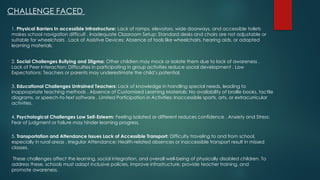
1. PhysicalBarriers In accessible Infrastructure: Lack of ramps, elevators, wide doorways, and accessible toilets
makes school navigation difficult . Inadequate Classroom Setup: Standard desks and chairs are not adjustable or
suitable for wheelchairs . Lack of Assistive Devices: Absence of tools like wheelchairs, hearing aids, or adapted
learning materials.
2. Social Challenges Bullying and Stigma: Other children may mock or isolate them due to lack of awareness .
Lack of Peer Interaction: Difficulties in participating in group activities reduce social development . Low
Expectations: Teachers or parents may underestimate the child’s potential.
3. Educational Challenges Untrained Teachers: Lack of knowledge in handling special needs, leading to
inappropriate teaching methods . Absence of Customized Learning Materials: No availability of braille books, tactile
diagrams, or speech-to-text software . Limited Participation in Activities: Inaccessible sports, arts, or extracurricular
activities.
4. Psychological Challenges Low Self-Esteem: Feeling isolated or different reduces confidence . Anxiety and Stress:
Fear of judgment or failure may hinder learning progress.
5. Transportation and Attendance Issues Lack of Accessible Transport: Difficulty traveling to and from school,
especially in rural areas . Irregular Attendance: Health-related absences or inaccessible transport result in missed
classes.
These challenges affect the learning, social integration, and overall well-being of physically disabled children. To
address these, schools must adopt inclusive policies, improve infrastructure, provide teacher training, and
promote awareness.
5.
• Ramps andElevators : Installation of ramps and elevators to allow
wheelchair access to classrooms and other area s. Accessible Toilets:
Restrooms equipped with grab bars and enough space for wheelchair
users . Wide Doorways & Handrails: Doorways widened and handrails
added to assist movement.
1. Flooring
•Material: Polished stone tiles (possibly granite, marble, or vitrified tiles).
•Finish: Glossy, reflective surface.
•Reason: Durable, easy to clean, and elegant for interior use.
2. Ramp
•Material: Mild steel or aluminum ramp with anti-slip rubber mat / textured metal sheet.
•Reason: Ensures wheelchair users can roll in smoothly without slipping.
3. Lift Platform
•Flooring Material: Textured aluminum /steel sheet or non-slip vinyl flooring.
•Guardrails: Tempered glass panels with stainless steel posts and handrails.
•Reason: Provides strength, safety, and modern aesthetics. Glass allows visibility while still protecting users.
4. Lift Shaft/Structure
•Material: Steel or aluminum frame with glass/metal cladding. Wide doorways.
•Finish: Powder-coated steel in grey/black for durability.
•Side Panels: Frosted or clear tempered safety glass for transparency and strength.
5. Signage
•Material: Acrylic or PVC board with printed accessibility (wheelchair) symbol.
•Finish: UV-resistant coating for visibility.
6. Staircase (beside lift)
•Steps: Likely polished stone treads (similar to flooring).
•Railing: Stainless steel railing with horizontal balusters and round top handrail.
•Reason: Steel railings are durable, easy to maintain, and comply with safety standards.
7. Walls
•Exposed Wall: Brick cladding (decorative exposed brick finish).
•Lift Wall (behind): Painted plastered concrete or gypsum wallboard with matte finish paint.
8. Wheelchair
•Frame: Lightweight stainless steel or aluminum.
•Seat/Backrest: Padded vinyl or nylon.
•Wheels: Rubber with steel/aluminum rims.
INFRASTRUCTURE IMPROVEMENT
6.
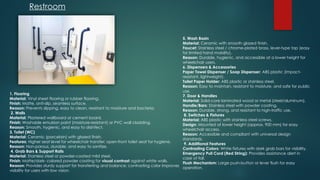
1. Flooring
Material: Vinylsheet flooring or rubber flooring.
Finish: Matte, anti-slip, seamless surface.
Reason: Prevents slipping, easy to clean, resistant to moisture and bacteria.
2. Walls
Material: Plastered wallboard or cement board.
Finish: Washable emulsion paint (moisture-resistant) or PVC wall cladding.
Reason: Smooth, hygienic, and easy to disinfect.
3. Toilet (WC)
Material: Ceramic (porcelain) with glazed finish.
Features: Higher seat level for wheelchair transfer; open-front toilet seat for hygiene.
Reason: Non-porous, durable, and easy to sanitize.
4. Grab Bars & Support Rails
Material: Stainless steel or powder-coated mild steel.
Finish: Matte/dark- colored powder coating for visual contrast against white walls.
Reason: Provides sturdy support for transferring and balance; contrasting color improves
visibility for users with low vision.
Restroom
5. Wash Basin
Material: Ceramic with smooth glazed finish.
Faucet: Stainless steel / chrome-plated brass, lever-type tap (easy
for limited hand mobility).
Reason: Durable, hygienic, and accessible at a lower height for
wheelchair users.
6. Dispensers & Accessories
Paper Towel Dispenser / Soap Dispenser: ABS plastic (impact-
resistant, lightweight).
Toilet Paper Holder: ABS plastic or stainless steel.
Reason: Easy to maintain, resistant to moisture, and safe for public
use.
7. Door & Handles
Material: Solid-core laminated wood or metal (steel/aluminum).
Handle/Bars: Stainless steel with powder coating.
Reason: Durable, strong, and resistant to high-traffic use.
8. Switches & Fixtures
Material: ABS plastic with stainless steel screws.
Design: Mounted at lower height (approx. 900 mm) for easy
wheelchair access.
Reason: Accessible and compliant with universal design
standards.
9. Additional Features
Contrasting Colors: White fixtures with dark grab bars for visibility.
Emergency Pull Cord (Red String): Provides assistance alert in
case of fall.
Flush Mechanism: Large push-button or lever flush for easy
operation.
7.
Circulation Inside theBuilding
1. Entrances & Doorways
•Width: Minimum 900 mm for wheelchairs; 1000 mm preferred.
•Handles: Lever-type (easier grip than round knobs).
•Thresholds: Flush or beveled (max. 12 mm height).
•Automatic Doors: Ideal for high-traffic spaces like schools.
Materials: Steel/aluminum doors with laminated panels; anti-slip matting at
entrances.
2. Corridors
•Width:
• Minimum 1500 mm (to allow two wheelchairs to pass).
• Turning radius: 1500 mm clear space at intersections.
•Handrails: On both sides, mounted 600–750 mm height for children.
•Flooring:
• Non-slip vinyl, rubber, or matte-finish tiles.
• Contrasting color strips for wayfinding.
•Signage:
• Large, high-contrast, braille and pictogram-based signs.
• Positioned at child’s eye level (~1000–1200 mm).
3. Stairs (if present)
•Width: At least 1500 mm.
•Handrails: On both sides, continuous, extended 300 mm beyond top & bottom.
•Steps: Uniform height (150 mm max for children).
•Nosings: Non-slip contrasting strip on edge of each step.
•Tactile Warning Strips: At top and bottom of staircases for children with low vision.
Materials: Stone/ceramic steps with anti-slip nosings; stainless steel handrails with
powder coating.
4. Ramps
•Slope: 1:12 ratio (gentle incline).
•Width: Minimum 1200–1500 mm.
•Landing: Every 9 meters, 1500 × 1500 mm flat space for resting.
•Handrails: On both sides, double height – 600 mm for children, 900 mm for adults.
•Surface: Non-slip finish (rubber matting, broom-finished concrete, or textured tiles).
5. Lifts/Elevators
•Size: Minimum 1100 × 1400 mm for wheelchair access.
•Controls:
• Buttons at 900–1200 mm height.
• Braille and raised numbers.
• Audio & visual signals.
•Doors: Automatic sliding, minimum width 900 mm.
•Interior: Mirror at back for reversing out.
Materials: Stainless steel walls (durable), non-slip vinyl floor, LED lighting.
6. Wayfinding & Orientation
•Tactile Pathways: Rubber or concrete tactile paving for visually impaired
children.
•Color Coding: Different floor or wall colors to guide through zones.
•Landmarks: Murals, textures, or child-friendly graphics for orientation.
7. Seating/Rest Areas
•Placement: Every 30–40 meters in long corridors.
•Material: Cushioned benches with armrests.
•Reason: Allows children with limited stamina to rest.
8. Emergency Exits & Safety
•Exit Routes: Wide, barrier-free, well-marked.
•Alarm Systems: Both audio (sirens) and visual (flashing lights).
•Evacuation Aids: Evacuation chairs near staircases
8.
1. Site Planning& Accessibility
•Accessible Pathways:
• Width: 1500 mm minimum.
• Material: Non-slip rubberized flooring, concrete with textured finish, or
tactile paving.
• Gentle slopes (max 1:12 gradient).
•Entrances: Wide, step-free, with ramps and handrails.
•Seating for Caregivers: Benches with backrests and armrests near play zones.
2. Ground Surfacing
•Preferred Materials:
• Poured-in-place rubber surfacing.
• Interlocking rubber tiles.
• Artificial grass with cushioned underlay.
•Properties: Shock-absorbing, slip-resistant, wheelchair-friendly, easy to maintain.
•Colors/Designs: Use bright, contrasting colors for wayfinding and playful
atmosphere.
3. Inclusive Play Equipment
•Swings:
• Bucket-seat swings with harness for children needing torso support.
• Platform swings for wheelchairs.
•Slides:
• Wide, gently sloped slides with side rails.
• Transfer platforms at top for wheelchair transfer.
•Merry-Go-Rounds:
• Flush-to-ground, wheelchair-accessible roundabouts.
•Climbing & Balancing:
• Low-height ramps with handrails.
• Rope nets at accessible heights.
•Sand & Water Play Tables:
• Raised platforms for wheelchair users.
• Smooth edges, safe materials (plastic, coated steel).
4. Sensory Play Areas
•Textures & Materials:
• Sensory walls with tactile panels (wood, rubber, fabric, stone).
• Musical instruments (drums, chimes, xylophones).
•Water Features: Interactive fountains or water jets with safe flooring.
•Gardens: Fragrant plants (lavender, basil, mint), butterfly gardens for
sensory stimulation 5. Safety Provisions
•Fencing: Around perimeter for safety, with wide gates.
•Shade Structures: UV-protective canopies, trees, or pergolas.
•Emergency Access: Clear paths for wheelchairs and stretchers.
•Soft Edges: Rounded equipment corners, padded railings.
6. Social & Rest Zones
•Seating Circles: Inclusive seating where wheelchair and non-wheelchair
children can sit together.
•Picnic Tables: Accessible versions with open sides for wheelchair entry.
•Quiet Zones: Small shaded areas for children who need rest or reduced
stimulation.
7. Materials Used
•Play Equipment: Powder-coated mild steel, HDPE (high-density
polyethylene), fiberglass-reinforced plastic.
•Ground: Rubber surfacing, EPDM granules, or cushioned vinyl.
•Handrails & Bars: Stainless steel/powder-coated steel for durability.
•Furniture (benches, tables): Recycled plastic lumber or treated wood
(smooth finish).
8. Additional Features
•Signage: Large, colorful, with braille for visually impaired children.
•Lighting: Even, glare-free LED lights for evening use.
•Inclusive Games: Floor markings for hopscotch, wheelchair basketball
courts, sensory trails.
Play & Recreation Areas
9.
Conclusion
Physically disabled childrenface a range of challenges in the educational environment, including physical
barriers, social stigma, lack of specialized teaching methods, and limited access to assistive technology. These
challenges negatively impact their ability to participate fully in academic, social, and extracurricular activities,
thereby hindering their holistic development . However, implementing well-planned solutions has demonstrated
significant positive outcomes. Modifications to school infrastructure—such as ramps, accessible toilets, and wide
doorways—create a more inclusive physical environment that enables easier mobility for disabled students. The
provision of assistive technologies, like braille books, speech-to-text software, and wheelchairs, addresses
specific learning and mobility needs, helping children access the curriculum more effectively.
Crucially, teacher training programs and peer sensitization initiatives foster an inclusive mindset, reduce
discrimination, and promote supportive classroom interactions. Individualized Education Plans (IEPs) and
vocational training empower students by offering personalized learning paths and practical skills that prepare
them for independent life beyond school . Parental involvement and community outreach are also key, as they
help reduce societal stigma and build a network of care around the child, enhancing their emotional well-being
and social integration . Despite notable progress, challenges remain, such as financial sustainability of specialized
services and the need for more advanced learning tools. Continued efforts from governments, educational
institutions, NGOs, and communities are essential to fully realize an inclusive education system that provides every
physically disabled child an equal opportunity to learn, grow, and succeed.





![제 23회 보아즈(BOAZ) 빅데이터 컨퍼런스 - [MBOAX] : ABSA를 활용한 소비자 반응 분석 기반 운영 효율화 대시보드 설계](https://cdn.slidesharecdn.com/ss_thumbnails/3-1boaz23rdconferencemboax-260203102709-9d519923-thumbnail.jpg?width=640&height=640&fit=bounds)


