Case 5
Group 3
Team 1
History
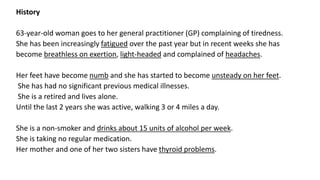
63-year-old woman goes to her general practitioner (GP) complaining of tiredness.
She has been increasingly fatigued over the past year but in recent weeks she has
become breathless on exertion, light-headed and complained of headaches.
Her feet have become numb and she has started to become unsteady on her feet.
She has had no significant previous medical illnesses.
She is a retired and lives alone.
Until the last 2 years she was active, walking 3 or 4 miles a day.
She is a non-smoker and drinks about 15 units of alcohol per week.
She is taking no regular medication.
Her mother and one of her two sisters have thyroid problems.
Examination
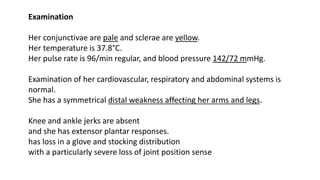
Her conjunctivae are pale and sclerae are yellow.
Her temperature is 37.8°C.
Her pulse rate is 96/min regular, and blood pressure 142/72 mmHg.
Examination of her cardiovascular, respiratory and abdominal systems is
normal.
She has a symmetrical distal weakness affecting her arms and legs.
Knee and ankle jerks are absent
and she has extensor plantar responses.
has loss in a glove and stocking distribution
with a particularly severe loss of joint position sense
1) Diagnosis
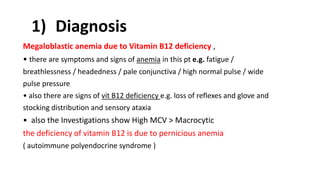
Megaloblastic anemia due to Vitamin B12 deficiency ,
• there are symptoms and signs of anemia in this pt e.g. fatigue /
breathlessness / headedness / pale conjunctiva / high normal pulse / wide
pulse pressure
• also there are signs of vit B12 deficiency e.g. loss of reflexes and glove and
stocking distribution and sensory ataxia
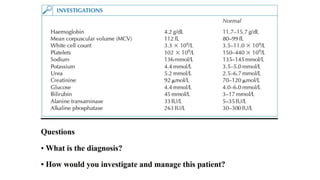
• also the Investigations show High MCV > Macrocytic
the deficiency of vitamin B12 is due to pernicious anemia
( autoimmune polyendocrine syndrome )
2) Investigations
 Complete Blood Count shows decrease RBCs and mild decrease on WBCs and
platelets and shows increase in MCV
 Serum vitamin B12 and folate levels should be measured
 Blood film shows macrocytic oval shaped RBCs ,
A proportion of the neutrophils show hypersegmented nuclei (with six or more
lobes).
 antibodies to intrinsic factor and parietal cells should be assayed.
Intrinsic factor antibodies are virtually specific for pernicious anaemia but are only present in about 50 per cent
of cases. Parietal cell antibody is present in 85-90 per cent of patients with pernicious anaemia but can also
occur in with other causes of atrophic gastritis.
 A radioactive B12 absorption test (Schilling test)
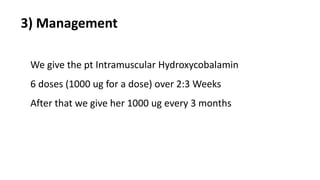
We give the pt Intramuscular Hydroxycobalamin
6 doses (1000 ug for a dose) over 2:3 Weeks
After that we give her 1000 ug every 3 months
3) Management
Questions
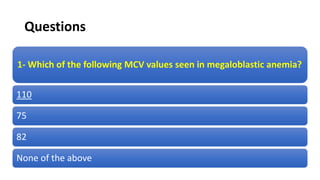
1- Which of the following MCV values seen in megaloblastic anemia?
110
75
82
None of the above
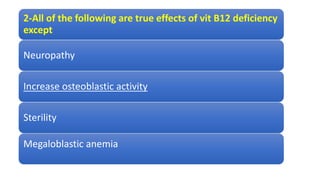
2-All of the following are true effects of vit B12 deficiency
except
Neuropathy
Increase osteoblastic activity
Sterility
Megaloblastic anemia
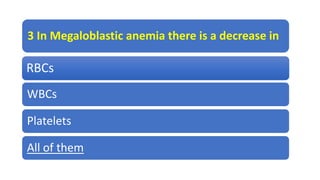
3 In Megaloblastic anemia there is a decrease in
RBCs
WBCs
Platelets
All of them
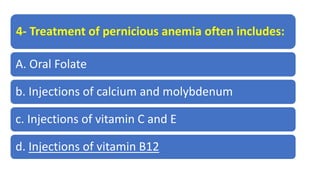
4- Treatment of pernicious anemia often includes:
A. Oral Folate
b. Injections of calcium and molybdenum
c. Injections of vitamin C and E
d. Injections of vitamin B12
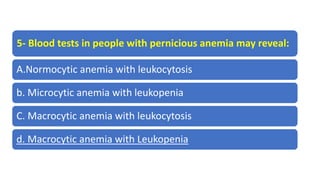
5- Blood tests in people with pernicious anemia may reveal:
A.Normocytic anemia with leukocytosis
b. Microcytic anemia with leukopenia
C. Macrocytic anemia with leukocytosis
d. Macrocytic anemia with Leukopenia

Case five anemia microcytic and diagnosis

  • 1.
  • 2.
    History 63-year-old woman goesto her general practitioner (GP) complaining of tiredness. She has been increasingly fatigued over the past year but in recent weeks she has become breathless on exertion, light-headed and complained of headaches. Her feet have become numb and she has started to become unsteady on her feet. She has had no significant previous medical illnesses. She is a retired and lives alone. Until the last 2 years she was active, walking 3 or 4 miles a day. She is a non-smoker and drinks about 15 units of alcohol per week. She is taking no regular medication. Her mother and one of her two sisters have thyroid problems.
  • 3.
    Examination Her conjunctivae arepale and sclerae are yellow. Her temperature is 37.8°C. Her pulse rate is 96/min regular, and blood pressure 142/72 mmHg. Examination of her cardiovascular, respiratory and abdominal systems is normal. She has a symmetrical distal weakness affecting her arms and legs. Knee and ankle jerks are absent and she has extensor plantar responses. has loss in a glove and stocking distribution with a particularly severe loss of joint position sense
  • 5.
    1) Diagnosis Megaloblastic anemiadue to Vitamin B12 deficiency , • there are symptoms and signs of anemia in this pt e.g. fatigue / breathlessness / headedness / pale conjunctiva / high normal pulse / wide pulse pressure • also there are signs of vit B12 deficiency e.g. loss of reflexes and glove and stocking distribution and sensory ataxia • also the Investigations show High MCV > Macrocytic the deficiency of vitamin B12 is due to pernicious anemia ( autoimmune polyendocrine syndrome )
  • 6.
    2) Investigations  CompleteBlood Count shows decrease RBCs and mild decrease on WBCs and platelets and shows increase in MCV  Serum vitamin B12 and folate levels should be measured  Blood film shows macrocytic oval shaped RBCs , A proportion of the neutrophils show hypersegmented nuclei (with six or more lobes).  antibodies to intrinsic factor and parietal cells should be assayed. Intrinsic factor antibodies are virtually specific for pernicious anaemia but are only present in about 50 per cent of cases. Parietal cell antibody is present in 85-90 per cent of patients with pernicious anaemia but can also occur in with other causes of atrophic gastritis.  A radioactive B12 absorption test (Schilling test)
  • 7.
    We give thept Intramuscular Hydroxycobalamin 6 doses (1000 ug for a dose) over 2:3 Weeks After that we give her 1000 ug every 3 months 3) Management
  • 8.
    Questions 1- Which ofthe following MCV values seen in megaloblastic anemia? 110 75 82 None of the above
  • 9.
    2-All of thefollowing are true effects of vit B12 deficiency except Neuropathy Increase osteoblastic activity Sterility Megaloblastic anemia
  • 10.
    3 In Megaloblasticanemia there is a decrease in RBCs WBCs Platelets All of them
  • 11.
    4- Treatment ofpernicious anemia often includes: A. Oral Folate b. Injections of calcium and molybdenum c. Injections of vitamin C and E d. Injections of vitamin B12
  • 12.
    5- Blood testsin people with pernicious anemia may reveal: A.Normocytic anemia with leukocytosis b. Microcytic anemia with leukopenia C. Macrocytic anemia with leukocytosis d. Macrocytic anemia with Leukopenia