Maximize the powers of Turmeric, Coconut Oil, Apple
Cider Vinegar, Ginger, Garlic, Raw Honey and Lemon
HOW TO USE
SUPERFOODS
AS MEDICINE
2.1 Introduction
2.2 For Fighting Infection and Boosting Your Immune System
2.3 For Dental Health
2.4 For Your Skin and Hair
2.5 For Memory Impairment and Alzheimer’s
2.6 For Cancer Treatment and Prevention
Table of Contents
1. Introduction
2.Coconut Oil
3.1 Introduction
3.2 For Fighting Infection
3.3 For Controlling Weight and Blood Sugar Levels
3.4 For Digestive Health
3.5 For Skin and Hair
3. Apple Cider Vinegar
4.1 Introduction
4.2 For Fighting Cancer
4.3 For Your Skin
4.4 For Balancing Your Blood Sugar
4.5 For Mental Health
4.6 For Pain and Inflammation
4. Turmeric
5.1 Introduction
5.2 For Indigestion and Stimulating Your Appetite
5.3 For Joint and Muscle Pain Relief
5.4 For Nausea
5.5 For Mental Health
5.6 For Cancer Treatment and Prevention
5. Ginger
This is the free version. The total content you can access will be limited. To unlock access to specific dosages
for each ailment, more home remedies, and recipes, you can upgrade by clicking these banners at anytime.
6.1 Introduction
6.2 For Boosting Your Immune System
6.3 For Fighting Candida and Yeast Infections
6.4 For Cardiovascular Health
6.5 For Cancer Treatment and Prevention
6. Garlic
7.1 Introduction
7.2 For Skincare and Haircare
7.3 For Healing Wounds
7.4 For Digestive Health
7.5 For Fighting Infections
7. Raw Honey
10.1 Cool Coconut Oil Recipes
10.2 Amazing Apple Cider Vinegar Recipes
10.3 Terrific Turmeric Recipes
10.4 Great Ginger Recipes
10.5 Glorious Garlic Recipes
10.6 Healing Honey Recipes
10.7 Lovely Lemon Recipes
10.8 For Cancer Treatment and Prevention
10.9 For Pain and Inflammation
8.1 Introduction
8.2 For Boosting Your Immune System
8.3 For Weight Loss
8.4 For Digestive & Liver Health
8.5 For Your Skin and Hair
8.6 For Heart Health and Mental Health
8. Lemon
10. Cooking With Superfoods
9. A Word of Caution
11. Thank You for Reading!
12. Sources
Introduction
But who are we?
Started a little over a year ago by Oren and Mo, The Hearty Soul is a thriving
community dedicated to spreading the knowledge of the world’s leading health
experts. Every day we’re collecting studies, tips, and recipes for some of nature’s most
healing foods in one place (right here!) to help readers like you live a healthier and
more natural life. Since its inception, The Hearty Soul has grown at an incredible pace.
Health statistics in the United States are alarming. If you’re an average American, you
will quite likely be diagnosed with a chronic illness by the time you’re 55. In fact, 78%
of American men and women around that age will have at least one chronic health
condition, and almost half of them will have two or more .
Cancer. Arthritis. Diabetes. Heart Disease. These words are spoken far, far too often.
So, if we’re spending more than most of the world on healthcare (a whopping 3
trillion dollars a year), why are more and more people seemingly suffering from such
poor health? As we researched the question further, we realized that something
didn’t add up.
2
1
Every success story we hear from our readers continues to make us smile. Still, others
have reached out to us through Facebook and email to ask for more remedies, more
precise dosages, and more coverage of other healing foods. That was when we
began to realize that individual articles alone weren’t doing enough.
We needed to do even more to help our readers be healthy and happy; we needed a
project that would cut through all the online clutter and misinformation to become a
definitive, research-based guide—free of fluff and exaggeration—for using food as
medicine. This text is the result of that realization, and the journey that followed.
The American healthcare problem is neglect. We neglect our bodies and our spirits.
We neglect time-tested solutions in favor of new pills. Many doctors neglect natural
cures, ancient remedies, and holistic approaches to health. Edward K from Saint Paul,
Minnesota wrote in telling us that, when diagnosed with diabetes, his doctor didn’t
even bother to ask him about his diet! The neglect goes on and on.
And yet millions of people have been empowered to take the reins of their own
health through natural, at-home food remedies and simple lifestyle changes. Newly
rediscovered ancient uses for all kinds of plants are spread online every day. Studies
frequently come out confirming much of what our ancestors have known all along.
For many of us, this is not news. Even the general public is finally catching on to the
health benefits of natural remedies and a holistic lifestyle. So then, what are we really
trying to accomplish?
If we have learned anything during the past year, it’s that the internet is actually too
full of information. There’s a reason readers like Monica E from Phoenix, Arizona have
to reach out to us to ask if she should take ½ or 5 cups of apple cider vinegar a day to
achieve better digestive health.
Each source seems to proclaim a new dosage for the same result, leaving readers
confused and unable to take those simple steps to a healthier life. Not to mention,
So, what’s going wrong,
and how do we fix it?
some dosages and recommendations can be downright dangerous! This problem is
why we knew we had to make a detailed guide containing the tested, science-backed
doses and uses for each superfood.
We have made everything as clear and accurate as possible (and also a little fun!) so
that you can find the trustworthy information you need without any trouble. As new
studies continue to come out and more becomes known, we will continue to keep
this resource up-to-date. If you think we can do something better, don’t be afraid to
reach out and tell us. We love making new friends. You can even just say hello!
So, whether you’re taking your first steps towards a healthier lifestyle, or you’re
already a natural health veteran, we hope you find the remedies, dosages, and
recipes inside this guide useful and insightful. We’ve picked out some of the most
versatile healing foods around, making sure to select those with the widest variety of
easy, natural uses. Many of them may already be in your kitchen! We know you’re
ready to have some fun, and live the healthiest and most fulfilling life you can.
Let’s hop right in
and meet our stars!
Coconut Oil
Turmeric Lemon
Garlic Honey
Apple Cider Vinegar Ginger
Coconut Oil
Coconut oil has been all the rage recently—and for good reason. It’s nutrient-rich,
full of healthy fats, and has countless uses in all facets of personal health! This news
has recently spread like wildfire around the world, and there are millions of people
now using it daily for everything from controlling weight to keeping skin and hair
beautiful and healthy. Even the realm of dental hygiene couldn’t escape coconut oil’s
healing powers!This chapter will cover all of these varied uses and the exact methods
and dosages you need to make them work best.
But first, what exactly is coconut oil? For thousands of years, inhabitants of South Asia
and South America have long used parts of the coconut fruit as a refreshing,
nutritious beverage and a healthy cooking staple. They have been well-aware of the
wealth of benefits coconut and its oil can provide. Even the coconut’s husk has been
used as a versatile raw material for making brushes, ropes, and fishnets! The flesh, or
coconut meat, however, is where the nutritious coconut oil comes from.
So, what kind of things can coconut oil be used for?
Although predominantly a saturated fat, scientists have discovered that coconut oil’s
unique composition makes it quite different from other fats: it consists of over 62%
medium-chain fatty acids (MCTs). In contrast to long-chain fatty acids, medium-chain
fatty acids do not get stored as fat, and are utilized quickly for energy. This is what
makes MCTs fantastic for weight loss and the perfect oil for those with difficulty
digesting fats, whether due to a digestive disorder or gall bladder removal. The two
main MCTs found in coconut oil are lauric acid and caprylic acid, which provide
coconut oil its anti-inflammatory and anti-microbial properties.
For all the tips and recipes below, we strongly recommend you use virgin coconut oil.
It’s expeller-pressed from dried fresh coconut meat, preserving its natural nutrients
and other healing properties. Refined coconut oil should be avoided where possible;
it’s exposed to potentially harmful chemicals through the bleaching and
deodorization process, and research has shown it to be inferior to virgin coconut oil
in terms of its health benefits, and, in particular, its antioxidant status. 3
For Fighting Infections and Boosting
Your Immune System
Let’s say that you got a cut or fell and scraped your elbow or knee. What would you
do in that situation? Maybe rinse out the wound. That’s good. What’s next? Apply an
antimicrobial cream like Neosporin? Stop right there! You’re on the right
track—disinfecting and preventing infections are crucial steps in the healing
process—but did you know that there are cheaper and more natural alternatives to
the synthetic options found in stores? Coconut oil is one of the best natural
alternatives due to its ability to fight infections! In fact, there’s even a homemade,
natural antibiotic ointment recipe featuring coconut oil right at the end of this
section!
Few natural substances can singlehandedly relieve pain, moisturize, and kill bacteria
and viruses (everything from the flu to even HIV ) like coconut oil can.
4
5
Uses, Doses, and Methods
For Cold Sores
For Cuts, Scrapes, Bruises, and Burns
Whether ingesting it or applying it topically, either method or a combination of the
two is a recipe for success! Regardless of the problem (and even if there isn’t a
problem yet!) eating as little as 2 tablespoons
6
of coconut oil—or incorporating it
into your cooking, if you aren’t a fan of eating oil by the spoonful, like some—can
have immense healing and preventative benefits.
Cold sores are actually caused by a virus (one related to the herpes virus) so the
antiviral properties in lauric acid
7
help kill off this virus! Coconut oil can also help
ease discomfort and heal the surrounding skin when applied directly
to the sore.
A little coconut oil applied to any kind of damaged skin can work wonders for
relieving pain and speeding recovery
8
. Simply cover the damaged skin with a thin
layer of coconut oil to reduce inflammation.
Unlock exact dosages, at-home remedies, and detailed recipes by upgrading to the full version at any time.
For Candida Overgrowth & Yeast Infections
Research has shown that the lauric and capric acids found in coconut oil are effective
in killing the pathogen C. Albicans that causes candida. In fact, they were even more
effective than the popular drug Fluconazole for treating yeast infections
9 10
. Caprylic
acid in particular works extremely well because it can penetrate the cell membranes
of candida yeast cells and cause them to die off.
When it comes to diet, the best course of action is to eat foods low in concentrated
sugars and to work coconut oil into your diet in any form each day.
Unlock exact dosages, at-home remedies, and detailed recipes by upgrading to the full version at any time.
Antibiotic Ointment
All-Natural Homemade
Here it is. The home-run hitting recipe to knock your medicine cabinet to the moon.
The clever concoction that will knock your socks off, moisturize your feet, and
disinfect them. You can use it on any cuts, scratches, bruises, skin irritations, or burns,
anywhere on your skin! Hopefully you’re ready to have this wonder ointment ready in
just over 30 minutes. If you’re not it’s fine to just take a breather for a moment.
• ½ Cup coconut oil
• ½ Cup olive, almond, or grapeseed oil
• ½ Cup healing herb mix containing
Acalendula, chamomile, comfrey,
Aplantain leaves, and lavender
• 2 Teaspoons witch hazel
• 4 Tablespoons beeswax
• 15 drops essential tea tree oils
...............................................
Goodness, each of these ingredients is so powerful
I might be healing just thinking about them!
1. Put all the herbs into a glass jar and submerge them in whichever oil you’re using.
2. Put the jar into a pot half-filled with water and heat on low heat for 30 minutes,
stirring often.
3. Strain the oil by pouring the mixture through a coffee filter or a cheese cloth.
4. Pour the oil back into the jar and return it to the pot with the water.
5. Add the beeswax and continue stirring on low heat.
6. Once the beeswax is fully melted take the pot off the heat.
7. Add witch hazel and mix well.
8. Let cool and store in airtight container of choice. Somewhere cool is preferable to
preserve freshness longer.
Bam! There you have it, the natural antibiotic ointment you have deserved all along.
Apply a teaspoon to cuts, burns, scrapes, bee stings, and so on, 2 to 3 times a day
until healed.
To Make, Simply
For Dental Health
Alongside bathing, dental hygiene is one of the few healthcare concerns absolutely
everyone will have during their life. And for many, the question of optimal routine or
best practice starts and ends at childhood with a parent’s toothbrushing prescription.
Are there even any alternatives?
You probably suspect there are. Would you be surprised to learn coconut oil is one?
In fact, coconut oil has been proven to be as—if not more effective than—regular
mouthwash
11
. Hundreds of thousands of people use it daily as part of their dental
hygiene routine for everything from whitening to promoting cleanliness and gum
health. In fact, the practice of oil pulling (one of the most popular methods of using
coconut oil for improving and maintaining dental health) dates back thousands of
years!
So, what exactly can coconut oil do for your dental health, and how should you use it?
Uses, Doses, and Methods
Though regular consumption of coconut oil alone can probably have a positive
impact on oral health, the primary method of dental cleaning using coconut oil comes
in the form of oil pulling. An ancient Ayurvedic technique, oil pulling consists of
swishing an oil—in this case coconut oil, for its added antimicrobial benefits—for 20
minutes and spitting it out. The process is like using a mouthwash, except the
swishing lasts quite a bit longer and is more natural (if you like coconut, it’s also a lot
better tasting)!
Using a coconut oil pull or toothpaste can also reduce the exposure to fluoride, which
many store-bought toothpastes contain. Fluoride is a hormone disrupting substance,
and is also capable of causing an erosion and staining of the teeth called dental
fluorosis.
Who doesn’t love a set of pearly whites? When used in the form of oil pulling, coconut
oil can be an effective substitute to store-bought whitening toothpastes and strips.
Although most results to date are anecdotal, you can at least be sure that you are not
unknowingly doing irreparable damage to your teeth. The added antimicrobial
benefit of coconut oil will also help fight off plaque and prevent other possible future
problems from arising.
For Whitening Teeth
Killing Oral Bacteria and Improving Breath
The research is in, and coconut oil has shown to be just as effective as mouthwash
for improving bad breath (and much safer) thanks to its antibacterial properties
12 13
.
Unlock exact dosages, at-home remedies, and detailed recipes by upgrading to the full version at any time.
For Preventing and Relieving Gingivitis
The antimicrobial effects of coconut oil extend to all kinds of unwanted bacteria,
including those that lead to plaque-induced gingivitis
14
. Research has shown that its
anti-inflammatory and antibacterial properties even help relieve inflamed gums, stop
their bleeding, strengthen them, and reverse their degeneration
15
.
For Your Skin and Hair
Psst, here’s a secret: coconut oil can work wonders on dry skin and keep hair
healthy and strong. Don’t spread it around, okay?
Just kidding, that’s no secret at all! Millions of people are using coconut oil every
single day to keep frizzy hair at bay and their skin smooth and hydrated! In fact,
these uses are some of the most well-documented and popular of the many uses
coconut oil provides.
Unlock exact dosages, at-home remedies, and detailed recipes by upgrading to the full version at any time.
Let’s get right into the action. Coconut oil is known for having a powerful
moisturizing effect on the skin and hair. This moisturization forms the basis for its
many skin and haircare uses. If your skin is feeling a little bit dry, just rub some
coconut oil on—dry no more! But coco oil (as some endearingly call it) is so much
more than a chemical-free, natural moisturizer.
Applying it to the skin will not only moisturize, but may also help repel bugs and
prevent bug bites (or ease the pain and itching if it’s too late). Coconut oil also acts
as an antimicrobial that can accelerate skin repair and keep wounds clean. This
means that any damage to the skin, like stretch marks or cuts, will not only be
moisturized, but also aided in their healing process.
When it comes to healing, how about the one thing everyone is trying to heal: the
passing of time? Coconut oil may not literally take you back to those blissful
childhood memories (at least the studies are still inconclusive…), but keeping your
skin moisturized and well-cared for can make you look—and feel!—years younger.
Uses, Doses, and Methods
For Dark Circles, Wrinkles, and Anti-Aging
For UV Protection and Sunburn Relief
Did you know approximately 75% of commercial sunscreens contain toxic
ingredients?
18
What’s more, in an attempt to protect against sunburn, most
sunscreens also block the beneficial UV radiation we need to make Vitamin D.
Coconut oil, on the other hand, provides just the right amount of protection from
sunburns and skin cancer without blocking out the beneficial rays!
19
Perhaps this is
why Pacific Islanders have been using it as sunscreen for decades.
Acne-prone skin is often actually too dry; though applying any kind of oil may seem
counterintuitive, a pea-sized amount of coconut oil may actually reduce oil gland
stimulation and help keep skin oil balanced and acne-free. Plus, research has
shown coconut oil to be effective against eliminating p. acne, the main causative
organism of acne vulgaris
20
.
For Acne
New research has shown that coconut oil helps those with itchy, scaly skin find
relief, which is fantastic news for those with atopic dermatitis and conditions such
as eczema and psoriasis
21
. Eczema patients in particular suffer from impaired
barrier function which leads to a loss of moisture and can encourage bacterial
infections. This is where the moisturizing, anti-inflammatory and antimicrobial
properties of coconut oil truly shine.
For Skin Conditions
Coconut oil not only helps lubricate skin for shaving, it also doubles as a
moisturizer, but without the exposure to toxic ingredients! What's more, since
coconut oil has antibacterial properties, it's particularly helpful for those who
experience razor burn or are shaving delicate skin!
For Shaving
Why use a conditioner full of chemicals few people can even pronounce, especially
when an even better alternative is right at hand? Thanks to its moisturizing
Unlock exact dosages, at-home remedies, and detailed recipes by upgrading to the full version at any time.
For Hair Protection and Strength
Research has found that a large cause of dandruff is an excess of the
scalp-dwelling fungus known as Malassezia globosa (M. globosa). Of course,
having a dry scalp doesn’t help either. What better to use than coconut oil as a
proven anti-fungal and moisturizer?
For Dandruff
properties, coconut oil is the perfect hair treatment to prevent hair damage from
brushing and combing, and keep it strong and healthy.
Even for calming down hopelessly frizzy hair, a little coconut oil goes a long way.
Applying coconut oil onto the hair will help get frizz under control, and can help
reduce thermal damage from common hair tools like blow dryers and flat irons.
For Frizz
A word of warning for those with a love for hair dye: coconut oil is known for
stripping hair color back to its natural state, so if that isn’t your goal you may need
to pass on most of these hair uses. On the other hand, those trying to ditch their
current color to return to their original can actually benefit from this effect.
Unlock exact dosages, at-home remedies, and detailed recipes by upgrading to the full version at any time.
For Removing Dyes
For Memory Impairment and Alzheimer's
Those suffering from impaired memory themselves, or who have loved ones affected
by it, will know that it is one of the worst things that can happen to someone. The
brain fog, inability to recall basic information, and eventual complete breakaway from
reality, can all take a heavy toll on a person and everyone around them.
What’s worse, the problem is considered incurable by the modern medical
establishment. Though research for solutions continues, the lack of answers and
treatments can have devastating effects on everyone involved.
Fortunately, one of the possible solutions currently being explored is (you guessed it)
coconut oil! A few recently conducted studies have shown positive results and future
potential for the use of coconut oil as a preventative measure and a treatment.
Studies Bring Hope
One study published in Neurobiology of Aging found that those memory-impaired
participants that were given medium-chain triglycerides, which make up up over 60%
of coconut oil, experienced a significant increase in their cognitive abilities. Another
study published in the Spanish journal Nutrición Hospitalaria showed similar results,
with a test group of participants suffering from Alzheimer’s demonstrating noticeable
improvement in cognitive test scores after taking just over 1 oz of coconut oil daily.
The benefit was more noticeable, however, in more severe cases, women, and those
without diabetes.
Overall, more testing needs to be done, but the early signs are promising. The
biology behind coconut oil’s effect on the body seems to support the idea as well.
Unlike other fats, coconut oil’s medium-chain fatty acids are not converted into body
fat. Instead, they are sent to the liver and converted to ketones, which act as an
efficient backup energy source for the brain if blood glucose levels are too low or, as
is the case with Alzheimer’s, the brain cannot convert glucose into energy.
For Cancer Treatment and Prevention
23
24
25
Like Alzheimer’s, cancer has the ability to leave devastation in its wake, and, like
Alzheimer’s, the current treatment leaves much to be desired. Chemotherapy and
other invasive procedures are the norm, and their side-effects on the body take a
costly toll.
Research continues on possible alternative treatments of all kinds, but so far there are
only promising leads. Fortunately, natural superfood remedies, like those throughout
this guide, pose little risk of harm. Though knowing their effectiveness for sure will be
difficult until more evidence is found, adding a few tablespoons of coconut oil a day
to your diet can only provide benefits in the long run.
Cancer and Tumour Prevention
Though research on coconut oil as a cancer-fighter is still inconclusive, some studies
are showing signs of coconut oil’s usefulness in cancer prevention and reducing the
growth of tumors; the research was conducted on prostate and colon cancer
respectively. That being said, adding a few tablespoons a day may have a positive
effect. And, if anything, it's at least highly unlikely that coconut oil will have a negative
impact. With all the other healing benefits it provides for your body and mind,
coconut oil is at least worth a shot.
Coconut Relief
While research is still being conducted on its usefulness as a cure for cancer, what is
clear is its impact as a pain reliever for cancer patients. In fact, one study found that
coconut oil had a significant beneficial impact on women suffering from breast cancer.
Women reported improvements in everything from sleep difficulties and loss of
appetite, to body image and future perspective. The researchers concluded that
coconut oil had caused a noticeable improvement in the quality of life of the women
undergoing chemotherapy. And as research for better treatments and even a cure
continues, for those battling cancer now, a few tablespoons a day may make the
battle much more tolerable and, as a result, much more winnable.
26 27
28
Apple Cider Vinegar
Turns out the benefits of consuming apples don’t just stop at eating“an apple a
day”. The natural sugars found in apples also lend themselves as the perfect
candidates for fermentation, resulting in a byproduct (apple cider vinegar!) that has
endless benefits. Its power lies in its active compound: acetic acid.
Acetic acid is a potent antimicrobial that can be used to treat multiple types of
infection, a fantastic blood-sugar stabilizer, helping both diabetics and those who are
trying to lose weight, and a tonic for the cardiovascular system, by working to lower
blood pressure and cholesterol levels. Consuming even a tablespoon a day mixed in
water is a great way to start reaping these benefits.
When looking to purchase apple cider vinegar, look for one that’s organic, unfiltered,
and unpasteurized so that you’re getting the health benefits from the amino acids,
minerals, enzymes, and friendly bacteria!
For Fighting Infection
Apple Cider Vinegar has two functions that make it a great fighter of infections. First,
it can stop bacteria and fungus from spreading (bacteriostatic), and second, it can
actually kill the existing pathogenic cells (bactericidal). It’s no wonder this powerful
vinegar has been used for centuries to treat all kinds of infections! Even today, apple
cider vinegar is commonly used to treat food products to ensure they're safe from
dangerous bacteria like E. coli
29
.
Use apple cider vinegar regularly during cold and flu seasons to prevent catching a
sinus infection. Its ability to kill bacteria, act as an antiseptic, reduce inflammation,
and break up mucus will help avoid sleepless nights, stuffy noses, and distracting
headaches.
For Your Sinuses
Uses, Doses, and Methods
Apple cider vinegar has been used to cleanse and treat wounds for generations!
The antibacterial vinegar will help you to heal faster and prevent infections
naturally.
For Cleaning Cuts and Scrapes
Want to stop sore throats from getting worse? The germs that cause scratchy, sore
throats and coughing won’t thrive in an acidic environment.
For Relieving and Healing a Sore Throat
Nobody likes bad breath. Most chronic bad breath is caused by certain types of
bacteria that build up in your mouth. Instead of trying to mask halitosis with mints
and store-bought mouthwash, eliminate it at the source with apple cider vinegar!
For Better Smelling Breath
Unlock exact dosages, home remedies and detailed recipes, you can upgrade to the paid version at anytime!
Drinking vinegar helps create a slightly acidic environment in your urine, so that
harmful bacteria can’t grow. In particular e.coli, the main bacteria that causes
cystitis. Essentially, you’ll become your own antibacterial agent, effectively
cleansing your urinary tract every time you “go”.
For Preventing UTI’s
Foot Bath
Natural Apple Cider Vinegar
This ACV foot bath not only treats (stinky) fungal infections, but helps to relax
muscles and soothe sore feet!
• 2 Cups apple cider vinegar
• ½ Cup Epsom salt
1. Mix all 3 ingredients in a large bowl. Soak your feet in the foot bath until it gets
cold. Do this once a week!
Unlock exact dosages, home remedies and detailed recipes, you can upgrade to the paid version at anytime!
• ½ Gallon hot water (more
Awarm than hot, really)
...............................................
What to do:
For Controlling Weight and
Blood Sugar Levels
Almost everyone struggles with their body weight at one time in their life.
Thankfully, nature supplies one of the best helping hands: apple cider vinegar!
Research has shown that this superfood helps reduce overall body weight and
body fat mass! Plus, it even has properties that make diabetes much easier to live
with. So, how does apple cider vinegar manage to work its magic?
ACV works to suppress your appetite by making you feel fuller with the food you
eat. This is because of its pectin content (a type of fibre naturally found in apples).
This fullness effect was tested in a study with healthy US soldiers, where
researchers found that ingesting any amount of pectin helped the soldiers feel full
for up to 4 hours.
Apple cider vinegar can also be used to control blood sugar levels, which also
helps with managing cravings. In one study, scientists found that men and
30
31
32 33
women with Type 2 diabetes woke up with much better blood sugar levels when
they consumed of ACV before bed, than if they only drank a glass of water. This
effect is great news for everyone, not just those with diabetes!
34
When stable blood sugar is the goal, the key to success is to consume apple cider
vinegar regularly before meals. Vinegar helps to partially block the absorption of
carbohydrates, mitigating the potential impact on your blood sugar levels. Plus, it’ll
help quell any cravings before your next meal, preventing you from reaching out
for a snack.
Uses, Doses, and Methods
For Controlling Blood Sugar (and cravings!)
If you’re looking for a trick to help keep you from overeating during meals, take
advantage of the natural benefits of apple cider vinegar. The naturally satiating
properties of ACV will help your brain recognize when you’ve had enough, so you
don’t accidentally overeat.
To Prevent Overeating
For Digestive Health
Unlock exact dosages, home remedies and detailed recipes, you can upgrade to the paid version at anytime!
The digestive benefits of apple cider vinegar are two-fold: the acetic acid in
vinegar helps absorb minerals from our food, and the acidic nature of ACV serves
as a remedy for acid reflux. Wait a minute—isn't acid reflux caused by too much
acid? Nope!
Paradoxically, that awful burning sensation isn’t necessarily caused by too much
stomach acid, it’s often the result of too little acid. Due to factors such as poor diet,
low water intake, and excessive intake of antacids, most people have low stomach
acid, which is required for digestion. When it’s too low, the body turns to
fermentation as a means to break down food, resulting in off-gassing, burping, and
acid backsplash associated with acid reflux! When you consume apple cider
vinegar, it increases the acidity of your stomach temporarily to aid digestion.
Taking apple cider vinegar at the onset of heartburn or acid reflux can help the
discomfort go away within minutes. Always keep this on hand, especially for large
meals!
For Quick Heartburn Relief
Uses, Doses, and Methods
The acidic content of apple cider vinegar mimics stomach acid, and can thereby
aid digestion if you have low stomach acid. (Taking the simple stomach acid test at
home is a good start to see where you're at!)
By boosting your stomach acid you will not only strengthen your digestion and
absorb nutrients better, but you will also experience less bloating, gas,
constipation and more energy overall!
For Increasing Stomach Acid
Unlock exact dosages, home remedies and detailed recipes, you can upgrade to the paid version at anytime!
Apple cider vinegar is so adaptable, and can be used safely from your face to your
feet. The trick is to mix it with just the right things for maximum benefit, as well as
to know how often to repeat your beauty regimen. Keep reading to find out the
Uses, Doses, and Methods
For Skin and Hair Care
When it comes to skin and hair care, apple cider vinegar is the perfect, inexpensive
solution! First of all, ACV can fight infections in the skin that leads to itchiness,
rashes, and discomfort. This is because of its acetic acid content, which has been
scientifically shown to disinfect different kinds of bacteria
36
. The antifungal and
antibacterial properties of apple cider vinegar translate to a wide variety of uses for
everyone’s skin type.
And when it comes to hair, science shows that apple cider vinegar is an important
part of preventing breakage, dandruff, and giving you the healthy shine you’re
looking for. One group of researchers found that organic acid (such as apple cider
vinegar) has the ability to bond with proteins in hair
37
. This prevents breakage that
occurs from every day washing.
Unlock exact dosages, home remedies and detailed recipes, you can upgrade to the paid version at anytime!
best methods for promoting holistically healthy skin and hair with one of nature’s
most effective multi-purpose remedies!
Uses, Doses, and Methods
Apple cider vinegar is fantastic for swapping out with your regular face wash or
even as a toner. It helps balance the natural pH of the skin, clears away excess oils
and make-up, and breaks the bonds between dead skin cells to keep pores open!
For Rejuvenating the Skin
If you’re prone to acne, apple cider vinegar is ideal to use in your skincare regimen
since it kills off bad bacteria, and removes the excess dirt and oil that can clog up
pores and cause pimples to form.
For Treating and Preventing Acne
Ready to de-frizz your hair, stop your scalp from itching, and return its natural
shine? Whereas regular shampoos and haircare products can strip hair of its natural
oils and leave it dry and brittle, the acidity of apple cider vinegar helps hair
maintain its ideal pH of 4 to 5, without stripping the hair of its natural oils.
Plus, thanks to its antibacterial and anti-fungal properties, apple cider vinegar is
ideal for relieving a flaking, itchy and dry scalp.
For Healthier Hair
Unlock exact dosages, home remedies and detailed recipes, you can upgrade to the paid version at anytime!
Turmeric
You probably have noticed the explosion of turmeric products and supplements on
the market, and the headline-grabbing attention it has received even amongst
mainstream media and literature.
Native to Indonesia and Southern India, turmeric has been harvested for over 5000
years, and been used not only as a healing remedy, but also as a textile dye and
condiment in curries.
So why all the fuss now? Well, recent research has confirmed the healing power of its
active compound: curcumin, even more powerful than some drugs. This
phytonutrient is an extremely potent anti-inflammatory, meaning it can help reduce
the symptoms of chronic disease where systemic inflammation plays a role.
(Hint: that’s pretty much every chronic disease) What’s more, turmeric is high in
antioxidants and supports liver health exceptionally well. That makes it an excellent
spice to include in your daily diet for immune support, anti-aging benefits and
detoxification.
When looking to consume turmeric, keep in mind that the bioavailability of curcumin
is quite low when eaten on its own. To begin with, there is only about 3% curcumin
available in turmeric root, so it is important to consume it alongside black pepper
and a good fat, as curcumin is fat-soluble.
Note on Absorption
There is a huge difference between daily, preventative use and therapeutic use. If
you’re looking for clinical results, it is not enough to consume turmeric tea or use it in
your cooking. For example, most anticancer research is done using doses up to 3
grams of curcumin, 3 to 4 times per day.
While there is no harm in adding fresh turmeric to your recipes, for relief from serious
ailments such as arthritis, dementia or cancer, a therapeutic dose from a supplement
in either capsule or tincture form would be most beneficial.
General vs Therapeutic Dose
The most common ways to enjoy turmeric is in curries, adding it to smoothies, as a
tea, and as a latte. As was explained in the introduction, curcumin is not very
“bioavailable”, meaning our bodies aren’t optimized to digest it. To get the full
benefits of curcumin in turmeric, you should always take it with black pepper and a
good fat. Piperine, a compound found in black pepper works to slow our digestive
properties and give it time to fully absorb the nutrients in turmeric.
Turmeric comes in many forms. Luckily, the University of Maryland Medical Center
has clearly laid out how much turmeric to take for each specific type of turmeric. The
following daily dosages are recommended for adults seeking optimal health
Uses, Doses, and Methods
• Cut root: 1.5 to 3 grams per day
• Dried, powdered root: 1 to 3 grams
A per day
• Standardized powder (curcumin): 400
A to 600 milligrams, 3 times per day
• Fluid extract (1:1): 30 to 90 drops
A per day
• Tincture (1:2): 15 to 30 drops, 4
A times per day
Up until the past decade, turmeric was mainly used to add color to curries and as a
natural remedy in Ayurvedic medicine. In recent years, this spice has been enjoying
an immense surge in popularity that some experts have likened to a “gold rush”.
The cause? Cancer. More specifically, the crowning achievement that put turmeric
on the global natural health map is its ability to fight cancer effectively without the
negative side-effects of chemotherapy. In fact, curcumin has more evidence-based
research supporting it as a treatment for cancer than any other nutrient!
Specifically, the active compound in turmeric, curcumin, stops precancerous
changes within DNA and interferes with enzymes necessary for cancer progression.
Thousands of peer-reviewed studies have researched curcumin and have found
that not only does it promote the death of cancer cells, it stops the spread of
cancer cells, and prevents cancer cell regrowth.
For Fighting Cancer
39
If you are undergoing cancer treatment or are in remission, it is advisable to consume
curcumin in supplement form in doses at a high dose. It is also important to ensure
that the supplement is of high quality and provides superior absorption .
Uses, Doses, and Methods
For Your Skin
40
Very few store-bought cosmetics can claim that they target multiple skin conditions.
If you’ve been looking for that all-in-one solution that treats everything from acne,
eczema, redness, inflammation, dark circles, and unwanted facial hair, turmeric might
just be your golden ticket. In fact, Indian brides have long used turmeric face masks
to purify, cleanse, and brighten their skin right before their weddings.
What’s more, its topical application has even proven to be effective for serious
conditions such as psoriasis and skin cancer. 41
Unlock exact dosages, at-home remedies, and detailed recipes by upgrading to the full version at any time.
When applying turmeric to the skin for the first time, take care to wear clothes you
don’t mind getting stained and cover any furniture around you. Additionally,
although turmeric is mild in taste, it is still a spice and can burn your eyes. Be careful!
There's a good reason South Asian brides apply turmeric all over their skin before the
big day! Thanks to its anti-inflammatory properties, turmeric helps clear the skin of any
redness, puffiness and bumps.
What's more, curcumin actually inhibits secretion of excess melanin in the skin (this is
what gives skin its dark colour)! This helps to brighten the skin and can fade tans as
well.
Uses, Doses, and Methods
For Glowing Skin
Not only is turmeric excellent at reducing the inflammation that comes with acne, but it
is also an exceptional antibacterial and antiseptic, making it great for getting to the
root of skin infections and breakouts.
For Treating Acne
42
Unlike pimples, psoriasis is an enduring skin condition that doesn’t have a full cure, and
treatment is more complex. However, numerous studies have looked at the effect of
turmeric in treating this autoimmune skin condition, and all of them point to the
compound curcumin as an effective agent for inhibiting and controlling the spread of
psoriasis.
Unlock exact dosages, at-home remedies, and detailed recipes by upgrading to the full version at any time.
For Psoriasis
Turmeric Face Mask
All-In-One
Try this simple and effective all-in-one turmeric face mask for all your skin
problems.
• 1 Teaspoon turmeric
• 2 Tablespoons flour
1. Mix turmeric and flour in a bowl.
2. Add almond oil and milk and mix together to form a paste.
3. Apply to face, taking care to avoid the eyebrows and eyelashes.
4. Let sit for 20 minutes before rinsing with lukewarm water and patting your skin dry.
• 1 Tablespoon almond oil
• 3 to 4 Tablespoons of organic milk
(or non-dairy milk)
...............................................
What to do:
Just like in the previous sections, studies looking at turmeric have found that the
compound that gives turmeric its yellow color, curcumin, is the key player in the
regulation of blood sugar. In fact, a study published in the journal Diabetes Care found
that curcumin was 100% effective at preventing pre-diabetic patients from developing
Type 2 Diabetes
43
.
But what about those who already have diabetes? Well, you’re in luck. A study
published in the journal Biochemistry and Biophysical Research Community found that
curcumin was 400 to 100,000 times more potent than Metformin, one of the leading
drugs for treating diabetes
44
.
Given that at least 40% of the US population ages 40 to 74 are believed to have
prediabetes, according to CDC statistics, this information is a huge breakthrough for
advocates of alternative health!
For Balancing Your Blood Sugar"
Uses, Doses, and Methods
Whether you’re just concerned about your blood sugar, are pre-diabetic, or are
suffering from diabetes, turmeric is one of the best natural remedies available. As a
general rule of thumb, take 1 teaspoon of powdered turmeric daily in your food or
drink.
However, If you’re currently taking drugs to treat your diabetes, avoid using turmeric as
it can lead to excessively low levels of blood sugar. Speak to your doctor or naturopath
about weaning off your medication while increasing your dose of curcumin.
For Mental Health
Research has found that curcimin has a neuroprotective action and is helpful for
multiple disorders of the brain like Alzheimer’s, major depression, epilepsy, tardive
dyskinesia, and more. While the exact mechanism is still being researched, scientists
are predicting it is largely due to the anti-inflammatory and high antioxidant properties
of curcumin
45
.
Unlock exact dosages, at-home remedies, and detailed recipes by upgrading to the full version at any time.
Uses, Doses, and Methods
When depression impairs your ability to function at work or affects your daily life,
treating it is important. Typical treatments for depression often involve speaking with a
doctor and taking medication. While medication can be helpful in severe cases, it has
been shown to be ineffective in mild cases of depression
46
. And even if it is helpful, the
fact is that antidepressants are riddled with side effects, from daily feelings of numbness
to increasing suicidal thoughts (slightly counterproductive, don’t you think?
47
.
This is where turmeric comes into play. A recent study showed that turmeric was even
more effective than Prozac, perhaps the most well-known drug for depression, for major
depressive disorder.
For Depression
Turmeric has been used for over 5000 years in India, where both rural and urban
populations have extremely low rates of Alzheimer’s. Is it any wonder that new research
is now shedding light on its efficacy in treating and preventing this disease?
A recent study showed that consumption of of curcumin by Alzheimer’s patients greatly
improved their behavioural symptoms and burden on caregivers over a 12-week
period
48
. Furthermore, two studies were able to specifically show that curcumin could
protect against and enhance the clearance of amyloid-beta plaque (the main cause of
Alzheimer’s)
49 50
.
Lastly, another study from Germany narrowed down a compound in turmeric
(surprisingly, this time it wasn’t curcumin), called turmerone which stimulates the growth
of new brain cells and promotes the brain’s regenerative functions
51
. While preliminary,
these findings hold promise for the future use of turmeric as a treatment for other
degenerative brain diseases, such as Parkinson’s.
Unlock exact dosages, at-home remedies, and detailed recipes by upgrading to the full version at any time.
For Brain Cell Growth and Alzheimer’s
A study of working adults over the age of 60 found that turmeric was an effective
supplement in treating the memory loss symptoms connected with prediabetes.
This is probably the most popular use for turmeric! Curcumin is well-known for its
ability to fight inflammation and the pain that comes with it. Perhaps that's why so
many people turn to curcumin for relief from arthritic pain, inflamed lungs and even
menstrual cramps.
For Improved Memory
For Pain and Inflammation
Uses, Doses, and Methods
According to the Arthritis Foundation, an estimated 50 million adults have diagnosed
arthritis. That’s 1 in 5 people over the age of 18! This number is projected to grow over
For Arthritis
Unlock exact dosages, at-home remedies, and detailed recipes by upgrading to the full version at any time.
the coming years.
The standard treatment for arthritis is using painkillers and anti-inflammatory drugs
such as Prednisone, which offer a Band-Aid solution and end up suppressing the
immune system in the long-run, along with a host of other harmful side-effects. Relying
solely on these drugs is no longer necessary, however, as groundbreaking research has
shown that curcumin was even more effective than a popular drug (under various brand
names such as Voltaren, Cataflam)
52
.
Turmeric works to treat coughs and colds in two ways. First, it contains compounds
which inhibit inflammation-causing cytokines. Second, its antibacterial and antiviral
powers allow it to target the infection directly.
Turmeric is most effective when treating a dry cough (coughs that don’t produce any
phlegm). The more your dry cough continues, the more irritated and inflamed your
lungs and respiratory tract will become. Unlike over-the-counter drugs for dry coughs,
which trick the brain into not coughing, try this turmeric gargle that actually reduces
the inflammation.
For Treating Cough and Colds
If you experience painful menstrual cramps each month, you'll know that Ibuprofen can
be a life-saver! Why use something that damages your stomach lining when research
has shown that curcumin is just as effective? Thanks to its anti-inflammatory properties,
curcumin is able to reduce the pain from cramping and muscle spasms.
For Menstrual Cramps
Unlock exact dosages, at-home remedies, and detailed recipes by upgrading to the full version at any time.
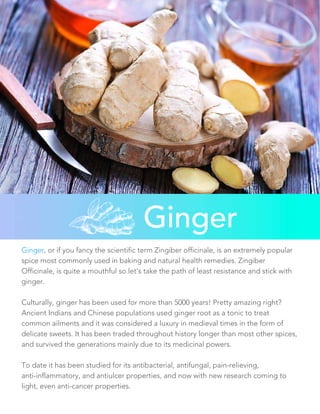
Ginger
Ginger, or if you fancy the scientific term Zingiber officinale, is an extremely popular
spice most commonly used in baking and natural health remedies. Zingiber
Officinale, is quite a mouthful so let’s take the path of least resistance and stick with
ginger.
Culturally, ginger has been used for more than 5000 years! Pretty amazing right?
Ancient Indians and Chinese populations used ginger root as a tonic to treat
common ailments and it was considered a luxury in medieval times in the form of
delicate sweets. It has been traded throughout history longer than most other spices,
and survived the generations mainly due to its medicinal powers.
To date it has been studied for its antibacterial, antifungal, pain-relieving,
anti-inflammatory, and antiulcer properties, and now with new research coming to
light, even anti-cancer properties.
Uses, Doses, and Methods Overview
For Indigestion and Stimulating
Your Appetite
Ginger is more effective when taken as a whole food, 240% more effective to be
exact. A common and simple way to enjoy ginger is through a soothing tea made
by boiling freshly chopped ginger root for 5-10 minutes, and sweetening it with
honey or stevia.
• For Adults: Adults should limit their intake of ginger root to no more than 4 grams
daily . This dosage recommendation includes ginger root consumed from food
sources such as ginger bread, ginger ale, and ginger snaps.
• For Pregnant Women: Women should not take more than 1 gram of ginger root
daily. Typically, expectant mothers are advised to take 250 milligrams of ginger root
up to four times daily to reduce pregnancy-related nausea.
• For Children: Generally, children between the ages of 2 and 6 should not consume
more than 2 milligrams of ginger root per day. Always consult your child's
pediatrician before giving your child ginger root to ensure you provide your child
with the correct dose of this supplement, as it can vary by weight.
54
53
A teaspoon of ginger helps the medicine go down…the medicine go down...the
medicine go down. If you don’t know that song, than you led a sad childhood. Just
kidding. In reality the song is talking about sugar, but for all intensive purposes
ginger has way, way, way, more nutritional benefits.
Phenolic compounds (a fancy way to say chemical combinations), like gingerol and
various other volatile oils, are primarily responsible for ginger tea's beneficial effect
on your digestive system.
Uses, Doses, and Methods
Whether you're recovering from a bout of illness or you just haven't had much of
an appetite due to stress, consuming ginger can help stimulate your appetite. It
helps overcome feelings of nausea and promotes the secretion of saliva, bile and
gastric juices.
For Stimulating Digestion
As a carminative and antispasmodic root herb, ginger is well-known for helping
combat indigestion after a meal, cramps, and relieving painful gas.
Unlock exact dosages, at-home remedies, and detailed recipes by upgrading to the full version at any time.
For Relieving Indigestion
For Joint and Muscle Pain Relief
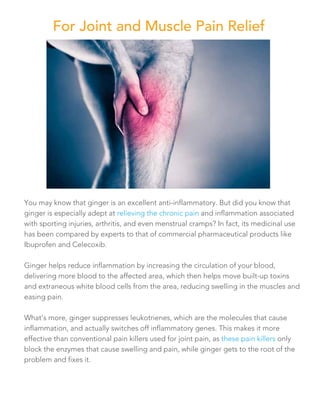
You may know that ginger is an excellent anti-inflammatory. But did you know that
ginger is especially adept at relieving the chronic pain and inflammation associated
with sporting injuries, arthritis, and even menstrual cramps? In fact, its medicinal use
has been compared by experts to that of commercial pharmaceutical products like
Ibuprofen and Celecoxib.
Ginger helps reduce inflammation by increasing the circulation of your blood,
delivering more blood to the affected area, which then helps move built-up toxins
and extraneous white blood cells from the area, reducing swelling in the muscles and
easing pain.
What’s more, ginger suppresses leukotrienes, which are the molecules that cause
inflammation, and actually switches off inflammatory genes. This makes it more
effective than conventional pain killers used for joint pain, as these pain killers only
block the enzymes that cause swelling and pain, while ginger gets to the root of the
problem and fixes it.
Uses, Doses, and Methods
As well as being a potent anti-inflammatory, ginger is fantastic at boosting
circulation by encouraging blood flow to your muscles, thereby relieving any aches,
pains, and overall soreness.
In one study done by the State University in Milledgeville, taking of raw or
heat-treated ginger reduced muscle pain following exercise-induced muscle injury
by 25% and 23%, respectively
55
.
In another study published in the Journal of Preventative Medicine, it was found
that women (60 competitive Taekwondo players, to be specific) who ginger
powder daily had less muscle soreness after exercising than the placebo group
56
.
Sometimes after a tiring day, you just need a long, hot soak in the tub to relieve
tired and aching muscles. Luckily, when ginger is added to the bath it amplifies the
benefits by reducing inflammation, pain and muscle soreness.
It all starts with the type of Ginger you select. The recommendation is to use
smooth, dry, firmly skinned ginger, and avoid anything that is soft or wrinkled. No
elderly pieces, if you will. You can also break the ginger and smell it. The hotter the
smell the stronger the ginger. And you want it HOT, HOT, HOT!
Typically, ginger is ingested for fast relief of pain and inflammation, but it can also
be applied as a cream externally.
For Muscle Soreness
Unlock exact dosages, at-home remedies, and detailed recipes by upgrading to the full version at any time.
Ginger Soak
Instead of using a deep heat spray or cream that's full of harmful chemicals, you
can purchase or make your own ginger-infused cream to relieve pain and
inflammation.
For women suffering from menstrual cramps each month, Ibuprofen can be a
necessity. Unfortunately, it also comes side-effects like gut damage over long
periods of use. What if there was something natural that was just as effective as
Ibuprofen? Research has shown that, when directly compared to Ibuprofen, ginger
is just as effective
57
.
Ginger Cream
For Menstrual Cramps
Ginger is very well known for being effective at treating symptoms of arthritis like
chronic joint pain. In fact, ginger has been found to be as, if not more, effective at
treating joint pain than most conventional pain relievers
58
. Plus, it doesn’t come
with a host of side-effects such as GI problems, high blood pressure, kidney
damage, or allergic reactions.
For Arthritis
Unlock exact dosages, at-home remedies, and detailed recipes by upgrading to the full version at any time.
Ginger
Bath
1. You will need a 1 cup Epsom salts and 3 Tbsp ground ginger (or fresh, minced).
Powder works better as it can absorb better into the cells.
2. Turn on the water in the bathtub and put it on the hottest setting possible, it should
A be steaming. While the bath is filling up, throw the ginger into the bath as it is
filling, turn off the water once it is full and let sit for around 5 to 10 minutes.
3. The water should now be fully infused. Lie down in the bath and try to submerge as
A much of your body as possible. Stay in for at least 15-30 minutes. Do this as much as
A possible to help reduce or prevent muscle and joint pain.
To Make:
Unlock exact dosages, at-home remedies, and detailed recipes by upgrading to the full version at any time.
For Nausea
Travel sickness aside, one of its most popular uses is actually for pregnant women who
experience morning sickness. According to a recent study, ginger has demonstrated a
75% success rate in curing morning sickness and the stomach flu. The ginger acts as a
calming agent and, when compared to a placebo, performed with shining colors in
various clinical tests. Research has also proven that ginger is just as effective as
medication such as Dramamine and even vitamin B6 for treating nausea
62 63
. Why take
a medication with side-effects when ginger will get you the same result?
Have you ever suffered through a long, queasy plane ride, envious of the person next
to you? Well, you might want to consider ginger for your next trip. used to treat
Uses, Doses, and Methods
Unlock exact dosages, at-home remedies, and detailed recipes by upgrading to the full version at any time.
65
For Mental Health
Did you know that ginger can increase the number of neurotransmitters in your
brain? These are the chemicals used by brain cells to communicate with each
other. For example, you may have heard of these two before: dopamine and
serotonin. They control your ability to concentrate, feel wakeful and alert, and help
regulate mood, memory, cravings, addictions, sleep, and more!
Given that 86% of Americans have suboptimal levels of neurotransmitters, it might
be time to add some ginger to your diet!
Uses, Doses, and Methods
Unlock exact dosages, at-home remedies, and detailed recipes by upgrading to the full version at any time.
Dementia is an umbrella term used to describe a decline in mental ability, and can
include specific conditions such as Alzheimer’s and Parkinson’s. For example,
patients often live in a world where they believe themselves to be significantly
younger and are easily confused by modern day reality.
A study done in 2011 showed that when healthy middle-aged adults were given
dried ginger supplements, they showed improvements in working memory,
reaction time, and attention
66
.
For Treating and Preventing Dementia
Cutting edge science now points to this common spice as a possible treatment for
Alzheimer’s. In fact, a new study published in the Indian Journal of Experimental
Biology suggests that ginger may be an excellent natural anti-Alzheimer’s (AD)
treatment
67
.
How so? One compound found in ginger (6-gingerol) increases activity of
acetylcholine, a neurotransmitter that plays an important role in learning and
memory. The best Alzheimer’s drugs currently available work by a similar
mechanism. Drugs like Aricept slow the progression of this disease by blocking an
enzyme that breaks down acetylcholine. Although there is no cure for these
diseases, ginger provides hope that their might be a natural and effective
prevention method.
For Treating and Preventing Alzheimer’s
For Cancer Treatment and Prevention
Natural alternatives to traditional cancer treatments are all the buzz right now, as
invasive treatments can, in fact, be carcinogenic, meaning they can cause
secondary cancers in the people they are treating
69
.
To date, the research on ginger as an effective agent in the prevention and
treatment of skin cancer , liver cancer , lung cancer , breast cancer , pancreatic
cancer , and colorectal cancer is looking promising. However, it is important to
keep in mind that this research was conducted in animal models, or in in vitro (petri
dishes using isolated extracts), so it is not possible to translate this into efficacy in
humans with a guarantee, or for that matter, a specific dosage.
Perhaps the closest dosage one could ascertain is 100 grams for a 70 kilogram
adult on average, as an aid in cancer treatment. Where did this number come
from? An animal study done on prostate cancer found that 100 mg per kilogram of
body weight was effective at reducing a tumour by 56% . (That’s a very large root
or approximately 2 cups chopped. Yikes!)
70 71 72 73
74 75
76
Ginger Targets Stem Cells
Better Than Chemo
A clinical study done by Georgia State University, found that ginger extract
induced growth of healthy cells and promoted death amongst cancerous cells. In
contrast, chemotherapy kills cancerous and healthy cells at the same time. That
being said, in comparison to chemo and radiation, ginger was found to have
virtually no side-effects
77
.
Another study, published in PLoS found that one particular component in ginger
known as 6-shogaol was superior to conventional cancer medication, namely
chemotherapy, at targeting the root cause of breast cancer malignancy—cancer
stem cells
78
. These are cells that are able to self renew, capable of continuous
separation, are resistant to conventional chemotherapeutic agents, and are
capable of splitting off and forming new tumor clusters. The only way to fully
ensure that your body is cancer free is to destroy the cancer stem cells within
a tumor.
While the findings on this topic are far too preliminary, this is a very promising
Garlic
Garlic is a herb grown around the world for over 5000 years, making it one of the
oldest cultivated plants in the world. Aside from adding flavor, it’s gaining attention
for its wide array of health benefits, in particular as an antimicrobial, cardiovascular
tonic, and due to its cancer-fighting capabilities.
On top of being a great solution for serious health issues, garlic is equally effective as
a treatment for common ailments like fever, coughs, headaches, stomach aches,
sinus congestion, asthma, tooth sensitivity, stomach inflammation, stress, and fatigue.
In fact, research on garlic indicates that it may provide an ideal low-cost and safe
alternative to a multitude of drugs.
Garlic can be eaten in its whole raw state, in capsule form, in oil and extracts, or as a
powder. When eating raw garlic, it is best to chop or mince it, and then leave it on
the counter for 10 minutes. This is because the enzyme alliinase needs time to turn
the main constituent in garlic, called allin, into the compound allicin, which has
antibacterial, antifungal, and antiviral effects. To take it up a notch, it’s been said that
chewing garlic first thing in the morning on an empty stomach can increase its power.
In terms of dosage, it is widely agreed that eating two cloves of garlic on a daily basis
will ensure that you are capitalizing on all of garlic’s wonders—across all health
ailments and preventative measures alike.
If you’re looking for therapeutic results however, keep in mind that allicin found in
raw garlic is quite unstable, and it would be better to consume stabilized allicin in
capsule form to get the best results.
Garlic is an immunity-boosting superstar! Garlic enhances the body’s ability to
defend itself by improving immunity through the production of natural killer cells.
These cells kill all invaders without the specific targeting that antibodies use to kill
pathogens, making it an excellent natural option for immune-related issues, such as
the cold and flu.
What’s more, garlic is mineral-rich, chock-full of calcium, sulfur, phosphorus, and iron;
perhaps this is why many many refer to it as ‘the antibiotic from nature’.
For Boosting Your Immune System
79
Thanks to the active compound allicin, garlic is the perfect antidote to fight off,
limit the symptoms, and shorten the longevity of the common cold and flu. A 2001
study published in the journal Advances in Therapy found a daily garlic supplement
can reduce the number of colds by 63 percent compared to their placebo
counterparts. Moreover, the average length of cold symptoms was also reduced
70 percent, from five days in the control group to 1.5 days in the garlic
supplementation groups.
Beyond the common cold, research confirms that garlic has immensely powerful
anti-infective properties, proven to kill both common and fatal infections, including
but not limited to: Methicillin Resistant Staphylococcus Aureus (MRSA), the herpes
virus, and ear infections.
For Cold and Flu
Beyond the common cold, research confirms that garlic has immensely powerful
anti-infective properties, proven to kill both common and fatal infections, including
but not limited to: Methicillin Resistant Staphylococcus Aureus (MRSA), the herpes
virus, and ear infections.
For Killing Infection-Causing Bacteria
MRSA is responsible for causing over 80,000 severe infections and 11,000 deaths
each year. Luckily, research has shown that using stabilized allicin extract found in
garlic can help in the treatment of MRSA. One human trial in particular
conducted in 2008 by Dr. Ron Cutler at UEL showed that all 52 patients recovered
fully from their MRSA infections, with wounds healing between 4 to 12 weeks.
For MRSA (Staph Infection)
Uses, Doses, and Methods
80
81 82
Garlic Lemon Shots
Immune-Boosting Raw Honey
• 1 Organic lemon
• 1 to 2 Cloves of garlic
1. Cut lemon in two halves.
2. Squeeze all the lemon juice out of one half and place in a small bowl. Keep the
A half you extracted the juice for Step 5 (store the other half for later use).
3. Chop the garlic and let it sit for at least 10 minutes. Then add it to the lemon
Unajuice with cayenne pepper.
4. Add the honey to the mix and stir all ingredients well.
5. Pour the entire mixture back into the lemon half (which you extracted the juice
A from in Step 2).
6. Consume the finished product in its entirety, including all the lemon pulp. Hold
A it in your hand and cup it as if you’re holding a fruit. Repeat recipe in four hours
A with the other lemon half.
• 1/8 Teaspoon of cayenne pepper
• 1 Tablespoon of raw honey
...............................................
The herpes simplex, while relatively harmless, can be an annoying and recurring
viral infection that is often manifested in the form of blisters on the lips. This,
believe it or not, can be remedied with a single clove of garlic.
For Treating Herpes
Ear infections, common in children, are of serious health concern due to their
complications, such as damaging or rupturing the eardrum, which can lead to
chronic recurrence, or in extreme cases, deafness. While it is important to consult a
doctor, immediate pain relief can be achieved by natural means. Due to its
antibacterial properties, garlic can kill off an ear infection without side-effects and
speed up the healing process.
For Fighting Candida and Yeast Infections
For Relieving Ear Infections
As a potent antifungal, garlic is fantastic at killing yeast. At the same time, it serves
as a prebiotic in the gut, providing food for good bacteria to thrive!
Candida, the short name for candidiasis, is used to describe yeast overgrowth in
the body. “Candida Albicans” live in all mucous membranes, such as the intestines,
bladder, stomach, lungs, and vagina. One of its important functions is to recognize
and destroy harmful bacteria.
Under control, candida poses no problem, but when it gets out of control it begins
to overgrow, causing several symptoms and health problems such as brain fog,
cravings, bad breathe and yeast infections. Luckily, taking garlic on a daily basis is a
powerful tool to help combat this problem.
A fresh garlic clove can easily cure a yeast infection. While the trick is to catch the
infection early, garlic’s benefits for attacking yeast infections can work both in mild
and extreme cases. While the oral ingestion of garlic is beneficial for combating all
bacterial and fungal infections, for yeast infections specifically, using garlic as a
vaginal suppository works best. (Yes, you heard right!)
For Treating Yeast Infections
Unlock exact dosages, at-home remedies, and detailed recipes by upgrading to the full version at any time.
For Treating Candida
Uses, Doses, and Methods
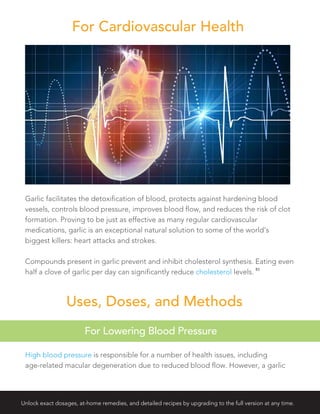
Garlic facilitates the detoxification of blood, protects against hardening blood
vessels, controls blood pressure, improves blood flow, and reduces the risk of clot
formation. Proving to be just as effective as many regular cardiovascular
medications, garlic is an exceptional natural solution to some of the world’s
biggest killers: heart attacks and strokes.
Compounds present in garlic prevent and inhibit cholesterol synthesis. Eating even
half a clove of garlic per day can significantly reduce cholesterol levels.
83
For Cardiovascular Health
High blood pressure is responsible for a number of health issues, including
age-related macular degeneration due to reduced blood flow. However, a garlic
Unlock exact dosages, at-home remedies, and detailed recipes by upgrading to the full version at any time.
For Lowering Blood Pressure
Uses, Doses, and Methods
supplement a day may help keep your blood pressure at bay, and is even
comparable to the effects of prescribed drugs. In fact, garlic has been proven to
aid in the control and reduction of blood pressure (hypertension)—as much as 7 to
8% in people suffering from high blood pressure.
84 85
How is this possible you ask? Turns out the high amount of sulfur containing
molecules in garlic activate the production of a compound that promotes
vasodilation (widening of blood vessels), following the relaxation of the smooth
muscle in the vessel wall.
Garlic can help lower the risk of heart disease by improving blood flow, reducing
the risk of clot formation, and lowering the total LDL cholesterol. A study published
in the journal Annals of Internal Medicine in 2000 found that garlic effectively
reduced cholesterol in people with elevated levels.
For Lowering Risk of Heart Disease
For Cancer Treatment and Prevention
Unlock exact dosages, at-home remedies, and detailed recipes by upgrading to the full version at any time.
86 87
Studies prove that a diet rich in garlic results in a significant drop in the risk of
multiple types of cancer, such as gastric, colorectal, and liver, to name a few.
88 89 90
The
protective effects from garlic stem from its antibacterial properties and its ability to
block the formation of cancer-causing substances, halt the activation of
cancer-causing substances, reduce cell proliferation, enhance DNA repair, or induce
cell death. The protective effects of garlic have shown to have a dose response
relationship. The highest exposure to the food shows the greatest decrease in risk. In
other words, the more the better!
While the National Cancer Institute does not currently recommend any dietary
supplement for the prevention of cancer, it recognizes garlic’s anti-cancer properties.
Since all garlic preparations are not the same, it is difficult to determine the exact
amount of garlic that may be needed to reduce cancer risk.
Therefore, the uses and dosage of garlic for anti-cancer purposes is recommended to
follow the average daily dose of at least 2 to 5 grams of fresh garlic (approximately
one to two cloves) or 300 to 1,000 mg of garlic extract.
Unlock exact dosages, at-home remedies, and detailed recipes by upgrading to the full version at any time.
Uses, Doses, and Methods
Raw Honey
You may know that honey is made by bees for food, but did you know honey also
contains a ton of benefits for humans, beyond just its sweet taste? Unlike sugar,
which is an isolate of sugarcane, honey is a whole food containing all the whole food
trademarks: live enzymes, probiotics, prebiotics, and amino acids. Of course, that’s
when you buy honey in raw form. Raw honey is unpasteurized (not exposed to heat)
which keeps its enzymes and good bacteria intact and preserves its benefits.
Raw honey also contains a powerful enzyme, known as glucose oxidase, which
provides raw honey with its antibacterial and antiseptic properties, making it fantastic
for wound healing and killing infections, even something as strong as a staph
infection! Raw honey also tends to retain bee pollen, which is not only energizing and
rich in amino acids, but also helps the body acclimatize to local bee pollen and ease
allergy symptoms.
While both raw honey and white sugar list a similar amount of sugar (in grams) on a
nutrition label, research has shown that when we consume a whole food sweetener as
opposed to an isolated form of sugar, there is a significant difference in our body’s
response to it.
A clinical study published in 2010 in the Journal of the American College of Nutrition
analyzed the effects of honey and sugar on blood sugar levels
94
. Those who ate
honey experienced, “a blunted glycemic response” (a slower response in the rise of
blood sugar) and “a positive modulation of appetite hormones” (a slower sugar
crash, resulting in longer-term satisfaction after eating)
95
.
Another difference between sugar and honey is that sugar as we know it is a relatively
new introduction to our diets. We’ve been eating honey for thousands of years. Our
bodies know how to process it, the sugar-isolate on the other hand… not so much!
Without the presence of vitamins, minerals and live enzymes, this incomplete
carbohydrate metabolism creates a toxic metabolite called pyruvic acid, which can
interfere with the respiration of the body’s cells.
The Sugar Vs. Honey Debate
Honey can been used as a natural and cost-effective way to find relief from seasonal
allergies, as it can reduce histamine levels. You may find it useful to reduce allergy
symptoms like watery and itchy eyes, sore throat, coughing, and headaches. However,
keep in mind that it’s best to buy local bee pollen in order to build up an immunity to
the plants in your area. Experiments prove that with consistent use, honey ingested in
high doses improve allergy symptoms of all kinds
96
.
Unlock exact dosages, at-home remedies, and detailed recipes by upgrading to the full version at any time.
For Seasonal Allergies
For Skincare and Haircare
Unlock exact dosages, at-home remedies, and detailed recipes by upgrading to the full version at any time.
You may have heard that sugar right before bed is a recipe for a sleepless night, and
studies not only tend to agree, but also prove that raw honey’s natural composition
aids in the overnight repair process
97 98
. Honey promotes a deep restorative sleep by
supplying the liver with dequate fuel during your sleep as your body enters a brief fast,
and contributes to the release of melatonin in the brain. Together, these assure a
deep, well-rested sleep.
As a Sleeping Aid
Uses, Doses, and Methods
Honey is an affordable, and equally effective alternative to conventional chemical acne
solutions. And it’s gentle enough for all skin types, and for everyday use! As a
natural antibiotic, raw honey kills bacteria-causing acne while preventing future
breakouts, its acidity prevents bacteria growth, it reduces inflammation, its antioxidants
prevent damage caused by free radicals, and its sticky texture actually helps to pull out
the dirt and grime as well. Phew!
Honey is the perfect addition to any skincare regimen. With its antioxidant and
antimicrobial properties, honey helps support skin rejuvenation, treats mild acne, and
leaves the skin feeling supple and soft. With such a wide range of benefits, it’s no
wonder that honey is consistently used in skincare products on the market!
The simplest natural recipe for incorporating raw honey into your beauty routine is
super easy: apply one spoon of raw honey smoothly over your face for 20 minutes,
rinse off, and repeat a few times a week.
For Acne
Honey’s hydrating properties make it a great addition to your skincare regime. So how
does it work? It is known as a humectant, which means it has the ability to pull moisture
from the air and retain it; this is what makes it an excellent moisturizer!
For Dry Skin and Eczema Relief
99 100
Unlock exact dosages, at-home remedies, and detailed recipes by upgrading to the full version at any time.
Face Mask Recipe
Honey Lavender
• 1 Tablespoon raw honey
1. Mix the ingredients, dampen your face with warm water, and smooth on the honey
A and lavender mixture.
2. Leave the mask on for 15 minutes.
3. Then rinse off with warm water.
This lavender honey face mask has boosted antimicrobial properties, and can also
help your mind relax!"
• 3 drops of lavender essential oil
...............................................
What to do:
101 102
Honey has tons of hair benefits too! It can strengthen hair follicles and keep the scalp
healthy, leading to a head of healthy, luscious locks. It can be used as a natural
softener, stimulate hair growth, improve shine, re-hydrate, and prevent psoriasis and
dandruff on your scalp.
Honey is an exceptional natural alternative to conventional store-bought treatments for
burns.
Why does it work so well, you ask? Well, when raw honey is placed on the wound, it
takes on the water content around the wound and helps prevent infection. The
antibacterial properties of the honey help prevent any further infection and combat
For Hair
For Healing Wounds
103
Unlock exact dosages, at-home remedies, and detailed recipes by upgrading to the full version at any time.
105
any already existing infection. The honey also moisturizes the skin as the wound is
healing, lessening the likelihood of scars.
Honey has been used as a remedy for digestive problems of all kinds for ages.
Everything from constipation to ulcers has been improved through the use of honey.
Raw honey contains over 5000 live enzymes, including digestive enzymes such as
amylase to break down carbohydrates. This reduces the burden on the body to
produce these enzymes itself, thereby making the digestive process more efficient. Its
antibacterial and antifungal properties also help defend against pathogens that can
lead to ulcers, such as H. Pylori.
For Digestive Health
Uses, Doses, and Methods
To give your digestive system a hand, simply use a tablespoon or two of honey to
counteract any indigestion problems before a heavy meal. Better yet, take a proactive
approach and eat about a tablespoon of honey daily as a prebiotic. It will promote the
growth of good bacteria in the intestine, and prevent digestive problems before they
have the chance to arise.
H Pylori is a bacterium commonly found in the stomach. Once it penetrates the
stomach's mucous lining, it can produce substances that weaken the lining of the
stomach and make it more susceptible to damage from gastric acids as well.
Fortunately, Honey inhibits bacterial growth in your digestive tract and is, as a result,
often used to heal stomach ulcers and H. pylori.
For Ulcers and H. Pylori
For Fighting Infections
Our ancestors have long been aware of raw honey’s antimicrobial powers, and recent
studies continue to confirm this knowledge. Raw honey has even been shown to be
effective against antibiotic-resistant strains of bacteria.
What makes honey so good at killing bacteria? Well, its antibacterial properties lie in
its release of hydrogen peroxide, a well-known antimicrobial. Manuka honey, a
special type, is even more effective at fighting bacteria, simply because it is higher in
antibacterial activity!
106
107
Unlock exact dosages, at-home remedies, and detailed recipes by upgrading to the full version at any time.
108
You might be thinking: what was that about Manuka honey? You heard it right. Manuka
honey is even better at fighting infections than regular raw honey, and using Manuka
honey is preferable to regular raw honey for this purpose.
What is it? Well, Manuka is a type of raw honey, known for its exceptionally strong
antimicrobial properties. It comes from New Zealand where it’s been used for
medicinal purposes by the Maori tribes for centuries. Unlike other honeys, the
antibacterial properties of Manuka don’t break down when exposed to heat or light. In
1981 research from the University of Waikato found that these weren’t just claims, they
were true.
Hot drinks such as tea have been a time-tested way to sooth throat tenderness and
aches. Increase the soothing and healing effect of any hot drink by simply adding a
tablespoon or two of raw (or Manuka) honey to taste.
Manuka Honey
Uses, Doses, and Methods
Honey isn’t just good at helping prevent surface damage from becoming infected, it
has also been proven to help fight off infections inside the body. Specifically, honey
poses a real threat for MRSA (Methicillin-resistant Staphylococcus aureus), also known
as the staph infection, which is covered in a biofilm that makes it resistant to many
antibiotics. Honey has been scientifically proven to kill the MRSA virus in chronic ulcers.
Manuka honey synergizes well with conventional antibiotics and makes the harmful
bacteria more susceptible, and therefore more treatable, to them
109
.
For MRSA
Unlock exact dosages, at-home remedies, and detailed recipes by upgrading to the full version at any time.
For those of you who are not a fan of swishing coconut oil in your mouth, there's always
the option of using raw honey to kill plaque as well. Specifically, Manuka honey’s
antimicrobial powers have proven to be an effective natural addition to any dental
hygiene regimen, helping treat not only plaque but also conquer dental abscesses,
decay and cavities as well.
For Plaque
A 2004 study published in the Medical Science Monitor showed that topical application
of honey worked better than conventional herpes medications and drugs in treating
both labial (lip) and genital herpes. Honey minimized the severity and duration of the
attacks, pain, and crusting, and improved treatment healing time, as compared to the
standard treatment using acyclovir. To boot, honey caused zero side effects with
repeated applications, a significant factor, considering those patients taking the
standard drug developed itching and irritation
111
.
For Herpes
Unlock exact dosages, at-home remedies, and detailed recipes by upgrading to the full version at any time.
Lemon
Why is it that every nutritionist and fitness expert these days is shown holding a glass
of lemon water in their hand? It’s because of the lemon’s wealth of health benefits, of
course! There’s a good reason why health and wellness experts can’t seem to get
enough of this citrus fruit.
Lemons got their first claim to fame as a medicinal remedy when it was discovered
that their high Vitamin C content helped prevent scurvy. Although scurvy is no longer
such a major concern, Vitamin C’s innumerable benefits are still useful for our
immune system and skin health in particular.
If the Vitamin C content isn’t enough to sell you on them, lemons also contain a
unique combination of flavonoids making them high in antioxidants, which is fantastic
for boosting heart health. They also aid digestion by stimulating bile production,112 113
For Boosting Your Immune System
help stabilize blood sugar
114
, act as a mild diuretic to flush out toxins, and help keep
weight off thanks to pectin, a soluble fiber that keeps you full and fights diabetes.
115
Phew! And for less than a dollar for one lemon (although maybe not in the Far
North!), why wouldn’t you make this a part of your daily routine?
Before going further, let’s clear up any concern about possible enamel damage from
consuming lemon and lemon juice. As long as you’re not using it like mouthwash,
your teeth will be fine! As a best practice, feel free to rinse your mouth out with water
after consuming lemon, or, for drinks, simply drink out of a straw to avoid the teeth
altogether.
Lemons are high in vitamin C (18.6mg per lemon to be exact), which is great for
boosting your immune system i.e. the perfect combatant to the common cold and
flu. Lemons also have the ability to prevent bacterial growth, treat throat infections,
and alleviate chest congestion.
116
117
Unlock exact dosages, at-home remedies, and detailed recipes by upgrading to the full version at any time.
What’s more, its high potassium content makes it an ideal ingredient in an electrolyte
drink for recovery following a fever or a bout of dehydration.
Uses, Doses, and Methods
For Weight Loss
No one likes getting a cold. Researchers found that the Vitamin C found in lemons can
help to reduce the duration of colds and infections, when consumed on a regular basis
119
.
What's more, it also serves as the perfect remedy for a sore throat or a nagging cough. In
2015, researchers determined that taking lemon with honey was more effective for
treating children’s night coughs than medication
118
.
Looking to shed a few pounds or burn body fat? Time to stock up on lemons. Thanks
to their polyphenol content, lemons directly assist in fat-burning activity by improving
insulin resistance and affects how efficiently your body metabolizes fat.
120
High in
pectin fiber, lemons also give a feeling of fullness and help fight pesky hunger cravings.
For Treating Cold Symptoms
Unlock exact dosages, at-home remedies, and detailed recipes by upgrading to the full version at any time.
Often, the trick to successful weight loss is to manage the little things. Breaking bad
habits like eating at the wrong times, or snacking on foods that skyrocket your blood
sugar can usually be the most difficult thing to overcome, even while the rest of your
lifestyle and diet are changing for the better. Luckily, there’s lemon to the rescue!
Lemons can help reduce insulin resistance , which is not only fantastic news for
diabetics, but means lemon juice can help anyone cut down on between-meal
cravings, and help prevent accidentalover-eating by balancing blood sugar levels.
For Controlling Blood Sugar
Uses, Doses, and Methods
122
Lemon juice is a natural diuretic , which can make it a useful tool for fighting the
feeling of bloating and excess water weight. Diuretics stimulate urination, and will
ultimately help you expel extra water stored around your body as you pee.
For Reducing Bloating
For Digestive & Liver Health
121
Unlock exact dosages, at-home remedies, and detailed recipes by upgrading to the full version at any time.
Citrus flavonoids are a great digestive tonic and are the primary cause for lemons'
ability to improve digestion.
124
They aid in the assimilation of food, breaking down
foods, help prevent fatty liver, and improve insulin sensitivity.
Not only will lemon help relieve indigestion, it will also help flush you out. Lemons
encourage the liver to produce bile, which is essentially the body’s internal laxative
that helps promote bowel movements. Goodbye constipation!
Uses, Doses, and Methods
The citrus flavonoids found in lemons (and other citrus fruits) have anti-inflammatory
properties, making them helpful for fighting gut inflammation that can lead to
uncomfortable symptoms such as nausea, gas, and cramping. But more importantly,
the citric acid, which is similar in makeup to your stomach acid, stimulates bile
production in the liver. Bile assists in the breakdown of fats, so ultimately, this leads to
healthier digestion, and food that's better broken down and assimilated in the gut.
Sometimes our livers need a little extra help to get our digestion back on track. Cue
lemon juice. Not only does bile help digest fat, it also acts as the body's internal
laxative! Therefore, the bile stimulating properties of lemon help to make things move
easier in the lower digestive tract.
Our liver is where we filter everything we consume. Since lemons are a natural
digestive aid, that means there is less work for the liver to do, allowing it to operate
more effectively. Plus, studies have shown have shown that the citric acid in lemons
supports the liver further by maximizing enzyme function and helping filter out
For Your Liver
For Constipation
For Indigestion
Unlock exact dosages, at-home remedies, and detailed recipes by upgrading to the full version at any time.
Lemons are amazing sources of Vitamin C, citric acid, and antioxidants. These three
nutrients are the perfect answer to any skin condition, from fast aging to acne. They
provide just what your body needs to build and maintain healthy skin and hair cells
for years!
Uses, Doses, and Methods
What are the properties of beautiful healthy skin? It's moisturized, but not oily; it's
blemish-free, and it's full and radiant, with minimal wrinkles. Before you start grabbing
dozens of beauty products for healthy-looking skin, find out how just one fruit can do
wonders for your face (and hair, too!).
For Your Skin and Hair
unwanted toxins. The solution is simple: drink lemon water at every chance you
get—first thing in the morning through to dinner.
Unlock exact dosages, at-home remedies, and detailed recipes by upgrading to the full version at any time.
If you’re interested in youthful skin, it’s time to make collagen your new best friend. It’s
the protein fibre that gives skin its strength, elasticity, and plumpness. Lemons are
excellent at promoting collagen production due to their high Vitamin C content, a
building block of collagen.
What’s more, the difference between those who age rapidly and those who don’t are
their exposure to free radicals, which cause damage to the skin.
126
The antidote?
Research has shown a diet high in antioxidants (think lemons!) are able to reverse the
breakdown of collagen fibres in the skin.
127
For treating acne, lemon is a great solution due to its high Vitamin C content that
develops collagen, a structural protein found in the body that is responsible for
creating new skin cells and fresh skin. The acidity of lemon juice kills bacteria sitting
on the skin and in pores, breaks down the sebum (oil) contributing to clogged
pores—and therefore, acne.
Lemon has proven to be a great natural alternative to harsh chemicals often used when
treating acne scars. Given that acne is the most common skin problem among
teenagers and adults alike, lemon is a great inexpensive and organic option.
For Treating Acne and Acne Scars
128
For treating acne, lemon is a great solution due to its high Vitamin C content that
develops collagen, a structural protein found in the body that is responsible for
creating new skin cells and fresh skin. The acidity of lemon juice kills bacteria sitting
on the skin and in pores, breaks down the sebum (oil) contributing to clogged
pores—and therefore, acne.
For Treating Acne and Acne Scars
128
For Slowing Down Aging
Unlock exact dosages, at-home remedies, and detailed recipes by upgrading to the full version at any time.
Lemon has proven to be a great natural alternative to harsh chemicals often used when
treating acne scars. Given that acne is the most common skin problem among
teenagers and adults alike, lemon is a great inexpensive and organic option.
and Milk Mask
Lemon Juice, Honey,
• 1 Tablespoon lemon juice
• 2 Tablespoons honey
1. In a bowl, combine the lemon juice, honey, and milk.
2. Mix until a paste forms; you don’t want it dripping all over you.
3. Once combined, apply to a thoroughly washed face and leave on for 30 minutes,
after which rinse with warm water and pat dry.
• 3 Tablespoons organic whole milk
...............................................
What to do:
129
For Heart Health and Mental Health
It's important to protect your heart, not just with the things you eat, but with the way
you live your life, and handle life's pressures. According to the American Heart
Association, “many forms of mental health issues can affect heart disease.”
If depression can increase your risk of coronary heart disease by 40% , you need to be
taking your mental health seriously. Thankfully, some of the lesser known benefits of
lemon have to do with their positive effect on your cardiovascular health, and mental
health too! Scientists are still figuring out why lemons have such a good effect on heart
and mental health, but the existing research is clear that it works!
Lemon can help you have a healthier heart and even improve your mood. Here's how
to use it!
Uses, Doses, and Methods
130
Unlock exact dosages, at-home remedies, and detailed recipes by upgrading to the full version at any time.
129
For Your Cholesterol
Unlock exact dosages, at-home remedies, and detailed recipes by upgrading to the full version at any time.
Lemon essential oils can be used as an effective aromatherapy for blood pressure!
Researchers found that smelling lemon oil (citrus limonum) can significantly improve
your systolic blood pressure level. (For those who aren't familiar with the term, the
systolic number is the top one in a BP measurement. For example, the ideal blood
pressure is 120 over 80. 120 is the systolic measurement).
For Your Blood Pressure
Researchers found that long-term regular consumption of citrus juice reduced the risk
factors of cardiovascular disease, including cholesterol levels.
131
They attributed this
effect to the antioxidants, phenolic compounds, flavonoids, and Vitamin C found in
fruits like oranges and lemons.
Lemon oil can also have an antidepressant effect when smelled. Researchers tested
lemon essential oil for its effectiveness against anxiety and stress in mice. The results
showed that lemon oil significantly reduced feelings of stress, and, in fact, was better
than lavender and rose essential oils.
For Your Mood
A Word of Caution
Now you’re ready to try out all of the awesome superfoods you’ve read above! But,
before you get started, take a peek at the list below to make sure these foods don’t
pose any danger to you. As long as you’re not on any of the below medication, and
don’t have a condition that might cause an unwanted interaction, you should be good
to go! While a small amount of these superfoods is unlikely to cause any side-effects
(unless you have an allergy), it’s always best to proceed with caution, listen to your
body, and also check in with your primary healthcare practitioner.
Coconut Oil:
• Avoid this if you have an allergy to coconuts
Turmeric
• Turmeric slows blood clotting; proceed with caution if taking blood thinners.
E.g. Warfarin (Coumadin), Cataflam, Ibuprofen
• Turmeric can lower blood sugar; proceed with caution if taking diabetes
Amedication. E.g. insulin, glimepiride (Amaryl), glyburide (DiaBeta, Glynase
APresTab, Micronase)
• Proceed with caution if you have one of the following:
- Bleeding disorder
- Scheduled surgery (avoid 2 weeks beforehand)
- GERD
Apple Cider Vinegar
• Apple cider vinegar can lower potassium levels; proceed with caution if you are
Aon the following medication, as potassium levels may fall too low:
A - Digoxin (Lanoxin)
A - Insulin
A - Water pills (Diuretic drugs)
Ginger:
• Ginger can slow blood clotting; proceed with caution when taking blood
Athinners. E.g. Warfarin (Coumadin), Cataflam, Ibuprofen
• Ginger can lower blood sugar; proceed with caution if taking diabetes
Amedication.E.g. insulin, glimepiride (Amaryl), glyburide (DiaBeta, Glynase
APresTab, Micronase)
• Ginger can lower high blood pressure; proceed with caution if taking blood
Apressure medication. E.g. Nifedipine (Adalat, Procardia), verapamil (Calan,
AIsoptin, Verelan)
• Avoid large doses if you have:
A - Bleeding disorders, it can increase the risk of bleeding
A - Diabetes (if you are on medication)
A - Heart conditions
Garlic:
• Garlic can increase the risk of bleeding; proceed with caution if you have one of
the following:
A- A bleeding disorder
A- A scheduled surgery (avoid this two weeks beforehand)
• Avoid large doses if you have a very sensitive stomach, or irritated GI tract
• Garlic can make certain medications less effective; avoid if you are taking:
A - Isoniazid (Nydrazid, INH)
A - Medication for HIV/AIDS
• Garlic can make certain medications less effective; proceed with caution if you
Aare taking one of the following:
A - Saquinavir (Fortovase, Invirase)
A - Blood thinners e.g. Warfarin (Coumadin)
A - Birth control pill
A - Cyclosporine (Neoral, Sandimmune)
A - Medications changed by the liver: acetaminophen, chlorzoxazone (Parafon
AAAForte), ethanol, theophylline, enflurane (Ethrane), halothane (Fluothane),
AAAisoflurane (Forane), methoxyflurane (Penthrane), lovastatin (Mevacor),
AAAketoconazole (Nizoral), itraconazole (Sporanox), fexofenadine (Allegra),
Raw Honey:
• Do not give this to infants under 12 months due to the chance of botulism
Apoisoning
• Avoid this if you have an allergy to bee pollen
Lemon:
• Avoid this if you have an allergy to citrus fruits
Cool Coconut Oil
Recipes
Unlock exact dosages, at-home remedies, and detailed recipes by upgrading to the full version at any time.
• 2 Tablespoons of organic virgin
Acoconut oil
• 2 Tablespoons ghee or grass-fed
Abutter
• 1 Teaspoon unsweetened vanilla
Apowder
Lattes are one of the world’s greatest pleasures, but the caffeine, processed sugar,
and money that go into your local Starbucks latte take this great drink off the table
for a lot of health-minded people. Fortunately, you can still quench your thirst for a
frothy beverage worry-free using this easy 5-minute recipe.
You’re only 5 minutes away now. Simply add all of the ingredients into your blender,
mix them up to the desired frothiness, and serve!
• ½ Teaspoon organic cinnamon, ¼
ATeaspoon cardamom, and 1
ATeaspoon organic cocoa powder to
Ataste (optional)
• 2 Cups hot filtered water
...............................................
Oil Vanilla Latte
Coffee-Free Coconut
Amazing Apple Cider
Vinegar Recipes
Unlock exact dosages, at-home remedies, and detailed recipes by upgrading to the full version at any time.
• 1/3 Cup apple cider vinegar
• 2 Cups chopped beets
• 1 Cup chopped apple
• 2 Cups chopped celery
• 2 Cloves of chopped garlic
• 2 Cups chopped carrots
• 4 Cups vegetable broth OR chicken
Abroth
This delightfully energizing soup takes only 10 minutes to prepare, tastes great, and
can even help to relieve inflammation and arthritis! Take out your blender and prepare
to have the soup that’ll have you coming back in a hurry if you’re ever in a hurry.
• 2 Tablespoons grated ginger
• 1 Tablespoon fresh thyme OR 2
Ateaspoons dried thyme
• ½ Teaspoon pink rock OR grey sea
Asalt
• 2 to 3 Cups organic coconut milk
...............................................
Soup
Hearty Anti-Inflammatory
1. Add all of the ingredients, except the coconut milk, to a large pot. Bring to a boil,
then simmer for 10 minutes.
2. In a blender, process the soup with coconut milk until smooth.
To make the soup, simply:
Serves 8. That’s it! The effort to healing ratio of this soup has had mathematicians
stumped for years now! How can it be so good?
Terrific Turmeric
Recipes
Unlock exact dosages, at-home remedies, and detailed recipes by upgrading to the full version at any time.
• ¼ Cup turmeric powder
• ½ Teaspoon ground pepper
Golden milk is aptly named: it’s gold for your body’s well-being! Full of healing foods
like turmeric, coconut oil, and honey, the benefits are clear. And you’ll be pleasantly
surprised too: for something so healthy, it’s delicious! There’s few better ways to get
your daily dose of so many super ingredients in one tasty beverage.
• ½ Cup filtered water
Milk
Golden
First, for the turmeric paste used
in this recipe, you’ll need:
• 1 Cup almond milk (or hemp / coconut
Amilk)
• 1 Teaspoon coconut oil
• ¼ Teaspoon turmeric paste
• Raw honey to taste
For the rest of the golden milk,
make sure you have:
1. Mix all the ingredients in a small saucepan and mix well.
2. Heat them on medium-high heat and stir constantly until the mixture forms a thick
paste.
3. Let cool before storing in the fridge.
Now, to prepare the turmeric paste simply:
1. Combine all the ingredients except for the honey in a saucepan.
2. Heat on medium-high heat once again, stirring constantly. Be careful that the
mixture doesn’t boil!
3. Add honey to taste.
With the paste made, you’re ready
to make some liquid gold! Just:
Mwuah! You’ve just struck gold. Enjoy cashing out with all those health benefits!
Great Ginger
Recipes
Unlock exact dosages, at-home remedies, and detailed recipes by upgrading to the full version at any time.
• 1 Cup water
• ¼ Teaspoon ground turmeric
• ¼ Teaspoon ground ginger
You might be expecting some witty wordplay and clever craft for this home-run hitting
healthy tea, but there’s not much to say: the ingredients speak for themselves!
• Splash of nut milk of choice
• Some raw honey to taste
...............................................
with Honey and Turmeric
Ginger “Tea”
1. Bring the water to boil in a small saucepan. Add the turmeric and ginger, reduce
heat, and let simmer for 10 minutes.
2. Stir in your nut milk and strain tea into a cup. Add honey and enjoy!
To get sipping on the healthiest tea around, just:
Glorious Garlic
Recipes
Unlock exact dosages, at-home remedies, and detailed recipes by upgrading to the full version at any time.
• 2 Garlic cloves
• 2 Tablespoons apple cider vinegar
• 1 Shallot
• ½ Cup extra virgin olive oil
• 1 ½ Cups tahini
A delicious spread with the anti-inflammatory and infection fighting powers of garlic
AND apple cider vinegar? Do you really need any more convincing?
• 1 Tablespoon freshly chopped
Arosemary
• 2 Tablespoons freshly chopped thyme
• ½ Cup freshly chopped parsley
• 2 Teaspoons sea salt
...............................................
Apple Cider Vinegar Spread
Roasted Garlic and
1. Peel all the garlic and then slice it thinly. Repeat with the shallot.
2. Place the olive oil, garlic, and shallots in a medium sauté pan and heat on low heat
for 5 to 6 minutes to infuse the oil. Remove from the heat, stir in the rosemary and
thyme, and set aside to cool.
To make it, just:
3. In a medium mixing bowl, add the tahini, the remaining ingredients, and the garlic
and oil mixture. Stir to combine.
You can serve this spread with sliced vegetables or flax crackers. (Or anything else,
really; just spread it on everything!) The spread is best served at room temperature.
Store the leftovers in an airtight container, where they should last for up to a week.
Enjoy!
Healing Honey
Recipes
Unlock exact dosages, at-home remedies, and detailed recipes by upgrading to the full version at any time.
• 1 cup roasted cashews
• 2 Teaspoons raw organic honey, lightly
warmed
Why buy pre-packaged nut butters, that are full of preservatives and artificial flavors,
when you can make a healthier, natural alternative at home? This cashew butter is a
perfect spread for apples, carrot sticks, celery, or banana. Get creative!
• 1 Teaspoon vanilla
...............................................
& Vanilla Cashew Butter
Raw Honey
To make it, just process all of the ingredients in a food processor until smooth, and
then spread to your heart’s content!
Lovely Lemon
Recipes
Unlock exact dosages, at-home remedies, and detailed recipes by upgrading to the full version at any time.
• 1 Cup coconut water
• ¼ Teaspoon pink Himalayan sea salt
Electrolytes are crucial for restoring the natural balance in your body after a period of
dehydration, whether from exercise or sickness. But, how can you get them? Many
people are familiar with big brand electrolyte drinks like Gatorade. Unsurprisingly,
these are filled with artificial colors, processed sugars, and all kinds of other junk,
making them far from healthy. Instead, if you’re being active, or are simply sweating a
lot from something like a fever, refuel your body with the natural electrolytes in this
lemon and coconut drink!
• 1 Tablespoon fresh lemon juice
• 1 Tablespoon raw honey (optional)
...............................................
Drink with Electrolytes
2-Minute Lemon Energy
1. Combine all of the ingredients in a blender.
2. Drink right away, or store in an air-tight container in the fridge to enjoy later!
To make it, simply:
Thank You for Reading!
There it it is! Now you have all of the information you need to get started on the first
steps towards a healthy, natural lifestyle, or to take your natural remedy knowledge to
the next level!
We hope this guide has given you the answers you were looking for, and maybe to
some questions you didn’t even know you had.
Did your kids love our Turmeric Roasted Cauliflower Snack? Has coconut oil helped
relieve your dry skin? Have you started using lemon water at the gym? We’d love to
hear your results and experiences, so send us your stories, or just drop by to say hello!
You can reach us through:
You can also connect with us through our Instagram, and show your support by giving
us a like on our Facebook.
If these remedies, dosages, and recipes were useful to you, please share them with
your friends and loved ones! You know better than most people the power natural
cures can have, and the terrible side-effects and chemical additives of the alternatives.
Spread the love and the healing! This guide is still available for free for a limited time,
so all they have to do is join our community by subscribing to our email newsletter.
They can do that here.
Thanks for reading and for being a part of our community! We look forward to seeing
you again soon. Best wishes and good health to you—from Oren and Mo, and the rest
of The Hearty Soul team!
Email: community@theheartysoul.com
Facebook: The Hearty Soul Facebook Page
Contact Us: Contact Us Page
Sources
1. Centers for Disease Control and Prevention. Percent of US Adults 55 and Over with Chronic Conditions.
http://www.cdc.gov/nchs/health_policy/adult_chronic_conditions.htm. Publication date unavailable. Updated September
14, 2009. Accessed May 9, 2016.
2. Centers for Medicare and Medicaid Services. National Health Expenditures 2014 Highlights.
https://www.cms.gov/research-statistics-data-and-systems/statistics-trends-and-reports/nationalhealthexpenddata/downl
oads/highlights.pdf. Publication date unavailable. Updated May 2, 2016. Accessed May 9, 2016.
3. Arunima S, Rajamohan T. Effect of virgin coconut oil enriched diet on the antioxidant status and paraoxanase 1 activity
in ameliorating the oxidative stress in rats- a comparitive study. Food Funct. 2013; 4(9): 1402-9.
4. DebMandal M, Mandal S. Coconut (cocos nucifera l.: arecaceae): in health promotion and disease prevention. Asian
Pac J Trop Med. 2011;4(3):241-247
5. Dayrit, Conrado S. Coconut oil in health and disease: its and monolaurin’s potential as cure for hiv/aids.
http://www.coconutoil.com/Dayrit.pdf. Publication date unavailable. Update date unavailable. Accessed May 9, 2016.
6. Dulloo AG et al. Twenty-four-hour energy expenditure and urinary catecholamines of humans consuming
low-to-moderate amounts of medium chain triglycerides: a dose-response study
7. DebMandal M, Mandal S. Coconut (cocos nucifera l.: arecaceae): in health promotion and disease prevention. Asian
Pac J Trop Med. 2011;4(3):241-247
8. Nevin et al. Effect of topical application of virgin coconut oil on skin components and antioxidant status during dermal
wound healing in young rats. Skin Pharmacol Phsyiol; 23(6): 290-7.
9. Bergsson et al. In Vitro Killing of Candida albicans by Fatty Acids and Monoglycerides. Antimicrobial Agents and
Chemotherapy. 45(11): 3209-3212.
10. Ogbolu et al. In vitro antimicrobial properties of coconut oil on Candida species in Ibadan, Nigeria. J Med Food;
10(2): 384-7.
11. Sharath Asokan, R Saravana Kumar, Pamela Emmadi, R Raghuraman, N Sivakumar. Effect of oil pulling on halitosis
and microorganisms causing halitosis: a randomized controlled pilot trial. J Indian Soc Pedod Prev Dent. 2011
Apr-Jun;29(2):90-4. PMID: 21911944
12. Asokan S et al. Effect of oil pulling on halitosis and microorganisms causing halitosis: a randomized controlled pilot
trial.J Indian Soc Pedod Prev Dent; 29(2):90-4.
13. Kaushik et al. The Effect of Coconut Oil pulling on Streptococcus mutans Count in Saliva in Comparison with
Chlorhexidine Mouthwash. J Contemp Dent Practice; 17(1):38-41.
14. Faizal et al. Effect of coconut oil in plaque related gingivitis — A preliminary report. Niger Med J; 56(2):143-7.
15. Asokan et al. Effect of oil pulling on halitosis and microorganisms causing halitosis: a randomized controlled pilot
trial. J Indian Soc Pedod Prev Dent; 29(2): 90-4.
16. Agero et al. A randomized double-blind controlled trial comparing extra virgin coconut oil with mineral oil as a
moisturizer for mild to moderate xerosis. Dermatitis; 15(3):109-16.
17. Evangelista et al. The effect of topical virgin coconut oil on SCORAD index, transepidermal water loss, and skin
capacitance in mild to moderate pediatric atopic dermatitis: a randomized, double-blind, clinical trial. International
Journal of Dermatology; 53(1):100-8.
18. Environmental Working Group. The Trouble With Sunscreen Chemicals. Publishing date unavailable. Available at:
http://www.ewg.org/2015sunscreen/report/the-trouble-with-sunscreen-chemicals/, accessed May 8, 2016.
19. Teressa et al. Ultraviolet Transmission through a few edible oils in the context of changing solar insolation.J. Ind.
Geophys. Union.;8(4):267-71.
20. Nakatsuji T, Kao MC, Fang JY, et al. Antimicrobial property of lauric acid against propionibacterium acnes: its
therapeutic potential for inflammatory acne vulgaris. J Invest Dermatol. 2009;129(10):2480-2488.
21. Evangelista et al. The effect of topical virgin coconut oil on SCORAD index, transepidermal water loss, and skin
capacitance in mild to moderate pediatric atopic dermatitis: a randomized, double-blind, clinical trial. Int J Dermatol;
53(1): 100-8.
22. Hewitson et al. Molecular Cloning, Characterization, and Inhibition Studies of a β-Carbonic Anhydrase from
Malassezia globosa, a Potential Antidandruff Target. Journal of Medicinal Chemistry, 2012; 55 (7): 3513
23. Reger et al. Effects of beta-hydroxybutyrate on cognition in memory-impaired adults. Neurobiol Aging; 25(3):311-4.
24. Yang et al. COCONUT OIL: NON-ALTERNATIVE DRUG TREATMENT AGAINST ALZHEIMER´S DISEASE. Nutr
Hosp;32(6):2822-7.
25. Alzheimer Society Canada. Coconut oil - an answer for Alzheimer's disease? Published February, 2016.Available at:
://www.alzheimer.ca/en/About-dementia/Alzheimer-s-disease/Risk-factors/Coconut-oil, accessed on May, 2016.
26. De Lourdes et al. Effects of coconut oil on testosterone-induced prostatic hyperplasia in Sprague-Dawley rats. J
Pharm Pharmacol; 59(7): 995-9.
27. Fauser et al. Induction of apoptosis by the medium-chain length fatty acid lauric acid in colon cancer cells due to
induction of oxidative stress. Chemotherapy; 59(3): 214-24.
28. Law et al. The effects of virgin coconut oil (VCO) as supplementation on quality of life (QOL) among breast cancer
patients. Lipids Health Dis; 13(139):
29. Entani et al. Antibacterial action of vinegar against food-borne pathogenic bacteria including Escherichia coli
O157:H7. J Food Prot; 61(8): 953-9.
30. Authority Nutrition. 6 Proven Benefits of Apple Cider Vinegar. Published 2016. Available at:
https://authoritynutrition.com/6-proven-health-benefits-of-apple-cider-vinegar/, accessed May 2016.
31. Tiwary CM, Ward JA, Jackson BA. Effect of pectin on satiety in health US Army adults. Journal of the American
College of Nutrition. 1997;16:423–428
32. Johnston et al. Vinegar Improves Insulin Sensitivity to a High-Carbohydrate Meal in Subjects With Insulin Resistance
or Type 2 Diabetes. Diabetes Care; 27(1): 281-282.
33. Johnston et al. Examination of the antiglycemic properties of vinegar in healthy adults. Ann Nutr Metab; 56(1): 74-9.
34. White et al. Vinegar Ingestion at Bedtime Moderates Waking Glucose Concentrations in Adults With Well-Controlled
Type 2 Diabetes. Diabetes Care; 30(11): 2814-2815.
35. Janssens et al. Nutraceuticals for body-weight management: The role of green tea catechins. Physiol Behav;
S0031-9384(16)30039-7.
36. Ryssel H et al. The antimicrobial effect of acetic acid--an alternative to common local antiseptics? Burns; 35(5):
695-700.
37. Itou T et al. Study of the interaction between hair protein and organic acid that improves hair-set durability by
near-infrared spectroscopy. J Cosmet Science; 57(2): 139-51.
38. Chiriac A, Brzezinski P. Topical malic acid in combination with citric acid: an option to treat recalcitrant warts.
Dermatologic Therapy. 2015;28(6):336-338. doi:10.1111/dth.12262.
39. Balch P. Prescription for nutritional healing: A practical A-to-Z reference to drug-free remedies using vitamins,
minerals, herbs & food supplements. New York City, NY: Avery; 2010.
40. Mercola J. Turmeric — The Spice of Life. Mercolacom. 2015. Available at:
http://articles.mercola.com/sites/articles/archive/2015/05/04/curcumin-turmeric-benefits.aspx. Accessed May 12, 2016.
41. Thangapazham, RL, Sharma, A, Maheshwari, RK. Beneficial Role Of Curcumin In Skin Diseases. Advances in
Experimental Medicine and Biology. 2007;(595):343–357. doi:10.1007/978-0-387-46401-5_15.
42. Thangapazham, RL, Sharma, A, Maheshwari, RK. Beneficial Role Of Curcumin In Skin Diseases. Advances in
Experimental Medicine and Biology. 2007;(595):343–357. doi:10.1007/978-0-387-46401-5_15.
43. Somlak Chuengsamarn, Suthee Rattanamongkolgul, Rataya Luechapudiporn, Chada Phisalaphong, Siwanon
Jirawatnotai. Curcumin extract for prevention of type 2 diabetes. Diabetes Care. 2012 Nov ;35(11):2121-7. Epub 2012 Jul
6. PMID: 22773702
44. Kim T, Davis J, Zhang A, He X, Mathews S. Curcumin activates AMPK and suppresses gluconeogenic gene expression
in hepatoma cells. Biochemical and Biophysical Research Communications. 2009;388(2):377-382.
doi:10.1016/j.bbrc.2009.08.018.
45. Kulkarni S., Dhir A. An overview of curcumin in neurological disorders. Indian Journal of Pharmaceutical Sciences.
2010;72(2):149. doi:10.4103/0250-474x.65012.
46. Fournier J, DeRubeis R, Hollon S et al. Antidepressant Drug Effects and Depression Severity. JAMA. 2010;303(1):47.
doi:10.1001/jama.2009.1943.
47. Prozac Side Effects in Detail - Drugs.com. Drugscom. Available at:
http://www.drugs.com/sfx/prozac-side-effects.html. Accessed May 13, 2016.
48. Nozomi Hishikawa, Yoriko Takahashi, Yoshinobu Amakusa, Yuhei Tanno, Yoshitake Tuji, Hisayoshi Niwa, Nobuyuki
Murakami, U K Krishna. Effects of turmeric on Alzheimer's disease with behavioral and psychological symptoms of
dementia. Ayu. 2012 Oct ;33(4):499-504.
49. Laura Zhang, Milan Fiala, John Cashman, James Sayre, Araceli Espinosa, Michelle Mahanian, Justin Zaghi, Vladimir
Badmaev, Michael C Graves, George Bernard, Mark Rosenthal.Curcuminoids enhance amyloid-beta uptake by
macrophages of Alzheimer's disease patients. J Alzheimers Dis. 2006 Sep;10(1):1-7. PMID: 16988474
50. Ava Masoumi, Ben Goldenson, Senait Ghirmai, Hripsime Avagyan, Justin Zaghi, Ken Abel, Xueying Zheng, Araceli
Espinosa-Jeffrey, Michelle Mahanian, Phillip T Liu, Martin Hewison, Matthew Mizwickie, John Cashman, Milan Fiala.
1alpha,25-dihydroxyvitamin D3 interacts with curcuminoids to stimulate amyloid-beta clearance by macrophages of
Alzheimer's disease patients. J Alzheimers Dis. 2009 Jul;17(3):703-17. PMID: 19433889
51. Hucklenbroich J, Klein R, Neumaier B et al. Aromatic-turmerone induces neural stem cell proliferation in vitro and in
vivo. Stem Cell Research & Therapy. 2014;5(4):100. doi:10.1186/scrt500.
52. Chandran et al. A randomized, pilot study to assess the efficacy and safety of curcumin in patients with active
rheumatoid arthritis. Phytother Res; 26(11): 1719-25.
53. Gundala et al. Enterohepatic recirculation of bioactive ginger phytochemicals is associated with enhanced tumor
growth-inhibitory activity of ginger extract. Carcinogenesis; 35(6): 1320-9.
54. University of Maryland Medical Center. Ginger. Published 2013. Available at:
http://umm.edu/health/medical/altmed/herb/ginger, accessed on May 8, 2016.
55. Black et al. Ginger (Zingiber officinale) Reduces Muscle Pain Caused by Eccentric Exercise. The Journal of Pain; 11(9):
894-903.
56. Masshadi et al. Influence of ginger and cinnamon intake on inflammation and muscle soreness endued by exercise in
Iranian female athletes. Int J Prev Med; 4(1): S11-15.
57. Ozgoli G, Goli M, Moattar F. Comparison of effects of ginger, mefenamic acid, and ibuprofen on pain in women with
primary dysmenorrhea. J Alternative and Complementary Med 2009; 15(2):129-132.
58. Ribel-Madson S et al. A synoviocyte model for osteoarthritis and rheumatoid arthritis: response to Ibuprofen,
betamethasone, and ginger extract-a cross-sectional in vitro study. Arthritis; 2012:505842.
59. Arthritis foundation. Ginger for Arthritis. Publication date unavailable. Available at:
http://www.arthritis.org/living-with-arthritis/treatments/natural/supplements-herbs/guide/ginger.php, accessed May 8,
2016.
60. Bartels et al. Efficacy and safety of ginger in osteoarthritis patients: a meta-analysis of randomized placebo-controlled
trials. Osteoarthritis and Cartilage; 23(1): 13-21.
61. Therkleson, T. Topical ginger treatment with a compress or patch for osteoarthritis symptoms. J Holist Nurs; 32(3):
173-182.
62. Sripramote M et al. A randomized comparison of ginger and vitamin B6 in the treatment of nausea and vomiting of
pregnancy. J Med Assoc Thailand; 86(9): 846-53.
63. Sripramote M et al. A randomized comparison of ginger and vitamin B6 in the treatment of nausea and vomiting of
pregnancy. J Med Assoc Thailand; 86(9): 846-53.
64. Bode et al. Herbal Medicine: biomolecular and clinical aspects 2nd edition. Published 2011. Available at:
http://www.ncbi.nlm.nih.gov/books/NBK92775/, accessed May 8, 2016.
65. Neurogistics. What Are Neurotransmitters? Published 2015. Available at:
http://www.neurogistics.com/thescience/whatareneurotransmi09ce.asp, accessed May 10, 2016.
66. Saenghong et al. Zingiber officinale Improves Cognitive Function of the Middle-Aged Healthy Women. Evid Based
Complementary Altern Medicine; 2012: 383062.
67. Matthew, M et al. In vitro evaluation of anti-Alzheimer effects of dry ginger (Zingiber officinale roscoe) extract. Indian
Journal of Experimental Biology; 52(6): 606-612.
68. Matthew, M et al. In vitro evaluation of anti-Alzheimer effects of dry ginger (Zingiber officinale roscoe) extract. Indian
Journal of Experimental Biology; 52(6): 606-612.
69. Kaldor, J et al. Bladder tumours following chemotherapy and radiotherapy for ovarian cancer: A case—control study.
International Journal of Cancer; 63(1): 1-6.
70. Nigam, N et al. [6]-Gingerol induces reactive oxygen species regulated mitochondrial cell death pathway in human
epidermoid carcinoma A431 cells. Chem Biol Interact; 181(1): 77-84.
71. Habib, SH et al. Ginger extract (Zingiber officinale) has anti-cancer and anti-inflammatory effects on
ethionine-induced hepatoma rats. Clinics; 63(6): 807-13.
72. Tuntiwechapikul W et al. Ginger extract inhibits human telomerase reverse transcriptase and c-Myc expression in
A549 lung cancer cells. J Med Food; 13(6):1347-54.
73. Elkady et al. Differential control of growth, apoptotic activity, and gene expression in human breast cancer cells by
extracts derived from medicinal herbs Zingiber officinale.J Biomed Biotechnol; 2012: 614356.
74. Akimoto et al. Anticancer Effect of Ginger Extract against Pancreatic Cancer Cells Mainly through Reactive Oxygen
Species-Mediated Autotic Cell Death.PLoS One 10(5):e0126605.
75. Kim et al. Zerumbone, a tropical ginger sesquiterpene, inhibits colon and lung carcinogenesis in mice. Int J Cancer;
124(2): 264-71.
76. Karna P, et al. Benefits of Whole Ginger Extract in Prostate Cancer. US National Library of Medicine National Institute
of Health. February 2012; 107(4):473-84.
77. Karna P, et al. Benefits of Whole Ginger Extract in Prostate Cancer. US National Library of Medicine National Institute
of Health. February 2012; 107(4):473-84.
78. Ray A, Vasudevan S, Sengupta S. 6-Shogaol Inhibits Breast Cancer Cells and Stem Cell-Like Spheroids by Modulation
of Notch Signaling Pathway and Induction of Autophagic Cell Death. PLoS ONE. September 2015; 10(9).
79. Karuppiah P, Rajaram S. Antibacterial Effect of Allium Sativum Cloves and Zingiber Officinale Rhizomes Against
Multiple-Drug Resistant Clinical Pathogens. Asian Pac J Trop Biomed. August 2012; 2(8): 597-601.
80. Josling P. Preventing the Common Cold with a Garlic Supplement: A Double-Blind, Placebo-Controlled Survey.
Advances in Therapy. August 2001; 18(4): 189-93.
81. Tsao S, Hsu C, Yin M. Garlic extract and two diallyl sulphides inhibit methicillin-resistant Staphylococcus aureus
infection in BALB/cA mice. The Journal of Antimicrobial Chemotherapy. December 2003; 53(6): 974-80.
82. Cutler R, Wilson P. Antibacterial activity of a new, stable, aqueous extract of allicin against methicillin-resistant
Staphylococcus aureus. British Journal of Biomedical Science. 2004; 61(2): 71-4.
83. Adler A, Holub B . Effect of garlic and fish-oil supplementation on serum lipid and lipoprotein concentrations in
hypercholesterolemic men. American Journal of Clinical Nutrition. February 1997; Vol 65, 445-450.
84. Ried K, Frank O, Stocks N, Fakler P, Sullivan P. Effect of garlic on blood pressure: A systematic review and
meta-analysis. BMC Cardiovascular Disorders. June 2008; 8(13).
85. Warshafsky S, Kamer R, Sivak, S. Effect of Garlic on Total Serum Cholesterol-A Meta-Analysis. Annals of Internal
Medicine. October 1993; 1(119): 599-605.
86. Stevinson C, Pittler M, Ernst E. Garlic for treating hypercholesterolemia: A meta-analysis of randomized clinical trials.
Annals of Internal Medicine. September 2000; 133(6): 420-9.
87. Stevinson C, Pittler M, Ernst E. Garlic for treating hypercholesterolemia: A meta-analysis of randomized clinical trials.
Annals of Internal Medicine. September 2000; 133(6): 420-9.
88. Zhou Y, Zhuang W, Hu W, Liu G, Wu T. Consumption of large amounts of Allium vegetables reduces risk for gastric
cancer in meta-analysis. Gastroenterology. July 2011; 1(80): 80-9.
89. Altonsy M, Andrews S. Diallyl disulphide, a beneficial component of garlic oil, causes a redistribution of cell-cycle
growth phases, induces apoptosis, and enhances butyrate-induced apoptosis in colorectal adenocarcinoma cells (HT-29).
Nutrition and Cancer. September 2011; 63(7):1104-1113.
90. De Martino A, Filomeni G, Aquilano K, Ciriolo M, Rotilio G. Effects of water garlic extracts on cell cycle and viability of
HepG2 hepatoma cells. The Journal of Nutritional Biochemistry. November 2006; 17(11):742-9.
91. Setiawan V, et al. Allium vegetables and stomach cancer risk in China. Asian Pacific Journal of Cancer Prevention.
September 2005; 6(3):387-95.
92. Gao C, Takezaki T, Ding J, Li M, Tajima K. Protective effect of allium vegetables against both esophageal and
stomach cancer: a simultaneous case-referent study of a high-epidemic area in Jiangsu Province, China. Japanese
Journal of Cancer Research. June 1999; 90(6):614-21.
93. Hsing A, et al. Allium vegetables and risk of prostate cancer: A population-based study. Journal of National Cancer
Institute. November 2002; 94(21):1648-51.
94. Larson-Meyer D, Willis K, Willis L, Austin K, Hart A, Breton A, Alexander B. Effects of honey versus sucrose on
appetite, appetite-regulating hormones, and postmeal thermogenesis. Journal of the American College of Nutrition.
October 2010; 29(5): 482-93.
95. Larson-Meyer D, Willis K, Willis L, Austin K, Hart A, Breton A, Alexander B. Effects of honey versus sucrose on
appetite, appetite-regulating hormones, and postmeal thermogenesis. Journal of the American College of Nutrition.
October 2010; 29(5): 482-93.
96. Ullman D, Frass M. A Review of Homeopathic Research in the Treatment of Respiratory Allergies. Alternative
Medicine Review. 2010; 15(1):48-58.
97. Fessenden R. Report to the Officers and Board of Directors of the Committee for the Promotion of Honey and
Health. January 2008.
98. Paul I, et al. Effect of honey, dextromethorphan, and no treatment on nocturnal cough and sleep quality for coughing
children and their parents. Arch Pediatr Adolesc Med. December 2007;161(12):1140-1146.
99. Cecil J. Acne Treatment. Google Patents. November 2006.
100. Burlando B, Cornara L. Honey in dermatology and skin care: A review. Journal of Cosmetic Dermatology. December
2013;12(4):306-313.
101. Al-Waili N. Therapeutic and prophylactic effects of crude honey on chronic seborrheic dermatitis and dandruff.
European Journal of Medical Research. 2001;6(7):306-308.
102. Mahmoud M. Honey Preparations. Google Patents. April 1996.
103. Mandal M, Mandai S. Honey: its medicinal property and antibacterial activity. Asian Pac J Biomed. April
2011;1(2):154-160.
104. Weil, Andrew. Condition Care Guide. Publication date unavailable. Available at
http://www.drweil.com/drw/u/ART02917/Burns.html, Accessed May 8, 2016.
105. Ediriweera E, Premarathna N. Medical and cosmetic uses of Bee’s Honey: A review. Institute of Indigenous
Medicine. December 2012;33(2):178-182.
106. Postmes TJ, Bosch MMC, Dutrieux R, van Baare J, Hoekstra MJ. Speeding up the healing of burns with honey. An
experimental study with histological assessment of wound biopsies. Springer Science and Business. 1997; 27-37.
107. World Wide Wounds. Honey as a topical antibacterial agent for treatment of infected wounds. February 2001.
http://www.worldwidewounds.com/2001/november/Molan/honey-as-topical-agent.html Accessed May 8, 2016
108. Molan P. Manuka Honey as a Medicine. Honey Research Unit, University of Waikato.
109. S Natarajan, D Williamson, J Grey, K G Harding, R A Cooper Healing of an MRSA-colonized, hydroxyurea-induced
leg ulcer with honey. J Dermatolog Treat. 2001 Mar;12(1):33-6. PMID: 12171686
110. Prathibha A Nayak, Ullal A Nayak, R Mythili Effect of Manuka honey, chlorhexidine gluconate and xylitol on the
clinical levels of dental plaque. Contemp Clin Dent. 2010 Oct ;1(4):214-7. PMID: 22114423
111. Noori S Al-Waili Topical honey application vs. acyclovir for the treatment of recurrent herpes simplex lesions. Med
Sci Monit. 2004 Aug;10(8):MT94-8. Epub 2004 Jul 23. PMID: 15278008
112. Tripoli E, La Guardia M, Giammanco S, Di Majo D, Giammanco M. Citrus flavonoids: Molecular structure, biological
activity and nutritional properties: A review. Food Chemistry. 2007; 104(2):466-479.
113. Cherng S, Chen Y, Lee M, Yang S, Huang W, Cheng C. Acceleration of hepatobiliary excretion by lemon juice on
99mTc-tetrofosmin cardiac SPECT. Nuclear Medicine Communications. November 2006; 27(11):859-64.
114. Larrauri J, et al. Measurement of Health-Promoting Properties in Fruit Dietary Fibres: Antioxidant Capacity,
Fermentability and Glucose Retardation Index. Journal of Science and Agriculture. March 1996; 70: 515-519.
115. Arias B, Ramon-Laca L. Pharmacological properties of citrus and their ancient and medieval uses in the
Mediterranean region. Journal of Ethnopharmacology. February 2005; 97(1):89-95.
116. Basic Report: Lemon Juice, Raw. National Nutrient Database for Standard Reference Release.
117. https://scholar.google.ca/scholar?q=lemon+antibacterial&btnG=&hl=en&as_sdt=0%2C5&as_vis=1
118. Khalil et al. Honey with lemon Improves Children`s Nocturnal Cough and their Sleep Quality as well as Their Parents.
International Journal of Advanced Research; 3(6): 143-152.
119. Hemila H, Chalker, E. Vitamin C for preventing and treating the common cold. Cochrane Database System Review.
January 2013.
120. Assini J, Mulvihill E, Huff M. Citrus flavonoids and lipid metabolism. Current Opinion Series. February 2013;
24(1):34-40.
121. Sarfaraz, et al. Evaluation of Diuretic Potential of Lemon Juice and Reconstituted Lemon Drink. World Journal of
Pharmaceutical Research; 4(7): 254-259.
122. Kim, et al. Lemon detox diet reduced body fat, insulin resistance, and serum hs-CRP level without hematological
changes in overweight Korean women. Nutr Res; 35(5): 409-20.
123. Flood-Obbagy, R. The effect of fruit on different forms of energy intake and satiety at a meal. Appetite. April 2009;
52(2): 416-22.
124. Okwu D, Emenike I. Evaluation of The Phytonutrients and Vitamins Content of Citrus Fruits. International Journal of
Molecular Medicine and Advance Sciences. 2006; 2(1):1-6.
125. Penniston K, et al. Quantitative Assessment of Citric Acid in Lemon Juice, Lime Juice, and Commercially-Available
Fruit Juice Products. Journal of Endourology. 2008; 22(3):567-570.
126. Lobo V, Patil A, Phatak A, Chandra N. Free radicals, antioxidants and functional foods: Impact on human health.
Pharmacogn Review. December 2010; 4(8):118-126.
127. Exhilarasan D, et al. Plant derived antioxidants and antifibrotic drugs: past, present and future. Journal of Coastal
Life Medicine. 2014; 2(9):738-745.
128. Telang P. Vitamin C in dermatology. Indian Dermatology Online. April 2013; 4(2):143-146.
129. Mental Health and Heart Health. Publication date unavailable. Updated Nov 10, 2015. Accessed May 13, 2016.
130. Ariyo, et al. Depressive Symptoms and Risks of Coronary Heart Disease and Mortality in Elderly Americans. Clinical
Investigation and Reports. February 2000;102:1773-1779.
131. Aptekmann, C. Long-term orange juice consumption is associated with low LDL-cholesterol and apolipoprotein B in
normal and moderately hypercholesterolemic subjects. Lipids Health Dis; (12): 119.
132. Cha J et al. Aromatherapy is effective in lowering systolic blood pressure and sympathetic nerve system activity. J
Korean Acad Nurs; 40(5): 705-13.
133. Komiya et al.Lemon oil possesses anxiolytic, antidepressant-like via modulation of neurotransmitters. Behav Brain
Res; 172(2): 240-9.
Sources
1. Centers for Disease Control and Prevention. Percent of US Adults 55 and Over with Chronic Conditions.
http://www.cdc.gov/nchs/health_policy/adult_chronic_conditions.htm. Publication date unavailable. Updated September
14, 2009. Accessed May 9, 2016.
2. Centers for Medicare and Medicaid Services. National Health Expenditures 2014 Highlights.
https://www.cms.gov/research-statistics-data-and-systems/statistics-trends-and-reports/nationalhealthexpenddata/downl
oads/highlights.pdf. Publication date unavailable. Updated May 2, 2016. Accessed May 9, 2016.
3. Arunima S, Rajamohan T. Effect of virgin coconut oil enriched diet on the antioxidant status and paraoxanase 1 activity
in ameliorating the oxidative stress in rats- a comparitive study. Food Funct. 2013; 4(9): 1402-9.
4. DebMandal M, Mandal S. Coconut (cocos nucifera l.: arecaceae): in health promotion and disease prevention. Asian
Pac J Trop Med. 2011;4(3):241-247
5. Dayrit, Conrado S. Coconut oil in health and disease: its and monolaurin’s potential as cure for hiv/aids.
http://www.coconutoil.com/Dayrit.pdf. Publication date unavailable. Update date unavailable. Accessed May 9, 2016.
6. Dulloo AG et al. Twenty-four-hour energy expenditure and urinary catecholamines of humans consuming
low-to-moderate amounts of medium chain triglycerides: a dose-response study
7. DebMandal M, Mandal S. Coconut (cocos nucifera l.: arecaceae): in health promotion and disease prevention. Asian
Pac J Trop Med. 2011;4(3):241-247
8. Nevin et al. Effect of topical application of virgin coconut oil on skin components and antioxidant status during dermal
wound healing in young rats. Skin Pharmacol Phsyiol; 23(6): 290-7.
9. Bergsson et al. In Vitro Killing of Candida albicans by Fatty Acids and Monoglycerides. Antimicrobial Agents and
Chemotherapy. 45(11): 3209-3212.
10. Ogbolu et al. In vitro antimicrobial properties of coconut oil on Candida species in Ibadan, Nigeria. J Med Food;
10(2): 384-7.
11. Sharath Asokan, R Saravana Kumar, Pamela Emmadi, R Raghuraman, N Sivakumar. Effect of oil pulling on halitosis
and microorganisms causing halitosis: a randomized controlled pilot trial. J Indian Soc Pedod Prev Dent. 2011
Apr-Jun;29(2):90-4. PMID: 21911944
12. Asokan S et al. Effect of oil pulling on halitosis and microorganisms causing halitosis: a randomized controlled pilot
trial.J Indian Soc Pedod Prev Dent; 29(2):90-4.
13. Kaushik et al. The Effect of Coconut Oil pulling on Streptococcus mutans Count in Saliva in Comparison with
Chlorhexidine Mouthwash. J Contemp Dent Practice; 17(1):38-41.
14. Faizal et al. Effect of coconut oil in plaque related gingivitis — A preliminary report. Niger Med J; 56(2):143-7.
15. Asokan et al. Effect of oil pulling on halitosis and microorganisms causing halitosis: a randomized controlled pilot
trial. J Indian Soc Pedod Prev Dent; 29(2): 90-4.
16. Agero et al. A randomized double-blind controlled trial comparing extra virgin coconut oil with mineral oil as a
moisturizer for mild to moderate xerosis. Dermatitis; 15(3):109-16.
17. Evangelista et al. The effect of topical virgin coconut oil on SCORAD index, transepidermal water loss, and skin
capacitance in mild to moderate pediatric atopic dermatitis: a randomized, double-blind, clinical trial. International
Journal of Dermatology; 53(1):100-8.
18. Environmental Working Group. The Trouble With Sunscreen Chemicals. Publishing date unavailable. Available at:
http://www.ewg.org/2015sunscreen/report/the-trouble-with-sunscreen-chemicals/, accessed May 8, 2016.
19. Teressa et al. Ultraviolet Transmission through a few edible oils in the context of changing solar insolation.J. Ind.
Geophys. Union.;8(4):267-71.
20. Nakatsuji T, Kao MC, Fang JY, et al. Antimicrobial property of lauric acid against propionibacterium acnes: its
therapeutic potential for inflammatory acne vulgaris. J Invest Dermatol. 2009;129(10):2480-2488.
21. Evangelista et al. The effect of topical virgin coconut oil on SCORAD index, transepidermal water loss, and skin
capacitance in mild to moderate pediatric atopic dermatitis: a randomized, double-blind, clinical trial. Int J Dermatol;
53(1): 100-8.
22. Hewitson et al. Molecular Cloning, Characterization, and Inhibition Studies of a β-Carbonic Anhydrase from
Malassezia globosa, a Potential Antidandruff Target. Journal of Medicinal Chemistry, 2012; 55 (7): 3513
23. Reger et al. Effects of beta-hydroxybutyrate on cognition in memory-impaired adults. Neurobiol Aging; 25(3):311-4.
24. Yang et al. COCONUT OIL: NON-ALTERNATIVE DRUG TREATMENT AGAINST ALZHEIMER´S DISEASE. Nutr
Hosp;32(6):2822-7.
25. Alzheimer Society Canada. Coconut oil - an answer for Alzheimer's disease? Published February, 2016.Available at:
://www.alzheimer.ca/en/About-dementia/Alzheimer-s-disease/Risk-factors/Coconut-oil, accessed on May, 2016.
26. De Lourdes et al. Effects of coconut oil on testosterone-induced prostatic hyperplasia in Sprague-Dawley rats. J
Pharm Pharmacol; 59(7): 995-9.
27. Fauser et al. Induction of apoptosis by the medium-chain length fatty acid lauric acid in colon cancer cells due to
induction of oxidative stress. Chemotherapy; 59(3): 214-24.
28. Law et al. The effects of virgin coconut oil (VCO) as supplementation on quality of life (QOL) among breast cancer
patients. Lipids Health Dis; 13(139):
29. Entani et al. Antibacterial action of vinegar against food-borne pathogenic bacteria including Escherichia coli
O157:H7. J Food Prot; 61(8): 953-9.
30. Authority Nutrition. 6 Proven Benefits of Apple Cider Vinegar. Published 2016. Available at:
https://authoritynutrition.com/6-proven-health-benefits-of-apple-cider-vinegar/, accessed May 2016.
31. Tiwary CM, Ward JA, Jackson BA. Effect of pectin on satiety in health US Army adults. Journal of the American
College of Nutrition. 1997;16:423–428
32. Johnston et al. Vinegar Improves Insulin Sensitivity to a High-Carbohydrate Meal in Subjects With Insulin Resistance
or Type 2 Diabetes. Diabetes Care; 27(1): 281-282.
33. Johnston et al. Examination of the antiglycemic properties of vinegar in healthy adults. Ann Nutr Metab; 56(1): 74-9.
34. White et al. Vinegar Ingestion at Bedtime Moderates Waking Glucose Concentrations in Adults With Well-Controlled
Type 2 Diabetes. Diabetes Care; 30(11): 2814-2815.
35. Janssens et al. Nutraceuticals for body-weight management: The role of green tea catechins. Physiol Behav;
S0031-9384(16)30039-7.
36. Ryssel H et al. The antimicrobial effect of acetic acid--an alternative to common local antiseptics? Burns; 35(5):
695-700.
37. Itou T et al. Study of the interaction between hair protein and organic acid that improves hair-set durability by
near-infrared spectroscopy. J Cosmet Science; 57(2): 139-51.
38. Chiriac A, Brzezinski P. Topical malic acid in combination with citric acid: an option to treat recalcitrant warts.
Dermatologic Therapy. 2015;28(6):336-338. doi:10.1111/dth.12262.
39. Balch P. Prescription for nutritional healing: A practical A-to-Z reference to drug-free remedies using vitamins,
minerals, herbs & food supplements. New York City, NY: Avery; 2010.
40. Mercola J. Turmeric — The Spice of Life. Mercolacom. 2015. Available at:
http://articles.mercola.com/sites/articles/archive/2015/05/04/curcumin-turmeric-benefits.aspx. Accessed May 12, 2016.
41. Thangapazham, RL, Sharma, A, Maheshwari, RK. Beneficial Role Of Curcumin In Skin Diseases. Advances in
Experimental Medicine and Biology. 2007;(595):343–357. doi:10.1007/978-0-387-46401-5_15.
42. Thangapazham, RL, Sharma, A, Maheshwari, RK. Beneficial Role Of Curcumin In Skin Diseases. Advances in
Experimental Medicine and Biology. 2007;(595):343–357. doi:10.1007/978-0-387-46401-5_15.
43. Somlak Chuengsamarn, Suthee Rattanamongkolgul, Rataya Luechapudiporn, Chada Phisalaphong, Siwanon
Jirawatnotai. Curcumin extract for prevention of type 2 diabetes. Diabetes Care. 2012 Nov ;35(11):2121-7. Epub 2012 Jul
6. PMID: 22773702
44. Kim T, Davis J, Zhang A, He X, Mathews S. Curcumin activates AMPK and suppresses gluconeogenic gene expression
in hepatoma cells. Biochemical and Biophysical Research Communications. 2009;388(2):377-382.
doi:10.1016/j.bbrc.2009.08.018.
45. Kulkarni S., Dhir A. An overview of curcumin in neurological disorders. Indian Journal of Pharmaceutical Sciences.
2010;72(2):149. doi:10.4103/0250-474x.65012.
46. Fournier J, DeRubeis R, Hollon S et al. Antidepressant Drug Effects and Depression Severity. JAMA. 2010;303(1):47.
doi:10.1001/jama.2009.1943.
47. Prozac Side Effects in Detail - Drugs.com. Drugscom. Available at:
http://www.drugs.com/sfx/prozac-side-effects.html. Accessed May 13, 2016.
48. Nozomi Hishikawa, Yoriko Takahashi, Yoshinobu Amakusa, Yuhei Tanno, Yoshitake Tuji, Hisayoshi Niwa, Nobuyuki
Murakami, U K Krishna. Effects of turmeric on Alzheimer's disease with behavioral and psychological symptoms of
dementia. Ayu. 2012 Oct ;33(4):499-504.
49. Laura Zhang, Milan Fiala, John Cashman, James Sayre, Araceli Espinosa, Michelle Mahanian, Justin Zaghi, Vladimir
Badmaev, Michael C Graves, George Bernard, Mark Rosenthal.Curcuminoids enhance amyloid-beta uptake by
macrophages of Alzheimer's disease patients. J Alzheimers Dis. 2006 Sep;10(1):1-7. PMID: 16988474
50. Ava Masoumi, Ben Goldenson, Senait Ghirmai, Hripsime Avagyan, Justin Zaghi, Ken Abel, Xueying Zheng, Araceli
Espinosa-Jeffrey, Michelle Mahanian, Phillip T Liu, Martin Hewison, Matthew Mizwickie, John Cashman, Milan Fiala.
1alpha,25-dihydroxyvitamin D3 interacts with curcuminoids to stimulate amyloid-beta clearance by macrophages of
Alzheimer's disease patients. J Alzheimers Dis. 2009 Jul;17(3):703-17. PMID: 19433889
51. Hucklenbroich J, Klein R, Neumaier B et al. Aromatic-turmerone induces neural stem cell proliferation in vitro and in
vivo. Stem Cell Research & Therapy. 2014;5(4):100. doi:10.1186/scrt500.
52. Chandran et al. A randomized, pilot study to assess the efficacy and safety of curcumin in patients with active
rheumatoid arthritis. Phytother Res; 26(11): 1719-25.
53. Gundala et al. Enterohepatic recirculation of bioactive ginger phytochemicals is associated with enhanced tumor
growth-inhibitory activity of ginger extract. Carcinogenesis; 35(6): 1320-9.
54. University of Maryland Medical Center. Ginger. Published 2013. Available at:
http://umm.edu/health/medical/altmed/herb/ginger, accessed on May 8, 2016.
55. Black et al. Ginger (Zingiber officinale) Reduces Muscle Pain Caused by Eccentric Exercise. The Journal of Pain; 11(9):
894-903.
56. Masshadi et al. Influence of ginger and cinnamon intake on inflammation and muscle soreness endued by exercise in
Iranian female athletes. Int J Prev Med; 4(1): S11-15.
57. Ozgoli G, Goli M, Moattar F. Comparison of effects of ginger, mefenamic acid, and ibuprofen on pain in women with
primary dysmenorrhea. J Alternative and Complementary Med 2009; 15(2):129-132.
58. Ribel-Madson S et al. A synoviocyte model for osteoarthritis and rheumatoid arthritis: response to Ibuprofen,
betamethasone, and ginger extract-a cross-sectional in vitro study. Arthritis; 2012:505842.
59. Arthritis foundation. Ginger for Arthritis. Publication date unavailable. Available at:
http://www.arthritis.org/living-with-arthritis/treatments/natural/supplements-herbs/guide/ginger.php, accessed May 8,
2016.
60. Bartels et al. Efficacy and safety of ginger in osteoarthritis patients: a meta-analysis of randomized placebo-controlled
trials. Osteoarthritis and Cartilage; 23(1): 13-21.
61. Therkleson, T. Topical ginger treatment with a compress or patch for osteoarthritis symptoms. J Holist Nurs; 32(3):
173-182.
62. Sripramote M et al. A randomized comparison of ginger and vitamin B6 in the treatment of nausea and vomiting of
pregnancy. J Med Assoc Thailand; 86(9): 846-53.
63. Sripramote M et al. A randomized comparison of ginger and vitamin B6 in the treatment of nausea and vomiting of
pregnancy. J Med Assoc Thailand; 86(9): 846-53.
64. Bode et al. Herbal Medicine: biomolecular and clinical aspects 2nd edition. Published 2011. Available at:
http://www.ncbi.nlm.nih.gov/books/NBK92775/, accessed May 8, 2016.
65. Neurogistics. What Are Neurotransmitters? Published 2015. Available at:
http://www.neurogistics.com/thescience/whatareneurotransmi09ce.asp, accessed May 10, 2016.
66. Saenghong et al. Zingiber officinale Improves Cognitive Function of the Middle-Aged Healthy Women. Evid Based
Complementary Altern Medicine; 2012: 383062.
67. Matthew, M et al. In vitro evaluation of anti-Alzheimer effects of dry ginger (Zingiber officinale roscoe) extract. Indian
Journal of Experimental Biology; 52(6): 606-612.
68. Matthew, M et al. In vitro evaluation of anti-Alzheimer effects of dry ginger (Zingiber officinale roscoe) extract. Indian
Journal of Experimental Biology; 52(6): 606-612.
69. Kaldor, J et al. Bladder tumours following chemotherapy and radiotherapy for ovarian cancer: A case—control study.
International Journal of Cancer; 63(1): 1-6.
70. Nigam, N et al. [6]-Gingerol induces reactive oxygen species regulated mitochondrial cell death pathway in human
epidermoid carcinoma A431 cells. Chem Biol Interact; 181(1): 77-84.
71. Habib, SH et al. Ginger extract (Zingiber officinale) has anti-cancer and anti-inflammatory effects on
ethionine-induced hepatoma rats. Clinics; 63(6): 807-13.
72. Tuntiwechapikul W et al. Ginger extract inhibits human telomerase reverse transcriptase and c-Myc expression in
A549 lung cancer cells. J Med Food; 13(6):1347-54.
73. Elkady et al. Differential control of growth, apoptotic activity, and gene expression in human breast cancer cells by
extracts derived from medicinal herbs Zingiber officinale.J Biomed Biotechnol; 2012: 614356.
74. Akimoto et al. Anticancer Effect of Ginger Extract against Pancreatic Cancer Cells Mainly through Reactive Oxygen
Species-Mediated Autotic Cell Death.PLoS One 10(5):e0126605.
75. Kim et al. Zerumbone, a tropical ginger sesquiterpene, inhibits colon and lung carcinogenesis in mice. Int J Cancer;
124(2): 264-71.
76. Karna P, et al. Benefits of Whole Ginger Extract in Prostate Cancer. US National Library of Medicine National Institute
of Health. February 2012; 107(4):473-84.
77. Karna P, et al. Benefits of Whole Ginger Extract in Prostate Cancer. US National Library of Medicine National Institute
of Health. February 2012; 107(4):473-84.
78. Ray A, Vasudevan S, Sengupta S. 6-Shogaol Inhibits Breast Cancer Cells and Stem Cell-Like Spheroids by Modulation
of Notch Signaling Pathway and Induction of Autophagic Cell Death. PLoS ONE. September 2015; 10(9).
79. Karuppiah P, Rajaram S. Antibacterial Effect of Allium Sativum Cloves and Zingiber Officinale Rhizomes Against
Multiple-Drug Resistant Clinical Pathogens. Asian Pac J Trop Biomed. August 2012; 2(8): 597-601.
80. Josling P. Preventing the Common Cold with a Garlic Supplement: A Double-Blind, Placebo-Controlled Survey.
Advances in Therapy. August 2001; 18(4): 189-93.
81. Tsao S, Hsu C, Yin M. Garlic extract and two diallyl sulphides inhibit methicillin-resistant Staphylococcus aureus
infection in BALB/cA mice. The Journal of Antimicrobial Chemotherapy. December 2003; 53(6): 974-80.
82. Cutler R, Wilson P. Antibacterial activity of a new, stable, aqueous extract of allicin against methicillin-resistant
Staphylococcus aureus. British Journal of Biomedical Science. 2004; 61(2): 71-4.
83. Adler A, Holub B . Effect of garlic and fish-oil supplementation on serum lipid and lipoprotein concentrations in
hypercholesterolemic men. American Journal of Clinical Nutrition. February 1997; Vol 65, 445-450.
84. Ried K, Frank O, Stocks N, Fakler P, Sullivan P. Effect of garlic on blood pressure: A systematic review and
meta-analysis. BMC Cardiovascular Disorders. June 2008; 8(13).
85. Warshafsky S, Kamer R, Sivak, S. Effect of Garlic on Total Serum Cholesterol-A Meta-Analysis. Annals of Internal
Medicine. October 1993; 1(119): 599-605.
86. Stevinson C, Pittler M, Ernst E. Garlic for treating hypercholesterolemia: A meta-analysis of randomized clinical trials.
Annals of Internal Medicine. September 2000; 133(6): 420-9.
87. Stevinson C, Pittler M, Ernst E. Garlic for treating hypercholesterolemia: A meta-analysis of randomized clinical trials.
Annals of Internal Medicine. September 2000; 133(6): 420-9.
88. Zhou Y, Zhuang W, Hu W, Liu G, Wu T. Consumption of large amounts of Allium vegetables reduces risk for gastric
cancer in meta-analysis. Gastroenterology. July 2011; 1(80): 80-9.
89. Altonsy M, Andrews S. Diallyl disulphide, a beneficial component of garlic oil, causes a redistribution of cell-cycle
growth phases, induces apoptosis, and enhances butyrate-induced apoptosis in colorectal adenocarcinoma cells (HT-29).
Nutrition and Cancer. September 2011; 63(7):1104-1113.
90. De Martino A, Filomeni G, Aquilano K, Ciriolo M, Rotilio G. Effects of water garlic extracts on cell cycle and viability of
HepG2 hepatoma cells. The Journal of Nutritional Biochemistry. November 2006; 17(11):742-9.
91. Setiawan V, et al. Allium vegetables and stomach cancer risk in China. Asian Pacific Journal of Cancer Prevention.
September 2005; 6(3):387-95.
92. Gao C, Takezaki T, Ding J, Li M, Tajima K. Protective effect of allium vegetables against both esophageal and
stomach cancer: a simultaneous case-referent study of a high-epidemic area in Jiangsu Province, China. Japanese
Journal of Cancer Research. June 1999; 90(6):614-21.
93. Hsing A, et al. Allium vegetables and risk of prostate cancer: A population-based study. Journal of National Cancer
Institute. November 2002; 94(21):1648-51.
94. Larson-Meyer D, Willis K, Willis L, Austin K, Hart A, Breton A, Alexander B. Effects of honey versus sucrose on
appetite, appetite-regulating hormones, and postmeal thermogenesis. Journal of the American College of Nutrition.
October 2010; 29(5): 482-93.
95. Larson-Meyer D, Willis K, Willis L, Austin K, Hart A, Breton A, Alexander B. Effects of honey versus sucrose on
appetite, appetite-regulating hormones, and postmeal thermogenesis. Journal of the American College of Nutrition.
October 2010; 29(5): 482-93.
96. Ullman D, Frass M. A Review of Homeopathic Research in the Treatment of Respiratory Allergies. Alternative
Medicine Review. 2010; 15(1):48-58.
97. Fessenden R. Report to the Officers and Board of Directors of the Committee for the Promotion of Honey and
Health. January 2008.
98. Paul I, et al. Effect of honey, dextromethorphan, and no treatment on nocturnal cough and sleep quality for coughing
children and their parents. Arch Pediatr Adolesc Med. December 2007;161(12):1140-1146.
99. Cecil J. Acne Treatment. Google Patents. November 2006.
100. Burlando B, Cornara L. Honey in dermatology and skin care: A review. Journal of Cosmetic Dermatology. December
2013;12(4):306-313.
101. Al-Waili N. Therapeutic and prophylactic effects of crude honey on chronic seborrheic dermatitis and dandruff.
European Journal of Medical Research. 2001;6(7):306-308.
102. Mahmoud M. Honey Preparations. Google Patents. April 1996.
103. Mandal M, Mandai S. Honey: its medicinal property and antibacterial activity. Asian Pac J Biomed. April
2011;1(2):154-160.
104. Weil, Andrew. Condition Care Guide. Publication date unavailable. Available at
http://www.drweil.com/drw/u/ART02917/Burns.html, Accessed May 8, 2016.
105. Ediriweera E, Premarathna N. Medical and cosmetic uses of Bee’s Honey: A review. Institute of Indigenous
Medicine. December 2012;33(2):178-182.
106. Postmes TJ, Bosch MMC, Dutrieux R, van Baare J, Hoekstra MJ. Speeding up the healing of burns with honey. An
experimental study with histological assessment of wound biopsies. Springer Science and Business. 1997; 27-37.
107. World Wide Wounds. Honey as a topical antibacterial agent for treatment of infected wounds. February 2001.
http://www.worldwidewounds.com/2001/november/Molan/honey-as-topical-agent.html Accessed May 8, 2016
108. Molan P. Manuka Honey as a Medicine. Honey Research Unit, University of Waikato.
109. S Natarajan, D Williamson, J Grey, K G Harding, R A Cooper Healing of an MRSA-colonized, hydroxyurea-induced
leg ulcer with honey. J Dermatolog Treat. 2001 Mar;12(1):33-6. PMID: 12171686
110. Prathibha A Nayak, Ullal A Nayak, R Mythili Effect of Manuka honey, chlorhexidine gluconate and xylitol on the
clinical levels of dental plaque. Contemp Clin Dent. 2010 Oct ;1(4):214-7. PMID: 22114423
111. Noori S Al-Waili Topical honey application vs. acyclovir for the treatment of recurrent herpes simplex lesions. Med
Sci Monit. 2004 Aug;10(8):MT94-8. Epub 2004 Jul 23. PMID: 15278008
112. Tripoli E, La Guardia M, Giammanco S, Di Majo D, Giammanco M. Citrus flavonoids: Molecular structure, biological
activity and nutritional properties: A review. Food Chemistry. 2007; 104(2):466-479.
113. Cherng S, Chen Y, Lee M, Yang S, Huang W, Cheng C. Acceleration of hepatobiliary excretion by lemon juice on
99mTc-tetrofosmin cardiac SPECT. Nuclear Medicine Communications. November 2006; 27(11):859-64.
114. Larrauri J, et al. Measurement of Health-Promoting Properties in Fruit Dietary Fibres: Antioxidant Capacity,
Fermentability and Glucose Retardation Index. Journal of Science and Agriculture. March 1996; 70: 515-519.
115. Arias B, Ramon-Laca L. Pharmacological properties of citrus and their ancient and medieval uses in the
Mediterranean region. Journal of Ethnopharmacology. February 2005; 97(1):89-95.
116. Basic Report: Lemon Juice, Raw. National Nutrient Database for Standard Reference Release.
117. https://scholar.google.ca/scholar?q=lemon+antibacterial&btnG=&hl=en&as_sdt=0%2C5&as_vis=1
118. Khalil et al. Honey with lemon Improves Children`s Nocturnal Cough and their Sleep Quality as well as Their Parents.
International Journal of Advanced Research; 3(6): 143-152.
119. Hemila H, Chalker, E. Vitamin C for preventing and treating the common cold. Cochrane Database System Review.
January 2013.
120. Assini J, Mulvihill E, Huff M. Citrus flavonoids and lipid metabolism. Current Opinion Series. February 2013;
24(1):34-40.
121. Sarfaraz, et al. Evaluation of Diuretic Potential of Lemon Juice and Reconstituted Lemon Drink. World Journal of
Pharmaceutical Research; 4(7): 254-259.
122. Kim, et al. Lemon detox diet reduced body fat, insulin resistance, and serum hs-CRP level without hematological
changes in overweight Korean women. Nutr Res; 35(5): 409-20.
123. Flood-Obbagy, R. The effect of fruit on different forms of energy intake and satiety at a meal. Appetite. April 2009;
52(2): 416-22.
124. Okwu D, Emenike I. Evaluation of The Phytonutrients and Vitamins Content of Citrus Fruits. International Journal of
Molecular Medicine and Advance Sciences. 2006; 2(1):1-6.
125. Penniston K, et al. Quantitative Assessment of Citric Acid in Lemon Juice, Lime Juice, and Commercially-Available
Fruit Juice Products. Journal of Endourology. 2008; 22(3):567-570.
126. Lobo V, Patil A, Phatak A, Chandra N. Free radicals, antioxidants and functional foods: Impact on human health.
Pharmacogn Review. December 2010; 4(8):118-126.
127. Exhilarasan D, et al. Plant derived antioxidants and antifibrotic drugs: past, present and future. Journal of Coastal
Life Medicine. 2014; 2(9):738-745.
128. Telang P. Vitamin C in dermatology. Indian Dermatology Online. April 2013; 4(2):143-146.
129. Mental Health and Heart Health. Publication date unavailable. Updated Nov 10, 2015. Accessed May 13, 2016.
130. Ariyo, et al. Depressive Symptoms and Risks of Coronary Heart Disease and Mortality in Elderly Americans. Clinical
Investigation and Reports. February 2000;102:1773-1779.
131. Aptekmann, C. Long-term orange juice consumption is associated with low LDL-cholesterol and apolipoprotein B in
normal and moderately hypercholesterolemic subjects. Lipids Health Dis; (12): 119.
132. Cha J et al. Aromatherapy is effective in lowering systolic blood pressure and sympathetic nerve system activity. J
Korean Acad Nurs; 40(5): 705-13.
133. Komiya et al.Lemon oil possesses anxiolytic, antidepressant-like via modulation of neurotransmitters. Behav Brain
Res; 172(2): 240-9.

Carte paleo

  • 1.
    Maximize the powersof Turmeric, Coconut Oil, Apple Cider Vinegar, Ginger, Garlic, Raw Honey and Lemon HOW TO USE SUPERFOODS AS MEDICINE
  • 2.
    2.1 Introduction 2.2 ForFighting Infection and Boosting Your Immune System 2.3 For Dental Health 2.4 For Your Skin and Hair 2.5 For Memory Impairment and Alzheimer’s 2.6 For Cancer Treatment and Prevention Table of Contents 1. Introduction 2.Coconut Oil 3.1 Introduction 3.2 For Fighting Infection 3.3 For Controlling Weight and Blood Sugar Levels 3.4 For Digestive Health 3.5 For Skin and Hair 3. Apple Cider Vinegar 4.1 Introduction 4.2 For Fighting Cancer 4.3 For Your Skin 4.4 For Balancing Your Blood Sugar 4.5 For Mental Health 4.6 For Pain and Inflammation 4. Turmeric 5.1 Introduction 5.2 For Indigestion and Stimulating Your Appetite 5.3 For Joint and Muscle Pain Relief 5.4 For Nausea 5.5 For Mental Health 5.6 For Cancer Treatment and Prevention 5. Ginger This is the free version. The total content you can access will be limited. To unlock access to specific dosages for each ailment, more home remedies, and recipes, you can upgrade by clicking these banners at anytime.
  • 3.
    6.1 Introduction 6.2 ForBoosting Your Immune System 6.3 For Fighting Candida and Yeast Infections 6.4 For Cardiovascular Health 6.5 For Cancer Treatment and Prevention 6. Garlic 7.1 Introduction 7.2 For Skincare and Haircare 7.3 For Healing Wounds 7.4 For Digestive Health 7.5 For Fighting Infections 7. Raw Honey 10.1 Cool Coconut Oil Recipes 10.2 Amazing Apple Cider Vinegar Recipes 10.3 Terrific Turmeric Recipes 10.4 Great Ginger Recipes 10.5 Glorious Garlic Recipes 10.6 Healing Honey Recipes 10.7 Lovely Lemon Recipes 10.8 For Cancer Treatment and Prevention 10.9 For Pain and Inflammation 8.1 Introduction 8.2 For Boosting Your Immune System 8.3 For Weight Loss 8.4 For Digestive & Liver Health 8.5 For Your Skin and Hair 8.6 For Heart Health and Mental Health 8. Lemon 10. Cooking With Superfoods 9. A Word of Caution 11. Thank You for Reading! 12. Sources
  • 4.
    Introduction But who arewe? Started a little over a year ago by Oren and Mo, The Hearty Soul is a thriving community dedicated to spreading the knowledge of the world’s leading health experts. Every day we’re collecting studies, tips, and recipes for some of nature’s most healing foods in one place (right here!) to help readers like you live a healthier and more natural life. Since its inception, The Hearty Soul has grown at an incredible pace. Health statistics in the United States are alarming. If you’re an average American, you will quite likely be diagnosed with a chronic illness by the time you’re 55. In fact, 78% of American men and women around that age will have at least one chronic health condition, and almost half of them will have two or more . Cancer. Arthritis. Diabetes. Heart Disease. These words are spoken far, far too often. So, if we’re spending more than most of the world on healthcare (a whopping 3 trillion dollars a year), why are more and more people seemingly suffering from such poor health? As we researched the question further, we realized that something didn’t add up. 2 1
  • 5.
    Every success storywe hear from our readers continues to make us smile. Still, others have reached out to us through Facebook and email to ask for more remedies, more precise dosages, and more coverage of other healing foods. That was when we began to realize that individual articles alone weren’t doing enough. We needed to do even more to help our readers be healthy and happy; we needed a project that would cut through all the online clutter and misinformation to become a definitive, research-based guide—free of fluff and exaggeration—for using food as medicine. This text is the result of that realization, and the journey that followed. The American healthcare problem is neglect. We neglect our bodies and our spirits. We neglect time-tested solutions in favor of new pills. Many doctors neglect natural cures, ancient remedies, and holistic approaches to health. Edward K from Saint Paul, Minnesota wrote in telling us that, when diagnosed with diabetes, his doctor didn’t even bother to ask him about his diet! The neglect goes on and on. And yet millions of people have been empowered to take the reins of their own health through natural, at-home food remedies and simple lifestyle changes. Newly rediscovered ancient uses for all kinds of plants are spread online every day. Studies frequently come out confirming much of what our ancestors have known all along. For many of us, this is not news. Even the general public is finally catching on to the health benefits of natural remedies and a holistic lifestyle. So then, what are we really trying to accomplish? If we have learned anything during the past year, it’s that the internet is actually too full of information. There’s a reason readers like Monica E from Phoenix, Arizona have to reach out to us to ask if she should take ½ or 5 cups of apple cider vinegar a day to achieve better digestive health. Each source seems to proclaim a new dosage for the same result, leaving readers confused and unable to take those simple steps to a healthier life. Not to mention, So, what’s going wrong, and how do we fix it?
  • 6.
    some dosages andrecommendations can be downright dangerous! This problem is why we knew we had to make a detailed guide containing the tested, science-backed doses and uses for each superfood. We have made everything as clear and accurate as possible (and also a little fun!) so that you can find the trustworthy information you need without any trouble. As new studies continue to come out and more becomes known, we will continue to keep this resource up-to-date. If you think we can do something better, don’t be afraid to reach out and tell us. We love making new friends. You can even just say hello! So, whether you’re taking your first steps towards a healthier lifestyle, or you’re already a natural health veteran, we hope you find the remedies, dosages, and recipes inside this guide useful and insightful. We’ve picked out some of the most
  • 7.
    versatile healing foodsaround, making sure to select those with the widest variety of easy, natural uses. Many of them may already be in your kitchen! We know you’re ready to have some fun, and live the healthiest and most fulfilling life you can. Let’s hop right in and meet our stars! Coconut Oil Turmeric Lemon Garlic Honey Apple Cider Vinegar Ginger
  • 8.
    Coconut Oil Coconut oilhas been all the rage recently—and for good reason. It’s nutrient-rich, full of healthy fats, and has countless uses in all facets of personal health! This news has recently spread like wildfire around the world, and there are millions of people now using it daily for everything from controlling weight to keeping skin and hair beautiful and healthy. Even the realm of dental hygiene couldn’t escape coconut oil’s healing powers!This chapter will cover all of these varied uses and the exact methods and dosages you need to make them work best. But first, what exactly is coconut oil? For thousands of years, inhabitants of South Asia and South America have long used parts of the coconut fruit as a refreshing, nutritious beverage and a healthy cooking staple. They have been well-aware of the wealth of benefits coconut and its oil can provide. Even the coconut’s husk has been used as a versatile raw material for making brushes, ropes, and fishnets! The flesh, or coconut meat, however, is where the nutritious coconut oil comes from.
  • 9.
    So, what kindof things can coconut oil be used for? Although predominantly a saturated fat, scientists have discovered that coconut oil’s unique composition makes it quite different from other fats: it consists of over 62% medium-chain fatty acids (MCTs). In contrast to long-chain fatty acids, medium-chain fatty acids do not get stored as fat, and are utilized quickly for energy. This is what makes MCTs fantastic for weight loss and the perfect oil for those with difficulty digesting fats, whether due to a digestive disorder or gall bladder removal. The two main MCTs found in coconut oil are lauric acid and caprylic acid, which provide coconut oil its anti-inflammatory and anti-microbial properties. For all the tips and recipes below, we strongly recommend you use virgin coconut oil. It’s expeller-pressed from dried fresh coconut meat, preserving its natural nutrients and other healing properties. Refined coconut oil should be avoided where possible; it’s exposed to potentially harmful chemicals through the bleaching and deodorization process, and research has shown it to be inferior to virgin coconut oil in terms of its health benefits, and, in particular, its antioxidant status. 3
  • 10.
    For Fighting Infectionsand Boosting Your Immune System Let’s say that you got a cut or fell and scraped your elbow or knee. What would you do in that situation? Maybe rinse out the wound. That’s good. What’s next? Apply an antimicrobial cream like Neosporin? Stop right there! You’re on the right track—disinfecting and preventing infections are crucial steps in the healing process—but did you know that there are cheaper and more natural alternatives to the synthetic options found in stores? Coconut oil is one of the best natural alternatives due to its ability to fight infections! In fact, there’s even a homemade, natural antibiotic ointment recipe featuring coconut oil right at the end of this section! Few natural substances can singlehandedly relieve pain, moisturize, and kill bacteria and viruses (everything from the flu to even HIV ) like coconut oil can. 4 5
  • 11.
    Uses, Doses, andMethods For Cold Sores For Cuts, Scrapes, Bruises, and Burns Whether ingesting it or applying it topically, either method or a combination of the two is a recipe for success! Regardless of the problem (and even if there isn’t a problem yet!) eating as little as 2 tablespoons 6 of coconut oil—or incorporating it into your cooking, if you aren’t a fan of eating oil by the spoonful, like some—can have immense healing and preventative benefits. Cold sores are actually caused by a virus (one related to the herpes virus) so the antiviral properties in lauric acid 7 help kill off this virus! Coconut oil can also help ease discomfort and heal the surrounding skin when applied directly to the sore. A little coconut oil applied to any kind of damaged skin can work wonders for relieving pain and speeding recovery 8 . Simply cover the damaged skin with a thin layer of coconut oil to reduce inflammation. Unlock exact dosages, at-home remedies, and detailed recipes by upgrading to the full version at any time.
  • 12.
    For Candida Overgrowth& Yeast Infections Research has shown that the lauric and capric acids found in coconut oil are effective in killing the pathogen C. Albicans that causes candida. In fact, they were even more effective than the popular drug Fluconazole for treating yeast infections 9 10 . Caprylic acid in particular works extremely well because it can penetrate the cell membranes of candida yeast cells and cause them to die off. When it comes to diet, the best course of action is to eat foods low in concentrated sugars and to work coconut oil into your diet in any form each day. Unlock exact dosages, at-home remedies, and detailed recipes by upgrading to the full version at any time.
  • 13.
    Antibiotic Ointment All-Natural Homemade Hereit is. The home-run hitting recipe to knock your medicine cabinet to the moon. The clever concoction that will knock your socks off, moisturize your feet, and disinfect them. You can use it on any cuts, scratches, bruises, skin irritations, or burns, anywhere on your skin! Hopefully you’re ready to have this wonder ointment ready in just over 30 minutes. If you’re not it’s fine to just take a breather for a moment. • ½ Cup coconut oil • ½ Cup olive, almond, or grapeseed oil • ½ Cup healing herb mix containing Acalendula, chamomile, comfrey, Aplantain leaves, and lavender • 2 Teaspoons witch hazel • 4 Tablespoons beeswax • 15 drops essential tea tree oils ............................................... Goodness, each of these ingredients is so powerful I might be healing just thinking about them!
  • 14.
    1. Put allthe herbs into a glass jar and submerge them in whichever oil you’re using. 2. Put the jar into a pot half-filled with water and heat on low heat for 30 minutes, stirring often. 3. Strain the oil by pouring the mixture through a coffee filter or a cheese cloth. 4. Pour the oil back into the jar and return it to the pot with the water. 5. Add the beeswax and continue stirring on low heat. 6. Once the beeswax is fully melted take the pot off the heat. 7. Add witch hazel and mix well. 8. Let cool and store in airtight container of choice. Somewhere cool is preferable to preserve freshness longer. Bam! There you have it, the natural antibiotic ointment you have deserved all along. Apply a teaspoon to cuts, burns, scrapes, bee stings, and so on, 2 to 3 times a day until healed. To Make, Simply
  • 15.
    For Dental Health Alongsidebathing, dental hygiene is one of the few healthcare concerns absolutely everyone will have during their life. And for many, the question of optimal routine or best practice starts and ends at childhood with a parent’s toothbrushing prescription. Are there even any alternatives? You probably suspect there are. Would you be surprised to learn coconut oil is one? In fact, coconut oil has been proven to be as—if not more effective than—regular mouthwash 11 . Hundreds of thousands of people use it daily as part of their dental hygiene routine for everything from whitening to promoting cleanliness and gum health. In fact, the practice of oil pulling (one of the most popular methods of using coconut oil for improving and maintaining dental health) dates back thousands of years! So, what exactly can coconut oil do for your dental health, and how should you use it?
  • 16.
    Uses, Doses, andMethods Though regular consumption of coconut oil alone can probably have a positive impact on oral health, the primary method of dental cleaning using coconut oil comes in the form of oil pulling. An ancient Ayurvedic technique, oil pulling consists of swishing an oil—in this case coconut oil, for its added antimicrobial benefits—for 20 minutes and spitting it out. The process is like using a mouthwash, except the swishing lasts quite a bit longer and is more natural (if you like coconut, it’s also a lot better tasting)! Using a coconut oil pull or toothpaste can also reduce the exposure to fluoride, which many store-bought toothpastes contain. Fluoride is a hormone disrupting substance, and is also capable of causing an erosion and staining of the teeth called dental fluorosis. Who doesn’t love a set of pearly whites? When used in the form of oil pulling, coconut oil can be an effective substitute to store-bought whitening toothpastes and strips. Although most results to date are anecdotal, you can at least be sure that you are not unknowingly doing irreparable damage to your teeth. The added antimicrobial benefit of coconut oil will also help fight off plaque and prevent other possible future problems from arising. For Whitening Teeth Killing Oral Bacteria and Improving Breath The research is in, and coconut oil has shown to be just as effective as mouthwash for improving bad breath (and much safer) thanks to its antibacterial properties 12 13 . Unlock exact dosages, at-home remedies, and detailed recipes by upgrading to the full version at any time.
  • 17.
    For Preventing andRelieving Gingivitis The antimicrobial effects of coconut oil extend to all kinds of unwanted bacteria, including those that lead to plaque-induced gingivitis 14 . Research has shown that its anti-inflammatory and antibacterial properties even help relieve inflamed gums, stop their bleeding, strengthen them, and reverse their degeneration 15 . For Your Skin and Hair Psst, here’s a secret: coconut oil can work wonders on dry skin and keep hair healthy and strong. Don’t spread it around, okay? Just kidding, that’s no secret at all! Millions of people are using coconut oil every single day to keep frizzy hair at bay and their skin smooth and hydrated! In fact, these uses are some of the most well-documented and popular of the many uses coconut oil provides. Unlock exact dosages, at-home remedies, and detailed recipes by upgrading to the full version at any time.
  • 18.
    Unlock exact dosages,at-home remedies, and detailed recipes by upgrading to the full version at any time. Let’s get right into the action. Coconut oil is known for having a powerful moisturizing effect on the skin and hair. This moisturization forms the basis for its many skin and haircare uses. If your skin is feeling a little bit dry, just rub some coconut oil on—dry no more! But coco oil (as some endearingly call it) is so much more than a chemical-free, natural moisturizer. Applying it to the skin will not only moisturize, but may also help repel bugs and prevent bug bites (or ease the pain and itching if it’s too late). Coconut oil also acts as an antimicrobial that can accelerate skin repair and keep wounds clean. This means that any damage to the skin, like stretch marks or cuts, will not only be moisturized, but also aided in their healing process. When it comes to healing, how about the one thing everyone is trying to heal: the passing of time? Coconut oil may not literally take you back to those blissful childhood memories (at least the studies are still inconclusive…), but keeping your skin moisturized and well-cared for can make you look—and feel!—years younger. Uses, Doses, and Methods For Dark Circles, Wrinkles, and Anti-Aging For UV Protection and Sunburn Relief Did you know approximately 75% of commercial sunscreens contain toxic ingredients? 18 What’s more, in an attempt to protect against sunburn, most sunscreens also block the beneficial UV radiation we need to make Vitamin D. Coconut oil, on the other hand, provides just the right amount of protection from sunburns and skin cancer without blocking out the beneficial rays! 19 Perhaps this is why Pacific Islanders have been using it as sunscreen for decades.
  • 19.
    Acne-prone skin isoften actually too dry; though applying any kind of oil may seem counterintuitive, a pea-sized amount of coconut oil may actually reduce oil gland stimulation and help keep skin oil balanced and acne-free. Plus, research has shown coconut oil to be effective against eliminating p. acne, the main causative organism of acne vulgaris 20 . For Acne New research has shown that coconut oil helps those with itchy, scaly skin find relief, which is fantastic news for those with atopic dermatitis and conditions such as eczema and psoriasis 21 . Eczema patients in particular suffer from impaired barrier function which leads to a loss of moisture and can encourage bacterial infections. This is where the moisturizing, anti-inflammatory and antimicrobial properties of coconut oil truly shine. For Skin Conditions Coconut oil not only helps lubricate skin for shaving, it also doubles as a moisturizer, but without the exposure to toxic ingredients! What's more, since coconut oil has antibacterial properties, it's particularly helpful for those who experience razor burn or are shaving delicate skin! For Shaving Why use a conditioner full of chemicals few people can even pronounce, especially when an even better alternative is right at hand? Thanks to its moisturizing Unlock exact dosages, at-home remedies, and detailed recipes by upgrading to the full version at any time. For Hair Protection and Strength
  • 20.
    Research has foundthat a large cause of dandruff is an excess of the scalp-dwelling fungus known as Malassezia globosa (M. globosa). Of course, having a dry scalp doesn’t help either. What better to use than coconut oil as a proven anti-fungal and moisturizer? For Dandruff properties, coconut oil is the perfect hair treatment to prevent hair damage from brushing and combing, and keep it strong and healthy. Even for calming down hopelessly frizzy hair, a little coconut oil goes a long way. Applying coconut oil onto the hair will help get frizz under control, and can help reduce thermal damage from common hair tools like blow dryers and flat irons. For Frizz A word of warning for those with a love for hair dye: coconut oil is known for stripping hair color back to its natural state, so if that isn’t your goal you may need to pass on most of these hair uses. On the other hand, those trying to ditch their current color to return to their original can actually benefit from this effect. Unlock exact dosages, at-home remedies, and detailed recipes by upgrading to the full version at any time. For Removing Dyes
  • 21.
    For Memory Impairmentand Alzheimer's Those suffering from impaired memory themselves, or who have loved ones affected by it, will know that it is one of the worst things that can happen to someone. The brain fog, inability to recall basic information, and eventual complete breakaway from reality, can all take a heavy toll on a person and everyone around them. What’s worse, the problem is considered incurable by the modern medical establishment. Though research for solutions continues, the lack of answers and treatments can have devastating effects on everyone involved. Fortunately, one of the possible solutions currently being explored is (you guessed it) coconut oil! A few recently conducted studies have shown positive results and future potential for the use of coconut oil as a preventative measure and a treatment.
  • 22.
    Studies Bring Hope Onestudy published in Neurobiology of Aging found that those memory-impaired participants that were given medium-chain triglycerides, which make up up over 60% of coconut oil, experienced a significant increase in their cognitive abilities. Another study published in the Spanish journal Nutrición Hospitalaria showed similar results, with a test group of participants suffering from Alzheimer’s demonstrating noticeable improvement in cognitive test scores after taking just over 1 oz of coconut oil daily. The benefit was more noticeable, however, in more severe cases, women, and those without diabetes. Overall, more testing needs to be done, but the early signs are promising. The biology behind coconut oil’s effect on the body seems to support the idea as well. Unlike other fats, coconut oil’s medium-chain fatty acids are not converted into body fat. Instead, they are sent to the liver and converted to ketones, which act as an efficient backup energy source for the brain if blood glucose levels are too low or, as is the case with Alzheimer’s, the brain cannot convert glucose into energy. For Cancer Treatment and Prevention 23 24 25
  • 23.
    Like Alzheimer’s, cancerhas the ability to leave devastation in its wake, and, like Alzheimer’s, the current treatment leaves much to be desired. Chemotherapy and other invasive procedures are the norm, and their side-effects on the body take a costly toll. Research continues on possible alternative treatments of all kinds, but so far there are only promising leads. Fortunately, natural superfood remedies, like those throughout this guide, pose little risk of harm. Though knowing their effectiveness for sure will be difficult until more evidence is found, adding a few tablespoons of coconut oil a day to your diet can only provide benefits in the long run. Cancer and Tumour Prevention Though research on coconut oil as a cancer-fighter is still inconclusive, some studies are showing signs of coconut oil’s usefulness in cancer prevention and reducing the growth of tumors; the research was conducted on prostate and colon cancer respectively. That being said, adding a few tablespoons a day may have a positive effect. And, if anything, it's at least highly unlikely that coconut oil will have a negative impact. With all the other healing benefits it provides for your body and mind, coconut oil is at least worth a shot. Coconut Relief While research is still being conducted on its usefulness as a cure for cancer, what is clear is its impact as a pain reliever for cancer patients. In fact, one study found that coconut oil had a significant beneficial impact on women suffering from breast cancer. Women reported improvements in everything from sleep difficulties and loss of appetite, to body image and future perspective. The researchers concluded that coconut oil had caused a noticeable improvement in the quality of life of the women undergoing chemotherapy. And as research for better treatments and even a cure continues, for those battling cancer now, a few tablespoons a day may make the battle much more tolerable and, as a result, much more winnable. 26 27 28
  • 24.
    Apple Cider Vinegar Turnsout the benefits of consuming apples don’t just stop at eating“an apple a day”. The natural sugars found in apples also lend themselves as the perfect candidates for fermentation, resulting in a byproduct (apple cider vinegar!) that has endless benefits. Its power lies in its active compound: acetic acid. Acetic acid is a potent antimicrobial that can be used to treat multiple types of infection, a fantastic blood-sugar stabilizer, helping both diabetics and those who are trying to lose weight, and a tonic for the cardiovascular system, by working to lower blood pressure and cholesterol levels. Consuming even a tablespoon a day mixed in water is a great way to start reaping these benefits. When looking to purchase apple cider vinegar, look for one that’s organic, unfiltered, and unpasteurized so that you’re getting the health benefits from the amino acids, minerals, enzymes, and friendly bacteria!
  • 25.
    For Fighting Infection AppleCider Vinegar has two functions that make it a great fighter of infections. First, it can stop bacteria and fungus from spreading (bacteriostatic), and second, it can actually kill the existing pathogenic cells (bactericidal). It’s no wonder this powerful vinegar has been used for centuries to treat all kinds of infections! Even today, apple cider vinegar is commonly used to treat food products to ensure they're safe from dangerous bacteria like E. coli 29 . Use apple cider vinegar regularly during cold and flu seasons to prevent catching a sinus infection. Its ability to kill bacteria, act as an antiseptic, reduce inflammation, and break up mucus will help avoid sleepless nights, stuffy noses, and distracting headaches. For Your Sinuses Uses, Doses, and Methods
  • 26.
    Apple cider vinegarhas been used to cleanse and treat wounds for generations! The antibacterial vinegar will help you to heal faster and prevent infections naturally. For Cleaning Cuts and Scrapes Want to stop sore throats from getting worse? The germs that cause scratchy, sore throats and coughing won’t thrive in an acidic environment. For Relieving and Healing a Sore Throat Nobody likes bad breath. Most chronic bad breath is caused by certain types of bacteria that build up in your mouth. Instead of trying to mask halitosis with mints and store-bought mouthwash, eliminate it at the source with apple cider vinegar! For Better Smelling Breath Unlock exact dosages, home remedies and detailed recipes, you can upgrade to the paid version at anytime! Drinking vinegar helps create a slightly acidic environment in your urine, so that harmful bacteria can’t grow. In particular e.coli, the main bacteria that causes cystitis. Essentially, you’ll become your own antibacterial agent, effectively cleansing your urinary tract every time you “go”. For Preventing UTI’s
  • 27.
    Foot Bath Natural AppleCider Vinegar This ACV foot bath not only treats (stinky) fungal infections, but helps to relax muscles and soothe sore feet! • 2 Cups apple cider vinegar • ½ Cup Epsom salt 1. Mix all 3 ingredients in a large bowl. Soak your feet in the foot bath until it gets cold. Do this once a week! Unlock exact dosages, home remedies and detailed recipes, you can upgrade to the paid version at anytime! • ½ Gallon hot water (more Awarm than hot, really) ............................................... What to do:
  • 28.
    For Controlling Weightand Blood Sugar Levels Almost everyone struggles with their body weight at one time in their life. Thankfully, nature supplies one of the best helping hands: apple cider vinegar! Research has shown that this superfood helps reduce overall body weight and body fat mass! Plus, it even has properties that make diabetes much easier to live with. So, how does apple cider vinegar manage to work its magic? ACV works to suppress your appetite by making you feel fuller with the food you eat. This is because of its pectin content (a type of fibre naturally found in apples). This fullness effect was tested in a study with healthy US soldiers, where researchers found that ingesting any amount of pectin helped the soldiers feel full for up to 4 hours. Apple cider vinegar can also be used to control blood sugar levels, which also helps with managing cravings. In one study, scientists found that men and 30 31 32 33
  • 29.
    women with Type2 diabetes woke up with much better blood sugar levels when they consumed of ACV before bed, than if they only drank a glass of water. This effect is great news for everyone, not just those with diabetes! 34 When stable blood sugar is the goal, the key to success is to consume apple cider vinegar regularly before meals. Vinegar helps to partially block the absorption of carbohydrates, mitigating the potential impact on your blood sugar levels. Plus, it’ll help quell any cravings before your next meal, preventing you from reaching out for a snack. Uses, Doses, and Methods For Controlling Blood Sugar (and cravings!) If you’re looking for a trick to help keep you from overeating during meals, take advantage of the natural benefits of apple cider vinegar. The naturally satiating properties of ACV will help your brain recognize when you’ve had enough, so you don’t accidentally overeat. To Prevent Overeating For Digestive Health Unlock exact dosages, home remedies and detailed recipes, you can upgrade to the paid version at anytime!
  • 30.
    The digestive benefitsof apple cider vinegar are two-fold: the acetic acid in vinegar helps absorb minerals from our food, and the acidic nature of ACV serves as a remedy for acid reflux. Wait a minute—isn't acid reflux caused by too much acid? Nope! Paradoxically, that awful burning sensation isn’t necessarily caused by too much stomach acid, it’s often the result of too little acid. Due to factors such as poor diet, low water intake, and excessive intake of antacids, most people have low stomach acid, which is required for digestion. When it’s too low, the body turns to fermentation as a means to break down food, resulting in off-gassing, burping, and acid backsplash associated with acid reflux! When you consume apple cider vinegar, it increases the acidity of your stomach temporarily to aid digestion. Taking apple cider vinegar at the onset of heartburn or acid reflux can help the discomfort go away within minutes. Always keep this on hand, especially for large meals! For Quick Heartburn Relief Uses, Doses, and Methods The acidic content of apple cider vinegar mimics stomach acid, and can thereby aid digestion if you have low stomach acid. (Taking the simple stomach acid test at home is a good start to see where you're at!) By boosting your stomach acid you will not only strengthen your digestion and absorb nutrients better, but you will also experience less bloating, gas, constipation and more energy overall! For Increasing Stomach Acid Unlock exact dosages, home remedies and detailed recipes, you can upgrade to the paid version at anytime!
  • 31.
    Apple cider vinegaris so adaptable, and can be used safely from your face to your feet. The trick is to mix it with just the right things for maximum benefit, as well as to know how often to repeat your beauty regimen. Keep reading to find out the Uses, Doses, and Methods For Skin and Hair Care When it comes to skin and hair care, apple cider vinegar is the perfect, inexpensive solution! First of all, ACV can fight infections in the skin that leads to itchiness, rashes, and discomfort. This is because of its acetic acid content, which has been scientifically shown to disinfect different kinds of bacteria 36 . The antifungal and antibacterial properties of apple cider vinegar translate to a wide variety of uses for everyone’s skin type. And when it comes to hair, science shows that apple cider vinegar is an important part of preventing breakage, dandruff, and giving you the healthy shine you’re looking for. One group of researchers found that organic acid (such as apple cider vinegar) has the ability to bond with proteins in hair 37 . This prevents breakage that occurs from every day washing. Unlock exact dosages, home remedies and detailed recipes, you can upgrade to the paid version at anytime!
  • 32.
    best methods forpromoting holistically healthy skin and hair with one of nature’s most effective multi-purpose remedies! Uses, Doses, and Methods Apple cider vinegar is fantastic for swapping out with your regular face wash or even as a toner. It helps balance the natural pH of the skin, clears away excess oils and make-up, and breaks the bonds between dead skin cells to keep pores open! For Rejuvenating the Skin If you’re prone to acne, apple cider vinegar is ideal to use in your skincare regimen since it kills off bad bacteria, and removes the excess dirt and oil that can clog up pores and cause pimples to form. For Treating and Preventing Acne Ready to de-frizz your hair, stop your scalp from itching, and return its natural shine? Whereas regular shampoos and haircare products can strip hair of its natural oils and leave it dry and brittle, the acidity of apple cider vinegar helps hair maintain its ideal pH of 4 to 5, without stripping the hair of its natural oils. Plus, thanks to its antibacterial and anti-fungal properties, apple cider vinegar is ideal for relieving a flaking, itchy and dry scalp. For Healthier Hair Unlock exact dosages, home remedies and detailed recipes, you can upgrade to the paid version at anytime!
  • 33.
    Turmeric You probably havenoticed the explosion of turmeric products and supplements on the market, and the headline-grabbing attention it has received even amongst mainstream media and literature. Native to Indonesia and Southern India, turmeric has been harvested for over 5000 years, and been used not only as a healing remedy, but also as a textile dye and condiment in curries. So why all the fuss now? Well, recent research has confirmed the healing power of its active compound: curcumin, even more powerful than some drugs. This phytonutrient is an extremely potent anti-inflammatory, meaning it can help reduce the symptoms of chronic disease where systemic inflammation plays a role.
  • 34.
    (Hint: that’s prettymuch every chronic disease) What’s more, turmeric is high in antioxidants and supports liver health exceptionally well. That makes it an excellent spice to include in your daily diet for immune support, anti-aging benefits and detoxification. When looking to consume turmeric, keep in mind that the bioavailability of curcumin is quite low when eaten on its own. To begin with, there is only about 3% curcumin available in turmeric root, so it is important to consume it alongside black pepper and a good fat, as curcumin is fat-soluble. Note on Absorption There is a huge difference between daily, preventative use and therapeutic use. If you’re looking for clinical results, it is not enough to consume turmeric tea or use it in your cooking. For example, most anticancer research is done using doses up to 3 grams of curcumin, 3 to 4 times per day. While there is no harm in adding fresh turmeric to your recipes, for relief from serious ailments such as arthritis, dementia or cancer, a therapeutic dose from a supplement in either capsule or tincture form would be most beneficial. General vs Therapeutic Dose The most common ways to enjoy turmeric is in curries, adding it to smoothies, as a tea, and as a latte. As was explained in the introduction, curcumin is not very “bioavailable”, meaning our bodies aren’t optimized to digest it. To get the full benefits of curcumin in turmeric, you should always take it with black pepper and a good fat. Piperine, a compound found in black pepper works to slow our digestive properties and give it time to fully absorb the nutrients in turmeric. Turmeric comes in many forms. Luckily, the University of Maryland Medical Center has clearly laid out how much turmeric to take for each specific type of turmeric. The following daily dosages are recommended for adults seeking optimal health Uses, Doses, and Methods
  • 35.
    • Cut root:1.5 to 3 grams per day • Dried, powdered root: 1 to 3 grams A per day • Standardized powder (curcumin): 400 A to 600 milligrams, 3 times per day • Fluid extract (1:1): 30 to 90 drops A per day • Tincture (1:2): 15 to 30 drops, 4 A times per day Up until the past decade, turmeric was mainly used to add color to curries and as a natural remedy in Ayurvedic medicine. In recent years, this spice has been enjoying an immense surge in popularity that some experts have likened to a “gold rush”. The cause? Cancer. More specifically, the crowning achievement that put turmeric on the global natural health map is its ability to fight cancer effectively without the negative side-effects of chemotherapy. In fact, curcumin has more evidence-based research supporting it as a treatment for cancer than any other nutrient! Specifically, the active compound in turmeric, curcumin, stops precancerous changes within DNA and interferes with enzymes necessary for cancer progression. Thousands of peer-reviewed studies have researched curcumin and have found that not only does it promote the death of cancer cells, it stops the spread of cancer cells, and prevents cancer cell regrowth. For Fighting Cancer 39
  • 36.
    If you areundergoing cancer treatment or are in remission, it is advisable to consume curcumin in supplement form in doses at a high dose. It is also important to ensure that the supplement is of high quality and provides superior absorption . Uses, Doses, and Methods For Your Skin 40 Very few store-bought cosmetics can claim that they target multiple skin conditions. If you’ve been looking for that all-in-one solution that treats everything from acne, eczema, redness, inflammation, dark circles, and unwanted facial hair, turmeric might just be your golden ticket. In fact, Indian brides have long used turmeric face masks to purify, cleanse, and brighten their skin right before their weddings. What’s more, its topical application has even proven to be effective for serious conditions such as psoriasis and skin cancer. 41 Unlock exact dosages, at-home remedies, and detailed recipes by upgrading to the full version at any time.
  • 37.
    When applying turmericto the skin for the first time, take care to wear clothes you don’t mind getting stained and cover any furniture around you. Additionally, although turmeric is mild in taste, it is still a spice and can burn your eyes. Be careful! There's a good reason South Asian brides apply turmeric all over their skin before the big day! Thanks to its anti-inflammatory properties, turmeric helps clear the skin of any redness, puffiness and bumps. What's more, curcumin actually inhibits secretion of excess melanin in the skin (this is what gives skin its dark colour)! This helps to brighten the skin and can fade tans as well. Uses, Doses, and Methods For Glowing Skin Not only is turmeric excellent at reducing the inflammation that comes with acne, but it is also an exceptional antibacterial and antiseptic, making it great for getting to the root of skin infections and breakouts. For Treating Acne 42 Unlike pimples, psoriasis is an enduring skin condition that doesn’t have a full cure, and treatment is more complex. However, numerous studies have looked at the effect of turmeric in treating this autoimmune skin condition, and all of them point to the compound curcumin as an effective agent for inhibiting and controlling the spread of psoriasis. Unlock exact dosages, at-home remedies, and detailed recipes by upgrading to the full version at any time. For Psoriasis
  • 38.
    Turmeric Face Mask All-In-One Trythis simple and effective all-in-one turmeric face mask for all your skin problems. • 1 Teaspoon turmeric • 2 Tablespoons flour 1. Mix turmeric and flour in a bowl. 2. Add almond oil and milk and mix together to form a paste. 3. Apply to face, taking care to avoid the eyebrows and eyelashes. 4. Let sit for 20 minutes before rinsing with lukewarm water and patting your skin dry. • 1 Tablespoon almond oil • 3 to 4 Tablespoons of organic milk (or non-dairy milk) ............................................... What to do:
  • 39.
    Just like inthe previous sections, studies looking at turmeric have found that the compound that gives turmeric its yellow color, curcumin, is the key player in the regulation of blood sugar. In fact, a study published in the journal Diabetes Care found that curcumin was 100% effective at preventing pre-diabetic patients from developing Type 2 Diabetes 43 . But what about those who already have diabetes? Well, you’re in luck. A study published in the journal Biochemistry and Biophysical Research Community found that curcumin was 400 to 100,000 times more potent than Metformin, one of the leading drugs for treating diabetes 44 . Given that at least 40% of the US population ages 40 to 74 are believed to have prediabetes, according to CDC statistics, this information is a huge breakthrough for advocates of alternative health! For Balancing Your Blood Sugar"
  • 40.
    Uses, Doses, andMethods Whether you’re just concerned about your blood sugar, are pre-diabetic, or are suffering from diabetes, turmeric is one of the best natural remedies available. As a general rule of thumb, take 1 teaspoon of powdered turmeric daily in your food or drink. However, If you’re currently taking drugs to treat your diabetes, avoid using turmeric as it can lead to excessively low levels of blood sugar. Speak to your doctor or naturopath about weaning off your medication while increasing your dose of curcumin. For Mental Health Research has found that curcimin has a neuroprotective action and is helpful for multiple disorders of the brain like Alzheimer’s, major depression, epilepsy, tardive dyskinesia, and more. While the exact mechanism is still being researched, scientists are predicting it is largely due to the anti-inflammatory and high antioxidant properties of curcumin 45 . Unlock exact dosages, at-home remedies, and detailed recipes by upgrading to the full version at any time.
  • 41.
    Uses, Doses, andMethods When depression impairs your ability to function at work or affects your daily life, treating it is important. Typical treatments for depression often involve speaking with a doctor and taking medication. While medication can be helpful in severe cases, it has been shown to be ineffective in mild cases of depression 46 . And even if it is helpful, the fact is that antidepressants are riddled with side effects, from daily feelings of numbness to increasing suicidal thoughts (slightly counterproductive, don’t you think? 47 . This is where turmeric comes into play. A recent study showed that turmeric was even more effective than Prozac, perhaps the most well-known drug for depression, for major depressive disorder. For Depression Turmeric has been used for over 5000 years in India, where both rural and urban populations have extremely low rates of Alzheimer’s. Is it any wonder that new research is now shedding light on its efficacy in treating and preventing this disease? A recent study showed that consumption of of curcumin by Alzheimer’s patients greatly improved their behavioural symptoms and burden on caregivers over a 12-week period 48 . Furthermore, two studies were able to specifically show that curcumin could protect against and enhance the clearance of amyloid-beta plaque (the main cause of Alzheimer’s) 49 50 . Lastly, another study from Germany narrowed down a compound in turmeric (surprisingly, this time it wasn’t curcumin), called turmerone which stimulates the growth of new brain cells and promotes the brain’s regenerative functions 51 . While preliminary, these findings hold promise for the future use of turmeric as a treatment for other degenerative brain diseases, such as Parkinson’s. Unlock exact dosages, at-home remedies, and detailed recipes by upgrading to the full version at any time. For Brain Cell Growth and Alzheimer’s
  • 42.
    A study ofworking adults over the age of 60 found that turmeric was an effective supplement in treating the memory loss symptoms connected with prediabetes. This is probably the most popular use for turmeric! Curcumin is well-known for its ability to fight inflammation and the pain that comes with it. Perhaps that's why so many people turn to curcumin for relief from arthritic pain, inflamed lungs and even menstrual cramps. For Improved Memory For Pain and Inflammation Uses, Doses, and Methods According to the Arthritis Foundation, an estimated 50 million adults have diagnosed arthritis. That’s 1 in 5 people over the age of 18! This number is projected to grow over For Arthritis Unlock exact dosages, at-home remedies, and detailed recipes by upgrading to the full version at any time.
  • 43.
    the coming years. Thestandard treatment for arthritis is using painkillers and anti-inflammatory drugs such as Prednisone, which offer a Band-Aid solution and end up suppressing the immune system in the long-run, along with a host of other harmful side-effects. Relying solely on these drugs is no longer necessary, however, as groundbreaking research has shown that curcumin was even more effective than a popular drug (under various brand names such as Voltaren, Cataflam) 52 . Turmeric works to treat coughs and colds in two ways. First, it contains compounds which inhibit inflammation-causing cytokines. Second, its antibacterial and antiviral powers allow it to target the infection directly. Turmeric is most effective when treating a dry cough (coughs that don’t produce any phlegm). The more your dry cough continues, the more irritated and inflamed your lungs and respiratory tract will become. Unlike over-the-counter drugs for dry coughs, which trick the brain into not coughing, try this turmeric gargle that actually reduces the inflammation. For Treating Cough and Colds If you experience painful menstrual cramps each month, you'll know that Ibuprofen can be a life-saver! Why use something that damages your stomach lining when research has shown that curcumin is just as effective? Thanks to its anti-inflammatory properties, curcumin is able to reduce the pain from cramping and muscle spasms. For Menstrual Cramps Unlock exact dosages, at-home remedies, and detailed recipes by upgrading to the full version at any time.
  • 44.
    Ginger Ginger, or ifyou fancy the scientific term Zingiber officinale, is an extremely popular spice most commonly used in baking and natural health remedies. Zingiber Officinale, is quite a mouthful so let’s take the path of least resistance and stick with ginger. Culturally, ginger has been used for more than 5000 years! Pretty amazing right? Ancient Indians and Chinese populations used ginger root as a tonic to treat common ailments and it was considered a luxury in medieval times in the form of delicate sweets. It has been traded throughout history longer than most other spices, and survived the generations mainly due to its medicinal powers. To date it has been studied for its antibacterial, antifungal, pain-relieving, anti-inflammatory, and antiulcer properties, and now with new research coming to light, even anti-cancer properties.
  • 45.
    Uses, Doses, andMethods Overview For Indigestion and Stimulating Your Appetite Ginger is more effective when taken as a whole food, 240% more effective to be exact. A common and simple way to enjoy ginger is through a soothing tea made by boiling freshly chopped ginger root for 5-10 minutes, and sweetening it with honey or stevia. • For Adults: Adults should limit their intake of ginger root to no more than 4 grams daily . This dosage recommendation includes ginger root consumed from food sources such as ginger bread, ginger ale, and ginger snaps. • For Pregnant Women: Women should not take more than 1 gram of ginger root daily. Typically, expectant mothers are advised to take 250 milligrams of ginger root up to four times daily to reduce pregnancy-related nausea. • For Children: Generally, children between the ages of 2 and 6 should not consume more than 2 milligrams of ginger root per day. Always consult your child's pediatrician before giving your child ginger root to ensure you provide your child with the correct dose of this supplement, as it can vary by weight. 54 53
  • 46.
    A teaspoon ofginger helps the medicine go down…the medicine go down...the medicine go down. If you don’t know that song, than you led a sad childhood. Just kidding. In reality the song is talking about sugar, but for all intensive purposes ginger has way, way, way, more nutritional benefits. Phenolic compounds (a fancy way to say chemical combinations), like gingerol and various other volatile oils, are primarily responsible for ginger tea's beneficial effect on your digestive system. Uses, Doses, and Methods Whether you're recovering from a bout of illness or you just haven't had much of an appetite due to stress, consuming ginger can help stimulate your appetite. It helps overcome feelings of nausea and promotes the secretion of saliva, bile and gastric juices. For Stimulating Digestion As a carminative and antispasmodic root herb, ginger is well-known for helping combat indigestion after a meal, cramps, and relieving painful gas. Unlock exact dosages, at-home remedies, and detailed recipes by upgrading to the full version at any time. For Relieving Indigestion
  • 47.
    For Joint andMuscle Pain Relief You may know that ginger is an excellent anti-inflammatory. But did you know that ginger is especially adept at relieving the chronic pain and inflammation associated with sporting injuries, arthritis, and even menstrual cramps? In fact, its medicinal use has been compared by experts to that of commercial pharmaceutical products like Ibuprofen and Celecoxib. Ginger helps reduce inflammation by increasing the circulation of your blood, delivering more blood to the affected area, which then helps move built-up toxins and extraneous white blood cells from the area, reducing swelling in the muscles and easing pain. What’s more, ginger suppresses leukotrienes, which are the molecules that cause inflammation, and actually switches off inflammatory genes. This makes it more effective than conventional pain killers used for joint pain, as these pain killers only block the enzymes that cause swelling and pain, while ginger gets to the root of the problem and fixes it.
  • 48.
    Uses, Doses, andMethods As well as being a potent anti-inflammatory, ginger is fantastic at boosting circulation by encouraging blood flow to your muscles, thereby relieving any aches, pains, and overall soreness. In one study done by the State University in Milledgeville, taking of raw or heat-treated ginger reduced muscle pain following exercise-induced muscle injury by 25% and 23%, respectively 55 . In another study published in the Journal of Preventative Medicine, it was found that women (60 competitive Taekwondo players, to be specific) who ginger powder daily had less muscle soreness after exercising than the placebo group 56 . Sometimes after a tiring day, you just need a long, hot soak in the tub to relieve tired and aching muscles. Luckily, when ginger is added to the bath it amplifies the benefits by reducing inflammation, pain and muscle soreness. It all starts with the type of Ginger you select. The recommendation is to use smooth, dry, firmly skinned ginger, and avoid anything that is soft or wrinkled. No elderly pieces, if you will. You can also break the ginger and smell it. The hotter the smell the stronger the ginger. And you want it HOT, HOT, HOT! Typically, ginger is ingested for fast relief of pain and inflammation, but it can also be applied as a cream externally. For Muscle Soreness Unlock exact dosages, at-home remedies, and detailed recipes by upgrading to the full version at any time. Ginger Soak
  • 49.
    Instead of usinga deep heat spray or cream that's full of harmful chemicals, you can purchase or make your own ginger-infused cream to relieve pain and inflammation. For women suffering from menstrual cramps each month, Ibuprofen can be a necessity. Unfortunately, it also comes side-effects like gut damage over long periods of use. What if there was something natural that was just as effective as Ibuprofen? Research has shown that, when directly compared to Ibuprofen, ginger is just as effective 57 . Ginger Cream For Menstrual Cramps Ginger is very well known for being effective at treating symptoms of arthritis like chronic joint pain. In fact, ginger has been found to be as, if not more, effective at treating joint pain than most conventional pain relievers 58 . Plus, it doesn’t come with a host of side-effects such as GI problems, high blood pressure, kidney damage, or allergic reactions. For Arthritis Unlock exact dosages, at-home remedies, and detailed recipes by upgrading to the full version at any time.
  • 50.
    Ginger Bath 1. You willneed a 1 cup Epsom salts and 3 Tbsp ground ginger (or fresh, minced). Powder works better as it can absorb better into the cells. 2. Turn on the water in the bathtub and put it on the hottest setting possible, it should A be steaming. While the bath is filling up, throw the ginger into the bath as it is filling, turn off the water once it is full and let sit for around 5 to 10 minutes. 3. The water should now be fully infused. Lie down in the bath and try to submerge as A much of your body as possible. Stay in for at least 15-30 minutes. Do this as much as A possible to help reduce or prevent muscle and joint pain. To Make: Unlock exact dosages, at-home remedies, and detailed recipes by upgrading to the full version at any time.
  • 51.
    Unlock exact dosages,at-home remedies, and detailed recipes by upgrading to the full version at any time. For Nausea Travel sickness aside, one of its most popular uses is actually for pregnant women who experience morning sickness. According to a recent study, ginger has demonstrated a 75% success rate in curing morning sickness and the stomach flu. The ginger acts as a calming agent and, when compared to a placebo, performed with shining colors in various clinical tests. Research has also proven that ginger is just as effective as medication such as Dramamine and even vitamin B6 for treating nausea 62 63 . Why take a medication with side-effects when ginger will get you the same result? Have you ever suffered through a long, queasy plane ride, envious of the person next to you? Well, you might want to consider ginger for your next trip. used to treat Uses, Doses, and Methods
  • 52.
    Unlock exact dosages,at-home remedies, and detailed recipes by upgrading to the full version at any time. 65 For Mental Health Did you know that ginger can increase the number of neurotransmitters in your brain? These are the chemicals used by brain cells to communicate with each other. For example, you may have heard of these two before: dopamine and serotonin. They control your ability to concentrate, feel wakeful and alert, and help regulate mood, memory, cravings, addictions, sleep, and more! Given that 86% of Americans have suboptimal levels of neurotransmitters, it might be time to add some ginger to your diet! Uses, Doses, and Methods
  • 53.
    Unlock exact dosages,at-home remedies, and detailed recipes by upgrading to the full version at any time. Dementia is an umbrella term used to describe a decline in mental ability, and can include specific conditions such as Alzheimer’s and Parkinson’s. For example, patients often live in a world where they believe themselves to be significantly younger and are easily confused by modern day reality. A study done in 2011 showed that when healthy middle-aged adults were given dried ginger supplements, they showed improvements in working memory, reaction time, and attention 66 . For Treating and Preventing Dementia Cutting edge science now points to this common spice as a possible treatment for Alzheimer’s. In fact, a new study published in the Indian Journal of Experimental Biology suggests that ginger may be an excellent natural anti-Alzheimer’s (AD) treatment 67 . How so? One compound found in ginger (6-gingerol) increases activity of acetylcholine, a neurotransmitter that plays an important role in learning and memory. The best Alzheimer’s drugs currently available work by a similar mechanism. Drugs like Aricept slow the progression of this disease by blocking an enzyme that breaks down acetylcholine. Although there is no cure for these diseases, ginger provides hope that their might be a natural and effective prevention method. For Treating and Preventing Alzheimer’s
  • 54.
    For Cancer Treatmentand Prevention Natural alternatives to traditional cancer treatments are all the buzz right now, as invasive treatments can, in fact, be carcinogenic, meaning they can cause secondary cancers in the people they are treating 69 . To date, the research on ginger as an effective agent in the prevention and treatment of skin cancer , liver cancer , lung cancer , breast cancer , pancreatic cancer , and colorectal cancer is looking promising. However, it is important to keep in mind that this research was conducted in animal models, or in in vitro (petri dishes using isolated extracts), so it is not possible to translate this into efficacy in humans with a guarantee, or for that matter, a specific dosage. Perhaps the closest dosage one could ascertain is 100 grams for a 70 kilogram adult on average, as an aid in cancer treatment. Where did this number come from? An animal study done on prostate cancer found that 100 mg per kilogram of body weight was effective at reducing a tumour by 56% . (That’s a very large root or approximately 2 cups chopped. Yikes!) 70 71 72 73 74 75 76
  • 55.
    Ginger Targets StemCells Better Than Chemo A clinical study done by Georgia State University, found that ginger extract induced growth of healthy cells and promoted death amongst cancerous cells. In contrast, chemotherapy kills cancerous and healthy cells at the same time. That being said, in comparison to chemo and radiation, ginger was found to have virtually no side-effects 77 . Another study, published in PLoS found that one particular component in ginger known as 6-shogaol was superior to conventional cancer medication, namely chemotherapy, at targeting the root cause of breast cancer malignancy—cancer stem cells 78 . These are cells that are able to self renew, capable of continuous separation, are resistant to conventional chemotherapeutic agents, and are capable of splitting off and forming new tumor clusters. The only way to fully ensure that your body is cancer free is to destroy the cancer stem cells within a tumor. While the findings on this topic are far too preliminary, this is a very promising
  • 56.
    Garlic Garlic is aherb grown around the world for over 5000 years, making it one of the oldest cultivated plants in the world. Aside from adding flavor, it’s gaining attention for its wide array of health benefits, in particular as an antimicrobial, cardiovascular tonic, and due to its cancer-fighting capabilities. On top of being a great solution for serious health issues, garlic is equally effective as a treatment for common ailments like fever, coughs, headaches, stomach aches, sinus congestion, asthma, tooth sensitivity, stomach inflammation, stress, and fatigue. In fact, research on garlic indicates that it may provide an ideal low-cost and safe alternative to a multitude of drugs. Garlic can be eaten in its whole raw state, in capsule form, in oil and extracts, or as a powder. When eating raw garlic, it is best to chop or mince it, and then leave it on the counter for 10 minutes. This is because the enzyme alliinase needs time to turn
  • 57.
    the main constituentin garlic, called allin, into the compound allicin, which has antibacterial, antifungal, and antiviral effects. To take it up a notch, it’s been said that chewing garlic first thing in the morning on an empty stomach can increase its power. In terms of dosage, it is widely agreed that eating two cloves of garlic on a daily basis will ensure that you are capitalizing on all of garlic’s wonders—across all health ailments and preventative measures alike. If you’re looking for therapeutic results however, keep in mind that allicin found in raw garlic is quite unstable, and it would be better to consume stabilized allicin in capsule form to get the best results. Garlic is an immunity-boosting superstar! Garlic enhances the body’s ability to defend itself by improving immunity through the production of natural killer cells. These cells kill all invaders without the specific targeting that antibodies use to kill pathogens, making it an excellent natural option for immune-related issues, such as the cold and flu. What’s more, garlic is mineral-rich, chock-full of calcium, sulfur, phosphorus, and iron; perhaps this is why many many refer to it as ‘the antibiotic from nature’. For Boosting Your Immune System 79
  • 58.
    Thanks to theactive compound allicin, garlic is the perfect antidote to fight off, limit the symptoms, and shorten the longevity of the common cold and flu. A 2001 study published in the journal Advances in Therapy found a daily garlic supplement can reduce the number of colds by 63 percent compared to their placebo counterparts. Moreover, the average length of cold symptoms was also reduced 70 percent, from five days in the control group to 1.5 days in the garlic supplementation groups. Beyond the common cold, research confirms that garlic has immensely powerful anti-infective properties, proven to kill both common and fatal infections, including but not limited to: Methicillin Resistant Staphylococcus Aureus (MRSA), the herpes virus, and ear infections. For Cold and Flu Beyond the common cold, research confirms that garlic has immensely powerful anti-infective properties, proven to kill both common and fatal infections, including but not limited to: Methicillin Resistant Staphylococcus Aureus (MRSA), the herpes virus, and ear infections. For Killing Infection-Causing Bacteria MRSA is responsible for causing over 80,000 severe infections and 11,000 deaths each year. Luckily, research has shown that using stabilized allicin extract found in garlic can help in the treatment of MRSA. One human trial in particular conducted in 2008 by Dr. Ron Cutler at UEL showed that all 52 patients recovered fully from their MRSA infections, with wounds healing between 4 to 12 weeks. For MRSA (Staph Infection) Uses, Doses, and Methods 80 81 82
  • 59.
    Garlic Lemon Shots Immune-BoostingRaw Honey • 1 Organic lemon • 1 to 2 Cloves of garlic 1. Cut lemon in two halves. 2. Squeeze all the lemon juice out of one half and place in a small bowl. Keep the A half you extracted the juice for Step 5 (store the other half for later use). 3. Chop the garlic and let it sit for at least 10 minutes. Then add it to the lemon Unajuice with cayenne pepper. 4. Add the honey to the mix and stir all ingredients well. 5. Pour the entire mixture back into the lemon half (which you extracted the juice A from in Step 2). 6. Consume the finished product in its entirety, including all the lemon pulp. Hold A it in your hand and cup it as if you’re holding a fruit. Repeat recipe in four hours A with the other lemon half. • 1/8 Teaspoon of cayenne pepper • 1 Tablespoon of raw honey ...............................................
  • 60.
    The herpes simplex,while relatively harmless, can be an annoying and recurring viral infection that is often manifested in the form of blisters on the lips. This, believe it or not, can be remedied with a single clove of garlic. For Treating Herpes Ear infections, common in children, are of serious health concern due to their complications, such as damaging or rupturing the eardrum, which can lead to chronic recurrence, or in extreme cases, deafness. While it is important to consult a doctor, immediate pain relief can be achieved by natural means. Due to its antibacterial properties, garlic can kill off an ear infection without side-effects and speed up the healing process. For Fighting Candida and Yeast Infections For Relieving Ear Infections
  • 61.
    As a potentantifungal, garlic is fantastic at killing yeast. At the same time, it serves as a prebiotic in the gut, providing food for good bacteria to thrive! Candida, the short name for candidiasis, is used to describe yeast overgrowth in the body. “Candida Albicans” live in all mucous membranes, such as the intestines, bladder, stomach, lungs, and vagina. One of its important functions is to recognize and destroy harmful bacteria. Under control, candida poses no problem, but when it gets out of control it begins to overgrow, causing several symptoms and health problems such as brain fog, cravings, bad breathe and yeast infections. Luckily, taking garlic on a daily basis is a powerful tool to help combat this problem. A fresh garlic clove can easily cure a yeast infection. While the trick is to catch the infection early, garlic’s benefits for attacking yeast infections can work both in mild and extreme cases. While the oral ingestion of garlic is beneficial for combating all bacterial and fungal infections, for yeast infections specifically, using garlic as a vaginal suppository works best. (Yes, you heard right!) For Treating Yeast Infections Unlock exact dosages, at-home remedies, and detailed recipes by upgrading to the full version at any time. For Treating Candida Uses, Doses, and Methods
  • 62.
    Garlic facilitates thedetoxification of blood, protects against hardening blood vessels, controls blood pressure, improves blood flow, and reduces the risk of clot formation. Proving to be just as effective as many regular cardiovascular medications, garlic is an exceptional natural solution to some of the world’s biggest killers: heart attacks and strokes. Compounds present in garlic prevent and inhibit cholesterol synthesis. Eating even half a clove of garlic per day can significantly reduce cholesterol levels. 83 For Cardiovascular Health High blood pressure is responsible for a number of health issues, including age-related macular degeneration due to reduced blood flow. However, a garlic Unlock exact dosages, at-home remedies, and detailed recipes by upgrading to the full version at any time. For Lowering Blood Pressure Uses, Doses, and Methods
  • 63.
    supplement a daymay help keep your blood pressure at bay, and is even comparable to the effects of prescribed drugs. In fact, garlic has been proven to aid in the control and reduction of blood pressure (hypertension)—as much as 7 to 8% in people suffering from high blood pressure. 84 85 How is this possible you ask? Turns out the high amount of sulfur containing molecules in garlic activate the production of a compound that promotes vasodilation (widening of blood vessels), following the relaxation of the smooth muscle in the vessel wall. Garlic can help lower the risk of heart disease by improving blood flow, reducing the risk of clot formation, and lowering the total LDL cholesterol. A study published in the journal Annals of Internal Medicine in 2000 found that garlic effectively reduced cholesterol in people with elevated levels. For Lowering Risk of Heart Disease For Cancer Treatment and Prevention Unlock exact dosages, at-home remedies, and detailed recipes by upgrading to the full version at any time. 86 87
  • 64.
    Studies prove thata diet rich in garlic results in a significant drop in the risk of multiple types of cancer, such as gastric, colorectal, and liver, to name a few. 88 89 90 The protective effects from garlic stem from its antibacterial properties and its ability to block the formation of cancer-causing substances, halt the activation of cancer-causing substances, reduce cell proliferation, enhance DNA repair, or induce cell death. The protective effects of garlic have shown to have a dose response relationship. The highest exposure to the food shows the greatest decrease in risk. In other words, the more the better! While the National Cancer Institute does not currently recommend any dietary supplement for the prevention of cancer, it recognizes garlic’s anti-cancer properties. Since all garlic preparations are not the same, it is difficult to determine the exact amount of garlic that may be needed to reduce cancer risk. Therefore, the uses and dosage of garlic for anti-cancer purposes is recommended to follow the average daily dose of at least 2 to 5 grams of fresh garlic (approximately one to two cloves) or 300 to 1,000 mg of garlic extract. Unlock exact dosages, at-home remedies, and detailed recipes by upgrading to the full version at any time. Uses, Doses, and Methods
  • 65.
    Raw Honey You mayknow that honey is made by bees for food, but did you know honey also contains a ton of benefits for humans, beyond just its sweet taste? Unlike sugar, which is an isolate of sugarcane, honey is a whole food containing all the whole food trademarks: live enzymes, probiotics, prebiotics, and amino acids. Of course, that’s when you buy honey in raw form. Raw honey is unpasteurized (not exposed to heat) which keeps its enzymes and good bacteria intact and preserves its benefits. Raw honey also contains a powerful enzyme, known as glucose oxidase, which provides raw honey with its antibacterial and antiseptic properties, making it fantastic for wound healing and killing infections, even something as strong as a staph infection! Raw honey also tends to retain bee pollen, which is not only energizing and rich in amino acids, but also helps the body acclimatize to local bee pollen and ease allergy symptoms.

  • 66.
    While both rawhoney and white sugar list a similar amount of sugar (in grams) on a nutrition label, research has shown that when we consume a whole food sweetener as opposed to an isolated form of sugar, there is a significant difference in our body’s response to it. A clinical study published in 2010 in the Journal of the American College of Nutrition analyzed the effects of honey and sugar on blood sugar levels 94 . Those who ate honey experienced, “a blunted glycemic response” (a slower response in the rise of blood sugar) and “a positive modulation of appetite hormones” (a slower sugar crash, resulting in longer-term satisfaction after eating) 95 . Another difference between sugar and honey is that sugar as we know it is a relatively new introduction to our diets. We’ve been eating honey for thousands of years. Our bodies know how to process it, the sugar-isolate on the other hand… not so much! Without the presence of vitamins, minerals and live enzymes, this incomplete carbohydrate metabolism creates a toxic metabolite called pyruvic acid, which can interfere with the respiration of the body’s cells. The Sugar Vs. Honey Debate Honey can been used as a natural and cost-effective way to find relief from seasonal allergies, as it can reduce histamine levels. You may find it useful to reduce allergy symptoms like watery and itchy eyes, sore throat, coughing, and headaches. However, keep in mind that it’s best to buy local bee pollen in order to build up an immunity to the plants in your area. Experiments prove that with consistent use, honey ingested in high doses improve allergy symptoms of all kinds 96 . Unlock exact dosages, at-home remedies, and detailed recipes by upgrading to the full version at any time. For Seasonal Allergies
  • 67.
    For Skincare andHaircare Unlock exact dosages, at-home remedies, and detailed recipes by upgrading to the full version at any time. You may have heard that sugar right before bed is a recipe for a sleepless night, and studies not only tend to agree, but also prove that raw honey’s natural composition aids in the overnight repair process 97 98 . Honey promotes a deep restorative sleep by supplying the liver with dequate fuel during your sleep as your body enters a brief fast, and contributes to the release of melatonin in the brain. Together, these assure a deep, well-rested sleep. As a Sleeping Aid
  • 68.
    Uses, Doses, andMethods Honey is an affordable, and equally effective alternative to conventional chemical acne solutions. And it’s gentle enough for all skin types, and for everyday use! As a natural antibiotic, raw honey kills bacteria-causing acne while preventing future breakouts, its acidity prevents bacteria growth, it reduces inflammation, its antioxidants prevent damage caused by free radicals, and its sticky texture actually helps to pull out the dirt and grime as well. Phew! Honey is the perfect addition to any skincare regimen. With its antioxidant and antimicrobial properties, honey helps support skin rejuvenation, treats mild acne, and leaves the skin feeling supple and soft. With such a wide range of benefits, it’s no wonder that honey is consistently used in skincare products on the market! The simplest natural recipe for incorporating raw honey into your beauty routine is super easy: apply one spoon of raw honey smoothly over your face for 20 minutes, rinse off, and repeat a few times a week. For Acne Honey’s hydrating properties make it a great addition to your skincare regime. So how does it work? It is known as a humectant, which means it has the ability to pull moisture from the air and retain it; this is what makes it an excellent moisturizer! For Dry Skin and Eczema Relief 99 100 Unlock exact dosages, at-home remedies, and detailed recipes by upgrading to the full version at any time.
  • 69.
    Face Mask Recipe HoneyLavender • 1 Tablespoon raw honey 1. Mix the ingredients, dampen your face with warm water, and smooth on the honey A and lavender mixture. 2. Leave the mask on for 15 minutes. 3. Then rinse off with warm water. This lavender honey face mask has boosted antimicrobial properties, and can also help your mind relax!" • 3 drops of lavender essential oil ............................................... What to do:
  • 70.
    101 102 Honey hastons of hair benefits too! It can strengthen hair follicles and keep the scalp healthy, leading to a head of healthy, luscious locks. It can be used as a natural softener, stimulate hair growth, improve shine, re-hydrate, and prevent psoriasis and dandruff on your scalp. Honey is an exceptional natural alternative to conventional store-bought treatments for burns. Why does it work so well, you ask? Well, when raw honey is placed on the wound, it takes on the water content around the wound and helps prevent infection. The antibacterial properties of the honey help prevent any further infection and combat For Hair For Healing Wounds 103 Unlock exact dosages, at-home remedies, and detailed recipes by upgrading to the full version at any time.
  • 71.
    105 any already existinginfection. The honey also moisturizes the skin as the wound is healing, lessening the likelihood of scars. Honey has been used as a remedy for digestive problems of all kinds for ages. Everything from constipation to ulcers has been improved through the use of honey. Raw honey contains over 5000 live enzymes, including digestive enzymes such as amylase to break down carbohydrates. This reduces the burden on the body to produce these enzymes itself, thereby making the digestive process more efficient. Its antibacterial and antifungal properties also help defend against pathogens that can lead to ulcers, such as H. Pylori. For Digestive Health Uses, Doses, and Methods To give your digestive system a hand, simply use a tablespoon or two of honey to counteract any indigestion problems before a heavy meal. Better yet, take a proactive approach and eat about a tablespoon of honey daily as a prebiotic. It will promote the growth of good bacteria in the intestine, and prevent digestive problems before they have the chance to arise.
  • 72.
    H Pylori isa bacterium commonly found in the stomach. Once it penetrates the stomach's mucous lining, it can produce substances that weaken the lining of the stomach and make it more susceptible to damage from gastric acids as well. Fortunately, Honey inhibits bacterial growth in your digestive tract and is, as a result, often used to heal stomach ulcers and H. pylori. For Ulcers and H. Pylori For Fighting Infections Our ancestors have long been aware of raw honey’s antimicrobial powers, and recent studies continue to confirm this knowledge. Raw honey has even been shown to be effective against antibiotic-resistant strains of bacteria. What makes honey so good at killing bacteria? Well, its antibacterial properties lie in its release of hydrogen peroxide, a well-known antimicrobial. Manuka honey, a special type, is even more effective at fighting bacteria, simply because it is higher in antibacterial activity! 106 107 Unlock exact dosages, at-home remedies, and detailed recipes by upgrading to the full version at any time.
  • 73.
    108 You might bethinking: what was that about Manuka honey? You heard it right. Manuka honey is even better at fighting infections than regular raw honey, and using Manuka honey is preferable to regular raw honey for this purpose. What is it? Well, Manuka is a type of raw honey, known for its exceptionally strong antimicrobial properties. It comes from New Zealand where it’s been used for medicinal purposes by the Maori tribes for centuries. Unlike other honeys, the antibacterial properties of Manuka don’t break down when exposed to heat or light. In 1981 research from the University of Waikato found that these weren’t just claims, they were true. Hot drinks such as tea have been a time-tested way to sooth throat tenderness and aches. Increase the soothing and healing effect of any hot drink by simply adding a tablespoon or two of raw (or Manuka) honey to taste. Manuka Honey Uses, Doses, and Methods Honey isn’t just good at helping prevent surface damage from becoming infected, it has also been proven to help fight off infections inside the body. Specifically, honey poses a real threat for MRSA (Methicillin-resistant Staphylococcus aureus), also known as the staph infection, which is covered in a biofilm that makes it resistant to many antibiotics. Honey has been scientifically proven to kill the MRSA virus in chronic ulcers. Manuka honey synergizes well with conventional antibiotics and makes the harmful bacteria more susceptible, and therefore more treatable, to them 109 . For MRSA Unlock exact dosages, at-home remedies, and detailed recipes by upgrading to the full version at any time.
  • 74.
    For those ofyou who are not a fan of swishing coconut oil in your mouth, there's always the option of using raw honey to kill plaque as well. Specifically, Manuka honey’s antimicrobial powers have proven to be an effective natural addition to any dental hygiene regimen, helping treat not only plaque but also conquer dental abscesses, decay and cavities as well. For Plaque A 2004 study published in the Medical Science Monitor showed that topical application of honey worked better than conventional herpes medications and drugs in treating both labial (lip) and genital herpes. Honey minimized the severity and duration of the attacks, pain, and crusting, and improved treatment healing time, as compared to the standard treatment using acyclovir. To boot, honey caused zero side effects with repeated applications, a significant factor, considering those patients taking the standard drug developed itching and irritation 111 . For Herpes Unlock exact dosages, at-home remedies, and detailed recipes by upgrading to the full version at any time.
  • 75.
    Lemon Why is itthat every nutritionist and fitness expert these days is shown holding a glass of lemon water in their hand? It’s because of the lemon’s wealth of health benefits, of course! There’s a good reason why health and wellness experts can’t seem to get enough of this citrus fruit. Lemons got their first claim to fame as a medicinal remedy when it was discovered that their high Vitamin C content helped prevent scurvy. Although scurvy is no longer such a major concern, Vitamin C’s innumerable benefits are still useful for our immune system and skin health in particular. If the Vitamin C content isn’t enough to sell you on them, lemons also contain a unique combination of flavonoids making them high in antioxidants, which is fantastic for boosting heart health. They also aid digestion by stimulating bile production,112 113
  • 76.
    For Boosting YourImmune System help stabilize blood sugar 114 , act as a mild diuretic to flush out toxins, and help keep weight off thanks to pectin, a soluble fiber that keeps you full and fights diabetes. 115 Phew! And for less than a dollar for one lemon (although maybe not in the Far North!), why wouldn’t you make this a part of your daily routine? Before going further, let’s clear up any concern about possible enamel damage from consuming lemon and lemon juice. As long as you’re not using it like mouthwash, your teeth will be fine! As a best practice, feel free to rinse your mouth out with water after consuming lemon, or, for drinks, simply drink out of a straw to avoid the teeth altogether. Lemons are high in vitamin C (18.6mg per lemon to be exact), which is great for boosting your immune system i.e. the perfect combatant to the common cold and flu. Lemons also have the ability to prevent bacterial growth, treat throat infections, and alleviate chest congestion. 116 117 Unlock exact dosages, at-home remedies, and detailed recipes by upgrading to the full version at any time.
  • 77.
    What’s more, itshigh potassium content makes it an ideal ingredient in an electrolyte drink for recovery following a fever or a bout of dehydration. Uses, Doses, and Methods For Weight Loss No one likes getting a cold. Researchers found that the Vitamin C found in lemons can help to reduce the duration of colds and infections, when consumed on a regular basis 119 . What's more, it also serves as the perfect remedy for a sore throat or a nagging cough. In 2015, researchers determined that taking lemon with honey was more effective for treating children’s night coughs than medication 118 . Looking to shed a few pounds or burn body fat? Time to stock up on lemons. Thanks to their polyphenol content, lemons directly assist in fat-burning activity by improving insulin resistance and affects how efficiently your body metabolizes fat. 120 High in pectin fiber, lemons also give a feeling of fullness and help fight pesky hunger cravings. For Treating Cold Symptoms Unlock exact dosages, at-home remedies, and detailed recipes by upgrading to the full version at any time.
  • 78.
    Often, the trickto successful weight loss is to manage the little things. Breaking bad habits like eating at the wrong times, or snacking on foods that skyrocket your blood sugar can usually be the most difficult thing to overcome, even while the rest of your lifestyle and diet are changing for the better. Luckily, there’s lemon to the rescue! Lemons can help reduce insulin resistance , which is not only fantastic news for diabetics, but means lemon juice can help anyone cut down on between-meal cravings, and help prevent accidentalover-eating by balancing blood sugar levels. For Controlling Blood Sugar Uses, Doses, and Methods 122 Lemon juice is a natural diuretic , which can make it a useful tool for fighting the feeling of bloating and excess water weight. Diuretics stimulate urination, and will ultimately help you expel extra water stored around your body as you pee. For Reducing Bloating For Digestive & Liver Health 121 Unlock exact dosages, at-home remedies, and detailed recipes by upgrading to the full version at any time.
  • 79.
    Citrus flavonoids area great digestive tonic and are the primary cause for lemons' ability to improve digestion. 124 They aid in the assimilation of food, breaking down foods, help prevent fatty liver, and improve insulin sensitivity. Not only will lemon help relieve indigestion, it will also help flush you out. Lemons encourage the liver to produce bile, which is essentially the body’s internal laxative that helps promote bowel movements. Goodbye constipation! Uses, Doses, and Methods The citrus flavonoids found in lemons (and other citrus fruits) have anti-inflammatory properties, making them helpful for fighting gut inflammation that can lead to uncomfortable symptoms such as nausea, gas, and cramping. But more importantly, the citric acid, which is similar in makeup to your stomach acid, stimulates bile production in the liver. Bile assists in the breakdown of fats, so ultimately, this leads to healthier digestion, and food that's better broken down and assimilated in the gut. Sometimes our livers need a little extra help to get our digestion back on track. Cue lemon juice. Not only does bile help digest fat, it also acts as the body's internal laxative! Therefore, the bile stimulating properties of lemon help to make things move easier in the lower digestive tract. Our liver is where we filter everything we consume. Since lemons are a natural digestive aid, that means there is less work for the liver to do, allowing it to operate more effectively. Plus, studies have shown have shown that the citric acid in lemons supports the liver further by maximizing enzyme function and helping filter out For Your Liver For Constipation For Indigestion Unlock exact dosages, at-home remedies, and detailed recipes by upgrading to the full version at any time.
  • 80.
    Lemons are amazingsources of Vitamin C, citric acid, and antioxidants. These three nutrients are the perfect answer to any skin condition, from fast aging to acne. They provide just what your body needs to build and maintain healthy skin and hair cells for years! Uses, Doses, and Methods What are the properties of beautiful healthy skin? It's moisturized, but not oily; it's blemish-free, and it's full and radiant, with minimal wrinkles. Before you start grabbing dozens of beauty products for healthy-looking skin, find out how just one fruit can do wonders for your face (and hair, too!). For Your Skin and Hair unwanted toxins. The solution is simple: drink lemon water at every chance you get—first thing in the morning through to dinner. Unlock exact dosages, at-home remedies, and detailed recipes by upgrading to the full version at any time.
  • 81.
    If you’re interestedin youthful skin, it’s time to make collagen your new best friend. It’s the protein fibre that gives skin its strength, elasticity, and plumpness. Lemons are excellent at promoting collagen production due to their high Vitamin C content, a building block of collagen. What’s more, the difference between those who age rapidly and those who don’t are their exposure to free radicals, which cause damage to the skin. 126 The antidote? Research has shown a diet high in antioxidants (think lemons!) are able to reverse the breakdown of collagen fibres in the skin. 127 For treating acne, lemon is a great solution due to its high Vitamin C content that develops collagen, a structural protein found in the body that is responsible for creating new skin cells and fresh skin. The acidity of lemon juice kills bacteria sitting on the skin and in pores, breaks down the sebum (oil) contributing to clogged pores—and therefore, acne. Lemon has proven to be a great natural alternative to harsh chemicals often used when treating acne scars. Given that acne is the most common skin problem among teenagers and adults alike, lemon is a great inexpensive and organic option. For Treating Acne and Acne Scars 128 For treating acne, lemon is a great solution due to its high Vitamin C content that develops collagen, a structural protein found in the body that is responsible for creating new skin cells and fresh skin. The acidity of lemon juice kills bacteria sitting on the skin and in pores, breaks down the sebum (oil) contributing to clogged pores—and therefore, acne. For Treating Acne and Acne Scars 128 For Slowing Down Aging Unlock exact dosages, at-home remedies, and detailed recipes by upgrading to the full version at any time.
  • 82.
    Lemon has provento be a great natural alternative to harsh chemicals often used when treating acne scars. Given that acne is the most common skin problem among teenagers and adults alike, lemon is a great inexpensive and organic option.
  • 83.
    and Milk Mask LemonJuice, Honey, • 1 Tablespoon lemon juice • 2 Tablespoons honey 1. In a bowl, combine the lemon juice, honey, and milk. 2. Mix until a paste forms; you don’t want it dripping all over you. 3. Once combined, apply to a thoroughly washed face and leave on for 30 minutes, after which rinse with warm water and pat dry. • 3 Tablespoons organic whole milk ............................................... What to do:
  • 84.
    129 For Heart Healthand Mental Health It's important to protect your heart, not just with the things you eat, but with the way you live your life, and handle life's pressures. According to the American Heart Association, “many forms of mental health issues can affect heart disease.” If depression can increase your risk of coronary heart disease by 40% , you need to be taking your mental health seriously. Thankfully, some of the lesser known benefits of lemon have to do with their positive effect on your cardiovascular health, and mental health too! Scientists are still figuring out why lemons have such a good effect on heart and mental health, but the existing research is clear that it works! Lemon can help you have a healthier heart and even improve your mood. Here's how to use it! Uses, Doses, and Methods 130 Unlock exact dosages, at-home remedies, and detailed recipes by upgrading to the full version at any time. 129
  • 85.
    For Your Cholesterol Unlockexact dosages, at-home remedies, and detailed recipes by upgrading to the full version at any time. Lemon essential oils can be used as an effective aromatherapy for blood pressure! Researchers found that smelling lemon oil (citrus limonum) can significantly improve your systolic blood pressure level. (For those who aren't familiar with the term, the systolic number is the top one in a BP measurement. For example, the ideal blood pressure is 120 over 80. 120 is the systolic measurement). For Your Blood Pressure Researchers found that long-term regular consumption of citrus juice reduced the risk factors of cardiovascular disease, including cholesterol levels. 131 They attributed this effect to the antioxidants, phenolic compounds, flavonoids, and Vitamin C found in fruits like oranges and lemons. Lemon oil can also have an antidepressant effect when smelled. Researchers tested lemon essential oil for its effectiveness against anxiety and stress in mice. The results showed that lemon oil significantly reduced feelings of stress, and, in fact, was better than lavender and rose essential oils. For Your Mood
  • 86.
    A Word ofCaution Now you’re ready to try out all of the awesome superfoods you’ve read above! But, before you get started, take a peek at the list below to make sure these foods don’t pose any danger to you. As long as you’re not on any of the below medication, and don’t have a condition that might cause an unwanted interaction, you should be good to go! While a small amount of these superfoods is unlikely to cause any side-effects (unless you have an allergy), it’s always best to proceed with caution, listen to your body, and also check in with your primary healthcare practitioner. Coconut Oil: • Avoid this if you have an allergy to coconuts Turmeric • Turmeric slows blood clotting; proceed with caution if taking blood thinners. E.g. Warfarin (Coumadin), Cataflam, Ibuprofen • Turmeric can lower blood sugar; proceed with caution if taking diabetes Amedication. E.g. insulin, glimepiride (Amaryl), glyburide (DiaBeta, Glynase APresTab, Micronase) • Proceed with caution if you have one of the following: - Bleeding disorder - Scheduled surgery (avoid 2 weeks beforehand) - GERD Apple Cider Vinegar • Apple cider vinegar can lower potassium levels; proceed with caution if you are Aon the following medication, as potassium levels may fall too low: A - Digoxin (Lanoxin) A - Insulin A - Water pills (Diuretic drugs)
  • 87.
    Ginger: • Ginger canslow blood clotting; proceed with caution when taking blood Athinners. E.g. Warfarin (Coumadin), Cataflam, Ibuprofen • Ginger can lower blood sugar; proceed with caution if taking diabetes Amedication.E.g. insulin, glimepiride (Amaryl), glyburide (DiaBeta, Glynase APresTab, Micronase) • Ginger can lower high blood pressure; proceed with caution if taking blood Apressure medication. E.g. Nifedipine (Adalat, Procardia), verapamil (Calan, AIsoptin, Verelan) • Avoid large doses if you have: A - Bleeding disorders, it can increase the risk of bleeding A - Diabetes (if you are on medication) A - Heart conditions Garlic: • Garlic can increase the risk of bleeding; proceed with caution if you have one of the following: A- A bleeding disorder A- A scheduled surgery (avoid this two weeks beforehand) • Avoid large doses if you have a very sensitive stomach, or irritated GI tract • Garlic can make certain medications less effective; avoid if you are taking: A - Isoniazid (Nydrazid, INH) A - Medication for HIV/AIDS • Garlic can make certain medications less effective; proceed with caution if you Aare taking one of the following: A - Saquinavir (Fortovase, Invirase) A - Blood thinners e.g. Warfarin (Coumadin) A - Birth control pill A - Cyclosporine (Neoral, Sandimmune) A - Medications changed by the liver: acetaminophen, chlorzoxazone (Parafon AAAForte), ethanol, theophylline, enflurane (Ethrane), halothane (Fluothane), AAAisoflurane (Forane), methoxyflurane (Penthrane), lovastatin (Mevacor), AAAketoconazole (Nizoral), itraconazole (Sporanox), fexofenadine (Allegra),
  • 88.
    Raw Honey: • Donot give this to infants under 12 months due to the chance of botulism Apoisoning • Avoid this if you have an allergy to bee pollen Lemon: • Avoid this if you have an allergy to citrus fruits
  • 89.
    Cool Coconut Oil Recipes Unlockexact dosages, at-home remedies, and detailed recipes by upgrading to the full version at any time.
  • 90.
    • 2 Tablespoonsof organic virgin Acoconut oil • 2 Tablespoons ghee or grass-fed Abutter • 1 Teaspoon unsweetened vanilla Apowder Lattes are one of the world’s greatest pleasures, but the caffeine, processed sugar, and money that go into your local Starbucks latte take this great drink off the table for a lot of health-minded people. Fortunately, you can still quench your thirst for a frothy beverage worry-free using this easy 5-minute recipe. You’re only 5 minutes away now. Simply add all of the ingredients into your blender, mix them up to the desired frothiness, and serve! • ½ Teaspoon organic cinnamon, ¼ ATeaspoon cardamom, and 1 ATeaspoon organic cocoa powder to Ataste (optional) • 2 Cups hot filtered water ............................................... Oil Vanilla Latte Coffee-Free Coconut
  • 91.
    Amazing Apple Cider VinegarRecipes Unlock exact dosages, at-home remedies, and detailed recipes by upgrading to the full version at any time.
  • 92.
    • 1/3 Cupapple cider vinegar • 2 Cups chopped beets • 1 Cup chopped apple • 2 Cups chopped celery • 2 Cloves of chopped garlic • 2 Cups chopped carrots • 4 Cups vegetable broth OR chicken Abroth This delightfully energizing soup takes only 10 minutes to prepare, tastes great, and can even help to relieve inflammation and arthritis! Take out your blender and prepare to have the soup that’ll have you coming back in a hurry if you’re ever in a hurry. • 2 Tablespoons grated ginger • 1 Tablespoon fresh thyme OR 2 Ateaspoons dried thyme • ½ Teaspoon pink rock OR grey sea Asalt • 2 to 3 Cups organic coconut milk ............................................... Soup Hearty Anti-Inflammatory
  • 93.
    1. Add allof the ingredients, except the coconut milk, to a large pot. Bring to a boil, then simmer for 10 minutes. 2. In a blender, process the soup with coconut milk until smooth. To make the soup, simply: Serves 8. That’s it! The effort to healing ratio of this soup has had mathematicians stumped for years now! How can it be so good?
  • 94.
    Terrific Turmeric Recipes Unlock exactdosages, at-home remedies, and detailed recipes by upgrading to the full version at any time.
  • 95.
    • ¼ Cupturmeric powder • ½ Teaspoon ground pepper Golden milk is aptly named: it’s gold for your body’s well-being! Full of healing foods like turmeric, coconut oil, and honey, the benefits are clear. And you’ll be pleasantly surprised too: for something so healthy, it’s delicious! There’s few better ways to get your daily dose of so many super ingredients in one tasty beverage. • ½ Cup filtered water Milk Golden First, for the turmeric paste used in this recipe, you’ll need: • 1 Cup almond milk (or hemp / coconut Amilk) • 1 Teaspoon coconut oil • ¼ Teaspoon turmeric paste • Raw honey to taste For the rest of the golden milk, make sure you have:
  • 96.
    1. Mix allthe ingredients in a small saucepan and mix well. 2. Heat them on medium-high heat and stir constantly until the mixture forms a thick paste. 3. Let cool before storing in the fridge. Now, to prepare the turmeric paste simply: 1. Combine all the ingredients except for the honey in a saucepan. 2. Heat on medium-high heat once again, stirring constantly. Be careful that the mixture doesn’t boil! 3. Add honey to taste. With the paste made, you’re ready to make some liquid gold! Just: Mwuah! You’ve just struck gold. Enjoy cashing out with all those health benefits!
  • 97.
    Great Ginger Recipes Unlock exactdosages, at-home remedies, and detailed recipes by upgrading to the full version at any time.
  • 98.
    • 1 Cupwater • ¼ Teaspoon ground turmeric • ¼ Teaspoon ground ginger You might be expecting some witty wordplay and clever craft for this home-run hitting healthy tea, but there’s not much to say: the ingredients speak for themselves! • Splash of nut milk of choice • Some raw honey to taste ............................................... with Honey and Turmeric Ginger “Tea” 1. Bring the water to boil in a small saucepan. Add the turmeric and ginger, reduce heat, and let simmer for 10 minutes. 2. Stir in your nut milk and strain tea into a cup. Add honey and enjoy! To get sipping on the healthiest tea around, just:
  • 99.
    Glorious Garlic Recipes Unlock exactdosages, at-home remedies, and detailed recipes by upgrading to the full version at any time.
  • 100.
    • 2 Garliccloves • 2 Tablespoons apple cider vinegar • 1 Shallot • ½ Cup extra virgin olive oil • 1 ½ Cups tahini A delicious spread with the anti-inflammatory and infection fighting powers of garlic AND apple cider vinegar? Do you really need any more convincing? • 1 Tablespoon freshly chopped Arosemary • 2 Tablespoons freshly chopped thyme • ½ Cup freshly chopped parsley • 2 Teaspoons sea salt ............................................... Apple Cider Vinegar Spread Roasted Garlic and 1. Peel all the garlic and then slice it thinly. Repeat with the shallot. 2. Place the olive oil, garlic, and shallots in a medium sauté pan and heat on low heat for 5 to 6 minutes to infuse the oil. Remove from the heat, stir in the rosemary and thyme, and set aside to cool. To make it, just:
  • 101.
    3. In amedium mixing bowl, add the tahini, the remaining ingredients, and the garlic and oil mixture. Stir to combine. You can serve this spread with sliced vegetables or flax crackers. (Or anything else, really; just spread it on everything!) The spread is best served at room temperature. Store the leftovers in an airtight container, where they should last for up to a week. Enjoy!
  • 102.
    Healing Honey Recipes Unlock exactdosages, at-home remedies, and detailed recipes by upgrading to the full version at any time.
  • 103.
    • 1 cuproasted cashews • 2 Teaspoons raw organic honey, lightly warmed Why buy pre-packaged nut butters, that are full of preservatives and artificial flavors, when you can make a healthier, natural alternative at home? This cashew butter is a perfect spread for apples, carrot sticks, celery, or banana. Get creative! • 1 Teaspoon vanilla ............................................... & Vanilla Cashew Butter Raw Honey To make it, just process all of the ingredients in a food processor until smooth, and then spread to your heart’s content!
  • 104.
    Lovely Lemon Recipes Unlock exactdosages, at-home remedies, and detailed recipes by upgrading to the full version at any time.
  • 105.
    • 1 Cupcoconut water • ¼ Teaspoon pink Himalayan sea salt Electrolytes are crucial for restoring the natural balance in your body after a period of dehydration, whether from exercise or sickness. But, how can you get them? Many people are familiar with big brand electrolyte drinks like Gatorade. Unsurprisingly, these are filled with artificial colors, processed sugars, and all kinds of other junk, making them far from healthy. Instead, if you’re being active, or are simply sweating a lot from something like a fever, refuel your body with the natural electrolytes in this lemon and coconut drink! • 1 Tablespoon fresh lemon juice • 1 Tablespoon raw honey (optional) ............................................... Drink with Electrolytes 2-Minute Lemon Energy 1. Combine all of the ingredients in a blender. 2. Drink right away, or store in an air-tight container in the fridge to enjoy later! To make it, simply:
  • 106.
    Thank You forReading! There it it is! Now you have all of the information you need to get started on the first steps towards a healthy, natural lifestyle, or to take your natural remedy knowledge to the next level! We hope this guide has given you the answers you were looking for, and maybe to some questions you didn’t even know you had. Did your kids love our Turmeric Roasted Cauliflower Snack? Has coconut oil helped relieve your dry skin? Have you started using lemon water at the gym? We’d love to hear your results and experiences, so send us your stories, or just drop by to say hello! You can reach us through: You can also connect with us through our Instagram, and show your support by giving us a like on our Facebook. If these remedies, dosages, and recipes were useful to you, please share them with your friends and loved ones! You know better than most people the power natural cures can have, and the terrible side-effects and chemical additives of the alternatives. Spread the love and the healing! This guide is still available for free for a limited time, so all they have to do is join our community by subscribing to our email newsletter. They can do that here. Thanks for reading and for being a part of our community! We look forward to seeing you again soon. Best wishes and good health to you—from Oren and Mo, and the rest of The Hearty Soul team! Email: community@theheartysoul.com Facebook: The Hearty Soul Facebook Page Contact Us: Contact Us Page
  • 107.
    Sources 1. Centers forDisease Control and Prevention. Percent of US Adults 55 and Over with Chronic Conditions. http://www.cdc.gov/nchs/health_policy/adult_chronic_conditions.htm. Publication date unavailable. Updated September 14, 2009. Accessed May 9, 2016. 2. Centers for Medicare and Medicaid Services. National Health Expenditures 2014 Highlights. https://www.cms.gov/research-statistics-data-and-systems/statistics-trends-and-reports/nationalhealthexpenddata/downl oads/highlights.pdf. Publication date unavailable. Updated May 2, 2016. Accessed May 9, 2016. 3. Arunima S, Rajamohan T. Effect of virgin coconut oil enriched diet on the antioxidant status and paraoxanase 1 activity in ameliorating the oxidative stress in rats- a comparitive study. Food Funct. 2013; 4(9): 1402-9. 4. DebMandal M, Mandal S. Coconut (cocos nucifera l.: arecaceae): in health promotion and disease prevention. Asian Pac J Trop Med. 2011;4(3):241-247 5. Dayrit, Conrado S. Coconut oil in health and disease: its and monolaurin’s potential as cure for hiv/aids. http://www.coconutoil.com/Dayrit.pdf. Publication date unavailable. Update date unavailable. Accessed May 9, 2016. 6. Dulloo AG et al. Twenty-four-hour energy expenditure and urinary catecholamines of humans consuming low-to-moderate amounts of medium chain triglycerides: a dose-response study 7. DebMandal M, Mandal S. Coconut (cocos nucifera l.: arecaceae): in health promotion and disease prevention. Asian Pac J Trop Med. 2011;4(3):241-247 8. Nevin et al. Effect of topical application of virgin coconut oil on skin components and antioxidant status during dermal wound healing in young rats. Skin Pharmacol Phsyiol; 23(6): 290-7. 9. Bergsson et al. In Vitro Killing of Candida albicans by Fatty Acids and Monoglycerides. Antimicrobial Agents and Chemotherapy. 45(11): 3209-3212. 10. Ogbolu et al. In vitro antimicrobial properties of coconut oil on Candida species in Ibadan, Nigeria. J Med Food; 10(2): 384-7. 11. Sharath Asokan, R Saravana Kumar, Pamela Emmadi, R Raghuraman, N Sivakumar. Effect of oil pulling on halitosis and microorganisms causing halitosis: a randomized controlled pilot trial. J Indian Soc Pedod Prev Dent. 2011 Apr-Jun;29(2):90-4. PMID: 21911944 12. Asokan S et al. Effect of oil pulling on halitosis and microorganisms causing halitosis: a randomized controlled pilot trial.J Indian Soc Pedod Prev Dent; 29(2):90-4. 13. Kaushik et al. The Effect of Coconut Oil pulling on Streptococcus mutans Count in Saliva in Comparison with Chlorhexidine Mouthwash. J Contemp Dent Practice; 17(1):38-41. 14. Faizal et al. Effect of coconut oil in plaque related gingivitis — A preliminary report. Niger Med J; 56(2):143-7. 15. Asokan et al. Effect of oil pulling on halitosis and microorganisms causing halitosis: a randomized controlled pilot trial. J Indian Soc Pedod Prev Dent; 29(2): 90-4. 16. Agero et al. A randomized double-blind controlled trial comparing extra virgin coconut oil with mineral oil as a moisturizer for mild to moderate xerosis. Dermatitis; 15(3):109-16. 17. Evangelista et al. The effect of topical virgin coconut oil on SCORAD index, transepidermal water loss, and skin capacitance in mild to moderate pediatric atopic dermatitis: a randomized, double-blind, clinical trial. International Journal of Dermatology; 53(1):100-8.
  • 108.
    18. Environmental WorkingGroup. The Trouble With Sunscreen Chemicals. Publishing date unavailable. Available at: http://www.ewg.org/2015sunscreen/report/the-trouble-with-sunscreen-chemicals/, accessed May 8, 2016. 19. Teressa et al. Ultraviolet Transmission through a few edible oils in the context of changing solar insolation.J. Ind. Geophys. Union.;8(4):267-71. 20. Nakatsuji T, Kao MC, Fang JY, et al. Antimicrobial property of lauric acid against propionibacterium acnes: its therapeutic potential for inflammatory acne vulgaris. J Invest Dermatol. 2009;129(10):2480-2488. 21. Evangelista et al. The effect of topical virgin coconut oil on SCORAD index, transepidermal water loss, and skin capacitance in mild to moderate pediatric atopic dermatitis: a randomized, double-blind, clinical trial. Int J Dermatol; 53(1): 100-8. 22. Hewitson et al. Molecular Cloning, Characterization, and Inhibition Studies of a β-Carbonic Anhydrase from Malassezia globosa, a Potential Antidandruff Target. Journal of Medicinal Chemistry, 2012; 55 (7): 3513 23. Reger et al. Effects of beta-hydroxybutyrate on cognition in memory-impaired adults. Neurobiol Aging; 25(3):311-4. 24. Yang et al. COCONUT OIL: NON-ALTERNATIVE DRUG TREATMENT AGAINST ALZHEIMER´S DISEASE. Nutr Hosp;32(6):2822-7. 25. Alzheimer Society Canada. Coconut oil - an answer for Alzheimer's disease? Published February, 2016.Available at: ://www.alzheimer.ca/en/About-dementia/Alzheimer-s-disease/Risk-factors/Coconut-oil, accessed on May, 2016. 26. De Lourdes et al. Effects of coconut oil on testosterone-induced prostatic hyperplasia in Sprague-Dawley rats. J Pharm Pharmacol; 59(7): 995-9. 27. Fauser et al. Induction of apoptosis by the medium-chain length fatty acid lauric acid in colon cancer cells due to induction of oxidative stress. Chemotherapy; 59(3): 214-24. 28. Law et al. The effects of virgin coconut oil (VCO) as supplementation on quality of life (QOL) among breast cancer patients. Lipids Health Dis; 13(139): 29. Entani et al. Antibacterial action of vinegar against food-borne pathogenic bacteria including Escherichia coli O157:H7. J Food Prot; 61(8): 953-9. 30. Authority Nutrition. 6 Proven Benefits of Apple Cider Vinegar. Published 2016. Available at: https://authoritynutrition.com/6-proven-health-benefits-of-apple-cider-vinegar/, accessed May 2016. 31. Tiwary CM, Ward JA, Jackson BA. Effect of pectin on satiety in health US Army adults. Journal of the American College of Nutrition. 1997;16:423–428 32. Johnston et al. Vinegar Improves Insulin Sensitivity to a High-Carbohydrate Meal in Subjects With Insulin Resistance or Type 2 Diabetes. Diabetes Care; 27(1): 281-282. 33. Johnston et al. Examination of the antiglycemic properties of vinegar in healthy adults. Ann Nutr Metab; 56(1): 74-9. 34. White et al. Vinegar Ingestion at Bedtime Moderates Waking Glucose Concentrations in Adults With Well-Controlled Type 2 Diabetes. Diabetes Care; 30(11): 2814-2815. 35. Janssens et al. Nutraceuticals for body-weight management: The role of green tea catechins. Physiol Behav; S0031-9384(16)30039-7. 36. Ryssel H et al. The antimicrobial effect of acetic acid--an alternative to common local antiseptics? Burns; 35(5): 695-700. 37. Itou T et al. Study of the interaction between hair protein and organic acid that improves hair-set durability by near-infrared spectroscopy. J Cosmet Science; 57(2): 139-51.
  • 109.
    38. Chiriac A,Brzezinski P. Topical malic acid in combination with citric acid: an option to treat recalcitrant warts. Dermatologic Therapy. 2015;28(6):336-338. doi:10.1111/dth.12262. 39. Balch P. Prescription for nutritional healing: A practical A-to-Z reference to drug-free remedies using vitamins, minerals, herbs & food supplements. New York City, NY: Avery; 2010. 40. Mercola J. Turmeric — The Spice of Life. Mercolacom. 2015. Available at: http://articles.mercola.com/sites/articles/archive/2015/05/04/curcumin-turmeric-benefits.aspx. Accessed May 12, 2016. 41. Thangapazham, RL, Sharma, A, Maheshwari, RK. Beneficial Role Of Curcumin In Skin Diseases. Advances in Experimental Medicine and Biology. 2007;(595):343–357. doi:10.1007/978-0-387-46401-5_15. 42. Thangapazham, RL, Sharma, A, Maheshwari, RK. Beneficial Role Of Curcumin In Skin Diseases. Advances in Experimental Medicine and Biology. 2007;(595):343–357. doi:10.1007/978-0-387-46401-5_15. 43. Somlak Chuengsamarn, Suthee Rattanamongkolgul, Rataya Luechapudiporn, Chada Phisalaphong, Siwanon Jirawatnotai. Curcumin extract for prevention of type 2 diabetes. Diabetes Care. 2012 Nov ;35(11):2121-7. Epub 2012 Jul 6. PMID: 22773702 44. Kim T, Davis J, Zhang A, He X, Mathews S. Curcumin activates AMPK and suppresses gluconeogenic gene expression in hepatoma cells. Biochemical and Biophysical Research Communications. 2009;388(2):377-382. doi:10.1016/j.bbrc.2009.08.018. 45. Kulkarni S., Dhir A. An overview of curcumin in neurological disorders. Indian Journal of Pharmaceutical Sciences. 2010;72(2):149. doi:10.4103/0250-474x.65012. 46. Fournier J, DeRubeis R, Hollon S et al. Antidepressant Drug Effects and Depression Severity. JAMA. 2010;303(1):47. doi:10.1001/jama.2009.1943. 47. Prozac Side Effects in Detail - Drugs.com. Drugscom. Available at: http://www.drugs.com/sfx/prozac-side-effects.html. Accessed May 13, 2016. 48. Nozomi Hishikawa, Yoriko Takahashi, Yoshinobu Amakusa, Yuhei Tanno, Yoshitake Tuji, Hisayoshi Niwa, Nobuyuki Murakami, U K Krishna. Effects of turmeric on Alzheimer's disease with behavioral and psychological symptoms of dementia. Ayu. 2012 Oct ;33(4):499-504. 49. Laura Zhang, Milan Fiala, John Cashman, James Sayre, Araceli Espinosa, Michelle Mahanian, Justin Zaghi, Vladimir Badmaev, Michael C Graves, George Bernard, Mark Rosenthal.Curcuminoids enhance amyloid-beta uptake by macrophages of Alzheimer's disease patients. J Alzheimers Dis. 2006 Sep;10(1):1-7. PMID: 16988474 50. Ava Masoumi, Ben Goldenson, Senait Ghirmai, Hripsime Avagyan, Justin Zaghi, Ken Abel, Xueying Zheng, Araceli Espinosa-Jeffrey, Michelle Mahanian, Phillip T Liu, Martin Hewison, Matthew Mizwickie, John Cashman, Milan Fiala. 1alpha,25-dihydroxyvitamin D3 interacts with curcuminoids to stimulate amyloid-beta clearance by macrophages of Alzheimer's disease patients. J Alzheimers Dis. 2009 Jul;17(3):703-17. PMID: 19433889 51. Hucklenbroich J, Klein R, Neumaier B et al. Aromatic-turmerone induces neural stem cell proliferation in vitro and in vivo. Stem Cell Research & Therapy. 2014;5(4):100. doi:10.1186/scrt500. 52. Chandran et al. A randomized, pilot study to assess the efficacy and safety of curcumin in patients with active rheumatoid arthritis. Phytother Res; 26(11): 1719-25. 53. Gundala et al. Enterohepatic recirculation of bioactive ginger phytochemicals is associated with enhanced tumor growth-inhibitory activity of ginger extract. Carcinogenesis; 35(6): 1320-9. 54. University of Maryland Medical Center. Ginger. Published 2013. Available at: http://umm.edu/health/medical/altmed/herb/ginger, accessed on May 8, 2016.
  • 110.
    55. Black etal. Ginger (Zingiber officinale) Reduces Muscle Pain Caused by Eccentric Exercise. The Journal of Pain; 11(9): 894-903. 56. Masshadi et al. Influence of ginger and cinnamon intake on inflammation and muscle soreness endued by exercise in Iranian female athletes. Int J Prev Med; 4(1): S11-15. 57. Ozgoli G, Goli M, Moattar F. Comparison of effects of ginger, mefenamic acid, and ibuprofen on pain in women with primary dysmenorrhea. J Alternative and Complementary Med 2009; 15(2):129-132. 58. Ribel-Madson S et al. A synoviocyte model for osteoarthritis and rheumatoid arthritis: response to Ibuprofen, betamethasone, and ginger extract-a cross-sectional in vitro study. Arthritis; 2012:505842. 59. Arthritis foundation. Ginger for Arthritis. Publication date unavailable. Available at: http://www.arthritis.org/living-with-arthritis/treatments/natural/supplements-herbs/guide/ginger.php, accessed May 8, 2016. 60. Bartels et al. Efficacy and safety of ginger in osteoarthritis patients: a meta-analysis of randomized placebo-controlled trials. Osteoarthritis and Cartilage; 23(1): 13-21. 61. Therkleson, T. Topical ginger treatment with a compress or patch for osteoarthritis symptoms. J Holist Nurs; 32(3): 173-182. 62. Sripramote M et al. A randomized comparison of ginger and vitamin B6 in the treatment of nausea and vomiting of pregnancy. J Med Assoc Thailand; 86(9): 846-53. 63. Sripramote M et al. A randomized comparison of ginger and vitamin B6 in the treatment of nausea and vomiting of pregnancy. J Med Assoc Thailand; 86(9): 846-53. 64. Bode et al. Herbal Medicine: biomolecular and clinical aspects 2nd edition. Published 2011. Available at: http://www.ncbi.nlm.nih.gov/books/NBK92775/, accessed May 8, 2016. 65. Neurogistics. What Are Neurotransmitters? Published 2015. Available at: http://www.neurogistics.com/thescience/whatareneurotransmi09ce.asp, accessed May 10, 2016. 66. Saenghong et al. Zingiber officinale Improves Cognitive Function of the Middle-Aged Healthy Women. Evid Based Complementary Altern Medicine; 2012: 383062. 67. Matthew, M et al. In vitro evaluation of anti-Alzheimer effects of dry ginger (Zingiber officinale roscoe) extract. Indian Journal of Experimental Biology; 52(6): 606-612. 68. Matthew, M et al. In vitro evaluation of anti-Alzheimer effects of dry ginger (Zingiber officinale roscoe) extract. Indian Journal of Experimental Biology; 52(6): 606-612. 69. Kaldor, J et al. Bladder tumours following chemotherapy and radiotherapy for ovarian cancer: A case—control study. International Journal of Cancer; 63(1): 1-6. 70. Nigam, N et al. [6]-Gingerol induces reactive oxygen species regulated mitochondrial cell death pathway in human epidermoid carcinoma A431 cells. Chem Biol Interact; 181(1): 77-84. 71. Habib, SH et al. Ginger extract (Zingiber officinale) has anti-cancer and anti-inflammatory effects on ethionine-induced hepatoma rats. Clinics; 63(6): 807-13. 72. Tuntiwechapikul W et al. Ginger extract inhibits human telomerase reverse transcriptase and c-Myc expression in A549 lung cancer cells. J Med Food; 13(6):1347-54. 73. Elkady et al. Differential control of growth, apoptotic activity, and gene expression in human breast cancer cells by extracts derived from medicinal herbs Zingiber officinale.J Biomed Biotechnol; 2012: 614356.
  • 111.
    74. Akimoto etal. Anticancer Effect of Ginger Extract against Pancreatic Cancer Cells Mainly through Reactive Oxygen Species-Mediated Autotic Cell Death.PLoS One 10(5):e0126605. 75. Kim et al. Zerumbone, a tropical ginger sesquiterpene, inhibits colon and lung carcinogenesis in mice. Int J Cancer; 124(2): 264-71. 76. Karna P, et al. Benefits of Whole Ginger Extract in Prostate Cancer. US National Library of Medicine National Institute of Health. February 2012; 107(4):473-84. 77. Karna P, et al. Benefits of Whole Ginger Extract in Prostate Cancer. US National Library of Medicine National Institute of Health. February 2012; 107(4):473-84. 78. Ray A, Vasudevan S, Sengupta S. 6-Shogaol Inhibits Breast Cancer Cells and Stem Cell-Like Spheroids by Modulation of Notch Signaling Pathway and Induction of Autophagic Cell Death. PLoS ONE. September 2015; 10(9). 79. Karuppiah P, Rajaram S. Antibacterial Effect of Allium Sativum Cloves and Zingiber Officinale Rhizomes Against Multiple-Drug Resistant Clinical Pathogens. Asian Pac J Trop Biomed. August 2012; 2(8): 597-601. 80. Josling P. Preventing the Common Cold with a Garlic Supplement: A Double-Blind, Placebo-Controlled Survey. Advances in Therapy. August 2001; 18(4): 189-93. 81. Tsao S, Hsu C, Yin M. Garlic extract and two diallyl sulphides inhibit methicillin-resistant Staphylococcus aureus infection in BALB/cA mice. The Journal of Antimicrobial Chemotherapy. December 2003; 53(6): 974-80. 82. Cutler R, Wilson P. Antibacterial activity of a new, stable, aqueous extract of allicin against methicillin-resistant Staphylococcus aureus. British Journal of Biomedical Science. 2004; 61(2): 71-4. 83. Adler A, Holub B . Effect of garlic and fish-oil supplementation on serum lipid and lipoprotein concentrations in hypercholesterolemic men. American Journal of Clinical Nutrition. February 1997; Vol 65, 445-450. 84. Ried K, Frank O, Stocks N, Fakler P, Sullivan P. Effect of garlic on blood pressure: A systematic review and meta-analysis. BMC Cardiovascular Disorders. June 2008; 8(13). 85. Warshafsky S, Kamer R, Sivak, S. Effect of Garlic on Total Serum Cholesterol-A Meta-Analysis. Annals of Internal Medicine. October 1993; 1(119): 599-605. 86. Stevinson C, Pittler M, Ernst E. Garlic for treating hypercholesterolemia: A meta-analysis of randomized clinical trials. Annals of Internal Medicine. September 2000; 133(6): 420-9. 87. Stevinson C, Pittler M, Ernst E. Garlic for treating hypercholesterolemia: A meta-analysis of randomized clinical trials. Annals of Internal Medicine. September 2000; 133(6): 420-9. 88. Zhou Y, Zhuang W, Hu W, Liu G, Wu T. Consumption of large amounts of Allium vegetables reduces risk for gastric cancer in meta-analysis. Gastroenterology. July 2011; 1(80): 80-9. 89. Altonsy M, Andrews S. Diallyl disulphide, a beneficial component of garlic oil, causes a redistribution of cell-cycle growth phases, induces apoptosis, and enhances butyrate-induced apoptosis in colorectal adenocarcinoma cells (HT-29). Nutrition and Cancer. September 2011; 63(7):1104-1113. 90. De Martino A, Filomeni G, Aquilano K, Ciriolo M, Rotilio G. Effects of water garlic extracts on cell cycle and viability of HepG2 hepatoma cells. The Journal of Nutritional Biochemistry. November 2006; 17(11):742-9. 91. Setiawan V, et al. Allium vegetables and stomach cancer risk in China. Asian Pacific Journal of Cancer Prevention. September 2005; 6(3):387-95. 92. Gao C, Takezaki T, Ding J, Li M, Tajima K. Protective effect of allium vegetables against both esophageal and stomach cancer: a simultaneous case-referent study of a high-epidemic area in Jiangsu Province, China. Japanese Journal of Cancer Research. June 1999; 90(6):614-21.
  • 112.
    93. Hsing A,et al. Allium vegetables and risk of prostate cancer: A population-based study. Journal of National Cancer Institute. November 2002; 94(21):1648-51. 94. Larson-Meyer D, Willis K, Willis L, Austin K, Hart A, Breton A, Alexander B. Effects of honey versus sucrose on appetite, appetite-regulating hormones, and postmeal thermogenesis. Journal of the American College of Nutrition. October 2010; 29(5): 482-93. 95. Larson-Meyer D, Willis K, Willis L, Austin K, Hart A, Breton A, Alexander B. Effects of honey versus sucrose on appetite, appetite-regulating hormones, and postmeal thermogenesis. Journal of the American College of Nutrition. October 2010; 29(5): 482-93. 96. Ullman D, Frass M. A Review of Homeopathic Research in the Treatment of Respiratory Allergies. Alternative Medicine Review. 2010; 15(1):48-58. 97. Fessenden R. Report to the Officers and Board of Directors of the Committee for the Promotion of Honey and Health. January 2008. 98. Paul I, et al. Effect of honey, dextromethorphan, and no treatment on nocturnal cough and sleep quality for coughing children and their parents. Arch Pediatr Adolesc Med. December 2007;161(12):1140-1146. 99. Cecil J. Acne Treatment. Google Patents. November 2006. 100. Burlando B, Cornara L. Honey in dermatology and skin care: A review. Journal of Cosmetic Dermatology. December 2013;12(4):306-313. 101. Al-Waili N. Therapeutic and prophylactic effects of crude honey on chronic seborrheic dermatitis and dandruff. European Journal of Medical Research. 2001;6(7):306-308. 102. Mahmoud M. Honey Preparations. Google Patents. April 1996. 103. Mandal M, Mandai S. Honey: its medicinal property and antibacterial activity. Asian Pac J Biomed. April 2011;1(2):154-160. 104. Weil, Andrew. Condition Care Guide. Publication date unavailable. Available at http://www.drweil.com/drw/u/ART02917/Burns.html, Accessed May 8, 2016. 105. Ediriweera E, Premarathna N. Medical and cosmetic uses of Bee’s Honey: A review. Institute of Indigenous Medicine. December 2012;33(2):178-182. 106. Postmes TJ, Bosch MMC, Dutrieux R, van Baare J, Hoekstra MJ. Speeding up the healing of burns with honey. An experimental study with histological assessment of wound biopsies. Springer Science and Business. 1997; 27-37. 107. World Wide Wounds. Honey as a topical antibacterial agent for treatment of infected wounds. February 2001. http://www.worldwidewounds.com/2001/november/Molan/honey-as-topical-agent.html Accessed May 8, 2016 108. Molan P. Manuka Honey as a Medicine. Honey Research Unit, University of Waikato. 109. S Natarajan, D Williamson, J Grey, K G Harding, R A Cooper Healing of an MRSA-colonized, hydroxyurea-induced leg ulcer with honey. J Dermatolog Treat. 2001 Mar;12(1):33-6. PMID: 12171686 110. Prathibha A Nayak, Ullal A Nayak, R Mythili Effect of Manuka honey, chlorhexidine gluconate and xylitol on the clinical levels of dental plaque. Contemp Clin Dent. 2010 Oct ;1(4):214-7. PMID: 22114423 111. Noori S Al-Waili Topical honey application vs. acyclovir for the treatment of recurrent herpes simplex lesions. Med Sci Monit. 2004 Aug;10(8):MT94-8. Epub 2004 Jul 23. PMID: 15278008 112. Tripoli E, La Guardia M, Giammanco S, Di Majo D, Giammanco M. Citrus flavonoids: Molecular structure, biological activity and nutritional properties: A review. Food Chemistry. 2007; 104(2):466-479.
  • 113.
    113. Cherng S,Chen Y, Lee M, Yang S, Huang W, Cheng C. Acceleration of hepatobiliary excretion by lemon juice on 99mTc-tetrofosmin cardiac SPECT. Nuclear Medicine Communications. November 2006; 27(11):859-64. 114. Larrauri J, et al. Measurement of Health-Promoting Properties in Fruit Dietary Fibres: Antioxidant Capacity, Fermentability and Glucose Retardation Index. Journal of Science and Agriculture. March 1996; 70: 515-519. 115. Arias B, Ramon-Laca L. Pharmacological properties of citrus and their ancient and medieval uses in the Mediterranean region. Journal of Ethnopharmacology. February 2005; 97(1):89-95. 116. Basic Report: Lemon Juice, Raw. National Nutrient Database for Standard Reference Release. 117. https://scholar.google.ca/scholar?q=lemon+antibacterial&btnG=&hl=en&as_sdt=0%2C5&as_vis=1 118. Khalil et al. Honey with lemon Improves Children`s Nocturnal Cough and their Sleep Quality as well as Their Parents. International Journal of Advanced Research; 3(6): 143-152. 119. Hemila H, Chalker, E. Vitamin C for preventing and treating the common cold. Cochrane Database System Review. January 2013. 120. Assini J, Mulvihill E, Huff M. Citrus flavonoids and lipid metabolism. Current Opinion Series. February 2013; 24(1):34-40. 121. Sarfaraz, et al. Evaluation of Diuretic Potential of Lemon Juice and Reconstituted Lemon Drink. World Journal of Pharmaceutical Research; 4(7): 254-259. 122. Kim, et al. Lemon detox diet reduced body fat, insulin resistance, and serum hs-CRP level without hematological changes in overweight Korean women. Nutr Res; 35(5): 409-20. 123. Flood-Obbagy, R. The effect of fruit on different forms of energy intake and satiety at a meal. Appetite. April 2009; 52(2): 416-22. 124. Okwu D, Emenike I. Evaluation of The Phytonutrients and Vitamins Content of Citrus Fruits. International Journal of Molecular Medicine and Advance Sciences. 2006; 2(1):1-6. 125. Penniston K, et al. Quantitative Assessment of Citric Acid in Lemon Juice, Lime Juice, and Commercially-Available Fruit Juice Products. Journal of Endourology. 2008; 22(3):567-570. 126. Lobo V, Patil A, Phatak A, Chandra N. Free radicals, antioxidants and functional foods: Impact on human health. Pharmacogn Review. December 2010; 4(8):118-126. 127. Exhilarasan D, et al. Plant derived antioxidants and antifibrotic drugs: past, present and future. Journal of Coastal Life Medicine. 2014; 2(9):738-745. 128. Telang P. Vitamin C in dermatology. Indian Dermatology Online. April 2013; 4(2):143-146. 129. Mental Health and Heart Health. Publication date unavailable. Updated Nov 10, 2015. Accessed May 13, 2016. 130. Ariyo, et al. Depressive Symptoms and Risks of Coronary Heart Disease and Mortality in Elderly Americans. Clinical Investigation and Reports. February 2000;102:1773-1779. 131. Aptekmann, C. Long-term orange juice consumption is associated with low LDL-cholesterol and apolipoprotein B in normal and moderately hypercholesterolemic subjects. Lipids Health Dis; (12): 119. 132. Cha J et al. Aromatherapy is effective in lowering systolic blood pressure and sympathetic nerve system activity. J Korean Acad Nurs; 40(5): 705-13. 133. Komiya et al.Lemon oil possesses anxiolytic, antidepressant-like via modulation of neurotransmitters. Behav Brain Res; 172(2): 240-9.
  • 114.
    Sources 1. Centers forDisease Control and Prevention. Percent of US Adults 55 and Over with Chronic Conditions. http://www.cdc.gov/nchs/health_policy/adult_chronic_conditions.htm. Publication date unavailable. Updated September 14, 2009. Accessed May 9, 2016. 2. Centers for Medicare and Medicaid Services. National Health Expenditures 2014 Highlights. https://www.cms.gov/research-statistics-data-and-systems/statistics-trends-and-reports/nationalhealthexpenddata/downl oads/highlights.pdf. Publication date unavailable. Updated May 2, 2016. Accessed May 9, 2016. 3. Arunima S, Rajamohan T. Effect of virgin coconut oil enriched diet on the antioxidant status and paraoxanase 1 activity in ameliorating the oxidative stress in rats- a comparitive study. Food Funct. 2013; 4(9): 1402-9. 4. DebMandal M, Mandal S. Coconut (cocos nucifera l.: arecaceae): in health promotion and disease prevention. Asian Pac J Trop Med. 2011;4(3):241-247 5. Dayrit, Conrado S. Coconut oil in health and disease: its and monolaurin’s potential as cure for hiv/aids. http://www.coconutoil.com/Dayrit.pdf. Publication date unavailable. Update date unavailable. Accessed May 9, 2016. 6. Dulloo AG et al. Twenty-four-hour energy expenditure and urinary catecholamines of humans consuming low-to-moderate amounts of medium chain triglycerides: a dose-response study 7. DebMandal M, Mandal S. Coconut (cocos nucifera l.: arecaceae): in health promotion and disease prevention. Asian Pac J Trop Med. 2011;4(3):241-247 8. Nevin et al. Effect of topical application of virgin coconut oil on skin components and antioxidant status during dermal wound healing in young rats. Skin Pharmacol Phsyiol; 23(6): 290-7. 9. Bergsson et al. In Vitro Killing of Candida albicans by Fatty Acids and Monoglycerides. Antimicrobial Agents and Chemotherapy. 45(11): 3209-3212. 10. Ogbolu et al. In vitro antimicrobial properties of coconut oil on Candida species in Ibadan, Nigeria. J Med Food; 10(2): 384-7. 11. Sharath Asokan, R Saravana Kumar, Pamela Emmadi, R Raghuraman, N Sivakumar. Effect of oil pulling on halitosis and microorganisms causing halitosis: a randomized controlled pilot trial. J Indian Soc Pedod Prev Dent. 2011 Apr-Jun;29(2):90-4. PMID: 21911944 12. Asokan S et al. Effect of oil pulling on halitosis and microorganisms causing halitosis: a randomized controlled pilot trial.J Indian Soc Pedod Prev Dent; 29(2):90-4. 13. Kaushik et al. The Effect of Coconut Oil pulling on Streptococcus mutans Count in Saliva in Comparison with Chlorhexidine Mouthwash. J Contemp Dent Practice; 17(1):38-41. 14. Faizal et al. Effect of coconut oil in plaque related gingivitis — A preliminary report. Niger Med J; 56(2):143-7. 15. Asokan et al. Effect of oil pulling on halitosis and microorganisms causing halitosis: a randomized controlled pilot trial. J Indian Soc Pedod Prev Dent; 29(2): 90-4. 16. Agero et al. A randomized double-blind controlled trial comparing extra virgin coconut oil with mineral oil as a moisturizer for mild to moderate xerosis. Dermatitis; 15(3):109-16. 17. Evangelista et al. The effect of topical virgin coconut oil on SCORAD index, transepidermal water loss, and skin capacitance in mild to moderate pediatric atopic dermatitis: a randomized, double-blind, clinical trial. International Journal of Dermatology; 53(1):100-8.
  • 115.
    18. Environmental WorkingGroup. The Trouble With Sunscreen Chemicals. Publishing date unavailable. Available at: http://www.ewg.org/2015sunscreen/report/the-trouble-with-sunscreen-chemicals/, accessed May 8, 2016. 19. Teressa et al. Ultraviolet Transmission through a few edible oils in the context of changing solar insolation.J. Ind. Geophys. Union.;8(4):267-71. 20. Nakatsuji T, Kao MC, Fang JY, et al. Antimicrobial property of lauric acid against propionibacterium acnes: its therapeutic potential for inflammatory acne vulgaris. J Invest Dermatol. 2009;129(10):2480-2488. 21. Evangelista et al. The effect of topical virgin coconut oil on SCORAD index, transepidermal water loss, and skin capacitance in mild to moderate pediatric atopic dermatitis: a randomized, double-blind, clinical trial. Int J Dermatol; 53(1): 100-8. 22. Hewitson et al. Molecular Cloning, Characterization, and Inhibition Studies of a β-Carbonic Anhydrase from Malassezia globosa, a Potential Antidandruff Target. Journal of Medicinal Chemistry, 2012; 55 (7): 3513 23. Reger et al. Effects of beta-hydroxybutyrate on cognition in memory-impaired adults. Neurobiol Aging; 25(3):311-4. 24. Yang et al. COCONUT OIL: NON-ALTERNATIVE DRUG TREATMENT AGAINST ALZHEIMER´S DISEASE. Nutr Hosp;32(6):2822-7. 25. Alzheimer Society Canada. Coconut oil - an answer for Alzheimer's disease? Published February, 2016.Available at: ://www.alzheimer.ca/en/About-dementia/Alzheimer-s-disease/Risk-factors/Coconut-oil, accessed on May, 2016. 26. De Lourdes et al. Effects of coconut oil on testosterone-induced prostatic hyperplasia in Sprague-Dawley rats. J Pharm Pharmacol; 59(7): 995-9. 27. Fauser et al. Induction of apoptosis by the medium-chain length fatty acid lauric acid in colon cancer cells due to induction of oxidative stress. Chemotherapy; 59(3): 214-24. 28. Law et al. The effects of virgin coconut oil (VCO) as supplementation on quality of life (QOL) among breast cancer patients. Lipids Health Dis; 13(139): 29. Entani et al. Antibacterial action of vinegar against food-borne pathogenic bacteria including Escherichia coli O157:H7. J Food Prot; 61(8): 953-9. 30. Authority Nutrition. 6 Proven Benefits of Apple Cider Vinegar. Published 2016. Available at: https://authoritynutrition.com/6-proven-health-benefits-of-apple-cider-vinegar/, accessed May 2016. 31. Tiwary CM, Ward JA, Jackson BA. Effect of pectin on satiety in health US Army adults. Journal of the American College of Nutrition. 1997;16:423–428 32. Johnston et al. Vinegar Improves Insulin Sensitivity to a High-Carbohydrate Meal in Subjects With Insulin Resistance or Type 2 Diabetes. Diabetes Care; 27(1): 281-282. 33. Johnston et al. Examination of the antiglycemic properties of vinegar in healthy adults. Ann Nutr Metab; 56(1): 74-9. 34. White et al. Vinegar Ingestion at Bedtime Moderates Waking Glucose Concentrations in Adults With Well-Controlled Type 2 Diabetes. Diabetes Care; 30(11): 2814-2815. 35. Janssens et al. Nutraceuticals for body-weight management: The role of green tea catechins. Physiol Behav; S0031-9384(16)30039-7. 36. Ryssel H et al. The antimicrobial effect of acetic acid--an alternative to common local antiseptics? Burns; 35(5): 695-700. 37. Itou T et al. Study of the interaction between hair protein and organic acid that improves hair-set durability by near-infrared spectroscopy. J Cosmet Science; 57(2): 139-51.
  • 116.
    38. Chiriac A,Brzezinski P. Topical malic acid in combination with citric acid: an option to treat recalcitrant warts. Dermatologic Therapy. 2015;28(6):336-338. doi:10.1111/dth.12262. 39. Balch P. Prescription for nutritional healing: A practical A-to-Z reference to drug-free remedies using vitamins, minerals, herbs & food supplements. New York City, NY: Avery; 2010. 40. Mercola J. Turmeric — The Spice of Life. Mercolacom. 2015. Available at: http://articles.mercola.com/sites/articles/archive/2015/05/04/curcumin-turmeric-benefits.aspx. Accessed May 12, 2016. 41. Thangapazham, RL, Sharma, A, Maheshwari, RK. Beneficial Role Of Curcumin In Skin Diseases. Advances in Experimental Medicine and Biology. 2007;(595):343–357. doi:10.1007/978-0-387-46401-5_15. 42. Thangapazham, RL, Sharma, A, Maheshwari, RK. Beneficial Role Of Curcumin In Skin Diseases. Advances in Experimental Medicine and Biology. 2007;(595):343–357. doi:10.1007/978-0-387-46401-5_15. 43. Somlak Chuengsamarn, Suthee Rattanamongkolgul, Rataya Luechapudiporn, Chada Phisalaphong, Siwanon Jirawatnotai. Curcumin extract for prevention of type 2 diabetes. Diabetes Care. 2012 Nov ;35(11):2121-7. Epub 2012 Jul 6. PMID: 22773702 44. Kim T, Davis J, Zhang A, He X, Mathews S. Curcumin activates AMPK and suppresses gluconeogenic gene expression in hepatoma cells. Biochemical and Biophysical Research Communications. 2009;388(2):377-382. doi:10.1016/j.bbrc.2009.08.018. 45. Kulkarni S., Dhir A. An overview of curcumin in neurological disorders. Indian Journal of Pharmaceutical Sciences. 2010;72(2):149. doi:10.4103/0250-474x.65012. 46. Fournier J, DeRubeis R, Hollon S et al. Antidepressant Drug Effects and Depression Severity. JAMA. 2010;303(1):47. doi:10.1001/jama.2009.1943. 47. Prozac Side Effects in Detail - Drugs.com. Drugscom. Available at: http://www.drugs.com/sfx/prozac-side-effects.html. Accessed May 13, 2016. 48. Nozomi Hishikawa, Yoriko Takahashi, Yoshinobu Amakusa, Yuhei Tanno, Yoshitake Tuji, Hisayoshi Niwa, Nobuyuki Murakami, U K Krishna. Effects of turmeric on Alzheimer's disease with behavioral and psychological symptoms of dementia. Ayu. 2012 Oct ;33(4):499-504. 49. Laura Zhang, Milan Fiala, John Cashman, James Sayre, Araceli Espinosa, Michelle Mahanian, Justin Zaghi, Vladimir Badmaev, Michael C Graves, George Bernard, Mark Rosenthal.Curcuminoids enhance amyloid-beta uptake by macrophages of Alzheimer's disease patients. J Alzheimers Dis. 2006 Sep;10(1):1-7. PMID: 16988474 50. Ava Masoumi, Ben Goldenson, Senait Ghirmai, Hripsime Avagyan, Justin Zaghi, Ken Abel, Xueying Zheng, Araceli Espinosa-Jeffrey, Michelle Mahanian, Phillip T Liu, Martin Hewison, Matthew Mizwickie, John Cashman, Milan Fiala. 1alpha,25-dihydroxyvitamin D3 interacts with curcuminoids to stimulate amyloid-beta clearance by macrophages of Alzheimer's disease patients. J Alzheimers Dis. 2009 Jul;17(3):703-17. PMID: 19433889 51. Hucklenbroich J, Klein R, Neumaier B et al. Aromatic-turmerone induces neural stem cell proliferation in vitro and in vivo. Stem Cell Research & Therapy. 2014;5(4):100. doi:10.1186/scrt500. 52. Chandran et al. A randomized, pilot study to assess the efficacy and safety of curcumin in patients with active rheumatoid arthritis. Phytother Res; 26(11): 1719-25. 53. Gundala et al. Enterohepatic recirculation of bioactive ginger phytochemicals is associated with enhanced tumor growth-inhibitory activity of ginger extract. Carcinogenesis; 35(6): 1320-9. 54. University of Maryland Medical Center. Ginger. Published 2013. Available at: http://umm.edu/health/medical/altmed/herb/ginger, accessed on May 8, 2016.
  • 117.
    55. Black etal. Ginger (Zingiber officinale) Reduces Muscle Pain Caused by Eccentric Exercise. The Journal of Pain; 11(9): 894-903. 56. Masshadi et al. Influence of ginger and cinnamon intake on inflammation and muscle soreness endued by exercise in Iranian female athletes. Int J Prev Med; 4(1): S11-15. 57. Ozgoli G, Goli M, Moattar F. Comparison of effects of ginger, mefenamic acid, and ibuprofen on pain in women with primary dysmenorrhea. J Alternative and Complementary Med 2009; 15(2):129-132. 58. Ribel-Madson S et al. A synoviocyte model for osteoarthritis and rheumatoid arthritis: response to Ibuprofen, betamethasone, and ginger extract-a cross-sectional in vitro study. Arthritis; 2012:505842. 59. Arthritis foundation. Ginger for Arthritis. Publication date unavailable. Available at: http://www.arthritis.org/living-with-arthritis/treatments/natural/supplements-herbs/guide/ginger.php, accessed May 8, 2016. 60. Bartels et al. Efficacy and safety of ginger in osteoarthritis patients: a meta-analysis of randomized placebo-controlled trials. Osteoarthritis and Cartilage; 23(1): 13-21. 61. Therkleson, T. Topical ginger treatment with a compress or patch for osteoarthritis symptoms. J Holist Nurs; 32(3): 173-182. 62. Sripramote M et al. A randomized comparison of ginger and vitamin B6 in the treatment of nausea and vomiting of pregnancy. J Med Assoc Thailand; 86(9): 846-53. 63. Sripramote M et al. A randomized comparison of ginger and vitamin B6 in the treatment of nausea and vomiting of pregnancy. J Med Assoc Thailand; 86(9): 846-53. 64. Bode et al. Herbal Medicine: biomolecular and clinical aspects 2nd edition. Published 2011. Available at: http://www.ncbi.nlm.nih.gov/books/NBK92775/, accessed May 8, 2016. 65. Neurogistics. What Are Neurotransmitters? Published 2015. Available at: http://www.neurogistics.com/thescience/whatareneurotransmi09ce.asp, accessed May 10, 2016. 66. Saenghong et al. Zingiber officinale Improves Cognitive Function of the Middle-Aged Healthy Women. Evid Based Complementary Altern Medicine; 2012: 383062. 67. Matthew, M et al. In vitro evaluation of anti-Alzheimer effects of dry ginger (Zingiber officinale roscoe) extract. Indian Journal of Experimental Biology; 52(6): 606-612. 68. Matthew, M et al. In vitro evaluation of anti-Alzheimer effects of dry ginger (Zingiber officinale roscoe) extract. Indian Journal of Experimental Biology; 52(6): 606-612. 69. Kaldor, J et al. Bladder tumours following chemotherapy and radiotherapy for ovarian cancer: A case—control study. International Journal of Cancer; 63(1): 1-6. 70. Nigam, N et al. [6]-Gingerol induces reactive oxygen species regulated mitochondrial cell death pathway in human epidermoid carcinoma A431 cells. Chem Biol Interact; 181(1): 77-84. 71. Habib, SH et al. Ginger extract (Zingiber officinale) has anti-cancer and anti-inflammatory effects on ethionine-induced hepatoma rats. Clinics; 63(6): 807-13. 72. Tuntiwechapikul W et al. Ginger extract inhibits human telomerase reverse transcriptase and c-Myc expression in A549 lung cancer cells. J Med Food; 13(6):1347-54. 73. Elkady et al. Differential control of growth, apoptotic activity, and gene expression in human breast cancer cells by extracts derived from medicinal herbs Zingiber officinale.J Biomed Biotechnol; 2012: 614356.
  • 118.
    74. Akimoto etal. Anticancer Effect of Ginger Extract against Pancreatic Cancer Cells Mainly through Reactive Oxygen Species-Mediated Autotic Cell Death.PLoS One 10(5):e0126605. 75. Kim et al. Zerumbone, a tropical ginger sesquiterpene, inhibits colon and lung carcinogenesis in mice. Int J Cancer; 124(2): 264-71. 76. Karna P, et al. Benefits of Whole Ginger Extract in Prostate Cancer. US National Library of Medicine National Institute of Health. February 2012; 107(4):473-84. 77. Karna P, et al. Benefits of Whole Ginger Extract in Prostate Cancer. US National Library of Medicine National Institute of Health. February 2012; 107(4):473-84. 78. Ray A, Vasudevan S, Sengupta S. 6-Shogaol Inhibits Breast Cancer Cells and Stem Cell-Like Spheroids by Modulation of Notch Signaling Pathway and Induction of Autophagic Cell Death. PLoS ONE. September 2015; 10(9). 79. Karuppiah P, Rajaram S. Antibacterial Effect of Allium Sativum Cloves and Zingiber Officinale Rhizomes Against Multiple-Drug Resistant Clinical Pathogens. Asian Pac J Trop Biomed. August 2012; 2(8): 597-601. 80. Josling P. Preventing the Common Cold with a Garlic Supplement: A Double-Blind, Placebo-Controlled Survey. Advances in Therapy. August 2001; 18(4): 189-93. 81. Tsao S, Hsu C, Yin M. Garlic extract and two diallyl sulphides inhibit methicillin-resistant Staphylococcus aureus infection in BALB/cA mice. The Journal of Antimicrobial Chemotherapy. December 2003; 53(6): 974-80. 82. Cutler R, Wilson P. Antibacterial activity of a new, stable, aqueous extract of allicin against methicillin-resistant Staphylococcus aureus. British Journal of Biomedical Science. 2004; 61(2): 71-4. 83. Adler A, Holub B . Effect of garlic and fish-oil supplementation on serum lipid and lipoprotein concentrations in hypercholesterolemic men. American Journal of Clinical Nutrition. February 1997; Vol 65, 445-450. 84. Ried K, Frank O, Stocks N, Fakler P, Sullivan P. Effect of garlic on blood pressure: A systematic review and meta-analysis. BMC Cardiovascular Disorders. June 2008; 8(13). 85. Warshafsky S, Kamer R, Sivak, S. Effect of Garlic on Total Serum Cholesterol-A Meta-Analysis. Annals of Internal Medicine. October 1993; 1(119): 599-605. 86. Stevinson C, Pittler M, Ernst E. Garlic for treating hypercholesterolemia: A meta-analysis of randomized clinical trials. Annals of Internal Medicine. September 2000; 133(6): 420-9. 87. Stevinson C, Pittler M, Ernst E. Garlic for treating hypercholesterolemia: A meta-analysis of randomized clinical trials. Annals of Internal Medicine. September 2000; 133(6): 420-9. 88. Zhou Y, Zhuang W, Hu W, Liu G, Wu T. Consumption of large amounts of Allium vegetables reduces risk for gastric cancer in meta-analysis. Gastroenterology. July 2011; 1(80): 80-9. 89. Altonsy M, Andrews S. Diallyl disulphide, a beneficial component of garlic oil, causes a redistribution of cell-cycle growth phases, induces apoptosis, and enhances butyrate-induced apoptosis in colorectal adenocarcinoma cells (HT-29). Nutrition and Cancer. September 2011; 63(7):1104-1113. 90. De Martino A, Filomeni G, Aquilano K, Ciriolo M, Rotilio G. Effects of water garlic extracts on cell cycle and viability of HepG2 hepatoma cells. The Journal of Nutritional Biochemistry. November 2006; 17(11):742-9. 91. Setiawan V, et al. Allium vegetables and stomach cancer risk in China. Asian Pacific Journal of Cancer Prevention. September 2005; 6(3):387-95. 92. Gao C, Takezaki T, Ding J, Li M, Tajima K. Protective effect of allium vegetables against both esophageal and stomach cancer: a simultaneous case-referent study of a high-epidemic area in Jiangsu Province, China. Japanese Journal of Cancer Research. June 1999; 90(6):614-21.
  • 119.
    93. Hsing A,et al. Allium vegetables and risk of prostate cancer: A population-based study. Journal of National Cancer Institute. November 2002; 94(21):1648-51. 94. Larson-Meyer D, Willis K, Willis L, Austin K, Hart A, Breton A, Alexander B. Effects of honey versus sucrose on appetite, appetite-regulating hormones, and postmeal thermogenesis. Journal of the American College of Nutrition. October 2010; 29(5): 482-93. 95. Larson-Meyer D, Willis K, Willis L, Austin K, Hart A, Breton A, Alexander B. Effects of honey versus sucrose on appetite, appetite-regulating hormones, and postmeal thermogenesis. Journal of the American College of Nutrition. October 2010; 29(5): 482-93. 96. Ullman D, Frass M. A Review of Homeopathic Research in the Treatment of Respiratory Allergies. Alternative Medicine Review. 2010; 15(1):48-58. 97. Fessenden R. Report to the Officers and Board of Directors of the Committee for the Promotion of Honey and Health. January 2008. 98. Paul I, et al. Effect of honey, dextromethorphan, and no treatment on nocturnal cough and sleep quality for coughing children and their parents. Arch Pediatr Adolesc Med. December 2007;161(12):1140-1146. 99. Cecil J. Acne Treatment. Google Patents. November 2006. 100. Burlando B, Cornara L. Honey in dermatology and skin care: A review. Journal of Cosmetic Dermatology. December 2013;12(4):306-313. 101. Al-Waili N. Therapeutic and prophylactic effects of crude honey on chronic seborrheic dermatitis and dandruff. European Journal of Medical Research. 2001;6(7):306-308. 102. Mahmoud M. Honey Preparations. Google Patents. April 1996. 103. Mandal M, Mandai S. Honey: its medicinal property and antibacterial activity. Asian Pac J Biomed. April 2011;1(2):154-160. 104. Weil, Andrew. Condition Care Guide. Publication date unavailable. Available at http://www.drweil.com/drw/u/ART02917/Burns.html, Accessed May 8, 2016. 105. Ediriweera E, Premarathna N. Medical and cosmetic uses of Bee’s Honey: A review. Institute of Indigenous Medicine. December 2012;33(2):178-182. 106. Postmes TJ, Bosch MMC, Dutrieux R, van Baare J, Hoekstra MJ. Speeding up the healing of burns with honey. An experimental study with histological assessment of wound biopsies. Springer Science and Business. 1997; 27-37. 107. World Wide Wounds. Honey as a topical antibacterial agent for treatment of infected wounds. February 2001. http://www.worldwidewounds.com/2001/november/Molan/honey-as-topical-agent.html Accessed May 8, 2016 108. Molan P. Manuka Honey as a Medicine. Honey Research Unit, University of Waikato. 109. S Natarajan, D Williamson, J Grey, K G Harding, R A Cooper Healing of an MRSA-colonized, hydroxyurea-induced leg ulcer with honey. J Dermatolog Treat. 2001 Mar;12(1):33-6. PMID: 12171686 110. Prathibha A Nayak, Ullal A Nayak, R Mythili Effect of Manuka honey, chlorhexidine gluconate and xylitol on the clinical levels of dental plaque. Contemp Clin Dent. 2010 Oct ;1(4):214-7. PMID: 22114423 111. Noori S Al-Waili Topical honey application vs. acyclovir for the treatment of recurrent herpes simplex lesions. Med Sci Monit. 2004 Aug;10(8):MT94-8. Epub 2004 Jul 23. PMID: 15278008 112. Tripoli E, La Guardia M, Giammanco S, Di Majo D, Giammanco M. Citrus flavonoids: Molecular structure, biological activity and nutritional properties: A review. Food Chemistry. 2007; 104(2):466-479.
  • 120.
    113. Cherng S,Chen Y, Lee M, Yang S, Huang W, Cheng C. Acceleration of hepatobiliary excretion by lemon juice on 99mTc-tetrofosmin cardiac SPECT. Nuclear Medicine Communications. November 2006; 27(11):859-64. 114. Larrauri J, et al. Measurement of Health-Promoting Properties in Fruit Dietary Fibres: Antioxidant Capacity, Fermentability and Glucose Retardation Index. Journal of Science and Agriculture. March 1996; 70: 515-519. 115. Arias B, Ramon-Laca L. Pharmacological properties of citrus and their ancient and medieval uses in the Mediterranean region. Journal of Ethnopharmacology. February 2005; 97(1):89-95. 116. Basic Report: Lemon Juice, Raw. National Nutrient Database for Standard Reference Release. 117. https://scholar.google.ca/scholar?q=lemon+antibacterial&btnG=&hl=en&as_sdt=0%2C5&as_vis=1 118. Khalil et al. Honey with lemon Improves Children`s Nocturnal Cough and their Sleep Quality as well as Their Parents. International Journal of Advanced Research; 3(6): 143-152. 119. Hemila H, Chalker, E. Vitamin C for preventing and treating the common cold. Cochrane Database System Review. January 2013. 120. Assini J, Mulvihill E, Huff M. Citrus flavonoids and lipid metabolism. Current Opinion Series. February 2013; 24(1):34-40. 121. Sarfaraz, et al. Evaluation of Diuretic Potential of Lemon Juice and Reconstituted Lemon Drink. World Journal of Pharmaceutical Research; 4(7): 254-259. 122. Kim, et al. Lemon detox diet reduced body fat, insulin resistance, and serum hs-CRP level without hematological changes in overweight Korean women. Nutr Res; 35(5): 409-20. 123. Flood-Obbagy, R. The effect of fruit on different forms of energy intake and satiety at a meal. Appetite. April 2009; 52(2): 416-22. 124. Okwu D, Emenike I. Evaluation of The Phytonutrients and Vitamins Content of Citrus Fruits. International Journal of Molecular Medicine and Advance Sciences. 2006; 2(1):1-6. 125. Penniston K, et al. Quantitative Assessment of Citric Acid in Lemon Juice, Lime Juice, and Commercially-Available Fruit Juice Products. Journal of Endourology. 2008; 22(3):567-570. 126. Lobo V, Patil A, Phatak A, Chandra N. Free radicals, antioxidants and functional foods: Impact on human health. Pharmacogn Review. December 2010; 4(8):118-126. 127. Exhilarasan D, et al. Plant derived antioxidants and antifibrotic drugs: past, present and future. Journal of Coastal Life Medicine. 2014; 2(9):738-745. 128. Telang P. Vitamin C in dermatology. Indian Dermatology Online. April 2013; 4(2):143-146. 129. Mental Health and Heart Health. Publication date unavailable. Updated Nov 10, 2015. Accessed May 13, 2016. 130. Ariyo, et al. Depressive Symptoms and Risks of Coronary Heart Disease and Mortality in Elderly Americans. Clinical Investigation and Reports. February 2000;102:1773-1779. 131. Aptekmann, C. Long-term orange juice consumption is associated with low LDL-cholesterol and apolipoprotein B in normal and moderately hypercholesterolemic subjects. Lipids Health Dis; (12): 119. 132. Cha J et al. Aromatherapy is effective in lowering systolic blood pressure and sympathetic nerve system activity. J Korean Acad Nurs; 40(5): 705-13. 133. Komiya et al.Lemon oil possesses anxiolytic, antidepressant-like via modulation of neurotransmitters. Behav Brain Res; 172(2): 240-9.