CARROLL MATH SUMMER SEMINAR 2009

  “Teaching Math is Teaching Thinking”
A Little History
1967- Carroll opened as a school for dyslexic children
1972- Carroll moved to current campus in Lincoln MA

Four Truths:
1. Carroll has taught children to read using the
Orton Gillingham Approach for forty two years.
2. No commercially available curriculum could do the
job properly.

3. Carroll has struggled to find an effective way to teach
math to our type of learners.
4. No commercially available curriculum in
math could do the job properly.
Therefore, many of us have collected the best available
materials, texts, and activities to create Carroll Math,
which is a collection of commercially available products
and some copyrighted material which will be used
specifically in the Carroll Math approach.

         1. Symphony Math
         2. Cognitive Activities
         3. Number Worlds
         4. Singapore Math
         5. Stern Materials
         6. Tom Harding Curriculum
         7. Carroll Teacher Constructed Lessons
The best way to describe the difference
  between Carroll Math and traditional
 approaches is to give you an example.
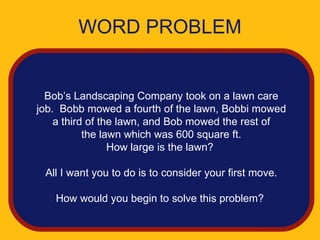
WORD PROBLEM


  Bob’s Landscaping Company took on a lawn care
job. Bobb mowed a fourth of the lawn, Bobbi mowed
    a third of the lawn, and Bob mowed the rest of
           the lawn which was 600 square ft.
                 How large is the lawn?

 All I want you to do is to consider your first move.

   How would you begin to solve this problem?
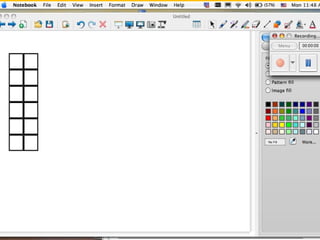
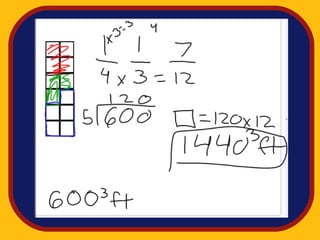
What did you notice about
 Kaylee’s presentation?

         • Real reading difficulties
          • Bright and articulate
 •   Some real “encoding” problems in math
         • Confidence and pride
          • Really good thinking
       • Logical order to her solution
        • Evidence of preparation
THEME FOR THE WEEK


   This week, you will see examples of children
with quite significant language-learning difficulties,
    throughout elementary and middle school,
     take on challenges, solve problems, and
   do math that (technically) they don’t have the
          (traditional) math skills to solve.
How is this possible?

       Carroll Math places thinking above all else.

         Number sense emerges from thinking.

Computational accuracy develops through number sense.

Conceptual understanding arises from students’ questions.
Traditional American math students tend to look
 at problems they haven’t seen before and say,
 “I don’t know. I haven’t been taught that yet.”

Students who are taught that math is a thinking
activity then to say, “I haven’t seen this problem
    before, but I think I know how to start….
        Oh, wait a minute, If I can do this,
          then I can keep going this way.”

Carrollmathopening7 09

  • 1.
    CARROLL MATH SUMMERSEMINAR 2009 “Teaching Math is Teaching Thinking”
  • 2.
    A Little History 1967-Carroll opened as a school for dyslexic children 1972- Carroll moved to current campus in Lincoln MA Four Truths: 1. Carroll has taught children to read using the Orton Gillingham Approach for forty two years. 2. No commercially available curriculum could do the job properly. 3. Carroll has struggled to find an effective way to teach math to our type of learners. 4. No commercially available curriculum in math could do the job properly.
  • 3.
    Therefore, many ofus have collected the best available materials, texts, and activities to create Carroll Math, which is a collection of commercially available products and some copyrighted material which will be used specifically in the Carroll Math approach. 1. Symphony Math 2. Cognitive Activities 3. Number Worlds 4. Singapore Math 5. Stern Materials 6. Tom Harding Curriculum 7. Carroll Teacher Constructed Lessons
  • 4.
    The best wayto describe the difference between Carroll Math and traditional approaches is to give you an example.
  • 5.
    WORD PROBLEM Bob’s Landscaping Company took on a lawn care job. Bobb mowed a fourth of the lawn, Bobbi mowed a third of the lawn, and Bob mowed the rest of the lawn which was 600 square ft. How large is the lawn? All I want you to do is to consider your first move. How would you begin to solve this problem?
  • 8.
    What did younotice about Kaylee’s presentation? • Real reading difficulties • Bright and articulate • Some real “encoding” problems in math • Confidence and pride • Really good thinking • Logical order to her solution • Evidence of preparation
  • 11.
    THEME FOR THEWEEK This week, you will see examples of children with quite significant language-learning difficulties, throughout elementary and middle school, take on challenges, solve problems, and do math that (technically) they don’t have the (traditional) math skills to solve.
  • 12.
    How is thispossible? Carroll Math places thinking above all else. Number sense emerges from thinking. Computational accuracy develops through number sense. Conceptual understanding arises from students’ questions.
  • 13.
    Traditional American mathstudents tend to look at problems they haven’t seen before and say, “I don’t know. I haven’t been taught that yet.” Students who are taught that math is a thinking activity then to say, “I haven’t seen this problem before, but I think I know how to start…. Oh, wait a minute, If I can do this, then I can keep going this way.”