U.S. Department of the Interior

On March 3, 1849, the last day of the 30th Congress, a bill was passed to
create the Department of the Interior, to take charge of the Nation's internal
affairs.

Some responsibilities given to this department include: the construction of the
national capital's water system, the colonization of freed slaves in Haiti,
exploration of western wilderness, oversight of the District of Columbia jail,
regulation of territorial governments, management of hospitals and
universities, management of public parks, and the basic responsibilities for
Indians, public lands, patents, and pensions.
Bureaus of the Department

There are nine technical bureaus of the Department of the Interior, as
follows:

The Bureau of Indian Affairs

The Bureau of Land Management

The Bureau of Ocean Energy Management

The Bureau of Reclamation

The Bureau of Safety and Environmental Enforcement

National Park Service

Office of Surface Mining Reclamation and Enforcement

U.S. Fish and Wildlife Service

U.S. Geological Survey
The Bureau of Indian Affairs

Indian Affairs provides services directly or through contracts, grants, or
compacts to 566 Federally recognized tribes with a service population of
about 1.9 million American Indian and Alaska Natives.

Programs administered by either Tribes or Indian Affairs through the Bureau
of Indian Education include an education system consisting of 183 schools
and dormitories, educating approximately 42,000 elementary and secondary
students, and 28 tribal colleges, universities, and post-secondary schools.

Programs administered through the Bureau of Indian Affairs include social
services, natural resources management on trust lands, economic
development programs, law enforcement and detention services,
administration of tribal courts, implementation of land and water claim
settlements, housing improvement, disaster relief, replacement and repair of
schools, repair and maintenance of roads and bridges, and the repair of
structural deficiencies on high hazard dams.
The Bureau of Land Management

BLM is responsible for managing a large spectrum of natural resource
values. There are many natural resource management and administrative
support programs, including:

Abandoned Mine Lands

Climate Change

Fish, Wildlife, and Plant Conservation

Hazardous Materials Management

Law Enforcement

Mining and Minerals

Soil, Water, and Air

Youth Initiatives
The Bureau of Ocean Energy
Management

BOEM promotes energy independence, environmental protection and
economic development through responsible, science-based management of
offshore conventional and renewable energy and marine mineral resources.

Some main roles of BOEM include:

Oil and Gas Lease Sales, along with Marine Minerals negotiated
agreements and official maps and GIS data.

Offshore Renewable Energy programs.

The Oil and Gas Lease Sales, along with Marine Minerals negotiated
agreements and official maps and GIS data.
The Bureau of Reclamation

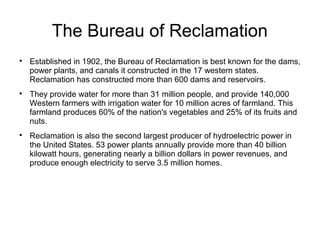
Established in 1902, the Bureau of Reclamation is best known for the dams,
power plants, and canals it constructed in the 17 western states.
Reclamation has constructed more than 600 dams and reservoirs.

They provide water for more than 31 million people, and provide 140,000
Western farmers with irrigation water for 10 million acres of farmland. This
farmland produces 60% of the nation's vegetables and 25% of its fruits and
nuts.

Reclamation is also the second largest producer of hydroelectric power in
the United States. 53 power plants annually provide more than 40 billion
kilowatt hours, generating nearly a billion dollars in power revenues, and
produce enough electricity to serve 3.5 million homes.
The Bureau of Safety and
Environmental Enforcement

BSEE works to promote safety, protect the environment, and conserve
resources offshore.

Some main roles of BSEE include:

The Offshore Regulatory Program develops standards and regulations to
enhance operational safety and environmental protection for the exploration
and development of offshore oil and natural gas on the U.S. Outer
Continental Shelf.

The Oil Spill Response division is responsible for developing standards and
guidelines for offshore operators’ Oil Spill Response Plans.

The Environmental Enforcement Division will provide sustained regulatory
oversight that is focused on compliance by operators with all applicable
environmental regulations.
National Park Service

The “Organic Act” states that the fundamental purpose of the NPS “is to
conserve the scenery and the natural and historic objects and the wild life
therein and to provide for the enjoyment of the same in such manner and by
such means as will leave them unimpaired for the enjoyment of future
generations.”

With the help of volunteers and park partners, the NPS takes care of more
than 400 places.
Office of Surface Mining
Reclamation and Enforcement

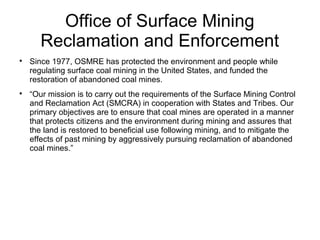
Since 1977, OSMRE has protected the environment and people while
regulating surface coal mining in the United States, and funded the
restoration of abandoned coal mines.

“Our mission is to carry out the requirements of the Surface Mining Control
and Reclamation Act (SMCRA) in cooperation with States and Tribes. Our
primary objectives are to ensure that coal mines are operated in a manner
that protects citizens and the environment during mining and assures that
the land is restored to beneficial use following mining, and to mitigate the
effects of past mining by aggressively pursuing reclamation of abandoned
coal mines.”
U.S. Fish and Wildlife Service

The USFWS assists in the development and application of an environmental
stewardship ethic for society, based on ecological principles, scientific
knowledge of fish and wildlife, and a sense of moral responsibility.

It guides the conservation, development, and management of the country's
fish and wildlife resources.

It administers a national program to provide the public opportunities to
understand, appreciate, and wisely use fish and wildlife resources.
U.S. Geological Survey

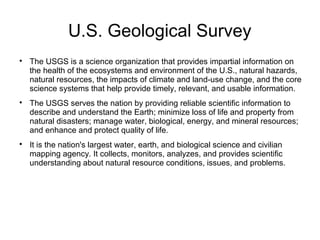
The USGS is a science organization that provides impartial information on
the health of the ecosystems and environment of the U.S., natural hazards,
natural resources, the impacts of climate and land-use change, and the core
science systems that help provide timely, relevant, and usable information.

The USGS serves the nation by providing reliable scientific information to
describe and understand the Earth; minimize loss of life and property from
natural disasters; manage water, biological, energy, and mineral resources;
and enhance and protect quality of life.

It is the nation's largest water, earth, and biological science and civilian
mapping agency. It collects, monitors, analyzes, and provides scientific
understanding about natural resource conditions, issues, and problems.
The Head of the Department of the
Interior

Secretary Sally Jewell was sworn in as the 51st Secretary of the Interior on
April 12, 2013.

President Obama said about Secretary Jewell, “She is an expert on the
energy and climate issues that are going to shape our future. She is
committed to building our nation-to-nation relationship with Indian Country.
She knows the link between conservation and good jobs. She knows that
there’s no contradiction between being good stewards of the land and our
economic progress; that in fact, those two things need to go hand in hand.”
Sally Jewell

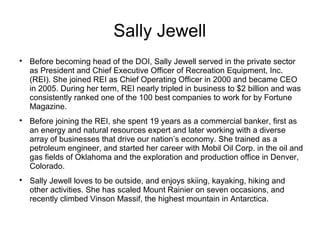
Before becoming head of the DOI, Sally Jewell served in the private sector
as President and Chief Executive Officer of Recreation Equipment, Inc.
(REI). She joined REI as Chief Operating Officer in 2000 and became CEO
in 2005. During her term, REI nearly tripled in business to $2 billion and was
consistently ranked one of the 100 best companies to work for by Fortune
Magazine.

Before joining the REI, she spent 19 years as a commercial banker, first as
an energy and natural resources expert and later working with a diverse
array of businesses that drive our nation’s economy. She trained as a
petroleum engineer, and started her career with Mobil Oil Corp. in the oil and
gas fields of Oklahoma and the exploration and production office in Denver,
Colorado.

Sally Jewell loves to be outside, and enjoys skiing, kayaking, hiking and
other activities. She has scaled Mount Rainier on seven occasions, and
recently climbed Vinson Massif, the highest mountain in Antarctica.

Frank SanPietro Presents the U.S. Department of the Interior

  • 1.
    U.S. Department ofthe Interior
  • 2.
    U.S. Department ofthe Interior  On March 3, 1849, the last day of the 30th Congress, a bill was passed to create the Department of the Interior, to take charge of the Nation's internal affairs.  Some responsibilities given to this department include: the construction of the national capital's water system, the colonization of freed slaves in Haiti, exploration of western wilderness, oversight of the District of Columbia jail, regulation of territorial governments, management of hospitals and universities, management of public parks, and the basic responsibilities for Indians, public lands, patents, and pensions.
  • 3.
    Bureaus of theDepartment  There are nine technical bureaus of the Department of the Interior, as follows:  The Bureau of Indian Affairs  The Bureau of Land Management  The Bureau of Ocean Energy Management  The Bureau of Reclamation  The Bureau of Safety and Environmental Enforcement  National Park Service  Office of Surface Mining Reclamation and Enforcement  U.S. Fish and Wildlife Service  U.S. Geological Survey
  • 4.
    The Bureau ofIndian Affairs  Indian Affairs provides services directly or through contracts, grants, or compacts to 566 Federally recognized tribes with a service population of about 1.9 million American Indian and Alaska Natives.  Programs administered by either Tribes or Indian Affairs through the Bureau of Indian Education include an education system consisting of 183 schools and dormitories, educating approximately 42,000 elementary and secondary students, and 28 tribal colleges, universities, and post-secondary schools.  Programs administered through the Bureau of Indian Affairs include social services, natural resources management on trust lands, economic development programs, law enforcement and detention services, administration of tribal courts, implementation of land and water claim settlements, housing improvement, disaster relief, replacement and repair of schools, repair and maintenance of roads and bridges, and the repair of structural deficiencies on high hazard dams.
  • 5.
    The Bureau ofLand Management  BLM is responsible for managing a large spectrum of natural resource values. There are many natural resource management and administrative support programs, including:  Abandoned Mine Lands  Climate Change  Fish, Wildlife, and Plant Conservation  Hazardous Materials Management  Law Enforcement  Mining and Minerals  Soil, Water, and Air  Youth Initiatives
  • 6.
    The Bureau ofOcean Energy Management  BOEM promotes energy independence, environmental protection and economic development through responsible, science-based management of offshore conventional and renewable energy and marine mineral resources.  Some main roles of BOEM include:  Oil and Gas Lease Sales, along with Marine Minerals negotiated agreements and official maps and GIS data.  Offshore Renewable Energy programs.  The Oil and Gas Lease Sales, along with Marine Minerals negotiated agreements and official maps and GIS data.
  • 7.
    The Bureau ofReclamation  Established in 1902, the Bureau of Reclamation is best known for the dams, power plants, and canals it constructed in the 17 western states. Reclamation has constructed more than 600 dams and reservoirs.  They provide water for more than 31 million people, and provide 140,000 Western farmers with irrigation water for 10 million acres of farmland. This farmland produces 60% of the nation's vegetables and 25% of its fruits and nuts.  Reclamation is also the second largest producer of hydroelectric power in the United States. 53 power plants annually provide more than 40 billion kilowatt hours, generating nearly a billion dollars in power revenues, and produce enough electricity to serve 3.5 million homes.
  • 8.
    The Bureau ofSafety and Environmental Enforcement  BSEE works to promote safety, protect the environment, and conserve resources offshore.  Some main roles of BSEE include:  The Offshore Regulatory Program develops standards and regulations to enhance operational safety and environmental protection for the exploration and development of offshore oil and natural gas on the U.S. Outer Continental Shelf.  The Oil Spill Response division is responsible for developing standards and guidelines for offshore operators’ Oil Spill Response Plans.  The Environmental Enforcement Division will provide sustained regulatory oversight that is focused on compliance by operators with all applicable environmental regulations.
  • 9.
    National Park Service  The“Organic Act” states that the fundamental purpose of the NPS “is to conserve the scenery and the natural and historic objects and the wild life therein and to provide for the enjoyment of the same in such manner and by such means as will leave them unimpaired for the enjoyment of future generations.”  With the help of volunteers and park partners, the NPS takes care of more than 400 places.
  • 10.
    Office of SurfaceMining Reclamation and Enforcement  Since 1977, OSMRE has protected the environment and people while regulating surface coal mining in the United States, and funded the restoration of abandoned coal mines.  “Our mission is to carry out the requirements of the Surface Mining Control and Reclamation Act (SMCRA) in cooperation with States and Tribes. Our primary objectives are to ensure that coal mines are operated in a manner that protects citizens and the environment during mining and assures that the land is restored to beneficial use following mining, and to mitigate the effects of past mining by aggressively pursuing reclamation of abandoned coal mines.”
  • 11.
    U.S. Fish andWildlife Service  The USFWS assists in the development and application of an environmental stewardship ethic for society, based on ecological principles, scientific knowledge of fish and wildlife, and a sense of moral responsibility.  It guides the conservation, development, and management of the country's fish and wildlife resources.  It administers a national program to provide the public opportunities to understand, appreciate, and wisely use fish and wildlife resources.
  • 12.
    U.S. Geological Survey  TheUSGS is a science organization that provides impartial information on the health of the ecosystems and environment of the U.S., natural hazards, natural resources, the impacts of climate and land-use change, and the core science systems that help provide timely, relevant, and usable information.  The USGS serves the nation by providing reliable scientific information to describe and understand the Earth; minimize loss of life and property from natural disasters; manage water, biological, energy, and mineral resources; and enhance and protect quality of life.  It is the nation's largest water, earth, and biological science and civilian mapping agency. It collects, monitors, analyzes, and provides scientific understanding about natural resource conditions, issues, and problems.
  • 13.
    The Head ofthe Department of the Interior  Secretary Sally Jewell was sworn in as the 51st Secretary of the Interior on April 12, 2013.  President Obama said about Secretary Jewell, “She is an expert on the energy and climate issues that are going to shape our future. She is committed to building our nation-to-nation relationship with Indian Country. She knows the link between conservation and good jobs. She knows that there’s no contradiction between being good stewards of the land and our economic progress; that in fact, those two things need to go hand in hand.”
  • 14.
    Sally Jewell  Before becominghead of the DOI, Sally Jewell served in the private sector as President and Chief Executive Officer of Recreation Equipment, Inc. (REI). She joined REI as Chief Operating Officer in 2000 and became CEO in 2005. During her term, REI nearly tripled in business to $2 billion and was consistently ranked one of the 100 best companies to work for by Fortune Magazine.  Before joining the REI, she spent 19 years as a commercial banker, first as an energy and natural resources expert and later working with a diverse array of businesses that drive our nation’s economy. She trained as a petroleum engineer, and started her career with Mobil Oil Corp. in the oil and gas fields of Oklahoma and the exploration and production office in Denver, Colorado.  Sally Jewell loves to be outside, and enjoys skiing, kayaking, hiking and other activities. She has scaled Mount Rainier on seven occasions, and recently climbed Vinson Massif, the highest mountain in Antarctica.