Distributed Digital Preservation
Methodology at the Brazilian
Network Cariniana
An overview of challenges, successes, and
future directions
Miguel Ángel Márdero Arellano
Coordinator
Introduction
The work of the IBICT
The actions taken
The importance
http://cariniana.ibict.br 2
The Brazilian Institute of Information in
Science and Technology
10 years…
The integration of a distributed digital
preservation national network
http://cariniana.ibict.br 3
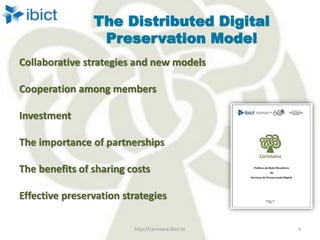
The Distributed Digital
Preservation Model
Collaborative strategies and new models
Cooperation among members
Investment
The importance of partnerships
The benefits of sharing costs
Effective preservation strategies
http://cariniana.ibict.br 4
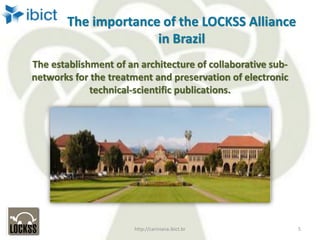
The importance of the LOCKSS Alliance
in Brazil
The establishment of an architecture of collaborative sub-
networks for the treatment and preservation of electronic
technical-scientific publications.
http://cariniana.ibict.br 5
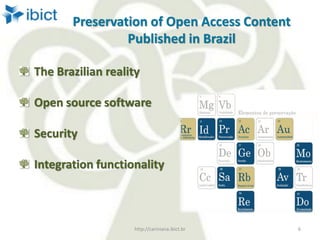
Preservation of Open Access Content
Published in Brazil
The Brazilian reality
Open source software
Security
Integration functionality
http://cariniana.ibict.br 6
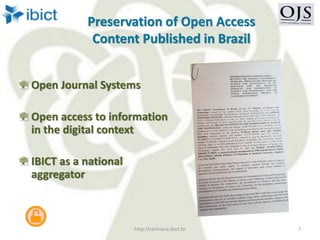
Preservation of Open Access
Content Published in Brazil
Open Journal Systems
Open access to information
in the digital context
IBICT as a national
aggregator
http://cariniana.ibict.br 7
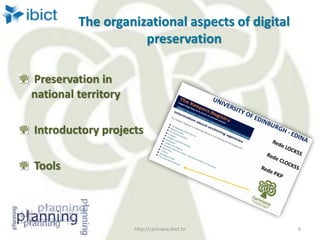
The organizational aspects of digital
preservation
Preservation in
national territory
Introductory projects
Tools
http://cariniana.ibict.br 8
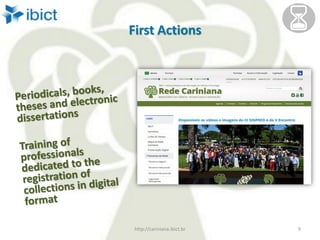
First Actions
http://cariniana.ibict.br 9
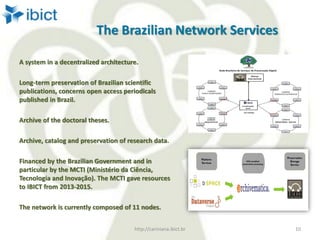
The Brazilian Network Services
A system in a decentralized architecture.
Long-term preservation of Brazilian scientific
publications, concerns open access periodicals
published in Brazil.
Archive of the doctoral theses.
Archive, catalog and preservation of research data.
Financed by the Brazilian Government and in
particular by the MCTI (Ministério da Ciência,
Tecnologia and Inovação). The MCTI gave resources
to IBICT from 2013-2015.
The network is currently composed of 11 nodes.
http://cariniana.ibict.br 10
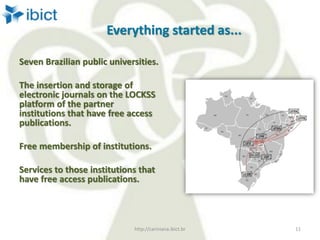
Everything started as...
Seven Brazilian public universities.
The insertion and storage of
electronic journals on the LOCKSS
platform of the partner
institutions that have free access
publications.
Free membership of institutions.
Services to those institutions that
have free access publications.
http://cariniana.ibict.br 11
The Network from here...
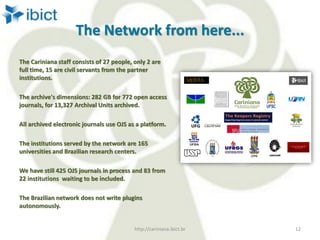
The Cariniana staff consists of 27 people, only 2 are
full time, 15 are civil servants from the partner
institutions.
The archive's dimensions: 282 GB for 772 open access
journals, for 13,327 Archival Units archived.
All archived electronic journals use OJS as a platform.
The institutions served by the network are 165
universities and Brazilian research centers.
We have still 425 OJS journals in process and 83 from
22 institutions waiting to be included.
The Brazilian network does not write plugins
autonomously.
http://cariniana.ibict.br 12
Developing a trusted space for
researchers datasets
Over the years, several methods have been used to store
research results. However, these methods do not use a
standardization of retrieval, availability and preservation of
research data for the scientific community.
These data were stored inappropriately or even discarded
without any management in the storage process.
Research data need to be structured, organized, made available
and preserved so that future generations can use and
understand the information described in them.
http://cariniana.ibict.br 13
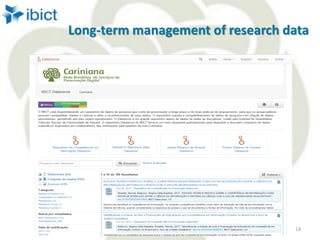
Long-term management of research data
http://cariniana.ibict.br 14
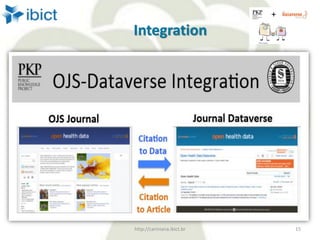
Integration
http://cariniana.ibict.br 15
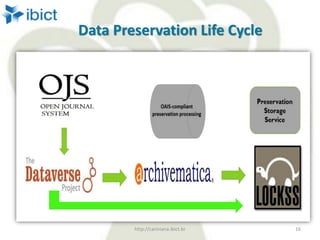
Data Preservation Life Cycle
http://cariniana.ibict.br 16
http://cariniana.ibict.br 17
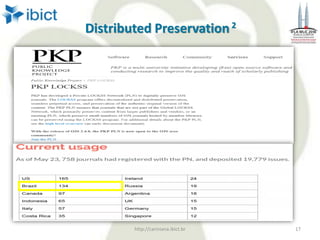
Distributed Preservation 2
http://cariniana.ibict.br 18
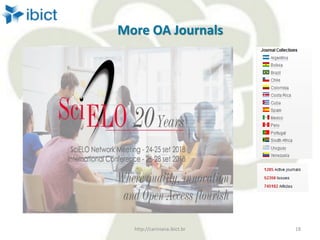
More OA Journals
Conclusion
http://cariniana.ibict.br 19
As distributed digital preservation solution, Stanford University's
LOCKSS program meets the requirements mentioned in the OAIS
reference model, even though it has a distributed architecture,
which did not interfere with compliance with these guidelines.
Cariniana Network follows the relevant internationally
established standards and best practices for definitions of access,
archiving and dissemination of preserved digital documents.
Following the commitment of the IBICT to managing the life cycle
of the digital collections and making the scientific and
technological information available in the long term, the objective
of the Cariniana network is focused on the fulfillment of the
functional requirements that allow the preservation and real
custody of these collections.
MUITO OBRIGADO!

Cariniana network methodology

  • 1.
    Distributed Digital Preservation Methodologyat the Brazilian Network Cariniana An overview of challenges, successes, and future directions Miguel Ángel Márdero Arellano Coordinator
  • 2.
    Introduction The work ofthe IBICT The actions taken The importance http://cariniana.ibict.br 2
  • 3.
    The Brazilian Instituteof Information in Science and Technology 10 years… The integration of a distributed digital preservation national network http://cariniana.ibict.br 3
  • 4.
    The Distributed Digital PreservationModel Collaborative strategies and new models Cooperation among members Investment The importance of partnerships The benefits of sharing costs Effective preservation strategies http://cariniana.ibict.br 4
  • 5.
    The importance ofthe LOCKSS Alliance in Brazil The establishment of an architecture of collaborative sub- networks for the treatment and preservation of electronic technical-scientific publications. http://cariniana.ibict.br 5
  • 6.
    Preservation of OpenAccess Content Published in Brazil The Brazilian reality Open source software Security Integration functionality http://cariniana.ibict.br 6
  • 7.
    Preservation of OpenAccess Content Published in Brazil Open Journal Systems Open access to information in the digital context IBICT as a national aggregator http://cariniana.ibict.br 7
  • 8.
    The organizational aspectsof digital preservation Preservation in national territory Introductory projects Tools http://cariniana.ibict.br 8
  • 9.
  • 10.
    The Brazilian NetworkServices A system in a decentralized architecture. Long-term preservation of Brazilian scientific publications, concerns open access periodicals published in Brazil. Archive of the doctoral theses. Archive, catalog and preservation of research data. Financed by the Brazilian Government and in particular by the MCTI (Ministério da Ciência, Tecnologia and Inovação). The MCTI gave resources to IBICT from 2013-2015. The network is currently composed of 11 nodes. http://cariniana.ibict.br 10
  • 11.
    Everything started as... SevenBrazilian public universities. The insertion and storage of electronic journals on the LOCKSS platform of the partner institutions that have free access publications. Free membership of institutions. Services to those institutions that have free access publications. http://cariniana.ibict.br 11
  • 12.
    The Network fromhere... The Cariniana staff consists of 27 people, only 2 are full time, 15 are civil servants from the partner institutions. The archive's dimensions: 282 GB for 772 open access journals, for 13,327 Archival Units archived. All archived electronic journals use OJS as a platform. The institutions served by the network are 165 universities and Brazilian research centers. We have still 425 OJS journals in process and 83 from 22 institutions waiting to be included. The Brazilian network does not write plugins autonomously. http://cariniana.ibict.br 12
  • 13.
    Developing a trustedspace for researchers datasets Over the years, several methods have been used to store research results. However, these methods do not use a standardization of retrieval, availability and preservation of research data for the scientific community. These data were stored inappropriately or even discarded without any management in the storage process. Research data need to be structured, organized, made available and preserved so that future generations can use and understand the information described in them. http://cariniana.ibict.br 13
  • 14.
    Long-term management ofresearch data http://cariniana.ibict.br 14
  • 15.
  • 16.
    Data Preservation LifeCycle http://cariniana.ibict.br 16
  • 17.
  • 18.
  • 19.
    Conclusion http://cariniana.ibict.br 19 As distributeddigital preservation solution, Stanford University's LOCKSS program meets the requirements mentioned in the OAIS reference model, even though it has a distributed architecture, which did not interfere with compliance with these guidelines. Cariniana Network follows the relevant internationally established standards and best practices for definitions of access, archiving and dissemination of preserved digital documents. Following the commitment of the IBICT to managing the life cycle of the digital collections and making the scientific and technological information available in the long term, the objective of the Cariniana network is focused on the fulfillment of the functional requirements that allow the preservation and real custody of these collections.
  • 20.