CAREER PLANNING
CAREER PLANNING
Presented by:
Presented by:
Karen Pagsolingan – Aguirre
Guidance Counselor
Guidance Counselor
CAREER PLANNING
is a deliberate process of
knowing WHO you are so that you can
be sure of WHERE you want to go or
WHAT you want to be at some
defined point in the future.
FIVE STEPS OF CAREER
PLANNING
1st Step: Self-Assessment
2nd Step: Explore Work/Career Options
3rd Step: Narrow Down List of
Work/Career Options
4th Step: Decide or Choose the Best Option
5th Step: Set a Career Goal
1st Step:
Self-Assessment
Knowing and understanding of self
better to know if you are in the right
job/career or you want to go to
another job.
• Attitude
• Interests
• Personality
• Needs
• Values
• Skills
2nd Step:
Work/Career Exploration
Matching and aligning what
you want to do on one
hand, and with the various
opportunities, on the
other.
Where to explore
Look at opportunities within your
organization and its subsidiaries
Look at career opportunities in
other organizations and in other
industries
Look at entrepreneurial and self-
employment opportunities
Look at jobs/careers of people
you know of those you read about
or see
3rd
Step: Narrow Down List
of Work/Career Options
List down three to five
career options that is
match with your interest,
personality, needs, values
and skills, on one hand and
the opportunities and
limitations, on the other.
5 Career Options Sample
1. Field engineer or IT Specialist
2. Pursue graduate
3. School instructor
4. Hardware business owner
5. Company Manager
Kinds of Career Paths
Steady State
– requires a life long commitment
to one career and is characterized
by a steady improvement in
knowledge and skills.
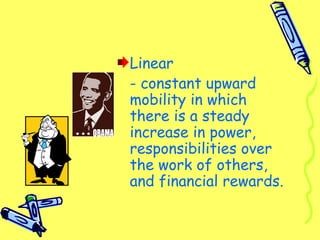
Linear
- constant upward
mobility in which
there is a steady
increase in power,
responsibilities over
the work of others,
and financial rewards.
Transitory
- constant seeking for variety
or independence. Jobs tend to
be short term and mobility is
generally lateral.
Spiral
- regular changes, usually every
five or seven years. Mobility is
usually lateral, and may be
initially downward.
4th
Step: Decide or Choose
the Best Option
This step will let you choose
the best from among the
list of 3-5 options.
– Description of your ideal job
– Personal Mission Statement
– Job Requirements or
Qualifications
5th
Step:
Set a Career Goal
This process will
give you focus
and it will
motivate you to
overcome
obstacles that
will keep you from
achieving your
goal.
What makes a goal good?
1. Specific
2. Measurable
3. Attainable
4. Relevant
5. Time-bound
6. Action-oriented
Barriers to Goals and Plan
Self-imposed or psychological barriers
• Negative self-image
• Negative attitude (bitterness,
selfishness, rebellion, crab mentality
etc.)
• Negative emotions (anxieties or fears)
• Victim mentality (feeling of
incapacity)
• Intrapersonal conflicts (torn
between two or more values)
• Personality traits (indecisiveness,
aggressiveness, competitiveness)
• Habits (procrastination, cramming)
• Negative thought against other
people (biases and prejudice)
Prepare for setbacks and
successes; ensure your
career.
1. Keep an ongoing file of all your
accomplishments.
2. Be prepared for any contingency by
maintaining an updated resume.
3. Sharpen your communication skills.
4. Build a network.
5. Become indispensable or close to it.
6. Remember that professional education
and self-development are never-ending.
7. Prepare for an alternative career.
8. Work on being pleasant and courteous.
The purpose of life, after
all, is to live it, to taste
experience to the
utmost, to reach out
eagerly and without fear
for newer and richer
experiences.
- Eleanor
Roosevelt
Thank you!!!!

careerplanningpresentation

  • 1.
    CAREER PLANNING CAREER PLANNING Presentedby: Presented by: Karen Pagsolingan – Aguirre Karen Pagsolingan – Aguirre Guidance Counselor Guidance Counselor
  • 2.
    CAREER PLANNING is adeliberate process of knowing WHO you are so that you can be sure of WHERE you want to go or WHAT you want to be at some defined point in the future.
  • 3.
    FIVE STEPS OFCAREER PLANNING 1st Step: Self-Assessment 2nd Step: Explore Work/Career Options 3rd Step: Narrow Down List of Work/Career Options 4th Step: Decide or Choose the Best Option 5th Step: Set a Career Goal
  • 4.
    1st Step: Self-Assessment Knowing andunderstanding of self better to know if you are in the right job/career or you want to go to another job.
  • 5.
    • Attitude • Interests •Personality • Needs • Values • Skills
  • 6.
    2nd Step: Work/Career Exploration Matchingand aligning what you want to do on one hand, and with the various opportunities, on the other.
  • 7.
    Where to explore Lookat opportunities within your organization and its subsidiaries Look at career opportunities in other organizations and in other industries Look at entrepreneurial and self- employment opportunities Look at jobs/careers of people you know of those you read about or see
  • 8.
    3rd Step: Narrow DownList of Work/Career Options List down three to five career options that is match with your interest, personality, needs, values and skills, on one hand and the opportunities and limitations, on the other.
  • 9.
    5 Career OptionsSample 1. Field engineer or IT Specialist 2. Pursue graduate 3. School instructor 4. Hardware business owner 5. Company Manager
  • 10.
    Kinds of CareerPaths Steady State – requires a life long commitment to one career and is characterized by a steady improvement in knowledge and skills.
  • 11.
    Linear - constant upward mobilityin which there is a steady increase in power, responsibilities over the work of others, and financial rewards.
  • 12.
    Transitory - constant seekingfor variety or independence. Jobs tend to be short term and mobility is generally lateral.
  • 13.
    Spiral - regular changes,usually every five or seven years. Mobility is usually lateral, and may be initially downward.
  • 14.
    4th Step: Decide orChoose the Best Option This step will let you choose the best from among the list of 3-5 options. – Description of your ideal job – Personal Mission Statement – Job Requirements or Qualifications
  • 15.
    5th Step: Set a CareerGoal This process will give you focus and it will motivate you to overcome obstacles that will keep you from achieving your goal.
  • 16.
    What makes agoal good? 1. Specific 2. Measurable 3. Attainable 4. Relevant 5. Time-bound 6. Action-oriented
  • 17.
    Barriers to Goalsand Plan Self-imposed or psychological barriers • Negative self-image • Negative attitude (bitterness, selfishness, rebellion, crab mentality etc.) • Negative emotions (anxieties or fears)
  • 18.
    • Victim mentality(feeling of incapacity) • Intrapersonal conflicts (torn between two or more values) • Personality traits (indecisiveness, aggressiveness, competitiveness) • Habits (procrastination, cramming) • Negative thought against other people (biases and prejudice)
  • 19.
    Prepare for setbacksand successes; ensure your career.
  • 20.
    1. Keep anongoing file of all your accomplishments. 2. Be prepared for any contingency by maintaining an updated resume. 3. Sharpen your communication skills. 4. Build a network. 5. Become indispensable or close to it. 6. Remember that professional education and self-development are never-ending. 7. Prepare for an alternative career. 8. Work on being pleasant and courteous.
  • 21.
    The purpose oflife, after all, is to live it, to taste experience to the utmost, to reach out eagerly and without fear for newer and richer experiences. - Eleanor Roosevelt
  • 22.