Personal Development
Objective
• appreciate that conflict is a
fact of life and a key
ingredient of human
interaction
P F A & D L | W O O D W O R K I N G 1 0 1
Objective
2. understand the nature of
conflict and how
interpersonal relationships
are affected by it.
P F A & D L | W O O D W O R K I N G 1 0 1
Objective
3. develop a positive
attitude about conflict as
important to personal
development.
P F A & D L | W O O D W O R K I N G 1 0 1
Objective
4. Learn one’s conflict
management style and
apply this in his day to day
living.
P F A & D L | W O O D W O R K I N G 1 0 1
The progress and actions taken by a person
throughout a lifetime, especially those related to
that person's occupations. A career is often
composed of the jobs held, titles earned and work
accomplished over a long period of time, rather
than just referring to one position.
I N S P I R A T I O N A L W O R D S T O L I V E B Y
Career Conflict
P F A & D L | W O O D W O R K I N G 1 0 1
Introduction
A career is a profession that a
person may get into, either
because he has found a good
match between his life goals,
skills, personality and interest
with a dream job, or it may be
just a means to earn a living.
Introduction
In the past generations, the
father chooses the courses for
his children to take up. One of
the first choices were medicine,
accounting, law, engineering
and education.
There are 4
categories of
career
development
theories
• Trait factor
• Psychological
• Decision
• Developmental,
life span or life
space theory
P F A & D L | W O O D W O R K I N G 1 0 1
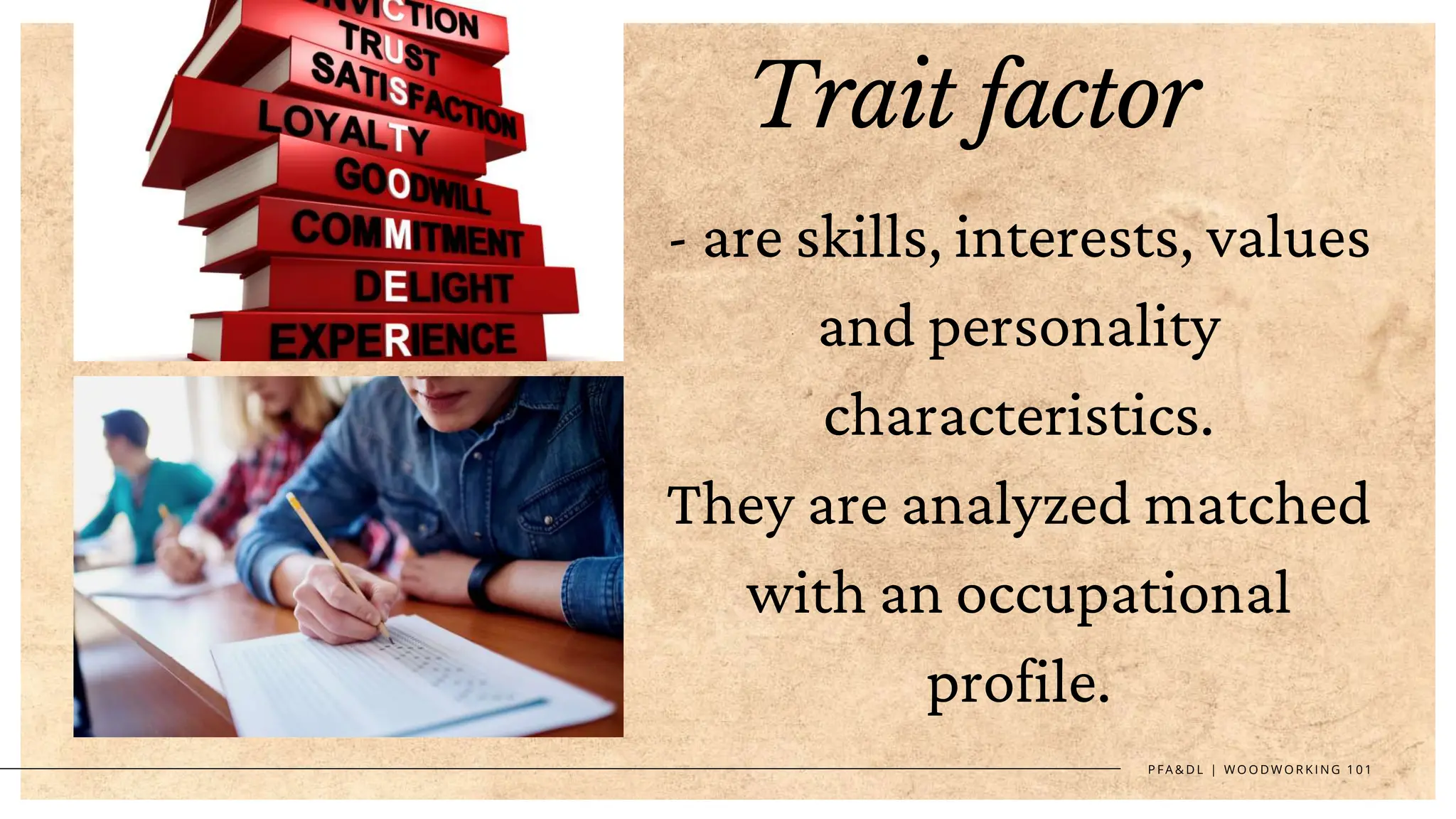
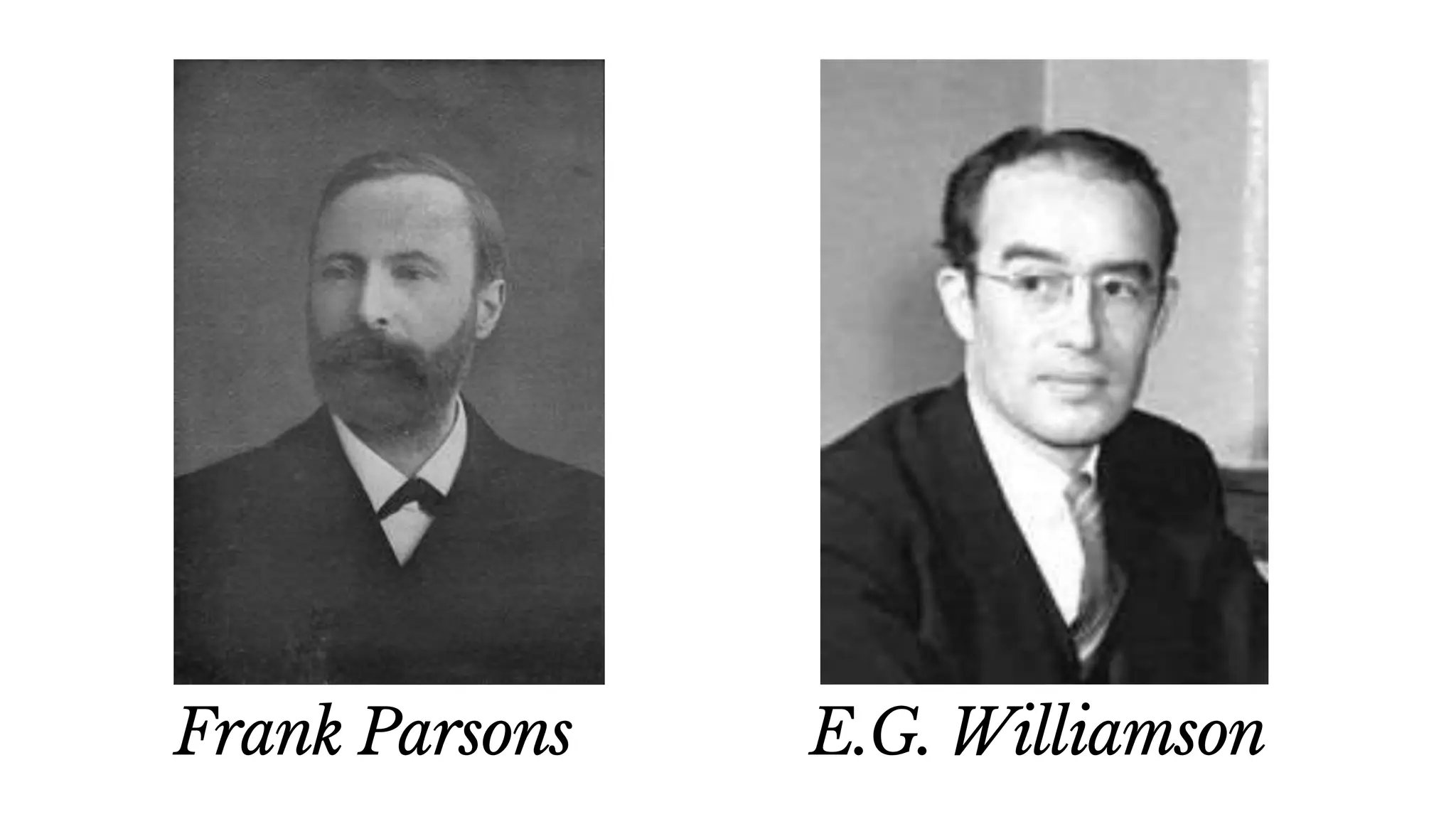
Trait factor
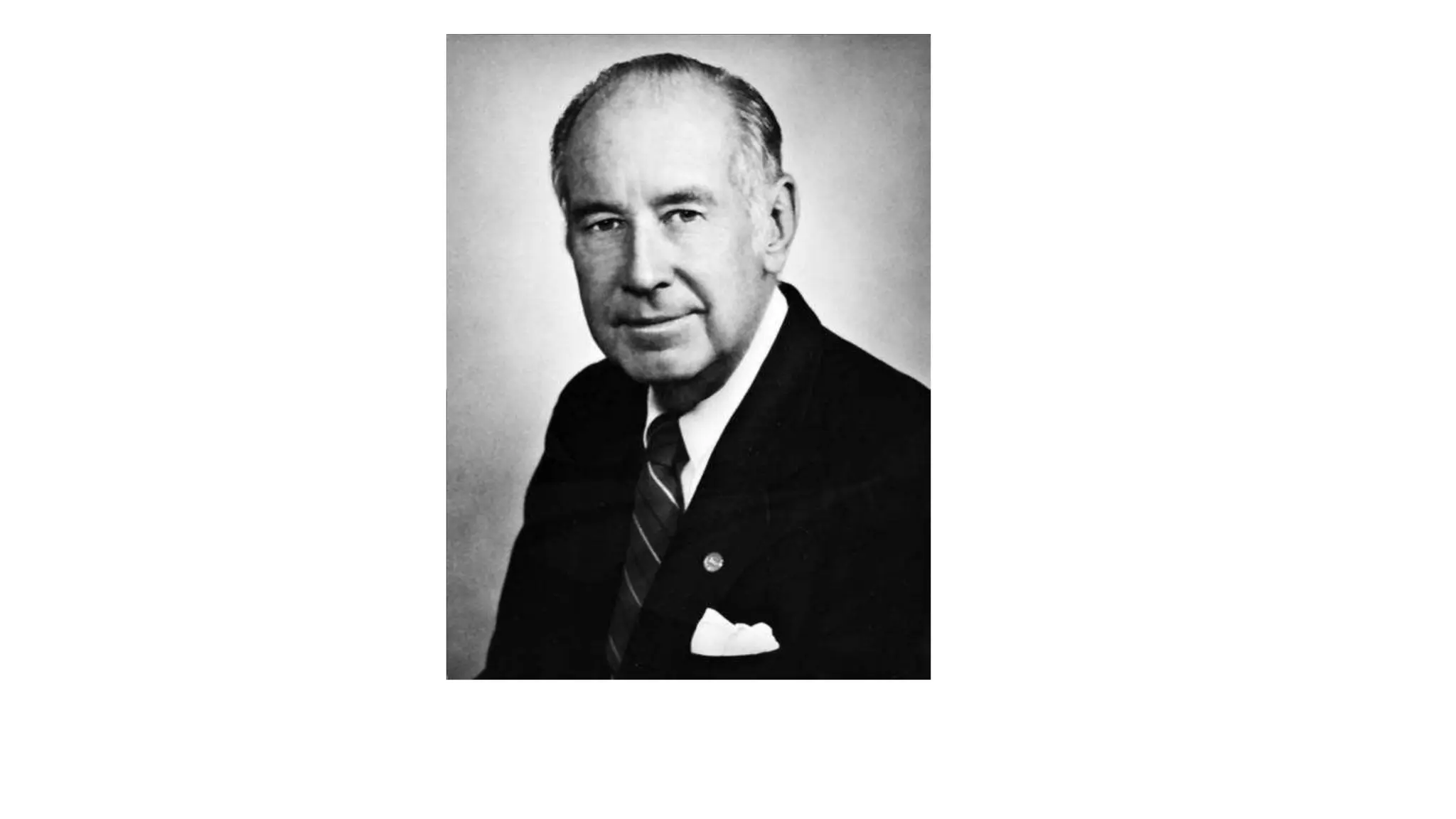
- are skills, interests, values
and personality
characteristics.
They are analyzed matched
with an occupational
profile.

Frank Parsons E.G. Williamson
P F A & D L | W O O D W O R K I N G 1 0 1
Psychological
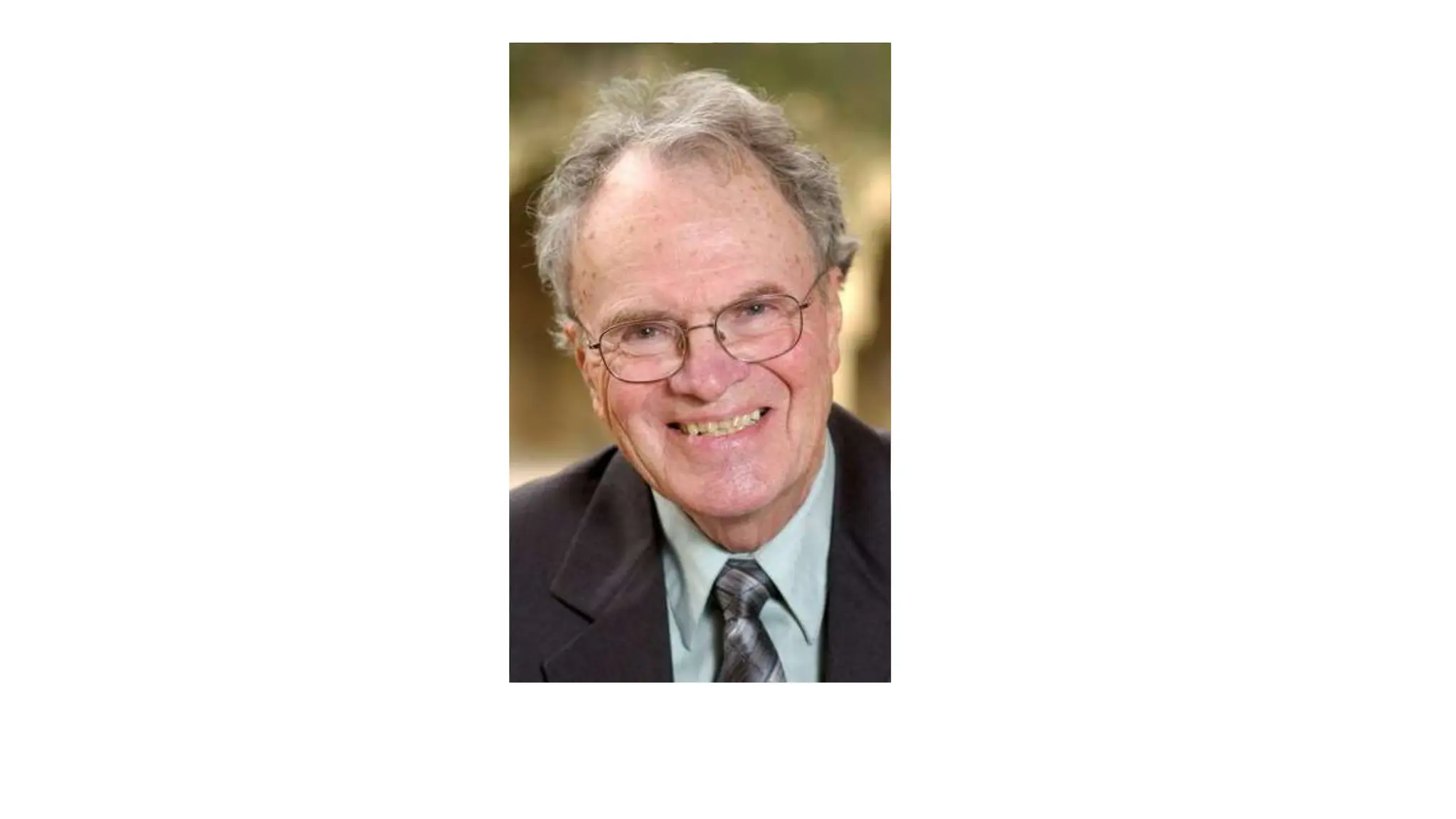
It is a branch of Parson’s
Trait factor theory, where
he described six
personality categories:
realistic, investigative,
social, conventional,
enterprising and artistic.
John Holland
P F A & D L | W O O D W O R K I N G 1 0 1
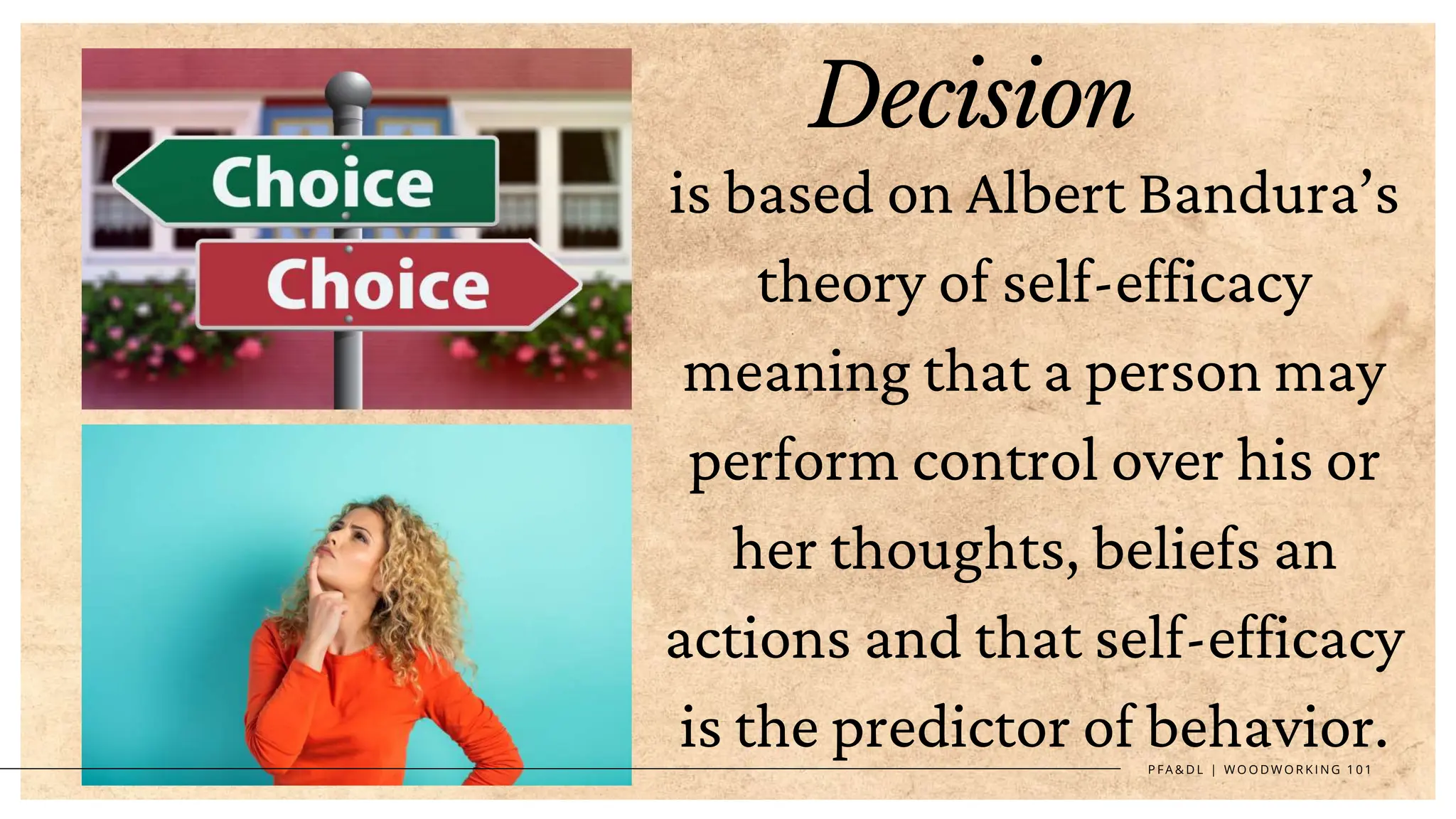
Decision
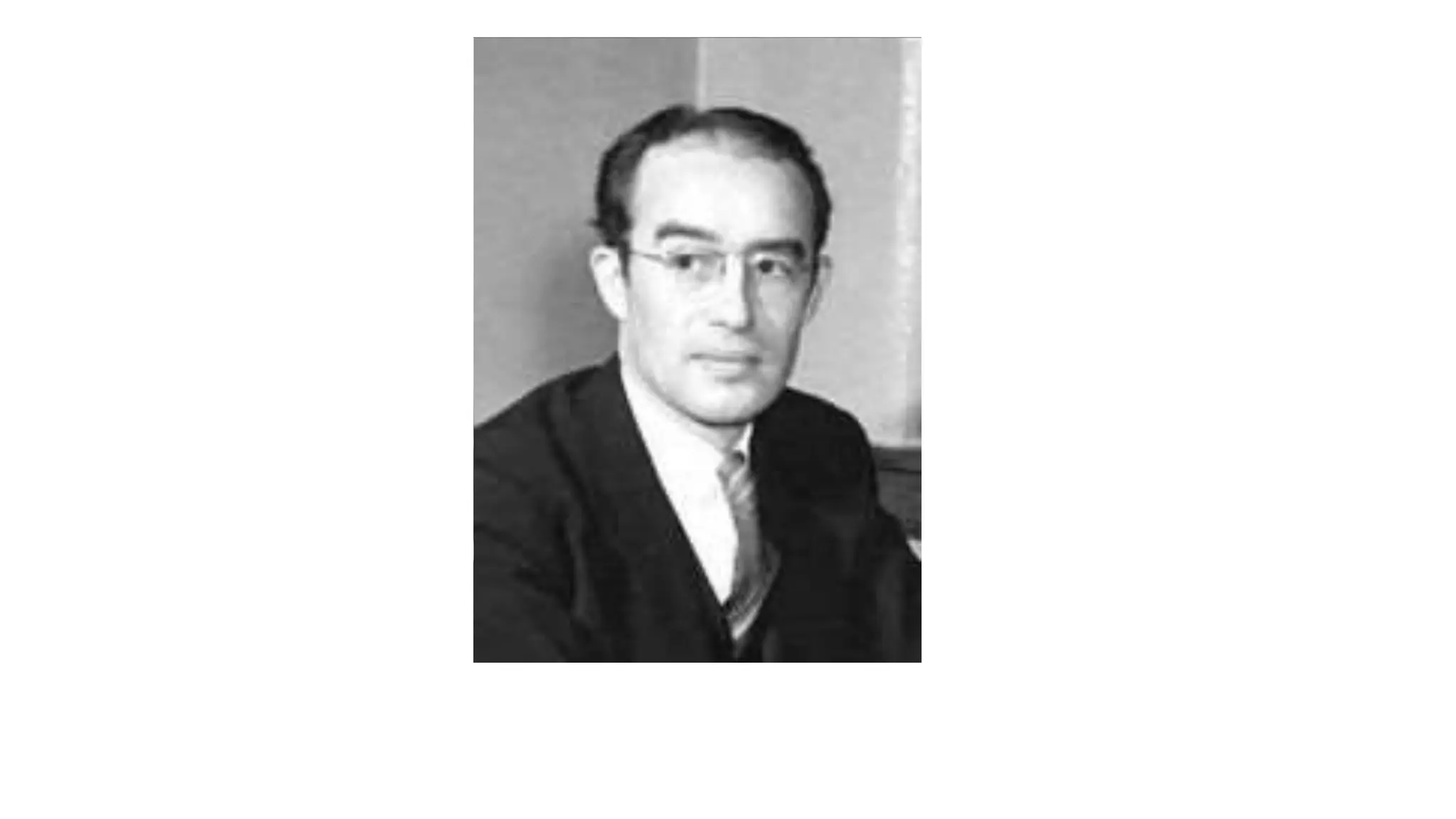
is based on Albert Bandura’s
theory of self-efficacy
meaning that a person may
perform control over his or
her thoughts, beliefs an
actions and that self-efficacy
is the predictor of behavior.
Albert Bandura
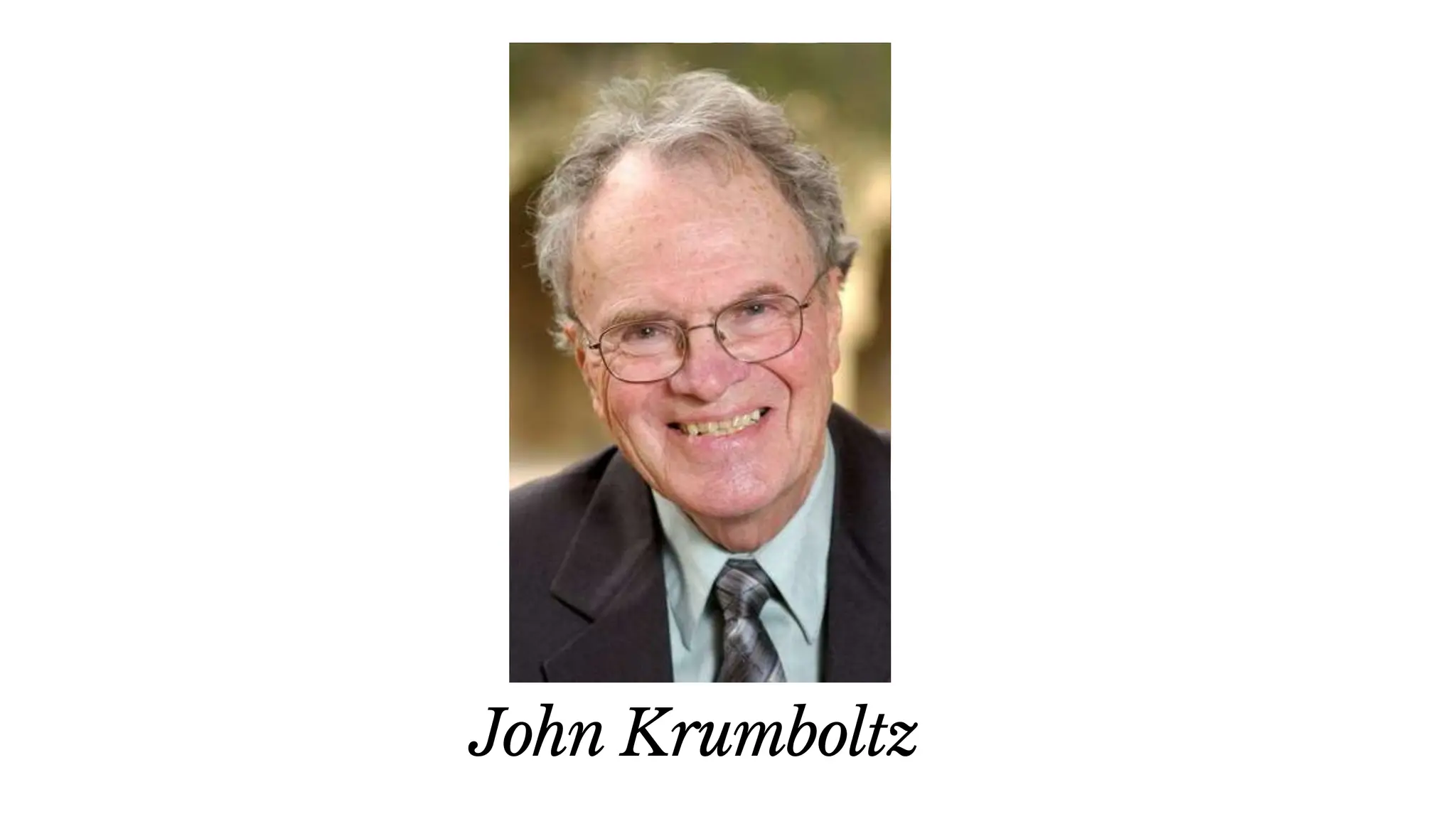
John Krumboltz
Decision
Krumboltz identified four
factors: genetic influences,
environmental conditions
and events, learning
experiences and skills like
goal setting, information
gathering and self-
observation. According to
him, these factors influences
career choice.
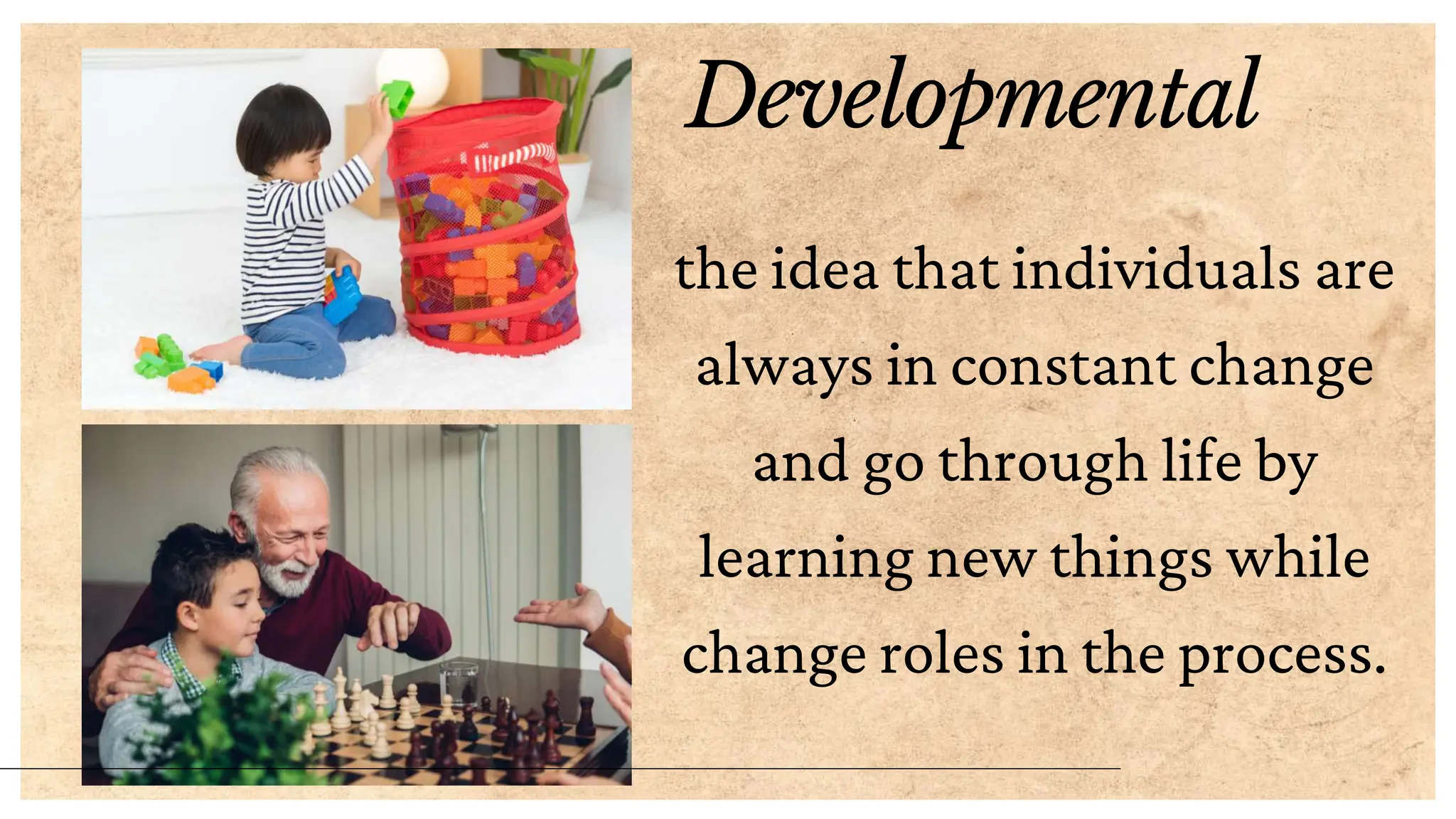
Developmental
the idea that individuals are
always in constant change
and go through life by
learning new things while
change roles in the process.
Donald Super
The Truth about Career
Development Theories
Keep in mind that there is not one particular theory
that can explain everything about career
development. Individuals have to develop their
own approach or method in searching for career
choices. Career choices may change through time
for many potential reasons since our lives are
constantly changing.
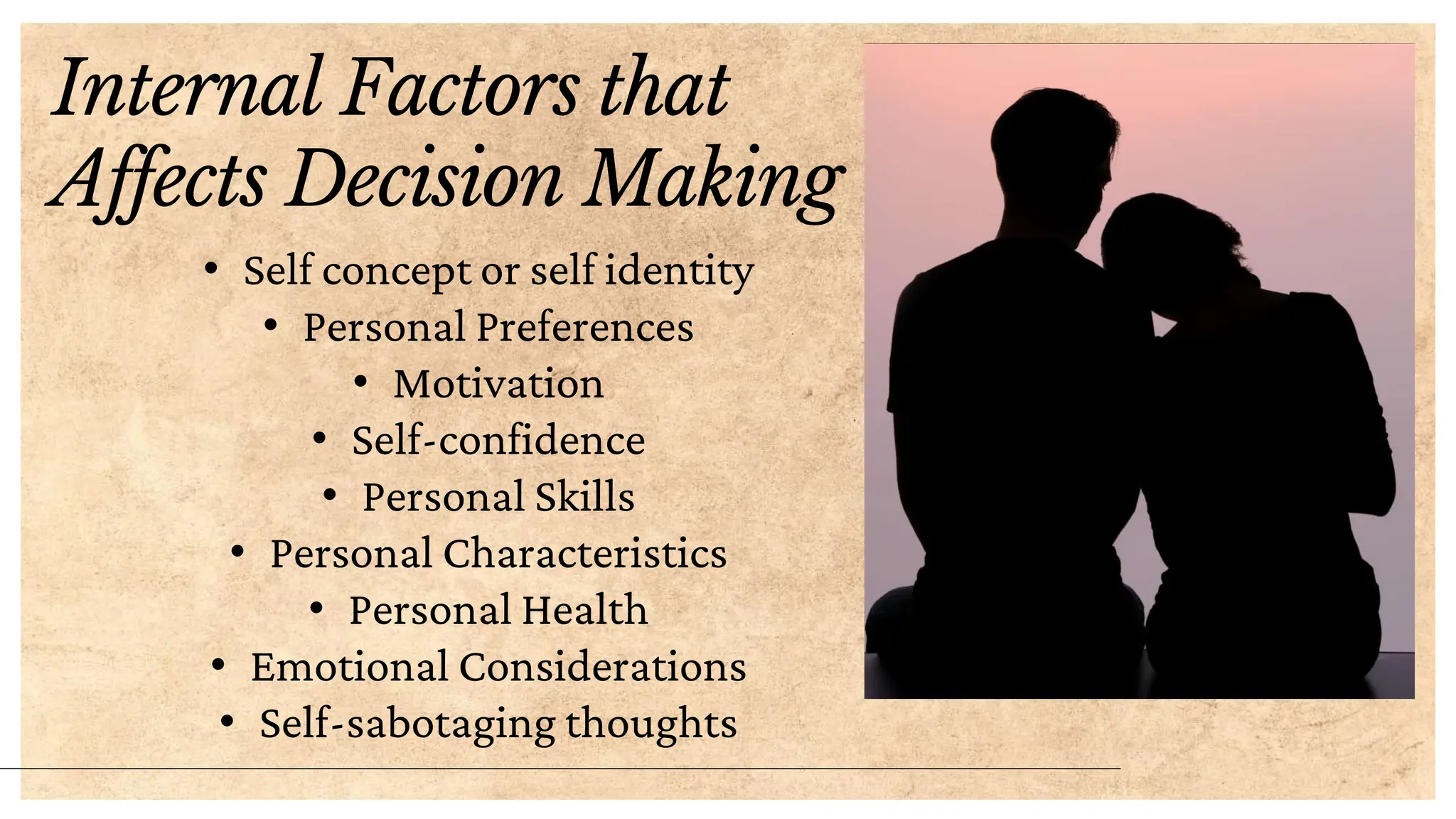
Internal Factors that
Affects Decision Making
• Self concept or self identity
• Personal Preferences
• Motivation
• Self-confidence
• Personal Skills
• Personal Characteristics
• Personal Health
• Emotional Considerations
• Self-sabotaging thoughts
Self-concept or
self identity
It will be difficult to choose
a career or course to take up
in college if your self-
identity is not as solid as it
should be. You need to
understand what to do or
not want to do
Personal
preferences
You decide to take up
You decide to take up accountancy but
your parents told you to take up
nursing like your aunts will help you
earn a lot of money and travel abroad.
This situation mostly happens in
many Filipino families.
No matter good their intentions are,
these can still boomerang because the
child is forced to do the opposite—
what his or her parents want. The
adolescent will abide by the wishes of
the parents over what college course to
take.
Juniele always wanted to become a
copywriter for an advertising agency. His
father wanted him to take up engineering.
Being the eldest in the family, he set aside
his personal preferences and took up
engineering. He did well since he was
smart, graduated on time, took the board
exam. .
When he passed, he went to his father and
gave his engineering diploma and professional
license and told his father now that he fulfilled
his father’s wish, he would like to fulfill his
own wish of becoming a copywriter. The father
allowed Juniele and now he is a successful
copywriter and eventually became the
president of an advertising company.
Motivation
drive to fulfill one’s fullest
potential.
Many Filipinos are motivated by their desire to
improve their quality of life. Many Filipinos are
working abroad for this reason. They took up a
course in college and graduated then they
venture out to find a fortune for themselves
and their families. When they have saved
enough money, they return home to pursue
their personal dreams.
Self-Confidence
keep his eyes on his goals
and tell the everyone that he
can do it and will succeed in
pursuing his dreams.
Kaya ko ‘to!
Yes, I can!
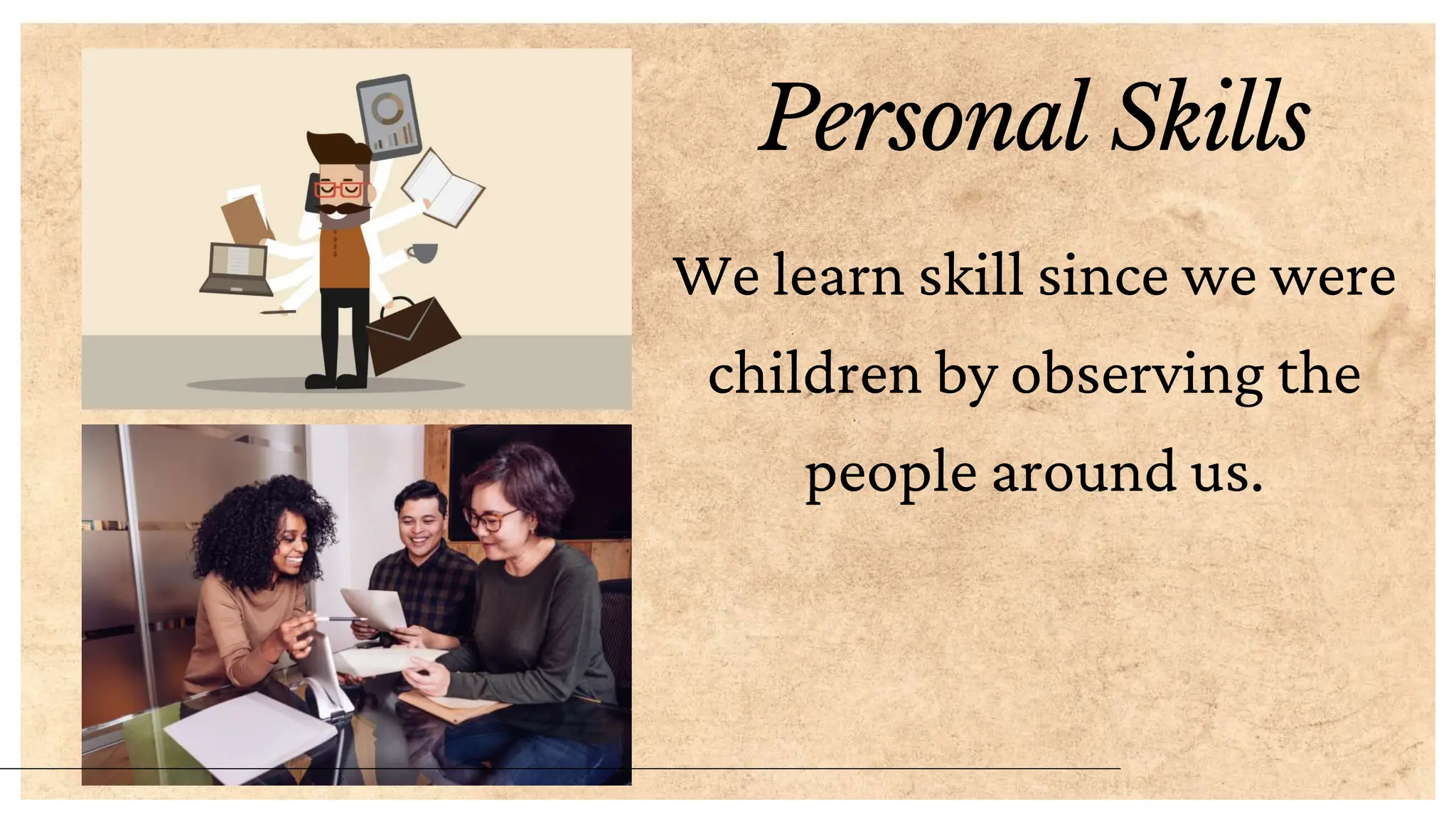
Personal Skills
We learn skill since we were
children by observing the
people around us.
Basic education teaches us the hard
skills we need to acquire so we can be
qualified for higher education, such as
learning math and sciences.
Soft skills such as dealing with people or
communicating a thought non-verbally
are skills not taught in our education
system.
Ask yourself what you like and enjoy
doing, when you enjoy cooking, then
that is a skill. You may have hidden
skills because some people around you
does not accept it or you may be afraid to
be misjudge if you show it.
Have the courage to stand up, hone
your skills and develop your own destiny.
Personal
Characteristics
Your attributes
Personal Health
health conditions is a
significant factor in the
career choice you will make.
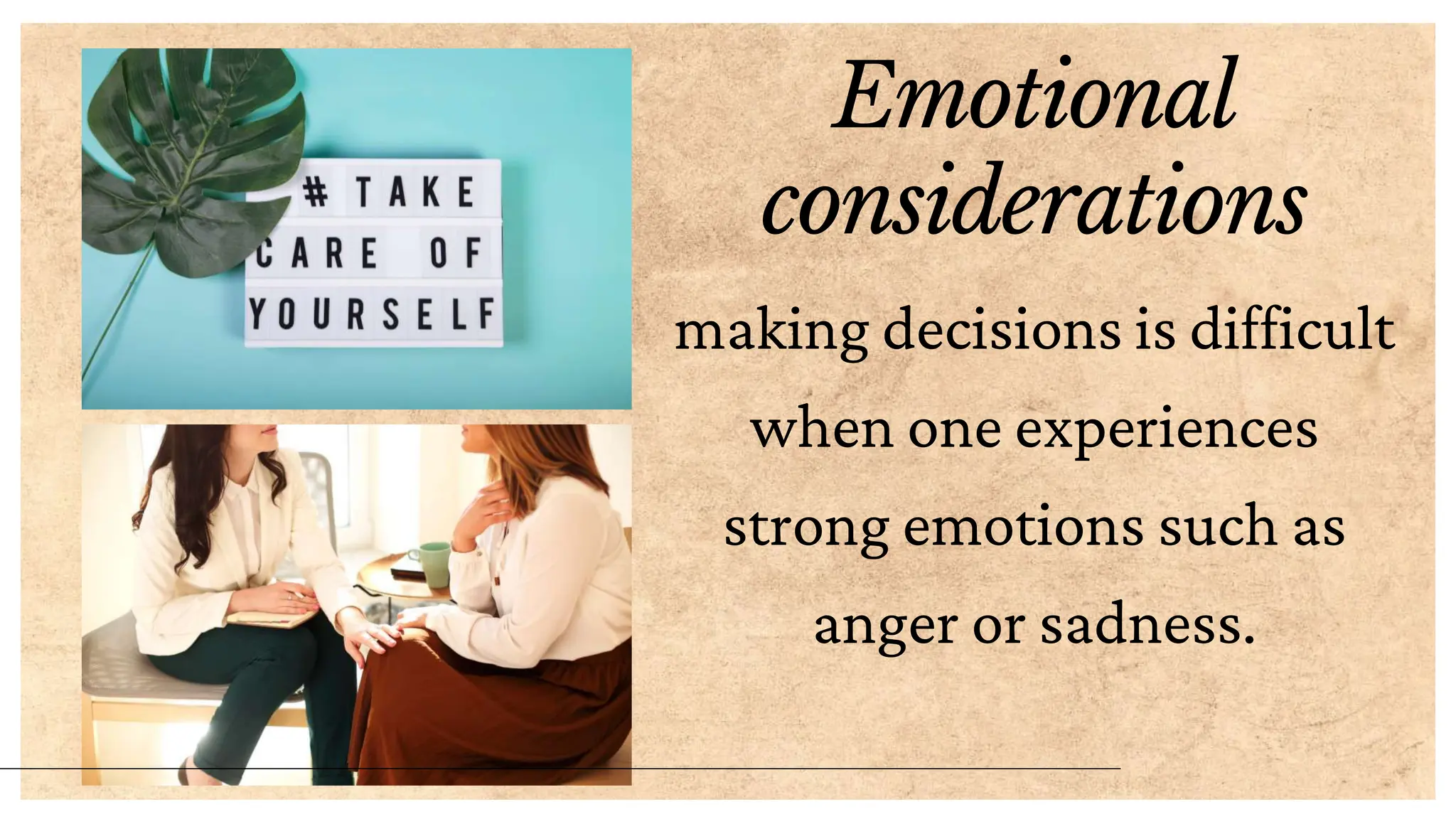
Emotional
considerations
making decisions is difficult
when one experiences
strong emotions such as
anger or sadness.
An individual will end up deciding on the
wrong thing because of strong emotions
felt. Assess yourself when deciding what
course to take. It is best to be sensible
and calm when taking life-directing
choices
Self-sabotaging
thoughts
thought to discourage a
person from developing a
wholesome self-concept.
Statements such as “I can’t do this. I will
not succeed.” I am not intelligent enough
for that course.” “Nobody believes in me,
so why should I believe in myself?” These
statements are stumbling blocks in your
road toward self-actualization.
G a u g e
P F A & D L | W O O D W O R K I N G 1 0 1
1. What is the branch of Parson’s trait factor
theory describing six personality categories
where one type is dominant and may show up
to three of these types?
A. PSYCHOLOGICAL THEORY
B. TRAIT FACTOR THEORY
C. DEVELOPMENTAL, LIFE SPAN OR LIFE SPACE THEORY
D. DECISION
P F A & D L | W O O D W O R K I N G 1 0 1
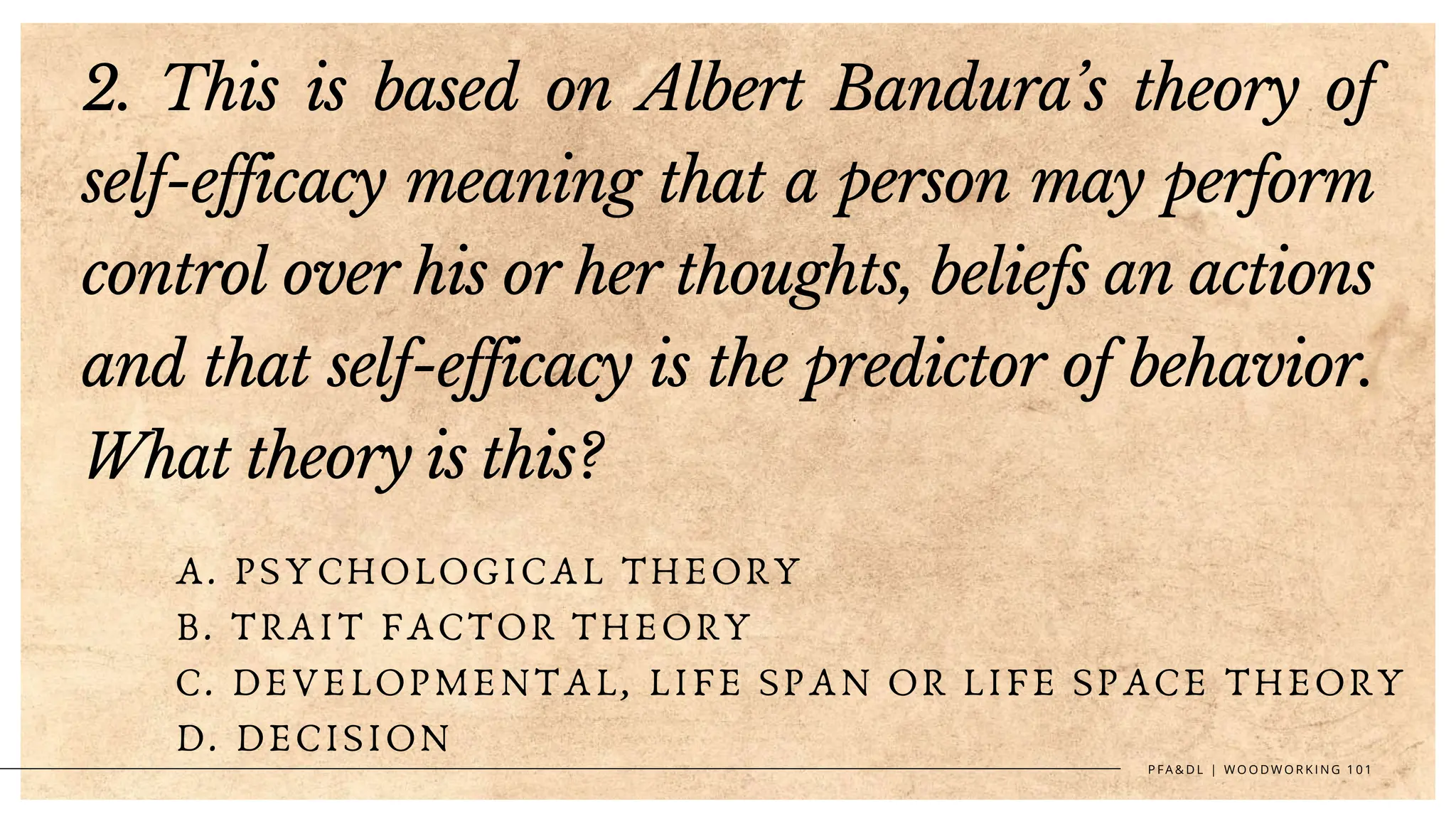
2. This is based on Albert Bandura’s theory of
self-efficacy meaning that a person may perform
control over his or her thoughts, beliefs an actions
and that self-efficacy is the predictor of behavior.
What theory is this?
A. PSYCHOLOGICAL THEORY
B. TRAIT FACTOR THEORY
C. DEVELOPMENTAL, LIFE SPAN OR LIFE SPACE THEORY
D. DECISION
P F A & D L | W O O D W O R K I N G 1 0 1
3. According to Krumboltz, these factors affect
career choice. What are these factors?
A. GENETICS
B. SOCIAL RESPONSIBILITY AND SITUATIONS
C. GENETIC INFLUENCES, ENVIRONMENTAL CONDITIONS
AND EVENTS, LEARNING EXPERIENCES AND SKILLS
D. NATURAL EXPERIENCE
P F A & D L | W O O D W O R K I N G 1 0 1
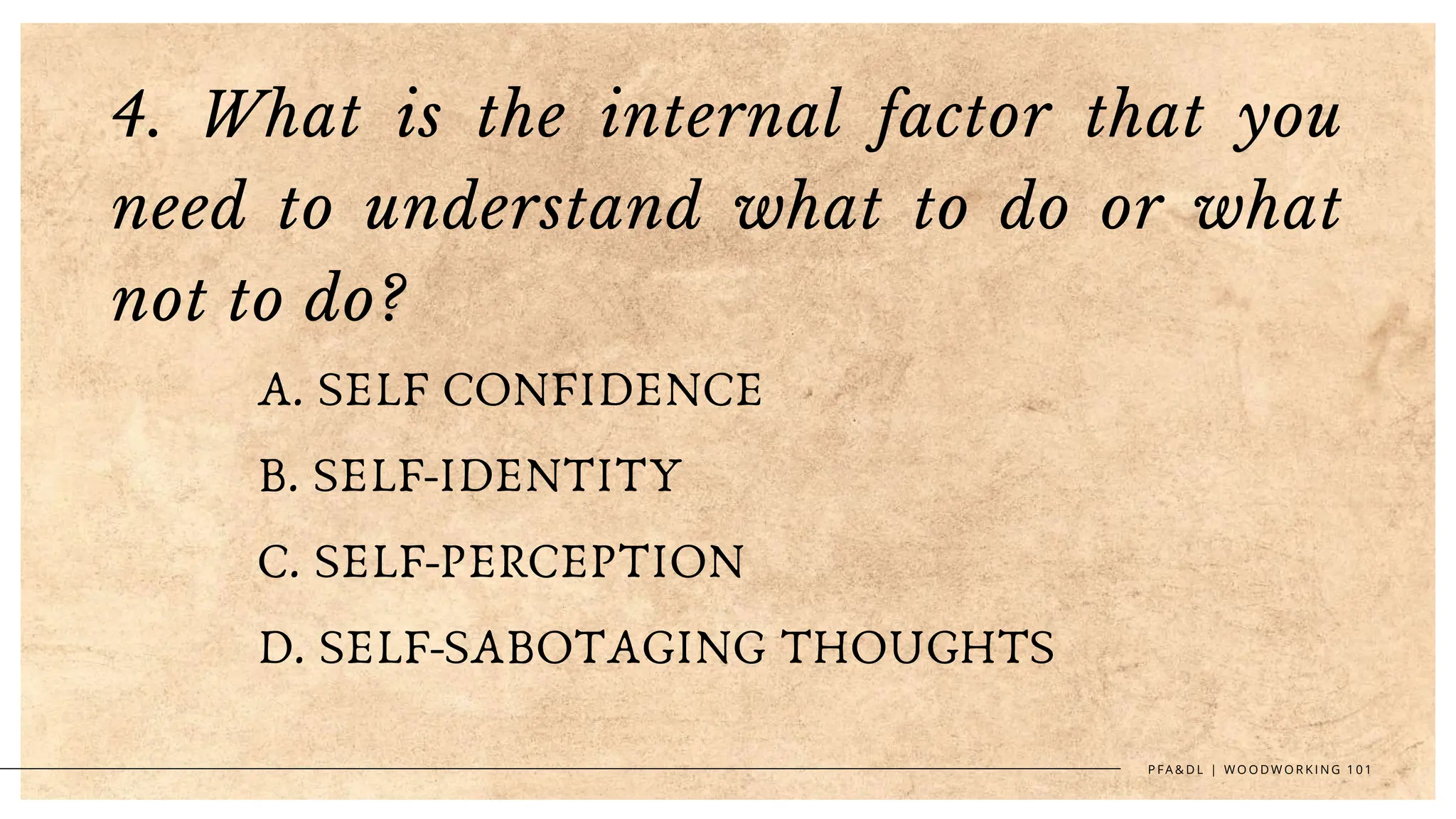
4. What is the internal factor that you
need to understand what to do or what
not to do?
A. SELF CONFIDENCE
B. SELF-IDENTITY
C. SELF-PERCEPTION
D. SELF-SABOTAGING THOUGHTS
P F A & D L | W O O D W O R K I N G 1 0 1
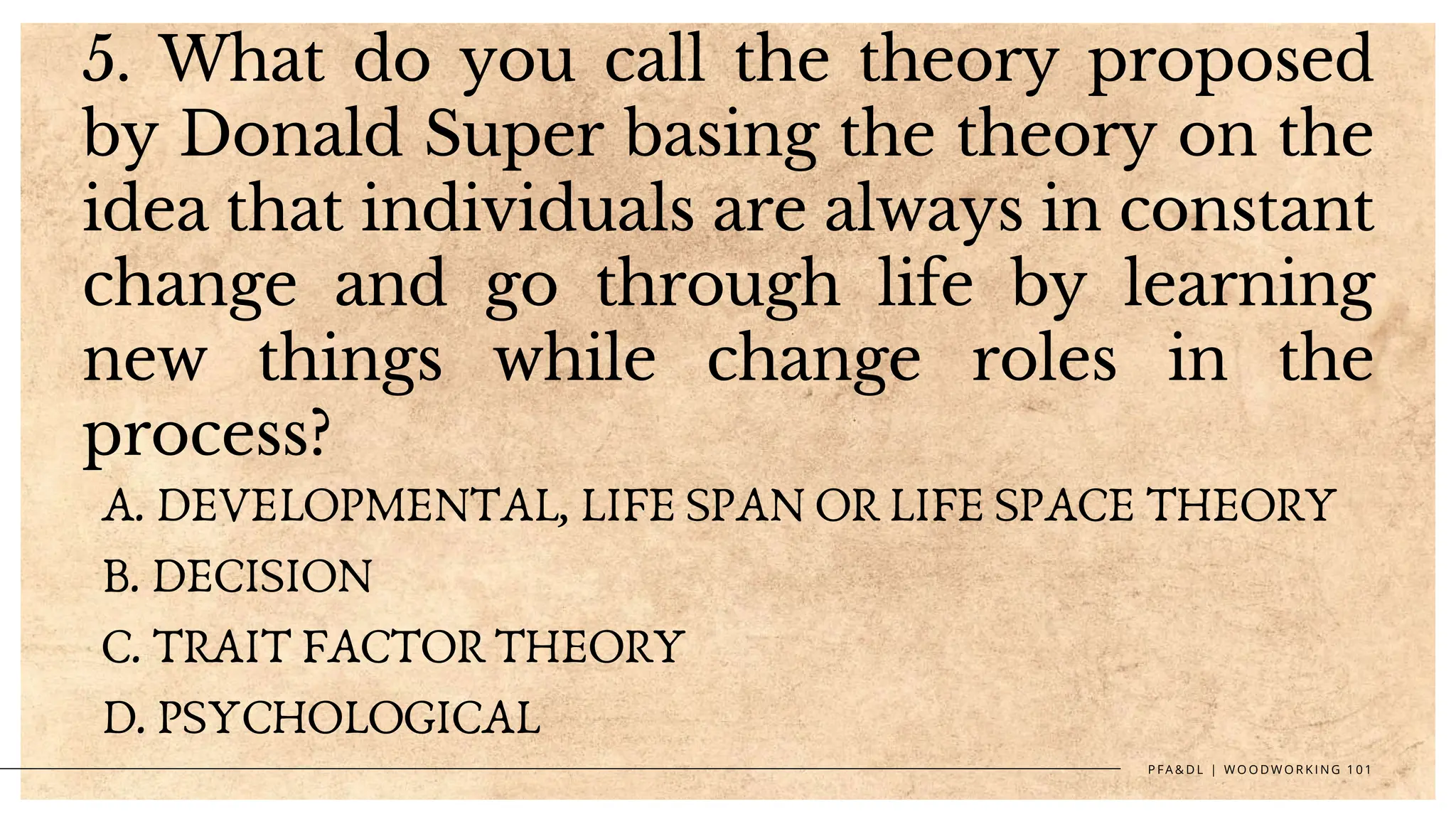
5. What do you call the theory proposed
by Donald Super basing the theory on the
idea that individuals are always in constant
change and go through life by learning
new things while change roles in the
process?
A. DEVELOPMENTAL, LIFE SPAN OR LIFE SPACE THEORY
B. DECISION
C. TRAIT FACTOR THEORY
D. PSYCHOLOGICAL
P F A & D L | W O O D W O R K I N G 1 0 1
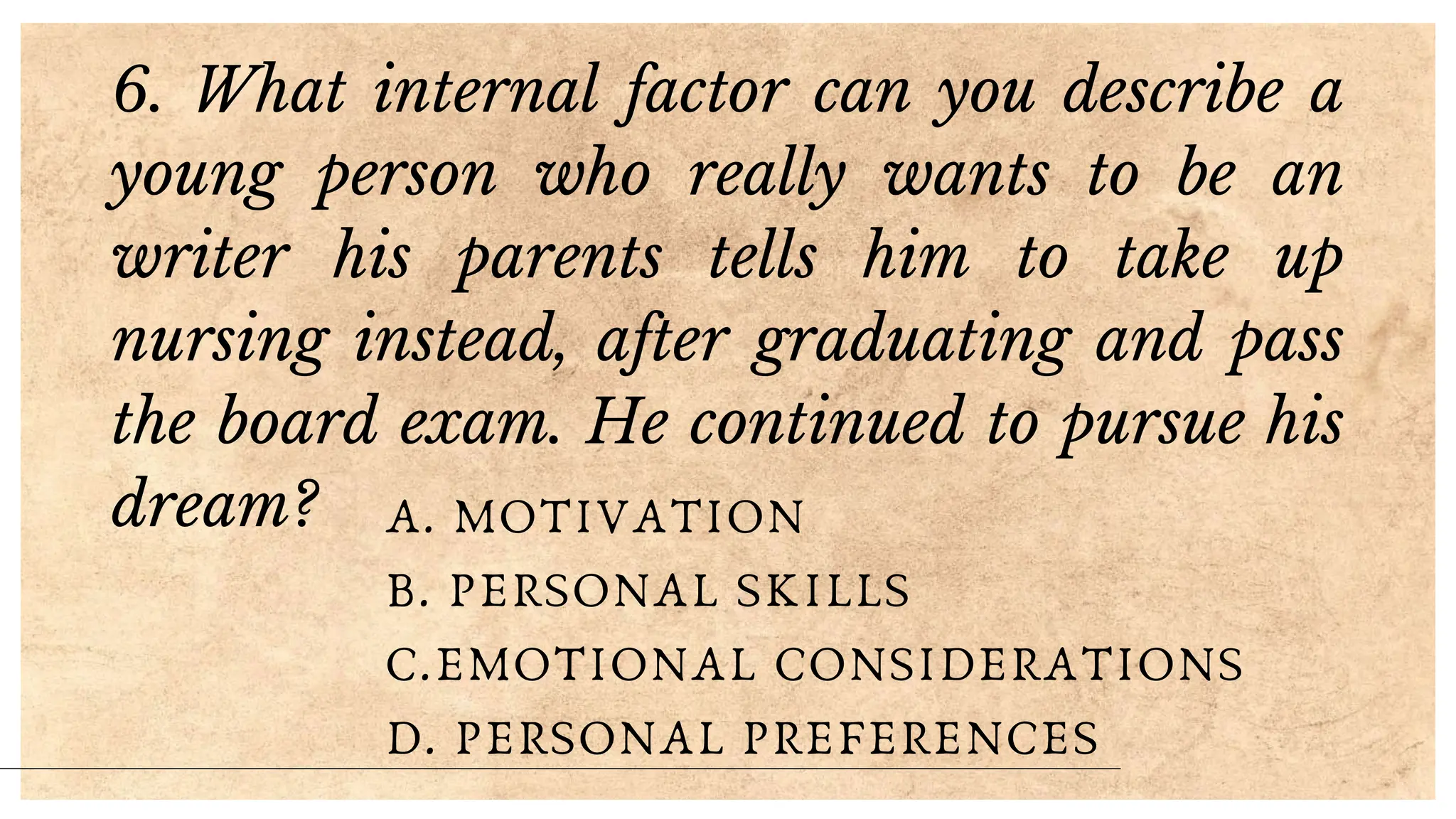
6. What internal factor can you describe a
young person who really wants to be an
writer his parents tells him to take up
nursing instead, after graduating and pass
the board exam. He continued to pursue his
dream? A. MOTIVATION
B. PERSONAL SKILLS
C.EMOTIONAL CONSIDERATIONS
D. PERSONAL PREFERENCES
7. It is described as a profession that a
person may get into, either because he has
found a good match between his life goals,
skills, personality and interest with a dream
job, or it may be just a means to earn a
living. A. EXPERIENCE
B. ON THE JOB TRAINING
C. CAREER
D. MOTIVATION
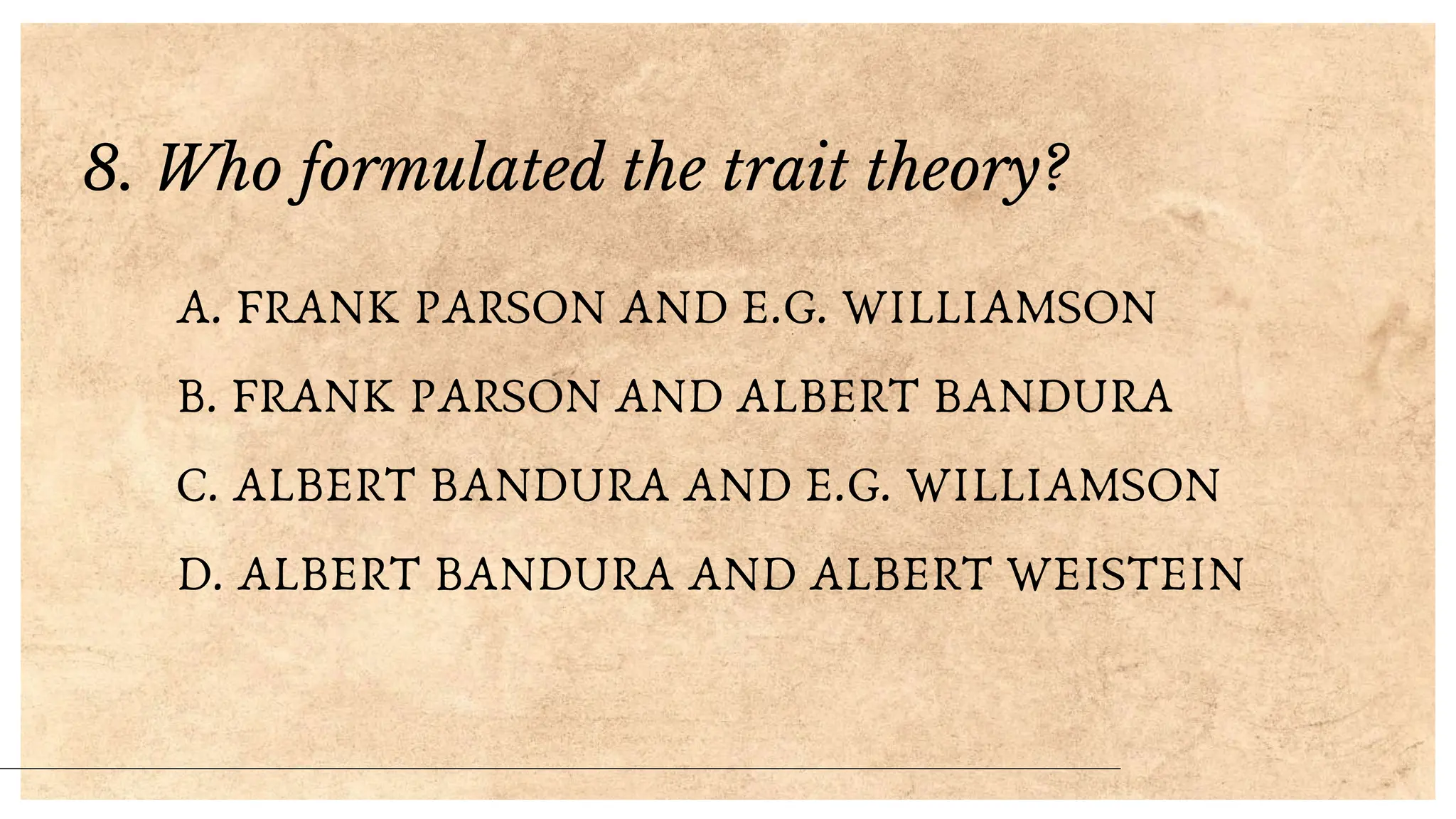
8. Who formulated the trait theory?
A. FRANK PARSON AND E.G. WILLIAMSON
B. FRANK PARSON AND ALBERT BANDURA
C. ALBERT BANDURA AND E.G. WILLIAMSON
D. ALBERT BANDURA AND ALBERT WEISTEIN
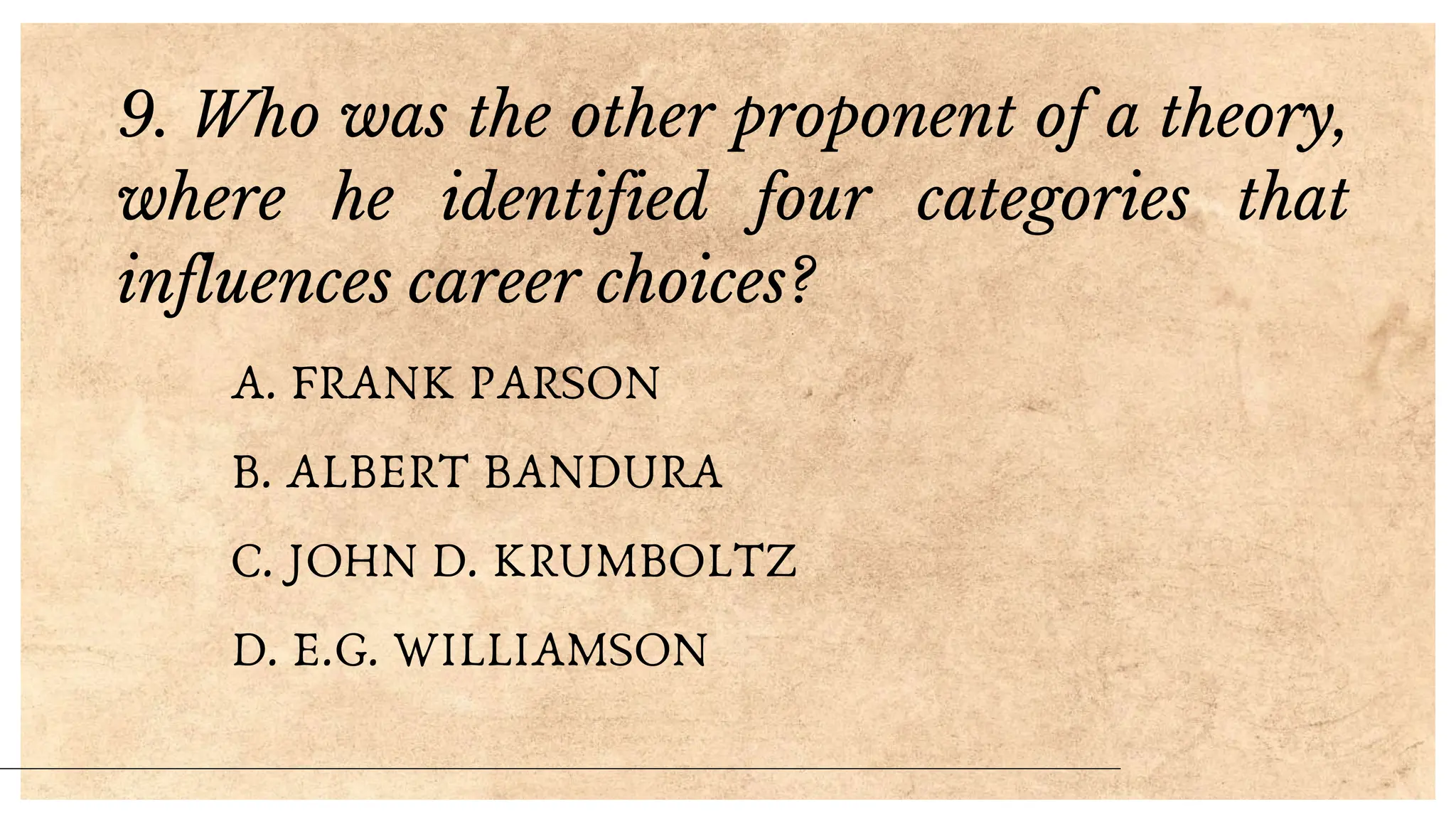
9. Who was the other proponent of a theory,
where he identified four categories that
influences career choices?
A. FRANK PARSON
B. ALBERT BANDURA
C. JOHN D. KRUMBOLTZ
D. E.G. WILLIAMSON
10. An individual will end up making the
wrong choices if strong emotions felt get in
his way. What is this factor?
A. MOTIVATION
B. PERSONAL CHARACTERISTICS
C. PERSONAL SKILLS
D.EMOTIONAL CONSIDERATIONS.
Activity
In a whole pad of paper, illustrate you and the chosen
career choice theory that you think fit to you.
You can express the illustration by drawing or, song
composition or, poem.

Career Choice and Conflict Management.ppt

  • 1.
  • 2.
    Objective • appreciate thatconflict is a fact of life and a key ingredient of human interaction P F A & D L | W O O D W O R K I N G 1 0 1
  • 3.
    Objective 2. understand thenature of conflict and how interpersonal relationships are affected by it. P F A & D L | W O O D W O R K I N G 1 0 1
  • 4.
    Objective 3. develop apositive attitude about conflict as important to personal development. P F A & D L | W O O D W O R K I N G 1 0 1
  • 5.
    Objective 4. Learn one’sconflict management style and apply this in his day to day living. P F A & D L | W O O D W O R K I N G 1 0 1
  • 6.
    The progress andactions taken by a person throughout a lifetime, especially those related to that person's occupations. A career is often composed of the jobs held, titles earned and work accomplished over a long period of time, rather than just referring to one position. I N S P I R A T I O N A L W O R D S T O L I V E B Y
  • 7.
  • 8.
    P F A& D L | W O O D W O R K I N G 1 0 1 Introduction A career is a profession that a person may get into, either because he has found a good match between his life goals, skills, personality and interest with a dream job, or it may be just a means to earn a living.
  • 9.
    Introduction In the pastgenerations, the father chooses the courses for his children to take up. One of the first choices were medicine, accounting, law, engineering and education.
  • 10.
    There are 4 categoriesof career development theories • Trait factor • Psychological • Decision • Developmental, life span or life space theory
  • 11.
    P F A& D L | W O O D W O R K I N G 1 0 1 Trait factor - are skills, interests, values and personality characteristics. They are analyzed matched with an occupational profile.
  • 12.
  • 13.
    P F A& D L | W O O D W O R K I N G 1 0 1 Psychological It is a branch of Parson’s Trait factor theory, where he described six personality categories: realistic, investigative, social, conventional, enterprising and artistic.
  • 14.
  • 15.
    P F A& D L | W O O D W O R K I N G 1 0 1 Decision is based on Albert Bandura’s theory of self-efficacy meaning that a person may perform control over his or her thoughts, beliefs an actions and that self-efficacy is the predictor of behavior.
  • 16.
  • 17.
  • 18.
    Decision Krumboltz identified four factors:genetic influences, environmental conditions and events, learning experiences and skills like goal setting, information gathering and self- observation. According to him, these factors influences career choice.
  • 19.
    Developmental the idea thatindividuals are always in constant change and go through life by learning new things while change roles in the process.
  • 20.
  • 21.
    The Truth aboutCareer Development Theories Keep in mind that there is not one particular theory that can explain everything about career development. Individuals have to develop their own approach or method in searching for career choices. Career choices may change through time for many potential reasons since our lives are constantly changing.
  • 28.
    Internal Factors that AffectsDecision Making • Self concept or self identity • Personal Preferences • Motivation • Self-confidence • Personal Skills • Personal Characteristics • Personal Health • Emotional Considerations • Self-sabotaging thoughts
  • 29.
    Self-concept or self identity Itwill be difficult to choose a career or course to take up in college if your self- identity is not as solid as it should be. You need to understand what to do or not want to do
  • 30.
  • 31.
    You decide totake up accountancy but your parents told you to take up nursing like your aunts will help you earn a lot of money and travel abroad. This situation mostly happens in many Filipino families.
  • 32.
    No matter goodtheir intentions are, these can still boomerang because the child is forced to do the opposite— what his or her parents want. The adolescent will abide by the wishes of the parents over what college course to take.
  • 33.
    Juniele always wantedto become a copywriter for an advertising agency. His father wanted him to take up engineering. Being the eldest in the family, he set aside his personal preferences and took up engineering. He did well since he was smart, graduated on time, took the board exam. .
  • 35.
    When he passed,he went to his father and gave his engineering diploma and professional license and told his father now that he fulfilled his father’s wish, he would like to fulfill his own wish of becoming a copywriter. The father allowed Juniele and now he is a successful copywriter and eventually became the president of an advertising company.
  • 36.
    Motivation drive to fulfillone’s fullest potential.
  • 37.
    Many Filipinos aremotivated by their desire to improve their quality of life. Many Filipinos are working abroad for this reason. They took up a course in college and graduated then they venture out to find a fortune for themselves and their families. When they have saved enough money, they return home to pursue their personal dreams.
  • 38.
    Self-Confidence keep his eyeson his goals and tell the everyone that he can do it and will succeed in pursuing his dreams.
  • 39.
  • 40.
  • 41.
    Personal Skills We learnskill since we were children by observing the people around us.
  • 42.
    Basic education teachesus the hard skills we need to acquire so we can be qualified for higher education, such as learning math and sciences.
  • 43.
    Soft skills suchas dealing with people or communicating a thought non-verbally are skills not taught in our education system.
  • 44.
    Ask yourself whatyou like and enjoy doing, when you enjoy cooking, then that is a skill. You may have hidden skills because some people around you does not accept it or you may be afraid to be misjudge if you show it.
  • 45.
    Have the courageto stand up, hone your skills and develop your own destiny.
  • 46.
  • 47.
    Personal Health health conditionsis a significant factor in the career choice you will make.
  • 48.
    Emotional considerations making decisions isdifficult when one experiences strong emotions such as anger or sadness.
  • 49.
    An individual willend up deciding on the wrong thing because of strong emotions felt. Assess yourself when deciding what course to take. It is best to be sensible and calm when taking life-directing choices
  • 50.
    Self-sabotaging thoughts thought to discouragea person from developing a wholesome self-concept.
  • 51.
    Statements such as“I can’t do this. I will not succeed.” I am not intelligent enough for that course.” “Nobody believes in me, so why should I believe in myself?” These statements are stumbling blocks in your road toward self-actualization.
  • 52.
    G a ug e P F A & D L | W O O D W O R K I N G 1 0 1
  • 53.
    1. What isthe branch of Parson’s trait factor theory describing six personality categories where one type is dominant and may show up to three of these types? A. PSYCHOLOGICAL THEORY B. TRAIT FACTOR THEORY C. DEVELOPMENTAL, LIFE SPAN OR LIFE SPACE THEORY D. DECISION P F A & D L | W O O D W O R K I N G 1 0 1
  • 54.
    2. This isbased on Albert Bandura’s theory of self-efficacy meaning that a person may perform control over his or her thoughts, beliefs an actions and that self-efficacy is the predictor of behavior. What theory is this? A. PSYCHOLOGICAL THEORY B. TRAIT FACTOR THEORY C. DEVELOPMENTAL, LIFE SPAN OR LIFE SPACE THEORY D. DECISION P F A & D L | W O O D W O R K I N G 1 0 1
  • 55.
    3. According toKrumboltz, these factors affect career choice. What are these factors? A. GENETICS B. SOCIAL RESPONSIBILITY AND SITUATIONS C. GENETIC INFLUENCES, ENVIRONMENTAL CONDITIONS AND EVENTS, LEARNING EXPERIENCES AND SKILLS D. NATURAL EXPERIENCE P F A & D L | W O O D W O R K I N G 1 0 1
  • 56.
    4. What isthe internal factor that you need to understand what to do or what not to do? A. SELF CONFIDENCE B. SELF-IDENTITY C. SELF-PERCEPTION D. SELF-SABOTAGING THOUGHTS P F A & D L | W O O D W O R K I N G 1 0 1
  • 57.
    5. What doyou call the theory proposed by Donald Super basing the theory on the idea that individuals are always in constant change and go through life by learning new things while change roles in the process? A. DEVELOPMENTAL, LIFE SPAN OR LIFE SPACE THEORY B. DECISION C. TRAIT FACTOR THEORY D. PSYCHOLOGICAL P F A & D L | W O O D W O R K I N G 1 0 1
  • 58.
    6. What internalfactor can you describe a young person who really wants to be an writer his parents tells him to take up nursing instead, after graduating and pass the board exam. He continued to pursue his dream? A. MOTIVATION B. PERSONAL SKILLS C.EMOTIONAL CONSIDERATIONS D. PERSONAL PREFERENCES
  • 59.
    7. It isdescribed as a profession that a person may get into, either because he has found a good match between his life goals, skills, personality and interest with a dream job, or it may be just a means to earn a living. A. EXPERIENCE B. ON THE JOB TRAINING C. CAREER D. MOTIVATION
  • 60.
    8. Who formulatedthe trait theory? A. FRANK PARSON AND E.G. WILLIAMSON B. FRANK PARSON AND ALBERT BANDURA C. ALBERT BANDURA AND E.G. WILLIAMSON D. ALBERT BANDURA AND ALBERT WEISTEIN
  • 61.
    9. Who wasthe other proponent of a theory, where he identified four categories that influences career choices? A. FRANK PARSON B. ALBERT BANDURA C. JOHN D. KRUMBOLTZ D. E.G. WILLIAMSON
  • 62.
    10. An individualwill end up making the wrong choices if strong emotions felt get in his way. What is this factor? A. MOTIVATION B. PERSONAL CHARACTERISTICS C. PERSONAL SKILLS D.EMOTIONAL CONSIDERATIONS.
  • 63.
    Activity In a wholepad of paper, illustrate you and the chosen career choice theory that you think fit to you. You can express the illustration by drawing or, song composition or, poem.

Editor's Notes