Analysis and Recommendations for Building New York’s
Care Coordination and Care Management Workforce
Who’s Going to Care?
By Karla Silverman, MS, RN, CNM • Helen Schaub • Dan Lowenstein, MBA
July 2015
2 Who’s Going to Care? Analysis and Recommendations for Building New York’s Care Coordination and Care Management Workforce
Table of Contents
Acknowledgements.......................................................................................................................... 5
Executive Summary.......................................................................................................................... 7
Introduction.................................................................................................................................... 11
The Need for a Skilled Care Coordination and Care Management Workforce ................................. 11
Home Health Aides: A Cautionary Tale............................................................................................ 14
Payment Reform: From Volume to Value......................................................................................... 15
Understanding the Care Coordination and Care Management Workforce:
Analysis and Recommendations from a Survey of Health Homes................................................... 16
Key Survey Findings....................................................................................................................... 17
Recommendations......................................................................................................................... 35
1. Collect Data about the Care Coordination and Care Management Workforce............................. 35
2. Require All Payers to Support Care Coordination and Care Management................................... 36
3. Ensure Sufficient Wages and Benefits for Care Coordination and Care Management Staff.......... 36
		A. Set a wage floor for care and care management workers..................................................... 36
		B. Ensure sufficient payment to meet compensation standards................................................ 36
		C. Ensure health plans are incentivized to invest in the community-based sector and
	 	community-based providers are incentivized to invest in their frontline staff.......................... 36
4. Provide Ongoing Training for the Care Coordination and Care Management Workforce.............. 37
		A. Develop industry standards and certification programs........................................................ 37
		B. Fund education and training initiatives that leverage economies of scale.............................. 37
		C. Establish care coordination and care management career ladders....................................... 38
		D. Provide clinical supervision and support for unlicensed care coordination and care
		 management staff................................................................................................................ 38
Appendix 1: Methodology............................................................................................................... 39
Appendix 2: Values......................................................................................................................... 51
Appendix 3: Additional Resources.................................................................................................. 57
Who’s Going to Care? Analysis and Recommendations for Building New York’s Care Coordination and Care Management Workforce 3
4 Who’s Going to Care? Analysis and Recommendations for Building New York’s Care Coordination and Care Management Workforce
The authors wish to thank the 49 Health Home organizations that participated in the survey that was the basis for
this publication; 1199SEIU Healthcare Workers East (1199SEIU) and the Primary Care Development Corporation
(PCDC) leadership; Sandi Vito from the 1199SEIU Training and Upgrading Fund and Annabelle Heckler from 1199SEIU
United Healthcare Workers East for key input; expert reviewers Jean Moore from the Center for Workforce Studies
and Joslyn Levy from Joslyn Levy Associates; Therese Wetterman from PCDC, Robert Feferman from Housing
Works and Elizabeth Lagone from NYC Health and Hospitals Corporation for their assistance with survey design and
review; and Steven Hefter and Alex Wueger from PCDC for proofreading assistance.
About the Authors
Karla Silverman, MS, RN, CNM is PCDC’s Director of Clinical and Training Initiatives. She directs healthcare
workforce initiatives and leads programs that support the delivery of high quality care coordination and care
management services.
Helen Schaub  is Director of Policy and Legislation at 1199SEIU United Healthcare Workers East, where she
oversees all New York State policy and legislative initiatives for the nation’s largest local union.
Dan Lowenstein, MBA is PCDC’s Senior Director of Public Affairs. He directs communications, public policy and
advocacy initiatives to expand access to primary care in underserved communities.
Acknowledgements
Who’s Going to Care? Analysis and Recommendations for Building New York’s Care Coordination and Care Management Workforce 5
1199SEIU Healthcare Workers East (1199SEIU)
1199SEIU United Healthcare Workers East is the largest union in New York and
the largest healthcare union in the nation, representing over 300,000 members
throughout New York State. The union’s mission is to achieve quality care and
good jobs for all.
Primary Care Development Corporation (PCDC)
PCDC is a nationally recognized nonprofit whose mission is to expand access to
primary care in underserved communities. PCDC achieves this mission by providing
affordable capital financing to build and expand primary care infrastructure, expert
technical assistance to help transform the primary care model and public advocacy
to support policies that sustain and expand primary care.
July 2015
Cover photo by Jim Tynan • Designed by Bencom
6 Who’s Going to Care? Analysis and Recommendations for Building New York’s Care Coordination and Care Management Workforce
A successful transition to this new system is highly
dependent on a skilled workforce. New models of care
require nonclinical and paraprofessional staff to assume
greater levels of responsibility as they are called upon
to work in multidisciplinary teams, conduct outreach
to patients in the community and participate in the
management of patient and population health.
Workforce development will be critical to healthcare
transformation, yet today’s workforce is largely unprepared
for these changes. Indeed, New York’s experiment in
shifting care for elderly residents from nursing homes to
a largely underpaid home care workforce offers painful
and expensive lessons as the larger and more complex
healthcare system embarks on a similar shift.
New York State’s Health Home program can provide
important insights on the steps needed to create and
support a skilled care coordination and care management
workforce for the healthcare system as a whole. Health
Homes manage care of Medicaid enrollees with costly and
complex chronic conditions that drive a high volume of
inpatient episodes. The effectiveness of the Health Home
workforce is thus a critical factor in the program’s success
or failure. The workforce lessons learned through Health
Homes and other programs involving high levels of care
management will be particularly relevant as New York State
launches its five-year Delivery System Reform Incentive
Payment Program (DSRIP), which has a goal of reducing
avoidable hospitalizations by 25% in large part by building
community-based healthcare capacity. Over $400 million
will be available for workforce development under DSRIP.
To better understand provider challenges and expectations
for the care coordination and care management workforce,
1199SEIU Healthcare Workers East (1199SEIU) and the
Primary Care Development Corporation (PCDC) surveyed
New York State Health Home providers about workforce
roles and jobs, including education and skills requirements,
salary range and training needs. Based on analysis of survey
results and additional research in the field, 1199SEIU and
PCDC developed recommendations for policymakers and
healthcare organizations.
Executive Summary
New York State’s healthcare
environment is undergoing
dramatic and much needed
change. It is moving towards
a system that places greater
emphasis on community-
based, prevention-focused
care and relies less on higher
cost acute care.
TURN THE PAGE FOR KEY SURVEY FINDINGS...
Who’s Going to Care? Analysis and Recommendations for Building New York’s Care Coordination and Care Management Workforce 7
1	 A diverse and broad set of skills and competencies are needed by the care coordination
		 and care management workforce.
Presented with 22 diverse skills and competencies, the vast majority of respondents were generally in agreement
about what was needed to be effective in care coordination and care management roles. Basic knowledge of clinical
conditions, advanced organizational and interpersonal skills and familiarity with many tasks that are typically in
the nursing and social work domains are required in Health Home care coordination and care management roles.
2	 Ongoing training and supervision are needed for staff who will provide care coordination
		 and care management.
Despite the fact that skills such as patient-centered care and knowledge of chronic conditions were required
of care managers by over 90% of the organizations surveyed, less than 60% provided training in these critical
areas. In addition, fewer than half offered training in health coaching, working in a team, housing placement,
stress management or running and reading reports – all skills that many organizations considered crucial to care
coordination and care management roles.
3	Recruitment and retention challenges are prevalent, driven by insufficient salaries,
high caseload and lack of appropriate skills and competencies.
A significant majority of organizations responding reported recruitment challenges (88%) and retention challenges
(78%). More than half reported insufficient salary as a barrier to recruitment and retention, while large caseloads
and insufficient skills and qualifications were also major factors. Half reported insufficient qualifications as a key
recruitment challenge, and large caseloads and insufficient salary as key staff retention barriers. Salaries reported
by organizations surveyed, the majority of which are community-based, are on average 27% - 50% lower than
those for similar Health Home titles in the hospital workforce.
4	 Job titles for those providing care coordination and care management are
		 still evolving.
While 72% used the title “care manager” for the job of managing and coordinating patient care, there was no
consensus about job titles for supervisory staff or those providing patient outreach and engagement. Without
standard definitions, it may be difficult to bring needed training programs to scale or ramp up the care coordination
and care management workforce.
Key Survey Findings
SEE RECOMMENDATIONS ON NEXT PAGE...
8 Who’s Going to Care? Analysis and Recommendations for Building New York’s Care Coordination and Care Management Workforce
1199SEIU and PCDC are proposing the following recommendations for policymakers and healthcare organizations seeking
to build a strong and effective care coordination and care management workforce.
Summary of Recommendations
1	 Collect data about the care coordination and care management workforce.
2	 Require all payers to support care coordination and care management.
3	Ensure sufficient wages and benefits for care coordination and care
management staff.
	 •	 Set a wage floor for care and care management workers;
	 • 	 Ensure sufficient payment to meet compensation standards; and
	 • 	 Ensure health plans are incentivized to invest in the community-based sector and community-
based providers are incentivized to invest in their frontline staff.
4	Provide ongoing support for the development of the care coordination
and care management workforce.
	 •	 Develop industry standards and certification programs;
	 •	 Fund education and training initiatives that leverage economies of scale;
	 •	 Establish care coordination and care management career ladders; and
	 •	 Provide clinical supervision and support for unlicensed care coordination and care     
management staff.
Who’s Going to Care? Analysis and Recommendations for Building New York’s Care Coordination and Care Management Workforce 9
The success of New York State’s healthcare transformation initiatives is heavily reliant on a
workforce with the skills and competencies necessary to undertake the myriad complex tasks of
coordinating patient care. There must be sufficient compensation, training and career ladders
to build and sustain a skilled workforce for these positions of considerable responsibility. Failing
to do so puts the entire healthcare transformation enterprise at risk.
Conclusion
10 Who’s Going to Care? Analysis and Recommendations for Building New York’s Care Coordination and Care Management Workforce
This change is causing a major shift in the workforce needs of healthcare organizations. Care coordination and care
management jobs, in which staff working in communities help connect patients with services and coordinate their care, are
growing in number. 2
Through the Delivery System Reform Incentive Payment Program (DSRIP)3
and healthcare delivery and payment
transformation at the federal level and in the commercial sector, healthcare workforce changes in New York State are
expected to accelerate over the next five years. However, the successful transition to a lower cost, higher quality community-
based healthcare delivery system faces a number of major challenges. One of the most pressing challenges is the development
of a sufficiently skilled care coordination and care management workforce.
The Need for a Skilled Care Coordination and Care Management Workforce4
In healthcare models such as the Patient-Centered Medical Home, New York State’s Health Home program, Accountable
Care Organizations (ACOs) and DSRIP, the correct medical diagnosis and a solid treatment plan are only part of the solution
to improving patients’ health.
Introduction
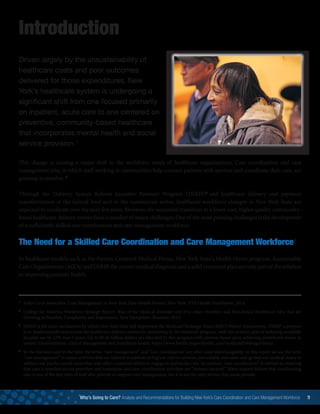
Driven largely by the unsustainability of
healthcare costs and poor outcomes
delivered for those expenditures, New
York’s healthcare system is undergoing a
significant shift from one focused primarily
on inpatient, acute care to one centered on
preventive, community-based healthcare
that incorporates mental health and social
service provision.1
1
	 Joslyn Levy Associates. Care Management in New York State Health Homes. New York: NYS Health Foundation, 2014.
2	
College for America Workforce Strategy Report. Rise of the Medical Assistant and Five other Frontline and Nonclinical Healthcare Jobs that are
Growing in Number, Complexity, and Importance. New Hampshire: Random, 2013.
3
	DSRIP is the main mechanism by which New York State will implement the Medicaid Redesign Team (MRT) Waiver Amendment. DSRIP´s purpose
is to fundamentally restructure the healthcare delivery system by reinvesting in the Medicaid program, with the primary goal of reducing avoidable
hospital use by 25% over 5 years. Up to $6.42 billion dollars are allocated to this program with payouts based upon achieving predefined results in
system transformation, clinical management and population health. https://www.health.ny.gov/health_care/medicaid/redesign/dsrip/.
4	
In the literature and in the field, the terms “care management” and “care coordination” are often used interchangeably. In this report we use the term
“care management” to mean activities that are tailored to patients at highest risk for adverse, preventable outcomes and go beyond medical issues to
address any psycho-social issues that may affect a patient’s ability to engage in and access care. In contrast, “care coordination” is defined as ensuring
that care is seamless across providers and transitions and care coordination activities are “systems-focused.” Many experts believe that coordinating
care is one of the key roles of staff who provide or support care management, but it is not the only service they must provide.
Who’s Going to Care? Analysis and Recommendations for Building New York’s Care Coordination and Care Management Workforce 11
5
	Hong, C.S., Siegel, A.L.,  Ferris, T.G. “Caring for High-Need, High-Cost Patients: What Makes for a Successful Care Management Program?”
Commonwealth Fund. (2014): 2.
6 	
Ibid.
7
	U.S. Department of Health and Human Services Office of Minority Health. Accessed June 9, 2015.
http://minorityhealth.hhs.gov/omh/browse.aspx?lvl=1lvlid=6
A team-based approach where care coordination is provided for all patients, and care management is provided for high-
need, high-cost patients, is now being adopted as a way to lower costs and improve patient outcomes and engagement.5
These are new practice models for most healthcare organizations. In order to be
successful,organizations have to shift their focus to meet the patient satisfaction
and clinical outcome goals that will increasingly determine how much an
organization gets paid, replacing traditional volume-based fee-for-service.
They must examine their day-to-day operations and create new workflows.
They must identify what new tasks need to be carried out, if their staff have
the skills to perform these tasks and if there is an organizational understanding
about how new roles fit together to provide coordinated, patient-centered care.
Training a care coordination and care management workforce with the skills
and competencies they need means teaching skills and creating roles that are
quite different from what was expected previously. Among other tasks, those
providing care coordination and care management need to be able to:
•	 reach out to and engage patients;
•	 provide comprehensive assessments of patients’ needs;
•	 link patients to resources;
•	 coordinate care;
•	 lead care planning;
•	 provide health coaching; and
•	 respond quickly and effectively to changes in patients’ conditions to keep patients from using unnecessary services.6
To be effective in their roles these frontline staff also have to be able to work well in multi-disciplinary teams and build
trusting relationships with patients, their families, primary care providers and specialists.
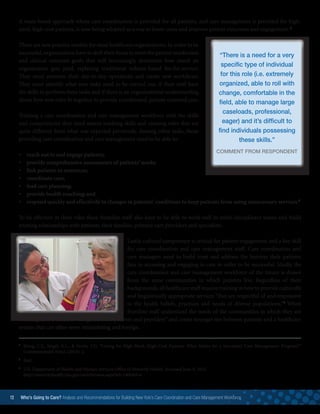
Lastly, cultural competency is critical for patient engagement and a key skill
for care coordination and care management staff. Care coordinators and
care managers need to build trust and address the barriers their patients
face in accessing and engaging in care in order to be successful. Ideally the
care coordination and care management workforce of the future is drawn
from the same communities in which patients live. Regardless of their
backgrounds,all healthcare staff require training in how to provide culturally
and linguistically appropriate services “that are respectful of and responsive
to the health beliefs, practices and needs of diverse populations.”7
When
frontline staff understand the needs of the communities in which they are
working, they become a “bridge between patients and providers” and create stronger ties between patients and a healthcare
system that can often seem intimidating and foreign.
“There is a need for a very
specific type of individual
for this role (i.e. extremely
organized, able to roll with
change, comfortable in the
field, able to manage large
caseloads, professional,
eager) and it’s difficult to
find individuals possessing
these skills.”
COMMENT FROM RESPONDENT
12 Who’s Going to Care? Analysis and Recommendations for Building New York’s Care Coordination and Care Management Workforce
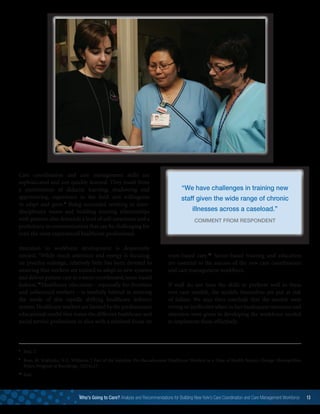
Care coordination and care management skills are
sophisticated and not quickly learned. They result from
a combination of didactic learning, shadowing and
apprenticing, experience in the field and willingness
to adapt and grow.8
Being successful working in inter-
disciplinary teams and building trusting relationships
with patients also demands a level of self-awareness and a
proficiency in communication that can be challenging for
even the most experienced healthcare professional.
Attention to workforce development is desperately
needed. “While much attention and energy is focusing
on practice redesign, relatively little has been devoted to
ensuring that workers are trained to adapt to new systems
and deliver patient care in a more coordinated, team-based
fashion.”9
Healthcare education – especially for frontline
and unlicensed workers – is woefully behind in meeting
the needs of this rapidly shifting healthcare delivery
system.Healthcare workers are limited by the predominant
educational model that trains the different healthcare and
social service professions in silos with a minimal focus on
team-based care.10
Sector-based training and education
are essential to the success of the new care coordination
and care management workforce.
If staff do not have the skills to perform well in these
new care models, the models themselves are put at risk
of failure. We may then conclude that the models were
wrong or ineffective when in fact inadequate resources and
attention were given to developing the workforce needed
to implement them effectively.
8
	Ibid, 2.
9
	Ross, M. Svajlenka, N.P., Williams, J. Part of the Solution: Pre-Baccalaureate Healthcare Workers in a Time of Health System Change. Metropolitan
Policy Program at Brookings. (2014),17.
10
	Ibid.
Who’s Going to Care? Analysis and Recommendations for Building New York’s Care Coordination and Care Management Workforce 13
Home Health Aides: A Cautionary Tale
To carry out these enormous responsibilities, care coordination and care management
staff need jobs with dignity, fair wages, training and educational opportunities and
access to career ladders that fully recognize their importance to patients, healthcare
organizations and those who pay for care.
11
	“Paying the Price: How Poverty Wages Undermine Home Care in America”. PHI (Paraprofessional Healthcare Institute). Accessed May 29, 2015.
http://phinational.org/sites/phinational.org/files/research-report/paying-the-price.pdf.
With hospitals among the top ten largest private sector
employers in every region of the State, it is important
to ensure that wage, benefit and training standards are
not undermined as some of these jobs are shifted to the
ambulatory setting. But this goal cannot be met without a
clearly thought out strategy driven by multiple stakeholders
across a variety of fields including hospitals, primary care
providers, community-based providers, government, labor
unions, funders and educational and training entities.
New York’s experience transitioning care for the elderly
and people with disabilities from institutions to home
care services should serve as a cautionary lesson as similar
changes are sought in the broader healthcare system. The
home care industry relied heavily on minimally skilled
workers making minimum wage (or worse) and did not
effectively integrate them into the overall care of patients.
The result was predictable: burgeoning costs and hundreds
of thousands of clients receiving lower-quality care than
they should have because of a high-turnover,poorly-trained
and poorly integrated workforce. Home health aides, from
the very communities already struggling with poverty and
other drivers of disparate healthcare outcomes, were unable
to support their families.11
New York cannot afford to make the same mistakes as we
build the new coordinated care sector.In particular,without
effective policies in place, we cannot assume that upfront
investments will be made to prepare frontline healthcare
workers to participate fully in these new care models, nor
that their value in improving health and reducing costs will
be reflected in their compensation.
Through DSRIP over $400 million will be available for
training and retraining the healthcare workforce. This
presents a remarkable opportunity for New York State to
minimize disruption for the existing healthcare workforce
as it transitions to new settings and to provide meaningful
careers for low wage, underemployed or unemployed
individuals in low income communities,all while improving
the quality of care for the highest need patients.
14 Who’s Going to Care? Analysis and Recommendations for Building New York’s Care Coordination and Care Management Workforce
How healthcare organizations are paid for
care coordination and care management
services will directly impact their effectiveness.
A national movement is underway to move
healthcare financing from volume-based
fee-for-service payment that defines much
of healthcare today to models that value
better health outcomes, patient satisfaction
and cost savings.
Under DSRIP, 90% of all Medicaid payments are expected to be
in Value-Based Payment (VBP) arrangements within five years.12
The U.S. Department of Health and Human Services has likewise
set a goal of tying 90% of Medicare payments to quality or value
by 2018. The commercial market is also moving rapidly toward
value-oriented payments.
Because care coordination and care management services can
have a major impact on reducing the need for higher cost,
higher intensity care, spending on these services should increase.
Indeed, there has been a greater emphasis on paying for care
coordination and care management. The New York State Health
Home program pays a flat per member per month (PMPM) fee
of $135 for outreach to patients and an additional acuity adjusted
PMPM fee for coordination services.13
Starting January 2015, the
Center for Medicare and Medicaid Services (CMS) began paying
physicians $42 PMPM to coordinate care for Medicare patients
with two or more chronic conditions. CMS is also developing
new ways for Medicaid to pay primary care providers that would
include support for care coordination and care management.
Likewise, private health insurance plans are beginning to support
these services, though there is wide variation in both adoption
and level of support.
Payment Reform: From Volume to Value
12
	Accessed 6/11/15. https://www.health.ny.gov/health_care/medicaid/redesign/
dsrip/docs/dsrip_vbp_webinar_slides.pdf.
13
	DOH Health Home Billing Practices, Effective July 1 2015. Accessed June 9,
2015.http://www.health.ny.gov/health_care/medicaid/program/medicaid_
health_homes/hh_billing_practices.htm. See also http://www.health.ny.gov/
health_care/medicaid/program/medicaid_health_homes/docs/hh_rates_
hml.pdf, page 5.
Who’s Going to Care? Analysis and Recommendations for Building New York’s Care Coordination and Care Management Workforce 15
16 Who’s Going to Care? Analysis and Recommendations for Building New York’s Care Coordination and Care Management Workforce	
Understanding the Care Coordination
and Care Management Workforce:
Analysis and Recommendations from a Survey of Health Homes
Nowhere is the need for
care management and care
coordination more apparent
than in Health Homes, which
serve patients in New York
State’s Medicaid Program
with the most complex chronic
conditions that are often related
to behavioral or social problems
and drive a high volume of
costly inpatient episodes.
The vision behind New York State’s Health Home program
is a healthcare delivery system that is integrated and
coordinated across the disciplines of physical healthcare,
mental health, chemical dependency treatment and social
services provision. Though the level of service intensity
will vary depending on patient acuity, the Health Home
workforce model and its challenges are instructive to DSRIP
as both rely on greater levels of care coordination and care
management services to meet their cost and quality goals.
To better understand provider challenges and expectations
for the care coordination workforce, 1199SEIU and
PCDC conducted an anonymous survey of Health Home
providers primarily from New York City and Downstate
(NYCboroughs,Nassau,Suffolk,WestchesterandRockland
counties). The survey was sent to 213 health homes (19
Health Home leads and 194 downstream providers) and
received 49 valid responses (10 leads, 35 downstream
and four that were both leads and downstream providers
in another Health Home). The results are statistically
significant at the 90% confidence interval with a margin of
error of plus or minus 11%.
The survey asked questions related to workforce roles
and job titles, education and skills requirements, salary
range, training needs and caseload for staff that provide
and supervise Health Home care coordination and care
management services. Based on analysis of survey results
and additional research in the field, 1199SEIU and PCDC
developed recommendations for policymakers and
healthcare organizations.
KEY SURVEY FINDINGS BEGIN ON NEXT PAGE...
Who’s Going to Care? Analysis and Recommendations for Building New York’s Care Coordination and Care Management Workforce 17
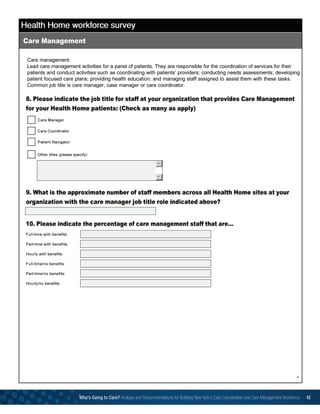
The following terms for Health Home workers were defined in the survey:
Key Survey Findings
14
	“Care Coordination Case Study Preliminary Findings.” Center for Health Workforce Studies. Accessed May 29, 2015. http://chws.albany.edu/archive/
uploads/2014/04/carecoordinationprelim2014.pdf. The “Health Care Workforce in New York: Trends in the Supply and Demand for Health Workers”.
Center for Health Workforce Studies. Accessed May 29, 2015. http://chws.albany.edu/archive/uploads/2014/08/nytracking2014.pdf.
Patient Outreach and
Engagement
Responsible for outreach to
patients, enrolling them into the
program and re-engaging patients
when they become lost to care.
These staff may also assist care
managers with coordinating care
for patients, including conducting
reminder calls about upcoming
appointments and arranging
transportation. Common job titles
include outreach worker, patient
navigator and care navigator.
Care Management
Lead care management activities
for a panel of patients. These staff
coordinate services for their
patients and conduct activities
such as coordinating with patients’
providers, conducting needs
assessments, developing patient
focused care plans, providing health
education and managing staff assigned
to assist them with these tasks.
Common job titles include
care manager, case manager
and care coordinator.
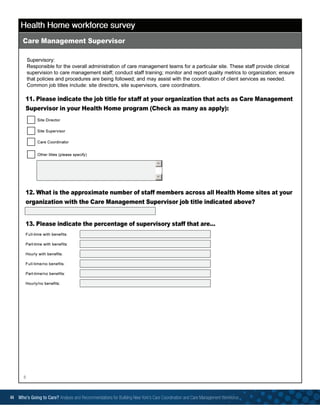
Supervisory
Responsible for the overall
administration of care management
teams at a particular site. These staff
provide clinical supervision to care
management staff, conduct staff
training, monitor and report quality
metrics to the organization, ensure
that policies and procedures are
being followed and may assist with
the coordination of client services as
needed. Common job titles include
site director, site supervisor
and care coordinator.
Findings from the survey were generally in line with other research on the care coordination and care management
workforce. For instance, recent analyses by the Center for Health Workforce Studies found similar challenges around
recruitment and retention, defining roles and responsibilities for various job titles and skills and competency training.14
(All numbers rounded to nearest percent. See Appendix 2 for values.)
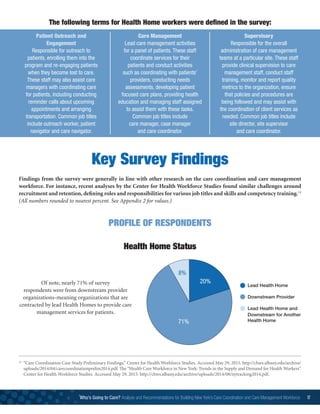
Of note, nearly 71% of survey
respondents were from downstream provider
organizations-meaning organizations that are
contracted by lead Health Homes to provide care
management services for patients.
PROFILE OF RESPONDENTS
Health Home Status
18 Who’s Going to Care? Analysis and Recommendations for Building New York’s Care Coordination and Care Management Workforce	
15
	“Emerging Positions in Primary Care: Results from the 2014 Ambulatory Care Workforce Survey”. Greater New York Hospital Association. Accessed
April 19, 2015. http://www.gnyha.org/PressRoom/Publication/c5dbde90-559e-4ef8-adbd-4b9567143f24/.
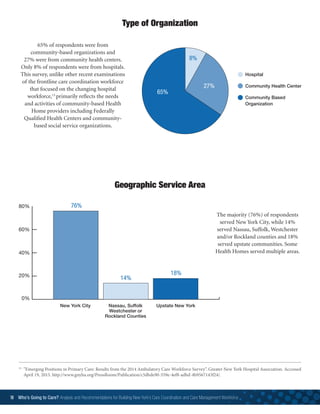
65% of respondents were from
community-based organizations and
27% were from community health centers.
Only 8% of respondents were from hospitals.
This survey, unlike other recent examinations
of the frontline care coordination workforce
that focused on the changing hospital
workforce,15
primarily reflects the needs
and activities of community-based Health
Home providers including Federally
Qualified Health Centers and community-
based social service organizations.
The majority (76%) of respondents
served New York City, while 14%
served Nassau, Suffolk, Westchester
and/or Rockland counties and 18%
served upstate communities. Some
Health Homes served multiple areas.
Type of Organization
Geographic Service Area
Who’s Going to Care? Analysis and Recommendations for Building New York’s Care Coordination and Care Management Workforce 19
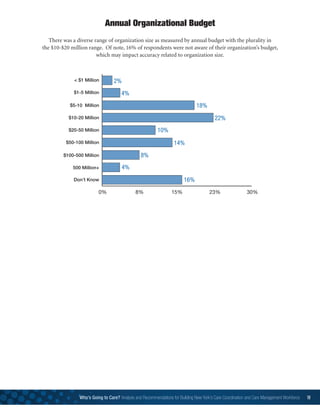
There was a diverse range of organization size as measured by annual budget with the plurality in
the $10-$20 million range. Of note, 16% of respondents were not aware of their organization’s budget,
which may impact accuracy related to organization size.
Annual Organizational Budget
20 Who’s Going to Care? Analysis and Recommendations for Building New York’s Care Coordination and Care Management Workforce	
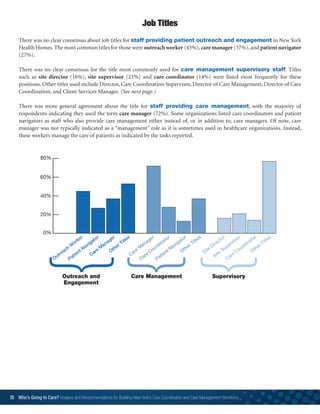
There was no clear consensus about job titles for staff providing patient outreach and engagement in New York
Health Homes. The most common titles for those were outreach worker (45%), care manager (37%), and patient navigator
(27%).
There was no clear consensus for the title most commonly used for care management supervisory staff. Titles
such as site director (16%), site supervisor (21%) and care coordinator (14%) were listed most frequently for these
positions. Other titles used include Director, Care Coordination Supervisor, Director of Care Management, Director of Care
Coordination, and Client Services Manager. (See next page.)
There was more general agreement about the title for staff providing care management, with the majority of
respondents indicating they used the term care manager (72%). Some organizations listed care coordinators and patient
navigators as staff who also provide care management either instead of, or in addition to, care managers. Of note, care
manager was not typically indicated as a “management” role as it is sometimes used in healthcare organizations. Instead,
these workers manage the care of patients as indicated by the tasks reported.
Job Titles
Who’s Going to Care? Analysis and Recommendations for Building New York’s Care Coordination and Care Management Workforce 21
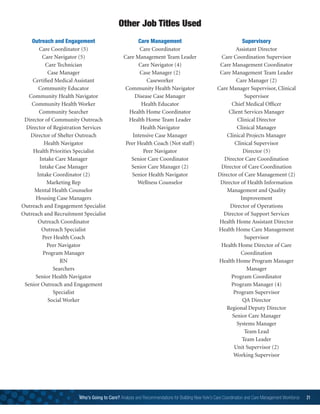
Other Job Titles Used
Outreach and Engagement
Care Coordinator (5)
Care Navigator (5)
Care Technician
Case Manager
Certified Medical Assistant
Community Educator
Community Health Navigator
Community Health Worker
Community Searcher
Director of Community Outreach
Director of Registration Services
Director of Shelter Outreach
Health Navigator
Health Priorities Specialist
Intake Care Manager
Intake Case Manager
Intake Coordinator (2)
Marketing Rep
Mental Health Counselor
Housing Case Managers
Outreach and Engagement Specialist
Outreach and Recruitment Specialist
Outreach Coordinator
Outreach Specialist
Peer Health Coach
Peer Navigator
Program Manager
RN
Searchers
Senior Health Navigator
Senior Outreach and Engagement
Specialist
Social Worker
Care Management
Care Coordinator
Care Management Team Leader
Care Navigator (4)
Case Manager (2)
Caseworker
Community Health Navigator
Disease Case Manager
Health Educator
Health Home Coordinator
Health Home Team Leader
Health Navigator
Intensive Case Manager
Peer Health Coach (Not staff)
Peer Navigator
Senior Care Coordinator
Senior Care Manager (2)
Senior Health Navigator
Wellness Counselor
Supervisory
Assistant Director
Care Coordination Supervisor
Care Management Coordinator
Care Management Team Leader
Care Manager (2)
Care Manager Supervisor, Clinical
Supervisor
Chief Medical Officer
Client Services Manager
Clinical Director
Clinical Manager
Clinical Projects Manager
Clinical Supervisor
Director (5)
Director Care Coordination
Director of Care Coordination
Director of Care Management (2)
Director of Health Information
Management and Quality
Improvement
Director of Operations
Director of Support Services
Health Home Assistant Director
Health Home Care Management
Supervisor
Health Home Director of Care
Coordination
Health Home Program Manager
Manager
Program Coordinator
Program Manager (4)
Program Supervisor
QA Director
Regional Deputy Director
Senior Care Manager
Systems Manager
Team Lead
Team Leader
Unit Supervisor (2)
Working Supervisor
22 Who’s Going to Care? Analysis and Recommendations for Building New York’s Care Coordination and Care Management Workforce	
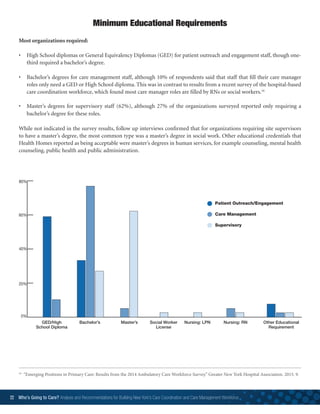
Most organizations required:
•	 High School diplomas or General Equivalency Diplomas (GED) for patient outreach and engagement staff, though one-
third required a bachelor’s degree.
•	 Bachelor’s degrees for care management staff, although 10% of respondents said that staff that fill their care manager
roles only need a GED or High School diploma. This was in contrast to results from a recent survey of the hospital-based
care coordination workforce, which found most care manager roles are filled by RNs or social workers.16
•	 Master’s degrees for supervisory staff (62%), although 27% of the organizations surveyed reported only requiring a
bachelor’s degree for these roles.
While not indicated in the survey results, follow up interviews confirmed that for organizations requiring site supervisors
to have a master’s degree, the most common type was a master’s degree in social work. Other educational credentials that
Health Homes reported as being acceptable were master’s degrees in human services, for example counseling, mental health
counseling, public health and public administration.
16
	“Emerging Positions in Primary Care: Results from the 2014 Ambulatory Care Workforce Survey.” Greater New York Hospital Association. 2015. 9.
Minimum Educational Requirements
Who’s Going to Care? Analysis and Recommendations for Building New York’s Care Coordination and Care Management Workforce 23
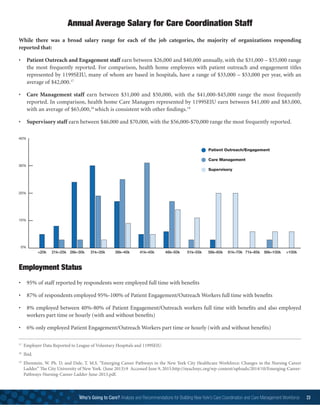
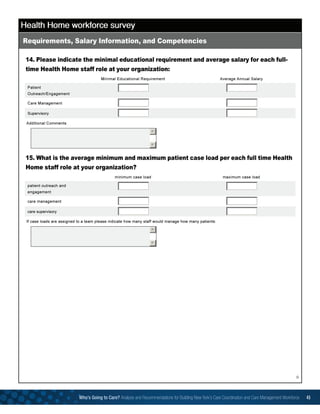
While there was a broad salary range for each of the job categories, the majority of organizations responding                       
reported that:
•	 Patient Outreach and Engagement staff earn between $26,000 and $40,000 annually, with the $31,000 – $35,000 range
the most frequently reported. For comparison, health home employees with patient outreach and engagement titles
represented by 1199SEIU, many of whom are based in hospitals, have a range of $33,000 – $53,000 per year, with an
average of $42,000.17
•	 Care Management staff earn between $31,000 and $50,000, with the $41,000-$45,000 range the most frequently
reported. In comparison, health home Care Managers represented by 1199SEIU earn between $41,000 and $83,000,
with an average of $65,000,18
which is consistent with other findings.19
•	 Supervisory staff earn between $46,000 and $70,000, with the $56,000-$70,000 range the most frequently reported.
17
	Employer Data Reported to League of Voluntary Hospitals and 1199SEIU.
18
	Ibid.
19
	Ebenstein, W. Ph. D. and Dale, T. M.S. “Emerging Career Pathways in the New York City Healthcare Workforce: Changes in the Nursing Career
Ladder.” The City University of New York. (June 2013):9 Accessed June 9, 2015.http://nyachnyc.org/wp-content/uploads/2014/10/Emerging-Career-
Pathways-Nursing-Career-Ladder-June-2013.pdf.
Annual Average Salary for Care Coordination Staff
Employment Status
•	 95% of staff reported by respondents were employed full time with benefits
•	 87% of respondents employed 95%-100% of Patient Engagement/Outreach Workers full time with benefits
•	 8% employed between 40%-80% of Patient Engagement/Outreach workers full time with benefits and also employed
workers part time or hourly (with and without benefits)
•	 6% only employed Patient Engagement/Outreach Workers part time or hourly (with and without benefits)
24 Who’s Going to Care? Analysis and Recommendations for Building New York’s Care Coordination and Care Management Workforce	
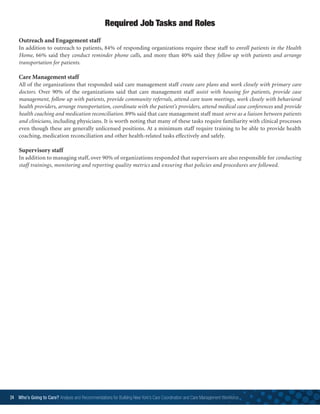
Outreach and Engagement staff
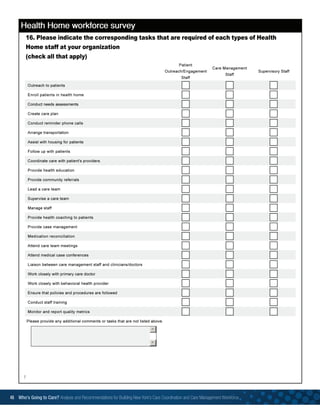
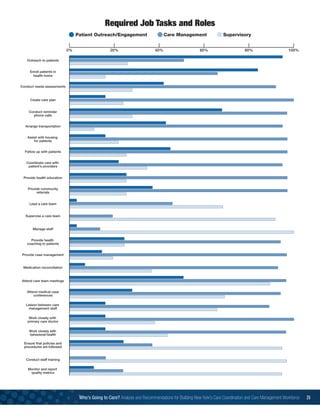
In addition to outreach to patients, 84% of responding organizations require these staff to enroll patients in the Health
Home, 66% said they conduct reminder phone calls, and more than 40% said they follow up with patients and arrange
transportation for patients.
Care Management staff
All of the organizations that responded said care management staff create care plans and work closely with primary care
doctors. Over 90% of the organizations said that care management staff assist with housing for patients, provide case
management, follow up with patients, provide community referrals, attend care team meetings, work closely with behavioral
health providers, arrange transportation, coordinate with the patient’s providers, attend medical case conferences and provide
health coaching and medication reconciliation. 89% said that care management staff must serve as a liaison between patients
and clinicians, including physicians. It is worth noting that many of these tasks require familiarity with clinical processes
even though these are generally unlicensed positions. At a minimum staff require training to be able to provide health
coaching, medication reconciliation and other health-related tasks effectively and safely.
Supervisory staff
In addition to managing staff, over 90% of organizations responded that supervisors are also responsible for conducting
staff trainings, monitoring and reporting quality metrics and ensuring that policies and procedures are followed.
Required Job Tasks and Roles
Who’s Going to Care? Analysis and Recommendations for Building New York’s Care Coordination and Care Management Workforce 25
Required Job Tasks and Roles
26 Who’s Going to Care? Analysis and Recommendations for Building New York’s Care Coordination and Care Management Workforce	
Outreach and Engagement staff
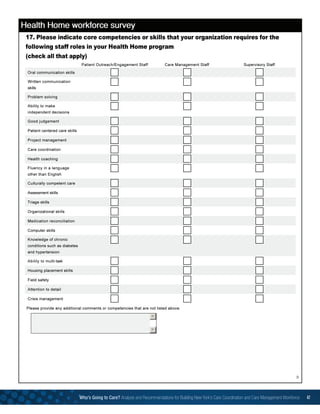
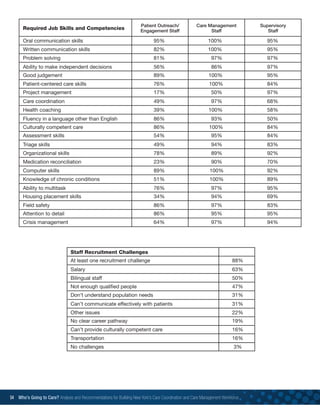
Oral communication was the primary skill needed by outreach and engagement staff for over 90% of survey respondents.
Over 80% require outreach and engagement staff to have written communication skills, good judgment, fluency in a language
other than English, the ability to provide culturally competent care, computer skills, field safety skills and attention to detail.
Care Management staff
There was universal agreement among survey respondents that all care managers need oral and written communication
skills, good judgment, patient-centered care skills, health coaching skills, ability to provide culturally competent care, computer
skills and knowledge of chronic conditions. Over 90% also cited problem solving, care coordination, fluency in a language
other than English, assessment and triage skills, the ability to multitask, housing placement skills, field safety knowledge,
attention to detail and crisis management skills. It is worth noting that the sheer range and diversity of competencies that
these positions require draw on experience with clinical conditions, nursing, social work and sophisticated organizational
and interpersonal skills.
Supervisory staff
Over 90% of the organizations listed oral and written communication skills, problem solving skills, the ability to make
independent decisions, project management and organizational skills, computer skills, ability to multitask, attention to detail
and crisis management as the primary required competencies for supervisory staff.
Required Job Skills and Competencies
Who’s Going to Care? Analysis and Recommendations for Building New York’s Care Coordination and Care Management Workforce 27
Required Skills and Competencies
28 Who’s Going to Care? Analysis and Recommendations for Building New York’s Care Coordination and Care Management Workforce	
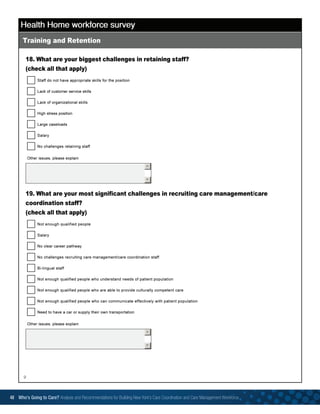
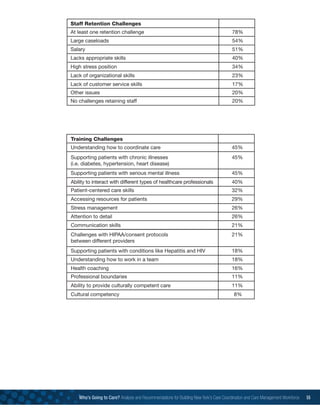
Fully 88% of respondents reported at least one challenge to staff recruitment. More than 60% reported inadequate salaries as
a reason. Insufficient qualifications and the inability to speak a second language were also significant factors.
Staff Recruitment Challenges
88% of respondents
reported at least one staff
recruitment challenge
Who’s Going to Care? Analysis and Recommendations for Building New York’s Care Coordination and Care Management Workforce 29
Fully 78% of respondents reported at least one challenge to staff retention. More than half reported that large caseloads and
insufficient salaries were barriers to retaining staff and 40% reported that lack of appropriate skills impacted retention.
Key Comments:
There is a need for a very specific type of individual for this role (i.e.
extremely organized, able to roll with change, comfortable in the field, able
to manage large caseloads, professional, eager) and it’s difficult to find
individuals possessing these skills. Also, the ability to provide supervision
for licensed individuals has been an issue.
These are difficult, high stress jobs.
We have trouble finding staff who are able to handle the caseload sizes.
The work requires a lot of travel within the five boroughs. This makes the
position strenuous.
Staff Retention Challenges
“We have been able to
retain our current staff,
but they do not hold a
master’s or bachelor’s
degree in social work
and thus require a
lot of training.”
COMMENT FROM
RESPONDENT
78% of respondents
reported at least one staff
retention challenge
30 Who’s Going to Care? Analysis and Recommendations for Building New York’s Care Coordination and Care Management Workforce	
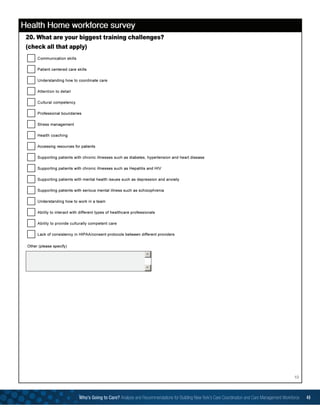
45% of respondents reported that the most significant training needs were in understanding how to coordinate care and
supporting patients who have chronic illnesses and/or serious mental illness while about 40% reported that interacting with
various healthcare providers was a key training challenge.
These responses likely reflect the reality that community-based providers typically have less wide-ranging clinical experience
and less experience interacting and coordinating care between a diverse array of medical providers as is required in the
Health Home model.
For example, a community-based organization may have many years of experience providing case management and
coordinating care for HIV-positive patients but have care managers who have considerably less experience working with
patients with conditions like diabetes and heart disease. They also may have much less experience interacting with the
doctors that provide the clinical care to those patients.
Conversely, there may be care managers who come from a medical case management background who are now being asked
to address social determinants of health for their patients but have little experience and need training to carry out these tasks.
For example, medical case managers may not have previously been tasked with finding housing for their patients or with
coordinating with substance abuse providers but are now being asked to do so as Health Home care managers.
Training Challenges
Who’s Going to Care? Analysis and Recommendations for Building New York’s Care Coordination and Care Management Workforce 31
Key Comments:
Caseloads are large and clients are very needy.
Information technology as it applies to the care managers and supervisors in their day to day work and reporting
requirements is an important need.
We have challenges in training new staff given the wide range of chronic illnesses across a caseload. We would like
[training] resources available on a regular basis to send new hires.
Managing all the paperwork needed for such large caseloads is difficult.
Understanding behavioral health needs of clients is a challenge.
Training Challenges
32 Who’s Going to Care? Analysis and Recommendations for Building New York’s Care Coordination and Care Management Workforce	
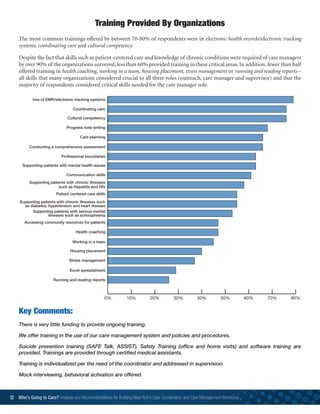
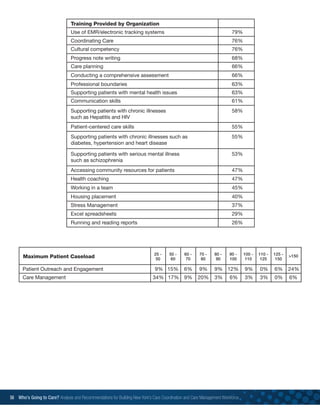
The most common trainings offered by between 70-80% of respondents were in electronic health records/electronic tracking
systems, coordinating care and cultural competency.
Despite the fact that skills such as patient-centered care and knowledge of chronic conditions were required of care managers
by over 90% of the organizations surveyed, less than 60% provided training in these critical areas. In addition, fewer than half
offered training in health coaching, working in a team, housing placement, stress management or running and reading reports –
all skills that many organizations considered crucial to all three roles (outreach, care manager and supervisor) and that the
majority of respondents considered critical skills needed for the care manager role.
Training Provided By Organizations
Key Comments:
There is very little funding to provide ongoing training.
We offer training in the use of our care management system and policies and procedures.
Suicide prevention training (SAFE Talk, ASSIST), Safety Training (office and home visits) and software training are
provided. Trainings are provided through certified medical assistants.
Training is individualized per the need of the coordinator and addressed in supervision.
Mock interviewing, behavioral activation are offered.
Who’s Going to Care? Analysis and Recommendations for Building New York’s Care Coordination and Care Management Workforce 33
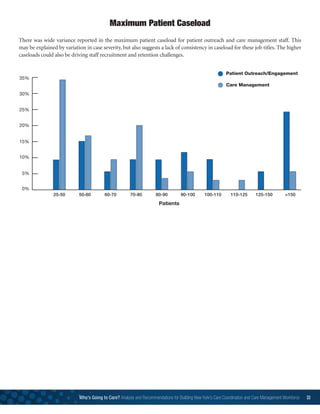
There was wide variance reported in the maximum patient caseload for patient outreach and care management staff. This
may be explained by variation in case severity, but also suggests a lack of consistency in caseload for these job titles. The higher
caseloads could also be driving staff recruitment and retention challenges.
Maximum Patient Caseload
34 Who’s Going to Care? Analysis and Recommendations for Building New York’s Care Coordination and Care Management Workforce
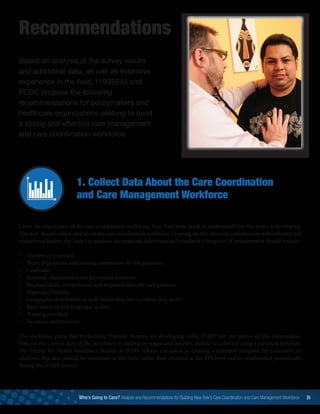
Recommendations
Based on analysis of the survey results
and additional data, as well as extensive
experience in the field, 1199SEIU and
PCDC propose the following
recommendations for policymakers and
healthcare organizations seeking to build
a strong and effective care management
and care coordination workforce.
1. Collect Data About the Care Coordination
and Care Management Workforce
Given the importance of the care coordination workforce, New York State needs to understand how the sector is developing.
The state should collect data about the care coordination workforce. Drawing on this data and consultations with industry and
educational leaders, the State can propose occupational definitions and standards. Categories of measurement should include:
•	 Number of positions
•	 Types of positions and naming conventions for the positions
•	 Caseloads
•	 Required educational levels for various positions
•	 Required skills, competencies and responsibilities for each position
•	 Wages and benefits
•	 Geographic distribution of staff (where they live vs. where they work)
•	 Race, ethnicity and languages spoken
•	 Training provided
•	 Vacancies and turnover  
The workforce plans that Performing Provider Systems are developing under DSRIP are one source of this information.
Data on the current state of the workforce, including on wages and benefits, should be collected using a common template.
The Center for Health Workforce Studies at SUNY Albany can assist in creating a common template for collection. In
addition, this data should be submitted to the State rather than retained at the PPS level and be resubmitted periodically
during the DSRIP period.
Who’s Going to Care? Analysis and Recommendations for Building New York’s Care Coordination and Care Management Workforce 35
2. Require All Payers to Support Care
Coordination and Care Management
Following policies underway and being established in Medicare and Medicaid,all payers should be required to pay adequately for
care coordination and care management services at the provider level. Not only will this support be vital for care coordination
and care management capacity in healthcare organizations, it will also help eliminate the “free rider” problem in which payers
(and their enrollees) who do not pay for care coordination and care management services benefit from those services funded by
other payers. Payment can take the form of a specific care coordination and care management fee or be funded as an element of
a bundle or other value-based arrangement.
3. Ensure Sufficient Wages and Benefits for
Care Coordination and Care Management Staff
More than half of respondents indicated that lack of a sufficient salary was a major barrier to recruiting and retaining staff.
In addition, care coordination salaries of the respondents to the survey, many of whom are community-based organizations,
were up to 50% lower than typical salaries for the similar work at hospitals.
Set a wage floor for care and care management workers
A minimum compensation standard in Medicaid-funded home care downstate has finally begun to stabilize a workforce
notoriousforitshighturnover. Asimilarpolicycanbeinstitutedforthenewcarecoordinationandcaremanagementworkforce.
This will not only ensure that care management staff are assured a living wage,it also can increase retention and thus help ensure
continuity of care for patients. Different wage floors should be established based on educational attainment and job category
using a methodology similar to“prevailing wage” statutes common in other industries.
Ensure sufficient payment to meet compensation standards
New York State Medicaid enrollees represent the largest and most intensive use of care coordination services. Medicaid and
Medicaid managed care organizations must pay providers enough to meet compensation standards for the care coordination
workforce and allow for investment in training.
Ensure health plans are incentivized to invest in the community-based sector and
community-based providers are incentivized to invest in their frontline staff
Under value-based payment, quality metrics for providers should include direct measures of investment in employees such as
compensation, turnover, caseload, satisfaction and access to career ladders as well as key measures of access and coordination.
36 Who’s Going to Care? Analysis and Recommendations for Building New York’s Care Coordination and Care Management Workforce
4. Provide Ongoing Training for the Care
Coordination and Care Management Workforce
Fully 45% of respondents indicated that their care coordination and care management workforce required training in core
areas. Given the enormous demand to fill these positions and the insufficient supply of skilled individuals who can fill them,
there is clear need for workforce initiatives that can rapidly and continuously train a large number of workers. While DSRIP is
providing a $400 million investment in training and workforce development, it will be important to ensure that these dollars
are used effectively and that resources are available once the DSRIP period is over.This will require industry-wide collaboration,
both regionally and statewide. Otherwise, significant resources could be wasted in duplication.
Develop industry standards and certification programs
Given the evolving nature of these job categories, we do not recommend state level licensure at this time. There should however
be a State-sanctioned certification process and a standard definition for each of the job titles in the care coordination and care
management category, drawn from the research and industry consultation discussed above.
Certification could be based on skills and competencies for each of the job titles (i.e. care coordination, communication,
culturally competent care,health coaching,assessment and care planning).These must be carefully constructed to avoid artificial
barriers to entry for community members,who may be the most suited to provide peer support and culturally and linguistically
competent services. Programs should allow for students to build on previous certifications and earn college credit to allow for
the development of career ladders.
Fund education and training initiatives that leverage economies of scale
The overwhelming need for qualified care coordination staff demands standardized curricula and training methods that can
be easily replicated (and modified as appropriate) across numerous healthcare settings throughout New York State. Significant
investment has already been made in curricula development in New York State and across the country. A clearinghouse for
best practices in training should be created. Existing curricula should be identified, evaluated and built upon to provide access
to high quality training programs, while avoiding duplication and waste.20
Just as important, colleges should be encouraged to
incorporate and build upon existing training in order to provide more career pathway options.
Bonds and collaboration must be strengthened between healthcare practice organizations and healthcare training and
educational institutions to better match training of workers to current healthcare practice needs. As a recent Brookings
report stated,“In order to meet the triple aim of better care, better health, and lower costs, the worlds of healthcare practice
and healthcare education (at all levels of credentials) need to exponentially strengthen their bonds and interactions so that
education and training for both incumbent and future workers is more connected to the actual delivery of care.”21
This
collaboration should be regional and industry-wide where possible to avoid duplication of effort.
20
	1199SEIU Training and Employment Fund and PCDC developed the Care Coordination Fundamentals training curriculum specifically for nonclinical
healthcare workers. Accessed June 8, 2015. http://www.pcdc.org/resources/quality-improvement/resources/care-coordination.html
21
	Ross M., Svajlenka N. P., Williams J. “Part of the Solution: Pre-Baccalaureate Healthcare Workers in a Time of Health System Change” Metropolitan
PolicyProgramatBrookings.July2014.17.AccessedJune9,2015http://www.brookings.edu/~/media/research/files/reports/2014/07/healthworkforce/
healthcare-workers-report.pdf
Who’s Going to Care? Analysis and Recommendations for Building New York’s Care Coordination and Care Management Workforce 37
Successful career ladder
programs such as the 1199SEIU
Training and Upgrading
Fund (TUF) have developed
comprehensive support systems
for working adults as they
return to school. By proactively
addressing challenges faced by
many worker-students through
programs including child care,
peer cohorts, academic support
and early intervention for
struggling participants, TUF has
achieved high completion rates. 
38 Who’s Going to Care? Analysis and Recommendations for Building New York’s Care Coordination and Care Management Workforce	
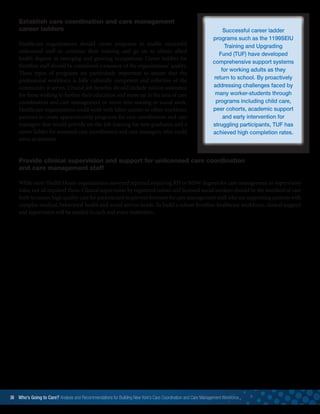
Establish care coordination and care management
career ladders
Healthcare organizations should create programs to enable successful
unlicensed staff to continue their training and go on to obtain allied
health degrees in emerging and growing occupations. Career ladders for
frontline staff should be considered a measure of the organizations’ quality.
These types of programs are particularly important to ensure that the
professional workforce is fully culturally competent and reflective of the
community it serves. Crucial job benefits should include tuition assistance
for those wishing to further their education and move up in the area of care
coordination and care management or move into nursing or social work.
Healthcare organizations could work with labor unions or other workforce
partners to create apprenticeship programs for care coordinators and care
managers that would provide on-the-job training for new graduates and a
career ladder for seasoned care coordinators and care managers, who could
serve as mentors.
Provide clinical supervision and support for unlicensed care coordination
and care management staff
While most Health Home organizations surveyed reported requiring RN or MSW degrees for care management or supervisory
roles, not all required them. Clinical supervision by registered nurses and licensed social workers should be the standard of care
both to ensure high quality care for patients and to prevent burnout for care management staff who are supporting patients with
complex medical, behavioral health and social service needs. To build a robust frontline healthcare workforce, clinical support
and supervision will be needed in each and every institution.
Appendix 1:
Survey Methodology and Questions
TURN THE PAGE FOR QUESTIONNAIRE...
Methodology
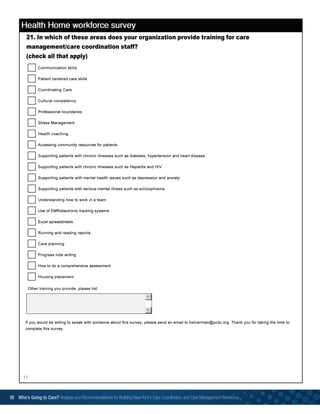
An online survey tool was developed and implemented through a survey collection website. Email requests were sent to
Health Home Leads and Downstream providers in the New York City and Downstate regions (Nassau, Suffolk,Westchester and
Rockland Counties) on March 17 and March 26, 2015, with a March 30, 2015 completion deadline. The survey was sent to 213
health homes (19 Health Home leads and 194 downstream providers), primarily in the New York City/Downstate area. Some
Upstate health homes also responded and their responses were included in the results. The survey generated 49 valid responses
(10 leads, 35 downstream and four that were both leads and downstream providers in another Health Home). The results are
statistically significant at the 90% confidence interval with a margin of error of plus or minus 11%.
Who’s Going to Care? Analysis and Recommendations for Building New York’s Care Coordination and Care Management Workforce 39
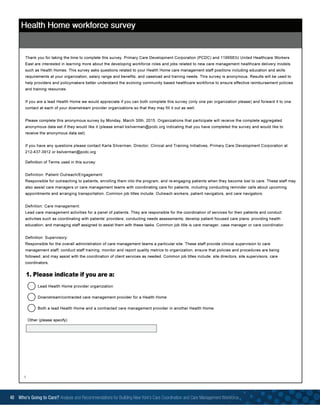
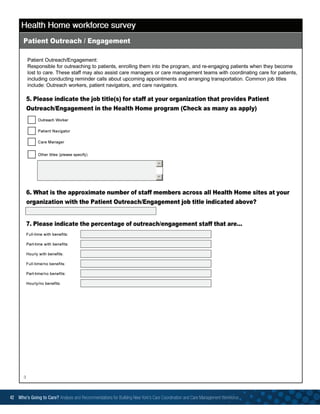
1
40 Who’s Going to Care? Analysis and Recommendations for Building New York’s Care Coordination and Care Management Workforce
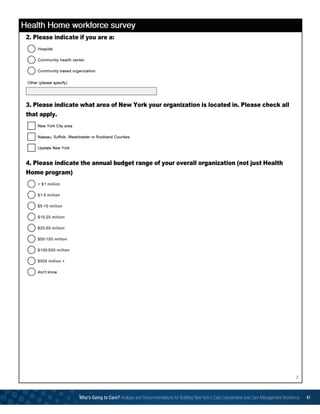
2
Who’s Going to Care? Analysis and Recommendations for Building New York’s Care Coordination and Care Management Workforce 41
3
42 Who’s Going to Care? Analysis and Recommendations for Building New York’s Care Coordination and Care Management Workforce
4
Who’s Going to Care? Analysis and Recommendations for Building New York’s Care Coordination and Care Management Workforce 43
5
44 Who’s Going to Care? Analysis and Recommendations for Building New York’s Care Coordination and Care Management Workforce
6
Who’s Going to Care? Analysis and Recommendations for Building New York’s Care Coordination and Care Management Workforce 45
7
46 Who’s Going to Care? Analysis and Recommendations for Building New York’s Care Coordination and Care Management Workforce
8
Who’s Going to Care? Analysis and Recommendations for Building New York’s Care Coordination and Care Management Workforce 47
9
48 Who’s Going to Care? Analysis and Recommendations for Building New York’s Care Coordination and Care Management Workforce
10
Who’s Going to Care? Analysis and Recommendations for Building New York’s Care Coordination and Care Management Workforce 49
11
50 Who’s Going to Care? Analysis and Recommendations for Building New York’s Care Coordination and Care Management Workforce
Appendix 2:
Values
Who’s Going to Care? Analysis and Recommendations for Building New York’s Care Coordination and Care Management Workforce 51
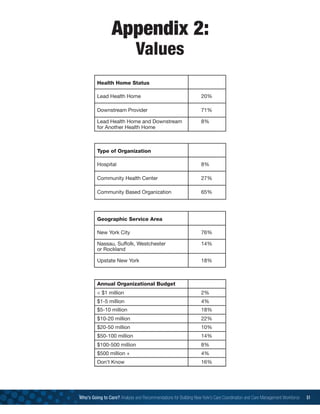
Health Home Status
Lead Health Home	 20%
Downstream Provider	 71%
Lead Health Home and Downstream 	 8%
for Another Health Home
Type of Organization
Hospital	8%
Community Health Center	 27%
Community Based Organization 	 65%
Geographic Service Area
New York City	 76%
Nassau, Suffolk, Westchester	 14%
or Rockland	
Upstate New York	 18%
Annual Organizational Budget
 $1 million	 2%
$1-5 million	 4%
$5-10 million	 18%
$10-20 million	 22%
$20-50 million	 10%
$50-100 million	 14%
$100-500 million	 8%
$500 million +	 4%
Don’t Know	 16%
52 Who’s Going to Care? Analysis and Recommendations for Building New York’s Care Coordination and Care Management Workforce	
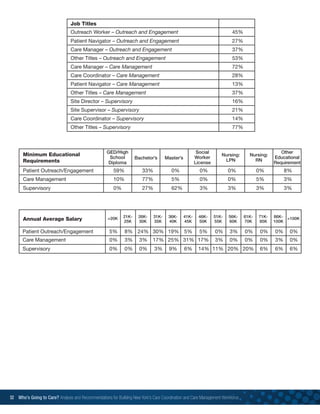
Job Titles
Outreach Worker – Outreach and Engagement	45%
Patient Navigator – Outreach and Engagement	27%
Care Manager – Outreach and Engagement	37%
Other Titles – Outreach and Engagement	53%
Care Manager – Care Management	72%
Care Coordinator – Care Management	28%
Patient Navigator – Care Management	13%
Other Titles – Care Management	37%
Site Director – Supervisory	16%
Site Supervisor – Supervisory	21%
Care Coordinator – Supervisory	14%
Other Titles – Supervisory	77%
Patient Outreach/Engagement	59%	33%	0%	0%	0%	0%	8%
Care Management	 10%	77%	5%	0%	0%	5%	3%
Supervisory	 0%	27%	62%	3%	3%	3%	3%
Minimum Educational
Requirements
Other
Educational
Requirement
GED/High
School
Diploma
Bachelor’s Master’s
Social
Worker
License
Nursing:
LPN
Nursing:
RN
Patient Outreach/Engagement	 5%	8%	24%	30%	19%	5%	5%	0%	3%	0%	0%	0%	0%
Care Management	 0%	3%	3%	17%	25%	31%	17%	3%	0%	0%	0%	3%	0%
Supervisory	 0%	0%	0%	3%	9%	6%	14%	11%	20%	20%	6%	6%	6%
Annual Average Salary 20K 21K-
25K
26K-
30K
31K-
35K
36K-
40K
41K-
45K
46K-
50K
51K-
55K
56K-
60K
61K-
70K
71K-
85K
86K-
100K
100K
Who’s Going to Care? Analysis and Recommendations for Building New York’s Care Coordination and Care Management Workforce 53
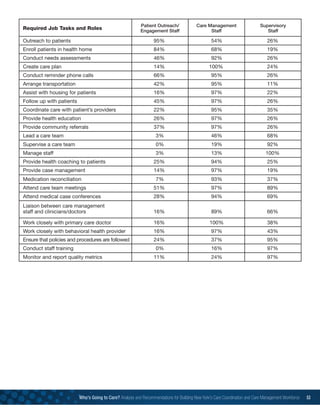
Outreach to patients	 95%	 54%	 26%
Enroll patients in health home	 84%	 68%	 19%
Conduct needs assessments	 46%	 92%	 26%
Create care plan	 14%	 100%	 24%
Conduct reminder phone calls	 66%	 95%	 26%
Arrange transportation	 42%	 95%	 11%
Assist with housing for patients	 16%	 97%	 22%
Follow up with patients	 45%	 97%	 26%
Coordinate care with patient’s providers	 22%	 95%	 35%
Provide health education	 26%	 97%	 26%
Provide community referrals	 37%	 97%	 26%
Lead a care team	 3%	 46%	 68%
Supervise a care team	 0%	 19%	 92%
Manage staff	 3%	 13%	 100%
Provide health coaching to patients	 25%	 94%	 25%
Provide case management	 14%	 97%	 19%
Medication reconciliation	 7%	 93%	 37%
Attend care team meetings	 51%	 97%	 89%
Attend medical case conferences	 28%	 94%	69%
Liaison between care management
staff and clinicians/doctors	 16%	 89%	 66%
Work closely with primary care doctor	 16%	 100%	 38%
Work closely with behavioral health provider	 16%	 97%	 43%
Ensure that policies and procedures are followed	 24%	 37%	 95%
Conduct staff training	 0%	 16%	 97%
Monitor and report quality metrics	 11%	 24%	 97%
Required Job Tasks and Roles
Patient Outreach/
Engagement Staff
Care Management
Staff
Supervisory
Staff
54 Who’s Going to Care? Analysis and Recommendations for Building New York’s Care Coordination and Care Management Workforce	
Oral communication skills	 95%	 100%	 95%
Written communication skills	 82%	 100%	 95%
Problem solving	 81%	 97%	 97%
Ability to make independent decisions	 56%	 86%	 97%
Good judgement	 89%	 100%	 95%
Patient-centered care skills	 76%	 100%	 84%
Project management	 17%	 50%	 97%
Care coordination	 49%	 97%	 68%
Health coaching	 39%	 100%	 58%
Fluency in a language other than English	 86%	 93%	 50%
Culturally competent care	 86%	 100%	 84%
Assessment skills	 54%	 95%	 84%
Triage skills	 49%	 94%	 83%
Organizational skills	 78%	 89%	 92%
Medication reconciliation	 23%	 90%	 70%
Computer skills	 89%	 100%	 92%
Knowledge of chronic conditions	 51%	 100%	 89%
Ability to multitask	 76%	 97%	 95%
Housing placement skills	 34%	 94%	 69%
Field safety	 86%	 97%	 83%
Attention to detail	 86%	 95%	 95%
Crisis management	 64%	 97%	 94%
Required Job Skills and Competencies
Patient Outreach/
Engagement Staff
Care Management
Staff
Supervisory
Staff
Staff Recruitment Challenges
At least one recruitment challenge	 88%
Salary	63%
Bilingual staff	 50%
Not enough qualified people	 47%
Don’t understand population needs	 31%
Can’t communicate effectively with patients	 31%
Other issues	 22%
No clear career pathway	 19%
Can’t provide culturally competent care	 16%
Transportation	 16%
No challenges	 3%
Who’s Going to Care? Analysis and Recommendations for Building New York’s Care Coordination and Care Management Workforce 55
Staff Retention Challenges
At least one retention challenge	 78%
Large caseloads	 54%
Salary	51%
Lacks appropriate skills	 40%
High stress position	 34%
Lack of organizational skills	 23%
Lack of customer service skills	 17%
Other issues 	 20%
No challenges retaining staff	 20%
Training Challenges
Understanding how to coordinate care	 45%
Supporting patients with chronic illnesses 	 45%
(i.e. diabetes, hypertension, heart disease)
Supporting patients with serious mental illness	 45%
Ability to interact with different types of healthcare professionals	 40%
Patient-centered care skills	 32%
Accessing resources for patients	 29%
Stress management	 26%
Attention to detail	 26%
Communication skills	 21%
Challenges with HIPAA/consent protocols 	 21%
between different providers
Supporting patients with conditions like Hepatitis and HIV	 18%
Understanding how to work in a team	 18%
Health coaching	 16%
Professional boundaries	 11%
Ability to provide culturally competent care	 11%
Cultural competency	8%
56 Who’s Going to Care? Analysis and Recommendations for Building New York’s Care Coordination and Care Management Workforce	
Training Provided by Organization
Use of EMR/electronic tracking systems	 79%
Coordinating Care	 76%
Cultural competency	 76%
Progress note writing	 68%
Care planning	 66%
Conducting a comprehensive assessment	 66%
Professional boundaries	 63%
Supporting patients with mental health issues 	 63%
Communication skills	 61%
Supporting patients with chronic illnesses 	 58%
such as Hepatitis and HIV
Patient-centered care skills	 55%
Supporting patients with chronic illnesses such as 	 55%
diabetes, hypertension and heart disease
Supporting patients with serious mental illness 	 53%
such as schizophrenia
Accessing community resources for patients 	 47%
Health coaching	 47%
Working in a team	 45%
Housing placement	 40%
Stress Management	 37%
Excel spreadsheets	 29%
Running and reading reports	26%
Patient Outreach and Engagement	 9%	 15%	 6%	 9%	 9%	 12%	 9%	 0%	 6%	 24%
Care Management	 34%	17%	9%	20%	3%	6%	3%	3%	0%	6%
Maximum Patient Caseload 25 -
50
50 -
60
60 -
70
70 -
80
80 -
90
90 -
100
100 -
110
110 -
125
125 -
150
150
Appendix 3:
Additional Resources
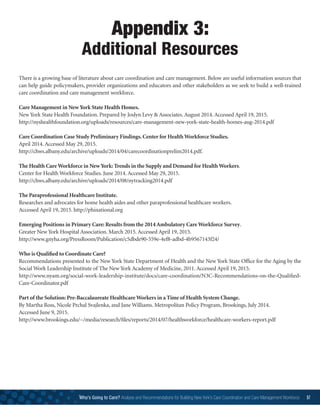
There is a growing base of literature about care coordination and care management. Below are useful information sources that
can help guide policymakers, provider organizations and educators and other stakeholders as we seek to build a well-trained
care coordination and care management workforce.
Care Management in NewYork State Health Homes.
New York State Health Foundation. Prepared by Joslyn Levy  Associates. August 2014. Accessed April 19, 2015.
http://nyshealthfoundation.org/uploads/resources/care-management-new-york-state-health-homes-aug-2014.pdf
Care Coordination Case Study Preliminary Findings. Center for Health Workforce Studies.
April 2014. Accessed May 29, 2015.
http://chws.albany.edu/archive/uploads/2014/04/carecoordinationprelim2014.pdf.
The Health Care Workforce in NewYork: Trends in the Supply and Demand for Health Workers.
Center for Health Workforce Studies. June 2014. Accessed May 29, 2015.
http://chws.albany.edu/archive/uploads/2014/08/nytracking2014.pdf
The Paraprofessional Healthcare Institute.
Researches and advocates for home health aides and other paraprofessional healthcare workers.
Accessed April 19, 2015. http://phinational.org
Emerging Positions in Primary Care: Results from the 2014 Ambulatory Care Workforce Survey.
Greater New York Hospital Association. March 2015. Accessed April 19, 2015.
http://www.gnyha.org/PressRoom/Publication/c5dbde90-559e-4ef8-adbd-4b9567143f24/
Who is Qualified to Coordinate Care?
Recommendations presented to the New York State Department of Health and the New York State Office for the Aging by the
Social Work Leadership Institute of The New York Academy of Medicine, 2011. Accessed April 19, 2015.
http://www.nyam.org/social-work-leadership-institute/docs/care-coordination/N3C-Recommendations-on-the-Qualified-
Care-Coordinator.pdf
Part of the Solution: Pre-Baccalaureate Healthcare Workers in a Time of Health System Change.
By Martha Ross, Nicole Prchal Svajlenka, and Jane Williams. Metropolitan Policy Program, Brookings, July 2014.
Accessed June 9, 2015.
http://www.brookings.edu/~/media/research/files/reports/2014/07/healthworkforce/healthcare-workers-report.pdf
Who’s Going to Care? Analysis and Recommendations for Building New York’s Care Coordination and Care Management Workforce 57
healthcare workforce
skills
complexity
community
patients
partnership
opportunity
treatment
prevention
outcomes
advancement
training
July 2015

carecoordinationreportfinal2

  • 1.
    Analysis and Recommendationsfor Building New York’s Care Coordination and Care Management Workforce Who’s Going to Care? By Karla Silverman, MS, RN, CNM • Helen Schaub • Dan Lowenstein, MBA July 2015
  • 2.
    2 Who’s Goingto Care? Analysis and Recommendations for Building New York’s Care Coordination and Care Management Workforce
  • 3.
    Table of Contents Acknowledgements..........................................................................................................................5 Executive Summary.......................................................................................................................... 7 Introduction.................................................................................................................................... 11 The Need for a Skilled Care Coordination and Care Management Workforce ................................. 11 Home Health Aides: A Cautionary Tale............................................................................................ 14 Payment Reform: From Volume to Value......................................................................................... 15 Understanding the Care Coordination and Care Management Workforce: Analysis and Recommendations from a Survey of Health Homes................................................... 16 Key Survey Findings....................................................................................................................... 17 Recommendations......................................................................................................................... 35 1. Collect Data about the Care Coordination and Care Management Workforce............................. 35 2. Require All Payers to Support Care Coordination and Care Management................................... 36 3. Ensure Sufficient Wages and Benefits for Care Coordination and Care Management Staff.......... 36 A. Set a wage floor for care and care management workers..................................................... 36 B. Ensure sufficient payment to meet compensation standards................................................ 36 C. Ensure health plans are incentivized to invest in the community-based sector and community-based providers are incentivized to invest in their frontline staff.......................... 36 4. Provide Ongoing Training for the Care Coordination and Care Management Workforce.............. 37 A. Develop industry standards and certification programs........................................................ 37 B. Fund education and training initiatives that leverage economies of scale.............................. 37 C. Establish care coordination and care management career ladders....................................... 38 D. Provide clinical supervision and support for unlicensed care coordination and care management staff................................................................................................................ 38 Appendix 1: Methodology............................................................................................................... 39 Appendix 2: Values......................................................................................................................... 51 Appendix 3: Additional Resources.................................................................................................. 57 Who’s Going to Care? Analysis and Recommendations for Building New York’s Care Coordination and Care Management Workforce 3
  • 4.
    4 Who’s Goingto Care? Analysis and Recommendations for Building New York’s Care Coordination and Care Management Workforce
  • 5.
    The authors wishto thank the 49 Health Home organizations that participated in the survey that was the basis for this publication; 1199SEIU Healthcare Workers East (1199SEIU) and the Primary Care Development Corporation (PCDC) leadership; Sandi Vito from the 1199SEIU Training and Upgrading Fund and Annabelle Heckler from 1199SEIU United Healthcare Workers East for key input; expert reviewers Jean Moore from the Center for Workforce Studies and Joslyn Levy from Joslyn Levy Associates; Therese Wetterman from PCDC, Robert Feferman from Housing Works and Elizabeth Lagone from NYC Health and Hospitals Corporation for their assistance with survey design and review; and Steven Hefter and Alex Wueger from PCDC for proofreading assistance. About the Authors Karla Silverman, MS, RN, CNM is PCDC’s Director of Clinical and Training Initiatives. She directs healthcare workforce initiatives and leads programs that support the delivery of high quality care coordination and care management services. Helen Schaub  is Director of Policy and Legislation at 1199SEIU United Healthcare Workers East, where she oversees all New York State policy and legislative initiatives for the nation’s largest local union. Dan Lowenstein, MBA is PCDC’s Senior Director of Public Affairs. He directs communications, public policy and advocacy initiatives to expand access to primary care in underserved communities. Acknowledgements Who’s Going to Care? Analysis and Recommendations for Building New York’s Care Coordination and Care Management Workforce 5 1199SEIU Healthcare Workers East (1199SEIU) 1199SEIU United Healthcare Workers East is the largest union in New York and the largest healthcare union in the nation, representing over 300,000 members throughout New York State. The union’s mission is to achieve quality care and good jobs for all. Primary Care Development Corporation (PCDC) PCDC is a nationally recognized nonprofit whose mission is to expand access to primary care in underserved communities. PCDC achieves this mission by providing affordable capital financing to build and expand primary care infrastructure, expert technical assistance to help transform the primary care model and public advocacy to support policies that sustain and expand primary care. July 2015 Cover photo by Jim Tynan • Designed by Bencom
  • 6.
    6 Who’s Goingto Care? Analysis and Recommendations for Building New York’s Care Coordination and Care Management Workforce
  • 7.
    A successful transitionto this new system is highly dependent on a skilled workforce. New models of care require nonclinical and paraprofessional staff to assume greater levels of responsibility as they are called upon to work in multidisciplinary teams, conduct outreach to patients in the community and participate in the management of patient and population health. Workforce development will be critical to healthcare transformation, yet today’s workforce is largely unprepared for these changes. Indeed, New York’s experiment in shifting care for elderly residents from nursing homes to a largely underpaid home care workforce offers painful and expensive lessons as the larger and more complex healthcare system embarks on a similar shift. New York State’s Health Home program can provide important insights on the steps needed to create and support a skilled care coordination and care management workforce for the healthcare system as a whole. Health Homes manage care of Medicaid enrollees with costly and complex chronic conditions that drive a high volume of inpatient episodes. The effectiveness of the Health Home workforce is thus a critical factor in the program’s success or failure. The workforce lessons learned through Health Homes and other programs involving high levels of care management will be particularly relevant as New York State launches its five-year Delivery System Reform Incentive Payment Program (DSRIP), which has a goal of reducing avoidable hospitalizations by 25% in large part by building community-based healthcare capacity. Over $400 million will be available for workforce development under DSRIP. To better understand provider challenges and expectations for the care coordination and care management workforce, 1199SEIU Healthcare Workers East (1199SEIU) and the Primary Care Development Corporation (PCDC) surveyed New York State Health Home providers about workforce roles and jobs, including education and skills requirements, salary range and training needs. Based on analysis of survey results and additional research in the field, 1199SEIU and PCDC developed recommendations for policymakers and healthcare organizations. Executive Summary New York State’s healthcare environment is undergoing dramatic and much needed change. It is moving towards a system that places greater emphasis on community- based, prevention-focused care and relies less on higher cost acute care. TURN THE PAGE FOR KEY SURVEY FINDINGS... Who’s Going to Care? Analysis and Recommendations for Building New York’s Care Coordination and Care Management Workforce 7
  • 8.
    1 A diverseand broad set of skills and competencies are needed by the care coordination and care management workforce. Presented with 22 diverse skills and competencies, the vast majority of respondents were generally in agreement about what was needed to be effective in care coordination and care management roles. Basic knowledge of clinical conditions, advanced organizational and interpersonal skills and familiarity with many tasks that are typically in the nursing and social work domains are required in Health Home care coordination and care management roles. 2 Ongoing training and supervision are needed for staff who will provide care coordination and care management. Despite the fact that skills such as patient-centered care and knowledge of chronic conditions were required of care managers by over 90% of the organizations surveyed, less than 60% provided training in these critical areas. In addition, fewer than half offered training in health coaching, working in a team, housing placement, stress management or running and reading reports – all skills that many organizations considered crucial to care coordination and care management roles. 3 Recruitment and retention challenges are prevalent, driven by insufficient salaries, high caseload and lack of appropriate skills and competencies. A significant majority of organizations responding reported recruitment challenges (88%) and retention challenges (78%). More than half reported insufficient salary as a barrier to recruitment and retention, while large caseloads and insufficient skills and qualifications were also major factors. Half reported insufficient qualifications as a key recruitment challenge, and large caseloads and insufficient salary as key staff retention barriers. Salaries reported by organizations surveyed, the majority of which are community-based, are on average 27% - 50% lower than those for similar Health Home titles in the hospital workforce. 4 Job titles for those providing care coordination and care management are still evolving. While 72% used the title “care manager” for the job of managing and coordinating patient care, there was no consensus about job titles for supervisory staff or those providing patient outreach and engagement. Without standard definitions, it may be difficult to bring needed training programs to scale or ramp up the care coordination and care management workforce. Key Survey Findings SEE RECOMMENDATIONS ON NEXT PAGE... 8 Who’s Going to Care? Analysis and Recommendations for Building New York’s Care Coordination and Care Management Workforce
  • 9.
    1199SEIU and PCDCare proposing the following recommendations for policymakers and healthcare organizations seeking to build a strong and effective care coordination and care management workforce. Summary of Recommendations 1 Collect data about the care coordination and care management workforce. 2 Require all payers to support care coordination and care management. 3 Ensure sufficient wages and benefits for care coordination and care management staff. • Set a wage floor for care and care management workers; • Ensure sufficient payment to meet compensation standards; and • Ensure health plans are incentivized to invest in the community-based sector and community- based providers are incentivized to invest in their frontline staff. 4 Provide ongoing support for the development of the care coordination and care management workforce. • Develop industry standards and certification programs; • Fund education and training initiatives that leverage economies of scale; • Establish care coordination and care management career ladders; and • Provide clinical supervision and support for unlicensed care coordination and care management staff. Who’s Going to Care? Analysis and Recommendations for Building New York’s Care Coordination and Care Management Workforce 9 The success of New York State’s healthcare transformation initiatives is heavily reliant on a workforce with the skills and competencies necessary to undertake the myriad complex tasks of coordinating patient care. There must be sufficient compensation, training and career ladders to build and sustain a skilled workforce for these positions of considerable responsibility. Failing to do so puts the entire healthcare transformation enterprise at risk. Conclusion
  • 10.
    10 Who’s Goingto Care? Analysis and Recommendations for Building New York’s Care Coordination and Care Management Workforce
  • 11.
    This change iscausing a major shift in the workforce needs of healthcare organizations. Care coordination and care management jobs, in which staff working in communities help connect patients with services and coordinate their care, are growing in number. 2 Through the Delivery System Reform Incentive Payment Program (DSRIP)3 and healthcare delivery and payment transformation at the federal level and in the commercial sector, healthcare workforce changes in New York State are expected to accelerate over the next five years. However, the successful transition to a lower cost, higher quality community- based healthcare delivery system faces a number of major challenges. One of the most pressing challenges is the development of a sufficiently skilled care coordination and care management workforce. The Need for a Skilled Care Coordination and Care Management Workforce4 In healthcare models such as the Patient-Centered Medical Home, New York State’s Health Home program, Accountable Care Organizations (ACOs) and DSRIP, the correct medical diagnosis and a solid treatment plan are only part of the solution to improving patients’ health. Introduction Driven largely by the unsustainability of healthcare costs and poor outcomes delivered for those expenditures, New York’s healthcare system is undergoing a significant shift from one focused primarily on inpatient, acute care to one centered on preventive, community-based healthcare that incorporates mental health and social service provision.1 1 Joslyn Levy Associates. Care Management in New York State Health Homes. New York: NYS Health Foundation, 2014. 2 College for America Workforce Strategy Report. Rise of the Medical Assistant and Five other Frontline and Nonclinical Healthcare Jobs that are Growing in Number, Complexity, and Importance. New Hampshire: Random, 2013. 3 DSRIP is the main mechanism by which New York State will implement the Medicaid Redesign Team (MRT) Waiver Amendment. DSRIP´s purpose is to fundamentally restructure the healthcare delivery system by reinvesting in the Medicaid program, with the primary goal of reducing avoidable hospital use by 25% over 5 years. Up to $6.42 billion dollars are allocated to this program with payouts based upon achieving predefined results in system transformation, clinical management and population health. https://www.health.ny.gov/health_care/medicaid/redesign/dsrip/. 4 In the literature and in the field, the terms “care management” and “care coordination” are often used interchangeably. In this report we use the term “care management” to mean activities that are tailored to patients at highest risk for adverse, preventable outcomes and go beyond medical issues to address any psycho-social issues that may affect a patient’s ability to engage in and access care. In contrast, “care coordination” is defined as ensuring that care is seamless across providers and transitions and care coordination activities are “systems-focused.” Many experts believe that coordinating care is one of the key roles of staff who provide or support care management, but it is not the only service they must provide. Who’s Going to Care? Analysis and Recommendations for Building New York’s Care Coordination and Care Management Workforce 11
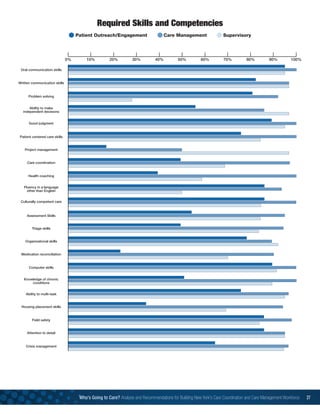
  • 12.
    5 Hong, C.S., Siegel,A.L., Ferris, T.G. “Caring for High-Need, High-Cost Patients: What Makes for a Successful Care Management Program?” Commonwealth Fund. (2014): 2. 6 Ibid. 7 U.S. Department of Health and Human Services Office of Minority Health. Accessed June 9, 2015. http://minorityhealth.hhs.gov/omh/browse.aspx?lvl=1lvlid=6 A team-based approach where care coordination is provided for all patients, and care management is provided for high- need, high-cost patients, is now being adopted as a way to lower costs and improve patient outcomes and engagement.5 These are new practice models for most healthcare organizations. In order to be successful,organizations have to shift their focus to meet the patient satisfaction and clinical outcome goals that will increasingly determine how much an organization gets paid, replacing traditional volume-based fee-for-service. They must examine their day-to-day operations and create new workflows. They must identify what new tasks need to be carried out, if their staff have the skills to perform these tasks and if there is an organizational understanding about how new roles fit together to provide coordinated, patient-centered care. Training a care coordination and care management workforce with the skills and competencies they need means teaching skills and creating roles that are quite different from what was expected previously. Among other tasks, those providing care coordination and care management need to be able to: • reach out to and engage patients; • provide comprehensive assessments of patients’ needs; • link patients to resources; • coordinate care; • lead care planning; • provide health coaching; and • respond quickly and effectively to changes in patients’ conditions to keep patients from using unnecessary services.6 To be effective in their roles these frontline staff also have to be able to work well in multi-disciplinary teams and build trusting relationships with patients, their families, primary care providers and specialists. Lastly, cultural competency is critical for patient engagement and a key skill for care coordination and care management staff. Care coordinators and care managers need to build trust and address the barriers their patients face in accessing and engaging in care in order to be successful. Ideally the care coordination and care management workforce of the future is drawn from the same communities in which patients live. Regardless of their backgrounds,all healthcare staff require training in how to provide culturally and linguistically appropriate services “that are respectful of and responsive to the health beliefs, practices and needs of diverse populations.”7 When frontline staff understand the needs of the communities in which they are working, they become a “bridge between patients and providers” and create stronger ties between patients and a healthcare system that can often seem intimidating and foreign. “There is a need for a very specific type of individual for this role (i.e. extremely organized, able to roll with change, comfortable in the field, able to manage large caseloads, professional, eager) and it’s difficult to find individuals possessing these skills.” COMMENT FROM RESPONDENT 12 Who’s Going to Care? Analysis and Recommendations for Building New York’s Care Coordination and Care Management Workforce
  • 13.
    Care coordination andcare management skills are sophisticated and not quickly learned. They result from a combination of didactic learning, shadowing and apprenticing, experience in the field and willingness to adapt and grow.8 Being successful working in inter- disciplinary teams and building trusting relationships with patients also demands a level of self-awareness and a proficiency in communication that can be challenging for even the most experienced healthcare professional. Attention to workforce development is desperately needed. “While much attention and energy is focusing on practice redesign, relatively little has been devoted to ensuring that workers are trained to adapt to new systems and deliver patient care in a more coordinated, team-based fashion.”9 Healthcare education – especially for frontline and unlicensed workers – is woefully behind in meeting the needs of this rapidly shifting healthcare delivery system.Healthcare workers are limited by the predominant educational model that trains the different healthcare and social service professions in silos with a minimal focus on team-based care.10 Sector-based training and education are essential to the success of the new care coordination and care management workforce. If staff do not have the skills to perform well in these new care models, the models themselves are put at risk of failure. We may then conclude that the models were wrong or ineffective when in fact inadequate resources and attention were given to developing the workforce needed to implement them effectively. 8 Ibid, 2. 9 Ross, M. Svajlenka, N.P., Williams, J. Part of the Solution: Pre-Baccalaureate Healthcare Workers in a Time of Health System Change. Metropolitan Policy Program at Brookings. (2014),17. 10 Ibid. Who’s Going to Care? Analysis and Recommendations for Building New York’s Care Coordination and Care Management Workforce 13
  • 14.
    Home Health Aides:A Cautionary Tale To carry out these enormous responsibilities, care coordination and care management staff need jobs with dignity, fair wages, training and educational opportunities and access to career ladders that fully recognize their importance to patients, healthcare organizations and those who pay for care. 11 “Paying the Price: How Poverty Wages Undermine Home Care in America”. PHI (Paraprofessional Healthcare Institute). Accessed May 29, 2015. http://phinational.org/sites/phinational.org/files/research-report/paying-the-price.pdf. With hospitals among the top ten largest private sector employers in every region of the State, it is important to ensure that wage, benefit and training standards are not undermined as some of these jobs are shifted to the ambulatory setting. But this goal cannot be met without a clearly thought out strategy driven by multiple stakeholders across a variety of fields including hospitals, primary care providers, community-based providers, government, labor unions, funders and educational and training entities. New York’s experience transitioning care for the elderly and people with disabilities from institutions to home care services should serve as a cautionary lesson as similar changes are sought in the broader healthcare system. The home care industry relied heavily on minimally skilled workers making minimum wage (or worse) and did not effectively integrate them into the overall care of patients. The result was predictable: burgeoning costs and hundreds of thousands of clients receiving lower-quality care than they should have because of a high-turnover,poorly-trained and poorly integrated workforce. Home health aides, from the very communities already struggling with poverty and other drivers of disparate healthcare outcomes, were unable to support their families.11 New York cannot afford to make the same mistakes as we build the new coordinated care sector.In particular,without effective policies in place, we cannot assume that upfront investments will be made to prepare frontline healthcare workers to participate fully in these new care models, nor that their value in improving health and reducing costs will be reflected in their compensation. Through DSRIP over $400 million will be available for training and retraining the healthcare workforce. This presents a remarkable opportunity for New York State to minimize disruption for the existing healthcare workforce as it transitions to new settings and to provide meaningful careers for low wage, underemployed or unemployed individuals in low income communities,all while improving the quality of care for the highest need patients. 14 Who’s Going to Care? Analysis and Recommendations for Building New York’s Care Coordination and Care Management Workforce
  • 15.
    How healthcare organizationsare paid for care coordination and care management services will directly impact their effectiveness. A national movement is underway to move healthcare financing from volume-based fee-for-service payment that defines much of healthcare today to models that value better health outcomes, patient satisfaction and cost savings. Under DSRIP, 90% of all Medicaid payments are expected to be in Value-Based Payment (VBP) arrangements within five years.12 The U.S. Department of Health and Human Services has likewise set a goal of tying 90% of Medicare payments to quality or value by 2018. The commercial market is also moving rapidly toward value-oriented payments. Because care coordination and care management services can have a major impact on reducing the need for higher cost, higher intensity care, spending on these services should increase. Indeed, there has been a greater emphasis on paying for care coordination and care management. The New York State Health Home program pays a flat per member per month (PMPM) fee of $135 for outreach to patients and an additional acuity adjusted PMPM fee for coordination services.13 Starting January 2015, the Center for Medicare and Medicaid Services (CMS) began paying physicians $42 PMPM to coordinate care for Medicare patients with two or more chronic conditions. CMS is also developing new ways for Medicaid to pay primary care providers that would include support for care coordination and care management. Likewise, private health insurance plans are beginning to support these services, though there is wide variation in both adoption and level of support. Payment Reform: From Volume to Value 12 Accessed 6/11/15. https://www.health.ny.gov/health_care/medicaid/redesign/ dsrip/docs/dsrip_vbp_webinar_slides.pdf. 13 DOH Health Home Billing Practices, Effective July 1 2015. Accessed June 9, 2015.http://www.health.ny.gov/health_care/medicaid/program/medicaid_ health_homes/hh_billing_practices.htm. See also http://www.health.ny.gov/ health_care/medicaid/program/medicaid_health_homes/docs/hh_rates_ hml.pdf, page 5. Who’s Going to Care? Analysis and Recommendations for Building New York’s Care Coordination and Care Management Workforce 15
  • 16.
    16 Who’s Goingto Care? Analysis and Recommendations for Building New York’s Care Coordination and Care Management Workforce Understanding the Care Coordination and Care Management Workforce: Analysis and Recommendations from a Survey of Health Homes Nowhere is the need for care management and care coordination more apparent than in Health Homes, which serve patients in New York State’s Medicaid Program with the most complex chronic conditions that are often related to behavioral or social problems and drive a high volume of costly inpatient episodes. The vision behind New York State’s Health Home program is a healthcare delivery system that is integrated and coordinated across the disciplines of physical healthcare, mental health, chemical dependency treatment and social services provision. Though the level of service intensity will vary depending on patient acuity, the Health Home workforce model and its challenges are instructive to DSRIP as both rely on greater levels of care coordination and care management services to meet their cost and quality goals. To better understand provider challenges and expectations for the care coordination workforce, 1199SEIU and PCDC conducted an anonymous survey of Health Home providers primarily from New York City and Downstate (NYCboroughs,Nassau,Suffolk,WestchesterandRockland counties). The survey was sent to 213 health homes (19 Health Home leads and 194 downstream providers) and received 49 valid responses (10 leads, 35 downstream and four that were both leads and downstream providers in another Health Home). The results are statistically significant at the 90% confidence interval with a margin of error of plus or minus 11%. The survey asked questions related to workforce roles and job titles, education and skills requirements, salary range, training needs and caseload for staff that provide and supervise Health Home care coordination and care management services. Based on analysis of survey results and additional research in the field, 1199SEIU and PCDC developed recommendations for policymakers and healthcare organizations. KEY SURVEY FINDINGS BEGIN ON NEXT PAGE...
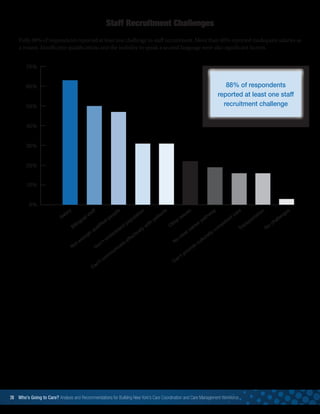
  • 17.
    Who’s Going toCare? Analysis and Recommendations for Building New York’s Care Coordination and Care Management Workforce 17 The following terms for Health Home workers were defined in the survey: Key Survey Findings 14 “Care Coordination Case Study Preliminary Findings.” Center for Health Workforce Studies. Accessed May 29, 2015. http://chws.albany.edu/archive/ uploads/2014/04/carecoordinationprelim2014.pdf. The “Health Care Workforce in New York: Trends in the Supply and Demand for Health Workers”. Center for Health Workforce Studies. Accessed May 29, 2015. http://chws.albany.edu/archive/uploads/2014/08/nytracking2014.pdf. Patient Outreach and Engagement Responsible for outreach to patients, enrolling them into the program and re-engaging patients when they become lost to care. These staff may also assist care managers with coordinating care for patients, including conducting reminder calls about upcoming appointments and arranging transportation. Common job titles include outreach worker, patient navigator and care navigator. Care Management Lead care management activities for a panel of patients. These staff coordinate services for their patients and conduct activities such as coordinating with patients’ providers, conducting needs assessments, developing patient focused care plans, providing health education and managing staff assigned to assist them with these tasks. Common job titles include care manager, case manager and care coordinator. Supervisory Responsible for the overall administration of care management teams at a particular site. These staff provide clinical supervision to care management staff, conduct staff training, monitor and report quality metrics to the organization, ensure that policies and procedures are being followed and may assist with the coordination of client services as needed. Common job titles include site director, site supervisor and care coordinator. Findings from the survey were generally in line with other research on the care coordination and care management workforce. For instance, recent analyses by the Center for Health Workforce Studies found similar challenges around recruitment and retention, defining roles and responsibilities for various job titles and skills and competency training.14 (All numbers rounded to nearest percent. See Appendix 2 for values.) Of note, nearly 71% of survey respondents were from downstream provider organizations-meaning organizations that are contracted by lead Health Homes to provide care management services for patients. PROFILE OF RESPONDENTS Health Home Status
  • 18.
    18 Who’s Goingto Care? Analysis and Recommendations for Building New York’s Care Coordination and Care Management Workforce 15 “Emerging Positions in Primary Care: Results from the 2014 Ambulatory Care Workforce Survey”. Greater New York Hospital Association. Accessed April 19, 2015. http://www.gnyha.org/PressRoom/Publication/c5dbde90-559e-4ef8-adbd-4b9567143f24/. 65% of respondents were from community-based organizations and 27% were from community health centers. Only 8% of respondents were from hospitals. This survey, unlike other recent examinations of the frontline care coordination workforce that focused on the changing hospital workforce,15 primarily reflects the needs and activities of community-based Health Home providers including Federally Qualified Health Centers and community- based social service organizations. The majority (76%) of respondents served New York City, while 14% served Nassau, Suffolk, Westchester and/or Rockland counties and 18% served upstate communities. Some Health Homes served multiple areas. Type of Organization Geographic Service Area
  • 19.
    Who’s Going toCare? Analysis and Recommendations for Building New York’s Care Coordination and Care Management Workforce 19 There was a diverse range of organization size as measured by annual budget with the plurality in the $10-$20 million range. Of note, 16% of respondents were not aware of their organization’s budget, which may impact accuracy related to organization size. Annual Organizational Budget
  • 20.
    20 Who’s Goingto Care? Analysis and Recommendations for Building New York’s Care Coordination and Care Management Workforce There was no clear consensus about job titles for staff providing patient outreach and engagement in New York Health Homes. The most common titles for those were outreach worker (45%), care manager (37%), and patient navigator (27%). There was no clear consensus for the title most commonly used for care management supervisory staff. Titles such as site director (16%), site supervisor (21%) and care coordinator (14%) were listed most frequently for these positions. Other titles used include Director, Care Coordination Supervisor, Director of Care Management, Director of Care Coordination, and Client Services Manager. (See next page.) There was more general agreement about the title for staff providing care management, with the majority of respondents indicating they used the term care manager (72%). Some organizations listed care coordinators and patient navigators as staff who also provide care management either instead of, or in addition to, care managers. Of note, care manager was not typically indicated as a “management” role as it is sometimes used in healthcare organizations. Instead, these workers manage the care of patients as indicated by the tasks reported. Job Titles
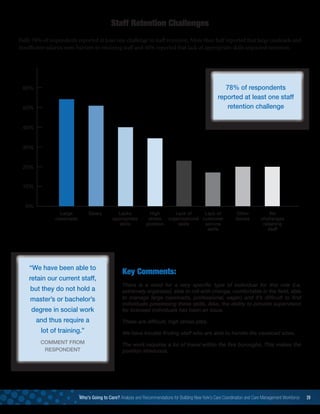
  • 21.
    Who’s Going toCare? Analysis and Recommendations for Building New York’s Care Coordination and Care Management Workforce 21 Other Job Titles Used Outreach and Engagement Care Coordinator (5) Care Navigator (5) Care Technician Case Manager Certified Medical Assistant Community Educator Community Health Navigator Community Health Worker Community Searcher Director of Community Outreach Director of Registration Services Director of Shelter Outreach Health Navigator Health Priorities Specialist Intake Care Manager Intake Case Manager Intake Coordinator (2) Marketing Rep Mental Health Counselor Housing Case Managers Outreach and Engagement Specialist Outreach and Recruitment Specialist Outreach Coordinator Outreach Specialist Peer Health Coach Peer Navigator Program Manager RN Searchers Senior Health Navigator Senior Outreach and Engagement Specialist Social Worker Care Management Care Coordinator Care Management Team Leader Care Navigator (4) Case Manager (2) Caseworker Community Health Navigator Disease Case Manager Health Educator Health Home Coordinator Health Home Team Leader Health Navigator Intensive Case Manager Peer Health Coach (Not staff) Peer Navigator Senior Care Coordinator Senior Care Manager (2) Senior Health Navigator Wellness Counselor Supervisory Assistant Director Care Coordination Supervisor Care Management Coordinator Care Management Team Leader Care Manager (2) Care Manager Supervisor, Clinical Supervisor Chief Medical Officer Client Services Manager Clinical Director Clinical Manager Clinical Projects Manager Clinical Supervisor Director (5) Director Care Coordination Director of Care Coordination Director of Care Management (2) Director of Health Information Management and Quality Improvement Director of Operations Director of Support Services Health Home Assistant Director Health Home Care Management Supervisor Health Home Director of Care Coordination Health Home Program Manager Manager Program Coordinator Program Manager (4) Program Supervisor QA Director Regional Deputy Director Senior Care Manager Systems Manager Team Lead Team Leader Unit Supervisor (2) Working Supervisor
  • 22.
    22 Who’s Goingto Care? Analysis and Recommendations for Building New York’s Care Coordination and Care Management Workforce Most organizations required: • High School diplomas or General Equivalency Diplomas (GED) for patient outreach and engagement staff, though one- third required a bachelor’s degree. • Bachelor’s degrees for care management staff, although 10% of respondents said that staff that fill their care manager roles only need a GED or High School diploma. This was in contrast to results from a recent survey of the hospital-based care coordination workforce, which found most care manager roles are filled by RNs or social workers.16 • Master’s degrees for supervisory staff (62%), although 27% of the organizations surveyed reported only requiring a bachelor’s degree for these roles. While not indicated in the survey results, follow up interviews confirmed that for organizations requiring site supervisors to have a master’s degree, the most common type was a master’s degree in social work. Other educational credentials that Health Homes reported as being acceptable were master’s degrees in human services, for example counseling, mental health counseling, public health and public administration. 16 “Emerging Positions in Primary Care: Results from the 2014 Ambulatory Care Workforce Survey.” Greater New York Hospital Association. 2015. 9. Minimum Educational Requirements
  • 23.
    Who’s Going toCare? Analysis and Recommendations for Building New York’s Care Coordination and Care Management Workforce 23 While there was a broad salary range for each of the job categories, the majority of organizations responding reported that: • Patient Outreach and Engagement staff earn between $26,000 and $40,000 annually, with the $31,000 – $35,000 range the most frequently reported. For comparison, health home employees with patient outreach and engagement titles represented by 1199SEIU, many of whom are based in hospitals, have a range of $33,000 – $53,000 per year, with an average of $42,000.17 • Care Management staff earn between $31,000 and $50,000, with the $41,000-$45,000 range the most frequently reported. In comparison, health home Care Managers represented by 1199SEIU earn between $41,000 and $83,000, with an average of $65,000,18 which is consistent with other findings.19 • Supervisory staff earn between $46,000 and $70,000, with the $56,000-$70,000 range the most frequently reported. 17 Employer Data Reported to League of Voluntary Hospitals and 1199SEIU. 18 Ibid. 19 Ebenstein, W. Ph. D. and Dale, T. M.S. “Emerging Career Pathways in the New York City Healthcare Workforce: Changes in the Nursing Career Ladder.” The City University of New York. (June 2013):9 Accessed June 9, 2015.http://nyachnyc.org/wp-content/uploads/2014/10/Emerging-Career- Pathways-Nursing-Career-Ladder-June-2013.pdf. Annual Average Salary for Care Coordination Staff Employment Status • 95% of staff reported by respondents were employed full time with benefits • 87% of respondents employed 95%-100% of Patient Engagement/Outreach Workers full time with benefits • 8% employed between 40%-80% of Patient Engagement/Outreach workers full time with benefits and also employed workers part time or hourly (with and without benefits) • 6% only employed Patient Engagement/Outreach Workers part time or hourly (with and without benefits)
  • 24.
    24 Who’s Goingto Care? Analysis and Recommendations for Building New York’s Care Coordination and Care Management Workforce Outreach and Engagement staff In addition to outreach to patients, 84% of responding organizations require these staff to enroll patients in the Health Home, 66% said they conduct reminder phone calls, and more than 40% said they follow up with patients and arrange transportation for patients. Care Management staff All of the organizations that responded said care management staff create care plans and work closely with primary care doctors. Over 90% of the organizations said that care management staff assist with housing for patients, provide case management, follow up with patients, provide community referrals, attend care team meetings, work closely with behavioral health providers, arrange transportation, coordinate with the patient’s providers, attend medical case conferences and provide health coaching and medication reconciliation. 89% said that care management staff must serve as a liaison between patients and clinicians, including physicians. It is worth noting that many of these tasks require familiarity with clinical processes even though these are generally unlicensed positions. At a minimum staff require training to be able to provide health coaching, medication reconciliation and other health-related tasks effectively and safely. Supervisory staff In addition to managing staff, over 90% of organizations responded that supervisors are also responsible for conducting staff trainings, monitoring and reporting quality metrics and ensuring that policies and procedures are followed. Required Job Tasks and Roles
  • 25.
    Who’s Going toCare? Analysis and Recommendations for Building New York’s Care Coordination and Care Management Workforce 25 Required Job Tasks and Roles
  • 26.
    26 Who’s Goingto Care? Analysis and Recommendations for Building New York’s Care Coordination and Care Management Workforce Outreach and Engagement staff Oral communication was the primary skill needed by outreach and engagement staff for over 90% of survey respondents. Over 80% require outreach and engagement staff to have written communication skills, good judgment, fluency in a language other than English, the ability to provide culturally competent care, computer skills, field safety skills and attention to detail. Care Management staff There was universal agreement among survey respondents that all care managers need oral and written communication skills, good judgment, patient-centered care skills, health coaching skills, ability to provide culturally competent care, computer skills and knowledge of chronic conditions. Over 90% also cited problem solving, care coordination, fluency in a language other than English, assessment and triage skills, the ability to multitask, housing placement skills, field safety knowledge, attention to detail and crisis management skills. It is worth noting that the sheer range and diversity of competencies that these positions require draw on experience with clinical conditions, nursing, social work and sophisticated organizational and interpersonal skills. Supervisory staff Over 90% of the organizations listed oral and written communication skills, problem solving skills, the ability to make independent decisions, project management and organizational skills, computer skills, ability to multitask, attention to detail and crisis management as the primary required competencies for supervisory staff. Required Job Skills and Competencies
  • 27.
    Who’s Going toCare? Analysis and Recommendations for Building New York’s Care Coordination and Care Management Workforce 27 Required Skills and Competencies
  • 28.
    28 Who’s Goingto Care? Analysis and Recommendations for Building New York’s Care Coordination and Care Management Workforce Fully 88% of respondents reported at least one challenge to staff recruitment. More than 60% reported inadequate salaries as a reason. Insufficient qualifications and the inability to speak a second language were also significant factors. Staff Recruitment Challenges 88% of respondents reported at least one staff recruitment challenge
  • 29.
    Who’s Going toCare? Analysis and Recommendations for Building New York’s Care Coordination and Care Management Workforce 29 Fully 78% of respondents reported at least one challenge to staff retention. More than half reported that large caseloads and insufficient salaries were barriers to retaining staff and 40% reported that lack of appropriate skills impacted retention. Key Comments: There is a need for a very specific type of individual for this role (i.e. extremely organized, able to roll with change, comfortable in the field, able to manage large caseloads, professional, eager) and it’s difficult to find individuals possessing these skills. Also, the ability to provide supervision for licensed individuals has been an issue. These are difficult, high stress jobs. We have trouble finding staff who are able to handle the caseload sizes. The work requires a lot of travel within the five boroughs. This makes the position strenuous. Staff Retention Challenges “We have been able to retain our current staff, but they do not hold a master’s or bachelor’s degree in social work and thus require a lot of training.” COMMENT FROM RESPONDENT 78% of respondents reported at least one staff retention challenge
  • 30.
    30 Who’s Goingto Care? Analysis and Recommendations for Building New York’s Care Coordination and Care Management Workforce 45% of respondents reported that the most significant training needs were in understanding how to coordinate care and supporting patients who have chronic illnesses and/or serious mental illness while about 40% reported that interacting with various healthcare providers was a key training challenge. These responses likely reflect the reality that community-based providers typically have less wide-ranging clinical experience and less experience interacting and coordinating care between a diverse array of medical providers as is required in the Health Home model. For example, a community-based organization may have many years of experience providing case management and coordinating care for HIV-positive patients but have care managers who have considerably less experience working with patients with conditions like diabetes and heart disease. They also may have much less experience interacting with the doctors that provide the clinical care to those patients. Conversely, there may be care managers who come from a medical case management background who are now being asked to address social determinants of health for their patients but have little experience and need training to carry out these tasks. For example, medical case managers may not have previously been tasked with finding housing for their patients or with coordinating with substance abuse providers but are now being asked to do so as Health Home care managers. Training Challenges
  • 31.
    Who’s Going toCare? Analysis and Recommendations for Building New York’s Care Coordination and Care Management Workforce 31 Key Comments: Caseloads are large and clients are very needy. Information technology as it applies to the care managers and supervisors in their day to day work and reporting requirements is an important need. We have challenges in training new staff given the wide range of chronic illnesses across a caseload. We would like [training] resources available on a regular basis to send new hires. Managing all the paperwork needed for such large caseloads is difficult. Understanding behavioral health needs of clients is a challenge. Training Challenges
  • 32.
    32 Who’s Goingto Care? Analysis and Recommendations for Building New York’s Care Coordination and Care Management Workforce The most common trainings offered by between 70-80% of respondents were in electronic health records/electronic tracking systems, coordinating care and cultural competency. Despite the fact that skills such as patient-centered care and knowledge of chronic conditions were required of care managers by over 90% of the organizations surveyed, less than 60% provided training in these critical areas. In addition, fewer than half offered training in health coaching, working in a team, housing placement, stress management or running and reading reports – all skills that many organizations considered crucial to all three roles (outreach, care manager and supervisor) and that the majority of respondents considered critical skills needed for the care manager role. Training Provided By Organizations Key Comments: There is very little funding to provide ongoing training. We offer training in the use of our care management system and policies and procedures. Suicide prevention training (SAFE Talk, ASSIST), Safety Training (office and home visits) and software training are provided. Trainings are provided through certified medical assistants. Training is individualized per the need of the coordinator and addressed in supervision. Mock interviewing, behavioral activation are offered.
  • 33.
    Who’s Going toCare? Analysis and Recommendations for Building New York’s Care Coordination and Care Management Workforce 33 There was wide variance reported in the maximum patient caseload for patient outreach and care management staff. This may be explained by variation in case severity, but also suggests a lack of consistency in caseload for these job titles. The higher caseloads could also be driving staff recruitment and retention challenges. Maximum Patient Caseload
  • 34.
    34 Who’s Goingto Care? Analysis and Recommendations for Building New York’s Care Coordination and Care Management Workforce
  • 35.
    Recommendations Based on analysisof the survey results and additional data, as well as extensive experience in the field, 1199SEIU and PCDC propose the following recommendations for policymakers and healthcare organizations seeking to build a strong and effective care management and care coordination workforce. 1. Collect Data About the Care Coordination and Care Management Workforce Given the importance of the care coordination workforce, New York State needs to understand how the sector is developing. The state should collect data about the care coordination workforce. Drawing on this data and consultations with industry and educational leaders, the State can propose occupational definitions and standards. Categories of measurement should include: • Number of positions • Types of positions and naming conventions for the positions • Caseloads • Required educational levels for various positions • Required skills, competencies and responsibilities for each position • Wages and benefits • Geographic distribution of staff (where they live vs. where they work) • Race, ethnicity and languages spoken • Training provided • Vacancies and turnover The workforce plans that Performing Provider Systems are developing under DSRIP are one source of this information. Data on the current state of the workforce, including on wages and benefits, should be collected using a common template. The Center for Health Workforce Studies at SUNY Albany can assist in creating a common template for collection. In addition, this data should be submitted to the State rather than retained at the PPS level and be resubmitted periodically during the DSRIP period. Who’s Going to Care? Analysis and Recommendations for Building New York’s Care Coordination and Care Management Workforce 35
  • 36.
    2. Require AllPayers to Support Care Coordination and Care Management Following policies underway and being established in Medicare and Medicaid,all payers should be required to pay adequately for care coordination and care management services at the provider level. Not only will this support be vital for care coordination and care management capacity in healthcare organizations, it will also help eliminate the “free rider” problem in which payers (and their enrollees) who do not pay for care coordination and care management services benefit from those services funded by other payers. Payment can take the form of a specific care coordination and care management fee or be funded as an element of a bundle or other value-based arrangement. 3. Ensure Sufficient Wages and Benefits for Care Coordination and Care Management Staff More than half of respondents indicated that lack of a sufficient salary was a major barrier to recruiting and retaining staff. In addition, care coordination salaries of the respondents to the survey, many of whom are community-based organizations, were up to 50% lower than typical salaries for the similar work at hospitals. Set a wage floor for care and care management workers A minimum compensation standard in Medicaid-funded home care downstate has finally begun to stabilize a workforce notoriousforitshighturnover. Asimilarpolicycanbeinstitutedforthenewcarecoordinationandcaremanagementworkforce. This will not only ensure that care management staff are assured a living wage,it also can increase retention and thus help ensure continuity of care for patients. Different wage floors should be established based on educational attainment and job category using a methodology similar to“prevailing wage” statutes common in other industries. Ensure sufficient payment to meet compensation standards New York State Medicaid enrollees represent the largest and most intensive use of care coordination services. Medicaid and Medicaid managed care organizations must pay providers enough to meet compensation standards for the care coordination workforce and allow for investment in training. Ensure health plans are incentivized to invest in the community-based sector and community-based providers are incentivized to invest in their frontline staff Under value-based payment, quality metrics for providers should include direct measures of investment in employees such as compensation, turnover, caseload, satisfaction and access to career ladders as well as key measures of access and coordination. 36 Who’s Going to Care? Analysis and Recommendations for Building New York’s Care Coordination and Care Management Workforce
  • 37.
    4. Provide OngoingTraining for the Care Coordination and Care Management Workforce Fully 45% of respondents indicated that their care coordination and care management workforce required training in core areas. Given the enormous demand to fill these positions and the insufficient supply of skilled individuals who can fill them, there is clear need for workforce initiatives that can rapidly and continuously train a large number of workers. While DSRIP is providing a $400 million investment in training and workforce development, it will be important to ensure that these dollars are used effectively and that resources are available once the DSRIP period is over.This will require industry-wide collaboration, both regionally and statewide. Otherwise, significant resources could be wasted in duplication. Develop industry standards and certification programs Given the evolving nature of these job categories, we do not recommend state level licensure at this time. There should however be a State-sanctioned certification process and a standard definition for each of the job titles in the care coordination and care management category, drawn from the research and industry consultation discussed above. Certification could be based on skills and competencies for each of the job titles (i.e. care coordination, communication, culturally competent care,health coaching,assessment and care planning).These must be carefully constructed to avoid artificial barriers to entry for community members,who may be the most suited to provide peer support and culturally and linguistically competent services. Programs should allow for students to build on previous certifications and earn college credit to allow for the development of career ladders. Fund education and training initiatives that leverage economies of scale The overwhelming need for qualified care coordination staff demands standardized curricula and training methods that can be easily replicated (and modified as appropriate) across numerous healthcare settings throughout New York State. Significant investment has already been made in curricula development in New York State and across the country. A clearinghouse for best practices in training should be created. Existing curricula should be identified, evaluated and built upon to provide access to high quality training programs, while avoiding duplication and waste.20 Just as important, colleges should be encouraged to incorporate and build upon existing training in order to provide more career pathway options. Bonds and collaboration must be strengthened between healthcare practice organizations and healthcare training and educational institutions to better match training of workers to current healthcare practice needs. As a recent Brookings report stated,“In order to meet the triple aim of better care, better health, and lower costs, the worlds of healthcare practice and healthcare education (at all levels of credentials) need to exponentially strengthen their bonds and interactions so that education and training for both incumbent and future workers is more connected to the actual delivery of care.”21 This collaboration should be regional and industry-wide where possible to avoid duplication of effort. 20 1199SEIU Training and Employment Fund and PCDC developed the Care Coordination Fundamentals training curriculum specifically for nonclinical healthcare workers. Accessed June 8, 2015. http://www.pcdc.org/resources/quality-improvement/resources/care-coordination.html 21 Ross M., Svajlenka N. P., Williams J. “Part of the Solution: Pre-Baccalaureate Healthcare Workers in a Time of Health System Change” Metropolitan PolicyProgramatBrookings.July2014.17.AccessedJune9,2015http://www.brookings.edu/~/media/research/files/reports/2014/07/healthworkforce/ healthcare-workers-report.pdf Who’s Going to Care? Analysis and Recommendations for Building New York’s Care Coordination and Care Management Workforce 37
  • 38.
    Successful career ladder programssuch as the 1199SEIU Training and Upgrading Fund (TUF) have developed comprehensive support systems for working adults as they return to school. By proactively addressing challenges faced by many worker-students through programs including child care, peer cohorts, academic support and early intervention for struggling participants, TUF has achieved high completion rates.  38 Who’s Going to Care? Analysis and Recommendations for Building New York’s Care Coordination and Care Management Workforce Establish care coordination and care management career ladders Healthcare organizations should create programs to enable successful unlicensed staff to continue their training and go on to obtain allied health degrees in emerging and growing occupations. Career ladders for frontline staff should be considered a measure of the organizations’ quality. These types of programs are particularly important to ensure that the professional workforce is fully culturally competent and reflective of the community it serves. Crucial job benefits should include tuition assistance for those wishing to further their education and move up in the area of care coordination and care management or move into nursing or social work. Healthcare organizations could work with labor unions or other workforce partners to create apprenticeship programs for care coordinators and care managers that would provide on-the-job training for new graduates and a career ladder for seasoned care coordinators and care managers, who could serve as mentors. Provide clinical supervision and support for unlicensed care coordination and care management staff While most Health Home organizations surveyed reported requiring RN or MSW degrees for care management or supervisory roles, not all required them. Clinical supervision by registered nurses and licensed social workers should be the standard of care both to ensure high quality care for patients and to prevent burnout for care management staff who are supporting patients with complex medical, behavioral health and social service needs. To build a robust frontline healthcare workforce, clinical support and supervision will be needed in each and every institution.
  • 39.
    Appendix 1: Survey Methodologyand Questions TURN THE PAGE FOR QUESTIONNAIRE... Methodology An online survey tool was developed and implemented through a survey collection website. Email requests were sent to Health Home Leads and Downstream providers in the New York City and Downstate regions (Nassau, Suffolk,Westchester and Rockland Counties) on March 17 and March 26, 2015, with a March 30, 2015 completion deadline. The survey was sent to 213 health homes (19 Health Home leads and 194 downstream providers), primarily in the New York City/Downstate area. Some Upstate health homes also responded and their responses were included in the results. The survey generated 49 valid responses (10 leads, 35 downstream and four that were both leads and downstream providers in another Health Home). The results are statistically significant at the 90% confidence interval with a margin of error of plus or minus 11%. Who’s Going to Care? Analysis and Recommendations for Building New York’s Care Coordination and Care Management Workforce 39
  • 40.
    1 40 Who’s Goingto Care? Analysis and Recommendations for Building New York’s Care Coordination and Care Management Workforce
  • 41.
    2 Who’s Going toCare? Analysis and Recommendations for Building New York’s Care Coordination and Care Management Workforce 41
  • 42.
    3 42 Who’s Goingto Care? Analysis and Recommendations for Building New York’s Care Coordination and Care Management Workforce
  • 43.
    4 Who’s Going toCare? Analysis and Recommendations for Building New York’s Care Coordination and Care Management Workforce 43
  • 44.
    5 44 Who’s Goingto Care? Analysis and Recommendations for Building New York’s Care Coordination and Care Management Workforce
  • 45.
    6 Who’s Going toCare? Analysis and Recommendations for Building New York’s Care Coordination and Care Management Workforce 45
  • 46.
    7 46 Who’s Goingto Care? Analysis and Recommendations for Building New York’s Care Coordination and Care Management Workforce
  • 47.
    8 Who’s Going toCare? Analysis and Recommendations for Building New York’s Care Coordination and Care Management Workforce 47
  • 48.
    9 48 Who’s Goingto Care? Analysis and Recommendations for Building New York’s Care Coordination and Care Management Workforce
  • 49.
    10 Who’s Going toCare? Analysis and Recommendations for Building New York’s Care Coordination and Care Management Workforce 49
  • 50.
    11 50 Who’s Goingto Care? Analysis and Recommendations for Building New York’s Care Coordination and Care Management Workforce
  • 51.
    Appendix 2: Values Who’s Goingto Care? Analysis and Recommendations for Building New York’s Care Coordination and Care Management Workforce 51 Health Home Status Lead Health Home 20% Downstream Provider 71% Lead Health Home and Downstream 8% for Another Health Home Type of Organization Hospital 8% Community Health Center 27% Community Based Organization 65% Geographic Service Area New York City 76% Nassau, Suffolk, Westchester 14% or Rockland Upstate New York 18% Annual Organizational Budget $1 million 2% $1-5 million 4% $5-10 million 18% $10-20 million 22% $20-50 million 10% $50-100 million 14% $100-500 million 8% $500 million + 4% Don’t Know 16%
  • 52.
    52 Who’s Goingto Care? Analysis and Recommendations for Building New York’s Care Coordination and Care Management Workforce Job Titles Outreach Worker – Outreach and Engagement 45% Patient Navigator – Outreach and Engagement 27% Care Manager – Outreach and Engagement 37% Other Titles – Outreach and Engagement 53% Care Manager – Care Management 72% Care Coordinator – Care Management 28% Patient Navigator – Care Management 13% Other Titles – Care Management 37% Site Director – Supervisory 16% Site Supervisor – Supervisory 21% Care Coordinator – Supervisory 14% Other Titles – Supervisory 77% Patient Outreach/Engagement 59% 33% 0% 0% 0% 0% 8% Care Management 10% 77% 5% 0% 0% 5% 3% Supervisory 0% 27% 62% 3% 3% 3% 3% Minimum Educational Requirements Other Educational Requirement GED/High School Diploma Bachelor’s Master’s Social Worker License Nursing: LPN Nursing: RN Patient Outreach/Engagement 5% 8% 24% 30% 19% 5% 5% 0% 3% 0% 0% 0% 0% Care Management 0% 3% 3% 17% 25% 31% 17% 3% 0% 0% 0% 3% 0% Supervisory 0% 0% 0% 3% 9% 6% 14% 11% 20% 20% 6% 6% 6% Annual Average Salary 20K 21K- 25K 26K- 30K 31K- 35K 36K- 40K 41K- 45K 46K- 50K 51K- 55K 56K- 60K 61K- 70K 71K- 85K 86K- 100K 100K
  • 53.
    Who’s Going toCare? Analysis and Recommendations for Building New York’s Care Coordination and Care Management Workforce 53 Outreach to patients 95% 54% 26% Enroll patients in health home 84% 68% 19% Conduct needs assessments 46% 92% 26% Create care plan 14% 100% 24% Conduct reminder phone calls 66% 95% 26% Arrange transportation 42% 95% 11% Assist with housing for patients 16% 97% 22% Follow up with patients 45% 97% 26% Coordinate care with patient’s providers 22% 95% 35% Provide health education 26% 97% 26% Provide community referrals 37% 97% 26% Lead a care team 3% 46% 68% Supervise a care team 0% 19% 92% Manage staff 3% 13% 100% Provide health coaching to patients 25% 94% 25% Provide case management 14% 97% 19% Medication reconciliation 7% 93% 37% Attend care team meetings 51% 97% 89% Attend medical case conferences 28% 94% 69% Liaison between care management staff and clinicians/doctors 16% 89% 66% Work closely with primary care doctor 16% 100% 38% Work closely with behavioral health provider 16% 97% 43% Ensure that policies and procedures are followed 24% 37% 95% Conduct staff training 0% 16% 97% Monitor and report quality metrics 11% 24% 97% Required Job Tasks and Roles Patient Outreach/ Engagement Staff Care Management Staff Supervisory Staff
  • 54.
    54 Who’s Goingto Care? Analysis and Recommendations for Building New York’s Care Coordination and Care Management Workforce Oral communication skills 95% 100% 95% Written communication skills 82% 100% 95% Problem solving 81% 97% 97% Ability to make independent decisions 56% 86% 97% Good judgement 89% 100% 95% Patient-centered care skills 76% 100% 84% Project management 17% 50% 97% Care coordination 49% 97% 68% Health coaching 39% 100% 58% Fluency in a language other than English 86% 93% 50% Culturally competent care 86% 100% 84% Assessment skills 54% 95% 84% Triage skills 49% 94% 83% Organizational skills 78% 89% 92% Medication reconciliation 23% 90% 70% Computer skills 89% 100% 92% Knowledge of chronic conditions 51% 100% 89% Ability to multitask 76% 97% 95% Housing placement skills 34% 94% 69% Field safety 86% 97% 83% Attention to detail 86% 95% 95% Crisis management 64% 97% 94% Required Job Skills and Competencies Patient Outreach/ Engagement Staff Care Management Staff Supervisory Staff Staff Recruitment Challenges At least one recruitment challenge 88% Salary 63% Bilingual staff 50% Not enough qualified people 47% Don’t understand population needs 31% Can’t communicate effectively with patients 31% Other issues 22% No clear career pathway 19% Can’t provide culturally competent care 16% Transportation 16% No challenges 3%
  • 55.
    Who’s Going toCare? Analysis and Recommendations for Building New York’s Care Coordination and Care Management Workforce 55 Staff Retention Challenges At least one retention challenge 78% Large caseloads 54% Salary 51% Lacks appropriate skills 40% High stress position 34% Lack of organizational skills 23% Lack of customer service skills 17% Other issues 20% No challenges retaining staff 20% Training Challenges Understanding how to coordinate care 45% Supporting patients with chronic illnesses 45% (i.e. diabetes, hypertension, heart disease) Supporting patients with serious mental illness 45% Ability to interact with different types of healthcare professionals 40% Patient-centered care skills 32% Accessing resources for patients 29% Stress management 26% Attention to detail 26% Communication skills 21% Challenges with HIPAA/consent protocols 21% between different providers Supporting patients with conditions like Hepatitis and HIV 18% Understanding how to work in a team 18% Health coaching 16% Professional boundaries 11% Ability to provide culturally competent care 11% Cultural competency 8%
  • 56.
    56 Who’s Goingto Care? Analysis and Recommendations for Building New York’s Care Coordination and Care Management Workforce Training Provided by Organization Use of EMR/electronic tracking systems 79% Coordinating Care 76% Cultural competency 76% Progress note writing 68% Care planning 66% Conducting a comprehensive assessment 66% Professional boundaries 63% Supporting patients with mental health issues 63% Communication skills 61% Supporting patients with chronic illnesses 58% such as Hepatitis and HIV Patient-centered care skills 55% Supporting patients with chronic illnesses such as 55% diabetes, hypertension and heart disease Supporting patients with serious mental illness 53% such as schizophrenia Accessing community resources for patients 47% Health coaching 47% Working in a team 45% Housing placement 40% Stress Management 37% Excel spreadsheets 29% Running and reading reports 26% Patient Outreach and Engagement 9% 15% 6% 9% 9% 12% 9% 0% 6% 24% Care Management 34% 17% 9% 20% 3% 6% 3% 3% 0% 6% Maximum Patient Caseload 25 - 50 50 - 60 60 - 70 70 - 80 80 - 90 90 - 100 100 - 110 110 - 125 125 - 150 150
  • 57.
    Appendix 3: Additional Resources Thereis a growing base of literature about care coordination and care management. Below are useful information sources that can help guide policymakers, provider organizations and educators and other stakeholders as we seek to build a well-trained care coordination and care management workforce. Care Management in NewYork State Health Homes. New York State Health Foundation. Prepared by Joslyn Levy Associates. August 2014. Accessed April 19, 2015. http://nyshealthfoundation.org/uploads/resources/care-management-new-york-state-health-homes-aug-2014.pdf Care Coordination Case Study Preliminary Findings. Center for Health Workforce Studies. April 2014. Accessed May 29, 2015. http://chws.albany.edu/archive/uploads/2014/04/carecoordinationprelim2014.pdf. The Health Care Workforce in NewYork: Trends in the Supply and Demand for Health Workers. Center for Health Workforce Studies. June 2014. Accessed May 29, 2015. http://chws.albany.edu/archive/uploads/2014/08/nytracking2014.pdf The Paraprofessional Healthcare Institute. Researches and advocates for home health aides and other paraprofessional healthcare workers. Accessed April 19, 2015. http://phinational.org Emerging Positions in Primary Care: Results from the 2014 Ambulatory Care Workforce Survey. Greater New York Hospital Association. March 2015. Accessed April 19, 2015. http://www.gnyha.org/PressRoom/Publication/c5dbde90-559e-4ef8-adbd-4b9567143f24/ Who is Qualified to Coordinate Care? Recommendations presented to the New York State Department of Health and the New York State Office for the Aging by the Social Work Leadership Institute of The New York Academy of Medicine, 2011. Accessed April 19, 2015. http://www.nyam.org/social-work-leadership-institute/docs/care-coordination/N3C-Recommendations-on-the-Qualified- Care-Coordinator.pdf Part of the Solution: Pre-Baccalaureate Healthcare Workers in a Time of Health System Change. By Martha Ross, Nicole Prchal Svajlenka, and Jane Williams. Metropolitan Policy Program, Brookings, July 2014. Accessed June 9, 2015. http://www.brookings.edu/~/media/research/files/reports/2014/07/healthworkforce/healthcare-workers-report.pdf Who’s Going to Care? Analysis and Recommendations for Building New York’s Care Coordination and Care Management Workforce 57
  • 60.