Cardiac
arrythmias and
pacemaker
Dr Ambily Syam
Department of Anaesthesiology
Moderators – Dr Ashitha KP
Dr Hawas Muhammed.
CARDIAC ARRHYTHMIAS
• Cardiac rhythms that have abnormalities in rate,
interval ,length, or conduction path are referred
to as dysrhythmias.
• Intraoperative arrythmias occur in
approximately 11% of general anesthetics.
• Manifestation of structural heart disease, may
also occurbecause of abnormal conduction.
• The most common intraoperative arrhythmias
are sinus tachycardia and sinus bradycardia.
Three basic causes of dysrhythmia in the
anesthetized patient:
• Patient physiology and existing abnormalities.
• Stimulation or iatrogenic factors from the
procedure .
• Effects of the anesthetic itself.
• Most of these arrythmias are insignificant and
transient. Some arrhythmias may only require
observation and others immediate intervention.
SINUS ARRYTHMIA
Sinus dysrhythmia is a normal variant encountered in patients who exhibit
normal sinus rhythm with a normal sinus rate (60 bpm and 100 bpm), normal
PR interval, normal QRS length, and normal ST intervals but an irregular RR
interval length.
This variation in the RR interval is usually due to a physiologic phenomenon
known as the Bainbridge reflex, which accelerates the heart rate when
intrathoracic pressure is increased during inspiration and slows the heart rate
when the intrathoracic pressure decreases during expiration.
Sinus dysrhythmia carries no increased risk of deterioration into a dangerous
rhythm.
It is seen frequently in children and young people and tends to decrease with
age.
MECHANISMS OF TACHYDYSRHYTHMIAS
• A cardiac rhythm greater than 100 bpm is considered a tachyarrhythmia.
• A tachydysrhythmia can be initiated from a pacemaker source above or below the
bundle of His.
• Narrow complex tachycardias include
1. Sinus tachycardia
2. Atrial flutter
3. Atrial fibrillation
4. Atrial premature complexes
5. Unifocal/multifocal atrial tachycardia
6. Paroxysmal supraventricular tachycardia
7. Accessory pathway mediated re-entrant tachycardias. (AVRT,AVNRT)
7
• Tachydysrhythmias generated from below the AV node have a wide QRS complex.
• Wide complex tachycardias include
Ventricular tachycardia
Ventricular premature extrasystole
Ventricular fibrillation
Torsades de pointes
Contoso grand opening event 8
• Tachydysrhythmias can result from three mechanisms:
(1) Increased automaticity in normal conduction tissue or in an ectopic focus
(2) Reentry of electrical potentials through abnormal pathways, and
(3) Triggering of abnormal cardiac potentials due to after-depolarizations
Contoso grand opening event 9
• AUTOMATICITY- the ability of cardiac cells to spontaneously generate
action potentials without external electrical stimulation.
Contoso grand opening event 10
• Automaticity enhanced-
Normal - Sinus tachycardia
Abnormal- 1.Unifocal atrial tachycardia
2.Accelerated idioventricular rhythms
3.VT post MI
• Triggered activity-
Early after depolarisation- Torsades de pointes
Late after depolarization- VT, digitalis induced arrythmias
• Re-entry- Na channel dependent-
Long excitable gap- Atrial flutter, WPW syndrome, Monomorphic VT
Short excitable gap- Atrial flutter, Atrial fibrillation, Circus movement tachycardia in
WPW syndrome,Polymorphic VT, Monomorphic VT, Bundle branch re-entry,
Ventricular fibrillation.
11
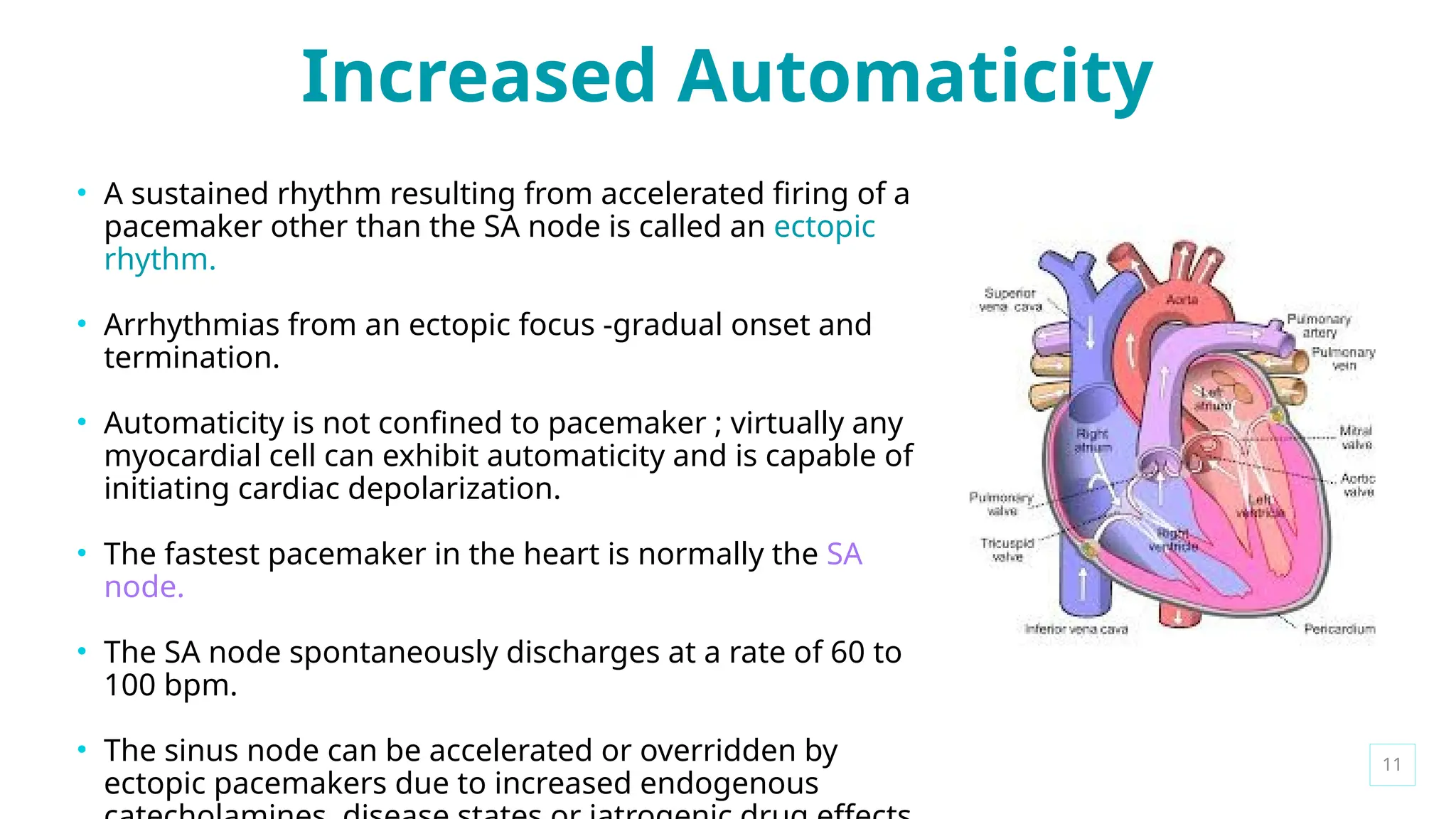
Increased Automaticity
• A sustained rhythm resulting from accelerated firing of a
pacemaker other than the SA node is called an ectopic
rhythm.
• Arrhythmias from an ectopic focus -gradual onset and
termination.
• Automaticity is not confined to pacemaker ; virtually any
myocardial cell can exhibit automaticity and is capable of
initiating cardiac depolarization.
• The fastest pacemaker in the heart is normally the SA
node.
• The SA node spontaneously discharges at a rate of 60 to
100 bpm.
• The sinus node can be accelerated or overridden by
ectopic pacemakers due to increased endogenous
Contoso grand opening event 12
• The automaticity of cardiac tissue changes when
the slope of phase 4 depolarization shifts or the
resting membrane potential changes.
• Sympathetic stimulation causes an increase in
heart rate by increasing the slope of phase 4 of
the action potential and by decreasing the
resting membrane potential.
• Conversely, parasympathetic stimulation results
in a decrease in the slope of phase 4
depolarization and an increase in resting
membrane potential to slow the heart rate.
Contoso grand opening event 13
Contoso grand opening event 14
Contoso grand opening event 15
Contoso grand opening event 16
Re-entry Pathways
• Reentry pathways - most premature beats and tachyarrhythmias.
• Pharmacologic or physiologic events -alter the balance between conduction
velocities and refractory periods -initiation or termination of reentrant
dysrhythmias.
• Abrupt onset and termination.
• Reentry or triggered dysrhythmias require two pathways over which cardiac
impulses can be conducted at different velocities.
• Anterograde (forward) conduction over the slower normal conduction pathway and
retrograde (backward) conduction over a faster accessory pathway.
Contoso grand opening event 17
Contoso grand opening event 18
19
Triggering by Afterdepolarizations
• Afterdepolarizations are oscillations in membrane potential that occur during or after
repolarization.
• Normally these membrane oscillations dissipate.
• However, under certain circumstances they can trigger a complete depolarization.
• Once triggered, the process may become self-sustaining and result in a dysrhythmia.
• Triggered dysrhythmias associated with early afterdepolarizations are enhanced by a slow
heart rate and treated by accelerating the heart rate with positive chronotropic drugs or
pacing.
• Triggered dysrhythmias associated with delayed afterdepolarizations are enhanced by fast
heart rates and can be suppressed with drugs that lower the heart rate.
Contoso grand opening event 20
Contoso grand opening event 21
SUPRAVENTRICULAR DYSRHYTHMIAS
Sinus Tachycardia
• Normal sinus rhythm in a patient at rest is under the control of the sinus node, which fires at
a rate of 60 to 100 bpm.
• When sinus rhythm exceeds 100 bpm, it is considered sinus tachycardia.
• ECG- The ECG shows a normal P wave before every QRS complex.
The PR interval is normal unless a coexisting conduction block exists.
• MECHANISM - Acceleration of SA node discharge due to either sympathetic stimulation or
parasympathetic suppression.
• Non-paroxysmal increase in heart rate that speeds up and slows down gradually.
• It is the most common supraventricular dysrhythmia seen during anesthesia.
Contoso grand opening event 22
Contoso grand opening event 23
• Reasons for sinus tachycardia range from simple to complex.
• Sinus tachycardia -well tolerated in young healthy patients.
• It can occur in an awake patient as part of the normal physiologic response to
stimuli (e.g., fear, pain, anxiety) or as a pharmacologic response to medications
such as atropine, ephedrine, or other vasopressors, intake of stimulant substances
such as caffeine or cocaine.
• Other potential intraoperative causes include sympathetic stimulation, pain,
vagolytic drug administration, hypovolemia, light anesthesia, hypoxia, hypercarbia,
heart failure, cardiac ischemia, fever, and infection.
Contoso grand opening event 24
Contoso grand opening event 25
Strategies to avoid intra operative
tachycardia
• Avoidance of sympathomimetic agents/vagolytic
drugs
• Ensuring adequate anesthetic depth
• Maintenance of euvolemia
• Correction of hypercarbia
• Avoidance of hypoxemia
• Antibiotic treatment of suspected infection
• Use of the lowest effective dose of inotropic support
for heart failure (many inotropes increase heart rate)
• Prompt treatment of myocardial ischemia.
Contoso grand opening event 26
• In patients with ischemic heart disease, diastolic dysfunction, or CHF, the heart rate
increase above normal sinus rhythm can lead to significant clinical deterioration
because of
increased oxygen demand
increased wall stress
a decrease in coronary perfusion.
• Treatment may include IV administration of a beta blocker to lower the heart rate
and decrease myocardial oxygen demand.
• Beta blockers -used with caution in patients with bronchospasm and impaired
cardiac function.
• Patients with a low ejection fraction may be dependent on elevated heart rate to
maintain adequate cardiac output.
• A decrease in heart rate in the setting of a fixed reduced stroke volume may cause
an abrupt and dangerous decrease in blood pressure.
Premature Atrial Beats
• Premature atrial contractions (PACs) are early (premature) ectopic beats.
• ECG -They appear as a P wave with a QRS complex earlier than expected given the
preceding two sinus beats.
• The P wave of the PAC originates from an ectopic focus in the atria.
• The PR interval is variable, QRS complex is narrow usually because activation of the
ventricles following the ectopic P wave occurs through normal conduction
pathway.
• PACs with aberrant conduction of atrial impulses can occur, resulting in a widened
QRS complex that may resemble a PVC.
• There is typically a slight pause after a PAC before the next sinus beat.
Contoso grand opening event 28
Contoso grand opening event 29
• Symptoms of PACs - awareness of a fluttering in the chest or a heavy/prominent
heartbeat.
• PACs are common in all ages, with or without heart disease.
• They often occur at rest and become less frequent with exercise.
• Emotional stress, alcohol, stimulant substances such as caffeine, nicotine, and
cocaine can increase the prevalence of PACs.
• Patients with chronic lung disease, ischemic heart disease, and hyperthyroidism
and digitalis toxicity often experience PACs.
• PACs are usually hemodynamically insignificant and do not require therapy unless
they are associated with initiation of a tachyarrhythmia.
• If they are implicated in the generation of a tachyarrhythmia, PACs can be
suppressed with calcium channel blockers or b blockers
Contoso grand opening event 30
Paroxysmal Supraventricular Tachycardia
• Paroxysmal supraventricular tachycardia (PSVT) , (average heart rate, 150–250
bpm) initiated and sustained by tissue at or above the AV node.
• Unlike sinus tachycardia, PSVT usually begins and ends abruptly.
• Common symptoms in an awake patient include lightheadedness, dizziness,
fatigue, chest discomfort, and dyspnea, syncope.
• PSVT often occurs in individuals without structural heart disease.
• Mechanism for PSVT include enhanced automaticity of secondary pacemaker
cells and triggered impulse initiation by afterdepolarizations.
Contoso grand opening event 31
• ECG- rate 150-250 bpm, P waves are not discernible, PR interval will be normal if
P waves are seen. Narrow QRS complex.
Contoso grand opening event 32
• Strategies - avoiding factors known to increase ectopy, such as increased
sympathetic tone, electrolyte imbalances, and acid-base disturbances.
• Monitoring of vital signs to detect any progression to hemodynamic instability and
verbal reassurance (if the patient is awake).
• If hemodynamically stable, the initial treatment of PSVT - vagal maneuvers such
as carotid sinus massage or a Valsalva maneuver.
• Termination by a vagal maneuver suggests reentry as the causative mechanism.
• If conservative treatment is not effective, pharmacologic treatment directed at
blocking AV nodal conduction is indicated.
Contoso grand opening event 33
• The most common agents to treat PSVT are adenosine, calcium channel blockers,
and b blockers
• Adenosine has an advantage over other IV drugs used to treat PSVT
• It has a very rapid onset (15–30 s)
• Very brief duration of action (10 s)
• 1st
dose 0.1 mg/kg max upto 6mg
• 2nd
dose 0.2mg/kg upto 12mg.
• Most AV nodal reentry tachycardia (AVNRT) episodes can be terminated by a single
dose of adenosine.
• Multifocal atrial tachycardia (MAT), atrial flutter, and atrial fibrillation do not
respond to adenosine.
• Heart transplant recipients require reduction in adenosine dosage because of
denervation hypersensitivity.
• IV administration of calcium channel blocking drugs such as verapamil and
diltiazem can also be useful for terminating PSVT.
• These drugs have a longer duration of action than adenosine.
34
• Side effects-peripheral vasodilation and negative inotropy- contribute to an
undesirable degree of hypotension.
• Intravenous b blockers can be used to control or convert PSVT.
• Digoxin is not useful in acute control ,secondary to characteristic delayed peak
effect and a narrow therapeutic window.
• Electrical cardioversion is indicated for PSVT unresponsive to drug therapy or
associated with hemodynamic instability.
•
• Long-term medical treatment of patients with repeated episodes of PSVT includes
calcium channel blockers, digoxin, and/or b blockers.
• Radiofrequency catheter ablation may be used in patients with recurrent or
recalcitrant AVNRT.
Contoso grand opening event 35
Preexcitation
• Rhythms originate from above ventricle, but travels via pathway other than AV
node or BOH.
Contoso grand opening event 36
Wolff-Parkinson-White Syndrome
• WPW syndrome is an inherited disorder characterized by reentrant tachycardias.
• Bimodal age distribution -early childhood, young adulthood.
•
• Initial manifestation -during pregnancy, perioperative period or even sudden
cardiac death.
• The relative frequency of tachycardia mediated by an accessory pathway decreases
with age.
• The diagnosis of WPW syndrome -characterized by both preexcitation and
tachydysrhythmia.
• Ventricular preexcitation causes an earlier than normal deflection of the QRS
complex called a delta wave.
• These preexcitation ECG changes are a form of conduction block.
Contoso grand opening event 37
Contoso grand opening event 38
AVNRT-AV NODAL RE-ENTRANT TACHYCARDIA
• Ebstein malformation of the tricuspid valve, hypertrophic cardiomyopathy, and transposition
of the great vessels.
• The ECG criteria in adults are PR interval less than 120 ms, slurring of the initial portion of
the QRS (delta wave), QRS longer than 120 ms in adults, and secondary ST-segment and T-
wave changes.
• Paroxysmal palpitations with or without dizziness, syncope, dyspnea, or angina pectoris are
common during the tachydysrhythmias associated with this syndrome.
• AVNRT is the most common tachydysrhythmia seen in patients with WPW syndrome.
• It accounts for 95% of the dysrhythmias seen with this syndrome.
• This tachydysrhythmia is usually triggered by a PAC.
• AVNRT is classified as either orthodromic (narrow QRS complex) or antidromic (wide QRS
Contoso grand opening event 39
• Orthodromic AVNRT -more common (90–95% of cases) and has a narrow QRS
complex because the cardiac impulse is conducted from the atrium through the
normal AV node–His-Purkinje system.
• These impulses return from the ventricle to the atrium using the accessory
pathway.
• Treatment of orthodromic AVNRT in conscious patients in stable condition should
begin with vagal maneuvers such as carotid sinus massage or a Valsalva maneuver.
• If vagal maneuvers are unsuccessful, adenosine, verapamil, b blockers, or
amiodarone may be used.
Contoso grand opening event 40
• In the less common antidromic form of AVNRT, the cardiac impulse is conducted
from the atrium to the ventricle through the accessory pathway and returns from
the ventricles to the atria via the normal AV node.
• The wide QRS complex seen in antidromic AVNRT makes it difficult to distinguish
this dysrhythmia from ventricular tachycardia.
• Treatment of antidromic AVNRT is intended to block conduction of the cardiac
impulse along the accessory pathway.
• Drugs used to treat orthodromic AVNRT (e.g., adenosine, calcium channel blockers,
b blockers, lidocaine, digoxin) are contraindicated in antidromic AVNRT as they may
increase conduction along the accessory pathway and produce a marked increase
in ventricular rate.
• Patients with known WPW syndrome coming for surgery should continue to receive
their antidysrhythmic medications.
Contoso grand opening event 41
• The goal during management of anesthesia is to avoid excess sympathetic
stimulation (pain, anxiety, or hypovolemia) and drugs that enhance anterograde
conduction of cardiac impulses through accessory pathway (digoxin, verapamil if
they have antidromic AVNRT)
• Electrical cardioversion defibrillation must be immediately available.
• Treatment of antidromic AVNRT in WPW patients with stable vital signs - IV
administration of procainamide 10 mg/kg infused at a rate not to exceed 50
mg/min.
• Procainamide slows conduction of cardiac impulses along the accessory pathway
and slow the ventricular response and terminate the wide-complex
tachydysrhythmia.
• Electrical cardioversion is indicated if the ventricular response cannot be controlled
by drug therapy
Contoso grand opening event 42
• Atrial fibrillation and atrial flutter are uncommon in WPW syndrome but are
potentially lethal because they can result in very rapid heart rates and deteriorate
into ventricular fibrillation.
• The mechanism responsible is anterograde conduction from the atria to the
ventricles through the accessory pathway.
• There is no mechanism along an accessory pathway to slow the conduction speed.
• The result is extremely rapid ventricular rates that often degenerate into
ventricular fibrillation and death.
•
• Atrial fibrillation in the setting of WPW syndrome can be treated with IV
procainamide; electrical cardioversion is preferred in presence of hemodynamic
instability.
• Verapamil and digoxin are contraindicated in this situation because they accelerate
conduction through the accessory pathway.
Contoso grand opening event 43
• Long-term management of tachydysrhythmias in patients
with WPW syndrome usually involves radiofrequency
catheter ablation of the accessory pathway.
• Radiofrequency catheter ablation refers to a procedure in
which an intracardiac electrode catheter is inserted
percutaneously under local anesthesia through a large vein
(femoral, subclavian, internal jugular, or cephalic).
• This electrode is then used to produce small, well-
demarcated areas of thermal injury that destroy the
myocardial tissue responsible for initiation or maintenance
of dysrhythmias.
• The procedure is curative in 95% of patients and has a low
complication rate.
• Antidysrhythmic drugs may be used as adjuvant therapy
Contoso grand opening event 44
Supraventricular tachycardia:
• Adenosine – drug of choice – 0.1 mg/kg bolus followed by 0.2 mg/kg after 2
minutes if refractory
• Verapamil – second drug of choice – 0.1–0.2 mg/kg at 1 mg/min
• Diltiazem – 0.25 mg/kg at 2.5 mg/min followed by 0.35 mg/kg if refractory
• Metoprolol – 0.1 mg/kg given every 5 mins to a maximum of 0.3 mg/kg
• Rapid overdrive pacing
Radiofrequency ablation:
• For AVNRT, focal atrial tachycardia, atrial flutter, atrial fibrillation
• Ablation around pulmonary veins, coronary sinus, right atrium, SVC
• Reduces frequency of recurrent atrial fibrillationin 60% patients
45
Multifocal Atrial Tachycardia
• MAT is a form of SVT that demonstrates the presence of multiple ectopic atrial pacemakers .
• The ECG shows P waves with three or more different morphologies, and the PR intervals
vary.
• This rhythm is frequently confused with atrial fibrillation, but unlike it, the rate is not
excessively rapid, and each QRS has an associated P wave.
• The atrial rhythm is usually between 100 and 180 bpm.
• MAT is most commonly seen in patients experiencing an acute exacerbation of chronic lung
disease.
• It can also be associated with methylxanthine (theophylline and caffeine) toxicity, CHF,
sepsis, metabolic derangements, and electrolyte abnormalities.
• Treatment of the underlying pulmonary decompensation with supplemental oxygen and
bronchodilators with improvement in arterial oxygenation decreases the activity of the
ectopic foci that cause MAT.
C
o
n
t
o
s
o
g
r
a
n
d
o
Contoso grand opening event 46
Contoso grand opening event 47
• Preoperative optimization of pulmonary function and arterial oxygenation is the
main goal in management of these patients.
• Intraoperatively, avoidance of medications or procedures that could worsen the
pulmonary status (such as b blockers) and avoidance of hypoxemia are
recommended.
• Magnesium sulfate 2 g IV over 1 hour followed by 1 to 2 g IV per hour by infusion
has shown effect in decreasing atrial ectopy and converting MAT to sinus rhythm.
• Verapamil 5 to 10 mg IV over 5 to 10 minutes slows the ventricular rate and will
convert to sinus rhythm
• Likewise, b blockers such as esmolol or metoprolol can decrease the ventricular
rate but at the risk of provoking bronchospasm in susceptible patients.
• Pharmacologic treatment of MAT has limited success and is considered secondary
to improvement in oxygenation.
Contoso grand opening event 48
Atrial Flutter
• Atrial flutter is characterized by an organized atrial rhythm with an atrial rate of 250 to 350
bpm with varying degrees of AV block.
• ECG - The rapid P waves create a sawtooth appearance on ECG called flutter waves.
Flutter waves are particularly noticeable in leads II, III, aVF, and V1.
• The flutter waves are not separated by an isoelectric baseline.
• The ventricular rate may be regular or irregular depending on the rate of conduction.
• Most commonly, patients have 2:1 AV conduction; an atrial rate of 300 bpm with 2:1
conduction, ventricular rate of 150 bpm.
• Atrial flutter frequently occurs in association with other dysrhythmias such as atrial
fibrillation.
Contoso grand opening event 50
Contoso grand opening event 51
• It occurs in approximately 30% of patients with atrial fibrillation and may be
associated with more intense symptoms than atrial fibrillation because of the more
rapid ventricular response.
• About 60% of patients experience atrial flutter in association with an acute
exacerbation of a chronic condition such as pulmonary disease, acute MI, ethanol
intoxication, thyrotoxicosis, or after cardiothoracic surgery.
• Treatment of the underlying disease process restores sinus rhythm.
• Ventricular response rates as high as 180 bpm can occur in patients with normal AV
node function.
• Extremely rapid ventricular responses in excess of 180 bpm can be seen in patients
with accessory AV nodal bypass tracts
52
• In this situation the QRS complex is often wide, and the ECG can resemble
ventricular tachycardia or ventricular fibrillation.
• If atrial flutter is hemodynamically significant, the treatment is cardioversion.
• Often less than 50 J (monophasic) is adequate to convert the rhythm to sinus.
• If the patient is hemodynamically stable, overdrive pacing using transesophageal
or atrial electrodes may be helpful to convert atrial flutter to sinus rhythm.
• Patients with atrial flutter lasting longer than 48 hours should receive
anticoagulant therapy.
• Pharmacologic control of the ventricular response and conversion to sinus rhythm
can be challenging in patients with atrial flutter.
• Ventricular rate control should be the initial goal of therapy. This is done to prevent
deterioration in AV conduction from 2:1 to 1:1, which would represent a doubling of
the heart rate.
d
o
p
e
n
i
n
g
e
v
e
n
t
Contoso grand opening event 53
• Such an increase in heart rate can cause severe hemodynamic instability.
• If there is 1:1 conduction with a ventricular rate of 300 bpm or faster, reentry is the
most likely mechanism, and procainamide administration should be considered.
• Drug therapy for ventricular rate control includes amiodarone, diltiazem, and
verapamil.
• All these drugs are helpful in controlling the ventricular rate, but none of them is
likely to convert atrial flutter to sinus rhythm.
• If atrial flutter occurs before induction of anesthesia, surgery should be postponed
if possible until control of the dysrhythmia has been achieved
Contoso grand opening event 54
• Management of atrial flutter occurring during anesthesia or surgery depends on
the hemodynamic stability of the patient.
• If the atrial flutter is hemodynamically significant, treatment requires
cardioversion.
• Synchronized cardioversion starting at 50 J (monophasic) is indicated.
• Pharmacologic control of the ventricular response with IV amiodarone, diltiazem,
or verapamil may be attempted if vital signs are stable.
• The choice of drug depends on the coexisting medical conditions of the patient.
Atrial Fibrillation
• Atrial fibrillation, the most common sustained cardiac arrhythmia in the general population,
can lead to palpitations, shortness of breath, chest discomfort, or anxiety due to the
irregularly irregular heart rate pattern
• Atrial fibrillation is a type of supraventricular dysrhythmia characterized on ECG by chaotic
atrial activity with no discernible P waves and irregular RR intervals
• The resulting heart rate can be normal or rapid depending on the status of the conduction
system and the use of drugs that affect AV conduction.
• Atrial fibrillation may be seen in a patient with no associated symptoms; however, most
patients are symptomatic.
• The most common complaint is fatigue.
• Other common signs and symptoms are generalized weakness, palpitations, hypotension,
syncope, angina pectoris, shortness of breath, orthopnea, and hypotension.
Contoso grand opening event 56
Contoso grand opening event 57
Pathogenesis
• Atrial fibrillation occurs with structural heart
changes such as left atrial dilation and/or
electrophysiologic abnormalities that promote
abnormal impulse generation or propagation.
• Abnormal automatic firing and complex re entry
circuits in the atria.
• Initiated by rapid burst of ectopics – from
conducting tissue in pulmonary veins or
diseased atria.
• Becomes sustained because of re entrant
conduction , continuous ectopic firing.
58
• The causes of these abnormalities are diverse but include medical issues and
comorbidities commonly encountered in the anesthetic patient such as
• 1.Obesity
• 2.Diabetes
• 3.Sleep apnea
• 4.Anemia, arthritis
• 5.Chronic kidney disease
• 6.Hyperlipidemia
• 7.Hypertension
• 8.Recreational drug use
• 9.Hyperthyroidism
• 10.CHF
Contoso
grand
opening
event
Contoso grand opening event 59
• 11.rheumatic heart disease (especially mitral valve disease),
• 12.ischemic heart disease,
• 13.COPD,
• 14.binge alcohol intake (holiday heart syndrome),
• 15.pericarditis,
• 16.pulmonary embolus, and
• 17.ASD.
• Ecg- irregular QRS complexes, no P waves and baseline shows irregular fibrillation
waves.
• Classified as paroxysmal [intermittent episodes that self terminate with in 7 days],
Persistent [prolonged episodes that can be terminated by electrical or
pharmacological cardioversion] , permanent.
Contoso grand opening event 60
Management
• If new-onset atrial fibrillation occurs prior to induction of anesthesia, surgery
should be postponed—if possible, until the ventricular rate is controlled or sinus
rhythm is achieved.
• Although atrial fibrillation is a common chronic medical problem, a large
proportion of patients with new-onset type experience spontaneous conversion to
sinus rhythm within 24 to 48 hours.
RHYTHM CONTROL
Electrical DC cardioversion/ pharmacological cardioversion
RATE CONTROL
ANTICOAGULANTS
Contoso grand opening event 61
• Restore sinus rhythm:
• • DC cardioversion:
• 200 J with monophasic defibrillator
• 120–200 J with biphasic defibrillator
• 0.5–1 J/kg increased to 2 J/kg if ineffective
• • Chemical cardioversion:
• Procainamide- 10–15 mg/kg over 30–60 min until one of the four situations arise:
• Arrhythmia suppression
• Hypotension develops
• QRS prolongation > 50% from baseline
• Maximum of 17–20 mg/kg has been administered
• Maintenance dose 1–4 mg/min
Contoso grand opening event 62
• Ibutilide:
• < 60 kg 0.01 mg/kg over 10 min
• >60 kg 1 mg over 10 min
• Dofetilide:
• Dose adjusted according to creatinine clearance
• 250–500 mics PO Q12H
• Propafenone:
• 150–300 mg PO Q8H immediate release
• 225–325 mg PO Q12H extended release
• Amiodarone:
• 5 mg/kg bolus dose over 20 mins
• 1 mg/min infusion for 6 hrs
• 0.5 mg/min maintenance for 18 hrs
Contoso grand opening event 63
• After conversion to sinus rhythm, b blockers are often useful in preventing
recurrent episodes and reducing symptoms should subsequent episodes occur.
• Treating coexisting factors such as uncontrolled blood pressure, COPD, or ischemic
heart disease can eliminate atrial fibrillation permanently.
• In the operating room or other acute settings, amiodarone is a good choice for
chemical cardioversion and rate control.
• Amiodarone also suppresses atrial ectopy and thus recurrent atrial fibrillation and
improves the success rate of electrical cardioversion.
• It is the preferred drug for patients with significant heart disease, including
ischemic heart disease, left ventricular hypertrophy, left ventricular dysfunction,
and heart failure.
Contoso grand opening event 64
• In patients with atrial fibrillation and a known or suspected accessory pathway and
preexcitation, procainamide or amiodarone are first-line agents.
• Adverse effects of short term amiodarone administration include bradycardia,
hypotension, and phlebitis at the site of administration.
• Potential long-term side effects include visual disturbances, thyroid dysfunction,
pulmonary toxicity, and skin discoloration.
• Electrical cardioversion is the most effective method for converting atrial fibrillation
to normal sinus rhythm and is indicated in patients with coexisting symptoms of
heart failure, angina pectoris, or hemodynamic instability.
• If vital signs are stable, the primary goal should be rate control with a b blocker or
calcium channel blocker if there are no clinical contraindications such as suspected
accessory pathways or preexcitation.
Contoso grand opening event 65
• Digoxin can be useful to control ventricular rate in appropriate patients but is not
effective for conversion of atrial fibrillation to sinus rhythm.
• In the acute setting, the usefulness of digoxin is limited because its peak
therapeutic effects are delayed by several hours.
• Side effects associated with digitalis therapy are dose related and most commonly
include AV block and ventricular ectopy.
• Patients with chronic atrial fibrillation are usually treated with anticoagulants. The
loss of coordinated atrial contraction promotes stasis of blood within the left
atrium and can lead to
• formation of atrial thrombi.
• As a result, atrial fibrillation is associated with a fivefold increase in the risk of
embolic stroke, a threefold increase in the risk of heart failure, and a twofold
increase in the risk of dementia and death.
Contoso grand opening event 66
• Atrial fibrillation:
• Rate control:
• Diltiazem:
• 0.25 mg/kg at 2.5 mg/min
• Repeat the dose after 15 min if refractory
• Infusion at 2.5 mg/kg/hr titrated to control ventricular rate
• Verapamil:
• 0.1 mg/kg at 1 mg/min
• Repeated in 30 mins
• Watch for prolonged hypotension
Contoso grand opening event 67
• Beta blockers:
• Esmolol 0.25–0.5 mg/kg followed by 0.05 mg/kg/min titrated to a maximum of
0.2mg/kg/min
• Propranolol 0.15 mg/kg given over 2 mins
• Digoxin:
• 5–10 μg/kg IV rapid digitalizing dose
• Half the total calculated dose administered first
• Remaining dose administered in fractions at 6–8 hour intervals
• Anticoagulation:
• Unfractionated heparin 80 IU/kg followed by 18 IU/kg infusion
• Maintain aPTT 1.5 to 2 times reference value
• Gradually shift to warfarin therapy
• Maintain INR of 2–3 to prevent thromboembolic sequelae
• Catheter-Based Therapy for Atrial Fibrillation
• Catheter ablation approaches for atrial fibrillation include AV node ablation with
permanent pacemaker placement to control the ventricular rate.
• AV node ablation is used for medically refractory tachycardia due to atrial
fibrillation or to eliminate intolerable symptoms due to an irregular heart rate.
• The procedure requires pacemaker implantation, does not aim to restore sinus
rhythm, and does not eliminate the need for anticoagulation
• In an attempt to restore sinus rhythm, ablation strategies involve electrical
isolation of the pulmonary veins and not ablating the AV node.
• Myocardial sleeves involving the os of the pulmonary veins can initiate atrial
fibrillation due to their inherently different electrophysiologic properties.
• They are electrically isolated to prevent development of atrial fibrillation.
• Pulmonary vein isolation can be achieved in one of two ways.
• In the first, complete electrical isolation is achieved by sequential, segmental RF
ablation around each pulmonary vein ostium.
• The second strategy is to regionally isolate the posterior left atrium by encircling
the pulmonary vein ostia and the surrounding posterior left atrial wall by a circular
pattern of adjacent RF ablation lesions (ie, wide area circumferential ablation).
Ventricular Arrhythmias
Ventricular Ectopy (Premature Ventricular Beats)
• Ventricular dysrhythmias occur in 70% to 80% of persons older than age 60 and are often
asymptomatic.
• Premature ventricular beats (i.e., PVCs) can arise from single (unifocal) or multiple
(multifocal) foci located below the AV node.
• Characteristic ECG findings include a premature and wide QRS complex (.0.12 s), with no
preceding P-wave, ST-segment, and T-wave deflections opposite the QRS deflection, and a
compensatory pause before the next sinus beat.
• The clinical significance of ventricular ectopy depends on whether a patient is symptomatic
and whether there is coexisting structural heart disease.
• In the absence of structural heart disease, asymptomatic ventricular ectopy is benign with
no demonstrable risk of sudden death..
Contoso grand opening event 71
Contoso grand opening event 72
• Benign PVCs occur at rest and disappear with exercise.
• PVCs that increase in frequency during exercise may be an indication of underlying
heart disease.
• Ventricular ectopy can occur as short episodes with spontaneous termination or as
a sustained pattern.
• Two or three PVCs—called a couplet or triplet, respectively—separated by one or
more regular sinus beats is called bigeminy or trigeminy.
• The occurrence of more than three consecutive PVCs is considered ventricular
tachycardia.
• Ventricular tachycardia that spontaneously terminates is termed nonsustained
ventricular tachycardia (NSVT).
Contoso grand opening event 73
• The number of PVCs a patient is experiencing is termed the PVC burden.
• A low burden of PVCs is considered less than 2% to 3% of beats on a 24 or 48 Holter
or other event monitor,
• Asymptomatic patients doesn’t require suppressive therapy with b blockers,
calcium channel blockers, or other antiarrhythmics unless they have underlying
heart disease such as heart failure, hypertension, coronary artery disease, or
cardiomyopathy.
• Treating the underlying heart disease -reduce the incidence of PVCs.
• Patients with symptomatic PVCs are often managed on ectopy suppression therapy
with b blockers, which not only suppress ventricular ectopy and other ventricular
dysrhythmias but also reduce the risk of SCD in patients with heart diseases,
including heart failure.
Contoso grand opening event 74
Contoso grand opening event 75
VENTRICULAR TACHYCARDIA
• Ventricular tachycardia (also called monomorphic ventricular tachycardia) is present when
three or more consecutive ventricular premature beats occur at a heart rate of more than
100 bpm lasting more than 30 seconds.
• The rhythm is regular with wide QRS complexes and no discernible P waves
• VT can occur as a non-sustained paroxysmal rhythm or as a sustained rhythm.
• NSVT is ventricular tachycardia lasting less than 30 seconds.
• A wide-complex SVT can be difficult to distinguish from ventricular tachycardia, especially if
there is aberrant conduction or if the patient has RBBB or LBBB causing a widened QRS.
• A wide QRS tachycardia should be presumed to be ventricular tachycardia if the diagnosis is
unclear.
• Direct current (DC) cardioversion is recommended if at any point a patient with sustained
monomorphic ventricular tachycardia develops hemodynamic instability.
Contoso grand opening event 76
Contoso grand opening event 77
• Sustained ventricular tachycardia has a regular rhythm of 100 to 200 bpm.
• The ratio of P waves to QRS has no fixed relationship because there is atrioventricular
dissociation.
• Although some patients can maintain a pulse with this rhythm, it can easily degenerate into
a pulseless rhythm and should be considered life threatening and requires immediate
treatment.
• Treatment of ventricular tachycardia includes amiodarone and cardioversion.
• If the rhythm degrades to ventricular fibrillation, the uncoordinated electrical state produces
a rhythm with no discernable QRS and no pulse.
• Immediate cardiopulmonary resuscitation (CPR) and defibrillation are needed.
Contoso grand opening event 78
• In the perioperative environment, mechanical ventilation, drug therapy, insertion
of central catheters, and other interventions can be iatrogenic causes of ventricular
dysrhythmias.
• Ventricular tachycardia is common after an acute MI and in the presence of
inflammatory or infectious diseases of the heart.
• It is also associated with digitalis toxicity.
• The occurrence of paroxysmal nonsustained ventricular tachycardia during
anesthesia should prompt an investigation into potential causes and correction of
any reversible factors.
• Timely termination of ventricular tachycardia is desirable even if it is well tolerated.
• IV amiodarone is the first-line drug for patients with stable ventricular tachycardia
• 150mg/kg over 10 mins- maintainance 1mg/min for first 6 hrs.
Contoso grand opening event 79
• It is the most effective agent for suppressing the condition in post-MI and CHF
patients.
• Procainamide and other class 1c drugs can be used { but there is an increase in
arrhythmic sudden death and total cardiovascular mortality in patients treated with
1c drugs used for ventricular ectopy suppression post MI or with lowered ejection
fraction.}
• Close monitoring of the blood pressure and cardiovascular status is necessary
because this drug can cause hypotension.
• Lidocaine is effective if the ventricular tachycardia is related to myocardial
ischemia.
• Transvenous catheter pacing for termination of ventricular tachycardia can be
useful in patients with sustained VT refractory to cardioversion or recurrent on
antidysrhythmic therapy.
• Calcium channel blockers should never be used to terminate a wide QRS complex
tachycardia of unknown origin, especially in patients with a history of myocardial
Contoso grand opening event 80
Ventricular Fibrillation
• Ventricular fibrillation is a rapid, grossly irregular ventricular rhythm with marked variability
in QRS cycle length, morphology, and amplitude
• It is incompatible with life because no stroke volume is generated by this rhythm.
• A pulse or blood pressure never accompanies ventricular fibrillation.
• Ventricular tachycardia often precedes the onset of ventricular fibrillation, which during
anesthesia is a critical event.
• CPR must be initiated immediately. Without defibrillation, cardiac output, coronary blood
flow, and cerebral blood flow are extremely low even with ideally performed external cardiac
compressions.
• Ventricular fibrillation is the most common cause of SCD.
• Most victims have underlying ischemic heart disease.
Contoso grand opening event 81
Contoso grand opening event 82
• Patients with acute coronary ischemia receiving b blockers, ACE inhibitors, or
statins have ventricular tachycardia and fibrillation less often than those not
receiving these drugs.
• Also, the incidence of ventricular fibrillation occurring with acute MI has decreased
due to increased b blocker use and early revascularization.
• Electrical defibrillation is the only effective method to convert ventricular fibrillation
to a viable rhythm.
• Defibrillation involves delivery of a high-energy electric current throughout the
heart to depolarize all myocardial cells at once.
Contoso grand opening event 83
• Ideally a single intrinsic pacemaker focus will then restore myocardial synchrony.
The single most important factor affecting survival in patients experiencing
ventricular fibrillation is time to defibrillation.
• Survival is best if defibrillation occurs within 3 to 5 minutes of cardiac arrest.
• When ventricular fibrillation is refractory to electrical treatment, IV administration
of epinephrine 1 mg every 3-5 mins or amiodarone 150 to 300 mg may improve the
response to electrical defibrillation.
• Adjunctive therapy with amiodarone, lidocaine, or magnesium may be indicated.
Contoso grand opening event 84
• Ventricular tachycardia/ventricular fibrillation:
• Unsynchronized DC defibrillation
• • 200 J unsynchronized defibrillation with biphasic defibrillator
• • 360 J unsynchronized defibrillation with monophasic defrillator
• • In children:
• First shock 2J/kg, second shock 4 J/kg
• Subsequent shocks > 4 J/kg up to maximum of 10 J/kg
• Resistant VT/VF:
• • Amiodarone
• 300mg bolus
• Second dose 150 mg
• • Lidocaine:
• 1-1.5mg/kg, 0.5-0.75 second dose
• Followed by 2–4 mg/min infusion
• • Bretilium:
• 5–10 mg/min over 2–5 min
• Followed by 1–2 mg/min
Contoso grand opening event 85
Contoso grand opening event 86
CARDIAC IMPLANTED ELECTRONIC DEVICES
• CIEDs are implanted cardiac rhythm management
devices.
• CIEDs include permanent pacemakers, ICDs, and
cardiac resynchronization devices.
• ICDs include pacing and shock therapies for the
management of bradydysrhythmia and
tachydysrhythmia.
• All implanted cardiac devices are designed to detect
and respond to low-amplitude electrical signals.
• Extraneous signals (i.e., EMI) produced by external
electric or magnetic fields can influence the function
of CIEDs.
Contoso grand opening event 87
History
1958: 1st Battery operated pacing devices.
1980: Implantable Cardioverter defibrillator (ICDs).
Today: > 3,000 pacemaker models, produced by 26 companies.
USA data: > 250,000 adults & children are undergoing Cardiac
Rhythm Management Device (CRMD) implantation annually.
(Global ~ 5 million)
Contoso grand opening event 88
A PACEMAKER (OR ARTIFICIAL PACEMAKER)
IS A MEDICAL DEVICE WHICH GENERATES
ELECTRICAL IMPULSES AND DELIVERS BY
ELECTRODES CONTRACTING THE HEART
MUSCLES, TO REGULATE THE BEATING OF
THE HEART.
Contoso grand opening event 89
Parts of pacemaker
1. Pulse Generator: power source or
battery. (Zinc,Lithium Iodide) and
electric circuits.
2. Leads Or Wire: deliver electrical
impulse- connects pulse generator
and electrodes
3. Cathode: (-) electrode.
4. Anode: (+) electrode.
exposed metal end of the lead in
contact with endocardium or epicardium
Contoso grand opening event 90
Types
TEMPORARY PACEMAKERS.
IMPLANTABLE CARDIOVERTER DEFIBRILLATOR
(ICDS).
PERMENANT PACEMAKERS.
Contoso grand opening event 91
Temporary pacemakers
• External, battery-powered, pulse generators with exteriorized electrodes produce
electrical cardiac stimulation to treat a bradyarrhythmia or tachyarrhythmia until it
resolves or until long-term therapy can be initiated.
• Used for less than three days.
Contoso grand opening event 92
Placement
1. Transvenous pacing (Invasive)
2. Epicardial pacing (Invasive)
3. Transcutaneous pacing (Non Invasive)
4. Esophageal
Contoso grand opening event 93
Permanently Implanted Cardiac Pacemakers
Bradycardia associated with
• Symptoms such as syncope, dizziness, and chest pain
• Inability to increase the heart rate adequately during exercise
• Heart rate of less than 40 bpm in the absence of physical conditioning or sleep is considered
abnormal.
• Sick sinus syndrome with symptomatic bradycardia is the most common reason for insertion
of a permanent cardiac pacemaker.
Contoso grand opening event 94
Indications
Acquired Atrioventricular (AV) block:
1. Third degree AV block
• Bradycardia with symptoms
• After drug treatment that cause symptomatic bradycardia
• Postoperative AV block not expected to resolve
• Neuromuscular disease with AV block
• Escape rhythm < 40 bpm or asystole > 3s.
2. Second degree AV block
• Permanent or intermittent symptomatic bradycardia
Contoso grand opening event 95
After Myocardial infarction:
• Persistent second degree or third degree block
• Infranodal AV block with left bundle branch block (LBBB)
• Symptomatic second or third degree block.
Bifascicular or Trifascicular block:
• Intermittent complete heart block with symptoms
• Type II second degree AV block
• Alternating bundle branch block.
Sinus node dysfunction:
• Sinus node dysfunction with symptoms as a result of long-term drug therapy
• Symptomatic chronotropic incompetence
• Hypertensive carotid sinus and neurocardiac syndromes.
Contoso grand opening event 96
• Electrical impulses originating in the pulse generator are transmitted through
specialized leads to excite endocardial cells and produce a propagating wave of
depolarization in the myocardium.
•
• The pulse generator is powered by a small lithium-iodide battery.
• The lithium-iodide batteries used in pulse generators can last up to 10 years, but
battery depletion requires surgical replacement of the entire pulse generator.
• The pulse generator for endocardial leads is usually implanted in a subcutaneous
pocket below the clavicle.
Contoso grand opening event 97
• Endocardial leads can be unipolar or bipolar.
• In a unipolar pacing system there is one electrode that is an active lead.
• Current flows from the negative pole (active lead) to stimulate the heart and then
returns to the positive pole (the casing of the pulse generator).
• The current returns to the positive pole by traveling through myocardium to
complete the circuit.
Contoso grand opening event 98
Contoso grand opening event 99
Contoso grand opening event 10
0
Terminologies
1. Pacing:-regular output of electrical current, for the purpose of depolarizing the
cardiac tissue in the immediate vicinity of the lead, with resulting propagation of
a wave of depolarization throughout that chamber.
2. Sensing:- response of a pacemaker to intrinsic heartbeats.
3. Pacing Threshold:-The threshold is the minimum amount of energy the
pacemaker sends down the lead to initiate a heart beat.
4. Capture:- Cardiac depolarization and resultant contraction (atrial or ventricular) -
Caused by pacemaker stimulus.
5. Rate response:- it have various sensors that will active while patient during
activities and adjust the rate .
Contoso grand opening event 10
1
6 . Triggered pacing:- Dual chamber pacemakers can be programmed to sense activity in one
chamber (usually the atrium) and deliver a pacing stimulus in the other chamber (usually the
ventricle) after a certain time delay.
7. Inhibition of Output:- pacemaker can be programmed to inhibit pacing if it senses intrinsic
activity, or it can be programmed to ignore intrinsic activity and deliver a pacing stimulus
anyway.
Contoso grand opening event 10
2
Pacing Modes
• A five-letter generic code is used to describe the various characteristics of cardiac
pacemakers.
• The first letter denotes the cardiac chamber(s) being paced (A, atrium; V, ventricle; D, dual
chamber).
• The second letter denotes the cardiac chamber(s) in which electrical activity is being sensed
or detected (O, none; A, atrium; V, ventricle; D, dual).
• The third letter indicates the response to sensed signals (O, none; I, inhibition; T, triggering;
D, dual— inhibition and triggering).
• The fourth letter, R, denotes activation of rate response features, and the fifth position
denotes the chamber(s) in which multisite pacing is delivered.
• The most common pacing modes are AAI, VVI, and DDD.
Contoso grand opening event 10
3
Contoso grand opening event 10
4
Programmable pacemaker
• Recent generation pacemakers provide flexibility to device to patients
changing metabolic needs.
• Capacity to noninvasively alter one of several aspects of the function
of a pacer.
• Sensors capable of detecting body movements, changes in
ventricular repolarisation, central venous temperature, respiratory
rate and depth and right ventricular contractibility
Contoso grand opening event 10
5
PROGRAMMABLE FACTORS
• Pacing rate.
• Pulse Duration.
• Voltage output.
• Refractory periods.
• PR Interval.
• Mode of pacing.
• Hysteresis.
Contoso grand opening event 10
6
Modes of pacing
1. Asynchronous Pacing.( eg. AOO,VOO,DOO)
2. Single Chamber Demand Pacing.(eg. AAI,VVI)
3. Dual Chamber AV Sequential Demand Pacing.(eg. DDD 70 with AV interval
200msec)
Contoso grand opening event 10
7
Asynchronous pacing.
• Asynchronous pacing is the simplest form of pacing.
• It can be AOO, VOO, or DOO.
• In this mode, the lead(s) fire at a fixed rate regardless of the patient’s underlying rhythm.
• This pacing mode can be used safely in patients with no intrinsic ventricular activity because
there is no risk of the R-on-T phenomenon.
• Asynchronous pacing could compete with a patient’s intrinsic rhythm, and the continuous
pacing activity decreases battery life and necessitates more frequent battery/pulse
generator replacement
Contoso grand opening event 10
8
• Single-chamber pacing.
• The choice of pacing mode depends on the primary indication for the artificial pacemaker.
• Single-chamber pacemakers can be atrial or ventricular.
• If the patient has SA node disease and no evidence of disease in the AV node or bundle of
His, an atrial pacemaker (AAI) can be placed.
• Use of atrial pacing modes requires a functioning AV node, and then AAI pacing can
maintain AV synchrony.
• However, it has been estimated that approximately 8% of patients with SA node dysfunction
will progress to AV node dysfunction within 3 years.
Contoso grand opening event 10
9
• Individuals experiencing episodes of symptomatic bradycardia caused by SA node or AV
node disease may benefit from placement of a single-chamber ventricular (VVI) pacemaker.
• This mode of pacing senses the native R wave, and if it is present, pacemaker discharge is
inhibited .
• It is often used in patients with complete heart block with chronic atrial flutter or fibrillation
and in patients with long ventricular pauses.
• A factor to consider in the patient with a single-chamber ventricular pacemaker is the
potential for pacemaker syndrome.
• Pacemaker syndrome is a constellation of symptoms caused by the loss of AV synchrony.
Symptoms include syncope, weakness,lethargy, cough, orthopnea, paroxysmal nocturnal
dyspnea, hypotension, and pulmonary edema.
• DDD pacing can be used to alleviate symptoms of pacemaker syndrome by restoring AV
synchrony.
Contoso grand opening event 11
0
Dual-chamber pacing.
• Cardiac pacing is the only long-term treatment for symptomatic bradycardia, regardless of
cause.
• Disease of the AV node or His bundle, or ongoing drug treatment to slow AV nodal
conduction, requires a dual-chamber (DDD or DDI) system.
• Disorders such as neurogenic syncope (resulting from carotid sinus hypersensitivity),
vasovagal syncope, and hypertrophic cardiomyopathy can also be successfully treated with a
dual-chamber pacemaker.
• Dual-chamber pacing is also known as physiologic pacing because it maintains AV
synchrony.
• This improves cardiac output by maintaining the contribution of atrial systole to ventricular
filling.
• AV synchrony also maintains appropriate valve closure timing, which reduces the risk of
significant mitral and/ or tricuspid insufficiency.
• Several studies suggest that patients receiving dual-chamber pacing have a decreased risk
Contoso grand opening event 11
1
•DDDpacing.
• Dual-chamber pacemakers have two leads, one placed in the right atrium and one located in
the right
• ventricle.
• DDD pacing is based on electrical feedback from the leads in the atrium and ventricle.
• If a native atrial signal is sensed, the atrial pacemaker output is inhibited,
• and if no intrinsic atrial signal is sensed, the pacemaker output is triggered.
• If intrinsic ventricular activity is sensed at the end of a programmable AV interval, the
intrinsic ventricular activity inhibits pacemaker output.
• If intrinsic ventricular activity is not sensed, the pacemaker triggers a spike.
• The DDD pacing mode permits the pacemaker to respond to increases in sinus node
discharge rate, such as occurs during exercise.
Contoso grand opening event 11
2
•DDI pacing.
• In the DDI pacing mode there is sensing in both the atrium and ventricle, but the only
response to a sensed
event is inhibition (inhibited pacing of the atrium and ventricle).
• DDI pacing is useful when there are frequent atrial tachydysrhythmias that might be
inappropriately tracked by a DDD pacemaker and result in rapid ventricular rates.
Contoso grand opening event 11
3
Rate-Adaptive Pacemakers
• Rate-adaptive pacing is considered for patients who do not have an appropriate heart rate
response to exercise (i.e., chronotropic incompetence).
• This syndrome can be caused by drug treatment with negative chronotropic drugs such as b
blockers or calcium channel blockers or by pathologic processes such as sick sinus
syndrome.
• Normally, AV synchrony contributes more to cardiac output at rest and at low levels of
exercise, whereas rate adaptation (i.e., a higher heart rate) is more important at higher levels
of exercise.
• Sensors within rate-adaptive pacemakers detect changes in movement (using a piezoelectric
crystal) or minute ventilation (by transthoracic impedance) as physical or physiologic signs of
exercise.
• In response, the device makes rate adjustments to mimic the response of a normal sinus
node.
Contoso grand opening event 11
4
Contoso grand opening event 11
5
Biventricular pacemaker- cardiac resynchronisation
therapy
• A pacemaker that paces both the septal and lateral wall of left ventricle
simultaneously.
• This resynchronizes a heart to contract in full synchrony.
• Leads in right and left ventricle and right atrium.
• INDICATION:-
1. patients with dilated cardiomyopathy with LVEF <35%, QRS complex >120ms
2. NYHA III/IV despite maximal medical therapy (CHF)
Contoso grand opening event 11
6
RUNAWAY PACEMAKER
• Pacemaker dysfunction characterised by fast and erratic spikes.
• Generator dysfunction due to battery failure or damage.
• Change the pacemaker to asynchronous mode, program it to lower outputs.
• If patient unstable- temporary pacing before changing pulse generator.
Contoso grand opening event 11
7
Pre operative evaluation
• Evaluation Of The
Patient:-
• Underlying cardiovascular disease
responsible for pacemaker implantation.
• Any other associated illness e.g CAD,
HTN, DM etc.
• Severity of the cardiac disease.
• Current functional status.
• Medication status of the patient.
Contoso grand opening event 11
8
• PACEMAKER EVALUATION:-
• Type of pacemaker (fixed rate or demand rate), manufacturer and identification
card.
• Conduct a focused physical examination (check for scars and palpate for device).
• Half-life of the pacemaker battery.
• Effect of the Magnet Application on Pacemaker Function.
• Time since implantation.
• Pacemaker rate at the time of implantation.
Contoso grand opening event 11
9
Investigations-
• Routine biochemical and hematological investigations
• Serum potassium
• 12 lead ECG-
Atrial pacing- electrical spike preceeding P wave and the QRS complex
Ventricular pacing- 2 spikes, one before P wave, one before QRS complex.
• X ray chest- for visualisation of continuity of leads
Contoso grand opening event 12
0
• Determine whether EMI is likely to occur during the planned procedure.
• If interference is likely, reprogram CRMD and suspend anti tachyarrhythmia
function.
• Determine pacemaker baseline rate and rhythm.
• Correct any underlying electrolyte abnormality ( if present)
Contoso grand opening event 12
1
Anaesthesia technique
• Technique may not influence directly but physiological changes (acid-base,
electrolytes) & hemodynamic shifts (heart rate, rhythm, hypertension, coronary
ischemia) can change CIED function & adversely effect patient outcome.
Contoso grand opening event 12
2
•Narcotic and inhalational techniques can be used successfully.
• In a patient with newly implanted pacemaker, nitrous oxide is avoided –
expansion of gas in pacemaker pocket.
• Etomidate and ketamine should be avoided as these cause myoclonic
movements.
• Pacemaker function should be verified before and after initiating
mechanical ventilation as Positive Pressure Ventilation can dislodge
pacemaker leads.
Contoso grand opening event 12
3
• Skeletal myopotentials, electroconvulsive therapy, succinylcholine fasciculation,
myoclonic movements, or direct muscle stimulation can inappropriately inhibit or
trigger stimulation, depending on the programmed pacing modes.
• Care should be taken during insertion of guide wire or central venous catheter as
they are arrhythmogenic and can dislodge pacemaker leads.
Contoso grand opening event 12
4
•Based on the patient’s underlying disease and the type of surgery.
•Continuous ECG monitoring (artifact filter disabled).
•NIBP, ETCO2 and peripheral temperature monitoring.
•Both electrical and mechanical evidence of the heart function should be monitored
by manual palpation of the pulse, pulse oximetry, precordial stethoscope and arterial
line.
Contoso grand opening event 12
5
Effect of EMI on pacemaker
1. Inhibition of pacing.
2. Asynchronous pacing.
3. Reset to back up mode.
4. Myocardial burn.(rare)
5. Ventricular fibrillation.(rare)
Contoso grand opening event 12
6
Measures to reduce adverse effects
• Bipolar cautery or ultrasonic (harmonic) scalpel in place of a monopolar cautery, if
possible.
•Unipolar cautery (grounding plate should be placed close to the operative site and as
far away as possible from the site of pacemaker)
•Electrocautery should not be used within 15cm of pacemaker.
• Pacemaker may be programmed to asynchronous mode by a magnet or by a
programmer.
Contoso grand opening event 12
7
• Provision of alternate temporary pacing.
•Drugs (isoproterenol and atropine) should be available.
•Careful monitoring of pulse, pulse oximetry and arterial pressure is
necessary during electrocautery, as ECG monitoring can also be affected
by interference.
•The device should always be rechecked after operation.
Contoso grand opening event 12
8
Magnet application on pacemaker
function
• The magnet is placed over the pulse generator
to trigger the reed switch present in the pulse
generator resulting in a non-sensing
asynchronous mode with a fixed pacing rate
(magnet rate).
• It shuts down the demand function so that the
pacemaker stimulates asynchronous pacing.
• Thus, it protects the pacemaker dependent
patient during EMI, such as diathermy or
electrocautery.
Contoso grand opening event 12
9
• The response varies with the model and the manufacturer so advisable to consult
the manufacturer to know the magnet response before use.
• Demonstrates remaining battery life and sometimes pacing thresholds.
• Complications- ventricular asynchrony, altered programming.
REFERENCES
• KAPLAN’S CARDIAC ANAESTHESIA-
7TH
EDITION
• STOELTING”S ANAESTHESIA AND
CO EXISTING DISEASES- 8TH
EDITION
• MILLERS ANAESTHESIA- 10TH
EDITION
• DAVIDSON’S PRINCIPLE AND
PRACTICE OF MEDICINE- 24TH
EDITION
Contoso grand opening event 13
0
THANK YOU
Contoso grand opening event 13
1

Cardiac arrythmias and pacemaker.pptxCardiac arrythmias and pacemaker.pptx

  • 1.
    Cardiac arrythmias and pacemaker Dr AmbilySyam Department of Anaesthesiology Moderators – Dr Ashitha KP Dr Hawas Muhammed.
  • 2.
    CARDIAC ARRHYTHMIAS • Cardiacrhythms that have abnormalities in rate, interval ,length, or conduction path are referred to as dysrhythmias. • Intraoperative arrythmias occur in approximately 11% of general anesthetics. • Manifestation of structural heart disease, may also occurbecause of abnormal conduction. • The most common intraoperative arrhythmias are sinus tachycardia and sinus bradycardia.
  • 3.
    Three basic causesof dysrhythmia in the anesthetized patient: • Patient physiology and existing abnormalities. • Stimulation or iatrogenic factors from the procedure . • Effects of the anesthetic itself. • Most of these arrythmias are insignificant and transient. Some arrhythmias may only require observation and others immediate intervention.
  • 4.
    SINUS ARRYTHMIA Sinus dysrhythmiais a normal variant encountered in patients who exhibit normal sinus rhythm with a normal sinus rate (60 bpm and 100 bpm), normal PR interval, normal QRS length, and normal ST intervals but an irregular RR interval length. This variation in the RR interval is usually due to a physiologic phenomenon known as the Bainbridge reflex, which accelerates the heart rate when intrathoracic pressure is increased during inspiration and slows the heart rate when the intrathoracic pressure decreases during expiration. Sinus dysrhythmia carries no increased risk of deterioration into a dangerous rhythm. It is seen frequently in children and young people and tends to decrease with age.
  • 6.
    MECHANISMS OF TACHYDYSRHYTHMIAS •A cardiac rhythm greater than 100 bpm is considered a tachyarrhythmia. • A tachydysrhythmia can be initiated from a pacemaker source above or below the bundle of His. • Narrow complex tachycardias include 1. Sinus tachycardia 2. Atrial flutter 3. Atrial fibrillation 4. Atrial premature complexes 5. Unifocal/multifocal atrial tachycardia 6. Paroxysmal supraventricular tachycardia 7. Accessory pathway mediated re-entrant tachycardias. (AVRT,AVNRT)
  • 7.
    7 • Tachydysrhythmias generatedfrom below the AV node have a wide QRS complex. • Wide complex tachycardias include Ventricular tachycardia Ventricular premature extrasystole Ventricular fibrillation Torsades de pointes
  • 8.
    Contoso grand openingevent 8 • Tachydysrhythmias can result from three mechanisms: (1) Increased automaticity in normal conduction tissue or in an ectopic focus (2) Reentry of electrical potentials through abnormal pathways, and (3) Triggering of abnormal cardiac potentials due to after-depolarizations
  • 9.
    Contoso grand openingevent 9 • AUTOMATICITY- the ability of cardiac cells to spontaneously generate action potentials without external electrical stimulation.
  • 10.
    Contoso grand openingevent 10 • Automaticity enhanced- Normal - Sinus tachycardia Abnormal- 1.Unifocal atrial tachycardia 2.Accelerated idioventricular rhythms 3.VT post MI • Triggered activity- Early after depolarisation- Torsades de pointes Late after depolarization- VT, digitalis induced arrythmias • Re-entry- Na channel dependent- Long excitable gap- Atrial flutter, WPW syndrome, Monomorphic VT Short excitable gap- Atrial flutter, Atrial fibrillation, Circus movement tachycardia in WPW syndrome,Polymorphic VT, Monomorphic VT, Bundle branch re-entry, Ventricular fibrillation.
  • 11.
    11 Increased Automaticity • Asustained rhythm resulting from accelerated firing of a pacemaker other than the SA node is called an ectopic rhythm. • Arrhythmias from an ectopic focus -gradual onset and termination. • Automaticity is not confined to pacemaker ; virtually any myocardial cell can exhibit automaticity and is capable of initiating cardiac depolarization. • The fastest pacemaker in the heart is normally the SA node. • The SA node spontaneously discharges at a rate of 60 to 100 bpm. • The sinus node can be accelerated or overridden by ectopic pacemakers due to increased endogenous
  • 12.
    Contoso grand openingevent 12 • The automaticity of cardiac tissue changes when the slope of phase 4 depolarization shifts or the resting membrane potential changes. • Sympathetic stimulation causes an increase in heart rate by increasing the slope of phase 4 of the action potential and by decreasing the resting membrane potential. • Conversely, parasympathetic stimulation results in a decrease in the slope of phase 4 depolarization and an increase in resting membrane potential to slow the heart rate.
  • 13.
  • 14.
  • 15.
  • 16.
    Contoso grand openingevent 16 Re-entry Pathways • Reentry pathways - most premature beats and tachyarrhythmias. • Pharmacologic or physiologic events -alter the balance between conduction velocities and refractory periods -initiation or termination of reentrant dysrhythmias. • Abrupt onset and termination. • Reentry or triggered dysrhythmias require two pathways over which cardiac impulses can be conducted at different velocities. • Anterograde (forward) conduction over the slower normal conduction pathway and retrograde (backward) conduction over a faster accessory pathway.
  • 17.
  • 18.
  • 19.
    19 Triggering by Afterdepolarizations •Afterdepolarizations are oscillations in membrane potential that occur during or after repolarization. • Normally these membrane oscillations dissipate. • However, under certain circumstances they can trigger a complete depolarization. • Once triggered, the process may become self-sustaining and result in a dysrhythmia. • Triggered dysrhythmias associated with early afterdepolarizations are enhanced by a slow heart rate and treated by accelerating the heart rate with positive chronotropic drugs or pacing. • Triggered dysrhythmias associated with delayed afterdepolarizations are enhanced by fast heart rates and can be suppressed with drugs that lower the heart rate.
  • 20.
  • 21.
    Contoso grand openingevent 21 SUPRAVENTRICULAR DYSRHYTHMIAS Sinus Tachycardia • Normal sinus rhythm in a patient at rest is under the control of the sinus node, which fires at a rate of 60 to 100 bpm. • When sinus rhythm exceeds 100 bpm, it is considered sinus tachycardia. • ECG- The ECG shows a normal P wave before every QRS complex. The PR interval is normal unless a coexisting conduction block exists. • MECHANISM - Acceleration of SA node discharge due to either sympathetic stimulation or parasympathetic suppression. • Non-paroxysmal increase in heart rate that speeds up and slows down gradually. • It is the most common supraventricular dysrhythmia seen during anesthesia.
  • 22.
  • 23.
    Contoso grand openingevent 23 • Reasons for sinus tachycardia range from simple to complex. • Sinus tachycardia -well tolerated in young healthy patients. • It can occur in an awake patient as part of the normal physiologic response to stimuli (e.g., fear, pain, anxiety) or as a pharmacologic response to medications such as atropine, ephedrine, or other vasopressors, intake of stimulant substances such as caffeine or cocaine. • Other potential intraoperative causes include sympathetic stimulation, pain, vagolytic drug administration, hypovolemia, light anesthesia, hypoxia, hypercarbia, heart failure, cardiac ischemia, fever, and infection.
  • 24.
  • 25.
    Contoso grand openingevent 25 Strategies to avoid intra operative tachycardia • Avoidance of sympathomimetic agents/vagolytic drugs • Ensuring adequate anesthetic depth • Maintenance of euvolemia • Correction of hypercarbia • Avoidance of hypoxemia • Antibiotic treatment of suspected infection • Use of the lowest effective dose of inotropic support for heart failure (many inotropes increase heart rate) • Prompt treatment of myocardial ischemia.
  • 26.
    Contoso grand openingevent 26 • In patients with ischemic heart disease, diastolic dysfunction, or CHF, the heart rate increase above normal sinus rhythm can lead to significant clinical deterioration because of increased oxygen demand increased wall stress a decrease in coronary perfusion. • Treatment may include IV administration of a beta blocker to lower the heart rate and decrease myocardial oxygen demand. • Beta blockers -used with caution in patients with bronchospasm and impaired cardiac function. • Patients with a low ejection fraction may be dependent on elevated heart rate to maintain adequate cardiac output. • A decrease in heart rate in the setting of a fixed reduced stroke volume may cause an abrupt and dangerous decrease in blood pressure.
  • 27.
    Premature Atrial Beats •Premature atrial contractions (PACs) are early (premature) ectopic beats. • ECG -They appear as a P wave with a QRS complex earlier than expected given the preceding two sinus beats. • The P wave of the PAC originates from an ectopic focus in the atria. • The PR interval is variable, QRS complex is narrow usually because activation of the ventricles following the ectopic P wave occurs through normal conduction pathway. • PACs with aberrant conduction of atrial impulses can occur, resulting in a widened QRS complex that may resemble a PVC. • There is typically a slight pause after a PAC before the next sinus beat.
  • 28.
  • 29.
    Contoso grand openingevent 29 • Symptoms of PACs - awareness of a fluttering in the chest or a heavy/prominent heartbeat. • PACs are common in all ages, with or without heart disease. • They often occur at rest and become less frequent with exercise. • Emotional stress, alcohol, stimulant substances such as caffeine, nicotine, and cocaine can increase the prevalence of PACs. • Patients with chronic lung disease, ischemic heart disease, and hyperthyroidism and digitalis toxicity often experience PACs. • PACs are usually hemodynamically insignificant and do not require therapy unless they are associated with initiation of a tachyarrhythmia. • If they are implicated in the generation of a tachyarrhythmia, PACs can be suppressed with calcium channel blockers or b blockers
  • 30.
    Contoso grand openingevent 30 Paroxysmal Supraventricular Tachycardia • Paroxysmal supraventricular tachycardia (PSVT) , (average heart rate, 150–250 bpm) initiated and sustained by tissue at or above the AV node. • Unlike sinus tachycardia, PSVT usually begins and ends abruptly. • Common symptoms in an awake patient include lightheadedness, dizziness, fatigue, chest discomfort, and dyspnea, syncope. • PSVT often occurs in individuals without structural heart disease. • Mechanism for PSVT include enhanced automaticity of secondary pacemaker cells and triggered impulse initiation by afterdepolarizations.
  • 31.
    Contoso grand openingevent 31 • ECG- rate 150-250 bpm, P waves are not discernible, PR interval will be normal if P waves are seen. Narrow QRS complex.
  • 32.
    Contoso grand openingevent 32 • Strategies - avoiding factors known to increase ectopy, such as increased sympathetic tone, electrolyte imbalances, and acid-base disturbances. • Monitoring of vital signs to detect any progression to hemodynamic instability and verbal reassurance (if the patient is awake). • If hemodynamically stable, the initial treatment of PSVT - vagal maneuvers such as carotid sinus massage or a Valsalva maneuver. • Termination by a vagal maneuver suggests reentry as the causative mechanism. • If conservative treatment is not effective, pharmacologic treatment directed at blocking AV nodal conduction is indicated.
  • 33.
    Contoso grand openingevent 33 • The most common agents to treat PSVT are adenosine, calcium channel blockers, and b blockers • Adenosine has an advantage over other IV drugs used to treat PSVT • It has a very rapid onset (15–30 s) • Very brief duration of action (10 s) • 1st dose 0.1 mg/kg max upto 6mg • 2nd dose 0.2mg/kg upto 12mg. • Most AV nodal reentry tachycardia (AVNRT) episodes can be terminated by a single dose of adenosine. • Multifocal atrial tachycardia (MAT), atrial flutter, and atrial fibrillation do not respond to adenosine. • Heart transplant recipients require reduction in adenosine dosage because of denervation hypersensitivity. • IV administration of calcium channel blocking drugs such as verapamil and diltiazem can also be useful for terminating PSVT. • These drugs have a longer duration of action than adenosine.
  • 34.
    34 • Side effects-peripheralvasodilation and negative inotropy- contribute to an undesirable degree of hypotension. • Intravenous b blockers can be used to control or convert PSVT. • Digoxin is not useful in acute control ,secondary to characteristic delayed peak effect and a narrow therapeutic window. • Electrical cardioversion is indicated for PSVT unresponsive to drug therapy or associated with hemodynamic instability. • • Long-term medical treatment of patients with repeated episodes of PSVT includes calcium channel blockers, digoxin, and/or b blockers. • Radiofrequency catheter ablation may be used in patients with recurrent or recalcitrant AVNRT.
  • 35.
    Contoso grand openingevent 35 Preexcitation • Rhythms originate from above ventricle, but travels via pathway other than AV node or BOH.
  • 36.
    Contoso grand openingevent 36 Wolff-Parkinson-White Syndrome • WPW syndrome is an inherited disorder characterized by reentrant tachycardias. • Bimodal age distribution -early childhood, young adulthood. • • Initial manifestation -during pregnancy, perioperative period or even sudden cardiac death. • The relative frequency of tachycardia mediated by an accessory pathway decreases with age. • The diagnosis of WPW syndrome -characterized by both preexcitation and tachydysrhythmia. • Ventricular preexcitation causes an earlier than normal deflection of the QRS complex called a delta wave. • These preexcitation ECG changes are a form of conduction block.
  • 37.
  • 38.
    Contoso grand openingevent 38 AVNRT-AV NODAL RE-ENTRANT TACHYCARDIA • Ebstein malformation of the tricuspid valve, hypertrophic cardiomyopathy, and transposition of the great vessels. • The ECG criteria in adults are PR interval less than 120 ms, slurring of the initial portion of the QRS (delta wave), QRS longer than 120 ms in adults, and secondary ST-segment and T- wave changes. • Paroxysmal palpitations with or without dizziness, syncope, dyspnea, or angina pectoris are common during the tachydysrhythmias associated with this syndrome. • AVNRT is the most common tachydysrhythmia seen in patients with WPW syndrome. • It accounts for 95% of the dysrhythmias seen with this syndrome. • This tachydysrhythmia is usually triggered by a PAC. • AVNRT is classified as either orthodromic (narrow QRS complex) or antidromic (wide QRS
  • 39.
    Contoso grand openingevent 39 • Orthodromic AVNRT -more common (90–95% of cases) and has a narrow QRS complex because the cardiac impulse is conducted from the atrium through the normal AV node–His-Purkinje system. • These impulses return from the ventricle to the atrium using the accessory pathway. • Treatment of orthodromic AVNRT in conscious patients in stable condition should begin with vagal maneuvers such as carotid sinus massage or a Valsalva maneuver. • If vagal maneuvers are unsuccessful, adenosine, verapamil, b blockers, or amiodarone may be used.
  • 40.
    Contoso grand openingevent 40 • In the less common antidromic form of AVNRT, the cardiac impulse is conducted from the atrium to the ventricle through the accessory pathway and returns from the ventricles to the atria via the normal AV node. • The wide QRS complex seen in antidromic AVNRT makes it difficult to distinguish this dysrhythmia from ventricular tachycardia. • Treatment of antidromic AVNRT is intended to block conduction of the cardiac impulse along the accessory pathway. • Drugs used to treat orthodromic AVNRT (e.g., adenosine, calcium channel blockers, b blockers, lidocaine, digoxin) are contraindicated in antidromic AVNRT as they may increase conduction along the accessory pathway and produce a marked increase in ventricular rate. • Patients with known WPW syndrome coming for surgery should continue to receive their antidysrhythmic medications.
  • 41.
    Contoso grand openingevent 41 • The goal during management of anesthesia is to avoid excess sympathetic stimulation (pain, anxiety, or hypovolemia) and drugs that enhance anterograde conduction of cardiac impulses through accessory pathway (digoxin, verapamil if they have antidromic AVNRT) • Electrical cardioversion defibrillation must be immediately available. • Treatment of antidromic AVNRT in WPW patients with stable vital signs - IV administration of procainamide 10 mg/kg infused at a rate not to exceed 50 mg/min. • Procainamide slows conduction of cardiac impulses along the accessory pathway and slow the ventricular response and terminate the wide-complex tachydysrhythmia. • Electrical cardioversion is indicated if the ventricular response cannot be controlled by drug therapy
  • 42.
    Contoso grand openingevent 42 • Atrial fibrillation and atrial flutter are uncommon in WPW syndrome but are potentially lethal because they can result in very rapid heart rates and deteriorate into ventricular fibrillation. • The mechanism responsible is anterograde conduction from the atria to the ventricles through the accessory pathway. • There is no mechanism along an accessory pathway to slow the conduction speed. • The result is extremely rapid ventricular rates that often degenerate into ventricular fibrillation and death. • • Atrial fibrillation in the setting of WPW syndrome can be treated with IV procainamide; electrical cardioversion is preferred in presence of hemodynamic instability. • Verapamil and digoxin are contraindicated in this situation because they accelerate conduction through the accessory pathway.
  • 43.
    Contoso grand openingevent 43 • Long-term management of tachydysrhythmias in patients with WPW syndrome usually involves radiofrequency catheter ablation of the accessory pathway. • Radiofrequency catheter ablation refers to a procedure in which an intracardiac electrode catheter is inserted percutaneously under local anesthesia through a large vein (femoral, subclavian, internal jugular, or cephalic). • This electrode is then used to produce small, well- demarcated areas of thermal injury that destroy the myocardial tissue responsible for initiation or maintenance of dysrhythmias. • The procedure is curative in 95% of patients and has a low complication rate. • Antidysrhythmic drugs may be used as adjuvant therapy
  • 44.
    Contoso grand openingevent 44 Supraventricular tachycardia: • Adenosine – drug of choice – 0.1 mg/kg bolus followed by 0.2 mg/kg after 2 minutes if refractory • Verapamil – second drug of choice – 0.1–0.2 mg/kg at 1 mg/min • Diltiazem – 0.25 mg/kg at 2.5 mg/min followed by 0.35 mg/kg if refractory • Metoprolol – 0.1 mg/kg given every 5 mins to a maximum of 0.3 mg/kg • Rapid overdrive pacing Radiofrequency ablation: • For AVNRT, focal atrial tachycardia, atrial flutter, atrial fibrillation • Ablation around pulmonary veins, coronary sinus, right atrium, SVC • Reduces frequency of recurrent atrial fibrillationin 60% patients
  • 45.
    45 Multifocal Atrial Tachycardia •MAT is a form of SVT that demonstrates the presence of multiple ectopic atrial pacemakers . • The ECG shows P waves with three or more different morphologies, and the PR intervals vary. • This rhythm is frequently confused with atrial fibrillation, but unlike it, the rate is not excessively rapid, and each QRS has an associated P wave. • The atrial rhythm is usually between 100 and 180 bpm. • MAT is most commonly seen in patients experiencing an acute exacerbation of chronic lung disease. • It can also be associated with methylxanthine (theophylline and caffeine) toxicity, CHF, sepsis, metabolic derangements, and electrolyte abnormalities. • Treatment of the underlying pulmonary decompensation with supplemental oxygen and bronchodilators with improvement in arterial oxygenation decreases the activity of the ectopic foci that cause MAT. C o n t o s o g r a n d o
  • 46.
  • 47.
    Contoso grand openingevent 47 • Preoperative optimization of pulmonary function and arterial oxygenation is the main goal in management of these patients. • Intraoperatively, avoidance of medications or procedures that could worsen the pulmonary status (such as b blockers) and avoidance of hypoxemia are recommended. • Magnesium sulfate 2 g IV over 1 hour followed by 1 to 2 g IV per hour by infusion has shown effect in decreasing atrial ectopy and converting MAT to sinus rhythm. • Verapamil 5 to 10 mg IV over 5 to 10 minutes slows the ventricular rate and will convert to sinus rhythm • Likewise, b blockers such as esmolol or metoprolol can decrease the ventricular rate but at the risk of provoking bronchospasm in susceptible patients. • Pharmacologic treatment of MAT has limited success and is considered secondary to improvement in oxygenation.
  • 48.
  • 49.
    Atrial Flutter • Atrialflutter is characterized by an organized atrial rhythm with an atrial rate of 250 to 350 bpm with varying degrees of AV block. • ECG - The rapid P waves create a sawtooth appearance on ECG called flutter waves. Flutter waves are particularly noticeable in leads II, III, aVF, and V1. • The flutter waves are not separated by an isoelectric baseline. • The ventricular rate may be regular or irregular depending on the rate of conduction. • Most commonly, patients have 2:1 AV conduction; an atrial rate of 300 bpm with 2:1 conduction, ventricular rate of 150 bpm. • Atrial flutter frequently occurs in association with other dysrhythmias such as atrial fibrillation.
  • 50.
  • 51.
    Contoso grand openingevent 51 • It occurs in approximately 30% of patients with atrial fibrillation and may be associated with more intense symptoms than atrial fibrillation because of the more rapid ventricular response. • About 60% of patients experience atrial flutter in association with an acute exacerbation of a chronic condition such as pulmonary disease, acute MI, ethanol intoxication, thyrotoxicosis, or after cardiothoracic surgery. • Treatment of the underlying disease process restores sinus rhythm. • Ventricular response rates as high as 180 bpm can occur in patients with normal AV node function. • Extremely rapid ventricular responses in excess of 180 bpm can be seen in patients with accessory AV nodal bypass tracts
  • 52.
    52 • In thissituation the QRS complex is often wide, and the ECG can resemble ventricular tachycardia or ventricular fibrillation. • If atrial flutter is hemodynamically significant, the treatment is cardioversion. • Often less than 50 J (monophasic) is adequate to convert the rhythm to sinus. • If the patient is hemodynamically stable, overdrive pacing using transesophageal or atrial electrodes may be helpful to convert atrial flutter to sinus rhythm. • Patients with atrial flutter lasting longer than 48 hours should receive anticoagulant therapy. • Pharmacologic control of the ventricular response and conversion to sinus rhythm can be challenging in patients with atrial flutter. • Ventricular rate control should be the initial goal of therapy. This is done to prevent deterioration in AV conduction from 2:1 to 1:1, which would represent a doubling of the heart rate. d o p e n i n g e v e n t
  • 53.
    Contoso grand openingevent 53 • Such an increase in heart rate can cause severe hemodynamic instability. • If there is 1:1 conduction with a ventricular rate of 300 bpm or faster, reentry is the most likely mechanism, and procainamide administration should be considered. • Drug therapy for ventricular rate control includes amiodarone, diltiazem, and verapamil. • All these drugs are helpful in controlling the ventricular rate, but none of them is likely to convert atrial flutter to sinus rhythm. • If atrial flutter occurs before induction of anesthesia, surgery should be postponed if possible until control of the dysrhythmia has been achieved
  • 54.
    Contoso grand openingevent 54 • Management of atrial flutter occurring during anesthesia or surgery depends on the hemodynamic stability of the patient. • If the atrial flutter is hemodynamically significant, treatment requires cardioversion. • Synchronized cardioversion starting at 50 J (monophasic) is indicated. • Pharmacologic control of the ventricular response with IV amiodarone, diltiazem, or verapamil may be attempted if vital signs are stable. • The choice of drug depends on the coexisting medical conditions of the patient.
  • 55.
    Atrial Fibrillation • Atrialfibrillation, the most common sustained cardiac arrhythmia in the general population, can lead to palpitations, shortness of breath, chest discomfort, or anxiety due to the irregularly irregular heart rate pattern • Atrial fibrillation is a type of supraventricular dysrhythmia characterized on ECG by chaotic atrial activity with no discernible P waves and irregular RR intervals • The resulting heart rate can be normal or rapid depending on the status of the conduction system and the use of drugs that affect AV conduction. • Atrial fibrillation may be seen in a patient with no associated symptoms; however, most patients are symptomatic. • The most common complaint is fatigue. • Other common signs and symptoms are generalized weakness, palpitations, hypotension, syncope, angina pectoris, shortness of breath, orthopnea, and hypotension.
  • 56.
  • 57.
    Contoso grand openingevent 57 Pathogenesis • Atrial fibrillation occurs with structural heart changes such as left atrial dilation and/or electrophysiologic abnormalities that promote abnormal impulse generation or propagation. • Abnormal automatic firing and complex re entry circuits in the atria. • Initiated by rapid burst of ectopics – from conducting tissue in pulmonary veins or diseased atria. • Becomes sustained because of re entrant conduction , continuous ectopic firing.
  • 58.
    58 • The causesof these abnormalities are diverse but include medical issues and comorbidities commonly encountered in the anesthetic patient such as • 1.Obesity • 2.Diabetes • 3.Sleep apnea • 4.Anemia, arthritis • 5.Chronic kidney disease • 6.Hyperlipidemia • 7.Hypertension • 8.Recreational drug use • 9.Hyperthyroidism • 10.CHF Contoso grand opening event
  • 59.
    Contoso grand openingevent 59 • 11.rheumatic heart disease (especially mitral valve disease), • 12.ischemic heart disease, • 13.COPD, • 14.binge alcohol intake (holiday heart syndrome), • 15.pericarditis, • 16.pulmonary embolus, and • 17.ASD. • Ecg- irregular QRS complexes, no P waves and baseline shows irregular fibrillation waves. • Classified as paroxysmal [intermittent episodes that self terminate with in 7 days], Persistent [prolonged episodes that can be terminated by electrical or pharmacological cardioversion] , permanent.
  • 60.
    Contoso grand openingevent 60 Management • If new-onset atrial fibrillation occurs prior to induction of anesthesia, surgery should be postponed—if possible, until the ventricular rate is controlled or sinus rhythm is achieved. • Although atrial fibrillation is a common chronic medical problem, a large proportion of patients with new-onset type experience spontaneous conversion to sinus rhythm within 24 to 48 hours. RHYTHM CONTROL Electrical DC cardioversion/ pharmacological cardioversion RATE CONTROL ANTICOAGULANTS
  • 61.
    Contoso grand openingevent 61 • Restore sinus rhythm: • • DC cardioversion: • 200 J with monophasic defibrillator • 120–200 J with biphasic defibrillator • 0.5–1 J/kg increased to 2 J/kg if ineffective • • Chemical cardioversion: • Procainamide- 10–15 mg/kg over 30–60 min until one of the four situations arise: • Arrhythmia suppression • Hypotension develops • QRS prolongation > 50% from baseline • Maximum of 17–20 mg/kg has been administered • Maintenance dose 1–4 mg/min
  • 62.
    Contoso grand openingevent 62 • Ibutilide: • < 60 kg 0.01 mg/kg over 10 min • >60 kg 1 mg over 10 min • Dofetilide: • Dose adjusted according to creatinine clearance • 250–500 mics PO Q12H • Propafenone: • 150–300 mg PO Q8H immediate release • 225–325 mg PO Q12H extended release • Amiodarone: • 5 mg/kg bolus dose over 20 mins • 1 mg/min infusion for 6 hrs • 0.5 mg/min maintenance for 18 hrs
  • 63.
    Contoso grand openingevent 63 • After conversion to sinus rhythm, b blockers are often useful in preventing recurrent episodes and reducing symptoms should subsequent episodes occur. • Treating coexisting factors such as uncontrolled blood pressure, COPD, or ischemic heart disease can eliminate atrial fibrillation permanently. • In the operating room or other acute settings, amiodarone is a good choice for chemical cardioversion and rate control. • Amiodarone also suppresses atrial ectopy and thus recurrent atrial fibrillation and improves the success rate of electrical cardioversion. • It is the preferred drug for patients with significant heart disease, including ischemic heart disease, left ventricular hypertrophy, left ventricular dysfunction, and heart failure.
  • 64.
    Contoso grand openingevent 64 • In patients with atrial fibrillation and a known or suspected accessory pathway and preexcitation, procainamide or amiodarone are first-line agents. • Adverse effects of short term amiodarone administration include bradycardia, hypotension, and phlebitis at the site of administration. • Potential long-term side effects include visual disturbances, thyroid dysfunction, pulmonary toxicity, and skin discoloration. • Electrical cardioversion is the most effective method for converting atrial fibrillation to normal sinus rhythm and is indicated in patients with coexisting symptoms of heart failure, angina pectoris, or hemodynamic instability. • If vital signs are stable, the primary goal should be rate control with a b blocker or calcium channel blocker if there are no clinical contraindications such as suspected accessory pathways or preexcitation.
  • 65.
    Contoso grand openingevent 65 • Digoxin can be useful to control ventricular rate in appropriate patients but is not effective for conversion of atrial fibrillation to sinus rhythm. • In the acute setting, the usefulness of digoxin is limited because its peak therapeutic effects are delayed by several hours. • Side effects associated with digitalis therapy are dose related and most commonly include AV block and ventricular ectopy. • Patients with chronic atrial fibrillation are usually treated with anticoagulants. The loss of coordinated atrial contraction promotes stasis of blood within the left atrium and can lead to • formation of atrial thrombi. • As a result, atrial fibrillation is associated with a fivefold increase in the risk of embolic stroke, a threefold increase in the risk of heart failure, and a twofold increase in the risk of dementia and death.
  • 66.
    Contoso grand openingevent 66 • Atrial fibrillation: • Rate control: • Diltiazem: • 0.25 mg/kg at 2.5 mg/min • Repeat the dose after 15 min if refractory • Infusion at 2.5 mg/kg/hr titrated to control ventricular rate • Verapamil: • 0.1 mg/kg at 1 mg/min • Repeated in 30 mins • Watch for prolonged hypotension
  • 67.
    Contoso grand openingevent 67 • Beta blockers: • Esmolol 0.25–0.5 mg/kg followed by 0.05 mg/kg/min titrated to a maximum of 0.2mg/kg/min • Propranolol 0.15 mg/kg given over 2 mins • Digoxin: • 5–10 μg/kg IV rapid digitalizing dose • Half the total calculated dose administered first • Remaining dose administered in fractions at 6–8 hour intervals • Anticoagulation: • Unfractionated heparin 80 IU/kg followed by 18 IU/kg infusion • Maintain aPTT 1.5 to 2 times reference value • Gradually shift to warfarin therapy • Maintain INR of 2–3 to prevent thromboembolic sequelae
  • 68.
    • Catheter-Based Therapyfor Atrial Fibrillation • Catheter ablation approaches for atrial fibrillation include AV node ablation with permanent pacemaker placement to control the ventricular rate. • AV node ablation is used for medically refractory tachycardia due to atrial fibrillation or to eliminate intolerable symptoms due to an irregular heart rate. • The procedure requires pacemaker implantation, does not aim to restore sinus rhythm, and does not eliminate the need for anticoagulation • In an attempt to restore sinus rhythm, ablation strategies involve electrical isolation of the pulmonary veins and not ablating the AV node.
  • 69.
    • Myocardial sleevesinvolving the os of the pulmonary veins can initiate atrial fibrillation due to their inherently different electrophysiologic properties. • They are electrically isolated to prevent development of atrial fibrillation. • Pulmonary vein isolation can be achieved in one of two ways. • In the first, complete electrical isolation is achieved by sequential, segmental RF ablation around each pulmonary vein ostium. • The second strategy is to regionally isolate the posterior left atrium by encircling the pulmonary vein ostia and the surrounding posterior left atrial wall by a circular pattern of adjacent RF ablation lesions (ie, wide area circumferential ablation).
  • 70.
    Ventricular Arrhythmias Ventricular Ectopy(Premature Ventricular Beats) • Ventricular dysrhythmias occur in 70% to 80% of persons older than age 60 and are often asymptomatic. • Premature ventricular beats (i.e., PVCs) can arise from single (unifocal) or multiple (multifocal) foci located below the AV node. • Characteristic ECG findings include a premature and wide QRS complex (.0.12 s), with no preceding P-wave, ST-segment, and T-wave deflections opposite the QRS deflection, and a compensatory pause before the next sinus beat. • The clinical significance of ventricular ectopy depends on whether a patient is symptomatic and whether there is coexisting structural heart disease. • In the absence of structural heart disease, asymptomatic ventricular ectopy is benign with no demonstrable risk of sudden death..
  • 71.
  • 72.
    Contoso grand openingevent 72 • Benign PVCs occur at rest and disappear with exercise. • PVCs that increase in frequency during exercise may be an indication of underlying heart disease. • Ventricular ectopy can occur as short episodes with spontaneous termination or as a sustained pattern. • Two or three PVCs—called a couplet or triplet, respectively—separated by one or more regular sinus beats is called bigeminy or trigeminy. • The occurrence of more than three consecutive PVCs is considered ventricular tachycardia. • Ventricular tachycardia that spontaneously terminates is termed nonsustained ventricular tachycardia (NSVT).
  • 73.
    Contoso grand openingevent 73 • The number of PVCs a patient is experiencing is termed the PVC burden. • A low burden of PVCs is considered less than 2% to 3% of beats on a 24 or 48 Holter or other event monitor, • Asymptomatic patients doesn’t require suppressive therapy with b blockers, calcium channel blockers, or other antiarrhythmics unless they have underlying heart disease such as heart failure, hypertension, coronary artery disease, or cardiomyopathy. • Treating the underlying heart disease -reduce the incidence of PVCs. • Patients with symptomatic PVCs are often managed on ectopy suppression therapy with b blockers, which not only suppress ventricular ectopy and other ventricular dysrhythmias but also reduce the risk of SCD in patients with heart diseases, including heart failure.
  • 74.
  • 75.
    Contoso grand openingevent 75 VENTRICULAR TACHYCARDIA • Ventricular tachycardia (also called monomorphic ventricular tachycardia) is present when three or more consecutive ventricular premature beats occur at a heart rate of more than 100 bpm lasting more than 30 seconds. • The rhythm is regular with wide QRS complexes and no discernible P waves • VT can occur as a non-sustained paroxysmal rhythm or as a sustained rhythm. • NSVT is ventricular tachycardia lasting less than 30 seconds. • A wide-complex SVT can be difficult to distinguish from ventricular tachycardia, especially if there is aberrant conduction or if the patient has RBBB or LBBB causing a widened QRS. • A wide QRS tachycardia should be presumed to be ventricular tachycardia if the diagnosis is unclear. • Direct current (DC) cardioversion is recommended if at any point a patient with sustained monomorphic ventricular tachycardia develops hemodynamic instability.
  • 76.
  • 77.
    Contoso grand openingevent 77 • Sustained ventricular tachycardia has a regular rhythm of 100 to 200 bpm. • The ratio of P waves to QRS has no fixed relationship because there is atrioventricular dissociation. • Although some patients can maintain a pulse with this rhythm, it can easily degenerate into a pulseless rhythm and should be considered life threatening and requires immediate treatment. • Treatment of ventricular tachycardia includes amiodarone and cardioversion. • If the rhythm degrades to ventricular fibrillation, the uncoordinated electrical state produces a rhythm with no discernable QRS and no pulse. • Immediate cardiopulmonary resuscitation (CPR) and defibrillation are needed.
  • 78.
    Contoso grand openingevent 78 • In the perioperative environment, mechanical ventilation, drug therapy, insertion of central catheters, and other interventions can be iatrogenic causes of ventricular dysrhythmias. • Ventricular tachycardia is common after an acute MI and in the presence of inflammatory or infectious diseases of the heart. • It is also associated with digitalis toxicity. • The occurrence of paroxysmal nonsustained ventricular tachycardia during anesthesia should prompt an investigation into potential causes and correction of any reversible factors. • Timely termination of ventricular tachycardia is desirable even if it is well tolerated. • IV amiodarone is the first-line drug for patients with stable ventricular tachycardia • 150mg/kg over 10 mins- maintainance 1mg/min for first 6 hrs.
  • 79.
    Contoso grand openingevent 79 • It is the most effective agent for suppressing the condition in post-MI and CHF patients. • Procainamide and other class 1c drugs can be used { but there is an increase in arrhythmic sudden death and total cardiovascular mortality in patients treated with 1c drugs used for ventricular ectopy suppression post MI or with lowered ejection fraction.} • Close monitoring of the blood pressure and cardiovascular status is necessary because this drug can cause hypotension. • Lidocaine is effective if the ventricular tachycardia is related to myocardial ischemia. • Transvenous catheter pacing for termination of ventricular tachycardia can be useful in patients with sustained VT refractory to cardioversion or recurrent on antidysrhythmic therapy. • Calcium channel blockers should never be used to terminate a wide QRS complex tachycardia of unknown origin, especially in patients with a history of myocardial
  • 80.
    Contoso grand openingevent 80 Ventricular Fibrillation • Ventricular fibrillation is a rapid, grossly irregular ventricular rhythm with marked variability in QRS cycle length, morphology, and amplitude • It is incompatible with life because no stroke volume is generated by this rhythm. • A pulse or blood pressure never accompanies ventricular fibrillation. • Ventricular tachycardia often precedes the onset of ventricular fibrillation, which during anesthesia is a critical event. • CPR must be initiated immediately. Without defibrillation, cardiac output, coronary blood flow, and cerebral blood flow are extremely low even with ideally performed external cardiac compressions. • Ventricular fibrillation is the most common cause of SCD. • Most victims have underlying ischemic heart disease.
  • 81.
  • 82.
    Contoso grand openingevent 82 • Patients with acute coronary ischemia receiving b blockers, ACE inhibitors, or statins have ventricular tachycardia and fibrillation less often than those not receiving these drugs. • Also, the incidence of ventricular fibrillation occurring with acute MI has decreased due to increased b blocker use and early revascularization. • Electrical defibrillation is the only effective method to convert ventricular fibrillation to a viable rhythm. • Defibrillation involves delivery of a high-energy electric current throughout the heart to depolarize all myocardial cells at once.
  • 83.
    Contoso grand openingevent 83 • Ideally a single intrinsic pacemaker focus will then restore myocardial synchrony. The single most important factor affecting survival in patients experiencing ventricular fibrillation is time to defibrillation. • Survival is best if defibrillation occurs within 3 to 5 minutes of cardiac arrest. • When ventricular fibrillation is refractory to electrical treatment, IV administration of epinephrine 1 mg every 3-5 mins or amiodarone 150 to 300 mg may improve the response to electrical defibrillation. • Adjunctive therapy with amiodarone, lidocaine, or magnesium may be indicated.
  • 84.
    Contoso grand openingevent 84 • Ventricular tachycardia/ventricular fibrillation: • Unsynchronized DC defibrillation • • 200 J unsynchronized defibrillation with biphasic defibrillator • • 360 J unsynchronized defibrillation with monophasic defrillator • • In children: • First shock 2J/kg, second shock 4 J/kg • Subsequent shocks > 4 J/kg up to maximum of 10 J/kg • Resistant VT/VF: • • Amiodarone • 300mg bolus • Second dose 150 mg • • Lidocaine: • 1-1.5mg/kg, 0.5-0.75 second dose • Followed by 2–4 mg/min infusion • • Bretilium: • 5–10 mg/min over 2–5 min • Followed by 1–2 mg/min
  • 85.
  • 86.
    Contoso grand openingevent 86 CARDIAC IMPLANTED ELECTRONIC DEVICES • CIEDs are implanted cardiac rhythm management devices. • CIEDs include permanent pacemakers, ICDs, and cardiac resynchronization devices. • ICDs include pacing and shock therapies for the management of bradydysrhythmia and tachydysrhythmia. • All implanted cardiac devices are designed to detect and respond to low-amplitude electrical signals. • Extraneous signals (i.e., EMI) produced by external electric or magnetic fields can influence the function of CIEDs.
  • 87.
    Contoso grand openingevent 87 History 1958: 1st Battery operated pacing devices. 1980: Implantable Cardioverter defibrillator (ICDs). Today: > 3,000 pacemaker models, produced by 26 companies. USA data: > 250,000 adults & children are undergoing Cardiac Rhythm Management Device (CRMD) implantation annually. (Global ~ 5 million)
  • 88.
    Contoso grand openingevent 88 A PACEMAKER (OR ARTIFICIAL PACEMAKER) IS A MEDICAL DEVICE WHICH GENERATES ELECTRICAL IMPULSES AND DELIVERS BY ELECTRODES CONTRACTING THE HEART MUSCLES, TO REGULATE THE BEATING OF THE HEART.
  • 89.
    Contoso grand openingevent 89 Parts of pacemaker 1. Pulse Generator: power source or battery. (Zinc,Lithium Iodide) and electric circuits. 2. Leads Or Wire: deliver electrical impulse- connects pulse generator and electrodes 3. Cathode: (-) electrode. 4. Anode: (+) electrode. exposed metal end of the lead in contact with endocardium or epicardium
  • 90.
    Contoso grand openingevent 90 Types TEMPORARY PACEMAKERS. IMPLANTABLE CARDIOVERTER DEFIBRILLATOR (ICDS). PERMENANT PACEMAKERS.
  • 91.
    Contoso grand openingevent 91 Temporary pacemakers • External, battery-powered, pulse generators with exteriorized electrodes produce electrical cardiac stimulation to treat a bradyarrhythmia or tachyarrhythmia until it resolves or until long-term therapy can be initiated. • Used for less than three days.
  • 92.
    Contoso grand openingevent 92 Placement 1. Transvenous pacing (Invasive) 2. Epicardial pacing (Invasive) 3. Transcutaneous pacing (Non Invasive) 4. Esophageal
  • 93.
    Contoso grand openingevent 93 Permanently Implanted Cardiac Pacemakers Bradycardia associated with • Symptoms such as syncope, dizziness, and chest pain • Inability to increase the heart rate adequately during exercise • Heart rate of less than 40 bpm in the absence of physical conditioning or sleep is considered abnormal. • Sick sinus syndrome with symptomatic bradycardia is the most common reason for insertion of a permanent cardiac pacemaker.
  • 94.
    Contoso grand openingevent 94 Indications Acquired Atrioventricular (AV) block: 1. Third degree AV block • Bradycardia with symptoms • After drug treatment that cause symptomatic bradycardia • Postoperative AV block not expected to resolve • Neuromuscular disease with AV block • Escape rhythm < 40 bpm or asystole > 3s. 2. Second degree AV block • Permanent or intermittent symptomatic bradycardia
  • 95.
    Contoso grand openingevent 95 After Myocardial infarction: • Persistent second degree or third degree block • Infranodal AV block with left bundle branch block (LBBB) • Symptomatic second or third degree block. Bifascicular or Trifascicular block: • Intermittent complete heart block with symptoms • Type II second degree AV block • Alternating bundle branch block. Sinus node dysfunction: • Sinus node dysfunction with symptoms as a result of long-term drug therapy • Symptomatic chronotropic incompetence • Hypertensive carotid sinus and neurocardiac syndromes.
  • 96.
    Contoso grand openingevent 96 • Electrical impulses originating in the pulse generator are transmitted through specialized leads to excite endocardial cells and produce a propagating wave of depolarization in the myocardium. • • The pulse generator is powered by a small lithium-iodide battery. • The lithium-iodide batteries used in pulse generators can last up to 10 years, but battery depletion requires surgical replacement of the entire pulse generator. • The pulse generator for endocardial leads is usually implanted in a subcutaneous pocket below the clavicle.
  • 97.
    Contoso grand openingevent 97 • Endocardial leads can be unipolar or bipolar. • In a unipolar pacing system there is one electrode that is an active lead. • Current flows from the negative pole (active lead) to stimulate the heart and then returns to the positive pole (the casing of the pulse generator). • The current returns to the positive pole by traveling through myocardium to complete the circuit.
  • 98.
  • 99.
  • 100.
    Contoso grand openingevent 10 0 Terminologies 1. Pacing:-regular output of electrical current, for the purpose of depolarizing the cardiac tissue in the immediate vicinity of the lead, with resulting propagation of a wave of depolarization throughout that chamber. 2. Sensing:- response of a pacemaker to intrinsic heartbeats. 3. Pacing Threshold:-The threshold is the minimum amount of energy the pacemaker sends down the lead to initiate a heart beat. 4. Capture:- Cardiac depolarization and resultant contraction (atrial or ventricular) - Caused by pacemaker stimulus. 5. Rate response:- it have various sensors that will active while patient during activities and adjust the rate .
  • 101.
    Contoso grand openingevent 10 1 6 . Triggered pacing:- Dual chamber pacemakers can be programmed to sense activity in one chamber (usually the atrium) and deliver a pacing stimulus in the other chamber (usually the ventricle) after a certain time delay. 7. Inhibition of Output:- pacemaker can be programmed to inhibit pacing if it senses intrinsic activity, or it can be programmed to ignore intrinsic activity and deliver a pacing stimulus anyway.
  • 102.
    Contoso grand openingevent 10 2 Pacing Modes • A five-letter generic code is used to describe the various characteristics of cardiac pacemakers. • The first letter denotes the cardiac chamber(s) being paced (A, atrium; V, ventricle; D, dual chamber). • The second letter denotes the cardiac chamber(s) in which electrical activity is being sensed or detected (O, none; A, atrium; V, ventricle; D, dual). • The third letter indicates the response to sensed signals (O, none; I, inhibition; T, triggering; D, dual— inhibition and triggering). • The fourth letter, R, denotes activation of rate response features, and the fifth position denotes the chamber(s) in which multisite pacing is delivered. • The most common pacing modes are AAI, VVI, and DDD.
  • 103.
  • 104.
    Contoso grand openingevent 10 4 Programmable pacemaker • Recent generation pacemakers provide flexibility to device to patients changing metabolic needs. • Capacity to noninvasively alter one of several aspects of the function of a pacer. • Sensors capable of detecting body movements, changes in ventricular repolarisation, central venous temperature, respiratory rate and depth and right ventricular contractibility
  • 105.
    Contoso grand openingevent 10 5 PROGRAMMABLE FACTORS • Pacing rate. • Pulse Duration. • Voltage output. • Refractory periods. • PR Interval. • Mode of pacing. • Hysteresis.
  • 106.
    Contoso grand openingevent 10 6 Modes of pacing 1. Asynchronous Pacing.( eg. AOO,VOO,DOO) 2. Single Chamber Demand Pacing.(eg. AAI,VVI) 3. Dual Chamber AV Sequential Demand Pacing.(eg. DDD 70 with AV interval 200msec)
  • 107.
    Contoso grand openingevent 10 7 Asynchronous pacing. • Asynchronous pacing is the simplest form of pacing. • It can be AOO, VOO, or DOO. • In this mode, the lead(s) fire at a fixed rate regardless of the patient’s underlying rhythm. • This pacing mode can be used safely in patients with no intrinsic ventricular activity because there is no risk of the R-on-T phenomenon. • Asynchronous pacing could compete with a patient’s intrinsic rhythm, and the continuous pacing activity decreases battery life and necessitates more frequent battery/pulse generator replacement
  • 108.
    Contoso grand openingevent 10 8 • Single-chamber pacing. • The choice of pacing mode depends on the primary indication for the artificial pacemaker. • Single-chamber pacemakers can be atrial or ventricular. • If the patient has SA node disease and no evidence of disease in the AV node or bundle of His, an atrial pacemaker (AAI) can be placed. • Use of atrial pacing modes requires a functioning AV node, and then AAI pacing can maintain AV synchrony. • However, it has been estimated that approximately 8% of patients with SA node dysfunction will progress to AV node dysfunction within 3 years.
  • 109.
    Contoso grand openingevent 10 9 • Individuals experiencing episodes of symptomatic bradycardia caused by SA node or AV node disease may benefit from placement of a single-chamber ventricular (VVI) pacemaker. • This mode of pacing senses the native R wave, and if it is present, pacemaker discharge is inhibited . • It is often used in patients with complete heart block with chronic atrial flutter or fibrillation and in patients with long ventricular pauses. • A factor to consider in the patient with a single-chamber ventricular pacemaker is the potential for pacemaker syndrome. • Pacemaker syndrome is a constellation of symptoms caused by the loss of AV synchrony. Symptoms include syncope, weakness,lethargy, cough, orthopnea, paroxysmal nocturnal dyspnea, hypotension, and pulmonary edema. • DDD pacing can be used to alleviate symptoms of pacemaker syndrome by restoring AV synchrony.
  • 110.
    Contoso grand openingevent 11 0 Dual-chamber pacing. • Cardiac pacing is the only long-term treatment for symptomatic bradycardia, regardless of cause. • Disease of the AV node or His bundle, or ongoing drug treatment to slow AV nodal conduction, requires a dual-chamber (DDD or DDI) system. • Disorders such as neurogenic syncope (resulting from carotid sinus hypersensitivity), vasovagal syncope, and hypertrophic cardiomyopathy can also be successfully treated with a dual-chamber pacemaker. • Dual-chamber pacing is also known as physiologic pacing because it maintains AV synchrony. • This improves cardiac output by maintaining the contribution of atrial systole to ventricular filling. • AV synchrony also maintains appropriate valve closure timing, which reduces the risk of significant mitral and/ or tricuspid insufficiency. • Several studies suggest that patients receiving dual-chamber pacing have a decreased risk
  • 111.
    Contoso grand openingevent 11 1 •DDDpacing. • Dual-chamber pacemakers have two leads, one placed in the right atrium and one located in the right • ventricle. • DDD pacing is based on electrical feedback from the leads in the atrium and ventricle. • If a native atrial signal is sensed, the atrial pacemaker output is inhibited, • and if no intrinsic atrial signal is sensed, the pacemaker output is triggered. • If intrinsic ventricular activity is sensed at the end of a programmable AV interval, the intrinsic ventricular activity inhibits pacemaker output. • If intrinsic ventricular activity is not sensed, the pacemaker triggers a spike. • The DDD pacing mode permits the pacemaker to respond to increases in sinus node discharge rate, such as occurs during exercise.
  • 112.
    Contoso grand openingevent 11 2 •DDI pacing. • In the DDI pacing mode there is sensing in both the atrium and ventricle, but the only response to a sensed event is inhibition (inhibited pacing of the atrium and ventricle). • DDI pacing is useful when there are frequent atrial tachydysrhythmias that might be inappropriately tracked by a DDD pacemaker and result in rapid ventricular rates.
  • 113.
    Contoso grand openingevent 11 3 Rate-Adaptive Pacemakers • Rate-adaptive pacing is considered for patients who do not have an appropriate heart rate response to exercise (i.e., chronotropic incompetence). • This syndrome can be caused by drug treatment with negative chronotropic drugs such as b blockers or calcium channel blockers or by pathologic processes such as sick sinus syndrome. • Normally, AV synchrony contributes more to cardiac output at rest and at low levels of exercise, whereas rate adaptation (i.e., a higher heart rate) is more important at higher levels of exercise. • Sensors within rate-adaptive pacemakers detect changes in movement (using a piezoelectric crystal) or minute ventilation (by transthoracic impedance) as physical or physiologic signs of exercise. • In response, the device makes rate adjustments to mimic the response of a normal sinus node.
  • 114.
  • 115.
    Contoso grand openingevent 11 5 Biventricular pacemaker- cardiac resynchronisation therapy • A pacemaker that paces both the septal and lateral wall of left ventricle simultaneously. • This resynchronizes a heart to contract in full synchrony. • Leads in right and left ventricle and right atrium. • INDICATION:- 1. patients with dilated cardiomyopathy with LVEF <35%, QRS complex >120ms 2. NYHA III/IV despite maximal medical therapy (CHF)
  • 116.
    Contoso grand openingevent 11 6 RUNAWAY PACEMAKER • Pacemaker dysfunction characterised by fast and erratic spikes. • Generator dysfunction due to battery failure or damage. • Change the pacemaker to asynchronous mode, program it to lower outputs. • If patient unstable- temporary pacing before changing pulse generator.
  • 117.
    Contoso grand openingevent 11 7 Pre operative evaluation • Evaluation Of The Patient:- • Underlying cardiovascular disease responsible for pacemaker implantation. • Any other associated illness e.g CAD, HTN, DM etc. • Severity of the cardiac disease. • Current functional status. • Medication status of the patient.
  • 118.
    Contoso grand openingevent 11 8 • PACEMAKER EVALUATION:- • Type of pacemaker (fixed rate or demand rate), manufacturer and identification card. • Conduct a focused physical examination (check for scars and palpate for device). • Half-life of the pacemaker battery. • Effect of the Magnet Application on Pacemaker Function. • Time since implantation. • Pacemaker rate at the time of implantation.
  • 119.
    Contoso grand openingevent 11 9 Investigations- • Routine biochemical and hematological investigations • Serum potassium • 12 lead ECG- Atrial pacing- electrical spike preceeding P wave and the QRS complex Ventricular pacing- 2 spikes, one before P wave, one before QRS complex. • X ray chest- for visualisation of continuity of leads
  • 120.
    Contoso grand openingevent 12 0 • Determine whether EMI is likely to occur during the planned procedure. • If interference is likely, reprogram CRMD and suspend anti tachyarrhythmia function. • Determine pacemaker baseline rate and rhythm. • Correct any underlying electrolyte abnormality ( if present)
  • 121.
    Contoso grand openingevent 12 1 Anaesthesia technique • Technique may not influence directly but physiological changes (acid-base, electrolytes) & hemodynamic shifts (heart rate, rhythm, hypertension, coronary ischemia) can change CIED function & adversely effect patient outcome.
  • 122.
    Contoso grand openingevent 12 2 •Narcotic and inhalational techniques can be used successfully. • In a patient with newly implanted pacemaker, nitrous oxide is avoided – expansion of gas in pacemaker pocket. • Etomidate and ketamine should be avoided as these cause myoclonic movements. • Pacemaker function should be verified before and after initiating mechanical ventilation as Positive Pressure Ventilation can dislodge pacemaker leads.
  • 123.
    Contoso grand openingevent 12 3 • Skeletal myopotentials, electroconvulsive therapy, succinylcholine fasciculation, myoclonic movements, or direct muscle stimulation can inappropriately inhibit or trigger stimulation, depending on the programmed pacing modes. • Care should be taken during insertion of guide wire or central venous catheter as they are arrhythmogenic and can dislodge pacemaker leads.
  • 124.
    Contoso grand openingevent 12 4 •Based on the patient’s underlying disease and the type of surgery. •Continuous ECG monitoring (artifact filter disabled). •NIBP, ETCO2 and peripheral temperature monitoring. •Both electrical and mechanical evidence of the heart function should be monitored by manual palpation of the pulse, pulse oximetry, precordial stethoscope and arterial line.
  • 125.
    Contoso grand openingevent 12 5 Effect of EMI on pacemaker 1. Inhibition of pacing. 2. Asynchronous pacing. 3. Reset to back up mode. 4. Myocardial burn.(rare) 5. Ventricular fibrillation.(rare)
  • 126.
    Contoso grand openingevent 12 6 Measures to reduce adverse effects • Bipolar cautery or ultrasonic (harmonic) scalpel in place of a monopolar cautery, if possible. •Unipolar cautery (grounding plate should be placed close to the operative site and as far away as possible from the site of pacemaker) •Electrocautery should not be used within 15cm of pacemaker. • Pacemaker may be programmed to asynchronous mode by a magnet or by a programmer.
  • 127.
    Contoso grand openingevent 12 7 • Provision of alternate temporary pacing. •Drugs (isoproterenol and atropine) should be available. •Careful monitoring of pulse, pulse oximetry and arterial pressure is necessary during electrocautery, as ECG monitoring can also be affected by interference. •The device should always be rechecked after operation.
  • 128.
    Contoso grand openingevent 12 8 Magnet application on pacemaker function • The magnet is placed over the pulse generator to trigger the reed switch present in the pulse generator resulting in a non-sensing asynchronous mode with a fixed pacing rate (magnet rate). • It shuts down the demand function so that the pacemaker stimulates asynchronous pacing. • Thus, it protects the pacemaker dependent patient during EMI, such as diathermy or electrocautery.
  • 129.
    Contoso grand openingevent 12 9 • The response varies with the model and the manufacturer so advisable to consult the manufacturer to know the magnet response before use. • Demonstrates remaining battery life and sometimes pacing thresholds. • Complications- ventricular asynchrony, altered programming.
  • 130.
    REFERENCES • KAPLAN’S CARDIACANAESTHESIA- 7TH EDITION • STOELTING”S ANAESTHESIA AND CO EXISTING DISEASES- 8TH EDITION • MILLERS ANAESTHESIA- 10TH EDITION • DAVIDSON’S PRINCIPLE AND PRACTICE OF MEDICINE- 24TH EDITION Contoso grand opening event 13 0
  • 131.
    THANK YOU Contoso grandopening event 13 1

Editor's Notes

  • #8 Automaticity- spontaneous depolarisation of ectopic focus in atria, ventricle or av junction- often in response to catecholamines Reentry – ectopic beat, sustained by re entry circuit. Triggering- secondary depolarisation in incompletely repolarised cell membrane.
  • #13 Ap- ventricular ms fiber- 105mv Intracellular potential -85mv to +20mv After initial spike, memb remain depol for 0.2 sec- plateau phase Increases duration of ap 15 times of sk ms Followed by repolrn to RMP.
  • #35 FETAL- STRANDS OF MYOCARDIAL TISSUE CONNECTING ATRIA TO VENTRICLES, OUTSIDE NORMAL CONDUCTING TISSUE USUALLY REGRESSES IF PERSISTS – PRE EXCITATION SYNDROMES. WPW -BUNDLE OF KENT LOWN GANONG LEVINE- JAMES BUNDLE MAHAIME FIBRES- FIBRES BELOW AV NODE TO VENTRICULAR WALL
  • #36 Originate from ventricles but impulses travel via pathway other than AVN or BOH. WPW- BUNDLE OF KENT LOWN GANONG LEVINE SYNDROME-JAMES BUNDLE MAHAIM FIBERS
  • #38 OTHERS- AV JUNCTIONAL TACHYCARDIA AV NODAL RECIPROCATING TACHYCARDIA.
  • #98 Unipolar- cathode to anode via myocardium and adjacent tissue to complete circuit. More likely to pickup external signals Bipolar – both electrodes are placed together, disturbances are less
  • #106 Current pacemaker are programmable into one of three modes
  • #120 Assistance from cardiologist or manufacturer representative
  • #128 Fixed rate asynchronous mode Reed switch- on off in response to magnets.