Isomers and epimers
•Compounds that have the same chemical formula but have
different structures are called isomers.
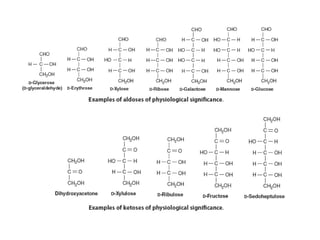
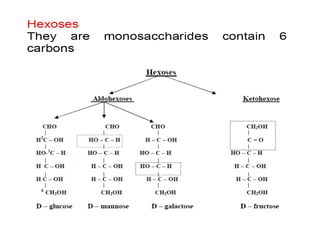
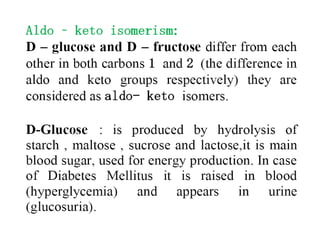
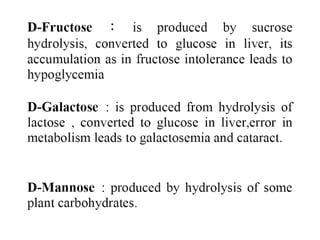
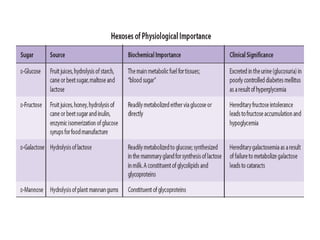
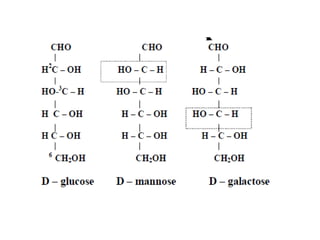
• For example, fructose, glucose, mannose, and galactose are all
isomers of each other, having the same chemical formula
C6H12O6 .
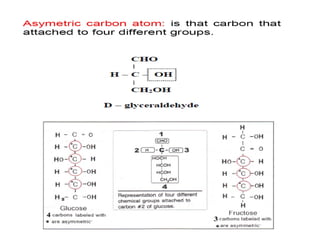
• The number of isomers for any sugar is according to the
number of asymmetric carbon atoms present in this sugar i.e
one asymmetric carbon atom give two isomers while two give 4
according to the role of 2n
23.
Epimers
• If twomonosaccharides differ in configuration around only one
specific carbon atom (with the exception of the carbonyl carbon,
they are defined as epimers of each other. (Of course, they are
also isomers!) .
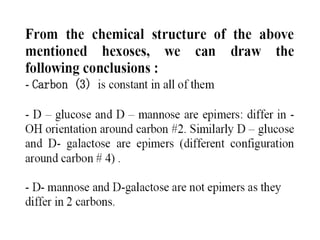
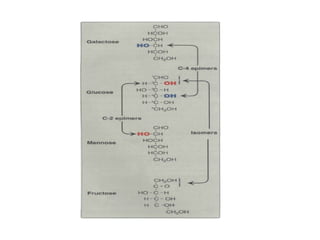
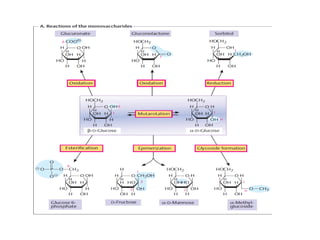
• For example, glucose and galactose are C-4 epimers. Their
structures differ only in the position of the -OH group at carbon 4.
• Glucose and mannose are C-2 epimers.
• However, galactose and mannose are NOT epimers they differ in
the position of -OH groups at two carbons (2 and 4) and are,
therefore, defined only as isomers.
25.
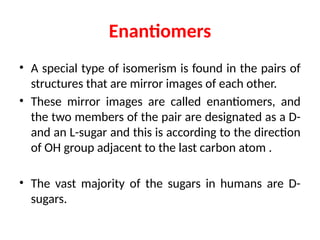
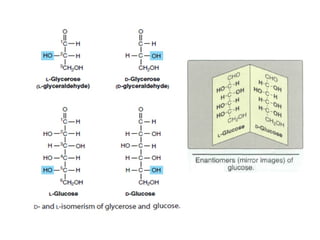
Enantiomers
• A specialtype of isomerism is found in the pairs of
structures that are mirror images of each other.
• These mirror images are called enantiomers, and
the two members of the pair are designated as a D-
and an L-sugar and this is according to the direction
of OH group adjacent to the last carbon atom .
• The vast majority of the sugars in humans are D-
sugars.