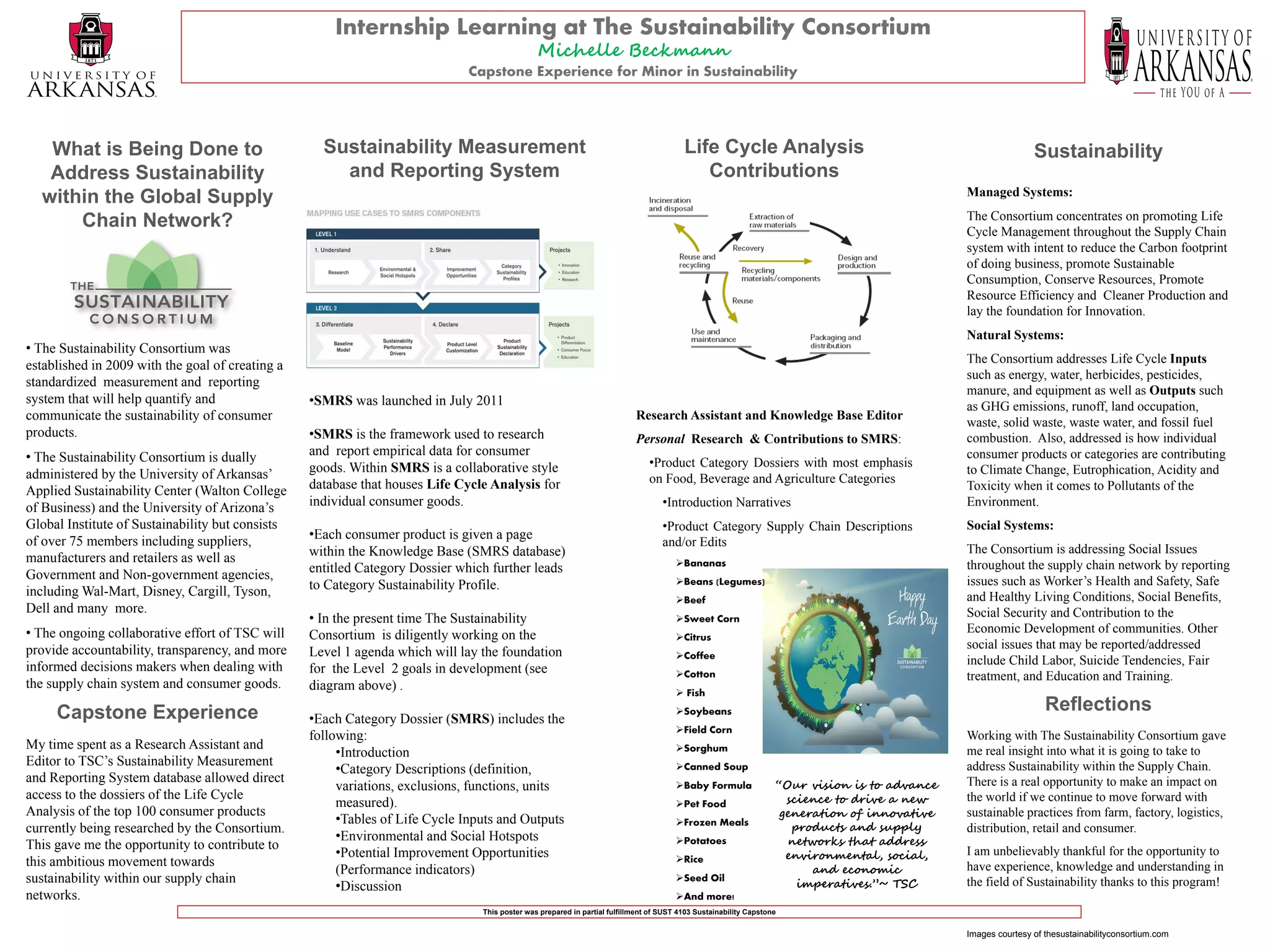
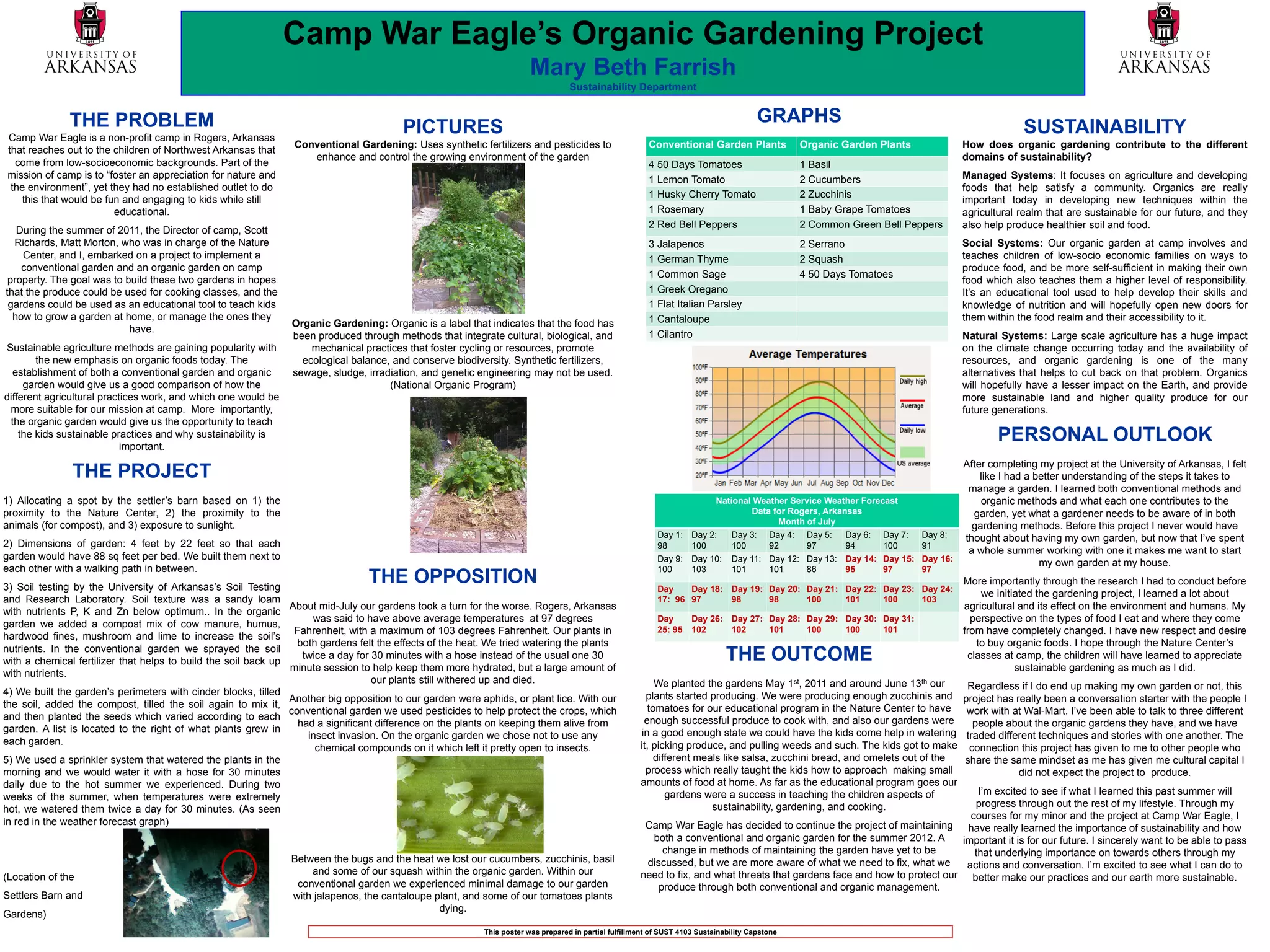
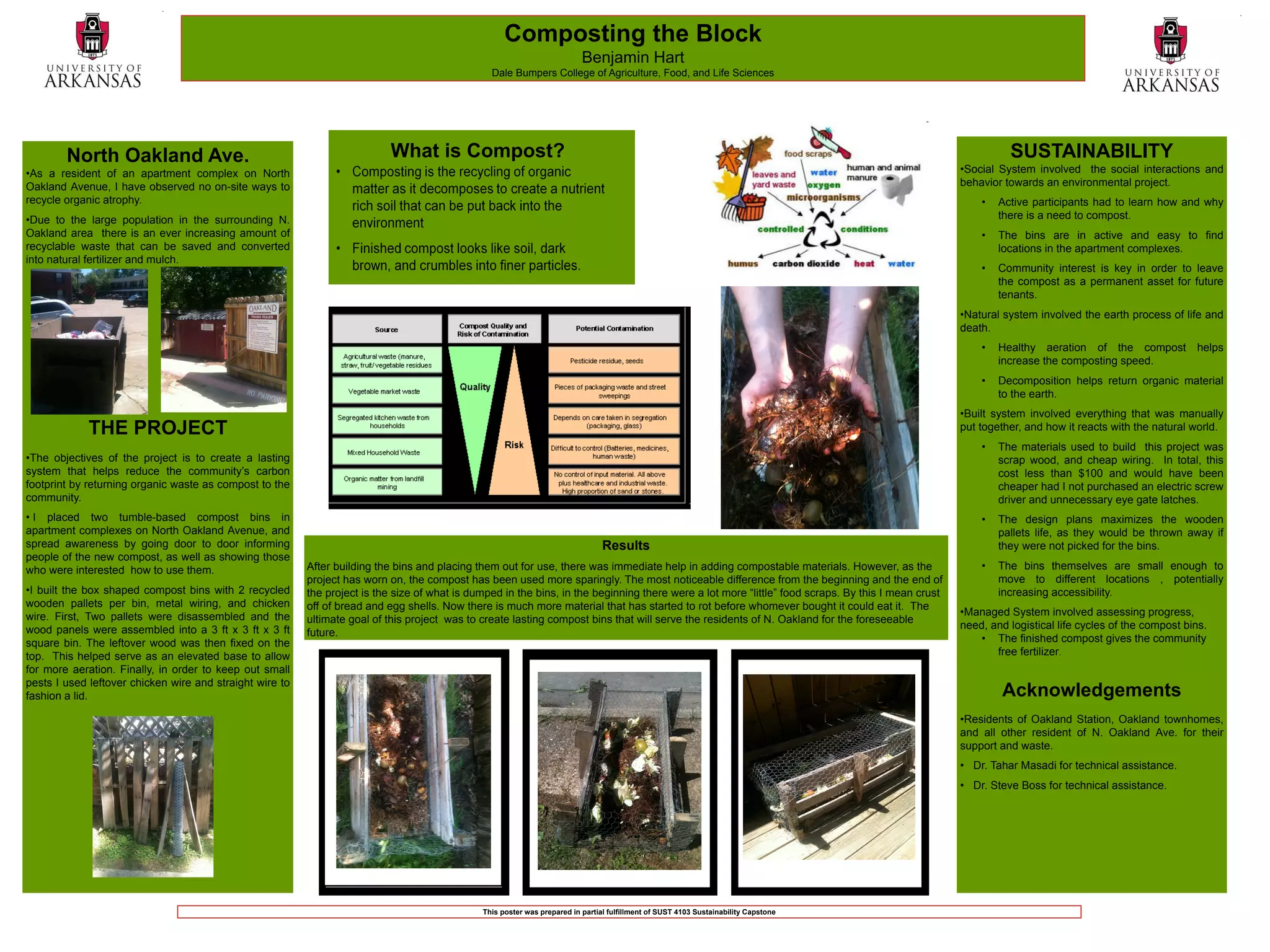
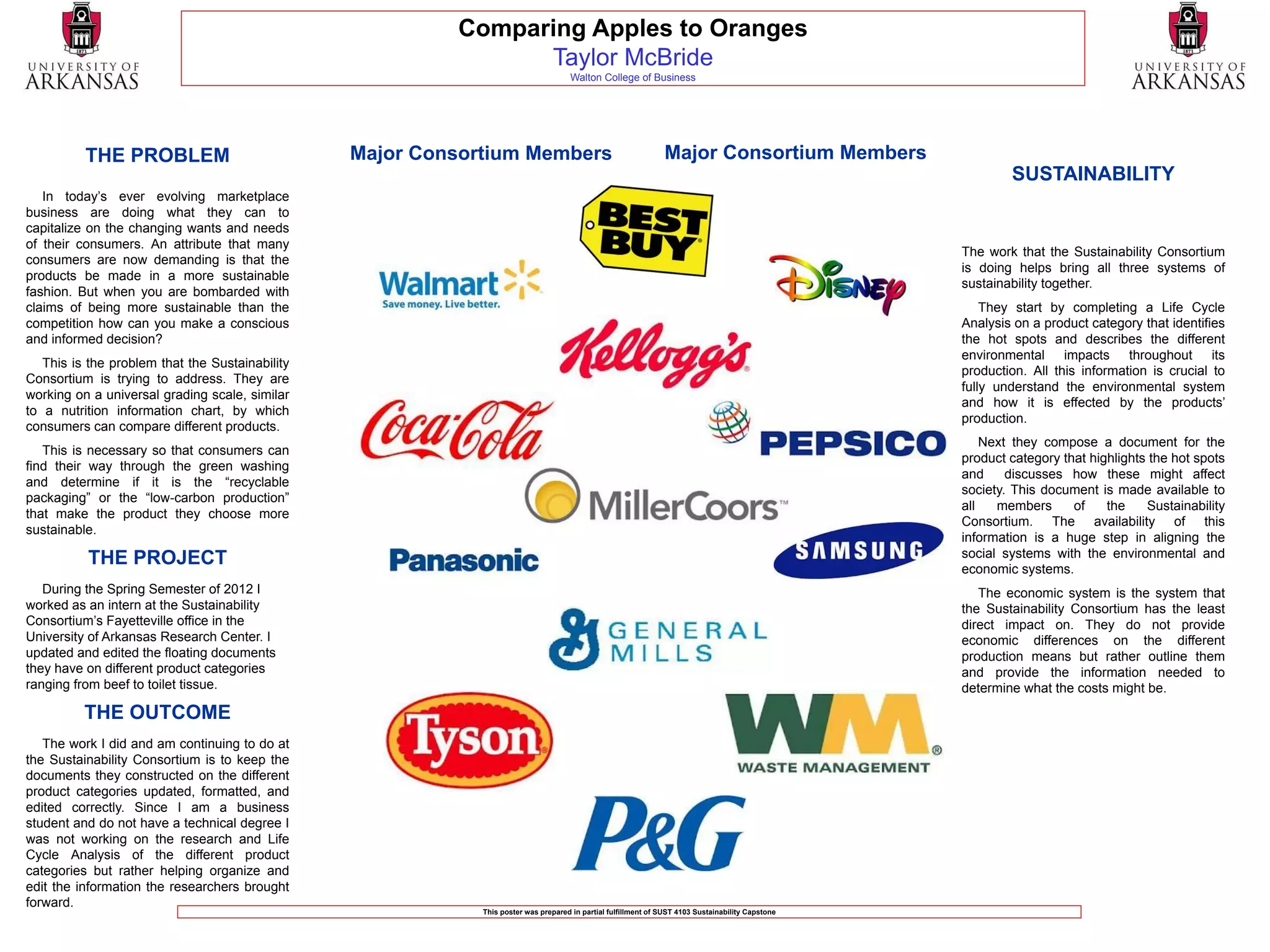
Service Learning in Belize: ANRI Seedling House
                                                                                                      Andrea Love, Tandie Bailey, Jessica House, Douglas Wolf
                                                                                                                                  Capstone for Minor in Sustainability
                                                                                                                            Department of Agriculture, Food and Life Sciences


                                             ANRI                                                                                    The New Seedling House                                                                                                            Sustainability
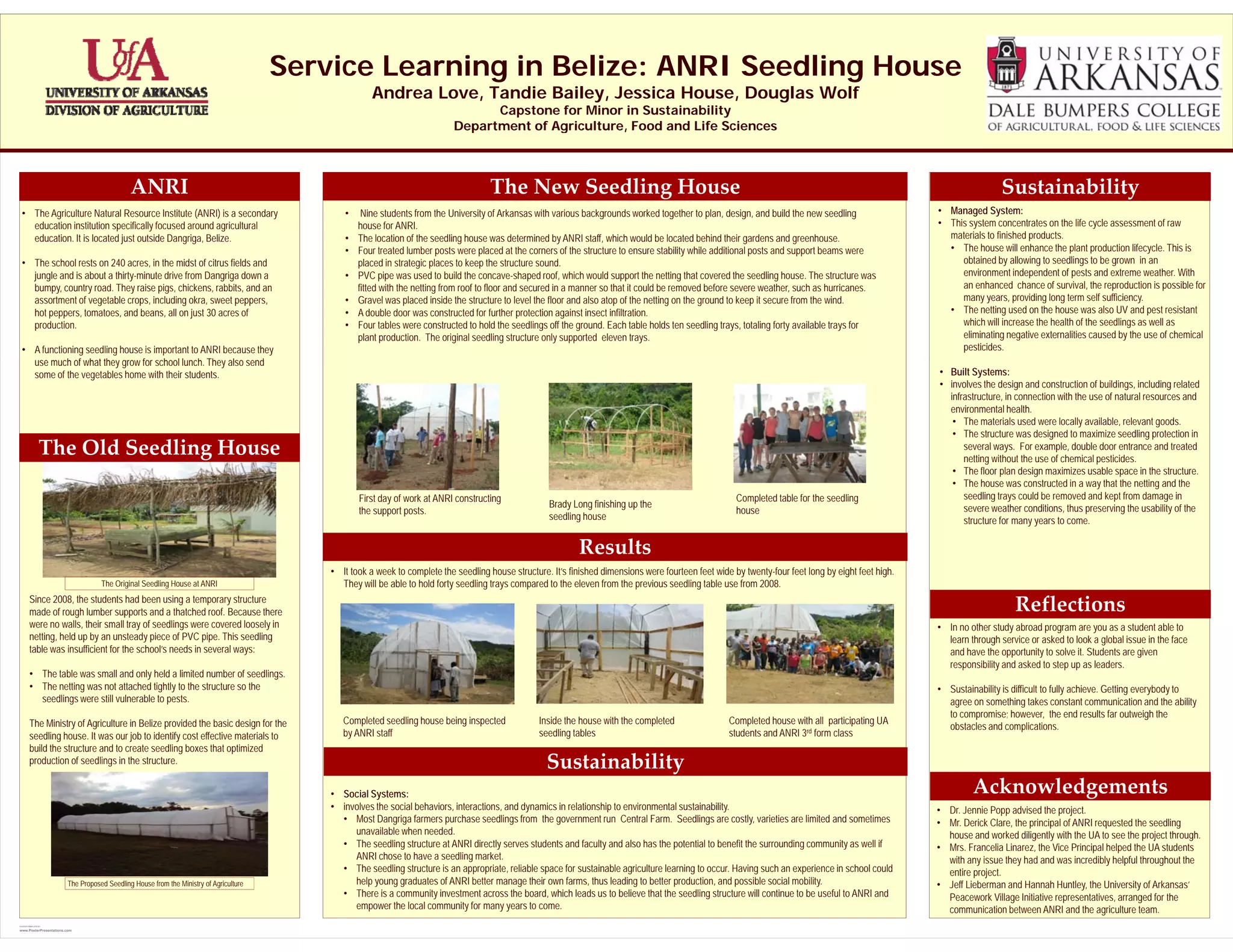
 • The Agriculture Natural Resource Institute (ANRI) is a secondary                           •    Nine students from the University of Arkansas with various backgrounds worked together to plan, design, and build the new seedling                 • Managed System:
   education institution specifically focused around agricultural                                 house for ANRI.                                                                                                                                     • This system concentrates on the life cycle assessment of raw
   education. It is located just outside Dangriga, Belize.                                    •   The location of the seedling house was determined by ANRI staff, which would be located behind their gardens and greenhouse.                          materials to finished products.
                                                                                              •   Four treated lumber posts were placed at the corners of the structure to ensure stability while additional posts and support beams were               • Th h
                                                                                                                                                                                                                                                           The house will enhance th plant production lif
                                                                                                                                                                                                                                                                          ill h     the l t d ti lifecycle. Thi iis
                                                                                                                                                                                                                                                                                                               l This
 • The school rests on 240 acres, in the midst of citrus fields and                               placed in strategic places to keep the structure sound.                                                                                                  obtained by allowing to seedlings to be grown in an
   jungle and is about a thirty-minute drive from Dangriga down a                             •   PVC pipe was used to build the concave-shaped roof, which would support the netting that covered the seedling house. The structure was                   environment independent of pests and extreme weather. With
   bumpy, country road. They raise pigs, chickens, rabbits, and an                                fitted with the netting from roof to floor and secured in a manner so that it could be removed before severe weather, such as hurricanes.                an enhanced chance of survival, the reproduction is possible for
   assortment of vegetable crops, including okra, sweet peppers,                              •   Gravel was placed inside the structure to level the floor and also atop of the netting on the ground to keep it secure from the wind.                    many years, providing long term self sufficiency.
   hot peppers, tomatoes, and beans, all on just 30 acres of                                  •   A double door was constructed for further protection against insect infiltration.                                                                     • The netting used on the house was also UV and pest resistant
   production.                                                                                •   Four tables were constructed to hold the seedlings off the ground. Each table holds ten seedling trays, totaling forty available trays for               which will increase the health of the seedlings as well as
                                                                                                  plant production. The original seedling structure only supported eleven trays.                                                                           eliminating negative externalities caused by the use of chemical
 • A functioning seedling house is important to ANRI because they                                                                                                                                                                                          pesticides.
   use much of what they grow for school lunch. They also send
                                          lunch
   some of the vegetables home with their students.                                                                                                                                                                                                   • Built Systems:
                                                                                                                                                                                                                                                      • involves the design and construction of buildings, including related
                                                                                                                                                                                                                                                        infrastructure, in connection with the use of natural resources and
                                                                                                                                                                                                                                                        environmental health.
                                                                                                                                                                                                                                                         • The materials used were locally available, relevant goods.
                                                                                                                                                                                                                                                         • The structure was designed to maximize seedling protection in
                The Old Seedling House                                                                                                                                                                                                                      several ways. For example, double door entrance and treated
                                                                                                                                                                                                                                                            netting without the use of chemical pesticides.
                                                                                                                                                                                                                                                         • The floor plan design maximizes usable space in the structure.
                                                                                                                                                                                                                                                                      p        g                       p
                                                                                                                                                                                                                                                         • The house was constructed in a way that the netting and the
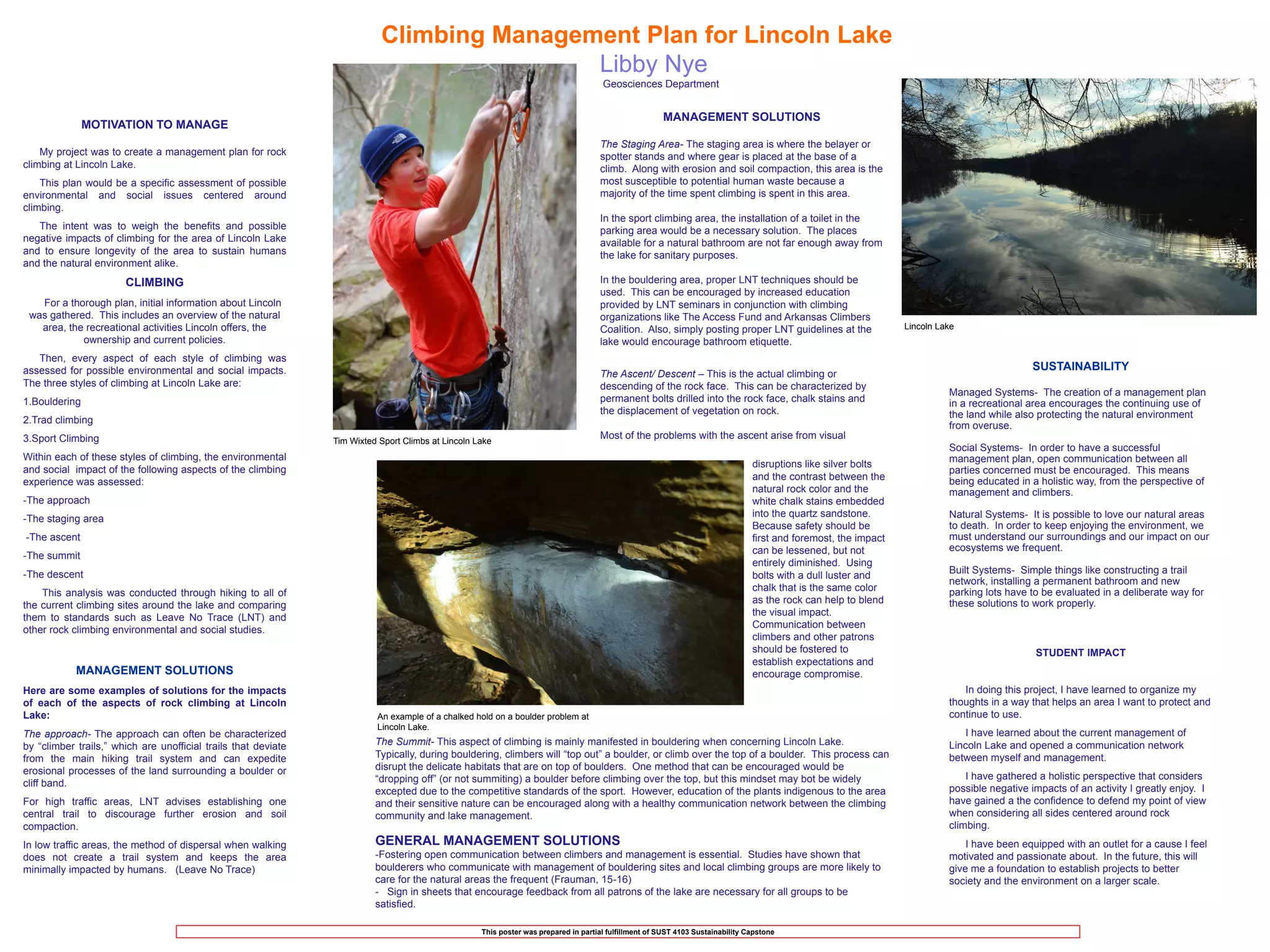
                                                                                                  First day of work at ANRI constructing                                                                Completed table for the seedling                    seedling trays could be removed and kept from damage in
                                                                                                                                                     Brady Long finishing up the                                                                            severe weather conditions, thus preserving the usability of the
                                                                                                  the support posts.                                                                                    house
                                                                                                                                                     seedling house                                                                                         structure for many years to come.

                                                                                                                                                             Results
                                                                                           • It took a week to complete the seedling house structure. It’s finished dimensions were fourteen feet wide by twenty-four feet long by eight feet high.
                                   The Original Seedling House at ANRI                       They will be able to hold forty seedling trays compared to the eleven from the previous seedling table use from 2008.
        Since 2008, the students had been using a temporary structure
        made of rough lumber supports and a thatched roof. Because there                                                                                                                                                                                                   Reflections
        were no walls, their small tray of seedlings were covered loosely in                                                                                                                                                                          • In no other study abroad program are you as a student able to
        netting, held up by an unsteady piece of PVC pipe. This seedling                                                                                                                                                                                learn through service or asked to look a global issue in the face
        table was insufficient for the school’s needs in several ways:                                                                                                                                                                                  and have the opportunity to solve it. Students are given
                                                                                                                                                                                                                                                        responsibility and asked to step up as leaders.
        • The table was small and only held a limited number of seedlings.
        • The netting was not attached tightly to the structure so the                                                                                                                                                                                • Sustainability is difficult to fully achieve. Getting everybody to
          seedlings were still vulnerable to pests.                                                                                                                                                                                                     agree on something takes constant communication and the ability
                                                                                                                                                                                                                                                          g                  g                                             y
                                                                                                                                                                                                                                                        to compromise; however, the end results far outweigh the
        The Ministry of Agriculture in Belize provided the basic design for the               Completed seedling house being inspected             Inside the house with the completed                Completed house with all participating UA
                                                                                                                                                                                                                                                        obstacles and complications.
        seedling house. It was our job to identify cost effective materials to                by ANRI staff                                        seedling tables                                    students and ANRI 3rd form class
        build the structure and to create seedling boxes that optimized
        production of seedlings in the structure.                                                                                                    Sustainability
                                                                                           • Social Systems:                                                                                                                                                   Acknowledgements
                                                                                           • involves the social behaviors, interactions, and dynamics in relationship to environmental sustainability.                                               • Dr. Jennie Popp advised the project.
                                                                                             • Most Dangriga farmers purchase seedlings from the government run Central Farm. Seedlings are costly, varieties are limited and sometimes               • Mr Derick Clare, the principal of ANRI requested the seedling
                                                                                                                                                                                                                                                        Mr.         Clare
                                                                                                unavailable when needed.                                                                                                                                house and worked diligently with the UA to see the project through.
                                                                                             • The seedling structure at ANRI directly serves students and faculty and also has the potential to benefit the surrounding community as well if         • Mrs. Francelia Linarez, the Vice Principal helped the UA students
                                                                                                ANRI chose to have a seedling market.                                                                                                                   with any issue they had and was incredibly helpful throughout the
                                                                                             • The seedling structure is an appropriate, reliable space for sustainable agriculture learning to occur. Having such an experience in school could        entire project.
                        The Proposed Seedling House from the Ministry of Agriculture            help young graduates of ANRI better manage their own farms, thus leading to better production, and possible social mobility.                          • Jeff Lieberman and Hannah Huntley, the University of Arkansas’
                                                                                             • There is a community investment across the board, which leads us to believe that the seedling structure will continue to be useful to ANRI and           Peacework Village Initiative representatives, arranged for the
                                                                                                empower the local community for many years to come.                                                                                                     communication between ANRI and the agriculture team.
POSTER TEMPLATE BY:

www.PosterPresentations.com
INTEGRATED PASTURED POULTRY INFRASTRUCTURE
                                                                                                              Carolina K. Proudfoot
                                                                                                                    Capstone For Minor Sustainability,
                                                                                                             Department of Agriculture, Food and Life Sciences


I

    Sustainable Agriculture                                                                                               Design and Building                                                                                    Sustainable Agriculture
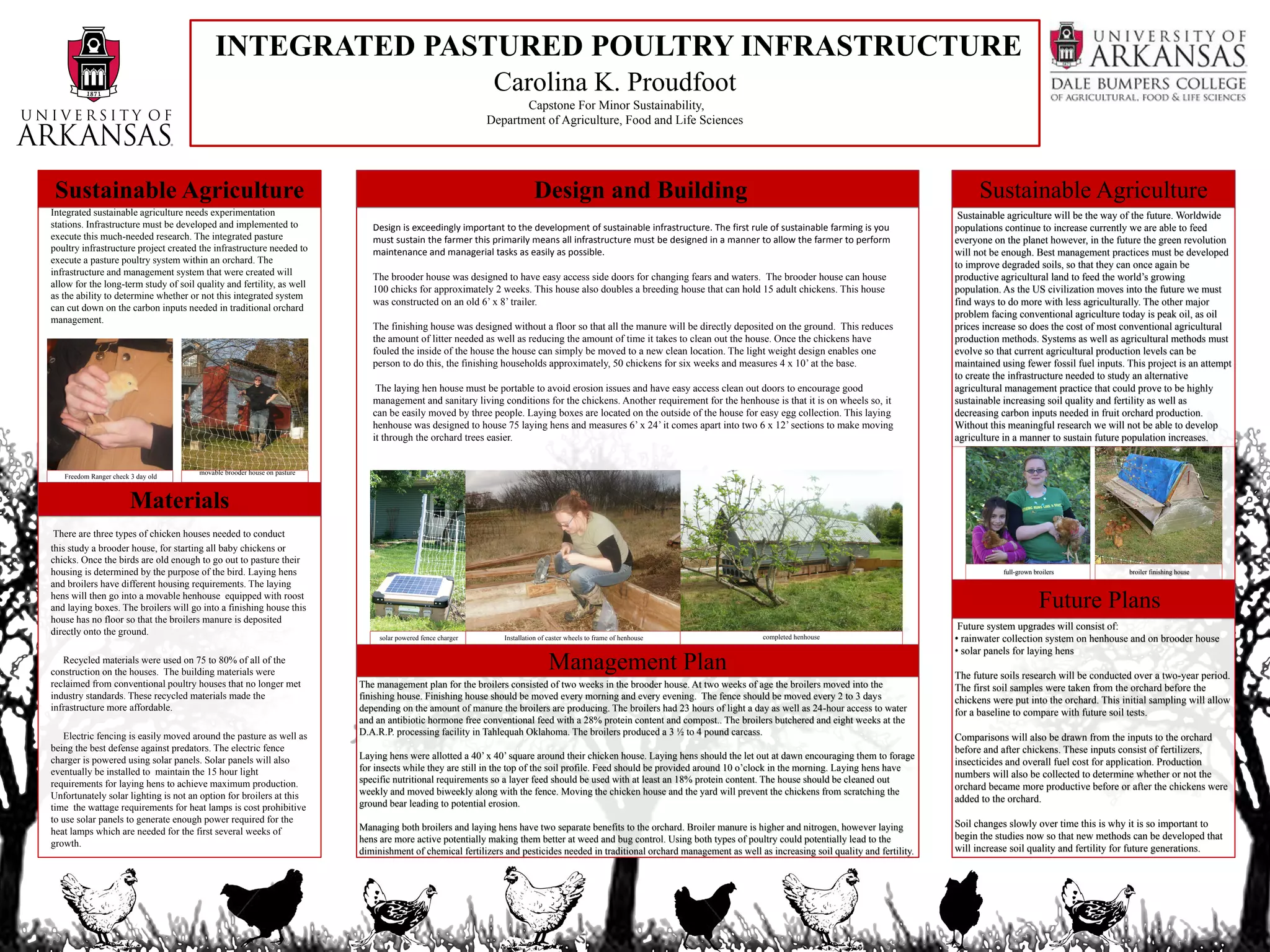
Integrated sustainable agriculture needs experimentation                                                                                                                                                                    Sustainable agriculture will be the way of the future. Worldwide
stations. Infrastructure must be developed and implemented to                Design is exceedingly important to the development of sustainable infrastructure. The first rule of sustainable farming is you                populations continue to increase currently we are able to feed
execute this much-needed research. The integrated pasture                    must sustain the farmer this primarily means all infrastructure must be designed in a manner to allow the farmer to perform                   everyone on the planet however, in the future the green revolution
poultry infrastructure project created the infrastructure needed to          maintenance and managerial tasks as easily as possible.                                                                                       will not be enough. Best management practices must be developed
execute a pasture poultry system within an orchard. The                                                                                                                                                                    to improve degraded soils, so that they can once again be
infrastructure and management system that were created will
                                                                             The brooder house was designed to have easy access side doors for changing fears and waters. The brooder house can house                      productive agricultural land to feed the world’s growing
allow for the long-term study of soil quality and fertility, as well
                                                                             100 chicks for approximately 2 weeks. This house also doubles a breeding house that can hold 15 adult chickens. This house                    population. As the US civilization moves into the future we must
as the ability to determine whether or not this integrated system
                                                                             was constructed on an old 6’ x 8’ trailer.                                                                                                    find ways to do more with less agriculturally. The other major
can cut down on the carbon inputs needed in traditional orchard
                                                                                                                                                                                                                           problem facing conventional agriculture today is peak oil, as oil
management.
                                                                             The finishing house was designed without a floor so that all the manure will be directly deposited on the ground. This reduces                prices increase so does the cost of most conventional agricultural
                                                                             the amount of litter needed as well as reducing the amount of time it takes to clean out the house. Once the chickens have                    production methods. Systems as well as agricultural methods must
                                                                             fouled the inside of the house the house can simply be moved to a new clean location. The light weight design enables one                     evolve so that current agricultural production levels can be
                                                                             person to do this, the finishing households approximately, 50 chickens for six weeks and measures 4 x 10’ at the base.                        maintained using fewer fossil fuel inputs. This project is an attempt
                                                                                                                                                                                                                           to create the infrastructure needed to study an alternative
                                                                              The laying hen house must be portable to avoid erosion issues and have easy access clean out doors to encourage good                         agricultural management practice that could prove to be highly
                                                                             management and sanitary living conditions for the chickens. Another requirement for the henhouse is that it is on wheels so, it               sustainable increasing soil quality and fertility as well as
                                                                             can be easily moved by three people. Laying boxes are located on the outside of the house for easy egg collection. This laying                decreasing carbon inputs needed in fruit orchard production.
                                                                             henhouse was designed to house 75 laying hens and measures 6’ x 24’ it comes apart into two 6 x 12’ sections to make moving                   Without this meaningful research we will not be able to develop
                                                                             it through the orchard trees easier.                                                                                                          agriculture in a manner to sustain future population increases.


                                       movable brooder house on pasture
    Freedom Ranger check 3 day old


                         Materials
 There are three types of chicken houses needed to conduct
this study a brooder house, for starting all baby chickens or
chicks. Once the birds are old enough to go out to pasture their
housing is determined by the purpose of the bird. Laying hens                                                                                                                                                                          full-grown broilers            broiler finishing house
and broilers have different housing requirements. The laying
hens will then go into a movable henhouse equipped with roost
and laying boxes. The broilers will go into a finishing house this                                                                                                                                                                                  Future Plans
house has no floor so that the broilers manure is deposited
                                                                                                                                                                                                                            Future system upgrades will consist of:
directly onto the ground.
                                                                               solar powered fence charger      Installation of caster wheels to frame of henhouse               completed henhouse                        • rainwater collection system on henhouse and on brooder house
                                                                                                                                                                                                                           • solar panels for laying hens
   Recycled materials were used on 75 to 80% of all of the
construction on the houses. The building materials were
                                                                                                                               Management Plan                                                                             The future soils research will be conducted over a two-year period.
reclaimed from conventional poultry houses that no longer met             The management plan for the broilers consisted of two weeks in the brooder house. At two weeks of age the broilers moved into the                The first soil samples were taken from the orchard before the
industry standards. These recycled materials made the                     finishing house. Finishing house should be moved every morning and every evening. The fence should be moved every 2 to 3 days                    chickens were put into the orchard. This initial sampling will allow
infrastructure more affordable.                                           depending on the amount of manure the broilers are producing. The broilers had 23 hours of light a day as well as 24-hour access to water        for a baseline to compare with future soil tests.
                                                                          and an antibiotic hormone free conventional feed with a 28% protein content and compost.. The broilers butchered and eight weeks at the
   Electric fencing is easily moved around the pasture as well as         D.A.R.P. processing facility in Tahlequah Oklahoma. The broilers produced a 3 ½ to 4 pound carcass.
                                                                                                                                                                                                                           Comparisons will also be drawn from the inputs to the orchard
being the best defense against predators. The electric fence                                                                                                                                                               before and after chickens. These inputs consist of fertilizers,
charger is powered using solar panels. Solar panels will also             Laying hens were allotted a 40’ x 40’ square around their chicken house. Laying hens should the let out at dawn encouraging them to forage
                                                                                                                                                                                                                           insecticides and overall fuel cost for application. Production
eventually be installed to maintain the 15 hour light                     for insects while they are still in the top of the soil profile. Feed should be provided around 10 o’clock in the morning. Laying hens have
                                                                                                                                                                                                                           numbers will also be collected to determine whether or not the
requirements for laying hens to achieve maximum production.               specific nutritional requirements so a layer feed should be used with at least an 18% protein content. The house should be cleaned out
                                                                          weekly and moved biweekly along with the fence. Moving the chicken house and the yard will prevent the chickens from scratching the              orchard became more productive before or after the chickens were
Unfortunately solar lighting is not an option for broilers at this                                                                                                                                                         added to the orchard.
time the wattage requirements for heat lamps is cost prohibitive          ground bear leading to potential erosion.
to use solar panels to generate enough power required for the                                                                                                                                                              Soil changes slowly over time this is why it is so important to
heat lamps which are needed for the first several weeks of                Managing both broilers and laying hens have two separate benefits to the orchard. Broiler manure is higher and nitrogen, however laying
                                                                          hens are more active potentially making them better at weed and bug control. Using both types of poultry could potentially lead to the           begin the studies now so that new methods can be developed that
growth.
                                                                          diminishment of chemical fertilizers and pesticides needed in traditional orchard management as well as increasing soil quality and fertility.   will increase soil quality and fertility for future generations.
University of Arkansas Vehicle Research Project
                                                                                                                        Clark Rogers
                                                                                                            Capstone for Minor in Sustainability
                                                                                                      Department of Agriculture, Food and Life Science

                                              Parking on Campus                                                                                                                                                      The Outcome                                                                                                       Sustainability

•   I have gathered information from the UofA parking and
    transit facility of all vehicles registered on campus from                             Fayettev
                                                                                           Student
                                                                                                   ille Campus
                                                                                                          Car Type
                                                                                                          Car
                                                                                                                                          Data
                                                                                                                                          Vech Count
                                                                                                                                                                       Ye a r
                                                                                                                                                                    2009-2010
                                                                                                                                                                      6,659
                                                                                                                                                                                          2010-2011
                                                                                                                                                                                            7,484
                                                                                                                                                                                                                           2011-2012
                                                                                                                                                                                                                             7,875
                                                                                                                                                                                                                                                  Gra nd Tota l
                                                                                                                                                                                                                                                    22,018
                                                                                                                                                                                                                                                                                                                      • Social Systems
                                                                                                                                          Year %                      36.8%                 38.4%                            39.3%                   38.2%
                                                                                                              SUV                         Vech Count                  3,615                 4,232                            4,299                  12,146

    the past 3 years.                                                                                         No Vech Type
                                                                                                                                          Year %
                                                                                                                                          Vech Count
                                                                                                                                          Year %
                                                                                                                                                                      20.0%
                                                                                                                                                                      2,023
                                                                                                                                                                      11.2%
                                                                                                                                                                                            21.7%
                                                                                                                                                                                            1,751
                                                                                                                                                                                             9.0%
                                                                                                                                                                                                                             21.4%
                                                                                                                                                                                                                             2,167
                                                                                                                                                                                                                             10.8%
                                                                                                                                                                                                                                                     21.1%
                                                                                                                                                                                                                                                     5,941
                                                                                                                                                                                                                                                     10.3%                                                                • People tend to buy vehicles based on looks
                                                                                            Student Vehicle   Truck                       Vech Count                  1,615                 2,149                            1,825                   5,589
                                                                                                +16.7%        Motorcycle
                                                                                                                                          Year %
                                                                                                                                          Vech Count
                                                                                                                                          Year %
                                                                                                                                                                       8.9%
                                                                                                                                                                         7
                                                                                                                                                                       0.0%
                                                                                                                                                                                            11.0%
                                                                                                                                                                                               7
                                                                                                                                                                                             0.0%
                                                                                                                                                                                                                              9.1%
                                                                                                                                                                                                                               17
                                                                                                                                                                                                                              0.1%
                                                                                                                                                                                                                                                      9.7%
                                                                                                                                                                                                                                                       31
                                                                                                                                                                                                                                                      0.1%
                                                                                                                                                                                                                                                                                                                            or the size that best fits them.
•   You will see that the student enrollment is continuously                                                  Scooter                     Vech Count
                                                                                                                                          Year %
                                                                                                                                                                         3
                                                                                                                                                                       0.0%
                                                                                                                                                                                               9
                                                                                                                                                                                             0.0%
                                                                                                                                                                                                                                4
                                                                                                                                                                                                                              0.0%
                                                                                                                                                                                                                                                       16
                                                                                                                                                                                                                                                      0.0%


                                                                                                                                                                                                                                                                                                                          • Students and Faculty will now have
                                                                                           Stude nt Ve ch Count                                                       13,922                15,632                           16,187                 45,741
                                                                                           Stude nt Ye a r %                                                          76.9%                 80.3%                            80.7%                   79.4%

    growing each year. Which means more traffic and more                                   Faculty         Car                            Vech Count
                                                                                                                                          Year %
                                                                                                                                                                      1,833
                                                                                                                                                                      10.1%
                                                                                                                                                                                            1,568
                                                                                                                                                                                             8.1%
                                                                                                                                                                                                                             1,628
                                                                                                                                                                                                                              8.1%
                                                                                                                                                                                                                                                     5,029
                                                                                                                                                                                                                                                      8.7%


                                                                                                                                                                                                                                                                                                                            different opinions of vehicles driven on
                                                                                                              SUV                         Vech Count                  1,008                   926                            1,024                   2,958


    vehicles on campus.
                                                                                                                                          Year %                       5.6%                  4.8%                             5.1%                    5.1%
                                                                                                              No Vech Type                Vech Count                    807                   745                              649                   2,201
                                                                                            Faculty Vehicle                               Year %                       4.5%                  3.8%                             3.2%                    3.8%

                                                                                                - 7.7%
                                                                                                              Truck

                                                                                                              Motorcycle
                                                                                                                                          Vech Count
                                                                                                                                          Year %
                                                                                                                                          Vech Count
                                                                                                                                                                        536
                                                                                                                                                                       3.0%
                                                                                                                                                                         1
                                                                                                                                                                                              602
                                                                                                                                                                                             3.1%
                                                                                                                                                                                                                               559
                                                                                                                                                                                                                              2.8%
                                                                                                                                                                                                                                6
                                                                                                                                                                                                                                                     1,697
                                                                                                                                                                                                                                                      2.9%
                                                                                                                                                                                                                                                        7
                                                                                                                                                                                                                                                                                                                            campus.
                                                                                                                                          Year %                       0.0%                   0.0%                            0.0%                    0.0%


•
                                                                                                              Scooter                     Vech Count                     2                                                                              2

    It is important to recognize that if enrollment continues to                           Faculty Vech Count
                                                                                           Faculty Year %
                                                                                                                                          Year %                       0.0%
                                                                                                                                                                      4,187
                                                                                                                                                                      23.1%
                                                                                                                                                                                             0.0%
                                                                                                                                                                                             3,841
                                                                                                                                                                                            19.7%
                                                                                                                                                                                                                              0.0%
                                                                                                                                                                                                                              3,866
                                                                                                                                                                                                                             19.3%
                                                                                                                                                                                                                                                      0.0%
                                                                                                                                                                                                                                                    11,894
                                                                                                                                                                                                                                                     20.6%                                                                • Students and Faculty will think of taking
                                                                                           Tota l Ve ch Count                                                         18,109                19,473                           20,053                 57,635

    grow then we will not have enough space for students to                                Tota l Ye a r %

                                                                                            10, 000
                                                                                                                                                                     100.0%                 100.0%                           100.0%                 100.0%
                                                                                                                                                                                                                                                                                                                            different types of transportation.
                                                                                             9, 000

    park on campus.                                                                          8, 000
                                                                                             7, 000


                                                                                                                                                                                                                                                                                                                          • People when purchasing a new vehicle will
                                                                                             6, 000
                                                                                             5, 000
                                                                                             4, 000
                                                                                             3, 000
                                                                                             2, 000


•   The graph below indicates that the student population
                                                                                             1, 000
                                                                                                  0                                                                                                                                                                                                                         now hopefully choose one with great fuel


                                                                                                                        No Vech Type


                                                                                                                                                                                             No Vech Type


                                                                                                                                                                                                                                                No Vech Type
                                                                                                               SUV


                                                                                                                                                                     SUV


                                                                                                                                                                                                                                   SUV
                                                                                                                                                                                                                     Car
                                                                                                        Car


                                                                                                                                                         Car
                                                                                                                                          Truck


                                                                                                                                                                                Truck


                                                                                                                                                                                                                                                                      Truck
    and the student vehicle count is steadily increasing each                                                   2009-2010                                             2010-2011                                                        2011-2012
                                                                                                                                                                                                                                                                                                                            efficiency.
                                                                                                                                                               F acility   Student


    year.                                                                                                                                                                                                                                                                                                                 • Vehicle count on campus is likely to
                                                                                                                                                                                                                                                                                                                            decrease due to the student enrollment
              25,000
                                                                                                                                                                                                                                                                                                                            population.
                         7 of Every 10 Students have a vehicle
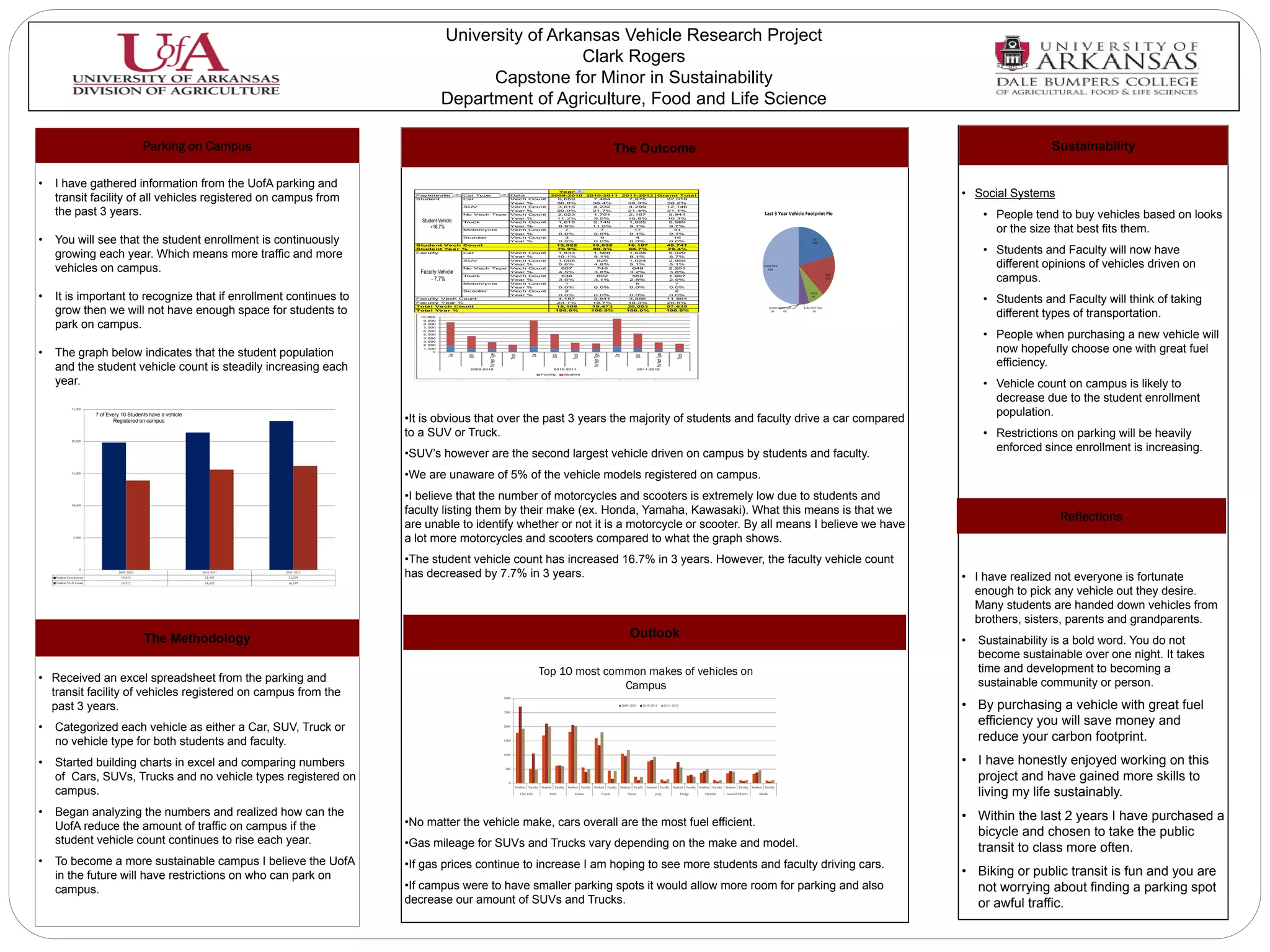
                                 Registered on campus                                    •It is obvious that over the past 3 years the majority of students and faculty drive a car compared
              20,000
                                                                                         to a SUV or Truck.                                                                                                                                                                                                               • Restrictions on parking will be heavily
                                                                                                                                                                                                                                                                                                                            enforced since enrollment is increasing.
                                                                                         •SUV’s however are the second largest vehicle driven on campus by students and faculty.
              15,000
                                                                                         •We are unaware of 5% of the vehicle models registered on campus.
                                                                                         •I believe that the number of motorcycles and scooters is extremely low due to students and
              10,000
                                                                                         faculty listing them by their make (ex. Honda, Yamaha, Kawasaki). What this means is that we
                                                                                                                                                                                                                                                                                                                                         Reflections
                                                                                         are unable to identify whether or not it is a motorcycle or scooter. By all means I believe we have
               5,000
                                                                                         a lot more motorcycles and scooters compared to what the graph shows.
                                                                                         •The student vehicle count has increased 16.7% in 3 years. However, the faculty vehicle count
                   0

    Student Enrolement
                                  2009-2010
                                    19,845
                                                                 2010-2011
                                                                   21,405
                                                                             2011-2012
                                                                               23,199    has decreased by 7.7% in 3 years.                                                                                                                                                                                            • I have realized not everyone is fortunate
    Student Vech Count              13,922                         15,632      16,187

                                                                                                                                                                                                                                                                                                                        enough to pick any vehicle out they desire.
                                                                                                                                                                                                                                                                                                                        Many students are handed down vehicles from
                                                                                                                                                                                                                                                                                                                        brothers, sisters, parents and grandparents.
                                                                                                                                                                                                                                Outlook
                                              The Methodology                                                                                                                                                                                                                                                         •   Sustainability is a bold word. You do not
                                                                                                                                                                                                                                                                                                                          become sustainable over one night. It takes
                                                                                                                                                               Top 10 most common makes of vehicles on                                                                                                                    time and development to becoming a
• Received an excel spreadsheet from the parking and                                                                                                                                                                                                                                                                      sustainable community or person.
                                                                                                                                                                              Campus
  transit facility of vehicles registered on campus from the                                                                           3000

  past 3 years.                                                                                                                        2500
                                                                                                                                                                                                                           2009-2010     2010-2011             2011-2012
                                                                                                                                                                                                                                                                                                                      • By purchasing a vehicle with great fuel
•   Categorized each vehicle as either a Car, SUV, Truck or                                                                            2000
                                                                                                                                                                                                                                                                                                                        efficiency you will save money and
    no vehicle type for both students and faculty.                                                                                     1500                                                                                                                                                                             reduce your carbon footprint.
                                                                                                                                                                                                                                                                                                                      • I have honestly enjoyed working on this
                                                                                                                                       1000

•   Started building charts in excel and comparing numbers                                                                             500

    of Cars, SUVs, Trucks and no vehicle types registered on                                                                              0
                                                                                                                                                                                                                                                                                                                        project and have gained more skills to
                                                                                                                                              Student Faculty Student Faculty Student Faculty Student Faculty Student Faculty Student Faculty Student Faculty Student Faculty Student Faculty Student Faculty
    campus.                                                                                                                                       Chevrolet         Ford          Honda                     Toyota            Nissan            Jeep                       Dodge   Hyundai   General Motors   Mazda     living my life sustainably.
•   Began analyzing the numbers and realized how can the                                                                                                                                                                                                                                                              • Within the last 2 years I have purchased a
    UofA reduce the amount of traffic on campus if the                                   •No matter the vehicle make, cars overall are the most fuel efficient.
                                                                                                                                                                                                                                                                                                                        bicycle and chosen to take the public
    student vehicle count continues to rise each year.                                   •Gas mileage for SUVs and Trucks vary depending on the make and model.                                                                                                                                                         transit to class more often.
•   To become a more sustainable campus I believe the UofA                               •If gas prices continue to increase I am hoping to see more students and faculty driving cars.
    in the future will have restrictions on who can park on                                                                                                                                                                                                                                                           • Biking or public transit is fun and you are
    campus.                                                                              •If campus were to have smaller parking spots it would allow more room for parking and also                                                                                                                                    not worrying about finding a parking spot
                                                                                         decrease our amount of SUVs and Trucks.                                                                                                                                                                                        or awful traffic.
Thermal Performance and Environmental Impact of Sustainable Concrete
                                                                                  Kyle Rookstool
                                                                                                                                                          UA Sustainability Programs


                                                                                                                   DESIGN                                                                  BUILT ENVIRONMENT
                      THE PROBLEM                                                               The structure is designed built as a large room                                                                                               SUSTAINABILITY
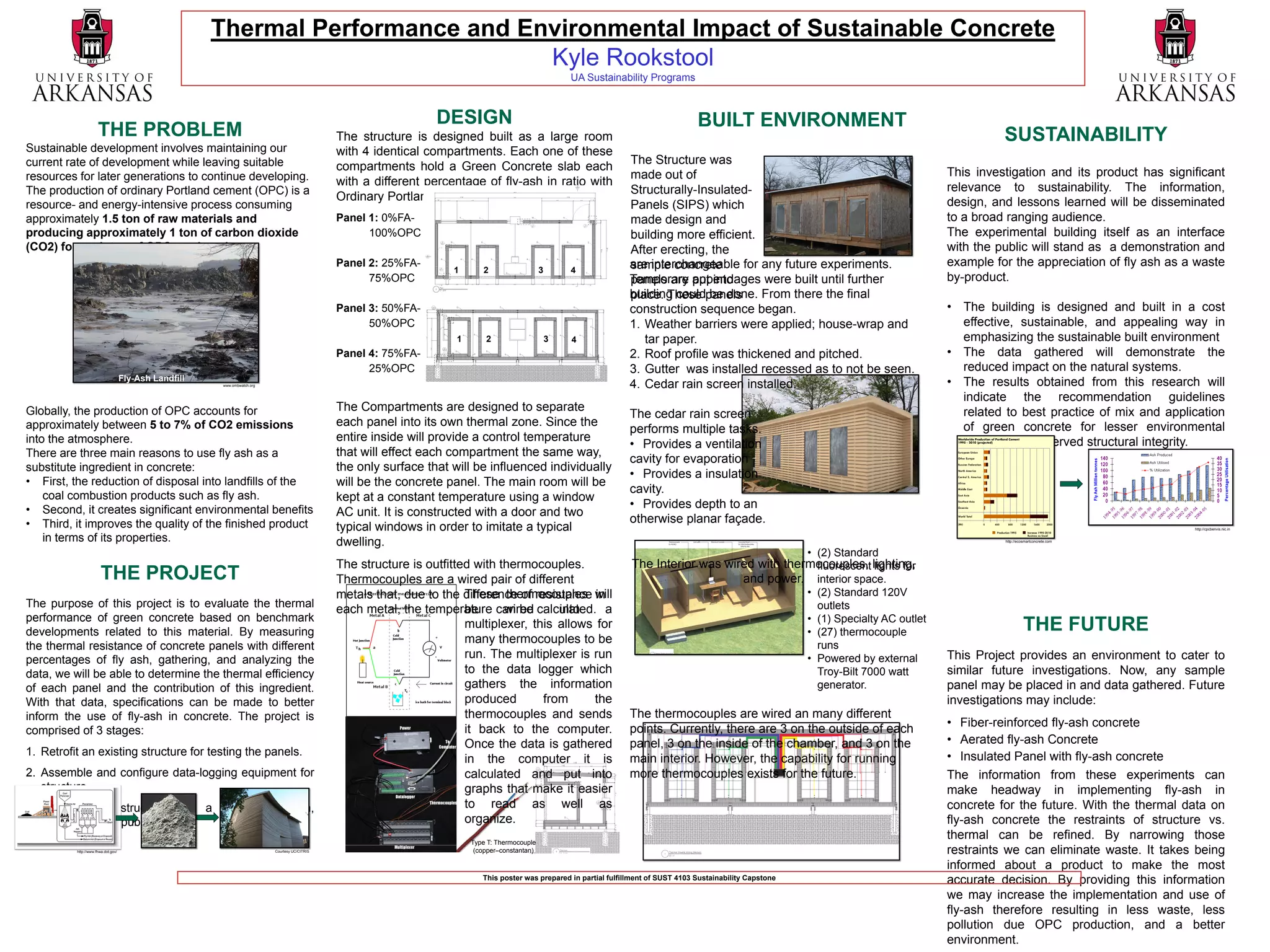
Sustainable development involves maintaining our                                                with 4 identical compartments. Each one of these
current rate of development while leaving suitable                                                                                                                      The Structure was
                                                                                                compartments hold a Green Concrete slab each                                                                                        This investigation and its product has significant
resources for later generations to continue developing.                                                                                                                 made out of
                                                                                                with a different percentage of fly-ash in ratio with                                                                                relevance to sustainability. The information,
The production of ordinary Portland cement (OPC) is a                                                                                                                   Structurally-Insulated-
                                                                                                Ordinary Portland Concrete aggregate.                                                                                               design, and lessons learned will be disseminated
resource- and energy-intensive process consuming                                                                                                                        Panels (SIPS) which
approximately 1.5 ton of raw materials and                                                      Panel 1: 0%FA-                                                          made design and                                             to a broad ranging audience.
producing approximately 1 ton of carbon dioxide                                                       100%OPC                                                           building more efficient.                                    The experimental building itself as an interface
(CO2) for each ton of OPC produced.                                                                                                                                     After erecting, the                                         with the public will stand as a demonstration and
                                                                                                Panel 2: 25%FA-                                                         are interchangeable for any future experiments.
                                                                                                                                                                        sample concrete                                             example for the appreciation of fly ash as a waste
                                                                                                                      1       2                   3       4
                                                                                                      75%OPC                                                            Temporary appendages were built until further
                                                                                                                                                                        panels are put into                                         by-product.
                                                                                                                                                                        building couldpanels
                                                                                                                                                                        place. These be done. From there the final
                                                                                                Panel 3: 50%FA-                                                         construction sequence began.                                • The building is designed and built in a cost
                                                                                                      50%OPC                                                            1. Weather barriers were applied; house-wrap and              effective, sustainable, and appealing way in
                                                                                                                       1       2                      3   4                tar paper.                                                 emphasizing the sustainable built environment
                                                                                                Panel 4: 75%FA-                                                         2. Roof profile was thickened and pitched.                  • The data gathered will demonstrate the
                                                                                                      25%OPC                                                            3. Gutter was installed recessed as to not be seen.           reduced impact on the natural systems.
                                     Fly-Ash Landfill
                                                        www.ombwatch.org                                                                                                4. Cedar rain screen installed.                             • The results obtained from this research will
                                                                                                                                                                                                                                      indicate the recommendation guidelines
Globally, the production of OPC accounts for                                                    The Compartments are designed to separate                                                                                             related to best practice of mix and application
                                                                                                                                                                        The cedar rain screen
approximately between 5 to 7% of CO2 emissions                                                  each panel into its own thermal zone. Since the                                                                                       of green concrete for lesser environmental
                                                                                                                                                                        performs multiple tasks.
into the atmosphere.                                                                            entire inside will provide a control temperature
                                                                                                                                                                        • Provides a ventilation                                      impact and preserved structural integrity.
There are three main reasons to use fly ash as a                                                that will effect each compartment the same way,
                                                                                                                                                                        cavity for evaporation
substitute ingredient in concrete:                                                              the only surface that will be influenced individually
                                                                                                                                                                        • Provides a insulation
• First, the reduction of disposal into landfills of the                                        will be the concrete panel. The main room will be
                                                                                                                                                                        cavity.
    coal combustion products such as fly ash.                                                   kept at a constant temperature using a window
• Second, it creates significant environmental benefits                                                                                                                 • Provides depth to an
                                                                                                AC unit. It is constructed with a door and two
• Third, it improves the quality of the finished product                                                                                                                otherwise planar façade.
                                                                                                typical windows in order to imitate a typical                                                                                                                                   http://cpcbenvis.nic.in


    in terms of its properties.                                                                 dwelling.                                                                                                                                     http://ecosmartconcrete.com


                                                                                                                                                                                                        • (2) Standard
                                                                                                The structure is outfitted with thermocouples.                          The Interior was wired with thermocouples, lighting,
                                                                                                                                                                                                          fluorescent lights for
                        THE PROJECT                                                             Thermocouples are a wired pair of different                                                 and power. interior space.
                                                                                                metals that, due to the difference of resistance will
                                                                                                                         These thermocouples in                                                         • (2) Standard 120V
The purpose of this project is to evaluate the thermal                                                                                                                                                    outlets
                                                                                                each metal, the temperature can be calculated. a
                                                                                                                         be      wired     into
performance of green concrete based on benchmark                                                                                                                                                        • (1) Specialty AC outlet
developments related to this material. By measuring
                                                                                                                         multiplexer, this allows for
                                                                                                                                                                                                        • (27) thermocouple                             THE FUTURE
                                                                                                                         many thermocouples to be                                                         runs
the thermal resistance of concrete panels with different
percentages of fly ash, gathering, and analyzing the                                                                     run. The multiplexer is run                                                    • Powered by external       This Project provides an environment to cater to
data, we will be able to determine the thermal efficiency                                                                to the data logger which                                                         Troy-Bilt 7000 watt       similar future investigations. Now, any sample
of each panel and the contribution of this ingredient.                                                                   gathers the information                                                          generator.                panel may be placed in and data gathered. Future
With that data, specifications can be made to better                                                                     produced       from     the                                                                                investigations may include:
inform the use of fly-ash in concrete. The project is                                                                    thermocouples and sends                        The thermocouples are wired an many different
                                                                                                                                                                        points. Currently, there are 3 on the outside of each       • Fiber-reinforced fly-ash concrete
comprised of 3 stages:                                                                                                   it back to the computer.
                                                                                                                         Once the data is gathered                      panel, 3 on the inside of the chamber, and 3 on the         • Aerated fly-ash Concrete
1. Retrofit an existing structure for testing the panels.                                                                                                                                                                           • Insulated Panel with fly-ash concrete
                                                                                                                         in the computer it is                          main interior. However, the capability for running
2. Assemble and configure data-logging equipment for                                                                     calculated and put into                        more thermocouples exists for the future.                   The information from these experiments can
   structure.                                                                                                            graphs that make it easier                                                                                 make headway in implementing fly-ash in
3. Develop the structure into a pleasing design,                                                                         to read as well as                                                                                         concrete for the future. With the thermal data on
   suitable for the public eye.                                                                                          organize.                                                                                                  fly-ash concrete the restraints of structure vs.
                                                                                                                           Type T: Thermocouple
                                                                                                                                                                                                                                    thermal can be refined. By narrowing those
          http://www.fhwa.dot.gov/                                         Courtesy UC/CITRIS                               (copper–constantan)                                                                                     restraints we can eliminate waste. It takes being
                                                                                                                                                                                                                                    informed about a product to make the most
                                                                                                                              This poster was prepared in partial fulfillment of SUST 4103 Sustainability Capstone                  accurate decision. By providing this information
                                                                                                                                                                                                                                    we may increase the implementation and use of
                                                                                                                                                                                                                                    fly-ash therefore resulting in less waste, less
                                                                                                                                                                                                                                    pollution due OPC production, and a better
                                                                                                                                                                                                                                    environment.
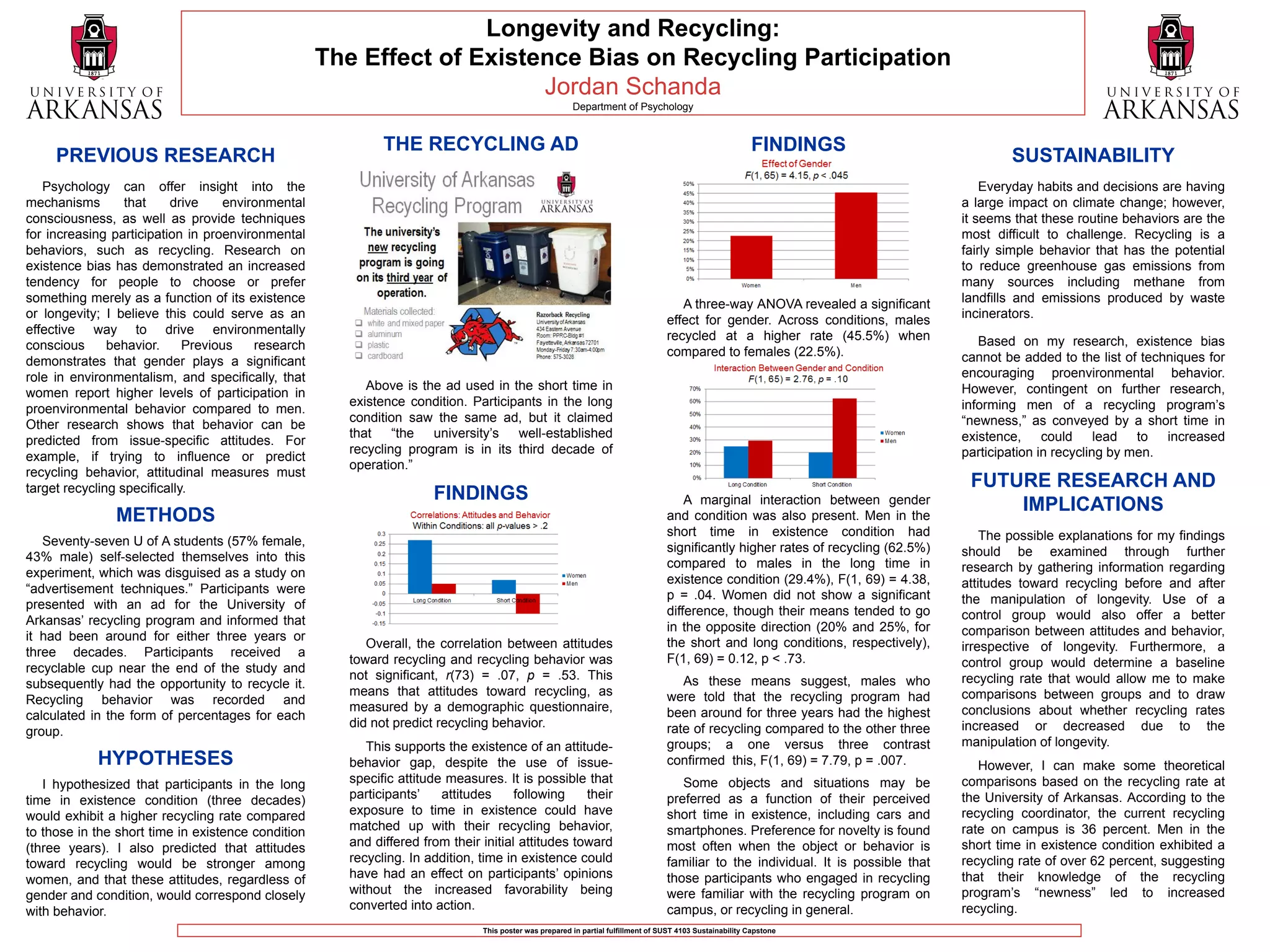
Longevity and Recycling:
                                                    The Effect of Existence Bias on Recycling Participation
                                                                        Jordan Schanda
                                                                                                       Department of Psychology


                                                            THE RECYCLING AD                                                                              FINDINGS
     PREVIOUS RESEARCH                                                                                                                                                                      SUSTAINABILITY
   Psychology can offer insight into the                                                                                                                                                Everyday habits and decisions are having
mechanisms        that    drive     environmental                                                                                                                                   a large impact on climate change; however,
consciousness, as well as provide techniques                                                                                                                                        it seems that these routine behaviors are the
for increasing participation in proenvironmental                                                                                                                                    most difficult to challenge. Recycling is a
behaviors, such as recycling. Research on                                                                                                                                           fairly simple behavior that has the potential
existence bias has demonstrated an increased                                                                                                                                        to reduce greenhouse gas emissions from
tendency for people to choose or prefer                                                                                                                                             many sources including methane from
something merely as a function of its existence                                                                                      A three-way ANOVA revealed a significant       landfills and emissions produced by waste
or longevity; I believe this could serve as an                                                                                    effect for gender. Across conditions, males       incinerators.
effective way to drive environmentally                                                                                            recycled at a higher rate (45.5%) when
conscious      behavior.     Previous    research                                                                                                                                      Based on my research, existence bias
                                                                                                                                  compared to females (22.5%).                      cannot be added to the list of techniques for
demonstrates that gender plays a significant
role in environmentalism, and specifically, that                                                                                                                                    encouraging proenvironmental behavior.
                                                         Above is the ad used in the short time in                                                                                  However, contingent on further research,
women report higher levels of participation in
                                                      existence condition. Participants in the long                                                                                 informing men of a recycling program’s
proenvironmental behavior compared to men.
                                                      condition saw the same ad, but it claimed                                                                                     “newness,” as conveyed by a short time in
Other research shows that behavior can be
                                                      that “the university’s well-established                                                                                       existence, could lead to increased
predicted from issue-specific attitudes. For
                                                      recycling program is in its third decade of                                                                                   participation in recycling by men.
example, if trying to influence or predict
                                                      operation.”
recycling behavior, attitudinal measures must
target recycling specifically.                                                                                                                                                       FUTURE RESEARCH AND
                                                                     FINDINGS                                                         A marginal interaction between gender              IMPLICATIONS
               METHODS                                                                                                            and condition was also present. Men in the
                                                                                                                                  short time in existence condition had                 The possible explanations for my findings
   Seventy-seven U of A students (57% female,                                                                                     significantly higher rates of recycling (62.5%)
43% male) self-selected themselves into this                                                                                                                                        should be examined through further
                                                                                                                                  compared to males in the long time in             research by gathering information regarding
experiment, which was disguised as a study on                                                                                     existence condition (29.4%), F(1, 69) = 4.38,
“advertisement techniques.” Participants were                                                                                                                                       attitudes toward recycling before and after
                                                                                                                                  p = .04. Women did not show a significant         the manipulation of longevity. Use of a
presented with an ad for the University of                                                                                        difference, though their means tended to go
Arkansas’ recycling program and informed that                                                                                                                                       control group would also offer a better
                                                                                                                                  in the opposite direction (20% and 25%, for       comparison between attitudes and behavior,
it had been around for either three years or                                                                                      the short and long conditions, respectively),
                                                         Overall, the correlation between attitudes                                                                                 irrespective of longevity. Furthermore, a
three decades. Participants received a                                                                                            F(1, 69) = 0.12, p < .73.
                                                      toward recycling and recycling behavior was                                                                                   control group would determine a baseline
recyclable cup near the end of the study and
                                                      not significant, r(73) = .07, p = .53. This                                    As these means suggest, males who              recycling rate that would allow me to make
subsequently had the opportunity to recycle it.
                                                      means that attitudes toward recycling, as                                   were told that the recycling program had          comparisons between groups and to draw
Recycling behavior was recorded and
                                                      measured by a demographic questionnaire,                                    been around for three years had the highest       conclusions about whether recycling rates
calculated in the form of percentages for each
                                                      did not predict recycling behavior.                                         rate of recycling compared to the other three     increased or decreased due to the
group.
                                                         This supports the existence of an attitude-                              groups; a one versus three contrast               manipulation of longevity.
            HYPOTHESES                                behavior gap, despite the use of issue-                                     confirmed this, F(1, 69) = 7.79, p = .007.           However, I can make some theoretical
   I hypothesized that participants in the long       specific attitude measures. It is possible that                                Some objects and situations may be             comparisons based on the recycling rate at
time in existence condition (three decades)           participants’    attitudes     following    their                           preferred as a function of their perceived        the University of Arkansas. According to the
would exhibit a higher recycling rate compared        exposure to time in existence could have                                    short time in existence, including cars and       recycling coordinator, the current recycling
to those in the short time in existence condition     matched up with their recycling behavior,                                   smartphones. Preference for novelty is found      rate on campus is 36 percent. Men in the
(three years). I also predicted that attitudes        and differed from their initial attitudes toward                            most often when the object or behavior is         short time in existence condition exhibited a
toward recycling would be stronger among              recycling. In addition, time in existence could                             familiar to the individual. It is possible that   recycling rate of over 62 percent, suggesting
women, and that these attitudes, regardless of        have had an effect on participants’ opinions                                those participants who engaged in recycling       that their knowledge of the recycling
gender and condition, would correspond closely        without the increased favorability being                                    were familiar with the recycling program on       program’s “newness” led to increased
with behavior.                                        converted into action.                                                      campus, or recycling in general.                  recycling.
                                                                              This poster was prepared in partial fulfillment of SUST 4103 Sustainability Capstone
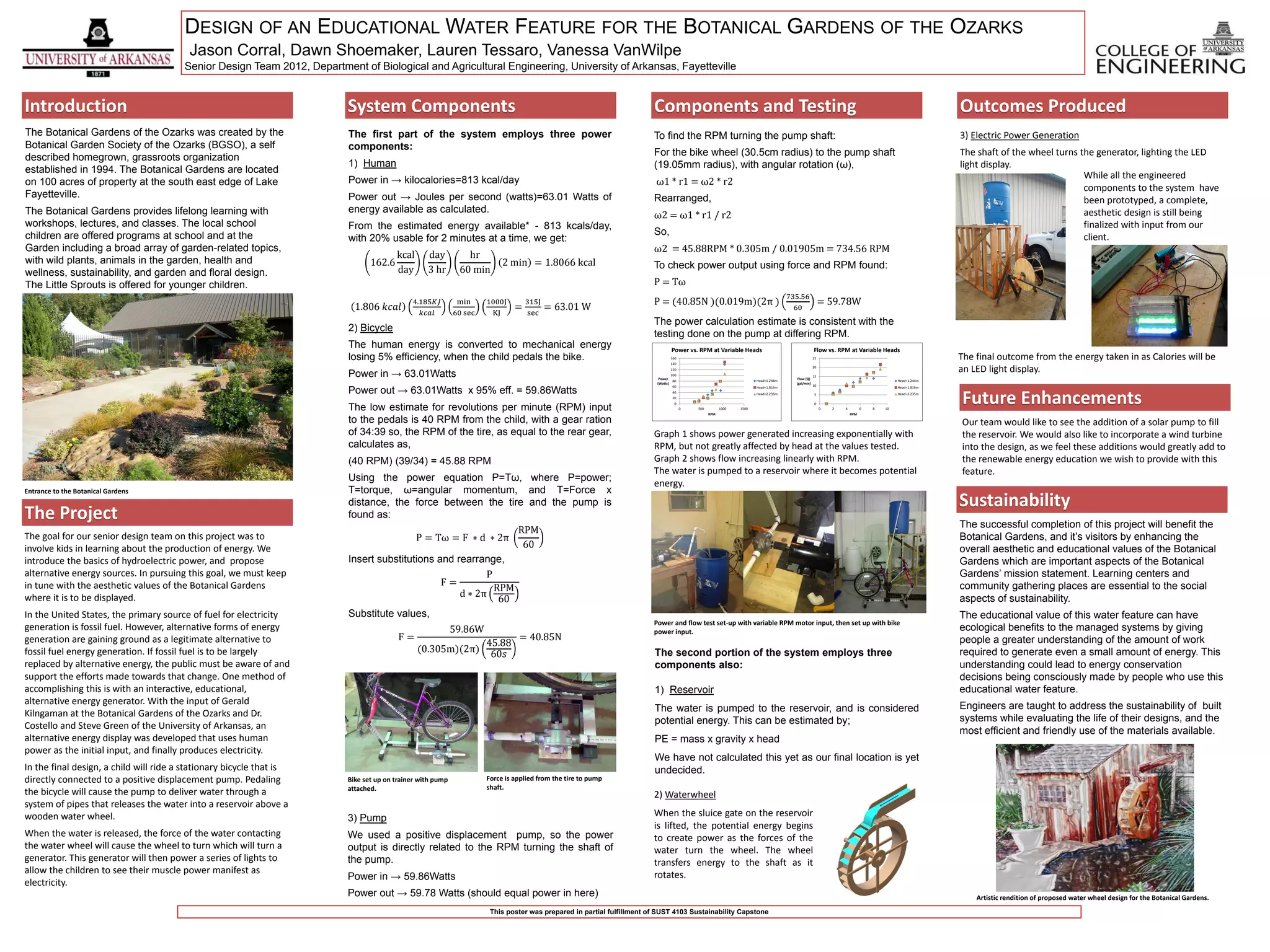
DESIGN OF AN EDUCATIONAL WATER FEATURE FOR THE BOTANICAL GARDENS OF THE OZARKS
                                         Jason Corral, Dawn Shoemaker, Lauren Tessaro, Vanessa VanWilpe
                                        Senior Design Team 2012, Department of Biological and Agricultural Engineering, University of Arkansas, Fayetteville


Introduction                                                              System Components                                                                             Components and Testing                                                                                                     Outcomes Produced
The Botanical Gardens of the Ozarks was created by the                    The first part of the system employs three power                                              To find the RPM turning the pump shaft:                                                                                    3) Electric Power Generation
Botanical Garden Society of the Ozarks (BGSO), a self                     components:
                                                                                                                                                                        For the bike wheel (30.5cm radius) to the pump shaft                                                                       The shaft of the wheel turns the generator, lighting the LED
described homegrown, grassroots organization
                                                                          1) Human                                                                                      (19.05mm radius), with angular rotation (ω),                                                                               light display.
established in 1994. The Botanical Gardens are located
                                                                          Power in → kilocalories=813 kcal/day                                                                                                                                                                                                                   While all the engineered
on 100 acres of property at the south east edge of Lake                                                                                                                  ω1 * r1 = ω2 * r2
                                                                                                                                                                                                                                                                                                                                 components to the system have
Fayetteville.                                                             Power out → Joules per second (watts)=63.01 Watts of                                          Rearranged,                                                                                                                                              been prototyped, a complete,
The Botanical Gardens provides lifelong learning with                     energy available as calculated.                                                                                                                                                                                                                        aesthetic design is still being
                                                                                                                                                                        ω2 = ω1 * r1 / r2
workshops, lectures, and classes. The local school                        From the estimated energy available* - 813 kcals/day,                                                                                                                                                                                                  finalized with input from our
children are offered programs at school and at the                                                                                                                      So,
                                                                          with 20% usable for 2 minutes at a time, we get:                                                                                                                                                                                                       client.
Garden including a broad array of garden-related topics,                                                                                                                ω2 = 45.88RPM * 0.305m / 0.01905m = 734.56 RPM
                                                                                       kcal        day          hr
with wild plants, animals in the garden, health and                              162.6                                     2 min = 1.8066 kcal                          To check power output using force and RPM found:
wellness, sustainability, and garden and floral design.                                day         3 hr       60 min
The Little Sprouts is offered for younger children.                                                                                                                     P = Tω
                                                                                                                                                                                                                                   735.56
                                                                                              4.185𝐾𝐽         min     1000J        315J                                 P = (40.85N )(0.019m)(2π )                                                    = 59.78W
                                                                            1.806 𝑘𝑐𝑎𝑙                                         =          = 63.01 W                                                                                  60
                                                                                                 𝑘𝑐𝑎𝑙        60 sec    KJ          sec
                                                                                                                                                                        The power calculation estimate is consistent with the
                                                                          2) Bicycle
                                                                                                                                                                        testing done on the pump at differing RPM.
                                                                          The human energy is converted to mechanical energy                                                     Power vs. RPM at Variable Heads                                 Flow vs. RPM at Variable Heads
                                                                          losing 5% efficiency, when the child pedals the bike.                                                 160                                                              25                                                The final outcome from the energy taken in as Calories will be
                                                                                                                                                                                140


                                                                          Power in → 63.01Watts
                                                                                                                                                                                120
                                                                                                                                                                                 100
                                                                                                                                                                                                                                                 20
                                                                                                                                                                                                                                                                                                   an LED light display.
                                                                                                                                                                                                                                                 15
                                                                                                                                                                          Power                                                       Flow (Q)
                                                                                                                                                                                  80                                 Head=1.244m                                                     Head=1.244m
                                                                                                                                                                         (Watts)                                                     (gal/min)
                                                                                                                                                                                                                                                 10
                                                                          Power out → 63.01Watts x 95% eff. = 59.86Watts
                                                                                                                                                                                  60                                 Head=1.816m                                                     Head=1.816m


                                                                                                                                                                                                                                                                                                   Future Enhancements
                                                                                                                                                                                 40                                  Head=2.235m                                                     Head=2.235m
                                                                                                                                                                                                                                                  5
                                                                                                                                                                                 20
                                                                                                                                                                                  0                                                               0
                                                                          The low estimate for revolutions per minute (RPM) input                                                      0   500
                                                                                                                                                                                                 RPM
                                                                                                                                                                                                       1000   1500                                    0   2   4
                                                                                                                                                                                                                                                                  RPM
                                                                                                                                                                                                                                                                        6   8   10


                                                                          to the pedals is 40 RPM from the child, with a gear ration                                                                                                                                                               Our team would like to see the addition of a solar pump to fill
                                                                          of 34:39 so, the RPM of the tire, as equal to the rear gear,                                  Graph 1 shows power generated increasing exponentially with                                                                the reservoir. We would also like to incorporate a wind turbine
                                                                          calculates as,                                                                                RPM, but not greatly affected by head at the values tested.                                                                into the design, as we feel these additions would greatly add to
                                                                          (40 RPM) (39/34) = 45.88 RPM                                                                  Graph 2 shows flow increasing linearly with RPM.                                                                           the renewable energy education we wish to provide with this
                                                                                                                                                                        The water is pumped to a reservoir where it becomes potential                                                              feature.
                                                                          Using the power equation P=Tω, where P=power;
                                                                                                                                                                        energy.
Entrance to the Botanical Gardens                                         T=torque, ω=angular momentum, and T=Force x
                                                                          distance, the force between the tire and the pump is                                                                                                                                                                     Sustainability
The Project                                                               found as:
                                                                                                                                                                                                                                                                                                   The successful completion of this project will benefit the
                                                                                                                RPM
The goal for our senior design team on this project was to                                P = Tω = F ∗ d ∗ 2π                                                                                                                                                                                      Botanical Gardens, and it’s visitors by enhancing the
involve kids in learning about the production of energy. We                                                      60                                                                                                                                                                                overall aesthetic and educational values of the Botanical
introduce the basics of hydroelectric power, and propose                  Insert substitutions and rearrange,                                                                                                                                                                                      Gardens which are important aspects of the Botanical
alternative energy sources. In pursuing this goal, we must keep                                           P                                                                                                                                                                                        Gardens’ mission statement. Learning centers and
in tune with the aesthetic values of the Botanical Gardens                                      F=
                                                                                                            RPM                                                                                                                                                                                    community gathering places are essential to the social
                                                                                                    d ∗ 2π
where it is to be displayed.                                                                                 60                                                                                                                                                                                    aspects of sustainability.
In the United States, the primary source of fuel for electricity          Substitute values,                                                                                                                                                                                                       The educational value of this water feature can have
                                                                                                                                                                        Power and flow test set-up with variable RPM motor input, then set up with bike
generation is fossil fuel. However, alternative forms of energy                                              59.86W                                                     power input.                                                                                                               ecological benefits to the managed systems by giving
generation are gaining ground as a legitimate alternative to                              F=                                    = 40.85N                                                                                                                                                           people a greater understanding of the amount of work
                                                                                                             45.88
fossil fuel energy generation. If fossil fuel is to be largely                                  (0.305m)(2π)
                                                                                                              60𝑠                                                       The second portion of the system employs three                                                                             required to generate even a small amount of energy. This
replaced by alternative energy, the public must be aware of and                                                                                                         components also:                                                                                                           understanding could lead to energy conservation
support the efforts made towards that change. One method of                                                                                                                                                                                                                                        decisions being consciously made by people who use this
accomplishing this is with an interactive, educational,                                                                                                                 1) Reservoir                                                                                                               educational water feature.
alternative energy generator. With the input of Gerald                                                                                                                                                                                                                                             Engineers are taught to address the sustainability of built
Kilngaman at the Botanical Gardens of the Ozarks and Dr.                                                                                                                The water is pumped to the reservoir, and is considered
                                                                                                                                                                        potential energy. This can be estimated by;                                                                                systems while evaluating the life of their designs, and the
Costello and Steve Green of the University of Arkansas, an                                                                                                                                                                                                                                         most efficient and friendly use of the materials available.
alternative energy display was developed that uses human                                                                                                                PE = mass x gravity x head
power as the initial input, and finally produces electricity.
                                                                                                                                                                        We have not calculated this yet as our final location is yet
In the final design, a child will ride a stationary bicycle that is                                                                                                     undecided.
directly connected to a positive displacement pump. Pedaling              Bike set up on trainer with pump            Force is applied from the tire to pump
                                                                          attached.                                   shaft.
the bicycle will cause the pump to deliver water through a                                                                                                              2) Waterwheel
system of pipes that releases the water into a reservoir above a
wooden water wheel.                                                                                                                                                     When the sluice gate on the reservoir
                                                                          3) Pump
                                                                                                                                                                        is lifted, the potential energy begins
When the water is released, the force of the water contacting             We used a positive displacement pump, so the power                                            to create power as the forces of the
the water wheel will cause the wheel to turn which will turn a            output is directly related to the RPM turning the shaft of                                    water turn the wheel. The wheel
generator. This generator will then power a series of lights to           the pump.                                                                                     transfers energy to the shaft as it
allow the children to see their muscle power manifest as                                                                                                                rotates.
                                                                          Power in → 59.86Watts
electricity.
                                                                          Power out → 59.78 Watts (should equal power in here)                                                                                                                                                                         Artistic rendition of proposed water wheel design for the Botanical Gardens.
                                                                                                                       This poster was prepared in partial fulfillment of SUST 4103 Sustainability Capstone
Need University
   Logo here
                                                        Radio Conversations about Sustainability                                                                                                              UNIVERSITY
                                                                                                                                                                                                              LOGO HERE
                                                                      Gavin Smith
                                                                                                        Civil Engineering Student


                                                                                                                                                                                 How was this project
                                                                   GRAPHS
    Why do a Radio Show?                                                                                                                                   GRAPHS              relative to the university
Sustainability is as vague as vague can be.
It is an overused and often misapplied term.
                                                                                                                                                                               wide conversation about
                                                     IT WOULD BE GOOD TO USE THIS
In the grocery store or really any commercial
                                                   SPACE TO PROVIDE GRAPHICS THAT                                                                                                   sustainability?
setting we are inundated by claims about the                                                                                       IT WOULD BE GOOD TO USE THIS
sustainability of different products. To           MAY INCLUDE                                                                   SPACE TO PROVIDE GRAPHICS THAT                 This project addressed all four major
understand the impacts of our choices we                                                                                         MAY INCLUDE                                 areas of sustainability studies as outlined by
have to go far out of our everyday routines.                                                                                                                                 the sustainability minor here at the University
Sustainability is a smart thing to choose, but     TABLES                                                                        PICTURES                                    of Arkansas. The show was produced from a
how do we choose which dish soap is                                                                                                                                          generalist point of view and as such we
sustainable and which is not? Can                  FIGURES                                                                       TABLES
                                                                                                                                                                             dipped into the built environment with Dr.
something be more sustainable than another         MAYBE YOU WANT TO PUT IN QUOTES                                               FIGURES
thing? What does it mean to be                                                                                                                                               Braham, Dan Coody, and Gary Kahanak,
                                                   FROM STUDENTS AND OR PARTNERS IN                                              MAYBE YOU WANT TO PUT IN QUOTES             into the managed environment with John
unsustainable? What happens when things
collapse? Will it hurt? Questions are at the       THE PROJECT                                                                   FROM STUDENTS AND OR PARTNERS IN            Sampiers and Sarah Dayringer, into the
heart of the discussion. Anyone who's tells                                                                                      THE PROJECT                                 economic with Sarah Dayringer, and into the
you definitively what sustainability means is                                                                                                                                environmental with Dr. Boss, Dr. Alverson,
either a time traveler, selling something, or                                                                                                                                and Dr. Smith, and into the social with Dr.
both. A radio show is the perfect place to                                                                                                                                   Brubaker, Sarah Dayringer, and Dan Coody.
parse this subject ad infinitum. If you want to
do something for the good of the planet and                                                                                                                                      The project was effective and all my goals
your fellow beings, as hard and as frustrating                                                                                                                               were met, that being said my biggest goal
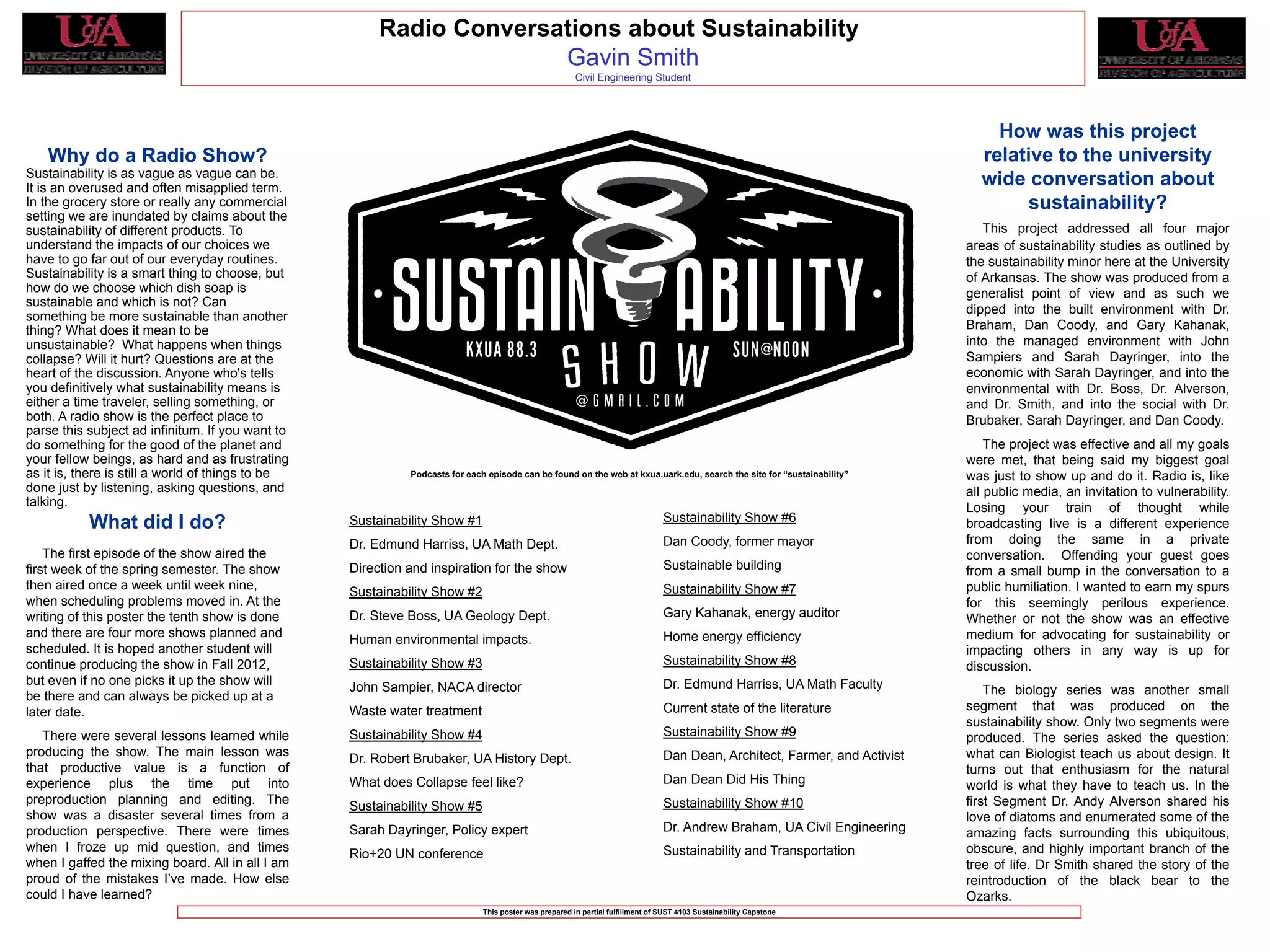
as it is, there is still a world of things to be             Podcasts for each episode can be found on the web at kxua.uark.edu, search the site for “sustainability”        was just to show up and do it. Radio is, like
done just by listening, asking questions, and                                                                                                                                all public media, an invitation to vulnerability.
talking.                                                                                                                                                                     Losing your train of thought while
           What did I do?                          Sustainability Show #1                                                        Sustainability Show #6                      broadcasting live is a different experience
                                                   Dr. Edmund Harriss, UA Math Dept.                                             Dan Coody, former mayor                     from doing the same in a private
    The first episode of the show aired the                                                                                                                                  conversation. Offending your guest goes
first week of the spring semester. The show        Direction and inspiration for the show                                        Sustainable building                        from a small bump in the conversation to a
then aired once a week until week nine,                                                                                          Sustainability Show #7                      public humiliation. I wanted to earn my spurs
                                                   Sustainability Show #2
when scheduling problems moved in. At the                                                                                                                                    for this seemingly perilous experience.
writing of this poster the tenth show is done      Dr. Steve Boss, UA Geology Dept.                                              Gary Kahanak, energy auditor                Whether or not the show was an effective
and there are four more shows planned and                                                                                        Home energy efficiency                      medium for advocating for sustainability or
                                                   Human environmental impacts.
scheduled. It is hoped another student will                                                                                                                                  impacting others in any way is up for
continue producing the show in Fall 2012,          Sustainability Show #3                                                        Sustainability Show #8                      discussion.
but even if no one picks it up the show will                                                                                     Dr. Edmund Harriss, UA Math Faculty
                                                   John Sampier, NACA director                                                                                                   The biology series was another small
be there and can always be picked up at a
later date.                                        Waste water treatment                                                         Current state of the literature             segment that was produced on the
                                                                                                                                                                             sustainability show. Only two segments were
   There were several lessons learned while        Sustainability Show #4                                                        Sustainability Show #9                      produced. The series asked the question:
producing the show. The main lesson was                                                                                          Dan Dean, Architect, Farmer, and Activist   what can Biologist teach us about design. It
                                                   Dr. Robert Brubaker, UA History Dept.
that productive value is a function of                                                                                                                                       turns out that enthusiasm for the natural
experience plus the time put into                  What does Collapse feel like?                                                 Dan Dean Did His Thing                      world is what they have to teach us. In the
preproduction planning and editing. The                                                                                          Sustainability Show #10                     first Segment Dr. Andy Alverson shared his
                                                   Sustainability Show #5
show was a disaster several times from a                                                                                                                                     love of diatoms and enumerated some of the
production perspective. There were times           Sarah Dayringer, Policy expert                                                Dr. Andrew Braham, UA Civil Engineering     amazing facts surrounding this ubiquitous,
when I froze up mid question, and times                                                                                          Sustainability and Transportation           obscure, and highly important branch of the
                                                   Rio+20 UN conference
when I gaffed the mixing board. All in all I am                                                                                                                              tree of life. Dr Smith shared the story of the
proud of the mistakes I’ve made. How else                                                                                                                                    reintroduction of the black bear to the
could I have learned?                                                                                                                                                        Ozarks.
                                                                              This poster was prepared in partial fulfillment of SUST 4103 Sustainability Capstone
Promoting a Sustainable Campus Using Social Media

  Sylvia Tran
 Office for Campus Sustainability


       WHAT IS THE ISSUE?                                                                        GENERAL SOCIAL MEDIA STRATEGY                                                                                                                                                                        RESULTS
Did you know the University of Arkansas has an office                                                                                                                                                                         The measurement period is between January & April
devoted to sustainable development?                             1 Listen                                                                            2 Identify Goals                                                         when the strategy was put in place. This is only a portion
                                                                         The ultimate surveying tool is social listening.                                      Form goals around the organization’s mission                  of all the possible measurements & does not include all
                                                                                                                                                                                                                                              five social media outlets.
Did you know the University of Arkansas has led the SEC                                                                                                                & what the audience wants.
                                                                                                                                                                                                                             Facebook
for 3 non-consecutive years in RecycleMania for waste           •Find out what your audience is talking about.
reduction & increased recycling?                                •Listen to their opinions, needs, & issues.                                         •Define the organization’s objectives                                                                                                                       Total Daily Reach
                                                                •Determine how to best contribute to the conversation.                              •Define success                                                                                            50000
Did you know you can opt-out of your physical junk mail         •Tools: Google alerts, Twitter search, Facebook search                                 o Increased online presence                                                                             45000

from your residence at sustainability.uark.edu?                                                                                                     •Identify required resources, training required, & any barriers                                            40000


                                                                                                                                                                                                                              Amount of People Reached Daily
                                                                                                                                                                                                                                                               35000

I did not know any of these facts until I became an intern
at the Office for Campus Sustainability (OCS). This office      3 Create Content                                                                    4 Content Delivery Plan                                                                                    30000

                                                                                                                                                                                                                                                               25000

organizes great events, coordinates important projects, &                  What would the audience find intriguing?                                        When is the best time to send content & how often?                                                  20000

the university as a whole has been recognized several times                                                                                                                                                                                                    15000

for its achievements in sustainability. However, much of        •After listening to the audience, find content that would spark their               •Develop a timeline months in advance to effectively promote events.                                       10000

this goes unnoticed. This is why I focused my project           interest.                                                                           •Schedule out messages in advance using social media dashboards for                                        5000

on helping the OCS leverage their social media to               •Be innovative. For instance, a Google+ Hangout could be hosted about               efficient use of time & to consistently post content.                                                         0

help effectively communicate all their efforts & the            climate change attended by influential researchers.                                 •Find out what time of the day & what days of the week is content most


                                                                                                                                                                                                                                                                       2

                                                                                                                                                                                                                                                                                2

                                                                                                                                                                                                                                                                                         2

                                                                                                                                                                                                                                                                                                  2

                                                                                                                                                                                                                                                                                                           2

                                                                                                                                                                                                                                                                                                                    2

                                                                                                                                                                                                                                                                                                                             2

                                                                                                                                                                                                                                                                                                                                       2

                                                                                                                                                                                                                                                                                                                                                2

                                                                                                                                                                                                                                                                                                                                                         2

                                                                                                                                                                                                                                                                                                                                                                  2

                                                                                                                                                                                                                                                                                                                                                                           2

                                                                                                                                                                                                                                                                                                                                                                                    2

                                                                                                                                                                                                                                                                                                                                                                                             2

                                                                                                                                                                                                                                                                                                                                                                                                      2

                                                                                                                                                                                                                                                                                                                                                                                                               2
                                                                                                                                                                                                                                                                     1

                                                                                                                                                                                                                                                                              1

                                                                                                                                                                                                                                                                                       1

                                                                                                                                                                                                                                                                                                1

                                                                                                                                                                                                                                                                                                         1

                                                                                                                                                                                                                                                                                                                  1

                                                                                                                                                                                                                                                                                                                            1

                                                                                                                                                                                                                                                                                                                                     1

                                                                                                                                                                                                                                                                                                                                              1

                                                                                                                                                                                                                                                                                                                                                       1

                                                                                                                                                                                                                                                                                                                                                                1

                                                                                                                                                                                                                                                                                                                                                                         1

                                                                                                                                                                                                                                                                                                                                                                                  1

                                                                                                                                                                                                                                                                                                                                                                                           1

                                                                                                                                                                                                                                                                                                                                                                                                    1

                                                                                                                                                                                                                                                                                                                                                                                                             1
                                                                                                                                                                                                                                                                  1/

                                                                                                                                                                                                                                                                           8/

                                                                                                                                                                                                                                                                                    5/

                                                                                                                                                                                                                                                                                             2/

                                                                                                                                                                                                                                                                                                      9/

                                                                                                                                                                                                                                                                                                               5/

                                                                                                                                                                                                                                                                                                                         2/

                                                                                                                                                                                                                                                                                                                                  9/

                                                                                                                                                                                                                                                                                                                                           6/

                                                                                                                                                                                                                                                                                                                                                    4/

                                                                                                                                                                                                                                                                                                                                                             1/

                                                                                                                                                                                                                                                                                                                                                                      8/

                                                                                                                                                                                                                                                                                                                                                                               5/

                                                                                                                                                                                                                                                                                                                                                                                        1/

                                                                                                                                                                                                                                                                                                                                                                                                 8/

                                                                                                                                                                                                                                                                                                                                                                                                          5/
                                                                                                                                                                                                                                                                                     1

                                                                                                                                                                                                                                                                                              2

                                                                                                                                                                                                                                                                                                       2


                                                                                                                                                                                                                                                                                                                         1

                                                                                                                                                                                                                                                                                                                                   1

                                                                                                                                                                                                                                                                                                                                            2


                                                                                                                                                                                                                                                                                                                                                              1

                                                                                                                                                                                                                                                                                                                                                                       1

                                                                                                                                                                                                                                                                                                                                                                                2


                                                                                                                                                                                                                                                                                                                                                                                                           1
                                                                                                                                                                                                                                                                 1/

                                                                                                                                                                                                                                                                           1/


                                                                                                                                                                                                                                                                                                               2/


                                                                                                                                                                                                                                                                                                                                                    3/


                                                                                                                                                                                                                                                                                                                                                                                        4/

                                                                                                                                                                                                                                                                                                                                                                                                 4/
                                                                                                                                                                                                                                                                                  1/

                                                                                                                                                                                                                                                                                           1/

                                                                                                                                                                                                                                                                                                    1/


                                                                                                                                                                                                                                                                                                                      2/

                                                                                                                                                                                                                                                                                                                                2/

                                                                                                                                                                                                                                                                                                                                         2/


                                                                                                                                                                                                                                                                                                                                                           3/

                                                                                                                                                                                                                                                                                                                                                                    3/

                                                                                                                                                                                                                                                                                                                                                                             3/


                                                                                                                                                                                                                                                                                                                                                                                                        4/
school’s efforts to the campus. This not only means             •Examples: Share facts, tips, promotions, ask for an opinion                        viewed.                                                                                                                                                             Date from Start to End of Project

furthering the reach of each message, but also building                                                                                             •Tools: Google+ Timing, Hootsuite, Tweetdeck, Seesmic
                                                                                                                                                                                                                                  • The figure above shows a continuing increase in
relationships with the members of this university &
beyond. This would be represented by an increase in             5 Engage Users                                                                      6 Measure Effectiveness                                                          Total Daily Reach (sum of Lifetime Total Likes
                                                                                                                                                                                                                                     & Daily Friends of Fans—every single person who
online presence overall.                                             Focus on genuine interaction, not just largest reach.                                                    How is success measured?                               could potentially see the pages’ content).
                                                                                                                                                                                                                             Twitter
                                                                •Traditional marketing’s main focused is broadcast media.                           •Various tools for all social media is available to ensure efforts are        • 258% increase in followers compared to
      WHY SOCIAL MEDIA?                                         •Social media is better utilized as an ‘engagement network.’                        moving towards achieving those previously set goals.                             amount at end of December 2011
                                                                •It’s not just about reaching the most people, but listening, engaging, &           •Measurements allows you to assess progress, revise or eliminate              • Due to increased amount of average posts/day,
Americans’ spend 22.5% of their time on social
                                                                empowering the audience with the quality & transparency of the                      content, change timing of posts, & more.                                         acknowledgement of new followers, & interactions
networks & blogs, more than any other online site.
                                                                content.                                                                            •Tools: Email campaign analysis on MailChimp or Constant Contact,                with others
                                                                                                                                                    Google Analytics, Facebook Insights, website traffic counter, Klout      Blog
People no longer surf the web for information, but they
surf Facebook, Twitter, & Blogger. These web brands are                                                                                                                                                                           • Avg 8.5% more viewers/month totaling 1,867
now the center for information. The OCS can take                                                                                                                                                                                     views as of April 17, 2012.
advantage of this popular medium to engage people in
                                                                                 BEST PRACTICES                                                                                                                                   • Due to consistent amount of blog posts per week,
conversations about sustainability. This is where we can         Each social media tool has its own unique ability to engage                                                                                                         sharing new posts on other social media, &
provide information about our efforts & involve the              an online user as long as it is used correctly & consistently.                                                                                                      content pertains to current issue & campus events
campus in sustainable development.
                                                                 Social media is also ever changing; therefore, preparation is key. For
                                                                 example, Facebook made a complete overhaul of their page layout
                                                                                                                                                                                                                                                                                    SUSTAINABILITY
                                                                                                                                                                                                                             Social media is a free tool that can be used to promote the
              THE PROJECT                                        on March 30, 2012 with the new Timeline. Users with a Facebook
                                                                 Page were notified in advance & provided an option to test it out.                                                                                          Office for Campus Sustainability & all the efforts of the
1. Amendments & Additions                                        This gave the users time to learn about the new features and how to                                                                                         university. By incorporating this guide into their program,
Facebook, Twitter, & the blog had been established, but          use them effectively before the official public launch.                                                                                                     there is potential to develop a greater online presence &
not used effectively. Google+ was added because of the                                                                                                                                                                       campus presence. It is about shining a brighter light on
growing amount of users on Google+. Then, an email                      The image on the right from social media expert Mari Smith                                                                                           what the students & faculty do here every year to help
campaign, or newsletter, was needed to help promote the                        attempts to explain every aspect of the new timeline.                                                                                         move towards a more socially, economically, and
office’s growing number of events, projects, & more.                                                                                                                                                                         environmentally sustainable institution.
                                                                 Examples included in the OCS Social Media Best Practices:                                                                                                       It is about using social media for social good.
2. General Strategy
A general strategy had to be created to learn the                •Number of posts needed each day to actively engage readers on
foundation for using any type of social media. Online            Twitter is much higher than Facebook
                                                                                                                                                                                                                                                                            Join the Conversation!
marketing is a new type of communication where                   •Optimize blog & website to mobile theme for easy viewing on cell                                                                                                                                                       FACEBOOK                                                 TWITTER
traditional marketing methods usually do not apply.              phones                                                                                                                                                                                                                    UAOCS                                                   UAOCS
                                                                 •Consistently post blogs each week to keep reader’s interested.                                                                                                                                                                                                          WORDPRESS.
3. Best Practices Guide & Detailed Plan                                                                                                                                                                                                                                                      GOOGLE +                                      UARK.EDU/
                                                                 •Give people a reason to like the page, not demanding people to
Each outlet is unique & requires its own set of rules, thus a                                                                                                                                                                                                                                                                                  UAOCS
                                                                 “Like now!”
detailed action plan was created for each of the five web                                                                                                                                                                                                                                                                                Text to like our Facebook Page!
                                                                 •Listen carefully, be transparent, be responsive, be                                                                                                                                                               SUSTAINABILITY
brands.                                                          authentic, & tell great stories                                                                                                                                                                                      .UARK.EDU
                                                                                                                                                                                                                                                                                                                                       Text “like uaocs” to 32665
                                                                                                       This poster was prepared in partial fulfillment of SUST 4103 Sustainability Capstone
Girls Gone Green: Reducing Sorority Styrofoam Usage
                                                                                                                                                                                                                FAY JONES
                                                                        Architectural Studies Student: Sara Turner
                                                                                                   SUST 4103: Capstone Project for Sustainability Minor
                                                                                                         Faculty: Dr. S. Boss and Dr. T. Messadi


              THE PROBLEM                                                                                                  GRAPHS                                                                              SUSTAINABILITY
   Did you know it takes 500 years for one Styrofoam
cup to dissolve? In the 21 weeks of the 2011 fall                                                                                                                                                       This project obviously relates to sustainability on
semester Chi Omega Fraternity’s Psi Chapter used                                                                                                                                                    many levels. It is first and most importantly connected to
approximately 40, 500 pieces of Styrofoam including                                                                                                                                                 the sustainability domain concerning Social Systems. I
cups, bowls and plates. That number meant that on                                                                                                                                                   believe that using Styrofoam is a cultural issue.
average our chapter was using 276 pieces per day. I                                                                                                                                                 Americans are all about things being done quickly and
knew that something had to be done. Components of                                                                                                                                                   easily, with as little effort as possible on their behalf.
Styrofoam, such as Ethylene, Styrene, and Benzene,                                                                                                                                                  Styrofoam fuels that mentality because it’s something we
have a very harmful long-term effect on the Earth’s                                                                                                                                                 don’t have to think about. We use it, and throw it away,
environment. Drilling for these components can lead to                                                                                                                                              never considering the long term impacts of our choices.
land erosion, and burning Styrofoam in landfills
contributes to our already deteriorating ozone layer.                                                                                                                                                    This type of project has the potential to spark
                                                                                                                                                                                                    campus-wide involvement. Imagine having all Greek Life
                                                                                                                                                                                                    at the University of Arkansas working toward a common
                                                                                                                                                                                                    goal of eliminating, or reducing Styrofoam usage.
                                                                                                                                                                                                    Imagining the difference that could be made just by our
                                                                                                                                                                                                    university is overwhelming. Reducing Styrofoam usage
                                                                                                                                                                                                    at the University of Arkansas has so many inherent
                                                                                                                                                                                                    benefits for students. Money saved by not purchasing
                                                                                                                                                                                                    Styrofoam could be put towards other campus projects
                                                                                                                                                                                                    and activities for students. Finances aren’t the only thing
                                                                                                                                                                                                    that will be affected by the reduction of Styrofoam.
                                                                                                                                                                                                        Evaluating the long term effects shows that we can
                                                                                                                                                                                                    reduce emissions that are eating away at our ozone
                                                                                                                                                                                                    layer. While we can’t stop the damage that has already
                                                                                                                                                                                                    been done, we can certainly do our part to prevent more
                                                                                                                                                                                                    from happening. I strongly believe that if students are
                                                                                                                                                                                                    made aware of the actual numbers when it comes to
                                                                                                                                                                                                    Styrofoam usage they will make a conscious effort to do
                                                                                                                                                                                                    their part in taking care of our environment and planet,
                                                                                                                                                                                                    and will being making more environmentally sustainable
 www.epa.gov/                                                                                                                                                                                       choices.


                THE PROJECT                                                                                        THE OUTCOME
I had three key goals in mind when I set out to begin
Styrofoam reduction at Chi Omega’s Psi Chapter.
                                                                          Getting rid of Styrofoam for a chapter of 352                               The first 2 weeks there was absolutely no
1, Inform the chapter as to the detriments of Styrofoam            girls took some adjusting. While the plan was                                Styrofoam put out at all. This was very good
usage.                                                                                                                                          news for the environment, but not for the
                                                                   adopted very quickly by the staff and executive
2.Cease the daily use of Styrofoam cups by making them             boards of the house, it still took the girls a                               kitchen staff. No one was there to clean the
unavailable to the chapter.                                        little convincing. Many times a day I heard girls                            dishes all weekend so several girls that lived in
                                                                                                                                                                                                              Above: Chi Omega Fraternity, Psi Chapter
3. Find and implement an alternative to Styrofoam cups             complaining about not having a cup to get coffee,                            the house ended up having to clean it                         Below: Psi Chapter President, Kelly Lamb
that is more environmentally friendly, but is still within the     or not having a cup so that they could take their                            themselves, which is against Housing Corps
allotted budget.                                                   drink to class.                                                              policy due to the fact that using the kitchen
The house mother provided me with the numbers that I                      I made a point to contact Jere Clune, the                             equipment without proper training is an
needed to convince the President, Housing Corps,                   Senior Vice President of Sales and Marketing for                             insurance liability. The house mother, kitchen
kitchen staff, and ultimately the entire chapter that              the company Ultra Green. The company special-                                staff, and President came to the consensus
something needed to be done. After making an                       izes in biodegradable paper products that are not                            that Styrofoam would only be available on the
announcement to the entire chapter the plan was created            only recyclable, but can be used as compost as                               weekends to ease the responsibility of the
an implemented within four days. From that point on I                                                                                           kitchen staff.
                                                                   well. After several phone calls and emails I
worked with the kitchen staff weekly, monitoring the
                                                                   realized that it was not possible to switch to such                                Although my plan to completely rid Chi
amount of Styrofoam that was put out weekly.
                                                                   a product without drastically increasing the budget                          Omega of Styrofoam was not possible, I know
                                                                   allotted for kitchen supplies.                                               that a tremendous standard was set that will
                                                                                                                                                impact not only the current members, but
                                                                                                                                                future members as well.
                                                                                          This poster was prepared in partial fulfillment of SUST 4103 Sustainability Capstone
UNIVERSITY OF ARKANSAS’S
                                                                                                          GREENHOUSE GAS EMISSION REDUCTION PLAN
                                                                                                                                                                                                                                              David Bednar
                                                                                                                                                                                                                             Department of Mechanical Engineering
                                                                                                                                                                                                                              Foundations of Sustainability Minor


                                                                                                                                                                                                                                                  PROJECT ANALYSIS
                                                                                                                                           GHG emissions avoided per year (MT CO2e/yr)                                                                                                                payback period of GHG emission reduction projects (yr)
                               THE PROBLEM                                                                                                                                                                                                                                                                                 0        2         4         6           8      10       12        14        16        18
                                                                                                                                                                                                                                                                                                                                                                                                                                                     RESULTS
                                                                                                                                                                    0           5,000      10,000 15,000 20,000 25,000 30,000 35,000 40,000
                                                                                                                                                                                                                                                                              project 01: computer power management
                                                                                                                                                                                                                                                                                                                                                                                                                      
                                                                                                                                                                                                                                                                                                                              0.374
     University of Arkansas (UA) emitted 171,585 metric tons of carbon                                              project 01: computer power management                       2,328.43
                                                                                                                                                                                                                                                                                  project 02: campus building energy use…         0.918
                                                                                                                                                                                                                                                                                                                                                                                                                           Project 01, 02, and 05 are low cost, quick payback projects with a
                                                                                                                 project 02: campus building energy use policy               949.63
     dioxide (MTCO2e) into the atmosphere in 2011.                                                                     project 03: district energy cogeneration                                                              20,684.18                                           project 03: district energy cogeneration                                                                      13.819                      combined GHG emission reduction of 4,700 MTCO2e per year.
                                                                                                                                                                                                                                                                                                project 04: trayless dining 0.000
                                                                                                                                      project 04: trayless dining       69.89                                                                                                                                                                                                                                             After payback, in less than one year, the reduction in electricity
    Greenhouse gas (GHG) emissions from human activity contribute to                                                    project 05: building energy dashboard               1,424.45
                                                                                                                                                                                                                                                                                   project 05: building energy dashboard      0.326

                                                                                                                                     project 06: bicycle parking
                                                                                                                                                                                                                                                                                               project 06: bicycle parking    N/A                                                                                          would save UA $390,000 on average per year.
     Earth’s climatic warming trend, changing our climate and weather,                                                                                                  46.67
                                                                                                                                                                                                                                                                                project 07: ESPCs (educational & general…                                                                                  16.019
                                                                                                           project 07: ESPCs (educational & general buildings)                                                                        23,503.15
                                                                                                                                                                                                                                                                                    project 08: ESPCs (auxiliary buildings)                                                                              15.959           UA has already undertaken Projects 07 and 08. These energy saving
     raising sea levels, and as a worst case scenario, potentially                                                        project 08: ESPCs (auxiliary buildings)                       5,454.08
                                                                                                                                                                                                                                                                                           project 09: increased recycling
                                                                                                                                 project 09: increased recycling            207.64                                                                                                                                            N/A                                                                                          performance contracts (ESPCs) which cost $52 million, save 29,000
     transforming Earth from a host to hostile planet.                                                                       project 10: food waste to compost          3.00
                                                                                                                                                                                                                                                                                       project 10: food waste to compost      N/A
                                                                                                                          project 11: campus WVO to biodiesel           32.72
                                                                                                                                                                                                                                                                                    project 11: campus WVO to biodiesel                 2.333                                                                              MTCO2e per year, and will save $740,000 on average per year after
    Fossil fuel consumption is the main source of human derived GHG                                            project 12: on-campus wind power generation             26.50
                                                                                                                                                                                                                                                                                      project 12: on-campus wind power…
                                                                                                                                                                                                                                                                               project 13: on-campus photovoltaic array                                                 8.780
                                                                                                                                                                                                                                                                                                                                                                              9.868
                                                                                                                                                                                                                                                                                                                                                                                                                           the payback period has been realized.
                                                                                                                     project 13: on-campus photovoltaic array
     emissions, yet the environmental burden can be minimized by using                                                          project 14: forest sequestration
                                                                                                                                                                        27.65
                                                                                                                                                                                     3,660.00                                                                                             project 14: forest sequestration                                                            12.044                              Project 03, although significant at $13 million, is less than the ESPCs
                                                                                                                                                                                                                                                                             project 15: offsets for commercial air travel    N/A
     conservation practices and alternative energy sources.                                                        project 15: offsets for commercial air travel                                   9,157.29
                                                                                                                                                                                                                                                                                  project 16: offsets for commuter travel     N/A
                                                                                                                                                                                                                                                                                                                                                                                                                           while offering a comparable payback period and emission reductions
                                                                                                                        project 16: offsets for commuter travel                                                       18,081.06
                                                                                                                             project 17: waste oil to space heat        -6.18                                                                                                          project 17: waste oil to space heat                      3.827                                                                      of 20,600 MTCO2e per year.
                                                                                                                           project 18: bicycle parking (phase 2)        46.67                                                                                                        project 18: bicycle parking (phase 2)
                                                                                                                                                                                                                                                                                    project 19: convert buses to run CNG
                                                                                                                                                                                                                                                                                                                              N/A
                                                                                                                                                                                                                                                                                                                                                                                        12.393
                                                                                                                                                                                                                                                                                                                                                                                                                          Forest sequestration is attractive as well, but this project assumes that
                                                                                                                          project 19: convert buses to run CNG          141.55
                                                                                                                        project 20: clean energy from SWEPCO                                    8,027.56                                                                          project 20: clean energy from SWEPCO        N/A                                                                                          emission offsets are being considered and would otherwise be
                BACKGROUND INFORMATION                                                                     project 21: on-campus photovoltaic array (phase 2)
                                                                                                                project 22: clean energy from area wind farms
                                                                                                                                                                            276.55
                                                                                                                                                                                                                          18,992.69
                                                                                                                                                                                                                                                                               project 21: on-campus photovoltaic array…
                                                                                                                                                                                                                                                                                project 22: clean energy from area wind… N/A
                                                                                                                                                                                                                                                                                                                                                                                                14.235
                                                                                                                                                                                                                                                                                                                                                                                                                           purchased and therefore savings would be realized.
                                                                                                                     project 23: forest sequestration (phase 2)                                                                                           36,600.00            project 23: forest sequestration (phase 2)                                                             12.044
    UA signed the American College and University Presidents’ Climate                                                project 24: renewable energy certificates                                               14,244.51                                                        project 24: renewable energy certificates      N/A                                                                                         Even if every single project in the GHGERP was implemented, UA’s
                                                                                                                                                                                                                                                                                 project 25: parking & carpool incentives      -
     Commitment (ACUPCC) in 2007 and intends to be climate neutral,                                                    project 25: parking & carpool incentives         -
                                                                                                                                                                                                                                                                                                                                       *N/A: project does not realize a payback period in 30 year project lifetime.        campus would still be a net emitter of GHGs as only 93% of current
     with a net zero sum of GHG emissions from campus activity, by                                                                                                                                                                                                                                                                                                                                                         emissions would have been eliminated or sequestered.
     2040.                                                                                                                                                                                         initial                    annual                   net present                MT CO2e                     $/MT CO2e                    payback                  % towards CO2e
                                                                                                                     emission reduction project                                                     cost                       cost                       value                  avoided/yr                     avoided                   period (yr)                  neutrality                  status**
    UA’s Office for Campus Sustainability (UAOCS) drafted the GHG                                                               campus policies:                                                      -                              -                      -                            -                           -                           -                             -                         -                                   SUSTAINABILITY
     Emission Reduction Plan (GHGERP) which outlines 25 proposed                                          project 01: computer power management                                                            $75,000                                $0         $5,881,026                        2,328.43                        -84.19                       0.374                    1.33%               c
     projects and quantifies GHG emission reductions and cost estimates                                   project 02: campus building energy use policy                                                    $75,000                                $0         $2,354,125                         949.63                         -82.63                       0.918                    0.54%               c
                                                                                                                                                                                                                                                                                                                                                                                                                          This capstone project shows that these different projects in the
     for each project.                                                                                    project 25: parking & carpool incentives                                                     -                              -                      -                            -                           -                           -                             -                        d
                                                                                                                                                                                                                                                                                                                                                                                                                           GHGERP, focusing on GHG emission reductions, also make
                                                                                                                        conservation and efficiency:                                                   -                              -                      -                            -                           -                           -                             -                         -
                                                                                                                                                                                                                                                                                                                                                                                                                           economic sense if you consider expenses and savings over the
                                                                                                                                                                                                                                                                                                                                                                                                                           lifetime of the project. This ties together the built and managed
                                                                                                          project 03: district energy cogeneration                                                $12,828,000                         $450,732               $3,724,858                       20,684.18                         -6.00                   13.819                      11.78%               c
                               THE PROJECT                                                                project 04: tray less dining                                                                           $0                               $0             $421,393                         69.89                   -200.98                           0.000                    0.04%               a
                                                                                                                                                                                                                                                                                                                                                                                                                           systems of sustainability as newer power generation and building
                                                                                                                                                                                                                                                                                                                                                                                                                           technologies allow for cleaner energy to start with, then a more
    This sustainability capstone project improved the GHGERP by                                          project 05: building energy dashboard                                                            $40,000                         $4,000            $3,483,687                        1,424.45                        -81.52                       0.326                    0.81%               c
                                                                                                                                                                                                                                                                                                                                                                                                                           efficient use of that energy, which if accounted for over the project’s
     updating proposed project data and assumptions while also turning                                    project 06: bicycle parking                                                                 $150,000                                    $0             $699,431                         46.67                   -499.56                            N/A                     0.03%               c
                                                                                                                                                                                                                                                                                                                                                                                                                           lifetime shows positive economic returns.
     the old static report into a dynamic economic analysis tool.                                         project 07: ESPCs (educational & general buildings)                                     $42,000,000                                     $0       $18,120,074                        23,503.15                        -25.70                   16.019                      13.39%               a
                                                                                                          project 08: ESPCs (auxiliary buildings)                                                   $9,700,000                                    $0         $4,251,309                        5,454.08                        -25.98                   15.959                       3.11%               a                The natural systems of sustainability are a major factor in this
    The new GHGERP can be quickly updated in Excel to keep all 25
                                                                                                          project 09: increased recycling                                                             $100,000                            $28,000                -$482,151                      207.64                         77.40                        #N/A                     0.12%               a                 project as the main goal of the project is to reduce GHG emissions to
     project proposals and their associated calculations up to date and
                                                                                                          project 10: food waste to compost                                                                 $8,000                        $10,000                -$209,890                          3.00                  2332.11                           #N/A                     0.00%               b                 create a climate neutral campus.
     valid.
                                                                                                          project 17: waste oil to space heat                                                              $12,500                                $0             $126,020                          -6.18                         N/A                        3.827                    0.00%               a
                                                                                                                                                                                                                                                                                                                                                                                                                          The social systems of sustainability are also pertinent because
    Additional economic calculations like payback period have been                                       project 18: bicycle parking (phase 2)                                                       $250,000                                    $0             $599,431                         46.67                   -428.14                            N/A                     0.03%               c
                                                                                                                                                                                                                                                                                                                                                                                                                           universities offer a stage where projects like these can resonate and
     added to determine projects’ economic viability alongside the GHG                                    project 19: convert buses to run CNG                                                      $1,850,000                            $27,500            $3,651,433                         141.55                    -859.85                       12.393                       0.08%               c
                                                                                                                                                                                                                                                                                                                                                                                                                           grow, reaching out and informing other groups about what is possible
     emission reduction, initial cost, emissions avoided per $ spent, and                                                      renewable energy:                                                       -                              -                      -                            -                           -                           -                             -                         -
                                                                                                                                                                                                                                                                                                                                                                                                                           and what is economically viable.
     net present value calculations.                                                                      project 11: campus WVO to biodiesel                                                              $20,000                         $3,000                $452,945                         32.72                   -461.44                           2.333                    0.02%               a
                                                                                                          project 12: on-campus wind power generation                                                      $26,164                                $0              $41,611                         26.50                        -52.35                       9.868                    0.02%               c
    Most projects accrue savings from energy conservation and efficiency
     measures which can actually finance the initial cost of the energy
                                                                                                          project 13: on-campus photovoltaic array                                                         $23,845                                $0              $46,895                         27.65                        -56.52                       8.780                    0.02%               c                                        COMMENTS
                                                                                                          project 20: clean energy from SWEPCO                                                                   $0                       $62,845           -$1,931,341                        8,027.56                         8.02                        #N/A                     4.57%               e
     conservation project.
                                                                                                          project 21: on-campus photovoltaic array (phase 2)                                          $425,477                                    $0             $281,926                       276.55                         -33.98                   14.235                       0.16%               c                Before I started this project I was under the impression that
    Projects that offer a short payback period are more likely to be                                     project 22: clean energy from area wind farms                                                          $0                   $377,070            -$11,312,087                        18,992.69                        19.85                        #N/A                    10.82%               c                 sustainable projects, or green/environmental/restoration projects were
     approved by UA as the project is economically viable as an                                                                   sequestration:                                                       -                              -                      -                            -                           -                           -                             -                         -                expensive but they were undertaken because of environmental
     investment even if the GHG emission reductions are discounted.                                       project 14: forest sequestration                                                          $1,110,000                                    $0         $1,001,566                        3,660.00                         -9.12                   12.044                       2.08%               c                 stewardship.
    Individual project descriptions can be seen in the table below and                                   project 23: forest sequestration (phase 2)                                               $11,100,000                                    $0       $10,015,659                        36,600.00                         -9.12                   12.044                      20.84%               c                I now realize that many projects can be good investments when just
                                                                                                                                purchase offsets:                                                      -                              -                      -                            -                           -                           -                             -                         -                looking at the economics as long as you consider the flux of
     project calculations are shown in the tables to the right.
                                                                                                          project 15: offsets for commercial air travel                                                          $0                       $91,573           -$2,747,188                        9,157.29                        10.00                        #N/A                     5.22%               c                 payments over the life of the project.
                                                                                                          project 16: offsets for commuter travel                                                                $0                    $180,811             -$5,424,317                       18,081.06                        10.00                        #N/A                    10.30%               c
                                                                                                          project 24: renewable energy certificates                                                              $0                   $188,535              -$5,656,043                       14,244.51                        13.24                        #N/A                     8.11%               c                Now give consideration to the environmental and social aspects of
                                                                                                                                       totals:                                                  $79,793,986                     $1,424,065                $27,390,371                    163,979.70                                                                                 93%                                    these projects and the triple bottom line looks even more attractive
                                                                                                                              status**: a - approved, funded, and underway; b - approved, funding pending; c - approval pending, funding pending; d - proposed, detailed research pending; e - external decision process                                                                                                   than the economics alone.

                                                            GHG emission reduction project descriptions (01 – 13)                                                                                                                                                                                                                                              GHG emission reduction project descriptions (14 – 25)
Project 01 improves power management for IT systems campus wide. Software would manage computer servers, printers, monitors, and other components.                                                                                                                               Project 14 is to purchase a pine forest and sustainably manage it to sequester and offset campus GHG emissions.
Project 02 implements a building energy use policy that establishes uniform temperature set points and building use times for all general and educational use buildings.                                                                                                         Project 15 introduces a direct pay-as-you-go payment by every department in the university that will offset GHG emissions for about $10 per MT CO2e.
Project 03 installs a combined heat & power (CHP) cogeneration system to produce electricity and heat for district energy use on campus.                                                                                                                                         Project 16 introduces a direct payment for the university to offset GHG emissions caused by commuter travel for about $10 per MT CO2e.
Project 04, initiated by Chartwells in 2008, reduces food waste simply by removing trays from the dining halls.                                                                                                                                                                  Project 17 burns used motor oil for space heat in the Bus Barn.
Project 05 installs Lucid building energy dashboards in the 20 residence halls on campus. Research shows dashboards make residents aware of energy usage and is effective in promoting conservation.                                                                             Project 18 increases the number of bike loops on campus from approximately 1,500 to 2,000 at a cost of $100 per bike loop, and adds an additional covered bike shelter at a cost of $200,000.
Project 06 increases the number of bike loops on campus from approximately 1,000 to 1,500 at a cost of $100 per bike loop, and adds an additional covered bike shelter at a cost of $100,000.                                                                                    Project 19 replaces 10 buses of the Razorback Transit fleet with new compressed natural gas (CNG) buses costing $110,000 each. Initial cost also includes $750,000 towards a CNG fueling station.
Project 07 consists of 3 existing energy savings performance contracts (ESPCs) which guarantee energy savings through building energy conservation and efficiency measures.                                                                                                      Project 20 purchases clean energy from SWEPCO at an additional cost over fossil fuel derived power.
Project 08 consists of energy savings performance contracts (ESPCs)for Arkansas Union, Housing, and Athletics which guarantee energy savings through building energy conservation and efficiency measures. Project 21 installs 250 kW capacity of solar power on campus.
Project 09 increases campus recycled material from 430 tons per year to 500 tons per year. (Paper, cardboard, cans, & bottles)                                                                                                                                                   Project 22 purchases electricity from area wind farms at $.015/kWh more than electricity from SWEPCO.
Project 10 installs a composting tub for dining hall food waste and allocates a part time worker to collect food waste and maintain the tub.                                                                                                                                     Project 23 is to purchase a pine forest and sustainably manage it to sequester and offset campus GHG emissions.
Project 11 began production in January 2009 and is processing waste vegetable oil (WVO) from the 4 dining halls into biodiesel to be used by university.                                                                                                                         Project 24 purchases renewable energy certificates (RECs) to offset GHG emissions and support regional projects that implement clean energy production.
Project 12 installs 25 kW capacity of wind power on campus.                                                                                                                                                                                                                      Project 25 will consider a wide range of parking and carpool incentives to reduce emissions from commuter travel.
Project 13 installs 25 kW capacity of solar power on campus.

                                                                                                                                                                                        This poster was prepared in partial fulfillment of SUST 4103 Sustainability Capstone
Service Learning in Belize: Christ the King Water Fountain
                                                                                                                                             Megan Peters
                                                                                                                            Capstone for Minor in Sustainability
                                                                                                                           Department of Industrial Engineering


                              Christ the King                                                                                      The New Fountain                                                                                                            Sustainability
       • Christ the King Primary School is situated on the coast of           • A group of six students, representing industrial, civil and mechanical engineering disciplines, built a new fountain in two days.                             Managed Sustainability
         Dangriga, Belize, next to the Caribbean Sea. Dangriga is the         • The decided location was visible from most classrooms and the principal’s office. After the length for pipe was measured and the least amount of              • The managed system of sustainability considers economic and
         largest urban area in southern Belize and is the capital of Stann      pipe elbows needed was determined, the protective structure was designed.                                                                                        legal constraints to maximize return on projects.
         Creek District.                                                      • It was decided that a wood box would be constructed flush with the side of the building to enclose the fountain. The length and width of the box              • Vandalism and water theft should no longer be a problem for the
       • About 210 students attend school at Christ the King in Infant one      would be two feet, while the height would be three feet, allowing for a vertical staff that would be two feet tall, so that a bucket could be filled. The        fountain. These activities are illegal in Dangriga, but remain an
         and two and Standards one through six, corresponding to grades         front of the box would open like a door and be locked in the evenings.                                                                                           issue.
         one through eight in the United States.                              • A teacher at Ecumenical High School donated most of the tools and Peacework donated wood. Twenty-seven two-feet planks and four four-feet                     • The project was constructed under a narrow budget. It was less
                                                                                posts were cut from the wood.                                                                                                                                    expensive for the group to execute the project than it would have
                                                                                                                                                                                                                                                 been for the school because labor was free to them and the wood
                        The Old Fountains                                     • Fifty feet of three-fourths inch PVC pipe was purchased at $1 BZ per foot. Four hinges, sixty-eight screws, a bottle of glue, a pipe cutter,
                                                                                connectors, two valves, a spout and a lock were purchased at a total of $40 BZ, totaling $90 BZ for the entire project.                                          and tools were donated.
                                                                              • A trench was dug alongside the building and around two corners from the water line connection to the fountain. The pipe was connected and glued               • The school will only pay for the water being used during school
       • The school had previously installed two water fountains located
                                                                                in the trench. Pressure was tested after the glue dried, and the trench was then filled.                                                                         hours and repair costs will be negligible.
         outside the bathrooms in an area of the campus that could not be
                                                                              • For the box, the four posts were placed in four holes that had been dug with a posthole digger and the top and sides were constructed. The door               • Materials were purchased locally, which supported Dangriga’s local
         seen from any classrooms or the principal’s office. The pipes
                                                                                was constructed and attached last.                                                                                                                               economic activity.
         running underground were considered to be too close to the
                                                                                                                                                                                                                                              Social Sustainability
         septic system. School staff and parents considered it unsafe and
                                                                                                                                                                                                                                              • The social system of sustainability focuses on people.
         unsanitary, two aspects that violated the fountain’s social
                                                                                                                                                                                                                                              • The new fountain will be students’ only source of hydration during
         sustainability.
                                                                                                                                                                                                                                                 school hours, an alternative to sugary juices.
       • The fountain was vandalized on a regular basis and unauthorized
                                                                                                                                                                                                                                              • Students who attend Christ the King, but live outside of Dangriga in
         use became a problem. Christ the King is not located in a
                                                                                                                                                                                                                                                 rural areas, may not have access to clean water all year. Most
         residential area and is adjacent to a basketball court that is
                                                                                                                                                                                                                                                 people living in Dangriga have piped water to their homes; however,
         frequented in the evenings. Because there was no protective
                                                                                                                                                                                                            Pumping station at                   those living in the surrounding villages may have other methods of
         structure built to enclose the fountains, they were unsustainable       Old fountains outside bathrooms                                                                                            Dangriga’s water facility in         obtaining drinking water.
         in the built system.
                                                                                                                              Civil engineering student,             Megan Peters, putting together         North Stann Creek
                                                                                                                              Chase Henrichs, filling the            the door to the box with help of
                 Basketball                                                                                                   first jug of water                     a student
                                  Old fountains
                 Court
                                                                                                                                                                                                                                                                                               Data obtained from
                                                                                                                                                   Results                                                                                                                                     2010 Belize
                                    Bathrooms            Classroom                                                                                                                                                                                                                             Population and
                                                                              • The project was implemented in a manner that solved the school’s financial boundary. It addresses all of the problems with the old fountains and
                                                         Bldg.                                                                                                                                                                                                                                 Housing Census
                                                                                kitchen use.
                                                                              • The principal expects the new fountain to last up to three years. She held a fountain dedication for the school.
                                                                                                                                                                                                                             Diagram of
                                                                                                                                                                                                                                                 Reflections/Future Work
                                                                                                         A group of                                          Christ the King                                 Classroom       new fountain     • The project provided first-hand experience in using knowledge and
                                                                                                         engineering                                         Campus, taken                                   Bldg.           location           skills learned in the classroom to implement a sustainable small-
                                                                                                         students at                                         from the center of                                                                 scale project in a developing country in another region of the
                                                                                                         the school’s                                        the outdoor                                                                        world. The sustainability of projects such as this one is very
                                                                                                         dedication                                          courtyard,                                                                         important to end-users, in this case, Christ the King.
                                    Principal’s Office Classrooms                                                                                                                      New fountain
                                                                                                         of the                                              showing the                                                                      • An interdisciplinary team of engineers worked together in the
                                                                                                         fountain                                            fountain                                                                           design and construction of the fountain.
       Diagram of old fountains with respect to campus and basketball court                                                                                                                                                                   • Communication with local partners was vital in understanding their
                                                                                                                                                                                      Principal’s Office Classrooms
                                                                                                                                                                                                                                                needs and addressing those needs with the project.
       • The school would have to pay to repair the damages regularly                                                                                                                                                                         • This project began interest in water situations in developing
         and for unauthorized use of the water. For these reasons, the                                                                                                                                                                          countries, which has further developed into research in water
         fountain was not economically sustainable, violating the managed
         system.
                                                                                                                                          Sustainability                                                                                        management and efficiency.

       • The fountains were used for only two months. When the group
         arrived, they were no longer functioning.
                                                                              Built Sustainability
                                                                              • The built system of sustainability includes the design and construction of structures in a manner that poses little impact on the environment and
                                                                                                                                                                                                                                                       Acknowledgements
       • In the time between use of the old fountains and the completion         takes into account location and surroundings.                                                                                                                • Dr. Tom Soerens advised the project.
         of the new fountain, students brought cups to school and             • The fountain was built with minimal material waste. The donated wood was left over from another project. Only the necessary amount of pipe                    • Megan Peters, Courtney Hill and Ryan Hagedorn led the project.
         accessed the only sink in the small kitchen for water. Children         materials and screws were purchased. The tools were loaned to the group so they would not need to be purchased.                                              • Mr. Derrick Jones, a teacher at Ecumenical High School in
         would make messes in the kitchen because they were                   • The protective wood box enclosing the fountain will discourage vandalism, and the lock on the door will prevent unauthorized use. It will also                  Dangriga, loaned most tools.
         unsupervised. This was an inconvenience to ladies working in            protect the fountain from children playing around it and severe weather, which could cause damage.                                                           • Mrs. Young, the principal at Christ the King, requested the fountain
         the kitchen. This method proved to be unsustainable in the social    • The trench was dug eighteen inches in the ground so that rain, severe weather and children playing could not damage the pipe.                                   project.
         system because it was disruptive and students were discouraged       • The pipe stands two feet tall so that a bucket could be filled for a classroom. This way, children will not have to continually disrupt class to fill their   • Jeff Lieberman, the University of Arkansas’ Peacework Village
         from filling their cups more than once a day. It was unsustainable      cups and may drink more water.                                                                                                                                 Initiative representative, coordinated initial communication between
         in the managed system because the children were unsupervised.        • The fountain is not in an inconvenient location for anyone and is not near anything that could cause harm to the water quality.                                 Mrs. Young and the engineering team.
POSTER TEMPLATE BY:

www.PosterPresentations.com
Need University
   Logo here
                                                                              Capstone Internship Experience                                                                                            UNIVERSITY

                                                                                                Cabot Shores                                                                                            LOGO HERE

                                                                                                      Tanner Freeman
                                                                                                  Sustainability Minor Requirement


                                                                     GOALs                                                           VISUALS
       THE EXPERIENCE                             So the goal of the owners and all the staff is to
                                                  foster a wilderness destination that provides                                                                                 SUSTAINABILITY
                                                  “comfort” to its guests, staff and visitors, while
             My internship experience for         being in ecological harmony with this special place
 Sustainability Capstone was with the Cabot       Cabot Shores along Indian Brook, Church Pond,                                                                               The Cabot Shores Vision of “Green
  Shores Wilderness Resort on Cape Breton         and the Atlantic. The goal is to retrofit the current                                                                                        Resort”
                                                  buildings, structures and exemplify human
  Island, Nova Scotia, Canada. My major in        activities to a more sustainable level. As well as                                                                         The Cabot Shores Vision of being more
         Recreation Management with an            to add additional recreation areas, more gardens,                                                                        sustainable starts with acknowledging the
       International concentration and the        and better equipped building to make the                                                                                  responsibility to be good stewards of the
    Capstone requirement is what led me to        experience more healthy and enjoyable to all. The                                                                      land which Cabot Shores sits. The 55 acres
                                                  future planned advancement toward the vision of a
    work at Cabot Shores last summer from         “Green Resort”                                                                                                         at the main Indian Brook location, 180 acres
June 14, 2011 to August 11, 2011. My work                                                                                                                                  at Breton Cove, and 6 acres at the Wreck
included a series of multidisciplinary projects                                                                                                                         Cove property that all have fragile ecological
  and jobs, although working in every part of                                                                                                                                   biodiversity issues. The two of the
        the Resort operation; I focused on                                                                                                                                      properties that have buildings and
     sustainable building projects, property                                                                                                                                 infrastructure are clearly not yet energy
  maintenance and upkeep of systems, and                                                                                                                                      efficient, but slowly getting there. The
   the team leader for the implementation of                                                                                                                             properties have huge populations of moose
 short-term and long-term plans and projects                                                                                                                             and a diverse amount of other delicate plant
     for me and the current staff as well as
                                                                                                                              THE OUTCOME                                and animal species. Respect and continued
     developing forecast plans and project                                                                              I had little carpentry or structural building      stewardship and attendance to air quality
      concepts for future staff to complete.                                                                         experience prior to my internship. I had zero      and water quality in the outstanding land and
                                                                                                                      experience with building foundations, laying      pathways of Cabot Shores is very important,
                                                                                                                  pavers, or planning and constructing natural stone       as I learned quickly in my first week. For
              PROJECTS                                               SKILLS
                                                                                                                      stairways. I had no prior knowledge to with        example, while developing wilderness trails
                                                                                                                   chickens or what needed to be considered when        that safely allow the guests and other visitors
                  Projects                                                                                         building a chicken coop in Nova Scotia. I did not
                                                  My entire project set that I was project leader                                                                         to view wildlife and the magnificence of the
  The new additions to the lodge near the                                                                          know how to build an earthen plastered cob oven
                                                       and was participant succeeded. The                                 or what was required of such a difficult            wilderness; we worked to mitigate the
  beginning of my attendance at the resort                                                                                                                                degradation of the flora and disturbance of
                                                  multiple systems of sustainability that all the                  undertaking. I did not know anything about solar
  were recent which called for me to learn                                                                        panels, solar hot water heaters, or passive heating                           fauna.
                                                       projects were based on provided for
  about and maintain different projects like                                                                      systems in application or practice. I was clueless
                                                         consideration of all planning and
examining the 32 sq ft solar hot water heater                                                                         to electricity values or concerns and did not
                                                    considerations. I have the set plans for the
  with a clear day rating in ‘Category C’ at                                                                        understand residential circuitry systems. Now I          The benefits of learning a myriad of
                                                  existing project initiatives and future projects.                  know the foundation of all these concepts and
about 8.9 kWh/day and 30kBtu/day made by                                                                                                                                multidisciplinary dimensions of sustainability
                                                   I hope that future employees will tweak and                                            practices.
           Thermo Dynamics Ltd.                                                                                                                                         has had a profound impact on my view and
                                                      research more ideas and concepts to
  addition and of two Cansolair solar hot air          improve upon the systems to further                                                                              perspectives on the sustainability paradigm.
 panels on the exterior of the lodge was the            increase the level of sustainability.                                                                           The take away skill sets, research abilities,
next project completed. When the sun is out                                                                                                                              and systems understanding in which I now
   it provides a warm flow of air to heat the                                                                                                                                hold due to my involvement with the
      main lodge Cansolair Solar Max 240                                                                                                                                    Sustainability minor curriculum at the
consists of a four by seven solar collector. It                                                                                                                          University of Arkansas and my invaluable
 has 15 vertical columns of cylindrical shape                                                                                                                           experience during my capstone internships
which makes the surface exposed to the sun                                                                                                                                has been a positive stepping stone to my
 greater. The same cylindrical shape allows                                                                                                                               future in my sustainability focused future
the Solar Max to receive solar radiation for a                                                                                                                                            endeavors.
 longer period due to the angle of incidence
        of the sun hitting the solar panel.


                                                    This poster was prepared in partial fulfillment of SUST 4103 Sustainability Capstone
Internship Learning at The Sustainability Consortium
                                                                                               Michelle Beckmann
                                                                              Capstone Experience for Minor in Sustainability


   What is Being Done to                            Sustainability Measurement                                                           Life Cycle Analysis                                                   Sustainability
   Address Sustainability                             and Reporting System                                                                  Contributions
                                                                                                                                                                                               Managed Systems:
  within the Global Supply
                                                                                                                                                                                               The Consortium concentrates on promoting Life
      Chain Network?                                                                                                                                                                           Cycle Management throughout the Supply Chain
                                                                                                                                                                                               system with intent to reduce the Carbon footprint
                                                                                                                                                                                               of doing business, promote Sustainable
                                                                                                                                                                                               Consumption, Conserve Resources, Promote
                                                                                                                                                                                               Resource Efficiency and Cleaner Production and
                                                                                                                                                                                               lay the foundation for Innovation.
                                                                                                                                                                                               Natural Systems:
• The Sustainability Consortium was
                                                                                                                                                                                               The Consortium addresses Life Cycle Inputs
established in 2009 with the goal of creating a
                                                                                                                                                                                               such as energy, water, herbicides, pesticides,
standardized measurement and reporting
                                                                                                                                                                                               manure, and equipment as well as Outputs such
system that will help quantify and                •SMRS was launched in July 2011                                                                                                              as GHG emissions, runoff, land occupation,
communicate the sustainability of consumer                                                                                 Research Assistant and Knowledge Base Editor
                                                                                                                                                                                               waste, solid waste, waste water, and fossil fuel
products.                                         •SMRS is the framework used to research                                  Personal Research & Contributions to SMRS:                          combustion. Also, addressed is how individual
• The Sustainability Consortium is dually         and report empirical data for consumer                                                                                                       consumer products or categories are contributing
                                                  goods. Within SMRS is a collaborative style                                  •Product Category Dossiers with most emphasis
administered by the University of Arkansas’                                                                                                                                                    to Climate Change, Eutrophication, Acidity and
                                                  database that houses Life Cycle Analysis for                                 on Food, Beverage and Agriculture Categories
Applied Sustainability Center (Walton College                                                                                                                                                  Toxicity when it comes to Pollutants of the
of Business) and the University of Arizona’s      individual consumer goods.                                                       •Introduction Narratives                                    Environment.
Global Institute of Sustainability but consists                                                                                    •Product Category Supply Chain Descriptions                 Social Systems:
of over 75 members including suppliers,           •Each consumer product is given a page
                                                                                                                                   and/or Edits
                                                  within the Knowledge Base (SMRS database)                                                                                                    The Consortium is addressing Social Issues
manufacturers and retailers as well as                                                                                                 Bananas
                                                  entitled Category Dossier which further leads                                                                                                throughout the supply chain network by reporting
Government and Non-government agencies,                                                                                                Beans (Legumes)                                        issues such as Worker’s Health and Safety, Safe
including Wal-Mart, Disney, Cargill, Tyson,       to Category Sustainability Profile.
                                                                                                                                       Beef                                                   and Healthy Living Conditions, Social Benefits,
Dell and many more.                                                                                                                                                                            Social Security and Contribution to the
                                                  • In the present time The Sustainability                                             Sweet Corn
• The ongoing collaborative effort of TSC will                                                                                                                                                 Economic Development of communities. Other
                                                  Consortium is diligently working on the                                              Citrus
provide accountability, transparency, and more                                                                                                                                                 social issues that may be reported/addressed
                                                  Level 1 agenda which will lay the foundation                                         Coffee
                                                                                                                                                                                               include Child Labor, Suicide Tendencies, Fair
informed decisions makers when dealing with       for the Level 2 goals in development (see                                            Cotton                                                 treatment, and Education and Training.
the supply chain system and consumer goods.       diagram above) .                                                                      Fish

     Capstone Experience                                                                                                               Soybeans                                                                  Reflections
                                                  •Each Category Dossier (SMRS) includes the
                                                                                                                                       Field Corn
                                                  following:                                                                                                                                   Working with The Sustainability Consortium gave
My time spent as a Research Assistant and                                                                                              Sorghum
                                                       •Introduction                                                                                                                           me real insight into what it is going to take to
Editor to TSC’s Sustainability Measurement
                                                       •Category Descriptions (definition,                                             Canned Soup                                            address Sustainability within the Supply Chain.
and Reporting System database allowed direct                                                                                           Baby Formula               “Our vision is to advance   There is a real opportunity to make an impact on
                                                       variations, exclusions, functions, units
access to the dossiers of the Life Cycle                                                                                                                             science to drive a new    the world if we continue to move forward with
                                                       measured).                                                                      Pet Food
Analysis of the top 100 consumer products                                                                                                                           generation of innovative   sustainable practices from farm, factory, logistics,
                                                       •Tables of Life Cycle Inputs and Outputs                                        Frozen Meals
currently being researched by the Consortium.                                                                                                                         products and supply      distribution, retail and consumer.
                                                       •Environmental and Social Hotspots                                              Potatoes                     networks that address
This gave me the opportunity to contribute to
                                                       •Potential Improvement Opportunities                                            Rice                         environmental, social,    I am unbelievably thankful for the opportunity to
this ambitious movement towards
                                                       (Performance indicators)                                                                                          and economic          have experience, knowledge and understanding in
sustainability within our supply chain                                                                                                 Seed Oil
                                                       •Discussion                                                                                                     imperatives.”~ TSC      the field of Sustainability thanks to this program!
networks.                                                                                                                              And more!
                                                                                This poster was prepared in partial fulfillment of SUST 4103 Sustainability Capstone


                                                                                                                                                                                               Images courtesy of thesustainabilityconsortium.com
Camp War Eagle’s Organic Gardening Project
                                                                                                                        Mary Beth Farrish
                                                                                                                                   Sustainability Department


              THE PROBLEM                                                                                                                                                                GRAPHS
Camp War Eagle is a non-profit camp in Rogers, Arkansas
                                                                                         PICTURES                                                                                                                                            SUSTAINABILITY
                                                                 Conventional Gardening: Uses synthetic fertilizers and pesticides to                     Conventional Garden Plants              Organic Garden Plants         How does organic gardening contribute to the different
that reaches out to the children of Northwest Arkansas that
                                                                    enhance and control the growing environment of the garden                                                                                                   domains of sustainability?
  come from low-socioeconomic backgrounds. Part of the                                                                                                    4 50 Days Tomatoes                      1 Basil
mission of camp is to “foster an appreciation for nature and                                                                                              1 Lemon Tomato                          2 Cucumbers                   Managed Systems: It focuses on agriculture and developing
 the environment”, yet they had no established outlet to do                                                                                                                                                                     foods that help satisfy a community. Organics are really
   this that would be fun and engaging to kids while still                                                                                                1 Husky Cherry Tomato                   2 Zucchinis
                                                                                                                                                                                                                                important today in developing new techniques within the
                        educational.                                                                                                                      1 Rosemary                              1 Baby Grape Tomatoes         agricultural realm that are sustainable for our future, and they
                                                                                                                                                          2 Red Bell Peppers                      2 Common Green Bell Peppers   also help produce healthier soil and food.
   During the summer of 2011, the Director of camp, Scott
  Richards, Matt Morton, who was in charge of the Nature                                                                                                  3 Jalapenos                             2 Serrano                     Social Systems: Our organic garden at camp involves and
    Center, and I, embarked on a project to implement a                                                                                                   1 German Thyme                          2 Squash                      teaches children of low-socio economic families on ways to
    conventional garden and an organic garden on camp                                                                                                                                                                           produce food, and be more self-sufficient in making their own
                                                                                                                                                          1 Common Sage                           4 50 Days Tomatoes
 property. The goal was to build these two gardens in hopes                                                                                                                                                                     food which also teaches them a higher level of responsibility.
that the produce could be used for cooking classes, and the                                                                                               1 Greek Oregano                                                       It’s an educational tool used to help develop their skills and
 gardens could be used as an educational tool to teach kids                                                                                               1 Flat Italian Parsley                                                knowledge of nutrition and will hopefully open new doors for
  how to grow a garden at home, or manage the ones they                                                                                                   1 Cantaloupe                                                          them within the food realm and their accessibility to it.
                                                                Organic Gardening: Organic is a label that indicates that the food has
                            have.                                                                                                                         1 Cilantro
                                                                been produced through methods that integrate cultural, biological, and                                                                                          Natural Systems: Large scale agriculture has a huge impact
Sustainable agriculture methods are gaining popularity with         mechanical practices that foster cycling or resources, promote                                                                                              on the climate change occurring today and the availability of
        the new emphasis on organic foods today. The              ecological balance, and conserve biodiversity. Synthetic fertilizers,                                                                                         resources, and organic gardening is one of the many
  establishment of both a conventional garden and organic       sewage, sludge, irradiation, and genetic engineering may not be used.                                                                                           alternatives that helps to cut back on that problem. Organics
     garden would give us a good comparison of how the                               (National Organic Program)                                                                                                                 will hopefully have a lesser impact on the Earth, and provide
different agricultural practices work, and which one would be                                                                                                                                                                   more sustainable land and higher quality produce for our
 more suitable for our mission at camp. More importantly,                                                                                                                                                                       future generations.
 the organic garden would give us the opportunity to teach
    the kids sustainable practices and why sustainability is
                            important.
                                                                                                                                                                                                                                       PERSONAL OUTLOOK
                                                                                                                                                                                                                            After completing my project at the University of Arkansas, I felt
               THE PROJECT                                                                                                                                                                                                      like I had a better understanding of the steps it takes to
                                                                                                                                                                                                                             manage a garden. I learned both conventional methods and
1) Allocating a spot by the settler’s barn based on 1) the                                                                                                               National Weather Service Weather Forecast              organic methods and what each one contributes to the
proximity to the Nature Center, 2) the proximity to the                                                                                                                          Data for Rogers, Arkansas                    garden, yet what a gardener needs to be aware of in both
animals (for compost), and 3) exposure to sunlight.                                                                                                                                    Month of July                          gardening methods. Before this project I never would have
                                                                                                                                                            Day 1: Day 2:    Day 3: Day 4: Day 5:      Day 6: Day 7: Day 8: thought about having my own garden, but now that I’ve spent
2) Dimensions of garden: 4 feet by 22 feet so that each                                                                                                     98     100       100     92      97        94      100   91
                                                                                                                                                                                                                             a whole summer working with one it makes me want to start
garden would have 88 sq feet per bed. We built them next to                                                                                                 Day 9: Day 10: Day 11: Day 12: Day 13: Day 14: Day 15: Day 16:                    my own garden at my house.
each other with a walking path in between.                                                                                                                  100       103        101        101    86     95      97      97

3) Soil testing by the University of Arkansas’s Soil Testing
                                                                                 THE OPPOSITION                                                             Day    Day 18: Day 19: Day 20: Day 21: Day 22: Day 23: Day 24:
                                                                                                                                                                                                                           More importantly through the research I had to conduct before
                                                                                                                                                                                                                               we initiated the gardening project, I learned a lot about
and Research Laboratory. Soil texture was a sandy loam                                                                                                      17: 96 97      98      98      100     101     100     103
                                                                About mid-July our gardens took a turn for the worse. Rogers, Arkansas                                                                                     agricultural and its effect on the environment and humans. My
with nutrients P, K and Zn below optimum.. In the organic
                                                                     was said to have above average temperatures at 97 degrees                              Day    Day 26: Day 27: Day 28: Day 29: Day 30: Day 31:           perspective on the types of food I eat and where they come
garden we added a compost mix of cow manure, humus,                                                                                                         25: 95 102     102     101     100     100     101
                                                                 Fahrenheit, with a maximum of 103 degrees Fahrenheit. Our plants in                                                                                       from have completely changed. I have new respect and desire
hardwood fines, mushroom and lime to increase the soil’s
                                                                  both gardens felt the effects of the heat. We tried watering the plants                                                                                     to buy organic foods. I hope through the Nature Center’s
nutrients. In the conventional garden we sprayed the soil
with a chemical fertilizer that helps to build the soil back up
                                                                   twice a day for 30 minutes with a hose instead of the usual one 30                                           THE OUTCOME                                 classes at camp, the children will have learned to appreciate
                                                                minute session to help keep them more hydrated, but a large amount of                                                                                                  sustainable gardening as much as I did.
with nutrients.
                                                                                   our plants still withered up and died.                                  We planted the gardens May 1st, 2011 and around June 13th our         Regardless if I do end up making my own garden or not, this
4) We built the garden’s perimeters with cinder blocks, tilled                                                                                           plants started producing. We were producing enough zucchinis and
                                                                Another big opposition to our garden were aphids, or plant lice. With our                                                                                       project has really been a conversation starter with the people I
the soil, added the compost, tilled the soil again to mix it,                                                                                            tomatoes for our educational program in the Nature Center to have
                                                                conventional garden we used pesticides to help protect the crops, which                                                                                          work with at Wal-Mart. I’ve been able to talk to three different
and then planted the seeds which varied according to each                                                                                               enough successful produce to cook with, and also our gardens were
                                                                  had a significant difference on the plants on keeping them alive from                                                                                            people about the organic gardens they have, and we have
garden. A list is located to the right of what plants grew in                                                                                          in a good enough state we could have the kids come help in watering
                                                                    insect invasion. On the organic garden we chose not to use any                                                                                               traded different techniques and stories with one another. The
each garden.                                                                                                                                           it, picking produce, and pulling weeds and such. The kids got to make
                                                                      chemical compounds on it which left it pretty open to insects.                                                                                              connection this project has given to me to other people who
5) We used a sprinkler system that watered the plants in the                                                                                               different meals like salsa, zucchini bread, and omelets out of the   share the same mindset as me has given me cultural capital I
morning and we would water it with a hose for 30 minutes                                                                                                 process which really taught the kids how to approach making small                   did not expect the project to produce.
daily due to the hot summer we experienced. During two                                                                                                 amounts of food at home. As far as the educational program goes our
                                                                                                                                                              gardens were a success in teaching the children aspects of         I’m excited to see if what I learned this past summer will
weeks of the summer, when temperatures were extremely
                                                                                                                                                                        sustainability, gardening, and cooking.                 progress through out the rest of my lifestyle. Through my
hot, we watered them twice a day for 30 minutes. (As seen
                                                                                                                                                                                                                               courses for my minor and the project at Camp War Eagle, I
in red in the weather forecast graph)                                                                                                                   Camp War Eagle has decided to continue the project of maintaining     have really learned the importance of sustainability and how
                                                                                                                                                         both a conventional and organic garden for the summer 2012. A       important it is for our future. I sincerely want to be able to pass
                                                                                                                                                            change in methods of maintaining the garden have yet to be          that underlying importance on towards others through my
                                                                Between the bugs and the heat we lost our cucumbers, zucchinis, basil                   discussed, but we are more aware of what we need to fix, what we      actions and conversation. I’m excited to see what I can do to
                                                                    and some of our squash within the organic garden. Within our                       need to fix, and what threats that gardens face and how to protect our better make our practices and our earth more sustainable.
(Location of the
                                                                 conventional garden we experienced minimal damage to our garden                           produce through both conventional and organic management.
Settlers Barn and                                               with jalapenos, the cantaloupe plant, and some of our tomatoes plants
                                                                                                dying.
Gardens)
                                                                                                           This poster was prepared in partial fulfillment of SUST 4103 Sustainability Capstone
Composting the Block
                                                                                                                           Benjamin Hart
                                                                                                 Dale Bumpers College of Agriculture, Food, and Life Sciences


        North Oakland Ave.                                                 What is Compost?                                                                                                                    SUSTAINABILITY
•As a resident of an apartment complex on North                                                                                                                                                      •Social System involved the social interactions and
Oakland Avenue, I have observed no on-site ways to                                                                                                                                                   behavior towards an environmental project.
recycle organic atrophy.                                                                                                                                                                                 •   Active participants had to learn how and why
•Due to the large population in the surrounding N.                                                                                                                                                           there is a need to compost.
Oakland area there is an ever increasing amount of                                                                                                                                                       •   The bins are in active and easy to find
recyclable waste that can be saved and converted                                                                                                                                                             locations in the apartment complexes.
into natural fertilizer and mulch.
                                                                                                                                                                                                         •   Community interest is key in order to leave
                                                                                                                                                                                                             the compost as a permanent asset for future
                                                                                                                                                                                                             tenants.
                                                                                                                                                                                                     •Natural system involved the earth process of life and
                                                                                                                                                                                                     death.
                                                                                                                                                                                                         •   Healthy aeration of the compost           helps
                                                                                                                                                                                                             increase the composting speed.
                                                                                                                                                                                                         •   Decomposition helps return organic material
                                                                                                                                                                                                             to the earth.
                                                                                                                                                                                                     •Built system involved everything that was manually
             THE PROJECT                                                                                                                                                                             put together, and how it reacts with the natural world.
                                                                                                                                                                                                         •   The materials used to build this project was
•The objectives of the project is to create a lasting                                                                                                                                                        scrap wood, and cheap wiring. In total, this
system that helps reduce the community’s carbon                                                                                                                                                              cost less than $100 and would have been
footprint by returning organic waste as compost to the                                                                                                                                                       cheaper had I not purchased an electric screw
community.                                                                                                                                                                                                   driver and unnecessary eye gate latches.
• I placed two tumble-based compost bins in                                                                                                                                                              •   The design plans maximizes the wooden
apartment complexes on North Oakland Avenue, and                                                                                                                                                             pallets life, as they would be thrown away if
spread awareness by going door to door informing                                                                                 Results                                                                     they were not picked for the bins.
people of the new compost, as well as showing those
who were interested how to use them.                      After building the bins and placing them out for use, there was immediate help in adding compostable materials. However, as the                •   The bins themselves are small enough to
                                                          project has worn on, the compost has been used more sparingly. The most noticeable difference from the beginning and the end of                    move to different locations , potentially
•I built the box shaped compost bins with 2 recycled      the project is the size of what is dumped in the bins, in the beginning there were a lot more “little” food scraps. By this I mean crust           increasing accessibility.
wooden pallets per bin, metal wiring, and chicken         off of bread and egg shells. Now there is much more material that has started to rot before whomever bought it could eat it. The
wire. First, Two pallets were disassembled and the                                                                                                                                                   •Managed System involved assessing progress,
                                                          ultimate goal of this project was to create lasting compost bins that will serve the residents of N. Oakland for the foreseeable
wood panels were assembled into a 3 ft x 3 ft x 3 ft                                                                                                                                                 need, and logistical life cycles of the compost bins.
                                                          future.
square bin. The leftover wood was then fixed on the                                                                                                                                                      • The finished compost gives the community
top. This helped serve as an elevated base to allow                                                                                                                                                         free fertilizer.
for more aeration. Finally, in order to keep out small
pests I used leftover chicken wire and straight wire to
fashion a lid.                                                                                                                                                                                                Acknowledgements
                                                                                                                                                                                                     •Residents of Oakland Station, Oakland townhomes,
                                                                                                                                                                                                     and all other resident of N. Oakland Ave. for their
                                                                                                                                                                                                     support and waste.
                                                                                                                                                                                                     • Dr. Tahar Masadi for technical assistance.
                                                                                                                                                                                                     • Dr. Steve Boss for technical assistance.


                                                                                               This poster was prepared in partial fulfillment of SUST 4103 Sustainability Capstone
Comparing Apples to Oranges
                                                                Taylor McBride
                                                                                      Walton College of Business


          THE PROBLEM                            Major Consortium Members                                        Major Consortium Members
                                                                                                                                                            SUSTAINABILITY
   In today’s ever evolving marketplace
business are doing what they can to
capitalize on the changing wants and needs
of their consumers. An attribute that many
                                                                                                                                                    The work that the Sustainability Consortium
consumers are now demanding is that the
                                                                                                                                                    is doing helps bring all three systems of
products be made in a more sustainable
                                                                                                                                                    sustainability together.
fashion. But when you are bombarded with
claims of being more sustainable than the                                                                                                               They start by completing a Life Cycle
competition how can you make a conscious                                                                                                            Analysis on a product category that identifies
and informed decision?                                                                                                                              the hot spots and describes the different
                                                                                                                                                    environmental impacts throughout its
   This is the problem that the Sustainability
                                                                                                                                                    production. All this information is crucial to
Consortium is trying to address. They are
                                                                                                                                                    fully understand the environmental system
working on a universal grading scale, similar
                                                                                                                                                    and how it is effected by the products’
to a nutrition information chart, by which
                                                                                                                                                    production.
consumers can compare different products.
                                                                                                                                                        Next they compose a document for the
   This is necessary so that consumers can
                                                                                                                                                    product category that highlights the hot spots
find their way through the green washing
                                                                                                                                                    and     discusses how these might affect
and determine if it is the “recyclable
                                                                                                                                                    society. This document is made available to
packaging” or the “low-carbon production”
                                                                                                                                                    all   members      of    the    Sustainability
that make the product they choose more
                                                                                                                                                    Consortium. The availability of this
sustainable.
                                                                                                                                                    information is a huge step in aligning the
          THE PROJECT                                                                                                                               social systems with the environmental and
                                                                                                                                                    economic systems.
   During the Spring Semester of 2012 I                                                                                                                The economic system is the system that
worked as an intern at the Sustainability                                                                                                           the Sustainability Consortium has the least
Consortium’s Fayetteville office in the                                                                                                             direct impact on. They do not provide
University of Arkansas Research Center. I                                                                                                           economic differences on the different
updated and edited the floating documents                                                                                                           production means but rather outline them
they have on different product categories                                                                                                           and provide the information needed to
ranging from beef to toilet tissue.                                                                                                                 determine what the costs might be.
          THE OUTCOME
   The work I did and am continuing to do at
the Sustainability Consortium is to keep the
documents they constructed on the different
product categories updated, formatted, and
edited correctly. Since I am a business
student and do not have a technical degree I
was not working on the research and Life
Cycle Analysis of the different product
categories but rather helping organize and
edit the information the researchers brought
forward.
                                                             This poster was prepared in partial fulfillment of SUST 4103 Sustainability Capstone
Sustainable Opportunities for a Small Urban Landscape
                                                                                     Matthew Ryan Neely
                                                                                             Geoscience Department


          THE PROBLEM
                                                                                                                                                                                                     SUSTAINABILITY
   Wayne Zipperer and his colleagues
identify three principles to yield the best
land-use decisions. Their three components                                                                                                                                            The lot is roughly equally distant in terms of
of ecological, physical, and community                                                                                                                                             walking time from the three nearest parks:
concerns are all aspects to sustainable                                                                                                                                            Gregory Park to the east (closest, but steeply
development.      Following      these    core                                                                                                                                     uphill), Wilson Park to the south (farthest, but
principles should lead to a better                                                                                                                                                 along the pedestrian trail) and Asbell Park to
understanding of urban environments, and                                                                                                                                           the west (flat ground, but past busy Garland
result in more beneficial land-use decision      Trails and lot Measurements
                                                                                                          Contours and Easements                                                   Avenue and without the aid of sidewalks).
making for a majority of the public. This
project examines the potential of one space                                                                                                                                           By simply not paving over the area it will
using these metrics. The relatively small,                                                                                                                                         continue to serve as a better water retainer
grassy corner-lot in the city of Fayetteville,                                                                                                                                     during heavy rains. Numerous studies have
Arkansas, is located directly to the southeast                                                                                                                                     related the percent of impervious surface area
of the Leverett Street and Sycamore Avenue                                                                                                                                         in a watershed to the sudden occurrence and
intersection.                                                                                                                                                                      increased severity of floods. Urbanization is
                                                                                                                                                                                   second only to agriculture for its effects
                                                                                                                                                                                   impairing streams, even though the total area
                                                                                                                                                                                   covered by urban land is small when compared
                                                                                                                                                                                   to the total agricultural area.
                                                                                                                                                                                       A dog park brings direct benefits to the
          THE PROJECT                                                                                                                                                              human community as well. Along with being a
                                                                                                                                                                                   green-space which is nicer to look at, a dog
                                                                                                                                                                                   park serves as a focal point for dog owners
                                                                                                                                                                                   and their friends to gather. Recreational park
   Since the plot could not hold more than a
                                                   Existing park Locations                                                                                                         spaces are hubs of activity on the weekends,
small building, this space could be paved                                                                 Flood Hazards                                                            and being so close to many student residences
over and used as automobile parking, but a
                                                                                                                                                                                   should ensure robust use. This argument
more useful designation could be for a small
                                                                                                                                                                                   would apply equally well to the site being
dog park, or a communal garden. Planting
                                                                                                                                                                                   dedicated to a children’s playground, a
trees, and allowing local residents to grow                               THE OUTCOME                                                                                              community maintained garden, or simply
their own vegetables would provide a sense                                                                   The city of Fayetteville annexed the property
                                                     The importance of the lot is ultimately only as      containing this space in 1946, it would be a                             setting up a few benches and chess tables. It
of community for those involved in the
                                                 meaningful as what people decide for it. Situated        shame to lose the opportunity to put it to good                          could even generate revenue for the city if a
projects. The importance of trees in
                                                 downhill from the University of Arkansas campus,         use. Karra Friedli, a university student and                             turnstile was installed at the entrance. The
mitigating    urban      temperatures    and
                                                 on a flat area prone to flood during heavy or            nearby resident, had this to say, "A dog park in                         utility of small public spaces should not be
increasing walkability is well documented.
                                                 prolonged precipitation, it is a rather                  that area would be greatly beneficial. The trail                         discounted.
                                                 unremarkable spot. The adjacent area consists of         runs very close to it, and there are many people
                                                 two-story apartments and small residences. The           just in my [apartment] building with dogs that
                                                 number of people living nearby who are                   need a space to truly be free and run. The
                                                 concerned with sustainability may be too few to          nearest dog park is at least a fifteen minute
                                                 enact quick changes, but like any setting, what          drive. When you have school, work, and an
                                                 it’s ultimately used for should still matter to the      internship, that extra thirty minutes there and
                                                 community.                                               back is a huge obstacle to have."
                                                                                                                                    This poster was prepared in partial fulfillment of SUST 4103 Sustainability Capstone
Climbing Management Plan for Lincoln Lake
                                                                                           Libby Nye
                                                                                                                                      Geosciences Department


                                                                                                                                                        MANAGEMENT SOLUTIONS
               MOTIVATION TO MANAGE
                                                                                                                                     The Staging Area- The staging area is where the belayer or
    My project was to create a management plan for rock                                                                              spotter stands and where gear is placed at the base of a
climbing at Lincoln Lake.                                                                                                            climb. Along with erosion and soil compaction, this area is the
    This plan would be a specific assessment of possible                                                                             most susceptible to potential human waste because a
environmental and social issues centered around                                                                                      majority of the time spent climbing is spent in this area.
climbing.
                                                                                                                                     In the sport climbing area, the installation of a toilet in the
   The intent was to weigh the benefits and possible                                                                                 parking area would be a necessary solution. The places
negative impacts of climbing for the area of Lincoln Lake                                                                            available for a natural bathroom are not far enough away from
and to ensure longevity of the area to sustain humans                                                                                the lake for sanitary purposes.
and the natural environment alike.
                       CLIMBING                                                                                                      In the bouldering area, proper LNT techniques should be
                                                                                                                                     used. This can be encouraged by increased education
   For a thorough plan, initial information about Lincoln                                                                            provided by LNT seminars in conjunction with climbing
 was gathered. This includes an overview of the natural                                                                              organizations like The Access Fund and Arkansas Climbers
   area, the recreational activities Lincoln offers, the                                                                             Coalition. Also, simply posting proper LNT guidelines at the                 Lincoln Lake
            ownership and current policies.                                                                                          lake would encourage bathroom etiquette.
   Then, every aspect of each style of climbing was
assessed for possible environmental and social impacts.                                                                                                                                                                                        SUSTAINABILITY
                                                                                                                                     The Ascent/ Descent – This is the actual climbing or
The three styles of climbing at Lincoln Lake are:                                                                                    descending of the rock face. This can be characterized by
                                                                                                                                                                                                                            Managed Systems- The creation of a management plan
1.Bouldering                                                                                                                         permanent bolts drilled into the rock face, chalk stains and                           in a recreational area encourages the continuing use of
                                                                                                                                     the displacement of vegetation on rock.                                                the land while also protecting the natural environment
2.Trad climbing
                                                                                                                                                                                                                            from overuse.
3.Sport Climbing                                                                                                                     Most of the problems with the ascent arise from visual
                                                                Tim Wixted Sport Climbs at Lincoln Lake
                                                                                                                                                                                                                            Social Systems- In order to have a successful
Within each of these styles of climbing, the environmental                                                                                                                                                                  management plan, open communication between all
                                                                                                                                                                                 disruptions like silver bolts
and social impact of the following aspects of the climbing                                                                                                                                                                  parties concerned must be encouraged. This means
                                                                                                                                                                                 and the contrast between the               being educated in a holistic way, from the perspective of
experience was assessed:
                                                                                                                                                                                 natural rock color and the                 management and climbers.
-The approach                                                                                                                                                                    white chalk stains embedded
                                                                                                                                                                                 into the quartz sandstone.                 Natural Systems- It is possible to love our natural areas
-The staging area
                                                                                                                                                                                 Because safety should be                   to death. In order to keep enjoying the environment, we
-The ascent                                                                                                                                                                      first and foremost, the impact             must understand our surroundings and our impact on our
                                                                                                                                                                                 can be lessened, but not                   ecosystems we frequent.
-The summit
                                                                                                                                                                                 entirely diminished. Using
-The descent                                                                                                                                                                                                                Built Systems- Simple things like constructing a trail
                                                                                                                                                                                 bolts with a dull luster and
                                                                                                                                                                                                                            network, installing a permanent bathroom and new
                                                                                                                                                                                 chalk that is the same color               parking lots have to be evaluated in a deliberate way for
    This analysis was conducted through hiking to all of
                                                                                                                                                                                 as the rock can help to blend              these solutions to work properly.
the current climbing sites around the lake and comparing
                                                                                                                                                                                 the visual impact.
them to standards such as Leave No Trace (LNT) and
                                                                                                                                                                                 Communication between
other rock climbing environmental and social studies.
                                                                                                                                                                                 climbers and other patrons
                                                                                                                                                                                 should be fostered to                                         STUDENT IMPACT
                                                                                                                                                                                 establish expectations and
            MANAGEMENT SOLUTIONS                                                                                                                                                 encourage compromise.
Here are some examples of solutions for the impacts                                                                                                                                                                            In doing this project, I have learned to organize my
of each of the aspects of rock climbing at Lincoln                                                                                                                                                                          thoughts in a way that helps an area I want to protect and
Lake:                                                                     An example of a chalked hold on a boulder problem at                                                                                              continue to use.
                                                                          Lincoln Lake.
The approach- The approach can often be characterized                                                                                                                                                                           I have learned about the current management of
by “climber trails,” which are unofficial trails that deviate             The Summit- This aspect of climbing is mainly manifested in bouldering when concerning Lincoln Lake.                                              Lincoln Lake and opened a communication network
from the main hiking trail system and can expedite                        Typically, during bouldering, climbers will “top out” a boulder, or climb over the top of a boulder. This process can                             between myself and management.
erosional processes of the land surrounding a boulder or                  disrupt the delicate habitats that are on top of boulders. One method that can be encouraged would be
                                                                          “dropping off” (or not summiting) a boulder before climbing over the top, but this mindset may bot be widely                                          I have gathered a holistic perspective that considers
cliff band.
                                                                          excepted due to the competitive standards of the sport. However, education of the plants indigenous to the area                                   possible negative impacts of an activity I greatly enjoy. I
For high traffic areas, LNT advises establishing one                      and their sensitive nature can be encouraged along with a healthy communication network between the climbing                                      have gained a the confidence to defend my point of view
central trail to discourage further erosion and soil                      community and lake management.                                                                                                                    when considering all sides centered around rock
compaction.                                                                                                                                                                                                                 climbing.
In low traffic areas, the method of dispersal when walking                GENERAL MANAGEMENT SOLUTIONS                                                                                                                          I have been equipped with an outlet for a cause I feel
does not create a trail system and keeps the area                         -Fostering open communication between climbers and management is essential. Studies have shown that                                               motivated and passionate about. In the future, this will
minimally impacted by humans. (Leave No Trace)                            boulderers who communicate with management of bouldering sites and local climbing groups are more likely to                                       give me a foundation to establish projects to better
                                                                          care for the natural areas the frequent (Frauman, 15-16)                                                                                          society and the environment on a larger scale.
                                                                          - Sign in sheets that encourage feedback from all patrons of the lake are necessary for all groups to be
                                                                          satisfied.

                                                                                                    This poster was prepared in partial fulfillment of SUST 4103 Sustainability Capstone
Renewed Perspective of Urban Revitalization: Siloam Springs Arkansas
                                                                                                                             Addison W. Pritchard
                                                                                                                             Capstone for minor in Sustainability
                                                                                                                              Fay Jones School of Architecture


          Urban Revitalization                                        Sectional Study of Twin Springs Park                                                                                                                             Design Principles
                                                                      In addition to a master plan and other supporting documents a                    Diagram Key.
Urban Revitalization is a movement to revitalize the                  sectional analysis study ensure successful resolution of existing                                                                                    1.) Provide a place for interaction with the natural elements of
urban centers of our cities, specifically the downtown                                                                                                         Conflicting Subspaces              Successful Subspaces         Siloam Springs
                                                                      site conflicts and constraints. This aspect of the design process
districts where economic and cultural activity have                                                                                                                                                                            a) Varying forms of access to the stream
                                                                      represents the master plan in a visually familiar format.                                Incomplete Views                   Attractive Views             b) Incorporation and connection of walking trail system
traditionally taken place. This movement is a reaction to
                                                                                                                                                                                                                               c) Restoration or renovation of springs access areas
the urban abandonment which began in the early 1990’s.                                                                                                         Water Percolation.
Low oil prices and abundant natural resources aided                   Section a – a                                                                                                                                            d) Expand uses and activities within greenspaces
                                                                                                                                                                                                                               e) Introduction of formal elements abstractly representing
society in moving to suburban neighborhoods and strip                 Existing Conditions - The site have been completely taken                         Design Recommendations - The site have been completely                    natural elements
mall shopping center, creating masses of sprawl                       over by the vehicular dominance of the streets and downtown                       taken over by the vehicular dominance of the streets and
development along highways and interstates.                                                                                                                                                                                2.) Enhance pedestrian and vehicular flow and mitigate
                                                                      development. Sager Creek is treated like a drainage ditch with                    downtown development. Sager Creek is treated like a drainage            conflicts
                                                                      deep floodwalls and no celebration or activity around the                         ditch with deep floodwalls and no celebration or activity around       a) Design a cohesive streetscape
                                                                      waterway.                                                                         the waterway.                                                          b) Provide human scale elements
                                                                                                                                                                                                                               c) Provide round the clock safety and accessibility

    Siloam Springs Arkansas                                                                                                                                                                                                3.) Create a pedestrian focused walkable downtown
                                                                                                                                                                                                                               a) Expand and enhance existing mixed developments,
Siloam Springs Arkansas a small scale community of                                                                                                                                                                                restaurants, shops, service businesses, residential
                                                                                                                                                                                                                               b) Provide single overnight stay
15,000. It has historic and cultural importance to the area
                                                                                                                                                                                                                               c) Introduce alternative modes of transportation
and has served the smaller surrounding communities as                                                                                                                                                                          d) Remove the need for vehicle use and limit the presents of
a destination place for economic trades, cultural and                                                                                                                                                                             vehicles
community events, and higher education through John
Brown University.                                                                                                                                                                                                          4.) Revitalize and preserve the culture and history of Siloam
                                                                                                                                                                                                                                Springs.
                                                                                                                                                                                                                               a) Maintaining and restore existing historic features of buildings
Existing Population                 Design Estimated Population                                                                                                                                                                b) New buildings to have facades with traditional historic
14,872 as of 2009 census            21,806 2040                                                                                                                                                                                   motif’s and design
37.2% growth since 2000             14,872 2009 census                Section b – b                                                                                                                                            c) Reuse and redevelopment of currently vacant buildings and
                                    31.79% increase over 31 years                                                                                                                                                                 commercial spaces
Transportation                                                        Existing Conditions - Twin Springs Park has the portion of                        Design Recommendations - Twin Springs and the show                     d) Redesign of city park and twin springs park
8% walk                             Transportation                    floodwall which has the greatest elevation change from the                        garden have been renovated, the terraced and expanded show
31% carpool                         8% walk                           top-of-wall to top-of-water. Sager Creek is all but hidden from                   garden create a sequential experience with clear, strong views     5.) Enhance and expand Development for downtown Siloam
55% car alone                       31% carpool                       sight until nearly at the floodwalls edge, this visual                            of Sager Creek and Twin Springs.                                       Springs
6% other                            55% car alone                                                                                                                                                                              a) Infill of vacant building spaces
                                                                      disconnection also prevents a relationship to Twin Springs                                                                                               b) Redevelopment and amenities zoning goals
                                    6% other
Downtown Units                                                        from occurring.                                                                                                                                          c) New development encourages mixed use spaces
128 units                           Downtown Units                                                                                                                                                                             d) Encourage new local businesses
+/- 20 units                        128 units
62 units for housing                +/- 20 units
29 detached residential             62 units for housing

Unit Density
                                    29 detached residential                                                                                                                                                                                  Methodology
9.63 acres                          Unit Density
128 units                           9.63 acres
                                    128 units                                                                                                                                                                              The project was conducted over two semesters under the
13.2 units per acre
                                    13.2 units per acre                                                                                                                                                                    guidance of a Landscape Architecture faculty advisor with
                                                                                                                                                                                                                           additional input by other faculty and a third party serving
                                                                                                                                                                                                                           as project client.
                      Key Issues                                      Sustainability                                                                        Built System
                                                                                                                                                                                                                           •   Literary research
•   Strip mall development and suburban flight of economic activity                                                                                         Streets - Redesigned streets will be shrunk down in width      •   Precedence study
                                                                      Natural System                                                                        and on street parking will be incorporated in order to slow    •   Graphic and visual analysis of site
•   Rural building and road codes in urban development
                                                                      Sager Creek - Floodwalls widened to better mitigate flooding                          down traffic and create larger sidewalk space. In doing so,    •   Site design recommendations
•   Downtown located in low lying topographic area transected by                                                                                            street trees can be planted and room for outdoor interaction   •   Written summary
    Sager Creek                                                       and terraced with a series of planting containment levels which
                                                                      would filter runoff and serve as a managed ecological buffer                          and pedestrian activity is enhanced.
•   Engineered flood walls along creek bank to prevent flooding
                                                                      zone.
•   Spring and creek water quality levels unsafe for drinking
                                                                                                                                                            Buildings - Redevelopment of old buildings encourages
                                                                                                                                                            smart development practices and recycling of current
                                                                                                                                                                                                                                     Acknowledgements
                                                                      Greenspaces - Introducing sloping levels and pervious paving
•   Disregard and mismanagement of greenspaces                        to park areas allows for greater percolation to occur and offset                      facilities instead of building out and causing more suburban
•   Loss of sidewalk zone to vehicular street                         storm water overload.                                                                 sprawl.                                                        •   Kimball Erdman, Studio Professor
                                                                                                                                                                                                                           •   Dr. Noah Billig, Faculty Advisor
                                                                      Social System                                                                         Social System (cont.)                                          •   Meredith Bergstrom, Client
                                                                                                                                                                                                                           •   Ron Drake, Client
                                                                      Streets - Larger pedestrian space enables passive interaction                         Greenspaces - Enhancing site elements and restoring visual
                                                                      to occur with the surrounding urban environment, greenspaces,                         and physical access to Sager Creek provides a sense of
                                                                      and other pedestrians                                                                 place and direct connection with the natural elements
                                                                                                           This poster was prepared in partial fulfillment of SUST 4103 Sustainability Capstone
An observational study of recycling participation and habits at the Recycling Drop-Off Site in
                                                                          Fayetteville, Arkansas
                                                                                                                            Robert Robbins
                                                                                                                               Department of Biology

                                                                      Gender of Participants Recycling                                            Age of Participants Using Recycling Center


                   THE PROBLEM                                                                                            males
                                                                                                                                                                                          12%
                                                                                                                                                                                                                                      SUSTAINABILITY
•Very little is known about who is actually recycling;                                                                    females
what age, race and gender? Demographic studies help                                                                                                                                                                 •People are the problem and the solution. The
researchers and leaders alike gain a better insight into the                                                                                                                                                        overconsumption of goods is the main problem that
population in question, this case, people who recycle.                   38%
                                                                                                                                                                                                17%                 needs to be addressed to limit the amount of waste
•Landfills are unsustainable                                                                                                                                                                                        bulking up landfills.
•The city’s curbside pickup is limited to only #1 & #2                                                      62%                                                                                                     •The best and easiest solution is to reduce consumption
plastics.                                                                                                                                                                                                           habits, buy in bulk and buy with sustainable packaging.
                                                                                                                                                                71%
•People outside city limits have no recycling pickup                                                                                                                                                                •Recycling mitigates the large amount of waste, post
                                                                                                                                                                                                                    production. The more raw materials that can be reused the
•Most apartments have no recycling                                                                                                                                                                                  better.
                                                                                                                                                                                                      18-34 Years
                                                                                                                                                                                                      35-54 Years   •Recycling helps limit toxin escape into the land, water
                                                                                                                                                                                                      55+ years     and air
                                                                                                                                                                                                                    •Limits unnecessary harvesting of “virgin” materials.
                                                                Who Do You Think Recycles More?
                   THE PROJECT                                                                                                                      Recycling Drop Off Center in Fayetteville, Arkansas             •Human actions are drastically affected by the society we
                                                                                                                                                                                                                    live in. By understanding social interactions and the
This project was developed to gain insight into the                                                                         males                                                                                   dynamics of a population, we can address issues towards
people using Fayetteville’s Recycle Drop off Center.                                                                        females                                                                                 a specific population to achieve best results.
-The city’s recycle center can handle a wide variety of                                                                                                                                                             •Managing and using recycled materials takes
material including plastic’s #1-7.                                                                                                                                                                                  cooperation from everyone from the producers of
-This project looks at who actually goes out of their way                                                                                                                                                           materials, to those recycling the waste. Recycling rates
                                                                                                              40%                                                                                                   are on the rise and with the right knowledge we can
to recycle items at the center and why.
                                                                                                                                                                                                                    increase it to a more sustainable rate.
-The data used was gathered from voluntary, anonymous
surveys handed out at randomly assigned times at the
                                                                     60%
city’s recycling drop off center.
-The survey included age, gender, race, approximate
distance traveled, how often they came to the center and
why, also two questions were asked about their
perceptions of recycling.
                                                                                                                                                                                                                                         THE STORY
                                                               *Demonstrates that 60% of participants believe that                                                                                                  Throughout the course of this project I learned as much
                                                                women recycle more.                                                                                                                                 about people’s recycling habits as I did about people. The
                                                                                                                                                                                                                    lack of college students recycling at the drop off center is
                   THE LIMITS                                                                                                                                                                                       something that opened my eyes to the lack of awareness
                                                                                      THE OUTCOME                                                                              THE OUTCOME
                                                                                                                                                                                                                    and possible action from college age students.
-Small sample size allotted                                    From the data gathered, the majority gender tuned out to be                        -71% of the people recycling were older than 55 and very few
                                                                                                                                                                                                                    There needs to be more awareness of recycling all things
-Only 45 participants were analyzed for the data.              male.                                                                              people were under the age 34.
                                                                                                                                                                                                                    that are recyclable, not just the items that are the most
-Participants were above the age of 18                         The results could be explained by the fact that men could                          -An improvement of recycling in younger ages is probably          convenient.
                                                               account for all the recycling from an individual household.                        needed. This project can help future researchers, and activists
                                                                                                                                                  learn about Fayetteville’s recycling habits and possible
                                                               The ratio of males to females was almost exactly opposite of                       improvement strategies .
                                                               people’s views, and shows there is inconsistencies between
                                                               people’s perceptions and reality, so a possible disconnect of
                                                               awareness programs may be loosing target audiences.


                                                                                                   This poster was prepared in partial fulfillment of SUST 4103 Sustainability Capstone

Capstone projects '12

  • 1.
    Service Learning inBelize: ANRI Seedling House Andrea Love, Tandie Bailey, Jessica House, Douglas Wolf Capstone for Minor in Sustainability Department of Agriculture, Food and Life Sciences ANRI The New Seedling House Sustainability • The Agriculture Natural Resource Institute (ANRI) is a secondary • Nine students from the University of Arkansas with various backgrounds worked together to plan, design, and build the new seedling • Managed System: education institution specifically focused around agricultural house for ANRI. • This system concentrates on the life cycle assessment of raw education. It is located just outside Dangriga, Belize. • The location of the seedling house was determined by ANRI staff, which would be located behind their gardens and greenhouse. materials to finished products. • Four treated lumber posts were placed at the corners of the structure to ensure stability while additional posts and support beams were • Th h The house will enhance th plant production lif ill h the l t d ti lifecycle. Thi iis l This • The school rests on 240 acres, in the midst of citrus fields and placed in strategic places to keep the structure sound. obtained by allowing to seedlings to be grown in an jungle and is about a thirty-minute drive from Dangriga down a • PVC pipe was used to build the concave-shaped roof, which would support the netting that covered the seedling house. The structure was environment independent of pests and extreme weather. With bumpy, country road. They raise pigs, chickens, rabbits, and an fitted with the netting from roof to floor and secured in a manner so that it could be removed before severe weather, such as hurricanes. an enhanced chance of survival, the reproduction is possible for assortment of vegetable crops, including okra, sweet peppers, • Gravel was placed inside the structure to level the floor and also atop of the netting on the ground to keep it secure from the wind. many years, providing long term self sufficiency. hot peppers, tomatoes, and beans, all on just 30 acres of • A double door was constructed for further protection against insect infiltration. • The netting used on the house was also UV and pest resistant production. • Four tables were constructed to hold the seedlings off the ground. Each table holds ten seedling trays, totaling forty available trays for which will increase the health of the seedlings as well as plant production. The original seedling structure only supported eleven trays. eliminating negative externalities caused by the use of chemical • A functioning seedling house is important to ANRI because they pesticides. use much of what they grow for school lunch. They also send lunch some of the vegetables home with their students. • Built Systems: • involves the design and construction of buildings, including related infrastructure, in connection with the use of natural resources and environmental health. • The materials used were locally available, relevant goods. • The structure was designed to maximize seedling protection in The Old Seedling House several ways. For example, double door entrance and treated netting without the use of chemical pesticides. • The floor plan design maximizes usable space in the structure. p g p • The house was constructed in a way that the netting and the First day of work at ANRI constructing Completed table for the seedling seedling trays could be removed and kept from damage in Brady Long finishing up the severe weather conditions, thus preserving the usability of the the support posts. house seedling house structure for many years to come. Results • It took a week to complete the seedling house structure. It’s finished dimensions were fourteen feet wide by twenty-four feet long by eight feet high. The Original Seedling House at ANRI They will be able to hold forty seedling trays compared to the eleven from the previous seedling table use from 2008. Since 2008, the students had been using a temporary structure made of rough lumber supports and a thatched roof. Because there Reflections were no walls, their small tray of seedlings were covered loosely in • In no other study abroad program are you as a student able to netting, held up by an unsteady piece of PVC pipe. This seedling learn through service or asked to look a global issue in the face table was insufficient for the school’s needs in several ways: and have the opportunity to solve it. Students are given responsibility and asked to step up as leaders. • The table was small and only held a limited number of seedlings. • The netting was not attached tightly to the structure so the • Sustainability is difficult to fully achieve. Getting everybody to seedlings were still vulnerable to pests. agree on something takes constant communication and the ability g g y to compromise; however, the end results far outweigh the The Ministry of Agriculture in Belize provided the basic design for the Completed seedling house being inspected Inside the house with the completed Completed house with all participating UA obstacles and complications. seedling house. It was our job to identify cost effective materials to by ANRI staff seedling tables students and ANRI 3rd form class build the structure and to create seedling boxes that optimized production of seedlings in the structure. Sustainability • Social Systems: Acknowledgements • involves the social behaviors, interactions, and dynamics in relationship to environmental sustainability. • Dr. Jennie Popp advised the project. • Most Dangriga farmers purchase seedlings from the government run Central Farm. Seedlings are costly, varieties are limited and sometimes • Mr Derick Clare, the principal of ANRI requested the seedling Mr. Clare unavailable when needed. house and worked diligently with the UA to see the project through. • The seedling structure at ANRI directly serves students and faculty and also has the potential to benefit the surrounding community as well if • Mrs. Francelia Linarez, the Vice Principal helped the UA students ANRI chose to have a seedling market. with any issue they had and was incredibly helpful throughout the • The seedling structure is an appropriate, reliable space for sustainable agriculture learning to occur. Having such an experience in school could entire project. The Proposed Seedling House from the Ministry of Agriculture help young graduates of ANRI better manage their own farms, thus leading to better production, and possible social mobility. • Jeff Lieberman and Hannah Huntley, the University of Arkansas’ • There is a community investment across the board, which leads us to believe that the seedling structure will continue to be useful to ANRI and Peacework Village Initiative representatives, arranged for the empower the local community for many years to come. communication between ANRI and the agriculture team. POSTER TEMPLATE BY: www.PosterPresentations.com
  • 2.
    INTEGRATED PASTURED POULTRYINFRASTRUCTURE Carolina K. Proudfoot Capstone For Minor Sustainability, Department of Agriculture, Food and Life Sciences I Sustainable Agriculture Design and Building Sustainable Agriculture Integrated sustainable agriculture needs experimentation Sustainable agriculture will be the way of the future. Worldwide stations. Infrastructure must be developed and implemented to Design is exceedingly important to the development of sustainable infrastructure. The first rule of sustainable farming is you populations continue to increase currently we are able to feed execute this much-needed research. The integrated pasture must sustain the farmer this primarily means all infrastructure must be designed in a manner to allow the farmer to perform everyone on the planet however, in the future the green revolution poultry infrastructure project created the infrastructure needed to maintenance and managerial tasks as easily as possible. will not be enough. Best management practices must be developed execute a pasture poultry system within an orchard. The to improve degraded soils, so that they can once again be infrastructure and management system that were created will The brooder house was designed to have easy access side doors for changing fears and waters. The brooder house can house productive agricultural land to feed the world’s growing allow for the long-term study of soil quality and fertility, as well 100 chicks for approximately 2 weeks. This house also doubles a breeding house that can hold 15 adult chickens. This house population. As the US civilization moves into the future we must as the ability to determine whether or not this integrated system was constructed on an old 6’ x 8’ trailer. find ways to do more with less agriculturally. The other major can cut down on the carbon inputs needed in traditional orchard problem facing conventional agriculture today is peak oil, as oil management. The finishing house was designed without a floor so that all the manure will be directly deposited on the ground. This reduces prices increase so does the cost of most conventional agricultural the amount of litter needed as well as reducing the amount of time it takes to clean out the house. Once the chickens have production methods. Systems as well as agricultural methods must fouled the inside of the house the house can simply be moved to a new clean location. The light weight design enables one evolve so that current agricultural production levels can be person to do this, the finishing households approximately, 50 chickens for six weeks and measures 4 x 10’ at the base. maintained using fewer fossil fuel inputs. This project is an attempt to create the infrastructure needed to study an alternative The laying hen house must be portable to avoid erosion issues and have easy access clean out doors to encourage good agricultural management practice that could prove to be highly management and sanitary living conditions for the chickens. Another requirement for the henhouse is that it is on wheels so, it sustainable increasing soil quality and fertility as well as can be easily moved by three people. Laying boxes are located on the outside of the house for easy egg collection. This laying decreasing carbon inputs needed in fruit orchard production. henhouse was designed to house 75 laying hens and measures 6’ x 24’ it comes apart into two 6 x 12’ sections to make moving Without this meaningful research we will not be able to develop it through the orchard trees easier. agriculture in a manner to sustain future population increases. movable brooder house on pasture Freedom Ranger check 3 day old Materials There are three types of chicken houses needed to conduct this study a brooder house, for starting all baby chickens or chicks. Once the birds are old enough to go out to pasture their housing is determined by the purpose of the bird. Laying hens full-grown broilers broiler finishing house and broilers have different housing requirements. The laying hens will then go into a movable henhouse equipped with roost and laying boxes. The broilers will go into a finishing house this Future Plans house has no floor so that the broilers manure is deposited Future system upgrades will consist of: directly onto the ground. solar powered fence charger Installation of caster wheels to frame of henhouse completed henhouse • rainwater collection system on henhouse and on brooder house • solar panels for laying hens Recycled materials were used on 75 to 80% of all of the construction on the houses. The building materials were Management Plan The future soils research will be conducted over a two-year period. reclaimed from conventional poultry houses that no longer met The management plan for the broilers consisted of two weeks in the brooder house. At two weeks of age the broilers moved into the The first soil samples were taken from the orchard before the industry standards. These recycled materials made the finishing house. Finishing house should be moved every morning and every evening. The fence should be moved every 2 to 3 days chickens were put into the orchard. This initial sampling will allow infrastructure more affordable. depending on the amount of manure the broilers are producing. The broilers had 23 hours of light a day as well as 24-hour access to water for a baseline to compare with future soil tests. and an antibiotic hormone free conventional feed with a 28% protein content and compost.. The broilers butchered and eight weeks at the Electric fencing is easily moved around the pasture as well as D.A.R.P. processing facility in Tahlequah Oklahoma. The broilers produced a 3 ½ to 4 pound carcass. Comparisons will also be drawn from the inputs to the orchard being the best defense against predators. The electric fence before and after chickens. These inputs consist of fertilizers, charger is powered using solar panels. Solar panels will also Laying hens were allotted a 40’ x 40’ square around their chicken house. Laying hens should the let out at dawn encouraging them to forage insecticides and overall fuel cost for application. Production eventually be installed to maintain the 15 hour light for insects while they are still in the top of the soil profile. Feed should be provided around 10 o’clock in the morning. Laying hens have numbers will also be collected to determine whether or not the requirements for laying hens to achieve maximum production. specific nutritional requirements so a layer feed should be used with at least an 18% protein content. The house should be cleaned out weekly and moved biweekly along with the fence. Moving the chicken house and the yard will prevent the chickens from scratching the orchard became more productive before or after the chickens were Unfortunately solar lighting is not an option for broilers at this added to the orchard. time the wattage requirements for heat lamps is cost prohibitive ground bear leading to potential erosion. to use solar panels to generate enough power required for the Soil changes slowly over time this is why it is so important to heat lamps which are needed for the first several weeks of Managing both broilers and laying hens have two separate benefits to the orchard. Broiler manure is higher and nitrogen, however laying hens are more active potentially making them better at weed and bug control. Using both types of poultry could potentially lead to the begin the studies now so that new methods can be developed that growth. diminishment of chemical fertilizers and pesticides needed in traditional orchard management as well as increasing soil quality and fertility. will increase soil quality and fertility for future generations.
  • 3.
    University of ArkansasVehicle Research Project Clark Rogers Capstone for Minor in Sustainability Department of Agriculture, Food and Life Science Parking on Campus The Outcome Sustainability • I have gathered information from the UofA parking and transit facility of all vehicles registered on campus from Fayettev Student ille Campus Car Type Car Data Vech Count Ye a r 2009-2010 6,659 2010-2011 7,484 2011-2012 7,875 Gra nd Tota l 22,018 • Social Systems Year % 36.8% 38.4% 39.3% 38.2% SUV Vech Count 3,615 4,232 4,299 12,146 the past 3 years. No Vech Type Year % Vech Count Year % 20.0% 2,023 11.2% 21.7% 1,751 9.0% 21.4% 2,167 10.8% 21.1% 5,941 10.3% • People tend to buy vehicles based on looks Student Vehicle Truck Vech Count 1,615 2,149 1,825 5,589 +16.7% Motorcycle Year % Vech Count Year % 8.9% 7 0.0% 11.0% 7 0.0% 9.1% 17 0.1% 9.7% 31 0.1% or the size that best fits them. • You will see that the student enrollment is continuously Scooter Vech Count Year % 3 0.0% 9 0.0% 4 0.0% 16 0.0% • Students and Faculty will now have Stude nt Ve ch Count 13,922 15,632 16,187 45,741 Stude nt Ye a r % 76.9% 80.3% 80.7% 79.4% growing each year. Which means more traffic and more Faculty Car Vech Count Year % 1,833 10.1% 1,568 8.1% 1,628 8.1% 5,029 8.7% different opinions of vehicles driven on SUV Vech Count 1,008 926 1,024 2,958 vehicles on campus. Year % 5.6% 4.8% 5.1% 5.1% No Vech Type Vech Count 807 745 649 2,201 Faculty Vehicle Year % 4.5% 3.8% 3.2% 3.8% - 7.7% Truck Motorcycle Vech Count Year % Vech Count 536 3.0% 1 602 3.1% 559 2.8% 6 1,697 2.9% 7 campus. Year % 0.0% 0.0% 0.0% 0.0% • Scooter Vech Count 2 2 It is important to recognize that if enrollment continues to Faculty Vech Count Faculty Year % Year % 0.0% 4,187 23.1% 0.0% 3,841 19.7% 0.0% 3,866 19.3% 0.0% 11,894 20.6% • Students and Faculty will think of taking Tota l Ve ch Count 18,109 19,473 20,053 57,635 grow then we will not have enough space for students to Tota l Ye a r % 10, 000 100.0% 100.0% 100.0% 100.0% different types of transportation. 9, 000 park on campus. 8, 000 7, 000 • People when purchasing a new vehicle will 6, 000 5, 000 4, 000 3, 000 2, 000 • The graph below indicates that the student population 1, 000 0 now hopefully choose one with great fuel No Vech Type No Vech Type No Vech Type SUV SUV SUV Car Car Car Truck Truck Truck and the student vehicle count is steadily increasing each 2009-2010 2010-2011 2011-2012 efficiency. F acility Student year. • Vehicle count on campus is likely to decrease due to the student enrollment 25,000 population. 7 of Every 10 Students have a vehicle Registered on campus •It is obvious that over the past 3 years the majority of students and faculty drive a car compared 20,000 to a SUV or Truck. • Restrictions on parking will be heavily enforced since enrollment is increasing. •SUV’s however are the second largest vehicle driven on campus by students and faculty. 15,000 •We are unaware of 5% of the vehicle models registered on campus. •I believe that the number of motorcycles and scooters is extremely low due to students and 10,000 faculty listing them by their make (ex. Honda, Yamaha, Kawasaki). What this means is that we Reflections are unable to identify whether or not it is a motorcycle or scooter. By all means I believe we have 5,000 a lot more motorcycles and scooters compared to what the graph shows. •The student vehicle count has increased 16.7% in 3 years. However, the faculty vehicle count 0 Student Enrolement 2009-2010 19,845 2010-2011 21,405 2011-2012 23,199 has decreased by 7.7% in 3 years. • I have realized not everyone is fortunate Student Vech Count 13,922 15,632 16,187 enough to pick any vehicle out they desire. Many students are handed down vehicles from brothers, sisters, parents and grandparents. Outlook The Methodology • Sustainability is a bold word. You do not become sustainable over one night. It takes Top 10 most common makes of vehicles on time and development to becoming a • Received an excel spreadsheet from the parking and sustainable community or person. Campus transit facility of vehicles registered on campus from the 3000 past 3 years. 2500 2009-2010 2010-2011 2011-2012 • By purchasing a vehicle with great fuel • Categorized each vehicle as either a Car, SUV, Truck or 2000 efficiency you will save money and no vehicle type for both students and faculty. 1500 reduce your carbon footprint. • I have honestly enjoyed working on this 1000 • Started building charts in excel and comparing numbers 500 of Cars, SUVs, Trucks and no vehicle types registered on 0 project and have gained more skills to Student Faculty Student Faculty Student Faculty Student Faculty Student Faculty Student Faculty Student Faculty Student Faculty Student Faculty Student Faculty campus. Chevrolet Ford Honda Toyota Nissan Jeep Dodge Hyundai General Motors Mazda living my life sustainably. • Began analyzing the numbers and realized how can the • Within the last 2 years I have purchased a UofA reduce the amount of traffic on campus if the •No matter the vehicle make, cars overall are the most fuel efficient. bicycle and chosen to take the public student vehicle count continues to rise each year. •Gas mileage for SUVs and Trucks vary depending on the make and model. transit to class more often. • To become a more sustainable campus I believe the UofA •If gas prices continue to increase I am hoping to see more students and faculty driving cars. in the future will have restrictions on who can park on • Biking or public transit is fun and you are campus. •If campus were to have smaller parking spots it would allow more room for parking and also not worrying about finding a parking spot decrease our amount of SUVs and Trucks. or awful traffic.
  • 4.
    Thermal Performance andEnvironmental Impact of Sustainable Concrete Kyle Rookstool UA Sustainability Programs DESIGN BUILT ENVIRONMENT THE PROBLEM The structure is designed built as a large room SUSTAINABILITY Sustainable development involves maintaining our with 4 identical compartments. Each one of these current rate of development while leaving suitable The Structure was compartments hold a Green Concrete slab each This investigation and its product has significant resources for later generations to continue developing. made out of with a different percentage of fly-ash in ratio with relevance to sustainability. The information, The production of ordinary Portland cement (OPC) is a Structurally-Insulated- Ordinary Portland Concrete aggregate. design, and lessons learned will be disseminated resource- and energy-intensive process consuming Panels (SIPS) which approximately 1.5 ton of raw materials and Panel 1: 0%FA- made design and to a broad ranging audience. producing approximately 1 ton of carbon dioxide 100%OPC building more efficient. The experimental building itself as an interface (CO2) for each ton of OPC produced. After erecting, the with the public will stand as a demonstration and Panel 2: 25%FA- are interchangeable for any future experiments. sample concrete example for the appreciation of fly ash as a waste 1 2 3 4 75%OPC Temporary appendages were built until further panels are put into by-product. building couldpanels place. These be done. From there the final Panel 3: 50%FA- construction sequence began. • The building is designed and built in a cost 50%OPC 1. Weather barriers were applied; house-wrap and effective, sustainable, and appealing way in 1 2 3 4 tar paper. emphasizing the sustainable built environment Panel 4: 75%FA- 2. Roof profile was thickened and pitched. • The data gathered will demonstrate the 25%OPC 3. Gutter was installed recessed as to not be seen. reduced impact on the natural systems. Fly-Ash Landfill www.ombwatch.org 4. Cedar rain screen installed. • The results obtained from this research will indicate the recommendation guidelines Globally, the production of OPC accounts for The Compartments are designed to separate related to best practice of mix and application The cedar rain screen approximately between 5 to 7% of CO2 emissions each panel into its own thermal zone. Since the of green concrete for lesser environmental performs multiple tasks. into the atmosphere. entire inside will provide a control temperature • Provides a ventilation impact and preserved structural integrity. There are three main reasons to use fly ash as a that will effect each compartment the same way, cavity for evaporation substitute ingredient in concrete: the only surface that will be influenced individually • Provides a insulation • First, the reduction of disposal into landfills of the will be the concrete panel. The main room will be cavity. coal combustion products such as fly ash. kept at a constant temperature using a window • Second, it creates significant environmental benefits • Provides depth to an AC unit. It is constructed with a door and two • Third, it improves the quality of the finished product otherwise planar façade. typical windows in order to imitate a typical http://cpcbenvis.nic.in in terms of its properties. dwelling. http://ecosmartconcrete.com • (2) Standard The structure is outfitted with thermocouples. The Interior was wired with thermocouples, lighting, fluorescent lights for THE PROJECT Thermocouples are a wired pair of different and power. interior space. metals that, due to the difference of resistance will These thermocouples in • (2) Standard 120V The purpose of this project is to evaluate the thermal outlets each metal, the temperature can be calculated. a be wired into performance of green concrete based on benchmark • (1) Specialty AC outlet developments related to this material. By measuring multiplexer, this allows for • (27) thermocouple THE FUTURE many thermocouples to be runs the thermal resistance of concrete panels with different percentages of fly ash, gathering, and analyzing the run. The multiplexer is run • Powered by external This Project provides an environment to cater to data, we will be able to determine the thermal efficiency to the data logger which Troy-Bilt 7000 watt similar future investigations. Now, any sample of each panel and the contribution of this ingredient. gathers the information generator. panel may be placed in and data gathered. Future With that data, specifications can be made to better produced from the investigations may include: inform the use of fly-ash in concrete. The project is thermocouples and sends The thermocouples are wired an many different points. Currently, there are 3 on the outside of each • Fiber-reinforced fly-ash concrete comprised of 3 stages: it back to the computer. Once the data is gathered panel, 3 on the inside of the chamber, and 3 on the • Aerated fly-ash Concrete 1. Retrofit an existing structure for testing the panels. • Insulated Panel with fly-ash concrete in the computer it is main interior. However, the capability for running 2. Assemble and configure data-logging equipment for calculated and put into more thermocouples exists for the future. The information from these experiments can structure. graphs that make it easier make headway in implementing fly-ash in 3. Develop the structure into a pleasing design, to read as well as concrete for the future. With the thermal data on suitable for the public eye. organize. fly-ash concrete the restraints of structure vs. Type T: Thermocouple thermal can be refined. By narrowing those http://www.fhwa.dot.gov/ Courtesy UC/CITRIS (copper–constantan) restraints we can eliminate waste. It takes being informed about a product to make the most This poster was prepared in partial fulfillment of SUST 4103 Sustainability Capstone accurate decision. By providing this information we may increase the implementation and use of fly-ash therefore resulting in less waste, less pollution due OPC production, and a better environment.
  • 5.
    Longevity and Recycling: The Effect of Existence Bias on Recycling Participation Jordan Schanda Department of Psychology THE RECYCLING AD FINDINGS PREVIOUS RESEARCH SUSTAINABILITY Psychology can offer insight into the Everyday habits and decisions are having mechanisms that drive environmental a large impact on climate change; however, consciousness, as well as provide techniques it seems that these routine behaviors are the for increasing participation in proenvironmental most difficult to challenge. Recycling is a behaviors, such as recycling. Research on fairly simple behavior that has the potential existence bias has demonstrated an increased to reduce greenhouse gas emissions from tendency for people to choose or prefer many sources including methane from something merely as a function of its existence A three-way ANOVA revealed a significant landfills and emissions produced by waste or longevity; I believe this could serve as an effect for gender. Across conditions, males incinerators. effective way to drive environmentally recycled at a higher rate (45.5%) when conscious behavior. Previous research Based on my research, existence bias compared to females (22.5%). cannot be added to the list of techniques for demonstrates that gender plays a significant role in environmentalism, and specifically, that encouraging proenvironmental behavior. Above is the ad used in the short time in However, contingent on further research, women report higher levels of participation in existence condition. Participants in the long informing men of a recycling program’s proenvironmental behavior compared to men. condition saw the same ad, but it claimed “newness,” as conveyed by a short time in Other research shows that behavior can be that “the university’s well-established existence, could lead to increased predicted from issue-specific attitudes. For recycling program is in its third decade of participation in recycling by men. example, if trying to influence or predict operation.” recycling behavior, attitudinal measures must target recycling specifically. FUTURE RESEARCH AND FINDINGS A marginal interaction between gender IMPLICATIONS METHODS and condition was also present. Men in the short time in existence condition had The possible explanations for my findings Seventy-seven U of A students (57% female, significantly higher rates of recycling (62.5%) 43% male) self-selected themselves into this should be examined through further compared to males in the long time in research by gathering information regarding experiment, which was disguised as a study on existence condition (29.4%), F(1, 69) = 4.38, “advertisement techniques.” Participants were attitudes toward recycling before and after p = .04. Women did not show a significant the manipulation of longevity. Use of a presented with an ad for the University of difference, though their means tended to go Arkansas’ recycling program and informed that control group would also offer a better in the opposite direction (20% and 25%, for comparison between attitudes and behavior, it had been around for either three years or the short and long conditions, respectively), Overall, the correlation between attitudes irrespective of longevity. Furthermore, a three decades. Participants received a F(1, 69) = 0.12, p < .73. toward recycling and recycling behavior was control group would determine a baseline recyclable cup near the end of the study and not significant, r(73) = .07, p = .53. This As these means suggest, males who recycling rate that would allow me to make subsequently had the opportunity to recycle it. means that attitudes toward recycling, as were told that the recycling program had comparisons between groups and to draw Recycling behavior was recorded and measured by a demographic questionnaire, been around for three years had the highest conclusions about whether recycling rates calculated in the form of percentages for each did not predict recycling behavior. rate of recycling compared to the other three increased or decreased due to the group. This supports the existence of an attitude- groups; a one versus three contrast manipulation of longevity. HYPOTHESES behavior gap, despite the use of issue- confirmed this, F(1, 69) = 7.79, p = .007. However, I can make some theoretical I hypothesized that participants in the long specific attitude measures. It is possible that Some objects and situations may be comparisons based on the recycling rate at time in existence condition (three decades) participants’ attitudes following their preferred as a function of their perceived the University of Arkansas. According to the would exhibit a higher recycling rate compared exposure to time in existence could have short time in existence, including cars and recycling coordinator, the current recycling to those in the short time in existence condition matched up with their recycling behavior, smartphones. Preference for novelty is found rate on campus is 36 percent. Men in the (three years). I also predicted that attitudes and differed from their initial attitudes toward most often when the object or behavior is short time in existence condition exhibited a toward recycling would be stronger among recycling. In addition, time in existence could familiar to the individual. It is possible that recycling rate of over 62 percent, suggesting women, and that these attitudes, regardless of have had an effect on participants’ opinions those participants who engaged in recycling that their knowledge of the recycling gender and condition, would correspond closely without the increased favorability being were familiar with the recycling program on program’s “newness” led to increased with behavior. converted into action. campus, or recycling in general. recycling. This poster was prepared in partial fulfillment of SUST 4103 Sustainability Capstone
  • 6.
    DESIGN OF ANEDUCATIONAL WATER FEATURE FOR THE BOTANICAL GARDENS OF THE OZARKS Jason Corral, Dawn Shoemaker, Lauren Tessaro, Vanessa VanWilpe Senior Design Team 2012, Department of Biological and Agricultural Engineering, University of Arkansas, Fayetteville Introduction System Components Components and Testing Outcomes Produced The Botanical Gardens of the Ozarks was created by the The first part of the system employs three power To find the RPM turning the pump shaft: 3) Electric Power Generation Botanical Garden Society of the Ozarks (BGSO), a self components: For the bike wheel (30.5cm radius) to the pump shaft The shaft of the wheel turns the generator, lighting the LED described homegrown, grassroots organization 1) Human (19.05mm radius), with angular rotation (ω), light display. established in 1994. The Botanical Gardens are located Power in → kilocalories=813 kcal/day While all the engineered on 100 acres of property at the south east edge of Lake ω1 * r1 = ω2 * r2 components to the system have Fayetteville. Power out → Joules per second (watts)=63.01 Watts of Rearranged, been prototyped, a complete, The Botanical Gardens provides lifelong learning with energy available as calculated. aesthetic design is still being ω2 = ω1 * r1 / r2 workshops, lectures, and classes. The local school From the estimated energy available* - 813 kcals/day, finalized with input from our children are offered programs at school and at the So, with 20% usable for 2 minutes at a time, we get: client. Garden including a broad array of garden-related topics, ω2 = 45.88RPM * 0.305m / 0.01905m = 734.56 RPM kcal day hr with wild plants, animals in the garden, health and 162.6 2 min = 1.8066 kcal To check power output using force and RPM found: wellness, sustainability, and garden and floral design. day 3 hr 60 min The Little Sprouts is offered for younger children. P = Tω 735.56 4.185𝐾𝐽 min 1000J 315J P = (40.85N )(0.019m)(2π ) = 59.78W 1.806 𝑘𝑐𝑎𝑙 = = 63.01 W 60 𝑘𝑐𝑎𝑙 60 sec KJ sec The power calculation estimate is consistent with the 2) Bicycle testing done on the pump at differing RPM. The human energy is converted to mechanical energy Power vs. RPM at Variable Heads Flow vs. RPM at Variable Heads losing 5% efficiency, when the child pedals the bike. 160 25 The final outcome from the energy taken in as Calories will be 140 Power in → 63.01Watts 120 100 20 an LED light display. 15 Power Flow (Q) 80 Head=1.244m Head=1.244m (Watts) (gal/min) 10 Power out → 63.01Watts x 95% eff. = 59.86Watts 60 Head=1.816m Head=1.816m Future Enhancements 40 Head=2.235m Head=2.235m 5 20 0 0 The low estimate for revolutions per minute (RPM) input 0 500 RPM 1000 1500 0 2 4 RPM 6 8 10 to the pedals is 40 RPM from the child, with a gear ration Our team would like to see the addition of a solar pump to fill of 34:39 so, the RPM of the tire, as equal to the rear gear, Graph 1 shows power generated increasing exponentially with the reservoir. We would also like to incorporate a wind turbine calculates as, RPM, but not greatly affected by head at the values tested. into the design, as we feel these additions would greatly add to (40 RPM) (39/34) = 45.88 RPM Graph 2 shows flow increasing linearly with RPM. the renewable energy education we wish to provide with this The water is pumped to a reservoir where it becomes potential feature. Using the power equation P=Tω, where P=power; energy. Entrance to the Botanical Gardens T=torque, ω=angular momentum, and T=Force x distance, the force between the tire and the pump is Sustainability The Project found as: The successful completion of this project will benefit the RPM The goal for our senior design team on this project was to P = Tω = F ∗ d ∗ 2π Botanical Gardens, and it’s visitors by enhancing the involve kids in learning about the production of energy. We 60 overall aesthetic and educational values of the Botanical introduce the basics of hydroelectric power, and propose Insert substitutions and rearrange, Gardens which are important aspects of the Botanical alternative energy sources. In pursuing this goal, we must keep P Gardens’ mission statement. Learning centers and in tune with the aesthetic values of the Botanical Gardens F= RPM community gathering places are essential to the social d ∗ 2π where it is to be displayed. 60 aspects of sustainability. In the United States, the primary source of fuel for electricity Substitute values, The educational value of this water feature can have Power and flow test set-up with variable RPM motor input, then set up with bike generation is fossil fuel. However, alternative forms of energy 59.86W power input. ecological benefits to the managed systems by giving generation are gaining ground as a legitimate alternative to F= = 40.85N people a greater understanding of the amount of work 45.88 fossil fuel energy generation. If fossil fuel is to be largely (0.305m)(2π) 60𝑠 The second portion of the system employs three required to generate even a small amount of energy. This replaced by alternative energy, the public must be aware of and components also: understanding could lead to energy conservation support the efforts made towards that change. One method of decisions being consciously made by people who use this accomplishing this is with an interactive, educational, 1) Reservoir educational water feature. alternative energy generator. With the input of Gerald Engineers are taught to address the sustainability of built Kilngaman at the Botanical Gardens of the Ozarks and Dr. The water is pumped to the reservoir, and is considered potential energy. This can be estimated by; systems while evaluating the life of their designs, and the Costello and Steve Green of the University of Arkansas, an most efficient and friendly use of the materials available. alternative energy display was developed that uses human PE = mass x gravity x head power as the initial input, and finally produces electricity. We have not calculated this yet as our final location is yet In the final design, a child will ride a stationary bicycle that is undecided. directly connected to a positive displacement pump. Pedaling Bike set up on trainer with pump Force is applied from the tire to pump attached. shaft. the bicycle will cause the pump to deliver water through a 2) Waterwheel system of pipes that releases the water into a reservoir above a wooden water wheel. When the sluice gate on the reservoir 3) Pump is lifted, the potential energy begins When the water is released, the force of the water contacting We used a positive displacement pump, so the power to create power as the forces of the the water wheel will cause the wheel to turn which will turn a output is directly related to the RPM turning the shaft of water turn the wheel. The wheel generator. This generator will then power a series of lights to the pump. transfers energy to the shaft as it allow the children to see their muscle power manifest as rotates. Power in → 59.86Watts electricity. Power out → 59.78 Watts (should equal power in here) Artistic rendition of proposed water wheel design for the Botanical Gardens. This poster was prepared in partial fulfillment of SUST 4103 Sustainability Capstone
  • 7.
    Need University Logo here Radio Conversations about Sustainability UNIVERSITY LOGO HERE Gavin Smith Civil Engineering Student How was this project GRAPHS Why do a Radio Show? GRAPHS relative to the university Sustainability is as vague as vague can be. It is an overused and often misapplied term. wide conversation about IT WOULD BE GOOD TO USE THIS In the grocery store or really any commercial SPACE TO PROVIDE GRAPHICS THAT sustainability? setting we are inundated by claims about the IT WOULD BE GOOD TO USE THIS sustainability of different products. To MAY INCLUDE SPACE TO PROVIDE GRAPHICS THAT This project addressed all four major understand the impacts of our choices we MAY INCLUDE areas of sustainability studies as outlined by have to go far out of our everyday routines. the sustainability minor here at the University Sustainability is a smart thing to choose, but TABLES PICTURES of Arkansas. The show was produced from a how do we choose which dish soap is generalist point of view and as such we sustainable and which is not? Can FIGURES TABLES dipped into the built environment with Dr. something be more sustainable than another MAYBE YOU WANT TO PUT IN QUOTES FIGURES thing? What does it mean to be Braham, Dan Coody, and Gary Kahanak, FROM STUDENTS AND OR PARTNERS IN MAYBE YOU WANT TO PUT IN QUOTES into the managed environment with John unsustainable? What happens when things collapse? Will it hurt? Questions are at the THE PROJECT FROM STUDENTS AND OR PARTNERS IN Sampiers and Sarah Dayringer, into the heart of the discussion. Anyone who's tells THE PROJECT economic with Sarah Dayringer, and into the you definitively what sustainability means is environmental with Dr. Boss, Dr. Alverson, either a time traveler, selling something, or and Dr. Smith, and into the social with Dr. both. A radio show is the perfect place to Brubaker, Sarah Dayringer, and Dan Coody. parse this subject ad infinitum. If you want to do something for the good of the planet and The project was effective and all my goals your fellow beings, as hard and as frustrating were met, that being said my biggest goal as it is, there is still a world of things to be Podcasts for each episode can be found on the web at kxua.uark.edu, search the site for “sustainability” was just to show up and do it. Radio is, like done just by listening, asking questions, and all public media, an invitation to vulnerability. talking. Losing your train of thought while What did I do? Sustainability Show #1 Sustainability Show #6 broadcasting live is a different experience Dr. Edmund Harriss, UA Math Dept. Dan Coody, former mayor from doing the same in a private The first episode of the show aired the conversation. Offending your guest goes first week of the spring semester. The show Direction and inspiration for the show Sustainable building from a small bump in the conversation to a then aired once a week until week nine, Sustainability Show #7 public humiliation. I wanted to earn my spurs Sustainability Show #2 when scheduling problems moved in. At the for this seemingly perilous experience. writing of this poster the tenth show is done Dr. Steve Boss, UA Geology Dept. Gary Kahanak, energy auditor Whether or not the show was an effective and there are four more shows planned and Home energy efficiency medium for advocating for sustainability or Human environmental impacts. scheduled. It is hoped another student will impacting others in any way is up for continue producing the show in Fall 2012, Sustainability Show #3 Sustainability Show #8 discussion. but even if no one picks it up the show will Dr. Edmund Harriss, UA Math Faculty John Sampier, NACA director The biology series was another small be there and can always be picked up at a later date. Waste water treatment Current state of the literature segment that was produced on the sustainability show. Only two segments were There were several lessons learned while Sustainability Show #4 Sustainability Show #9 produced. The series asked the question: producing the show. The main lesson was Dan Dean, Architect, Farmer, and Activist what can Biologist teach us about design. It Dr. Robert Brubaker, UA History Dept. that productive value is a function of turns out that enthusiasm for the natural experience plus the time put into What does Collapse feel like? Dan Dean Did His Thing world is what they have to teach us. In the preproduction planning and editing. The Sustainability Show #10 first Segment Dr. Andy Alverson shared his Sustainability Show #5 show was a disaster several times from a love of diatoms and enumerated some of the production perspective. There were times Sarah Dayringer, Policy expert Dr. Andrew Braham, UA Civil Engineering amazing facts surrounding this ubiquitous, when I froze up mid question, and times Sustainability and Transportation obscure, and highly important branch of the Rio+20 UN conference when I gaffed the mixing board. All in all I am tree of life. Dr Smith shared the story of the proud of the mistakes I’ve made. How else reintroduction of the black bear to the could I have learned? Ozarks. This poster was prepared in partial fulfillment of SUST 4103 Sustainability Capstone
  • 8.
    Promoting a SustainableCampus Using Social Media Sylvia Tran Office for Campus Sustainability WHAT IS THE ISSUE? GENERAL SOCIAL MEDIA STRATEGY RESULTS Did you know the University of Arkansas has an office The measurement period is between January & April devoted to sustainable development? 1 Listen 2 Identify Goals when the strategy was put in place. This is only a portion The ultimate surveying tool is social listening. Form goals around the organization’s mission of all the possible measurements & does not include all five social media outlets. Did you know the University of Arkansas has led the SEC & what the audience wants. Facebook for 3 non-consecutive years in RecycleMania for waste •Find out what your audience is talking about. reduction & increased recycling? •Listen to their opinions, needs, & issues. •Define the organization’s objectives Total Daily Reach •Determine how to best contribute to the conversation. •Define success 50000 Did you know you can opt-out of your physical junk mail •Tools: Google alerts, Twitter search, Facebook search o Increased online presence 45000 from your residence at sustainability.uark.edu? •Identify required resources, training required, & any barriers 40000 Amount of People Reached Daily 35000 I did not know any of these facts until I became an intern at the Office for Campus Sustainability (OCS). This office 3 Create Content 4 Content Delivery Plan 30000 25000 organizes great events, coordinates important projects, & What would the audience find intriguing? When is the best time to send content & how often? 20000 the university as a whole has been recognized several times 15000 for its achievements in sustainability. However, much of •After listening to the audience, find content that would spark their •Develop a timeline months in advance to effectively promote events. 10000 this goes unnoticed. This is why I focused my project interest. •Schedule out messages in advance using social media dashboards for 5000 on helping the OCS leverage their social media to •Be innovative. For instance, a Google+ Hangout could be hosted about efficient use of time & to consistently post content. 0 help effectively communicate all their efforts & the climate change attended by influential researchers. •Find out what time of the day & what days of the week is content most 2 2 2 2 2 2 2 2 2 2 2 2 2 2 2 2 1 1 1 1 1 1 1 1 1 1 1 1 1 1 1 1 1/ 8/ 5/ 2/ 9/ 5/ 2/ 9/ 6/ 4/ 1/ 8/ 5/ 1/ 8/ 5/ 1 2 2 1 1 2 1 1 2 1 1/ 1/ 2/ 3/ 4/ 4/ 1/ 1/ 1/ 2/ 2/ 2/ 3/ 3/ 3/ 4/ school’s efforts to the campus. This not only means •Examples: Share facts, tips, promotions, ask for an opinion viewed. Date from Start to End of Project furthering the reach of each message, but also building •Tools: Google+ Timing, Hootsuite, Tweetdeck, Seesmic • The figure above shows a continuing increase in relationships with the members of this university & beyond. This would be represented by an increase in 5 Engage Users 6 Measure Effectiveness Total Daily Reach (sum of Lifetime Total Likes & Daily Friends of Fans—every single person who online presence overall. Focus on genuine interaction, not just largest reach. How is success measured? could potentially see the pages’ content). Twitter •Traditional marketing’s main focused is broadcast media. •Various tools for all social media is available to ensure efforts are • 258% increase in followers compared to WHY SOCIAL MEDIA? •Social media is better utilized as an ‘engagement network.’ moving towards achieving those previously set goals. amount at end of December 2011 •It’s not just about reaching the most people, but listening, engaging, & •Measurements allows you to assess progress, revise or eliminate • Due to increased amount of average posts/day, Americans’ spend 22.5% of their time on social empowering the audience with the quality & transparency of the content, change timing of posts, & more. acknowledgement of new followers, & interactions networks & blogs, more than any other online site. content. •Tools: Email campaign analysis on MailChimp or Constant Contact, with others Google Analytics, Facebook Insights, website traffic counter, Klout Blog People no longer surf the web for information, but they surf Facebook, Twitter, & Blogger. These web brands are • Avg 8.5% more viewers/month totaling 1,867 now the center for information. The OCS can take views as of April 17, 2012. advantage of this popular medium to engage people in BEST PRACTICES • Due to consistent amount of blog posts per week, conversations about sustainability. This is where we can Each social media tool has its own unique ability to engage sharing new posts on other social media, & provide information about our efforts & involve the an online user as long as it is used correctly & consistently. content pertains to current issue & campus events campus in sustainable development. Social media is also ever changing; therefore, preparation is key. For example, Facebook made a complete overhaul of their page layout SUSTAINABILITY Social media is a free tool that can be used to promote the THE PROJECT on March 30, 2012 with the new Timeline. Users with a Facebook Page were notified in advance & provided an option to test it out. Office for Campus Sustainability & all the efforts of the 1. Amendments & Additions This gave the users time to learn about the new features and how to university. By incorporating this guide into their program, Facebook, Twitter, & the blog had been established, but use them effectively before the official public launch. there is potential to develop a greater online presence & not used effectively. Google+ was added because of the campus presence. It is about shining a brighter light on growing amount of users on Google+. Then, an email The image on the right from social media expert Mari Smith what the students & faculty do here every year to help campaign, or newsletter, was needed to help promote the attempts to explain every aspect of the new timeline. move towards a more socially, economically, and office’s growing number of events, projects, & more. environmentally sustainable institution. Examples included in the OCS Social Media Best Practices: It is about using social media for social good. 2. General Strategy A general strategy had to be created to learn the •Number of posts needed each day to actively engage readers on foundation for using any type of social media. Online Twitter is much higher than Facebook Join the Conversation! marketing is a new type of communication where •Optimize blog & website to mobile theme for easy viewing on cell FACEBOOK TWITTER traditional marketing methods usually do not apply. phones UAOCS UAOCS •Consistently post blogs each week to keep reader’s interested. WORDPRESS. 3. Best Practices Guide & Detailed Plan GOOGLE + UARK.EDU/ •Give people a reason to like the page, not demanding people to Each outlet is unique & requires its own set of rules, thus a UAOCS “Like now!” detailed action plan was created for each of the five web Text to like our Facebook Page! •Listen carefully, be transparent, be responsive, be SUSTAINABILITY brands. authentic, & tell great stories .UARK.EDU Text “like uaocs” to 32665 This poster was prepared in partial fulfillment of SUST 4103 Sustainability Capstone
  • 9.
    Girls Gone Green:Reducing Sorority Styrofoam Usage FAY JONES Architectural Studies Student: Sara Turner SUST 4103: Capstone Project for Sustainability Minor Faculty: Dr. S. Boss and Dr. T. Messadi THE PROBLEM GRAPHS SUSTAINABILITY Did you know it takes 500 years for one Styrofoam cup to dissolve? In the 21 weeks of the 2011 fall This project obviously relates to sustainability on semester Chi Omega Fraternity’s Psi Chapter used many levels. It is first and most importantly connected to approximately 40, 500 pieces of Styrofoam including the sustainability domain concerning Social Systems. I cups, bowls and plates. That number meant that on believe that using Styrofoam is a cultural issue. average our chapter was using 276 pieces per day. I Americans are all about things being done quickly and knew that something had to be done. Components of easily, with as little effort as possible on their behalf. Styrofoam, such as Ethylene, Styrene, and Benzene, Styrofoam fuels that mentality because it’s something we have a very harmful long-term effect on the Earth’s don’t have to think about. We use it, and throw it away, environment. Drilling for these components can lead to never considering the long term impacts of our choices. land erosion, and burning Styrofoam in landfills contributes to our already deteriorating ozone layer. This type of project has the potential to spark campus-wide involvement. Imagine having all Greek Life at the University of Arkansas working toward a common goal of eliminating, or reducing Styrofoam usage. Imagining the difference that could be made just by our university is overwhelming. Reducing Styrofoam usage at the University of Arkansas has so many inherent benefits for students. Money saved by not purchasing Styrofoam could be put towards other campus projects and activities for students. Finances aren’t the only thing that will be affected by the reduction of Styrofoam. Evaluating the long term effects shows that we can reduce emissions that are eating away at our ozone layer. While we can’t stop the damage that has already been done, we can certainly do our part to prevent more from happening. I strongly believe that if students are made aware of the actual numbers when it comes to Styrofoam usage they will make a conscious effort to do their part in taking care of our environment and planet, and will being making more environmentally sustainable www.epa.gov/ choices. THE PROJECT THE OUTCOME I had three key goals in mind when I set out to begin Styrofoam reduction at Chi Omega’s Psi Chapter. Getting rid of Styrofoam for a chapter of 352 The first 2 weeks there was absolutely no 1, Inform the chapter as to the detriments of Styrofoam girls took some adjusting. While the plan was Styrofoam put out at all. This was very good usage. news for the environment, but not for the adopted very quickly by the staff and executive 2.Cease the daily use of Styrofoam cups by making them boards of the house, it still took the girls a kitchen staff. No one was there to clean the unavailable to the chapter. little convincing. Many times a day I heard girls dishes all weekend so several girls that lived in Above: Chi Omega Fraternity, Psi Chapter 3. Find and implement an alternative to Styrofoam cups complaining about not having a cup to get coffee, the house ended up having to clean it Below: Psi Chapter President, Kelly Lamb that is more environmentally friendly, but is still within the or not having a cup so that they could take their themselves, which is against Housing Corps allotted budget. drink to class. policy due to the fact that using the kitchen The house mother provided me with the numbers that I I made a point to contact Jere Clune, the equipment without proper training is an needed to convince the President, Housing Corps, Senior Vice President of Sales and Marketing for insurance liability. The house mother, kitchen kitchen staff, and ultimately the entire chapter that the company Ultra Green. The company special- staff, and President came to the consensus something needed to be done. After making an izes in biodegradable paper products that are not that Styrofoam would only be available on the announcement to the entire chapter the plan was created only recyclable, but can be used as compost as weekends to ease the responsibility of the an implemented within four days. From that point on I kitchen staff. well. After several phone calls and emails I worked with the kitchen staff weekly, monitoring the realized that it was not possible to switch to such Although my plan to completely rid Chi amount of Styrofoam that was put out weekly. a product without drastically increasing the budget Omega of Styrofoam was not possible, I know allotted for kitchen supplies. that a tremendous standard was set that will impact not only the current members, but future members as well. This poster was prepared in partial fulfillment of SUST 4103 Sustainability Capstone
  • 10.
    UNIVERSITY OF ARKANSAS’S GREENHOUSE GAS EMISSION REDUCTION PLAN David Bednar Department of Mechanical Engineering Foundations of Sustainability Minor PROJECT ANALYSIS GHG emissions avoided per year (MT CO2e/yr) payback period of GHG emission reduction projects (yr) THE PROBLEM 0 2 4 6 8 10 12 14 16 18 RESULTS 0 5,000 10,000 15,000 20,000 25,000 30,000 35,000 40,000 project 01: computer power management   0.374 University of Arkansas (UA) emitted 171,585 metric tons of carbon project 01: computer power management 2,328.43 project 02: campus building energy use… 0.918 Project 01, 02, and 05 are low cost, quick payback projects with a project 02: campus building energy use policy 949.63 dioxide (MTCO2e) into the atmosphere in 2011. project 03: district energy cogeneration 20,684.18 project 03: district energy cogeneration 13.819 combined GHG emission reduction of 4,700 MTCO2e per year. project 04: trayless dining 0.000 project 04: trayless dining 69.89  After payback, in less than one year, the reduction in electricity  Greenhouse gas (GHG) emissions from human activity contribute to project 05: building energy dashboard 1,424.45 project 05: building energy dashboard 0.326 project 06: bicycle parking project 06: bicycle parking N/A would save UA $390,000 on average per year. Earth’s climatic warming trend, changing our climate and weather, 46.67 project 07: ESPCs (educational & general… 16.019 project 07: ESPCs (educational & general buildings) 23,503.15 project 08: ESPCs (auxiliary buildings) 15.959  UA has already undertaken Projects 07 and 08. These energy saving raising sea levels, and as a worst case scenario, potentially project 08: ESPCs (auxiliary buildings) 5,454.08 project 09: increased recycling project 09: increased recycling 207.64 N/A performance contracts (ESPCs) which cost $52 million, save 29,000 transforming Earth from a host to hostile planet. project 10: food waste to compost 3.00 project 10: food waste to compost N/A project 11: campus WVO to biodiesel 32.72 project 11: campus WVO to biodiesel 2.333 MTCO2e per year, and will save $740,000 on average per year after  Fossil fuel consumption is the main source of human derived GHG project 12: on-campus wind power generation 26.50 project 12: on-campus wind power… project 13: on-campus photovoltaic array 8.780 9.868 the payback period has been realized. project 13: on-campus photovoltaic array emissions, yet the environmental burden can be minimized by using project 14: forest sequestration 27.65 3,660.00 project 14: forest sequestration 12.044  Project 03, although significant at $13 million, is less than the ESPCs project 15: offsets for commercial air travel N/A conservation practices and alternative energy sources. project 15: offsets for commercial air travel 9,157.29 project 16: offsets for commuter travel N/A while offering a comparable payback period and emission reductions project 16: offsets for commuter travel 18,081.06 project 17: waste oil to space heat -6.18 project 17: waste oil to space heat 3.827 of 20,600 MTCO2e per year. project 18: bicycle parking (phase 2) 46.67 project 18: bicycle parking (phase 2) project 19: convert buses to run CNG N/A 12.393  Forest sequestration is attractive as well, but this project assumes that project 19: convert buses to run CNG 141.55 project 20: clean energy from SWEPCO 8,027.56 project 20: clean energy from SWEPCO N/A emission offsets are being considered and would otherwise be BACKGROUND INFORMATION project 21: on-campus photovoltaic array (phase 2) project 22: clean energy from area wind farms 276.55 18,992.69 project 21: on-campus photovoltaic array… project 22: clean energy from area wind… N/A 14.235 purchased and therefore savings would be realized. project 23: forest sequestration (phase 2) 36,600.00 project 23: forest sequestration (phase 2) 12.044  UA signed the American College and University Presidents’ Climate project 24: renewable energy certificates 14,244.51 project 24: renewable energy certificates N/A  Even if every single project in the GHGERP was implemented, UA’s project 25: parking & carpool incentives - Commitment (ACUPCC) in 2007 and intends to be climate neutral, project 25: parking & carpool incentives - *N/A: project does not realize a payback period in 30 year project lifetime. campus would still be a net emitter of GHGs as only 93% of current with a net zero sum of GHG emissions from campus activity, by emissions would have been eliminated or sequestered. 2040. initial annual net present MT CO2e $/MT CO2e payback % towards CO2e emission reduction project cost cost value avoided/yr avoided period (yr) neutrality status**  UA’s Office for Campus Sustainability (UAOCS) drafted the GHG campus policies: - - - - - - - - SUSTAINABILITY Emission Reduction Plan (GHGERP) which outlines 25 proposed project 01: computer power management $75,000 $0 $5,881,026 2,328.43 -84.19 0.374 1.33% c projects and quantifies GHG emission reductions and cost estimates project 02: campus building energy use policy $75,000 $0 $2,354,125 949.63 -82.63 0.918 0.54% c  This capstone project shows that these different projects in the for each project. project 25: parking & carpool incentives - - - - - - - d GHGERP, focusing on GHG emission reductions, also make conservation and efficiency: - - - - - - - - economic sense if you consider expenses and savings over the lifetime of the project. This ties together the built and managed project 03: district energy cogeneration $12,828,000 $450,732 $3,724,858 20,684.18 -6.00 13.819 11.78% c THE PROJECT project 04: tray less dining $0 $0 $421,393 69.89 -200.98 0.000 0.04% a systems of sustainability as newer power generation and building technologies allow for cleaner energy to start with, then a more  This sustainability capstone project improved the GHGERP by project 05: building energy dashboard $40,000 $4,000 $3,483,687 1,424.45 -81.52 0.326 0.81% c efficient use of that energy, which if accounted for over the project’s updating proposed project data and assumptions while also turning project 06: bicycle parking $150,000 $0 $699,431 46.67 -499.56 N/A 0.03% c lifetime shows positive economic returns. the old static report into a dynamic economic analysis tool. project 07: ESPCs (educational & general buildings) $42,000,000 $0 $18,120,074 23,503.15 -25.70 16.019 13.39% a project 08: ESPCs (auxiliary buildings) $9,700,000 $0 $4,251,309 5,454.08 -25.98 15.959 3.11% a  The natural systems of sustainability are a major factor in this  The new GHGERP can be quickly updated in Excel to keep all 25 project 09: increased recycling $100,000 $28,000 -$482,151 207.64 77.40 #N/A 0.12% a project as the main goal of the project is to reduce GHG emissions to project proposals and their associated calculations up to date and project 10: food waste to compost $8,000 $10,000 -$209,890 3.00 2332.11 #N/A 0.00% b create a climate neutral campus. valid. project 17: waste oil to space heat $12,500 $0 $126,020 -6.18 N/A 3.827 0.00% a  The social systems of sustainability are also pertinent because  Additional economic calculations like payback period have been project 18: bicycle parking (phase 2) $250,000 $0 $599,431 46.67 -428.14 N/A 0.03% c universities offer a stage where projects like these can resonate and added to determine projects’ economic viability alongside the GHG project 19: convert buses to run CNG $1,850,000 $27,500 $3,651,433 141.55 -859.85 12.393 0.08% c grow, reaching out and informing other groups about what is possible emission reduction, initial cost, emissions avoided per $ spent, and renewable energy: - - - - - - - - and what is economically viable. net present value calculations. project 11: campus WVO to biodiesel $20,000 $3,000 $452,945 32.72 -461.44 2.333 0.02% a project 12: on-campus wind power generation $26,164 $0 $41,611 26.50 -52.35 9.868 0.02% c  Most projects accrue savings from energy conservation and efficiency measures which can actually finance the initial cost of the energy project 13: on-campus photovoltaic array $23,845 $0 $46,895 27.65 -56.52 8.780 0.02% c COMMENTS project 20: clean energy from SWEPCO $0 $62,845 -$1,931,341 8,027.56 8.02 #N/A 4.57% e conservation project. project 21: on-campus photovoltaic array (phase 2) $425,477 $0 $281,926 276.55 -33.98 14.235 0.16% c  Before I started this project I was under the impression that  Projects that offer a short payback period are more likely to be project 22: clean energy from area wind farms $0 $377,070 -$11,312,087 18,992.69 19.85 #N/A 10.82% c sustainable projects, or green/environmental/restoration projects were approved by UA as the project is economically viable as an sequestration: - - - - - - - - expensive but they were undertaken because of environmental investment even if the GHG emission reductions are discounted. project 14: forest sequestration $1,110,000 $0 $1,001,566 3,660.00 -9.12 12.044 2.08% c stewardship.  Individual project descriptions can be seen in the table below and project 23: forest sequestration (phase 2) $11,100,000 $0 $10,015,659 36,600.00 -9.12 12.044 20.84% c  I now realize that many projects can be good investments when just purchase offsets: - - - - - - - - looking at the economics as long as you consider the flux of project calculations are shown in the tables to the right. project 15: offsets for commercial air travel $0 $91,573 -$2,747,188 9,157.29 10.00 #N/A 5.22% c payments over the life of the project. project 16: offsets for commuter travel $0 $180,811 -$5,424,317 18,081.06 10.00 #N/A 10.30% c project 24: renewable energy certificates $0 $188,535 -$5,656,043 14,244.51 13.24 #N/A 8.11% c  Now give consideration to the environmental and social aspects of totals: $79,793,986 $1,424,065 $27,390,371 163,979.70 93% these projects and the triple bottom line looks even more attractive status**: a - approved, funded, and underway; b - approved, funding pending; c - approval pending, funding pending; d - proposed, detailed research pending; e - external decision process than the economics alone. GHG emission reduction project descriptions (01 – 13) GHG emission reduction project descriptions (14 – 25) Project 01 improves power management for IT systems campus wide. Software would manage computer servers, printers, monitors, and other components. Project 14 is to purchase a pine forest and sustainably manage it to sequester and offset campus GHG emissions. Project 02 implements a building energy use policy that establishes uniform temperature set points and building use times for all general and educational use buildings. Project 15 introduces a direct pay-as-you-go payment by every department in the university that will offset GHG emissions for about $10 per MT CO2e. Project 03 installs a combined heat & power (CHP) cogeneration system to produce electricity and heat for district energy use on campus. Project 16 introduces a direct payment for the university to offset GHG emissions caused by commuter travel for about $10 per MT CO2e. Project 04, initiated by Chartwells in 2008, reduces food waste simply by removing trays from the dining halls. Project 17 burns used motor oil for space heat in the Bus Barn. Project 05 installs Lucid building energy dashboards in the 20 residence halls on campus. Research shows dashboards make residents aware of energy usage and is effective in promoting conservation. Project 18 increases the number of bike loops on campus from approximately 1,500 to 2,000 at a cost of $100 per bike loop, and adds an additional covered bike shelter at a cost of $200,000. Project 06 increases the number of bike loops on campus from approximately 1,000 to 1,500 at a cost of $100 per bike loop, and adds an additional covered bike shelter at a cost of $100,000. Project 19 replaces 10 buses of the Razorback Transit fleet with new compressed natural gas (CNG) buses costing $110,000 each. Initial cost also includes $750,000 towards a CNG fueling station. Project 07 consists of 3 existing energy savings performance contracts (ESPCs) which guarantee energy savings through building energy conservation and efficiency measures. Project 20 purchases clean energy from SWEPCO at an additional cost over fossil fuel derived power. Project 08 consists of energy savings performance contracts (ESPCs)for Arkansas Union, Housing, and Athletics which guarantee energy savings through building energy conservation and efficiency measures. Project 21 installs 250 kW capacity of solar power on campus. Project 09 increases campus recycled material from 430 tons per year to 500 tons per year. (Paper, cardboard, cans, & bottles) Project 22 purchases electricity from area wind farms at $.015/kWh more than electricity from SWEPCO. Project 10 installs a composting tub for dining hall food waste and allocates a part time worker to collect food waste and maintain the tub. Project 23 is to purchase a pine forest and sustainably manage it to sequester and offset campus GHG emissions. Project 11 began production in January 2009 and is processing waste vegetable oil (WVO) from the 4 dining halls into biodiesel to be used by university. Project 24 purchases renewable energy certificates (RECs) to offset GHG emissions and support regional projects that implement clean energy production. Project 12 installs 25 kW capacity of wind power on campus. Project 25 will consider a wide range of parking and carpool incentives to reduce emissions from commuter travel. Project 13 installs 25 kW capacity of solar power on campus. This poster was prepared in partial fulfillment of SUST 4103 Sustainability Capstone
  • 11.
    Service Learning inBelize: Christ the King Water Fountain Megan Peters Capstone for Minor in Sustainability Department of Industrial Engineering Christ the King The New Fountain Sustainability • Christ the King Primary School is situated on the coast of • A group of six students, representing industrial, civil and mechanical engineering disciplines, built a new fountain in two days. Managed Sustainability Dangriga, Belize, next to the Caribbean Sea. Dangriga is the • The decided location was visible from most classrooms and the principal’s office. After the length for pipe was measured and the least amount of • The managed system of sustainability considers economic and largest urban area in southern Belize and is the capital of Stann pipe elbows needed was determined, the protective structure was designed. legal constraints to maximize return on projects. Creek District. • It was decided that a wood box would be constructed flush with the side of the building to enclose the fountain. The length and width of the box • Vandalism and water theft should no longer be a problem for the • About 210 students attend school at Christ the King in Infant one would be two feet, while the height would be three feet, allowing for a vertical staff that would be two feet tall, so that a bucket could be filled. The fountain. These activities are illegal in Dangriga, but remain an and two and Standards one through six, corresponding to grades front of the box would open like a door and be locked in the evenings. issue. one through eight in the United States. • A teacher at Ecumenical High School donated most of the tools and Peacework donated wood. Twenty-seven two-feet planks and four four-feet • The project was constructed under a narrow budget. It was less posts were cut from the wood. expensive for the group to execute the project than it would have been for the school because labor was free to them and the wood The Old Fountains • Fifty feet of three-fourths inch PVC pipe was purchased at $1 BZ per foot. Four hinges, sixty-eight screws, a bottle of glue, a pipe cutter, connectors, two valves, a spout and a lock were purchased at a total of $40 BZ, totaling $90 BZ for the entire project. and tools were donated. • A trench was dug alongside the building and around two corners from the water line connection to the fountain. The pipe was connected and glued • The school will only pay for the water being used during school • The school had previously installed two water fountains located in the trench. Pressure was tested after the glue dried, and the trench was then filled. hours and repair costs will be negligible. outside the bathrooms in an area of the campus that could not be • For the box, the four posts were placed in four holes that had been dug with a posthole digger and the top and sides were constructed. The door • Materials were purchased locally, which supported Dangriga’s local seen from any classrooms or the principal’s office. The pipes was constructed and attached last. economic activity. running underground were considered to be too close to the Social Sustainability septic system. School staff and parents considered it unsafe and • The social system of sustainability focuses on people. unsanitary, two aspects that violated the fountain’s social • The new fountain will be students’ only source of hydration during sustainability. school hours, an alternative to sugary juices. • The fountain was vandalized on a regular basis and unauthorized • Students who attend Christ the King, but live outside of Dangriga in use became a problem. Christ the King is not located in a rural areas, may not have access to clean water all year. Most residential area and is adjacent to a basketball court that is people living in Dangriga have piped water to their homes; however, frequented in the evenings. Because there was no protective Pumping station at those living in the surrounding villages may have other methods of structure built to enclose the fountains, they were unsustainable Old fountains outside bathrooms Dangriga’s water facility in obtaining drinking water. in the built system. Civil engineering student, Megan Peters, putting together North Stann Creek Chase Henrichs, filling the the door to the box with help of Basketball first jug of water a student Old fountains Court Data obtained from Results 2010 Belize Bathrooms Classroom Population and • The project was implemented in a manner that solved the school’s financial boundary. It addresses all of the problems with the old fountains and Bldg. Housing Census kitchen use. • The principal expects the new fountain to last up to three years. She held a fountain dedication for the school. Diagram of Reflections/Future Work A group of Christ the King Classroom new fountain • The project provided first-hand experience in using knowledge and engineering Campus, taken Bldg. location skills learned in the classroom to implement a sustainable small- students at from the center of scale project in a developing country in another region of the the school’s the outdoor world. The sustainability of projects such as this one is very dedication courtyard, important to end-users, in this case, Christ the King. Principal’s Office Classrooms New fountain of the showing the • An interdisciplinary team of engineers worked together in the fountain fountain design and construction of the fountain. Diagram of old fountains with respect to campus and basketball court • Communication with local partners was vital in understanding their Principal’s Office Classrooms needs and addressing those needs with the project. • The school would have to pay to repair the damages regularly • This project began interest in water situations in developing and for unauthorized use of the water. For these reasons, the countries, which has further developed into research in water fountain was not economically sustainable, violating the managed system. Sustainability management and efficiency. • The fountains were used for only two months. When the group arrived, they were no longer functioning. Built Sustainability • The built system of sustainability includes the design and construction of structures in a manner that poses little impact on the environment and Acknowledgements • In the time between use of the old fountains and the completion takes into account location and surroundings. • Dr. Tom Soerens advised the project. of the new fountain, students brought cups to school and • The fountain was built with minimal material waste. The donated wood was left over from another project. Only the necessary amount of pipe • Megan Peters, Courtney Hill and Ryan Hagedorn led the project. accessed the only sink in the small kitchen for water. Children materials and screws were purchased. The tools were loaned to the group so they would not need to be purchased. • Mr. Derrick Jones, a teacher at Ecumenical High School in would make messes in the kitchen because they were • The protective wood box enclosing the fountain will discourage vandalism, and the lock on the door will prevent unauthorized use. It will also Dangriga, loaned most tools. unsupervised. This was an inconvenience to ladies working in protect the fountain from children playing around it and severe weather, which could cause damage. • Mrs. Young, the principal at Christ the King, requested the fountain the kitchen. This method proved to be unsustainable in the social • The trench was dug eighteen inches in the ground so that rain, severe weather and children playing could not damage the pipe. project. system because it was disruptive and students were discouraged • The pipe stands two feet tall so that a bucket could be filled for a classroom. This way, children will not have to continually disrupt class to fill their • Jeff Lieberman, the University of Arkansas’ Peacework Village from filling their cups more than once a day. It was unsustainable cups and may drink more water. Initiative representative, coordinated initial communication between in the managed system because the children were unsupervised. • The fountain is not in an inconvenient location for anyone and is not near anything that could cause harm to the water quality. Mrs. Young and the engineering team. POSTER TEMPLATE BY: www.PosterPresentations.com
  • 12.
    Need University Logo here Capstone Internship Experience UNIVERSITY Cabot Shores LOGO HERE Tanner Freeman Sustainability Minor Requirement GOALs VISUALS THE EXPERIENCE So the goal of the owners and all the staff is to foster a wilderness destination that provides SUSTAINABILITY “comfort” to its guests, staff and visitors, while My internship experience for being in ecological harmony with this special place Sustainability Capstone was with the Cabot Cabot Shores along Indian Brook, Church Pond, The Cabot Shores Vision of “Green Shores Wilderness Resort on Cape Breton and the Atlantic. The goal is to retrofit the current Resort” buildings, structures and exemplify human Island, Nova Scotia, Canada. My major in activities to a more sustainable level. As well as The Cabot Shores Vision of being more Recreation Management with an to add additional recreation areas, more gardens, sustainable starts with acknowledging the International concentration and the and better equipped building to make the responsibility to be good stewards of the Capstone requirement is what led me to experience more healthy and enjoyable to all. The land which Cabot Shores sits. The 55 acres future planned advancement toward the vision of a work at Cabot Shores last summer from “Green Resort” at the main Indian Brook location, 180 acres June 14, 2011 to August 11, 2011. My work at Breton Cove, and 6 acres at the Wreck included a series of multidisciplinary projects Cove property that all have fragile ecological and jobs, although working in every part of biodiversity issues. The two of the the Resort operation; I focused on properties that have buildings and sustainable building projects, property infrastructure are clearly not yet energy maintenance and upkeep of systems, and efficient, but slowly getting there. The the team leader for the implementation of properties have huge populations of moose short-term and long-term plans and projects and a diverse amount of other delicate plant for me and the current staff as well as THE OUTCOME and animal species. Respect and continued developing forecast plans and project I had little carpentry or structural building stewardship and attendance to air quality concepts for future staff to complete. experience prior to my internship. I had zero and water quality in the outstanding land and experience with building foundations, laying pathways of Cabot Shores is very important, pavers, or planning and constructing natural stone as I learned quickly in my first week. For PROJECTS SKILLS stairways. I had no prior knowledge to with example, while developing wilderness trails chickens or what needed to be considered when that safely allow the guests and other visitors Projects building a chicken coop in Nova Scotia. I did not My entire project set that I was project leader to view wildlife and the magnificence of the The new additions to the lodge near the know how to build an earthen plastered cob oven and was participant succeeded. The or what was required of such a difficult wilderness; we worked to mitigate the beginning of my attendance at the resort degradation of the flora and disturbance of multiple systems of sustainability that all the undertaking. I did not know anything about solar were recent which called for me to learn panels, solar hot water heaters, or passive heating fauna. projects were based on provided for about and maintain different projects like systems in application or practice. I was clueless consideration of all planning and examining the 32 sq ft solar hot water heater to electricity values or concerns and did not considerations. I have the set plans for the with a clear day rating in ‘Category C’ at understand residential circuitry systems. Now I The benefits of learning a myriad of existing project initiatives and future projects. know the foundation of all these concepts and about 8.9 kWh/day and 30kBtu/day made by multidisciplinary dimensions of sustainability I hope that future employees will tweak and practices. Thermo Dynamics Ltd. has had a profound impact on my view and research more ideas and concepts to addition and of two Cansolair solar hot air improve upon the systems to further perspectives on the sustainability paradigm. panels on the exterior of the lodge was the increase the level of sustainability. The take away skill sets, research abilities, next project completed. When the sun is out and systems understanding in which I now it provides a warm flow of air to heat the hold due to my involvement with the main lodge Cansolair Solar Max 240 Sustainability minor curriculum at the consists of a four by seven solar collector. It University of Arkansas and my invaluable has 15 vertical columns of cylindrical shape experience during my capstone internships which makes the surface exposed to the sun has been a positive stepping stone to my greater. The same cylindrical shape allows future in my sustainability focused future the Solar Max to receive solar radiation for a endeavors. longer period due to the angle of incidence of the sun hitting the solar panel. This poster was prepared in partial fulfillment of SUST 4103 Sustainability Capstone
  • 13.
    Internship Learning atThe Sustainability Consortium Michelle Beckmann Capstone Experience for Minor in Sustainability What is Being Done to Sustainability Measurement Life Cycle Analysis Sustainability Address Sustainability and Reporting System Contributions Managed Systems: within the Global Supply The Consortium concentrates on promoting Life Chain Network? Cycle Management throughout the Supply Chain system with intent to reduce the Carbon footprint of doing business, promote Sustainable Consumption, Conserve Resources, Promote Resource Efficiency and Cleaner Production and lay the foundation for Innovation. Natural Systems: • The Sustainability Consortium was The Consortium addresses Life Cycle Inputs established in 2009 with the goal of creating a such as energy, water, herbicides, pesticides, standardized measurement and reporting manure, and equipment as well as Outputs such system that will help quantify and •SMRS was launched in July 2011 as GHG emissions, runoff, land occupation, communicate the sustainability of consumer Research Assistant and Knowledge Base Editor waste, solid waste, waste water, and fossil fuel products. •SMRS is the framework used to research Personal Research & Contributions to SMRS: combustion. Also, addressed is how individual • The Sustainability Consortium is dually and report empirical data for consumer consumer products or categories are contributing goods. Within SMRS is a collaborative style •Product Category Dossiers with most emphasis administered by the University of Arkansas’ to Climate Change, Eutrophication, Acidity and database that houses Life Cycle Analysis for on Food, Beverage and Agriculture Categories Applied Sustainability Center (Walton College Toxicity when it comes to Pollutants of the of Business) and the University of Arizona’s individual consumer goods. •Introduction Narratives Environment. Global Institute of Sustainability but consists •Product Category Supply Chain Descriptions Social Systems: of over 75 members including suppliers, •Each consumer product is given a page and/or Edits within the Knowledge Base (SMRS database) The Consortium is addressing Social Issues manufacturers and retailers as well as Bananas entitled Category Dossier which further leads throughout the supply chain network by reporting Government and Non-government agencies, Beans (Legumes) issues such as Worker’s Health and Safety, Safe including Wal-Mart, Disney, Cargill, Tyson, to Category Sustainability Profile. Beef and Healthy Living Conditions, Social Benefits, Dell and many more. Social Security and Contribution to the • In the present time The Sustainability Sweet Corn • The ongoing collaborative effort of TSC will Economic Development of communities. Other Consortium is diligently working on the Citrus provide accountability, transparency, and more social issues that may be reported/addressed Level 1 agenda which will lay the foundation Coffee include Child Labor, Suicide Tendencies, Fair informed decisions makers when dealing with for the Level 2 goals in development (see Cotton treatment, and Education and Training. the supply chain system and consumer goods. diagram above) .  Fish Capstone Experience Soybeans Reflections •Each Category Dossier (SMRS) includes the Field Corn following: Working with The Sustainability Consortium gave My time spent as a Research Assistant and Sorghum •Introduction me real insight into what it is going to take to Editor to TSC’s Sustainability Measurement •Category Descriptions (definition, Canned Soup address Sustainability within the Supply Chain. and Reporting System database allowed direct Baby Formula “Our vision is to advance There is a real opportunity to make an impact on variations, exclusions, functions, units access to the dossiers of the Life Cycle science to drive a new the world if we continue to move forward with measured). Pet Food Analysis of the top 100 consumer products generation of innovative sustainable practices from farm, factory, logistics, •Tables of Life Cycle Inputs and Outputs Frozen Meals currently being researched by the Consortium. products and supply distribution, retail and consumer. •Environmental and Social Hotspots Potatoes networks that address This gave me the opportunity to contribute to •Potential Improvement Opportunities Rice environmental, social, I am unbelievably thankful for the opportunity to this ambitious movement towards (Performance indicators) and economic have experience, knowledge and understanding in sustainability within our supply chain Seed Oil •Discussion imperatives.”~ TSC the field of Sustainability thanks to this program! networks. And more! This poster was prepared in partial fulfillment of SUST 4103 Sustainability Capstone Images courtesy of thesustainabilityconsortium.com
  • 14.
    Camp War Eagle’sOrganic Gardening Project Mary Beth Farrish Sustainability Department THE PROBLEM GRAPHS Camp War Eagle is a non-profit camp in Rogers, Arkansas PICTURES SUSTAINABILITY Conventional Gardening: Uses synthetic fertilizers and pesticides to Conventional Garden Plants Organic Garden Plants How does organic gardening contribute to the different that reaches out to the children of Northwest Arkansas that enhance and control the growing environment of the garden domains of sustainability? come from low-socioeconomic backgrounds. Part of the 4 50 Days Tomatoes 1 Basil mission of camp is to “foster an appreciation for nature and 1 Lemon Tomato 2 Cucumbers Managed Systems: It focuses on agriculture and developing the environment”, yet they had no established outlet to do foods that help satisfy a community. Organics are really this that would be fun and engaging to kids while still 1 Husky Cherry Tomato 2 Zucchinis important today in developing new techniques within the educational. 1 Rosemary 1 Baby Grape Tomatoes agricultural realm that are sustainable for our future, and they 2 Red Bell Peppers 2 Common Green Bell Peppers also help produce healthier soil and food. During the summer of 2011, the Director of camp, Scott Richards, Matt Morton, who was in charge of the Nature 3 Jalapenos 2 Serrano Social Systems: Our organic garden at camp involves and Center, and I, embarked on a project to implement a 1 German Thyme 2 Squash teaches children of low-socio economic families on ways to conventional garden and an organic garden on camp produce food, and be more self-sufficient in making their own 1 Common Sage 4 50 Days Tomatoes property. The goal was to build these two gardens in hopes food which also teaches them a higher level of responsibility. that the produce could be used for cooking classes, and the 1 Greek Oregano It’s an educational tool used to help develop their skills and gardens could be used as an educational tool to teach kids 1 Flat Italian Parsley knowledge of nutrition and will hopefully open new doors for how to grow a garden at home, or manage the ones they 1 Cantaloupe them within the food realm and their accessibility to it. Organic Gardening: Organic is a label that indicates that the food has have. 1 Cilantro been produced through methods that integrate cultural, biological, and Natural Systems: Large scale agriculture has a huge impact Sustainable agriculture methods are gaining popularity with mechanical practices that foster cycling or resources, promote on the climate change occurring today and the availability of the new emphasis on organic foods today. The ecological balance, and conserve biodiversity. Synthetic fertilizers, resources, and organic gardening is one of the many establishment of both a conventional garden and organic sewage, sludge, irradiation, and genetic engineering may not be used. alternatives that helps to cut back on that problem. Organics garden would give us a good comparison of how the (National Organic Program) will hopefully have a lesser impact on the Earth, and provide different agricultural practices work, and which one would be more sustainable land and higher quality produce for our more suitable for our mission at camp. More importantly, future generations. the organic garden would give us the opportunity to teach the kids sustainable practices and why sustainability is important. PERSONAL OUTLOOK After completing my project at the University of Arkansas, I felt THE PROJECT like I had a better understanding of the steps it takes to manage a garden. I learned both conventional methods and 1) Allocating a spot by the settler’s barn based on 1) the National Weather Service Weather Forecast organic methods and what each one contributes to the proximity to the Nature Center, 2) the proximity to the Data for Rogers, Arkansas garden, yet what a gardener needs to be aware of in both animals (for compost), and 3) exposure to sunlight. Month of July gardening methods. Before this project I never would have Day 1: Day 2: Day 3: Day 4: Day 5: Day 6: Day 7: Day 8: thought about having my own garden, but now that I’ve spent 2) Dimensions of garden: 4 feet by 22 feet so that each 98 100 100 92 97 94 100 91 a whole summer working with one it makes me want to start garden would have 88 sq feet per bed. We built them next to Day 9: Day 10: Day 11: Day 12: Day 13: Day 14: Day 15: Day 16: my own garden at my house. each other with a walking path in between. 100 103 101 101 86 95 97 97 3) Soil testing by the University of Arkansas’s Soil Testing THE OPPOSITION Day Day 18: Day 19: Day 20: Day 21: Day 22: Day 23: Day 24: More importantly through the research I had to conduct before we initiated the gardening project, I learned a lot about and Research Laboratory. Soil texture was a sandy loam 17: 96 97 98 98 100 101 100 103 About mid-July our gardens took a turn for the worse. Rogers, Arkansas agricultural and its effect on the environment and humans. My with nutrients P, K and Zn below optimum.. In the organic was said to have above average temperatures at 97 degrees Day Day 26: Day 27: Day 28: Day 29: Day 30: Day 31: perspective on the types of food I eat and where they come garden we added a compost mix of cow manure, humus, 25: 95 102 102 101 100 100 101 Fahrenheit, with a maximum of 103 degrees Fahrenheit. Our plants in from have completely changed. I have new respect and desire hardwood fines, mushroom and lime to increase the soil’s both gardens felt the effects of the heat. We tried watering the plants to buy organic foods. I hope through the Nature Center’s nutrients. In the conventional garden we sprayed the soil with a chemical fertilizer that helps to build the soil back up twice a day for 30 minutes with a hose instead of the usual one 30 THE OUTCOME classes at camp, the children will have learned to appreciate minute session to help keep them more hydrated, but a large amount of sustainable gardening as much as I did. with nutrients. our plants still withered up and died. We planted the gardens May 1st, 2011 and around June 13th our Regardless if I do end up making my own garden or not, this 4) We built the garden’s perimeters with cinder blocks, tilled plants started producing. We were producing enough zucchinis and Another big opposition to our garden were aphids, or plant lice. With our project has really been a conversation starter with the people I the soil, added the compost, tilled the soil again to mix it, tomatoes for our educational program in the Nature Center to have conventional garden we used pesticides to help protect the crops, which work with at Wal-Mart. I’ve been able to talk to three different and then planted the seeds which varied according to each enough successful produce to cook with, and also our gardens were had a significant difference on the plants on keeping them alive from people about the organic gardens they have, and we have garden. A list is located to the right of what plants grew in in a good enough state we could have the kids come help in watering insect invasion. On the organic garden we chose not to use any traded different techniques and stories with one another. The each garden. it, picking produce, and pulling weeds and such. The kids got to make chemical compounds on it which left it pretty open to insects. connection this project has given to me to other people who 5) We used a sprinkler system that watered the plants in the different meals like salsa, zucchini bread, and omelets out of the share the same mindset as me has given me cultural capital I morning and we would water it with a hose for 30 minutes process which really taught the kids how to approach making small did not expect the project to produce. daily due to the hot summer we experienced. During two amounts of food at home. As far as the educational program goes our gardens were a success in teaching the children aspects of I’m excited to see if what I learned this past summer will weeks of the summer, when temperatures were extremely sustainability, gardening, and cooking. progress through out the rest of my lifestyle. Through my hot, we watered them twice a day for 30 minutes. (As seen courses for my minor and the project at Camp War Eagle, I in red in the weather forecast graph) Camp War Eagle has decided to continue the project of maintaining have really learned the importance of sustainability and how both a conventional and organic garden for the summer 2012. A important it is for our future. I sincerely want to be able to pass change in methods of maintaining the garden have yet to be that underlying importance on towards others through my Between the bugs and the heat we lost our cucumbers, zucchinis, basil discussed, but we are more aware of what we need to fix, what we actions and conversation. I’m excited to see what I can do to and some of our squash within the organic garden. Within our need to fix, and what threats that gardens face and how to protect our better make our practices and our earth more sustainable. (Location of the conventional garden we experienced minimal damage to our garden produce through both conventional and organic management. Settlers Barn and with jalapenos, the cantaloupe plant, and some of our tomatoes plants dying. Gardens) This poster was prepared in partial fulfillment of SUST 4103 Sustainability Capstone
  • 15.
    Composting the Block Benjamin Hart Dale Bumpers College of Agriculture, Food, and Life Sciences North Oakland Ave. What is Compost? SUSTAINABILITY •As a resident of an apartment complex on North •Social System involved the social interactions and Oakland Avenue, I have observed no on-site ways to behavior towards an environmental project. recycle organic atrophy. • Active participants had to learn how and why •Due to the large population in the surrounding N. there is a need to compost. Oakland area there is an ever increasing amount of • The bins are in active and easy to find recyclable waste that can be saved and converted locations in the apartment complexes. into natural fertilizer and mulch. • Community interest is key in order to leave the compost as a permanent asset for future tenants. •Natural system involved the earth process of life and death. • Healthy aeration of the compost helps increase the composting speed. • Decomposition helps return organic material to the earth. •Built system involved everything that was manually THE PROJECT put together, and how it reacts with the natural world. • The materials used to build this project was •The objectives of the project is to create a lasting scrap wood, and cheap wiring. In total, this system that helps reduce the community’s carbon cost less than $100 and would have been footprint by returning organic waste as compost to the cheaper had I not purchased an electric screw community. driver and unnecessary eye gate latches. • I placed two tumble-based compost bins in • The design plans maximizes the wooden apartment complexes on North Oakland Avenue, and pallets life, as they would be thrown away if spread awareness by going door to door informing Results they were not picked for the bins. people of the new compost, as well as showing those who were interested how to use them. After building the bins and placing them out for use, there was immediate help in adding compostable materials. However, as the • The bins themselves are small enough to project has worn on, the compost has been used more sparingly. The most noticeable difference from the beginning and the end of move to different locations , potentially •I built the box shaped compost bins with 2 recycled the project is the size of what is dumped in the bins, in the beginning there were a lot more “little” food scraps. By this I mean crust increasing accessibility. wooden pallets per bin, metal wiring, and chicken off of bread and egg shells. Now there is much more material that has started to rot before whomever bought it could eat it. The wire. First, Two pallets were disassembled and the •Managed System involved assessing progress, ultimate goal of this project was to create lasting compost bins that will serve the residents of N. Oakland for the foreseeable wood panels were assembled into a 3 ft x 3 ft x 3 ft need, and logistical life cycles of the compost bins. future. square bin. The leftover wood was then fixed on the • The finished compost gives the community top. This helped serve as an elevated base to allow free fertilizer. for more aeration. Finally, in order to keep out small pests I used leftover chicken wire and straight wire to fashion a lid. Acknowledgements •Residents of Oakland Station, Oakland townhomes, and all other resident of N. Oakland Ave. for their support and waste. • Dr. Tahar Masadi for technical assistance. • Dr. Steve Boss for technical assistance. This poster was prepared in partial fulfillment of SUST 4103 Sustainability Capstone
  • 16.
    Comparing Apples toOranges Taylor McBride Walton College of Business THE PROBLEM Major Consortium Members Major Consortium Members SUSTAINABILITY In today’s ever evolving marketplace business are doing what they can to capitalize on the changing wants and needs of their consumers. An attribute that many The work that the Sustainability Consortium consumers are now demanding is that the is doing helps bring all three systems of products be made in a more sustainable sustainability together. fashion. But when you are bombarded with claims of being more sustainable than the They start by completing a Life Cycle competition how can you make a conscious Analysis on a product category that identifies and informed decision? the hot spots and describes the different environmental impacts throughout its This is the problem that the Sustainability production. All this information is crucial to Consortium is trying to address. They are fully understand the environmental system working on a universal grading scale, similar and how it is effected by the products’ to a nutrition information chart, by which production. consumers can compare different products. Next they compose a document for the This is necessary so that consumers can product category that highlights the hot spots find their way through the green washing and discusses how these might affect and determine if it is the “recyclable society. This document is made available to packaging” or the “low-carbon production” all members of the Sustainability that make the product they choose more Consortium. The availability of this sustainable. information is a huge step in aligning the THE PROJECT social systems with the environmental and economic systems. During the Spring Semester of 2012 I The economic system is the system that worked as an intern at the Sustainability the Sustainability Consortium has the least Consortium’s Fayetteville office in the direct impact on. They do not provide University of Arkansas Research Center. I economic differences on the different updated and edited the floating documents production means but rather outline them they have on different product categories and provide the information needed to ranging from beef to toilet tissue. determine what the costs might be. THE OUTCOME The work I did and am continuing to do at the Sustainability Consortium is to keep the documents they constructed on the different product categories updated, formatted, and edited correctly. Since I am a business student and do not have a technical degree I was not working on the research and Life Cycle Analysis of the different product categories but rather helping organize and edit the information the researchers brought forward. This poster was prepared in partial fulfillment of SUST 4103 Sustainability Capstone
  • 17.
    Sustainable Opportunities fora Small Urban Landscape Matthew Ryan Neely Geoscience Department THE PROBLEM SUSTAINABILITY Wayne Zipperer and his colleagues identify three principles to yield the best land-use decisions. Their three components The lot is roughly equally distant in terms of of ecological, physical, and community walking time from the three nearest parks: concerns are all aspects to sustainable Gregory Park to the east (closest, but steeply development. Following these core uphill), Wilson Park to the south (farthest, but principles should lead to a better along the pedestrian trail) and Asbell Park to understanding of urban environments, and the west (flat ground, but past busy Garland result in more beneficial land-use decision Trails and lot Measurements Contours and Easements Avenue and without the aid of sidewalks). making for a majority of the public. This project examines the potential of one space By simply not paving over the area it will using these metrics. The relatively small, continue to serve as a better water retainer grassy corner-lot in the city of Fayetteville, during heavy rains. Numerous studies have Arkansas, is located directly to the southeast related the percent of impervious surface area of the Leverett Street and Sycamore Avenue in a watershed to the sudden occurrence and intersection. increased severity of floods. Urbanization is second only to agriculture for its effects impairing streams, even though the total area covered by urban land is small when compared to the total agricultural area. A dog park brings direct benefits to the THE PROJECT human community as well. Along with being a green-space which is nicer to look at, a dog park serves as a focal point for dog owners and their friends to gather. Recreational park Since the plot could not hold more than a Existing park Locations spaces are hubs of activity on the weekends, small building, this space could be paved Flood Hazards and being so close to many student residences over and used as automobile parking, but a should ensure robust use. This argument more useful designation could be for a small would apply equally well to the site being dog park, or a communal garden. Planting dedicated to a children’s playground, a trees, and allowing local residents to grow THE OUTCOME community maintained garden, or simply their own vegetables would provide a sense The city of Fayetteville annexed the property The importance of the lot is ultimately only as containing this space in 1946, it would be a setting up a few benches and chess tables. It of community for those involved in the meaningful as what people decide for it. Situated shame to lose the opportunity to put it to good could even generate revenue for the city if a projects. The importance of trees in downhill from the University of Arkansas campus, use. Karra Friedli, a university student and turnstile was installed at the entrance. The mitigating urban temperatures and on a flat area prone to flood during heavy or nearby resident, had this to say, "A dog park in utility of small public spaces should not be increasing walkability is well documented. prolonged precipitation, it is a rather that area would be greatly beneficial. The trail discounted. unremarkable spot. The adjacent area consists of runs very close to it, and there are many people two-story apartments and small residences. The just in my [apartment] building with dogs that number of people living nearby who are need a space to truly be free and run. The concerned with sustainability may be too few to nearest dog park is at least a fifteen minute enact quick changes, but like any setting, what drive. When you have school, work, and an it’s ultimately used for should still matter to the internship, that extra thirty minutes there and community. back is a huge obstacle to have." This poster was prepared in partial fulfillment of SUST 4103 Sustainability Capstone
  • 18.
    Climbing Management Planfor Lincoln Lake Libby Nye Geosciences Department MANAGEMENT SOLUTIONS MOTIVATION TO MANAGE The Staging Area- The staging area is where the belayer or My project was to create a management plan for rock spotter stands and where gear is placed at the base of a climbing at Lincoln Lake. climb. Along with erosion and soil compaction, this area is the This plan would be a specific assessment of possible most susceptible to potential human waste because a environmental and social issues centered around majority of the time spent climbing is spent in this area. climbing. In the sport climbing area, the installation of a toilet in the The intent was to weigh the benefits and possible parking area would be a necessary solution. The places negative impacts of climbing for the area of Lincoln Lake available for a natural bathroom are not far enough away from and to ensure longevity of the area to sustain humans the lake for sanitary purposes. and the natural environment alike. CLIMBING In the bouldering area, proper LNT techniques should be used. This can be encouraged by increased education For a thorough plan, initial information about Lincoln provided by LNT seminars in conjunction with climbing was gathered. This includes an overview of the natural organizations like The Access Fund and Arkansas Climbers area, the recreational activities Lincoln offers, the Coalition. Also, simply posting proper LNT guidelines at the Lincoln Lake ownership and current policies. lake would encourage bathroom etiquette. Then, every aspect of each style of climbing was assessed for possible environmental and social impacts. SUSTAINABILITY The Ascent/ Descent – This is the actual climbing or The three styles of climbing at Lincoln Lake are: descending of the rock face. This can be characterized by Managed Systems- The creation of a management plan 1.Bouldering permanent bolts drilled into the rock face, chalk stains and in a recreational area encourages the continuing use of the displacement of vegetation on rock. the land while also protecting the natural environment 2.Trad climbing from overuse. 3.Sport Climbing Most of the problems with the ascent arise from visual Tim Wixted Sport Climbs at Lincoln Lake Social Systems- In order to have a successful Within each of these styles of climbing, the environmental management plan, open communication between all disruptions like silver bolts and social impact of the following aspects of the climbing parties concerned must be encouraged. This means and the contrast between the being educated in a holistic way, from the perspective of experience was assessed: natural rock color and the management and climbers. -The approach white chalk stains embedded into the quartz sandstone. Natural Systems- It is possible to love our natural areas -The staging area Because safety should be to death. In order to keep enjoying the environment, we -The ascent first and foremost, the impact must understand our surroundings and our impact on our can be lessened, but not ecosystems we frequent. -The summit entirely diminished. Using -The descent Built Systems- Simple things like constructing a trail bolts with a dull luster and network, installing a permanent bathroom and new chalk that is the same color parking lots have to be evaluated in a deliberate way for This analysis was conducted through hiking to all of as the rock can help to blend these solutions to work properly. the current climbing sites around the lake and comparing the visual impact. them to standards such as Leave No Trace (LNT) and Communication between other rock climbing environmental and social studies. climbers and other patrons should be fostered to STUDENT IMPACT establish expectations and MANAGEMENT SOLUTIONS encourage compromise. Here are some examples of solutions for the impacts In doing this project, I have learned to organize my of each of the aspects of rock climbing at Lincoln thoughts in a way that helps an area I want to protect and Lake: An example of a chalked hold on a boulder problem at continue to use. Lincoln Lake. The approach- The approach can often be characterized I have learned about the current management of by “climber trails,” which are unofficial trails that deviate The Summit- This aspect of climbing is mainly manifested in bouldering when concerning Lincoln Lake. Lincoln Lake and opened a communication network from the main hiking trail system and can expedite Typically, during bouldering, climbers will “top out” a boulder, or climb over the top of a boulder. This process can between myself and management. erosional processes of the land surrounding a boulder or disrupt the delicate habitats that are on top of boulders. One method that can be encouraged would be “dropping off” (or not summiting) a boulder before climbing over the top, but this mindset may bot be widely I have gathered a holistic perspective that considers cliff band. excepted due to the competitive standards of the sport. However, education of the plants indigenous to the area possible negative impacts of an activity I greatly enjoy. I For high traffic areas, LNT advises establishing one and their sensitive nature can be encouraged along with a healthy communication network between the climbing have gained a the confidence to defend my point of view central trail to discourage further erosion and soil community and lake management. when considering all sides centered around rock compaction. climbing. In low traffic areas, the method of dispersal when walking GENERAL MANAGEMENT SOLUTIONS I have been equipped with an outlet for a cause I feel does not create a trail system and keeps the area -Fostering open communication between climbers and management is essential. Studies have shown that motivated and passionate about. In the future, this will minimally impacted by humans. (Leave No Trace) boulderers who communicate with management of bouldering sites and local climbing groups are more likely to give me a foundation to establish projects to better care for the natural areas the frequent (Frauman, 15-16) society and the environment on a larger scale. - Sign in sheets that encourage feedback from all patrons of the lake are necessary for all groups to be satisfied. This poster was prepared in partial fulfillment of SUST 4103 Sustainability Capstone
  • 19.
    Renewed Perspective ofUrban Revitalization: Siloam Springs Arkansas Addison W. Pritchard Capstone for minor in Sustainability Fay Jones School of Architecture Urban Revitalization Sectional Study of Twin Springs Park Design Principles In addition to a master plan and other supporting documents a Diagram Key. Urban Revitalization is a movement to revitalize the sectional analysis study ensure successful resolution of existing 1.) Provide a place for interaction with the natural elements of urban centers of our cities, specifically the downtown Conflicting Subspaces Successful Subspaces Siloam Springs site conflicts and constraints. This aspect of the design process districts where economic and cultural activity have a) Varying forms of access to the stream represents the master plan in a visually familiar format. Incomplete Views Attractive Views b) Incorporation and connection of walking trail system traditionally taken place. This movement is a reaction to c) Restoration or renovation of springs access areas the urban abandonment which began in the early 1990’s. Water Percolation. Low oil prices and abundant natural resources aided Section a – a d) Expand uses and activities within greenspaces e) Introduction of formal elements abstractly representing society in moving to suburban neighborhoods and strip Existing Conditions - The site have been completely taken Design Recommendations - The site have been completely natural elements mall shopping center, creating masses of sprawl over by the vehicular dominance of the streets and downtown taken over by the vehicular dominance of the streets and development along highways and interstates. 2.) Enhance pedestrian and vehicular flow and mitigate development. Sager Creek is treated like a drainage ditch with downtown development. Sager Creek is treated like a drainage conflicts deep floodwalls and no celebration or activity around the ditch with deep floodwalls and no celebration or activity around a) Design a cohesive streetscape waterway. the waterway. b) Provide human scale elements c) Provide round the clock safety and accessibility Siloam Springs Arkansas 3.) Create a pedestrian focused walkable downtown a) Expand and enhance existing mixed developments, Siloam Springs Arkansas a small scale community of restaurants, shops, service businesses, residential b) Provide single overnight stay 15,000. It has historic and cultural importance to the area c) Introduce alternative modes of transportation and has served the smaller surrounding communities as d) Remove the need for vehicle use and limit the presents of a destination place for economic trades, cultural and vehicles community events, and higher education through John Brown University. 4.) Revitalize and preserve the culture and history of Siloam Springs. a) Maintaining and restore existing historic features of buildings Existing Population Design Estimated Population b) New buildings to have facades with traditional historic 14,872 as of 2009 census 21,806 2040 motif’s and design 37.2% growth since 2000 14,872 2009 census Section b – b c) Reuse and redevelopment of currently vacant buildings and 31.79% increase over 31 years commercial spaces Transportation Existing Conditions - Twin Springs Park has the portion of Design Recommendations - Twin Springs and the show d) Redesign of city park and twin springs park 8% walk Transportation floodwall which has the greatest elevation change from the garden have been renovated, the terraced and expanded show 31% carpool 8% walk top-of-wall to top-of-water. Sager Creek is all but hidden from garden create a sequential experience with clear, strong views 5.) Enhance and expand Development for downtown Siloam 55% car alone 31% carpool sight until nearly at the floodwalls edge, this visual of Sager Creek and Twin Springs. Springs 6% other 55% car alone a) Infill of vacant building spaces disconnection also prevents a relationship to Twin Springs b) Redevelopment and amenities zoning goals 6% other Downtown Units from occurring. c) New development encourages mixed use spaces 128 units Downtown Units d) Encourage new local businesses +/- 20 units 128 units 62 units for housing +/- 20 units 29 detached residential 62 units for housing Unit Density 29 detached residential Methodology 9.63 acres Unit Density 128 units 9.63 acres 128 units The project was conducted over two semesters under the 13.2 units per acre 13.2 units per acre guidance of a Landscape Architecture faculty advisor with additional input by other faculty and a third party serving as project client. Key Issues Sustainability Built System • Literary research • Strip mall development and suburban flight of economic activity Streets - Redesigned streets will be shrunk down in width • Precedence study Natural System and on street parking will be incorporated in order to slow • Graphic and visual analysis of site • Rural building and road codes in urban development Sager Creek - Floodwalls widened to better mitigate flooding down traffic and create larger sidewalk space. In doing so, • Site design recommendations • Downtown located in low lying topographic area transected by street trees can be planted and room for outdoor interaction • Written summary Sager Creek and terraced with a series of planting containment levels which would filter runoff and serve as a managed ecological buffer and pedestrian activity is enhanced. • Engineered flood walls along creek bank to prevent flooding zone. • Spring and creek water quality levels unsafe for drinking Buildings - Redevelopment of old buildings encourages smart development practices and recycling of current Acknowledgements Greenspaces - Introducing sloping levels and pervious paving • Disregard and mismanagement of greenspaces to park areas allows for greater percolation to occur and offset facilities instead of building out and causing more suburban • Loss of sidewalk zone to vehicular street storm water overload. sprawl. • Kimball Erdman, Studio Professor • Dr. Noah Billig, Faculty Advisor Social System Social System (cont.) • Meredith Bergstrom, Client • Ron Drake, Client Streets - Larger pedestrian space enables passive interaction Greenspaces - Enhancing site elements and restoring visual to occur with the surrounding urban environment, greenspaces, and physical access to Sager Creek provides a sense of and other pedestrians place and direct connection with the natural elements This poster was prepared in partial fulfillment of SUST 4103 Sustainability Capstone
  • 20.
    An observational studyof recycling participation and habits at the Recycling Drop-Off Site in Fayetteville, Arkansas Robert Robbins Department of Biology Gender of Participants Recycling Age of Participants Using Recycling Center THE PROBLEM males 12% SUSTAINABILITY •Very little is known about who is actually recycling; females what age, race and gender? Demographic studies help •People are the problem and the solution. The researchers and leaders alike gain a better insight into the overconsumption of goods is the main problem that population in question, this case, people who recycle. 38% 17% needs to be addressed to limit the amount of waste •Landfills are unsustainable bulking up landfills. •The city’s curbside pickup is limited to only #1 & #2 62% •The best and easiest solution is to reduce consumption plastics. habits, buy in bulk and buy with sustainable packaging. 71% •People outside city limits have no recycling pickup •Recycling mitigates the large amount of waste, post production. The more raw materials that can be reused the •Most apartments have no recycling better. 18-34 Years 35-54 Years •Recycling helps limit toxin escape into the land, water 55+ years and air •Limits unnecessary harvesting of “virgin” materials. Who Do You Think Recycles More? THE PROJECT Recycling Drop Off Center in Fayetteville, Arkansas •Human actions are drastically affected by the society we live in. By understanding social interactions and the This project was developed to gain insight into the males dynamics of a population, we can address issues towards people using Fayetteville’s Recycle Drop off Center. females a specific population to achieve best results. -The city’s recycle center can handle a wide variety of •Managing and using recycled materials takes material including plastic’s #1-7. cooperation from everyone from the producers of -This project looks at who actually goes out of their way materials, to those recycling the waste. Recycling rates 40% are on the rise and with the right knowledge we can to recycle items at the center and why. increase it to a more sustainable rate. -The data used was gathered from voluntary, anonymous surveys handed out at randomly assigned times at the 60% city’s recycling drop off center. -The survey included age, gender, race, approximate distance traveled, how often they came to the center and why, also two questions were asked about their perceptions of recycling. THE STORY *Demonstrates that 60% of participants believe that Throughout the course of this project I learned as much women recycle more. about people’s recycling habits as I did about people. The lack of college students recycling at the drop off center is THE LIMITS something that opened my eyes to the lack of awareness THE OUTCOME THE OUTCOME and possible action from college age students. -Small sample size allotted From the data gathered, the majority gender tuned out to be -71% of the people recycling were older than 55 and very few There needs to be more awareness of recycling all things -Only 45 participants were analyzed for the data. male. people were under the age 34. that are recyclable, not just the items that are the most -Participants were above the age of 18 The results could be explained by the fact that men could -An improvement of recycling in younger ages is probably convenient. account for all the recycling from an individual household. needed. This project can help future researchers, and activists learn about Fayetteville’s recycling habits and possible The ratio of males to females was almost exactly opposite of improvement strategies . people’s views, and shows there is inconsistencies between people’s perceptions and reality, so a possible disconnect of awareness programs may be loosing target audiences. This poster was prepared in partial fulfillment of SUST 4103 Sustainability Capstone