Statement of theProblem
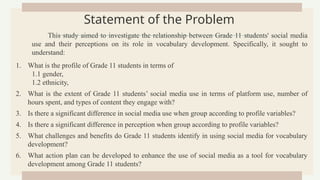
This study aimed to investigate the relationship between Grade 11 students' social media
use and their perceptions on its role in vocabulary development. Specifically, it sought to
understand:
1. What is the profile of Grade 11 students in terms of
1.1 gender,
1.2 ethnicity,
2. What is the extent of Grade 11 students’ social media use in terms of platform use, number of
hours spent, and types of content they engage with?
3. Is there a significant difference in social media use when group according to profile variables?
4. Is there a significant difference in perception when group according to profile variables?
5. What challenges and benefits do Grade 11 students identify in using social media for vocabulary
development?
6. What action plan can be developed to enhance the use of social media as a tool for vocabulary
development among Grade 11 students?
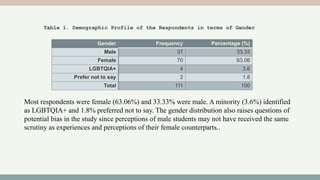
Table 1. DemographicProfile of the Respondents in terms of Gender
Gender Frequency Percentage (%)
Male 37 33.33
Female 70 63.06
LGBTQIA+ 4 3.6
Prefer not to say 2 1.8
Total 111 100
Most respondents were female (63.06%) and 33.33% were male. A minority (3.6%) identified
as LGBTQIA+ and 1.8% preferred not to say. The gender distribution also raises questions of
potential bias in the study since perceptions of male students may not have received the same
scrutiny as experiences and perceptions of their female counterparts..
7.
Ethnicity Frequency Percentage(%)
Ilocano 46 41.82%
Ibanag 27 24.55%
Itawes 23 20.91%
Tagalog 6 5.45%
Malaueg 2 1.82%
Filipino 2 1.82%
English and Filipino only 1 0.91%
Itawes, Ibanag 1 0.91%
Ibanag and Itawes 1 0.91%
Pilipino 1 0.91%
Total 111 100
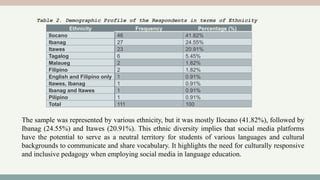
Table 2. Demographic Profile of the Respondents in terms of Ethnicity
The sample was represented by various ethnicity, but it was mostly Ilocano (41.82%), followed by
Ibanag (24.55%) and Itawes (20.91%). This ethnic diversity implies that social media platforms
have the potential to serve as a neutral territory for students of various languages and cultural
backgrounds to communicate and share vocabulary. It highlights the need for culturally responsive
and inclusive pedagogy when employing social media in language education.
8.
Platform Frequency Percentage
Tiktok93 21.78%
Facebook 91 21.31%
Instagram 83 19.44%
Youtube 68 15.93%
Twitter 46 10.77%
Pinterest 40 9.37%
Messenger 1 0.23%
Bluesky 1 0.23%
Spotify 1 0.23%
Telegram 1 0.23%
spotify 1 0.23%
Discord 1 0.23%
Total 111 100
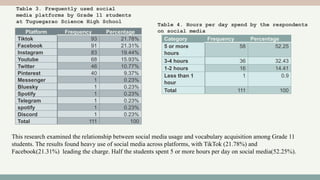
Table 3. Frequently used social
media platforms by Grade 11 students
at Tuguegarao Science High School
This research examined the relationship between social media usage and vocabulary acquisition among Grade 11
students. The results found heavy use of social media across platforms, with TikTok (21.78%) and
Facebook(21.31%) leading the charge. Half the students spent 5 or more hours per day on social media(52.25%).
Category Frequency Percentage
5 or more
hours
58 52.25
3-4 hours 36 32.43
1-2 hours 16 14.41
Less than 1
hour
1 0.9
Total 111 100
Table 4. Hours per day spend by the respondents
on social media
9.
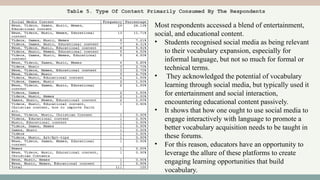
Table 5. TypeOf Content Primarily Consumed By The Respondents
Most respondents accessed a blend of entertainment,
social, and educational content.
• Students recognised social media as being relevant
to their vocabulary expansion, especially for
informal language, but not so much for formal or
technical terms.
• They acknowledged the potential of vocabulary
learning through social media, but typically used it
for entertainment and social interaction,
encountering educational content passively.
• It shows that how one ought to use social media to
engage interactively with language to promote a
better vocabulary acquisition needs to be taught in
these forums.
• For this reason, educators have an opportunity to
leverage the allure of these platforms to create
engaging learning opportunities that build
vocabulary.
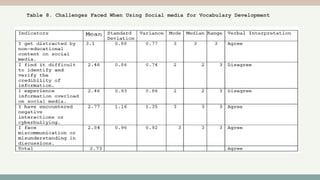
Grade 11students identify both challenges and benefits in using social media for
vocabulary enrichment. While they acknowledge challenges such as distractions from non-
educational content, difficulty verifying information, information overload, and potential
for negative interactions, their overall attitude towards using social media for language
learning remains positive.
13.
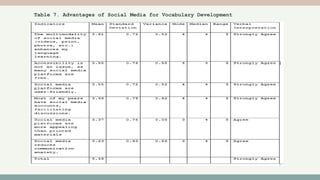
• Students stronglyagree that social media offers diverse benefits for vocabulary development. They
appreciate the multimodality of platforms, providing access to various media formats that enhance
learning. The accessibility and user-friendliness of these platforms also contribute to their positive
perception. Moreover, students value the opportunity for peer interaction and collaborative learning
that social media provides. They find the content engaging and motivating, offering unique learning
opportunities not found in traditional methods.
• Ultimately, students believe social media is an effective tool for vocabulary development,
complementing traditional approaches. Despite the recognized challenges, the perceived benefits of
social media contribute to a positive overall perception of its role in vocabulary learning. This
highlights the potential of social media as a valuable tool for language development when used
strategically and purposefully.
14.
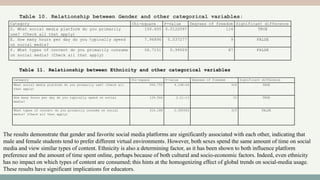
Category Chi-square P-valueDegrees of freedom Significant difference
D. What social media platform do you primarily
use? (Check all that apply)
150.655 0.0122097 114 TRUE
E. How many hours per day do you typically spend
on social media?
7.96896 0.537277 9 FALSE
F. What types of content do you primarily consume
on social media? (Check all that apply)
56.7151 0.99509 87 FALSE
Table 10. Relationship between Gender and other categorical variables:
Category Chi-square P-value Degrees of freedom Significant difference
What social media platform do you primarily use? (Check all
that apply)
559.755 4.10E-06 418 TRUE
How many hours per day do you typically spend on social
media?
129.564 2.21-13 33 TRUE
What types of content do you primarily consume on social
media? (Check all that apply)
314.188 0.565543 319 FALSE
Table 11. Relationship between Ethnicity and other categorical variables
The results demonstrate that gender and favorite social media platforms are significantly associated with each other, indicating that
male and female students tend to prefer different virtual environments. However, both sexes spend the same amount of time on social
media and view similar types of content. Ethnicity is also a determining factor, as it has been shown to both influence platform
preference and the amount of time spent online, perhaps because of both cultural and socio-economic factors. Indeed, even ethnicity
has no impact on which types of content are consumed; this hints at the homogenizing effect of global trends on social-media usage.
These results have significant implications for educators.
15.
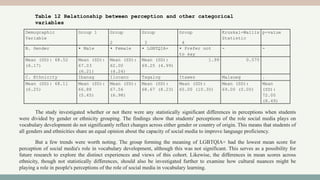
Demographic
Variable
Group 1 Group
2
Group
3
Group
4
Kruskal-Wallis
Statistic
p-value
B.Gender • Male • Female • LGBTQIA+ • Prefer not
to say
- -
Mean (SD): 68.52
(6.17)
Mean (SD):
67.03
(6.21)
Mean (SD):
62.00
(4.24)
Mean (SD):
69.25 (4.99)
1.99 0.575
C. Ethnicity Ibanag Ilocano Tagalog Itawes Malaueg .
Mean (SD): 68.11
(6.25)
Mean (SD):
66.88
(5.45)
Mean (SD):
67.56
(6.98)
Mean (SD):
68.67 (8.23)
Mean (SD):
65.00 (10.30)
Mean (SD):
69.00 (0.00)
Mean
(SD):
72.00
(8.49)
Table 12 Relationship between perception and other categorical
variables
The study investigated whether or not there were any statistically significant differences in perceptions when students
were divided by gender or ethnicity grouping. The findings show that students' perceptions of the role social media plays on
vocabulary development do not significantly reflect changes across either gender or country of origin. This means that students of
all genders and ethnicities share an equal opinion about the capacity of social media to improve language proficiency.
But a few trends were worth noting. The group forming the meaning of LGBTQIA+ had the lowest mean score for
perception of social media's role in vocabulary development, although this was not significant. This serves as a possibility for
future research to explore the distinct experiences and views of this cohort. Likewise, the differences in mean scores across
ethnicity, though not statistically differences, should also be investigated further to examine how cultural nuances might be
playing a role in people's perceptions of the role of social media in vocabulary learning.
16.
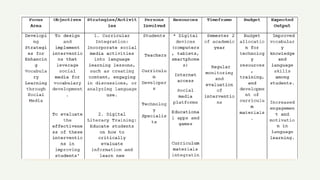
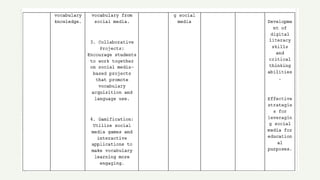
ACTION PLAN TOENHANCE VOCABULARY LEARNING THROUGH SOCIAL MEDIA
Rationale:
The findings of this study highlight the potential of social media to support vocabulary development
while also addressing challenges like distractions, information overload, and verifying credible content.
To enhance vocabulary learning through social media, the action plan will focus on three key objectives:
(1) Guide educators on effectively integrating social media into vocabulary instruction,
(2) Develop strategies that address diverse student preferences and needs, and
(3) Help students identify and use valuable educational content on social media.
These objectives aim to maximize the benefits of social media for language learning while minimizing
its challenges.
CREDITS: This presentationtemplate was created by
Slidesgo, and includes icons by Flaticon, and infographics
& images by Freepik
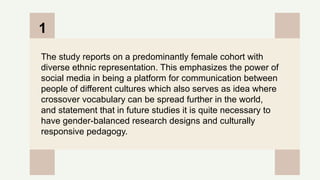
The study reports on a predominantly female cohort with
diverse ethnic representation. This emphasizes the power of
social media in being a platform for communication between
people of different cultures which also serves as idea where
crossover vocabulary can be spread further in the world,
and statement that in future studies it is quite necessary to
have gender-balanced research designs and culturally
responsive pedagogy.
1
21.
CREDITS: This presentationtemplate was created by
Slidesgo, and includes icons by Flaticon, and infographics
& images by Freepik
The common practice of Grade 11 students is to use social media
primarily for entertainment and social interaction. They
understand its possibilities for vocabulary learning but mostly
passively consume educational content. Educators should
harness the power of social media to create engaging learning
opportunities that actively promote vocabulary acquisition.
2
22.
CREDITS: This presentationtemplate was created by
Slidesgo, and includes icons by Flaticon, and infographics
& images by Freepik
The use of social media for vocabulary development presents
challenges and benefits, as reported by students. Despite
recognizing the distractions and potential negative interactions,
they highly value its multimodality, accessibility, and peer
interaction capabilities. This highlights the intricate balance
needed to leverage social media strategically for its advantages in
language acquisition.
3
23.
CREDITS: This presentationtemplate was created by
Slidesgo, and includes icons by Flaticon, and infographics
& images by Freepik
While this study captures the role of both gender and ethnicity on
the social media platforms used, there is no impact on the amount
of time spent or nature of content consumed on these platforms.
This not only means highly contextual interventions, but also the
potential to learn from universally engaging material and
experiences.
4
24.
CREDITS: This presentationtemplate was created by
Slidesgo, and includes icons by Flaticon, and infographics
& images by Freepik
Overall, some small trends in the correlation between gender, ethnicity, and the
percentage who agree with the statement, "Social Media Plays a Role in
Developing My Vocabulary," stand out but are not significantly impactful and
require further investigation. However future studies should also consider looking
into how certain demographic categories exist differently among their
backgrounds and how they use social media differently, as well as the frequency
of use, type of media platforms, and learning strategies for a broader view of how
vocabulary learning may be achieved through the use of social media.
5
CREDITS: This presentationtemplate was created by
Slidesgo, and includes icons by Flaticon, and infographics
& images by Freepik
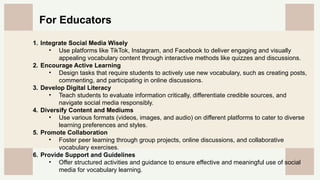
1. Integrate Social Media Wisely
• Use platforms like TikTok, Instagram, and Facebook to deliver engaging and visually
appealing vocabulary content through interactive methods like quizzes and discussions.
2. Encourage Active Learning
• Design tasks that require students to actively use new vocabulary, such as creating posts,
commenting, and participating in online discussions.
3. Develop Digital Literacy
• Teach students to evaluate information critically, differentiate credible sources, and
navigate social media responsibly.
4. Diversify Content and Mediums
• Use various formats (videos, images, and audio) on different platforms to cater to diverse
learning preferences and styles.
5. Promote Collaboration
• Foster peer learning through group projects, online discussions, and collaborative
vocabulary exercises.
6. Provide Support and Guidelines
• Offer structured activities and guidance to ensure effective and meaningful use of social
media for vocabulary learning.
For Educators
27.
CREDITS: This presentationtemplate was created by
Slidesgo, and includes icons by Flaticon, and infographics
& images by Freepik
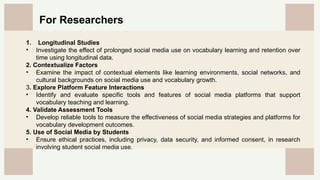
For Researchers
1. Longitudinal Studies
• Investigate the effect of prolonged social media use on vocabulary learning and retention over
time using longitudinal data.
2. Contextualize Factors
• Examine the impact of contextual elements like learning environments, social networks, and
cultural backgrounds on social media use and vocabulary growth.
3. Explore Platform Feature Interactions
• Identify and evaluate specific tools and features of social media platforms that support
vocabulary teaching and learning.
4. Validate Assessment Tools
• Develop reliable tools to measure the effectiveness of social media strategies and platforms for
vocabulary development outcomes.
5. Use of Social Media by Students
• Ensure ethical practices, including privacy, data security, and informed consent, in research
involving student social media use.
28.
CREDITS: This presentationtemplate was created by
Slidesgo, and includes icons by Flaticon, and infographics
& images by Freepik
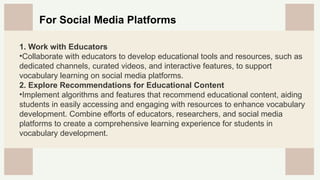
For Social Media Platforms
1. Work with Educators
•Collaborate with educators to develop educational tools and resources, such as
dedicated channels, curated videos, and interactive features, to support
vocabulary learning on social media platforms.
2. Explore Recommendations for Educational Content
•Implement algorithms and features that recommend educational content, aiding
students in easily accessing and engaging with resources to enhance vocabulary
development. Combine efforts of educators, researchers, and social media
platforms to create a comprehensive learning experience for students in
vocabulary development.