USES OF SOCIAL MEDIA AND ITS
IMPACT ON THE ACADEMIC
PERFORMANCE AMONG JUNIOR
HIGH SCHOOL STUDENTS FOR
THE ACADEMIC YEAR 2022-2023
Researchers:
BANGQUIAO, JESSAH T.
CABANAG, MARGIE G.
DIGMAN, JOMAR A.
GARDIGO, ALONA A.
LUIB, GOLDY ISSHI B.
QUILLANO, JEJEFIE O.
Technology has introduced people to better
ways of doing things, but the impact of social
media, particularly on students, is of cause for
concern. Social media is a popular online
platform that focuses on communication,
community-based input, engagement, content
sharing, and collaboration. It has developed into
a crucial component of students' lives, affecting
their interactions in terms of education,
interacting with others, entertainment, and
acquiring information.
Introductio
n
The objective of this study is to ascertain
whether there is a correlation between SNHS
students' use of social media and their level of
academic performance. It also aims to propose
recommended measures that would aid students
in managing their academic performance and
social media usage, particularly how to manage
their time in a way that does not negatively or
positively impact their education. Consequently,
this research is required to determine the status
of the Sagbayan National High School students'
academic performance and how social media
influences it.
Theoretical and Conceptual
Framework
This study is anchored on the Dual-
System Thinking Theory, a hypothesis that
contends that people have two different sets
of decisions-making processes (Kahneman &
Tversky, 2011, as cited in Kannengiesser &
Gero, 2019). According to this theory, students
frequently struggle to decide which activity to
complete first, whether to concentrate on
their studies or browse through their phones.
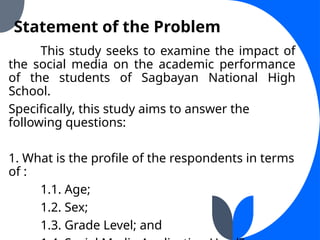
Statement of the Problem
This study seeks to examine the impact of
the social media on the academic performance
of the students of Sagbayan National High
School.
Specifically, this study aims to answer the
following questions:
1. What is the profile of the respondents in terms
of :
1.1. Age;
1.2. Sex;
1.3. Grade Level; and
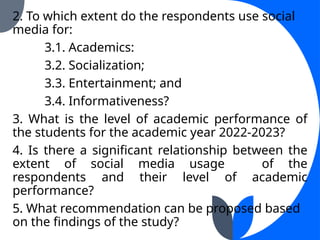
2. To which extent do the respondents use social
media for:
3.1. Academics:
3.2. Socialization;
3.3. Entertainment; and
3.4. Informativeness?
3. What is the level of academic performance of
the students for the academic year 2022-2023?
4. Is there a significant relationship between the
extent of social media usage of the
respondents and their level of academic
performance?
5. What recommendation can be proposed based
on the findings of the study?
Chapter 3
RESEARCH METHOLOGY
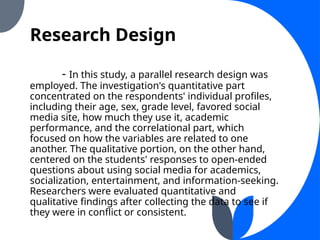
Research Design
- In this study, a parallel research design was
employed. The investigation's quantitative part
concentrated on the respondents' individual profiles,
including their age, sex, grade level, favored social
media site, how much they use it, academic
performance, and the correlational part, which
focused on how the variables are related to one
another. The qualitative portion, on the other hand,
centered on the students' responses to open-ended
questions about using social media for academics,
socialization, entertainment, and information-seeking.
Researchers were evaluated quantitative and
qualitative findings after collecting the data to see if
they were in conflict or consistent.
Research Instrument
The researchers provided a survey
questionnaire relevant to the field of the
study. It will undergo validity and reliability
test so that the researchers can make sure
that the survey questionnaire can measure
the extent of social media usage and
manage to assess its relationship with the
level of academic performance.
Statistical Treatment of Data
The following statistical tools were used to
treat the problems in the study:
Frequency and percentage. The frequency
and percentage distributions were used to
categorize the respondents according to age,
sex, grade level, and most used social media
application.
Weighted mean. It was utilized to determine the
parameters of the extent to which the students use
social media for academics, socialization,
entertainment, and informativeness.
Pearson correlation coefficient. This was
employed to determine the significant relationships
between (1) the extent to which the students at
Sagbayan National High School use social media for
academics, socialization, entertainment, and
informativeness; and (2) their academic
performance.
Likert Scale. A scale used to determine the
respondents purposes for using social media. This
scale ranges from one to five (1 to 5), namely:
Always, Often, Sometimes, Rarely and Never.
CHAPTER 4
Presentation, Analysis and
Interpretation of Data
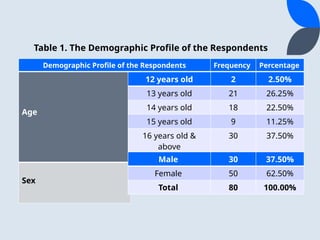
Table 1. The Demographic Profile of the Respondents
Demographic Profile of the Respondents Frequency Percentage
Age
Sex
12 years old 2 2.50%
13 years old 21 26.25%
14 years old 18 22.50%
15 years old 9 11.25%
16 years old &
above
30 37.50%
Total 80 100.00%
Male 30 37.50%
Female 50 62.50%
Total 80 100.00%
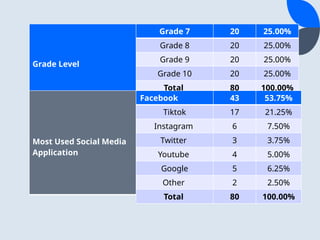
Grade Level
Grade 7 20 25.00%
Grade 8 20 25.00%
Grade 9 20 25.00%
Grade 10 20 25.00%
Total 80 100.00%
Most Used Social Media
Application
Facebook 43 53.75%
Tiktok 17 21.25%
Instagram 6 7.50%
Twitter 3 3.75%
Youtube 4 5.00%
Google 5 6.25%
Other 2 2.50%
Total 80 100.00%
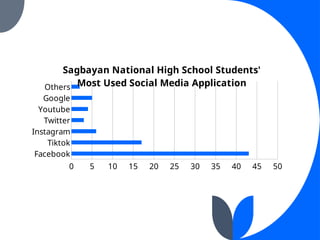
Facebook
Tiktok
Instagram
Twitter
Youtube
Google
Others
0 5 10 15 20 25 30 35 40 45 50
Sagbayan National High School Students'
Most Used Social Media Application
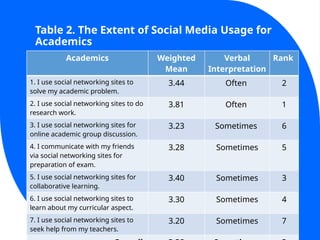
Table 2. The Extent of Social Media Usage for
Academics
Academics Weighted
Mean
Verbal
Interpretation
Rank
1. I use social networking sites to
solve my academic problem.
3.44 Often 2
2. I use social networking sites to do
research work.
3.81 Often 1
3. I use social networking sites for
online academic group discussion.
3.23 Sometimes 6
4. I communicate with my friends
via social networking sites for
preparation of exam.
3.28 Sometimes 5
5. I use social networking sites for
collaborative learning.
3.40 Sometimes 3
6. I use social networking sites to
learn about my curricular aspect.
3.30 Sometimes 4
7. I use social networking sites to
seek help from my teachers.
3.20 Sometimes 7
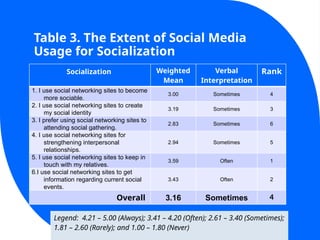
Table 3. The Extent of Social Media
Usage for Socialization
Socialization Weighted
Mean
Verbal
Interpretation
Rank
1. I use social networking sites to become
more sociable.
3.00 Sometimes 4
2. I use social networking sites to create
my social identity
3.19 Sometimes 3
3. I prefer using social networking sites to
attending social gathering.
2.83 Sometimes 6
4. I use social networking sites for
strengthening interpersonal
relationships.
2.94 Sometimes 5
5. I use social networking sites to keep in
touch with my relatives.
3.59 Often 1
6.I use social networking sites to get
information regarding current social
events.
3.43 Often 2
Overall 3.16 Sometimes 4
Legend: 4.21 – 5.00 (Always); 3.41 – 4.20 (Often); 2.61 – 3.40 (Sometimes);
1.81 – 2.60 (Rarely); and 1.00 – 1.80 (Never)
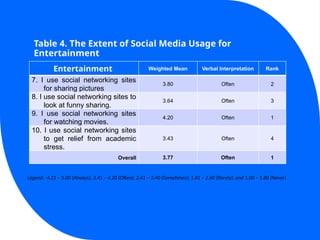
Table 4. The Extent of Social Media Usage for
Entertainment
Entertainment Weighted Mean Verbal Interpretation Rank
7. I use social networking sites
for sharing pictures
3.80 Often 2
8. I use social networking sites to
look at funny sharing.
3.64 Often 3
9. I use social networking sites
for watching movies.
4.20 Often 1
10. I use social networking sites
to get relief from academic
stress.
3.43 Often 4
Overall 3.77 Often 1
Legend: 4.21 – 5.00 (Always); 3.41 – 4.20 (Often); 2.61 – 3.40 (Sometimes); 1.81 – 2.60 (Rarely); and 1.00 – 1.80 (Never)
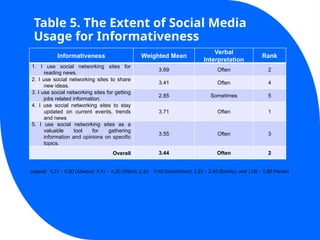
Table 5. The Extent of Social Media
Usage for Informativeness
Informativeness Weighted Mean
Verbal
Interpretation
Rank
1. I use social networking sites for
reading news.
3.69 Often 2
2. I use social networking sites to share
new ideas.
3.41 Often 4
3. I use social networking sites for getting
jobs related information.
2.85 Sometimes 5
4. I use social networking sites to stay
updated on current events, trends
and news
3.71 Often 1
5. I use social networking sites as a
valuable tool for gathering
information and opinions on specific
topics.
3.55 Often 3
Overall 3.44 Often 2
Legend: 4.21 – 5.00 (Always); 3.41 – 4.20 (Often); 2.61 – 3.40 (Sometimes); 1.81 – 2.60 (Rarely); and 1.00 – 1.80 (Never)
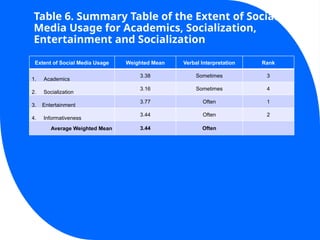
Table 6. Summary Table of the Extent of Social
Media Usage for Academics, Socialization,
Entertainment and Socialization
Extent of Social Media Usage Weighted Mean Verbal Interpretation Rank
1. Academics
3.38 Sometimes 3
2. Socialization
3.16 Sometimes 4
3. Entertainment
3.77 Often 1
4. Informativeness
3.44 Often 2
Average Weighted Mean 3.44 Often
Four additional open-ended questions.
Impact of Social Media on Academic
Performance and Overall Learning
Experience
The majority of students' comments in this
part narrated "helps answer school tasks,"
"contributes to doing research," and "assist
academic concerns." They believe that the impact of
social media has more advantages than
disadvantages, adding some even attend online
classes to stay ahead on activities and topics. It can,
however, lead to addiction and distraction. While
social media can aid in research and assignment
completion, respondents believe that they must
balance it with their schoolwork in order to create a
good learning environment.
Impact of Social Media on SNHS
Students’ Social Relationship and Daily
Life
“Allowed us to communicate and keep in
touch with our family members and friends”
was identified as the most recurrent theme in
terms of socialization as the purpose for
using social media. This implies that social
media is a powerful tool for staying
connected with friends and family, even in
distant places and staying updated on their
lives. Some of the respondents also admitted
to using social networking sites to stay up to
date on current events in society: "Social
media enabled me to get updates from our
society."
Preference to Spend More Time on Social
Media than Completing their Schoolwork
Based on the students’ respondents
regarding this concern, social media “brings
students more enjoyment by providing
entertainment and staying updated on trends”.
However, it can also be “addictive” and
“distracting” from academic work. Students often
spend more time on social media than they do on
schoolwork, as it can distract them from their
studies and keep them connected with friends.
While some students find “happiness” in
spending time on social media, others find it
“interrupting” and forget their schoolwork. They
enjoy watching funny videos and sharing memes,
which, they attest, “can help relieve academic
stress”.
Some respondents also stated that if students
use social media for learning, it can make
learning more fun and easy. In today's world,
students often find it more enjoyable to spend
time talking about nonsense things rather than
answering schoolwork, as it “provides a chilling
and stress-relieving environment”.
How Social Media Continues to Serve as
an Informative Platform
According to the students' responses
regarding how social media continues to serve as
an informative platform, they stated that social
media platforms such as
Facebook allow them to “communicate
and connect with people in real-time”,
“connect with cultural communities,” and
“share ideas, thoughts, and opinions”.
Some narrated that it is a
“trustworthy tool for staying connected
and informed about what's going on in the
globe”; that it assists people in finding
common ground with others online;
making the world appear “more linked and
accessible”; offering “access to current
news” in numerous industries such as
sports, entertainment, and business; and
informing them about their surroundings
and provide opportunities for enjoyment
and growth in their lives.
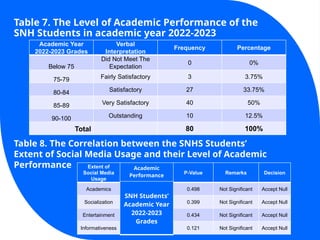
Table 7. The Level of Academic Performance of the
SNH Students in academic year 2022-2023
Academic Year
2022-2023 Grades
Verbal
Interpretation
Frequency Percentage
Below 75
Did Not Meet The
Expectation
0 0%
75-79 Fairly Satisfactory 3 3.75%
80-84 Satisfactory 27 33.75%
85-89 Very Satisfactory 40 50%
90-100 Outstanding 10 12.5%
Total 80 100%
Table 8. The Correlation between the SNHS Students’
Extent of Social Media Usage and their Level of Academic
Performance Extent of
Social Media
Usage
Academic
Performance
P-Value Remarks Decision
Academics 0.498 Not Significant Accept Null
Socialization 0.399 Not Significant Accept Null
Entertainment 0.434 Not Significant Accept Null
Informativeness 0.121 Not Significant Accept Null
SNH Students’
Academic Year
2022-2023
Grades
Summary
As to the extent of social media usage for academics and
the level of academic performance, there is no a significant
relationship with a p-value of 0.498 which is greater than the
significance level 0.05. The null hypothesis was accepted.
As to the extent of social media usage for socialization
and the level of academic performance, there is no a significant
relationship with a p-value of 0.399 which is greater than the
significance level 0.05. The null hypothesis was accepted.
As to the extent of social media usage for entertainment
and the level of academic performance, there is no a significant
relationship with a p-value of 0.434 which is greater than the
significance level 0.05. The null hypothesis was accepted.
As to the extent of social media usage for informativeness
and the level of academic performance, there is no a significant
relationship with a p-value of 0.121 which is greater than the
significance level 0.05. The null hypothesis was accepted.
Conclusions
Out of 80 respondents from all four grade levels, 37%
were aged 16 and above, 26.25% were aged 13 and above, 22.50%
were aged 14, 11.25% were aged 15, and 2.50% were aged 12;
62.5% were female and only 37.5% were male; and the majority of
the respondents reported Facebook as their most used social
media application.
In addition, it is revealed that SNHS students more often
use social media for entertainment and informativeness than for
academics and socialization. Primarily, they use it for
entertainment, which is often accessed for watching movies,
sharing pictures, browsing funny content, and seeking academic
stress relief.
Secondarily, they use it for informativeness, which is
often accessed for staying updated on current events and trends,
reading news, sharing ideas, gathering information and opinions
on specific topics, obtaining job information, and sharing new
ideas.
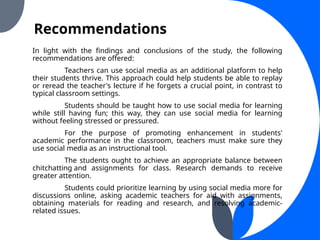
Recommendations
In light with the findings and conclusions of the study, the following
recommendations are offered:
Teachers can use social media as an additional platform to help
their students thrive. This approach could help students be able to replay
or reread the teacher's lecture if he forgets a crucial point, in contrast to
typical classroom settings.
Students should be taught how to use social media for learning
while still having fun; this way, they can use social media for learning
without feeling stressed or pressured.
For the purpose of promoting enhancement in students'
academic performance in the classroom, teachers must make sure they
use social media as an instructional tool.
The students ought to achieve an appropriate balance between
chitchatting and assignments for class. Research demands to receive
greater attention.
Students could prioritize learning by using social media more for
discussions online, asking academic teachers for aid with assignments,
obtaining materials for reading and research, and resolving academic-
related issues.
THANK YOU!

research_presentation For 1st year college

  • 1.
    USES OF SOCIALMEDIA AND ITS IMPACT ON THE ACADEMIC PERFORMANCE AMONG JUNIOR HIGH SCHOOL STUDENTS FOR THE ACADEMIC YEAR 2022-2023
  • 2.
    Researchers: BANGQUIAO, JESSAH T. CABANAG,MARGIE G. DIGMAN, JOMAR A. GARDIGO, ALONA A. LUIB, GOLDY ISSHI B. QUILLANO, JEJEFIE O.
  • 3.
    Technology has introducedpeople to better ways of doing things, but the impact of social media, particularly on students, is of cause for concern. Social media is a popular online platform that focuses on communication, community-based input, engagement, content sharing, and collaboration. It has developed into a crucial component of students' lives, affecting their interactions in terms of education, interacting with others, entertainment, and acquiring information. Introductio n
  • 4.
    The objective ofthis study is to ascertain whether there is a correlation between SNHS students' use of social media and their level of academic performance. It also aims to propose recommended measures that would aid students in managing their academic performance and social media usage, particularly how to manage their time in a way that does not negatively or positively impact their education. Consequently, this research is required to determine the status of the Sagbayan National High School students' academic performance and how social media influences it.
  • 5.
    Theoretical and Conceptual Framework Thisstudy is anchored on the Dual- System Thinking Theory, a hypothesis that contends that people have two different sets of decisions-making processes (Kahneman & Tversky, 2011, as cited in Kannengiesser & Gero, 2019). According to this theory, students frequently struggle to decide which activity to complete first, whether to concentrate on their studies or browse through their phones.
  • 6.
    Statement of theProblem This study seeks to examine the impact of the social media on the academic performance of the students of Sagbayan National High School. Specifically, this study aims to answer the following questions: 1. What is the profile of the respondents in terms of : 1.1. Age; 1.2. Sex; 1.3. Grade Level; and
  • 7.
    2. To whichextent do the respondents use social media for: 3.1. Academics: 3.2. Socialization; 3.3. Entertainment; and 3.4. Informativeness? 3. What is the level of academic performance of the students for the academic year 2022-2023? 4. Is there a significant relationship between the extent of social media usage of the respondents and their level of academic performance? 5. What recommendation can be proposed based on the findings of the study?
  • 8.
  • 9.
    Research Design - Inthis study, a parallel research design was employed. The investigation's quantitative part concentrated on the respondents' individual profiles, including their age, sex, grade level, favored social media site, how much they use it, academic performance, and the correlational part, which focused on how the variables are related to one another. The qualitative portion, on the other hand, centered on the students' responses to open-ended questions about using social media for academics, socialization, entertainment, and information-seeking. Researchers were evaluated quantitative and qualitative findings after collecting the data to see if they were in conflict or consistent.
  • 10.
    Research Instrument The researchersprovided a survey questionnaire relevant to the field of the study. It will undergo validity and reliability test so that the researchers can make sure that the survey questionnaire can measure the extent of social media usage and manage to assess its relationship with the level of academic performance.
  • 11.
    Statistical Treatment ofData The following statistical tools were used to treat the problems in the study: Frequency and percentage. The frequency and percentage distributions were used to categorize the respondents according to age, sex, grade level, and most used social media application.
  • 12.
    Weighted mean. Itwas utilized to determine the parameters of the extent to which the students use social media for academics, socialization, entertainment, and informativeness. Pearson correlation coefficient. This was employed to determine the significant relationships between (1) the extent to which the students at Sagbayan National High School use social media for academics, socialization, entertainment, and informativeness; and (2) their academic performance. Likert Scale. A scale used to determine the respondents purposes for using social media. This scale ranges from one to five (1 to 5), namely: Always, Often, Sometimes, Rarely and Never.
  • 13.
    CHAPTER 4 Presentation, Analysisand Interpretation of Data
  • 14.
    Table 1. TheDemographic Profile of the Respondents Demographic Profile of the Respondents Frequency Percentage Age Sex 12 years old 2 2.50% 13 years old 21 26.25% 14 years old 18 22.50% 15 years old 9 11.25% 16 years old & above 30 37.50% Total 80 100.00% Male 30 37.50% Female 50 62.50% Total 80 100.00%
  • 15.
    Grade Level Grade 720 25.00% Grade 8 20 25.00% Grade 9 20 25.00% Grade 10 20 25.00% Total 80 100.00% Most Used Social Media Application Facebook 43 53.75% Tiktok 17 21.25% Instagram 6 7.50% Twitter 3 3.75% Youtube 4 5.00% Google 5 6.25% Other 2 2.50% Total 80 100.00%
  • 16.
    Facebook Tiktok Instagram Twitter Youtube Google Others 0 5 1015 20 25 30 35 40 45 50 Sagbayan National High School Students' Most Used Social Media Application
  • 17.
    Table 2. TheExtent of Social Media Usage for Academics Academics Weighted Mean Verbal Interpretation Rank 1. I use social networking sites to solve my academic problem. 3.44 Often 2 2. I use social networking sites to do research work. 3.81 Often 1 3. I use social networking sites for online academic group discussion. 3.23 Sometimes 6 4. I communicate with my friends via social networking sites for preparation of exam. 3.28 Sometimes 5 5. I use social networking sites for collaborative learning. 3.40 Sometimes 3 6. I use social networking sites to learn about my curricular aspect. 3.30 Sometimes 4 7. I use social networking sites to seek help from my teachers. 3.20 Sometimes 7
  • 18.
    Table 3. TheExtent of Social Media Usage for Socialization Socialization Weighted Mean Verbal Interpretation Rank 1. I use social networking sites to become more sociable. 3.00 Sometimes 4 2. I use social networking sites to create my social identity 3.19 Sometimes 3 3. I prefer using social networking sites to attending social gathering. 2.83 Sometimes 6 4. I use social networking sites for strengthening interpersonal relationships. 2.94 Sometimes 5 5. I use social networking sites to keep in touch with my relatives. 3.59 Often 1 6.I use social networking sites to get information regarding current social events. 3.43 Often 2 Overall 3.16 Sometimes 4 Legend: 4.21 – 5.00 (Always); 3.41 – 4.20 (Often); 2.61 – 3.40 (Sometimes); 1.81 – 2.60 (Rarely); and 1.00 – 1.80 (Never)
  • 19.
    Table 4. TheExtent of Social Media Usage for Entertainment Entertainment Weighted Mean Verbal Interpretation Rank 7. I use social networking sites for sharing pictures 3.80 Often 2 8. I use social networking sites to look at funny sharing. 3.64 Often 3 9. I use social networking sites for watching movies. 4.20 Often 1 10. I use social networking sites to get relief from academic stress. 3.43 Often 4 Overall 3.77 Often 1 Legend: 4.21 – 5.00 (Always); 3.41 – 4.20 (Often); 2.61 – 3.40 (Sometimes); 1.81 – 2.60 (Rarely); and 1.00 – 1.80 (Never)
  • 20.
    Table 5. TheExtent of Social Media Usage for Informativeness Informativeness Weighted Mean Verbal Interpretation Rank 1. I use social networking sites for reading news. 3.69 Often 2 2. I use social networking sites to share new ideas. 3.41 Often 4 3. I use social networking sites for getting jobs related information. 2.85 Sometimes 5 4. I use social networking sites to stay updated on current events, trends and news 3.71 Often 1 5. I use social networking sites as a valuable tool for gathering information and opinions on specific topics. 3.55 Often 3 Overall 3.44 Often 2 Legend: 4.21 – 5.00 (Always); 3.41 – 4.20 (Often); 2.61 – 3.40 (Sometimes); 1.81 – 2.60 (Rarely); and 1.00 – 1.80 (Never)
  • 21.
    Table 6. SummaryTable of the Extent of Social Media Usage for Academics, Socialization, Entertainment and Socialization Extent of Social Media Usage Weighted Mean Verbal Interpretation Rank 1. Academics 3.38 Sometimes 3 2. Socialization 3.16 Sometimes 4 3. Entertainment 3.77 Often 1 4. Informativeness 3.44 Often 2 Average Weighted Mean 3.44 Often
  • 22.
    Four additional open-endedquestions. Impact of Social Media on Academic Performance and Overall Learning Experience The majority of students' comments in this part narrated "helps answer school tasks," "contributes to doing research," and "assist academic concerns." They believe that the impact of social media has more advantages than disadvantages, adding some even attend online classes to stay ahead on activities and topics. It can, however, lead to addiction and distraction. While social media can aid in research and assignment completion, respondents believe that they must balance it with their schoolwork in order to create a good learning environment.
  • 23.
    Impact of SocialMedia on SNHS Students’ Social Relationship and Daily Life “Allowed us to communicate and keep in touch with our family members and friends” was identified as the most recurrent theme in terms of socialization as the purpose for using social media. This implies that social media is a powerful tool for staying connected with friends and family, even in distant places and staying updated on their lives. Some of the respondents also admitted to using social networking sites to stay up to date on current events in society: "Social media enabled me to get updates from our society."
  • 24.
    Preference to SpendMore Time on Social Media than Completing their Schoolwork Based on the students’ respondents regarding this concern, social media “brings students more enjoyment by providing entertainment and staying updated on trends”. However, it can also be “addictive” and “distracting” from academic work. Students often spend more time on social media than they do on schoolwork, as it can distract them from their studies and keep them connected with friends. While some students find “happiness” in spending time on social media, others find it “interrupting” and forget their schoolwork. They enjoy watching funny videos and sharing memes, which, they attest, “can help relieve academic stress”.
  • 25.
    Some respondents alsostated that if students use social media for learning, it can make learning more fun and easy. In today's world, students often find it more enjoyable to spend time talking about nonsense things rather than answering schoolwork, as it “provides a chilling and stress-relieving environment”. How Social Media Continues to Serve as an Informative Platform According to the students' responses regarding how social media continues to serve as an informative platform, they stated that social media platforms such as
  • 26.
    Facebook allow themto “communicate and connect with people in real-time”, “connect with cultural communities,” and “share ideas, thoughts, and opinions”. Some narrated that it is a “trustworthy tool for staying connected and informed about what's going on in the globe”; that it assists people in finding common ground with others online; making the world appear “more linked and accessible”; offering “access to current news” in numerous industries such as sports, entertainment, and business; and informing them about their surroundings and provide opportunities for enjoyment and growth in their lives.
  • 27.
    Table 7. TheLevel of Academic Performance of the SNH Students in academic year 2022-2023 Academic Year 2022-2023 Grades Verbal Interpretation Frequency Percentage Below 75 Did Not Meet The Expectation 0 0% 75-79 Fairly Satisfactory 3 3.75% 80-84 Satisfactory 27 33.75% 85-89 Very Satisfactory 40 50% 90-100 Outstanding 10 12.5% Total 80 100% Table 8. The Correlation between the SNHS Students’ Extent of Social Media Usage and their Level of Academic Performance Extent of Social Media Usage Academic Performance P-Value Remarks Decision Academics 0.498 Not Significant Accept Null Socialization 0.399 Not Significant Accept Null Entertainment 0.434 Not Significant Accept Null Informativeness 0.121 Not Significant Accept Null SNH Students’ Academic Year 2022-2023 Grades
  • 28.
    Summary As to theextent of social media usage for academics and the level of academic performance, there is no a significant relationship with a p-value of 0.498 which is greater than the significance level 0.05. The null hypothesis was accepted. As to the extent of social media usage for socialization and the level of academic performance, there is no a significant relationship with a p-value of 0.399 which is greater than the significance level 0.05. The null hypothesis was accepted. As to the extent of social media usage for entertainment and the level of academic performance, there is no a significant relationship with a p-value of 0.434 which is greater than the significance level 0.05. The null hypothesis was accepted. As to the extent of social media usage for informativeness and the level of academic performance, there is no a significant relationship with a p-value of 0.121 which is greater than the significance level 0.05. The null hypothesis was accepted.
  • 29.
    Conclusions Out of 80respondents from all four grade levels, 37% were aged 16 and above, 26.25% were aged 13 and above, 22.50% were aged 14, 11.25% were aged 15, and 2.50% were aged 12; 62.5% were female and only 37.5% were male; and the majority of the respondents reported Facebook as their most used social media application. In addition, it is revealed that SNHS students more often use social media for entertainment and informativeness than for academics and socialization. Primarily, they use it for entertainment, which is often accessed for watching movies, sharing pictures, browsing funny content, and seeking academic stress relief. Secondarily, they use it for informativeness, which is often accessed for staying updated on current events and trends, reading news, sharing ideas, gathering information and opinions on specific topics, obtaining job information, and sharing new ideas.
  • 30.
    Recommendations In light withthe findings and conclusions of the study, the following recommendations are offered: Teachers can use social media as an additional platform to help their students thrive. This approach could help students be able to replay or reread the teacher's lecture if he forgets a crucial point, in contrast to typical classroom settings. Students should be taught how to use social media for learning while still having fun; this way, they can use social media for learning without feeling stressed or pressured. For the purpose of promoting enhancement in students' academic performance in the classroom, teachers must make sure they use social media as an instructional tool. The students ought to achieve an appropriate balance between chitchatting and assignments for class. Research demands to receive greater attention. Students could prioritize learning by using social media more for discussions online, asking academic teachers for aid with assignments, obtaining materials for reading and research, and resolving academic- related issues.
  • 31.