Research Journal of Finance and Accounting www.iiste.org 
ISSN 2222-1697 (Paper) ISSN 2222-2847 (Online) 
Vol.5, No.16, 2014 
Capital Structure and Firm Performance: Evidence from Ghana 
Stock Exchange 
Eric Atta Appiadjei 
Ghana Technology University College, PMB 100 Accra Ghana 
Contact Address: Eric Atta Appiadjei, P.O. Box 13344 Kumasi-Ghana 
eappiadjei@gtuc.edu.gh ericaa3134@yahoo.co.uk 
Abstract 
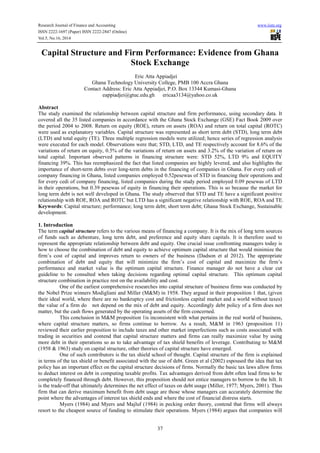
The study examined the relationship between capital structure and firm performance, using secondary data. It 
covered all the 35 listed companies in accordance with the Ghana Stock Exchange (GSE) Fact Book 2009 over 
the period 2004 to 2008. Return on equity (ROE), return on assets (ROA) and return on total capital (ROTC) 
were used as explanatory variables. Capital structure was represented as short term debt (STD), long term debt 
(LTD) and total equity (TE). Three multiple regression models were utilized; hence series of regression analysis 
were executed for each model. Observations were that; STD, LTD, and TE respectively account for 8.6% of the 
variations of return on equity, 0.5% of the variations of return on assets and 3.2% of the variation of return on 
total capital. Important observed patterns in financing structure were: STD 52%, LTD 9% and EQUITY 
financing 39%. This has reemphasized the fact that listed companies are highly levered, and also highlights the 
importance of short-term debts over long-term debts in the financing of companies in Ghana. For every cedi of 
company financing in Ghana, listed companies employed 0.52pesewas of STD in financing their operations and 
for every cedi of company financing, listed companies during the study period employed 0.09 pesewas of LTD 
in their operations, but 0.39 pesewas of equity in financing their operations. This is so because the market for 
long term debt is not well developed in Ghana. The study observed that STD and TE have a significant positive 
relationship with ROE, ROA and ROTC but LTD has a significant negative relationship with ROE, ROA and TE. 
Keywords: Capital structure; performance; long term debt; short term debt; Ghana Stock Exchange, Sustainable 
development. 
1. Introduction 
The term capital structure refers to the various means of financing a company. It is the mix of long term sources 
of funds such as debenture, long term debt, and preference and equity share capitals. It is therefore used to 
represent the appropriate relationship between debt and equity. One crucial issue confronting managers today is 
how to choose the combination of debt and equity to achieve optimum capital structure that would minimize the 
firm’s cost of capital and improves return to owners of the business (Dadson et al 2012). The appropriate 
combination of debt and equity that will minimize the firm’s cost of capital and maximize the firm’s 
performance and market value is the optimum capital structure. Finance manager do not have a clear cut 
guideline to be consulted when taking decisions regarding optimal capital structure. This optimum capital 
structure combination in practice rest on the availability and cost. 
One of the earliest comprehensive researches into capital structure of business firms was conducted by 
the Nobel Prize winners Modigliani and Miller (M&M) in 1958. They argued in their proposition 1 that, (given 
their ideal world, where there are no bankruptcy cost and frictionless capital market and a world without taxes) 
the value of a firm do not depend on the mix of debt and equity. Accordingly debt policy of a firm does not 
matter, but the cash flows generated by the operating assets of the firm concerned. 
This conclusion in M&M proposition 1is inconsistent with what pertains in the real world of business, 
where capital structure matters, so firms continue to borrow. As a result, M&M in 1963 (proposition 11) 
reviewed their earlier proposition to include taxes and other market imperfections such as costs associated with 
trading in securities and contend that capital structure matters and firms can really maximize value by using 
more debt in their operations so as to take advantage of tax shield benefits of leverage. Contributing to M&M 
(1958 & 1963) study on capital structure, other theories of capital structure have emerged. 
One of such contributors is the tax shield school of thought. Capital structure of the firm is explained 
in terms of the tax shield or benefit associated with the use of debt. Green et al (2002) espoused the idea that tax 
policy has an important effect on the capital structure decisions of firms. Normally the basic tax laws allow firms 
to deduct interest on debt in computing taxable profits. Tax advantages derived from debt often lead firms to be 
completely financed through debt. However, this proposition should not entice managers to borrow to the hilt. It 
is the trade-off that ultimately determines the net effect of taxes on debt usage (Miller, 1977; Myers, 2001). Thus 
firm that can derive maximum benefit from debt usage are those whose managers can accurately determine the 
point where the advantages of interest tax shield ends and where the cost of financial distress starts. 
Myers (1984) and Myers and Majluf (1984) in pecking order theory, contend that firms will always 
resort to the cheapest source of funding to stimulate their operations. Myers (1984) argues that companies will 
37
Research Journal of Finance and Accounting www.iiste.org 
ISSN 2222-1697 (Paper) ISSN 2222-2847 (Online) 
Vol.5, No.16, 2014 
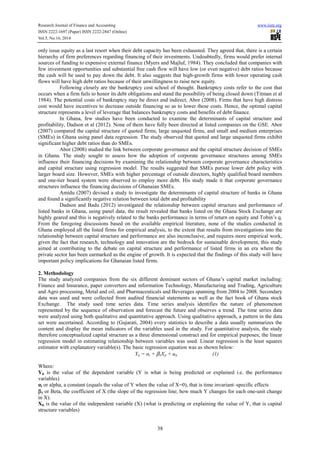
only issue equity as a last resort when their debt capacity has been exhausted. They agreed that, there is a certain 
hierarchy of firm preferences regarding financing of their investments. Undoubtedly, firms would prefer internal 
sources of funding to expensive external finance (Myers and Majluf, 1984). They concluded that companies with 
few investment opportunities and substantial free cash flow will have low (or even negative) debt ratios because 
the cash will be used to pay down the debt. It also suggests that high-growth firms with lower operating cash 
flows will have high debt ratios because of their unwillingness to raise new equity. 
Following closely are the bankruptcy cost school of thought. Bankruptcy costs refer to the cost that 
occurs when a firm fails to honor its debt obligations and stand the possibility of being closed down (Titman et al 
1984). The potential costs of bankruptcy may be direct and indirect, Abor (2008). Firms that have high distress 
cost would have incentives to decrease outside financing so as to lower these costs. Hence, the optimal capital 
structure represents a level of leverage that balances bankruptcy costs and benefits of debt finance. 
In Ghana, few studies have been conducted to examine the determinants of capital structure and 
profitability, Dadson et al (2012). None of them have fully been directed at listed companies on the GSE. Abor 
(2007) compared the capital structure of quoted firms, large unquoted firms, and small and medium enterprises 
(SMEs) in Ghana using panel data regression. The study observed that quoted and large unquoted firms exhibit 
significant higher debt ratios than do SMEs. 
Abor (2008) studied the link between corporate governance and the capital structure decision of SMEs 
in Ghana. The study sought to assess how the adoption of corporate governance structures among SMEs 
influence their financing decisions by examining the relationship between corporate governance characteristics 
and capital structure using regression model. The results suggested that SMEs pursue lower debt policy with 
larger board size. However, SMEs with higher percentage of outside directors, highly qualified board members 
and one-tier board system were observed to employ more debt. His study made it that corporate governance 
structures influence the financing decisions of Ghanaian SMEs. 
Amidu (2007) devised a study to investigate the determinants of capital structure of banks in Ghana 
and found a significantly negative relation between total debt and profitability 
Dadson and Badu (2012) investigated the relationship between capital structure and performance of 
listed banks in Ghana, using panel data, the result revealed that banks listed on the Ghana Stock Exchange are 
highly geared and this is negatively related to the banks performance in terms of return on equity and Tobin’s q. 
From the foregoing discussions based on the available empirical literature, none of the studies conducted in 
Ghana employed all the listed firms for empirical analysis, to the extent that results from investigations into the 
relationship between capital structure and performance are also inconclusive, and requires more empirical work, 
given the fact that research, technology and innovation are the bedrock for sustainable development, this study 
aimed at contributing to the debate on capital structure and performance of listed firms in an era where the 
private sector has been earmarked as the engine of growth. It is expected that the findings of this study will have 
important policy implications for Ghanaian listed firms. 
2. Methodology 
The study analyzed companies from the six different dominant sectors of Ghana’s capital market including: 
Finance and Insurance, paper converters and information Technology, Manufacturing and Trading, Agriculture 
and Agro processing, Metal and oil, and Pharmaceuticals and Beverages spanning from 2004 to 2008. Secondary 
data was used and were collected from audited financial statements as well as the fact book of Ghana stock 
Exchange. The study used time series data. Time series analysis identifies the nature of phenomenon 
represented by the sequence of observation and forecast the future and observes a trend. The time series data 
were analyzed using both qualitative and quantitative approach. Using qualitative approach, a pattern in the data 
set were ascertained. According to (Gujarati, 2004) every statistics to describe a data usually summarizes the 
content and display the mean indicators of the variables used in the study. For quantitative analysis, the study 
therefore conceptualized capital structure as a three dimensional construct and for empirical purposes; the linear 
regression model in estimating relationship between variables was used. Linear regression is the least squares 
estimator with explanatory variable(s). The basic regression equation was as shown below: 
Yit = αi + b1Xit + uit (1) 
Where: 
Yit is the value of the dependent variable (Y is what is being predicted or explained i.e. the performance 
variables) 
αi or alpha, a constant (equals the value of Y when the value of X=0), that is time invariant–specific effects 
b1 or Beta, the coefficient of X (the slope of the regression line; how much Y changes for each one-unit change 
in X). 
Xit is the value of the independent variable (X) (what is predicting or explaining the value of Y, that is capital 
structure variables) 
38
Research Journal of Finance and Accounting www.iiste.org 
ISSN 2222-1697 (Paper) ISSN 2222-2847 (Online) 
Vol.5, No.16, 2014 
Uit is the error term; the error in predicting the value of Y, given the value of X, or it’s a random disturbance (it 
is not displayed in most regression equations). 
The Modigliani and Miller (MM) model was adopted to serve as framework for the model development. 
They argued that capital structure was irrelevant in determining the firm’s value and its future performance. 
Modigliani and Miller (1963) showed that their model is no more effective if tax was taken into consideration 
since tax subsidies on debt interest payments will cause a rise in firm value when equity is traded for debt. 
Modigliani and Miller (1963) argued that the capital structure of a firm should compose entirely of debt due to 
tax deductions on interest payments. To this end the market value of a firm is given by: Equity + Debt = Value 
(i.e. E + D = V). The objective of the managers is the maximization of the firm’s value i.e. of its share price. 
Debt finance is cheaper than equity finance (rd < re), because equity is more risky than debt. Traditional theory 
postulated that if a firm substitute’s debt for equity, it will reduce its cost of capital so increasing the firm’s value 
is given by equation 2. 
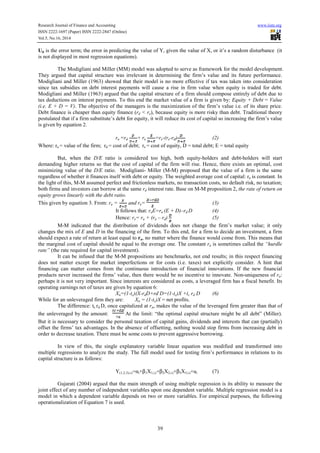
ra =rd + re =re-(re-rd) (2) 
Where: ra = value of the firm; rd = cost of debt; re = cost of equity, D = total debt; E = total equity 
But, when the D/E ratio is considered too high, both equity-holders and debt-holders will start 
demanding higher returns so that the cost of capital of the firm will rise. Hence, there exists an optimal, cost 
minimizing value of the D/E ratio. Modigliani- Miller (M-M) proposed that the value of a firm is the same 
regardless of whether it finances itself with debt or equity. The weighted average cost of capital: ra is constant. In 
the light of this, M-M assumed perfect and frictionless markets, no transaction costs, no default risk, no taxation; 
both firms and investors can borrow at the same rd interest rate. Base on M-M proposition 2, the rate of return on 
equity grows linearly with the debt ratio. 
This given by equation 3. From: ra = and re= (3) 
It follows that: reE=ra (E + D)–rd D (4) 
Hence: re= ra + (ra – rd) (5) 
M-M indicated that the distribution of dividends does not change the firm’s market value; it only 
changes the mix of E and D in the financing of the firm. To this end, for a firm to decide an investment, a firm 
should expect a rate of return at least equal to ra, no matter where the finance would come from. This means that 
the marginal cost of capital should be equal to the average one. The constant ra is sometimes called the “hurdle 
rate” (the rate required for capital investment). 
It can be infused that the M-M propositions are benchmarks, not end results; in this respect financing 
does not matter except for market imperfections or for costs (i.e. taxes) not explicitly consider. A hint that 
financing can matter comes from the continuous introduction of financial innovations. If the new financial 
products never increased the firms’ value, then there would be no incentive to innovate. Non-uniqueness of ra: 
perhaps it is not very important. Since interests are considered as costs, a leveraged firm has a fiscal benefit. Its 
operating earnings net of taxes are given by equation 6: 
Xn=(1-tc)(X-rdD+rd D=(1-tc)X +tc rd D (6) 
While for an unleveraged firm they are: Xn = (1-tc)X = net profits. 
The difference: tc rd D, once capitalized at ra, makes the value of the leveraged firm greater than that of 
the unleveraged by the amount: At the limit: “the optimal capital structure might be all debt” (Miller). 
But it is necessary to consider the personal taxation of capital gains, dividends and interests that can (partially) 
offset the firms’ tax advantages. In the absence of offsetting, nothing would stop firms from increasing debt in 
order to decrease taxation. There must be some costs to prevent aggressive borrowing. 
In view of this, the single explanatory variable linear equation was modified and transformed into 
multiple regressions to analyze the study. The full model used for testing firm’s performance in relations to its 
capital structure is as follows: 
Y(1,2,3),i,t=αi+b1X1,i,t+b2X2,i,t+b3X3,i,t+ui (7) 
Gujarati (2004) argued that the main strength of using multiple regression is its ability to measure the 
joint effect of any number of independent variables upon one dependent variable. Multiple regression model is a 
model in which a dependent variable depends on two or more variables. For empirical purposes, the following 
operationalization of Equation 7 is used. 
39
Research Journal of Finance and Accounting www.iiste.org 
ISSN 2222-1697 (Paper) ISSN 2222-2847 (Online) 
Vol.5, No.16, 2014 
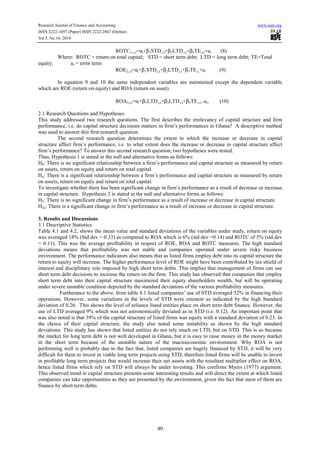
ROTC1,,i,t=αi+b1STD,i,t+b2LTD,i,t+b3TE,i,t+ui (8) 
Where: ROTC = return on total capital; STD = short term debt; LTD = long term debt; TE=Total 
40 
equity; ui = error term 
ROE2,i,t=αi+b1STD,i,t+b2LTD,i,t+b3TE,i,+ui (9) 
In equation 9 and 10 the same independent variables are maintained except the dependent variable 
which are ROE (return on equity) and ROA (return on asset). 
ROA3,i,t=αi+b1LTD,i,t+b2LTD,i,t+b3TE,i,t +ui, (10) 
2.1 Research Questions and Hypotheses 
This study addressed two research questions. The first describes the irrelevancy of capital structure and firm 
performance, i.e. do capital structure decisions matters in firm’s performances in Ghana? A descriptive method 
was used to answer this first research question. 
The second research question determines the extent to which the increase or decrease in capital 
structure affect firm’s performance, i.e. to what extent does the increase or decrease in capital structure affect 
firm’s performance? To answer this second research question, two hypotheses were tested. 
Thus, Hypothesis 1 is stated in the null and alternative forms as follows: 
H0: There is no significant relationship between a firm’s performance and capital structure as measured by return 
on assets, return on equity and return on total capital. 
Ha: There is a significant relationship between a firm’s performance and capital structure as measured by return 
on assets, return on equity and return on total capital. 
To investigate whether there has been significant change in firm’s performance as a result of decrease or increase 
in capital structure. Hypothesis 2 is stated in the null and alternative forms as follows: 
H2: There is no significant change in firm’s performance as a result of increase or decrease in capital structure. 
H2a: There is a significant change in firm’s performance as a result of increase or decrease in capital structure. 
3. Results and Discussions 
3.1 Descriptive Statistics 
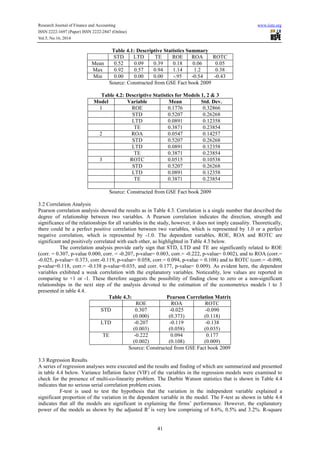
Table 4.1 and 4.2, shows the mean value and standard deviations of the variables under study, return on equity 
was averaged 18% (Std dev = 0.33) as compared to ROA which is 6% (std dev =0.14) and ROTC of 5% (std dev 
= 0.11). This was the average profitability in respect of ROE, ROA and ROTC measures. The high standard 
deviations means that profitability was not stable and companies operated under severe risky business 
environment. The performance indicators also means that as listed firms employ debt into its capital structure the 
return to equity will increase. The higher performance level of ROE might have been contributed by tax shield of 
interest and disciplinary role imposed by high short term debts. This implies that management of firms can use 
short term debt decisions to increase the return on the firm. This study has observed that companies that employ 
short term debt into their capital structure maximized their equity shareholders wealth, but will be operating 
under severe unstable condition depicted by the standard deviations of the various profitability measures. 
Furtherance to the above, from table 4.1 listed companies’ use of STD averaged 52% in financing their 
operations. However, some variations in the levels of STD were eminent as indicated by the high Standard 
deviation of 0.26. This shows the level of reliance listed entities place on short term debt finance. However, the 
use of LTD averaged 9% which was not astronomically deviated as in STD (i.e. 0.12). An important point that 
was also noted is that 39% of the capital structure of listed firms was equity with a standard deviation of 0.23. In 
the choice of their capital structure, the study also noted some instability as shown by the high standard 
deviations. This study has shown that listed entities do not rely much on LTD, but on STD. This is so because 
the market for long term debt is not well developed in Ghana, but it is easy to raise money in the money market 
in the short term because of the unstable nature of the macroeconomic environment. Why ROA is not 
performing well is probably due to the fact that, listed companies are hugely financed by STD, it will be very 
difficult for them to invest in viable long term projects using STD, therefore listed firms will be unable to invest 
in profitable long term projects that would increase their net assets with the resultant multiplier effect on ROA, 
hence listed firms which rely on STD will always be under investing. This confirms Myers (1977) argument. 
This observed trend in capital structure presents some interesting results and will direct the extent at which listed 
companies can take opportunities as they are presented by the environment, given the fact that most of them are 
finance by short term debts.
Research Journal of Finance and Accounting www.iiste.org 
ISSN 2222-1697 (Paper) ISSN 2222-2847 (Online) 
Vol.5, No.16, 2014 
Table 4.1: Descriptive Statistics Summary 
STD LTD TE ROE ROA ROTC 
Mean 0.52 0.09 0.39 0.18 0.06 0.05 
Max 0.92 0.57 0.94 1.14 1.2 0.38 
Min 0.00 0.00 0.00 -.95 -0.54 -0.43 
Source: Constructed from GSE Fact book 2009 
Table 4.2: Descriptive Statistics for Models 1, 2 & 3 
Model Variable Mean Std. Dev. 
1 ROE 0.1776 0.32866 
STD 0.5207 0.26268 
LTD 0.0891 0.12358 
TE 0.3871 0.23854 
2 ROA 0.0547 0.14257 
STD 0.5207 0.26268 
LTD 0.0891 0.12358 
TE 0.3871 0.23854 
3 ROTC 0.0515 0.10538 
STD 0.5207 0.26268 
LTD 0.0891 0.12358 
TE 0.3871 0.23854 
Source: Constructed from GSE Fact book 2009 
3.2 Correlation Analysis 
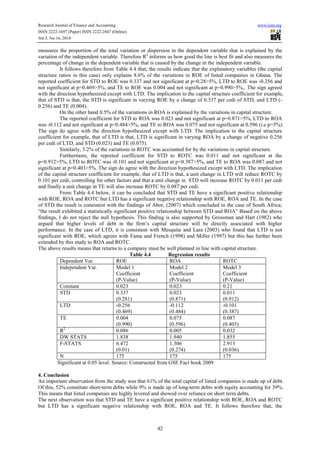
Pearson correlation analysis showed the results as in Table 4.3. Correlation is a single number that described the 
degree of relationship between two variables. A Pearson correlation indicates the direction, strength and 
significance of the relationships for all variables in the study, however, it does not imply causality. Theoretically, 
there could be a perfect positive correlation between two variables, which is represented by 1.0 or a perfect 
negative correlation, which is represented by -1.0. The dependent variables, ROE, ROA and ROTC are 
significant and positively correlated with each other, as highlighted in Table 4.3 below. 
The correlation analysis provide early sign that STD, LTD and TE are significantly related to ROE 
(corr. = 0.307, p-value 0.000, corr. = -0.207, p-value= 0.003, corr.= -0.222, p-value= 0.002), and to ROA (corr.= 
-0.025, p-value= 0.373, corr.-0.119, p-value= 0.058, corr.= 0.094, p-value = 0.108) and to ROTC (corr.= -0.090, 
p-value=0.118, corr.= -0.138 p-value=0.035, and corr. 0.177, p-value= 0.009). As evident here, the dependent 
variables exhibited a weak correlation with the explanatory variables. Noticeably, low values are reported in 
comparing to +1 or -1. These therefore suggests the possibility of finding close to zero or a non-significant 
relationships in the next step of the analysis devoted to the estimation of the econometrics models l to 3 
presented in table 4.4. 
Table 4.3: Pearson Correlation Matrix 
ROE ROA ROTC 
41 
STD 0.307 
(0.000) 
-0.025 
(0.373) 
-0.090 
(0.118) 
LTD -0.207 
(0.003) 
-0.119 
(0.058) 
-0.138 
(0.035) 
TE -0.222 
(0.002) 
0.094 
(0.108) 
0.177 
(0.009) 
Source: Constructed from GSE Fact book 2009 
3.3 Regression Results 
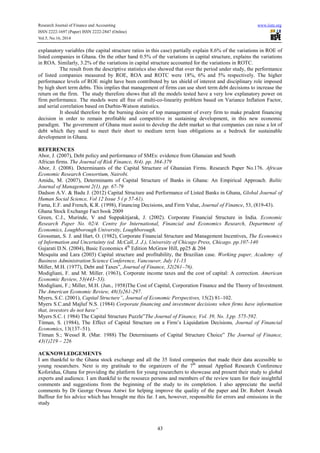
A series of regression analyses were executed and the results and finding of which are summarized and presented 
in table 4.4 below. Variance Inflation factor (VIF) of the variables in the regression models were examined to 
check for the presence of multi-co-linearity problem. The Durbin Watson statistics that is shown in Table 4.4 
indicates that no serious serial correlation problem exists. 
F-test is used to test the hypothesis that the variation in the independent variable explained a 
significant proportion of the variation in the dependent variable in the model. The F-test as shown in table 4.4 
indicates that all the models are significant in explaining the firms’ performance. However, the explanatory 
power of the models as shown by the adjusted R2 is very low comprising of 8.6%, 0.5% and 3.2%. R-square
Research Journal of Finance and Accounting www.iiste.org 
ISSN 2222-1697 (Paper) ISSN 2222-2847 (Online) 
Vol.5, No.16, 2014 
measures the proportion of the total variation or dispersion in the dependent variable that is explained by the 
variation of the independent variable. Therefore R2 informs us how good the line is best fit and also measures the 
percentage of change in the dependent variable that is caused by the change in the independent variable. 
It follows therefore from Table 4.4 that; the results indicate that the explanatory variables (the capital 
structure ratios in this case) only explains 8.6% of the variations in ROE of listed companies in Ghana. The 
reported coefficient for STD to ROE was 0.337 and not significant at p=0.28>5%, LTD to ROE was -0.256 and 
not significant at p=0.469>5%, and TE to ROE was 0.004 and not significant at p=0.990>5%,. The sign agreed 
with the direction hypothesized except with LTD. The implication to the capital structure coefficient for example, 
that of STD is that, the STD is significant in varying ROE by a change of 0.337 per cedi of STD, and LTD (- 
0.256) and TE (0.004). 
On the other hand 0.5% of the variations in ROA is explained by the variations in capital structure. 
The reported coefficient for STD to ROA was 0.023 and not significant at p=0.871>5%, LTD to ROA 
was -0.112 and not significant at p=0.484>5%, and TE to ROA was 0.075 and not significant at 0.596 (i.e p>5%). 
The sign do agree with the direction hypothesized except with LTD. The implication to the capital structure 
coefficient for example, that of LTD is that, LTD is significant in varying ROA by a change of negative 0.256 
per cedi of LTD, and STD (0.023) and TE (0.075). 
Similarly, 3.2% of the variations in ROTC was accounted for by the variations in capital structure. 
Furthermore, the reported coefficient for STD to ROTC was 0.011 and not significant at the 
p=0.912>5%, LTD to ROTC was -0.101 and not significant at p=0.387>5%, and TE to ROA was 0.087 and not 
significant at p=0.403>5%. The sign do agree with the direction hypothesized except with LTD. The implication 
of the capital structure coefficient for example, that of LTD is that, a unit change in LTD will reduce ROTC by 
0.101 per cedi, controlling for other factors and that a unit change in STD will increase ROTC by 0.011 per cedi 
and finally a unit change in TE will also increase ROTC by 0.087 per cedi. 
From Table 4.4 below, it can be concluded that STD and TE have a significant positive relationship 
with ROE, ROA and ROTC but LTD has a significant negative relationship with ROE, ROA and TE. In the case 
of STD the result is consistent with the findings of Abor, (2007) which concluded in the case of South Africa; 
“the result exhibited a statistically significant positive relationship between STD and ROA” Based on the above 
findings, I do not reject the null hypothesis. This finding is also supported by Grossman and Hart (1982) who 
argued that higher levels of debt in the firm’s capital structure will be directly associated with higher 
performance. In the case of LTD, it is consistent with Mesquita and Lara (2003) who found that LTD is not 
significant with ROE, which agrees with Fama and French (1998) and Miller (1997) but this has further been 
extended by this study to ROA and ROTC. 
The above results means that returns to a company must be well planned in line with capital structure. 
Table 4.4 Regression results 
Dependent Var. ROE ROA ROTC 
Independent Var. Model 1 
42 
Coefficient 
(P-Value) 
Model 2 
Coefficient 
(P-Value) 
Model 3 
Coefficient 
(P-Value) 
Constant 0.023 0.023 0.21 
STD 0.337 
(0.281) 
0.023 
(0.871) 
0.011 
(0.912) 
LTD -0.256 
(0.469) 
-0.112 
(0.484) 
-0.101 
(0.387) 
TE 0.004 
(0.990) 
0.075 
(0.596) 
0.087 
(0.403) 
R2 0.086 0.005 0.032 
DW STATS 1.838 1.940 1.855 
F-STATS 6.472 
(0.01) 
1.306 
(0.274) 
2.913 
(0.036) 
N 175 175 175 
Significant at 0.05 level. Source: Constructed from GSE Fact book 2009 
4. Conclusion 
An important observation from the study was that 61% of the total capital of listed companies is made up of debt. 
Of this, 52% constitute short-term debts while 9% is made up of long-term debts with equity accounting for 39%. 
This means that listed companies are highly levered and showed over reliance on short term debts. 
The next observation was that STD and TE have a significant positive relationship with ROE, ROA and ROTC 
but LTD has a significant negative relationship with ROE, ROA and TE. It follows therefore that, the
Research Journal of Finance and Accounting www.iiste.org 
ISSN 2222-1697 (Paper) ISSN 2222-2847 (Online) 
Vol.5, No.16, 2014 
explanatory variables (the capital structure ratios in this case) partially explain 8.6% of the variations in ROE of 
listed companies in Ghana. On the other hand 0.5% of the variations in capital structure, explains the variations 
in ROA. Similarly, 3.2% of the variations in capital structure accounted for the variations in ROTC. 
The result from the descriptive statistics also showed that over the period under study, the performance 
of listed companies measured by ROE, ROA and ROTC were 18%, 6% and 5% respectively. The higher 
performance levels of ROE might have been contributed by tax shield of interest and disciplinary role imposed 
by high short term debts. This implies that management of firms can use short term debt decisions to increase the 
return on the firm. The study therefore shows that all the models tested have a very low explanatory power on 
firm performance. The models were all free of multi-co-linearity problem based on Variance Inflation Factor, 
and serial correlation based on Durbin-Watson statistics. 
It should therefore be the burning desire of top management of every firm to make prudent financing 
decision in order to remain profitable and competitive in sustaining development, in this new economic 
paradigm. The government of Ghana must assist to develop the debt market so that companies can raise a lot of 
debt which they need to meet their short to medium term loan obligations as a bedrock for sustainable 
development in Ghana. 
REFERENCES 
Abor, J. (2007), Debt policy and performance of SMEs: evidence from Ghanaian and South 
African firms. The Journal of Risk Finance, 8(4). pp. 364-379 
Abor, J. (2008). Determinants of the Capital Structure of Ghanaian Firms. Research Paper No.176. African 
Economic Research Consortium, Nairobi. 
Amidu, M. (2007), Determinants of Capital Structure of Banks in Ghana: An Empirical Approach. Baltic 
Journal of Management 2(1). pp. 67-79 
Dadson A.V. & Badu J. (2012) Capital Structure and Performance of Listed Banks in Ghana, Global Journal of 
Human Social Science, Vol 12 Issue 5 ( p 57-61). 
Fama, E.F. and French, K.R. (1998), Financing Decisions, and Firm Value, Journal of Finance, 53, (819-43). 
Ghana Stock Exchange Fact book 2009 
Green, C.J., Murinde, V and Suppakitjarak, J. (2002). Corporate Financial Structure in India. Economic 
Research Paper No. 02/4. Centre for International, Financial and Economics Research, Department of 
Economics, Loughborough University, Loughborough. 
Grossman, S. J. and Hart, O. (1982), Corporate Financial Structure and Management Incentives, The Economics 
of Information and Uncertainty (ed. McCall, J. J.), University of Chicago Press, Chicago. pp.107-140 
Gujarati D.N. (2004), Basic Economics 4th Edition McGraw Hill, pp25 & 204 
Mesquita and Lara (2003) Capital structure and profitability, the Brazilian case. Working paper, Academy of 
Business Administration Science Conference, Vancouver, July 11-13 
Miller, M.H. (1977), Debt and Taxes”, Journal of Finance, 32(261–76). 
Modigliani, F. and M. Miller. (1963), Corporate income taxes and the cost of capital: A correction. American 
Economic Review, 53(443–53). 
Modigliani, F.; Miller, M.H. (Jun., 1958)The Cost of Capital, Corporation Finance and the Theory of Investment. 
The American Economic Review, 48(3)261-297. 
Myers, S.C. (2001), Capital Structure”, Journal of Economic Perspectives, 15(2) 81–102. 
Myers S.C.and Majluf N.S. (1984) Corporate financing and investment decisions when firms have information 
that, investors do not have” 
Myers S.C. ( 1984) The Capital Structure Puzzle”The Journal of Finance, Vol. 39, No. 3,pp. 575-592. 
Titman, S. (1984), The Effect of Capital Structure on a Firm’s Liquidation Decisions, Journal of Financial 
Economics, 13(137–51). 
Titman S.; Wessel R. (Mar. 1988) The Determinants of Capital Structure Choice” The Journal of Finance, 
43(1)219 – 226 
ACKNOWLEDGEMENTS 
I am thankful to the Ghana stock exchange and all the 35 listed companies that made their data accessible to 
young researchers. Next is my gratitude to the organizers of the 7th annual Applied Research Conference 
Koforidua, Ghana for providing the platform for young researchers to showcase and present their study to global 
experts and audience. I am thankful to the resource persons and members of the review team for their insightful 
comments and suggestions from the beginning of the study to its completion. I also appreciate the useful 
comments by Dr George Owusu Antwi for helping improve the quality of the paper and Dr. Robert Awuah 
Baffour for his advice which has brought me this far. I am, however, responsible for errors and omissions in the 
study 
43
The IISTE is a pioneer in the Open-Access hosting service and academic event 
management. The aim of the firm is Accelerating Global Knowledge Sharing. 
More information about the firm can be found on the homepage: 
http://www.iiste.org 
CALL FOR JOURNAL PAPERS 
There are more than 30 peer-reviewed academic journals hosted under the hosting 
platform. 
Prospective authors of journals can find the submission instruction on the 
following page: http://www.iiste.org/journals/ All the journals articles are available 
online to the readers all over the world without financial, legal, or technical barriers 
other than those inseparable from gaining access to the internet itself. Paper version 
of the journals is also available upon request of readers and authors. 
MORE RESOURCES 
Book publication information: http://www.iiste.org/book/ 
IISTE Knowledge Sharing Partners 
EBSCO, Index Copernicus, Ulrich's Periodicals Directory, JournalTOCS, PKP Open 
Archives Harvester, Bielefeld Academic Search Engine, Elektronische 
Zeitschriftenbibliothek EZB, Open J-Gate, OCLC WorldCat, Universe Digtial 
Library , NewJour, Google Scholar

Capital structure and firm performance

  • 1.
    Research Journal ofFinance and Accounting www.iiste.org ISSN 2222-1697 (Paper) ISSN 2222-2847 (Online) Vol.5, No.16, 2014 Capital Structure and Firm Performance: Evidence from Ghana Stock Exchange Eric Atta Appiadjei Ghana Technology University College, PMB 100 Accra Ghana Contact Address: Eric Atta Appiadjei, P.O. Box 13344 Kumasi-Ghana eappiadjei@gtuc.edu.gh ericaa3134@yahoo.co.uk Abstract The study examined the relationship between capital structure and firm performance, using secondary data. It covered all the 35 listed companies in accordance with the Ghana Stock Exchange (GSE) Fact Book 2009 over the period 2004 to 2008. Return on equity (ROE), return on assets (ROA) and return on total capital (ROTC) were used as explanatory variables. Capital structure was represented as short term debt (STD), long term debt (LTD) and total equity (TE). Three multiple regression models were utilized; hence series of regression analysis were executed for each model. Observations were that; STD, LTD, and TE respectively account for 8.6% of the variations of return on equity, 0.5% of the variations of return on assets and 3.2% of the variation of return on total capital. Important observed patterns in financing structure were: STD 52%, LTD 9% and EQUITY financing 39%. This has reemphasized the fact that listed companies are highly levered, and also highlights the importance of short-term debts over long-term debts in the financing of companies in Ghana. For every cedi of company financing in Ghana, listed companies employed 0.52pesewas of STD in financing their operations and for every cedi of company financing, listed companies during the study period employed 0.09 pesewas of LTD in their operations, but 0.39 pesewas of equity in financing their operations. This is so because the market for long term debt is not well developed in Ghana. The study observed that STD and TE have a significant positive relationship with ROE, ROA and ROTC but LTD has a significant negative relationship with ROE, ROA and TE. Keywords: Capital structure; performance; long term debt; short term debt; Ghana Stock Exchange, Sustainable development. 1. Introduction The term capital structure refers to the various means of financing a company. It is the mix of long term sources of funds such as debenture, long term debt, and preference and equity share capitals. It is therefore used to represent the appropriate relationship between debt and equity. One crucial issue confronting managers today is how to choose the combination of debt and equity to achieve optimum capital structure that would minimize the firm’s cost of capital and improves return to owners of the business (Dadson et al 2012). The appropriate combination of debt and equity that will minimize the firm’s cost of capital and maximize the firm’s performance and market value is the optimum capital structure. Finance manager do not have a clear cut guideline to be consulted when taking decisions regarding optimal capital structure. This optimum capital structure combination in practice rest on the availability and cost. One of the earliest comprehensive researches into capital structure of business firms was conducted by the Nobel Prize winners Modigliani and Miller (M&M) in 1958. They argued in their proposition 1 that, (given their ideal world, where there are no bankruptcy cost and frictionless capital market and a world without taxes) the value of a firm do not depend on the mix of debt and equity. Accordingly debt policy of a firm does not matter, but the cash flows generated by the operating assets of the firm concerned. This conclusion in M&M proposition 1is inconsistent with what pertains in the real world of business, where capital structure matters, so firms continue to borrow. As a result, M&M in 1963 (proposition 11) reviewed their earlier proposition to include taxes and other market imperfections such as costs associated with trading in securities and contend that capital structure matters and firms can really maximize value by using more debt in their operations so as to take advantage of tax shield benefits of leverage. Contributing to M&M (1958 & 1963) study on capital structure, other theories of capital structure have emerged. One of such contributors is the tax shield school of thought. Capital structure of the firm is explained in terms of the tax shield or benefit associated with the use of debt. Green et al (2002) espoused the idea that tax policy has an important effect on the capital structure decisions of firms. Normally the basic tax laws allow firms to deduct interest on debt in computing taxable profits. Tax advantages derived from debt often lead firms to be completely financed through debt. However, this proposition should not entice managers to borrow to the hilt. It is the trade-off that ultimately determines the net effect of taxes on debt usage (Miller, 1977; Myers, 2001). Thus firm that can derive maximum benefit from debt usage are those whose managers can accurately determine the point where the advantages of interest tax shield ends and where the cost of financial distress starts. Myers (1984) and Myers and Majluf (1984) in pecking order theory, contend that firms will always resort to the cheapest source of funding to stimulate their operations. Myers (1984) argues that companies will 37
  • 2.
    Research Journal ofFinance and Accounting www.iiste.org ISSN 2222-1697 (Paper) ISSN 2222-2847 (Online) Vol.5, No.16, 2014 only issue equity as a last resort when their debt capacity has been exhausted. They agreed that, there is a certain hierarchy of firm preferences regarding financing of their investments. Undoubtedly, firms would prefer internal sources of funding to expensive external finance (Myers and Majluf, 1984). They concluded that companies with few investment opportunities and substantial free cash flow will have low (or even negative) debt ratios because the cash will be used to pay down the debt. It also suggests that high-growth firms with lower operating cash flows will have high debt ratios because of their unwillingness to raise new equity. Following closely are the bankruptcy cost school of thought. Bankruptcy costs refer to the cost that occurs when a firm fails to honor its debt obligations and stand the possibility of being closed down (Titman et al 1984). The potential costs of bankruptcy may be direct and indirect, Abor (2008). Firms that have high distress cost would have incentives to decrease outside financing so as to lower these costs. Hence, the optimal capital structure represents a level of leverage that balances bankruptcy costs and benefits of debt finance. In Ghana, few studies have been conducted to examine the determinants of capital structure and profitability, Dadson et al (2012). None of them have fully been directed at listed companies on the GSE. Abor (2007) compared the capital structure of quoted firms, large unquoted firms, and small and medium enterprises (SMEs) in Ghana using panel data regression. The study observed that quoted and large unquoted firms exhibit significant higher debt ratios than do SMEs. Abor (2008) studied the link between corporate governance and the capital structure decision of SMEs in Ghana. The study sought to assess how the adoption of corporate governance structures among SMEs influence their financing decisions by examining the relationship between corporate governance characteristics and capital structure using regression model. The results suggested that SMEs pursue lower debt policy with larger board size. However, SMEs with higher percentage of outside directors, highly qualified board members and one-tier board system were observed to employ more debt. His study made it that corporate governance structures influence the financing decisions of Ghanaian SMEs. Amidu (2007) devised a study to investigate the determinants of capital structure of banks in Ghana and found a significantly negative relation between total debt and profitability Dadson and Badu (2012) investigated the relationship between capital structure and performance of listed banks in Ghana, using panel data, the result revealed that banks listed on the Ghana Stock Exchange are highly geared and this is negatively related to the banks performance in terms of return on equity and Tobin’s q. From the foregoing discussions based on the available empirical literature, none of the studies conducted in Ghana employed all the listed firms for empirical analysis, to the extent that results from investigations into the relationship between capital structure and performance are also inconclusive, and requires more empirical work, given the fact that research, technology and innovation are the bedrock for sustainable development, this study aimed at contributing to the debate on capital structure and performance of listed firms in an era where the private sector has been earmarked as the engine of growth. It is expected that the findings of this study will have important policy implications for Ghanaian listed firms. 2. Methodology The study analyzed companies from the six different dominant sectors of Ghana’s capital market including: Finance and Insurance, paper converters and information Technology, Manufacturing and Trading, Agriculture and Agro processing, Metal and oil, and Pharmaceuticals and Beverages spanning from 2004 to 2008. Secondary data was used and were collected from audited financial statements as well as the fact book of Ghana stock Exchange. The study used time series data. Time series analysis identifies the nature of phenomenon represented by the sequence of observation and forecast the future and observes a trend. The time series data were analyzed using both qualitative and quantitative approach. Using qualitative approach, a pattern in the data set were ascertained. According to (Gujarati, 2004) every statistics to describe a data usually summarizes the content and display the mean indicators of the variables used in the study. For quantitative analysis, the study therefore conceptualized capital structure as a three dimensional construct and for empirical purposes; the linear regression model in estimating relationship between variables was used. Linear regression is the least squares estimator with explanatory variable(s). The basic regression equation was as shown below: Yit = αi + b1Xit + uit (1) Where: Yit is the value of the dependent variable (Y is what is being predicted or explained i.e. the performance variables) αi or alpha, a constant (equals the value of Y when the value of X=0), that is time invariant–specific effects b1 or Beta, the coefficient of X (the slope of the regression line; how much Y changes for each one-unit change in X). Xit is the value of the independent variable (X) (what is predicting or explaining the value of Y, that is capital structure variables) 38
  • 3.
    Research Journal ofFinance and Accounting www.iiste.org ISSN 2222-1697 (Paper) ISSN 2222-2847 (Online) Vol.5, No.16, 2014 Uit is the error term; the error in predicting the value of Y, given the value of X, or it’s a random disturbance (it is not displayed in most regression equations). The Modigliani and Miller (MM) model was adopted to serve as framework for the model development. They argued that capital structure was irrelevant in determining the firm’s value and its future performance. Modigliani and Miller (1963) showed that their model is no more effective if tax was taken into consideration since tax subsidies on debt interest payments will cause a rise in firm value when equity is traded for debt. Modigliani and Miller (1963) argued that the capital structure of a firm should compose entirely of debt due to tax deductions on interest payments. To this end the market value of a firm is given by: Equity + Debt = Value (i.e. E + D = V). The objective of the managers is the maximization of the firm’s value i.e. of its share price. Debt finance is cheaper than equity finance (rd < re), because equity is more risky than debt. Traditional theory postulated that if a firm substitute’s debt for equity, it will reduce its cost of capital so increasing the firm’s value is given by equation 2. ra =rd + re =re-(re-rd) (2) Where: ra = value of the firm; rd = cost of debt; re = cost of equity, D = total debt; E = total equity But, when the D/E ratio is considered too high, both equity-holders and debt-holders will start demanding higher returns so that the cost of capital of the firm will rise. Hence, there exists an optimal, cost minimizing value of the D/E ratio. Modigliani- Miller (M-M) proposed that the value of a firm is the same regardless of whether it finances itself with debt or equity. The weighted average cost of capital: ra is constant. In the light of this, M-M assumed perfect and frictionless markets, no transaction costs, no default risk, no taxation; both firms and investors can borrow at the same rd interest rate. Base on M-M proposition 2, the rate of return on equity grows linearly with the debt ratio. This given by equation 3. From: ra = and re= (3) It follows that: reE=ra (E + D)–rd D (4) Hence: re= ra + (ra – rd) (5) M-M indicated that the distribution of dividends does not change the firm’s market value; it only changes the mix of E and D in the financing of the firm. To this end, for a firm to decide an investment, a firm should expect a rate of return at least equal to ra, no matter where the finance would come from. This means that the marginal cost of capital should be equal to the average one. The constant ra is sometimes called the “hurdle rate” (the rate required for capital investment). It can be infused that the M-M propositions are benchmarks, not end results; in this respect financing does not matter except for market imperfections or for costs (i.e. taxes) not explicitly consider. A hint that financing can matter comes from the continuous introduction of financial innovations. If the new financial products never increased the firms’ value, then there would be no incentive to innovate. Non-uniqueness of ra: perhaps it is not very important. Since interests are considered as costs, a leveraged firm has a fiscal benefit. Its operating earnings net of taxes are given by equation 6: Xn=(1-tc)(X-rdD+rd D=(1-tc)X +tc rd D (6) While for an unleveraged firm they are: Xn = (1-tc)X = net profits. The difference: tc rd D, once capitalized at ra, makes the value of the leveraged firm greater than that of the unleveraged by the amount: At the limit: “the optimal capital structure might be all debt” (Miller). But it is necessary to consider the personal taxation of capital gains, dividends and interests that can (partially) offset the firms’ tax advantages. In the absence of offsetting, nothing would stop firms from increasing debt in order to decrease taxation. There must be some costs to prevent aggressive borrowing. In view of this, the single explanatory variable linear equation was modified and transformed into multiple regressions to analyze the study. The full model used for testing firm’s performance in relations to its capital structure is as follows: Y(1,2,3),i,t=αi+b1X1,i,t+b2X2,i,t+b3X3,i,t+ui (7) Gujarati (2004) argued that the main strength of using multiple regression is its ability to measure the joint effect of any number of independent variables upon one dependent variable. Multiple regression model is a model in which a dependent variable depends on two or more variables. For empirical purposes, the following operationalization of Equation 7 is used. 39
  • 4.
    Research Journal ofFinance and Accounting www.iiste.org ISSN 2222-1697 (Paper) ISSN 2222-2847 (Online) Vol.5, No.16, 2014 ROTC1,,i,t=αi+b1STD,i,t+b2LTD,i,t+b3TE,i,t+ui (8) Where: ROTC = return on total capital; STD = short term debt; LTD = long term debt; TE=Total 40 equity; ui = error term ROE2,i,t=αi+b1STD,i,t+b2LTD,i,t+b3TE,i,+ui (9) In equation 9 and 10 the same independent variables are maintained except the dependent variable which are ROE (return on equity) and ROA (return on asset). ROA3,i,t=αi+b1LTD,i,t+b2LTD,i,t+b3TE,i,t +ui, (10) 2.1 Research Questions and Hypotheses This study addressed two research questions. The first describes the irrelevancy of capital structure and firm performance, i.e. do capital structure decisions matters in firm’s performances in Ghana? A descriptive method was used to answer this first research question. The second research question determines the extent to which the increase or decrease in capital structure affect firm’s performance, i.e. to what extent does the increase or decrease in capital structure affect firm’s performance? To answer this second research question, two hypotheses were tested. Thus, Hypothesis 1 is stated in the null and alternative forms as follows: H0: There is no significant relationship between a firm’s performance and capital structure as measured by return on assets, return on equity and return on total capital. Ha: There is a significant relationship between a firm’s performance and capital structure as measured by return on assets, return on equity and return on total capital. To investigate whether there has been significant change in firm’s performance as a result of decrease or increase in capital structure. Hypothesis 2 is stated in the null and alternative forms as follows: H2: There is no significant change in firm’s performance as a result of increase or decrease in capital structure. H2a: There is a significant change in firm’s performance as a result of increase or decrease in capital structure. 3. Results and Discussions 3.1 Descriptive Statistics Table 4.1 and 4.2, shows the mean value and standard deviations of the variables under study, return on equity was averaged 18% (Std dev = 0.33) as compared to ROA which is 6% (std dev =0.14) and ROTC of 5% (std dev = 0.11). This was the average profitability in respect of ROE, ROA and ROTC measures. The high standard deviations means that profitability was not stable and companies operated under severe risky business environment. The performance indicators also means that as listed firms employ debt into its capital structure the return to equity will increase. The higher performance level of ROE might have been contributed by tax shield of interest and disciplinary role imposed by high short term debts. This implies that management of firms can use short term debt decisions to increase the return on the firm. This study has observed that companies that employ short term debt into their capital structure maximized their equity shareholders wealth, but will be operating under severe unstable condition depicted by the standard deviations of the various profitability measures. Furtherance to the above, from table 4.1 listed companies’ use of STD averaged 52% in financing their operations. However, some variations in the levels of STD were eminent as indicated by the high Standard deviation of 0.26. This shows the level of reliance listed entities place on short term debt finance. However, the use of LTD averaged 9% which was not astronomically deviated as in STD (i.e. 0.12). An important point that was also noted is that 39% of the capital structure of listed firms was equity with a standard deviation of 0.23. In the choice of their capital structure, the study also noted some instability as shown by the high standard deviations. This study has shown that listed entities do not rely much on LTD, but on STD. This is so because the market for long term debt is not well developed in Ghana, but it is easy to raise money in the money market in the short term because of the unstable nature of the macroeconomic environment. Why ROA is not performing well is probably due to the fact that, listed companies are hugely financed by STD, it will be very difficult for them to invest in viable long term projects using STD, therefore listed firms will be unable to invest in profitable long term projects that would increase their net assets with the resultant multiplier effect on ROA, hence listed firms which rely on STD will always be under investing. This confirms Myers (1977) argument. This observed trend in capital structure presents some interesting results and will direct the extent at which listed companies can take opportunities as they are presented by the environment, given the fact that most of them are finance by short term debts.
  • 5.
    Research Journal ofFinance and Accounting www.iiste.org ISSN 2222-1697 (Paper) ISSN 2222-2847 (Online) Vol.5, No.16, 2014 Table 4.1: Descriptive Statistics Summary STD LTD TE ROE ROA ROTC Mean 0.52 0.09 0.39 0.18 0.06 0.05 Max 0.92 0.57 0.94 1.14 1.2 0.38 Min 0.00 0.00 0.00 -.95 -0.54 -0.43 Source: Constructed from GSE Fact book 2009 Table 4.2: Descriptive Statistics for Models 1, 2 & 3 Model Variable Mean Std. Dev. 1 ROE 0.1776 0.32866 STD 0.5207 0.26268 LTD 0.0891 0.12358 TE 0.3871 0.23854 2 ROA 0.0547 0.14257 STD 0.5207 0.26268 LTD 0.0891 0.12358 TE 0.3871 0.23854 3 ROTC 0.0515 0.10538 STD 0.5207 0.26268 LTD 0.0891 0.12358 TE 0.3871 0.23854 Source: Constructed from GSE Fact book 2009 3.2 Correlation Analysis Pearson correlation analysis showed the results as in Table 4.3. Correlation is a single number that described the degree of relationship between two variables. A Pearson correlation indicates the direction, strength and significance of the relationships for all variables in the study, however, it does not imply causality. Theoretically, there could be a perfect positive correlation between two variables, which is represented by 1.0 or a perfect negative correlation, which is represented by -1.0. The dependent variables, ROE, ROA and ROTC are significant and positively correlated with each other, as highlighted in Table 4.3 below. The correlation analysis provide early sign that STD, LTD and TE are significantly related to ROE (corr. = 0.307, p-value 0.000, corr. = -0.207, p-value= 0.003, corr.= -0.222, p-value= 0.002), and to ROA (corr.= -0.025, p-value= 0.373, corr.-0.119, p-value= 0.058, corr.= 0.094, p-value = 0.108) and to ROTC (corr.= -0.090, p-value=0.118, corr.= -0.138 p-value=0.035, and corr. 0.177, p-value= 0.009). As evident here, the dependent variables exhibited a weak correlation with the explanatory variables. Noticeably, low values are reported in comparing to +1 or -1. These therefore suggests the possibility of finding close to zero or a non-significant relationships in the next step of the analysis devoted to the estimation of the econometrics models l to 3 presented in table 4.4. Table 4.3: Pearson Correlation Matrix ROE ROA ROTC 41 STD 0.307 (0.000) -0.025 (0.373) -0.090 (0.118) LTD -0.207 (0.003) -0.119 (0.058) -0.138 (0.035) TE -0.222 (0.002) 0.094 (0.108) 0.177 (0.009) Source: Constructed from GSE Fact book 2009 3.3 Regression Results A series of regression analyses were executed and the results and finding of which are summarized and presented in table 4.4 below. Variance Inflation factor (VIF) of the variables in the regression models were examined to check for the presence of multi-co-linearity problem. The Durbin Watson statistics that is shown in Table 4.4 indicates that no serious serial correlation problem exists. F-test is used to test the hypothesis that the variation in the independent variable explained a significant proportion of the variation in the dependent variable in the model. The F-test as shown in table 4.4 indicates that all the models are significant in explaining the firms’ performance. However, the explanatory power of the models as shown by the adjusted R2 is very low comprising of 8.6%, 0.5% and 3.2%. R-square
  • 6.
    Research Journal ofFinance and Accounting www.iiste.org ISSN 2222-1697 (Paper) ISSN 2222-2847 (Online) Vol.5, No.16, 2014 measures the proportion of the total variation or dispersion in the dependent variable that is explained by the variation of the independent variable. Therefore R2 informs us how good the line is best fit and also measures the percentage of change in the dependent variable that is caused by the change in the independent variable. It follows therefore from Table 4.4 that; the results indicate that the explanatory variables (the capital structure ratios in this case) only explains 8.6% of the variations in ROE of listed companies in Ghana. The reported coefficient for STD to ROE was 0.337 and not significant at p=0.28>5%, LTD to ROE was -0.256 and not significant at p=0.469>5%, and TE to ROE was 0.004 and not significant at p=0.990>5%,. The sign agreed with the direction hypothesized except with LTD. The implication to the capital structure coefficient for example, that of STD is that, the STD is significant in varying ROE by a change of 0.337 per cedi of STD, and LTD (- 0.256) and TE (0.004). On the other hand 0.5% of the variations in ROA is explained by the variations in capital structure. The reported coefficient for STD to ROA was 0.023 and not significant at p=0.871>5%, LTD to ROA was -0.112 and not significant at p=0.484>5%, and TE to ROA was 0.075 and not significant at 0.596 (i.e p>5%). The sign do agree with the direction hypothesized except with LTD. The implication to the capital structure coefficient for example, that of LTD is that, LTD is significant in varying ROA by a change of negative 0.256 per cedi of LTD, and STD (0.023) and TE (0.075). Similarly, 3.2% of the variations in ROTC was accounted for by the variations in capital structure. Furthermore, the reported coefficient for STD to ROTC was 0.011 and not significant at the p=0.912>5%, LTD to ROTC was -0.101 and not significant at p=0.387>5%, and TE to ROA was 0.087 and not significant at p=0.403>5%. The sign do agree with the direction hypothesized except with LTD. The implication of the capital structure coefficient for example, that of LTD is that, a unit change in LTD will reduce ROTC by 0.101 per cedi, controlling for other factors and that a unit change in STD will increase ROTC by 0.011 per cedi and finally a unit change in TE will also increase ROTC by 0.087 per cedi. From Table 4.4 below, it can be concluded that STD and TE have a significant positive relationship with ROE, ROA and ROTC but LTD has a significant negative relationship with ROE, ROA and TE. In the case of STD the result is consistent with the findings of Abor, (2007) which concluded in the case of South Africa; “the result exhibited a statistically significant positive relationship between STD and ROA” Based on the above findings, I do not reject the null hypothesis. This finding is also supported by Grossman and Hart (1982) who argued that higher levels of debt in the firm’s capital structure will be directly associated with higher performance. In the case of LTD, it is consistent with Mesquita and Lara (2003) who found that LTD is not significant with ROE, which agrees with Fama and French (1998) and Miller (1997) but this has further been extended by this study to ROA and ROTC. The above results means that returns to a company must be well planned in line with capital structure. Table 4.4 Regression results Dependent Var. ROE ROA ROTC Independent Var. Model 1 42 Coefficient (P-Value) Model 2 Coefficient (P-Value) Model 3 Coefficient (P-Value) Constant 0.023 0.023 0.21 STD 0.337 (0.281) 0.023 (0.871) 0.011 (0.912) LTD -0.256 (0.469) -0.112 (0.484) -0.101 (0.387) TE 0.004 (0.990) 0.075 (0.596) 0.087 (0.403) R2 0.086 0.005 0.032 DW STATS 1.838 1.940 1.855 F-STATS 6.472 (0.01) 1.306 (0.274) 2.913 (0.036) N 175 175 175 Significant at 0.05 level. Source: Constructed from GSE Fact book 2009 4. Conclusion An important observation from the study was that 61% of the total capital of listed companies is made up of debt. Of this, 52% constitute short-term debts while 9% is made up of long-term debts with equity accounting for 39%. This means that listed companies are highly levered and showed over reliance on short term debts. The next observation was that STD and TE have a significant positive relationship with ROE, ROA and ROTC but LTD has a significant negative relationship with ROE, ROA and TE. It follows therefore that, the
  • 7.
    Research Journal ofFinance and Accounting www.iiste.org ISSN 2222-1697 (Paper) ISSN 2222-2847 (Online) Vol.5, No.16, 2014 explanatory variables (the capital structure ratios in this case) partially explain 8.6% of the variations in ROE of listed companies in Ghana. On the other hand 0.5% of the variations in capital structure, explains the variations in ROA. Similarly, 3.2% of the variations in capital structure accounted for the variations in ROTC. The result from the descriptive statistics also showed that over the period under study, the performance of listed companies measured by ROE, ROA and ROTC were 18%, 6% and 5% respectively. The higher performance levels of ROE might have been contributed by tax shield of interest and disciplinary role imposed by high short term debts. This implies that management of firms can use short term debt decisions to increase the return on the firm. The study therefore shows that all the models tested have a very low explanatory power on firm performance. The models were all free of multi-co-linearity problem based on Variance Inflation Factor, and serial correlation based on Durbin-Watson statistics. It should therefore be the burning desire of top management of every firm to make prudent financing decision in order to remain profitable and competitive in sustaining development, in this new economic paradigm. The government of Ghana must assist to develop the debt market so that companies can raise a lot of debt which they need to meet their short to medium term loan obligations as a bedrock for sustainable development in Ghana. REFERENCES Abor, J. (2007), Debt policy and performance of SMEs: evidence from Ghanaian and South African firms. The Journal of Risk Finance, 8(4). pp. 364-379 Abor, J. (2008). Determinants of the Capital Structure of Ghanaian Firms. Research Paper No.176. African Economic Research Consortium, Nairobi. Amidu, M. (2007), Determinants of Capital Structure of Banks in Ghana: An Empirical Approach. Baltic Journal of Management 2(1). pp. 67-79 Dadson A.V. & Badu J. (2012) Capital Structure and Performance of Listed Banks in Ghana, Global Journal of Human Social Science, Vol 12 Issue 5 ( p 57-61). Fama, E.F. and French, K.R. (1998), Financing Decisions, and Firm Value, Journal of Finance, 53, (819-43). Ghana Stock Exchange Fact book 2009 Green, C.J., Murinde, V and Suppakitjarak, J. (2002). Corporate Financial Structure in India. Economic Research Paper No. 02/4. Centre for International, Financial and Economics Research, Department of Economics, Loughborough University, Loughborough. Grossman, S. J. and Hart, O. (1982), Corporate Financial Structure and Management Incentives, The Economics of Information and Uncertainty (ed. McCall, J. J.), University of Chicago Press, Chicago. pp.107-140 Gujarati D.N. (2004), Basic Economics 4th Edition McGraw Hill, pp25 & 204 Mesquita and Lara (2003) Capital structure and profitability, the Brazilian case. Working paper, Academy of Business Administration Science Conference, Vancouver, July 11-13 Miller, M.H. (1977), Debt and Taxes”, Journal of Finance, 32(261–76). Modigliani, F. and M. Miller. (1963), Corporate income taxes and the cost of capital: A correction. American Economic Review, 53(443–53). Modigliani, F.; Miller, M.H. (Jun., 1958)The Cost of Capital, Corporation Finance and the Theory of Investment. The American Economic Review, 48(3)261-297. Myers, S.C. (2001), Capital Structure”, Journal of Economic Perspectives, 15(2) 81–102. Myers S.C.and Majluf N.S. (1984) Corporate financing and investment decisions when firms have information that, investors do not have” Myers S.C. ( 1984) The Capital Structure Puzzle”The Journal of Finance, Vol. 39, No. 3,pp. 575-592. Titman, S. (1984), The Effect of Capital Structure on a Firm’s Liquidation Decisions, Journal of Financial Economics, 13(137–51). Titman S.; Wessel R. (Mar. 1988) The Determinants of Capital Structure Choice” The Journal of Finance, 43(1)219 – 226 ACKNOWLEDGEMENTS I am thankful to the Ghana stock exchange and all the 35 listed companies that made their data accessible to young researchers. Next is my gratitude to the organizers of the 7th annual Applied Research Conference Koforidua, Ghana for providing the platform for young researchers to showcase and present their study to global experts and audience. I am thankful to the resource persons and members of the review team for their insightful comments and suggestions from the beginning of the study to its completion. I also appreciate the useful comments by Dr George Owusu Antwi for helping improve the quality of the paper and Dr. Robert Awuah Baffour for his advice which has brought me this far. I am, however, responsible for errors and omissions in the study 43
  • 8.
    The IISTE isa pioneer in the Open-Access hosting service and academic event management. The aim of the firm is Accelerating Global Knowledge Sharing. More information about the firm can be found on the homepage: http://www.iiste.org CALL FOR JOURNAL PAPERS There are more than 30 peer-reviewed academic journals hosted under the hosting platform. Prospective authors of journals can find the submission instruction on the following page: http://www.iiste.org/journals/ All the journals articles are available online to the readers all over the world without financial, legal, or technical barriers other than those inseparable from gaining access to the internet itself. Paper version of the journals is also available upon request of readers and authors. MORE RESOURCES Book publication information: http://www.iiste.org/book/ IISTE Knowledge Sharing Partners EBSCO, Index Copernicus, Ulrich's Periodicals Directory, JournalTOCS, PKP Open Archives Harvester, Bielefeld Academic Search Engine, Elektronische Zeitschriftenbibliothek EZB, Open J-Gate, OCLC WorldCat, Universe Digtial Library , NewJour, Google Scholar