Capacity
Development
in Fragile
Contexts
Challenges and
Opportunities
• Fragility and its
characteristics
• Comparing conventional
L&D and Fragility
• Our experience in World
Vision Somalia
• Available space for
innovations
Outline
WHO WE ARE
World Vision is a Christian relief, development and
advocacy organisation dedicated to working with
children, families and communities to overcome poverty
and injustice. Inspired by our Christian values, we are
dedicated to working with the World’s most vulnerable
people. We serve all people regardless of religion, race,
ethnicity or gender.
OUR OPERATIONS
• 15 districts in Somaliland, Puntland and South West &
Juba land.
• Working with partners in the Global Fund TB, Somalia
Resilience Programme (SomReP) and WFP.
• Sectors - health, nutrition, resilience & livelihoods,
child protection, shelter & WASH.
World Vision Int. Somalia
Background
Capacity building has varying
perspectives. In this session, we shall
focus on staff capacity building –
specifically, learning and development.
While this session may present new
ideas, my key intention is to trigger a
discussion on L&D in fragility with an
aim of coming up with greater ideas.
Fragility and
Fragile contexts
Common characteristics in fragility:
• States are unwilling or unable to provide
an enabling environment e.g. education.
• Social, political & economic characteristics
- poor governance, violence, repression,
corruption, inequality and exclusion,
• Fluid and transient actors
• Acute, longstanding humanitarian needs
• Predominantly short, grant funded projects
Fragility in
numbers
• 2 billion (30% of the World’s
Populations) live in Fragile context
• By 2030, 46% of global poor will be living
in fragile contexts (up from 17% today)
• 80% of all humanitarian needs are in fragile
contexts (particularly conflict affected).
• 30% of Official Development Assistance
(ODA) is spent in fragile and conflict-
affected contexts.
• Basic governance transformations may take
20-40 years.
Crop
Price
Crash
Refugee
influx
Terrorist
Attack
Failed
Election
Disaster
stabilityeconomic
turnaround
economic
stagnation
aid
effort
Relief >> Recovery >>
Development
Crisis
Often Fragile contexts are described in a linear framework like this:
When in reality, fragile contexts tend to be much more
unpredictable:
UNDERSTANDING FRAGILE CONTEXTS
Conventional Learning and
Development
Analysis
Design
Development
Implementatio
n
Evaluation
Innovations
• Technology, LMSs,
Course authoring tools
• New delivery methods
e.g. Flipped classroom.
• Democratization of
knowledge.
What affects L&D in
Fragile Context?
• Fluidity and transience of staff: will they sit
through a 6 – 12 months leadership development
program?
• Urgent humanitarian needs: will there be time
for a 10 days, in-person training amidst the
humanitarian emergencies?
• Characteristics of humanitarian aid grants: do
they provide space for learning and
development?
• Subject Matter Experts: Do we have sufficient
local SMEs in Fragile contexts or do we have to
outsource? What are the pros and cons of this?
L&D in Fragile Context
With the context in mind, how can L&D
better adapt for sustained impact?
Technology &
“Quick-bites”
learning
programs
Capacity
development
pipeline not
courses
Looking
outwards
A go-to place
KM system
In-house SMEs
Capacity
development
for local staff
Innovations in WV Somalia
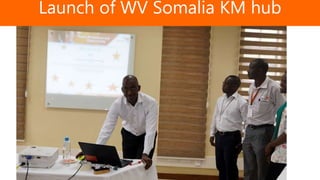
Launch of WV Somalia KM hub
Space for
innovation
• Macro level
• Stir conversations about L&D in Fragile
Contexts
• Inter agency collaboration in L&D
• Fragile-context sensitive funding models
that accommodate L&D
• Micro level
• SAM not ADDIE
• “Quick-bites” type of learning programs
• Engrain learning to work
• Capitalize on shared knowledge
• Identify and support the go-to places
for staff
• Reinforce key behaviours
Successive Approximation Model

Capacity development in fragile contexts

  • 1.
  • 2.
    • Fragility andits characteristics • Comparing conventional L&D and Fragility • Our experience in World Vision Somalia • Available space for innovations Outline
  • 3.
    WHO WE ARE WorldVision is a Christian relief, development and advocacy organisation dedicated to working with children, families and communities to overcome poverty and injustice. Inspired by our Christian values, we are dedicated to working with the World’s most vulnerable people. We serve all people regardless of religion, race, ethnicity or gender. OUR OPERATIONS • 15 districts in Somaliland, Puntland and South West & Juba land. • Working with partners in the Global Fund TB, Somalia Resilience Programme (SomReP) and WFP. • Sectors - health, nutrition, resilience & livelihoods, child protection, shelter & WASH. World Vision Int. Somalia
  • 4.
    Background Capacity building hasvarying perspectives. In this session, we shall focus on staff capacity building – specifically, learning and development. While this session may present new ideas, my key intention is to trigger a discussion on L&D in fragility with an aim of coming up with greater ideas.
  • 5.
    Fragility and Fragile contexts Commoncharacteristics in fragility: • States are unwilling or unable to provide an enabling environment e.g. education. • Social, political & economic characteristics - poor governance, violence, repression, corruption, inequality and exclusion, • Fluid and transient actors • Acute, longstanding humanitarian needs • Predominantly short, grant funded projects
  • 6.
    Fragility in numbers • 2billion (30% of the World’s Populations) live in Fragile context • By 2030, 46% of global poor will be living in fragile contexts (up from 17% today) • 80% of all humanitarian needs are in fragile contexts (particularly conflict affected). • 30% of Official Development Assistance (ODA) is spent in fragile and conflict- affected contexts. • Basic governance transformations may take 20-40 years.
  • 7.
    Crop Price Crash Refugee influx Terrorist Attack Failed Election Disaster stabilityeconomic turnaround economic stagnation aid effort Relief >> Recovery>> Development Crisis Often Fragile contexts are described in a linear framework like this: When in reality, fragile contexts tend to be much more unpredictable: UNDERSTANDING FRAGILE CONTEXTS
  • 8.
    Conventional Learning and Development Analysis Design Development Implementatio n Evaluation Innovations •Technology, LMSs, Course authoring tools • New delivery methods e.g. Flipped classroom. • Democratization of knowledge.
  • 9.
    What affects L&Din Fragile Context? • Fluidity and transience of staff: will they sit through a 6 – 12 months leadership development program? • Urgent humanitarian needs: will there be time for a 10 days, in-person training amidst the humanitarian emergencies? • Characteristics of humanitarian aid grants: do they provide space for learning and development? • Subject Matter Experts: Do we have sufficient local SMEs in Fragile contexts or do we have to outsource? What are the pros and cons of this?
  • 10.
    L&D in FragileContext With the context in mind, how can L&D better adapt for sustained impact?
  • 11.
    Technology & “Quick-bites” learning programs Capacity development pipeline not courses Looking outwards Ago-to place KM system In-house SMEs Capacity development for local staff Innovations in WV Somalia
  • 12.
    Launch of WVSomalia KM hub
  • 13.
    Space for innovation • Macrolevel • Stir conversations about L&D in Fragile Contexts • Inter agency collaboration in L&D • Fragile-context sensitive funding models that accommodate L&D • Micro level • SAM not ADDIE • “Quick-bites” type of learning programs • Engrain learning to work • Capitalize on shared knowledge • Identify and support the go-to places for staff • Reinforce key behaviours
  • 14.

Editor's Notes

  • #6 Funding goes to humanitarian aid not “tertiary needs” e.g. L&D. Thought leaders in the Humanitarian and Development arena are yet to agree on the definitions of Fragility and fragile contexts
  • #7 http://www.worldbank.org/en/topic/fragilityconflictviolence/overview https://www.pbsbdialogue.org/media/filer_public/07/69/07692de0-3557-494e-918e-18df00e9ef73/the_new_deal.pdf These details are important as they show the urgency, extent and complexity of humanitarian work. For example, the global humanitarian need for 2014 alone amounted to roughly $25 billion - http://www3.weforum.org/docs/GAC16_Responsible_Investment_Fragile_Context.pdf
  • #9 ADDIE – Is linear and systematic. Do fragile contexts work in the same way? Probably not. There is need to come up with a more responsive, dynamic training design model. Successive Approximation Model could be an option is an option. Considering examples such as the 1970 military-developed ADDIE model, Adult Learning Principles, Kirk Patrick training evaluation framework among others, there are prescribed ways of designing, delivering, delivering and evaluating learning programs. In 2009 - 93 hours to develop an hour of a basic e-learning training IN 2017 - 42 hours for a similar learning program in 2017 (Defelice 2017) https://www.td.org/insights/how-long-does-it-take-to-develop-one-hour-of-training-updated-for-2017 (This is 5 days of 8 hours each to come up with one hour of an e-learning course) 12 hours basic e-learning course would thus require over 2 months of design and development. Just how much happens in fragile contexts over a period of 2 months? Will the data from the Analysis stage hold relevant? Will the envisioned training design still make sense?
  • #10 There are programs designed for fragile contexts but how learning happens (or is affected) by fragility is not adequately explored…
  • #11 Use the card given. NB: Fragile contexts are on the increase.
  • #12 Looking outwards – partnering with other L&D experts. Looking at L&D from a system perspective i.e. WV Somalia L&D as part of the wider humanitarian space. Capacity development pipeline not courses Technology Moodle and Mobile learning app (under development) Knowledge management system – refined, on-time resources for decision making. Formalizing mentoring and coaching In-house SMEs who take centre stage in design and development of learning programs through Successive Approximation Model not ADDIE
  • #14 Learning design time (2009) - 93 hours per hour of a basic e-learning. In 2017, 42 hours. This translates to about 5 days of 8 hours each to come up with one hour of an e-learning course. 12 hours basic e-learning course would thus require over 2 months of design and development. Just how much happens in fragile contexts over a period of 2 months? Will the data from the Analysis stage hold relevant? Will the envisioned training design still make sense? https://www.td.org/insights/4-questions-to-ask-before-providing-training - JD Dillon. http://www.worldbank.org/en/events/2018/01/11/fragility-forum-2018#4 There is a World Bank organized forum on Fragility – in the topics, there is nothing on capacity building!!!!! NB: Major donors, who fund The New Deal – Country Owned and Country Led. FIELD and ToT Programs
  • #15 SAM – It allows continuous development of resources as implementation takes place. http://www.alleninteractions.com/sam-process