NEW ZEALAND CANCER REGISTRY

      DATA DICTIONARY

         Version 2.0
        October 2008
NZCR Data Dictionary                                                                            Front Pages


Reproduction of material
The Ministry of Health (‘the Ministry’) permits the reproduction of material from this publication without
prior notification, providing all the following conditions are met: the information must not be used for
commercial gain, must not be distorted or changed, and the Ministry must be acknowledged as the
source.
Disclaimer
The Ministry of Health gives no indemnity as to the correctness of the information or data supplied. The
Ministry of Health shall not be liable for any loss or damage arising directly or indirectly from the supply
of this publication.
All care has been taken in the preparation of this publication. The data presented was deemed to be
accurate at the time of publication, but may be subject to change. It is advisable to check for updates to
this publication on the Ministry’s web site at http://www.moh.govt.nz.
Reporting environments
Reporting environments such as Business Objects and data extracts will not necessarily contain all data
described in this Data Dictionary.
Publications
A complete list of the Ministry’s publications is available from Ministry of Health, PO Box 5013,
Wellington, or on the Ministy’s web site.
Any enquiries about or comments on this publication should be directed to:
Information Services Statistics and Reporting
Sector Services
Information Directorate
Ministry of Health
PO Box 5013
Wellington
Phone: (04) 922 1800 Fax: (04) 922-1899
Email: publications@moh.govt.nz


Published by the Ministry of Health
© 2008, Ministry of Health


Version: 2.0                                 Ministry of Health
October 2008
NZCR Data Dictionary                                                             Front Pages


Introduction

Objectives             The objectives of the Ministry of Health (‘the Ministry’) Data
                       Dictionaries are to:
                       •   describe the information available within the National
                           Collections
                       •   promote uniformity, availability and consistency across the
                           National Collections
                       •   support the use of nationally agreed protocols and standards
                           wherever possible
                       •   promote national standard definitions and make them
                           available to users.
                       It is hoped that the greater level of detail along with clear
                       definitions of the business rules around each element will assist
                       with providing and using the data.
Audiences              The target audiences for Data Dictionaries are data providers,
                       software developers, and data users.

Format                 All data element definitions in the Data Dictionaries are presented
                       in a format based on the Australian Institute of Health and Welfare
                       National Health Data Dictionary. This dictionary is based on the
                       ISO/IEC Standard 11179 Specification and Standardization of Data
                       Elements—the international standard for defining data elements
                       issued by the International Organization for Standardization and
                       the International Electrotechnical Commission.
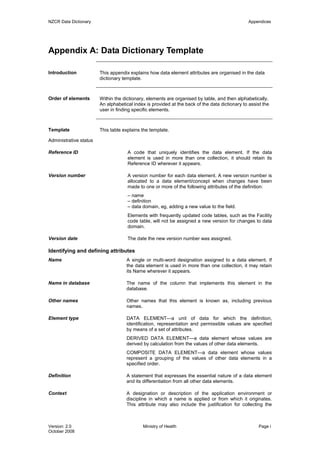
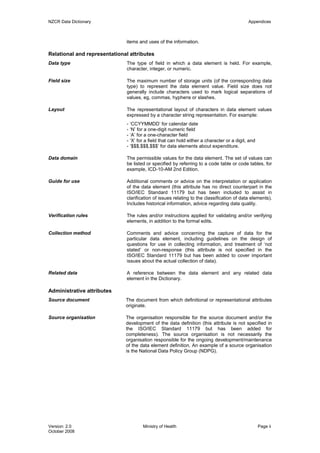
                       The format is described in detail in Appendix A of this dictionary.


Version: 2.0                  Ministry of Health
October 2008
NZCR Data Dictionary                                                                                                                        Front Pages


Table of Contents
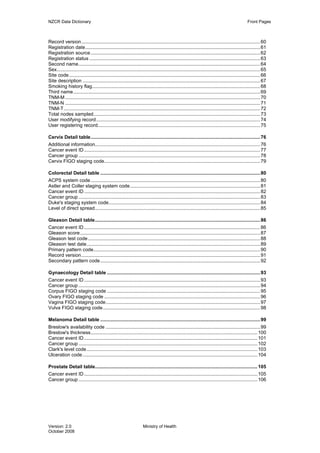
New Zealand Cancer Registry (NZCR) ............................................................................ front pages

Breast Detail table............................................................................................................................... 1
Cancer event ID .................................................................................................................................... 1
Cancer group ........................................................................................................................................ 2
ER status .............................................................................................................................................. 3
Her2 status............................................................................................................................................ 4
Her2 test type........................................................................................................................................ 5
Histopathology code ............................................................................................................................. 6
Lymphovascular invasion flag ............................................................................................................... 7
Multicentric or multifocal tumour flag..................................................................................................... 8
Positive sentinel nodes ......................................................................................................................... 9
PR status ............................................................................................................................................ 10
Resection margin ................................................................................................................................ 11
Sentinel nodes sampled...................................................................................................................... 12
Size of tumour..................................................................................................................................... 13

Cancer Event table............................................................................................................................ 14
Address city/town................................................................................................................................ 14
Address country .................................................................................................................................. 15
Address date....................................................................................................................................... 16
Address street line 1 ........................................................................................................................... 17
Address street line 2 ........................................................................................................................... 18
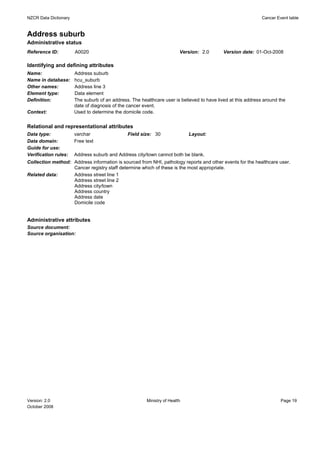
Address suburb................................................................................................................................... 19
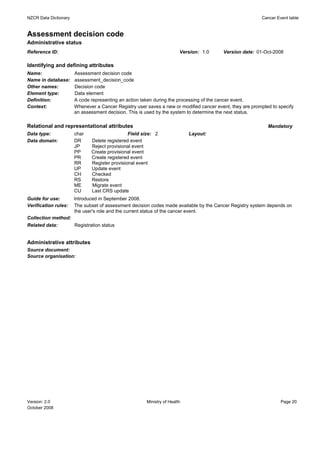
Assessment decision code.................................................................................................................. 20
Basis of diagnosis code ...................................................................................................................... 21
Behaviour code ................................................................................................................................... 22
Cancer comments............................................................................................................................... 23
Cancer event ID .................................................................................................................................. 24
Cancer group ...................................................................................................................................... 25
Clinical code version ........................................................................................................................... 26
Clinical notes....................................................................................................................................... 27
Clinician name .................................................................................................................................... 28
Coding review flag .............................................................................................................................. 29
Country of birth code........................................................................................................................... 30
Country of diagnosis code................................................................................................................... 31
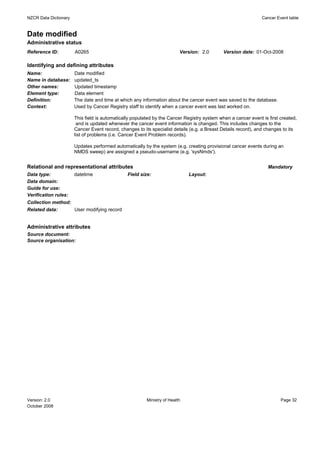
Date modified...................................................................................................................................... 32
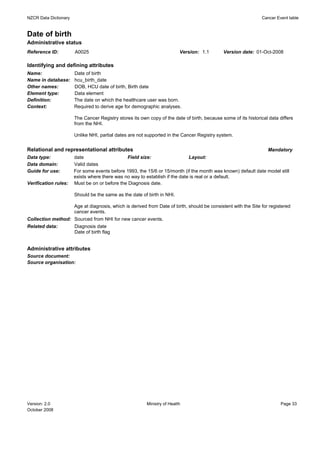
Date of birth ........................................................................................................................................ 33
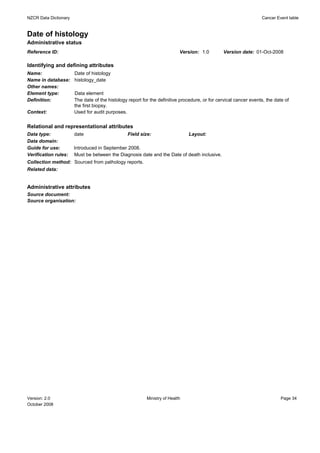
Date of histology ................................................................................................................................. 34
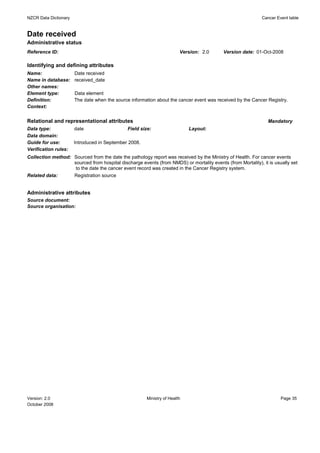
Date received...................................................................................................................................... 35
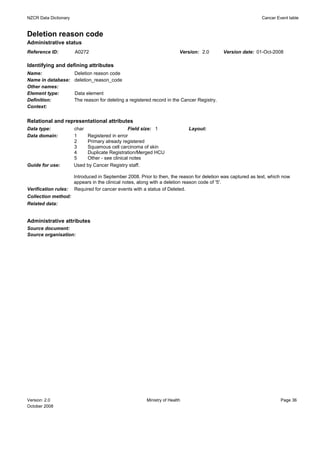
Deletion reason code .......................................................................................................................... 36
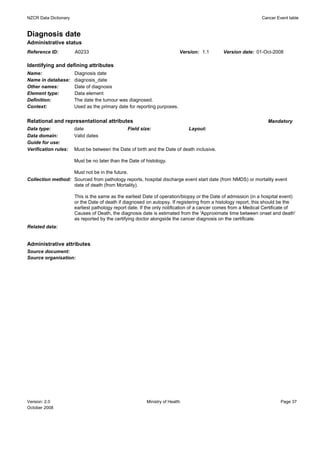
Diagnosis date .................................................................................................................................... 37
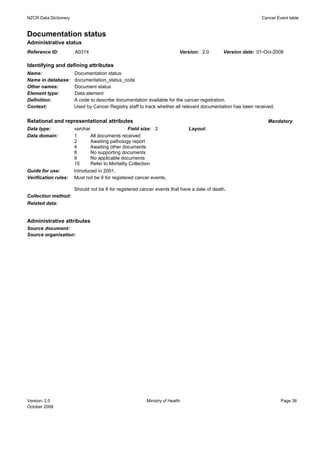
Documentation status ......................................................................................................................... 38
Domicile code ..................................................................................................................................... 39
Extent of disease code........................................................................................................................ 41
Facility code ........................................................................................................................................ 42
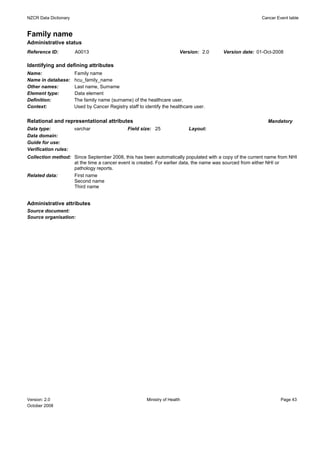
Family name ....................................................................................................................................... 43
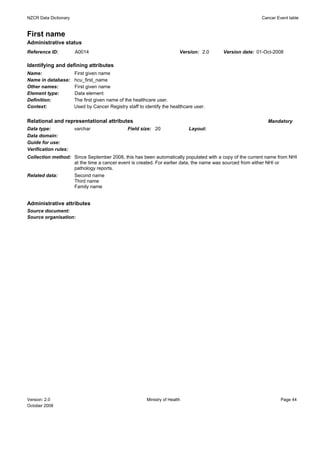
First name ........................................................................................................................................... 44
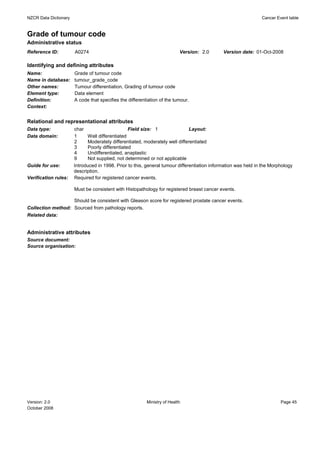
Grade of tumour code ......................................................................................................................... 45
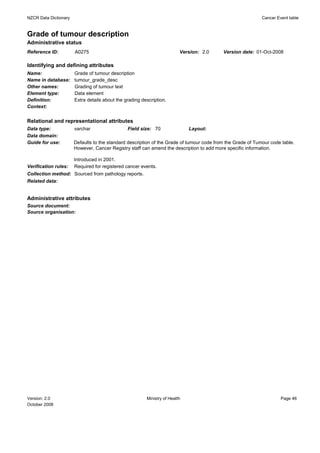
Grade of tumour description................................................................................................................ 46
HCU ID................................................................................................................................................ 47
ICD9 site code .................................................................................................................................... 48
Laboratory code .................................................................................................................................. 49
Laterality code..................................................................................................................................... 50
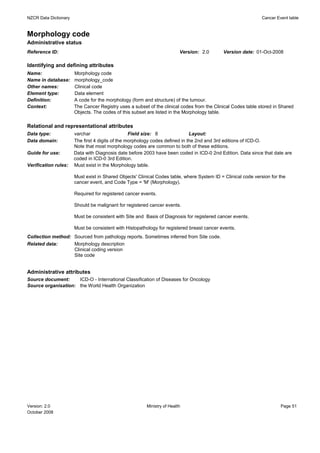
Morphology code ................................................................................................................................ 51
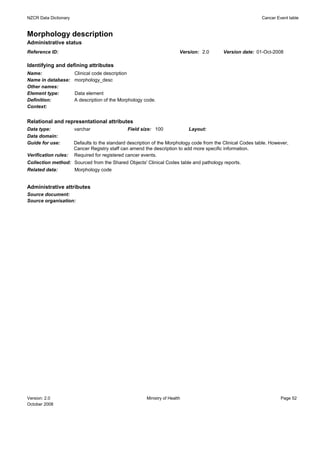
Morphology description ....................................................................................................................... 52
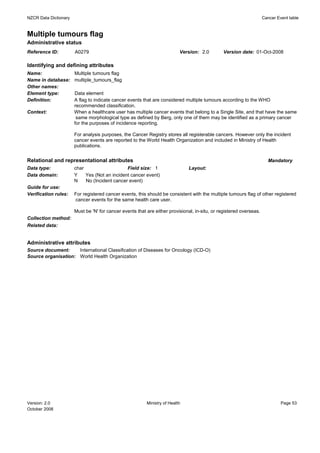
Multiple tumours flag........................................................................................................................... 53
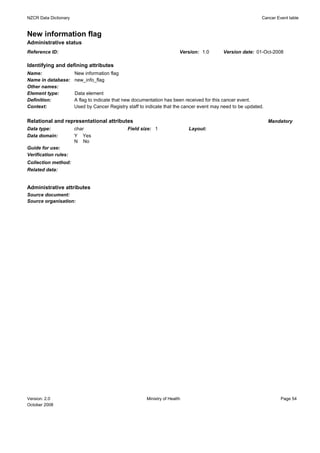
New information flag ........................................................................................................................... 54
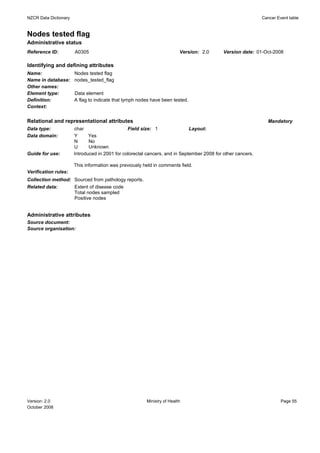
Nodes tested flag ................................................................................................................................ 55
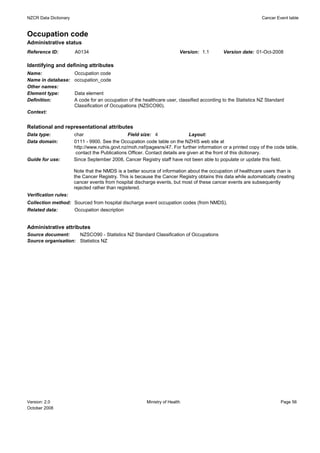
Occupation code ................................................................................................................................. 56
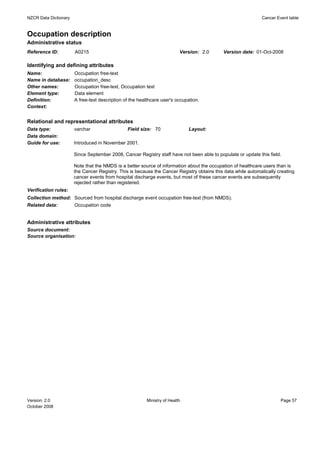
Occupation description........................................................................................................................ 57
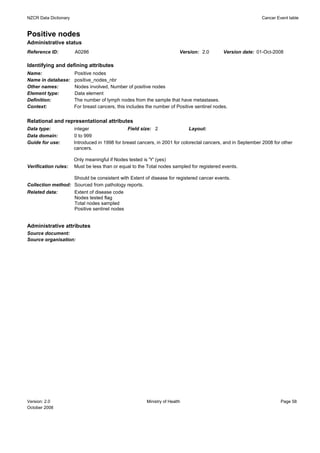
Positive nodes..................................................................................................................................... 58
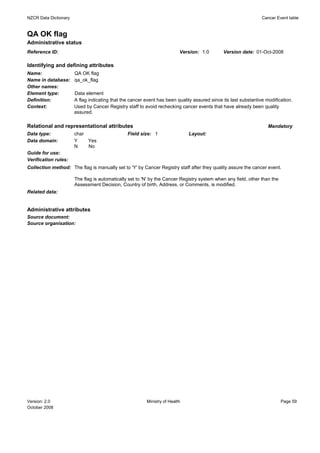
QA OK flag.......................................................................................................................................... 59


Version: 2.0                                                      Ministry of Health
October 2008
NZCR Data Dictionary                                                                                                                          Front Pages


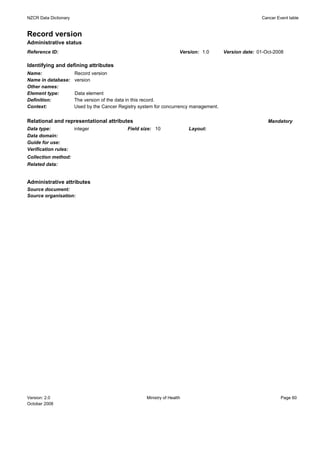
Record version.................................................................................................................................... 60
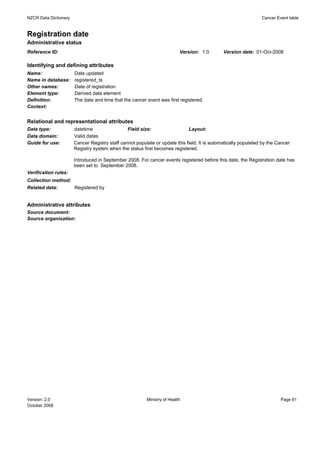
Registration date................................................................................................................................. 61
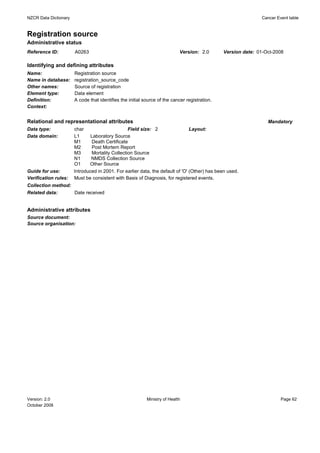
Registration source ............................................................................................................................. 62
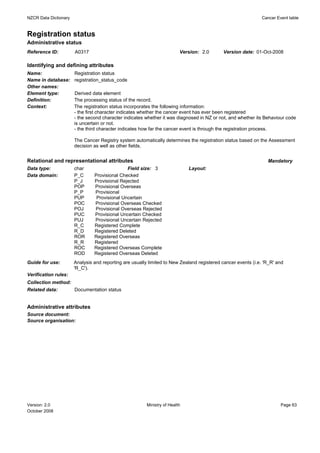
Registration status .............................................................................................................................. 63
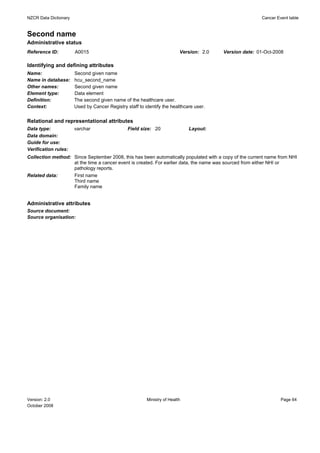
Second name...................................................................................................................................... 64
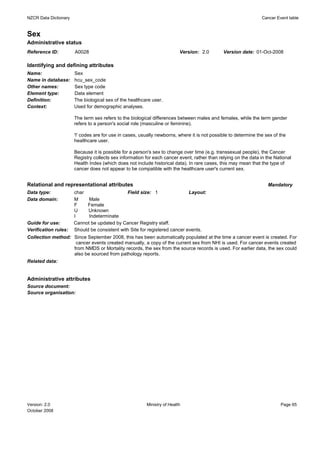
Sex...................................................................................................................................................... 65
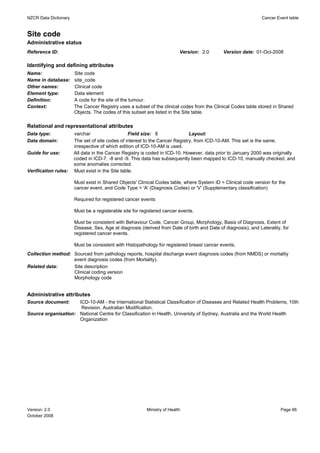
Site code ............................................................................................................................................. 66
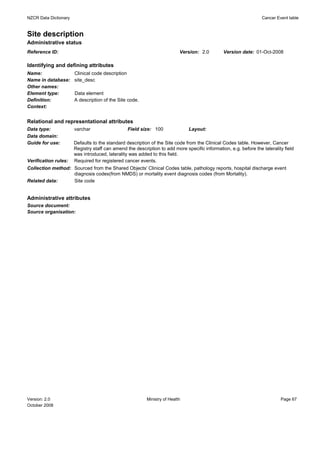
Site description ................................................................................................................................... 67
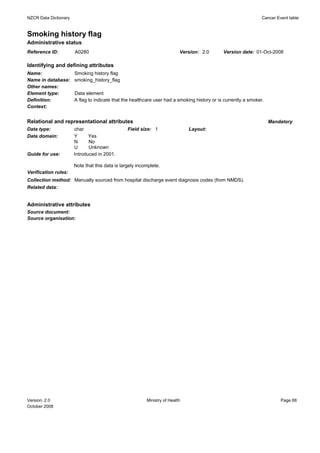
Smoking history flag............................................................................................................................ 68
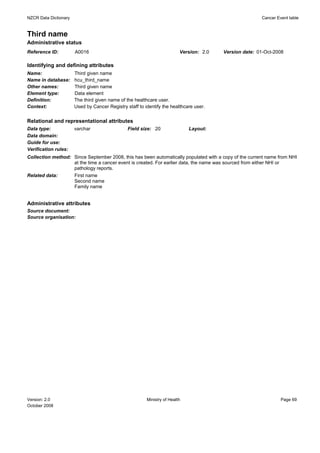
Third name.......................................................................................................................................... 69
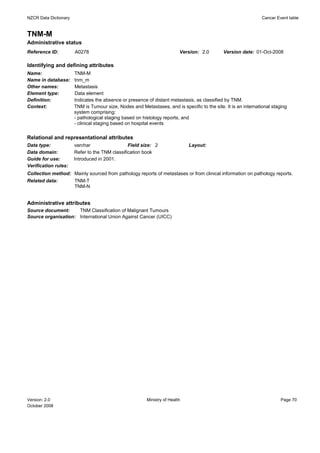
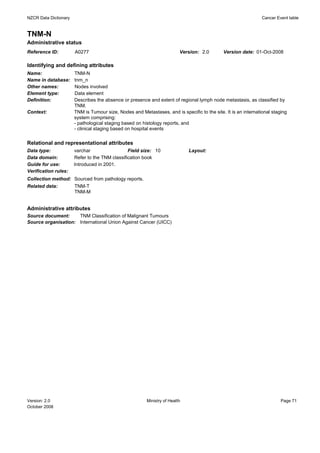
TNM-M ................................................................................................................................................ 70
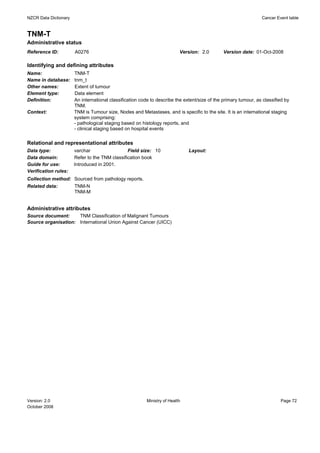
TNM-N ................................................................................................................................................ 71
TNM-T................................................................................................................................................. 72
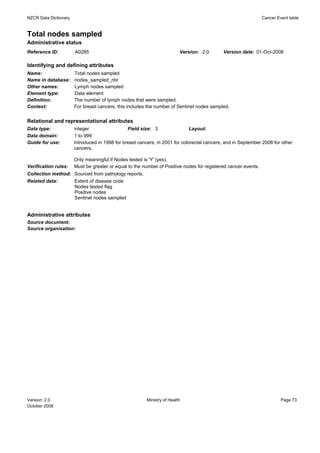
Total nodes sampled........................................................................................................................... 73
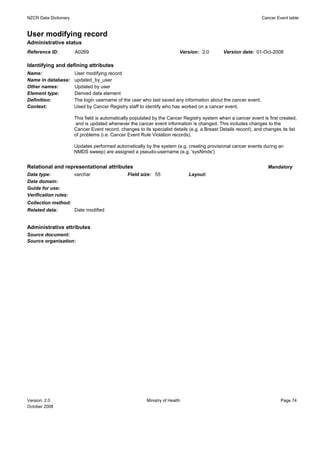
User modifying record......................................................................................................................... 74
User registering record........................................................................................................................ 75

Cervix Detail table............................................................................................................................. 76
Additional information.......................................................................................................................... 76
Cancer event ID .................................................................................................................................. 77
Cancer group ...................................................................................................................................... 78
Cervix FIGO staging code................................................................................................................... 79

Colorectal Detail table ...................................................................................................................... 80
ACPS system code ............................................................................................................................. 80
Astler and Coller staging system code................................................................................................ 81
Cancer event ID .................................................................................................................................. 82
Cancer group ...................................................................................................................................... 83
Duke's staging system code................................................................................................................ 84
Level of direct spread.......................................................................................................................... 85

Gleason Detail table.......................................................................................................................... 86
Cancer event ID .................................................................................................................................. 86
Gleason score..................................................................................................................................... 87
Gleason test code ............................................................................................................................... 88
Gleason test date................................................................................................................................ 89
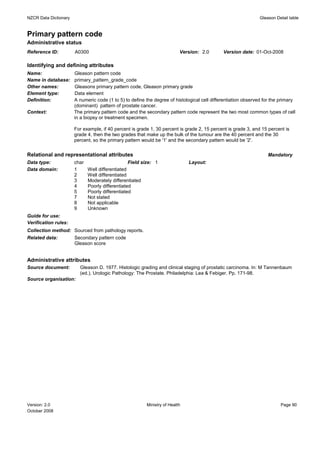
Primary pattern code........................................................................................................................... 90
Record version.................................................................................................................................... 91
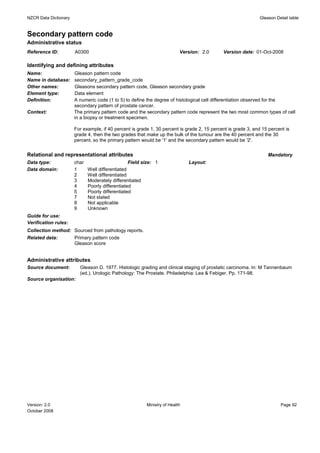
Secondary pattern code ...................................................................................................................... 92

Gynaecology Detail table ................................................................................................................. 93
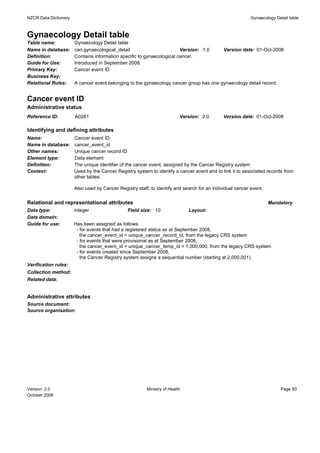
Cancer event ID .................................................................................................................................. 93
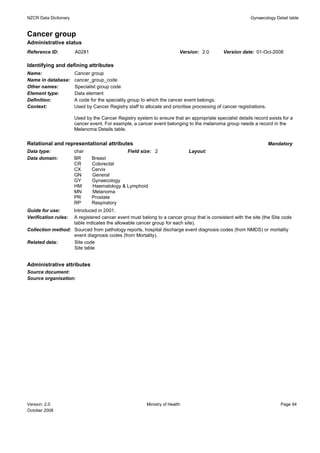
Cancer group ...................................................................................................................................... 94
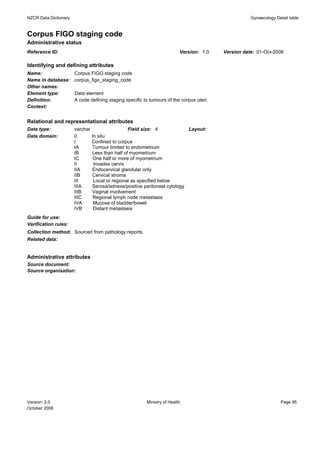
Corpus FIGO staging code ................................................................................................................. 95
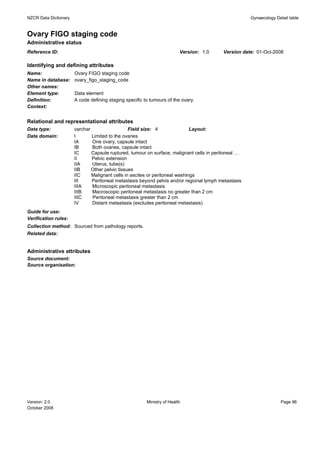
Ovary FIGO staging code ................................................................................................................... 96
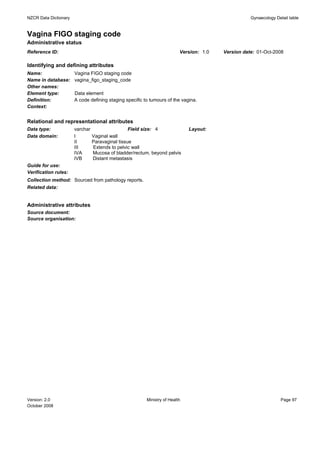
Vagina FIGO staging code.................................................................................................................. 97
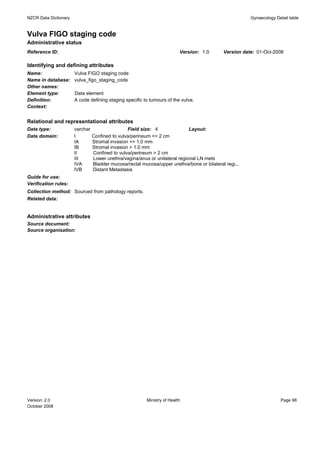
Vulva FIGO staging code .................................................................................................................... 98

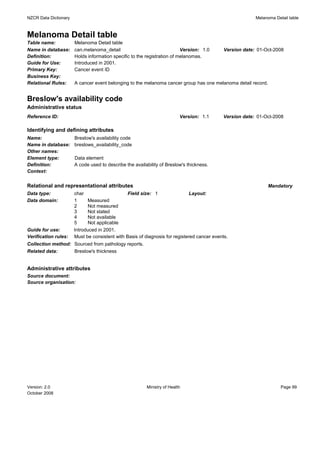
Melanoma Detail table ...................................................................................................................... 99
Breslow's availability code .................................................................................................................. 99
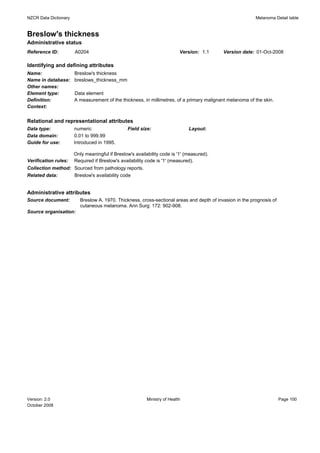
Breslow's thickness........................................................................................................................... 100
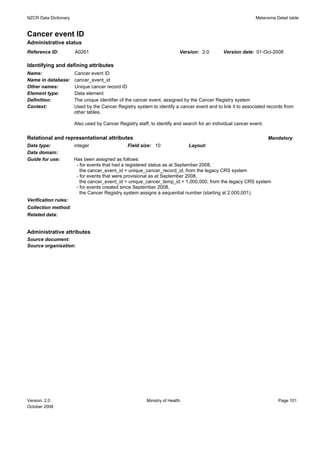
Cancer event ID ................................................................................................................................ 101
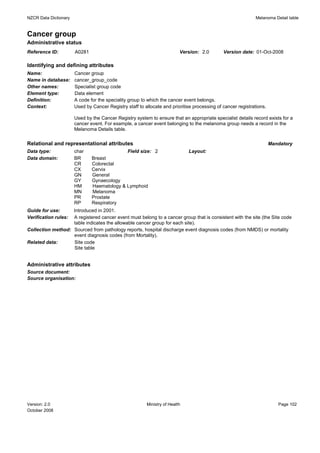
Cancer group .................................................................................................................................... 102
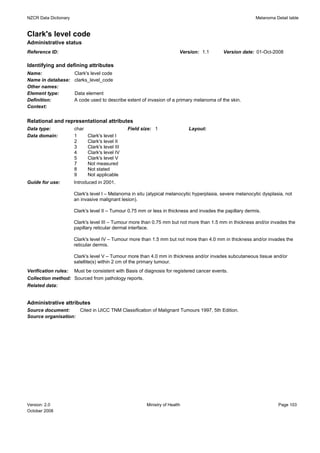
Clark's level code .............................................................................................................................. 103
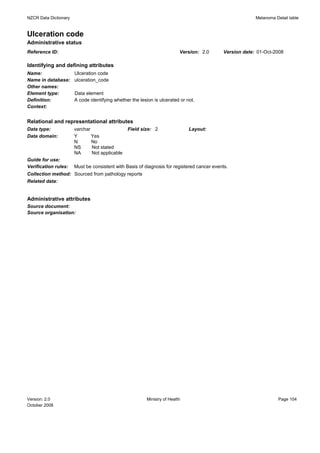
Ulceration code ................................................................................................................................. 104

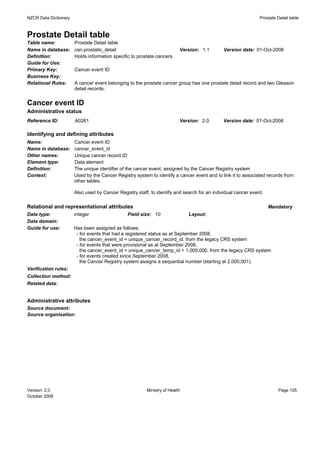
Prostate Detail table........................................................................................................................ 105
Cancer event ID ................................................................................................................................ 105
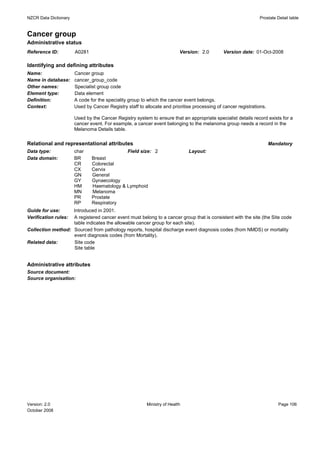
Cancer group .................................................................................................................................... 106


Version: 2.0                                                       Ministry of Health
October 2008
NZCR Data Dictionary                                                                                                              Front Pages


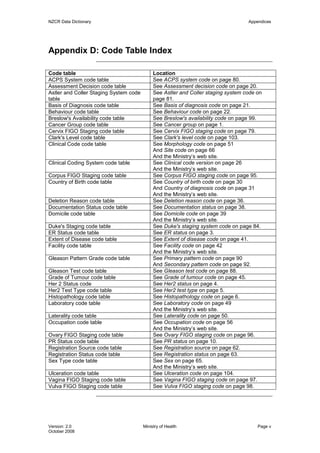
Appendix A: Data Dictionary Template .............................................................................................. i
Appendix B: Schemas ....................................................................................................................... iii
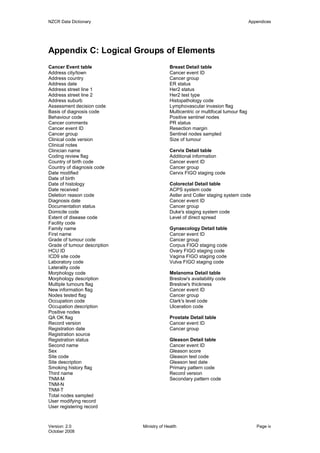
Appendix C: Logical Groups of Elements ....................................................................................... iv
Appendix D: Code Table Index .......................................................................................................... v
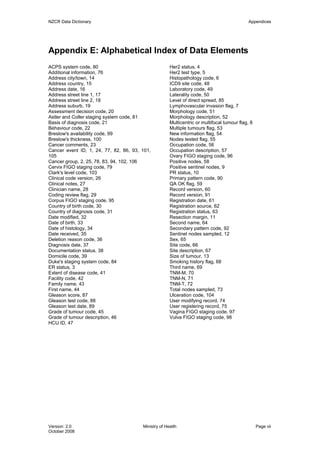
Appendix E: Alphabetical Index of Data Elements ........................................................................ vii


Version: 2.0                                                  Ministry of Health
October 2008
NZCR Data Dictionary                                                                     Front Pages


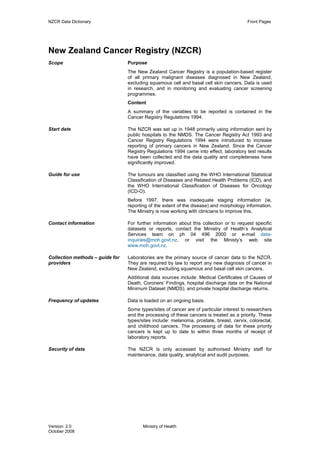
New Zealand Cancer Registry (NZCR)
Scope                            Purpose
                                 The New Zealand Cancer Registry is a population-based register
                                 of all primary malignant diseases diagnosed in New Zealand,
                                 excluding squamous cell and basal cell skin cancers. Data is used
                                 in research, and in monitoring and evaluating cancer screening
                                 programmes.
                                 Content
                                 A summary of the variables to be reported is contained in the
                                 Cancer Registry Regulations 1994.

Start date                       The NZCR was set up in 1948 primarily using information sent by
                                 public hospitals to the NMDS. The Cancer Registry Act 1993 and
                                 Cancer Registry Regulations 1994 were introduced to increase
                                 reporting of primary cancers in New Zealand. Since the Cancer
                                 Registry Regulations 1994 came into effect, laboratory test results
                                 have been collected and the data quality and completeness have
                                 significantly improved.

Guide for use                    The tumours are classified using the WHO International Statistical
                                 Classification of Diseases and Related Health Problems (ICD), and
                                 the WHO International Classification of Diseases for Oncology
                                 (ICD-O).
                                 Before 1997, there was inadequate staging information (ie,
                                 reporting of the extent of the disease) and morphology information.
                                 The Ministry is now working with clinicians to improve this.

Contact information              For further information about this collection or to request specific
                                 datasets or reports, contact the Ministry of Health’s Analytical
                                 Services team on ph 04 496 2000 or e-mail data-
                                 inquiries@moh.govt.nz, or visit the Ministy’s web site
                                 www.moh.govt.nz.

Collection methods – guide for   Laboratories are the primary source of cancer data to the NZCR.
providers                        They are required by law to report any new diagnosis of cancer in
                                 New Zealand, excluding squamous and basal cell skin cancers.
                                 Additional data sources include: Medical Certificates of Causes of
                                 Death, Coroners’ Findings, hospital discharge data on the National
                                 Minimum Dataset (NMDS), and private hospital discharge returns.

Frequency of updates             Data is loaded on an ongoing basis.
                                 Some types/sites of cancer are of particular interest to researchers
                                 and the processing of these cancers is treated as a priority. These
                                 types/sites include: melanoma, prostate, breast, cervix, colorectal,
                                 and childhood cancers. The processing of data for these priority
                                 cancers is kept up to date to within three months of receipt of
                                 laboratory reports.

Security of data                 The NZCR is only accessed by authorised Ministry staff for
                                 maintenance, data quality, analytical and audit purposes.


Version: 2.0                            Ministry of Health
October 2008
NZCR Data Dictionary                                                              Front Pages


Privacy issues         The Ministry of Health is required to ensure that the release of
                       information recognises any legislation related to the privacy of
                       health information, in particular the Official Information Act 1982,
                       the Privacy Act 1993 and the Health Information Privacy Code
                       1994.
                       Information available to the general public is of a statistical and
                       non-identifiable nature. Researchers requiring identifiable data will
                       usually need approval from an Ethics Committee.

National reports and   The Ministry publishes an annual report Cancer – New
publications           Registrations and Deaths in hard copy and on the Ministry’s web
                       site www.moh.govt.nz. This publication contains detailed
                       information on numbers and rates of cancers according to year of
                       diagnosis.
                       More timely provisional cancer data for the priority sites is posted
                       on the Ministry’s web site www.moh.govt.nz.

Data provision         Customised datasets or summary reports are available on request,
                       either electronically or on paper. Staff from the Ministry’s Analytical
                       Services team can help to define the specifications for a request
                       and are familiar with the strengths and weaknesses of the data.
                       The Analytical Services team also offers a peer review service to
                       ensure that Minstry of Heatlh data is reported appropriately when
                       published by other organisations.
                       There may be charges associated with data extracts.


Version: 2.0                  Ministry of Health
October 2008
NZCR Data Dictionary                                                                                                Breast Detail table


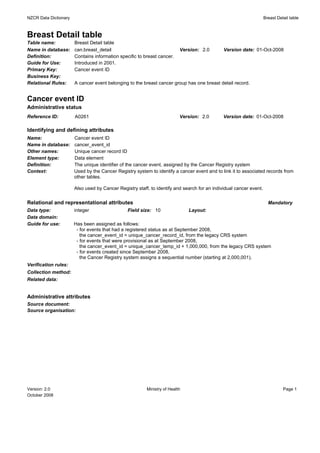
Breast Detail table
Table name:            Breast Detail table
Name in database:      can.breast_detail                                  Version: 2.0        Version date: 01-Oct-2008
Definition:            Contains information specific to breast cancer.
Guide for Use:         Introduced in 2001.
Primary Key:           Cancer event ID
Business Key:
Relational Rules:      A cancer event belonging to the breast cancer group has one breast detail record.


Cancer event ID
Administrative status
Reference ID:          A0261                                              Version: 2.0        Version date: 01-Oct-2008

Identifying and defining attributes
Name:                  Cancer event ID
Name in database:      cancer_event_id
Other names:           Unique cancer record ID
Element type:          Data element
Definition:            The unique identifier of the cancer event, assigned by the Cancer Registry system
Context:               Used by the Cancer Registry system to identify a cancer event and to link it to associated records from
                       other tables.

                       Also used by Cancer Registry staff, to identify and search for an individual cancer event.

Relational and representational attributes                                                                            Mandatory
Data type:             integer                  Field size: 10                Layout:
Data domain:
Guide for use:         Has been assigned as follows:
                        - for events that had a registered status as at September 2008,
                          the cancer_event_id = unique_cancer_record_id, from the legacy CRS system
                        - for events that were provisional as at September 2008,
                          the cancer_event_id = unique_cancer_temp_id + 1,000,000, from the legacy CRS system
                        - for events created since September 2008,
                          the Cancer Registry system assigns a sequential number (starting at 2,000,001).
Verification rules:
Collection method:
Related data:


Administrative attributes
Source document:
Source organisation:


Version: 2.0                                             Ministry of Health                                                   Page 1
October 2008
NZCR Data Dictionary                                                                                             Breast Detail table


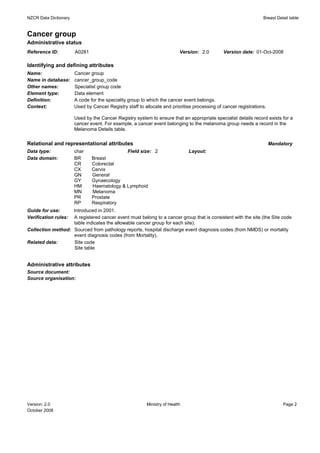
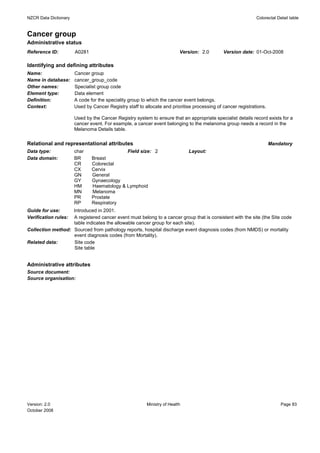
Cancer group
Administrative status
Reference ID:          A0281                                              Version: 2.0        Version date: 01-Oct-2008

Identifying and defining attributes
Name:                  Cancer group
Name in database:      cancer_group_code
Other names:           Specialist group code
Element type:          Data element
Definition:            A code for the speciality group to which the cancer event belongs.
Context:               Used by Cancer Registry staff to allocate and prioritise processing of cancer registrations.

                       Used by the Cancer Registry system to ensure that an appropriate specialist details record exists for a
                       cancer event. For example, a cancer event belonging to the melanoma group needs a record in the
                       Melanoma Details table.


Relational and representational attributes                                                                            Mandatory
Data type:             char                  Field size: 2                    Layout:
Data domain:           BR      Breast
                       CR      Colorectal
                       CX      Cervix
                       GN      General
                       GY      Gynaecology
                       HM      Haematology & Lymphoid
                       MN      Melanoma
                       PR      Prostate
                       RP      Respiratory
Guide for use:     Introduced in 2001.
Verification rules:A registered cancer event must belong to a cancer group that is consistent with the site (the Site code
                   table indicates the allowable cancer group for each site).
Collection method: Sourced from pathology reports, hospital discharge event diagnosis codes (from NMDS) or mortality
                   event diagnosis codes (from Mortality).
Related data:      Site code
                   Site table


Administrative attributes
Source document:
Source organisation:


Version: 2.0                                             Ministry of Health                                                Page 2
October 2008
NZCR Data Dictionary                                                                                        Breast Detail table


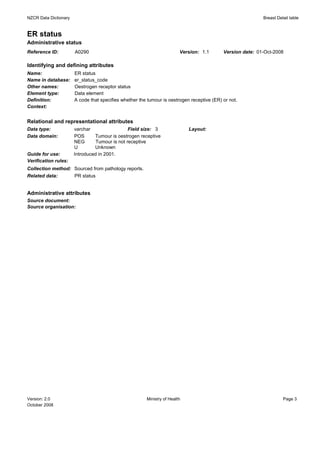
ER status
Administrative status
Reference ID:          A0290                                             Version: 1.1       Version date: 01-Oct-2008

Identifying and defining attributes
Name:                  ER status
Name in database:      er_status_code
Other names:           Oestrogen receptor status
Element type:          Data element
Definition:            A code that specifies whether the tumour is oestrogen receptive (ER) or not.
Context:


Relational and representational attributes
Data type:             varchar                  Field size: 3                Layout:
Data domain:           POS      Tumour is oestrogen receptive
                       NEG       Tumour is not receptive
                       U        Unknown
Guide for use:         Introduced in 2001.
Verification rules:
Collection method: Sourced from pathology reports.
Related data:      PR status


Administrative attributes
Source document:
Source organisation:


Version: 2.0                                            Ministry of Health                                            Page 3
October 2008
NZCR Data Dictionary                                                                                         Breast Detail table


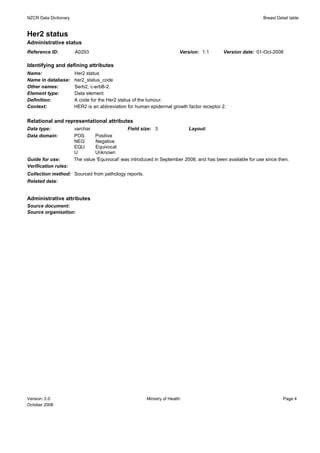
Her2 status
Administrative status
Reference ID:          A0293                                             Version: 1.1      Version date: 01-Oct-2008

Identifying and defining attributes
Name:                  Her2 status
Name in database:      her2_status_code
Other names:           Serb2, c-erbB-2.
Element type:          Data element
Definition:            A code for the Her2 status of the tumour.
Context:               HER2 is an abbreviation for human epidermal growth factor receptor 2.


Relational and representational attributes
Data type:             varchar                 Field size: 3              Layout:
Data domain:           POS      Positive
                       NEG      Negative
                       EQU      Equivocal
                       U        Unknown
Guide for use:         The value 'Equivocal' was introduced in September 2008, and has been available for use since then.
Verification rules:
Collection method: Sourced from pathology reports.
Related data:


Administrative attributes
Source document:
Source organisation:


Version: 2.0                                            Ministry of Health                                             Page 4
October 2008
NZCR Data Dictionary                                                                                          Breast Detail table


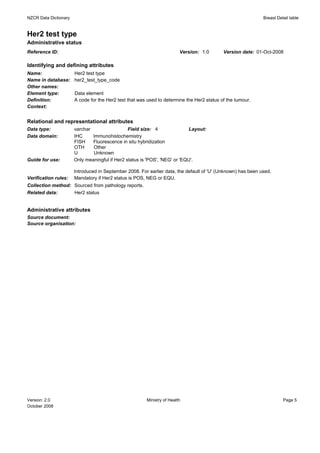
Her2 test type
Administrative status
Reference ID:                                                            Version: 1.0       Version date: 01-Oct-2008

Identifying and defining attributes
Name:                  Her2 test type
Name in database:      her2_test_type_code
Other names:
Element type:          Data element
Definition:            A code for the Her2 test that was used to determine the Her2 status of the tumour.
Context:


Relational and representational attributes
Data type:             varchar                  Field size: 4                Layout:
Data domain:           IHC     Immunohistochemistry
                       FISH    Fluorescence in situ hybridization
                       OTH     Other
                       U       Unknown
Guide for use:         Only meaningful if Her2 status is 'POS', 'NEG' or 'EQU'.

                       Introduced in September 2008. For earlier data, the default of 'U' (Unknown) has been used.
Verification rules:    Mandatory if Her2 status is POS, NEG or EQU.
Collection method: Sourced from pathology reports.
Related data:      Her2 status


Administrative attributes
Source document:
Source organisation:


Version: 2.0                                            Ministry of Health                                              Page 5
October 2008
NZCR Data Dictionary                                                                                          Breast Detail table


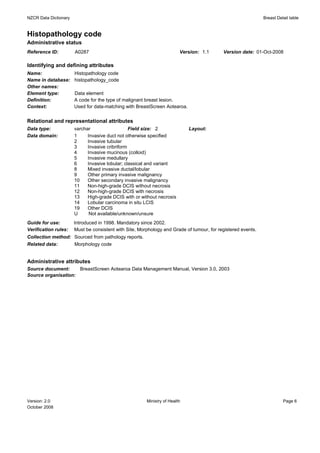
Histopathology code
Administrative status
Reference ID:          A0287                                             Version: 1.1      Version date: 01-Oct-2008

Identifying and defining attributes
Name:                  Histopathology code
Name in database:      histopathology_code
Other names:
Element type:          Data element
Definition:            A code for the type of malignant breast lesion.
Context:               Used for data-matching with BreastScreen Aotearoa.


Relational and representational attributes
Data type:             varchar                   Field size: 2               Layout:
Data domain:           1     Invasive duct not otherwise specified
                       2     Invasive tubular
                       3     Invasive cribriform
                       4     Invasive mucinous (colloid)
                       5     Invasive medullary
                       6     Invasive lobular; classical and variant
                       8     Mixed invasive ductal/lobular
                       9     Other primary invasive malignancy
                       10    Other secondary invasive malignancy
                       11    Non-high-grade DCIS without necrosis
                       12    Non-high-grade DCIS with necrosis
                       13    High-grade DCIS with or without necrosis
                       14    Lobular carcinoma in situ LCIS
                       19    Other DCIS
                       U      Not available/unknown/unsure
Guide for use:         Introduced in 1998. Mandatory since 2002.
Verification rules:    Must be consistent with Site, Morphology and Grade of tumour, for registered events.
Collection method: Sourced from pathology reports.
Related data:      Morphology code


Administrative attributes
Source document:     BreastScreen Aotearoa Data Management Manual, Version 3.0, 2003
Source organisation:


Version: 2.0                                            Ministry of Health                                              Page 6
October 2008
NZCR Data Dictionary                                                                                    Breast Detail table


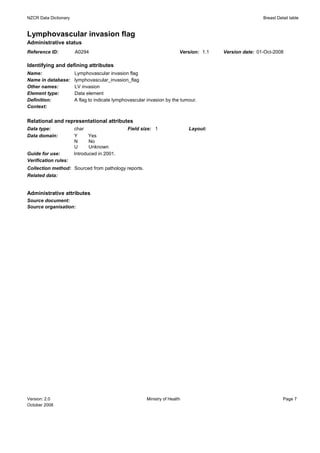
Lymphovascular invasion flag
Administrative status
Reference ID:          A0294                                             Version: 1.1   Version date: 01-Oct-2008

Identifying and defining attributes
Name:                  Lymphovascular invasion flag
Name in database:      lymphovascular_invasion_flag
Other names:           LV invasion
Element type:          Data element
Definition:            A flag to indicate lymphovascular invasion by the tumour.
Context:


Relational and representational attributes
Data type:             char                    Field size: 1                 Layout:
Data domain:           Y      Yes
                       N      No
                       U      Unknown
Guide for use:         Introduced in 2001.
Verification rules:
Collection method: Sourced from pathology reports.
Related data:


Administrative attributes
Source document:
Source organisation:


Version: 2.0                                            Ministry of Health                                        Page 7
October 2008
NZCR Data Dictionary                                                                                              Breast Detail table


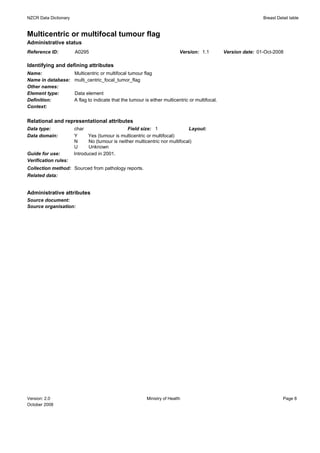
Multicentric or multifocal tumour flag
Administrative status
Reference ID:          A0295                                                Version: 1.1          Version date: 01-Oct-2008

Identifying and defining attributes
Name:                  Multicentric or multifocal tumour flag
Name in database:      multi_centric_focal_tumor_flag
Other names:
Element type:          Data element
Definition:            A flag to indicate that the tumour is either multicentric or multifocal.
Context:


Relational and representational attributes
Data type:             char                     Field size: 1                 Layout:
Data domain:           Y      Yes (tumour is multicentric or multifocal)
                       N      No (tumour is neither multicentric nor multifocal)
                       U      Unknown
Guide for use:         Introduced in 2001.
Verification rules:
Collection method: Sourced from pathology reports.
Related data:


Administrative attributes
Source document:
Source organisation:


Version: 2.0                                               Ministry of Health                                               Page 8
October 2008
NZCR Data Dictionary                                                                                         Breast Detail table


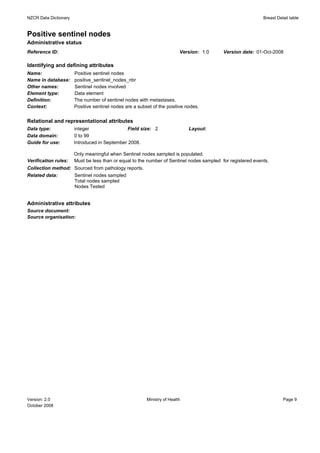
Positive sentinel nodes
Administrative status
Reference ID:                                                             Version: 1.0     Version date: 01-Oct-2008

Identifying and defining attributes
Name:                  Positive sentinel nodes
Name in database:      positive_sentinel_nodes_nbr
Other names:           Sentinel nodes involved
Element type:          Data element
Definition:            The number of sentinel nodes with metastases.
Context:               Positive sentinel nodes are a subset of the positive nodes.


Relational and representational attributes
Data type:             integer                Field size: 2                   Layout:
Data domain:           0 to 99
Guide for use:         Introduced in September 2008.

                       Only meaningful when Sentinel nodes sampled is populated.
Verification rules:    Must be less than or equal to the number of Sentinel nodes sampled for registered events.
Collection method: Sourced from pathology reports.
Related data:      Sentinel nodes sampled
                   Total nodes sampled
                   Nodes Tested


Administrative attributes
Source document:
Source organisation:


Version: 2.0                                             Ministry of Health                                            Page 9
October 2008
NZCR Data Dictionary                                                                                        Breast Detail table


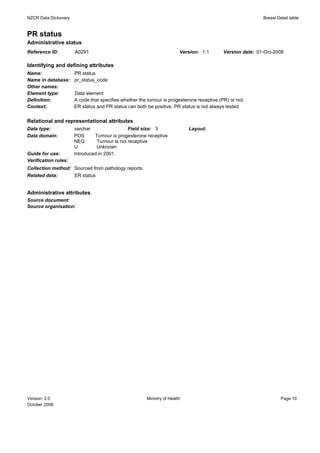
PR status
Administrative status
Reference ID:          A0291                                             Version: 1.1       Version date: 01-Oct-2008

Identifying and defining attributes
Name:                  PR status
Name in database:      pr_status_code
Other names:
Element type:          Data element
Definition:            A code that specifies whether the tumour is progesterone receptive (PR) or not.
Context:               ER status and PR status can both be positive. PR status is not always tested


Relational and representational attributes
Data type:             varchar                 Field size: 3                 Layout:
Data domain:           POS      Tumour is progesterone receptive
                       NEG       Tumour is not receptive
                       U         Unknown
Guide for use:         Introduced in 2001.
Verification rules:
Collection method: Sourced from pathology reports.
Related data:      ER status


Administrative attributes
Source document:
Source organisation:


Version: 2.0                                            Ministry of Health                                           Page 10
October 2008
NZCR Data Dictionary                                                                                       Breast Detail table


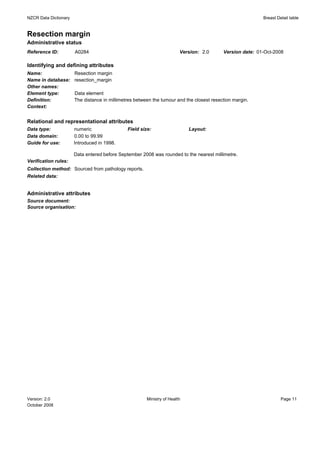
Resection margin
Administrative status
Reference ID:          A0284                                             Version: 2.0      Version date: 01-Oct-2008

Identifying and defining attributes
Name:                  Resection margin
Name in database:      resection_margin
Other names:
Element type:          Data element
Definition:            The distance in millimetres between the tumour and the closest resection margin.
Context:


Relational and representational attributes
Data type:             numeric                 Field size:                   Layout:
Data domain:           0.00 to 99.99
Guide for use:         Introduced in 1998.

                       Data entered before September 2008 was rounded to the nearest millimetre.
Verification rules:
Collection method: Sourced from pathology reports.
Related data:


Administrative attributes
Source document:
Source organisation:


Version: 2.0                                            Ministry of Health                                          Page 11
October 2008
NZCR Data Dictionary                                                                                          Breast Detail table


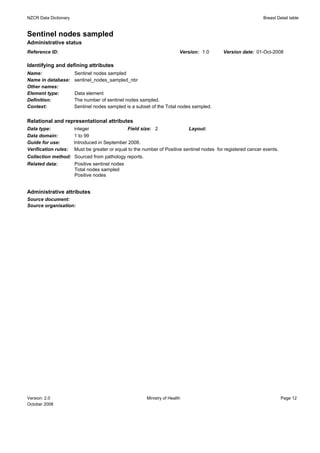
Sentinel nodes sampled
Administrative status
Reference ID:                                                            Version: 1.0       Version date: 01-Oct-2008

Identifying and defining attributes
Name:                  Sentinel nodes sampled
Name in database:      sentinel_nodes_sampled_nbr
Other names:
Element type:          Data element
Definition:            The number of sentinel nodes sampled.
Context:               Sentinel nodes sampled is a subset of the Total nodes sampled.


Relational and representational attributes
Data type:             integer                 Field size: 2                Layout:
Data domain:           1 to 99
Guide for use:         Introduced in September 2008.
Verification rules:    Must be greater or equal to the number of Positive sentinel nodes for registered cancer events.
Collection method: Sourced from pathology reports.
Related data:      Positive sentinel nodes
                   Total nodes sampled
                   Positive nodes


Administrative attributes
Source document:
Source organisation:


Version: 2.0                                            Ministry of Health                                               Page 12
October 2008
NZCR Data Dictionary                                                                                       Breast Detail table


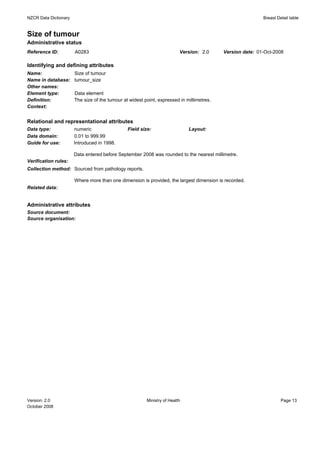
Size of tumour
Administrative status
Reference ID:          A0283                                              Version: 2.0     Version date: 01-Oct-2008

Identifying and defining attributes
Name:                  Size of tumour
Name in database:      tumour_size
Other names:
Element type:          Data element
Definition:            The size of the tumour at widest point, expressed in millimetres.
Context:


Relational and representational attributes
Data type:             numeric                  Field size:                   Layout:
Data domain:           0.01 to 999.99
Guide for use:         Introduced in 1998.

                       Data entered before September 2008 was rounded to the nearest millimetre.
Verification rules:
Collection method: Sourced from pathology reports.

                       Where more than one dimension is provided, the largest dimension is recorded.
Related data:


Administrative attributes
Source document:
Source organisation:


Version: 2.0                                             Ministry of Health                                         Page 13
October 2008
NZCR Data Dictionary                                                                                           Cancer Event table


Cancer Event table
Table name:       Cancer Event table
Name in database: can.cancer_event                                 Version: 2.0         Version date: 01-Oct-2008
Definition:       Describes a cancer event. It contains demographic and administrative information as well as the main
                  clinical details common to all tumours.
Guide for Use:    Most cancer events are created and updated manually by Cancer Registry staff using information from
                  pathology reports, death certificates, NMDS health events, Mortality events, NHI records and other
                  cancer events for the same healthcare user.

                       Some cancer events are created automatically by the NMDS and Mortality sweeps, based on recently
                       created events in those systems. These cancer events are then updated manually by Cancer Registry
                       staff using all sources of information.
Primary Key:           Cancer event ID
Business Key:
Relational Rules:      May have a detail record, depending on the cancer group this cancer event belongs to. For example, a
                       cancer event belonging to the melanoma group has a record in the Melanoma Details table.


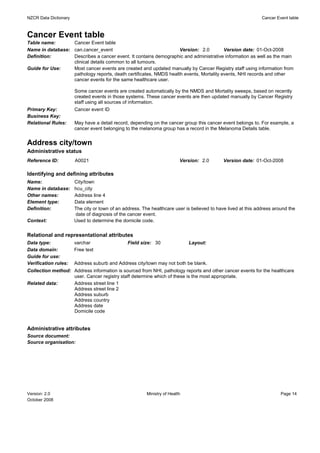
Address city/town
Administrative status
Reference ID:          A0021                                              Version: 2.0       Version date: 01-Oct-2008

Identifying and defining attributes
Name:                  City/town
Name in database:      hcu_city
Other names:           Address line 4
Element type:          Data element
Definition:            The city or town of an address. The healthcare user is believed to have lived at this address around the
                       date of diagnosis of the cancer event.
Context:               Used to determine the domicile code.


Relational and representational attributes
Data type:             varchar                  Field size: 30                Layout:
Data domain:           Free text
Guide for use:
Verification rules:    Address suburb and Address city/town may not both be blank.
Collection method: Address information is sourced from NHI, pathology reports and other cancer events for the healthcare
                   user. Cancer registry staff determine which of these is the most appropriate.
Related data:      Address street line 1
                   Address street line 2
                   Address suburb
                   Address country
                   Address date
                   Domicile code


Administrative attributes
Source document:
Source organisation:


Version: 2.0                                             Ministry of Health                                             Page 14
October 2008
NZCR Data Dictionary                                                                                            Cancer Event table


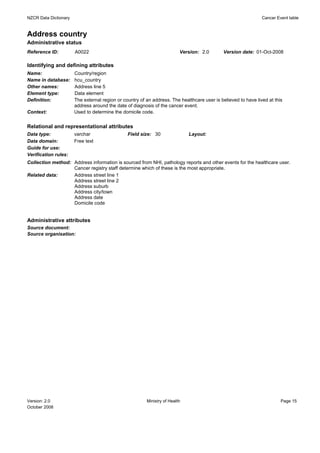
Address country
Administrative status
Reference ID:          A0022                                              Version: 2.0       Version date: 01-Oct-2008

Identifying and defining attributes
Name:                  Country/region
Name in database:      hcu_country
Other names:           Address line 5
Element type:          Data element
Definition:            The external region or country of an address. The healthcare user is believed to have lived at this
                       address around the date of diagnosis of the cancer event.
Context:               Used to determine the domicile code.


Relational and representational attributes
Data type:             varchar                  Field size: 30                Layout:
Data domain:           Free text
Guide for use:
Verification rules:
Collection method: Address information is sourced from NHI, pathology reports and other events for the healthcare user.
                   Cancer registry staff determine which of these is the most appropriate.
Related data:      Address street line 1
                   Address street line 2
                   Address suburb
                   Address city/town
                   Address date
                   Domicile code


Administrative attributes
Source document:
Source organisation:


Version: 2.0                                             Ministry of Health                                              Page 15
October 2008
NZCR Data Dictionary                                                                                           Cancer Event table


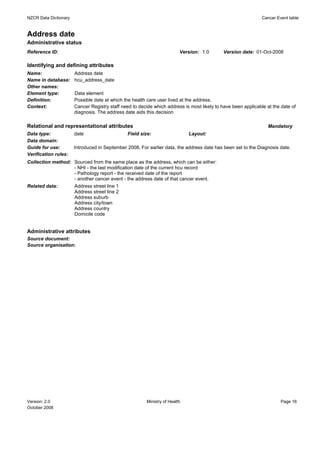
Address date
Administrative status
Reference ID:                                                             Version: 1.0       Version date: 01-Oct-2008

Identifying and defining attributes
Name:                  Address date
Name in database:      hcu_address_date
Other names:
Element type:          Data element
Definition:            Possible date at which the health care user lived at the address.
Context:               Cancer Registry staff need to decide which address is most likely to have been applicable at the date of
                       diagnosis. The address date aids this decision

Relational and representational attributes                                                                       Mandatory
Data type:             date                     Field size:                   Layout:
Data domain:
Guide for use:         Introduced in September 2008. For earlier data, the address date has been set to the Diagnosis date.
Verification rules:
Collection method: Sourced from the same place as the address, which can be either:
                   - NHI - the last modification date of the current hcu record
                   - Pathology report - the received date of the report
                   - another cancer event - the address date of that cancer event.
Related data:          Address street line 1
                       Address street line 2
                       Address suburb
                       Address city/town
                       Address country
                       Domicile code


Administrative attributes
Source document:
Source organisation:


Version: 2.0                                             Ministry of Health                                             Page 16
October 2008
NZCR Data Dictionary                                                                                               Cancer Event table


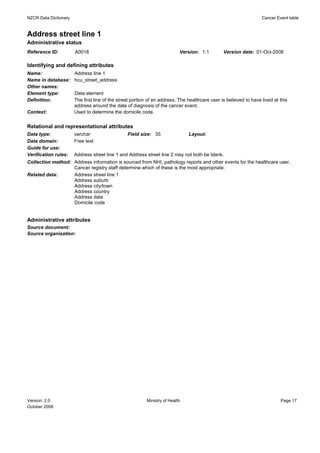
Address street line 1
Administrative status
Reference ID:          A0018                                               Version: 1.1         Version date: 01-Oct-2008

Identifying and defining attributes
Name:                  Address line 1
Name in database:      hcu_street_address
Other names:
Element type:          Data element
Definition:            The first line of the street portion of an address. The healthcare user is believed to have lived at this
                       address around the date of diagnosis of the cancer event.
Context:               Used to determine the domicile code.


Relational and representational attributes
Data type:             varchar                   Field size: 35                Layout:
Data domain:           Free text
Guide for use:
Verification rules:    Address street line 1 and Address street line 2 may not both be blank.
Collection method: Address information is sourced from NHI, pathology reports and other events for the healthcare user.
                   Cancer registry staff determine which of these is the most appropriate.
Related data:      Address street line 1
                   Address suburb
                   Address city/town
                   Address country
                   Address date
                   Domicile code


Administrative attributes
Source document:
Source organisation:


Version: 2.0                                              Ministry of Health                                                Page 17
October 2008
NZCR Data Dictionary                                                                                             Cancer Event table


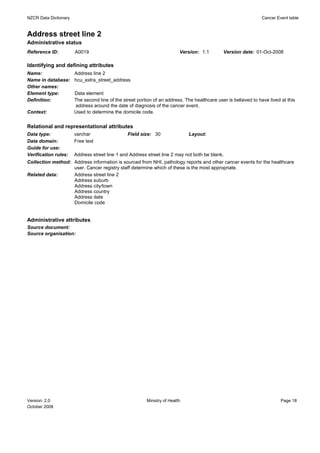
Address street line 2
Administrative status
Reference ID:          A0019                                              Version: 1.1        Version date: 01-Oct-2008

Identifying and defining attributes
Name:                  Address line 2
Name in database:      hcu_extra_street_address
Other names:
Element type:          Data element
Definition:            The second line of the street portion of an address. The healthcare user is believed to have lived at this
                       address around the date of diagnosis of the cancer event.
Context:               Used to determine the domicile code.


Relational and representational attributes
Data type:             varchar                  Field size: 30                Layout:
Data domain:           Free text
Guide for use:
Verification rules:    Address street line 1 and Address street line 2 may not both be blank.
Collection method: Address information is sourced from NHI, pathology reports and other cancer events for the healthcare
                   user. Cancer registry staff determine which of these is the most appropriate.
Related data:      Address street line 2
                   Address suburb
                   Address city/town
                   Address country
                   Address date
                   Domicile code


Administrative attributes
Source document:
Source organisation:


Version: 2.0                                             Ministry of Health                                               Page 18
October 2008
NZCR Data Dictionary                                                                                          Cancer Event table


Address suburb
Administrative status
Reference ID:          A0020                                             Version: 2.0       Version date: 01-Oct-2008

Identifying and defining attributes
Name:                  Address suburb
Name in database:      hcu_suburb
Other names:           Address line 3
Element type:          Data element
Definition:            The suburb of an address. The healthcare user is believed to have lived at this address around the
                       date of diagnosis of the cancer event.
Context:               Used to determine the domicile code.


Relational and representational attributes
Data type:             varchar                 Field size: 30                Layout:
Data domain:           Free text
Guide for use:
Verification rules:    Address suburb and Address city/town cannot both be blank.
Collection method: Address information is sourced from NHI, pathology reports and other events for the healthcare user.
                   Cancer registry staff determine which of these is the most appropriate.
Related data:      Address street line 1
                   Address street line 2
                   Address city/town
                   Address country
                   Address date
                   Domicile code


Administrative attributes
Source document:
Source organisation:


Version: 2.0                                            Ministry of Health                                             Page 19
October 2008
NZCR Data Dictionary                                                                                      Cancer Event table


Assessment decision code
Administrative status
Reference ID:                                                           Version: 1.0     Version date: 01-Oct-2008

Identifying and defining attributes
Name:                  Assessment decision code
Name in database:      assessment_decision_code
Other names:           Decision code
Element type:          Data element
Definition:            A code representing an action taken during the processing of the cancer event.
Context:               Whenever a Cancer Registry user saves a new or modified cancer event, they are prompted to specify
                       an assessment decision. This is used by the system to determine the next status.

Relational and representational attributes                                                                   Mandatory
Data type:             char                     Field size: 2               Layout:
Data domain:           DR      Delete registered event
                       JP      Reject provisional event
                       PP      Create provisional event
                       PR      Create registered event
                       RR      Register provisional event
                       UP      Update event
                       CH      Checked
                       RS      Restore
                       ME      Migrate event
                       CU      Last CRS update
Guide for use:         Introduced in September 2008.
Verification rules:    The subset of assessment decision codes made available by the Cancer Registry system depends on
                       the user's role and the current status of the cancer event.
Collection method:
Related data:          Registration status


Administrative attributes
Source document:
Source organisation:


Version: 2.0                                           Ministry of Health                                          Page 20
October 2008
NZCR Data Dictionary                                                                                           Cancer Event table


Basis of diagnosis code
Administrative status
Reference ID:          A0120                                               Version: 2.0      Version date: 01-Oct-2008

Identifying and defining attributes
Name:                  Basis of diagnosis code
Name in database:      diagnosis_basis_code
Other names:           Diagnosis Basis
Element type:          Data element
Definition:            A code used to describe the single, most valid basis of diagnosis for a primary malignant tumour, or a
                       secondary tumour if the primary tumour site is unknown or cannot be determined.
Context:


Relational and representational attributes
Data type:             char                        Field size: 1               Layout:
Data domain:           0      Death certificate only
                       1      Clinical only
                       2      Clinical investigation
                       3      Exploratory surgery / autopsy
                       4      Specific tests
                       5      Cytology or haematology
                       6      Histology of metastases
                       7      Histology of primary
                       8      Autopsy with histology
                       9      Unknown
Guide for use:
Verification rules:    Mandatory for registered cancer events.

                       Must be consistent with the Site, Morphology, Extent of disease, and Registration source, for registered
                       cancer events.

                       Must be consistent with Breslow's availability, Ulceration and Clark's level for registered melanoma
                       cancer events.
Collection method: Sourced from pathology reports, or inferred from the Registration source code.
Related data:      Site code
                   Morphology code
                   Extent of disease code
                   Registration source code


Administrative attributes
Source document:     World Health Organization Manual for Cancer Registry Personnel
Source organisation: World Health Organization/International Association of Cancer Registries (IACR)


Version: 2.0                                              Ministry of Health                                            Page 21
October 2008
NZCR Data Dictionary                                                                                          Cancer Event table


Behaviour code
Administrative status
Reference ID:                                                             Version: 1.0      Version date: 01-Oct-2008

Identifying and defining attributes
Name:                  Behaviour code
Name in database:      behaviour_code
Other names:
Element type:          Data element
Definition:            A code specifying the behaviour of the tumour, in terms of its malignancy and metastasis.
Context:


Relational and representational attributes                                                                         Mandatory
Data type:             char                      Field size: 1                 Layout:
Data domain:           0      Benign
                       1      Uncertain if benign or malignant
                       2      Carcinoma In Situ
                       3      Malignant, primary site
                       6      Malignant, metastatic site
                       9      Malignant, uncertain if primary or metastatic site
Guide for use:         Introduced in September 2008.
Verification rules:    Benign cancer events must be either rejected or deleted.

                   Must be consistent with Site, for registered cancer events.
Collection method: Sourced from pathology reports, hospital discharge event diagnosis codes (from NMDS) or mortality
                   event diagnosis codes (from Mortality).
Related data:      Site code
                   Morphology code
                   Extent of disease code


Administrative attributes
Source document:     International Classification of Diseases for Oncology, Third Edition, 2000
Source organisation: World Health Organization


Version: 2.0                                             Ministry of Health                                            Page 22
October 2008
NZCR Data Dictionary                                                                                           Cancer Event table


Cancer comments
Administrative status
Reference ID:          A0271                                               Version: 2.0        Version date: 01-Oct-2008

Identifying and defining attributes
Name:                  Cancer comments
Name in database:      cancer_comments
Other names:
Element type:          Data element
Definition:            A multi line text field containing notes related to processing the cancer event.
Context:               Used by Cancer Registry staff.


Relational and representational attributes
Data type:             varchar                  Field size: 2000               Layout:
Data domain:
Guide for use:
Verification rules:
Collection method:
Related data:


Administrative attributes
Source document:
Source organisation:


Version: 2.0                                              Ministry of Health                                            Page 23
October 2008
NZCR Data Dictionary                                                                                            Cancer Event table


Cancer event ID
Administrative status
Reference ID:          A0261                                              Version: 2.0        Version date: 01-Oct-2008

Identifying and defining attributes
Name:                  Cancer event ID
Name in database:      cancer_event_id
Other names:           Unique cancer record ID
Element type:          Data element
Definition:            The unique identifier of the cancer event, assigned by the Cancer Registry system
Context:               Used by the Cancer Registry system to identify a cancer event and to link it to associated records from
                       other tables.

                       Also used by Cancer Registry staff, to identify and search for an individual cancer event.

Relational and representational attributes                                                                          Mandatory
Data type:             integer                  Field size: 10                Layout:
Data domain:
Guide for use:         Has been assigned as follows:
                        - for events that had a registered status as at September 2008,
                          the cancer_event_id = unique_cancer_record_id, from the legacy CRS system
                        - for events that were provisional as at September 2008,
                          the cancer_event_id = unique_cancer_temp_id + 1,000,000, from the legacy CRS system
                        - for events created since September 2008,
                          the Cancer Registry system assigns a sequential number (starting at 2,000,001).
Verification rules:
Collection method:
Related data:


Administrative attributes
Source document:
Source organisation:


Version: 2.0                                             Ministry of Health                                              Page 24
October 2008
NZCR Data Dictionary                                                                                            Cancer Event table


Cancer group
Administrative status
Reference ID:          A0281                                              Version: 2.0        Version date: 01-Oct-2008

Identifying and defining attributes
Name:                  Cancer group
Name in database:      cancer_group_code
Other names:           Specialist group code
Element type:          Data element
Definition:            A code for the speciality group to which the cancer event belongs.
Context:               Used by Cancer Registry staff to allocate and prioritise processing of cancer registrations.

                       Used by the Cancer Registry system to ensure that an appropriate specialist details record exists for a
                       cancer event. For example, a cancer event belonging to the melanoma group needs a record in the
                       Melanoma Details table.


Relational and representational attributes                                                                            Mandatory
Data type:             char                  Field size: 2                    Layout:
Data domain:           BR      Breast
                       CR      Colorectal
                       CX      Cervix
                       GN      General
                       GY      Gynaecology
                       HM      Haematology & Lymphoid
                       MN      Melanoma
                       PR      Prostate
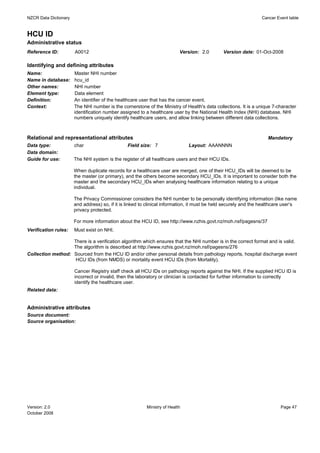
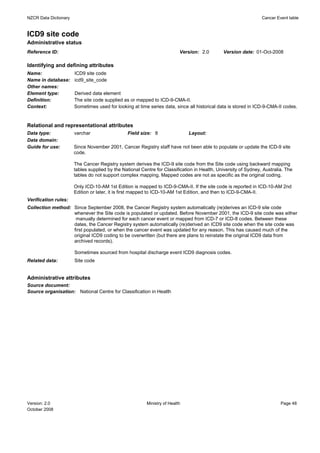
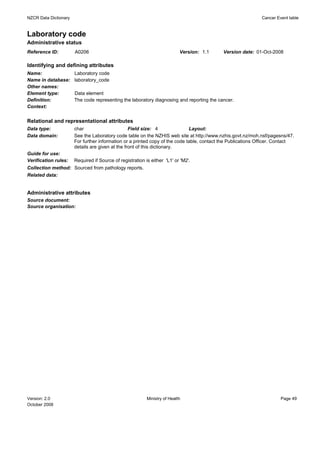
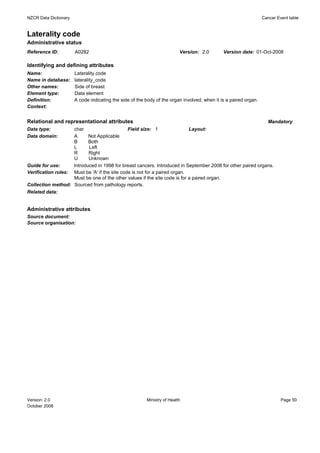
                       RP      Respiratory
Guide for use:     Introduced in 2001.
Verification rules:A registered cancer event must belong to a cancer group that is consistent with the site (the Site code
                   table indicates the allowable cancer group for each site).
Collection method: Sourced from pathology reports, hospital discharge event diagnosis codes (from NMDS) or mortality
                   event diagnosis codes (from Mortality).
Related data:      Site code
                   Site table


Administrative attributes
Source document:
Source organisation:


Version: 2.0                                             Ministry of Health                                               Page 25
October 2008
NZCR Data Dictionary                                                                                             Cancer Event table


Clinical code version
Administrative status
Reference ID:                                                             Version: 2.0        Version date: 01-Oct-2008

Identifying and defining attributes
Name:                  Clinical code version
Name in database:      clinical_coding_system_code
Other names:           Diagnosis coding system code, Clinical codes version
Element type:          Derived data element
Definition:            An ID for the system of clinical codes used for site and morphology codes.
Context:               The Cancer Registry uses a subset of clinical coding systems from the Clinical Coding System code
                       table stored in Shared Objects. This subset is listed in the Clinical Coding System table stored in the
                       Cancer Registry.

                       The Cancer Registry system derives the Clinical code system ID from the diagnosis date, using the date
                       ranges specified in the Clinical Coding System table stored in the Cancer Registry.


Relational and representational attributes
Data type:             char                       Field size: 2             Layout:
Data domain:           10 ICD-10-AM 1st Edition           ICD-O 2nd Edition
                       11 ICD-10-AM 2nd Edition           ICD-O 2nd Edition
                       12 ICD-10-AM 3rd Edition           ICD-O 3rd Edition
                       13 ICD-10-AM 6th Edition           ICD-O 3rd Edition
Guide for use:         A cancer event record uses the same Clinical code version for both the site code and the morphology
                       code.
Verification rules:    Must exist in the Clinical Coding System table.

                       Must be in force at the date of diagnosis.
Collection method:
Related data:      Site code
                   Morphology code


Administrative attributes
Source document:
Source organisation:


Version: 2.0                                             Ministry of Health                                               Page 26
October 2008
NZCR Data Dictionary                                                                                             Cancer Event table


Clinical notes
Administrative status
Reference ID:          A0270                                              Version: 2.0        Version date: 01-Oct-2008

Identifying and defining attributes
Name:                  Clinical notes
Name in database:      clinical_notes
Other names:           Cancer notes
Element type:          Data element
Definition:            A multi line text field containing supplementary information about the tumour registration.
Context:


Relational and representational attributes
Data type:             varchar                  Field size: 2000              Layout:
Data domain:
Guide for use:         Used by the Cancer Registry staff for notes such as recording requests for additional histology reports.
Verification rules:
Collection method:
Related data:


Administrative attributes
Source document:
Source organisation:


Version: 2.0                                             Ministry of Health                                               Page 27
October 2008
NZCR Data Dictionary                                                                                           Cancer Event table


Clinician name
Administrative status
Reference ID:          A0297                                              Version: 2.0       Version date: 01-Oct-2008

Identifying and defining attributes
Name:                  Clinician name
Name in database:      clinician_name
Other names:
Element type:          Data element
Definition:            The name of the clinician responsible for the treatment of the healthcare user.
Context:


Relational and representational attributes
Data type:             varchar                   Field size: 50               Layout:
Data domain:           Free text
Guide for use:         Collected for audit and research purposes.

                       Introduced in 2001 for cervical cancers. Introduced in September 2008 for all other cancers.
Verification rules:
Collection method: Sourced from pathology reports.
Related data:


Administrative attributes
Source document:
Source organisation:


Version: 2.0                                             Ministry of Health                                             Page 28
October 2008
NZCR Data Dictionary                                                                                          Cancer Event table


Coding review flag
Administrative status
Reference ID:                                                            Version: 1.0       Version date: 01-Oct-2008

Identifying and defining attributes
Name:                  Coding review flag
Name in database:      coding_review_flag
Other names:
Element type:          Data element
Definition:            A flag to indicate that the cancer event information should be reviewed.
Context:               Used by Cancer Registry staff to request a review of the cancer event information by another staff
                       member.

Relational and representational attributes                                                                       Mandatory
Data type:             char                     Field size: 1                Layout:
Data domain:           Y Yes
                       N No
Guide for use:
Verification rules:
Collection method:
Related data:


Administrative attributes
Source document:
Source organisation:


Version: 2.0                                            Ministry of Health                                             Page 29
October 2008
NZCR Data Dictionary                                                                                           Cancer Event table


Country of birth code
Administrative status
Reference ID:          A0198                                                 Version: 2.0    Version date: 01-Oct-2008

Identifying and defining attributes
Name:                  Country code
Name in database:      birth_country_code
Other names:
Element type:          Data element
Definition:            A code for the country of birth of the healthcare user.
Context:               Primarily used for epidemiological studies.


Relational and representational attributes
Data type:             char                       Field size: 3                  Layout:
Data domain:           004 - 999.

                       See the Country of Birth code table on the NZHIS web site at http://www.nzhis.govt.nz/moh.nsf/pagesns/47

Guide for use:         This is not the latest Statistics NZ country list.

                       Note that the NMDS and Mortality collections are better sources of information about the country of birth
                       of healthcare users than is the Cancer Registry. This is because the Cancer Registry obtains this data
                       while automatically creating cancer events from hospital discharge events or mortality events, but most
                       of these cancer events are subsequently rejected rather than registered.
Verification rules:
Collection method: Sourced from hospital discharge events (from NMDS) or mortality events (from Mortality).
Related data:


Administrative attributes
Source document:     Statistics NZ Country Code list (NZSCC86).
Source organisation:


Version: 2.0                                                Ministry of Health                                          Page 30
October 2008
NZCR Data Dictionary                                                                                           Cancer Event table


Country of diagnosis code
Administrative status
Reference ID:          A0198                                                 Version: 2.0      Version date: 01-Oct-2008

Identifying and defining attributes
Name:                  Country code
Name in database:      diagnosis_country_code
Other names:
Element type:          Data element
Definition:            A code for the country in which the cancer event was diagnosed.
Context:               The Cancer Registry occasionally receives information about cancer events that were diagnosed
                       overseas. These cancer events may still be captured, but are treated differently to those diagnosed in
                       New Zealand.

                       Only cancer events diagnosed in New Zealand are included in the core dataset.


Relational and representational attributes                                                                        Mandatory
Data type:             char                       Field size: 3                  Layout: NNN
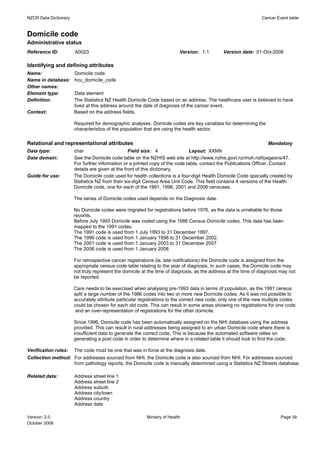
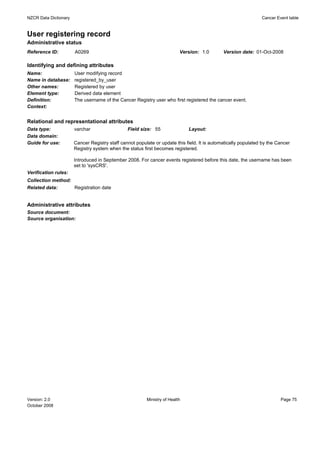
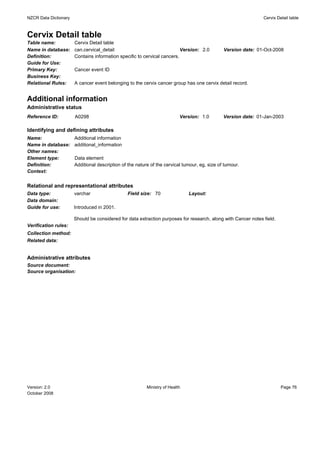
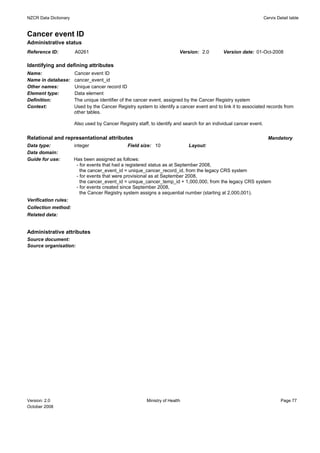
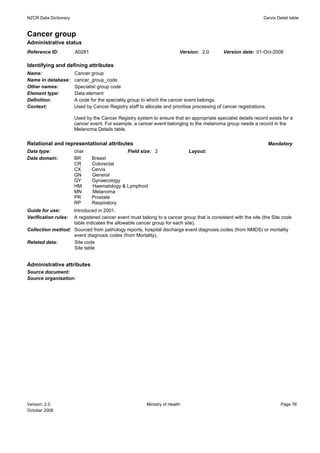
Data domain:           004 - 999.

                       See the Country of Birth code table on the NZHIS web site at http://www.nzhis.govt.nz/moh.nsf/pagesns/47

Guide for use:         Introduced in September 2008.

                       This is not the latest Statistics NZ country list.

                       This field uses the same code table as the country of birth.
Verification rules:
Collection method: Sourced from pathology reports.
Related data:


Administrative attributes
Source document:     Statistics NZ Country Code list (NZSCC86)
Source organisation:


Version: 2.0                                                Ministry of Health                                          Page 31
October 2008
NZCR Data Dictionary                                                                                           Cancer Event table


Date modified
Administrative status
Reference ID:          A0265                                              Version: 2.0       Version date: 01-Oct-2008

Identifying and defining attributes
Name:                  Date modified
Name in database:      updated_ts
Other names:           Updated timestamp
Element type:          Data element
Definition:            The date and time at which any information about the cancer event was saved to the database.
Context:               Used by Cancer Registry staff to identify when a cancer event was last worked on.

                       This field is automatically populated by the Cancer Registry system when a cancer event is first created,
                        and is updated whenever the cancer event information is changed. This includes changes to the
                       Cancer Event record, changes to its specialist details (e.g. a Breast Details record), and changes to its
                       list of problems (i.e. Cancer Event Problem records).

                       Updates performed automatically by the system (e.g. creating provisional cancer events during an
                       NMDS sweep) are assigned a pseudo-username (e.g. 'sysNmds').


Relational and representational attributes                                                                        Mandatory
Data type:             datetime                 Field size:                   Layout:
Data domain:
Guide for use:
Verification rules:
Collection method:
Related data:      User modifying record


Administrative attributes
Source document:
Source organisation:


Version: 2.0                                             Ministry of Health                                             Page 32
October 2008
NZCR Data Dictionary                                                                                             Cancer Event table


Date of birth
Administrative status
Reference ID:          A0025                                              Version: 1.1        Version date: 01-Oct-2008

Identifying and defining attributes
Name:                  Date of birth
Name in database:      hcu_birth_date
Other names:           DOB, HCU date of birth, Birth date
Element type:          Data element
Definition:            The date on which the healthcare user was born.
Context:               Required to derive age for demographic analyses.

                       The Cancer Registry stores its own copy of the date of birth, because some of its historical data differs
                       from the NHI.

                       Unlike NHI, partial dates are not supported in the Cancer Registry system.


Relational and representational attributes                                                                          Mandatory
Data type:             date                    Field size:                   Layout:
Data domain:           Valid dates
Guide for use:         For some events before 1993, the 15/6 or 15/month (if the month was known) default date model still
                       exists where there was no way to establish if the date is real or a default.
Verification rules:    Must be on or before the Diagnosis date.

                       Should be the same as the date of birth in NHI.

                       Age at diagnosis, which is derived from Date of birth, should be consistent with the Site for registered
                       cancer events.
Collection method: Sourced from NHI for new cancer events.
Related data:          Diagnosis date
                       Date of birth flag


Administrative attributes
Source document:
Source organisation:


Version: 2.0                                             Ministry of Health                                               Page 33
October 2008
NZCR Data Dictionary                                                                                              Cancer Event table


Date of histology
Administrative status
Reference ID:                                                              Version: 1.0        Version date: 01-Oct-2008

Identifying and defining attributes
Name:                  Date of histology
Name in database:      histology_date
Other names:
Element type:          Data element
Definition:            The date of the histology report for the definitive procedure, or for cervical cancer events, the date of
                       the first biopsy.
Context:               Used for audit purposes.


Relational and representational attributes
Data type:             date                      Field size:                   Layout:
Data domain:
Guide for use:         Introduced in September 2008.
Verification rules:    Must be between the Diagnosis date and the Date of death inclusive.
Collection method: Sourced from pathology reports.
Related data:


Administrative attributes
Source document:
Source organisation:


Version: 2.0                                              Ministry of Health                                                Page 34
October 2008
NZCR Data Dictionary                                                                                        Cancer Event table


Date received
Administrative status
Reference ID:                                                           Version: 2.0      Version date: 01-Oct-2008

Identifying and defining attributes
Name:                  Date received
Name in database:      received_date
Other names:
Element type:          Data element
Definition:            The date when the source information about the cancer event was received by the Cancer Registry.
Context:


Relational and representational attributes                                                                     Mandatory
Data type:             date                   Field size:                   Layout:
Data domain:
Guide for use:         Introduced in September 2008.
Verification rules:
Collection method: Sourced from the date the pathology report was received by the Ministry of Health. For cancer events
                   sourced from hospital discharge events (from NMDS) or mortality events (from Mortality), it is usually set
                    to the date the cancer event record was created in the Cancer Registry system.
Related data:      Registration source


Administrative attributes
Source document:
Source organisation:


Version: 2.0                                           Ministry of Health                                            Page 35
October 2008
NZCR Data Dictionary                                                                                          Cancer Event table


Deletion reason code
Administrative status
Reference ID:          A0272                                              Version: 2.0       Version date: 01-Oct-2008

Identifying and defining attributes
Name:                  Deletion reason code
Name in database:      deletion_reason_code
Other names:
Element type:          Data element
Definition:            The reason for deleting a registered record in the Cancer Registry.
Context:


Relational and representational attributes
Data type:             char                     Field size: 1                 Layout:
Data domain:           1    Registered in error
                       2    Primary already registered
                       3    Squamous cell carcinoma of skin
                       4    Duplicate Registration/Merged HCU
                       5    Other - see clinical notes
Guide for use:         Used by Cancer Registry staff.

                       Introduced in September 2008. Prior to then, the reason for deletion was captured as text, which now
                       appears in the clinical notes, along with a deletion reason code of '5'.
Verification rules:    Required for cancer events with a status of Deleted.
Collection method:
Related data:


Administrative attributes
Source document:
Source organisation:


Version: 2.0                                             Ministry of Health                                            Page 36
October 2008
NZCR Data Dictionary                                                                                           Cancer Event table


Diagnosis date
Administrative status
Reference ID:          A0233                                              Version: 1.1       Version date: 01-Oct-2008

Identifying and defining attributes
Name:                  Diagnosis date
Name in database:      diagnosis_date
Other names:           Date of diagnosis
Element type:          Data element
Definition:            The date the tumour was diagnosed.
Context:               Used as the primary date for reporting purposes.


Relational and representational attributes                                                                        Mandatory
Data type:             date                     Field size:                   Layout:
Data domain:           Valid dates
Guide for use:
Verification rules:    Must be between the Date of birth and the Date of death inclusive.

                       Must be no later than the Date of histology.

                   Must not be in the future.
Collection method: Sourced from pathology reports, hospital discharge event start date (from NMDS) or mortality event
                   date of death (from Mortality).

                       This is the same as the earliest Date of operation/biopsy or the Date of admission (in a hospital event)
                       or the Date of death if diagnosed on autopsy. If registering from a histology report, this should be the
                       earliest pathology report date. If the only notification of a cancer comes from a Medical Certificate of
                       Causes of Death, the diagnosis date is estimated from the 'Approximate time between onset and death'
                       as reported by the certifying doctor alongside the cancer diagnosis on the certificate.
Related data:


Administrative attributes
Source document:
Source organisation:


Version: 2.0                                             Ministry of Health                                             Page 37
October 2008
NZCR Data Dictionary                                                                                         Cancer Event table


Documentation status
Administrative status
Reference ID:          A0314                                             Version: 2.0       Version date: 01-Oct-2008

Identifying and defining attributes
Name:                  Documentation status
Name in database:      documentation_status_code
Other names:           Document status
Element type:          Data element
Definition:            A code to describe documentation available for the cancer registration.
Context:               Used by Cancer Registry staff to track whether all relevant documentation has been received.


Relational and representational attributes                                                                      Mandatory
Data type:             varchar                   Field size: 2               Layout:
Data domain:           1       All documents received
                       2       Awaiting pathology report
                       4       Awaiting other documents
                       8       No supporting documents
                       9       No applicable documents
                       10      Refer to Mortality Collection
Guide for use:         Introduced in 2001.
Verification rules:    Must not be 9 for registered cancer events.

                       Should not be 8 for registered cancer events that have a date of death.
Collection method:
Related data:


Administrative attributes
Source document:
Source organisation:


Version: 2.0                                            Ministry of Health                                            Page 38
October 2008
NZCR Data Dictionary                                                                                            Cancer Event table


Domicile code
Administrative status
Reference ID:          A0023                                              Version: 1.1        Version date: 01-Oct-2008

Identifying and defining attributes
Name:                  Domicile code
Name in database:      hcu_domicile_code
Other names:
Element type:          Data element
Definition:            The Statistics NZ Health Domicile Code based on an address. The healthcare user is believed to have
                       lived at this address around the date of diagnosis of the cancer event.
Context:               Based on the address fields.

                       Required for demographic analyses. Domicile codes are key variables for determining the
                       characteristics of the population that are using the health sector.

Relational and representational attributes                                                                         Mandatory
Data type:             char                       Field size: 4               Layout: XXNN
Data domain:           See the Domicile code table on the NZHIS web site at http://www.nzhis.govt.nz/moh.nsf/pagesns/47.
                       For further information or a printed copy of the code table, contact the Publications Officer. Contact
                       details are given at the front of this dictionary.
Guide for use:         The Domicile code used for health collections is a four-digit Health Domicile Code specially created by
                       Statistics NZ from their six-digit Census Area Unit Code. This field contains 4 versions of the Health
                       Domicile code, one for each of the 1991, 1996, 2001 and 2006 censuses.

                       The series of Domicile codes used depends on the Diagnosis date.

                       No Domicile codes were migrated for registrations before 1976, as the data is unreliable for those
                       records.
                       Before July 1993 Domicile was coded using the 1986 Census Domicile codes. This data has been
                       mapped to the 1991 codes.
                       The 1991 code is used from 1 July 1993 to 31 December 1997.
                       The 1996 code is used from 1 January 1998 to 31 December 2002.
                       The 2001 code is used from 1 January 2003 to 31 December 2007
                       The 2006 code is used from 1 January 2008

                       For retrospective cancer registrations (ie, late notifications) the Domicile code is assigned from the
                       appropriate census code table relating to the year of diagnosis. In such cases, the Domicile code may
                       not truly represent the domicile at the time of diagnosis, as the address at the time of diagnosis may not
                       be reported.

                       Care needs to be exercised when analysing pre-1993 data in terms of population, as the 1991 census
                       split a large number of the 1986 codes into two or more new Domicile codes. As it was not possible to
                       accurately attribute particular registrations to the correct new code, only one of the new multiple codes
                       could be chosen for each old code. This can result in some areas showing no registrations for one code
                        and an over-representation of registrations for the other domicile.

                       Since 1996, Domicile code has been automatically assigned on the NHI database using the address
                       provided. This can result in rural addresses being assigned to an urban Domicile code where there is
                       insufficient data to generate the correct code. This is because the automated software relies on
                       generating a post code in order to determine where in a related table it should look to find the code.

Verification rules:    The code must be one that was in force at the diagnosis date.
Collection method: For addresses sourced from NHI, the Domicile code is also sourced from NHI. For addresses sourced
                   from pathology reports, the Domicile code is manually determined using a Statistics NZ Streets database.

Related data:          Address street line 1
                       Address street line 2
                       Address suburb
                       Address city/town
                       Address country
                       Address date

Version: 2.0                                             Ministry of Health                                              Page 39
October 2008
NZCR Data Dictionary                                      Cancer Event table


Administrative attributes
Source document:
Source organisation: Statistics NZ


Version: 2.0                         Ministry of Health            Page 40
October 2008
NZCR Data Dictionary                                                                                           Cancer Event table


Extent of disease code
Administrative status
Reference ID:          A0121                                              Version: 2.0       Version date: 01-Oct-2008

Identifying and defining attributes
Name:                  Extent of disease code
Name in database:      disease_extent_code
Other names:           Stage of disease, Stage code
Element type:          Data element
Definition:            A code that describes the stage of development that the tumour has reached at the time of diagnosis.
Context:


Relational and representational attributes
Data type:             char                      Field size: 1                Layout:
Data domain:           A      In situ
                       B      Localised to organ of origin
                       C       Invasion of adjacent tissue or organ
                       D       Regional lymph nodes
                       E      Distant
                       F      Not known
                       G       Not applicable
                       0      In situ
                       1      Localised to organ of origin
                       2      Regional or node involvement
                       3      Remote or diffuse metastases
                       5      Not stated
                       6      Not applicable (Lymphomas/Leukaemias)
Guide for use:         Numeric extent of disease codes are used for cancer events diagnosed before 1999. For cancer events
                       diagnosed from 1 January 1999 onwards, alpha codes are used. The current codes 'C' and 'D' replace
                       the single numeric code '2' so these cannot be mapped one-to-one forwards.

                       For cancer events diagnosed from 1999, the Extent of disease code was applied in a standardised way,
                       using the SEER (Surveillance, Epidemiology and End Results) Guide to Summary Staging. At the end of
                       2002, the Ministry of Health adopted the updated SEER Guide (extended version).
Verification rules:    Mandatory for registered cancer events.

                       Must be consistent with the Site, Basis of diagnosis and Positive nodes.

                       If either ACPS system, Astler and Coller staging system, and/or Duke’s staging system has a value other
                        than blank or 'N' for registered colorectal cancer events, then Extent of disease must not be '5' or 'F'.

Collection method:         Sourced from pathology reports, hospital discharge events (from NMDS) or mortality events (from
                       Mortality).
Related data:


Administrative attributes
Source document:     SEER Summary Staging Manual
Source organisation: SEER Programme, World Health Organization


Version: 2.0                                             Ministry of Health                                             Page 41
October 2008
NZCR Data Dictionary                                                                                             Cancer Event table


Facility code
Administrative status
Reference ID:          A0143                                              Version: 1.1        Version date: 01-Oct-2008

Identifying and defining attributes
Name:                  Facility code
Name in database:      facility_code
Other names:           Health agency facility code, Hospital, HAF code, HAFC
Element type:          Data element
Definition:            A code that uniquely identifies the healthcare facility where the cancer was diagnosed or treated.
Context:               Used for audit and research purposes.


Relational and representational attributes
Data type:             char                       Field size: 4               Layout:
Data domain:           See the Facility code table on the NZHIS web site at http://www.nzhis.govt.nz/moh.nsf/pagesns/47.
                       For further information or a printed copy of the code table, contact the Publications Officer. Contact
                       details are given at the front of this dictionary.
Guide for use:
Verification rules:    Mandatory for registered cancer events with a Registration source of 'N1'.
Collection method: Sourced from hospital discharge events (from NMDS).
Related data:


Administrative attributes
Source document:
Source organisation:


Version: 2.0                                             Ministry of Health                                               Page 42
October 2008
NZCR Data Dictionary                                                                                     Cancer Event table


Family name
Administrative status
Reference ID:          A0013                                              Version: 2.0   Version date: 01-Oct-2008

Identifying and defining attributes
Name:                  Family name
Name in database:      hcu_family_name
Other names:           Last name, Surname
Element type:          Data element
Definition:            The family name (surname) of the healthcare user.
Context:               Used by Cancer Registry staff to identify the healthcare user.


Relational and representational attributes                                                                 Mandatory
Data type:             varchar                  Field size: 25                Layout:
Data domain:
Guide for use:
Verification rules:
Collection method: Since September 2008, this has been automatically populated with a copy of the current name from NHI
                   at the time a cancer event is created. For earlier data, the name was sourced from either NHI or
                   pathology reports.
Related data:      First name
                   Second name
                   Third name


Administrative attributes
Source document:
Source organisation:


Version: 2.0                                             Ministry of Health                                       Page 43
October 2008
NZCR Data Dictionary                                                                                     Cancer Event table


First name
Administrative status
Reference ID:          A0014                                              Version: 2.0   Version date: 01-Oct-2008

Identifying and defining attributes
Name:                  First given name
Name in database:      hcu_first_name
Other names:           First given name
Element type:          Data element
Definition:            The first given name of the healthcare user.
Context:               Used by Cancer Registry staff to identify the healthcare user.


Relational and representational attributes                                                                 Mandatory
Data type:             varchar                  Field size: 20                Layout:
Data domain:
Guide for use:
Verification rules:
Collection method: Since September 2008, this has been automatically populated with a copy of the current name from NHI
                   at the time a cancer event is created. For earlier data, the name was sourced from either NHI or
                   pathology reports.
Related data:      Second name
                   Third name
                   Family name


Administrative attributes
Source document:
Source organisation:


Version: 2.0                                             Ministry of Health                                       Page 44
October 2008
NZCR Data Dictionary                                                                                            Cancer Event table


Grade of tumour code
Administrative status
Reference ID:          A0274                                               Version: 2.0       Version date: 01-Oct-2008

Identifying and defining attributes
Name:                  Grade of tumour code
Name in database:      tumour_grade_code
Other names:           Tumour differentiation, Grading of tumour code
Element type:          Data element
Definition:            A code that specifies the differentiation of the tumour.
Context:


Relational and representational attributes
Data type:             char                       Field size: 1                Layout:
Data domain:           1     Well differentiated
                       2      Moderately differentiated, moderately well differentiated
                       3      Poorly differentiated
                       4      Undifferentiated, anaplastic
                       9      Not supplied, not determined or not applicable
Guide for use:         Introduced in 1998. Prior to this, general tumour differentiation information was held in the Morphology
                       description.
Verification rules:    Required for registered cancer events.

                       Must be consistent with Histopathology for registered breast cancer events.

                   Should be consistent with Gleason score for registered prostate cancer events.
Collection method: Sourced from pathology reports.
Related data:


Administrative attributes
Source document:
Source organisation:


Version: 2.0                                              Ministry of Health                                             Page 45
October 2008
NZCR Data Dictionary                                                                                         Cancer Event table


Grade of tumour description
Administrative status
Reference ID:          A0275                                              Version: 2.0     Version date: 01-Oct-2008

Identifying and defining attributes
Name:                  Grade of tumour description
Name in database:      tumour_grade_desc
Other names:           Grading of tumour text
Element type:          Data element
Definition:            Extra details about the grading description.
Context:


Relational and representational attributes
Data type:             varchar                  Field size: 70                Layout:
Data domain:
Guide for use:         Defaults to the standard description of the Grade of tumour code from the Grade of Tumour code table.
                       However, Cancer Registry staff can amend the description to add more specific information.
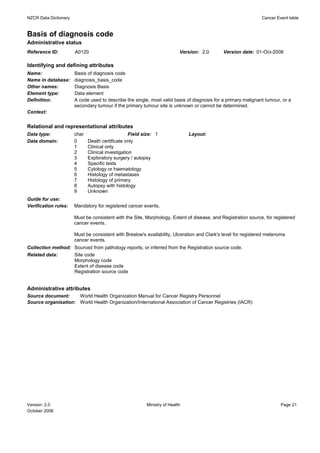
                       Introduced in 2001.
Verification rules:    Required for registered cancer events.
Collection method: Sourced from pathology reports.
Related data:


Administrative attributes
Source document:
Source organisation:


Version: 2.0                                             Ministry of Health                                           Page 46
October 2008
NZCR Data Dictionary                                                                                              Cancer Event table


HCU ID
Administrative status
Reference ID:          A0012                                               Version: 2.0        Version date: 01-Oct-2008

Identifying and defining attributes
Name:                  Master NHI number
Name in database:      hcu_id
Other names:           NHI number
Element type:          Data element
Definition:            An identifier of the healthcare user that has the cancer event.
Context:               The NHI number is the cornerstone of the Ministry of Health's data collections. It is a unique 7-character
                       identification number assigned to a healthcare user by the National Health Index (NHI) database. NHI
                       numbers uniquely identify healthcare users, and allow linking between different data collections.


Relational and representational attributes                                                                          Mandatory
Data type:             char                     Field size: 7                  Layout: AAANNNN
Data domain:
Guide for use:         The NHI system is the register of all healthcare users and their HCU IDs.

                       When duplicate records for a healthcare user are merged, one of their HCU_IDs will be deemed to be
                       the master (or primary), and the others become secondary HCU_IDs. It is important to consider both the
                       master and the secondary HCU_IDs when analysing healthcare information relating to a unique
                       individual.

                       The Privacy Commissioner considers the NHI number to be personally identifying information (like name
                       and address) so, if it is linked to clinical information, it must be held securely and the healthcare user’s
                       privacy protected.

                       For more information about the HCU ID, see http://www.nzhis.govt.nz/moh.nsf/pagesns/37
Verification rules:    Must exist on NHI.

                   There is a verification algorithm which ensures that the NHI number is in the correct format and is valid.
                   The algorithm is described at http://www.nzhis.govt.nz/moh.nsf/pagesns/276
Collection method: Sourced from the HCU ID and/or other personal details from pathology reports, hospital discharge event
                    HCU IDs (from NMDS) or mortality event HCU IDs (from Mortality).

                       Cancer Registry staff check all HCU IDs on pathology reports against the NHI. If the supplied HCU ID is
                       incorrect or invalid, then the laboratory or clinician is contacted for further information to correctly
                       identify the healthcare user.
Related data:


Administrative attributes
Source document:
Source organisation:


Version: 2.0                                              Ministry of Health                                               Page 47
October 2008
NZCR Data Dictionary                                                                                             Cancer Event table


ICD9 site code
Administrative status
Reference ID:                                                              Version: 2.0       Version date: 01-Oct-2008

Identifying and defining attributes
Name:                  ICD9 site code
Name in database:      icd9_site_code
Other names:
Element type:          Derived data element
Definition:            The site code supplied as or mapped to ICD-9-CMA-II.
Context:               Sometimes used for looking at time series data, since all historical data is stored in ICD-9-CMA-II codes.


Relational and representational attributes
Data type:             varchar                  Field size: 8                  Layout:
Data domain:
Guide for use:         Since November 2001, Cancer Registry staff have not been able to populate or update the ICD-9 site
                       code.

                       The Cancer Registry system derives the ICD-9 site code from the Site code using backward mapping
                       tables supplied by the National Centre for Classification in Health, University of Sydney, Australia. The
                       tables do not support complex mapping. Mapped codes are not as specific as the original coding.

                       Only ICD-10-AM 1st Edition is mapped to ICD-9-CMA-II. If the site code is reported in ICD-10-AM 2nd
                       Edition or later, it is first mapped to ICD-10-AM 1st Edition, and then to ICD-9-CMA-II.
Verification rules:
Collection method: Since September 2008, the Cancer Registry system automatically (re)derives an ICD-9 site code
                   whenever the Site code is populated or updated. Before November 2001, the ICD-9 site code was either
                    manually determined for each cancer event or mapped from ICD-7 or ICD-8 codes. Between these
                   dates, the Cancer Registry system automatically (re)derived an ICD9 site code when the site code was
                   first populated, or when the cancer event was updated for any reason. This has caused much of the
                   original ICD9 coding to be overwritten (but there are plans to reinstate the original ICD9 data from
                   archived records).

                       Sometimes sourced from hospital discharge event ICD9 diagnosis codes.
Related data:          Site code


Administrative attributes
Source document:
Source organisation: National Centre for Classification in Health


Version: 2.0                                              Ministry of Health                                              Page 48
October 2008
NZCR Data Dictionary                                                                                          Cancer Event table


Laboratory code
Administrative status
Reference ID:          A0206                                                Version: 1.1    Version date: 01-Oct-2008

Identifying and defining attributes
Name:                  Laboratory code
Name in database:      laboratory_code
Other names:
Element type:          Data element
Definition:            The code representing the laboratory diagnosing and reporting the cancer.
Context:


Relational and representational attributes
Data type:             char                       Field size: 4               Layout:
Data domain:           See the Laboratory code table on the NZHIS web site at http://www.nzhis.govt.nz/moh.nsf/pagesns/47.
                       For further information or a printed copy of the code table, contact the Publications Officer. Contact
                       details are given at the front of this dictionary.
Guide for use:
Verification rules:    Required if Source of registration is either 'L1' or 'M2'.
Collection method: Sourced from pathology reports.
Related data:


Administrative attributes
Source document:
Source organisation:


Version: 2.0                                               Ministry of Health                                          Page 49
October 2008
NZCR Data Dictionary                                                                                              Cancer Event table


Laterality code
Administrative status
Reference ID:          A0282                                              Version: 2.0        Version date: 01-Oct-2008

Identifying and defining attributes
Name:                  Laterality code
Name in database:      laterality_code
Other names:           Side of breast
Element type:          Data element
Definition:            A code indicating the side of the body of the organ involved, when it is a paired organ.
Context:


Relational and representational attributes                                                                          Mandatory
Data type:          char                       Field size: 1                Layout:
Data domain:        A      Not Applicable
                    B      Both
                    L      Left
                    R      Right
                    U      Unknown
Guide for use:      Introduced in 1998 for breast cancers. Introduced in September 2008 for other paired organs.
Verification rules: Must be 'A' if the site code is not for a paired organ.
                    Must be one of the other values if the site code is for a paired organ.
Collection method: Sourced from pathology reports.
Related data:


Administrative attributes
Source document:
Source organisation:


Version: 2.0                                             Ministry of Health                                                Page 50
October 2008
NZCR Data Dictionary                                                                                          Cancer Event table


Morphology code
Administrative status
Reference ID:                                                             Version: 2.0      Version date: 01-Oct-2008

Identifying and defining attributes
Name:                  Morphology code
Name in database:      morphology_code
Other names:           Clinical code
Element type:          Data element
Definition:            A code for the morphology (form and structure) of the tumour.
Context:               The Cancer Registry uses a subset of the clinical codes from the Clinical Codes table stored in Shared
                       Objects. The codes of this subset are listed in the Morphology table.

Relational and representational attributes
Data type:             varchar                    Field size: 8               Layout:
Data domain:           The first 4 digits of the morphology codes defined in the 2nd and 3rd editions of ICD-O.
                       Note that most morphology codes are common to both of these editions.
Guide for use:         Data with Diagnosis date before 2003 have been coded in ICD-0 2nd Edition. Data since that date are
                       coded in ICD-0 3rd Edition.
Verification rules:    Must exist in the Morphology table.

                       Must exist in Shared Objects' Clinical Codes table, where System ID = Clinical code version for the
                       cancer event, and Code Type = 'M' (Morphology).

                       Required for registered cancer events.

                       Should be malignant for registered cancer events.

                       Must be consistent with Site and Basis of Diagnosis for registered cancer events.

                       Must be consistent with Histopathology for registered breast cancer events.
Collection method: Sourced from pathology reports. Sometimes inferred from Site code.
Related data:      Morphology description
                   Clinical coding version
                   Site code


Administrative attributes
Source document:     ICD-O - International Classification of Diseases for Oncology
Source organisation: the World Health Organization


Version: 2.0                                             Ministry of Health                                            Page 51
October 2008
NZCR Data Dictionary                                                                                         Cancer Event table


Morphology description
Administrative status
Reference ID:                                                               Version: 2.0    Version date: 01-Oct-2008

Identifying and defining attributes
Name:                  Clinical code description
Name in database:      morphology_desc
Other names:
Element type:          Data element
Definition:            A description of the Morphology code.
Context:


Relational and representational attributes
Data type:             varchar                     Field size: 100              Layout:
Data domain:
Guide for use:         Defaults to the standard description of the Morphology code from the Clinical Codes table. However,
                       Cancer Registry staff can amend the description to add more specific information.
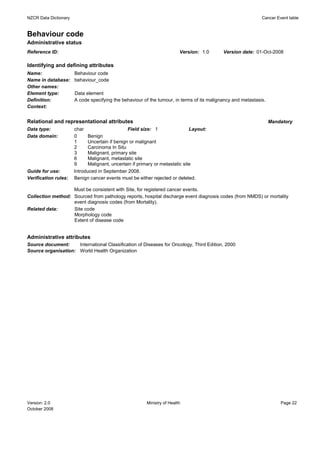
Verification rules:    Required for registered cancer events.
Collection method: Sourced from the Shared Objects' Clinical Codes table and pathology reports.
Related data:      Morphology code


Administrative attributes
Source document:
Source organisation:


Version: 2.0                                               Ministry of Health                                         Page 52
October 2008
NZCR Data Dictionary                                                                                                 Cancer Event table


Multiple tumours flag
Administrative status
Reference ID:          A0279                                               Version: 2.0         Version date: 01-Oct-2008

Identifying and defining attributes
Name:                  Multiple tumours flag
Name in database:      multiple_tumours_flag
Other names:
Element type:          Data element
Definition:            A flag to indicate cancer events that are considered multiple tumours according to the WHO
                       recommended classification.
Context:               When a healthcare user has multiple cancer events that belong to a Single Site, and that have the same
                        same morphological type as defined by Berg, only one of them may be identified as a primary cancer
                       for the purposes of incidence reporting.

                       For analysis purposes, the Cancer Registry stores all registerable cancers. However only the incident
                       cancer events are reported to the World Health Organization and included in Ministry of Health
                       publications.


Relational and representational attributes                                                                             Mandatory
Data type:             char                    Field size: 1                   Layout:
Data domain:           Y    Yes (Not an incident cancer event)
                       N    No (Incident cancer event)
Guide for use:
Verification rules:    For registered cancer events, this should be consistent with the multiple tumours flag of other registered
                       cancer events for the same health care user.

                       Must be 'N' for cancer events that are either provisional, in-situ, or registered overseas.
Collection method:
Related data:


Administrative attributes
Source document:     International Classification of Diseases for Oncology (ICD-O)
Source organisation: World Health Organization


Version: 2.0                                              Ministry of Health                                                  Page 53
October 2008
NZCR Data Dictionary                                                                                         Cancer Event table


New information flag
Administrative status
Reference ID:                                                            Version: 1.0      Version date: 01-Oct-2008

Identifying and defining attributes
Name:                  New information flag
Name in database:      new_info_flag
Other names:
Element type:          Data element
Definition:            A flag to indicate that new documentation has been received for this cancer event.
Context:               Used by Cancer Registry staff to indicate that the cancer event may need to be updated.


Relational and representational attributes                                                                       Mandatory
Data type:             char                    Field size: 1                 Layout:
Data domain:           Y Yes
                       N No
Guide for use:
Verification rules:
Collection method:
Related data:


Administrative attributes
Source document:
Source organisation:


Version: 2.0                                            Ministry of Health                                            Page 54
October 2008
NZCR Data Dictionary                                                                                         Cancer Event table


Nodes tested flag
Administrative status
Reference ID:          A0305                                             Version: 2.0       Version date: 01-Oct-2008

Identifying and defining attributes
Name:                  Nodes tested flag
Name in database:      nodes_tested_flag
Other names:
Element type:          Data element
Definition:            A flag to indicate that lymph nodes have been tested.
Context:


Relational and representational attributes                                                                     Mandatory
Data type:             char                     Field size: 1                Layout:
Data domain:           Y      Yes
                       N      No
                       U      Unknown
Guide for use:         Introduced in 2001 for colorectal cancers, and in September 2008 for other cancers.

                       This information was previously held in comments field.
Verification rules:
Collection method: Sourced from pathology reports.
Related data:      Extent of disease code
                   Total nodes sampled
                   Positive nodes


Administrative attributes
Source document:
Source organisation:


Version: 2.0                                            Ministry of Health                                            Page 55
October 2008
NZCR Data Dictionary                                                                                           Cancer Event table


Occupation code
Administrative status
Reference ID:          A0134                                              Version: 1.1       Version date: 01-Oct-2008

Identifying and defining attributes
Name:                  Occupation code
Name in database:      occupation_code
Other names:
Element type:          Data element
Definition:            A code for an occupation of the healthcare user, classified according to the Statistics NZ Standard
                       Classification of Occupations (NZSCO90).
Context:


Relational and representational attributes
Data type:             char                      Field size: 4                 Layout:
Data domain:           0111 - 9900. See the Occupation code table on the NZHIS web site at
                       http://www.nzhis.govt.nz/moh.nsf/pagesns/47. For further information or a printed copy of the code table,
                        contact the Publications Officer. Contact details are given at the front of this dictionary.
Guide for use:         Since September 2008, Cancer Registry staff have not been able to populate or update this field.

                       Note that the NMDS is a better source of information about the occupation of healthcare users than is
                       the Cancer Registry. This is because the Cancer Registry obtains this data while automatically creating
                       cancer events from hospital discharge events, but most of these cancer events are subsequently
                       rejected rather than registered.
Verification rules:
Collection method: Sourced from hospital discharge event occupation codes (from NMDS).
Related data:      Occupation description


Administrative attributes
Source document:     NZSCO90 - Statistics NZ Standard Classification of Occupations
Source organisation: Statistics NZ


Version: 2.0                                             Ministry of Health                                             Page 56
October 2008
NZCR Data Dictionary                                                                                          Cancer Event table


Occupation description
Administrative status
Reference ID:          A0215                                              Version: 2.0      Version date: 01-Oct-2008

Identifying and defining attributes
Name:                  Occupation free-text
Name in database:      occupation_desc
Other names:           Occupation free-text, Occupation text
Element type:          Data element
Definition:            A free-text description of the healthcare user's occupation.
Context:


Relational and representational attributes
Data type:             varchar                  Field size: 70                Layout:
Data domain:
Guide for use:         Introduced in November 2001.

                       Since September 2008, Cancer Registry staff have not been able to populate or update this field.

                       Note that the NMDS is a better source of information about the occupation of healthcare users than is
                       the Cancer Registry. This is because the Cancer Registry obtains this data while automatically creating
                       cancer events from hospital discharge events, but most of these cancer events are subsequently
                       rejected rather than registered.
Verification rules:
Collection method: Sourced from hospital discharge event occupation free-text (from NMDS).
Related data:      Occupation code


Administrative attributes
Source document:
Source organisation:


Version: 2.0                                             Ministry of Health                                            Page 57
October 2008
NZCR Data Dictionary                                                                                          Cancer Event table


Positive nodes
Administrative status
Reference ID:          A0286                                              Version: 2.0       Version date: 01-Oct-2008

Identifying and defining attributes
Name:                  Positive nodes
Name in database:      positive_nodes_nbr
Other names:           Nodes involved, Number of positive nodes
Element type:          Data element
Definition:            The number of lymph nodes from the sample that have metastases.
Context:               For breast cancers, this includes the number of Positive sentinel nodes.


Relational and representational attributes
Data type:             integer                  Field size: 2                 Layout:
Data domain:           0 to 999
Guide for use:         Introduced in 1998 for breast cancers, in 2001 for colorectal cancers, and in September 2008 for other
                       cancers.

                       Only meaningful if Nodes tested is 'Y' (yes)
Verification rules:    Must be less than or equal to the Total nodes sampled for registered events.

                   Should be consistent with Extent of disease for registered cancer events.
Collection method: Sourced from pathology reports.
Related data:          Extent of disease code
                       Nodes tested flag
                       Total nodes sampled
                       Positive sentinel nodes


Administrative attributes
Source document:
Source organisation:


Version: 2.0                                             Ministry of Health                                            Page 58
October 2008
NZCR Data Dictionary                                                                                             Cancer Event table


QA OK flag
Administrative status
Reference ID:                                                             Version: 1.0        Version date: 01-Oct-2008

Identifying and defining attributes
Name:                  QA OK flag
Name in database:      qa_ok_flag
Other names:
Element type:          Data element
Definition:            A flag indicating that the cancer event has been quality assured since its last substantive modification.
Context:               Used by Cancer Registry staff to avoid rechecking cancer events that have already been quality
                       assured.

Relational and representational attributes                                                                          Mandatory
Data type:             char                     Field size: 1                 Layout:
Data domain:           Y    Yes
                       N    No
Guide for use:
Verification rules:
Collection method: The flag is manually set to 'Y' by Cancer Registry staff after they quality assure the cancer event.

                       The flag is automatically set to 'N' by the Cancer Registry system when any field, other than the
                       Assessment Decision, Country of birth, Address, or Comments, is modified.
Related data:


Administrative attributes
Source document:
Source organisation:


Version: 2.0                                             Ministry of Health                                                Page 59
October 2008
NZCR Data Dictionary                                                                                    Cancer Event table


Record version
Administrative status
Reference ID:                                                          Version: 1.0     Version date: 01-Oct-2008

Identifying and defining attributes
Name:                  Record version
Name in database:      version
Other names:
Element type:          Data element
Definition:            The version of the data in this record.
Context:               Used by the Cancer Registry system for concurrency management.


Relational and representational attributes                                                                Mandatory
Data type:             integer               Field size: 10                Layout:
Data domain:
Guide for use:
Verification rules:
Collection method:
Related data:


Administrative attributes
Source document:
Source organisation:


Version: 2.0                                          Ministry of Health                                         Page 60
October 2008
NZCR Data Dictionary                                                                                            Cancer Event table


Registration date
Administrative status
Reference ID:                                                             Version: 1.0        Version date: 01-Oct-2008

Identifying and defining attributes
Name:                  Date updated
Name in database:      registered_ts
Other names:           Date of registration
Element type:          Derived data element
Definition:            The date and time that the cancer event was first registered.
Context:


Relational and representational attributes
Data type:             datetime                 Field size:                  Layout:
Data domain:           Valid dates
Guide for use:         Cancer Registry staff cannot populate or update this field. It is automatically populated by the Cancer
                       Registry system when the status first becomes registered.

                       Introduced in September 2008. For cancer events registered before this date, the Registration date has
                       been set to September 2008.
Verification rules:
Collection method:
Related data:      Registered by


Administrative attributes
Source document:
Source organisation:


Version: 2.0                                             Ministry of Health                                              Page 61
October 2008
NZCR Data Dictionary                                                                                           Cancer Event table


Registration source
Administrative status
Reference ID:          A0263                                                Version: 2.0       Version date: 01-Oct-2008

Identifying and defining attributes
Name:                  Registration source
Name in database:      registration_source_code
Other names:           Source of registration
Element type:          Data element
Definition:            A code that identifies the initial source of the cancer registration.
Context:


Relational and representational attributes                                                                       Mandatory
Data type:             char                      Field size: 2                  Layout:
Data domain:           L1      Laboratory Source
                       M1      Death Certificate
                       M2      Post Mortem Report
                       M3      Mortality Collection Source
                       N1      NMDS Collection Source
                       O1     Other Source
Guide for use:         Introduced in 2001. For earlier data, the default of 'O' (Other) has been used.
Verification rules:    Must be consistent with Basis of Diagnosis, for registered events.
Collection method:
Related data:      Date received


Administrative attributes
Source document:
Source organisation:


Version: 2.0                                               Ministry of Health                                           Page 62
October 2008
NZCR Data Dictionary                                                                                           Cancer Event table


Registration status
Administrative status
Reference ID:          A0317                                              Version: 2.0      Version date: 01-Oct-2008

Identifying and defining attributes
Name:                  Registration status
Name in database:      registration_status_code
Other names:
Element type:          Derived data element
Definition:            The processing status of the record.
Context:               The registration status incorporates the following information:
                       - the first character indicates whether the cancer event has ever been registered
                       - the second character indicates whether it was diagnosed in NZ or not, and whether its Behaviour code
                       is uncertain or not.
                       - the third character indicates how far the cancer event is through the registration process.

                       The Cancer Registry system automatically determines the registration status based on the Assessment
                       decision as well as other fields.


Relational and representational attributes                                                                       Mandatory
Data type:             char                    Field size: 3                  Layout:
Data domain:           P_C      Provisional Checked
                       P_J      Provisional Rejected
                       POP      Provisional Overseas
                       P_P      Provisional
                       PUP       Provisional Uncertain
                       POC      Provisional Overseas Checked
                       POJ      Provisional Overseas Rejected
                       PUC      Provisional Uncertain Checked
                       PUJ      Provisional Uncertain Rejected
                       R_C      Registered Complete
                       R_D      Registered Deleted
                       ROR      Registered Overseas
                       R_R      Registered
                       ROC      Registered Overseas Complete
                       ROD      Registered Overseas Deleted
Guide for use:         Analysis and reporting are usually limited to New Zealand registered cancer events (i.e. 'R_R' and
                       'R_C').
Verification rules:
Collection method:
Related data:          Documentation status


Administrative attributes
Source document:
Source organisation:


Version: 2.0                                             Ministry of Health                                             Page 63
October 2008
NZCR Data Dictionary                                                                                     Cancer Event table


Second name
Administrative status
Reference ID:          A0015                                              Version: 2.0   Version date: 01-Oct-2008

Identifying and defining attributes
Name:                  Second given name
Name in database:      hcu_second_name
Other names:           Second given name
Element type:          Data element
Definition:            The second given name of the healthcare user.
Context:               Used by Cancer Registry staff to identify the healthcare user.


Relational and representational attributes
Data type:             varchar                  Field size: 20                Layout:
Data domain:
Guide for use:
Verification rules:
Collection method: Since September 2008, this has been automatically populated with a copy of the current name from NHI
                   at the time a cancer event is created. For earlier data, the name was sourced from either NHI or
                   pathology reports.
Related data:      First name
                   Third name
                   Family name


Administrative attributes
Source document:
Source organisation:


Version: 2.0                                             Ministry of Health                                       Page 64
October 2008
NZCR Data Dictionary                                                                                             Cancer Event table


Sex
Administrative status
Reference ID:          A0028                                              Version: 2.0        Version date: 01-Oct-2008

Identifying and defining attributes
Name:                  Sex
Name in database:      hcu_sex_code
Other names:           Sex type code
Element type:          Data element
Definition:            The biological sex of the healthcare user.
Context:               Used for demographic analyses.

                       The term sex refers to the biological differences between males and females, while the term gender
                       refers to a person's social role (masculine or feminine).

                       'I' codes are for use in cases, usually newborns, where it is not possible to determine the sex of the
                       healthcare user.

                       Because it is possible for a person's sex to change over time (e.g. transsexual people), the Cancer
                       Registry collects sex information for each cancer event, rather than relying on the data in the National
                       Health Index (which does not include historical data). In rare cases, this may mean that the type of
                       cancer does not appear to be compatible with the healthcare user's current sex.


Relational and representational attributes                                                                          Mandatory
Data type:             char                    Field size: 1                 Layout:
Data domain:           M     Male
                       F    Female
                       U     Unknown
                       I     Indeterminate
Guide for use:         Cannot be updated by Cancer Registry staff.
Verification rules:    Should be consistent with Site for registered cancer events.
Collection method: Since September 2008, this has been automatically populated at the time a cancer event is created. For
                    cancer events created manually, a copy of the current sex from NHI is used. For cancer events created
                   from NMDS or Mortality records, the sex from the source records is used. For earlier data, the sex could
                   also be sourced from pathology reports.
Related data:


Administrative attributes
Source document:
Source organisation:


Version: 2.0                                             Ministry of Health                                               Page 65
October 2008
NZCR Data Dictionary                                                                                            Cancer Event table


Site code
Administrative status
Reference ID:                                                             Version: 2.0       Version date: 01-Oct-2008

Identifying and defining attributes
Name:                  Site code
Name in database:      site_code
Other names:           Clinical code
Element type:          Data element
Definition:            A code for the site of the tumour.
Context:               The Cancer Registry uses a subset of the clinical codes from the Clinical Codes table stored in Shared
                       Objects. The codes of this subset are listed in the Site table.

Relational and representational attributes
Data type:             varchar                    Field size: 8               Layout:
Data domain:           The set of site codes of interest to the Cancer Registry, from ICD-10-AM. This set is the same,
                       irrespective of which edition of ICD-10-AM is used.
Guide for use:         All data in the Cancer Registry is coded in ICD-10. However, data prior to January 2000 was originally
                       coded in ICD-7, -8 and -9. This data has subsequently been mapped to ICD-10, manually checked, and
                       some anomalies corrected.
Verification rules:    Must exist in the Site table.

                       Must exist in Shared Objects' Clinical Codes table, where System ID = Clinical code version for the
                       cancer event, and Code Type = 'A' (Diagnosis Codes) or 'V' (Supplementary classification)

                       Required for registered cancer events

                       Must be a registerable site for registered cancer events.

                       Must be consistent with Behaviour Code, Cancer Group, Morphology, Basis of Diagnosis, Extent of
                       Disease, Sex, Age at diagnosis (derived from Date of birth and Date of diagnosis), and Laterality, for
                       registered cancer events.

                       Must be consistent with Histopathology for registered breast cancer events.
Collection method: Sourced from pathology reports, hospital discharge event diagnosis codes (from NMDS) or mortality
                   event diagnosis codes (from Mortality).
Related data:      Site description
                   Clinical coding version
                   Morphology code


Administrative attributes
Source document:     ICD-10-AM - the International Statistical Classification of Diseases and Related Health Problems, 10th
                      Revision, Australian Modification.
Source organisation: National Centre for Classification in Health, University of Sydney, Australia and the World Health
                     Organization


Version: 2.0                                             Ministry of Health                                              Page 66
October 2008
NZCR Data Dictionary                                                                                              Cancer Event table


Site description
Administrative status
Reference ID:                                                               Version: 2.0       Version date: 01-Oct-2008

Identifying and defining attributes
Name:                  Clinical code description
Name in database:      site_desc
Other names:
Element type:          Data element
Definition:            A description of the Site code.
Context:


Relational and representational attributes
Data type:             varchar                     Field size: 100              Layout:
Data domain:
Guide for use:         Defaults to the standard description of the Site code from the Clinical Codes table. However, Cancer
                       Registry staff can amend the description to add more specific information, e.g. before the laterality field
                       was introduced, laterality was added to this field.
Verification rules:    Required for registered cancer events.
Collection method: Sourced from the Shared Objects' Clinical Codes table, pathology reports, hospital discharge event
                   diagnosis codes(from NMDS) or mortality event diagnosis codes (from Mortality).
Related data:      Site code


Administrative attributes
Source document:
Source organisation:


Version: 2.0                                               Ministry of Health                                              Page 67
October 2008
NZCR Data Dictionary                                                                                             Cancer Event table


Smoking history flag
Administrative status
Reference ID:          A0280                                               Version: 2.0       Version date: 01-Oct-2008

Identifying and defining attributes
Name:                  Smoking history flag
Name in database:      smoking_history_flag
Other names:
Element type:          Data element
Definition:            A flag to indicate that the healthcare user had a smoking history or is currently a smoker.
Context:


Relational and representational attributes                                                                           Mandatory
Data type:             char                      Field size: 1                 Layout:
Data domain:           Y      Yes
                       N      No
                       U      Unknown
Guide for use:         Introduced in 2001.

                       Note that this data is largely incomplete.
Verification rules:
Collection method: Manually sourced from hospital discharge event diagnosis codes (from NMDS).
Related data:


Administrative attributes
Source document:
Source organisation:


Version: 2.0                                              Ministry of Health                                              Page 68
October 2008
NZCR Data Dictionary                                                                                     Cancer Event table


Third name
Administrative status
Reference ID:          A0016                                              Version: 2.0   Version date: 01-Oct-2008

Identifying and defining attributes
Name:                  Third given name
Name in database:      hcu_third_name
Other names:           Third given name
Element type:          Data element
Definition:            The third given name of the healthcare user.
Context:               Used by Cancer Registry staff to identify the healthcare user.


Relational and representational attributes
Data type:             varchar                  Field size: 20                Layout:
Data domain:
Guide for use:
Verification rules:
Collection method: Since September 2008, this has been automatically populated with a copy of the current name from NHI
                   at the time a cancer event is created. For earlier data, the name was sourced from either NHI or
                   pathology reports.
Related data:      First name
                   Second name
                   Family name


Administrative attributes
Source document:
Source organisation:


Version: 2.0                                             Ministry of Health                                       Page 69
October 2008
NZCR Data Dictionary                                                                                            Cancer Event table


TNM-M
Administrative status
Reference ID:          A0278                                              Version: 2.0       Version date: 01-Oct-2008

Identifying and defining attributes
Name:                  TNM-M
Name in database:      tnm_m
Other names:           Metastasis
Element type:          Data element
Definition:            Indicates the absence or presence of distant metastasis, as classified by TNM.
Context:               TNM is Tumour size, Nodes and Metastases, and is specific to the site. It is an international staging
                       system comprising:
                       - pathological staging based on histology reports, and
                       - clinical staging based on hospital events

Relational and representational attributes
Data type:             varchar                  Field size: 2                 Layout:
Data domain:           Refer to the TNM classification book
Guide for use:         Introduced in 2001.
Verification rules:
Collection method: Mainly sourced from pathology reports of metastases or from clinical information on pathology reports.
Related data:      TNM-T
                   TNM-N


Administrative attributes
Source document:     TNM Classification of Malignant Tumours
Source organisation: International Union Against Cancer (UICC)


Version: 2.0                                             Ministry of Health                                              Page 70
October 2008
NZCR Data Dictionary                                                                                            Cancer Event table


TNM-N
Administrative status
Reference ID:          A0277                                              Version: 2.0       Version date: 01-Oct-2008

Identifying and defining attributes
Name:                  TNM-N
Name in database:      tnm_n
Other names:           Nodes involved
Element type:          Data element
Definition:            Describes the absence or presence and extent of regional lymph node metastasis, as classified by
                       TNM.
Context:               TNM is Tumour size, Nodes and Metastases, and is specific to the site. It is an international staging
                       system comprising:
                       - pathological staging based on histology reports, and
                       - clinical staging based on hospital events

Relational and representational attributes
Data type:             varchar                  Field size: 10                Layout:
Data domain:           Refer to the TNM classification book
Guide for use:         Introduced in 2001.
Verification rules:
Collection method: Sourced from pathology reports.
Related data:          TNM-T
                       TNM-M


Administrative attributes
Source document:     TNM Classification of Malignant Tumours
Source organisation: International Union Against Cancer (UICC)


Version: 2.0                                             Ministry of Health                                              Page 71
October 2008
NZCR Data Dictionary                                                                                             Cancer Event table


TNM-T
Administrative status
Reference ID:          A0276                                               Version: 2.0        Version date: 01-Oct-2008

Identifying and defining attributes
Name:                  TNM-T
Name in database:      tnm_t
Other names:           Extent of tumour
Element type:          Data element
Definition:            An international classification code to describe the extent/size of the primary tumour, as classified by
                       TNM.
Context:               TNM is Tumour size, Nodes and Metastases, and is specific to the site. It is an international staging
                       system comprising:
                       - pathological staging based on histology reports, and
                       - clinical staging based on hospital events

Relational and representational attributes
Data type:             varchar                  Field size: 10                 Layout:
Data domain:           Refer to the TNM classification book
Guide for use:         Introduced in 2001.
Verification rules:
Collection method: Sourced from pathology reports.
Related data:          TNM-N
                       TNM-M


Administrative attributes
Source document:     TNM Classification of Malignant Tumours
Source organisation: International Union Against Cancer (UICC)


Version: 2.0                                              Ministry of Health                                              Page 72
October 2008
NZCR Data Dictionary                                                                                            Cancer Event table


Total nodes sampled
Administrative status
Reference ID:          A0285                                              Version: 2.0      Version date: 01-Oct-2008

Identifying and defining attributes
Name:                  Total nodes sampled
Name in database:      nodes_sampled_nbr
Other names:           Lymph nodes sampled
Element type:          Data element
Definition:            The number of lymph nodes that were sampled.
Context:               For breast cancers, this includes the number of Sentinel nodes sampled.


Relational and representational attributes
Data type:             integer                  Field size: 3                 Layout:
Data domain:           1 to 999
Guide for use:         Introduced in 1998 for breast cancers, in 2001 for colorectal cancers, and in September 2008 for other
                       cancers.

                       Only meaningful if Nodes tested is 'Y' (yes).
Verification rules:    Must be greater or equal to the number of Positive nodes for registered cancer events.
Collection method: Sourced from pathology reports.
Related data:      Extent of disease code
                   Nodes tested flag
                   Positive nodes
                   Sentinel nodes sampled


Administrative attributes
Source document:
Source organisation:


Version: 2.0                                             Ministry of Health                                              Page 73
October 2008
NZCR Data Dictionary                                                                                             Cancer Event table


User modifying record
Administrative status
Reference ID:          A0269                                              Version: 2.0        Version date: 01-Oct-2008

Identifying and defining attributes
Name:                  User modifying record
Name in database:      updated_by_user
Other names:           Updated by user
Element type:          Derived data element
Definition:            The login username of the user who last saved any information about the cancer event.
Context:               Used by Cancer Registry staff to identify who has worked on a cancer event.

                       This field is automatically populated by the Cancer Registry system when a cancer event is first created,
                        and is updated whenever the cancer event information is changed. This includes changes to the
                       Cancer Event record, changes to its specialist details (e.g. a Breast Details record), and changes its list
                       of problems (i.e. Cancer Event Rule Violation records).

                       Updates performed automatically by the system (e.g. creating provisional cancer events during an
                       NMDS sweep) are assigned a pseudo-username (e.g. 'sysNmds')


Relational and representational attributes                                                                          Mandatory
Data type:             varchar                  Field size: 55                Layout:
Data domain:
Guide for use:
Verification rules:
Collection method:
Related data:      Date modified


Administrative attributes
Source document:
Source organisation:


Version: 2.0                                             Ministry of Health                                               Page 74
October 2008
NZCR Data Dictionary                                                                                            Cancer Event table


User registering record
Administrative status
Reference ID:          A0269                                              Version: 1.0        Version date: 01-Oct-2008

Identifying and defining attributes
Name:                  User modifying record
Name in database:      registered_by_user
Other names:           Registered by user
Element type:          Derived data element
Definition:            The username of the Cancer Registry user who first registered the cancer event.
Context:


Relational and representational attributes
Data type:             varchar                  Field size: 55                Layout:
Data domain:
Guide for use:         Cancer Registry staff cannot populate or update this field. It is automatically populated by the Cancer
                       Registry system when the status first becomes registered.

                       Introduced in September 2008. For cancer events registered before this date, the username has been
                       set to 'sysCRS'.
Verification rules:
Collection method:
Related data:      Registration date


Administrative attributes
Source document:
Source organisation:


Version: 2.0                                             Ministry of Health                                              Page 75
October 2008
NZCR Data Dictionary                                                                                           Cervix Detail table


Cervix Detail table
Table name:            Cervix Detail table
Name in database:      can.cervical_detail                                Version: 2.0         Version date: 01-Oct-2008
Definition:            Contains information specific to cervical cancers.
Guide for Use:
Primary Key:           Cancer event ID
Business Key:
Relational Rules:      A cancer event belonging to the cervix cancer group has one cervix detail record.


Additional information
Administrative status
Reference ID:          A0298                                               Version: 1.0        Version date: 01-Jan-2003

Identifying and defining attributes
Name:                  Additional information
Name in database:      additional_information
Other names:
Element type:          Data element
Definition:            Additional description of the nature of the cervical tumour, eg, size of tumour.
Context:


Relational and representational attributes
Data type:             varchar                  Field size: 70                 Layout:
Data domain:
Guide for use:         Introduced in 2001.

                       Should be considered for data extraction purposes for research, along with Cancer notes field.
Verification rules:
Collection method:
Related data:


Administrative attributes
Source document:
Source organisation:


Version: 2.0                                              Ministry of Health                                            Page 76
October 2008
NZCR Data Dictionary                                                                                                Cervix Detail table


Cancer event ID
Administrative status
Reference ID:          A0261                                              Version: 2.0        Version date: 01-Oct-2008

Identifying and defining attributes
Name:                  Cancer event ID
Name in database:      cancer_event_id
Other names:           Unique cancer record ID
Element type:          Data element
Definition:            The unique identifier of the cancer event, assigned by the Cancer Registry system
Context:               Used by the Cancer Registry system to identify a cancer event and to link it to associated records from
                       other tables.

                       Also used by Cancer Registry staff, to identify and search for an individual cancer event.

Relational and representational attributes                                                                            Mandatory
Data type:             integer                  Field size: 10                Layout:
Data domain:
Guide for use:         Has been assigned as follows:
                        - for events that had a registered status as at September 2008,
                          the cancer_event_id = unique_cancer_record_id, from the legacy CRS system
                        - for events that were provisional as at September 2008,
                          the cancer_event_id = unique_cancer_temp_id + 1,000,000, from the legacy CRS system
                        - for events created since September 2008,
                          the Cancer Registry system assigns a sequential number (starting at 2,000,001).
Verification rules:
Collection method:
Related data:


Administrative attributes
Source document:
Source organisation:


Version: 2.0                                             Ministry of Health                                                  Page 77
October 2008
NZCR Data Dictionary                                                                                             Cervix Detail table


Cancer group
Administrative status
Reference ID:          A0281                                              Version: 2.0        Version date: 01-Oct-2008

Identifying and defining attributes
Name:                  Cancer group
Name in database:      cancer_group_code
Other names:           Specialist group code
Element type:          Data element
Definition:            A code for the speciality group to which the cancer event belongs.
Context:               Used by Cancer Registry staff to allocate and prioritise processing of cancer registrations.

                       Used by the Cancer Registry system to ensure that an appropriate specialist details record exists for a
                       cancer event. For example, a cancer event belonging to the melanoma group needs a record in the
                       Melanoma Details table.


Relational and representational attributes                                                                            Mandatory
Data type:             char                  Field size: 2                    Layout:
Data domain:           BR      Breast
                       CR      Colorectal
                       CX      Cervix
                       GN      General
                       GY      Gynaecology
                       HM      Haematology & Lymphoid
                       MN      Melanoma
                       PR      Prostate
                       RP      Respiratory
Guide for use:     Introduced in 2001.
Verification rules:A registered cancer event must belong to a cancer group that is consistent with the site (the Site code
                   table indicates the allowable cancer group for each site).
Collection method: Sourced from pathology reports, hospital discharge event diagnosis codes (from NMDS) or mortality
                   event diagnosis codes (from Mortality).
Related data:      Site code
                   Site table


Administrative attributes
Source document:
Source organisation:


Version: 2.0                                             Ministry of Health                                               Page 78
October 2008
NZCR Data Dictionary                                                                                           Cervix Detail table


Cervix FIGO staging code
Administrative status
Reference ID:          A0296                                              Version: 1.1       Version date: 01-Oct-2008

Identifying and defining attributes
Name:                  Cervix FIGO staging code
Name in database:      cervical_figo_staging_code
Other names:
Element type:          Data element
Definition:            A code defining staging specific to tumours of the cervix.
Context:


Relational and representational attributes                                                                       Mandatory
Data type:             varchar                    Field size: 4                 Layout:
Data domain:           0       Carcinoma in situ
                       I       Cervical carcinoma confined to uterus (extension to corpus should b…
                       IA      Invasive carcinoma diagnosed only by microscopy. All macroscopical…
                       IA1     Stromal invasion no greater than 3.0 mm in depth and 7.0 mm or le…
                       IA2     Stromal invasion more than 3.0 mm and not more than 5.0 mm with a…
                       IB      Clinically visible lesion confined to the cervix or microscopic le…
                       IB1     Clinically visible lesion 4.0 cm or less in greatest dimension
                       IB2     Clinically visible lesion more than 4 cm in greatest dimension
                       II      Tumour invades beyond uterus but not to pelvic wall or to lower th…
                       IIA     Without parametrial invasion
                       IIB     With parametrial invasion
                       III     Tumour extends to pelvic wall, and/or involves lower third of vag...
                       IIIA    Tumour involves lower third of vagina, no extension to pelvic wall
                       IIIB    Tumour extends to pelvic wall and/or causes hydronephrosis or no...
                       IVA     Tumour invades mucosa of bladder or rectum and/or extends beyond ...
                       IVB     Distant metastasis
                       9        Unknown or not stated
Guide for use:         This is usually a clinical staging code, which is assigned prior to treatment. It should not change,
                       regardless of the results of operation or biopsy. Therefore the FIGO staging code may not correlate with
                        the extent of disease code.

                       Introduced in 2001.
Verification rules:
Collection method: Sourced directly from clinicians or from pathology reports.
Related data:      Extent of disease code


Administrative attributes
Source document:
Source organisation: International Federation of Gynecology and Obstetrics (FIGO)


Version: 2.0                                             Ministry of Health                                             Page 79
October 2008
NZCR Data Dictionary                                                                                         Colorectal Detail table


Colorectal Detail table
Table name:       Colorectal Detail table
Name in database: can.colorectal_detail                               Version: 1.1         Version date: 01-Oct-2008
Definition:       Holds information specific to the registration of malignancies of the colon, including the appendix and
                  the rectum.
Guide for Use:    This table contains fields for different staging systems, ie, ACP, Astler and Coller, and Duke's. These
                  are not necessarily all reported for each tumour. ACP is the least commonly used.
Primary Key:      Cancer event ID
Business Key:
Relational Rules: A cancer event belonging to the colorectal cancer group has one colorectal detail record.


ACPS system code
Administrative status
Reference ID:          A0304                                               Version: 1.1      Version date: 01-Oct-2008

Identifying and defining attributes
Name:                  ACPS system code
Name in database:      acp_staging_code
Other names:           Australian clinicopathological staging code, ACP staging system
Element type:          Data element
Definition:            A code that specifies the extent of the colorectal tumour.
Context:


Relational and representational attributes
Data type:             varchar                  Field size: 2                Layout:
Data domain:           A0      Mucosa
                       A1      Mucosa
                       A       Submucosa/muscularis propria
                       A2      Submucosa
                       A3      Muscularis propria
                       B       Beyond muscularis propria/free serosal surface
                       B1      Beyond muscularis propria
                       B2      Free serosal surface
                       C       Local/apical nodes involved
                       C1      Local nodes involved
                       C2      Apical nodes involved
                       D      Tumour transected (hist)/distant metastasis (clinical/hist)
                       D1     Tumour transected (histological)
                       D2      Distant metastasis (clinical/histological)
                       N       Not applicable/unknown
Guide for use:         This is based on the ACP Staging System. It is a pathology code.

                       Introduced in 2001.
Verification rules:    If either ACPS system, Astler and Coller staging system, and/or Duke’s staging system has a value other
                        than blank or 'N' for registered colorectal cancer events, then Extent of disease must not be '5' or 'F'.

Collection method: Sourced from pathology reports.
Related data:      Extent of disease code


Administrative attributes
Source document:     Finlay A. 1996. Screening for colorectal cancer. Medical Journal of Australia 165: 102-5.
Source organisation: Australasian College of Pathology


Version: 2.0                                              Ministry of Health                                              Page 80
October 2008
NZCR Data Dictionary                                                                                         Colorectal Detail table


Astler and Coller staging system code
Administrative status
Reference ID:          A0302                                               Version: 1.1      Version date: 01-Oct-2008

Identifying and defining attributes
Name:                  Astler and Coller staging system
Name in database:      astler_coller_staging_code
Other names:
Element type:          Data element
Definition:            A code that specifies the extent of the colorectal tumour.
Context:


Relational and representational attributes
Data type:             varchar                  Field size: 2              Layout:
Data domain:           A       Limited to mucosa
                       B1      Involvement of muscularis propria
                       B2      Through muscularis propria to subserosa/serosa
                       B3      Involvement of adjacent structures
                       C1      Involvement of muscularis propria with LN metastasis
                       C2      Through muscularis propria to subserosa/serosa with LN metastasis
                       C3      Involvement of adjacent structures with LN metastasis
                       D       Distant metastasis
                       N       Not applicable/unknown
Guide for use:         This is based on the Astler and Coller staging system.

                       Introduced in 2001.
Verification rules:    If either ACPS system, Astler and Coller staging system, and/or Duke’s staging system has a value other
                        than blank or 'N' for registered colorectal cancer events, then Extent of disease must not be '5' or 'F'.

Collection method: Sourced from pathology reports.
Related data:      Extent of disease code


Administrative attributes
Source document:         Astler VB, Coller FA. 1954. The prognostic significance of direct extension of carcinoma of the colon
                         and rectum. Ann Surg 139: 846.
Source organisation:


Version: 2.0                                              Ministry of Health                                              Page 81
October 2008
NZCR Data Dictionary                                                                                         Colorectal Detail table


Cancer event ID
Administrative status
Reference ID:          A0261                                              Version: 2.0        Version date: 01-Oct-2008

Identifying and defining attributes
Name:                  Cancer event ID
Name in database:      cancer_event_id
Other names:           Unique cancer record ID
Element type:          Data element
Definition:            The unique identifier of the cancer event, assigned by the Cancer Registry system
Context:               Used by the Cancer Registry system to identify a cancer event and to link it to associated records from
                       other tables.

                       Also used by Cancer Registry staff, to identify and search for an individual cancer event.

Relational and representational attributes                                                                          Mandatory
Data type:             integer                  Field size: 10                Layout:
Data domain:
Guide for use:         Has been assigned as follows:
                        - for events that had a registered status as at September 2008,
                          the cancer_event_id = unique_cancer_record_id, from the legacy CRS system
                        - for events that were provisional as at September 2008,
                          the cancer_event_id = unique_cancer_temp_id + 1,000,000, from the legacy CRS system
                        - for events created since September 2008,
                          the Cancer Registry system assigns a sequential number (starting at 2,000,001).
Verification rules:
Collection method:
Related data:


Administrative attributes
Source document:
Source organisation:


Version: 2.0                                             Ministry of Health                                               Page 82
October 2008
NZCR Data Dictionary                                                                                          Colorectal Detail table


Cancer group
Administrative status
Reference ID:          A0281                                              Version: 2.0        Version date: 01-Oct-2008

Identifying and defining attributes
Name:                  Cancer group
Name in database:      cancer_group_code
Other names:           Specialist group code
Element type:          Data element
Definition:            A code for the speciality group to which the cancer event belongs.
Context:               Used by Cancer Registry staff to allocate and prioritise processing of cancer registrations.

                       Used by the Cancer Registry system to ensure that an appropriate specialist details record exists for a
                       cancer event. For example, a cancer event belonging to the melanoma group needs a record in the
                       Melanoma Details table.


Relational and representational attributes                                                                            Mandatory
Data type:             char                  Field size: 2                    Layout:
Data domain:           BR      Breast
                       CR      Colorectal
                       CX      Cervix
                       GN      General
                       GY      Gynaecology
                       HM      Haematology & Lymphoid
                       MN      Melanoma
                       PR      Prostate
                       RP      Respiratory
Guide for use:     Introduced in 2001.
Verification rules:A registered cancer event must belong to a cancer group that is consistent with the site (the Site code
                   table indicates the allowable cancer group for each site).
Collection method: Sourced from pathology reports, hospital discharge event diagnosis codes (from NMDS) or mortality
                   event diagnosis codes (from Mortality).
Related data:      Site code
                   Site table


Administrative attributes
Source document:
Source organisation:


Version: 2.0                                             Ministry of Health                                                Page 83
October 2008
NZCR Data Dictionary                                                                                         Colorectal Detail table


Duke's staging system code
Administrative status
Reference ID:          A0303                                              Version: 1.1       Version date: 01-Oct-2008

Identifying and defining attributes
Name:                  Duke's staging system code
Name in database:      dukes_staging_code
Other names:
Element type:          Data element
Definition:            A code that specifies the extent of the colorectal tumour.
Context:


Relational and representational attributes
Data type:             varchar                  Field size: 2               Layout:
Data domain:           A       Localised. No extension beyond muscularis propria
                       B       Extension to subserosa/serosa or extrarectal
                       C       Regional LN involvement
                       C1      Regional LN involvement (perirectal nodes)
                       C2      Regional LN involvement (apical nodes)
                       D       Distant metastasis
                       N       Not applicable/unknown
Guide for use:         This is based on the Duke's staging system. This is the most commonly used staging system for
                       colorectal cancer.

                       Introduced in 2001. This information was previously held in comments field.
Verification rules:    If either ACPS system, Astler and Coller staging system, and/or Duke’s staging system has a value other
                        than blank or 'N' for registered colorectal cancer events, then Extent of disease must not be '5' or 'F'.

Collection method: Sourced from pathology reports.
Related data:      Extent of disease code


Administrative attributes
Source document:     Cited in UICC TNM Classification of Malignant Tumours 1997, 5th Edition.
Source organisation:


Version: 2.0                                             Ministry of Health                                               Page 84
October 2008
NZCR Data Dictionary                                                                                       Colorectal Detail table


Level of direct spread
Administrative status
Reference ID:          A0308                                               Version: 1.1     Version date: 01-Oct-2008

Identifying and defining attributes
Name:                  Level of direct spread
Name in database:      direct_spread_level
Other names:
Element type:          Data element
Definition:            Denotes the level of direct spread of the tumour.
Context:


Relational and representational attributes
Data type:             varchar                  Field size: 70                Layout:
Data domain:
Guide for use:         Supplementary field for staging information.
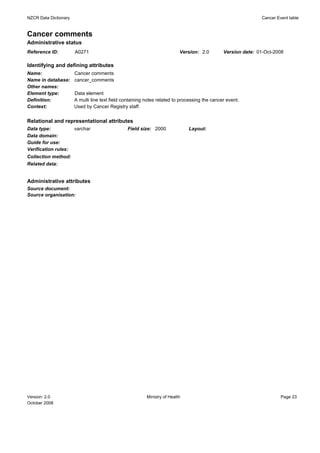
                       Introduced in 2001.
Verification rules:
Collection method: If no staging codes are supplied, this field should state where the tumour has spread directly to, if
                   known.

                       Sourced from pathology reports.
Related data:          Extent of disease code


Administrative attributes
Source document:
Source organisation:


Version: 2.0                                             Ministry of Health                                             Page 85
October 2008
NZCR Data Dictionary                                                                                           Gleason Detail table


Gleason Detail table
Table name:            Gleason Detail table
Name in database:      can.gleason_detail                                 Version: 1.0        Version date: 01-Oct-2008
Definition:            Holds the results of a Gleason test.
Guide for Use:
Primary Key:           Cancer event ID, Gleason test code
Business Key:
Relational Rules:      A cancer event belonging to the prostate cancer group has two Gleason detail records (even if no
                       secondary Gleason test has been performed).


Cancer event ID
Administrative status
Reference ID:          A0261                                              Version: 2.0        Version date: 01-Oct-2008

Identifying and defining attributes
Name:                  Cancer event ID
Name in database:      cancer_event_id
Other names:           Unique cancer record ID
Element type:          Data element
Definition:            The unique identifier of the cancer event, assigned by the Cancer Registry system
Context:               Used by the Cancer Registry system to identify a cancer event and to link it to associated records from
                       other tables.

                       Also used by Cancer Registry staff, to identify and search for an individual cancer event.

Relational and representational attributes                                                                          Mandatory
Data type:             integer                  Field size: 10                Layout:
Data domain:
Guide for use:         Has been assigned as follows:
                        - for events that had a registered status as at September 2008,
                          the cancer_event_id = unique_cancer_record_id, from the legacy CRS system
                        - for events that were provisional as at September 2008,
                          the cancer_event_id = unique_cancer_temp_id + 1,000,000, from the legacy CRS system
                        - for events created since September 2008,
                          the Cancer Registry system assigns a sequential number (starting at 2,000,001).
Verification rules:
Collection method:
Related data:


Administrative attributes
Source document:
Source organisation:


Version: 2.0                                             Ministry of Health                                              Page 86
October 2008
NZCR Data Dictionary                                                                                         Gleason Detail table


Gleason score
Administrative status
Reference ID:          A0301                                             Version: 2.0       Version date: 01-Oct-2008

Identifying and defining attributes
Name:                  Gleason score
Name in database:      gleason_score
Other names:
Element type:          Derived data element
Definition:            The result of adding the primary and secondary Gleason pattern codes, subject to the edit rules.
Context:               Derived automatically from the primary and secondary Gleason pattern codes:
                       - if both values are in the range 1-5, the values are added.
                       - if only one value is in the range 1-5, that value is doubled.

Relational and representational attributes
Data type:             integer                      Field size: 2                Layout:
Data domain:           2,3,4         Well differentiated
                       5,6           Moderately differentiated
                       7,8,9,10 Poorly differentiated
Guide for use:         Before 1 January 2003, Gleason score '7' was defined as moderately differentiated.
Verification rules:    The Gleason score of the 'highest' Gleason test should be consistent with the Grade of tumour for
                       registered prostate cancer events diagnosed after 2002. If the second Gleason test has been recorded,
                        it is the 'highest' Gleason test. Otherwise the first Gleason test is used.
Collection method:
Related data:          Primary Gleason pattern code
                       Secondary Gleason pattern code


Administrative attributes
Source document:         Gleason D. 1977. Histologic grading and clinical staging of prostatic carcinoma. In: M Tannenbaum
                         (ed.). Urologic Pathology: The Prostate. Philadelphia: Lea & Febiger. Pp. 171-98.
Source organisation:


Version: 2.0                                            Ministry of Health                                                Page 87
October 2008
NZCR Data Dictionary                                                                                         Gleason Detail table


Gleason test code
Administrative status
Reference ID:                                                             Version: 1.0      Version date: 01-Oct-2008

Identifying and defining attributes
Name:                  Gleason test code
Name in database:      gleason_test_code
Other names:
Element type:          Data element
Definition:            A code to distinguish between the different Gleason tests.
Context:


Relational and representational attributes                                                                       Mandatory
Data type:             integer                   Field size: 1                Layout:
Data domain:           0      First Gleason Test
                       1      Second Gleason Test
Guide for use:         Introduced in September 2008. Prior to this, results of the second Gleason test were not saved.

                       The First Gleason test is used for the first biopsy or TURP.
                       The Second Gleason test is used for the prostatectomy.
Verification rules:
Collection method:
Related data:


Administrative attributes
Source document:
Source organisation:


Version: 2.0                                             Ministry of Health                                              Page 88
October 2008
NZCR Data Dictionary                                                                                           Gleason Detail table


Gleason test date
Administrative status
Reference ID:                                                             Version: 1.0      Version date: 01-Oct-2008

Identifying and defining attributes
Name:                  Gleason test date
Name in database:      gleason_test_date
Other names:
Element type:          Data element
Definition:            The date that the Gleason test was performed.
Context:


Relational and representational attributes
Data type:             date                    Field size:                    Layout:
Data domain:
Guide for use:         Introduced in 2008.
Verification rules:    Required for a second Gleason test if any other data about the test has been entered.
Collection method: Does not need to be populated for the first Gleason test if it was performed on the diagnosis date.

                       Sourced from pathology reports.
Related data:


Administrative attributes
Source document:
Source organisation:


Version: 2.0                                             Ministry of Health                                              Page 89
October 2008
NZCR Data Dictionary                                                                                           Gleason Detail table


Primary pattern code
Administrative status
Reference ID:          A0300                                              Version: 2.0        Version date: 01-Oct-2008

Identifying and defining attributes
Name:                  Gleason pattern code
Name in database:      primary_pattern_grade_code
Other names:           Gleasons primary pattern code, Gleason primary grade
Element type:          Data element
Definition:            A numeric code (1 to 5) to define the degree of histological cell differentiation observed for the primary
                       (dominant) pattern of prostate cancer.
Context:               The primary pattern code and the secondary pattern code represent the two most common types of cell
                       in a biopsy or treatment specimen.

                       For example, if 40 percent is grade 1, 30 percent is grade 2, 15 percent is grade 3, and 15 percent is
                       grade 4, then the two grades that make up the bulk of the tumour are the 40 percent and the 30
                       percent, so the primary pattern would be '1' and the secondary pattern would be '2'.


Relational and representational attributes                                                                         Mandatory
Data type:             char                       Field size: 1               Layout:
Data domain:           1      Well differentiated
                       2      Well differentiated
                       3      Moderately differentiated
                       4      Poorly differentiated
                       5      Poorly differentiated
                       7      Not stated
                       8      Not applicable
                       9      Unknown
Guide for use:
Verification rules:
Collection method: Sourced from pathology reports.
Related data:          Secondary pattern code
                       Gleason score


Administrative attributes
Source document:         Gleason D. 1977. Histologic grading and clinical staging of prostatic carcinoma. In: M Tannenbaum
                         (ed.). Urologic Pathology: The Prostate. Philadelphia: Lea & Febiger. Pp. 171-98.
Source organisation:


Version: 2.0                                             Ministry of Health                                               Page 90
October 2008
NZCR Data Dictionary                                                                                   Gleason Detail table


Record version
Administrative status
Reference ID:                                                          Version: 1.0     Version date: 01-Oct-2008

Identifying and defining attributes
Name:                  Record version
Name in database:      version
Other names:
Element type:          Data element
Definition:            The version of the data in this record.
Context:               Used by the Cancer Registry system for concurrency management.


Relational and representational attributes                                                                 Mandatory
Data type:             integer               Field size: 10                Layout:
Data domain:
Guide for use:
Verification rules:
Collection method:
Related data:


Administrative attributes
Source document:
Source organisation:


Version: 2.0                                          Ministry of Health                                         Page 91
October 2008
NZCR Data Dictionary                                                                                          Gleason Detail table


Secondary pattern code
Administrative status
Reference ID:          A0300                                              Version: 2.0       Version date: 01-Oct-2008

Identifying and defining attributes
Name:                  Gleason pattern code
Name in database:      secondary_pattern_grade_code
Other names:           Gleasons secondary pattern code, Gleason secondary grade
Element type:          Data element
Definition:            A numeric code (1 to 5) to define the degree of histological cell differentiation observed for the
                       secondary pattern of prostate cancer.
Context:               The primary pattern code and the secondary pattern code represent the two most common types of cell
                       in a biopsy or treatment specimen.

                       For example, if 40 percent is grade 1, 30 percent is grade 2, 15 percent is grade 3, and 15 percent is
                       grade 4, then the two grades that make up the bulk of the tumour are the 40 percent and the 30
                       percent, so the primary pattern would be '1' and the secondary pattern would be '2'.


Relational and representational attributes                                                                        Mandatory
Data type:             char                       Field size: 1               Layout:
Data domain:           1      Well differentiated
                       2      Well differentiated
                       3      Moderately differentiated
                       4      Poorly differentiated
                       5      Poorly differentiated
                       7      Not stated
                       8      Not applicable
                       9      Unknown
Guide for use:
Verification rules:
Collection method: Sourced from pathology reports.
Related data:          Primary pattern code
                       Gleason score


Administrative attributes
Source document:         Gleason D. 1977. Histologic grading and clinical staging of prostatic carcinoma. In: M Tannenbaum
                         (ed.). Urologic Pathology: The Prostate. Philadelphia: Lea & Febiger. Pp. 171-98.
Source organisation:


Version: 2.0                                             Ministry of Health                                             Page 92
October 2008
NZCR Data Dictionary                                                                                       Gynaecology Detail table


Gynaecology Detail table
Table name:            Gynaecology Detail table
Name in database:      can.gynaecological_detail                        Version: 1.0          Version date: 01-Oct-2008
Definition:            Contains information specific to gynaecological cancer.
Guide for Use:         Introduced in September 2008.
Primary Key:           Cancer event ID
Business Key:
Relational Rules:      A cancer event belonging to the gynaecology cancer group has one gynaecology detail record.


Cancer event ID
Administrative status
Reference ID:          A0261                                              Version: 2.0        Version date: 01-Oct-2008

Identifying and defining attributes
Name:                  Cancer event ID
Name in database:      cancer_event_id
Other names:           Unique cancer record ID
Element type:          Data element
Definition:            The unique identifier of the cancer event, assigned by the Cancer Registry system
Context:               Used by the Cancer Registry system to identify a cancer event and to link it to associated records from
                       other tables.

                       Also used by Cancer Registry staff, to identify and search for an individual cancer event.

Relational and representational attributes                                                                          Mandatory
Data type:             integer                  Field size: 10                Layout:
Data domain:
Guide for use:         Has been assigned as follows:
                        - for events that had a registered status as at September 2008,
                          the cancer_event_id = unique_cancer_record_id, from the legacy CRS system
                        - for events that were provisional as at September 2008,
                          the cancer_event_id = unique_cancer_temp_id + 1,000,000, from the legacy CRS system
                        - for events created since September 2008,
                          the Cancer Registry system assigns a sequential number (starting at 2,000,001).
Verification rules:
Collection method:
Related data:


Administrative attributes
Source document:
Source organisation:


Version: 2.0                                             Ministry of Health                                               Page 93
October 2008
NZCR Data Dictionary                                                                                       Gynaecology Detail table


Cancer group
Administrative status
Reference ID:          A0281                                              Version: 2.0        Version date: 01-Oct-2008

Identifying and defining attributes
Name:                  Cancer group
Name in database:      cancer_group_code
Other names:           Specialist group code
Element type:          Data element
Definition:            A code for the speciality group to which the cancer event belongs.
Context:               Used by Cancer Registry staff to allocate and prioritise processing of cancer registrations.

                       Used by the Cancer Registry system to ensure that an appropriate specialist details record exists for a
                       cancer event. For example, a cancer event belonging to the melanoma group needs a record in the
                       Melanoma Details table.


Relational and representational attributes                                                                            Mandatory
Data type:             char                  Field size: 2                    Layout:
Data domain:           BR      Breast
                       CR      Colorectal
                       CX      Cervix
                       GN      General
                       GY      Gynaecology
                       HM      Haematology & Lymphoid
                       MN      Melanoma
                       PR      Prostate
                       RP      Respiratory
Guide for use:     Introduced in 2001.
Verification rules:A registered cancer event must belong to a cancer group that is consistent with the site (the Site code
                   table indicates the allowable cancer group for each site).
Collection method: Sourced from pathology reports, hospital discharge event diagnosis codes (from NMDS) or mortality
                   event diagnosis codes (from Mortality).
Related data:      Site code
                   Site table


Administrative attributes
Source document:
Source organisation:


Version: 2.0                                             Ministry of Health                                               Page 94
October 2008
NZCR Data Dictionary                                                                                 Gynaecology Detail table


Corpus FIGO staging code
Administrative status
Reference ID:                                                             Version: 1.0    Version date: 01-Oct-2008

Identifying and defining attributes
Name:                  Corpus FIGO staging code
Name in database:      corpus_figo_staging_code
Other names:
Element type:          Data element
Definition:            A code defining staging specific to tumours of the corpus uteri.
Context:


Relational and representational attributes
Data type:             varchar                  Field size: 4             Layout:
Data domain:           0       In situ
                       I       Confined to corpus
                       IA      Tumour limited to endometrium
                       IB      Less than half of myometrium
                       IC       One half or more of myometrium
                       II       Invades cervix
                       IIA     Endocervical glandular only
                       IIB     Cervical stroma
                       III      Local or regional as specified below
                       IIIA    Serosa/adnexa/positive peritoneal cytology
                       IIIB    Vaginal involvement
                       IIIC     Regional lymph node metastasis
                       IVA      Mucosa of bladder/bowel
                       IVB      Distant metastasis
Guide for use:
Verification rules:
Collection method: Sourced from pathology reports.
Related data:


Administrative attributes
Source document:
Source organisation:


Version: 2.0                                             Ministry of Health                                         Page 95
October 2008
NZCR Data Dictionary                                                                                  Gynaecology Detail table


Ovary FIGO staging code
Administrative status
Reference ID:                                                             Version: 1.0    Version date: 01-Oct-2008

Identifying and defining attributes
Name:                  Ovary FIGO staging code
Name in database:      ovary_figo_staging_code
Other names:
Element type:          Data element
Definition:            A code defining staging specific to tumours of the ovary.
Context:


Relational and representational attributes
Data type:             varchar                   Field size: 4                Layout:
Data domain:           I       Limited to the ovaries
                       IA      One ovary, capsule intact
                       IB      Both ovaries, capsule intact
                       IC      Capsule ruptured, tumour on surface, malignant cells in peritoneal …
                       II      Pelvic extension
                       IIA     Uterus, tube(s)
                       IIB     Other pelvic tissues
                       IIC     Malignant cells in ascites or peritoneal washings
                       III     Peritoneal metastasis beyond pelvis and/or regional lymph metastasis
                       IIIA    Microscopic peritoneal metastasis
                       IIIB    Macroscopic peritoneal metastasis no greater than 2 cm
                       IIIC    Peritoneal metastasis greater than 2 cm
                       IV      Distant metastasis (excludes peritoneal metastasis)
Guide for use:
Verification rules:
Collection method: Sourced from pathology reports.
Related data:


Administrative attributes
Source document:
Source organisation:


Version: 2.0                                             Ministry of Health                                          Page 96
October 2008
NZCR Data Dictionary                                                                                Gynaecology Detail table


Vagina FIGO staging code
Administrative status
Reference ID:                                                             Version: 1.0   Version date: 01-Oct-2008

Identifying and defining attributes
Name:                  Vagina FIGO staging code
Name in database:      vagina_figo_staging_code
Other names:
Element type:          Data element
Definition:            A code defining staging specific to tumours of the vagina.
Context:


Relational and representational attributes
Data type:             varchar                  Field size: 4                 Layout:
Data domain:           I       Vaginal wall
                       II      Paravaginal tissue
                       III     Extends to pelvic wall
                       IVA     Mucosa of bladder/rectum, beyond pelvis
                       IVB     Distant metastasis
Guide for use:
Verification rules:
Collection method: Sourced from pathology reports.
Related data:


Administrative attributes
Source document:
Source organisation:


Version: 2.0                                             Ministry of Health                                        Page 97
October 2008
NZCR Data Dictionary                                                                                  Gynaecology Detail table


Vulva FIGO staging code
Administrative status
Reference ID:                                                             Version: 1.0     Version date: 01-Oct-2008

Identifying and defining attributes
Name:                  Vulva FIGO staging code
Name in database:      vulva_figo_staging_code
Other names:
Element type:          Data element
Definition:            A code defining staging specific to tumours of the vulva.
Context:


Relational and representational attributes
Data type:             varchar                 Field size: 4                Layout:
Data domain:           I       Confined to vulva/perineum <= 2 cm
                       IA      Stromal invasion <= 1.0 mm
                       IB      Stromal invasion > 1.0 mm
                       II      Confined to vulva/perineum > 2 cm
                       III     Lower urethra/vagina/anus or unilateral regional LN mets
                       IVA     Bladder mucosa/rectal mucosa/upper urethra/bone or bilateral regi...
                       IVB     Distant Metastasis
Guide for use:
Verification rules:
Collection method: Sourced from pathology reports.
Related data:


Administrative attributes
Source document:
Source organisation:


Version: 2.0                                             Ministry of Health                                          Page 98
October 2008
NZCR Data Dictionary                                                                                      Melanoma Detail table


Melanoma Detail table
Table name:            Melanoma Detail table
Name in database:      can.melanoma_detail                                Version: 1.0       Version date: 01-Oct-2008
Definition:            Holds information specific to the registration of melanomas.
Guide for Use:         Introduced in 2001.
Primary Key:           Cancer event ID
Business Key:
Relational Rules:      A cancer event belonging to the melanoma cancer group has one melanoma detail record.


Breslow's availability code
Administrative status
Reference ID:                                                             Version: 1.1      Version date: 01-Oct-2008

Identifying and defining attributes
Name:                  Breslow's availability code
Name in database:      breslows_availability_code
Other names:
Element type:          Data element
Definition:            A code used to describe the availability of Breslow's thickness.
Context:


Relational and representational attributes                                                                      Mandatory
Data type:             char                     Field size: 1                 Layout:
Data domain:           1      Measured
                       2      Not measured
                       3      Not stated
                       4      Not available
                       5      Not applicable
Guide for use:         Introduced in 2001.
Verification rules:    Must be consistent with Basis of diagnosis for registered cancer events.
Collection method: Sourced from pathology reports.
Related data:      Breslow's thickness


Administrative attributes
Source document:
Source organisation:


Version: 2.0                                             Ministry of Health                                           Page 99
October 2008
NZCR Data Dictionary                                                                                      Melanoma Detail table


Breslow's thickness
Administrative status
Reference ID:          A0204                                               Version: 1.1    Version date: 01-Oct-2008

Identifying and defining attributes
Name:                  Breslow's thickness
Name in database:      breslows_thickness_mm
Other names:
Element type:          Data element
Definition:            A measurement of the thickness, in millimetres, of a primary malignant melanoma of the skin.
Context:


Relational and representational attributes
Data type:             numeric                  Field size:                    Layout:
Data domain:           0.01 to 999.99
Guide for use:         Introduced in 1995.

                       Only meaningful if Breslow's availability code is '1' (measured).
Verification rules:    Required if Breslow's availability code is '1' (measured).
Collection method: Sourced from pathology reports.
Related data:      Breslow's availability code


Administrative attributes
Source document:         Breslow A. 1970. Thickness, cross-sectional areas and depth of invasion in the prognosis of
                         cutaneous melanoma. Ann Surg: 172: 902-908.
Source organisation:


Version: 2.0                                              Ministry of Health                                           Page 100
October 2008
NZCR Data Dictionary                                                                                         Melanoma Detail table


Cancer event ID
Administrative status
Reference ID:          A0261                                              Version: 2.0        Version date: 01-Oct-2008

Identifying and defining attributes
Name:                  Cancer event ID
Name in database:      cancer_event_id
Other names:           Unique cancer record ID
Element type:          Data element
Definition:            The unique identifier of the cancer event, assigned by the Cancer Registry system
Context:               Used by the Cancer Registry system to identify a cancer event and to link it to associated records from
                       other tables.

                       Also used by Cancer Registry staff, to identify and search for an individual cancer event.

Relational and representational attributes                                                                          Mandatory
Data type:             integer                  Field size: 10                Layout:
Data domain:
Guide for use:         Has been assigned as follows:
                        - for events that had a registered status as at September 2008,
                          the cancer_event_id = unique_cancer_record_id, from the legacy CRS system
                        - for events that were provisional as at September 2008,
                          the cancer_event_id = unique_cancer_temp_id + 1,000,000, from the legacy CRS system
                        - for events created since September 2008,
                          the Cancer Registry system assigns a sequential number (starting at 2,000,001).
Verification rules:
Collection method:
Related data:


Administrative attributes
Source document:
Source organisation:


Version: 2.0                                             Ministry of Health                                             Page 101
October 2008
NZCR Data Dictionary                                                                                         Melanoma Detail table


Cancer group
Administrative status
Reference ID:          A0281                                              Version: 2.0        Version date: 01-Oct-2008

Identifying and defining attributes
Name:                  Cancer group
Name in database:      cancer_group_code
Other names:           Specialist group code
Element type:          Data element
Definition:            A code for the speciality group to which the cancer event belongs.
Context:               Used by Cancer Registry staff to allocate and prioritise processing of cancer registrations.

                       Used by the Cancer Registry system to ensure that an appropriate specialist details record exists for a
                       cancer event. For example, a cancer event belonging to the melanoma group needs a record in the
                       Melanoma Details table.


Relational and representational attributes                                                                            Mandatory
Data type:             char                  Field size: 2                    Layout:
Data domain:           BR      Breast
                       CR      Colorectal
                       CX      Cervix
                       GN      General
                       GY      Gynaecology
                       HM      Haematology & Lymphoid
                       MN      Melanoma
                       PR      Prostate
                       RP      Respiratory
Guide for use:     Introduced in 2001.
Verification rules:A registered cancer event must belong to a cancer group that is consistent with the site (the Site code
                   table indicates the allowable cancer group for each site).
Collection method: Sourced from pathology reports, hospital discharge event diagnosis codes (from NMDS) or mortality
                   event diagnosis codes (from Mortality).
Related data:      Site code
                   Site table


Administrative attributes
Source document:
Source organisation:


Version: 2.0                                             Ministry of Health                                              Page 102
October 2008
NZCR Data Dictionary                                                                                        Melanoma Detail table


Clark's level code
Administrative status
Reference ID:                                                              Version: 1.1      Version date: 01-Oct-2008

Identifying and defining attributes
Name:                  Clark's level code
Name in database:      clarks_level_code
Other names:
Element type:          Data element
Definition:            A code used to describe extent of invasion of a primary melanoma of the skin.
Context:


Relational and representational attributes
Data type:             char                       Field size: 1                Layout:
Data domain:           1      Clark's level I
                       2      Clark's level II
                       3      Clark's level III
                       4      Clark's level IV
                       5      Clark's level V
                       7      Not measured
                       8      Not stated
                       9      Not applicable
Guide for use:         Introduced in 2001.

                       Clark's level I – Melanoma in situ (atypical melanocytic hyperplasia, severe melanocytic dysplasia, not
                       an invasive malignant lesion).

                       Clark's level II – Tumour 0.75 mm or less in thickness and invades the papillary dermis.

                       Clark's level III – Tumour more than 0.75 mm but not more than 1.5 mm in thickness and/or invades the
                       papillary reticular dermal interface.

                       Clark's level IV – Tumour more than 1.5 mm but not more than 4.0 mm in thickness and/or invades the
                       reticular dermis.

                       Clark's level V – Tumour more than 4.0 mm in thickness and/or invades subcutaneous tissue and/or
                       satellite(s) within 2 cm of the primary tumour.
Verification rules:    Must be consistent with Basis of diagnosis for registered cancer events.
Collection method: Sourced from pathology reports.
Related data:


Administrative attributes
Source document:     Cited in UICC TNM Classification of Malignant Tumours 1997, 5th Edition.
Source organisation:


Version: 2.0                                              Ministry of Health                                           Page 103
October 2008
NZCR Data Dictionary                                                                                     Melanoma Detail table


Ulceration code
Administrative status
Reference ID:                                                             Version: 2.0      Version date: 01-Oct-2008

Identifying and defining attributes
Name:                  Ulceration code
Name in database:      ulceration_code
Other names:
Element type:          Data element
Definition:            A code identifying whether the lesion is ulcerated or not.
Context:


Relational and representational attributes
Data type:             varchar                  Field size: 2                 Layout:
Data domain:           Y       Yes
                       N       No
                       NS      Not stated
                       NA      Not applicable
Guide for use:
Verification rules:    Must be consistent with Basis of diagnosis for registered cancer events.
Collection method: Sourced from pathology reports
Related data:


Administrative attributes
Source document:
Source organisation:


Version: 2.0                                             Ministry of Health                                         Page 104
October 2008
NZCR Data Dictionary                                                                                           Prostate Detail table


Prostate Detail table
Table name:            Prostate Detail table
Name in database:      can.prostatic_detail                               Version: 1.1        Version date: 01-Oct-2008
Definition:            Holds information specific to prostate cancers.
Guide for Use:
Primary Key:           Cancer event ID
Business Key:
Relational Rules:      A cancer event belonging to the prostate cancer group has one prostate detail record and two Gleason
                       detail records.


Cancer event ID
Administrative status
Reference ID:          A0261                                              Version: 2.0        Version date: 01-Oct-2008

Identifying and defining attributes
Name:                  Cancer event ID
Name in database:      cancer_event_id
Other names:           Unique cancer record ID
Element type:          Data element
Definition:            The unique identifier of the cancer event, assigned by the Cancer Registry system
Context:               Used by the Cancer Registry system to identify a cancer event and to link it to associated records from
                       other tables.

                       Also used by Cancer Registry staff, to identify and search for an individual cancer event.

Relational and representational attributes                                                                          Mandatory
Data type:             integer                  Field size: 10                Layout:
Data domain:
Guide for use:         Has been assigned as follows:
                        - for events that had a registered status as at September 2008,
                          the cancer_event_id = unique_cancer_record_id, from the legacy CRS system
                        - for events that were provisional as at September 2008,
                          the cancer_event_id = unique_cancer_temp_id + 1,000,000, from the legacy CRS system
                        - for events created since September 2008,
                          the Cancer Registry system assigns a sequential number (starting at 2,000,001).
Verification rules:
Collection method:
Related data:


Administrative attributes
Source document:
Source organisation:


Version: 2.0                                             Ministry of Health                                              Page 105
October 2008
NZCR Data Dictionary                                                                                           Prostate Detail table


Cancer group
Administrative status
Reference ID:          A0281                                              Version: 2.0        Version date: 01-Oct-2008

Identifying and defining attributes
Name:                  Cancer group
Name in database:      cancer_group_code
Other names:           Specialist group code
Element type:          Data element
Definition:            A code for the speciality group to which the cancer event belongs.
Context:               Used by Cancer Registry staff to allocate and prioritise processing of cancer registrations.

                       Used by the Cancer Registry system to ensure that an appropriate specialist details record exists for a
                       cancer event. For example, a cancer event belonging to the melanoma group needs a record in the
                       Melanoma Details table.


Relational and representational attributes                                                                            Mandatory
Data type:             char                  Field size: 2                    Layout:
Data domain:           BR      Breast
                       CR      Colorectal
                       CX      Cervix
                       GN      General
                       GY      Gynaecology
                       HM      Haematology & Lymphoid
                       MN      Melanoma
                       PR      Prostate
                       RP      Respiratory
Guide for use:     Introduced in 2001.
Verification rules:A registered cancer event must belong to a cancer group that is consistent with the site (the Site code
                   table indicates the allowable cancer group for each site).
Collection method: Sourced from pathology reports, hospital discharge event diagnosis codes (from NMDS) or mortality
                   event diagnosis codes (from Mortality).
Related data:      Site code
                   Site table


Administrative attributes
Source document:
Source organisation:


Version: 2.0                                             Ministry of Health                                              Page 106
October 2008
NZCR Data Dictionary                                                                            Appendices


Appendix A: Data Dictionary Template

Introduction            This appendix explains how data element attributes are organised in the data
                        dictionary template.


Order of elements       Within the dictionary, elements are organised by table, and then alphabetically.
                        An alphabetical index is provided at the back of the data dictionary to assist the
                        user in finding specific elements.


Template                This table explains the template.

Administrative status

Reference ID                         A code that uniquely identifies the data element. If the data
                                     element is used in more than one collection, it should retain its
                                     Reference ID wherever it appears.

Version number                       A version number for each data element. A new version number is
                                     allocated to a data element/concept when changes have been
                                     made to one or more of the following attributes of the definition:
                                     – name
                                     – definition
                                     – data domain, eg, adding a new value to the field.
                                     Elements with frequently updated code tables, such as the Facility
                                     code table, will not be assigned a new version for changes to data
                                     domain.

Version date                         The date the new version number was assigned.

Identifying and defining attributes
Name                                 A single or multi-word designation assigned to a data element. If
                                     the data element is used in more than one collection, it may retain
                                     its Name wherever it appears.

Name in database                     The name of the column that implements this element in the
                                     database.

Other names                          Other names that this element is known as, including previous
                                     names.

Element type                         DATA ELEMENT—a unit of data for which the definition,
                                     identification, representation and permissible values are specified
                                     by means of a set of attributes.
                                     DERIVED DATA ELEMENT—a data element whose values are
                                     derived by calculation from the values of other data elements.
                                     COMPOSITE DATA ELEMENT—a data element whose values
                                     represent a grouping of the values of other data elements in a
                                     specified order.

Definition                           A statement that expresses the essential nature of a data element
                                     and its differentiation from all other data elements.

Context                              A designation or description of the application environment or
                                     discipline in which a name is applied or from which it originates.
                                     This attribute may also include the justification for collecting the


Version: 2.0                                 Ministry of Health                                      Page i
October 2008
NZCR Data Dictionary                                                                         Appendices


                              items and uses of the information.
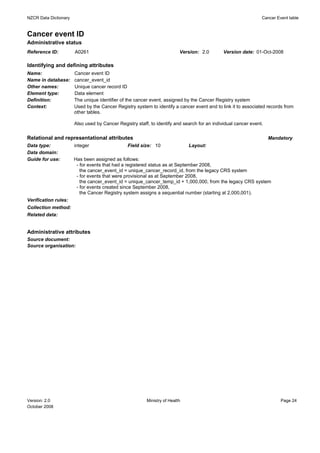
Relational and representational attributes
Data type                      The type of field in which a data element is held. For example,
                               character, integer, or numeric.

Field size                     The maximum number of storage units (of the corresponding data
                               type) to represent the data element value. Field size does not
                               generally include characters used to mark logical separations of
                               values, eg, commas, hyphens or slashes.

Layout                         The representational layout of characters in data element values
                               expressed by a character string representation. For example:
                               - ‘CCYYMMDD’ for calendar date
                               - ‘N’ for a one-digit numeric field
                               - ‘A’ for a one-character field
                               - ‘X’ for a field that can hold either a character or a digit, and
                               - ‘$$$,$$$,$$$’ for data elements about expenditure.

Data domain                    The permissible values for the data element. The set of values can
                               be listed or specified by referring to a code table or code tables, for
                               example, ICD-10-AM 2nd Edition.

Guide for use                  Additional comments or advice on the interpretation or application
                               of the data element (this attribute has no direct counterpart in the
                               ISO/IEC Standard 11179 but has been included to assist in
                               clarification of issues relating to the classification of data elements).
                               Includes historical information, advice regarding data quality.

Verification rules             The rules and/or instructions applied for validating and/or verifying
                               elements, in addition to the formal edits.

Collection method              Comments and advice concerning the capture of data for the
                               particular data element, including guidelines on the design of
                               questions for use in collecting information, and treatment of ‘not
                               stated’ or non-response (this attribute is not specified in the
                               ISO/IEC Standard 11179 but has been added to cover important
                               issues about the actual collection of data).

Related data                   A reference between the data element and any related data
                               element in the Dictionary.

Administrative attributes
Source document               The document from which definitional or representational attributes
                              originate.

Source organisation           The organisation responsible for the source document and/or the
                              development of the data definition (this attribute is not specified in
                              the ISO/IEC Standard 11179 but has been added for
                              completeness). The source organisation is not necessarily the
                              organisation responsible for the ongoing development/maintenance
                              of the data element definition. An example of a source organisation
                              is the National Data Policy Group (NDPG).


Version: 2.0                           Ministry of Health                                           Page ii
October 2008
NZCR Data Dictionary                                                                        Appendices


Appendix B: Schemas

Cancer Registry        The data stored in the Cancer Registry database is organized into 7 schemas,
has 7 schemas          which are described below


Schema                              Description
CAN                                 Stores information about cancer events
DMS                                 Stores information about documents
DWHEXT                              Provides a view of cancer event data for the data
                                    warehouse to use

                                    Currently there is one view for each table in CAN.
LINKMAN                             Provides a view of cancer event data for Link Manager to
                                    use

                                    The views are structured to mimic the schema of the legacy
                                    CRS system.
MIG                                 Provides a temporary workspace for the migration process.

                                    This schema can ultimately be dropped.
SCHEDULER                           Stores information about Jobs.

                                    This information is used by the third-party job scheduler
                                    component of the Cancer Registry system.
SECURITY_ACCESS_POLICY              Stores information about which roles may access which
                                    Cancer Registry functions.

                                    This information is used by the security component of the
                                    Cancer Registry system.


Data dictionary        This data dictionary describes the tables of the CAN schemas. The other
covers 1 schema        schemas’ tables are not described because they are for internal use by either
                       the Cancer Registry system and/or the Cancer Registry team.


Version: 2.0                               Ministry of Health                                   Page iii
October 2008
NZCR Data Dictionary                                                                 Appendices


Appendix C: Logical Groups of Elements
Cancer Event table                          Breast Detail table
Address city/town                           Cancer event ID
Address country                             Cancer group
Address date                                ER status
Address street line 1                       Her2 status
Address street line 2                       Her2 test type
Address suburb                              Histopathology code
Assessment decision code                    Lymphovascular invasion flag
Basis of diagnosis code                     Multicentric or multifocal tumour flag
Behaviour code                              Positive sentinel nodes
Cancer comments                             PR status
Cancer event ID                             Resection margin
Cancer group                                Sentinel nodes sampled
Clinical code version                       Size of tumour
Clinical notes
Clinician name                              Cervix Detail table
Coding review flag                          Additional information
Country of birth code                       Cancer event ID
Country of diagnosis code                   Cancer group
Date modified                               Cervix FIGO staging code
Date of birth
Date of histology                           Colorectal Detail table
Date received                               ACPS system code
Deletion reason code                        Astler and Coller staging system code
Diagnosis date                              Cancer event ID
Documentation status                        Cancer group
Domicile code                               Duke's staging system code
Extent of disease code                      Level of direct spread
Facility code
Family name                                 Gynaecology Detail table
First name                                  Cancer event ID
Grade of tumour code                        Cancer group
Grade of tumour description                 Corpus FIGO staging code
HCU ID                                      Ovary FIGO staging code
ICD9 site code                              Vagina FIGO staging code
Laboratory code                             Vulva FIGO staging code
Laterality code
Morphology code                             Melanoma Detail table
Morphology description                      Breslow's availability code
Multiple tumours flag                       Breslow's thickness
New information flag                        Cancer event ID
Nodes tested flag                           Cancer group
Occupation code                             Clark's level code
Occupation description                      Ulceration code
Positive nodes
QA OK flag                                  Prostate Detail table
Record version                              Cancer event ID
Registration date                           Cancer group
Registration source
Registration status                         Gleason Detail table
Second name                                 Cancer event ID
Sex                                         Gleason score
Site code                                   Gleason test code
Site description                            Gleason test date
Smoking history flag                        Primary pattern code
Third name                                  Record version
TNM-M                                       Secondary pattern code
TNM-N
TNM-T
Total nodes sampled
User modifying record
User registering record


Version: 2.0                  Ministry of Health                                        Page iv
October 2008
NZCR Data Dictionary                                                               Appendices


Appendix D: Code Table Index

Code table                                   Location
ACPS System code table                       See ACPS system code on page 80.
Assessment Decision code table               See Assessment decision code on page 20.
Astler and Coller Staging System code        See Astler and Coller staging system code on
table                                        page 81.
Basis of Diagnosis code table                See Basis of diagnosis code on page 21.
Behaviour code table                         See Behaviour code on page 22.
Breslow's Availability code table            See Breslow's availability code on page 99.
Cancer Group code table                      See Cancer group on page 1.
Cervix FIGO Staging code table               See Cervix FIGO staging code on page 79.
Clark's Level code table                     See Clark's level code on page 103.
Clinical Code code table                     See Morphology code on page 51
                                             And Site code on page 66
                                             And the Ministry’s web site.
Clinical Coding System code table            See Clinical code version on page 26
                                             And the Ministry’s web site.
Corpus FIGO Staging code table               See Corpus FIGO staging code on page 95.
Country of Birth code table                  See Country of birth code on page 30
                                             And Country of diagnosis code on page 31
                                             And the Ministry’s web site.
Deletion Reason code table                   See Deletion reason code on page 36.
Documentation Status code table              See Documentation status on page 38.
Domicile code table                          See Domicile code on page 39
                                             And the Ministry’s web site.
Duke's Staging code table                    See Duke's staging system code on page 84.
ER Status code table                         See ER status on page 3.
Extent of Disease code table                 See Extent of disease code on page 41.
Facility code table                          See Facility code on page 42
                                             And the Ministry’s web site.
Gleason Pattern Grade code table             See Primary pattern code on page 90
                                             And Secondary pattern code on page 92.
Gleason Test code table                      See Gleason test code on page 88.
Grade of Tumour code table                   See Grade of tumour code on page 45.
Her 2 Status code                            See Her2 status on page 4.
Her2 Test Type code table                    See Her2 test type on page 5.
Histopathology code table                    See Histopathology code on page 6.
Laboratory code table                        See Laboratory code on page 49
                                             And the Ministry’s web site.
Laterality code table                        See Laterality code on page 50.
Occupation code table                        See Occupation code on page 56
                                             And the Ministry’s web site.
Ovary FIGO Staging code table                See Ovary FIGO staging code on page 96.
PR Status code table                         See PR status on page 10.
Registration Source code table               See Registration source on page 62.
Registration Status code table               See Registration status on page 63.
Sex Type code table                          See Sex on page 65.
                                             And the Ministry’s web site.
Ulceration code table                        See Ulceration code on page 104.
Vagina FIGO Staging code table               See Vagina FIGO staging code on page 97.
Vulva FIGO Staging code table                See Vulva FIGO staging code on page 98.


Version: 2.0                            Ministry of Health                             Page v
October 2008
NZCR Data Dictionary                                                                Appendices


Code tables on         For code tables on the Ministry’s web site go to
website                http://www.moh.govt.nz/moh.nsf/pagesns/47. For further information or
                       a printed copy of the code table, contact the Publications Officer.
                       Contact details are listed at the front of this dictionary.


Version: 2.0                            Ministry of Health                             Page vi
October 2008
NZCR Data Dictionary                                                                         Appendices


Appendix E: Alphabetical Index of Data Elements
ACPS system code, 80                                  Her2 status, 4
Additional information, 76                            Her2 test type, 5
Address city/town, 14                                 Histopathology code, 6
Address country, 15                                   ICD9 site code, 48
Address date, 16                                      Laboratory code, 49
Address street line 1, 17                             Laterality code, 50
Address street line 2, 18                             Level of direct spread, 85
Address suburb, 19                                    Lymphovascular invasion flag, 7
Assessment decision code, 20                          Morphology code, 51
Astler and Coller staging system code, 81             Morphology description, 52
Basis of diagnosis code, 21                           Multicentric or multifocal tumour flag, 8
Behaviour code, 22                                    Multiple tumours flag, 53
Breslow's availability code, 99                       New information flag, 54
Breslow's thickness, 100                              Nodes tested flag, 55
Cancer comments, 23                                   Occupation code, 56
Cancer event ID, 1, 24, 77, 82, 86, 93, 101,          Occupation description, 57
105                                                   Ovary FIGO staging code, 96
Cancer group, 2, 25, 78, 83, 94, 102, 106             Positive nodes, 58
Cervix FIGO staging code, 79                          Positive sentinel nodes, 9
Clark's level code, 103                               PR status, 10
Clinical code version, 26                             Primary pattern code, 90
Clinical notes, 27                                    QA OK flag, 59
Clinician name, 28                                    Record version, 60
Coding review flag, 29                                Record version, 91
Corpus FIGO staging code, 95                          Registration date, 61
Country of birth code, 30                             Registration source, 62
Country of diagnosis code, 31                         Registration status, 63
Date modified, 32                                     Resection margin, 11
Date of birth, 33                                     Second name, 64
Date of histology, 34                                 Secondary pattern code, 92
Date received, 35                                     Sentinel nodes sampled, 12
Deletion reason code, 36                              Sex, 65
Diagnosis date, 37                                    Site code, 66
Documentation status, 38                              Site description, 67
Domicile code, 39                                     Size of tumour, 13
Duke's staging system code, 84                        Smoking history flag, 68
ER status, 3                                          Third name, 69
Extent of disease code, 41                            TNM-M, 70
Facility code, 42                                     TNM-N, 71
Family name, 43                                       TNM-T, 72
First name, 44                                        Total nodes sampled, 73
Gleason score, 87                                     Ulceration code, 104
Gleason test code, 88                                 User modifying record, 74
Gleason test date, 89                                 User registering record, 75
Grade of tumour code, 45                              Vagina FIGO staging code, 97
Grade of tumour description, 46                       Vulva FIGO staging code, 98
HCU ID, 47


Version: 2.0                            Ministry of Health                                        Page vii
October 2008

Cancer dict v2_0

  • 1.
    NEW ZEALAND CANCERREGISTRY DATA DICTIONARY Version 2.0 October 2008
  • 2.
    NZCR Data Dictionary Front Pages Reproduction of material The Ministry of Health (‘the Ministry’) permits the reproduction of material from this publication without prior notification, providing all the following conditions are met: the information must not be used for commercial gain, must not be distorted or changed, and the Ministry must be acknowledged as the source. Disclaimer The Ministry of Health gives no indemnity as to the correctness of the information or data supplied. The Ministry of Health shall not be liable for any loss or damage arising directly or indirectly from the supply of this publication. All care has been taken in the preparation of this publication. The data presented was deemed to be accurate at the time of publication, but may be subject to change. It is advisable to check for updates to this publication on the Ministry’s web site at http://www.moh.govt.nz. Reporting environments Reporting environments such as Business Objects and data extracts will not necessarily contain all data described in this Data Dictionary. Publications A complete list of the Ministry’s publications is available from Ministry of Health, PO Box 5013, Wellington, or on the Ministy’s web site. Any enquiries about or comments on this publication should be directed to: Information Services Statistics and Reporting Sector Services Information Directorate Ministry of Health PO Box 5013 Wellington Phone: (04) 922 1800 Fax: (04) 922-1899 Email: publications@moh.govt.nz Published by the Ministry of Health © 2008, Ministry of Health Version: 2.0 Ministry of Health October 2008
  • 3.
    NZCR Data Dictionary Front Pages Introduction Objectives The objectives of the Ministry of Health (‘the Ministry’) Data Dictionaries are to: • describe the information available within the National Collections • promote uniformity, availability and consistency across the National Collections • support the use of nationally agreed protocols and standards wherever possible • promote national standard definitions and make them available to users. It is hoped that the greater level of detail along with clear definitions of the business rules around each element will assist with providing and using the data. Audiences The target audiences for Data Dictionaries are data providers, software developers, and data users. Format All data element definitions in the Data Dictionaries are presented in a format based on the Australian Institute of Health and Welfare National Health Data Dictionary. This dictionary is based on the ISO/IEC Standard 11179 Specification and Standardization of Data Elements—the international standard for defining data elements issued by the International Organization for Standardization and the International Electrotechnical Commission. The format is described in detail in Appendix A of this dictionary. Version: 2.0 Ministry of Health October 2008
  • 4.
    NZCR Data Dictionary Front Pages Table of Contents New Zealand Cancer Registry (NZCR) ............................................................................ front pages Breast Detail table............................................................................................................................... 1 Cancer event ID .................................................................................................................................... 1 Cancer group ........................................................................................................................................ 2 ER status .............................................................................................................................................. 3 Her2 status............................................................................................................................................ 4 Her2 test type........................................................................................................................................ 5 Histopathology code ............................................................................................................................. 6 Lymphovascular invasion flag ............................................................................................................... 7 Multicentric or multifocal tumour flag..................................................................................................... 8 Positive sentinel nodes ......................................................................................................................... 9 PR status ............................................................................................................................................ 10 Resection margin ................................................................................................................................ 11 Sentinel nodes sampled...................................................................................................................... 12 Size of tumour..................................................................................................................................... 13 Cancer Event table............................................................................................................................ 14 Address city/town................................................................................................................................ 14 Address country .................................................................................................................................. 15 Address date....................................................................................................................................... 16 Address street line 1 ........................................................................................................................... 17 Address street line 2 ........................................................................................................................... 18 Address suburb................................................................................................................................... 19 Assessment decision code.................................................................................................................. 20 Basis of diagnosis code ...................................................................................................................... 21 Behaviour code ................................................................................................................................... 22 Cancer comments............................................................................................................................... 23 Cancer event ID .................................................................................................................................. 24 Cancer group ...................................................................................................................................... 25 Clinical code version ........................................................................................................................... 26 Clinical notes....................................................................................................................................... 27 Clinician name .................................................................................................................................... 28 Coding review flag .............................................................................................................................. 29 Country of birth code........................................................................................................................... 30 Country of diagnosis code................................................................................................................... 31 Date modified...................................................................................................................................... 32 Date of birth ........................................................................................................................................ 33 Date of histology ................................................................................................................................. 34 Date received...................................................................................................................................... 35 Deletion reason code .......................................................................................................................... 36 Diagnosis date .................................................................................................................................... 37 Documentation status ......................................................................................................................... 38 Domicile code ..................................................................................................................................... 39 Extent of disease code........................................................................................................................ 41 Facility code ........................................................................................................................................ 42 Family name ....................................................................................................................................... 43 First name ........................................................................................................................................... 44 Grade of tumour code ......................................................................................................................... 45 Grade of tumour description................................................................................................................ 46 HCU ID................................................................................................................................................ 47 ICD9 site code .................................................................................................................................... 48 Laboratory code .................................................................................................................................. 49 Laterality code..................................................................................................................................... 50 Morphology code ................................................................................................................................ 51 Morphology description ....................................................................................................................... 52 Multiple tumours flag........................................................................................................................... 53 New information flag ........................................................................................................................... 54 Nodes tested flag ................................................................................................................................ 55 Occupation code ................................................................................................................................. 56 Occupation description........................................................................................................................ 57 Positive nodes..................................................................................................................................... 58 QA OK flag.......................................................................................................................................... 59 Version: 2.0 Ministry of Health October 2008
  • 5.
    NZCR Data Dictionary Front Pages Record version.................................................................................................................................... 60 Registration date................................................................................................................................. 61 Registration source ............................................................................................................................. 62 Registration status .............................................................................................................................. 63 Second name...................................................................................................................................... 64 Sex...................................................................................................................................................... 65 Site code ............................................................................................................................................. 66 Site description ................................................................................................................................... 67 Smoking history flag............................................................................................................................ 68 Third name.......................................................................................................................................... 69 TNM-M ................................................................................................................................................ 70 TNM-N ................................................................................................................................................ 71 TNM-T................................................................................................................................................. 72 Total nodes sampled........................................................................................................................... 73 User modifying record......................................................................................................................... 74 User registering record........................................................................................................................ 75 Cervix Detail table............................................................................................................................. 76 Additional information.......................................................................................................................... 76 Cancer event ID .................................................................................................................................. 77 Cancer group ...................................................................................................................................... 78 Cervix FIGO staging code................................................................................................................... 79 Colorectal Detail table ...................................................................................................................... 80 ACPS system code ............................................................................................................................. 80 Astler and Coller staging system code................................................................................................ 81 Cancer event ID .................................................................................................................................. 82 Cancer group ...................................................................................................................................... 83 Duke's staging system code................................................................................................................ 84 Level of direct spread.......................................................................................................................... 85 Gleason Detail table.......................................................................................................................... 86 Cancer event ID .................................................................................................................................. 86 Gleason score..................................................................................................................................... 87 Gleason test code ............................................................................................................................... 88 Gleason test date................................................................................................................................ 89 Primary pattern code........................................................................................................................... 90 Record version.................................................................................................................................... 91 Secondary pattern code ...................................................................................................................... 92 Gynaecology Detail table ................................................................................................................. 93 Cancer event ID .................................................................................................................................. 93 Cancer group ...................................................................................................................................... 94 Corpus FIGO staging code ................................................................................................................. 95 Ovary FIGO staging code ................................................................................................................... 96 Vagina FIGO staging code.................................................................................................................. 97 Vulva FIGO staging code .................................................................................................................... 98 Melanoma Detail table ...................................................................................................................... 99 Breslow's availability code .................................................................................................................. 99 Breslow's thickness........................................................................................................................... 100 Cancer event ID ................................................................................................................................ 101 Cancer group .................................................................................................................................... 102 Clark's level code .............................................................................................................................. 103 Ulceration code ................................................................................................................................. 104 Prostate Detail table........................................................................................................................ 105 Cancer event ID ................................................................................................................................ 105 Cancer group .................................................................................................................................... 106 Version: 2.0 Ministry of Health October 2008
  • 6.
    NZCR Data Dictionary Front Pages Appendix A: Data Dictionary Template .............................................................................................. i Appendix B: Schemas ....................................................................................................................... iii Appendix C: Logical Groups of Elements ....................................................................................... iv Appendix D: Code Table Index .......................................................................................................... v Appendix E: Alphabetical Index of Data Elements ........................................................................ vii Version: 2.0 Ministry of Health October 2008
  • 7.
    NZCR Data Dictionary Front Pages New Zealand Cancer Registry (NZCR) Scope Purpose The New Zealand Cancer Registry is a population-based register of all primary malignant diseases diagnosed in New Zealand, excluding squamous cell and basal cell skin cancers. Data is used in research, and in monitoring and evaluating cancer screening programmes. Content A summary of the variables to be reported is contained in the Cancer Registry Regulations 1994. Start date The NZCR was set up in 1948 primarily using information sent by public hospitals to the NMDS. The Cancer Registry Act 1993 and Cancer Registry Regulations 1994 were introduced to increase reporting of primary cancers in New Zealand. Since the Cancer Registry Regulations 1994 came into effect, laboratory test results have been collected and the data quality and completeness have significantly improved. Guide for use The tumours are classified using the WHO International Statistical Classification of Diseases and Related Health Problems (ICD), and the WHO International Classification of Diseases for Oncology (ICD-O). Before 1997, there was inadequate staging information (ie, reporting of the extent of the disease) and morphology information. The Ministry is now working with clinicians to improve this. Contact information For further information about this collection or to request specific datasets or reports, contact the Ministry of Health’s Analytical Services team on ph 04 496 2000 or e-mail data- inquiries@moh.govt.nz, or visit the Ministy’s web site www.moh.govt.nz. Collection methods – guide for Laboratories are the primary source of cancer data to the NZCR. providers They are required by law to report any new diagnosis of cancer in New Zealand, excluding squamous and basal cell skin cancers. Additional data sources include: Medical Certificates of Causes of Death, Coroners’ Findings, hospital discharge data on the National Minimum Dataset (NMDS), and private hospital discharge returns. Frequency of updates Data is loaded on an ongoing basis. Some types/sites of cancer are of particular interest to researchers and the processing of these cancers is treated as a priority. These types/sites include: melanoma, prostate, breast, cervix, colorectal, and childhood cancers. The processing of data for these priority cancers is kept up to date to within three months of receipt of laboratory reports. Security of data The NZCR is only accessed by authorised Ministry staff for maintenance, data quality, analytical and audit purposes. Version: 2.0 Ministry of Health October 2008
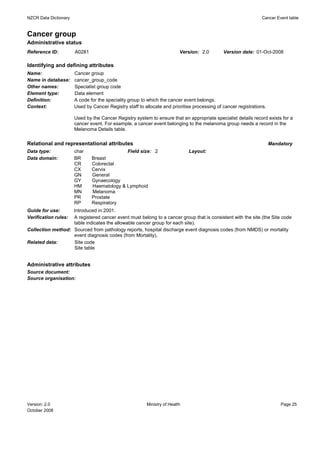
  • 8.
    NZCR Data Dictionary Front Pages Privacy issues The Ministry of Health is required to ensure that the release of information recognises any legislation related to the privacy of health information, in particular the Official Information Act 1982, the Privacy Act 1993 and the Health Information Privacy Code 1994. Information available to the general public is of a statistical and non-identifiable nature. Researchers requiring identifiable data will usually need approval from an Ethics Committee. National reports and The Ministry publishes an annual report Cancer – New publications Registrations and Deaths in hard copy and on the Ministry’s web site www.moh.govt.nz. This publication contains detailed information on numbers and rates of cancers according to year of diagnosis. More timely provisional cancer data for the priority sites is posted on the Ministry’s web site www.moh.govt.nz. Data provision Customised datasets or summary reports are available on request, either electronically or on paper. Staff from the Ministry’s Analytical Services team can help to define the specifications for a request and are familiar with the strengths and weaknesses of the data. The Analytical Services team also offers a peer review service to ensure that Minstry of Heatlh data is reported appropriately when published by other organisations. There may be charges associated with data extracts. Version: 2.0 Ministry of Health October 2008
  • 9.
    NZCR Data Dictionary Breast Detail table Breast Detail table Table name: Breast Detail table Name in database: can.breast_detail Version: 2.0 Version date: 01-Oct-2008 Definition: Contains information specific to breast cancer. Guide for Use: Introduced in 2001. Primary Key: Cancer event ID Business Key: Relational Rules: A cancer event belonging to the breast cancer group has one breast detail record. Cancer event ID Administrative status Reference ID: A0261 Version: 2.0 Version date: 01-Oct-2008 Identifying and defining attributes Name: Cancer event ID Name in database: cancer_event_id Other names: Unique cancer record ID Element type: Data element Definition: The unique identifier of the cancer event, assigned by the Cancer Registry system Context: Used by the Cancer Registry system to identify a cancer event and to link it to associated records from other tables. Also used by Cancer Registry staff, to identify and search for an individual cancer event. Relational and representational attributes Mandatory Data type: integer Field size: 10 Layout: Data domain: Guide for use: Has been assigned as follows: - for events that had a registered status as at September 2008, the cancer_event_id = unique_cancer_record_id, from the legacy CRS system - for events that were provisional as at September 2008, the cancer_event_id = unique_cancer_temp_id + 1,000,000, from the legacy CRS system - for events created since September 2008, the Cancer Registry system assigns a sequential number (starting at 2,000,001). Verification rules: Collection method: Related data: Administrative attributes Source document: Source organisation: Version: 2.0 Ministry of Health Page 1 October 2008
  • 10.
    NZCR Data Dictionary Breast Detail table Cancer group Administrative status Reference ID: A0281 Version: 2.0 Version date: 01-Oct-2008 Identifying and defining attributes Name: Cancer group Name in database: cancer_group_code Other names: Specialist group code Element type: Data element Definition: A code for the speciality group to which the cancer event belongs. Context: Used by Cancer Registry staff to allocate and prioritise processing of cancer registrations. Used by the Cancer Registry system to ensure that an appropriate specialist details record exists for a cancer event. For example, a cancer event belonging to the melanoma group needs a record in the Melanoma Details table. Relational and representational attributes Mandatory Data type: char Field size: 2 Layout: Data domain: BR Breast CR Colorectal CX Cervix GN General GY Gynaecology HM Haematology & Lymphoid MN Melanoma PR Prostate RP Respiratory Guide for use: Introduced in 2001. Verification rules:A registered cancer event must belong to a cancer group that is consistent with the site (the Site code table indicates the allowable cancer group for each site). Collection method: Sourced from pathology reports, hospital discharge event diagnosis codes (from NMDS) or mortality event diagnosis codes (from Mortality). Related data: Site code Site table Administrative attributes Source document: Source organisation: Version: 2.0 Ministry of Health Page 2 October 2008
  • 11.
    NZCR Data Dictionary Breast Detail table ER status Administrative status Reference ID: A0290 Version: 1.1 Version date: 01-Oct-2008 Identifying and defining attributes Name: ER status Name in database: er_status_code Other names: Oestrogen receptor status Element type: Data element Definition: A code that specifies whether the tumour is oestrogen receptive (ER) or not. Context: Relational and representational attributes Data type: varchar Field size: 3 Layout: Data domain: POS Tumour is oestrogen receptive NEG Tumour is not receptive U Unknown Guide for use: Introduced in 2001. Verification rules: Collection method: Sourced from pathology reports. Related data: PR status Administrative attributes Source document: Source organisation: Version: 2.0 Ministry of Health Page 3 October 2008
  • 12.
    NZCR Data Dictionary Breast Detail table Her2 status Administrative status Reference ID: A0293 Version: 1.1 Version date: 01-Oct-2008 Identifying and defining attributes Name: Her2 status Name in database: her2_status_code Other names: Serb2, c-erbB-2. Element type: Data element Definition: A code for the Her2 status of the tumour. Context: HER2 is an abbreviation for human epidermal growth factor receptor 2. Relational and representational attributes Data type: varchar Field size: 3 Layout: Data domain: POS Positive NEG Negative EQU Equivocal U Unknown Guide for use: The value 'Equivocal' was introduced in September 2008, and has been available for use since then. Verification rules: Collection method: Sourced from pathology reports. Related data: Administrative attributes Source document: Source organisation: Version: 2.0 Ministry of Health Page 4 October 2008
  • 13.
    NZCR Data Dictionary Breast Detail table Her2 test type Administrative status Reference ID: Version: 1.0 Version date: 01-Oct-2008 Identifying and defining attributes Name: Her2 test type Name in database: her2_test_type_code Other names: Element type: Data element Definition: A code for the Her2 test that was used to determine the Her2 status of the tumour. Context: Relational and representational attributes Data type: varchar Field size: 4 Layout: Data domain: IHC Immunohistochemistry FISH Fluorescence in situ hybridization OTH Other U Unknown Guide for use: Only meaningful if Her2 status is 'POS', 'NEG' or 'EQU'. Introduced in September 2008. For earlier data, the default of 'U' (Unknown) has been used. Verification rules: Mandatory if Her2 status is POS, NEG or EQU. Collection method: Sourced from pathology reports. Related data: Her2 status Administrative attributes Source document: Source organisation: Version: 2.0 Ministry of Health Page 5 October 2008
  • 14.
    NZCR Data Dictionary Breast Detail table Histopathology code Administrative status Reference ID: A0287 Version: 1.1 Version date: 01-Oct-2008 Identifying and defining attributes Name: Histopathology code Name in database: histopathology_code Other names: Element type: Data element Definition: A code for the type of malignant breast lesion. Context: Used for data-matching with BreastScreen Aotearoa. Relational and representational attributes Data type: varchar Field size: 2 Layout: Data domain: 1 Invasive duct not otherwise specified 2 Invasive tubular 3 Invasive cribriform 4 Invasive mucinous (colloid) 5 Invasive medullary 6 Invasive lobular; classical and variant 8 Mixed invasive ductal/lobular 9 Other primary invasive malignancy 10 Other secondary invasive malignancy 11 Non-high-grade DCIS without necrosis 12 Non-high-grade DCIS with necrosis 13 High-grade DCIS with or without necrosis 14 Lobular carcinoma in situ LCIS 19 Other DCIS U Not available/unknown/unsure Guide for use: Introduced in 1998. Mandatory since 2002. Verification rules: Must be consistent with Site, Morphology and Grade of tumour, for registered events. Collection method: Sourced from pathology reports. Related data: Morphology code Administrative attributes Source document: BreastScreen Aotearoa Data Management Manual, Version 3.0, 2003 Source organisation: Version: 2.0 Ministry of Health Page 6 October 2008
  • 15.
    NZCR Data Dictionary Breast Detail table Lymphovascular invasion flag Administrative status Reference ID: A0294 Version: 1.1 Version date: 01-Oct-2008 Identifying and defining attributes Name: Lymphovascular invasion flag Name in database: lymphovascular_invasion_flag Other names: LV invasion Element type: Data element Definition: A flag to indicate lymphovascular invasion by the tumour. Context: Relational and representational attributes Data type: char Field size: 1 Layout: Data domain: Y Yes N No U Unknown Guide for use: Introduced in 2001. Verification rules: Collection method: Sourced from pathology reports. Related data: Administrative attributes Source document: Source organisation: Version: 2.0 Ministry of Health Page 7 October 2008
  • 16.
    NZCR Data Dictionary Breast Detail table Multicentric or multifocal tumour flag Administrative status Reference ID: A0295 Version: 1.1 Version date: 01-Oct-2008 Identifying and defining attributes Name: Multicentric or multifocal tumour flag Name in database: multi_centric_focal_tumor_flag Other names: Element type: Data element Definition: A flag to indicate that the tumour is either multicentric or multifocal. Context: Relational and representational attributes Data type: char Field size: 1 Layout: Data domain: Y Yes (tumour is multicentric or multifocal) N No (tumour is neither multicentric nor multifocal) U Unknown Guide for use: Introduced in 2001. Verification rules: Collection method: Sourced from pathology reports. Related data: Administrative attributes Source document: Source organisation: Version: 2.0 Ministry of Health Page 8 October 2008
  • 17.
    NZCR Data Dictionary Breast Detail table Positive sentinel nodes Administrative status Reference ID: Version: 1.0 Version date: 01-Oct-2008 Identifying and defining attributes Name: Positive sentinel nodes Name in database: positive_sentinel_nodes_nbr Other names: Sentinel nodes involved Element type: Data element Definition: The number of sentinel nodes with metastases. Context: Positive sentinel nodes are a subset of the positive nodes. Relational and representational attributes Data type: integer Field size: 2 Layout: Data domain: 0 to 99 Guide for use: Introduced in September 2008. Only meaningful when Sentinel nodes sampled is populated. Verification rules: Must be less than or equal to the number of Sentinel nodes sampled for registered events. Collection method: Sourced from pathology reports. Related data: Sentinel nodes sampled Total nodes sampled Nodes Tested Administrative attributes Source document: Source organisation: Version: 2.0 Ministry of Health Page 9 October 2008
  • 18.
    NZCR Data Dictionary Breast Detail table PR status Administrative status Reference ID: A0291 Version: 1.1 Version date: 01-Oct-2008 Identifying and defining attributes Name: PR status Name in database: pr_status_code Other names: Element type: Data element Definition: A code that specifies whether the tumour is progesterone receptive (PR) or not. Context: ER status and PR status can both be positive. PR status is not always tested Relational and representational attributes Data type: varchar Field size: 3 Layout: Data domain: POS Tumour is progesterone receptive NEG Tumour is not receptive U Unknown Guide for use: Introduced in 2001. Verification rules: Collection method: Sourced from pathology reports. Related data: ER status Administrative attributes Source document: Source organisation: Version: 2.0 Ministry of Health Page 10 October 2008
  • 19.
    NZCR Data Dictionary Breast Detail table Resection margin Administrative status Reference ID: A0284 Version: 2.0 Version date: 01-Oct-2008 Identifying and defining attributes Name: Resection margin Name in database: resection_margin Other names: Element type: Data element Definition: The distance in millimetres between the tumour and the closest resection margin. Context: Relational and representational attributes Data type: numeric Field size: Layout: Data domain: 0.00 to 99.99 Guide for use: Introduced in 1998. Data entered before September 2008 was rounded to the nearest millimetre. Verification rules: Collection method: Sourced from pathology reports. Related data: Administrative attributes Source document: Source organisation: Version: 2.0 Ministry of Health Page 11 October 2008
  • 20.
    NZCR Data Dictionary Breast Detail table Sentinel nodes sampled Administrative status Reference ID: Version: 1.0 Version date: 01-Oct-2008 Identifying and defining attributes Name: Sentinel nodes sampled Name in database: sentinel_nodes_sampled_nbr Other names: Element type: Data element Definition: The number of sentinel nodes sampled. Context: Sentinel nodes sampled is a subset of the Total nodes sampled. Relational and representational attributes Data type: integer Field size: 2 Layout: Data domain: 1 to 99 Guide for use: Introduced in September 2008. Verification rules: Must be greater or equal to the number of Positive sentinel nodes for registered cancer events. Collection method: Sourced from pathology reports. Related data: Positive sentinel nodes Total nodes sampled Positive nodes Administrative attributes Source document: Source organisation: Version: 2.0 Ministry of Health Page 12 October 2008
  • 21.
    NZCR Data Dictionary Breast Detail table Size of tumour Administrative status Reference ID: A0283 Version: 2.0 Version date: 01-Oct-2008 Identifying and defining attributes Name: Size of tumour Name in database: tumour_size Other names: Element type: Data element Definition: The size of the tumour at widest point, expressed in millimetres. Context: Relational and representational attributes Data type: numeric Field size: Layout: Data domain: 0.01 to 999.99 Guide for use: Introduced in 1998. Data entered before September 2008 was rounded to the nearest millimetre. Verification rules: Collection method: Sourced from pathology reports. Where more than one dimension is provided, the largest dimension is recorded. Related data: Administrative attributes Source document: Source organisation: Version: 2.0 Ministry of Health Page 13 October 2008
  • 22.
    NZCR Data Dictionary Cancer Event table Cancer Event table Table name: Cancer Event table Name in database: can.cancer_event Version: 2.0 Version date: 01-Oct-2008 Definition: Describes a cancer event. It contains demographic and administrative information as well as the main clinical details common to all tumours. Guide for Use: Most cancer events are created and updated manually by Cancer Registry staff using information from pathology reports, death certificates, NMDS health events, Mortality events, NHI records and other cancer events for the same healthcare user. Some cancer events are created automatically by the NMDS and Mortality sweeps, based on recently created events in those systems. These cancer events are then updated manually by Cancer Registry staff using all sources of information. Primary Key: Cancer event ID Business Key: Relational Rules: May have a detail record, depending on the cancer group this cancer event belongs to. For example, a cancer event belonging to the melanoma group has a record in the Melanoma Details table. Address city/town Administrative status Reference ID: A0021 Version: 2.0 Version date: 01-Oct-2008 Identifying and defining attributes Name: City/town Name in database: hcu_city Other names: Address line 4 Element type: Data element Definition: The city or town of an address. The healthcare user is believed to have lived at this address around the date of diagnosis of the cancer event. Context: Used to determine the domicile code. Relational and representational attributes Data type: varchar Field size: 30 Layout: Data domain: Free text Guide for use: Verification rules: Address suburb and Address city/town may not both be blank. Collection method: Address information is sourced from NHI, pathology reports and other cancer events for the healthcare user. Cancer registry staff determine which of these is the most appropriate. Related data: Address street line 1 Address street line 2 Address suburb Address country Address date Domicile code Administrative attributes Source document: Source organisation: Version: 2.0 Ministry of Health Page 14 October 2008
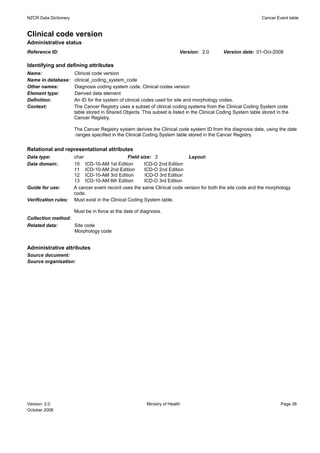
  • 23.
    NZCR Data Dictionary Cancer Event table Address country Administrative status Reference ID: A0022 Version: 2.0 Version date: 01-Oct-2008 Identifying and defining attributes Name: Country/region Name in database: hcu_country Other names: Address line 5 Element type: Data element Definition: The external region or country of an address. The healthcare user is believed to have lived at this address around the date of diagnosis of the cancer event. Context: Used to determine the domicile code. Relational and representational attributes Data type: varchar Field size: 30 Layout: Data domain: Free text Guide for use: Verification rules: Collection method: Address information is sourced from NHI, pathology reports and other events for the healthcare user. Cancer registry staff determine which of these is the most appropriate. Related data: Address street line 1 Address street line 2 Address suburb Address city/town Address date Domicile code Administrative attributes Source document: Source organisation: Version: 2.0 Ministry of Health Page 15 October 2008
  • 24.
    NZCR Data Dictionary Cancer Event table Address date Administrative status Reference ID: Version: 1.0 Version date: 01-Oct-2008 Identifying and defining attributes Name: Address date Name in database: hcu_address_date Other names: Element type: Data element Definition: Possible date at which the health care user lived at the address. Context: Cancer Registry staff need to decide which address is most likely to have been applicable at the date of diagnosis. The address date aids this decision Relational and representational attributes Mandatory Data type: date Field size: Layout: Data domain: Guide for use: Introduced in September 2008. For earlier data, the address date has been set to the Diagnosis date. Verification rules: Collection method: Sourced from the same place as the address, which can be either: - NHI - the last modification date of the current hcu record - Pathology report - the received date of the report - another cancer event - the address date of that cancer event. Related data: Address street line 1 Address street line 2 Address suburb Address city/town Address country Domicile code Administrative attributes Source document: Source organisation: Version: 2.0 Ministry of Health Page 16 October 2008
  • 25.
    NZCR Data Dictionary Cancer Event table Address street line 1 Administrative status Reference ID: A0018 Version: 1.1 Version date: 01-Oct-2008 Identifying and defining attributes Name: Address line 1 Name in database: hcu_street_address Other names: Element type: Data element Definition: The first line of the street portion of an address. The healthcare user is believed to have lived at this address around the date of diagnosis of the cancer event. Context: Used to determine the domicile code. Relational and representational attributes Data type: varchar Field size: 35 Layout: Data domain: Free text Guide for use: Verification rules: Address street line 1 and Address street line 2 may not both be blank. Collection method: Address information is sourced from NHI, pathology reports and other events for the healthcare user. Cancer registry staff determine which of these is the most appropriate. Related data: Address street line 1 Address suburb Address city/town Address country Address date Domicile code Administrative attributes Source document: Source organisation: Version: 2.0 Ministry of Health Page 17 October 2008
  • 26.
    NZCR Data Dictionary Cancer Event table Address street line 2 Administrative status Reference ID: A0019 Version: 1.1 Version date: 01-Oct-2008 Identifying and defining attributes Name: Address line 2 Name in database: hcu_extra_street_address Other names: Element type: Data element Definition: The second line of the street portion of an address. The healthcare user is believed to have lived at this address around the date of diagnosis of the cancer event. Context: Used to determine the domicile code. Relational and representational attributes Data type: varchar Field size: 30 Layout: Data domain: Free text Guide for use: Verification rules: Address street line 1 and Address street line 2 may not both be blank. Collection method: Address information is sourced from NHI, pathology reports and other cancer events for the healthcare user. Cancer registry staff determine which of these is the most appropriate. Related data: Address street line 2 Address suburb Address city/town Address country Address date Domicile code Administrative attributes Source document: Source organisation: Version: 2.0 Ministry of Health Page 18 October 2008
  • 27.
    NZCR Data Dictionary Cancer Event table Address suburb Administrative status Reference ID: A0020 Version: 2.0 Version date: 01-Oct-2008 Identifying and defining attributes Name: Address suburb Name in database: hcu_suburb Other names: Address line 3 Element type: Data element Definition: The suburb of an address. The healthcare user is believed to have lived at this address around the date of diagnosis of the cancer event. Context: Used to determine the domicile code. Relational and representational attributes Data type: varchar Field size: 30 Layout: Data domain: Free text Guide for use: Verification rules: Address suburb and Address city/town cannot both be blank. Collection method: Address information is sourced from NHI, pathology reports and other events for the healthcare user. Cancer registry staff determine which of these is the most appropriate. Related data: Address street line 1 Address street line 2 Address city/town Address country Address date Domicile code Administrative attributes Source document: Source organisation: Version: 2.0 Ministry of Health Page 19 October 2008
  • 28.
    NZCR Data Dictionary Cancer Event table Assessment decision code Administrative status Reference ID: Version: 1.0 Version date: 01-Oct-2008 Identifying and defining attributes Name: Assessment decision code Name in database: assessment_decision_code Other names: Decision code Element type: Data element Definition: A code representing an action taken during the processing of the cancer event. Context: Whenever a Cancer Registry user saves a new or modified cancer event, they are prompted to specify an assessment decision. This is used by the system to determine the next status. Relational and representational attributes Mandatory Data type: char Field size: 2 Layout: Data domain: DR Delete registered event JP Reject provisional event PP Create provisional event PR Create registered event RR Register provisional event UP Update event CH Checked RS Restore ME Migrate event CU Last CRS update Guide for use: Introduced in September 2008. Verification rules: The subset of assessment decision codes made available by the Cancer Registry system depends on the user's role and the current status of the cancer event. Collection method: Related data: Registration status Administrative attributes Source document: Source organisation: Version: 2.0 Ministry of Health Page 20 October 2008
  • 29.
    NZCR Data Dictionary Cancer Event table Basis of diagnosis code Administrative status Reference ID: A0120 Version: 2.0 Version date: 01-Oct-2008 Identifying and defining attributes Name: Basis of diagnosis code Name in database: diagnosis_basis_code Other names: Diagnosis Basis Element type: Data element Definition: A code used to describe the single, most valid basis of diagnosis for a primary malignant tumour, or a secondary tumour if the primary tumour site is unknown or cannot be determined. Context: Relational and representational attributes Data type: char Field size: 1 Layout: Data domain: 0 Death certificate only 1 Clinical only 2 Clinical investigation 3 Exploratory surgery / autopsy 4 Specific tests 5 Cytology or haematology 6 Histology of metastases 7 Histology of primary 8 Autopsy with histology 9 Unknown Guide for use: Verification rules: Mandatory for registered cancer events. Must be consistent with the Site, Morphology, Extent of disease, and Registration source, for registered cancer events. Must be consistent with Breslow's availability, Ulceration and Clark's level for registered melanoma cancer events. Collection method: Sourced from pathology reports, or inferred from the Registration source code. Related data: Site code Morphology code Extent of disease code Registration source code Administrative attributes Source document: World Health Organization Manual for Cancer Registry Personnel Source organisation: World Health Organization/International Association of Cancer Registries (IACR) Version: 2.0 Ministry of Health Page 21 October 2008
  • 30.
    NZCR Data Dictionary Cancer Event table Behaviour code Administrative status Reference ID: Version: 1.0 Version date: 01-Oct-2008 Identifying and defining attributes Name: Behaviour code Name in database: behaviour_code Other names: Element type: Data element Definition: A code specifying the behaviour of the tumour, in terms of its malignancy and metastasis. Context: Relational and representational attributes Mandatory Data type: char Field size: 1 Layout: Data domain: 0 Benign 1 Uncertain if benign or malignant 2 Carcinoma In Situ 3 Malignant, primary site 6 Malignant, metastatic site 9 Malignant, uncertain if primary or metastatic site Guide for use: Introduced in September 2008. Verification rules: Benign cancer events must be either rejected or deleted. Must be consistent with Site, for registered cancer events. Collection method: Sourced from pathology reports, hospital discharge event diagnosis codes (from NMDS) or mortality event diagnosis codes (from Mortality). Related data: Site code Morphology code Extent of disease code Administrative attributes Source document: International Classification of Diseases for Oncology, Third Edition, 2000 Source organisation: World Health Organization Version: 2.0 Ministry of Health Page 22 October 2008
  • 31.
    NZCR Data Dictionary Cancer Event table Cancer comments Administrative status Reference ID: A0271 Version: 2.0 Version date: 01-Oct-2008 Identifying and defining attributes Name: Cancer comments Name in database: cancer_comments Other names: Element type: Data element Definition: A multi line text field containing notes related to processing the cancer event. Context: Used by Cancer Registry staff. Relational and representational attributes Data type: varchar Field size: 2000 Layout: Data domain: Guide for use: Verification rules: Collection method: Related data: Administrative attributes Source document: Source organisation: Version: 2.0 Ministry of Health Page 23 October 2008
  • 32.
    NZCR Data Dictionary Cancer Event table Cancer event ID Administrative status Reference ID: A0261 Version: 2.0 Version date: 01-Oct-2008 Identifying and defining attributes Name: Cancer event ID Name in database: cancer_event_id Other names: Unique cancer record ID Element type: Data element Definition: The unique identifier of the cancer event, assigned by the Cancer Registry system Context: Used by the Cancer Registry system to identify a cancer event and to link it to associated records from other tables. Also used by Cancer Registry staff, to identify and search for an individual cancer event. Relational and representational attributes Mandatory Data type: integer Field size: 10 Layout: Data domain: Guide for use: Has been assigned as follows: - for events that had a registered status as at September 2008, the cancer_event_id = unique_cancer_record_id, from the legacy CRS system - for events that were provisional as at September 2008, the cancer_event_id = unique_cancer_temp_id + 1,000,000, from the legacy CRS system - for events created since September 2008, the Cancer Registry system assigns a sequential number (starting at 2,000,001). Verification rules: Collection method: Related data: Administrative attributes Source document: Source organisation: Version: 2.0 Ministry of Health Page 24 October 2008
  • 33.
    NZCR Data Dictionary Cancer Event table Cancer group Administrative status Reference ID: A0281 Version: 2.0 Version date: 01-Oct-2008 Identifying and defining attributes Name: Cancer group Name in database: cancer_group_code Other names: Specialist group code Element type: Data element Definition: A code for the speciality group to which the cancer event belongs. Context: Used by Cancer Registry staff to allocate and prioritise processing of cancer registrations. Used by the Cancer Registry system to ensure that an appropriate specialist details record exists for a cancer event. For example, a cancer event belonging to the melanoma group needs a record in the Melanoma Details table. Relational and representational attributes Mandatory Data type: char Field size: 2 Layout: Data domain: BR Breast CR Colorectal CX Cervix GN General GY Gynaecology HM Haematology & Lymphoid MN Melanoma PR Prostate RP Respiratory Guide for use: Introduced in 2001. Verification rules:A registered cancer event must belong to a cancer group that is consistent with the site (the Site code table indicates the allowable cancer group for each site). Collection method: Sourced from pathology reports, hospital discharge event diagnosis codes (from NMDS) or mortality event diagnosis codes (from Mortality). Related data: Site code Site table Administrative attributes Source document: Source organisation: Version: 2.0 Ministry of Health Page 25 October 2008
  • 34.
    NZCR Data Dictionary Cancer Event table Clinical code version Administrative status Reference ID: Version: 2.0 Version date: 01-Oct-2008 Identifying and defining attributes Name: Clinical code version Name in database: clinical_coding_system_code Other names: Diagnosis coding system code, Clinical codes version Element type: Derived data element Definition: An ID for the system of clinical codes used for site and morphology codes. Context: The Cancer Registry uses a subset of clinical coding systems from the Clinical Coding System code table stored in Shared Objects. This subset is listed in the Clinical Coding System table stored in the Cancer Registry. The Cancer Registry system derives the Clinical code system ID from the diagnosis date, using the date ranges specified in the Clinical Coding System table stored in the Cancer Registry. Relational and representational attributes Data type: char Field size: 2 Layout: Data domain: 10 ICD-10-AM 1st Edition ICD-O 2nd Edition 11 ICD-10-AM 2nd Edition ICD-O 2nd Edition 12 ICD-10-AM 3rd Edition ICD-O 3rd Edition 13 ICD-10-AM 6th Edition ICD-O 3rd Edition Guide for use: A cancer event record uses the same Clinical code version for both the site code and the morphology code. Verification rules: Must exist in the Clinical Coding System table. Must be in force at the date of diagnosis. Collection method: Related data: Site code Morphology code Administrative attributes Source document: Source organisation: Version: 2.0 Ministry of Health Page 26 October 2008
  • 35.
    NZCR Data Dictionary Cancer Event table Clinical notes Administrative status Reference ID: A0270 Version: 2.0 Version date: 01-Oct-2008 Identifying and defining attributes Name: Clinical notes Name in database: clinical_notes Other names: Cancer notes Element type: Data element Definition: A multi line text field containing supplementary information about the tumour registration. Context: Relational and representational attributes Data type: varchar Field size: 2000 Layout: Data domain: Guide for use: Used by the Cancer Registry staff for notes such as recording requests for additional histology reports. Verification rules: Collection method: Related data: Administrative attributes Source document: Source organisation: Version: 2.0 Ministry of Health Page 27 October 2008
  • 36.
    NZCR Data Dictionary Cancer Event table Clinician name Administrative status Reference ID: A0297 Version: 2.0 Version date: 01-Oct-2008 Identifying and defining attributes Name: Clinician name Name in database: clinician_name Other names: Element type: Data element Definition: The name of the clinician responsible for the treatment of the healthcare user. Context: Relational and representational attributes Data type: varchar Field size: 50 Layout: Data domain: Free text Guide for use: Collected for audit and research purposes. Introduced in 2001 for cervical cancers. Introduced in September 2008 for all other cancers. Verification rules: Collection method: Sourced from pathology reports. Related data: Administrative attributes Source document: Source organisation: Version: 2.0 Ministry of Health Page 28 October 2008
  • 37.
    NZCR Data Dictionary Cancer Event table Coding review flag Administrative status Reference ID: Version: 1.0 Version date: 01-Oct-2008 Identifying and defining attributes Name: Coding review flag Name in database: coding_review_flag Other names: Element type: Data element Definition: A flag to indicate that the cancer event information should be reviewed. Context: Used by Cancer Registry staff to request a review of the cancer event information by another staff member. Relational and representational attributes Mandatory Data type: char Field size: 1 Layout: Data domain: Y Yes N No Guide for use: Verification rules: Collection method: Related data: Administrative attributes Source document: Source organisation: Version: 2.0 Ministry of Health Page 29 October 2008
  • 38.
    NZCR Data Dictionary Cancer Event table Country of birth code Administrative status Reference ID: A0198 Version: 2.0 Version date: 01-Oct-2008 Identifying and defining attributes Name: Country code Name in database: birth_country_code Other names: Element type: Data element Definition: A code for the country of birth of the healthcare user. Context: Primarily used for epidemiological studies. Relational and representational attributes Data type: char Field size: 3 Layout: Data domain: 004 - 999. See the Country of Birth code table on the NZHIS web site at http://www.nzhis.govt.nz/moh.nsf/pagesns/47 Guide for use: This is not the latest Statistics NZ country list. Note that the NMDS and Mortality collections are better sources of information about the country of birth of healthcare users than is the Cancer Registry. This is because the Cancer Registry obtains this data while automatically creating cancer events from hospital discharge events or mortality events, but most of these cancer events are subsequently rejected rather than registered. Verification rules: Collection method: Sourced from hospital discharge events (from NMDS) or mortality events (from Mortality). Related data: Administrative attributes Source document: Statistics NZ Country Code list (NZSCC86). Source organisation: Version: 2.0 Ministry of Health Page 30 October 2008
  • 39.
    NZCR Data Dictionary Cancer Event table Country of diagnosis code Administrative status Reference ID: A0198 Version: 2.0 Version date: 01-Oct-2008 Identifying and defining attributes Name: Country code Name in database: diagnosis_country_code Other names: Element type: Data element Definition: A code for the country in which the cancer event was diagnosed. Context: The Cancer Registry occasionally receives information about cancer events that were diagnosed overseas. These cancer events may still be captured, but are treated differently to those diagnosed in New Zealand. Only cancer events diagnosed in New Zealand are included in the core dataset. Relational and representational attributes Mandatory Data type: char Field size: 3 Layout: NNN Data domain: 004 - 999. See the Country of Birth code table on the NZHIS web site at http://www.nzhis.govt.nz/moh.nsf/pagesns/47 Guide for use: Introduced in September 2008. This is not the latest Statistics NZ country list. This field uses the same code table as the country of birth. Verification rules: Collection method: Sourced from pathology reports. Related data: Administrative attributes Source document: Statistics NZ Country Code list (NZSCC86) Source organisation: Version: 2.0 Ministry of Health Page 31 October 2008
  • 40.
    NZCR Data Dictionary Cancer Event table Date modified Administrative status Reference ID: A0265 Version: 2.0 Version date: 01-Oct-2008 Identifying and defining attributes Name: Date modified Name in database: updated_ts Other names: Updated timestamp Element type: Data element Definition: The date and time at which any information about the cancer event was saved to the database. Context: Used by Cancer Registry staff to identify when a cancer event was last worked on. This field is automatically populated by the Cancer Registry system when a cancer event is first created, and is updated whenever the cancer event information is changed. This includes changes to the Cancer Event record, changes to its specialist details (e.g. a Breast Details record), and changes to its list of problems (i.e. Cancer Event Problem records). Updates performed automatically by the system (e.g. creating provisional cancer events during an NMDS sweep) are assigned a pseudo-username (e.g. 'sysNmds'). Relational and representational attributes Mandatory Data type: datetime Field size: Layout: Data domain: Guide for use: Verification rules: Collection method: Related data: User modifying record Administrative attributes Source document: Source organisation: Version: 2.0 Ministry of Health Page 32 October 2008
  • 41.
    NZCR Data Dictionary Cancer Event table Date of birth Administrative status Reference ID: A0025 Version: 1.1 Version date: 01-Oct-2008 Identifying and defining attributes Name: Date of birth Name in database: hcu_birth_date Other names: DOB, HCU date of birth, Birth date Element type: Data element Definition: The date on which the healthcare user was born. Context: Required to derive age for demographic analyses. The Cancer Registry stores its own copy of the date of birth, because some of its historical data differs from the NHI. Unlike NHI, partial dates are not supported in the Cancer Registry system. Relational and representational attributes Mandatory Data type: date Field size: Layout: Data domain: Valid dates Guide for use: For some events before 1993, the 15/6 or 15/month (if the month was known) default date model still exists where there was no way to establish if the date is real or a default. Verification rules: Must be on or before the Diagnosis date. Should be the same as the date of birth in NHI. Age at diagnosis, which is derived from Date of birth, should be consistent with the Site for registered cancer events. Collection method: Sourced from NHI for new cancer events. Related data: Diagnosis date Date of birth flag Administrative attributes Source document: Source organisation: Version: 2.0 Ministry of Health Page 33 October 2008
  • 42.
    NZCR Data Dictionary Cancer Event table Date of histology Administrative status Reference ID: Version: 1.0 Version date: 01-Oct-2008 Identifying and defining attributes Name: Date of histology Name in database: histology_date Other names: Element type: Data element Definition: The date of the histology report for the definitive procedure, or for cervical cancer events, the date of the first biopsy. Context: Used for audit purposes. Relational and representational attributes Data type: date Field size: Layout: Data domain: Guide for use: Introduced in September 2008. Verification rules: Must be between the Diagnosis date and the Date of death inclusive. Collection method: Sourced from pathology reports. Related data: Administrative attributes Source document: Source organisation: Version: 2.0 Ministry of Health Page 34 October 2008
  • 43.
    NZCR Data Dictionary Cancer Event table Date received Administrative status Reference ID: Version: 2.0 Version date: 01-Oct-2008 Identifying and defining attributes Name: Date received Name in database: received_date Other names: Element type: Data element Definition: The date when the source information about the cancer event was received by the Cancer Registry. Context: Relational and representational attributes Mandatory Data type: date Field size: Layout: Data domain: Guide for use: Introduced in September 2008. Verification rules: Collection method: Sourced from the date the pathology report was received by the Ministry of Health. For cancer events sourced from hospital discharge events (from NMDS) or mortality events (from Mortality), it is usually set to the date the cancer event record was created in the Cancer Registry system. Related data: Registration source Administrative attributes Source document: Source organisation: Version: 2.0 Ministry of Health Page 35 October 2008
  • 44.
    NZCR Data Dictionary Cancer Event table Deletion reason code Administrative status Reference ID: A0272 Version: 2.0 Version date: 01-Oct-2008 Identifying and defining attributes Name: Deletion reason code Name in database: deletion_reason_code Other names: Element type: Data element Definition: The reason for deleting a registered record in the Cancer Registry. Context: Relational and representational attributes Data type: char Field size: 1 Layout: Data domain: 1 Registered in error 2 Primary already registered 3 Squamous cell carcinoma of skin 4 Duplicate Registration/Merged HCU 5 Other - see clinical notes Guide for use: Used by Cancer Registry staff. Introduced in September 2008. Prior to then, the reason for deletion was captured as text, which now appears in the clinical notes, along with a deletion reason code of '5'. Verification rules: Required for cancer events with a status of Deleted. Collection method: Related data: Administrative attributes Source document: Source organisation: Version: 2.0 Ministry of Health Page 36 October 2008
  • 45.
    NZCR Data Dictionary Cancer Event table Diagnosis date Administrative status Reference ID: A0233 Version: 1.1 Version date: 01-Oct-2008 Identifying and defining attributes Name: Diagnosis date Name in database: diagnosis_date Other names: Date of diagnosis Element type: Data element Definition: The date the tumour was diagnosed. Context: Used as the primary date for reporting purposes. Relational and representational attributes Mandatory Data type: date Field size: Layout: Data domain: Valid dates Guide for use: Verification rules: Must be between the Date of birth and the Date of death inclusive. Must be no later than the Date of histology. Must not be in the future. Collection method: Sourced from pathology reports, hospital discharge event start date (from NMDS) or mortality event date of death (from Mortality). This is the same as the earliest Date of operation/biopsy or the Date of admission (in a hospital event) or the Date of death if diagnosed on autopsy. If registering from a histology report, this should be the earliest pathology report date. If the only notification of a cancer comes from a Medical Certificate of Causes of Death, the diagnosis date is estimated from the 'Approximate time between onset and death' as reported by the certifying doctor alongside the cancer diagnosis on the certificate. Related data: Administrative attributes Source document: Source organisation: Version: 2.0 Ministry of Health Page 37 October 2008
  • 46.
    NZCR Data Dictionary Cancer Event table Documentation status Administrative status Reference ID: A0314 Version: 2.0 Version date: 01-Oct-2008 Identifying and defining attributes Name: Documentation status Name in database: documentation_status_code Other names: Document status Element type: Data element Definition: A code to describe documentation available for the cancer registration. Context: Used by Cancer Registry staff to track whether all relevant documentation has been received. Relational and representational attributes Mandatory Data type: varchar Field size: 2 Layout: Data domain: 1 All documents received 2 Awaiting pathology report 4 Awaiting other documents 8 No supporting documents 9 No applicable documents 10 Refer to Mortality Collection Guide for use: Introduced in 2001. Verification rules: Must not be 9 for registered cancer events. Should not be 8 for registered cancer events that have a date of death. Collection method: Related data: Administrative attributes Source document: Source organisation: Version: 2.0 Ministry of Health Page 38 October 2008
  • 47.
    NZCR Data Dictionary Cancer Event table Domicile code Administrative status Reference ID: A0023 Version: 1.1 Version date: 01-Oct-2008 Identifying and defining attributes Name: Domicile code Name in database: hcu_domicile_code Other names: Element type: Data element Definition: The Statistics NZ Health Domicile Code based on an address. The healthcare user is believed to have lived at this address around the date of diagnosis of the cancer event. Context: Based on the address fields. Required for demographic analyses. Domicile codes are key variables for determining the characteristics of the population that are using the health sector. Relational and representational attributes Mandatory Data type: char Field size: 4 Layout: XXNN Data domain: See the Domicile code table on the NZHIS web site at http://www.nzhis.govt.nz/moh.nsf/pagesns/47. For further information or a printed copy of the code table, contact the Publications Officer. Contact details are given at the front of this dictionary. Guide for use: The Domicile code used for health collections is a four-digit Health Domicile Code specially created by Statistics NZ from their six-digit Census Area Unit Code. This field contains 4 versions of the Health Domicile code, one for each of the 1991, 1996, 2001 and 2006 censuses. The series of Domicile codes used depends on the Diagnosis date. No Domicile codes were migrated for registrations before 1976, as the data is unreliable for those records. Before July 1993 Domicile was coded using the 1986 Census Domicile codes. This data has been mapped to the 1991 codes. The 1991 code is used from 1 July 1993 to 31 December 1997. The 1996 code is used from 1 January 1998 to 31 December 2002. The 2001 code is used from 1 January 2003 to 31 December 2007 The 2006 code is used from 1 January 2008 For retrospective cancer registrations (ie, late notifications) the Domicile code is assigned from the appropriate census code table relating to the year of diagnosis. In such cases, the Domicile code may not truly represent the domicile at the time of diagnosis, as the address at the time of diagnosis may not be reported. Care needs to be exercised when analysing pre-1993 data in terms of population, as the 1991 census split a large number of the 1986 codes into two or more new Domicile codes. As it was not possible to accurately attribute particular registrations to the correct new code, only one of the new multiple codes could be chosen for each old code. This can result in some areas showing no registrations for one code and an over-representation of registrations for the other domicile. Since 1996, Domicile code has been automatically assigned on the NHI database using the address provided. This can result in rural addresses being assigned to an urban Domicile code where there is insufficient data to generate the correct code. This is because the automated software relies on generating a post code in order to determine where in a related table it should look to find the code. Verification rules: The code must be one that was in force at the diagnosis date. Collection method: For addresses sourced from NHI, the Domicile code is also sourced from NHI. For addresses sourced from pathology reports, the Domicile code is manually determined using a Statistics NZ Streets database. Related data: Address street line 1 Address street line 2 Address suburb Address city/town Address country Address date Version: 2.0 Ministry of Health Page 39 October 2008
  • 48.
    NZCR Data Dictionary Cancer Event table Administrative attributes Source document: Source organisation: Statistics NZ Version: 2.0 Ministry of Health Page 40 October 2008
  • 49.
    NZCR Data Dictionary Cancer Event table Extent of disease code Administrative status Reference ID: A0121 Version: 2.0 Version date: 01-Oct-2008 Identifying and defining attributes Name: Extent of disease code Name in database: disease_extent_code Other names: Stage of disease, Stage code Element type: Data element Definition: A code that describes the stage of development that the tumour has reached at the time of diagnosis. Context: Relational and representational attributes Data type: char Field size: 1 Layout: Data domain: A In situ B Localised to organ of origin C Invasion of adjacent tissue or organ D Regional lymph nodes E Distant F Not known G Not applicable 0 In situ 1 Localised to organ of origin 2 Regional or node involvement 3 Remote or diffuse metastases 5 Not stated 6 Not applicable (Lymphomas/Leukaemias) Guide for use: Numeric extent of disease codes are used for cancer events diagnosed before 1999. For cancer events diagnosed from 1 January 1999 onwards, alpha codes are used. The current codes 'C' and 'D' replace the single numeric code '2' so these cannot be mapped one-to-one forwards. For cancer events diagnosed from 1999, the Extent of disease code was applied in a standardised way, using the SEER (Surveillance, Epidemiology and End Results) Guide to Summary Staging. At the end of 2002, the Ministry of Health adopted the updated SEER Guide (extended version). Verification rules: Mandatory for registered cancer events. Must be consistent with the Site, Basis of diagnosis and Positive nodes. If either ACPS system, Astler and Coller staging system, and/or Duke’s staging system has a value other than blank or 'N' for registered colorectal cancer events, then Extent of disease must not be '5' or 'F'. Collection method: Sourced from pathology reports, hospital discharge events (from NMDS) or mortality events (from Mortality). Related data: Administrative attributes Source document: SEER Summary Staging Manual Source organisation: SEER Programme, World Health Organization Version: 2.0 Ministry of Health Page 41 October 2008
  • 50.
    NZCR Data Dictionary Cancer Event table Facility code Administrative status Reference ID: A0143 Version: 1.1 Version date: 01-Oct-2008 Identifying and defining attributes Name: Facility code Name in database: facility_code Other names: Health agency facility code, Hospital, HAF code, HAFC Element type: Data element Definition: A code that uniquely identifies the healthcare facility where the cancer was diagnosed or treated. Context: Used for audit and research purposes. Relational and representational attributes Data type: char Field size: 4 Layout: Data domain: See the Facility code table on the NZHIS web site at http://www.nzhis.govt.nz/moh.nsf/pagesns/47. For further information or a printed copy of the code table, contact the Publications Officer. Contact details are given at the front of this dictionary. Guide for use: Verification rules: Mandatory for registered cancer events with a Registration source of 'N1'. Collection method: Sourced from hospital discharge events (from NMDS). Related data: Administrative attributes Source document: Source organisation: Version: 2.0 Ministry of Health Page 42 October 2008
  • 51.
    NZCR Data Dictionary Cancer Event table Family name Administrative status Reference ID: A0013 Version: 2.0 Version date: 01-Oct-2008 Identifying and defining attributes Name: Family name Name in database: hcu_family_name Other names: Last name, Surname Element type: Data element Definition: The family name (surname) of the healthcare user. Context: Used by Cancer Registry staff to identify the healthcare user. Relational and representational attributes Mandatory Data type: varchar Field size: 25 Layout: Data domain: Guide for use: Verification rules: Collection method: Since September 2008, this has been automatically populated with a copy of the current name from NHI at the time a cancer event is created. For earlier data, the name was sourced from either NHI or pathology reports. Related data: First name Second name Third name Administrative attributes Source document: Source organisation: Version: 2.0 Ministry of Health Page 43 October 2008
  • 52.
    NZCR Data Dictionary Cancer Event table First name Administrative status Reference ID: A0014 Version: 2.0 Version date: 01-Oct-2008 Identifying and defining attributes Name: First given name Name in database: hcu_first_name Other names: First given name Element type: Data element Definition: The first given name of the healthcare user. Context: Used by Cancer Registry staff to identify the healthcare user. Relational and representational attributes Mandatory Data type: varchar Field size: 20 Layout: Data domain: Guide for use: Verification rules: Collection method: Since September 2008, this has been automatically populated with a copy of the current name from NHI at the time a cancer event is created. For earlier data, the name was sourced from either NHI or pathology reports. Related data: Second name Third name Family name Administrative attributes Source document: Source organisation: Version: 2.0 Ministry of Health Page 44 October 2008
  • 53.
    NZCR Data Dictionary Cancer Event table Grade of tumour code Administrative status Reference ID: A0274 Version: 2.0 Version date: 01-Oct-2008 Identifying and defining attributes Name: Grade of tumour code Name in database: tumour_grade_code Other names: Tumour differentiation, Grading of tumour code Element type: Data element Definition: A code that specifies the differentiation of the tumour. Context: Relational and representational attributes Data type: char Field size: 1 Layout: Data domain: 1 Well differentiated 2 Moderately differentiated, moderately well differentiated 3 Poorly differentiated 4 Undifferentiated, anaplastic 9 Not supplied, not determined or not applicable Guide for use: Introduced in 1998. Prior to this, general tumour differentiation information was held in the Morphology description. Verification rules: Required for registered cancer events. Must be consistent with Histopathology for registered breast cancer events. Should be consistent with Gleason score for registered prostate cancer events. Collection method: Sourced from pathology reports. Related data: Administrative attributes Source document: Source organisation: Version: 2.0 Ministry of Health Page 45 October 2008
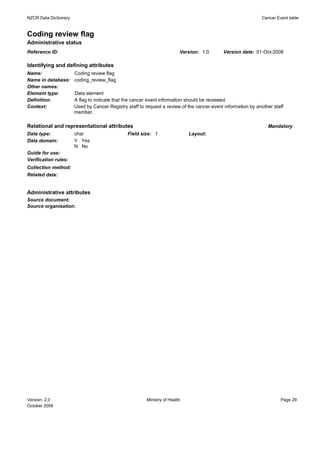
  • 54.
    NZCR Data Dictionary Cancer Event table Grade of tumour description Administrative status Reference ID: A0275 Version: 2.0 Version date: 01-Oct-2008 Identifying and defining attributes Name: Grade of tumour description Name in database: tumour_grade_desc Other names: Grading of tumour text Element type: Data element Definition: Extra details about the grading description. Context: Relational and representational attributes Data type: varchar Field size: 70 Layout: Data domain: Guide for use: Defaults to the standard description of the Grade of tumour code from the Grade of Tumour code table. However, Cancer Registry staff can amend the description to add more specific information. Introduced in 2001. Verification rules: Required for registered cancer events. Collection method: Sourced from pathology reports. Related data: Administrative attributes Source document: Source organisation: Version: 2.0 Ministry of Health Page 46 October 2008
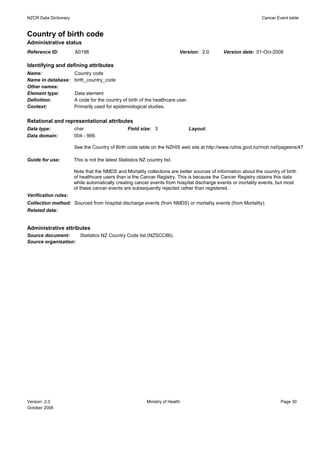
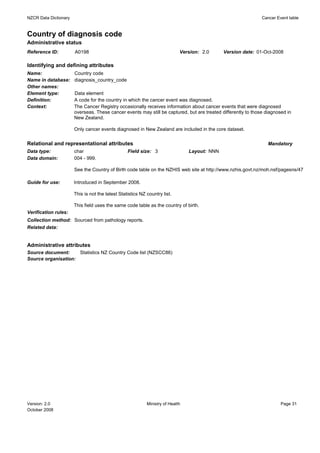
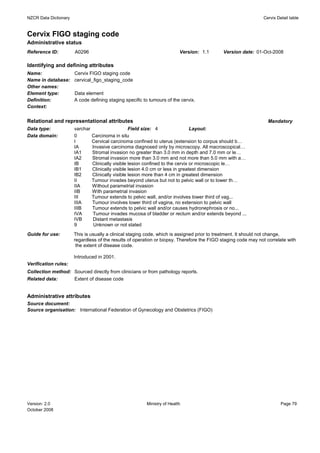
  • 55.
    NZCR Data Dictionary Cancer Event table HCU ID Administrative status Reference ID: A0012 Version: 2.0 Version date: 01-Oct-2008 Identifying and defining attributes Name: Master NHI number Name in database: hcu_id Other names: NHI number Element type: Data element Definition: An identifier of the healthcare user that has the cancer event. Context: The NHI number is the cornerstone of the Ministry of Health's data collections. It is a unique 7-character identification number assigned to a healthcare user by the National Health Index (NHI) database. NHI numbers uniquely identify healthcare users, and allow linking between different data collections. Relational and representational attributes Mandatory Data type: char Field size: 7 Layout: AAANNNN Data domain: Guide for use: The NHI system is the register of all healthcare users and their HCU IDs. When duplicate records for a healthcare user are merged, one of their HCU_IDs will be deemed to be the master (or primary), and the others become secondary HCU_IDs. It is important to consider both the master and the secondary HCU_IDs when analysing healthcare information relating to a unique individual. The Privacy Commissioner considers the NHI number to be personally identifying information (like name and address) so, if it is linked to clinical information, it must be held securely and the healthcare user’s privacy protected. For more information about the HCU ID, see http://www.nzhis.govt.nz/moh.nsf/pagesns/37 Verification rules: Must exist on NHI. There is a verification algorithm which ensures that the NHI number is in the correct format and is valid. The algorithm is described at http://www.nzhis.govt.nz/moh.nsf/pagesns/276 Collection method: Sourced from the HCU ID and/or other personal details from pathology reports, hospital discharge event HCU IDs (from NMDS) or mortality event HCU IDs (from Mortality). Cancer Registry staff check all HCU IDs on pathology reports against the NHI. If the supplied HCU ID is incorrect or invalid, then the laboratory or clinician is contacted for further information to correctly identify the healthcare user. Related data: Administrative attributes Source document: Source organisation: Version: 2.0 Ministry of Health Page 47 October 2008
  • 56.
    NZCR Data Dictionary Cancer Event table ICD9 site code Administrative status Reference ID: Version: 2.0 Version date: 01-Oct-2008 Identifying and defining attributes Name: ICD9 site code Name in database: icd9_site_code Other names: Element type: Derived data element Definition: The site code supplied as or mapped to ICD-9-CMA-II. Context: Sometimes used for looking at time series data, since all historical data is stored in ICD-9-CMA-II codes. Relational and representational attributes Data type: varchar Field size: 8 Layout: Data domain: Guide for use: Since November 2001, Cancer Registry staff have not been able to populate or update the ICD-9 site code. The Cancer Registry system derives the ICD-9 site code from the Site code using backward mapping tables supplied by the National Centre for Classification in Health, University of Sydney, Australia. The tables do not support complex mapping. Mapped codes are not as specific as the original coding. Only ICD-10-AM 1st Edition is mapped to ICD-9-CMA-II. If the site code is reported in ICD-10-AM 2nd Edition or later, it is first mapped to ICD-10-AM 1st Edition, and then to ICD-9-CMA-II. Verification rules: Collection method: Since September 2008, the Cancer Registry system automatically (re)derives an ICD-9 site code whenever the Site code is populated or updated. Before November 2001, the ICD-9 site code was either manually determined for each cancer event or mapped from ICD-7 or ICD-8 codes. Between these dates, the Cancer Registry system automatically (re)derived an ICD9 site code when the site code was first populated, or when the cancer event was updated for any reason. This has caused much of the original ICD9 coding to be overwritten (but there are plans to reinstate the original ICD9 data from archived records). Sometimes sourced from hospital discharge event ICD9 diagnosis codes. Related data: Site code Administrative attributes Source document: Source organisation: National Centre for Classification in Health Version: 2.0 Ministry of Health Page 48 October 2008
  • 57.
    NZCR Data Dictionary Cancer Event table Laboratory code Administrative status Reference ID: A0206 Version: 1.1 Version date: 01-Oct-2008 Identifying and defining attributes Name: Laboratory code Name in database: laboratory_code Other names: Element type: Data element Definition: The code representing the laboratory diagnosing and reporting the cancer. Context: Relational and representational attributes Data type: char Field size: 4 Layout: Data domain: See the Laboratory code table on the NZHIS web site at http://www.nzhis.govt.nz/moh.nsf/pagesns/47. For further information or a printed copy of the code table, contact the Publications Officer. Contact details are given at the front of this dictionary. Guide for use: Verification rules: Required if Source of registration is either 'L1' or 'M2'. Collection method: Sourced from pathology reports. Related data: Administrative attributes Source document: Source organisation: Version: 2.0 Ministry of Health Page 49 October 2008
  • 58.
    NZCR Data Dictionary Cancer Event table Laterality code Administrative status Reference ID: A0282 Version: 2.0 Version date: 01-Oct-2008 Identifying and defining attributes Name: Laterality code Name in database: laterality_code Other names: Side of breast Element type: Data element Definition: A code indicating the side of the body of the organ involved, when it is a paired organ. Context: Relational and representational attributes Mandatory Data type: char Field size: 1 Layout: Data domain: A Not Applicable B Both L Left R Right U Unknown Guide for use: Introduced in 1998 for breast cancers. Introduced in September 2008 for other paired organs. Verification rules: Must be 'A' if the site code is not for a paired organ. Must be one of the other values if the site code is for a paired organ. Collection method: Sourced from pathology reports. Related data: Administrative attributes Source document: Source organisation: Version: 2.0 Ministry of Health Page 50 October 2008
  • 59.
    NZCR Data Dictionary Cancer Event table Morphology code Administrative status Reference ID: Version: 2.0 Version date: 01-Oct-2008 Identifying and defining attributes Name: Morphology code Name in database: morphology_code Other names: Clinical code Element type: Data element Definition: A code for the morphology (form and structure) of the tumour. Context: The Cancer Registry uses a subset of the clinical codes from the Clinical Codes table stored in Shared Objects. The codes of this subset are listed in the Morphology table. Relational and representational attributes Data type: varchar Field size: 8 Layout: Data domain: The first 4 digits of the morphology codes defined in the 2nd and 3rd editions of ICD-O. Note that most morphology codes are common to both of these editions. Guide for use: Data with Diagnosis date before 2003 have been coded in ICD-0 2nd Edition. Data since that date are coded in ICD-0 3rd Edition. Verification rules: Must exist in the Morphology table. Must exist in Shared Objects' Clinical Codes table, where System ID = Clinical code version for the cancer event, and Code Type = 'M' (Morphology). Required for registered cancer events. Should be malignant for registered cancer events. Must be consistent with Site and Basis of Diagnosis for registered cancer events. Must be consistent with Histopathology for registered breast cancer events. Collection method: Sourced from pathology reports. Sometimes inferred from Site code. Related data: Morphology description Clinical coding version Site code Administrative attributes Source document: ICD-O - International Classification of Diseases for Oncology Source organisation: the World Health Organization Version: 2.0 Ministry of Health Page 51 October 2008
  • 60.
    NZCR Data Dictionary Cancer Event table Morphology description Administrative status Reference ID: Version: 2.0 Version date: 01-Oct-2008 Identifying and defining attributes Name: Clinical code description Name in database: morphology_desc Other names: Element type: Data element Definition: A description of the Morphology code. Context: Relational and representational attributes Data type: varchar Field size: 100 Layout: Data domain: Guide for use: Defaults to the standard description of the Morphology code from the Clinical Codes table. However, Cancer Registry staff can amend the description to add more specific information. Verification rules: Required for registered cancer events. Collection method: Sourced from the Shared Objects' Clinical Codes table and pathology reports. Related data: Morphology code Administrative attributes Source document: Source organisation: Version: 2.0 Ministry of Health Page 52 October 2008
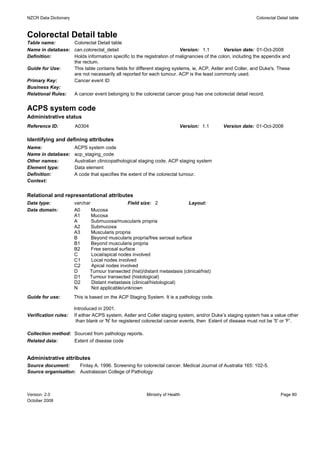
  • 61.
    NZCR Data Dictionary Cancer Event table Multiple tumours flag Administrative status Reference ID: A0279 Version: 2.0 Version date: 01-Oct-2008 Identifying and defining attributes Name: Multiple tumours flag Name in database: multiple_tumours_flag Other names: Element type: Data element Definition: A flag to indicate cancer events that are considered multiple tumours according to the WHO recommended classification. Context: When a healthcare user has multiple cancer events that belong to a Single Site, and that have the same same morphological type as defined by Berg, only one of them may be identified as a primary cancer for the purposes of incidence reporting. For analysis purposes, the Cancer Registry stores all registerable cancers. However only the incident cancer events are reported to the World Health Organization and included in Ministry of Health publications. Relational and representational attributes Mandatory Data type: char Field size: 1 Layout: Data domain: Y Yes (Not an incident cancer event) N No (Incident cancer event) Guide for use: Verification rules: For registered cancer events, this should be consistent with the multiple tumours flag of other registered cancer events for the same health care user. Must be 'N' for cancer events that are either provisional, in-situ, or registered overseas. Collection method: Related data: Administrative attributes Source document: International Classification of Diseases for Oncology (ICD-O) Source organisation: World Health Organization Version: 2.0 Ministry of Health Page 53 October 2008
  • 62.
    NZCR Data Dictionary Cancer Event table New information flag Administrative status Reference ID: Version: 1.0 Version date: 01-Oct-2008 Identifying and defining attributes Name: New information flag Name in database: new_info_flag Other names: Element type: Data element Definition: A flag to indicate that new documentation has been received for this cancer event. Context: Used by Cancer Registry staff to indicate that the cancer event may need to be updated. Relational and representational attributes Mandatory Data type: char Field size: 1 Layout: Data domain: Y Yes N No Guide for use: Verification rules: Collection method: Related data: Administrative attributes Source document: Source organisation: Version: 2.0 Ministry of Health Page 54 October 2008
  • 63.
    NZCR Data Dictionary Cancer Event table Nodes tested flag Administrative status Reference ID: A0305 Version: 2.0 Version date: 01-Oct-2008 Identifying and defining attributes Name: Nodes tested flag Name in database: nodes_tested_flag Other names: Element type: Data element Definition: A flag to indicate that lymph nodes have been tested. Context: Relational and representational attributes Mandatory Data type: char Field size: 1 Layout: Data domain: Y Yes N No U Unknown Guide for use: Introduced in 2001 for colorectal cancers, and in September 2008 for other cancers. This information was previously held in comments field. Verification rules: Collection method: Sourced from pathology reports. Related data: Extent of disease code Total nodes sampled Positive nodes Administrative attributes Source document: Source organisation: Version: 2.0 Ministry of Health Page 55 October 2008
  • 64.
    NZCR Data Dictionary Cancer Event table Occupation code Administrative status Reference ID: A0134 Version: 1.1 Version date: 01-Oct-2008 Identifying and defining attributes Name: Occupation code Name in database: occupation_code Other names: Element type: Data element Definition: A code for an occupation of the healthcare user, classified according to the Statistics NZ Standard Classification of Occupations (NZSCO90). Context: Relational and representational attributes Data type: char Field size: 4 Layout: Data domain: 0111 - 9900. See the Occupation code table on the NZHIS web site at http://www.nzhis.govt.nz/moh.nsf/pagesns/47. For further information or a printed copy of the code table, contact the Publications Officer. Contact details are given at the front of this dictionary. Guide for use: Since September 2008, Cancer Registry staff have not been able to populate or update this field. Note that the NMDS is a better source of information about the occupation of healthcare users than is the Cancer Registry. This is because the Cancer Registry obtains this data while automatically creating cancer events from hospital discharge events, but most of these cancer events are subsequently rejected rather than registered. Verification rules: Collection method: Sourced from hospital discharge event occupation codes (from NMDS). Related data: Occupation description Administrative attributes Source document: NZSCO90 - Statistics NZ Standard Classification of Occupations Source organisation: Statistics NZ Version: 2.0 Ministry of Health Page 56 October 2008
  • 65.
    NZCR Data Dictionary Cancer Event table Occupation description Administrative status Reference ID: A0215 Version: 2.0 Version date: 01-Oct-2008 Identifying and defining attributes Name: Occupation free-text Name in database: occupation_desc Other names: Occupation free-text, Occupation text Element type: Data element Definition: A free-text description of the healthcare user's occupation. Context: Relational and representational attributes Data type: varchar Field size: 70 Layout: Data domain: Guide for use: Introduced in November 2001. Since September 2008, Cancer Registry staff have not been able to populate or update this field. Note that the NMDS is a better source of information about the occupation of healthcare users than is the Cancer Registry. This is because the Cancer Registry obtains this data while automatically creating cancer events from hospital discharge events, but most of these cancer events are subsequently rejected rather than registered. Verification rules: Collection method: Sourced from hospital discharge event occupation free-text (from NMDS). Related data: Occupation code Administrative attributes Source document: Source organisation: Version: 2.0 Ministry of Health Page 57 October 2008
  • 66.
    NZCR Data Dictionary Cancer Event table Positive nodes Administrative status Reference ID: A0286 Version: 2.0 Version date: 01-Oct-2008 Identifying and defining attributes Name: Positive nodes Name in database: positive_nodes_nbr Other names: Nodes involved, Number of positive nodes Element type: Data element Definition: The number of lymph nodes from the sample that have metastases. Context: For breast cancers, this includes the number of Positive sentinel nodes. Relational and representational attributes Data type: integer Field size: 2 Layout: Data domain: 0 to 999 Guide for use: Introduced in 1998 for breast cancers, in 2001 for colorectal cancers, and in September 2008 for other cancers. Only meaningful if Nodes tested is 'Y' (yes) Verification rules: Must be less than or equal to the Total nodes sampled for registered events. Should be consistent with Extent of disease for registered cancer events. Collection method: Sourced from pathology reports. Related data: Extent of disease code Nodes tested flag Total nodes sampled Positive sentinel nodes Administrative attributes Source document: Source organisation: Version: 2.0 Ministry of Health Page 58 October 2008
  • 67.
    NZCR Data Dictionary Cancer Event table QA OK flag Administrative status Reference ID: Version: 1.0 Version date: 01-Oct-2008 Identifying and defining attributes Name: QA OK flag Name in database: qa_ok_flag Other names: Element type: Data element Definition: A flag indicating that the cancer event has been quality assured since its last substantive modification. Context: Used by Cancer Registry staff to avoid rechecking cancer events that have already been quality assured. Relational and representational attributes Mandatory Data type: char Field size: 1 Layout: Data domain: Y Yes N No Guide for use: Verification rules: Collection method: The flag is manually set to 'Y' by Cancer Registry staff after they quality assure the cancer event. The flag is automatically set to 'N' by the Cancer Registry system when any field, other than the Assessment Decision, Country of birth, Address, or Comments, is modified. Related data: Administrative attributes Source document: Source organisation: Version: 2.0 Ministry of Health Page 59 October 2008
  • 68.
    NZCR Data Dictionary Cancer Event table Record version Administrative status Reference ID: Version: 1.0 Version date: 01-Oct-2008 Identifying and defining attributes Name: Record version Name in database: version Other names: Element type: Data element Definition: The version of the data in this record. Context: Used by the Cancer Registry system for concurrency management. Relational and representational attributes Mandatory Data type: integer Field size: 10 Layout: Data domain: Guide for use: Verification rules: Collection method: Related data: Administrative attributes Source document: Source organisation: Version: 2.0 Ministry of Health Page 60 October 2008
  • 69.
    NZCR Data Dictionary Cancer Event table Registration date Administrative status Reference ID: Version: 1.0 Version date: 01-Oct-2008 Identifying and defining attributes Name: Date updated Name in database: registered_ts Other names: Date of registration Element type: Derived data element Definition: The date and time that the cancer event was first registered. Context: Relational and representational attributes Data type: datetime Field size: Layout: Data domain: Valid dates Guide for use: Cancer Registry staff cannot populate or update this field. It is automatically populated by the Cancer Registry system when the status first becomes registered. Introduced in September 2008. For cancer events registered before this date, the Registration date has been set to September 2008. Verification rules: Collection method: Related data: Registered by Administrative attributes Source document: Source organisation: Version: 2.0 Ministry of Health Page 61 October 2008
  • 70.
    NZCR Data Dictionary Cancer Event table Registration source Administrative status Reference ID: A0263 Version: 2.0 Version date: 01-Oct-2008 Identifying and defining attributes Name: Registration source Name in database: registration_source_code Other names: Source of registration Element type: Data element Definition: A code that identifies the initial source of the cancer registration. Context: Relational and representational attributes Mandatory Data type: char Field size: 2 Layout: Data domain: L1 Laboratory Source M1 Death Certificate M2 Post Mortem Report M3 Mortality Collection Source N1 NMDS Collection Source O1 Other Source Guide for use: Introduced in 2001. For earlier data, the default of 'O' (Other) has been used. Verification rules: Must be consistent with Basis of Diagnosis, for registered events. Collection method: Related data: Date received Administrative attributes Source document: Source organisation: Version: 2.0 Ministry of Health Page 62 October 2008
  • 71.
    NZCR Data Dictionary Cancer Event table Registration status Administrative status Reference ID: A0317 Version: 2.0 Version date: 01-Oct-2008 Identifying and defining attributes Name: Registration status Name in database: registration_status_code Other names: Element type: Derived data element Definition: The processing status of the record. Context: The registration status incorporates the following information: - the first character indicates whether the cancer event has ever been registered - the second character indicates whether it was diagnosed in NZ or not, and whether its Behaviour code is uncertain or not. - the third character indicates how far the cancer event is through the registration process. The Cancer Registry system automatically determines the registration status based on the Assessment decision as well as other fields. Relational and representational attributes Mandatory Data type: char Field size: 3 Layout: Data domain: P_C Provisional Checked P_J Provisional Rejected POP Provisional Overseas P_P Provisional PUP Provisional Uncertain POC Provisional Overseas Checked POJ Provisional Overseas Rejected PUC Provisional Uncertain Checked PUJ Provisional Uncertain Rejected R_C Registered Complete R_D Registered Deleted ROR Registered Overseas R_R Registered ROC Registered Overseas Complete ROD Registered Overseas Deleted Guide for use: Analysis and reporting are usually limited to New Zealand registered cancer events (i.e. 'R_R' and 'R_C'). Verification rules: Collection method: Related data: Documentation status Administrative attributes Source document: Source organisation: Version: 2.0 Ministry of Health Page 63 October 2008
  • 72.
    NZCR Data Dictionary Cancer Event table Second name Administrative status Reference ID: A0015 Version: 2.0 Version date: 01-Oct-2008 Identifying and defining attributes Name: Second given name Name in database: hcu_second_name Other names: Second given name Element type: Data element Definition: The second given name of the healthcare user. Context: Used by Cancer Registry staff to identify the healthcare user. Relational and representational attributes Data type: varchar Field size: 20 Layout: Data domain: Guide for use: Verification rules: Collection method: Since September 2008, this has been automatically populated with a copy of the current name from NHI at the time a cancer event is created. For earlier data, the name was sourced from either NHI or pathology reports. Related data: First name Third name Family name Administrative attributes Source document: Source organisation: Version: 2.0 Ministry of Health Page 64 October 2008
  • 73.
    NZCR Data Dictionary Cancer Event table Sex Administrative status Reference ID: A0028 Version: 2.0 Version date: 01-Oct-2008 Identifying and defining attributes Name: Sex Name in database: hcu_sex_code Other names: Sex type code Element type: Data element Definition: The biological sex of the healthcare user. Context: Used for demographic analyses. The term sex refers to the biological differences between males and females, while the term gender refers to a person's social role (masculine or feminine). 'I' codes are for use in cases, usually newborns, where it is not possible to determine the sex of the healthcare user. Because it is possible for a person's sex to change over time (e.g. transsexual people), the Cancer Registry collects sex information for each cancer event, rather than relying on the data in the National Health Index (which does not include historical data). In rare cases, this may mean that the type of cancer does not appear to be compatible with the healthcare user's current sex. Relational and representational attributes Mandatory Data type: char Field size: 1 Layout: Data domain: M Male F Female U Unknown I Indeterminate Guide for use: Cannot be updated by Cancer Registry staff. Verification rules: Should be consistent with Site for registered cancer events. Collection method: Since September 2008, this has been automatically populated at the time a cancer event is created. For cancer events created manually, a copy of the current sex from NHI is used. For cancer events created from NMDS or Mortality records, the sex from the source records is used. For earlier data, the sex could also be sourced from pathology reports. Related data: Administrative attributes Source document: Source organisation: Version: 2.0 Ministry of Health Page 65 October 2008
  • 74.
    NZCR Data Dictionary Cancer Event table Site code Administrative status Reference ID: Version: 2.0 Version date: 01-Oct-2008 Identifying and defining attributes Name: Site code Name in database: site_code Other names: Clinical code Element type: Data element Definition: A code for the site of the tumour. Context: The Cancer Registry uses a subset of the clinical codes from the Clinical Codes table stored in Shared Objects. The codes of this subset are listed in the Site table. Relational and representational attributes Data type: varchar Field size: 8 Layout: Data domain: The set of site codes of interest to the Cancer Registry, from ICD-10-AM. This set is the same, irrespective of which edition of ICD-10-AM is used. Guide for use: All data in the Cancer Registry is coded in ICD-10. However, data prior to January 2000 was originally coded in ICD-7, -8 and -9. This data has subsequently been mapped to ICD-10, manually checked, and some anomalies corrected. Verification rules: Must exist in the Site table. Must exist in Shared Objects' Clinical Codes table, where System ID = Clinical code version for the cancer event, and Code Type = 'A' (Diagnosis Codes) or 'V' (Supplementary classification) Required for registered cancer events Must be a registerable site for registered cancer events. Must be consistent with Behaviour Code, Cancer Group, Morphology, Basis of Diagnosis, Extent of Disease, Sex, Age at diagnosis (derived from Date of birth and Date of diagnosis), and Laterality, for registered cancer events. Must be consistent with Histopathology for registered breast cancer events. Collection method: Sourced from pathology reports, hospital discharge event diagnosis codes (from NMDS) or mortality event diagnosis codes (from Mortality). Related data: Site description Clinical coding version Morphology code Administrative attributes Source document: ICD-10-AM - the International Statistical Classification of Diseases and Related Health Problems, 10th Revision, Australian Modification. Source organisation: National Centre for Classification in Health, University of Sydney, Australia and the World Health Organization Version: 2.0 Ministry of Health Page 66 October 2008
  • 75.
    NZCR Data Dictionary Cancer Event table Site description Administrative status Reference ID: Version: 2.0 Version date: 01-Oct-2008 Identifying and defining attributes Name: Clinical code description Name in database: site_desc Other names: Element type: Data element Definition: A description of the Site code. Context: Relational and representational attributes Data type: varchar Field size: 100 Layout: Data domain: Guide for use: Defaults to the standard description of the Site code from the Clinical Codes table. However, Cancer Registry staff can amend the description to add more specific information, e.g. before the laterality field was introduced, laterality was added to this field. Verification rules: Required for registered cancer events. Collection method: Sourced from the Shared Objects' Clinical Codes table, pathology reports, hospital discharge event diagnosis codes(from NMDS) or mortality event diagnosis codes (from Mortality). Related data: Site code Administrative attributes Source document: Source organisation: Version: 2.0 Ministry of Health Page 67 October 2008
  • 76.
    NZCR Data Dictionary Cancer Event table Smoking history flag Administrative status Reference ID: A0280 Version: 2.0 Version date: 01-Oct-2008 Identifying and defining attributes Name: Smoking history flag Name in database: smoking_history_flag Other names: Element type: Data element Definition: A flag to indicate that the healthcare user had a smoking history or is currently a smoker. Context: Relational and representational attributes Mandatory Data type: char Field size: 1 Layout: Data domain: Y Yes N No U Unknown Guide for use: Introduced in 2001. Note that this data is largely incomplete. Verification rules: Collection method: Manually sourced from hospital discharge event diagnosis codes (from NMDS). Related data: Administrative attributes Source document: Source organisation: Version: 2.0 Ministry of Health Page 68 October 2008
  • 77.
    NZCR Data Dictionary Cancer Event table Third name Administrative status Reference ID: A0016 Version: 2.0 Version date: 01-Oct-2008 Identifying and defining attributes Name: Third given name Name in database: hcu_third_name Other names: Third given name Element type: Data element Definition: The third given name of the healthcare user. Context: Used by Cancer Registry staff to identify the healthcare user. Relational and representational attributes Data type: varchar Field size: 20 Layout: Data domain: Guide for use: Verification rules: Collection method: Since September 2008, this has been automatically populated with a copy of the current name from NHI at the time a cancer event is created. For earlier data, the name was sourced from either NHI or pathology reports. Related data: First name Second name Family name Administrative attributes Source document: Source organisation: Version: 2.0 Ministry of Health Page 69 October 2008
  • 78.
    NZCR Data Dictionary Cancer Event table TNM-M Administrative status Reference ID: A0278 Version: 2.0 Version date: 01-Oct-2008 Identifying and defining attributes Name: TNM-M Name in database: tnm_m Other names: Metastasis Element type: Data element Definition: Indicates the absence or presence of distant metastasis, as classified by TNM. Context: TNM is Tumour size, Nodes and Metastases, and is specific to the site. It is an international staging system comprising: - pathological staging based on histology reports, and - clinical staging based on hospital events Relational and representational attributes Data type: varchar Field size: 2 Layout: Data domain: Refer to the TNM classification book Guide for use: Introduced in 2001. Verification rules: Collection method: Mainly sourced from pathology reports of metastases or from clinical information on pathology reports. Related data: TNM-T TNM-N Administrative attributes Source document: TNM Classification of Malignant Tumours Source organisation: International Union Against Cancer (UICC) Version: 2.0 Ministry of Health Page 70 October 2008
  • 79.
    NZCR Data Dictionary Cancer Event table TNM-N Administrative status Reference ID: A0277 Version: 2.0 Version date: 01-Oct-2008 Identifying and defining attributes Name: TNM-N Name in database: tnm_n Other names: Nodes involved Element type: Data element Definition: Describes the absence or presence and extent of regional lymph node metastasis, as classified by TNM. Context: TNM is Tumour size, Nodes and Metastases, and is specific to the site. It is an international staging system comprising: - pathological staging based on histology reports, and - clinical staging based on hospital events Relational and representational attributes Data type: varchar Field size: 10 Layout: Data domain: Refer to the TNM classification book Guide for use: Introduced in 2001. Verification rules: Collection method: Sourced from pathology reports. Related data: TNM-T TNM-M Administrative attributes Source document: TNM Classification of Malignant Tumours Source organisation: International Union Against Cancer (UICC) Version: 2.0 Ministry of Health Page 71 October 2008
  • 80.
    NZCR Data Dictionary Cancer Event table TNM-T Administrative status Reference ID: A0276 Version: 2.0 Version date: 01-Oct-2008 Identifying and defining attributes Name: TNM-T Name in database: tnm_t Other names: Extent of tumour Element type: Data element Definition: An international classification code to describe the extent/size of the primary tumour, as classified by TNM. Context: TNM is Tumour size, Nodes and Metastases, and is specific to the site. It is an international staging system comprising: - pathological staging based on histology reports, and - clinical staging based on hospital events Relational and representational attributes Data type: varchar Field size: 10 Layout: Data domain: Refer to the TNM classification book Guide for use: Introduced in 2001. Verification rules: Collection method: Sourced from pathology reports. Related data: TNM-N TNM-M Administrative attributes Source document: TNM Classification of Malignant Tumours Source organisation: International Union Against Cancer (UICC) Version: 2.0 Ministry of Health Page 72 October 2008
  • 81.
    NZCR Data Dictionary Cancer Event table Total nodes sampled Administrative status Reference ID: A0285 Version: 2.0 Version date: 01-Oct-2008 Identifying and defining attributes Name: Total nodes sampled Name in database: nodes_sampled_nbr Other names: Lymph nodes sampled Element type: Data element Definition: The number of lymph nodes that were sampled. Context: For breast cancers, this includes the number of Sentinel nodes sampled. Relational and representational attributes Data type: integer Field size: 3 Layout: Data domain: 1 to 999 Guide for use: Introduced in 1998 for breast cancers, in 2001 for colorectal cancers, and in September 2008 for other cancers. Only meaningful if Nodes tested is 'Y' (yes). Verification rules: Must be greater or equal to the number of Positive nodes for registered cancer events. Collection method: Sourced from pathology reports. Related data: Extent of disease code Nodes tested flag Positive nodes Sentinel nodes sampled Administrative attributes Source document: Source organisation: Version: 2.0 Ministry of Health Page 73 October 2008
  • 82.
    NZCR Data Dictionary Cancer Event table User modifying record Administrative status Reference ID: A0269 Version: 2.0 Version date: 01-Oct-2008 Identifying and defining attributes Name: User modifying record Name in database: updated_by_user Other names: Updated by user Element type: Derived data element Definition: The login username of the user who last saved any information about the cancer event. Context: Used by Cancer Registry staff to identify who has worked on a cancer event. This field is automatically populated by the Cancer Registry system when a cancer event is first created, and is updated whenever the cancer event information is changed. This includes changes to the Cancer Event record, changes to its specialist details (e.g. a Breast Details record), and changes its list of problems (i.e. Cancer Event Rule Violation records). Updates performed automatically by the system (e.g. creating provisional cancer events during an NMDS sweep) are assigned a pseudo-username (e.g. 'sysNmds') Relational and representational attributes Mandatory Data type: varchar Field size: 55 Layout: Data domain: Guide for use: Verification rules: Collection method: Related data: Date modified Administrative attributes Source document: Source organisation: Version: 2.0 Ministry of Health Page 74 October 2008
  • 83.
    NZCR Data Dictionary Cancer Event table User registering record Administrative status Reference ID: A0269 Version: 1.0 Version date: 01-Oct-2008 Identifying and defining attributes Name: User modifying record Name in database: registered_by_user Other names: Registered by user Element type: Derived data element Definition: The username of the Cancer Registry user who first registered the cancer event. Context: Relational and representational attributes Data type: varchar Field size: 55 Layout: Data domain: Guide for use: Cancer Registry staff cannot populate or update this field. It is automatically populated by the Cancer Registry system when the status first becomes registered. Introduced in September 2008. For cancer events registered before this date, the username has been set to 'sysCRS'. Verification rules: Collection method: Related data: Registration date Administrative attributes Source document: Source organisation: Version: 2.0 Ministry of Health Page 75 October 2008
  • 84.
    NZCR Data Dictionary Cervix Detail table Cervix Detail table Table name: Cervix Detail table Name in database: can.cervical_detail Version: 2.0 Version date: 01-Oct-2008 Definition: Contains information specific to cervical cancers. Guide for Use: Primary Key: Cancer event ID Business Key: Relational Rules: A cancer event belonging to the cervix cancer group has one cervix detail record. Additional information Administrative status Reference ID: A0298 Version: 1.0 Version date: 01-Jan-2003 Identifying and defining attributes Name: Additional information Name in database: additional_information Other names: Element type: Data element Definition: Additional description of the nature of the cervical tumour, eg, size of tumour. Context: Relational and representational attributes Data type: varchar Field size: 70 Layout: Data domain: Guide for use: Introduced in 2001. Should be considered for data extraction purposes for research, along with Cancer notes field. Verification rules: Collection method: Related data: Administrative attributes Source document: Source organisation: Version: 2.0 Ministry of Health Page 76 October 2008
  • 85.
    NZCR Data Dictionary Cervix Detail table Cancer event ID Administrative status Reference ID: A0261 Version: 2.0 Version date: 01-Oct-2008 Identifying and defining attributes Name: Cancer event ID Name in database: cancer_event_id Other names: Unique cancer record ID Element type: Data element Definition: The unique identifier of the cancer event, assigned by the Cancer Registry system Context: Used by the Cancer Registry system to identify a cancer event and to link it to associated records from other tables. Also used by Cancer Registry staff, to identify and search for an individual cancer event. Relational and representational attributes Mandatory Data type: integer Field size: 10 Layout: Data domain: Guide for use: Has been assigned as follows: - for events that had a registered status as at September 2008, the cancer_event_id = unique_cancer_record_id, from the legacy CRS system - for events that were provisional as at September 2008, the cancer_event_id = unique_cancer_temp_id + 1,000,000, from the legacy CRS system - for events created since September 2008, the Cancer Registry system assigns a sequential number (starting at 2,000,001). Verification rules: Collection method: Related data: Administrative attributes Source document: Source organisation: Version: 2.0 Ministry of Health Page 77 October 2008
  • 86.
    NZCR Data Dictionary Cervix Detail table Cancer group Administrative status Reference ID: A0281 Version: 2.0 Version date: 01-Oct-2008 Identifying and defining attributes Name: Cancer group Name in database: cancer_group_code Other names: Specialist group code Element type: Data element Definition: A code for the speciality group to which the cancer event belongs. Context: Used by Cancer Registry staff to allocate and prioritise processing of cancer registrations. Used by the Cancer Registry system to ensure that an appropriate specialist details record exists for a cancer event. For example, a cancer event belonging to the melanoma group needs a record in the Melanoma Details table. Relational and representational attributes Mandatory Data type: char Field size: 2 Layout: Data domain: BR Breast CR Colorectal CX Cervix GN General GY Gynaecology HM Haematology & Lymphoid MN Melanoma PR Prostate RP Respiratory Guide for use: Introduced in 2001. Verification rules:A registered cancer event must belong to a cancer group that is consistent with the site (the Site code table indicates the allowable cancer group for each site). Collection method: Sourced from pathology reports, hospital discharge event diagnosis codes (from NMDS) or mortality event diagnosis codes (from Mortality). Related data: Site code Site table Administrative attributes Source document: Source organisation: Version: 2.0 Ministry of Health Page 78 October 2008
  • 87.
    NZCR Data Dictionary Cervix Detail table Cervix FIGO staging code Administrative status Reference ID: A0296 Version: 1.1 Version date: 01-Oct-2008 Identifying and defining attributes Name: Cervix FIGO staging code Name in database: cervical_figo_staging_code Other names: Element type: Data element Definition: A code defining staging specific to tumours of the cervix. Context: Relational and representational attributes Mandatory Data type: varchar Field size: 4 Layout: Data domain: 0 Carcinoma in situ I Cervical carcinoma confined to uterus (extension to corpus should b… IA Invasive carcinoma diagnosed only by microscopy. All macroscopical… IA1 Stromal invasion no greater than 3.0 mm in depth and 7.0 mm or le… IA2 Stromal invasion more than 3.0 mm and not more than 5.0 mm with a… IB Clinically visible lesion confined to the cervix or microscopic le… IB1 Clinically visible lesion 4.0 cm or less in greatest dimension IB2 Clinically visible lesion more than 4 cm in greatest dimension II Tumour invades beyond uterus but not to pelvic wall or to lower th… IIA Without parametrial invasion IIB With parametrial invasion III Tumour extends to pelvic wall, and/or involves lower third of vag... IIIA Tumour involves lower third of vagina, no extension to pelvic wall IIIB Tumour extends to pelvic wall and/or causes hydronephrosis or no... IVA Tumour invades mucosa of bladder or rectum and/or extends beyond ... IVB Distant metastasis 9 Unknown or not stated Guide for use: This is usually a clinical staging code, which is assigned prior to treatment. It should not change, regardless of the results of operation or biopsy. Therefore the FIGO staging code may not correlate with the extent of disease code. Introduced in 2001. Verification rules: Collection method: Sourced directly from clinicians or from pathology reports. Related data: Extent of disease code Administrative attributes Source document: Source organisation: International Federation of Gynecology and Obstetrics (FIGO) Version: 2.0 Ministry of Health Page 79 October 2008
  • 88.
    NZCR Data Dictionary Colorectal Detail table Colorectal Detail table Table name: Colorectal Detail table Name in database: can.colorectal_detail Version: 1.1 Version date: 01-Oct-2008 Definition: Holds information specific to the registration of malignancies of the colon, including the appendix and the rectum. Guide for Use: This table contains fields for different staging systems, ie, ACP, Astler and Coller, and Duke's. These are not necessarily all reported for each tumour. ACP is the least commonly used. Primary Key: Cancer event ID Business Key: Relational Rules: A cancer event belonging to the colorectal cancer group has one colorectal detail record. ACPS system code Administrative status Reference ID: A0304 Version: 1.1 Version date: 01-Oct-2008 Identifying and defining attributes Name: ACPS system code Name in database: acp_staging_code Other names: Australian clinicopathological staging code, ACP staging system Element type: Data element Definition: A code that specifies the extent of the colorectal tumour. Context: Relational and representational attributes Data type: varchar Field size: 2 Layout: Data domain: A0 Mucosa A1 Mucosa A Submucosa/muscularis propria A2 Submucosa A3 Muscularis propria B Beyond muscularis propria/free serosal surface B1 Beyond muscularis propria B2 Free serosal surface C Local/apical nodes involved C1 Local nodes involved C2 Apical nodes involved D Tumour transected (hist)/distant metastasis (clinical/hist) D1 Tumour transected (histological) D2 Distant metastasis (clinical/histological) N Not applicable/unknown Guide for use: This is based on the ACP Staging System. It is a pathology code. Introduced in 2001. Verification rules: If either ACPS system, Astler and Coller staging system, and/or Duke’s staging system has a value other than blank or 'N' for registered colorectal cancer events, then Extent of disease must not be '5' or 'F'. Collection method: Sourced from pathology reports. Related data: Extent of disease code Administrative attributes Source document: Finlay A. 1996. Screening for colorectal cancer. Medical Journal of Australia 165: 102-5. Source organisation: Australasian College of Pathology Version: 2.0 Ministry of Health Page 80 October 2008
  • 89.
    NZCR Data Dictionary Colorectal Detail table Astler and Coller staging system code Administrative status Reference ID: A0302 Version: 1.1 Version date: 01-Oct-2008 Identifying and defining attributes Name: Astler and Coller staging system Name in database: astler_coller_staging_code Other names: Element type: Data element Definition: A code that specifies the extent of the colorectal tumour. Context: Relational and representational attributes Data type: varchar Field size: 2 Layout: Data domain: A Limited to mucosa B1 Involvement of muscularis propria B2 Through muscularis propria to subserosa/serosa B3 Involvement of adjacent structures C1 Involvement of muscularis propria with LN metastasis C2 Through muscularis propria to subserosa/serosa with LN metastasis C3 Involvement of adjacent structures with LN metastasis D Distant metastasis N Not applicable/unknown Guide for use: This is based on the Astler and Coller staging system. Introduced in 2001. Verification rules: If either ACPS system, Astler and Coller staging system, and/or Duke’s staging system has a value other than blank or 'N' for registered colorectal cancer events, then Extent of disease must not be '5' or 'F'. Collection method: Sourced from pathology reports. Related data: Extent of disease code Administrative attributes Source document: Astler VB, Coller FA. 1954. The prognostic significance of direct extension of carcinoma of the colon and rectum. Ann Surg 139: 846. Source organisation: Version: 2.0 Ministry of Health Page 81 October 2008
  • 90.
    NZCR Data Dictionary Colorectal Detail table Cancer event ID Administrative status Reference ID: A0261 Version: 2.0 Version date: 01-Oct-2008 Identifying and defining attributes Name: Cancer event ID Name in database: cancer_event_id Other names: Unique cancer record ID Element type: Data element Definition: The unique identifier of the cancer event, assigned by the Cancer Registry system Context: Used by the Cancer Registry system to identify a cancer event and to link it to associated records from other tables. Also used by Cancer Registry staff, to identify and search for an individual cancer event. Relational and representational attributes Mandatory Data type: integer Field size: 10 Layout: Data domain: Guide for use: Has been assigned as follows: - for events that had a registered status as at September 2008, the cancer_event_id = unique_cancer_record_id, from the legacy CRS system - for events that were provisional as at September 2008, the cancer_event_id = unique_cancer_temp_id + 1,000,000, from the legacy CRS system - for events created since September 2008, the Cancer Registry system assigns a sequential number (starting at 2,000,001). Verification rules: Collection method: Related data: Administrative attributes Source document: Source organisation: Version: 2.0 Ministry of Health Page 82 October 2008
  • 91.
    NZCR Data Dictionary Colorectal Detail table Cancer group Administrative status Reference ID: A0281 Version: 2.0 Version date: 01-Oct-2008 Identifying and defining attributes Name: Cancer group Name in database: cancer_group_code Other names: Specialist group code Element type: Data element Definition: A code for the speciality group to which the cancer event belongs. Context: Used by Cancer Registry staff to allocate and prioritise processing of cancer registrations. Used by the Cancer Registry system to ensure that an appropriate specialist details record exists for a cancer event. For example, a cancer event belonging to the melanoma group needs a record in the Melanoma Details table. Relational and representational attributes Mandatory Data type: char Field size: 2 Layout: Data domain: BR Breast CR Colorectal CX Cervix GN General GY Gynaecology HM Haematology & Lymphoid MN Melanoma PR Prostate RP Respiratory Guide for use: Introduced in 2001. Verification rules:A registered cancer event must belong to a cancer group that is consistent with the site (the Site code table indicates the allowable cancer group for each site). Collection method: Sourced from pathology reports, hospital discharge event diagnosis codes (from NMDS) or mortality event diagnosis codes (from Mortality). Related data: Site code Site table Administrative attributes Source document: Source organisation: Version: 2.0 Ministry of Health Page 83 October 2008
  • 92.
    NZCR Data Dictionary Colorectal Detail table Duke's staging system code Administrative status Reference ID: A0303 Version: 1.1 Version date: 01-Oct-2008 Identifying and defining attributes Name: Duke's staging system code Name in database: dukes_staging_code Other names: Element type: Data element Definition: A code that specifies the extent of the colorectal tumour. Context: Relational and representational attributes Data type: varchar Field size: 2 Layout: Data domain: A Localised. No extension beyond muscularis propria B Extension to subserosa/serosa or extrarectal C Regional LN involvement C1 Regional LN involvement (perirectal nodes) C2 Regional LN involvement (apical nodes) D Distant metastasis N Not applicable/unknown Guide for use: This is based on the Duke's staging system. This is the most commonly used staging system for colorectal cancer. Introduced in 2001. This information was previously held in comments field. Verification rules: If either ACPS system, Astler and Coller staging system, and/or Duke’s staging system has a value other than blank or 'N' for registered colorectal cancer events, then Extent of disease must not be '5' or 'F'. Collection method: Sourced from pathology reports. Related data: Extent of disease code Administrative attributes Source document: Cited in UICC TNM Classification of Malignant Tumours 1997, 5th Edition. Source organisation: Version: 2.0 Ministry of Health Page 84 October 2008
  • 93.
    NZCR Data Dictionary Colorectal Detail table Level of direct spread Administrative status Reference ID: A0308 Version: 1.1 Version date: 01-Oct-2008 Identifying and defining attributes Name: Level of direct spread Name in database: direct_spread_level Other names: Element type: Data element Definition: Denotes the level of direct spread of the tumour. Context: Relational and representational attributes Data type: varchar Field size: 70 Layout: Data domain: Guide for use: Supplementary field for staging information. Introduced in 2001. Verification rules: Collection method: If no staging codes are supplied, this field should state where the tumour has spread directly to, if known. Sourced from pathology reports. Related data: Extent of disease code Administrative attributes Source document: Source organisation: Version: 2.0 Ministry of Health Page 85 October 2008
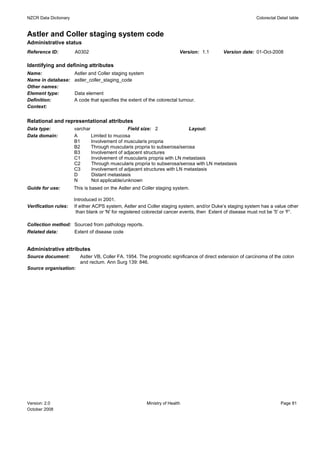
  • 94.
    NZCR Data Dictionary Gleason Detail table Gleason Detail table Table name: Gleason Detail table Name in database: can.gleason_detail Version: 1.0 Version date: 01-Oct-2008 Definition: Holds the results of a Gleason test. Guide for Use: Primary Key: Cancer event ID, Gleason test code Business Key: Relational Rules: A cancer event belonging to the prostate cancer group has two Gleason detail records (even if no secondary Gleason test has been performed). Cancer event ID Administrative status Reference ID: A0261 Version: 2.0 Version date: 01-Oct-2008 Identifying and defining attributes Name: Cancer event ID Name in database: cancer_event_id Other names: Unique cancer record ID Element type: Data element Definition: The unique identifier of the cancer event, assigned by the Cancer Registry system Context: Used by the Cancer Registry system to identify a cancer event and to link it to associated records from other tables. Also used by Cancer Registry staff, to identify and search for an individual cancer event. Relational and representational attributes Mandatory Data type: integer Field size: 10 Layout: Data domain: Guide for use: Has been assigned as follows: - for events that had a registered status as at September 2008, the cancer_event_id = unique_cancer_record_id, from the legacy CRS system - for events that were provisional as at September 2008, the cancer_event_id = unique_cancer_temp_id + 1,000,000, from the legacy CRS system - for events created since September 2008, the Cancer Registry system assigns a sequential number (starting at 2,000,001). Verification rules: Collection method: Related data: Administrative attributes Source document: Source organisation: Version: 2.0 Ministry of Health Page 86 October 2008
  • 95.
    NZCR Data Dictionary Gleason Detail table Gleason score Administrative status Reference ID: A0301 Version: 2.0 Version date: 01-Oct-2008 Identifying and defining attributes Name: Gleason score Name in database: gleason_score Other names: Element type: Derived data element Definition: The result of adding the primary and secondary Gleason pattern codes, subject to the edit rules. Context: Derived automatically from the primary and secondary Gleason pattern codes: - if both values are in the range 1-5, the values are added. - if only one value is in the range 1-5, that value is doubled. Relational and representational attributes Data type: integer Field size: 2 Layout: Data domain: 2,3,4 Well differentiated 5,6 Moderately differentiated 7,8,9,10 Poorly differentiated Guide for use: Before 1 January 2003, Gleason score '7' was defined as moderately differentiated. Verification rules: The Gleason score of the 'highest' Gleason test should be consistent with the Grade of tumour for registered prostate cancer events diagnosed after 2002. If the second Gleason test has been recorded, it is the 'highest' Gleason test. Otherwise the first Gleason test is used. Collection method: Related data: Primary Gleason pattern code Secondary Gleason pattern code Administrative attributes Source document: Gleason D. 1977. Histologic grading and clinical staging of prostatic carcinoma. In: M Tannenbaum (ed.). Urologic Pathology: The Prostate. Philadelphia: Lea & Febiger. Pp. 171-98. Source organisation: Version: 2.0 Ministry of Health Page 87 October 2008
  • 96.
    NZCR Data Dictionary Gleason Detail table Gleason test code Administrative status Reference ID: Version: 1.0 Version date: 01-Oct-2008 Identifying and defining attributes Name: Gleason test code Name in database: gleason_test_code Other names: Element type: Data element Definition: A code to distinguish between the different Gleason tests. Context: Relational and representational attributes Mandatory Data type: integer Field size: 1 Layout: Data domain: 0 First Gleason Test 1 Second Gleason Test Guide for use: Introduced in September 2008. Prior to this, results of the second Gleason test were not saved. The First Gleason test is used for the first biopsy or TURP. The Second Gleason test is used for the prostatectomy. Verification rules: Collection method: Related data: Administrative attributes Source document: Source organisation: Version: 2.0 Ministry of Health Page 88 October 2008
  • 97.
    NZCR Data Dictionary Gleason Detail table Gleason test date Administrative status Reference ID: Version: 1.0 Version date: 01-Oct-2008 Identifying and defining attributes Name: Gleason test date Name in database: gleason_test_date Other names: Element type: Data element Definition: The date that the Gleason test was performed. Context: Relational and representational attributes Data type: date Field size: Layout: Data domain: Guide for use: Introduced in 2008. Verification rules: Required for a second Gleason test if any other data about the test has been entered. Collection method: Does not need to be populated for the first Gleason test if it was performed on the diagnosis date. Sourced from pathology reports. Related data: Administrative attributes Source document: Source organisation: Version: 2.0 Ministry of Health Page 89 October 2008
  • 98.
    NZCR Data Dictionary Gleason Detail table Primary pattern code Administrative status Reference ID: A0300 Version: 2.0 Version date: 01-Oct-2008 Identifying and defining attributes Name: Gleason pattern code Name in database: primary_pattern_grade_code Other names: Gleasons primary pattern code, Gleason primary grade Element type: Data element Definition: A numeric code (1 to 5) to define the degree of histological cell differentiation observed for the primary (dominant) pattern of prostate cancer. Context: The primary pattern code and the secondary pattern code represent the two most common types of cell in a biopsy or treatment specimen. For example, if 40 percent is grade 1, 30 percent is grade 2, 15 percent is grade 3, and 15 percent is grade 4, then the two grades that make up the bulk of the tumour are the 40 percent and the 30 percent, so the primary pattern would be '1' and the secondary pattern would be '2'. Relational and representational attributes Mandatory Data type: char Field size: 1 Layout: Data domain: 1 Well differentiated 2 Well differentiated 3 Moderately differentiated 4 Poorly differentiated 5 Poorly differentiated 7 Not stated 8 Not applicable 9 Unknown Guide for use: Verification rules: Collection method: Sourced from pathology reports. Related data: Secondary pattern code Gleason score Administrative attributes Source document: Gleason D. 1977. Histologic grading and clinical staging of prostatic carcinoma. In: M Tannenbaum (ed.). Urologic Pathology: The Prostate. Philadelphia: Lea & Febiger. Pp. 171-98. Source organisation: Version: 2.0 Ministry of Health Page 90 October 2008
  • 99.
    NZCR Data Dictionary Gleason Detail table Record version Administrative status Reference ID: Version: 1.0 Version date: 01-Oct-2008 Identifying and defining attributes Name: Record version Name in database: version Other names: Element type: Data element Definition: The version of the data in this record. Context: Used by the Cancer Registry system for concurrency management. Relational and representational attributes Mandatory Data type: integer Field size: 10 Layout: Data domain: Guide for use: Verification rules: Collection method: Related data: Administrative attributes Source document: Source organisation: Version: 2.0 Ministry of Health Page 91 October 2008
  • 100.
    NZCR Data Dictionary Gleason Detail table Secondary pattern code Administrative status Reference ID: A0300 Version: 2.0 Version date: 01-Oct-2008 Identifying and defining attributes Name: Gleason pattern code Name in database: secondary_pattern_grade_code Other names: Gleasons secondary pattern code, Gleason secondary grade Element type: Data element Definition: A numeric code (1 to 5) to define the degree of histological cell differentiation observed for the secondary pattern of prostate cancer. Context: The primary pattern code and the secondary pattern code represent the two most common types of cell in a biopsy or treatment specimen. For example, if 40 percent is grade 1, 30 percent is grade 2, 15 percent is grade 3, and 15 percent is grade 4, then the two grades that make up the bulk of the tumour are the 40 percent and the 30 percent, so the primary pattern would be '1' and the secondary pattern would be '2'. Relational and representational attributes Mandatory Data type: char Field size: 1 Layout: Data domain: 1 Well differentiated 2 Well differentiated 3 Moderately differentiated 4 Poorly differentiated 5 Poorly differentiated 7 Not stated 8 Not applicable 9 Unknown Guide for use: Verification rules: Collection method: Sourced from pathology reports. Related data: Primary pattern code Gleason score Administrative attributes Source document: Gleason D. 1977. Histologic grading and clinical staging of prostatic carcinoma. In: M Tannenbaum (ed.). Urologic Pathology: The Prostate. Philadelphia: Lea & Febiger. Pp. 171-98. Source organisation: Version: 2.0 Ministry of Health Page 92 October 2008
  • 101.
    NZCR Data Dictionary Gynaecology Detail table Gynaecology Detail table Table name: Gynaecology Detail table Name in database: can.gynaecological_detail Version: 1.0 Version date: 01-Oct-2008 Definition: Contains information specific to gynaecological cancer. Guide for Use: Introduced in September 2008. Primary Key: Cancer event ID Business Key: Relational Rules: A cancer event belonging to the gynaecology cancer group has one gynaecology detail record. Cancer event ID Administrative status Reference ID: A0261 Version: 2.0 Version date: 01-Oct-2008 Identifying and defining attributes Name: Cancer event ID Name in database: cancer_event_id Other names: Unique cancer record ID Element type: Data element Definition: The unique identifier of the cancer event, assigned by the Cancer Registry system Context: Used by the Cancer Registry system to identify a cancer event and to link it to associated records from other tables. Also used by Cancer Registry staff, to identify and search for an individual cancer event. Relational and representational attributes Mandatory Data type: integer Field size: 10 Layout: Data domain: Guide for use: Has been assigned as follows: - for events that had a registered status as at September 2008, the cancer_event_id = unique_cancer_record_id, from the legacy CRS system - for events that were provisional as at September 2008, the cancer_event_id = unique_cancer_temp_id + 1,000,000, from the legacy CRS system - for events created since September 2008, the Cancer Registry system assigns a sequential number (starting at 2,000,001). Verification rules: Collection method: Related data: Administrative attributes Source document: Source organisation: Version: 2.0 Ministry of Health Page 93 October 2008
  • 102.
    NZCR Data Dictionary Gynaecology Detail table Cancer group Administrative status Reference ID: A0281 Version: 2.0 Version date: 01-Oct-2008 Identifying and defining attributes Name: Cancer group Name in database: cancer_group_code Other names: Specialist group code Element type: Data element Definition: A code for the speciality group to which the cancer event belongs. Context: Used by Cancer Registry staff to allocate and prioritise processing of cancer registrations. Used by the Cancer Registry system to ensure that an appropriate specialist details record exists for a cancer event. For example, a cancer event belonging to the melanoma group needs a record in the Melanoma Details table. Relational and representational attributes Mandatory Data type: char Field size: 2 Layout: Data domain: BR Breast CR Colorectal CX Cervix GN General GY Gynaecology HM Haematology & Lymphoid MN Melanoma PR Prostate RP Respiratory Guide for use: Introduced in 2001. Verification rules:A registered cancer event must belong to a cancer group that is consistent with the site (the Site code table indicates the allowable cancer group for each site). Collection method: Sourced from pathology reports, hospital discharge event diagnosis codes (from NMDS) or mortality event diagnosis codes (from Mortality). Related data: Site code Site table Administrative attributes Source document: Source organisation: Version: 2.0 Ministry of Health Page 94 October 2008
  • 103.
    NZCR Data Dictionary Gynaecology Detail table Corpus FIGO staging code Administrative status Reference ID: Version: 1.0 Version date: 01-Oct-2008 Identifying and defining attributes Name: Corpus FIGO staging code Name in database: corpus_figo_staging_code Other names: Element type: Data element Definition: A code defining staging specific to tumours of the corpus uteri. Context: Relational and representational attributes Data type: varchar Field size: 4 Layout: Data domain: 0 In situ I Confined to corpus IA Tumour limited to endometrium IB Less than half of myometrium IC One half or more of myometrium II Invades cervix IIA Endocervical glandular only IIB Cervical stroma III Local or regional as specified below IIIA Serosa/adnexa/positive peritoneal cytology IIIB Vaginal involvement IIIC Regional lymph node metastasis IVA Mucosa of bladder/bowel IVB Distant metastasis Guide for use: Verification rules: Collection method: Sourced from pathology reports. Related data: Administrative attributes Source document: Source organisation: Version: 2.0 Ministry of Health Page 95 October 2008
  • 104.
    NZCR Data Dictionary Gynaecology Detail table Ovary FIGO staging code Administrative status Reference ID: Version: 1.0 Version date: 01-Oct-2008 Identifying and defining attributes Name: Ovary FIGO staging code Name in database: ovary_figo_staging_code Other names: Element type: Data element Definition: A code defining staging specific to tumours of the ovary. Context: Relational and representational attributes Data type: varchar Field size: 4 Layout: Data domain: I Limited to the ovaries IA One ovary, capsule intact IB Both ovaries, capsule intact IC Capsule ruptured, tumour on surface, malignant cells in peritoneal … II Pelvic extension IIA Uterus, tube(s) IIB Other pelvic tissues IIC Malignant cells in ascites or peritoneal washings III Peritoneal metastasis beyond pelvis and/or regional lymph metastasis IIIA Microscopic peritoneal metastasis IIIB Macroscopic peritoneal metastasis no greater than 2 cm IIIC Peritoneal metastasis greater than 2 cm IV Distant metastasis (excludes peritoneal metastasis) Guide for use: Verification rules: Collection method: Sourced from pathology reports. Related data: Administrative attributes Source document: Source organisation: Version: 2.0 Ministry of Health Page 96 October 2008
  • 105.
    NZCR Data Dictionary Gynaecology Detail table Vagina FIGO staging code Administrative status Reference ID: Version: 1.0 Version date: 01-Oct-2008 Identifying and defining attributes Name: Vagina FIGO staging code Name in database: vagina_figo_staging_code Other names: Element type: Data element Definition: A code defining staging specific to tumours of the vagina. Context: Relational and representational attributes Data type: varchar Field size: 4 Layout: Data domain: I Vaginal wall II Paravaginal tissue III Extends to pelvic wall IVA Mucosa of bladder/rectum, beyond pelvis IVB Distant metastasis Guide for use: Verification rules: Collection method: Sourced from pathology reports. Related data: Administrative attributes Source document: Source organisation: Version: 2.0 Ministry of Health Page 97 October 2008
  • 106.
    NZCR Data Dictionary Gynaecology Detail table Vulva FIGO staging code Administrative status Reference ID: Version: 1.0 Version date: 01-Oct-2008 Identifying and defining attributes Name: Vulva FIGO staging code Name in database: vulva_figo_staging_code Other names: Element type: Data element Definition: A code defining staging specific to tumours of the vulva. Context: Relational and representational attributes Data type: varchar Field size: 4 Layout: Data domain: I Confined to vulva/perineum <= 2 cm IA Stromal invasion <= 1.0 mm IB Stromal invasion > 1.0 mm II Confined to vulva/perineum > 2 cm III Lower urethra/vagina/anus or unilateral regional LN mets IVA Bladder mucosa/rectal mucosa/upper urethra/bone or bilateral regi... IVB Distant Metastasis Guide for use: Verification rules: Collection method: Sourced from pathology reports. Related data: Administrative attributes Source document: Source organisation: Version: 2.0 Ministry of Health Page 98 October 2008
  • 107.
    NZCR Data Dictionary Melanoma Detail table Melanoma Detail table Table name: Melanoma Detail table Name in database: can.melanoma_detail Version: 1.0 Version date: 01-Oct-2008 Definition: Holds information specific to the registration of melanomas. Guide for Use: Introduced in 2001. Primary Key: Cancer event ID Business Key: Relational Rules: A cancer event belonging to the melanoma cancer group has one melanoma detail record. Breslow's availability code Administrative status Reference ID: Version: 1.1 Version date: 01-Oct-2008 Identifying and defining attributes Name: Breslow's availability code Name in database: breslows_availability_code Other names: Element type: Data element Definition: A code used to describe the availability of Breslow's thickness. Context: Relational and representational attributes Mandatory Data type: char Field size: 1 Layout: Data domain: 1 Measured 2 Not measured 3 Not stated 4 Not available 5 Not applicable Guide for use: Introduced in 2001. Verification rules: Must be consistent with Basis of diagnosis for registered cancer events. Collection method: Sourced from pathology reports. Related data: Breslow's thickness Administrative attributes Source document: Source organisation: Version: 2.0 Ministry of Health Page 99 October 2008
  • 108.
    NZCR Data Dictionary Melanoma Detail table Breslow's thickness Administrative status Reference ID: A0204 Version: 1.1 Version date: 01-Oct-2008 Identifying and defining attributes Name: Breslow's thickness Name in database: breslows_thickness_mm Other names: Element type: Data element Definition: A measurement of the thickness, in millimetres, of a primary malignant melanoma of the skin. Context: Relational and representational attributes Data type: numeric Field size: Layout: Data domain: 0.01 to 999.99 Guide for use: Introduced in 1995. Only meaningful if Breslow's availability code is '1' (measured). Verification rules: Required if Breslow's availability code is '1' (measured). Collection method: Sourced from pathology reports. Related data: Breslow's availability code Administrative attributes Source document: Breslow A. 1970. Thickness, cross-sectional areas and depth of invasion in the prognosis of cutaneous melanoma. Ann Surg: 172: 902-908. Source organisation: Version: 2.0 Ministry of Health Page 100 October 2008
  • 109.
    NZCR Data Dictionary Melanoma Detail table Cancer event ID Administrative status Reference ID: A0261 Version: 2.0 Version date: 01-Oct-2008 Identifying and defining attributes Name: Cancer event ID Name in database: cancer_event_id Other names: Unique cancer record ID Element type: Data element Definition: The unique identifier of the cancer event, assigned by the Cancer Registry system Context: Used by the Cancer Registry system to identify a cancer event and to link it to associated records from other tables. Also used by Cancer Registry staff, to identify and search for an individual cancer event. Relational and representational attributes Mandatory Data type: integer Field size: 10 Layout: Data domain: Guide for use: Has been assigned as follows: - for events that had a registered status as at September 2008, the cancer_event_id = unique_cancer_record_id, from the legacy CRS system - for events that were provisional as at September 2008, the cancer_event_id = unique_cancer_temp_id + 1,000,000, from the legacy CRS system - for events created since September 2008, the Cancer Registry system assigns a sequential number (starting at 2,000,001). Verification rules: Collection method: Related data: Administrative attributes Source document: Source organisation: Version: 2.0 Ministry of Health Page 101 October 2008
  • 110.
    NZCR Data Dictionary Melanoma Detail table Cancer group Administrative status Reference ID: A0281 Version: 2.0 Version date: 01-Oct-2008 Identifying and defining attributes Name: Cancer group Name in database: cancer_group_code Other names: Specialist group code Element type: Data element Definition: A code for the speciality group to which the cancer event belongs. Context: Used by Cancer Registry staff to allocate and prioritise processing of cancer registrations. Used by the Cancer Registry system to ensure that an appropriate specialist details record exists for a cancer event. For example, a cancer event belonging to the melanoma group needs a record in the Melanoma Details table. Relational and representational attributes Mandatory Data type: char Field size: 2 Layout: Data domain: BR Breast CR Colorectal CX Cervix GN General GY Gynaecology HM Haematology & Lymphoid MN Melanoma PR Prostate RP Respiratory Guide for use: Introduced in 2001. Verification rules:A registered cancer event must belong to a cancer group that is consistent with the site (the Site code table indicates the allowable cancer group for each site). Collection method: Sourced from pathology reports, hospital discharge event diagnosis codes (from NMDS) or mortality event diagnosis codes (from Mortality). Related data: Site code Site table Administrative attributes Source document: Source organisation: Version: 2.0 Ministry of Health Page 102 October 2008
  • 111.
    NZCR Data Dictionary Melanoma Detail table Clark's level code Administrative status Reference ID: Version: 1.1 Version date: 01-Oct-2008 Identifying and defining attributes Name: Clark's level code Name in database: clarks_level_code Other names: Element type: Data element Definition: A code used to describe extent of invasion of a primary melanoma of the skin. Context: Relational and representational attributes Data type: char Field size: 1 Layout: Data domain: 1 Clark's level I 2 Clark's level II 3 Clark's level III 4 Clark's level IV 5 Clark's level V 7 Not measured 8 Not stated 9 Not applicable Guide for use: Introduced in 2001. Clark's level I – Melanoma in situ (atypical melanocytic hyperplasia, severe melanocytic dysplasia, not an invasive malignant lesion). Clark's level II – Tumour 0.75 mm or less in thickness and invades the papillary dermis. Clark's level III – Tumour more than 0.75 mm but not more than 1.5 mm in thickness and/or invades the papillary reticular dermal interface. Clark's level IV – Tumour more than 1.5 mm but not more than 4.0 mm in thickness and/or invades the reticular dermis. Clark's level V – Tumour more than 4.0 mm in thickness and/or invades subcutaneous tissue and/or satellite(s) within 2 cm of the primary tumour. Verification rules: Must be consistent with Basis of diagnosis for registered cancer events. Collection method: Sourced from pathology reports. Related data: Administrative attributes Source document: Cited in UICC TNM Classification of Malignant Tumours 1997, 5th Edition. Source organisation: Version: 2.0 Ministry of Health Page 103 October 2008
  • 112.
    NZCR Data Dictionary Melanoma Detail table Ulceration code Administrative status Reference ID: Version: 2.0 Version date: 01-Oct-2008 Identifying and defining attributes Name: Ulceration code Name in database: ulceration_code Other names: Element type: Data element Definition: A code identifying whether the lesion is ulcerated or not. Context: Relational and representational attributes Data type: varchar Field size: 2 Layout: Data domain: Y Yes N No NS Not stated NA Not applicable Guide for use: Verification rules: Must be consistent with Basis of diagnosis for registered cancer events. Collection method: Sourced from pathology reports Related data: Administrative attributes Source document: Source organisation: Version: 2.0 Ministry of Health Page 104 October 2008
  • 113.
    NZCR Data Dictionary Prostate Detail table Prostate Detail table Table name: Prostate Detail table Name in database: can.prostatic_detail Version: 1.1 Version date: 01-Oct-2008 Definition: Holds information specific to prostate cancers. Guide for Use: Primary Key: Cancer event ID Business Key: Relational Rules: A cancer event belonging to the prostate cancer group has one prostate detail record and two Gleason detail records. Cancer event ID Administrative status Reference ID: A0261 Version: 2.0 Version date: 01-Oct-2008 Identifying and defining attributes Name: Cancer event ID Name in database: cancer_event_id Other names: Unique cancer record ID Element type: Data element Definition: The unique identifier of the cancer event, assigned by the Cancer Registry system Context: Used by the Cancer Registry system to identify a cancer event and to link it to associated records from other tables. Also used by Cancer Registry staff, to identify and search for an individual cancer event. Relational and representational attributes Mandatory Data type: integer Field size: 10 Layout: Data domain: Guide for use: Has been assigned as follows: - for events that had a registered status as at September 2008, the cancer_event_id = unique_cancer_record_id, from the legacy CRS system - for events that were provisional as at September 2008, the cancer_event_id = unique_cancer_temp_id + 1,000,000, from the legacy CRS system - for events created since September 2008, the Cancer Registry system assigns a sequential number (starting at 2,000,001). Verification rules: Collection method: Related data: Administrative attributes Source document: Source organisation: Version: 2.0 Ministry of Health Page 105 October 2008
  • 114.
    NZCR Data Dictionary Prostate Detail table Cancer group Administrative status Reference ID: A0281 Version: 2.0 Version date: 01-Oct-2008 Identifying and defining attributes Name: Cancer group Name in database: cancer_group_code Other names: Specialist group code Element type: Data element Definition: A code for the speciality group to which the cancer event belongs. Context: Used by Cancer Registry staff to allocate and prioritise processing of cancer registrations. Used by the Cancer Registry system to ensure that an appropriate specialist details record exists for a cancer event. For example, a cancer event belonging to the melanoma group needs a record in the Melanoma Details table. Relational and representational attributes Mandatory Data type: char Field size: 2 Layout: Data domain: BR Breast CR Colorectal CX Cervix GN General GY Gynaecology HM Haematology & Lymphoid MN Melanoma PR Prostate RP Respiratory Guide for use: Introduced in 2001. Verification rules:A registered cancer event must belong to a cancer group that is consistent with the site (the Site code table indicates the allowable cancer group for each site). Collection method: Sourced from pathology reports, hospital discharge event diagnosis codes (from NMDS) or mortality event diagnosis codes (from Mortality). Related data: Site code Site table Administrative attributes Source document: Source organisation: Version: 2.0 Ministry of Health Page 106 October 2008
  • 115.
    NZCR Data Dictionary Appendices Appendix A: Data Dictionary Template Introduction This appendix explains how data element attributes are organised in the data dictionary template. Order of elements Within the dictionary, elements are organised by table, and then alphabetically. An alphabetical index is provided at the back of the data dictionary to assist the user in finding specific elements. Template This table explains the template. Administrative status Reference ID A code that uniquely identifies the data element. If the data element is used in more than one collection, it should retain its Reference ID wherever it appears. Version number A version number for each data element. A new version number is allocated to a data element/concept when changes have been made to one or more of the following attributes of the definition: – name – definition – data domain, eg, adding a new value to the field. Elements with frequently updated code tables, such as the Facility code table, will not be assigned a new version for changes to data domain. Version date The date the new version number was assigned. Identifying and defining attributes Name A single or multi-word designation assigned to a data element. If the data element is used in more than one collection, it may retain its Name wherever it appears. Name in database The name of the column that implements this element in the database. Other names Other names that this element is known as, including previous names. Element type DATA ELEMENT—a unit of data for which the definition, identification, representation and permissible values are specified by means of a set of attributes. DERIVED DATA ELEMENT—a data element whose values are derived by calculation from the values of other data elements. COMPOSITE DATA ELEMENT—a data element whose values represent a grouping of the values of other data elements in a specified order. Definition A statement that expresses the essential nature of a data element and its differentiation from all other data elements. Context A designation or description of the application environment or discipline in which a name is applied or from which it originates. This attribute may also include the justification for collecting the Version: 2.0 Ministry of Health Page i October 2008
  • 116.
    NZCR Data Dictionary Appendices items and uses of the information. Relational and representational attributes Data type The type of field in which a data element is held. For example, character, integer, or numeric. Field size The maximum number of storage units (of the corresponding data type) to represent the data element value. Field size does not generally include characters used to mark logical separations of values, eg, commas, hyphens or slashes. Layout The representational layout of characters in data element values expressed by a character string representation. For example: - ‘CCYYMMDD’ for calendar date - ‘N’ for a one-digit numeric field - ‘A’ for a one-character field - ‘X’ for a field that can hold either a character or a digit, and - ‘$$$,$$$,$$$’ for data elements about expenditure. Data domain The permissible values for the data element. The set of values can be listed or specified by referring to a code table or code tables, for example, ICD-10-AM 2nd Edition. Guide for use Additional comments or advice on the interpretation or application of the data element (this attribute has no direct counterpart in the ISO/IEC Standard 11179 but has been included to assist in clarification of issues relating to the classification of data elements). Includes historical information, advice regarding data quality. Verification rules The rules and/or instructions applied for validating and/or verifying elements, in addition to the formal edits. Collection method Comments and advice concerning the capture of data for the particular data element, including guidelines on the design of questions for use in collecting information, and treatment of ‘not stated’ or non-response (this attribute is not specified in the ISO/IEC Standard 11179 but has been added to cover important issues about the actual collection of data). Related data A reference between the data element and any related data element in the Dictionary. Administrative attributes Source document The document from which definitional or representational attributes originate. Source organisation The organisation responsible for the source document and/or the development of the data definition (this attribute is not specified in the ISO/IEC Standard 11179 but has been added for completeness). The source organisation is not necessarily the organisation responsible for the ongoing development/maintenance of the data element definition. An example of a source organisation is the National Data Policy Group (NDPG). Version: 2.0 Ministry of Health Page ii October 2008
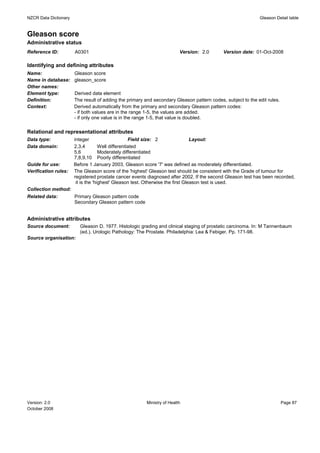
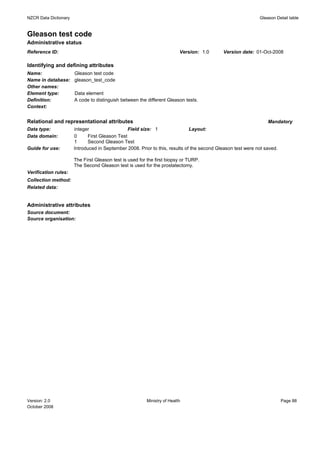
  • 117.
    NZCR Data Dictionary Appendices Appendix B: Schemas Cancer Registry The data stored in the Cancer Registry database is organized into 7 schemas, has 7 schemas which are described below Schema Description CAN Stores information about cancer events DMS Stores information about documents DWHEXT Provides a view of cancer event data for the data warehouse to use Currently there is one view for each table in CAN. LINKMAN Provides a view of cancer event data for Link Manager to use The views are structured to mimic the schema of the legacy CRS system. MIG Provides a temporary workspace for the migration process. This schema can ultimately be dropped. SCHEDULER Stores information about Jobs. This information is used by the third-party job scheduler component of the Cancer Registry system. SECURITY_ACCESS_POLICY Stores information about which roles may access which Cancer Registry functions. This information is used by the security component of the Cancer Registry system. Data dictionary This data dictionary describes the tables of the CAN schemas. The other covers 1 schema schemas’ tables are not described because they are for internal use by either the Cancer Registry system and/or the Cancer Registry team. Version: 2.0 Ministry of Health Page iii October 2008
  • 118.
    NZCR Data Dictionary Appendices Appendix C: Logical Groups of Elements Cancer Event table Breast Detail table Address city/town Cancer event ID Address country Cancer group Address date ER status Address street line 1 Her2 status Address street line 2 Her2 test type Address suburb Histopathology code Assessment decision code Lymphovascular invasion flag Basis of diagnosis code Multicentric or multifocal tumour flag Behaviour code Positive sentinel nodes Cancer comments PR status Cancer event ID Resection margin Cancer group Sentinel nodes sampled Clinical code version Size of tumour Clinical notes Clinician name Cervix Detail table Coding review flag Additional information Country of birth code Cancer event ID Country of diagnosis code Cancer group Date modified Cervix FIGO staging code Date of birth Date of histology Colorectal Detail table Date received ACPS system code Deletion reason code Astler and Coller staging system code Diagnosis date Cancer event ID Documentation status Cancer group Domicile code Duke's staging system code Extent of disease code Level of direct spread Facility code Family name Gynaecology Detail table First name Cancer event ID Grade of tumour code Cancer group Grade of tumour description Corpus FIGO staging code HCU ID Ovary FIGO staging code ICD9 site code Vagina FIGO staging code Laboratory code Vulva FIGO staging code Laterality code Morphology code Melanoma Detail table Morphology description Breslow's availability code Multiple tumours flag Breslow's thickness New information flag Cancer event ID Nodes tested flag Cancer group Occupation code Clark's level code Occupation description Ulceration code Positive nodes QA OK flag Prostate Detail table Record version Cancer event ID Registration date Cancer group Registration source Registration status Gleason Detail table Second name Cancer event ID Sex Gleason score Site code Gleason test code Site description Gleason test date Smoking history flag Primary pattern code Third name Record version TNM-M Secondary pattern code TNM-N TNM-T Total nodes sampled User modifying record User registering record Version: 2.0 Ministry of Health Page iv October 2008
  • 119.
    NZCR Data Dictionary Appendices Appendix D: Code Table Index Code table Location ACPS System code table See ACPS system code on page 80. Assessment Decision code table See Assessment decision code on page 20. Astler and Coller Staging System code See Astler and Coller staging system code on table page 81. Basis of Diagnosis code table See Basis of diagnosis code on page 21. Behaviour code table See Behaviour code on page 22. Breslow's Availability code table See Breslow's availability code on page 99. Cancer Group code table See Cancer group on page 1. Cervix FIGO Staging code table See Cervix FIGO staging code on page 79. Clark's Level code table See Clark's level code on page 103. Clinical Code code table See Morphology code on page 51 And Site code on page 66 And the Ministry’s web site. Clinical Coding System code table See Clinical code version on page 26 And the Ministry’s web site. Corpus FIGO Staging code table See Corpus FIGO staging code on page 95. Country of Birth code table See Country of birth code on page 30 And Country of diagnosis code on page 31 And the Ministry’s web site. Deletion Reason code table See Deletion reason code on page 36. Documentation Status code table See Documentation status on page 38. Domicile code table See Domicile code on page 39 And the Ministry’s web site. Duke's Staging code table See Duke's staging system code on page 84. ER Status code table See ER status on page 3. Extent of Disease code table See Extent of disease code on page 41. Facility code table See Facility code on page 42 And the Ministry’s web site. Gleason Pattern Grade code table See Primary pattern code on page 90 And Secondary pattern code on page 92. Gleason Test code table See Gleason test code on page 88. Grade of Tumour code table See Grade of tumour code on page 45. Her 2 Status code See Her2 status on page 4. Her2 Test Type code table See Her2 test type on page 5. Histopathology code table See Histopathology code on page 6. Laboratory code table See Laboratory code on page 49 And the Ministry’s web site. Laterality code table See Laterality code on page 50. Occupation code table See Occupation code on page 56 And the Ministry’s web site. Ovary FIGO Staging code table See Ovary FIGO staging code on page 96. PR Status code table See PR status on page 10. Registration Source code table See Registration source on page 62. Registration Status code table See Registration status on page 63. Sex Type code table See Sex on page 65. And the Ministry’s web site. Ulceration code table See Ulceration code on page 104. Vagina FIGO Staging code table See Vagina FIGO staging code on page 97. Vulva FIGO Staging code table See Vulva FIGO staging code on page 98. Version: 2.0 Ministry of Health Page v October 2008
  • 120.
    NZCR Data Dictionary Appendices Code tables on For code tables on the Ministry’s web site go to website http://www.moh.govt.nz/moh.nsf/pagesns/47. For further information or a printed copy of the code table, contact the Publications Officer. Contact details are listed at the front of this dictionary. Version: 2.0 Ministry of Health Page vi October 2008
  • 121.
    NZCR Data Dictionary Appendices Appendix E: Alphabetical Index of Data Elements ACPS system code, 80 Her2 status, 4 Additional information, 76 Her2 test type, 5 Address city/town, 14 Histopathology code, 6 Address country, 15 ICD9 site code, 48 Address date, 16 Laboratory code, 49 Address street line 1, 17 Laterality code, 50 Address street line 2, 18 Level of direct spread, 85 Address suburb, 19 Lymphovascular invasion flag, 7 Assessment decision code, 20 Morphology code, 51 Astler and Coller staging system code, 81 Morphology description, 52 Basis of diagnosis code, 21 Multicentric or multifocal tumour flag, 8 Behaviour code, 22 Multiple tumours flag, 53 Breslow's availability code, 99 New information flag, 54 Breslow's thickness, 100 Nodes tested flag, 55 Cancer comments, 23 Occupation code, 56 Cancer event ID, 1, 24, 77, 82, 86, 93, 101, Occupation description, 57 105 Ovary FIGO staging code, 96 Cancer group, 2, 25, 78, 83, 94, 102, 106 Positive nodes, 58 Cervix FIGO staging code, 79 Positive sentinel nodes, 9 Clark's level code, 103 PR status, 10 Clinical code version, 26 Primary pattern code, 90 Clinical notes, 27 QA OK flag, 59 Clinician name, 28 Record version, 60 Coding review flag, 29 Record version, 91 Corpus FIGO staging code, 95 Registration date, 61 Country of birth code, 30 Registration source, 62 Country of diagnosis code, 31 Registration status, 63 Date modified, 32 Resection margin, 11 Date of birth, 33 Second name, 64 Date of histology, 34 Secondary pattern code, 92 Date received, 35 Sentinel nodes sampled, 12 Deletion reason code, 36 Sex, 65 Diagnosis date, 37 Site code, 66 Documentation status, 38 Site description, 67 Domicile code, 39 Size of tumour, 13 Duke's staging system code, 84 Smoking history flag, 68 ER status, 3 Third name, 69 Extent of disease code, 41 TNM-M, 70 Facility code, 42 TNM-N, 71 Family name, 43 TNM-T, 72 First name, 44 Total nodes sampled, 73 Gleason score, 87 Ulceration code, 104 Gleason test code, 88 User modifying record, 74 Gleason test date, 89 User registering record, 75 Grade of tumour code, 45 Vagina FIGO staging code, 97 Grade of tumour description, 46 Vulva FIGO staging code, 98 HCU ID, 47 Version: 2.0 Ministry of Health Page vii October 2008