Can the City be ethical? Will CrouchFaculty of PhilosophyUniversity of Oxfordwill@highimpactcareers.org
IntroductionCity careers have a bad reputation.
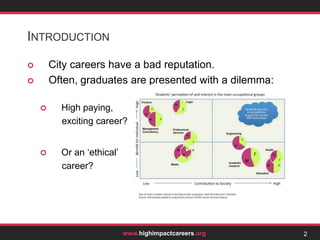
Often, graduates are presented with a dilemma:
High paying,   	 exciting career?Or an ‘ethical’  	 career?2
IntroductionCity careers have a bad reputation.
Often, graduates are presented with a dilemma:
High paying, exciting career?
Or an ‘ethical’ career, in the charity sector?
I’ll show that this dilemma is ill-conceived.
I’ll show that one can do far more good through a city career than by working in the charity sector.3
Part I: How to Think about CareersNormally, we think that charity careers are the most ethical.I’ll suggest that’s wrong, based on mistakes regarding: indirect benefit; fungibility; marginal benefit; and harm.Part II: How much good can you do?I’ll look at how many lives you could save.I’ll conclude that we can do a tremendous amount to help others if we put our minds to it.Overview Of This Talk4
What’s the point of thinking about this?You’ll spend 70 000 hours of your life working.
Career choice is one of the most important decisions you’ll ever make.
If you’re thinking ethically, the decision is evenmore important.
It’s not just a critically important decision for you.
It’s also a life-or-death decision for hundreds or thousands of other people.5
Part IHow to think about Careers6
The Standard ViewAccording to the Standard View, the paradigm examples of ethical careers are the ‘direct benefiters’.But consider the following story…7
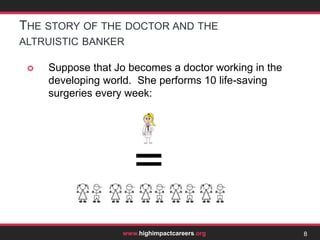
Suppose that Jo becomes a doctor working in the developing world.  She performs 10 life-saving surgeries every week:The story of the doctor and the altruistic banker8
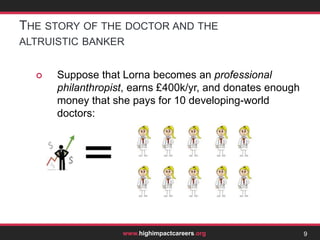
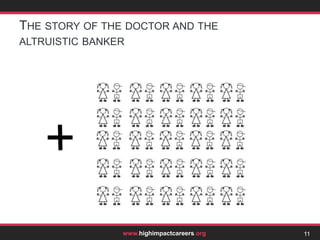
Suppose that Lorna becomes an professional philanthropist, earns £400k/yr, and donates enough money that she pays for 10 developing-world doctors:The story of the doctor and the altruistic banker9
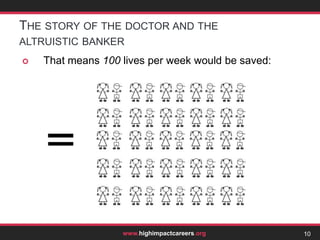
That means 100 lives per week would be saved:The story of the doctor and the altruistic banker10
The story of the doctor and the altruistic banker11
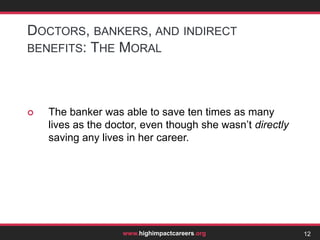
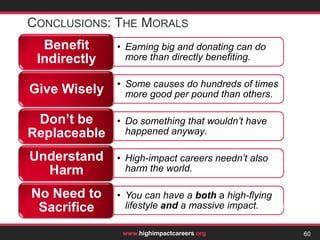
Doctors, bankers, and indirect benefits: The MoralThe banker was able to save ten times as many lives as the doctor, even though she wasn’t directly saving any lives in her career.12
Doctors, bankers, and opportunity cost: The Moral	The Moral:  Ways of indirectly benefiting others, such as earning big and donating, can do much more good than directly benefiting.13
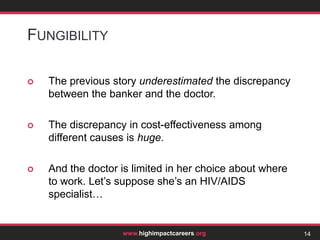
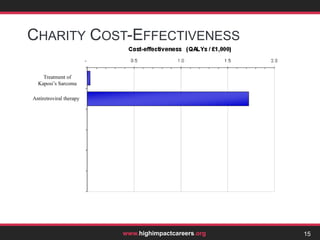
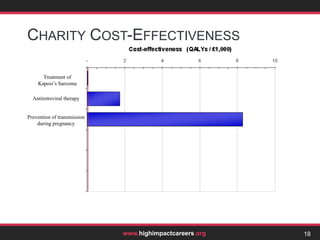
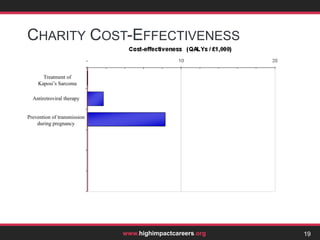
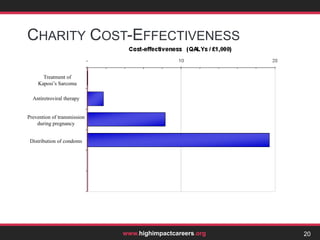
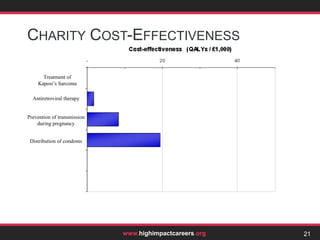
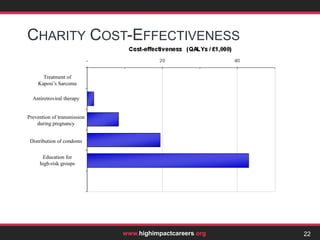
FungibilityThe previous story underestimated the discrepancy between the banker and the doctor.The discrepancy in cost-effectiveness among different causes is huge.And the doctor is limited in her choice about where to work. Let’s suppose she’s an HIV/AIDS specialist…14
Charity Cost-EffectivenessTreatment of Kaposi’s SarcomaAntiretroviral therapy
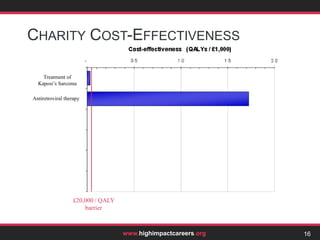
Charity Cost-EffectivenessTreatment of Kaposi’s SarcomaAntiretroviral therapy£20,000 / QALY barrier
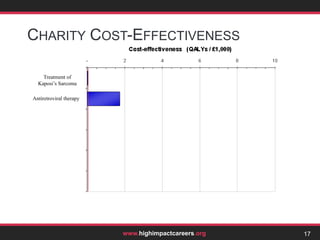
Charity Cost-EffectivenessTreatment of Kaposi’s SarcomaAntiretroviral therapy
Charity Cost-EffectivenessTreatment of Kaposi’s SarcomaAntiretroviral therapyPrevention of transmission during pregnancy
Charity Cost-EffectivenessTreatment of Kaposi’s SarcomaAntiretroviral therapyPrevention of transmission during pregnancyDistribution of condoms
Charity Cost-EffectivenessTreatment of Kaposi’s SarcomaAntiretroviral therapyPrevention of transmission during pregnancyDistribution of condomsEducation for high-risk groups
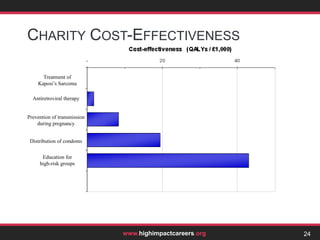
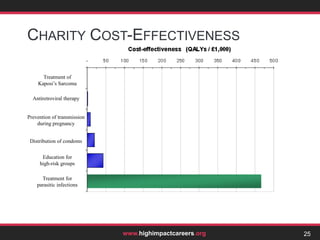
FungibilityBy choosing to work on the right areas, the doctor can multiply her impact by a factor of hundred.But she’s still limited to HIV/AIDS reduction.In contrast, money is completely fungible.  It can be used to further any cause, including those far more cost-effective than HIV/AIDS reduction:23
Charity Cost-EffectivenessTreatment of Kaposi’s SarcomaAntiretroviral therapyPrevention of transmission during pregnancyDistribution of condomsEducation for high-risk groups
Charity Cost-EffectivenessTreatment of Kaposi’s SarcomaAntiretroviral therapyPrevention of transmission during pregnancyDistribution of condomsEducation for high-risk groupsTreatment for parasitic infections
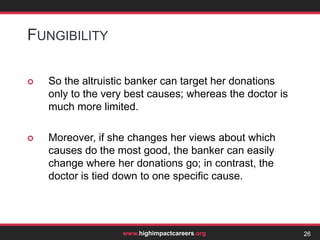
FungibilitySo the altruistic banker can target her donations only to the very best causes; whereas the doctor is much more limited.Moreover, if she changes her views about which causes do the most good, the banker can easily change where her donations go; in contrast, the doctor is tied down to one specific cause.26
Fungibility: The Moral	The Moral: Do something which is flexible with respect to causes.27
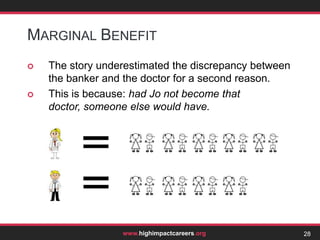
Marginal BenefitThe story underestimatedthe discrepancy between the banker and the doctor for a second reason.This is because: had Jo not become that doctor, someone else would have.28
Marginal BenefitIn contrast, if Lorna had not earned and donated the money, the result would have been fewer doctors.  If she hadn’t become an altruistic banker, all 100 people would have died.29
Marginal Benefit: The Moral	The Moral: Do something that wouldn’t have happened anyway.30
‘Making a Difference’: The Failure to QuantifyWhere did we go wrong?Perhaps we focused on making a difference rather than making the most difference.Thinking with our gut overlooks the vast discrepancy among different career routes.  31
‘Making a Difference’: The Failure to Quantify32
‘Making a Difference’: The Failure to Quantify	The Moral: Going with your gut, or relying on heuristics like ‘do what you’re good at’ isn’t enough.  Choosing the right career  requires research and reflection, and the willingness to take new ideas seriously.33
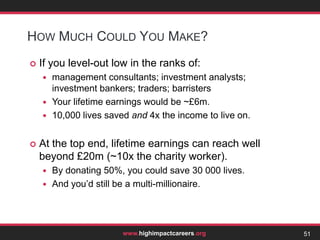
‘Making a Difference’: MartyrdomPerhaps we assume that doing good must involve self-sacrifice.But if the altruistic banker earns £6mn over a 30yr career, she could save 10 thousand lives and still have an average salary of £100 000/yr.34
‘Making a Difference’: Martyrdom	The Moral:By choosing the right career, you can have a high-flying lifestyle and benefit others far more than you would otherwise have done. 35
The most obvious objection to my suggestion is: what if the career you pursue causes harm?  Or supports an evil system?Surely that’s the reason why it’s not ethical to go into the city.Causing Harm?36
Even granting the premise that a typical city career causes harm, that doesn’t mean that it’s unethical for you as a professional philanthropist to pursue a city career.You need to consider what would happen if you don’t take the job.If someone else would be doing the same evil work anyway, then you don’t help anyone by refusing the job.Causing Harm?37
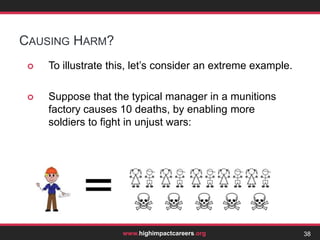
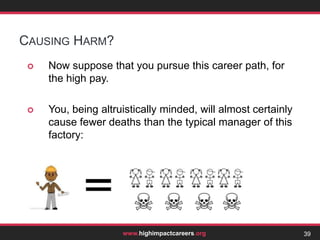
To illustrate this, let’s consider an extreme example.Suppose that the typical manager in a munitions factory causes 10 deaths, by enabling more soldiers to fight in unjust wars:Causing Harm?38
Now suppose that you pursue this career path, for the high pay.You, being altruistically minded, will almost certainly cause fewer deaths than the typical manager of this factory:Causing Harm?39
Far from harming people, the world is benefited in virtue of you working for a munitions factory.  This is a benefit independent of the good that your donations do.Causing Harm?40
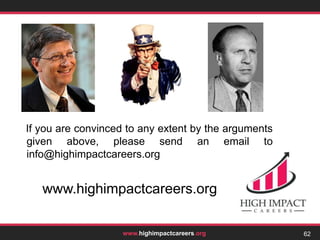
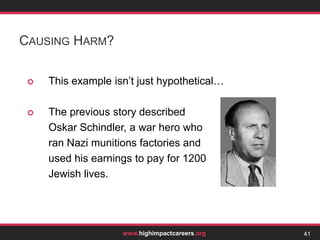
This example isn’t just hypothetical…The previous story described 	Oskar Schindler, a war hero who ran Nazi	munitions factories and used his earnings to pay for 1200 Jewish lives.Causing Harm?41
	The Moral: High-impact careers needn’t also involve making people worse off.Causing Harm?42
Moreover, if you oppose the current capitalist system, the best thing you can do is take a city job.Then you can fund many anti-capitalist campaigners.Finally, any bad aspects of your career need to be weighed against the good that you do.So let’s turn to that.Supporting an evil system?43
Part IIHow much good can you do?44
How much good can you do?Bearing in mind the morals of part 1…And bearing in mind that you can save a life for £300…How much good can you do?45
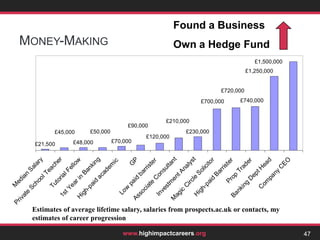
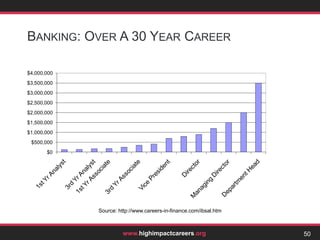
Let’s suppose you pursue a lucrative career and donate 50% of your earnings, over your lifetime.By pursuing certain careers, you can make a lot of money….Money-Making46

Can the City be Ethical?

  • 1.
    Can the Citybe ethical? Will CrouchFaculty of PhilosophyUniversity of Oxfordwill@highimpactcareers.org
  • 2.
  • 3.
    Often, graduates arepresented with a dilemma:
  • 4.
    High paying, exciting career?Or an ‘ethical’ career?2
  • 5.
  • 6.
    Often, graduates arepresented with a dilemma:
  • 7.
  • 8.
    Or an ‘ethical’career, in the charity sector?
  • 9.
    I’ll show thatthis dilemma is ill-conceived.
  • 10.
    I’ll show thatone can do far more good through a city career than by working in the charity sector.3
  • 11.
    Part I: Howto Think about CareersNormally, we think that charity careers are the most ethical.I’ll suggest that’s wrong, based on mistakes regarding: indirect benefit; fungibility; marginal benefit; and harm.Part II: How much good can you do?I’ll look at how many lives you could save.I’ll conclude that we can do a tremendous amount to help others if we put our minds to it.Overview Of This Talk4
  • 12.
    What’s the pointof thinking about this?You’ll spend 70 000 hours of your life working.
  • 13.
    Career choice isone of the most important decisions you’ll ever make.
  • 14.
    If you’re thinkingethically, the decision is evenmore important.
  • 15.
    It’s not justa critically important decision for you.
  • 16.
    It’s also alife-or-death decision for hundreds or thousands of other people.5
  • 17.
    Part IHow tothink about Careers6
  • 18.
    The Standard ViewAccordingto the Standard View, the paradigm examples of ethical careers are the ‘direct benefiters’.But consider the following story…7
  • 19.
    Suppose that Jobecomes a doctor working in the developing world. She performs 10 life-saving surgeries every week:The story of the doctor and the altruistic banker8
  • 20.
    Suppose that Lornabecomes an professional philanthropist, earns £400k/yr, and donates enough money that she pays for 10 developing-world doctors:The story of the doctor and the altruistic banker9
  • 21.
    That means 100lives per week would be saved:The story of the doctor and the altruistic banker10
  • 22.
    The story ofthe doctor and the altruistic banker11
  • 23.
    Doctors, bankers, andindirect benefits: The MoralThe banker was able to save ten times as many lives as the doctor, even though she wasn’t directly saving any lives in her career.12
  • 24.
    Doctors, bankers, andopportunity cost: The Moral The Moral: Ways of indirectly benefiting others, such as earning big and donating, can do much more good than directly benefiting.13
  • 25.
    FungibilityThe previous storyunderestimated the discrepancy between the banker and the doctor.The discrepancy in cost-effectiveness among different causes is huge.And the doctor is limited in her choice about where to work. Let’s suppose she’s an HIV/AIDS specialist…14
  • 26.
    Charity Cost-EffectivenessTreatment ofKaposi’s SarcomaAntiretroviral therapy
  • 27.
    Charity Cost-EffectivenessTreatment ofKaposi’s SarcomaAntiretroviral therapy£20,000 / QALY barrier
  • 28.
    Charity Cost-EffectivenessTreatment ofKaposi’s SarcomaAntiretroviral therapy
  • 29.
    Charity Cost-EffectivenessTreatment ofKaposi’s SarcomaAntiretroviral therapyPrevention of transmission during pregnancy
  • 30.
    Charity Cost-EffectivenessTreatment ofKaposi’s SarcomaAntiretroviral therapyPrevention of transmission during pregnancy
  • 31.
    Charity Cost-EffectivenessTreatment ofKaposi’s SarcomaAntiretroviral therapyPrevention of transmission during pregnancyDistribution of condoms
  • 32.
    Charity Cost-EffectivenessTreatment ofKaposi’s SarcomaAntiretroviral therapyPrevention of transmission during pregnancyDistribution of condoms
  • 33.
    Charity Cost-EffectivenessTreatment ofKaposi’s SarcomaAntiretroviral therapyPrevention of transmission during pregnancyDistribution of condomsEducation for high-risk groups
  • 34.
    FungibilityBy choosing towork on the right areas, the doctor can multiply her impact by a factor of hundred.But she’s still limited to HIV/AIDS reduction.In contrast, money is completely fungible. It can be used to further any cause, including those far more cost-effective than HIV/AIDS reduction:23
  • 35.
    Charity Cost-EffectivenessTreatment ofKaposi’s SarcomaAntiretroviral therapyPrevention of transmission during pregnancyDistribution of condomsEducation for high-risk groups
  • 36.
    Charity Cost-EffectivenessTreatment ofKaposi’s SarcomaAntiretroviral therapyPrevention of transmission during pregnancyDistribution of condomsEducation for high-risk groupsTreatment for parasitic infections
  • 37.
    FungibilitySo the altruisticbanker can target her donations only to the very best causes; whereas the doctor is much more limited.Moreover, if she changes her views about which causes do the most good, the banker can easily change where her donations go; in contrast, the doctor is tied down to one specific cause.26
  • 38.
    Fungibility: The Moral TheMoral: Do something which is flexible with respect to causes.27
  • 39.
    Marginal BenefitThe storyunderestimatedthe discrepancy between the banker and the doctor for a second reason.This is because: had Jo not become that doctor, someone else would have.28
  • 40.
    Marginal BenefitIn contrast,if Lorna had not earned and donated the money, the result would have been fewer doctors. If she hadn’t become an altruistic banker, all 100 people would have died.29
  • 41.
    Marginal Benefit: TheMoral The Moral: Do something that wouldn’t have happened anyway.30
  • 42.
    ‘Making a Difference’:The Failure to QuantifyWhere did we go wrong?Perhaps we focused on making a difference rather than making the most difference.Thinking with our gut overlooks the vast discrepancy among different career routes. 31
  • 43.
    ‘Making a Difference’:The Failure to Quantify32
  • 44.
    ‘Making a Difference’:The Failure to Quantify The Moral: Going with your gut, or relying on heuristics like ‘do what you’re good at’ isn’t enough. Choosing the right career requires research and reflection, and the willingness to take new ideas seriously.33
  • 45.
    ‘Making a Difference’:MartyrdomPerhaps we assume that doing good must involve self-sacrifice.But if the altruistic banker earns £6mn over a 30yr career, she could save 10 thousand lives and still have an average salary of £100 000/yr.34
  • 46.
    ‘Making a Difference’:Martyrdom The Moral:By choosing the right career, you can have a high-flying lifestyle and benefit others far more than you would otherwise have done. 35
  • 47.
    The most obviousobjection to my suggestion is: what if the career you pursue causes harm? Or supports an evil system?Surely that’s the reason why it’s not ethical to go into the city.Causing Harm?36
  • 48.
    Even granting thepremise that a typical city career causes harm, that doesn’t mean that it’s unethical for you as a professional philanthropist to pursue a city career.You need to consider what would happen if you don’t take the job.If someone else would be doing the same evil work anyway, then you don’t help anyone by refusing the job.Causing Harm?37
  • 49.
    To illustrate this,let’s consider an extreme example.Suppose that the typical manager in a munitions factory causes 10 deaths, by enabling more soldiers to fight in unjust wars:Causing Harm?38
  • 50.
    Now suppose thatyou pursue this career path, for the high pay.You, being altruistically minded, will almost certainly cause fewer deaths than the typical manager of this factory:Causing Harm?39
  • 51.
    Far from harmingpeople, the world is benefited in virtue of you working for a munitions factory. This is a benefit independent of the good that your donations do.Causing Harm?40
  • 52.
    This example isn’tjust hypothetical…The previous story described Oskar Schindler, a war hero who ran Nazi munitions factories and used his earnings to pay for 1200 Jewish lives.Causing Harm?41
  • 53.
    The Moral: High-impactcareers needn’t also involve making people worse off.Causing Harm?42
  • 54.
    Moreover, if youoppose the current capitalist system, the best thing you can do is take a city job.Then you can fund many anti-capitalist campaigners.Finally, any bad aspects of your career need to be weighed against the good that you do.So let’s turn to that.Supporting an evil system?43
  • 55.
    Part IIHow muchgood can you do?44
  • 56.
    How much goodcan you do?Bearing in mind the morals of part 1…And bearing in mind that you can save a life for £300…How much good can you do?45
  • 57.
    Let’s suppose youpursue a lucrative career and donate 50% of your earnings, over your lifetime.By pursuing certain careers, you can make a lot of money….Money-Making46