Aquaculture Research. 2021;00:1–5.	wileyonlinelibrary.com/journal/are  | 1
© 2021 John Wiley  Sons Ltd.
The infectivity of Caligus rogercresseyi in natural reservoirs is linked
to a variety of environmental, biological and management factors,
influencing infestation development (Gonzalez Gomez et al., 2019;
Molinet et al., 2011). Temperature plays a major role in copepod
cycle development by affecting physiological processes speed and
viability (Bravo, 2010; Yatabe et al., 2011). Parasites develop at an
estimated minimum of 4.2° (Gonzáles  Carvajal, 2003) since lower
temperatures decrease copepods’ oxygen and food consumption
(Fernández, 1978).
Several adult parasite control strategies exist, including physi-
cal barriers (Riquelme et al., 2017), physiochemical fish mucus al-
terations (Torrealba et al., 2011), medicated feed (St-­
Hilaire et al.,
2019), vaccines (Carpio et al., 2011) and drugs, which are costly
and can cause environmental damage (Agusti-­
Ridaura et al., 2018;
Horsberg, 2012; Tucca et al., 2017). However, these strategies have
not eradicated the parasite. There are also several bioassay types
aimed at studying infection phenotypes (Bethke et al., 2017; Lozano
et al., 2017) and observing their characteristics (Lozano et al., 2017),
clinical studies (Whyte et al., 2014) and trials to observe infection
and mechanism of infection (Mordue  Birkett, 2009), but these
strategies have also failed to control the disease (Mancilla-­
Schulz
et al., 2019). In current conditions, all studies are made in vivo, using
special hatchlings with high cost and long test times. Therefore, this
study aimed to design a low-­
cost system to evaluate the effects of
non-­
lethal doses of different compounds on the swimming function
of Caligus planktonic forms, thereby reducing Caligus reinfection
Received: 8 January 2021 | Revised: 20 May 2021 | Accepted: 21 May 2021
DOI: 10.1111/are.15447
S H O R T C O M M U N I C AT I O N
A low-­
cost screening system for kinetic analysis of Caligus
rogercresseyi: New focus on pharmacological study of
caligidosis disease
Jorge Parodi1
 | Klaudia Hernandez2
 | Maria-­
Isabel Pizarro3
 |
Pamela  Olivares-­Ferreti4,5
 | Rodrigo Sanchez6
1
Tonalli ltda, Temuco, Chile
2
MOHANA Environmental solutions,
Bergen, Norway
3
Laboratorio de Caligus, Fundacion Chile,
Puerto Montt, Chile
4
Center of Excellence in Translational
Medicine (CEMT-­
BIOREN), Preclinical
Sciences Department, Faculty of
Medicine, Universidad de La Frontera,
Temuco, Chile
5
Doctoral Program in Sciences, Major in
Applied Cellular and Molecular Biology,
Universidad de La Frontera, Temuco, Chile
6
Vitapro S. A, Castro, Región de Los Lagos,
Chiloe, Chile
Correspondence:
Jorge Parodi, Tonalli ltda, Temuco, Chile.
Email: jparodi2010@gmail.com
Funding information
Project IO, Grant/Award Number: 101340
and 101322
Abstract
The study of the parasite Caligus rogercresseyi (sea louse) and its effects on salmon
farms in Chile is a complex challenge. One of these problems concerns the cost for
testing potential treatments’ efficacy; the development of in vitro infection models is
expensive because of the biosecurity protocol in general and animal care required. Our
objective was to develop a low-­
cost system to evaluate the effect of different drugs
on Caligus infestation. We previously used a low-­
cost software (ImageJ) to observe
the kinetic parameters in Caligus sperm cells, which had been video recorded under an
inverted microscope. The same was carried out for Caligus at different lifecycle stages
(copepodites), where we used a modified protocol for ImageJ analysis (CASA) for ki-
netic parameter analysis. The Caligus were observed under both controlled (seawater
at 15°), or experimental conditions (tap water dilution 0.1 at 100 V/V). Our results
suggest that we can use the ImageJ plugin (CASA) as a low-­
cost system for screening
potential drug compounds that have the potential to alter the physiology of Caligus
rogercresseyi, as well as compare the pharmacological effects of a new drug before
conducting an in vitro or in vivo study.
K E Y W O R D S
Caligus, control, ImageJ, kinetic, pharmacology
2 |    PARODI et al.
in salmon farms. We used Caligus rogercresseyi from SalmoFood.
Pregnant females (C. rogercresseyi) came in collaboration with
Fundacion Chile (FCh) who provided the female samples from an in-
ternal Caligus culture, developed at FCh with samples for different
parts of Chilean farm culture. Adult parasite forms were kept in the
laboratory, after which the eggs were hatched in sea water, from
adult female Caligus rogercresseyi. Planktonic forms were left in nat-
ural aerated seawater at 11° using a pump (ABS Slida). Samples were
taken from the seawater with copepods in the solution every 48 h
until their death in the five days after hatching. As there was no host
to allow any further development, they died after five days, ending
the experimental observation series.
All the samples are collected in Planktonic Caligus rogercresseyi
forms, taken from aerated seawater and immediately placed in
clean 24-­
well culture plates with 0.5 ml of seawater cooled to 11°,
with three specimens used for plates and the condition. Plates
were placed under a Nikon SMZ 800N stereo microscope and re-
corded with a digital camera attached to a C 55x tube. The cam-
era was a C-­
MOS, 516CU 5. OM connected to a computer with
Micrometrics LE (ACCU-­
Scope) software. Recordings took the
form of 20-­to 60-­
s videos of three planktonic form specimens.
Once recorded, all specimens were discarded. The protocol was
modified (change the basis parameter, like the previous publication)
for CASA analysis (Parodi et al., 2015). Videos were processed
using a previously published protocol described for sperm kinetic
analysis. Free source ImageJ and CASA software were used to
analyse the videos. Image analysis was carried out by leaving them
as an 8-­
bit image to establish an arbitrary threshold. CASA param-
eters were modified according to this threshold to analyse Caligus
rogercresseyi planktonic form movements, estimating the total
movement of each sample, percentage of velocity, and changes
in planktonic forms’ kinetics (Parodi et al., 2015). We built a phar-
macological test, with decay graphs generated for several drug
compounds. These compounds were taurine, glutamate, GABA
and iodine (all from Simga-­
Aldricht). To make the decay graphs, a
stock solution was used, which was diluted directly in the exper-
imental recording well to reach a final volume of 0.5 ml (Cornejo
et al., 2014). Changes in planktonic forms’ motility were observed
when non-­
lethal doses of the different compounds were utilized.
Activity was measured at zero, two, five, 10, 15, 30 and 60 minutes
of incubation, using the percentage of motility change compared
with time zero as a control value. Unless indicated otherwise, re-
sults are presented as the average ±SEM, including image analysis.
Statistical comparisons were performed using the Student t-­test
or ANOVA. A probability level (p) 0.05 was considered statis-
tically significant. We explored some molecules and their effect
over the samples. Taurine is used as an antioxidant and biological
stimulant in Atlantic salmon (Espe et al., 2012). However, previ-
ous reports indicate that taurine is also a modulator of GABA re-
ceptors important for some insects’ function (Palmer  Harvey,
2014). Different receptors are present in Caligus rogercresseyi;
however, there is no description of the effects of taurine on the
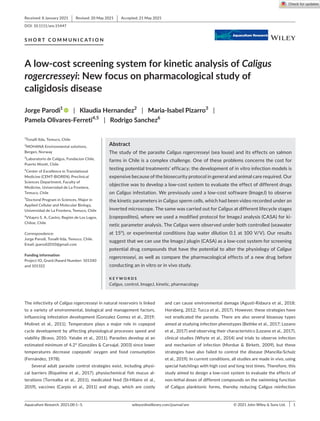
parasite. The graph in Figure 1 shows the effect of the presence
and absence of taurine on Caligus rogercresseyi motility. The dot-
ted line in Figure 1 represents the effect of taurine (100 ppm) on
motility, showing an increase at the start of recording and a signif-
icant reduction at the end of incubation. Taurine mediated mod-
ulation of other receptors, like the inhibitory neurotransmitter
GABA. This type of parasite is known to exhibit neurotransmitter
receptors similar to mammals (Cornejo et al., 2014). We investi-
gated the effect of a classic neurotransmitter, glutamate, and an
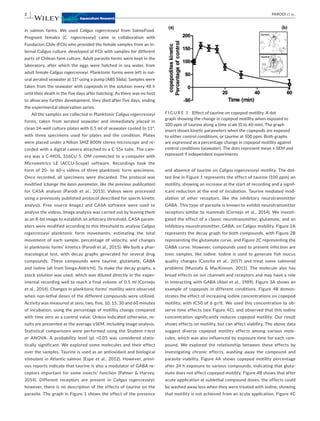
inhibitory neurotransmitter, GABA, on Caligus mobility. Figure 2A
represents the decay graph for both compounds, with Figure 2B
representing the glutamate curve, and Figure 2C representing the
GABA curve. However, compounds used to prevent infection are
ionic samples, like iodine. Iodine is used to generate fish mucus
quality changes (Concha et al., 2017) and treat some salmonid
problems (Mustafa  MacKinnon, 2011). The molecule also has
broad effects on ion channels and receptors and may have a role
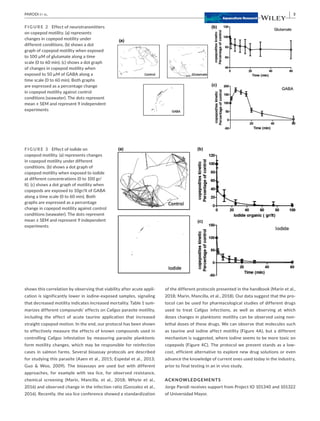
in interacting with GABA (Abel et al., 1989). Figure 3A shows an
example of copepods in different conditions. Figure 4B demon-
strates the effect of increasing iodine concentrations on copepod
motility, with IC50 of 6 gr/lt. We used this concentration to ob-
serve time effects (see Figure 4C), and observed that this iodine
concentration significantly reduces copepod motility. Our result
shows effects on motility, but can affect viability. The above data
suggest diverse copepod motility effects among various mole-
cules, which was also influenced by exposure time for each com-
pound. We explored the relationship between these effects by
investigating chronic effects, washing away the compound and
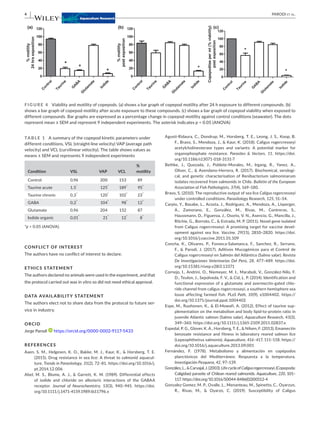
parasite viability. Figure 4A shows copepod motility percentage
after 24 h exposure to various compounds, indicating that gluta-
mate does not affect copepod motility. Figure 4B shows that after
acute application at sublethal compound doses, the effects could
be washed away less when they were treated with iodine, showing
that motility is not achieved from an acute application. Figure 4C
FI G U R E 1 Effect of taurine on copepod motility. A dot
graph showing the change in copepod motility when exposed to
100 ppm of taurine along a time scale (0 to 60 min). The graph
insert shows kinetic parameters when the copepods are exposed
to either control conditions, or taurine at 100 ppm. Both graphs
are expressed as a percentage change in copepod motility against
control conditions (seawater). The dots represent mean ± SEM and
represent 9 independent experiments
    |  3
PARODI et al.
shows this correlation by observing that viability after acute appli-
cation is significantly lower in iodine-­
exposed samples, signaling
that decreased motility indicates increased mortality. Table 1 sum-
marizes different compounds’ effects on Caligus parasite motility,
including the effect of acute taurine application that increased
straight copepod motion. In the end, our protocol has been shown
to effectively measure the effects of known compounds used in
controlling Caligus infestation by measuring parasite planktonic
form motility changes, which may be responsible for reinfection
cases in salmon farms. Several bioassay protocols are described
for studying this parasite (Aaen et al., 2015; Espedal et al., 2013;
Guo  Woo, 2009). The bioassays are used but with different
approaches, for example with sea lice, for observed resistance,
chemical screening (Marin, Mancilla, et al., 2018; Whyte et al.,
2016) and observed change in the infection ratio (Gonzalez et al.,
2016). Recently, the sea lice conference showed a standardization
of the different protocols presented in the handbook (Marin et al.,
2018; Marin, Mancilla, et al., 2018). Our data suggest that the pro-
tocol can be used for pharmacological studies of different drugs
used to treat Caligus infections, as well as observing at which
doses changes in planktonic motility can be observed using non-­
lethal doses of these drugs. We can observe that molecules such
as taurine and iodine affect motility (Figure 4A), but a different
mechanism is suggested, where iodine seems to be more toxic on
copepods (Figure 4C). The protocol we present stands as a low-­
cost, efficient alternative to explore new drug solutions or even
advance the knowledge of current ones used today in the industry,
prior to final testing in an in vivo study.
ACKNOWLEDGEMENTS
Jorge Parodi receives support from Project IO 101340 and 101322
of Universidad Mayor.
FI G U R E 2 Effect of neurotransmitters
on copepod motility. (a) represents
changes in copepod motility under
different conditions. (b) shows a dot
graph of copepod motility when exposed
to 100 µM of glutamate along a time
scale (0 to 60 min). (c) shows a dot graph
of changes in copepod motility when
exposed to 50 µM of GABA along a
time scale (0 to 60 min). Both graphs
are expressed as a percentage change
in copepod motility against control
conditions (seawater). The dots represent
mean ± SEM and represent 9 independent
experiments
FI G U R E 3 Effect of iodide on
copepod motility. (a) represents changes
in copepod motility under different
conditions. (b) shows a dot graph of
copepod motility when exposed to iodide
at different concentrations (0 to 100 gr/
lt). (c) shows a dot graph of motility when
copepods are exposed to 10gr/lt of GABA
along a time scale (0 to 60 min). Both
graphs are expressed as a percentage
change in copepod motility against control
conditions (seawater). The dots represent
mean ± SEM and represent 9 independent
experiments
4 |    PARODI et al.
CONFLICT OF INTEREST
The authors have no conflict of interest to declare.
ETHICS STATEMENT
The authors declared no animals were used in the experiment, and that
the protocol carried out was in vitro so did not need ethical approval.
DATA AVAILABILITY STATEMENT
The authors elect not to share data from the protocol to future ser-
vice in industry.
ORCID
Jorge Parodi  https://orcid.org/0000-0002-9117-5433
REFERENCES
Aaen, S. M., Helgesen, K. O., Bakke, M. J., Kaur, K.,  Horsberg, T. E.
(2015). Drug resistance in sea lice: A threat to salmonid aquacul-
ture. Trends in Parasitology, 31(2), 72–­
81. https://doi.org/10.1016/j.
pt.2014.12.006
Abel, M. S., Blume, A. J.,  Garrett, K. M. (1989). Differential effects
of iodide and chloride on allosteric interactions of the GABAA
receptor. Journal of Neurochemistry, 53(3), 940–­
945. https://doi.
org/10.1111/j.1471-­4159.1989.tb117​96.x
Agusti-­
Ridaura, C., Dondrup, M., Horsberg, T. E., Leong, J. S., Koop, B.
F., Bravo, S., Mendoza, J.,  Kaur, K. (2018). Caligus rogercresseyi
acetylcholinesterase types and variants: A potential marker for
organophosphate resistance. Parasites  Vectors, 11. https://doi.
org/10.1186/s1307​1-­018-­3151-­7
Bethke, J., Quezada, J., Poblete-­
Morales, M., Irgang, R., Yanez, A.,
Oliver, C.,  Avendano-­
Herrera, R. (2017). Biochemical, serologi-
cal, and genetic characterisation of Renibacterium salmoninarum
isolates recovered from salmonids in Chile. Bulletin of the European
Association of Fish Pathologists, 37(4), 169–­180.
Bravo, S. (2010). The reproductive output of sea lice Caligus rogercresseyi
under controlled conditions. Parasitology Research, 125, 51–­54.
Carpio, Y., Basabe, L., Acosta, J., Rodríguez, A., Mendoza, A., Lisperger,
A., Zamorano, E., González, M., Rivas, M., Contreras, S.,
Haussmann, D., Figueroa, J., Osorio, V. N., Asencio, G., Mancilla, J.,
Ritchie, G., Borroto, C.,  Estrada, M. P. (2011). Novel gene isolated
from Caligus rogercresseyi: A promising target for vaccine devel-
opment against sea lice. Vaccine, 29(15), 2810–­
2820. https://doi.
org/10.1016/j.vacci​ne.2011.01.109
Concha, K., Olivares, P., Fonseca-­
Salamanca, F., Sanchez, R., Serrano,
F.,  Parodi, J. (2017). Aditivos Mucogénicos para el Control de
Caligus rogercresseyi en Salmón del Atlántico (Salmo salar). Revista
De Investigaciones Veterinarias Del Perú, 28, 477–­
489. https://doi.
org/10.15381/​rivep.v28i3.13371
Cornejo, I., Andrini, O., Niemeyer, M. I., Marabolí, V., González-­
Nilo, F.
D., Teulon, J., Sepúlveda, F. V.,  Cid, L. P. (2014). Identification and
functional expression of a glutamate and avermectin-­
gated chlo-
ride channel from caligus rogercresseyi, a southern hemisphere sea
louse affecting farmed fish. PLoS Path, 10(9), e1004402. https://
doi.org/10.1371/journ​al.ppat.1004402
Espe, M., Ruohonen, K.,  El-­
Mowafi, A. (2012). Effect of taurine sup-
plementation on the metabolism and body lipid-­
to-­
protein ratio in
juvenile Atlantic salmon (Salmo salar). Aquaculture Research, 43(3),
349–­360. https://doi.org/10.1111/j.1365-­2109.2011.02837.x
Espedal, P. G., Glover, K. A., Horsberg, T. E.,  Nilsen, F. (2013). Emamectin
benzoate resistance and fitness in laboratory reared salmon lice
(Lepeophtheirus salmonis). Aquaculture, 416–­417, 111–­
118. https://
doi.org/10.1016/j.aquac​ulture.2013.09.001
Fernández, F. (1978). Metabolismo y alimentación en copépodos
planctónicos del Mediterráneo: Respuesta a la temperatura.
Investigación Pesquera, 42, 97–­139.
Gonzáles,L.,Carvajal,J.(2003).LifecycleofCaligusrogercresseyi,(Copepoda:
Caligidae) parasite of Chilean reared salmonids. Aquaculture, 220, 101–­
117. https://doi.org/10.1016/S0044​-­8486(02)00512​-­4
Gonzalez Gomez, M. P., Ovalle, L., Menanteau, M., Spinetto, C., Oyarzun,
R., Rivas, M.,  Oyarzo, C. (2019). Susceptibility of Caligus
FI G U R E 4 Viability and motility of copepods. (a) shows a bar graph of copepod motility after 24 h exposure to different compounds. (b)
shows a bar graph of copepod motility after acute exposure to these compounds. (c) shows a bar graph of copepod viability when exposed to
different compounds. Bar graphs are expressed as a percentage change in copepod motility against control conditions (seawater). The dots
represent mean ± SEM and represent 9 independent experiments. The asterisk indicates p  0.05 (ANOVA)
C
o
n
t
r
o
l
T
a
u
r
i
n
e
G
A
B
A
G
l
u
t
a
m
a
t
e
I
o
d
i
d
e
0
20
40
60
80
100
120
*
*
*
y
t
i
l
i
t
o
m
%
n
o
i
t
i
s
o
p
x
e
s
r
h
4
2
C
o
n
t
r
o
l
T
a
u
r
i
n
e
G
A
B
A
G
l
u
t
a
m
a
t
e
I
o
d
i
d
e
0
20
40
60
80
100
120
*
y
t
i
l
i
t
o
m
%
n
o
i
t
i
s
o
p
x
e
t
s
o
p
C
o
n
t
r
o
l
T
a
u
r
i
n
e
G
A
B
A
G
l
u
t
a
m
a
t
e
I
o
d
i
d
e
0
20
40
60
80
100
120
*
*
)
y
t
i
l
i
b
a
i
v
%
(
l
m
r
e
p
s
e
t
i
d
o
p
e
p
o
C
n
o
i
t
i
s
o
p
x
e
t
s
o
p
(a) (b) (c)
TA B LE 1 A summary of the copepod kinetic parameters under
different conditions, VSL (straight-­
line velocity) VAP (average path
velocity) and VCL (curvilinear velocity). The table shows values as
means ± SEM and represents 9 independent experiments
Condition VSL VAP VCL
%
motility
Control 0,96 200 153 89
Taurine acute 1,5*
125*
189*
95*
Taurine chronic 0,3*
120*
102*
23*
GABA 0,2*
104*
98*
12*
Glutamate 0,96 204 152 87
Iodide organic 0,01*
21*
12*
8*
*p  0.05 (ANOVA).
    |  5
PARODI et al.
rogercresseyi collected from the native fish species Eleginops ma-
clovinus (Cuvier) to antiparasitics applied by immersion. Journal of
Fish Diseases, 42(8), 1143–­
1149. https://doi.org/10.1111/jfd.13020
Gonzalez, L., Robles, C.,  San Martin, M. C. (2016). Management issues
regarding caligidosis treatment on salmon farms in Chile affected
by infection salmon anaemia virus (ISAV), Piscirickettsia salmonis
and Neoparamoeba perurans. Ocean  Coastal Management, 123,
74–­83. https://doi.org/10.1016/j.oceco​aman.2016.02.002
Guo, F. C.,  Woo, P. T. K. (2009). Selected parasitosis in cultured and
wild fish. Veterinary Parasitology, 163(3), 207–­
216. https://doi.
org/10.1016/j.vetpar.2009.06.016
Horsberg, T. E. (2012). Avermectin use in aquaculture. Current
Pharmaceutical Biotechnology, 13(6), 1095–­1102.
Lozano, I., Neumann, K., Cichero, D., Schroeder, G.,  Martinez, V. (2017).
Gene expression of immune genes in skin of Salmo salar interacting
with sessile Caligus rogercresseyi. Aquaculture, 472, 150.
Mancilla-­
Schulz, J., Marin, S. L.,  Molinet, C. (2019). Dynamics of Caligus
rogercresseyi (Boxshall  Bravo, 2000) in farmed Atlantic salmon
(Salmo salar) in southern Chile: Are we controlling sea lice? Journal
of Fish Diseases, 42(3), 357–­
369. https://doi.org/10.1111/jfd.12931
Marin, S. L., Gonzalez, M. P., Madariaga, S. T., Mancilla, M.,  Mancilla, J.
(2018). Response of Caligus rogercresseyi (Boxshall  Bravo, 2000)
to treatment with Hydrogen Peroxide: Recovery of parasites, fish
infestation and egg viability under experimental conditions. Journal
of Fish Diseases, 41(6), 861–­873.
Marin, S. L., Mancilla, J., Hausdorf, M. A., Bouchard, D., Tudor, M. S., 
Kane, F. (2018). Sensitivity assessment of sea lice to chemother-
apeutants: Current bioassays and best practices. Journal of Fish
Diseases, 41(6), 995–­1003.
Molinet, C., Cáceres, M., Gonzalez, M. T., Carvajal, J., Asencio, G., Díaz,
M., Díaz, P., Castro, M. T.,  Codjambassis, J. (2011). Population
dynamic of early stages of Caligus rogercresseyi in an embay-
ment used for intensive salmon farms in Chilean inland seas.
Aquaculture, 312(1–­4), 62–­71. https://doi.org/10.1016/j.aquac​
ulture.2010.12.010
Mordue, A. J.,  Birkett, M. A. (2009). A review of host finding behaviour
in the parasitic sea louse, Lepeophtheirus salmonis (Caligidae:
Copepoda). Journal of Fish Diseases, 32(1), 3–­13.
Mustafa, A.,  MacKinnon, B. (2011). Atlantic salmon, Salmo salar L.,
and Arctic char, Salvelinus alpinus (L.): Comparative correlation
between iodine-­
iodide supplementation, thyroid hormone levels,
plasma cortisol levels, and infection intensity with the sea louse
Caligus elongatus. Canadian Journal of Zoology, 77, 1092–­1101.
https://doi.org/10.1139/z99-­060
Palmer, M. J.,  Harvey, J. (2014). Honeybee Kenyon cells are regulated
by a tonic GABA receptor conductance. Journal of Neurophysiology,
112(8), 2026–­
2035. https://doi.org/10.1152/jn.00180.2014
Parodi, J., Ramírez-­
Reveco, A.,  Guerra, G. (2015). Example use of
low-­
cost system for capturing the kinetic parameters of sperm
cells in Atlantic Salmon (%3ci%3eSalmo salar%3c/i%3e). Advances
in Bioscience and Biotechnology, 06(02), 63–­
72. https://doi.
org/10.4236/abb.2015.62007
Riquelme, R., Olivares-­
Ferretti, P., Fonseca-­
Salamanca, F.,  Parodi,
J. (2017). Aguas profundas, un efecto en la temperatura para
el manejo de caligidosis en el Salmón del Atlántico (Salmo salar).
Revista De Investigaciones Veterinarias Del Perú, 28(1), 33. https://
doi.org/10.15381/​rivep.v28i1.12938
St-­
Hilaire, S., Price, D., Noftall, S., Boyce, B.,  Morrison, D. (2019).
Evaluating the concentration of emamectin benzoate in Atlantic
salmon tissues after sea lice treatments. Aquaculture, 498, 464–­
469. https://doi.org/10.1016/j.aquac​ulture.2018.08.071
Torrealba, D. A., Toledo, X. E.,  Gallardo, J. A. (2011). Artificial settle-
ment of Sea Lice, Caligus Rogercresseyi Boxshall  Bravo, 2000
(Copepoda, Caligidae), on Tissues of Fish Used as Substrate.
Crustaceana, 84(8), 939–­948.
Tucca, F., Moya, H., Pozo, K., Borghini, F., Focardi, S.,  Barra, R.
(2017). Occurrence of antiparasitic pesticides in sediments near
salmon farms in the northern Chilean Patagonia. Marine Pollution
Bulletin, 115(1–­2), 465–­468. https://doi.org/10.1016/j.marpo​
lbul.2016.11.041
Whyte, S. K., Westcott, J. D., Jimenez, D., Revie, C. W.,  Hammell, K. L.
(2014). Assessment of sea lice (Lepeophtheirus salmonis) manage-
ment in New Brunswick, Canada using deltamethrin (AlphaMax (R))
through clinical field treatment and laboratory bioassay responses.
Aquaculture, 422, 54–­62.
Whyte, S. K., Westcott, J. D., Revie, C. W.,  Hammell, K. L. (2016).
Sensitivity of salmon lice (Lepeophtheirus salmonis) in New
Brunswick, Canada, to the organophosphate Salmosan (R) (w/w
50% azamethiphos) using bioassays. Aquaculture, 464, 593–­600.
Yatabe, T., Arriagada, G., Hamilton-­
West, C.,  Urcelay, S. (2011). Risk
factor analysis for sea lice, Caligus rogercresseyi, levels in farmed
salmonids in southern Chile. Journal of Fish Diseases, 34, 345–­354.
https://doi.org/10.1111/j.1365-­2761.2011.01238.x
How to cite this article: Parodi, J., Hernandez, K., Pizarro,
M.-­
I., Olivares-­
Ferreti, P.,  Sanchez, R. (2021). A low-­
cost
screening system for kinetic analysis of Caligus rogercresseyi:
New focus on pharmacological study of caligidosis disease.
Aquaculture Research, 00, 1–­
5. https://doi.org/10.1111/
are.15447

Caligus cinetica 2021.pdf

  • 1.
    Aquaculture Research. 2021;00:1–5. wileyonlinelibrary.com/journal/are | 1 © 2021 John Wiley Sons Ltd. The infectivity of Caligus rogercresseyi in natural reservoirs is linked to a variety of environmental, biological and management factors, influencing infestation development (Gonzalez Gomez et al., 2019; Molinet et al., 2011). Temperature plays a major role in copepod cycle development by affecting physiological processes speed and viability (Bravo, 2010; Yatabe et al., 2011). Parasites develop at an estimated minimum of 4.2° (Gonzáles Carvajal, 2003) since lower temperatures decrease copepods’ oxygen and food consumption (Fernández, 1978). Several adult parasite control strategies exist, including physi- cal barriers (Riquelme et al., 2017), physiochemical fish mucus al- terations (Torrealba et al., 2011), medicated feed (St-­ Hilaire et al., 2019), vaccines (Carpio et al., 2011) and drugs, which are costly and can cause environmental damage (Agusti-­ Ridaura et al., 2018; Horsberg, 2012; Tucca et al., 2017). However, these strategies have not eradicated the parasite. There are also several bioassay types aimed at studying infection phenotypes (Bethke et al., 2017; Lozano et al., 2017) and observing their characteristics (Lozano et al., 2017), clinical studies (Whyte et al., 2014) and trials to observe infection and mechanism of infection (Mordue Birkett, 2009), but these strategies have also failed to control the disease (Mancilla-­ Schulz et al., 2019). In current conditions, all studies are made in vivo, using special hatchlings with high cost and long test times. Therefore, this study aimed to design a low-­ cost system to evaluate the effects of non-­ lethal doses of different compounds on the swimming function of Caligus planktonic forms, thereby reducing Caligus reinfection Received: 8 January 2021 | Revised: 20 May 2021 | Accepted: 21 May 2021 DOI: 10.1111/are.15447 S H O R T C O M M U N I C AT I O N A low-­ cost screening system for kinetic analysis of Caligus rogercresseyi: New focus on pharmacological study of caligidosis disease Jorge Parodi1  | Klaudia Hernandez2  | Maria-­ Isabel Pizarro3  | Pamela  Olivares-­Ferreti4,5  | Rodrigo Sanchez6 1 Tonalli ltda, Temuco, Chile 2 MOHANA Environmental solutions, Bergen, Norway 3 Laboratorio de Caligus, Fundacion Chile, Puerto Montt, Chile 4 Center of Excellence in Translational Medicine (CEMT-­ BIOREN), Preclinical Sciences Department, Faculty of Medicine, Universidad de La Frontera, Temuco, Chile 5 Doctoral Program in Sciences, Major in Applied Cellular and Molecular Biology, Universidad de La Frontera, Temuco, Chile 6 Vitapro S. A, Castro, Región de Los Lagos, Chiloe, Chile Correspondence: Jorge Parodi, Tonalli ltda, Temuco, Chile. Email: jparodi2010@gmail.com Funding information Project IO, Grant/Award Number: 101340 and 101322 Abstract The study of the parasite Caligus rogercresseyi (sea louse) and its effects on salmon farms in Chile is a complex challenge. One of these problems concerns the cost for testing potential treatments’ efficacy; the development of in vitro infection models is expensive because of the biosecurity protocol in general and animal care required. Our objective was to develop a low-­ cost system to evaluate the effect of different drugs on Caligus infestation. We previously used a low-­ cost software (ImageJ) to observe the kinetic parameters in Caligus sperm cells, which had been video recorded under an inverted microscope. The same was carried out for Caligus at different lifecycle stages (copepodites), where we used a modified protocol for ImageJ analysis (CASA) for ki- netic parameter analysis. The Caligus were observed under both controlled (seawater at 15°), or experimental conditions (tap water dilution 0.1 at 100 V/V). Our results suggest that we can use the ImageJ plugin (CASA) as a low-­ cost system for screening potential drug compounds that have the potential to alter the physiology of Caligus rogercresseyi, as well as compare the pharmacological effects of a new drug before conducting an in vitro or in vivo study. K E Y W O R D S Caligus, control, ImageJ, kinetic, pharmacology
  • 2.
    2 |    PARODI etal. in salmon farms. We used Caligus rogercresseyi from SalmoFood. Pregnant females (C. rogercresseyi) came in collaboration with Fundacion Chile (FCh) who provided the female samples from an in- ternal Caligus culture, developed at FCh with samples for different parts of Chilean farm culture. Adult parasite forms were kept in the laboratory, after which the eggs were hatched in sea water, from adult female Caligus rogercresseyi. Planktonic forms were left in nat- ural aerated seawater at 11° using a pump (ABS Slida). Samples were taken from the seawater with copepods in the solution every 48 h until their death in the five days after hatching. As there was no host to allow any further development, they died after five days, ending the experimental observation series. All the samples are collected in Planktonic Caligus rogercresseyi forms, taken from aerated seawater and immediately placed in clean 24-­ well culture plates with 0.5 ml of seawater cooled to 11°, with three specimens used for plates and the condition. Plates were placed under a Nikon SMZ 800N stereo microscope and re- corded with a digital camera attached to a C 55x tube. The cam- era was a C-­ MOS, 516CU 5. OM connected to a computer with Micrometrics LE (ACCU-­ Scope) software. Recordings took the form of 20-­to 60-­ s videos of three planktonic form specimens. Once recorded, all specimens were discarded. The protocol was modified (change the basis parameter, like the previous publication) for CASA analysis (Parodi et al., 2015). Videos were processed using a previously published protocol described for sperm kinetic analysis. Free source ImageJ and CASA software were used to analyse the videos. Image analysis was carried out by leaving them as an 8-­ bit image to establish an arbitrary threshold. CASA param- eters were modified according to this threshold to analyse Caligus rogercresseyi planktonic form movements, estimating the total movement of each sample, percentage of velocity, and changes in planktonic forms’ kinetics (Parodi et al., 2015). We built a phar- macological test, with decay graphs generated for several drug compounds. These compounds were taurine, glutamate, GABA and iodine (all from Simga-­ Aldricht). To make the decay graphs, a stock solution was used, which was diluted directly in the exper- imental recording well to reach a final volume of 0.5 ml (Cornejo et al., 2014). Changes in planktonic forms’ motility were observed when non-­ lethal doses of the different compounds were utilized. Activity was measured at zero, two, five, 10, 15, 30 and 60 minutes of incubation, using the percentage of motility change compared with time zero as a control value. Unless indicated otherwise, re- sults are presented as the average ±SEM, including image analysis. Statistical comparisons were performed using the Student t-­test or ANOVA. A probability level (p) 0.05 was considered statis- tically significant. We explored some molecules and their effect over the samples. Taurine is used as an antioxidant and biological stimulant in Atlantic salmon (Espe et al., 2012). However, previ- ous reports indicate that taurine is also a modulator of GABA re- ceptors important for some insects’ function (Palmer Harvey, 2014). Different receptors are present in Caligus rogercresseyi; however, there is no description of the effects of taurine on the parasite. The graph in Figure 1 shows the effect of the presence and absence of taurine on Caligus rogercresseyi motility. The dot- ted line in Figure 1 represents the effect of taurine (100 ppm) on motility, showing an increase at the start of recording and a signif- icant reduction at the end of incubation. Taurine mediated mod- ulation of other receptors, like the inhibitory neurotransmitter GABA. This type of parasite is known to exhibit neurotransmitter receptors similar to mammals (Cornejo et al., 2014). We investi- gated the effect of a classic neurotransmitter, glutamate, and an inhibitory neurotransmitter, GABA, on Caligus mobility. Figure 2A represents the decay graph for both compounds, with Figure 2B representing the glutamate curve, and Figure 2C representing the GABA curve. However, compounds used to prevent infection are ionic samples, like iodine. Iodine is used to generate fish mucus quality changes (Concha et al., 2017) and treat some salmonid problems (Mustafa MacKinnon, 2011). The molecule also has broad effects on ion channels and receptors and may have a role in interacting with GABA (Abel et al., 1989). Figure 3A shows an example of copepods in different conditions. Figure 4B demon- strates the effect of increasing iodine concentrations on copepod motility, with IC50 of 6 gr/lt. We used this concentration to ob- serve time effects (see Figure 4C), and observed that this iodine concentration significantly reduces copepod motility. Our result shows effects on motility, but can affect viability. The above data suggest diverse copepod motility effects among various mole- cules, which was also influenced by exposure time for each com- pound. We explored the relationship between these effects by investigating chronic effects, washing away the compound and parasite viability. Figure 4A shows copepod motility percentage after 24 h exposure to various compounds, indicating that gluta- mate does not affect copepod motility. Figure 4B shows that after acute application at sublethal compound doses, the effects could be washed away less when they were treated with iodine, showing that motility is not achieved from an acute application. Figure 4C FI G U R E 1 Effect of taurine on copepod motility. A dot graph showing the change in copepod motility when exposed to 100 ppm of taurine along a time scale (0 to 60 min). The graph insert shows kinetic parameters when the copepods are exposed to either control conditions, or taurine at 100 ppm. Both graphs are expressed as a percentage change in copepod motility against control conditions (seawater). The dots represent mean ± SEM and represent 9 independent experiments
  • 3.
        |  3 PARODIet al. shows this correlation by observing that viability after acute appli- cation is significantly lower in iodine-­ exposed samples, signaling that decreased motility indicates increased mortality. Table 1 sum- marizes different compounds’ effects on Caligus parasite motility, including the effect of acute taurine application that increased straight copepod motion. In the end, our protocol has been shown to effectively measure the effects of known compounds used in controlling Caligus infestation by measuring parasite planktonic form motility changes, which may be responsible for reinfection cases in salmon farms. Several bioassay protocols are described for studying this parasite (Aaen et al., 2015; Espedal et al., 2013; Guo Woo, 2009). The bioassays are used but with different approaches, for example with sea lice, for observed resistance, chemical screening (Marin, Mancilla, et al., 2018; Whyte et al., 2016) and observed change in the infection ratio (Gonzalez et al., 2016). Recently, the sea lice conference showed a standardization of the different protocols presented in the handbook (Marin et al., 2018; Marin, Mancilla, et al., 2018). Our data suggest that the pro- tocol can be used for pharmacological studies of different drugs used to treat Caligus infections, as well as observing at which doses changes in planktonic motility can be observed using non-­ lethal doses of these drugs. We can observe that molecules such as taurine and iodine affect motility (Figure 4A), but a different mechanism is suggested, where iodine seems to be more toxic on copepods (Figure 4C). The protocol we present stands as a low-­ cost, efficient alternative to explore new drug solutions or even advance the knowledge of current ones used today in the industry, prior to final testing in an in vivo study. ACKNOWLEDGEMENTS Jorge Parodi receives support from Project IO 101340 and 101322 of Universidad Mayor. FI G U R E 2 Effect of neurotransmitters on copepod motility. (a) represents changes in copepod motility under different conditions. (b) shows a dot graph of copepod motility when exposed to 100 µM of glutamate along a time scale (0 to 60 min). (c) shows a dot graph of changes in copepod motility when exposed to 50 µM of GABA along a time scale (0 to 60 min). Both graphs are expressed as a percentage change in copepod motility against control conditions (seawater). The dots represent mean ± SEM and represent 9 independent experiments FI G U R E 3 Effect of iodide on copepod motility. (a) represents changes in copepod motility under different conditions. (b) shows a dot graph of copepod motility when exposed to iodide at different concentrations (0 to 100 gr/ lt). (c) shows a dot graph of motility when copepods are exposed to 10gr/lt of GABA along a time scale (0 to 60 min). Both graphs are expressed as a percentage change in copepod motility against control conditions (seawater). The dots represent mean ± SEM and represent 9 independent experiments
  • 4.
    4 |    PARODI etal. CONFLICT OF INTEREST The authors have no conflict of interest to declare. ETHICS STATEMENT The authors declared no animals were used in the experiment, and that the protocol carried out was in vitro so did not need ethical approval. DATA AVAILABILITY STATEMENT The authors elect not to share data from the protocol to future ser- vice in industry. ORCID Jorge Parodi  https://orcid.org/0000-0002-9117-5433 REFERENCES Aaen, S. M., Helgesen, K. O., Bakke, M. J., Kaur, K., Horsberg, T. E. (2015). Drug resistance in sea lice: A threat to salmonid aquacul- ture. Trends in Parasitology, 31(2), 72–­ 81. https://doi.org/10.1016/j. pt.2014.12.006 Abel, M. S., Blume, A. J., Garrett, K. M. (1989). Differential effects of iodide and chloride on allosteric interactions of the GABAA receptor. Journal of Neurochemistry, 53(3), 940–­ 945. https://doi. org/10.1111/j.1471-­4159.1989.tb117​96.x Agusti-­ Ridaura, C., Dondrup, M., Horsberg, T. E., Leong, J. S., Koop, B. F., Bravo, S., Mendoza, J., Kaur, K. (2018). Caligus rogercresseyi acetylcholinesterase types and variants: A potential marker for organophosphate resistance. Parasites Vectors, 11. https://doi. org/10.1186/s1307​1-­018-­3151-­7 Bethke, J., Quezada, J., Poblete-­ Morales, M., Irgang, R., Yanez, A., Oliver, C., Avendano-­ Herrera, R. (2017). Biochemical, serologi- cal, and genetic characterisation of Renibacterium salmoninarum isolates recovered from salmonids in Chile. Bulletin of the European Association of Fish Pathologists, 37(4), 169–­180. Bravo, S. (2010). The reproductive output of sea lice Caligus rogercresseyi under controlled conditions. Parasitology Research, 125, 51–­54. Carpio, Y., Basabe, L., Acosta, J., Rodríguez, A., Mendoza, A., Lisperger, A., Zamorano, E., González, M., Rivas, M., Contreras, S., Haussmann, D., Figueroa, J., Osorio, V. N., Asencio, G., Mancilla, J., Ritchie, G., Borroto, C., Estrada, M. P. (2011). Novel gene isolated from Caligus rogercresseyi: A promising target for vaccine devel- opment against sea lice. Vaccine, 29(15), 2810–­ 2820. https://doi. org/10.1016/j.vacci​ne.2011.01.109 Concha, K., Olivares, P., Fonseca-­ Salamanca, F., Sanchez, R., Serrano, F., Parodi, J. (2017). Aditivos Mucogénicos para el Control de Caligus rogercresseyi en Salmón del Atlántico (Salmo salar). Revista De Investigaciones Veterinarias Del Perú, 28, 477–­ 489. https://doi. org/10.15381/​rivep.v28i3.13371 Cornejo, I., Andrini, O., Niemeyer, M. I., Marabolí, V., González-­ Nilo, F. D., Teulon, J., Sepúlveda, F. V., Cid, L. P. (2014). Identification and functional expression of a glutamate and avermectin-­ gated chlo- ride channel from caligus rogercresseyi, a southern hemisphere sea louse affecting farmed fish. PLoS Path, 10(9), e1004402. https:// doi.org/10.1371/journ​al.ppat.1004402 Espe, M., Ruohonen, K., El-­ Mowafi, A. (2012). Effect of taurine sup- plementation on the metabolism and body lipid-­ to-­ protein ratio in juvenile Atlantic salmon (Salmo salar). Aquaculture Research, 43(3), 349–­360. https://doi.org/10.1111/j.1365-­2109.2011.02837.x Espedal, P. G., Glover, K. A., Horsberg, T. E., Nilsen, F. (2013). Emamectin benzoate resistance and fitness in laboratory reared salmon lice (Lepeophtheirus salmonis). Aquaculture, 416–­417, 111–­ 118. https:// doi.org/10.1016/j.aquac​ulture.2013.09.001 Fernández, F. (1978). Metabolismo y alimentación en copépodos planctónicos del Mediterráneo: Respuesta a la temperatura. Investigación Pesquera, 42, 97–­139. Gonzáles,L.,Carvajal,J.(2003).LifecycleofCaligusrogercresseyi,(Copepoda: Caligidae) parasite of Chilean reared salmonids. Aquaculture, 220, 101–­ 117. https://doi.org/10.1016/S0044​-­8486(02)00512​-­4 Gonzalez Gomez, M. P., Ovalle, L., Menanteau, M., Spinetto, C., Oyarzun, R., Rivas, M., Oyarzo, C. (2019). Susceptibility of Caligus FI G U R E 4 Viability and motility of copepods. (a) shows a bar graph of copepod motility after 24 h exposure to different compounds. (b) shows a bar graph of copepod motility after acute exposure to these compounds. (c) shows a bar graph of copepod viability when exposed to different compounds. Bar graphs are expressed as a percentage change in copepod motility against control conditions (seawater). The dots represent mean ± SEM and represent 9 independent experiments. The asterisk indicates p  0.05 (ANOVA) C o n t r o l T a u r i n e G A B A G l u t a m a t e I o d i d e 0 20 40 60 80 100 120 * * * y t i l i t o m % n o i t i s o p x e s r h 4 2 C o n t r o l T a u r i n e G A B A G l u t a m a t e I o d i d e 0 20 40 60 80 100 120 * y t i l i t o m % n o i t i s o p x e t s o p C o n t r o l T a u r i n e G A B A G l u t a m a t e I o d i d e 0 20 40 60 80 100 120 * * ) y t i l i b a i v % ( l m r e p s e t i d o p e p o C n o i t i s o p x e t s o p (a) (b) (c) TA B LE 1 A summary of the copepod kinetic parameters under different conditions, VSL (straight-­ line velocity) VAP (average path velocity) and VCL (curvilinear velocity). The table shows values as means ± SEM and represents 9 independent experiments Condition VSL VAP VCL % motility Control 0,96 200 153 89 Taurine acute 1,5* 125* 189* 95* Taurine chronic 0,3* 120* 102* 23* GABA 0,2* 104* 98* 12* Glutamate 0,96 204 152 87 Iodide organic 0,01* 21* 12* 8* *p  0.05 (ANOVA).
  • 5.
        |  5 PARODIet al. rogercresseyi collected from the native fish species Eleginops ma- clovinus (Cuvier) to antiparasitics applied by immersion. Journal of Fish Diseases, 42(8), 1143–­ 1149. https://doi.org/10.1111/jfd.13020 Gonzalez, L., Robles, C., San Martin, M. C. (2016). Management issues regarding caligidosis treatment on salmon farms in Chile affected by infection salmon anaemia virus (ISAV), Piscirickettsia salmonis and Neoparamoeba perurans. Ocean Coastal Management, 123, 74–­83. https://doi.org/10.1016/j.oceco​aman.2016.02.002 Guo, F. C., Woo, P. T. K. (2009). Selected parasitosis in cultured and wild fish. Veterinary Parasitology, 163(3), 207–­ 216. https://doi. org/10.1016/j.vetpar.2009.06.016 Horsberg, T. E. (2012). Avermectin use in aquaculture. Current Pharmaceutical Biotechnology, 13(6), 1095–­1102. Lozano, I., Neumann, K., Cichero, D., Schroeder, G., Martinez, V. (2017). Gene expression of immune genes in skin of Salmo salar interacting with sessile Caligus rogercresseyi. Aquaculture, 472, 150. Mancilla-­ Schulz, J., Marin, S. L., Molinet, C. (2019). Dynamics of Caligus rogercresseyi (Boxshall Bravo, 2000) in farmed Atlantic salmon (Salmo salar) in southern Chile: Are we controlling sea lice? Journal of Fish Diseases, 42(3), 357–­ 369. https://doi.org/10.1111/jfd.12931 Marin, S. L., Gonzalez, M. P., Madariaga, S. T., Mancilla, M., Mancilla, J. (2018). Response of Caligus rogercresseyi (Boxshall Bravo, 2000) to treatment with Hydrogen Peroxide: Recovery of parasites, fish infestation and egg viability under experimental conditions. Journal of Fish Diseases, 41(6), 861–­873. Marin, S. L., Mancilla, J., Hausdorf, M. A., Bouchard, D., Tudor, M. S., Kane, F. (2018). Sensitivity assessment of sea lice to chemother- apeutants: Current bioassays and best practices. Journal of Fish Diseases, 41(6), 995–­1003. Molinet, C., Cáceres, M., Gonzalez, M. T., Carvajal, J., Asencio, G., Díaz, M., Díaz, P., Castro, M. T., Codjambassis, J. (2011). Population dynamic of early stages of Caligus rogercresseyi in an embay- ment used for intensive salmon farms in Chilean inland seas. Aquaculture, 312(1–­4), 62–­71. https://doi.org/10.1016/j.aquac​ ulture.2010.12.010 Mordue, A. J., Birkett, M. A. (2009). A review of host finding behaviour in the parasitic sea louse, Lepeophtheirus salmonis (Caligidae: Copepoda). Journal of Fish Diseases, 32(1), 3–­13. Mustafa, A., MacKinnon, B. (2011). Atlantic salmon, Salmo salar L., and Arctic char, Salvelinus alpinus (L.): Comparative correlation between iodine-­ iodide supplementation, thyroid hormone levels, plasma cortisol levels, and infection intensity with the sea louse Caligus elongatus. Canadian Journal of Zoology, 77, 1092–­1101. https://doi.org/10.1139/z99-­060 Palmer, M. J., Harvey, J. (2014). Honeybee Kenyon cells are regulated by a tonic GABA receptor conductance. Journal of Neurophysiology, 112(8), 2026–­ 2035. https://doi.org/10.1152/jn.00180.2014 Parodi, J., Ramírez-­ Reveco, A., Guerra, G. (2015). Example use of low-­ cost system for capturing the kinetic parameters of sperm cells in Atlantic Salmon (%3ci%3eSalmo salar%3c/i%3e). Advances in Bioscience and Biotechnology, 06(02), 63–­ 72. https://doi. org/10.4236/abb.2015.62007 Riquelme, R., Olivares-­ Ferretti, P., Fonseca-­ Salamanca, F., Parodi, J. (2017). Aguas profundas, un efecto en la temperatura para el manejo de caligidosis en el Salmón del Atlántico (Salmo salar). Revista De Investigaciones Veterinarias Del Perú, 28(1), 33. https:// doi.org/10.15381/​rivep.v28i1.12938 St-­ Hilaire, S., Price, D., Noftall, S., Boyce, B., Morrison, D. (2019). Evaluating the concentration of emamectin benzoate in Atlantic salmon tissues after sea lice treatments. Aquaculture, 498, 464–­ 469. https://doi.org/10.1016/j.aquac​ulture.2018.08.071 Torrealba, D. A., Toledo, X. E., Gallardo, J. A. (2011). Artificial settle- ment of Sea Lice, Caligus Rogercresseyi Boxshall Bravo, 2000 (Copepoda, Caligidae), on Tissues of Fish Used as Substrate. Crustaceana, 84(8), 939–­948. Tucca, F., Moya, H., Pozo, K., Borghini, F., Focardi, S., Barra, R. (2017). Occurrence of antiparasitic pesticides in sediments near salmon farms in the northern Chilean Patagonia. Marine Pollution Bulletin, 115(1–­2), 465–­468. https://doi.org/10.1016/j.marpo​ lbul.2016.11.041 Whyte, S. K., Westcott, J. D., Jimenez, D., Revie, C. W., Hammell, K. L. (2014). Assessment of sea lice (Lepeophtheirus salmonis) manage- ment in New Brunswick, Canada using deltamethrin (AlphaMax (R)) through clinical field treatment and laboratory bioassay responses. Aquaculture, 422, 54–­62. Whyte, S. K., Westcott, J. D., Revie, C. W., Hammell, K. L. (2016). Sensitivity of salmon lice (Lepeophtheirus salmonis) in New Brunswick, Canada, to the organophosphate Salmosan (R) (w/w 50% azamethiphos) using bioassays. Aquaculture, 464, 593–­600. Yatabe, T., Arriagada, G., Hamilton-­ West, C., Urcelay, S. (2011). Risk factor analysis for sea lice, Caligus rogercresseyi, levels in farmed salmonids in southern Chile. Journal of Fish Diseases, 34, 345–­354. https://doi.org/10.1111/j.1365-­2761.2011.01238.x How to cite this article: Parodi, J., Hernandez, K., Pizarro, M.-­ I., Olivares-­ Ferreti, P., Sanchez, R. (2021). A low-­ cost screening system for kinetic analysis of Caligus rogercresseyi: New focus on pharmacological study of caligidosis disease. Aquaculture Research, 00, 1–­ 5. https://doi.org/10.1111/ are.15447