Chapter-7: Symmetrical Fault
Analysis
Dr Parmal Singh Solanki
1
Power System Analysis-1
(ELEC3241)
ELEC3241
Acknowledgements
• Power System Analysis by J.J Granger and WD
Stevenson, McGraw Hill, 1994
• Principle of Power System by VK Meha, SC
Publivation, 2005.
• Power System Analysis & Design, by Duncan,
Mulukutla and Thomas, Cengage Learning 2008
ELEC3241 2
Outlines
• Fault, classification and symmetrical fault.
• Percentage reactance and Short Circuit Current
• Per-Unit System and Base KVA
• Calculation of Short Circuit KVA
• Control techniques of Short Circuit Currents
• Location of Reactors in Power System
• Steps to symmetrical fault calculation
• Tutorial
ELEC3241 3
Faults and Classification
• Symmetrical and unsymmetrical faults
• Symmetrical Fault: That fault on power system
which gives rise to symmetrical currents (i.e.
equal fault currents in the lines with 120 degree
displacement) I called a symmetrical fault
• Why symmetrical fault is important??
- Though rarely occurs, but most severe and
IMPOSE MORE HEAVY DUTY ON THE CIRCUIT
BREAKER
• How to limit fault current: By impedance of the
system
ELEC3241 4
Percentage Reactance
• Percentage reactance (%X): It is the % of the total
phase voltage dropped in the circuit when full load
current is flowing
Where I = full load current
V= phase voltage
X = reactance in ohms per phase
%𝑿 =
𝒌𝑽𝑨 𝑿
𝟏𝟎 𝒌𝑽 𝟐
or 𝐼𝑆𝐶 =
𝑉
𝑋
= 𝐼 ×
100
%𝑋
ELEC3241 5
%𝑋 =
𝐼 𝑋
𝑉
× 100
Illustration on SC current
ELEC3241 6
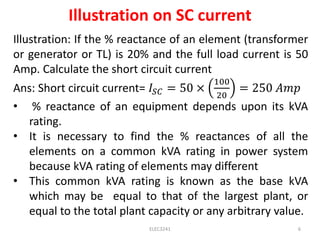
Illustration: If the % reactance of an element (transformer
or generator or TL) is 20% and the full load current is 50
Amp. Calculate the short circuit current
Ans: Short circuit current= 𝐼𝑆𝐶 = 50 ×
100
20
= 250 𝐴𝑚𝑝
• % reactance of an equipment depends upon its kVA
rating.
• It is necessary to find the % reactances of all the
elements on a common kVA rating in power system
because kVA rating of elements may different
• This common kVA rating is known as the base kVA
which may be equal to that of the largest plant, or
equal to the total plant capacity or any arbitrary value.
Base kVA and SC current
ELEC3241 7
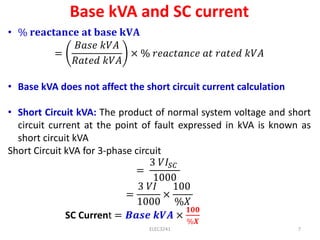
• % 𝐫𝐞𝐚𝐜𝐭𝐚𝐧𝐜𝐞 𝐚𝐭 𝐛𝐚𝐬𝐞 𝐤𝐕𝐀
=
𝐵𝑎𝑠𝑒 𝑘𝑉𝐴
𝑅𝑎𝑡𝑒𝑑 𝑘𝑉𝐴
× % 𝑟𝑒𝑎𝑐𝑡𝑎𝑛𝑐𝑒 𝑎𝑡 𝑟𝑎𝑡𝑒𝑑 𝑘𝑉𝐴
• Base kVA does not affect the short circuit current calculation
• Short Circuit kVA: The product of normal system voltage and short
circuit current at the point of fault expressed in kVA is known as
short circuit kVA
Short Circuit kVA for 3-phase circuit
=
3 𝑉𝐼𝑆𝐶
1000
=
3 𝑉𝐼
1000
×
100
%𝑋
SC Current = 𝑩𝒂𝒔𝒆 𝒌𝑽𝑨 ×
𝟏𝟎𝟎
%𝑿
Steps for Symmetrical Fault Calculations
• Draw a single line diagram of the given network
including rating, voltage and % reactance of each
element
• Choose base kVA and convert all % reactance to this
base value
• Draw the reactance diagram showing one phase of the
system and the neutral . Indicate the %X on the base
kVA in diagram.
• Find the total %X of the network up to the point of
fault
• Find the full load current corresponding to the
selected base kVA and the normal system voltage at
the fault point
• Apply the formula to determine the Short Circuit
Current
ELEC3241 8
Tutorial
Q7.1. A circuit of a 3-phase system is given- see in
Figure. The %X of each alternator is based on its
own capacity. Find the short circuit current that
will flow into a complete 3-phase short circuit at
point F.
Answer: 4330 Amp
ELEC3241 9
Tutorial
Q7.2. A 3-phase, 20 MVA, 10 kV alternator has
internal reactance of 5% and negligible resistance.
Find the external reactance per phase to be
connected in series with the alternator so that
steady current on short circuit does not exceed 8
times the full load current.
Answer: X = 0.375 Ω
ELEC3241 10
Tutorial
Q7.3. A 3-phase transmission line operating at 10 kV
and having a resistance of 1Ω and reactance of 4Ω is
connected to the generating station bus bar through 5
MVA step-up transformer having a reactance of 5%.
The bus bar supplied by a 10 MVA alternator having
10% reactance. Calculate the short circuit kVA fed to
symmetrical fault between phases if it occurs
(i) At the load end of transmission line
(ii) (ii) at the high voltage terminals of the transformer
Answer: (i) Short circuit kVA = 16,440 kVA
(ii) Short circuit kVA = 50,000 kVA
ELEC3241 11
Tutorial
Q7.4. The plant capacity of a 3-phase generating
station consists of two 10000 kVA generators of
reactance 12% each and one 5000 kVA generator of
reactance 18%. The generators are connected to the
station bus bar from which load is taken through three
5000 kVA step up transformer each having a reactance
of 5%. Determine the maximum fault MVA which the
circuit breakers on (i) low voltage side and (ii) high
voltage side may have to deal with.
Answer: (i) Fault MVA = 194.5
(ii) Fault MVA = 66
ELEC3241 12

Cahpter_7_Symmetrical_Fault_Analysis.pptx

  • 1.
    Chapter-7: Symmetrical Fault Analysis DrParmal Singh Solanki 1 Power System Analysis-1 (ELEC3241) ELEC3241
  • 2.
    Acknowledgements • Power SystemAnalysis by J.J Granger and WD Stevenson, McGraw Hill, 1994 • Principle of Power System by VK Meha, SC Publivation, 2005. • Power System Analysis & Design, by Duncan, Mulukutla and Thomas, Cengage Learning 2008 ELEC3241 2
  • 3.
    Outlines • Fault, classificationand symmetrical fault. • Percentage reactance and Short Circuit Current • Per-Unit System and Base KVA • Calculation of Short Circuit KVA • Control techniques of Short Circuit Currents • Location of Reactors in Power System • Steps to symmetrical fault calculation • Tutorial ELEC3241 3
  • 4.
    Faults and Classification •Symmetrical and unsymmetrical faults • Symmetrical Fault: That fault on power system which gives rise to symmetrical currents (i.e. equal fault currents in the lines with 120 degree displacement) I called a symmetrical fault • Why symmetrical fault is important?? - Though rarely occurs, but most severe and IMPOSE MORE HEAVY DUTY ON THE CIRCUIT BREAKER • How to limit fault current: By impedance of the system ELEC3241 4
  • 5.
    Percentage Reactance • Percentagereactance (%X): It is the % of the total phase voltage dropped in the circuit when full load current is flowing Where I = full load current V= phase voltage X = reactance in ohms per phase %𝑿 = 𝒌𝑽𝑨 𝑿 𝟏𝟎 𝒌𝑽 𝟐 or 𝐼𝑆𝐶 = 𝑉 𝑋 = 𝐼 × 100 %𝑋 ELEC3241 5 %𝑋 = 𝐼 𝑋 𝑉 × 100
  • 6.
    Illustration on SCcurrent ELEC3241 6 Illustration: If the % reactance of an element (transformer or generator or TL) is 20% and the full load current is 50 Amp. Calculate the short circuit current Ans: Short circuit current= 𝐼𝑆𝐶 = 50 × 100 20 = 250 𝐴𝑚𝑝 • % reactance of an equipment depends upon its kVA rating. • It is necessary to find the % reactances of all the elements on a common kVA rating in power system because kVA rating of elements may different • This common kVA rating is known as the base kVA which may be equal to that of the largest plant, or equal to the total plant capacity or any arbitrary value.
  • 7.
    Base kVA andSC current ELEC3241 7 • % 𝐫𝐞𝐚𝐜𝐭𝐚𝐧𝐜𝐞 𝐚𝐭 𝐛𝐚𝐬𝐞 𝐤𝐕𝐀 = 𝐵𝑎𝑠𝑒 𝑘𝑉𝐴 𝑅𝑎𝑡𝑒𝑑 𝑘𝑉𝐴 × % 𝑟𝑒𝑎𝑐𝑡𝑎𝑛𝑐𝑒 𝑎𝑡 𝑟𝑎𝑡𝑒𝑑 𝑘𝑉𝐴 • Base kVA does not affect the short circuit current calculation • Short Circuit kVA: The product of normal system voltage and short circuit current at the point of fault expressed in kVA is known as short circuit kVA Short Circuit kVA for 3-phase circuit = 3 𝑉𝐼𝑆𝐶 1000 = 3 𝑉𝐼 1000 × 100 %𝑋 SC Current = 𝑩𝒂𝒔𝒆 𝒌𝑽𝑨 × 𝟏𝟎𝟎 %𝑿
  • 8.
    Steps for SymmetricalFault Calculations • Draw a single line diagram of the given network including rating, voltage and % reactance of each element • Choose base kVA and convert all % reactance to this base value • Draw the reactance diagram showing one phase of the system and the neutral . Indicate the %X on the base kVA in diagram. • Find the total %X of the network up to the point of fault • Find the full load current corresponding to the selected base kVA and the normal system voltage at the fault point • Apply the formula to determine the Short Circuit Current ELEC3241 8
  • 9.
    Tutorial Q7.1. A circuitof a 3-phase system is given- see in Figure. The %X of each alternator is based on its own capacity. Find the short circuit current that will flow into a complete 3-phase short circuit at point F. Answer: 4330 Amp ELEC3241 9
  • 10.
    Tutorial Q7.2. A 3-phase,20 MVA, 10 kV alternator has internal reactance of 5% and negligible resistance. Find the external reactance per phase to be connected in series with the alternator so that steady current on short circuit does not exceed 8 times the full load current. Answer: X = 0.375 Ω ELEC3241 10
  • 11.
    Tutorial Q7.3. A 3-phasetransmission line operating at 10 kV and having a resistance of 1Ω and reactance of 4Ω is connected to the generating station bus bar through 5 MVA step-up transformer having a reactance of 5%. The bus bar supplied by a 10 MVA alternator having 10% reactance. Calculate the short circuit kVA fed to symmetrical fault between phases if it occurs (i) At the load end of transmission line (ii) (ii) at the high voltage terminals of the transformer Answer: (i) Short circuit kVA = 16,440 kVA (ii) Short circuit kVA = 50,000 kVA ELEC3241 11
  • 12.
    Tutorial Q7.4. The plantcapacity of a 3-phase generating station consists of two 10000 kVA generators of reactance 12% each and one 5000 kVA generator of reactance 18%. The generators are connected to the station bus bar from which load is taken through three 5000 kVA step up transformer each having a reactance of 5%. Determine the maximum fault MVA which the circuit breakers on (i) low voltage side and (ii) high voltage side may have to deal with. Answer: (i) Fault MVA = 194.5 (ii) Fault MVA = 66 ELEC3241 12