California
Department of
Business Oversight
Alana Golden
Director for Education and
Outreach
California Community Colleges
Real Estate Educators’ Conference
Northern California
Friday, April 22, 2016
DoubleTree by Hilton, San Francisco Airport
Department of Financial Institutions
+
Department of Corporations
________________________________________________
= Department of Business Oversight
• DBO regulates more than 350,000 individuals
and firms
2
DBO Born July 1, 2013
• 155 state-chartered banks
• 145 state-chartered credit unions
• 85 money transmitters
• 365 mortgage bankers
• 21,617 mortgage loan originators
• 2,225 consumer and commercial finance lenders
• 950 escrow agents
• 326 payday lenders
• 277,102 broker-dealer agent registrations
• 50,723 investment adviser representative registrations
3
DBO Financial
Institution Portfolio
As of December 31, 2014
DBO MISSION
Secure fair and healthy financial services
marketplace
For consumers and businesses
4
Balancing Act
5
California Residential Mortgage
Lending Act
The California Residential Mortgage Lending Act (CRMLA) is contained in Division 20 of the
California Financial Code, commencing with Section 50000. The regulations are contained in
Subchapter 11.5 of Chapter 3 of Title 10 of the California Code of Regulations, commencing
with Section 1950.003 (10 C.C.R. §1950.003, et seq.).
• In general, any form of organization may get a license. This
includes natural persons, sole proprietorships, corporations,
partnerships, limited liability companies, associations, trusts,
joint ventures, unincorporated organizations, joint stock
companies, governments or political subdivisions of
governments and any other entity.
• The CRMLA requires that any person engaged in the business
of making or servicing residential mortgage loans within
California do so only under the authority of a license under
the CRMLA.
What's New
• 02/23/2016 - Specified DBO-licensed lenders must file their 2015 Residential Mortgage
Loan Report no later than Mar. 31. The report is mandated by the state’s Housing Financial
Discrimination Act of 1977, known as the Holden Act. The report forms, information on
how to complete the forms and details about who has to file reports can be found at
http://www.dbo.ca.gov/Licensees/Residential_Mortgage/Forms.asp.
• 01/20/2016 - 2015 Annual Report for the California Residential Mortgage Lending Act Due
March 1, 2016. Licensees under the California Residential Mortgage Lending Act (CRMLA)
are now able to complete their 2015 CRMLA Annual Report electronically. The format for
submitting the report and the data collected will be the same as for the 2014
reports. Instructions for completing the annual report were sent to each licensee’s
designated email address on January 20, 2016. Reports must be submitted online using the
unique link included in the e-mail. The instructions also include a link to a blank paper copy
of the report to help you compile the information and prepare to file the online form. The
report must be filed by all CRMLA licensees by March 1, 2016.
6
California Residential Mortgage
Lending Act
The California Residential Mortgage Lending Act (CRMLA) is contained in Division 20 of the
California Financial Code, commencing with Section 50000. The regulations are contained in
Subchapter 11.5 of Chapter 3 of Title 10 of the California Code of Regulations, commencing
with Section 1950.003 (10 C.C.R. §1950.003, et seq.).
7
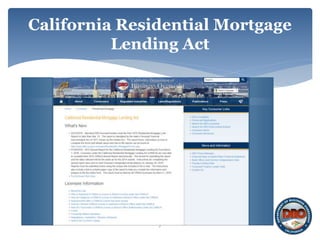
California Residential Mortgage
Lending Act
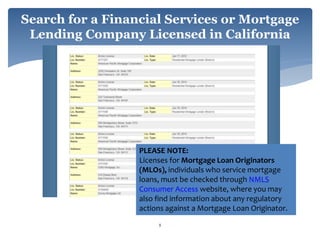
Search for a Financial Services or Mortgage
Lending Company Licensed in California
8
PLEASE NOTE:
Licenses for Mortgage Loan Originators
(MLOs), individuals who service mortgage
loans, must be checked through NMLS
Consumer Access website, where you may
also find information about any regulatory
actions against a Mortgage Loan Originator.
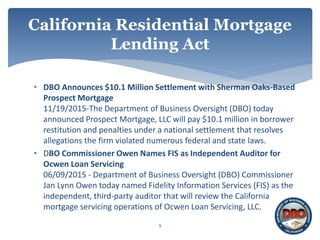
• DBO Announces $10.1 Million Settlement with Sherman Oaks-Based
Prospect Mortgage
11/19/2015-The Department of Business Oversight (DBO) today
announced Prospect Mortgage, LLC will pay $10.1 million in borrower
restitution and penalties under a national settlement that resolves
allegations the firm violated numerous federal and state laws.
• DBO Commissioner Owen Names FIS as Independent Auditor for
Ocwen Loan Servicing
06/09/2015 - Department of Business Oversight (DBO) Commissioner
Jan Lynn Owen today named Fidelity Information Services (FIS) as the
independent, third-party auditor that will review the California
mortgage servicing operations of Ocwen Loan Servicing, LLC.
9
California Residential Mortgage
Lending Act
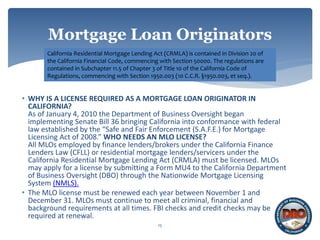
• WHY IS A LICENSE REQUIRED AS A MORTGAGE LOAN ORIGINATOR IN
CALIFORNIA?
As of January 4, 2010 the Department of Business Oversight began
implementing Senate Bill 36 bringing California into conformance with federal
law established by the “Safe and Fair Enforcement (S.A.F.E.) for Mortgage
Licensing Act of 2008.” WHO NEEDS AN MLO LICENSE?
All MLOs employed by finance lenders/brokers under the California Finance
Lenders Law (CFLL) or residential mortgage lenders/servicers under the
California Residential Mortgage Lending Act (CRMLA) must be licensed. MLOs
may apply for a license by submitting a Form MU4 to the California Department
of Business Oversight (DBO) through the Nationwide Mortgage Licensing
System (NMLS).
• The MLO license must be renewed each year between November 1 and
December 31. MLOs must continue to meet all criminal, financial and
background requirements at all times. FBI checks and credit checks may be
required at renewal.
15
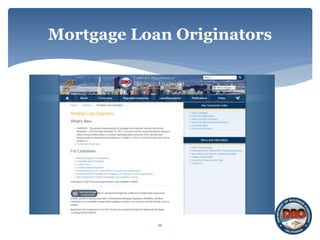
Mortgage Loan Originators
California Residential Mortgage Lending Act (CRMLA) is contained in Division 20 of
the California Financial Code, commencing with Section 50000. The regulations are
contained in Subchapter 11.5 of Chapter 3 of Title 10 of the California Code of
Regulations, commencing with Section 1950.003 (10 C.C.R. §1950.003, et seq.).
16
Mortgage Loan Originators
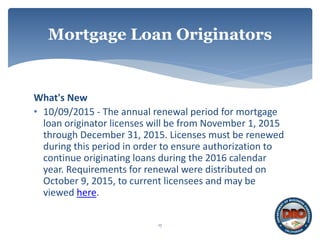
What's New
• 10/09/2015 - The annual renewal period for mortgage
loan originator licenses will be from November 1, 2015
through December 31, 2015. Licenses must be renewed
during this period in order to ensure authorization to
continue originating loans during the 2016 calendar
year. Requirements for renewal were distributed on
October 9, 2015, to current licensees and may be
viewed here.
17
Mortgage Loan Originators
Mortgage Education
Outreach Program
The DBO Mortgage Education and Outreach Program
(Program) is focused on supporting homeownership and
informing mortgage borrowers of their rights.
The Program partners with community stakeholders through
workshops, train-the trainer sessions and educational
materials. The Program focuses on the hardest hit areas in the
state, although resources are available statewide.
To partner with DBO or to request copies of free mortgage
education materials, please email Outreach@dbo.ca.gov.
18
Request free copies of printed materials by
emailing publications@dbo.ca.gov.
• About the Department of Business Oversight - English / Español (2015, PDF)
• Always Read the Small Print / Lea siempre la letra pequeña (2015, PDF)
• Budget Worksheet / Hoja de trabajo de presupuesto (2015, PDF)
• Check Before You Sign / Revise antes de firmar (2015, PDF)
• Guard Against Fraud! (2015, PDF)
• 防止欺詐! (Chinese)
• 사기로부터 가족 을 지키세요! (Korean)
• НЕ ДАЙТЕ СЕБЯ ОБМАНУТЬ! (Russian)
• Cuidado Con El Fraude! (Spanish)
• Mag-Ingat Laban Sa Pandaraya! (Tagalog)
• ĐỀ PHÒNG CHỐNG GIAN LẬN! (Vietnamese)
• Path to Homeownership (2015, PDF)
• El camino a seguir para ser propietario de vivienda (Spanish)
• 购房之路 (Chinese)
• Protect Yourself From Fraud / Protéjase del fraude (2014,PDF)
19
Brochures and Publications
20
Department of Business Oversight
Visit www.dbo.ca.gov
Stay informed. Sign up for our mailing list!
www.dbo.ca.gov/resources/subscription
Thank you

CADepofBusOversight_Overview_04222016

  • 1.
    California Department of Business Oversight AlanaGolden Director for Education and Outreach California Community Colleges Real Estate Educators’ Conference Northern California Friday, April 22, 2016 DoubleTree by Hilton, San Francisco Airport
  • 2.
    Department of FinancialInstitutions + Department of Corporations ________________________________________________ = Department of Business Oversight • DBO regulates more than 350,000 individuals and firms 2 DBO Born July 1, 2013
  • 3.
    • 155 state-charteredbanks • 145 state-chartered credit unions • 85 money transmitters • 365 mortgage bankers • 21,617 mortgage loan originators • 2,225 consumer and commercial finance lenders • 950 escrow agents • 326 payday lenders • 277,102 broker-dealer agent registrations • 50,723 investment adviser representative registrations 3 DBO Financial Institution Portfolio As of December 31, 2014
  • 4.
    DBO MISSION Secure fairand healthy financial services marketplace For consumers and businesses 4 Balancing Act
  • 5.
    5 California Residential Mortgage LendingAct The California Residential Mortgage Lending Act (CRMLA) is contained in Division 20 of the California Financial Code, commencing with Section 50000. The regulations are contained in Subchapter 11.5 of Chapter 3 of Title 10 of the California Code of Regulations, commencing with Section 1950.003 (10 C.C.R. §1950.003, et seq.). • In general, any form of organization may get a license. This includes natural persons, sole proprietorships, corporations, partnerships, limited liability companies, associations, trusts, joint ventures, unincorporated organizations, joint stock companies, governments or political subdivisions of governments and any other entity. • The CRMLA requires that any person engaged in the business of making or servicing residential mortgage loans within California do so only under the authority of a license under the CRMLA.
  • 6.
    What's New • 02/23/2016- Specified DBO-licensed lenders must file their 2015 Residential Mortgage Loan Report no later than Mar. 31. The report is mandated by the state’s Housing Financial Discrimination Act of 1977, known as the Holden Act. The report forms, information on how to complete the forms and details about who has to file reports can be found at http://www.dbo.ca.gov/Licensees/Residential_Mortgage/Forms.asp. • 01/20/2016 - 2015 Annual Report for the California Residential Mortgage Lending Act Due March 1, 2016. Licensees under the California Residential Mortgage Lending Act (CRMLA) are now able to complete their 2015 CRMLA Annual Report electronically. The format for submitting the report and the data collected will be the same as for the 2014 reports. Instructions for completing the annual report were sent to each licensee’s designated email address on January 20, 2016. Reports must be submitted online using the unique link included in the e-mail. The instructions also include a link to a blank paper copy of the report to help you compile the information and prepare to file the online form. The report must be filed by all CRMLA licensees by March 1, 2016. 6 California Residential Mortgage Lending Act The California Residential Mortgage Lending Act (CRMLA) is contained in Division 20 of the California Financial Code, commencing with Section 50000. The regulations are contained in Subchapter 11.5 of Chapter 3 of Title 10 of the California Code of Regulations, commencing with Section 1950.003 (10 C.C.R. §1950.003, et seq.).
  • 7.
  • 8.
    Search for aFinancial Services or Mortgage Lending Company Licensed in California 8 PLEASE NOTE: Licenses for Mortgage Loan Originators (MLOs), individuals who service mortgage loans, must be checked through NMLS Consumer Access website, where you may also find information about any regulatory actions against a Mortgage Loan Originator.
  • 9.
    • DBO Announces$10.1 Million Settlement with Sherman Oaks-Based Prospect Mortgage 11/19/2015-The Department of Business Oversight (DBO) today announced Prospect Mortgage, LLC will pay $10.1 million in borrower restitution and penalties under a national settlement that resolves allegations the firm violated numerous federal and state laws. • DBO Commissioner Owen Names FIS as Independent Auditor for Ocwen Loan Servicing 06/09/2015 - Department of Business Oversight (DBO) Commissioner Jan Lynn Owen today named Fidelity Information Services (FIS) as the independent, third-party auditor that will review the California mortgage servicing operations of Ocwen Loan Servicing, LLC. 9 California Residential Mortgage Lending Act
  • 10.
    • WHY ISA LICENSE REQUIRED AS A MORTGAGE LOAN ORIGINATOR IN CALIFORNIA? As of January 4, 2010 the Department of Business Oversight began implementing Senate Bill 36 bringing California into conformance with federal law established by the “Safe and Fair Enforcement (S.A.F.E.) for Mortgage Licensing Act of 2008.” WHO NEEDS AN MLO LICENSE? All MLOs employed by finance lenders/brokers under the California Finance Lenders Law (CFLL) or residential mortgage lenders/servicers under the California Residential Mortgage Lending Act (CRMLA) must be licensed. MLOs may apply for a license by submitting a Form MU4 to the California Department of Business Oversight (DBO) through the Nationwide Mortgage Licensing System (NMLS). • The MLO license must be renewed each year between November 1 and December 31. MLOs must continue to meet all criminal, financial and background requirements at all times. FBI checks and credit checks may be required at renewal. 15 Mortgage Loan Originators California Residential Mortgage Lending Act (CRMLA) is contained in Division 20 of the California Financial Code, commencing with Section 50000. The regulations are contained in Subchapter 11.5 of Chapter 3 of Title 10 of the California Code of Regulations, commencing with Section 1950.003 (10 C.C.R. §1950.003, et seq.).
  • 11.
  • 12.
    What's New • 10/09/2015- The annual renewal period for mortgage loan originator licenses will be from November 1, 2015 through December 31, 2015. Licenses must be renewed during this period in order to ensure authorization to continue originating loans during the 2016 calendar year. Requirements for renewal were distributed on October 9, 2015, to current licensees and may be viewed here. 17 Mortgage Loan Originators
  • 13.
    Mortgage Education Outreach Program TheDBO Mortgage Education and Outreach Program (Program) is focused on supporting homeownership and informing mortgage borrowers of their rights. The Program partners with community stakeholders through workshops, train-the trainer sessions and educational materials. The Program focuses on the hardest hit areas in the state, although resources are available statewide. To partner with DBO or to request copies of free mortgage education materials, please email Outreach@dbo.ca.gov. 18
  • 14.
    Request free copiesof printed materials by emailing publications@dbo.ca.gov. • About the Department of Business Oversight - English / Español (2015, PDF) • Always Read the Small Print / Lea siempre la letra pequeña (2015, PDF) • Budget Worksheet / Hoja de trabajo de presupuesto (2015, PDF) • Check Before You Sign / Revise antes de firmar (2015, PDF) • Guard Against Fraud! (2015, PDF) • 防止欺詐! (Chinese) • 사기로부터 가족 을 지키세요! (Korean) • НЕ ДАЙТЕ СЕБЯ ОБМАНУТЬ! (Russian) • Cuidado Con El Fraude! (Spanish) • Mag-Ingat Laban Sa Pandaraya! (Tagalog) • ĐỀ PHÒNG CHỐNG GIAN LẬN! (Vietnamese) • Path to Homeownership (2015, PDF) • El camino a seguir para ser propietario de vivienda (Spanish) • 购房之路 (Chinese) • Protect Yourself From Fraud / Protéjase del fraude (2014,PDF) 19 Brochures and Publications
  • 15.
    20 Department of BusinessOversight Visit www.dbo.ca.gov Stay informed. Sign up for our mailing list! www.dbo.ca.gov/resources/subscription Thank you

Editor's Notes

  • #3 I’d like to take just a few minutes to talk about the DBO. Governor Brown has made a priority of making government more efficient. In 2013, as part of his government reorganization plan, the Department of Financial Institutions merged with the Department of Corporations to become the Department of Business Oversight. The merger brought regulation of banks, credit unions and other financial institutions under the same roof with regulation of mortgage lenders and servicers, payday lenders, securities brokers, financial advisers and other financial service providers. Both the Corporations and Financial Institutions brought 100 years of history to the merger. So, it’s no surprise the transition to operating as one unit has been challenging. But we’ve made great strides.
  • #4  The DBO’s financial institution regulatory portfolio is large, as you might expect, given California’s size. Among the institutions we regulate are 155 state-chartered commercial banks and 145 state-chartered credit unions. We do not regulate federally-chartered banks – the big ones such as Wells Fargo, Bank of America, JPMorgan Chase, Citi, and others. On the financial institution side, we also license and supervise money transmitters – basically businesses that receive, store or transmit money or monetary value. This is becoming an area of increasing interest for regulators, with the emergence of virtual currency exchanges and large prepaid card issuers such as Green Dot Bank.
  • #5 Regulating banking and other financial services is a balancing act, one DBO performs every day. That balance is reflected in our mission statement. Our role is to secure a fair and healthy financial services marketplace, both for consumers and businesses. What does that mean in terms of the job we do? It means we have to protect consumers from fraud and other unlawful conduct by businesses, and at the same time help ensure businesses can thrive. We have to be careful to not place undue burdens on businesses or hit them with unduly harsh punishment, because that could end up hurting consumers. For example, the state law we enforce that governs non-bank lenders specifically requires us to not only protect consumers from excessive fees and deceptive conduct, but also protect consumers’ access to lending – again, a balancing act.
  • #11 Licensees pay for examination costs. Examination costs are based on an hourly rate – currently $80 – and actual per diem costs. Per diem costs range from $2,700 to $12,500. Examination bills are sent to the licensee at the conclusion of the examination.
  • #12 What penalties are assessed as a result of an exam? The findings of the examination are sent to the licensees in the form of a report. If violations found during an exam are serious, or are repeated from the previous year, the findings may result in an enforcement action by the Department. Enforcement actions can result in citations, monetary penalties, and suspension or revocation of licenses. Penalties depend on the nature of the violations.
  • #14 Since 2011, non-bank’s share of the mortgage servicing market has grown exponentially, as banks such as Citi and Bank of America have been shrinking their portfolios. From 2011 through the first quarter of 2014, one non-bank servicer – Ocwen Loan Servicing LLC – increased its market share by 350 percent. Over the same period, the number of non-banks in the ranks of the top 10 mortgage servicers increased from zero to 5. The DBO regulates mortgage loan servicers, and we have been trying to obtain information from Ocwen to determine whether they have violated consumer protection laws, including California’s Homeowner Bill of Rights. At one point, after Ocwen repeatedly failed to provide us that information, we moved to suspend their license to operate in this state. Fortunately, we eventually settled the dispute without having to take that drastic step. But in anticipation of the worst-case scenario, the DBO had to consider how a suspension would affect consumers and the market. And we were consulting with federal officials and others on how to address that issue and mitigate any potential harm to consumers. The case provides a good example of the balance financial service regulators have to strike when they carry out their duties.
  • #15 We have noted a higher number of examinations with numerous violations that require administrative action, these examinations take more time. Violations noted in the Origination of Loans: Per Diem Interest Overcharges: Self-audit reviews, and repeat violators. Third Party Charges: Overcharges noted in Appraisal, Credit Report, and Title Insurance Premiums. Licensees’ inability to keep readily available records to verify charges listed on the HUD-1 Final Settlement Statement. (self-audits have resulted in many cases) Trust Accounting Problems: Licensees failure to segregate trust funds from operating funds, failure to reconcile properly and timely, debit balances, trust account designations.
  • #21 Thank you all again for inviting me to participate in the Sustainable Banking Seminar. I hope this presentation has been at least somewhat informative. Now, I’m ready to listen and learn.