FACTORING
RULES
2
*GCF( Greatest Common Factor) – First Rule
4 TERMS
Grouping
3 TERMS
Perfect Square Trinomial
AC Method with Grouping
2 TERMS
Difference Of Two Squares
Sum or Difference Of Two Cubes
2 2 2
2 2 2
a 2ab b (a b)
a 2ab b (a b)
   
   
2 2
a b (a b)(a b)
   
3 3 2 2
3 3 2 2
a b (a b)(a ab b )
a b (a b)(a ab b )
    
    
3
GCF
Greatest Common Factor
First Rule to Always Check
 
 
 
3
2
2
1) 3
3
3
y y
y
y
y y
y

  

 
 
3
2 2
2
2
2) 8 16
8 2
2
8
8
a a a
a
a
a
a 
  

4
 
 
3 2 3
3 2 3
3 2 3
4) 12 16 48
3 4 1
4 4 2
3
4 4 12
4
p p t t
p p t t
p p t t
  
   






 
 
 
2
3) 2
2
2
a
ab a ax
b a
a ax
b a x
a
 
 
 
5
 
 
2 2 2 2
2
5) 4 2 4 2
2 2
2 2
a b c d
a b c d
a b c d
  
    
  
 
2 2
2 2
2 2
1 1
3 3
1 1
6)
3
3
1
3
R h r h
R r
R
h h
h r


 

 
 
 
 



  
 
 



6
   
  
7) 3
3
4 4
4
x x
x
x
x



 
   
  
8) 2 7
2
1 1
1 7
y y
y
y
y 




   
    
   
  
2
9)
1
1
a b a b
a
a b a b
a b
a b
a b
b
a b
  
 
 
 








7
4 TERMS - Grouping
   
 
  
2
1 2
1
2
) 2 2
[ 2
2
2
]

  
  
  
 
 
 
Group Group
GCF GCF
GCF
x y
a
x y ax ay
x y x y
x y x y
x
a
y
a
a
a
8
   
 
  
2
3 2
3
16
2
2
1 2
2
2
2) 2 4 32 64
2 [ 2 16 32]
2 2 2
2 2
16
16

  
  
 
  
 
 
Group Group
GC
x
F GCF
GCF
x
x z x z xz z
z x x x
z x
x
x
z x
x
9
3 TERMS
1) Perfect Square
Trinomials
2) AC Method With
Grouping
We will explore factoring trinomials using
the ac method with grouping next and
come back to Perfect Square Trinomials
later.
Factoring Trinomials
by
Using The
AC Method
With
Grouping
11
4 3 2
6 14 40
y y y
 
2 2
2 2
[ 7 0
2 2 2
3 2 ]
y y
y
y y
    
The first rule of factoring is to factor
out the Greatest Common Factor
(GCF).
Factor the trinomial completely.
12
Stop! Check that you have factored
the (GCF) correctly by distributing it
back through the remaining
polynomial to obtain the original
trinomial.
2 2
[3 20]
2 7
 
y y
y
2 2
2 2
[ 7 0
2 2 2
3 2 ]
y y
y
y y
    
4 3 2
6 14 40
y y y
 
13
2
ax c
bx
 
To factor , we must find two integers
whose product is -60 and whose sum is 7.
To factor , we must find two integers
whose product is ac and whose sum is b.
After factoring out the (GCF), the remaining
polynomial is of the form
4 3 2
6 14 40
y y y
 
2
2
3 20
[ ]
2 7
y
y y
 
2
ax c
bx
 
2
7
3 20
y y
 
14
Key number 60
 
 
60
12 12
( 5) 5 7
     
FACTORS OF 60
 SUM OF FACTORS OF 60

2
2
3 20
[ ]
2 7
y
y y
 
1( 60) 60 1 ( 60) 59
2( 30) 60 2 ( 30) 28
3( 20) 60 3 ( 20) 17
4( 15) 60 4 ( 15) 11
5( 12) 60 5 ( 12) 7
      
      
      
      
      
15
ac = b = 7
Replace b = 7 in our original expression with
b = 12 + (-5).
7
 0]
2
y 
12
 y 5
 0]
2
y 
60

2
2
3 20
[ ]
2 7
y
y y
 
 
60
12 12
( 5) 5 7
     
2 2
2 [3
y y
2 2
2 [3
y y
16
FINISH FACTORING BY GROUPING
2
2
3 20
[ ]
2 7
y
y y
 
2
3
2
Group 1 Group 2
G
5
CF GCF
2 0
12 5 ]
3
[ 2
y
y y
y y

 

2
3
GCF C
5
G F
[ ( 4) ( 4
5 )]
2 3
y
y
y y y


 
17
2
2 ( 4)(3 5)
y y y
 
FACTORED COMPLETELY
4 3 2
6 14 40
y y y
 
2
2
3 20
[ ]
2 7
y
y y
 
GC
2
F
( 4)
2 [ ( 4) (
5 ]
3 4)
y
y y
y y

 

2
3
2
Group 1 Group 2
G
5
CF GCF
2 0
12 5 ]
3
[ 2
y
y y
y y

 

18
Practice Problems
2
2 2
2
2
2 2
2
1) 12 4 16
2) 6 29 28
3) 8 30 18
4) 3 10 8
5) 10 7 12
6) 6 3 18
 
 
 
  
 
  
a a
a ab b
x x
h h
m mn n
y y
19
SUM OF FACTORS OF
GCF
FACTORS OF
KEY #
2
1) 12 4 16
 
a a
20
SUM OF FACTORS OF
GCF
FACTORS OF
KEY #
2 2
2) 6 29 28
 
a ab b
21
SUM OF FACTORS OF
GCF
FACTORS OF
KEY #
2
3) 8 30 18
x x
 
22
SUM OF FACTORS OF
GCF
FACTORS OF
KEY #
2
4) 3 10 8
  
h h
23
SUM OF FACTORS OF
GCF
FACTORS OF
KEY #
2 2
5) 10 7 12
 
m mn n
24
SUM OF FACTORS OF
GCF
FACTORS OF
KEY #
2
6) 6 3 18
y y
  
25
Answers To Practice Problems
1) 4(3 4)( 1)
2) (3 4 )(2 7 )
3) 2(4 3)( 3)
4) 1(3 2)( 4)
5) (5 4 )(2 3 )
6) 3(2 3)( 2)
 
 
 
  
 
  
a a
a b a b
x x
h h
m n m n
y y
26
Perfect Square Trinomials
 
  
 
2 2
2
2 2
2 2
2
1) 25 70 49
5 2 5 7 7
5 7
2
b
a
m mn n
m
a ab
m n n
m
b a
n
b
 
   
 
   
 





 
 
 
2
2 2
2
2 2
2
2
a ab b a b
a ab b a b
   
   
27
 
  
 
4 3 2
2
2 2
2
2
2
2
2
2 2
2) 4 20 25
4 20 25
2 2 2 5
2
5
2 5
a b
a ab b a b
x x x
x x x
x x x
x x
 
 
 
 
 
 
 
 
 
 
 
  
 

 
 

 
28
2 TERMS
1) Difference of Two
Squares
2) Sum and Difference of
Two Cubes
29
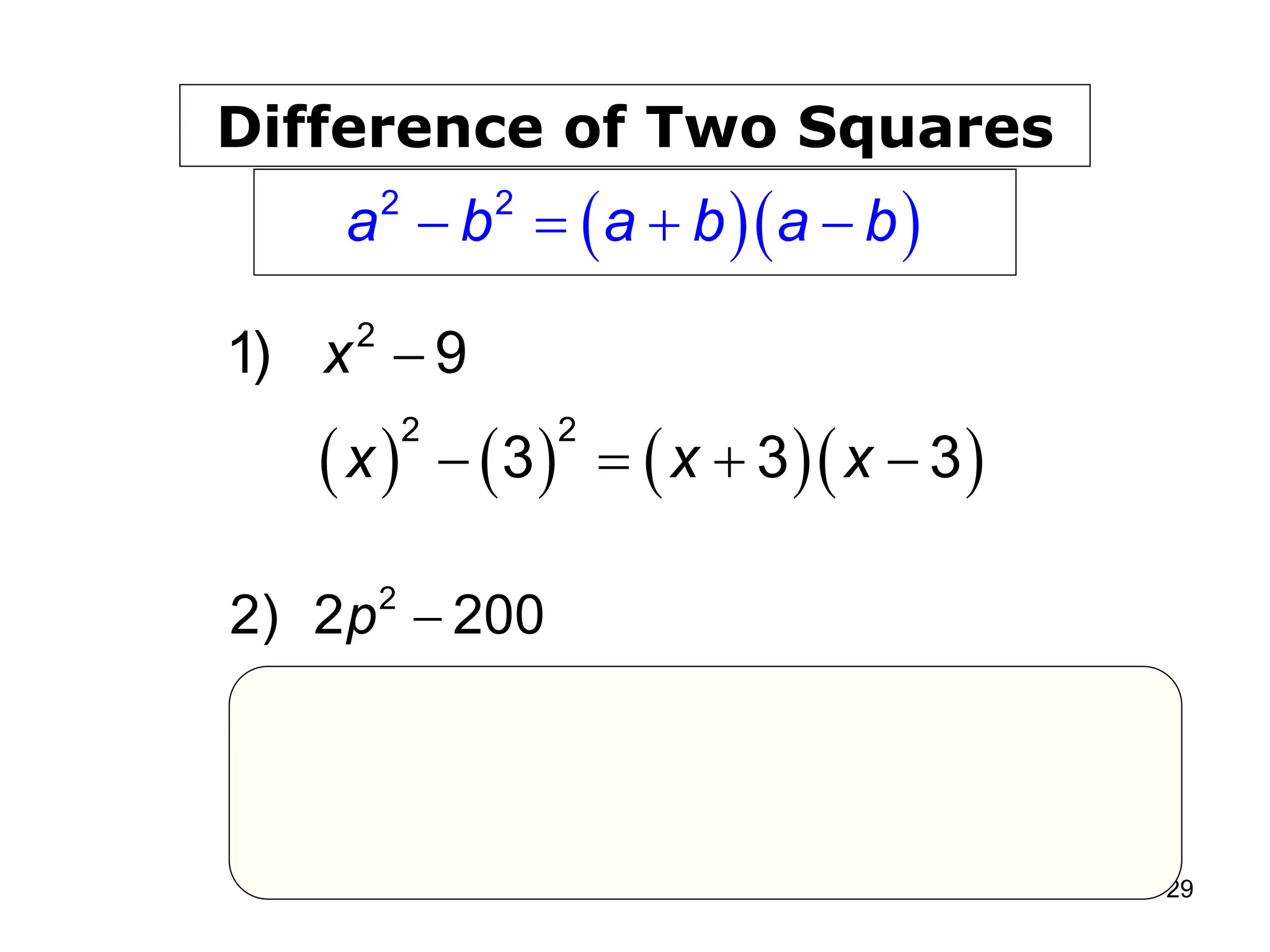
Difference of Two Squares
  
2 2
a b a b a b
   
      
2
2 2
1) 9
3 3 3
x
x x x

   
      
2
2
2 2
2) 2 200
2 100
2 10 2 10 10
p
p
p p p

 

 
 
   
 
30
      
   
4
2 2
2 2 2
2
3) 81
9 9 9
9 3 3
x
x x x
x x x

   
  
 
2
2
2
2
54
4) 6
25
9
6
25
3 3 3
6 6
5 5 5
t
t
t t t

 

 
 
 
    
   
 
    
    
 
 
31
Sum and Difference of Two Cubes
  
  
3 3 2 2
3 3 2 2
a b a b a ab b
a b a b a ab b
    
    
32
 
   
  
  
3
3
3
3
3 2
3
2
2
1) 125
125
5
5 5 25
x
x
x
x x
a b a b a ab b
x

 
 
 
 
 
  
 

 
33
 
   
  
  
4 3
3 3
3 3
3 3 2
2 2
2
2) 16 128
16 8
16 2
16 2 2 4
a b a b
r rs
r
a ab
r s
r r s
r r s r rs s
b


 

 
 
 

  
34
 
   
  
  
3
3
3
3
3 2
3
2
2
3) 216
216
6
6 6 36
x
x
x
x x
a b a b a ab b
x

 
 
 
 
 
  
 

 
35
 
   
  
  
3 3 2
3 3
3 3
3 3
2
2
2
4) 64 8
8 8
8 2
8 2 4 2
a b a b a ab
m x n x
x m n
x m n
x m n m n
b
m n


 

 






 
36
What purpose does factoring
serve?
Factoring is an algebraic process which allows
us to solve quadratic equations pertaining to
real-world applications, such as remodeling a
kitchen or building a skyscraper.
We will cover the concept of solving quadratic
equations and then investigate some real-
world applications.
37
Solving Quadratic Equations
A quadratic equation is an equation
that can be written in standard
form
where a, b, and c represent real
numbers, and
2
0
ax bx c
  
0
a 
38
We will solve some quadratic equations
using factoring and the
Zero-Factor Property.
When the product of two real numbers is 0,
at least one of them is 0.
If a and b represent real numbers, and
if then a=0 or b=0
0
ab 
39
Solve Each Equation
  
1) 3 2 0
3 0 and 2 0
3 2
x x
x x
x x
  
   
 
 
2) 7 3 10 0
7 0 and 3 10 0
10
0
3
a a
a a
a a
  
   
  
40
 
  
2
2
3) 9 3 3 25
9 27 3 25
9 30 25 0
3 5 3 5 0
3 5 0
5
3
a a a
a a a
a a
a a
a
a
  
  
  
  
 

41
  
  
2
2
2
4) 8 3 30
3 8 24 30
5 24 30
5 6 0
2 3 0
2 0 and 3 0
2 3
n n
n n n
n n
n n
n n
n n
n n
   
    
   
  
  
   
   
42
 
  
3 2
2
5) 3 2 0
3 2 0
1 2 0
0, 1 0, and 2 0
0, 1, 2
x x x
x x x
x x x
x x x
x
  
  
  
    
  
 
  
3
2
6) 6 6 0
6 1 0
6 1 1 0
6 0, 1 0, 1 0
0, 1, 1
n n
n n
n n n
n n n
n
 
 
  
    
 
43
REAL-WORLD
APPLICATIONS
USING
QUADRATIC
EQUATIONS
44
45
46
The height h in feet reached by a dolphin t seconds after
breaking the surface of the water is given by h
How long will it take the dolphin to jump out of the water
and touch the trainer’s hand?
2
16 32
t t
  
47
From the top of the building a ball is thrown straight up with
an initial velocity of 32 feet per second. The equation below
gives the height s of the ball t seconds after thrown. Find the
maximum height reached by the ball and the time it takes for
the ball to hit the ground.
2
16 32 48
s t t
   

Cacaomplete Factoring Rules for grade 10 .pptx

  • 1.
  • 2.
    2 *GCF( Greatest CommonFactor) – First Rule 4 TERMS Grouping 3 TERMS Perfect Square Trinomial AC Method with Grouping 2 TERMS Difference Of Two Squares Sum or Difference Of Two Cubes 2 2 2 2 2 2 a 2ab b (a b) a 2ab b (a b)         2 2 a b (a b)(a b)     3 3 2 2 3 3 2 2 a b (a b)(a ab b ) a b (a b)(a ab b )          
  • 3.
    3 GCF Greatest Common Factor FirstRule to Always Check       3 2 2 1) 3 3 3 y y y y y y y          3 2 2 2 2 2) 8 16 8 2 2 8 8 a a a a a a a     
  • 4.
    4     32 3 3 2 3 3 2 3 4) 12 16 48 3 4 1 4 4 2 3 4 4 12 4 p p t t p p t t p p t t                    2 3) 2 2 2 a ab a ax b a a ax b a x a      
  • 5.
    5     22 2 2 2 5) 4 2 4 2 2 2 2 2 a b c d a b c d a b c d              2 2 2 2 2 2 1 1 3 3 1 1 6) 3 3 1 3 R h r h R r R h h h r                          
  • 6.
    6       7) 3 3 4 4 4 x x x x x             8) 2 7 2 1 1 1 7 y y y y y                      2 9) 1 1 a b a b a a b a b a b a b a b b a b                 
  • 7.
    7 4 TERMS -Grouping          2 1 2 1 2 ) 2 2 [ 2 2 2 ]                 Group Group GCF GCF GCF x y a x y ax ay x y x y x y x y x a y a a a
  • 8.
    8         2 3 2 3 16 2 2 1 2 2 2 2) 2 4 32 64 2 [ 2 16 32] 2 2 2 2 2 16 16                 Group Group GC x F GCF GCF x x z x z xz z z x x x z x x x z x x
  • 9.
    9 3 TERMS 1) PerfectSquare Trinomials 2) AC Method With Grouping We will explore factoring trinomials using the ac method with grouping next and come back to Perfect Square Trinomials later.
  • 10.
  • 11.
    11 4 3 2 614 40 y y y   2 2 2 2 [ 7 0 2 2 2 3 2 ] y y y y y      The first rule of factoring is to factor out the Greatest Common Factor (GCF). Factor the trinomial completely.
  • 12.
    12 Stop! Check thatyou have factored the (GCF) correctly by distributing it back through the remaining polynomial to obtain the original trinomial. 2 2 [3 20] 2 7   y y y 2 2 2 2 [ 7 0 2 2 2 3 2 ] y y y y y      4 3 2 6 14 40 y y y  
  • 13.
    13 2 ax c bx   Tofactor , we must find two integers whose product is -60 and whose sum is 7. To factor , we must find two integers whose product is ac and whose sum is b. After factoring out the (GCF), the remaining polynomial is of the form 4 3 2 6 14 40 y y y   2 2 3 20 [ ] 2 7 y y y   2 ax c bx   2 7 3 20 y y  
  • 14.
    14 Key number 60    60 12 12 ( 5) 5 7       FACTORS OF 60  SUM OF FACTORS OF 60  2 2 3 20 [ ] 2 7 y y y   1( 60) 60 1 ( 60) 59 2( 30) 60 2 ( 30) 28 3( 20) 60 3 ( 20) 17 4( 15) 60 4 ( 15) 11 5( 12) 60 5 ( 12) 7                                   
  • 15.
    15 ac = b= 7 Replace b = 7 in our original expression with b = 12 + (-5). 7  0] 2 y  12  y 5  0] 2 y  60  2 2 3 20 [ ] 2 7 y y y     60 12 12 ( 5) 5 7       2 2 2 [3 y y 2 2 2 [3 y y
  • 16.
    16 FINISH FACTORING BYGROUPING 2 2 3 20 [ ] 2 7 y y y   2 3 2 Group 1 Group 2 G 5 CF GCF 2 0 12 5 ] 3 [ 2 y y y y y     2 3 GCF C 5 G F [ ( 4) ( 4 5 )] 2 3 y y y y y    
  • 17.
    17 2 2 ( 4)(35) y y y   FACTORED COMPLETELY 4 3 2 6 14 40 y y y   2 2 3 20 [ ] 2 7 y y y   GC 2 F ( 4) 2 [ ( 4) ( 5 ] 3 4) y y y y y     2 3 2 Group 1 Group 2 G 5 CF GCF 2 0 12 5 ] 3 [ 2 y y y y y    
  • 18.
    18 Practice Problems 2 2 2 2 2 22 2 1) 12 4 16 2) 6 29 28 3) 8 30 18 4) 3 10 8 5) 10 7 12 6) 6 3 18               a a a ab b x x h h m mn n y y
  • 19.
    19 SUM OF FACTORSOF GCF FACTORS OF KEY # 2 1) 12 4 16   a a
  • 20.
    20 SUM OF FACTORSOF GCF FACTORS OF KEY # 2 2 2) 6 29 28   a ab b
  • 21.
    21 SUM OF FACTORSOF GCF FACTORS OF KEY # 2 3) 8 30 18 x x  
  • 22.
    22 SUM OF FACTORSOF GCF FACTORS OF KEY # 2 4) 3 10 8    h h
  • 23.
    23 SUM OF FACTORSOF GCF FACTORS OF KEY # 2 2 5) 10 7 12   m mn n
  • 24.
    24 SUM OF FACTORSOF GCF FACTORS OF KEY # 2 6) 6 3 18 y y   
  • 25.
    25 Answers To PracticeProblems 1) 4(3 4)( 1) 2) (3 4 )(2 7 ) 3) 2(4 3)( 3) 4) 1(3 2)( 4) 5) (5 4 )(2 3 ) 6) 3(2 3)( 2)               a a a b a b x x h h m n m n y y
  • 26.
    26 Perfect Square Trinomials       2 2 2 2 2 2 2 2 1) 25 70 49 5 2 5 7 7 5 7 2 b a m mn n m a ab m n n m b a n b                          2 2 2 2 2 2 2 2 a ab b a b a ab b a b        
  • 27.
    27       4 3 2 2 2 2 2 2 2 2 2 2 2 2) 4 20 25 4 20 25 2 2 2 5 2 5 2 5 a b a ab b a b x x x x x x x x x x x                                   
  • 28.
    28 2 TERMS 1) Differenceof Two Squares 2) Sum and Difference of Two Cubes
  • 29.
    29 Difference of TwoSquares    2 2 a b a b a b            2 2 2 1) 9 3 3 3 x x x x             2 2 2 2 2) 2 200 2 100 2 10 2 10 10 p p p p p              
  • 30.
    30           4 2 2 2 2 2 2 3) 81 9 9 9 9 3 3 x x x x x x x           2 2 2 2 54 4) 6 25 9 6 25 3 3 3 6 6 5 5 5 t t t t t                                   
  • 31.
    31 Sum and Differenceof Two Cubes       3 3 2 2 3 3 2 2 a b a b a ab b a b a b a ab b          
  • 32.
    32            3 3 3 3 3 2 3 2 2 1) 125 125 5 5 5 25 x x x x x a b a b a ab b x                   
  • 33.
    33            4 3 3 3 3 3 3 3 2 2 2 2 2) 16 128 16 8 16 2 16 2 2 4 a b a b r rs r a ab r s r r s r r s r rs s b               
  • 34.
    34            3 3 3 3 3 2 3 2 2 3) 216 216 6 6 6 36 x x x x x a b a b a ab b x                   
  • 35.
    35            3 3 2 3 3 3 3 3 3 2 2 2 4) 64 8 8 8 8 2 8 2 4 2 a b a b a ab m x n x x m n x m n x m n m n b m n               
  • 36.
    36 What purpose doesfactoring serve? Factoring is an algebraic process which allows us to solve quadratic equations pertaining to real-world applications, such as remodeling a kitchen or building a skyscraper. We will cover the concept of solving quadratic equations and then investigate some real- world applications.
  • 37.
    37 Solving Quadratic Equations Aquadratic equation is an equation that can be written in standard form where a, b, and c represent real numbers, and 2 0 ax bx c    0 a 
  • 38.
    38 We will solvesome quadratic equations using factoring and the Zero-Factor Property. When the product of two real numbers is 0, at least one of them is 0. If a and b represent real numbers, and if then a=0 or b=0 0 ab 
  • 39.
    39 Solve Each Equation   1) 3 2 0 3 0 and 2 0 3 2 x x x x x x            2) 7 3 10 0 7 0 and 3 10 0 10 0 3 a a a a a a          
  • 40.
    40     2 2 3) 9 3 3 25 9 27 3 25 9 30 25 0 3 5 3 5 0 3 5 0 5 3 a a a a a a a a a a a a               
  • 41.
    41      2 2 2 4) 8 3 30 3 8 24 30 5 24 30 5 6 0 2 3 0 2 0 and 3 0 2 3 n n n n n n n n n n n n n n n                           
  • 42.
    42     3 2 2 5) 3 2 0 3 2 0 1 2 0 0, 1 0, and 2 0 0, 1, 2 x x x x x x x x x x x x x                       3 2 6) 6 6 0 6 1 0 6 1 1 0 6 0, 1 0, 1 0 0, 1, 1 n n n n n n n n n n n              
  • 43.
  • 44.
  • 45.
  • 46.
    46 The height hin feet reached by a dolphin t seconds after breaking the surface of the water is given by h How long will it take the dolphin to jump out of the water and touch the trainer’s hand? 2 16 32 t t   
  • 47.
    47 From the topof the building a ball is thrown straight up with an initial velocity of 32 feet per second. The equation below gives the height s of the ball t seconds after thrown. Find the maximum height reached by the ball and the time it takes for the ball to hit the ground. 2 16 32 48 s t t    