CA12
Assessing Online Courses
Howard University
April 2013
Workshop Objectives
Upon completing this workshop, you will be able to do
the following:
1. Explain how the assessment of online courses differs
from that of face-to-face courses.
2. List the benefits of assessing online courses.
3. Access an online course on Blackboard.
4. Assess the design of an online course, using the
Quality Matters rubric.
5. Assess course delivery in an online course.
6. Introduce colleagues to CETLA’s resources for online
teaching.
Definitions • F2F (face-to-face)
• Hybrid* (30-79% online)
• DL (80-100% online)
• Online (Hybrid* and DL)
• How many of you have
taught an online course?
• How many of you have
taught with Blackboard?
*aka “Blended”
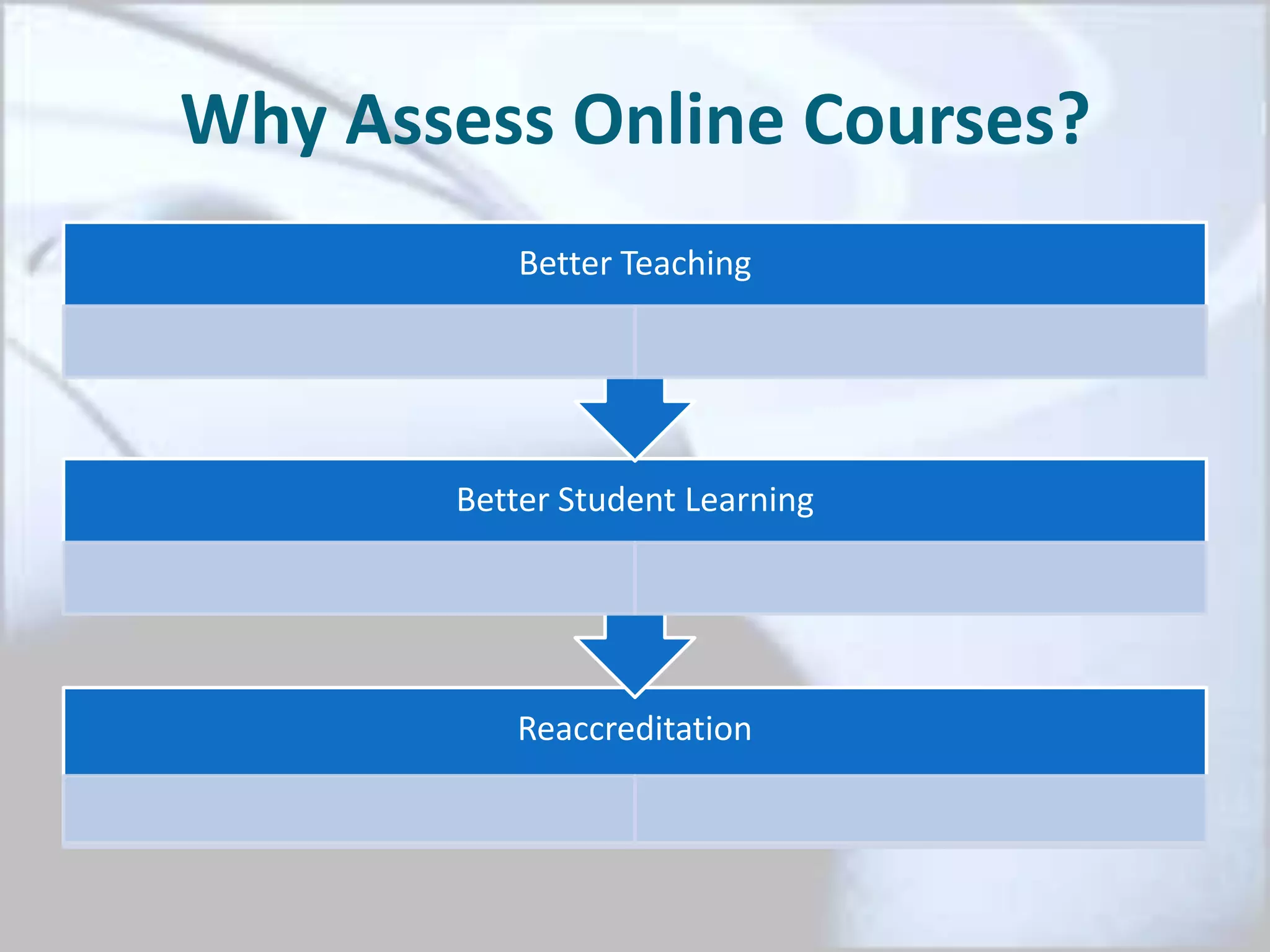
Why Assess Online Courses?
Reaccreditation
Better Student Learning
Better Teaching
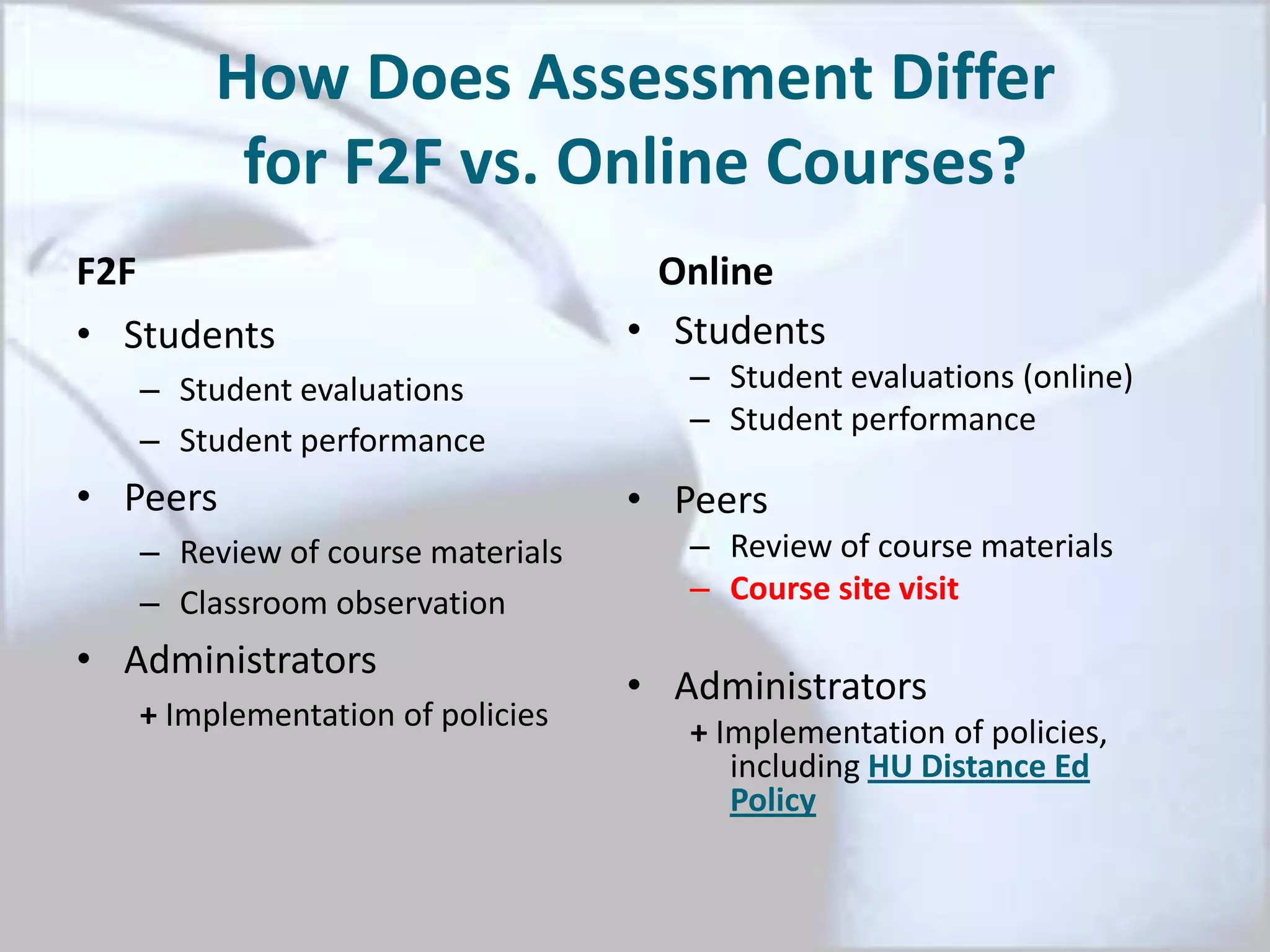
How Does Assessment Differ
for F2F vs. Online Courses?
F2F
• Students
– Student evaluations
– Student performance
• Peers
– Review of course materials
– Classroom observation
• Administrators
+ Implementation of policies
Online
• Students
– Student evaluations (online)
– Student performance
• Peers
– Review of course materials
– Course site visit
• Administrators
+ Implementation of policies,
including HU Distance Ed
Policy
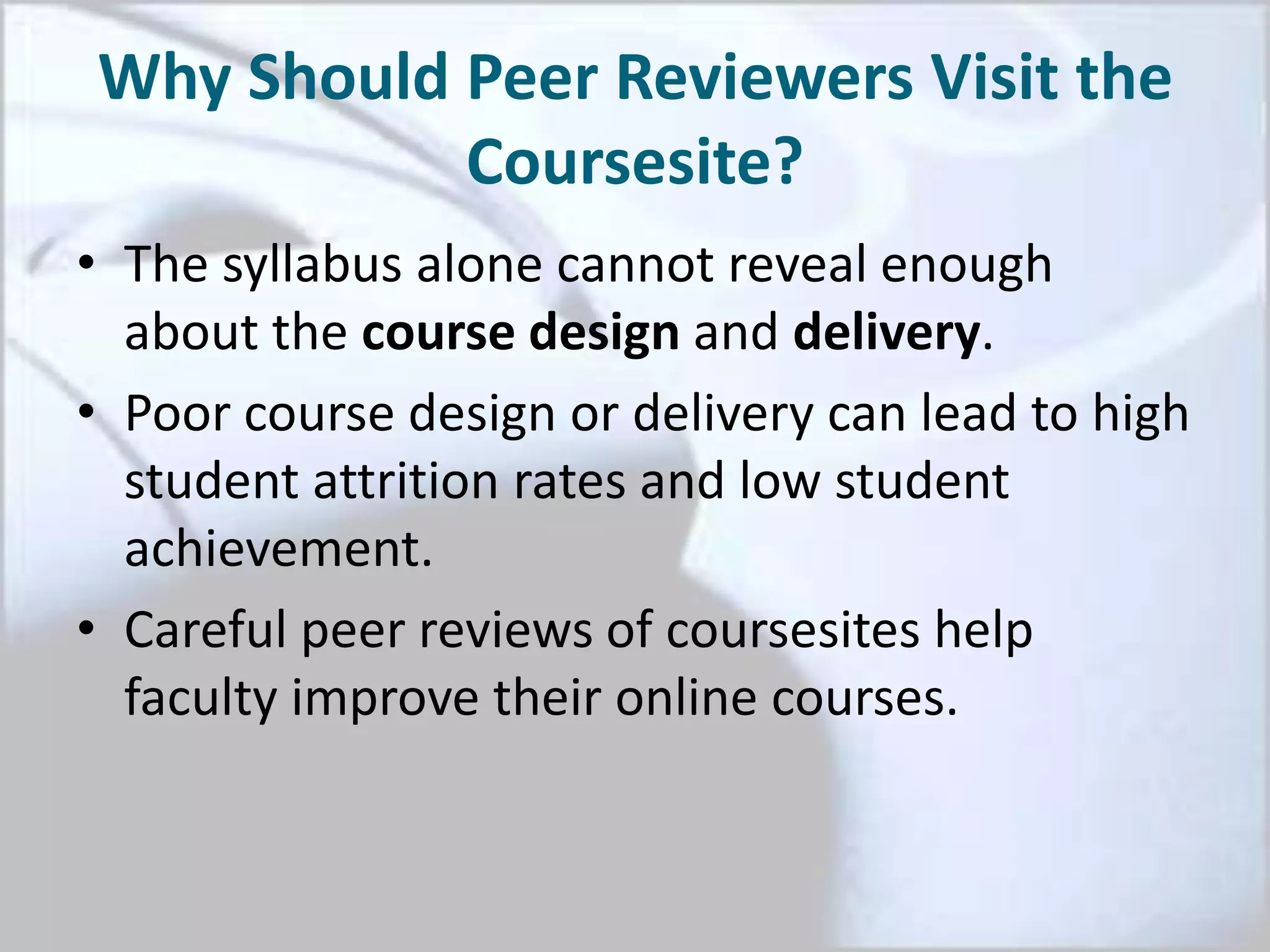
Why Should Peer Reviewers Visit the
Coursesite?
• The syllabus alone cannot reveal enough
about the course design and delivery.
• Poor course design or delivery can lead to high
student attrition rates and low student
achievement.
• Careful peer reviews of coursesites help
faculty improve their online courses.
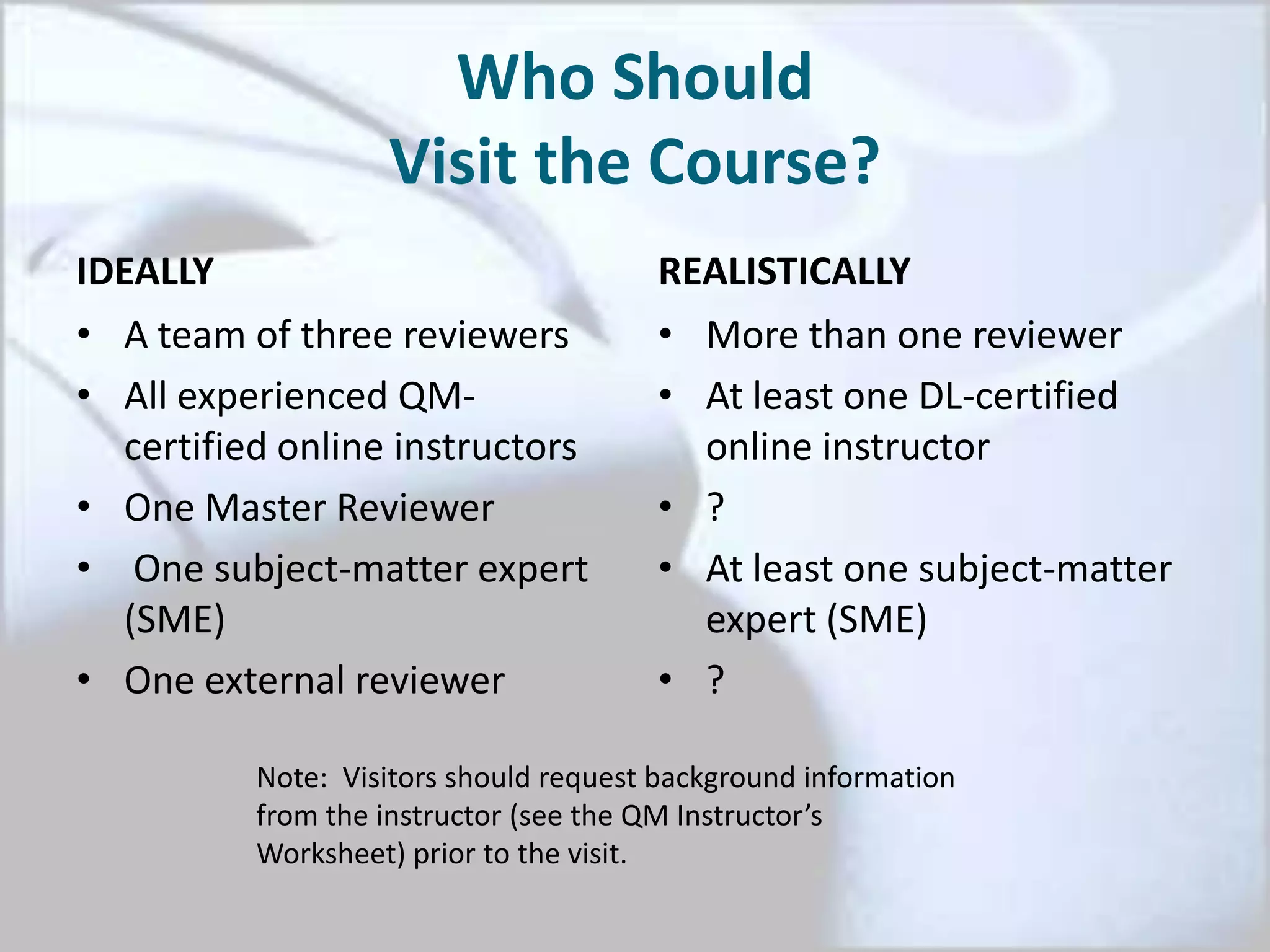
Who Should
Visit the Course?
IDEALLY
• A team of three reviewers
• All experienced QM-
certified online instructors
• One Master Reviewer
• One subject-matter expert
(SME)
• One external reviewer
REALISTICALLY
• More than one reviewer
• At least one DL-certified
online instructor
• ?
• At least one subject-matter
expert (SME)
• ?
Note: Visitors should request background information
from the instructor (see the QM Instructor’s
Worksheet) prior to the visit.
How Can You
Visit a Course?
• Ask the instructor to add you as
a student.
• Ask the instructor to make all
assignments and tests
available—password-protected
if necessary.
• Log into
http://howard.blackboard.com.
• If you can’t log in, contact one
of ISAS’s Blackboard System
Administrators: Umesh Giri
(ugiri@howard.edu , 6-2834) or
Konya Hurt
(khurt@howard.edu , 6-2940).
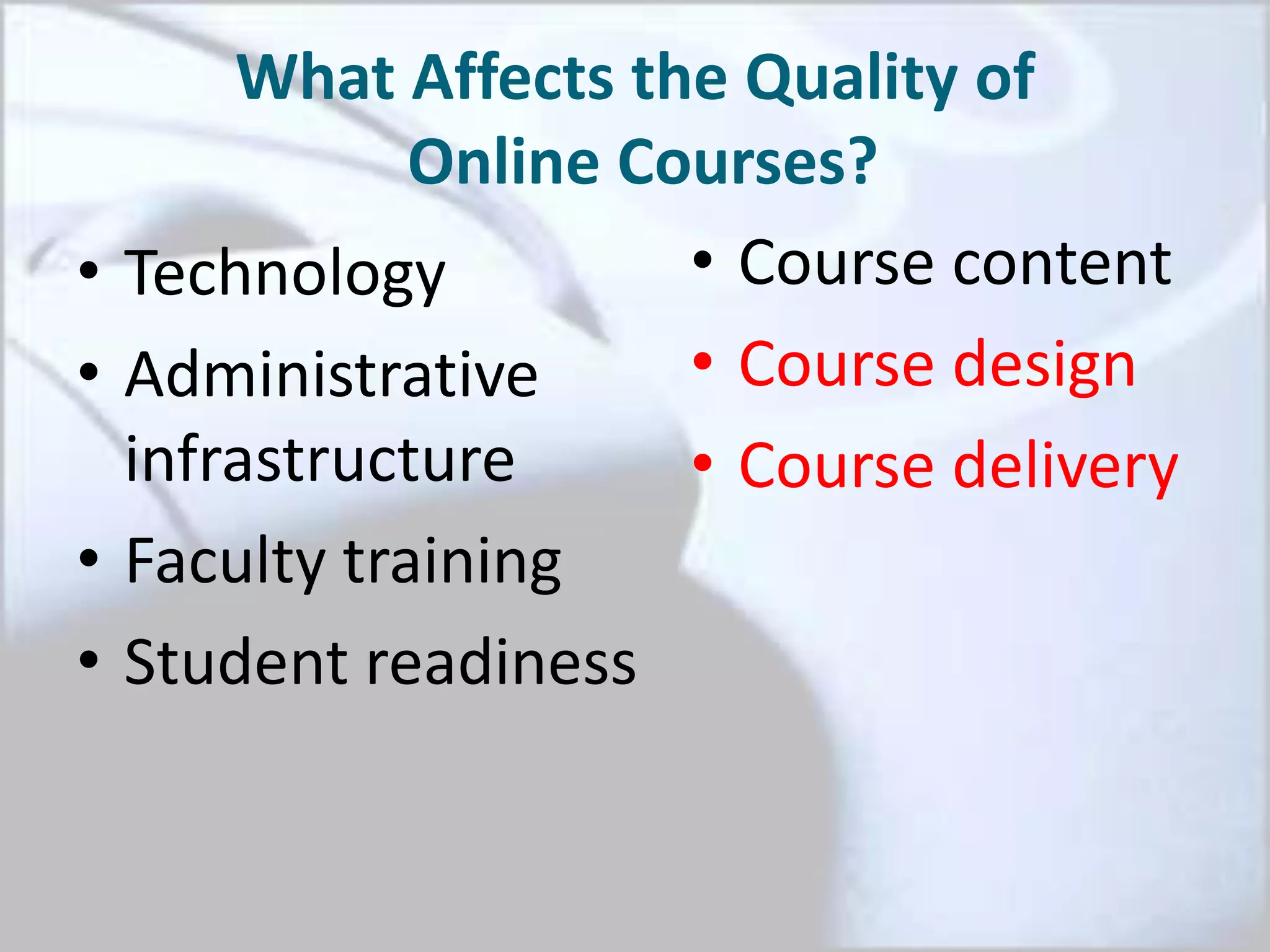
What Affects the Quality of
Online Courses?
• Technology
• Administrative
infrastructure
• Faculty training
• Student readiness
• Course content
• Course design
• Course delivery
Why Is Assessing Course Design So
Important in an Online Course?
“When learners can’t find what they need or are
confused about where to go and what to do, it is
harder for them to learn. Being an online learner
is challenging enough without these additional
barriers. Plus, frustrated learners tend to either
drop out or drive the instructor crazy….”
Patti Shank
Watch this video: http://www.youtube.com/watch?v=OG9fnbqmdxA
How Can You Assess Course Design?
Use the Quality Matters (QM) rubric!
• Based on research, best practices, and instructional
design principles
• Aligned with national standards (e.g., Sloan
Consortium Pillars)
• Aligned with accreditation standards for distance-
learning (e.g., Middle States)
• Consistent with HU Provost’s syllabus guidelines
What Is the QM Rubric?
Rubric Standards
Annotated Rubric
How Do You Rate a Course?
• If 2-3 reviewers agree that a course meets a
standard, award full points.
• If 2-3 reviewers agree that a course does not
meet a standard, do not award any points.
• A course must meet all 3-point standards.
• The instructor may make minor changes during
the review.
• An effective course will earn 72 of the 85 points
(85%).
Standard 1.1 “Instructions make clear how to get
started and where to find various course components.”
1point
2points
3points
0% 0%0%
1. 1 point
2. 2 points
3. 3 points
Standard 5.2 “Learning activities provide opportunities
for interaction that support active learning.”
1point
2points
3points
0% 0%0%
1. 1 point
2. 2 points
3. 3 points
Standard 6.3 “Navigation throughout the online
components of the course is logical, consistent, and
efficient.”
1point
2points
3points
0% 0%0%
1. 1 point
2. 2 points
3. 3 points
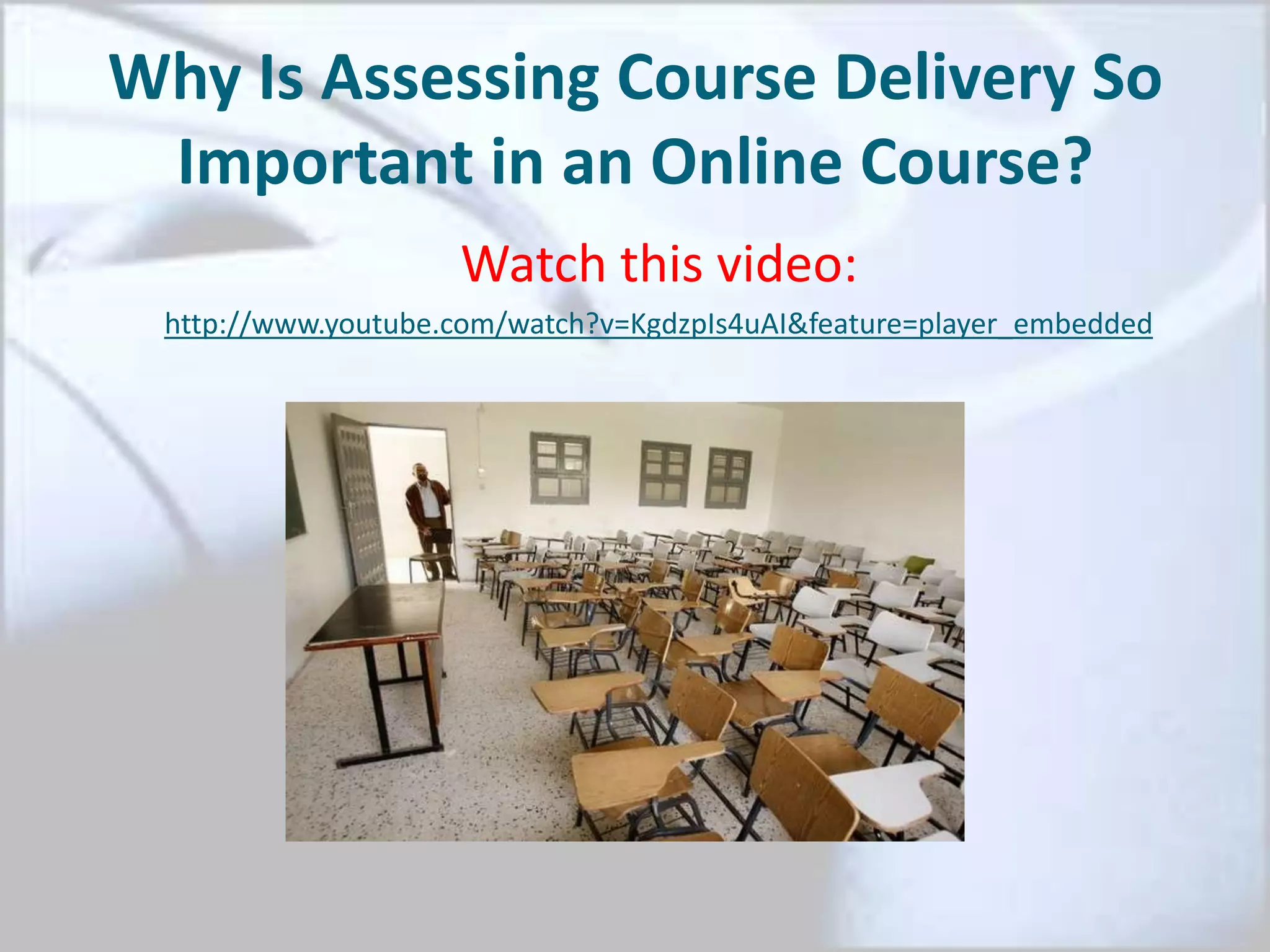
Why Is Assessing Course Delivery So
Important in an Online Course?
Watch this video:
http://www.youtube.com/watch?v=KgdzpIs4uAI&feature=player_embedded
How Can You Assess Course Delivery?
• Ask the instructor to generate two Blackboard
course reports:
– “Overall Summary of User Activity” for all
students
– “Overall Summary of User Activity” for the
instructor
• Visit the coursesite.
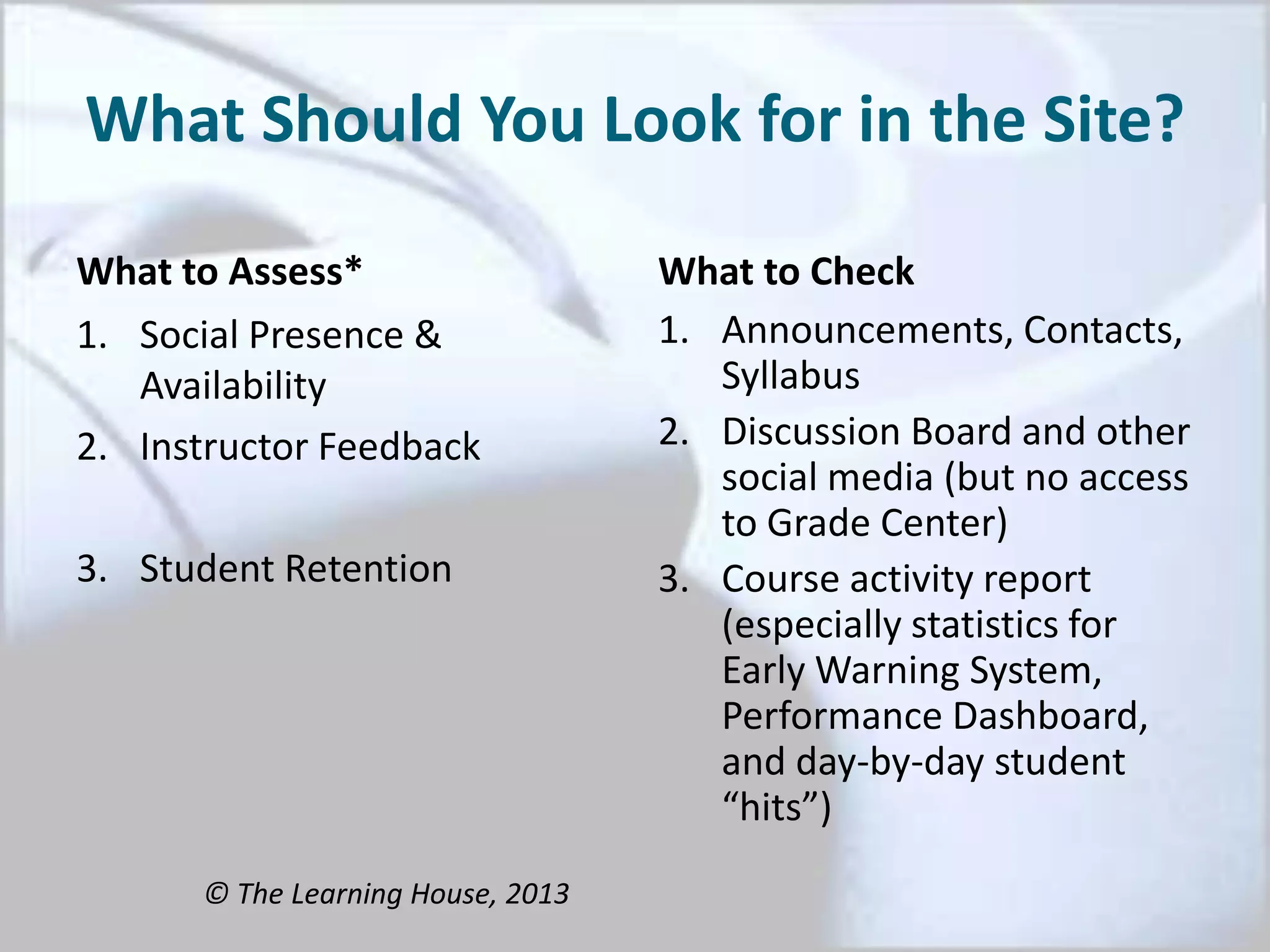
What Should You Look for in the Site?
What to Assess*
1. Social Presence &
Availability
2. Instructor Feedback
3. Student Retention
What to Check
1. Announcements, Contacts,
Syllabus
2. Discussion Board and other
social media (but no access
to Grade Center)
3. Course activity report
(especially statistics for
Early Warning System,
Performance Dashboard,
and day-by-day student
“hits”)
© The Learning House, 2013
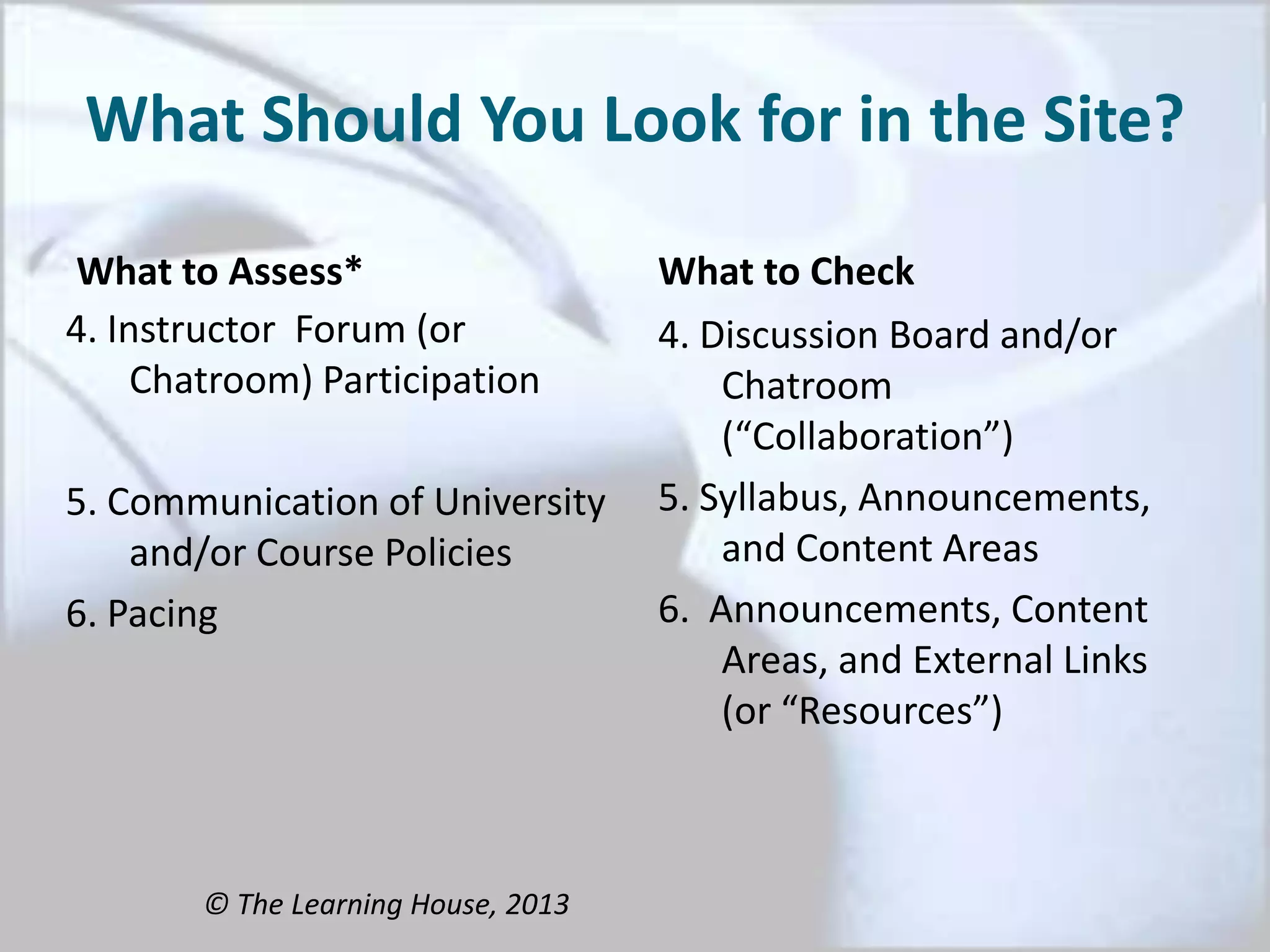
What Should You Look for in the Site?
What to Assess*
4. Instructor Forum (or
Chatroom) Participation
5. Communication of University
and/or Course Policies
6. Pacing
What to Check
4. Discussion Board and/or
Chatroom
(“Collaboration”)
5. Syllabus, Announcements,
and Content Areas
6. Announcements, Content
Areas, and External Links
(or “Resources”)
© The Learning House, 2013
What DL resources does CETLA offer?
• Faculty can upload CETLA’s template to facilitate
course development and assessment.
• Faculty can earn Blackboard certification via
seven workshops, one three-day seminar, a
previous certificate, or a demo.
• Faculty can earn DL certification via a 5-day
online seminar, a certificate, or a demo.
• Faculty can find other resources on CETLA’s
Distance-Learning Resource webpage.

CA12 Assessing Online Courses (Updated)

  • 1.
  • 2.
    Workshop Objectives Upon completingthis workshop, you will be able to do the following: 1. Explain how the assessment of online courses differs from that of face-to-face courses. 2. List the benefits of assessing online courses. 3. Access an online course on Blackboard. 4. Assess the design of an online course, using the Quality Matters rubric. 5. Assess course delivery in an online course. 6. Introduce colleagues to CETLA’s resources for online teaching.
  • 3.
    Definitions • F2F(face-to-face) • Hybrid* (30-79% online) • DL (80-100% online) • Online (Hybrid* and DL) • How many of you have taught an online course? • How many of you have taught with Blackboard? *aka “Blended”
  • 4.
    Why Assess OnlineCourses? Reaccreditation Better Student Learning Better Teaching
  • 5.
    How Does AssessmentDiffer for F2F vs. Online Courses? F2F • Students – Student evaluations – Student performance • Peers – Review of course materials – Classroom observation • Administrators + Implementation of policies Online • Students – Student evaluations (online) – Student performance • Peers – Review of course materials – Course site visit • Administrators + Implementation of policies, including HU Distance Ed Policy
  • 6.
    Why Should PeerReviewers Visit the Coursesite? • The syllabus alone cannot reveal enough about the course design and delivery. • Poor course design or delivery can lead to high student attrition rates and low student achievement. • Careful peer reviews of coursesites help faculty improve their online courses.
  • 7.
    Who Should Visit theCourse? IDEALLY • A team of three reviewers • All experienced QM- certified online instructors • One Master Reviewer • One subject-matter expert (SME) • One external reviewer REALISTICALLY • More than one reviewer • At least one DL-certified online instructor • ? • At least one subject-matter expert (SME) • ? Note: Visitors should request background information from the instructor (see the QM Instructor’s Worksheet) prior to the visit.
  • 8.
    How Can You Visita Course? • Ask the instructor to add you as a student. • Ask the instructor to make all assignments and tests available—password-protected if necessary. • Log into http://howard.blackboard.com. • If you can’t log in, contact one of ISAS’s Blackboard System Administrators: Umesh Giri (ugiri@howard.edu , 6-2834) or Konya Hurt (khurt@howard.edu , 6-2940).
  • 9.
    What Affects theQuality of Online Courses? • Technology • Administrative infrastructure • Faculty training • Student readiness • Course content • Course design • Course delivery
  • 10.
    Why Is AssessingCourse Design So Important in an Online Course? “When learners can’t find what they need or are confused about where to go and what to do, it is harder for them to learn. Being an online learner is challenging enough without these additional barriers. Plus, frustrated learners tend to either drop out or drive the instructor crazy….” Patti Shank Watch this video: http://www.youtube.com/watch?v=OG9fnbqmdxA
  • 11.
    How Can YouAssess Course Design? Use the Quality Matters (QM) rubric! • Based on research, best practices, and instructional design principles • Aligned with national standards (e.g., Sloan Consortium Pillars) • Aligned with accreditation standards for distance- learning (e.g., Middle States) • Consistent with HU Provost’s syllabus guidelines
  • 12.
    What Is theQM Rubric? Rubric Standards Annotated Rubric
  • 13.
    How Do YouRate a Course? • If 2-3 reviewers agree that a course meets a standard, award full points. • If 2-3 reviewers agree that a course does not meet a standard, do not award any points. • A course must meet all 3-point standards. • The instructor may make minor changes during the review. • An effective course will earn 72 of the 85 points (85%).
  • 14.
    Standard 1.1 “Instructionsmake clear how to get started and where to find various course components.” 1point 2points 3points 0% 0%0% 1. 1 point 2. 2 points 3. 3 points
  • 15.
    Standard 5.2 “Learningactivities provide opportunities for interaction that support active learning.” 1point 2points 3points 0% 0%0% 1. 1 point 2. 2 points 3. 3 points
  • 16.
    Standard 6.3 “Navigationthroughout the online components of the course is logical, consistent, and efficient.” 1point 2points 3points 0% 0%0% 1. 1 point 2. 2 points 3. 3 points
  • 17.
    Why Is AssessingCourse Delivery So Important in an Online Course? Watch this video: http://www.youtube.com/watch?v=KgdzpIs4uAI&feature=player_embedded
  • 18.
    How Can YouAssess Course Delivery? • Ask the instructor to generate two Blackboard course reports: – “Overall Summary of User Activity” for all students – “Overall Summary of User Activity” for the instructor • Visit the coursesite.
  • 19.
    What Should YouLook for in the Site? What to Assess* 1. Social Presence & Availability 2. Instructor Feedback 3. Student Retention What to Check 1. Announcements, Contacts, Syllabus 2. Discussion Board and other social media (but no access to Grade Center) 3. Course activity report (especially statistics for Early Warning System, Performance Dashboard, and day-by-day student “hits”) © The Learning House, 2013
  • 20.
    What Should YouLook for in the Site? What to Assess* 4. Instructor Forum (or Chatroom) Participation 5. Communication of University and/or Course Policies 6. Pacing What to Check 4. Discussion Board and/or Chatroom (“Collaboration”) 5. Syllabus, Announcements, and Content Areas 6. Announcements, Content Areas, and External Links (or “Resources”) © The Learning House, 2013
  • 21.
    What DL resourcesdoes CETLA offer? • Faculty can upload CETLA’s template to facilitate course development and assessment. • Faculty can earn Blackboard certification via seven workshops, one three-day seminar, a previous certificate, or a demo. • Faculty can earn DL certification via a 5-day online seminar, a certificate, or a demo. • Faculty can find other resources on CETLA’s Distance-Learning Resource webpage.