BRINGING TATA CHEMICALS‘
PEOPLE TOGETHER
ISSUE 9 | 2015
‘30s
Hello Singapore!
Meet the team building
Tata Chemicals International
Feeding the troops
Tata Chemicals is feeding
India at home, on holiday,
and at work
IT’S ALL ABOUT
THE PEOPLE
BABRALA CELEBRATES
MILESTONE ANNIVERSARY
TURNING 20
SEVEN SHAFT SECURES
WYOMING’S FUTURE
BREATHING EASY
TCE PUTS EMPLOYEE
SAFETY ABOVE ALL ELSE
SAFETY FIRST
confluence 01
Editorial team
Alka Talwar
Sunanda Parekh
Zareer Gotla
MIke Bodnar
Caroline Opondo
John Christian
Mark Hannant
Munni Trivedi
Raj Aditya-Chaudhuri
Anita Sarkar
Sweta Thakkar
Vini Avlani
Photographs
Larry Brown
John Almgren
Design
Himanshu Lakhwani
Shruti Nandu
Produced in association with
magenta
(www.teammagenta.com)
Confluence is printed on
Cocoon Silk
All matter in Confluence is under
copyright and may not be
reproduced without permission.
When you have finished
with this magazine
please recycle it
Contents JUNE 2015
01 Commence
	
02 Compass
Latest news from around
Tata Chemicals’world
04 Cover Story
The people that make it
all possible
12 Customer Profile
The most important
ingredient in every dish
14 Corporate
Vision 2020
18 Caretakers
‘Make’-ing it to the top
19 Champions
Boosting green 		
credentials
20 Colleagues
Ensuring Tata Chemicals’
is never‘court’off-guard
10
12
BRINGING TATA CHEMICALS‘
PEOPLE TOGETHER
ISSUE 9 | 2015
‘30s
HelloSingapore!
Meet the team building
Tata Chemicals International
Feedingthetroops
Tata Chemicals is feeding
India at home, on holiday,
and at work
IT’S ALL ABOUT
THE PEOPLE
BABRALA CELEBRATES
MILESTONE ANNIVERSARY
TURNING 20
SEVEN SHAFT HELPS
WYOMING BREATHE EASY
BREATHING EASY
TCE PUTS EMPLOYEE
SAFETY ABOVE ALL ELSE
SAFETY FIRST
Changing tack
Dear Colleagues,
We are embarking on a journey of growth. A journey that will
build on what we have already achieved over the last 75 years as a
company. This year, we launched LEAP - our Vision 2020.
Over the last year our teams and our board of directors have
worked together to articulate the journey going forward with the
end goal of tripling our market capitalisation by 2020. We have
identified a strategy that will help us achieve the targets we have
set for each of our businesses. Our task, collectively, is to execute
this strategy. To transform our company we have to change the
way we do things and I believe that biggest challenges and
changes will be in the area of culture and behaviour.
The new Transformation and Culture office headed by Ashvini
Hiran has been asked to identify areas where we as a company
need to build and change. Ashvini has spent time meeting and
interviewing colleagues in India to understand the various facets
of culture of the organisation. As a company we do certain things
quite well. To achieve our Vision 2020 we need to understand
what will get us there and to adopt behaviours that support our
future growth.
We have identified six of the most pressing themes that we
need to improve on. These are: high performance management,
reward and recognition, communication, collaboration, innovation,
and agility. The leadership team has pledged to be more respectful
of individuals, responsive when dealing with business issues, and
to encourage an environment where all employees can reach out
and flag problems when they encounter them.
We need to change things that are often at the root of the
problem. Addressing the root cause of the issue will help us make
meaningful and sustainable improvements and modifications.
The journey ahead will be a challenging one. It requires major
effort on our part to embrace behaviours and culture that are
critical for our long-term survival and growth. I am sure that we will
come out stronger as we LEAP forward.r mukundan
I
n Cheshire we’re enjoying the spring sunshine
and the promise of new growth that heralds.
Some of us are in training to undertake the
three peaks challenge in June. Participants climb
the highest mountains in England (Scafell Pike,
978m) Scotland (Ben Nevis, 1,344m) and Wales
(Snowdon, 1,085m) in 24 hours. It requires guts and
determination and we’re hoping to raise GBP6,000
for our nominated charity St Luke’s Hospice. As head
of Human Resources at TCE I’m working with my
colleagues to harness our people’s determination to
scale new peaks of business success too.
Underpinning that work is an understanding that
as a business we need to make the right products
and sell them at the right price. Ultimately the
success of this will come down to the people we
employ. We employ some great people. The role of
HR is to ensure that we employ those who want TCE
to succeed and that we develop a culture of success.
We need to attract, retain and develop high
calibre people. One of the ways in which we will
do that is by ensuring recruitment is robust. As part
of our talent strategy we are developing criteria
to identify the skills we need in our business. We
are using the Tata Leadership behaviours as a
mechanism to recruit for future success.
As part of our agenda to nurture our people we
are launching a new online learning management
system. This will initially be for all mandatory Health
and Safety training but we will add throughout
the year to include technical training as well
as development training. This means that all
employees will be able to access training on line.
We are also migrating our performance
management processes online and using
technology to enhance that activity. The goal is
to create the golden thread that links our strategy
to the cascade of objectives and the ongoing
development of our people. Our interventions
should ensure that our great people have the
skills and behaviours to drive improvements in the
quality of our products so that we can deliver the
commercial results.
HR is not just about processes and policies.
Making sure our people are engaged and
understand the objectives of the business is
important too. Employment patterns in the UK have
changed much in the past two decades.
No longer do employees work in just one or two
organisations during their working lives. Work is now
much more flexible and the pace of change and
innovation in the world is huge.
r nanda
LEAP is about what we learn on our journey
to our Vision 2020 and how these learnings
shape our next 75 years.
The Tata Group is changing. By 2025 the
group aims to touch the lives of 25 per
cent of the world’s communities. We at Tata
Chemicals have set ourselves the ambitious
target of transforming the way our business
functions over the next five years. We
have built a strong foundation with our
values over the years but we now need to
embrace a few new ones that will help us
to propel forward for the next 75 years.
LEAP is about the fundamental shifts we
need to make in the way we work. It is
about channelling our people’s energy
and passion into not only becoming
a more innovative, customer-centric,
results oriented organisation but also a
place where employees feel valued and
respected for the diversity they bring in.
We are quite enthusiastic about the
opportunities that is going to unfold in
front of us soon. Our cultural pillars and
our values should become the thread that
should connect everyone and everything
together. Now it’s time to set the ball rolling
– discover yourself and stretch out to attain
new heights in whatever you do.
Come, let us take this LEAP together.
Change is the one thing we can rely upon, which
some employees find easier than others. Helping
people manage and respond to change is also an
important aspect of our HR activity.
Engaging people in what this business is about
and what the long term goals are about is critical.
Improvements are underway. We have started
a new employee board for those colleagues
who want to get involved in learning about our
business and contributing to ideas. Each employee
representative is responsible for bringing items of
interest or queries to the forum and then ensuring
they communicate it back to their teams. We’ve
also introduced a new engagement project team
across the business to look at ways in which we can
improve engagement. We had our first meeting a
few weeks ago. This is to look at ways in which we
can increase involvement of employees and build
pride back into working for TCE.
This coupled with the great work we are
doing as a business to support the local community
through volunteering projects and fundraising is
starting to gain momentum in our business.
We really want to develop the fact that this is a
great place to work! In the meantime we have
mountains to climb.
LEAP to 2020
Getting in training
for the high peaks Karen Lounds
7
6
4
32
02 confluence | Compass Compass | confluence 03
TCNA miners breathe easier, Tata Innovista for Metahelix, 		 the Lion City welcomes Tata Chemicals, and Natrium House turns into a courtroom.
Tata Salt among top
10 Indian brands
Tata Salt has been featured in
Brandstand’s 10 Tankers, a list of the
top 10 Indian brands. “Desh ka namak”
(the country’s salt), the Tata Salt slogan,
says it all. An emotion-charged brand
statement, it positions Tata Salt as
a pro-India brand. “Tata is trust and
salt is food. Why would I trust anyone
else with my food?” asks one consumer.
Another declares: “ I will buy
Tata Salt even if it comes out of a
brown-paper
bag.” Among the
other brands in
Brandstand’s list
are Maggi, Amul,
Thums Up, and
Cadbury’s.
Meeting of Minds
CFOs, accountants and lawyers,
secretarial employees met in London
to chalk out a plan for the future of
the group.
From left to right: John Abbotts,
Ranjeev Lodha, Ron Achter, John
Mulhall, P K Ghose, Anup Guha,
Rajiv Chandan, Scott Ellis,
and Phil Davies
stepping stone
for global growth
Meet the four-members of Tata
Chemicals International Private Limited’s
team in Singapore and find out how they
are uniquely positioned to increase Tata
Chemicals’ global reach. John Mulhall and
his colleagues talk about the advantages of
being based in the Lion City as well as the
quirks of coordinating operations spread
over four continents.
Read more on page 14.
Mission Accomplished
McRae Richardson and his team recently
celebrated the completion of the Seven Shaft
project with a celebratory breakfast in Green
River, Wyoming. Started in 2013, the project
involved working with a variety of regulatory
and environmental stakeholders to minimise the
impact to the flora and fauna in the vicinity. This
is because among other features, Seven Shaft has
two fans, 11ft in diameter that will better ventilate
all current and planned mining operations at the
Green River facility. Initial noise-level test results
have been better than initially expected. Seven
Shaft will go through a comprehensive audit by a
variety of environmental stakeholders.
1
Global round-up...
5Better Life, Better Yield
Rallis India has launched Amplus, an innovative and
modern technology HYT™ based microbial bio product
that helps enhance soil fertility. It efficiently fixes
atmospheric nitrogen, sustains soil health by decomposing
plant residues, and stabilises the carbon:nitrogen ratio
of the soil. This improves soil texture, structure, and
water holding capacity. The unique and proprietary
manufacturing process of Amplus™ results in highly
stable microbes. This, in addition to enhancing soil
fertility, improves viability and shelf life of the product
line. Amplus™ will be delivered to growers in biological
crop input provider Agrinos’ India Star 2014 award
winning packaging.
Tata Innovista Award
for Metahelix
Metahelix Life Science’s project MC 13 has won this
year’s Tata Innovista award for Promising and New
Product Innovations. Its Project MC 13 is a path-breaking
hybrid seed that won in the ‘Bold Rice’ segment. Rallis
India, a Tata Chemicals subsidiary, has a majority stake
in Metahelix Life Sciences, a Bangalore-based seed
research company. More than 2,500 teams from 65 group
companies such as Tata Steel, Tata Consultancy Services,
Tata Motors, Jaguar Land Rover, Titan submitted their
innovative projects. The final round saw 78 projects
judged by a four-member jury for their innovation, social
relevance, environment conservation, and business
prospects. MC 13 was one of eight final winners.
Safety Over
Productivity
Tata Chemicals Europe found a very
unique way to drive home the importance
of health and safety measures in operations.
A mock trial, a video by the managing
director, and a safety amnesty got
employees talking about ways to improve
the TCE’s safety performance.
Read more on page 16.
They all have distinct identities nurtured and
built on over the years. This presents a significant
on-going challenge when it comes to standardising
processes and systems and the organisation will
have to keep at it. But behind the production
targets, equipment, and profit figures is a Tata
Chemicals employee driving progress. Despite
the differences in culture and technical abilities
this Tata Chemicals family member, whether
from Wyoming, Winnington, Magadi, Babrala
or Singapore, has more in common than might
be immediately apparent. In addition to core
values such as safety, passion, integrity, care, and
excellence (SPICE) that are core to operational
efficiency and sustainability, each geography’s
individual personality meshes together to form
a unique Tata Chemicals culture, much like
individual members of a big, very diverse family.
These differences were a significant
consideration for the
family members that married
in to the Tata Chemicals idea.
Wilson Tima, like a lot of his colleagues in
Magadi, Kenya, was concerned about this new
relationship when he visited India for a Lean Six
Sigma conference in 2010. This was his first visit
to the country after Tata Chemicals’ acquisition of
Brunner Mond and its assets in the UK and Kenya.
“We were uncertain about our future and about
the implications of how our unique Magadi work
culture was going to be affected,” says Wilson, a
long time Magadi employee who works in SHEQ
and Strategy Coordination. That was until he and
his colleagues visited Mithapur, the birthplace of
Tata Chemicals’ Indian operations.
Located on the very tip of the peninsula of the
western Indian state of Gujarat jutting out in to the
Arabian Sea, Wilson suddenly found that Mithapur
almost felt like home. “My colleagues from
Magadi and I were amazed at how similar Magadi
and Mithapur are. Same-same environment,
township, same-same operational challenges,
community expectations,” he remembers.
That meeting was an important step that set
the scene for how the various geographies of Tata
Chemicals’ rapidly growing family members
got on. Five years on Wilson reflects, “It helped
us realise that there we did not have to worry
about serious cultural differences when it came
to becoming part of Tata Chemicals. This trip
helped us realise that the values that underpin the
operations in India and the ones we work by in
Magadi are pretty much the same. Different at
times, but essentially same-same.”
John Christian, director of Human Resources
at Tata Chemicals North America (TCNA)
talks about the core human values that all Tata
Chemicals employees, irrespective of geography,
espouse. “We all want to do a good job, we want
to be rewarded for our hard-work, we all have
frustrations with our jobs and management, and
we all try to work to resolve them,” he says. “We all
have a lot of the same ideas, we just go about them
slightly differently.” Productivity in diversity.
For example, one common theme that emerged
from conversations with employees from almost
every geography is their taste for a good challenge.
Andrew Plant, Packaging and Despatch coordinator
at Tata Chemicals Europe’s (TCE) Middlewich plant
first came to the organization 22 years ago looking
for a work environment that would keep
challenging him. “I wanted something that would
keep me stimulated, somewhere I could make an
impact,” he says.
Joining in the 1990s Andrew found himself part
of a business struggling to modernize itself. His
challenge was to automate a bagging line-up that
was essentially still manual. The design engineer
who had previously worked for British Aerospace
called on his experience to architect a new line-
up to meet the bagging requirements of the food
industry. “This was an excellent opportunity not just
to modernize our set up at British Salt but to upgrade
our employees’ technical skills. This is exactly the
kind of challenge I was looking for. The end result
actually impacted the way we worked significantly
and knowing that I had been part of the solution was
a very satisfying feeling.”
Andrew feels that for him, and a lot of his
colleagues, working at TCE is not just about drawing
a salary. “We are here because we genuinely enjoy
this line of work and the challenges it presents,”
he says. Part of the challenge has been developing
new talent to ensure operational sustainability. “It
has been very satisfying to have played a part in the
development of colleagues who were just young lads
looking to make their way in the world. I cherish
the fact that I get a chance to pass on knowledge
and experience that I gathered during my time
here.” Andrew says. This is one of the main reasons
Andrew has never felt the urge to change jobs. “It is
still just as challenging and rewarding as when I first
started here.”
Andrew’s colleague Bhagwati Prasad works half
a world away in the rural parts of the eastern Indian
state of Bihar, but he too has a taste for coming
up with innovative solutions to challenges. When
the Sales and Marketing liaison for TCL’s Crop
Nutrition and Agri Business (CNAB) first noticed his
sales numbers were dipping, he took it upon himself
to figure out the problem. “I recognised there was a
problem and I knew I alone could fix it,” Bhagwati
says. “I tried to identify flaws in the way I operated
as well as my core strengths so that I could play
them to remedy the situation.”
Bhagwati comes from a farming family and
his education in agronomy means that he has a
solid understanding of what farmers in the Saharsa
district in the eastern Indian state of Bihar, his
core customer base, is looking for in their farming
products. He used his knowledge of the area to
segment the territory in to 20 markets and identified
the top two retailers in each of those segments.
“I conducted field visits and interacted with each
W
ith more than 5,500
employees working
operations spread over
all continents barring
one, Tata Chemicals
is now a truly global
enterprise. And as with companies that
have grown inorganically, TCL inherited
organisations some of which had been in
operation for more than a 100 years.
Wilson Tima
Diversity of people, cultures, and capabilities defines
the new Tata Chemicals. Raj Aditya-Chaudhuri speaks to
some of the members of this
Rainbow Family
retailer to gauge his reputation
in the market, his ability to
influence his customer base,
and whether his finances
were sound,” he says. Of
these shortlisted retailers
Bhagwati identified 18 that
had the makings of a Tata Kisan
Sansar (TKS) partner. TKS is a Tata
Chemicals initiative that works closely with retailers
and farmers to identify their needs and issues to
better address them. “The results were better than
I expected. By recognising TKS partners not only
have I managed to double sales, I have also managed
to position Tata Chemicals products and myself as
trusted members of the farming community here. It
pays to be diligent.”
The story behind the innovative products
Bhagwati’s customers use every day in fields around
India is as much a reflection of this determination
that defines Tata Chemicals employees wherever
they might be.
Debasis Roy works in Quality Assurance and
New Product Development at what used to be
Hindustan Lever and is now TCL’s Haldia division
in West Bengal. Despite having been in this line
of work at the same location for 26 years, it is this
determination to do better that keeps him excited
about coming in to work every morning. “That
passion to innovate to improve what we do is very
much part of the DNA of the 280 permanent staff
and 700 contracted employees here in
Haldia,” agrees Debasis’s
colleague Bhaskar Datta.
“We are always up for
a challenge.”
Debasis and his
team have recently
come up with a
new compound to
be used in fertilisers
produced by the CNAB
that is not only better suited
to the local farmers needs, it
is also a more profitable proposition for TCL. “We
used to manufacture, di-ammonium phosphate
(DAP), a compound that utilises a lot of imported
components,” he explains. “This meant that as the
price for the imported components went up every
year, it kept eating in to our profit margins for the
product.” To remedy this his team came up with
a new product called NP20:20. “It replaces the
components we needed to import and creates a new
product that will give us a cost advantage.”
Debasis thinks of this kind of innovation as
creativity that only comes from being passionate
about your work. “We have to contend with
government regulations, environmental issues,
and customer requirements,” he says. “But even
within that we can be creative and innovate with
our products. The processes and system that Tata
Chemicals has in place ensures transparency in the
way we work, and encourages improvements, both
personal and operational, as well as learning and
capability building,” Debasis says. “These values are
now ingrained in our work culture here and it is the
reason we excel at what we do.”
Cover story | confluence 07
“Innovation and creativity are
now ingrained in our work
culture in Haldia.”
Ashok Dubey would not be
interested in a job that keeps
him tied down to the same line
of work, even if the salary was
very attractive. The reason the
scientist who was brought on as
one of the founding members of
Tata Chemicals’ Innovation Centre,
continues to work here is the freedom
the job offers. Located in the western Indian city
of Pune, the Innovation Centre’s mandate is to help
TCL explore new business areas. “To be able to
innovate you need to have the freedom to explore
different ways to think about your subject. At the
Innovation Centre we have that kind of freedom
and that is why it is such a great place to work,”
Ashok says.
This creative freedom has resulted in a number
of innovative products such as the Tata Swach water
purifier. The Innovation Centre’s latest innovation
is a new natural sweetener made from prebiotic
elements found in unlikely sounding vegetables
such as asparagus and onions. Called fructo-oligo-
saccharides, this product will be marketed under the
Sustentials brand. “This natural sugar is food for
a number of ‘good’ bacteria present in the human
gut. These bacteria perform an array of beneficial
functions such as absorption of calcium to strengthen
our bones, improving our immunity, reducing the
tri-glycerides and blood sugar level,” he explains.
So thanks to Ashok and his colleagues cookies and
ice cream are now good for our body.
Each of the geographies also has its unique
definition of community. In communities such as
Magadi and Mithapur where employees work,
live in close quarters, the dynamics are very
different from geographies such as TCE where
employees feel bound together by a shared
history and sense of destiny.
In Magadi the sense of community and
familial congeniality is palpable. “We work and live
in close proximity so it almost feels like you are
working with your brothers and sisters. Wherever
you might be working in Magadi, we all know each
other,” says Wilson.
When employees get off work, they get together
and play football or socialise in the club on campus
where all permanent employees live.
“These are the same-same people
we work with, try to keep safe and
we are doing the same when we
are playing on their team on the
football pitch. So when I say we
truly care for each other you know
I mean it,” adds Ibrahim Kibutu,
mechanical maintenance officer
in charge of dredging equipment
at Magadi. “That warmth and
camaraderie is the first things visitors to
Magadi notice.”
A shade of this warmth is evident even in the busy
life in the corporate offices. Located in the crowded,
chaotic Mumbai suburb of Andheri, Tata Chemicals’
leafy and green Leela Business Park office is
like an oasis that houses the corporate ends
of the Chemicals and Consumer Products
business. This is where Preeti Sanghi came
to interview for her first job fresh out of
university. “I remember it was December
28, 2007,” she says. The employees at the
location were having a New Year’s party in
the office cafeteria. “Although neither I nor
the other 15 people interviewing for the position
had got the job yet, the employees went out of
their way to involve us in the celebrations as well.
I knew then that I wanted to be part of this kind of
work culture.”
So when she got the job working in the HR
department at the Babrala operation in
the northern Indian state of Uttar
Pradesh, Preeti decided to bring
that work culture to Babrala.
Employees’ work-life balance
became her top priority. “These
people work very hard and they
deserve to have the recreational
facilities to unwind after work. That is
key to a happy, productive workforce,” she
says. “We have state of the art recreational
and sporting facilities and we get employees
involved in a variety of cultural celebrations to build
team spirit.” Preeti prides herself and the operation
in Babrala for building work and living environment
that offers employees a good quality of life.
To Joseph Evans, operations coordinator at
British Salt, being part of a tight community means
always having your colleagues back. The 26 year
old has been working with TCE for four years. “I
quickly learnt that here we don’t wait
till one of us is really struggling
with something. At the first sign
of an issue we all chip in and try
to collectively find a solution.
Everyone at TCE is open to
sharing the knowledge that they
have gathered over decades of
Bhaskar Datta
Preeti
Sanghi
Ashok Dubey
Ibrahim Kibutu
Joseph Evans
Debasis Roy
Sweet Freedom
Getting work done in Green River
08 confluence | Cover story Cover story | confluence 09
Green River’s no-man left
behind culture makes for
a very congenial working
environment
After 27 years with Tata Chemicals, Sanjay
Choudhary has a lot to reflect on when
summing up the character of the company
that he has been such a significant part of the
75 years since its inception. His latest role is
that of joint managing director of Indo Maroc
Phosphore SA (IMACID), a joint venture between
Tata Chemicals, OCP Morocco, and Chambal
Fertilisers and Chemicals Limited (CFCL), India.
“I remember when I first joined Tata Chemicals
back in 1988. I used to work in the public sector
in India before that and this was a major shift for
me,”he says.“One of the things that fascinated
and inspired me was this desire to always be
the best at whatever we did. This organization
is not interested in coming in second. So the
organisation would not even pursue a new
direction or product unless it believed it had a
reasonable chance of becoming a market leader.”
He remembers the heady days of the
liberalisation of the Indian economy in the early
1990s and the move to redefine and reinvent
Tata Chemicals. The organization was looking in
to going in to the farm essentials sector to create
value for the farmers, a departure from its core
soda ash business.“Everyone was telling us this
was going to be difficult because the fertiliser
segment was highly regulated ,”he says.“But we
had strength of our convictions. We wanted to
be a self-reliant organisation that did what we
understood is good for the stakeholders and
did a very good job of it in building a urea plant,
which has set global benchmarks in reliability,
energy efficiency, safety and environmental
performance and was the first urea plant with
minimum imports of equipment and machinery.
And nothing was going to stop us.”
And Sanjay thinks that spirit of pushing the
boundaries in pursuit of excellence is still very
much part of the organisation.“To me this
company combines the security of an illustrious
past, the excitement of the present, and the
promising pictures of the future,”he says.“That
is what makes Tata Chemicals what it is, a great
place to work.”And finally it is all about LIFE.
experience working here,” he says. “As a newer
member of the team I have been given a fair share
of responsibility as well as support from every one
around me to ensure my success as an employee.
This makes for a positive working environment.
So even if we are under a lot of pressure, my team
and I keep it light. That sense of being part of a
larger, supportive team is very much part of the
work culture here.”
For Rick Couch, TCNA’s newish Procurement
Manager, it is the bond of a band that works
1,800ft underground in a 13-mile long mine.
“Even though I work with employees who have
been here for decades, within the first few months
I was already tight with the crew,” he says. He is
a member of the Wyoming Army National Guard
and was undergoing his annual mandatory training
at the time of the interview. He talks about a no-
man-left-behind culture at Green River, Wyoming.
“This is a small community. So you
will see the person you work
with in the mine at your local
supermarket and watering
hole. These are rugged, caring
people.” Just the kind you
would want on your side when
going in to battle.
This sense of community
extends outside the workplace as
well. In addition to partnering with charitable
organisations such as United
Way in North America
and floating others such as
Magadi Foundation and
Tata Chemicals Society for
Rural Development, Tata
Chemicals is always trying to
make its business initiatives more beneficial to
the larger community.
As senior manager of Human Resources
based in Mumbai, Verma had to contend with the
business challenge of high attrition in the front
sales force of the Consumer Product’s Business
(CPB). To deal with this, the organisation came
up with a novel solution that engaged a section
of the Indian workforce that the country’s recent
economic boom had left behind.
“Around 25 per cent or 32 mn people in India
are categorised as belonging to ‘scheduled castes’,”
he says. Typically members of this community
don’t have access to good education and
as a result often lack the basic skills to
get any kind of meaningful employment.
“Since the CPB is centred around
consumers and people, Amit and his
colleagues saw the opportunity to unleash
the potential of an entire section of society
and in doing so ensuring the sustainability
of the sales division. The Affirmative
Action plan the business came up with
addressed both these issues.
The plan involves training young
graduates in sales and marketing
techniques and helping them get jobs
through which they could contribute to
their communities. This initiative has
been rolled out in a number of Indian
states and provides batches of students
7 days of basic in-class sales training followed
by 7 days experience working with CPB sales
representatives. They are then interviewed for
various positions by TCL and other partner
organisations. “This is also making a significant
impact in increasing the diversity in our supply
chain,” says Vipul Sinha, regional Sales manager,
West II based in Ahmedabad, Gujarat. He is part
of the core CPB sales team that has championed
the initiative in their respective territories and
regions. The team also includes Santosh Chandran,
Himanshu Kumar, Arvind Tripathi, and Sushil
Bishnoi.. The team’s work has meant that the 125
students who have graduated from this program
have all secured sales related jobs they are now
well equipped to succeed at. A undred more are
currently undergoing training.
In addition to the immediate impact of providing
opportunities to gain valuable job skills, this
programme is changing mentalities and work
culture in the business. “That’s the whole point of
the Affirmative Action programme,” says Amit.
“People in the sales value chain are now sensitive
to these issues and this influences their hiring
decisions. Hopefully this means long-term changes
for the organisation as well as the communities we
work in.” The initiative was recently recognised as
a good practice by the Tata Group.
Dilip Choksi is a Tata Chemicals man. His
father was a Tata Chemicals
man and so was his older
brother. “Every one of us in
the family wanted to use our
education and skills to give
back to the community that
we live in,” says Dilip, the
administrator of Mithapur Hospital. “We have all
chosen to work with Tata Chemicals because that is
the best way to give back to the entire Okhamandal
district here in Gujarat.”
Located just a kilometre away from the
Mithapur plant, the 147-bed hospital is funded
by Tata Chemicals. Its 13 doctors and 32 nurses
cater to the 400,000 people living in the 42
villages in the area. The hospital not only offers
free healthcare to all TCL employees and their
dependents but charges other patients a token fee
of 20 rupees ($0.30) for a night’s stay. “In addition
to the medical costs, that includes all meals,”
explains Dilip. “This institution is
a true community asset and this
is why I choose to work here.”
Innovation has come from all
directions and has helped some
of the geographies weather
some of the uncertainty they have
faced over the years. Tata Chemicals
Europe has survived over 140 year
history by reinventing itself. “Innovation has
helped us survive and remain competitive.
That is a part of what we as a group of people
stand for,” says Pauline Yould, manager of Payroll
in the HR division at TCE. “That is a TCE trait.
This is because we as a group of employees have
a diverse range of experience. We have employees
who have been working here for the last 30 years
and others you have joined us more recently.
Between them we have enough experience,
expertise, and new ideas and perspectives to keep
reinventing ourselves.”
The organisation has had its ups and downs;
it has suffered from high energy costs in the UK
and has had to go through a painful restructuring
process in part to cope with that. To better manage
its energy costs TCE acquired a combined heat and
power plant that has been supplying the Northwich
plant since 2000. Controlling an issue that in the
past has exposed the viability of the operations
itself is testament to the organisation’s resilience
and ability to reinvent itself.
The result is a workplace that 140 years on still
manages to attract top talent in the Cheshire area.
“People here buy in to that history of excellence
and take it very seriously,” Pauline says. Another
reason TCE is an employer of choice because it
offers more than just a job. “A good number of the
400 employees at TCE have been working with
the organisation as long as they have is because of
this,” says Pauline. “Most of our top management
has risen through the ranks and our employees
know that with TCE they have a career direction.”
Jennifer Herman, Customer Service manager
at TCNA, prides herself on the service her
organisation has provided its customers. She
has been part of the organisation through its
downsizing phase that saw the number of corporate
employees weeded down from 200 to 30, closure
of the plant in Canada, salary freezes, a period of
stagnation where no money was invested in to the
business. But through it all she ensured that the
customer is always king. “The customer was king
when I started as a customer service representative
in what was General Chemicals back then and
what is TCNA now and everything it has been
in between,” she says. An uninterrupted delivery
of product is a key performance indicator that
she holds in high regard. “Whatever we were
experiencing as an organisation never affected our
customers supply of material. And we made sure
that supply remained flawless, seamless.”
Jennifer approaches her responsibilities like she
owns the business. “I take immense pride in my
career and the work I do. I know my customers
and I know the people they work with and their
families. There is a sense of community and we
look after our customers.” She recalls the incident
last winter when TCNA was experiencing some
delays in shipments going out as a result of trouble
with the railways. “A lot of these customers need a
steady supply of material to keep their operations
going. The fact that we couldn’t ship material to
them in time would have badly hampered their
ability to make their final product. Our guys took it
upon themselves to work over time that weekend
to ensure our customers wouldn’t feel the effects
of this breakdown in the supply chain. Some of
subcontractors even drove trucks full of product
all the way from Green River, Wyoming to our
customers operations in Pennsylvania.”
She does however appreciate some of the new
initiatives that have come with being part of the
Tata Group. “Learning the Tata Business Excellence
Model and introducing other initiatives such as
Six Sigma have helped the operations,” she says.
However this was one of the more challenging parts
of the initiation to Tata Chemicals.
John agrees. He feels that
initially it was tricky meshing
TCNA’s way of doing
things with Tata Chemicals’
processes and systems. “For
example we didn’t believe
in such initiatives because we
didn’t think it would affect the
bottom line,” he says. “We fought
these initiatives for a long time and we still struggle
with it. But we are starting to see their value now.”
Other changes were more welcome. “Before
Tata Chemicals we didn’t think beyond the day’s
production. That was what we as an organisation
were concerned with. We didn’t really have a
long-term perspective of our organisation,”
John adds. “This was a mind-shift for all
of us. All of a sudden we are told that we
as an organisation want to do the right
thing, we want to be sustainable, that is
often a difficult transition and we are still
coming to terms with it. Organisational
sustainability was one of the more important
things that we gained as a result of this marriage.
It permeates every aspect of the organisation – from
learning and development, something we had not
invested in in the past, to career development.
Now we have a plan in place for a sustainable
organisation that will be here for the next 50
or even a 100 years.”
According to maintenance
planner Billie Parks the TCNA
had lacked accountability and
ownership and this
was hampering
the business.
“Somewhere between being bought and sold every
few years and being part of organisations that didn’t
really care about what we did as a business, we
lost that sense of ownership in the work we did,”
says the 25 year veteran of the
organisation. “But recently
I have noticed that this is
becoming an area of focus
again. This is vital to
creating an organization
that excels at what
it does.”
As a workforce that
is always striving to do
better, naturally there are areas where
improvements can be made. “Each geography has its
distinct work culture and nuances and that is a good
thing,” says Steve McGuinness. Process technology
manager at Lostock in Cheshire. “But when Tata
Chemicals wants to identify and promote a range of
central themes that need to be rolled out globally,
that can be quite tricky. How do you consolidate all
that varied history and work culture and get them
to agree on a set of central themes that would meet
every geography’s developmental needs?”
Bibaswan Datta feels the organisation needs to
promote a more performance-driven work culture.
He is part of a two-man team charged with helping
articulate strategy for various business divisions.
“The organisation is a very inclusive one this often
means Tata Chemicals is slow to react to market
changes,” he says. “We are not as aggressive
when it comes to taking risk that could unlock
the organization’s real potential. We need to be
more performance driven and this is one
area of our work culture where we can
improve,” he says.
Culture is fluid especially in an
organisation such as Tata Chemicals
where member organisations are
still learning to work constructively
with each other. Culture is key to the
operation and the family will have to
reflect on itself to identify practices that
aren’t conducive to becoming more agile and goal-
oriented. This does not necessarily have to equal a
rejection of local practices and
practices that make each
member of this
family uniquely
interesting.
Past Perfect,
Future Continuous
Dilip Choksi
Jennifer Herman
Rick Couch
Billie Parks
L-R: R Nanda, Santosh Chandran,
Amit Verma and Alka Talwar
Bibaswan Datta
10 confluence | Customer profile
Tata Chemicals does not just make quality products. It touches the lives of tens of millions. From
the forces that guard India’s borders and prestigious holiday resorts whose reputation is tested
with every dish placed before a guest, to homes across India, a packet of Tata Chemicals product
bears testimony to quality consumer can trust every time. Anita Sarkar finds this a recurring theme
in conversations with chefs, housewives, military quartermaster, and retailers.
A Priceless ingredient
calledTrust
“Lentils is a staple. I insist on Tata i-Shakti
because I value my family’s health”
to have reliable basic assets in place. Sai Shankar,
the head of purchasing at Club Mahindra Holidays,
relies on Tata Chemicals to provide his operations
that kind of constancy. To him it is not just about
the quality of Tata i-Shakti lentils or Tata Salt.“We
also get a lot of help from Tata Chemicals to ensure
supplies are made available at the nearest resort
depot. Our resorts, some of which are in remote
locations, require weekly or fortnightly visits to
these depots to stock up on supply,”says Sai.
That seamless supply chain ensures Club
Mahindra Holidays can keep its 55 kitchens
operational, churning out delicious Indian and
pan-Asian dishes for its 9,000 guests every day.
“Each of our restaurants offers at least six dishes for
breakfast and at least ten options for both lunch
and dinner,”explains Sai. Club Mahindra Holidays
goes through 5,000 kilograms of lentils and salt
every month across its locations.“And we know
that every time one of our 100 chefs around the
country puts out any one of our many dishes,
it is going to be a quality product that we as an
organisation can be proud of. And that wouldn’t
be possible without a partner like Tata Chemicals
and its products.”
This trust in Tata Chemicals consumer products
is re-iterated in consumers’kitchens across India.
In Andheri, a bustling western suburb in Mumbai,
long-time Tata Chemicals’customer Archana
Khare considers herself the custodian of her
family’s health. On learning from her local grocer
or baniya that Tata Chemicals had launched a
variety of lentils in addition to her preferred Tata
Salt, Archana tested them herself.“My mother
had taught me how to wash rice and lentils,”says
the former science student.“They should not be
rubbed rigorously while washing otherwise a
powerhouse of nutrition gets lost.”Tata i-Shakti
lentils are not polished and preserve their
nutritional value, so they get Archana’s
approval. So strongly does Archana
feel about Tata i-Shakti lentils that
she persuaded her neighbours,
who were reluctant to try
something new, to switch to Tata
i-Shakti. She also tests the salt she
uses.“If it floats while I am cooking,
I abandon the dish. But that never
happens with Tata Salt,”she says. That’s
why she insists on using Tata Salt and
makes sure there’s always a packet in store. ”Can’t
take chances with my family’s health,”she says.
Tata Salt was the brand Shahriyar Atai turned
to when he was looking to re-invent his product
offering at Daily Bread-n-Foods, a bakery supplying
bread to schools, hospitals, and restaurants across
Mumbai. The baker who is also a singer, a dancer,
and an actor has enough on his plate to worry
about a component as basic yet important as salt.
“The recipes for my breads and rolls were inherited
from my father but I have updated them, putting
more value-added ingredients to suit today’s
health and nutrition-conscious consumers,”he
says. A talented chef, Shahriyar also dishes up Parsi
bhonu (traditional Parsi food) and uses
Tata i-Shakti lentils when making the classic Parsi
dish dhansak (a rice pulao made with different
lentils). Shahriyar puts his trust in Tata i-Shakti
lentils and Tata Salt.“Between‘me-n-u’everything
has to be of a high enough quality to go on the
menu,”he says.
With this kind of
reliance and trust in the
brand and its products, the
Tata Chemicals promise is tested every
time a consumer reaches for a pack of
i-Shakti lentils, besan (gram flour), or
Tata Salt. And for end consumers to
put their faith in Tata Chemicals, the
retailers have to first be convinced
of the quality of the products. They
really are the first customers who
must be convinced of the promise.
So when Tata i-Shakti lentils came
to market, Umesh Gudre tried it out
himself. The owner of Mahaganpati Stores in
Titwala, a small town in Maharashtra famous for
its temple to the Hindu deity Ganesh, only began
persuading his customers to buy Tata i-Shakti
products when he was satisfied about its quality
and nutritional value. It was much the same with
Satish Chaudhary who owns Suman Kirana stores
in Kalyan, a city near Mumbai.“I believed in the
nutritional value of Tata i-Shakti lentils and told
my customers about it. They were sceptical at
first because the lentils looked different, even
the colour was different. Based on my word they
decided to try them out once. And then they
came back a second time and now they insist on
only buying Tata i-Shakti lentils,”Suman says.
Recipes and usage change from customer to
customer. But Tata Chemicals remains the brand
of choice for a host of customers who rely on it
because in its products they get that ingredient
called trust that is as invaluable as it is priceless.
I
f you have attended India’s Republic Day parade
held in the national capital of New Delhi on
January 26, you will surely remember the Border
Security Force’s (BSF) colourful camel-mounted
band, the only one of its kind in the world
according to the Guinness Book of Records.
Their day-job is a far more critical one: they are
charged with securing India’s borders. Established
60 years ago as a paramilitary force, the BSF is the
world’s largest border-guarding force. It secures
the country’s vast and often difficult borders. In
peacetime it protects against insurgency and
acts of terrorism; in times of war it supports
frontline forces.
“The more you sweat during peace, the less you
bleed during war,”is the BSF’s motto. The 66th of
the 250 BSF battalions spread over India’s frontiers
is located in Siliguri in the eastern Indian state
of West Bengal in the foothills of the Himalayas.
It has a special link with Tata Chemicals. Tata
i-Shakti lentils and Tata Salt are essential rations for
the 1,200 soldiers or jawans stationed here says
Manoj Singh, the BSF’s deputy commandant and
quartermaster responsible for the 66th battalion’s
supplies in Siliguri. After careful comparison
with other products on the market, Manoj Singh
approached Tata Chemicals.“I put them through
the drill and was satisfied. Tata i-Shakti lentils have
no moisture content. They are unadulterated and
retain their nutrition because they are unpolished.
I wanted my men to get the real thing.”
That was the start of a close relationship.“Every
month Tata Chemicals supplies us the seven tons
of these essential products we need for our five
dining rooms. The jawans are happy with the tasty
and nutritious dals we serve which are like the
home-cooked meals they miss. My job is to keep
our jawans fighting fit and I can do that with the
help of reliable supplies of quality products from
Tata Chemicals,”says Manoj.
Reliability is just as essential to an operation
such as Club Mahindra Holidays, a leading
timeshare holiday company in India. With 42 luxury
resorts spread from Chandigarh in the northern
Indian state of Punjab to the tea estates of Munnar,
Kerala in the south, and from Jaisalmer in the
western desert state of Rajasthan to the foothills of
the Himalayas in Gangtok, Sikkim in the east, there
are many moving parts to a business that relies on
keeping its guests happy. The organisation needs
Shahriyar Atai
Archana Khare
Corporate | confluence 1312 confluence | Corporate
2
015 is a landmark year for Singapore.
The former British colony became fully
independent in August 1965 and this
marked the start of an unprecedented journey
of development that saw it move from third
world to first world status in a generation. Lee
Kwan Yew, the man credited as architect of this
transformation died this year. His death in March
marked an end of an era during which the
city-state achieved the top spot in the World
Bank’s ease of doing business rankings and
cemented its place as a regional hub for
multinational businesses.
In a handful of decades the Lion City, as its
sometime known, has become Asia’s preeminent
financial market. It has a mature regulatory
environment that encourages foreign investment
and all the world’s major financial institutions
are present, making Singapore an ideal destination
for fundraising.
For the past two years Singapore has been
home to Tata Chemicals International Private
Limited (TCPIL) formed as a holding company
for the group’s international assets: Tata
Chemicals North America, Tata Chemicals
Europe and Tata Chemicals Magadi.
Head of TCIPL’s four-person team in Singapore
is John Mulhall, a British finance professional,
who has been with the group since 2007 when
he joined what was then Brunner Mond shortly
after its acquisition by Tata Chemicals. In 2010
John moved to the US. He served for three years
as CFO of TCNA where among other things
he was responsible for implementing SAP and
refinancing the US business. Since 2013 he’s been
based in Singapore.
There office on Robinson Road is close to the
landmark Raffles Place in the heart of Singapore’s
Central Business District.
John explains the rationale for headquartering
the holding company in Singapore. “This
simplified the group structure and offers TCL
financing options in a well respected and
regulated market. It allows TCIPL to play a role
in minimising the group’s cost of capital – that
is bringing new savings to bear that couldn’t be
achieved simply through operational excellence
and better procurement. We have access to
working capital funding at attractive rates and can
leverage local financial instruments
including currency hedging, that lowers the
total cost of transactions for the group. With
transparent regulations on investment, taxes
and dividends a Singapore-registered holding
company creates competitive investment
opportunity for the group.”
John is adamant that lower taxes are only a
small part of the equation and being close to
customers in south Asia, particularly those who
buy soda ash from Magadi, contributes to growth.
Looking at new markets and local growth
opportunities make Varun Mehta a frequent
traveller who racks up the air miles as he moves
around the ASEAN region. Varun is a Tata
Administrative Services graduate who’s been with
Tata Chemicals for five years. He swapped the
mayhem of Mumbai for the order of Singapore
two years ago. The two cities couldn’t be more
different and together illustrate the diversity
of Asia. Varun is responsible for Business
Development and overseeing sales of soda ash
from Magadi in countries such as Thailand,
Indonesia, Philippines as well as the Middle
East and Pakistan. “We’re actively looking for
new markets for all our existing products across
the region and leveraging our position to reduce
procurement and transaction costs for the TCL
group” says Varun. He’s had to manage the
fallout from the mothballing of the premium soda
ash plant in Magadi. “Migrating customers to a
standard product has been achieved successfully
with competitively priced accounts, proactive
account management and customer engagement,”
he says.
The other two members of the quartet are
Singaporean. Tiffany Teo is finance manager
who’s been with the company for a year. She
began her career as a tax auditor and has had
stints with KPMG and Eon Realty. Derrick Kwan
Gao You is the newest member of the team.
He joined on 1st April and is in charge of trade
finance and trade operations for all shipping,
letters of credit and working capital financing.
“We’re not here just to move savings around
but rather to use the advantages that Singapore
gives us to reduce the overall cost of doing
business and take advantage of exchange
rate movements and better working capital
arrangements,” says Tiffany.
The size of the team means it’s a quiet office
and there are logistical considerations to being
located in south east Asia. John explains: “Given
the time difference (GMT+8) we get a couple of
quiet hours in the morning before other offices
start to come on stream. But if we want to
organise a group-wide call it either gets done at
6am or 10pm. It’s a function of being part of a
group with a broad international footprint.”
With so many big organisations basing their
regional headquarters in Singapore the market
for talent is competitive but says John the
Tata name has appeal and offers a competitive
advantage when recruiting. In total there are more
than 3500 Tata employees in Singapore. Tata
Communications and TCS all have significant
head counts here and that means people know
the name and understand the type of global
organisation we are part of. In terms of Tata
Chemicals our numbers may be small but
people know and understand that we are part of
something much bigger.
“One of the recent achievements was to
implement a large working capital facility with
no parental guarantee and a very competitive rate.
That’s a sign that we are on track to establish
ourselves as an independent self-sustaining
operation within Tata Chemicals,” he says.
Singapore’s emergence as a regional powerhouse has created a vibrant,
world-class city that invites investment and offers an array of business
benefits to those who base themselves there. Tata Chemicals has accepted
the invitation and is quietly building a presence in the heart of South East
Asia. Mark Hannant reports.
Clockwise from top left: Varun Mehta, Tiffany Teo,
John Mulhall, Derrick Kwan Gao
Singapore team sets
sights on regional ex-
Evolving to grow
A
company’s ability to reinvent itself
is crucial to its long-term success.
Companies that do manage this are
ahead of the curve; they show the way for others
in their industry to follow for years to come.
This is the kind of change Tata Chemicals’
leadership team had in mind when it met in
March 2014. The company was planning a
definitive shift in its business strategy. The
organisation, which is predominantly a producer
of bulk commodities, was making a strategic
shift towards a more consumer-facing model.
This meeting was to discuss how Tata Chemicals’
mission, vision, and values would enable it
to become a performance-driven, customer-
centric, and innovative organisation; this in turn
would drive the organisation’s overall business
realignment.
“Tata Chemicals has three verticals, chemicals,
farms essentials, and consumer products. Each
of these business verticals is unique in the way
it works,”says chief culture officer Ashvini Hiran.
“In order for them to focus on this new strategy
it was important for each vertical to have its own
set of focussed mission, vision, and values. While
we have defined these, it was essential to gauge
whether our people were ready for the shift to a
more consumer-facing model. It required a LEAP
in the way we think about our business to go to,
what I consider, is the next orbit.”
LEAP, an acronym for Lead, Engage, Aspire,
Perform, describes the culture and behaviour
that the organisation is encouraging to enable
this business strategy change. The company’s
Vision 2020 is to position Tata Chemicals as‘a
sustainable industrial chemicals, branded agri,
and consumer products’company with deep
Chief Culture Officer Ashvini Hiran immerses himself in Tata Chemical’s culture to find out how the
organisation needs to evolve to become a more performance-driven, agile enterprise.
customer insights and engaging relationships
with all stakeholders’. The goal is to triple market
capitalisation by 2020.
And this is why the Culture function at TCL
was conceived.“The HR department is like the
plumbing or hardware part while culture is the
water that flows inside the plumbing or the
software that runs on the hardware,”he says.
“Together it represents the cultural fabric of the
organisation. We needed to understand and
analyse this culture. We also wanted to gauge
our people’s understanding of the journey
we as a company are on and the role they see
themselves playing in its success.
To achieve this Ashvini set about meeting
with more than 500 members of the Tata
Chemicals family, across business divisions and
locations in India, over a five-month period. ”We
wanted to personally engage with our people in
small groups so that we could understand their
sentiments, their suggestions for improving
our culture,”Ashvini says.“It was heartening to
see the passion with which they talked about
the things that they thought could change
the organisation’s culture for the better.”The
discussions were open ended in order to not
limit their scope. Richard Lobo, a colleague from
Business Excellence, accompanied Ashvini on
this journey.
What emerged is a view of a work culture
that is open and an organisation where people
treat each other with respect, much like a family.
The organisational culture is informal and it
encourages learning and experimentation. Tata
Chemicals is viewed as an ethical and honest
enterprise, both within and without.“Our culture
promotes a workplace environment that our
people feel comfortable in,”Ashvini says.“Now
we need to build on this strong foundation.”
The task now is to raise awareness about
the company’s future strategy and create the
cultural and behavioural shifts that will enable
it.“We are a very diverse group of people in
every sense of the word and we all think about
this LEAP differently. The insights from our
people helped identify areas we need to further
improve in.”
These insights have been categorised into
themes. A management committee member
from the leadership team mentors each theme.
They will work closely with people in the
relevant businesses and functions to identify
action plans.“While the mentor will act as a
guide, the teams will collectively design and
work on action plans that would address the
feedback relevant to their domains. This process
of co-creation will make this change journey
more inclusive and effective,”Ashvini explains.
For example, R Mukundan, the managing
director, is mentoring the company’s strategic
direction communication. This is the first step in
this change journey.“The strategic direction has
the approval of our Board of Directors and we
as an organisation are now putting in to action,”
says Ashvini.
Increased collaboration between
departments is an area that could unlock
TCL’s potential as it embarks on this change
journey.“TCL has many pockets of excellence.
Just think of what all we could achieve if these
departments collaborated better,”says Ashvini.
The leadership team is leading by example
on this. It has taken a pledge to be more
responsive when dealing with business issues,
respect individuals and their contributions, and
encourage an environment where all employees
can reach out and flag problems without any
apprehensions.
Such collaboration will lead to sharing
innovations and the co-creation of process
improvements, key to Tata Chemicals’new
direction.“Although many parts of the business
are innovating, we need a rigorous simple
framework to encourage and document
all current and future business-oriented
innovations. This will embed innovation in
our DNA and help share them across business
verticals and functions.”
This kind of approach will also make the
organisation more performance-oriented
and agile.“From getting our products to
market, responding to both internal and
external consumers’needs, focussing on
high performance and agility are key to our
consumer-facing future culture.”
An effective communication and a structured
recognition and reward framework underpin
all these changes the organisation is looking to
make.“Our communication needs to be more
effective and goal-oriented and our culture
must have a structured short-term and long-
term reward and recognition mechanism built
in to it. This kind of a framework to encourage,
recognise, celebrate, and reward performance
has to be built in to the organisation’s DNA. It is
key to a happy and motivated employee base.”
The organisation is also working on
simplifying its processes through initiatives such
as Simpli5.“We want to make approvals easier
to get, whether they are for leave or for the tools
employees need to do their jobs. These will
make TCL an easier and more agile place to work
in,”Ashvini says.
Tata Chemicals has already started acting
on some of these planned changes. Some of
these include flexible working hours, paternity
leave, leave for children’s weddings, a five and
a half day workweek in Mithapur, automatic
approval for leave, improved health benefits
for employees, expeditious reimbursement of
expenses claims, more long-service awards,
among others.
Every grain
W
hen they began writing Salt of the
Earthin 2012, authors Philip Chacko
and Christabelle Norhona didn’t
know it would be published just in timefor Tata
Chemicals’75th Anniversary celebrations.
The book captures the history of the company.
Its 350 pages are overflowing with facts,
anecdotes and reminiscences making it a highlight
of the platinum jubilee with launches in cities
across India.
The idea behind the book came from managing
director R Mukundan and his team who thought
the company’s story could be captured in a way
that hadn’t been done before. Says Philip: “We
wanted to create a book to be sold on bookstands
and to reach out to a general readership.”
Not letting this project effect their regular jobs,
Philip and Christabelle headed out and visited
Tata Chemicals’ businesses in India, the US, the
UK and Kenya to gather content.
Philip, a consultant with Tata Sons’ Group
Publications team since 2002, started his
professional career as a journalist in Mumbai
more than 25 years ago. Christabelle has been
with the Tata group for 14 years. She’s currently
responsible for publishing the group website and
intranet as well as a portfolio of print magazines,
special publications and books. Between them
they have a wealth of knowledge but nothing
beats first hand interviews and research.
The pair met about 200 people in 18 months.
Philip recalls meeting employees who had been
with the company for decades, some with their
grandchildren working at the Mithapur plant.
Some were forthcoming and others were hesitant
to share any information. “We had just one chance
to establish an equation with a stranger in a short
span of time, and we had to get it right,” says
Philip. “We made them feel comfortable to get
them to tell us anecdotal information but they
were worried about how the information would be
perceived,” adds Christabelle.
Tata Chemicals has excelled at retaining
important documents and that made the task easier
according to Philip. He and Christabelle visited
the archives in Mithapur, the Tata Group’s central
archives in Pune and gathered a mountain of
data. Combining this with data from international
operations and constructing a narrative was one
of the biggest challenges they faced. They added
external perspectives from other companies
and industry sources such as the Chemicals
Technology Institute, the Times of India, the
Bombay Stock Exchange and the Indian Chemical
Council who helped fill in gaps.
The book was launched in Gandhinagar, the
capital city of the state of Gujarat built in the
1907s and named after India’s, and the state’s,
most famous son. Chairman Cyrus Mistry stressed
the importance of the company’s relationship
tells a story
with the state at the launch. “I am pleased and
privileged to be present […] and especially
so because it is being held in Gujarat, which
has always extended its full support to Tata
Chemicals. We remain forever grateful for this
support,” he said.
Subsequent launch events were held in
Mumbai, Delhi and Bengaluru among others.
R Mukundan says he’s delighted with the
finished book. “The authors beautifully captured
our history,” he says. “Salt of the Earth brings
alive this journey and enlightens readers to the
numerous trials, tribulations, hopes and triumphs
that the company has endured and experienced
over the last 75 years. Most importantly, the book
narrates how we reached where we are today.
Our journey so far has been extraordinary and
incredibly exciting.”
For the authors the passion and commitment
of the people they met is their abiding memory.
“They see it as much more than just an institution
that gives them their salary. Their connection and
dedication to the company is quite extraordinary,”
says Philip.
Christabelle enjoyed the diversity of the
folk she met. “People are naturally forthright
Tata Chemicals’colourful history is captured in a new book published to coincide with the
“Employees see it as much more
than an institution that gives them
their salary. Their connection
and dedication to the company is
quite extraordinary”
in Wyoming and it was an absolute pleasure
talking to all of them. We discovered and learned
a lot about this exceptional company and have
been overawed at times by the challenges it has
overcome and its many accomplishments.”
company’s 75th anniversary. Sweta Thakkar meets the authors to get the story behind the pages.
Next stop Winnington
Mithapur: Where the story began
Clearing The Air
Corporate | confluence 1716 confluence | Corporate
McRae Richardson reflects on the two-year journey to build a hole in the ground that will make the
operations in Wyoming future-proof. Raj Aditya-Chaudhuri reports
S
even Shaft hasn’t just been one of the most
ambitious new projects undertaken by Tata
Chemicals North America (TCNA); it
has also been one of the most complex, both in
terms of the engineering and the stakeholder
approvals process.
Located on the high plateau of Sweetwater
County, work on this project to better ventilate the
mine at Green River, Wyoming, started in August
2013. These past few months McRae ‘Mac’
Richardson, engineering superintendent at TCNA,
and a large team that helped make Seven Shaft
a reality have been putting the final touches to
their masterpiece. Seven Shaft will better ventilate
all existing mining zones in the mine in Green
River as well as support mining expansion plans
for the future; this project is critical to TCNA’s
operational sustainability.
The shaft is now complete and is powered by
a new 34.5kV power line and substation. Among
the shaft’s various other electrical components,
are two massive extractor fans, 11ft in diameter.
Each of these fans is powered by a 1,500hp
electric motor. To put that kind of power in
perspective, the average modern car is powered
by a motor that develops around 200hp.
Manufactured by the Spendrup Fan Company
in Grand Junction, Colorado, the fans were
installed in February this year after rigorous
testing for performance, vibration, heat
generation and overall operating parameters.
Given the size of these installations there were
concerns about noise and how it could disrupt
local fauna, especially the sage grouse
and migratory antelope population
native to the dusty plateau
surrounding the shaft.
“We tested these fans
before they were installed
and after they were
commissioned and the
noise level readings have
been well below what we
were expecting and what
would have been acceptable.
So we are very happy about
that,” says Mac.
TCNA has been working
with a number of local, state and
federal regulatory and environmental stakeholders
throughout the course of the project to ensure
minimal environmental impact of the shaft. In
accordance with that, there is a comprehensive
environmental audit of Seven Shaft planned over
the next few weeks.
“The scope of the project was so large that in
addition to the regulatory and environmental,
virtually everyone involved in the mining
operation here had a role in successfully
completing this project,” says Mac.
And Mac and his team needed all the help they
could get especially when the going got really
cold or tough. “There were times when we were
working in -28F weather. We had to deal with
frozen equipment and frozen water lines,”
he says.
Other times the challenges came
from below. “Sometimes the geology
of the areas where we were drilling
made it quite difficult. Some of the
areas where we were drilling, the
ground was fractured and loose and
that made it difficult to drill holes and
maintain them so that we could then load
them with dynamite.”
All these challenges made that
celebratory breakfast to commemorate
the completion of the project earlier this
month all the more delicious. The shaft will now
be maintained by a maintenance team that will
monitor fan operations and pressure in the shaft
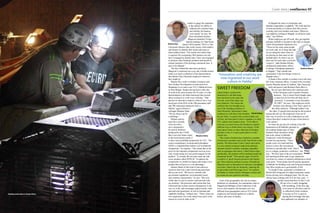
to ensure everything is working alright. “Apart
from that, the shaft does not require a lot of
overseeing,” says Mac.
T
he ingredients list on packaged foods can
give you food for thought. Some believe the
claims made on the pack. For example, food
that trumpets itself as containing whole grain is likely
to have more sugar than grains. Something that
promises to be trans fat free may, in fact, contain up
to 0.5 grams of partially hydrogenated oils, a source
of trans fats. And then there is a baffling array of
sugars which do not boost nutritional value but
add calories. The importance of dietary fiber intake
is increasingly being recognized. Tata Chemicals
has made a foray in this sector with SUSTENTIALS
(Nutrition Solutions Business). Its flagship product is
FOSSENCE (Short-Chain Fructo-oligosaccharade), an
alternative sweetener which is non-digestible and is
a perfect substitute sweetener; FOSSENCE
has approximately half the sweetness of sugar.
FOSSENCE is expected to have a wide range of
applications in the nutrition supplements business
- specially for the bakery, confectionery, dairy and
nutraceuticals sectors.
READ THE FINE
PRINT ON YOUR
FOOD PACKET
INNCOTECH
2015
launched
A
technical symposium series titled INNCOTECH
(innovation – collaboration – technology)
was launched at the Innovation Centre, Pune,
to showcase the latest trends in food science and
technology and provide a common platform for
researchers and business teams to share knowledge
and present innovative ideas. The inaugural event
was organized by Team Commingle on Innovation
Day (January 25) and also to celebrate TCL’s Founder’s
Day. A highlight was a poster competition for out-
of-the-box thinking in food technology. Twenty -five
teams from the Innovation Centre participated.
The first prize went to the poster on‘Brand Attraction
through Sense of Smell’. The series will be an
annual event.
Recently 50 employees at Tata Chemicals
Europe served on the jury of a landmark case
about employee safety in the workplace. If
that seems like an unlikely coincidence it’s
because this wasn’t a real trial and the incident
being deliberated had never actually happened.
However the principle of workplace safety
behind this recent exercise at Natrium House in
Northwich is very real and an area on which the
operations in the UK are renewing their focus.
Employees played the part of prosecutor,
defendant, presiding judge with 48 of their
colleagues acting as the jury. They discussed
whether a contractor doing a routine job for a
fictitious organisation called Charteris
Chemicals had died because of a lack of
‘reasonably practicable’ health and safety
protocol on site. The presiding judge ruled that
the company had been negligent about health
and safety on the day as the contractor had been
unsupervised and without proper clearance for
the job he was doing.
“The Control of Contractors training session
mock trial was very well received and provided
an excellent platform for improving our
contractors’ management systems,” says
Stephen Weston, head of Corporate Social
Responsibility at TCE and one of the organisers
of the session. “The training was videotaped so
that we can now train even more than the 48 who
attended the event.”
This is part of a general TCE push to re-
focus on safety. As part of this initiative Martin
Ashcroft, managing director of TCE, recorded
a video talking about how it was not alright
to take risk just to get the job done. “I want to
emphasize that no amount of production is
worth going home injured, or worse, not going
home at all,” Martin says in the video. His
video set the scene for the Safety Training Days
programme at TCE.
This follows last December’s Safety Climate
Survey and Safety Amnesty where employees
were encouraged to report any plant operations
risks, conditions, and routines that could result
in injury.
This positive, proactive initiative will generate
solutions to better TCE’s overall safety record.
PrioritiSing Safety
Gary Preston and Simon Cheshire finally took it upon themselves to
clean up a part of Redlers House, that by employees’ own admission
hasn’t been cleaned in years. Known to employees here as the
Penthouse, the sixth floor of the building was in a really bad way the last
time Martin Ashcroft, managing director
of TCE was on one of his safety walks. He
was pleasantly surprised when he visited
the same part of the facility a month later.
Gary and Simon had not only cleaned
up the Penthouse but also identified
potential safety hazards and solutions.
Martin recognised their initiative by
presenting them with certificates and
tokens of appreciation. This initiative is
part of a wider two-month long cleaning
plan at TCE.
clean
start
An Indian, a Brit, and an
American were lowered
into a hole...
Eco-friendly
TCL signs MoUs
with Gujarat
Government
As true friends of the environment, Tata
Chemicals signed three MoUs with the Forests
and Environment department, Government
of Gujarat, in Gandhinagar. The MoUs were in
support of these initiatives:
Saving birds and primates
The focus is on rescuing birds who get injured,
especially during the kite festival.
TCL provided equipment for a Bird Rescue
Center at Bodakdev which includes X-ray
machines, radiography systems, anaesthesia
and surgery equipment.
Eco-tourism development
TCL is supporting the Gujarat Forest
department in developing eco-tourism in
the Dwarka region. In the first phase, a project
feasibility report will be prepared by
identified agencies.
Renewal of Whale-Shark
conservation MoU
A tripartite MoU between the Government
of Gujarat, the Wildlife Trust of India and
Tata Chemicals is being renewed to support
whale-shark conservation.
Caretakers | confluence 1918 confluence | Champions
Ranavav
Quarries
mine Awards
Ranavav Quarries, TCL Mithapur, has won awards
in the Safety and Environment Competitions
2014-2015. The Soda Ash Group limestone
mines won the awards for the Mines Safety
and Mines Environment Weeks. The awards
were organised by the Director General Mines
Safety and the Indian Bureau of Mines. Winning
these awards underlines TCL’s continuous
commitment to the safety of mines and the
environment in which they operate.
T
ata Chemicals was honoured as India’s Most Admired Enterprise and ‘MAKE’ winner 2015.
‘MAKE’ recognises organisations that outperform their peers in creating shareholder value
by transforming enterprise knowledge and intellectual capital into superior products, services
and solutions. The winners of ‘MAKE’ awards are selected by an expert panel comprising business
executives from Fortune 500 companies, leading knowledge management practitioners as well
as intellectual capital experts. The award was given at the CII National Knowledge Summit 2015
in Bangalore.
Making it to ‘MAKE’ as
India’s Most Admired
Enterprise
We Are
Family
Improving rural lives
and livelihoods
Tata Chemicals Bags
Agri Awards
Tata Chemicals was awarded
the Mahindra Samriddhi India
Agri Awards 2015 by Agriculture
Minister, Radha Mohan Singh.
The award was received on
behalf of the company by Arnab
Ghosh, head SustainabilityTCL
Mithapur and Ramji Nayani,
senior project co-ordinator
NRM & SafetyTCSRD-Mithapur.
Anand Mahindra, chairman
Mahindra Group, was among the
dignitaries present.
Okhai womEn win award
The Gujarat government honouredTata Chemicals’Okhai
project for its outstanding effort in the field of women’s
empowerment on the country’s 66th Republic Day
celebrations (26th January). Anandiben Patel, chief minister of
Gujarat, gave the award to Ramiben from Okhai.Tata Chemicals
has been a great supporter of women’s empowerment,
helping women like Ramiben find the strength and
determination to improve their lives – and livelihoods.
Babrala celebrates
20th anniversary
It’s 20 years since the start ofTata Chemicals’operations in Babrala.
The day-long celebration to mark the event included the launch of
the book,“Salt of the Earth”. An MoU was also signed betweenTata
Strive andTata Chemicals for the development of aTata Skill Center.
Mementos and souvenirs were handed out to employees and
dignitaries. Managing director R Mukundan and other seniorTata
Group managers attended the celebration.
Tata Chemicals won the award for the “highest
number of employees’ family members’
participation”in the Tata Volunteering Week II held
from 5th September 2014 across the Tata Group.
Dr Mukund Rajan, Member, Group Executive
Council, Brand Custodian and Chief Ethics Officer,
handed over the award to R Nanda, CHRO, and
Prantik Sarkar, Manager CSR, at the Tata CSR retreat
at Novotel Hotel, Pune, on 21st January, 2015.
Volunteering is a way of life in the extended Tata
Chemicals family.
Tata Chemicals Society for Rural Development undertook a large number of activities in rural
communities to improve their lives and livelihoods in the last quarter of 2014. Among the initiatives
undertaken: skills development programmes focusing on training for immediate employability; learning
enhancement programmes and scholarships for higher education; capacity building programmes
for farmers to improve productivity; water management and land reclamation. Sensitivity to the
environment was fostered. For instance, a project was undertaken to create climate neutral villages,
facilitating communities to change their lifestyles to cope with climate change. Various health
programmes were held including eye camps, mother and child healthcare initiatives and AIDS awareness
programmes. A quiet revolution is transforming rural lives in the Tata Chemicals’world.
20 confluence | Colleagues
A day
in the
life
What is the most
interesting part of
your workday?
How did you decide to
work in legal?
What is the most
interesting legal
conundrum you have
had to deal with?
Morning, as I am at my creative best and have the
opportunity to deal with new challenges.
It was first by chance that I admitted into a Legal Degree
course but slowly found that the subject was really
interesting having a strong connect with individual’s life
every day. My work challenges me to find out
creative responses to business challenges.
When I first joined the CNAB division,
I found that the legal controls systems
were weak and awareness of statutory
requirements was low. Over a period of time
I was able to create awareness among my
colleagues of the legal implications of their activities
and the requirement for controls. It gives me immense
pleasure today when I see my colleagues’ awareness about
compliances and regard for legal control systems.
How do you stay
abreast of new
legislation relating to
your line of work?
What is it that your
colleagues in other
departments think you
do? How different is it to
what you actually do at
your job?
It is challenging as the product related laws that I deal with
are not popular laws. I track these laws and the amendments
as they take place through legislative documents and
government notifications. I also keep an eye on judgements
on the subject by higher courts in legal journals. Some
e-enabled portals are very helpful.
The basic difference is in perception, while colleagues in
other departments think we as a function are controllers, I
believe we are enablers, as we enable the business to run
without getting into legal hassles and thereby saving time,
energy and money for the further growth of the business.
Our colleagues expect us to have immediate and instant
solutions to the issues and more so to their liking, without
realising the complexity of the issue that we may be
able to foresee and the consequences they might have.
Communication is key to overcoming this, as we logically
dissect the issue and offer them alternative courses of action to
choose from, enabling informed decision-making.
What is the most
annoying stereotype
you have to deal with
in your line of work?
And how well do you
deal with it?
Name: KP Shekhar
Designation: Deputy General manager
Department: Crop Nutrition and Agri
Location: Noida, Uttar Pradesh	
of...
Name: Scott Ellis
Designation: Vice President, General
Counsel and Corporate Secretary
Department: Legal
Location: Rockaway, New Jersey	
The opportunity to discuss legal problems with highly
intelligent people and, hopefully, arrive at a satisfactory
solution to a variety of legal issues/problems.
After college, I had worked as a CPA with a large
accounting firm (now PwC) for several years and
determined that my particular interests and skills were
better suited for functioning more as a business counselor
vs. accountant. After law school and then
working at two large law firms, I took
the plunge and moved in house and have
never regretted it.
My career at Tata Chemicals and its
predecessors spans almost
18 years and, as you can imagine,
we’ve encountered many challenges
over that time period.
However, having ‘experienced’ two bankruptcies
(USA and Canadian), one right after another,
probably ranks near the top of my ‘top ten’ list.
A lot of reading! Seriously though, besides reading
professional journals, I attend continuing
legal education seminars throughout the
year. Not only are they very useful and
informative, they are legally required to
maintaining my attorney license.
I’m absolutely confident my colleagues’
impressions of what I do and what I
actually do on a day-to-day basis form
mutually exclusive subsets. I view my
position as the company’s ‘last line of
defense’ and am very disappointed if the various risks
associated with a contract or other transaction are not
fully considered from all sides.
The average person tends to think that lawyers, in
private practice or corporations unreasonably delay
a transaction. Years ago I was even referred to as a
‘bottleneck’ by a former boss. However, our charge
as lawyers is to ensure that the interests of the
corporation are fully protected at all times. As you
can imagine, that position doesn’t always generate
unanimous applause.
Name: Phil Davies
Designation: General Manager
Business Services
Department: Business Services
Location: Winnington, Northwich
Name: pouruchisti meherhomji
Designation: Company Secretary
Department: Rallis India Limited
Location: Navi Mumbai
Every day is quite different, but it’s always interesting to interpret
contracts to find new angles for resolving commercial disputes, or
to add or preserve value for Tata Chemicals.
Analyzing new regulations and their implications for the company and putting
in place processes to ensure compliance. Drafting Board and Committee
minutes, capturing all that transpired at meetings, is also very interesting.
By showing a distinct lack of imagination! All of my
family were accountants, so I decided to break the
mould and become a lawyer – crazy…!
I was seriously considering Chartered Accountancy, since my father and brother
are both Chartered Accountants. I even gave the CA entrance exam, but then
got interested in Business laws while in college and decided to take up law
after graduation. Not wanting to get into legal practice, I simultaneously started
doing the Company Secretary course and after completing studies, got into
secretarial and legal work.
There have been some tricky commercial
disputes where we obtained a great
result, but being asked for legal advice
on what to do about a cow which had
fallen down a shaft on our land was one
of the more challenging!
The new Companies Act, 2013, coupled with the revised Clause 49 of the
Listing Agreement relating to Corporate Governance, have posed quite a few
challenges, particularly since some of the provisions contradict each other. It
was an interesting dilemma to resolve as responsibility for the same process
is devolved to multiple bodies. Frequent changes in laws do pose their own
challenges in resolving the often inherent contradictions while ensuring the law
is complied with in letter and spirit.
As a senior in-house lawyer, law firms send me e mail updates on
legislation on a weekly basis. Sometimes 5 or 6 firms might send me
a briefing on the same new law. I choose the most informative and
succinct to digest.
Remaining updated with new legislation and amendments is vital to a company
secretary’s work. There are several sources through which we remain updated,
including websites on Company law, professional journals, seminars and
conferences. Knowledge sharing with peers in the profession, including within
the Tata Group, is also very helpful.
Sometimes colleagues assume that I deal mainly with claims and
litigation. In reality, much of what I do is contract drafting and
negotiation. I generally try to avoid claims and litigation –
disputes are expensive, and there is no such thing as a
‘cast iron defence’!
I think colleagues in other departments think the biggest part of my job is
conducting Board Meetings, printing the Annual Report, and organising
the Annual General Meeting, since there is greater visibility in these. There
is lesser realization of the amount of time and efforts spent in compliance
and governance related work, especially in this age of enhanced regulatory
requirements for corporates.
People often expect lawyers to be an expert at
every single legal discipline. Lawyers are like
doctors – they specialise from an early stage. I
remind them that, just as you wouldn’t expect
your family doctor to perform open heart surgery,
don’t expect me to know all the legal ‘ins and outs’
about your disputes with your neighbour over an
overhanging tree or their cat digging up your flower beds!
Many people outside the corporate are unaware of what a company secretary
does. Some of this ignorance still persists. I have been asked at times if I am
the secretary to the Managing Director. Within the company also, employees
in Operations are often unaware of the varied responsibilities handled by the
Secretarial Department. I am often asked why I am working so late in the
evening, or why I am in the office on a Saturday/ holiday when there is no
Board Meeting coming up. This can get really annoying. I try to explain what
we are working on at the moment, or sometimes use humour to deal with it.
#truth
Moo!
“You can’t handle
the truth!”
Better lawyer up
Registered corporate office Tata Chemicals Limited, Bombay House, 24, Homi Mody Street, Fort, Mumbai
400001 India Tel: +91 (0)22 6665 8282
Tata Chemicals Europe Limited Mond House, Winnington Lane, Northwich, Cheshire, CW8 4DT UK
Tata Chemicals North America Inc. 100 Enterprise Drive Suite 701 Rockaway, NJ 07866
Tel: (973) 599-5500, (800) 819-8568, Fax: (973) 599-550
Tata Chemicals Magadi Limited PO Box 1 - 00205, Magadi, Kenya
Tata Chemicals International Pte Ltd 80 Robinson Road, #14-02, Singapore 068898 Tel : +65 62214719
www.facebook.com/TataChemicals
www.facebook.com/humantouchofchemistry
www.twitter.com/TataChemicals
www.linkedin.com/tatchemicals
www.tatachemicals.com
www.humantouchofchemistry.com
SPICE
Safety
SPICE stands for Safety, Passion, Integrity, Care and
Excellence – our core values at Tata Chemicals
summed up in one memorable acronym. Successive
issues will highlight these values in turn. The aim is
to show how these values are more than something
to aspire towards; they are actually a philosophy in
action, a way of life across all our operations. The
next five issues will look at each of these values.
VOX Pops and case stories will make this set of
issues interactive and relatable to the individual
reader. The bank of knowledge, vivid examples and
well-researched facts will make the set a valuable
handbook for all Tata Chemical employees.
A business is its people. Providing them a safe
working environment is essential to a productive
and sustainable workplace. As part of the first issue
of the SPICE series we speak with the people tasked
with keeping your workplace safe. Whether it is a
mine, a laboratory, a plant, or an office these people
help design safety initiatives and process that have
become industry benchmarks.

C9_fullissue_050615

  • 1.
    BRINGING TATA CHEMICALS‘ PEOPLETOGETHER ISSUE 9 | 2015 ‘30s Hello Singapore! Meet the team building Tata Chemicals International Feeding the troops Tata Chemicals is feeding India at home, on holiday, and at work IT’S ALL ABOUT THE PEOPLE BABRALA CELEBRATES MILESTONE ANNIVERSARY TURNING 20 SEVEN SHAFT SECURES WYOMING’S FUTURE BREATHING EASY TCE PUTS EMPLOYEE SAFETY ABOVE ALL ELSE SAFETY FIRST
  • 2.
    confluence 01 Editorial team AlkaTalwar Sunanda Parekh Zareer Gotla MIke Bodnar Caroline Opondo John Christian Mark Hannant Munni Trivedi Raj Aditya-Chaudhuri Anita Sarkar Sweta Thakkar Vini Avlani Photographs Larry Brown John Almgren Design Himanshu Lakhwani Shruti Nandu Produced in association with magenta (www.teammagenta.com) Confluence is printed on Cocoon Silk All matter in Confluence is under copyright and may not be reproduced without permission. When you have finished with this magazine please recycle it Contents JUNE 2015 01 Commence 02 Compass Latest news from around Tata Chemicals’world 04 Cover Story The people that make it all possible 12 Customer Profile The most important ingredient in every dish 14 Corporate Vision 2020 18 Caretakers ‘Make’-ing it to the top 19 Champions Boosting green credentials 20 Colleagues Ensuring Tata Chemicals’ is never‘court’off-guard 10 12 BRINGING TATA CHEMICALS‘ PEOPLE TOGETHER ISSUE 9 | 2015 ‘30s HelloSingapore! Meet the team building Tata Chemicals International Feedingthetroops Tata Chemicals is feeding India at home, on holiday, and at work IT’S ALL ABOUT THE PEOPLE BABRALA CELEBRATES MILESTONE ANNIVERSARY TURNING 20 SEVEN SHAFT HELPS WYOMING BREATHE EASY BREATHING EASY TCE PUTS EMPLOYEE SAFETY ABOVE ALL ELSE SAFETY FIRST Changing tack Dear Colleagues, We are embarking on a journey of growth. A journey that will build on what we have already achieved over the last 75 years as a company. This year, we launched LEAP - our Vision 2020. Over the last year our teams and our board of directors have worked together to articulate the journey going forward with the end goal of tripling our market capitalisation by 2020. We have identified a strategy that will help us achieve the targets we have set for each of our businesses. Our task, collectively, is to execute this strategy. To transform our company we have to change the way we do things and I believe that biggest challenges and changes will be in the area of culture and behaviour. The new Transformation and Culture office headed by Ashvini Hiran has been asked to identify areas where we as a company need to build and change. Ashvini has spent time meeting and interviewing colleagues in India to understand the various facets of culture of the organisation. As a company we do certain things quite well. To achieve our Vision 2020 we need to understand what will get us there and to adopt behaviours that support our future growth. We have identified six of the most pressing themes that we need to improve on. These are: high performance management, reward and recognition, communication, collaboration, innovation, and agility. The leadership team has pledged to be more respectful of individuals, responsive when dealing with business issues, and to encourage an environment where all employees can reach out and flag problems when they encounter them. We need to change things that are often at the root of the problem. Addressing the root cause of the issue will help us make meaningful and sustainable improvements and modifications. The journey ahead will be a challenging one. It requires major effort on our part to embrace behaviours and culture that are critical for our long-term survival and growth. I am sure that we will come out stronger as we LEAP forward.r mukundan I n Cheshire we’re enjoying the spring sunshine and the promise of new growth that heralds. Some of us are in training to undertake the three peaks challenge in June. Participants climb the highest mountains in England (Scafell Pike, 978m) Scotland (Ben Nevis, 1,344m) and Wales (Snowdon, 1,085m) in 24 hours. It requires guts and determination and we’re hoping to raise GBP6,000 for our nominated charity St Luke’s Hospice. As head of Human Resources at TCE I’m working with my colleagues to harness our people’s determination to scale new peaks of business success too. Underpinning that work is an understanding that as a business we need to make the right products and sell them at the right price. Ultimately the success of this will come down to the people we employ. We employ some great people. The role of HR is to ensure that we employ those who want TCE to succeed and that we develop a culture of success. We need to attract, retain and develop high calibre people. One of the ways in which we will do that is by ensuring recruitment is robust. As part of our talent strategy we are developing criteria to identify the skills we need in our business. We are using the Tata Leadership behaviours as a mechanism to recruit for future success. As part of our agenda to nurture our people we are launching a new online learning management system. This will initially be for all mandatory Health and Safety training but we will add throughout the year to include technical training as well as development training. This means that all employees will be able to access training on line. We are also migrating our performance management processes online and using technology to enhance that activity. The goal is to create the golden thread that links our strategy to the cascade of objectives and the ongoing development of our people. Our interventions should ensure that our great people have the skills and behaviours to drive improvements in the quality of our products so that we can deliver the commercial results. HR is not just about processes and policies. Making sure our people are engaged and understand the objectives of the business is important too. Employment patterns in the UK have changed much in the past two decades. No longer do employees work in just one or two organisations during their working lives. Work is now much more flexible and the pace of change and innovation in the world is huge. r nanda LEAP is about what we learn on our journey to our Vision 2020 and how these learnings shape our next 75 years. The Tata Group is changing. By 2025 the group aims to touch the lives of 25 per cent of the world’s communities. We at Tata Chemicals have set ourselves the ambitious target of transforming the way our business functions over the next five years. We have built a strong foundation with our values over the years but we now need to embrace a few new ones that will help us to propel forward for the next 75 years. LEAP is about the fundamental shifts we need to make in the way we work. It is about channelling our people’s energy and passion into not only becoming a more innovative, customer-centric, results oriented organisation but also a place where employees feel valued and respected for the diversity they bring in. We are quite enthusiastic about the opportunities that is going to unfold in front of us soon. Our cultural pillars and our values should become the thread that should connect everyone and everything together. Now it’s time to set the ball rolling – discover yourself and stretch out to attain new heights in whatever you do. Come, let us take this LEAP together. Change is the one thing we can rely upon, which some employees find easier than others. Helping people manage and respond to change is also an important aspect of our HR activity. Engaging people in what this business is about and what the long term goals are about is critical. Improvements are underway. We have started a new employee board for those colleagues who want to get involved in learning about our business and contributing to ideas. Each employee representative is responsible for bringing items of interest or queries to the forum and then ensuring they communicate it back to their teams. We’ve also introduced a new engagement project team across the business to look at ways in which we can improve engagement. We had our first meeting a few weeks ago. This is to look at ways in which we can increase involvement of employees and build pride back into working for TCE. This coupled with the great work we are doing as a business to support the local community through volunteering projects and fundraising is starting to gain momentum in our business. We really want to develop the fact that this is a great place to work! In the meantime we have mountains to climb. LEAP to 2020 Getting in training for the high peaks Karen Lounds
  • 3.
    7 6 4 32 02 confluence |Compass Compass | confluence 03 TCNA miners breathe easier, Tata Innovista for Metahelix, the Lion City welcomes Tata Chemicals, and Natrium House turns into a courtroom. Tata Salt among top 10 Indian brands Tata Salt has been featured in Brandstand’s 10 Tankers, a list of the top 10 Indian brands. “Desh ka namak” (the country’s salt), the Tata Salt slogan, says it all. An emotion-charged brand statement, it positions Tata Salt as a pro-India brand. “Tata is trust and salt is food. Why would I trust anyone else with my food?” asks one consumer. Another declares: “ I will buy Tata Salt even if it comes out of a brown-paper bag.” Among the other brands in Brandstand’s list are Maggi, Amul, Thums Up, and Cadbury’s. Meeting of Minds CFOs, accountants and lawyers, secretarial employees met in London to chalk out a plan for the future of the group. From left to right: John Abbotts, Ranjeev Lodha, Ron Achter, John Mulhall, P K Ghose, Anup Guha, Rajiv Chandan, Scott Ellis, and Phil Davies stepping stone for global growth Meet the four-members of Tata Chemicals International Private Limited’s team in Singapore and find out how they are uniquely positioned to increase Tata Chemicals’ global reach. John Mulhall and his colleagues talk about the advantages of being based in the Lion City as well as the quirks of coordinating operations spread over four continents. Read more on page 14. Mission Accomplished McRae Richardson and his team recently celebrated the completion of the Seven Shaft project with a celebratory breakfast in Green River, Wyoming. Started in 2013, the project involved working with a variety of regulatory and environmental stakeholders to minimise the impact to the flora and fauna in the vicinity. This is because among other features, Seven Shaft has two fans, 11ft in diameter that will better ventilate all current and planned mining operations at the Green River facility. Initial noise-level test results have been better than initially expected. Seven Shaft will go through a comprehensive audit by a variety of environmental stakeholders. 1 Global round-up... 5Better Life, Better Yield Rallis India has launched Amplus, an innovative and modern technology HYT™ based microbial bio product that helps enhance soil fertility. It efficiently fixes atmospheric nitrogen, sustains soil health by decomposing plant residues, and stabilises the carbon:nitrogen ratio of the soil. This improves soil texture, structure, and water holding capacity. The unique and proprietary manufacturing process of Amplus™ results in highly stable microbes. This, in addition to enhancing soil fertility, improves viability and shelf life of the product line. Amplus™ will be delivered to growers in biological crop input provider Agrinos’ India Star 2014 award winning packaging. Tata Innovista Award for Metahelix Metahelix Life Science’s project MC 13 has won this year’s Tata Innovista award for Promising and New Product Innovations. Its Project MC 13 is a path-breaking hybrid seed that won in the ‘Bold Rice’ segment. Rallis India, a Tata Chemicals subsidiary, has a majority stake in Metahelix Life Sciences, a Bangalore-based seed research company. More than 2,500 teams from 65 group companies such as Tata Steel, Tata Consultancy Services, Tata Motors, Jaguar Land Rover, Titan submitted their innovative projects. The final round saw 78 projects judged by a four-member jury for their innovation, social relevance, environment conservation, and business prospects. MC 13 was one of eight final winners. Safety Over Productivity Tata Chemicals Europe found a very unique way to drive home the importance of health and safety measures in operations. A mock trial, a video by the managing director, and a safety amnesty got employees talking about ways to improve the TCE’s safety performance. Read more on page 16.
  • 4.
    They all havedistinct identities nurtured and built on over the years. This presents a significant on-going challenge when it comes to standardising processes and systems and the organisation will have to keep at it. But behind the production targets, equipment, and profit figures is a Tata Chemicals employee driving progress. Despite the differences in culture and technical abilities this Tata Chemicals family member, whether from Wyoming, Winnington, Magadi, Babrala or Singapore, has more in common than might be immediately apparent. In addition to core values such as safety, passion, integrity, care, and excellence (SPICE) that are core to operational efficiency and sustainability, each geography’s individual personality meshes together to form a unique Tata Chemicals culture, much like individual members of a big, very diverse family. These differences were a significant consideration for the family members that married in to the Tata Chemicals idea. Wilson Tima, like a lot of his colleagues in Magadi, Kenya, was concerned about this new relationship when he visited India for a Lean Six Sigma conference in 2010. This was his first visit to the country after Tata Chemicals’ acquisition of Brunner Mond and its assets in the UK and Kenya. “We were uncertain about our future and about the implications of how our unique Magadi work culture was going to be affected,” says Wilson, a long time Magadi employee who works in SHEQ and Strategy Coordination. That was until he and his colleagues visited Mithapur, the birthplace of Tata Chemicals’ Indian operations. Located on the very tip of the peninsula of the western Indian state of Gujarat jutting out in to the Arabian Sea, Wilson suddenly found that Mithapur almost felt like home. “My colleagues from Magadi and I were amazed at how similar Magadi and Mithapur are. Same-same environment, township, same-same operational challenges, community expectations,” he remembers. That meeting was an important step that set the scene for how the various geographies of Tata Chemicals’ rapidly growing family members got on. Five years on Wilson reflects, “It helped us realise that there we did not have to worry about serious cultural differences when it came to becoming part of Tata Chemicals. This trip helped us realise that the values that underpin the operations in India and the ones we work by in Magadi are pretty much the same. Different at times, but essentially same-same.” John Christian, director of Human Resources at Tata Chemicals North America (TCNA) talks about the core human values that all Tata Chemicals employees, irrespective of geography, espouse. “We all want to do a good job, we want to be rewarded for our hard-work, we all have frustrations with our jobs and management, and we all try to work to resolve them,” he says. “We all have a lot of the same ideas, we just go about them slightly differently.” Productivity in diversity. For example, one common theme that emerged from conversations with employees from almost every geography is their taste for a good challenge. Andrew Plant, Packaging and Despatch coordinator at Tata Chemicals Europe’s (TCE) Middlewich plant first came to the organization 22 years ago looking for a work environment that would keep challenging him. “I wanted something that would keep me stimulated, somewhere I could make an impact,” he says. Joining in the 1990s Andrew found himself part of a business struggling to modernize itself. His challenge was to automate a bagging line-up that was essentially still manual. The design engineer who had previously worked for British Aerospace called on his experience to architect a new line- up to meet the bagging requirements of the food industry. “This was an excellent opportunity not just to modernize our set up at British Salt but to upgrade our employees’ technical skills. This is exactly the kind of challenge I was looking for. The end result actually impacted the way we worked significantly and knowing that I had been part of the solution was a very satisfying feeling.” Andrew feels that for him, and a lot of his colleagues, working at TCE is not just about drawing a salary. “We are here because we genuinely enjoy this line of work and the challenges it presents,” he says. Part of the challenge has been developing new talent to ensure operational sustainability. “It has been very satisfying to have played a part in the development of colleagues who were just young lads looking to make their way in the world. I cherish the fact that I get a chance to pass on knowledge and experience that I gathered during my time here.” Andrew says. This is one of the main reasons Andrew has never felt the urge to change jobs. “It is still just as challenging and rewarding as when I first started here.” Andrew’s colleague Bhagwati Prasad works half a world away in the rural parts of the eastern Indian state of Bihar, but he too has a taste for coming up with innovative solutions to challenges. When the Sales and Marketing liaison for TCL’s Crop Nutrition and Agri Business (CNAB) first noticed his sales numbers were dipping, he took it upon himself to figure out the problem. “I recognised there was a problem and I knew I alone could fix it,” Bhagwati says. “I tried to identify flaws in the way I operated as well as my core strengths so that I could play them to remedy the situation.” Bhagwati comes from a farming family and his education in agronomy means that he has a solid understanding of what farmers in the Saharsa district in the eastern Indian state of Bihar, his core customer base, is looking for in their farming products. He used his knowledge of the area to segment the territory in to 20 markets and identified the top two retailers in each of those segments. “I conducted field visits and interacted with each W ith more than 5,500 employees working operations spread over all continents barring one, Tata Chemicals is now a truly global enterprise. And as with companies that have grown inorganically, TCL inherited organisations some of which had been in operation for more than a 100 years. Wilson Tima Diversity of people, cultures, and capabilities defines the new Tata Chemicals. Raj Aditya-Chaudhuri speaks to some of the members of this Rainbow Family
  • 5.
    retailer to gaugehis reputation in the market, his ability to influence his customer base, and whether his finances were sound,” he says. Of these shortlisted retailers Bhagwati identified 18 that had the makings of a Tata Kisan Sansar (TKS) partner. TKS is a Tata Chemicals initiative that works closely with retailers and farmers to identify their needs and issues to better address them. “The results were better than I expected. By recognising TKS partners not only have I managed to double sales, I have also managed to position Tata Chemicals products and myself as trusted members of the farming community here. It pays to be diligent.” The story behind the innovative products Bhagwati’s customers use every day in fields around India is as much a reflection of this determination that defines Tata Chemicals employees wherever they might be. Debasis Roy works in Quality Assurance and New Product Development at what used to be Hindustan Lever and is now TCL’s Haldia division in West Bengal. Despite having been in this line of work at the same location for 26 years, it is this determination to do better that keeps him excited about coming in to work every morning. “That passion to innovate to improve what we do is very much part of the DNA of the 280 permanent staff and 700 contracted employees here in Haldia,” agrees Debasis’s colleague Bhaskar Datta. “We are always up for a challenge.” Debasis and his team have recently come up with a new compound to be used in fertilisers produced by the CNAB that is not only better suited to the local farmers needs, it is also a more profitable proposition for TCL. “We used to manufacture, di-ammonium phosphate (DAP), a compound that utilises a lot of imported components,” he explains. “This meant that as the price for the imported components went up every year, it kept eating in to our profit margins for the product.” To remedy this his team came up with a new product called NP20:20. “It replaces the components we needed to import and creates a new product that will give us a cost advantage.” Debasis thinks of this kind of innovation as creativity that only comes from being passionate about your work. “We have to contend with government regulations, environmental issues, and customer requirements,” he says. “But even within that we can be creative and innovate with our products. The processes and system that Tata Chemicals has in place ensures transparency in the way we work, and encourages improvements, both personal and operational, as well as learning and capability building,” Debasis says. “These values are now ingrained in our work culture here and it is the reason we excel at what we do.” Cover story | confluence 07 “Innovation and creativity are now ingrained in our work culture in Haldia.” Ashok Dubey would not be interested in a job that keeps him tied down to the same line of work, even if the salary was very attractive. The reason the scientist who was brought on as one of the founding members of Tata Chemicals’ Innovation Centre, continues to work here is the freedom the job offers. Located in the western Indian city of Pune, the Innovation Centre’s mandate is to help TCL explore new business areas. “To be able to innovate you need to have the freedom to explore different ways to think about your subject. At the Innovation Centre we have that kind of freedom and that is why it is such a great place to work,” Ashok says. This creative freedom has resulted in a number of innovative products such as the Tata Swach water purifier. The Innovation Centre’s latest innovation is a new natural sweetener made from prebiotic elements found in unlikely sounding vegetables such as asparagus and onions. Called fructo-oligo- saccharides, this product will be marketed under the Sustentials brand. “This natural sugar is food for a number of ‘good’ bacteria present in the human gut. These bacteria perform an array of beneficial functions such as absorption of calcium to strengthen our bones, improving our immunity, reducing the tri-glycerides and blood sugar level,” he explains. So thanks to Ashok and his colleagues cookies and ice cream are now good for our body. Each of the geographies also has its unique definition of community. In communities such as Magadi and Mithapur where employees work, live in close quarters, the dynamics are very different from geographies such as TCE where employees feel bound together by a shared history and sense of destiny. In Magadi the sense of community and familial congeniality is palpable. “We work and live in close proximity so it almost feels like you are working with your brothers and sisters. Wherever you might be working in Magadi, we all know each other,” says Wilson. When employees get off work, they get together and play football or socialise in the club on campus where all permanent employees live. “These are the same-same people we work with, try to keep safe and we are doing the same when we are playing on their team on the football pitch. So when I say we truly care for each other you know I mean it,” adds Ibrahim Kibutu, mechanical maintenance officer in charge of dredging equipment at Magadi. “That warmth and camaraderie is the first things visitors to Magadi notice.” A shade of this warmth is evident even in the busy life in the corporate offices. Located in the crowded, chaotic Mumbai suburb of Andheri, Tata Chemicals’ leafy and green Leela Business Park office is like an oasis that houses the corporate ends of the Chemicals and Consumer Products business. This is where Preeti Sanghi came to interview for her first job fresh out of university. “I remember it was December 28, 2007,” she says. The employees at the location were having a New Year’s party in the office cafeteria. “Although neither I nor the other 15 people interviewing for the position had got the job yet, the employees went out of their way to involve us in the celebrations as well. I knew then that I wanted to be part of this kind of work culture.” So when she got the job working in the HR department at the Babrala operation in the northern Indian state of Uttar Pradesh, Preeti decided to bring that work culture to Babrala. Employees’ work-life balance became her top priority. “These people work very hard and they deserve to have the recreational facilities to unwind after work. That is key to a happy, productive workforce,” she says. “We have state of the art recreational and sporting facilities and we get employees involved in a variety of cultural celebrations to build team spirit.” Preeti prides herself and the operation in Babrala for building work and living environment that offers employees a good quality of life. To Joseph Evans, operations coordinator at British Salt, being part of a tight community means always having your colleagues back. The 26 year old has been working with TCE for four years. “I quickly learnt that here we don’t wait till one of us is really struggling with something. At the first sign of an issue we all chip in and try to collectively find a solution. Everyone at TCE is open to sharing the knowledge that they have gathered over decades of Bhaskar Datta Preeti Sanghi Ashok Dubey Ibrahim Kibutu Joseph Evans Debasis Roy Sweet Freedom Getting work done in Green River
  • 6.
    08 confluence |Cover story Cover story | confluence 09 Green River’s no-man left behind culture makes for a very congenial working environment After 27 years with Tata Chemicals, Sanjay Choudhary has a lot to reflect on when summing up the character of the company that he has been such a significant part of the 75 years since its inception. His latest role is that of joint managing director of Indo Maroc Phosphore SA (IMACID), a joint venture between Tata Chemicals, OCP Morocco, and Chambal Fertilisers and Chemicals Limited (CFCL), India. “I remember when I first joined Tata Chemicals back in 1988. I used to work in the public sector in India before that and this was a major shift for me,”he says.“One of the things that fascinated and inspired me was this desire to always be the best at whatever we did. This organization is not interested in coming in second. So the organisation would not even pursue a new direction or product unless it believed it had a reasonable chance of becoming a market leader.” He remembers the heady days of the liberalisation of the Indian economy in the early 1990s and the move to redefine and reinvent Tata Chemicals. The organization was looking in to going in to the farm essentials sector to create value for the farmers, a departure from its core soda ash business.“Everyone was telling us this was going to be difficult because the fertiliser segment was highly regulated ,”he says.“But we had strength of our convictions. We wanted to be a self-reliant organisation that did what we understood is good for the stakeholders and did a very good job of it in building a urea plant, which has set global benchmarks in reliability, energy efficiency, safety and environmental performance and was the first urea plant with minimum imports of equipment and machinery. And nothing was going to stop us.” And Sanjay thinks that spirit of pushing the boundaries in pursuit of excellence is still very much part of the organisation.“To me this company combines the security of an illustrious past, the excitement of the present, and the promising pictures of the future,”he says.“That is what makes Tata Chemicals what it is, a great place to work.”And finally it is all about LIFE. experience working here,” he says. “As a newer member of the team I have been given a fair share of responsibility as well as support from every one around me to ensure my success as an employee. This makes for a positive working environment. So even if we are under a lot of pressure, my team and I keep it light. That sense of being part of a larger, supportive team is very much part of the work culture here.” For Rick Couch, TCNA’s newish Procurement Manager, it is the bond of a band that works 1,800ft underground in a 13-mile long mine. “Even though I work with employees who have been here for decades, within the first few months I was already tight with the crew,” he says. He is a member of the Wyoming Army National Guard and was undergoing his annual mandatory training at the time of the interview. He talks about a no- man-left-behind culture at Green River, Wyoming. “This is a small community. So you will see the person you work with in the mine at your local supermarket and watering hole. These are rugged, caring people.” Just the kind you would want on your side when going in to battle. This sense of community extends outside the workplace as well. In addition to partnering with charitable organisations such as United Way in North America and floating others such as Magadi Foundation and Tata Chemicals Society for Rural Development, Tata Chemicals is always trying to make its business initiatives more beneficial to the larger community. As senior manager of Human Resources based in Mumbai, Verma had to contend with the business challenge of high attrition in the front sales force of the Consumer Product’s Business (CPB). To deal with this, the organisation came up with a novel solution that engaged a section of the Indian workforce that the country’s recent economic boom had left behind. “Around 25 per cent or 32 mn people in India are categorised as belonging to ‘scheduled castes’,” he says. Typically members of this community don’t have access to good education and as a result often lack the basic skills to get any kind of meaningful employment. “Since the CPB is centred around consumers and people, Amit and his colleagues saw the opportunity to unleash the potential of an entire section of society and in doing so ensuring the sustainability of the sales division. The Affirmative Action plan the business came up with addressed both these issues. The plan involves training young graduates in sales and marketing techniques and helping them get jobs through which they could contribute to their communities. This initiative has been rolled out in a number of Indian states and provides batches of students 7 days of basic in-class sales training followed by 7 days experience working with CPB sales representatives. They are then interviewed for various positions by TCL and other partner organisations. “This is also making a significant impact in increasing the diversity in our supply chain,” says Vipul Sinha, regional Sales manager, West II based in Ahmedabad, Gujarat. He is part of the core CPB sales team that has championed the initiative in their respective territories and regions. The team also includes Santosh Chandran, Himanshu Kumar, Arvind Tripathi, and Sushil Bishnoi.. The team’s work has meant that the 125 students who have graduated from this program have all secured sales related jobs they are now well equipped to succeed at. A undred more are currently undergoing training. In addition to the immediate impact of providing opportunities to gain valuable job skills, this programme is changing mentalities and work culture in the business. “That’s the whole point of the Affirmative Action programme,” says Amit. “People in the sales value chain are now sensitive to these issues and this influences their hiring decisions. Hopefully this means long-term changes for the organisation as well as the communities we work in.” The initiative was recently recognised as a good practice by the Tata Group. Dilip Choksi is a Tata Chemicals man. His father was a Tata Chemicals man and so was his older brother. “Every one of us in the family wanted to use our education and skills to give back to the community that we live in,” says Dilip, the administrator of Mithapur Hospital. “We have all chosen to work with Tata Chemicals because that is the best way to give back to the entire Okhamandal district here in Gujarat.” Located just a kilometre away from the Mithapur plant, the 147-bed hospital is funded by Tata Chemicals. Its 13 doctors and 32 nurses cater to the 400,000 people living in the 42 villages in the area. The hospital not only offers free healthcare to all TCL employees and their dependents but charges other patients a token fee of 20 rupees ($0.30) for a night’s stay. “In addition to the medical costs, that includes all meals,” explains Dilip. “This institution is a true community asset and this is why I choose to work here.” Innovation has come from all directions and has helped some of the geographies weather some of the uncertainty they have faced over the years. Tata Chemicals Europe has survived over 140 year history by reinventing itself. “Innovation has helped us survive and remain competitive. That is a part of what we as a group of people stand for,” says Pauline Yould, manager of Payroll in the HR division at TCE. “That is a TCE trait. This is because we as a group of employees have a diverse range of experience. We have employees who have been working here for the last 30 years and others you have joined us more recently. Between them we have enough experience, expertise, and new ideas and perspectives to keep reinventing ourselves.” The organisation has had its ups and downs; it has suffered from high energy costs in the UK and has had to go through a painful restructuring process in part to cope with that. To better manage its energy costs TCE acquired a combined heat and power plant that has been supplying the Northwich plant since 2000. Controlling an issue that in the past has exposed the viability of the operations itself is testament to the organisation’s resilience and ability to reinvent itself. The result is a workplace that 140 years on still manages to attract top talent in the Cheshire area. “People here buy in to that history of excellence and take it very seriously,” Pauline says. Another reason TCE is an employer of choice because it offers more than just a job. “A good number of the 400 employees at TCE have been working with the organisation as long as they have is because of this,” says Pauline. “Most of our top management has risen through the ranks and our employees know that with TCE they have a career direction.” Jennifer Herman, Customer Service manager at TCNA, prides herself on the service her organisation has provided its customers. She has been part of the organisation through its downsizing phase that saw the number of corporate employees weeded down from 200 to 30, closure of the plant in Canada, salary freezes, a period of stagnation where no money was invested in to the business. But through it all she ensured that the customer is always king. “The customer was king when I started as a customer service representative in what was General Chemicals back then and what is TCNA now and everything it has been in between,” she says. An uninterrupted delivery of product is a key performance indicator that she holds in high regard. “Whatever we were experiencing as an organisation never affected our customers supply of material. And we made sure that supply remained flawless, seamless.” Jennifer approaches her responsibilities like she owns the business. “I take immense pride in my career and the work I do. I know my customers and I know the people they work with and their families. There is a sense of community and we look after our customers.” She recalls the incident last winter when TCNA was experiencing some delays in shipments going out as a result of trouble with the railways. “A lot of these customers need a steady supply of material to keep their operations going. The fact that we couldn’t ship material to them in time would have badly hampered their ability to make their final product. Our guys took it upon themselves to work over time that weekend to ensure our customers wouldn’t feel the effects of this breakdown in the supply chain. Some of subcontractors even drove trucks full of product all the way from Green River, Wyoming to our customers operations in Pennsylvania.” She does however appreciate some of the new initiatives that have come with being part of the Tata Group. “Learning the Tata Business Excellence Model and introducing other initiatives such as Six Sigma have helped the operations,” she says. However this was one of the more challenging parts of the initiation to Tata Chemicals. John agrees. He feels that initially it was tricky meshing TCNA’s way of doing things with Tata Chemicals’ processes and systems. “For example we didn’t believe in such initiatives because we didn’t think it would affect the bottom line,” he says. “We fought these initiatives for a long time and we still struggle with it. But we are starting to see their value now.” Other changes were more welcome. “Before Tata Chemicals we didn’t think beyond the day’s production. That was what we as an organisation were concerned with. We didn’t really have a long-term perspective of our organisation,” John adds. “This was a mind-shift for all of us. All of a sudden we are told that we as an organisation want to do the right thing, we want to be sustainable, that is often a difficult transition and we are still coming to terms with it. Organisational sustainability was one of the more important things that we gained as a result of this marriage. It permeates every aspect of the organisation – from learning and development, something we had not invested in in the past, to career development. Now we have a plan in place for a sustainable organisation that will be here for the next 50 or even a 100 years.” According to maintenance planner Billie Parks the TCNA had lacked accountability and ownership and this was hampering the business. “Somewhere between being bought and sold every few years and being part of organisations that didn’t really care about what we did as a business, we lost that sense of ownership in the work we did,” says the 25 year veteran of the organisation. “But recently I have noticed that this is becoming an area of focus again. This is vital to creating an organization that excels at what it does.” As a workforce that is always striving to do better, naturally there are areas where improvements can be made. “Each geography has its distinct work culture and nuances and that is a good thing,” says Steve McGuinness. Process technology manager at Lostock in Cheshire. “But when Tata Chemicals wants to identify and promote a range of central themes that need to be rolled out globally, that can be quite tricky. How do you consolidate all that varied history and work culture and get them to agree on a set of central themes that would meet every geography’s developmental needs?” Bibaswan Datta feels the organisation needs to promote a more performance-driven work culture. He is part of a two-man team charged with helping articulate strategy for various business divisions. “The organisation is a very inclusive one this often means Tata Chemicals is slow to react to market changes,” he says. “We are not as aggressive when it comes to taking risk that could unlock the organization’s real potential. We need to be more performance driven and this is one area of our work culture where we can improve,” he says. Culture is fluid especially in an organisation such as Tata Chemicals where member organisations are still learning to work constructively with each other. Culture is key to the operation and the family will have to reflect on itself to identify practices that aren’t conducive to becoming more agile and goal- oriented. This does not necessarily have to equal a rejection of local practices and practices that make each member of this family uniquely interesting. Past Perfect, Future Continuous Dilip Choksi Jennifer Herman Rick Couch Billie Parks L-R: R Nanda, Santosh Chandran, Amit Verma and Alka Talwar Bibaswan Datta
  • 7.
    10 confluence |Customer profile Tata Chemicals does not just make quality products. It touches the lives of tens of millions. From the forces that guard India’s borders and prestigious holiday resorts whose reputation is tested with every dish placed before a guest, to homes across India, a packet of Tata Chemicals product bears testimony to quality consumer can trust every time. Anita Sarkar finds this a recurring theme in conversations with chefs, housewives, military quartermaster, and retailers. A Priceless ingredient calledTrust “Lentils is a staple. I insist on Tata i-Shakti because I value my family’s health” to have reliable basic assets in place. Sai Shankar, the head of purchasing at Club Mahindra Holidays, relies on Tata Chemicals to provide his operations that kind of constancy. To him it is not just about the quality of Tata i-Shakti lentils or Tata Salt.“We also get a lot of help from Tata Chemicals to ensure supplies are made available at the nearest resort depot. Our resorts, some of which are in remote locations, require weekly or fortnightly visits to these depots to stock up on supply,”says Sai. That seamless supply chain ensures Club Mahindra Holidays can keep its 55 kitchens operational, churning out delicious Indian and pan-Asian dishes for its 9,000 guests every day. “Each of our restaurants offers at least six dishes for breakfast and at least ten options for both lunch and dinner,”explains Sai. Club Mahindra Holidays goes through 5,000 kilograms of lentils and salt every month across its locations.“And we know that every time one of our 100 chefs around the country puts out any one of our many dishes, it is going to be a quality product that we as an organisation can be proud of. And that wouldn’t be possible without a partner like Tata Chemicals and its products.” This trust in Tata Chemicals consumer products is re-iterated in consumers’kitchens across India. In Andheri, a bustling western suburb in Mumbai, long-time Tata Chemicals’customer Archana Khare considers herself the custodian of her family’s health. On learning from her local grocer or baniya that Tata Chemicals had launched a variety of lentils in addition to her preferred Tata Salt, Archana tested them herself.“My mother had taught me how to wash rice and lentils,”says the former science student.“They should not be rubbed rigorously while washing otherwise a powerhouse of nutrition gets lost.”Tata i-Shakti lentils are not polished and preserve their nutritional value, so they get Archana’s approval. So strongly does Archana feel about Tata i-Shakti lentils that she persuaded her neighbours, who were reluctant to try something new, to switch to Tata i-Shakti. She also tests the salt she uses.“If it floats while I am cooking, I abandon the dish. But that never happens with Tata Salt,”she says. That’s why she insists on using Tata Salt and makes sure there’s always a packet in store. ”Can’t take chances with my family’s health,”she says. Tata Salt was the brand Shahriyar Atai turned to when he was looking to re-invent his product offering at Daily Bread-n-Foods, a bakery supplying bread to schools, hospitals, and restaurants across Mumbai. The baker who is also a singer, a dancer, and an actor has enough on his plate to worry about a component as basic yet important as salt. “The recipes for my breads and rolls were inherited from my father but I have updated them, putting more value-added ingredients to suit today’s health and nutrition-conscious consumers,”he says. A talented chef, Shahriyar also dishes up Parsi bhonu (traditional Parsi food) and uses Tata i-Shakti lentils when making the classic Parsi dish dhansak (a rice pulao made with different lentils). Shahriyar puts his trust in Tata i-Shakti lentils and Tata Salt.“Between‘me-n-u’everything has to be of a high enough quality to go on the menu,”he says. With this kind of reliance and trust in the brand and its products, the Tata Chemicals promise is tested every time a consumer reaches for a pack of i-Shakti lentils, besan (gram flour), or Tata Salt. And for end consumers to put their faith in Tata Chemicals, the retailers have to first be convinced of the quality of the products. They really are the first customers who must be convinced of the promise. So when Tata i-Shakti lentils came to market, Umesh Gudre tried it out himself. The owner of Mahaganpati Stores in Titwala, a small town in Maharashtra famous for its temple to the Hindu deity Ganesh, only began persuading his customers to buy Tata i-Shakti products when he was satisfied about its quality and nutritional value. It was much the same with Satish Chaudhary who owns Suman Kirana stores in Kalyan, a city near Mumbai.“I believed in the nutritional value of Tata i-Shakti lentils and told my customers about it. They were sceptical at first because the lentils looked different, even the colour was different. Based on my word they decided to try them out once. And then they came back a second time and now they insist on only buying Tata i-Shakti lentils,”Suman says. Recipes and usage change from customer to customer. But Tata Chemicals remains the brand of choice for a host of customers who rely on it because in its products they get that ingredient called trust that is as invaluable as it is priceless. I f you have attended India’s Republic Day parade held in the national capital of New Delhi on January 26, you will surely remember the Border Security Force’s (BSF) colourful camel-mounted band, the only one of its kind in the world according to the Guinness Book of Records. Their day-job is a far more critical one: they are charged with securing India’s borders. Established 60 years ago as a paramilitary force, the BSF is the world’s largest border-guarding force. It secures the country’s vast and often difficult borders. In peacetime it protects against insurgency and acts of terrorism; in times of war it supports frontline forces. “The more you sweat during peace, the less you bleed during war,”is the BSF’s motto. The 66th of the 250 BSF battalions spread over India’s frontiers is located in Siliguri in the eastern Indian state of West Bengal in the foothills of the Himalayas. It has a special link with Tata Chemicals. Tata i-Shakti lentils and Tata Salt are essential rations for the 1,200 soldiers or jawans stationed here says Manoj Singh, the BSF’s deputy commandant and quartermaster responsible for the 66th battalion’s supplies in Siliguri. After careful comparison with other products on the market, Manoj Singh approached Tata Chemicals.“I put them through the drill and was satisfied. Tata i-Shakti lentils have no moisture content. They are unadulterated and retain their nutrition because they are unpolished. I wanted my men to get the real thing.” That was the start of a close relationship.“Every month Tata Chemicals supplies us the seven tons of these essential products we need for our five dining rooms. The jawans are happy with the tasty and nutritious dals we serve which are like the home-cooked meals they miss. My job is to keep our jawans fighting fit and I can do that with the help of reliable supplies of quality products from Tata Chemicals,”says Manoj. Reliability is just as essential to an operation such as Club Mahindra Holidays, a leading timeshare holiday company in India. With 42 luxury resorts spread from Chandigarh in the northern Indian state of Punjab to the tea estates of Munnar, Kerala in the south, and from Jaisalmer in the western desert state of Rajasthan to the foothills of the Himalayas in Gangtok, Sikkim in the east, there are many moving parts to a business that relies on keeping its guests happy. The organisation needs Shahriyar Atai Archana Khare
  • 8.
    Corporate | confluence1312 confluence | Corporate 2 015 is a landmark year for Singapore. The former British colony became fully independent in August 1965 and this marked the start of an unprecedented journey of development that saw it move from third world to first world status in a generation. Lee Kwan Yew, the man credited as architect of this transformation died this year. His death in March marked an end of an era during which the city-state achieved the top spot in the World Bank’s ease of doing business rankings and cemented its place as a regional hub for multinational businesses. In a handful of decades the Lion City, as its sometime known, has become Asia’s preeminent financial market. It has a mature regulatory environment that encourages foreign investment and all the world’s major financial institutions are present, making Singapore an ideal destination for fundraising. For the past two years Singapore has been home to Tata Chemicals International Private Limited (TCPIL) formed as a holding company for the group’s international assets: Tata Chemicals North America, Tata Chemicals Europe and Tata Chemicals Magadi. Head of TCIPL’s four-person team in Singapore is John Mulhall, a British finance professional, who has been with the group since 2007 when he joined what was then Brunner Mond shortly after its acquisition by Tata Chemicals. In 2010 John moved to the US. He served for three years as CFO of TCNA where among other things he was responsible for implementing SAP and refinancing the US business. Since 2013 he’s been based in Singapore. There office on Robinson Road is close to the landmark Raffles Place in the heart of Singapore’s Central Business District. John explains the rationale for headquartering the holding company in Singapore. “This simplified the group structure and offers TCL financing options in a well respected and regulated market. It allows TCIPL to play a role in minimising the group’s cost of capital – that is bringing new savings to bear that couldn’t be achieved simply through operational excellence and better procurement. We have access to working capital funding at attractive rates and can leverage local financial instruments including currency hedging, that lowers the total cost of transactions for the group. With transparent regulations on investment, taxes and dividends a Singapore-registered holding company creates competitive investment opportunity for the group.” John is adamant that lower taxes are only a small part of the equation and being close to customers in south Asia, particularly those who buy soda ash from Magadi, contributes to growth. Looking at new markets and local growth opportunities make Varun Mehta a frequent traveller who racks up the air miles as he moves around the ASEAN region. Varun is a Tata Administrative Services graduate who’s been with Tata Chemicals for five years. He swapped the mayhem of Mumbai for the order of Singapore two years ago. The two cities couldn’t be more different and together illustrate the diversity of Asia. Varun is responsible for Business Development and overseeing sales of soda ash from Magadi in countries such as Thailand, Indonesia, Philippines as well as the Middle East and Pakistan. “We’re actively looking for new markets for all our existing products across the region and leveraging our position to reduce procurement and transaction costs for the TCL group” says Varun. He’s had to manage the fallout from the mothballing of the premium soda ash plant in Magadi. “Migrating customers to a standard product has been achieved successfully with competitively priced accounts, proactive account management and customer engagement,” he says. The other two members of the quartet are Singaporean. Tiffany Teo is finance manager who’s been with the company for a year. She began her career as a tax auditor and has had stints with KPMG and Eon Realty. Derrick Kwan Gao You is the newest member of the team. He joined on 1st April and is in charge of trade finance and trade operations for all shipping, letters of credit and working capital financing. “We’re not here just to move savings around but rather to use the advantages that Singapore gives us to reduce the overall cost of doing business and take advantage of exchange rate movements and better working capital arrangements,” says Tiffany. The size of the team means it’s a quiet office and there are logistical considerations to being located in south east Asia. John explains: “Given the time difference (GMT+8) we get a couple of quiet hours in the morning before other offices start to come on stream. But if we want to organise a group-wide call it either gets done at 6am or 10pm. It’s a function of being part of a group with a broad international footprint.” With so many big organisations basing their regional headquarters in Singapore the market for talent is competitive but says John the Tata name has appeal and offers a competitive advantage when recruiting. In total there are more than 3500 Tata employees in Singapore. Tata Communications and TCS all have significant head counts here and that means people know the name and understand the type of global organisation we are part of. In terms of Tata Chemicals our numbers may be small but people know and understand that we are part of something much bigger. “One of the recent achievements was to implement a large working capital facility with no parental guarantee and a very competitive rate. That’s a sign that we are on track to establish ourselves as an independent self-sustaining operation within Tata Chemicals,” he says. Singapore’s emergence as a regional powerhouse has created a vibrant, world-class city that invites investment and offers an array of business benefits to those who base themselves there. Tata Chemicals has accepted the invitation and is quietly building a presence in the heart of South East Asia. Mark Hannant reports. Clockwise from top left: Varun Mehta, Tiffany Teo, John Mulhall, Derrick Kwan Gao Singapore team sets sights on regional ex- Evolving to grow A company’s ability to reinvent itself is crucial to its long-term success. Companies that do manage this are ahead of the curve; they show the way for others in their industry to follow for years to come. This is the kind of change Tata Chemicals’ leadership team had in mind when it met in March 2014. The company was planning a definitive shift in its business strategy. The organisation, which is predominantly a producer of bulk commodities, was making a strategic shift towards a more consumer-facing model. This meeting was to discuss how Tata Chemicals’ mission, vision, and values would enable it to become a performance-driven, customer- centric, and innovative organisation; this in turn would drive the organisation’s overall business realignment. “Tata Chemicals has three verticals, chemicals, farms essentials, and consumer products. Each of these business verticals is unique in the way it works,”says chief culture officer Ashvini Hiran. “In order for them to focus on this new strategy it was important for each vertical to have its own set of focussed mission, vision, and values. While we have defined these, it was essential to gauge whether our people were ready for the shift to a more consumer-facing model. It required a LEAP in the way we think about our business to go to, what I consider, is the next orbit.” LEAP, an acronym for Lead, Engage, Aspire, Perform, describes the culture and behaviour that the organisation is encouraging to enable this business strategy change. The company’s Vision 2020 is to position Tata Chemicals as‘a sustainable industrial chemicals, branded agri, and consumer products’company with deep Chief Culture Officer Ashvini Hiran immerses himself in Tata Chemical’s culture to find out how the organisation needs to evolve to become a more performance-driven, agile enterprise. customer insights and engaging relationships with all stakeholders’. The goal is to triple market capitalisation by 2020. And this is why the Culture function at TCL was conceived.“The HR department is like the plumbing or hardware part while culture is the water that flows inside the plumbing or the software that runs on the hardware,”he says. “Together it represents the cultural fabric of the organisation. We needed to understand and analyse this culture. We also wanted to gauge our people’s understanding of the journey we as a company are on and the role they see themselves playing in its success. To achieve this Ashvini set about meeting with more than 500 members of the Tata Chemicals family, across business divisions and locations in India, over a five-month period. ”We wanted to personally engage with our people in small groups so that we could understand their sentiments, their suggestions for improving our culture,”Ashvini says.“It was heartening to see the passion with which they talked about the things that they thought could change the organisation’s culture for the better.”The discussions were open ended in order to not limit their scope. Richard Lobo, a colleague from Business Excellence, accompanied Ashvini on this journey. What emerged is a view of a work culture that is open and an organisation where people treat each other with respect, much like a family. The organisational culture is informal and it encourages learning and experimentation. Tata Chemicals is viewed as an ethical and honest enterprise, both within and without.“Our culture promotes a workplace environment that our people feel comfortable in,”Ashvini says.“Now we need to build on this strong foundation.” The task now is to raise awareness about the company’s future strategy and create the cultural and behavioural shifts that will enable it.“We are a very diverse group of people in every sense of the word and we all think about this LEAP differently. The insights from our people helped identify areas we need to further improve in.” These insights have been categorised into themes. A management committee member from the leadership team mentors each theme. They will work closely with people in the relevant businesses and functions to identify action plans.“While the mentor will act as a guide, the teams will collectively design and work on action plans that would address the feedback relevant to their domains. This process of co-creation will make this change journey more inclusive and effective,”Ashvini explains. For example, R Mukundan, the managing director, is mentoring the company’s strategic direction communication. This is the first step in this change journey.“The strategic direction has the approval of our Board of Directors and we as an organisation are now putting in to action,” says Ashvini. Increased collaboration between departments is an area that could unlock TCL’s potential as it embarks on this change journey.“TCL has many pockets of excellence. Just think of what all we could achieve if these departments collaborated better,”says Ashvini. The leadership team is leading by example on this. It has taken a pledge to be more responsive when dealing with business issues, respect individuals and their contributions, and encourage an environment where all employees can reach out and flag problems without any apprehensions. Such collaboration will lead to sharing innovations and the co-creation of process improvements, key to Tata Chemicals’new direction.“Although many parts of the business are innovating, we need a rigorous simple framework to encourage and document all current and future business-oriented innovations. This will embed innovation in our DNA and help share them across business verticals and functions.” This kind of approach will also make the organisation more performance-oriented and agile.“From getting our products to market, responding to both internal and external consumers’needs, focussing on high performance and agility are key to our consumer-facing future culture.” An effective communication and a structured recognition and reward framework underpin all these changes the organisation is looking to make.“Our communication needs to be more effective and goal-oriented and our culture must have a structured short-term and long- term reward and recognition mechanism built in to it. This kind of a framework to encourage, recognise, celebrate, and reward performance has to be built in to the organisation’s DNA. It is key to a happy and motivated employee base.” The organisation is also working on simplifying its processes through initiatives such as Simpli5.“We want to make approvals easier to get, whether they are for leave or for the tools employees need to do their jobs. These will make TCL an easier and more agile place to work in,”Ashvini says. Tata Chemicals has already started acting on some of these planned changes. Some of these include flexible working hours, paternity leave, leave for children’s weddings, a five and a half day workweek in Mithapur, automatic approval for leave, improved health benefits for employees, expeditious reimbursement of expenses claims, more long-service awards, among others.
  • 9.
    Every grain W hen theybegan writing Salt of the Earthin 2012, authors Philip Chacko and Christabelle Norhona didn’t know it would be published just in timefor Tata Chemicals’75th Anniversary celebrations. The book captures the history of the company. Its 350 pages are overflowing with facts, anecdotes and reminiscences making it a highlight of the platinum jubilee with launches in cities across India. The idea behind the book came from managing director R Mukundan and his team who thought the company’s story could be captured in a way that hadn’t been done before. Says Philip: “We wanted to create a book to be sold on bookstands and to reach out to a general readership.” Not letting this project effect their regular jobs, Philip and Christabelle headed out and visited Tata Chemicals’ businesses in India, the US, the UK and Kenya to gather content. Philip, a consultant with Tata Sons’ Group Publications team since 2002, started his professional career as a journalist in Mumbai more than 25 years ago. Christabelle has been with the Tata group for 14 years. She’s currently responsible for publishing the group website and intranet as well as a portfolio of print magazines, special publications and books. Between them they have a wealth of knowledge but nothing beats first hand interviews and research. The pair met about 200 people in 18 months. Philip recalls meeting employees who had been with the company for decades, some with their grandchildren working at the Mithapur plant. Some were forthcoming and others were hesitant to share any information. “We had just one chance to establish an equation with a stranger in a short span of time, and we had to get it right,” says Philip. “We made them feel comfortable to get them to tell us anecdotal information but they were worried about how the information would be perceived,” adds Christabelle. Tata Chemicals has excelled at retaining important documents and that made the task easier according to Philip. He and Christabelle visited the archives in Mithapur, the Tata Group’s central archives in Pune and gathered a mountain of data. Combining this with data from international operations and constructing a narrative was one of the biggest challenges they faced. They added external perspectives from other companies and industry sources such as the Chemicals Technology Institute, the Times of India, the Bombay Stock Exchange and the Indian Chemical Council who helped fill in gaps. The book was launched in Gandhinagar, the capital city of the state of Gujarat built in the 1907s and named after India’s, and the state’s, most famous son. Chairman Cyrus Mistry stressed the importance of the company’s relationship tells a story with the state at the launch. “I am pleased and privileged to be present […] and especially so because it is being held in Gujarat, which has always extended its full support to Tata Chemicals. We remain forever grateful for this support,” he said. Subsequent launch events were held in Mumbai, Delhi and Bengaluru among others. R Mukundan says he’s delighted with the finished book. “The authors beautifully captured our history,” he says. “Salt of the Earth brings alive this journey and enlightens readers to the numerous trials, tribulations, hopes and triumphs that the company has endured and experienced over the last 75 years. Most importantly, the book narrates how we reached where we are today. Our journey so far has been extraordinary and incredibly exciting.” For the authors the passion and commitment of the people they met is their abiding memory. “They see it as much more than just an institution that gives them their salary. Their connection and dedication to the company is quite extraordinary,” says Philip. Christabelle enjoyed the diversity of the folk she met. “People are naturally forthright Tata Chemicals’colourful history is captured in a new book published to coincide with the “Employees see it as much more than an institution that gives them their salary. Their connection and dedication to the company is quite extraordinary” in Wyoming and it was an absolute pleasure talking to all of them. We discovered and learned a lot about this exceptional company and have been overawed at times by the challenges it has overcome and its many accomplishments.” company’s 75th anniversary. Sweta Thakkar meets the authors to get the story behind the pages. Next stop Winnington Mithapur: Where the story began
  • 10.
    Clearing The Air Corporate| confluence 1716 confluence | Corporate McRae Richardson reflects on the two-year journey to build a hole in the ground that will make the operations in Wyoming future-proof. Raj Aditya-Chaudhuri reports S even Shaft hasn’t just been one of the most ambitious new projects undertaken by Tata Chemicals North America (TCNA); it has also been one of the most complex, both in terms of the engineering and the stakeholder approvals process. Located on the high plateau of Sweetwater County, work on this project to better ventilate the mine at Green River, Wyoming, started in August 2013. These past few months McRae ‘Mac’ Richardson, engineering superintendent at TCNA, and a large team that helped make Seven Shaft a reality have been putting the final touches to their masterpiece. Seven Shaft will better ventilate all existing mining zones in the mine in Green River as well as support mining expansion plans for the future; this project is critical to TCNA’s operational sustainability. The shaft is now complete and is powered by a new 34.5kV power line and substation. Among the shaft’s various other electrical components, are two massive extractor fans, 11ft in diameter. Each of these fans is powered by a 1,500hp electric motor. To put that kind of power in perspective, the average modern car is powered by a motor that develops around 200hp. Manufactured by the Spendrup Fan Company in Grand Junction, Colorado, the fans were installed in February this year after rigorous testing for performance, vibration, heat generation and overall operating parameters. Given the size of these installations there were concerns about noise and how it could disrupt local fauna, especially the sage grouse and migratory antelope population native to the dusty plateau surrounding the shaft. “We tested these fans before they were installed and after they were commissioned and the noise level readings have been well below what we were expecting and what would have been acceptable. So we are very happy about that,” says Mac. TCNA has been working with a number of local, state and federal regulatory and environmental stakeholders throughout the course of the project to ensure minimal environmental impact of the shaft. In accordance with that, there is a comprehensive environmental audit of Seven Shaft planned over the next few weeks. “The scope of the project was so large that in addition to the regulatory and environmental, virtually everyone involved in the mining operation here had a role in successfully completing this project,” says Mac. And Mac and his team needed all the help they could get especially when the going got really cold or tough. “There were times when we were working in -28F weather. We had to deal with frozen equipment and frozen water lines,” he says. Other times the challenges came from below. “Sometimes the geology of the areas where we were drilling made it quite difficult. Some of the areas where we were drilling, the ground was fractured and loose and that made it difficult to drill holes and maintain them so that we could then load them with dynamite.” All these challenges made that celebratory breakfast to commemorate the completion of the project earlier this month all the more delicious. The shaft will now be maintained by a maintenance team that will monitor fan operations and pressure in the shaft to ensure everything is working alright. “Apart from that, the shaft does not require a lot of overseeing,” says Mac. T he ingredients list on packaged foods can give you food for thought. Some believe the claims made on the pack. For example, food that trumpets itself as containing whole grain is likely to have more sugar than grains. Something that promises to be trans fat free may, in fact, contain up to 0.5 grams of partially hydrogenated oils, a source of trans fats. And then there is a baffling array of sugars which do not boost nutritional value but add calories. The importance of dietary fiber intake is increasingly being recognized. Tata Chemicals has made a foray in this sector with SUSTENTIALS (Nutrition Solutions Business). Its flagship product is FOSSENCE (Short-Chain Fructo-oligosaccharade), an alternative sweetener which is non-digestible and is a perfect substitute sweetener; FOSSENCE has approximately half the sweetness of sugar. FOSSENCE is expected to have a wide range of applications in the nutrition supplements business - specially for the bakery, confectionery, dairy and nutraceuticals sectors. READ THE FINE PRINT ON YOUR FOOD PACKET INNCOTECH 2015 launched A technical symposium series titled INNCOTECH (innovation – collaboration – technology) was launched at the Innovation Centre, Pune, to showcase the latest trends in food science and technology and provide a common platform for researchers and business teams to share knowledge and present innovative ideas. The inaugural event was organized by Team Commingle on Innovation Day (January 25) and also to celebrate TCL’s Founder’s Day. A highlight was a poster competition for out- of-the-box thinking in food technology. Twenty -five teams from the Innovation Centre participated. The first prize went to the poster on‘Brand Attraction through Sense of Smell’. The series will be an annual event. Recently 50 employees at Tata Chemicals Europe served on the jury of a landmark case about employee safety in the workplace. If that seems like an unlikely coincidence it’s because this wasn’t a real trial and the incident being deliberated had never actually happened. However the principle of workplace safety behind this recent exercise at Natrium House in Northwich is very real and an area on which the operations in the UK are renewing their focus. Employees played the part of prosecutor, defendant, presiding judge with 48 of their colleagues acting as the jury. They discussed whether a contractor doing a routine job for a fictitious organisation called Charteris Chemicals had died because of a lack of ‘reasonably practicable’ health and safety protocol on site. The presiding judge ruled that the company had been negligent about health and safety on the day as the contractor had been unsupervised and without proper clearance for the job he was doing. “The Control of Contractors training session mock trial was very well received and provided an excellent platform for improving our contractors’ management systems,” says Stephen Weston, head of Corporate Social Responsibility at TCE and one of the organisers of the session. “The training was videotaped so that we can now train even more than the 48 who attended the event.” This is part of a general TCE push to re- focus on safety. As part of this initiative Martin Ashcroft, managing director of TCE, recorded a video talking about how it was not alright to take risk just to get the job done. “I want to emphasize that no amount of production is worth going home injured, or worse, not going home at all,” Martin says in the video. His video set the scene for the Safety Training Days programme at TCE. This follows last December’s Safety Climate Survey and Safety Amnesty where employees were encouraged to report any plant operations risks, conditions, and routines that could result in injury. This positive, proactive initiative will generate solutions to better TCE’s overall safety record. PrioritiSing Safety Gary Preston and Simon Cheshire finally took it upon themselves to clean up a part of Redlers House, that by employees’ own admission hasn’t been cleaned in years. Known to employees here as the Penthouse, the sixth floor of the building was in a really bad way the last time Martin Ashcroft, managing director of TCE was on one of his safety walks. He was pleasantly surprised when he visited the same part of the facility a month later. Gary and Simon had not only cleaned up the Penthouse but also identified potential safety hazards and solutions. Martin recognised their initiative by presenting them with certificates and tokens of appreciation. This initiative is part of a wider two-month long cleaning plan at TCE. clean start An Indian, a Brit, and an American were lowered into a hole...
  • 11.
    Eco-friendly TCL signs MoUs withGujarat Government As true friends of the environment, Tata Chemicals signed three MoUs with the Forests and Environment department, Government of Gujarat, in Gandhinagar. The MoUs were in support of these initiatives: Saving birds and primates The focus is on rescuing birds who get injured, especially during the kite festival. TCL provided equipment for a Bird Rescue Center at Bodakdev which includes X-ray machines, radiography systems, anaesthesia and surgery equipment. Eco-tourism development TCL is supporting the Gujarat Forest department in developing eco-tourism in the Dwarka region. In the first phase, a project feasibility report will be prepared by identified agencies. Renewal of Whale-Shark conservation MoU A tripartite MoU between the Government of Gujarat, the Wildlife Trust of India and Tata Chemicals is being renewed to support whale-shark conservation. Caretakers | confluence 1918 confluence | Champions Ranavav Quarries mine Awards Ranavav Quarries, TCL Mithapur, has won awards in the Safety and Environment Competitions 2014-2015. The Soda Ash Group limestone mines won the awards for the Mines Safety and Mines Environment Weeks. The awards were organised by the Director General Mines Safety and the Indian Bureau of Mines. Winning these awards underlines TCL’s continuous commitment to the safety of mines and the environment in which they operate. T ata Chemicals was honoured as India’s Most Admired Enterprise and ‘MAKE’ winner 2015. ‘MAKE’ recognises organisations that outperform their peers in creating shareholder value by transforming enterprise knowledge and intellectual capital into superior products, services and solutions. The winners of ‘MAKE’ awards are selected by an expert panel comprising business executives from Fortune 500 companies, leading knowledge management practitioners as well as intellectual capital experts. The award was given at the CII National Knowledge Summit 2015 in Bangalore. Making it to ‘MAKE’ as India’s Most Admired Enterprise We Are Family Improving rural lives and livelihoods Tata Chemicals Bags Agri Awards Tata Chemicals was awarded the Mahindra Samriddhi India Agri Awards 2015 by Agriculture Minister, Radha Mohan Singh. The award was received on behalf of the company by Arnab Ghosh, head SustainabilityTCL Mithapur and Ramji Nayani, senior project co-ordinator NRM & SafetyTCSRD-Mithapur. Anand Mahindra, chairman Mahindra Group, was among the dignitaries present. Okhai womEn win award The Gujarat government honouredTata Chemicals’Okhai project for its outstanding effort in the field of women’s empowerment on the country’s 66th Republic Day celebrations (26th January). Anandiben Patel, chief minister of Gujarat, gave the award to Ramiben from Okhai.Tata Chemicals has been a great supporter of women’s empowerment, helping women like Ramiben find the strength and determination to improve their lives – and livelihoods. Babrala celebrates 20th anniversary It’s 20 years since the start ofTata Chemicals’operations in Babrala. The day-long celebration to mark the event included the launch of the book,“Salt of the Earth”. An MoU was also signed betweenTata Strive andTata Chemicals for the development of aTata Skill Center. Mementos and souvenirs were handed out to employees and dignitaries. Managing director R Mukundan and other seniorTata Group managers attended the celebration. Tata Chemicals won the award for the “highest number of employees’ family members’ participation”in the Tata Volunteering Week II held from 5th September 2014 across the Tata Group. Dr Mukund Rajan, Member, Group Executive Council, Brand Custodian and Chief Ethics Officer, handed over the award to R Nanda, CHRO, and Prantik Sarkar, Manager CSR, at the Tata CSR retreat at Novotel Hotel, Pune, on 21st January, 2015. Volunteering is a way of life in the extended Tata Chemicals family. Tata Chemicals Society for Rural Development undertook a large number of activities in rural communities to improve their lives and livelihoods in the last quarter of 2014. Among the initiatives undertaken: skills development programmes focusing on training for immediate employability; learning enhancement programmes and scholarships for higher education; capacity building programmes for farmers to improve productivity; water management and land reclamation. Sensitivity to the environment was fostered. For instance, a project was undertaken to create climate neutral villages, facilitating communities to change their lifestyles to cope with climate change. Various health programmes were held including eye camps, mother and child healthcare initiatives and AIDS awareness programmes. A quiet revolution is transforming rural lives in the Tata Chemicals’world.
  • 12.
    20 confluence |Colleagues A day in the life What is the most interesting part of your workday? How did you decide to work in legal? What is the most interesting legal conundrum you have had to deal with? Morning, as I am at my creative best and have the opportunity to deal with new challenges. It was first by chance that I admitted into a Legal Degree course but slowly found that the subject was really interesting having a strong connect with individual’s life every day. My work challenges me to find out creative responses to business challenges. When I first joined the CNAB division, I found that the legal controls systems were weak and awareness of statutory requirements was low. Over a period of time I was able to create awareness among my colleagues of the legal implications of their activities and the requirement for controls. It gives me immense pleasure today when I see my colleagues’ awareness about compliances and regard for legal control systems. How do you stay abreast of new legislation relating to your line of work? What is it that your colleagues in other departments think you do? How different is it to what you actually do at your job? It is challenging as the product related laws that I deal with are not popular laws. I track these laws and the amendments as they take place through legislative documents and government notifications. I also keep an eye on judgements on the subject by higher courts in legal journals. Some e-enabled portals are very helpful. The basic difference is in perception, while colleagues in other departments think we as a function are controllers, I believe we are enablers, as we enable the business to run without getting into legal hassles and thereby saving time, energy and money for the further growth of the business. Our colleagues expect us to have immediate and instant solutions to the issues and more so to their liking, without realising the complexity of the issue that we may be able to foresee and the consequences they might have. Communication is key to overcoming this, as we logically dissect the issue and offer them alternative courses of action to choose from, enabling informed decision-making. What is the most annoying stereotype you have to deal with in your line of work? And how well do you deal with it? Name: KP Shekhar Designation: Deputy General manager Department: Crop Nutrition and Agri Location: Noida, Uttar Pradesh of... Name: Scott Ellis Designation: Vice President, General Counsel and Corporate Secretary Department: Legal Location: Rockaway, New Jersey The opportunity to discuss legal problems with highly intelligent people and, hopefully, arrive at a satisfactory solution to a variety of legal issues/problems. After college, I had worked as a CPA with a large accounting firm (now PwC) for several years and determined that my particular interests and skills were better suited for functioning more as a business counselor vs. accountant. After law school and then working at two large law firms, I took the plunge and moved in house and have never regretted it. My career at Tata Chemicals and its predecessors spans almost 18 years and, as you can imagine, we’ve encountered many challenges over that time period. However, having ‘experienced’ two bankruptcies (USA and Canadian), one right after another, probably ranks near the top of my ‘top ten’ list. A lot of reading! Seriously though, besides reading professional journals, I attend continuing legal education seminars throughout the year. Not only are they very useful and informative, they are legally required to maintaining my attorney license. I’m absolutely confident my colleagues’ impressions of what I do and what I actually do on a day-to-day basis form mutually exclusive subsets. I view my position as the company’s ‘last line of defense’ and am very disappointed if the various risks associated with a contract or other transaction are not fully considered from all sides. The average person tends to think that lawyers, in private practice or corporations unreasonably delay a transaction. Years ago I was even referred to as a ‘bottleneck’ by a former boss. However, our charge as lawyers is to ensure that the interests of the corporation are fully protected at all times. As you can imagine, that position doesn’t always generate unanimous applause. Name: Phil Davies Designation: General Manager Business Services Department: Business Services Location: Winnington, Northwich Name: pouruchisti meherhomji Designation: Company Secretary Department: Rallis India Limited Location: Navi Mumbai Every day is quite different, but it’s always interesting to interpret contracts to find new angles for resolving commercial disputes, or to add or preserve value for Tata Chemicals. Analyzing new regulations and their implications for the company and putting in place processes to ensure compliance. Drafting Board and Committee minutes, capturing all that transpired at meetings, is also very interesting. By showing a distinct lack of imagination! All of my family were accountants, so I decided to break the mould and become a lawyer – crazy…! I was seriously considering Chartered Accountancy, since my father and brother are both Chartered Accountants. I even gave the CA entrance exam, but then got interested in Business laws while in college and decided to take up law after graduation. Not wanting to get into legal practice, I simultaneously started doing the Company Secretary course and after completing studies, got into secretarial and legal work. There have been some tricky commercial disputes where we obtained a great result, but being asked for legal advice on what to do about a cow which had fallen down a shaft on our land was one of the more challenging! The new Companies Act, 2013, coupled with the revised Clause 49 of the Listing Agreement relating to Corporate Governance, have posed quite a few challenges, particularly since some of the provisions contradict each other. It was an interesting dilemma to resolve as responsibility for the same process is devolved to multiple bodies. Frequent changes in laws do pose their own challenges in resolving the often inherent contradictions while ensuring the law is complied with in letter and spirit. As a senior in-house lawyer, law firms send me e mail updates on legislation on a weekly basis. Sometimes 5 or 6 firms might send me a briefing on the same new law. I choose the most informative and succinct to digest. Remaining updated with new legislation and amendments is vital to a company secretary’s work. There are several sources through which we remain updated, including websites on Company law, professional journals, seminars and conferences. Knowledge sharing with peers in the profession, including within the Tata Group, is also very helpful. Sometimes colleagues assume that I deal mainly with claims and litigation. In reality, much of what I do is contract drafting and negotiation. I generally try to avoid claims and litigation – disputes are expensive, and there is no such thing as a ‘cast iron defence’! I think colleagues in other departments think the biggest part of my job is conducting Board Meetings, printing the Annual Report, and organising the Annual General Meeting, since there is greater visibility in these. There is lesser realization of the amount of time and efforts spent in compliance and governance related work, especially in this age of enhanced regulatory requirements for corporates. People often expect lawyers to be an expert at every single legal discipline. Lawyers are like doctors – they specialise from an early stage. I remind them that, just as you wouldn’t expect your family doctor to perform open heart surgery, don’t expect me to know all the legal ‘ins and outs’ about your disputes with your neighbour over an overhanging tree or their cat digging up your flower beds! Many people outside the corporate are unaware of what a company secretary does. Some of this ignorance still persists. I have been asked at times if I am the secretary to the Managing Director. Within the company also, employees in Operations are often unaware of the varied responsibilities handled by the Secretarial Department. I am often asked why I am working so late in the evening, or why I am in the office on a Saturday/ holiday when there is no Board Meeting coming up. This can get really annoying. I try to explain what we are working on at the moment, or sometimes use humour to deal with it. #truth Moo! “You can’t handle the truth!” Better lawyer up
  • 13.
    Registered corporate officeTata Chemicals Limited, Bombay House, 24, Homi Mody Street, Fort, Mumbai 400001 India Tel: +91 (0)22 6665 8282 Tata Chemicals Europe Limited Mond House, Winnington Lane, Northwich, Cheshire, CW8 4DT UK Tata Chemicals North America Inc. 100 Enterprise Drive Suite 701 Rockaway, NJ 07866 Tel: (973) 599-5500, (800) 819-8568, Fax: (973) 599-550 Tata Chemicals Magadi Limited PO Box 1 - 00205, Magadi, Kenya Tata Chemicals International Pte Ltd 80 Robinson Road, #14-02, Singapore 068898 Tel : +65 62214719 www.facebook.com/TataChemicals www.facebook.com/humantouchofchemistry www.twitter.com/TataChemicals www.linkedin.com/tatchemicals www.tatachemicals.com www.humantouchofchemistry.com SPICE Safety SPICE stands for Safety, Passion, Integrity, Care and Excellence – our core values at Tata Chemicals summed up in one memorable acronym. Successive issues will highlight these values in turn. The aim is to show how these values are more than something to aspire towards; they are actually a philosophy in action, a way of life across all our operations. The next five issues will look at each of these values. VOX Pops and case stories will make this set of issues interactive and relatable to the individual reader. The bank of knowledge, vivid examples and well-researched facts will make the set a valuable handbook for all Tata Chemical employees. A business is its people. Providing them a safe working environment is essential to a productive and sustainable workplace. As part of the first issue of the SPICE series we speak with the people tasked with keeping your workplace safe. Whether it is a mine, a laboratory, a plant, or an office these people help design safety initiatives and process that have become industry benchmarks.