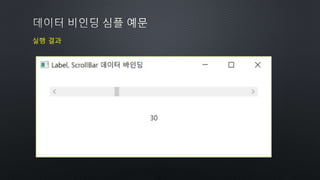
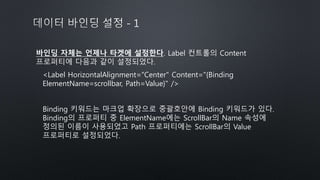
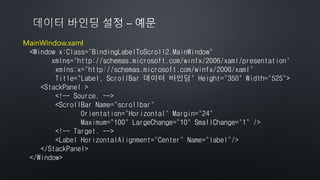
바인딩 자체는 언제나타겟에 설정한다. Label 컨트롤의 Content
프로퍼티에 다음과 같이 설정되었다.
<Label HorizontalAlignment="Center" Content="{Binding
ElementName=scrollbar, Path=Value}" />
Binding 키워드는 마크업 확장으로 중괄호안에 Binding 키워드가 있다.
Binding의 프로퍼티 중 ElementName에는 ScrollBar의 Name 속성에
정의된 이름이 사용되었고 Path 프로퍼티에는 ScrollBar의 Value
프로퍼티로 설정되었다.
7.
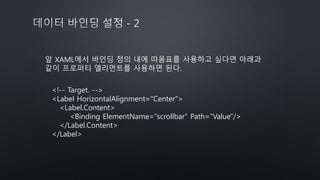
앞 XAML에서 바인딩정의 내에 따옴표를 사용하고 싶다면 아래과
같이 프로퍼티 엘리먼트를 사용하면 된다.
<!-- Target. -->
<Label HorizontalAlignment="Center">
<Label.Content>
<Binding ElementName="scrollbar" Path="Value"/>
</Label.Content>
</Label>
8.
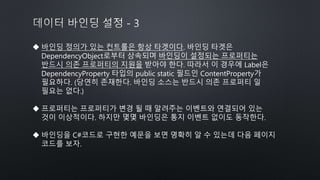
바인딩 정의가있는 컨트롤은 항상 타겟이다. 바인딩 타겟은
DependencyObject로부터 상속되며 바인딩이 설정되는 프로퍼티는
반드시 의존 프로퍼티의 지원을 받아야 한다. 따라서 이 경우에 Label은
DependencyProperty 타입의 public static 필드인 ContentProperty가
필요하다. (당연히 존재한다. 바인딩 소스는 반드시 의존 프로퍼티 일
필요는 없다.)
프로퍼티는 프로퍼티가 변경 될 때 알려주는 이벤트와 연결되어 있는
것이 이상적이다. 하지만 몇몇 바인딩은 통지 이벤트 없이도 동작한다.
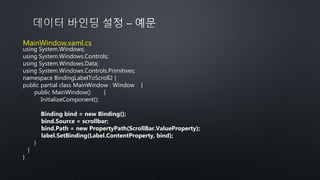
바인딩을 C#코드로 구현한 예문을 보면 명확히 알 수 있는데 다음 페이지
코드를 보자.
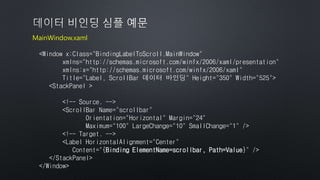
MainWindow.xaml.cs
using System.Windows;
using System.Windows.Controls;
usingSystem.Windows.Data;
using System.Windows.Controls.Primitives;
namespace BindingLabelToScroll2 {
public partial class MainWindow : Window {
public MainWindow() {
InitializeComponent();
Binding bind = new Binding();
bind.Source = scrollbar;
bind.Path = new PropertyPath(ScrollBar.ValueProperty);
label.SetBinding(Label.ContentProperty, bind);
}
}
}
11.
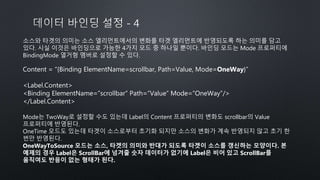
소스와 타겟의 의미는소스 엘리먼트에서의 변화를 타겟 엘리먼트에 반영되도록 하는 의미를 담고
있다. 시실 이것은 바인딩으로 가능한 4가지 모드 중 하나일 뿐이다. 바인딩 모드는 Mode 프로퍼티에
BindingMode 열거형 멤버로 설정할 수 있다.
Content = “{Binding ElementName=scrollbar, Path=Value, Mode=OneWay}”
<Label.Content>
<Binding ElementName=”scrollbar” Path=”Value” Mode=”OneWay”/>
</Label.Content>
Mode는 TwoWay로 설정할 수도 있는데 Label의 Content 프로퍼티의 변화도 scrollbar의 Value
프로퍼티에 반영된다.
OneTime 모드도 있는데 타겟이 소스로부터 초기화 되지만 소스의 변화가 계속 반영되지 않고 초기 한
번만 반영된다.
OneWayToSource 모드는 소스, 타겟의 의미와 반대가 되도록 타겟이 소스를 갱신하는 모양이다. 본
예제의 경우 Label은 ScrollBar에 넘겨줄 숫자 데이터가 없기에 Label은 비어 있고 ScrollBar를
움직여도 반응이 없는 형태가 된다.


![Kiss PageObjects [01-2017]](https://cdn.slidesharecdn.com/ss_thumbnails/kisspageobjects-01-2017-170113192904-thumbnail.jpg?width=640&height=640&fit=bounds)


![[Td 2015]틱틱대도 써야 하는 windows 10 앱 개발, c# tips & tricks(송기수)](https://cdn.slidesharecdn.com/ss_thumbnails/td2015windows10ctipstricks-151104053021-lva1-app6892-thumbnail.jpg?width=640&height=640&fit=bounds)


![[IT교육/IT학원]Develope를 위한 IT실무교육](https://cdn.slidesharecdn.com/ss_thumbnails/random-180126054238-thumbnail.jpg?width=640&height=640&fit=bounds)
![[아이오닉학원]아이오닉 하이브리드 앱 개발 과정(아이오닉2로 동적 모바일 앱 만들기)](https://cdn.slidesharecdn.com/ss_thumbnails/2-180116062601-thumbnail.jpg?width=640&height=640&fit=bounds)
![[뷰제이에스학원]뷰제이에스(Vue.js) 프로그래밍 입문(프로그레시브 자바스크립트 프레임워크)](https://cdn.slidesharecdn.com/ss_thumbnails/vue-180116043929-thumbnail.jpg?width=640&height=640&fit=bounds)
![[씨샵학원/씨샵교육]C#, 윈폼, 네트워크, ado.net 실무프로젝트 과정](https://cdn.slidesharecdn.com/ss_thumbnails/cado-180116013552-thumbnail.jpg?width=640&height=640&fit=bounds)
![[정보처리기사자격증학원]정보처리기사 취득 양성과정(국비무료 자격증과정)](https://cdn.slidesharecdn.com/ss_thumbnails/random-180116010303-thumbnail.jpg?width=640&height=640&fit=bounds)
![[wpf학원,wpf교육]닷넷, c#기반 wpf 프로그래밍 인터페이스구현 재직자 향상과정](https://cdn.slidesharecdn.com/ss_thumbnails/11-180102064615-thumbnail.jpg?width=640&height=640&fit=bounds)

![[자마린교육/자마린실습]자바,스프링프레임워크(스프링부트) RESTful 웹서비스 구현 실습,자마린에서 스프링 웹서비스를 호출하고 응답 JS...](https://cdn.slidesharecdn.com/ss_thumbnails/restfuljson-171119094451-thumbnail.jpg?width=640&height=640&fit=bounds)
![[구로자마린학원/자마린강좌/자마린교육]3. xamarin.ios 3.3.5 추가적인 사항](https://cdn.slidesharecdn.com/ss_thumbnails/3-171109005415-thumbnail.jpg?width=640&height=640&fit=bounds)


![자바, 웹 기초와 스프링 프레임워크 & 마이바티스 재직자 향상과정(자바학원/자바교육/자바기업출강]](https://cdn.slidesharecdn.com/ss_thumbnails/01-171017011030-thumbnail.jpg?width=640&height=640&fit=bounds)

![3. 안드로이드 애플리케이션 구성요소 3.2인텐트 part01(안드로이드학원/안드로이드교육/안드로이드강좌/안드로이드기업출강]](https://cdn.slidesharecdn.com/ss_thumbnails/3-171010074659-thumbnail.jpg?width=640&height=640&fit=bounds)