SAMRAT PRITHVIRAJ CHAUHAN
GOVERNMENTCOLLEGE (AJMER)
DEPARTMENT OF CHEMISTRY
SUBMITTED TO : DEPARTMENT OF CHEMISTRY
SUBMITTED BY :
HRITIK POONIYA [M.Sc.(PREVIOUS)]
TOPIC : ‘C’-PROGRAMMING
CONTENT
1. OVERVIEW OF“C”
2. TERMS RELATED TO ‘C’ PROGRAM
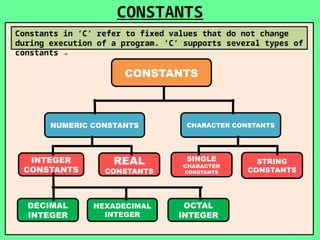
3. CONSTANTS
4. VARIABLES
5. DATA TYPES
6. OPERATORS AND EXPRESSIONS
7. DECISION MAKING AND BRANCHING
8. If, If……Else AND goto STATEMENTS
9. DECISION MAKING AND LOOPING
10. While , Do AND For STATEMENT
11. C – PROGRAM TO CALCULATE PRESSURE USING
VANDER WAALS EQUATION
4.
OVERVIEW OF “C”
DEFINATION–
‘C’ may be
defined as a
structured,
high- level,
machine
independent
language which
allows software
developers to
develop programs
without worrying
about the
hardware
platforms where
they will be
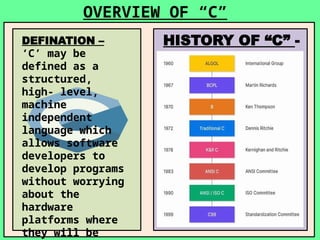
HISTORY OF “C” -
5.
TERMS RELATED TO‘C’-
PROGRAM
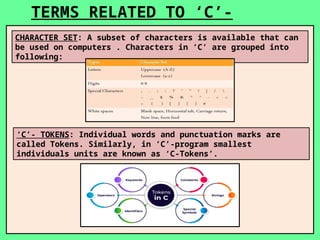
CHARACTER SET: A subset of characters is available that can
be used on computers . Characters in ‘C’ are grouped into
following:
‘C’- TOKENS: Individual words and punctuation marks are
called Tokens. Similarly, in ‘C’-program smallest
individuals units are known as ‘C-Tokens’.
6.
TERMS RELATED TO‘C’-
PROGRAM
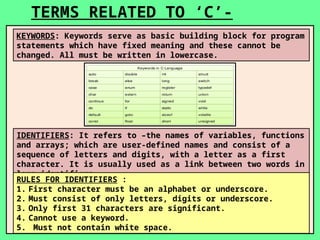
KEYWORDS: Keywords serve as basic building block for program
statements which have fixed meaning and these cannot be
changed. All must be written in lowercase.
IDENTIFIERS: It refers to –the names of variables, functions
and arrays; which are user-defined names and consist of a
sequence of letters and digits, with a letter as a first
character. It is usually used as a link between two words in
long identifiers.
RULES FOR IDENTIFIERS :
1. First character must be an alphabet or underscore.
2. Must consist of only letters, digits or underscore.
3. Only first 31 characters are significant.
4. Cannot use a keyword.
5. Must not contain white space.
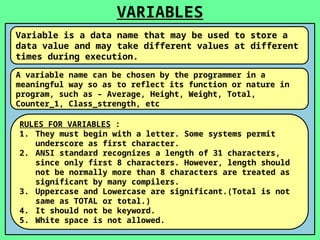
VARIABLES
Variable is adata name that may be used to store a
data value and may take different values at different
times during execution.
A variable name can be chosen by the programmer in a
meaningful way so as to reflect its function or nature in
program, such as – Average, Height, Weight, Total,
Counter_1, Class_strength, etc.
RULES FOR VARIABLES :
1. They must begin with a letter. Some systems permit
underscore as first character.
2. ANSI standard recognizes a length of 31 characters,
since only first 8 characters. However, length should
not be normally more than 8 characters are treated as
significant by many compilers.
3. Uppercase and Lowercase are significant.(Total is not
same as TOTAL or total.)
4. It should not be keyword.
5. White space is not allowed.
9.
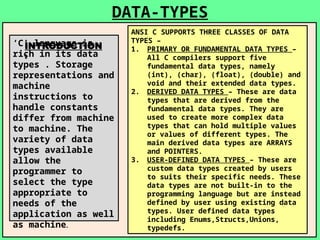
DATA-TYPES
ANSI C SUPPORTSTHREE CLASSES OF DATA
TYPES –
1. PRIMARY OR FUNDAMENTAL DATA TYPES –
All C compilers support five
fundamental data types, namely
(int), (char), (float), (double) and
void and their extended data types.
2. DERIVED DATA TYPES – These are data
types that are derived from the
fundamental data types. They are
used to create more complex data
types that can hold multiple values
or values of different types. The
main derived data types are ARRAYS
and POINTERS.
3. USER-DEFINED DATA TYPES – These are
custom data types created by users
to suits their specific needs. These
data types are not built-in to the
programming language but are instead
defined by user using existing data
types. User defined data types
including Enums,Structs,Unions,
typedefs.
‘C’ language is
rich in its data
types . Storage
representations and
machine
instructions to
handle constants
differ from machine
to machine. The
variety of data
types available
allow the
programmer to
select the type
appropriate to
needs of the
application as well
as machine.
INTRODUCTION
:
10.
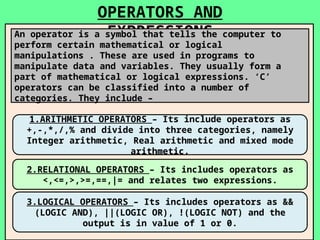
OPERATORS AND
EXPRESSIONS
An operatoris a symbol that tells the computer to
perform certain mathematical or logical
manipulations . These are used in programs to
manipulate data and variables. They usually form a
part of mathematical or logical expressions. ‘C’
operators can be classified into a number of
categories. They include –
1.ARITHMETIC OPERATORS – Its include operators as
+,-,*,/,% and divide into three categories, namely
Integer arithmetic, Real arithmetic and mixed mode
arithmetic.
2.RELATIONAL OPERATORS – Its includes operators as
<,<=,>,>=,==,|= and relates two expressions.
3.LOGICAL OPERATORS – Its includes operators as &&
(LOGIC AND), ||(LOGIC OR), !(LOGIC NOT) and the
output is in value of 1 or 0.
11.
4.ASSIGNMENT OPERATORS –Its include operator ‘=’ and
work as a shorthand form(v1op=exp;).
EXAMPLE- a=a+1 shorthand as a+=1.
5.INCREMENT & DECREMENT OPERATORS – Its includes
operators as ++m,--m and allows to increase or
decrease expressions(m) by 1,respectively.
6.BITWISE OPERATORS – Its includes operators as &
(bitwise AND), |(bitwise OR), ^(bitwise exclusive
OR), <<(shift left), >>(shift right) and these are
used for manipulation of data at bit level.
7.SPECIAL OPERATORS – ‘C’ supports some special
operators of interest such as the comma operator,
sizeof operator, pointer operator(&) and member
selection operators (. and →).
8.CONDITIONAL OPERATORS – It is also known as ternary
operator pair ‘?:’ is available in ‘C’ to construct
conditional expressions of the form :
[exp1?exp2:exp3]
12.
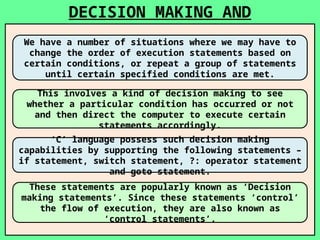
DECISION MAKING AND
BRANCHING
Wehave a number of situations where we may have to
change the order of execution statements based on
certain conditions, or repeat a group of statements
until certain specified conditions are met.
This involves a kind of decision making to see
whether a particular condition has occurred or not
and then direct the computer to execute certain
statements accordingly.
‘C’ language possess such decision making
capabilities by supporting the following statements –
if statement, switch statement, ?: operator statement
and goto statement.
These statements are popularly known as ‘Decision
making statements’. Since these statements ‘control’
the flow of execution, they are also known as
‘control statements’.
13.
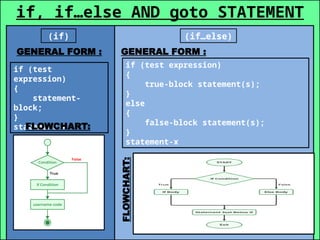
if, if…else ANDgoto STATEMENT
(if) (if…else)
if (test
expression)
{
statement-
block;
}
statement-x
GENERAL FORM : GENERAL FORM :
FLOWCHART:
if (test expression)
{
true-block statement(s);
}
else
{
false-block statement(s);
}
statement-x
FLOWCHART:
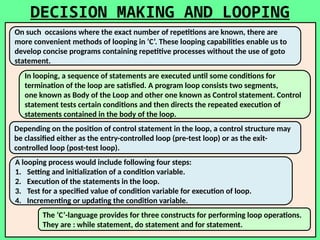
DECISION MAKING ANDLOOPING
On such occasions where the exact number of repetitions are known, there are
more convenient methods of looping in ‘C’. These looping capabilities enable us to
develop concise programs containing repetitive processes without the use of goto
statement.
A looping process would include following four steps:
1. Setting and initialization of a condition variable.
2. Execution of the statements in the loop.
3. Test for a specified value of condition variable for execution of loop.
4. Incrementing or updating the condition variable.
In looping, a sequence of statements are executed until some conditions for
termination of the loop are satisfied. A program loop consists two segments,
one known as Body of the Loop and other one known as Control statement. Control
statement tests certain conditions and then directs the repeated execution of
statements contained in the body of the loop.
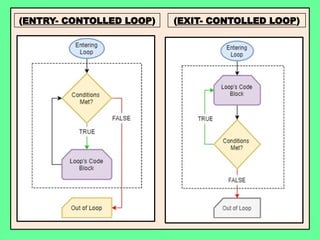
Depending on the position of control statement in the loop, a control structure may
be classified either as the entry-controlled loop (pre-test loop) or as the exit-
controlled loop (post-test loop).
The ‘C’-language provides for three constructs for performing loop operations.
They are : while statement, do statement and for statement.
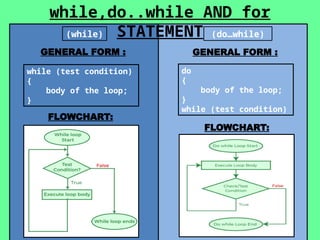
while,do..while AND for
STATEMENT(do…while)
do
{
body of the loop;
}
while (test condition)
GENERAL FORM :
FLOWCHART:
while (test condition)
{
body of the loop;
}
GENERAL FORM :
FLOWCHART:
(while)
18.
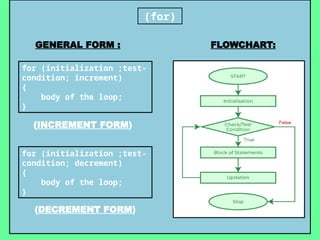
(for)
for (initialization ;test-
condition;increment)
{
body of the loop;
}
GENERAL FORM : FLOWCHART:
for (initialization ;test-
condition; decrement)
{
body of the loop;
}
(INCREMENT FORM)
(DECREMENT FORM)
19.
C – PROGRAMTO CALCULATE PRESSURE
USING VANDER WAALS EQUATION
VAN-DER WAALS EQUATION :
VAN-DER WAALS EQUATION FOR FIND OUT PRESSURE :
20.
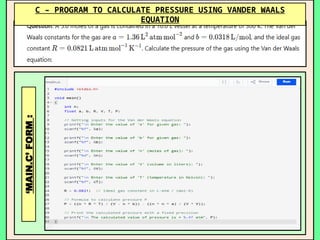
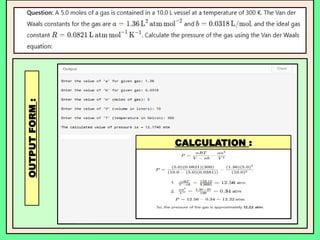
C – PROGRAMTO CALCULATE PRESSURE USING VANDER WAALS
EQUATION
‘MAIN.C’
FORM
:
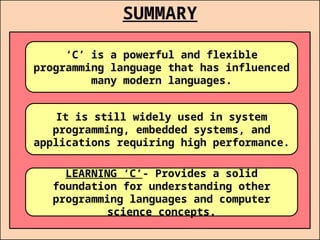
SUMMARY
‘C’ is apowerful and flexible
programming language that has influenced
many modern languages.
It is still widely used in system
programming, embedded systems, and
applications requiring high performance.
LEARNING ‘C’- Provides a solid
foundation for understanding other
programming languages and computer
science concepts.
![SAMRAT PRITHVIRAJ CHAUHAN
GOVERNMENT COLLEGE (AJMER)
DEPARTMENT OF CHEMISTRY
SUBMITTED TO : DEPARTMENT OF CHEMISTRY
SUBMITTED BY :
HRITIK POONIYA [M.Sc.(PREVIOUS)]
TOPIC : ‘C’-PROGRAMMING](https://image.slidesharecdn.com/hc4112-250824152013-2965410a/85/C-programming-msc-chemistry-pankaj-pandey-1-320.jpg)
![4.ASSIGNMENT OPERATORS – Its include operator ‘=’ and
work as a shorthand form(v1op=exp;).
EXAMPLE- a=a+1 shorthand as a+=1.
5.INCREMENT & DECREMENT OPERATORS – Its includes
operators as ++m,--m and allows to increase or
decrease expressions(m) by 1,respectively.
6.BITWISE OPERATORS – Its includes operators as &
(bitwise AND), |(bitwise OR), ^(bitwise exclusive
OR), <<(shift left), >>(shift right) and these are
used for manipulation of data at bit level.
7.SPECIAL OPERATORS – ‘C’ supports some special
operators of interest such as the comma operator,
sizeof operator, pointer operator(&) and member
selection operators (. and →).
8.CONDITIONAL OPERATORS – It is also known as ternary
operator pair ‘?:’ is available in ‘C’ to construct
conditional expressions of the form :
[exp1?exp2:exp3]](https://image.slidesharecdn.com/hc4112-250824152013-2965410a/85/C-programming-msc-chemistry-pankaj-pandey-11-320.jpg)