C++ Programming : from problem analysis to program design
1.
C++ Programming: FromProblem Analysis to
Program Design, Fifth Edition
Chapter 1: An Overview of
Computers and Programming
Languages
2.
Objectives
In this chapter,you will:
• Learn about different types of computers
• Explore the hardware and software
components of a computer system
• Learn about the language of a computer
• Learn about the evolution of programming
languages
• Examine high-level programming
languages
C++ Programming: From Problem Analysis to Program Design, Fifth Edition 2
3.
Objectives (cont'd.)
• Discoverwhat a compiler is and what it
does
• Examine a C++ program
• Explore how a C++ program is processed
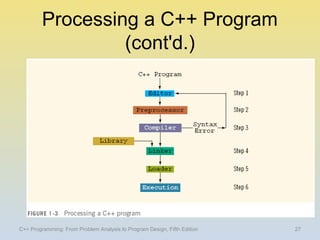
• Learn what an algorithm is and explore
problem-solving techniques
• Become aware of structured design and
object-oriented design programming
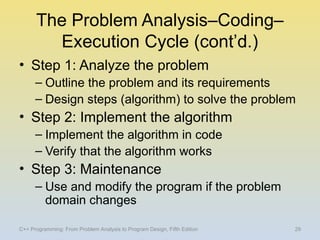
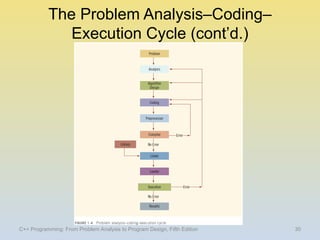
methodologies
• Become aware of Standard C++ and
ANSI/ISO Standard C++
C++ Programming: From Problem Analysis to Program Design, Fifth Edition 3
4.
Introduction
• Without software,the computer is useless
• Software developed with programming
languages
– C++ is a programming language
• C++ suited for a wide variety of
programming tasks
• Before programming, it is useful to
understand terminology and computer
components
C++ Programming: From Problem Analysis to Program Design, Fifth Edition 4
5.
A Brief Overviewof the History of
Computers
• Early calculation devices
– Abacus, Pascaline
– Leibniz device
– Babbage machines: difference and analytic
engines
– Hollerith machine
C++ Programming: From Problem Analysis to Program Design, Fifth Edition 5
6.
A Brief Overviewof the History of
Computers (cont'd.)
• Early computer-like machines
– Mark I
– ENIAC
– Von Neumann architecture
– UNIVAC
– Transistors and microprocessors
C++ Programming: From Problem Analysis to Program Design, Fifth Edition 6
7.
A Brief Overviewof the History of
Computers (cont'd.)
• Categories of computers
– Mainframe computers
– Midsize computers
– Micro computers (personal computers)
C++ Programming: From Problem Analysis to Program Design, Fifth Edition 7
8.
Elements of aComputer
System
• Hardware
• CPU
• Main memory
• Secondary storage
• Input/Output devices
• Software
C++ Programming: From Problem Analysis to Program Design, Fifth Edition 8
9.
Hardware
• CPU
• Mainmemory: RAM
• Input/output devices
• Secondary storage
C++ Programming: From Problem Analysis to Program Design, Fifth Edition 9
10.
Central Processing Unitand Main
Memory
• Central processing unit
– Brain of the computer
– Most expensive piece of hardware
– Carries out arithmetic and logical operations
C++ Programming: From Problem Analysis to Program Design, Fifth Edition 10
11.
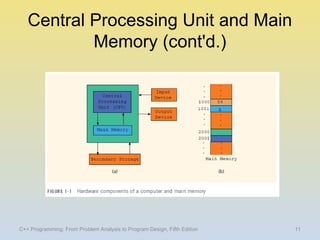
Central Processing Unitand Main
Memory (cont'd.)
C++ Programming: From Problem Analysis to Program Design, Fifth Edition 11
12.
Central Processing Unitand Main
Memory (cont'd.)
• Random access memory
• Directly connected to the CPU
• All programs must be loaded into main
memory before they can be executed
• All data must be brought into main
memory before it can be manipulated
• When computer power is turned off,
everything in main memory is lost
C++ Programming: From Problem Analysis to Program Design, Fifth Edition 12
13.
Secondary Storage
• Secondarystorage: device that stores
information permanently
• Examples of secondary storage:
– Hard disks
– Flash drives
– Floppy disks
– Zip disks
– CD-ROMs
– Tapes
C++ Programming: From Problem Analysis to Program Design, Fifth Edition 13
14.
Input/Output Devices
• Inputdevices feed data and programs into
computers
– Keyboard
– Mouse
– Secondary storage
• Output devices display results
– Monitor
– Printer
– Secondary storage
C++ Programming: From Problem Analysis to Program Design, Fifth Edition 14
15.
Software
• Software: programsthat do specific tasks
• System programs take control of the
computer, such as an operating system
• Application programs perform a specific
task
– Word processors
– Spreadsheets
– Games
C++ Programming: From Problem Analysis to Program Design, Fifth Edition 15
16.
The Language ofa Computer
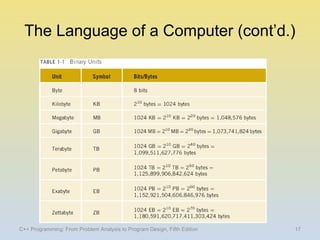
• Digital signals: sequences of 0s and 1s
• Machine language: language of a computer
• Binary digit (bit):
– The digit 0 or 1
• Binary code:
– A sequence of 0s and 1s
• Byte:
– A sequence of eight bits
C++ Programming: From Problem Analysis to Program Design, Fifth Edition 16
17.
The Language ofa Computer (cont’d.)
C++ Programming: From Problem Analysis to Program Design, Fifth Edition 17
18.
The Language ofa Computer
(cont'd.)
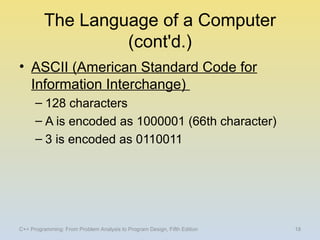
• ASCII (American Standard Code for
Information Interchange)
– 128 characters
– A is encoded as 1000001 (66th character)
– 3 is encoded as 0110011
C++ Programming: From Problem Analysis to Program Design, Fifth Edition 18
19.
The Language ofa Computer
(cont'd.)
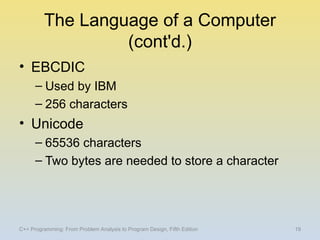
• EBCDIC
– Used by IBM
– 256 characters
• Unicode
– 65536 characters
– Two bytes are needed to store a character
C++ Programming: From Problem Analysis to Program Design, Fifth Edition 19
20.
The Evolution ofProgramming
Languages
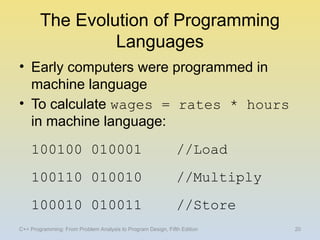
• Early computers were programmed in
machine language
• To calculate wages = rates * hours
in machine language:
100100 010001 //Load
100110 010010 //Multiply
100010 010011 //Store
C++ Programming: From Problem Analysis to Program Design, Fifth Edition 20
21.
The Evolution ofProgramming
Languages (cont'd.)
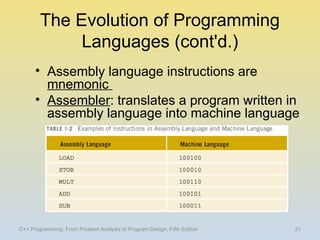
• Assembly language instructions are
mnemonic
• Assembler: translates a program written in
assembly language into machine language
C++ Programming: From Problem Analysis to Program Design, Fifth Edition 21
22.
The Evolution ofProgramming
Languages (cont'd.)
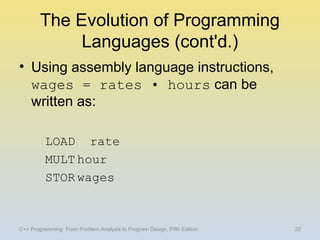
• Using assembly language instructions,
wages = rates • hours can be
written as:
LOAD rate
MULT hour
STOR wages
C++ Programming: From Problem Analysis to Program Design, Fifth Edition 22
23.
The Evolution ofProgramming
Languages (cont'd.)
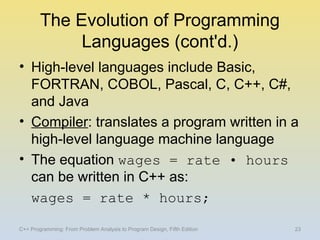
• High-level languages include Basic,
FORTRAN, COBOL, Pascal, C, C++, C#,
and Java
• Compiler: translates a program written in a
high-level language machine language
• The equation wages = rate • hours
can be written in C++ as:
wages = rate * hours;
C++ Programming: From Problem Analysis to Program Design, Fifth Edition 23
24.
Processing a C++Program
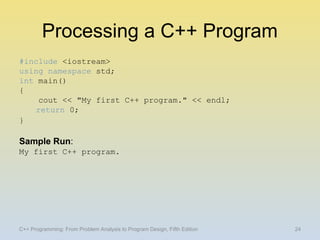
#include <iostream>
using namespace std;
int main()
{
cout << "My first C++ program." << endl;
return 0;
}
Sample Run:
My first C++ program.
C++ Programming: From Problem Analysis to Program Design, Fifth Edition 24
25.
Processing a C++Program
(cont'd.)
• To execute a C++ program:
– Use an editor to create a source program in
C++
– Preprocessor directives begin with # and are
processed by a the preprocessor
– Use the compiler to:
• Check that the program obeys the rules
• Translate into machine language (object program)
C++ Programming: From Problem Analysis to Program Design, Fifth Edition 25
26.
Processing a C++Program
(cont'd.)
• To execute a C++ program (cont'd.):
– Linker:
• Combines object program with other programs
provided by the SDK to create executable code
– Loader:
• Loads executable program into main memory
– The last step is to execute the program
C++ Programming: From Problem Analysis to Program Design, Fifth Edition 26
27.
Processing a C++Program
(cont'd.)
C++ Programming: From Problem Analysis to Program Design, Fifth Edition 27
28.
Programming with theProblem
Analysis–Coding–Execution Cycle
• Programming is a process of problem solving
• One problem-solving technique:
– Analyze the problem
– Outline the problem requirements
– Design steps (algorithm) to solve the problem
• Algorithm:
– Step-by-step problem-solving process
– Solution achieved in finite amount of time
C++ Programming: From Problem Analysis to Program Design, Fifth Edition 28
29.
The Problem Analysis–Coding–
ExecutionCycle (cont’d.)
• Step 1: Analyze the problem
– Outline the problem and its requirements
– Design steps (algorithm) to solve the problem
• Step 2: Implement the algorithm
– Implement the algorithm in code
– Verify that the algorithm works
• Step 3: Maintenance
– Use and modify the program if the problem
domain changes
C++ Programming: From Problem Analysis to Program Design, Fifth Edition 29
The Problem Analysis–Coding–
ExecutionCycle (cont'd.)
• Thoroughly understand the problem
• Understand problem requirements
– Does program require user interaction?
– Does program manipulate data?
– What is the output?
• If the problem is complex, divide it into
subproblems
– Analyze each subproblem as above
C++ Programming: From Problem Analysis to Program Design, Fifth Edition 31
32.
The Problem Analysis–Coding–
ExecutionCycle (cont'd.)
• If problem was broken into subproblems
– Design algorithms for each subproblem
• Check the correctness of algorithm
– Can test using sample data
– Some mathematical analysis might be
required
C++ Programming: From Problem Analysis to Program Design, Fifth Edition 32
33.
The Problem Analysis–Coding–
ExecutionCycle (cont'd.)
• Once the algorithm is designed and
correctness verified
– Write the equivalent code in high-level
language
• Enter the program using text editor
C++ Programming: From Problem Analysis to Program Design, Fifth Edition 33
34.
The Problem Analysis–Coding–
ExecutionCycle (cont'd.)
• Run code through compiler
• If compiler generates errors
– Look at code and remove errors
– Run code again through compiler
• If there are no syntax errors
– Compiler generates equivalent machine code
• Linker links machine code with system
resources
C++ Programming: From Problem Analysis to Program Design, Fifth Edition 34
35.
The Problem Analysis–Coding–
ExecutionCycle (cont'd.)
• Once compiled and linked, loader can
place program into main memory for
execution
• The final step is to execute the program
• Compiler guarantees that the program
follows the rules of the language
– Does not guarantee that the program will run
correctly
C++ Programming: From Problem Analysis to Program Design, Fifth Edition 35
36.
Example 1-1
• Designan algorithm to find the perimeter
and area of a rectangle
• The perimeter and area of the rectangle
are given by the following formulas:
perimeter = 2 * (length +
width)
area = length * width
C++ Programming: From Problem Analysis to Program Design, Fifth Edition 36
37.
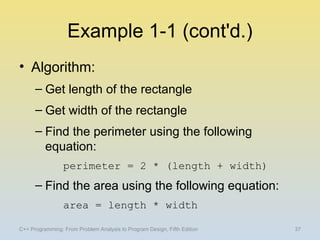
Example 1-1 (cont'd.)
•Algorithm:
– Get length of the rectangle
– Get width of the rectangle
– Find the perimeter using the following
equation:
perimeter = 2 * (length + width)
– Find the area using the following equation:
area = length * width
C++ Programming: From Problem Analysis to Program Design, Fifth Edition 37
38.
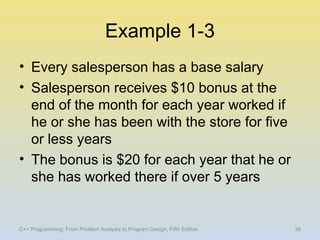
Example 1-3
• Everysalesperson has a base salary
• Salesperson receives $10 bonus at the
end of the month for each year worked if
he or she has been with the store for five
or less years
• The bonus is $20 for each year that he or
she has worked there if over 5 years
C++ Programming: From Problem Analysis to Program Design, Fifth Edition 38
39.
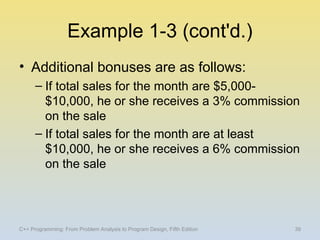
Example 1-3 (cont'd.)
•Additional bonuses are as follows:
– If total sales for the month are $5,000-
$10,000, he or she receives a 3% commission
on the sale
– If total sales for the month are at least
$10,000, he or she receives a 6% commission
on the sale
C++ Programming: From Problem Analysis to Program Design, Fifth Edition 39
40.
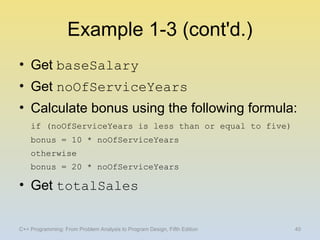
Example 1-3 (cont'd.)
•Get baseSalary
• Get noOfServiceYears
• Calculate bonus using the following formula:
if (noOfServiceYears is less than or equal to five)
bonus = 10 * noOfServiceYears
otherwise
bonus = 20 * noOfServiceYears
• Get totalSales
C++ Programming: From Problem Analysis to Program Design, Fifth Edition 40
41.
Example 1-3 (cont'd.)
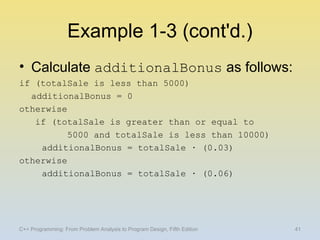
•Calculate additionalBonus as follows:
if (totalSale is less than 5000)
additionalBonus = 0
otherwise
if (totalSale is greater than or equal to
5000 and totalSale is less than 10000)
additionalBonus = totalSale · (0.03)
otherwise
additionalBonus = totalSale · (0.06)
C++ Programming: From Problem Analysis to Program Design, Fifth Edition 41
42.
Example 1-3 (cont'd.)
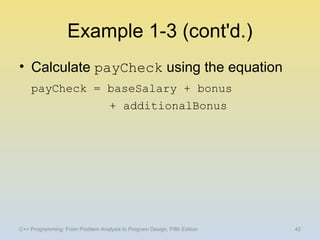
•Calculate payCheck using the equation
payCheck = baseSalary + bonus
+ additionalBonus
C++ Programming: From Problem Analysis to Program Design, Fifth Edition 42
43.
Example 1-5
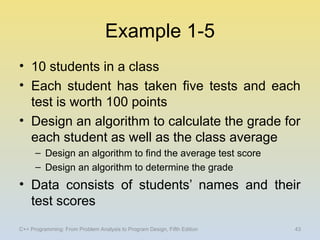
• 10students in a class
• Each student has taken five tests and each
test is worth 100 points
• Design an algorithm to calculate the grade for
each student as well as the class average
– Design an algorithm to find the average test score
– Design an algorithm to determine the grade
• Data consists of students’ names and their
test scores
C++ Programming: From Problem Analysis to Program Design, Fifth Edition 43
44.
Example 1-5 (cont'd.)
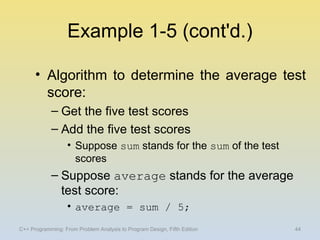
•Algorithm to determine the average test
score:
– Get the five test scores
– Add the five test scores
• Suppose sum stands for the sum of the test
scores
– Suppose average stands for the average
test score:
• average = sum / 5;
C++ Programming: From Problem Analysis to Program Design, Fifth Edition 44
45.
Example 1-5 (cont'd.)
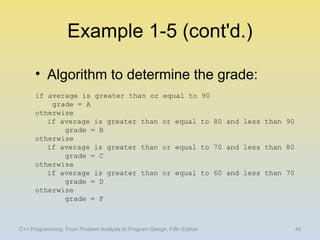
•Algorithm to determine the grade:
if average is greater than or equal to 90
grade = A
otherwise
if average is greater than or equal to 80 and less than 90
grade = B
otherwise
if average is greater than or equal to 70 and less than 80
grade = C
otherwise
if average is greater than or equal to 60 and less than 70
grade = D
otherwise
grade = F
C++ Programming: From Problem Analysis to Program Design, Fifth Edition 45
46.
Example 1-5 (cont'd.)
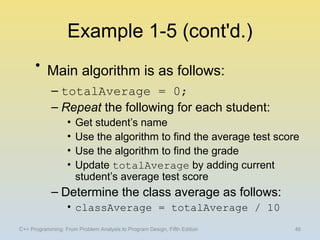
•Main algorithm is as follows:
– totalAverage = 0;
– Repeat the following for each student:
• Get student’s name
• Use the algorithm to find the average test score
• Use the algorithm to find the grade
• Update totalAverage by adding current
student’s average test score
– Determine the class average as follows:
• classAverage = totalAverage / 10
C++ Programming: From Problem Analysis to Program Design, Fifth Edition 46
47.
Programming Methodologies
• Twopopular approaches to
programming design
– Structured
– Object-oriented
C++ Programming: From Problem Analysis to Program Design, Fifth Edition 47
48.
Structured Programming
• Structureddesign:
– Dividing a problem into smaller subproblems
• Structured programming:
– Implementing a structured design
• The structured design approach is also
called:
– Top-down (or bottom-up) design
– Stepwise refinement
– Modular programming
C++ Programming: From Problem Analysis to Program Design, Fifth Edition 48
49.
Object-Oriented Programming
• Identifycomponents called objects
• Specify relevant data and possible
operations to be performed on that data
• Each object consists of data and
operations on that data
• An object combines data and operations
on the data into a single unit
C++ Programming: From Problem Analysis to Program Design, Fifth Edition 49
50.
Object-Oriented Programming
(cont'd.)
• Aprogramming language that implements
OOD is called an object-oriented
programming (OOP) language
• Learn how to represent data in computer
memory, how to manipulate data, and how
to implement operations
• Write algorithms and implement them in a
programming language
C++ Programming: From Problem Analysis to Program Design, Fifth Edition 50
51.
Object-Oriented Programming
(cont'd.)
• Learnhow to combine data and operations
on the data into a single unit called an
object
• C++ was designed to implement OOD
• OOD is used with structured design
C++ Programming: From Problem Analysis to Program Design, Fifth Edition 51
52.
ANSI/ISO Standard C++
•C++ evolved from C
• C++ designed by Bjarne Stroustrup at Bell
Laboratories in early 1980s
• C++ programs were not always portable
from one compiler to another
• In mid-1998, ANSI/ISO C++ language
standards were approved
C++ Programming: From Problem Analysis to Program Design, Fifth Edition 52
53.
Summary
• Computer: electronicdevice that can perform
arithmetic and logical operations
• Computer system has hardware and software
• Central processing unit (CPU): brain
• Primary storage (MM) is volatile; secondary
storage (e.g., disk) is permanent
• Operating system monitors the overall activity
of the computer and provides services
C++ Programming: From Problem Analysis to Program Design, Fifth Edition 53
54.
Summary (cont'd.)
• Variouskinds of languages, such as machine
language, assembly, high-level
• Algorithm: step-by-step problem-solving
process; solution in finite amount of time
• Problem-solving process has three steps:
– Analyze problem and design an algorithm
– Implement the algorithm in code
– Maintain the program
C++ Programming: From Problem Analysis to Program Design, Fifth Edition 54
55.
Summary (cont'd.)
• Structureddesign:
– Problem is divided into smaller subproblems
– Each subproblem is solved
– Combine solutions to all subproblems
• Object-oriented design (OOD): a program is a
collection of interacting objects
– Object: data and operations on those data
C++ Programming: From Problem Analysis to Program Design, Fifth Edition 55