C Programming Program Design Including Data Structures 5th Edition D. S. Malik
C Programming Program Design Including Data Structures 5th Edition D. S. Malik
C Programming Program Design Including Data Structures 5th Edition D. S. Malik
C Programming Program Design Including Data Structures 5th Edition D. S. Malik
C Programming Program Design Including Data Structures 5th Edition D. S. Malik
1.
C Programming ProgramDesign Including Data
Structures 5th Edition D. S. Malik - Downloadable
PDF 2025
https://ebookfinal.com/download/c-programming-program-design-including-
data-structures-5th-edition-d-s-malik/
Visit ebookfinal.com today to download the complete set of
ebooks or textbooks
2.
Here are somerecommended products that we believe you will be
interested in. You can click the link to download.
Java programming from problem analysis to program design
5th ed Edition D S Malik
https://ebookfinal.com/download/java-programming-from-problem-
analysis-to-program-design-5th-ed-edition-d-s-malik/
Data structures using C Second Edition Reema Thareja
https://ebookfinal.com/download/data-structures-using-c-second-
edition-reema-thareja/
Understanding Structures Analysis Materials Design 5th
Edition Derek Seward
https://ebookfinal.com/download/understanding-structures-analysis-
materials-design-5th-edition-derek-seward/
The Complete Bedwetting Book Including a Daytime Program
for Nighttime Dryness 1st Edition D. Preston
https://ebookfinal.com/download/the-complete-bedwetting-book-
including-a-daytime-program-for-nighttime-dryness-1st-edition-d-
preston/
3.
Fundamentals of DataStructures in C 2nd Edition Ellis
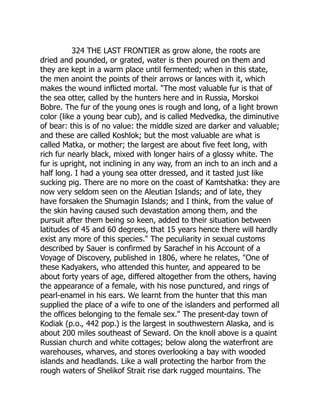
Horowitz
https://ebookfinal.com/download/fundamentals-of-data-structures-
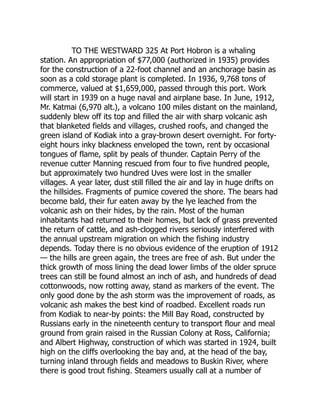
in-c-2nd-edition-ellis-horowitz/
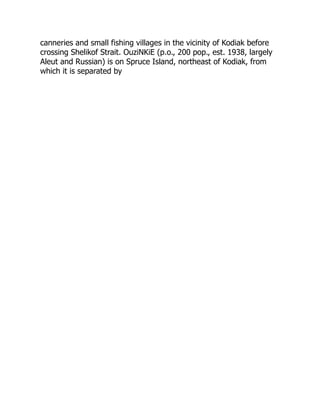
Data Structures and Other Objects Using C 4th Edition Main
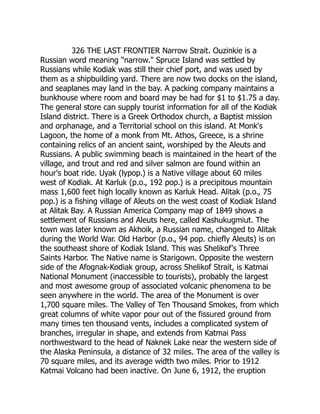
https://ebookfinal.com/download/data-structures-and-other-objects-
using-c-4th-edition-main/
Introduction to Programming Languages Programming in C C
Scheme Prolog C and SOA 5th Edition Yinong Chen
https://ebookfinal.com/download/introduction-to-programming-languages-
programming-in-c-c-scheme-prolog-c-and-soa-5th-edition-yinong-chen/
Analysis and Design of Marine Structures including CD ROM
1 Har/Cdr Edition Carlos Guedes Soares
https://ebookfinal.com/download/analysis-and-design-of-marine-
structures-including-cd-rom-1-har-cdr-edition-carlos-guedes-soares/
Classic Data Structures Samanta
https://ebookfinal.com/download/classic-data-structures-samanta/
5.
C Programming ProgramDesign Including Data
Structures 5th Edition D. S. Malik Digital Instant
Download
Author(s): D. S. Malik
ISBN(s): 9780538798099, 0538798092
Edition: 5th
File Details: PDF, 20.12 MB
Year: 2010
Language: english
7.
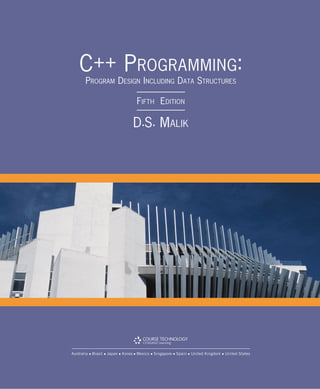
C++ PROGRAMMING:
PROGRAM DESIGNINCLUDING DATA STRUCTURES
FIFTH EDITION
D.S. MALIK
Australia Brazil Japan Korea Mexico Singapore Spain United Kingdom United States
8.
This is anelectronic version of the print textbook. Due to electronic rights restrictions,
some third party content may be suppressed. Editorial review has deemed that any suppressed
content does not materially affect the overall learning experience. The publisher reserves the right
to remove content from this title at any time if subsequent rights restrictions require it. For
valuable information on pricing, previous editions, changes to current editions, and alternate
formats, please visit www.cengage.com/highered to search by ISBN#, author, title, or keyword for
materials in your areas of interest.
9.
C++ Programming: ProgramDesign
Including Data Structures, Fifth Edition
D.S. Malik
Executive Editor: Marie Lee
Acquisitions Editor: Amy Jollymore
Senior Product Manager: Alyssa Pratt
Editorial Assistant: Zina Kresin
Content Project Manager: Matthew
Hutchinson
Art Director: Faith Brosnan
Print Buyer: Julio Esperas
Proofreader: GreenPen QA
Indexer: Elizabeth Cunningham
Cover Designer: Roycroft Design/
www.roycroftdesign.com
Cover Photo: Contemporary Building
ª Steve Hix/Somos Images/Corbis
Compositor: Integra
ª 2011 Course Technology, Cengage Learning
ALL RIGHTS RESERVED. No part of this work
covered by the copyright herein may be
reproduced, transmitted, stored or used in any
form or by any means graphic, electronic, or
mechanical, including but not limited to
photocopying, recording, scanning, digitizing,
taping, Web distribution, information
networks, or information storage and retrieval
systems, except as permitted under Section
107 or 108 of the 1976 United States Copyright
Act, without the prior written permission of
the publisher.
For product information and technology assistance, contact us at
Cengage Learning Customer Sales Support, 1-800-354-9706
For permission to use material from this text or product, submit
all requests online at www.cengage.com/permissions
Further permissions questions can be emailed to
permissionrequest@cengage.com
Library of Congress Control Number: 2010921540
ISBN-13: 978-0-538-79809-2
ISBN-10: 0-538-79809-2
Course Technology
20 Channel Center Street
Boston, MA 02210
USA
Some of the product names and company names used in this
book have been used for identification purposes only and may
be trademarks or registered trademarks of their respective
manufacturers and sellers.
Any fictional data related to persons or companies or URLs used
throughout this book is intended for instructional purposes only.
At the time this book was printed, any such data was fictional
and not belonging to any real persons or companies.
Course Technology, a part of Cengage Learning, reserves the
right to revise this publication and make changes from time to
time in its content without notice.
The programs in this book are for instructional purposes only.
They have been tested with care, but are not guaranteed
for any particular intent beyond educational purposes. The
author and the publisher do not offer any warranties or
representations, nor do they accept any liabilities with respect
to the programs.
Cengage Learning is a leading provider of customized
learning solutions with office locations around the globe,
including Singapore, the United Kingdom, Australia, Mexico,
Brazil and Japan. Locate your local office at:
www.cengage.com/global
Cengage Learning products are represented in Canada
by Nelson Education, Ltd.
To learn more about Course Technology, visit
www.cengage.com/coursetechnology
Purchase any of our products at your local college store or at
our preferred online store www.CengageBrain.com
TO
My Parents
Printed in the United States of America
1 2 3 4 5 6 7 16 15 14 13 12 11 10
10.
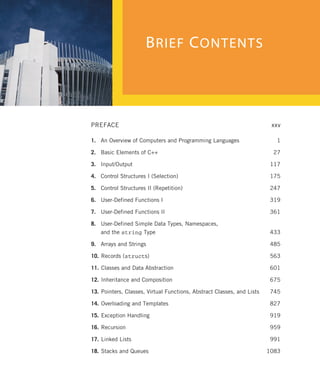
PREFACE xxv
1. AnOverview of Computers and Programming Languages 1
2. Basic Elements of C++ 27
3. Input/Output 117
4. Control Structures I (Selection) 175
5. Control Structures II (Repetition) 247
6. User-Defined Functions I 319
7. User-Defined Functions II 361
8. User-Defined Simple Data Types, Namespaces,
and the string Type 433
9. Arrays and Strings 485
10. Records (structs) 563
11. Classes and Data Abstraction 601
12. Inheritance and Composition 675
13. Pointers, Classes, Virtual Functions, Abstract Classes, and Lists 745
14. Overloading and Templates 827
15. Exception Handling 919
16. Recursion 959
17. Linked Lists 991
18. Stacks and Queues 1083
BRIEF CONTENTS
11.
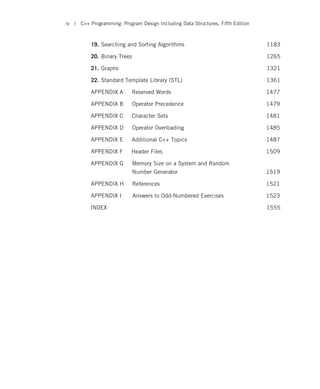
19. Searching andSorting Algorithms 1183
20. Binary Trees 1265
21. Graphs 1321
22. Standard Template Library (STL) 1361
APPENDIX A Reserved Words 1477
APPENDIX B Operator Precedence 1479
APPENDIX C Character Sets 1481
APPENDIX D Operator Overloading 1485
APPENDIX E Additional C++ Topics 1487
APPENDIX F Header Files 1509
APPENDIX G Memory Size on a System and Random
Number Generator 1519
APPENDIX H References 1521
APPENDIX I Answers to Odd-Numbered Exercises 1523
INDEX 1555
iv | C++ Programming: Program Design Including Data Structures, Fifth Edition
12.
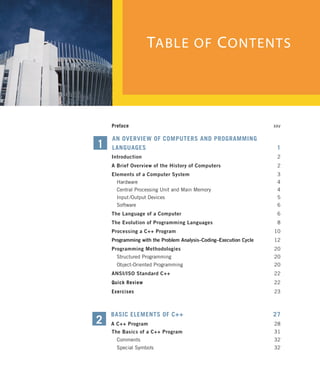
TABLE OF CONTENTS
Prefacexxv
AN OVERVIEW OF COMPUTERS AND PROGRAMMING
LANGUAGES 1
Introduction 2
A Brief Overview of the History of Computers 2
Elements of a Computer System 3
Hardware 4
Central Processing Unit and Main Memory 4
Input /Output Devices 5
Software 6
The Language of a Computer 6
The Evolution of Programming Languages 8
Processing a C++ Program 10
Programming with the Problem Analysis–Coding–Execution Cycle 12
Programming Methodologies 20
Structured Programming 20
Object-Oriented Programming 20
ANSI/ISO Standard C++ 22
Quick Review 22
Exercises 23
BASIC ELEMENTS OF C++ 27
A C++ Program 28
The Basics of a C++ Program 31
Comments 32
Special Symbols 32
1
2
13.
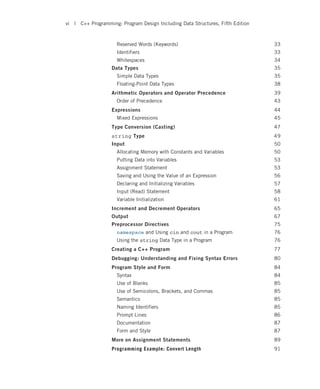
Reserved Words (Keywords)33
Identifiers 33
Whitespaces 34
Data Types 35
Simple Data Types 35
Floating-Point Data Types 38
Arithmetic Operators and Operator Precedence 39
Order of Precedence 43
Expressions 44
Mixed Expressions 45
Type Conversion (Casting) 47
string Type 49
Input 50
Allocating Memory with Constants and Variables 50
Putting Data into Variables 53
Assignment Statement 53
Saving and Using the Value of an Expression 56
Declaring and Initializing Variables 57
Input (Read) Statement 58
Variable Initialization 61
Increment and Decrement Operators 65
Output 67
Preprocessor Directives 75
namespace and Using cin and cout in a Program 76
Using the string Data Type in a Program 76
Creating a C++ Program 77
Debugging: Understanding and Fixing Syntax Errors 80
Program Style and Form 84
Syntax 84
Use of Blanks 85
Use of Semicolons, Brackets, and Commas 85
Semantics 85
Naming Identifiers 85
Prompt Lines 86
Documentation 87
Form and Style 87
More on Assignment Statements 89
Programming Example: Convert Length 91
vi | C++ Programming: Program Design Including Data Structures, Fifth Edition
14.
Programming Example: MakeChange 94
Quick Review 98
Exercises 100
Programming Exercises 109
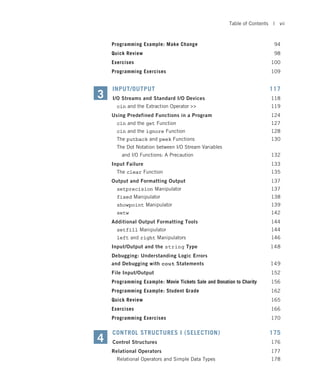
INPUT/OUTPUT 117
I/O Streams and Standard I/O Devices 118
cin and the Extraction Operator 119
Using Predefined Functions in a Program 124
cin and the get Function 127
cin and the ignore Function 128
The putback and peek Functions 130
The Dot Notation between I/O Stream Variables
and I/O Functions: A Precaution 132
Input Failure 133
The clear Function 135
Output and Formatting Output 137
setprecision Manipulator 137
fixed Manipulator 138
showpoint Manipulator 139
setw 142
Additional Output Formatting Tools 144
setfill Manipulator 144
left and right Manipulators 146
Input/Output and the string Type 148
Debugging: Understanding Logic Errors
and Debugging with cout Statements 149
File Input/Output 152
Programming Example: Movie Tickets Sale and Donation to Charity 156
Programming Example: Student Grade 162
Quick Review 165
Exercises 166
Programming Exercises 170
CONTROL STRUCTURES I (SELECTION) 175
Control Structures 176
Relational Operators 177
Relational Operators and Simple Data Types 178
3
4
Table of Contents | vii
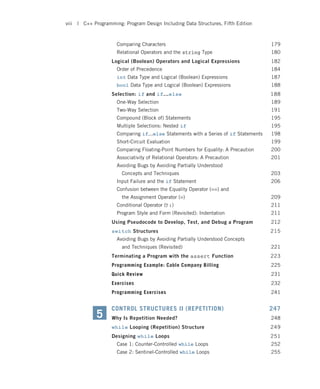
15.
Comparing Characters 179
RelationalOperators and the string Type 180
Logical (Boolean) Operators and Logical Expressions 182
Order of Precedence 184
int Data Type and Logical (Boolean) Expressions 187
bool Data Type and Logical (Boolean) Expressions 188
Selection: if and if...else 188
One-Way Selection 189
Two-Way Selection 191
Compound (Block of) Statements 195
Multiple Selections: Nested if 195
Comparing if...else Statements with a Series of if Statements 198
Short-Circuit Evaluation 199
Comparing Floating-Point Numbers for Equality: A Precaution 200
Associativity of Relational Operators: A Precaution 201
Avoiding Bugs by Avoiding Partially Understood
Concepts and Techniques 203
Input Failure and the if Statement 206
Confusion between the Equality Operator (==) and
the Assignment Operator (=) 209
Conditional Operator (?:) 211
Program Style and Form (Revisited): Indentation 211
Using Pseudocode to Develop, Test, and Debug a Program 212
switch Structures 215
Avoiding Bugs by Avoiding Partially Understood Concepts
and Techniques (Revisited) 221
Terminating a Program with the assert Function 223
Programming Example: Cable Company Billing 225
Quick Review 231
Exercises 232
Programming Exercises 241
CONTROL STRUCTURES II (REPETITION) 247
Why Is Repetition Needed? 248
while Looping (Repetition) Structure 249
Designing while Loops 251
Case 1: Counter-Controlled while Loops 252
Case 2: Sentinel-Controlled while Loops 255
5
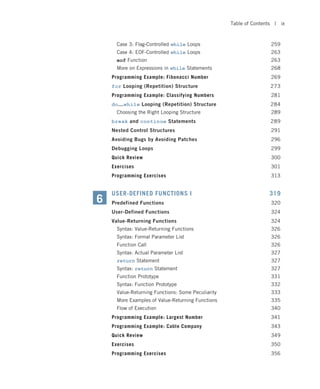
viii | C++ Programming: Program Design Including Data Structures, Fifth Edition
16.
Case 3: Flag-Controlledwhile Loops 259
Case 4: EOF-Controlled while Loops 263
eof Function 263
More on Expressions in while Statements 268
Programming Example: Fibonacci Number 269
for Looping (Repetition) Structure 273
Programming Example: Classifying Numbers 281
do...while Looping (Repetition) Structure 284
Choosing the Right Looping Structure 289
break and continue Statements 289
Nested Control Structures 291
Avoiding Bugs by Avoiding Patches 296
Debugging Loops 299
Quick Review 300
Exercises 301
Programming Exercises 313
USER-DEFINED FUNCTIONS I 319
Predefined Functions 320
User-Defined Functions 324
Value-Returning Functions 324
Syntax: Value-Returning Functions 326
Syntax: Formal Parameter List 326
Function Call 326
Syntax: Actual Parameter List 327
return Statement 327
Syntax: return Statement 327
Function Prototype 331
Syntax: Function Prototype 332
Value-Returning Functions: Some Peculiarity 333
More Examples of Value-Returning Functions 335
Flow of Execution 340
Programming Example: Largest Number 341
Programming Example: Cable Company 343
Quick Review 349
Exercises 350
Programming Exercises 356
6
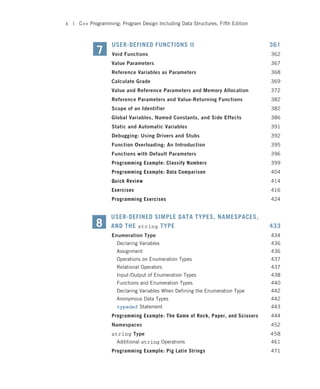
Table of Contents | ix
17.
USER-DEFINED FUNCTIONS II361
Void Functions 362
Value Parameters 367
Reference Variables as Parameters 368
Calculate Grade 369
Value and Reference Parameters and Memory Allocation 372
Reference Parameters and Value-Returning Functions 382
Scope of an Identifier 382
Global Variables, Named Constants, and Side Effects 386
Static and Automatic Variables 391
Debugging: Using Drivers and Stubs 392
Function Overloading: An Introduction 395
Functions with Default Parameters 396
Programming Example: Classify Numbers 399
Programming Example: Data Comparison 404
Quick Review 414
Exercises 416
Programming Exercises 424
USER-DEFINED SIMPLE DATA TYPES, NAMESPACES,
AND THE string TYPE 433
Enumeration Type 434
Declaring Variables 436
Assignment 436
Operations on Enumeration Types 437
Relational Operators 437
Input /Output of Enumeration Types 438
Functions and Enumeration Types 440
Declaring Variables When Defining the Enumeration Type 442
Anonymous Data Types 442
typedef Statement 443
Programming Example: The Game of Rock, Paper, and Scissors 444
Namespaces 452
string Type 458
Additional string Operations 461
Programming Example: Pig Latin Strings 471
7
8
x | C++ Programming: Program Design Including Data Structures, Fifth Edition
18.
Quick Review 475
Exercises477
Programming Exercises 481
ARRAYS AND STRINGS 485
Arrays 487
Accessing Array Components 488
Processing One-Dimensional Arrays 491
Array Index Out of Bounds 494
Array Initialization During Declaration 495
Partial Initialization of Arrays During Declaration 496
Some Restrictions on Array Processing 496
Arrays as Parameters to Functions 497
Constant Arrays as Formal Parameters 498
Base Address of an Array and Array in Computer Memory 501
Functions Cannot Return a Value of the Type Array 503
Integral Data Type and Array Indices 506
Other Ways to Declare Arrays 507
Searching an Array for a Specific Item 507
C-Strings (Character Arrays) 510
String Comparison 512
Reading and Writing Strings 514
String Input 514
String Output 515
Specifying Input/Output Files at Execution Time 516
string Type and Input/Output Files 516
Parallel Arrays 517
Two- and Multidimensional Arrays 518
Accessing Array Components 520
Two-Dimensional Array Initialization During Declaration 521
Two-Dimensional Arrays and Enumeration Types 521
Initialization 524
Print 525
Input 525
Sum by Row 525
Sum by Column 526
Largest Element in Each Row and Each Column 526
Passing Two-Dimensional Arrays as Parameters to Functions 527
9
Table of Contents | xi
19.
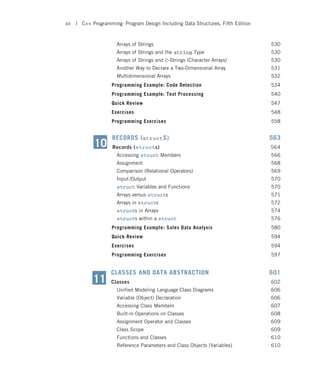
Arrays of Strings530
Arrays of Strings and the string Type 530
Arrays of Strings and C-Strings (Character Arrays) 530
Another Way to Declare a Two-Dimensional Array 531
Multidimensional Arrays 532
Programming Example: Code Detection 534
Programming Example: Text Processing 540
Quick Review 547
Exercises 548
Programming Exercises 558
RECORDS (structS) 563
Records (structs) 564
Accessing struct Members 566
Assignment 568
Comparison (Relational Operators) 569
Input /Output 570
struct Variables and Functions 570
Arrays versus structs 571
Arrays in structs 572
structs in Arrays 574
structs within a struct 576
Programming Example: Sales Data Analysis 580
Quick Review 594
Exercises 594
Programming Exercises 597
CLASSES AND DATA ABSTRACTION 601
Classes 602
Unified Modeling Language Class Diagrams 606
Variable (Object) Declaration 606
Accessing Class Members 607
Built-in Operations on Classes 608
Assignment Operator and Classes 609
Class Scope 609
Functions and Classes 610
Reference Parameters and Class Objects (Variables) 610
10
11
xii | C++ Programming: Program Design Including Data Structures, Fifth Edition
20.
Implementation of MemberFunctions 611
Accessor and Mutator Functions 616
Order of public and private Members of a Class 619
Constructors 621
Invoking a Constructor 623
Invoking the Default Constructor 623
Invoking a Constructor with Parameters 623
Constructors and Default Parameters 626
Classes and Constructors: A Precaution 626
Arrays of Class Objects (Variables) and Constructors 627
Destructors 629
Data Abstraction, Classes, and Abstract Data Types 630
A struct Versus a class 632
Information Hiding 633
Executable Code 637
Static Members of a Class 643
Programming Example: Candy Machine 649
Quick Review 663
Exercises 665
Programming Exercises 670
INHERITANCE AND COMPOSITION 675
Inheritance 676
Redefining (Overriding) Member Functions
of the Base Class 679
Constructors of Derived and Base Classes 686
Destructors in a Derived Class 694
Multiple Inclusions of a Header File 695
C++ Stream Classes 696
Protected Members of a Class 698
Inheritance as public, protected, or private 698
Composition (Aggregation) 702
Object-Oriented Design (OOD) and Object-Oriented Programming (OOP) 707
Identifying Classes, Objects, and Operations 709
Programming Example: Grade Report 710
Quick Review 731
Exercises 732
Programming Exercises 739
12
Table of Contents | xiii
21.
POINTERS, CLASSES, VIRTUALFUNCTIONS,
ABSTRACT CLASSES, AND LISTS 745
Pointer Data Type and Pointer Variables 746
Declaring Pointer Variables 746
Address of Operator () 747
Dereferencing Operator (*) 748
Classes, Structs, and Pointer Variables 752
Initializing Pointer Variables 755
Dynamic Variables 755
Operator new 756
Operator delete 757
Operations on Pointer Variables 759
Dynamic Arrays 761
Functions and Pointers 764
Pointers and Function Return Values 764
Dynamic Two-Dimensional Arrays 765
Shallow versus Deep Copy and Pointers 768
Classes and Pointers: Some Peculiarities 770
Destructor 770
Assignment Operator 772
Copy Constructor 773
Inheritance, Pointers, and Virtual Functions 780
Classes and Virtual Destructors 787
Abstract Classes and Pure Virtual Functions 787
Array Based Lists 796
Unordered Lists 803
Ordered Lists 807
Address of Operator and Classes 809
Quick Review 812
Exercises 815
Programming Exercises 822
OVERLOADING AND TEMPLATES 827
Why Operator Overloading Is Needed 828
Operator Overloading 829
Syntax for Operator Functions 830
13
14
xiv | C++ Programming: Program Design Including Data Structures, Fifth Edition
22.
Overloading an Operator:Some Restrictions 830
Pointer this 831
Friend Functions of Classes 836
Operator Functions as Member Functions and
Nonmember Functions 839
Overloading Binary Operators 842
Overloading the Stream Insertion () and
Extraction () Operators 848
Overloading the Assignment Operator (=) 853
Overloading Unary Operators 861
Operator Overloading: Member versus Nonmember 867
Classes and Pointer Member Variables (Revisited) 868
Operator Overloading: One Final Word 868
Programming Example: Clock Type 868
Programming Example: Complex Numbers 877
Overloading the Array Index (Subscript) Operator ([]) 882
Programming Example: newString 884
Function Overloading 890
Templates 891
Function Templates 891
Class Templates 893
Array-Based Lists (Revisited) 896
Quick Review 902
Exercises 905
Programming Exercises 910
EXCEPTION HANDLING 919
Handling Exceptions within a Program 920
C++ Mechanisms of Exception Handling 924
try/catch Block 924
Using C++ Exception Classes 931
Creating Your Own Exception Classes 935
Rethrowing and Throwing an Exception 941
Exception-Handling Techniques 946
Terminate the Program 946
Fix the Error and Continue 946
Log the Error and Continue 948
15
Table of Contents | xv
23.
Stack Unwinding 948
QuickReview 952
Exercises 954
Programming Exercises 957
RECURSION 959
Recursive Definitions 960
Direct and Indirect Recursion 963
Infinite Recursion 963
Problem Solving Using Recursion 964
Tower of Hanoi: Analysis 973
Recursion or Iteration? 974
Programming Example: Converting a Number from
Binary to Decimal 975
Programming Example: Converting a Number from
Decimal to Binary 979
Quick Review 982
Exercises 983
Programming Exercises 986
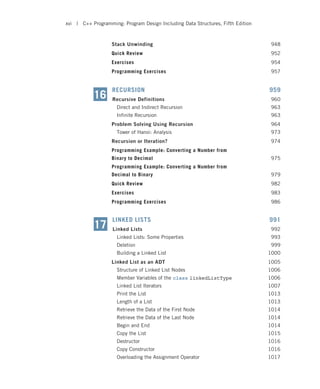
LINKED LISTS 991
Linked Lists 992
Linked Lists: Some Properties 993
Deletion 999
Building a Linked List 1000
Linked List as an ADT 1005
Structure of Linked List Nodes 1006
Member Variables of the class linkedListType 1006
Linked List Iterators 1007
Print the List 1013
Length of a List 1013
Retrieve the Data of the First Node 1014
Retrieve the Data of the Last Node 1014
Begin and End 1014
Copy the List 1015
Destructor 1016
Copy Constructor 1016
Overloading the Assignment Operator 1017
16
17
xvi | C++ Programming: Program Design Including Data Structures, Fifth Edition
24.
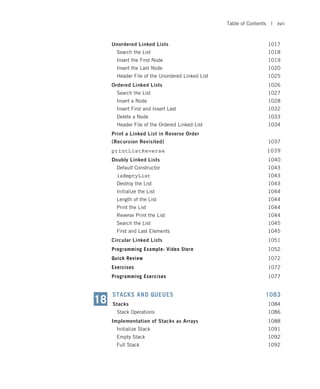
Unordered Linked Lists1017
Search the List 1018
Insert the First Node 1019
Insert the Last Node 1020
Header File of the Unordered Linked List 1025
Ordered Linked Lists 1026
Search the List 1027
Insert a Node 1028
Insert First and Insert Last 1032
Delete a Node 1033
Header File of the Ordered Linked List 1034
Print a Linked List in Reverse Order
(Recursion Revisited) 1037
printListReverse 1039
Doubly Linked Lists 1040
Default Constructor 1043
isEmptyList 1043
Destroy the List 1043
Initialize the List 1044
Length of the List 1044
Print the List 1044
Reverse Print the List 1044
Search the List 1045
First and Last Elements 1045
Circular Linked Lists 1051
Programming Example: Video Store 1052
Quick Review 1072
Exercises 1072
Programming Exercises 1077
STACKS AND QUEUES 1083
Stacks 1084
Stack Operations 1086
Implementation of Stacks as Arrays 1088
Initialize Stack 1091
Empty Stack 1092
Full Stack 1092
18
Table of Contents | xvii
25.
Push 1092
Return theTop Element 1094
Pop 1094
Copy Stack 1096
Constructor and Destructor 1096
Copy Constructor 1097
Overloading the Assignment Operator (=) 1097
Stack Header File 1098
Programming Example: Highest GPA 1102
Linked Implementation of Stacks 1106
Default Constructor 1109
Empty Stack and Full Stack 1109
Initialize Stack 1110
Push 1110
Return the Top Element 1112
Pop 1112
Copy Stack 1114
Constructors and Destructors 1115
Overloading the Assignment Operator (=) 1115
Stack as Derived from the class
unorderedLinkedList 1118
Application of Stacks: Postfix Expressions Calculator 1119
Main Algorithm 1122
Function evaluateExpression 1122
Function evaluateOpr 1124
Function discardExp 1126
Function printResult 1126
Removing Recursion: Nonrecursive Algorithm to
Print a Linked List Backward 1129
Queues 1133
Queue Operations 1134
Implementation of Queues as Arrays 1136
Linked Implementation of Queues 1145
Queue Derived from the class
unorderedLinkedListType 1150
Application of Queues: Simulation 1151
Designing a Queuing System 1152
Customer 1153
Server 1156
xviii | C++ Programming: Program Design Including Data Structures, Fifth Edition
company upwards of600 double baidars of Natives, each containing
two or three men. These are divided into six parties, each under the
direction of a single Peredofshik, or Russian leader. Besides these,
small parties are sent out
28.
TO THE WESTWARD321 daily to fish for halibut, cod, etc.
The females are employed in curing and drying the fish; in digging,
washing and drying edible roots; in collecting useful plants, berries,
etc., and in making the dresses of the Natives, and also for the
Russians. About 200 of the daughters of the Native chiefs are kept
at the Russian habitations near our anchoring place as hostages for
the obedience of the Natives; and as far as I could learn, they are
satisfied with their treatment. The males are less satisfied; and at
the first arrival of the Russians, seemed inclined to oppose their
landing on the island; but Shelikof, surprising their women while
collecting berries, carried them as prisoners to his habitation, and
kept them as hostages, only returning wives for daughters, or the
younger children of the chiefs. Every considerable habitation of the
Natives had large baidars capable of containing 40 or 50 men. These
were all purchased by Shelikof, and the Natives now have only small
canoes, none of which carry more than three. They seem reconciled
to the rules made by the present chief of the company, Delareff, who
governs with the strictest justice, the Natives as well as the
Russians, and has established a school where the young Natives are
taught Russian, reading and writing. He allows some of the female
hostages to visit their relatives for a certain time; these returning,
others are allowed to go home; and on application of anyone for his
child, it is not refused. The whole number of hostages is about 300.
The males are employed in the chase in turn, as are also the
females: I mean, for the benefit of the community; for they lay in an
amazing stock of provisions, roots, berries, etc., sufficient for the
winter's supply of the whole island, both Natives and Russians; a
circumstance which convinces the savages that the Russians are not
their absolute enemies; for Delareff says that they never laid in a
supply of food for the winter till the Russians taught them; but in
bad weather were obliged to collect cockles, mussels, and other
shellfish, or the refuse of the sea. Luxuries such as tobacco, beads,
linen, shirts, and nankeen dresses, they pay for in particular. I saw
that such of the parties as were successful in procuring rich skins
received a certain payment; for each sea otter, a string of beads four
29.
feet long; andfor other furs in proportion; and that only the food
and seal skins were the property of the community, of which the
Natives enjoy the greater share, being by far the most numerous;
and seal skins are used bv the Natives to
30.
322 THE LASTFRONTIER mend their baidars, and to make
new ones; in the latter case, they are purchased for furs, foxes,
marmots, otters, etc., or by service. The natives call themselves
Soo-oo-it, and their magicians are Kanghemcnt. I could obtain no
name from them for the Almighty; though they say there is a
superior being who has the command of all the spirits; and that the
wrath of these spirits is only to be appeased by offerings, and in
some cases their slaves are sacrificed, but very seldom; for all the
prisoners they take in their wars (which are almost perpetual, one
tribe against another) become slaves, and are subject to ill
treatment, particularly from the women. The female prisoners are all
slaves, and are sold from one tribe to another for trinkets,
instruments, etc. Not only their prisoners, however, are their laborers
or slaves, but orphans become the property of those who bring them
up, and are frequently redeemed by relatives of the parents;
especially such as were inhabitants of other islands. The dwellings
of the Natives differ from those of Oonalashka. They are but very
little sunk in the ground, and have a door fronting the east, made of
framed seal skin; a fireplace in the middle; a hole over it through the
roof, which serves both for the discharge of smoke and the
admission of light. The sides, partitioned off for sleeping and sitting
places, are covered with grass mats, much coarser made than those
of Oonalashka. Each hut has a small apartment attached to it, which
serves for a vapor bath; stones are heated in the open air and
carried inside, where heat is increased to any degree by steam from
water poured on the hot stones. The customs of these savages are
nearly allied to those of the Oonalashkans. They have the same kind
of instruments, darts, and boats or baidars; but much worse made;
nor are they so active on the water. Their dances are proper
tournaments, with a knife or lance in the right hand, and a rattle in
the left; the rattle is made of a number of thin hoops, one inside the
other, covered with white feathers, and having the red bills of the
sea parrot suspended on very short threads; which being shaken,
strike together, and make a very considerable noise; their music is
the tambourine, and their songs are warlike. They are frequently
31.
much hurt, butnever lose their temper on account of it. In these
dances they use masks, or paint their faces very fantastically. The
dances of the women are only jumping to and fro upon their toes,
with a blown bladder in their hand, which they
32.
TO THE WESTWARD323 throw at anyone whom they wish
to dance with, and who always accepts the challenge. The first
character is the athletic and skillful warrior; the second, the fleet and
expert hunter; the former enjoys his prisoners and the booty of his
enemy; the latter has his wives, laborers and slaves by purchase,
and the ability he possesses to maintain them. The most favored of
women is she who has the greatest number of children. The women
seem very fond of their offspring; dreading the effects of war and
the dangers of the chase; and some of them bring up their male
children in a very effeminate manner, and are happy to see them
taken by the chiefs to gratify their unnatural desires. Such youths
are dressed like women, and are taught all their domestic duties.
There is no ceremony in marriage : the ability to support a woman
gives the authority to take them, with their consent; in which case
the couple are conducted by the relatives of the girl to the vapor
bath, which is heated and they are left together; but some present is
generally made to the girl's father and mother. I enquired whether
they lent their wives to each other? They told me. No; unless they
were barren, and desired it; if they then had a child, it became the
property of its father. No other ceremony is observed at births than
washing the child, and giving it a name. The dead body of a chief is
embalmed with moss, and buried. The most confidential of his
laborers are sacrificed and buried with him; also his instruments of
war or chase, and some food. Numbers of the natives are baptized,
but Delareff, director of the Company, would not allow our priest to
compel any of them to become Christians; however he assisted him
in persuading as many as he could. Such as were at the school
willingly embraced the Greek religion, as did also numbers of the
women. The dresses of the natives are the same as at Oonalashka,
but worse made; they are open around the neck, and have but very
few ornaments. They are very fond of blue beads and amber, and
carry on a trade with the natives around Cook's River, where they
purchase their baidars and canoes for trinkets, provisions, and oils of
whales and seals. They use darts and lances headed with slate, with
which they kill the sea animals. They also use poison to their arrows,
33.
and aconite isthe drug adopted for this purpose. Selecting the roots
of such plants
34.
324 THE LASTFRONTIER as grow alone, the roots are
dried and pounded, or grated, water is then poured on them and
they are kept in a warm place until fermented; when in this state,
the men anoint the points of their arrows or lances with it, which
makes the wound inflicted mortal. The most valuable fur is that of
the sea otter, called by the hunters here and in Russia, Morskoi
Bobre. The fur of the young ones is rough and long, of a light brown
color (like a young bear cub), and is called Medvedka, the diminutive
of bear: this is of no value: the middle sized are darker and valuable;
and these are called Koshlok; but the most valuable are what is
called Matka, or mother; the largest are about five feet long, with
rich fur nearly black, mixed with longer hairs of a glossy white. The
fur is upright, not inclining in any way, from an inch to an inch and a
half long. I had a young sea otter dressed, and it tasted just like
sucking pig. There are no more on the coast of Kamtshatka: they are
now very seldom seen on the Aleutian Islands; and of late, they
have forsaken the Shumagin Islands; and I think, from the value of
the skin having caused such devastation among them, and the
pursuit after them being so keen, added to their situation between
latitudes of 45 and 60 degrees, that 15 years hence there will hardly
exist any more of this species. The peculiarity in sexual customs
described by Sauer is confirmed by Sarachef in his Account of a
Voyage of Discovery, published in 1806, where he relates, One of
these Kadyakers, who attended this hunter, and appeared to be
about forty years of age, differed altogether from the others, having
the appearance of a female, with his nose punctured, and rings of
pearl-enamel in his ears. We learnt from the hunter that this man
supplied the place of a wife to one of the islanders and performed all
the offices belonging to the female sex. The present-day town of
Kodiak (p.o., 442 pop.) is the largest in southwestern Alaska, and is
about 200 miles southeast of Seward. On the knoll above is a quaint
Russian church and white cottages; below along the waterfront are
warehouses, wharves, and stores overlooking a bay with wooded
islands and headlands. Like a wall protecting the harbor from the
rough waters of Shelikof Strait rise dark rugged mountains. The
35.
town has apublic school, a Baptist orphanage and church, a Russian
Orthodox church, two hotels, and two general stores. There are
many salmon canneries in the vicinity, foxes are bred at Eagle
Harbor, stock is raised, and hunting parties equipped.
36.
TO THE WESTWARD325 At Port Hobron is a whaling
station. An appropriation of $77,000 (authorized in 1935) provides
for the construction of a 22-foot channel and an anchorage basin as
soon as a cold storage plant is completed. In 1936, 9,768 tons of
commerce, valued at $1,659,000, passed through this port. Work
will start in 1939 on a huge naval and airplane base. In June, 1912,
Mr. Katmai (6,970 alt.), a volcano 100 miles distant on the mainland,
suddenly blew off its top and filled the air with sharp volcanic ash
that blanketed fields and villages, crushed roofs, and changed the
green island of Kodiak into a gray-brown desert overnight. For forty-
eight hours inky blackness enveloped the town, rent by occasional
tongues of flame, split by peals of thunder. Captain Perry of the
revenue cutter Manning rescued from four to five hundred people,
but approximately two hundred Uves were lost in the smaller
villages. A year later, dust still filled the air and lay in huge drifts on
the hillsides. Fragments of pumice covered the shore. The bears had
become bald, their fur eaten away by the lye leached from the
volcanic ash on their hides, by the rain. Most of the human
inhabitants had returned to their homes, but lack of grass prevented
the return of cattle, and ash-clogged rivers seriously interfered with
the annual upstream migration on which the fishing industry
depends. Today there is no obvious evidence of the eruption of 1912
— the hills are green again, the trees are free of ash. But under the
thick growth of moss lining the dead lower limbs of the older spruce
trees can still be found almost an inch of ash, and hundreds of dead
cottonwoods, now rotting away, stand as markers of the event. The
only good done by the ash storm was the improvement of roads, as
volcanic ash makes the best kind of roadbed. Excellent roads run
from Kodiak to near-by points: the Mill Bay Road, constructed by
Russians early in the nineteenth century to transport flour and meal
ground from grain raised in the Russian Colony at Ross, California;
and Albert Highway, construction of which was started in 1924, built
high on the cliffs overlooking the bay and, at the head of the bay,
turning inland through fields and meadows to Buskin River, where
there is good trout fishing. Steamers usually call at a number of
37.
canneries and smallfishing villages in the vicinity of Kodiak before
crossing Shelikof Strait. OuziNKiE (p.o., 200 pop., est. 1938, largely
Aleut and Russian) is on Spruce Island, northeast of Kodiak, from
which it is separated by
38.
326 THE LASTFRONTIER Narrow Strait. Ouzinkie is a
Russian word meaning narrow. Spruce Island was settled by
Russians while Kodiak was still their chief port, and was used by
them as a shipbuilding yard. There are now two docks on the island,
and seaplanes may land in the bay. A packing company maintains a
bunkhouse where room and board may be had for $1 to $1.75 a day.
The general store can supply tourist information for all of the Kodiak
Island district. There is a Greek Orthodox church, a Baptist mission
and orphanage, and a Territorial school on this island. At Monk's
Lagoon, the home of a monk from Mt. Athos, Greece, is a shrine
containing relics of an ancient saint, worshiped by the Aleuts and
Russians. A public swimming beach is maintained in the heart of the
village, and trout and red and silver salmon are found within an
hour's boat ride. Uyak (lypop.) is a Native village about 60 miles
west of Kodiak. At Karluk (p.o., 192 pop.) is a precipitous mountain
mass 1,600 feet high locally known as Karluk Head. Alitak (p.o., 75
pop.) is a fishing village of Aleuts on the west coast of Kodiak Island
at Alitak Bay. A Russian America Company map of 1849 shows a
settlement of Russians and Aleuts here, called Kashukugmiut. The
town was later known as Akhoik, a Russian name, changed to Alitak
during the World War. Old Harbor (p.o., 94 pop. chiefly Aleuts) is on
the southeast shore of Kodiak Island. This was Shelikof's Three
Saints Harbor. The Native name is Starigown. Opposite the western
side of the Afognak-Kodiak group, across Shelikof Strait, is Katmai
National Monument (inaccessible to tourists), probably the largest
and most awesome group of associated volcanic phenomena to be
seen anywhere in the world. The area of the Monument is over
1,700 square miles. The Valley of Ten Thousand Smokes, from which
great columns of white vapor pour out of the fissured ground from
many times ten thousand vents, includes a complicated system of
branches, irregular in shape, and extends from Katmai Pass
northwestward to the head of Naknek Lake near the western side of
the Alaska Peninsula, a distance of 32 miles. The area of the valley is
70 square miles, and its average width two miles. Prior to 1912
Katmai Volcano had been inactive. On June 6, 1912, the eruption
39.
began at ip.m., with a terrific explosion, the sound of which was
heard 750 miles distant. At 3 p.m. there was another explo
40.
TO THE WESTWARD327 sion. Steam and ash rose several
miles in the air and spread over an area as large as Connecticut,
extending total darkness over 100 miles. Fumes were observed at
Vancouver Island and Puget Sound, 1,500 miles away. Ivan Orloff,
who with a group of Natives was fishing near by, wrote to his wife
on June 8, A mountain has burst near here, so that we are covered
with ashes, in some places 10 feet and 6 feet deep. . . . Night and
day we light lamps. In a word it is terrible, and we are expecting
death any moment, and we have no water. . . . Here are darkness
and hell, thunder and noise. The earth is trembling. American Pete,
chief of the Sabonoski tribe, the only eyewitness of the eruption,
described the phenomenon in six words that compare for laconicism
with the first sentence of Genesis: Fire come down trail from
Katmai. The first detailed news of the explosion came to the outside
world when the steamer Dora, which had been unable to reach
Kodiak, returned to Seward, her decks covered with ash. The
National Geographic Society sent an exploration party to the district
in 1915, consisting of Prof. R. F. Griggs, botanist of Ohio State
University, B. B. Fulton, etymologist of the New York Experimental
Station, and L. G. Folsom, manual training teacher of Kodiak. When
the party landed at Katmai Bay, they saw evidences of a great flood.
Small avalanches were still rolling down the mountain, most of the
trees had perished, the old church was in a sea of mud, and some of
the Native's houses were filled with pumice and others submerged.
The river, formerly a body of deep water five miles wide, was a maze
of quicksand crisscrossed by a network of small streams. The old
trail between Katmai village and Saboniski, at the head of Naknek
Lake, was covered with ash and pumice. Tens of thousands of holes
had been blown through the floor of the valley. All vegetation had
been burned by a torrent of incandescent sand that covered a total
area of 53 square miles and had an estimated volume of more than
one cubic mile; as a result, there was no fuel, and cooking had to be
done in the vents, where temperatures reached as high as 1,200°.
The whole valley was a riot of bright color, and the finegrained mud
was so similar to ground oil pigments that an artist painted a
41.
number of pictureswith the mud, using canvas from a ruined tent.
For over 15 miles down the Valley of Ten Thousand Smokes, in the
northwestern portion of the reservation, the ground is broken open,
42.
328 THE LASTFRONTIER giving vent to several million
fumaroles or little volcanoes, from which rise jets of steam. Some of
the jets throw their steam to over a thousand feet in the air, and
hundreds of others go up to a distance of 500 feet, all merging
above the valley into one titanic cloud. Scientists say that this
astounding valley is an example of what the geyser basins of
Yellowstone Park were at the time when Yellowstone's volcanoes first
ceased their activity, and they predict that in the course of time,
probably many centuries, the surface will cool sufficiently for the
vents to retain water some distance down. When this happens the
steam below, pressing against the water near the surface, will force
it upward into the air, and a new geyser field will come into
existence. Recent visitors (1938) report that the fumaroles already
have begun to show less activity than formerly. The snow-capped
crater of Katmai, left by the explosion, has a rim three miles in
width. The circumference, measured along the highest point of the
rim, is 8.4 miles. From the bottom of the crater to its rim is 3,700
feet, and its capacity is 4,000,000,000 cubic yards. In the crater lies
a lake of milky blue water over a mile long and nearly a mile wide, in
which is a little crescent-shaped island measuring 400 feet from tip
to tip. Within five miles of the fumaroles is heavily timbered country,
little injured by the eruption^ which supports an abundance of wild
life. The upper end of Naknek Lake, lying within the western
boundary of the park between the wooded slopes of Mr. La Gorge
(3,3i5alt.) and Mr. Katalinat (5,8ooalt.) is full of large trout, 24 to 32
inches long; and Coville, Grosvenor, and Brooks lakes are near by.
The eruption carved out a new harbor in what had hitherto been
shown on all charts as dry land, in an arm of Amalik Bay, surrounded
by rugged mountains, rising 3,000 feet out of the water. This the last
National Geographic Society Expedition in 1919 discovered and
christened Geographic Harbor. When the harbor is developed and an
automobile road about 30 miles in length is constructed, the area
will be readily accessible and will undoubtedly draw many visitors. In
the meantime, none but the hardiest and most experienced
explorers should attempt a visit to the region. The land was set
43.
aside as anational monument by presidential proclamation,
September 24, 1918. It has a total area of 1,087,990 acres. The
volcanic region of Alaska stretches along Alaska Peninsula
44.
TO THE WESTWARD329 for some 1,200 miles, from Mr.
Redoubt (io,20oalt.) and Mr. Iliamna (io,02oalt.), both active
volcanoes, on the north, to Bogoslov Island on the south. Mt.
Augustine (3,970 alt.), on Augustine Island toward the western side
of the mouth of Cook Inlet, was the most recent volcano to erupt in
Alaska. Kanatak (p.o., 78 pop.), supposed to mean snowy in
Aleutian, is a ghost town whose inhabitants live in fine houses along
a street with buildings bravely marked Bakery, Cafe, and so on.
Fishing and trapping are the principal industry, since the subsiding of
an oil boom early in the century. There are three principal petroleum
areas in Alaska: the regions around Point Barrow, around Katalla,
and on the east coast of the Alaska Peninsula from Tuxedni Bay near
Iliamna to Kanatak and Wide Bay. In 1937 and 1938 the third area
was receiving renewed attention. A test well drilled on the Iniskin-
Chinitna Peninsula, near Mt. Iliamna, was the most northerly
commercial oil well in the world, and was the first well in Alaska to
be drilled with modern methods (similar to those used in California),
that permit a depth of 10,000 feet or more. The Iniskin Drilling
Company brought 2500 tons of machinery and equipment to the
site, including 11,000 barrels of fuel oil, eight miles of pipe, 200 tons
of clay and mud-conditioning chemicals from the Mohave Desert,
and 250,000 feet of lumber for constructing camps and housing, for
equipment. All this was freighted ashore in 40-ton lighters and
hauled six miles inland, where a 122-foot steel derrick was erected
on a concrete foundation. The geological formations are right for oil
— it remains to be seen whether it exists in commercial quantities. If
it does, this source of fuel would be of great value for national
defense, and could supply the naval bases at Kodiak and Unalaska
and the army air base at Fairbanks. Roughly on a line with Sutwik,
the Semidi (Russian for seven), and Chirikof islands — the last
named for Captain Alexei Ilich Chirikof, commander of the Si. Paul,
companion ship of Bering's St. Peter — is Aniakchak Crater.
Comparable craters to this one, its diameter measuring the
stupendous distance of six miles, are found on the moon. It was
discovered and named by R. H. Sargent of the Geological Survey in
45.
1923, and liesabout midway between the Pacific and Bering Sea on
Alaska Peninsula. It was thought to be extinct until May I, 1931,
when at exactly 12 noon it exploded, and clouds of gas
46.
330 THE LASTFRONTIER and ashes rushed four miles
straight up into the air and spread out hkc a gigantic mushroom.
The earth shook, flames and smoke rose thousands of feet high, and
volcanic ash hurled through the air. The eruption went on
continuously for ten days, and on May ii another terrilk explosion
occurred. After resting nine days, Aniakchak blew up for the final
time on May 20. All this display was witnessed by only one white
person, Frank Wilson, who lived fifteen miles away. The Aniakchak
River, a small stream, rises in the crater of the volcano. Father
Hubbard, the glacier priest, estimates the floor area of Aniakchak
at 30 square miles. He visited it after the 1931 eruption, and says,
It was the most terrible prelude to hell I could imagine. Last year it
was a plant, fish, and animal world in a 30 square mile area
enclosed by 3,000-foot walls, but now it was an abomination of
desolation with everything blotted out. Father Bernard Rosecrans
Hubbard was born in San Francisco in 1888. He has taught in many
Jesuit schools and was one time chaplain to the Austrian empress.
Since 1926 he has been head of the department of geology at the
University of Santa Clara. During this time he has conducted many
explorations in Alaska, and has himself climbed Aniakchak,
Shishaldin, and Katmai volcanoes. In addition to many scientific
papers, he is the author of Mush You Malemutes (1932) and Cradle
of the Storm (1933). Chignik (p.o., 60 pop. est. in 1938, mostly
Natives) Is a fishing settlement in a beautiful crescent harbor
surrounded by towering mountains. It contains a Russian Orthodox
church. Its name is probably of Native origin, given it by the
Russians. West of Chignik is Mt. Veniaminof (8,40oalt.), which was in
eruption in June, 1939, was named for Father Ivan Veniaminof,
Metropolitan Innocent of Moscow. Born Ivan Popof in 1797, in
Irkutsk province, Siberia, he entered the theological school of Irkutsk
as a ward of the parish. Upon an order from the Holy Synod in
Moscow in 1823 that a priest be sent to Unalaska, Father Veniaminof
offered to go. He instructed the Aleuts in the practical arts, learned
their language, beliefs, and customs, and began the translation of
hymns, prayers and portions of the Bible into Aleut. On his travels he
47.
always carried anotebook in which he recorded all he heard. Later
he gathered his notes into a volume that still remains the foundation
for students of Aleutian ethnology. He also compiled a grammar of
the Aleut and Kodiak languages. After
48.
TO THE WESTWARD331 ten years at Unalaska he was
transferred to Sitka, the Russian capital of Alaska, as pastor of St.
Michael's Cathedral, the clock of which he built with his own hands.
Here he compiled important ethnological data concerning the
Tlingits. In 1838 he left Sitka for Moscow, returning in 1841 as the
first bishop of Alaska. From that time on he traveled often from Sitka
to Moscow and throughout the Russian colonies in America. In 1868
he was given the title of Metropolitan of Moscow, and remained in
Russia, where he died in 1879. Perryville (p.o., 93 pop.) is a Native
fishing village 50 miles south of Chignik. After the village of Katmai
had been destroyed in 1912, Captain Perry of the Manning brought
its inhabitants to this spot, where they settled, naming the village
after the commander of the relief ship. Here steamers usually leave
the coast and touch at fishing villages on the larger Shumagin
Islands, a group named by Bering after one of his sailors who died
of scurvy near here on August 30, 1 741. There are no trees on
these islands save dense thickets, scrubby elders, and willows.
Delicate alpine flowers grow between the rocks on the heights, and
here are found dwarf poppies, willows hardly larger than clover
plants, and tiny dwarf dandelions barely one inch high. The only
mammals are small rodents, upon which the many owls eagerly
feed. The insects are all wingless — insects with wings would be
swept into the sea by the strong winds. The climate is mild and
damp. In many respects the Shumagins resemble the Aleutians,
which the ship is now approaching. On Unga Island, the largest of
the Shumagins, is the village of Unga (p.o., 150 pop.). In the
Russian period this was a sea-otter station. About 1900 extensive
gold mining was done here and in recent years it has been a center
for cod fishing. Sand Point (p.o., 69pop.) is about 15 miles northeast
of Unga. The Methodist Mission Board planned in 1938 to ecjuip a
hospital here to serve the entire region. The steamer channel runs
between Dolgoi Island, west of the Shumagins, and the mainland,
on which now appears Mr. Pavlof (8,900 alt.), an active volcano
which in 1937 showered the countryside with ash. South of Mt.
Pavlof is Belkofski (p.o., 123 pop.), a Native settlement, its name,
49.
meaning squirrel, givenit by Russians before 1835. King Cove
(p.o., 9opop. est. 1938), named for its founder, is a fishing village
with a Territorial school. At False Pass (p.o., i6pop. est. 1933), so
named because it and Isanotski Strait seem at first sight to offer
passage to ocean-going vessels between
50.
332 THE LASTFRONTIER the Pacific Ocean and Bering Sea,
is a small fishing settlement. Here the Alaska Peninsula ends, and
the Aleutian Islands begin. From Unimak the Aleutians stretch
westward some 1,300 miles from the Alaska Peninsula to
Kamchatka, the parallel that marks the boundary line between the
western and eastern hemispheres (180° both east and west of
Greenwich) occurring between the Andreanof and the Rat groups.
The Aleutians enclose the great Bering Sea between the United
States and the USSR. Attu, the westernmost of the Aleutian Islands
belonging to the United States, lies about on the 173rd parallel —
here in the month of June the sun is setting at the same hour it is
rising off the coast of Maine. The Komandorski group, belonging to
the Soviet Union, completes the chain that stretches from the Alaska
Peninsula to Kamchatka. In these treeless islands of volcanic origin,
bathed in a moist climate, covered with luxuriant growth of grasses
and soft moss, the history of Alaska began. Perhaps it was over this
chain of islands that man first crossed to Alaska from Asia. The very
name Alaska had its origin here. Cook noted in 1778, The American
continent is here called by the Russians as well as by the islanders
Alaschka, which name though it properly belongs only to the country
adjoining Oonemak is used by them when speaking of the American
continent in general, which they know perfectly well to be a great
land. The Aleut name al-ay-e/{-sha is supposed to mean
mainland, and even today Natives of the Shumagins are reported
as saying, when they intend to cross over to the peninsula, I am
going to Alaska (i.e., the mainland). When Russian fur hunters
began to swarm into these islands soon after Bering's third voyage in
1741, they found them inhabited by a large nation, perhaps
numbering 25,000: a peaceful, fish-eating people, called by the
Chukchi on the Asiatic mainland /(itchin elaet, later corrupted into
Aleut. Their behavior, wrote Sauer, is not rude and barbarous, but
mild, polite, and hospitable. At the same time the beauty, proportion
and art with which they make their boats, instruments, and apparel,
evince that they by no means deserve to be termed stupid; an
epithet so liberally bestowed on those whom Europeans call
51.
savages. In afew years the Aleuts had been brought by the
Russians to a state of slavery, and their numbers reduced almost
unbelievably. According to the best intelligence I could obtain of the
population
52.
Welcome to ourwebsite – the ideal destination for book lovers and
knowledge seekers. With a mission to inspire endlessly, we offer a
vast collection of books, ranging from classic literary works to
specialized publications, self-development books, and children's
literature. Each book is a new journey of discovery, expanding
knowledge and enriching the soul of the reade
Our website is not just a platform for buying books, but a bridge
connecting readers to the timeless values of culture and wisdom. With
an elegant, user-friendly interface and an intelligent search system,
we are committed to providing a quick and convenient shopping
experience. Additionally, our special promotions and home delivery
services ensure that you save time and fully enjoy the joy of reading.
Let us accompany you on the journey of exploring knowledge and
personal growth!
ebookfinal.com








![Overloading an Operator: Some Restrictions 830
Pointer this 831
Friend Functions of Classes 836
Operator Functions as Member Functions and
Nonmember Functions 839
Overloading Binary Operators 842
Overloading the Stream Insertion () and
Extraction () Operators 848
Overloading the Assignment Operator (=) 853
Overloading Unary Operators 861
Operator Overloading: Member versus Nonmember 867
Classes and Pointer Member Variables (Revisited) 868
Operator Overloading: One Final Word 868
Programming Example: Clock Type 868
Programming Example: Complex Numbers 877
Overloading the Array Index (Subscript) Operator ([]) 882
Programming Example: newString 884
Function Overloading 890
Templates 891
Function Templates 891
Class Templates 893
Array-Based Lists (Revisited) 896
Quick Review 902
Exercises 905
Programming Exercises 910
EXCEPTION HANDLING 919
Handling Exceptions within a Program 920
C++ Mechanisms of Exception Handling 924
try/catch Block 924
Using C++ Exception Classes 931
Creating Your Own Exception Classes 935
Rethrowing and Throwing an Exception 941
Exception-Handling Techniques 946
Terminate the Program 946
Fix the Error and Continue 946
Log the Error and Continue 948
15
Table of Contents | xv](https://image.slidesharecdn.com/5042-250723222241-6ac27ede/85/C-Programming-Program-Design-Including-Data-Structures-5th-Edition-D-S-Malik-22-320.jpg)