C Programming Program design including data structures 5ed. Edition Malik D.S.
C Programming Program design including data structures 5ed. Edition Malik D.S.
C Programming Program design including data structures 5ed. Edition Malik D.S.
C Programming Program design including data structures 5ed. Edition Malik D.S.
C Programming Program design including data structures 5ed. Edition Malik D.S.
1.
Instant Ebook Access,One Click Away – Begin at ebookgate.com
C Programming Program design including data
structures 5ed. Edition Malik D.S.
https://ebookgate.com/product/c-programming-program-design-
including-data-structures-5ed-edition-malik-d-s/
OR CLICK BUTTON
DOWLOAD EBOOK
Get Instant Ebook Downloads – Browse at https://ebookgate.com
Click here to visit ebookgate.com and download ebook now
2.
Instant digital products(PDF, ePub, MOBI) available
Download now and explore formats that suit you...
C Programming Program Design Including Data Structures 7th
Edition D. S. Malik
https://ebookgate.com/product/c-programming-program-design-including-
data-structures-7th-edition-d-s-malik/
ebookgate.com
C Programming Program Design Including Data Structures 6th
Edition D. S. Malik
https://ebookgate.com/product/c-programming-program-design-including-
data-structures-6th-edition-d-s-malik/
ebookgate.com
C Programming From Problem Analysis to Program Design 5th
5th Edition D. S. Malik
https://ebookgate.com/product/c-programming-from-problem-analysis-to-
program-design-5th-5th-edition-d-s-malik/
ebookgate.com
Data Structures Using C 2nd Edition D. S. Malik
https://ebookgate.com/product/data-structures-using-c-2nd-edition-d-s-
malik/
ebookgate.com
3.
Java Programming FromProblem Analysis to Program Design
4th Edition D. S. Malik
https://ebookgate.com/product/java-programming-from-problem-analysis-
to-program-design-4th-edition-d-s-malik/
ebookgate.com
C Programming Data Structures 4th Edition E. Balagurusamy
https://ebookgate.com/product/c-programming-data-structures-4th-
edition-e-balagurusamy/
ebookgate.com
Java Foundations Introduction to Program Design and Data
Structures 2nd Edition John Lewis
https://ebookgate.com/product/java-foundations-introduction-to-
program-design-and-data-structures-2nd-edition-john-lewis/
ebookgate.com
C Programming From Problem Analysis to Program Design 4th
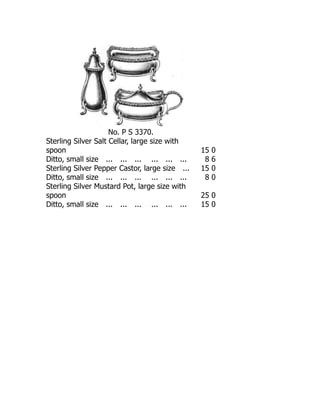
Edition Barbara Doyle
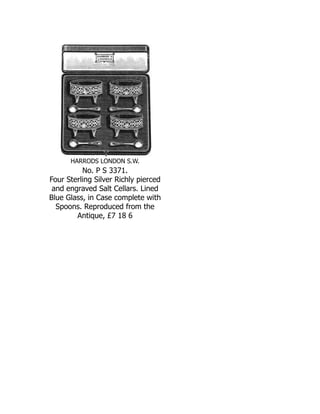
https://ebookgate.com/product/c-programming-from-problem-analysis-to-
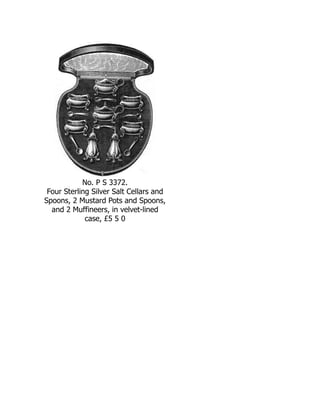
program-design-4th-edition-barbara-doyle/
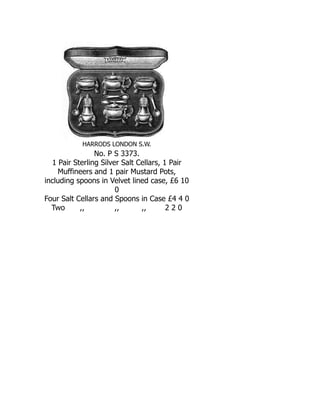
ebookgate.com
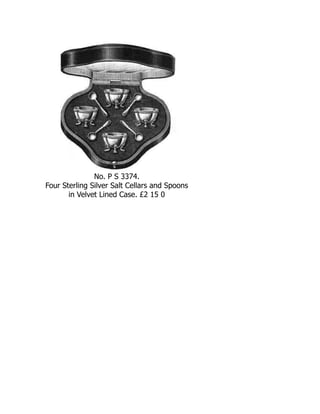
Data Structures and Algorithms Using C 1st Edition Michael
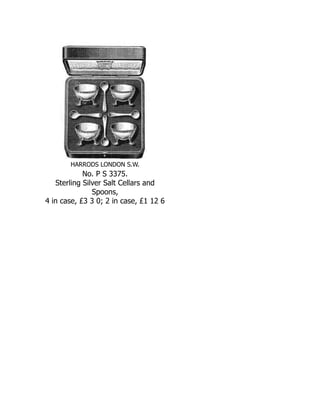
Mcmillan
https://ebookgate.com/product/data-structures-and-algorithms-
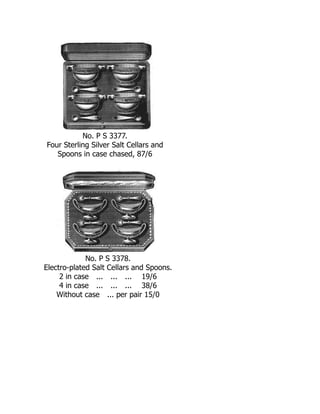
using-c-1st-edition-michael-mcmillan/
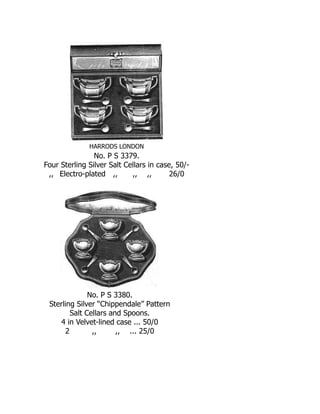
ebookgate.com
6.
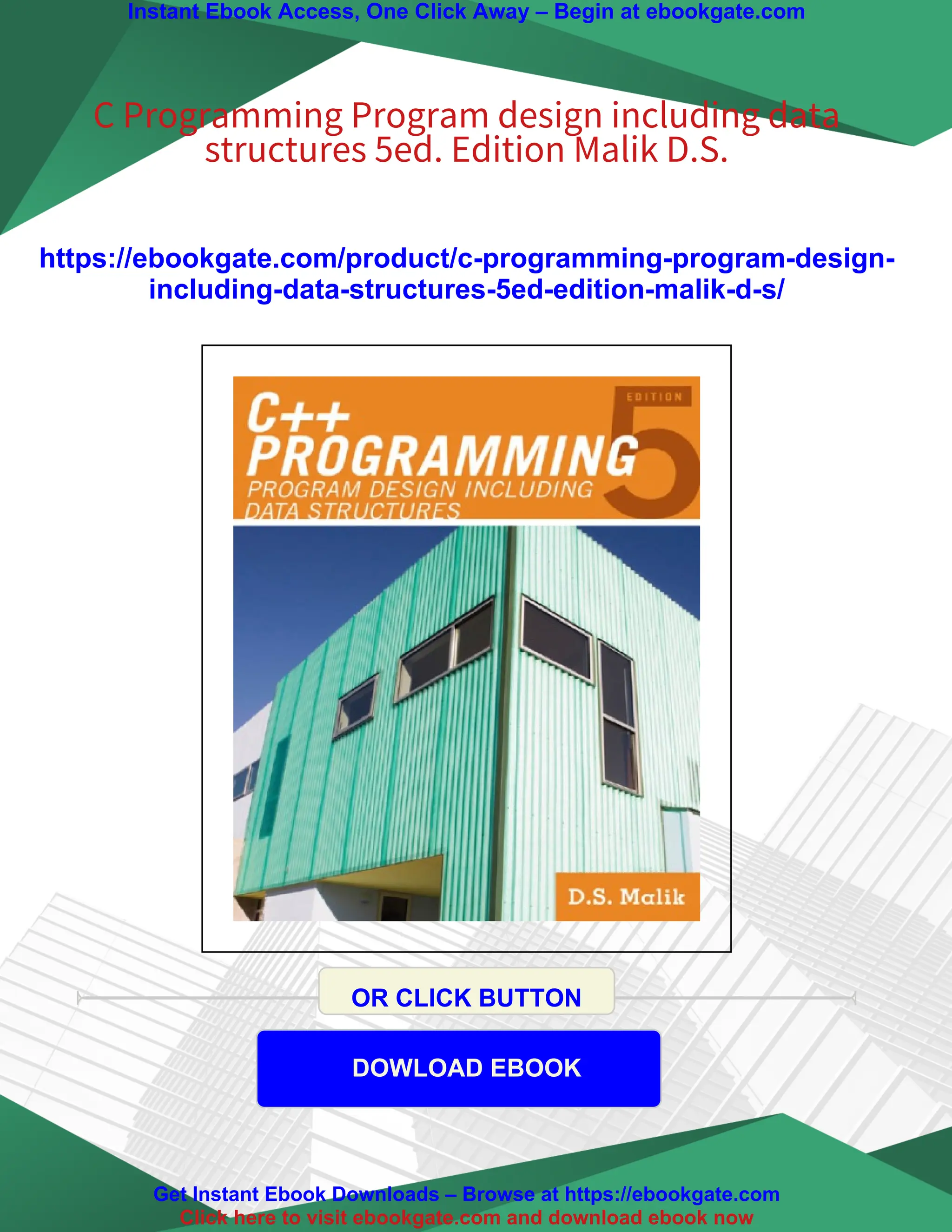
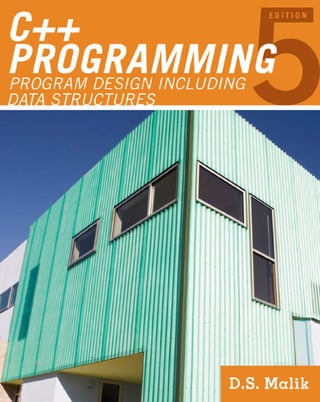
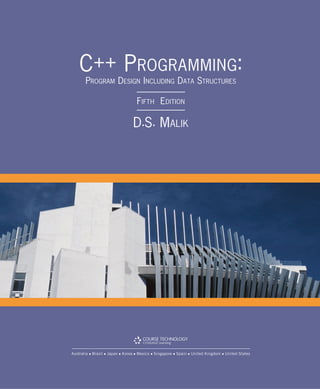
C++ PROGRAMMING:
PROGRAM DESIGNINCLUDING DATA STRUCTURES
FIFTH EDITION
D.S. MALIK
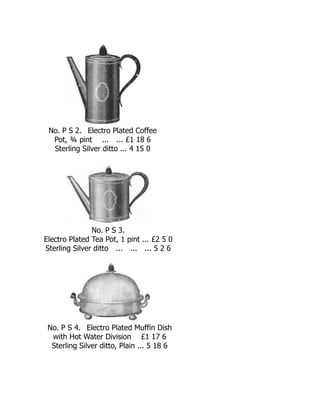
Australia Brazil Japan Korea Mexico Singapore Spain United Kingdom United States
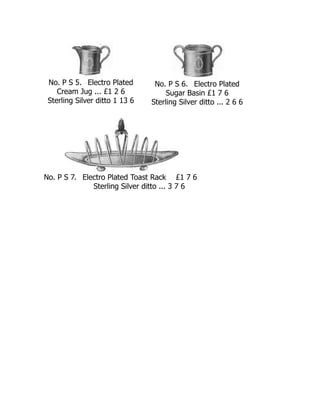
7.
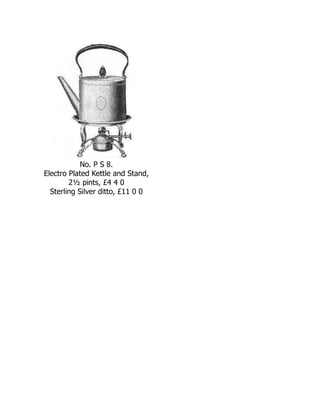
This is anelectronic version of the print textbook. Due to electronic rights restrictions,
some third party content may be suppressed. Editorial review has deemed that any suppressed
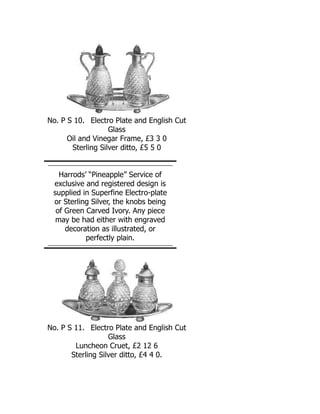
content does not materially affect the overall learning experience. The publisher reserves the right
to remove content from this title at any time if subsequent rights restrictions require it. For
valuable information on pricing, previous editions, changes to current editions, and alternate
formats, please visit www.cengage.com/highered to search by ISBN#, author, title, or keyword for
materials in your areas of interest.
8.
C++ Programming: ProgramDesign
Including Data Structures, Fifth Edition
D.S. Malik
Executive Editor: Marie Lee
Acquisitions Editor: Amy Jollymore
Senior Product Manager: Alyssa Pratt
Editorial Assistant: Zina Kresin
Content Project Manager: Matthew
Hutchinson
Art Director: Faith Brosnan
Print Buyer: Julio Esperas
Proofreader: GreenPen QA
Indexer: Elizabeth Cunningham
Cover Designer: Roycroft Design/
www.roycroftdesign.com
Cover Photo: Contemporary Building
ª Steve Hix/Somos Images/Corbis
Compositor: Integra
ª 2011 Course Technology, Cengage Learning
ALL RIGHTS RESERVED. No part of this work
covered by the copyright herein may be
reproduced, transmitted, stored or used in any
form or by any means graphic, electronic, or
mechanical, including but not limited to
photocopying, recording, scanning, digitizing,
taping, Web distribution, information
networks, or information storage and retrieval
systems, except as permitted under Section
107 or 108 of the 1976 United States Copyright
Act, without the prior written permission of
the publisher.
For product information and technology assistance, contact us at
Cengage Learning Customer Sales Support, 1-800-354-9706
For permission to use material from this text or product, submit
all requests online at www.cengage.com/permissions
Further permissions questions can be emailed to
permissionrequest@cengage.com
Library of Congress Control Number: 2010921540
ISBN-13: 978-0-538-79809-2
ISBN-10: 0-538-79809-2
Course Technology
20 Channel Center Street
Boston, MA 02210
USA
Some of the product names and company names used in this
book have been used for identification purposes only and may
be trademarks or registered trademarks of their respective
manufacturers and sellers.
Any fictional data related to persons or companies or URLs used
throughout this book is intended for instructional purposes only.
At the time this book was printed, any such data was fictional
and not belonging to any real persons or companies.
Course Technology, a part of Cengage Learning, reserves the
right to revise this publication and make changes from time to
time in its content without notice.
The programs in this book are for instructional purposes only.
They have been tested with care, but are not guaranteed
for any particular intent beyond educational purposes. The
author and the publisher do not offer any warranties or
representations, nor do they accept any liabilities with respect
to the programs.
Cengage Learning is a leading provider of customized
learning solutions with office locations around the globe,
including Singapore, the United Kingdom, Australia, Mexico,
Brazil and Japan. Locate your local office at:
www.cengage.com/global
Cengage Learning products are represented in Canada
by Nelson Education, Ltd.
To learn more about Course Technology, visit
www.cengage.com/coursetechnology
Purchase any of our products at your local college store or at
our preferred online store www.CengageBrain.com
TO
My Parents
Printed in the United States of America
1 2 3 4 5 6 7 16 15 14 13 12 11 10
9.
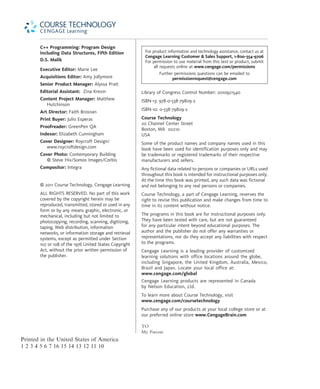
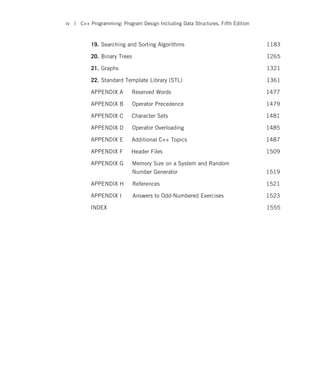
PREFACE xxv
1. AnOverview of Computers and Programming Languages 1
2. Basic Elements of C++ 27
3. Input/Output 117
4. Control Structures I (Selection) 175
5. Control Structures II (Repetition) 247
6. User-Defined Functions I 319
7. User-Defined Functions II 361
8. User-Defined Simple Data Types, Namespaces,
and the string Type 433
9. Arrays and Strings 485
10. Records (structs) 563
11. Classes and Data Abstraction 601
12. Inheritance and Composition 675
13. Pointers, Classes, Virtual Functions, Abstract Classes, and Lists 745
14. Overloading and Templates 827
15. Exception Handling 919
16. Recursion 959
17. Linked Lists 991
18. Stacks and Queues 1083
BRIEF CONTENTS
10.
19. Searching andSorting Algorithms 1183
20. Binary Trees 1265
21. Graphs 1321
22. Standard Template Library (STL) 1361
APPENDIX A Reserved Words 1477
APPENDIX B Operator Precedence 1479
APPENDIX C Character Sets 1481
APPENDIX D Operator Overloading 1485
APPENDIX E Additional C++ Topics 1487
APPENDIX F Header Files 1509
APPENDIX G Memory Size on a System and Random
Number Generator 1519
APPENDIX H References 1521
APPENDIX I Answers to Odd-Numbered Exercises 1523
INDEX 1555
iv | C++ Programming: Program Design Including Data Structures, Fifth Edition
11.
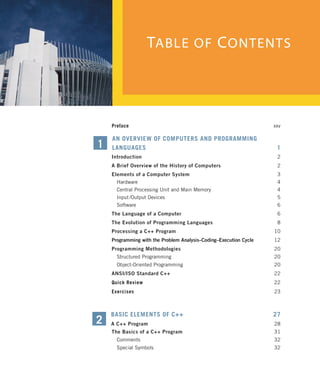
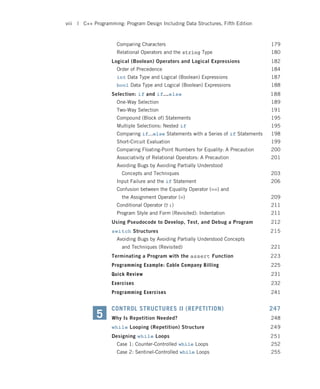
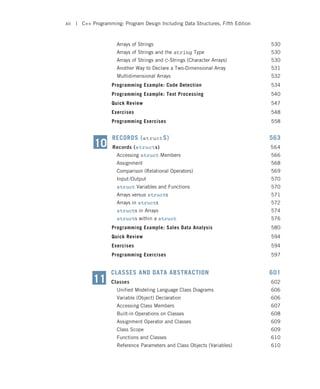
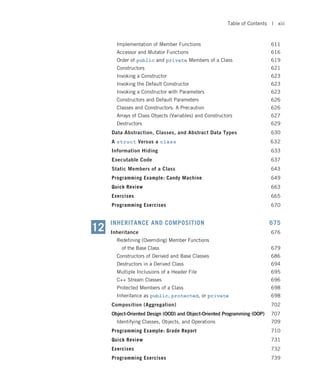
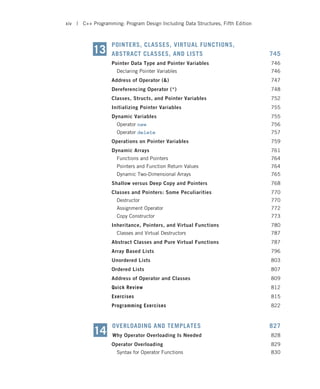
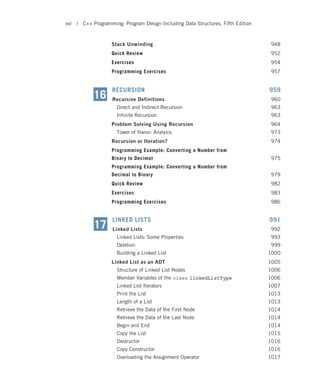
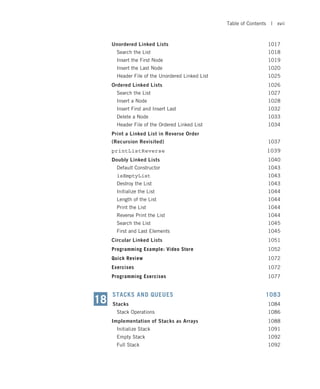
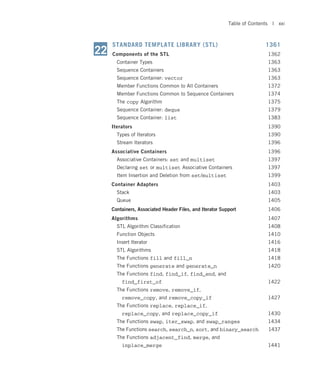
TABLE OF CONTENTS
Prefacexxv
AN OVERVIEW OF COMPUTERS AND PROGRAMMING
LANGUAGES 1
Introduction 2
A Brief Overview of the History of Computers 2
Elements of a Computer System 3
Hardware 4
Central Processing Unit and Main Memory 4
Input /Output Devices 5
Software 6
The Language of a Computer 6
The Evolution of Programming Languages 8
Processing a C++ Program 10
Programming with the Problem Analysis–Coding–Execution Cycle 12
Programming Methodologies 20
Structured Programming 20
Object-Oriented Programming 20
ANSI/ISO Standard C++ 22
Quick Review 22
Exercises 23
BASIC ELEMENTS OF C++ 27
A C++ Program 28
The Basics of a C++ Program 31
Comments 32
Special Symbols 32
1
2
12.
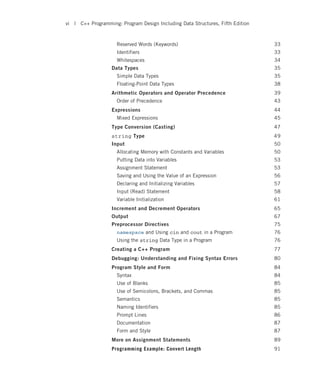
Reserved Words (Keywords)33
Identifiers 33
Whitespaces 34
Data Types 35
Simple Data Types 35
Floating-Point Data Types 38
Arithmetic Operators and Operator Precedence 39
Order of Precedence 43
Expressions 44
Mixed Expressions 45
Type Conversion (Casting) 47
string Type 49
Input 50
Allocating Memory with Constants and Variables 50
Putting Data into Variables 53
Assignment Statement 53
Saving and Using the Value of an Expression 56
Declaring and Initializing Variables 57
Input (Read) Statement 58
Variable Initialization 61
Increment and Decrement Operators 65
Output 67
Preprocessor Directives 75
namespace and Using cin and cout in a Program 76
Using the string Data Type in a Program 76
Creating a C++ Program 77
Debugging: Understanding and Fixing Syntax Errors 80
Program Style and Form 84
Syntax 84
Use of Blanks 85
Use of Semicolons, Brackets, and Commas 85
Semantics 85
Naming Identifiers 85
Prompt Lines 86
Documentation 87
Form and Style 87
More on Assignment Statements 89
Programming Example: Convert Length 91
vi | C++ Programming: Program Design Including Data Structures, Fifth Edition
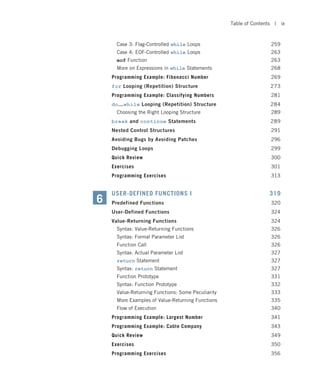
13.
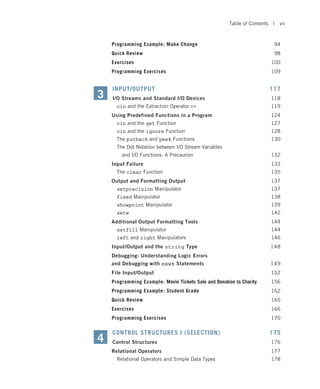
Programming Example: MakeChange 94
Quick Review 98
Exercises 100
Programming Exercises 109
INPUT/OUTPUT 117
I/O Streams and Standard I/O Devices 118
cin and the Extraction Operator 119
Using Predefined Functions in a Program 124
cin and the get Function 127
cin and the ignore Function 128
The putback and peek Functions 130
The Dot Notation between I/O Stream Variables
and I/O Functions: A Precaution 132
Input Failure 133
The clear Function 135
Output and Formatting Output 137
setprecision Manipulator 137
fixed Manipulator 138
showpoint Manipulator 139
setw 142
Additional Output Formatting Tools 144
setfill Manipulator 144
left and right Manipulators 146
Input/Output and the string Type 148
Debugging: Understanding Logic Errors
and Debugging with cout Statements 149
File Input/Output 152
Programming Example: Movie Tickets Sale and Donation to Charity 156
Programming Example: Student Grade 162
Quick Review 165
Exercises 166
Programming Exercises 170
CONTROL STRUCTURES I (SELECTION) 175
Control Structures 176
Relational Operators 177
Relational Operators and Simple Data Types 178
3
4
Table of Contents | vii
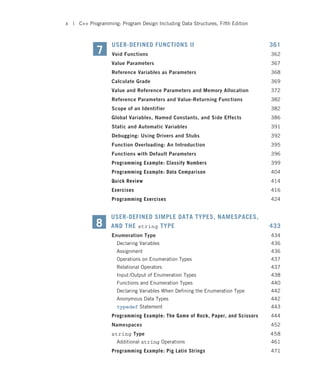
14.
Comparing Characters 179
RelationalOperators and the string Type 180
Logical (Boolean) Operators and Logical Expressions 182
Order of Precedence 184
int Data Type and Logical (Boolean) Expressions 187
bool Data Type and Logical (Boolean) Expressions 188
Selection: if and if...else 188
One-Way Selection 189
Two-Way Selection 191
Compound (Block of) Statements 195
Multiple Selections: Nested if 195
Comparing if...else Statements with a Series of if Statements 198
Short-Circuit Evaluation 199
Comparing Floating-Point Numbers for Equality: A Precaution 200
Associativity of Relational Operators: A Precaution 201
Avoiding Bugs by Avoiding Partially Understood
Concepts and Techniques 203
Input Failure and the if Statement 206
Confusion between the Equality Operator (==) and
the Assignment Operator (=) 209
Conditional Operator (?:) 211
Program Style and Form (Revisited): Indentation 211
Using Pseudocode to Develop, Test, and Debug a Program 212
switch Structures 215
Avoiding Bugs by Avoiding Partially Understood Concepts
and Techniques (Revisited) 221
Terminating a Program with the assert Function 223
Programming Example: Cable Company Billing 225
Quick Review 231
Exercises 232
Programming Exercises 241
CONTROL STRUCTURES II (REPETITION) 247
Why Is Repetition Needed? 248
while Looping (Repetition) Structure 249
Designing while Loops 251
Case 1: Counter-Controlled while Loops 252
Case 2: Sentinel-Controlled while Loops 255
5
viii | C++ Programming: Program Design Including Data Structures, Fifth Edition
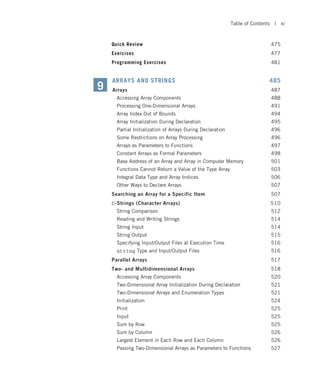
15.
Case 3: Flag-Controlledwhile Loops 259
Case 4: EOF-Controlled while Loops 263
eof Function 263
More on Expressions in while Statements 268
Programming Example: Fibonacci Number 269
for Looping (Repetition) Structure 273
Programming Example: Classifying Numbers 281
do...while Looping (Repetition) Structure 284
Choosing the Right Looping Structure 289
break and continue Statements 289
Nested Control Structures 291
Avoiding Bugs by Avoiding Patches 296
Debugging Loops 299
Quick Review 300
Exercises 301
Programming Exercises 313
USER-DEFINED FUNCTIONS I 319
Predefined Functions 320
User-Defined Functions 324
Value-Returning Functions 324
Syntax: Value-Returning Functions 326
Syntax: Formal Parameter List 326
Function Call 326
Syntax: Actual Parameter List 327
return Statement 327
Syntax: return Statement 327
Function Prototype 331
Syntax: Function Prototype 332
Value-Returning Functions: Some Peculiarity 333
More Examples of Value-Returning Functions 335
Flow of Execution 340
Programming Example: Largest Number 341
Programming Example: Cable Company 343
Quick Review 349
Exercises 350
Programming Exercises 356
6
Table of Contents | ix
16.
USER-DEFINED FUNCTIONS II361
Void Functions 362
Value Parameters 367
Reference Variables as Parameters 368
Calculate Grade 369
Value and Reference Parameters and Memory Allocation 372
Reference Parameters and Value-Returning Functions 382
Scope of an Identifier 382
Global Variables, Named Constants, and Side Effects 386
Static and Automatic Variables 391
Debugging: Using Drivers and Stubs 392
Function Overloading: An Introduction 395
Functions with Default Parameters 396
Programming Example: Classify Numbers 399
Programming Example: Data Comparison 404
Quick Review 414
Exercises 416
Programming Exercises 424
USER-DEFINED SIMPLE DATA TYPES, NAMESPACES,
AND THE string TYPE 433
Enumeration Type 434
Declaring Variables 436
Assignment 436
Operations on Enumeration Types 437
Relational Operators 437
Input /Output of Enumeration Types 438
Functions and Enumeration Types 440
Declaring Variables When Defining the Enumeration Type 442
Anonymous Data Types 442
typedef Statement 443
Programming Example: The Game of Rock, Paper, and Scissors 444
Namespaces 452
string Type 458
Additional string Operations 461
Programming Example: Pig Latin Strings 471
7
8
x | C++ Programming: Program Design Including Data Structures, Fifth Edition
17.
Quick Review 475
Exercises477
Programming Exercises 481
ARRAYS AND STRINGS 485
Arrays 487
Accessing Array Components 488
Processing One-Dimensional Arrays 491
Array Index Out of Bounds 494
Array Initialization During Declaration 495
Partial Initialization of Arrays During Declaration 496
Some Restrictions on Array Processing 496
Arrays as Parameters to Functions 497
Constant Arrays as Formal Parameters 498
Base Address of an Array and Array in Computer Memory 501
Functions Cannot Return a Value of the Type Array 503
Integral Data Type and Array Indices 506
Other Ways to Declare Arrays 507
Searching an Array for a Specific Item 507
C-Strings (Character Arrays) 510
String Comparison 512
Reading and Writing Strings 514
String Input 514
String Output 515
Specifying Input/Output Files at Execution Time 516
string Type and Input/Output Files 516
Parallel Arrays 517
Two- and Multidimensional Arrays 518
Accessing Array Components 520
Two-Dimensional Array Initialization During Declaration 521
Two-Dimensional Arrays and Enumeration Types 521
Initialization 524
Print 525
Input 525
Sum by Row 525
Sum by Column 526
Largest Element in Each Row and Each Column 526
Passing Two-Dimensional Arrays as Parameters to Functions 527
9
Table of Contents | xi
18.
Arrays of Strings530
Arrays of Strings and the string Type 530
Arrays of Strings and C-Strings (Character Arrays) 530
Another Way to Declare a Two-Dimensional Array 531
Multidimensional Arrays 532
Programming Example: Code Detection 534
Programming Example: Text Processing 540
Quick Review 547
Exercises 548
Programming Exercises 558
RECORDS (structS) 563
Records (structs) 564
Accessing struct Members 566
Assignment 568
Comparison (Relational Operators) 569
Input /Output 570
struct Variables and Functions 570
Arrays versus structs 571
Arrays in structs 572
structs in Arrays 574
structs within a struct 576
Programming Example: Sales Data Analysis 580
Quick Review 594
Exercises 594
Programming Exercises 597
CLASSES AND DATA ABSTRACTION 601
Classes 602
Unified Modeling Language Class Diagrams 606
Variable (Object) Declaration 606
Accessing Class Members 607
Built-in Operations on Classes 608
Assignment Operator and Classes 609
Class Scope 609
Functions and Classes 610
Reference Parameters and Class Objects (Variables) 610
10
11
xii | C++ Programming: Program Design Including Data Structures, Fifth Edition
19.
Implementation of MemberFunctions 611
Accessor and Mutator Functions 616
Order of public and private Members of a Class 619
Constructors 621
Invoking a Constructor 623
Invoking the Default Constructor 623
Invoking a Constructor with Parameters 623
Constructors and Default Parameters 626
Classes and Constructors: A Precaution 626
Arrays of Class Objects (Variables) and Constructors 627
Destructors 629
Data Abstraction, Classes, and Abstract Data Types 630
A struct Versus a class 632
Information Hiding 633
Executable Code 637
Static Members of a Class 643
Programming Example: Candy Machine 649
Quick Review 663
Exercises 665
Programming Exercises 670
INHERITANCE AND COMPOSITION 675
Inheritance 676
Redefining (Overriding) Member Functions
of the Base Class 679
Constructors of Derived and Base Classes 686
Destructors in a Derived Class 694
Multiple Inclusions of a Header File 695
C++ Stream Classes 696
Protected Members of a Class 698
Inheritance as public, protected, or private 698
Composition (Aggregation) 702
Object-Oriented Design (OOD) and Object-Oriented Programming (OOP) 707
Identifying Classes, Objects, and Operations 709
Programming Example: Grade Report 710
Quick Review 731
Exercises 732
Programming Exercises 739
12
Table of Contents | xiii
20.
POINTERS, CLASSES, VIRTUALFUNCTIONS,
ABSTRACT CLASSES, AND LISTS 745
Pointer Data Type and Pointer Variables 746
Declaring Pointer Variables 746
Address of Operator () 747
Dereferencing Operator (*) 748
Classes, Structs, and Pointer Variables 752
Initializing Pointer Variables 755
Dynamic Variables 755
Operator new 756
Operator delete 757
Operations on Pointer Variables 759
Dynamic Arrays 761
Functions and Pointers 764
Pointers and Function Return Values 764
Dynamic Two-Dimensional Arrays 765
Shallow versus Deep Copy and Pointers 768
Classes and Pointers: Some Peculiarities 770
Destructor 770
Assignment Operator 772
Copy Constructor 773
Inheritance, Pointers, and Virtual Functions 780
Classes and Virtual Destructors 787
Abstract Classes and Pure Virtual Functions 787
Array Based Lists 796
Unordered Lists 803
Ordered Lists 807
Address of Operator and Classes 809
Quick Review 812
Exercises 815
Programming Exercises 822
OVERLOADING AND TEMPLATES 827
Why Operator Overloading Is Needed 828
Operator Overloading 829
Syntax for Operator Functions 830
13
14
xiv | C++ Programming: Program Design Including Data Structures, Fifth Edition
21.
Overloading an Operator:Some Restrictions 830
Pointer this 831
Friend Functions of Classes 836
Operator Functions as Member Functions and
Nonmember Functions 839
Overloading Binary Operators 842
Overloading the Stream Insertion () and
Extraction () Operators 848
Overloading the Assignment Operator (=) 853
Overloading Unary Operators 861
Operator Overloading: Member versus Nonmember 867
Classes and Pointer Member Variables (Revisited) 868
Operator Overloading: One Final Word 868
Programming Example: Clock Type 868
Programming Example: Complex Numbers 877
Overloading the Array Index (Subscript) Operator ([]) 882
Programming Example: newString 884
Function Overloading 890
Templates 891
Function Templates 891
Class Templates 893
Array-Based Lists (Revisited) 896
Quick Review 902
Exercises 905
Programming Exercises 910
EXCEPTION HANDLING 919
Handling Exceptions within a Program 920
C++ Mechanisms of Exception Handling 924
try/catch Block 924
Using C++ Exception Classes 931
Creating Your Own Exception Classes 935
Rethrowing and Throwing an Exception 941
Exception-Handling Techniques 946
Terminate the Program 946
Fix the Error and Continue 946
Log the Error and Continue 948
15
Table of Contents | xv
22.
Stack Unwinding 948
QuickReview 952
Exercises 954
Programming Exercises 957
RECURSION 959
Recursive Definitions 960
Direct and Indirect Recursion 963
Infinite Recursion 963
Problem Solving Using Recursion 964
Tower of Hanoi: Analysis 973
Recursion or Iteration? 974
Programming Example: Converting a Number from
Binary to Decimal 975
Programming Example: Converting a Number from
Decimal to Binary 979
Quick Review 982
Exercises 983
Programming Exercises 986
LINKED LISTS 991
Linked Lists 992
Linked Lists: Some Properties 993
Deletion 999
Building a Linked List 1000
Linked List as an ADT 1005
Structure of Linked List Nodes 1006
Member Variables of the class linkedListType 1006
Linked List Iterators 1007
Print the List 1013
Length of a List 1013
Retrieve the Data of the First Node 1014
Retrieve the Data of the Last Node 1014
Begin and End 1014
Copy the List 1015
Destructor 1016
Copy Constructor 1016
Overloading the Assignment Operator 1017
16
17
xvi | C++ Programming: Program Design Including Data Structures, Fifth Edition
23.
Unordered Linked Lists1017
Search the List 1018
Insert the First Node 1019
Insert the Last Node 1020
Header File of the Unordered Linked List 1025
Ordered Linked Lists 1026
Search the List 1027
Insert a Node 1028
Insert First and Insert Last 1032
Delete a Node 1033
Header File of the Ordered Linked List 1034
Print a Linked List in Reverse Order
(Recursion Revisited) 1037
printListReverse 1039
Doubly Linked Lists 1040
Default Constructor 1043
isEmptyList 1043
Destroy the List 1043
Initialize the List 1044
Length of the List 1044
Print the List 1044
Reverse Print the List 1044
Search the List 1045
First and Last Elements 1045
Circular Linked Lists 1051
Programming Example: Video Store 1052
Quick Review 1072
Exercises 1072
Programming Exercises 1077
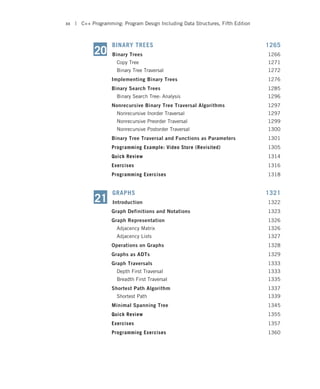
STACKS AND QUEUES 1083
Stacks 1084
Stack Operations 1086
Implementation of Stacks as Arrays 1088
Initialize Stack 1091
Empty Stack 1092
Full Stack 1092
18
Table of Contents | xvii
24.
Push 1092
Return theTop Element 1094
Pop 1094
Copy Stack 1096
Constructor and Destructor 1096
Copy Constructor 1097
Overloading the Assignment Operator (=) 1097
Stack Header File 1098
Programming Example: Highest GPA 1102
Linked Implementation of Stacks 1106
Default Constructor 1109
Empty Stack and Full Stack 1109
Initialize Stack 1110
Push 1110
Return the Top Element 1112
Pop 1112
Copy Stack 1114
Constructors and Destructors 1115
Overloading the Assignment Operator (=) 1115
Stack as Derived from the class
unorderedLinkedList 1118
Application of Stacks: Postfix Expressions Calculator 1119
Main Algorithm 1122
Function evaluateExpression 1122
Function evaluateOpr 1124
Function discardExp 1126
Function printResult 1126
Removing Recursion: Nonrecursive Algorithm to
Print a Linked List Backward 1129
Queues 1133
Queue Operations 1134
Implementation of Queues as Arrays 1136
Linked Implementation of Queues 1145
Queue Derived from the class
unorderedLinkedListType 1150
Application of Queues: Simulation 1151
Designing a Queuing System 1152
Customer 1153
Server 1156
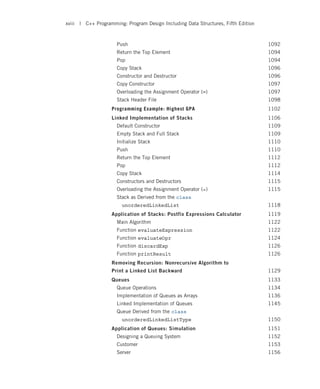
xviii | C++ Programming: Program Design Including Data Structures, Fifth Edition
25.
Server List 1159
WaitingCustomers Queue 1164
Main Program 1166
Quick Review 1171
Exercises 1172
Programming Exercises 1178
SEARCHING AND SORTING ALGORITHMS 1183
Searching and Sorting Algorithms 1184
Search Algorithms 1184
Sequential Search 1185
Binary Search 1187
Performance of Binary Search 1192
Binary Search Algorithm and the class orderedArrayListType 1193
Asymptotic Notation: Big-O Notation 1194
Lower Bound on Comparison-Based Search Algorithms 1202
Sorting Algorithms 1202
Sorting a List: Bubble Sort 1202
Analysis: Bubble Sort 1206
Bubble Sort Algorithm and the class unorderedArrayListType 1207
Selection Sort: Array-Based Lists 1208
Analysis: Selection Sort 1211
Insertion Sort: Array-Based Lists 1212
Analysis: Insertion Sort 1216
Lower Bound on Comparison-Based Sort Algorithms 1216
Quick Sort: Array-Based Lists 1218
Analysis: Quick Sort 1224
Merge Sort: Linked List-Based Lists 1225
Divide 1227
Merge 1229
Analysis: Merge Sort 1232
Programming Example: Election Results 1235
Quick Review 1256
Exercises 1257
Programming Exercises 1260
19
Table of Contents | xix
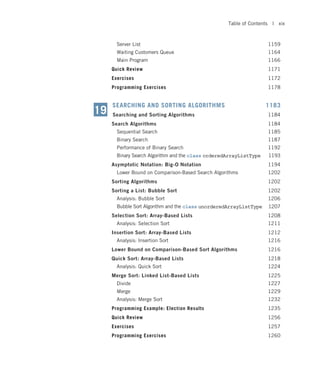
26.
BINARY TREES 1265
BinaryTrees 1266
Copy Tree 1271
Binary Tree Traversal 1272
Implementing Binary Trees 1276
Binary Search Trees 1285
Binary Search Tree: Analysis 1296
Nonrecursive Binary Tree Traversal Algorithms 1297
Nonrecursive Inorder Traversal 1297
Nonrecursive Preorder Traversal 1299
Nonrecursive Postorder Traversal 1300
Binary Tree Traversal and Functions as Parameters 1301
Programming Example: Video Store (Revisited) 1305
Quick Review 1314
Exercises 1316
Programming Exercises 1318
GRAPHS 1321
Introduction 1322
Graph Definitions and Notations 1323
Graph Representation 1326
Adjacency Matrix 1326
Adjacency Lists 1327
Operations on Graphs 1328
Graphs as ADTs 1329
Graph Traversals 1333
Depth First Traversal 1333
Breadth First Traversal 1335
Shortest Path Algorithm 1337
Shortest Path 1339
Minimal Spanning Tree 1345
Quick Review 1355
Exercises 1357
Programming Exercises 1360
20
21
xx | C++ Programming: Program Design Including Data Structures, Fifth Edition
27.
STANDARD TEMPLATE LIBRARY(STL) 1361
Components of the STL 1362
Container Types 1363
Sequence Containers 1363
Sequence Container: vector 1363
Member Functions Common to All Containers 1372
Member Functions Common to Sequence Containers 1374
The copy Algorithm 1375
Sequence Container: deque 1379
Sequence Container: list 1383
Iterators 1390
Types of Iterators 1390
Stream Iterators 1396
Associative Containers 1396
Associative Containers: set and multiset 1397
Declaring set or multiset Associative Containers 1397
Item Insertion and Deletion from set/multiset 1399
Container Adapters 1403
Stack 1403
Queue 1405
Containers, Associated Header Files, and Iterator Support 1406
Algorithms 1407
STL Algorithm Classification 1408
Function Objects 1410
Insert Iterator 1416
STL Algorithms 1418
The Functions fill and fill_n 1418
The Functions generate and generate_n 1420
The Functions find, find_if, find_end, and
find_first_of 1422
The Functions remove, remove_if,
remove_copy, and remove_copy_if 1427
The Functions replace, replace_if,
replace_copy, and replace_copy_if 1430
The Functions swap, iter_swap, and swap_ranges 1434
The Functions search, search_n, sort, and binary_search 1437
The Functions adjacent_find, merge, and
inplace_merge 1441
22
Table of Contents | xxi
28.
The Functions reverse,reverse_copy,
rotate, and rotate_copy 1445
The Functions count, count_if, max, max_element,
min, min_element, and random_shuffle 1448
The Functions for_each and transform 1452
The Functions includes, set_intersection, set_union,
set_difference, and set_symmetric_difference 1455
The Functions accumulate, adjacent_difference,
inner_product, and partial_sum 1463
Quick Review 1468
Exercises 1472
Programming Exercises 1475
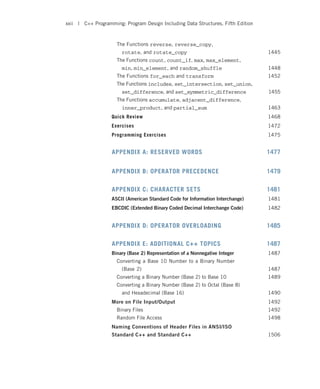
APPENDIX A: RESERVED WORDS 1477
APPENDIX B: OPERATOR PRECEDENCE 1479
APPENDIX C: CHARACTER SETS 1481
ASCII (American Standard Code for Information Interchange) 1481
EBCDIC (Extended Binary Coded Decimal Interchange Code) 1482
APPENDIX D: OPERATOR OVERLOADING 1485
APPENDIX E: ADDITIONAL C++ TOPICS 1487
Binary (Base 2) Representation of a Nonnegative Integer 1487
Converting a Base 10 Number to a Binary Number
(Base 2) 1487
Converting a Binary Number (Base 2) to Base 10 1489
Converting a Binary Number (Base 2) to Octal (Base 8)
and Hexadecimal (Base 16) 1490
More on File Input/Output 1492
Binary Files 1492
Random File Access 1498
Naming Conventions of Header Files in ANSI/ISO
Standard C++ and Standard C++ 1506
xxii | C++ Programming: Program Design Including Data Structures, Fifth Edition
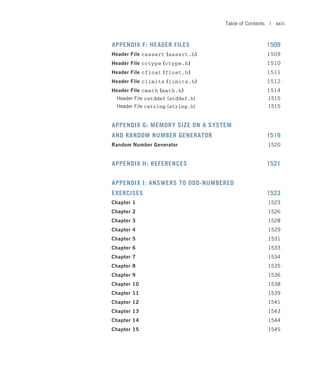
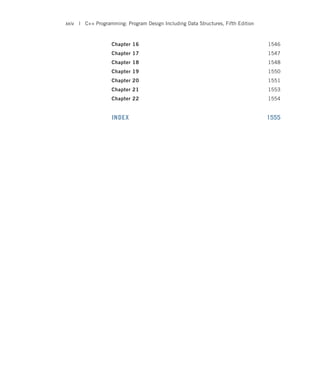
Chapter 16 1546
Chapter17 1547
Chapter 18 1548
Chapter 19 1550
Chapter 20 1551
Chapter 21 1553
Chapter 22 1554
INDEX 1555
xxiv | C++ Programming: Program Design Including Data Structures, Fifth Edition
31.
WELCOME TO THEFIFTH EDITION OF C++ Programming: Program Design Including Data
Structures. Designed for a two semester (CS1 and CS2) C++ course, this text will provide
a breath of fresh air to you and your students. The CS1 and CS2 courses serve as the cornerstone
of the Computer Science curriculum. My primary goal is to motivate and excite all
introductory programming students, regardless of their level. Motivation breeds excite-
ment for learning. Motivation and excitement are critical factors that lead to the success
of the programming student. This text is a culmination and development of my classroom
notes throughout more than fifty semesters of teaching successful programming to
Computer Science students.
C++ Programming: Program Design Including Data Structures started as a collection of brief
examples, exercises, and lengthy programming examples to supplement the books that were
in use at our university. It soon turned into a collection large enough to develop into a text.
The approach taken in this book is, in fact, driven by the students’ demand for clarity and readability.
The material was written and rewritten until the students felt comfortable with it. Most of the
examples in this book resulted from student interaction in the classroom.
As with any profession, practice is essential. Cooking students practice their recipes. Budding
violinists practice their scales. New programmers must practice solving problems and writing
code. This is not a C++ cookbook. We do not simply list the C++ syntax followed by an
example; we dissect the ‘‘why’’ behind all the concepts. The crucial question of ‘‘why?’’ is
answered for every topic when first introduced. This technique offers a bridge to learning
C++. Students must understand the ‘‘why?’’ in order to be motivated to learn.
Traditionally, a C++ programming neophyte needed a working knowledge of another
programming language. This book assumes no prior programming experience. However,
some adequate mathematics background such as college algebra is required.
PREFACE
Warning: This text can be expected to create a serious reduction in the demand for program-
ming help during your office hours. Other side effects include significantly diminished student
dependency on others while learning to program.
32.
Changes in theFifth Edition
The fifth edition contains more than 50 new programming exercises and more than 150 new
exercises. Chapters 2 through 7 include a programming exercise which contains a solution to
a problem; however, the statements are in the incorrect order. So the student is asked to
rewrite the program with statements in the correct order. This will allow students to learn
how to read and debug programs written by someone else. Another major change in this
edition is the inclusion of debugging sections in Chapters 2 through 7. In these sections, a
program with errors is included. The program is compiled, and syntax errors, if any, are
shown. We then show how to interpret the syntax errors and correct them. Some sections
also show how to find and correct logical errors. This edition also includes various new
examples, such as Examples 5-8, 7-8, 12-6, and 12-8. Various sections in Chapters 4, 5, 6, and
7 have been rewritten. Chapter 8 includes additional string functions, and the virtual func-
tions section in Chapter 14 has been rewritten with new examples.
Approach
The programming language C++, which evolved from C, is no longer considered an
industry-only language. Numerous colleges and universities use C++ for their first program-
ming language course. C++ is a combination of structured programming and object-oriented
programming, and this book addresses both types.
This book is intended for a two-semester course, CS1 and CS2, in Computer Science. The
first 11 or 12 chapters can be covered in the first course and the remaining in the second
course.
In July 1998, ANSI/ISO Standard C++ was officially approved. This book focuses on ANSI/
ISO Standard C++. Even though the syntax of Standard C++ and ANSI/ISO Standard C++
is very similar, Chapter 8 discusses some of the features of ANSI/ISO Standard C++ that are
not available in Standard C++.
Chapter 1 briefly reviews the history of computers and programming languages. The reader can
quickly skim through this chapter and become familiar with some of the hardware components
and the software parts of the computer. This chapter contains a section on processing a C++
program. This chapter also describes structured and object-oriented programming.
Chapter 2 discusses the basic elements of C++. After completing this chapter, students
become familiar with the basics of C++ and are ready to write programs that are complicated
enough to do some computations. Input/output is fundamental to any programming lan-
guage. It is introduced early, in Chapter 3, and is covered in detail.
Chapters 4 and 5 introduce control structures to alter the sequential flow of execution.
Chapters 6 and 7 study user-defined functions. It is recommended that readers with no prior
programming background spend extra time on Chapters 6 and 7. Several examples are
provided to help readers understand the concepts of parameter passing and the scope of an
identifier.
xxvi | C++ Programming: Program Design Including Data Structures, Fifth Edition
33.
Chapter 8 discussesthe user-defined simple data type (enumeration type), the namespace
mechanism of ANSI/ISO Standard C++, and the string type. The earlier versions of C did
not include the enumeration type. Enumeration types have very limited use; their main
purpose is to make the program readable. This book is organized such that readers can skip
the section on enumeration types during the first reading without experiencing any discon-
tinuity, and then later go through this section.
Chapter 9 discusses arrays in detail. Chapter 10 introduces records (structs). The introduc-
tion of structs in this book is similar to C structs. This chapter is optional; it is not a
prerequisite for any of the remaining chapters.
Chapter 11 begins the study of object-oriented programming (OOP) and introduces classes.
The first half of this chapter shows how classes are defined and used in a program. The second
half of the chapter introduces abstract data types (ADTs). This chapter shows how classes in
C++ are a natural way to implement ADTs. Chapter 12 continues with the fundamentals of
object-oriented design (OOD) and OOP, and discusses inheritance and composition. It
explains how classes in C++ provide a natural mechanism for OOD and how C++ supports
OOP. Chapter 12 also discusses how to find the objects in a given problem.
Chapter 13 studies pointers in detail. After introducing pointers and how to use them in a
program, this chapter highlights the peculiarities of classes with pointer data members and
how to avoid them. Moreover, this chapter also discusses how to create and work with
dynamic two-dimensional arrays. Chapter 13 also discusses abstract classes and a type of
polymorphism accomplished via virtual functions.
Chapter 14 continues the study of OOD and OOP. In particular, it studies polymorphism
in C++. Chapter 14 specifically discusses two types of polymorphism—overloading and
templates.
Chapter 15 discusses exception handling in detail. Chapter 16 introduces and discusses
recursion. This is a stand-alone chapter, so it can be studied anytime after Chapter 10.
Chapters 17 and 18 are devoted to the study of data structures. Discussed in detail are linked
lists in Chapter 17 and stacks and queues in Chapter 18. The programming code developed in
these chapters is generic. These chapters effectively use the fundamentals of OOD.
Chapter 19 discusses various searching and sorting algorithms. In addition to showing how
these algorithms work, it also provides relevant analysis and results concerning the perfor-
mance of the algorithms. The algorithm analysis allows the user to decide which algorithm to
use in a particular application. This chapter also includes several sorting algorithms. The
instructor can decide which algorithms to cover.
Chapter 20 provides an introduction to binary trees. Various traversal algorithms, as well as the
basic properties of binary trees, are discussed and illustrated. Special binary trees, called binary
search trees, are introduced. Searching, as well as item insertion and deletion from a binary search
tree, are described and illustrated. Chapter 20 also discusses nonrecursive binary tree traversal
algorithms. Furthermore, to enhance the flexibility of traversal algorithms, it shows how to
construct and pass functions as parameters to other functions. This chapter also discusses AVL
Preface | xxvii
34.
(height balanced) treesin detail. Due to text length considerations, discussion on AVL trees is
provided as a separate section and is available on the Web site accompanying this book.
Graph algorithms are discussed in Chapter 21. After introducing the basic graph theory
terminology, the representation of graphs in computer memory is discussed. This chapter
also discusses graph traversal algorithms, the shortest path algorithm, and the minimal span-
ning tree algorithm. Topological sort is also discussed in this chapter and is available on the
Web site accompanying this book.
C++ is equipped with a powerful library—the Standard Template Library (STL)—of data
structures and algorithms that can be used effectively in a wide variety of applications. Chapter
22 describes the STL in detail. After introducing the three basic components of the STL, it
shows how sequence containers are used in a program. Special containers, such as stack and
queue, are also discussed. The latter half of this chapter shows how various STL algorithms
can be used in a program. This chapter is fairly long; depending on the availability of time, the
instructor can at least cover the sequence containers, iterators, the classes stack and queue,
and certain algorithms.
Appendix A lists the reserved words in C++. Appendix B shows the precedence and
associativity of the C++ operators. Appendix C lists the ASCII (American Standard Code
for Information Interchange) and EBCDIC (Extended Binary Coded Decimal Interchange
Code) character sets. Appendix D lists the C++ operators that can be overloaded.
Appendix E has three objectives. First, we discuss how to convert a number from decimal to
binary and binary to decimal. We then discuss binary and random access files in detail. Finally,
we describe the naming conventions of the header files in both ANSI/ISO Standard C++ and
Standard C++. Appendix F discusses some of the most widely used library routines, and
includes the names of the standard C++ header files. The programs in Appendix G show
how to print the memory size for the built-in data types on your system as well as how to use a
random number generator. Appendix H gives selected references for further study. Appendix I
provides the answers to odd-numbered exercises in the book.
xxviii | C++ Programming: Program Design Including Data Structures, Fifth Edition
35.
How to Usethe Book
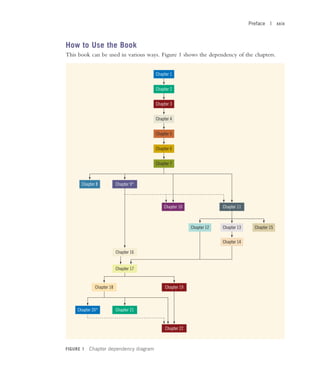
This book can be used in various ways. Figure 1 shows the dependency of the chapters.
Chapter 1
Chapter 2
Chapter 3
Chapter 4
Chapter 5
Chapter 6
Chapter 7
Chapter 8 Chapter 9*
Chapter 19
Chapter 10 Chapter 11
Chapter 12 Chapter 13
Chapter 14
Chapter 15
Chapter 16
Chapter 17
Chapter 18
Chapter 20* Chapter 21
Chapter 22
FIGURE 1 Chapter dependency diagram
Preface | xxix
36.
In Figure 1,dotted lines mean that the preceding chapter is used in one of the sections of the
chapter and is not necessarily a prerequisite for the next chapter. For example, Chapter 9
covers arrays in detail. In Chapters 10 and 11, we show the relationship between arrays and
structs and arrays and classes, respectively. However, if Chapter 11 is studied before
Chapter 9, then the section dealing with arrays in Chapter 11 can be skipped without any
discontinuation. This particular section can be studied after studying Chapter 9.
It is recommended that the first seven chapters be covered sequentially. After covering the
first seven chapters, if the reader is interested in learning OOD and OOP early, then Chapter
11 can be studied right after Chapter 7. Chapter 8 can be studied anytime after Chapter 7.
After studying the first seven chapters in sequence, some of the approaches are:
1. Study chapters in the sequence: 9, 10, 11, 12, 13, 14, 15, 16, 17, 18, 19, 20, 21, 22.
2. Study chapters in the sequence: 9, 11, 13, 14, 12, 16, 17, 18, 15, 19, 20, 21, 22.
3. Study chapters in the sequence: 11, 9, 13, 14, 12, 16, 17, 18, 15, 19, 20, 21, 22.
As the chapter dependency diagram shows, Chapters 18 and 19 can be covered in any sequence.
However, typically, Chapters 18 and 19 are studied in sequence. Ideally, one should study
Chapters 17, 18, 19, and 20 in sequence. Chapters 21 and 22 can be studied in any sequence.
xxx | C++ Programming: Program Design Including Data Structures, Fifth Edition
37.
FEATURES OF THEBOOK
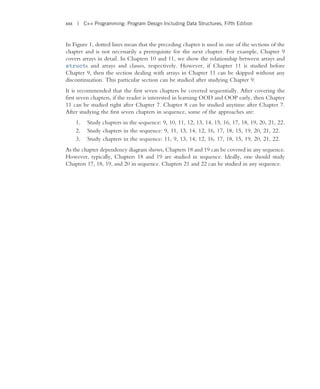
Four-color interior
design shows
accurate C++
code and related
comments.
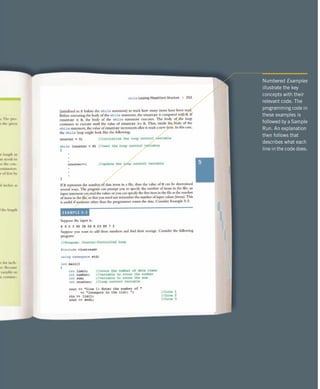
Numbered Examples
illustrate thekey
concepts with their
relevant code. The
programming code in
these examples is
followed by a Sample
Run. An explanation
then follows that
describes what each
line in the code does.
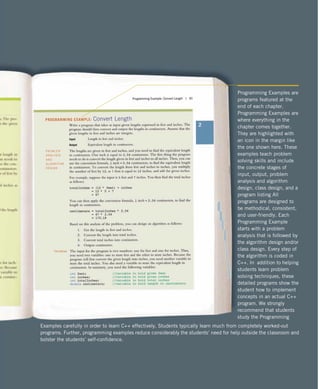
Programming Examples are
programsfeatured at the
end of each chapter.
Programming Examples are
where everything in the
chapter comes together.
They are highlighted with
an icon in the margin like
the one shown here. These
examples teach problem
solving skills and include
the concrete stages of
input, output, problem
analysis and algorithm
design, class design, and a
program listing All
programs are designed to
be methodical, consistent,
and user-friendly. Each
Programming Example
starts with a problem
analysis that is followed by
the algorithm design and/or
class design. Every step of
the algorithm is coded in
C++. In addition to helping
students learn problem
solving techniques, these
detailed programs show the
student how to implement
concepts in an actual C++
program. We strongly
recommend that students
study the Programming
Examples carefully in order to learn C++ effectively. Students typically learn much from completely worked-out
programs. Further, programming examples reduce considerably the students’ need for help outside the classroom and
bolster the students’ self-confidence.
The following supplementalmaterials are available when this book is used in a classroom
setting. All instructor materials as outlined below are available at the Companion Site for the
text at www.cengage.com.
Electronic Instructor’s Manual
The Instructor’s Manual that accompanies this textbook includes:
• Additional instructional material to assist in class preparation, including suggestions
for lecture topics.
• Solutions to all the end-of-chapter materials, including the Programming Exercises.
ExamViewâ
This textbook is accompanied by ExamView, a powerful testing software package that allows
instructors to create and administer printed, computer (LAN-based), and Internet exams.
ExamView includes hundreds of questions that correspond to the topics covered in this text,
enabling students to generate detailed study guides that include page references for further
review. These computer-based and Internet testing components allow students to take exams
at their computers, and save the instructor time because each exam is graded automatically.
PowerPoint Presentations
This book comes with Microsoft PowerPoint slides for each chapter. These are included as a
teaching aid for classroom presentations, either to make available to students on the network
for chapter review, or to be printed for classroom distribution. Instructors can add their own
slides for additional topics that they introduce to the class. The PowerPoint slides for the book
are also available on the Instructor Resources CD.
Distance Learning
Cengage Learning is proud to present online courses in WebCT and Blackboard to provide
the most complete and dynamic learning experience possible. For more information on how
SUPPLEMENTAL
RESOURCES
44.
to bring distancelearning to your course, contact your local Cengage Learning sales
representative.
Source Code
The source code, in ANSI/ISO Standard C++, is available at the Companion Site for the text
at www.cengage.com/coursetechnology, and is also available on the Instructor Resources
CD-ROM. The input files needed to run some of the programs are also included with the
source code.
Solution Files
The solution files for all programming exercises, in ANSI/ISO C++, are available at the
Companion Site for the text at www.cengage.com/coursetechnology and are also available on
the Instructor Resources CD-ROM. The input files needed to run some of the programming
exercises are also included with the solution files.
xxxviii | C++ Programming: Program Design Including Data Structures, Fifth Edition
45.
There are manypeople that I must thank who, one way or another, contributed to the success
of this book. First, I would like to thank all the students who, during the preparation, were
spontaneous in telling me if certain portions needed to be reworded for better understanding
and clearer reading. Next, I would like to thank those who e-mailed numerous comments
to improve upon the third edition. I am thankful to Professors S.C. Cheng, Randall Crist, and
Vasant Raval for constantly supporting this project. I am also very grateful to the reviewers
who reviewed earlier versions of this book and offered many critical suggestions on how to
improve it.
I owe a great deal to the following reviewers who patiently read each page of every chapter of
the current version and made critical comments to improve the book: Stefano Basagni,
Northeastern University; Jeff Ringenberg, University of Michigan; Colleen van Lent, Uni-
versity of Michigan; Tuan Vo, Mt. San Antonio College; Kerstin Voigt, California State
University, San Bernardino; Lan Yang, Cal Poly Pomona. The reviewers will recognize that
their criticisms have not been overlooked and, in fact, made this a better book.
Next, I express thanks to Amy Jollymore, Acquisitions Editor, for recognizing the importance
and uniqueness of this project. All this would not have been possible without the careful
planning of Senior Product Manager Alyssa Pratt. I extend my sincere thanks to Alyssa, as well
as to Content Project Manager Matthew Hutchinson. I also thank Tintu Thomas of Integra
Software Services for assisting us in keeping the project on schedule. I would like to thank
Chris Scriver and Serge Palladino of Course Technology for patiently and carefully testing the
code and discovering typos and errors.
This book is dedicated to my parents, who I thank for their blessings.
Finally, I am thankful for the support of my wife Sadhana and especially my daughter Shelly.
They cheered me up whenever I was overwhelmed during the writing of this book. I welcome
any comments concerning the text. Comments may be forwarded to the following e-mail
address: malik@creighton.edu.
D. S. Malik
ACKNOWLEDGEMENTS
AN OVERVIEW OF
COMPUTERSAND
PROGRAMMING
LANGUAGES
IN THIS CHAPTER, YOU WILL:
. Learn about different types of computers
. Explore the hardware and software components of a computer system
. Learn about the language of a computer
. Learn about the evolution of programming languages
. Examine high-level programming languages
. Discover what a compiler is and what it does
. Examine a C++ program
. Explore how a C++ program is processed
. Learn what an algorithm is and explore problem-solving techniques
. Become aware of structured design and object-oriented design programming methodologies
. Become aware of Standard C++ and ANSI/ISO Standard C++
1
C H A P T E R
48.
Introduction
Terms such as‘‘the Internet,’’ which were unfamiliar just 20 years ago are now common.
Students in elementary school regularly ‘‘surf ’’ the Internet and use computers to design their
classroom projects. Many people use the Internet to look for information and to commu-
nicate with others. This is all made possible by the availability of different software, also
known as computer programs. Without software, a computer is useless. Software is devel-
oped by using programming languages. The programming language C++ is especially well
suited for developing software to accomplish specific tasks. Our main objective is to help you
learn how to write programs in the C++ programming language. Before you begin
programming, it is useful to understand some of the basic terminology and different
components of a computer. We begin with an overview of the history of computers.
A Brief Overview of the History of Computers
The first device known to carry out calculations was the abacus. The abacus was invented in
Asia but was used in ancient Babylon, China, and throughout Europe until the late middle
ages. The abacus uses a system of sliding beads in a rack for addition and subtraction. In 1642,
the French philosopher and mathematician Blaise Pascal invented the calculating device
called the Pascaline. It had eight movable dials on wheels and could calculate sums up to
eight figures long. Both the abacus and Pascaline could perform only addition and subtrac-
tion operations. Later in the 17th century, Gottfried von Leibniz invented a device that was
able to add, subtract, multiply, and divide. In 1819, Joseph Jacquard, a French weaver,
discovered that the weaving instructions for his looms could be stored on cards with holes
punched in them. While the cards moved through the loom in sequence, needles passed
through the holes and picked up threads of the correct color and texture. A weaver could
rearrange the cards and change the pattern being woven. In essence, the cards programmed a
loom to produce patterns in cloth. The weaving industry may seem to have little in common
with the computer industry. However, the idea of storing information by punching holes on
a card proved to be of great importance in the later development of computers.
In the early and mid-1800s, Charles Babbage, an English mathematician and physical
scientist, designed two calculating machines—the difference engine and the analytical
engine. The difference engine could perform complex operations such as squaring
numbers automatically. Babbage built a prototype of the difference engine, but the actual
device was never produced. The analytical engine’s design included input device, data
storage, a control unit that allowed processing instructions in any sequence, and output
devices. However, the designs remained in blueprint stage. Most of Babbage’s work is
known through the writings of his colleague Ada Augusta, Countess of Lovelace. Augusta
is considered the first computer programmer.
At the end of the 19th century, U.S. Census officials needed help in accurately tabulating
the census data. Herman Hollerith invented a calculating machine that ran on electricity
and used punched cards to store data. Hollerith’s machine was immensely successful.
Hollerith founded the Tabulating Machine Company, which later became the computer
and technology corporation known as IBM.
2 | Chapter 1: An Overview of Computers and Programming Languages
49.
1
The first computer-likemachine was the Mark I. It was built, in 1944, jointly by IBM and
Harvard University under the leadership of Howard Aiken. Punched cards were used to feed
data into the machine. The Mark I was 52 feet long, weighed 50 tons, and had 750,000 parts.
In 1946, the ENIAC (Electronic Numerical Integrator and Calculator) was built at the
University of Pennsylvania. It contained 18,000 vacuum tubes and weighed some 30 tons.
The computers that we know today use the design rules given by John von Neumann in
the late 1940s. His design included components such as an arithmetic logic unit, a control
unit, memory, and input/output devices. These components are described in the next
section. Von Neumann’s computer design makes it possible to store the programming
instructions and the data in the same memory space. In 1951, the UNIVAC (Universal
Automatic Computer) was built and sold to the U.S. Census Bureau.
In 1956, the invention of transistors resulted in smaller, faster, more reliable, and more
energy-efficient computers. This era also saw the emergence of the software development
industry, with the introduction of FORTRAN and COBOL, two early programming
languages. In the next major technological advancement, transistors were replaced by tiny
integrated circuits, or ‘‘chips.’’ Chips are smaller and cheaper than transistors and can contain
thousands of circuits on a single chip. They give computers tremendous processing speed.
In 1970, the microprocessor, an entire CPU on a single chip, was invented. In 1977,
Stephen Wozniak and Steven Jobs designed and built the first Apple computer in their
garage. In 1981, IBM introduced its personal computer (PC). In the 1980s, clones of the
IBM PC made the personal computer even more affordable. By the mid-1990s, people
from many walks of life were able to afford them. Computers continue to become faster
and less expensive as technology advances.
Modern-day computers are powerful, reliable, and easy to use. They can accept spoken-word
instructions and imitate human reasoning through artificial intelligence. Expert systems assist
doctors in making diagnoses. Mobile computing applications are growing significantly. Using
handheld devices, delivery drivers can access global positioning satellites (GPS) to verify
customer locations for pickups and deliveries. Cell phones permit you to check your e-mail,
make airline reservations, see how stocks are performing, and access your bank accounts.
Although there are several categories of computers, such as mainframe, midsize, and
micro, all computers share some basic elements, described in the next section.
Elements of a Computer System
A computer is an electronic device capable of performing commands. The basic commands
that a computer performs are input (get data), output (display result), storage, and perfor-
mance of arithmetic and logical operations.
In today’s market, personal computers are sold with descriptions such as a Pentium 4
Processor 2.80 GHz, 1 GB RAM, 250 GB HD, VX750 19 Silver Flat CRT Color
Monitor, preloaded with software such as an operating system, games, encyclopedias, and
application software such as word processors or money management programs. These
descriptions represent two categories: hardware and software. Items such as ‘‘Pentium 4
Elements of a Computer System | 3
No. P S3364.
Glass Mustard Pot,
Electro-plated
Mount, 2/6
No. P S 3365.
Electro-plate and
Polished Oak Pepper
Mill, 5/9 Ditto. with
Silver Mounts, 7/0
No. P S 3366.
Sterling Silver and
Glass Cayenne Pot
with Gilt Spoon. Size
3 in. 9/6
No. P S 3367.
Sterling Silver
“Capstan” Pepper Mill.
Height 2¾ in. ... 13/3
Do. 3⅛ in. ... 20/0
Do. 3½ in. ... 24/0
Ditto in Electro-plate,
height 3⅛ in., 10/0
[145]
SALT CELLARS, MUSTARD POTS, PEPPER
CASTORS, Etc.
52.
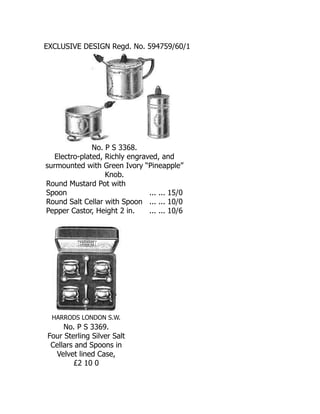
EXCLUSIVE DESIGN Regd.No. 594759/60/1
No. P S 3368.
Electro-plated, Richly engraved, and
surmounted with Green Ivory “Pineapple”
Knob.
Round Mustard Pot with
Spoon ... ... 15/0
Round Salt Cellar with Spoon ... ... 10/0
Pepper Castor, Height 2 in. ... ... 10/6
HARRODS LONDON S.W.
No. P S 3369.
Four Sterling Silver Salt
Cellars and Spoons in
Velvet lined Case,
£2 10 0
53.
No. P S3370.
Sterling Silver Salt Cellar, large size with
spoon 15 0
Ditto, small size ... ... ... ... ... ... 8 6
Sterling Silver Pepper Castor, large size ... 15 0
Ditto, small size ... ... ... ... ... ... 8 0
Sterling Silver Mustard Pot, large size with
spoon 25 0
Ditto, small size ... ... ... ... ... ... 15 0
54.
HARRODS LONDON S.W.
No.P S 3371.
Four Sterling Silver Richly pierced
and engraved Salt Cellars. Lined
Blue Glass, in Case complete with
Spoons. Reproduced from the
Antique, £7 18 6
55.
No. P S3372.
Four Sterling Silver Salt Cellars and
Spoons, 2 Mustard Pots and Spoons,
and 2 Muffineers, in velvet-lined
case, £5 5 0
56.
HARRODS LONDON S.W.
No.P S 3373.
1 Pair Sterling Silver Salt Cellars, 1 Pair
Muffineers and 1 pair Mustard Pots,
including spoons in Velvet lined case, £6 10
0
Four Salt Cellars and Spoons in Case £4 4 0
Two ,, ,, ,, 2 2 0
57.
No. P S3374.
Four Sterling Silver Salt Cellars and Spoons
in Velvet Lined Case. £2 15 0
58.
HARRODS LONDON S.W.
No.P S 3375.
Sterling Silver Salt Cellars and
Spoons,
4 in case, £3 3 0; 2 in case, £1 12 6
59.
No. P S3376.
Four Sterling Silver Salt Cellars and Spoons
in Velvet-lined Case, £4 10 0
[146]
STERLING SILVER AND ELECTRO-PLATED SALT
CELLARS, Etc., IN CASES.
60.
No. P S3377.
Four Sterling Silver Salt Cellars and
Spoons in case chased, 87/6
No. P S 3378.
Electro-plated Salt Cellars and Spoons.
2 in case ... ... ... 19/6
4 in case ... ... ... 38/6
Without case ... per pair 15/0
61.
HARRODS LONDON
No. PS 3379.
Four Sterling Silver Salt Cellars in case, 50/-
,, Electro-plated ,, ,, ,, 26/0
No. P S 3380.
Sterling Silver “Chippendale” Pattern
Salt Cellars and Spoons.
4 in Velvet-lined case ... 50/0
2 ,, ,, ... 25/0
62.
HARRODS LONDON
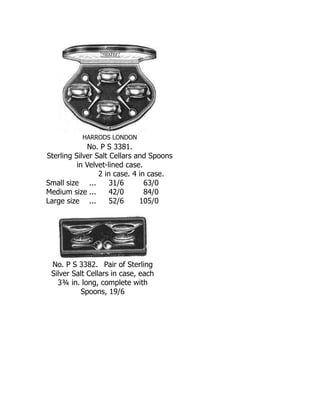
No. PS 3381.
Sterling Silver Salt Cellars and Spoons
in Velvet-lined case.
2 in case. 4 in case.
Small size ... 31/6 63/0
Medium size ... 42/0 84/0
Large size ... 52/6 105/0
No. P S 3382. Pair of Sterling
Silver Salt Cellars in case, each
3¾ in. long, complete with
Spoons, 19/6
63.
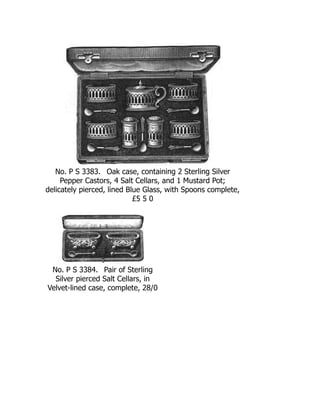
No. P S3383. Oak case, containing 2 Sterling Silver
Pepper Castors, 4 Salt Cellars, and 1 Mustard Pot;
delicately pierced, lined Blue Glass, with Spoons complete,
£5 5 0
No. P S 3384. Pair of Sterling
Silver pierced Salt Cellars, in
Velvet-lined case, complete, 28/0
64.
HARRODS LONDON
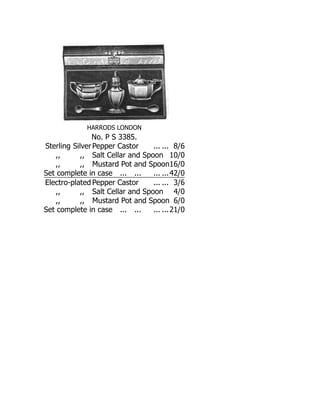
No. PS 3385.
Sterling SilverPepper Castor ... ... 8/6
,, ,, Salt Cellar and Spoon 10/0
,, ,, Mustard Pot and Spoon16/0
Set complete in case ... ... ... ...42/0
Electro-plated Pepper Castor ... ... 3/6
,, ,, Salt Cellar and Spoon 4/0
,, ,, Mustard Pot and Spoon 6/0
Set complete in case ... ... ... ...21/0
65.
No. P S3386.
Four Sterling Silver Salt Cellars and
Spoons in Velvet-lined case, 70/0
Do. do. do. smaller size, 40/0
No. P S 3387.
Four Sterling Silver Salt Cellars in Velvet-
lined case, 63/0
[146a]
SILVER, ELECTRO PLATE CUTLERY DEPARTMENT
66.
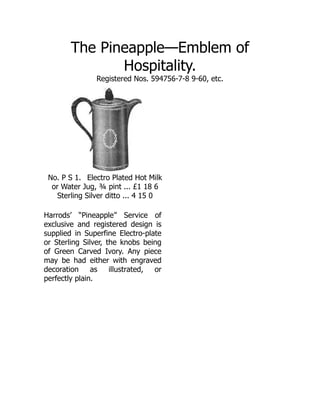
The Pineapple—Emblem of
Hospitality.
RegisteredNos. 594756-7-8 9-60, etc.
No. P S 1. Electro Plated Hot Milk
or Water Jug, ¾ pint ... £1 18 6
Sterling Silver ditto ... 4 15 0
Harrods’ “Pineapple” Service of
exclusive and registered design is
supplied in Superfine Electro-plate
or Sterling Silver, the knobs being
of Green Carved Ivory. Any piece
may be had either with engraved
decoration as illustrated, or
perfectly plain.
67.
No. P S2. Electro Plated Coffee
Pot, ¾ pint ... ... £1 18 6
Sterling Silver ditto ... 4 15 0
No. P S 3.
Electro Plated Tea Pot, 1 pint ... £2 5 0
Sterling Silver ditto ... ... ... 5 2 6
No. P S 4. Electro Plated Muffin Dish
with Hot Water Division £1 17 6
Sterling Silver ditto, Plain ... 5 18 6
68.
No. P S5. Electro Plated
Cream Jug ... £1 2 6
Sterling Silver ditto 1 13 6
No. P S 6. Electro Plated
Sugar Basin £1 7 6
Sterling Silver ditto ... 2 6 6
No. P S 7. Electro Plated Toast Rack £1 7 6
Sterling Silver ditto ... 3 7 6
69.
No. P S8.
Electro Plated Kettle and Stand,
2½ pints, £4 4 0
Sterling Silver ditto, £11 0 0
70.
No. P S9. Electro Plate.
Sterling
Silver.
£ s. d. £ s. d
Coffee Pot (2 pts.) ... ... ... 2 12 6 ... ... 6 15
Tea Pot (2 pts.) ... ... ... 2 7 6 ... ... 6 15
Sugar Basin ... ... ... ... ... 1 15 0 ... ... 3 12
Cream Jug ... ... ... ... ... 1 10 0 ... ... 2 10
Complete ... ... ... ... ... £8 5 0 ... ... £19 12
Electro Plated Tray, with Oval Scalloped or Plain Border
(24 inch) ... £7 15
Sterling Silver ditto ... ... ... ... To order £38 10
[146b]
SILVER, ELECTRO PLATE CUTLERY DEPARTMENT
The Pineapple—Emblem of
Hospitality.
Registered Nos. 594756-7-8 9-60, etc.
71.
No. P S10. Electro Plate and English Cut
Glass
Oil and Vinegar Frame, £3 3 0
Sterling Silver ditto, £5 5 0
Harrods’ “Pineapple” Service of
exclusive and registered design is
supplied in Superfine Electro-plate
or Sterling Silver, the knobs being
of Green Carved Ivory. Any piece
may be had either with engraved
decoration as illustrated, or
perfectly plain.
No. P S 11. Electro Plate and English Cut
Glass
Luncheon Cruet, £2 12 6
Sterling Silver ditto, £4 4 0.
72.
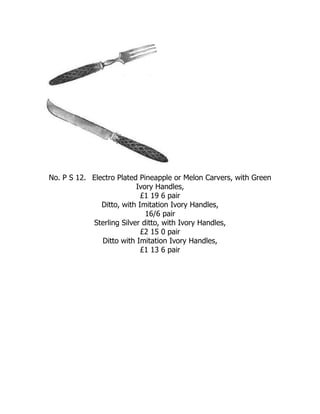
No. P S12. Electro Plated Pineapple or Melon Carvers, with Green
Ivory Handles,
£1 19 6 pair
Ditto, with Imitation Ivory Handles,
16/6 pair
Sterling Silver ditto, with Ivory Handles,
£2 15 0 pair
Ditto with Imitation Ivory Handles,
£1 13 6 pair
73.
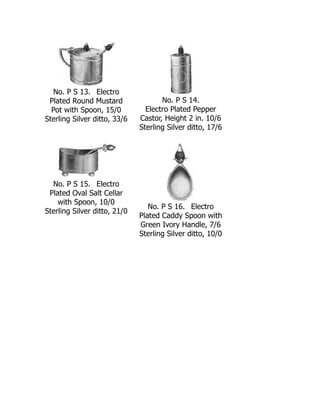
No. P S13. Electro
Plated Round Mustard
Pot with Spoon, 15/0
Sterling Silver ditto, 33/6
No. P S 14.
Electro Plated Pepper
Castor, Height 2 in. 10/6
Sterling Silver ditto, 17/6
No. P S 15. Electro
Plated Oval Salt Cellar
with Spoon, 10/0
Sterling Silver ditto, 21/0
No. P S 16. Electro
Plated Caddy Spoon with
Green Ivory Handle, 7/6
Sterling Silver ditto, 10/0
74.
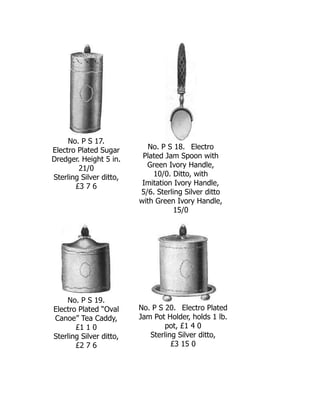
No. P S17.
Electro Plated Sugar
Dredger. Height 5 in.
21/0
Sterling Silver ditto,
£3 7 6
No. P S 18. Electro
Plated Jam Spoon with
Green Ivory Handle,
10/0. Ditto, with
Imitation Ivory Handle,
5/6. Sterling Silver ditto
with Green Ivory Handle,
15/0
No. P S 19.
Electro Plated “Oval
Canoe” Tea Caddy,
£1 1 0
Sterling Silver ditto,
£2 7 6
No. P S 20. Electro Plated
Jam Pot Holder, holds 1 lb.
pot, £1 4 0
Sterling Silver ditto,
£3 15 0
75.
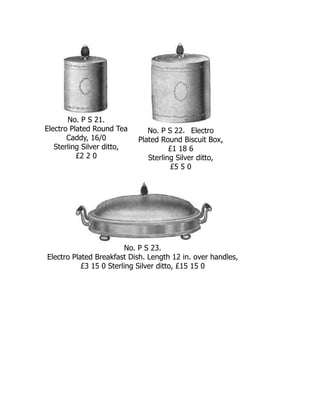
No. P S21.
Electro Plated Round Tea
Caddy, 16/0
Sterling Silver ditto,
£2 2 0
No. P S 22. Electro
Plated Round Biscuit Box,
£1 18 6
Sterling Silver ditto,
£5 5 0
No. P S 23.
Electro Plated Breakfast Dish. Length 12 in. over handles,
£3 15 0 Sterling Silver ditto, £15 15 0
HARRODS LONDON SW
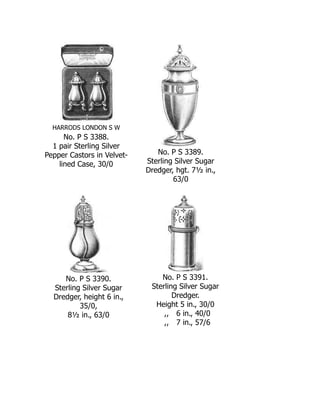
No. P S 3388.
1 pair Sterling Silver
Pepper Castors in Velvet-
lined Case, 30/0
No. P S 3389.
Sterling Silver Sugar
Dredger, hgt. 7½ in.,
63/0
No. P S 3390.
Sterling Silver Sugar
Dredger, height 6 in.,
35/0,
8½ in., 63/0
No. P S 3391.
Sterling Silver Sugar
Dredger.
Height 5 in., 30/0
,, 6 in., 40/0
,, 7 in., 57/6
78.
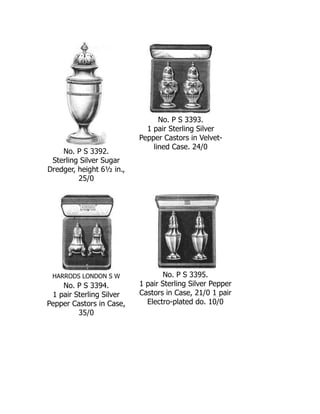
No. P S3392.
Sterling Silver Sugar
Dredger, height 6½ in.,
25/0
No. P S 3393.
1 pair Sterling Silver
Pepper Castors in Velvet-
lined Case. 24/0
HARRODS LONDON S W
No. P S 3394.
1 pair Sterling Silver
Pepper Castors in Case,
35/0
No. P S 3395.
1 pair Sterling Silver Pepper
Castors in Case, 21/0 1 pair
Electro-plated do. 10/0
79.
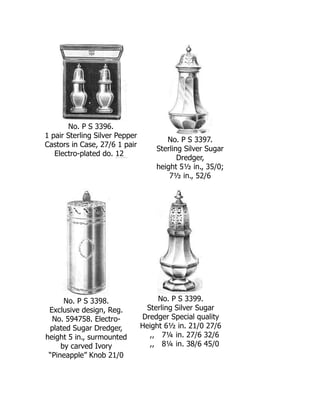
No. P S3396.
1 pair Sterling Silver Pepper
Castors in Case, 27/6 1 pair
Electro-plated do. 12
No. P S 3397.
Sterling Silver Sugar
Dredger,
height 5½ in., 35/0;
7½ in., 52/6
No. P S 3398.
Exclusive design, Reg.
No. 594758. Electro-
plated Sugar Dredger,
height 5 in., surmounted
by carved Ivory
“Pineapple” Knob 21/0
No. P S 3399.
Sterling Silver Sugar
Dredger Special quality
Height 6½ in. 21/0 27/6
,, 7¼ in. 27/6 32/6
,, 8¼ in. 38/6 45/0
80.
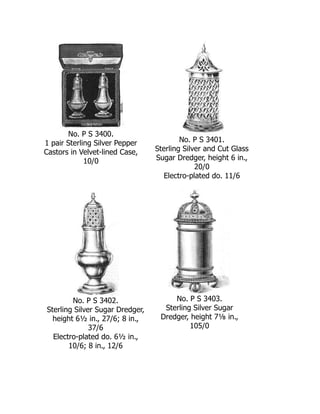
No. P S3400.
1 pair Sterling Silver Pepper
Castors in Velvet-lined Case,
10/0
No. P S 3401.
Sterling Silver and Cut Glass
Sugar Dredger, height 6 in.,
20/0
Electro-plated do. 11/6
No. P S 3402.
Sterling Silver Sugar Dredger,
height 6½ in., 27/6; 8 in.,
37/6
Electro-plated do. 6½ in.,
10/6; 8 in., 12/6
No. P S 3403.
Sterling Silver Sugar
Dredger, height 7⅛ in.,
105/0
81.
Welcome to OurBookstore - The Ultimate Destination for Book Lovers
Are you passionate about books and eager to explore new worlds of
knowledge? At our website, we offer a vast collection of books that
cater to every interest and age group. From classic literature to
specialized publications, self-help books, and children’s stories, we
have it all! Each book is a gateway to new adventures, helping you
expand your knowledge and nourish your soul
Experience Convenient and Enjoyable Book Shopping Our website is more
than just an online bookstore—it’s a bridge connecting readers to the
timeless values of culture and wisdom. With a sleek and user-friendly
interface and a smart search system, you can find your favorite books
quickly and easily. Enjoy special promotions, fast home delivery, and
a seamless shopping experience that saves you time and enhances your
love for reading.
Let us accompany you on the journey of exploring knowledge and
personal growth!
ebookgate.com


![Overloading an Operator: Some Restrictions 830
Pointer this 831
Friend Functions of Classes 836
Operator Functions as Member Functions and
Nonmember Functions 839
Overloading Binary Operators 842
Overloading the Stream Insertion () and
Extraction () Operators 848
Overloading the Assignment Operator (=) 853
Overloading Unary Operators 861
Operator Overloading: Member versus Nonmember 867
Classes and Pointer Member Variables (Revisited) 868
Operator Overloading: One Final Word 868
Programming Example: Clock Type 868
Programming Example: Complex Numbers 877
Overloading the Array Index (Subscript) Operator ([]) 882
Programming Example: newString 884
Function Overloading 890
Templates 891
Function Templates 891
Class Templates 893
Array-Based Lists (Revisited) 896
Quick Review 902
Exercises 905
Programming Exercises 910
EXCEPTION HANDLING 919
Handling Exceptions within a Program 920
C++ Mechanisms of Exception Handling 924
try/catch Block 924
Using C++ Exception Classes 931
Creating Your Own Exception Classes 935
Rethrowing and Throwing an Exception 941
Exception-Handling Techniques 946
Terminate the Program 946
Fix the Error and Continue 946
Log the Error and Continue 948
15
Table of Contents | xv](https://image.slidesharecdn.com/92477-250320031723-14cd8ba6/85/C-Programming-Program-design-including-data-structures-5ed-Edition-Malik-D-S-21-320.jpg)

![No. P S 3364.
Glass Mustard Pot,
Electro-plated
Mount, 2/6
No. P S 3365.
Electro-plate and
Polished Oak Pepper
Mill, 5/9 Ditto. with
Silver Mounts, 7/0
No. P S 3366.
Sterling Silver and
Glass Cayenne Pot
with Gilt Spoon. Size
3 in. 9/6
No. P S 3367.
Sterling Silver
“Capstan” Pepper Mill.
Height 2¾ in. ... 13/3
Do. 3⅛ in. ... 20/0
Do. 3½ in. ... 24/0
Ditto in Electro-plate,
height 3⅛ in., 10/0
[145]
SALT CELLARS, MUSTARD POTS, PEPPER
CASTORS, Etc.](https://image.slidesharecdn.com/92477-250320031723-14cd8ba6/85/C-Programming-Program-design-including-data-structures-5ed-Edition-Malik-D-S-51-320.jpg)
![No. P S 3376.
Four Sterling Silver Salt Cellars and Spoons
in Velvet-lined Case, £4 10 0
[146]
STERLING SILVER AND ELECTRO-PLATED SALT
CELLARS, Etc., IN CASES.](https://image.slidesharecdn.com/92477-250320031723-14cd8ba6/85/C-Programming-Program-design-including-data-structures-5ed-Edition-Malik-D-S-59-320.jpg)
![No. P S 3386.
Four Sterling Silver Salt Cellars and
Spoons in Velvet-lined case, 70/0
Do. do. do. smaller size, 40/0
No. P S 3387.
Four Sterling Silver Salt Cellars in Velvet-
lined case, 63/0
[146a]
SILVER, ELECTRO PLATE CUTLERY DEPARTMENT](https://image.slidesharecdn.com/92477-250320031723-14cd8ba6/85/C-Programming-Program-design-including-data-structures-5ed-Edition-Malik-D-S-65-320.jpg)
![No. P S 9. Electro Plate.
Sterling
Silver.
£ s. d. £ s. d
Coffee Pot (2 pts.) ... ... ... 2 12 6 ... ... 6 15
Tea Pot (2 pts.) ... ... ... 2 7 6 ... ... 6 15
Sugar Basin ... ... ... ... ... 1 15 0 ... ... 3 12
Cream Jug ... ... ... ... ... 1 10 0 ... ... 2 10
Complete ... ... ... ... ... £8 5 0 ... ... £19 12
Electro Plated Tray, with Oval Scalloped or Plain Border
(24 inch) ... £7 15
Sterling Silver ditto ... ... ... ... To order £38 10
[146b]
SILVER, ELECTRO PLATE CUTLERY DEPARTMENT
The Pineapple—Emblem of
Hospitality.
Registered Nos. 594756-7-8 9-60, etc.](https://image.slidesharecdn.com/92477-250320031723-14cd8ba6/85/C-Programming-Program-design-including-data-structures-5ed-Edition-Malik-D-S-70-320.jpg)
![No. P S 24.
Electro Plated “Oval Canoe”
Biscuit Box, £2 5 0.
Sterling Silver ditto, £5 12 6.
[147]
SUGAR DREDGERS AND PEPPER CASTORS.](https://image.slidesharecdn.com/92477-250320031723-14cd8ba6/85/C-Programming-Program-design-including-data-structures-5ed-Edition-Malik-D-S-76-320.jpg)