11. Write a Program to overload operators like *, <<, >> using friend
function. The following overloaded operators should work for a class vector.
#include<iostream.h>
#include<conio.h>
const size = 3;
class vector
{
int v[size];
public:
vector();
vector(int *x);
friend vector operator *(int a, vector b);
friend vector operator *(vector b, int a);
friend istream & operator >>(istream &, vector &);
friend ostream & operator <<(ostream &, vector &);
};
vector ::vector()
{
for(int i=0;i<size;i++)
v[i]=0;
}
vector :: vector(int *x)
{
for(int i=0; i<size; i++)
v[i] = x[i];
}
vector operator *(int a, vector b)
{
vector c;
for(int i=0; i<size; i++)
c.v[i] = a * b.v[i];
return c;
}
vector operator *(vector b, int a)
{
vector c;
for(int i=0; i<size; i++)
c.v[i] = b.v[i] * a;
return c;
}
istream & operator >> (istream &din, vector &b)
{
for(int i=0; i<size; i++)
din>>b.v[i];
return(din);
}
ostream & operator << (ostream &dout, vector &b)
{
dout<<"("<<b.v [0];
for(int i=1; i<size; i++)
dout<<","<<b.v[i];
dout<<")";
return(dout);
}
int x[size] = {2,4,6};
int main()
{
vector m;
vector n = x;
cout<<"Enter Elements of vector m"<<"n";
cin>>m;
cout<<"n";
cout<<"m="<<m<<"n";
vector p,q;
p = 2 * m;
q = n * 2;
cout<<"n";
cout<<"p="<<p<<"n";
cout<<"q="<<q<<"n";
return 0;
}
12. Write a program for developing a matrix class which can handle integer
matrices of different dimensions. Also overload the operator for addition,
multiplication & comparison of matrices.
#include <iostream.h>
#include <iomanip.h>
class matrix
{
int maxrow, maxcol;
int * ptr;
public:
matrix( int r, int c )
{
maxrow = r;
maxcol = c;
ptr = new int [r * c];
}
void getmat( )
{
int i,j, mat_off,temp;
cout << endl << "enter elements matrix:" << endl;
for( i = 0; i < maxrow; i++ )
{
for( j = 0; j < maxcol; j++ )
{
mat_off = i * maxcol + j;
cin >> ptr[ mat_off ];
}
}
}
void printmat( )
{
int i, j, mat_off;
for( i = 0; i < maxrow; i++ )
{
cout << endl;
for( j = 0; j < maxcol; j++ )
{
mat_off = i * maxcol + j;
cout << setw( 3 ) << ptr[ mat_off ];
}
}
}
int delmat( )
{
matrix q ( maxrow - 1, maxcol - 1 );
int sign = 1, sum = 0, i, j,k,count;
int newsize,newpos,pos,order;
order = maxrow;
if( order == 1 )
{
return ( ptr[ 0 ] );
}
for( i = 0; i < order; i++, sign *= -1 )
{
for( j = 1; j < order; j++ )
{
for( k = 0, count = 0; k < order;
k++ )
{
if( k == i )
continue;
pos = j * order + k;
newpos = ( j - 1 ) * ( order - 1 ) + count;
q.ptr[ newpos ] = ptr[ pos ];
count++;
}
}
sum = sum + ptr[ i ] * sign * q.delmat( );
}
return ( sum );
}
matrix operator +( matrix b )
{
matrix c ( maxrow, maxcol );
int i,j,mat_off;
for( i = 0; i < maxrow; i++ )
{
for( j = 0; j < maxcol; j++ )
{
mat_off = i * maxcol + j;
c.ptr[ mat_off ] = ptr[ mat_off ] + b.ptr[ mat_off ];
}
}
return ( c );
}
matrix operator *( matrix b )
{
matrix c ( b.maxcol, maxrow );
int i,j,k,mat_off1, mat_off2, mat_off3;
for( i = 0; i < c.maxrow; i++ )
{
for( j = 0; j < c.maxcol; j++ )
{
mat_off3 - i * c.maxcol + j;
c.ptr[ mat_off3 ] = 0;
for( k = 0; k < b.maxrow; k++ )
{
mat_off2 = k * b.maxcol + j;
mat_off1 = i * maxcol + k;
c.ptr[mat_off3]+=ptr[mat_off1]* b.ptr[mat_off2 ];
}
}
}
return ( c );
}
int operator ==( matrix b )
{
int i,j, mat_off;
if( maxrow != b.maxrow
|| maxcol != b.maxcol )
return ( 0 );
for( i = 0; i < maxrow; i++ )
{
for( j = 0; j < maxcol; j++ )
{
mat_off = i * maxcol + j;
if( ptr[ mat_off ]
!= b.ptr[ mat_off ] )
return ( 0 );
}
}
return ( 1 );
}
} ;
void main( )
{
int rowa, cola, rowb, colb;
cout << endl << "Enter dimensions of matrix A ";
cin >> rowa >> cola;
matrix a ( rowa, cola );
a.getmat( );
cout << endl << "Enter dimensions of matrix B";
cin >> rowb >> colb;
matrix b ( rowb, colb );
b.getmat( );
matrix c ( rowa, cola );
c = a + b;
cout << endl << "The sum of two matrics = ";
c.printmat( );
matrix d ( rowa, colb );
d = a * b;
cout << endl << "The product of two matrics = ";
d.printmat( );
cout << endl << "Determinant of matrix a =" << a.delmat( );
if( a == b )
cout << endl << "a & b are equal";
else
cout << endl << "a & b are not equal";
}
13. Write a program to overload new/delete operators in a class.
#include <iostream.h>
#include <stdlib.h>
#include <string.h>
#include <new.h>
const int MAX = 5;
const int FREE = 0;
const int OCCUPIED = 1;
void memwarning( )
{
cout << endl << "Free store has now gone empty";
exit( 1 );
}
class employee
{
private:
char name[ 20 ];
int age;
float sal;
public:
void *operator new(size_t bytes)
void operator delete( void * q );
void setdata( char * n, int a, float s );
void showdata( );
~employee( );
} ;
struct pool
{
employee obj;
int status;
} ;
int flag = 0;
struct pool * p = NULL;
void * employee::operator new( size_t sz )
{
int i;
if( flag == 0 )
{
p = ( pool * )malloc( sz * MAX );
if( p == NULL )
memwarning( );
for( i = 0; i < MAX; i++ )
p[ i ].status = FREE;
flag = 1;
p[ 0 ].status = OCCUPIED;
return &p[ 0 ].obj;
}
else
{
for( i = 0; i < MAX; i++ )
{
if( p[ i ].status = FREE )
{
p[ i ].status = OCCUPIED;
return &p[ i ].obj;
}
}
memwarning( );
}
}
void employee::operator delete( void * q )
{
if( q == NULL )
return;
for( int i = 0; i < MAX; i++)
{
if( q == &p[ i ].obj )
{
p[ i ].status = FREE;
strcpy( p[ i ].obj.name, "" );
p[ i ].obj.age = 0;
p[ i ].obj.sal = 0.0;
}
}
}
void employee::setdata( char * n, int a, float s )
{
strcpy( name, n );
age = a;
sal = s;
}
void employee::showdata( )
{
cout << endl << name << "t" << age << "t" << sal;
}
employee::~employee( )
{
cout << endl << "reached destructor";
free( p );
}
void main( )
{
void memwarning( );
set_new_handler( memwarning );
employee * e1,*e2,*e3,*e4,*e5,*e6;
e1 = new employee;
e1->setdata( "ajay", 23, 4500.50 );
e2 = new employee;
e2->setdata( "amol", 25, 5500.50 );
e3 = new employee;
e3->setdata( "anil", 26, 3500.50 );
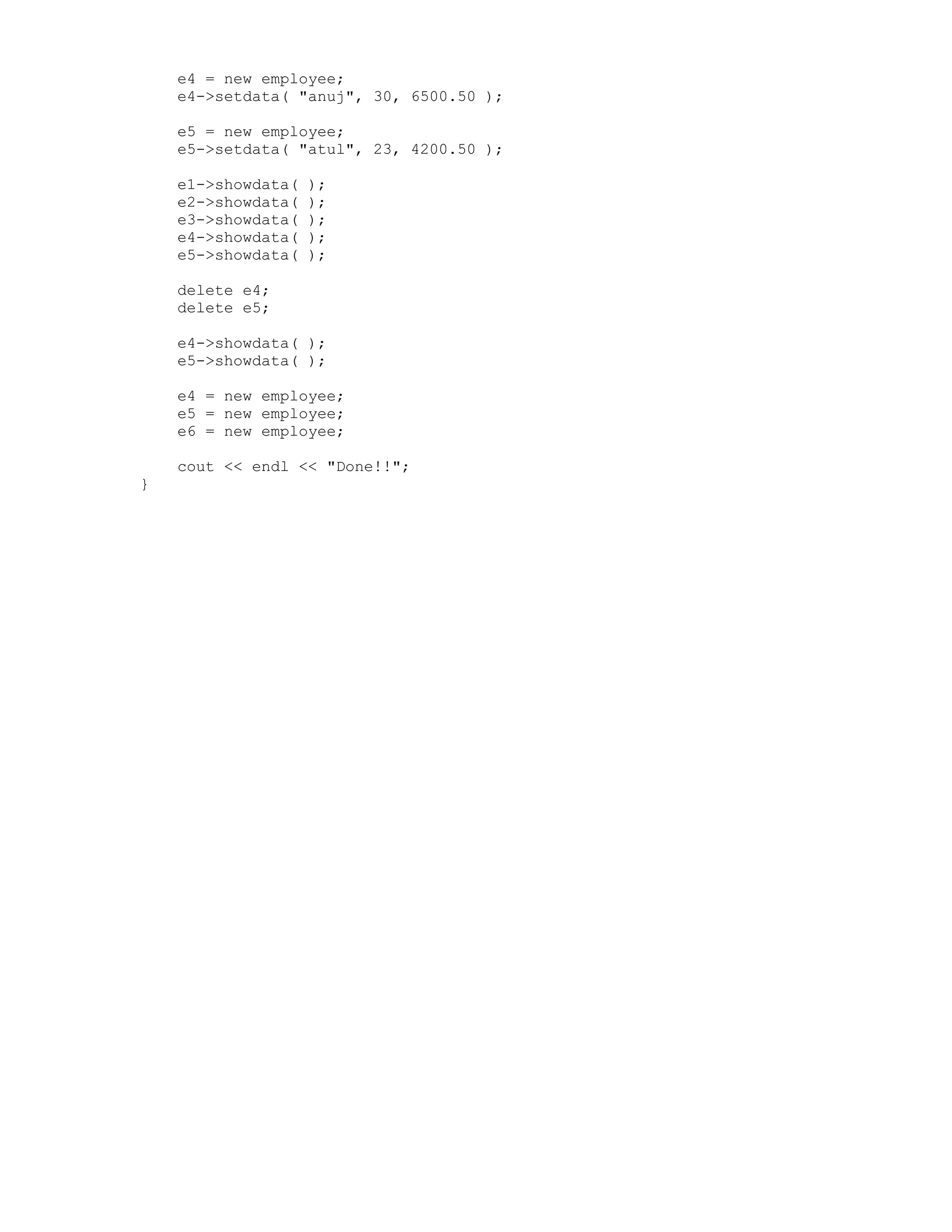
e4 = new employee;
e4->setdata( "anuj", 30, 6500.50 );
e5 = new employee;
e5->setdata( "atul", 23, 4200.50 );
e1->showdata( );
e2->showdata( );
e3->showdata( );
e4->showdata( );
e5->showdata( );
delete e4;
delete e5;
e4->showdata( );
e5->showdata( );
e4 = new employee;
e5 = new employee;
e6 = new employee;
cout << endl << "Done!!";
}
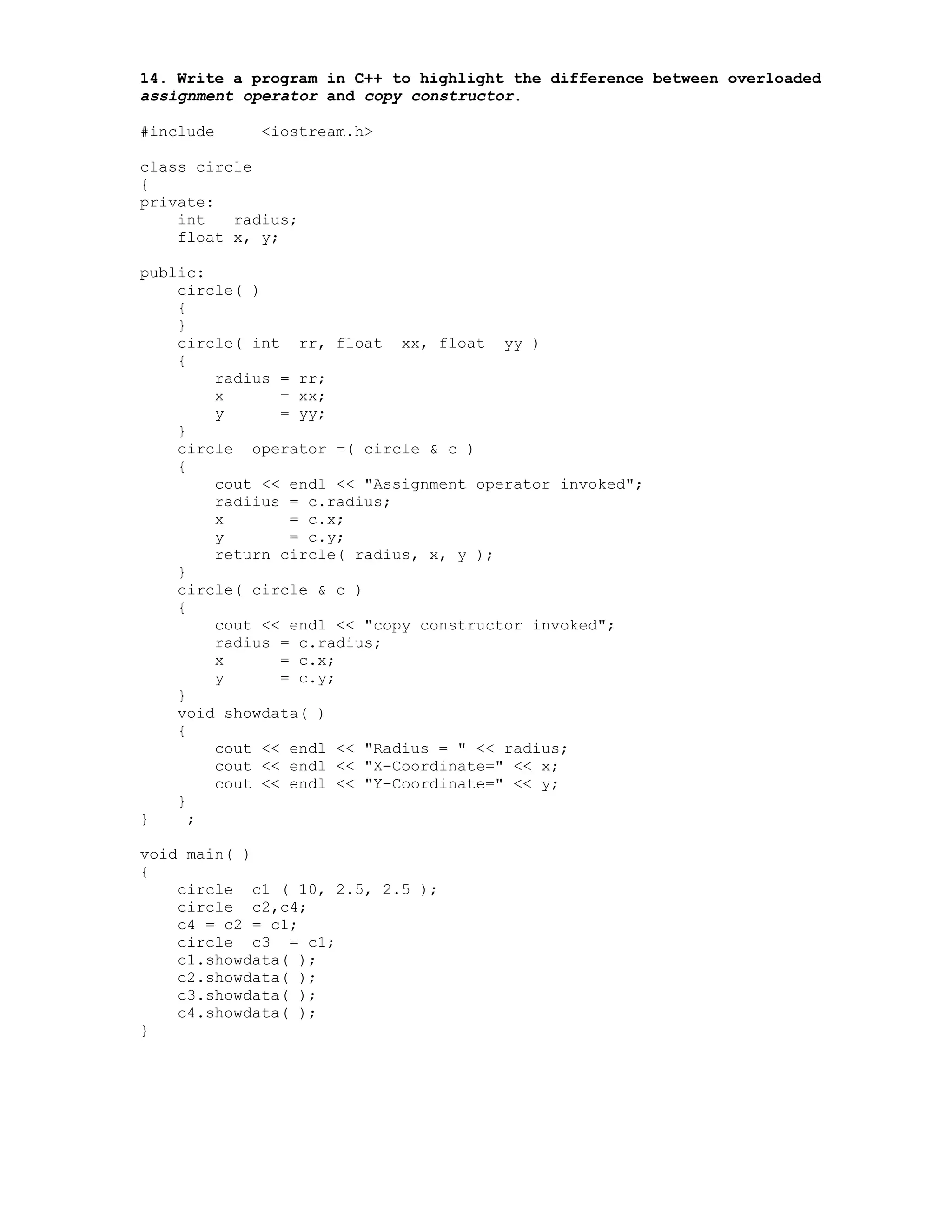
14. Write a program in C++ to highlight the difference between overloaded
assignment operator and copy constructor.
#include <iostream.h>
class circle
{
private:
int radius;
float x, y;
public:
circle( )
{
}
circle( int rr, float xx, float yy )
{
radius = rr;
x = xx;
y = yy;
}
circle operator =( circle & c )
{
cout << endl << "Assignment operator invoked";
radiius = c.radius;
x = c.x;
y = c.y;
return circle( radius, x, y );
}
circle( circle & c )
{
cout << endl << "copy constructor invoked";
radius = c.radius;
x = c.x;
y = c.y;
}
void showdata( )
{
cout << endl << "Radius = " << radius;
cout << endl << "X-Coordinate=" << x;
cout << endl << "Y-Coordinate=" << y;
}
} ;
void main( )
{
circle c1 ( 10, 2.5, 2.5 );
circle c2,c4;
c4 = c2 = c1;
circle c3 = c1;
c1.showdata( );
c2.showdata( );
c3.showdata( );
c4.showdata( );
}
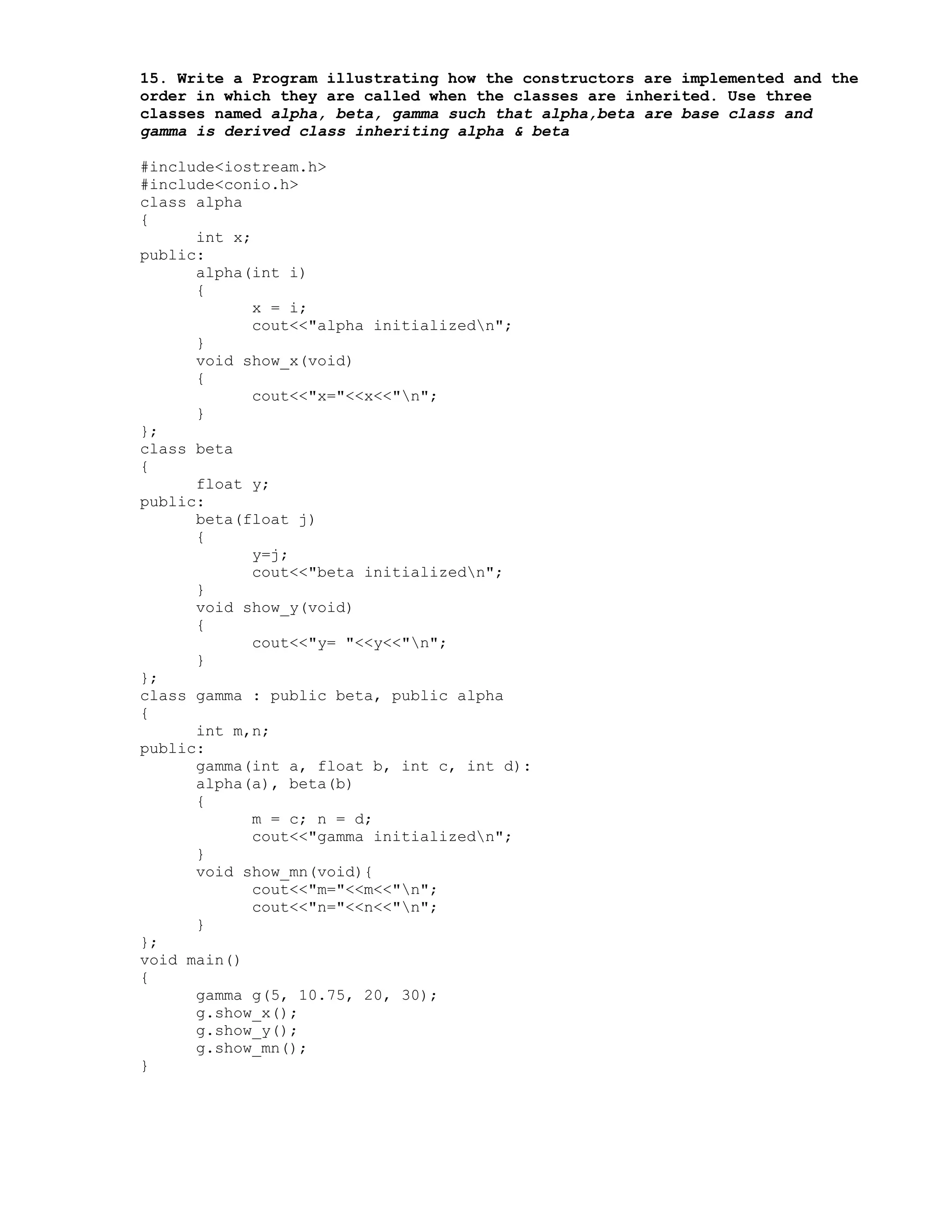
15. Write a Program illustrating how the constructors are implemented and the
order in which they are called when the classes are inherited. Use three
classes named alpha, beta, gamma such that alpha,beta are base class and
gamma is derived class inheriting alpha & beta
#include<iostream.h>
#include<conio.h>
class alpha
{
int x;
public:
alpha(int i)
{
x = i;
cout<<"alpha initializedn";
}
void show_x(void)
{
cout<<"x="<<x<<"n";
}
};
class beta
{
float y;
public:
beta(float j)
{
y=j;
cout<<"beta initializedn";
}
void show_y(void)
{
cout<<"y= "<<y<<"n";
}
};
class gamma : public beta, public alpha
{
int m,n;
public:
gamma(int a, float b, int c, int d):
alpha(a), beta(b)
{
m = c; n = d;
cout<<"gamma initializedn";
}
void show_mn(void){
cout<<"m="<<m<<"n";
cout<<"n="<<n<<"n";
}
};
void main()
{
gamma g(5, 10.75, 20, 30);
g.show_x();
g.show_y();
g.show_mn();
}
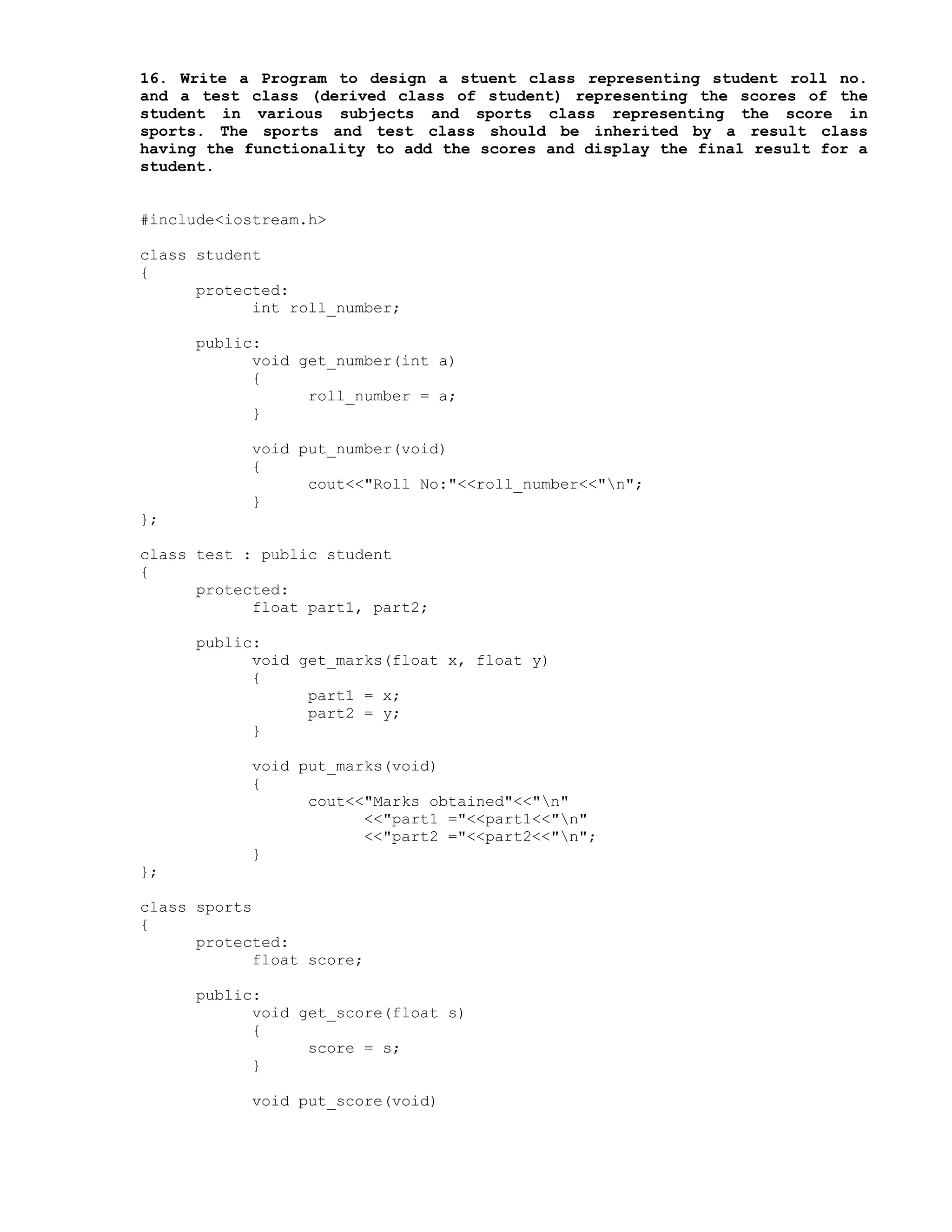
16. Write a Program to design a stuent class representing student roll no.
and a test class (derived class of student) representing the scores of the
student in various subjects and sports class representing the score in
sports. The sports and test class should be inherited by a result class
having the functionality to add the scores and display the final result for a
student.
#include<iostream.h>
class student
{
protected:
int roll_number;
public:
void get_number(int a)
{
roll_number = a;
}
void put_number(void)
{
cout<<"Roll No:"<<roll_number<<"n";
}
};
class test : public student
{
protected:
float part1, part2;
public:
void get_marks(float x, float y)
{
part1 = x;
part2 = y;
}
void put_marks(void)
{
cout<<"Marks obtained"<<"n"
<<"part1 ="<<part1<<"n"
<<"part2 ="<<part2<<"n";
}
};
class sports
{
protected:
float score;
public:
void get_score(float s)
{
score = s;
}
void put_score(void)
{
cout<<"Sports wt:"<<score<<"nn";
}
};
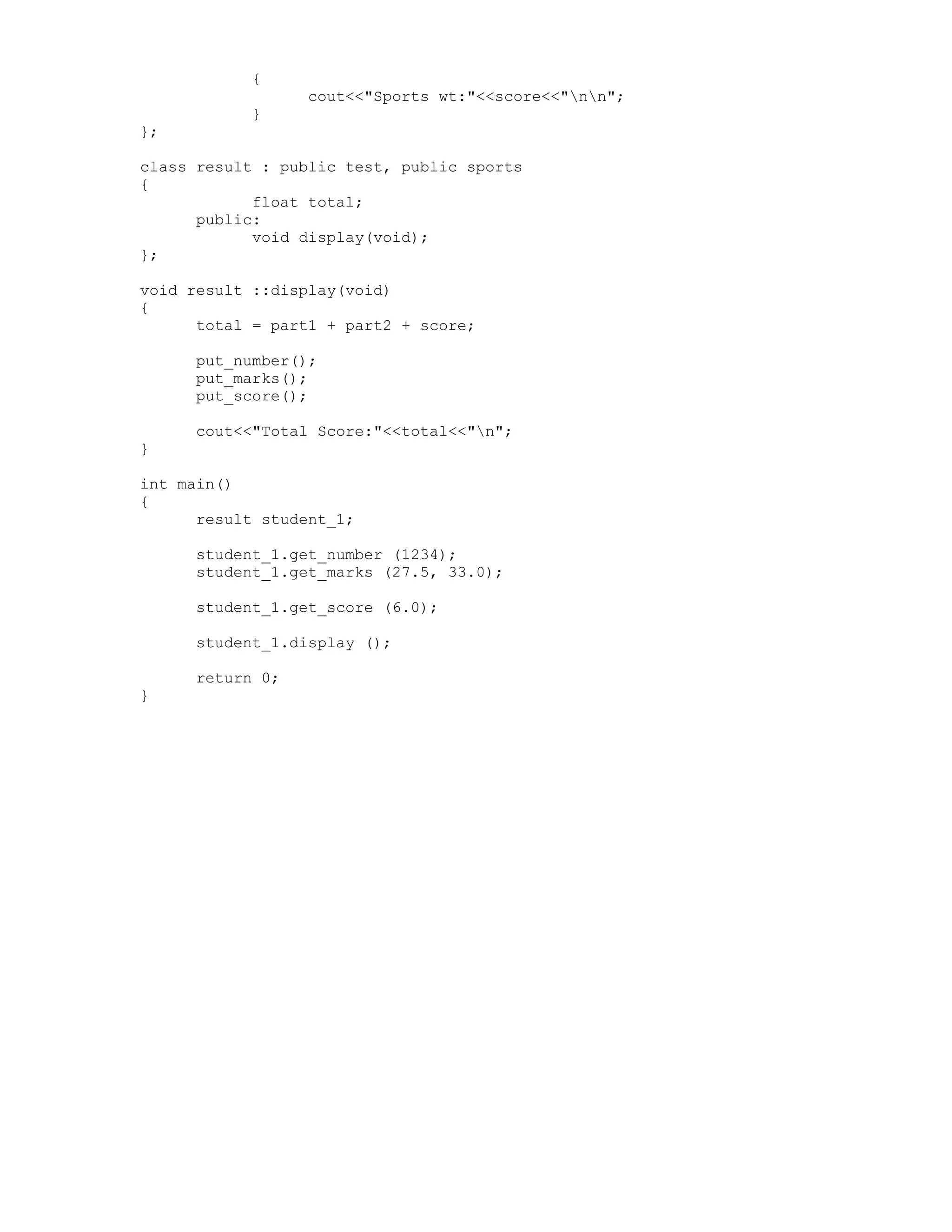
class result : public test, public sports
{
float total;
public:
void display(void);
};
void result ::display(void)
{
total = part1 + part2 + score;
put_number();
put_marks();
put_score();
cout<<"Total Score:"<<total<<"n";
}
int main()
{
result student_1;
student_1.get_number (1234);
student_1.get_marks (27.5, 33.0);
student_1.get_score (6.0);
student_1.display ();
return 0;
}
17. Write a program to maintain the records of person with details (Name and
Age) and find the eldest among them. The program must use this pointer to
return the result.
#include<iostream.h>
#include<string.h>
class person
{
char name[20];
float age;
public:
person(char *s, float a)
{
strcpy(name, s);
age = a;
}
person & person :: greater(person & x)
{
if(x.age >= age)
return x;
else
return *this;
}
void display(void)
{
cout<<"Name:"<<name<<"n"
<<"Age: "<<age<<"n";
}
};
int main()
{
person p1("John", 37.50),
p2("Ahmed",29.0),
p3("Hebber", 40.5);
person p = p1.greater (p3);
cout<<"Elder Person is:n";
p.display();
p = p1.greater (p2);
cout<<"Elder Person is:n";
p.display();
return 0;
}
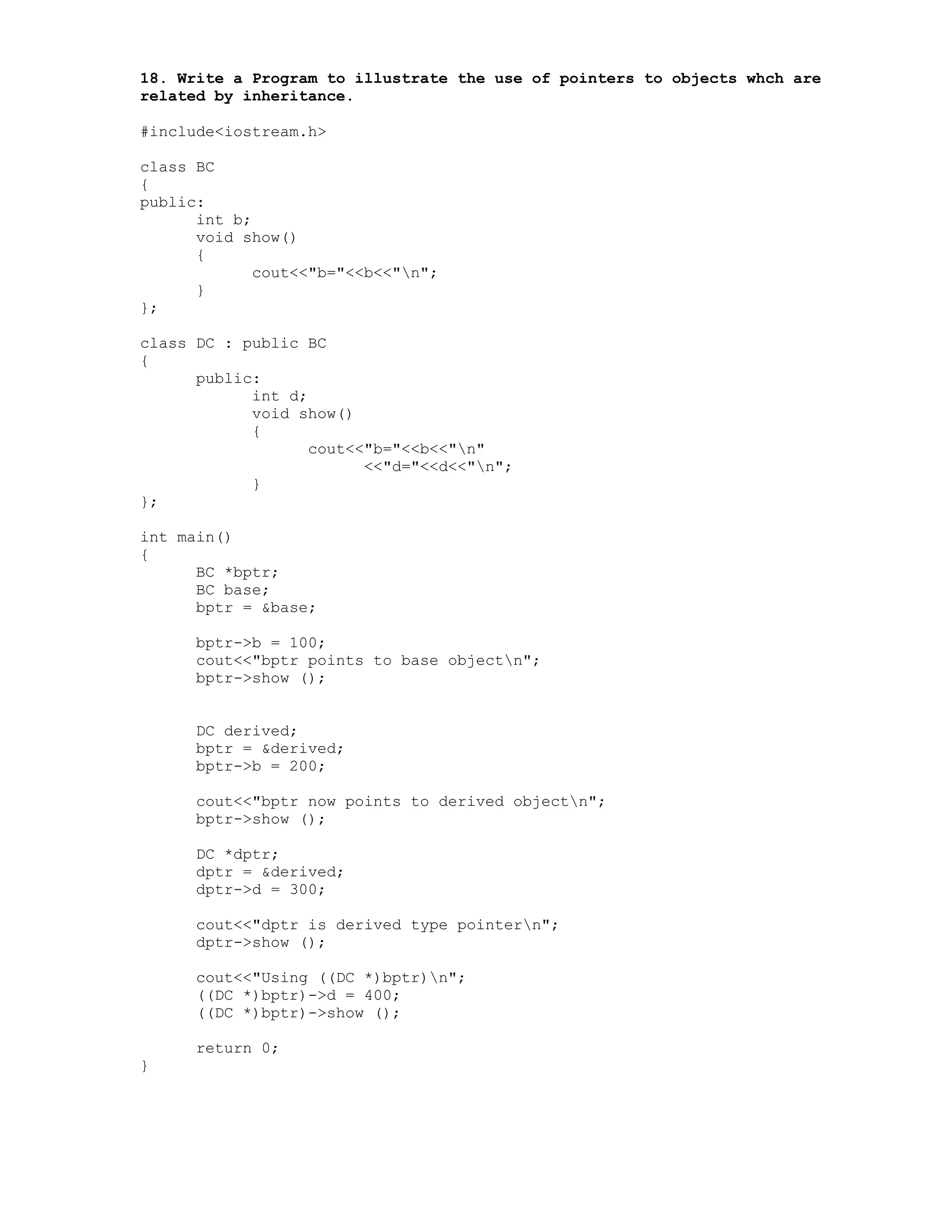
18. Write a Program to illustrate the use of pointers to objects whch are
related by inheritance.
#include<iostream.h>
class BC
{
public:
int b;
void show()
{
cout<<"b="<<b<<"n";
}
};
class DC : public BC
{
public:
int d;
void show()
{
cout<<"b="<<b<<"n"
<<"d="<<d<<"n";
}
};
int main()
{
BC *bptr;
BC base;
bptr = &base;
bptr->b = 100;
cout<<"bptr points to base objectn";
bptr->show ();
DC derived;
bptr = &derived;
bptr->b = 200;
cout<<"bptr now points to derived objectn";
bptr->show ();
DC *dptr;
dptr = &derived;
dptr->d = 300;
cout<<"dptr is derived type pointern";
dptr->show ();
cout<<"Using ((DC *)bptr)n";
((DC *)bptr)->d = 400;
((DC *)bptr)->show ();
return 0;
}
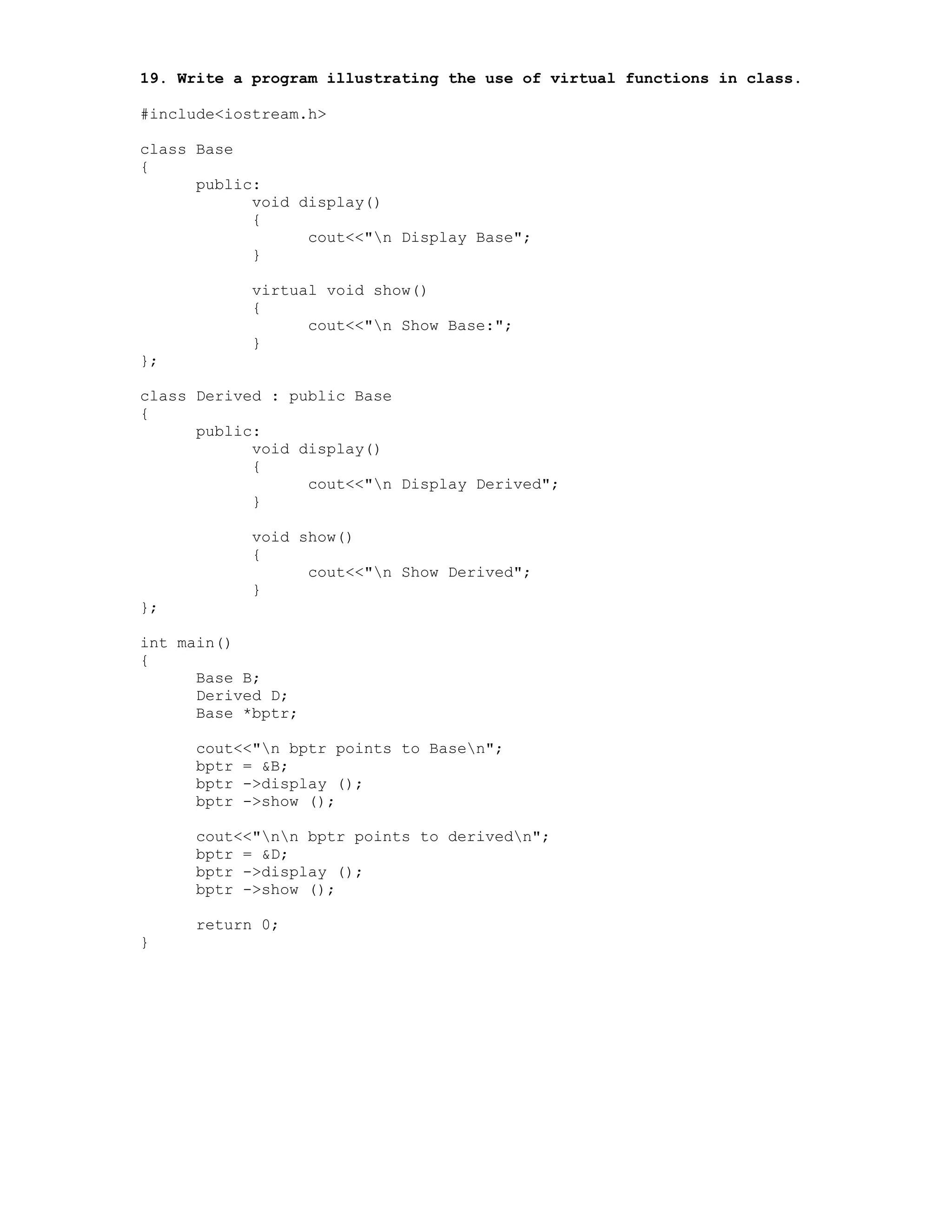
19. Write a program illustrating the use of virtual functions in class.
#include<iostream.h>
class Base
{
public:
void display()
{
cout<<"n Display Base";
}
virtual void show()
{
cout<<"n Show Base:";
}
};
class Derived : public Base
{
public:
void display()
{
cout<<"n Display Derived";
}
void show()
{
cout<<"n Show Derived";
}
};
int main()
{
Base B;
Derived D;
Base *bptr;
cout<<"n bptr points to Basen";
bptr = &B;
bptr ->display ();
bptr ->show ();
cout<<"nn bptr points to derivedn";
bptr = &D;
bptr ->display ();
bptr ->show ();
return 0;
}
20. Write a program to design a class representing the information regarding
digital library (books, tape: book & tape should be separate classes having
the base class as media ). The class should have the functionality for
adding new item, issuing, deposit etc. the program should use the runtime
polymorphism.
#include<iostream.h>
#include<string.h>
class media
{
protected:
char title[50];
float price;
public:
media(char *s, float a)
{
strcpy(title, s);
price = a;
}
virtual void display(){}
};
class book : public media
{
int pages;
public:
book(char *s, float a, int p) : media(s,a)
{
pages = p;
}
void display();
};
class tape : public media
{
float time;
public:
tape(char * s, float a, float t):media(s,a)
{
time =t;
}
void display();
};
void book ::display()
{
cout<<"n Title:"<<title;
cout<<"n Pages:"<<pages;
cout<<"n Price:"<<price;
}
void tape ::display ()
{
cout<<"n Title:"<<title;
cout<<"n Play Time:"<<time<<"mins";
cout<<"n Price:"<<price;
}
int main()
{
char * title = new char[30];
float price, time;
int pages;
cout<<"n Enter Book Details n";
cout<<"n Title:";
cin>>title;
cout<<"n Price:";
cin>>price;
cout<<"n Pages:";
cin>>pages;
book book1(title, price, pages);
cout<<"n Enter Tape Details";
cout<<"n Title:";
cin>>title;
cout<<"n Price:";
cin>>price;
cout<<"n Play Times(mins):";
cin>>time;
tape tape1(title, price, time);
media* list[2];
list[0] = &book1;
list[1] = &tape1;
cout<<"n Media Details";
cout<<"n..............Book.....";
list[0]->display ();
cout<<"n..............Tape.....";
list[1]->display ();
return 0;
}
21. write a program to show conversion from string to int and vice-versa.
#include <iostream.h>
#include <stdlib.h>
#include <string.h>
class string
{
private:
char str[ 20 ];
public:
string( )
{
str[ 0 ] = '0';
}
string( char * s )
{
strcpy( str, s );
}
string( int a )
{
itoa( a, str, 10 );
}
operator int( )
{
int i = 0,
l,
ss = 0,
k = 1;
l = strlen( str ) - 1;
while( l >= 0 )
{
ss = ss + ( str[ l ] - 48 ) * k;
l--;
k *= 10;
}
return ( ss );
}
void displaydata( )
{
cout << str;
}
} ;
void main( )
{
string s1 = 123;
cout << endl << "s1=";
s1.displaydata( );
s1 = 150;
cout << endl << "s1=";
s1.displaydata( );
string s2 ( "123" );
int i = int( s2 );
cout << endl << "i=" << i;
string s3 ( "456" );
i = s3;
cout << endl << "i=" << i;
}
22. Write a program showing data conversion between objects of different
classes.
#include <iostream.h>
#include <stdlib.h>
#include <string.h>
class date
{
private:
char dt[ 9 ];
public:
date( )
{
dt[ 0 ] = '0';
}
date( char * s )
{
strcpy( dt, s );
}
void displaydata( )
{
cout << dt;
}
} ;
class dmy
{
private:
int day,
mth,
yr;
public:
dmy( )
{
day = mth = yr = 0;
}
dmy( int d, int m, int y )
{
day = d;
mth = m;
yr = y;
} ;
operator date( )
{
char temp[ 3 ], str[ 9 ];
itoa( day, str, 10 );
strcat( str, "/" );
itoa( mth, temp, 10 );
strcat( str, temp );
strcat( str, "/" );
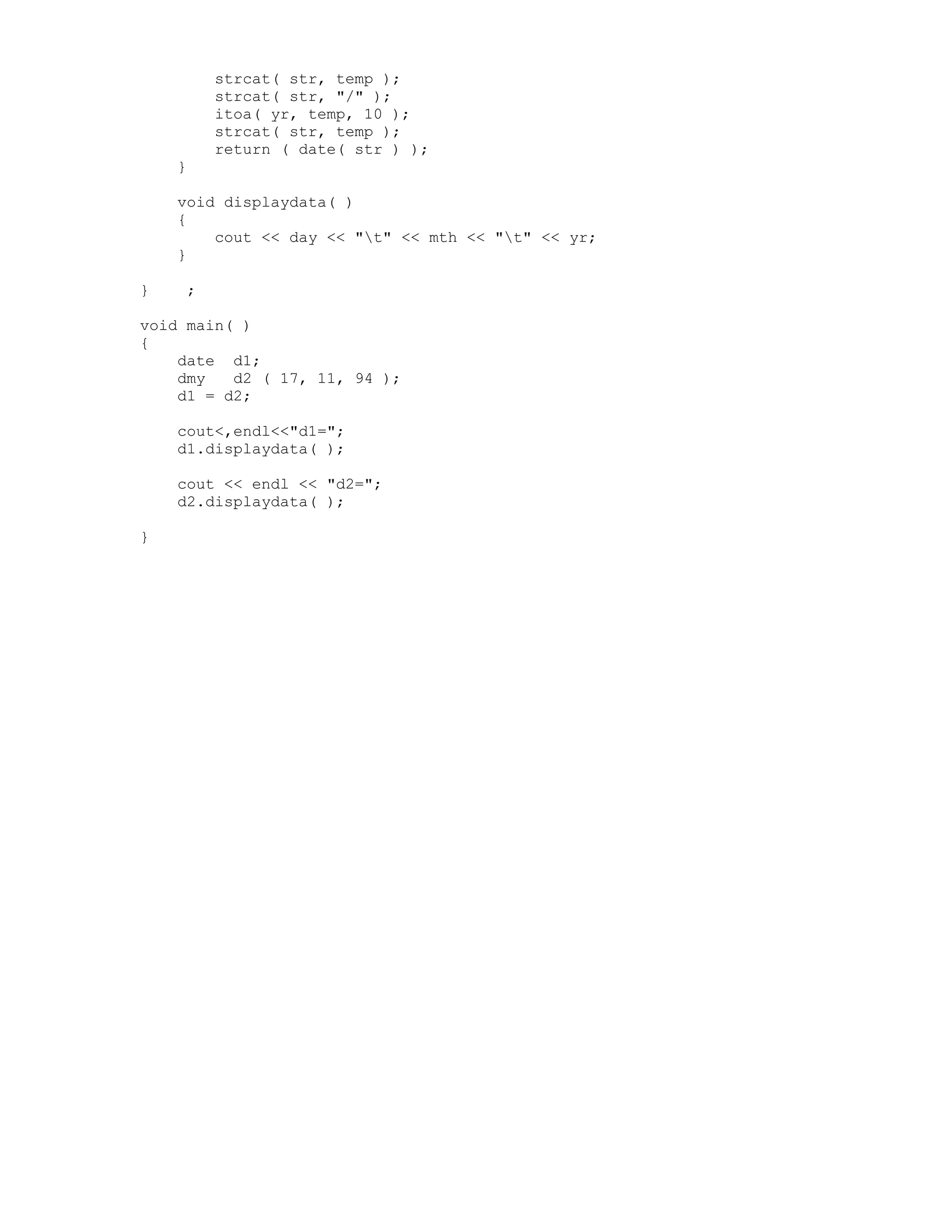
itoa( yr, temp, 10 );
strcat( str, temp );
return ( date( str ) );
}
void displaydata( )
{
cout << day << "t" << mth << "t" << yr;
}
} ;
void main( )
{
date d1;
dmy d2 ( 17, 11, 94 );
d1 = d2;
cout<,endl<<"d1=";
d1.displaydata( );
cout << endl << "d2=";
d2.displaydata( );
}
23. Write a program showing data conversion between objects of different
classes and conversion routine should reside in destination class.
#include <iostream.h>
#include <string.h>
#include <stdlib.h>
class dmy
{
int day,
mth,
yr;
public:
dmy( )
{
day = mth, yr = 0;
}
dmy( int d, int m, int y )
{
day = d;
mth = m;
yr = y;
}
int getday( )
{
return ( day );
}
int getmth( )
{
return ( mth );
}
int getyr( )
{
return ( yr );
}
void displaydata( )
{
cout << day << "t" << mth << "t" << yr;
}
} ;
class date
{
private:
char dt[ 9 ];
public:
date( )
{
dt[ 0 ] = '0';
}
date( char * s )
{
strcpy( dt, s );
}
void displaydata( )
{
cout << dt;
}
date( dmy t )
{
int d = t.getday( );
int m = t.getmth( );
int y = t.getyr( );
char temp[ 3 ];
itoa( d, dt, 10 );
strcat( dt, "t" );
itoa( m, temp, 10 );
strcat( dt, temp );
strcat( dt, "/" );
itoa( y, temp, 10 );
strcat( dt, temp );
}
} ;
void main( )
{
date d1;
dmy d2 ( 17, 11, 94 );
d1 = d2;
cout << endl << "d1=";
d1.displaydata( );
cout << endl << "d2=";
d2.displaydata( );
}
24. Write a program implementing basic operation of class ios i.e.
setf,unsetf,precision etc.
#include <iostream.h>
#include <conio.h>
void main( )
{
int i = 52;
float a = 425.0;
float b = 123.500328;
char str[ ] = "Dream. Then make it happend!";
clrscr( );
cout.setf( ios::unitbuf );
cout.setf( ios::stdio );
cout.setf( ios::showpos );
cout << i << endl;
cout.setf( ios::showbase );
cout.setf( ios::uppercase );
cout.setf( ios::hex, ios::basefield );
cout << i << endl;
cout.setf( ios::oct, ios::basefield );
cout << i << endl;
cout.fill( '0' );
cout << "Fill character " << cout.fill( ) << endl;
cout.setf( ios::dec, ios::basefield );
cout.width( 10 );
cout << i << endl;
cout << setf( ios::left, ios::adjustfield );
cout.width( 10 );
cout << i << endl;
cout.setf( ios::internal, ios::adjustfield );
cout.width( 10 );
cout << endl;
cout << endl;
cout.width( 10 );
cout << str << endl;
cout.width( 40 );
cout.setf( ios::left, ios::adjustfield );
cout.width( 40 );
cout << str << endl;
cout.precision( 6 );
cout << "Precision" << cout.precision( );
cout.setf( ios::showpoint );
cout.unsetf( ios::showpos );
cout << endl << a;
cout.unsetf( ios::showpoint );
cout << endl << a;
cout.setf( ios::fixed, ios::floatfield );
cout << endl << b;
cout.setf( ios::scientific, ios::floatfield );
cout << endl << b;
b = 5.375;
cout.precision( 14 );
cout.setf( ios::fixed, ios::floatfield );
cout << endl << b;
cout.setf( ios::scientific, ios::floatfield );
cout << endl << b;
cout.unsetf( ios::showpoint );
cout.unsetf( ios::unitbuf );
cout.unsetf( ios::stdio );
}

C++ normal assignments by maharshi_jd.pdf

  • 1.
    11. Write aProgram to overload operators like *, <<, >> using friend function. The following overloaded operators should work for a class vector. #include<iostream.h> #include<conio.h> const size = 3; class vector { int v[size]; public: vector(); vector(int *x); friend vector operator *(int a, vector b); friend vector operator *(vector b, int a); friend istream & operator >>(istream &, vector &); friend ostream & operator <<(ostream &, vector &); }; vector ::vector() { for(int i=0;i<size;i++) v[i]=0; } vector :: vector(int *x) { for(int i=0; i<size; i++) v[i] = x[i]; } vector operator *(int a, vector b) { vector c; for(int i=0; i<size; i++) c.v[i] = a * b.v[i]; return c; } vector operator *(vector b, int a) { vector c; for(int i=0; i<size; i++) c.v[i] = b.v[i] * a; return c; } istream & operator >> (istream &din, vector &b) { for(int i=0; i<size; i++) din>>b.v[i]; return(din); } ostream & operator << (ostream &dout, vector &b) {
  • 2.
    dout<<"("<<b.v [0]; for(int i=1;i<size; i++) dout<<","<<b.v[i]; dout<<")"; return(dout); } int x[size] = {2,4,6}; int main() { vector m; vector n = x; cout<<"Enter Elements of vector m"<<"n"; cin>>m; cout<<"n"; cout<<"m="<<m<<"n"; vector p,q; p = 2 * m; q = n * 2; cout<<"n"; cout<<"p="<<p<<"n"; cout<<"q="<<q<<"n"; return 0; }
  • 3.
    12. Write aprogram for developing a matrix class which can handle integer matrices of different dimensions. Also overload the operator for addition, multiplication & comparison of matrices. #include <iostream.h> #include <iomanip.h> class matrix { int maxrow, maxcol; int * ptr; public: matrix( int r, int c ) { maxrow = r; maxcol = c; ptr = new int [r * c]; } void getmat( ) { int i,j, mat_off,temp; cout << endl << "enter elements matrix:" << endl; for( i = 0; i < maxrow; i++ ) { for( j = 0; j < maxcol; j++ ) { mat_off = i * maxcol + j; cin >> ptr[ mat_off ]; } } } void printmat( ) { int i, j, mat_off; for( i = 0; i < maxrow; i++ ) { cout << endl; for( j = 0; j < maxcol; j++ ) { mat_off = i * maxcol + j; cout << setw( 3 ) << ptr[ mat_off ]; } } } int delmat( ) { matrix q ( maxrow - 1, maxcol - 1 ); int sign = 1, sum = 0, i, j,k,count; int newsize,newpos,pos,order; order = maxrow; if( order == 1 ) { return ( ptr[ 0 ] ); } for( i = 0; i < order; i++, sign *= -1 ) { for( j = 1; j < order; j++ ) { for( k = 0, count = 0; k < order; k++ )
  • 4.
    { if( k ==i ) continue; pos = j * order + k; newpos = ( j - 1 ) * ( order - 1 ) + count; q.ptr[ newpos ] = ptr[ pos ]; count++; } } sum = sum + ptr[ i ] * sign * q.delmat( ); } return ( sum ); } matrix operator +( matrix b ) { matrix c ( maxrow, maxcol ); int i,j,mat_off; for( i = 0; i < maxrow; i++ ) { for( j = 0; j < maxcol; j++ ) { mat_off = i * maxcol + j; c.ptr[ mat_off ] = ptr[ mat_off ] + b.ptr[ mat_off ]; } } return ( c ); } matrix operator *( matrix b ) { matrix c ( b.maxcol, maxrow ); int i,j,k,mat_off1, mat_off2, mat_off3; for( i = 0; i < c.maxrow; i++ ) { for( j = 0; j < c.maxcol; j++ ) { mat_off3 - i * c.maxcol + j; c.ptr[ mat_off3 ] = 0; for( k = 0; k < b.maxrow; k++ ) { mat_off2 = k * b.maxcol + j; mat_off1 = i * maxcol + k; c.ptr[mat_off3]+=ptr[mat_off1]* b.ptr[mat_off2 ]; } } } return ( c ); } int operator ==( matrix b ) { int i,j, mat_off; if( maxrow != b.maxrow || maxcol != b.maxcol ) return ( 0 ); for( i = 0; i < maxrow; i++ ) { for( j = 0; j < maxcol; j++ ) { mat_off = i * maxcol + j; if( ptr[ mat_off ]
  • 5.
    != b.ptr[ mat_off] ) return ( 0 ); } } return ( 1 ); } } ; void main( ) { int rowa, cola, rowb, colb; cout << endl << "Enter dimensions of matrix A "; cin >> rowa >> cola; matrix a ( rowa, cola ); a.getmat( ); cout << endl << "Enter dimensions of matrix B"; cin >> rowb >> colb; matrix b ( rowb, colb ); b.getmat( ); matrix c ( rowa, cola ); c = a + b; cout << endl << "The sum of two matrics = "; c.printmat( ); matrix d ( rowa, colb ); d = a * b; cout << endl << "The product of two matrics = "; d.printmat( ); cout << endl << "Determinant of matrix a =" << a.delmat( ); if( a == b ) cout << endl << "a & b are equal"; else cout << endl << "a & b are not equal"; }
  • 6.
    13. Write aprogram to overload new/delete operators in a class. #include <iostream.h> #include <stdlib.h> #include <string.h> #include <new.h> const int MAX = 5; const int FREE = 0; const int OCCUPIED = 1; void memwarning( ) { cout << endl << "Free store has now gone empty"; exit( 1 ); } class employee { private: char name[ 20 ]; int age; float sal; public: void *operator new(size_t bytes) void operator delete( void * q ); void setdata( char * n, int a, float s ); void showdata( ); ~employee( ); } ; struct pool { employee obj; int status; } ; int flag = 0; struct pool * p = NULL; void * employee::operator new( size_t sz ) { int i; if( flag == 0 ) { p = ( pool * )malloc( sz * MAX ); if( p == NULL ) memwarning( ); for( i = 0; i < MAX; i++ ) p[ i ].status = FREE; flag = 1; p[ 0 ].status = OCCUPIED; return &p[ 0 ].obj; } else { for( i = 0; i < MAX; i++ )
  • 7.
    { if( p[ i].status = FREE ) { p[ i ].status = OCCUPIED; return &p[ i ].obj; } } memwarning( ); } } void employee::operator delete( void * q ) { if( q == NULL ) return; for( int i = 0; i < MAX; i++) { if( q == &p[ i ].obj ) { p[ i ].status = FREE; strcpy( p[ i ].obj.name, "" ); p[ i ].obj.age = 0; p[ i ].obj.sal = 0.0; } } } void employee::setdata( char * n, int a, float s ) { strcpy( name, n ); age = a; sal = s; } void employee::showdata( ) { cout << endl << name << "t" << age << "t" << sal; } employee::~employee( ) { cout << endl << "reached destructor"; free( p ); } void main( ) { void memwarning( ); set_new_handler( memwarning ); employee * e1,*e2,*e3,*e4,*e5,*e6; e1 = new employee; e1->setdata( "ajay", 23, 4500.50 ); e2 = new employee; e2->setdata( "amol", 25, 5500.50 ); e3 = new employee; e3->setdata( "anil", 26, 3500.50 );
  • 8.
    e4 = newemployee; e4->setdata( "anuj", 30, 6500.50 ); e5 = new employee; e5->setdata( "atul", 23, 4200.50 ); e1->showdata( ); e2->showdata( ); e3->showdata( ); e4->showdata( ); e5->showdata( ); delete e4; delete e5; e4->showdata( ); e5->showdata( ); e4 = new employee; e5 = new employee; e6 = new employee; cout << endl << "Done!!"; }
  • 9.
    14. Write aprogram in C++ to highlight the difference between overloaded assignment operator and copy constructor. #include <iostream.h> class circle { private: int radius; float x, y; public: circle( ) { } circle( int rr, float xx, float yy ) { radius = rr; x = xx; y = yy; } circle operator =( circle & c ) { cout << endl << "Assignment operator invoked"; radiius = c.radius; x = c.x; y = c.y; return circle( radius, x, y ); } circle( circle & c ) { cout << endl << "copy constructor invoked"; radius = c.radius; x = c.x; y = c.y; } void showdata( ) { cout << endl << "Radius = " << radius; cout << endl << "X-Coordinate=" << x; cout << endl << "Y-Coordinate=" << y; } } ; void main( ) { circle c1 ( 10, 2.5, 2.5 ); circle c2,c4; c4 = c2 = c1; circle c3 = c1; c1.showdata( ); c2.showdata( ); c3.showdata( ); c4.showdata( ); }
  • 10.
    15. Write aProgram illustrating how the constructors are implemented and the order in which they are called when the classes are inherited. Use three classes named alpha, beta, gamma such that alpha,beta are base class and gamma is derived class inheriting alpha & beta #include<iostream.h> #include<conio.h> class alpha { int x; public: alpha(int i) { x = i; cout<<"alpha initializedn"; } void show_x(void) { cout<<"x="<<x<<"n"; } }; class beta { float y; public: beta(float j) { y=j; cout<<"beta initializedn"; } void show_y(void) { cout<<"y= "<<y<<"n"; } }; class gamma : public beta, public alpha { int m,n; public: gamma(int a, float b, int c, int d): alpha(a), beta(b) { m = c; n = d; cout<<"gamma initializedn"; } void show_mn(void){ cout<<"m="<<m<<"n"; cout<<"n="<<n<<"n"; } }; void main() { gamma g(5, 10.75, 20, 30); g.show_x(); g.show_y(); g.show_mn(); }
  • 11.
    16. Write aProgram to design a stuent class representing student roll no. and a test class (derived class of student) representing the scores of the student in various subjects and sports class representing the score in sports. The sports and test class should be inherited by a result class having the functionality to add the scores and display the final result for a student. #include<iostream.h> class student { protected: int roll_number; public: void get_number(int a) { roll_number = a; } void put_number(void) { cout<<"Roll No:"<<roll_number<<"n"; } }; class test : public student { protected: float part1, part2; public: void get_marks(float x, float y) { part1 = x; part2 = y; } void put_marks(void) { cout<<"Marks obtained"<<"n" <<"part1 ="<<part1<<"n" <<"part2 ="<<part2<<"n"; } }; class sports { protected: float score; public: void get_score(float s) { score = s; } void put_score(void)
  • 12.
    { cout<<"Sports wt:"<<score<<"nn"; } }; class result: public test, public sports { float total; public: void display(void); }; void result ::display(void) { total = part1 + part2 + score; put_number(); put_marks(); put_score(); cout<<"Total Score:"<<total<<"n"; } int main() { result student_1; student_1.get_number (1234); student_1.get_marks (27.5, 33.0); student_1.get_score (6.0); student_1.display (); return 0; }
  • 13.
    17. Write aprogram to maintain the records of person with details (Name and Age) and find the eldest among them. The program must use this pointer to return the result. #include<iostream.h> #include<string.h> class person { char name[20]; float age; public: person(char *s, float a) { strcpy(name, s); age = a; } person & person :: greater(person & x) { if(x.age >= age) return x; else return *this; } void display(void) { cout<<"Name:"<<name<<"n" <<"Age: "<<age<<"n"; } }; int main() { person p1("John", 37.50), p2("Ahmed",29.0), p3("Hebber", 40.5); person p = p1.greater (p3); cout<<"Elder Person is:n"; p.display(); p = p1.greater (p2); cout<<"Elder Person is:n"; p.display(); return 0; }
  • 14.
    18. Write aProgram to illustrate the use of pointers to objects whch are related by inheritance. #include<iostream.h> class BC { public: int b; void show() { cout<<"b="<<b<<"n"; } }; class DC : public BC { public: int d; void show() { cout<<"b="<<b<<"n" <<"d="<<d<<"n"; } }; int main() { BC *bptr; BC base; bptr = &base; bptr->b = 100; cout<<"bptr points to base objectn"; bptr->show (); DC derived; bptr = &derived; bptr->b = 200; cout<<"bptr now points to derived objectn"; bptr->show (); DC *dptr; dptr = &derived; dptr->d = 300; cout<<"dptr is derived type pointern"; dptr->show (); cout<<"Using ((DC *)bptr)n"; ((DC *)bptr)->d = 400; ((DC *)bptr)->show (); return 0; }
  • 15.
    19. Write aprogram illustrating the use of virtual functions in class. #include<iostream.h> class Base { public: void display() { cout<<"n Display Base"; } virtual void show() { cout<<"n Show Base:"; } }; class Derived : public Base { public: void display() { cout<<"n Display Derived"; } void show() { cout<<"n Show Derived"; } }; int main() { Base B; Derived D; Base *bptr; cout<<"n bptr points to Basen"; bptr = &B; bptr ->display (); bptr ->show (); cout<<"nn bptr points to derivedn"; bptr = &D; bptr ->display (); bptr ->show (); return 0; }
  • 16.
    20. Write aprogram to design a class representing the information regarding digital library (books, tape: book & tape should be separate classes having the base class as media ). The class should have the functionality for adding new item, issuing, deposit etc. the program should use the runtime polymorphism. #include<iostream.h> #include<string.h> class media { protected: char title[50]; float price; public: media(char *s, float a) { strcpy(title, s); price = a; } virtual void display(){} }; class book : public media { int pages; public: book(char *s, float a, int p) : media(s,a) { pages = p; } void display(); }; class tape : public media { float time; public: tape(char * s, float a, float t):media(s,a) { time =t; } void display(); }; void book ::display() { cout<<"n Title:"<<title; cout<<"n Pages:"<<pages; cout<<"n Price:"<<price; } void tape ::display () { cout<<"n Title:"<<title; cout<<"n Play Time:"<<time<<"mins"; cout<<"n Price:"<<price; } int main()
  • 17.
    { char * title= new char[30]; float price, time; int pages; cout<<"n Enter Book Details n"; cout<<"n Title:"; cin>>title; cout<<"n Price:"; cin>>price; cout<<"n Pages:"; cin>>pages; book book1(title, price, pages); cout<<"n Enter Tape Details"; cout<<"n Title:"; cin>>title; cout<<"n Price:"; cin>>price; cout<<"n Play Times(mins):"; cin>>time; tape tape1(title, price, time); media* list[2]; list[0] = &book1; list[1] = &tape1; cout<<"n Media Details"; cout<<"n..............Book....."; list[0]->display (); cout<<"n..............Tape....."; list[1]->display (); return 0; }
  • 18.
    21. write aprogram to show conversion from string to int and vice-versa. #include <iostream.h> #include <stdlib.h> #include <string.h> class string { private: char str[ 20 ]; public: string( ) { str[ 0 ] = '0'; } string( char * s ) { strcpy( str, s ); } string( int a ) { itoa( a, str, 10 ); } operator int( ) { int i = 0, l, ss = 0, k = 1; l = strlen( str ) - 1; while( l >= 0 ) { ss = ss + ( str[ l ] - 48 ) * k; l--; k *= 10; } return ( ss ); } void displaydata( ) { cout << str; } } ; void main( ) { string s1 = 123; cout << endl << "s1="; s1.displaydata( ); s1 = 150; cout << endl << "s1="; s1.displaydata( ); string s2 ( "123" ); int i = int( s2 ); cout << endl << "i=" << i; string s3 ( "456" ); i = s3; cout << endl << "i=" << i; }
  • 19.
    22. Write aprogram showing data conversion between objects of different classes. #include <iostream.h> #include <stdlib.h> #include <string.h> class date { private: char dt[ 9 ]; public: date( ) { dt[ 0 ] = '0'; } date( char * s ) { strcpy( dt, s ); } void displaydata( ) { cout << dt; } } ; class dmy { private: int day, mth, yr; public: dmy( ) { day = mth = yr = 0; } dmy( int d, int m, int y ) { day = d; mth = m; yr = y; } ; operator date( ) { char temp[ 3 ], str[ 9 ]; itoa( day, str, 10 ); strcat( str, "/" ); itoa( mth, temp, 10 );
  • 20.
    strcat( str, temp); strcat( str, "/" ); itoa( yr, temp, 10 ); strcat( str, temp ); return ( date( str ) ); } void displaydata( ) { cout << day << "t" << mth << "t" << yr; } } ; void main( ) { date d1; dmy d2 ( 17, 11, 94 ); d1 = d2; cout<,endl<<"d1="; d1.displaydata( ); cout << endl << "d2="; d2.displaydata( ); }
  • 21.
    23. Write aprogram showing data conversion between objects of different classes and conversion routine should reside in destination class. #include <iostream.h> #include <string.h> #include <stdlib.h> class dmy { int day, mth, yr; public: dmy( ) { day = mth, yr = 0; } dmy( int d, int m, int y ) { day = d; mth = m; yr = y; } int getday( ) { return ( day ); } int getmth( ) { return ( mth ); } int getyr( ) { return ( yr ); } void displaydata( ) { cout << day << "t" << mth << "t" << yr; } } ; class date { private: char dt[ 9 ]; public: date( ) { dt[ 0 ] = '0'; } date( char * s ) { strcpy( dt, s );
  • 22.
    } void displaydata( ) { cout<< dt; } date( dmy t ) { int d = t.getday( ); int m = t.getmth( ); int y = t.getyr( ); char temp[ 3 ]; itoa( d, dt, 10 ); strcat( dt, "t" ); itoa( m, temp, 10 ); strcat( dt, temp ); strcat( dt, "/" ); itoa( y, temp, 10 ); strcat( dt, temp ); } } ; void main( ) { date d1; dmy d2 ( 17, 11, 94 ); d1 = d2; cout << endl << "d1="; d1.displaydata( ); cout << endl << "d2="; d2.displaydata( ); }
  • 23.
    24. Write aprogram implementing basic operation of class ios i.e. setf,unsetf,precision etc. #include <iostream.h> #include <conio.h> void main( ) { int i = 52; float a = 425.0; float b = 123.500328; char str[ ] = "Dream. Then make it happend!"; clrscr( ); cout.setf( ios::unitbuf ); cout.setf( ios::stdio ); cout.setf( ios::showpos ); cout << i << endl; cout.setf( ios::showbase ); cout.setf( ios::uppercase ); cout.setf( ios::hex, ios::basefield ); cout << i << endl; cout.setf( ios::oct, ios::basefield ); cout << i << endl; cout.fill( '0' ); cout << "Fill character " << cout.fill( ) << endl; cout.setf( ios::dec, ios::basefield ); cout.width( 10 ); cout << i << endl; cout << setf( ios::left, ios::adjustfield ); cout.width( 10 ); cout << i << endl; cout.setf( ios::internal, ios::adjustfield ); cout.width( 10 ); cout << endl; cout << endl; cout.width( 10 ); cout << str << endl; cout.width( 40 ); cout.setf( ios::left, ios::adjustfield ); cout.width( 40 ); cout << str << endl; cout.precision( 6 ); cout << "Precision" << cout.precision( ); cout.setf( ios::showpoint ); cout.unsetf( ios::showpos );
  • 24.
    cout << endl<< a; cout.unsetf( ios::showpoint ); cout << endl << a; cout.setf( ios::fixed, ios::floatfield ); cout << endl << b; cout.setf( ios::scientific, ios::floatfield ); cout << endl << b; b = 5.375; cout.precision( 14 ); cout.setf( ios::fixed, ios::floatfield ); cout << endl << b; cout.setf( ios::scientific, ios::floatfield ); cout << endl << b; cout.unsetf( ios::showpoint ); cout.unsetf( ios::unitbuf ); cout.unsetf( ios::stdio ); }