C++ Made Easy:
Common Mistakes
Students Make in
Programming
Assignments
MASTERING C++ WITH CONFIDENCE
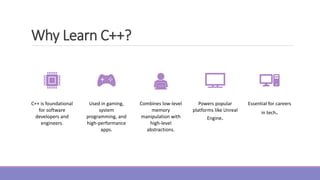
Why Learn C++?
C++ is foundational
for software
developers and
engineers.
Used in gaming,
system
programming, and
high-performance
apps.
Combines low-level
memory
manipulation with
high-level
abstractions.
Powers popular
platforms like Unreal
Engine.
Essential for careers
in tech.
Challenges
Students
Face
C++ Homework Help
Complex syntax that’s unforgiving of mistakes.
Steep learning curve for beginners.
Struggles with object-oriented programming (OOP).
Finding reliable C++ Homework Help services.
Debugging and testing roadblocks.
Common Syntax Errors
Forgetting semicolons (;).
Mismatched brackets {}.
Case-sensitive variable issues (e.g., Value vs. value).
Overusing or underusing pointers.
Lack of consistent formatting.
Avoiding Syntax Errors
1.Use an Integrated Development Environment (IDE).
2.Compile your code frequently.
3.Follow naming conventions.
4.Learn from compiler error messages.
5.Double-check your brackets and punctuation.
Misunderstanding Data Types
Integer vs. float precision issues.
Confusing char and string.
Using the wrong type for variables.
Implicit type conversions causing
bugs.
Mismanagement of memory
allocation for types.
Mastering
Data Types
1.Study data type properties and limits.
2.Use sizeof() to understand memory allocation.
3.Explicitly cast types when needed.
4.Write unit tests for data-heavy functions.
5.Practice common type conversions.
Pointer Pitfalls
Dereferencing
null pointers leads
to crashes.
1
Forgetting to
deallocate
dynamic memory.
2
Overcomplicating
code with manual
memory
management.
3
Misusing pointer
arithmetic.
4
Dangling pointers
from deleted
memory.
5
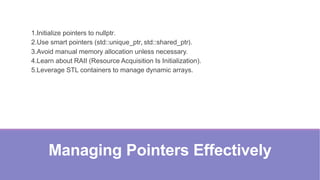
Managing Pointers Effectively
1.Initialize pointers to nullptr.
2.Use smart pointers (std::unique_ptr, std::shared_ptr).
3.Avoid manual memory allocation unless necessary.
4.Learn about RAII (Resource Acquisition Is Initialization).
5.Leverage STL containers to manage dynamic arrays.
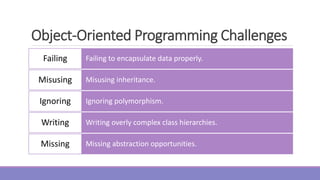
Object-Oriented Programming Challenges
Failing to encapsulate data properly.
Failing
Misusing inheritance.
Misusing
Ignoring polymorphism.
Ignoring
Writing overly complex class hierarchies.
Writing
Missing abstraction opportunities.
Missing
Tips for OOP
Success
1.Use access specifiers (private, public, protected)
appropriately.
2.Design before coding: Plan your class structure.
3.Use virtual functions for polymorphism.
4.Keep methods focused and classes cohesive.
5.Regularly refactor to simplify designs.
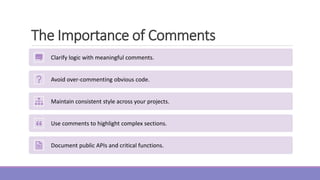
The Importance of Comments
Clarify logic with meaningful comments.
Avoid over-commenting obvious code.
Maintain consistent style across your projects.
Use comments to highlight complex sections.
Document public APIs and critical functions.
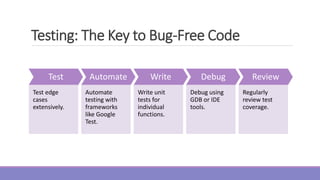
Testing: The Key to Bug-Free Code
Test
Test edge
cases
extensively.
Automate
Automate
testing with
frameworks
like Google
Test.
Write
Write unit
tests for
individual
functions.
Debug
Debug using
GDB or IDE
tools.
Review
Regularly
review test
coverage.
Ignoring Compiler Warnings
1.Warnings often indicate potential bugs.
2.Common issues include type mismatches and uninitialized variables.
3.Treat warnings as errors during development.
4.Review documentation to understand warnings.
5.Use flags like -Wall in GCC for comprehensive warning checks.
Practical Tips for Success
1.Practice daily on coding exercises or small projects.
2.Use resources like AssignmentDude, Stack Overflow, and C++ documentation.
3.Collaborate with peers through pair programming or study groups.
4.Tackle coding competitions to sharpen your skills.
5.Review and refactor completed assignments.
Recommended Resources
1.Books: Effective Modern C++ by Scott Meyers.
2.Online Courses: Udemy, Coursera (C++ for Beginners).
3.Websites: cplusplus.com, GeeksforGeeks.
4.Coding Platforms: LeetCode, Codeforces.
5.Tools: IDEs like Visual Studio, debugging tools like GDB.
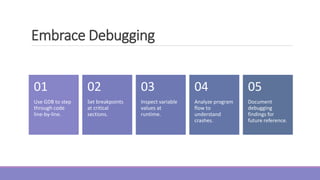
Embrace Debugging
Use GDB to step
through code
line-by-line.
01
Set breakpoints
at critical
sections.
02
Inspect variable
values at
runtime.
03
Analyze program
flow to
understand
crashes.
04
Document
debugging
findings for
future reference.
05
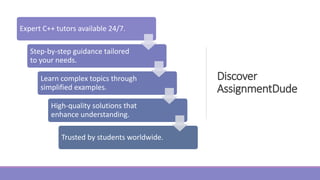
Discover
AssignmentDude
Expert C++ tutors available 24/7.
Step-by-step guidance tailored
to your needs.
Learn complex topics through
simplified examples.
High-quality solutions that
enhance understanding.
Trusted by students worldwide.
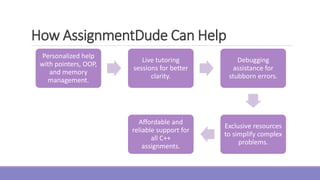
How AssignmentDude Can Help
Personalized help
with pointers, OOP,
and memory
management.
Live tutoring
sessions for better
clarity.
Debugging
assistance for
stubborn errors.
Exclusive resources
to simplify complex
problems.
Affordable and
reliable support for
all C++
assignments.
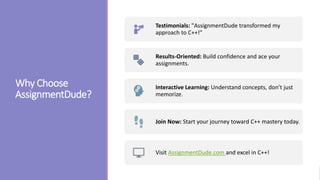
Why Choose
AssignmentDude?
AssignmentDude.com
Testimonials: "AssignmentDude transformed my
approach to C++!"
Results-Oriented: Build confidence and ace your
assignments.
Interactive Learning: Understand concepts, don’t just
memorize.
Join Now: Start your journey toward C++ mastery today.
Visit AssignmentDude.com and excel in C++!

C++ Made Easy: Common Mistakes Students Make in Programming Assignments

  • 1.
    C++ Made Easy: CommonMistakes Students Make in Programming Assignments MASTERING C++ WITH CONFIDENCE
  • 2.
    Why Learn C++? C++is foundational for software developers and engineers. Used in gaming, system programming, and high-performance apps. Combines low-level memory manipulation with high-level abstractions. Powers popular platforms like Unreal Engine. Essential for careers in tech.
  • 3.
    Challenges Students Face C++ Homework Help Complexsyntax that’s unforgiving of mistakes. Steep learning curve for beginners. Struggles with object-oriented programming (OOP). Finding reliable C++ Homework Help services. Debugging and testing roadblocks.
  • 4.
    Common Syntax Errors Forgettingsemicolons (;). Mismatched brackets {}. Case-sensitive variable issues (e.g., Value vs. value). Overusing or underusing pointers. Lack of consistent formatting.
  • 5.
    Avoiding Syntax Errors 1.Usean Integrated Development Environment (IDE). 2.Compile your code frequently. 3.Follow naming conventions. 4.Learn from compiler error messages. 5.Double-check your brackets and punctuation.
  • 6.
    Misunderstanding Data Types Integervs. float precision issues. Confusing char and string. Using the wrong type for variables. Implicit type conversions causing bugs. Mismanagement of memory allocation for types.
  • 7.
    Mastering Data Types 1.Study datatype properties and limits. 2.Use sizeof() to understand memory allocation. 3.Explicitly cast types when needed. 4.Write unit tests for data-heavy functions. 5.Practice common type conversions.
  • 8.
    Pointer Pitfalls Dereferencing null pointersleads to crashes. 1 Forgetting to deallocate dynamic memory. 2 Overcomplicating code with manual memory management. 3 Misusing pointer arithmetic. 4 Dangling pointers from deleted memory. 5
  • 9.
    Managing Pointers Effectively 1.Initializepointers to nullptr. 2.Use smart pointers (std::unique_ptr, std::shared_ptr). 3.Avoid manual memory allocation unless necessary. 4.Learn about RAII (Resource Acquisition Is Initialization). 5.Leverage STL containers to manage dynamic arrays.
  • 10.
    Object-Oriented Programming Challenges Failingto encapsulate data properly. Failing Misusing inheritance. Misusing Ignoring polymorphism. Ignoring Writing overly complex class hierarchies. Writing Missing abstraction opportunities. Missing
  • 11.
    Tips for OOP Success 1.Useaccess specifiers (private, public, protected) appropriately. 2.Design before coding: Plan your class structure. 3.Use virtual functions for polymorphism. 4.Keep methods focused and classes cohesive. 5.Regularly refactor to simplify designs.
  • 12.
    The Importance ofComments Clarify logic with meaningful comments. Avoid over-commenting obvious code. Maintain consistent style across your projects. Use comments to highlight complex sections. Document public APIs and critical functions.
  • 13.
    Testing: The Keyto Bug-Free Code Test Test edge cases extensively. Automate Automate testing with frameworks like Google Test. Write Write unit tests for individual functions. Debug Debug using GDB or IDE tools. Review Regularly review test coverage.
  • 14.
    Ignoring Compiler Warnings 1.Warningsoften indicate potential bugs. 2.Common issues include type mismatches and uninitialized variables. 3.Treat warnings as errors during development. 4.Review documentation to understand warnings. 5.Use flags like -Wall in GCC for comprehensive warning checks.
  • 15.
    Practical Tips forSuccess 1.Practice daily on coding exercises or small projects. 2.Use resources like AssignmentDude, Stack Overflow, and C++ documentation. 3.Collaborate with peers through pair programming or study groups. 4.Tackle coding competitions to sharpen your skills. 5.Review and refactor completed assignments.
  • 16.
    Recommended Resources 1.Books: EffectiveModern C++ by Scott Meyers. 2.Online Courses: Udemy, Coursera (C++ for Beginners). 3.Websites: cplusplus.com, GeeksforGeeks. 4.Coding Platforms: LeetCode, Codeforces. 5.Tools: IDEs like Visual Studio, debugging tools like GDB.
  • 17.
    Embrace Debugging Use GDBto step through code line-by-line. 01 Set breakpoints at critical sections. 02 Inspect variable values at runtime. 03 Analyze program flow to understand crashes. 04 Document debugging findings for future reference. 05
  • 18.
    Discover AssignmentDude Expert C++ tutorsavailable 24/7. Step-by-step guidance tailored to your needs. Learn complex topics through simplified examples. High-quality solutions that enhance understanding. Trusted by students worldwide.
  • 19.
    How AssignmentDude CanHelp Personalized help with pointers, OOP, and memory management. Live tutoring sessions for better clarity. Debugging assistance for stubborn errors. Exclusive resources to simplify complex problems. Affordable and reliable support for all C++ assignments.
  • 20.
    Why Choose AssignmentDude? AssignmentDude.com Testimonials: "AssignmentDudetransformed my approach to C++!" Results-Oriented: Build confidence and ace your assignments. Interactive Learning: Understand concepts, don’t just memorize. Join Now: Start your journey toward C++ mastery today. Visit AssignmentDude.com and excel in C++!