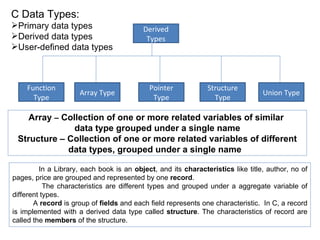
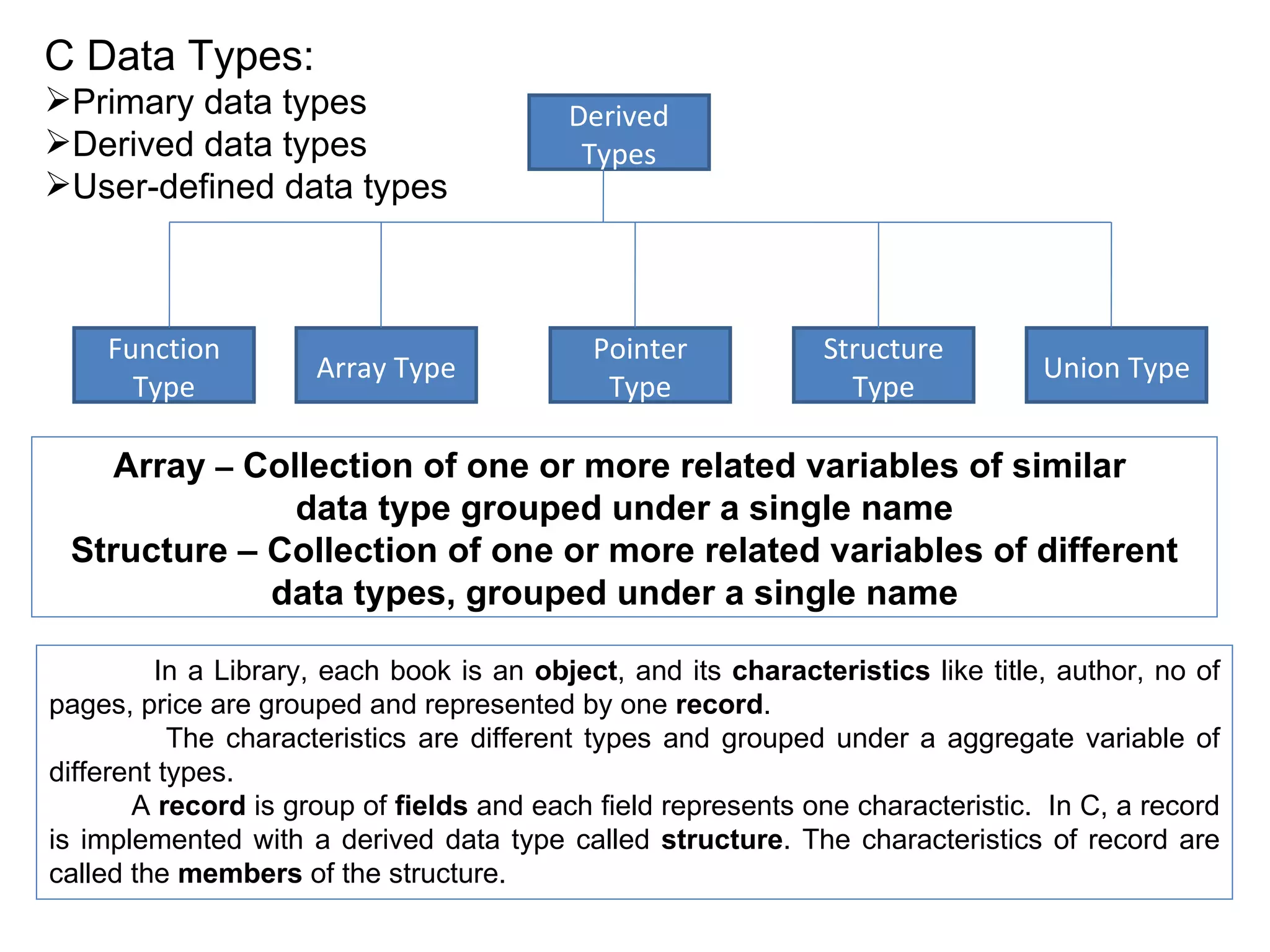
C Data Types:
Primary data types                       Derived
Derived data types                        Types
User-defined data types


    Function                                Pointer            Structure
                     Array Type                                                  Union Type
      Type                                   Type                Type

    Array – Collection of one or more related variables of similar
               data type grouped under a single name
 Structure – Collection of one or more related variables of different
             data types, grouped under a single name

         In a Library, each book is an object, and its characteristics like title, author, no of
pages, price are grouped and represented by one record.
           The characteristics are different types and grouped under a aggregate variable of
different types.
       A record is group of fields and each field represents one characteristic. In C, a record
is implemented with a derived data type called structure. The characteristics of record are
called the members of the structure.
Book-1                      Book-2                               Book-3
BookID: 1211                BookID: 1212                         BookID: 1213
Title : C Primer Plus       Title : The ANSI C Programming       Title : C By Example
Author : Stephen Prata      Author : Dennis Ritchie              Author : Greg Perry
Pages : 984                 Pages : 214                          Pages : 498
Price : Rs. 585.00          Price : Rs. 125.00                   Price : Rs. 305.00

   book                        book_id        integer        2 bytes
                  bookid
                                 title        Array of 50 characters                    50 bytes
                    title
                                 author       Array of 40 characters            40 bytes
                  author
                                 pages        integer         2 bytes
                  pages
                   price         price        float                      4 bytes

                                         Memory occupied by a Structure variable

               STRUCTURE- BOOK                        struct < structure_tag_name >
struct book {                                         {
                            Structure tag                   data type < member 1 >
      int book_id ;
      char title[50] ;                                      data type < member 2 >
                                                               …. …. …. ….
      char author[40] ;
                                                            data type < member N >
      int pages ;                                     };
      float price ;
};
Declaring a Structure Type                   Declaring a Structure Variable

 struct student                               struct student s1,s2,s3;
 {                                                      (or)
           int roll_no;                       struct student
           char name[30];                     {
           float percentage;                            int roll_no;
 };                                                     char name[30];
                                                        float percentage;
                                              }s1,s2,s3;

      Initialization of structure                       Reading values to members at
                                                        runtime:
Initialization of structure variable while
declaration :                                           struct student s3;
   struct student s2 = { 1001, “ K.Avinash ”,           printf(“nEnter the roll no”);
                  87.25 } ;                             scanf(“%d”,&s3.roll_no);
Initialization of structure members individually :      printf(“nEnter the name”);
   s1. roll_no = 1111;                                  scanf(“%s”,s3.name);
   strcpy ( s1. name , “ B. Kishore “ ) ;               printf(“nEnter the percentage”);
   s1.percentage = 78.5 ;                               scanf(“%f”,&s3.percentage);

                      membership operator
Implementing a Structure
struct employee {
     int empid;
     char name[35];
     int age;                   Declaration of Structure Type
     float salary;
};
                                           Declaration of Structure variables
int main() {
    struct employee emp1,emp2 ;      Declaration and initialization of Structure variable

   struct employee emp3 = { 1213 , ” S.Murali ” , 31 , 32000.00 } ;
   emp1.empid=1211;
   strcpy(emp1.name, “K.Ravi”);
   emp1.age = 27;                         Initialization of Structure members individually
   emp1.salary=30000.00;
   printf(“Enter the details of employee 2”);      Reading values to members of Structure
   scanf(“%d %s %d %f “ , &emp2.empid, emp2.name, &emp2.age, &emp2.salary);
   if(emp1.age > emp2.age)
        printf( “ Employee1 is senior than Employee2n” );
   else
        printf(“Employee1 is junior than Employee2n”);
                                                             Accessing members of Structure
  printf(“Emp ID:%dn Name:%sn Age:%dn Salary:%f”,
emp1.empid,emp1.name,emp1.age,emp1.salary);
}
Arrays And structures                               Nesting of structures
struct student                                        struct date {
{                                                         int day ;
   int sub[3] ;                                           int month ;
                                                                             Outer Structure
   int total ;                                            int year ;
};                                                    };
                                                      struct person {
                                                          char name[40];
int main( ) {                                             int age ;
  struct student s[3];                                    struct date b_day ;
  int i,j;                                            };
   for(i=0;i<3;i++) {                                 int main( ) {             Inner Structure
      printf(“nnEnter student %d marks:”,i+1);         struct person p1;
      for(j=0;j<3;j++) {                                 strcpy ( p1.name , “S. Ramesh “ ) ;
           scanf(“%d”,&s[i].sub[j]);                     p1. age = 32 ;
       }                                                 p1.b_day.day = 25 ;       Accessing Inner
    }                                                    p1.b_day. month = 8 ; Structure members
    for(i=0;i<3;i++) {                                   p1.b_day. year = 1978 ;
         s[i].total =0;                               }
         for(j=0;j<3;j++) {
               s[i].total +=s[i].sub[j];              OUTPUT:
       }                                              Enter student 1 marks: 60 60 60
       printf(“nTotal marks of student %d is: %d”,   Enter student 2 marks: 70 70 70
                          i+1,s[i].total );           Enter student 3 marks: 90 90 90
    }
}                                                     Total marks of student 1 is: 180
                                                      Total marks of student 2 is: 240
                                                      Total marks of student 3 is: 270
structures and functions                           Self referential structures
struct fraction {                      struct student_node {
    int numerator ;                        int roll_no ;
    int denominator ;                      char name [25] ;
};                                         struct student_node *next ;
                                       };
void show ( struct fraction f )        int main( )
{                                       {
  printf ( “ %d / %d “, f.numerator,      struct student_node s1 ;
                                          struct student_node s2 = { 1111, “B.Mahesh”, NULL } ;
                f.denominator ) ;         s1. roll_no = 1234 ;
}                                         strcpy ( s1.name , “P.Kiran “ ) ;
int main ( ) {                             s1. next = & s2 ;       s2 node is linked to s1 node
    struct fraction f1 = { 7, 12 } ;
    show ( f1 ) ;                          printf ( “ %s “, s1. name ) ;
}                                                                            Prints P.Kiran
                                           printf ( “ %s “ , s1.next - > name ) ;   Prints B.Mahesh
OUTPUT:                                }
           7 / 12


         A self referential structure is one that includes at least one member
                     which is a pointer to the same structure type.
             With self referential structures, we can create very useful data
      structures such as linked -lists, trees and graphs.
Pointer to a structure

struct product                                     Accessing structure members through
{                                                  pointer :
   int prodid;
   char name[20];                                  i) Using . ( dot ) operator :
};                                                      ( *ptr ) . prodid = 111 ;
                                                        strcpy ( ( *ptr ) . Name, “Pen”) ;
int main()
{                                                  ii) Using - > ( arrow ) operator :
   struct product inventory[3];                          ptr - > prodid = 111 ;
   struct product *ptr;                                  strcpy( ptr - > name , “Pencil”) ;
   printf(“Read Product Details : n");
   for(ptr = inventory;ptr<inventory +3;ptr++) {
     scanf("%d %s", &ptr->prodid, ptr->name);      Read Product Details :
   }
                                                   111 Pen
   printf("noutputn");
                                                   112 Pencil
   for(ptr=inventory;ptr<inventory+3;ptr++)        113 Book
   {
     printf("nnProduct ID :%5d",ptr->prodid);    Print Product Details :
     printf("nName : %s",ptr->name);
   }                                               Product ID : 111
}                                                  Name : Pen
                                                   Product ID : 112
                                                   Name : Pencil
                                                   Product ID : 113
                                                   Name : Book
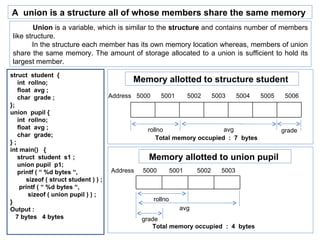
A union is a structure all of whose members share the same memory
        Union is a variable, which is similar to the structure and contains number of members
like structure.
       In the structure each member has its own memory location whereas, members of union
share the same memory. The amount of storage allocated to a union is sufficient to hold its
largest member.
struct student {
    int rollno;                              Memory allotted to structure student
    float avg ;
    char grade ;                     Address 5000     5001     5002    5003    5004 5005  5006
};
union pupil {
    int rollno;
    float avg ;                                  rollno                    avg           grade
    char grade;                                     Total memory occupied : 7 bytes
};
int main() {
    struct student s1 ;                           Memory allotted to union pupil
    union pupil p1;
    printf ( “ %d bytes “,            Address 5000        5001    5002    5003
       sizeof ( struct student ) ) ;
     printf ( “ %d bytes “,
        sizeof ( union pupil ) ) ;
}                                                  rollno
Output :                                                     avg
   7 bytes 4 bytes                             grade
                                              Total memory occupied : 4 bytes

C Language Unit-4

  • 1.
    C Data Types: Primarydata types Derived Derived data types Types User-defined data types Function Pointer Structure Array Type Union Type Type Type Type Array – Collection of one or more related variables of similar data type grouped under a single name Structure – Collection of one or more related variables of different data types, grouped under a single name In a Library, each book is an object, and its characteristics like title, author, no of pages, price are grouped and represented by one record. The characteristics are different types and grouped under a aggregate variable of different types. A record is group of fields and each field represents one characteristic. In C, a record is implemented with a derived data type called structure. The characteristics of record are called the members of the structure.
  • 2.
    Book-1 Book-2 Book-3 BookID: 1211 BookID: 1212 BookID: 1213 Title : C Primer Plus Title : The ANSI C Programming Title : C By Example Author : Stephen Prata Author : Dennis Ritchie Author : Greg Perry Pages : 984 Pages : 214 Pages : 498 Price : Rs. 585.00 Price : Rs. 125.00 Price : Rs. 305.00 book book_id integer 2 bytes bookid title Array of 50 characters 50 bytes title author Array of 40 characters 40 bytes author pages integer 2 bytes pages price price float 4 bytes Memory occupied by a Structure variable STRUCTURE- BOOK struct < structure_tag_name > struct book { { Structure tag data type < member 1 > int book_id ; char title[50] ; data type < member 2 > …. …. …. …. char author[40] ; data type < member N > int pages ; }; float price ; };
  • 3.
    Declaring a StructureType Declaring a Structure Variable struct student struct student s1,s2,s3; { (or) int roll_no; struct student char name[30]; { float percentage; int roll_no; }; char name[30]; float percentage; }s1,s2,s3; Initialization of structure Reading values to members at runtime: Initialization of structure variable while declaration : struct student s3; struct student s2 = { 1001, “ K.Avinash ”, printf(“nEnter the roll no”); 87.25 } ; scanf(“%d”,&s3.roll_no); Initialization of structure members individually : printf(“nEnter the name”); s1. roll_no = 1111; scanf(“%s”,s3.name); strcpy ( s1. name , “ B. Kishore “ ) ; printf(“nEnter the percentage”); s1.percentage = 78.5 ; scanf(“%f”,&s3.percentage); membership operator
  • 4.
    Implementing a Structure structemployee { int empid; char name[35]; int age; Declaration of Structure Type float salary; }; Declaration of Structure variables int main() { struct employee emp1,emp2 ; Declaration and initialization of Structure variable struct employee emp3 = { 1213 , ” S.Murali ” , 31 , 32000.00 } ; emp1.empid=1211; strcpy(emp1.name, “K.Ravi”); emp1.age = 27; Initialization of Structure members individually emp1.salary=30000.00; printf(“Enter the details of employee 2”); Reading values to members of Structure scanf(“%d %s %d %f “ , &emp2.empid, emp2.name, &emp2.age, &emp2.salary); if(emp1.age > emp2.age) printf( “ Employee1 is senior than Employee2n” ); else printf(“Employee1 is junior than Employee2n”); Accessing members of Structure printf(“Emp ID:%dn Name:%sn Age:%dn Salary:%f”, emp1.empid,emp1.name,emp1.age,emp1.salary); }
  • 5.
    Arrays And structures Nesting of structures struct student struct date { { int day ; int sub[3] ; int month ; Outer Structure int total ; int year ; }; }; struct person { char name[40]; int main( ) { int age ; struct student s[3]; struct date b_day ; int i,j; }; for(i=0;i<3;i++) { int main( ) { Inner Structure printf(“nnEnter student %d marks:”,i+1); struct person p1; for(j=0;j<3;j++) { strcpy ( p1.name , “S. Ramesh “ ) ; scanf(“%d”,&s[i].sub[j]); p1. age = 32 ; } p1.b_day.day = 25 ; Accessing Inner } p1.b_day. month = 8 ; Structure members for(i=0;i<3;i++) { p1.b_day. year = 1978 ; s[i].total =0; } for(j=0;j<3;j++) { s[i].total +=s[i].sub[j]; OUTPUT: } Enter student 1 marks: 60 60 60 printf(“nTotal marks of student %d is: %d”, Enter student 2 marks: 70 70 70 i+1,s[i].total ); Enter student 3 marks: 90 90 90 } } Total marks of student 1 is: 180 Total marks of student 2 is: 240 Total marks of student 3 is: 270
  • 6.
    structures and functions Self referential structures struct fraction { struct student_node { int numerator ; int roll_no ; int denominator ; char name [25] ; }; struct student_node *next ; }; void show ( struct fraction f ) int main( ) { { printf ( “ %d / %d “, f.numerator, struct student_node s1 ; struct student_node s2 = { 1111, “B.Mahesh”, NULL } ; f.denominator ) ; s1. roll_no = 1234 ; } strcpy ( s1.name , “P.Kiran “ ) ; int main ( ) { s1. next = & s2 ; s2 node is linked to s1 node struct fraction f1 = { 7, 12 } ; show ( f1 ) ; printf ( “ %s “, s1. name ) ; } Prints P.Kiran printf ( “ %s “ , s1.next - > name ) ; Prints B.Mahesh OUTPUT: } 7 / 12 A self referential structure is one that includes at least one member which is a pointer to the same structure type. With self referential structures, we can create very useful data structures such as linked -lists, trees and graphs.
  • 7.
    Pointer to astructure struct product Accessing structure members through { pointer : int prodid; char name[20]; i) Using . ( dot ) operator : }; ( *ptr ) . prodid = 111 ; strcpy ( ( *ptr ) . Name, “Pen”) ; int main() { ii) Using - > ( arrow ) operator : struct product inventory[3]; ptr - > prodid = 111 ; struct product *ptr; strcpy( ptr - > name , “Pencil”) ; printf(“Read Product Details : n"); for(ptr = inventory;ptr<inventory +3;ptr++) { scanf("%d %s", &ptr->prodid, ptr->name); Read Product Details : } 111 Pen printf("noutputn"); 112 Pencil for(ptr=inventory;ptr<inventory+3;ptr++) 113 Book { printf("nnProduct ID :%5d",ptr->prodid); Print Product Details : printf("nName : %s",ptr->name); } Product ID : 111 } Name : Pen Product ID : 112 Name : Pencil Product ID : 113 Name : Book
  • 8.
    A union isa structure all of whose members share the same memory Union is a variable, which is similar to the structure and contains number of members like structure. In the structure each member has its own memory location whereas, members of union share the same memory. The amount of storage allocated to a union is sufficient to hold its largest member. struct student { int rollno; Memory allotted to structure student float avg ; char grade ; Address 5000 5001 5002 5003 5004 5005 5006 }; union pupil { int rollno; float avg ; rollno avg grade char grade; Total memory occupied : 7 bytes }; int main() { struct student s1 ; Memory allotted to union pupil union pupil p1; printf ( “ %d bytes “, Address 5000 5001 5002 5003 sizeof ( struct student ) ) ; printf ( “ %d bytes “, sizeof ( union pupil ) ) ; } rollno Output : avg 7 bytes 4 bytes grade Total memory occupied : 4 bytes