Download the full version and explore a variety of test banks
or solution manuals at https://testbankmall.com
C++ Programming From Problem Analysis to Program
Design 8th Edition Malik Solutions Manual
_____ Follow the link below to get your download now _____
https://testbankmall.com/product/c-programming-from-problem-
analysis-to-program-design-8th-edition-malik-solutions-
manual/
Access testbankmall.com now to download high-quality
test banks or solution manuals
We have selected some products that you may be interested in
Click the link to download now or visit testbankmall.com
for more options!.
Solution manual for C++ Programming: From Problem Analysis
to Program Design, 6th Edition – D.S. Malik
https://testbankmall.com/product/solution-manual-for-c-programming-
from-problem-analysis-to-program-design-6th-edition-d-s-malik/
Test Bank for C++ Programming: From Problem Analysis to
Program Design, 6th Edition – D.S. Malik
https://testbankmall.com/product/test-bank-for-c-programming-from-
problem-analysis-to-program-design-6th-edition-d-s-malik/
Solution Manual for C# Programming: From Problem Analysis
to Program Design, 5th Edition, Barbara Doyle
https://testbankmall.com/product/solution-manual-for-c-programming-
from-problem-analysis-to-program-design-5th-edition-barbara-doyle/
Solution Manual for Social Statistics for a Diverse
Society Seventh Edition
https://testbankmall.com/product/solution-manual-for-social-
statistics-for-a-diverse-society-seventh-edition/
Microeconomics A Contemporary Introduction 11th Edition
McEachern Test Bank
https://testbankmall.com/product/microeconomics-a-contemporary-
introduction-11th-edition-mceachern-test-bank/
Solution manual for Essentials of Soil Mechanics and
Foundations: Basic Geotechnics McCarthy 7th Edition
https://testbankmall.com/product/solution-manual-for-essentials-of-
soil-mechanics-and-foundations-basic-geotechnics-mccarthy-7th-edition/
Solution Manual for Organizational Behavior, 16/E 16th
Edition Stephen P. Robbins, Timothy A. Judge
https://testbankmall.com/product/solution-manual-for-organizational-
behavior-16-e-16th-edition-stephen-p-robbins-timothy-a-judge/
Solution Manual for Ecology: Concepts and Applications 7th
Edition
https://testbankmall.com/product/solution-manual-for-ecology-concepts-
and-applications-7th-edition/
Principles of Macroeconomics Mankiw 6th Edition Test Bank
https://testbankmall.com/product/principles-of-macroeconomics-
mankiw-6th-edition-test-bank/
Solution Manual for Strategic Financial Management
Application of Corporate Finance 1st Edition by Weaver
https://testbankmall.com/product/solution-manual-for-strategic-
financial-management-application-of-corporate-finance-1st-edition-by-
weaver/
C++ Programming: From Problem Analysis to Program Design, Eighth Edition 2-2
© 2018 Cengage Learning. All Rights Reserved. May not be copied, scanned, or duplicated, in whole or in part, except for use as permitted in a
license distributed with a certain product or service or otherwise on a password-protected website for classroom use.
• Key Terms
C++ Programming: From Problem Analysis to Program Design, Eighth Edition 2-3
© 2018 Cengage Learning. All Rights Reserved. May not be copied, scanned, or duplicated, in whole or in part, except for use as permitted in a
license distributed with a certain product or service or otherwise on a password-protected website for classroom use.
Lecture Notes
Overview
Chapter 2 teaches your students the basics of C++. Learning a programming language is
similar to learning to be a chef or learning to play a musical instrument. All three
require direct interaction with the tools; in other words, you cannot become proficient
by simply reading books on the topics. In this chapter, your students will begin
acquiring a fundamental knowledge of C++ by learning about data types, functions,
identifiers, assignment statements, arithmetic operations, and input/output operations.
They will then write and test programs using these concepts to verify their knowledge
of the material.
Objectives
In this chapter, the student will:
• Become familiar with the basic components of a C++ program, including functions,
special symbols, and identifiers
• Explore simple data types
• Discover how to use arithmetic operators
• Examine how a program evaluates arithmetic expressions
• Become familiar with the string data type
• Learn what an assignment statement is and what it does
• Learn about variable declaration
• Discover how to input data into memory using input statements
• Become familiar with the use of increment and decrement operators
• Examine ways to output results using output statements
• Learn how to use preprocessor directives and why they are necessary
• Learn how to debug syntax errors
• Explore how to properly structure a program, including using comments to document a
program
• Become familiar with compound statements
• Learn how to write a C++ program
Teaching Tips
Introduction
1. Define the terms computer program and programming.
2. Use the recipe analogy to give students an idea of the process of programming.
C++ Programming: From Problem Analysis to Program Design, Eighth Edition 2-4
© 2018 Cengage Learning. All Rights Reserved. May not be copied, scanned, or duplicated, in whole or in part, except for use as permitted in a
license distributed with a certain product or service or otherwise on a password-protected website for classroom use.
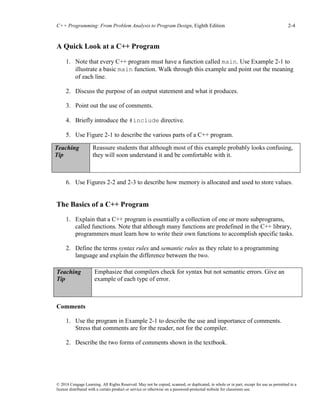
A Quick Look at a C++ Program
1. Note that every C++ program must have a function called main. Use Example 2-1 to
illustrate a basic main function. Walk through this example and point out the meaning
of each line.
2. Discuss the purpose of an output statement and what it produces.
3. Point out the use of comments.
4. Briefly introduce the #include directive.
5. Use Figure 2-1 to describe the various parts of a C++ program.
Teaching
Tip
Reassure students that although most of this example probably looks confusing,
they will soon understand it and be comfortable with it.
6. Use Figures 2-2 and 2-3 to describe how memory is allocated and used to store values.
The Basics of a C++ Program
1. Explain that a C++ program is essentially a collection of one or more subprograms,
called functions. Note that although many functions are predefined in the C++ library,
programmers must learn how to write their own functions to accomplish specific tasks.
2. Define the terms syntax rules and semantic rules as they relate to a programming
language and explain the difference between the two.
Teaching
Tip
Emphasize that compilers check for syntax but not semantic errors. Give an
example of each type of error.
Comments
1. Use the program in Example 2-1 to describe the use and importance of comments.
Stress that comments are for the reader, not for the compiler.
2. Describe the two forms of comments shown in the textbook.
C++ Programming: From Problem Analysis to Program Design, Eighth Edition 2-5
© 2018 Cengage Learning. All Rights Reserved. May not be copied, scanned, or duplicated, in whole or in part, except for use as permitted in a
license distributed with a certain product or service or otherwise on a password-protected website for classroom use.
Teaching
Tip
The importance of documenting a program cannot be underestimated. It is highly
important for ensuring that the next programmer to be responsible for
maintaining the code will be able to understand what the code is supposed to do.
Special Symbols
1. Explain that the C++ programming language consists of individual units called tokens,
and these are divided into special symbols, word symbols, and identifiers.
2. Go over some of the special symbols in C++, including mathematical symbols,
punctuation marks, the blank symbol, and double characters that are regarded as a
single symbol.
Reserved Words (Keywords)
1. Discuss the word symbols, or keywords, used in C++, using Appendix A as a guide.
Emphasize that C++ keywords are reserved and cannot be redefined for any other
purpose with a program.
Identifiers
1. Define the term identifier as a name for something, such as a variable, constant, or
function.
2. Discuss the rules for naming identifiers in C++. Also note that C++ is a case-sensitive
language.
3. Use Table 2-1 to review the rules of identifier naming.
Teaching
Tip
Discuss the difference between C++ conventions and rules. For example, it is a
rule that a mathematical symbol cannot be used in an identifier name. However,
it is a convention to begin an identifier with a lowercase letter.
Whitespaces
1. Explain that whitespaces (which include blanks, tabs, and newline characters) are used
to separate special symbols, reserved words, and identifiers.
C++ Programming: From Problem Analysis to Program Design, Eighth Edition 2-6
© 2018 Cengage Learning. All Rights Reserved. May not be copied, scanned, or duplicated, in whole or in part, except for use as permitted in a
license distributed with a certain product or service or otherwise on a password-protected website for classroom use.
Data Types
1. Explain that C++ categorizes data into different types in order to manipulate the data in
a program correctly. Although it may seem cumbersome at first to be so type-conscious,
emphasize that C++ has these built-in checks to guard against errors.
Teaching
Tip
Explain that C++ is called a strongly typed language because it checks for
operations between inconsistent data types. This results in more robust and error-
free programs. Demonstrate how C++ checks for data types with a simple
program that attempts to add a string and a numeric value.
2. Define the term data type as a set of values together with a set of operations.
3. Mention that C++ data types fall into three categories: simple data types, structured data
types, and pointers. Only the first type is discussed in this chapter.
Simple Data Types
1. Describe the three categories of simple data types in C++: integral, floating-point, and
enumeration.
2. Mention the eleven categories of integral data types. Explain why C++ (and many other
languages) has so many categories of the same data type. In addition, discuss the rules
involving the use of integral types.
4. Explain the purpose of the bool data type.
5. Discuss the char data type, including its primary uses. Mention commonly used ASCII
characters and their predefined ordering. Explain that a char data type is enclosed in
single quotation marks, and note that only one symbol may be designated as a character.
6. Use Table 2-2 to summarize the three simple data types. Point out the difference in the
amount of memory storage required, but inform students that this is system-dependent.
Floating-Point Data Types
1. Use Table 2-3 to explain how C++ represents real, or floating-point, numbers. Mention
the three categories of data types to represent real numbers (float, double, and
long double), and explain when to use each type.
2. Define the terms precision, single precision, and double precision.
C++ Programming: From Problem Analysis to Program Design, Eighth Edition 2-7
© 2018 Cengage Learning. All Rights Reserved. May not be copied, scanned, or duplicated, in whole or in part, except for use as permitted in a
license distributed with a certain product or service or otherwise on a password-protected website for classroom use.
Teaching
Tip
Demonstrate how to find the values of float and double on a particular
system by running the program with the header file <cfloat> in Appendix F.
Encourage students to try running this program on their own computers and
comparing the results.
Quick Quiz 1
1. What is an enumeration type?
Answer: C++’s method for allowing programmers to create their own simple data types
2. The maximum number of significant digits in a number is called the
.
Answer: precision
3. The data type
Answer: bool
4. The
represent characters.
Answer: char
has only two values: true and false.
data type, the smallest integral data type, is used to
Data Types and Variables, and Assignment Statements
1. Explain that the declaration of a variable requires that the data type be specified.
2. Explain the concept and syntax of an assignment.
Arithmetic Operators, Operator Precedence, and Expressions
1. Discuss the five arithmetic operators in C++ that are used to manipulate integral and
floating-type data types.
2. Define the terms unary and binary operators, and discuss the difference between them.
Order of Precedence
1. Review operator precedence rules, as C++ uses these rules when evaluating
expressions. Explain that parentheses can be used to override the order of operator
precedence.
C++ Programming: From Problem Analysis to Program Design, Eighth Edition 2-8
© 2018 Cengage Learning. All Rights Reserved. May not be copied, scanned, or duplicated, in whole or in part, except for use as permitted in a
license distributed with a certain product or service or otherwise on a password-protected website for classroom use.
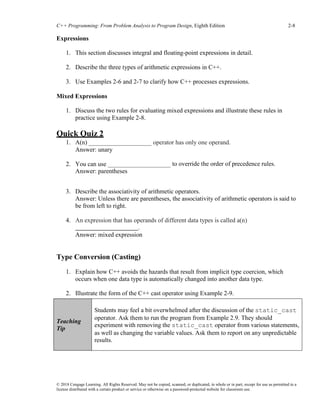
Expressions
1. This section discusses integral and floating-point expressions in detail.
2. Describe the three types of arithmetic expressions in C++.
3. Use Examples 2-6 and 2-7 to clarify how C++ processes expressions.
Mixed Expressions
1. Discuss the two rules for evaluating mixed expressions and illustrate these rules in
practice using Example 2-8.
Quick Quiz 2
1. A(n)
Answer: unary
2. You can use
Answer: parentheses
operator has only one operand.
to override the order of precedence rules.
3. Describe the associativity of arithmetic operators.
Answer: Unless there are parentheses, the associativity of arithmetic operators is said to
be from left to right.
4. An expression that has operands of different data types is called a(n)
.
Answer: mixed expression
Type Conversion (Casting)
1. Explain how C++ avoids the hazards that result from implicit type coercion, which
occurs when one data type is automatically changed into another data type.
2. Illustrate the form of the C++ cast operator using Example 2-9.
Teaching
Tip
Students may feel a bit overwhelmed after the discussion of the static_cast
operator. Ask them to run the program from Example 2.9. They should
experiment with removing the static_cast operator from various statements,
as well as changing the variable values. Ask them to report on any unpredictable
results.
C++ Programming: From Problem Analysis to Program Design, Eighth Edition 2-9
© 2018 Cengage Learning. All Rights Reserved. May not be copied, scanned, or duplicated, in whole or in part, except for use as permitted in a
license distributed with a certain product or service or otherwise on a password-protected website for classroom use.
string Type
1. Introduce the C++ data type string, which is a programmer-defined data type
available in the C++ library. Define a string as a sequence of zero or more characters.
2. Define the terms null string or empty string.
3. Discuss how to determine the length of a string, as well as the position of each character
in a string.
Teaching
Tip
Emphasize that the first position of a character in a string is 0, not 1. This will be
helpful when manipulating both strings and arrays later on the text.
Variables, Assignment Statements, and Input Statements
1. Explain that data for a C++ program must be input into main memory. Mention the two-
step process to store data in the computer’s memory.
Allocating Memory with Constants and Variables
1. Emphasize that when allocating memory, the programmer must instruct the computer
which names to use for each memory location as well as what type of data to store in
those memory locations.
2. Define the term named constant and describe the syntax for declaring a named constant.
Use Example 2-11 to illustrate the naming conventions for named constants. Explain
why named constants are used in programs.
3. Define the term variable and use Example 2-12 to illustrate the syntax for declaring
single and multiple variables.
4. Give a formal definition of a simple data type.
Putting Data into Variables
1. Mention the two ways you can place data in a variable in C++.
Assignment Statement
1. Discuss the C++ assignment statement, including its syntax, variable initialization, and
the associativity rules of the assignment operator.
2. Step through Example 2-13 to illustrate how assignment statements operate in C++.
C++ Programming: From Problem Analysis to Program Design, Eighth Edition 2-
10
© 2018 Cengage Learning. All Rights Reserved. May not be copied, scanned, or duplicated, in whole or in part, except for use as permitted in a
license distributed with a certain product or service or otherwise on a password-protected website for classroom use.
3. Use Example 2-14 to discuss the importance of doing a walk-through (tracing values
through a sequence of steps) when writing code.
Teaching
Tip
Building a table showing the values of variables at each step of the program is
very helpful for students to understand the nature of variables.
Saving and Using the Value of an Expression
1. Explain the steps involved in saving the value of an expression using Example 2-15.
Declaring and Initializing Variables
1. Explain that when a variable is declared, C++ may not automatically put a meaningful
value in it.
2. Emphasize that it is a good practice to initialize variables while they are being declared.
Use one or more examples to illustrate how to do this in C++.
Input (Read) Statement
1. This section teaches your students to read data into variables from a standard input
device. Define and explain the use of the C++ object cin and the stream extraction
operator >>.
2. Step through Examples 2-16 through 2-18 to illustrate how to read in numeric and string
data.
Variable Initialization
1. Reiterate that a variable can be initialized either through an assignment statement or a
read statement. Explain why the read statement option is more versatile. Use Example
2-19 to illustrate both types of initialization.
Teaching
Tip
Programmers (and instructors) have various approaches or preferences regarding
variable declaration and initialization. Share your views on the topic. Do you
think the best approach is to always initialize variables for consistency? Do you
prefer initializing variables directly before the block of code that uses them, or
initializing them during declaration?
Quick Quiz 3
1. What is a named constant?
© 2018 Cengage Learning. All Rights Reserved. May not be copied, scanned, or duplicated, in whole or in part, except for use as permitted in a
license distributed with a certain product or service or otherwise on a password-protected website for classroom use.
C++ Programming: From Problem Analysis to Program Design, Eighth Edition 2-10
Answer: A memory location whose content is not allowed to change during program
execution
2. What is the syntax for declaring single or multiple variables?
Answer: dataType identifier, identifier, …;
3. True or False: If you refer to an identifier without declaring it, the compiler will
generate an error message.
Answer: True
4. A variable is said to be _ the first time a value is placed in it.
Answer: initialized
Increment and Decrement Operators
1. Explain the purpose of the C++ increment (++) and decrement (--) operators.
2. Discuss how pre and post versions of these operators affect the results in a program.
Use Example 2-20 to help explain the difference between these versions.
Teaching
Tip
Verify that students are comfortable with using pre- and post-
increment/decrement operators correctly, as it will be useful when working with
control structures.
Output
1. Review how the C++ output statement is coded with the cout object and stream
insertion operator (<<). Review the role of the endl manipulator in output statements
as well.
2. Discuss the use of escape characters (see Table 2-4), such as the newline character, to
format output. Demonstrate how to format output with Examples 2-21 through 2-26.
Teaching
Tip
Outputting strings can be confusing at first. Talk about the various methods to
deal with several lines of string output, and give your opinion as to the best
approach. Emphasize that the Enter key cannot be used to break up a long string
into two lines.
© 2018 Cengage Learning. All Rights Reserved. May not be copied, scanned, or duplicated, in whole or in part, except for use as permitted in a
license distributed with a certain product or service or otherwise on a password-protected website for classroom use.
C++ Programming: From Problem Analysis to Program Design, Eighth Edition 2-11
Preprocessor Directives
1. Explain the role of the preprocessor in C++. Discuss the use of header files and the
syntax for including them in a C++ program.
Teaching
Tip
Show your students some of the available operations in the <cmath> header.
Here is one Web site with a description:
http://www.cplusplus.com/reference/cmath/
namespace and Using cin and cout in a Program
1. Briefly explain the purpose of the namespace mechanism in ANSI/ISO Standard
C++. Discuss the std namespace and how it relates to the <iostream> header
file.
2. Review the using namespace std; statement and its usefulness in programs
using cin and cout statements.
Using the string Data Type in a Program
1. Mention that the <string> header must be included in C++ programs using the
string data type.
Creating a C++ Program
1. Discuss the role of the function main in a C++ program. Go over the syntax of a main
function, including declaration, assignment, executable, and return statements. Mention
that named constant definitions and preprocessor directives are written before the main
function.
2. Spend some time stepping through Examples 2-27 through 2-29. Verify that students
understand each line of code in Example 2-29.
Debugging: Understanding and Fixing Syntax Errors
1. Review the sample program on page 84 and the compiler output that is generated when
compiling the program. Walk through the various syntax errors and explain how each
one should be fixed. Note that a syntax error on one line may be the cause of a compiler
error on the following line.
© 2018 Cengage Learning. All Rights Reserved. May not be copied, scanned, or duplicated, in whole or in part, except for use as permitted in a
license distributed with a certain product or service or otherwise on a password-protected website for classroom use.
C++ Programming: From Problem Analysis to Program Design, Eighth Edition 2-12
Teaching
Tip
Debugging is one of the most important skills a professional programmer
acquires. Stress to students the importance of learning how to debug their own
programs, including the verification of the results.
Program Style and Form
1. This section covers basic C++ syntax and semantic rules. Review these rules with your
students in order for them to feel comfortable writing a complete functioning C++
program.
Syntax
1. Remind students that syntax rules define what is legal and what is not.
2. Discuss some common syntax errors. Emphasize that syntax errors should be corrected
in the order in which the compiler lists them.
Use of Blanks
1. Discuss when blanks should and should not be used in a C++ program.
Use of Semicolons, Brackets, and Commas
1. Explain the purpose and meaning of semicolons, brackets, and commas in C++
programs. Define the term statement terminator.
Semantics
1. Define the term semantics.
2. Reiterate that a program may run without compiler errors and still have semantic errors
that generate incorrect results. Use the example in the text to illustrate.
Naming Identifiers
1. Mention the conventions for naming identifiers, including self-documenting identifiers
and run-together words.
Prompt Lines
1. Define the term prompt lines.
© 2018 Cengage Learning. All Rights Reserved. May not be copied, scanned, or duplicated, in whole or in part, except for use as permitted in a
license distributed with a certain product or service or otherwise on a password-protected website for classroom use.
C++ Programming: From Problem Analysis to Program Design, Eighth Edition 2-13
2. Explain why well-written prompt lines are essential for user input.
Documentation
1. Discuss why documenting a program through comments is critical to understanding and
modifying the program at a later time.
Form and Style
1. Explain the purpose behind formatting and indentation conventions in source code. Use
Example 2-30 to illustrate.
Teaching
Tip
As with naming conventions, discuss your own preferences in terms of form and
style in programming. Use the programming examples at the end of the chapter
to talk about various stylistic elements. Discuss the value of the “art” of
programming.
Quick Quiz 4
1. True or False: The semantic rules of a language tell you what is legal and what is not
legal.
Answer: False
2. The semicolon is also called the .
Answer: statement terminator
3. How can you make run-together words easier to understand?
Answer: Capitalizing the beginning of each new word; or inserting an underscore before
each new word
4. Why are comments important in a program?
Answer: A well-documented program is easier to understand and modify, even a long
time after you originally wrote it. You use comments to document programs. Comments
should appear in a program to explain the purpose of the program, identify who wrote
it, and explain the purpose of particular statements.
More on Assignment Statements
1. Define the terms simple assignment statement and compound assignment statement.
2. Define the C++ compound operators (+=, -=, *=, /=, and %=) and explain how and
why compound assignment statements are used in C++ programs. Use Example 2-31 to
illustrate this.
© 2018 Cengage Learning. All Rights Reserved. May not be copied, scanned, or duplicated, in whole or in part, except for use as permitted in a
license distributed with a certain product or service or otherwise on a password-protected website for classroom use.
C++ Programming: From Problem Analysis to Program Design, Eighth Edition 2-14
3. Step through the “Convert Length” and “Make Change” Programming Examples to
help the students consolidate all the information from this chapter.
Class Discussion Topics
1. As mentioned in this chapter, C++ predefined identifiers such as cout and cin can be
redefined by the programmer. However, why is it not wise to do so?
2. The text mentioned that the char data type can be cast into an int. What are some
possible uses of this functionality?
Additional Projects
1. Learn and report on various compiler errors by modifying one or two of the programs in
this chapter. Try to compile the program. What happens when you fail to initialize a
value for a named constant? What are the error messages when you use a numeric or
string constant in an expression without first giving it a value? Finally, what happens
when you initialize a char data type with a character enclosed in double quotes?
2. Use one of the programs in this chapter to test for invalid user input. The program
should compile with no errors. What happens when you enter an unexpected value
(such as an incorrect data type) when prompted for user input? Test with several sets of
invalid data and document your findings.
Additional Resources
1. C++ Examples:
https://developers.google.com/edu/c++/getting-started
2. Basic Input/Output:
http://www.cplusplus.com/doc/tutorial/basic_io/
3. C++ Programming Style Guidelines:
http://geosoft.no/development/cppstyle.html
4. Strong vs. Weak Typing:
http://www.artima.com/intv/strongweak.html
© 2018 Cengage Learning. All Rights Reserved. May not be copied, scanned, or duplicated, in whole or in part, except for use as permitted in a
license distributed with a certain product or service or otherwise on a password-protected website for classroom use.
C++ Programming: From Problem Analysis to Program Design, Eighth Edition 2-15
Key Terms
Arithmetic expression: an expression constructed using arithmetic operators and
numbers
Assignment operator: =; assigns whatever is on the right side to the variable on the left
side
Associativity: the associativity of arithmetic operators is said to be from left to right
Binary operator: an operator that has two operands
Cast operator (type conversion, type casting): used to explicitly convert one data type
to another data type
Character arithmetic: arithmetic operation on char data
Collating sequence: a predefined ordering for the characters in a set
Compound assignment statement: statements that are used to write simple assignment
statements in a more concise notation
Computer program: a sequence of statements whose objective is to accomplish a task
Data type: a set of values together with a set of operations
Declaration statements: statements that are used to declare things, such as variables
Decrement operator: --; decreases the value of a variable by 1
Double precision: values of type double
Enumeration: a user-defined data type
Executable statements: statements that perform calculations, manipulate data, create
output, accept input, and so on
Floating-point: a data type that deals with decimal numbers
Floating-point (decimal) expression: an expression in which all operands in the
expression are floating-point numbers
Floating-point notation: a form of scientific notation used to represent real numbers
Function (subprogram): a collection of statements; when activated, or executed, it
accomplishes something
Identifier: a C++ identifier consists of letters, digits, and the underscore character (_); it
must begin with a letter or underscore
Implicit type coercion: when a value of one data type is automatically changed to
another data type
Increment operator: ++; increases the value of a variable by 1
Initialized: the first time a value is placed in the variable
Input (read) statement: a statement that places data into variables using cin and >>
Integral: a data type that deals with integers, or numbers, without a decimal part
Integral expression: an expression in which all operands are integers
Keyword: a reserved word
Mixed expression: an expression that has operands of different data types
Named constant: a memory location whose content is not allowed to change during
program execution
Null (empty) string: a string containing no characters
Operands: numbers appearing in an arithmetic expression
Output statement: an output on the standard output device via cout and <<
© 2018 Cengage Learning. All Rights Reserved. May not be copied, scanned, or duplicated, in whole or in part, except for use as permitted in a
license distributed with a certain product or service or otherwise on a password-protected website for classroom use.
C++ Programming: From Problem Analysis to Program Design, Eighth Edition 2-16
Post-decrement: has the syntax variable--
Post-increment: has the syntax variable++
Precision: the maximum number of significant digits
Pre-decrement: has the syntax –-variable
Predefined (standard) function: a function that is already written and provided as part
of the system
Pre-increment: has the syntax ++variable
Preprocessor: a program that carries out preprocessor directives
Programming: the process of planning and creating a program
Programming language: a set of rules, symbols, and special words
Prompt lines: executable statements that inform the user what to do
Reserved words (keywords): word symbols in a programming language that cannot be
redefined in any program
Run-together word: an identifier that is composed of two or more words that are
combined without caps or underscores
Self-documenting identifiers: identifiers that describe the purpose of the identifier
through the name
Semantic rules: rules that determine the meaning of the instructions
Semantics: a set of rules that gives meaning to a language
Simple assignment statement: a statement that uses only the assignment operator to
assign values to the variable on the left side of the operator
Simple data type: the variable or named constant of that type can store only one value
at a time
Single precision: values of type float
Source code: consists of the preprocessor directives and program statements
Source code file (source file): a file containing source code
Statement terminator: the semicolon
Stream extraction operator: >>; takes information from a stream and puts it into a
variable
Stream insertion operator: <<; takes information from a variable and puts it into a
stream
String: a sequence of zero or more characters
Syntax rules: rules that describe which statements (instructions) are legal, or accepted
by the programming language, and which are not legal
Token: the smallest individual unit of a program written in any language
Unary operator: an operator that has only one operand
Variable: a memory location whose content may change during program execution
Walk-through: the process of tracing values through a sequence
7
Chapter 2
1. a. false; b. false; c. true; d. true; e. false; f. false; g. true; h. true; i. false; j. false; k. true; l. false
2. b, d, e, f
3. b, e
4. A keyword is a reserved word and is defined by the system. A keyword cannot be redefined in a
program. A user-defined identifier can be redefined.
5. The identifiers quizNo1 and quizno1 are not the same. C++ is case sensitive. The fifth letter of
quizNo1 is uppercase N while the fifth character of quizno1 is lowercase n. So these identifiers
are different
6 . a. 22
b. 2
c. 14
d. 8
e. 7.00
f. 21
g. 20
h. 0.00
i. 15.50
7. a. 7
b. 5.50
c. -1.00
d. Not possible. Both the operands of the operator % must be integers. y + z is of type double. Both
operands, y + z and x, of %V must be integers.
e. 13.50
f. 1
g. Not possible. Both the operands of the operator % must be integers. Because the second operand, z,
is a floating-point value, the expression is invalid.
h. 3.00
8. a, b, c, e, i, j, and k are valid;
d, f, and g are invalid because the left side of an expression must be a variable. h is invalid because the
operands of the mod operator must be integers.
9. x = 9, y = 5, z = 3, w = -3
10. Variable declarations in Lines 1, 6, and 7 are correct.
Variable declaration in Line 2 is incorrect. Now, B+ is a string, so it must be enclosed in double
quotes mark. Also, grade is a char variable and a string cannot be assigned to a char variable. A
correct declaration is:
8
char grade = 'B'; //Line 2
Variable declaration in Line 3 is incorrect because the left side of the assignment operator must be a
variable, and the semicolon at the end of the statement is missing. A correct declaration is:
double num = 28.5; //Line 3
The variable declaration in Line 4 is incorrect because strings are enclosed in double quotation marks.
A correct declaration is:
string message = "First C++ course"; //Line 4
The variable declaration in Line 5 is incorrect because the value assigned to age must be an int value.
A correct declaration is:
int age = 18; //Line 5
11. a and c are valid
12. a. int x, y;
x = 25;
y = 18;
b. int temp = 10;
char ch = 'A';
c. x = x + 5;
d. double payRate = 12.5;
e. tempNum = firstNum;
f. temp = x;
x = y;
y = temp;
g. cout << x << " " << y << " " << x + 12 / y - 18 << endl;
h. char grade = 'A';
i. int num1, num2, num3, num4;
j. x = static_cast<int>(z + 0.5);
13. a. 9.0 / 5 * C + 32
b. static_cast<int>('+')
c. static_cast<int>(x + 0.5)
d. str = "C++ Programming is exciting"
e. totalInches = 12 * feet + inches
f. i++, ++i, or i = i + 1;
g. v = 4 / 3 * (3.1416 * r * r *r);
h. s = 2* (3.1416 * r * *r) + 2 * (3.1416 * r) * h;
i. a + (b – c) / d * (e * f – g * h)
j. (–b + (b * b – 4 * a * c)) / (2 * a)
9
14. x = 1
y = 102
z = 15
w = 44
15. x = 101
y = 11
z = 104
w = 159.00
t = 81.50
16. a. x = 18, y = 5, z = 4
b. 5 * x - y = 85
c. Product of 18 and 4 is 72
d. x - y / z = 17
e. 18 square = 324
17. a. 1000
b. 42.50
c. 1.25
d. 11.00
e. 9
f. 88.25
g. -2.00
18. a. cout << endl; or cout << "n"; or cout << 'n';
b. cout << "t";
c. cout << """;
19. a and c are correct
20.
a. char grade = '*';
b. double salesTax = 0.05;
c. int numOfJuiceBottles = 0;
d. double billingAmount = 0.0;
e. double gpa = 0.0;
10
21. a. int num1;
int num2;
b. cout << "Enter two numbers separated by spaces." << endl;
c. cin >> num1 >> num2;
d. cout << "num1 = " << num1 << ", num2 = " << num2
<< ", 2 * num1 – num2 = " << 2 * num1 – num2 << endl;
22. A correct answer is:
#include <iostream>
#include <string>
using namespace std;
const double DECIMAL = 5.50;
const string blanks = " ";
double PAY_RATE = 10.75;
int main()
{
int height, weight;
double discount;
double billingAmount;
double bonus;
int hoursWorked = 45;
double price;
height = 6;
weight = 156;
cout << height << " " << weight << endl;
discount = (2 * height + weight) % 10;
price = 49.99;
billingAmount = price * (1 - discount) - DECIMAL ;
// DECIMAL = 7.55;
cout << price << blanks << "$" << billingAmount << endl;
bonus = hoursWorked * PAY_RATE / 50;
cout << "Bonus = " << bonus << endl;
return 0;
}
23. A correct answer is:
#include <iostream>
using namespace std;
const char STAR = '*';
const int PRIME = 71;
11
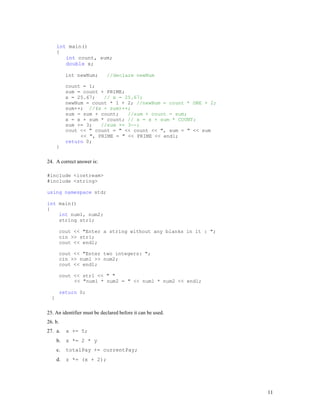
int main()
{
int count, sum;
double x;
int newNum; //declare newNum
count = 1;
sum = count + PRIME;
x = 25.67; // x = 25.67;
newNum = count * 1 + 2; //newNum = count * ONE + 2;
sum++; //(x + sum)++;
sum = sum + count; //sum + count = sum;
x = x + sum * count; // x = x + sum * COUNT;
sum += 3; //sum += 3--;
cout << " count = " << count << ", sum = " << sum
<< ", PRIME = " << PRIME << endl;
return 0;
}
24. A correct answer is:
#include <iostream>
#include <string>
using namespace std;
int main()
{
int num1, num2;
string str1;
cout << "Enter a string without any blanks in it : ";
cin >> str1;
cout << endl;
cout << "Enter two integers: ";
cin >> num1 >> num2;
cout << endl;
cout << str1 << " "
<< "num1 * num2 = " << num1 * num2 << endl;
return 0;
}
25. An identifier must be declared before it can be used.
26. b.
27. a. x += 5;
b. x *= 2 * y
c. totalPay += currentPay;
d. z *= (x + 2);
12
e. y /= x + 5;
28. a. x = x + 5 – z;
b. y = y * (2 * x + 5 – z);
c. w = w + 2 * z + 4;
d. x = x – (z + y – t);
e. sum = sum + num;
29.
a b c
a = (b++) + 3; 8 3 und
c = 2 * a + (++b); 8 2 12
b = 2 * (++c) – (a++); 9 -3 11
30.
a b c sum
sum = static_cast<int>(a + b + c); 6 3 2.2 11
b += c * a; 6 16 2.2 11
c -= a; 6 16 -3.8 11
a *= 2 * b - c; 214 16 -3.8 11
31. (The user input is shaded.)
firstNum = 62
Enter three numbers: 35 10.5 27
The numbers you entered are 35, 10.5, and 27
z = 33
Enter grade: B
The letter that follows your grade is: C
32. (The user input is shaded.)
Enter last name: Miller
Enter a two digit integer: 34
Enter a decimal number: 62.5
Name: Miller
Id: 34
Mystery number: -5.14286
33.
#include <iostream>
#include <string>
using namespace std;
13
const double X = 13.45;
const int Y = 18;
const char STAR = '*';
int main()
{
string employeeID;
string department;
int num;
double salary;
cout << "Enter employee ID: ";
cin >> employeeID;
cout << endl;
cout << "Enter department: ";
cin >> department;
cout << endl;
cout << "Enter a positive integer less than 80: ";
cin >> num;
cout << endl;
salary = num * X;
cout << "ID: " << employeeID << endl;
cout << "Department " << department << endl;
cout << "Star: " << STAR << endl;
cout << "Wages: $" << salary << endl;
cout << "X = " << X << endl;
cout << "X + Y = " << X + Y << endl;
return 0;
}
34. The program requires four inputs in the following order:
string decimal_number decimal_number integer
Other documents randomly have
different content
THE FULL PROJECT GUTENBERG LICENSE
PLEASE READ THIS BEFORE YOU DISTRIBUTE OR USE THIS WORK
To protect the Project Gutenberg™ mission of promoting the free
distribution of electronic works, by using or distributing this work (or
any other work associated in any way with the phrase “Project
Gutenberg”), you agree to comply with all the terms of the Full
Project Gutenberg™ License available with this file or online at
www.gutenberg.org/license.
Section 1. General Terms of Use and
Redistributing Project Gutenberg™
electronic works
1.A. By reading or using any part of this Project Gutenberg™
electronic work, you indicate that you have read, understand, agree
to and accept all the terms of this license and intellectual property
(trademark/copyright) agreement. If you do not agree to abide by all
the terms of this agreement, you must cease using and return or
destroy all copies of Project Gutenberg™ electronic works in your
possession. If you paid a fee for obtaining a copy of or access to a
Project Gutenberg™ electronic work and you do not agree to be
bound by the terms of this agreement, you may obtain a refund
from the person or entity to whom you paid the fee as set forth in
paragraph 1.E.8.
1.B. “Project Gutenberg” is a registered trademark. It may only be
used on or associated in any way with an electronic work by people
who agree to be bound by the terms of this agreement. There are a
few things that you can do with most Project Gutenberg™ electronic
works even without complying with the full terms of this agreement.
See paragraph 1.C below. There are a lot of things you can do with
Project Gutenberg™ electronic works if you follow the terms of this
agreement and help preserve free future access to Project
Gutenberg™ electronic works. See paragraph 1.E below.
1.C. The Project Gutenberg Literary Archive Foundation (“the
Foundation” or PGLAF), owns a compilation copyright in the
collection of Project Gutenberg™ electronic works. Nearly all the
individual works in the collection are in the public domain in the
United States. If an individual work is unprotected by copyright law
in the United States and you are located in the United States, we do
not claim a right to prevent you from copying, distributing,
performing, displaying or creating derivative works based on the
work as long as all references to Project Gutenberg are removed. Of
course, we hope that you will support the Project Gutenberg™
mission of promoting free access to electronic works by freely
sharing Project Gutenberg™ works in compliance with the terms of
this agreement for keeping the Project Gutenberg™ name associated
with the work. You can easily comply with the terms of this
agreement by keeping this work in the same format with its attached
full Project Gutenberg™ License when you share it without charge
with others.
1.D. The copyright laws of the place where you are located also
govern what you can do with this work. Copyright laws in most
countries are in a constant state of change. If you are outside the
United States, check the laws of your country in addition to the
terms of this agreement before downloading, copying, displaying,
performing, distributing or creating derivative works based on this
work or any other Project Gutenberg™ work. The Foundation makes
no representations concerning the copyright status of any work in
any country other than the United States.
1.E. Unless you have removed all references to Project Gutenberg:
1.E.1. The following sentence, with active links to, or other
immediate access to, the full Project Gutenberg™ License must
appear prominently whenever any copy of a Project Gutenberg™
work (any work on which the phrase “Project Gutenberg” appears,
or with which the phrase “Project Gutenberg” is associated) is
accessed, displayed, performed, viewed, copied or distributed:
This eBook is for the use of anyone anywhere in the United
States and most other parts of the world at no cost and with
almost no restrictions whatsoever. You may copy it, give it away
or re-use it under the terms of the Project Gutenberg License
included with this eBook or online at www.gutenberg.org. If you
are not located in the United States, you will have to check the
laws of the country where you are located before using this
eBook.
1.E.2. If an individual Project Gutenberg™ electronic work is derived
from texts not protected by U.S. copyright law (does not contain a
notice indicating that it is posted with permission of the copyright
holder), the work can be copied and distributed to anyone in the
United States without paying any fees or charges. If you are
redistributing or providing access to a work with the phrase “Project
Gutenberg” associated with or appearing on the work, you must
comply either with the requirements of paragraphs 1.E.1 through
1.E.7 or obtain permission for the use of the work and the Project
Gutenberg™ trademark as set forth in paragraphs 1.E.8 or 1.E.9.
1.E.3. If an individual Project Gutenberg™ electronic work is posted
with the permission of the copyright holder, your use and distribution
must comply with both paragraphs 1.E.1 through 1.E.7 and any
additional terms imposed by the copyright holder. Additional terms
will be linked to the Project Gutenberg™ License for all works posted
with the permission of the copyright holder found at the beginning
of this work.
1.E.4. Do not unlink or detach or remove the full Project
Gutenberg™ License terms from this work, or any files containing a
part of this work or any other work associated with Project
Gutenberg™.
1.E.5. Do not copy, display, perform, distribute or redistribute this
electronic work, or any part of this electronic work, without
prominently displaying the sentence set forth in paragraph 1.E.1
with active links or immediate access to the full terms of the Project
Gutenberg™ License.
1.E.6. You may convert to and distribute this work in any binary,
compressed, marked up, nonproprietary or proprietary form,
including any word processing or hypertext form. However, if you
provide access to or distribute copies of a Project Gutenberg™ work
in a format other than “Plain Vanilla ASCII” or other format used in
the official version posted on the official Project Gutenberg™ website
(www.gutenberg.org), you must, at no additional cost, fee or
expense to the user, provide a copy, a means of exporting a copy, or
a means of obtaining a copy upon request, of the work in its original
“Plain Vanilla ASCII” or other form. Any alternate format must
include the full Project Gutenberg™ License as specified in
paragraph 1.E.1.
1.E.7. Do not charge a fee for access to, viewing, displaying,
performing, copying or distributing any Project Gutenberg™ works
unless you comply with paragraph 1.E.8 or 1.E.9.
1.E.8. You may charge a reasonable fee for copies of or providing
access to or distributing Project Gutenberg™ electronic works
provided that:
• You pay a royalty fee of 20% of the gross profits you derive
from the use of Project Gutenberg™ works calculated using the
method you already use to calculate your applicable taxes. The
fee is owed to the owner of the Project Gutenberg™ trademark,
but he has agreed to donate royalties under this paragraph to
the Project Gutenberg Literary Archive Foundation. Royalty
payments must be paid within 60 days following each date on
which you prepare (or are legally required to prepare) your
periodic tax returns. Royalty payments should be clearly marked
as such and sent to the Project Gutenberg Literary Archive
Foundation at the address specified in Section 4, “Information
about donations to the Project Gutenberg Literary Archive
Foundation.”
• You provide a full refund of any money paid by a user who
notifies you in writing (or by e-mail) within 30 days of receipt
that s/he does not agree to the terms of the full Project
Gutenberg™ License. You must require such a user to return or
destroy all copies of the works possessed in a physical medium
and discontinue all use of and all access to other copies of
Project Gutenberg™ works.
• You provide, in accordance with paragraph 1.F.3, a full refund of
any money paid for a work or a replacement copy, if a defect in
the electronic work is discovered and reported to you within 90
days of receipt of the work.
• You comply with all other terms of this agreement for free
distribution of Project Gutenberg™ works.
1.E.9. If you wish to charge a fee or distribute a Project Gutenberg™
electronic work or group of works on different terms than are set
forth in this agreement, you must obtain permission in writing from
the Project Gutenberg Literary Archive Foundation, the manager of
the Project Gutenberg™ trademark. Contact the Foundation as set
forth in Section 3 below.
1.F.
1.F.1. Project Gutenberg volunteers and employees expend
considerable effort to identify, do copyright research on, transcribe
and proofread works not protected by U.S. copyright law in creating
the Project Gutenberg™ collection. Despite these efforts, Project
Gutenberg™ electronic works, and the medium on which they may
be stored, may contain “Defects,” such as, but not limited to,
incomplete, inaccurate or corrupt data, transcription errors, a
copyright or other intellectual property infringement, a defective or
damaged disk or other medium, a computer virus, or computer
codes that damage or cannot be read by your equipment.
1.F.2. LIMITED WARRANTY, DISCLAIMER OF DAMAGES - Except for
the “Right of Replacement or Refund” described in paragraph 1.F.3,
the Project Gutenberg Literary Archive Foundation, the owner of the
Project Gutenberg™ trademark, and any other party distributing a
Project Gutenberg™ electronic work under this agreement, disclaim
all liability to you for damages, costs and expenses, including legal
fees. YOU AGREE THAT YOU HAVE NO REMEDIES FOR
NEGLIGENCE, STRICT LIABILITY, BREACH OF WARRANTY OR
BREACH OF CONTRACT EXCEPT THOSE PROVIDED IN PARAGRAPH
1.F.3. YOU AGREE THAT THE FOUNDATION, THE TRADEMARK
OWNER, AND ANY DISTRIBUTOR UNDER THIS AGREEMENT WILL
NOT BE LIABLE TO YOU FOR ACTUAL, DIRECT, INDIRECT,
CONSEQUENTIAL, PUNITIVE OR INCIDENTAL DAMAGES EVEN IF
YOU GIVE NOTICE OF THE POSSIBILITY OF SUCH DAMAGE.
1.F.3. LIMITED RIGHT OF REPLACEMENT OR REFUND - If you
discover a defect in this electronic work within 90 days of receiving
it, you can receive a refund of the money (if any) you paid for it by
sending a written explanation to the person you received the work
from. If you received the work on a physical medium, you must
return the medium with your written explanation. The person or
entity that provided you with the defective work may elect to provide
a replacement copy in lieu of a refund. If you received the work
electronically, the person or entity providing it to you may choose to
give you a second opportunity to receive the work electronically in
lieu of a refund. If the second copy is also defective, you may
demand a refund in writing without further opportunities to fix the
problem.
1.F.4. Except for the limited right of replacement or refund set forth
in paragraph 1.F.3, this work is provided to you ‘AS-IS’, WITH NO
OTHER WARRANTIES OF ANY KIND, EXPRESS OR IMPLIED,
INCLUDING BUT NOT LIMITED TO WARRANTIES OF
MERCHANTABILITY OR FITNESS FOR ANY PURPOSE.
1.F.5. Some states do not allow disclaimers of certain implied
warranties or the exclusion or limitation of certain types of damages.
If any disclaimer or limitation set forth in this agreement violates the
law of the state applicable to this agreement, the agreement shall be
interpreted to make the maximum disclaimer or limitation permitted
by the applicable state law. The invalidity or unenforceability of any
provision of this agreement shall not void the remaining provisions.
1.F.6. INDEMNITY - You agree to indemnify and hold the Foundation,
the trademark owner, any agent or employee of the Foundation,
anyone providing copies of Project Gutenberg™ electronic works in
accordance with this agreement, and any volunteers associated with
the production, promotion and distribution of Project Gutenberg™
electronic works, harmless from all liability, costs and expenses,
including legal fees, that arise directly or indirectly from any of the
following which you do or cause to occur: (a) distribution of this or
any Project Gutenberg™ work, (b) alteration, modification, or
additions or deletions to any Project Gutenberg™ work, and (c) any
Defect you cause.
Section 2. Information about the Mission
of Project Gutenberg™
Project Gutenberg™ is synonymous with the free distribution of
electronic works in formats readable by the widest variety of
computers including obsolete, old, middle-aged and new computers.
It exists because of the efforts of hundreds of volunteers and
donations from people in all walks of life.
Volunteers and financial support to provide volunteers with the
assistance they need are critical to reaching Project Gutenberg™’s
goals and ensuring that the Project Gutenberg™ collection will
remain freely available for generations to come. In 2001, the Project
Gutenberg Literary Archive Foundation was created to provide a
secure and permanent future for Project Gutenberg™ and future
generations. To learn more about the Project Gutenberg Literary
Archive Foundation and how your efforts and donations can help,
see Sections 3 and 4 and the Foundation information page at
www.gutenberg.org.
Section 3. Information about the Project
Gutenberg Literary Archive Foundation
The Project Gutenberg Literary Archive Foundation is a non-profit
501(c)(3) educational corporation organized under the laws of the
state of Mississippi and granted tax exempt status by the Internal
Revenue Service. The Foundation’s EIN or federal tax identification
number is 64-6221541. Contributions to the Project Gutenberg
Literary Archive Foundation are tax deductible to the full extent
permitted by U.S. federal laws and your state’s laws.
The Foundation’s business office is located at 809 North 1500 West,
Salt Lake City, UT 84116, (801) 596-1887. Email contact links and up
to date contact information can be found at the Foundation’s website
and official page at www.gutenberg.org/contact
Section 4. Information about Donations to
the Project Gutenberg Literary Archive
Foundation
Project Gutenberg™ depends upon and cannot survive without
widespread public support and donations to carry out its mission of
increasing the number of public domain and licensed works that can
be freely distributed in machine-readable form accessible by the
widest array of equipment including outdated equipment. Many
small donations ($1 to $5,000) are particularly important to
maintaining tax exempt status with the IRS.
The Foundation is committed to complying with the laws regulating
charities and charitable donations in all 50 states of the United
States. Compliance requirements are not uniform and it takes a
considerable effort, much paperwork and many fees to meet and
keep up with these requirements. We do not solicit donations in
locations where we have not received written confirmation of
compliance. To SEND DONATIONS or determine the status of
compliance for any particular state visit www.gutenberg.org/donate.
While we cannot and do not solicit contributions from states where
we have not met the solicitation requirements, we know of no
prohibition against accepting unsolicited donations from donors in
such states who approach us with offers to donate.
International donations are gratefully accepted, but we cannot make
any statements concerning tax treatment of donations received from
outside the United States. U.S. laws alone swamp our small staff.
Please check the Project Gutenberg web pages for current donation
methods and addresses. Donations are accepted in a number of
other ways including checks, online payments and credit card
donations. To donate, please visit: www.gutenberg.org/donate.
Section 5. General Information About
Project Gutenberg™ electronic works
Professor Michael S. Hart was the originator of the Project
Gutenberg™ concept of a library of electronic works that could be
freely shared with anyone. For forty years, he produced and
distributed Project Gutenberg™ eBooks with only a loose network of
volunteer support.
Project Gutenberg™ eBooks are often created from several printed
editions, all of which are confirmed as not protected by copyright in
the U.S. unless a copyright notice is included. Thus, we do not
necessarily keep eBooks in compliance with any particular paper
edition.
Most people start at our website which has the main PG search
facility: www.gutenberg.org.
This website includes information about Project Gutenberg™,
including how to make donations to the Project Gutenberg Literary
Archive Foundation, how to help produce our new eBooks, and how
to subscribe to our email newsletter to hear about new eBooks.
back
back
back
Welcome to our website – the perfect destination for book lovers and
knowledge seekers. We believe that every book holds a new world,
offering opportunities for learning, discovery, and personal growth.
That’s why we are dedicated to bringing you a diverse collection of
books, ranging from classic literature and specialized publications to
self-development guides and children's books.
More than just a book-buying platform, we strive to be a bridge
connecting you with timeless cultural and intellectual values. With an
elegant, user-friendly interface and a smart search system, you can
quickly find the books that best suit your interests. Additionally,
our special promotions and home delivery services help you save time
and fully enjoy the joy of reading.
Join us on a journey of knowledge exploration, passion nurturing, and
personal growth every day!
testbankmall.com

C++ Programming From Problem Analysis to Program Design 8th Edition Malik Solutions Manual
  • 1.
    Download the fullversion and explore a variety of test banks or solution manuals at https://testbankmall.com C++ Programming From Problem Analysis to Program Design 8th Edition Malik Solutions Manual _____ Follow the link below to get your download now _____ https://testbankmall.com/product/c-programming-from-problem- analysis-to-program-design-8th-edition-malik-solutions- manual/ Access testbankmall.com now to download high-quality test banks or solution manuals
  • 2.
    We have selectedsome products that you may be interested in Click the link to download now or visit testbankmall.com for more options!. Solution manual for C++ Programming: From Problem Analysis to Program Design, 6th Edition – D.S. Malik https://testbankmall.com/product/solution-manual-for-c-programming- from-problem-analysis-to-program-design-6th-edition-d-s-malik/ Test Bank for C++ Programming: From Problem Analysis to Program Design, 6th Edition – D.S. Malik https://testbankmall.com/product/test-bank-for-c-programming-from- problem-analysis-to-program-design-6th-edition-d-s-malik/ Solution Manual for C# Programming: From Problem Analysis to Program Design, 5th Edition, Barbara Doyle https://testbankmall.com/product/solution-manual-for-c-programming- from-problem-analysis-to-program-design-5th-edition-barbara-doyle/ Solution Manual for Social Statistics for a Diverse Society Seventh Edition https://testbankmall.com/product/solution-manual-for-social- statistics-for-a-diverse-society-seventh-edition/
  • 3.
    Microeconomics A ContemporaryIntroduction 11th Edition McEachern Test Bank https://testbankmall.com/product/microeconomics-a-contemporary- introduction-11th-edition-mceachern-test-bank/ Solution manual for Essentials of Soil Mechanics and Foundations: Basic Geotechnics McCarthy 7th Edition https://testbankmall.com/product/solution-manual-for-essentials-of- soil-mechanics-and-foundations-basic-geotechnics-mccarthy-7th-edition/ Solution Manual for Organizational Behavior, 16/E 16th Edition Stephen P. Robbins, Timothy A. Judge https://testbankmall.com/product/solution-manual-for-organizational- behavior-16-e-16th-edition-stephen-p-robbins-timothy-a-judge/ Solution Manual for Ecology: Concepts and Applications 7th Edition https://testbankmall.com/product/solution-manual-for-ecology-concepts- and-applications-7th-edition/ Principles of Macroeconomics Mankiw 6th Edition Test Bank https://testbankmall.com/product/principles-of-macroeconomics- mankiw-6th-edition-test-bank/
  • 4.
    Solution Manual forStrategic Financial Management Application of Corporate Finance 1st Edition by Weaver https://testbankmall.com/product/solution-manual-for-strategic- financial-management-application-of-corporate-finance-1st-edition-by- weaver/
  • 5.
    C++ Programming: FromProblem Analysis to Program Design, Eighth Edition 2-2 © 2018 Cengage Learning. All Rights Reserved. May not be copied, scanned, or duplicated, in whole or in part, except for use as permitted in a license distributed with a certain product or service or otherwise on a password-protected website for classroom use. • Key Terms
  • 6.
    C++ Programming: FromProblem Analysis to Program Design, Eighth Edition 2-3 © 2018 Cengage Learning. All Rights Reserved. May not be copied, scanned, or duplicated, in whole or in part, except for use as permitted in a license distributed with a certain product or service or otherwise on a password-protected website for classroom use. Lecture Notes Overview Chapter 2 teaches your students the basics of C++. Learning a programming language is similar to learning to be a chef or learning to play a musical instrument. All three require direct interaction with the tools; in other words, you cannot become proficient by simply reading books on the topics. In this chapter, your students will begin acquiring a fundamental knowledge of C++ by learning about data types, functions, identifiers, assignment statements, arithmetic operations, and input/output operations. They will then write and test programs using these concepts to verify their knowledge of the material. Objectives In this chapter, the student will: • Become familiar with the basic components of a C++ program, including functions, special symbols, and identifiers • Explore simple data types • Discover how to use arithmetic operators • Examine how a program evaluates arithmetic expressions • Become familiar with the string data type • Learn what an assignment statement is and what it does • Learn about variable declaration • Discover how to input data into memory using input statements • Become familiar with the use of increment and decrement operators • Examine ways to output results using output statements • Learn how to use preprocessor directives and why they are necessary • Learn how to debug syntax errors • Explore how to properly structure a program, including using comments to document a program • Become familiar with compound statements • Learn how to write a C++ program Teaching Tips Introduction 1. Define the terms computer program and programming. 2. Use the recipe analogy to give students an idea of the process of programming.
  • 7.
    C++ Programming: FromProblem Analysis to Program Design, Eighth Edition 2-4 © 2018 Cengage Learning. All Rights Reserved. May not be copied, scanned, or duplicated, in whole or in part, except for use as permitted in a license distributed with a certain product or service or otherwise on a password-protected website for classroom use. A Quick Look at a C++ Program 1. Note that every C++ program must have a function called main. Use Example 2-1 to illustrate a basic main function. Walk through this example and point out the meaning of each line. 2. Discuss the purpose of an output statement and what it produces. 3. Point out the use of comments. 4. Briefly introduce the #include directive. 5. Use Figure 2-1 to describe the various parts of a C++ program. Teaching Tip Reassure students that although most of this example probably looks confusing, they will soon understand it and be comfortable with it. 6. Use Figures 2-2 and 2-3 to describe how memory is allocated and used to store values. The Basics of a C++ Program 1. Explain that a C++ program is essentially a collection of one or more subprograms, called functions. Note that although many functions are predefined in the C++ library, programmers must learn how to write their own functions to accomplish specific tasks. 2. Define the terms syntax rules and semantic rules as they relate to a programming language and explain the difference between the two. Teaching Tip Emphasize that compilers check for syntax but not semantic errors. Give an example of each type of error. Comments 1. Use the program in Example 2-1 to describe the use and importance of comments. Stress that comments are for the reader, not for the compiler. 2. Describe the two forms of comments shown in the textbook.
  • 8.
    C++ Programming: FromProblem Analysis to Program Design, Eighth Edition 2-5 © 2018 Cengage Learning. All Rights Reserved. May not be copied, scanned, or duplicated, in whole or in part, except for use as permitted in a license distributed with a certain product or service or otherwise on a password-protected website for classroom use. Teaching Tip The importance of documenting a program cannot be underestimated. It is highly important for ensuring that the next programmer to be responsible for maintaining the code will be able to understand what the code is supposed to do. Special Symbols 1. Explain that the C++ programming language consists of individual units called tokens, and these are divided into special symbols, word symbols, and identifiers. 2. Go over some of the special symbols in C++, including mathematical symbols, punctuation marks, the blank symbol, and double characters that are regarded as a single symbol. Reserved Words (Keywords) 1. Discuss the word symbols, or keywords, used in C++, using Appendix A as a guide. Emphasize that C++ keywords are reserved and cannot be redefined for any other purpose with a program. Identifiers 1. Define the term identifier as a name for something, such as a variable, constant, or function. 2. Discuss the rules for naming identifiers in C++. Also note that C++ is a case-sensitive language. 3. Use Table 2-1 to review the rules of identifier naming. Teaching Tip Discuss the difference between C++ conventions and rules. For example, it is a rule that a mathematical symbol cannot be used in an identifier name. However, it is a convention to begin an identifier with a lowercase letter. Whitespaces 1. Explain that whitespaces (which include blanks, tabs, and newline characters) are used to separate special symbols, reserved words, and identifiers.
  • 9.
    C++ Programming: FromProblem Analysis to Program Design, Eighth Edition 2-6 © 2018 Cengage Learning. All Rights Reserved. May not be copied, scanned, or duplicated, in whole or in part, except for use as permitted in a license distributed with a certain product or service or otherwise on a password-protected website for classroom use. Data Types 1. Explain that C++ categorizes data into different types in order to manipulate the data in a program correctly. Although it may seem cumbersome at first to be so type-conscious, emphasize that C++ has these built-in checks to guard against errors. Teaching Tip Explain that C++ is called a strongly typed language because it checks for operations between inconsistent data types. This results in more robust and error- free programs. Demonstrate how C++ checks for data types with a simple program that attempts to add a string and a numeric value. 2. Define the term data type as a set of values together with a set of operations. 3. Mention that C++ data types fall into three categories: simple data types, structured data types, and pointers. Only the first type is discussed in this chapter. Simple Data Types 1. Describe the three categories of simple data types in C++: integral, floating-point, and enumeration. 2. Mention the eleven categories of integral data types. Explain why C++ (and many other languages) has so many categories of the same data type. In addition, discuss the rules involving the use of integral types. 4. Explain the purpose of the bool data type. 5. Discuss the char data type, including its primary uses. Mention commonly used ASCII characters and their predefined ordering. Explain that a char data type is enclosed in single quotation marks, and note that only one symbol may be designated as a character. 6. Use Table 2-2 to summarize the three simple data types. Point out the difference in the amount of memory storage required, but inform students that this is system-dependent. Floating-Point Data Types 1. Use Table 2-3 to explain how C++ represents real, or floating-point, numbers. Mention the three categories of data types to represent real numbers (float, double, and long double), and explain when to use each type. 2. Define the terms precision, single precision, and double precision.
  • 10.
    C++ Programming: FromProblem Analysis to Program Design, Eighth Edition 2-7 © 2018 Cengage Learning. All Rights Reserved. May not be copied, scanned, or duplicated, in whole or in part, except for use as permitted in a license distributed with a certain product or service or otherwise on a password-protected website for classroom use. Teaching Tip Demonstrate how to find the values of float and double on a particular system by running the program with the header file <cfloat> in Appendix F. Encourage students to try running this program on their own computers and comparing the results. Quick Quiz 1 1. What is an enumeration type? Answer: C++’s method for allowing programmers to create their own simple data types 2. The maximum number of significant digits in a number is called the . Answer: precision 3. The data type Answer: bool 4. The represent characters. Answer: char has only two values: true and false. data type, the smallest integral data type, is used to Data Types and Variables, and Assignment Statements 1. Explain that the declaration of a variable requires that the data type be specified. 2. Explain the concept and syntax of an assignment. Arithmetic Operators, Operator Precedence, and Expressions 1. Discuss the five arithmetic operators in C++ that are used to manipulate integral and floating-type data types. 2. Define the terms unary and binary operators, and discuss the difference between them. Order of Precedence 1. Review operator precedence rules, as C++ uses these rules when evaluating expressions. Explain that parentheses can be used to override the order of operator precedence.
  • 11.
    C++ Programming: FromProblem Analysis to Program Design, Eighth Edition 2-8 © 2018 Cengage Learning. All Rights Reserved. May not be copied, scanned, or duplicated, in whole or in part, except for use as permitted in a license distributed with a certain product or service or otherwise on a password-protected website for classroom use. Expressions 1. This section discusses integral and floating-point expressions in detail. 2. Describe the three types of arithmetic expressions in C++. 3. Use Examples 2-6 and 2-7 to clarify how C++ processes expressions. Mixed Expressions 1. Discuss the two rules for evaluating mixed expressions and illustrate these rules in practice using Example 2-8. Quick Quiz 2 1. A(n) Answer: unary 2. You can use Answer: parentheses operator has only one operand. to override the order of precedence rules. 3. Describe the associativity of arithmetic operators. Answer: Unless there are parentheses, the associativity of arithmetic operators is said to be from left to right. 4. An expression that has operands of different data types is called a(n) . Answer: mixed expression Type Conversion (Casting) 1. Explain how C++ avoids the hazards that result from implicit type coercion, which occurs when one data type is automatically changed into another data type. 2. Illustrate the form of the C++ cast operator using Example 2-9. Teaching Tip Students may feel a bit overwhelmed after the discussion of the static_cast operator. Ask them to run the program from Example 2.9. They should experiment with removing the static_cast operator from various statements, as well as changing the variable values. Ask them to report on any unpredictable results.
  • 12.
    C++ Programming: FromProblem Analysis to Program Design, Eighth Edition 2-9 © 2018 Cengage Learning. All Rights Reserved. May not be copied, scanned, or duplicated, in whole or in part, except for use as permitted in a license distributed with a certain product or service or otherwise on a password-protected website for classroom use. string Type 1. Introduce the C++ data type string, which is a programmer-defined data type available in the C++ library. Define a string as a sequence of zero or more characters. 2. Define the terms null string or empty string. 3. Discuss how to determine the length of a string, as well as the position of each character in a string. Teaching Tip Emphasize that the first position of a character in a string is 0, not 1. This will be helpful when manipulating both strings and arrays later on the text. Variables, Assignment Statements, and Input Statements 1. Explain that data for a C++ program must be input into main memory. Mention the two- step process to store data in the computer’s memory. Allocating Memory with Constants and Variables 1. Emphasize that when allocating memory, the programmer must instruct the computer which names to use for each memory location as well as what type of data to store in those memory locations. 2. Define the term named constant and describe the syntax for declaring a named constant. Use Example 2-11 to illustrate the naming conventions for named constants. Explain why named constants are used in programs. 3. Define the term variable and use Example 2-12 to illustrate the syntax for declaring single and multiple variables. 4. Give a formal definition of a simple data type. Putting Data into Variables 1. Mention the two ways you can place data in a variable in C++. Assignment Statement 1. Discuss the C++ assignment statement, including its syntax, variable initialization, and the associativity rules of the assignment operator. 2. Step through Example 2-13 to illustrate how assignment statements operate in C++.
  • 13.
    C++ Programming: FromProblem Analysis to Program Design, Eighth Edition 2- 10 © 2018 Cengage Learning. All Rights Reserved. May not be copied, scanned, or duplicated, in whole or in part, except for use as permitted in a license distributed with a certain product or service or otherwise on a password-protected website for classroom use. 3. Use Example 2-14 to discuss the importance of doing a walk-through (tracing values through a sequence of steps) when writing code. Teaching Tip Building a table showing the values of variables at each step of the program is very helpful for students to understand the nature of variables. Saving and Using the Value of an Expression 1. Explain the steps involved in saving the value of an expression using Example 2-15. Declaring and Initializing Variables 1. Explain that when a variable is declared, C++ may not automatically put a meaningful value in it. 2. Emphasize that it is a good practice to initialize variables while they are being declared. Use one or more examples to illustrate how to do this in C++. Input (Read) Statement 1. This section teaches your students to read data into variables from a standard input device. Define and explain the use of the C++ object cin and the stream extraction operator >>. 2. Step through Examples 2-16 through 2-18 to illustrate how to read in numeric and string data. Variable Initialization 1. Reiterate that a variable can be initialized either through an assignment statement or a read statement. Explain why the read statement option is more versatile. Use Example 2-19 to illustrate both types of initialization. Teaching Tip Programmers (and instructors) have various approaches or preferences regarding variable declaration and initialization. Share your views on the topic. Do you think the best approach is to always initialize variables for consistency? Do you prefer initializing variables directly before the block of code that uses them, or initializing them during declaration? Quick Quiz 3 1. What is a named constant?
  • 14.
    © 2018 CengageLearning. All Rights Reserved. May not be copied, scanned, or duplicated, in whole or in part, except for use as permitted in a license distributed with a certain product or service or otherwise on a password-protected website for classroom use. C++ Programming: From Problem Analysis to Program Design, Eighth Edition 2-10 Answer: A memory location whose content is not allowed to change during program execution 2. What is the syntax for declaring single or multiple variables? Answer: dataType identifier, identifier, …; 3. True or False: If you refer to an identifier without declaring it, the compiler will generate an error message. Answer: True 4. A variable is said to be _ the first time a value is placed in it. Answer: initialized Increment and Decrement Operators 1. Explain the purpose of the C++ increment (++) and decrement (--) operators. 2. Discuss how pre and post versions of these operators affect the results in a program. Use Example 2-20 to help explain the difference between these versions. Teaching Tip Verify that students are comfortable with using pre- and post- increment/decrement operators correctly, as it will be useful when working with control structures. Output 1. Review how the C++ output statement is coded with the cout object and stream insertion operator (<<). Review the role of the endl manipulator in output statements as well. 2. Discuss the use of escape characters (see Table 2-4), such as the newline character, to format output. Demonstrate how to format output with Examples 2-21 through 2-26. Teaching Tip Outputting strings can be confusing at first. Talk about the various methods to deal with several lines of string output, and give your opinion as to the best approach. Emphasize that the Enter key cannot be used to break up a long string into two lines.
  • 15.
    © 2018 CengageLearning. All Rights Reserved. May not be copied, scanned, or duplicated, in whole or in part, except for use as permitted in a license distributed with a certain product or service or otherwise on a password-protected website for classroom use. C++ Programming: From Problem Analysis to Program Design, Eighth Edition 2-11 Preprocessor Directives 1. Explain the role of the preprocessor in C++. Discuss the use of header files and the syntax for including them in a C++ program. Teaching Tip Show your students some of the available operations in the <cmath> header. Here is one Web site with a description: http://www.cplusplus.com/reference/cmath/ namespace and Using cin and cout in a Program 1. Briefly explain the purpose of the namespace mechanism in ANSI/ISO Standard C++. Discuss the std namespace and how it relates to the <iostream> header file. 2. Review the using namespace std; statement and its usefulness in programs using cin and cout statements. Using the string Data Type in a Program 1. Mention that the <string> header must be included in C++ programs using the string data type. Creating a C++ Program 1. Discuss the role of the function main in a C++ program. Go over the syntax of a main function, including declaration, assignment, executable, and return statements. Mention that named constant definitions and preprocessor directives are written before the main function. 2. Spend some time stepping through Examples 2-27 through 2-29. Verify that students understand each line of code in Example 2-29. Debugging: Understanding and Fixing Syntax Errors 1. Review the sample program on page 84 and the compiler output that is generated when compiling the program. Walk through the various syntax errors and explain how each one should be fixed. Note that a syntax error on one line may be the cause of a compiler error on the following line.
  • 16.
    © 2018 CengageLearning. All Rights Reserved. May not be copied, scanned, or duplicated, in whole or in part, except for use as permitted in a license distributed with a certain product or service or otherwise on a password-protected website for classroom use. C++ Programming: From Problem Analysis to Program Design, Eighth Edition 2-12 Teaching Tip Debugging is one of the most important skills a professional programmer acquires. Stress to students the importance of learning how to debug their own programs, including the verification of the results. Program Style and Form 1. This section covers basic C++ syntax and semantic rules. Review these rules with your students in order for them to feel comfortable writing a complete functioning C++ program. Syntax 1. Remind students that syntax rules define what is legal and what is not. 2. Discuss some common syntax errors. Emphasize that syntax errors should be corrected in the order in which the compiler lists them. Use of Blanks 1. Discuss when blanks should and should not be used in a C++ program. Use of Semicolons, Brackets, and Commas 1. Explain the purpose and meaning of semicolons, brackets, and commas in C++ programs. Define the term statement terminator. Semantics 1. Define the term semantics. 2. Reiterate that a program may run without compiler errors and still have semantic errors that generate incorrect results. Use the example in the text to illustrate. Naming Identifiers 1. Mention the conventions for naming identifiers, including self-documenting identifiers and run-together words. Prompt Lines 1. Define the term prompt lines.
  • 17.
    © 2018 CengageLearning. All Rights Reserved. May not be copied, scanned, or duplicated, in whole or in part, except for use as permitted in a license distributed with a certain product or service or otherwise on a password-protected website for classroom use. C++ Programming: From Problem Analysis to Program Design, Eighth Edition 2-13 2. Explain why well-written prompt lines are essential for user input. Documentation 1. Discuss why documenting a program through comments is critical to understanding and modifying the program at a later time. Form and Style 1. Explain the purpose behind formatting and indentation conventions in source code. Use Example 2-30 to illustrate. Teaching Tip As with naming conventions, discuss your own preferences in terms of form and style in programming. Use the programming examples at the end of the chapter to talk about various stylistic elements. Discuss the value of the “art” of programming. Quick Quiz 4 1. True or False: The semantic rules of a language tell you what is legal and what is not legal. Answer: False 2. The semicolon is also called the . Answer: statement terminator 3. How can you make run-together words easier to understand? Answer: Capitalizing the beginning of each new word; or inserting an underscore before each new word 4. Why are comments important in a program? Answer: A well-documented program is easier to understand and modify, even a long time after you originally wrote it. You use comments to document programs. Comments should appear in a program to explain the purpose of the program, identify who wrote it, and explain the purpose of particular statements. More on Assignment Statements 1. Define the terms simple assignment statement and compound assignment statement. 2. Define the C++ compound operators (+=, -=, *=, /=, and %=) and explain how and why compound assignment statements are used in C++ programs. Use Example 2-31 to illustrate this.
  • 18.
    © 2018 CengageLearning. All Rights Reserved. May not be copied, scanned, or duplicated, in whole or in part, except for use as permitted in a license distributed with a certain product or service or otherwise on a password-protected website for classroom use. C++ Programming: From Problem Analysis to Program Design, Eighth Edition 2-14 3. Step through the “Convert Length” and “Make Change” Programming Examples to help the students consolidate all the information from this chapter. Class Discussion Topics 1. As mentioned in this chapter, C++ predefined identifiers such as cout and cin can be redefined by the programmer. However, why is it not wise to do so? 2. The text mentioned that the char data type can be cast into an int. What are some possible uses of this functionality? Additional Projects 1. Learn and report on various compiler errors by modifying one or two of the programs in this chapter. Try to compile the program. What happens when you fail to initialize a value for a named constant? What are the error messages when you use a numeric or string constant in an expression without first giving it a value? Finally, what happens when you initialize a char data type with a character enclosed in double quotes? 2. Use one of the programs in this chapter to test for invalid user input. The program should compile with no errors. What happens when you enter an unexpected value (such as an incorrect data type) when prompted for user input? Test with several sets of invalid data and document your findings. Additional Resources 1. C++ Examples: https://developers.google.com/edu/c++/getting-started 2. Basic Input/Output: http://www.cplusplus.com/doc/tutorial/basic_io/ 3. C++ Programming Style Guidelines: http://geosoft.no/development/cppstyle.html 4. Strong vs. Weak Typing: http://www.artima.com/intv/strongweak.html
  • 19.
    © 2018 CengageLearning. All Rights Reserved. May not be copied, scanned, or duplicated, in whole or in part, except for use as permitted in a license distributed with a certain product or service or otherwise on a password-protected website for classroom use. C++ Programming: From Problem Analysis to Program Design, Eighth Edition 2-15 Key Terms Arithmetic expression: an expression constructed using arithmetic operators and numbers Assignment operator: =; assigns whatever is on the right side to the variable on the left side Associativity: the associativity of arithmetic operators is said to be from left to right Binary operator: an operator that has two operands Cast operator (type conversion, type casting): used to explicitly convert one data type to another data type Character arithmetic: arithmetic operation on char data Collating sequence: a predefined ordering for the characters in a set Compound assignment statement: statements that are used to write simple assignment statements in a more concise notation Computer program: a sequence of statements whose objective is to accomplish a task Data type: a set of values together with a set of operations Declaration statements: statements that are used to declare things, such as variables Decrement operator: --; decreases the value of a variable by 1 Double precision: values of type double Enumeration: a user-defined data type Executable statements: statements that perform calculations, manipulate data, create output, accept input, and so on Floating-point: a data type that deals with decimal numbers Floating-point (decimal) expression: an expression in which all operands in the expression are floating-point numbers Floating-point notation: a form of scientific notation used to represent real numbers Function (subprogram): a collection of statements; when activated, or executed, it accomplishes something Identifier: a C++ identifier consists of letters, digits, and the underscore character (_); it must begin with a letter or underscore Implicit type coercion: when a value of one data type is automatically changed to another data type Increment operator: ++; increases the value of a variable by 1 Initialized: the first time a value is placed in the variable Input (read) statement: a statement that places data into variables using cin and >> Integral: a data type that deals with integers, or numbers, without a decimal part Integral expression: an expression in which all operands are integers Keyword: a reserved word Mixed expression: an expression that has operands of different data types Named constant: a memory location whose content is not allowed to change during program execution Null (empty) string: a string containing no characters Operands: numbers appearing in an arithmetic expression Output statement: an output on the standard output device via cout and <<
  • 20.
    © 2018 CengageLearning. All Rights Reserved. May not be copied, scanned, or duplicated, in whole or in part, except for use as permitted in a license distributed with a certain product or service or otherwise on a password-protected website for classroom use. C++ Programming: From Problem Analysis to Program Design, Eighth Edition 2-16 Post-decrement: has the syntax variable-- Post-increment: has the syntax variable++ Precision: the maximum number of significant digits Pre-decrement: has the syntax –-variable Predefined (standard) function: a function that is already written and provided as part of the system Pre-increment: has the syntax ++variable Preprocessor: a program that carries out preprocessor directives Programming: the process of planning and creating a program Programming language: a set of rules, symbols, and special words Prompt lines: executable statements that inform the user what to do Reserved words (keywords): word symbols in a programming language that cannot be redefined in any program Run-together word: an identifier that is composed of two or more words that are combined without caps or underscores Self-documenting identifiers: identifiers that describe the purpose of the identifier through the name Semantic rules: rules that determine the meaning of the instructions Semantics: a set of rules that gives meaning to a language Simple assignment statement: a statement that uses only the assignment operator to assign values to the variable on the left side of the operator Simple data type: the variable or named constant of that type can store only one value at a time Single precision: values of type float Source code: consists of the preprocessor directives and program statements Source code file (source file): a file containing source code Statement terminator: the semicolon Stream extraction operator: >>; takes information from a stream and puts it into a variable Stream insertion operator: <<; takes information from a variable and puts it into a stream String: a sequence of zero or more characters Syntax rules: rules that describe which statements (instructions) are legal, or accepted by the programming language, and which are not legal Token: the smallest individual unit of a program written in any language Unary operator: an operator that has only one operand Variable: a memory location whose content may change during program execution Walk-through: the process of tracing values through a sequence
  • 21.
    7 Chapter 2 1. a.false; b. false; c. true; d. true; e. false; f. false; g. true; h. true; i. false; j. false; k. true; l. false 2. b, d, e, f 3. b, e 4. A keyword is a reserved word and is defined by the system. A keyword cannot be redefined in a program. A user-defined identifier can be redefined. 5. The identifiers quizNo1 and quizno1 are not the same. C++ is case sensitive. The fifth letter of quizNo1 is uppercase N while the fifth character of quizno1 is lowercase n. So these identifiers are different 6 . a. 22 b. 2 c. 14 d. 8 e. 7.00 f. 21 g. 20 h. 0.00 i. 15.50 7. a. 7 b. 5.50 c. -1.00 d. Not possible. Both the operands of the operator % must be integers. y + z is of type double. Both operands, y + z and x, of %V must be integers. e. 13.50 f. 1 g. Not possible. Both the operands of the operator % must be integers. Because the second operand, z, is a floating-point value, the expression is invalid. h. 3.00 8. a, b, c, e, i, j, and k are valid; d, f, and g are invalid because the left side of an expression must be a variable. h is invalid because the operands of the mod operator must be integers. 9. x = 9, y = 5, z = 3, w = -3 10. Variable declarations in Lines 1, 6, and 7 are correct. Variable declaration in Line 2 is incorrect. Now, B+ is a string, so it must be enclosed in double quotes mark. Also, grade is a char variable and a string cannot be assigned to a char variable. A correct declaration is:
  • 22.
    8 char grade ='B'; //Line 2 Variable declaration in Line 3 is incorrect because the left side of the assignment operator must be a variable, and the semicolon at the end of the statement is missing. A correct declaration is: double num = 28.5; //Line 3 The variable declaration in Line 4 is incorrect because strings are enclosed in double quotation marks. A correct declaration is: string message = "First C++ course"; //Line 4 The variable declaration in Line 5 is incorrect because the value assigned to age must be an int value. A correct declaration is: int age = 18; //Line 5 11. a and c are valid 12. a. int x, y; x = 25; y = 18; b. int temp = 10; char ch = 'A'; c. x = x + 5; d. double payRate = 12.5; e. tempNum = firstNum; f. temp = x; x = y; y = temp; g. cout << x << " " << y << " " << x + 12 / y - 18 << endl; h. char grade = 'A'; i. int num1, num2, num3, num4; j. x = static_cast<int>(z + 0.5); 13. a. 9.0 / 5 * C + 32 b. static_cast<int>('+') c. static_cast<int>(x + 0.5) d. str = "C++ Programming is exciting" e. totalInches = 12 * feet + inches f. i++, ++i, or i = i + 1; g. v = 4 / 3 * (3.1416 * r * r *r); h. s = 2* (3.1416 * r * *r) + 2 * (3.1416 * r) * h; i. a + (b – c) / d * (e * f – g * h) j. (–b + (b * b – 4 * a * c)) / (2 * a)
  • 23.
    9 14. x =1 y = 102 z = 15 w = 44 15. x = 101 y = 11 z = 104 w = 159.00 t = 81.50 16. a. x = 18, y = 5, z = 4 b. 5 * x - y = 85 c. Product of 18 and 4 is 72 d. x - y / z = 17 e. 18 square = 324 17. a. 1000 b. 42.50 c. 1.25 d. 11.00 e. 9 f. 88.25 g. -2.00 18. a. cout << endl; or cout << "n"; or cout << 'n'; b. cout << "t"; c. cout << """; 19. a and c are correct 20. a. char grade = '*'; b. double salesTax = 0.05; c. int numOfJuiceBottles = 0; d. double billingAmount = 0.0; e. double gpa = 0.0;
  • 24.
    10 21. a. intnum1; int num2; b. cout << "Enter two numbers separated by spaces." << endl; c. cin >> num1 >> num2; d. cout << "num1 = " << num1 << ", num2 = " << num2 << ", 2 * num1 – num2 = " << 2 * num1 – num2 << endl; 22. A correct answer is: #include <iostream> #include <string> using namespace std; const double DECIMAL = 5.50; const string blanks = " "; double PAY_RATE = 10.75; int main() { int height, weight; double discount; double billingAmount; double bonus; int hoursWorked = 45; double price; height = 6; weight = 156; cout << height << " " << weight << endl; discount = (2 * height + weight) % 10; price = 49.99; billingAmount = price * (1 - discount) - DECIMAL ; // DECIMAL = 7.55; cout << price << blanks << "$" << billingAmount << endl; bonus = hoursWorked * PAY_RATE / 50; cout << "Bonus = " << bonus << endl; return 0; } 23. A correct answer is: #include <iostream> using namespace std; const char STAR = '*'; const int PRIME = 71;
  • 25.
    11 int main() { int count,sum; double x; int newNum; //declare newNum count = 1; sum = count + PRIME; x = 25.67; // x = 25.67; newNum = count * 1 + 2; //newNum = count * ONE + 2; sum++; //(x + sum)++; sum = sum + count; //sum + count = sum; x = x + sum * count; // x = x + sum * COUNT; sum += 3; //sum += 3--; cout << " count = " << count << ", sum = " << sum << ", PRIME = " << PRIME << endl; return 0; } 24. A correct answer is: #include <iostream> #include <string> using namespace std; int main() { int num1, num2; string str1; cout << "Enter a string without any blanks in it : "; cin >> str1; cout << endl; cout << "Enter two integers: "; cin >> num1 >> num2; cout << endl; cout << str1 << " " << "num1 * num2 = " << num1 * num2 << endl; return 0; } 25. An identifier must be declared before it can be used. 26. b. 27. a. x += 5; b. x *= 2 * y c. totalPay += currentPay; d. z *= (x + 2);
  • 26.
    12 e. y /=x + 5; 28. a. x = x + 5 – z; b. y = y * (2 * x + 5 – z); c. w = w + 2 * z + 4; d. x = x – (z + y – t); e. sum = sum + num; 29. a b c a = (b++) + 3; 8 3 und c = 2 * a + (++b); 8 2 12 b = 2 * (++c) – (a++); 9 -3 11 30. a b c sum sum = static_cast<int>(a + b + c); 6 3 2.2 11 b += c * a; 6 16 2.2 11 c -= a; 6 16 -3.8 11 a *= 2 * b - c; 214 16 -3.8 11 31. (The user input is shaded.) firstNum = 62 Enter three numbers: 35 10.5 27 The numbers you entered are 35, 10.5, and 27 z = 33 Enter grade: B The letter that follows your grade is: C 32. (The user input is shaded.) Enter last name: Miller Enter a two digit integer: 34 Enter a decimal number: 62.5 Name: Miller Id: 34 Mystery number: -5.14286 33. #include <iostream> #include <string> using namespace std;
  • 27.
    13 const double X= 13.45; const int Y = 18; const char STAR = '*'; int main() { string employeeID; string department; int num; double salary; cout << "Enter employee ID: "; cin >> employeeID; cout << endl; cout << "Enter department: "; cin >> department; cout << endl; cout << "Enter a positive integer less than 80: "; cin >> num; cout << endl; salary = num * X; cout << "ID: " << employeeID << endl; cout << "Department " << department << endl; cout << "Star: " << STAR << endl; cout << "Wages: $" << salary << endl; cout << "X = " << X << endl; cout << "X + Y = " << X + Y << endl; return 0; } 34. The program requires four inputs in the following order: string decimal_number decimal_number integer
  • 28.
    Other documents randomlyhave different content
  • 29.
    THE FULL PROJECTGUTENBERG LICENSE
  • 30.
    PLEASE READ THISBEFORE YOU DISTRIBUTE OR USE THIS WORK To protect the Project Gutenberg™ mission of promoting the free distribution of electronic works, by using or distributing this work (or any other work associated in any way with the phrase “Project Gutenberg”), you agree to comply with all the terms of the Full Project Gutenberg™ License available with this file or online at www.gutenberg.org/license. Section 1. General Terms of Use and Redistributing Project Gutenberg™ electronic works 1.A. By reading or using any part of this Project Gutenberg™ electronic work, you indicate that you have read, understand, agree to and accept all the terms of this license and intellectual property (trademark/copyright) agreement. If you do not agree to abide by all the terms of this agreement, you must cease using and return or destroy all copies of Project Gutenberg™ electronic works in your possession. If you paid a fee for obtaining a copy of or access to a Project Gutenberg™ electronic work and you do not agree to be bound by the terms of this agreement, you may obtain a refund from the person or entity to whom you paid the fee as set forth in paragraph 1.E.8. 1.B. “Project Gutenberg” is a registered trademark. It may only be used on or associated in any way with an electronic work by people who agree to be bound by the terms of this agreement. There are a few things that you can do with most Project Gutenberg™ electronic works even without complying with the full terms of this agreement. See paragraph 1.C below. There are a lot of things you can do with Project Gutenberg™ electronic works if you follow the terms of this agreement and help preserve free future access to Project Gutenberg™ electronic works. See paragraph 1.E below.
  • 31.
    1.C. The ProjectGutenberg Literary Archive Foundation (“the Foundation” or PGLAF), owns a compilation copyright in the collection of Project Gutenberg™ electronic works. Nearly all the individual works in the collection are in the public domain in the United States. If an individual work is unprotected by copyright law in the United States and you are located in the United States, we do not claim a right to prevent you from copying, distributing, performing, displaying or creating derivative works based on the work as long as all references to Project Gutenberg are removed. Of course, we hope that you will support the Project Gutenberg™ mission of promoting free access to electronic works by freely sharing Project Gutenberg™ works in compliance with the terms of this agreement for keeping the Project Gutenberg™ name associated with the work. You can easily comply with the terms of this agreement by keeping this work in the same format with its attached full Project Gutenberg™ License when you share it without charge with others. 1.D. The copyright laws of the place where you are located also govern what you can do with this work. Copyright laws in most countries are in a constant state of change. If you are outside the United States, check the laws of your country in addition to the terms of this agreement before downloading, copying, displaying, performing, distributing or creating derivative works based on this work or any other Project Gutenberg™ work. The Foundation makes no representations concerning the copyright status of any work in any country other than the United States. 1.E. Unless you have removed all references to Project Gutenberg: 1.E.1. The following sentence, with active links to, or other immediate access to, the full Project Gutenberg™ License must appear prominently whenever any copy of a Project Gutenberg™ work (any work on which the phrase “Project Gutenberg” appears, or with which the phrase “Project Gutenberg” is associated) is accessed, displayed, performed, viewed, copied or distributed:
  • 32.
    This eBook isfor the use of anyone anywhere in the United States and most other parts of the world at no cost and with almost no restrictions whatsoever. You may copy it, give it away or re-use it under the terms of the Project Gutenberg License included with this eBook or online at www.gutenberg.org. If you are not located in the United States, you will have to check the laws of the country where you are located before using this eBook. 1.E.2. If an individual Project Gutenberg™ electronic work is derived from texts not protected by U.S. copyright law (does not contain a notice indicating that it is posted with permission of the copyright holder), the work can be copied and distributed to anyone in the United States without paying any fees or charges. If you are redistributing or providing access to a work with the phrase “Project Gutenberg” associated with or appearing on the work, you must comply either with the requirements of paragraphs 1.E.1 through 1.E.7 or obtain permission for the use of the work and the Project Gutenberg™ trademark as set forth in paragraphs 1.E.8 or 1.E.9. 1.E.3. If an individual Project Gutenberg™ electronic work is posted with the permission of the copyright holder, your use and distribution must comply with both paragraphs 1.E.1 through 1.E.7 and any additional terms imposed by the copyright holder. Additional terms will be linked to the Project Gutenberg™ License for all works posted with the permission of the copyright holder found at the beginning of this work. 1.E.4. Do not unlink or detach or remove the full Project Gutenberg™ License terms from this work, or any files containing a part of this work or any other work associated with Project Gutenberg™. 1.E.5. Do not copy, display, perform, distribute or redistribute this electronic work, or any part of this electronic work, without prominently displaying the sentence set forth in paragraph 1.E.1
  • 33.
    with active linksor immediate access to the full terms of the Project Gutenberg™ License. 1.E.6. You may convert to and distribute this work in any binary, compressed, marked up, nonproprietary or proprietary form, including any word processing or hypertext form. However, if you provide access to or distribute copies of a Project Gutenberg™ work in a format other than “Plain Vanilla ASCII” or other format used in the official version posted on the official Project Gutenberg™ website (www.gutenberg.org), you must, at no additional cost, fee or expense to the user, provide a copy, a means of exporting a copy, or a means of obtaining a copy upon request, of the work in its original “Plain Vanilla ASCII” or other form. Any alternate format must include the full Project Gutenberg™ License as specified in paragraph 1.E.1. 1.E.7. Do not charge a fee for access to, viewing, displaying, performing, copying or distributing any Project Gutenberg™ works unless you comply with paragraph 1.E.8 or 1.E.9. 1.E.8. You may charge a reasonable fee for copies of or providing access to or distributing Project Gutenberg™ electronic works provided that: • You pay a royalty fee of 20% of the gross profits you derive from the use of Project Gutenberg™ works calculated using the method you already use to calculate your applicable taxes. The fee is owed to the owner of the Project Gutenberg™ trademark, but he has agreed to donate royalties under this paragraph to the Project Gutenberg Literary Archive Foundation. Royalty payments must be paid within 60 days following each date on which you prepare (or are legally required to prepare) your periodic tax returns. Royalty payments should be clearly marked as such and sent to the Project Gutenberg Literary Archive Foundation at the address specified in Section 4, “Information
  • 34.
    about donations tothe Project Gutenberg Literary Archive Foundation.” • You provide a full refund of any money paid by a user who notifies you in writing (or by e-mail) within 30 days of receipt that s/he does not agree to the terms of the full Project Gutenberg™ License. You must require such a user to return or destroy all copies of the works possessed in a physical medium and discontinue all use of and all access to other copies of Project Gutenberg™ works. • You provide, in accordance with paragraph 1.F.3, a full refund of any money paid for a work or a replacement copy, if a defect in the electronic work is discovered and reported to you within 90 days of receipt of the work. • You comply with all other terms of this agreement for free distribution of Project Gutenberg™ works. 1.E.9. If you wish to charge a fee or distribute a Project Gutenberg™ electronic work or group of works on different terms than are set forth in this agreement, you must obtain permission in writing from the Project Gutenberg Literary Archive Foundation, the manager of the Project Gutenberg™ trademark. Contact the Foundation as set forth in Section 3 below. 1.F. 1.F.1. Project Gutenberg volunteers and employees expend considerable effort to identify, do copyright research on, transcribe and proofread works not protected by U.S. copyright law in creating the Project Gutenberg™ collection. Despite these efforts, Project Gutenberg™ electronic works, and the medium on which they may be stored, may contain “Defects,” such as, but not limited to, incomplete, inaccurate or corrupt data, transcription errors, a copyright or other intellectual property infringement, a defective or
  • 35.
    damaged disk orother medium, a computer virus, or computer codes that damage or cannot be read by your equipment. 1.F.2. LIMITED WARRANTY, DISCLAIMER OF DAMAGES - Except for the “Right of Replacement or Refund” described in paragraph 1.F.3, the Project Gutenberg Literary Archive Foundation, the owner of the Project Gutenberg™ trademark, and any other party distributing a Project Gutenberg™ electronic work under this agreement, disclaim all liability to you for damages, costs and expenses, including legal fees. YOU AGREE THAT YOU HAVE NO REMEDIES FOR NEGLIGENCE, STRICT LIABILITY, BREACH OF WARRANTY OR BREACH OF CONTRACT EXCEPT THOSE PROVIDED IN PARAGRAPH 1.F.3. YOU AGREE THAT THE FOUNDATION, THE TRADEMARK OWNER, AND ANY DISTRIBUTOR UNDER THIS AGREEMENT WILL NOT BE LIABLE TO YOU FOR ACTUAL, DIRECT, INDIRECT, CONSEQUENTIAL, PUNITIVE OR INCIDENTAL DAMAGES EVEN IF YOU GIVE NOTICE OF THE POSSIBILITY OF SUCH DAMAGE. 1.F.3. LIMITED RIGHT OF REPLACEMENT OR REFUND - If you discover a defect in this electronic work within 90 days of receiving it, you can receive a refund of the money (if any) you paid for it by sending a written explanation to the person you received the work from. If you received the work on a physical medium, you must return the medium with your written explanation. The person or entity that provided you with the defective work may elect to provide a replacement copy in lieu of a refund. If you received the work electronically, the person or entity providing it to you may choose to give you a second opportunity to receive the work electronically in lieu of a refund. If the second copy is also defective, you may demand a refund in writing without further opportunities to fix the problem. 1.F.4. Except for the limited right of replacement or refund set forth in paragraph 1.F.3, this work is provided to you ‘AS-IS’, WITH NO OTHER WARRANTIES OF ANY KIND, EXPRESS OR IMPLIED,
  • 36.
    INCLUDING BUT NOTLIMITED TO WARRANTIES OF MERCHANTABILITY OR FITNESS FOR ANY PURPOSE. 1.F.5. Some states do not allow disclaimers of certain implied warranties or the exclusion or limitation of certain types of damages. If any disclaimer or limitation set forth in this agreement violates the law of the state applicable to this agreement, the agreement shall be interpreted to make the maximum disclaimer or limitation permitted by the applicable state law. The invalidity or unenforceability of any provision of this agreement shall not void the remaining provisions. 1.F.6. INDEMNITY - You agree to indemnify and hold the Foundation, the trademark owner, any agent or employee of the Foundation, anyone providing copies of Project Gutenberg™ electronic works in accordance with this agreement, and any volunteers associated with the production, promotion and distribution of Project Gutenberg™ electronic works, harmless from all liability, costs and expenses, including legal fees, that arise directly or indirectly from any of the following which you do or cause to occur: (a) distribution of this or any Project Gutenberg™ work, (b) alteration, modification, or additions or deletions to any Project Gutenberg™ work, and (c) any Defect you cause. Section 2. Information about the Mission of Project Gutenberg™ Project Gutenberg™ is synonymous with the free distribution of electronic works in formats readable by the widest variety of computers including obsolete, old, middle-aged and new computers. It exists because of the efforts of hundreds of volunteers and donations from people in all walks of life. Volunteers and financial support to provide volunteers with the assistance they need are critical to reaching Project Gutenberg™’s goals and ensuring that the Project Gutenberg™ collection will
  • 37.
    remain freely availablefor generations to come. In 2001, the Project Gutenberg Literary Archive Foundation was created to provide a secure and permanent future for Project Gutenberg™ and future generations. To learn more about the Project Gutenberg Literary Archive Foundation and how your efforts and donations can help, see Sections 3 and 4 and the Foundation information page at www.gutenberg.org. Section 3. Information about the Project Gutenberg Literary Archive Foundation The Project Gutenberg Literary Archive Foundation is a non-profit 501(c)(3) educational corporation organized under the laws of the state of Mississippi and granted tax exempt status by the Internal Revenue Service. The Foundation’s EIN or federal tax identification number is 64-6221541. Contributions to the Project Gutenberg Literary Archive Foundation are tax deductible to the full extent permitted by U.S. federal laws and your state’s laws. The Foundation’s business office is located at 809 North 1500 West, Salt Lake City, UT 84116, (801) 596-1887. Email contact links and up to date contact information can be found at the Foundation’s website and official page at www.gutenberg.org/contact Section 4. Information about Donations to the Project Gutenberg Literary Archive Foundation Project Gutenberg™ depends upon and cannot survive without widespread public support and donations to carry out its mission of increasing the number of public domain and licensed works that can be freely distributed in machine-readable form accessible by the widest array of equipment including outdated equipment. Many
  • 38.
    small donations ($1to $5,000) are particularly important to maintaining tax exempt status with the IRS. The Foundation is committed to complying with the laws regulating charities and charitable donations in all 50 states of the United States. Compliance requirements are not uniform and it takes a considerable effort, much paperwork and many fees to meet and keep up with these requirements. We do not solicit donations in locations where we have not received written confirmation of compliance. To SEND DONATIONS or determine the status of compliance for any particular state visit www.gutenberg.org/donate. While we cannot and do not solicit contributions from states where we have not met the solicitation requirements, we know of no prohibition against accepting unsolicited donations from donors in such states who approach us with offers to donate. International donations are gratefully accepted, but we cannot make any statements concerning tax treatment of donations received from outside the United States. U.S. laws alone swamp our small staff. Please check the Project Gutenberg web pages for current donation methods and addresses. Donations are accepted in a number of other ways including checks, online payments and credit card donations. To donate, please visit: www.gutenberg.org/donate. Section 5. General Information About Project Gutenberg™ electronic works Professor Michael S. Hart was the originator of the Project Gutenberg™ concept of a library of electronic works that could be freely shared with anyone. For forty years, he produced and distributed Project Gutenberg™ eBooks with only a loose network of volunteer support.
  • 39.
    Project Gutenberg™ eBooksare often created from several printed editions, all of which are confirmed as not protected by copyright in the U.S. unless a copyright notice is included. Thus, we do not necessarily keep eBooks in compliance with any particular paper edition. Most people start at our website which has the main PG search facility: www.gutenberg.org. This website includes information about Project Gutenberg™, including how to make donations to the Project Gutenberg Literary Archive Foundation, how to help produce our new eBooks, and how to subscribe to our email newsletter to hear about new eBooks.
  • 41.
  • 42.
  • 43.
  • 44.
    Welcome to ourwebsite – the perfect destination for book lovers and knowledge seekers. We believe that every book holds a new world, offering opportunities for learning, discovery, and personal growth. That’s why we are dedicated to bringing you a diverse collection of books, ranging from classic literature and specialized publications to self-development guides and children's books. More than just a book-buying platform, we strive to be a bridge connecting you with timeless cultural and intellectual values. With an elegant, user-friendly interface and a smart search system, you can quickly find the books that best suit your interests. Additionally, our special promotions and home delivery services help you save time and fully enjoy the joy of reading. Join us on a journey of knowledge exploration, passion nurturing, and personal growth every day! testbankmall.com