1
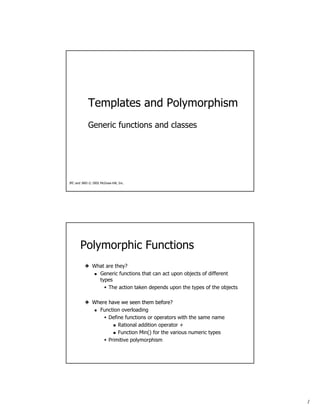
Templates and Polymorphism
Generic functions and classes
JPC and JWD © 2002 McGraw-Hill, Inc.
Polymorphic Functions
What are they?
Generic functions that can act upon objects of different
types
The action taken depends upon the types of the objects
Where have we seen them beforeWhere have we seen them before?
Function overloading
Define functions or operators with the same name
Rational addition operator +
Function Min() for the various numeric types
Primitive polymorphism
2
Polymorphic Functions
Templates
Generate a function or class at compile time
Where have we seen them before?
Templates
Generate a function or class at compile time
Where have we seen them before?
Standard Template Library
Vector and other container classes
Templates
Generate a function or class at compile time
Where have we seen them before?
Standard Template Library
Vector and other container classes
True polymorphism
Choice of which function to execute is made during run time
C++ uses virtual functions
Templates
Generate a function or class at compile time
Function Templates
Current scenario
We rewrite functions Min(), Max(), and InsertionSort() for
many different types
There has to be a better way
Function template
Describes a function format that when instantiated with
particulars generates a function definition
Write once, use multiple times
3
An Example Function Template
template <class T>
T Min(const T &a, const T &b) {
if (a < b)
return a;
else
return b;
}
Indicates a template is being defined
Indicates T is our formal template
parameter
Instantiated functions
will return a value
whose type is the
actual template
parameter
Instantiated functions
require two actual
parameters of the
same type. Their
type will be the
actual value for T
Min Template
Code segment
int Input1 = PromptAndRead();
int Input2 = PromptAndRead();
cout << Min(Input1, Input2) << endl;
Causes the following function to be generated from our
template
int Min(const int &a, const int &b) {
if (a < b)
return a;
else
return b;
}
4
Min Template
Code segment
double Value1 = 4.30;
double Value2 = 19.54;
cout << Min(Value1, Value2) << endl;
Causes the following function to be generated from our
template
double Min(const double &a, const double &b) {
if (a < b)
return a;
else
return b;
}
Min Template
Code segment
Rational r(6,21);
Rational s(11,29);
cout << Min(r, s) << endl;
Causes the following function to be generated from our template
Rational Min(const Rational &a, const Rational &b){
if (a < b)
return a;
else
return b;
}
Operator < needs to be defined for
for the actual template parameter
type. If < is not defined, then a
compile-time error occurs
5
Function Templates Facts
Location in program files
In current compilers
Template definitions are part of header files
Possible template instantiation failure scenario
cout << min(7, 3.14); // different parameter
// types
Generic Sorting
template <class T>
void InsertionSort(T A[], int n) {
for (int i = 1; i < n; ++i) {
if (A[i] < A[i-1]) {
T val = A[i];
int j = i;
do { A[j] = A[j-1];
--j;
} while ((j > 0) && (val < A[j-1]));
A[j] = val;
}
}
}
6
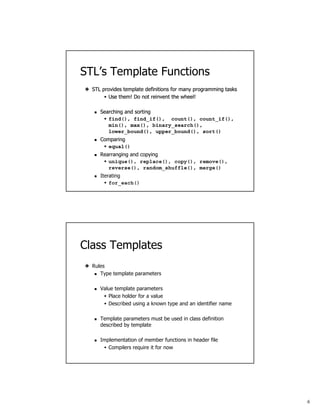
STL’s Template Functions
STL provides template definitions for many programming tasks
Use them! Do not reinvent the wheel!
STL provides template definitions for many programming tasks
Use them! Do not reinvent the wheel!
Searching and sorting
find(), find_if(), count(), count_if(),
min(), max(), binary_search(),
lower_bound(), upper_bound(), sort()
STL provides template definitions for many programming tasks
Use them! Do not reinvent the wheel!
Searching and sorting
find(), find_if(), count(), count_if(),
min(), max(), binary_search(),
lower_bound(), upper_bound(), sort()
Comparing
equal()
STL provides template definitions for many programming tasks
Use them! Do not reinvent the wheel!
Searching and sorting
find(), find_if(), count(), count_if(),
min(), max(), binary_search(),
lower_bound(), upper_bound(), sort()
Comparing
equal()
Rearranging and copying
unique(), replace(), copy(), remove(),
reverse(), random_shuffle(), merge()
STL provides template definitions for many programming tasks
Use them! Do not reinvent the wheel!
Searching and sorting
find(), find_if(), count(), count_if(),
min(), max(), binary_search(),
lower_bound(), upper_bound(), sort()
Comparing
equal()
Rearranging and copying
unique(), replace(), copy(), remove(),
reverse(), random_shuffle(), merge()
Iterating
for_each()
Class Templates
Rules
Type template parameters
Value template parameters
Place holder for a value
Described using a known type and an identifier name
Template parameters must be used in class definition
described by template
Implementation of member functions in header file
Compilers require it for now
7
A Generic Array Representation
We will develop a class Array
Template version of IntList
Provides additional insight into container classes of STL
Homegrown Generic Arrays
Array<int> A(5, 0); // A is five 0's
const Array<int> B(6, 1); // B is six 1's
Array<Rational> C; // C is ten 0/1's
A = B;
A[5] = 3;
A[B[1]] = 2;
cout << "A = " << A << endl; // [ 1 2 1 1 1 3
]
cout << "B = " << B << endl; // [ 1 1 1 1 1 1
]
cout << "C = " << D << endl;
// [ 0/1 0/1 0/1 0/1 0/1 0/1 0/1 0/1 0/1 0/1
]
8
template <class T>
class Array {
public:
Array(int n = 10, const T &val = T());
Array(const T A[], int n);
Array(const Array<T> &A);
~Array();
int size() const {
return NumberValues;
}
Array<T> & operator=(const Array<T> &A);
const T& operator[](int i) const;
T& operator[](int i);
private:
int NumberValues;
T *Values;
};
Optional value is default constructed
Inlined function
Auxiliary Operators
template <class T>
ostream& operator<<
(ostream &sout, const Array<T> &A);
template <class T>
istream& operator>>
(istream &sin, Array<T> &A);
9
Default Constructor
template <class T>
Array<T>::Array(int n, const T &val) {
assert(n > 0);
NumberValues = n;
Values = new T [n];
assert(Values);
for (int i = 0; i < n’ ++ i) {
Values[i] = A[i];
}
}
Copy Constructor
template <class T>
Array<T>::Array(const Array<T> &A) {
NumberValues = A.size();
Values = new T [A.size()];
assert(Values);
for (int i = 0; i < A.size(); ++i) {
Values[i] = A[i];
}
}
10
Destructor
template <class T>
Array<T>::~Array() {
delete [] Values;
}
Member Assignment
template <class T>
Array<T>& Array<T>::operator=(const Array<T> &A) {
if ( this != &A ) {
if (size() != A.size()) {
delete [] Values;
NumberValues = A.size();
Values = new T [A.size()];
assert(Values);
}
for (int i = 0; i < A.size(); ++i) {
Values[i] = A[i];
}
}
return *this;
}
11
Inspector for Constant Arrays
template <class T>
const T& Array<T>::operator[](int i) const {
assert((i >= 0) && (i < size()));
return Values[i];
}
Nonconstant Inspector/Mutator
template <class T>
T& Array<T>::operator[](int i) {
assert((i >= 0) && (i < size()));
return Values[i];
}
12
Generic Array Insertion Operator
template <class T>
ostream& operator<<(ostream &sout,
const Array<T> &A){
sout << "[ ";
for (int i = 0; i < A.size(); ++i) {
sout << A[i] << " ";
}
sout << "]";
return sout;
}
Can be instantiated for whatever type of Array we need
Specific Array Insertion Operator
Suppose we want a different Array insertion operator for
Array<char> objects
ostream& operator<<(ostream &sout,
const Array<char> &A){
for (int i = 0; i < A.size(); ++i) {
sout << A[i];
}
return sout;
}
13
Scenario
Manipulate list of heterogeneous objects with common base class
Example: a list of graphical shapes to be drawn
// what we would like
for (int i = 0; i < n; ++i) {
A[i].Draw();
}
Manipulate list of heterogeneous objects with common base class
Example: a list of graphical shapes to be drawn
// what we would like
for (int i = 0; i < n; ++i) {
A[i].Draw();
}
Need
Draw() to be a virtual function
Placeholder in the Shape class with specialized
definitions in the derived class
In C++ we can come close
Virtual Functions
For virtual functions
It is the type of object to which the pointer refers that
determines which function is invoked
TriangleShape T(W, P, Red, 1);
RectangleShape R(W,P, Yellow, 3, 2);
CircleShape C(W, P, Yellow, 4);
Shape *A[3] = {&T, &R, &C};
for (int i = 0; i < 3; ++i) {
A[i]->Draw();
} When i is 0, a TriangleShape’s
Draw() is used
14
Virtual Functions
For virtual functions
It is the type of object to which the pointer refers that
determines which function is invoked
TriangleShape T(W, P, Red, 1);
RectangleShape R(W,P, Yellow, 3, 2);
CircleShape C(W, P, Yellow, 4);
Shape *A[3] = {&T, &R, &C};
for (int i = 0; i < 3; ++i) {
A[i]->Draw();
} When i is 1, a RectangleShape’s
Draw() is used
Virtual Functions
For virtual functions
It is the type of object to which the pointer refers that
determines which function is invoked
TriangleShape T(W, P, Red, 1);
RectangleShape R(W,P, Yellow, 3, 2);
CircleShape C(W, P, Yellow, 4);
Shape *A[3] = {&T, &R, &C};
for (int i = 0; i < 3; ++i) {
A[i]->Draw();
} When i is 2, a CircleShape’s
Draw() is used
15
A Shape Class with a Virtual Draw
class Shape : public WindowObject {
public:
Shape(SimpleWindow &w, const Position &p,
const color c = Red);
color GetColor() const;
void SetColor(const color c);
virtual void Draw(); // virtual function!
private:
color Color;
};
Virtual Functions
Can be invoked via either a dereferenced pointer or a reference
object
Actual function to be invoked is determined from the type of
object that is stored at the memory location being accessed
Can be invoked via either a dereferenced pointer or a reference
object
Actual function to be invoked is determined from the type of
object that is stored at the memory location being accessed
Definition of the derived function overrides the definition of the
base class version
Can be invoked via either a dereferenced pointer or a reference
object
Actual function to be invoked is determined from the type of
object that is stored at the memory location being accessed
Definition of the derived function overrides the definition of the
base class version
Determination of which virtual function to use cannot always be
made at compile time
Decision is deferred by the compiler to run time
Introduces overhead
16
Pure Virtual Function
Has no implementationHas no implementation
A pure virtual function is specified in C++ by assigning the
function the null address within its class definition
Has no implementation
A pure virtual function is specified in C++ by assigning the
function the null address within its class definition
A class with a pure virtual function is an abstract base class
Convenient for defining interfaces
Base class cannot be directly instantiated
A Shape Abstract Base Class
class Shape : public WindowObject {
public:
Shape(SimpleWindow &w, const Position &p,
const color &c = Red);
color GetColor() const;
void SetColor(const color &c);
virtual void Draw() = 0; // pure virtual
// function!
private:
color Color;
};

Bw14

  • 1.
    1 Templates and Polymorphism Genericfunctions and classes JPC and JWD © 2002 McGraw-Hill, Inc. Polymorphic Functions What are they? Generic functions that can act upon objects of different types The action taken depends upon the types of the objects Where have we seen them beforeWhere have we seen them before? Function overloading Define functions or operators with the same name Rational addition operator + Function Min() for the various numeric types Primitive polymorphism
  • 2.
    2 Polymorphic Functions Templates Generate afunction or class at compile time Where have we seen them before? Templates Generate a function or class at compile time Where have we seen them before? Standard Template Library Vector and other container classes Templates Generate a function or class at compile time Where have we seen them before? Standard Template Library Vector and other container classes True polymorphism Choice of which function to execute is made during run time C++ uses virtual functions Templates Generate a function or class at compile time Function Templates Current scenario We rewrite functions Min(), Max(), and InsertionSort() for many different types There has to be a better way Function template Describes a function format that when instantiated with particulars generates a function definition Write once, use multiple times
  • 3.
    3 An Example FunctionTemplate template <class T> T Min(const T &a, const T &b) { if (a < b) return a; else return b; } Indicates a template is being defined Indicates T is our formal template parameter Instantiated functions will return a value whose type is the actual template parameter Instantiated functions require two actual parameters of the same type. Their type will be the actual value for T Min Template Code segment int Input1 = PromptAndRead(); int Input2 = PromptAndRead(); cout << Min(Input1, Input2) << endl; Causes the following function to be generated from our template int Min(const int &a, const int &b) { if (a < b) return a; else return b; }
  • 4.
    4 Min Template Code segment doubleValue1 = 4.30; double Value2 = 19.54; cout << Min(Value1, Value2) << endl; Causes the following function to be generated from our template double Min(const double &a, const double &b) { if (a < b) return a; else return b; } Min Template Code segment Rational r(6,21); Rational s(11,29); cout << Min(r, s) << endl; Causes the following function to be generated from our template Rational Min(const Rational &a, const Rational &b){ if (a < b) return a; else return b; } Operator < needs to be defined for for the actual template parameter type. If < is not defined, then a compile-time error occurs
  • 5.
    5 Function Templates Facts Locationin program files In current compilers Template definitions are part of header files Possible template instantiation failure scenario cout << min(7, 3.14); // different parameter // types Generic Sorting template <class T> void InsertionSort(T A[], int n) { for (int i = 1; i < n; ++i) { if (A[i] < A[i-1]) { T val = A[i]; int j = i; do { A[j] = A[j-1]; --j; } while ((j > 0) && (val < A[j-1])); A[j] = val; } } }
  • 6.
    6 STL’s Template Functions STLprovides template definitions for many programming tasks Use them! Do not reinvent the wheel! STL provides template definitions for many programming tasks Use them! Do not reinvent the wheel! Searching and sorting find(), find_if(), count(), count_if(), min(), max(), binary_search(), lower_bound(), upper_bound(), sort() STL provides template definitions for many programming tasks Use them! Do not reinvent the wheel! Searching and sorting find(), find_if(), count(), count_if(), min(), max(), binary_search(), lower_bound(), upper_bound(), sort() Comparing equal() STL provides template definitions for many programming tasks Use them! Do not reinvent the wheel! Searching and sorting find(), find_if(), count(), count_if(), min(), max(), binary_search(), lower_bound(), upper_bound(), sort() Comparing equal() Rearranging and copying unique(), replace(), copy(), remove(), reverse(), random_shuffle(), merge() STL provides template definitions for many programming tasks Use them! Do not reinvent the wheel! Searching and sorting find(), find_if(), count(), count_if(), min(), max(), binary_search(), lower_bound(), upper_bound(), sort() Comparing equal() Rearranging and copying unique(), replace(), copy(), remove(), reverse(), random_shuffle(), merge() Iterating for_each() Class Templates Rules Type template parameters Value template parameters Place holder for a value Described using a known type and an identifier name Template parameters must be used in class definition described by template Implementation of member functions in header file Compilers require it for now
  • 7.
    7 A Generic ArrayRepresentation We will develop a class Array Template version of IntList Provides additional insight into container classes of STL Homegrown Generic Arrays Array<int> A(5, 0); // A is five 0's const Array<int> B(6, 1); // B is six 1's Array<Rational> C; // C is ten 0/1's A = B; A[5] = 3; A[B[1]] = 2; cout << "A = " << A << endl; // [ 1 2 1 1 1 3 ] cout << "B = " << B << endl; // [ 1 1 1 1 1 1 ] cout << "C = " << D << endl; // [ 0/1 0/1 0/1 0/1 0/1 0/1 0/1 0/1 0/1 0/1 ]
  • 8.
    8 template <class T> classArray { public: Array(int n = 10, const T &val = T()); Array(const T A[], int n); Array(const Array<T> &A); ~Array(); int size() const { return NumberValues; } Array<T> & operator=(const Array<T> &A); const T& operator[](int i) const; T& operator[](int i); private: int NumberValues; T *Values; }; Optional value is default constructed Inlined function Auxiliary Operators template <class T> ostream& operator<< (ostream &sout, const Array<T> &A); template <class T> istream& operator>> (istream &sin, Array<T> &A);
  • 9.
    9 Default Constructor template <classT> Array<T>::Array(int n, const T &val) { assert(n > 0); NumberValues = n; Values = new T [n]; assert(Values); for (int i = 0; i < n’ ++ i) { Values[i] = A[i]; } } Copy Constructor template <class T> Array<T>::Array(const Array<T> &A) { NumberValues = A.size(); Values = new T [A.size()]; assert(Values); for (int i = 0; i < A.size(); ++i) { Values[i] = A[i]; } }
  • 10.
    10 Destructor template <class T> Array<T>::~Array(){ delete [] Values; } Member Assignment template <class T> Array<T>& Array<T>::operator=(const Array<T> &A) { if ( this != &A ) { if (size() != A.size()) { delete [] Values; NumberValues = A.size(); Values = new T [A.size()]; assert(Values); } for (int i = 0; i < A.size(); ++i) { Values[i] = A[i]; } } return *this; }
  • 11.
    11 Inspector for ConstantArrays template <class T> const T& Array<T>::operator[](int i) const { assert((i >= 0) && (i < size())); return Values[i]; } Nonconstant Inspector/Mutator template <class T> T& Array<T>::operator[](int i) { assert((i >= 0) && (i < size())); return Values[i]; }
  • 12.
    12 Generic Array InsertionOperator template <class T> ostream& operator<<(ostream &sout, const Array<T> &A){ sout << "[ "; for (int i = 0; i < A.size(); ++i) { sout << A[i] << " "; } sout << "]"; return sout; } Can be instantiated for whatever type of Array we need Specific Array Insertion Operator Suppose we want a different Array insertion operator for Array<char> objects ostream& operator<<(ostream &sout, const Array<char> &A){ for (int i = 0; i < A.size(); ++i) { sout << A[i]; } return sout; }
  • 13.
    13 Scenario Manipulate list ofheterogeneous objects with common base class Example: a list of graphical shapes to be drawn // what we would like for (int i = 0; i < n; ++i) { A[i].Draw(); } Manipulate list of heterogeneous objects with common base class Example: a list of graphical shapes to be drawn // what we would like for (int i = 0; i < n; ++i) { A[i].Draw(); } Need Draw() to be a virtual function Placeholder in the Shape class with specialized definitions in the derived class In C++ we can come close Virtual Functions For virtual functions It is the type of object to which the pointer refers that determines which function is invoked TriangleShape T(W, P, Red, 1); RectangleShape R(W,P, Yellow, 3, 2); CircleShape C(W, P, Yellow, 4); Shape *A[3] = {&T, &R, &C}; for (int i = 0; i < 3; ++i) { A[i]->Draw(); } When i is 0, a TriangleShape’s Draw() is used
  • 14.
    14 Virtual Functions For virtualfunctions It is the type of object to which the pointer refers that determines which function is invoked TriangleShape T(W, P, Red, 1); RectangleShape R(W,P, Yellow, 3, 2); CircleShape C(W, P, Yellow, 4); Shape *A[3] = {&T, &R, &C}; for (int i = 0; i < 3; ++i) { A[i]->Draw(); } When i is 1, a RectangleShape’s Draw() is used Virtual Functions For virtual functions It is the type of object to which the pointer refers that determines which function is invoked TriangleShape T(W, P, Red, 1); RectangleShape R(W,P, Yellow, 3, 2); CircleShape C(W, P, Yellow, 4); Shape *A[3] = {&T, &R, &C}; for (int i = 0; i < 3; ++i) { A[i]->Draw(); } When i is 2, a CircleShape’s Draw() is used
  • 15.
    15 A Shape Classwith a Virtual Draw class Shape : public WindowObject { public: Shape(SimpleWindow &w, const Position &p, const color c = Red); color GetColor() const; void SetColor(const color c); virtual void Draw(); // virtual function! private: color Color; }; Virtual Functions Can be invoked via either a dereferenced pointer or a reference object Actual function to be invoked is determined from the type of object that is stored at the memory location being accessed Can be invoked via either a dereferenced pointer or a reference object Actual function to be invoked is determined from the type of object that is stored at the memory location being accessed Definition of the derived function overrides the definition of the base class version Can be invoked via either a dereferenced pointer or a reference object Actual function to be invoked is determined from the type of object that is stored at the memory location being accessed Definition of the derived function overrides the definition of the base class version Determination of which virtual function to use cannot always be made at compile time Decision is deferred by the compiler to run time Introduces overhead
  • 16.
    16 Pure Virtual Function Hasno implementationHas no implementation A pure virtual function is specified in C++ by assigning the function the null address within its class definition Has no implementation A pure virtual function is specified in C++ by assigning the function the null address within its class definition A class with a pure virtual function is an abstract base class Convenient for defining interfaces Base class cannot be directly instantiated A Shape Abstract Base Class class Shape : public WindowObject { public: Shape(SimpleWindow &w, const Position &p, const color &c = Red); color GetColor() const; void SetColor(const color &c); virtual void Draw() = 0; // pure virtual // function! private: color Color; };