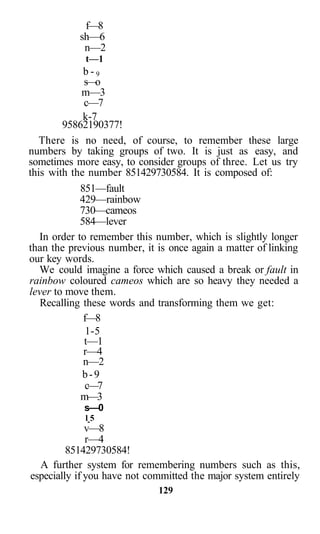
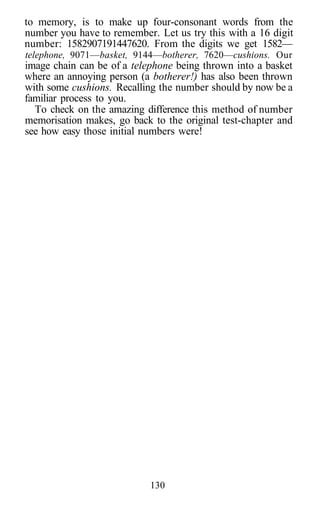
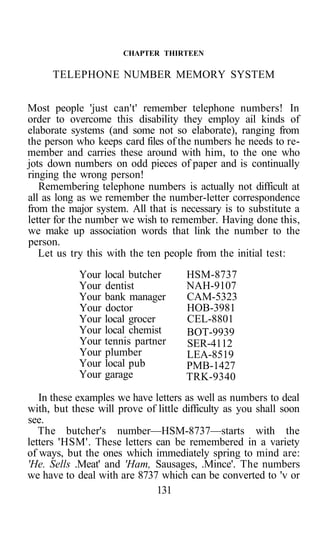
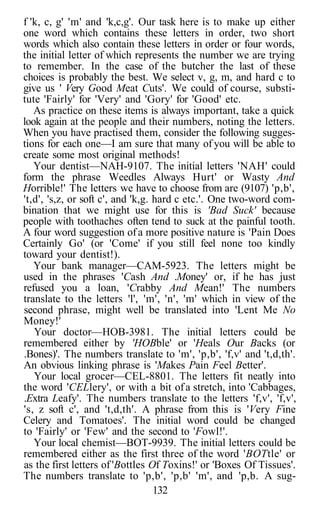
Can you remember names, faces,
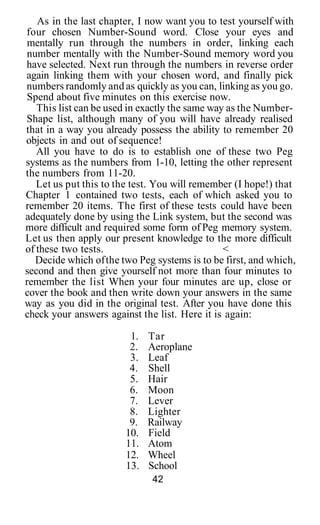
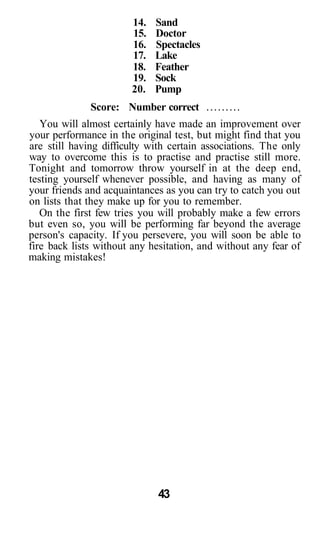
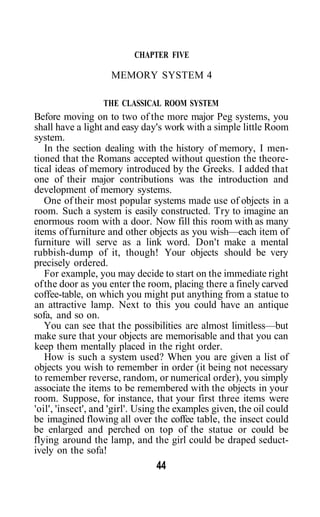
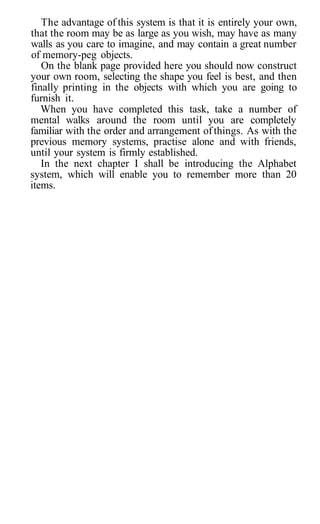
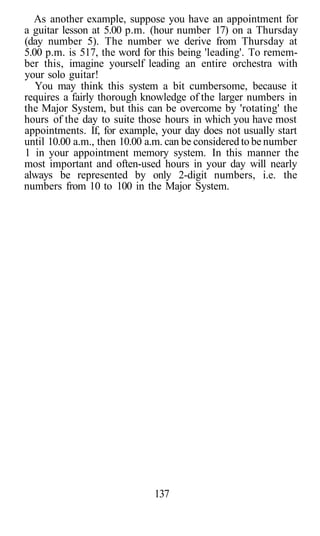
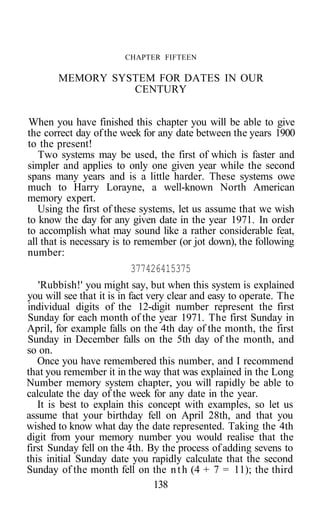
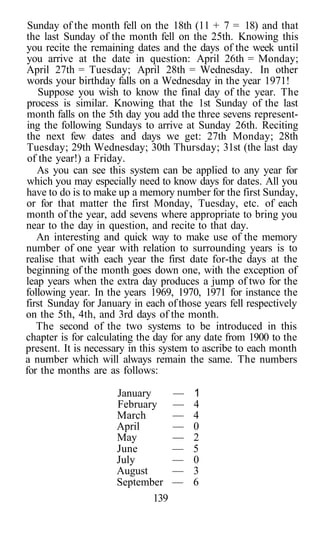
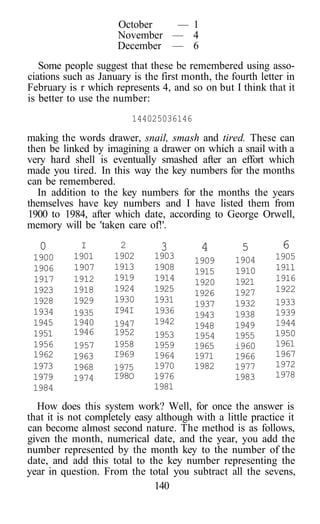
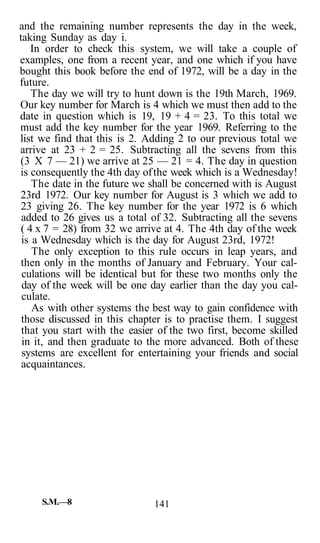
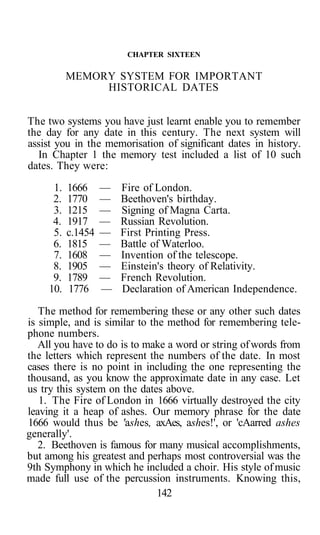
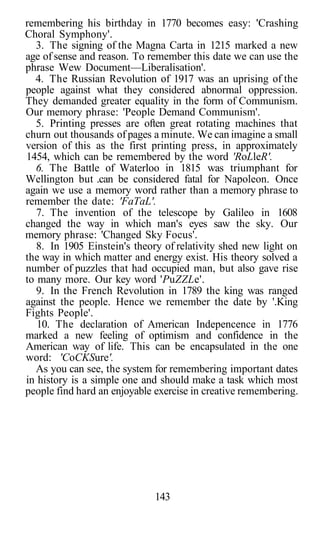
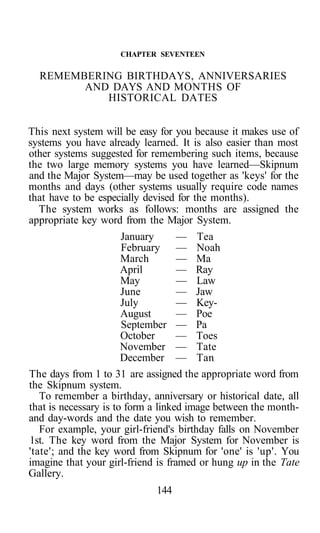
       lists, numbers, speeches, dates,
               examination data ?
    Speed Memory is a comprehensive
 memory training course based on recent
 research. As you work through the book,
   you graduate from simple methods to
highly advanced systems - increasing your
        memory power all the time.
These techniques to improve your memory
  form the basis of the new BBC television
 programme Use Your Head, devised and
         presented by the author.


               CRAFTS & HOBBIES
                  0 7221 2118 0

 UNITED
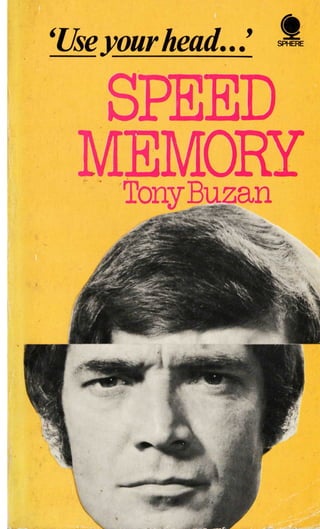
SPEED MEMORY
Tony Buzan

Can you remember names, faces, lists, speeches,
dates, numbers, examination data?

SPEED MEMORY is a comprehensive memory
training course based on recent research. As you
work through the book, you graduate from
simple methods to highly advanced systems-and
increase your memory power as you go!

There are special sections on subjects such as
learning foreign languages, memorizing poems
and dramatic parts, and remembering for
examinations.

Tony Buzan is an expert in the field of reading
techniques and memory systems. He has
developed a memory training course which has
been widely used in schools and colleges, and in
the Houses of Parliament. He is also the author
of SPEED READING.
Also by Tony Buzan and available
in Sphere Books
SPEED READING


My special thanks are due to Heinz Norden for his permission
to use the Skipnum Memory System and for his extensive help
morally and editorially, and to my personal assistant, Joy
Buttery, for her encouragement and perseverance.
Speed Memory
TONY BUZAN


i
SPHERE BOOKS LIMITED
30/32 Gray's Inn Road, London, WCIX 8JL
First published in Great Britain in 1971 by Sphere Books
© Tony Buzan 1971


TRADE
MARK


Conditions of Sale - This book shall not without
the written consent of the Publishers first given
be lent, re-sold, hired out or otherwise disposed of
by way of trade in any form of binding or cover
other than that in which it is published.
The book is published at a net price and is supplied
subject to the Publishers Association Standard
Conditions of Sale registered under the Restrictive
Trade Practices Act, 1956.
Set in Monotype Plantin
Printed in Great Britain by
Hazell Watson & Viney Ltd
Aylesbury, Bucks
FOREWORD

Once again my gifted young friend—and if I may say so with
pride, protégé—Tony Buzan has asked me to give one of his
eminently useful books a send-off.
     In a lop-sided kind of comparison, if you already have a
good memory, training is not needed, and if you do not—well,
how useful really is training?
     I can answer this conundrum by suggesting that memory
exists only in the use of it. It may not be true that everyone has a
good memory to begin with, although I should like to think so;
but it is certainly true that many people simply do not use the
memory they have.
     It has always seemed to me that memory systems tend to be
cumbersome, even though, as you will see, I have developed
one of my own. They are like crutches, when one ought to
walk unaided. How much simpler to remember the thing
directly rather than to have to remember a way of remembering
It!
     A fine way to send off a book on memory training, you may
say—but let me add quickly that to my mind the real value of
memory training and a book such as Tony Buzan's is that it is,
or should be, self-liquidating, so to speak. No doubt memory
can be trained, like an unused muscle, on a dumbbell, but in the
end the dumbbell is thrown away and the muscle goes to work
on the job to be done rather than on a training aid.
     Could you remember something—let us assume you have
a 'bad memory'—if you had to? James Bond lay dying. 'The
formula,' he whispers, ' . . . can say it only o n c e . . . . Your
life depends on i t . . . . The world will go smash if you don't.
. . . ' Would you remember? I think you would.
     This attention set seems to me all-important in remember-
ing. Let me give you a small example. Someone gives you his
telephone number over the telephone. Almost invariably nine
persons out of ten will say: 'Would you mind repeating that?'
Why? He said it perfectly clearly the first time. All you had to
                                   5
do was to press the switch marked 'attention set' rather than
leaving the one on that says 'Oh, I'll get it on the second or
third try'. A matter of habit. Of course, I happen to be one of
those lucky people who can repeat the number out loud, and
then actually 'hear it' for a long time, simply by listening. Try
it some time.
   One more thing. Memory is not just a quantitative faculty.
Its potential capacity is probably astronomical, but I suspect it
is not unlimited, although few of us are in danger of getting
even near the limit. Yet I do know two men, each of whom
speaks—and speaks fluently, idiomatically—more than a
dozen languages, and, sad to relate, neither of them has any-
thing of importance to say in any of them! Don't try to turn
yourself into an 'idiot savant'.
   I long ago gave up making a vast parking lot of facts and
figures of my mind. It's enjoyable enough to dazzle people with
displays of esoteric knowledge (I have sometimes described
knowledge as 'the opium of the intelligent'), but what is the
point, really? Do you want to be a walking almanac? It's no
great hardship to carry a small book of telephone numbers, or
to keep an encyclopaedia on your shelves.
   Today I try to use my memory for storing up relationships,
how things hang together, insight. I see the great function and
aim of mind, with its marvellous tool, memory, as integration,
or, if you will forgive the grandiloquent term, wisdom. Tony
Buzan's book Speed Memory is an excellent 'first step' toward
the realisation of that goal.
                                          HEINZ NORDEN.


                               6
TABLE OF CONTENTS

   FOREWORD                             5

   INTRODUCTION                         9

   THE HISTORY OF MEMORY               11

 1. MEMORY TEST                        18

2. MEMORY SYSTEM 1                     27
3. MEMORY SYSTEM 2                     34
4. MEMORY SYSTEM 3                     40
5. MEMORY SYSTEM 4                     44
6. MEMORY SYSTEM 5                     47
7. SMALL MEMORY SYSTEM REVIEW AND
    EXTENSION                          52
8. MEMORY SYSTEM 6                     53
9. MEMORY SYSTEM FOR NAMES AND FACES 59
10. THE MAJOR SYSTEM                   81
11. CARD MEMORY SYSTEM                124
12. LONG NUMBER MEMORY SYSTEM         128
13. TELEPHONE NUMBER MEMORY SYSTEM    131
14. MEMORY SYSTEM FOR SCHEDULES AND
     APPOINTMENTS                     135
                    7
15. MEMORY SYSTEM FOR DATES IN OUR
     CENTURY                             138
16. MEMORY SYSTEM FOR IMPORTANT
     HISTORICAL DATES                    142
17. REMEMBERING BIRTHDAYS, ANNIVERSARIES
     AND DAYS AND MONTHS OF
     HISTORICAL DATES                 144

18. MEMORY SYSTEM FOR SPEECHES, JOKES,
     NARRATIVES, DRAMATIC PARTS AND
     POEMS, ARTICLES                     146

19. MEMORY SYSTEMS FOR LANGUAGES         151

20. REMEMBERING FOR EXAMINATIONS         154
21. REMEMBER TO REMEMBER!                157


                    8
INTRODUCTION


  Speed Memory will enable you to remember lists of objects
 not only in order, but also in reverse and random order; to
 remember names and faces, as well as facts associated with
 them; to remember speeches, scripts, articles, jokes and
 narratives; to remember dates, prices, numbers (including
 telephone numbers!) and anniversaries; and to remember far
 more readily languages and information relevant to examina-
 tions. You will also be able to perform 'memory feats' with
* number games and cards.
    The course was compiled over a number of years, taking
 Into consideration the latest educational and psychological
 theories as well as a wide range of material concerned with
 memory systems.
    As a result Speed Memory will give you as wide an introduc-
 tion to the art of memory training as do the much-publicised
 memory training courses advertised in the national press. The
 course will enable you also to see how the 'Super-Brain'
 memory experts perform their amazing feats, while at the same
 time enabling you to perform with the same competence! In
 other words, anyone who approaches this book seriously can
 himself become, in the popular sense of the term, a mental
 wizard!
    It is a number of years since the widespread publicity sur-
 rounding Pelmanism made the art of memory training well-
 known. But it has taken all this time for the various systems to
 be completely developed, and for new and exciting systems to
 be introduced.
    Speed Memory brings the reader to this exciting point in
 time.
    The book is programmed to make the learning of the various
 systems especially easy. The first section introduces the history
 of memory and the development of ideas and practices sur-
rounding it, thus providing a context for subsequent learning.
The next few chapters introduce simple Link and Peg systems,
                                9
enabling you to exercise your growing capacities on progress-
ively more difficult material and advanced concepts. Among
these systems is an entirely new and original system, Skipnum,
recently developed by my close friend, Heinz Norden, the well-
known polymath.
  After these basic systems have been introduced an important
chapter is devoted to the memorisation of names and faces, as
well as facts relating to them.
   This is followed by the introduction of the Major System, a
highly developed mnemonic system that serves not only as an
almost infinite Peg system (1,000 Peg words are included in
this chapter!), but also a system that may be applied to the
memorisation of numbers in their various forms.
   The remainder of the book is devoted in part to these
numerical memorisations (dates, prices, telephone numbers,
anniversaries and birthdays, etc.) and in part to the more
general application of memory systems to remembering
speeches, scripts, jokes, articles, narratives, languages, appoint-
ments and schedules.
  In conclusion, special examination techniques are discussed
and general advice is given.


                                10
THE HISTORY OF MEMORY


From the time when man first began to depend on his mind for
coping with the environment, the possession of an excellent
memory has placed individuals in positions of both command
and respect. The amazing feats in remembering accomplished
by particular people were so impressive that they have become
legendary!
 The Greeks
   It is difficult to say exactly when and where the first inte-
grated ideas on memory arose. It is reasonable to state, how-
ever, that the first sophisticated concepts can be attributed to
the Greeks some 600 years before the birth of Christ.
   As we look back on them now, these 'sophisticated' ideas
were surprisingly naive, especially since some of the men
proposing them are numbered among the greatest thinkers the
world has ever known!
   In the 6th century B.C., Parmenides thought of memory as
being a mixture of light and dark or heat and cold! He thought
that as long as any given mixture remained unstirred, the
memory would be perfect. As soon as the mixture was altered,
forgetting occurred.
   In the 5th century B.C. Diogenes of Appollonia advanced a
different theory. He suggested that memory was a process
which consisted of events producing an equal distribution of.
air in the body. Like Parmenides he thought that when this
equilibrium was disturbed forgetting would occur.
   Not surprisingly, the first person to introduce a really major
idea in the field of memory was Plato, in the 4th century B.C.
His theory is known as the Wax Tablet Hypothesis and is still
accepted by some people today, although there is growing
disagreement. To Plato the mind accepted impressions in the
same way that wax becomes marked when a pointed object is
moved around on its surface. Once the impression had been
made Plato assumed it remained until, with time, it wore away,
                              11
leaving a smooth surface once more. This smooth surface was,
  of course, what Plato considered to be complete forgetting—the
  opposite aspects of the same process. As will become clear later,
  many people now feel that they are actually two quite different
 processes.
     Shortly after Plato, Zeno the Stoic slightly modified Plato's
  ideas, suggesting that sensations actually 'wrote' impressions
 on the wax tablet. When Zeno referred to the mind and its
 memory he, like the Greeks before him, did not place it in any
 particular organ or section of the body. To him and to the
 Greeks 'mind' was a loose and very unclear concept.
     The first man to introduce a more scientific terminology
 was Aristotle, in the late 4th century B.C. He maintained that
 the language previously used was not adequate to explain the
 physical aspects of memory. In applying his new language
 Aristotle attributed to the heart most of the functions that we
 properly attribute to the brain. Part of the heart's function, he
 realised, was concerned with the blood, and he felt that
 memory was based on the blood's movements. He thought
 forgetting to be the result of a gradual slowing down of these
 movements.
     Aristotle made another important contribution to sub-
 sequent thinking on the subject of memory when he introduced
his laws of the association of ideas. The concept of association
of ideas and images is now generally thought to be of major
importance to memory. Throughout Speed Memory this con-
cept will be discussed, developed and applied.
    In the 3rd century B.C. Herophilus introduced to the discus-
sion 'vital' and 'animal' spirits. He considered the higher order
vital spirits to be located in the heart. These higher order
spirits produced the lower order animal spirits, which included
the memory, the brain, and the nervous system. All of these he
thought to be secondary in importance to the heart!
    It is interesting to note that one reason advanced by Hero-
philus for man's superiority over animals was the large number
of creases in man's brain. (these creases are now known as
convolutions of the cortex). Despite the fact of his observation,
Herophilus offered no reason for his conclusion. It was not until
the 19th century, over 2,000 years later, that the real import-
ance of the cortex was discovered.
    In summary, the Greeks made the following significant
contribution: they were the first to seek a physical as opposed
                               12
to a spiritual basis for memory; they developed scientific con-
cepts and a language structure that helped the development of
these concepts; and they contributed the Wax Tablet hypo-
thesis which suggested that memory and forgetting were
opposite aspects of the same process.
The Romans
    Surprisingly, the contributions of the Romans were minimal.
The major thinkers of their time, including Cicero in the 1st
century B.C. and Quintilian in the 1st century A.D., accepted
without question the Wax Tablet concept of memory, and did
little further work.
   Their major contribution was in the development of memory
systems. It was they who first introduced the idea of a Link
system and a Room system, both of which will be described in
later chapters.
 The Influence of the Christian Church
   The next major contributor to the progress of ideas on
memory was the great physician Galen in the 2nd century A.D.
He located and delineated various anatomical and physiological
structures, as well as further investigating the function and
structure of the nervous system.
   Like the later Greeks, he assumed that memory and mental
processes were part of the lower order of animal spirits. These
spirits he thought were manufactured in the sides of the brain,
and it was consequently here that memory was seated.
   Galen thought that air was sucked into the brain, mixing
with the vital spirits. This mixture produced animal spirits
which were pushed down through the nervous system, enabl-
ing us to feel and taste, etc.
   Galen's ideas on memory were rapidly accepted and con-
doned by the Church which at this time was beginning to exert
a great influence. His ideas became doctrine, and on that
account little progress was made in the field for 1,500 years.
This mental suppression stifled some of the greatest minds
that philosophy and science has produced!
   St. Augustine in the 4th century A.D. accepted the Church's
ideas, considering memory to be a function of the soul, which
had a physical seat in the brain. He never expanded on the
anatomical aspects of his ideas.
   From the time of St. Augustine until the 17th century there
                              13
were virtually no significant developments in ideas on memory,
and even in the 17th century new ideas were restricted by
doctrine.
   Even such great a thinker as Descartes accepted Galen's
basic ideas, although he thought that animal spirits were sent
from the pineal gland on special courses through the brain
until they came to the part where memory could be triggered.
The more clear-cut these courses, the more readily, he
thought, would they open when animal spirits travelled
through them. It was in this way that he explained the improve-
ment of memory and the development of what are known as
'memory traces'. A memory trace is a physical change in the
nervous system that was not present before learning. The trace
enables us to recall.
   Another great philosopher, who 'went along with the tide'
was Thomas Hobbes, who discussed and considered the idea of
memory but contributed little to what had been said before. He
agreed with Aristotle's ideas, rejecting non-physical explana-
tions of memory. He did not, however, specify the real nature
of memory, nor did he make any significant attempts to locate
it accurately.
   In summary, it is evident from the theories of the 16th
century intellectuals that the influence of Galen and the
Church had been profound. Almost without exception these
great thinkers uncritically accepted primitive ideas on memory.
 Transitional Period—The 18th Century
   One of the first thinkers to be influenced by the new surge of
science and by the ideas of Newton was Hartley, who developed
the vibratory theory of memory. Applying Newton's ideas on
vibrating particles, Hartley suggested that there were memory
vibrations in the brain which began before birth. New sensa-
tions modified existing vibrations in degree, kind, place and
direction. After influence by a new sensation, vibrations
quickly returned to their natural state. But if the same sensa-
tion appeared again the vibrations took a little longer to return.
This progression would finally result in the vibrations remain-
ing in their 'new' state, and a memory trace was established.
   Other major thinkers of this period included Zanotti who
was the first to link electrical forces with brain functions, and
Bonnet who developed the ideas of Hartley in relation to the
flexibility of nerve fibres. The more often nerves were used, the
                               14
more easily he thought they vibrated, and the better memory
would then be.
  The theories of these men were more sophisticated than
previous ones because they had been largely influenced by
developments in related scientific fields. This interaction of
ideas laid the groundwork for some of the more modern
theories of memory in the 18th century.
 The 19th Century
   With the development of science in Germany in the 19th
century, some important developments occurred. Many of the
ideas initiated by the Greeks were overthrown, and work on
memory expanded to include the biological sciences.
   Prochaska finally and irrevocably rejected the age-old idea of
animal spirits, on the ground that it has no scientific basis and
no evidence to support it. He felt that limited existing know-
ledge made speculation on the location of memory in the
brain a waste of time. 'Spatial localisation may be possible', he
said, 'but we just do not know enough at the moment to make
it a useful idea.' It was not for some 50 years that localising the
area of memory function became a useful pursuit.
   Another major theory presented in this century was that of
Flourens, who 'located' the memory in every part of the brain!
He said that the brain acted as a whole and could not be inter-
preted as the interaction of elementary parts. His views held
the field of physiology for some time, and it is only recently
that great strides have been made in the development of our
thinking on memory.
Modern Theories
   Modern developments in memory have been aided to an
enormous degree by advances in technology and methodology.
Almost without exception psychologists and other thinkers in
this field agree that memory is located in the cerebum, which
is the large area of the brain covering the surface of the cortex.
Even today however, the exact localisation of memory areas is
proving a difficult task, as is the accurate understanding of the
function of memory itself.
   Current thought has progressed from Ebbinghaus's work
with learning and forgetting curves at the turn of the century,
to advanced and complex theories.
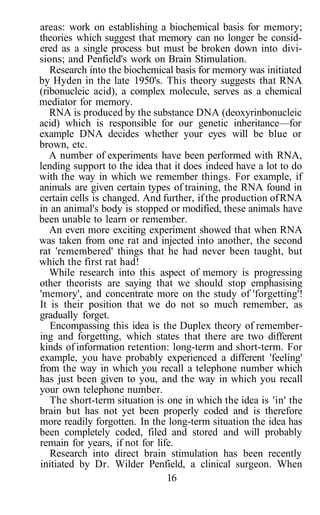
   Research and theory can be roughly divided into 3 main
                                15
areas: work on establishing a biochemical basis for memory;
theories which suggest that memory can no longer be consid-
ered as a single process but must be broken down into divi-
sions; and Penfield's work on Brain Stimulation.
   Research into the biochemical basis for memory was initiated
by Hyden in the late 1950's. This theory suggests that RNA
(ribonucleic acid), a complex molecule, serves as a chemical
mediator for memory.
   RNA is produced by the substance DNA (deoxyrinbonucleic
acid) which is responsible for our genetic inheritance—for
example DNA decides whether your eyes will be blue or
brown, etc.
   A number of experiments have been performed with RNA,
lending support to the idea that it does indeed have a lot to do
with the way in which we remember things. For example, if
animals are given certain types of training, the RNA found in
certain cells is changed. And further, if the production of RNA
in an animal's body is stopped or modified, these animals have
been unable to learn or remember.
   An even more exciting experiment showed that when RNA
was taken from one rat and injected into another, the second
rat 'remembered' things that he had never been taught, but
which the first rat had!
   While research into this aspect of memory is progressing
other theorists are saying that we should stop emphasising
'memory', and concentrate more on the study of 'forgetting'!
It is their position that we do not so much remember, as
gradually forget.
   Encompassing this idea is the Duplex theory of remember-
ing and forgetting, which states that there are two different
kinds of information retention: long-term and short-term. For
example, you have probably experienced a different 'feeling'
from the way in which you recall a telephone number which
has just been given to you, and the way in which you recall
your own telephone number.
   The short-term situation is one in which the idea is 'in' the
brain but has not yet been properly coded and is therefore
more readily forgotten. In the long-term situation the idea has
been completely coded, filed and stored and will probably
remain for years, if not for life.
   Research into direct brain stimulation has been recently
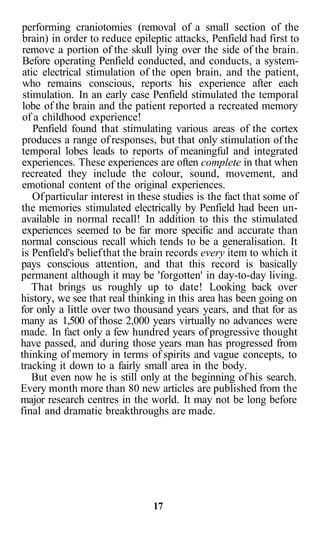
initiated by Dr. Wilder Penfield, a clinical surgeon. When
                                16
performing craniotomies (removal of a small section of the
 brain) in order to reduce epileptic attacks, Penfield had first to
 remove a portion of the skull lying over the side of the brain.
 Before operating Penfield conducted, and conducts, a system-
 atic electrical stimulation of the open brain, and the patient,
 who remains conscious, reports his experience after each
 stimulation. In an early case Penfield stimulated the temporal
 lobe of the brain and the patient reported a recreated memory
 of a childhood experience!
    Penfield found that stimulating various areas of the cortex
produces a range of responses, but that only stimulation of the
temporal lobes leads to reports of meaningful and integrated
experiences. These experiences are often complete in that when
recreated they include the colour, sound, movement, and
emotional content of the original experiences.
    Of particular interest in these studies is the fact that some of
the memories stimulated electrically by Penfield had been un-
available in normal recall! In addition to this the stimulated
experiences seemed to be far more specific and accurate than
normal conscious recall which tends to be a generalisation. It
is Penfield's belief that the brain records every item to which it
pays conscious attention, and that this record is basically
permanent although it may be 'forgotten' in day-to-day living.
    That brings us roughly up to date! Looking back over
history, we see that real thinking in this area has been going on
for only a little over two thousand years years, and that for as
many as 1,500 of those 2,000 years virtually no advances were
made. In fact only a few hundred years of progressive thought
have passed, and during those years man has progressed from
thinking of memory in terms of spirits and vague concepts, to
tracking it down to a fairly small area in the body.
    But even now he is still only at the beginning of his search.
Every month more than 80 new articles are published from the
major research centres in the world. It may not be long before
final and dramatic breakthroughs are made.


                                17
CHAPTER ONE

                      MEMORY TEST


Few people ever put their memory to the immediate test, and
it is for this reason that most are unaware of the limits and
habits of their mind's work.
   The tests that follow should not be too difficult, but because
of the way we are trained (or not trained!) in school, the simple
tasks you will presently attempt will in some cases prove very
very difficult and in others almost impossible!
   Do not worry about poor performance, since it is the purpose
of this book to make the memorisation of all items in the
following tests an easy and enjoyable exercise.
   Looking at this situation from a positive point of view, the
more difficulty you experience now, the greater will be your
improvement by the time you have completed this book!
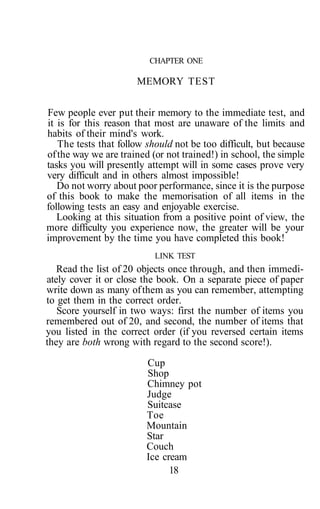
                           LINK TEST
   Read the list of 20 objects once through, and then immedi-
ately cover it or close the book. On a separate piece of paper
write down as many of them as you can remember, attempting
to get them in the correct order.
   Score yourself in two ways: first the number of items you
remembered out of 20, and second, the number of items that
you listed in the correct order (if you reversed certain items
they are both wrong with regard to the second score!).

                         Cup
                         Shop
                         Chimney pot
                         Judge
                         Suitcase
                         Toe
                         Mountain
                         Star
                         Couch
                         Ice cream
                               18
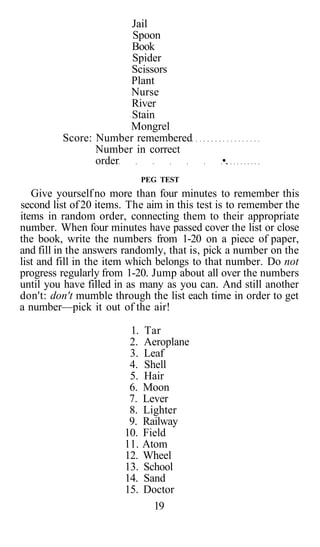
Jail
                      Spoon
                      Book
                      Spider
                      Scissors
                      Plant
                      Nurse
                      River
                      Stain
                      Mongrel
         Score: Number remembered
                Number in correct
                order                         •.
                              PEG TEST
   Give yourself no more than four minutes to remember this
second list of 20 items. The aim in this test is to remember the
items in random order, connecting them to their appropriate
number. When four minutes have passed cover the list or close
the book, write the numbers from 1-20 on a piece of paper,
and fill in the answers randomly, that is, pick a number on the
list and fill in the item which belongs to that number. Do not
progress regularly from 1-20. Jump about all over the numbers
until you have filled in as many as you can. And still another
don't: don't mumble through the list each time in order to get
a number—pick it out of the air!

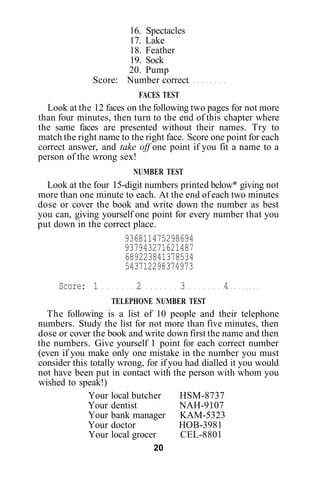
                         1.   Tar
                         2.   Aeroplane
                         3.   Leaf
                         4.   Shell
                         5.   Hair
                         6.   Moon
                         7.   Lever
                         8.   Lighter
                         9.   Railway
                        10.   Field
                        11.   Atom
                        12.   Wheel
                        13.   School
                        14.   Sand
                        15.   Doctor
                                19
16. Spectacles
                     17. Lake
                     18. Feather
                     19. Sock
                     20. Pump
              Score: Number correct
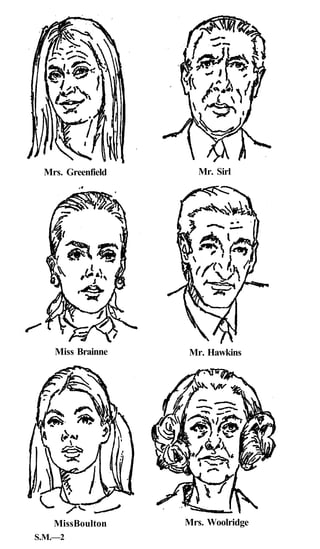
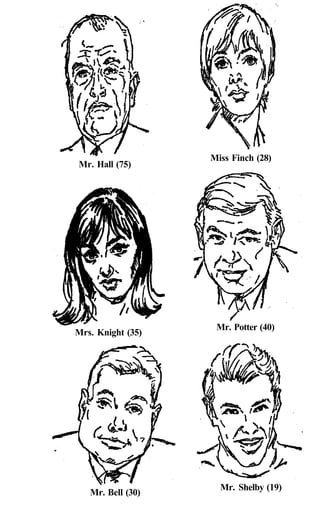
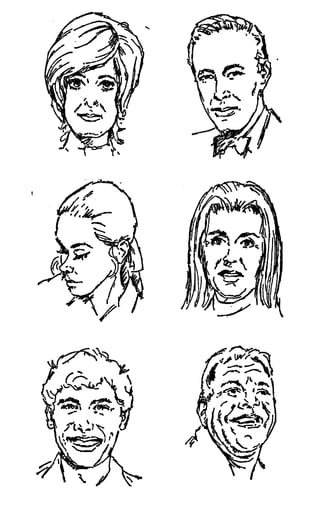
                          FACES TEST
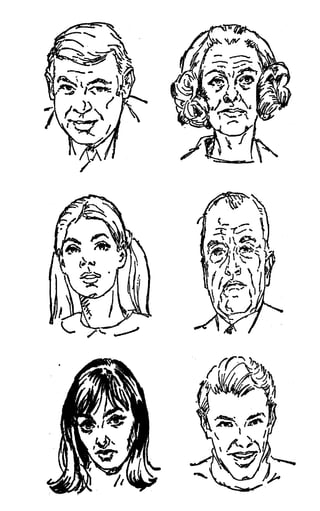
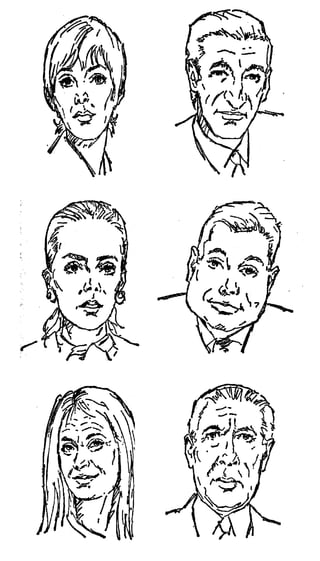
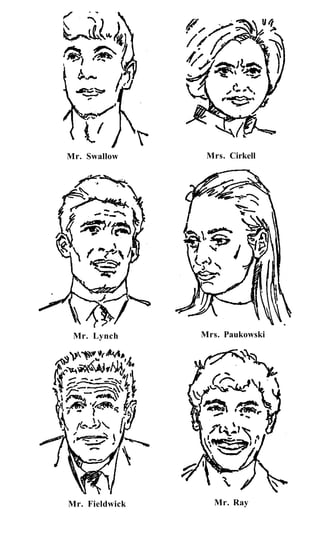
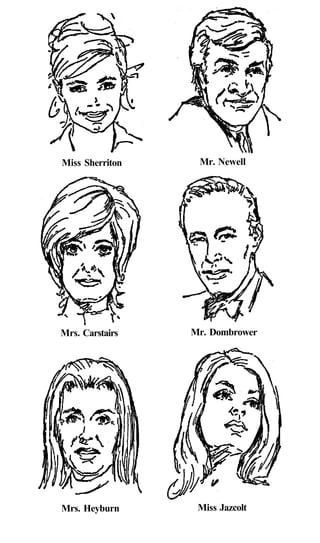
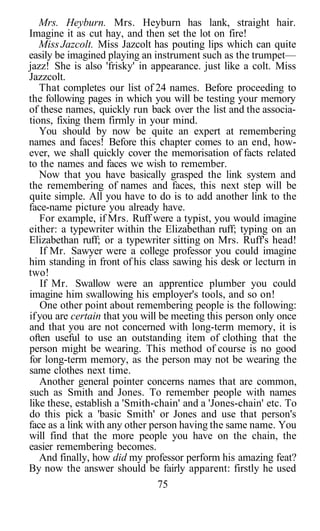
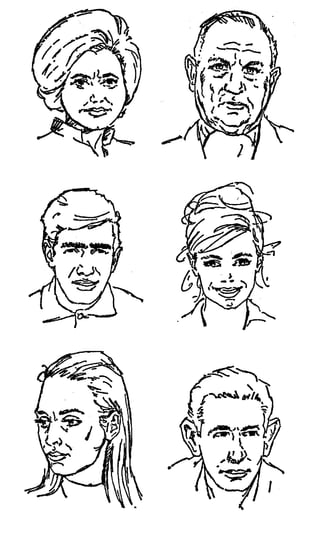
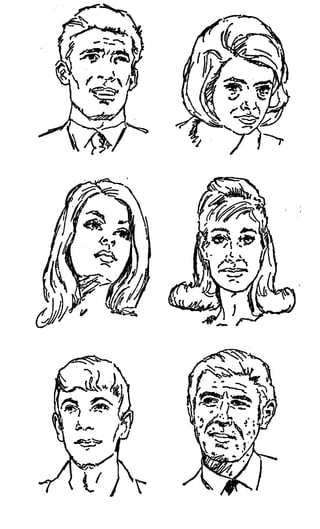
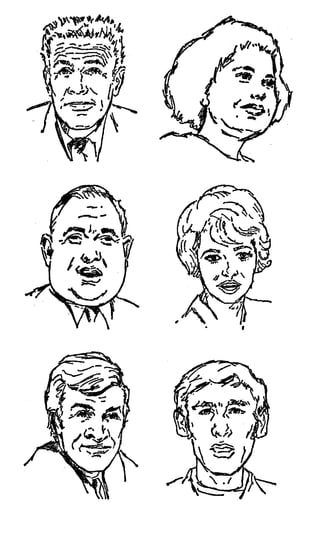
  Look at the 12 faces on the following two pages for not more
than four minutes, then turn to the end of this chapter where
the same faces are presented without their names. Try to
match the right name to the right face. Score one point for each
correct answer, and take off one point if you fit a name to a
person of the wrong sex!
                         NUMBER TEST
  Look at the four 15-digit numbers printed below* giving not
more than one minute to each. At the end of each two minutes
dose or cover the book and write down the number as best
you can, giving yourself one point for every number that you
put down in the correct place.
                       936811475298694
                       937943271621487
                       689223841378534
                       543712298374973
     Score: 1             2            3         4
                   TELEPHONE NUMBER TEST
  The following is a list of 10 people and their telephone
numbers. Study the list for not more than five minutes, then
dose or cover the book and write down first the name and then
the numbers. Give yourself 1 point for each correct number
(even if you make only one mistake in the number you must
consider this totally wrong, for if you had dialled it you would
not have been put in contact with the person with whom you
wished to speak!)
             Your local butcher       HSM-8737
             Your dentist             NAH-9107
             Your bank manager KAM-5323
             Your doctor              HOB-3981
             Your local grocer         CEL-8801
                              20
Mrs. Greenfield     Mr. Sirl


    Miss Brainne   Mr. Hawkins


   MissBoulton     Mrs. Woolridge
S.M.—2
Miss Finch (28)
Mr. Hall (75)


                    Mr. Potter (40)
Mrs. Knight (35)


                     Mr. Shelby (19)
   Mr. Bell (30)
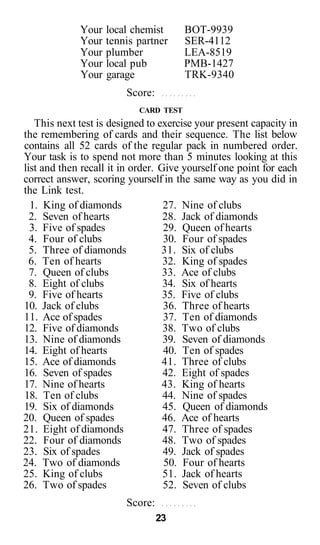
Your local chemist        BOT-9939
             Your tennis partner       SER-4112
             Your plumber              LEA-8519
             Your local pub            PMB-1427
             Your garage               TRK-9340
                        Score:
                           CARD TEST
   This next test is designed to exercise your present capacity in
the remembering of cards and their sequence. The list below
contains all 52 cards of the regular pack in numbered order.
Your task is to spend not more than 5 minutes looking at this
list and then recall it in order. Give yourself one point for each
correct answer, scoring yourself in the same way as you did in
the Link test.
  1. King of diamonds              27. Nine of clubs
  2. Seven of hearts               28. Jack of diamonds
  3. Five of spades                29. Queen of hearts
  4. Four of clubs                 30. Four of spades
  5. Three of diamonds            31. Six of clubs
  6. Ten of hearts                 32. King of spades
  7. Queen of clubs                33. Ace of clubs
  8. Eight of clubs                34. Six of hearts
  9. Five of hearts                35. Five of clubs
10. Jack of clubs                  36. Three of hearts
11. Ace of spades                  37. Ten of diamonds
12. Five of diamonds               38. Two of clubs
13. Nine of diamonds               39. Seven of diamonds
14. Eight of hearts                40. Ten of spades
15. Ace of diamonds                41. Three of clubs
16. Seven of spades                42. Eight of spades
17. Nine of hearts                 43. King of hearts
18. Ten of clubs                   44. Nine of spades
19. Six of diamonds                45. Queen of diamonds
20. Queen of spades                46. Ace of hearts
21. Eight of diamonds              47. Three of spades
22. Four of diamonds               48. Two of spades
23. Six of spades                  49. Jack of spades
24. Two of diamonds                50. Four of hearts
25. King of clubs                  51. Jack of hearts
26. Two of spades                  52. Seven of clubs
                        Score:
                                 23
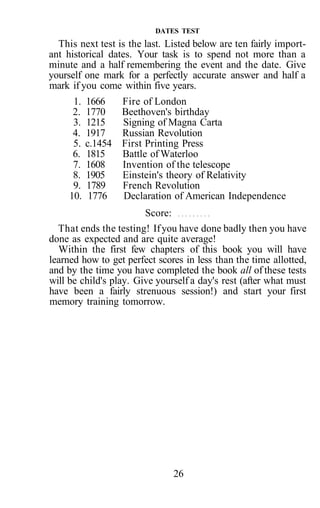
DATES TEST
  This next test is the last. Listed below are ten fairly import-
ant historical dates. Your task is to spend not more than a
minute and a half remembering the event and the date. Give
yourself one mark for a perfectly accurate answer and half a
mark if you come within five years.
      1.   1666   Fire of London
      2.   1770   Beethoven's birthday
      3.   1215   Signing of Magna Carta
      4.   1917   Russian Revolution
      5.   c.1454 First Printing Press
      6.   1815   Battle of Waterloo
      7.   1608   Invention of the telescope
      8.   1905   Einstein's theory of Relativity
      9.   1789   French Revolution
     10.    1776  Declaration of American Independence
                        Score:
  That ends the testing! If you have done badly then you have
done as expected and are quite average!
  Within the first few chapters of this book you will have
learned how to get perfect scores in less than the time allotted,
and by the time you have completed the book all of these tests
will be child's play. Give yourself a day's rest (after what must
have been a fairly strenuous session!) and start your first
memory training tomorrow.


                               26
CHAPTER TWO

                   MEMORY SYSTEM I

                       THE LINK SYSTEM
Having established what I hope was not a too disturbing
picture of the way in which your memory has been limited up
to now, we move on to the first method of improving its
ability!
   The method is known as the Link method, and is the most
basic of all the systems—the ideas and methods that you use
when applying this system will prove invaluable in mastering
the more sophisticated systems.
   'Link' can be considered to be the key word in memory,
another word for it being 'association'. Before going into the
details of the link system, I shall say something about the
principle of association and its connection with the entire field
of Memory.
   As I mentioned in the introduction, psychologists have come
to the conclusion that we remember things by joining a certain
part of them with other things. For example, on returning to
an old home or your old school, you may have realised that
seeing a certain picture on the wall, or a certain piece of
furniture, etc., made you 'suddenly remember' things that you
would otherwise, have entirely forgotten.
   Your mind was linking all the ideas and memories that had
been associated with the object at which you were looking.
   This principle applies, no matter how complicated the
memory situation is. Even when remembering complicated
mathematical formulas or very abstract ideas, there is a link in
the background which triggers the memory you want. It is this
basic concept that we shall make use of throughout the book,
using methods that enable the mind to link or associate far
more readily than it would otherwise have been able to.
   Without further ado let us apply the link method of remem-
bering to a simple shopping list. In a rushed moment, and with
no paper or writing instruments nearby, you have been asked
to buy the following items:
                               27
1.   Bananas
                     2.   Soap                               '
                     3.   Eggs
                     4.   Drinking glasses
                     5.   Bandages
                     6.   Matches
                     7.   Washing up liquid
                     8.   Toothpaste
                     9.   Shoes
                    10.   Tomatoes

   Most people when given a list quickly like this manage to
remember six or seven of the items. If you haven't already
spent some time trying to remember the list, close your eyes
now without looking at the list again, and see how many you can
recall, giving yourself extra credit if you remember the correct
order!
   The link method makes it all so much easier! Instead of
frantically trying to remember everything randomly, you must
quickly and decisively link the objects with each other.
   In die list that we have set out to learn this can be done as
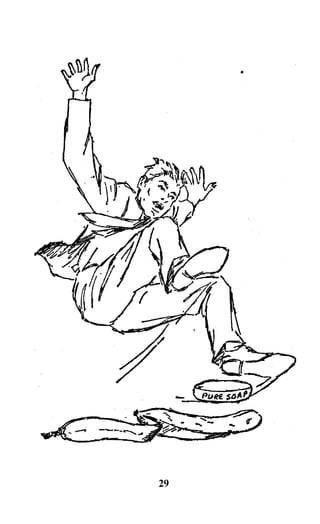
follows: Bananas and Soap are both items commonly used in
jokes about people falling on their behinds! Immediately
imagine yourself therefore stepping on a banana peel with your
right foot and a bar of soap with your left foot, causing you to
fall down.
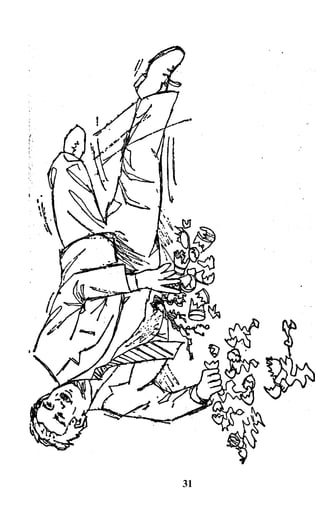
   What happens when someone falls down?—He breaks
things! Rather than making our memory device into a medical
catalogue, we remember the next two items on our list by
picturing eggs in our right hand and glasses in our left hand,
both of which get broken during the fall.
   Our first four items are now firmly linked together. How do
we link the rest? Again the task is quite easy; bandages are
used for cuts which are caused by broken glass.
   Our next item, matches, can be linked with the idea of a
bandage if we think of one of those long rolled bandages, the
end of which has been set alight and is slowly burning.
Matches!
   Having created a mental fire we had better put it out! And
what better device than a fire extinguisher, or a container of
washing up liquid which we mentally 'put' in the fire extin-
guisher's place.
                               28
29
The next item on our list, toothpaste, can easily be linked
with die washing up liquid as they both come from containers
which have to be squeezed. Simply imagine a fire-extinguisher-
soap-container beginning to squirt toothpaste instead of soap.
   We can move rapidly onto the next item by picturing the
toothpaste no longer being squirted at the fire, but being badly
aimed and covering our freshly polished shoes which were
about to step on a rotten tomato anyway!
   And there we have it: our list often items neatly associated:
we slip on the bananas and soap, break the eggs and drinking
glasses, and need bandages which are set alight by matches.
The resulting fire is then put out by washing up liquid which is
similar to squeezing toothpaste which goes all over our clean
shoes which were about to squash a tomato!
   The system is easy, but you might have already thought 'Ah
yes, it might work for that list, but what happens when I have
to memorise my own?*.
   In fact it will be just as easy for you to make up your own,
and eventually even easier, if you follow these simple rules:
                1. Exaggerate your associations
               2. Move your associations.
                3. Substitute your associations.
               4. Be Absurd!
1. Exaggerate Your Associations
   Items are remembered far more easily if they are pictured
in your mind's eye as being much greater than they really are.
For example when you pictured yourself slipping on the
banana peel and the bar of soap, your remembering task would
have been made easier if you imagined a banana peel the size of
a ski, and a bar of soap as large as a boulder.
2. Move Your Associations
   Whenever you are establishing links include if possible,
movement or action. By doing this you create images which are";
far more alive. The movement in your image helps to nudge
the picture back into consciousness. Imagine for example how
much more difficult our shopping list would have been to
memorise if we had not used the idea of falling, breaking,
bleeding, burning, squirting, and squashing! Action and move-
ment always make remembering not only easier, but also more
enjoyable.
                              30
31
32
3. Substitute Your Associations
   The art of remembering well relies on a number of factors,
and it is advisable, especially in associations which you might
feel are a little weak, to bring all your weapons to the fore. By
substituting one thing for another you can often very strongly
reinforce a link that might have been not quite strong enough.
An example of this was our substitution of the fire extinguisher
for the washing-up liquid container. The substitution itself
made the association and the movement links more complete,
and thus more readily recalled.
 4. Be Absurd!
   Remembering is one area where you can really 'let yourself
 go'! There is no point at all in being conservative about the
links you form—in fact the more conservative and retiring you
are, the weaker your associations will be, and the worse your
memory!
   Whenever you are trying to associate anything with anything
else, think up the most extraordinary and outrageous combina-
tion you can, and you will find it will last much longer. In day-
to-day living you will find the same principle works. It is
never the humdrum, mundane, ordinary events that catch
one's attention; it is the exciting, new and unusual events
which do so.
   And even if somebody does mention the uninteresting or
boring, doesn't he always commence his statement with 'It was
the most extraordinarily boring . . . ' or 'The most deadly
dull . . . ' ? In other words it is those events which stand out
which are remembered (even if they stand out because of their
mediocrity!).
   As a final note, and in a hushed breath, I feel obliged to
mention that associations using some form of vulgar or sexual
imagery are for many people among the strongest form. In
view of this, and if a sexual image seems appropriate, do not
hesitate to use it. Just be sure your imagination doesn't run
away with itself!


                               33
CHAPTER THREE

                    MEMORY SYSTEM 2

                   THE NUMBER-SHAPE SYSTEM

In the last chapter we established the ground-work for all our
memory systems. We learned that memory is a linking process
and that it can be aided by exaggeration, by movement, by
substitution, and by being absurd.
   We now move on to the first of the Peg memory systems. A
Peg memory system differs from the link system in that it uses
a special list of items which never change, and to which the
items you wish to remember are joined or linked.
   A Peg system can be thought of as a clothes cabinet which
contains a number of hooks for hanging clothes on. The hooks
never change, but the clothes which are hung on the hooks can
be infinitely varied. The first system we shall use is a fairly
short one which uses the numbers from 1 to 10.
   It would, of course, be possible for me to give you the system
outright, but it will be far more valuable if you create most of it
yourself. I shall therefore explain exactly how to construct the
system, and shall then progress to its practical use.
   The first Peg system, which we shall call the Number-
Shape system, requires initially that you think of a noun which
you are reminded of by the actual shape of the number. For
example, and to make your task a little easier, the memory
word that most people associate with the number 2 is swan,
because the number resembles very closely the shape of a
swan.
   I shall list the numbers from 1-10, leaving a blank beside
each number for you to pencil in the words which you think
best approximate the shape of the other nine numbers.
   These words will be your constant memory hooks, so try to
make sure that they are good visual images—words to which
you will be able to join other ideas without too much difficulty.
Give yourself not more than five minutes to complete the list
from 1-10, and even if you find some numbers impossible,
don't worry, just read on!
                                34
Number     Number shape memory word
           1
           2
           3
           4
           5
           6
           7
           8
           9
          10.

   Many readers will have realised while making up their
Number-Shape memory words that what they were doing was
using their creative imagination, while at the same time using
the basic concept of linking! In other words, you were taking
two basically unconnected items, a number and an object, and
associating them by substituting the idea of shape.
   You will probably have come up with words similar to the
following:
            1   Pole, pencil, pen, straw, penis
            2   Swan, duck.
            3   Double-chin, breasts, mole-hills
            4   Table, swastika, sail
            5   Hook, pregnant woman
            6   Golf club, cherry
            7   Fishing line, cliff, boomerang
            8   Bun, hourglass, shapely woman
            9   Flag, sperm, tadpole,
           10   Bat and ball, Laurel & Hardy

  Now, having worked out your own memory words, and
having seen some other suggestions, I want you to select the
Number-Shape memory word which for you is the best one.
When you have done this print it large and clear in the box
below, and put a large X through each of the previous lists.
From now on you will be interested only in the words you have
selected, and should forget the other choices.
                             35
Number Final number shape memory word
          1
          2
          3
          4
          5
          6
          7
          8
          9
         10


   Now I want you to test yourself! Close your eyes and
mentally run through the numbers from 1-10 in order. As you
come to each number mentally link it with the final Number-
Shape memory word you have selected. When you have done
this run through the numbers in reverse order, again linking
them with your chosen word, and finally pick out numbers
randomly and as quickly as you can, Unking the words to the
numbers. Do this exercise now.
   If you managed to do this fairly successfully, you have
already accomplished a memory feat which most people would
find difficult, if not impossible. And what is more you will find
that these associations will be so strong it will not only be easy
to remember them, it will be almost impossible to forget them!
   The use of this system is quite simple, and involves of
course the idea of Unking. Suppose we have a list of ten items
that we wish to remember not simply by Unking, but in
numerical order, reverse numerical order, and random
numerical order. The simple link system introduced in
Chapter 2 would help us somewhat with the numerical order,
but would certainly leave us straining to rattle-off reverse
order and random order! The Peg system leaves us with no
such problem. Let us put it to the test.
   You have been asked to remember the following list of
items:
                               36
1.   telephone
                           2.   farmer
                           3.   waterfall
                           4.   aeroplane
                           5.   meat
                           6.   apple
                           7.   teapot
                           8.   rocks
                           9.   bicycle
                          10.   hatpin

    To remember these items in order all that it necessary is to
 link them with the appropriate Number-Shape memory word.
 Remember that when you link them the associations should be
 exaggerated, should be moving where possible, and should be
 absurd. Give yourself not more than three minutes to compete
 your memorisation of these items, and then test yourself as
 you did when you were creating the system. That is, mentally
 run through the items in order, in reverse order, and random
 order. Start this exercise now.
    As a guide to those readers who might have had a little
difficulty, the following are examples of possible associations:
    1. For telephone you might have imagined an enormous
telephone pole being toppled, with a giant telephone either on
top of it or being broken by it; or a telephone with the receiver
which turned into a large pencil or pen every time the phone
rang.
    2. For farmer you could have pictured him being attacked
by a giant swan or duck, or riding fairy-tale-style on one of
these giant birds.
    3. The waterfall could have been cascading down an
enormous double chin, over a woman's very ample bosom, or
onto molehills which were flattened by the water's force.
    4. Aeroplane can be remembered by imagining it covered
with swastikas, crashing into an enormous table, or being
absurdly propelled by means of a giant sail.
    5. Meat fits very nicely onto a large hook, or a pregnant
woman can be thought of as 'meaty'!
    6. If golf club was your choice for number 6 then you
can imagine teeing off at an apple instead of a golf ball; or
the apple might be thought of as a giant mutation on a cherry
tree.
                                37
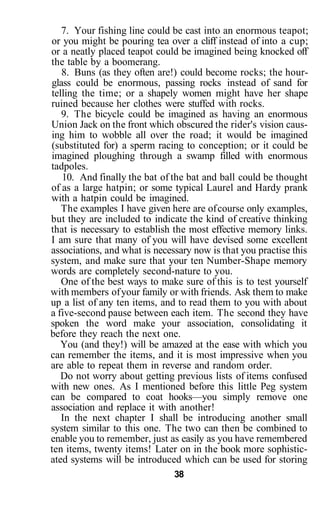
7. Your fishing line could be cast into an enormous teapot;
or you might be pouring tea over a cliff instead of into a cup;
or a neatly placed teapot could be imagined being knocked off
the table by a boomerang.
   8. Buns (as they often are!) could become rocks; the hour-
glass could be enormous, passing rocks instead of sand for
telling the time; or a shapely women might have her shape
ruined because her clothes were stuffed with rocks.
   9. The bicycle could be imagined as having an enormous
Union Jack on the front which obscured the rider's vision caus-
ing him to wobble all over the road; it would be imagined
(substituted for) a sperm racing to conception; or it could be
imagined ploughing through a swamp filled with enormous
tadpoles.
   10. And finally the bat of the bat and ball could be thought
of as a large hatpin; or some typical Laurel and Hardy prank
with a hatpin could be imagined.
   The examples I have given here are of course only examples,
but they are included to indicate the kind of creative thinking
that is necessary to establish the most effective memory links.
I am sure that many of you will have devised some excellent
associations, and what is necessary now is that you practise this
system, and make sure that your ten Number-Shape memory
words are completely second-nature to you.
   One of the best ways to make sure of this is to test yourself
with members of your family or with friends. Ask them to make
up a list of any ten items, and to read them to you with about
a five-second pause between each item. The second they have
spoken the word make your association, consolidating it
before they reach the next one.
   You (and they!) will be amazed at the ease with which you
can remember the items, and it is most impressive when you
are able to repeat them in reverse and random order.
   Do not worry about getting previous lists of items confused
with new ones. As I mentioned before this little Peg system
can be compared to coat hooks—you simply remove one
association and replace it with another!
   In the next chapter I shall be introducing another small
system similar to this one. The two can then be combined to
enable you to remember, just as easily as you have remembered
ten items, twenty items! Later on in the book more sophistic-
ated systems will be introduced which can be used for storing
                               38
information you wish to remember for a long period of time.
The present systems are for more immediate purposes.
   Give yourself about a day to become skilled with the tech-
piques you have learned so far and then move on to the next
chapter.


                             39
CHAPTER FOUR

                   MEMORY SYSTEM 3

                  THE NUMBER-SOUND SYSTEM
Now that you have learned about the history of memory, about
the ideas of association, about the Link system, and the first
small Peg system, you are ready to progress to the next small
Peg system and to a few slightly more sophisticated Peg
systems.
   Because of the knowledge you are building up as you go
along these systems will be introduced without too much
preliminary explanation as the principles already discussed are
common to all of them.
   The Number-Sound system is almost identical to the
Number-Shape system except that (and this you may have
already guessed.) we think of nouns or noun-verbs which are
similar in sound to the number.
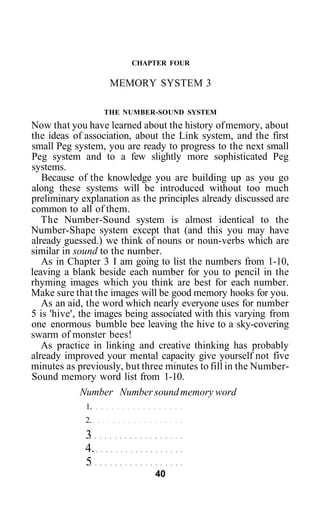
   As in Chapter 3 I am going to list the numbers from 1-10,
leaving a blank beside each number for you to pencil in the
rhyming images which you think are best for each number.
Make sure that the images will be good memory hooks for you.
   As an aid, the word which nearly everyone uses for number
5 is 'hive', the images being associated with this varying from
one enormous bumble bee leaving the hive to a sky-covering
swarm of monster bees!
   As practice in linking and creative thinking has probably
already improved your mental capacity give yourself not five
minutes as previously, but three minutes to fill in the Number-
Sound memory word list from 1-10.
              Number Number sound memory word
             1.
             2.
             3
             4.
             5
                              40
6.
             7.
             8.                  ...........
             9.
            10.
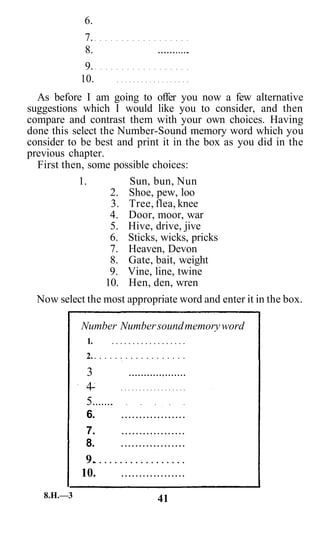
  As before I am going to offer you now a few alternative
suggestions which I would like you to consider, and then
compare and contrast them with your own choices. Having
done this select the Number-Sound memory word which you
consider to be best and print it in the box as you did in the
previous chapter.
  First then, some possible choices:
            1.         Sun, bun, Nun
                   2. Shoe, pew, loo
                   3. Tree, flea, knee
                   4. Door, moor, war
                   5. Hive, drive, jive
                   6. Sticks, wicks, pricks
                   7. Heaven, Devon
                   8. Gate, bait, weight
                   9. Vine, line, twine
                  10. Hen, den, wren
  Now select the most appropriate word and enter it in the box.

            Number Number sound memory word
             1.
             2.
             3          ...................
             4-
             5.......
             6.
             7.
             8.
             9.
            10.
   8.H.—3                        41
As in the last chapter, I now want you to test yourself with
four chosen Number-Sound word. Close your eyes and
mentally run through the numbers in order, linking each
number mentally with the Number-Sound memory word you
have selected. Next run through the numbers in reverse order
again linking them with your chosen word, and finally pick
numbers randomly and as quickly as you can, linking as you go.
Spend about five minutes on this exercise now.
   This list can be used in exactly the same way as the Number-
Shape list, although many of you will have already realised
that in a way you already possess the ability to remember 20
objects in and out of sequence!
   All you have to do is to establish one of these two Peg
systems as the numbers from 1-10, letting the other represent
the numbers from 11-20.
   Let us put this to the test. You will remember (I hope!) that
Chapter 1 contained two tests, each of which asked you to
remember 20 items. The first of these tests could have been
adequately done by using the Link system, but the second was
more difficult and required some form of Peg memory system.
Let us then apply our present knowledge to the more difficult
of these two tests.                             <
  Decide which of the two Peg systems is to be first, and which,
second and then give yourself not more than four minutes to
remember the list When your four minutes are up, close or
cover the book and then write down your answers in the same
way as you did in the original test. After you have done this
check your answers against the list. Here it is again:

                        1.   Tar
                        2.   Aeroplane
                        3.   Leaf
                        4.   Shell
                        5.   Hair
                        6.   Moon
                        7.   Lever
                        8.   Lighter
                        9.   Railway
                       10.   Field
                       11.   Atom
                       12.   Wheel
                       13.   School
                              42
14.   Sand
                       15.   Doctor
                       16.   Spectacles
                       17.   Lake
                       18.   Feather
                       19.   Sock
                       20.   Pump
              Score: Number correct
   You will almost certainly have made an improvement over
your performance in the original test, but might find that you
are still having difficulty with certain associations. The only
way to overcome this is to practise and practise still more.
Tonight and tomorrow throw yourself in at the deep end,
testing yourself whenever possible, and having as many of
your friends and acquaintances as you can try to catch you out
on lists that they make up for you to remember.
   On the first few tries you will probably make a few errors
but even so, you will be performing far beyond the average
person's capacity. If you persevere, you will soon be able to
fire back lists without any hesitation, and without any fear of
making mistakes!


                             43
CHAPTER FIVE

                    MEMORY SYSTEM 4

                  THE CLASSICAL ROOM SYSTEM
Before moving on to two of the more major Peg systems, you
shall have a light and easy day's work with a simple little Room
system.
   In the section dealing with the history of memory, I men-
tioned that the Romans accepted without question the theore-
tical ideas of memory introduced by the Greeks. I added that
one of their major contributions was the introduction and
development of memory systems.
   One of their most popular systems made use of objects in a
room. Such a system is easily constructed. Try to imagine an
enormous room with a door. Now fill this room with as many
items of furniture and other objects as you wish—each item of
furniture will serve as a link word. Don't make a mental
rubbish-dump of it, though! Your objects should be very
precisely ordered.
   For example, you may decide to start on the immediate right
of the door as you enter the room, placing there a finely carved
coffee-table, on which you might put anything from a statue to
an attractive lamp. Next to this you could have an antique
sofa, and so on.
   You can see that the possibilities are almost limitless—but
make sure that your objects are memorisable and that you can
keep them mentally placed in the right order.
   How is such a system used? When you are given a list of
objects you wish to remember in order (it being not necessary
to remember reverse, random, or numerical order), you simply
associate the items to be remembered with the objects in your
room. Suppose, for instance, that your first three items were
'oil', 'insect', and 'girl'. Using the examples given, the oil could
be imagined flowing all over the coffee table, the insect could
be enlarged and perched on top of the statue or could be
flying around the lamp, and the girl could be draped seduct-
ively on the sofa!
                                44
YOUR CLASSICAL MEMORY ROOM


            45
The advantage of this system is that it is entirely your own,
that the room may be as large as you wish, may have as many
walls as you care to imagine, and may contain a great number
of memory-peg objects.
   On the blank page provided here you should now construct
your own room, selecting the shape you feel is best, and then
finally printing in the objects with which you are going to
furnish it.
   When you have completed this task, take a number of
mental walks around the room until you are completely
familiar with the order and arrangement of things. As with the
previous memory systems, practise alone and with friends,
until your system is firmly established.
   In the next chapter I shall be introducing the Alphabet
system, which will enable you to remember more than 20
items.
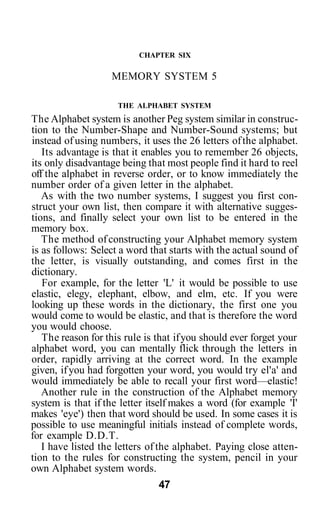
CHAPTER SIX

                   MEMORY SYSTEM 5

                     THE ALPHABET SYSTEM
The Alphabet system is another Peg system similar in construc-
tion to the Number-Shape and Number-Sound systems; but
instead of using numbers, it uses the 26 letters of the alphabet.
   Its advantage is that it enables you to remember 26 objects,
its only disadvantage being that most people find it hard to reel
off the alphabet in reverse order, or to know immediately the
number order of a given letter in the alphabet.
   As with the two number systems, I suggest you first con-
struct your own list, then compare it with alternative sugges-
tions, and finally select your own list to be entered in the
memory box.
   The method of constructing your Alphabet memory system
is as follows: Select a word that starts with the actual sound of
the letter, is visually outstanding, and comes first in the
dictionary.
   For example, for the letter 'L' it would be possible to use
elastic, elegy, elephant, elbow, and elm, etc. If you were
looking up these words in the dictionary, the first one you
would come to would be elastic, and that is therefore the word
you would choose.
   The reason for this rule is that if you should ever forget your
alphabet word, you can mentally flick through the letters in
order, rapidly arriving at the correct word. In the example
given, if you had forgotten your word, you would try el'a' and
would immediately be able to recall your first word—elastic!
   Another rule in the construction of the Alphabet memory
system is that if the letter itself makes a word (for example 'I'
makes 'eye') then that word should be used. In some cases it is
possible to use meaningful initials instead of complete words,
for example D.D.T.
   I have listed the letters of the alphabet. Paying close atten-
tion to the rules for constructing the system, pencil in your
own Alphabet system words.
                               47
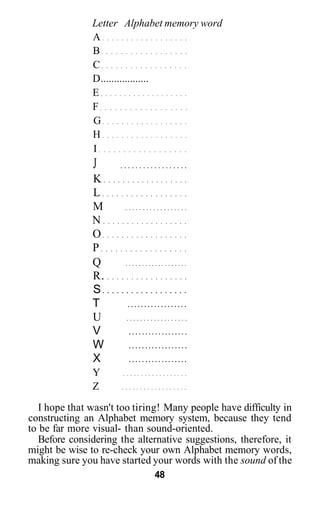
Letter Alphabet memory word
               A
               B
               C
               D ..................
               E
               F
               G
               H
               I
               J
               K
               L
               M
               N
               O
               P
               Q
               R.
               S
               T
               U
               V
               W
               X
               Y
               Z
   I hope that wasn't too tiring! Many people have difficulty in
constructing an Alphabet memory system, because they tend
to be far more visual- than sound-oriented.
   Before considering the alternative suggestions, therefore, it
might be wise to re-check your own Alphabet memory words,
making sure you have started your words with the sound of the
                              48
letter or letter word and not simply the letter itself. For
example 'ant', 'bottle', 'case', 'dog', and 'eddy' would not be
correct memory words because they do not start with the
sound of the letter as it is pronounced in the alphabet.
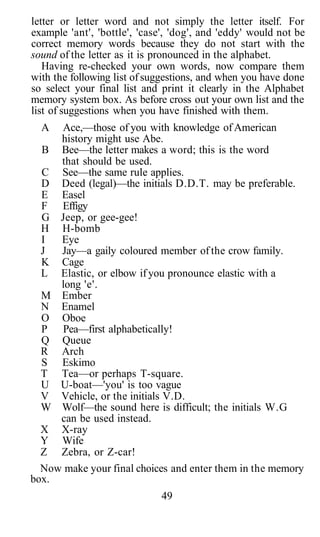
   Having re-checked your own words, now compare them
with the following list of suggestions, and when you have done
so select your final list and print it clearly in the Alphabet
memory system box. As before cross out your own list and the
list of suggestions when you have finished with them.
  A  Ace,—those of you with knowledge of American
     history might use Abe.
  B Bee—the letter makes a word; this is the word
     that should be used.
  C See—the same rule applies.
  D Deed (legal)—the initials D.D.T. may be preferable.
  E Easel
  F Effigy
  G Jeep, or gee-gee!
  H H-bomb
  I  Eye
  J  Jay—a gaily coloured member of the crow family.
  K Cage
  L Elastic, or elbow if you pronounce elastic with a
     long 'e'.
  M Ember
  N Enamel
  O Oboe
  P Pea—first alphabetically!
  Q Queue
  R Arch
  S Eskimo
  T Tea—or perhaps T-square.
  U U-boat—'you' is too vague
  V Vehicle, or the initials V.D.
  W Wolf—the sound here is difficult; the initials W.G
     can be used instead.
  X X-ray
  Y Wife
  Z Zebra, or Z-car!
  Now make your final choices and enter them in the memory
box.
                              49
Letter Final Alphabet memory word
A
B                 ...............
C                            ....
D
E
F
G
H .................
I
J..................
K
L
M
N
O
P
Q
R
S
T
U
V
W
X
Y
Z
Your practice with the Alphabet system should be similar to
your practice with previous smaller systems.
   The end of this chapter marks the end of your learning the
introductory and basic Peg and Link systems. From now on,
apart from a brief summary of these concepts in Chapter 7,
you will be learning more sophisticated and more expansive
systems that will enable you to remember lists of hundreds of
items, as well as systems to help you remember faces, numbers
etc.
   The next chapter but one deals with an exciting new
system which has never been published or widely used,
although it has been carefully tested.
CHAPTER SEVEN

          SMALL MEMORY SYSTEM REVIEW
                AND EXTENSION


You have now completed the five smaller memory systems:
the Link, the Number-Shape, the Number-Sound, the
Classical Room and the Alphabet.
   Each of these systems can be used either independently or in
conjunction with another system. Furthermore, one or two of
the systems can be set aside, if you wish, as 'constant memory
banks'. That is, if you have certain lists or orders of items that
you will need to be able to recall over a period of a year or more,
you can set aside the system of your choice for this purpose.
   Before moving on to the broader systems, however, I want
to introduce you to a simple and intriguing method for
instantly doubling any of the systems you have so far learned!
   When you have reached the end of a system but still wish
to add further associations, all you have to do is to go back to
the beginning of your system and imagine your association
word exactly as you usually imagine it, with the exception that
it is contained in a huge block of ice ! This simple device will
drastically change the association pictures you have formed,
and will double the effectiveness of your system by giving you
the original list plus the original list in its new context.
   For example, if your first key in the Number-Shape system
was 'telephone pole', you would imagine that same telephone
pole either buried in the heart of your giant block, or protrud-
ing from the corners or sides; if your first word in the Number-
Sound system was 'sun', then you could imagine its fierce rays
melting the edges of the ice block in which it was contained;
if your first word in the Alphabet system was ace then you
could imagine a giant playing card either frozen in the centre
or forming one of the six sides of the ice cube.
   Practise this technique. You will find it extraordinarily
helpful.
CHAPTER EIGHT

                   MEMORY SYSTEM 6

                            SKIPNUM
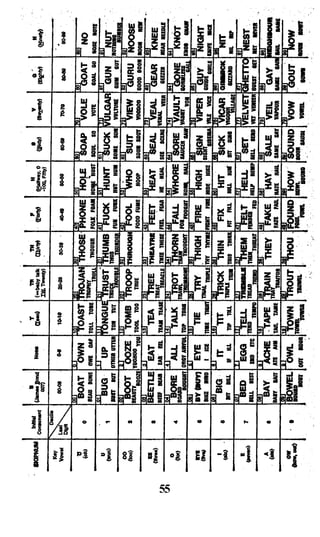
Skipnum (Self-Coding Instant Phonetic Number Memory
grid!) is an entirely new memory system. It was developed by
my close friend and associate Heinz Norden, the well-known
writer, translator and polymath.
   Skipnum differs from other major memory systems in that
it is based almost entirely on phonetics. The system is based
on two elements everyone knows:
   1, The initial letter of the memory word is the same as the
initial letter of the number which is attached to that word. For
example the numbers from 60 to 69 all begin with an 's', and
therefore so do the memory words for the numbers from 60 to
69.
   2. The vowel sound of the memory word is the same as the
vowel sound of the unit digit in the number for which we are
making the word. For example let us take the number 42. The
first letter in our memory word must be an 'f because 42
begins with an 'f'. The next sound in our memory word must
be '00' because the digit number in 42 is two, and its vowel
sound is '00'. That means we have 'foo' which we can easily
make into a word by adding either T or 'd' giving us 'fool' or
'food'.
   Let us try another example. The number we wish to create a
memory word for is 91. The first letter is 'n'. The digit
number in 91 is 1, and its vowel sound is 'uh'. To complete our
memory word for 91 we simply have to complete 'nuh'. A 't'
or an 'n' completes this most satisfactorily giving us 'nut' or
'nun'.
   There are a few exceptions to these two basic rules, but they
are logical and easily remembered.
   1. Ten to nineteen. These numbers do not of course have the
same initial consonant. They are however collectively the 'tens'
or 'teens' and therefore we use the letter 't' for these numbers.
   2. Twenty to twenty-nine. A full set of memory words
                               53
beginning with 'tw' is not available so 'tr' is used instead. We
can remember this fairly easily by recalling that children often
confuse 'tr' and 'tw'.
  3. Fifty to fifty-nine. We cannot use 'f' as the initial letter
because we have already used it for forty. Instead we use 'h'
because it stands for 'half', and fifty is halfway between 0 and
100.
   4. Seventy to seventy-nine. In the same way that we could
not use 'f' for fifty because we had already used it for forty, we
cannot use V for seventy because we have already used it for
sixty. This is overcome easily by using the second consonant
of seventy, i.e. 'v'.
   5. Eighty to eighty-nine. There is no initial consonant here
so instead we use the first consonant in the word eighty, which
is 'g'.
   6. Vowel sound for nine. We cannot use the 'i' sound for nine
because we have already used it for five. Instead we use one of
the most common remaining vowel sounds (which is contained
in the word vowel!) 'ow'.
   7. 00-09. These are included in the Skipnum grid for
convenience, because these two-digit units occur frequently in
telephone numbers and elsewhere. We use the initial conso-
nant 'b' because it is easy to remember when we think of 007,
James Bond!
   Before reading on, have a quick look at the memory grid in
this Chapter, trying to familiarise yourself with the ideas that
have so far been explained. The grid is laid out simply and
dearly, and should not be hard to follow.
   You have noticed from looking at the grid that a preferred
memory word is given in bold It is usually the simplest
possible word formed by the above two rules, and is preferably
one that can be used both as a verb and a noun. If possible it
should have more than one meaning, and should be able to
serve as a connector in making phrases from the memory words.
Vulgar, action and emotionally charged words are also prefer-
able because they are easier to remember.
   Where they arise, silent initial letters such as 'g' 'k' 'w' and
'y' are ignored in the memory words.
   Since more than one word can often be formed within the
boundaries of the rule, alternate words may be used. Some of
these are given in the Skipnum grid for you to choose from.
   This possibility of alternate words is particularly useful in
                                54
55
situations where you might be trying to remember a long
number which contains the same two-digit sequence more
than once. You don't have to repeat the same word, but can
use another word representing the same number!
   Another advantage of this memory system is that you don't
have to learn the memory words by heart since they are 'self
coding'. They will pop into your mind instantly as long as you
know the rules!
   Up to this point in the Chapter you have been given a lot of
detailed information which at the moment you may have found
a little bit difficult to absorb completely. It is advisable now to
review quickly the entire Chapter, consolidating those areas
which have given you some trouble. To assist you in further
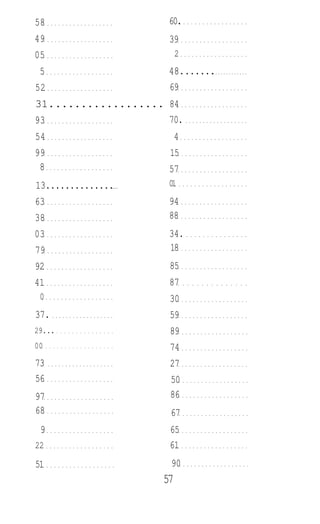
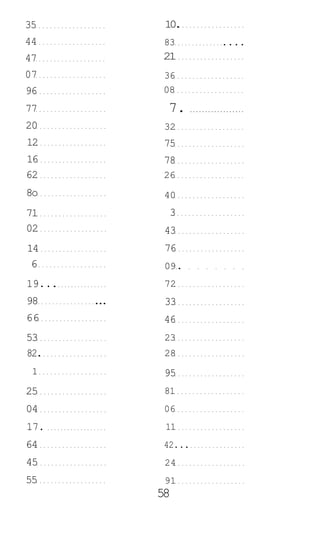
consolidation, I have randomly listed the numbers from 1-100
on the next two pages so that you can readily test yourself in
either remembering the words on the grid or 'self coding' your
own.
   When you have completed the Skipnum grid to your satis-
faction take the plunge and try to remember 100 items. You
will find to your surprise that it is not really much more
difficult than remembering twenty! When you are confident
test yourself with your friends.


                                56
58                    60.
49                    39
05                        2
 5                    48. ......
52                    69
31. ................. 84
93                    70.
54                        4
99                    15
 8                    57
13..............      01
63                    94
38                    88
03                    34.
79                    18
92                    85
41                    87
 0                    30
37.                   59
29. ..                89
00                    74
73                    27
56                    50
97                    86
68                    67
 9                    65
22                    61
51                     90
                     57
35             1.
                0
44             83       ....
47            21
07             36
96             08
77              7.
20             32
12             75
16             78
62             26
8o             40
71              3
02             43
14             76
 6             09 .
19. ..         72
98       ..
          .    33
66             46
53             23
82.            28
 1             95
25             81
04             06
17.            11
64             42. ..
45             24
55             91
              58
CHAPTER NINE

    MEMORY SYSTEM FOR NAMES AND FACES


Remembering names and faces is one of the most important
aspects in our lives, and one of the most difficult!
   In every walk of life, every level of occupation, and every
social situation, there are literally millions of people who say
they 'just can't remember' the people they meet.
   In business and the professions this can be most embarrass-
ing. If you are at a conference, attending a course, or involved
in any situation in which you are meeting new people, it is not
only embarrassing to be unable to remember the names and
faces of those who are with you, it can also be a serious handi-
cap when you meet them again. Even should you not have
occasion to meet them again, the ability to remember names
and faces without seeing them may be useful when you are
'mentally thumbing through' people who might be of assist-
ance to you.
   In a social setting, the inability to remember the names and
faces of people you meet is a discomforting and unpleasant
experience. Many people devise little tricks and methods for
evading the issue!
   One of the favourites is to ask for the person's name, and
when he replies with his Christian name to say 'Oh, I knew
that! it was your surname I had difficulty remembering', and
of course if he replies with his surname 'Oh I knew that! it was
your Christian name I had difficulty remembering'! The
disadvantages of this little technique are two-fold: Even if it
works you have had to admit that at least in part you had
forgotten his name; and secondly, many people reply immed-
iately with both their Christian and surnames!
   Another device commonly used by people who have forgot-
ten a name is to say something like 'Oh, I am sorry, but how
was it that you spelled your name?' This of course can work in
situations where a person has a name like Pattlesserie Zhytni-
ewski! But when the retort is a sarcastic 'J-O-H-N S-M-I-T-H'
you can be made to look a little silly!
                              59
These tricks are nothing more than tricks, and apart from
the obvious pitfalls I have mentioned they inevitably leave the
person who is using them in an insecure and uncomfortable
position. Aware of his inadequacy, he tends to be afraid that
his tricks won't work or that he will be placed in a situation
where they will be inappropriate and his poor memory will be
on full view! Tricks, then, are not enough.
   At the other end of the scale from the person who 'just can't
remember' names and faces, is that well-known person who
always does remember. At school it might have been a particu-
lar teacher (or the headmaster!); at university a well-known
professor, and in business a successful manager. Whatever the
situation I am sure you will confirm the fact that the person
was socially confident, generally successful, and almost
certainly well-known.
   I remember well the first class I ever attended at university.
It was an eight-in-the-morning English lecture, and the
excitement of the first day and the first class had not quite
managed to shake off the sleepiness from most of the students.
   Our professor had! He strode into the room with no brief-
case and no books, stood in front of the class, announced his
name, and then said he would call the attendance. He started
alphabetically, listing off names such as Abrahamson, Adams,
Ardlett, and Bush, in response to which he got the usual
mumbled 'Yes, sir' and 'Here, sir'. When he came to Cartland,
however, there was no reply. He paused for a moment and
then said 'Mr. John Cartland'. To which there was still no
reply. Without change of expression he then said 'Mr. John
W. P. Cartland?' and proceeded to list the boy's birthday,
address, and telephone number! There was still no reply so
our professor (who by this time had thoroughly awakened the
class!) carried on with the remaining names. Each time he
arrived at the name of a person who was absent he called out
that persons initials, birthday, address and telephone number!
   When he had completed the roster and everyone sat with
jaws hanging open, he repeated very rapidly the names of all
the students who were absent and said, with a wry smile on his
face, 'I'll make a note of them some time!'
   He never forgot one of us, either!
   From that day on he became a legend, for none of us could
imagine or hope to compete with the brilliance of a mind that
could so completely and perfectly remember names and dates.
                                60
We were, of course, mistaken. Using the proper memory
system, the kind of performance that our professor gave is by
no means an impossibility, and is in fact quite simple.
   In this chapter I shall introduce you to the systems and
techniques that make remembering of names, faces and
related facts a relatively simple and certainly a rewarding task.
   Before getting down to the specific methodology, there are
a few rules that should be observed, even when one is not
using special memory systems. These rules or pointers apply
mostly to situations in which you are meeting new people. The
pointers rely on one of the most important factors in memory:
Repetition.
    When you are introduced to somebody first make sure you
listen. Many people actually 'turn off' when they are intro-
duced to people and haven't the faintest idea what the name of
the person is to whom they have just been introduced!
     Second, request that the name be repeated even if you have
heard it. Most people tend to mumble introductions and even
if an introduction is clear no one will be disturbed if you ask
for a repetition.
     Third, repeat the name when you have been given it the
second time. Rather than saying simply 'how do you do?' add
the name to the end of your greeting: 'how do you do, Mr.
Rosenthal'.
    Fourth, if the name is at all difficult, politely ask for the
spelling.
    Fifth, if the situation seems to warrant it ask the person
something about the background and history of his name.
     Contrary to what you might expect most people will be
flattered by your interest, and pleased that you have taken the
trouble to enquire about their name and remember it.
    Carrying the principles of repetition and involvement
further, make sure that during conversations with people you
newly meet you repeat the name wherever possible. This
repetition helps to implant the name more firmly in your
memory, and is also socially more rewarding, for it involves the
other person more intimately in the conversation. It is far
more satisfying to hear you say 'yes, as Mr. Jones has just said
. . . ' than to hear you say 'yes, as this chap over here as just
said...'!
    And finally of course when you are taking leave of those you
    S.M.—4                     61
have met make sure you say, rather than just an impersonal
farewell, 'good evening, Mr. Jones'.
   These aids to memory are, as I mentioned, useful to the
person who is not using memory systems as well as one who is,
although they are naturally far more beneficial to the latter,
because he has additional 'artillery' which he can use to back
himself up. Without further ado, let us learn the system for
remembering faces and names.
   To begin with, we must become far more observant of the
faces we wish to remember! Many people, especially those who
have a poor memory for names and faces, have great difficulty
in remembering how one face differs from another, and find it
almost impossible to describe the individual characteristics of
faces. Our first task then is to become more observant.
   To aid you in this the next few pages will give you a 'guided
tour' from the top of the head to the tip of the chin, enumer-
ating the various characteristics and the ways in which they
can be classified and typified. You may well be surprised at
just how varied faces can be!

              HEAD AND FACIAL CHARACTERISTICS

1. The Head
  Usually you will first- meet a person face-on, so before deal-
ing with the run-down of separate characteristics we will
consider the head as a whole. Look for the general shape of the
entire bone structure. You will find that this can be:
            a. Large
           b. Medium
           c. Small
  And that within these three categories the following shapes
can be found:
             a.square
             b.rectangular
             c.round
             d.oval
             e.triangular, with the base at the chin and
               the point at the scalp
            f. triangular with the base and the scalp and
               the point at the chin
                             62
g. broad
              h. narrow
              i. big-boned
              j.     fine-boned
   You may, fairly early in your meeting, see the head from the
side and will be surprised at how many different shapes heads
seen from this view can take:
              a. square
              b. rectangular
              c. oval
              d. broad
              e. narrow
              f. round
              g. flat at the front
              h. flat on top
              i. flat at the back
              j. domed at the back
              k. face angled with jutting chin and slanted
                 forehead
              1. face angled with receding chin and prominent
                 forehead
2. The Hair
   In earlier days, when hairstyles used to be more consistent
and lasting, hair served as a better memory hook than it does
now. The advent of dyes, sprays, wigs, and almost infinitely
varied styles makes identification by this feature a somewhat
tricky business! Some of the more basic characteristics,
however, can be listed as follows:
Men         a.    thick
            b.   fine
            c.    wavy
            d.    straight
            e.    parted
            f.    receding
            g.    bald
            h.    cropped
            i.   medium
            j.   long
            k.    frizzy
            1.    colour (only in notable cases)
                               63
Women          a. thick
               b. thin
               c. fine
  Because of the variability in women's hairstyles it is not
advisable to try to remember them from this characteristic!
3. Forehead
  Foreheads can be generally divided into the following
categories:
               a.   high
               b.   wide
               c.   narrow between hairline and eyebrows
               d.   narrow between temple and temple
               e.   smooth
               f.   lined horizontally
               g.   lined vertically
4. Eyebrows
               a.   thick
               b.   thin
               c.   long
               d.   short
               e.   meeting at the middle
               f.   spaced apart
               g.   flat
               h.   arched
               i.   winged
               j.   tapered
5. Eyelashes
               a.   thick
               b.   thin
               c.   long
               d.   short
               e.   curled
               f.   straight
6. Eyes
               a. large
               b. small
               c. protruding
                                64
d.    deep-seated
             e.   close together
             f.   spaced apart
             g.   slanted outwards
             h.   slanted inwards
             i.   coloured
             j.   iris—entire circle seen
             k.   iris—circle covered partly by upper and/or
                  lower lid
  Attention may also be paid in some cases to the lid above
and the bag below the eye, both of which can be large or small,
smooth or wrinkled, and puffy or firm.
7. The Nose
  When seen from the front:
           a. large
           b. small
           c. narrow
           d. medium
           e. wide
  When seen from the side:
              a. straight
              b. flat
              c. pointed
              d. blunt
              e. snub or upturned
              f. Roman or aquiline
              g. Greek, forming straight line with forehead
              h. concave (caved in)
   The base of the nose can also vary considerably in relation
to the nostrils:
            a. lower
            b. level
            c. a little higher
  The nostrils themselves can also vary:
            a. straight
            b. curved down
            c. flaring
                              65
d. wide
             e. narrow
             f. hairy
8. Cheekbones
   Cheekbones are often linked very closely with the character-
istics of the face when seen front-on, but the following three
characteristics may often be worth noting:
             a. high
             b. prominent
             c. obscured
9. Ears
  Ears are a part of the face that few people pay attention to,
and yet their individuality can be greater than any other
feature. They may be:
            a.    large
            b.    small
            c.    gnarled
            d.    smooth
            e.    round
            f.    oblong
            g.    triangular
            h.   flat against the head
            i.    protruding
            j.    hairy
            k.    large lobed
            1.    no lobe
  This feature is of course more appropriate as a memory
hook with men than with women, because the latter usually
cover their ears with hair.
10. Lips
            a.   Long upper lip
            b.   short upper lip
            c.   small
            d.   thick (bee-stung)
            e.   wide
            f.   thin
            g.   upturned
                               66
h.   downturned
             i.   Cupid's bow (U Thant)
             j.   well-shaped
             k.   ill-defined
11. Chin
   When seen straight on the chin may be:
             a.   long
             b.   short
             c.   pointed
             d.   square
             e.   round
             f.   double (or multiple)
             g.   cleft,
             h.   dimpled
  When seen from the side it will be either:
             a. jutting
             b. straight
             c. receding
12. Skin
  Finally the skin should be observed. It may be:
             a.   smooth
             b.   rough
             c.   dark
             d.   fair
             e.   blemished or marked in some way
             f.   oily
             g.   dry
             h.   blotchy
             i.   doughy
             j.   wrinkled
             k.   furrowed
   Other characteristics of faces, specially men's, include the
various and varied growth of facial hair ranging from short
sideburns to the full-blooded and face-concealing beard with
moustache. There is no point in listing all the variations. It
should suffice to note that these hirsute phenomena do exist,
                               67
but that they, like hairstyles and colours, can change dramatic-
ally overnight!
   Having acquired all this information about the face, how do
we make use of it? You may be surprised to learn that the
answer is contained in the earlier chapters of the book! To put
it briefly all that we have to do is the following:
   1. Make a definite note of the name of the person.
   2. Examine his face very carefully noting the characteristics
that have been enumerated in the preceding pages.
   3. Look for characteristics which are unusual, extra-
ordinary, or unique.
   4. Mentally reconstruct the person's face, exaggerating in
the way that a caricaturist does these noteworthy features.
   5. Link, using exaggeration and movement etc, where possi-
ble, these outstanding features to the name of the person.
   The best way for you to learn the application of these
methods is to practise them, so following I have doubled the
number of faces and names you were asked to remember in
your original test, have given suggestions for linking them,
and then have rearranged the faces without names for you to
test your new skills.
   'An impossible task!' you might say. But before you actually
test yourself on these names let's look at each person separ-
ately to see what kind of associations we can make between the
face and the name.
   Mrs. Ruff. Mrs. Ruff has a fairly distinct hairstyle which it is
unlikely that a woman such as she would change. It doesn't
take much imagination to change her hair into an Elizabethan
ruff—the frilled neck collar common to that age.
   Mr. Hind has enormous jowls! As a matter of fact they look
a little bit like a person's posterior! BeHind!
   Mr. Pickett. The outstanding feature of Mr. Pickett's face
is it's overall rectangular quality and its straight neck. An
image can conveniently be made using the type of placard
that people on strike who are picketing their employers carry.
To make the image more complete, you might even imagine
the word 'picket' being written on the placard.
   Mr. Rolls is perhaps one of the easiest. His triple chin
bulging in rolls beneath his face makes no other image neces-
sary.
   Miss Shute. Attractive though she may be, Miss Shute has
one of those characteristically in-curved noses, a little similar
                                 68
Mrs. Ruff    Mr. Hind


Mr. Pickett    Mr. Rolls


Miss Shute    Mr Sawyer
Mrs. Knapp       Mr. Marshall


 Mr. Callis     Miss Hammant


Mr. Dockerill    Mrs. Nash
Mr. Swallow      Mrs. Cirkell


 Mr. Lynch      Mrs. Paukowski


Mr. Fieldwick     Mr. Ray
Miss Sherriton    Mr. Newell


Mrs. Carstairs   Mr. Dombrower


Mrs. Heyburn      Miss Jazcolt
to a certain famous comedian. We can exaggerate this variously
 imagining a giant coal-chute, or a fairground shoot-the-chute.
    Mr. Sawyer. The outstanding characteristic on this man's
 face is his large, straight and shaggy eyebrow. With a quick
 mental twist we convert this into a large saw, the shaggy
 sections of the eyebrow representing the teeth of the saw.
    Mrs. Knapp. Mrs. Knapp is noticeable for the fairly large
 bags beneath her eyes. Concentrate on this aspect and imagine
 that these were caused by a lack of sleep. In other words they
 might go away if she were more often able to take a nap.
    Mr. Marshall. Fairly obviously Mr. Marshall would be
noticed for his large protruding ears. To link them with his
name is not as difficult as it might appear: Imagine that each
ear is a gun holster!
   Mr. Callis. A number of features might be picked for Mr.
Callis, but probably the best is his rough pock-marked skin.
Our link here is the word 'callous', which refers to a hardened
or rough area on the body's surface.
   Miss Hammant. Two features should immediately strike you
about Miss Hammant. First her beefy, strong face, and second
her rather small nose. The caricature is easy: make the beef
into a large ham; make the small nose into an ant crawling over
the ham.
   Mr. Dockerill. Mr Dockerill is slightly more difficult than
Miss Hammant, but he is not impossible! To begin with he is
a large man, which fits in with the general impression of a
docker. Add to this his large eyes (like harbours !) and the first
part of his name—Docker—is easily remembered. Further
more he does look a little run down, many of his features
tending to either droop or sag. We thus arrive at 'ill' and the
complete Dockerill.
   Mrs. Nash. One of the most noticeable characteristics of Mrs.
Nash is her upper lip which is drawn back, leaving her upper
front teeth slightly uncovered. To remember her name we
concentrate on the teeth rather than on the lip, thinking of the
gnashing of teeth.
   Mr. Swallow. Mr. Swallow is an ideal subject! For those
people to whom the word swallow immediately brings to mind
images of eating or drinking he has a prominent adam's apple
which can be exaggerated with ease. For those who are more
inclined to ornithology his fine arched eyebrows look very
much like a swallow in flight!
                               73
Mrs. Cirkell. Again an easy one! With this face we need not
be concerned with particular characteristics—simply the
overall shape which is circular circle—Cirkell.
   Mr. Lynch. In remembering Mr. Lynch let us try a different
approach. We will think first of a lynching, realising that it
concentrates on the neck! Next we will link this image with our
man. Mr. Lynch has a particularly thick neck so we imagine an
especially strong rope being needed to complete the job!
   Mrs. Paukowski. Of Mrs. Paukowski's major features, one
of the most outstanding is her large, sloping forehead. To
remember her name we convert this into an enormous ski-
slope, and imagine (here we have to get really ridiculous, which
is good!) a poverty striken cow skiing or attempting to ski
down the slope: poor-cow-ski!
   Mr. Fieldwick. Another person whose memory-feature is
to be the forehead. Mr. Fieldwick's forehead is noticeable not
for its size or shape, but for the wrinkles and creases upon
it. Imagine it therefore as a ploughed field. His tufty hair
can be likened to a candle-wick. A field above which there is a
wick.
   Mr. Ray. This young man is noticeable not so much for any
particular feature, but for the general quality that emanates
from his face. It seems almost to glow. A quick mental trip
takes us from 'glow' to 'gleam' to 'ray'.
   Miss Sheriton. Miss Sheriton is made even more attractive
than she would otherwise be by the large dimple in her chin.
Think of the dimple as a large cherry, so large that it weighs a
ton. A slight slurring of the 'ch' gives us 'sh' Sheriton.
   Mr. Newell. As with Mrs. Paukowski Mr. Newell's memory-
feature is his nose, although in his case we are interested in the
fact that it is slightly shiny and flared at the nostril. The shiny
quality can easily be interpreted as newness, and the flared
nostril can be likened to a well.
   Mrs. Carstairs. Rather than attempting to combine two
images here we will concentrate on Mrs. Carstairs eyes which
are noticeably round. The image is of a car's headlights. We
need not imagine stairs, as the round eyes themselves stare. In
other words we imagine: car stares!
   Mr. Dombrower. This intelligent looking gentleman is
characteristic of the 'intellectual' or 'highbrow' look because of
his large, domed forehead or brow. The link is easy: dome-
brow.
                                74
Mrs. Heyburn. Mrs. Heyburn has lank, straight hair.
Imagine it as cut hay, and then set the lot on fire!
   Miss Jazcolt. Miss Jazcolt has pouting lips which can quite
easily be imagined playing an instrument such as the trumpet—
jazz! She is also 'frisky' in appearance. just like a colt. Miss
Jazzcolt.
   That completes our list of 24 names. Before proceeding to
the following pages in which you will be testing your memory
of these names, quickly run back over the list and the associa-
tions, fixing them firmly in your mind.
   You should by now be quite an expert at remembering
names and faces! Before this chapter comes to an end, how-
ever, we shall quickly cover the memorisation of facts related
to the names and faces we wish to remember.
   Now that you have basically grasped the link system and
the remembering of names and faces, this next step will be
quite simple. All you have to do is to add another link to the
face-name picture you already have.
   For example, if Mrs. Ruff were a typist, you would imagine
either: a typewriter within the Elizabethan ruff; typing on an
Elizabethan ruff; or a typewriter sitting on Mrs. Ruff's head!
   If Mr. Sawyer were a college professor you could imagine
him standing in front of his class sawing his desk or lecturn in
two!
   If Mr. Swallow were an apprentice plumber you could
imagine him swallowing his employer's tools, and so on!
   One other point about remembering people is the following:
if you are certain that you will be meeting this person only once
and that you are not concerned with long-term memory, it is
often useful to use an outstanding item of clothing that the
person might be wearing. This method of course is no good
for long-term memory, as the person may not be wearing the
same clothes next time.
   Another general pointer concerns names that are common,
such as Smith and Jones. To remember people with names
like these, establish a 'Smith-chain' and a 'Jones-chain' etc. To
do this pick a 'basic Smith' or Jones and use that person's
face as a link with any other person having the same name. You
will find that the more people you have on the chain, the
easier remembering becomes.
   And finally, how did my professor perform his amazing feat?
By now the answer should be fairly apparent: firstly he used
                                 75
one of the basic list systems to remember the names in the
proper order, obviously making extravagant associations with
the memory word and the name to be remembered. The
numbers and addresses he remembered by a system with
which I will be dealing in a later chapter. Once he had called
our names and we had identified ourselves, the rest was easy.
He linked the names with the very motley collection of faces in
the class!


                             80
CHAPTER TEN

                  THE MAJOR SYSTEM


The Major system is the ultimate in the development of the
peg systems discussed earlier. It is a system which has been in
use for over 400 years, although it has been continually
improved since the middle of the 17th century, when it was
introduced by Stanislaus Mink von Wesnnsshein. Von
Wennsshein's basic construction was modified in the early
18th century by Doctor Richard Grey, an Englishman.
   The system makes use of a different consonant or consonant
sound for each number from zero to ten as follows:

              1 = t, d, th
              2=n
              3=m
              4=r
              6 = j, sh, ch, dg, soft g
              7 = k, ch, hard c, hard g, ng, q
              8 = f,v
              9 = p,b
               o = s, z, soft c

   To save you the trouble of remembering these by rote, there
are simple little remembering devices:
   1. The letters t and d have one down stroke.
   2. The letter n has two down strokes.-
   3. The letter m has three down strokes.
   4. The letter r is the last letter in the word four.
   5. The letter 1 can be thought of as either the roman numeral
for 50 or the shape of a spread hand which has five spread
fingers.
   6. The letter L is the mirror image of 6.
   7. The letter k, when seen as a capital, contains two number
sevens!
     S.M.—5                     81
8. The letter f, when written, has two loops; similar to the
number 8.
   9. The letter p is the mirror image of 9.
  10. s or z is the first sound of the word zero; 'o' is the last
letter.
   As with the Number-Sound and Number-Shape systems,
our task is to create a visual image that can immediately and
permanently be linked with the number it represents.
   Let us take for example the number 1. In order to assign to
it a memory word we have to think of a word that is a good
visual image and that contains only 't', 'd' or 'th' and a vowel
sound. Examples include 'toe', 'doe', tea', 'the' and many
others. When recalling the word we had chosen for number 1,
let us say 'tea', we would know that it could represent only the
number 1 because the consonant letters in the word represent
no other number, and vowels do not count as numbers in our
system.
   Let us try another example: the number 34. In this case we
have first the number three which is represented by the letter
'm' and then 4 which is represented by the letter 'r'. Examples
can include 'more', 'moor', 'mire' and 'mare'. In selecting the
'best' word for this number you once again make use of the
alphabetic dictionary-order to assist both in choice of word
and in recall.
   The letters we have to choose are 'm' and 'r', so we simply
mentally run through the vowels 'a-e-i-o-u' order using the
first vowel that enables us to make an adequate memory word.
The case in question is easily solved, as 'a' fits in between 'm'
and V to direct us towards the word 'mare"
   The advantage of using this alphabet-order system is that
should a word in the major system ever be forgotten it can
literally be 'worked out' from the basic information. All you
have to do is to place the letters of the number in their correct
order and then 'slot in' the vowels. As soon as you touch the
correct combination your memory-word will immediately
come to mind.
   Before going on, jot down the numbers from 10 to 19, letting
the letter t represent in each case the '1' of the number. Next
try to complete the words, using the alphabet-order system for
these numbers.
   Don't worry if this exercise proves a little difficult, as just
over the page you will find a complete list of memory words for
                               82
the numbers 1 to 100. Don't simply accept them—check each
one carefully, changing any that you find difficult to visualise
or for which you have a better substitute.
   You now possess a peg memory system for the numbers
from 1 to 100—a system which contains within itself the
pattern for its own memorisation! As you will have seen, this
system is basically limitless. In other words, now that we have
letters for the numbers 0-9, it should be possible for us to
devise memory words for the numbers not only for 1 to 100 but
also for the numbers from 100 to 1,000! This system could of
course go on for ever but I doubt that anyone would need
more than 1,000 peg words.
   On the pages that follow I have devised a list of key memory
peg words for the numbers 100 to 1,000. After certain of the
more 'difficult' words I have included either:
   1. A suggestion for a way in which an image might be
formed from the word.
   2. A dictionary definition of the word, the definition includ-
ing words or ideas that should help you to form your image.
   3. 'New' definitions for words which place them in a
humourous, or different, but certainly more memorisable
form.
   The remaining words have blank spaces following them. In
the space provided you should write in your own key words for,
or ideas about, the image you will be using.
   In some cases, where the combination of letters makes the
use of single words impossible, double words have been used
such as Wo Cash' for the number 276, (n, hard c, sh).
   In other cases it is necessary to include vowels (which have
no numerical meaning) at the beginning of the word. For
example the number 394 (m, p, r) is represented by the word
 'empire'.
   In still further cases words have been used, the first three
letters only of which pertain to the number. For example the
number 359 (m, 1, b) is represented by the word 'mailbag'. The
final 'g' has no significance or importance.
   Your next task should be to check carefully this Major
 System list. It would obviously be too much to ask you to do
 this at one sitting, so I suggest the more modest goal of
checking, making images for, and remembering, a hundred
words each day. As you go through the list make every effort to
make your images of the words as solid as you possibly can.
                                 83
1. TEA                       26. NICHE
2. NOAH                      27. NECK
3. MA                        28. NAVE
4. RAY                       29. NAP
5. LAW                       30. MACE
6. JAW                       31. MAT
7. KEY                       32. MAN
8. FOE                       33. MAMA
9. PA                        34. MARE
10. TOES                     35. MALE
11. TATE (the Art Gallery)   36. MASH
12. TAN                      37. MAC
13. TAM                      38. MAFIA
14. TAR                      39. MAP
15. TAIL                     40. RACE
16. TAJ (Mahal)              41. RAT
17. TACK                     42. RAIN
18. TOFFEE                   43. RAM
19. TAP                      44. REAR
20. NOSE                     45. RAIL
21. NET                      46. RASH
22. NAN                      47. RACK
23. NAME                     48. RAVE
24. NERO                     49. RAPE
25. NAIL                     50. LACE
                     84
51. LAD                 76. CAGE
52. LANE                77. CAKE
53. LAMB                78. CAFE
54. LAIR                79. CAB
55. LILY                80. FACE
56. LASH               81. FAT
57. LAKE               82. FAN
58. LAUGH              83. FOAM
59. LAP                84. FAIR
60. CHASE              85. FALL
61. CHAT               86. FISH
62. CHAIN              87. FAKE
63. CHIME              88. FIFE
64. CHAIR              89. FOB
65. CHILL              90. BASE
66. JUDGE              91. BAT
67. CHECK              92. BAN
68. CHAFF              93. BEAM
69. CHAP               94. BAR
70. CASE               95. BALL
71. CAT                96. BASH
72. CAN                97. BACK
73. CAM (Shaft)        98. BEEF
74. CAR                99. BABE
75. CALL               100. DISEASE
                  85
Even when words refer to ideas or concepts, bring them down
 to a more immediately imaginistic level For example the number
  368, represented by the memory words 'much force' should
, not be pictured as some vague power or energy in space, but
  should be solidified into an image in which much force is used
  to, accomplish or destroy, etc. In other words in each of these
  cases you will be attempting to make the memory word as
  visual and as memorable as possible. Remember the four rules
  in the early chapter: Exaggerate; Move; Substitute; be
  Absurd.
     In cases where words are similar in concept to previous
 words, it is most important to make your images as different
 as possible. The same caution applies to words which are
 pluralised because of the addition of V. In these cases imagine
 an enormous number of the items as opposed to a single
 enormous item.
     You will find your consolidation of the words in the major
  system useful not only because it will enable you to remember
 the astounding number of 1,000 items in order or randomly,
 but also because it will exercise your creative Unking ability
 which is so necessary for remembering anything.
     In addition, a number of the words used as mnemonics in
 this Major System are interesting in their own right. As you
 check through and memorise each list of 100, have a dictionary
 by your side—it will serve as a means of solidifying the images
 for you, will enable you to select the best possible images or
 words and will be of value in the improvement of your general
 vocabulary ! If you are also reading my book Speed Reading,
 combine where feasible the vocabulary exercises included in it
 with your exercises on the Major System.
 100. Dust.
 101. Design.
 102. Disease.
 103. Dismay.
 104.      Desert.______________________________________
 105. Dazzle.
 106. Discharge.
 107. Disc.
                               86
108. Deceive.                                         •
109. Despair.
110. Dates.         Succulent, sticky fruit, often eaten at
                    Christmas.
111. Deadwood.      Decayed, often twisted remains of trees.
112. Deaden.
113. Diadem.        A crown; a wreath of leaves or flowers
                    worn around the head.
114.   Daughter.
115.   Detail.
116.   Detach.
117.   Toothache.
118.   Dative.      Nouns which express giving.
119.   Deathbed.
120.   Tennis.
121.   Dent.
122.   Denun.       To take a nun or nuns away from a
                    place or situation.
123. Denim.         A very tough fabric used for making
                    working clothes.
124. Dinner.
125. Downhill.
126. Danish.        A native of Denmark; like the Great
                    Dane dog.
127. Dank.          Unpleasantly soaked or damp; marshy
                    or swampy.
128. Downfall.
129. Danube.        The river (or picture waltzing to the
                    Blue Danube).
130. Demise.        The death of a sovereign.
131. Domed.         Having a large, rounded summit, as a
                    head or a church.
                            87
132. Demon.
133. Demi-monde. The fringe of Society.
134. Demure.                                                   '
135. Dimly.                                             -
136. Damage.
137. Democracy.
138. Dam full.
139. Damp.
140. Dress.           (It may be helpful here to imagine the
                      garment on a man.)
141. Dart.
142. Drain.
143. Dram.
144. Drawer.
145. Drill.
146. Dredge.          Apparatus for bringing up mud (or
                      oysters) from the sea or river bottom.
147- Drag.
148. Drive.
149. Drip.
150. Deluxe.
151. Daylight.
152. Delinquent.
153. Dilemma.        A position leaving a choice which is
                     usually between two evils.
154. Dealer.
155. Delilah.        Temptress; false and wily woman
                     (Samson).
156. Deluge.     A great flood; Noah's flood.
                               88
157. Delicacy.
158. Delphi.       The Greek town in which was the
                   sanctuary of the oracle.
159. Tulip.                                                •
160. Duchess.
161. Dashed.
162. Dudgeon.      Strong anger, resentment or feeling of
                   offence.
163. Dutchman.
164. Dodger.       A wily, tricky, elusive person.
165. Dash light:   (Imagine the dash light in your car.)
166. Dishwash.     Abbreviation for dishwashing machine.
167. De choke.     (Reverse the image of choke, either in
                   relation to a car or to strangling
                   someone!)
168. Dishevel.     To make the hair or clothes loose, dis-
                   ordered, 'flung about'.
169. Dish-up.       To serve food—usually applied to a
                   slap-dash manner.
170. Decks.
171. Decade.
172. Token.
173. Decamp.       (Imagine confusion in the dismantling
                   of tents, etc.)
174. Decree.       An order made by an authority
                   demanding some kind of action.
175.    Ducal.      (Imagine anything similar to or looking
                   like a Duke.)
176. Puckish.
177. Decaying.
178. Take-off.
                            89
179. Decapitate.
 180. Deface.
 181. Defeat.
 182. Divan.
 183. Defame.        To speak evil of; to slander.
 184. Diver.
 185. Defile.
 186. Devotion.
187. Defeat.
188. Two Frisky Fillies. (Imagine them in a field or
                   memorable enclosure.)
189. Two Frightened Boys. (Perhaps being chased by
                   188!)
190. Debase.        To lower in character, quality, or value.
191. Debate.
192. Debone.        To pick the bones out of—usually from

193. Whitebeam.     A tree with long, silvery underleaves.
194. Dipper.        (Imagine the Big Dipper star
                    constellation.)
195. Dabble.
196. Debauch.       To corrupt or lead astray, from
                    temperance or chastity.
197. Dipping.       (Imagine someone being dipped forcibly
                     into water, as the medieval torture.)
198. Dab off.       (Imagine a stain or blood being
                    'dabbed off' with cotton wool.)
199. Depip.         To take the pips out of (imagine a
                    pomegranate!).
200. Nieces.
                            90
201. Nosed.          Sniffed or smelled out—often applied
                    to hunting animals.
202. Insane.
203. Noisome.       Harmful, noxious, ill-smelling.
204. Noser.         A very strong headwind.
205. Nestle.
206. Incision.      A clean cutting of something, as with a
                    doctor's scalpel.
207. Nosegay. A bunch of sweet-scented flowers.
208. Unsafe.
209. Newsboy.
210. Notice.
211. Needed.
212. Indian.
213. Anatomy.
214. Nadir.         The lowest point; place or time of
                    great depression.
215. Needle.
216. Night-watch.
217. Antique.
218. Native.
219. Nit-boy.       A boy who is always doing addle-
                    headed things.
220. Ninnies.        A group of people with weak minds;
                     Simpletons.
221. Ninth.         (Imagine the ninth hole of a golf
                    course.)
222. Ninon.         A light-weight dress fabric made of
                    silk.
223. Noname.         (Imagine a person who has forgotten
                    his name.)
                            91
224. Nunnery.
225. Union-hall.
226. Nunish.       Pertaining to, or like a nun.
227. Non-aqua.     Having nothing at all to do with water.
228. Nineveh.
229. Ninepin.      One of nine upright pieces of wood to
                   be knocked down in the game of
                   ninepins.                            __
230. Names.
231. Nomad.
232. Nominee.      A person nominated for a position or
        •          office.
233. No Ma'am.
234. Enamour.      To bring to life, to animate with love.
235. Animal.
236. No mash.      (Imagine a saucepan which has just
                   been emptied of mashed potatoes.)
237. Unmake
238. Nymph.        A beautiful, mythological maiden,
                   always young.
239. Numb.
240. Nurse.
241. Narrate.
242. No run.
243. Norm.         A standard; a set pattern to be
                   maintained.
244. Narrower.
245. Nearly.
246. Nourish.
247. New York.
                             92
248. Nerve.
249. Nearby.
250. Nails.                                                        '
251. Nailed.                                                   .
252. Nylon.
253. New Loam.        Freshly-turned rich and fertile soil.
254. Kneeler.
255. Nail-hole.
256. Knowledge.
257. Nailing
258. Nullify.         To cancel, to neutralize, to quash.
259. Unlab.           To dismantle a scientific laboratory.
260. Niches.          Vertical recesses in a wall to contain
                      a statue.
261. Unshod.
262. Nation.
263. Unjam.
264. Injure.
265. Unshell.         To extract a living organism from its
                      shell
266. Nosh shop.       (Imagine the school tuck-shop or
                     something similar.)
267. No Joke.     A 'joke' that falls flat.
268. Unshaved.
269. Unship.          (Imagine a great crowd of people being
                     ordered off a ship.)
270. Necks.
271. Naked.
272. Noggin.         A small mug and/or its contents.
                                93
273. Income.                         ________________
274. Anchor.
275. Nickel.         A grey metal related to cobalt; an
                     American coin worth about 21/2 n.p.
276. No Cash.        (Imagine someone fumbling in his
                     pockets in order to pay a restaurant
                     bill)
277. Knocking.
278. Encave.          To confine to a dark place; to keep in a
                     cave.
279. Uncap.          (Imagine schoolboys stealing each
                     others caps.)
280. Nephews.
281. Nevada.
282. Uneven.
283. Unfirm.
284. Never.
285. Navel.
286. Knavish.         Having the characteristics of a roguish
                     trickster; a deceitful and dishonest man.
287. Invoke.         To address in prayer; to implore
                     assistance or protection.
288. Unfavourable.
289. Enfeeble.        To make extremely weak and unable to
                     function.
290. Nibs.
291. Unpod.          To take from the pod, as peas.
292. New Pan.        (Imagine a brilliantly shiny frying pan.)
293. New Beam.       (Imagine the first beam ever from the
                     sun.)
294. Neighbour.
                             94
295. Nibble.                                           ,
296. Nippish.
297. Unpack.                                                   •,
298. Unpaved.
299. Nabob.     A wealthy, luxurious person, especially
                one returned from India with a fortune.
300. Moses.
301. Mast
302. Mason.     One who cuts, builds, and prepares
                with stone.
303. Museum.
304. Miser.
305. Missile.
306. Massage.
307. Mask.
308. Massive.
309. Mishap.
310. Midas.     The king who craved for gold.
311. Mid-day.
312. Maiden.
313. Madam.
314. Motor.
315. Medal.                                                -
316. Modish.    In the style of the current fashion.
317. Medic.
318. Midwife.
319. Mudpie.
320. Manse.     The home of a Presbyterian minister.
                       95
321. Mend.
322. Minion.     Favourite child, servant or animal;
                 slave.
323. Minim.      A creature of the smallest size or
                 importance; a musical note.
324. Manner.
325. Manila.
326. Manage.
327. Maniac.
328. Manful.     Brave, resolute, bold; with man's best
                 qualities.
329. Monopoly.   The sole power of trading; exclusive
                 possession; a popular board-game.
330. Maims.
331. Mammouth.
332. Mammon.     The Syrian God of riches; wordly
                 wealth.
333. My Mum.                                          '
334. Memory.
335. Mammal.
336. My match.
337. Mimic.
338. Mummify.    To preserve the body by embalming.
339. Mump.
340. Mars.
341. Maraud.     To make a plunderous raid; to go about
                 pilfering.
342. Marine.
343. Miriam.
344. Mirror.
                        96
345. Moral.
346. March.
347. Mark.
348. Morphia.      The narcotic principle of opium.
349. Marble.
350. Males.
351. Malt.
352. Melon.
353. Mile Man.
354. Miller
355. Molehill.
356. Mulish.       (Imagine anything that is characteristic
                   of a mule.)
357. Milk.
358. Mollify.      To soften, assuage, appease.
359. Mail-bag.
360. Matches.
361. Mashed.
362. Machine.
363. Mishmash.     A jumble; a hodge podge; a medley.
364. Major.
365. Mesh Lock.    (Imagine something like a gear cog
                   meshing and locking, or a lock that
                   operates by an intricate mesh.)
366. Magician.
367. Magic.
368. Much Force.
369. Much bent.                             __
370. Mikes.
                           97
371.   Mocked.
372.   Mohican.                               .
373.   Make Muck.
374.   Maker.
375. Meekly.
376. My cash.
377. Making.
378. Make Off.      To hurry away, as a thief from the
                    scene.
379- Magpie.
380. Movies.
381. Mufti.         An expounder of Mohammedan law;
                    civilian dress as opposed to uniform.
382. Muffin.
383. Movement.
384. Mayfair.
385. Muffle.
386. My Fish.
387. Maffick.       To celebrate uproariously.                 -
388. Mauve Feet.
389. Movable.                                              _____
390. Mopes.         Sulks; being dull or out of spirits.
391. Moped.         Having completed 390!
392. Embank.        To throw up a bank; protect by a bank.
393. Wampum.        Name for money-beads and shells
                    used by North American Indians.
394. Empire.
395. Maple.
396. Ambush.
                            98
397. Impact.
398. Impavid.         Fearless; bold; intrepid.                      .
399. Imbibe.           To drink in; absorb (often used of
                      liquor).                        '
400. Recess.
401. Recite.
402. Raisin.
403. Resume*.         A summing up; a condensed statement;
                      a summary.
404. Racer.
405. Wrestle.
406. Rose-show.
407. Risk.
408.         R    e      c     e     i     v      e     .        _
409. Rasp.            To rub with a coarse file; to utter in a
             '        grating way.
410. Raids.
411. Radiate.
412. Rattan.          Indian climbing palm with long, thin,
                      many-jointed pliable stem.
413. Redeem.
414. Radar.           (Imagine 'beaming in' on some object
                      in the sky.)
415. Rattle.
416. Radish.
417. Reading.
418. Ratify.          To settle, confirm, approve, establish.
419. Rat Bait.
420. Reigns.
421. Rained.
                               99
422. Reunion.
423. Uranium.     A radio-active white metallic element.
424. Runner.
425. Runnel.      A rivulet or gutter.
426. Ranch.
427. Rank.
428. Run Off.     A deciding, final contest; a gutter or
                  spillway.
429. Rainbow.
430. Remus.       One of two brothers suckled by a wolf—-
                  one of the founders of Rome.
431. Rammed.
432. Roman.
433. Remember.
434. Rammer.      An armoured point on the prow of a
                  ship.
435. Rommel. -    Notorious German war leader.
436. Rummage.
437. Remake.
438. Ramify.      To form branches or subdivisions or
                  offshots.      t

439. Ramp.
440. Roars.
441. Reared.
442. Rareness.
443. Rearman.     The last man in a column or file.
444. Rarer.
445- Rarely.                                               _
446. Rare Show.
                          100
447. Rearing.
448. Rarefy.      To lessen the density or solidity of,
                  especially air.
449. Rarebit.     A dainty morsel; often applied to
                  Welsh Rarebit—grilled cheese on toast
450. Release.
451. Railed.
452. Re-loan.
453. Realm.
454. Roller.
455. Reel Line.   (Imagine a fishing line tangled on its
                  reel.)
456. Relish.
457. Relic.
458. Relief.
459. Relapse.
460. Riches.
461. Reached.
462. Region.
463. Regime.      Mode, style, diet; form of government
464. Rasher.
465. Rachel.
466. Rejudge.
467. Raging.
468. Arch Foe.    (Imagine yourself as a knight with one
                  giant foe among a number of others.)
469. Reach up.
470. Racks.
471. Racket.
   S.M.—6                  101
472. Reckon.
 473. Requiem.      A service spoken or sung for the peace
                    of the soul of a dead person.
 474. Raker.        (Imagine a man who does nothing but
                    rake gardens.)
 475. Recall.
 476. Roguish.
 477. Rococo.       A highly ornamented and florid style in
                    design.
478. Recover.
479. Raek up.      Colloquialism meaning to injure
                   seriously in sport.
480. Refuse.       Rubbish; garbage.
481. Raft;
482. Raven.
483. Reform.
484. Reefer.       A short jacket worn by sailors; a
                   marijuana cigarette.
485. Raffle.                     __
486. Ravage.
487. Revoke.       A card player's failure to follow suit
                   though he could.
488. Revive.
489. Roofable.                    .
490. Rabies.
491. Rabid.        Furious, violent, unreasoning, mad.
492. Ribbon.
493. Ripe Melon.
494. Raper.
495. Rabble.
                           102
49& Rubbish.
497. Rebuke.
498. Rebuff.
499. Republic.    A society of persons or animals with
                  equality between members.
500. Lasses.
501. Last.
502. Lesson.
503. Lyceum.      A place for instruction and lectures; A
                  place in Athens where Aristotle taught.
504. Laser.        A super-concentrated beam of light
                  - coming from a substance which is
                   vibrated.
505. Lazily.
506. Alsatian.
507. Lacing.
508. Lucifer.
509. Lisp.
510. Ladies.
511. Lighted.
512. Latin.
513. Late Meal.
514. Ladder.
515. Ladle.
516. Old-Age.
517. Leading.
518. Old Foe.
519. Lead Pipe.
520. Lance.
                          103
521. Land.                           ,      _____
522. linen.
523. Liniment.
524. Linear.
525. Lineal.        Relating to a line or lines; in direct line.
526. Launch.
527. Lank.
528. Luna Flight.
529. Line-up.
530. Looms.
531. Limit.                  .
532. Layman.
533. Lame Mare.
534. Lamarck.       Famous French Zoologist and botanist
535. Lamella.       A thin plate, especially of tissue or bone.
536. Lime Juice.
537. Looming.
538. Lymph.         Virus-laden matter obtained from a
                    diseased body.
539- Lamp.
540. Layers.                     ,
541. Lard.
542. Learn.
543. Alarm.
544. Leerer.
545. Laurel.
546. Large.
547. Lark.
                             104
548. Larva.
549. Larrup.         Colloquial for 'to thrash'.
550. Lilies.
551. lilt;
552. Lowland.
553. Lielow Mattress. A camping mattress which serves
                   as a bed.
554. Lowlier.
555. Lily-livered.
556. Liliaceous.     Relating to the lily family; like a lily.
557. Lilac. " .
558. Low life.
559. Lullaby.
560. Lashes.          ^
561. Legit.           Colloquial for that which is honest or
                     'above board'.
562. Legion.
563. Lush Meadow.
564. Lecher.
565. Lushly.
566. All-Jewish.
567- Logic-
568. Low shot.                        :

569. Lush Pea.
570. Lakes.
571. Licked.
572. Lagoon.
573. Locum.          Colloquial for a deputy in any office,
                     especially a doctor.
                             105
574« Lacquer.                                            .___
575. Local.                                                  '
576- Luggage.
577. licking.
578. Liquefy.     To bring a solid or a gas into a liquid
                  condition.
579. Lock-up.
580. Leaves.
581. Livid.
582. Elfin.       Like, or relating to, a fairy or an elf.
583. Alluvium.    Soil deposited or washed down by the
                  action of water
584. Lever.
585. Level.
586. Lavish.
587. Leaving.
588. Leave Off!
589. Life-boat.
590. Lips.
591. Leaped.
592. Lib Now!     (Imagine this phrase as a Woman's
     __|          Liberation placard.)
593.    Labium.   The floor of the mouth of insects and
                  crustaceans etc.
594. Labour.
595. Label.
596. Lipchap.     A cold sore on the lip.
597. Law-book.
598. Leap-frog.
                          106
599- Lap-up.
600. Chases.
601. Chaste.
602. Jason.         And the Golden Fleece!
603. Chessman.
604. Chaser.
605. Chisel.
606. Cheese-Show.
607. Chasing.
608. Joseph.
609. Jasper. "      An opaque variety of quartz, usually
                    red, yellow or brown.
610. Shades.
611. Shaded.
612. Jetton.        An engraved disc or counter.
613. Chatham.       Naval town in Kent.
614. Chatter.
615. Chattel.       A movable possession; property which
      _             is not freehold.
616. Chit-chat.
617. Cheating.
618. Shadoof.       A water raiser consisting of a long pole
                    hung from a post, and a bucket or
                    bottle.
619. Chat-up.       To talk to a person of the opposite sex
                    with further contact in mind.
620. Chains.
621. Chant.
622. Genuine.
                            107
623.   Chinaman
624. Joiner.
625. Channel.
626. Change.
627. Chink.
628. Geneva.      Headquarters for certain United
                  Nations organisations; Major city of
                  Switzerland.
629. Shin-bone.
630. Chums.
631. Ashamed.
632. Showman.
633. Jemima.      Boot with elastic sides, having no laces
                  or clasps to fasten.
634. Chimera.     A fire-breathing monster with a lion's
                  head, a goat's body, and a dragon's
                  tail.
635. Shameless.
636. Jimjams.     Nervous fears; delirium tremens.
637. Jamaica.                                 -              '
638. Shameful.
639. Champ.
640. Cheers.
641. Chart.
642. Shrine.
643. Chairman.
644. Juror.
645. Churl.       A surly, ill-bred man.
646. Charge.                    .
                          108
647. Cherokee.        North American Indian.
648. Giraffe.
649. Chirp.
650. Jealous.
651. Child.
652. Chilean.
653. Show-loom.       (Imagine an exquisite antique weaving
               •      machine put on special display.)
654. Jailer.
655. Shallowly.       In a manner not intellectual, or lacking
               ,"..   in depth.
656. Geology.
657. Challenge.
658. Shelf.
659. Julep.           A sweet preparation serving as a vehicle
                      for nauseous medicines.
660. Judges.
661. Judged.
662. Jejune.          Bare, meagre, empty, attenuated; void
                      of interest.
663. Judgement.
664. Judger.
665. Jewishly.
666. Choo-choo-choo. An especially puffy steam engine 1
667. Joshing.         Good-natured leg-pulling or joking.
668. Jehoshaphat.     A king of Israel.
669. Shoe Shop.
670. Checks.
671. Checked.
                              109
672. Chicken.
673. Checkmate.     A position in the game chess in which
                    opponent's king is trapped. The end of
                    the game.
674. Checker.
675. Chuckle.
676. Jokish.
677. Checking.
678. Chekhov.       Famous Russian Author of short
                    stories and plays.
679. Jacob.
680. Chafes.        Excites or heats by friction; wears by
                    rubbing.                             ___
681. Shaft.
682. Shaven.
683. Chief Mao.
684. Shaver.
685. Joyful.
686. Chiff Chaff.   One of the British warbling birds.
687. Chafing.
688. Shove Off!
689. Shaveable.
690. Chaps.
691. Chapter.
692. Japan.
693. Chapman.
694. Chopper.
695. Chapel.
696. Sheepish.
                           110
697. Chipping.
698. Sheepfold.                                         _____
699. Shopboy.
700. Kisses.
701. Cast.
702. Casino.
703. Chasm.
704. Kisser.
705. Gazelle.                                       •
766. Kiss Owch!
707. Cash.
708. Cohesive.    With the quality of sticking together,
                  said especially of 'sticky tape' and
                  molecules.
709. Cusp.        The point at which two branches of a
                  curve meet and stop; the pointed end,
                  especially of a leaf.
710. Cats.
711. Cadet.
712. Cotton.
713. Gotham.      A typical foolish town; New York City.
714. Catarrh.      A discharge from the mucous
                  membrane caused by a cold in the head;
                  the condition resulting from this.
715. Cattle.
716. Cottage.
717. Coating.
718. Cadaver.     A corpse.
719. Cut-up.      Colloquial for 'knife fight' in which one
                  or both antagonists are injured.
                          111
720. Cans.
721. Cant.          Affected, insincere speech; the fashion
                    of speech of a sea; to speak with
                    whining insincerity.
722. Cannon.
723. Economy.
724. Coiner.
725. Kennel.
726. Conjure.
727. Conk.          Colloquial for 'to bang on the head*.
728. Convey.
729. Canopy.        A covering over a bed or a throne.
730. Cameos.         Pieces of relief carving in stone and
                    agate, etc. with colour-layers utilized to
                    give background.
731. Comet.
732. Common.
733. Commemorate.
734. Camera.
735. Camel.                                       ,
736. Garnish.       In a plucky or rumbustious mood; of
                    the quality of birds of game.
737. Comic.
738. Comfy.
739. Camp.
740. Caress.
741.   Card.
742.   Corn.
743.   Cram.
744.   Career.
                            112
745. Carol.
746. Crash.                                                  •.
747. Crack.
748. Carafe.       A glass water or wine bottle for the
                   eating table.
749. Carp.          To catch at small faults; a freshwater
                   fish usually bred in ponds.
750.   Class.
751.   Clod.
752.   Clan.
753.   Clam. -
754.   Clear.
755. Galilee.      The porch or chapel at the entrance of
                   a church.
756. Gash.
757. Clack.
758. Cliff.
759.                                                    Clip.
760. Cages.
761. Caged.
762. Cushion.
763. Cashmere.     A rich shawl, originally made at
                   Cashmere in India.
764. Cashier.
765. Cajole.       To persuade or soothe by flattery,
                   deceit, etc.
766.   Co-Judge.
767.   Catching.
768.   Cageful.
769.   Ketchup.    Tomato sauce.

113
770. Cakes.        .                                    .
771. Cooked.
772. Cocoon.
773. Cucumber.
774. Cooker.
775. Cackle.
776. Quackish.     Like the call of the duck; characteristic
                   of a charlatan, imposter or pretender.
777. Cooking.
778. Quickfire.
779. Cockup.       Colloquial for that which has been
                   made a mess of; improperly arranged.
780. Cafes.
781. Craved.                                                -
782. Coffin.
783. Caveman.
784. Caviar.       A food delicacy; the prepared roe of
                   the sturgeon.
785. Cavil.        To find objection or needless fault with.
786. Gaffish.      Similar to a barbed fishing spear.
787. Caving.
788. Cavafy.       The 'old poet' of Alexandria.
789. Coffee Bar.
790. Cabs.
791. Cupid.
792. Cabin.
793. Cabman.
794. Caper.        To frolic, skip or leap lightly, as a
                   lamb; a small berry used for making
                   pickles and condiments.
                           114
795- Cable.
796. Cabbage.
797- Coping.                                              „
798. Keep Off.
799. Cobweb.                                              -
800. Faces.
801. Fast.
802. Pheasant.
803. Face Mole.
804. Visor.
805. Facile.     '
806. Visage.
807. Facing.
808. Phosphor.       Related to that which glows or
                     phosphoresces.
809. Face Up.        Colloquial for 'meet the brunt'; accept
                     the challenge or consequences.
810. Fates.          The three Greek godesses of Destiny.
811. Faded.
812. Fatten.
813. Fathom.
814. Fetter.
815. Fatal.
816. Fattish.
817. Fading.
818. Fateful.                                         .
819. Football.
820. Fans.
821. Faint.
                            115
822. Finance.
 823. Venom.                               •
 824. Fawner.     An obsequious or sycophantic person;
                  one who insincerely praises for
                  reward.
 825. Final.
 826. Finish.
 827. Fawning.    A deer giving birth.
 828. Fanfare.
 829. Vain Boy.
 830. Famous.
 831. Vomit.
 832. Famine.
 833. Fame-Mad.
834. Femur.       The thigh bone.
 835. Female.
 836. Famish.
 837. Foaming.
 838. Fumeful.
 839. Vamp.       Adventuress; woman who exploits
                  men; unscrupulous flirt.
840. Farce.
841. Fort.
842. Fern.
843. Farm.
, 844. Farrier.   A man who shoes horses or treats them
                  for disease.
845. Frail.                                         ^___
846. Fresh.
                          116
847. Frock,                 •
848. Verify.        Establish the truth of, bear out, make
                    good.
849. Verb.          (Imagine a word in action itself!)
850. False.
851. Fault.
852. Flan.          Pastry spread with jam or conserves.
853. Flame.
854. Flare.                                              __
855. Flail.           Wooden staff at the end of which a
                     short heavy stick hangs swinging—for
                   - threshing.
856. Flash.
857. Flake.
858. Fluff.
859. Flab.
860. Fishes.
861. Fished.
862. Fashion.
863. Fishman.
864. Fisher.
865. Facial.
866. Fish-shop.
867.   Fishing.
868.   Fishfood.
869.   Fishbait.
870.   Focus.                                  __
871.   Faked.                                              __
872.   Fecund.      Prolific; fertile.
873. Vacuum,
874. Fakir.         A Mohammedan or Hindu religious
                    devotee.
875. Fickle.
876. Fake China.
877. Faking.
878. Havocful.      Tilled' with devastation and destruction,
879. Vagabond.
880. Fifes.
881. Vivid.
882. Vivien.
883. Fife-man.
884. Fever.
885. Favillous.     Consisting of, or pertaining to, ashes.
886. Fifish.        Resembling, or having the
                    characteristics of a fife.
887. Fifing.
888. Vivify.        Give life to; enliven; animate.
889. Viviparous.    Bringing forth young alive rather than
         •          as eggs.
890. Fibs.
891. Fibbed.
892. Fabian.        Employing cautious strategy to wear
                    out an enemy.
893.   Fob-maker.
894.   Fibre
895.   Fable.
896.   Foppish.
897.   Fee back.    (Imagine yourself receiving money you
                    had paid for a product that was un-
                    satisfactory.)
                              118
898. Fob File.
    899. Fab Boy.       Colloquialism for a young boy
                       considered very attractive by girls.
    900. Basis.
    901. Bast.         The inner bark of lime; other flexible
                       fibrous barks.
    902. Basin.
    903. Bosom.
    904. Bazaar.
    905. Puzzle.                                           ,
    906. Beseech:',    To ask earnestly for; to entreat,
•                     ' supplicate or implore.
    907. Basic.
    908. Passive.
    909. Baseball.
    910. Beads.
    911. Bedded.
    912. Button.
    913. Bottom.                                               ___
    914. Batter.
    915. Battle.                                                 -
    916. Badge.                                                 _.
                                                                 _
    917. Bedding.
    918. Beatify.     To make happy or blessed; to declare
                      that a person is blessed with eternal
                      happiness.
    919. Bad Boy.
    920. Bans.          Curses; interdicts; prohibitions;
                       sentence of outlawry.
    921. Band.
                               119
922. Banana.
923. Benumb.       To make numb or torpid, insensible or
                   powerless.
924. Banner.
925. Banal.        Trivial, trite, stale, commonplace.
926. Bannish,
927. Bank.
928. Banf.         A mountainous area in western Canada
                   in the Rocky Mountains famous for its
                   beauty and excellent skiing slopes.
929. Pinup.
930. Beams.
931. Pomade.       A scented ointment, originating from
                   apples, for the hair and skin of the
                   head.
932. Bemoan.       Weep or express sorrow for or over; to
                   lament or bewail.
933. Beam Maker.
934. Bemire.       To get stuck in wet mud.
935. Pommel.       A rounded knob, especially at the end
                   of a swordhilt; to beat with the
                   fists.
936. Bombshell.
937. Beaming.
938. Bumf.         Odds and ends; disorganised stuff;
                   waste; rubbish.                         _
939. Bump.
940. Brass.
941. Bread.
942. Barn.
943. Brim.
                           120
944. Barrier.
945. Barrel.
946. Barge.               .
947. Bark.
948. Brief.
949. Bribe.
950. Blaze.
951. Bald.
952. Balloon.
953. Blame. -
954. Boiler.
955. Balliol.      One of the famous Colleges at Oxford.
956. Blush.
957. Black.
958. Bailiff.      A king's representative in a district;
                   agent or lord of a manor; officer under
                   a sheriff.
959. Bulb.
960. Beaches.
961. Budget.
962. Passion.
963. Pyjamas.
964. Poacher.      One who tresspasses to steal game or
                   fish; a vessel for poaching eggs.
965. Bushel.        An 8-gallon measure for grain and
                   fruit.
966. Push Chair.
967. Bushwack.     Dweller in the backwoods; guerrilla or
-                  bandit.                               __
968. Bashful.
X   S.M.—7                121
969. Bishop.                                                .
970. Bacchus.       The Greek God of wine.
971. Bucket.
972. Bacon.
973. Becalm.       To still; to make quiet; delay through
                   lack of wind, as a yacht.
974. Baker.
975. Buckle.
976. Baggage.
977. Backing.      Support, moral or physical; a web of
                   strong material at the back of some
                   woven fabric.
978. Back Off.
979. Back Up.
980. Beehives.
981. Buffet.
982. Buffoon.      A wag, jester, mocker, a droll clown.
983. Pavement.
984. Beaver.
985. Baffle.
986. Beefish.
987. Bivouac.      A temporary encampment without
                   tents.
988. Push Off.
989. Puff Up.                                      ,
990. Babies.
991. Puppet.
992. Baboon.
993. Pipe Major.
                           122
994- Paper.
995. Babble.
996. Baby Show.
997- Popgun-
998. Pipeful.
999. Pop Up.         An automatic toaster; a toy consisting
                     of a lidded box with sprung puppet.
1000. Diseases.

  This has been a giant chapter, but its importance is beyond
question. The. major system can be used, like the smaller
systems, to remember' short lists. Its advantage of course is
that it is limitless.
  It can therefore be used to store information. For example if
you wish to remember a certain list of facts to which you
would have to refer continually over a period of years you
could memorise that list using the key words from, for example,
400 to 430. In this way you can build up a permanent library of
important or interesting facts which you will never forget!
  The major system is not only a peg system. It is also the
basis for remembering numbers, dates and telephone numbers,
etc., and to these we shall shortly turn.


                             123
CHAPTER ELEVEN

                CARD MEMORY SYSTEM


Magicians and memory experts often amaze and amuse
audiences with their ability to remember complete packs of
cards in the order in which they were presented. They
similarly astound their audiences by being able to rattle off,
without any difficulty, the six or seven cards not mentioned
when an incomplete 'pack' is randomly presented. Extra-
ordinary as these feats may seem, they are not all that difficult
and are usually quite straightforward—even though many
people accuse the performer of having hidden assistants in the
audience, marked cards, and a number of other tricks!
   The system for remembering a complete pack of cards is
similar in concept to the peg systems so far discussed. All that
is necessary is to know the first letter of the word for the suit
and the number of the card in that suit.
   For example, all words for the club cards will begin with
c, all words for the hearts with h, all words for the spades with
s, and all the words for the diamonds with d. The second
consonant for the card-word will be the consonant repre-
sented by the letter from the Major Memory System.
   Taking as an example the 5 of spades we know that it must
begin with V because it is a spade card, and that its last
consonant must be 'l' because it is the 5, and 5 is represented
by 'l'. Without much difficulty we arrive at the word 'sale'
which represents the 5 of spades.
   Taking another example, we wish to devise a word for the
3 of diamonds. The word must begin with 'd' because it is the
diamond suit and its final consonant must be 'm' because 'm*
is represented by the number 3 in the major system. Filling in
with the first vowel we arrive at the word 'dam' which is our
image word for the 3 of diamonds.
   Following is a list of the cards (aces count as 'one') and
their memory words. A few of the variations I will explain
when you have had a chance to familiarise yourself with the
list.
                               124
Clubs                     Diamonds
        CA—Cat                   DA—Date
         C2—Can                   D2—Dane
         C3—Cam                   D3—Dam
         C4—Car                   D4—Deer
         C5—Call                  D5—Dale
         C6—Cage                  D6—Dash
         C7—Cake                  D7—Deck
         C8—Cafe                  D8—Dive
         C9—Cab                   D9—Dab
        Cio—Case                 D10—Daze
         CJ—Cadet                 DJ—Dead wood
        CQ—Cotton                DQ—Deaden
        CK—Club                  DK—Diamond
         Hearts    -              Spades
        HA—Hat                    SA—Sot
         H2—Hen                   S2—Son
         H3—Ham                   S3—Sum
         H4—Hair                  S4—Sore
         H5—Hail                  S5—Sale
         H6—Hash                  S6—Sash
         H7—Hag                   S7—Sack
         H8—Hoof                  S8—Sage
         H9—Hub                   S9—Sap
        Hio—Haze                 Sio—Seas
         HJ—Headed                SJ—Sated
        HQ—Heathen               SQ—Satan
        HK—Heart                 HK—Spade
  In this system the jacks and queens have been counted as the
numbers 11 and 12, and 10 as 's', and the king simply as the
name of the suit in which he resides! The memory words for
the clubs are in many cases the same as those for the major
system words for the 70's, but this need not concern you, as
the two lists will never come into conflict.
  How does the memory expert dazzle his audience? The
answer is quite simple—whenever a card is called out he
immediately associates that card with the appropriate number
on his major system (you will of course be able to use mo
systems for this task, as the Skipnum system also contains
enough pegs to hold a full pack of cards.).
                              125
If for example the first card called out was the 7 of dia-
 monds you would associate the word 'deck' with the first word
 on your major system which is 'tea'. You might imagine the
 entire deck of a boat being covered in tea, or perhaps even the
 Boston Tea Party! If the next card called were the ace of
 hearts you would associate the word for this card—'hat'—
 with the second word on you memory system 'Noah' and
 would link these two. You could imagine Noah on the ark
 wearing an enormous rain-hat in order to keep off the flood!
 If the next card called were the queen of spades you would
 associate the word for that card —'satan'—with your third
major system word 'Ma'. You could imagine your mother
 bashing satan over the head!
    From these few examples I hope you can see how easy it can
be to memorise an entire pack of cards in whatever order they
happen to be presented to you. It is a most impressive feat to
be able to perform in front of your friends!
    Your facility in remembering cards can be taken a step
further. It is possible to have someone randomly read you the
names of all the cards in the deck, leaving out any six or seven
he chooses. Without much hesitation you can tell him which
cards these were!
    There are two ways of doing this, the first being to use a
technique similar to that explained in Chapter 8.
    Whenever a card is called out you associate the image word
for that card within a larger concept such as the block of ice
previously mentioned. In different situations you can use a
coal-cellar or a boat etc. as that in which you contain your card
memory word. When all the cards have been presented you
simply run down the list of card memory words noting those
words which are not connected with the larger memory
concept.
    If the 4 of clubs had been called you might have pictured a
car slithering across the huge cube of ice, or being trapped
within it. You could hardly forget this image but if the card
4 of clubs had not been called you would immediately remem-
ber that you had nothing to remember!
   The other system for this type of feat is to mutate or change
in some way the card memory word if that card is called. For
example if the king of clubs were called and your image for
this was a cave-man like club you would imagine it being
broken in half. Or if the card called were the 2 of hearts and
                                126
your normal image for this was a simple farm hen you might
imagine it with an extraordinarily large tail or with its head cut
off!
   The systems described in this chapter are basic to the
remembering of cards, but it does not take much to see that in
the actual playing of card games, a memory system such as this
can be of enormous help. You have probably watched people
repeating over and over to themselves the cards which they
know have been put down or which are in other players' hands,
and you have probably seen them sigh with exasperation at
their inability to remember accurately!
   With your new memory system such tasks will become only
too simple!


                              127
CHAPTER TWELVE


          LONG NUMBER MEMORY SYSTEM

 Give a long number such as 95862190377 to someone to
remember and he will try: to repeat it as you present it to him,
eventually getting bogged down in his own repetition; to
subdivide it into two-or-three number groups, eventually
 losing the order and content of these; to work out mathematical
relations between the numbers as you present them, inevitably
getting confused; or to 'picture' the number as it is presented,
the photograph in his mirid always becoming blurred!
   If you think back to the initial test in which you were asked
to perform a feat like this, you will probably recall your own
approach.
   Remembering long numbers is really quite simple if you
apply the Major System. Instead of using this system as a
word system to remember objects, it is possible to use the
basic words of the system itself to recall the numbers from
which they are made.
   Let us take the number at the top of the page. It is com-
posed of: 95—ball
             86—fish
             21—net
             90—base
             37—mac
               7—key
   In order to remember this almost impossible number all
that we now have to do is to link the key words which relate to
sub-sections of that number.
   The image-chain here could be of a large ball bouncing off
the head of a fish which has just broken out of a net and fallen
to the base level of the pier where it struck a man wearing a mac
who was bending over to pick up his key.
   Recalling these words and transforming them to numbers
we get:
             b-9
              1-5
                                128
f—8
           sh—6
            n—2
             t—1
              b-9
              s—o
             m—3
              c—7
              k-7
        95862190377!
   There is no need, of course, to remember these large
numbers by taking groups of two. It is just as easy, and
sometimes more easy, to consider groups of three. Let us try
this with the number 851429730584. It is composed of:
             851—fault
             429—rainbow
             730—cameos
             584—lever
   In order to remember this number, which is slightly longer
than the previous number, it is once again a matter of linking
our key words.
   We could imagine a force which caused a break or fault in
rainbow coloured cameos which are so heavy they needed a
lever to move them.
   Recalling these words and transforming them we get:
              f—8
               1-5
              t—1
              r—4
              n—2
             b-9
               c—7
             m—3
            s—0
             l5
              v—8
              r—4
         851429730584!
  A further system for remembering numbers such as this,
especially if you have not committed the major system entirely
                             129
to memory, is to make up four-consonant words from the
number you have to remember. Let us try this with a 16 digit
number: 1582907191447620. From the digits we get 1582—
telephone, 9071—basket, 9144—botherer, 7620—cushions. Our
image chain can be of a telephone being thrown into a basket
where an annoying person (a botherer!) has also been thrown
with some cushions. Recalling the number should by now be a
familiar process to you.
  To check on the amazing difference this method of number
memorisation makes, go back to the original test-chapter and
see how easy those initial numbers were!


                            130
CHAPTER THIRTEEN

      TELEPHONE NUMBER MEMORY SYSTEM


Most people 'just can't' remember telephone numbers! In
order to overcome this disability they employ ail kinds of
elaborate systems (and some not so elaborate), ranging from
the person who keeps card files of the numbers he needs to re-
member and carries these around with him, to the one who
jots down numbers on odd pieces of paper and is continually
ringing the wrong person!
   Remembering telephone numbers is actually not difficult at
all as long as we remember the number-letter correspondence
from the major system. All that is necessary is to substitute a
letter for the number we wish to remember. Having done this,
we make up association words that link the number to the
person.
   Let us try this with the ten people from the initial test:
            Your   local butcher     HSM-8737
            Your   dentist           NAH-9107
            Your   bank manager      CAM-5323
            Your   doctor            HOB-3981
            Your   local grocer      CEL-8801
            Your   local chemist     BOT-9939
            Your   tennis partner    SER-4112
            Your   plumber           LEA-8519
            Your   local pub         PMB-1427
            Your   garage            TRK-9340
   In these examples we have letters as well as numbers to deal
with, but these will prove of little difficulty as you shall soon
see.
   The butcher's number—HSM-8737—starts with the
letters 'HSM'. These letters can be remembered in a variety
of ways, but the ones which immediately spring to mind are:
'He. Sells .Meat' and 'Ham, Sausages, .Mince'. The numbers
we have to deal with are 8737 which can be converted to 'v or
                             131
f 'k, c, g' 'm' and 'k,c,g'. Our task here is to make up either
one word which contains these letters in order, two short
words which also contain these letters in order or four words,
the initial letter of which represents the number we are trying
to remember. In the case of the butcher the last of these
choices is probably the best. We select v, g, m, and hard c to
give us ' Very Good Meat Cuts'. We could of course, substi-
tute 'Fairly' for 'Very' and 'Gory' for 'Good' etc.
   As practice on these items is always important, take a quick
look again at the people and their numbers, noting the letters.
When you have practised them, consider the following sugges-
tions for each one—I am sure that many of you will be able to
create some most original methods!
   Your dentist—NAH-9107. The initial letters 'NAH' could
form the phrase Weedles Always Hurt' or Wasty And
Horrible!' The letters we have to choose from are (9107) 'p,b',
't,d', 's,z, or soft c', and 'k,g. hard c etc.'. One two-word com-
bination that we might use for this is 'Bad Suck' because
people with toothaches often tend to suck at the painful tooth.
A four word suggestion of a more positive nature is 'Pain Does
Certainly Go' (or 'Come' if you still feel none too kindly
toward your dentist!).
   Your bank manager—CAM-5923. The letters might be
used in the phrases 'Cash And .Money' or, if he has just
refused you a loan, 'Crabby And Mean!' The numbers
translate to the letters 'l', 'm', 'n', 'm' which in view of the
second phrase, might well be translated into 'Lent Me No
Money!'
   Your doctor—HOB-3981. The initial letters could be
remembered either by 'HOBble' or 'Heals Our Backs (or
.Bones)'. The numbers translate to 'm', 'p,b', 'f,v' and 't,d,th'.
An obvious linking phrase is 'Makes Pain Feel Better'.
   Your local grocer—CEL-8801. The letters fit neatly into
the word 'CELlery', or with a bit of a stretch, into 'Cabbages,
.Extra Leafy'. The numbers translate to the letters 'f,v', 'f,v',
's, z soft c', and 't,d,th'. A phrase from this is 'Very Fine
Celery and Tomatoes'. The initial word could be changed
to 'Fairly' or 'Few' and the second to 'Fowl!'.
   Your local chemist—BOT-9939. The initial letters could be
remembered either as the first three of the word 'BOTtle' or
as the first letters of 'Bottles Of Toxins!' or 'Boxes Of Tissues'.
The numbers translate to 'p,b', 'p,b' 'm', and 'p,b. A sug-
                                   132
gested four word phrase is 'Potions, Poisons, Medicines and
 Pills'.
    Your tennis partner—SER-4112. The initial letters can be
 remembered as the first three letters of the word 'SERve'. The
 numbers translate to the letters 'r', 't,d,th', 't,d,th', and 'n'.
 Our memory phrase here might be '.Rarely Touches The Net'.
   Your plumber—LEA-8519. As with the grocer and tennis
partner the first three letters fit conveniently into the word
 'LEAk!. The numbers translate to the letters 'f,v', 'l', 't,d,th',
and 'p,b'. Our memory phrase could either be 'Fixes Leaks,
Drips and Plumbing' or 'Faulty Lines, Taps and Pipes'.
   Your local pub—PMB 1427. The initial letters are difficult
to make into a word, but can be used in such three letter
phrases as 'Publicans Manage Beer'. The numbers translate to
't,d,th', 'r', 'n', and 'k, g, hard c etc' In this case there is no
need to make up a phrase—we can contain it all in the one
word 'Drink'.
   Your garage—TRK 9340. As with the number section of
the telephone number of your local pub this group of letters
need not be made into separate words. The word 'TRuCK'
perfectly conveys the first three letters. The number translates
to 'p,b' 'm', 'r', and 's,z, soft c'. This can be put into the
phrase 'Broken Motor Repair Service'.
   The examples given above are of course very particular, and
it will now be up to you to apply the system outlined to the
telephone numbers which are important for you to remember.
   In some cases the telephone number may have no letters in
it at all, as may soon be the general case in Britain when the
all-digit number system is completely introduced. This will
present no extra difficulty, as you simply have three initial
numbers instead of three initial letters, and these three
numbers themselves will be translatable into letters.
   In some cases the combination of numbers may present a
greater than usual difficulty, and 'appropriate' phrases or
words may be almost impossible to devise. In such cases the
solutions are still fairly simple.
   In the first case, you may make up inappropriate words out
of the numbers you have to deal with, and then use the basic
system, making absurd and exaggerated images which you
link with the person whose telephone number you are trying
to remember.
   For example, if the telephone number of one of your friends
                               133
whose hobby is cricket is 411-4276 you would take the Major
System word for 41 which is 'rat', the Major word for 142
which is 'drain', and the Major word for 76 which is 'cage'.
Your image for remembering this number would be of your
friend swatting a rat instead of a cricket ball and of the rat
flying through the air landing in a drain, the iron grill of which
is similar to the bars of a cage!
   The telephone number memory system is easy and enjoy-
able to practice, once you have mastered it. As with all other
systems, it requires practice, so before you proceed to the
next chapter make sure you have committed to memory at least
10 numbers which are important to you.


                               134
CHAPTER FOURTEEN

     MEMORY SYSTEM FOR SCHEDULES AND
              APPOINTMENTS.


As with telephone numbers, many people find appointments
and schedules hard to remember. They employ similar
systems for coping with their problem, the most common, of
course, being the diary. Unfortunately many people don't
always keep their diaries with them!
   In this chapter I introduce two systems, the first of which is
for immediate daily use, the second for remembering schedules
and appointments for an entire week.
   The first involves your basic peg systems. Simply equate the
number in your system with the hour of your appointment.
Since there are 24 hours in a day, you can either join the
shorter system together, with an appropriate total of 24, or
use the first 24 peg words in one of the larger systems.
   Let us assume you have the following appointments:
                  7—Early morning training
                 10—Dentist
                  1—Luncheon
                  6—Board meeting
                 10—Late film

   We will assume that you are using the Skipnum system to
remember these appointments. At the beginning of the day,
which in this case will certainly be no earlier than 5.30 a.m.,
you run through the list and check for words with associations.
   7 a.m., represented by the word egg, is the time for your
Early Morning Group Athletic Practice. Imagine your whole
team running on eggshells, or enjoying a breakfast of egg
before or after.
  At 10 a.m. (toast) you have an appointment with the dentist.
Imagine all your teeth sinking into a piece of toast which
causes pain.
  Your next appointment, at 1 p.m. (13.00) is for lunch. The
                               135
key word is 'tea'. Imagine the rather depressing prospect of a
lunch at which nothing but tea is served.
   At 6 p.m. you have a Board Meeting. The Skipnum memory
word for 18 (18.00 hours equals 6 p.m.) is 'tape'. The associa-
tion here is not difficult—imagine the confidential matters of
your Board Meeting being tape-recorded on an enormous
machine.
   Finally you have an appointment at 10 p.m. (2200 hours) to
see a late film. The Skipnum key word is 'troop'. Imagine the
audience of which you will be a part as a well organised military
force!
   The second system for remembering schedules and appoint-
ments may be used for an entire week. As with the memory
system for dates, take Sunday as day 1 of the week and
ascribe a number to each of the other days:
                         Sunday   —       1
                         Monday —         2
                         Tuesday —        3
                         Wednesday—       4
                         Thursday —       5
                         Friday   —       6
                         Saturday —       7
  Having given a number to the day, we treat the hours as they
are treated in the small system discussed above, and as they
appear in railway, shipping and airline schedules. The day is
considered to have 24 hours, from 2400 (midnight) through
1 a.m. (0100), noon (1200), 1 p.m. (1300) and back to midnight
(2400).
   Thus for any hour and day of the week a two- or three-digit
number is formed—day first, hour second. All that is necessary
is to transfer the number into the word of the major system
list. Having arrived at the word we link it with the appropriate
appointment.
   Supposing you had an appointment to see a car you wanted
to buy at 9.00 a.m. on Tuesday. Tuesday is represented by the
number 3 which in the major system translates to the letter 'm'.
The hour, 9, translates to the letter 'b,p'. Referring to the basic
list we see that the key word for Tuesday at 9.00 a.m. is 'map'.
To remember this appointment you might imagine the car you
are going to see either bursting through a giant map, wrapped
in a giant map, or driving across a giant map.
                               136
As another example, suppose you have an appointment for
a guitar lesson at 5.00 p.m. (hour number 17) on a Thursday
(day number 5). The number we derive from Thursday at
5.00 p.m. is 517, the word for this being 'leading'. To remem-
ber this, imagine yourself leading an entire orchestra with
your solo guitar!
   You may think this system a bit cumbersome, because it
requires a fairly thorough knowledge of the larger numbers in
the Major System, but this can be overcome by 'rotating' the
hours of the day to suite those hours in which you have most
appointments. If, for example, your day does not usually start
until 10.00 a.m., then 10.00 a.m. can be considered to be number
1 in your appointment memory system. In this manner the
most important and often-used hours in your day will nearly
always be represented by only 2-digit numbers, i.e. the
numbers from 10 to 100 in the Major System.


                              137
CHAPTER FIFTEEN

       MEMORY SYSTEM FOR DATES IN OUR
                 CENTURY


When you have finished this chapter you will be able to give
the correct day of the week for any date between the years 1900
to the present!
   Two systems may be used, the first of which is faster and
simpler and applies to only one given year while the second
spans many years and is a little harder. These systems owe
much to Harry Lorayne, a well-known North American
memory expert.
   Using the first of these systems, let us assume that we wish
to know the day for any given date in the year 1971. In order
to accomplish what may sound like a rather considerable feat,
all that is necessary is to remember (or jot down), the following
number:
                          377426415375
   'Rubbish!' you might say, but when this system is explained
you will see that it is in fact very clear and easy to operate. The
individual digits of the 12-digit number represent the first
Sunday for each month of the year 1971. The first Sunday in
April, for example falls on the 4th day of the month, the first
Sunday in December falls on the 5th day of the month, and
so on.
   Once you have remembered this number, and I recommend
that you remember it in the way that was explained in the Long
Number memory system chapter, you will rapidly be able to
calculate the day of the week for any date in the year.
   It is best to explain this concept with examples, so let us
assume that your birthday fell on April 28th, and that you
wished to know what day the date represented. Taking the 4th
digit from your memory number you would realise that the
first Sunday fell on the 4th. By the process of adding sevens to
this initial Sunday date you rapidly calculate that the second
Sunday of the month fell on the n t h (4 + 7 = 11); the third
                                  138
Sunday of the month fell on the 18th (11 + 7 = 18) and that
the last Sunday of the month fell on the 25th. Knowing this
you recite the remaining dates and the days of the week until
you arrive at the date in question: April 26th = Monday;
April 27th = Tuesday; April 28th = Wednesday. In other
words your birthday falls on a Wednesday in the year 1971!
    Suppose you wish to know the final day of the year. The
process is similar. Knowing that the 1st Sunday of the last
month falls on the 5th day you add the three sevens represent-
ing the following Sundays to arrive at Sunday 26th. Reciting
the next few dates and days we get: 27th Monday; 28th
Tuesday; 29th Wednesday; 30th Thursday; 31st (the last day
 of the year!) a Friday.
   As you can see this system can be applied to any year for
which you may especially need to know days for dates. All you
have to do is to make up a memory number for the first Sunday,
or for that matter the first Monday, Tuesday, etc. of each
month of the year, add sevens where appropriate to bring you
near to the day in question, and recite to that day.
   An interesting and quick way to make use of the memory
number of one year with relation to surrounding years is to
realise that with each year the first date for-the days at the
beginning of the month goes down one, with the exception of
leap years when the extra day produces a jump of two for the
following year. In the years 1969, 1970, 1971 for instance the
first Sunday for January in each of those years fell respectively
on the 5th, 4th, and 3rd days of the month.
   The second of the two systems to be introduced in this
chapter is for calculating the day for any date from 1900 to the
present. It is necessary in this system to ascribe to each month
a number which will always remain the same. The numbers
for the months are as follows:

                     January       —   1
                     February      —   4
                     March         —   4
                     April         —   0
                     May           —   2
                     June          —   5
                     July          —   0
                     August        —   3
                     September     —   6
                             139
October  — 1
                     November — 4
                     December — 6
   Some people suggest that these be remembered using asso-
ciations such as January is the first month, the fourth letter in
February is r which represents 4, and so on but I think that it
is better to use the number:
                         144025036146

making the words drawer, snail, smash and tired. These can
then be linked by imagining a drawer on which a snail with a
very hard shell is eventually smashed after an effort which
made you tired. In this way the key numbers for the months
can be remembered.
  In addition to the key numbers for the months the years
themselves have key numbers and I have listed them from
1900 to 1984, after which date, according to George Orwell,
memory will be 'taken care of!'.
   0         I        2         3         4         5        6
 1900      1901      1902     1903      1909      1904      1905
 1906      1907      1913     1908      1915      1910      1911
 1917      1912      1919     1914      1920      1921      1916
 1923      1918      1924     1925      1926      1927      1922
 1928      1929      1930     1931      1937      1932      1933
 1934      1935      I94I     1936      1943      1938      1939
 1945      1940      1947     1942      1948      1949      1944
 1951      1946      1952     1953      1954      1955      1950
 1956      1957      1958     1959      1965      i960      1961
 1962      1963      I969     1964      1971      1966      1967
 1973      1968      1975     1970      1982      1977      1972
 1979      1974      I98O     1976                1983      1978
 1984                         1981

  How does this system work? Well, for once the answer is
that it is not completely easy although with a little practice it
can become almost second nature. The method is as follows,
given the month, numerical date, and the year, you add the
number represented by the month key to the number of the
date, and add this total to the key number representing the
year in question. From the total you subtract all the sevens,
                               140
and the remaining number represents the day in the week,
taking Sunday as day i.
    In order to check this system, we will take a couple of
examples, one from a recent year, and one which if you have
bought this book before the end of 1972, will be a day in the
future.
    The day we will try to hunt down is the 19th March, 1969.
Our key number for March is 4 which we must then add to the
date in question which is 19, 19 + 4 = 23. To this total we
must add the key number for the year 1969. Referring to the
list we find that this is 2. Adding 2 to our previous total we
arrive at 23 + 2 = 25. Subtracting all the sevens from this
(3 X 7 — 21) we arrive at 25 — 21 = 4. The day in question
is consequently the 4th day of the week which is a Wednesday!
    The date in the future we shall be concerned with is August
23rd 1972. Our key number for August is 3 which we add to
 23 giving 26. The key number for the year 1972 is 6 which
 added to 26 gives us a total of 32. Subtracting all the sevens
 ( 4 x 7 = 28) from 32 we arrive at 4. The 4th day of the week
 is a Wednesday which is the day for August 23rd, 1972!
    The only exception to this rule occurs in leap years, and
 then only in the months of January and February. Your cal-
 culations will be identical but for these two months only the
 day of the week will be one day earlier than the day you cal-
 culate.
    As with other systems the best way to gain confidence with
 those discussed in this chapter is to practise them. I suggest
 that you start with the easier of the two first, become skilled
 in it, and then graduate to the more advanced. Both of these
 systems are excellent for entertaining your friends and social
 acquaintances.


     S.M.—8                   141
CHAPTER SIXTEEN

           MEMORY SYSTEM FOR IMPORTANT
                HISTORICAL DATES


The two systems you have just learnt enable you to remember
the day for any date in this century. The next system will
assist you in the memorisation of significant dates in history.
  In Chapter 1 the memory test included a list of 10 such
dates. They were:
      1.   1666     —   Fire of London.
      2.   1770     —   Beethoven's birthday.
      3.   1215     —   Signing of Magna Carta.
      4.   1917     —   Russian Revolution.
      5.   c.1454   —   First Printing Press.
      6.   1815     —   Battle of Waterloo.
      7.   1608     —   Invention of the telescope.
      8.   1905     —   Einstein's theory of Relativity.
      9.   1789     —   French Revolution.
     10.   1776     —   Declaration of American Independence.

   The method for remembering these or any other such dates
is simple, and is similar to the method for remembering tele-
phone numbers.
   All you have to do is to make a word or string of words from
the letters which represent the numbers of the date. In most
cases there is no point in including the one representing the
thousand, as you know the approximate date in any case. Let
us try this system on the dates above.
   1. The Fire of London in 1666 virtually destroyed the city
leaving it a heap of ashes. Our memory phrase for the date
1666 would thus be 'ashes, axAes, ashes!', or 'cAarred ashes
generally'.
   2. Beethoven is famous for many musical accomplishments,
but among his greatest and perhaps most controversial was the
9th Symphony in which he included a choir. His style of music
made full use of the percussion instruments. Knowing this,
                               142
remembering his birthday in 1770 becomes easy: 'Crashing
Choral Symphony'.
   3. The signing of the Magna Carta in 1215 marked a new
age of sense and reason. To remember this date we can use the
phrase Wew Document—Liberalisation'.
  4. The Russian Revolution of 1917 was an uprising of the
people against what they considered abnormal oppression.
They demanded greater equality in the form of Communism.
Our memory phrase: 'People Demand Communism'.
   5. Printing presses are often great rotating machines that
churn out thousands of pages a minute. We can imagine a small
version of this as the first printing press, in approximately
1454, which can be remembered by the word 'RoLleR'.
   6. The Battle of Waterloo in 1815 was triumphant for
Wellington but .can be considered fatal for Napoleon. Once
again we use a memory word rather than a memory phrase to
remember the date: 'FaTaL'.
   7. The invention of the telescope by Galileo in 1608
changed the way in which man's eyes saw the sky. Our
memory phrase: 'Changed Sky Focus'.
   8. In 1905 Einstein's theory of relativity shed new light on
the way in which matter and energy exist. His theory solved a
number of puzzles that had occupied man, but also gave rise
to many more. Our key word 'PuZZLe'.
   9. In the French Revolution in 1789 the king was ranged
against the people. Hence we remember the date by '.King
Fights People'.
   10. The declaration of American Indepencence in 1776
marked a new feeling of optimism and confidence in the
American way of life. This can be encapsulated in the one
word: 'CoCKSure'.
   As you can see, the system for remembering important dates
in history is a simple one and should make a task which most
people find hard an enjoyable exercise in creative remembering.


                             143
CHAPTER SEVENTEEN

  REMEMBERING BIRTHDAYS, ANNIVERSARIES
        AND DAYS AND MONTHS OF
           HISTORICAL DATES


This next system will be easy for you because it makes use of
systems you have already learned. It is also easier than most
other systems suggested for remembering such items, because
the two large memory systems you have learned—Skipnum
and the Major System—may be used together as 'keys' for the
months and days (other systems usually require code names
that have to be especially devised for the months).
  The system works as follows: months are assigned the
appropriate key word from the Major System.
                       January      — Tea
                       February — Noah
                       March        — Ma
                       April        — Ray
                       May          — Law
                       June         — Jaw
                       July         — Key-
                       August       — Poe
                       September — Pa
                       October      — Toes
                       November — Tate
                       December — Tan
The days from 1 to 31 are assigned the appropriate word from
the Skipnum system.
   To remember a birthday, anniversary or historical date, all
that is necessary is to form a linked image between the month-
and day-words and the date you wish to remember.
   For example, your girl-friend's birthday falls on November
1st. The key word from the Major System for November is
'tate'; and the key word from Skipnum for 'one' is 'up'. You
imagine that your girl-friend is framed or hung up in the Tate
Gallery.
                             144
The anniversary you wish to remember is your parent's
Wedding Anniversary which falls on February 25th. The
Major System key word for February is 'Noah'; the Skipnum
key word for 25 is 'try'. Imagine Noah, who 'married' the
pairs of animals, trying to marry your parents at the same
time.
   Historical dates are just as easy to remember. For example
the date when the United Nations came into formal existence
was October 24th. The Major System key word for October is
'toes', and the Skipnum key word for 24 is 'trot'. We imagine
the different shaped and coloured toes of representatives of the
world's nations hurrying (trotting) to meet because of the
urgency created by the end of the Second World War.
   There is one small danger in this system, and this is epitom-
ised by those people who don't forget the date—they forget to
remember it! This can be overcome by making a habit of
checking through, on a regular basis, your memory links for
the coming one or two weeks.
   The memory system outlined in this chapter can be effect-
ively linked with the previous system for remembering
historical dates by year. In this way you will have provided
yourself with a complete date-remembering system.


                              145
CHAPTER EIGHTEEN

     MEMORY SYSTEM FOR SPEECHES, JOKES,
      NARRATIVES, DRAMATIC PARTS AND
              POEMS, ARTICLES


The problems and embarrassments with the items listed in the
title of this chapter are almost endless!
   The speech maker, terrified that he will make a blunder in
front of his audience, usually reverts to reading word-for-
word from a prepared text, the result of which is inevitably a
monotonous and de-personalised presentation. The slightly
more courageous speech-maker will often commit his speech
to memory, falling into the trap of scrambling through it as
fast as possible in order to get to the end before he forgets
something! In most cases he does forget something and the
most awkward silences ensue as he gropes for the lost
thread.
   Similar, although not so important, situations arise in the
telling of jokes. These are not so much embarrassing to the
story teller as annoying to the person to whom the joke is being
told. How familiar is the situation in which, after ages of build
up, the story teller suddenly looks at you with a slack jaw and
the exclamation 'Damn! I've forgotten the punch line, but
anyway it was a really funny story'.
   Dramatic parts present a different problem in that they are
usually to be memorised by actors who have continual practise
sessions with the same material. Their task is nevertheless still
difficult, and each member of the group must make sure that
his familiarity with the material is at least on a par with that of
the other members. In more lengthy and difficult works,
soliloquies and poems are among the items that have to be
remembered, and the task becomes even more difficult.
   Remembering articles is often necessary in an academic or
business situation, embarrassment usually arising during exam
time when the student 'knows that he knows' but just can't get the
information off the tip of his tongue or his mind; and in the
business situation where one is asked to discuss a report that
                                146
everyone else has read, and either goes completely blank or
cannot recall a major point.
   These are the problems. How can they be solved? Un-
fortunately there is no simple system such as the Link and Peg
systems discussed previously, but there are methods and
techniques that make the remembering of this kind of material
much easier. As the techniques vary slightly in different cases,
I shall consider each individually.
Speeches
    If you wish to make a good speech one of the cardinal rules
is never to memorise it word for word. Another is never to read
it.
    1. Generally research the topic about which you are going
to speak, making recordings of ideas, quotations and references
which you think" might prove relevant.
    2. Having completed your basic research sit down and plan
out the basic structure of your presentation. Do not start to
write your speech before you have completed your basic
design. I have known people who have written the 'same'
speech seven times before arriving at their final draft. If they
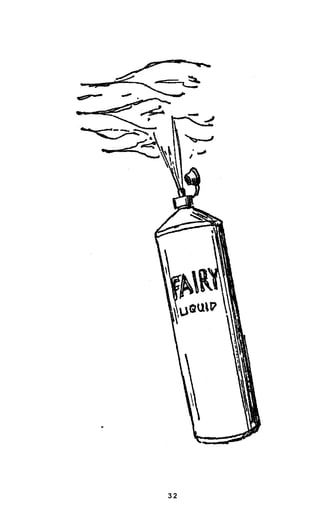
had organised themselves a little more adequately to begin
with, weeks could have been saved!
    3. With your basic structure in front of you fill in the details
in note form so that you complete an outline which needs only
 grammatical and sentence structure changes to become a
coherent presentation.
    4. Practise making your speech from this completed out-
 line! You will find that, having completed the research and
 having thought about the structure of the material, you will
 already have nearly memorised your speech! Initially, of
 course, there will be points at which you hesitate, but with a
 little practice you will find that not only do you know your
speech, you also know what you are talking about !
  This point is especially important, for it means that when
you finally do speak to your audience you need have no fear of
forgetting the word-order or what you are presenting. You
simply say what you have to say, using the appropriate voca-
bulary and not a rigid succession of sentence structures. In
other words, you become a creative rather than a static speaker.
This is Always preferably.
   5. As a precautionary step it is advisable to jot down on a
                                147
small card, or to remember on one of your smaller memory
systems, the key words in the basic outline of your speech. This
greatly reduces the possibility of forgetting.
   The only problem you may consider still unsolved is that
of not being able, immediately, to find the right word at the
right time. Don't worry about this. When the audience senses
that a speaker knows what he is talking about, an effective
pause makes it obvious that he is creating on the platform.
This adds rather than subtracts from the enjoyment of listen-
ing, for it makes the presentation less formal and more
spontaneous.
Jokes and Narratives
    Jokes and narratives are far easier to deal with than are
speeches, because most of the creative work has already been
done for you! The problem is nevertheless a two-fold one:
first, you must remember the joke or narrative to begin with,
and second, you must remember its details.
   The first of these problems is easily solved by using a section
of the major system as a permanent library for the stories you
wish to file. I need go into this point no further, as it is simply
a matter of selecting a key word and associating it with the key
word of the System.
    The second problem is slightly more difficult to overcome,
and involves once again our use of the link system. Let us take,
for example, the joke about the man who went to the pub
and bought a pint of beer. Having bought this beer, he sud-
denly realised he had to make a telephone call, but knew that
some of the 'characters' in the bar might well swipe his pint
before he returned. In order to prevent this he wrote on his
glass 'I am the World's Karate Champion.' and went to
make his telephone call, securely thinking that his beer was
safe.
   When he returned he saw immediately that his glass was
empty and noticed more scribbling underneath his own. It
read 'I am the World's fastest runner—thanks!'
   To remember this joke we consciously select key words from
it, joining them into the basic narrative.
   All we need from this full paragraph of narration are the
words 'pint', 'phone', 'write', 'karate champion', and 'runner'.
With these few words, which can be linked in whatever way
we please, the whole sequence and essence of the joke will
                                148
return immediately, and those horrible silences as one runs out
of steam in the middle of a story need never recur!
Articles
   Articles may need to be remembered on a very short-term
basis or on a long-term basis, and the systems for remembering
each are different.
   If you have to attend a meeting or to make a brief resume of
an article you have only recently read, you can remember it
almost totally, and at the same time can astound your listeners
by remembering the pages you are referring to! The method is
simple: take one, two or three ideas from each page of the article
and slot them on to one of your peg memory systems. If there is
only ono idea per page, you will know that when you are down
to memory word 5 in your basic system, you are referring to
the 5th page, whereas if there are two ideas per page and you
are at memory word 5 you will know you are the top of page 3!
   When an article has to be remembered over a longer period
of time, we once again revert to the link system, taking key
words from the article and linking them in such a way as to
make them most memorable. This method of remembering
will enable you not only to recall the sequence of the events
and ideas but also to retain a more adequate general impression
of what the article was about. The act of consciously attempting
to remember is itself a part of learning.
Dramatic Parts and Poems
   The last section of this chapter deals with those two items
that have been in the past, and are still unfortunately today,
the bane of the schoolchild.
   The method usually employed (and recommended) is to
read a line over and over again, 'get it'; read the next line,
'get it'; join the two together; 'get them'; read the next line
and so on ad nausum until the first lines have been forgotten!
   A system recommended and used successfully by well-
known actors and actresses is almost the reverse. In this system
the material to be remembered is read and re-read quickly but
with understanding over a period of four days, approximately 5
times a day. In this manner the reader becomes far more
familiar with the material than he realises and at the end of his
20th reading tries to recall, without looking at the text, the
material to be remembered. Almost without fail the mind will
                              149
have absorbed 90% or more totally, and remembering will
have been a natural outgrowth of reading!
   As I have said, this system has been found far more success-
ful than the line-by-line repeating system, but even it can be
improved considerably.
   Once again the link system and key words come into play.
If the material to be remembered is poetry, a few major key
words will help the mind to 'fill in' the remaining words which
will almost automatically fall into place between the key words.
   If the material to be remembered is part of a script, once
again key words and linking images can prove essential. The
basic content of a long speech can be strung together with ease,
and the cues from speaker to speaker can also be handled far
more effectively. It is these cues that often cause chaos on the
stage because of the silences and breaks in continuity that may
occur when one performer forgets his last word or another
forgets his first. If these last words (or even actions) are linked
in the way that we link objects in our memory system, breaks
and confusion can be completely avoided.
   In summary, the remembering of speeches, narratives,
jokes, articles, dramatic parts and poems involves a number
of slightly differing techniques. In all cases, however, the use
of some form of link, key words, and repetition is necessary.


                               150
CHAPTER NINETEEN

         MEMORY SYSTEMS FOR LANGUAGES


 When hearing the word 'language', some tend to think only of
foreign languages. Seldom do they stop to think that the term
 includes their own tongue! The title of this chapter conse-
 quently refers to English as well as to other languages!
    As I mentioned in my book Speed Reading vocabulary is
 considered to be the most important single factor not only in
 the development of efficient reading but also in academic and
 business success. This is not surprising when one realises that
 the size of one's vocabulary is usually an indication of the
 depth of one's knowledge.
    Since vocabulary is the basic building block of language, it
 it desirable and necessary to develop methods of learning and
 remembering words more easily. One of the better ways of
 accomplishing this aim is to learn the prefixes (letters, syllables
 or words recurring before root words) the suffixes (letters,
 syllables or words recurring at the end of root words) and the
 roots (words from which others are derived) that occur most
 frequently in the language you are attempting to learn. A
 comprehensive list of these appears in the vocabulary chapters
 of my book Speed Reading.
    Here are some more tips on how to improve your word
memory:
    1. Browse through a good dictionary, studying the ways in
which the prefixes, suffixes and roots of the language are used.
Whenever possible, use association to strengthen your recall.
    2. Introduce a fixed number of new words into your
vocabulary everyday. New words are retained only if the
principle of repetitions as explained earlier, is practised. Use
your new words in context and as many times as possible after
you have initially learned them.
    3. Consciously look for new words in the language. This
directing of your attention, known as 'mental set', leaves the
'hooks' of your memory more open to catch new linguistic
fish!
                               151
These are general learning aids to assist your memory in
acquiring knowledge of a language. They may be applied to
English, as a means for improving your present vocabulary, or
to any foreign languages you are beginning to learn.
   Having established a general foundation for learning words,
let us be more specific in the remembering of particular words.
As with other memory systems the key word is association. In
the context of language-learning it is well to associate sounds,
images and similarities, using the fact that certain languages
are grouped in 'families' and have words that are related.
   To give you an idea of this linking method, I shall consider
a few words from English, French, Latin and German.
   In English we want to remember the word 'vertigo' which
means dizziness or giddiness, and in which a person feels as if
he or surrounding objects are turning around. To imprint this
word on the memory we associate the sound of it with the
phrase 'where to go?' which is the kind of question you would
ask if you felt that all surrounding objects were rotating about
you! Two words which many people confuse in the English
language are: 'acrophobia', which is a morbid fear of heights,
and 'agoraphobia' which is a morbid fear of open spaces. The
distinction can be firmly established if you associate the 'aero'
in acrophobia with acrobat (a person who performs at great
height!) and the 'agora' from agoraphobia with agriculture,
bringing to mind images of large flat fields (though the Greek
word actually means marketplace!).
   Foreign languages are more 'approachable' when one
realises that they form groups. Virtually all European lan-
guages (with the exception of Finnish, Hungarian and Basque)
are part of the Indo-European group, and consequently
contain a number of words which are similar in both sound
and meaning. For example the words for father: German
'vater', Latin 'pater', French 'pere', Italian and Spanish
'padre'.
   A knowledge of Latin is of enormous help in understanding
all the Romance languages, in which many of the words are
similar. The Latin word for 'love' is 'amor'. Related to 'love'
in the English language is the word 'amorous' which means
inclined to love; in love; and of or pertaining to love—the
links are obvious. Similarly we have the Latin word for 'god':
'Deus'. In English the words Deity and Deify mean respect-
ively 'divine status; a god; the Creator' and 'to make a god of.
                                152
French was derived from the vulgar speech of the Roman
legionaries, who called a head 'testa', a crockery shard, hence
'tete', and the shoulder 'spatular', a small spade, hence
'epaule', etc. About fifty per cent of ordinary English speech is
derived either directly from Latin (+ Greek) or by way of
Norman French, leading to many direct analogies between
French and English.
    As well as language similarities based on language grouping,
foreign words can be remembered in a manner similar to that
explained for remembering English words. As we are discuss-
ing French, the following two examples are appropriate: In
French the word for 'book' is 'livre'. This can be remembered
more readily if you think of the first four letters of the word
'Library' which is a place where books are classified and
studied. The-French word for 'pen' is 'plume' which in
English refers td a bird's feather, especially a large one used for
ornament. This immediately brings to mind the quill pen
used widely before the invention of the steel nib, fountain pen
and biro. The link-chain 'plume—feather—quill—pen' will
make the remembering of the French word a simple task.
    Apart from the Latin, Greek, and French, the rest of
English is largely Anglo-Saxon, going back to German, giving
rise to countless words that are virtually the same in German
and English—glass, grass, will, hand, arm, bank, halt, wolf, etc.
while others are closely related, light (licht), night (nacht),
book (buch), stick (stock) and follow (folgen).
    Learning languages, both our own and those of other
 people's, need not be the frustrating and depressing experience
 it so often is. It is simply a matter of organising the informa-
tion you have to learn in such a way as to enable your memory
 to 'hook on' to every available scrap of information!
    The methods outlined in this chapter should give you a solid
 basis for becoming more proficient in the various languages,
 and for enjoying the process of becoming more efficient.


                                153
CHAPTER TWENTY

        REMEMBERING FOR EXAMINATIONS


Few people hear the word 'examination' without a slight
feeling of fear or distaste. In Speed Reading, I have dealt
comprehensively with methods for studying three to ten times
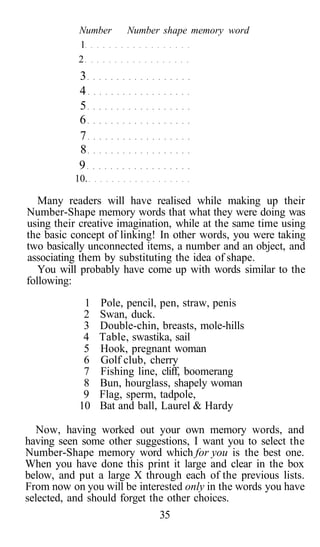
more effectively. Here I'm going to discuss examinations in
relation to memory systems.
   Typically, the person taking an examination dashes to his
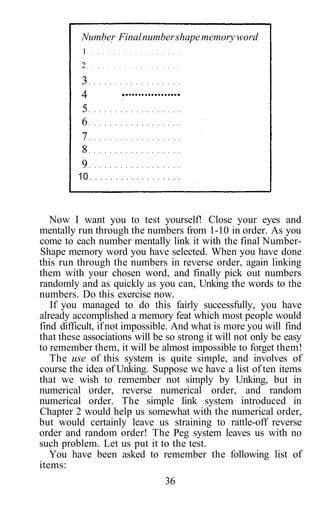
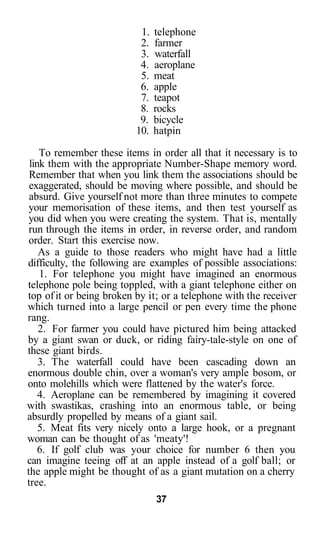
seat in order to use all the available time and reads his exam-
ination paper so nervously, quickly and confusedly that he
has to read it over again to find out just what it is he is being
asked.
   At this stage he usually becomes flustered, desperately trying
to co-ordinate all the information which he thinks might relate
to the question he is trying to answer, but which is buried in
the mire of all his other disorganised knowledge. How often
have you yourself, or have you seen someone else write an
examination, spending as much as 15 minutes of an hour's
time jotting down notes, scratching his head, resting his chin on
his hand, and frowning as he frantically tries to recall all that
he knows and yet at this moment does not know?
   Such students often possess more knowledge about the
subject than others. I remember at least three students in my
undergraduate years who knew more about certain subjects
than virtually everyone in the class and who used to give
private tuition and coaching to those who were struggling.
   Extraordinarily and regularly, these students would fail to
excel at examination time, invariably complaining that they
had not had time in the examination room to gather together
the knowledge they had.
   Problems such as theirs can be overcome by preparing for
examinations using the Major and Skipnum Memory Systems,
in conjunction with the link system.
   Let us assume that the subject to be examined is psycho-
logy. Reviewing your notes, you realise that in the year's study
you have covered four major areas, and that each area had four
                              154
or five main theories, four or five major figures, and a number
of experiments.
   Applying this information to the memory system, you link
the name of the first major area with the first word of the
system, list the main theories on the following numbers, the
main figures on the next numbers and after that the experi-
ments. For the next major area you repeat this process until
you have covered the major key words and ideas for the
content of the year's course. Should any of these items have
smaller items which you think might be significant, they can
be linked to the key psychology words.
   It may surprise you to learn that in circumstances where
my students have applied these systems, their memory list
for any given subject in a yearly exam seldom exceeds 70 items!
In the examination room they are immediately far ahead of
their erstwhile "peers. When considering their answers to
questions, they simply survey their organised knowledge in
less than a minute, selecting those items that are relevant. In
addition, the items selected are already in an 'essay' form.
   In the example we are using, the answer to any question
could take the following form 'in considering the problem of
blank and blank I wish to discuss three of the major areas of
psychology, citing the theories of blank from the second, and
the theories of blank and blank from the third area. In connec-
tion with these areas and theories I will also consider the
importance of the following major figures in the history of these
ideas, and shall discuss in relation to the entire question the
following experiments: . . . '
   Without having said anything our imaginary student
already sounds well on the way to a 1st class! Indeed he may
well be, for as his initial fact getting-down task has been made
so much more easy, the amount of time left to him for creative
discussion and comment on what he has written will be
greater.
   To carry this last point a little further—it is advisable to peg
on to your memory system creative or original ideas that flash
into your mind concerning the subject of examination. These
often make the difference between a 1st and 2nd class, yet
normally they tend either to get mixed up in a generally con-
fused presentation of knowledge and ideas or lost in the heat
of the moment.
   Smaller details, including the titles of books, articles and
                               155
dates, can obviously be co-ordinated with the system explained
above.
  Examinations are not all that difficult. Explaining what you
know in an organised and coherent fashion to an examiner can
be—use your memory systems to help you!


                             156
CHAPTER TWENTY-ONE

              REMEMBER TO REMEMBER!


You have now completed your basic course and should have
learnt no fewer than twenty different systems for remembering
different items!
   After being given a rough historical context within which to
work, you were given an initial memory test designed to establish
the limits of your memory at that time.
   The first chapters (in an attempt to overcome as rapidly as
possible the deficiencies laid bare by the test!) dealt with the
basic principles of remembering, giving you practice in the
rules of exaggeration, movement, substitution and absurdity.
The principles learnt in these systems were then applied to
the new memory system of Heinz Norden, Skipnum, and to
the Major System.
   From the Major System you were able to branch out into
the remembering of numbers, anniversaries, birthdays and
historical dates, including the year, month and day.
  Apart from this you learnt systems for remembering names
and faces, speeches, jokes, narratives, articles, languages, and
playing cards.
  With the information you now possess you are ready to use
your memory in a far more adequate and comprehensive way.
Apart from your business and social life many of the systems
may be used to give 'memory demonstrations' ranging from
reeling off lists of items to picking out the 'missing cards' from
a deck.
  Building a good memory is much like growing up. You
develop a little day by day but seldom notice the changes until
you suddenly look back at yourself, often through other
people's eyes, writing or photographs. You may not even
now be fully aware of the strides you have made during your
reading of Speed Memory.
  To see just how far you have come, go back and look at the
'photograph' of your memory as recorded in the initial memory
                               157
test. Things which at that time appeared (and were!) difficult
will now seem like child's play.
   We have come to the end of the course, but in a sense it is
only a beginning. At the moment you are using abstract
systems to remember items that have given you difficulty in
the past. By continuing to use these systems and actively
concerning yourself with remembering to remember, you will
find that the systems themselves will become unnecessary, and
that through the process of consciously working to improve
your memory with 'artificial aids', you will have helped it to
become vigorous and independent.


                             158
If you feel you have benefited from reading this book why
not invest in a copy of Tony Buzan's SPEED READING
by Sphere Books.

To anyone reaching a reading speed of 350 words per
minute plus 50 per cent comprehension of SPEED
READING the author offers a £5 reduction in an
ADVANCED READING COURSE taught personally
by Tony Buzan.

For further details please write or telephone:
The College of Advanced Reading,
49 Frognal,
Hampstead,
London N.W.3.
01-435 6846
All Sphere Books are available at your bookshop or
newsagent, or can be ordered from the following address:
Sphere Books, Cash Sales Department,
P.O. Box 11, Falmouth, Cornwall.
Please send cheque or postal order (no currency), and allow
5p per book to cover the cost of postage and packing
in U.K., 7p per copy overseas.

Buzan tony speed memory

  • 2.
    Can you remembernames, faces, lists, numbers, speeches, dates, examination data ? Speed Memory is a comprehensive memory training course based on recent research. As you work through the book, you graduate from simple methods to highly advanced systems - increasing your memory power all the time. These techniques to improve your memory form the basis of the new BBC television programme Use Your Head, devised and presented by the author. CRAFTS & HOBBIES 0 7221 2118 0 UNITED
  • 3.
    SPEED MEMORY Tony Buzan Canyou remember names, faces, lists, speeches, dates, numbers, examination data? SPEED MEMORY is a comprehensive memory training course based on recent research. As you work through the book, you graduate from simple methods to highly advanced systems-and increase your memory power as you go! There are special sections on subjects such as learning foreign languages, memorizing poems and dramatic parts, and remembering for examinations. Tony Buzan is an expert in the field of reading techniques and memory systems. He has developed a memory training course which has been widely used in schools and colleges, and in the Houses of Parliament. He is also the author of SPEED READING.
  • 4.
    Also by TonyBuzan and available in Sphere Books SPEED READING My special thanks are due to Heinz Norden for his permission to use the Skipnum Memory System and for his extensive help morally and editorially, and to my personal assistant, Joy Buttery, for her encouragement and perseverance.
  • 5.
    Speed Memory TONY BUZAN i SPHEREBOOKS LIMITED 30/32 Gray's Inn Road, London, WCIX 8JL
  • 6.
    First published inGreat Britain in 1971 by Sphere Books © Tony Buzan 1971 TRADE MARK Conditions of Sale - This book shall not without the written consent of the Publishers first given be lent, re-sold, hired out or otherwise disposed of by way of trade in any form of binding or cover other than that in which it is published. The book is published at a net price and is supplied subject to the Publishers Association Standard Conditions of Sale registered under the Restrictive Trade Practices Act, 1956. Set in Monotype Plantin Printed in Great Britain by Hazell Watson & Viney Ltd Aylesbury, Bucks
  • 7.
    FOREWORD Once again mygifted young friend—and if I may say so with pride, protégé—Tony Buzan has asked me to give one of his eminently useful books a send-off. In a lop-sided kind of comparison, if you already have a good memory, training is not needed, and if you do not—well, how useful really is training? I can answer this conundrum by suggesting that memory exists only in the use of it. It may not be true that everyone has a good memory to begin with, although I should like to think so; but it is certainly true that many people simply do not use the memory they have. It has always seemed to me that memory systems tend to be cumbersome, even though, as you will see, I have developed one of my own. They are like crutches, when one ought to walk unaided. How much simpler to remember the thing directly rather than to have to remember a way of remembering It! A fine way to send off a book on memory training, you may say—but let me add quickly that to my mind the real value of memory training and a book such as Tony Buzan's is that it is, or should be, self-liquidating, so to speak. No doubt memory can be trained, like an unused muscle, on a dumbbell, but in the end the dumbbell is thrown away and the muscle goes to work on the job to be done rather than on a training aid. Could you remember something—let us assume you have a 'bad memory'—if you had to? James Bond lay dying. 'The formula,' he whispers, ' . . . can say it only o n c e . . . . Your life depends on i t . . . . The world will go smash if you don't. . . . ' Would you remember? I think you would. This attention set seems to me all-important in remember- ing. Let me give you a small example. Someone gives you his telephone number over the telephone. Almost invariably nine persons out of ten will say: 'Would you mind repeating that?' Why? He said it perfectly clearly the first time. All you had to 5
  • 8.
    do was topress the switch marked 'attention set' rather than leaving the one on that says 'Oh, I'll get it on the second or third try'. A matter of habit. Of course, I happen to be one of those lucky people who can repeat the number out loud, and then actually 'hear it' for a long time, simply by listening. Try it some time. One more thing. Memory is not just a quantitative faculty. Its potential capacity is probably astronomical, but I suspect it is not unlimited, although few of us are in danger of getting even near the limit. Yet I do know two men, each of whom speaks—and speaks fluently, idiomatically—more than a dozen languages, and, sad to relate, neither of them has any- thing of importance to say in any of them! Don't try to turn yourself into an 'idiot savant'. I long ago gave up making a vast parking lot of facts and figures of my mind. It's enjoyable enough to dazzle people with displays of esoteric knowledge (I have sometimes described knowledge as 'the opium of the intelligent'), but what is the point, really? Do you want to be a walking almanac? It's no great hardship to carry a small book of telephone numbers, or to keep an encyclopaedia on your shelves. Today I try to use my memory for storing up relationships, how things hang together, insight. I see the great function and aim of mind, with its marvellous tool, memory, as integration, or, if you will forgive the grandiloquent term, wisdom. Tony Buzan's book Speed Memory is an excellent 'first step' toward the realisation of that goal. HEINZ NORDEN. 6
  • 9.
    TABLE OF CONTENTS FOREWORD 5 INTRODUCTION 9 THE HISTORY OF MEMORY 11 1. MEMORY TEST 18 2. MEMORY SYSTEM 1 27 3. MEMORY SYSTEM 2 34 4. MEMORY SYSTEM 3 40 5. MEMORY SYSTEM 4 44 6. MEMORY SYSTEM 5 47 7. SMALL MEMORY SYSTEM REVIEW AND EXTENSION 52 8. MEMORY SYSTEM 6 53 9. MEMORY SYSTEM FOR NAMES AND FACES 59 10. THE MAJOR SYSTEM 81 11. CARD MEMORY SYSTEM 124 12. LONG NUMBER MEMORY SYSTEM 128 13. TELEPHONE NUMBER MEMORY SYSTEM 131 14. MEMORY SYSTEM FOR SCHEDULES AND APPOINTMENTS 135 7
  • 10.
    15. MEMORY SYSTEMFOR DATES IN OUR CENTURY 138 16. MEMORY SYSTEM FOR IMPORTANT HISTORICAL DATES 142 17. REMEMBERING BIRTHDAYS, ANNIVERSARIES AND DAYS AND MONTHS OF HISTORICAL DATES 144 18. MEMORY SYSTEM FOR SPEECHES, JOKES, NARRATIVES, DRAMATIC PARTS AND POEMS, ARTICLES 146 19. MEMORY SYSTEMS FOR LANGUAGES 151 20. REMEMBERING FOR EXAMINATIONS 154 21. REMEMBER TO REMEMBER! 157 8
  • 11.
    INTRODUCTION SpeedMemory will enable you to remember lists of objects not only in order, but also in reverse and random order; to remember names and faces, as well as facts associated with them; to remember speeches, scripts, articles, jokes and narratives; to remember dates, prices, numbers (including telephone numbers!) and anniversaries; and to remember far more readily languages and information relevant to examina- tions. You will also be able to perform 'memory feats' with * number games and cards. The course was compiled over a number of years, taking Into consideration the latest educational and psychological theories as well as a wide range of material concerned with memory systems. As a result Speed Memory will give you as wide an introduc- tion to the art of memory training as do the much-publicised memory training courses advertised in the national press. The course will enable you also to see how the 'Super-Brain' memory experts perform their amazing feats, while at the same time enabling you to perform with the same competence! In other words, anyone who approaches this book seriously can himself become, in the popular sense of the term, a mental wizard! It is a number of years since the widespread publicity sur- rounding Pelmanism made the art of memory training well- known. But it has taken all this time for the various systems to be completely developed, and for new and exciting systems to be introduced. Speed Memory brings the reader to this exciting point in time. The book is programmed to make the learning of the various systems especially easy. The first section introduces the history of memory and the development of ideas and practices sur- rounding it, thus providing a context for subsequent learning. The next few chapters introduce simple Link and Peg systems, 9
  • 12.
    enabling you toexercise your growing capacities on progress- ively more difficult material and advanced concepts. Among these systems is an entirely new and original system, Skipnum, recently developed by my close friend, Heinz Norden, the well- known polymath. After these basic systems have been introduced an important chapter is devoted to the memorisation of names and faces, as well as facts relating to them. This is followed by the introduction of the Major System, a highly developed mnemonic system that serves not only as an almost infinite Peg system (1,000 Peg words are included in this chapter!), but also a system that may be applied to the memorisation of numbers in their various forms. The remainder of the book is devoted in part to these numerical memorisations (dates, prices, telephone numbers, anniversaries and birthdays, etc.) and in part to the more general application of memory systems to remembering speeches, scripts, jokes, articles, narratives, languages, appoint- ments and schedules. In conclusion, special examination techniques are discussed and general advice is given. 10
  • 13.
    THE HISTORY OFMEMORY From the time when man first began to depend on his mind for coping with the environment, the possession of an excellent memory has placed individuals in positions of both command and respect. The amazing feats in remembering accomplished by particular people were so impressive that they have become legendary! The Greeks It is difficult to say exactly when and where the first inte- grated ideas on memory arose. It is reasonable to state, how- ever, that the first sophisticated concepts can be attributed to the Greeks some 600 years before the birth of Christ. As we look back on them now, these 'sophisticated' ideas were surprisingly naive, especially since some of the men proposing them are numbered among the greatest thinkers the world has ever known! In the 6th century B.C., Parmenides thought of memory as being a mixture of light and dark or heat and cold! He thought that as long as any given mixture remained unstirred, the memory would be perfect. As soon as the mixture was altered, forgetting occurred. In the 5th century B.C. Diogenes of Appollonia advanced a different theory. He suggested that memory was a process which consisted of events producing an equal distribution of. air in the body. Like Parmenides he thought that when this equilibrium was disturbed forgetting would occur. Not surprisingly, the first person to introduce a really major idea in the field of memory was Plato, in the 4th century B.C. His theory is known as the Wax Tablet Hypothesis and is still accepted by some people today, although there is growing disagreement. To Plato the mind accepted impressions in the same way that wax becomes marked when a pointed object is moved around on its surface. Once the impression had been made Plato assumed it remained until, with time, it wore away, 11
  • 14.
    leaving a smoothsurface once more. This smooth surface was, of course, what Plato considered to be complete forgetting—the opposite aspects of the same process. As will become clear later, many people now feel that they are actually two quite different processes. Shortly after Plato, Zeno the Stoic slightly modified Plato's ideas, suggesting that sensations actually 'wrote' impressions on the wax tablet. When Zeno referred to the mind and its memory he, like the Greeks before him, did not place it in any particular organ or section of the body. To him and to the Greeks 'mind' was a loose and very unclear concept. The first man to introduce a more scientific terminology was Aristotle, in the late 4th century B.C. He maintained that the language previously used was not adequate to explain the physical aspects of memory. In applying his new language Aristotle attributed to the heart most of the functions that we properly attribute to the brain. Part of the heart's function, he realised, was concerned with the blood, and he felt that memory was based on the blood's movements. He thought forgetting to be the result of a gradual slowing down of these movements. Aristotle made another important contribution to sub- sequent thinking on the subject of memory when he introduced his laws of the association of ideas. The concept of association of ideas and images is now generally thought to be of major importance to memory. Throughout Speed Memory this con- cept will be discussed, developed and applied. In the 3rd century B.C. Herophilus introduced to the discus- sion 'vital' and 'animal' spirits. He considered the higher order vital spirits to be located in the heart. These higher order spirits produced the lower order animal spirits, which included the memory, the brain, and the nervous system. All of these he thought to be secondary in importance to the heart! It is interesting to note that one reason advanced by Hero- philus for man's superiority over animals was the large number of creases in man's brain. (these creases are now known as convolutions of the cortex). Despite the fact of his observation, Herophilus offered no reason for his conclusion. It was not until the 19th century, over 2,000 years later, that the real import- ance of the cortex was discovered. In summary, the Greeks made the following significant contribution: they were the first to seek a physical as opposed 12
  • 15.
    to a spiritualbasis for memory; they developed scientific con- cepts and a language structure that helped the development of these concepts; and they contributed the Wax Tablet hypo- thesis which suggested that memory and forgetting were opposite aspects of the same process. The Romans Surprisingly, the contributions of the Romans were minimal. The major thinkers of their time, including Cicero in the 1st century B.C. and Quintilian in the 1st century A.D., accepted without question the Wax Tablet concept of memory, and did little further work. Their major contribution was in the development of memory systems. It was they who first introduced the idea of a Link system and a Room system, both of which will be described in later chapters. The Influence of the Christian Church The next major contributor to the progress of ideas on memory was the great physician Galen in the 2nd century A.D. He located and delineated various anatomical and physiological structures, as well as further investigating the function and structure of the nervous system. Like the later Greeks, he assumed that memory and mental processes were part of the lower order of animal spirits. These spirits he thought were manufactured in the sides of the brain, and it was consequently here that memory was seated. Galen thought that air was sucked into the brain, mixing with the vital spirits. This mixture produced animal spirits which were pushed down through the nervous system, enabl- ing us to feel and taste, etc. Galen's ideas on memory were rapidly accepted and con- doned by the Church which at this time was beginning to exert a great influence. His ideas became doctrine, and on that account little progress was made in the field for 1,500 years. This mental suppression stifled some of the greatest minds that philosophy and science has produced! St. Augustine in the 4th century A.D. accepted the Church's ideas, considering memory to be a function of the soul, which had a physical seat in the brain. He never expanded on the anatomical aspects of his ideas. From the time of St. Augustine until the 17th century there 13
  • 16.
    were virtually nosignificant developments in ideas on memory, and even in the 17th century new ideas were restricted by doctrine. Even such great a thinker as Descartes accepted Galen's basic ideas, although he thought that animal spirits were sent from the pineal gland on special courses through the brain until they came to the part where memory could be triggered. The more clear-cut these courses, the more readily, he thought, would they open when animal spirits travelled through them. It was in this way that he explained the improve- ment of memory and the development of what are known as 'memory traces'. A memory trace is a physical change in the nervous system that was not present before learning. The trace enables us to recall. Another great philosopher, who 'went along with the tide' was Thomas Hobbes, who discussed and considered the idea of memory but contributed little to what had been said before. He agreed with Aristotle's ideas, rejecting non-physical explana- tions of memory. He did not, however, specify the real nature of memory, nor did he make any significant attempts to locate it accurately. In summary, it is evident from the theories of the 16th century intellectuals that the influence of Galen and the Church had been profound. Almost without exception these great thinkers uncritically accepted primitive ideas on memory. Transitional Period—The 18th Century One of the first thinkers to be influenced by the new surge of science and by the ideas of Newton was Hartley, who developed the vibratory theory of memory. Applying Newton's ideas on vibrating particles, Hartley suggested that there were memory vibrations in the brain which began before birth. New sensa- tions modified existing vibrations in degree, kind, place and direction. After influence by a new sensation, vibrations quickly returned to their natural state. But if the same sensa- tion appeared again the vibrations took a little longer to return. This progression would finally result in the vibrations remain- ing in their 'new' state, and a memory trace was established. Other major thinkers of this period included Zanotti who was the first to link electrical forces with brain functions, and Bonnet who developed the ideas of Hartley in relation to the flexibility of nerve fibres. The more often nerves were used, the 14
  • 17.
    more easily hethought they vibrated, and the better memory would then be. The theories of these men were more sophisticated than previous ones because they had been largely influenced by developments in related scientific fields. This interaction of ideas laid the groundwork for some of the more modern theories of memory in the 18th century. The 19th Century With the development of science in Germany in the 19th century, some important developments occurred. Many of the ideas initiated by the Greeks were overthrown, and work on memory expanded to include the biological sciences. Prochaska finally and irrevocably rejected the age-old idea of animal spirits, on the ground that it has no scientific basis and no evidence to support it. He felt that limited existing know- ledge made speculation on the location of memory in the brain a waste of time. 'Spatial localisation may be possible', he said, 'but we just do not know enough at the moment to make it a useful idea.' It was not for some 50 years that localising the area of memory function became a useful pursuit. Another major theory presented in this century was that of Flourens, who 'located' the memory in every part of the brain! He said that the brain acted as a whole and could not be inter- preted as the interaction of elementary parts. His views held the field of physiology for some time, and it is only recently that great strides have been made in the development of our thinking on memory. Modern Theories Modern developments in memory have been aided to an enormous degree by advances in technology and methodology. Almost without exception psychologists and other thinkers in this field agree that memory is located in the cerebum, which is the large area of the brain covering the surface of the cortex. Even today however, the exact localisation of memory areas is proving a difficult task, as is the accurate understanding of the function of memory itself. Current thought has progressed from Ebbinghaus's work with learning and forgetting curves at the turn of the century, to advanced and complex theories. Research and theory can be roughly divided into 3 main 15
  • 18.
    areas: work onestablishing a biochemical basis for memory; theories which suggest that memory can no longer be consid- ered as a single process but must be broken down into divi- sions; and Penfield's work on Brain Stimulation. Research into the biochemical basis for memory was initiated by Hyden in the late 1950's. This theory suggests that RNA (ribonucleic acid), a complex molecule, serves as a chemical mediator for memory. RNA is produced by the substance DNA (deoxyrinbonucleic acid) which is responsible for our genetic inheritance—for example DNA decides whether your eyes will be blue or brown, etc. A number of experiments have been performed with RNA, lending support to the idea that it does indeed have a lot to do with the way in which we remember things. For example, if animals are given certain types of training, the RNA found in certain cells is changed. And further, if the production of RNA in an animal's body is stopped or modified, these animals have been unable to learn or remember. An even more exciting experiment showed that when RNA was taken from one rat and injected into another, the second rat 'remembered' things that he had never been taught, but which the first rat had! While research into this aspect of memory is progressing other theorists are saying that we should stop emphasising 'memory', and concentrate more on the study of 'forgetting'! It is their position that we do not so much remember, as gradually forget. Encompassing this idea is the Duplex theory of remember- ing and forgetting, which states that there are two different kinds of information retention: long-term and short-term. For example, you have probably experienced a different 'feeling' from the way in which you recall a telephone number which has just been given to you, and the way in which you recall your own telephone number. The short-term situation is one in which the idea is 'in' the brain but has not yet been properly coded and is therefore more readily forgotten. In the long-term situation the idea has been completely coded, filed and stored and will probably remain for years, if not for life. Research into direct brain stimulation has been recently initiated by Dr. Wilder Penfield, a clinical surgeon. When 16
  • 19.
    performing craniotomies (removalof a small section of the brain) in order to reduce epileptic attacks, Penfield had first to remove a portion of the skull lying over the side of the brain. Before operating Penfield conducted, and conducts, a system- atic electrical stimulation of the open brain, and the patient, who remains conscious, reports his experience after each stimulation. In an early case Penfield stimulated the temporal lobe of the brain and the patient reported a recreated memory of a childhood experience! Penfield found that stimulating various areas of the cortex produces a range of responses, but that only stimulation of the temporal lobes leads to reports of meaningful and integrated experiences. These experiences are often complete in that when recreated they include the colour, sound, movement, and emotional content of the original experiences. Of particular interest in these studies is the fact that some of the memories stimulated electrically by Penfield had been un- available in normal recall! In addition to this the stimulated experiences seemed to be far more specific and accurate than normal conscious recall which tends to be a generalisation. It is Penfield's belief that the brain records every item to which it pays conscious attention, and that this record is basically permanent although it may be 'forgotten' in day-to-day living. That brings us roughly up to date! Looking back over history, we see that real thinking in this area has been going on for only a little over two thousand years years, and that for as many as 1,500 of those 2,000 years virtually no advances were made. In fact only a few hundred years of progressive thought have passed, and during those years man has progressed from thinking of memory in terms of spirits and vague concepts, to tracking it down to a fairly small area in the body. But even now he is still only at the beginning of his search. Every month more than 80 new articles are published from the major research centres in the world. It may not be long before final and dramatic breakthroughs are made. 17
  • 20.
    CHAPTER ONE MEMORY TEST Few people ever put their memory to the immediate test, and it is for this reason that most are unaware of the limits and habits of their mind's work. The tests that follow should not be too difficult, but because of the way we are trained (or not trained!) in school, the simple tasks you will presently attempt will in some cases prove very very difficult and in others almost impossible! Do not worry about poor performance, since it is the purpose of this book to make the memorisation of all items in the following tests an easy and enjoyable exercise. Looking at this situation from a positive point of view, the more difficulty you experience now, the greater will be your improvement by the time you have completed this book! LINK TEST Read the list of 20 objects once through, and then immedi- ately cover it or close the book. On a separate piece of paper write down as many of them as you can remember, attempting to get them in the correct order. Score yourself in two ways: first the number of items you remembered out of 20, and second, the number of items that you listed in the correct order (if you reversed certain items they are both wrong with regard to the second score!). Cup Shop Chimney pot Judge Suitcase Toe Mountain Star Couch Ice cream 18
  • 21.
    Jail Spoon Book Spider Scissors Plant Nurse River Stain Mongrel Score: Number remembered Number in correct order •. PEG TEST Give yourself no more than four minutes to remember this second list of 20 items. The aim in this test is to remember the items in random order, connecting them to their appropriate number. When four minutes have passed cover the list or close the book, write the numbers from 1-20 on a piece of paper, and fill in the answers randomly, that is, pick a number on the list and fill in the item which belongs to that number. Do not progress regularly from 1-20. Jump about all over the numbers until you have filled in as many as you can. And still another don't: don't mumble through the list each time in order to get a number—pick it out of the air! 1. Tar 2. Aeroplane 3. Leaf 4. Shell 5. Hair 6. Moon 7. Lever 8. Lighter 9. Railway 10. Field 11. Atom 12. Wheel 13. School 14. Sand 15. Doctor 19
  • 22.
    16. Spectacles 17. Lake 18. Feather 19. Sock 20. Pump Score: Number correct FACES TEST Look at the 12 faces on the following two pages for not more than four minutes, then turn to the end of this chapter where the same faces are presented without their names. Try to match the right name to the right face. Score one point for each correct answer, and take off one point if you fit a name to a person of the wrong sex! NUMBER TEST Look at the four 15-digit numbers printed below* giving not more than one minute to each. At the end of each two minutes dose or cover the book and write down the number as best you can, giving yourself one point for every number that you put down in the correct place. 936811475298694 937943271621487 689223841378534 543712298374973 Score: 1 2 3 4 TELEPHONE NUMBER TEST The following is a list of 10 people and their telephone numbers. Study the list for not more than five minutes, then dose or cover the book and write down first the name and then the numbers. Give yourself 1 point for each correct number (even if you make only one mistake in the number you must consider this totally wrong, for if you had dialled it you would not have been put in contact with the person with whom you wished to speak!) Your local butcher HSM-8737 Your dentist NAH-9107 Your bank manager KAM-5323 Your doctor HOB-3981 Your local grocer CEL-8801 20
  • 23.
    Mrs. Greenfield Mr. Sirl Miss Brainne Mr. Hawkins MissBoulton Mrs. Woolridge S.M.—2
  • 24.
    Miss Finch (28) Mr.Hall (75) Mr. Potter (40) Mrs. Knight (35) Mr. Shelby (19) Mr. Bell (30)
  • 25.
    Your local chemist BOT-9939 Your tennis partner SER-4112 Your plumber LEA-8519 Your local pub PMB-1427 Your garage TRK-9340 Score: CARD TEST This next test is designed to exercise your present capacity in the remembering of cards and their sequence. The list below contains all 52 cards of the regular pack in numbered order. Your task is to spend not more than 5 minutes looking at this list and then recall it in order. Give yourself one point for each correct answer, scoring yourself in the same way as you did in the Link test. 1. King of diamonds 27. Nine of clubs 2. Seven of hearts 28. Jack of diamonds 3. Five of spades 29. Queen of hearts 4. Four of clubs 30. Four of spades 5. Three of diamonds 31. Six of clubs 6. Ten of hearts 32. King of spades 7. Queen of clubs 33. Ace of clubs 8. Eight of clubs 34. Six of hearts 9. Five of hearts 35. Five of clubs 10. Jack of clubs 36. Three of hearts 11. Ace of spades 37. Ten of diamonds 12. Five of diamonds 38. Two of clubs 13. Nine of diamonds 39. Seven of diamonds 14. Eight of hearts 40. Ten of spades 15. Ace of diamonds 41. Three of clubs 16. Seven of spades 42. Eight of spades 17. Nine of hearts 43. King of hearts 18. Ten of clubs 44. Nine of spades 19. Six of diamonds 45. Queen of diamonds 20. Queen of spades 46. Ace of hearts 21. Eight of diamonds 47. Three of spades 22. Four of diamonds 48. Two of spades 23. Six of spades 49. Jack of spades 24. Two of diamonds 50. Four of hearts 25. King of clubs 51. Jack of hearts 26. Two of spades 52. Seven of clubs Score: 23
  • 28.
    DATES TEST This next test is the last. Listed below are ten fairly import- ant historical dates. Your task is to spend not more than a minute and a half remembering the event and the date. Give yourself one mark for a perfectly accurate answer and half a mark if you come within five years. 1. 1666 Fire of London 2. 1770 Beethoven's birthday 3. 1215 Signing of Magna Carta 4. 1917 Russian Revolution 5. c.1454 First Printing Press 6. 1815 Battle of Waterloo 7. 1608 Invention of the telescope 8. 1905 Einstein's theory of Relativity 9. 1789 French Revolution 10. 1776 Declaration of American Independence Score: That ends the testing! If you have done badly then you have done as expected and are quite average! Within the first few chapters of this book you will have learned how to get perfect scores in less than the time allotted, and by the time you have completed the book all of these tests will be child's play. Give yourself a day's rest (after what must have been a fairly strenuous session!) and start your first memory training tomorrow. 26
  • 29.
    CHAPTER TWO MEMORY SYSTEM I THE LINK SYSTEM Having established what I hope was not a too disturbing picture of the way in which your memory has been limited up to now, we move on to the first method of improving its ability! The method is known as the Link method, and is the most basic of all the systems—the ideas and methods that you use when applying this system will prove invaluable in mastering the more sophisticated systems. 'Link' can be considered to be the key word in memory, another word for it being 'association'. Before going into the details of the link system, I shall say something about the principle of association and its connection with the entire field of Memory. As I mentioned in the introduction, psychologists have come to the conclusion that we remember things by joining a certain part of them with other things. For example, on returning to an old home or your old school, you may have realised that seeing a certain picture on the wall, or a certain piece of furniture, etc., made you 'suddenly remember' things that you would otherwise, have entirely forgotten. Your mind was linking all the ideas and memories that had been associated with the object at which you were looking. This principle applies, no matter how complicated the memory situation is. Even when remembering complicated mathematical formulas or very abstract ideas, there is a link in the background which triggers the memory you want. It is this basic concept that we shall make use of throughout the book, using methods that enable the mind to link or associate far more readily than it would otherwise have been able to. Without further ado let us apply the link method of remem- bering to a simple shopping list. In a rushed moment, and with no paper or writing instruments nearby, you have been asked to buy the following items: 27
  • 30.
    1. Bananas 2. Soap ' 3. Eggs 4. Drinking glasses 5. Bandages 6. Matches 7. Washing up liquid 8. Toothpaste 9. Shoes 10. Tomatoes Most people when given a list quickly like this manage to remember six or seven of the items. If you haven't already spent some time trying to remember the list, close your eyes now without looking at the list again, and see how many you can recall, giving yourself extra credit if you remember the correct order! The link method makes it all so much easier! Instead of frantically trying to remember everything randomly, you must quickly and decisively link the objects with each other. In die list that we have set out to learn this can be done as follows: Bananas and Soap are both items commonly used in jokes about people falling on their behinds! Immediately imagine yourself therefore stepping on a banana peel with your right foot and a bar of soap with your left foot, causing you to fall down. What happens when someone falls down?—He breaks things! Rather than making our memory device into a medical catalogue, we remember the next two items on our list by picturing eggs in our right hand and glasses in our left hand, both of which get broken during the fall. Our first four items are now firmly linked together. How do we link the rest? Again the task is quite easy; bandages are used for cuts which are caused by broken glass. Our next item, matches, can be linked with the idea of a bandage if we think of one of those long rolled bandages, the end of which has been set alight and is slowly burning. Matches! Having created a mental fire we had better put it out! And what better device than a fire extinguisher, or a container of washing up liquid which we mentally 'put' in the fire extin- guisher's place. 28
  • 31.
  • 32.
    The next itemon our list, toothpaste, can easily be linked with die washing up liquid as they both come from containers which have to be squeezed. Simply imagine a fire-extinguisher- soap-container beginning to squirt toothpaste instead of soap. We can move rapidly onto the next item by picturing the toothpaste no longer being squirted at the fire, but being badly aimed and covering our freshly polished shoes which were about to step on a rotten tomato anyway! And there we have it: our list often items neatly associated: we slip on the bananas and soap, break the eggs and drinking glasses, and need bandages which are set alight by matches. The resulting fire is then put out by washing up liquid which is similar to squeezing toothpaste which goes all over our clean shoes which were about to squash a tomato! The system is easy, but you might have already thought 'Ah yes, it might work for that list, but what happens when I have to memorise my own?*. In fact it will be just as easy for you to make up your own, and eventually even easier, if you follow these simple rules: 1. Exaggerate your associations 2. Move your associations. 3. Substitute your associations. 4. Be Absurd! 1. Exaggerate Your Associations Items are remembered far more easily if they are pictured in your mind's eye as being much greater than they really are. For example when you pictured yourself slipping on the banana peel and the bar of soap, your remembering task would have been made easier if you imagined a banana peel the size of a ski, and a bar of soap as large as a boulder. 2. Move Your Associations Whenever you are establishing links include if possible, movement or action. By doing this you create images which are"; far more alive. The movement in your image helps to nudge the picture back into consciousness. Imagine for example how much more difficult our shopping list would have been to memorise if we had not used the idea of falling, breaking, bleeding, burning, squirting, and squashing! Action and move- ment always make remembering not only easier, but also more enjoyable. 30
  • 33.
  • 34.
  • 35.
    3. Substitute YourAssociations The art of remembering well relies on a number of factors, and it is advisable, especially in associations which you might feel are a little weak, to bring all your weapons to the fore. By substituting one thing for another you can often very strongly reinforce a link that might have been not quite strong enough. An example of this was our substitution of the fire extinguisher for the washing-up liquid container. The substitution itself made the association and the movement links more complete, and thus more readily recalled. 4. Be Absurd! Remembering is one area where you can really 'let yourself go'! There is no point at all in being conservative about the links you form—in fact the more conservative and retiring you are, the weaker your associations will be, and the worse your memory! Whenever you are trying to associate anything with anything else, think up the most extraordinary and outrageous combina- tion you can, and you will find it will last much longer. In day- to-day living you will find the same principle works. It is never the humdrum, mundane, ordinary events that catch one's attention; it is the exciting, new and unusual events which do so. And even if somebody does mention the uninteresting or boring, doesn't he always commence his statement with 'It was the most extraordinarily boring . . . ' or 'The most deadly dull . . . ' ? In other words it is those events which stand out which are remembered (even if they stand out because of their mediocrity!). As a final note, and in a hushed breath, I feel obliged to mention that associations using some form of vulgar or sexual imagery are for many people among the strongest form. In view of this, and if a sexual image seems appropriate, do not hesitate to use it. Just be sure your imagination doesn't run away with itself! 33
  • 36.
    CHAPTER THREE MEMORY SYSTEM 2 THE NUMBER-SHAPE SYSTEM In the last chapter we established the ground-work for all our memory systems. We learned that memory is a linking process and that it can be aided by exaggeration, by movement, by substitution, and by being absurd. We now move on to the first of the Peg memory systems. A Peg memory system differs from the link system in that it uses a special list of items which never change, and to which the items you wish to remember are joined or linked. A Peg system can be thought of as a clothes cabinet which contains a number of hooks for hanging clothes on. The hooks never change, but the clothes which are hung on the hooks can be infinitely varied. The first system we shall use is a fairly short one which uses the numbers from 1 to 10. It would, of course, be possible for me to give you the system outright, but it will be far more valuable if you create most of it yourself. I shall therefore explain exactly how to construct the system, and shall then progress to its practical use. The first Peg system, which we shall call the Number- Shape system, requires initially that you think of a noun which you are reminded of by the actual shape of the number. For example, and to make your task a little easier, the memory word that most people associate with the number 2 is swan, because the number resembles very closely the shape of a swan. I shall list the numbers from 1-10, leaving a blank beside each number for you to pencil in the words which you think best approximate the shape of the other nine numbers. These words will be your constant memory hooks, so try to make sure that they are good visual images—words to which you will be able to join other ideas without too much difficulty. Give yourself not more than five minutes to complete the list from 1-10, and even if you find some numbers impossible, don't worry, just read on! 34
  • 37.
    Number Number shape memory word 1 2 3 4 5 6 7 8 9 10. Many readers will have realised while making up their Number-Shape memory words that what they were doing was using their creative imagination, while at the same time using the basic concept of linking! In other words, you were taking two basically unconnected items, a number and an object, and associating them by substituting the idea of shape. You will probably have come up with words similar to the following: 1 Pole, pencil, pen, straw, penis 2 Swan, duck. 3 Double-chin, breasts, mole-hills 4 Table, swastika, sail 5 Hook, pregnant woman 6 Golf club, cherry 7 Fishing line, cliff, boomerang 8 Bun, hourglass, shapely woman 9 Flag, sperm, tadpole, 10 Bat and ball, Laurel & Hardy Now, having worked out your own memory words, and having seen some other suggestions, I want you to select the Number-Shape memory word which for you is the best one. When you have done this print it large and clear in the box below, and put a large X through each of the previous lists. From now on you will be interested only in the words you have selected, and should forget the other choices. 35
  • 38.
    Number Final numbershape memory word 1 2 3 4 5 6 7 8 9 10 Now I want you to test yourself! Close your eyes and mentally run through the numbers from 1-10 in order. As you come to each number mentally link it with the final Number- Shape memory word you have selected. When you have done this run through the numbers in reverse order, again linking them with your chosen word, and finally pick out numbers randomly and as quickly as you can, Unking the words to the numbers. Do this exercise now. If you managed to do this fairly successfully, you have already accomplished a memory feat which most people would find difficult, if not impossible. And what is more you will find that these associations will be so strong it will not only be easy to remember them, it will be almost impossible to forget them! The use of this system is quite simple, and involves of course the idea of Unking. Suppose we have a list of ten items that we wish to remember not simply by Unking, but in numerical order, reverse numerical order, and random numerical order. The simple link system introduced in Chapter 2 would help us somewhat with the numerical order, but would certainly leave us straining to rattle-off reverse order and random order! The Peg system leaves us with no such problem. Let us put it to the test. You have been asked to remember the following list of items: 36
  • 39.
    1. telephone 2. farmer 3. waterfall 4. aeroplane 5. meat 6. apple 7. teapot 8. rocks 9. bicycle 10. hatpin To remember these items in order all that it necessary is to link them with the appropriate Number-Shape memory word. Remember that when you link them the associations should be exaggerated, should be moving where possible, and should be absurd. Give yourself not more than three minutes to compete your memorisation of these items, and then test yourself as you did when you were creating the system. That is, mentally run through the items in order, in reverse order, and random order. Start this exercise now. As a guide to those readers who might have had a little difficulty, the following are examples of possible associations: 1. For telephone you might have imagined an enormous telephone pole being toppled, with a giant telephone either on top of it or being broken by it; or a telephone with the receiver which turned into a large pencil or pen every time the phone rang. 2. For farmer you could have pictured him being attacked by a giant swan or duck, or riding fairy-tale-style on one of these giant birds. 3. The waterfall could have been cascading down an enormous double chin, over a woman's very ample bosom, or onto molehills which were flattened by the water's force. 4. Aeroplane can be remembered by imagining it covered with swastikas, crashing into an enormous table, or being absurdly propelled by means of a giant sail. 5. Meat fits very nicely onto a large hook, or a pregnant woman can be thought of as 'meaty'! 6. If golf club was your choice for number 6 then you can imagine teeing off at an apple instead of a golf ball; or the apple might be thought of as a giant mutation on a cherry tree. 37
  • 40.
    7. Your fishingline could be cast into an enormous teapot; or you might be pouring tea over a cliff instead of into a cup; or a neatly placed teapot could be imagined being knocked off the table by a boomerang. 8. Buns (as they often are!) could become rocks; the hour- glass could be enormous, passing rocks instead of sand for telling the time; or a shapely women might have her shape ruined because her clothes were stuffed with rocks. 9. The bicycle could be imagined as having an enormous Union Jack on the front which obscured the rider's vision caus- ing him to wobble all over the road; it would be imagined (substituted for) a sperm racing to conception; or it could be imagined ploughing through a swamp filled with enormous tadpoles. 10. And finally the bat of the bat and ball could be thought of as a large hatpin; or some typical Laurel and Hardy prank with a hatpin could be imagined. The examples I have given here are of course only examples, but they are included to indicate the kind of creative thinking that is necessary to establish the most effective memory links. I am sure that many of you will have devised some excellent associations, and what is necessary now is that you practise this system, and make sure that your ten Number-Shape memory words are completely second-nature to you. One of the best ways to make sure of this is to test yourself with members of your family or with friends. Ask them to make up a list of any ten items, and to read them to you with about a five-second pause between each item. The second they have spoken the word make your association, consolidating it before they reach the next one. You (and they!) will be amazed at the ease with which you can remember the items, and it is most impressive when you are able to repeat them in reverse and random order. Do not worry about getting previous lists of items confused with new ones. As I mentioned before this little Peg system can be compared to coat hooks—you simply remove one association and replace it with another! In the next chapter I shall be introducing another small system similar to this one. The two can then be combined to enable you to remember, just as easily as you have remembered ten items, twenty items! Later on in the book more sophistic- ated systems will be introduced which can be used for storing 38
  • 41.
    information you wishto remember for a long period of time. The present systems are for more immediate purposes. Give yourself about a day to become skilled with the tech- piques you have learned so far and then move on to the next chapter. 39
  • 42.
    CHAPTER FOUR MEMORY SYSTEM 3 THE NUMBER-SOUND SYSTEM Now that you have learned about the history of memory, about the ideas of association, about the Link system, and the first small Peg system, you are ready to progress to the next small Peg system and to a few slightly more sophisticated Peg systems. Because of the knowledge you are building up as you go along these systems will be introduced without too much preliminary explanation as the principles already discussed are common to all of them. The Number-Sound system is almost identical to the Number-Shape system except that (and this you may have already guessed.) we think of nouns or noun-verbs which are similar in sound to the number. As in Chapter 3 I am going to list the numbers from 1-10, leaving a blank beside each number for you to pencil in the rhyming images which you think are best for each number. Make sure that the images will be good memory hooks for you. As an aid, the word which nearly everyone uses for number 5 is 'hive', the images being associated with this varying from one enormous bumble bee leaving the hive to a sky-covering swarm of monster bees! As practice in linking and creative thinking has probably already improved your mental capacity give yourself not five minutes as previously, but three minutes to fill in the Number- Sound memory word list from 1-10. Number Number sound memory word 1. 2. 3 4. 5 40
  • 43.
    6. 7. 8. ........... 9. 10. As before I am going to offer you now a few alternative suggestions which I would like you to consider, and then compare and contrast them with your own choices. Having done this select the Number-Sound memory word which you consider to be best and print it in the box as you did in the previous chapter. First then, some possible choices: 1. Sun, bun, Nun 2. Shoe, pew, loo 3. Tree, flea, knee 4. Door, moor, war 5. Hive, drive, jive 6. Sticks, wicks, pricks 7. Heaven, Devon 8. Gate, bait, weight 9. Vine, line, twine 10. Hen, den, wren Now select the most appropriate word and enter it in the box. Number Number sound memory word 1. 2. 3 ................... 4- 5....... 6. 7. 8. 9. 10. 8.H.—3 41
  • 44.
    As in thelast chapter, I now want you to test yourself with four chosen Number-Sound word. Close your eyes and mentally run through the numbers in order, linking each number mentally with the Number-Sound memory word you have selected. Next run through the numbers in reverse order again linking them with your chosen word, and finally pick numbers randomly and as quickly as you can, linking as you go. Spend about five minutes on this exercise now. This list can be used in exactly the same way as the Number- Shape list, although many of you will have already realised that in a way you already possess the ability to remember 20 objects in and out of sequence! All you have to do is to establish one of these two Peg systems as the numbers from 1-10, letting the other represent the numbers from 11-20. Let us put this to the test. You will remember (I hope!) that Chapter 1 contained two tests, each of which asked you to remember 20 items. The first of these tests could have been adequately done by using the Link system, but the second was more difficult and required some form of Peg memory system. Let us then apply our present knowledge to the more difficult of these two tests. < Decide which of the two Peg systems is to be first, and which, second and then give yourself not more than four minutes to remember the list When your four minutes are up, close or cover the book and then write down your answers in the same way as you did in the original test. After you have done this check your answers against the list. Here it is again: 1. Tar 2. Aeroplane 3. Leaf 4. Shell 5. Hair 6. Moon 7. Lever 8. Lighter 9. Railway 10. Field 11. Atom 12. Wheel 13. School 42
  • 45.
    14. Sand 15. Doctor 16. Spectacles 17. Lake 18. Feather 19. Sock 20. Pump Score: Number correct You will almost certainly have made an improvement over your performance in the original test, but might find that you are still having difficulty with certain associations. The only way to overcome this is to practise and practise still more. Tonight and tomorrow throw yourself in at the deep end, testing yourself whenever possible, and having as many of your friends and acquaintances as you can try to catch you out on lists that they make up for you to remember. On the first few tries you will probably make a few errors but even so, you will be performing far beyond the average person's capacity. If you persevere, you will soon be able to fire back lists without any hesitation, and without any fear of making mistakes! 43
  • 46.
    CHAPTER FIVE MEMORY SYSTEM 4 THE CLASSICAL ROOM SYSTEM Before moving on to two of the more major Peg systems, you shall have a light and easy day's work with a simple little Room system. In the section dealing with the history of memory, I men- tioned that the Romans accepted without question the theore- tical ideas of memory introduced by the Greeks. I added that one of their major contributions was the introduction and development of memory systems. One of their most popular systems made use of objects in a room. Such a system is easily constructed. Try to imagine an enormous room with a door. Now fill this room with as many items of furniture and other objects as you wish—each item of furniture will serve as a link word. Don't make a mental rubbish-dump of it, though! Your objects should be very precisely ordered. For example, you may decide to start on the immediate right of the door as you enter the room, placing there a finely carved coffee-table, on which you might put anything from a statue to an attractive lamp. Next to this you could have an antique sofa, and so on. You can see that the possibilities are almost limitless—but make sure that your objects are memorisable and that you can keep them mentally placed in the right order. How is such a system used? When you are given a list of objects you wish to remember in order (it being not necessary to remember reverse, random, or numerical order), you simply associate the items to be remembered with the objects in your room. Suppose, for instance, that your first three items were 'oil', 'insect', and 'girl'. Using the examples given, the oil could be imagined flowing all over the coffee table, the insect could be enlarged and perched on top of the statue or could be flying around the lamp, and the girl could be draped seduct- ively on the sofa! 44
  • 47.
  • 48.
    The advantage ofthis system is that it is entirely your own, that the room may be as large as you wish, may have as many walls as you care to imagine, and may contain a great number of memory-peg objects. On the blank page provided here you should now construct your own room, selecting the shape you feel is best, and then finally printing in the objects with which you are going to furnish it. When you have completed this task, take a number of mental walks around the room until you are completely familiar with the order and arrangement of things. As with the previous memory systems, practise alone and with friends, until your system is firmly established. In the next chapter I shall be introducing the Alphabet system, which will enable you to remember more than 20 items.
  • 49.
    CHAPTER SIX MEMORY SYSTEM 5 THE ALPHABET SYSTEM The Alphabet system is another Peg system similar in construc- tion to the Number-Shape and Number-Sound systems; but instead of using numbers, it uses the 26 letters of the alphabet. Its advantage is that it enables you to remember 26 objects, its only disadvantage being that most people find it hard to reel off the alphabet in reverse order, or to know immediately the number order of a given letter in the alphabet. As with the two number systems, I suggest you first con- struct your own list, then compare it with alternative sugges- tions, and finally select your own list to be entered in the memory box. The method of constructing your Alphabet memory system is as follows: Select a word that starts with the actual sound of the letter, is visually outstanding, and comes first in the dictionary. For example, for the letter 'L' it would be possible to use elastic, elegy, elephant, elbow, and elm, etc. If you were looking up these words in the dictionary, the first one you would come to would be elastic, and that is therefore the word you would choose. The reason for this rule is that if you should ever forget your alphabet word, you can mentally flick through the letters in order, rapidly arriving at the correct word. In the example given, if you had forgotten your word, you would try el'a' and would immediately be able to recall your first word—elastic! Another rule in the construction of the Alphabet memory system is that if the letter itself makes a word (for example 'I' makes 'eye') then that word should be used. In some cases it is possible to use meaningful initials instead of complete words, for example D.D.T. I have listed the letters of the alphabet. Paying close atten- tion to the rules for constructing the system, pencil in your own Alphabet system words. 47
  • 50.
    Letter Alphabet memoryword A B C D .................. E F G H I J K L M N O P Q R. S T U V W X Y Z I hope that wasn't too tiring! Many people have difficulty in constructing an Alphabet memory system, because they tend to be far more visual- than sound-oriented. Before considering the alternative suggestions, therefore, it might be wise to re-check your own Alphabet memory words, making sure you have started your words with the sound of the 48
  • 51.
    letter or letterword and not simply the letter itself. For example 'ant', 'bottle', 'case', 'dog', and 'eddy' would not be correct memory words because they do not start with the sound of the letter as it is pronounced in the alphabet. Having re-checked your own words, now compare them with the following list of suggestions, and when you have done so select your final list and print it clearly in the Alphabet memory system box. As before cross out your own list and the list of suggestions when you have finished with them. A Ace,—those of you with knowledge of American history might use Abe. B Bee—the letter makes a word; this is the word that should be used. C See—the same rule applies. D Deed (legal)—the initials D.D.T. may be preferable. E Easel F Effigy G Jeep, or gee-gee! H H-bomb I Eye J Jay—a gaily coloured member of the crow family. K Cage L Elastic, or elbow if you pronounce elastic with a long 'e'. M Ember N Enamel O Oboe P Pea—first alphabetically! Q Queue R Arch S Eskimo T Tea—or perhaps T-square. U U-boat—'you' is too vague V Vehicle, or the initials V.D. W Wolf—the sound here is difficult; the initials W.G can be used instead. X X-ray Y Wife Z Zebra, or Z-car! Now make your final choices and enter them in the memory box. 49
  • 52.
    Letter Final Alphabetmemory word A B ............... C .... D E F G H ................. I J.................. K L M N O P Q R S T U V W X Y Z
  • 53.
    Your practice withthe Alphabet system should be similar to your practice with previous smaller systems. The end of this chapter marks the end of your learning the introductory and basic Peg and Link systems. From now on, apart from a brief summary of these concepts in Chapter 7, you will be learning more sophisticated and more expansive systems that will enable you to remember lists of hundreds of items, as well as systems to help you remember faces, numbers etc. The next chapter but one deals with an exciting new system which has never been published or widely used, although it has been carefully tested.
  • 54.
    CHAPTER SEVEN SMALL MEMORY SYSTEM REVIEW AND EXTENSION You have now completed the five smaller memory systems: the Link, the Number-Shape, the Number-Sound, the Classical Room and the Alphabet. Each of these systems can be used either independently or in conjunction with another system. Furthermore, one or two of the systems can be set aside, if you wish, as 'constant memory banks'. That is, if you have certain lists or orders of items that you will need to be able to recall over a period of a year or more, you can set aside the system of your choice for this purpose. Before moving on to the broader systems, however, I want to introduce you to a simple and intriguing method for instantly doubling any of the systems you have so far learned! When you have reached the end of a system but still wish to add further associations, all you have to do is to go back to the beginning of your system and imagine your association word exactly as you usually imagine it, with the exception that it is contained in a huge block of ice ! This simple device will drastically change the association pictures you have formed, and will double the effectiveness of your system by giving you the original list plus the original list in its new context. For example, if your first key in the Number-Shape system was 'telephone pole', you would imagine that same telephone pole either buried in the heart of your giant block, or protrud- ing from the corners or sides; if your first word in the Number- Sound system was 'sun', then you could imagine its fierce rays melting the edges of the ice block in which it was contained; if your first word in the Alphabet system was ace then you could imagine a giant playing card either frozen in the centre or forming one of the six sides of the ice cube. Practise this technique. You will find it extraordinarily helpful.
  • 55.
    CHAPTER EIGHT MEMORY SYSTEM 6 SKIPNUM Skipnum (Self-Coding Instant Phonetic Number Memory grid!) is an entirely new memory system. It was developed by my close friend and associate Heinz Norden, the well-known writer, translator and polymath. Skipnum differs from other major memory systems in that it is based almost entirely on phonetics. The system is based on two elements everyone knows: 1, The initial letter of the memory word is the same as the initial letter of the number which is attached to that word. For example the numbers from 60 to 69 all begin with an 's', and therefore so do the memory words for the numbers from 60 to 69. 2. The vowel sound of the memory word is the same as the vowel sound of the unit digit in the number for which we are making the word. For example let us take the number 42. The first letter in our memory word must be an 'f because 42 begins with an 'f'. The next sound in our memory word must be '00' because the digit number in 42 is two, and its vowel sound is '00'. That means we have 'foo' which we can easily make into a word by adding either T or 'd' giving us 'fool' or 'food'. Let us try another example. The number we wish to create a memory word for is 91. The first letter is 'n'. The digit number in 91 is 1, and its vowel sound is 'uh'. To complete our memory word for 91 we simply have to complete 'nuh'. A 't' or an 'n' completes this most satisfactorily giving us 'nut' or 'nun'. There are a few exceptions to these two basic rules, but they are logical and easily remembered. 1. Ten to nineteen. These numbers do not of course have the same initial consonant. They are however collectively the 'tens' or 'teens' and therefore we use the letter 't' for these numbers. 2. Twenty to twenty-nine. A full set of memory words 53
  • 56.
    beginning with 'tw'is not available so 'tr' is used instead. We can remember this fairly easily by recalling that children often confuse 'tr' and 'tw'. 3. Fifty to fifty-nine. We cannot use 'f' as the initial letter because we have already used it for forty. Instead we use 'h' because it stands for 'half', and fifty is halfway between 0 and 100. 4. Seventy to seventy-nine. In the same way that we could not use 'f' for fifty because we had already used it for forty, we cannot use V for seventy because we have already used it for sixty. This is overcome easily by using the second consonant of seventy, i.e. 'v'. 5. Eighty to eighty-nine. There is no initial consonant here so instead we use the first consonant in the word eighty, which is 'g'. 6. Vowel sound for nine. We cannot use the 'i' sound for nine because we have already used it for five. Instead we use one of the most common remaining vowel sounds (which is contained in the word vowel!) 'ow'. 7. 00-09. These are included in the Skipnum grid for convenience, because these two-digit units occur frequently in telephone numbers and elsewhere. We use the initial conso- nant 'b' because it is easy to remember when we think of 007, James Bond! Before reading on, have a quick look at the memory grid in this Chapter, trying to familiarise yourself with the ideas that have so far been explained. The grid is laid out simply and dearly, and should not be hard to follow. You have noticed from looking at the grid that a preferred memory word is given in bold It is usually the simplest possible word formed by the above two rules, and is preferably one that can be used both as a verb and a noun. If possible it should have more than one meaning, and should be able to serve as a connector in making phrases from the memory words. Vulgar, action and emotionally charged words are also prefer- able because they are easier to remember. Where they arise, silent initial letters such as 'g' 'k' 'w' and 'y' are ignored in the memory words. Since more than one word can often be formed within the boundaries of the rule, alternate words may be used. Some of these are given in the Skipnum grid for you to choose from. This possibility of alternate words is particularly useful in 54
  • 57.
  • 58.
    situations where youmight be trying to remember a long number which contains the same two-digit sequence more than once. You don't have to repeat the same word, but can use another word representing the same number! Another advantage of this memory system is that you don't have to learn the memory words by heart since they are 'self coding'. They will pop into your mind instantly as long as you know the rules! Up to this point in the Chapter you have been given a lot of detailed information which at the moment you may have found a little bit difficult to absorb completely. It is advisable now to review quickly the entire Chapter, consolidating those areas which have given you some trouble. To assist you in further consolidation, I have randomly listed the numbers from 1-100 on the next two pages so that you can readily test yourself in either remembering the words on the grid or 'self coding' your own. When you have completed the Skipnum grid to your satis- faction take the plunge and try to remember 100 items. You will find to your surprise that it is not really much more difficult than remembering twenty! When you are confident test yourself with your friends. 56
  • 59.
    58 60. 49 39 05 2 5 48. ...... 52 69 31. ................. 84 93 70. 54 4 99 15 8 57 13.............. 01 63 94 38 88 03 34. 79 18 92 85 41 87 0 30 37. 59 29. .. 89 00 74 73 27 56 50 97 86 68 67 9 65 22 61 51 90 57
  • 60.
    35 1. 0 44 83 .... 47 21 07 36 96 08 77 7. 20 32 12 75 16 78 62 26 8o 40 71 3 02 43 14 76 6 09 . 19. .. 72 98 .. . 33 66 46 53 23 82. 28 1 95 25 81 04 06 17. 11 64 42. .. 45 24 55 91 58
  • 61.
    CHAPTER NINE MEMORY SYSTEM FOR NAMES AND FACES Remembering names and faces is one of the most important aspects in our lives, and one of the most difficult! In every walk of life, every level of occupation, and every social situation, there are literally millions of people who say they 'just can't remember' the people they meet. In business and the professions this can be most embarrass- ing. If you are at a conference, attending a course, or involved in any situation in which you are meeting new people, it is not only embarrassing to be unable to remember the names and faces of those who are with you, it can also be a serious handi- cap when you meet them again. Even should you not have occasion to meet them again, the ability to remember names and faces without seeing them may be useful when you are 'mentally thumbing through' people who might be of assist- ance to you. In a social setting, the inability to remember the names and faces of people you meet is a discomforting and unpleasant experience. Many people devise little tricks and methods for evading the issue! One of the favourites is to ask for the person's name, and when he replies with his Christian name to say 'Oh, I knew that! it was your surname I had difficulty remembering', and of course if he replies with his surname 'Oh I knew that! it was your Christian name I had difficulty remembering'! The disadvantages of this little technique are two-fold: Even if it works you have had to admit that at least in part you had forgotten his name; and secondly, many people reply immed- iately with both their Christian and surnames! Another device commonly used by people who have forgot- ten a name is to say something like 'Oh, I am sorry, but how was it that you spelled your name?' This of course can work in situations where a person has a name like Pattlesserie Zhytni- ewski! But when the retort is a sarcastic 'J-O-H-N S-M-I-T-H' you can be made to look a little silly! 59
  • 62.
    These tricks arenothing more than tricks, and apart from the obvious pitfalls I have mentioned they inevitably leave the person who is using them in an insecure and uncomfortable position. Aware of his inadequacy, he tends to be afraid that his tricks won't work or that he will be placed in a situation where they will be inappropriate and his poor memory will be on full view! Tricks, then, are not enough. At the other end of the scale from the person who 'just can't remember' names and faces, is that well-known person who always does remember. At school it might have been a particu- lar teacher (or the headmaster!); at university a well-known professor, and in business a successful manager. Whatever the situation I am sure you will confirm the fact that the person was socially confident, generally successful, and almost certainly well-known. I remember well the first class I ever attended at university. It was an eight-in-the-morning English lecture, and the excitement of the first day and the first class had not quite managed to shake off the sleepiness from most of the students. Our professor had! He strode into the room with no brief- case and no books, stood in front of the class, announced his name, and then said he would call the attendance. He started alphabetically, listing off names such as Abrahamson, Adams, Ardlett, and Bush, in response to which he got the usual mumbled 'Yes, sir' and 'Here, sir'. When he came to Cartland, however, there was no reply. He paused for a moment and then said 'Mr. John Cartland'. To which there was still no reply. Without change of expression he then said 'Mr. John W. P. Cartland?' and proceeded to list the boy's birthday, address, and telephone number! There was still no reply so our professor (who by this time had thoroughly awakened the class!) carried on with the remaining names. Each time he arrived at the name of a person who was absent he called out that persons initials, birthday, address and telephone number! When he had completed the roster and everyone sat with jaws hanging open, he repeated very rapidly the names of all the students who were absent and said, with a wry smile on his face, 'I'll make a note of them some time!' He never forgot one of us, either! From that day on he became a legend, for none of us could imagine or hope to compete with the brilliance of a mind that could so completely and perfectly remember names and dates. 60
  • 63.
    We were, ofcourse, mistaken. Using the proper memory system, the kind of performance that our professor gave is by no means an impossibility, and is in fact quite simple. In this chapter I shall introduce you to the systems and techniques that make remembering of names, faces and related facts a relatively simple and certainly a rewarding task. Before getting down to the specific methodology, there are a few rules that should be observed, even when one is not using special memory systems. These rules or pointers apply mostly to situations in which you are meeting new people. The pointers rely on one of the most important factors in memory: Repetition. When you are introduced to somebody first make sure you listen. Many people actually 'turn off' when they are intro- duced to people and haven't the faintest idea what the name of the person is to whom they have just been introduced! Second, request that the name be repeated even if you have heard it. Most people tend to mumble introductions and even if an introduction is clear no one will be disturbed if you ask for a repetition. Third, repeat the name when you have been given it the second time. Rather than saying simply 'how do you do?' add the name to the end of your greeting: 'how do you do, Mr. Rosenthal'. Fourth, if the name is at all difficult, politely ask for the spelling. Fifth, if the situation seems to warrant it ask the person something about the background and history of his name. Contrary to what you might expect most people will be flattered by your interest, and pleased that you have taken the trouble to enquire about their name and remember it. Carrying the principles of repetition and involvement further, make sure that during conversations with people you newly meet you repeat the name wherever possible. This repetition helps to implant the name more firmly in your memory, and is also socially more rewarding, for it involves the other person more intimately in the conversation. It is far more satisfying to hear you say 'yes, as Mr. Jones has just said . . . ' than to hear you say 'yes, as this chap over here as just said...'! And finally of course when you are taking leave of those you S.M.—4 61
  • 64.
    have met makesure you say, rather than just an impersonal farewell, 'good evening, Mr. Jones'. These aids to memory are, as I mentioned, useful to the person who is not using memory systems as well as one who is, although they are naturally far more beneficial to the latter, because he has additional 'artillery' which he can use to back himself up. Without further ado, let us learn the system for remembering faces and names. To begin with, we must become far more observant of the faces we wish to remember! Many people, especially those who have a poor memory for names and faces, have great difficulty in remembering how one face differs from another, and find it almost impossible to describe the individual characteristics of faces. Our first task then is to become more observant. To aid you in this the next few pages will give you a 'guided tour' from the top of the head to the tip of the chin, enumer- ating the various characteristics and the ways in which they can be classified and typified. You may well be surprised at just how varied faces can be! HEAD AND FACIAL CHARACTERISTICS 1. The Head Usually you will first- meet a person face-on, so before deal- ing with the run-down of separate characteristics we will consider the head as a whole. Look for the general shape of the entire bone structure. You will find that this can be: a. Large b. Medium c. Small And that within these three categories the following shapes can be found: a.square b.rectangular c.round d.oval e.triangular, with the base at the chin and the point at the scalp f. triangular with the base and the scalp and the point at the chin 62
  • 65.
    g. broad h. narrow i. big-boned j. fine-boned You may, fairly early in your meeting, see the head from the side and will be surprised at how many different shapes heads seen from this view can take: a. square b. rectangular c. oval d. broad e. narrow f. round g. flat at the front h. flat on top i. flat at the back j. domed at the back k. face angled with jutting chin and slanted forehead 1. face angled with receding chin and prominent forehead 2. The Hair In earlier days, when hairstyles used to be more consistent and lasting, hair served as a better memory hook than it does now. The advent of dyes, sprays, wigs, and almost infinitely varied styles makes identification by this feature a somewhat tricky business! Some of the more basic characteristics, however, can be listed as follows: Men a. thick b. fine c. wavy d. straight e. parted f. receding g. bald h. cropped i. medium j. long k. frizzy 1. colour (only in notable cases) 63
  • 66.
    Women a. thick b. thin c. fine Because of the variability in women's hairstyles it is not advisable to try to remember them from this characteristic! 3. Forehead Foreheads can be generally divided into the following categories: a. high b. wide c. narrow between hairline and eyebrows d. narrow between temple and temple e. smooth f. lined horizontally g. lined vertically 4. Eyebrows a. thick b. thin c. long d. short e. meeting at the middle f. spaced apart g. flat h. arched i. winged j. tapered 5. Eyelashes a. thick b. thin c. long d. short e. curled f. straight 6. Eyes a. large b. small c. protruding 64
  • 67.
    d. deep-seated e. close together f. spaced apart g. slanted outwards h. slanted inwards i. coloured j. iris—entire circle seen k. iris—circle covered partly by upper and/or lower lid Attention may also be paid in some cases to the lid above and the bag below the eye, both of which can be large or small, smooth or wrinkled, and puffy or firm. 7. The Nose When seen from the front: a. large b. small c. narrow d. medium e. wide When seen from the side: a. straight b. flat c. pointed d. blunt e. snub or upturned f. Roman or aquiline g. Greek, forming straight line with forehead h. concave (caved in) The base of the nose can also vary considerably in relation to the nostrils: a. lower b. level c. a little higher The nostrils themselves can also vary: a. straight b. curved down c. flaring 65
  • 68.
    d. wide e. narrow f. hairy 8. Cheekbones Cheekbones are often linked very closely with the character- istics of the face when seen front-on, but the following three characteristics may often be worth noting: a. high b. prominent c. obscured 9. Ears Ears are a part of the face that few people pay attention to, and yet their individuality can be greater than any other feature. They may be: a. large b. small c. gnarled d. smooth e. round f. oblong g. triangular h. flat against the head i. protruding j. hairy k. large lobed 1. no lobe This feature is of course more appropriate as a memory hook with men than with women, because the latter usually cover their ears with hair. 10. Lips a. Long upper lip b. short upper lip c. small d. thick (bee-stung) e. wide f. thin g. upturned 66
  • 69.
    h. downturned i. Cupid's bow (U Thant) j. well-shaped k. ill-defined 11. Chin When seen straight on the chin may be: a. long b. short c. pointed d. square e. round f. double (or multiple) g. cleft, h. dimpled When seen from the side it will be either: a. jutting b. straight c. receding 12. Skin Finally the skin should be observed. It may be: a. smooth b. rough c. dark d. fair e. blemished or marked in some way f. oily g. dry h. blotchy i. doughy j. wrinkled k. furrowed Other characteristics of faces, specially men's, include the various and varied growth of facial hair ranging from short sideburns to the full-blooded and face-concealing beard with moustache. There is no point in listing all the variations. It should suffice to note that these hirsute phenomena do exist, 67
  • 70.
    but that they,like hairstyles and colours, can change dramatic- ally overnight! Having acquired all this information about the face, how do we make use of it? You may be surprised to learn that the answer is contained in the earlier chapters of the book! To put it briefly all that we have to do is the following: 1. Make a definite note of the name of the person. 2. Examine his face very carefully noting the characteristics that have been enumerated in the preceding pages. 3. Look for characteristics which are unusual, extra- ordinary, or unique. 4. Mentally reconstruct the person's face, exaggerating in the way that a caricaturist does these noteworthy features. 5. Link, using exaggeration and movement etc, where possi- ble, these outstanding features to the name of the person. The best way for you to learn the application of these methods is to practise them, so following I have doubled the number of faces and names you were asked to remember in your original test, have given suggestions for linking them, and then have rearranged the faces without names for you to test your new skills. 'An impossible task!' you might say. But before you actually test yourself on these names let's look at each person separ- ately to see what kind of associations we can make between the face and the name. Mrs. Ruff. Mrs. Ruff has a fairly distinct hairstyle which it is unlikely that a woman such as she would change. It doesn't take much imagination to change her hair into an Elizabethan ruff—the frilled neck collar common to that age. Mr. Hind has enormous jowls! As a matter of fact they look a little bit like a person's posterior! BeHind! Mr. Pickett. The outstanding feature of Mr. Pickett's face is it's overall rectangular quality and its straight neck. An image can conveniently be made using the type of placard that people on strike who are picketing their employers carry. To make the image more complete, you might even imagine the word 'picket' being written on the placard. Mr. Rolls is perhaps one of the easiest. His triple chin bulging in rolls beneath his face makes no other image neces- sary. Miss Shute. Attractive though she may be, Miss Shute has one of those characteristically in-curved noses, a little similar 68
  • 71.
    Mrs. Ruff Mr. Hind Mr. Pickett Mr. Rolls Miss Shute Mr Sawyer
  • 72.
    Mrs. Knapp Mr. Marshall Mr. Callis Miss Hammant Mr. Dockerill Mrs. Nash
  • 73.
    Mr. Swallow Mrs. Cirkell Mr. Lynch Mrs. Paukowski Mr. Fieldwick Mr. Ray
  • 74.
    Miss Sherriton Mr. Newell Mrs. Carstairs Mr. Dombrower Mrs. Heyburn Miss Jazcolt
  • 75.
    to a certainfamous comedian. We can exaggerate this variously imagining a giant coal-chute, or a fairground shoot-the-chute. Mr. Sawyer. The outstanding characteristic on this man's face is his large, straight and shaggy eyebrow. With a quick mental twist we convert this into a large saw, the shaggy sections of the eyebrow representing the teeth of the saw. Mrs. Knapp. Mrs. Knapp is noticeable for the fairly large bags beneath her eyes. Concentrate on this aspect and imagine that these were caused by a lack of sleep. In other words they might go away if she were more often able to take a nap. Mr. Marshall. Fairly obviously Mr. Marshall would be noticed for his large protruding ears. To link them with his name is not as difficult as it might appear: Imagine that each ear is a gun holster! Mr. Callis. A number of features might be picked for Mr. Callis, but probably the best is his rough pock-marked skin. Our link here is the word 'callous', which refers to a hardened or rough area on the body's surface. Miss Hammant. Two features should immediately strike you about Miss Hammant. First her beefy, strong face, and second her rather small nose. The caricature is easy: make the beef into a large ham; make the small nose into an ant crawling over the ham. Mr. Dockerill. Mr Dockerill is slightly more difficult than Miss Hammant, but he is not impossible! To begin with he is a large man, which fits in with the general impression of a docker. Add to this his large eyes (like harbours !) and the first part of his name—Docker—is easily remembered. Further more he does look a little run down, many of his features tending to either droop or sag. We thus arrive at 'ill' and the complete Dockerill. Mrs. Nash. One of the most noticeable characteristics of Mrs. Nash is her upper lip which is drawn back, leaving her upper front teeth slightly uncovered. To remember her name we concentrate on the teeth rather than on the lip, thinking of the gnashing of teeth. Mr. Swallow. Mr. Swallow is an ideal subject! For those people to whom the word swallow immediately brings to mind images of eating or drinking he has a prominent adam's apple which can be exaggerated with ease. For those who are more inclined to ornithology his fine arched eyebrows look very much like a swallow in flight! 73
  • 76.
    Mrs. Cirkell. Againan easy one! With this face we need not be concerned with particular characteristics—simply the overall shape which is circular circle—Cirkell. Mr. Lynch. In remembering Mr. Lynch let us try a different approach. We will think first of a lynching, realising that it concentrates on the neck! Next we will link this image with our man. Mr. Lynch has a particularly thick neck so we imagine an especially strong rope being needed to complete the job! Mrs. Paukowski. Of Mrs. Paukowski's major features, one of the most outstanding is her large, sloping forehead. To remember her name we convert this into an enormous ski- slope, and imagine (here we have to get really ridiculous, which is good!) a poverty striken cow skiing or attempting to ski down the slope: poor-cow-ski! Mr. Fieldwick. Another person whose memory-feature is to be the forehead. Mr. Fieldwick's forehead is noticeable not for its size or shape, but for the wrinkles and creases upon it. Imagine it therefore as a ploughed field. His tufty hair can be likened to a candle-wick. A field above which there is a wick. Mr. Ray. This young man is noticeable not so much for any particular feature, but for the general quality that emanates from his face. It seems almost to glow. A quick mental trip takes us from 'glow' to 'gleam' to 'ray'. Miss Sheriton. Miss Sheriton is made even more attractive than she would otherwise be by the large dimple in her chin. Think of the dimple as a large cherry, so large that it weighs a ton. A slight slurring of the 'ch' gives us 'sh' Sheriton. Mr. Newell. As with Mrs. Paukowski Mr. Newell's memory- feature is his nose, although in his case we are interested in the fact that it is slightly shiny and flared at the nostril. The shiny quality can easily be interpreted as newness, and the flared nostril can be likened to a well. Mrs. Carstairs. Rather than attempting to combine two images here we will concentrate on Mrs. Carstairs eyes which are noticeably round. The image is of a car's headlights. We need not imagine stairs, as the round eyes themselves stare. In other words we imagine: car stares! Mr. Dombrower. This intelligent looking gentleman is characteristic of the 'intellectual' or 'highbrow' look because of his large, domed forehead or brow. The link is easy: dome- brow. 74
  • 77.
    Mrs. Heyburn. Mrs.Heyburn has lank, straight hair. Imagine it as cut hay, and then set the lot on fire! Miss Jazcolt. Miss Jazcolt has pouting lips which can quite easily be imagined playing an instrument such as the trumpet— jazz! She is also 'frisky' in appearance. just like a colt. Miss Jazzcolt. That completes our list of 24 names. Before proceeding to the following pages in which you will be testing your memory of these names, quickly run back over the list and the associa- tions, fixing them firmly in your mind. You should by now be quite an expert at remembering names and faces! Before this chapter comes to an end, how- ever, we shall quickly cover the memorisation of facts related to the names and faces we wish to remember. Now that you have basically grasped the link system and the remembering of names and faces, this next step will be quite simple. All you have to do is to add another link to the face-name picture you already have. For example, if Mrs. Ruff were a typist, you would imagine either: a typewriter within the Elizabethan ruff; typing on an Elizabethan ruff; or a typewriter sitting on Mrs. Ruff's head! If Mr. Sawyer were a college professor you could imagine him standing in front of his class sawing his desk or lecturn in two! If Mr. Swallow were an apprentice plumber you could imagine him swallowing his employer's tools, and so on! One other point about remembering people is the following: if you are certain that you will be meeting this person only once and that you are not concerned with long-term memory, it is often useful to use an outstanding item of clothing that the person might be wearing. This method of course is no good for long-term memory, as the person may not be wearing the same clothes next time. Another general pointer concerns names that are common, such as Smith and Jones. To remember people with names like these, establish a 'Smith-chain' and a 'Jones-chain' etc. To do this pick a 'basic Smith' or Jones and use that person's face as a link with any other person having the same name. You will find that the more people you have on the chain, the easier remembering becomes. And finally, how did my professor perform his amazing feat? By now the answer should be fairly apparent: firstly he used 75
  • 82.
    one of thebasic list systems to remember the names in the proper order, obviously making extravagant associations with the memory word and the name to be remembered. The numbers and addresses he remembered by a system with which I will be dealing in a later chapter. Once he had called our names and we had identified ourselves, the rest was easy. He linked the names with the very motley collection of faces in the class! 80
  • 83.
    CHAPTER TEN THE MAJOR SYSTEM The Major system is the ultimate in the development of the peg systems discussed earlier. It is a system which has been in use for over 400 years, although it has been continually improved since the middle of the 17th century, when it was introduced by Stanislaus Mink von Wesnnsshein. Von Wennsshein's basic construction was modified in the early 18th century by Doctor Richard Grey, an Englishman. The system makes use of a different consonant or consonant sound for each number from zero to ten as follows: 1 = t, d, th 2=n 3=m 4=r 6 = j, sh, ch, dg, soft g 7 = k, ch, hard c, hard g, ng, q 8 = f,v 9 = p,b o = s, z, soft c To save you the trouble of remembering these by rote, there are simple little remembering devices: 1. The letters t and d have one down stroke. 2. The letter n has two down strokes.- 3. The letter m has three down strokes. 4. The letter r is the last letter in the word four. 5. The letter 1 can be thought of as either the roman numeral for 50 or the shape of a spread hand which has five spread fingers. 6. The letter L is the mirror image of 6. 7. The letter k, when seen as a capital, contains two number sevens! S.M.—5 81
  • 84.
    8. The letterf, when written, has two loops; similar to the number 8. 9. The letter p is the mirror image of 9. 10. s or z is the first sound of the word zero; 'o' is the last letter. As with the Number-Sound and Number-Shape systems, our task is to create a visual image that can immediately and permanently be linked with the number it represents. Let us take for example the number 1. In order to assign to it a memory word we have to think of a word that is a good visual image and that contains only 't', 'd' or 'th' and a vowel sound. Examples include 'toe', 'doe', tea', 'the' and many others. When recalling the word we had chosen for number 1, let us say 'tea', we would know that it could represent only the number 1 because the consonant letters in the word represent no other number, and vowels do not count as numbers in our system. Let us try another example: the number 34. In this case we have first the number three which is represented by the letter 'm' and then 4 which is represented by the letter 'r'. Examples can include 'more', 'moor', 'mire' and 'mare'. In selecting the 'best' word for this number you once again make use of the alphabetic dictionary-order to assist both in choice of word and in recall. The letters we have to choose are 'm' and 'r', so we simply mentally run through the vowels 'a-e-i-o-u' order using the first vowel that enables us to make an adequate memory word. The case in question is easily solved, as 'a' fits in between 'm' and V to direct us towards the word 'mare" The advantage of using this alphabet-order system is that should a word in the major system ever be forgotten it can literally be 'worked out' from the basic information. All you have to do is to place the letters of the number in their correct order and then 'slot in' the vowels. As soon as you touch the correct combination your memory-word will immediately come to mind. Before going on, jot down the numbers from 10 to 19, letting the letter t represent in each case the '1' of the number. Next try to complete the words, using the alphabet-order system for these numbers. Don't worry if this exercise proves a little difficult, as just over the page you will find a complete list of memory words for 82
  • 85.
    the numbers 1to 100. Don't simply accept them—check each one carefully, changing any that you find difficult to visualise or for which you have a better substitute. You now possess a peg memory system for the numbers from 1 to 100—a system which contains within itself the pattern for its own memorisation! As you will have seen, this system is basically limitless. In other words, now that we have letters for the numbers 0-9, it should be possible for us to devise memory words for the numbers not only for 1 to 100 but also for the numbers from 100 to 1,000! This system could of course go on for ever but I doubt that anyone would need more than 1,000 peg words. On the pages that follow I have devised a list of key memory peg words for the numbers 100 to 1,000. After certain of the more 'difficult' words I have included either: 1. A suggestion for a way in which an image might be formed from the word. 2. A dictionary definition of the word, the definition includ- ing words or ideas that should help you to form your image. 3. 'New' definitions for words which place them in a humourous, or different, but certainly more memorisable form. The remaining words have blank spaces following them. In the space provided you should write in your own key words for, or ideas about, the image you will be using. In some cases, where the combination of letters makes the use of single words impossible, double words have been used such as Wo Cash' for the number 276, (n, hard c, sh). In other cases it is necessary to include vowels (which have no numerical meaning) at the beginning of the word. For example the number 394 (m, p, r) is represented by the word 'empire'. In still further cases words have been used, the first three letters only of which pertain to the number. For example the number 359 (m, 1, b) is represented by the word 'mailbag'. The final 'g' has no significance or importance. Your next task should be to check carefully this Major System list. It would obviously be too much to ask you to do this at one sitting, so I suggest the more modest goal of checking, making images for, and remembering, a hundred words each day. As you go through the list make every effort to make your images of the words as solid as you possibly can. 83
  • 86.
    1. TEA 26. NICHE 2. NOAH 27. NECK 3. MA 28. NAVE 4. RAY 29. NAP 5. LAW 30. MACE 6. JAW 31. MAT 7. KEY 32. MAN 8. FOE 33. MAMA 9. PA 34. MARE 10. TOES 35. MALE 11. TATE (the Art Gallery) 36. MASH 12. TAN 37. MAC 13. TAM 38. MAFIA 14. TAR 39. MAP 15. TAIL 40. RACE 16. TAJ (Mahal) 41. RAT 17. TACK 42. RAIN 18. TOFFEE 43. RAM 19. TAP 44. REAR 20. NOSE 45. RAIL 21. NET 46. RASH 22. NAN 47. RACK 23. NAME 48. RAVE 24. NERO 49. RAPE 25. NAIL 50. LACE 84
  • 87.
    51. LAD 76. CAGE 52. LANE 77. CAKE 53. LAMB 78. CAFE 54. LAIR 79. CAB 55. LILY 80. FACE 56. LASH 81. FAT 57. LAKE 82. FAN 58. LAUGH 83. FOAM 59. LAP 84. FAIR 60. CHASE 85. FALL 61. CHAT 86. FISH 62. CHAIN 87. FAKE 63. CHIME 88. FIFE 64. CHAIR 89. FOB 65. CHILL 90. BASE 66. JUDGE 91. BAT 67. CHECK 92. BAN 68. CHAFF 93. BEAM 69. CHAP 94. BAR 70. CASE 95. BALL 71. CAT 96. BASH 72. CAN 97. BACK 73. CAM (Shaft) 98. BEEF 74. CAR 99. BABE 75. CALL 100. DISEASE 85
  • 88.
    Even when wordsrefer to ideas or concepts, bring them down to a more immediately imaginistic level For example the number 368, represented by the memory words 'much force' should , not be pictured as some vague power or energy in space, but should be solidified into an image in which much force is used to, accomplish or destroy, etc. In other words in each of these cases you will be attempting to make the memory word as visual and as memorable as possible. Remember the four rules in the early chapter: Exaggerate; Move; Substitute; be Absurd. In cases where words are similar in concept to previous words, it is most important to make your images as different as possible. The same caution applies to words which are pluralised because of the addition of V. In these cases imagine an enormous number of the items as opposed to a single enormous item. You will find your consolidation of the words in the major system useful not only because it will enable you to remember the astounding number of 1,000 items in order or randomly, but also because it will exercise your creative Unking ability which is so necessary for remembering anything. In addition, a number of the words used as mnemonics in this Major System are interesting in their own right. As you check through and memorise each list of 100, have a dictionary by your side—it will serve as a means of solidifying the images for you, will enable you to select the best possible images or words and will be of value in the improvement of your general vocabulary ! If you are also reading my book Speed Reading, combine where feasible the vocabulary exercises included in it with your exercises on the Major System. 100. Dust. 101. Design. 102. Disease. 103. Dismay. 104. Desert.______________________________________ 105. Dazzle. 106. Discharge. 107. Disc. 86
  • 89.
    108. Deceive. • 109. Despair. 110. Dates. Succulent, sticky fruit, often eaten at Christmas. 111. Deadwood. Decayed, often twisted remains of trees. 112. Deaden. 113. Diadem. A crown; a wreath of leaves or flowers worn around the head. 114. Daughter. 115. Detail. 116. Detach. 117. Toothache. 118. Dative. Nouns which express giving. 119. Deathbed. 120. Tennis. 121. Dent. 122. Denun. To take a nun or nuns away from a place or situation. 123. Denim. A very tough fabric used for making working clothes. 124. Dinner. 125. Downhill. 126. Danish. A native of Denmark; like the Great Dane dog. 127. Dank. Unpleasantly soaked or damp; marshy or swampy. 128. Downfall. 129. Danube. The river (or picture waltzing to the Blue Danube). 130. Demise. The death of a sovereign. 131. Domed. Having a large, rounded summit, as a head or a church. 87
  • 90.
    132. Demon. 133. Demi-monde.The fringe of Society. 134. Demure. ' 135. Dimly. - 136. Damage. 137. Democracy. 138. Dam full. 139. Damp. 140. Dress. (It may be helpful here to imagine the garment on a man.) 141. Dart. 142. Drain. 143. Dram. 144. Drawer. 145. Drill. 146. Dredge. Apparatus for bringing up mud (or oysters) from the sea or river bottom. 147- Drag. 148. Drive. 149. Drip. 150. Deluxe. 151. Daylight. 152. Delinquent. 153. Dilemma. A position leaving a choice which is usually between two evils. 154. Dealer. 155. Delilah. Temptress; false and wily woman (Samson). 156. Deluge. A great flood; Noah's flood. 88
  • 91.
    157. Delicacy. 158. Delphi. The Greek town in which was the sanctuary of the oracle. 159. Tulip. • 160. Duchess. 161. Dashed. 162. Dudgeon. Strong anger, resentment or feeling of offence. 163. Dutchman. 164. Dodger. A wily, tricky, elusive person. 165. Dash light: (Imagine the dash light in your car.) 166. Dishwash. Abbreviation for dishwashing machine. 167. De choke. (Reverse the image of choke, either in relation to a car or to strangling someone!) 168. Dishevel. To make the hair or clothes loose, dis- ordered, 'flung about'. 169. Dish-up. To serve food—usually applied to a slap-dash manner. 170. Decks. 171. Decade. 172. Token. 173. Decamp. (Imagine confusion in the dismantling of tents, etc.) 174. Decree. An order made by an authority demanding some kind of action. 175. Ducal. (Imagine anything similar to or looking like a Duke.) 176. Puckish. 177. Decaying. 178. Take-off. 89
  • 92.
    179. Decapitate. 180.Deface. 181. Defeat. 182. Divan. 183. Defame. To speak evil of; to slander. 184. Diver. 185. Defile. 186. Devotion. 187. Defeat. 188. Two Frisky Fillies. (Imagine them in a field or memorable enclosure.) 189. Two Frightened Boys. (Perhaps being chased by 188!) 190. Debase. To lower in character, quality, or value. 191. Debate. 192. Debone. To pick the bones out of—usually from 193. Whitebeam. A tree with long, silvery underleaves. 194. Dipper. (Imagine the Big Dipper star constellation.) 195. Dabble. 196. Debauch. To corrupt or lead astray, from temperance or chastity. 197. Dipping. (Imagine someone being dipped forcibly into water, as the medieval torture.) 198. Dab off. (Imagine a stain or blood being 'dabbed off' with cotton wool.) 199. Depip. To take the pips out of (imagine a pomegranate!). 200. Nieces. 90
  • 93.
    201. Nosed. Sniffed or smelled out—often applied to hunting animals. 202. Insane. 203. Noisome. Harmful, noxious, ill-smelling. 204. Noser. A very strong headwind. 205. Nestle. 206. Incision. A clean cutting of something, as with a doctor's scalpel. 207. Nosegay. A bunch of sweet-scented flowers. 208. Unsafe. 209. Newsboy. 210. Notice. 211. Needed. 212. Indian. 213. Anatomy. 214. Nadir. The lowest point; place or time of great depression. 215. Needle. 216. Night-watch. 217. Antique. 218. Native. 219. Nit-boy. A boy who is always doing addle- headed things. 220. Ninnies. A group of people with weak minds; Simpletons. 221. Ninth. (Imagine the ninth hole of a golf course.) 222. Ninon. A light-weight dress fabric made of silk. 223. Noname. (Imagine a person who has forgotten his name.) 91
  • 94.
    224. Nunnery. 225. Union-hall. 226.Nunish. Pertaining to, or like a nun. 227. Non-aqua. Having nothing at all to do with water. 228. Nineveh. 229. Ninepin. One of nine upright pieces of wood to be knocked down in the game of ninepins. __ 230. Names. 231. Nomad. 232. Nominee. A person nominated for a position or • office. 233. No Ma'am. 234. Enamour. To bring to life, to animate with love. 235. Animal. 236. No mash. (Imagine a saucepan which has just been emptied of mashed potatoes.) 237. Unmake 238. Nymph. A beautiful, mythological maiden, always young. 239. Numb. 240. Nurse. 241. Narrate. 242. No run. 243. Norm. A standard; a set pattern to be maintained. 244. Narrower. 245. Nearly. 246. Nourish. 247. New York. 92
  • 95.
    248. Nerve. 249. Nearby. 250.Nails. ' 251. Nailed. . 252. Nylon. 253. New Loam. Freshly-turned rich and fertile soil. 254. Kneeler. 255. Nail-hole. 256. Knowledge. 257. Nailing 258. Nullify. To cancel, to neutralize, to quash. 259. Unlab. To dismantle a scientific laboratory. 260. Niches. Vertical recesses in a wall to contain a statue. 261. Unshod. 262. Nation. 263. Unjam. 264. Injure. 265. Unshell. To extract a living organism from its shell 266. Nosh shop. (Imagine the school tuck-shop or something similar.) 267. No Joke. A 'joke' that falls flat. 268. Unshaved. 269. Unship. (Imagine a great crowd of people being ordered off a ship.) 270. Necks. 271. Naked. 272. Noggin. A small mug and/or its contents. 93
  • 96.
    273. Income. ________________ 274. Anchor. 275. Nickel. A grey metal related to cobalt; an American coin worth about 21/2 n.p. 276. No Cash. (Imagine someone fumbling in his pockets in order to pay a restaurant bill) 277. Knocking. 278. Encave. To confine to a dark place; to keep in a cave. 279. Uncap. (Imagine schoolboys stealing each others caps.) 280. Nephews. 281. Nevada. 282. Uneven. 283. Unfirm. 284. Never. 285. Navel. 286. Knavish. Having the characteristics of a roguish trickster; a deceitful and dishonest man. 287. Invoke. To address in prayer; to implore assistance or protection. 288. Unfavourable. 289. Enfeeble. To make extremely weak and unable to function. 290. Nibs. 291. Unpod. To take from the pod, as peas. 292. New Pan. (Imagine a brilliantly shiny frying pan.) 293. New Beam. (Imagine the first beam ever from the sun.) 294. Neighbour. 94
  • 97.
    295. Nibble. , 296. Nippish. 297. Unpack. •, 298. Unpaved. 299. Nabob. A wealthy, luxurious person, especially one returned from India with a fortune. 300. Moses. 301. Mast 302. Mason. One who cuts, builds, and prepares with stone. 303. Museum. 304. Miser. 305. Missile. 306. Massage. 307. Mask. 308. Massive. 309. Mishap. 310. Midas. The king who craved for gold. 311. Mid-day. 312. Maiden. 313. Madam. 314. Motor. 315. Medal. - 316. Modish. In the style of the current fashion. 317. Medic. 318. Midwife. 319. Mudpie. 320. Manse. The home of a Presbyterian minister. 95
  • 98.
    321. Mend. 322. Minion. Favourite child, servant or animal; slave. 323. Minim. A creature of the smallest size or importance; a musical note. 324. Manner. 325. Manila. 326. Manage. 327. Maniac. 328. Manful. Brave, resolute, bold; with man's best qualities. 329. Monopoly. The sole power of trading; exclusive possession; a popular board-game. 330. Maims. 331. Mammouth. 332. Mammon. The Syrian God of riches; wordly wealth. 333. My Mum. ' 334. Memory. 335. Mammal. 336. My match. 337. Mimic. 338. Mummify. To preserve the body by embalming. 339. Mump. 340. Mars. 341. Maraud. To make a plunderous raid; to go about pilfering. 342. Marine. 343. Miriam. 344. Mirror. 96
  • 99.
    345. Moral. 346. March. 347.Mark. 348. Morphia. The narcotic principle of opium. 349. Marble. 350. Males. 351. Malt. 352. Melon. 353. Mile Man. 354. Miller 355. Molehill. 356. Mulish. (Imagine anything that is characteristic of a mule.) 357. Milk. 358. Mollify. To soften, assuage, appease. 359. Mail-bag. 360. Matches. 361. Mashed. 362. Machine. 363. Mishmash. A jumble; a hodge podge; a medley. 364. Major. 365. Mesh Lock. (Imagine something like a gear cog meshing and locking, or a lock that operates by an intricate mesh.) 366. Magician. 367. Magic. 368. Much Force. 369. Much bent. __ 370. Mikes. 97
  • 100.
    371. Mocked. 372. Mohican. . 373. Make Muck. 374. Maker. 375. Meekly. 376. My cash. 377. Making. 378. Make Off. To hurry away, as a thief from the scene. 379- Magpie. 380. Movies. 381. Mufti. An expounder of Mohammedan law; civilian dress as opposed to uniform. 382. Muffin. 383. Movement. 384. Mayfair. 385. Muffle. 386. My Fish. 387. Maffick. To celebrate uproariously. - 388. Mauve Feet. 389. Movable. _____ 390. Mopes. Sulks; being dull or out of spirits. 391. Moped. Having completed 390! 392. Embank. To throw up a bank; protect by a bank. 393. Wampum. Name for money-beads and shells used by North American Indians. 394. Empire. 395. Maple. 396. Ambush. 98
  • 101.
    397. Impact. 398. Impavid. Fearless; bold; intrepid. . 399. Imbibe. To drink in; absorb (often used of liquor). ' 400. Recess. 401. Recite. 402. Raisin. 403. Resume*. A summing up; a condensed statement; a summary. 404. Racer. 405. Wrestle. 406. Rose-show. 407. Risk. 408. R e c e i v e . _ 409. Rasp. To rub with a coarse file; to utter in a ' grating way. 410. Raids. 411. Radiate. 412. Rattan. Indian climbing palm with long, thin, many-jointed pliable stem. 413. Redeem. 414. Radar. (Imagine 'beaming in' on some object in the sky.) 415. Rattle. 416. Radish. 417. Reading. 418. Ratify. To settle, confirm, approve, establish. 419. Rat Bait. 420. Reigns. 421. Rained. 99
  • 102.
    422. Reunion. 423. Uranium. A radio-active white metallic element. 424. Runner. 425. Runnel. A rivulet or gutter. 426. Ranch. 427. Rank. 428. Run Off. A deciding, final contest; a gutter or spillway. 429. Rainbow. 430. Remus. One of two brothers suckled by a wolf—- one of the founders of Rome. 431. Rammed. 432. Roman. 433. Remember. 434. Rammer. An armoured point on the prow of a ship. 435. Rommel. - Notorious German war leader. 436. Rummage. 437. Remake. 438. Ramify. To form branches or subdivisions or offshots. t 439. Ramp. 440. Roars. 441. Reared. 442. Rareness. 443. Rearman. The last man in a column or file. 444. Rarer. 445- Rarely. _ 446. Rare Show. 100
  • 103.
    447. Rearing. 448. Rarefy. To lessen the density or solidity of, especially air. 449. Rarebit. A dainty morsel; often applied to Welsh Rarebit—grilled cheese on toast 450. Release. 451. Railed. 452. Re-loan. 453. Realm. 454. Roller. 455. Reel Line. (Imagine a fishing line tangled on its reel.) 456. Relish. 457. Relic. 458. Relief. 459. Relapse. 460. Riches. 461. Reached. 462. Region. 463. Regime. Mode, style, diet; form of government 464. Rasher. 465. Rachel. 466. Rejudge. 467. Raging. 468. Arch Foe. (Imagine yourself as a knight with one giant foe among a number of others.) 469. Reach up. 470. Racks. 471. Racket. S.M.—6 101
  • 104.
    472. Reckon. 473.Requiem. A service spoken or sung for the peace of the soul of a dead person. 474. Raker. (Imagine a man who does nothing but rake gardens.) 475. Recall. 476. Roguish. 477. Rococo. A highly ornamented and florid style in design. 478. Recover. 479. Raek up. Colloquialism meaning to injure seriously in sport. 480. Refuse. Rubbish; garbage. 481. Raft; 482. Raven. 483. Reform. 484. Reefer. A short jacket worn by sailors; a marijuana cigarette. 485. Raffle. __ 486. Ravage. 487. Revoke. A card player's failure to follow suit though he could. 488. Revive. 489. Roofable. . 490. Rabies. 491. Rabid. Furious, violent, unreasoning, mad. 492. Ribbon. 493. Ripe Melon. 494. Raper. 495. Rabble. 102
  • 105.
    49& Rubbish. 497. Rebuke. 498.Rebuff. 499. Republic. A society of persons or animals with equality between members. 500. Lasses. 501. Last. 502. Lesson. 503. Lyceum. A place for instruction and lectures; A place in Athens where Aristotle taught. 504. Laser. A super-concentrated beam of light - coming from a substance which is vibrated. 505. Lazily. 506. Alsatian. 507. Lacing. 508. Lucifer. 509. Lisp. 510. Ladies. 511. Lighted. 512. Latin. 513. Late Meal. 514. Ladder. 515. Ladle. 516. Old-Age. 517. Leading. 518. Old Foe. 519. Lead Pipe. 520. Lance. 103
  • 106.
    521. Land. , _____ 522. linen. 523. Liniment. 524. Linear. 525. Lineal. Relating to a line or lines; in direct line. 526. Launch. 527. Lank. 528. Luna Flight. 529. Line-up. 530. Looms. 531. Limit. . 532. Layman. 533. Lame Mare. 534. Lamarck. Famous French Zoologist and botanist 535. Lamella. A thin plate, especially of tissue or bone. 536. Lime Juice. 537. Looming. 538. Lymph. Virus-laden matter obtained from a diseased body. 539- Lamp. 540. Layers. , 541. Lard. 542. Learn. 543. Alarm. 544. Leerer. 545. Laurel. 546. Large. 547. Lark. 104
  • 107.
    548. Larva. 549. Larrup. Colloquial for 'to thrash'. 550. Lilies. 551. lilt; 552. Lowland. 553. Lielow Mattress. A camping mattress which serves as a bed. 554. Lowlier. 555. Lily-livered. 556. Liliaceous. Relating to the lily family; like a lily. 557. Lilac. " . 558. Low life. 559. Lullaby. 560. Lashes. ^ 561. Legit. Colloquial for that which is honest or 'above board'. 562. Legion. 563. Lush Meadow. 564. Lecher. 565. Lushly. 566. All-Jewish. 567- Logic- 568. Low shot. : 569. Lush Pea. 570. Lakes. 571. Licked. 572. Lagoon. 573. Locum. Colloquial for a deputy in any office, especially a doctor. 105
  • 108.
    574« Lacquer. .___ 575. Local. ' 576- Luggage. 577. licking. 578. Liquefy. To bring a solid or a gas into a liquid condition. 579. Lock-up. 580. Leaves. 581. Livid. 582. Elfin. Like, or relating to, a fairy or an elf. 583. Alluvium. Soil deposited or washed down by the action of water 584. Lever. 585. Level. 586. Lavish. 587. Leaving. 588. Leave Off! 589. Life-boat. 590. Lips. 591. Leaped. 592. Lib Now! (Imagine this phrase as a Woman's __| Liberation placard.) 593. Labium. The floor of the mouth of insects and crustaceans etc. 594. Labour. 595. Label. 596. Lipchap. A cold sore on the lip. 597. Law-book. 598. Leap-frog. 106
  • 109.
    599- Lap-up. 600. Chases. 601.Chaste. 602. Jason. And the Golden Fleece! 603. Chessman. 604. Chaser. 605. Chisel. 606. Cheese-Show. 607. Chasing. 608. Joseph. 609. Jasper. " An opaque variety of quartz, usually red, yellow or brown. 610. Shades. 611. Shaded. 612. Jetton. An engraved disc or counter. 613. Chatham. Naval town in Kent. 614. Chatter. 615. Chattel. A movable possession; property which _ is not freehold. 616. Chit-chat. 617. Cheating. 618. Shadoof. A water raiser consisting of a long pole hung from a post, and a bucket or bottle. 619. Chat-up. To talk to a person of the opposite sex with further contact in mind. 620. Chains. 621. Chant. 622. Genuine. 107
  • 110.
    623. Chinaman 624. Joiner. 625. Channel. 626. Change. 627. Chink. 628. Geneva. Headquarters for certain United Nations organisations; Major city of Switzerland. 629. Shin-bone. 630. Chums. 631. Ashamed. 632. Showman. 633. Jemima. Boot with elastic sides, having no laces or clasps to fasten. 634. Chimera. A fire-breathing monster with a lion's head, a goat's body, and a dragon's tail. 635. Shameless. 636. Jimjams. Nervous fears; delirium tremens. 637. Jamaica. - ' 638. Shameful. 639. Champ. 640. Cheers. 641. Chart. 642. Shrine. 643. Chairman. 644. Juror. 645. Churl. A surly, ill-bred man. 646. Charge. . 108
  • 111.
    647. Cherokee. North American Indian. 648. Giraffe. 649. Chirp. 650. Jealous. 651. Child. 652. Chilean. 653. Show-loom. (Imagine an exquisite antique weaving • machine put on special display.) 654. Jailer. 655. Shallowly. In a manner not intellectual, or lacking ,".. in depth. 656. Geology. 657. Challenge. 658. Shelf. 659. Julep. A sweet preparation serving as a vehicle for nauseous medicines. 660. Judges. 661. Judged. 662. Jejune. Bare, meagre, empty, attenuated; void of interest. 663. Judgement. 664. Judger. 665. Jewishly. 666. Choo-choo-choo. An especially puffy steam engine 1 667. Joshing. Good-natured leg-pulling or joking. 668. Jehoshaphat. A king of Israel. 669. Shoe Shop. 670. Checks. 671. Checked. 109
  • 112.
    672. Chicken. 673. Checkmate. A position in the game chess in which opponent's king is trapped. The end of the game. 674. Checker. 675. Chuckle. 676. Jokish. 677. Checking. 678. Chekhov. Famous Russian Author of short stories and plays. 679. Jacob. 680. Chafes. Excites or heats by friction; wears by rubbing. ___ 681. Shaft. 682. Shaven. 683. Chief Mao. 684. Shaver. 685. Joyful. 686. Chiff Chaff. One of the British warbling birds. 687. Chafing. 688. Shove Off! 689. Shaveable. 690. Chaps. 691. Chapter. 692. Japan. 693. Chapman. 694. Chopper. 695. Chapel. 696. Sheepish. 110
  • 113.
    697. Chipping. 698. Sheepfold. _____ 699. Shopboy. 700. Kisses. 701. Cast. 702. Casino. 703. Chasm. 704. Kisser. 705. Gazelle. • 766. Kiss Owch! 707. Cash. 708. Cohesive. With the quality of sticking together, said especially of 'sticky tape' and molecules. 709. Cusp. The point at which two branches of a curve meet and stop; the pointed end, especially of a leaf. 710. Cats. 711. Cadet. 712. Cotton. 713. Gotham. A typical foolish town; New York City. 714. Catarrh. A discharge from the mucous membrane caused by a cold in the head; the condition resulting from this. 715. Cattle. 716. Cottage. 717. Coating. 718. Cadaver. A corpse. 719. Cut-up. Colloquial for 'knife fight' in which one or both antagonists are injured. 111
  • 114.
    720. Cans. 721. Cant. Affected, insincere speech; the fashion of speech of a sea; to speak with whining insincerity. 722. Cannon. 723. Economy. 724. Coiner. 725. Kennel. 726. Conjure. 727. Conk. Colloquial for 'to bang on the head*. 728. Convey. 729. Canopy. A covering over a bed or a throne. 730. Cameos. Pieces of relief carving in stone and agate, etc. with colour-layers utilized to give background. 731. Comet. 732. Common. 733. Commemorate. 734. Camera. 735. Camel. , 736. Garnish. In a plucky or rumbustious mood; of the quality of birds of game. 737. Comic. 738. Comfy. 739. Camp. 740. Caress. 741. Card. 742. Corn. 743. Cram. 744. Career. 112
  • 115.
    745. Carol. 746. Crash. •. 747. Crack. 748. Carafe. A glass water or wine bottle for the eating table. 749. Carp. To catch at small faults; a freshwater fish usually bred in ponds. 750. Class. 751. Clod. 752. Clan. 753. Clam. - 754. Clear. 755. Galilee. The porch or chapel at the entrance of a church. 756. Gash. 757. Clack. 758. Cliff. 759. Clip. 760. Cages. 761. Caged. 762. Cushion. 763. Cashmere. A rich shawl, originally made at Cashmere in India. 764. Cashier. 765. Cajole. To persuade or soothe by flattery, deceit, etc. 766. Co-Judge. 767. Catching. 768. Cageful. 769. Ketchup. Tomato sauce. 113
  • 116.
    770. Cakes. . . 771. Cooked. 772. Cocoon. 773. Cucumber. 774. Cooker. 775. Cackle. 776. Quackish. Like the call of the duck; characteristic of a charlatan, imposter or pretender. 777. Cooking. 778. Quickfire. 779. Cockup. Colloquial for that which has been made a mess of; improperly arranged. 780. Cafes. 781. Craved. - 782. Coffin. 783. Caveman. 784. Caviar. A food delicacy; the prepared roe of the sturgeon. 785. Cavil. To find objection or needless fault with. 786. Gaffish. Similar to a barbed fishing spear. 787. Caving. 788. Cavafy. The 'old poet' of Alexandria. 789. Coffee Bar. 790. Cabs. 791. Cupid. 792. Cabin. 793. Cabman. 794. Caper. To frolic, skip or leap lightly, as a lamb; a small berry used for making pickles and condiments. 114
  • 117.
    795- Cable. 796. Cabbage. 797-Coping. „ 798. Keep Off. 799. Cobweb. - 800. Faces. 801. Fast. 802. Pheasant. 803. Face Mole. 804. Visor. 805. Facile. ' 806. Visage. 807. Facing. 808. Phosphor. Related to that which glows or phosphoresces. 809. Face Up. Colloquial for 'meet the brunt'; accept the challenge or consequences. 810. Fates. The three Greek godesses of Destiny. 811. Faded. 812. Fatten. 813. Fathom. 814. Fetter. 815. Fatal. 816. Fattish. 817. Fading. 818. Fateful. . 819. Football. 820. Fans. 821. Faint. 115
  • 118.
    822. Finance. 823.Venom. • 824. Fawner. An obsequious or sycophantic person; one who insincerely praises for reward. 825. Final. 826. Finish. 827. Fawning. A deer giving birth. 828. Fanfare. 829. Vain Boy. 830. Famous. 831. Vomit. 832. Famine. 833. Fame-Mad. 834. Femur. The thigh bone. 835. Female. 836. Famish. 837. Foaming. 838. Fumeful. 839. Vamp. Adventuress; woman who exploits men; unscrupulous flirt. 840. Farce. 841. Fort. 842. Fern. 843. Farm. , 844. Farrier. A man who shoes horses or treats them for disease. 845. Frail. ^___ 846. Fresh. 116
  • 119.
    847. Frock, • 848. Verify. Establish the truth of, bear out, make good. 849. Verb. (Imagine a word in action itself!) 850. False. 851. Fault. 852. Flan. Pastry spread with jam or conserves. 853. Flame. 854. Flare. __ 855. Flail. Wooden staff at the end of which a short heavy stick hangs swinging—for - threshing. 856. Flash. 857. Flake. 858. Fluff. 859. Flab. 860. Fishes. 861. Fished. 862. Fashion. 863. Fishman. 864. Fisher. 865. Facial. 866. Fish-shop. 867. Fishing. 868. Fishfood. 869. Fishbait. 870. Focus. __ 871. Faked. __ 872. Fecund. Prolific; fertile.
  • 120.
    873. Vacuum, 874. Fakir. A Mohammedan or Hindu religious devotee. 875. Fickle. 876. Fake China. 877. Faking. 878. Havocful. Tilled' with devastation and destruction, 879. Vagabond. 880. Fifes. 881. Vivid. 882. Vivien. 883. Fife-man. 884. Fever. 885. Favillous. Consisting of, or pertaining to, ashes. 886. Fifish. Resembling, or having the characteristics of a fife. 887. Fifing. 888. Vivify. Give life to; enliven; animate. 889. Viviparous. Bringing forth young alive rather than • as eggs. 890. Fibs. 891. Fibbed. 892. Fabian. Employing cautious strategy to wear out an enemy. 893. Fob-maker. 894. Fibre 895. Fable. 896. Foppish. 897. Fee back. (Imagine yourself receiving money you had paid for a product that was un- satisfactory.) 118
  • 121.
    898. Fob File. 899. Fab Boy. Colloquialism for a young boy considered very attractive by girls. 900. Basis. 901. Bast. The inner bark of lime; other flexible fibrous barks. 902. Basin. 903. Bosom. 904. Bazaar. 905. Puzzle. , 906. Beseech:', To ask earnestly for; to entreat, • ' supplicate or implore. 907. Basic. 908. Passive. 909. Baseball. 910. Beads. 911. Bedded. 912. Button. 913. Bottom. ___ 914. Batter. 915. Battle. - 916. Badge. _. _ 917. Bedding. 918. Beatify. To make happy or blessed; to declare that a person is blessed with eternal happiness. 919. Bad Boy. 920. Bans. Curses; interdicts; prohibitions; sentence of outlawry. 921. Band. 119
  • 122.
    922. Banana. 923. Benumb. To make numb or torpid, insensible or powerless. 924. Banner. 925. Banal. Trivial, trite, stale, commonplace. 926. Bannish, 927. Bank. 928. Banf. A mountainous area in western Canada in the Rocky Mountains famous for its beauty and excellent skiing slopes. 929. Pinup. 930. Beams. 931. Pomade. A scented ointment, originating from apples, for the hair and skin of the head. 932. Bemoan. Weep or express sorrow for or over; to lament or bewail. 933. Beam Maker. 934. Bemire. To get stuck in wet mud. 935. Pommel. A rounded knob, especially at the end of a swordhilt; to beat with the fists. 936. Bombshell. 937. Beaming. 938. Bumf. Odds and ends; disorganised stuff; waste; rubbish. _ 939. Bump. 940. Brass. 941. Bread. 942. Barn. 943. Brim. 120
  • 123.
    944. Barrier. 945. Barrel. 946.Barge. . 947. Bark. 948. Brief. 949. Bribe. 950. Blaze. 951. Bald. 952. Balloon. 953. Blame. - 954. Boiler. 955. Balliol. One of the famous Colleges at Oxford. 956. Blush. 957. Black. 958. Bailiff. A king's representative in a district; agent or lord of a manor; officer under a sheriff. 959. Bulb. 960. Beaches. 961. Budget. 962. Passion. 963. Pyjamas. 964. Poacher. One who tresspasses to steal game or fish; a vessel for poaching eggs. 965. Bushel. An 8-gallon measure for grain and fruit. 966. Push Chair. 967. Bushwack. Dweller in the backwoods; guerrilla or - bandit. __ 968. Bashful. X S.M.—7 121
  • 124.
    969. Bishop. . 970. Bacchus. The Greek God of wine. 971. Bucket. 972. Bacon. 973. Becalm. To still; to make quiet; delay through lack of wind, as a yacht. 974. Baker. 975. Buckle. 976. Baggage. 977. Backing. Support, moral or physical; a web of strong material at the back of some woven fabric. 978. Back Off. 979. Back Up. 980. Beehives. 981. Buffet. 982. Buffoon. A wag, jester, mocker, a droll clown. 983. Pavement. 984. Beaver. 985. Baffle. 986. Beefish. 987. Bivouac. A temporary encampment without tents. 988. Push Off. 989. Puff Up. , 990. Babies. 991. Puppet. 992. Baboon. 993. Pipe Major. 122
  • 125.
    994- Paper. 995. Babble. 996.Baby Show. 997- Popgun- 998. Pipeful. 999. Pop Up. An automatic toaster; a toy consisting of a lidded box with sprung puppet. 1000. Diseases. This has been a giant chapter, but its importance is beyond question. The. major system can be used, like the smaller systems, to remember' short lists. Its advantage of course is that it is limitless. It can therefore be used to store information. For example if you wish to remember a certain list of facts to which you would have to refer continually over a period of years you could memorise that list using the key words from, for example, 400 to 430. In this way you can build up a permanent library of important or interesting facts which you will never forget! The major system is not only a peg system. It is also the basis for remembering numbers, dates and telephone numbers, etc., and to these we shall shortly turn. 123
  • 126.
    CHAPTER ELEVEN CARD MEMORY SYSTEM Magicians and memory experts often amaze and amuse audiences with their ability to remember complete packs of cards in the order in which they were presented. They similarly astound their audiences by being able to rattle off, without any difficulty, the six or seven cards not mentioned when an incomplete 'pack' is randomly presented. Extra- ordinary as these feats may seem, they are not all that difficult and are usually quite straightforward—even though many people accuse the performer of having hidden assistants in the audience, marked cards, and a number of other tricks! The system for remembering a complete pack of cards is similar in concept to the peg systems so far discussed. All that is necessary is to know the first letter of the word for the suit and the number of the card in that suit. For example, all words for the club cards will begin with c, all words for the hearts with h, all words for the spades with s, and all the words for the diamonds with d. The second consonant for the card-word will be the consonant repre- sented by the letter from the Major Memory System. Taking as an example the 5 of spades we know that it must begin with V because it is a spade card, and that its last consonant must be 'l' because it is the 5, and 5 is represented by 'l'. Without much difficulty we arrive at the word 'sale' which represents the 5 of spades. Taking another example, we wish to devise a word for the 3 of diamonds. The word must begin with 'd' because it is the diamond suit and its final consonant must be 'm' because 'm* is represented by the number 3 in the major system. Filling in with the first vowel we arrive at the word 'dam' which is our image word for the 3 of diamonds. Following is a list of the cards (aces count as 'one') and their memory words. A few of the variations I will explain when you have had a chance to familiarise yourself with the list. 124
  • 127.
    Clubs Diamonds CA—Cat DA—Date C2—Can D2—Dane C3—Cam D3—Dam C4—Car D4—Deer C5—Call D5—Dale C6—Cage D6—Dash C7—Cake D7—Deck C8—Cafe D8—Dive C9—Cab D9—Dab Cio—Case D10—Daze CJ—Cadet DJ—Dead wood CQ—Cotton DQ—Deaden CK—Club DK—Diamond Hearts - Spades HA—Hat SA—Sot H2—Hen S2—Son H3—Ham S3—Sum H4—Hair S4—Sore H5—Hail S5—Sale H6—Hash S6—Sash H7—Hag S7—Sack H8—Hoof S8—Sage H9—Hub S9—Sap Hio—Haze Sio—Seas HJ—Headed SJ—Sated HQ—Heathen SQ—Satan HK—Heart HK—Spade In this system the jacks and queens have been counted as the numbers 11 and 12, and 10 as 's', and the king simply as the name of the suit in which he resides! The memory words for the clubs are in many cases the same as those for the major system words for the 70's, but this need not concern you, as the two lists will never come into conflict. How does the memory expert dazzle his audience? The answer is quite simple—whenever a card is called out he immediately associates that card with the appropriate number on his major system (you will of course be able to use mo systems for this task, as the Skipnum system also contains enough pegs to hold a full pack of cards.). 125
  • 128.
    If for examplethe first card called out was the 7 of dia- monds you would associate the word 'deck' with the first word on your major system which is 'tea'. You might imagine the entire deck of a boat being covered in tea, or perhaps even the Boston Tea Party! If the next card called were the ace of hearts you would associate the word for this card—'hat'— with the second word on you memory system 'Noah' and would link these two. You could imagine Noah on the ark wearing an enormous rain-hat in order to keep off the flood! If the next card called were the queen of spades you would associate the word for that card —'satan'—with your third major system word 'Ma'. You could imagine your mother bashing satan over the head! From these few examples I hope you can see how easy it can be to memorise an entire pack of cards in whatever order they happen to be presented to you. It is a most impressive feat to be able to perform in front of your friends! Your facility in remembering cards can be taken a step further. It is possible to have someone randomly read you the names of all the cards in the deck, leaving out any six or seven he chooses. Without much hesitation you can tell him which cards these were! There are two ways of doing this, the first being to use a technique similar to that explained in Chapter 8. Whenever a card is called out you associate the image word for that card within a larger concept such as the block of ice previously mentioned. In different situations you can use a coal-cellar or a boat etc. as that in which you contain your card memory word. When all the cards have been presented you simply run down the list of card memory words noting those words which are not connected with the larger memory concept. If the 4 of clubs had been called you might have pictured a car slithering across the huge cube of ice, or being trapped within it. You could hardly forget this image but if the card 4 of clubs had not been called you would immediately remem- ber that you had nothing to remember! The other system for this type of feat is to mutate or change in some way the card memory word if that card is called. For example if the king of clubs were called and your image for this was a cave-man like club you would imagine it being broken in half. Or if the card called were the 2 of hearts and 126
  • 129.
    your normal imagefor this was a simple farm hen you might imagine it with an extraordinarily large tail or with its head cut off! The systems described in this chapter are basic to the remembering of cards, but it does not take much to see that in the actual playing of card games, a memory system such as this can be of enormous help. You have probably watched people repeating over and over to themselves the cards which they know have been put down or which are in other players' hands, and you have probably seen them sigh with exasperation at their inability to remember accurately! With your new memory system such tasks will become only too simple! 127
  • 130.
    CHAPTER TWELVE LONG NUMBER MEMORY SYSTEM Give a long number such as 95862190377 to someone to remember and he will try: to repeat it as you present it to him, eventually getting bogged down in his own repetition; to subdivide it into two-or-three number groups, eventually losing the order and content of these; to work out mathematical relations between the numbers as you present them, inevitably getting confused; or to 'picture' the number as it is presented, the photograph in his mirid always becoming blurred! If you think back to the initial test in which you were asked to perform a feat like this, you will probably recall your own approach. Remembering long numbers is really quite simple if you apply the Major System. Instead of using this system as a word system to remember objects, it is possible to use the basic words of the system itself to recall the numbers from which they are made. Let us take the number at the top of the page. It is com- posed of: 95—ball 86—fish 21—net 90—base 37—mac 7—key In order to remember this almost impossible number all that we now have to do is to link the key words which relate to sub-sections of that number. The image-chain here could be of a large ball bouncing off the head of a fish which has just broken out of a net and fallen to the base level of the pier where it struck a man wearing a mac who was bending over to pick up his key. Recalling these words and transforming them to numbers we get: b-9 1-5 128
  • 131.
    f—8 sh—6 n—2 t—1 b-9 s—o m—3 c—7 k-7 95862190377! There is no need, of course, to remember these large numbers by taking groups of two. It is just as easy, and sometimes more easy, to consider groups of three. Let us try this with the number 851429730584. It is composed of: 851—fault 429—rainbow 730—cameos 584—lever In order to remember this number, which is slightly longer than the previous number, it is once again a matter of linking our key words. We could imagine a force which caused a break or fault in rainbow coloured cameos which are so heavy they needed a lever to move them. Recalling these words and transforming them we get: f—8 1-5 t—1 r—4 n—2 b-9 c—7 m—3 s—0 l5 v—8 r—4 851429730584! A further system for remembering numbers such as this, especially if you have not committed the major system entirely 129
  • 132.
    to memory, isto make up four-consonant words from the number you have to remember. Let us try this with a 16 digit number: 1582907191447620. From the digits we get 1582— telephone, 9071—basket, 9144—botherer, 7620—cushions. Our image chain can be of a telephone being thrown into a basket where an annoying person (a botherer!) has also been thrown with some cushions. Recalling the number should by now be a familiar process to you. To check on the amazing difference this method of number memorisation makes, go back to the original test-chapter and see how easy those initial numbers were! 130
  • 133.
    CHAPTER THIRTEEN TELEPHONE NUMBER MEMORY SYSTEM Most people 'just can't' remember telephone numbers! In order to overcome this disability they employ ail kinds of elaborate systems (and some not so elaborate), ranging from the person who keeps card files of the numbers he needs to re- member and carries these around with him, to the one who jots down numbers on odd pieces of paper and is continually ringing the wrong person! Remembering telephone numbers is actually not difficult at all as long as we remember the number-letter correspondence from the major system. All that is necessary is to substitute a letter for the number we wish to remember. Having done this, we make up association words that link the number to the person. Let us try this with the ten people from the initial test: Your local butcher HSM-8737 Your dentist NAH-9107 Your bank manager CAM-5323 Your doctor HOB-3981 Your local grocer CEL-8801 Your local chemist BOT-9939 Your tennis partner SER-4112 Your plumber LEA-8519 Your local pub PMB-1427 Your garage TRK-9340 In these examples we have letters as well as numbers to deal with, but these will prove of little difficulty as you shall soon see. The butcher's number—HSM-8737—starts with the letters 'HSM'. These letters can be remembered in a variety of ways, but the ones which immediately spring to mind are: 'He. Sells .Meat' and 'Ham, Sausages, .Mince'. The numbers we have to deal with are 8737 which can be converted to 'v or 131
  • 134.
    f 'k, c,g' 'm' and 'k,c,g'. Our task here is to make up either one word which contains these letters in order, two short words which also contain these letters in order or four words, the initial letter of which represents the number we are trying to remember. In the case of the butcher the last of these choices is probably the best. We select v, g, m, and hard c to give us ' Very Good Meat Cuts'. We could of course, substi- tute 'Fairly' for 'Very' and 'Gory' for 'Good' etc. As practice on these items is always important, take a quick look again at the people and their numbers, noting the letters. When you have practised them, consider the following sugges- tions for each one—I am sure that many of you will be able to create some most original methods! Your dentist—NAH-9107. The initial letters 'NAH' could form the phrase Weedles Always Hurt' or Wasty And Horrible!' The letters we have to choose from are (9107) 'p,b', 't,d', 's,z, or soft c', and 'k,g. hard c etc.'. One two-word com- bination that we might use for this is 'Bad Suck' because people with toothaches often tend to suck at the painful tooth. A four word suggestion of a more positive nature is 'Pain Does Certainly Go' (or 'Come' if you still feel none too kindly toward your dentist!). Your bank manager—CAM-5923. The letters might be used in the phrases 'Cash And .Money' or, if he has just refused you a loan, 'Crabby And Mean!' The numbers translate to the letters 'l', 'm', 'n', 'm' which in view of the second phrase, might well be translated into 'Lent Me No Money!' Your doctor—HOB-3981. The initial letters could be remembered either by 'HOBble' or 'Heals Our Backs (or .Bones)'. The numbers translate to 'm', 'p,b', 'f,v' and 't,d,th'. An obvious linking phrase is 'Makes Pain Feel Better'. Your local grocer—CEL-8801. The letters fit neatly into the word 'CELlery', or with a bit of a stretch, into 'Cabbages, .Extra Leafy'. The numbers translate to the letters 'f,v', 'f,v', 's, z soft c', and 't,d,th'. A phrase from this is 'Very Fine Celery and Tomatoes'. The initial word could be changed to 'Fairly' or 'Few' and the second to 'Fowl!'. Your local chemist—BOT-9939. The initial letters could be remembered either as the first three of the word 'BOTtle' or as the first letters of 'Bottles Of Toxins!' or 'Boxes Of Tissues'. The numbers translate to 'p,b', 'p,b' 'm', and 'p,b. A sug- 132
  • 135.
    gested four wordphrase is 'Potions, Poisons, Medicines and Pills'. Your tennis partner—SER-4112. The initial letters can be remembered as the first three letters of the word 'SERve'. The numbers translate to the letters 'r', 't,d,th', 't,d,th', and 'n'. Our memory phrase here might be '.Rarely Touches The Net'. Your plumber—LEA-8519. As with the grocer and tennis partner the first three letters fit conveniently into the word 'LEAk!. The numbers translate to the letters 'f,v', 'l', 't,d,th', and 'p,b'. Our memory phrase could either be 'Fixes Leaks, Drips and Plumbing' or 'Faulty Lines, Taps and Pipes'. Your local pub—PMB 1427. The initial letters are difficult to make into a word, but can be used in such three letter phrases as 'Publicans Manage Beer'. The numbers translate to 't,d,th', 'r', 'n', and 'k, g, hard c etc' In this case there is no need to make up a phrase—we can contain it all in the one word 'Drink'. Your garage—TRK 9340. As with the number section of the telephone number of your local pub this group of letters need not be made into separate words. The word 'TRuCK' perfectly conveys the first three letters. The number translates to 'p,b' 'm', 'r', and 's,z, soft c'. This can be put into the phrase 'Broken Motor Repair Service'. The examples given above are of course very particular, and it will now be up to you to apply the system outlined to the telephone numbers which are important for you to remember. In some cases the telephone number may have no letters in it at all, as may soon be the general case in Britain when the all-digit number system is completely introduced. This will present no extra difficulty, as you simply have three initial numbers instead of three initial letters, and these three numbers themselves will be translatable into letters. In some cases the combination of numbers may present a greater than usual difficulty, and 'appropriate' phrases or words may be almost impossible to devise. In such cases the solutions are still fairly simple. In the first case, you may make up inappropriate words out of the numbers you have to deal with, and then use the basic system, making absurd and exaggerated images which you link with the person whose telephone number you are trying to remember. For example, if the telephone number of one of your friends 133
  • 136.
    whose hobby iscricket is 411-4276 you would take the Major System word for 41 which is 'rat', the Major word for 142 which is 'drain', and the Major word for 76 which is 'cage'. Your image for remembering this number would be of your friend swatting a rat instead of a cricket ball and of the rat flying through the air landing in a drain, the iron grill of which is similar to the bars of a cage! The telephone number memory system is easy and enjoy- able to practice, once you have mastered it. As with all other systems, it requires practice, so before you proceed to the next chapter make sure you have committed to memory at least 10 numbers which are important to you. 134
  • 137.
    CHAPTER FOURTEEN MEMORY SYSTEM FOR SCHEDULES AND APPOINTMENTS. As with telephone numbers, many people find appointments and schedules hard to remember. They employ similar systems for coping with their problem, the most common, of course, being the diary. Unfortunately many people don't always keep their diaries with them! In this chapter I introduce two systems, the first of which is for immediate daily use, the second for remembering schedules and appointments for an entire week. The first involves your basic peg systems. Simply equate the number in your system with the hour of your appointment. Since there are 24 hours in a day, you can either join the shorter system together, with an appropriate total of 24, or use the first 24 peg words in one of the larger systems. Let us assume you have the following appointments: 7—Early morning training 10—Dentist 1—Luncheon 6—Board meeting 10—Late film We will assume that you are using the Skipnum system to remember these appointments. At the beginning of the day, which in this case will certainly be no earlier than 5.30 a.m., you run through the list and check for words with associations. 7 a.m., represented by the word egg, is the time for your Early Morning Group Athletic Practice. Imagine your whole team running on eggshells, or enjoying a breakfast of egg before or after. At 10 a.m. (toast) you have an appointment with the dentist. Imagine all your teeth sinking into a piece of toast which causes pain. Your next appointment, at 1 p.m. (13.00) is for lunch. The 135
  • 138.
    key word is'tea'. Imagine the rather depressing prospect of a lunch at which nothing but tea is served. At 6 p.m. you have a Board Meeting. The Skipnum memory word for 18 (18.00 hours equals 6 p.m.) is 'tape'. The associa- tion here is not difficult—imagine the confidential matters of your Board Meeting being tape-recorded on an enormous machine. Finally you have an appointment at 10 p.m. (2200 hours) to see a late film. The Skipnum key word is 'troop'. Imagine the audience of which you will be a part as a well organised military force! The second system for remembering schedules and appoint- ments may be used for an entire week. As with the memory system for dates, take Sunday as day 1 of the week and ascribe a number to each of the other days: Sunday — 1 Monday — 2 Tuesday — 3 Wednesday— 4 Thursday — 5 Friday — 6 Saturday — 7 Having given a number to the day, we treat the hours as they are treated in the small system discussed above, and as they appear in railway, shipping and airline schedules. The day is considered to have 24 hours, from 2400 (midnight) through 1 a.m. (0100), noon (1200), 1 p.m. (1300) and back to midnight (2400). Thus for any hour and day of the week a two- or three-digit number is formed—day first, hour second. All that is necessary is to transfer the number into the word of the major system list. Having arrived at the word we link it with the appropriate appointment. Supposing you had an appointment to see a car you wanted to buy at 9.00 a.m. on Tuesday. Tuesday is represented by the number 3 which in the major system translates to the letter 'm'. The hour, 9, translates to the letter 'b,p'. Referring to the basic list we see that the key word for Tuesday at 9.00 a.m. is 'map'. To remember this appointment you might imagine the car you are going to see either bursting through a giant map, wrapped in a giant map, or driving across a giant map. 136
  • 139.
    As another example,suppose you have an appointment for a guitar lesson at 5.00 p.m. (hour number 17) on a Thursday (day number 5). The number we derive from Thursday at 5.00 p.m. is 517, the word for this being 'leading'. To remem- ber this, imagine yourself leading an entire orchestra with your solo guitar! You may think this system a bit cumbersome, because it requires a fairly thorough knowledge of the larger numbers in the Major System, but this can be overcome by 'rotating' the hours of the day to suite those hours in which you have most appointments. If, for example, your day does not usually start until 10.00 a.m., then 10.00 a.m. can be considered to be number 1 in your appointment memory system. In this manner the most important and often-used hours in your day will nearly always be represented by only 2-digit numbers, i.e. the numbers from 10 to 100 in the Major System. 137
  • 140.
    CHAPTER FIFTEEN MEMORY SYSTEM FOR DATES IN OUR CENTURY When you have finished this chapter you will be able to give the correct day of the week for any date between the years 1900 to the present! Two systems may be used, the first of which is faster and simpler and applies to only one given year while the second spans many years and is a little harder. These systems owe much to Harry Lorayne, a well-known North American memory expert. Using the first of these systems, let us assume that we wish to know the day for any given date in the year 1971. In order to accomplish what may sound like a rather considerable feat, all that is necessary is to remember (or jot down), the following number: 377426415375 'Rubbish!' you might say, but when this system is explained you will see that it is in fact very clear and easy to operate. The individual digits of the 12-digit number represent the first Sunday for each month of the year 1971. The first Sunday in April, for example falls on the 4th day of the month, the first Sunday in December falls on the 5th day of the month, and so on. Once you have remembered this number, and I recommend that you remember it in the way that was explained in the Long Number memory system chapter, you will rapidly be able to calculate the day of the week for any date in the year. It is best to explain this concept with examples, so let us assume that your birthday fell on April 28th, and that you wished to know what day the date represented. Taking the 4th digit from your memory number you would realise that the first Sunday fell on the 4th. By the process of adding sevens to this initial Sunday date you rapidly calculate that the second Sunday of the month fell on the n t h (4 + 7 = 11); the third 138
  • 141.
    Sunday of themonth fell on the 18th (11 + 7 = 18) and that the last Sunday of the month fell on the 25th. Knowing this you recite the remaining dates and the days of the week until you arrive at the date in question: April 26th = Monday; April 27th = Tuesday; April 28th = Wednesday. In other words your birthday falls on a Wednesday in the year 1971! Suppose you wish to know the final day of the year. The process is similar. Knowing that the 1st Sunday of the last month falls on the 5th day you add the three sevens represent- ing the following Sundays to arrive at Sunday 26th. Reciting the next few dates and days we get: 27th Monday; 28th Tuesday; 29th Wednesday; 30th Thursday; 31st (the last day of the year!) a Friday. As you can see this system can be applied to any year for which you may especially need to know days for dates. All you have to do is to make up a memory number for the first Sunday, or for that matter the first Monday, Tuesday, etc. of each month of the year, add sevens where appropriate to bring you near to the day in question, and recite to that day. An interesting and quick way to make use of the memory number of one year with relation to surrounding years is to realise that with each year the first date for-the days at the beginning of the month goes down one, with the exception of leap years when the extra day produces a jump of two for the following year. In the years 1969, 1970, 1971 for instance the first Sunday for January in each of those years fell respectively on the 5th, 4th, and 3rd days of the month. The second of the two systems to be introduced in this chapter is for calculating the day for any date from 1900 to the present. It is necessary in this system to ascribe to each month a number which will always remain the same. The numbers for the months are as follows: January — 1 February — 4 March — 4 April — 0 May — 2 June — 5 July — 0 August — 3 September — 6 139
  • 142.
    October —1 November — 4 December — 6 Some people suggest that these be remembered using asso- ciations such as January is the first month, the fourth letter in February is r which represents 4, and so on but I think that it is better to use the number: 144025036146 making the words drawer, snail, smash and tired. These can then be linked by imagining a drawer on which a snail with a very hard shell is eventually smashed after an effort which made you tired. In this way the key numbers for the months can be remembered. In addition to the key numbers for the months the years themselves have key numbers and I have listed them from 1900 to 1984, after which date, according to George Orwell, memory will be 'taken care of!'. 0 I 2 3 4 5 6 1900 1901 1902 1903 1909 1904 1905 1906 1907 1913 1908 1915 1910 1911 1917 1912 1919 1914 1920 1921 1916 1923 1918 1924 1925 1926 1927 1922 1928 1929 1930 1931 1937 1932 1933 1934 1935 I94I 1936 1943 1938 1939 1945 1940 1947 1942 1948 1949 1944 1951 1946 1952 1953 1954 1955 1950 1956 1957 1958 1959 1965 i960 1961 1962 1963 I969 1964 1971 1966 1967 1973 1968 1975 1970 1982 1977 1972 1979 1974 I98O 1976 1983 1978 1984 1981 How does this system work? Well, for once the answer is that it is not completely easy although with a little practice it can become almost second nature. The method is as follows, given the month, numerical date, and the year, you add the number represented by the month key to the number of the date, and add this total to the key number representing the year in question. From the total you subtract all the sevens, 140
  • 143.
    and the remainingnumber represents the day in the week, taking Sunday as day i. In order to check this system, we will take a couple of examples, one from a recent year, and one which if you have bought this book before the end of 1972, will be a day in the future. The day we will try to hunt down is the 19th March, 1969. Our key number for March is 4 which we must then add to the date in question which is 19, 19 + 4 = 23. To this total we must add the key number for the year 1969. Referring to the list we find that this is 2. Adding 2 to our previous total we arrive at 23 + 2 = 25. Subtracting all the sevens from this (3 X 7 — 21) we arrive at 25 — 21 = 4. The day in question is consequently the 4th day of the week which is a Wednesday! The date in the future we shall be concerned with is August 23rd 1972. Our key number for August is 3 which we add to 23 giving 26. The key number for the year 1972 is 6 which added to 26 gives us a total of 32. Subtracting all the sevens ( 4 x 7 = 28) from 32 we arrive at 4. The 4th day of the week is a Wednesday which is the day for August 23rd, 1972! The only exception to this rule occurs in leap years, and then only in the months of January and February. Your cal- culations will be identical but for these two months only the day of the week will be one day earlier than the day you cal- culate. As with other systems the best way to gain confidence with those discussed in this chapter is to practise them. I suggest that you start with the easier of the two first, become skilled in it, and then graduate to the more advanced. Both of these systems are excellent for entertaining your friends and social acquaintances. S.M.—8 141
  • 144.
    CHAPTER SIXTEEN MEMORY SYSTEM FOR IMPORTANT HISTORICAL DATES The two systems you have just learnt enable you to remember the day for any date in this century. The next system will assist you in the memorisation of significant dates in history. In Chapter 1 the memory test included a list of 10 such dates. They were: 1. 1666 — Fire of London. 2. 1770 — Beethoven's birthday. 3. 1215 — Signing of Magna Carta. 4. 1917 — Russian Revolution. 5. c.1454 — First Printing Press. 6. 1815 — Battle of Waterloo. 7. 1608 — Invention of the telescope. 8. 1905 — Einstein's theory of Relativity. 9. 1789 — French Revolution. 10. 1776 — Declaration of American Independence. The method for remembering these or any other such dates is simple, and is similar to the method for remembering tele- phone numbers. All you have to do is to make a word or string of words from the letters which represent the numbers of the date. In most cases there is no point in including the one representing the thousand, as you know the approximate date in any case. Let us try this system on the dates above. 1. The Fire of London in 1666 virtually destroyed the city leaving it a heap of ashes. Our memory phrase for the date 1666 would thus be 'ashes, axAes, ashes!', or 'cAarred ashes generally'. 2. Beethoven is famous for many musical accomplishments, but among his greatest and perhaps most controversial was the 9th Symphony in which he included a choir. His style of music made full use of the percussion instruments. Knowing this, 142
  • 145.
    remembering his birthdayin 1770 becomes easy: 'Crashing Choral Symphony'. 3. The signing of the Magna Carta in 1215 marked a new age of sense and reason. To remember this date we can use the phrase Wew Document—Liberalisation'. 4. The Russian Revolution of 1917 was an uprising of the people against what they considered abnormal oppression. They demanded greater equality in the form of Communism. Our memory phrase: 'People Demand Communism'. 5. Printing presses are often great rotating machines that churn out thousands of pages a minute. We can imagine a small version of this as the first printing press, in approximately 1454, which can be remembered by the word 'RoLleR'. 6. The Battle of Waterloo in 1815 was triumphant for Wellington but .can be considered fatal for Napoleon. Once again we use a memory word rather than a memory phrase to remember the date: 'FaTaL'. 7. The invention of the telescope by Galileo in 1608 changed the way in which man's eyes saw the sky. Our memory phrase: 'Changed Sky Focus'. 8. In 1905 Einstein's theory of relativity shed new light on the way in which matter and energy exist. His theory solved a number of puzzles that had occupied man, but also gave rise to many more. Our key word 'PuZZLe'. 9. In the French Revolution in 1789 the king was ranged against the people. Hence we remember the date by '.King Fights People'. 10. The declaration of American Indepencence in 1776 marked a new feeling of optimism and confidence in the American way of life. This can be encapsulated in the one word: 'CoCKSure'. As you can see, the system for remembering important dates in history is a simple one and should make a task which most people find hard an enjoyable exercise in creative remembering. 143
  • 146.
    CHAPTER SEVENTEEN REMEMBERING BIRTHDAYS, ANNIVERSARIES AND DAYS AND MONTHS OF HISTORICAL DATES This next system will be easy for you because it makes use of systems you have already learned. It is also easier than most other systems suggested for remembering such items, because the two large memory systems you have learned—Skipnum and the Major System—may be used together as 'keys' for the months and days (other systems usually require code names that have to be especially devised for the months). The system works as follows: months are assigned the appropriate key word from the Major System. January — Tea February — Noah March — Ma April — Ray May — Law June — Jaw July — Key- August — Poe September — Pa October — Toes November — Tate December — Tan The days from 1 to 31 are assigned the appropriate word from the Skipnum system. To remember a birthday, anniversary or historical date, all that is necessary is to form a linked image between the month- and day-words and the date you wish to remember. For example, your girl-friend's birthday falls on November 1st. The key word from the Major System for November is 'tate'; and the key word from Skipnum for 'one' is 'up'. You imagine that your girl-friend is framed or hung up in the Tate Gallery. 144
  • 147.
    The anniversary youwish to remember is your parent's Wedding Anniversary which falls on February 25th. The Major System key word for February is 'Noah'; the Skipnum key word for 25 is 'try'. Imagine Noah, who 'married' the pairs of animals, trying to marry your parents at the same time. Historical dates are just as easy to remember. For example the date when the United Nations came into formal existence was October 24th. The Major System key word for October is 'toes', and the Skipnum key word for 24 is 'trot'. We imagine the different shaped and coloured toes of representatives of the world's nations hurrying (trotting) to meet because of the urgency created by the end of the Second World War. There is one small danger in this system, and this is epitom- ised by those people who don't forget the date—they forget to remember it! This can be overcome by making a habit of checking through, on a regular basis, your memory links for the coming one or two weeks. The memory system outlined in this chapter can be effect- ively linked with the previous system for remembering historical dates by year. In this way you will have provided yourself with a complete date-remembering system. 145
  • 148.
    CHAPTER EIGHTEEN MEMORY SYSTEM FOR SPEECHES, JOKES, NARRATIVES, DRAMATIC PARTS AND POEMS, ARTICLES The problems and embarrassments with the items listed in the title of this chapter are almost endless! The speech maker, terrified that he will make a blunder in front of his audience, usually reverts to reading word-for- word from a prepared text, the result of which is inevitably a monotonous and de-personalised presentation. The slightly more courageous speech-maker will often commit his speech to memory, falling into the trap of scrambling through it as fast as possible in order to get to the end before he forgets something! In most cases he does forget something and the most awkward silences ensue as he gropes for the lost thread. Similar, although not so important, situations arise in the telling of jokes. These are not so much embarrassing to the story teller as annoying to the person to whom the joke is being told. How familiar is the situation in which, after ages of build up, the story teller suddenly looks at you with a slack jaw and the exclamation 'Damn! I've forgotten the punch line, but anyway it was a really funny story'. Dramatic parts present a different problem in that they are usually to be memorised by actors who have continual practise sessions with the same material. Their task is nevertheless still difficult, and each member of the group must make sure that his familiarity with the material is at least on a par with that of the other members. In more lengthy and difficult works, soliloquies and poems are among the items that have to be remembered, and the task becomes even more difficult. Remembering articles is often necessary in an academic or business situation, embarrassment usually arising during exam time when the student 'knows that he knows' but just can't get the information off the tip of his tongue or his mind; and in the business situation where one is asked to discuss a report that 146
  • 149.
    everyone else hasread, and either goes completely blank or cannot recall a major point. These are the problems. How can they be solved? Un- fortunately there is no simple system such as the Link and Peg systems discussed previously, but there are methods and techniques that make the remembering of this kind of material much easier. As the techniques vary slightly in different cases, I shall consider each individually. Speeches If you wish to make a good speech one of the cardinal rules is never to memorise it word for word. Another is never to read it. 1. Generally research the topic about which you are going to speak, making recordings of ideas, quotations and references which you think" might prove relevant. 2. Having completed your basic research sit down and plan out the basic structure of your presentation. Do not start to write your speech before you have completed your basic design. I have known people who have written the 'same' speech seven times before arriving at their final draft. If they had organised themselves a little more adequately to begin with, weeks could have been saved! 3. With your basic structure in front of you fill in the details in note form so that you complete an outline which needs only grammatical and sentence structure changes to become a coherent presentation. 4. Practise making your speech from this completed out- line! You will find that, having completed the research and having thought about the structure of the material, you will already have nearly memorised your speech! Initially, of course, there will be points at which you hesitate, but with a little practice you will find that not only do you know your speech, you also know what you are talking about ! This point is especially important, for it means that when you finally do speak to your audience you need have no fear of forgetting the word-order or what you are presenting. You simply say what you have to say, using the appropriate voca- bulary and not a rigid succession of sentence structures. In other words, you become a creative rather than a static speaker. This is Always preferably. 5. As a precautionary step it is advisable to jot down on a 147
  • 150.
    small card, orto remember on one of your smaller memory systems, the key words in the basic outline of your speech. This greatly reduces the possibility of forgetting. The only problem you may consider still unsolved is that of not being able, immediately, to find the right word at the right time. Don't worry about this. When the audience senses that a speaker knows what he is talking about, an effective pause makes it obvious that he is creating on the platform. This adds rather than subtracts from the enjoyment of listen- ing, for it makes the presentation less formal and more spontaneous. Jokes and Narratives Jokes and narratives are far easier to deal with than are speeches, because most of the creative work has already been done for you! The problem is nevertheless a two-fold one: first, you must remember the joke or narrative to begin with, and second, you must remember its details. The first of these problems is easily solved by using a section of the major system as a permanent library for the stories you wish to file. I need go into this point no further, as it is simply a matter of selecting a key word and associating it with the key word of the System. The second problem is slightly more difficult to overcome, and involves once again our use of the link system. Let us take, for example, the joke about the man who went to the pub and bought a pint of beer. Having bought this beer, he sud- denly realised he had to make a telephone call, but knew that some of the 'characters' in the bar might well swipe his pint before he returned. In order to prevent this he wrote on his glass 'I am the World's Karate Champion.' and went to make his telephone call, securely thinking that his beer was safe. When he returned he saw immediately that his glass was empty and noticed more scribbling underneath his own. It read 'I am the World's fastest runner—thanks!' To remember this joke we consciously select key words from it, joining them into the basic narrative. All we need from this full paragraph of narration are the words 'pint', 'phone', 'write', 'karate champion', and 'runner'. With these few words, which can be linked in whatever way we please, the whole sequence and essence of the joke will 148
  • 151.
    return immediately, andthose horrible silences as one runs out of steam in the middle of a story need never recur! Articles Articles may need to be remembered on a very short-term basis or on a long-term basis, and the systems for remembering each are different. If you have to attend a meeting or to make a brief resume of an article you have only recently read, you can remember it almost totally, and at the same time can astound your listeners by remembering the pages you are referring to! The method is simple: take one, two or three ideas from each page of the article and slot them on to one of your peg memory systems. If there is only ono idea per page, you will know that when you are down to memory word 5 in your basic system, you are referring to the 5th page, whereas if there are two ideas per page and you are at memory word 5 you will know you are the top of page 3! When an article has to be remembered over a longer period of time, we once again revert to the link system, taking key words from the article and linking them in such a way as to make them most memorable. This method of remembering will enable you not only to recall the sequence of the events and ideas but also to retain a more adequate general impression of what the article was about. The act of consciously attempting to remember is itself a part of learning. Dramatic Parts and Poems The last section of this chapter deals with those two items that have been in the past, and are still unfortunately today, the bane of the schoolchild. The method usually employed (and recommended) is to read a line over and over again, 'get it'; read the next line, 'get it'; join the two together; 'get them'; read the next line and so on ad nausum until the first lines have been forgotten! A system recommended and used successfully by well- known actors and actresses is almost the reverse. In this system the material to be remembered is read and re-read quickly but with understanding over a period of four days, approximately 5 times a day. In this manner the reader becomes far more familiar with the material than he realises and at the end of his 20th reading tries to recall, without looking at the text, the material to be remembered. Almost without fail the mind will 149
  • 152.
    have absorbed 90%or more totally, and remembering will have been a natural outgrowth of reading! As I have said, this system has been found far more success- ful than the line-by-line repeating system, but even it can be improved considerably. Once again the link system and key words come into play. If the material to be remembered is poetry, a few major key words will help the mind to 'fill in' the remaining words which will almost automatically fall into place between the key words. If the material to be remembered is part of a script, once again key words and linking images can prove essential. The basic content of a long speech can be strung together with ease, and the cues from speaker to speaker can also be handled far more effectively. It is these cues that often cause chaos on the stage because of the silences and breaks in continuity that may occur when one performer forgets his last word or another forgets his first. If these last words (or even actions) are linked in the way that we link objects in our memory system, breaks and confusion can be completely avoided. In summary, the remembering of speeches, narratives, jokes, articles, dramatic parts and poems involves a number of slightly differing techniques. In all cases, however, the use of some form of link, key words, and repetition is necessary. 150
  • 153.
    CHAPTER NINETEEN MEMORY SYSTEMS FOR LANGUAGES When hearing the word 'language', some tend to think only of foreign languages. Seldom do they stop to think that the term includes their own tongue! The title of this chapter conse- quently refers to English as well as to other languages! As I mentioned in my book Speed Reading vocabulary is considered to be the most important single factor not only in the development of efficient reading but also in academic and business success. This is not surprising when one realises that the size of one's vocabulary is usually an indication of the depth of one's knowledge. Since vocabulary is the basic building block of language, it it desirable and necessary to develop methods of learning and remembering words more easily. One of the better ways of accomplishing this aim is to learn the prefixes (letters, syllables or words recurring before root words) the suffixes (letters, syllables or words recurring at the end of root words) and the roots (words from which others are derived) that occur most frequently in the language you are attempting to learn. A comprehensive list of these appears in the vocabulary chapters of my book Speed Reading. Here are some more tips on how to improve your word memory: 1. Browse through a good dictionary, studying the ways in which the prefixes, suffixes and roots of the language are used. Whenever possible, use association to strengthen your recall. 2. Introduce a fixed number of new words into your vocabulary everyday. New words are retained only if the principle of repetitions as explained earlier, is practised. Use your new words in context and as many times as possible after you have initially learned them. 3. Consciously look for new words in the language. This directing of your attention, known as 'mental set', leaves the 'hooks' of your memory more open to catch new linguistic fish! 151
  • 154.
    These are generallearning aids to assist your memory in acquiring knowledge of a language. They may be applied to English, as a means for improving your present vocabulary, or to any foreign languages you are beginning to learn. Having established a general foundation for learning words, let us be more specific in the remembering of particular words. As with other memory systems the key word is association. In the context of language-learning it is well to associate sounds, images and similarities, using the fact that certain languages are grouped in 'families' and have words that are related. To give you an idea of this linking method, I shall consider a few words from English, French, Latin and German. In English we want to remember the word 'vertigo' which means dizziness or giddiness, and in which a person feels as if he or surrounding objects are turning around. To imprint this word on the memory we associate the sound of it with the phrase 'where to go?' which is the kind of question you would ask if you felt that all surrounding objects were rotating about you! Two words which many people confuse in the English language are: 'acrophobia', which is a morbid fear of heights, and 'agoraphobia' which is a morbid fear of open spaces. The distinction can be firmly established if you associate the 'aero' in acrophobia with acrobat (a person who performs at great height!) and the 'agora' from agoraphobia with agriculture, bringing to mind images of large flat fields (though the Greek word actually means marketplace!). Foreign languages are more 'approachable' when one realises that they form groups. Virtually all European lan- guages (with the exception of Finnish, Hungarian and Basque) are part of the Indo-European group, and consequently contain a number of words which are similar in both sound and meaning. For example the words for father: German 'vater', Latin 'pater', French 'pere', Italian and Spanish 'padre'. A knowledge of Latin is of enormous help in understanding all the Romance languages, in which many of the words are similar. The Latin word for 'love' is 'amor'. Related to 'love' in the English language is the word 'amorous' which means inclined to love; in love; and of or pertaining to love—the links are obvious. Similarly we have the Latin word for 'god': 'Deus'. In English the words Deity and Deify mean respect- ively 'divine status; a god; the Creator' and 'to make a god of. 152
  • 155.
    French was derivedfrom the vulgar speech of the Roman legionaries, who called a head 'testa', a crockery shard, hence 'tete', and the shoulder 'spatular', a small spade, hence 'epaule', etc. About fifty per cent of ordinary English speech is derived either directly from Latin (+ Greek) or by way of Norman French, leading to many direct analogies between French and English. As well as language similarities based on language grouping, foreign words can be remembered in a manner similar to that explained for remembering English words. As we are discuss- ing French, the following two examples are appropriate: In French the word for 'book' is 'livre'. This can be remembered more readily if you think of the first four letters of the word 'Library' which is a place where books are classified and studied. The-French word for 'pen' is 'plume' which in English refers td a bird's feather, especially a large one used for ornament. This immediately brings to mind the quill pen used widely before the invention of the steel nib, fountain pen and biro. The link-chain 'plume—feather—quill—pen' will make the remembering of the French word a simple task. Apart from the Latin, Greek, and French, the rest of English is largely Anglo-Saxon, going back to German, giving rise to countless words that are virtually the same in German and English—glass, grass, will, hand, arm, bank, halt, wolf, etc. while others are closely related, light (licht), night (nacht), book (buch), stick (stock) and follow (folgen). Learning languages, both our own and those of other people's, need not be the frustrating and depressing experience it so often is. It is simply a matter of organising the informa- tion you have to learn in such a way as to enable your memory to 'hook on' to every available scrap of information! The methods outlined in this chapter should give you a solid basis for becoming more proficient in the various languages, and for enjoying the process of becoming more efficient. 153
  • 156.
    CHAPTER TWENTY REMEMBERING FOR EXAMINATIONS Few people hear the word 'examination' without a slight feeling of fear or distaste. In Speed Reading, I have dealt comprehensively with methods for studying three to ten times more effectively. Here I'm going to discuss examinations in relation to memory systems. Typically, the person taking an examination dashes to his seat in order to use all the available time and reads his exam- ination paper so nervously, quickly and confusedly that he has to read it over again to find out just what it is he is being asked. At this stage he usually becomes flustered, desperately trying to co-ordinate all the information which he thinks might relate to the question he is trying to answer, but which is buried in the mire of all his other disorganised knowledge. How often have you yourself, or have you seen someone else write an examination, spending as much as 15 minutes of an hour's time jotting down notes, scratching his head, resting his chin on his hand, and frowning as he frantically tries to recall all that he knows and yet at this moment does not know? Such students often possess more knowledge about the subject than others. I remember at least three students in my undergraduate years who knew more about certain subjects than virtually everyone in the class and who used to give private tuition and coaching to those who were struggling. Extraordinarily and regularly, these students would fail to excel at examination time, invariably complaining that they had not had time in the examination room to gather together the knowledge they had. Problems such as theirs can be overcome by preparing for examinations using the Major and Skipnum Memory Systems, in conjunction with the link system. Let us assume that the subject to be examined is psycho- logy. Reviewing your notes, you realise that in the year's study you have covered four major areas, and that each area had four 154
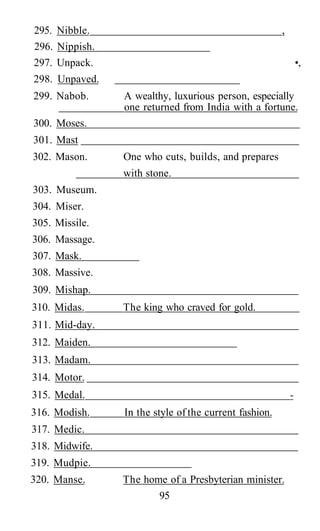
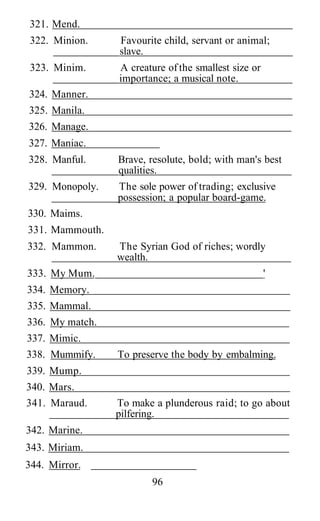
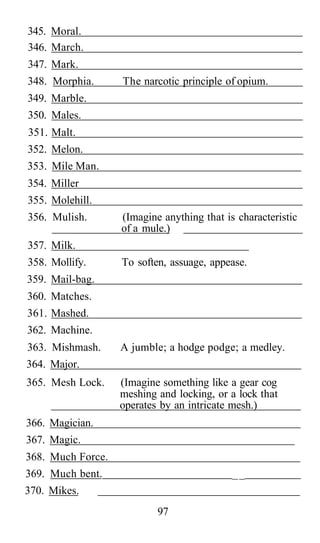
  • 157.
    or five maintheories, four or five major figures, and a number of experiments. Applying this information to the memory system, you link the name of the first major area with the first word of the system, list the main theories on the following numbers, the main figures on the next numbers and after that the experi- ments. For the next major area you repeat this process until you have covered the major key words and ideas for the content of the year's course. Should any of these items have smaller items which you think might be significant, they can be linked to the key psychology words. It may surprise you to learn that in circumstances where my students have applied these systems, their memory list for any given subject in a yearly exam seldom exceeds 70 items! In the examination room they are immediately far ahead of their erstwhile "peers. When considering their answers to questions, they simply survey their organised knowledge in less than a minute, selecting those items that are relevant. In addition, the items selected are already in an 'essay' form. In the example we are using, the answer to any question could take the following form 'in considering the problem of blank and blank I wish to discuss three of the major areas of psychology, citing the theories of blank from the second, and the theories of blank and blank from the third area. In connec- tion with these areas and theories I will also consider the importance of the following major figures in the history of these ideas, and shall discuss in relation to the entire question the following experiments: . . . ' Without having said anything our imaginary student already sounds well on the way to a 1st class! Indeed he may well be, for as his initial fact getting-down task has been made so much more easy, the amount of time left to him for creative discussion and comment on what he has written will be greater. To carry this last point a little further—it is advisable to peg on to your memory system creative or original ideas that flash into your mind concerning the subject of examination. These often make the difference between a 1st and 2nd class, yet normally they tend either to get mixed up in a generally con- fused presentation of knowledge and ideas or lost in the heat of the moment. Smaller details, including the titles of books, articles and 155
  • 158.
    dates, can obviouslybe co-ordinated with the system explained above. Examinations are not all that difficult. Explaining what you know in an organised and coherent fashion to an examiner can be—use your memory systems to help you! 156
  • 159.
    CHAPTER TWENTY-ONE REMEMBER TO REMEMBER! You have now completed your basic course and should have learnt no fewer than twenty different systems for remembering different items! After being given a rough historical context within which to work, you were given an initial memory test designed to establish the limits of your memory at that time. The first chapters (in an attempt to overcome as rapidly as possible the deficiencies laid bare by the test!) dealt with the basic principles of remembering, giving you practice in the rules of exaggeration, movement, substitution and absurdity. The principles learnt in these systems were then applied to the new memory system of Heinz Norden, Skipnum, and to the Major System. From the Major System you were able to branch out into the remembering of numbers, anniversaries, birthdays and historical dates, including the year, month and day. Apart from this you learnt systems for remembering names and faces, speeches, jokes, narratives, articles, languages, and playing cards. With the information you now possess you are ready to use your memory in a far more adequate and comprehensive way. Apart from your business and social life many of the systems may be used to give 'memory demonstrations' ranging from reeling off lists of items to picking out the 'missing cards' from a deck. Building a good memory is much like growing up. You develop a little day by day but seldom notice the changes until you suddenly look back at yourself, often through other people's eyes, writing or photographs. You may not even now be fully aware of the strides you have made during your reading of Speed Memory. To see just how far you have come, go back and look at the 'photograph' of your memory as recorded in the initial memory 157
  • 160.
    test. Things whichat that time appeared (and were!) difficult will now seem like child's play. We have come to the end of the course, but in a sense it is only a beginning. At the moment you are using abstract systems to remember items that have given you difficulty in the past. By continuing to use these systems and actively concerning yourself with remembering to remember, you will find that the systems themselves will become unnecessary, and that through the process of consciously working to improve your memory with 'artificial aids', you will have helped it to become vigorous and independent. 158
  • 161.
    If you feelyou have benefited from reading this book why not invest in a copy of Tony Buzan's SPEED READING by Sphere Books. To anyone reaching a reading speed of 350 words per minute plus 50 per cent comprehension of SPEED READING the author offers a £5 reduction in an ADVANCED READING COURSE taught personally by Tony Buzan. For further details please write or telephone: The College of Advanced Reading, 49 Frognal, Hampstead, London N.W.3. 01-435 6846
  • 162.
    All Sphere Booksare available at your bookshop or newsagent, or can be ordered from the following address: Sphere Books, Cash Sales Department, P.O. Box 11, Falmouth, Cornwall. Please send cheque or postal order (no currency), and allow 5p per book to cover the cost of postage and packing in U.K., 7p per copy overseas.