More Related Content

PPT

PDF

ODP

PDF

PDF

PPTX
camunda moduler for gov BPMN-Overview.pptx 
PPTX

PPT
The Role of Standards in BPM Similar to Business Process Modeling Notation presentation

PPTX
BPMN Primer (Razvan Radulian, ASPE Webinar, 2013) 
PPT

PPTX

PDF

PDF
Business Process Model and Notation (BPMN) 
PPTX

PDF

PPTX

PDF
III Conferência CMMI Portugal, Presentation 4: Make the Software Process Visi... 
PDF

PDF
From Site to System (specifically, business process management systems) 
PDF
Bpm+bpmn (lunch n-learn,12-15-2009,updated) 
PPTX
trainingpresentation-visiobusinessprocessmodelingnotation.pptx 
PPT
How to use BPMN* for modelling business processes 
PDF
2007 11-09 mm (costa rica - incae cit omg) modeling with bpmn and xpdl 
PPTX

PDF
Introduction to Business Process Model and Notation (BPMN) - OSSCamp 2014 
PDF
JBoss jBPM, the future is now for all your Business Processes by Eric Schabell 
PDF
JBoss jBPM, the future is now for all your Business Processes 
PDF
Recently uploaded

PDF
Andria Sergio - Known For Her Accuracy And Professionalism 
PDF
John Michael Philbin - An Avid Hiking Enthusiast 
PDF
OFFRE DE LA SEMAINE DU 9 FEVRIER pour les emplois 
PDF
Chris Elwell Woburn - Specializes In Cybersecurity And Audit Preparedness 
DOCX
8 Best Places to Buy Facebook Accounts at Wholesale Prices.docx 
PPTX
Levels of Management: Top, Middle and Lower Management Explained 
PDF
Certification Training Course On New Skills Across Globe 
PDF
Fraud Warning MOALA WALLET Exchange Exposed 
PDF
Securiport - Specializes In Civil Aviation And Intelligent Immigration Techno... 
DOCX
SEO's & Digital Marketing Case Study 2026 
PDF
LCP-consultation-response-to-TPR-CDC-code-of-practice.pdf 
DOCX
Buy Verified Paypal Accounts_ A Safely Complete Guide Usa.docx 
PDF
𝐋𝐚𝐮𝐧𝐜𝐡 𝐘𝐨𝐮𝐫 𝐎𝐰𝐧 𝐀𝐥𝐥 𝐢𝐧 𝐎𝐧𝐞 𝐃𝐞𝐥𝐢𝐯𝐞𝐫𝐲 𝐀𝐩𝐩 𝐏𝐥𝐚𝐭𝐟𝐨𝐫𝐦 𝐋𝐢𝐤𝐞 𝐆𝐥𝐨𝐯𝐨 
PDF
Maksym Vyshnivetskyi: Business Value & Benefits Realization (UA) 
PDF
ICv2 White Paper - Navigating the New World of Comics 
PDF
Buy Telegram Accounts_ A Complete Educational Guide to Understanding Digital ... 
PDF
Affordable Way to Buy Verified Airbnb Accounts in Bulk (2).pdf 
PDF
Stablecoins beyond narrow banking - Lombard Notes 
PPTX
423784969-Aquaria-Grande-by-Faisal.pptxh 
PDF
Comments on Ultra Map Section II Multifaceted Second Edition.pdf Business Process Modeling Notation presentation
- 1.
- 2.
- 3.
Copyright © 2005,OMG
Background
History
Definition of BPMN
Initial Charter
Within the OMG
- 4.
Copyright © 2005,OMG
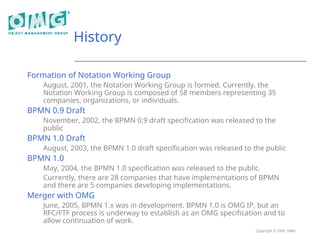
History
Formation of Notation Working Group
August, 2001, the Notation Working Group is formed. Currently, the
Notation Working Group is composed of 58 members representing 35
companies, organizations, or individuals.
BPMN 0.9 Draft
November, 2002, the BPMN 0.9 draft specification was released to the
public
BPMN 1.0 Draft
August, 2003, the BPMN 1.0 draft specification was released to the public
BPMN 1.0
May, 2004, the BPMN 1.0 specification was released to the public.
Currently, there are 28 companies that have implementations of BPMN
and there are 5 companies developing implementations.
Merger with OMG
June, 2005, BPMN 1.x was in development. BPMN 1.0 is OMG IP, but an
RFC/FTF process is underway to establish as an OMG specification and to
allow continuation of work.
- 5.
Copyright © 2005,OMG
Definition of BPMN
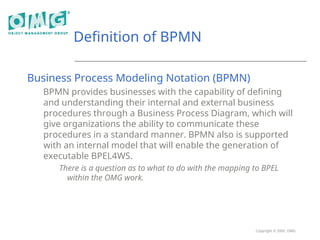
Business Process Modeling Notation (BPMN)
BPMN provides businesses with the capability of defining
and understanding their internal and external business
procedures through a Business Process Diagram, which will
give organizations the ability to communicate these
procedures in a standard manner. BPMN also is supported
with an internal model that will enable the generation of
executable BPEL4WS.
There is a question as to what to do with the mapping to BPEL
within the OMG work.
- 6.
Copyright © 2005,OMG
BPMN Initial Charter
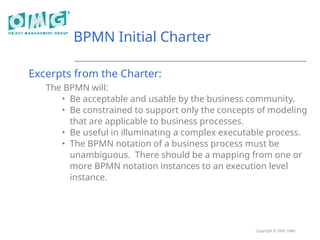
Excerpts from the Charter:
The BPMN will:
• Be acceptable and usable by the business community.
• Be constrained to support only the concepts of modeling
that are applicable to business processes.
• Be useful in illuminating a complex executable process.
• The BPMN notation of a business process must be
unambiguous. There should be a mapping from one or
more BPMN notation instances to an execution level
instance.
- 7.
Copyright © 2005,OMG
BPMN Initial Charter, Cont.
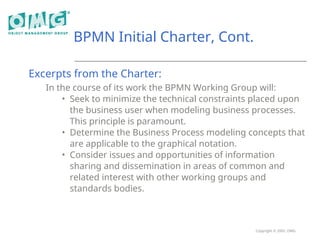
Excerpts from the Charter:
In the course of its work the BPMN Working Group will:
• Seek to minimize the technical constraints placed upon
the business user when modeling business processes.
This principle is paramount.
• Determine the Business Process modeling concepts that
are applicable to the graphical notation.
• Consider issues and opportunities of information
sharing and dissemination in areas of common and
related interest with other working groups and
standards bodies.
- 8.
Copyright © 2005,OMG
BPMI.org Hourglass
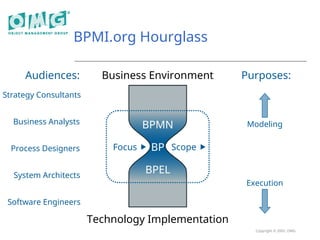
Business Environment
Technology Implementation
BP
BPMN
BPEL
Focus Scope
Strategy Consultants
Process Designers
System Architects
Software Engineers
Business Analysts
Audiences: Purposes:
Execution
Modeling
- 9.
Copyright © 2005,OMG
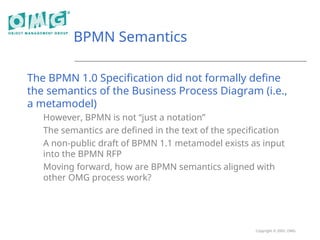
BPMN Semantics
The BPMN 1.0 Specification did not formally define
the semantics of the Business Process Diagram (i.e.,
a metamodel)
However, BPMN is not “just a notation”
The semantics are defined in the text of the specification
A non-public draft of BPMN 1.1 metamodel exists as input
into the BPMN RFP
Moving forward, how are BPMN semantics aligned with
other OMG process work?
- 10.
Copyright © 2005,OMG
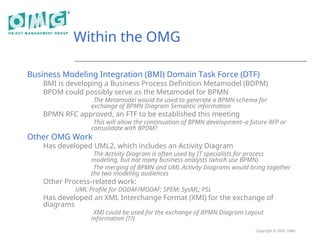
Within the OMG
Business Modeling Integration (BMI) Domain Task Force (DTF)
BMI is developing a Business Process Definition Metamodel (BDPM)
BPDM could possibly serve as the Metamodel for BPMN
The Metamodel would be used to generate a BPMN schema for
exchange of BPMN Diagram Semantic information
BPMN RFC approved, an FTF to be established this meeting
This will allow the continuation of BPMN development–a future RFP or
consolidate with BPDM?
Other OMG Work
Has developed UML2, which includes an Activity Diagram
The Activity Diagram is often used by IT specialists for process
modeling, but not many business analysts (which use BPMN)
The merging of BPMN and UML Activity Diagrams would bring together
the two modeling audiences
Other Process-related work:
UML Profile for DODAF/MODAF; SPEM; SysML; PSL
Has developed an XML Interchange Format (XMI) for the exchange of
diagrams
XMI could be used for the exchange of BPMN Diagram Layout
information (??)
- 11.
- 12.
Copyright © 2005,OMG
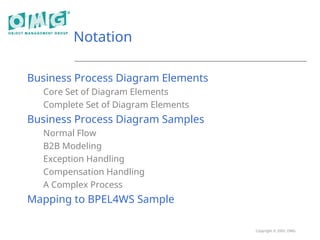
Notation
Business Process Diagram Elements
Core Set of Diagram Elements
Complete Set of Diagram Elements
Business Process Diagram Samples
Normal Flow
B2B Modeling
Exception Handling
Compensation Handling
A Complex Process
Mapping to BPEL4WS Sample
- 13.
Copyright © 2005,OMG
Core Set of Diagram Elements
The core set of modeling
elements enable the easy
development simple
Business Process
Diagrams that will look
familiar to most Business
Analysts (a flowchart
diagram)
- 14.
Copyright © 2005,OMG
Complete Set of Diagram
Elements, Events
An Event is something
that “happens” during the
course of a business
process. These Events
affect the flow of the
Process and usually have
a trigger or a result. They
can start, interrupt, or end
the flow.
- 15.
Copyright © 2005,OMG
Complete Set of Diagram
Elements, Activities
An activity is work that is
performed within a
business process. An
activity can be atomic or
non-atomic (compound).
The types of activities that
are a part of a Process
Model are: Process, Sub-
Process, and Task.
- 16.
Copyright © 2005,OMG
Complete Set of Diagram
Elements, Activities, Cont.
A Sub-Process can be in
an expanded form that
shows the process details
of the a lower-level set of
activities.
- 17.
Copyright © 2005,OMG
Complete Set of Diagram
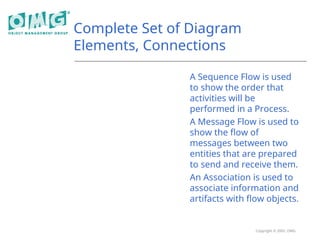
Elements, Connections
A Sequence Flow is used
to show the order that
activities will be
performed in a Process.
A Message Flow is used to
show the flow of
messages between two
entities that are prepared
to send and receive them.
An Association is used to
associate information and
artifacts with flow objects.
- 18.
Copyright © 2005,OMG
Complete Set of Diagram
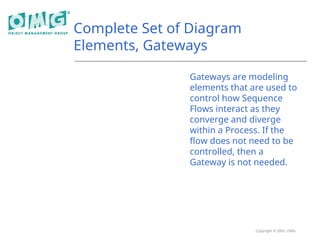
Elements, Gateways
Gateways are modeling
elements that are used to
control how Sequence
Flows interact as they
converge and diverge
within a Process. If the
flow does not need to be
controlled, then a
Gateway is not needed.
- 19.
Copyright © 2005,OMG
Complete Set of Diagram
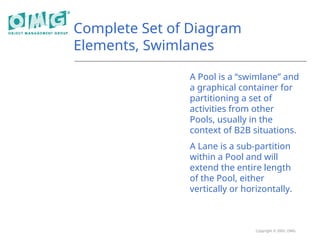
Elements, Swimlanes
A Pool is a “swimlane” and
a graphical container for
partitioning a set of
activities from other
Pools, usually in the
context of B2B situations.
A Lane is a sub-partition
within a Pool and will
extend the entire length
of the Pool, either
vertically or horizontally.
- 20.
Copyright © 2005,OMG
Complete Set of Diagram
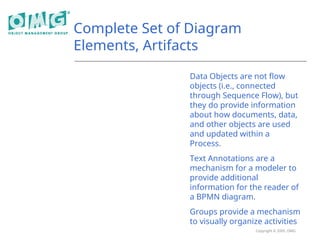
Elements, Artifacts
Data Objects are not flow
objects (i.e., connected
through Sequence Flow), but
they do provide information
about how documents, data,
and other objects are used
and updated within a
Process.
Text Annotations are a
mechanism for a modeler to
provide additional
information for the reader of
a BPMN diagram.
Groups provide a mechanism
to visually organize activities
- 21.
- 22.
- 23.
Copyright © 2005,OMG
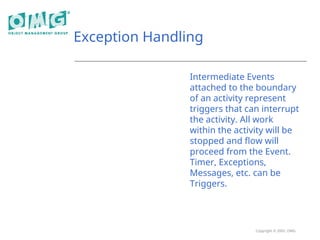
Exception Handling
Intermediate Events
attached to the boundary
of an activity represent
triggers that can interrupt
the activity. All work
within the activity will be
stopped and flow will
proceed from the Event.
Timer, Exceptions,
Messages, etc. can be
Triggers.
- 24.
Copyright © 2005,OMG
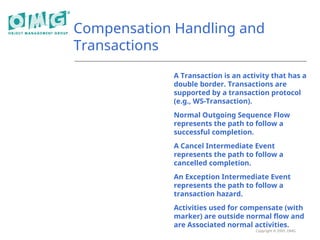
Compensation Handling and
Transactions
A Transaction is an activity that has a
double border. Transactions are
supported by a transaction protocol
(e.g., WS-Transaction).
Normal Outgoing Sequence Flow
represents the path to follow a
successful completion.
A Cancel Intermediate Event
represents the path to follow a
cancelled completion.
An Exception Intermediate Event
represents the path to follow a
transaction hazard.
Activities used for compensate (with
marker) are outside normal flow and
are Associated normal activities.
- 25.
- 26.
Copyright © 2005,OMG
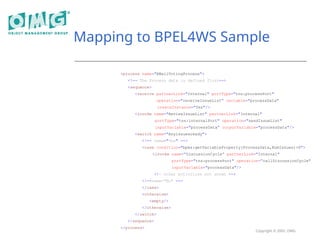
Mapping to BPEL4WS Sample
<process name="EMailVotingProcess">
<!-- The Process data is defined first-->
<sequence>
<receive partnerLink="Internal" portType="tns:processPort"
operation="receiveIssueList“ variable="processData"
createInstance="Yes"/>
<invoke name="ReviewIssueList" partnerLink="Internal"
portType="tns:internalPort" operation="sendIssueList"
inputVariable="processData“ outputVariable="processData"/>
<switch name="Anyissuesready">
<!-- name="Yes" -->
<case condition="bpws:getVariableProperty(ProcessData,NumIssues)>0">
<invoke name=“DiscussionCycle“ partnerLink="Internal"
portType="tns:processPort" operation=“callDiscussionCycle"
inputVariable="processData"/>
<!– Other Activities not shown -->
<!--name="No" -->
</case>
<otherwise>
<empty/>
</otherwise>
</switch>
</sequence>
</process>
- 27.
- 28.
Copyright © 2005,OMG
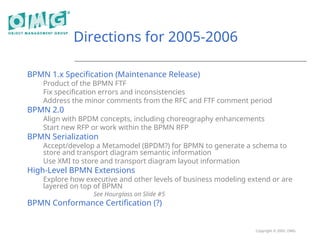
Directions for 2005-2006
BPMN 1.x Specification (Maintenance Release)
Product of the BPMN FTF
Fix specification errors and inconsistencies
Address the minor comments from the RFC and FTF comment period
BPMN 2.0
Align with BPDM concepts, including choreography enhancements
Start new RFP or work within the BPMN RFP
BPMN Serialization
Accept/develop a Metamodel (BPDM?) for BPMN to generate a schema to
store and transport diagram semantic information
Use XMI to store and transport diagram layout information
High-Level BPMN Extensions
Explore how executive and other levels of business modeling extend or are
layered on top of BPMN
See Hourglass on Slide #5
BPMN Conformance Certification (?)