© Grant Thornton LLP. All rights reserved.
Business Process Mapping
University of Colorado
© Grant Thornton LLP. All rights reserved.
Why Model Processes?
• Understand and analyze current way of working
• Redesign and improve
• Use model as a way to implement a standard way
of working
• Train new employees
• Communicate with other groups and external
entities
© Grant Thornton LLP. All rights reserved.
Process Modeling Standards
The Business Process Management Initiative (BPMI) has
developed a standard Business Process Modeling Notation
(BPMN).
• The primary goal:
– provide a notation that is readily understandable by all
business users,
• from the business analysts that create the initial drafts of
the processes,
• to the technical developers responsible for implementing
the technology that will perform those processes, and
finally,
• to the business people who will manage and monitor
those processes.
© Grant Thornton LLP. All rights reserved.
Basic Process Components
Participants
People or systems that
provide input to, or
perform work steps
within a process
Processes are:
A set of Activities and Tasks, which are performed by
Participants in Roles, organized in a particular Sequence,
directed and measured by Time and Events / Triggers
Activities / Tasks
A single unit of work,
can be performed by a
person or system
Roles
A layer of abstraction
that creates the link
between participants
and activities / tasks
Events / Triggers
Occurrences that cause
a process to start, direct
a process sequence, or
cause a process to end
Time
Average or desired
durations for work items
Sequence
The logical order in
which work steps are
performed
© Grant Thornton LLP. All rights reserved.
Basic Process Components
• In order to prevent the need for a VERY large sheet of
paper, we create a process hierarchy that allows us to
compartmentalize and focus on specific process segments
• Our process hierarchy will be the following:
• Cycle
• Process
• Subprocess
• Activity
• Task
© Grant Thornton LLP. All rights reserved.
Basic Process Components
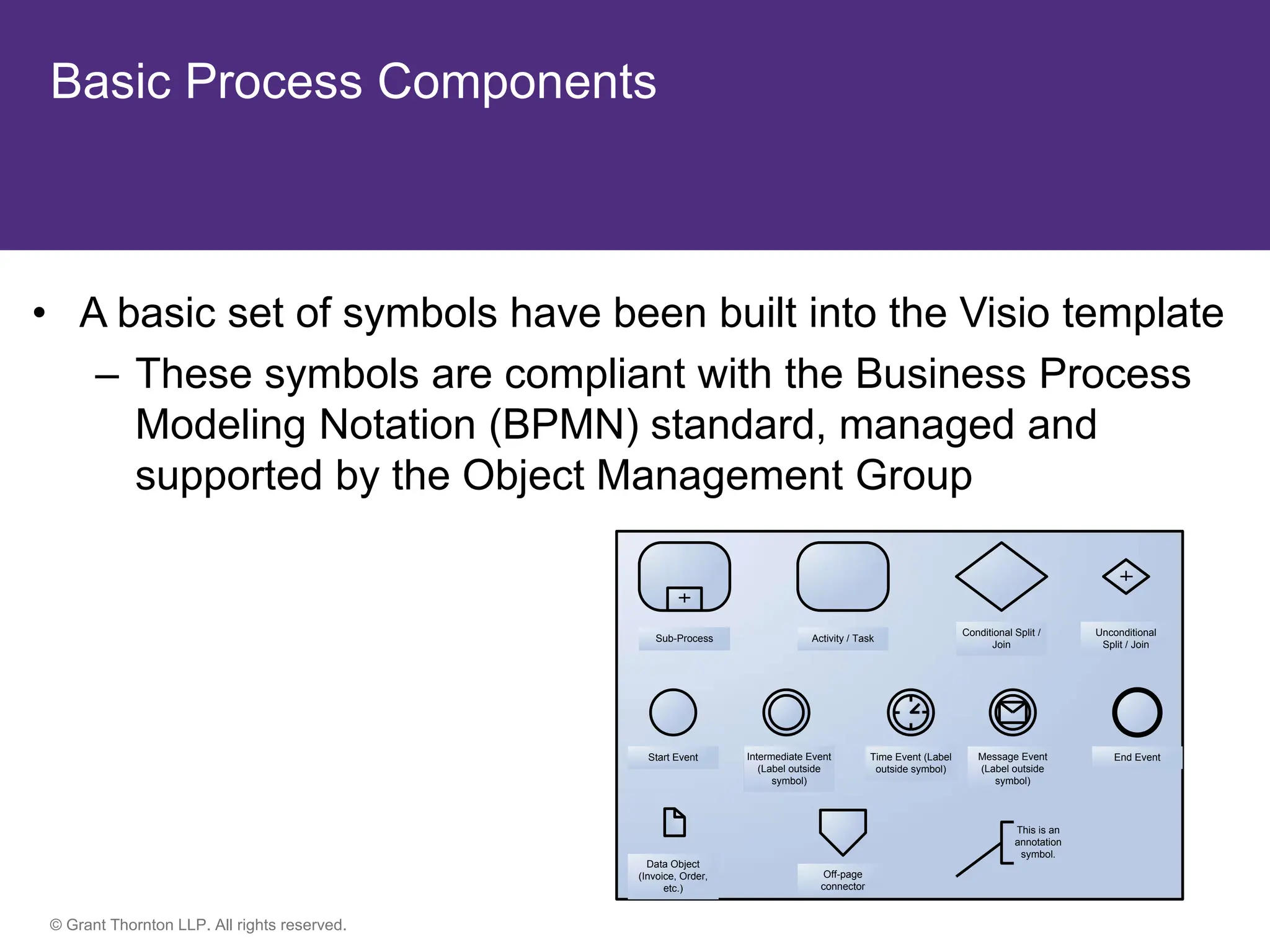
• A basic set of symbols have been built into the Visio template
– These symbols are compliant with the Business Process
Modeling Notation (BPMN) standard, managed and
supported by the Object Management Group
This is an
annotation
symbol.
Sub-Process Activity / Task
Conditional Split /
Join
Unconditional
Split / Join
Sub-Process
Start Event Intermediate Event
(Label outside
symbol)
Time Event (Label
outside symbol)
Message Event
(Label outside
symbol)
End Event
Data Object
(Invoice, Order,
etc.)
Off-page
connector
© Grant Thornton LLP. All rights reserved.
Swimlanes
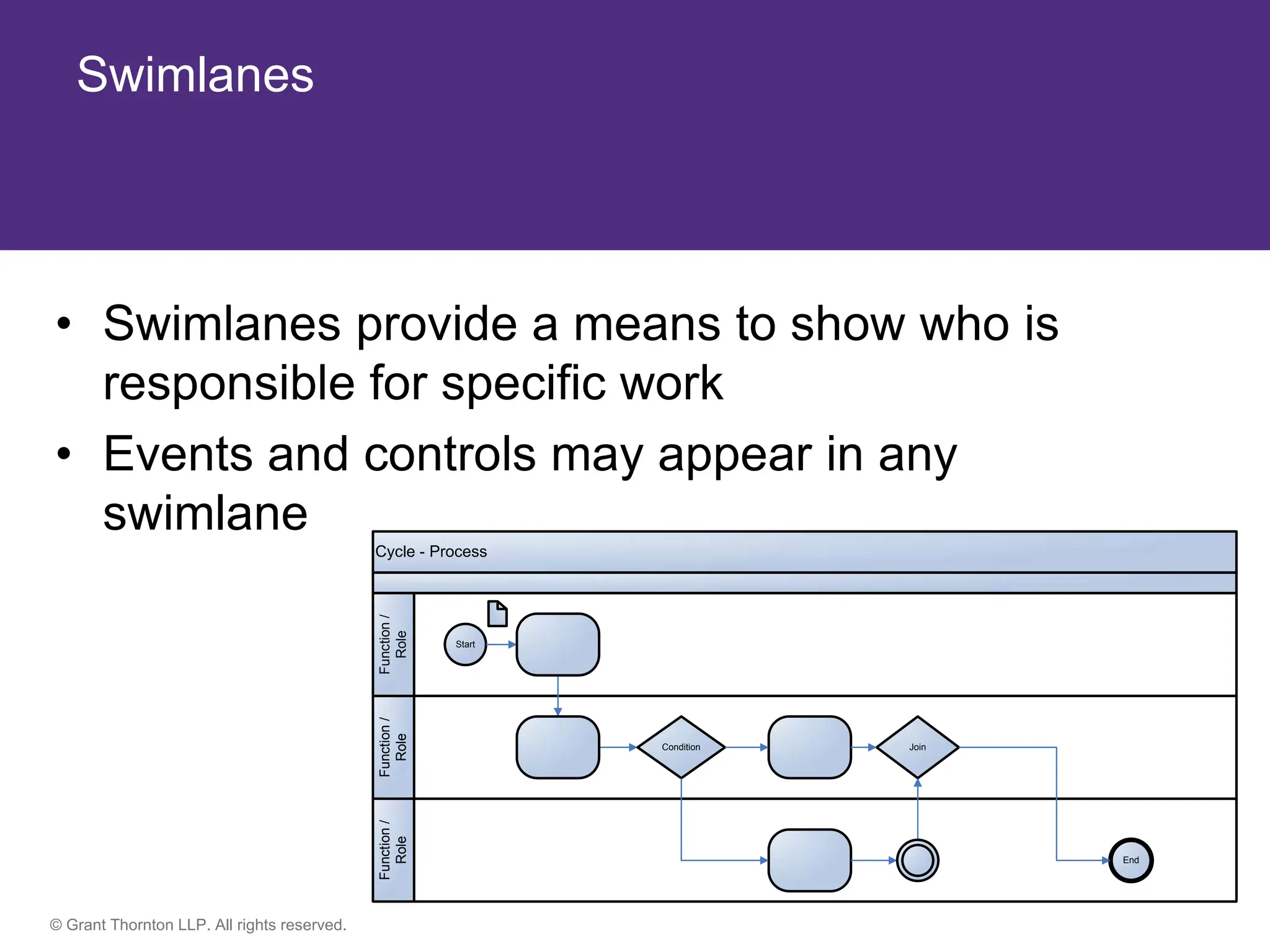
• Swimlanes provide a means to show who is
responsible for specific work
• Events and controls may appear in any
swimlane
Cycle - Process
Function
/
Role
Function
/
Role
Function
/
Role
Function
/
Role
Function
/
Role
Condition
Start
Join
End
© Grant Thornton LLP. All rights reserved.
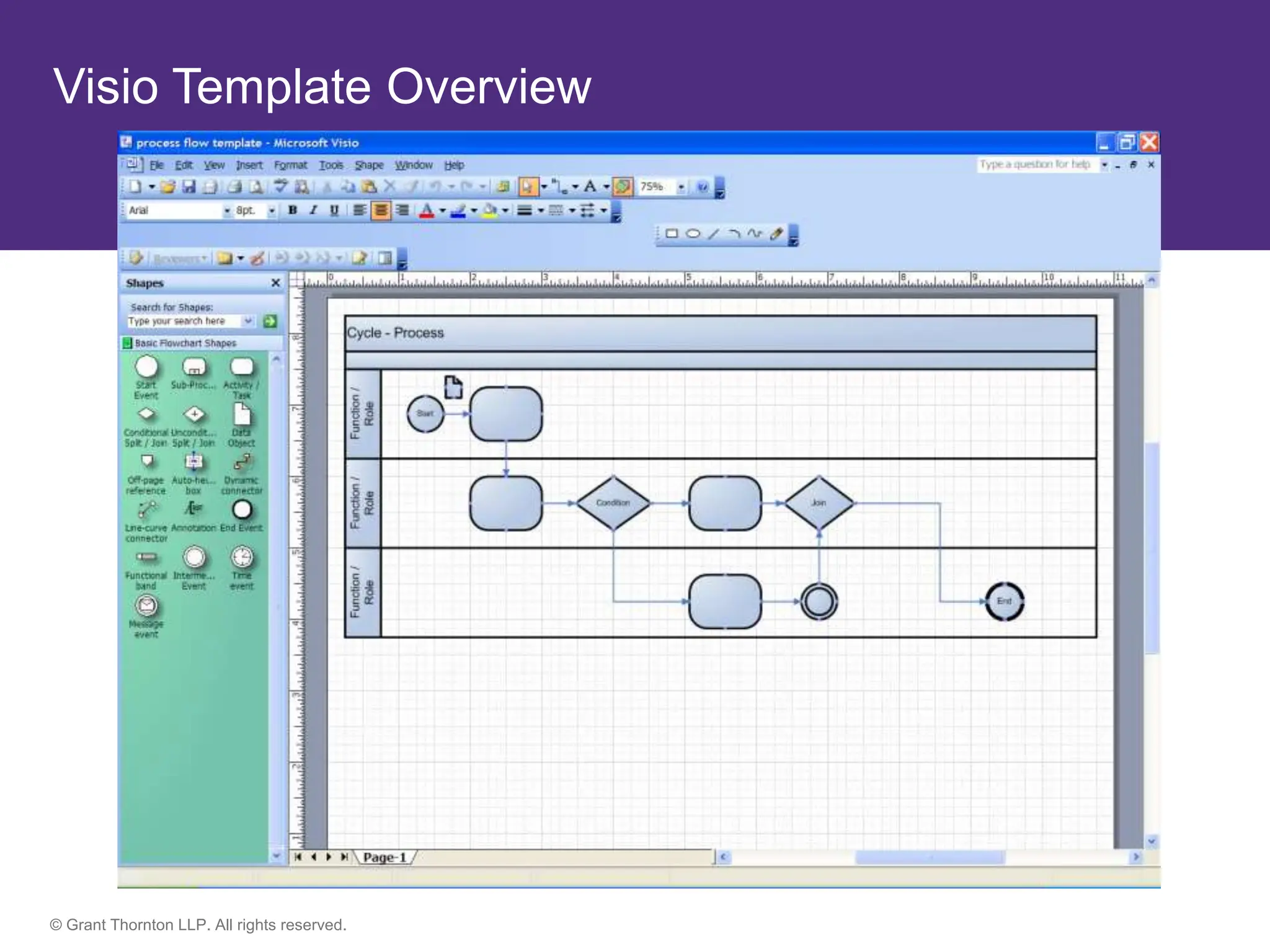
Visio Template Overview
© Grant Thornton LLP. All rights reserved.
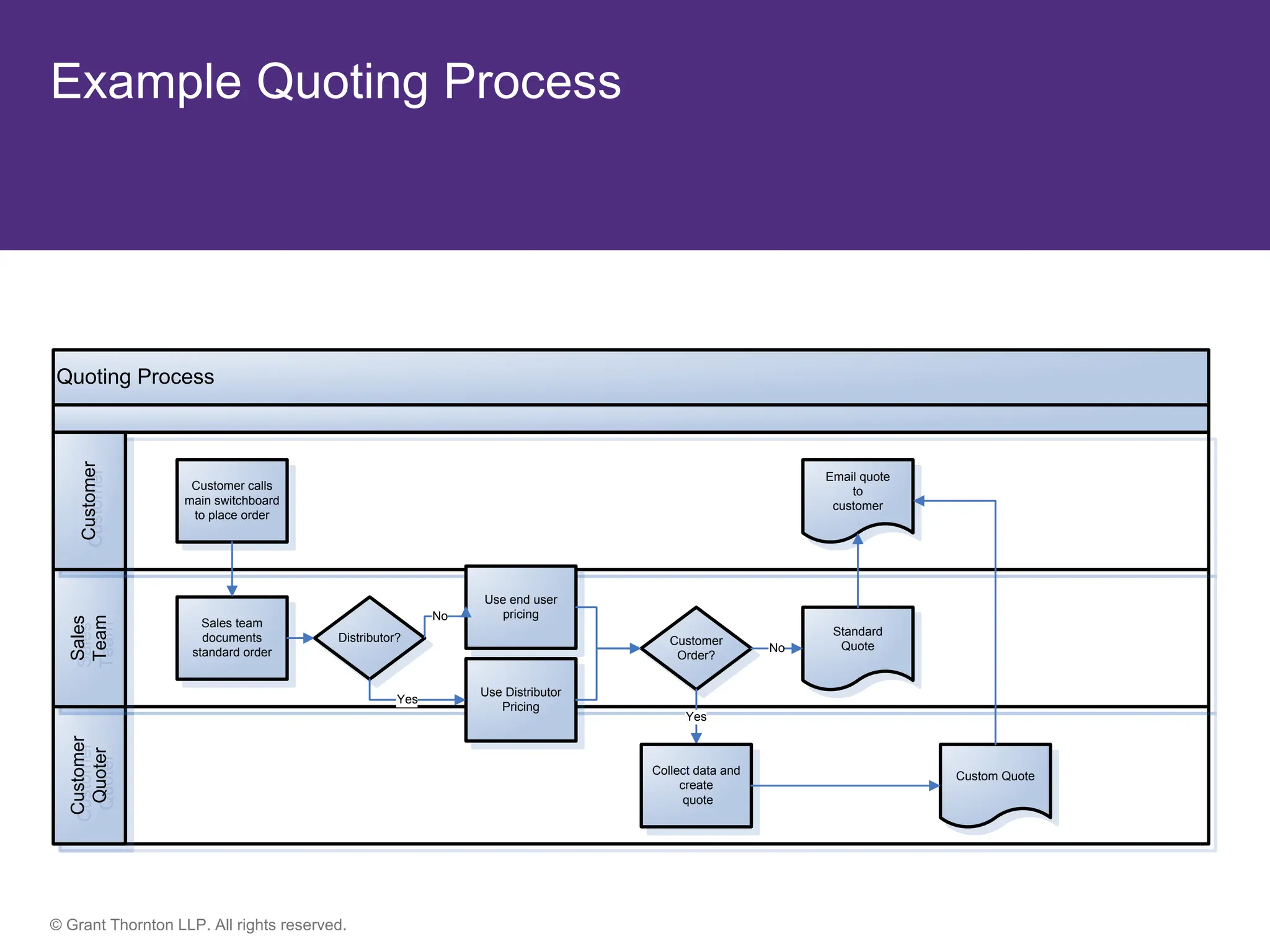
Example Quoting Process
Quoting Process
Customer
Quoter
Customer
Quoter
Sales
Team
Sales
Team
Customer
Customer
Customer calls
main switchboard
to place order
Sales team
documents
standard order
Distributor?
Use Distributor
Pricing
Yes
Use end user
pricing
No
Customer
Order?
Yes
Collect data and
create
quote
Custom Quote
Email quote
to
customer
Standard
Quote
No
© Grant Thornton LLP. All rights reserved.
Questions?

Business Process Mapping.ppt

  • 1.
    © Grant ThorntonLLP. All rights reserved. Business Process Mapping University of Colorado
  • 2.
    © Grant ThorntonLLP. All rights reserved. Why Model Processes? • Understand and analyze current way of working • Redesign and improve • Use model as a way to implement a standard way of working • Train new employees • Communicate with other groups and external entities
  • 3.
    © Grant ThorntonLLP. All rights reserved. Process Modeling Standards The Business Process Management Initiative (BPMI) has developed a standard Business Process Modeling Notation (BPMN). • The primary goal: – provide a notation that is readily understandable by all business users, • from the business analysts that create the initial drafts of the processes, • to the technical developers responsible for implementing the technology that will perform those processes, and finally, • to the business people who will manage and monitor those processes.
  • 4.
    © Grant ThorntonLLP. All rights reserved. Basic Process Components Participants People or systems that provide input to, or perform work steps within a process Processes are: A set of Activities and Tasks, which are performed by Participants in Roles, organized in a particular Sequence, directed and measured by Time and Events / Triggers Activities / Tasks A single unit of work, can be performed by a person or system Roles A layer of abstraction that creates the link between participants and activities / tasks Events / Triggers Occurrences that cause a process to start, direct a process sequence, or cause a process to end Time Average or desired durations for work items Sequence The logical order in which work steps are performed
  • 5.
    © Grant ThorntonLLP. All rights reserved. Basic Process Components • In order to prevent the need for a VERY large sheet of paper, we create a process hierarchy that allows us to compartmentalize and focus on specific process segments • Our process hierarchy will be the following: • Cycle • Process • Subprocess • Activity • Task
  • 6.
    © Grant ThorntonLLP. All rights reserved. Basic Process Components • A basic set of symbols have been built into the Visio template – These symbols are compliant with the Business Process Modeling Notation (BPMN) standard, managed and supported by the Object Management Group This is an annotation symbol. Sub-Process Activity / Task Conditional Split / Join Unconditional Split / Join Sub-Process Start Event Intermediate Event (Label outside symbol) Time Event (Label outside symbol) Message Event (Label outside symbol) End Event Data Object (Invoice, Order, etc.) Off-page connector
  • 7.
    © Grant ThorntonLLP. All rights reserved. Swimlanes • Swimlanes provide a means to show who is responsible for specific work • Events and controls may appear in any swimlane Cycle - Process Function / Role Function / Role Function / Role Function / Role Function / Role Condition Start Join End
  • 8.
    © Grant ThorntonLLP. All rights reserved. Visio Template Overview
  • 9.
    © Grant ThorntonLLP. All rights reserved. Example Quoting Process Quoting Process Customer Quoter Customer Quoter Sales Team Sales Team Customer Customer Customer calls main switchboard to place order Sales team documents standard order Distributor? Use Distributor Pricing Yes Use end user pricing No Customer Order? Yes Collect data and create quote Custom Quote Email quote to customer Standard Quote No
  • 10.
    © Grant ThorntonLLP. All rights reserved. Questions?