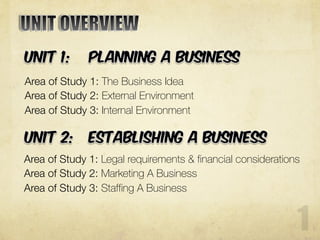
Area of Study 1: The Business Idea
Area of Study 2: External Environment
Area of Study 3: Internal Environment
Area of Study 1: Legal requirements & financial considerations
Area of Study 2: Marketing A Business
Area of Study 3: Staffing A Business
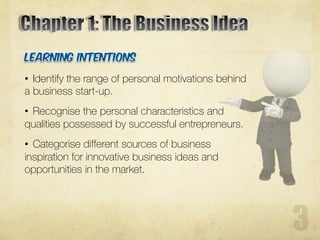
• Identify the range of personal motivations behind
a business start-up.
• Recognise the personal characteristics and
qualities possessed by successful entrepreneurs.
• Categorise different sources of business
inspiration for innovative business ideas and
opportunities in the market.
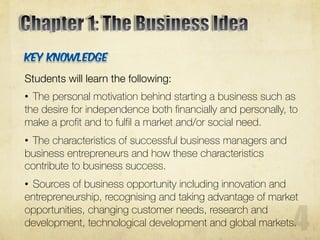
Students will learn the following:
• The personal motivation behind starting a business such as
the desire for independence both financially and personally, to
make a profit and to fulfil a market and/or social need.
• The characteristics of successful business managers and
business entrepreneurs and how these characteristics
contribute to business success.
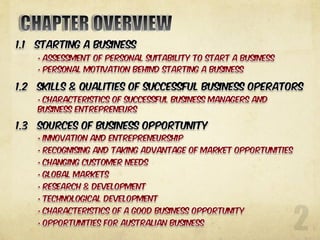
• Sources of business opportunity including innovation and
entrepreneurship, recognising and taking advantage of market
opportunities, changing customer needs, research and
development, technological development and global markets.
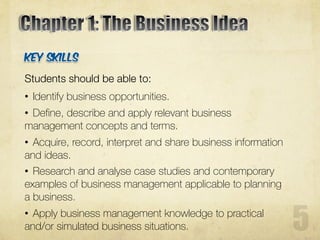
Students should be able to:
• Identify business opportunities.
• Define, describe and apply relevant business
management concepts and terms.
• Acquire, record, interpret and share business information
and ideas.
• Research and analyse case studies and contemporary
examples of business management applicable to planning
a business.
• Apply business management knowledge to practical
and/or simulated business situations.
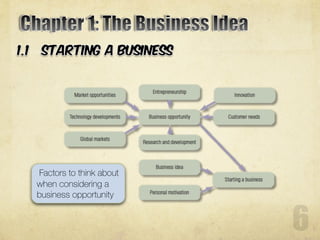
Factors to think about
when considering a
business opportunity
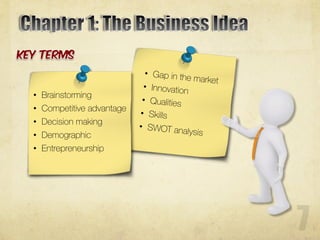
• Brainstorming
• Competitive advantage
• Decision making
• Demographic
• Entrepreneurship
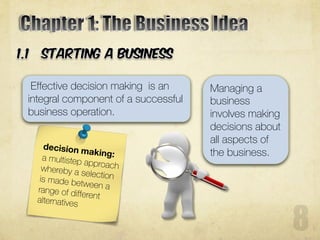
Effective decision making is an
integral component of a successful
business operation.
Managing a
business
involves making
decisions about
all aspects of
the business.
Many key decisions are made prior to
business commencement. These include:
• personal suitability to start and
operate a business. This involves
asking: Is this business right for me?
• where to look for inspiration for
business ideas
• the business concept (type of
business).
The first step for a person starting a business is to
conduct a self-evaluation focusing on the following:
• Personal motivation, or reasons, for
going into business must be examined.
• A self-appraisal of personal skills, abilities
and personality type should be completed.
• Personal and business objectives
must be established and clarified.
People decide to start a business
for a variety of reasons, including:
• a desire for independence and to be their own boss
• potential wealth and financial independence
• self-worth: many see business ownership as a
means of recognition as a successful person potential
for flexible working hours and conditions
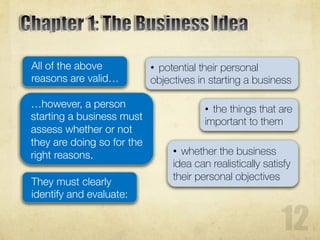
All of the above
reasons are valid…
• potential their personal
objectives in starting a business
…however, a person
starting a business must
assess whether or not
they are doing so for the
right reasons.
They must clearly
identify and evaluate:
• the things that are
important to them
• whether the business
idea can realistically satisfy
their personal objectives
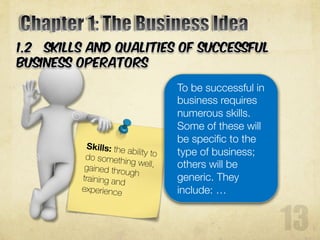
To be successful in
business requires
numerous skills.
Some of these will
be specific to the
type of business;
others will be
generic. They
include: …
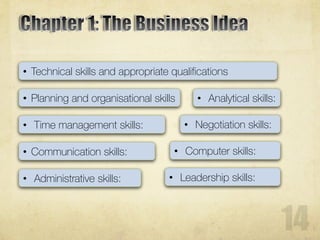
• Communication skills:
• Technical skills and appropriate qualifications
• Time management skills:
• Planning and organisational skills
• Administrative skills:
• Analytical skills:
• Computer skills:
• Negotiation skills:
• Leadership skills:
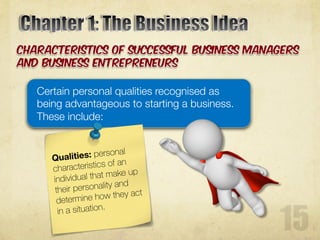
Certain personal qualities recognised as
being advantageous to starting a business.
These include:
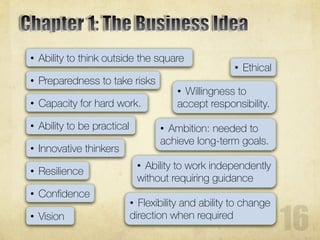
• Ability to think outside the square
• Preparedness to take risks
• Confidence
• Innovative thinkers
• Vision
• Flexibility and ability to change
direction when required
• Ability to work independently
without requiring guidance
• Capacity for hard work.
• Willingness to
accept responsibility.
• Ambition: needed to
achieve long-term goals.
• Ability to be practical
• Ethical
• Resilience
• Innovation, or new, improved
products or methods of doing
things, is often the impetus for a
new business venture.
• An innovation can be a whole new
product or a variation on an existing
product that improves it, such as
colour, design or features.
• An entrepreneur combines
an element of risk taking with
their own knowledge assets
and skills in order to make a
profit.
• Entrepreneurship involves
designing, launching and
running a new business.
Entrepreneurs are often
innovators.
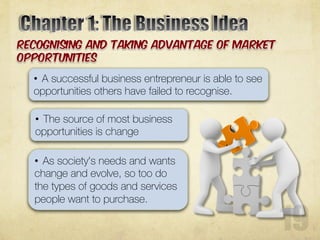
• A successful business entrepreneur is able to see
opportunities others have failed to recognise.
• The source of most business
opportunities is change
• As society's needs and wants
change and evolve, so too do
the types of goods and services
people want to purchase.
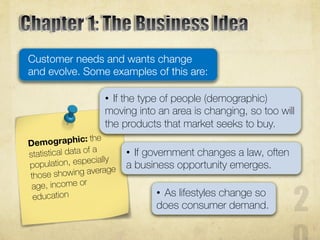
Customer needs and wants change
and evolve. Some examples of this are:
• If the type of people (demographic)
moving into an area is changing, so too will
the products that market seeks to buy.
• If government changes a law, often
a business opportunity emerges.
• As lifestyles change so
does consumer demand.
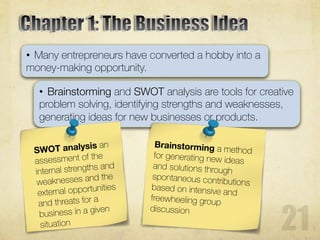
• Many entrepreneurs have converted a hobby into a
money-making opportunity.
• Brainstorming and SWOT analysis are tools for creative
problem solving, identifying strengths and weaknesses,
generating ideas for new businesses or products.
• The media is often a source of ideas for a
business concept. Regular observation of the
media can provide inspiration and innovative ideas.
• Trade shows and exhibitions
are sources of ideas. These
provide opportunities to see new
products, obtain ideas and
maybe opportunities for the
rebranding of existing products.
A business may spot a change creating
a favourable condition that the business
can take advantage of.
Often such a change creates a gap
between customer demand and supply.
An entrepreneur is able to recognise
signs in customer needs and wants.
Successful businesses recognise
changes in consumer demand
and take advantage of these.
This is known as
recognising a gap
in the market.
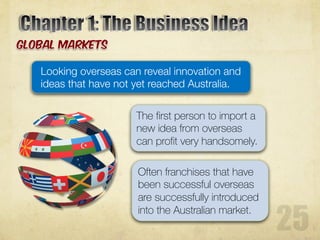
Looking overseas can reveal innovation and
ideas that have not yet reached Australia.
The first person to import a
new idea from overseas
can profit very handsomely.
Often franchises that have
been successful overseas
are successfully introduced
into the Australian market.
Research and development is often the
source of business ideas.
It is possible to identify new products
and technologies for potential
development through observation of
a particular target market.
Another option is to research and
develop ways of adding value to an
existing product for consumers.
The development and impending
availability of new technologies is often
a source of ideas for a new business.
For example, the growth and development of the
World Wide Web, coupled with the handheld
devices capable of mobile internet access…
…has enabled the formation
and development of many new
business ideas. Airbnb and
Uber are two examples.
A brilliant piece of technology or an
innovative idea is not the only criteria for
a potentially successful business idea.
There must also exist a market, or
group of consumers who are prepared
to purchase the product at a price that
will provide a profit to the business.
For a business concept to be an attractive
proposition for development, there must be a strong
possibility of a return on the investments made.
In order for the potential of income to be
made the following criteria must exist:
• Real demand.
• Return on investment.
• Freely available resources & skills.
• Market competitiveness.
• Objectives of risks must be feasible/achievable.
There are always opportunities for potential business
development. The trick is to identify and locate them.
Successful entrepreneurs are constantly
looking for innovative ideas that can be
translated into ideas for new business.
Changes in lifestyles, fashions, trends, laws, economic
situations, demographics and world events are all indicators
of potentially altered consumer demands and buying habits.
A business operator should always
keep an ear to the ground.
Thank You

BUSINESS MANAGEMENT STEPUP 2017

  • 2.
    Area of Study1: The Business Idea Area of Study 2: External Environment Area of Study 3: Internal Environment Area of Study 1: Legal requirements & financial considerations Area of Study 2: Marketing A Business Area of Study 3: Staffing A Business
  • 4.
    • Identify therange of personal motivations behind a business start-up. • Recognise the personal characteristics and qualities possessed by successful entrepreneurs. • Categorise different sources of business inspiration for innovative business ideas and opportunities in the market.
  • 5.
    Students will learnthe following: • The personal motivation behind starting a business such as the desire for independence both financially and personally, to make a profit and to fulfil a market and/or social need. • The characteristics of successful business managers and business entrepreneurs and how these characteristics contribute to business success. • Sources of business opportunity including innovation and entrepreneurship, recognising and taking advantage of market opportunities, changing customer needs, research and development, technological development and global markets.
  • 6.
    Students should beable to: • Identify business opportunities. • Define, describe and apply relevant business management concepts and terms. • Acquire, record, interpret and share business information and ideas. • Research and analyse case studies and contemporary examples of business management applicable to planning a business. • Apply business management knowledge to practical and/or simulated business situations.
  • 7.
    Factors to thinkabout when considering a business opportunity
  • 8.
    • Brainstorming • Competitiveadvantage • Decision making • Demographic • Entrepreneurship
  • 9.
    Effective decision makingis an integral component of a successful business operation. Managing a business involves making decisions about all aspects of the business.
  • 10.
    Many key decisionsare made prior to business commencement. These include: • personal suitability to start and operate a business. This involves asking: Is this business right for me? • where to look for inspiration for business ideas • the business concept (type of business).
  • 11.
    The first stepfor a person starting a business is to conduct a self-evaluation focusing on the following: • Personal motivation, or reasons, for going into business must be examined. • A self-appraisal of personal skills, abilities and personality type should be completed. • Personal and business objectives must be established and clarified.
  • 12.
    People decide tostart a business for a variety of reasons, including: • a desire for independence and to be their own boss • potential wealth and financial independence • self-worth: many see business ownership as a means of recognition as a successful person potential for flexible working hours and conditions
  • 13.
    All of theabove reasons are valid… • potential their personal objectives in starting a business …however, a person starting a business must assess whether or not they are doing so for the right reasons. They must clearly identify and evaluate: • the things that are important to them • whether the business idea can realistically satisfy their personal objectives
  • 14.
    To be successfulin business requires numerous skills. Some of these will be specific to the type of business; others will be generic. They include: …
  • 15.
    • Communication skills: •Technical skills and appropriate qualifications • Time management skills: • Planning and organisational skills • Administrative skills: • Analytical skills: • Computer skills: • Negotiation skills: • Leadership skills:
  • 16.
    Certain personal qualitiesrecognised as being advantageous to starting a business. These include:
  • 17.
    • Ability tothink outside the square • Preparedness to take risks • Confidence • Innovative thinkers • Vision • Flexibility and ability to change direction when required • Ability to work independently without requiring guidance • Capacity for hard work. • Willingness to accept responsibility. • Ambition: needed to achieve long-term goals. • Ability to be practical • Ethical • Resilience
  • 18.
    • Innovation, ornew, improved products or methods of doing things, is often the impetus for a new business venture. • An innovation can be a whole new product or a variation on an existing product that improves it, such as colour, design or features.
  • 19.
    • An entrepreneurcombines an element of risk taking with their own knowledge assets and skills in order to make a profit. • Entrepreneurship involves designing, launching and running a new business. Entrepreneurs are often innovators.
  • 20.
    • A successfulbusiness entrepreneur is able to see opportunities others have failed to recognise. • The source of most business opportunities is change • As society's needs and wants change and evolve, so too do the types of goods and services people want to purchase.
  • 21.
    Customer needs andwants change and evolve. Some examples of this are: • If the type of people (demographic) moving into an area is changing, so too will the products that market seeks to buy. • If government changes a law, often a business opportunity emerges. • As lifestyles change so does consumer demand.
  • 22.
    • Many entrepreneurshave converted a hobby into a money-making opportunity. • Brainstorming and SWOT analysis are tools for creative problem solving, identifying strengths and weaknesses, generating ideas for new businesses or products.
  • 23.
    • The mediais often a source of ideas for a business concept. Regular observation of the media can provide inspiration and innovative ideas. • Trade shows and exhibitions are sources of ideas. These provide opportunities to see new products, obtain ideas and maybe opportunities for the rebranding of existing products.
  • 24.
    A business mayspot a change creating a favourable condition that the business can take advantage of. Often such a change creates a gap between customer demand and supply. An entrepreneur is able to recognise signs in customer needs and wants.
  • 25.
    Successful businesses recognise changesin consumer demand and take advantage of these. This is known as recognising a gap in the market.
  • 26.
    Looking overseas canreveal innovation and ideas that have not yet reached Australia. The first person to import a new idea from overseas can profit very handsomely. Often franchises that have been successful overseas are successfully introduced into the Australian market.
  • 27.
    Research and developmentis often the source of business ideas. It is possible to identify new products and technologies for potential development through observation of a particular target market. Another option is to research and develop ways of adding value to an existing product for consumers.
  • 28.
    The development andimpending availability of new technologies is often a source of ideas for a new business. For example, the growth and development of the World Wide Web, coupled with the handheld devices capable of mobile internet access… …has enabled the formation and development of many new business ideas. Airbnb and Uber are two examples.
  • 29.
    A brilliant pieceof technology or an innovative idea is not the only criteria for a potentially successful business idea. There must also exist a market, or group of consumers who are prepared to purchase the product at a price that will provide a profit to the business. For a business concept to be an attractive proposition for development, there must be a strong possibility of a return on the investments made.
  • 30.
    In order forthe potential of income to be made the following criteria must exist: • Real demand. • Return on investment. • Freely available resources & skills. • Market competitiveness. • Objectives of risks must be feasible/achievable.
  • 31.
    There are alwaysopportunities for potential business development. The trick is to identify and locate them. Successful entrepreneurs are constantly looking for innovative ideas that can be translated into ideas for new business. Changes in lifestyles, fashions, trends, laws, economic situations, demographics and world events are all indicators of potentially altered consumer demands and buying habits. A business operator should always keep an ear to the ground.
  • 32.