BUSINESS
LETTERS
Technical Writing Skills
Nadeem Abbas
Alipur College, Alipur
Definition
 The business letter is the basic
means of communication
between two companies.
 Most business letters have a
formal tone.
What is a Personal Business Letter?
 Written from a person to a company
 Can be used for any purpose that requires written
communication from an individual to a company, such
as:
 To accompany returned goods
 Complaint letter
 Thank you letter
 Résumé cover letter
Purpose
 Business letters are written to inform readers of specific
information.
 However, you might also write a business letter to
persuade others to take action.
 Business letters even function as advertisements.
Persuasive Letters
 The purpose is to sell your idea to someone,
attempting to get them to do something they may not
want to do.
 AIDA Formula:
 First paragraph Attention
 Second paragraph Interest
 Third paragraph Desire
 Fourth paragraph Action
Parts of a Business Letter
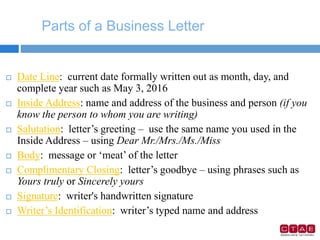
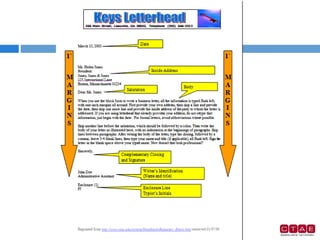
 Date Line: current date formally written out as month, day, and
complete year such as May 3, 2016
 Inside Address: name and address of the business and person (if you
know the person to whom you are writing)
 Salutation: letter’s greeting – use the same name you used in the
Inside Address – using Dear Mr./Mrs./Ms./Miss
 Body: message or ‘meat’ of the letter
 Complimentary Closing: letter’s goodbye – using phrases such as
Yours truly or Sincerely yours
 Signature: writer's handwritten signature
 Writer’s Identification: writer’s typed name and address
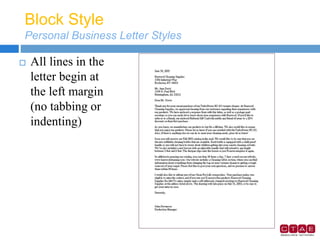
Block Style
Personal Business Letter Styles
 All lines in the
letter begin at
the left margin
(no tabbing or
indenting)
Modified Block Style
Personal Business Letter Styles
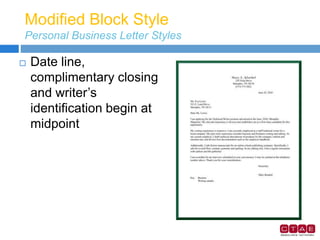
 Date line,
complimentary closing
and writer’s
identification begin at
midpoint
Semi-Modified Block Style
Personal Business Letter Styles
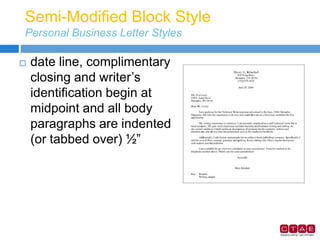
 date line, complimentary
closing and writer’s
identification begin at
midpoint and all body
paragraphs are indented
(or tabbed over) ½”
Personal Business Letter
Punctuation
 Acceptable types of letter punctuation in business:
 Mixed punctuation – there will be a colon (:) after the salutation
and a comma (,) after the complimentary closing
 Open punctuation – there will be NO punctuation after the
salutation or complimentary closing
Differences between a Business and
Personal Business Letter
 Writer’s company name and address should appear in the
letterhead
 Writer’s business title is usually keyed under the name
 Reference initials are added a DS (press Enter 2 times) after the
Writer’s ID –
 These initials are of the person who types the letter
 Used to easily locate who typed the letter
 Enclosure or Attachment notations are added a DS below the
Reference Initials
 This is a special section that is only added if something else is either
physically attached to the letter or accompanying the letter in the same
envelope
The Seven C’s of Business Letter Writing
1. Clear
2. Concise
3. Correct
4. Courteous
5. Conversational
6. Convincing
7. Complete
Business Letter Writing Checklist
 Keep it Short
 Cut needless words and needless information
 Cut stale phrases and redundant statements
 Keep it Simple
 Use familiar words, short sentences and short paragraphs
 Keep your subject matter as simple as possible
 Use a conversational style
Business Letter Writing Checklist
 Keep it Strong
 Use concrete words and examples
 Keep to the subject
 Keep it Sincere
 Be human and as friendly as possible
 Write as if you were talking to your reader
Do’s of Letter Writing
 Use plain English
 Write in active voice when possible
 Use short sentences when possible
 Use everyday words and avoid technical jargon
 Use lists to present complex materials
 Select the words you use very carefully
 Use a strong organizational strategy
 Use a reader centered tone
 Use a business like, conversational tone
Don’ts of Letter Writing
 Make grammar or usage errors
 Use clichés or worn out phrases
 Use obsolete and/or pompous language because it "seems"
more professional
 Be too familiar with your audience
 Use humor unless you know what you are doing
 Preach
 Brag
Proofread Before You Print
 ALWAYS proofread your letter before you print.
 Don’t rely on Spell check alone!
 It is also good to have someone else proofread your
work.
 Questions
 Comments
 Concerns

Business Letters Presentation.ppt

  • 1.
  • 2.
    Definition  The businessletter is the basic means of communication between two companies.  Most business letters have a formal tone.
  • 3.
    What is aPersonal Business Letter?  Written from a person to a company  Can be used for any purpose that requires written communication from an individual to a company, such as:  To accompany returned goods  Complaint letter  Thank you letter  Résumé cover letter
  • 4.
    Purpose  Business lettersare written to inform readers of specific information.  However, you might also write a business letter to persuade others to take action.  Business letters even function as advertisements.
  • 5.
    Persuasive Letters  Thepurpose is to sell your idea to someone, attempting to get them to do something they may not want to do.  AIDA Formula:  First paragraph Attention  Second paragraph Interest  Third paragraph Desire  Fourth paragraph Action
  • 6.
    Parts of aBusiness Letter  Date Line: current date formally written out as month, day, and complete year such as May 3, 2016  Inside Address: name and address of the business and person (if you know the person to whom you are writing)  Salutation: letter’s greeting – use the same name you used in the Inside Address – using Dear Mr./Mrs./Ms./Miss  Body: message or ‘meat’ of the letter  Complimentary Closing: letter’s goodbye – using phrases such as Yours truly or Sincerely yours  Signature: writer's handwritten signature  Writer’s Identification: writer’s typed name and address
  • 8.
    Block Style Personal BusinessLetter Styles  All lines in the letter begin at the left margin (no tabbing or indenting)
  • 9.
    Modified Block Style PersonalBusiness Letter Styles  Date line, complimentary closing and writer’s identification begin at midpoint
  • 10.
    Semi-Modified Block Style PersonalBusiness Letter Styles  date line, complimentary closing and writer’s identification begin at midpoint and all body paragraphs are indented (or tabbed over) ½”
  • 11.
    Personal Business Letter Punctuation Acceptable types of letter punctuation in business:  Mixed punctuation – there will be a colon (:) after the salutation and a comma (,) after the complimentary closing  Open punctuation – there will be NO punctuation after the salutation or complimentary closing
  • 12.
    Differences between aBusiness and Personal Business Letter  Writer’s company name and address should appear in the letterhead  Writer’s business title is usually keyed under the name  Reference initials are added a DS (press Enter 2 times) after the Writer’s ID –  These initials are of the person who types the letter  Used to easily locate who typed the letter  Enclosure or Attachment notations are added a DS below the Reference Initials  This is a special section that is only added if something else is either physically attached to the letter or accompanying the letter in the same envelope
  • 13.
    The Seven C’sof Business Letter Writing 1. Clear 2. Concise 3. Correct 4. Courteous 5. Conversational 6. Convincing 7. Complete
  • 14.
    Business Letter WritingChecklist  Keep it Short  Cut needless words and needless information  Cut stale phrases and redundant statements  Keep it Simple  Use familiar words, short sentences and short paragraphs  Keep your subject matter as simple as possible  Use a conversational style
  • 15.
    Business Letter WritingChecklist  Keep it Strong  Use concrete words and examples  Keep to the subject  Keep it Sincere  Be human and as friendly as possible  Write as if you were talking to your reader
  • 16.
    Do’s of LetterWriting  Use plain English  Write in active voice when possible  Use short sentences when possible  Use everyday words and avoid technical jargon  Use lists to present complex materials  Select the words you use very carefully  Use a strong organizational strategy  Use a reader centered tone  Use a business like, conversational tone
  • 17.
    Don’ts of LetterWriting  Make grammar or usage errors  Use clichés or worn out phrases  Use obsolete and/or pompous language because it "seems" more professional  Be too familiar with your audience  Use humor unless you know what you are doing  Preach  Brag
  • 18.
    Proofread Before YouPrint  ALWAYS proofread your letter before you print.  Don’t rely on Spell check alone!  It is also good to have someone else proofread your work.
  • 19.

Editor's Notes

  • #17 Use everyday words: Most U.S. Newspapers are written on an 8th grade level….