Business Essentials 11th Edition Ebert Solutions Manual
1.
Business Essentials 11thEdition Ebert Solutions
Manual download
https://testbankfan.com/product/business-essentials-11th-edition-
ebert-solutions-manual/
Explore and download more test bank or solution manual
at testbankfan.com
2.
We have selectedsome products that you may be interested in
Click the link to download now or visit testbankfan.com
for more options!.
Business Essentials 11th Edition Ebert Test Bank
https://testbankfan.com/product/business-essentials-11th-edition-
ebert-test-bank/
Business Essentials 10th Edition Ebert Solutions Manual
https://testbankfan.com/product/business-essentials-10th-edition-
ebert-solutions-manual/
Business Essentials Canadian 8th Edition Ebert Solutions
Manual
https://testbankfan.com/product/business-essentials-canadian-8th-
edition-ebert-solutions-manual/
Educational Research Competencies for Analysis and
Applications Global Edition 11th Edition Mills Test Bank
https://testbankfan.com/product/educational-research-competencies-for-
analysis-and-applications-global-edition-11th-edition-mills-test-bank/
3.
Ebersole and HessGerontological Nursing and Healthy Aging
1st Edition Touhy Test Bank
https://testbankfan.com/product/ebersole-and-hess-gerontological-
nursing-and-healthy-aging-1st-edition-touhy-test-bank/
Auditing and Assurance Services A Systematic Approach 10th
Edition Messier Test Bank
https://testbankfan.com/product/auditing-and-assurance-services-a-
systematic-approach-10th-edition-messier-test-bank/
Marketing Real People Real Choices Canadian 4th Edition
Solomon Test Bank
https://testbankfan.com/product/marketing-real-people-real-choices-
canadian-4th-edition-solomon-test-bank/
E-Marketing 7th Edition Strauss Test Bank
https://testbankfan.com/product/e-marketing-7th-edition-strauss-test-
bank/
Business Analytics 1st Edition Evans Test Bank
https://testbankfan.com/product/business-analytics-1st-edition-evans-
test-bank/
4.
Accounting Information Systems11th Edition Gelinas
Solutions Manual
https://testbankfan.com/product/accounting-information-systems-11th-
edition-gelinas-solutions-manual/
"Behold!" he cried,"your ass is eating my corn. I will take your ass, and
he shall pay for the theft."
"Shall I be robbed," cried the sekhti, "in the lands of the Lord Steward
Meruitensa, who treateth robbers so hardly? Behold, I will go to him. He
will not suffer this misdeed of thine."
"Thinkest thou he will hearken to thy plaint?" sneered Tehuti-nekht.
"Poor as thou art, who will concern himself with thy woes? Lo, I am the
Lord Steward Meruitensa," and so saying he beat the sekhti sorely, stole
all his asses and drove them into pasture.
In vain the sekhti wept and implored him to restore his property. Tehuti-
nekht bade him hold his peace, threatening to send him to the Demon
of Silence if he continued to complain. Nevertheless, the sekhti
petitioned him for a whole day. At length, finding that he was wasting
his breath, the peasant betook himself to Henen-ni-sut, there to lay his
case before the Lord Steward Meruitensa. On his arrival he found the
latter preparing to embark in his boat, which was to carry him to the
judgment-hall. The sekhti bowed himself to the ground, and told the
Lord Steward that he had a grievance to lay before him, praying him to
send one of his followers to hear the tale. The Lord Steward granted the
suppliant's request, and sent to him one from among his train. To the
messenger the sekhti revealed all that had befallen him on his journey,
the manner in which Tehuti-nekht had closed the path so as to force him
to trespass on the corn, and the cruelty with which he had beaten him
and stolen his property. In due time these matters were told to the Lord
Steward, who laid the case before the nobles who were with him in the
judgment-hall.
"Let this sekhti bring a witness," they said, "and if he establish his case,
it may be necessary to beat Tehuti-nekht, or perchance he will be made
to pay a trifle for the salt and natron he has stolen."
The Lord Steward said nothing, and the sekhti himself came unto him
and hailed him as the greatest of the great, the orphan's father, the
widow's husband, the guide of the needy, and so on.
Very eloquent was the sekhti, and in his florid speech he skilfully
combined eulogy with his plea for justice, so that the Lord Steward was
interested and flattered in spite of himself.
23.
Now at thattime there sat upon the throne of Egypt the King Neb-ka-n-
ra, and to him came the Lord Steward Meruitensa, saying:
"Behold, my lord, I have been sought by a sekhti whose goods were
stolen. Most eloquent of mortals is he. What would my lord that I do
unto him?"
"Do not answer his speeches," said the king, "but put his words in
writing and bring them to us. See that he and his wife and children are
supplied with meat and drink, but do not let him know who provides it."
The Lord Steward did as the king had commanded him. He gave to the
peasant a daily ration of bread and beer, and to his wife sufficient corn
to feed herself and her children. But the sekhti knew not whence the
provisions came.
A second time the peasant sought the judgment-hall and poured forth
his complaint to the Lord Steward; and yet a third time he came, and
the Lord Steward commanded that he be beaten with staves, to see
whether he would desist. But no, the sekhti came a fourth, a fifth, a
sixth time, endeavouring with pleasant speeches to open the ear of the
judge. Meruitensa hearkened to him not at all, yet the sekhti did not
despair, but came again unto the ninth time. And at the ninth time the
Lord Steward sent two of his followers to the sekhti, and the peasant
trembled exceedingly, for he feared that he was about to be beaten
once more because of his importunity. The message, however, was a
reassuring one. Meruitensa declared that he had been greatly delighted
by the peasant's eloquence and would see that he obtained satisfaction.
He then caused the sekhti's petitions to be written on clean papyri and
sent to the king, according as the monarch had commanded. Neb-ka-n-
ra was also much pleased with the speeches, but the giving of judgment
he left entirely in the hands of the Lord Steward.
Meruitensa therefore deprived Tehuti-nekht of all his offices and his
property, and gave them to the sekhti, who thenceforth dwelt at the
king's palace with all his family. And the sekhti became the chief
overseer of Neb-ka-n-ra, and was greatly beloved by him.
Story of the Two Brothers
24.
The manuscript ofthis tale of the Nineteenth Dynasty was bought in
Italy by Mme. Elizabeth d'Orbiney, and is called the d'Orbiney Papyrus. It
was acquired by the British Museum in 1857 and copied in facsimile. It
has been translated over and over again. The manuscript extends to
nineteen pages of ten lines each, the first five pages having been
considerably torn. Several gaps have been filled in by the modern
possessors of the manuscript, and the restorations are signed. The
original manuscript is stamped in two places with the name of its
ancient owner, Sety Merenptah, whom we know as Sety II. It was
executed by Anena, a scribe who lived during the reigns of Rameses II,
Merenptah, and Sety II, and is more than three thousand years old.
Bitou, the hero of the story, a herd and husbandman, is perhaps
identifiable with the Greek god Bitys.
Anapou and Bitou were two brothers who lived in Egypt a long time ago.
To Anapou, as the elder, belonged house, cattle, and fields; and Bitou,
the younger, worked for him. Bitou was marvellously clever in his
management of the cattle and in all things relating to agriculture—he
could even tell what the cattle said to him and to each other. One day,
as the brothers were working in the fields, Anapou sent Bitou home for
a large quantity of seed, as he saw the time had come for sowing. Bitou
went and got the seed, and after their day's work the two returned, to
find Anapou's wife lying moaning, and saying she had been thrashed by
Bitou until she was sore because she would not yield him something he
had asked of her when he came for the seed. Then Anapou sought to
kill Bitou by stealth, but Bitou, warned by the cattle, fled. His brother
overtook him, but the god Phra-Harmakhis caused a wide stream full of
crocodiles to arise between them, and Bitou asked his brother to wait till
break of day, when he would explain all that had happened. When day
broke Bitou told Anapou the truth, refusing at the same time ever to
return to the house where Anapou's wife was. "I shall go," he said, "to
the Vale of the Acacia. Now listen to what will happen. I shall tear out
my heart by magic so as to place it on the topmost bough of the acacia,
and when the acacia is cut down, and my heart will fall to the ground,
you will come to look for it. After you have looked for seven years do
not be discouraged, but put it in a vessel of cold water; that will bring
me to life again. I shall certainly live again and be revenged on my
enemies. You will know that something of moment is about to happen to
25.
me when ajug of beer is given you and the froth shall run over. They
will then give you a jug of wine of which the sediment will rise to the
top. Rest no more when these things come about."
He went to the valley and his brother returned home, killed his wife, and
mourned for Bitou.
Bitou, in the valley, spent his days in hunting, and at night slept under
the acacia, on top of which his heart was placed. One day he met the
nine gods, who gave him the daughter of the gods for his wife; but the
Seven Hathors swore she should die by the sword. He told her about his
heart, and that whoever should find the acacia would have to fight with
him.
The Treachery of Bitou's Wife
Pharaoh, hearing of this beautiful woman, desired to take possession of
her, and sent armed men into the valley, all of whom Bitou killed.
Pharaoh at last enticed her away and made her his chief favourite. She
told him her husband's secret and bade him cut down the acacia-tree,
which was accordingly done, and Bitou fell down dead at the same
moment.
Then what Bitou had foretold happened to his brother. Beer that foamed
was brought to him, and then wine which became muddy while he held
the cup. By these signs he knew that the time had come to act, and
taking his clothes and sandals and weapons, he set off for the valley.
When he got there he found his brother lying dead on his bed. He went
to the acacia to look for the heart, but could find only a berry, which,
however, was the heart. He placed it in cold water, and Bitou was
restored to life. They embraced each other, and Bitou said to his brother,
"I shall now become a sacred bull (Apis). Lead me, then, to Pharaoh,
who will reward you with gold and silver for having brought me. I shall
then find means to punish my wife for having betrayed me." Anapou did
as Bitou directed, and when the sun rose again next day, Bitou having
then assumed the form of a bull, he led him to court. There were great
rejoicings over the miraculous bull, and Pharaoh rewarded Anapou richly
and preferred him before any other man.
26.
Some days after,the bull entered the harem and addressed his former
wife. "You see, I am still alive, after all," he said. "Who are you?" she
replied. He said, "I am Bitou. You knew well what you were doing when
you got Pharaoh to have the acacia cut down." Then she was very much
afraid, and begged Pharaoh to grant her any request she would make.
Pharaoh, who loved her so much that he could refuse her nothing,
consented. "Then," she said, "give me the liver of the sacred bull to eat,
for nothing else will satisfy me." Pharaoh was very much grieved at this,
but he had sworn, and one day when the people were offering up
sacrifices to the bull he sent his butchers to cut its throat. When the bull
was being killed two big drops of blood fell from his neck, and flowing
till they were opposite Pharaoh's doorway, they sprang up in the form of
two great trees, one at either side of the portal.
At this second miracle all the people rejoiced again and offered sacrifices
to the two trees.
A long time after, Pharaoh, in his crown of lapis-lazuli, with a garland of
flowers round his neck, got into his electrum chair and was carried out
to look at the two trees. His chief favourite—Bitou's wife—was brought
after him and they were set down, one under each tree. Then Bitou, the
tree under which his wife was seated, whispered to her, "Faithless
woman! I am Bitou, and I am still alive in spite of you. You made
Pharaoh cut down the acacia, and killed me. Then I became a bull and
you had me slain."
Afterward, when she was seated again with Pharaoh at table, she made
him swear another oath to do whatever she asked him, and Pharaoh
swore again. Then she said, "Cut me down these two trees and make
them into two good beams." What she demanded was done, but as the
trees were being cut down a chip flew into her mouth. In due time she
brought forth a male child, whom Pharaoh loved and made Prince of the
Upper Nile, and when Pharaoh died, Bitou, for he was this child,
succeeded him. Then he summoned all the great officials, had his wife
brought before him, and told them all that had happened. So she was
put to death. Bitou lived and reigned for twenty years, and then his
brother Anapou, whom he had made his successor, reigned in his stead.
27.
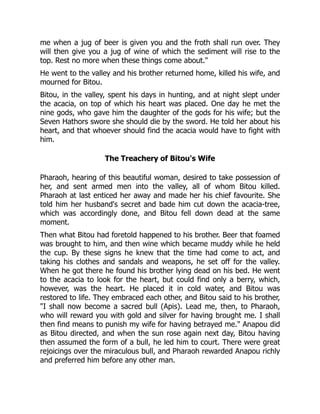
"Who are you?"—EvelynPaul.
The Doomed Prince
This story is to be found in the Harris Papyrus in the British Museum. It
was complete when first discovered, but an unfortunate accident partly
28.
destroyed it, sothat the end of the tale is lost. It is supposed to belong
to the end of the Eighteenth Dynasty.
There was once a king who was sore in heart because no son had been
born to him. He prayed the gods to grant his desire, and they decreed
that as he had prayed, so it should be. And his wife brought forth a son.
When the Hathors came to decide his destiny they said, "His death shall
be by the crocodile, or by the serpent, or by the dog." And those who
stood round, upon hearing this, hurried to tell the king, who was much
grieved thereat and feared greatly.
And because of what he had heard he caused a house to be built in the
mountains and furnished richly and with all that could be desired, so
that the child should not go abroad. When the boy was grown he went
one day upon the roof, and from there he saw a dog following a man
upon the road. Then he turned to his attendant and said, "What is that
which follows the man coming along the road?" And he was told that it
was a dog.
And the child at once wished to possess a dog, and when the king was
told of his desire he might not deny him, lest his heart should be sad.
As time went on and the child became a man he grew restive, and,
being told of the decree of the Hathors, at once sent a message to his
father, saying, "Come, why and wherefore am I kept a prisoner? Though
I am fated to three evil fates, let me follow my desires. Let God fulfil His
will."
And after this he was free and did as other men. He was given weapons
and his dog was allowed to follow him, and they took him to the east
country and said to him, "Behold, thou art free to go wheresoever thou
wilt."
He set his face to the north, his dog following, and his whim dictated his
path. Then he lived on all the choicest of the game of the desert. And
then he came to the chief of Nahairana. And this chief had but one
child, a daughter. For her had been built a house with seventy windows
seventy cubits from the ground. And here the chief had commanded all
the sons of the chiefs of the country of Khalu to be brought, and he said
to them, "He who climbs and reaches my daughter's windows shall win
her for wife."
29.
And some timeafter this the prince arrived, and the people of the chief
of Nahairana took the youth to the house and treated him with the
greatest honour and kindness. And as he partook of their food they
asked him whence he had come. He answered them, saying, "I come
from Egypt; I am the son of an officer of that land. My mother died and
my father has taken another wife, who, when she bore my father other
children, grew to hate me. Therefore have I fled as a fugitive from her
presence." And they were sorry for him and embraced him.
Then one day he asked the climbing youths what it was they did there.
And when they told him that they climbed the height that they might
win the chief's daughter for wife, he decided to make the attempt with
them, for afar off he beheld the face of the chief's daughter looking
forth from her window and turned toward them.
And he climbed the dizzy height and reached her window. So glad was
she that she kissed and embraced him.
And thinking to make glad the heart of her father, a messenger went to
him, saying, "One of the youths hath reached thy daughter's window."
The chief inquired which of the chief's sons had accomplished this, and
he was told that it was the fugitive from Egypt.
At this the chief of Nahairana was wroth and vowed that his daughter
was not for an Egyptian fugitive. "Let him go back whence he came!" he
cried.
An attendant hurried to warn the youth, but the maiden held him fast
and would not let him go. She swore by the gods, saying, "By the being
of Ra Harakhti, if he is taken from me, I will neither eat nor drink and in
that hour I shall die!"
And her father was told of her vow, and hearing it he sent some to slay
the youth while he should be in his house. But the daughter of the chief
divined this and said again, "By the great god Ra, if he be slain, then I
shall die ere the set of sun. If I am parted from him, then I live no
longer!"
Again her words were carried to the chief. He caused his daughter and
the youth to be brought before him, and at first the young man was
afraid, but the chief of Nahairana embraced him affectionately, saying,
30.
"Tell me whothou art, for now thou art as a son to me." He answered
him, "I come from Egypt; I am the son of an officer of that land. My
mother died and my father has taken another wife, who, when she bore
my father children, grew to hate me. Therefore have I fled as a fugitive
from her presence!"
Then the chief gave him his daughter to wife; he gave him a house and
slaves, he gave him lands and cattle and all manner of good gifts.
The time passed. One day the youth told his wife of his fate, saying to
her, "I am doomed to three evil fates—to die by a crocodile, a serpent,
or a dog." And her heart was filled with a great dread. She said to him,
"Then let one kill the dog which follows thee." But he told her that could
not be, for he had brought it up from the time it was small.
At last the youth desired to travel to the land of Egypt, and his wife,
fearing for him, would not let him go alone, so one went with him. They
came to a town, and the crocodile of the river was there. Now in that
town was a great and mighty man, and he bound the crocodile and
would not suffer it to escape. When it was bound the mighty man was
at peace and walked abroad. When the sun rose the man went back to
his house, and this he did every day for two months.
After this as the days passed the youth sat at ease in his house. When
the night came he lay on his couch and sleep fell upon him. Then his
wife filled a bowl of milk and placed it by his side. Out from a hole came
a serpent, and it tried to bite the sleeping man, but his wife sat beside
him watching and unsleeping. And the servants, beholding the serpent,
gave it milk so that it drank and was drunk and lay helpless on its back.
Seeing this, with her dagger the wife dispatched it. Upon this her
husband woke and, understanding all, was astonished. "See," she said
to him, "thy god hath given one of thy dooms into thy hand. Surely he
shall also give thee the others!"
And then the youth made sacrifices to his god and praised him always.
One day after this the youth walked abroad in his fields, his dog
following him. And his dog chased after the wild game, and he followed
after the dog, who plunged into the river. He also went into the river,
and then out came the crocodile, who took him to the place where the
31.
mighty man lived.And as he carried him the crocodile said to the youth,
"Behold, I am thy doom, following after thee...."
At this point the papyrus is so extensively mutilated that in all probability
we shall never know what happened to the prince. Was he at last
devoured by the crocodile? or perchance did his faithful dog lead him
into still graver danger? Let everyone concoct his own ending to the
tale!
The Visit of Ounamounou to the Coasts of Egypt
On the sixteenth day of the thirteenth month, the harvest month,
Ounamounou, the chief priest of the temple of Amen-Ra, departed on a
voyage to procure wood for the fashioning of the sacred barque of the
god.
"When I arrived at Tanis," he says, "I gave them the edicts of Amen-Ra,
which they read and decided to obey. I stayed at Tanis till the fourteenth
month of Shomou, when I embarked to voyage upon the Syrian sea.
When the ship arrived at Dora, city of Zakkala, the Prince of the place,
Badîl, sent bread, meat, and wine unto me.
"While in this place a man of the vessel deserted, carrying with him
much gold and silver. Thereupon I went to the Prince and made my
complaint to him, saying that the gold belonged to Amen-Ra. And the
Prince answered and said he knew naught of it, but if the robber were
of his country, he would reimburse me out of his own treasury; if, on the
other hand, the robber were of my own company, I must stay there for
some days and he would search for the thief. I stayed nine days in that
port. Then I went again to the Prince, saying, 'You have not yet found
the stolen gold. But now I must go. If you should find it in my absence,
then keep it against my return.' This was so arranged between us.
"Then I embarked again and reached Tyre, to whose Prince I recounted
my loss, and complained that the Prince of Dora had not found my gold,
but, being a friend of Badîl, he would not listen—indeed, threatened me.
At break of day we set out in the direction of Byblos, and on the way a
vessel of Zakkala overtook us with a coffer on board. On opening this
coffer I discovered money, and took possession of it. I said to them that
I would keep and use it until my stolen gold was restored to me. When
32.
they saw Iwas firm they accepted the situation and left me, and we at
last reached Byblos.
"I disembarked, carrying the naos containing the statue of Amen-Ra,
having put therein the treasure. But the Prince of Byblos bade me
begone. I said to him, 'Is this because the men of Zakkala have told you
that I took their money? That money is my own, for in their port the
gold of Amen-Ra was stolen. Besides, I come from Herihor to procure
wood for the sacred barque of the god Amen-Ra.' I stayed in this port
for nineteen days, and each day the Prince sent this message bidding
me begone.
"Then one eve when the Prince of Byblos sacrificed to his gods, and one
danced before them, he mocked me and bade me bring my god to life.
That night I met a man whose vessel was bound for Egypt, and I
charged him with all concerning me. I said to him that I would embark
and depart unknown to any, and surely the gods I trust would watch
over me. While so debating the commander of the port came to me,
saying, 'Stay; it is the will of the Prince.' And I answered him, 'Are you
not the one who brought me the message each day bidding me begone,
and never bade me stay? Now why is it that you bid me rest?'
"He turned and left me and went to the Prince, who this time sent a
message to the captain of the vessel bidding him wait till the morrow.
The next morning he sent for me to be brought to the palace in which
he lived beside the sea. I was taken to his chamber, and there he asked
me how long it was I had been on this journey. I answered five months,
but he doubted me, asking where were the edicts of Amen-Ra which
ought to be in my hands, and where was the letter of the high-priest? I
told him that I had given them to other princes. He was angered, and
said that I came with no proofs, and what was there to hinder him
ordering the captain of the vessel to kill me? Again I answered that I
had come from Egypt for wood for the sacred barque. And then he told
how formerly those from Egypt had come in state to visit his city. After a
long altercation with the Prince, and when I had told him that if he
executed the commands of Amen-Ra much good would be his, he still
hesitated. Then I asked for a messenger to take a letter from me to the
other Princes, Smendes and Tantamounou, and he would see how they
would do my bidding and succour me.
33.
"It seemed thatthe Prince had changed his mind, for after he had given
my letter to his messenger he ordered a ship to be loaded with wood,
seven pieces in all, and to be taken to Egypt.
"His messenger went to Egypt and returned to me in the first month of
the winter. And soon the Princes Smendes and Tantamounou sent me
ships laden with many gifts. Seeing this, the Prince was rejoiced, and
soon he commanded much wood to be hewn for me. And when it was
finished he came saying that he had done as his fathers had done
before him, and giving orders that the wood should be loaded on a
vessel. He also said that I had not been treated as were the envoys of
Khamoîs, who had lived seventeen years in the country and died there.
Turning to his courtier, he bade him show me their tomb. But I had no
desire to see it, and said so. I also said, 'The envoys of Khamoîs were
but men of his household; I came as the messenger of the great god
Amen-Ra.'
"Then I bade him erect a stele and this inscription to be engraved
thereon:
"'Amen-Ra, the great god of the gods, sent me a divine messenger,
together with Ounamounou as his human ambassador, for the wood
wherewith his sacred barque should be fashioned. I cut down trees for
this and loaded them, furnishing the vessels by which it was carried into
Egypt. I did this that I may obtain immortal life from the great god
Amen.'
"'And,' I continued, 'a messenger shall come from the land of Egypt who
shall read your name upon the stele, and you shall receive the water of
Amenti even as the gods.'
"He said, 'This is a wonderful thing you tell me.' Then I told him that
when I returned I should acquaint the high-priest of Amen of how he,
the Prince, had done all as he was commanded, and that he should
assuredly receive the gifts.
"When I went down to the shore where the wood was loaded I beheld
eleven vessels sent from Zakkala to seize and imprison and prevent me
from reaching Egypt. Then I was distressed and cried out, and a
messenger from the Prince approached me, saying, 'What troubles you?'
34.
"I explained tohim what menaced me, and he went and told the Prince,
who was much distressed. To cheer me he sent gifts of food and wine,
and an Egyptian singer, Tantnouit, whose songs he thought might chase
away my sorrow. His message was, 'Eat, drink, and be not troubled. You
shall hear my plans in the morn.'
"And when the day was come the Prince called his men, and they set
out and spoke to the men of Zakkala, asking them the object of their
coming. They answered that they had come to seize the vessels and
their rascally crews. He answered, 'I have not the power to take prisoner
the messenger of Amen-Ra in my country. I shall let him go, and after
you can do with him as you please.'
"I embarked and left the port, and the wind drove me into the country
of Alasia. There the people of the town came to put me to death,
dragging me to the presence of Hatibi, the Princess of the city. I looked
at the men around, and asked was there not one who could understand
Egyptian? One came forward saying that he understood it. I said that I
had heard that if justice was to be found anywhere it was in Alasia, and
yet here were they ready to work an injustice. The Princess inquired
what I had said.
"Again I spoke, and pleaded that as the storm had driven me into their
country they should not slay me, for in truth I was a messenger of the
great god Amen-Ra. Then I pointed out that if harm came to me I would
be avenged. In a little while the Princess called her people and caused
them to relinquish their evil designs, saying to me, 'Be not troubled...."
Here the papyrus ends. It is tantalizing not to know how Ounamounou
managed to return to Egypt, but we may be sure a person of such
infinite resource and determination, not to say doggedness,
accomplished all he desired.
35.
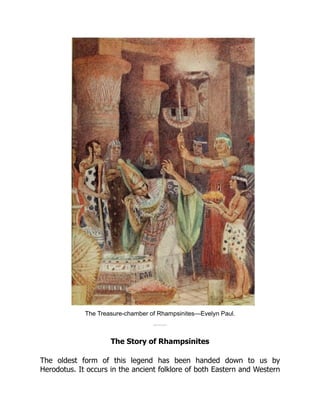
The Treasure-chamber ofRhampsinites—Evelyn Paul.
The Story of Rhampsinites
The oldest form of this legend has been handed down to us by
Herodotus. It occurs in the ancient folklore of both Eastern and Western
36.
peoples and itsorigin has often been debated. If not really of Egyptian
origin, it had certainly become Egyptianized when Herodotus found it. It
relates how King Rhampsinites possessed so much treasure that none of
his successors ever surpassed or even came near to having a like
amount.
To ensure its safety he had a seemingly impregnable stone house built,
in which he placed all his great wealth. By a clever trick, however, the
architect contrived to provide access to the treasure. He made one of
the stones in two parts, so that one part could be removed; but so
skilfully were the two parts placed together that they presented a
perfectly even surface, as of one single stone. Before he died he
acquainted his two sons with the secret of the treasure-house, and after
his death they did not delay in putting their knowledge into practice.
They went by night, found the stone without any difficulty, withdrew it,
stole a large sum of money, and replaced it in position.
When the king discovered that thieves were at work he had man-traps
placed near the site of the treasure-house. One night the two brothers
came as usual, and one of them was caught in a trap. Seeing his danger,
he called his brother and said to him, "We shall both perish and the
treasure be lost unless you cut off my head and take it away, so that no
one will recognize us as the thieves." The brother did as he advised: he
moved the stone back into position, cut off his brother's head and
carried it home.
When the king found the headless body he was much disturbed, for
there were no traces of entrance to or exit from the treasure-house, and
he bethought himself of this expedient: he had the dead body exposed
on the city wall and placed a guard round it with instructions to watch
and report whoever manifested any sign of grief on seeing the body.
This act was contrary to the practice of the Egyptians, who had usually
too much respect for the dead to indulge in it. Even in the case of an
executed criminal the remains were returned to the relatives to be
embalmed. Nevertheless Rhampsinites considered himself justified in
adopting this measure. The body was exposed, and the mother,
although she did not betray any sign of grief, insisted on her other son
bringing it to her; otherwise she threatened to divulge his secret to the
king. Seeing that he dared not disobey, the son devised a stratagem. He
37.
saddled some assesand loaded them with goatskins full of wine—skins
were used in Egypt for water only at most times, wine being held in
short narrow vases—he drove the asses past the guard and, when
passing, stealthily untied one or two of the skins, and as the wine ran
down and flowed on the ground began to beat his head and make a
great outcry. The guards ran for vessels to save the precious liquid, and
over the catastrophe they became quite friendly with the thief and gave
him meat, for which he offered in exchange one of his skins of wine.
They all sat down to drink together, and as they became merry over the
wine he offered them the remainder of his wine, which they took and
drank until they were quite tipsy. The thief, needless to say, had taken
care to remain tolerably sober. After the guards were in a drunken sleep,
he waited till nightfall and then cut down his brother's body and took it
home on the asses to his mother. Before quitting the guards he shaved
off all the hair on one side of their faces.
When the king heard of the trick he was furious, and, determined by fair
means or foul to discover its author, he hit upon the following plan. He
ordered the princess, his daughter, to receive any man in the land, no
matter whom, and to grant him whatever favour he might ask of her,
but first she must make him tell her what was the cleverest and
wickedest thing he had ever done. When the thief told her his trick she
was to have him bound before he could escape. The princess was ready
to do her father's bidding, but the thief, knowing well what the king had
in his mind, resolved to circumvent him a third time. He cut off the arm
of a newly dead man and, hiding it under his robe, obtained admission
to the princess. On being asked the question that she put to all comers,
he told her first about cutting off his brother's head in the trap, and then
went on to tell how, having made the guards tipsy, he had cut down his
brother's body. She at once called out and tried to seize him, but he
placed in her hand that of the dead man, which she grasped firmly,
believing it to be the thief's, and he escaped in the darkness of the
room.
The king now owned himself beaten, and offered a free pardon and rich
rewards to the man who had so boldly outwitted him. Trusting to his
word, the thief presented himself before the king, and received not only
what Rhampsinites had promised, but also the hand of the princess in
38.
marriage, for heheld the thief to be the cleverest of men in that he had
duped the Egyptians, who prided themselves on their astuteness.
Civil War in Egypt: The Theft of the Cuirass
In the reign of the Pharaoh Petoubastis the Delta and great part of
Lower Egypt were divided into two rival factions, one part being headed
by the chieftain Kamenophis, Prince of Mendes, and the other ruled by
the king-priest of Heliopolis, Ierharerou, and his ally Pakrourou, the
great chieftain of the east. Only four nomes in the middle of the Delta
were subject to Kamenophis, whilst Ierharerou had succeeded in
establishing either his children or relations in most of the other nomes.
Ierharerou possessed a cuirass to which he attached great value and
which was generally regarded as a talisman. At his death Kamenophis,
taking advantage of the mourning and confusion in Heliopolis, seized the
cuirass and placed it in one of his own strongholds. Prince Pimonî 'the
little'—"Pimonî of the strong fist," as he is sometimes called in the
narrative—the successor of Ierharerou, demanded its restoration.
Kamenophis refused, and hence arose a quarrel in which all the
provinces of Egypt were implicated.
Pimonî and Pakrourou both presented themselves before King
Petoubastis, asking his permission to be revenged on Kamenophis; but
Pharaoh, who knew that this would entail civil war, endeavoured to
dissuade Pimonî from taking steps against Kamenophis and, indeed,
forbade him to proceed with his intentions, promising as compensation a
splendid funeral for Ierharerou. Unwillingly Pimonî submitted, but after
the funeral ceremonies were over resentment still burned within him,
and he and Pakrourou, "the great chieftain of the east," returned again
to Petoubastis at his court in Tanis. He received them rather impatiently,
asking them why they troubled him again and declaring that he would
not allow civil war during his reign. They, however, would not be
satisfied and said they could not go on with the celebration of the feast
that was to follow the religious rites of Ierharerou's funeral until the
shield or cuirass was restored to its rightful owner.
Pharaoh then sent for Kamenophis, and requested him urgently to
return the shield, but in vain. Kamenophis declined to do so.
39.
Then said Pimonî,"By Tem, the lord of Heliopolis, the great god, my
god, were it not for Pharaoh's decree and that my respect for him
protects you, I should kill you this very instant."
Kamenophis replied, "By the life of Mendes, the great god, the war
which will break out in the nome, the battle which will break out in the
city will stir up clan against clan, and man against man, before the
cuirass shall be wrested from the stronghold where I have placed it."
The Horrors of War
Pakrourou then said before the king, "Is it right what Kamenophis has
done, and the words he has just spoken are they not said to provoke us
to anger that we may measure our strength against his? I will make
Kamenophis and the nome of Mendes feel the shame of these words
uttered to provoke civil war which Pharaoh has forbidden; I will glut
them with war. I said nothing because I knew the king did not want war;
but if the king remains neutral I shall be silent no longer, and the king
shall see all the horrors of civil war."
Pharaoh said, "Be neither boastful nor timid, Pakrourou, great chieftain
of the east, but now go each one of you to your nomes and your towns
in peace, and give me but five days, and I swear by Amen-Ra that I
shall cause the cuirass to be put back in the place from which it was
taken."
Pimonî then said that if the cuirass were replaced nothing more should
be said about it, and there should be no war; but if it were withheld, he
would fight for it, against the whole of Egypt if necessary.
Kamenophis at this respectfully asked and obtained permission from
Pharaoh to order all his men to arm themselves, and to go with him to
the Lake of the Gazelle and prepare to fight.
Then Pimonî, encouraged by Pakrourou, sent messages of a similar
import to all his nomes and cities. Pakrourou further advised him to
hasten to the Lake of the Gazelle and be there before Kamenophis had
assembled all his men, and Pimonî, with only one band of men, took his
advice and was first in the field, intending to wait there till his brothers,
at the head of their respective clans, should join him.
40.
News of thiswas taken to Kamenophis, and he hastily assembled his
four nomes, Tanis, Mendes, Tahait, and Sebennytos. Arrived at the lake,
he at once challenged Pimonî, and Pimonî, though his other forces had
not yet arrived, accepted the challenge.
Pimonî put on a shirt of byssus embroidered with silver and gold, and
over that a second shirt of gold tissue; he also donned his copper
corselet and carried two golden swords; he put on his helmet and sallied
forth to meet Kamenophis.
While they were fighting, Zinonfi, Pimonî's young servant, ran off to
watch for the forces that were to come to Pimonî's aid, and he soon
descried a flotilla so large that the river could hardly carry all the barges.
They were the people of Heliopolis coming to help their chief. As soon as
they came within earshot Zinonfi called out to them to hurry, because
Pimonî was being hard pressed by Kamenophis, which, indeed, was true,
for his horse was slain under him.
Kamenophis redoubled his efforts when he saw the fresh forces arriving,
and Petekhousou, Pimonî's brother, challenged Anoukhoron, the king's
son, to single combat. When Pharaoh heard this he was very angry. He
went in person to the field of battle and forbade the combatants to
proceed, and also commanded a truce until all the forces should be
assembled.
Petoubastis and all the chieftains occupied prominent positions so that
they could watch what was going on, and the men were as numerous as
the sands of the seashore and their rage against each other
uncontrollable. The bands of the four nomes were ranged behind
Kamenophis, and the bands of the nome of Heliopolis behind Pimonî the
Little.
Then Petoubastis gave Pakrourou a signal and he armed himself and
went down among the forces, stirring them all to deeds of valour; he
pitted man against man, and great was the ardour he aroused in them.
Succour for Pakrourou
After Pakrourou had left the mêlée, he met a mighty man in armour
leading forty galleys and eight thousand soldiers. This was Moutoubaal,
a prince of Syria, who had been warned in a dream to repair to the Lake
41.
of the Gazelleto help to regain the stolen cuirass. Pakrourou gave him a
place, though all the forces were now disposed; but he ordered him not
to join in the fight until the opposite side—the men of Kamenophis—
should attack their vessels. Moutoubaal, therefore, remained in his
barque, and Pakrourou went back to his point of vantage to watch the
progress of the battle. The two factions fought from four in the morning
to nine in the evening. Finally Anoukhoron, the king's son, broke under
the stress of the bands of Sebennytos and they rushed toward the
boats. Then Moutoubaal took his opportunity and went against the
bands of Sebennytos and overthrew them. He went on spreading
destruction among the forces of Kamenophis till Pharaoh called a halt;
then proceeded with Pakrourou to Moutoubaal and besought him to stay
his hand, promising that he would see to it that the shield was restored.
Moutoubaal accordingly quitted the lists after having wrought great
havoc among the men of Kamenophis. Then Pharaoh and Pakrourou
went with Moutoubaal to the place where Pimonî was found engaged in
mortal combat with Kamenophis. Pimonî had got the upper hand and
was about to slay his adversary, but they stopped him, and Pharaoh
ordered Kamenophis to quit the lists.
After this Anoukhoron, the royal prince, was overthrown by
Petekhousou, the brother of Pimonî, but Pharaoh interposed and
persuaded Petekhousou to spare his son, so the young man was allowed
to withdraw unhurt.
The king said, "By Amen-Ra, the sceptre has fallen from the hands of
Kamenophis, prince of Mendes. Petekhousou has vanquished my son,
and the bands of the four strongest nomes in Egypt have been
overthrown."
The Shield Regained
Then Minnemai, Prince of the Eupuantine, the son of Ierharerou, the
priest-king, to whom the shield had belonged, advanced from Thebes
with all his forces. They assigned him a place next the ship of Takhos,
the chief soldier of the nome of Mendes, and it happened that in the
galley of Takhos lay the cuirass itself. And Minnemai called upon his
gods to let him behold his father's cuirass that he might be the
instrument of its recapture. He armed himself, went to the galley of
Takhos, and met there nine thousand soldiers guarding the cuirass of
42.
Ierharerou, son ofOsiris. Minnemai placed thirty-four guards on the
footbridge of the galley to prevent anyone from getting off, and he fell
upon the soldiers guarding the cuirass. Takhos fought well and killed
fifty-four men, but finally gave in and retired to his vessel, where
Minnemai followed him with his Ethiopian warriors. The children of
Ierharerou supported him and they seized the cuirass of Ierharerou.
Thus was the armour recaptured and brought back to its former place.
There was great joy among the children of Ierharerou and the troops of
Heliopolis. They went before Pharaoh and said to him, "Great master,
have the history of the war of the cuirass written, and the names of the
warriors who waged it, that posterity may know what a war was made
in Egypt on account of the cuirass, in the nomes and in the cities; then
cause the history to be engraved on a stone stele in the temple of
Heliopolis." And King Petoubastis did as they asked.
The Birth of Hatshepsut
The following story of the birth of Hatshepsut, the great queen, the
beloved of the gods, mistress of all lands under the sun, is not a direct
translation from the old papyrus which recounts it, but is told in the
writer's own words:
In the land of the gods Amen-Ra held court. King of the gods was
Amen-Ra, and the maker of men. On his right was Osiris, with the twin
goddesses Isis and Nephthys, Hathor the goddess of love, and Horus
and Anubis. On his left was Mentu, the god of war, with Geb, the earth-
god, and Nut, the sky-goddess, the gods Atmu and Shu, and the
goddess Tefnut. And to the assembled gods Amen-Ra spake thus:
"I will make a great queen, who shall rule over Egypt and Syria, Nubia
and Punt, so that all lands may be united under her sway. Worthy must
the maiden be of her great dominions, for she shall rule the whole
world."
As he spoke the god Thoth entered, he who has the form of an ibis, that
he may fly more swiftly than the swiftest arrow. In silence he listened to
the words of Amen-Ra, the mightiest of the gods, the maker of men.
Then he said:
43.
"Behold, O Amen-Ra,there is in the land of Egypt a maiden of wondrous
beauty. The sun in his circuit shines not on anything more fair. Surely it
is fitting that she be the mother of the great queen of whom thou
speakest."
"Thou sayest well," said Amen-Ra. "Where shall we seek this fair
princess? What is her name?"
"Her name is Aahmes," answered Thoth; "she is wife to the King of
Egypt, and dwelleth in his palace. I will lead thee to her."
"It is well," said Amen-Ra.
Then Thoth, in the shape of an ibis, flew toward the land of Egypt, and
with him went Amen-Ra, in the form of the King of Egypt, and all the
gods and goddesses, among them Neith, goddess of Sais, and the
scorpion goddess, Selk, on whose head was a scorpion bearing in each
claw the sign of life.
Silently the gods and goddesses entered the sleeping palace, and were
conducted by Thoth to the chamber of Queen Aahmes. The queen lay
asleep on a couch shaped like a lion, and as they gazed upon her they
saw that Thoth had spoken truly, that she was indeed the fairest of
mortal women, and they stood speechless with admiration for her
beauty. But the fragrance which they had borne with them from the land
of Punt awoke the maiden, who looked with astonishment on her
supernatural visitors. Very magnificent was Amen-Ra, the king of the
gods, the maker of men, as he stood before the queen. Jewels of gold
and precious stones adorned his person, and his beauty was as the
beauty of the sun, so that the maiden's heart was filled with delight.
Amen-Ra placed in her hand the sign of life and the emblem of power,
and the goddesses Neith and Selk raised her couch above the ground,
so that she might be above the earth while she conversed with the
gods.
At length the gods returned to the land of Punt, and Amen-Ra called for
Khnum, the creator, the fashioner of the bodies of men.
"Fashion for me," said Amen-Ra, "the body of my daughter, and the
body of her ka. A great queen shall I make of her, and honour and
power shall be hers all the days of her life."
44.
"O Amen-Ra," answeredKhnum, the creator, "it shall be done as thou
hast said. The beauty of thy daughter shall surpass that of the gods,
and shall be worthy of her dignity and glory."
So Khnum fashioned the body of Amen-Ra's daughter and the body of
her ka, the two forms exactly alike, and more beautiful than the
daughters of men. He fashioned them of clay with the aid of his potter's
wheel, and Hekt, goddess of birth, knelt by his side, holding the sign of
life toward the clay that the bodies of Hatshepsut and her ka might be
filled with the breath of life.
Then did the gods bring the bodies to the palace of the King of Egypt.
Khnum, the creator, and Hekt, the goddess of birth, Isis, the great
mother, and her twin sister Nephthys, Bes, the protector of children, and
Meskhent and Ta-urt, all were present to hail the birth of Hatshepsut,
the great queen, the daughter of Amen-Ra and Queen Aahmes.
Great were the rejoicings when the child was born, and loud the praises
chanted in her honour. And in time she became ruler of all countries,
rich and powerful and beloved of Amen-Ra, the great queen for whom
she had been designed by the king of the gods.
In the valley of the Nile there was erected a temple to Queen
Hatshepsut. The temple stands to this day, and is now known as Deir-el-
Bahari, the Northern Convent.
How Thoutii took the Town of Joppa
The fragments of this story are inscribed on the Harris Papyrus. Like the
story of the Predestined Prince, they were discovered in 1874 by
Goodwin, who recognized in them the remnants of an historical
narrative, and who informed the Archæological Society of his find. The
beginning is lost. At the point where the narrative commences there are
three characters: an Egyptian officer called Thoutii, the prince of a town
in Syria, and his equerry. The tale deals with the recapture of Joppa (a
town of Palestine mentioned in the Bible) by Thoutii's stratagem. The
stratagem employed bears some resemblance to that related in the story
of the robber-captain in the Arabian Nights.
45.
In the reignof Thothmes III, King of Egypt (Eighteenth Dynasty), the
Prince of Joppa rose in rebellion and murdered all the Egyptian soldiers
that were quartered in the town. This news naturally excited Pharaoh's
wrath, and he called together his nobles and generals and scribes to see
what could be done. None of them, however, had any suggestion to
make except Thoutii, a brilliant young infantry officer.
"Give me," he begged, "your magic cane, O my king, and a body of
infantry and of charioteers, and I undertake to kill the Prince of Joppa
and to take the town."
Pharaoh, who esteemed this officer highly and knew his worth, granted
all that he asked—not exactly a modest request, for the cane was a
talisman supposed to render invisible anyone into whose possession it
fell.
Thoutii then marched to Palestine with his men. Having arrived there, he
had a large skin bag made, big enough to hold a man, and he had irons
made for feet and hands, one pair being especially large and strong;
also shackles and yokes of wood, and four hundred jars. Then he sent
to the Prince of Joppa the following message: "I am Thoutii, the
Egyptian infantry general. King Thothmes was jealous of my bravery and
sought to kill me; but I have escaped from him, and I have stolen his
magic cane, which is hidden in my baggage; and, if you like, I will give it
to you, and I will join forces with you, I and my men, the pick of the
Egyptian army."
This message was very pleasant news to the Prince of Joppa, for he
knew Thoutii's reputation, and knew that he had no equal in all Egypt.
He sent to Thoutii, accepting his offer, and promising him a share of his
territory. He then left Joppa, taking with him his equerry and the women
and children, to greet the man whom he took to be a new and powerful
ally. He welcomed him warmly, and invited him into his camp to dine
with him. In course of conversation, as they were eating and drinking
together, he asked Thoutii about the magic cane. Thoutii replied that it
was concealed in the baggage with which his horses were laden, and
requested that his men and horses should be brought into the camp to
be refreshed and rested.
46.
This was done:his horses were fed and tied up, the baggage was
searched, and the magic cane found.
The Stratagem
Hearing this, the Prince of Joppa expressed his eager wish to behold the
magic cane. Thoutii went and fetched it; then suddenly seizing the
Prince by his clothes, he said, "Behold here King Thothmes' magic
cane," and with that he raised his hand and struck the Prince on the
forehead so that the latter fell down unconscious before him. Then he
put him into the big leather sack he had with him and clapped the
handcuffs on his wrists and the irons on his feet. The face of the dead
man being invisible, Thoutii's stratagem was to pass off the corpse as
his own. He had the two hundred soldiers put into an equal number of
the four hundred jars he had brought with him and filled the remainder
with the ropes and wooden shackles; then he sealed them, corded
them, and gave them to as many strong soldiers, saying, "Go quickly
and tell the Prince of Joppa's equerry that I am slain. Let him go and tell
his mistress, the Princess of Joppa, that Thoutii is conquered, that she
may open the city gates to receive the dead body of the vanquished and
the jars of booty that have been taken from him." The equerry received
this message and ran to tell the joyful news to his mistress. The gates of
the town were opened, and Thoutii's men carried the jars containing the
other soldiers into the town. Then they released their companions, and
the Egyptian force fell upon the inhabitants of the city and took them
and bound them.
After he had rested Thoutii sent a message to Pharaoh saying, "I have
killed the Prince of Joppa and all the people of Joppa are prisoners. Let
them be sent for and brought to Egypt, that your house may be filled
with male and female slaves who will be yours for ever. Let Amen-Ra,
thy father, the god of gods, be glorified."
[1] Vansleb at the end of the seventeenth century perhaps heard it
spoken.
[2] The Rosetta Stone is written in three scripts, hieroglyphic,
Demotic, and Greek.
[3] Properly speaking, it should be written from right to left
horizontally. Only for decorative purposes is it inscribed from right to
left or in columns.
47.
[4] Or Usertsen.
[5]This expression argues a greater decency in matters convivial in
the Egypt of 526 B.C. than obtained in Georgian England.
[6] Called Her-tata-f in another part of this manuscript.
[7] The Demotic gives the name (or title) as Setne or Setme, and the
name of the miraculous child as Si-Osiris (i.e. son of Osiris).
[8] The whole of this is very obscure in the original.
CHAPTER VII: MAGIC
To the peoples of antiquity Egypt appeared as the very mother of magic.
In the mysterious Nile country they found a magical system much more
highly developed than any within their native knowledge, and the cult of
the dead, with which Egyptian religion was so strongly identified,
appeared to the foreigner to savour of magical practice. If the materials
of the magical papyri be omitted, the accounts which we possess of
Egyptian magic are almost wholly foreign, so that it is wiser to derive
our data concerning it from the original native sources if we desire to
arrive at a proper understanding of Egyptian sorcery.
Most of what has been written by Egyptologists on the subject of
Egyptian magic has been penned on the assumption that magic is either
merely a degraded form of religion, or its foundation. This is one of the
results of the archæologist entering a domain (that of anthropology)
where he is usually rather at a loss. For example, we find Sir Gaston
Maspero stating that "ancient magic was the very foundation of religion.
The faithful who desired to obtain some favour from a god had no
chance of succeeding except by laying hands on the deity, and this
arrest could only be effected by means of a certain number of rites,
sacrifices, prayers, and chants, which the god himself had revealed and
which obliged him to do what was demanded of him."[1] Then we find
Dr. Budge stating that in the religious texts and works we see how
magic is made to be the handmaiden of religion, and that whereas non-
Egyptian races directed their art against the powers of darkness, and
48.
Welcome to ourwebsite – the perfect destination for book lovers and
knowledge seekers. We believe that every book holds a new world,
offering opportunities for learning, discovery, and personal growth.
That’s why we are dedicated to bringing you a diverse collection of
books, ranging from classic literature and specialized publications to
self-development guides and children's books.
More than just a book-buying platform, we strive to be a bridge
connecting you with timeless cultural and intellectual values. With an
elegant, user-friendly interface and a smart search system, you can
quickly find the books that best suit your interests. Additionally,
our special promotions and home delivery services help you save time
and fully enjoy the joy of reading.
Join us on a journey of knowledge exploration, passion nurturing, and
personal growth every day!
testbankfan.com








![This was done: his horses were fed and tied up, the baggage was
searched, and the magic cane found.
The Stratagem
Hearing this, the Prince of Joppa expressed his eager wish to behold the
magic cane. Thoutii went and fetched it; then suddenly seizing the
Prince by his clothes, he said, "Behold here King Thothmes' magic
cane," and with that he raised his hand and struck the Prince on the
forehead so that the latter fell down unconscious before him. Then he
put him into the big leather sack he had with him and clapped the
handcuffs on his wrists and the irons on his feet. The face of the dead
man being invisible, Thoutii's stratagem was to pass off the corpse as
his own. He had the two hundred soldiers put into an equal number of
the four hundred jars he had brought with him and filled the remainder
with the ropes and wooden shackles; then he sealed them, corded
them, and gave them to as many strong soldiers, saying, "Go quickly
and tell the Prince of Joppa's equerry that I am slain. Let him go and tell
his mistress, the Princess of Joppa, that Thoutii is conquered, that she
may open the city gates to receive the dead body of the vanquished and
the jars of booty that have been taken from him." The equerry received
this message and ran to tell the joyful news to his mistress. The gates of
the town were opened, and Thoutii's men carried the jars containing the
other soldiers into the town. Then they released their companions, and
the Egyptian force fell upon the inhabitants of the city and took them
and bound them.
After he had rested Thoutii sent a message to Pharaoh saying, "I have
killed the Prince of Joppa and all the people of Joppa are prisoners. Let
them be sent for and brought to Egypt, that your house may be filled
with male and female slaves who will be yours for ever. Let Amen-Ra,
thy father, the god of gods, be glorified."
[1] Vansleb at the end of the seventeenth century perhaps heard it
spoken.
[2] The Rosetta Stone is written in three scripts, hieroglyphic,
Demotic, and Greek.
[3] Properly speaking, it should be written from right to left
horizontally. Only for decorative purposes is it inscribed from right to
left or in columns.](https://image.slidesharecdn.com/11373-250330054401-aaf9ff4b/85/Business-Essentials-11th-Edition-Ebert-Solutions-Manual-46-320.jpg)
![[4] Or Usertsen.
[5] This expression argues a greater decency in matters convivial in
the Egypt of 526 B.C. than obtained in Georgian England.
[6] Called Her-tata-f in another part of this manuscript.
[7] The Demotic gives the name (or title) as Setne or Setme, and the
name of the miraculous child as Si-Osiris (i.e. son of Osiris).
[8] The whole of this is very obscure in the original.
CHAPTER VII: MAGIC
To the peoples of antiquity Egypt appeared as the very mother of magic.
In the mysterious Nile country they found a magical system much more
highly developed than any within their native knowledge, and the cult of
the dead, with which Egyptian religion was so strongly identified,
appeared to the foreigner to savour of magical practice. If the materials
of the magical papyri be omitted, the accounts which we possess of
Egyptian magic are almost wholly foreign, so that it is wiser to derive
our data concerning it from the original native sources if we desire to
arrive at a proper understanding of Egyptian sorcery.
Most of what has been written by Egyptologists on the subject of
Egyptian magic has been penned on the assumption that magic is either
merely a degraded form of religion, or its foundation. This is one of the
results of the archæologist entering a domain (that of anthropology)
where he is usually rather at a loss. For example, we find Sir Gaston
Maspero stating that "ancient magic was the very foundation of religion.
The faithful who desired to obtain some favour from a god had no
chance of succeeding except by laying hands on the deity, and this
arrest could only be effected by means of a certain number of rites,
sacrifices, prayers, and chants, which the god himself had revealed and
which obliged him to do what was demanded of him."[1] Then we find
Dr. Budge stating that in the religious texts and works we see how
magic is made to be the handmaiden of religion, and that whereas non-
Egyptian races directed their art against the powers of darkness, and](https://image.slidesharecdn.com/11373-250330054401-aaf9ff4b/85/Business-Essentials-11th-Edition-Ebert-Solutions-Manual-47-320.jpg)



![Chapter 1 THE MANAGER’S JOB [PowerPoint Slide 1] The p.docx](https://cdn.slidesharecdn.com/ss_thumbnails/chapter1themanagersjobpowerpointslide1thep-221018173716-d728ad17-thumbnail.jpg?width=640&height=640&fit=bounds)


