Business Essentials Canadian 7th Edition Ebert
Test Bank download
https://testbankfan.com/product/business-essentials-canadian-7th-
edition-ebert-test-bank/
Explore and download more test bank or solution manual
at testbankfan.com
Here are some recommended products for you. Click the link to
download, or explore more at testbankfan.com
Business Essentials Canadian 7th Edition Ebert Solutions
Manual
https://testbankfan.com/product/business-essentials-canadian-7th-
edition-ebert-solutions-manual/
Business Essentials Canadian 8th Edition Ebert Test Bank
https://testbankfan.com/product/business-essentials-canadian-8th-
edition-ebert-test-bank/
Business Essentials Canadian 8th Edition Ebert Solutions
Manual
https://testbankfan.com/product/business-essentials-canadian-8th-
edition-ebert-solutions-manual/
Fundamental Financial Accounting Concepts 10th Edition
Edmonds Solutions Manual
https://testbankfan.com/product/fundamental-financial-accounting-
concepts-10th-edition-edmonds-solutions-manual/
Accounting and Auditing Research Tools and Strategies 9th
Edition Weirich Solutions Manual
https://testbankfan.com/product/accounting-and-auditing-research-
tools-and-strategies-9th-edition-weirich-solutions-manual/
Principles of Managerial Finance 13th Edition Gitman
Solutions Manual
https://testbankfan.com/product/principles-of-managerial-finance-13th-
edition-gitman-solutions-manual/
Business Law The Ethical Global and E-Commerce Environment
15th Edition Mallor Solutions Manual
https://testbankfan.com/product/business-law-the-ethical-global-and-e-
commerce-environment-15th-edition-mallor-solutions-manual/
Psychology An Exploration 3rd Edition Ciccarelli Test Bank
https://testbankfan.com/product/psychology-an-exploration-3rd-edition-
ciccarelli-test-bank/
Fundamentals of Organic Chemistry 7th Edition McMurry Test
Bank
https://testbankfan.com/product/fundamentals-of-organic-chemistry-7th-
edition-mcmurry-test-bank/
Mosby s Pharmacy Technician Principles and Practice 3rd
Edition Hopper Test Bank
https://testbankfan.com/product/mosby-s-pharmacy-technician-
principles-and-practice-3rd-edition-hopper-test-bank/
Copyright © 2015 Pearson Canada Inc.
1
Chapter 08: Managing Human Resources and Labour Relations
Chapter 08 Multiple Choice Questions
1. ________ is the set of organizational activities directed at attracting, developing, and maintaining an effective
workforce.
Production management
Operations management
Developing a mission statement
Human resource management
Financial management
Difficulty: 2
QuestionID: 08-1-01
Page-Reference: 167
Skill: Knowledge
Objective: 8.1
Answer: Human resource management
2. Which of the following is considered the starting point of effective human resource management?
Advertising
Financing
Human resource planning
External staffing
Recruitment
Difficulty: 2
QuestionID: 08-1-02
Page-Reference: 167
Skill: Knowledge
Objective: 8.1
Answer: Human resource planning
3. Cindy Stevens is observing and interviewing several database administrators to determine the duties and
responsibilities associated with their job, as well as the knowledge, skills, and abilities that someone must have
to perform the job. Cindy is performing the HR function of
job analysis.
advertising.
promotion.
training.
staffing.
Difficulty: 2
QuestionID: 08-1-03
Page-Reference: 167
Skill: Comprehension
Objective: 8.1
Answer: job analysis.
Copyright © 2015 Pearson Canada Inc.
2
4. Cindy Stevens has developed a document that identifies the duties and responsibilities of a database
administrator. This document is referred to as a
recruitment effort.
job quantification.
job description.
job advertisement.
job specification.
Difficulty: 2
QuestionID: 08-1-04
Page-Reference: 167
Skill: Comprehension
Objective: 8.1
Answer: job description.
5. Cindy Stevens has identified the knowledge, skills, and abilities necessary for a database administrator in her
organization. She will record this information in a(n)
advertising budget.
employee analysis.
job specification.
staffing survey.
on-the-job training agreement.
Difficulty: 1
QuestionID: 08-1-05
Page-Reference: 167
Skill: Comprehension
Objective: 8.1
Answer: job specification.
6. June has been given the responsibility of doing a job analysis, but she isn't sure what it means, so she asks
you. You say that it is
a written statement which outlines the duties, tasks, and relationship with other positions in the organization.
an attempt to generate large numbers of qualified applicants.
the specific method by which the firm will attempt to reach its objectives.
the detailed study of the specific duties required for a particular job and human qualities required to perform that job.
an analysis of the characteristics of individuals who currently hold jobs with the firm.
Difficulty: 1
QuestionID: 08-1-06
Page-Reference: 167
Skill: Comprehension
Objective: 8.1
Answer: the detailed study of the specific duties required for a particular job and human qualities required to perform that
job.
Copyright © 2015 Pearson Canada Inc.
3
7. Joe manages 15 workers on a production line. He has asked each of them to create a checklist of all the duties
they perform. Joe is working on a
job analysis.
job specification.
job description.
person-job matching.
job relatedness.
Difficulty: 2
QuestionID: 08-1-07
Page-Reference: 167
Skill: Comprehension
Objective: 8.1
Answer: job description.
8. John is reading a document which describes the conditions under which his job will be done, the ways in
which it relates to other positions, and the duties he needs to perform. John is probably looking at
a job specification.
a job description.
job relatedness.
person-job matching.
a job analysis.
Difficulty: 2
QuestionID: 08-1-08
Page-Reference: 167
Skill: Comprehension
Objective: 8.1
Answer: a job description.
9. Cindy Stevens has developed a database that contains information on each employee's education, skills, work
experience, and career aspirations. She plans to use this database to identify employees to fill vacancies. This
data base is a
job specification.
skills inventory.
managerial grid.
job analysis.
replacement chart.
Difficulty: 2
QuestionID: 08-1-09
Page-Reference: 168
Skill: Comprehension
Objective: 8.1
Answer: skills inventory.
Copyright © 2015 Pearson Canada Inc.
4
10. Mark, a manager in production, needs to determine the supply and demand of employees in order to develop
specific strategies. This is known as
job specification.
job description.
performance appraisal.
job analysis.
forecasting.
Difficulty: 1
QuestionID: 08-1-10
Page-Reference: 168
Skill: Comprehension
Objective: 8.1
Answer: forecasting.
11. When forecasting demand,
industry comparisons are mandatory.
the company forecasts the number and type of people who will be available for hiring from the labour market at large.
employees are interviewed and asked how long they think they will remain with the company.
employees sign a contract stating the number of years they will stay.
a company must assess trends in past HR usage, future organizational plans, and general economic trends.
Difficulty: 2
QuestionID: 08-1-11
Page-Reference: 168
Skill: Knowledge
Objective: 8.1
Answer: a company must assess trends in past HR usage, future organizational plans, and general economic trends.
12. Forecasting the supply of labour involves two tasks. The first task is to forecast
future organizational plans.
the number and type of employees who will be in the firm at some future date.
general economic trends.
trends in past HR usage.
demand for certain types of employees.
Difficulty: 1
QuestionID: 08-1-12
Page-Reference: 168
Skill: Knowledge
Objective: 8.1
Answer: the number and type of employees who will be in the firm at some future date.
Copyright © 2015 Pearson Canada Inc.
5
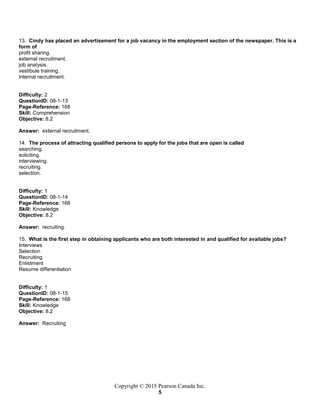
13. Cindy has placed an advertisement for a job vacancy in the employment section of the newspaper. This is a
form of
profit sharing.
external recruitment.
job analysis.
vestibule training.
internal recruitment.
Difficulty: 2
QuestionID: 08-1-13
Page-Reference: 168
Skill: Comprehension
Objective: 8.2
Answer: external recruitment.
14. The process of attracting qualified persons to apply for the jobs that are open is called
searching.
soliciting.
interviewing.
recruiting.
selection.
Difficulty: 1
QuestionID: 08-1-14
Page-Reference: 168
Skill: Knowledge
Objective: 8.2
Answer: recruiting.
15. What is the first step in obtaining applicants who are both interested in and qualified for available jobs?
Interviews
Selection
Recruiting
Enlistment
Resume differentiation
Difficulty: 1
QuestionID: 08-1-15
Page-Reference: 168
Skill: Knowledge
Objective: 8.2
Answer: Recruiting
Copyright © 2015 Pearson Canada Inc.
6
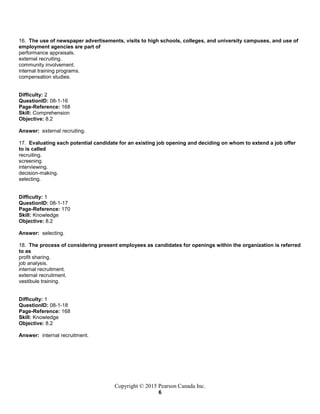
16. The use of newspaper advertisements, visits to high schools, colleges, and university campuses, and use of
employment agencies are part of
performance appraisals.
external recruiting.
community involvement.
internal training programs.
compensation studies.
Difficulty: 2
QuestionID: 08-1-16
Page-Reference: 168
Skill: Comprehension
Objective: 8.2
Answer: external recruiting.
17. Evaluating each potential candidate for an existing job opening and deciding on whom to extend a job offer
to is called
recruiting.
screening.
interviewing.
decision-making.
selecting.
Difficulty: 1
QuestionID: 08-1-17
Page-Reference: 170
Skill: Knowledge
Objective: 8.2
Answer: selecting.
18. The process of considering present employees as candidates for openings within the organization is referred
to as
profit sharing.
job analysis.
internal recruitment.
external recruitment.
vestibule training.
Difficulty: 1
QuestionID: 08-1-18
Page-Reference: 168
Skill: Knowledge
Objective: 8.2
Answer: internal recruitment.
Copyright © 2015 Pearson Canada Inc.
7
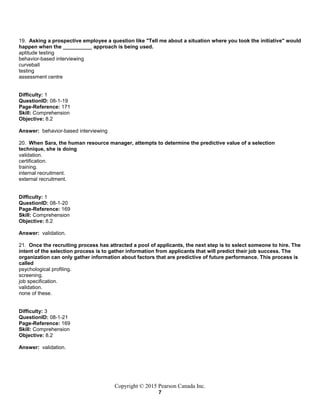
19. Asking a prospective employee a question like "Tell me about a situation where you took the initiative" would
happen when the __________ approach is being used.
aptitude testing
behavior-based interviewing
curveball
testing
assessment centre
Difficulty: 1
QuestionID: 08-1-19
Page-Reference: 171
Skill: Comprehension
Objective: 8.2
Answer: behavior-based interviewing
20. When Sara, the human resource manager, attempts to determine the predictive value of a selection
technique, she is doing
validation.
certification.
training.
internal recruitment.
external recruitment.
Difficulty: 1
QuestionID: 08-1-20
Page-Reference: 169
Skill: Comprehension
Objective: 8.2
Answer: validation.
21. Once the recruiting process has attracted a pool of applicants, the next step is to select someone to hire. The
intent of the selection process is to gather information from applicants that will predict their job success. The
organization can only gather information about factors that are predictive of future performance. This process is
called
psychological profiling.
screening.
job specification.
validation.
none of these.
Difficulty: 3
QuestionID: 08-1-21
Page-Reference: 169
Skill: Comprehension
Objective: 8.2
Answer: validation.
Copyright © 2015 Pearson Canada Inc.
8
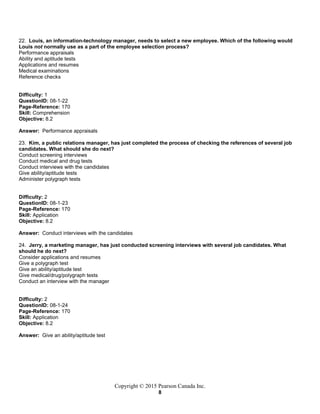
22. Louis, an information-technology manager, needs to select a new employee. Which of the following would
Louis not normally use as a part of the employee selection process?
Performance appraisals
Ability and aptitude tests
Applications and resumes
Medical examinations
Reference checks
Difficulty: 1
QuestionID: 08-1-22
Page-Reference: 170
Skill: Comprehension
Objective: 8.2
Answer: Performance appraisals
23. Kim, a public relations manager, has just completed the process of checking the references of several job
candidates. What should she do next?
Conduct screening interviews
Conduct medical and drug tests
Conduct interviews with the candidates
Give ability/aptitude tests
Administer polygraph tests
Difficulty: 2
QuestionID: 08-1-23
Page-Reference: 170
Skill: Application
Objective: 8.2
Answer: Conduct interviews with the candidates
24. Jerry, a marketing manager, has just conducted screening interviews with several job candidates. What
should he do next?
Consider applications and resumes
Give a polygraph test
Give an ability/aptitude test
Give medical/drug/polygraph tests
Conduct an interview with the manager
Difficulty: 2
QuestionID: 08-1-24
Page-Reference: 170
Skill: Application
Objective: 8.2
Answer: Give an ability/aptitude test
Copyright © 2015 Pearson Canada Inc.
9
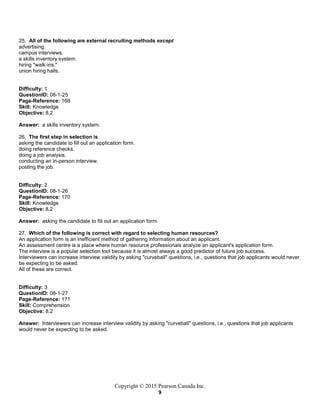
25. All of the following are external recruiting methods except
advertising.
campus interviews.
a skills inventory system.
hiring "walk-ins."
union hiring halls.
Difficulty: 1
QuestionID: 08-1-25
Page-Reference: 168
Skill: Knowledge
Objective: 8.2
Answer: a skills inventory system.
26. The first step in selection is
asking the candidate to fill out an application form.
doing reference checks.
doing a job analysis.
conducting an in-person interview.
posting the job.
Difficulty: 2
QuestionID: 08-1-26
Page-Reference: 170
Skill: Knowledge
Objective: 8.2
Answer: asking the candidate to fill out an application form.
27. Which of the following is correct with regard to selecting human resources?
An application form is an inefficient method of gathering information about an applicant.
An assessment centre is a place where human resource professionals analyze an applicant's application form.
The interview is a popular selection tool because it is almost always a good predictor of future job success.
Interviewers can increase interview validity by asking "curveball" questions, i.e., questions that job applicants would never
be expecting to be asked.
All of these are correct.
Difficulty: 3
QuestionID: 08-1-27
Page-Reference: 171
Skill: Comprehension
Objective: 8.2
Answer: Interviewers can increase interview validity by asking "curveball" questions, i.e., questions that job applicants
would never be expecting to be asked.
Copyright © 2015 Pearson Canada Inc.
10
28. Once the recruiting process has attracted a pool of applicants, the next step is to select someone to hire. The
intent of the selection process is to gather information from applicants that will predict their job success. The
organization can only gather information about factors that are predictive of future performance. This process is
called
psychological profiling.
screening.
job specification.
validation.
none of these.
Difficulty: 3
QuestionID: 08-1-28
Page-Reference: 169
Skill: Comprehension
Objective: 8.2
Answer: validation.
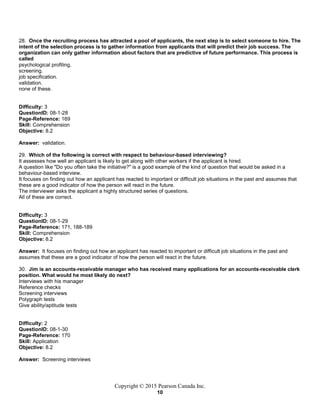
29. Which of the following is correct with respect to behaviour-based interviewing?
It assesses how well an applicant is likely to get along with other workers if the applicant is hired.
A question like "Do you often take the initiative?" is a good example of the kind of question that would be asked in a
behaviour-based interview.
It focuses on finding out how an applicant has reacted to important or difficult job situations in the past and assumes that
these are a good indicator of how the person will react in the future.
The interviewer asks the applicant a highly structured series of questions.
All of these are correct.
Difficulty: 3
QuestionID: 08-1-29
Page-Reference: 171, 188-189
Skill: Comprehension
Objective: 8.2
Answer: It focuses on finding out how an applicant has reacted to important or difficult job situations in the past and
assumes that these are a good indicator of how the person will react in the future.
30. Jim is an accounts-receivable manager who has received many applications for an accounts-receivable clerk
position. What would he most likely do next?
Interviews with his manager
Reference checks
Screening interviews
Polygraph tests
Give ability/aptitude tests
Difficulty: 2
QuestionID: 08-1-30
Page-Reference: 170
Skill: Application
Objective: 8.2
Answer: Screening interviews
Visit https://testbankbell.com
now to explore a rich
collection of testbank,
solution manual and enjoy
exciting offers!
Copyright © 2015 Pearson Canada Inc.
11
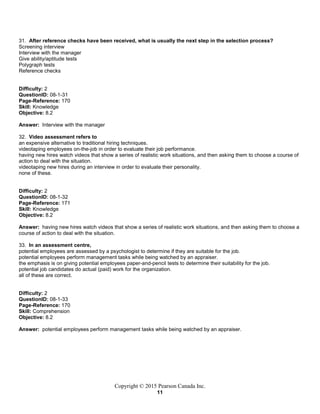
31. After reference checks have been received, what is usually the next step in the selection process?
Screening interview
Interview with the manager
Give ability/aptitude tests
Polygraph tests
Reference checks
Difficulty: 2
QuestionID: 08-1-31
Page-Reference: 170
Skill: Knowledge
Objective: 8.2
Answer: Interview with the manager
32. Video assessment refers to
an expensive alternative to traditional hiring techniques.
videotaping employees on-the-job in order to evaluate their job performance.
having new hires watch videos that show a series of realistic work situations, and then asking them to choose a course of
action to deal with the situation.
videotaping new hires during an interview in order to evaluate their personality.
none of these.
Difficulty: 2
QuestionID: 08-1-32
Page-Reference: 171
Skill: Knowledge
Objective: 8.2
Answer: having new hires watch videos that show a series of realistic work situations, and then asking them to choose a
course of action to deal with the situation.
33. In an assessment centre,
potential employees are assessed by a psychologist to determine if they are suitable for the job.
potential employees perform management tasks while being watched by an appraiser.
the emphasis is on giving potential employees paper-and-pencil tests to determine their suitability for the job.
potential job candidates do actual (paid) work for the organization.
all of these are correct.
Difficulty: 2
QuestionID: 08-1-33
Page-Reference: 170
Skill: Comprehension
Objective: 8.2
Answer: potential employees perform management tasks while being watched by an appraiser.
Copyright © 2015 Pearson Canada Inc.
12
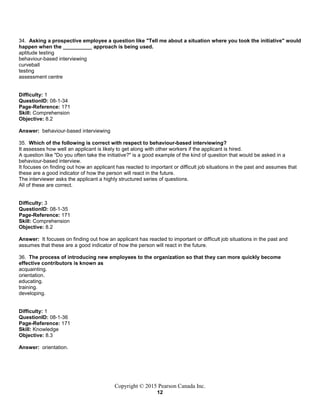
34. Asking a prospective employee a question like "Tell me about a situation where you took the initiative" would
happen when the __________ approach is being used.
aptitude testing
behaviour-based interviewing
curveball
testing
assessment centre
Difficulty: 1
QuestionID: 08-1-34
Page-Reference: 171
Skill: Comprehension
Objective: 8.2
Answer: behaviour-based interviewing
35. Which of the following is correct with respect to behaviour-based interviewing?
It assesses how well an applicant is likely to get along with other workers if the applicant is hired.
A question like "Do you often take the initiative?" is a good example of the kind of question that would be asked in a
behaviour-based interview.
It focuses on finding out how an applicant has reacted to important or difficult job situations in the past and assumes that
these are a good indicator of how the person will react in the future.
The interviewer asks the applicant a highly structured series of questions.
All of these are correct.
Difficulty: 3
QuestionID: 08-1-35
Page-Reference: 171
Skill: Comprehension
Objective: 8.2
Answer: It focuses on finding out how an applicant has reacted to important or difficult job situations in the past and
assumes that these are a good indicator of how the person will react in the future.
36. The process of introducing new employees to the organization so that they can more quickly become
effective contributors is known as
acquainting.
orientation.
educating.
training.
developing.
Difficulty: 1
QuestionID: 08-1-36
Page-Reference: 171
Skill: Knowledge
Objective: 8.3
Answer: orientation.
Copyright © 2015 Pearson Canada Inc.
13
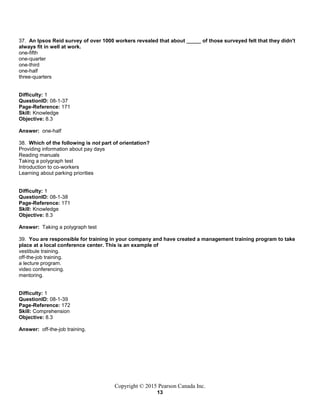
37. An Ipsos Reid survey of over 1000 workers revealed that about _____ of those surveyed felt that they didn't
always fit in well at work.
one-fifth
one-quarter
one-third
one-half
three-quarters
Difficulty: 1
QuestionID: 08-1-37
Page-Reference: 171
Skill: Knowledge
Objective: 8.3
Answer: one-half
38. Which of the following is not part of orientation?
Providing information about pay days
Reading manuals
Taking a polygraph test
Introduction to co-workers
Learning about parking priorities
Difficulty: 1
QuestionID: 08-1-38
Page-Reference: 171
Skill: Knowledge
Objective: 8.3
Answer: Taking a polygraph test
39. You are responsible for training in your company and have created a management training program to take
place at a local conference center. This is an example of
vestibule training.
off-the-job training.
a lecture program.
video conferencing.
mentoring.
Difficulty: 1
QuestionID: 08-1-39
Page-Reference: 172
Skill: Comprehension
Objective: 8.3
Answer: off-the-job training.
Copyright © 2015 Pearson Canada Inc.
14
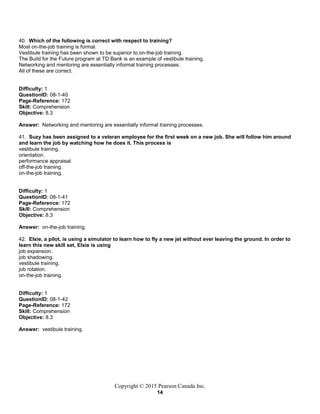
40. Which of the following is correct with respect to training?
Most on-the-job training is formal.
Vestibule training has been shown to be superior to on-the-job training.
The Build for the Future program at TD Bank is an example of vestibule training.
Networking and mentoring are essentially informal training processes.
All of these are correct.
Difficulty: 1
QuestionID: 08-1-40
Page-Reference: 172
Skill: Comprehension
Objective: 8.3
Answer: Networking and mentoring are essentially informal training processes.
41. Suzy has been assigned to a veteran employee for the first week on a new job. She will follow him around
and learn the job by watching how he does it. This process is
vestibule training.
orientation.
performance appraisal.
off-the-job training.
on-the-job training.
Difficulty: 1
QuestionID: 08-1-41
Page-Reference: 172
Skill: Comprehension
Objective: 8.3
Answer: on-the-job training.
42. Elsie, a pilot, is using a simulator to learn how to fly a new jet without ever leaving the ground. In order to
learn this new skill set, Elsie is using
job expansion.
job shadowing.
vestibule training.
job rotation.
on-the-job training.
Difficulty: 1
QuestionID: 08-1-42
Page-Reference: 172
Skill: Comprehension
Objective: 8.3
Answer: vestibule training.
Copyright © 2015 Pearson Canada Inc.
15
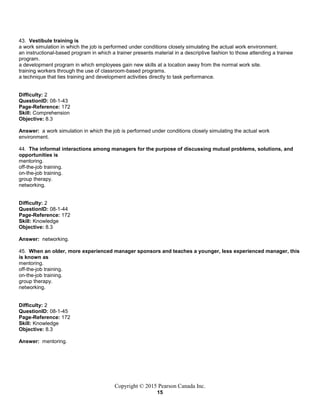
43. Vestibule training is
a work simulation in which the job is performed under conditions closely simulating the actual work environment.
an instructional-based program in which a trainer presents material in a descriptive fashion to those attending a trainee
program.
a development program in which employees gain new skills at a location away from the normal work site.
training workers through the use of classroom-based programs.
a technique that ties training and development activities directly to task performance.
Difficulty: 2
QuestionID: 08-1-43
Page-Reference: 172
Skill: Comprehension
Objective: 8.3
Answer: a work simulation in which the job is performed under conditions closely simulating the actual work
environment.
44. The informal interactions among managers for the purpose of discussing mutual problems, solutions, and
opportunities is
mentoring.
off-the-job training.
on-the-job training.
group therapy.
networking.
Difficulty: 2
QuestionID: 08-1-44
Page-Reference: 172
Skill: Knowledge
Objective: 8.3
Answer: networking.
45. When an older, more experienced manager sponsors and teaches a younger, less experienced manager, this
is known as
mentoring.
off-the-job training.
on-the-job training.
group therapy.
networking.
Difficulty: 2
QuestionID: 08-1-45
Page-Reference: 172
Skill: Knowledge
Objective: 8.3
Answer: mentoring.
Other documents randomly have
different content
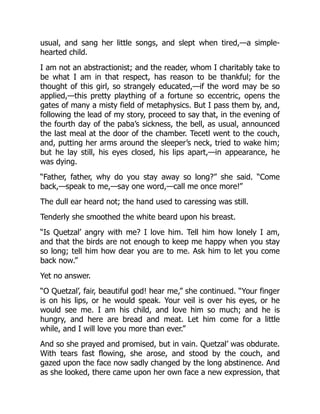
usual, and sang her little songs, and slept when tired,—a simple-
hearted child.
I am not an abstractionist; and the reader, whom I charitably take to
be what I am in that respect, has reason to be thankful; for the
thought of this girl, so strangely educated,—if the word may be so
applied,—this pretty plaything of a fortune so eccentric, opens the
gates of many a misty field of metaphysics. But I pass them by, and,
following the lead of my story, proceed to say that, in the evening of
the fourth day of the paba’s sickness, the bell, as usual, announced
the last meal at the door of the chamber. Tecetl went to the couch,
and, putting her arms around the sleeper’s neck, tried to wake him;
but he lay still, his eyes closed, his lips apart,—in appearance, he
was dying.
“Father, father, why do you stay away so long?” she said. “Come
back,—speak to me,—say one word,—call me once more!”
The dull ear heard not; the hand used to caressing was still.
Tenderly she smoothed the white beard upon his breast.
“Is Quetzal’ angry with me? I love him. Tell him how lonely I am,
and that the birds are not enough to keep me happy when you stay
so long; tell him how dear you are to me. Ask him to let you come
back now.”
Yet no answer.
“O Quetzal’, fair, beautiful god! hear me,” she continued. “Your finger
is on his lips, or he would speak. Your veil is over his eyes, or he
would see me. I am his child, and love him so much; and he is
hungry, and here are bread and meat. Let him come for a little
while, and I will love you more than ever.”
And so she prayed and promised, but in vain. Quetzal’ was obdurate.
With tears fast flowing, she arose, and stood by the couch, and
gazed upon the face now sadly changed by the long abstinence. And
as she looked, there came upon her own face a new expression, that
which the very young always have when at the side of the dying,—
half dread, half curiosity,—wonder at the manifestation, awe of the
power that invokes it,—the look we can imagine on the countenance
of a simple soul in the presence of Death interpreting himself.
At last she turned away, and went to the door. Twice she hesitated,
and looked back. Wherefore? Was she pondering the mystery of the
deep sleep, or expecting the sleeper to awake, or listening to the
whisper of a premonition fainter in her ears than the voice of the
faintest breeze? She went on, nevertheless; she reached the door,
and drew the curtain; and there, in the full light, was Orteguilla.
That we may judge the impression, let us recall what kind of youth
the page was. I never saw him myself, but those who knew him well
have told me he was a handsome fellow; tall, graceful, and in
manner and feature essentially Spanish. He wore at the time the
bonnet and jaunty feather, and the purple mantle, of which I have
spoken, and under that a close black jerkin, with hose to
correspond; half-boots, usual to the period, and a crimson sash
about the waist, its fringed ends hanging down the left side,
completed his attire. Altogether, a goodly young man; not as gay,
probably, as some then loitering amongst the alamedas of Seville;
for rough service long continued had tarnished his finery and abused
his complexion, to say nothing of the imprints of present suffering;
yet he was enough so to excite admiration in eyes older than
Tecetl’s, and more familiar with the race.
The two gazed at each other, wonder-struck.
“Holy Mother!” exclaimed Orteguilla, the bread in his hand. “Into
what world have I been brought? Is this a spirit thou hast sent me?”
In his eyes, she was an angel; in hers, he was more. She went to
him, and knelt, and said, “Quetzal’, dear Quetzal’,—beautiful god!
You are come to bring my father back to me. He is asleep by the
fountain.”
In her eyes, the page was a god.
The paba’s descriptions of Quetzal’ had given her the ideal of a
youth like Orteguilla. Of late, moreover, he had been constantly
expected from Tlapallan, his isle of the blest; indeed, he had come,
—so the father said. And the house was his. Whither would he go, if
not there? So, from tradition oft repeated, from descriptions colored
by passionate love, she knew the god; and as to the man,—between
the image and his maker there is a likeness; so saith a book holier
than the teoamoxtli.
The page, as we have seen, was witty and shrewd, and acquainted
well with the world; his first impression went quickly; her voice
assured him that he was not come to any spirit land. The pangs of
hunger, for the moment forgotten, returned, and I am sorry to say
that he at once yielded to their urgency, and began to eat as heroes
in romances never do. When the edge of his appetite was dulled,
and he could think of something else, an impulse of courtesy moved
him, and he said,—
“I crave thy pardon, fair mistress. I have been so much an animal as
to forget that this food is thine, and required to subsist thee, and,
perhaps, some other inhabiting here. I admit, moreover, that
ordinarily the invitation should proceed from the owner of the feast;
but claim thy own, and partake with me; else it may befall that in
my great hunger thy share will be wanting. Fall to, I pray thee.”
Still kneeling, she stared at him, and, folding her hands upon her
breast, replied, “Quetzal’ knows that I am his servant. Let him speak
so that I may understand.”
“Por cierto!—it is true! What knoweth she of my mother tongue?”
And thereupon, in the Aztecan, he asked her to help herself.
“No,” said she. “The house and all belong to you. I am glad you have
come.”
“Mine? Whom do you take me for?”
“The good god of my father, to whom I say all my prayers,—
Quetzal’!”
“Quetzal’, Quetzal’!” he repeated, looking steadily in her face; then,
as if assured that he understood her, he took one of the goblets of
chocolate, and tried to drink, but failed; the liquid had been beaten
into foam.
“In the world I come from, good girl,” he said, replacing the cup,
“people find need of water, which, just now, would be sweeter to my
tongue than all the honey in the valley. Canst thou give me a drink?”
She arose, and answered eagerly, “Yes, at the fountain. Let us go.
By this time my father is awake.”
“So, so!” he said to himself. “Her father, indeed! I have eaten his
supper or dinner, according to the time of day outside, and he may
not be as civil as his daughter. I will first know something about
him.” And he asked, “Your father is old, is he not?”
“His beard and hair are very white. They have always been so.”
Again he looked at her doubtingly. “Always, said you?”
“Always.”
“Is he a priest?”
She smiled, and asked, “Does not Quetzal’ know his own servant?”
“Has he company?”
“The birds may be with him.”
He quit eating, and, much puzzled by the answer, reflected.
“Birds, birds! Am I so near daylight and freedom? Grant it, O Blessed
Mother!” And he crossed himself devoutly.
Then Tecetl said, earnestly, “Now that you have eaten, good
Quetzal’, come and let us go to my father.”
Orteguilla made up his mind speedily: he could not do worse than go
back the way he came; and the light here was so beautiful, and the
darkness there so terrible: and here was company. Just then, also,
as a further inducement, he heard the whistle of a bird, and fancied
he distinguished the smell of flowers.
“A garden,” he said, in his soul,—“a garden, and birds, and liberty!”
The welcome thought thrilled him inexpressibly. “Yes, I will go”; and,
aloud, “I am ready.”
Thereupon she took his hand, and put the curtains aside, and led
him into the paba’s World, never but once before seen by a stranger.
This time forethought had not gone in advance to prepare for the
visitor. The master’s eye was dim, and his careful hand still, in the
sleep by the fountain. The neglect that darkened the fire on the
turret was gloaming the lamps in the chamber; one by one they had
gone out, as all would have gone but for Tecetl, to whom the
darkness and the shadows were hated enemies. Nevertheless, the
light, falling suddenly upon eyes so long filled with blackness as his
had been, was blinding bright, insomuch that he clapped his hand
over his face. Yet she led him on eagerly, saying,—
“Here, here, good Quetzal’. Here by the fountain he lies.”
All her concern was for the paba.
And through the many pillars of stone, and along a walk bounded by
shrubs and all manner of dwarfed tropical trees, half blinded by the
light, but with the scent of flowers and living vegetation in his
nostrils, and the carol of birds in his ears, and full of wonder
unspeakable, he was taken, without pause, to the fountain. At sight
of the sparkling jet, his fever of thirst raged more intensely than
ever.
“Here he is. Speak to him,—call him back to me! As you love him,
call him back, O Quetzal’?”
He scarcely heard her.
“Water, water! Blessed Mother, I see it again! A cup,—quick,—a cup!”
He seized one on the table, and drank, and drank again crying
between each breath, “To the Mother the praise!” Not until he was
fully satisfied did he give ear to the girl’s entreaty.
Looking to the couch, whither she had gone, he saw the figure of
the paba stretched out like a corpse. He approached, and, searching
the face, and laying his hand upon the breast over the heart, asked,
in a low voice, “How long has your father been asleep?”
“A long time,” she replied.
“Jesu Christo! He is dead, and she does not know it!” he thought,
amazed at her simplicity.
Again he regarded her closely, and for the first time was struck by
her beauty of face and form, by the brightness of her eyes, by the
hair, wavy on the head and curling over the shoulders, by the
simple, childish dress, and sweet voice; above all, by the innocence
and ineffable purity of her look and manner, all then discernible in
the full glare of the lamps. And with what feeling he made discovery
of her loveliness may be judged passably well by the softened tone
in which he said, “Poor girl! your father will never, never wake.”
Her eyes opened wide.
“Never, never wake! Why?”
“He is dead.”
She looked at him wistfully, and he, seeing that she did not
understand, added, “He is in heaven; or, as he himself would have
said, in the Sun.”
“Yes, but you will let him come back.”
He took note of the trustful, beseeching look with which she
accompanied the words, and shook his head, and, returning to the
fountain, took a seat upon a bench, reflecting.
“What kind of girl is this? Not know death when he showeth so
plainly! Where hath she been living? And I am possessed of St.
Peter’s keys. I open Heaven’s gate to let the heathen out! By the
bones of the saints! let him get there first! The Devil hath him!”
He picked up a withered flower lying by the bowl of the fountain,
and went back to Tecetl.
“You remember how beautiful this was when taken from the vine?”
“Yes.”
“What ails it now?”
“It is dead.”
“Well, did you ever know one of these, after dying, to come back to
life?”
“No.”
“No more can thy father regain his life. He, too, is dead. From what
you see, he will go to dust; therefore, leave him now, and let us sit
by the fountain, and talk of escape; for surely you know the way out
of this.”
From the flower, she looked to the dead, and, comprehending the
illustration, sat by the body, and cried. And so it happened that
knowledge of death was her first lesson in life.
And he respected her grief, and went and took a bench by the basin,
and thought.
“Quetzal’, Quetzal’,—who is he? A god, no doubt; yes, the one of
whom the king so liveth in dread. I have heard his name. And I am
Quetzal’! And this is his house—that is, my house! A scurvy trick, by
St. James! Lost in my own house,—a god lost in his own temple!”
And as he could then well afford, being full-fed, he laughed at the
absurd idea; and in such mood, fell into a revery, and grew drowsy,
and finally composed himself on the bench, and sunk to sleep.
CHAPTER IX
LIFE IN THE PABA’S WORLD
When the page awoke, after a long, refreshing sleep, he saw the
fountain first, and Tecetl next. She was sitting a little way off, upon a
mat stretched on the floor. A number of birds were about her,
whistling and coquetting with each other. One or two of very
beautiful plumage balanced themselves on the edge of the basin,
and bathed their wings in the crystal water. Through half-shut eyes,
he studied her. She was quiet,—thinking of what? Of what do
children think in their waking dreams? Yet he might have known,
from her pensive look and frequent sighs, that the fountain was
singing to deaf ears, and the birds playing their tricks before
sightless eyes. She was most probably thinking of what he had so
lately taught her, and nursed the great mystery as something past
finding out; many a wiser head has done the same thing.
Now, Orteguilla was very sensible of her loveliness; he was no less
sensible, also, that she was a mystery out of the common way of
life; and had he been in a place of safety, in the palace of Axaya’, he
would have stayed a long time pretending sleep, in order to study
her unobserved. But his situation presently rose to mind; the yellow
glow of the lamps suggested the day outside; the birds, liberty; the
fountain and shrubbery, the world he had lost; and the girl, life,—his
life, and all its innumerable strong attachments. And so, in his mind,
he ran over his adventures in the house. He surveyed all of the
chamber that was visible from the bench. The light, the fountain, the
vegetation, the decorated walls,—everything in view dependent
upon the care of man. Where so much was to be done constantly,
was there not something to be done at once,—something to save
life? There were the lamps: how were they supplied? They might go
out. And, Jesu Christo! the corpse of the paba! He sat up, as if
touched by a spear: there it was, in all the repulsiveness of death.
The movement attracted the girl’s attention; she arose, and waited
for him to speak.
“Good morning,—if morning it be,” he said.
She made no reply.
“Come here,” he continued. “I have some questions to ask.”
She drew a few steps nearer. A bird with breast of purple and wings
of snow flew around her for a while, then settled upon her hand,
and was drawn close to her bosom. He remembered, from Father
Bartolomé’s reading, how the love of God once before took a bird’s
form; and forthwith his piety and superstition hedged her about with
sanctity. What with the white wings upon her breast, and the whiter
innocency within, she was safe as if bound by walls of brass.
“Have no fear, I pray you,” he said, misinterpreting her respectful
sentiment. “You and I are two people in a difficult strait, and, if I
mistake not, much dependent upon each other. A God, of whom you
never heard, but whom I will tell you all about, took your father
away, and sent me in his stead. The road thither, I confess, has been
toilsome and dreadful. Ah me, I shudder at the thought!”
He emphasized his feelings by a true Spanish shrug of the shoulders.
“This is a strange place,” he next said. “How long have you been
here?”
“I cannot say.”
“Can you remember coming, and who brought you?”
“No.”
“You must have been a baby.” He looked at her with pity. “Have you
never been elsewhere?”
“No, never.”
“Ah, by the Mother that keeps me! Always here! And the sky, and
sun, and stars, and all God’s glory of nature, seen in the valleys,
mountains, and rivers, and seas,—have they been denied you, poor
girl?”
“I have seen them all,” she answered.
“Where?”
“On the ceiling and walls.”
He looked up at the former, and noticed its excellence of
representation.
“Very good,—beautiful!” he said, in the way of criticism. “Who did
the work?”
“Quetzal’.”
“And who is Quetzal’?”
“Who should know better than the god himself?”
“Me?”
“Yes.”
Again he shrugged his shoulders.
“My name, then, is Quetzal’. Now, what is yours?”
“Tecetl.”
“Well, then, Tecetl, let me undeceive you. In the first place, I am not
Quetzal’, or any god. I am a man, as your father there was. My
name is Orteguilla; and for the time I am page to the great king
Montezuma. And before long, if I live, and get out of this place, as I
most devoutly pray, I will be a soldier. In the next place you are a
girl, and soon will be a woman. You have been cheated of life. By
God’s help, I will take you out of this. Do you understand me?”
“No; unless men and gods are the same.”
“Heaven forbid!” He crossed himself fervently. “Do you not know
what men are?”
“All my knowledge of things is from the pictures on the walls, and
what else you see here.”
“Jesu Christo!” he cried, in open astonishment. “And did the good
man never tell you of the world outside,—of its creation, and its
millions upon millions of people?”
“No.”
“Of the world in which you may find the originals of all that is
painted on the walls, more beautiful than colors can make them?”
He received the same reply, but, still incredulous, went on.
“Who takes care of these plants?”
“My father.”
“A servant brings your food to the door—may he do so again! Have
you not seen him?”
“No.”
“Where does the oil that feeds the lamps come from?”
“From Quetzal’.”
Just then a lamp went out. He arose hastily, and saw that the
contents of the cup were entirely consumed. “Tecetl, is there plenty
of oil? Where do you keep it? Tell me.”
“In a jar, there by the door. While you were asleep, I refilled the
cups, and now the jar is empty.”
He turned pale. Who better than he knew the value of the liquid that
saved them from the darkness so horribly peopled by hunger and
thirst? If exhausted, where could they get more? Without further
question, he went through the chamber, and collected the lamps,
and put them all out except one. Then he brought the jar from the
door, and poured the oil back, losing not a drop.
Tecetl remonstrated, and cried when she saw the darkness invade
the chamber, blotting out the walls, and driving the birds to their
perches, or to the fountain yet faintly illuminated. But he was firm.
“Fie, fie!” he said. “You should laugh, not cry. Did I not tell you
about the world above this, so great, and so full of people, like
ourselves? And did I not promise to take you there? I am come in
your father’s stead. Everything must contribute to our escape. We
must think of nothing else. Do you understand? This chamber is but
one of many, in a house big as a mountain, and full of passages in
which, if we get lost, we might wander days and days, and then not
get out, unless we had a light to show us the way. So we must save
the oil. When this supply gives out, as it soon will if we are not
careful, the darkness that so frightens you will come and swallow us,
and we shall die, as did your father there.”
The last suggestion sufficed; she dried her tears, and drew closer to
him, as if to say, “I confide in you; save me.”
Nature teaches fear of death; so that separation from the breathless
thing upon the couch was not like parting from Mualox. Whether she
touched his hand or looked in his face now, “Go hence, go hence!”
was what she seemed to hear. The stony repulsion that substituted
his living love reconciled her to the idea of leaving home, for such
the chamber had been to her.
Here I may as well confess the page began to do a great deal of
talking,—a consequence, probably, of having a good listener; or he
may have thought it a duty to teach all that was necessary to
prepare his disciple for life in the new world. In the midst of a
lecture, the tinkle of a bell brought him to a hasty pause.
“Now, O Blessed Mother, now I am happy! Thou hast not forsaken
me! I shall see the sun again, and brave old Spain. Live my heart!”
he cried, as the last tinkle trembled, and died in the silence.
Seeing that she regarded him with surprise, he said, in her tongue,
“I was thanking the Mother, Tecetl. She will save us both. Go now,
and bring the breakfast,—I say breakfast, not knowing better,—and
while we eat I will tell you why I am so glad. When you have heard
me, you will be glad as I am.”
She went at once, and, coming back, found him bathing his face and
head in the water of the basin,—a healthful act, but not one to
strengthen the idea of his godship. She placed the tray upon the
table, and helped him to napkin and comb; then they took places
opposite each other, with the lamp between them; whereupon she
had other proof of his kind of being; for it is difficult to think of a
deity at table, eating. The Greeks felt the incongruity, and dined
their gods on nectar and ambrosia, leaving us to imagine them
partaken in some other than the ordinary, vulgar way. Verily, Tecetl
was becoming accustomed to the stranger!
And while they ate, he explained his plans, and talked of the upper
world, and described its wonders and people, until, her curiosity
aroused, she plied him with questions; and as point after point was
given, we may suppose nature asserted itself, and taught her, by
what power there is in handsome youth, with its bright eyes, smooth
face, and tongue more winsome than wise, that life in the said world
was a desirable exchange for the monotonous drifting to which she
had been so long subjected. We may also suppose that she was not
slow to observe the difference between Mualox and the page; which
was that between age and youth, or, more philosophically, that
between a creature to be revered and a creature to be admired.
CHAPTER X
THE ANGEL BECOMES A BEADSWOMAN
The stars at the foot of the last chapter I called in as an easy bridge
by which to cross an interval of two days,—a trick never to be
resorted to except when there is nothing of interest to record, as
was the case here.
Orteguilla occupied the interval very industriously, if not pleasantly.
He had in hand two tasks,—one to instruct Tecetl about the world to
which he had vowed to lead her; the other to fix upon a plan of
escape. The first he found easy, the latter difficult; yet he had
decided, and his preparations for the attempt, sufficient, he thought,
though simple, lay upon the floor by the fountain. A lamp shed a dim
light over the scene.
“So, so, Tecetl: are we ready now?” he asked.
“You are the master,” she replied.
“Very good, I will be assured.”
He went through a thorough inspection.
“Here are the paint and brush; here the oil and lamp; here the bread
and meat, and the calabash of water. So far, good, very good. And
here is the mat,—very comfortable, Tecetl, if you have to make your
bed upon a stone in the floor. Now, are we ready?”
“Yes, if you say so.”
“Good again! The Mother is with us. Courage! You shall see the sun
and sky, or I am not a Spaniard. Listen, now, and I will explain.”
They took seats upon the bench, this time together; for the
strangeness was wellnigh gone, and they had come to have an
interest in a common purpose.
“You must know, then, that I have two reliances: first, the man who
brings the tray to the door; next, the Blessed Mother.”
“I will begin with the first,” he said, after a pause. “The man is a
slave, and, therefore, easy to impose upon. If he is like his class,
from habit, he asks no questions of his superiors. Your father—I
speak from what you have told me—was thoughtful and dreamy, and
spoke but little to anybody, and seldom, if ever, to his servants. You
are not well versed in human nature; one day, no doubt, you will be;
then you will be able to decide whether I am right in believing that
the traits of master and slave, which I have mentioned, are likely to
help us. I carried your father’s body over to the corner yonder,—you
were asleep at the time,—and laid it upon the floor, as we Christians
serve our dead. I made two crosses, and put one upon his lips, the
other on his breast; he will sleep all the better for them. As you
would have done, had you been present, I also covered him with
flowers. One other thing I did.”
He took a lamp, and was gone a moment.
“Here are your father’s gown and hood,” he said, coming back. “I
doubt whether they would sell readily in the market. He will never
need them again. I took them to help save your life,—a purpose for
which he would certainly have given them, had he been alive. I will
put them on.”
He laid his bonnet on the bench; then took off his boots, and put on
the gown,—a garment of coarse black manta, loose in body and
sleeves, and hanging nearly to the feet. Tying the cord about his
waist, and drawing the hood over his head, he walked away a few
steps, saying,—
“Look at me, Tecetl. Your father was very old. Did he stoop much?
as much as this?”
He struck the good man’s habitual posture, and, in a moment after,
his slow, careful gait. At the sight, she could not repress her tears.
“What, crying again!” he said. “I shall be ashamed of you soon. If
we fail, then you may cry, and—I do not know but that I will join
you. People who weep much cannot hear as they ought, and I want
you to hear every word. To go on, then: In this guise I mean to wait
for the old slave. When he lets the tray down, I will be there to climb
the ladder. He will see the hood and gown, and think me his old
master. He will not speak, nor will I. He will let me get to his side,
and then—”
After reflection, he continued,—
“Ah, Tecetl! you know not what troubles women sometimes are.
Here am I now. How easy for me, in this guise, to follow the slave
out of the temple! The most I would have to do would be to hold my
tongue. But you,—I cannot go and leave you; the Señor Hernan
would not forgive me, and I could not forgive myself. Nevertheless,
you are a trouble. For instance, when the slave sees you with me,
will he not be afraid, and run? or, to prevent that, shall I not have to
make him a prisoner? That involves a struggle. I may have to fight
him, to wound him. I may get hurt myself, and then—alas! what
would become of us?”
Again, he stopped, but at length proceeded,—
“So much for that. Now for my other reliance,—the Blessed Lady. If
the slave escapes me, you see, Tecetl, I must trust to what the
infidels call Fortune,—a wicked spirit, sometimes good, sometimes
bad. I mean we shall then have to hunt the way out ourselves; and,
having already tried that, I know what will happen. Hence these
preparations. With the paint, I will mark the corners we pass, that I
may know them again; the lamp will enable me to see the marks
and keep the direction; if we get hungry, here are bread and meat,
saved, as you know, from our meals; if we get thirsty, the calabash
will be at hand. That is what I call trusting to ourselves; yet the
Blessed Mother enabled me to anticipate all these wants, and
provide for them, as we have done; therefore I call her my reliance.
Now you have my plans. I said you were my trouble; you cannot
work, or think, or fight; yet there is something you can do. Tecetl,
you can be my pretty beadswoman. I see you do not know what
that is. I will explain. Take these beads.”
While speaking, he took a string of them from his neck.
“Take these beads, and begin now to say, ‘O Blessed Mother,
beautiful Mother, save us for Christ’s sake.’ Repeat! Good!” he said,
his eyes sparkling. “I think the prayer never sounded as sweetly
before; nor was there ever cavalier with such a beadswoman.
Again.”
And again she said the prayer.
“Now,” he said, “take the string in your own hand,—thus; drop one
bead,—thus; and keep on praying, and for every prayer drop one
bead. Only think, Tecetl, how I shall be comforted, as I go along the
gloomy passages, to know that right behind me comes one, so lately
a heathen but now a Christian, at every step calling on the Mother.
Who knows but we shall be out and in the beautiful day before the
beads are twice counted? If so, then shall we know that she cared
for us; and when we reach the palace we will go to the chapel, with
good Father Bartolomé, and say the prayer together once for every
bead on the string. So I vow, and do you the same.”
“So I vow,” she said, with a pretty submission.
Then, by ropes fixed for the purpose, he raised the calabash, and
mat, and bundle of provisions, and swung them lightly over his
shoulders. Under his arm he took an earthen vase filled with oil.
“Let us to the door now. The slave should be there. Before we start,
look around: you are leaving this place forever.”
The thought went to her heart.
“O my birds! What will become of them?”
“Leave them to God,” he replied, laconically.
There were tears and sobs, in the midst of which he started off,
lamp in hand. She gave a look to the fountain, within the circle of
whose voice nearly all her years had been passed. In her absence, it
would play and sing, would go on as of old; but in her absence who
would be there to see and hear? In the silence and darkness it
would live, but nevermore for her.
And she looked to the corner of the chamber where Orteguilla had
carried the body of the paba. Her tears attested her undiminished
affection for him. The recollection of his love outlived the influence
of his Will. His World was being abandoned, having first become a
tomb, capacious and magnificent,—his tomb. But Quetzal’ had not
come. Broken are thy dreams, O Mualox, wasted thy wealth of
devotion! Yet, at this parting, thou hast tears,—first and last gift of
Love, the sweetest of human principles, and the strongest,—
stronger than the Will; for if the latter cannot make God of a man,
the former can take him to God.
And while she looked, came again the bird of the breast of purple
and wings of snow, which she placed in her bosom; then she
followed the page, saying, trustfully, “O Blessed Mother, beautiful
Mother, save us for Christ’s sake!”
Outside the curtain door he deposited his load, and carefully
explained to Tecetl the use of the ladder. Then he placed a stool for
her.
“Sit now; you can do nothing more. Everything depends on the
slave: if he behaves well, we shall have no need of these
preparations, and they may be left here. But whether he behave well
or ill, remember this, Tecetl,—cease not to pray; forget not the
beads.”
And so saying, he tossed a stout cord up through the trap; then,
leaving the lamp below, he clomb to the floor above. His anxiety
may be imagined. Fortunately, the waiting was not long. Through
the gallery distantly he saw a light, which—praise to the Mother!—
came his way. He descended the ladder.
“He comes, and is alone. Be of cheer, Tecetl; be of cheer, and pray.
O if the Mother but stay with us now!”
Faster fell the beads.
When the sound of footsteps overhead announced the arrival of the
slave, Orteguilla put his dagger between his teeth, drew the hood
over his head, and began to ascend. He dared not look up; he
trusted in the prayers of the little beadswoman, and clomb on.
His head reached the level of the floor, and with the trap gaping
wide around, he knew himself under the man’s eyes. Another
moment, and his hand was upon the floor; slowly he raised himself
clear of the rope; he stood up, then turned to the slave, and saw
him to be old, and feeble, and almost naked; the lamp was on his
forehead, the tray at his feet; his face was downcast, his posture
humble. The Spaniard’s blood leaped exultantly; nevertheless,
carefully and deliberately, as became his assumed character, he
moved to one side of the passage, to clear the way to the trap. The
servant accepted the movement, and without a word took the lamp
from his head, crossed the great stone, fixed the ropes, and stooped
to lower the tray.
Orteguilla had anticipated everything, even this action, which gave
him his supreme advantage; so he picked up the cord lying near, and
stepped to the old man’s side. When the tray was landed below, the
latter raised himself upon his knees; in an instant the cord was
around his body; before he understood the assault, escape was
impossible.
Orteguilla, his head yet covered by the hood, said calmly, “Be quiet,
and you are safe.”
The man looked up, and replied, “I am the paba’s servant now, even
as I was when a youth. I have done no wrong, and am not afraid.”
“I want you to live. Only move not.”
Then the page called, “Tecetl! Tecetl!”
“Here,” she answered.
“Try, now, to come up. Be careful lest you fall. If you need help, tell
me.”
“What shall I do with the bread and meat, and—”
“Leave them. The Mother has been with us. Come up.”
The climbing was really a sailor’s feat, and difficult for her; finally,
she raised her head through the trap. At the sight, the slave shrank
back, as if to run. Orteguilla spoke to him.
“Be not afraid of the child. I have raised her to help me take care of
the temple. We are going to the chapel now.”
The man turned to him curiously; possibly he detected a strange
accent under the hood. When, on her part, Tecetl saw him, she
stopped, full of wonder as of fear. Old and ugly as he was, he yet
confirmed the page’s story, and brought the new world directly to
her. So a child stops, and regards the first person met at the door of
a strange house,—attracted, curious, afraid.
“Come on,” said Orteguilla.
She raised her hand overhead, and held up the bird with the white
wings.
“Take it,” she said.
Used as he was to wonderful things in connection with his old
master, the servant held back. A girl and a bird from the cells,—a
mystery, indeed!
“Take it,” said Orteguilla.
He did so; whereupon the page assisted her to the floor.
“We are almost there,—almost,” he said, cheerfully. “Have you kept
count of the prayers? Let me see the beads.”
She held out the rosary.
“Ten beads more,—ten prayers yet. The Mother is with us. Courage!”
Then of the slave he asked,—
“How is the day without?”
“There is not a cloud in the sky.”
“Is it morning or evening?”
“About midday.”
“Is the city quiet?”
“I cannot say.”
“Very well. Give the girl her bird, and lead to the court-yard.”
And they started, the slave ahead, held in check by the cord in the
Spaniard’s hand. The light was faint and unsteady. Once they
ascended a flight of steps, and twice changed direction. When the
page saw the many cells on either side, and the number of
intersecting passages, all equal in height and width, and bounded by
the same walls of rough red stone, he understood how he became
lost; and with a shuddering recollection of his wanderings through
the great house, he could not sufficiently thank the Providence that
was now befriending him.
They clomb yet another stairway, and again changed direction; after
that, a little farther walk, and Orteguilla caught sight of a doorway
penetrated by a pure white light, which he recognized as day. Words
cannot express his emotion; his spirit could hardly be controlled; he
would have shouted, sung, danced,—anything to relieve himself of
this oppression of happiness. But he thought, if he were out of the
temple, he would not yet be out of danger; that he had to make
way, by the great street from which he had been driven, to the
quarters of his friends, before he could promise himself rest and
safety; the disguise was the secret of his present good-fortune, and
must help him further. So he restrained himself, saying to Tecetl,—
“For the time, cease your prayers, little one. The world I promised to
bring you to is close by. I see the daylight.”
There was indeed a door into the patio, or court-yard, of the temple.
Under the lintel the page lingered a moment,—the court was clear.
Then he gave the cord into the servant’s hand, with the usual
parting salutation, and stepped once more into the air, fresh with the
moisture of the lake and the fragrance of the valley. He looked to the
sky, blue as ever; and through its serenity, up sped his grateful Ave
Maria. In the exulting sense of rescue, he forgot all else, and was
well across the court to the steps leading to the azoteas, when he
thought of Tecetl. He looked back, and did not see her; he ran to the
door; she was there. The bird had fallen to the floor, and was
fluttering blindly about; her hands were pressed hard over her face.
“What ails you?” he asked, petulantly. “This is not a time to halt and
cry. Come on.”
“I cannot—”
“Cannot! Give me your hand.”
He led her through the door, under the colonnade, out into the
court.
“Look up, Tecetl, look up! See the sky, drink the air. You are free!”
She uncovered her eyes; they filled as with fiery arrows. She
screamed, staggered as if struck, and cried, “Where are you? I am
lost, I am blind!”
“O Madre de Dios!” said Orteguilla, comprehending the calamity, and
all its inconveniences to her and himself. “Help me, most miserable
of wretches,—help me to a little wisdom!”
To save her from falling, he had put his arm around her; and as they
stood thus,—she the picture of suffering, and he overwhelmed by
perplexity,—help from any quarter would have been welcome; had
the slave been near, he might have abandoned her; but aid there
was not. So he led her tenderly to the steps, and seated her.
“How stupid,” he said in Spanish,—“how stupid not to think of this!
If, the moment I was born, they had carried me out to take a look at
the sun, shining as he is here, I would have been blinder than any
beggar on the Prado, blinder than the Bernardo of whom I have
heard Don Pedro tell. My nurse was a sensible woman.”
Debating what to do, he looked at Tecetl; and for the first time since
she had come out of the door, he noticed her dress,—simply a cotton
chemise, a skirt of the same reaching below the knees, a blue sash
around the waist,—very simple, but very clean. He noticed, also, the
exceeding delicacy of her person, the transparency of her
complexion, the profusion of her hair, which was brown in the sun.
Finally, he observed the rosary.
“She is not clad according to the laws which govern high-born ladies
over the water; yet she is beautiful, and—by the Mother! she is a
Christian. Enough. By God’s love, I, who taught her to pray, will save
her, though I die. Help me, all the saints!”
He adjusted the hood once more, and, stooping, said, in his kindliest
tone, “Pshaw, Tecetl, you are not blind. The light of the sun is so
much stronger than that of your lamps that your eyes could not bear
it. Cheer up, cheer up! And now put your arm around my neck. I will
carry you to the top of these steps. We cannot stay here.”
She stretched out her arms.
“Hark!” he cried. “What is that?”
He stood up and listened. The air above the temple seemed full of
confused sounds; now resembling the distant roar of the sea, now
the hum of insects, now the yells of men.
“Jesu! I know that sound. There,—there!”
He listened again. Through the soaring, muffled din, came another
report, as of thunder below the horizon.
“It is the artillery! By the mother that bore me, the guns of Mesa!”
The words of Io’, spoken in Xoli’s portico, came back to him.
“Battle! As I live, they are fighting on the street!”
And he, too, sat down, listening, thinking. How was he to get to his
countrymen?
The sounds overhead continued, at intervals intensified by the
bellowing guns. Battle has a fascination which draws men as birds
are said to be drawn by serpents. They listen; then wish to see;
lingering upon the edge, they catch its spirit, and finally thrill with
fierce delight to find themselves within the heat and fury of its
deadly circle. The page knew the feeling then. To see the fight was
an overmastering desire.
“Tecetl, poor child, you are better now?”
“I dare not open my eyes.”
“Well, I will see for you. Put your arms around my neck.”
And with that, he carried her up the steps. All the time, he gave ear
to the battle.
“Listen, Tecetl; hear that noise! A battle is going on out in the street,
and seems to be coming this way. I will lead you into the chapel
here,—a holy place, so your father would have said. In the shade,
perhaps, you can find relief.”
“How pleasant the air is!” she said, as they entered.
“Yes, and there is Quetzal’,”—he pointed to the idol,—“and here the
step before the altar upon which, I venture, your father spent half
his life in worship. Sit, and rest until I return.”
“Do not leave me,” she said.
“A little while only. I must see the fight. Some good may come of it,
—who knows? Be patient; I will not leave you.”
He went to the door. The sounds were much louder and nearer. All
the air above the city apparently was filled with them. Amongst the
medley, he distinguished the yells of men and peals of horns. Shots
were frequent, and now and then came the heavy, pounding report
of cannon. He had been at Tabasco, at Tzimpantzinco, and in the
three pitched battles in Tlascala, and was familiar with what he
heard.
“How they fight!” he said to himself. “Don Pedro is a good sword and
brave gentlemen, but—ah! if the Señor Hernan were there, I should
feel better: he is a good sword, brave gentleman, and wise general,
also. Heaven fights for him. Ill betide Narvaez! Why could he not
have put off his coming until the city was reduced? Jesu! The sounds
come this way now. Victory! The guns have quit, the infidels fly, on
their heels ride the cavaliers. Victory!”
And so, intent upon the conflict, insensibly he approached the front
of the temple, before described as one great stairway. On the
topmost step he paused. A man looking at him from the street below
would have said, “It is only a paba”; and considering, further, that he
was a paba serving the forsaken shrine, he would have passed by
without a second look.
What he looked down upon was a broad street, crowded with men,
—not citizens, but warriors, and warriors in such splendor of
costume that he was fairly dazzled. Their movement suggested a
Welcome to our website – the perfect destination for book lovers and
knowledge seekers. We believe that every book holds a new world,
offering opportunities for learning, discovery, and personal growth.
That’s why we are dedicated to bringing you a diverse collection of
books, ranging from classic literature and specialized publications to
self-development guides and children's books.
More than just a book-buying platform, we strive to be a bridge
connecting you with timeless cultural and intellectual values. With an
elegant, user-friendly interface and a smart search system, you can
quickly find the books that best suit your interests. Additionally,
our special promotions and home delivery services help you save time
and fully enjoy the joy of reading.
Join us on a journey of knowledge exploration, passion nurturing, and
personal growth every day!
testbankfan.com


Business Essentials Canadian 7th Edition Ebert Test Bank

  • 1.
    Business Essentials Canadian7th Edition Ebert Test Bank download https://testbankfan.com/product/business-essentials-canadian-7th- edition-ebert-test-bank/ Explore and download more test bank or solution manual at testbankfan.com
  • 2.
    Here are somerecommended products for you. Click the link to download, or explore more at testbankfan.com Business Essentials Canadian 7th Edition Ebert Solutions Manual https://testbankfan.com/product/business-essentials-canadian-7th- edition-ebert-solutions-manual/ Business Essentials Canadian 8th Edition Ebert Test Bank https://testbankfan.com/product/business-essentials-canadian-8th- edition-ebert-test-bank/ Business Essentials Canadian 8th Edition Ebert Solutions Manual https://testbankfan.com/product/business-essentials-canadian-8th- edition-ebert-solutions-manual/ Fundamental Financial Accounting Concepts 10th Edition Edmonds Solutions Manual https://testbankfan.com/product/fundamental-financial-accounting- concepts-10th-edition-edmonds-solutions-manual/
  • 3.
    Accounting and AuditingResearch Tools and Strategies 9th Edition Weirich Solutions Manual https://testbankfan.com/product/accounting-and-auditing-research- tools-and-strategies-9th-edition-weirich-solutions-manual/ Principles of Managerial Finance 13th Edition Gitman Solutions Manual https://testbankfan.com/product/principles-of-managerial-finance-13th- edition-gitman-solutions-manual/ Business Law The Ethical Global and E-Commerce Environment 15th Edition Mallor Solutions Manual https://testbankfan.com/product/business-law-the-ethical-global-and-e- commerce-environment-15th-edition-mallor-solutions-manual/ Psychology An Exploration 3rd Edition Ciccarelli Test Bank https://testbankfan.com/product/psychology-an-exploration-3rd-edition- ciccarelli-test-bank/ Fundamentals of Organic Chemistry 7th Edition McMurry Test Bank https://testbankfan.com/product/fundamentals-of-organic-chemistry-7th- edition-mcmurry-test-bank/
  • 4.
    Mosby s PharmacyTechnician Principles and Practice 3rd Edition Hopper Test Bank https://testbankfan.com/product/mosby-s-pharmacy-technician- principles-and-practice-3rd-edition-hopper-test-bank/
  • 5.
    Copyright © 2015Pearson Canada Inc. 1 Chapter 08: Managing Human Resources and Labour Relations Chapter 08 Multiple Choice Questions 1. ________ is the set of organizational activities directed at attracting, developing, and maintaining an effective workforce. Production management Operations management Developing a mission statement Human resource management Financial management Difficulty: 2 QuestionID: 08-1-01 Page-Reference: 167 Skill: Knowledge Objective: 8.1 Answer: Human resource management 2. Which of the following is considered the starting point of effective human resource management? Advertising Financing Human resource planning External staffing Recruitment Difficulty: 2 QuestionID: 08-1-02 Page-Reference: 167 Skill: Knowledge Objective: 8.1 Answer: Human resource planning 3. Cindy Stevens is observing and interviewing several database administrators to determine the duties and responsibilities associated with their job, as well as the knowledge, skills, and abilities that someone must have to perform the job. Cindy is performing the HR function of job analysis. advertising. promotion. training. staffing. Difficulty: 2 QuestionID: 08-1-03 Page-Reference: 167 Skill: Comprehension Objective: 8.1 Answer: job analysis.
  • 6.
    Copyright © 2015Pearson Canada Inc. 2 4. Cindy Stevens has developed a document that identifies the duties and responsibilities of a database administrator. This document is referred to as a recruitment effort. job quantification. job description. job advertisement. job specification. Difficulty: 2 QuestionID: 08-1-04 Page-Reference: 167 Skill: Comprehension Objective: 8.1 Answer: job description. 5. Cindy Stevens has identified the knowledge, skills, and abilities necessary for a database administrator in her organization. She will record this information in a(n) advertising budget. employee analysis. job specification. staffing survey. on-the-job training agreement. Difficulty: 1 QuestionID: 08-1-05 Page-Reference: 167 Skill: Comprehension Objective: 8.1 Answer: job specification. 6. June has been given the responsibility of doing a job analysis, but she isn't sure what it means, so she asks you. You say that it is a written statement which outlines the duties, tasks, and relationship with other positions in the organization. an attempt to generate large numbers of qualified applicants. the specific method by which the firm will attempt to reach its objectives. the detailed study of the specific duties required for a particular job and human qualities required to perform that job. an analysis of the characteristics of individuals who currently hold jobs with the firm. Difficulty: 1 QuestionID: 08-1-06 Page-Reference: 167 Skill: Comprehension Objective: 8.1 Answer: the detailed study of the specific duties required for a particular job and human qualities required to perform that job.
  • 7.
    Copyright © 2015Pearson Canada Inc. 3 7. Joe manages 15 workers on a production line. He has asked each of them to create a checklist of all the duties they perform. Joe is working on a job analysis. job specification. job description. person-job matching. job relatedness. Difficulty: 2 QuestionID: 08-1-07 Page-Reference: 167 Skill: Comprehension Objective: 8.1 Answer: job description. 8. John is reading a document which describes the conditions under which his job will be done, the ways in which it relates to other positions, and the duties he needs to perform. John is probably looking at a job specification. a job description. job relatedness. person-job matching. a job analysis. Difficulty: 2 QuestionID: 08-1-08 Page-Reference: 167 Skill: Comprehension Objective: 8.1 Answer: a job description. 9. Cindy Stevens has developed a database that contains information on each employee's education, skills, work experience, and career aspirations. She plans to use this database to identify employees to fill vacancies. This data base is a job specification. skills inventory. managerial grid. job analysis. replacement chart. Difficulty: 2 QuestionID: 08-1-09 Page-Reference: 168 Skill: Comprehension Objective: 8.1 Answer: skills inventory.
  • 8.
    Copyright © 2015Pearson Canada Inc. 4 10. Mark, a manager in production, needs to determine the supply and demand of employees in order to develop specific strategies. This is known as job specification. job description. performance appraisal. job analysis. forecasting. Difficulty: 1 QuestionID: 08-1-10 Page-Reference: 168 Skill: Comprehension Objective: 8.1 Answer: forecasting. 11. When forecasting demand, industry comparisons are mandatory. the company forecasts the number and type of people who will be available for hiring from the labour market at large. employees are interviewed and asked how long they think they will remain with the company. employees sign a contract stating the number of years they will stay. a company must assess trends in past HR usage, future organizational plans, and general economic trends. Difficulty: 2 QuestionID: 08-1-11 Page-Reference: 168 Skill: Knowledge Objective: 8.1 Answer: a company must assess trends in past HR usage, future organizational plans, and general economic trends. 12. Forecasting the supply of labour involves two tasks. The first task is to forecast future organizational plans. the number and type of employees who will be in the firm at some future date. general economic trends. trends in past HR usage. demand for certain types of employees. Difficulty: 1 QuestionID: 08-1-12 Page-Reference: 168 Skill: Knowledge Objective: 8.1 Answer: the number and type of employees who will be in the firm at some future date.
  • 9.
    Copyright © 2015Pearson Canada Inc. 5 13. Cindy has placed an advertisement for a job vacancy in the employment section of the newspaper. This is a form of profit sharing. external recruitment. job analysis. vestibule training. internal recruitment. Difficulty: 2 QuestionID: 08-1-13 Page-Reference: 168 Skill: Comprehension Objective: 8.2 Answer: external recruitment. 14. The process of attracting qualified persons to apply for the jobs that are open is called searching. soliciting. interviewing. recruiting. selection. Difficulty: 1 QuestionID: 08-1-14 Page-Reference: 168 Skill: Knowledge Objective: 8.2 Answer: recruiting. 15. What is the first step in obtaining applicants who are both interested in and qualified for available jobs? Interviews Selection Recruiting Enlistment Resume differentiation Difficulty: 1 QuestionID: 08-1-15 Page-Reference: 168 Skill: Knowledge Objective: 8.2 Answer: Recruiting
  • 10.
    Copyright © 2015Pearson Canada Inc. 6 16. The use of newspaper advertisements, visits to high schools, colleges, and university campuses, and use of employment agencies are part of performance appraisals. external recruiting. community involvement. internal training programs. compensation studies. Difficulty: 2 QuestionID: 08-1-16 Page-Reference: 168 Skill: Comprehension Objective: 8.2 Answer: external recruiting. 17. Evaluating each potential candidate for an existing job opening and deciding on whom to extend a job offer to is called recruiting. screening. interviewing. decision-making. selecting. Difficulty: 1 QuestionID: 08-1-17 Page-Reference: 170 Skill: Knowledge Objective: 8.2 Answer: selecting. 18. The process of considering present employees as candidates for openings within the organization is referred to as profit sharing. job analysis. internal recruitment. external recruitment. vestibule training. Difficulty: 1 QuestionID: 08-1-18 Page-Reference: 168 Skill: Knowledge Objective: 8.2 Answer: internal recruitment.
  • 11.
    Copyright © 2015Pearson Canada Inc. 7 19. Asking a prospective employee a question like "Tell me about a situation where you took the initiative" would happen when the __________ approach is being used. aptitude testing behavior-based interviewing curveball testing assessment centre Difficulty: 1 QuestionID: 08-1-19 Page-Reference: 171 Skill: Comprehension Objective: 8.2 Answer: behavior-based interviewing 20. When Sara, the human resource manager, attempts to determine the predictive value of a selection technique, she is doing validation. certification. training. internal recruitment. external recruitment. Difficulty: 1 QuestionID: 08-1-20 Page-Reference: 169 Skill: Comprehension Objective: 8.2 Answer: validation. 21. Once the recruiting process has attracted a pool of applicants, the next step is to select someone to hire. The intent of the selection process is to gather information from applicants that will predict their job success. The organization can only gather information about factors that are predictive of future performance. This process is called psychological profiling. screening. job specification. validation. none of these. Difficulty: 3 QuestionID: 08-1-21 Page-Reference: 169 Skill: Comprehension Objective: 8.2 Answer: validation.
  • 12.
    Copyright © 2015Pearson Canada Inc. 8 22. Louis, an information-technology manager, needs to select a new employee. Which of the following would Louis not normally use as a part of the employee selection process? Performance appraisals Ability and aptitude tests Applications and resumes Medical examinations Reference checks Difficulty: 1 QuestionID: 08-1-22 Page-Reference: 170 Skill: Comprehension Objective: 8.2 Answer: Performance appraisals 23. Kim, a public relations manager, has just completed the process of checking the references of several job candidates. What should she do next? Conduct screening interviews Conduct medical and drug tests Conduct interviews with the candidates Give ability/aptitude tests Administer polygraph tests Difficulty: 2 QuestionID: 08-1-23 Page-Reference: 170 Skill: Application Objective: 8.2 Answer: Conduct interviews with the candidates 24. Jerry, a marketing manager, has just conducted screening interviews with several job candidates. What should he do next? Consider applications and resumes Give a polygraph test Give an ability/aptitude test Give medical/drug/polygraph tests Conduct an interview with the manager Difficulty: 2 QuestionID: 08-1-24 Page-Reference: 170 Skill: Application Objective: 8.2 Answer: Give an ability/aptitude test
  • 13.
    Copyright © 2015Pearson Canada Inc. 9 25. All of the following are external recruiting methods except advertising. campus interviews. a skills inventory system. hiring "walk-ins." union hiring halls. Difficulty: 1 QuestionID: 08-1-25 Page-Reference: 168 Skill: Knowledge Objective: 8.2 Answer: a skills inventory system. 26. The first step in selection is asking the candidate to fill out an application form. doing reference checks. doing a job analysis. conducting an in-person interview. posting the job. Difficulty: 2 QuestionID: 08-1-26 Page-Reference: 170 Skill: Knowledge Objective: 8.2 Answer: asking the candidate to fill out an application form. 27. Which of the following is correct with regard to selecting human resources? An application form is an inefficient method of gathering information about an applicant. An assessment centre is a place where human resource professionals analyze an applicant's application form. The interview is a popular selection tool because it is almost always a good predictor of future job success. Interviewers can increase interview validity by asking "curveball" questions, i.e., questions that job applicants would never be expecting to be asked. All of these are correct. Difficulty: 3 QuestionID: 08-1-27 Page-Reference: 171 Skill: Comprehension Objective: 8.2 Answer: Interviewers can increase interview validity by asking "curveball" questions, i.e., questions that job applicants would never be expecting to be asked.
  • 14.
    Copyright © 2015Pearson Canada Inc. 10 28. Once the recruiting process has attracted a pool of applicants, the next step is to select someone to hire. The intent of the selection process is to gather information from applicants that will predict their job success. The organization can only gather information about factors that are predictive of future performance. This process is called psychological profiling. screening. job specification. validation. none of these. Difficulty: 3 QuestionID: 08-1-28 Page-Reference: 169 Skill: Comprehension Objective: 8.2 Answer: validation. 29. Which of the following is correct with respect to behaviour-based interviewing? It assesses how well an applicant is likely to get along with other workers if the applicant is hired. A question like "Do you often take the initiative?" is a good example of the kind of question that would be asked in a behaviour-based interview. It focuses on finding out how an applicant has reacted to important or difficult job situations in the past and assumes that these are a good indicator of how the person will react in the future. The interviewer asks the applicant a highly structured series of questions. All of these are correct. Difficulty: 3 QuestionID: 08-1-29 Page-Reference: 171, 188-189 Skill: Comprehension Objective: 8.2 Answer: It focuses on finding out how an applicant has reacted to important or difficult job situations in the past and assumes that these are a good indicator of how the person will react in the future. 30. Jim is an accounts-receivable manager who has received many applications for an accounts-receivable clerk position. What would he most likely do next? Interviews with his manager Reference checks Screening interviews Polygraph tests Give ability/aptitude tests Difficulty: 2 QuestionID: 08-1-30 Page-Reference: 170 Skill: Application Objective: 8.2 Answer: Screening interviews
  • 15.
    Visit https://testbankbell.com now toexplore a rich collection of testbank, solution manual and enjoy exciting offers!
  • 16.
    Copyright © 2015Pearson Canada Inc. 11 31. After reference checks have been received, what is usually the next step in the selection process? Screening interview Interview with the manager Give ability/aptitude tests Polygraph tests Reference checks Difficulty: 2 QuestionID: 08-1-31 Page-Reference: 170 Skill: Knowledge Objective: 8.2 Answer: Interview with the manager 32. Video assessment refers to an expensive alternative to traditional hiring techniques. videotaping employees on-the-job in order to evaluate their job performance. having new hires watch videos that show a series of realistic work situations, and then asking them to choose a course of action to deal with the situation. videotaping new hires during an interview in order to evaluate their personality. none of these. Difficulty: 2 QuestionID: 08-1-32 Page-Reference: 171 Skill: Knowledge Objective: 8.2 Answer: having new hires watch videos that show a series of realistic work situations, and then asking them to choose a course of action to deal with the situation. 33. In an assessment centre, potential employees are assessed by a psychologist to determine if they are suitable for the job. potential employees perform management tasks while being watched by an appraiser. the emphasis is on giving potential employees paper-and-pencil tests to determine their suitability for the job. potential job candidates do actual (paid) work for the organization. all of these are correct. Difficulty: 2 QuestionID: 08-1-33 Page-Reference: 170 Skill: Comprehension Objective: 8.2 Answer: potential employees perform management tasks while being watched by an appraiser.
  • 17.
    Copyright © 2015Pearson Canada Inc. 12 34. Asking a prospective employee a question like "Tell me about a situation where you took the initiative" would happen when the __________ approach is being used. aptitude testing behaviour-based interviewing curveball testing assessment centre Difficulty: 1 QuestionID: 08-1-34 Page-Reference: 171 Skill: Comprehension Objective: 8.2 Answer: behaviour-based interviewing 35. Which of the following is correct with respect to behaviour-based interviewing? It assesses how well an applicant is likely to get along with other workers if the applicant is hired. A question like "Do you often take the initiative?" is a good example of the kind of question that would be asked in a behaviour-based interview. It focuses on finding out how an applicant has reacted to important or difficult job situations in the past and assumes that these are a good indicator of how the person will react in the future. The interviewer asks the applicant a highly structured series of questions. All of these are correct. Difficulty: 3 QuestionID: 08-1-35 Page-Reference: 171 Skill: Comprehension Objective: 8.2 Answer: It focuses on finding out how an applicant has reacted to important or difficult job situations in the past and assumes that these are a good indicator of how the person will react in the future. 36. The process of introducing new employees to the organization so that they can more quickly become effective contributors is known as acquainting. orientation. educating. training. developing. Difficulty: 1 QuestionID: 08-1-36 Page-Reference: 171 Skill: Knowledge Objective: 8.3 Answer: orientation.
  • 18.
    Copyright © 2015Pearson Canada Inc. 13 37. An Ipsos Reid survey of over 1000 workers revealed that about _____ of those surveyed felt that they didn't always fit in well at work. one-fifth one-quarter one-third one-half three-quarters Difficulty: 1 QuestionID: 08-1-37 Page-Reference: 171 Skill: Knowledge Objective: 8.3 Answer: one-half 38. Which of the following is not part of orientation? Providing information about pay days Reading manuals Taking a polygraph test Introduction to co-workers Learning about parking priorities Difficulty: 1 QuestionID: 08-1-38 Page-Reference: 171 Skill: Knowledge Objective: 8.3 Answer: Taking a polygraph test 39. You are responsible for training in your company and have created a management training program to take place at a local conference center. This is an example of vestibule training. off-the-job training. a lecture program. video conferencing. mentoring. Difficulty: 1 QuestionID: 08-1-39 Page-Reference: 172 Skill: Comprehension Objective: 8.3 Answer: off-the-job training.
  • 19.
    Copyright © 2015Pearson Canada Inc. 14 40. Which of the following is correct with respect to training? Most on-the-job training is formal. Vestibule training has been shown to be superior to on-the-job training. The Build for the Future program at TD Bank is an example of vestibule training. Networking and mentoring are essentially informal training processes. All of these are correct. Difficulty: 1 QuestionID: 08-1-40 Page-Reference: 172 Skill: Comprehension Objective: 8.3 Answer: Networking and mentoring are essentially informal training processes. 41. Suzy has been assigned to a veteran employee for the first week on a new job. She will follow him around and learn the job by watching how he does it. This process is vestibule training. orientation. performance appraisal. off-the-job training. on-the-job training. Difficulty: 1 QuestionID: 08-1-41 Page-Reference: 172 Skill: Comprehension Objective: 8.3 Answer: on-the-job training. 42. Elsie, a pilot, is using a simulator to learn how to fly a new jet without ever leaving the ground. In order to learn this new skill set, Elsie is using job expansion. job shadowing. vestibule training. job rotation. on-the-job training. Difficulty: 1 QuestionID: 08-1-42 Page-Reference: 172 Skill: Comprehension Objective: 8.3 Answer: vestibule training.
  • 20.
    Copyright © 2015Pearson Canada Inc. 15 43. Vestibule training is a work simulation in which the job is performed under conditions closely simulating the actual work environment. an instructional-based program in which a trainer presents material in a descriptive fashion to those attending a trainee program. a development program in which employees gain new skills at a location away from the normal work site. training workers through the use of classroom-based programs. a technique that ties training and development activities directly to task performance. Difficulty: 2 QuestionID: 08-1-43 Page-Reference: 172 Skill: Comprehension Objective: 8.3 Answer: a work simulation in which the job is performed under conditions closely simulating the actual work environment. 44. The informal interactions among managers for the purpose of discussing mutual problems, solutions, and opportunities is mentoring. off-the-job training. on-the-job training. group therapy. networking. Difficulty: 2 QuestionID: 08-1-44 Page-Reference: 172 Skill: Knowledge Objective: 8.3 Answer: networking. 45. When an older, more experienced manager sponsors and teaches a younger, less experienced manager, this is known as mentoring. off-the-job training. on-the-job training. group therapy. networking. Difficulty: 2 QuestionID: 08-1-45 Page-Reference: 172 Skill: Knowledge Objective: 8.3 Answer: mentoring.
  • 21.
    Other documents randomlyhave different content
  • 22.
    usual, and sangher little songs, and slept when tired,—a simple- hearted child. I am not an abstractionist; and the reader, whom I charitably take to be what I am in that respect, has reason to be thankful; for the thought of this girl, so strangely educated,—if the word may be so applied,—this pretty plaything of a fortune so eccentric, opens the gates of many a misty field of metaphysics. But I pass them by, and, following the lead of my story, proceed to say that, in the evening of the fourth day of the paba’s sickness, the bell, as usual, announced the last meal at the door of the chamber. Tecetl went to the couch, and, putting her arms around the sleeper’s neck, tried to wake him; but he lay still, his eyes closed, his lips apart,—in appearance, he was dying. “Father, father, why do you stay away so long?” she said. “Come back,—speak to me,—say one word,—call me once more!” The dull ear heard not; the hand used to caressing was still. Tenderly she smoothed the white beard upon his breast. “Is Quetzal’ angry with me? I love him. Tell him how lonely I am, and that the birds are not enough to keep me happy when you stay so long; tell him how dear you are to me. Ask him to let you come back now.” Yet no answer. “O Quetzal’, fair, beautiful god! hear me,” she continued. “Your finger is on his lips, or he would speak. Your veil is over his eyes, or he would see me. I am his child, and love him so much; and he is hungry, and here are bread and meat. Let him come for a little while, and I will love you more than ever.” And so she prayed and promised, but in vain. Quetzal’ was obdurate. With tears fast flowing, she arose, and stood by the couch, and gazed upon the face now sadly changed by the long abstinence. And as she looked, there came upon her own face a new expression, that
  • 23.
    which the veryyoung always have when at the side of the dying,— half dread, half curiosity,—wonder at the manifestation, awe of the power that invokes it,—the look we can imagine on the countenance of a simple soul in the presence of Death interpreting himself. At last she turned away, and went to the door. Twice she hesitated, and looked back. Wherefore? Was she pondering the mystery of the deep sleep, or expecting the sleeper to awake, or listening to the whisper of a premonition fainter in her ears than the voice of the faintest breeze? She went on, nevertheless; she reached the door, and drew the curtain; and there, in the full light, was Orteguilla. That we may judge the impression, let us recall what kind of youth the page was. I never saw him myself, but those who knew him well have told me he was a handsome fellow; tall, graceful, and in manner and feature essentially Spanish. He wore at the time the bonnet and jaunty feather, and the purple mantle, of which I have spoken, and under that a close black jerkin, with hose to correspond; half-boots, usual to the period, and a crimson sash about the waist, its fringed ends hanging down the left side, completed his attire. Altogether, a goodly young man; not as gay, probably, as some then loitering amongst the alamedas of Seville; for rough service long continued had tarnished his finery and abused his complexion, to say nothing of the imprints of present suffering; yet he was enough so to excite admiration in eyes older than Tecetl’s, and more familiar with the race. The two gazed at each other, wonder-struck. “Holy Mother!” exclaimed Orteguilla, the bread in his hand. “Into what world have I been brought? Is this a spirit thou hast sent me?” In his eyes, she was an angel; in hers, he was more. She went to him, and knelt, and said, “Quetzal’, dear Quetzal’,—beautiful god! You are come to bring my father back to me. He is asleep by the fountain.” In her eyes, the page was a god.
  • 24.
    The paba’s descriptionsof Quetzal’ had given her the ideal of a youth like Orteguilla. Of late, moreover, he had been constantly expected from Tlapallan, his isle of the blest; indeed, he had come, —so the father said. And the house was his. Whither would he go, if not there? So, from tradition oft repeated, from descriptions colored by passionate love, she knew the god; and as to the man,—between the image and his maker there is a likeness; so saith a book holier than the teoamoxtli. The page, as we have seen, was witty and shrewd, and acquainted well with the world; his first impression went quickly; her voice assured him that he was not come to any spirit land. The pangs of hunger, for the moment forgotten, returned, and I am sorry to say that he at once yielded to their urgency, and began to eat as heroes in romances never do. When the edge of his appetite was dulled, and he could think of something else, an impulse of courtesy moved him, and he said,— “I crave thy pardon, fair mistress. I have been so much an animal as to forget that this food is thine, and required to subsist thee, and, perhaps, some other inhabiting here. I admit, moreover, that ordinarily the invitation should proceed from the owner of the feast; but claim thy own, and partake with me; else it may befall that in my great hunger thy share will be wanting. Fall to, I pray thee.” Still kneeling, she stared at him, and, folding her hands upon her breast, replied, “Quetzal’ knows that I am his servant. Let him speak so that I may understand.” “Por cierto!—it is true! What knoweth she of my mother tongue?” And thereupon, in the Aztecan, he asked her to help herself. “No,” said she. “The house and all belong to you. I am glad you have come.” “Mine? Whom do you take me for?”
  • 25.
    “The good godof my father, to whom I say all my prayers,— Quetzal’!” “Quetzal’, Quetzal’!” he repeated, looking steadily in her face; then, as if assured that he understood her, he took one of the goblets of chocolate, and tried to drink, but failed; the liquid had been beaten into foam. “In the world I come from, good girl,” he said, replacing the cup, “people find need of water, which, just now, would be sweeter to my tongue than all the honey in the valley. Canst thou give me a drink?” She arose, and answered eagerly, “Yes, at the fountain. Let us go. By this time my father is awake.” “So, so!” he said to himself. “Her father, indeed! I have eaten his supper or dinner, according to the time of day outside, and he may not be as civil as his daughter. I will first know something about him.” And he asked, “Your father is old, is he not?” “His beard and hair are very white. They have always been so.” Again he looked at her doubtingly. “Always, said you?” “Always.” “Is he a priest?” She smiled, and asked, “Does not Quetzal’ know his own servant?” “Has he company?” “The birds may be with him.” He quit eating, and, much puzzled by the answer, reflected. “Birds, birds! Am I so near daylight and freedom? Grant it, O Blessed Mother!” And he crossed himself devoutly. Then Tecetl said, earnestly, “Now that you have eaten, good Quetzal’, come and let us go to my father.”
  • 26.
    Orteguilla made uphis mind speedily: he could not do worse than go back the way he came; and the light here was so beautiful, and the darkness there so terrible: and here was company. Just then, also, as a further inducement, he heard the whistle of a bird, and fancied he distinguished the smell of flowers. “A garden,” he said, in his soul,—“a garden, and birds, and liberty!” The welcome thought thrilled him inexpressibly. “Yes, I will go”; and, aloud, “I am ready.” Thereupon she took his hand, and put the curtains aside, and led him into the paba’s World, never but once before seen by a stranger. This time forethought had not gone in advance to prepare for the visitor. The master’s eye was dim, and his careful hand still, in the sleep by the fountain. The neglect that darkened the fire on the turret was gloaming the lamps in the chamber; one by one they had gone out, as all would have gone but for Tecetl, to whom the darkness and the shadows were hated enemies. Nevertheless, the light, falling suddenly upon eyes so long filled with blackness as his had been, was blinding bright, insomuch that he clapped his hand over his face. Yet she led him on eagerly, saying,— “Here, here, good Quetzal’. Here by the fountain he lies.” All her concern was for the paba. And through the many pillars of stone, and along a walk bounded by shrubs and all manner of dwarfed tropical trees, half blinded by the light, but with the scent of flowers and living vegetation in his nostrils, and the carol of birds in his ears, and full of wonder unspeakable, he was taken, without pause, to the fountain. At sight of the sparkling jet, his fever of thirst raged more intensely than ever. “Here he is. Speak to him,—call him back to me! As you love him, call him back, O Quetzal’?” He scarcely heard her.
  • 27.
    “Water, water! BlessedMother, I see it again! A cup,—quick,—a cup!” He seized one on the table, and drank, and drank again crying between each breath, “To the Mother the praise!” Not until he was fully satisfied did he give ear to the girl’s entreaty. Looking to the couch, whither she had gone, he saw the figure of the paba stretched out like a corpse. He approached, and, searching the face, and laying his hand upon the breast over the heart, asked, in a low voice, “How long has your father been asleep?” “A long time,” she replied. “Jesu Christo! He is dead, and she does not know it!” he thought, amazed at her simplicity. Again he regarded her closely, and for the first time was struck by her beauty of face and form, by the brightness of her eyes, by the hair, wavy on the head and curling over the shoulders, by the simple, childish dress, and sweet voice; above all, by the innocence and ineffable purity of her look and manner, all then discernible in the full glare of the lamps. And with what feeling he made discovery of her loveliness may be judged passably well by the softened tone in which he said, “Poor girl! your father will never, never wake.” Her eyes opened wide. “Never, never wake! Why?” “He is dead.” She looked at him wistfully, and he, seeing that she did not understand, added, “He is in heaven; or, as he himself would have said, in the Sun.” “Yes, but you will let him come back.” He took note of the trustful, beseeching look with which she accompanied the words, and shook his head, and, returning to the fountain, took a seat upon a bench, reflecting.
  • 28.
    “What kind ofgirl is this? Not know death when he showeth so plainly! Where hath she been living? And I am possessed of St. Peter’s keys. I open Heaven’s gate to let the heathen out! By the bones of the saints! let him get there first! The Devil hath him!” He picked up a withered flower lying by the bowl of the fountain, and went back to Tecetl. “You remember how beautiful this was when taken from the vine?” “Yes.” “What ails it now?” “It is dead.” “Well, did you ever know one of these, after dying, to come back to life?” “No.” “No more can thy father regain his life. He, too, is dead. From what you see, he will go to dust; therefore, leave him now, and let us sit by the fountain, and talk of escape; for surely you know the way out of this.” From the flower, she looked to the dead, and, comprehending the illustration, sat by the body, and cried. And so it happened that knowledge of death was her first lesson in life. And he respected her grief, and went and took a bench by the basin, and thought. “Quetzal’, Quetzal’,—who is he? A god, no doubt; yes, the one of whom the king so liveth in dread. I have heard his name. And I am Quetzal’! And this is his house—that is, my house! A scurvy trick, by St. James! Lost in my own house,—a god lost in his own temple!” And as he could then well afford, being full-fed, he laughed at the absurd idea; and in such mood, fell into a revery, and grew drowsy,
  • 29.
    and finally composedhimself on the bench, and sunk to sleep.
  • 30.
    CHAPTER IX LIFE INTHE PABA’S WORLD When the page awoke, after a long, refreshing sleep, he saw the fountain first, and Tecetl next. She was sitting a little way off, upon a mat stretched on the floor. A number of birds were about her, whistling and coquetting with each other. One or two of very beautiful plumage balanced themselves on the edge of the basin, and bathed their wings in the crystal water. Through half-shut eyes, he studied her. She was quiet,—thinking of what? Of what do children think in their waking dreams? Yet he might have known, from her pensive look and frequent sighs, that the fountain was singing to deaf ears, and the birds playing their tricks before sightless eyes. She was most probably thinking of what he had so lately taught her, and nursed the great mystery as something past finding out; many a wiser head has done the same thing. Now, Orteguilla was very sensible of her loveliness; he was no less sensible, also, that she was a mystery out of the common way of life; and had he been in a place of safety, in the palace of Axaya’, he would have stayed a long time pretending sleep, in order to study her unobserved. But his situation presently rose to mind; the yellow glow of the lamps suggested the day outside; the birds, liberty; the fountain and shrubbery, the world he had lost; and the girl, life,—his life, and all its innumerable strong attachments. And so, in his mind, he ran over his adventures in the house. He surveyed all of the chamber that was visible from the bench. The light, the fountain, the vegetation, the decorated walls,—everything in view dependent upon the care of man. Where so much was to be done constantly, was there not something to be done at once,—something to save life? There were the lamps: how were they supplied? They might go
  • 31.
    out. And, JesuChristo! the corpse of the paba! He sat up, as if touched by a spear: there it was, in all the repulsiveness of death. The movement attracted the girl’s attention; she arose, and waited for him to speak. “Good morning,—if morning it be,” he said. She made no reply. “Come here,” he continued. “I have some questions to ask.” She drew a few steps nearer. A bird with breast of purple and wings of snow flew around her for a while, then settled upon her hand, and was drawn close to her bosom. He remembered, from Father Bartolomé’s reading, how the love of God once before took a bird’s form; and forthwith his piety and superstition hedged her about with sanctity. What with the white wings upon her breast, and the whiter innocency within, she was safe as if bound by walls of brass. “Have no fear, I pray you,” he said, misinterpreting her respectful sentiment. “You and I are two people in a difficult strait, and, if I mistake not, much dependent upon each other. A God, of whom you never heard, but whom I will tell you all about, took your father away, and sent me in his stead. The road thither, I confess, has been toilsome and dreadful. Ah me, I shudder at the thought!” He emphasized his feelings by a true Spanish shrug of the shoulders. “This is a strange place,” he next said. “How long have you been here?” “I cannot say.” “Can you remember coming, and who brought you?” “No.” “You must have been a baby.” He looked at her with pity. “Have you never been elsewhere?”
  • 32.
    “No, never.” “Ah, bythe Mother that keeps me! Always here! And the sky, and sun, and stars, and all God’s glory of nature, seen in the valleys, mountains, and rivers, and seas,—have they been denied you, poor girl?” “I have seen them all,” she answered. “Where?” “On the ceiling and walls.” He looked up at the former, and noticed its excellence of representation. “Very good,—beautiful!” he said, in the way of criticism. “Who did the work?” “Quetzal’.” “And who is Quetzal’?” “Who should know better than the god himself?” “Me?” “Yes.” Again he shrugged his shoulders. “My name, then, is Quetzal’. Now, what is yours?” “Tecetl.” “Well, then, Tecetl, let me undeceive you. In the first place, I am not Quetzal’, or any god. I am a man, as your father there was. My name is Orteguilla; and for the time I am page to the great king Montezuma. And before long, if I live, and get out of this place, as I most devoutly pray, I will be a soldier. In the next place you are a
  • 33.
    girl, and soonwill be a woman. You have been cheated of life. By God’s help, I will take you out of this. Do you understand me?” “No; unless men and gods are the same.” “Heaven forbid!” He crossed himself fervently. “Do you not know what men are?” “All my knowledge of things is from the pictures on the walls, and what else you see here.” “Jesu Christo!” he cried, in open astonishment. “And did the good man never tell you of the world outside,—of its creation, and its millions upon millions of people?” “No.” “Of the world in which you may find the originals of all that is painted on the walls, more beautiful than colors can make them?” He received the same reply, but, still incredulous, went on. “Who takes care of these plants?” “My father.” “A servant brings your food to the door—may he do so again! Have you not seen him?” “No.” “Where does the oil that feeds the lamps come from?” “From Quetzal’.” Just then a lamp went out. He arose hastily, and saw that the contents of the cup were entirely consumed. “Tecetl, is there plenty of oil? Where do you keep it? Tell me.” “In a jar, there by the door. While you were asleep, I refilled the cups, and now the jar is empty.”
  • 34.
    He turned pale.Who better than he knew the value of the liquid that saved them from the darkness so horribly peopled by hunger and thirst? If exhausted, where could they get more? Without further question, he went through the chamber, and collected the lamps, and put them all out except one. Then he brought the jar from the door, and poured the oil back, losing not a drop. Tecetl remonstrated, and cried when she saw the darkness invade the chamber, blotting out the walls, and driving the birds to their perches, or to the fountain yet faintly illuminated. But he was firm. “Fie, fie!” he said. “You should laugh, not cry. Did I not tell you about the world above this, so great, and so full of people, like ourselves? And did I not promise to take you there? I am come in your father’s stead. Everything must contribute to our escape. We must think of nothing else. Do you understand? This chamber is but one of many, in a house big as a mountain, and full of passages in which, if we get lost, we might wander days and days, and then not get out, unless we had a light to show us the way. So we must save the oil. When this supply gives out, as it soon will if we are not careful, the darkness that so frightens you will come and swallow us, and we shall die, as did your father there.” The last suggestion sufficed; she dried her tears, and drew closer to him, as if to say, “I confide in you; save me.” Nature teaches fear of death; so that separation from the breathless thing upon the couch was not like parting from Mualox. Whether she touched his hand or looked in his face now, “Go hence, go hence!” was what she seemed to hear. The stony repulsion that substituted his living love reconciled her to the idea of leaving home, for such the chamber had been to her. Here I may as well confess the page began to do a great deal of talking,—a consequence, probably, of having a good listener; or he may have thought it a duty to teach all that was necessary to
  • 35.
    prepare his disciplefor life in the new world. In the midst of a lecture, the tinkle of a bell brought him to a hasty pause. “Now, O Blessed Mother, now I am happy! Thou hast not forsaken me! I shall see the sun again, and brave old Spain. Live my heart!” he cried, as the last tinkle trembled, and died in the silence. Seeing that she regarded him with surprise, he said, in her tongue, “I was thanking the Mother, Tecetl. She will save us both. Go now, and bring the breakfast,—I say breakfast, not knowing better,—and while we eat I will tell you why I am so glad. When you have heard me, you will be glad as I am.” She went at once, and, coming back, found him bathing his face and head in the water of the basin,—a healthful act, but not one to strengthen the idea of his godship. She placed the tray upon the table, and helped him to napkin and comb; then they took places opposite each other, with the lamp between them; whereupon she had other proof of his kind of being; for it is difficult to think of a deity at table, eating. The Greeks felt the incongruity, and dined their gods on nectar and ambrosia, leaving us to imagine them partaken in some other than the ordinary, vulgar way. Verily, Tecetl was becoming accustomed to the stranger! And while they ate, he explained his plans, and talked of the upper world, and described its wonders and people, until, her curiosity aroused, she plied him with questions; and as point after point was given, we may suppose nature asserted itself, and taught her, by what power there is in handsome youth, with its bright eyes, smooth face, and tongue more winsome than wise, that life in the said world was a desirable exchange for the monotonous drifting to which she had been so long subjected. We may also suppose that she was not slow to observe the difference between Mualox and the page; which was that between age and youth, or, more philosophically, that between a creature to be revered and a creature to be admired.
  • 36.
    CHAPTER X THE ANGELBECOMES A BEADSWOMAN The stars at the foot of the last chapter I called in as an easy bridge by which to cross an interval of two days,—a trick never to be resorted to except when there is nothing of interest to record, as was the case here. Orteguilla occupied the interval very industriously, if not pleasantly. He had in hand two tasks,—one to instruct Tecetl about the world to which he had vowed to lead her; the other to fix upon a plan of escape. The first he found easy, the latter difficult; yet he had decided, and his preparations for the attempt, sufficient, he thought, though simple, lay upon the floor by the fountain. A lamp shed a dim light over the scene. “So, so, Tecetl: are we ready now?” he asked. “You are the master,” she replied. “Very good, I will be assured.” He went through a thorough inspection. “Here are the paint and brush; here the oil and lamp; here the bread and meat, and the calabash of water. So far, good, very good. And here is the mat,—very comfortable, Tecetl, if you have to make your bed upon a stone in the floor. Now, are we ready?” “Yes, if you say so.” “Good again! The Mother is with us. Courage! You shall see the sun and sky, or I am not a Spaniard. Listen, now, and I will explain.”
  • 37.
    They took seatsupon the bench, this time together; for the strangeness was wellnigh gone, and they had come to have an interest in a common purpose. “You must know, then, that I have two reliances: first, the man who brings the tray to the door; next, the Blessed Mother.” “I will begin with the first,” he said, after a pause. “The man is a slave, and, therefore, easy to impose upon. If he is like his class, from habit, he asks no questions of his superiors. Your father—I speak from what you have told me—was thoughtful and dreamy, and spoke but little to anybody, and seldom, if ever, to his servants. You are not well versed in human nature; one day, no doubt, you will be; then you will be able to decide whether I am right in believing that the traits of master and slave, which I have mentioned, are likely to help us. I carried your father’s body over to the corner yonder,—you were asleep at the time,—and laid it upon the floor, as we Christians serve our dead. I made two crosses, and put one upon his lips, the other on his breast; he will sleep all the better for them. As you would have done, had you been present, I also covered him with flowers. One other thing I did.” He took a lamp, and was gone a moment. “Here are your father’s gown and hood,” he said, coming back. “I doubt whether they would sell readily in the market. He will never need them again. I took them to help save your life,—a purpose for which he would certainly have given them, had he been alive. I will put them on.” He laid his bonnet on the bench; then took off his boots, and put on the gown,—a garment of coarse black manta, loose in body and sleeves, and hanging nearly to the feet. Tying the cord about his waist, and drawing the hood over his head, he walked away a few steps, saying,— “Look at me, Tecetl. Your father was very old. Did he stoop much? as much as this?”
  • 38.
    He struck thegood man’s habitual posture, and, in a moment after, his slow, careful gait. At the sight, she could not repress her tears. “What, crying again!” he said. “I shall be ashamed of you soon. If we fail, then you may cry, and—I do not know but that I will join you. People who weep much cannot hear as they ought, and I want you to hear every word. To go on, then: In this guise I mean to wait for the old slave. When he lets the tray down, I will be there to climb the ladder. He will see the hood and gown, and think me his old master. He will not speak, nor will I. He will let me get to his side, and then—” After reflection, he continued,— “Ah, Tecetl! you know not what troubles women sometimes are. Here am I now. How easy for me, in this guise, to follow the slave out of the temple! The most I would have to do would be to hold my tongue. But you,—I cannot go and leave you; the Señor Hernan would not forgive me, and I could not forgive myself. Nevertheless, you are a trouble. For instance, when the slave sees you with me, will he not be afraid, and run? or, to prevent that, shall I not have to make him a prisoner? That involves a struggle. I may have to fight him, to wound him. I may get hurt myself, and then—alas! what would become of us?” Again, he stopped, but at length proceeded,— “So much for that. Now for my other reliance,—the Blessed Lady. If the slave escapes me, you see, Tecetl, I must trust to what the infidels call Fortune,—a wicked spirit, sometimes good, sometimes bad. I mean we shall then have to hunt the way out ourselves; and, having already tried that, I know what will happen. Hence these preparations. With the paint, I will mark the corners we pass, that I may know them again; the lamp will enable me to see the marks and keep the direction; if we get hungry, here are bread and meat, saved, as you know, from our meals; if we get thirsty, the calabash will be at hand. That is what I call trusting to ourselves; yet the
  • 39.
    Blessed Mother enabledme to anticipate all these wants, and provide for them, as we have done; therefore I call her my reliance. Now you have my plans. I said you were my trouble; you cannot work, or think, or fight; yet there is something you can do. Tecetl, you can be my pretty beadswoman. I see you do not know what that is. I will explain. Take these beads.” While speaking, he took a string of them from his neck. “Take these beads, and begin now to say, ‘O Blessed Mother, beautiful Mother, save us for Christ’s sake.’ Repeat! Good!” he said, his eyes sparkling. “I think the prayer never sounded as sweetly before; nor was there ever cavalier with such a beadswoman. Again.” And again she said the prayer. “Now,” he said, “take the string in your own hand,—thus; drop one bead,—thus; and keep on praying, and for every prayer drop one bead. Only think, Tecetl, how I shall be comforted, as I go along the gloomy passages, to know that right behind me comes one, so lately a heathen but now a Christian, at every step calling on the Mother. Who knows but we shall be out and in the beautiful day before the beads are twice counted? If so, then shall we know that she cared for us; and when we reach the palace we will go to the chapel, with good Father Bartolomé, and say the prayer together once for every bead on the string. So I vow, and do you the same.” “So I vow,” she said, with a pretty submission. Then, by ropes fixed for the purpose, he raised the calabash, and mat, and bundle of provisions, and swung them lightly over his shoulders. Under his arm he took an earthen vase filled with oil. “Let us to the door now. The slave should be there. Before we start, look around: you are leaving this place forever.” The thought went to her heart.
  • 40.
    “O my birds!What will become of them?” “Leave them to God,” he replied, laconically. There were tears and sobs, in the midst of which he started off, lamp in hand. She gave a look to the fountain, within the circle of whose voice nearly all her years had been passed. In her absence, it would play and sing, would go on as of old; but in her absence who would be there to see and hear? In the silence and darkness it would live, but nevermore for her. And she looked to the corner of the chamber where Orteguilla had carried the body of the paba. Her tears attested her undiminished affection for him. The recollection of his love outlived the influence of his Will. His World was being abandoned, having first become a tomb, capacious and magnificent,—his tomb. But Quetzal’ had not come. Broken are thy dreams, O Mualox, wasted thy wealth of devotion! Yet, at this parting, thou hast tears,—first and last gift of Love, the sweetest of human principles, and the strongest,— stronger than the Will; for if the latter cannot make God of a man, the former can take him to God. And while she looked, came again the bird of the breast of purple and wings of snow, which she placed in her bosom; then she followed the page, saying, trustfully, “O Blessed Mother, beautiful Mother, save us for Christ’s sake!” Outside the curtain door he deposited his load, and carefully explained to Tecetl the use of the ladder. Then he placed a stool for her. “Sit now; you can do nothing more. Everything depends on the slave: if he behaves well, we shall have no need of these preparations, and they may be left here. But whether he behave well or ill, remember this, Tecetl,—cease not to pray; forget not the beads.”
  • 41.
    And so saying,he tossed a stout cord up through the trap; then, leaving the lamp below, he clomb to the floor above. His anxiety may be imagined. Fortunately, the waiting was not long. Through the gallery distantly he saw a light, which—praise to the Mother!— came his way. He descended the ladder. “He comes, and is alone. Be of cheer, Tecetl; be of cheer, and pray. O if the Mother but stay with us now!” Faster fell the beads. When the sound of footsteps overhead announced the arrival of the slave, Orteguilla put his dagger between his teeth, drew the hood over his head, and began to ascend. He dared not look up; he trusted in the prayers of the little beadswoman, and clomb on. His head reached the level of the floor, and with the trap gaping wide around, he knew himself under the man’s eyes. Another moment, and his hand was upon the floor; slowly he raised himself clear of the rope; he stood up, then turned to the slave, and saw him to be old, and feeble, and almost naked; the lamp was on his forehead, the tray at his feet; his face was downcast, his posture humble. The Spaniard’s blood leaped exultantly; nevertheless, carefully and deliberately, as became his assumed character, he moved to one side of the passage, to clear the way to the trap. The servant accepted the movement, and without a word took the lamp from his head, crossed the great stone, fixed the ropes, and stooped to lower the tray. Orteguilla had anticipated everything, even this action, which gave him his supreme advantage; so he picked up the cord lying near, and stepped to the old man’s side. When the tray was landed below, the latter raised himself upon his knees; in an instant the cord was around his body; before he understood the assault, escape was impossible. Orteguilla, his head yet covered by the hood, said calmly, “Be quiet, and you are safe.”
  • 42.
    The man lookedup, and replied, “I am the paba’s servant now, even as I was when a youth. I have done no wrong, and am not afraid.” “I want you to live. Only move not.” Then the page called, “Tecetl! Tecetl!” “Here,” she answered. “Try, now, to come up. Be careful lest you fall. If you need help, tell me.” “What shall I do with the bread and meat, and—” “Leave them. The Mother has been with us. Come up.” The climbing was really a sailor’s feat, and difficult for her; finally, she raised her head through the trap. At the sight, the slave shrank back, as if to run. Orteguilla spoke to him. “Be not afraid of the child. I have raised her to help me take care of the temple. We are going to the chapel now.” The man turned to him curiously; possibly he detected a strange accent under the hood. When, on her part, Tecetl saw him, she stopped, full of wonder as of fear. Old and ugly as he was, he yet confirmed the page’s story, and brought the new world directly to her. So a child stops, and regards the first person met at the door of a strange house,—attracted, curious, afraid. “Come on,” said Orteguilla. She raised her hand overhead, and held up the bird with the white wings. “Take it,” she said. Used as he was to wonderful things in connection with his old master, the servant held back. A girl and a bird from the cells,—a mystery, indeed!
  • 43.
    “Take it,” saidOrteguilla. He did so; whereupon the page assisted her to the floor. “We are almost there,—almost,” he said, cheerfully. “Have you kept count of the prayers? Let me see the beads.” She held out the rosary. “Ten beads more,—ten prayers yet. The Mother is with us. Courage!” Then of the slave he asked,— “How is the day without?” “There is not a cloud in the sky.” “Is it morning or evening?” “About midday.” “Is the city quiet?” “I cannot say.” “Very well. Give the girl her bird, and lead to the court-yard.” And they started, the slave ahead, held in check by the cord in the Spaniard’s hand. The light was faint and unsteady. Once they ascended a flight of steps, and twice changed direction. When the page saw the many cells on either side, and the number of intersecting passages, all equal in height and width, and bounded by the same walls of rough red stone, he understood how he became lost; and with a shuddering recollection of his wanderings through the great house, he could not sufficiently thank the Providence that was now befriending him. They clomb yet another stairway, and again changed direction; after that, a little farther walk, and Orteguilla caught sight of a doorway penetrated by a pure white light, which he recognized as day. Words cannot express his emotion; his spirit could hardly be controlled; he
  • 44.
    would have shouted,sung, danced,—anything to relieve himself of this oppression of happiness. But he thought, if he were out of the temple, he would not yet be out of danger; that he had to make way, by the great street from which he had been driven, to the quarters of his friends, before he could promise himself rest and safety; the disguise was the secret of his present good-fortune, and must help him further. So he restrained himself, saying to Tecetl,— “For the time, cease your prayers, little one. The world I promised to bring you to is close by. I see the daylight.” There was indeed a door into the patio, or court-yard, of the temple. Under the lintel the page lingered a moment,—the court was clear. Then he gave the cord into the servant’s hand, with the usual parting salutation, and stepped once more into the air, fresh with the moisture of the lake and the fragrance of the valley. He looked to the sky, blue as ever; and through its serenity, up sped his grateful Ave Maria. In the exulting sense of rescue, he forgot all else, and was well across the court to the steps leading to the azoteas, when he thought of Tecetl. He looked back, and did not see her; he ran to the door; she was there. The bird had fallen to the floor, and was fluttering blindly about; her hands were pressed hard over her face. “What ails you?” he asked, petulantly. “This is not a time to halt and cry. Come on.” “I cannot—” “Cannot! Give me your hand.” He led her through the door, under the colonnade, out into the court. “Look up, Tecetl, look up! See the sky, drink the air. You are free!” She uncovered her eyes; they filled as with fiery arrows. She screamed, staggered as if struck, and cried, “Where are you? I am lost, I am blind!”
  • 45.
    “O Madre deDios!” said Orteguilla, comprehending the calamity, and all its inconveniences to her and himself. “Help me, most miserable of wretches,—help me to a little wisdom!” To save her from falling, he had put his arm around her; and as they stood thus,—she the picture of suffering, and he overwhelmed by perplexity,—help from any quarter would have been welcome; had the slave been near, he might have abandoned her; but aid there was not. So he led her tenderly to the steps, and seated her. “How stupid,” he said in Spanish,—“how stupid not to think of this! If, the moment I was born, they had carried me out to take a look at the sun, shining as he is here, I would have been blinder than any beggar on the Prado, blinder than the Bernardo of whom I have heard Don Pedro tell. My nurse was a sensible woman.” Debating what to do, he looked at Tecetl; and for the first time since she had come out of the door, he noticed her dress,—simply a cotton chemise, a skirt of the same reaching below the knees, a blue sash around the waist,—very simple, but very clean. He noticed, also, the exceeding delicacy of her person, the transparency of her complexion, the profusion of her hair, which was brown in the sun. Finally, he observed the rosary. “She is not clad according to the laws which govern high-born ladies over the water; yet she is beautiful, and—by the Mother! she is a Christian. Enough. By God’s love, I, who taught her to pray, will save her, though I die. Help me, all the saints!” He adjusted the hood once more, and, stooping, said, in his kindliest tone, “Pshaw, Tecetl, you are not blind. The light of the sun is so much stronger than that of your lamps that your eyes could not bear it. Cheer up, cheer up! And now put your arm around my neck. I will carry you to the top of these steps. We cannot stay here.” She stretched out her arms. “Hark!” he cried. “What is that?”
  • 46.
    He stood upand listened. The air above the temple seemed full of confused sounds; now resembling the distant roar of the sea, now the hum of insects, now the yells of men. “Jesu! I know that sound. There,—there!” He listened again. Through the soaring, muffled din, came another report, as of thunder below the horizon. “It is the artillery! By the mother that bore me, the guns of Mesa!” The words of Io’, spoken in Xoli’s portico, came back to him. “Battle! As I live, they are fighting on the street!” And he, too, sat down, listening, thinking. How was he to get to his countrymen? The sounds overhead continued, at intervals intensified by the bellowing guns. Battle has a fascination which draws men as birds are said to be drawn by serpents. They listen; then wish to see; lingering upon the edge, they catch its spirit, and finally thrill with fierce delight to find themselves within the heat and fury of its deadly circle. The page knew the feeling then. To see the fight was an overmastering desire. “Tecetl, poor child, you are better now?” “I dare not open my eyes.” “Well, I will see for you. Put your arms around my neck.” And with that, he carried her up the steps. All the time, he gave ear to the battle. “Listen, Tecetl; hear that noise! A battle is going on out in the street, and seems to be coming this way. I will lead you into the chapel here,—a holy place, so your father would have said. In the shade, perhaps, you can find relief.”
  • 47.
    “How pleasant theair is!” she said, as they entered. “Yes, and there is Quetzal’,”—he pointed to the idol,—“and here the step before the altar upon which, I venture, your father spent half his life in worship. Sit, and rest until I return.” “Do not leave me,” she said. “A little while only. I must see the fight. Some good may come of it, —who knows? Be patient; I will not leave you.” He went to the door. The sounds were much louder and nearer. All the air above the city apparently was filled with them. Amongst the medley, he distinguished the yells of men and peals of horns. Shots were frequent, and now and then came the heavy, pounding report of cannon. He had been at Tabasco, at Tzimpantzinco, and in the three pitched battles in Tlascala, and was familiar with what he heard. “How they fight!” he said to himself. “Don Pedro is a good sword and brave gentlemen, but—ah! if the Señor Hernan were there, I should feel better: he is a good sword, brave gentleman, and wise general, also. Heaven fights for him. Ill betide Narvaez! Why could he not have put off his coming until the city was reduced? Jesu! The sounds come this way now. Victory! The guns have quit, the infidels fly, on their heels ride the cavaliers. Victory!” And so, intent upon the conflict, insensibly he approached the front of the temple, before described as one great stairway. On the topmost step he paused. A man looking at him from the street below would have said, “It is only a paba”; and considering, further, that he was a paba serving the forsaken shrine, he would have passed by without a second look. What he looked down upon was a broad street, crowded with men, —not citizens, but warriors, and warriors in such splendor of costume that he was fairly dazzled. Their movement suggested a
  • 48.
    Welcome to ourwebsite – the perfect destination for book lovers and knowledge seekers. We believe that every book holds a new world, offering opportunities for learning, discovery, and personal growth. That’s why we are dedicated to bringing you a diverse collection of books, ranging from classic literature and specialized publications to self-development guides and children's books. More than just a book-buying platform, we strive to be a bridge connecting you with timeless cultural and intellectual values. With an elegant, user-friendly interface and a smart search system, you can quickly find the books that best suit your interests. Additionally, our special promotions and home delivery services help you save time and fully enjoy the joy of reading. Join us on a journey of knowledge exploration, passion nurturing, and personal growth every day! testbankfan.com