Business Data is your Competitive Asset.
Is that how you use it?
Every organization generates large quantities of data —
regarding customers, employees, partners, products, services,
and operations. Business leaders must be able to access this
information quickly and in a context that gives them immediate
insight for better, faster business decisions.
Executives need to know the “4 W’s” (why, what, who, and what-if). To answer these questions
they often receive loads of reports and unstructured data; they also receive the emotional
judgments of the people who deliver the data. Before executives may feel comfortable to make
decisions markets will change, leads will expire, opportunities will become hidden, and sales
performances may slip; time is of the essence.
Transformations of internal business data into relevant business
insights enable informed decisions at all levels of organization.
Managing data and its use is a core business function with strategically important outcomes; it is
not just an IT operation.
However, IT is an important
enabler and engine behind all
effective processes. Leaders must
understand that internal business
data has inherit value – it is an
asset and should be used to create
a sustainable competitive
advantage. This data is pointing
directly to improvement
opportunities in operations and to
align customer service with
customer needs more efficiently.
Data is in notes, sheets, reports
and databases spread throughout
many departments. It’s often complex strings of numbers and is not discernable to the human
eye. However, this data does not create impacts, insights do.
Data analysis+ data visualization = insights
Data must be analyzed and then visualized for decision makers to utilize its true value. Insights
are instruments in the hands of business leaders to develop well-informed plans and make
better business decisions.
Visualizations show significant trends, patterns, peaks, and valleys in your business cycle. These
help identify organizations make large changes quickly. Visualizations provide an
understandable and tangible form to the business performance.
While external data (customers, market analysis, and business intelligence) is abundant, fast
changing, and requires effort to maintain relevancy, internal business data drives operations
and presents transformation opportunities across the enterprise. This is beyond financial
outlooks and P&L; this data shows the details of customer segments and classifications, profit
drains, product tails, purchasing behaviors, and the dynamics of sales activities.
The real power of internal business data comes when organizations
are aligned across people, processes, and technology.
Aligning resources and talent along the fact-based engagements enables the organization to
respond to the market in an effective, profitable way. This is what we call House in Order.
A few tips on important insights:
1. Look beyond the obvious: much deeper than
standard executive views
2. Be sure you fully understand your sales team’s
culture, logic, and operations
3. Review stability, repeatability, and the ability of
sales team to generate new deals and customers
4. How is pricing strategy reflecting small
deviations in product quality?
5. Strangely enough, you are not interested in P&L
nor final financial results. There you cannot find
what you are looking for.
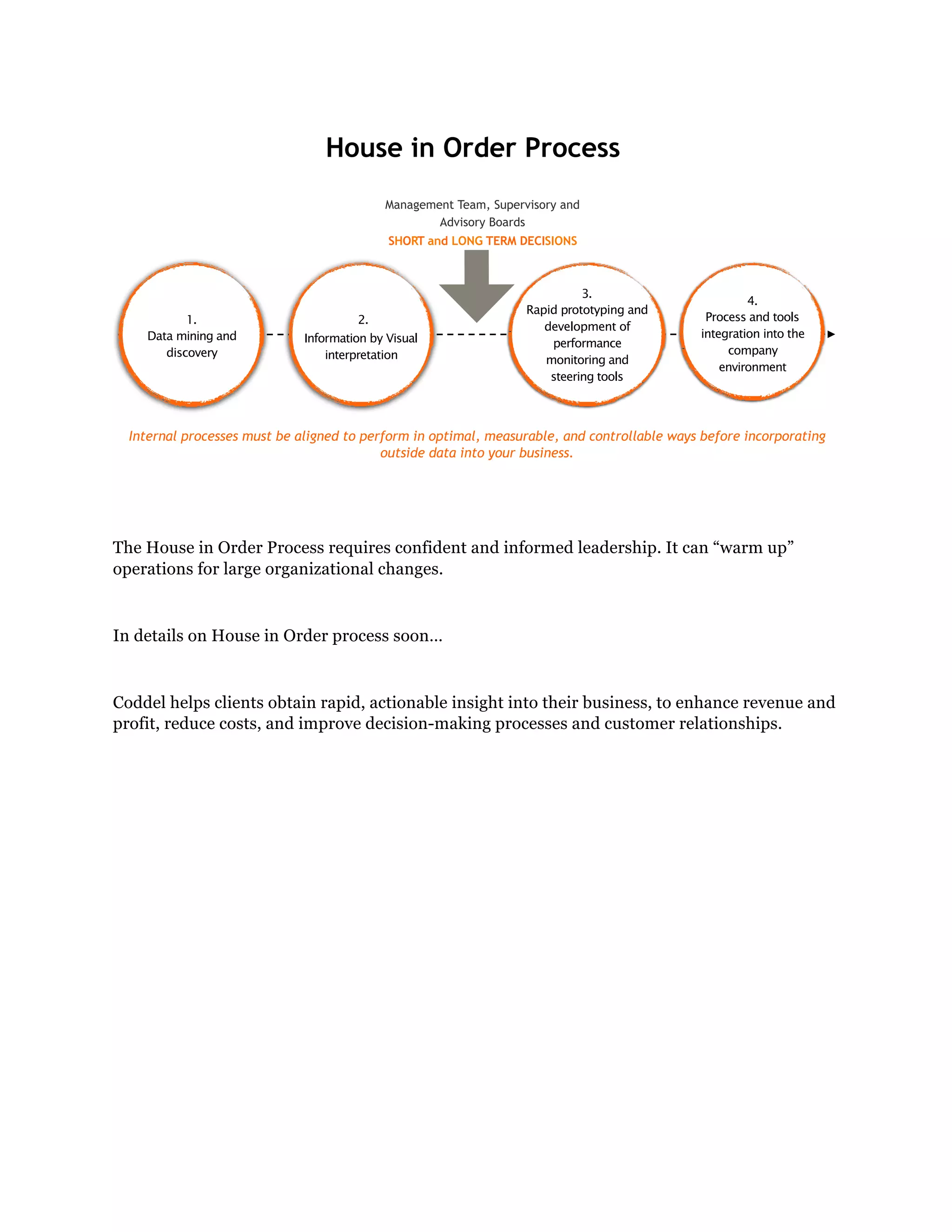
The House in Order Process requires confident and informed leadership. It can “warm up”
operations for large organizational changes.
In details on House in Order process soon…
Coddel helps clients obtain rapid, actionable insight into their business, to enhance revenue and
profit, reduce costs, and improve decision-making processes and customer relationships.
8
1.
Data mining and
discovery
3.
Rapid prototyping and
development of
performance
monitoring and
steering tools
4.
Process and tools
integration into the
company
environment
2.
Information by Visual
interpretation
House in Order Process
Management Team, Supervisory and
Advisory Boards
SHORT and LONG TERM DECISIONS
Internal processes must be aligned to perform in optimal, measurable, and controllable ways before incorporating
outside data into your business.

Business Data is your Competitive Asset. Is that how you use it?

  • 1.
    Business Data isyour Competitive Asset. Is that how you use it? Every organization generates large quantities of data — regarding customers, employees, partners, products, services, and operations. Business leaders must be able to access this information quickly and in a context that gives them immediate insight for better, faster business decisions. Executives need to know the “4 W’s” (why, what, who, and what-if). To answer these questions they often receive loads of reports and unstructured data; they also receive the emotional judgments of the people who deliver the data. Before executives may feel comfortable to make decisions markets will change, leads will expire, opportunities will become hidden, and sales performances may slip; time is of the essence. Transformations of internal business data into relevant business insights enable informed decisions at all levels of organization.
  • 2.
    Managing data andits use is a core business function with strategically important outcomes; it is not just an IT operation. However, IT is an important enabler and engine behind all effective processes. Leaders must understand that internal business data has inherit value – it is an asset and should be used to create a sustainable competitive advantage. This data is pointing directly to improvement opportunities in operations and to align customer service with customer needs more efficiently. Data is in notes, sheets, reports and databases spread throughout many departments. It’s often complex strings of numbers and is not discernable to the human eye. However, this data does not create impacts, insights do. Data analysis+ data visualization = insights Data must be analyzed and then visualized for decision makers to utilize its true value. Insights are instruments in the hands of business leaders to develop well-informed plans and make better business decisions. Visualizations show significant trends, patterns, peaks, and valleys in your business cycle. These help identify organizations make large changes quickly. Visualizations provide an understandable and tangible form to the business performance. While external data (customers, market analysis, and business intelligence) is abundant, fast changing, and requires effort to maintain relevancy, internal business data drives operations and presents transformation opportunities across the enterprise. This is beyond financial outlooks and P&L; this data shows the details of customer segments and classifications, profit drains, product tails, purchasing behaviors, and the dynamics of sales activities. The real power of internal business data comes when organizations are aligned across people, processes, and technology. Aligning resources and talent along the fact-based engagements enables the organization to respond to the market in an effective, profitable way. This is what we call House in Order. A few tips on important insights: 1. Look beyond the obvious: much deeper than standard executive views 2. Be sure you fully understand your sales team’s culture, logic, and operations 3. Review stability, repeatability, and the ability of sales team to generate new deals and customers 4. How is pricing strategy reflecting small deviations in product quality? 5. Strangely enough, you are not interested in P&L nor final financial results. There you cannot find what you are looking for.
  • 3.
    The House inOrder Process requires confident and informed leadership. It can “warm up” operations for large organizational changes. In details on House in Order process soon… Coddel helps clients obtain rapid, actionable insight into their business, to enhance revenue and profit, reduce costs, and improve decision-making processes and customer relationships. 8 1. Data mining and discovery 3. Rapid prototyping and development of performance monitoring and steering tools 4. Process and tools integration into the company environment 2. Information by Visual interpretation House in Order Process Management Team, Supervisory and Advisory Boards SHORT and LONG TERM DECISIONS Internal processes must be aligned to perform in optimal, measurable, and controllable ways before incorporating outside data into your business.