
© Citadel Advantage Ltd
www.citadeladvantage.com
Citadel Advantage
Business Continuity &
Payment Systems
A Presentation to the
Financial Services Technology Consortium
44 Wall Street
New York, NY
18 December 2008
Citadel Advantage
Who am I?
 Stanley Epstein
Company Director & Principal Associate
 Masters degree in Economics
 Bachelors degree in Accounting
 42 years of banking and IT experience, 33 of which were with a major South
African Bank
 Extensive exposure to banking practice and banking operations in Africa,
North America, Europe & Australasia
 Advised a number of central banks on payment system, payments policy and
payments risk issues and as a payment systems consultant to a global
payments software developer.
 In 1990s held severs industry level roles in South Africa which included
 Chairman: Risk Committee – Payments Association of South Africa
 Vice Chairman – ERAG (Electronic Risk Assessment) Group – Clearing
Bankers Association
 Board Member of the Bankserv Electronic Funds Clearing Services
(Johannesburg, South Africa)
 Member of Strategy Team of the South African Reserve Bank’s “National
Payments System Steering Group”
Citadel Advantage
A word about Citadel Advantage
 Citadel Advantage provides
back office system specialist
services to banks, financial
institutions & vendors
 Our area of focus
 Operations Risk Mitigation
 Payments, Liquidity & Treasury
Systems
 Training in the Operations Risk
and Payments Systems areas
 Our website
 www.citadeladvanatge.com
 Some Clients & Partners
Citadel Advantage
Business Continuity & Payment Systems
 "A payment system consists of a set of instruments, banking
procedures and, typically, interbank funds transfer systems that
ensure the circulation of money" *
 Two basic problems
 Narrow focus
 Wrong focus
* "A glossary of terms used in payments and settlement systems“
Committee on Payment & Settlement Systems. BIS, Basel. March 2003
Citadel Advantage
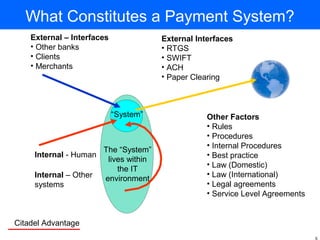
The “System”
lives within
the IT
environment
What Constitutes a Payment System?
“System” Other Factors
• Rules
• Procedures
• Internal Procedures
• Best practice
• Law (Domestic)
• Law (International)
• Legal agreements
• Service Level Agreements
External – Interfaces
• Other banks
• Clients
• Merchants
Internal – Other
systems
Internal - Human
External Interfaces
• RTGS
• SWIFT
• ACH
• Paper Clearing
Citadel Advantage
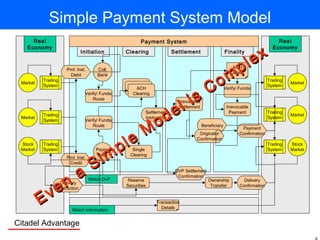
Simple Payment System Model
Payment System
Initiation FinalityClearing Settlement
Real
Economy
Real
Economy
Match Information
Trading
System
Trading
System
Trading
System
Stock
Market
Market
Market
Trading
System
Trading
System
Trading
System
Stock
Market
Market
Market
Verify/ Funds/
Route
Pmt. Inst.
Credit
Pmt. Inst.
Debit
Paying
Bank
Coll.
Bank
Verify/ Funds/
Route
Settlement
Instruction
Single
Clearing
ACH
Clear
ACH
Clear
ACH
Clearing
Irrevocable
Settlement
DVP Settlement
Confirmation
Delivery
Instruction
Payment
Confirmation
Beneficiary
Originator
Confirmation
Irrevocable
Payment
Verify/ Funds/
ACH
Details
Delivery
Confirmation
Reserve
Securities
Ownership
Transfer
Transaction
Details
Match DvP
Even
a
Sim
ple
M
odel is
Com
plex
Even
a
Sim
ple
M
odel is
Com
plex
Citadel Advantage
9/11 – The Event
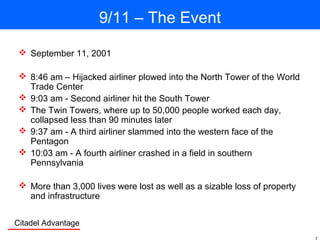
 September 11, 2001
 8:46 am – Hijacked airliner plowed into the North Tower of the World
Trade Center
 9:03 am - Second airliner hit the South Tower
 The Twin Towers, where up to 50,000 people worked each day,
collapsed less than 90 minutes later
 9:37 am - A third airliner slammed into the western face of the
Pentagon
 10:03 am - A fourth airliner crashed in a field in southern
Pennsylvania
 More than 3,000 lives were lost as well as a sizable loss of property
and infrastructure
Citadel Advantage
The Impact
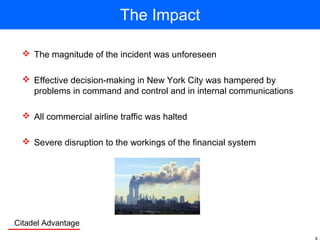
 The magnitude of the incident was unforeseen
 Effective decision-making in New York City was hampered by
problems in command and control and in internal communications
 All commercial airline traffic was halted
 Severe disruption to the workings of the financial system
Citadel Advantage
Loss of Infrastructure
 Property damage was extensive
 Major power outages
 Most of the telecommunications infrastructure of lower Manhattan
was unavailable for several days
 Over 40 percent of lower Manhattan’s phone lines and 20 percent of
the lines serving the New York Stock Exchange were lost
 Service was lost on voice, data, PBX and internet lines affecting
about 34,000 business and residential customers
 200,000 voice access lines went out
 100,000 PBX/Centrex lines went out
 3.6 million data circuits went out
 10 cellular towers were lost or damaged
Citadel Advantage
Financial System Impact
 Severe damage on banking and financial institutions in Lower
Manhattan
 Markets closed
 Participants relocated to backup sites
 Backup communications links failed or were unreliable
 Severe disruption of interbank payments
 Settlement instructions were lost
 Interbank payments were delayed
Citadel Advantage
Financial System Impact
 Government securities settlement was especially hurt by the attacks
 Cantor Fitzgerald, a key inter-dealer broker, lost 658 employees
 Fatalities in the financial industry represented over 74 percent of the
total civilian casualties in the World Trade Center attacks
 Many market participants had to relocate to backup sites, where
internal systems and communications were not reliable
 Several banks had difficulty processing payment instructions
 The resulting accumulation of large balances drove net balances in
the remainder of the banking system negative, requiring the Fed’s
intervention
 At one point the Fed injected more than $100 billion in additional
liquidity
Citadel Advantage
Financial System Impact
 Timing of the attacks – around 9 a.m. Eastern Time – meant that many
markets had not yet begun trading
 Many key market participants had substantial operations in or around
the World Trade Center that were destroyed or damaged in the
attacks, and had to relocate to backup facilities
 The New York Stock Exchange and the Nasdaq Stock Market never
opened for trading the day of the attacks
 The facilities of the New York Board of Trade in Four World Trade
Center were destroyed
 Regional stock exchanges, the Chicago Board of Trade, and the
Chicago Mercantile Exchange all closed as well
 Equity markets reopened on Monday morning, September 17th
Citadel Advantage
Financial System Impact
 Government securities market was hit particularly hard by the World
Trade Center attacks basically because it opens earlier
 Trading in U.S. government securities starts at 8 a.m. in New York,
and repo trading starts as early as 7 a.m. The bulk of government
securities cash and repo trading takes place before 9:00 a.m.
 On September 11th
it was close to a full trading day
 $500 billion in repo transactions and about $80 billion in government
securities trades had already been executed when the planes hit
 Reconciling these trades would occupy back-office personnel for
weeks
Citadel Advantage
Financial System Impact
 The two main clearing banks for the government securities market,
Bank of New York (BoNY) and J.P. Morgan Chase (JPMC), operated
just a few blocks from the World Trade Center
 JPMC was in the middle of migrating certain business operations to
Tampa, Florida, and were able to resume operations from there
 BoNY had more difficulty. Their headquarters, One Wall Street, was
untouched a half a mile from the WTC, but had to be evacuated
 BoNY’s main operations center at 101 Barclay Street, one block north
of the World Trade Center, housed the bank’s funds transfer and
broker/dealer systems, including the bond clearing and settlement
systems
 Both facilities were evacuated on September 11th
, and operations were
established at contingency sites outside the city in New Jersey and
New York
Citadel Advantage
Financial System Impact
 Third major entity clearing government securities trades was the
(then) Government Securities Clearing Corporation
 Instructions from counterparty government securities dealers are
compared and confirmed by GSCC, who establishes a net position for
each dealer in each security issue, along with a net cash position, and
interposes itself as counterparty to guarantee settlement
 Positions are settled using the Fedwire Securities Service or the clearing
banks
 GSCC remained operational after September 11th
, but many
members were unable to deliver trade instructions for the 11th
, and
thus GSCC had information from only one side of the trade
 GSCC’s connection to BoNY was lost for part of the week of the 11th
and as a result they did not know what securities and cash they had
received, and were at times unable to transmit settlement
instructions to BoNY
Citadel Advantage
Financial System Impact
 Because the offices of so many key market participants were
destroyed, and because of connectivity problems there was a
dramatic increase in the volume of settlement “fails”
 from $1.7 billion per day in the week of September 5th
 to $190 billion the week ending Wednesday, September 19th
 BoNY’s role in clearing and settling government securities
transactions placed it at a critical node in interbank payment flows
 The communications and operations difficulties plaguing BoNY
meant that not all funds payment instructions were getting sent as
intended
Citadel Advantage
Financial System Impact
 A bank’s inability to send funds transfer payment instructions
through Fedwire resulted in funds accumulating in that bank’s
account at the Fed
 Balances in the rest of the banking system would be
correspondingly lower
 At one point during the week after September 11th
, BoNY publicly
reported to be overdue on $100 billion in payments
Citadel Advantage
Financial System Impact
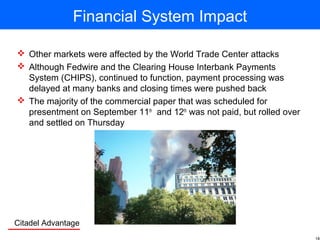
 Other markets were affected by the World Trade Center attacks
 Although Fedwire and the Clearing House Interbank Payments
System (CHIPS), continued to function, payment processing was
delayed at many banks and closing times were pushed back
 The majority of the commercial paper that was scheduled for
presentment on September 11th
and 12th
was not paid, but rolled over
and settled on Thursday
Citadel Advantage
Financial System Impact
 Retail payment card networks – credit, debit, ATM cards, and the
automated clearinghouse networks – remained operational, except
for scattered problems at bank ATMs in New York City, and at
BoNY’s ATM network, which crashed entirely on the 11th
and wasn’t
restored until the evening of September 19th
 The grounding of airline flights seriously hampered inter-regional
check clearing, as banks and the Federal Reserve rushed to
arrange for substitute truck transport
 On Thursday, September 13th
, the Federal Aviation Administration
began reopening U.S. airspace and gave cheque air couriers
approval to resume its chartered flights
Citadel Advantage
9/11 and Business Continuity Planning
 The losses
 2,800 workers DIED
 320 companies FAILED to return to business
 135,000 workers lost their jobs
 Organizations that did recover and continued operations
 Cantor Fitzgerald who lost 658 staff and resumed operations two days
later
 Marsh & McLennan who had 3,200 staff over 8 floors
 Morgan Stanley who had 3,500 staff over 17 floors
 NY Port Authority who had 2,000 staff over 23 floors
Citadel Advantage
The Lessons of 9/11
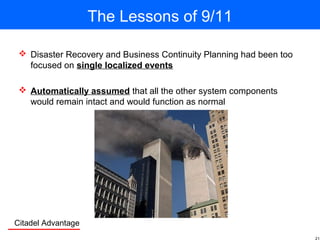
 Disaster Recovery and Business Continuity Planning had been too
focused on single localized events
 Automatically assumed that all the other system components
would remain intact and would function as normal
Citadel Advantage
The Lessons of 9/11
 Business continuity planning failed to take into account the
possibility of wide-area disasters and for the major loss of or
inaccessibility of critical staff
 Planning focused on single building or system
 Backup site often in same building
 Inability to transport staff to backup site
 Loss of substantial staff numbers
 Ability of surviving staff to continue to work
Citadel Advantage
Communications
Transportation
Trauma
Health &
safety concerns
Payroll
Succession &
training
Employee
tracking
Abilitytoattendwork
Ability
to
deliver critical
internal services
Ability to maintain
business operations
Only Human
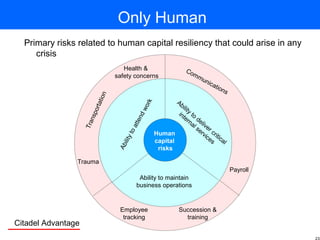
Primary risks related to human capital resiliency that could arise in any
crisis
Human
capital
risks
Citadel Advantage
The Lessons of 9/11
 The market and geographical focus intensified the effect of
operational disruptions
 High concentration in NYC
 Staff concentrated in one or two locations
 Using multiple telcom providers does not equal full redundancy
Citadel Advantage
The Lessons of 9/11
 There was a strong interdependence among financial system
participants irrespective of where they were located
 Failure to connect
 Suspension of commercial flights
Citadel Advantage
Dependencies, Concentrations & Vulnerabilities
 Have we really learned anything?
 Jury still out on this …
 In London on 7th July 2005 terrorists struck …..and despite the
almost 4 years (at that time) since 9/11 ….
 Geographical concentration
 Heavy concentration of primary and recovery sites in London
 Nearly 400 critical sites (i.e. primary and recovery sites) of which around
half are located in London within a 10km radius of Bank Junction
 Of these, three quarters are within a 5km radius of Bank Junction
Citadel Advantage
To Sum Up
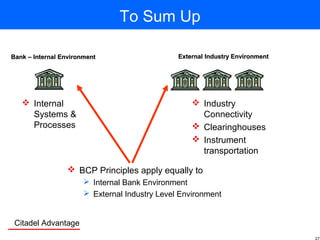
Bank – Internal EnvironmentBank – Internal Environment External Industry EnvironmentExternal Industry Environment
 Internal
Systems &
Processes
 Industry
Connectivity
 Clearinghouses
 Instrument
transportation
 BCP Principles apply equally to
 Internal Bank Environment
 External Industry Level Environment
Citadel Advantage
Guidance
 Federal Reserve
 Interagency Paper on Sound Practices to Strengthen the Resilience of
the U.S. Financial System
 European Central Bank
 Business Continuity Oversight Expectations for Systemically Important
Payment Systems
 Bank of Italy
 Guidelines for the Business Continuity of Payment System Significant
Infrastructures
Citadel Advantage

Business Continuity & Payment Systems

  • 1.
    © Citadel AdvantageLtd www.citadeladvantage.com Citadel Advantage Business Continuity & Payment Systems A Presentation to the Financial Services Technology Consortium 44 Wall Street New York, NY 18 December 2008
  • 2.
    Citadel Advantage Who amI?  Stanley Epstein Company Director & Principal Associate  Masters degree in Economics  Bachelors degree in Accounting  42 years of banking and IT experience, 33 of which were with a major South African Bank  Extensive exposure to banking practice and banking operations in Africa, North America, Europe & Australasia  Advised a number of central banks on payment system, payments policy and payments risk issues and as a payment systems consultant to a global payments software developer.  In 1990s held severs industry level roles in South Africa which included  Chairman: Risk Committee – Payments Association of South Africa  Vice Chairman – ERAG (Electronic Risk Assessment) Group – Clearing Bankers Association  Board Member of the Bankserv Electronic Funds Clearing Services (Johannesburg, South Africa)  Member of Strategy Team of the South African Reserve Bank’s “National Payments System Steering Group”
  • 3.
    Citadel Advantage A wordabout Citadel Advantage  Citadel Advantage provides back office system specialist services to banks, financial institutions & vendors  Our area of focus  Operations Risk Mitigation  Payments, Liquidity & Treasury Systems  Training in the Operations Risk and Payments Systems areas  Our website  www.citadeladvanatge.com  Some Clients & Partners
  • 4.
    Citadel Advantage Business Continuity& Payment Systems  "A payment system consists of a set of instruments, banking procedures and, typically, interbank funds transfer systems that ensure the circulation of money" *  Two basic problems  Narrow focus  Wrong focus * "A glossary of terms used in payments and settlement systems“ Committee on Payment & Settlement Systems. BIS, Basel. March 2003
  • 5.
    Citadel Advantage The “System” liveswithin the IT environment What Constitutes a Payment System? “System” Other Factors • Rules • Procedures • Internal Procedures • Best practice • Law (Domestic) • Law (International) • Legal agreements • Service Level Agreements External – Interfaces • Other banks • Clients • Merchants Internal – Other systems Internal - Human External Interfaces • RTGS • SWIFT • ACH • Paper Clearing
  • 6.
    Citadel Advantage Simple PaymentSystem Model Payment System Initiation FinalityClearing Settlement Real Economy Real Economy Match Information Trading System Trading System Trading System Stock Market Market Market Trading System Trading System Trading System Stock Market Market Market Verify/ Funds/ Route Pmt. Inst. Credit Pmt. Inst. Debit Paying Bank Coll. Bank Verify/ Funds/ Route Settlement Instruction Single Clearing ACH Clear ACH Clear ACH Clearing Irrevocable Settlement DVP Settlement Confirmation Delivery Instruction Payment Confirmation Beneficiary Originator Confirmation Irrevocable Payment Verify/ Funds/ ACH Details Delivery Confirmation Reserve Securities Ownership Transfer Transaction Details Match DvP Even a Sim ple M odel is Com plex Even a Sim ple M odel is Com plex
  • 7.
    Citadel Advantage 9/11 –The Event  September 11, 2001  8:46 am – Hijacked airliner plowed into the North Tower of the World Trade Center  9:03 am - Second airliner hit the South Tower  The Twin Towers, where up to 50,000 people worked each day, collapsed less than 90 minutes later  9:37 am - A third airliner slammed into the western face of the Pentagon  10:03 am - A fourth airliner crashed in a field in southern Pennsylvania  More than 3,000 lives were lost as well as a sizable loss of property and infrastructure
  • 8.
    Citadel Advantage The Impact The magnitude of the incident was unforeseen  Effective decision-making in New York City was hampered by problems in command and control and in internal communications  All commercial airline traffic was halted  Severe disruption to the workings of the financial system
  • 9.
    Citadel Advantage Loss ofInfrastructure  Property damage was extensive  Major power outages  Most of the telecommunications infrastructure of lower Manhattan was unavailable for several days  Over 40 percent of lower Manhattan’s phone lines and 20 percent of the lines serving the New York Stock Exchange were lost  Service was lost on voice, data, PBX and internet lines affecting about 34,000 business and residential customers  200,000 voice access lines went out  100,000 PBX/Centrex lines went out  3.6 million data circuits went out  10 cellular towers were lost or damaged
  • 10.
    Citadel Advantage Financial SystemImpact  Severe damage on banking and financial institutions in Lower Manhattan  Markets closed  Participants relocated to backup sites  Backup communications links failed or were unreliable  Severe disruption of interbank payments  Settlement instructions were lost  Interbank payments were delayed
  • 11.
    Citadel Advantage Financial SystemImpact  Government securities settlement was especially hurt by the attacks  Cantor Fitzgerald, a key inter-dealer broker, lost 658 employees  Fatalities in the financial industry represented over 74 percent of the total civilian casualties in the World Trade Center attacks  Many market participants had to relocate to backup sites, where internal systems and communications were not reliable  Several banks had difficulty processing payment instructions  The resulting accumulation of large balances drove net balances in the remainder of the banking system negative, requiring the Fed’s intervention  At one point the Fed injected more than $100 billion in additional liquidity
  • 12.
    Citadel Advantage Financial SystemImpact  Timing of the attacks – around 9 a.m. Eastern Time – meant that many markets had not yet begun trading  Many key market participants had substantial operations in or around the World Trade Center that were destroyed or damaged in the attacks, and had to relocate to backup facilities  The New York Stock Exchange and the Nasdaq Stock Market never opened for trading the day of the attacks  The facilities of the New York Board of Trade in Four World Trade Center were destroyed  Regional stock exchanges, the Chicago Board of Trade, and the Chicago Mercantile Exchange all closed as well  Equity markets reopened on Monday morning, September 17th
  • 13.
    Citadel Advantage Financial SystemImpact  Government securities market was hit particularly hard by the World Trade Center attacks basically because it opens earlier  Trading in U.S. government securities starts at 8 a.m. in New York, and repo trading starts as early as 7 a.m. The bulk of government securities cash and repo trading takes place before 9:00 a.m.  On September 11th it was close to a full trading day  $500 billion in repo transactions and about $80 billion in government securities trades had already been executed when the planes hit  Reconciling these trades would occupy back-office personnel for weeks
  • 14.
    Citadel Advantage Financial SystemImpact  The two main clearing banks for the government securities market, Bank of New York (BoNY) and J.P. Morgan Chase (JPMC), operated just a few blocks from the World Trade Center  JPMC was in the middle of migrating certain business operations to Tampa, Florida, and were able to resume operations from there  BoNY had more difficulty. Their headquarters, One Wall Street, was untouched a half a mile from the WTC, but had to be evacuated  BoNY’s main operations center at 101 Barclay Street, one block north of the World Trade Center, housed the bank’s funds transfer and broker/dealer systems, including the bond clearing and settlement systems  Both facilities were evacuated on September 11th , and operations were established at contingency sites outside the city in New Jersey and New York
  • 15.
    Citadel Advantage Financial SystemImpact  Third major entity clearing government securities trades was the (then) Government Securities Clearing Corporation  Instructions from counterparty government securities dealers are compared and confirmed by GSCC, who establishes a net position for each dealer in each security issue, along with a net cash position, and interposes itself as counterparty to guarantee settlement  Positions are settled using the Fedwire Securities Service or the clearing banks  GSCC remained operational after September 11th , but many members were unable to deliver trade instructions for the 11th , and thus GSCC had information from only one side of the trade  GSCC’s connection to BoNY was lost for part of the week of the 11th and as a result they did not know what securities and cash they had received, and were at times unable to transmit settlement instructions to BoNY
  • 16.
    Citadel Advantage Financial SystemImpact  Because the offices of so many key market participants were destroyed, and because of connectivity problems there was a dramatic increase in the volume of settlement “fails”  from $1.7 billion per day in the week of September 5th  to $190 billion the week ending Wednesday, September 19th  BoNY’s role in clearing and settling government securities transactions placed it at a critical node in interbank payment flows  The communications and operations difficulties plaguing BoNY meant that not all funds payment instructions were getting sent as intended
  • 17.
    Citadel Advantage Financial SystemImpact  A bank’s inability to send funds transfer payment instructions through Fedwire resulted in funds accumulating in that bank’s account at the Fed  Balances in the rest of the banking system would be correspondingly lower  At one point during the week after September 11th , BoNY publicly reported to be overdue on $100 billion in payments
  • 18.
    Citadel Advantage Financial SystemImpact  Other markets were affected by the World Trade Center attacks  Although Fedwire and the Clearing House Interbank Payments System (CHIPS), continued to function, payment processing was delayed at many banks and closing times were pushed back  The majority of the commercial paper that was scheduled for presentment on September 11th and 12th was not paid, but rolled over and settled on Thursday
  • 19.
    Citadel Advantage Financial SystemImpact  Retail payment card networks – credit, debit, ATM cards, and the automated clearinghouse networks – remained operational, except for scattered problems at bank ATMs in New York City, and at BoNY’s ATM network, which crashed entirely on the 11th and wasn’t restored until the evening of September 19th  The grounding of airline flights seriously hampered inter-regional check clearing, as banks and the Federal Reserve rushed to arrange for substitute truck transport  On Thursday, September 13th , the Federal Aviation Administration began reopening U.S. airspace and gave cheque air couriers approval to resume its chartered flights
  • 20.
    Citadel Advantage 9/11 andBusiness Continuity Planning  The losses  2,800 workers DIED  320 companies FAILED to return to business  135,000 workers lost their jobs  Organizations that did recover and continued operations  Cantor Fitzgerald who lost 658 staff and resumed operations two days later  Marsh & McLennan who had 3,200 staff over 8 floors  Morgan Stanley who had 3,500 staff over 17 floors  NY Port Authority who had 2,000 staff over 23 floors
  • 21.
    Citadel Advantage The Lessonsof 9/11  Disaster Recovery and Business Continuity Planning had been too focused on single localized events  Automatically assumed that all the other system components would remain intact and would function as normal
  • 22.
    Citadel Advantage The Lessonsof 9/11  Business continuity planning failed to take into account the possibility of wide-area disasters and for the major loss of or inaccessibility of critical staff  Planning focused on single building or system  Backup site often in same building  Inability to transport staff to backup site  Loss of substantial staff numbers  Ability of surviving staff to continue to work
  • 23.
    Citadel Advantage Communications Transportation Trauma Health & safetyconcerns Payroll Succession & training Employee tracking Abilitytoattendwork Ability to deliver critical internal services Ability to maintain business operations Only Human Primary risks related to human capital resiliency that could arise in any crisis Human capital risks
  • 24.
    Citadel Advantage The Lessonsof 9/11  The market and geographical focus intensified the effect of operational disruptions  High concentration in NYC  Staff concentrated in one or two locations  Using multiple telcom providers does not equal full redundancy
  • 25.
    Citadel Advantage The Lessonsof 9/11  There was a strong interdependence among financial system participants irrespective of where they were located  Failure to connect  Suspension of commercial flights
  • 26.
    Citadel Advantage Dependencies, Concentrations& Vulnerabilities  Have we really learned anything?  Jury still out on this …  In London on 7th July 2005 terrorists struck …..and despite the almost 4 years (at that time) since 9/11 ….  Geographical concentration  Heavy concentration of primary and recovery sites in London  Nearly 400 critical sites (i.e. primary and recovery sites) of which around half are located in London within a 10km radius of Bank Junction  Of these, three quarters are within a 5km radius of Bank Junction
  • 27.
    Citadel Advantage To SumUp Bank – Internal EnvironmentBank – Internal Environment External Industry EnvironmentExternal Industry Environment  Internal Systems & Processes  Industry Connectivity  Clearinghouses  Instrument transportation  BCP Principles apply equally to  Internal Bank Environment  External Industry Level Environment
  • 28.
    Citadel Advantage Guidance  FederalReserve  Interagency Paper on Sound Practices to Strengthen the Resilience of the U.S. Financial System  European Central Bank  Business Continuity Oversight Expectations for Systemically Important Payment Systems  Bank of Italy  Guidelines for the Business Continuity of Payment System Significant Infrastructures
  • 29.

Editor's Notes

  • #21 The losses were tragic & irreplaceable. But the effect on the overall national US banking system and specifically payment systems was even more profound. We have already looked at the effect on Fedwire. Now lets briefly cover some of the retail payments issues. In New York and Washington, bank branch closings were widespread on September 11th, but many banks outside those cities closed branches briefly as well. Some state banking agencies and the Office of the Comptroller of the Currency issued statements allowing banks to close at their discretion. The Banking Commissioner for the State of Connecticut as one example ordered all banks and credit unions to close. Bank of America and Wachovia closed their headquarters, which are housed in several tall towers that dominate the Charlotte, North Carolina skyline. Wachovia and Chicago-based Bank One closed branches nationwide early in the afternoon on Tuesday, but were open as usual the next day. The Chicago Tribune reported that “a handful of bank branches in or around major landmarks such as the Sears Tower” were closed. Some banks discouraged cash withdrawals by customers. The Municipal Credit Union, whose back offices were near the WTC, limited customers to $500 withdrawals when their 11 branches reopened on Thursday. For a day after the attack Citibank recommended that customers limit cash withdrawals to $5,000. Wells Fargo, a San Francisco based bank, placed limits on per-person cash withdrawals that reportedly varied across locations from $1,000 to $5,000, and Washington Mutual, based in Seattle, imposed a limit of $2,500. Some armored carriers suspended operations in New York City, and transportation difficulties impeded some deliveries of currency elsewhere in the country. Deliveries of newly printed notes from the Bureau of Engraving and Printing to some Federal Reserve Banks were delayed by the airline grounding, as were currency shipments to Alaska and Hawaii. Reports of increased cash withdrawals by bank depositors were common, especially on the East Coast. Concord EFS, an ATM payment processor, reported a surge in ATM card usage on their network on Tuesday afternoon and Wednesday morning. At 8 p.m. volume was 31 percent higher than the previous week. The biggest surge was at point-of-sale terminals, especially at gasoline retailers, perhaps reflecting the substitution of automotive for airline travel. Concord’s network traffic was down in the hours immediately following the attacks, however. Credit card networks reported lower volume for several days after the attacks, which was consistent with the sharp drop in retail sales. Currency in circulation increased by $4.4 billion from Monday to Wednesday. In comparison, total currency in circulation was $614 billion on September 5, of which more than half was estimated to be overseas. Nearly $3 billion of the $4.4billion reflected an increase in banks’ vault cash holdings, consistent with heightened cash shipments from the Federal Reserve banks.
  • #26 There was a strong interdependence among financial system participants irrespective of where they were located. While financial institutions situated outside the New York City area were affected to a much lesser degree than were those inside it, many felt the effects of the disaster. Most financial factors lost the ability to connect to banks, brokers and other organizations in lower Manhattan. This blocked their ability to conduct business and establish whether transactions had been completed as anticipated. Some customers were affected by actions of institutions with which they did not even do business, when funds or securities could not be delivered due to operational problems at other institutions. The suspension of all commercial flights had serious implications for the clearing of cheques. In the post-9/11 world there is a clear understanding that the financial system has many components, and they all have to work. It is the big picture, not the narrow "own" view that has to be planned for. Business continuity planning needs to be made far more robust. Revised plans should include the ability for a rapid resumption of critical operations following the loss or inaccessibility of staff in at least one major operating site; or following a wide-scale, regional disruption. It is vital that all critical internal and external continuity arrangements are effective and compatible.
  • #27 Subsequently to the events of 9/11 the UK's tripartite financial authorities - HM Treasury, The Bank of England and Financial Services Authority (FSA). Financial Services Authority in the United Kingdom undertook a detailed survey of how the financial system would cope with major operational disruption. More than 60 major banks, exchanges and settlement firms volunteered to take part. The research found that core firms and financial infrastructure providers have highly resilient IT systems and can recover critical functions rapidly following major operational disruption. But the regulator identified the heavy concentration of primary and recovery sites in London as a potential weakness. There is a heavy concentration of primary and recovery sites in London. Participants reported nearly 400 critical sites (i.e. primary and recovery sites) of which around half are located in London within a 10km radius of Bank Junction (i.e. across a maximum distance of 20km). Of these, three quarters are within a 5km radius of Bank Junction. While this was to be expected it nevertheless represents a significant level of concentration. Observed sound practice is to have recovery facilities close by (to handle day-to-day interruptions) and alternative recovery facilities further away which are not exposed to the same risks as the recovery site. While the FSA recognized that there are cost implications but also noted that relatively few firms have alternative recovery facilities for all critical functions. While the FSA did not propose at that stage to suggest minimum distance criteria for the location of recovery sites they were extremely concerned about the issue. As an example, some firms mitigate geographical concentration risk by being able to switch their business to other offices with minimal disruption. We intend to follow up geographical concentration as part of our follow-up project, for example by exploring the extent to which core firms and financial infrastructure providers are able to switch their business overseas or to offices that are unlikely to be concurrently affected. We can then form a view on whether minimum distance criteria might be a helpful yardstick. Broadly speaking, the FSA supported the principle that, ideally, firms should have a recovery facility “close by” (i.e. that they could get to quickly in the event of a localized incident) and something “further away” (i.e. subject to a different risk profile that would remain unaffected by a wider area event). Nonetheless particularly in London geographical concentration remains a real issue, and that for most firms is something that can only be resolved in the medium to long term. To quote the FSA findings; “So whilst it might not be possible to eliminate these risks in the short term, we would encourage firms to think creatively about how they might diversify their arrangements in order to mitigate those risks. This might include identifying alternative recovery space “further away”, or having the facility to switch their critical business functions to regional offices or overseas.”
  • #28 At the start I spoke of two basic problems. Firstly there is the narrow focus and secondly the wrong focus. There needs to be a view of the whole picture.