TM
© IT Governance Ltd 2017
Copyright IT Governance Ltd 2017 – v1.0
Appointing a Data Protection Officer
under the GDPR
Adrian Ross LLB (Hons), MBA
GRC Consultant
IT Governance Ltd
9 March 2017
TM
© IT Governance Ltd 2017
Copyright IT Governance Ltd 2017 – v1.0
Introduction
• Adrian Ross
• GRC consultant
– Infrastructure services
– Business process re-engineering
– Business intelligence
– Business architecture
– Intellectual property
– Legal compliance
– Data protection and information security
– Enterprise risk management
TM
© IT Governance Ltd 2017
Copyright IT Governance Ltd 2017 – v1.0
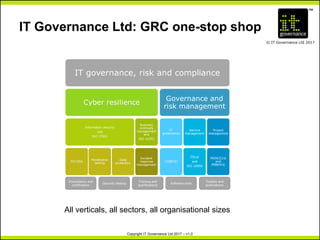
IT Governance Ltd: GRC one-stop shop
All verticals, all sectors, all organisational sizes
TM
© IT Governance Ltd 2017
Copyright IT Governance Ltd 2017 – v1.0
Agenda
• An overview of the regulatory landscape
• Territorial scope
• Remedies, liabilities and penalties
• Security of personal data
• Appointing a data protection officer under the GDPR
TM
© IT Governance Ltd 2017
Copyright IT Governance Ltd 2017 – v1.0
The nature of European law
• Two main types of legal instrument:
– Directives
º Require individual implementation in each member state
º Implemented by the creation of national laws approved by the parliaments of
each member state
º European Directive 95/46/EC is a directive
º UK Data Protection Act 1998
– Regulations
º Immediately applicable in each member state
º Requires no local laws to implement
º GDPR is a regulation
TM
© IT Governance Ltd 2017
Copyright IT Governance Ltd 2017 – v1.0
Article 99: Entry into force and
application
“This Regulation shall be binding in its entirety and directly
applicable in all Member States.”
KEY DATES
• On 8 April 2016 the European Council adopted the Regulation.
• On 14 April 2016 the Regulation was adopted by the European Parliament.
• On 4 May 2016, the official text of the Regulation was published in the EU Official
Journal in all the official languages.
• The Regulation entered into force on 24 May 2016, and applies from 25 May 2018.
• http://ec.europa.eu/justice/data-protection/reform/index_en.htm
Final text of the Regulation: http://data.consilium.europa.eu/doc/document/ST-
5419-2016-REV-1/en/pdf
TM
© IT Governance Ltd 2017
Copyright IT Governance Ltd 2017 – v1.0
Articles 1 – 3: Who, and where?
• Natural person = a living individual
• Natural persons have rights associated with:
– The protection of personal data
– The protection of the processing personal data
– The unrestricted movement of personal data within the EU
• In material scope:
– Personal data that is processed wholly or partly by automated means;
– Personal data that is part of a filing system, or intended to be.
• The Regulation applies to controllers and processors in the EU,
irrespective of where processing takes place.
• It also applies to controllers not in the EU
TM
© IT Governance Ltd 2017
Copyright IT Governance Ltd 2017 – v1.0
Remedies, liabilities and penalties
• Natural persons have rights
– Judicial remedy where their rights have been infringed as a result of the
processing of personal data.
º In the courts of the member state where the controller or processor has an establishment.
º In the courts of the member state where the data subject habitually resides.
– Any person who has suffered material, or non-material, damage shall have the
right to receive compensation from the controller or processor.
– Controller involved in processing shall be liable for damage caused by
processing.
• Administrative fines
– Imposition of administrative fines will in each case be “effective, proportionate,
and dissuasive”
º taking into account technical and organisational measures implemented.
– €10,000,000 or, in the case of an undertaking, up to 2% of the total
worldwide annual turnover of the preceding financial year
– €20,000,000 or, in the case of an undertaking, 4% total worldwide
annual turnover in the preceding financial year
TM
© IT Governance Ltd 2017
Copyright IT Governance Ltd 2017 – v1.0
Data breaches in the UK
• January to March 2016 - 448 new cases
• Data breaches by sector
– Health (184)
– Local government (43)
– Education (36)
– General business (36)
– Finance, insurance and credit (25)
– Legal (25)
– Charitable and voluntary (23)
– Justice (18)
– Land or property services (17)
– Other (41)
Source: UK Information Commissioner’s Office
TM
© IT Governance Ltd 2017
Copyright IT Governance Ltd 2017 – v1.0
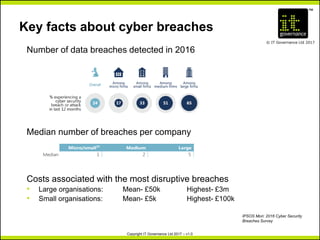
Key facts about cyber breaches
Number of data breaches detected in 2016
Median number of breaches per company
Costs associated with the most disruptive breaches
• Large organisations: Mean- £50k Highest- £3m
• Small organisations: Mean- £5k Highest- £100k
IPSOS Mori: 2016 Cyber Security
Breaches Survey
TM
© IT Governance Ltd 2017
Copyright IT Governance Ltd 2017 – v1.0
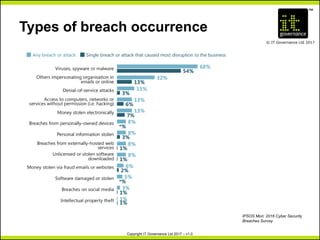
Types of breach occurrence
IPSOS Mori: 2016 Cyber Security
Breaches Survey
TM
© IT Governance Ltd 2017
Copyright IT Governance Ltd 2017 – v1.0
Article 33: Personal data breaches
• The definition of a personal data breach in GDPR:
– A "'personal data breach' means a breach of security leading to the accidental or
unlawful destruction, loss, alteration, unauthorised disclosure of, or access to,
personal data transmitted, stored or otherwise processed" (Article 4(12)).
TM
© IT Governance Ltd 2017
Copyright IT Governance Ltd 2017 – v1.0
Section 4: Data protection officers
Article 37: Designation of the data protection officer
• Organisations will have to appoint a DPO in three situations:
– Where the processing is carried out by a public authority or body;
– Where the organisation’s core activities require regular and systematic
monitoring of data subjects on a large scale; or
– Where core activities involve large-scale processing of sensitive personal data or
data relating to criminal convictions or offences.
• A DPO has the same legal status whether the appointment is
voluntary or mandatory
TM
© IT Governance Ltd 2017
Copyright IT Governance Ltd 2017 – v1.0
Section 4: Data protection officers
• Article 37: Designation of the data protection officer
• Public authority or body
– Usually means national, regional or local authorities, but can also mean other public
bodies governed by applicable national laws:
º Public transport services;
º water and energy supply;
º road infrastructure;
º public service broadcasting;
º public housing;
º disciplinary bodies for regulated professions.
• Exception is courts acting in their judicial capacity.
• The Article 29 Working Party recommends that private organisations
carrying out public tasks or exercising public authority designate a
DPO.
TM
© IT Governance Ltd 2017
Copyright IT Governance Ltd 2017 – v1.0
Section 4: Data protection officers
Article 37: Designation of the data protection officer
• Core activities
– The key operations necessary to achieve the controller’s or processor’s goals.
– Does not exclude processing that is an inextricable part of the controller’s or
processor’s activities.
– Necessary support functions of a business are ancillary to core activities.
TM
© IT Governance Ltd 2017
Copyright IT Governance Ltd 2017 – v1.0
Section 4: Data protection officers
Article 37: Designation of the data protection officer
• Regular and systematic monitoring
– Not defined in the GDPR
• WP29 interprets ‘regular’ as meaning one or more of the following:
– Ongoing or occurring at particular intervals for a particular period
– Recurring or repeated at fixed times
– Constantly or periodically taking place
• WP29 interprets ‘systematic’ as meaning one or more of the following:
– Occurring according to a system
– Pre-arranged, organised or methodical
– Taking place as part of a general plan for data collection
– Carried out as part of a strategy
TM
© IT Governance Ltd 2017
Copyright IT Governance Ltd 2017 – v1.0
Section 4: Data protection officers
Article 37: Designation of the data protection officer
• Monitoring
– Includes all forms of tracking and profiling on the Internet, including for the
purposes of behavioural advertising.
– Is not restricted to the online environment and online tracking should only be
considered one example of monitoring the behaviour of data subjects.
TM
© IT Governance Ltd 2017
Copyright IT Governance Ltd 2017 – v1.0
Section 4: Data protection officers
Article 37: Designation of the data protection officer
• Large scale
– Not defined in the GDPR
• WP29 recommends considering the following factors:
– The number of data subjects concerned – either as a specific number or as a
proportion of the relevant population.
– The volume of data and/or the range of different data items being processed.
– The duration, or permanence, of the data processing activity.
– The geographical extent of the processing activity.
TM
© IT Governance Ltd 2017
Copyright IT Governance Ltd 2017 – v1.0
Section 4: Data protection officers
Article 37: Designation of the data protection officer
• Examples of large-scale processing include:
– Processing of patient data in the regular course of business by a hospital
– Processing of travel data of individuals using a city’s public transport system (e.g.
tracking via travel cards)
– Processing of real time geolocation data of customers of an international fast
food chain for statistical purposes by a processor that specialises in providing
these services
– Processing of customer data in the regular course of business by an insurance
company or a bank
– Processing of personal data for behavioural advertising by a search engine
– Processing of data (content, traffic, location) by telephone or Internet service
providers
TM
© IT Governance Ltd 2017
Copyright IT Governance Ltd 2017 – v1.0
Section 4: Data protection officers
• Article 37: Designation of the data protection officer
– Designation applies to both controllers and processors
– Designation on mandatory criteria but also good practice
– WP29 recommends that processor’s DPO oversees its controller’s activities
– Group undertakings can appoint a single DPO if they are easily accessible
– Accessible by data subjects and supervisory authorities, and also internally
– Communication must take place in the language used by the relevant parties
– May be appointed for several public authorities depending on structure and size
– DPO can represent categories of controllers and processors
– DPO designated on the basis of professional qualities and knowledge of data
protection law, but not legally qualified
– May fulfil the role as part of a service contract
– Controller or processor must publish DPOs contact details and notify supervisory
authority
TM
© IT Governance Ltd 2017
Copyright IT Governance Ltd 2017 – v1.0
Section 4: Data protection officers
Article 38: Position of the data protection officer
– Organisations must ensure proper and timely involvement of the DPO
– Organisations must provide support through necessary resources
– DPO has a large degree of independence
– Protected role within the organisation
– Direct access to highest management
– Data subject must have clear access to DPO
– Bound by confidentiality in accordance with EU or member state law
– No conflict of interest arising from additional tasks or duties
– Involvement of the DPO will facilitate compliance with the GDPR
– Involvement of the DPO will ensure a data protection by design approach
TM
© IT Governance Ltd 2017
Copyright IT Governance Ltd 2017 – v1.0
Section 4: Data protection officers
Article 39: Tasks of the data protection officer:
– To inform and advise controller, processor and employees of obligations;
– To monitor compliance, including assignment of responsibilities;
– To provide advice with regard to data protection impact assessments;
– To monitor performance of the data protection impact assessment;
– To cooperate with the supervisory authority;
– To liaise with the supervisory authority;
– To have due regard to risk associated with processing operations;
– To focus their efforts on issues that present higher data protection risks.
TM
© IT Governance Ltd 2017
Copyright IT Governance Ltd 2017 – v1.0
Data protection impact assessment
• Article 35: Data protection impact assessment
• The controller shall seek the advice of the DPO when carrying out a
DPIA where a process is using new technologies, and taking into
account the nature, scope, context and purposes of the processing,
there is a high risk to the rights and freedoms of natural person
• A single DPIA may be particularly required where:
º "Automated processing, including profiling, informs decisions that produce
legal effects that concern, or similarly significantly affect, natural persons“;
º The processing is on a large scale of special categories of data or personal
data related to criminal convictions;
º "A publicly accessible area is systematically monitored on a large scale."
• A single DPIA may address sets of similar processing operations
that present similar high risks.
TM
© IT Governance Ltd 2017
Copyright IT Governance Ltd 2017 – v1.0
Data protection impact assessment
• Article 35: Data protection impact assessment
• A data protection impact assessment shall contain the following:
– a systematic description of the purposes of the processing;
– any legitimate interest pursued by the controller;
– an assessment of the necessity and proportionality of the processing operations;
– an assessment of the risks to the rights and freedoms of data subjects;
– the measures envisaged to address the risks;
– adherence to approved codes of conduct;
– any consultation with data subjects on intended processing;
– any processing in relation to a law to which the controller is subject;
– any processing that changes the risk profile.
TM
© IT Governance Ltd 2017
Copyright IT Governance Ltd 2017 – v1.0
Prior consultation
• Article 36: Prior consultation
• The controller shall consult the supervisory authority prior to
processing where the DPIA indicates a “high risk to the rights and
freedoms of the data subjects”.
– Supervisory authority shall provide written advice to the controller;
– Controller has to provide information on responsibilities of controller and
processor;
– Information on purposes and means of intended processing;
– Information on measures and safeguards taken to protect rights and freedoms;
– The contact details of the DPO;
– A copy of the data protection impact assessment;
– Any other information requested.
TM
© IT Governance Ltd 2017
Copyright IT Governance Ltd 2017 – v1.0
Job summary: data protection officer
• The DPO is a strategic role that:
– Develops, coordinates and manages an organisation’s privacy strategy;
– Ensure that operations and business practices adhere to applicable privacy laws;
– Ensures privacy considerations and processes are incorporated into business
practices.
• Q: Should there be a specific board member with accountability for
the privacy strategy?
• Q: What relationship should the DPO have with professional legal
advisers?
TM
© IT Governance Ltd 2017
Copyright IT Governance Ltd 2017 – v1.0
Data protection officers
The realities of the role of the data protection officer
• Legal knowledge of data protection regulations is necessary but not
enough
• Must also:
– Be able to articulate privacy by design and by default to delivery functions
– Have information security knowledge and skills
º An understanding of how to deliver C, I and A within a management framework
º A good understanding of risk management and risk assessments
– Be able to coordinate and advise on data breaches and notification
– Be able to make a cyber security incident response process work.
– Be able to carry out and interpret internal audits against compliance requirements
– Be familiar with codes of conduct for industry sector
– Have a good understanding of compliance standards and data marks
– Lead co-operation with supervisory authority
– Have excellent communication skills
TM
© IT Governance Ltd 2017
Copyright IT Governance Ltd 2017 – v1.0
Cyber security assurance
• GDPR requirement – data controllers must implement “appropriate
technical and organisational measures to ensure and to be able to
demonstrate that the processing is performed in accordance with
this Regulation.”
– Must include appropriate data protection policies
– Organizations may use adherence to approved codes of conduct or management
system certifications “as an element by which to demonstrate compliance with
their obligations”
– ICO and BSI are both developing new GDPR-focused standards
• ISO 27001 already meets the “appropriate technical and
organisational measures” requirement
• It provides assurance to the board that data security is being
managed in accordance with the regulation
• It helps manage ALL information assets and all information security
within the organisation – protecting against ALL threats
TM
© IT Governance Ltd 2017
Copyright IT Governance Ltd 2017 – v1.0
IT Governance: GDPR one-stop shop
• Accredited training – one-Day Foundation Course
– London or Cambridge: www.itgovernance.co.uk/shop/p-1795-certified-eu-
general-data-protection-regulation-foundation-gdpr-training-course.aspx
– Online www.itgovernance.co.uk/shop/p-1834-certified-eu-general-data-
protection-regulation-foundation-gdpr-online-training-course.aspx
• Practitioner course, classroom or online
– www.itgovernance.co.uk/shop/p-1824-certified-eu-general-data-protection-
regulation-practitioner-gdpr-training-course.aspx
• Pocket guide www.itgovernance.co.uk/shop/p-1830-eu-gdpr-a-pocket-guide.aspx
• Documentation toolkit www.itgovernance.co.uk/shop/p-1796-eu-general-data-
protection-regulation-gdpr-documentation-toolkit.aspx
• Consultancy support
– Data audit
– Transition/implementation consultancy
– www.itgovernance.co.uk/dpa-compliance-consultancy.aspx
TM
© IT Governance Ltd 2017
Copyright IT Governance Ltd 2017 – v1.0
Questions?
aross@itgovernance.co.uk
0845 070 1750
www.itgovernance.co.uk

Appointing a Data Protection Officer under the GDPR

  • 1.
    TM © IT GovernanceLtd 2017 Copyright IT Governance Ltd 2017 – v1.0 Appointing a Data Protection Officer under the GDPR Adrian Ross LLB (Hons), MBA GRC Consultant IT Governance Ltd 9 March 2017
  • 2.
    TM © IT GovernanceLtd 2017 Copyright IT Governance Ltd 2017 – v1.0 Introduction • Adrian Ross • GRC consultant – Infrastructure services – Business process re-engineering – Business intelligence – Business architecture – Intellectual property – Legal compliance – Data protection and information security – Enterprise risk management
  • 3.
    TM © IT GovernanceLtd 2017 Copyright IT Governance Ltd 2017 – v1.0 IT Governance Ltd: GRC one-stop shop All verticals, all sectors, all organisational sizes
  • 4.
    TM © IT GovernanceLtd 2017 Copyright IT Governance Ltd 2017 – v1.0 Agenda • An overview of the regulatory landscape • Territorial scope • Remedies, liabilities and penalties • Security of personal data • Appointing a data protection officer under the GDPR
  • 5.
    TM © IT GovernanceLtd 2017 Copyright IT Governance Ltd 2017 – v1.0 The nature of European law • Two main types of legal instrument: – Directives º Require individual implementation in each member state º Implemented by the creation of national laws approved by the parliaments of each member state º European Directive 95/46/EC is a directive º UK Data Protection Act 1998 – Regulations º Immediately applicable in each member state º Requires no local laws to implement º GDPR is a regulation
  • 6.
    TM © IT GovernanceLtd 2017 Copyright IT Governance Ltd 2017 – v1.0 Article 99: Entry into force and application “This Regulation shall be binding in its entirety and directly applicable in all Member States.” KEY DATES • On 8 April 2016 the European Council adopted the Regulation. • On 14 April 2016 the Regulation was adopted by the European Parliament. • On 4 May 2016, the official text of the Regulation was published in the EU Official Journal in all the official languages. • The Regulation entered into force on 24 May 2016, and applies from 25 May 2018. • http://ec.europa.eu/justice/data-protection/reform/index_en.htm Final text of the Regulation: http://data.consilium.europa.eu/doc/document/ST- 5419-2016-REV-1/en/pdf
  • 7.
    TM © IT GovernanceLtd 2017 Copyright IT Governance Ltd 2017 – v1.0 Articles 1 – 3: Who, and where? • Natural person = a living individual • Natural persons have rights associated with: – The protection of personal data – The protection of the processing personal data – The unrestricted movement of personal data within the EU • In material scope: – Personal data that is processed wholly or partly by automated means; – Personal data that is part of a filing system, or intended to be. • The Regulation applies to controllers and processors in the EU, irrespective of where processing takes place. • It also applies to controllers not in the EU
  • 8.
    TM © IT GovernanceLtd 2017 Copyright IT Governance Ltd 2017 – v1.0 Remedies, liabilities and penalties • Natural persons have rights – Judicial remedy where their rights have been infringed as a result of the processing of personal data. º In the courts of the member state where the controller or processor has an establishment. º In the courts of the member state where the data subject habitually resides. – Any person who has suffered material, or non-material, damage shall have the right to receive compensation from the controller or processor. – Controller involved in processing shall be liable for damage caused by processing. • Administrative fines – Imposition of administrative fines will in each case be “effective, proportionate, and dissuasive” º taking into account technical and organisational measures implemented. – €10,000,000 or, in the case of an undertaking, up to 2% of the total worldwide annual turnover of the preceding financial year – €20,000,000 or, in the case of an undertaking, 4% total worldwide annual turnover in the preceding financial year
  • 9.
    TM © IT GovernanceLtd 2017 Copyright IT Governance Ltd 2017 – v1.0 Data breaches in the UK • January to March 2016 - 448 new cases • Data breaches by sector – Health (184) – Local government (43) – Education (36) – General business (36) – Finance, insurance and credit (25) – Legal (25) – Charitable and voluntary (23) – Justice (18) – Land or property services (17) – Other (41) Source: UK Information Commissioner’s Office
  • 10.
    TM © IT GovernanceLtd 2017 Copyright IT Governance Ltd 2017 – v1.0 Key facts about cyber breaches Number of data breaches detected in 2016 Median number of breaches per company Costs associated with the most disruptive breaches • Large organisations: Mean- £50k Highest- £3m • Small organisations: Mean- £5k Highest- £100k IPSOS Mori: 2016 Cyber Security Breaches Survey
  • 11.
    TM © IT GovernanceLtd 2017 Copyright IT Governance Ltd 2017 – v1.0 Types of breach occurrence IPSOS Mori: 2016 Cyber Security Breaches Survey
  • 12.
    TM © IT GovernanceLtd 2017 Copyright IT Governance Ltd 2017 – v1.0 Article 33: Personal data breaches • The definition of a personal data breach in GDPR: – A "'personal data breach' means a breach of security leading to the accidental or unlawful destruction, loss, alteration, unauthorised disclosure of, or access to, personal data transmitted, stored or otherwise processed" (Article 4(12)).
  • 13.
    TM © IT GovernanceLtd 2017 Copyright IT Governance Ltd 2017 – v1.0 Section 4: Data protection officers Article 37: Designation of the data protection officer • Organisations will have to appoint a DPO in three situations: – Where the processing is carried out by a public authority or body; – Where the organisation’s core activities require regular and systematic monitoring of data subjects on a large scale; or – Where core activities involve large-scale processing of sensitive personal data or data relating to criminal convictions or offences. • A DPO has the same legal status whether the appointment is voluntary or mandatory
  • 14.
    TM © IT GovernanceLtd 2017 Copyright IT Governance Ltd 2017 – v1.0 Section 4: Data protection officers • Article 37: Designation of the data protection officer • Public authority or body – Usually means national, regional or local authorities, but can also mean other public bodies governed by applicable national laws: º Public transport services; º water and energy supply; º road infrastructure; º public service broadcasting; º public housing; º disciplinary bodies for regulated professions. • Exception is courts acting in their judicial capacity. • The Article 29 Working Party recommends that private organisations carrying out public tasks or exercising public authority designate a DPO.
  • 15.
    TM © IT GovernanceLtd 2017 Copyright IT Governance Ltd 2017 – v1.0 Section 4: Data protection officers Article 37: Designation of the data protection officer • Core activities – The key operations necessary to achieve the controller’s or processor’s goals. – Does not exclude processing that is an inextricable part of the controller’s or processor’s activities. – Necessary support functions of a business are ancillary to core activities.
  • 16.
    TM © IT GovernanceLtd 2017 Copyright IT Governance Ltd 2017 – v1.0 Section 4: Data protection officers Article 37: Designation of the data protection officer • Regular and systematic monitoring – Not defined in the GDPR • WP29 interprets ‘regular’ as meaning one or more of the following: – Ongoing or occurring at particular intervals for a particular period – Recurring or repeated at fixed times – Constantly or periodically taking place • WP29 interprets ‘systematic’ as meaning one or more of the following: – Occurring according to a system – Pre-arranged, organised or methodical – Taking place as part of a general plan for data collection – Carried out as part of a strategy
  • 17.
    TM © IT GovernanceLtd 2017 Copyright IT Governance Ltd 2017 – v1.0 Section 4: Data protection officers Article 37: Designation of the data protection officer • Monitoring – Includes all forms of tracking and profiling on the Internet, including for the purposes of behavioural advertising. – Is not restricted to the online environment and online tracking should only be considered one example of monitoring the behaviour of data subjects.
  • 18.
    TM © IT GovernanceLtd 2017 Copyright IT Governance Ltd 2017 – v1.0 Section 4: Data protection officers Article 37: Designation of the data protection officer • Large scale – Not defined in the GDPR • WP29 recommends considering the following factors: – The number of data subjects concerned – either as a specific number or as a proportion of the relevant population. – The volume of data and/or the range of different data items being processed. – The duration, or permanence, of the data processing activity. – The geographical extent of the processing activity.
  • 19.
    TM © IT GovernanceLtd 2017 Copyright IT Governance Ltd 2017 – v1.0 Section 4: Data protection officers Article 37: Designation of the data protection officer • Examples of large-scale processing include: – Processing of patient data in the regular course of business by a hospital – Processing of travel data of individuals using a city’s public transport system (e.g. tracking via travel cards) – Processing of real time geolocation data of customers of an international fast food chain for statistical purposes by a processor that specialises in providing these services – Processing of customer data in the regular course of business by an insurance company or a bank – Processing of personal data for behavioural advertising by a search engine – Processing of data (content, traffic, location) by telephone or Internet service providers
  • 20.
    TM © IT GovernanceLtd 2017 Copyright IT Governance Ltd 2017 – v1.0 Section 4: Data protection officers • Article 37: Designation of the data protection officer – Designation applies to both controllers and processors – Designation on mandatory criteria but also good practice – WP29 recommends that processor’s DPO oversees its controller’s activities – Group undertakings can appoint a single DPO if they are easily accessible – Accessible by data subjects and supervisory authorities, and also internally – Communication must take place in the language used by the relevant parties – May be appointed for several public authorities depending on structure and size – DPO can represent categories of controllers and processors – DPO designated on the basis of professional qualities and knowledge of data protection law, but not legally qualified – May fulfil the role as part of a service contract – Controller or processor must publish DPOs contact details and notify supervisory authority
  • 21.
    TM © IT GovernanceLtd 2017 Copyright IT Governance Ltd 2017 – v1.0 Section 4: Data protection officers Article 38: Position of the data protection officer – Organisations must ensure proper and timely involvement of the DPO – Organisations must provide support through necessary resources – DPO has a large degree of independence – Protected role within the organisation – Direct access to highest management – Data subject must have clear access to DPO – Bound by confidentiality in accordance with EU or member state law – No conflict of interest arising from additional tasks or duties – Involvement of the DPO will facilitate compliance with the GDPR – Involvement of the DPO will ensure a data protection by design approach
  • 22.
    TM © IT GovernanceLtd 2017 Copyright IT Governance Ltd 2017 – v1.0 Section 4: Data protection officers Article 39: Tasks of the data protection officer: – To inform and advise controller, processor and employees of obligations; – To monitor compliance, including assignment of responsibilities; – To provide advice with regard to data protection impact assessments; – To monitor performance of the data protection impact assessment; – To cooperate with the supervisory authority; – To liaise with the supervisory authority; – To have due regard to risk associated with processing operations; – To focus their efforts on issues that present higher data protection risks.
  • 23.
    TM © IT GovernanceLtd 2017 Copyright IT Governance Ltd 2017 – v1.0 Data protection impact assessment • Article 35: Data protection impact assessment • The controller shall seek the advice of the DPO when carrying out a DPIA where a process is using new technologies, and taking into account the nature, scope, context and purposes of the processing, there is a high risk to the rights and freedoms of natural person • A single DPIA may be particularly required where: º "Automated processing, including profiling, informs decisions that produce legal effects that concern, or similarly significantly affect, natural persons“; º The processing is on a large scale of special categories of data or personal data related to criminal convictions; º "A publicly accessible area is systematically monitored on a large scale." • A single DPIA may address sets of similar processing operations that present similar high risks.
  • 24.
    TM © IT GovernanceLtd 2017 Copyright IT Governance Ltd 2017 – v1.0 Data protection impact assessment • Article 35: Data protection impact assessment • A data protection impact assessment shall contain the following: – a systematic description of the purposes of the processing; – any legitimate interest pursued by the controller; – an assessment of the necessity and proportionality of the processing operations; – an assessment of the risks to the rights and freedoms of data subjects; – the measures envisaged to address the risks; – adherence to approved codes of conduct; – any consultation with data subjects on intended processing; – any processing in relation to a law to which the controller is subject; – any processing that changes the risk profile.
  • 25.
    TM © IT GovernanceLtd 2017 Copyright IT Governance Ltd 2017 – v1.0 Prior consultation • Article 36: Prior consultation • The controller shall consult the supervisory authority prior to processing where the DPIA indicates a “high risk to the rights and freedoms of the data subjects”. – Supervisory authority shall provide written advice to the controller; – Controller has to provide information on responsibilities of controller and processor; – Information on purposes and means of intended processing; – Information on measures and safeguards taken to protect rights and freedoms; – The contact details of the DPO; – A copy of the data protection impact assessment; – Any other information requested.
  • 26.
    TM © IT GovernanceLtd 2017 Copyright IT Governance Ltd 2017 – v1.0 Job summary: data protection officer • The DPO is a strategic role that: – Develops, coordinates and manages an organisation’s privacy strategy; – Ensure that operations and business practices adhere to applicable privacy laws; – Ensures privacy considerations and processes are incorporated into business practices. • Q: Should there be a specific board member with accountability for the privacy strategy? • Q: What relationship should the DPO have with professional legal advisers?
  • 27.
    TM © IT GovernanceLtd 2017 Copyright IT Governance Ltd 2017 – v1.0 Data protection officers The realities of the role of the data protection officer • Legal knowledge of data protection regulations is necessary but not enough • Must also: – Be able to articulate privacy by design and by default to delivery functions – Have information security knowledge and skills º An understanding of how to deliver C, I and A within a management framework º A good understanding of risk management and risk assessments – Be able to coordinate and advise on data breaches and notification – Be able to make a cyber security incident response process work. – Be able to carry out and interpret internal audits against compliance requirements – Be familiar with codes of conduct for industry sector – Have a good understanding of compliance standards and data marks – Lead co-operation with supervisory authority – Have excellent communication skills
  • 28.
    TM © IT GovernanceLtd 2017 Copyright IT Governance Ltd 2017 – v1.0 Cyber security assurance • GDPR requirement – data controllers must implement “appropriate technical and organisational measures to ensure and to be able to demonstrate that the processing is performed in accordance with this Regulation.” – Must include appropriate data protection policies – Organizations may use adherence to approved codes of conduct or management system certifications “as an element by which to demonstrate compliance with their obligations” – ICO and BSI are both developing new GDPR-focused standards • ISO 27001 already meets the “appropriate technical and organisational measures” requirement • It provides assurance to the board that data security is being managed in accordance with the regulation • It helps manage ALL information assets and all information security within the organisation – protecting against ALL threats
  • 29.
    TM © IT GovernanceLtd 2017 Copyright IT Governance Ltd 2017 – v1.0 IT Governance: GDPR one-stop shop • Accredited training – one-Day Foundation Course – London or Cambridge: www.itgovernance.co.uk/shop/p-1795-certified-eu- general-data-protection-regulation-foundation-gdpr-training-course.aspx – Online www.itgovernance.co.uk/shop/p-1834-certified-eu-general-data- protection-regulation-foundation-gdpr-online-training-course.aspx • Practitioner course, classroom or online – www.itgovernance.co.uk/shop/p-1824-certified-eu-general-data-protection- regulation-practitioner-gdpr-training-course.aspx • Pocket guide www.itgovernance.co.uk/shop/p-1830-eu-gdpr-a-pocket-guide.aspx • Documentation toolkit www.itgovernance.co.uk/shop/p-1796-eu-general-data- protection-regulation-gdpr-documentation-toolkit.aspx • Consultancy support – Data audit – Transition/implementation consultancy – www.itgovernance.co.uk/dpa-compliance-consultancy.aspx
  • 30.
    TM © IT GovernanceLtd 2017 Copyright IT Governance Ltd 2017 – v1.0 Questions? aross@itgovernance.co.uk 0845 070 1750 www.itgovernance.co.uk