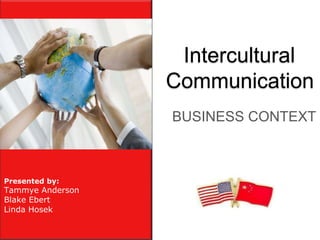
Intercultural
                  Communication
                  BUSINESS CONTEXT


Presented by:
Tammye Anderson
Blake Ebert
Linda Hosek
Table of Contents
I. Importance of Intercultural Communication in
    a Business Context
II. Global Economy
III.Communication Challenges
IV.Diversity
V. Social & Political Issues and the Effect on
    Global Business
VI.Business Etiquette
VII.Summary
VIII.Works Cited
The Importance of Intercultural
Communication in Business
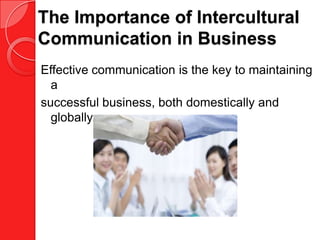
Effective communication is the key to maintaining
  a
successful business, both domestically and
  globally.
Global Growth & Multinational
Corporations
o Global businesses all over the world
  are growing very rapidly

o The internet has made it easier and
  less costly to do business in both
  domestic and international markets

o Many global businesses have offices
  in two or more countries
Increasing Demographic Diversity

o The growth of both Black and Hispanic
  buying power is predicted to outpace that
  of whites, which is projected to be 128%
  (Martin & Nakayama page 307)

o Women and people with disabilities also
  have a great deal of buying power
Global Economy
o Global Markets are growing rapidly
o China is the 2nd largest economy in the
  world
o In 2011, China's average GDP growth rate
  was 2.15% per quarter
o The main source of China's economic
  growth is exports
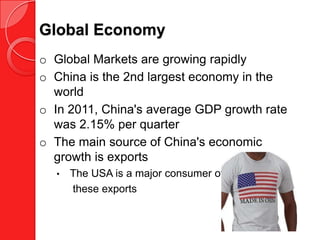
  •   The USA is a major consumer of
      these exports
Communication Challenges
o   Power Issues
o   Values
o   Communication Style
o   Language
Power Issues
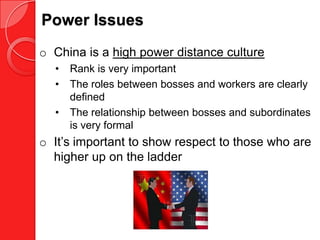
o China is a high power distance culture
  •   Rank is very important
  •   The roles between bosses and workers are clearly
      defined
  •   The relationship between bosses and subordinates
      is very formal
o It’s important to show respect to those who are
  higher up on the ladder
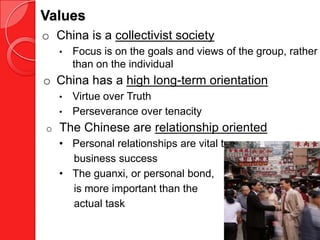
Values
o China is a collectivist society
    •   Focus is on the goals and views of the group, rather
        than on the individual
o China has a high long-term orientation
    •   Virtue over Truth
    •   Perseverance over tenacity
o   The Chinese are relationship oriented
    • Personal relationships are vital to
      business success
    • The guanxi, or personal bond,
      is more important than the
      actual task
Communication Style
o   The Chinese are high-context communicators

o Messages are communicated in a predominantly
  non-verbal manner:
    o Hand Gestures
    o Body Movements
    o Facial Expressions


o The Chinese prefer to conduct business
  face-to-face
o The Chinese value Harmony over Honesty
  • Honesty is not always the best policy


o Focus is not on the truth but on achieving
  relational harmony

o Facework is a communication strategy that
  allows one to save another's face as well as
  his own face
Language Issues

Language is a major challenge in intercultural
communication:
 o It is important to learn as much about the culture

   as possible in order to communicate effectively

   •   For example, when visiting a culture with a high conte
       communication style, such as China, one should
       watch for nonverbal cues.
Tips for Effective Communication
o Avoid slang or jargon

o Jokes and puns do not always translate well, it is
  best to avoid them

o Speak slowly and clearly
  • Use simple but not simple-minded words


o Do not assume that others are talking about you
  when speaking in their native language
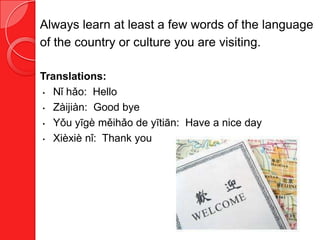
Always learn at least a few words of the language
of the country or culture you are visiting.

Translations:
• Nǐ hǎo: Hello

• Zàijiàn: Good bye

• Yǒu yīgè měihǎo de yītiān: Have a nice day

• Xièxiè nǐ: Thank you
Basic Chinese Phrases
Diversity
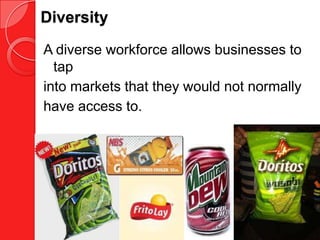
A diverse workforce allows businesses to
  tap
into markets that they would not normally
have access to.
Businesses adopt diversity initiatives for
several reasons:

o A diverse workforce can have a positive effect
  on the company's bottom line

o Some feel that it is morally and ethically the righ
  thing to do
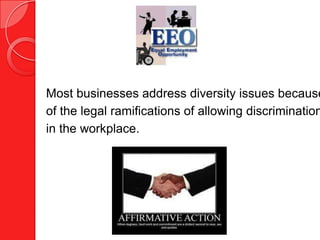
Most businesses address diversity issues because
of the legal ramifications of allowing discrimination
in the workplace.
A diverse workforce is a powerful workforce.
Social And Political Issues and
the Effect on Business

China's Business is affected by several different
social
and political issues that are constantly changing for
both positive and negative reasons.
Political Issues Effects on Business
Political Conflict with Other Nations:
 o Determines what types of business will
      succeed or fail in a global market

Changes in Government:
 o Determines who regulates international
   business laws and dealings
Social Issues Effects on Business

In a Global Economy many Social Issues and
Conflicts directly support or oppose certain
industries.

Examples specific to China and the U.S.:
  o Nike: unfair wage and age concerns of employees
  o Current whaling in the South China Sea
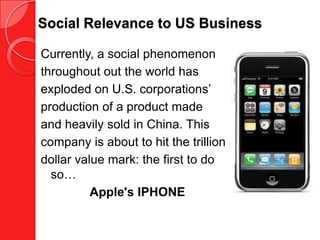
Social Relevance to US Business

Currently, a social phenomenon
throughout out the world has
exploded on U.S. corporations’
production of a product made
and heavily sold in China. This
company is about to hit the trillion
dollar value mark: the first to do
  so…
          Apple's IPHONE
Business Etiquette
Appropriate Dress is Important
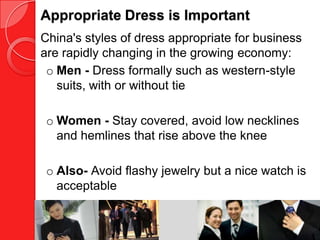
China's styles of dress appropriate for business
are rapidly changing in the growing economy:
 o Men - Dress formally such as western-style
   suits, with or without tie

 o Women - Stay covered, avoid low necklines
   and hemlines that rise above the knee

 o Also- Avoid flashy jewelry but a nice watch is
   acceptable
Informal Dress

 The Chinese business contact will take it as
 their responsibility to show you around
   outside
 of the office:

 o Stay in formal attire if your host does

 o Jeans can be worn by men and women
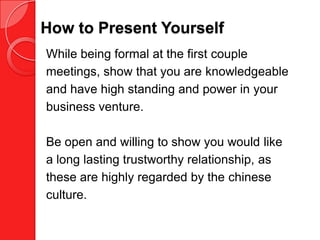
How to Present Yourself
While being formal at the first couple
meetings, show that you are knowledgeable
and have high standing and power in your
business venture.

Be open and willing to show you would like
a long lasting trustworthy relationship, as
these are highly regarded by the chinese
culture.
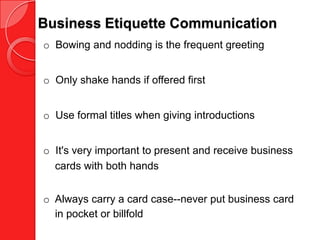
Business Etiquette Communication
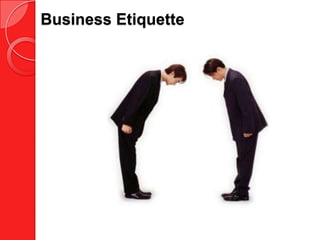
o Bowing and nodding is the frequent greeting


o Only shake hands if offered first


o Use formal titles when giving introductions


o It's very important to present and receive business
  cards with both hands


o Always carry a card case--never put business card
  in pocket or billfold
Basics of a Business Greeting
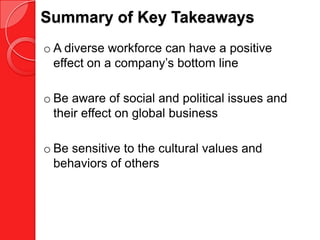
Summary of Key Takeaways
o A diverse workforce can have a positive
  effect on a company’s bottom line

o Be aware of social and political issues and
  their effect on global business

o Be sensitive to the cultural values and
  behaviors of others
Works Cited
   "Business Attire." Web. 28 Apr. 2012. <http://www.china-
          window.com/china_business/doing_business_in_china/business-attire.shtml>.


   "China GDP Growth Rate." TradingEconomics.com. Web. 28 Apr. 2012.
          <http://www.tradingeconomics.com/china/gdp-growth>.


   Chinavasion. "Learn Business Chinese, Saying Hello And Goodbye." YouTube. YouTube, 12 Mar.
    2009.
          Web. 28 Apr. 2012. <http://www.youtube.com/watch?v=CXoYy_W6nwU>.


   "Chinese Business Etiquette : Chinese Business Etiquette: Greeting." YouTube. YouTube, 27 Nov
    2008.
          Web. 28 Apr. 2012. <http://www.youtube.com/watch?v=GtVHjrLQKLI>.


   Martin, Judith N., and Nakayama, Thomas K. Experiencing Intercultural Communication: An
    Introduction.
          McGraw-Hill, 2011:New York, NY. Print


   ""TheWeb's Leading Resource for International Business Etiquette, Manners, & Culture"“
          International Business Etiquette and Manners for Global Travelers. Web. 28 Apr. 2012.
          <http://www.cyborlink.com/default.htm>

Business contextpowerpointpresentationshow

  • 1.
    Intercultural Communication BUSINESS CONTEXT Presented by: Tammye Anderson Blake Ebert Linda Hosek
  • 2.
    Table of Contents I.Importance of Intercultural Communication in a Business Context II. Global Economy III.Communication Challenges IV.Diversity V. Social & Political Issues and the Effect on Global Business VI.Business Etiquette VII.Summary VIII.Works Cited
  • 3.
    The Importance ofIntercultural Communication in Business Effective communication is the key to maintaining a successful business, both domestically and globally.
  • 4.
    Global Growth &Multinational Corporations o Global businesses all over the world are growing very rapidly o The internet has made it easier and less costly to do business in both domestic and international markets o Many global businesses have offices in two or more countries
  • 5.
    Increasing Demographic Diversity oThe growth of both Black and Hispanic buying power is predicted to outpace that of whites, which is projected to be 128% (Martin & Nakayama page 307) o Women and people with disabilities also have a great deal of buying power
  • 6.
    Global Economy o GlobalMarkets are growing rapidly o China is the 2nd largest economy in the world o In 2011, China's average GDP growth rate was 2.15% per quarter o The main source of China's economic growth is exports • The USA is a major consumer of these exports
  • 7.
    Communication Challenges o Power Issues o Values o Communication Style o Language
  • 8.
    Power Issues o Chinais a high power distance culture • Rank is very important • The roles between bosses and workers are clearly defined • The relationship between bosses and subordinates is very formal o It’s important to show respect to those who are higher up on the ladder
  • 9.
    Values o China isa collectivist society • Focus is on the goals and views of the group, rather than on the individual o China has a high long-term orientation • Virtue over Truth • Perseverance over tenacity o The Chinese are relationship oriented • Personal relationships are vital to business success • The guanxi, or personal bond, is more important than the actual task
  • 10.
    Communication Style o The Chinese are high-context communicators o Messages are communicated in a predominantly non-verbal manner: o Hand Gestures o Body Movements o Facial Expressions o The Chinese prefer to conduct business face-to-face
  • 11.
    o The Chinesevalue Harmony over Honesty • Honesty is not always the best policy o Focus is not on the truth but on achieving relational harmony o Facework is a communication strategy that allows one to save another's face as well as his own face
  • 12.
    Language Issues Language isa major challenge in intercultural communication: o It is important to learn as much about the culture as possible in order to communicate effectively • For example, when visiting a culture with a high conte communication style, such as China, one should watch for nonverbal cues.
  • 13.
    Tips for EffectiveCommunication o Avoid slang or jargon o Jokes and puns do not always translate well, it is best to avoid them o Speak slowly and clearly • Use simple but not simple-minded words o Do not assume that others are talking about you when speaking in their native language
  • 14.
    Always learn atleast a few words of the language of the country or culture you are visiting. Translations: • Nǐ hǎo: Hello • Zàijiàn: Good bye • Yǒu yīgè měihǎo de yītiān: Have a nice day • Xièxiè nǐ: Thank you
  • 15.
  • 16.
    Diversity A diverse workforceallows businesses to tap into markets that they would not normally have access to.
  • 17.
    Businesses adopt diversityinitiatives for several reasons: o A diverse workforce can have a positive effect on the company's bottom line o Some feel that it is morally and ethically the righ thing to do
  • 18.
    Most businesses addressdiversity issues because of the legal ramifications of allowing discrimination in the workplace.
  • 19.
    A diverse workforceis a powerful workforce.
  • 20.
    Social And PoliticalIssues and the Effect on Business China's Business is affected by several different social and political issues that are constantly changing for both positive and negative reasons.
  • 21.
    Political Issues Effectson Business Political Conflict with Other Nations: o Determines what types of business will succeed or fail in a global market Changes in Government: o Determines who regulates international business laws and dealings
  • 22.
    Social Issues Effectson Business In a Global Economy many Social Issues and Conflicts directly support or oppose certain industries. Examples specific to China and the U.S.: o Nike: unfair wage and age concerns of employees o Current whaling in the South China Sea
  • 23.
    Social Relevance toUS Business Currently, a social phenomenon throughout out the world has exploded on U.S. corporations’ production of a product made and heavily sold in China. This company is about to hit the trillion dollar value mark: the first to do so… Apple's IPHONE
  • 24.
  • 25.
    Appropriate Dress isImportant China's styles of dress appropriate for business are rapidly changing in the growing economy: o Men - Dress formally such as western-style suits, with or without tie o Women - Stay covered, avoid low necklines and hemlines that rise above the knee o Also- Avoid flashy jewelry but a nice watch is acceptable
  • 26.
    Informal Dress TheChinese business contact will take it as their responsibility to show you around outside of the office: o Stay in formal attire if your host does o Jeans can be worn by men and women
  • 27.
    How to PresentYourself While being formal at the first couple meetings, show that you are knowledgeable and have high standing and power in your business venture. Be open and willing to show you would like a long lasting trustworthy relationship, as these are highly regarded by the chinese culture.
  • 28.
    Business Etiquette Communication oBowing and nodding is the frequent greeting o Only shake hands if offered first o Use formal titles when giving introductions o It's very important to present and receive business cards with both hands o Always carry a card case--never put business card in pocket or billfold
  • 29.
    Basics of aBusiness Greeting
  • 30.
    Summary of KeyTakeaways o A diverse workforce can have a positive effect on a company’s bottom line o Be aware of social and political issues and their effect on global business o Be sensitive to the cultural values and behaviors of others
  • 31.
    Works Cited  "Business Attire." Web. 28 Apr. 2012. <http://www.china- window.com/china_business/doing_business_in_china/business-attire.shtml>.  "China GDP Growth Rate." TradingEconomics.com. Web. 28 Apr. 2012. <http://www.tradingeconomics.com/china/gdp-growth>.  Chinavasion. "Learn Business Chinese, Saying Hello And Goodbye." YouTube. YouTube, 12 Mar. 2009. Web. 28 Apr. 2012. <http://www.youtube.com/watch?v=CXoYy_W6nwU>.  "Chinese Business Etiquette : Chinese Business Etiquette: Greeting." YouTube. YouTube, 27 Nov 2008. Web. 28 Apr. 2012. <http://www.youtube.com/watch?v=GtVHjrLQKLI>.  Martin, Judith N., and Nakayama, Thomas K. Experiencing Intercultural Communication: An Introduction. McGraw-Hill, 2011:New York, NY. Print  ""TheWeb's Leading Resource for International Business Etiquette, Manners, & Culture"“ International Business Etiquette and Manners for Global Travelers. Web. 28 Apr. 2012. <http://www.cyborlink.com/default.htm>