Adam Wonnacott
Burlington Group
ICM Managing Change Masterclass, 10th October 2013
www.burlingtongroup.co.uk
AdoptingLitigationandEnforcementasaDebtRecoveryTool
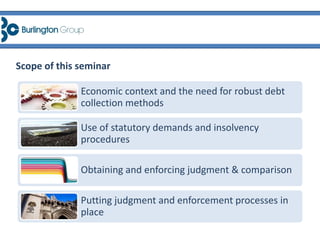
Scope of this seminar
Economic context and the need for robust debt
collection methods
Use of statutory demands and insolvency
procedures
Obtaining and enforcing judgment & comparison
Putting judgment and enforcement processes in
place
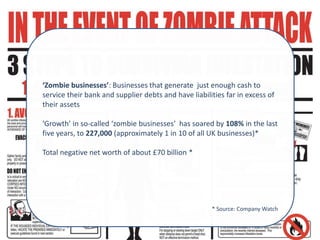
‘Zombie businesses’: Businesses that generate just enough cash to
service their bank and supplier debts and have liabilities far in excess of
their assets
‘Growth’ in so-called ‘zombie businesses’ has soared by 108% in the last
five years, to 227,000 (approximately 1 in 10 of all UK businesses)*
Total negative net worth of about £70 billion *
* Source: Company Watch
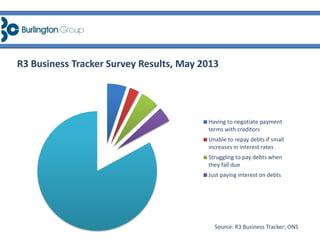
Having to negotiate payment
terms with creditors
Unable to repay debts if small
increases in interest rates
Struggling to pay debts when
they fall due
Just paying interest on debts
R3 Business Tracker Survey Results, May 2013
Source: R3 Business Tracker; ONS
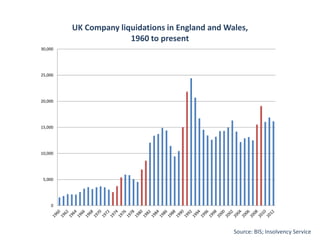
0
5,000
10,000
15,000
20,000
25,000
30,000
UK Company liquidations in England and Wales,
1960 to present
Source: BIS; Insolvency Service
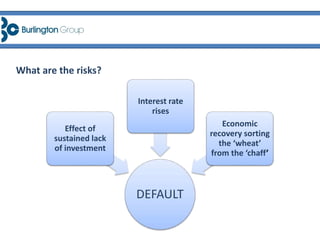
What are the risks?
DEFAULT
Effect of
sustained lack
of investment
Interest rate
rises
Economic
recovery sorting
the ‘wheat’
from the ‘chaff’
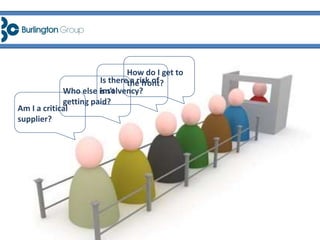
Who else isn't
getting paid?
Am I a critical
supplier?
Is there a risk of
insolvency?
How do I get to
the front?
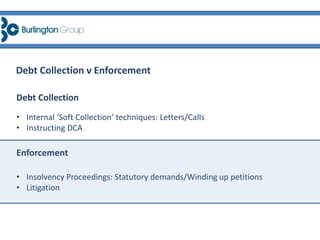
Debt Collection v Enforcement
Debt Collection
• Internal ‘Soft Collection’ techniques: Letters/Calls
• Instructing DCA
Enforcement
• Insolvency Proceedings: Statutory demands/Winding up petitions
• Litigation
Statutory Demands and Corporate Insolvency Procedures
Statutory Demands are a demand to the debtor to make payment/satisfy the
demand within a given timeframe (21 days from date of service)
If the demand is not met and is not challenged, the creditor can proceed to
issue a petition at court to obtain a winding up order
If the parties agree payment terms the creditor can set aside service of the
demand
Advantages
• Inexpensive: A statutory demand is not ‘court issued’ and, as such there is
no fee (besides process server fee)
• Leverage: As the first stage in insolvency, a Statutory Demand can be an
effective way of prioritising a debt
Statutory Demands
Disadvantages
• If the debt is disputed in good faith and on substantial grounds, the creditor
may obtain an injunction against winding up – and ask you to pay the cost!
• The next step (Winding up Petition) can be costly and ultimately
unrewarding – which can leave the debtor to conclude that a Statutory
Demand is an ‘idle threat’
Statutory Demands
Issuing a claim at County Court can be an effective method of engaging with the
debtor
Costs of issuing a claim between £500 and £5000 range from just £60-£100 and
can take as little as 4-5 weeks if the claim is undefended or admitted (85% of
judgments issued are ‘judgment in default’ or ‘on admission’)
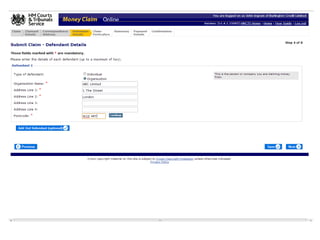
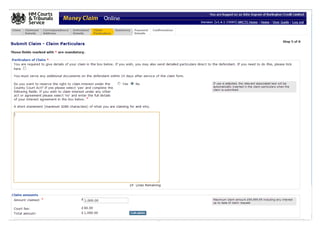
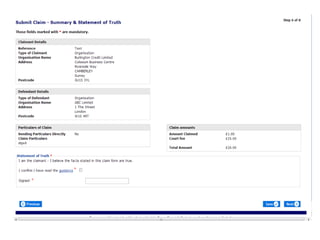
Proceedings can be issued using Court Service portal (moneyclaimonline.co.uk)
or using a specialist debt recovery solicitor either on a fixed fee basis or under a
contingency arrangement (Damage-Based Agreement)
Litigation
Advantages
• Issuing a claim form may prompt the defendant to pay
• If it doesn’t the ‘next steps’ (enforcement) are much less costly than under
the insolvency process
• A prompt attitude towards enforcing a CCJ can place you in a priority
position if the debtor business is facing liquidation/administration
Litigation
Disadvantages
• If a claim is defended, it may take time to obtain judgment (although note
summary judgment procedure)
• If issuing the claim/obtaining judgment doesn’t work, you will need to think
about a suitable enforcement method
Litigation
Enforcement methods as against commercial entities:
• Enforcement against goods (High Court Enforcement, where Debt > £600)
• Charging orders against property
• Third Party Debt Orders
NB: You can also use a judgment as ‘belt and braces’ for serving a statutory
demand an ‘unsuccessful return’ from a High Court Enforcement Officer can
also allow you to proceed straight to a winding up petition
What happens if getting judgment doesn’t work?
High Court Enforcement Officers enforce judgments awarded in the High Court
and County Courts by seizing the goods of the defendant/debtor
If payment isn’t made, goods can be removed and sold to pay the amount
owing under the writ
If the defendant opts to make payment, it will be liable to pay costs awarded
under the judgment (including court fees) and the High Court Enforcement
Officers costs in addition
High Court Enforcement
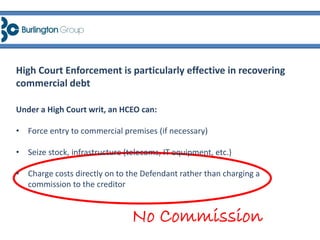
Under a High Court writ, an HCEO can:
• Force entry to commercial premises (if necessary)
• Seize stock, infrastructure (telecoms, IT equipment, etc.)
• Charge costs directly on to the Defendant rather than charging a
commission to the creditor
High Court Enforcement is particularly effective in recovering
commercial debt
No Commission
The most appropriate method will depend on circumstances:
• What is the debt amount?
• What is the provenance of the debt? Goods or services?
• Is the debt disputed or is it likely to be? If so, is there a substantive defence?
• Does the debtor have assets that could be seized?
• Does the debtor business have any less tangible assets; debt book etc?
Also consider what you can develop as a scalable process
Insolvency v Litigation
In summary:
Economic recovery is likely to bring an ‘insolvency lag’ that will
almost certainly affect your customer base to some degree
If it affects you, it will affect others: The ‘domino’ effect
If you haven’t already, put in place some more robust debt
recovery methods and be prepared to use them before
everyone else
Email: adam.wonnacott@burlingtongroup.com
Call: 07788 871250 / 0845 520 2000
Get your copy of Getting to the front of the queue: A
commercial creditor’s guide to High Court Enforcement
@BurlGroup
www.burlingtongroup.co.uk

Burlington icm managing change

  • 1.
    Adam Wonnacott Burlington Group ICMManaging Change Masterclass, 10th October 2013 www.burlingtongroup.co.uk AdoptingLitigationandEnforcementasaDebtRecoveryTool
  • 2.
    Scope of thisseminar Economic context and the need for robust debt collection methods Use of statutory demands and insolvency procedures Obtaining and enforcing judgment & comparison Putting judgment and enforcement processes in place
  • 3.
    ‘Zombie businesses’: Businessesthat generate just enough cash to service their bank and supplier debts and have liabilities far in excess of their assets ‘Growth’ in so-called ‘zombie businesses’ has soared by 108% in the last five years, to 227,000 (approximately 1 in 10 of all UK businesses)* Total negative net worth of about £70 billion * * Source: Company Watch
  • 4.
    Having to negotiatepayment terms with creditors Unable to repay debts if small increases in interest rates Struggling to pay debts when they fall due Just paying interest on debts R3 Business Tracker Survey Results, May 2013 Source: R3 Business Tracker; ONS
  • 5.
    0 5,000 10,000 15,000 20,000 25,000 30,000 UK Company liquidationsin England and Wales, 1960 to present Source: BIS; Insolvency Service
  • 6.
    What are therisks? DEFAULT Effect of sustained lack of investment Interest rate rises Economic recovery sorting the ‘wheat’ from the ‘chaff’
  • 7.
    Who else isn't gettingpaid? Am I a critical supplier? Is there a risk of insolvency? How do I get to the front?
  • 8.
    Debt Collection vEnforcement Debt Collection • Internal ‘Soft Collection’ techniques: Letters/Calls • Instructing DCA Enforcement • Insolvency Proceedings: Statutory demands/Winding up petitions • Litigation
  • 9.
    Statutory Demands andCorporate Insolvency Procedures Statutory Demands are a demand to the debtor to make payment/satisfy the demand within a given timeframe (21 days from date of service) If the demand is not met and is not challenged, the creditor can proceed to issue a petition at court to obtain a winding up order If the parties agree payment terms the creditor can set aside service of the demand
  • 10.
    Advantages • Inexpensive: Astatutory demand is not ‘court issued’ and, as such there is no fee (besides process server fee) • Leverage: As the first stage in insolvency, a Statutory Demand can be an effective way of prioritising a debt Statutory Demands
  • 11.
    Disadvantages • If thedebt is disputed in good faith and on substantial grounds, the creditor may obtain an injunction against winding up – and ask you to pay the cost! • The next step (Winding up Petition) can be costly and ultimately unrewarding – which can leave the debtor to conclude that a Statutory Demand is an ‘idle threat’ Statutory Demands
  • 12.
    Issuing a claimat County Court can be an effective method of engaging with the debtor Costs of issuing a claim between £500 and £5000 range from just £60-£100 and can take as little as 4-5 weeks if the claim is undefended or admitted (85% of judgments issued are ‘judgment in default’ or ‘on admission’) Proceedings can be issued using Court Service portal (moneyclaimonline.co.uk) or using a specialist debt recovery solicitor either on a fixed fee basis or under a contingency arrangement (Damage-Based Agreement) Litigation
  • 16.
    Advantages • Issuing aclaim form may prompt the defendant to pay • If it doesn’t the ‘next steps’ (enforcement) are much less costly than under the insolvency process • A prompt attitude towards enforcing a CCJ can place you in a priority position if the debtor business is facing liquidation/administration Litigation
  • 17.
    Disadvantages • If aclaim is defended, it may take time to obtain judgment (although note summary judgment procedure) • If issuing the claim/obtaining judgment doesn’t work, you will need to think about a suitable enforcement method Litigation
  • 18.
    Enforcement methods asagainst commercial entities: • Enforcement against goods (High Court Enforcement, where Debt > £600) • Charging orders against property • Third Party Debt Orders NB: You can also use a judgment as ‘belt and braces’ for serving a statutory demand an ‘unsuccessful return’ from a High Court Enforcement Officer can also allow you to proceed straight to a winding up petition What happens if getting judgment doesn’t work?
  • 19.
    High Court EnforcementOfficers enforce judgments awarded in the High Court and County Courts by seizing the goods of the defendant/debtor If payment isn’t made, goods can be removed and sold to pay the amount owing under the writ If the defendant opts to make payment, it will be liable to pay costs awarded under the judgment (including court fees) and the High Court Enforcement Officers costs in addition High Court Enforcement
  • 20.
    Under a HighCourt writ, an HCEO can: • Force entry to commercial premises (if necessary) • Seize stock, infrastructure (telecoms, IT equipment, etc.) • Charge costs directly on to the Defendant rather than charging a commission to the creditor High Court Enforcement is particularly effective in recovering commercial debt No Commission
  • 21.
    The most appropriatemethod will depend on circumstances: • What is the debt amount? • What is the provenance of the debt? Goods or services? • Is the debt disputed or is it likely to be? If so, is there a substantive defence? • Does the debtor have assets that could be seized? • Does the debtor business have any less tangible assets; debt book etc? Also consider what you can develop as a scalable process Insolvency v Litigation
  • 22.
    In summary: Economic recoveryis likely to bring an ‘insolvency lag’ that will almost certainly affect your customer base to some degree If it affects you, it will affect others: The ‘domino’ effect If you haven’t already, put in place some more robust debt recovery methods and be prepared to use them before everyone else
  • 23.
    Email: adam.wonnacott@burlingtongroup.com Call: 07788871250 / 0845 520 2000 Get your copy of Getting to the front of the queue: A commercial creditor’s guide to High Court Enforcement @BurlGroup www.burlingtongroup.co.uk