

1
2

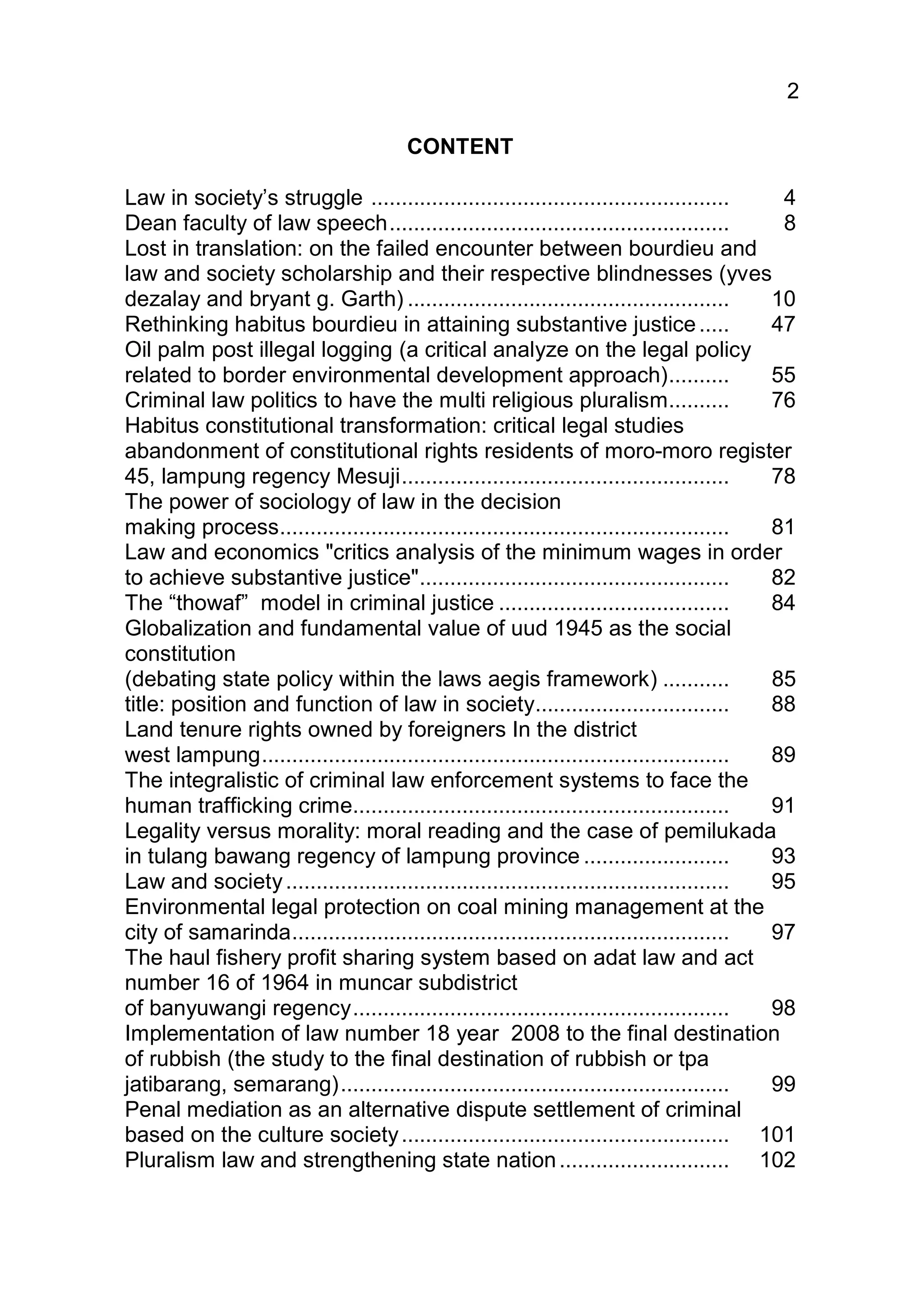
                                       CONTENT

Law in society’s struggle ...........................................................       4
Dean faculty of law speech ........................................................         8
Lost in translation: on the failed encounter between bourdieu and
law and society scholarship and their respective blindnesses (yves
dezalay and bryant g. Garth) .....................................................         10
Rethinking habitus bourdieu in attaining substantive justice .....                         47
Oil palm post illegal logging (a critical analyze on the legal policy
related to border environmental development approach) ..........                           55
Criminal law politics to have the multi religious pluralism ..........                     76
Habitus constitutional transformation: critical legal studies
abandonment of constitutional rights residents of moro-moro register
45, lampung regency Mesuji ......................................................          78
The power of sociology of law in the decision
making process ..........................................................................  81
Law and economics "critics analysis of the minimum wages in order
to achieve substantive justice" ...................................................        82
The “thowaf” model in criminal justice ......................................              84
Globalization and fundamental value of uud 1945 as the social
constitution
(debating state policy within the laws aegis framework) ...........                        85
title: position and function of law in society................................             88
Land tenure rights owned by foreigners In the district
west lampung ............................................................................. 89
The integralistic of criminal law enforcement systems to face the
human trafficking crime..............................................................      91
Legality versus morality: moral reading and the case of pemilukada
in tulang bawang regency of lampung province ........................                      93
Law and society .........................................................................  95
Environmental legal protection on coal mining management at the
city of samarinda ........................................................................ 97
The haul fishery profit sharing system based on adat law and act
number 16 of 1964 in muncar subdistrict
of banyuwangi regency ..............................................................       98
Implementation of law number 18 year 2008 to the final destination
of rubbish (the study to the final destination of rubbish or tpa
jatibarang, semarang) ................................................................     99
Penal mediation as an alternative dispute settlement of criminal
based on the culture society ...................................................... 101
Pluralism law and strengthening state nation ............................ 102
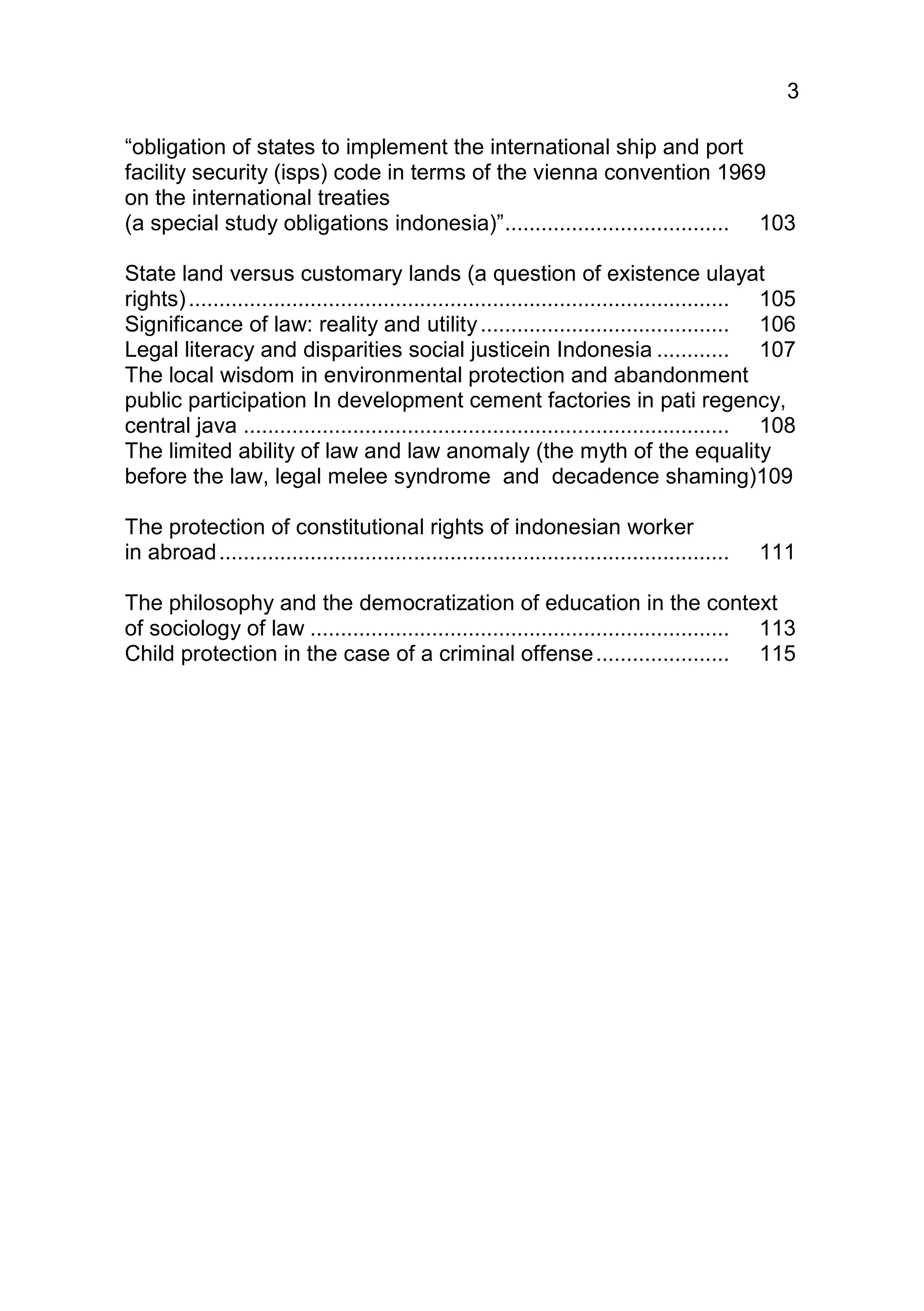
3

“obligation of states to implement the international ship and port
facility security (isps) code in terms of the vienna convention 1969
on the international treaties
(a special study obligations indonesia)” ..................................... 103

State land versus customary lands (a question of existence ulayat
rights) ......................................................................................... 105
Significance of law: reality and utility ......................................... 106
Legal literacy and disparities social justicein Indonesia ............ 107
The local wisdom in environmental protection and abandonment
public participation In development cement factories in pati regency,
central java ................................................................................ 108
The limited ability of law and law anomaly (the myth of the equality
before the law, legal melee syndrome and decadence shaming)109

The protection of constitutional rights of indonesian worker
in abroad ....................................................................................   111

The philosophy and the democratization of education in the context
of sociology of law ..................................................................... 113
Child protection in the case of a criminal offense ...................... 115
4

              LAW IN SOCIETY’S STRUGGLE.

"Do Mihi factum Dobo Tibi juice"

                   (Give me the facts, and I'll give you the law)

Lately we often hear some minor cases that have disturbed
our conscience and our sense of justice have intervened.
Mbok Minah’s cases, an old woman who steal three pieces of
cocoa beans, Rasminah’s case who took away six plates of
her master, and a child who took away the perforated sandals,
have to deal with an uncompromising world, especially for the
poor people, namely the field of law. Not in a half-hearted, the
deeds that they themselves considered was not a crime
should face a maximum penalty of 5 years. This penalty is
such an unreasonably punishment for those who live in
difficulty. They must bear the brunt of poverty in which the
country also contributing on.
Policies that more enjoyed by the have people become the
orientation of government, as if the poor are only being
properties of a country that needs the existence of poor
people. The poor become the object of ethical political masks
of ruling elites and intellectual elite, making the poor as
projects that benefit to the elite, but not very impact to the
change of their lives. A tragic condition in a country which is
rich of natural resources but its peoples does not enjoy the
natural wealth. The constitutional mandate is ignored of hand.
Even, The Papuans have to declare that freedom of the
Unitary State of Indonesia is better because they can manage
the forest as they had already done past through ulayat rights
of indigenous peoples. The government has seized and
disarmed their ulayat rights in the name of sovereignty, in the
name of unity, on behalf of the common good, and makes the
law as an instrument to distribute the forest management
concessions to its cronies around the palace.
Goddess Themis closed his eyes with a black cloth, a symbol
that the law is blind to the social world, and the law has an
5

internal logic separated from social determination. This is what
so called by Bourdieu as “Juridical field”, a structured area
which has a patterned social practice activity, defined
professionally and mono-disciplinal. The logic of the law only
recognizes juridical constructions enacting laws as norms that
must be elaborated by social facts. Unfortunately, social facts
as if are constructed following the rule of law, so that the facts
are forced to conform to the norm of law.
Rigid legal knowledge is specialized with what generally called
"jurisprudence". A study and debate on jurisprudence has split
in to two streams between "formalism" which asserts the
autonomous juridical body in absolute terms in relation to the
social world, and "instrumentalism" that understands law as a
reflection or a means of service to the dominant group.
As understood by legal scholars, particularly those who
identify the legal history with the history of the internal
development from the concepts and methods of law,
jurisprudence formalist sees the law as a closed and
autonomous system that its development can only be
understood in terms of its "internal dynamics". The insistence
on the absolute autonomy of thought and law practice is a
result on the formation of a special mode of legal thought that
its existence is free from any social determination. It can be
tracked from Hans Kelsen thought about "pure theory of law"
which is the ultimate result of the formalists ‘efforts to build the
form of doctrine and rules that are totally independent of the
social problems and pressures, something which its foundation
is within them. For Bourdieu, This formalist ideology, the
professional ideology of legal scholars, has become rigidified
as a body of "doctrine”.
While the instrumentalist point of view tends to understand the
law and jurisprudence as a direct reflection of existing social
power relations, in which the economy determination and in
particular, the interests of dominant groups are expressed.
The law as a means of domination, the theory of the
apparatus, which is turned on by Althusser, has shown
instrumentalists’ view. However, Althusser and structuralist
6

Marxist, the victims of the tradition which still believes in the
economy determination, have been regarded as "the ideology
that only identify its function in society”. Paradoxically, the
structuralists reject the symbols system structure in a certain
case. The form of the juridical discourse has reaffirmed its
"relative autonomy" of ideology. These experts forgot the
social basis of the autonomy, a condition that arises from the
history of the struggle in the political realm, the realm of power,
which must exist for the sake of an autonomous world in which
to bring up and to reproduce a corpus Juridical that relatively
independent from historical conditions that make its
autonomous possible to be created.
Architectural metaphor of base and superstructure usually
become the basics idea of relative autonomy. This metaphor
continues to guide those who believed that they had been
breaking things related to economism (Economism refers to a
tendency within Marxist political practice to emphasize
economic determination so completely that other social
elements-particularly ideological and political-are simply
neglected as irrelevant.).
Yet, the followers of those two schools had forgotten that law
whose special logic, is determined by two factors: first, the
particular power relation that gives its structure and a structure
of a competitive fight, (or more specifically, a conflict that goes
beyond their competence) that occurs in the law, and second,
the internal logic to function juridical things that continually
hamper the various levels of action that will close certain areas
of legal solutions.
This symposium will be very beginning discourses for legal
academics, legal practitioners, and other studies that make the
law as its object, to always conduct a self-reflection of the
existence of law in society; the modern legal problems that
isolated from its social basis have to be solved in order to
achieve the order of harmonic social life; justice and peace.
The law as a means of achieving the happiness of the society
must always put forward in order that the world life is in peace,
always.
7

And I congratulate you, on the formation of center for
contemporary legal studies faculty of Law Semarang State
University. This may be the first step and the contributions of
faculty of Law, especially, and Semarang State University,
generally, to always keep his common sense on the meaning
of law for society.
                                    That’s all and thanks you.
8

Dean Faculty of Law Speech


Dear President Semarang State University who give scientific
inspiration to make this international forum;
Dear the speakers Prof Dezalay and Prof Bryant Garth for
willing to come here to attend our international symposium;
Dear our presenter of call for paper and participant

It has pleassure to meet you in this international forum, where
faculty of law at semarang state university got a dream to
make scientific meeting for discussion on the latest issues of
legal theories. We have such as intellectual culture to access
international debate on jurisprudence discourse, as we know
this forum also as one of part from those intellectual mission.
This international symposium on the thema about Pierre
Bourdieu is very important for the indonesian legal scholar in
general. Because we face difficulties to meet the legal scholar
who expert on Pierre Bourdieu perspective in Indonesia. Who
Yves Dezalay and Bryant Garth invited here for giving us
enlightement to know how the basic concept of philosophy of
sociology Pierre Bourdieu.
Hopefully this conference will be contribute to the intellectual
and practice discource on Indonesian legal theories. Bourdieu
is the one of most influence scholar in the sociology science,
his thought applicable to improve the legal theory from his
persective. So this conference as the future of the Indonesian
legal development related with the contemporary legal studies.
That’s way, at this moment we will launching the UNNES
Center for Contemporary Legal Studies who maintaining and
keeping this power of socio-legal intellectual discourse through
the next program such as research, socio-legal training,
seminar, publication, journal, etc.
Bourdieu tend to develop the sociology of law which is related
with the progressive law by Prof Satjipto Rahardjo. A
perspective to analyze the legal system from social science
perspective. From his theory, we really know that the legal
9

studies became multidiciplinary and systematic ways, it’s
connected with the politics, economics, and culture institution.
Perhaps all of you can enjoy in this symposium and have a
nice discussion.


                                           Dean faculty of law
                                              Sartono Sahlan
10

Lost in Translation: On the Failed Encounter Between
Bourdieu and Law and Society Scholarship and Their
Respective Blindnesses

       Yves Dezalay and Bryant G. Garth

Introduction
        The hypothesis formulated by Bourdieu about "texts
which circulate without their contexts" applies to the
international circulation of Bourdieu's theories. The reading
and reception of texts outside of their national spaces is
strongly determined by internal battles specific to the field
where the text is received. Those battles determine the
possible usages of imported theories, and notably the
strategic resources that the potential importers-translators
are able to mobilize -- shaped in turn by the internal positions
that they occupy.
        This hypothesis provides an explanation for the great
contrast between the strong interest produced by the
publication of Bourdieu's "The Force of Law" in 1987 and the
relatively weak impact of Bourdieu's form of structural
sociology on the research methods and agendas in the Law
and Society field -- despite the fact that Bourdieu is among
the most cited scholars internationally in the social sciences
(Truong and Weill 2012, stating that Michel Foucault is one
and Bourdieu two).
        The argument has two parts. First, the influence of
the problematique sketched in "The Force of Law" was
limited by the fact that Bourdieu's sociology of law referred
essentially -- even if not exclusively -- to the legal field as
structured in Germany, leading to an emphasis on the so-
called "professorenrecht." This German structure differs
considerably from the U.S. or English legal worlds from
which the great majority of Law and Society scholars come.
Given this contextual mismatch, any effort to draw on
Bourdieu's approach was bound to involve some
misunderstanding, reinforced by the inexact English
11

translation of juristes into lawyers. The translation obscures
the opposition between European jurists of the state and
Anglo-Saxon lawyers, who are the product of the
autonomization of legal fields at the margin of the state.
More precisely, it obscures the role of the legal field in the
construction of the state in Continental Europe and in limiting
the bureaucratic construction of state power in the United
States.
        The recent publication of the lectures that Bourdieu
gave at the College de France in the period 1989-92 "Sur
l'Etat" (2012) permits some partial correction of this
misunderstanding. The lectures suggest lines of reasoning
through which Bourdieu had deepened and enriched the
hypotheses developed more schematically in 1986 in "The
Force of Law." While remaining essentially within the
historical setting of Continental Europe, Bourdieu sketched a
problematique which enlarged both the scope of his analysis
and the object of study. He moved beyond jurists in the field
of state power toward showing the more general play of
oppositions and complementarity between the different
fractions which make up the world of law in relationship to
the holders of state power. The deepening of this
problematique permitted him to open the field of analysis to
other national configurations, such as that which developed
in Great Britain with the reforms of the 17th century civil war.
This enlarged and refined perspective better allows one to
take into account the transformations and breaks that mark
the dramatically changing histories of legal fields, which
involve successive geneses, borrowings, breaks, and even
revolutions which can be characterized as a succession of
golden ages and declines -- far from the grand Weberian
scheme of a linear progression toward rationality and the
autonomy of law.
        The first part of this paper will therefore seek to show
that, even if still anchored in Continental European history,
this more recent problematique developed by Bourdieu
offers considerable analytical power that can advance Law
12

and Society understanding of the "Cravath model" of
lawyering (Trubek et al 1994) and the internationalization of
its spaces of practice -- whereby this model is at the same
time the means and the product.
         The second part of the paper focuses more on Law
and Society than Bourdieu's approach as such. It suggests
that the analytical power of political and structural sociology
contrasts with the mainstream approach of Law and Society
scholarship. The mainstream approach draws on the
paradigm of Legal Realism -- with corresponding objects and
silences, even taboos -- , which is the product of a particular
history of the field of state power in the United States and the
academic, legal, and political hierarchies produced by that
history. The spread of the Law and Society movement
cannot be separated from the complementary and
contradictory relationship between law professors and social
science researchers. The relationship tends not to favor the
kind of reflexive sociology that we believe, drawing on
Bourdieu, is indispensable to understanding precisely how
hierarchies and links among the academic, legal,
bureaucratic, and activist components of the legal field
determine the problematiques and the objects of the
research that characterize Law and Society. More
importantly and generally, this reflexive sociology is a
prerequisite for the construction of objects of study that do
not simply reflect the more or less dominated positions of the
producers of research in the field of power.
         With a few rare exceptions (e.g., Garth and Sterling
1998), this reflexive sociology is almost completely absent in
Law and Society research. Yet the scientific relevance of
Law and Society research and the sustainability of research
that can be condemned quickly to obsolescence for enacting
the role of "handmaidens and sort of technicians that had to
supply the technical answers to legal scholars who then had
to (1) frame the problem and (2) analyze what the data really
meant" (Rita Simon in Garth and Sterling 1998: 459). Our
second point, therefore, is that it is important to interrogate
13

the sociological contradictions that place obstacles in the
way of this more reflexive line of sociological research. We
ask why the reflexivity central to Bourdieu's research is
almost completely neglected in the borrowings and
references to Bourdieu.

-I - From the legal field to the national field of state
power
         Bourdieu wrote relatively little about law after his long
theoretical article, "The Force of Law," published in 1986.
After that effort, he did not return to this theme outside of a
few short texts: "Les robins et l'invention de l'Etat” (pp. 539-
48 in La noblesse d'Etat (1989)); "Les juristes, gardiens de
l'hypocrisie collective” in Chazel and Commaille (1991);
"Esprits d'etat: genese et structure du champ
bureaucratique” (1993). In contrast, he made a number of
references to the history of law and lawyers on the occasion
of his last series of courses on the state offered at the
College de France in 1991 and recently published as Sur
l'Etat (2012).
         These recently published documents illustrate how
Bourdieu had deepened his analysis beyond the theoretical
hypotheses developed in "The Force of Law." Bourdieu
moved in this later work to treat the legal market more
generally and underscored how the demand for legal
services was in large part constructed by what the producers
offered. His course of lectures examined the genesis and the
reproduction of the holders and producers of legal capital in
relation to the different powers of the state, a theme that he
had only treated in a relatively elusive manner in "The Force
of Law."
         This historical focus on the "clerks" of the law, termed
the "robins," is somewhat more narrow than the topics of
"The Force of Law," but this focus permitted Bourdieu to
refine his analysis considerably, notably going beyond the
fundamental and over-simplified opposition between
theoreticians and practitioners that Bourdieu had borrowed
14

from Weber. Thus, in his course, he took some distance from
the very Weberian conception of a "professorenrecht"
dominated by the theoreticians of "pure law" by underlining
that " legal capital is not only a capital of theories .... but it is
a species of permanent exchange between practical
innovations ... and theoretical innovations destined to
legitimate small conquests in practice” (2012: 533).

The Internal Fights between Fractions of Jurists as
Fundamental to the Diversification of the Legal Field
         Drawing on the works of historians (Kelly 1981, Baker
1990), he proposed an "analysis of the world of the 'robins' in
terms of the field, that is to say a differentiated space" (2012:
516). He then opposed various fractions of jurists
differentiated by their social origins, their education, and their
proximity to royal power.
         The first group is jurists of the state who contributed
to the creation of the authoritarian state. They represent
what can be termed the bureaucratic pole of the legal field or
the party of the crown. They are opposed by a different
fraction of the "noblesse de robe," the "officiers de justice,"
those who inherited the control of the High Courts of Justice.
The ideology and objectives of the latter group were inspired
in part by the British model. They relied in particular on one
key institution, the Parisian Parlement, to which the king had
delegated the power of applying the law -- setting up legal
autonomy as a limit on royal power. The third category is that
of the "lower legal clergy ... speaking and being
spokespersons for the collective will, popular will, etc.,
according to the transhistoric alliance between 'the
intelligentsia proletaroïde' as Max Weber pointed out and the
popular classes" (2012: 515). The French Revolution
disrupted this hierarchy in favor of the third category, which
succeeded in imposing its conception of the nation state as
the sole legitimate form of the modern state and then
appropriated "the quasi-monopoly of profits associated with
this institution" (2012: 544).
15

         The power of this analysis is that it opens up a fluid
conception of the legal field as a "space of many dimensions
[where] things shift in relation to each other" (2012: 518).
The positions of the holders of legal capital are quite mobile,
since the clerks can operate between many different spaces.
They can modify their strategies and the positions they take
in relation to the historical and political context that valorizes
one or another of these spaces.
         This conception of the legal field as a crossroads1 is
quite rich from a heuristic point of view because it introduces
the possibility of using the same general paradigm to
examine different national histories of the state and the law
(2012: 556). By way of illustration, we can show how this
problematique helps to explain the genesis of the British
model of the rule of law -- constructed against the
bureaucratic doctors of Roman law who served as officers of
the royal bureaucracy.

Common lawyers vs. officers of the king
         The barristers from the time of the Fifteenth Century
were trained at the Inns of Court through a process that
could last ten years and could be compared to education at a
“finishing school” (Prest, 1986). Those who accumulated
sufficient social and learned capital were predisposed to
serve as agents and intermediaries for the monarchy or for
the landed aristocracy -- defending independence against
royal or religious power. They provided advice and resolved
disputes, serving also as Justices of the Peace. The
autonomy of the bar was therefore constructed on the basis
of capital and activities attuned not only to legitimation, but


1
  This conception was developed by Christopher Charle in
1989 in a short programatic note where he defined legal
professions as "crossroads professions where social capital is
converted easily into diverse other forms of capital: economic,
intellectual, political" (1989: 119).
16

also to maintaining equilibrium within the field of political
power.
         Since they were recruited from within the elite of the
landed gentry – and to some degree from the new merchant
bourgeoisie –, the barristers trained and socialized at the
Inns of Court were predisposed to become the
representatives of the two social groups to which they were
well introduced. These learned gentlemen became both the
champions and the guardians of an equilibrium among
various powers against the absolutist claims of the monarchy
supported by the bureaucrats and jurists of the state. The
parliamentary monarchy that emerged then favored the
emergence of a new elite – the practitioners of the common
law – at the expense of the old elite -- the doctors of Roman
law -- which had served the leaders of the royal bureaucracy.
         While retaining their privileged relationships with the
new ruling classes whose interests were now represented in
Parliament, these legal practitioners succeeded in
legitimating their jurisdictional monopoly and affirming their
autonomy with respect to the holders of power. This strategy
of autonomization was facilitated by the fragmentation and
decentralization of the field of power in the context of a civil
war and religious battles favoring the emancipation of cities
and the growth in power of an alliance between the gentry
and the merchant bourgeoisie. The strategy also drew on a
mode of familial reproduction through co-optation and
apprenticeship under the aegis of the Inns of Court, which
reinforced the sociological homogeneity of this professional
guild dominated by a hierarchy of barristers controlling the
judicial power and the learned authority of the law.
         This double control of the production of law and the
reproduction of lawyers allowed the barristers to thrive from
the litigation market. Their monopoly gained credibility
because it rested on the affirmation of the need for the law to
be independent with respect to the holders of state power –
whether central or local. At the same time, however, the
guild structure kept the bar very closed and small in number
17

and promoted the decline of the role of the Inns of Court.
Intellectual activities diminished at the Inns and they lost
their role in educating the inheritors of the elite of the gentry.

Internal fights as a factor in the recomposition of legal
fields: geneses, golden ages, decline
        Even though Bourdieu failed to develop certain lines
of comparative analysis himself, he had the insight to see
how the fluidity of the world of the state jurists permitted
them to serve as go-betweens among different fields of
power and successive variations of the field of state power.
Drawing on Skinner (1978), he stressed "the role of the great
religious ruptures in the construction of the state" (Bourdieu
2012: 528). Still, however, he did not develop this direction of
his research, which without citation has much in common
with the theses offered by Berman in his Law and Revolution
(1983). Consistent with Bourdieu's basic hypothesis, internal
fights are crucial to the history of legal fields, including both
the period of their geneses and also their crises and
recompositions.
        Pursuant to this diachronic approach to the legal
field, Bourdieu explores the central hypothesis of a parallel
genesis for law and the state, a theme that he took up again
in his article in 1993. As a counterpoint to this line of
research, he also interrogated the effects of contradictions
which are the source of tensions, crises, but also of
innovations and inventions in the legal field. He remarks also
in passing that the internal confrontations between different
fractions may degenerate into fratricidal battles so violent
that they can sap the fundamentals of the credibility of the
field, by means of a kind of suicidal collective madness
among various fractions of elites, totally intent on
disqualifying their opponents, even if it means undermining
their own symbolic capital.
18

        A double game between the fields of power
        By comparison with what he wrote in "The Force of
Law," Bourdieu insisted in these courses on the genesis of
legal capital through competitive struggles between religious
and royal power: "The jurists, at bottom, served the Church
and used resources furnished largely by the Church to
construct the State against the Church.... The State was
constructed on the model of the Church, but against it"
(2012: 526). The strength of these lines of analysis was
shown brilliantly later by Brundage (2008), who in great
detail reveals the complexity of the strategies of those with
law degrees playing simultaneously in the religious hierarchy
and in the royal bureaucracies.
        In what Brundage describes as a kind of "managerial
revolution," the very expensive (2008: 274) acquisition of
legal learning in Medieval and Renaissance Italy appears as
the golden path to riches and the accumulation of powers of
influence for children of noble lineage. For them, it
represented a scholarly reconversion which valorized their
relational capital (2008: 267). Their careers then moved
quickly because their status as jurists permitted them to
serve both as counselors to kings and princes, but also to
the Catholic hierarchy. Indeed, grateful for the service of
such counselors, powerful protectors extended the influence
of jurists by providing educational stipends and offering
ecclesiastical positions to graduates of the University of
Bologna and its imitators. Brundage reports that this was the
case for a third of the German bishops.This double game
was not only very profitable, but it also represented a
prudential strategy, since it offered a variety of positions to
accommodate an historical context where counselors had to
find ways to avoid being the first victims of antagonisms
between competing protective powers.2 The success of this

2
  As an example of these double careers, consider the
trajectory of Thomas Arundel (1353-1414) (Brundage
2008:392). This son of an Earl was successively Chancellor of
19

strategy is evident from the fact that these “learned”
managers and counselors were able to insinuate themselves
within the entourage of both princes and the Church, where
they dominated the Curie at the end of the XII century
(Brundage 2008: 132) and even ultimately at the level of the
Papacy, with a succession of popes trained as Doctors of
Cannon Law.

         Legal capital as inheritance or scholarly merit:
accumulation and contradiction
         Bourdieu also suggests a hypothesis that might be
developed fruitfully to better understand the later evolution of
legal fields. Apart from these battles of positions in relation
to church and state politics, he also notes the structural
contradictions inherent in the reproduction of legal capital,
since legal capital comes both from inheritance and from
scholarly achievement. On the one hand, it is a cultural
capital that is defined in opposition to aristocratic capital or
nobility, giving value to individual merit and scholarly
competence rather than inherited title or family lineage -- the
diploma as against the title of nobility. On the other hand,
Bourdieu observes that it is a matter of a false opposition
since the doctors of law seek to be recognized as a
"noblesse de robe." In the top judicial hierarchy of France,
for example, the holders of “legal offices” purchased from the
King defended the principle of dynastic reproduction against
meritocratic promotion (2012: 510).
         As mentioned briefly before, this claim to the status of
nobility is sustained also by the importance of barriers to
entry -- as much cultural as financial -- that may reserve
access to the schools of law only to the most privileged of

England and Archbishop of Canterbury and had numerous
proteges who themselves accumulated top bureaucratic
positions -- Treasurer of England, Chief Justice, Constable of
Bordeaux -- as well as ecclesiastical ones -- Papal Chaplain,
Auditor Apostolic Camera, Archbishop of England.
20

the "cadets" of aristocratic lineage -- sustained in their
studies by their families or as beneficiaries of the support of
powerful religious or civil protectors. As mentioned above,
grants of an ecclesiastical stipend were critical for these long
and costly studies (Brundage 2008: 121).
        Martines further shows that this mobilization of family
capital in legal careers was not limited to scholarly
investment (1968). In fact, the first stage in the most
successful of these careers involved an early succession of
diplomatic tasks that permitted the accumulation of
diversified relational capital from the holders of state power,
princes of the Church, monarchs or condotierri. And there
too, the support of great names -- one's family or supporters
-- was indispensable to be recognized and received. The
advantage of family wealth and prominence was also quite
direct. Family financial support was usually indispensable to
get through the courses in an ambiance where expected
sumptuary demonstrations would likely exceed any stipends.
        This phenomenon of the conversion of the social
capital of family lineage into learned legal capital, which
opened the door to careers in the state, was not limited to
the period of genesis during the Renaissance. Karady, for
example, describes a very similar process in Hungary before
the Second World War (Karady 1991, see also Dahrendorf
1969 for the faculties of law in Germany after the Second
World War). This mechanism for the conversion of cultural
capital into state capital through investment in legal learning
was also exported to colonial societies including notably
Latin America and Asia (Dezalay and Garth 2002, 2010). In
the case of Brazil, Misceli (1983) has shown that the
construction by Getulio Vargas of the institutions of a modern
state -- by opposition to the patrimonial and clientelistic state
-- was nourished by the reconversion of inheritors of old
families from the sugar oligarchy of the Northeast, at that
time in decline, into the new notables of the state and politics
-- thanks to the legitimacy of their law degree.
21

         This strong complementarity between family
inheritance and a legal diploma -- which Bourdieu
designated the "diploma of the bourgeoisie" -- did not mean
that there were no tensions between these two types of
personal resources. More precisely, there is an opposition
between different fractions of jurists who seek to valorize one
or the other of the forms of capital valued in the field. The
inheritors of the “noblesse de robe” oppose the new arrivals
seeking to make a career of their learned competence, their
personal merits, their managerial skills, or their eloquence on
behalf of the disadvantaged. Nevertheless, the members of
the “noblesse de robe” -- and also their descendants --
almost by definition occupy the dominant positions in the
hierarchy of the field, drawing on a structural tendency
toward the valorization of family reproduction at the expense
of the more intellectual fraction within the legal field,3 which
is also a source of obsolescence or even decline. This kind
of process has not been documented by legal historians,
since most often these histories are written by and for jurists
and therefore serve, as Bourdieu emphasizes, "an internal
history, a history without agents" (2012: 536). But one can
find nevertheless numerous indicators of this very general
tendency toward the relative demise and obsolescence of
academic legal capital.
         The most flagrant example is doubtlessly the
evolution of the Inns of Court in Great Britain, which lost all
intellectual function following the triumph of barristers who
then imposed recruitment by co-optation and apprenticeship
in conformance with their social origins and political strategy.
Elsewhere, one can see this propensity in the histories of
faculties of law when they become places for the
reproduction of doctrinal exegesis, dominated by the

3
 Cf. this famous statement of a senior judge in the French
Cour de Cassation, in mid 19th century, who was the son of
one of the leading writers of the Code Napoleon: "There is no
better guarantee of good justice than a good name."
22

"guardians of the temple and the texts," seeking to minimize
jurisprudential evolutions and refusing to take into account
new social realities. As Bourdieu remarked in the conclusion
of "The Force of Law," it is then the dominated of the field or
new arrivals who are constrained to invest in the renovation
of jurisprudential science. They may, for example, import
from social science with the aim of gaining recognition within
the law for the new social interests which they seek to be
spokespersons for within the legal field.
         The effects of these internal fights quite often are
very beneficial to the legal field generally in terms of
innovations, but the process can be quite dramatic and
conflict laden. As Bourdieu noted in passing (2012: 502), "At
the core of the field, one kills oneself for things that are
imperceptible ... little changes which, often, are not
intelligible except to people who operate within the particular
universe." Opposing sides may be completely taken by the
logic of symbolic confrontation. They may even fail to see
that "they may be in the process of sawing off the branch on
which they are sitting. Very often, the dominant group can
contribute to weaken the fundamentals of their domination
because, taken by the logic of the game ... they forget that
they go a little too far." The "passion of internal fights" may
therefore become a suicidal enterprise.
         To be sure, in European societies, the process of
decline that come in part from resisting any innovation -- or
more precisely, the loss of credibility in law that results --
typically takes place very slowly, especially given the weight
of the capital accumulated over a period of centuries and
inscribed in institutional, symbolic, and linguistic structures
endowed with a certain permanence.
         In contrast, as we have seen elsewhere (Dezalay and
Garth 2010), in colonized societies where the investment in
the law is deeply implicated in colonial and post-colonial
politics, this process of losing credibility may be much more
brutal and more immediate. Indeed, while quite often the
military regimes of the Cold War provoked and accelerated
23

this devalorization of the legal field, the process of losing
credibility was already underway because of the political
strategies of notable politicians of the law who had abused
their double positions in the state and in the law4 in order to
privilege the interests of the oligarchical elites to which they
also belonged.
Still, as we have shown elsewhere (Dezalay and Garth
2012), we see the same conjunction of devalorization of
legal capital at the expense of political strategies in
European societies between the two world wars, then again
in the Welfare States after the Second World War. Even
though attenuated in contrast to post-colonial states, lawyers
lamented the "decline of law" according to a formula
articulated notably by grand professors such as Georges
Ripert and also by young progressive judges such as the
members of the “Syndicat de la Magistrature,” who sought to
mobilize to restore the credibility of law -- and therefore also
their own authority in the field of power -- drawing on new
ideals combining “l’Etat de droit” (from the German notion of
“RechtsStaat”) and social justice.
         Rather than serving as an exception to the
hypotheses that we have sought to develop, the legal field of
the United States can be analyzed according to the same
problematique. In fact, the re-invention of the Cravath model
(Trubek et al. 1994) was accomplished through a
reinvestment in the production and reproduction of legal
learning, parallel with the launching of reformist political
strategies at the domestic and international level. These
activities addressed an enduring weakness in the social
credibility of law according to a process quite analogous to
the situation in other societies constrained to gain a distance
with a colonial legal order which left a strong mark on them.


4
 Cf. the comment by Nehru that his peers in the law had
"purloined the Constitution."
24

Towards a new genesis: post colonial reinvention and
hybridization across the Atlantic
        The transplantation of the British common law, and
the leadership role of lawyers in the colonies and in the
move to independence, paved the way for lawyers and legal
legitimacy to become central to the U.S. state. Despite some
challenges to their authority, as in the Jacksonian era,
lawyers have played a very prominent role in the state and in
the economy in the United States. By the late nineteenth
century, in addition, the new breed of corporate lawyers was
assuming the position at the top of the legal hierarchy.
        Lawyers were not of course unchallenged. Their ties
to England and the common law did occasion criticism, as
did links through business and kinship to local elites. The
Jacksonian era is usually presented as the high water period
of those attacks (Konefsky 2008: 77). The bar began to grow
as restrictions on membership were lifted, but there were still
by 1860 “only a few cracks in its façade of social class”
(Konefsky 2008: 86). Stratification within the legal profession
began toward the middle of the 19th century to be identified
much more with clients as corporate wealth began to build.
Railroad attorneys emerged as part of what Konefsky
describes as “a segmented and stratified profession …
reinforced by social kinship and family networks” (2008: 89).
Lawyers began to concentrate increasingly in cities, to form
partnerships, and to specialize in the representation of
corporate interests. As the century came toward a close and
U.S. industry expanded, the emerging law firms that served
them began to occupy a unique social position between
business and the state.
        The main appeal – and success – of the law-firm
model rests precisely on the fact that it facilitated this
concentration and circulation of resources. Its purpose from
inception was to provide the “robber barons” with an
indispensable instrument for realizing their projects of
industrial restructuring and concentration of financial capital.
In the meantime, it also enabled these entrepreneurs to
25

reinvest the substantial profits gained from their business
activity into the education sector, notably by setting up and
funding law schools, as well as in the state, by supporting
reformist policies at home and exporting a combination of
“moral imperialism” and “dollar diplomacy” abroad (Dezalay
and Garth 2010).
         It is on the basis of this double authority, both moral
and political, that the law firms of the Cravath model have
been able to impose themselves in business circles, where
they have contributed to consolidating industrial dynasties by
inciting the robber barons to rebrand themselves as
philanthropists and invest in the production of knowledge, in
order to encourage and accompany political reform. This
mode of production of legal expertise – and of reproduction
of the legitimacy of the law - is also at the heart of a strategy
of facilitating the exchange of resources and the mobility of
elites between the different poles of power. By positioning
themselves at the crossroads, lawyers with access to state
affairs could combine the leadership of a large firm, and the
associated economic gains, with an authority acquired in
Washington networks (as “wise men” or “elder statesmen”),
while maintaining a close connection with the most
prestigious campuses (where their generous gifts ensure
that they maintain an overview and right of pre-emption in
the recruitment of the new generation of elite lawyers).
         On the basis of the developments we have described
above, we can summarize the main contributions of
Bourdieu's problematique to analyses of the diversity of
national legal fields and their respective histories. There are
three fundamental axioms. First, research must be
undertaken through a sociological problematique -- without
being constrained by indigenous categories -- on the history
and composition of the diverse fractions whose oppositions
and complementarities are constitutive of national legal
fields. Second, it is necessary to inscribe this history of
national legal fields within a sociology of the field of state
power, as well as a sociology of the reproduction of elites,
26

particularly in relation to the opposition between the logic of
inheritance and the logic of scholarly merit. Third, it is also
vital to take into account not only the specificity of national
legal fields -- mixtures of ruptures and path dependencies --
but to relate them to a global history in which legal agents
have been both the product and the instruments. These
connected histories show the national-global role of legal
agents as intermediaries and mediators in colonial politics
and in hegemonic confrontations among state powers.
         In order to undertake this work, one key is to
undertake a sociological analysis to question the partial
lucidities and the blind spots that derive from positions in
academic, legal, and political fields and predictably continue
to shape Law and Society agendas and research.


- II - Toward a reflexive sociology of Law and Society
         One may apply to different strains of the sociology of
law a fundamental axiom of the sociology of science
formulated by Bourdieu: the strategies of learned production
of the different agents in competition in these fields -- and
then also the choices of their objects of research as well as
their strategies of alliance with professionals, practitioners,
bureaucrats, or activists -- are in great part determined by
the positions that they occupy in the hierarchies of fields of
learned production.
         Further, in the case of legal learning, it is necessary
to take into account also the relatively weak autonomy of the
sub-field of learned law, which has porous and fluctuating
boundaries with the field of legal practice. This internal
mobility across boundaries is facilitated by the multiple hats
worn by legal elites as learned gentlemen of the law,
professors-politicians (Dezalay and Garth 2002), or
academic entrepreneurs (Dezalay and Garth 1996).
         This fluidity is evident in the common law countries
modeled on England, where the elite of practitioners, the
27

Queens Counsel, are considered the true scholars in the
law, unwilling to cede legal authority to the new arrivals, the
law professors. But this is also true in the legal fields of
Continental Europe depicted by Max Weber as a model of
"professorenrecht." In fact, the dominant producers -- those
with the authority "to speak the law" -- are characterized by
an ability to combine academic competence with an
important mix of political and social capital5 constructed
around networks of alliance within the world of law -- the
judicial hierarchy and the elite of the bar -- but also within the
field of state power and parliamentary politics, as well as in
the world of business and activism -- labor unions,
associations, NGOs -- and even the media.
         As emphasized many times by Bourdieu,6 this
heteronomy of the field of (re)production of legal learning has
as a corollary a strong homology of positions -- as much
between practitioners and learned scholars, as outside the
legal field between different fractions of jurists and the social
groups whose interests these professional groups translate
into the language and forms of the law.


5
  A German grand professor stated to Yves Dezalay that it was
a matter of the difference between "true professors" and those
who, lacking the power to mobilize multiple forms of social
and political capital, were nothing more than simple "teachers"
(lehrers), contenting themselves with their contributions to
legal knowledge but without the social authority to "speak the
law."
6
  Notably in "The Force of Law" (1986: 18), where he
explained the hierarchy of legal disciplines, such as the civil
law versus labor law, by the fact that "the position of the
different specialists in the relationships of power at the core of
the field depends on the place in the political field of the
groups whose interests are most directly linked to the
corresponding forms of law.”
28

          The learned legal capital is then constructed by
affinity with the dominant groups in national fields of power.
Historians such as Brundage (2008) have shown that the
reinvention of legal learning in Italy during the early
Renaissance -- but also later reinventions, notably through
the Protestant Reformations (Berman 1983) -- are the
product of an alliance between the holders of religious or
state power and professors who are often their advisors.
These rulers support the academic enterprises and help to
finance them -- especially by giving their proteges
ecclesiastical benefits in order to finance quite costly studies.
In exchange, these schools of law select and educate new
generations, all predisposed to put their learned competence
to work in order to valorize the combined forms of social and
relational capital of which they are the product.
          Even if these games of alliance are modified with
new political configurations (Berman 1983), these strategic
alliances between the elites of learned law and the dominant
groups in the field of state power are found throughout
national and colonial histories. The accumulation over time
of multiple strata of legal learning helps to produce continuity
and stability in the process of social reproduction. This
activity has long served to inscribe the interests of dominant
social groups within the language of the law. Further, as
Berman shows (1983), since it is a matter both of being
close to power and seeking to maintain some distance
(Kantorowicz 1997), these clerics and jurists have served as
intermediaries in periods of religious and social revolution by
facilitating the transition toward new political regimes which
are accompanied by recompositions of the legal order that
nevertheless preserve a large portion of accumulated legal
learning. The strength of this symbolic capital, constructed
and accumulated in the service of dominant classes, comes
in part from the fact that the legal ensemble of principles,
categories, and modes of reasoning appears more legitimate
because the product of a long history. It appears as a kind of
natural, even universal order.
29

        As Bourdieu noted in the conclusion of “The Force of
Law” (1986), the social interests of dominant groups are
linked to the guardians of the legal order, who are the
"defenders of a (legal) orthodoxy": enshrined in the cult of
the text and the primacy of doctrine and exegesis, which is to
say the theory that embodies the past, and which typically
goes with the refusal to recognize any role for creative
values -- practically denying economic and social reality and
refusing any scientific understanding of this reality (1986:
18). He concludes the analysis by emphasizing that it is the
dominated of the field, or the new arrivals, who by necessity
are forced to invest in the renovation of legal science, even
with borrowings from social science aiming to gain
recognition in the law for new interests that they seek to
speak for within the legal field.
        Still, as we are reminded in the "Noblesse d' Etat,"
even if opposed to the guardians of the legal order, the new
arrivals can only succeed in their strategies of subversion if
they play simultaneously on a double register, contradictory
as well as complementary, of science and political morality --
the promotion of new social rights or access to justice. The
double game means that the challenges and oppositions are
presented as legal science and legitimate law. At the same
time, this approach valorizes their positions because
success means not only an enlargement of legal markets but
also a revival of belief in the law. As Bourdieu states, "The
dominant among the dominated can only succeed in making
their interests progress by associating with causes that
appear universal, such as through an emancipatory science"
(2012: 548). This insight applies nicely to other forms of
universals such as human rights or social justice.
        The reformers are therefore taken in by the game. In
order to contribute effectively to the legal recognition of the
social interests that they purport to represent, they must
insist on the scientific rigor of their approach, borrowing from
social sciences but not putting into question the autonomy of
the law -- the fundamental basis of the social belief and
30

legitimacy of law. They are captured by a double
contradiction. In order to shake up the legal order, they must
present innovations as a return to the sources of law. In
order to fight to gain recognition of new social groups
excluded from the law, they must preserve the fiction of the
neutrality of law, since the symbolic power comes precisely
from the fact that it does not appear as a simple reflection of
social and political relations of power. In other words, the
efficacy of the reformist strategies is conditioned on
strategies of a double game that permit ruptures as a story of
continuity.
        This way, the new arrivals oppose their predecessors
as dogmatic, conservative, even archaic. But they adopt
strategies that serve to inscribe the new state in the forms
and the texts of the law and therefore, however precarious,
existing social relations. The consolidation of these new legal
paradigms is accomplished through a reaffirmation of the
autonomy of law that privileges the texts and maintains a
distance from their contexts. In short, in seeking to gain
recognition for a new orthodoxy, this updating begins the
process of relaunching the great tradition of exegesis -- at
least, until these new high priests of the new cycle of
doctrinal production are criticized in turn for their own
dogmatism.

A tactical instrumentalization of social science
         The social and political alliances that are
indispensable to the production of new legal learning impose
particular strategies and limits, and the corollary of implied
silences and blind spots, taboos and off-limits areas. The
various enterprises that have mobilized social science and
notably the sociology of law in the service of legal politics --
such as the production of new social rights -- only succeeds
by becoming part of new legal orthodoxies.
         In the field of doctrinal production, the new arrivals,
anxious to gain recognition for the causes they defend, may
profit from collaborators occupying dominated positions -- in
31

particular, those from the "auxiliary" social sciences -- by
imposing on them a self-limitation on their objects of
research. These limitations ensure that the social belief in
the law, and ultimately the hierarchy of learning that is
fundamental to the legal order, remains unquestioned.7
         Ronan Shamir's examination of "The Revolt of the
Academics: Legal Realists and the New Deal" in his book on
the New Deal (1995) demonstrates superbly the relevance of
these hypotheses in the relationships between the subfield of
learned law and the fields of power -- legal and political -- in
the United States. He begins by emphasizing the "dual
marginality" of this generation of law professors. They were
relegated to the role of "adjunct" by the elite of legal
practitioners. Their competence was mainly in the
classification of the law: "Academics were the librarians,
Judges the authors" (1995: 139). Their position was simply
teachers in professional schools using appellate cases as
their material. According to Shamir, "In stark contrast with
the vivid intellectual activity in the emerging social sciences,"
the law professors were not "fully integrated -- either
institutionally or intellectually -- into the rest of the academic
world" (1995: 140). The revolt of the Legal Realists had
therefore to be analyzed as a "collective mobility project"
relying on a "two tiered assault on the established legal
order" (1995: 141): "questioning the field's established
hierarchies ... [by] comprehensive challenge of judicial


7
  Cf., in this respect, the quite revealing statement by Rita
Simon mentioned above that described law and society
scholars as "handmaidens and sort of technicians that had to
supply technical answers to legal scholars who than had to (1)
frame the problem and (2) decide what the data really meant."
(Garth and Sterling 1998: 459). We find the same perspective
from interdisciplinary scholars such as James Willard Hurst
that social scientists should be "on tap" and lawyers "on top."
(Garth 1999).
32

supremacy on the one hand and the privileged position of
the bar's elite on the other" (1995: 147) -- more precisely,
"Challenging the privileged bond between appellate courts
and the bar's elite" (1995: 148).
         At the beginning, the objective was to question the
basis of the authority of the top judicial hierarchy: "To
dethrone the King" (1995: 143), they demonstrated the
chaotic character, indeterminacy, inconsistency, and above
all unpredictability of judicial decisions. In the course of
undermining these judicial pronouncements, they also
sought to promote "legitimating alternative sources of law"
(1995: 145), and also "different strategies of uncertainty
reduction" including a "social scientific foundation for the
study of judicial decisions," as a "true science" (1995: 149).
         Simultaneously, they attacked the monopoly of the
case method that stifled reflection on the law through a
deductive technique that "over-emphasized and canonized
appellate court decisions" (1995: 146). In order to remedy
these defects, they called for the study of "law in context"
and for "closer relationships with the social sciences," which
they intended to attract by opening the doors of the law
schools. By bringing them to their own terrain, they benefited
not only from a new image as an "intellectual vanguard," but
they also reaffirmed their own authority, since they were by
definition the "final arbiters of the law." The position of
authority was facilitated further by the fact that they were in
position to be "architects of the new social order" through
their privileged relationships with the field of state power in
the New Deal.
         This alliance with new academic disciplines which
were intellectually prestigious but lacking relational and
political power, went hand in hand with a repositioning of
alliances in the field of legal and governmental practice. The
scientific investment combined with an investment in
morality. They denounced a profession which had become
"the obsequious servant of business, tainted with the morals
and manners of the market place" (Shamir 1995: 148). They
33

placed their expertise in the service of the politics of the new
bureaucracies of the New Deal by promoting a "socially
informed law" through "enlightened legislation" able to solve
social problems "too complex, too difficult to be handled by
the average judge" (1995: 150).
        The incontestable success of this project came from
a context that permitted these "law teachers to escape their
dual marginality.... The New Deal opened an entirely new
market of legal services, that of the legal expert in the new
governmental agencies, and, in the same act, opened the
doors of the law schools to the social sciences" (1995: 152).
        Nevertheless, this success did not come without its
counterpart: "The alliance with Roosevelt's administration led
the realists away from a critical discourse towards an
operational one" (1995: 156). In order to appear credible as
"responsible social-legal planners," they had to contribute to
reinforce the social belief in the law, constructing the myth of
a doubly legitimate law, both from the perspective of the new
social science and a political morality conforming to the
ideals of the welfare and regulatory state.


Law and Society: a hierarchized division of labor of
scientific rationalization and the legal order
        The emergence at the end of the 1960s of the current
Law and Society movement signaled the revitalization of this
strategy of mobilization of the social sciences in the service
of legal progress. The themes were a rationalization of legal
regulation and greater social justice8 -- access to justice for

8
 According to Victor Rosenblum’s presidential address to the
Law and Society Association in 1970, “the law itself can in
some situations guide the development of cultural values and
social institutions, in other situations be utterly ineffective in
doing so, and in still other situations have consequences
exactly the opposite of those it was intended to produce. The
social-scientific investigation of the variables which produce
34

the underprivileged and a recognition of their rights. This
complementarity between the two poles which -- employing
the terms formulated by Boaventura de Sousa Santos (1995)
-- can be termed "regulatory" and "emancipatory," went
along with a hierarchized division of labor between lawyers
and social science researchers. The professors of law
reserved to themselves the key roles, due to the simple fact
that they had the possibility of playing simultaneously on the
double register of scientific competence and the legal
authority that goes with greater institutional and relational
capital. This hierarchical relationship was built on the
opposition and complementary between "two species of
scientific capital: on one side a temporal (or political) power,
an institutional and institutionalized power linked to the
occupation of eminent positions in scientific institutions ... as
well as control over the means of scientific production
(contracts, credits, positions, etc.) and the (re)production of
legitimate producers of science (power to shape and
influence       academic careers through nominations,
recommendations and appointments…) and on the other
side a 'pure' scientific capital of personal prestige, which is
acquired mainly through contributions recognized by peers."
(Bourdieu 1997: 29).


each of these results carried on with the aim of formulating a
general theory of the limits of effective legal action seems to
me to be essential to the understanding of the relationship
between law and social change. Such a theory should be useful
to lawmakers as a guide in using law as an instrument of social
policy. Another service the social scientist can and should
provide the lawmaker is the pragmatic evaluation of the social
consequences of specific rules of law to determine how well
they achieve their ends and how they might be modified to
better achieve those ends” (1970: 4).
35

         This division of scientific labor which doubles as a
hierarchization of agents shapes the objects and themes of
research. This process is evident with respect to the
"regulatory" pole, which benefits from greater proximity to the
institutional resources and market of "policy sciences." On
the other side, researchers who are more activist and
engaged reclaim the "emancipatory" pole and are able to
turn their investment in political legitimacy into a strong
scientific visibility. Less subject to bureaucratic necessities,
these researchers embody the scientific ideal of the
production of knowledge responding to "social demands."
         Conforming to the adage of making a virtue out of
necessity, these investments come at a cost in scientific
relevance. These two poles -- between which the boundaries
are porous and fluctuating -- have in common the exclusion
from the definition of their objects of research all that touches
the structure of the legal field, and therefore that which
determines the choice of their objects of study in relation to
the positions that they occupy in this hierarchical space. This
structural invisibility of hierarchical structures in the field of
legal power (and in its relations with the field of state power)
is a kind of common denominator of the two topical themes,
providing a basis for the alliance between the different
fractions that co-exist in the Law and Society movement.
         Still, as a function of their respective positions in the
processes of learned production, the two poles of Law and
Society invoke justifications that are perceptively different to
explain their priorities and thus also their blind spots. The
researchers who seek to help policy makers rely largely on
the rigor of their scientific methods. This approach
corresponds to the division of labor which allows them to
avoid posing questions about the structure of the field in
which is inscribed the process of political decision. The
social science researchers confine themselves mainly to
quantitative analyses with given objectives. The political and
professional stakes that weigh on the themes and the
categories are, if not hidden, at least bracketed for the
36

purpose of the research. Within the broad Law and Society
field in the U.S., the Society for Empirical Legal Studies well
reflects this division.
           In contrast, those who work on the themes that are,
by definition, much more political play less on the scientific
register and much more on their engagement in the service
of causes for which ideological legitimacy imposes tactical
imperatives and self-censure on the researchers. The fact
that they are engaging in the service of great causes
prevents all forms of reflexive distance, since it might appear
as a criticism of the actions of the activist professionals --
even a kind of treason. Further, these allies play a
determinant role, as much for the definition of the objects
and the themes of the research as to validate the results.
The support and recognition by the activist practitioners
attests to the value of the scholarly analyses.
           Even if the modalities and the principles of
justification differ, the effects of these blind spots converge to
exclude analysis of the structures of the field of legal power.
Still, it is not necessary to see this phenomenon as a simple
failure of scientific activity. It is above all the result and the
product of the structures of the field -- the means by which
the structures and hierarchies of legal fields impose their
logic on the (re)production of learned representations of the
law.
           It is therefore significant that one observes very
similar phenomena in other national spaces, where the
borrowings from the social sciences most often contribute to
promote updating and reform strategies, pursued in alliance
with state bureaucracies, and also to help the "lower legal
clergy" seeking to gain recognition as legitimate
spokespersons for the rights of underprivileged social
groups.
37

Social sciences as auxiliaries of the "legislateur éclairé"
(enlightened lawmaker).
         As Bourdieu reminds us, "those who govern today
have need of a science capable of rationalizing, in a double
sense, domination, capable at the same time of reinforcing
mechanisms that assure it and legitimate it" (Bourdieu 1984:
27). One can easily transpose these observations about the
sociology     of     religion    to    legal    sociology.     The
instrumentalization of social science in the service of policy
makers produces the kind of marketing studies that take as
their quasi-exclusive object the behavior and characteristics
of potential clients in order to refine their politics and improve
the impact or effectiveness.9
         According to the formulas offered by jurists, the social
sciences and more particularly sociology have the function of
contributing to the modernization of law. This tactical
argument is mobilized -- with some prudence! -- by
reformers, particularly in newer legal disciplines such as
social law and labor law. It is a warning addressed to the
hierarchy with respect to legal doctrine characterized by the
most legally orthodox positions as well as the most
conservative politics.
         These modernists repeat that is not a matter of
questioning the legal order, but only to avoid the "law of
jurists" (an expression targeting the guardians of doctrinal
orthodoxy and exegetic science) becoming "antiquarian law,"
a "dogmatic law" (Durand 1956), in order to “save their


9
  In this manner, the observations of an eminent representative
of French legal doctrine, Robert Savatier (1959: 136), strangely
echo the promotional discourse described above for Law and
Society: "what contemporary jurists desire from sociology, that
which can help to guide them, is first in the recognition of
social structures that are to be affected by rules of law, next the
range of possible reactions that these rules of law will bring
according to the play of social factors"
38

discipline from unconditional attachment to the established
order.”10 In short, these reformers remind their peers that in
order to be socially credible, the law and the jurists must
know how to take into account transformations of the social
reality, under penalty of appearing archaic and being
disqualified and dispossessed by new sciences of
government.
          This tactical use of social science, limited to subaltern
tasks of reporting on the legal environment and its social
context, is in this manner inconsistent with a sociology that
would take as its object understanding the functioning of the
legal field and interrogating the mechanisms -- including the
recourse to social science -- that contribute to the
reproduction of the belief in the law, at the price of a
redefinition of positions that consolidate more that threaten
the structures and the hierarchies constitutive of the legal
order.
          The stakes of these false ruptures is only to disturb
the hierarchies and internal relations of power sufficiently to
permit the promotion of the new arrivals, without in the
process weakening the structures and the representations
on which rest the belief in the autonomy of these symbolic
fields and their legitimacy. As Jean Carbonnier stated, "Don't
shake without discerning the columns of the Temple." He
made this injunction more precise writing that for this
auxiliary science, "it would be unpardonable to launch by
itself, lightly armed as it is, in pursuit of that which the law
has most jealously defended, which is its essence, or at least
its own image” (Carbonnier 1972: 272ff). This disciplinary
imperative addressed to legal sociology made clear that it
should stick to its role as an “ancillary” sub-discipline and
thus remain "respectful" of the legal order that it had to
serve. Dean Carbonnier was one of the godfathers of a


10
 Citations from Professor Rene David, in Bancaud and
Dezalay1984.
39

revival of sociology of law in France in the 1970s, seeking to
make the case for the legislative modernization of family law.

A tactical interest in the fable of pure science
         In a field of scientific production with relatively weak
autonomy, scientific ruptures are necessarily linked to
ruptures and even political revolutions that favor the
emergence of new strategic alliances exterior to the field. As
a counterpart, these new alliances, which favor a
recomposition of internal hierarchies, also underlie the
definition of new objects of research, which appear and give
value to a double legitimacy -- both in relation to the new
political landscape and in regards to the new agendas and
paradigms of mainstream academic production.
         As was seen in the case of the Legal Realists, the
effectiveness of these updating strategies is much greater
when the new producers, after having denounced the "false
science" of the guardians of orthodoxy which they oppose,
shift gears and reassert the mystification of a scientific
approach which permits the law and the jurists to take
account of transformations in social demands. For these
reformers, it is essential that they protect themselves against
the risks of an unveiling which, in publicly revealing their
intervention and their interests in the play of alliances, would
only weaken the credibility of the new rights by reducing
them to arrangements negotiated by learned brokers
between law and state politics.
         In these plays of alliance, all the participants have an
interest in maintaining this fiction, insisting on the scientific
objectivity of the relationship between law and society and
hiding the role of intermediaries in the process through which
new social demands become inscribed in legal categories.11

11
   This "putting in a direct relationship the text and the context
is what I call the 'error of short-circuiting,' an error that consists
in putting in relationship a work ... and its (social)
manifestations" (Bourdieu 1997: 14). He makes this point more
40

This is true for socio-legal scholars -- but also for the law
professors who are their partners. This boundary is easily
maintained by the policy makers for whom it increases the
room to maneuver by keeping discreet their specific interests
in the world of lobbying. It is even more true for a legal
sociology purporting to champion "causes" and more
generally new social demands.
         As Bourdieu reminded us, "this rhetoric of the 'social
demand' ...is inspired less by a real desire to satisfy the
needs or the expectations of such and such category of
'clients' ... or even to gain their support, (…) it is part of a
scientific strategy whose legitimacy can’t be challenged by
its opponents, it provides a surplus of symbolic force in the
internal competitive struggles over the monopoly of
legitimate definition of scientific practice" (1997: 40).The
analysis also applies to activist practitioners, such as cause
lawyers, who contribute to the promotion of legal practices in
favor of dominated social groups. The work of scientific
objectification brings them an increase in legitimacy with
respect to the process of putting at a distance arrangements
and private interests that might otherwise be able to
disqualify their efforts. And the strategic importance of this
work of universalization is even greater when it is a matter of
marginalized and dominated social groups, since they have


precise as follows: "My hypothesis consists in supposing that
between these two poles which are very far apart ... there exists
an intermediate universe, which I call the literary, artistic, legal
or scientific field, that is to say the universe in which are
inserted the agents and the institutions that produce (works or
texts).... In fact, the external constraints, of whatever nature
they might be, only operate through the intermediary of the
field and are mediated through the logic of the field. One of the
most visible manifestations of the autonomy of the field is this
capacity to refract, by retranslating constraints and external
demands into a specific form" (1997: 15).
41

little access to the networks and institutionalized forms of
rationalization that are reserved to dominant groups.

Conclusion
        A blindness not only strongly limits the heuristic
relevance of the majority of research on the themes of law
and society, but also dooms to failure any effort at
comparative sociology, and thus a fortiori any interrogation
into the international relations between national legal fields
or the emergence of transnational legal fields. In fact, as we
have developed in our own works (1996, 2002, 2010), this
international dimension of legal practice is strongly
implicated in international hegemonic struggles in which
national legal elites are at the same time the missionaries
and the mercenaries, the courtiers and the mediators.
        Further, the (re)production of legal learning is a key
element in the internationalization of the competition of
national legal elites. From the reinvention of legal learning in
Bologna for Europe during the early Renaissance, to the
recent wave of the restructuring of teaching law according to
the model of the American law school, through the
exportation of faculties and schools of law as a strategy of
co-optation of colonial elites (or as a strategy of the Cold
War in the case of the Law and Development Movement),
the international circulation of students and professors has
always been at the center of the methods for the
(re)production of national fields of legal learning.
        The international relationships between legal fields is
therefore inscribed in complex games relating at the same
time to hegemonic strategies, the competition between
different elites and different expertises, but also the
interconnection between national histories that have
produced different configurations of the field of state power,
in which law and jurists have held very specific positions and
resources.
        In order to begin to understand this international
dimension of legal practice, it is then indispensable to
42

analyze the multiple networks of relations that permit these
elites of national legal fields to exchange and accumulate
different species of symbolic capital -- social and economic,
political and academic -- through which they have
constructed their specific model of legal capital, and which
determines the respective value of national competences in
international markets.
         In other words, it is imperative to open the black box
that constitutes the unthought and unthinkable of Law and
Society scholarship. Failing this, the multiple efforts toward
internationalization, whether seeking to export legal learning
(as with the missionaries of law and development), whether
through comparative sociology (as that of Abel and Lewis
1988-89, Sarat and Scheingold 1998, or Halliday and Karpik
1997), come up against the stumbling block of legal and
paradigmatic nationalism -- projecting to another national
space conceptions of legal practice that are the product of
very specific national histories, such as the belief in the
virtues of the Socratic method, the notion of "lawyer" as
“monopolist,” and a fortiori that of "cause lawyer" or the bar
as champion of "political liberalism."
43

Bibliography

Abel , Richard. and Philip Lewis (eds.). 1988-89. Lawyers in
Society (three vols.). Berkeley: University of California Press.

Baker, Keith.1990, Inventing the French Revolution, Essays
on French Political Culture in the XVIII Century, Cambridge:
Cambridge University Press.

Bancaud, Anne and Yves Dezalay. 1984. "La sociologie
juridique comme enjeu social et professionel,” Revue
Interdisciplinaire d'Etudes Juridiques 12.

Berman, Harold J. 1983. Law and Revolution: The Formation
of the Western Legal Tradition, Cambridge: Harvard
University Press.

Bourdieu, Pierre. 1984. "Une science qui derange," in
Questions de sociologie. Paris: Les éditions de Minuit.

Bourdieu, Pierre. 1986. “The Force of Law: Toward a
Sociology of the Juridical Field,” 38 Hastings L.J. 805.

Bourdieu, Pierre. 1989. La noblesse d'Etat. Paris: Seuil.

Bourdieu, Pierre. 1991. “Les juristes, gardiens de l'hypocrisie
collective,” in Chazel Francois and Jacque Commaille eds.,
Normes juridiques et egulation sociale. Paris: LGDJ.

Bourdieu Pierre, “Esprits d'État. Genèse et structure du
champ bureaucratique,” Actes de la recherche en sciences
sociales, 96-97, March 1993, p 49-62.

Bourdieu, Pierre. 1997. Usages sociaux de la science: Pour
une sociologie clinique du champ. Paris: INRA Editions.
44

Bourdieu, Pierre. 1998. The State Nobility: Elite Schools in
the Field of Power. Stanford: Stanford University Press.

Bourdieu, Pierre. 2012. Sur l'État: Cours au Collège de
France (1989-1992). Paris:Seuil.

Brundage, James. 2008. The Medieval Origins of the Legal
Profession. Chicago: University of Chicago Press.

Carbonnier, Jean. 1972. Sociologie Juridique. Paris: Armand
Colin.

Charles, Christopher. 1989. "Pour une histoire sociale des
professions juridiques a l'epoque contemporaine. Notes pour
une recherche," Actes de la recherche en sciences sociales,
N 76-77, pp. 117-119.

Dahrendorf, Ralf. 1969. Law Faculties and the German
Upper Class, in W. Aubert (ed.) Sociology of Law.
Harmondsworth : Penguin. Pp. 294-309.

Dezalay, Yves, and Garth, Bryant G. 2002. The
Internationalization of Palace Wars. Chicago: University of
Chicago Press.

Dezalay, Yves and Bryant G. Garth. 2010. Asian Legal
Revivals, Lawyers in the Shadow of Empires. Chicago :
University of Chicago Press.

Durand, P. 1956. "La connaissance du phenomene juridique
et les taches de la doctrine moderne du droit prive." Paris:
Dalloz.

Garth, Bryant G. 1999.      “James Willard Hurst in the
Establishment and Definition of the Field of Law and Social
Science,”18 Law and History Review 37-59.
45

Garth., Bryant and Joyce Sterling. 1998. “From Legal
Realism to Law and Society: Reshaping Law for the Last
Stages of the Social Activist State,” 32 Law and Society
Review 409-72.

Halliday, Terence C.      and Lucien Karpik (eds.).1997.
Lawyers and the Rise of Western Political Liberalism, Oxford
: Clarendon.
Kantorowicz, E. H. 1997. The King's Two Bodies: A Study in
Mediaeval Political Theology. Princeton: Princeton University
Press.

Karady, Victor. 1991. “Une nation de juristes,” Actes de la
Recherche en Sciences Sociales 90: 106-15.

Kelly, Donald R. 1981, The Beginning of Ideology.
Consciousness and Society in the French Reformation.
Cambridge: Cambridge University Press.

Konefsky, Alfred S. 2008. “The Legal Profession: From the
Revolution to the Civil War.” In
Michael Grossman and Christopher Tomlins (eds.), The
Cambridge History of Law in America, The Long Nineteenth
Century (1789-1920), vol. 2, 68-105. Cambridge: Cambridge
University Press.

Martines, Lauro. 1968. Lawyers and Statecraft in
Renaissance Florence. Princeton: Princeton University
Press.

Miceli, Sergio. 1983. Les intellectuals et le pouvior au Bresil.
Paris: A.M. Metaille.

Prest, Wilfrid R. 1986. The Rise of the Barristers, A Social
History of the English Bar 1590-1640, Oxford, Oxford
University Press.
46

Rosenblum, Victor G. 1970. “President's Message,” Law &
Society Review, Vol. 5, No. 1 (Aug., 1970), pp. 3-4.

Santos, Boaventura de Sousa. 1995. Toward a New
Common Sense: Law, Science, and Politics in the
Paradigmatic Transition. New York: Routledge.

Sarat, Austin and Stuart Scheingold (eds.). 1998. Cause
Lawyering: Political Commitments and Professional
Responsibilities. New York: Oxford University Press.

Savatier, Robert. 1959. Les metamorphoses economiques et
sociales du droit prive d'aujourd'hui. Paris: Dalloz.

Shamir, Ronen.” 1995. Managing Legal Uncertainty: Elite
Lawyers in the New Deal. Durham: Duke University Press.

Skinner, Quentin. 1978. The Foundations of Modern Political
Thought. Cambridge: Cambridge University Press.

Trubek, D., Y. Dezalay, R. Buchanan, and J. Davis. 1994,
‘Global Restructuring and the Law Studies of the
Internationalization of Legal Fields and the Creation of
Transnational Arenas’, Case Western Reserve Law Review,
vol. 44, 2.

Truong, Nicolas and Nicolas Weill. 2012. “A decade after his
death, French sociologist Pierre Bourdieu stands tall:
Bourdieu's ideas are making a comeback in education and
can be found across the social sciences and the arts,”
Guardian Weekly, 21 February.
47

Rethinking Habitus Bourdieu in Attaining Substantive
Justice
Prof. Dr. Suteki. SH. MHum12


Substantive justice historically becomes the objective structure
of a judicial system in a civilization. A judicial system must
have universal metaphysics, spiritual, transcendental as well
as objective. In Habitus Bourdieu’s perspective about law,
justice is a utopian conceptualization. It penetrates into a way
of thinking and agent of cosmology longed for justice.
Therefore, the solemn justice has manifested in the
subconscious mind, way of thinking and subjective truth of an
individual. Though eventually the substantive justice in Habitus
Bourdieu’s perspective undergoes a paradox, on the one
hand, Habitus demonstrates the objectivism in an individual’s
thought regarding the mechanism of law that has been
discussed aforementioned-macro point of view. On the other,
Habitus is a behavior and individual relationship in a relatively
narrow perspective-micro point of view. The last one, the
substantive justice is immensely anthropological perceiving in
a small sphere of social life. If the society is distinctive, the
sense of justice will be dissimilar.
Habitus is an objective perspective upon social life penetrated
in a structure of supra-individual, creating a tendency in
decision-making process, concept of understanding and
knowledge reproduction (Jenkins: 2006: 45). Habitus is stored
in an individual’s mind thus the process of interaction will be
based on ideology, mythology, idealism and exclusive
abstraction.13 In this case, substantive justice is in the
framework of knowledge philosophy. Therefore, people

12
  Professor Law and Society at Diponegoro University
13
   Habitus sometimes appears in the nature of perception to disentangle
ideal criteria reproducing ideological description of human civilization. In
this context, education and socialization become essential elements in
controlling the ideas of universal knowledge. Richard Jenkins. Pierre
Bourdieu. Key Sociologist. 2006. Routledge. New York &London. p. 46
48

consistently think about justice. Further, it is a dream,
expectation, passion and aspiration simultaneously. At this
point, the substantive justice is universal; all elements of
society from different tribe, nation, ethnicity, race and religion
demand the manifestation of substantive justice. Moreover, it
becomes collective objective in sociological as well as
philosophical optics.
How the social structure in Kabylia tribe upholds its tradition
and cultural norm in order to distribute the justice for all
families living there is embodied in Indonesia. One of the
objectives of this nation stated in Pancasila as the
philosophical ground (philosophigrondslag) is to materialize
and distribute social justice for the whole of the people of
Indonesia. In short, there is no resistance to justice. It is in this
sense that the substantive justice in Habitus metaphor
employs the basis of reasoning in line with natural law. The
natural law is universal and objective, meanwhile justice is a
moral concept construed as Habitus perspective in the shadow
of human supra-individual with their transcendental values.
Substantive justice in the framework of Habitus concept is a
confrontation between the ideas of macrocosm and
microcosm. In the frame of macrocosm, as initially elaborated,
justice appears to be universal and objective, not a final and
end of conceptual system. The universality and objectivity of
substantive justice face their eternal adversary, the
conceptualization     of    pluralism    and      multiculturalism.
Heterogeneity is a static social phenomenon in the historical
record. In this post-industrial society, the diversity is
increasingly complex and varied.
From this context, Habitus has the dimensions of fragmentary,
segmentation and multiculturalism among its social actors as
well as community (Lane: 2006: 45). Habitus is related to the
social behavior demonstrated by diverse individual who reacts
upon the stimulant of information not to mention incident.
Through this point, Habitus influences social class,
49

demography and particular social behavior in a typical
society.14
In the end, Bourdie is pessimistic towards the concept of
justice because, in fact, it is manipulated by a king,
government, business enterprise and other dominant social
stratification (Bourdieu: 1998: 47). The conceptual system of
justice with European style creates hegemony in international
scope through the boundaries of jurisdictions and sovereignty
of indigenous community. Law is executed by the social
agents representing the power and capital interest.15 In this
point, substantive justice is a perplexing conceptualization. In
contrast, it covers the shortcoming-criticizing-Bourdieu’s
reasoning that glorifies empirical and political approaches in its
socio-analysis philosophy.

Habitus and Substantive Justice
Adopting approach from Bourdieu in defining the objective of
substantive justice is such a complex task. A lengthy
elaboration is required to explain the characteristics of
interconnection between social philosophy Bourdieu and the
concept of substantive justice I contended as the basis of
theoretical and epistemological scheme of law and society.
Particularly the conceptualization of Habitus Bourdieu can be
developed in line with the concept of substantive justice I
imagined in the world of constellation law. Further, I will put
forth concepts of law reformation with these deliberate

14
   The ethic of the working class is realities exampled by Bourdieu in
describing the micro-physic of its Habitus. As each class has its
characteristics distinguished among others. Jeremy F. Labe. Bourdieu’s
Politics Problems and Possiblities. 2006. Routledge. London&New York.
p. 46
15
   Bourdieu believes that the production of justice is always labeled as
public interest, but the authorities predominantly blame it to shift the
definition of justice based on status quo interest. Therefore the function of
legal system only legalizes the desire options by ruler and capital. Pieere
Bourdieu. Practial Reason: On the Theory of Action. 1998. Stanford
University Press. p. 49
50

considerations: law as the instrument to reduce conflict based
on social change; law as the organization in society that has
comprehensive structure as well as function; law as the
interconnected system from one institution to the other, and
law as the fragmentation of diverse social life.
First, law as the instrument to reduce conflict based on social
change. Habitus asserts when the social class has political
awareness to protect their economic interest-through law
enforcement-thus they are willing to contend in a battle16. The
conflict could not be avoided from the social life. Even, Coser
believes that the conflict significantly contributes to the social
change.17 For instance, the industrial conflict after the
invention of steam engine by James Watt in 1765, the life
standard development advanced towards better civilization.
Conflict is a predominantly primitive concept from human
being; however, this wildest perspective is gradually eroded by
the development of science, technology and art.
Bourdieu allows a conflict arise in every level of social life,
even in the most modern society, since in the deepest
subconscious mind of an individual has intuition and sense of
injustice, excruciation, and symbolic violence. An individual or
social stratification in Habitus’ perspective easily rebels a
regime if the power has been corrupted and violated the rights
of human dignity. Further, the conflict is not only physical
violence using weapon, albeit this kind of violence has become
an emerging phenomena in the World War I, II, Cold War and
conflicts in North America not to mention Middle East. But
also, the conflict materializes in a symbolic understanding,
attacking the psychological foundation of an individual until it

16
   David Schwartz. Culture Power. The Sociology of Pierre Bourdieu. 1997.
The University of Chicago Press. p. 49. Bourdieu quotes the perspective of
Durkheim upon systematical symbol of society that moves in accordance
with social logics and integration, thus society consisting of that structure
produces power to impose its domination through hierarchy, conflict and
contention.
17
   Lewis A. Coser. The British Journal of Sociology, Vol. 8, No. 3. (Sep.,
1957), p. 197
51

becomes vulnerable, somewhat dismissive of the expectation
towards a better life, and poverty.
From the perspective of substantive justice, legal institutions
play an essential role in reducing the violent conflict. The
existence of international judicial tribunal and criminal court
expectedly could resolve the conflict in a civilized manner with
the rule of law. Though basically, the law also has the conflict
of interest among its blocks of political, economical and race.
With the substantive justice, Habitus Bourdieu that observes
the primitive form of social conflict finds its metaphysic
foundation, a utopia about justice and peace. Individual libido
longed for substantive justice will become the guiding star to
contend the coveted justice. Therefore, a person shall not fall
into materialism and money cult, but he has to defend his
idealism to honor the manifestation of the ideology regarding
what is right or wrong. However, he shall not fall selfishness-
centric that would plunge him into alienation or estrangement
leading to unrealistic aspiration. In this manner, willingness to
compromise is required. In the concept of substantive justice,
communication plays a significant role. It creates
understanding between one to the other. With communication,
peace and justice could be attained utilizing law instrument in
order to protect social interest.
Second is law as the social organization with comprehensive
structure as well as function. The society is organized into a
structure in which the fragmentation, demography, hierarchy
and pattern of labor division take place. In the words of
Baourdieu, Habitus is a social pattern which is independent in
a habit becoming day-to-day behavior of a society. Thus law is
not only in the form of constitution, but also it consists of
behavior and authority organizing public functions. In the
classificatory notion of social segmentation, ‘doxa’ of an
individual finds a way for learning, understanding, believing
that eventually making decisions and practical actions of an
individual. In other words, individual perceptual in society is
influenced by external factor of his surroundings and internal
factor of his life journey. In this respect, erudite and well-
52

grounded individual has a power and impels him into an elite
group of a society. Culture and science are the authority of an
individual distinguished from others.18 Anything outside the
dominant structure is categorized as illegal, criminal, even
terrorist. Further, the dominant structure in a society is not only
influenced by nation institution, but also religion, business
enterprise, convention institution, and so forth.
In Indonesian society, substantive justice could not be
straightforwardly manifested if the ruler not only views a formal
state institution as an abash authority, but also tolerates
institution outside the state system to regulate the society.
Before legislation observes the matter of customary law, the
customary law institution has worked in accordance with its life
world (lebenswelt). Before legislation exist, the customary law
institution works under the autonomous authority (self-
government), whether in Desa in Java; Uma in Mentawai; Euri
in Nias; Kuria and Huta in Tapanuli; Nagari in Minangkabau;
Marga and Dusun in Palembang.19 Regarding the law as a
social organization, thus objective is prioritized in an
institutional administrative arrangement. Law as the social
organization is oriented towards the attainment of objective as
conceived by Nonet-Selznick.20

18
   From this point Bourdieu believes that sociology also provide tool to
observe the network of domination, organized in a form of exclusive
structure. Individuals who play a role have their social weapons to impose
its will be subordinated with others. Jeannie Verdes. Deconstructing Pierre
Bourdieu. Against Sociological Terrorism From the Left. 2001. Algora
Publishing. New York. P. 14.
19
   Soepomo, Bab-Bab tentang Hukum Adat. 1977. PT Pradnya Paramita.
Jakarta. p. 7. Besides Soepomo, figures discussing anthropological law are:
Soekanto, Hazairin, Mohammad Koesnoe, and Satjipto Rahardjo.
20
    Philippe Nonet & Philip Selznick, Hukum Responsif. Nusamedia,
Bandung. 2008. p. 25. Then it is developed in a post-bureaucratic system. In
this system, the main objective is oriented on a more flexible mission.
Nonet and Selznick explain the assumption of responsive institution
regarding social pressure as the source of knowledge and opportunity for
self-correction. It becomes the authority in a team organization with open
communication duty that has substantive rationality, in the enforcement of
53

Third, law is an interconnected system among one institution
to the other. In this perspective, Bourdieu believes that the
law-adapting Wittgenstein’s word, Tractatus-could not stand
alone, at least it needs political, historical, economical, and
social contexts.21 From that perspective, Habitus formulates
law as a system. It does not stand alone and further, connects
with other systems. Behind a law that contains normative
guidelines (prohibition, junction, sanction, principle, and so on)
it has law structure and culture as conceived by Lawrence
Friedman.22 Law requires agents, individuals who run it,
meanwhile the practical action as the part of individual
regularity is institutionalized in a cultural formula inherently
related to Habitus. Eventually Habistus shall attain
fundamental foundation to bring forth substantive justice
focusing on human resource development filled with idealism
and cultural law protecting the human rights of its society.
Legal institution could not be separated from other sub
systems, for instance economical, political, cultural and social
system. Cultural system is the value basis of law; meanwhile
economy is basically a capital energy allowing the law as it
should be. Law has complex duties to integrate all institutions
to actively protect the interest of society.
Fourth, law is a fragmentation of diverse social life. In the
logical perspective of Habitus Bourdieu, it materializes as a
‘market’. In a robust market, the price and types of goods
production interacts with its variation and diversity. In the end,
this diversity forms abundance of ‘flavors’ among its social
stratification are influenced by interdisciplinary circumstances

social order. The regulation in this system is subordinate towars the
objective of resistance upon the attachment to rules, thus this organization is
more flexible compared to the era of pra- bureaucratic as well as
bureaucratic.
21
   Jacques Bouveresse. Rules, Dispositions and the Habitus. See also,
Richard Shusterman. Bourdieu A Critical Reader. 2000.
BlackwellPublisher. p. 45-9
22
   Lawrence M. Friedman, The Legal System: A Social Science Perspective,
Russel Sage Foundation, New York. 1975. p. 16
54

(combining among other disciplines academics, culture,
economics, and so forth).23


23
  Pierre Bourdieu. Distiction A Social Critique of the Judgment of Taste.
Translated by Richard Nice. 1984. Harvard University Press. p. 12
55


            OIL PALM POST ILLEGAL LOGGING
(A Critical Analyze on The Legal Policy Related to Border
         Environmental Development Approach)24

                       Saru Arifin
    Faculty of Law UNNES e-mail: sars.unnes@gmail.com

                              Abstract

The National Body for Border Management, the Republic of
Indonesia has introduced a new approach to border
management in the border Grand Design 2011-2025. One of
the approaches is environmental approach. This approach is
inspired by the real condition of the forest devastation along
the Borneo Island (especially in the West Kalimantan).
Practically, this approach will be visualized by planting the oil
palm along the border forest. The Government argues that this
policy will have economically impact in terms of border
development. It is expected that the oil palm will absorb a
huge number of worker especially from the local border
society, and it would be the effective way to race the
Malaysia’s economic development as well. This paper is
intended to analyze this approach through sociological law
perspective. The focus of analyze is to answer two major
questions as follow: how is the environmental paradigm
integrated in the state border management; and how is the oil
palm policy relevance to the border society economic
development need.

Keywords: Border Economic, Illegal Logging, Oil Palm,
          Border Society, West Kalimantan and Sarawak
          Border.


        24
            This Paper is presented in International Conference on Pear
Bourdeou: A Reflextive Sociology of Law and Society, Conducted by the
Faculty of Law UNNES, November 30, 2012, Patrajasa Hotel Semarang.
56


A.      Introduction
        The Indonesian government through The National
Body for Border Management25 has created a grand design for
border management 2011-2025. The grand design is to show
that Government has a serious commitment to develop and
maintain its frontier by changing the security approach to
prosperity. It is indicated by enacting some border
regulations26, which contains a strategic and philosophical
aspect of border management. For instance, new paradigm
and approaches are explicitly mentioned. The Government
sees that in the past experience, the use of military approach
has made the social and economic development along the
border, especially in the West Kalimantan and Sarawak, East
Malaysia stagnant or even isolated.
        Based on the experience, the Government reorganized
the management approach for border development from

        25
             This institution was established under Presidential Regulation
(Perpres) Number 12 Year 2010. This Presidential Rule is followed by the
Home Ministry Rule Number 2 Year 2012 about The guidance for
Establishing the Local Authority for Border Management. The President of
the Republic of Indonesia has determined that the Ministry of Home Affair
as the leader of the institution. He has coordination function in the
maintaining the border management in all aspect. This idea was triggered by
the past experience in the border development program. According to
BNPP there ware at least 60 institutions that has border program. This
model was inefficient and just showing the partial action of the state
institution program for border management.
          26
             The regulations related to border are: Law Number 17 Year 2005
on Development Plan National Long (RPJPN) Year 2004-2025, Presidential
Regulation Number 5 Year 2010 on National Medium-Term Development
Plan (RPJMN) in 2010-2014, Law Number 43 Year 2008 on Concerning
Regional State, Law Number 26 Year 2007 on Concerning Space, Law
Number 27 Year 2007 on Regional Coastal and Small Island, Presidential
Decree Number 78 Year 2005 on Management Minor Outlying Islands, and
Presidential Regulation Number 12 Year 2010 on the National Border
Management
57

inward looking to outward looking27. This paradigm is intended
to become the economic growth gate for border society in
conducting trans border relation. There are three approaches
are used to endorse the paradigm, they are: prosperity,
security28 and environmental approach. Following this policy,
the Government has determined border region as one of the
Center of National Strategic Activity (PKSN)29.
        One of the interesting approaches to be analyzed is the
environmental approach, which is taken as one of the major
approach. If we look at the existing condition of the forest
devastation in the along border, we will assume that this
approach is very important to keep the sustainability of the
forest development in the area. However, the forest
devastation through illegal logging activity has impacted to not
only deforestation but also the indigenous people30 economic
life.
        Deforestation in West Kalimantan is increasingly
prevalent since the reform era rolled out in 1998. Today, there
has been a shift in the mode of forest destruction. Whereas in
the past the rampant cases of illegal logging, the present case
is a clearing and mining (illegal mining). At least there are
approximately 2,000 cases of forest clearance and illegal
mining that occurred in Indonesia. "The most common is in


         27
              See BNPP, the Grand Design for Border Management 2011-
2025, p.3.
         28
            In present, these approaches (the prosperity and security) are
known as the comprehensive approach. This term was introduced by the
President Yudoyono. See the explanation of this term in the Ganewati, et al.
2009. Keamanan di Wilayah Perbatasan Inonesia-Timor Leste (The
Territorial Security in Indonesia-Timor Leste), Pustaka Pelajar, Yogyakarta.
         29
            According to Government Regulation Number 26 Year 2008 on
The Regional Spatial Planning (RTRW), there are 26 Center of National
Strategic Activity (PKSN) in the 11 Province in Indonesia. The meaning of
the PKSN is a region, which has a priority development among others.
         30
            Mostly, the border societies who are living in the surrounding of
the border are Dayak tribes. They live in the forest and made it as the major
resources for their daily need. See Riwut, 2009. Kalimantan…..
58

Central Kalimantan, East Kalimantan, West Kalimantan and
South Kalimantan"31.
        In West Kalimantan, forest destruction reached 2.2
million hectares, with an area damaged by the plantation used
to reach more than 2.1 million hectares due to 169 cases of
vandalism. For mining The Forest Ministry recorded 384
cases, the damaged area reached 3.6 million hectares, with
total state losses of 47.5 trillion rupiah32. Surprisingly, current
forest conditions in the West Kalimantan as quoted from
Kalimantan News, which reported that forest area of West
Kalimantan Province remaining 9.1 million hectares or about
60.93 percent of the total 14.9 million hectares of Kalimantan.
        Many policies and efforts have been taken through
numbers of program. However, one of the policies is the
plantation of oil palm especially in the border region. The
Indonesian government plans to plant a palm oil plantation in
Indonesia-Malaysia border in Kalimantan along the 850 km33.

         31
             See Pantonanews, May 8, 2012. Kondisi Hutan di Kalimantan
(The      Forest      Condition      in     Kalimantan),      retrieved    from
http://www.pantonanews.com/1451-kondisi-hutan-di-kalimantan-barat,
accessed on November 17, 2012.
          32
             See Ibid.
          33
             Indonesia has announced plans to double its crude oil production
by 2025, a goal that will require a 2-fold increase in the result - something
that is very likely to see from the success of its neighbors Malaisya - or
even expand the area to be planted with oil palm. The report states that
Indonesia is likely to use both options. Appropriate investment proposals in
2005, made by the Company Plantation Country PT Nusantara (PTPN),
Indonesia will develop about 1.8 million acres in the Indonesia-Malaysia
border, where most of the remaining forest is still there complete. Survey of
the region conducted by WWF found that most of the land is poorly suited
for oil palm. Surface mountainous terrain combined with the altitude and
the climate is not suitable for oil palm highest mean only about 10 percent
are suitable for planting and this gives credibility to the environmentalist
groups to show that the entire plan may be just a cover for illegal massive
forest to take all sources of timber in the region. See Butler, A.R.2008.
Kenapa kelapa sawit menggantikan hutan hujan?. Kenapa biofuels
menggerakkan penggundulan hutan?.
59

According to Government, the plantation of oil palm will absorb
the labor force of more than half a million people. This project
will reduce the level of economic inequality in the border
region where there has been illegal economic activity34.
        This situation must be examined thoroughly
considering the development practices of large-scale oil palm
plantations are always displace and destroy ecosystems
indigenous forests. This is because, as most of the large-scale
plantation development which has been implemented in
Indonesia never recognize and respect the rights of
indigenous peoples. So, in general discrimination against
indigenous peoples is quite commonplace in the management
of forest resources and forestlands in Indonesia. Protected
forests, conservation forests and mines set by Government
without involving the indigenous communities35.
        Moreover, legislation in Indonesia is still limited
acknowledge the existence and rights of indigenous peoples36,
and in particular to authorize communities to manage forests
classified as a state forest. However, the state still maintains
full control37 over the land with all its implications for
indigenous peoples38.

http://world.mongabay.com/indonesian/sawit.html accessed on November
25, 2012.
          34
             See the resume of the ELSAM’s Book entitle: Pembangunan
Perkebunan Sawit di Perbatasan Indonesia-Malaysia: Diskriminasi Rasial
terhadap Masyarakat Adat, available at
http://www.elsam.or.id/?id=221&lang=in&act=view&cat=c/401, retrivied
on October 11, 2012.
          35
              See Ibid. See also Rafael Edy Bosko, 1999. Hak-Hak
Masyarakat Adat Dalam Pengelolaan Sumber Daya Alam (The Indigenous
People’s Rights in Maintaining the Natural Resources), Jakarta:Elsam.
          36
             During year 2007-2008, the writer had participated as expert
team with the House of Local Representative (DPD) in drafting the
Arrangement Law for Protecting the Indigenous People. Unfortunately, the
draft rejected by the DPR RI. So, until the present time there is no a specific
regulation that preventing the indigenous people.
          37
             This is deviant from the original intent of the article 33 (3) of
UUD 1945 that the meaning of the state control over the land and its
60

        In the context of the West Kalimantan border society,
forest is the main source for their life. They take anything from
forest to fulfill their daily life such as food, wood, medicine and
some religion ritual activities also conducting in the forest. This
situation has been conducting since the ancient time, and it is
internationally recognized as the indigenous people rights39.
As we know that the existence of the border society had
existed before the states either Indonesia or Malaysia. The
origin people are dayak, such as daya Iban, Salako, Bidayuh,
etc40. Their families are the same as Malaysian border society
before the modern power and political organization formed,

surrounding is to manage and distribute based on the social justice. We can
find this spirit of law under act of Agrarian Law 1960. Unfortunately, there
some obstacles in its implementation, such as: politic, economic and social.
See. Sodiki. A. 1993. Penataan Pemilikan Hak Atas Tanah di Daerah
Perkebunan Kabupaten Malang: Studi Tentang Dinamika Hukum
(Managing Right to Land in the Malang District Garden: A Study on the
Law Dynamics), Desertasi Universitas Airlangga, Surabaya. p.1. As a
solution the Government enacted Law Number 5 year 1967 on Basic
Principles of Forestry. The Government Authority over the Land is
delivered into Medebewind and Deconcentration model of the forest
management. See Subadi, 2009. Desentralisasi Penguasaan dan
Pendayagunaan Tanah Kawasan Hutan di Jawa: Antara Harapan dan
Kenyataan. (Decentralization of the Land Ownership and Utilisation in the
Java Forest Region: Hope and Facts) Hibah Bersaing PT D2M Dikti.
p.133.
          38
             See Ibid.
          39
             Riyadi (1999) states that more less 350 million (370 million
based on the ILO data 2012) the populations consist of the indigenous
people. They are living in the remote area of country but rich of the natural
resources. See Riyadi, E. 2009. Masyarakat Adat,Eksistensi dan
Problemnya: Sebuah Diskursus Hak Asasi Manusia. Prolog on Bosko
Book: Hak-Hak Masyarakat Adat…Op.Cit.p.1. Policies and Strategies
Related to Indigenous People’s Rights is described comprehensively in the
<http://www.iwgia.org/human-rights/policiesstrategies-on-indigenous-
peoples> accessed on November 25, 2012.
          40
             The comprehensive description of the Dayak life, see TJilik
Riwut. 2007. Kalimantan Membangun Alam dan Kebudayaan (Kalimantan
Build Nature and Culture). Yogyakarta: NR Publishing.
61

namely state41. The present of the modern states has changed
their social and economic relations except cultural
relationships. According to Usman, a head of subdistrict
Sajingan Besar, Sambas, the Indonesian border society, sells
the forest product to their relative in the Sarawak, Malaysia to
buy their daily needs.

B.      Existing Condition of the West Kalimantan Forest
        When we view from the forest area (based on
Ministerial Decree No. 259/Kpts-II/2000) the West Kalimantan
Province has a forest area of 9,176 million hectares, consisting
of: other usage areas 2.307645 Ha; limited production forest
2,445,985 ha; forest regular production of 2.2658 million
hectares; forest production interchangeable converted 514,350
hectares; forest nature 210.100 ha; Nature Reserves: nature
reserve area due to its natural state of the unique plants,
animals, and the ecosystem or particular ecosystem needs to
be protected and its development occur naturally covering
153.275 ha; National Parks: conservation areas that have
native ecosystems, managed by the zoning system is utilized
for the purpose of research, science, education, culture
support tourism and recreation area of 1,252,895 hectares;
Garden Tour Nature: nature conservation areas which is
mainly used for tourism and recreation area of 29.320 ha, and
2,307,045 hectares of Protected Forest42.
        Forestry is a system that has to do with the
management of forests, forestland, and forest products are
organized in an integrated manner. As mandated by the Act
No. 41 Year 1999 on Forestry, the forest as a national

        41
           See Arifin, 2010. Prevention of the Border Society Migration to
Sarawak Through Revitalizing of the Border Economic Potention,
(Fundamental Research of Research and Technology Ministry) Jakarta. See
Also Arifin. 2011. People Migration and Its Implication to the West
Kalimantan-Sarawak, Malaysia Border Security. Jurnal Masalah-Masalah
Hukum, Vol.40. No.2 April 2011 p.220-227.
        42
            This data is cited from investigative report, conducted by
PantonaNews, May 12, 2012. See Op.Cit.
62

development capital has tangible benefits to the lives and
livelihood of the Indonesian nation, whether ecological, social,
cultural, economic and dynamic balance43. Hence, forests
should be managed, protected and sustainably utilized for the
welfare of the people of Indonesia both for present and future.
        Forestry development is part of the national
development; therefore the development of forestry in West
Kalimantan must be aligned with national development.
Forestry development in West Kalimantan has contributed to
the development of both national and local views of the
country's      foreign   exchange      earnings,  employment,
environmental protection, and improvement of the welfare of
forest communities. However, policy or decision made by a
government agency or organization and is binding on the
parties concerned with the agency. Forest development in the
past has led to the emergence of a variety of economic, social
and environmental. Fundamental problems that resulted in,
among other weaknesses is the orientation paradigm relies on
economic growth, and resources allocation policies are unfair
and centralized development pattern44.
        Meanwhile, according to Goeltenboth (1992)45,
originally, tropical forest destruction caused by many things,
such as: population growth, poverty, external debt and poor

         43
             This claim seems imbalance and tends to place the state interest
as a major reason. However in the real condition, social, cultural and
economic rights of the local people (indigenous people) are often
marginalized from forest maintenance.
          44
              Sunito (2005) says that the centralized model of forest
management is fully adopted from colonial model in the 19 th century, which
was aimed at exploiting the forest. See Sunito S. 2005 review on the Book:
Strengthening Forest Management In Indonesia Through Land Tenure
Reform. Issues and Framework of Action. By:Arnoldo Contreras-
Hermosilla; Chip Fay. Published by Forest Trends dan World Agroforstry
Centre.
          45
             As quoted by Atep Afia, (211). Kerusakan Hutan di Kalimantan
(The         Devastation        of       Forest       in       Kalimantan.
http://green.kompasiana.com/penghijauan/2011/08/01/kerusakan-hutan-di-
kalimantan/, accessed on November 17, 2012.
63

economic conditions. But for most of the main cause of the
expansion of agricultural land and plantations, large private
construction projects, as well as over-exploitation of timber
resources. While the concerns of indigenous people
mentioned, that for centuries, indigenous people in forest use
without damaging the ecosystem balance. It could be said that
the main cause of forest destruction is caused by greedy
attitude of most immigrants in exploiting the environment.
Ongoing deforestation is estimated at about 1 percent per
year, or about 20-40 hectares of forest is lost every minute.
The existence of tropical forests, including forests in Borneo,
are threatened by two events, the first selective logging,
mainly to supply the raw material wood Industry (Logs, sawn
wood, plywood), both the logging throughout the area, both for
spreading agricultural fuels (slash -and-burn agriculture) or
shifting, open plantations, farms, mining or lumber industry.
        According to Wana Equator (1992)46, the two main
causes of forest destruction, if not immediately controlled and
improved anticipation scenarios, many had feared would
exacerbate deforestation that has occurred. In the long term
degradation will negatively impact wildlife, the global and local
economy, the quality of life of people around the forest and
climate. However the rate of deforestation should be
controlled, especially when considering the Kalimantan forests
are ecologically and economically is one of the most important
in the world47.

C.     Indigenous People’s Rights to Forest
       The third amendment of the Indonesian Constitution
recognizes indigenous peoples’ rights in Article 18b-2. In more
recent legislation, there is an implicit, though conditional,
recognition of some rights of peoples referred to as
masyarakat adat or masyarakat hukum adat, such as Act No.


        46
          See Ibid.
        47
           The real policy, which is internationally concerned, is the REED
program to keep the forest sustainable.
64

5/1960 on Basic Agrarian Regulation, Act No. 39/1999 on
Human Rights, MPR Decree No X/2001 on Agrarian Reform.
        In addition, Indonesia is a signatory to the UN
Declaration on the Rights of Indigenous Peoples. Government
argues, however, that the concept of indigenous peoples is not
applicable, as almost all Indonesian (with the exception of the
ethnic Chinese) are indigenous and thus entitled to the same
rights. Article 17 of The Universal Declaration of The Human
Rights is the main legal source for protecting the indigenous
peoples right to natural resources. It is said that: (1) everyone
has the same rights to own goods, either alone or with others.
(2) Nobody is carrying away his treasure arbitrarily.
        Meanwhile, provisions governing indigenous forests
and state forests in several articles in Law. 41 Year 1999 on
Forestry (Forestry Act) continue to recognize the existence of
indigenous forests. However, AMAN in their suit to
Constitutional Court rejected this argument. They argue that
Forestry Law has been proven as a tool of the state to take
over union rights of indigenous forest in forest management,
which is then used as a state forest. Therefore, they asked the
Court to reverse and canceled some of the provisions in the
Forest Act because contrary to Article 18B Paragraph (2),
Article 28D paragraph (1), Article 28G paragraph (1), Article 28
paragraph (3), of the 1945 Constitution48.
        Meanwhile, Article 13 to 19 ILO Convention 169
highlights the indigenous people’s rights to natural resources.
These rights include the rights to land and all resources under
and over the land, which are authorized by the indigenous
people even they are nomadic. In addition article 15 states that
the indigenous people’s rights must be protected. Hence, if the
state has rights over mineral on the land, it must provides the
consultation mechanism. This consultation to ascertain how far

        48
           See hukumonline.com, UU Kehutanan Lindungi Hak
Masyarakat Adat (Forestry Law Protects the Indigenous People Rights),
November 19, 2012.
http://www.hukumonline.com/berita/baca/lt4fbce5794662e/uu-kehutanan-
lindungi-hak-masyarakat-adat accessed on November 19, 2012.
65

the indigenous people’s rights affected before the state
exploites and explores the mineral resources in the land. In
addition it must be ascertained how can the indigenous people
take benefit and receive the fine caused the exploration49.

D.      Oil Palm Policy and Indigenous People Position
        The idea to plant the Oil Palm in the border area was
coined by the late Minister of Agriculture, Anton Apriantono in
2005. He argued that revitalize the land surrounding the
border by planting the oil palm could improve the local people
economic welfare. Because it will absorbs a hundred of the
employees from the local people. According to Anton, palm oil
plantation goal is for the purpose of national security and the
welfare of people living in the border. Of course it opportunities
for investors, both domestic and abroad, due to it is necessary
to build oil palm Rp.5.5 trillion dollars within 5 years future.
Because of relatively low population density Borneo is
between 11-27 per km2, then for the purposes of the
transmigration program that will be an option. For the initial
stages development of oil palm plantations in West Kalimantan
focused in Sambas district, Bengkayang, Sintang and
Sanggau whereas in Central Kalimantan in Kapuas. The
dream to plant oil palm is certainly highly regarded as being
promising. It because the nation needs of answers to various
problems such as: jobs, revenues and alternative sources of
energy.
        According to data from BPS50 as described in the Table
1, the largest area of oil palm plantation is in the District of
Border Ketuangau Hulu, Putussibau. It reaches 4,026 areas
(ha), whereas the smallest is in the district of border Paloh,
Sambas. This data indicates that the plantation of oil palm in
the district of border has changed the forest area in the region.
This forest change, of course impacted to the local people


       49
            See Bosko, 1999. Hak-Hak Masyarakat Adat…Op.Cit. p.121.
       50
            BPS. 2010 and 2011. Indonesian Oil Palm Statistic. Jakarta:
BPS.
66

     revenue from forest. It seems that the plantation of the oil palm
     didn’t recognize the spatial planning regulation as stated in the
     Government Regulation No.26 year 2008 on The National
     Spatial Planning Area. This indicates by the spread of the oil
     palm plantation is not well managed in the border forest.
              In the middle of this estate development process, start
     to hear complaints from local communities (Dayak tribe)
     associated with various negative effects they felt after the
     entry of oil palm plantation company, for example: the more
     difficult to find clean water, more difficult to gather firewood,
     the more difficult for farming traditionally for their daily wages
     from the company was not enough to meet the daily living
     needs51.
                                   Table 1
           Broad Area, Production and Total Oil Palm Plantation
                     In the West Kalimantan Border 2012
                          District of         Area       Production
No      Regency                                                           Plantation
                             Border           (Ha)          (Ton)
1     Sambas            Sajingan Besar        1,336           -               11
                        Paloh                  214            -               10
2     Sanggau           Entikong                -             -                -
3     Sintang           Ketungau Hulu         4,026          216               -
4     Putussibau        Badau                 3,872           -                -
                        Empanang              2,905           -                -
                        Puring Kencana        1,858           -                -
5     Bengkayang        Jagoibabang             -             -                -
     Source: BPS West Kalimantan, 2012.

            Failure of project planning will bring disaster to the use
     of space and bring tremendous damage that could not be

             51
                 For instance this situation happened in the District Border of
     Kapuas Hulu, such as: Badau, Puring Kencana and Nanga Kantuk. See
     Kompas reports 28 February 2011. Masyarakat Kecamatan Embaloh Hulu
     Menolak Perkebunan Sawit di Wilayahnya
     http://regional.kompasiana.com/2011/02/28/masyarakat-kecamatan-
     embaloh-hulu-menolak-perkebunan-sawit-di-wilayahnya/ accessed on
     November 25, 2012.
67

returned to its original level. In his mind, still remembered
mega farm project in Central Kalimantan by averting enable
the 1.7 million hectares of peat forest. Mega projects planned
by placing respective received 316,000 families with 2.25
acres of farmland. More than 1.5 trillion dollars has been
invested there to build canals and the homesteader. Illegal
extraordinary had happened in the forest peat. The project
was a total failure due to lack of spatial planning and land
suitability for agriculture. State loses financially, depleted peat
lands, connoisseur’s timber harvesting permit "debauchery",
and peat carbon sink function of forests lost forever.
         Meanwhile, members of the Alliance of Indigenous
Peoples Archipelago (AMAN) in West Kalimantan judge
hostage a number of heavy equipment palm oil company PT
Ledo Lestari Jaya Semunying Village, District Jagoibabang,
Bengkayang, because it proved to work on customary land
area of 13,000 hectares, could affect disintegration. It can only
be seen from the eyes of the law and government rules and
regulations. It must be realized, the Dayak Iban village
Semunying Jaya has close ties with the Dayak Iban in
Sarawak state, the Federation of Malaysia. PT Ledo Lestari
and PT Ceria Prima and PT Virata Build the Great
Bengkayang, go in a group company PT Duta Palma
Nusantara, owned by Surya Darmadi and Maj. Gen. (Ret.)
Sardan Marbun (Special Staff of President Susilo Bambang
Yudhoyono Social Communication Division). Three's company
since 2004 proved to loot productive forest area of 28,000
hectares of oil palm plantations so without a license from the
Ministry of Forestry's release. Village Secretary Semunying
Jaya, Abu Lipah in separate places, asserted, hostage heavy
equipment and blockades base camp in the village of PT Ledo
Lestari Jaya Semunying, will end if the company is no
guarantee of actually stopping land clearing in the area of
indigenous Dayak Iban tribe.
         Head of Government Regional Secretary Bengkayang,
Aleksius, explains the problem of conflict management with
the PT Ledo Lestari has been going on in recent years.
68

Ironically, a number of recommendations presented by the
Government ever Bengkayang not always run by the
management of PT Ledo Lestari. Heavy equipment PT Ledo
Lestari society hostage includes three excavators, three
trucks, one bulldozer, two chainsaws, three two-wheeled
vehicles, and a nursery area.
        In connection with that, Sujarni warned the government
to be able to see social conflicts related to struggles over land
in Desa Jaya Semunying wisely. Social problems that
occurred at the border will be easily internationalized by a
number of parties who are not responsible, if less well
handled. TNI, Police, Ministry of Interior, Ministry of
Agriculture, Government of West Kalimantan Province and the
Government must synergize Bengkayang to resolve problems
that occur, in order not to develop into issues that could harm
the interests of Indonesia economically and politically.
        According to Sujarni, actually lands retained the Dayak
Iban live 1426 hectares of 13,000 hectares of previously, after
compromise the company and the people who facilitated the
government. In 2010, the Government issued a decree
Bengkayang determination of indigenous lands in the village of
Dayak Iban Semunying Jaya area of 1426 hectares. The
situation becomes worse, said Sujarni, after the management
of PT Ledo Lestari provoke communal practice, so the
remaining 1426 hectares of customary land was partly
transformed into oil palm plantations, without going through
the process of a thorough discussion, especially from the
pattern of results that will be offered.
        Head of Public Relations of West Kalimantan Regional
Police, Assistant Commissioner of Munandar, said police had
been sent to the conflict to anticipate everything that is not
desirable. Currently, negotiations continued. Data SAFE West
Kalimantan Province in 2011, recorded 67 cases of agrarian
conflict that almost occurred in all districts in the province, of
which 18 cases were categorized criminalization of the oil
palm plantations and mining communities seeking to preserve
their land.
69

        Data from The Indonesian Environmental Forum
(Walhi) West Kalimantan Province, recorded from 2008 to
2011 was about 280 conflicts between people who try to
defend their land being tilled by the investors in the
development of oil palm plantations in the province52.
        The data indicates that the oil palm development in the
region is rejected due to the planning management didn’t
recognize the indigenous people aspiration. From this we can
see that if in the planning process the local people neglected,
how about the economic benefit from the oil palm?. This data
also show that the motive of oil palm plantation in this context
is far from the effort to increase the border people welfare.
Conversely it gives the new economic opportunity to certain
party, who want to take benefit from the situation.
        Another reason of oil plantation program in the border
is to race the economic development in the neighbor country,
Sarawak. This effort is a political ambition and tends to not
make sense. Because, since the long time, the oil palm
become their economics excellent in frontier. It means the
plantation of these resources with the comprehensive planning
from the row to mass production. However, Indonesia actually
has more diversify product from our forest, such as wood,
farm, medicine, and other forest product. Hence, if we focus to
our strength, our border economic will more attractive than
Sarawak. Ironically, The Malaysian company owns almost
60%53 of the oil palm in the border. In the other word, that the


        52
            Aju, April 12, 2012. Konflik Sawit di Perbatasan (Oil Palm
Conflict in The Border) <http://www.shnews.co/detile-420-konflik-sawit-di-
perbatasan.html> accessed on November 19, 2012.
         53
            This data is quoted from the TVOne News in the mid of October
2012. Today almost half of the land that has been cultivated in Malaysia is
palm oil, and the country has become the manufacturer and the largest
exporter of palm oil, though Indonesia is quickly gaining ground. The two
countries, Indonesia and Malaysia, exporting these products in large
quantities to China: Malaysia's exports to that country alone is expected to
increase more than 20 percent from 2.9 million metric tons in 2005 to more
70

political ambition to race with the neighbor economic
development is contra productive.
         This situation is positioning the border people as a
labor for the giant company of oil palm from Malaysia. As we
know that oil palm is the main plantation in the Malaysian
border. So, when Indonesia opens their border forest to oil
palm plantation, this situation is cached as a big opportunity to
expand their business in the region.

E.       Conclusion and Remark
         Environmental approach as one of the major paradigm
in developing border state is a strategic policy. However, this
approach should be planned and maintained well. In this
contexts, the plantation of oil palm as a real implementation in
the border will failure if it is not managed and prepared well.
The raise of conflict surrounding the border indicates that state
still neglecting the local people. The policy was created by the
central government without involving the local people.
         Meanwhile, the reasons of plantation the oil palm such
as: economic development, security and political race with
Malaysian are contra productive. As a neighbor country, we
should respect to the neighbor country. The principles such as
mutual understanding, mutual benefit, and mutual respect
should be the guidance in developing the state border. The
interplay of social, economic and culture are the natural
character for neighboring country relation. Hence, the spirit of
competition should be replace with the cooperation.
         In the context of environment development, the oil
palm plantation is not strategic choice. However, the border
natural resources are varying in the form and type. In addition
the local people’s economic life are hanged up to the forest.
So, the oil palm plantation is an alien resource. They don’t
have experience and even knowledge how to plant and sell it.
On the other hand, the owners of the oil palm are Malaysian


than 3.2 million metric tons in 2006, representing almost 1 percent of the
total value of exports of Malaysia. See Butler, Op.Cit.
71

company. It means that the economic competition aims are
inconsistent. It’s just placing the border society as the labor in
their home country. Ironically, the company determines the
price of the oil palm. In this context the border people doesn’t
have choice, because there is no more market choice.
        On the other hand, the unwell planning of the oil palm
plantation has raised the social conflict in the border region.
This is would be the second disaster after illegal logging in
which destructing their forest. This situation, off course, brings
the social and economic life of the border people getting
worse. Hence, the idea to develop the economic welfare under
border grand design 2011-2025 will fail if this project is not
managed well by creating a strategic consultation mechanism
with the local people in the border area.
72

                    REFERENCES CITED

Afia,   A. (211). Kerusakan Hutan di Kalimantan (The
        Devastation      of    Forest      in    Kalimantan).
        http://green.kompasiana.com/penghijauan/2011/08/01/
        kerusakan-hutan-di-    kalimantan/,   accessed    on
        November 17, 2012.

Aju, April 12, 2012. Konflik Sawit di Perbatasan (Oil Palm
       Conflict in The Border) <http://www.shnews.co/detile-
       420-konflik-sawit-di-perbatasan.html> accessed on
       November 19, 2012.

Arifin, S. 2010. Prevention of the Border Society Migration to
        Sarawak Through Revitalizing of the Border Economic
        Potention, (Fundamental Research of Research and
        Technology Ministry) Jakarta.

Arifin, S. 2011. People Migration and Its Implication to the
        West Kalimantan-Sarawak, Malaysia Border Security.
        Jurnal Masalah-Masalah Hukum, Vol.40. No.2 April
        2011 p.220-227.

Butler, A.R.2008. Kenapa kelapa sawit menggantikan hutan
        hujan?. Kenapa biofuels menggerakkan penggundulan
        hutan?.
        http://world.mongabay.com/indonesian/sawit.html
        accessed on November 25, 2012.

Bosko,  R.E. 1999. Hak-Hak Masyarakat Adat Dalam
      Pengelolaan Sumber Daya Alam (The Indigenous
      People’s Rights in Maintaining the Natural Resources),
      Jakarta:Elsam.
BNPP, 2011. the Grand Design for Border Management 2011-
      2025.
73

ELSAM. Pembangunan Perkebunan Sawit di Perbatasan
     Indonesia-Malaysia: Diskriminasi Rasial terhadap
     Masyarakat            Adat,        available      at
     http://www.elsam.or.id/?id=221&lang=in&act=view&cat
     =c/401, retrivied on October 11, 2012.

Ganewati, et al. 2009. Keamanan di Wilayah Perbatasan
     Inonesia-Timor Leste (The Territorial Security in
     Indonesia-Timor Leste), Pustaka Pelajar, Yogyakarta.

Hukumonline.com, UU Kehutanan Lindungi Hak Masyarakat
     Adat (Forestry Law Protects the Indigenous People
     Rights),        November           19,         2012.
     http://www.hukumonline.com/berita/baca/lt4fbce57946
     62e/uu-kehutanan-lindungi-hak-masyarakat-adat
     accessed on November 19, 2012.

IWGIA, Policies and Strategies Related to Indigenous People’s
      Rights                     <http://www.iwgia.org/human-
      rights/policiesstrategies-on-indigenous-peoples>
      accessed on November 25, 2012.

Pantonanews, May 8, 2012. Kondisi Hutan di Kalimantan (The
      Forest Condition in Kalimantan), retrieved from
      http://www.pantonanews.com/1451-kondisi-hutan-di-
      kalimantan-barat, accessed on November 17, 2012.

Riyadi, E. 2009. Masyarakat Adat,Eksistensi dan Problemnya:
        Sebuah Diskursus Hak Asasi Manusia. Prolog on
        Bosko Book: Hak-Hak Masyarakat Adat Dalam
        Pengelolaan Sumber Daya Alam (The Indigenous
        People’s Rights in Maintaining the Natural Resources),
        Jakarta:Elsam.
74

Riwut,  T. 2007. Kalimantan Membangun Alam dan
       Kebudayaan (Kalimantan Build Nature and Culture).
       Yogyakarta: NR Publishing.
Sunito S. 2005 review on the Book: Strengthening Forest
       Management In Indonesia Through Land Tenure
       Reform. Issues and Framework of Action. By:Arnoldo
       Contreras-Hermosilla; Chip Fay. Published by Forest
       Trends dan World Agroforstry Centre.

Law Number 17 Year 2005 on Development Plan National
     Long (RPJPN) Year 2004-2025

Law Number 43 Year 2008 on Concerning Regional State

Law Number 26 Year 2007 on Concerning Space

Law Number 27 Year 2007 on Regional Coastal and Small
     Island

Government Regulation Number 26 Year 2008 on The
      Regional Spatial Planning (RTRW).

Presidential Regulation Number 12 Year 2010 on The National
       Body for Border Management.

Presidential Regulation Number 12 Year 2010 on the National
       Border Management
Presidential Regulation Number 5 Year 2010 on National
       Medium-Term Development Plan (RPJMN) in 2010-
       2014

Presidential Decree Number 78 Year 2005 on Management
       Minor Outlying Islands
75

Home Ministry Rule Number 2 Year 2012 on The Guidance for
     Establishing the Local Authority for Border
     Management.
76

               CRIMINAL LAW POLITICS
       TO HAVE THE MULTI RELIGIOUS PLURALISM

                             ABSTRACT

                                 By
                            Marsudi Utoyo

         The plurality of religious life in Indonesia attract each
other, leading to problems between theology, history and
primodialisme, pluralism when dealing with issues of theology
in the internal environment of religious themselves, whether
Catholic,      Protestant,       Islam,      Hinduism,      Buddhism,
Confucianism and other religions, still preoccupied by the
question of truth claims (truth claims) by forgetting the esoteric
aspects of the existing religions. Religion is the main gateway
to be opposed when the destructive efforts (truth claim) to
another entity. Pluralism is carried here departs from socio-
religious, where religious pluralism as a basis for bring forth.
         The approach of this research included into streams
socio-legal studies approach to phenomenology, symbolic
interactional and hermeneutics. Data collection methods
include observation, interviews, questionnaires and a survey of
the main resource person, a person familiar multi religious
adherents, the police, prosecutors, judges and leaders of all
faiths in the city of Palembang.
         In Article 29 paragraph 1 and 2 of the Constitution of
the Republic of Indonesia in 1945, is a law in the realm of
political guide religious life. It's really interesting here is the first
principle, namely Belief in God Almighty attributed to
underwriting by the state of religious freedom in life.
         Conclusions, to understand the politics of criminal law
is to protect religious pluralism and respect the feelings
between religion and belief, to be protected by freedom of
religion within the framework of one almighty deity.
         Recommendations is a country must be able to
translate / anticipate every opportunity of freedom of religion
77

for religious life and beliefs, so that should not pose multi-
dimensional conflict of religion.

Keywords: Pluralism, Plurality, Understanding Multi Religious,
Political Law.
78

          Habitus Constitutional Transformation:
  Critical Legal Studies Abandonment of Constitutional
  Rights Residents of Moro-Moro Register 45, Lampung
                     Regency Mesuji

                   OKI HAJIANSYAH WAHAB
      (Ph D Program in Law Science at Diponegoro University,
             paman_mao@yahoo.com, 081927814324)

                       TANIUS SEBASTIAN
     (Student Matriculation Programme Postgraduate School of
Philosophy (STF) Driyarkara, Jakarta.sabastian_tanius@yahoo.com,
                           081802116129)

Our Constitution clearly provides the provision of protection the
citizen     constitutional rights. The idea of constitutionalism
contains the notion of limiting the power and rights of the people
guaranteed by the Constitution. Yet in some places , especially ini
agrarian conflicts area,      tehe citizen constitutional rights has
been ignored. Moro-Moro communities living in forest areas
Registers 45, Mesuji Lampung is a portrait of people who for a
dozen years lose their constitutional rights. The local Government
does not recognize them as residing in forest areas are managed
by private companies. Critical legal perspective always see this
kind of legal enforceability can not be separated from the
authority just what was behind it, and a power struggle in society.
Critical legal theory emphasized the need for the study of law is
not limited to a review of the material from a legal rule or
legislation, but also should take into consideration all aspects of
community life. Of Bourdieu's sociological reflection, the latter
proposition gets significant portion as a habitus tensions amid
claims of political economy which raged. Critical thinking in law in
view of the constitutional rights of this problematic should make
way for a transformation in the Indonesian constitutional habitus.

Keywords: Constitutional rights, Ignoring, Critical Legal,
Constitutional Transformation of Habitus
79

                           ABSTRACT54

           The working process of law is influenced by the
component of the substance, structure and the legal culture.
The importance of positive and creative legal culture is to
achieve people's welfare, but in social realities of fishing
communities, especially traditional fishermen, and fishing
workers are exposed to negative legal culture conditions
resulting poverty. Reconstruction is the effort that must be
taken by staying in the primacy of law ideal values of
Pancasila. It creates the problems why the legal culture of
fishing communities which is not constructive leading to the
poverty and how it is related to government policies and its
reconstruction to their welfare. The aim of the research is to
explain the importance of value of legal culture reconstruction,
to build the legal empowerment, and to achieve social welfare.
           This study uses qualitative methods with socio-legal
approach and constructivism paradigm. The method of
collecting the data is through Legal Culture Theory, Symbolic
Interaction’s Theory, and Empowerment Theory to collect,
reduce, verify and present the data in the territory of fishing
community in Cirebon municipality and regency.
           The study finding are: 1) A necessity to have a
positive and creative legal culture to achieve prosperity and
welfare of fishermen and fishing workers through the
implementation of values of confidence, cooperation, trust,
optimism, honesty, social politeness, social care 2) Legal
culture of fishing communities formed over the years, the belief
in values of hard, radical, ignorant, wasteful, apathetic, and
pessimism caused by the formation of more mechanistic top-
down policy. It should be changed into the model of
participatory and humanistic, value-based social justice and
democratic; 3) Reconstruction of legal culture, in the context of
the values should be made to realize prosperity and welfare of
fishermen in accordance with the mandate of Article 33 of the

54
     Dr. Endang Sutrisno,SH.M.Hum
80

Constitution of the Republic of Indonesia, 1945, with the basic
strategy using the values of law ideals (rechtsidee) Pancasila
in order to construct new legal culture values that are priority
to collective interests, the recognition of progression of local
wisdom values, sustainable development, and substantial
behavior (the spontaneously generated law) namely honesty,
cooperation, social politeness, social concern. The conclusion
is that the negative legal culture in the fishing community
results the negation of law progressive values although the
regulation contains the view as the Progressive of Law.
Therefore, the reconstruction of the Legal Culture dealing with
the values is primary condition to be recommended by the
Local Government. It must be able to formulate a more
participative and humane policy to develop the welfare of
fishing communities.

Key words : Legal Culture, Reconstruction, Progressive
Values, Fishermen Welfare.
81

                         ABSTRACT55
     The Power of Sociology of Law in the de56cision making
                           process

This international symposium is a good opportunity for us
because all schoolars gather and discuss together to give
enlightment the perspective Pierre Bourdieu, what the
sociology of law is. Let me begin with the state that sociology
of law has legal power. the core of this sociology of law in this
context is discusses aspect “positive of the positive law”. It
means law regarded as only act or regulation itself but also
how to implement in society and its result accepted. In related
to this assumption, this paper describes the power of sociology
of law in the decision making process. The mentioned
sociological power are socials and legal factor which can be
used as input into the legal structure, legal decision, and last is
legal outcome such as in the court process.
To explain it, for example, belowed I try to take, for example,
the trial court proceedings which focus on the establishing
mens rea (criminal intent) and actus reus (the criminal act). If
both are shown conviction results. The defendant insists, the
opposing lawyer will simply “object” and the judge will sustain,
even telling the jury to disregard what was said. The point is,
certain factors that are part of why people act the way they do
are not given codification, are not entertained in a court of law
(see Bourdieu, 1987: 831-82). They are non-justiciable. Thus,
another reality is never made visible. “Relevan” factors for
decision-making are reduced to a narrow frame. “Facts” are
cleansed and sterilized. They are abstracted and removed
from their overall concrete context (see Milovanovic, 1994)


55
     ade saptomo
56
     Guru Besar dan Dekan Fakultas Hukum Universitas Pancasila
82

                   LAW AND ECONOMICS

"CRITICS ANALYSIS OF THE MINIMUM WAGES IN ORDER
        TO ACHIEVE SUBSTANTIVE JUSTICE"57

                            Abstract:
Everyone needs income for life. Determination of minimum
wage workers always give rise social conflict. There are a
sharp conflict of interests between employers and workers in
determining the minimum wage. Workers want to high wages,
but employers want to low wages. At the beginning of 2012,
the Bandung State Administrative Court decision (PTUN
Bandung) have resulted to strike and closure of the highway.
The purpose of this study was to analyze whether the rule of
law on the minimum wage reflects the substantive justice? The
research method used was sociolegal. This study discusses
whether the minimum wage rule can serve as legal problem
solving for workers to achieve welfare. Are the rules on
minimum wages are in line with ILO Convention No.131. Are
the court's decision on the minimum wage are substantive
justice? The result are minimum wage laws do not serve as
legal problem solving. Substance components as objects
decent living minimum wage has not been in accordance with
the ILO Convention No. 131. The authority of the Wages
Councils (tripartid elements: workers, employers, government)
have not been up for only a limited a recommendation.
Procedures formulation of the minimum wage has not applied
the principle of transparency. The impact of unfavorable wage
systems was chosen to strike and shut down the highway as a
form of forum shopping. There are two recommendations, the
first component of the revised the substance of decent living in
the minimum wage. Second, the revision of the minimum wage


 Dr. Asri Wijayanti, SH, MH.
57

Lecturer in Faculty of Law University of Muhammadiyah
Surabaya
83

determination   procedure   based   on   the   principle   of
transparency.

Keywords: minimum wages, decent living components,
principles of transparency, justice substantive.
84

Title                 : The “THOWAF” Model in Criminal
Justice
Name of the writer    : Dr. H. Kuat Puji Prayitno, SH.MHum.
Profession            : The Lecture of Law Faculty in Unsoed
                        Purwokerto

         The ideal of Indonesian law which is based on
Pancasila can not be seperated by the value of Ketuhanan
yang Maha Esa. The principal of law suprame is an expression
of the believe to Tuhan Yang Maha Esa.
         Based on the the traffics national Law policy, there is a
good interaction among the aspect of religious, law, society,
and nation in criminal justice. The justice is almost similar with
the process of thowaf. The using of terms “ thowaf” it doesn’t
mean that the fanatism to the certain religious, but more based
on the      reason to improve and develop principle work
religiously in criminal justice.
         The general principles of criminal justice theory on
“thowaf” model have some characteristics, those are as
follows:
1. Criminal Justice is established based on Ketuhanan Yang
    Maha Esa , so criminal justice is an activity to find out the
    God’s allowness.
2. The Centre of criminal justice is law formulation in form of
    sentence. Judge’s decision as rule making institution/judge
    made law.( see: Chambliss & Seidman);
3. Judge‘s decision is made based on the observation result
    due to the crime, criminal, victim, and society (Socio-legal
    approaches). The integral interaction         refers to the
    character of substatif justice;
4. Ka’bah is the symbol of the truth and the eternal of God
    with the charácter of adil, honestly, and blessing. Ka’bah
    faced to all the directions, so the criminal justice have to
    carry out the head the nature of “universalism”;
5. Thowaf needs people who braved, deciplined, and must be
    far away from carácter of individualistic, as a form of
    believe to God. By doing thowaf , you are as a “ syahadat”
85

   (sacret) which is called “ syahid” . As a sacret of the justice
   in the court.
6. Thowaf is done only for God (ikhlas), therefore, in the
   application of criminal law must be done only for God. It
   must be saved and cleaned from dirty characteristics.
Thowaf is an apropriate model for Indonesian criminal justice,
therefore, the basic ideas must be implemented in the process
of criminal justice.
86

 GLOBALIZATION AND FUNDAMENTAL VALUE OF UUD
          1945 AS THE SOCIAL CONSTITUTION
  (Debating State Policy within the Laws Aegis Framework)

                              By :
                    Dr. HS Tisnanta,S.H,M.H
 (Centre Of Public Policy and Human Right Lampung University)
  Email : s.nymus@yahoo.co.id, phone number : 081279531999


UUD 1945 is the Constitution which as foundamental norm of
social state policy to realize the ideal of Pancasila’s law.
However, the strong influence of liberal ideology, which tend to
place market as its goals, causing marginalization of social
rights and economic rights of citizens. There for strategy in the
legal delevopment is strongly needed through the conceptual
approach to pursue state roles and responsibilities.

According Jimly Asshidiqie, state roles and responsibilities is
developed through triadic relationship among state, civil
society and market. This role is manifested in the formulation
of state policy in accordance with the position and function of
each actor. As welfare state based on Pancasila, state policy
should be placed in the relationship among                 law,
institutions/state and economics, as conceptualized by David
Trubek. State policy is an instrument to realize human dignity
as a fundamental value based on Pancasila Ideology.

State policy is an instrument in structuring social and
economics giving preference to citizens and creating citizens'
access. State policy should be built based on the concept of
legal purposive that give flexible standards. The concept of
legal purposive requires a progressive approach that puts the
principles of responsiveness as the core of morality. This
principle, serve as a material and formal principle in the
formulation of the state policy in favor of the people. The
preference shall be the basic to uphold the unity and
87

sovereignty of substantial aspects of the welfare state policies.
Thus, the character of the state policy shall be aimed to
encompass both nurturing the citizens and became the aegis
in dealing with global challenges.
Key words : Globalization, Fundamental Value, social
constitution, state policy, Hukum Pengayoman. Aegis
Framework
88

                          ABSTRACT

 TITLE: POSITION AND FUNCTION OF LAW IN SOCIETY

   Measuring the return value as a source of essential legal
                      policy and virtue

                 by Dr. Titik Triwulan Tutik, MH
        Faculty of Syariah IAIN Sunan Ampel Surabaya


One side of the position and function of the law that essentially
is a state (symptoms) that apply in the social as a
manifestation of a growing pattern of behavior. This means
that the new law is considered as a law, when the imposing
and patterned behaviors so.

Thus grounded in reality, the law basically can not be
separated from society (ubi societas ibi ius), because the two
have a mutual relationship, which according to the universal
nature of the law is to regulate all aspects of community life.
So it is in the law because the law only exists in the
community.

The problem is that today there is a disparity in enforcement of
law in society. The law has made a political tool that aspect of
justice as the basic substance in society has lost his soul, the
law has been separated from intrinsic values as a source of
social and mental sense of justice.

Under such conditions, the law needs to be returned to her
identity is a noble As with patterns of behavior in public life.
Laws should be a source of wisdom and virtue, because only
then the law will put him.
Keywords: ubi societas ibi ius, law intrinsic value, the source of
wisdom and virtue
89


         Land Tenure Rights Owned by Foreigners
              In The District West Lampung

                By: FX. Sumarja, SH, M. Hum.
     (Faculty of Law, University of Lampung, is pursuing a
        doctorate in jurisprudence UNDIP Semarang,
                    fxsmj.unila@gmail.com)
                           Abstract
Mobility of foreigners from the country towards other countries
is increasing and cannot be avoided in the era of globalization.
Foreigners who enter Indonesia were to be tourists, workers,
and investors. Some of them are interested to own land. It’s
indicated quite a lot of foreigners who controlled land in
Indonesia. This study wanted to know the rules of the
ineffectiveness of the prohibition ownership of property by
foreigners in South Krui District, West Lampung regency.
The research method used to study normative juridical and
empirical approaches. Data collection methods include
observation and interviews of the informant that the village
head, district and community leaders at the sites.
Indonesian Land legislation prohibits foreigners to own land
property rights. Foreigners allowed owning land leases and
rights to use, but they are not interested. They chose to control
land ownership by way of borrowed names, power of attorney,
the option agreement, and lease agreement, the power to sell,
grant probate, or married to citizens. For the issue is not a
problem. They benefit the economy for a moment. There are
regulations that provide convenience of foreigners controlling
land property rights. There is an absolute power agency,
streamlining permit transfer of land rights and land
certification.
The inference rule is the prohibition of land ownership of
property by foreigners is not exhaustive and is not able to
90

resolve the issue of land ownership of property by foreigners.
Inability was due to the factor of legal and non-legal. Non-legal
factors include social and economic factors.
Keywords: land tenure, property rights, foreigners
91

THE INTEGRALISTIC OF CRIMINAL LAW ENFORCEMENT
 SYSTEMS TO FACE THE HUMAN TRAFFICKING CRIME

                         ABSTRACT

                             By
                   Heni Siswanto, SH, M.H.


         Human trafficking crime (HTC) has been transformed
from ordinary crime into extra-ordinary crime responsed by the
Indonesian Government issued of Law No. 21 Year 2007 on
Combating of Human Trafficking Crime (Law CHTC). The
setting changes of the legal substance should be change the
legal structure and the legal culture in the criminal law
enforcement (CLE). The case of the HTC should be treated as
a specific offense to use in extra-ordinary measures for the
legal protection of women and children.
         The research method used to study juridical normative
with normatif and factual juridical approaches. Data collection
methods include observation, interviews, questionnaires and
surveys of key informants by the polices, prosecutors, and
judges as well as supporting speakers were lectures, lawyers,
NGOs, PJTKI, and the community leaders with research sites
in Pati, Jepara, Semarang and Bandar Lampung.
         During this time CLE to face HTC held not qualified.
Practical CLE tinged foul play. CLE is run with weakened of
the scientific approach by a partial approaches to aspects of
legal substance, legal structure and legal culture in their
respective of law enforcement officers. To improve the quality
of CLE needed the integralistic of criminal law enforcement
system (ICLES) by the scientific approach and the idea of
balance in the creation and CLE are implemented at cases of
HTC in criminal act, guilt/criminal responsibility, and the
punishment/ sentencing.
         Conclusions are facing CLE required changing in the
legal system. Changes implemented in ICLES by the scientific
92

approaches and the ideas balances for materialized of
substantive justice. Recommendations are less qualified of
CLE required the scientific approach/religious who is expected
to encourage a change of morality, integrity and
professionalism of law enforcement officers.

Keywords : The integralistic of criminal law enforcement
system; human trafficking crime.
93

 Legality versus Morality: Moral Reading and the Case of
  Pemilukada in Tulang Bawang Regency of Lampung
                         Province

                   Rudy, S.H., LL.M., LL.D
           Center for Law and Constitution Studies
            University of Lampung Faculty of Law
                    rechtboy@yahoo.com

                           Abstract

General Election for the Head of Local Government
(Pemilukada) has become one of problematic feature in our
democratic ways of managing the nation. This problematic
feature is happening in many regions; in Lampung, the
problem of Pemilukada has been encompassing the problem
legality versus morality. Specifically, Tulang Bawang Local
General Election Commission which has been hailed as
winner by Administrative Court, decided guilty ethically and
morally by Election Organizer Ethics Council (DKPP). Five
members of the Tulang Bawang KPUD acted unprofessionally
by annulling the pair from the election.

Academically, a core difficulty in the search for justice is the
coexistence of different legal and moral system since there are
three legal and moral efforts has been given to Pemilukada
participant: Legal effort through Administrative Court (PTUN),
Moral effort through Ethic Hearing and the last is through
Constitutional Court (MK) which operates within the area of
legal and moral. The systems are coexistence, thus creating
the confusion of legality versus morality.

This article takes one aspect of the question of the search for
justice, that of its relation to the ubiquitous phenomenon of
legality and morality. The article thereby attempts to place the
problems of Pemilukada within the discussion of legal versus
moral using Dworkin moral reading doctrine and moral function
94

that Raz believes lawmaking must aim to fulfill. These
doctrines, thus, shall be framed in MK decision as the court of
legal and moral. This paper turns attention on how MK is
responding to resolve the duality of legality versus morality.


Keyword: Legality, Morality, General Election, Constitutional
Court.
95

Area: Law and Society
Author´s Name: Sandra Milena Gómez Santamaría. Lawyer
(University of Antioquia, Colombia). Master of Arts in
Sociology of Law (International Institute of Sociology of Law in
Oñati, Basque Country-2010). I´m currently working as
researcher in civil and political Rights and International
Humanitarian Law at the Colombian Commission of Jurists, a
Human Rights NGO. My areas of special interest are sociology
of law, critical theories of law, Anthropology of the State, and
Postcolonialism decolonial Studies.


Lay people in the juridical field: alternative presences and
                      alternative uses

Law is part of the life of people. Although it determines and
face them in many ways, it is also a social universe, not just an
institucional one. This conception of law needs various
theoretical and methodological tools that allow to account for
the different ways in which the law is recreated and it appears
in social settings, for understanding its rationale. For doing so,
in this paper the proposal of Reflexive sociology by Pierre
Bourdieu will be explored as a cultural perspective of law, in
order to establish which are the contributions for the debate of
law in our societies. Some of the main categories of
Bourdieu´s construction about law as a juridical field will be
critically explored, especially the role of lay people into the
juridical field by challenging it through reflections about the
effects of the symbolic violence and the habitus in the uses of
law. This paper is a theoretical reflection that takes into
account a literature review about Bourdieu´s perspective,
taking into account the particularities that the colombian
context entails for understanding law and its effects in social
and political lives. Being close to perspectives as proposed by
Legal Consciousness Studies, the reflection about lay people
points out that the legal professional domain not fully describe
the uses of law and we need to go beyond to understand not
96

just the complexity of the uses, but also the implications of the
symbolic violence in everyday life58.

Keywords: law, culture, legal field, symbolic violence,
resistance


58
  Patricia Ewick and Susan Silbey. Conformity, Contestation and
Resistance: An Account of Legal Consciousness.
97

 Environmental Legal Protection on Coal Mining Management
                      at The City of Samarinda
  Siti Kotijah, SH., MH., IneVentyrina, SH., MH., Ida Wahyuni
     S.Sos, M.SciLecture at Faculty of Law of University of
 Mulawarman at Samarinda, East Kalimantan, Indonesia.Head
Office: Sambeliung Street, Kampus Gunung Kelua University
                           of Mulawarman
                               Abstract
       good living and healthy environment is the individual right
of every citizen of Indonesia which is guaranteed by Constitution
on Article 28 letter (H). Environmental legal protection of
management of mining in the town of Samarinda, refers to ACT
Number 32 year 2009 on The Protection and Management of The
Environment, and ACT Number 4 year 2009 on The Mineral and
Coal. Legislation above has be arranged about protection and the
management of mining, but in execution in the city of Samarinda
has not been maximum effort.This research is an legal research,
with legislation approach, and a conceptual approach. The
principle of protection of the environmental law has not been
optimally protect the communities surrounding the areas of
mining, even against the victim in the mining business district.
This is due to the distinction of implementation of the principle of
ultimium remedium in ACT Number 32 year 2009. It is caused by
problems of interpretation in the explanation of the LAW, a
greater emphasis on administrative sanctions and civil penalties,
to criminal sanctions as a last effort of environmental law
enforcement. Protection of environmental law against the victim in
the management of post mining became unclear in law
enforcement, since the distinction of application of the concept. It
is needed improvements in 3 aspects; substantive law, human
resources and infrastructure. There are barriers to the
implementation of this LAW: the condition of human resources in
law enforcement; there is no rule of ACT Number 32 year 2009,
there is still lack of legal awareness of society, and politicization
in the mines sector.
Keyword : Protection Law, Environmental Law, Mining,
Samarinda.
98

 THE HAUL FISHERY PROFIT SHARING SYSTEM BASED
    ON ADAT LAW AND ACT NUMBER 16 OF 1964 IN
  MUNCAR SUBDISTRICT OF BANYUWANGI REGENCY.

                       Djoko Wahju Winarno
                          Rahayu Subekti
                       Rosita Candrakirana59

        The profit sharing principle of haul fishery result is
governed by Act No. 16 of 1964 about the Fishery Profit
Sharing. Such the profit sharing is done according to the
existing regulation and intended to improve the fisherman’s
standard of living in Indonesia particularly, in Muncar
Subdistrict, Banyuwangi Regency. In fact, however, the Act
No. 16 of 1964 is not implemented in the fisherman setting
because they have their own fish haul profit sharing tradition.
The subject of research was the ratio of fishery profit sharing
system used by the fisherman community in Muncar
Subdistrict of Banyuwangi Regency, namely Adat Law or habit
more with the national law, Act Number 16 of 1964 about the
Fishery Profit Sharing. Such the ratio was used as an overview
in developing the fisherman profit sharing that was fair and
acceptable to the fisherman community in Banyuwangi
Regency.

Keywords: profit sharing system, Adat Law


59
 Lecturer of State Administrative Law of Faculty of Law of Surakarta
Sebelas Maret University
99

    Implementation of Law number 18 year 2008 to the final
                    destination of rubbish
    (THE STUDY TO THE FINAL DESTINATION OF RUBBISH
            OR TPA JATIBARANG, SEMARANG)
                       Nurul Fibrianti

                              Abstract
       Final destination of rubbish (TPA) is a final place of
rubbishes from the society. TPA becomes very potential to
catch livelihood from the useless stuffs for a bagger.
       TPA Jatibarang organized by Semarang Government.
The rule about organizing rubbish in the Law of Rubbish, one
of them is based on the safety point. This point describes that
the organizing of the rubbish should guarantee and protect the
society or citizen from the bad effects of it.
       The people as the consumer could get the bad effect
from the organizing of the rubbish which doesn’t include the
safety point. In TPA, a bagger tries to take some useless stuff
and process it again. After they process them, they sell it in the
society again. In the other word, some crimes of the people
who are not responsible started from TPA. It may damage and
lose another people as the consumer.
       those bad effects that affect the common society could
happened when the organizer of TPA doesn’t pay attention to
the baggers that look for some secondhand stuff in the TPA, or
even the organizer couldn’t make a clear rule about the
sterilization of TPA from the bagger.
       The government of Semarang still cannot implement the
safety point or safety principle yet while they are organizing
the TPA which is found in The Law of Rubbish as common. As
a matter of fact, the Semarang Government still take no act
facing the activity of the bagger in Jatibarang TPA.
       In the Law of Organizing Rubbish, the government as the
organizer of TPA should apply the safety principle in


    Tenaga Pengajar Fakultas Hukum UNNES
100

organizing rubbish. In The Law of Protecting Consumer, the
government also should hold the protection to the consumer.
Those two principle laws become the basis of the government
to make the district rule or law which can accommodate
consumer’s need as the responsibility of the government in
holding consumer

Keyword : the final destination of rubbish, Safety Point,
Consumer Protection
101


    PENAL MEDIATION AS AN ALTERNATIVE DISPUTE
   SETTLEMENT OF CRIMINAL BASED ON THE CULTURE
                     SOCIETY
            Cahya Wulandari,S.H.,M.Hum

The law has to move along with the dynamics that occurs in the
community. The law is not static but dynamic, adapting to the
developments and needs of the community. The inability of the
law to accommodate social change dynamically move will effect
deteriorating law and return to the condition before experiencing
progression or regression occurs. In essence, progressive law
does not move at the level of legalistic-dogmatic, analytical
positivism, but rather at the level of sociological. The law is not
absolutely driven by positive law or the law of legislation, but the
law also moves at the level of non-formal. In connection with the
settlement of disputes, it can indeed be reached using formal and
informal lines. The judicial process has many disadvantages
mainly related to the evidence at trial. Path litigation is a win-lose
principle. This is certainly very different from the principle of penal
mediation is a win-win solution that both parties can realize their
own interests without any aggrieved party. This has become a
discourse is possible penal mediation to resolve criminal case
and made the rule of law. Penal mediation is the most ideal
alternative dispute resolution, in accordance with customary law
and daily life, developed in accordance with the progressive legal
thought. Although in general, the settlement of disputes are
outside the courts only in civil disputes, but in practice criminal
cases are often settled out of court through a variety of law
enforcement discretion or in consultation/peace or forgiveness
institutions that exists in the community. Penal mediation is a
spark ideas as a form of dispute resolution outside the court of
law rooted in the culture of society.


Keywords: Penal Mediation; alternative dispute settlement;
criminal; culture society
102


PLURALISM LAW AND STRENGTHENING STATE NATION
                          Martitah


                          Abstract
         Indonesia is a multicultural country-style, including
  the diversity of legal systems prevailing in the society.
  This is because in addition to the system applicable state
  law, the de facto there is also a system of customary
  law, religious law, as well as regulatory mechanisms
  (self-regulation) in public life. However, if observed
  carefully the legal development paradigm adopted by the
  government in the past three decades in the law is likely
  to be centralism (legal centralism), through the
  implementation of political unification and codification of
  laws for all the people in the territory of the state (rule-
  centered paradigm) . The implication, tend to displace
  state law, neglect, and dominates the existence of other
  legal systems, which empirically lived and operated by
  citizens (living law), because it is aware of the law
  functioned as governmental social control, or as the
  servant of repressive power, or as the command of a
  sovereign backed by sanction.

  Keywords: Legal Pluralism, Nation State
103


 “Obligation of States to Implement the International Ship
  and Port Facility Security (ISPS) Code in Terms of the
  Vienna Convention 1969 on the International Treaties
        (A Special Study Obligations Indonesia)”
             By : Rindia Fanny Kusumaningtyas
                         ABSTRACT

        International Ship and Port Facility Security (ISPS)
Code 2002 is a refinement of and amendment on International
Convention for the Safety of Live at Sea (SOLAS) 1974 on the
convention for safety of lives. The ISPS Code 2002 was
issued as an anticipatory measure by the world faced with
increasing threats on lives, particularly the threats on the
safety of ships and port facilities around the world.
        Based on the background above, there were some
problems that might with addressed. Does the ISPS Code
constitutes an international treaty in accord with what has
been regulated in the Vienna Convention on the Law of Treaty
1969 on International Treaties? How is the implementation of
the ISPS Code in Indonesia and what are the obligations of
Indonesia State concerning with the imposition of the ISPS
Code? Therefore, this study was intended to understand these
problems clearly.
        This study used a normative legal approach with
analyses emphasizing on the prevailing laws.
        The study than showed that the ISPS Code constitutes
an International Treaty that has been in accord with the Vienna
Convention on the Law of Treaty 1969 concerning
International Treaties. Although the form of the “Code“ is not
known in the statutes for International Treaties, but as a unit of
an amendment convention it constitutes, through international
treaties that should be implemented in good faith in accord
with the principle of pacta sunt servanda, an International
Convention binding all states that are members of International
Maritime Organization (IMO). Particularly in Indonesia, the
imposition of the ISPS Code, based on the Decision by the
104

International Traffic Ministry (No. KM.33-2004) on the
Imposition of the ISPS Code, constitutes of prove that the
implementation of the ISPS Code in Indonesia has been fairly
good. With the imposition of the statute on the ISPS Code,
then all IMO member states, including Indonesia are obliged to
implement the “Code“ with good faith.
        Based on the conclusions drawn from the findings of
this study then it might be recommended that, for the use of
the safety of the ships and port facilities in Indonesia, the
Authorized Government (in this case Indonesia Government)
should issue an Act, which to have strong legal power, in order
to be used as a foundation for implementing the ISPS Code.
The Government should also make periodic inspections at
several Indonesia ports to check whether the implementations
of the ISPS Code have really met the prescribed conditions.

Keyword : Obligation of the States, ISPS Code,
International Treaties
105

            State Land Versus Customary Lands
          (A Question Of Existence Ulayat Rights)
               By Tri Andari Dahlan, SH.,M.Kn.
       Article 2 paragraph (1) UUPA affirms that all the earth,
air, and outer space, including the natural riches contained
therein at the highest levels controlled by the state as an
organization of people's power. All the actions taken by the
state are directed to the interests of the state and should not
be contrary to the national interest and shall respect the rights
of traditional indigenous (customary) community that has been
cultivated and mastered by them.
       Respect for customary rights to rely on the proviso "as
long as it was" to be such that in accordance with national and
state based on the unity of the nation and must not conflict
with the rules is higher. It contains interpretations vary from
one another, so there is an opportunity for the emergence of
conflict over the status of communal land.
       The status of customary rights on the one hand is still
recognized throughout its existence can be proven, but on the
other side of customary rights should be subject to the national
interest that rank higher. In these vague restrictions that often
appear different interpretations extent of customary rights can
be taken into account and respected in the process of
devolution of tenure rights, particularly those involving the
interests of the state or other interest authorized by the state.
Countries can explain legal rights in terms of its control by the
existing legislation, but land rights has no clear legal validity of
the measure so far can not be proved by the fact that in writing
to be valid.
       System control and ownership of land under customary
law principle different from the national agrarian law used by
the state so that in practice it can always be contested
between land tenure customary law of land tenure based on
national agrarian law or be contested between the land held by
the state lands .
Keywords: Tenure, state land, customary land
106

        SIGNIFICANCE OF LAW: Reality and Utility
                       By: Indah Sri Utari


Study of "significancy of law", in essence, trying to reveal the
reality, whether the law is to guide and direct the social life,
does in fact attract people to use it. In the perspective of the
social meaning of the law, the law is not seen merely
normative rules in the abstract, but as something "concrete".
He faces a concrete ones, at any given time, and also have a
certain background. We do not deal with the law as an idea,
but "the law as it is in human (inter-) action." Not only that, the
law also is a true human efforts to organize, regulate, and
maintain an orderly life together. In other words, the law is
(one of many) forms of human endeavor set the rules of living
together. Exactly at this point, the law actually talking about
the order of the order of the human angle. The law speaks of
"human order". Therefore, the law is actually, in a sense, is the
"anthropological document" . With this perspective, the study
of law is not only dwell on the rules, but also to be shifted to
the man as an actor, which in decisions about actions are
faced with various choices they face various legal norms. In
academia, the study of the social significance of the law can
be tested by empirical truth theorising so common in schools
of centralism, the law made the legal domicile perceived as
special and has the ability as an effective tool for social
change. Thus, the social meaning of legal offers academically
critical attitude, whether state law is so superlative on the other
norms and effectively regulate the behavior of people in fact.

Keywords: Law, Society and significance of Law
107

 LEGAL LITERACY AND DISPARITIES SOCIAL JUSTICE
                         IN INDONESIA
                          Arif Hidayat


                            Abstract
          Rule of law refers to a principle of governance in
   which all persons, institutions and entities, public and
   private including the state itself, are accountable to law are
   publicly promulgated, equally enforced and independently
   adjudicated, and which are consistent with international
   human rights norms and standards. It requires as well,
   measures to ensure adherence to the principles of
   supremacy of law, equality before the law, accountability to
   the law, fairness in the application of law, separation of
   powers, participation in decision making, legal certainty,
   avoidance of arbitrariness and procedural and legal
   transparency. This article will discuss the issue of access to
   social justice for the poor and marginalized. Social justice
   refers to the idea of a structure of social life based on the
   principles of equality and solidarity. In the concept of social
   justice contained recognition of the dignity of human beings
   who have rights are rights and egalitarianism. This concept
   involves a greater degree of egalitarianism in the economy,
   for example, through a policy of progressive taxation,
   income redistribution, or even redistribution of wealth.
   Therefore, in practice, the concept of social justice is often
   discussed in terms of economic justice. Such policies are
   intended to create a more equal opportunity than what is in
   the structure of society and to create equal outcomes can
   overcome inequality system formed as a result of the
   application of procedural justice.

Keywords: Legal Literacy, Social Justice, Human Rights
(HAM).
108

THE LOCAL WISDOM IN ENVIRONMENTAL PROTECTION
      AND ABANDONMENT PUBLIC PARTICIPATION
    IN DEVELOPMENT CEMENT FACTORIES IN PATI
                REGENCY, CENTRAL JAVA
                        By Suhadi
           Law Faculty Semarang State University
Email: suhadi_fh_unnes@yahoo.co.id, Fax: (061024) 8507891

                              Abstract
Development plan unrealized cement factory in Sub-District
Sukolilo, Pati Regency is one of the cases phenomenal
relating to the management and environmental protection in
the region of the province of Central Java, Indonesia.
Exploration and exploitation of natural resources in the form of
chalk in the area of kars mountains Kendeng is considered to
be detrimental to the ecosystem. Local wisdom as a society
Samin is a party so as to cause unrealized opponents
development of cement factory. Society Samin having local
wisdom which rests on the paradigm ecosentris who puts a
human being as part of ecosystem. At the other side the
cancellation of the development of cement factory was also
based on the abandonment local public participation in
decision making on development plan that which concerns the
sustainability of their lives. Of civil rights samin that his life is
controlled depend on nature ( agriculture ), ignored by the
government parties who issued the permit its mining more
rested on economy calculation. Rekognisi over the public
rights Samin over its natural environment that provides a
source of livelihood is not done by the government. This
writing was meant to analyze in a critical manner against
cases the development of cement factory in Pati Regency
using approach for human rights and environment in this
context is local wisdom.
Keywords: the local wisdom, rekognisi, participation, and
society Samin.
109

   THE LIMITED ABILITY OF LAW AND LAW ANOMALY
   (The Myth of The Equality Before The Law, Legal Melee
          Syndrome and Decadence Shaming)
                  Duhita DS, SH,.MHum

Law limitation discourses are classical topic. They are as old
as the discussion about the relationship between legality and
morality or the relationship between law positivism and moral
force.
The discussion between legality and morality comes to the
result about two conceptional agreements. First, law has
inherent limitation if it confronts individual freedom. Second,
law limitations symbolize the minimum moral relevance in the
law. In the first conception, the law limitations mean law brings
natural limitations if it faces with individual freedom. In the
second conception, law limitations are the effect of the nature
of human restrictiveness. It represents morality as the
minimum content of law.
       Law limitation is a theoretical conception that firstly
established in moral and law discourses. It started when John
Stuart Mill—utilitarianism prominent heir—taught the principle
of national non-intervention through the law in individual
privacy. The basis and principle of keeping safe the others are
the main requirements of national intervention that were
proposed by Mill.
       He set out the profit principle from Bentham as the
measurement of morality. It is used to determine the good and
lack of a law regulation. He argued that the principle of harm
others is allowed as he established a fact that “whoever, both
individually or collectively, let to do the intervention of others’
freedom as far as it is for self-protection. The main reason that
allows people to intervene others’ freedom is to keep safe and
restrain the threatening to others. So, the use of power and
authority for self-protection is forbidden both physically and
morally.
       Golding -utilitarian proposer after Mill- criticized Mill's
denial about law paternalistic domain. According to Golding,
110

the principle of harm others cannot simply be used by anyone
for example in an individual case with mental disorders. In line
with Golding, H.L.A.Hart-the proposer of legal positivism-
beside accepted the position of laws paternalistic, He also
rejected the conception of legal moralism ala Mill. According to
Hart, a legal restriction for the individual virtue does not have
to make the moral law faced. A restriction for the individual
virtue is a form of legal paternalism, not morality laws.
Furthermore, Hart stated that legal coercion should not be
seen as state intervention on the individual privacy, but rather
as a bond to facilitate individual interests.
Complementing to Hart’s arguments, Herbert L. Packer in his
book The Limits of the Criminal Sanction (1968), argued that
the principle of harm others ala Mill was not significant when it
was related to the basics principle of punishment for an
individual who harms other individuals. Ideally, an individual
gets a punishment is not based on moral consi
111


  THE PROTECTION OF CONSTITUTIONAL RIGHTS OF
          INDONESIAN WORKER IN ABROAD
                           By:
                   Ristiana Yudhanti
  (Lecturer of Law Faculty, Semarang State University)
                        Abstract

The purpose and the meaning of the importance of job for
each person reflected in Indonesian law on section 27 verse
(2) stated that each Indonesian citizen reserve the right on
occupation and proper life for humanity. In fact it was not the
real condition, the limitation of job vacancy in Indonesia and
the guarantee of high salary triggered Indonesian (TKI) looking
for a job in abroad. The positive side is solving a part of
problem of jobless in domestic area. But there is a negative
side that it may a torture towards the Indonesian worker. It
affects the violation of constitutional right and human right that
viewed as non derogable right for country which received the
Indonesian worker. The risk can be experienced by the
Indonesian worker during the departure process, during work
in abroad and after come back in Indonesia with all of form of
human right violence.
The increasing of the worker interest that will get a job in
abroad and the great amount of Indonesian worker makes the
inhumanity act, the violence of constitutional right and human
right increasing too. Referring to section 27 verse (2)
Indonesia’s law 1945 “Each citizens reserve the right on
occupation and proper life for human being “, this law make an
abstract of giving guarantee and human right protection for
Indonesian worker (TKI) as constitutional right of each citizen
without any exception. It means where the country must give
protection for its citizens who will use their rights to get a
proper and humane job especially in abroad. The worker
protection is one of nature right for each worker which the rule
arranged in minister of worker RI decision number
Kep/92/MEN/98 about the protection of Indonesian worker in
112

abroad. Refer to the affirmative steps from above as a
realization of admission and human right protection not only
since in the domestic country but also the human sovereignty
guaranteed and protected as derogable rights. It arranged as
international mechanism which has agreed by countries so
there are convention and international agreement.
The importance meaning of Indonesian worker or manpower
protection is the part of human rights which protected in
constitutional law Republic of Indonesia 1945 section 27
verses (2).
In the dynamic law regulation, the country takes a part actively
in the effort of creating society welfare. Especially on the
labour migrant protection and arrange the function of country
with the implantation of right and duty of human right.

Keywords : the protection of constitusional right, Indonesian
worker, protection consept
113

     THE PHILOSOPHY AND THE DEMOCRATIZATION OF
EDUCATION IN THE CONTEXT OF SOCIOLOGY OF LAW60
                            Rodiyah61
                   rodiyahtangwun@yahoo.com

                               Abstract
The philosophy is meant as an attitude of someone who was
aware and mature in thinking about everything in depth and
breadth as well as thorough with every relationship.
Philosophy of education is thought to activities everything
about education in depth and thoroughly with all the
relationships which is the effort to interpret and realize the best
potential for achieving human life. The flow of philosophy of
education,     namely      esensialime,       perenialisme     and
progressivism focuses on the end point of that education is a
leading capabilities that are still asleep in order to become
active or real, paying attention to manners and values and
should be based on the values that have stood the test of
firmness and strength of all time. Indonesia's national
philosophy of education is a system regulating the
implementation of the education which stands above the
runway and imbued by Pancasila Nations ' philosophy of life
which is spelled out in the Constitution. Then in Describe in
article 31 paragraph (1,2,3,4,5)
Education in perspective democracy have an important role
and strategic in the formation of character and temper of
nationality and fulfillment ham every one. Hence amendment
article 31 subsection 1,2,3,4,5 mereposisikan and education
budget from act sisdiknas more proportional is a constructive

60
   Pierre Bourdien Theme: A Reflexive Sociology of Law and Society at the
International Symposium--30 November-December 1, 2012-Hotel
Patrajasa-Semarang. Organizers of the Faculty of Law – Semarang State
University
61
   Dr. Spd., SH., MSi. Lecturer-Legal Drafting-Semarang State University
Law School
114

to membetuk education system that democratic. Education are
the pillars democracy by creating new paradigm education
democracy. The education system will this thing be is to build
democracy by establishing school democratic. To education,
linieritas philosophy with real democracy education you have
to have the formation of legislative regulations education
democratic with a charge of material shows the values of
democracy in pendidikan.kondisi this system can be realized if
elaborated in context sosilogi law more reflect reality of life and
legal needs of education in Indonesia.

Keywords: Philosophy, Democratization and Education,
Sosilogi Of Law
115

                          CHILD PROTECTION

              IN THE CASE OF A CRIMINAL OFFENSE

                                   Rasdi62

            FH Unnes Gd C4 Lt. 1 Sekaran Campus
         Gunung Pati, Semarang,Jawa Tengah, Indonesia
                      mr.rasdi@yahoo.com


                                  Abstract


Child, as the successor to the nation, is the mandate and
blessing from the God Almighty. Further, the child protection is
required in order to grow and develop optimal physical, mental
as well as social well-being. Besides that, the protection from
violence, exploitation and abuse needs to be given. One of the
concret efforts by government of Republic Indonesia is the
enactment of the Act No. 11 of 2012 about Juvenile Criminal
Justice System. In this regulation, a child who commits crime
will be examined and judged in accordance with the nature
and characteristic of a child as minors who have not been able
to account for his or her legal actions. One of the specificities
in the juvenile justice process is when a child accused of or
charged with a criminal offense. As a result, at the level of
investigation, prosecution and examination in court, he or she
shall be examined by the juvenile investigator, prosecutor and
judge who have qualifications, duties, obligations and authority
as stipulated in the Act No. 11 of 2012.

Keywords: brat; child protection; criminal offense.


62
     Lecturer of Criminal section, Faculty of Law, Semarang State University

Buku lengkap simposium

  • 1.
  • 2.
    2 CONTENT Law in society’s struggle ........................................................... 4 Dean faculty of law speech ........................................................ 8 Lost in translation: on the failed encounter between bourdieu and law and society scholarship and their respective blindnesses (yves dezalay and bryant g. Garth) ..................................................... 10 Rethinking habitus bourdieu in attaining substantive justice ..... 47 Oil palm post illegal logging (a critical analyze on the legal policy related to border environmental development approach) .......... 55 Criminal law politics to have the multi religious pluralism .......... 76 Habitus constitutional transformation: critical legal studies abandonment of constitutional rights residents of moro-moro register 45, lampung regency Mesuji ...................................................... 78 The power of sociology of law in the decision making process .......................................................................... 81 Law and economics "critics analysis of the minimum wages in order to achieve substantive justice" ................................................... 82 The “thowaf” model in criminal justice ...................................... 84 Globalization and fundamental value of uud 1945 as the social constitution (debating state policy within the laws aegis framework) ........... 85 title: position and function of law in society................................ 88 Land tenure rights owned by foreigners In the district west lampung ............................................................................. 89 The integralistic of criminal law enforcement systems to face the human trafficking crime.............................................................. 91 Legality versus morality: moral reading and the case of pemilukada in tulang bawang regency of lampung province ........................ 93 Law and society ......................................................................... 95 Environmental legal protection on coal mining management at the city of samarinda ........................................................................ 97 The haul fishery profit sharing system based on adat law and act number 16 of 1964 in muncar subdistrict of banyuwangi regency .............................................................. 98 Implementation of law number 18 year 2008 to the final destination of rubbish (the study to the final destination of rubbish or tpa jatibarang, semarang) ................................................................ 99 Penal mediation as an alternative dispute settlement of criminal based on the culture society ...................................................... 101 Pluralism law and strengthening state nation ............................ 102
  • 3.
    3 “obligation of statesto implement the international ship and port facility security (isps) code in terms of the vienna convention 1969 on the international treaties (a special study obligations indonesia)” ..................................... 103 State land versus customary lands (a question of existence ulayat rights) ......................................................................................... 105 Significance of law: reality and utility ......................................... 106 Legal literacy and disparities social justicein Indonesia ............ 107 The local wisdom in environmental protection and abandonment public participation In development cement factories in pati regency, central java ................................................................................ 108 The limited ability of law and law anomaly (the myth of the equality before the law, legal melee syndrome and decadence shaming)109 The protection of constitutional rights of indonesian worker in abroad .................................................................................... 111 The philosophy and the democratization of education in the context of sociology of law ..................................................................... 113 Child protection in the case of a criminal offense ...................... 115
  • 4.
    4 LAW IN SOCIETY’S STRUGGLE. "Do Mihi factum Dobo Tibi juice" (Give me the facts, and I'll give you the law) Lately we often hear some minor cases that have disturbed our conscience and our sense of justice have intervened. Mbok Minah’s cases, an old woman who steal three pieces of cocoa beans, Rasminah’s case who took away six plates of her master, and a child who took away the perforated sandals, have to deal with an uncompromising world, especially for the poor people, namely the field of law. Not in a half-hearted, the deeds that they themselves considered was not a crime should face a maximum penalty of 5 years. This penalty is such an unreasonably punishment for those who live in difficulty. They must bear the brunt of poverty in which the country also contributing on. Policies that more enjoyed by the have people become the orientation of government, as if the poor are only being properties of a country that needs the existence of poor people. The poor become the object of ethical political masks of ruling elites and intellectual elite, making the poor as projects that benefit to the elite, but not very impact to the change of their lives. A tragic condition in a country which is rich of natural resources but its peoples does not enjoy the natural wealth. The constitutional mandate is ignored of hand. Even, The Papuans have to declare that freedom of the Unitary State of Indonesia is better because they can manage the forest as they had already done past through ulayat rights of indigenous peoples. The government has seized and disarmed their ulayat rights in the name of sovereignty, in the name of unity, on behalf of the common good, and makes the law as an instrument to distribute the forest management concessions to its cronies around the palace. Goddess Themis closed his eyes with a black cloth, a symbol that the law is blind to the social world, and the law has an
  • 5.
    5 internal logic separatedfrom social determination. This is what so called by Bourdieu as “Juridical field”, a structured area which has a patterned social practice activity, defined professionally and mono-disciplinal. The logic of the law only recognizes juridical constructions enacting laws as norms that must be elaborated by social facts. Unfortunately, social facts as if are constructed following the rule of law, so that the facts are forced to conform to the norm of law. Rigid legal knowledge is specialized with what generally called "jurisprudence". A study and debate on jurisprudence has split in to two streams between "formalism" which asserts the autonomous juridical body in absolute terms in relation to the social world, and "instrumentalism" that understands law as a reflection or a means of service to the dominant group. As understood by legal scholars, particularly those who identify the legal history with the history of the internal development from the concepts and methods of law, jurisprudence formalist sees the law as a closed and autonomous system that its development can only be understood in terms of its "internal dynamics". The insistence on the absolute autonomy of thought and law practice is a result on the formation of a special mode of legal thought that its existence is free from any social determination. It can be tracked from Hans Kelsen thought about "pure theory of law" which is the ultimate result of the formalists ‘efforts to build the form of doctrine and rules that are totally independent of the social problems and pressures, something which its foundation is within them. For Bourdieu, This formalist ideology, the professional ideology of legal scholars, has become rigidified as a body of "doctrine”. While the instrumentalist point of view tends to understand the law and jurisprudence as a direct reflection of existing social power relations, in which the economy determination and in particular, the interests of dominant groups are expressed. The law as a means of domination, the theory of the apparatus, which is turned on by Althusser, has shown instrumentalists’ view. However, Althusser and structuralist
  • 6.
    6 Marxist, the victimsof the tradition which still believes in the economy determination, have been regarded as "the ideology that only identify its function in society”. Paradoxically, the structuralists reject the symbols system structure in a certain case. The form of the juridical discourse has reaffirmed its "relative autonomy" of ideology. These experts forgot the social basis of the autonomy, a condition that arises from the history of the struggle in the political realm, the realm of power, which must exist for the sake of an autonomous world in which to bring up and to reproduce a corpus Juridical that relatively independent from historical conditions that make its autonomous possible to be created. Architectural metaphor of base and superstructure usually become the basics idea of relative autonomy. This metaphor continues to guide those who believed that they had been breaking things related to economism (Economism refers to a tendency within Marxist political practice to emphasize economic determination so completely that other social elements-particularly ideological and political-are simply neglected as irrelevant.). Yet, the followers of those two schools had forgotten that law whose special logic, is determined by two factors: first, the particular power relation that gives its structure and a structure of a competitive fight, (or more specifically, a conflict that goes beyond their competence) that occurs in the law, and second, the internal logic to function juridical things that continually hamper the various levels of action that will close certain areas of legal solutions. This symposium will be very beginning discourses for legal academics, legal practitioners, and other studies that make the law as its object, to always conduct a self-reflection of the existence of law in society; the modern legal problems that isolated from its social basis have to be solved in order to achieve the order of harmonic social life; justice and peace. The law as a means of achieving the happiness of the society must always put forward in order that the world life is in peace, always.
  • 7.
    7 And I congratulateyou, on the formation of center for contemporary legal studies faculty of Law Semarang State University. This may be the first step and the contributions of faculty of Law, especially, and Semarang State University, generally, to always keep his common sense on the meaning of law for society. That’s all and thanks you.
  • 8.
    8 Dean Faculty ofLaw Speech Dear President Semarang State University who give scientific inspiration to make this international forum; Dear the speakers Prof Dezalay and Prof Bryant Garth for willing to come here to attend our international symposium; Dear our presenter of call for paper and participant It has pleassure to meet you in this international forum, where faculty of law at semarang state university got a dream to make scientific meeting for discussion on the latest issues of legal theories. We have such as intellectual culture to access international debate on jurisprudence discourse, as we know this forum also as one of part from those intellectual mission. This international symposium on the thema about Pierre Bourdieu is very important for the indonesian legal scholar in general. Because we face difficulties to meet the legal scholar who expert on Pierre Bourdieu perspective in Indonesia. Who Yves Dezalay and Bryant Garth invited here for giving us enlightement to know how the basic concept of philosophy of sociology Pierre Bourdieu. Hopefully this conference will be contribute to the intellectual and practice discource on Indonesian legal theories. Bourdieu is the one of most influence scholar in the sociology science, his thought applicable to improve the legal theory from his persective. So this conference as the future of the Indonesian legal development related with the contemporary legal studies. That’s way, at this moment we will launching the UNNES Center for Contemporary Legal Studies who maintaining and keeping this power of socio-legal intellectual discourse through the next program such as research, socio-legal training, seminar, publication, journal, etc. Bourdieu tend to develop the sociology of law which is related with the progressive law by Prof Satjipto Rahardjo. A perspective to analyze the legal system from social science perspective. From his theory, we really know that the legal
  • 9.
    9 studies became multidiciplinaryand systematic ways, it’s connected with the politics, economics, and culture institution. Perhaps all of you can enjoy in this symposium and have a nice discussion. Dean faculty of law Sartono Sahlan
  • 10.
    10 Lost in Translation:On the Failed Encounter Between Bourdieu and Law and Society Scholarship and Their Respective Blindnesses Yves Dezalay and Bryant G. Garth Introduction The hypothesis formulated by Bourdieu about "texts which circulate without their contexts" applies to the international circulation of Bourdieu's theories. The reading and reception of texts outside of their national spaces is strongly determined by internal battles specific to the field where the text is received. Those battles determine the possible usages of imported theories, and notably the strategic resources that the potential importers-translators are able to mobilize -- shaped in turn by the internal positions that they occupy. This hypothesis provides an explanation for the great contrast between the strong interest produced by the publication of Bourdieu's "The Force of Law" in 1987 and the relatively weak impact of Bourdieu's form of structural sociology on the research methods and agendas in the Law and Society field -- despite the fact that Bourdieu is among the most cited scholars internationally in the social sciences (Truong and Weill 2012, stating that Michel Foucault is one and Bourdieu two). The argument has two parts. First, the influence of the problematique sketched in "The Force of Law" was limited by the fact that Bourdieu's sociology of law referred essentially -- even if not exclusively -- to the legal field as structured in Germany, leading to an emphasis on the so- called "professorenrecht." This German structure differs considerably from the U.S. or English legal worlds from which the great majority of Law and Society scholars come. Given this contextual mismatch, any effort to draw on Bourdieu's approach was bound to involve some misunderstanding, reinforced by the inexact English
  • 11.
    11 translation of juristesinto lawyers. The translation obscures the opposition between European jurists of the state and Anglo-Saxon lawyers, who are the product of the autonomization of legal fields at the margin of the state. More precisely, it obscures the role of the legal field in the construction of the state in Continental Europe and in limiting the bureaucratic construction of state power in the United States. The recent publication of the lectures that Bourdieu gave at the College de France in the period 1989-92 "Sur l'Etat" (2012) permits some partial correction of this misunderstanding. The lectures suggest lines of reasoning through which Bourdieu had deepened and enriched the hypotheses developed more schematically in 1986 in "The Force of Law." While remaining essentially within the historical setting of Continental Europe, Bourdieu sketched a problematique which enlarged both the scope of his analysis and the object of study. He moved beyond jurists in the field of state power toward showing the more general play of oppositions and complementarity between the different fractions which make up the world of law in relationship to the holders of state power. The deepening of this problematique permitted him to open the field of analysis to other national configurations, such as that which developed in Great Britain with the reforms of the 17th century civil war. This enlarged and refined perspective better allows one to take into account the transformations and breaks that mark the dramatically changing histories of legal fields, which involve successive geneses, borrowings, breaks, and even revolutions which can be characterized as a succession of golden ages and declines -- far from the grand Weberian scheme of a linear progression toward rationality and the autonomy of law. The first part of this paper will therefore seek to show that, even if still anchored in Continental European history, this more recent problematique developed by Bourdieu offers considerable analytical power that can advance Law
  • 12.
    12 and Society understandingof the "Cravath model" of lawyering (Trubek et al 1994) and the internationalization of its spaces of practice -- whereby this model is at the same time the means and the product. The second part of the paper focuses more on Law and Society than Bourdieu's approach as such. It suggests that the analytical power of political and structural sociology contrasts with the mainstream approach of Law and Society scholarship. The mainstream approach draws on the paradigm of Legal Realism -- with corresponding objects and silences, even taboos -- , which is the product of a particular history of the field of state power in the United States and the academic, legal, and political hierarchies produced by that history. The spread of the Law and Society movement cannot be separated from the complementary and contradictory relationship between law professors and social science researchers. The relationship tends not to favor the kind of reflexive sociology that we believe, drawing on Bourdieu, is indispensable to understanding precisely how hierarchies and links among the academic, legal, bureaucratic, and activist components of the legal field determine the problematiques and the objects of the research that characterize Law and Society. More importantly and generally, this reflexive sociology is a prerequisite for the construction of objects of study that do not simply reflect the more or less dominated positions of the producers of research in the field of power. With a few rare exceptions (e.g., Garth and Sterling 1998), this reflexive sociology is almost completely absent in Law and Society research. Yet the scientific relevance of Law and Society research and the sustainability of research that can be condemned quickly to obsolescence for enacting the role of "handmaidens and sort of technicians that had to supply the technical answers to legal scholars who then had to (1) frame the problem and (2) analyze what the data really meant" (Rita Simon in Garth and Sterling 1998: 459). Our second point, therefore, is that it is important to interrogate
  • 13.
    13 the sociological contradictionsthat place obstacles in the way of this more reflexive line of sociological research. We ask why the reflexivity central to Bourdieu's research is almost completely neglected in the borrowings and references to Bourdieu. -I - From the legal field to the national field of state power Bourdieu wrote relatively little about law after his long theoretical article, "The Force of Law," published in 1986. After that effort, he did not return to this theme outside of a few short texts: "Les robins et l'invention de l'Etat” (pp. 539- 48 in La noblesse d'Etat (1989)); "Les juristes, gardiens de l'hypocrisie collective” in Chazel and Commaille (1991); "Esprits d'etat: genese et structure du champ bureaucratique” (1993). In contrast, he made a number of references to the history of law and lawyers on the occasion of his last series of courses on the state offered at the College de France in 1991 and recently published as Sur l'Etat (2012). These recently published documents illustrate how Bourdieu had deepened his analysis beyond the theoretical hypotheses developed in "The Force of Law." Bourdieu moved in this later work to treat the legal market more generally and underscored how the demand for legal services was in large part constructed by what the producers offered. His course of lectures examined the genesis and the reproduction of the holders and producers of legal capital in relation to the different powers of the state, a theme that he had only treated in a relatively elusive manner in "The Force of Law." This historical focus on the "clerks" of the law, termed the "robins," is somewhat more narrow than the topics of "The Force of Law," but this focus permitted Bourdieu to refine his analysis considerably, notably going beyond the fundamental and over-simplified opposition between theoreticians and practitioners that Bourdieu had borrowed
  • 14.
    14 from Weber. Thus,in his course, he took some distance from the very Weberian conception of a "professorenrecht" dominated by the theoreticians of "pure law" by underlining that " legal capital is not only a capital of theories .... but it is a species of permanent exchange between practical innovations ... and theoretical innovations destined to legitimate small conquests in practice” (2012: 533). The Internal Fights between Fractions of Jurists as Fundamental to the Diversification of the Legal Field Drawing on the works of historians (Kelly 1981, Baker 1990), he proposed an "analysis of the world of the 'robins' in terms of the field, that is to say a differentiated space" (2012: 516). He then opposed various fractions of jurists differentiated by their social origins, their education, and their proximity to royal power. The first group is jurists of the state who contributed to the creation of the authoritarian state. They represent what can be termed the bureaucratic pole of the legal field or the party of the crown. They are opposed by a different fraction of the "noblesse de robe," the "officiers de justice," those who inherited the control of the High Courts of Justice. The ideology and objectives of the latter group were inspired in part by the British model. They relied in particular on one key institution, the Parisian Parlement, to which the king had delegated the power of applying the law -- setting up legal autonomy as a limit on royal power. The third category is that of the "lower legal clergy ... speaking and being spokespersons for the collective will, popular will, etc., according to the transhistoric alliance between 'the intelligentsia proletaroïde' as Max Weber pointed out and the popular classes" (2012: 515). The French Revolution disrupted this hierarchy in favor of the third category, which succeeded in imposing its conception of the nation state as the sole legitimate form of the modern state and then appropriated "the quasi-monopoly of profits associated with this institution" (2012: 544).
  • 15.
    15 The power of this analysis is that it opens up a fluid conception of the legal field as a "space of many dimensions [where] things shift in relation to each other" (2012: 518). The positions of the holders of legal capital are quite mobile, since the clerks can operate between many different spaces. They can modify their strategies and the positions they take in relation to the historical and political context that valorizes one or another of these spaces. This conception of the legal field as a crossroads1 is quite rich from a heuristic point of view because it introduces the possibility of using the same general paradigm to examine different national histories of the state and the law (2012: 556). By way of illustration, we can show how this problematique helps to explain the genesis of the British model of the rule of law -- constructed against the bureaucratic doctors of Roman law who served as officers of the royal bureaucracy. Common lawyers vs. officers of the king The barristers from the time of the Fifteenth Century were trained at the Inns of Court through a process that could last ten years and could be compared to education at a “finishing school” (Prest, 1986). Those who accumulated sufficient social and learned capital were predisposed to serve as agents and intermediaries for the monarchy or for the landed aristocracy -- defending independence against royal or religious power. They provided advice and resolved disputes, serving also as Justices of the Peace. The autonomy of the bar was therefore constructed on the basis of capital and activities attuned not only to legitimation, but 1 This conception was developed by Christopher Charle in 1989 in a short programatic note where he defined legal professions as "crossroads professions where social capital is converted easily into diverse other forms of capital: economic, intellectual, political" (1989: 119).
  • 16.
    16 also to maintainingequilibrium within the field of political power. Since they were recruited from within the elite of the landed gentry – and to some degree from the new merchant bourgeoisie –, the barristers trained and socialized at the Inns of Court were predisposed to become the representatives of the two social groups to which they were well introduced. These learned gentlemen became both the champions and the guardians of an equilibrium among various powers against the absolutist claims of the monarchy supported by the bureaucrats and jurists of the state. The parliamentary monarchy that emerged then favored the emergence of a new elite – the practitioners of the common law – at the expense of the old elite -- the doctors of Roman law -- which had served the leaders of the royal bureaucracy. While retaining their privileged relationships with the new ruling classes whose interests were now represented in Parliament, these legal practitioners succeeded in legitimating their jurisdictional monopoly and affirming their autonomy with respect to the holders of power. This strategy of autonomization was facilitated by the fragmentation and decentralization of the field of power in the context of a civil war and religious battles favoring the emancipation of cities and the growth in power of an alliance between the gentry and the merchant bourgeoisie. The strategy also drew on a mode of familial reproduction through co-optation and apprenticeship under the aegis of the Inns of Court, which reinforced the sociological homogeneity of this professional guild dominated by a hierarchy of barristers controlling the judicial power and the learned authority of the law. This double control of the production of law and the reproduction of lawyers allowed the barristers to thrive from the litigation market. Their monopoly gained credibility because it rested on the affirmation of the need for the law to be independent with respect to the holders of state power – whether central or local. At the same time, however, the guild structure kept the bar very closed and small in number
  • 17.
    17 and promoted thedecline of the role of the Inns of Court. Intellectual activities diminished at the Inns and they lost their role in educating the inheritors of the elite of the gentry. Internal fights as a factor in the recomposition of legal fields: geneses, golden ages, decline Even though Bourdieu failed to develop certain lines of comparative analysis himself, he had the insight to see how the fluidity of the world of the state jurists permitted them to serve as go-betweens among different fields of power and successive variations of the field of state power. Drawing on Skinner (1978), he stressed "the role of the great religious ruptures in the construction of the state" (Bourdieu 2012: 528). Still, however, he did not develop this direction of his research, which without citation has much in common with the theses offered by Berman in his Law and Revolution (1983). Consistent with Bourdieu's basic hypothesis, internal fights are crucial to the history of legal fields, including both the period of their geneses and also their crises and recompositions. Pursuant to this diachronic approach to the legal field, Bourdieu explores the central hypothesis of a parallel genesis for law and the state, a theme that he took up again in his article in 1993. As a counterpoint to this line of research, he also interrogated the effects of contradictions which are the source of tensions, crises, but also of innovations and inventions in the legal field. He remarks also in passing that the internal confrontations between different fractions may degenerate into fratricidal battles so violent that they can sap the fundamentals of the credibility of the field, by means of a kind of suicidal collective madness among various fractions of elites, totally intent on disqualifying their opponents, even if it means undermining their own symbolic capital.
  • 18.
    18 A double game between the fields of power By comparison with what he wrote in "The Force of Law," Bourdieu insisted in these courses on the genesis of legal capital through competitive struggles between religious and royal power: "The jurists, at bottom, served the Church and used resources furnished largely by the Church to construct the State against the Church.... The State was constructed on the model of the Church, but against it" (2012: 526). The strength of these lines of analysis was shown brilliantly later by Brundage (2008), who in great detail reveals the complexity of the strategies of those with law degrees playing simultaneously in the religious hierarchy and in the royal bureaucracies. In what Brundage describes as a kind of "managerial revolution," the very expensive (2008: 274) acquisition of legal learning in Medieval and Renaissance Italy appears as the golden path to riches and the accumulation of powers of influence for children of noble lineage. For them, it represented a scholarly reconversion which valorized their relational capital (2008: 267). Their careers then moved quickly because their status as jurists permitted them to serve both as counselors to kings and princes, but also to the Catholic hierarchy. Indeed, grateful for the service of such counselors, powerful protectors extended the influence of jurists by providing educational stipends and offering ecclesiastical positions to graduates of the University of Bologna and its imitators. Brundage reports that this was the case for a third of the German bishops.This double game was not only very profitable, but it also represented a prudential strategy, since it offered a variety of positions to accommodate an historical context where counselors had to find ways to avoid being the first victims of antagonisms between competing protective powers.2 The success of this 2 As an example of these double careers, consider the trajectory of Thomas Arundel (1353-1414) (Brundage 2008:392). This son of an Earl was successively Chancellor of
  • 19.
    19 strategy is evidentfrom the fact that these “learned” managers and counselors were able to insinuate themselves within the entourage of both princes and the Church, where they dominated the Curie at the end of the XII century (Brundage 2008: 132) and even ultimately at the level of the Papacy, with a succession of popes trained as Doctors of Cannon Law. Legal capital as inheritance or scholarly merit: accumulation and contradiction Bourdieu also suggests a hypothesis that might be developed fruitfully to better understand the later evolution of legal fields. Apart from these battles of positions in relation to church and state politics, he also notes the structural contradictions inherent in the reproduction of legal capital, since legal capital comes both from inheritance and from scholarly achievement. On the one hand, it is a cultural capital that is defined in opposition to aristocratic capital or nobility, giving value to individual merit and scholarly competence rather than inherited title or family lineage -- the diploma as against the title of nobility. On the other hand, Bourdieu observes that it is a matter of a false opposition since the doctors of law seek to be recognized as a "noblesse de robe." In the top judicial hierarchy of France, for example, the holders of “legal offices” purchased from the King defended the principle of dynastic reproduction against meritocratic promotion (2012: 510). As mentioned briefly before, this claim to the status of nobility is sustained also by the importance of barriers to entry -- as much cultural as financial -- that may reserve access to the schools of law only to the most privileged of England and Archbishop of Canterbury and had numerous proteges who themselves accumulated top bureaucratic positions -- Treasurer of England, Chief Justice, Constable of Bordeaux -- as well as ecclesiastical ones -- Papal Chaplain, Auditor Apostolic Camera, Archbishop of England.
  • 20.
    20 the "cadets" ofaristocratic lineage -- sustained in their studies by their families or as beneficiaries of the support of powerful religious or civil protectors. As mentioned above, grants of an ecclesiastical stipend were critical for these long and costly studies (Brundage 2008: 121). Martines further shows that this mobilization of family capital in legal careers was not limited to scholarly investment (1968). In fact, the first stage in the most successful of these careers involved an early succession of diplomatic tasks that permitted the accumulation of diversified relational capital from the holders of state power, princes of the Church, monarchs or condotierri. And there too, the support of great names -- one's family or supporters -- was indispensable to be recognized and received. The advantage of family wealth and prominence was also quite direct. Family financial support was usually indispensable to get through the courses in an ambiance where expected sumptuary demonstrations would likely exceed any stipends. This phenomenon of the conversion of the social capital of family lineage into learned legal capital, which opened the door to careers in the state, was not limited to the period of genesis during the Renaissance. Karady, for example, describes a very similar process in Hungary before the Second World War (Karady 1991, see also Dahrendorf 1969 for the faculties of law in Germany after the Second World War). This mechanism for the conversion of cultural capital into state capital through investment in legal learning was also exported to colonial societies including notably Latin America and Asia (Dezalay and Garth 2002, 2010). In the case of Brazil, Misceli (1983) has shown that the construction by Getulio Vargas of the institutions of a modern state -- by opposition to the patrimonial and clientelistic state -- was nourished by the reconversion of inheritors of old families from the sugar oligarchy of the Northeast, at that time in decline, into the new notables of the state and politics -- thanks to the legitimacy of their law degree.
  • 21.
    21 This strong complementarity between family inheritance and a legal diploma -- which Bourdieu designated the "diploma of the bourgeoisie" -- did not mean that there were no tensions between these two types of personal resources. More precisely, there is an opposition between different fractions of jurists who seek to valorize one or the other of the forms of capital valued in the field. The inheritors of the “noblesse de robe” oppose the new arrivals seeking to make a career of their learned competence, their personal merits, their managerial skills, or their eloquence on behalf of the disadvantaged. Nevertheless, the members of the “noblesse de robe” -- and also their descendants -- almost by definition occupy the dominant positions in the hierarchy of the field, drawing on a structural tendency toward the valorization of family reproduction at the expense of the more intellectual fraction within the legal field,3 which is also a source of obsolescence or even decline. This kind of process has not been documented by legal historians, since most often these histories are written by and for jurists and therefore serve, as Bourdieu emphasizes, "an internal history, a history without agents" (2012: 536). But one can find nevertheless numerous indicators of this very general tendency toward the relative demise and obsolescence of academic legal capital. The most flagrant example is doubtlessly the evolution of the Inns of Court in Great Britain, which lost all intellectual function following the triumph of barristers who then imposed recruitment by co-optation and apprenticeship in conformance with their social origins and political strategy. Elsewhere, one can see this propensity in the histories of faculties of law when they become places for the reproduction of doctrinal exegesis, dominated by the 3 Cf. this famous statement of a senior judge in the French Cour de Cassation, in mid 19th century, who was the son of one of the leading writers of the Code Napoleon: "There is no better guarantee of good justice than a good name."
  • 22.
    22 "guardians of thetemple and the texts," seeking to minimize jurisprudential evolutions and refusing to take into account new social realities. As Bourdieu remarked in the conclusion of "The Force of Law," it is then the dominated of the field or new arrivals who are constrained to invest in the renovation of jurisprudential science. They may, for example, import from social science with the aim of gaining recognition within the law for the new social interests which they seek to be spokespersons for within the legal field. The effects of these internal fights quite often are very beneficial to the legal field generally in terms of innovations, but the process can be quite dramatic and conflict laden. As Bourdieu noted in passing (2012: 502), "At the core of the field, one kills oneself for things that are imperceptible ... little changes which, often, are not intelligible except to people who operate within the particular universe." Opposing sides may be completely taken by the logic of symbolic confrontation. They may even fail to see that "they may be in the process of sawing off the branch on which they are sitting. Very often, the dominant group can contribute to weaken the fundamentals of their domination because, taken by the logic of the game ... they forget that they go a little too far." The "passion of internal fights" may therefore become a suicidal enterprise. To be sure, in European societies, the process of decline that come in part from resisting any innovation -- or more precisely, the loss of credibility in law that results -- typically takes place very slowly, especially given the weight of the capital accumulated over a period of centuries and inscribed in institutional, symbolic, and linguistic structures endowed with a certain permanence. In contrast, as we have seen elsewhere (Dezalay and Garth 2010), in colonized societies where the investment in the law is deeply implicated in colonial and post-colonial politics, this process of losing credibility may be much more brutal and more immediate. Indeed, while quite often the military regimes of the Cold War provoked and accelerated
  • 23.
    23 this devalorization ofthe legal field, the process of losing credibility was already underway because of the political strategies of notable politicians of the law who had abused their double positions in the state and in the law4 in order to privilege the interests of the oligarchical elites to which they also belonged. Still, as we have shown elsewhere (Dezalay and Garth 2012), we see the same conjunction of devalorization of legal capital at the expense of political strategies in European societies between the two world wars, then again in the Welfare States after the Second World War. Even though attenuated in contrast to post-colonial states, lawyers lamented the "decline of law" according to a formula articulated notably by grand professors such as Georges Ripert and also by young progressive judges such as the members of the “Syndicat de la Magistrature,” who sought to mobilize to restore the credibility of law -- and therefore also their own authority in the field of power -- drawing on new ideals combining “l’Etat de droit” (from the German notion of “RechtsStaat”) and social justice. Rather than serving as an exception to the hypotheses that we have sought to develop, the legal field of the United States can be analyzed according to the same problematique. In fact, the re-invention of the Cravath model (Trubek et al. 1994) was accomplished through a reinvestment in the production and reproduction of legal learning, parallel with the launching of reformist political strategies at the domestic and international level. These activities addressed an enduring weakness in the social credibility of law according to a process quite analogous to the situation in other societies constrained to gain a distance with a colonial legal order which left a strong mark on them. 4 Cf. the comment by Nehru that his peers in the law had "purloined the Constitution."
  • 24.
    24 Towards a newgenesis: post colonial reinvention and hybridization across the Atlantic The transplantation of the British common law, and the leadership role of lawyers in the colonies and in the move to independence, paved the way for lawyers and legal legitimacy to become central to the U.S. state. Despite some challenges to their authority, as in the Jacksonian era, lawyers have played a very prominent role in the state and in the economy in the United States. By the late nineteenth century, in addition, the new breed of corporate lawyers was assuming the position at the top of the legal hierarchy. Lawyers were not of course unchallenged. Their ties to England and the common law did occasion criticism, as did links through business and kinship to local elites. The Jacksonian era is usually presented as the high water period of those attacks (Konefsky 2008: 77). The bar began to grow as restrictions on membership were lifted, but there were still by 1860 “only a few cracks in its façade of social class” (Konefsky 2008: 86). Stratification within the legal profession began toward the middle of the 19th century to be identified much more with clients as corporate wealth began to build. Railroad attorneys emerged as part of what Konefsky describes as “a segmented and stratified profession … reinforced by social kinship and family networks” (2008: 89). Lawyers began to concentrate increasingly in cities, to form partnerships, and to specialize in the representation of corporate interests. As the century came toward a close and U.S. industry expanded, the emerging law firms that served them began to occupy a unique social position between business and the state. The main appeal – and success – of the law-firm model rests precisely on the fact that it facilitated this concentration and circulation of resources. Its purpose from inception was to provide the “robber barons” with an indispensable instrument for realizing their projects of industrial restructuring and concentration of financial capital. In the meantime, it also enabled these entrepreneurs to
  • 25.
    25 reinvest the substantialprofits gained from their business activity into the education sector, notably by setting up and funding law schools, as well as in the state, by supporting reformist policies at home and exporting a combination of “moral imperialism” and “dollar diplomacy” abroad (Dezalay and Garth 2010). It is on the basis of this double authority, both moral and political, that the law firms of the Cravath model have been able to impose themselves in business circles, where they have contributed to consolidating industrial dynasties by inciting the robber barons to rebrand themselves as philanthropists and invest in the production of knowledge, in order to encourage and accompany political reform. This mode of production of legal expertise – and of reproduction of the legitimacy of the law - is also at the heart of a strategy of facilitating the exchange of resources and the mobility of elites between the different poles of power. By positioning themselves at the crossroads, lawyers with access to state affairs could combine the leadership of a large firm, and the associated economic gains, with an authority acquired in Washington networks (as “wise men” or “elder statesmen”), while maintaining a close connection with the most prestigious campuses (where their generous gifts ensure that they maintain an overview and right of pre-emption in the recruitment of the new generation of elite lawyers). On the basis of the developments we have described above, we can summarize the main contributions of Bourdieu's problematique to analyses of the diversity of national legal fields and their respective histories. There are three fundamental axioms. First, research must be undertaken through a sociological problematique -- without being constrained by indigenous categories -- on the history and composition of the diverse fractions whose oppositions and complementarities are constitutive of national legal fields. Second, it is necessary to inscribe this history of national legal fields within a sociology of the field of state power, as well as a sociology of the reproduction of elites,
  • 26.
    26 particularly in relationto the opposition between the logic of inheritance and the logic of scholarly merit. Third, it is also vital to take into account not only the specificity of national legal fields -- mixtures of ruptures and path dependencies -- but to relate them to a global history in which legal agents have been both the product and the instruments. These connected histories show the national-global role of legal agents as intermediaries and mediators in colonial politics and in hegemonic confrontations among state powers. In order to undertake this work, one key is to undertake a sociological analysis to question the partial lucidities and the blind spots that derive from positions in academic, legal, and political fields and predictably continue to shape Law and Society agendas and research. - II - Toward a reflexive sociology of Law and Society One may apply to different strains of the sociology of law a fundamental axiom of the sociology of science formulated by Bourdieu: the strategies of learned production of the different agents in competition in these fields -- and then also the choices of their objects of research as well as their strategies of alliance with professionals, practitioners, bureaucrats, or activists -- are in great part determined by the positions that they occupy in the hierarchies of fields of learned production. Further, in the case of legal learning, it is necessary to take into account also the relatively weak autonomy of the sub-field of learned law, which has porous and fluctuating boundaries with the field of legal practice. This internal mobility across boundaries is facilitated by the multiple hats worn by legal elites as learned gentlemen of the law, professors-politicians (Dezalay and Garth 2002), or academic entrepreneurs (Dezalay and Garth 1996). This fluidity is evident in the common law countries modeled on England, where the elite of practitioners, the
  • 27.
    27 Queens Counsel, areconsidered the true scholars in the law, unwilling to cede legal authority to the new arrivals, the law professors. But this is also true in the legal fields of Continental Europe depicted by Max Weber as a model of "professorenrecht." In fact, the dominant producers -- those with the authority "to speak the law" -- are characterized by an ability to combine academic competence with an important mix of political and social capital5 constructed around networks of alliance within the world of law -- the judicial hierarchy and the elite of the bar -- but also within the field of state power and parliamentary politics, as well as in the world of business and activism -- labor unions, associations, NGOs -- and even the media. As emphasized many times by Bourdieu,6 this heteronomy of the field of (re)production of legal learning has as a corollary a strong homology of positions -- as much between practitioners and learned scholars, as outside the legal field between different fractions of jurists and the social groups whose interests these professional groups translate into the language and forms of the law. 5 A German grand professor stated to Yves Dezalay that it was a matter of the difference between "true professors" and those who, lacking the power to mobilize multiple forms of social and political capital, were nothing more than simple "teachers" (lehrers), contenting themselves with their contributions to legal knowledge but without the social authority to "speak the law." 6 Notably in "The Force of Law" (1986: 18), where he explained the hierarchy of legal disciplines, such as the civil law versus labor law, by the fact that "the position of the different specialists in the relationships of power at the core of the field depends on the place in the political field of the groups whose interests are most directly linked to the corresponding forms of law.”
  • 28.
    28 The learned legal capital is then constructed by affinity with the dominant groups in national fields of power. Historians such as Brundage (2008) have shown that the reinvention of legal learning in Italy during the early Renaissance -- but also later reinventions, notably through the Protestant Reformations (Berman 1983) -- are the product of an alliance between the holders of religious or state power and professors who are often their advisors. These rulers support the academic enterprises and help to finance them -- especially by giving their proteges ecclesiastical benefits in order to finance quite costly studies. In exchange, these schools of law select and educate new generations, all predisposed to put their learned competence to work in order to valorize the combined forms of social and relational capital of which they are the product. Even if these games of alliance are modified with new political configurations (Berman 1983), these strategic alliances between the elites of learned law and the dominant groups in the field of state power are found throughout national and colonial histories. The accumulation over time of multiple strata of legal learning helps to produce continuity and stability in the process of social reproduction. This activity has long served to inscribe the interests of dominant social groups within the language of the law. Further, as Berman shows (1983), since it is a matter both of being close to power and seeking to maintain some distance (Kantorowicz 1997), these clerics and jurists have served as intermediaries in periods of religious and social revolution by facilitating the transition toward new political regimes which are accompanied by recompositions of the legal order that nevertheless preserve a large portion of accumulated legal learning. The strength of this symbolic capital, constructed and accumulated in the service of dominant classes, comes in part from the fact that the legal ensemble of principles, categories, and modes of reasoning appears more legitimate because the product of a long history. It appears as a kind of natural, even universal order.
  • 29.
    29 As Bourdieu noted in the conclusion of “The Force of Law” (1986), the social interests of dominant groups are linked to the guardians of the legal order, who are the "defenders of a (legal) orthodoxy": enshrined in the cult of the text and the primacy of doctrine and exegesis, which is to say the theory that embodies the past, and which typically goes with the refusal to recognize any role for creative values -- practically denying economic and social reality and refusing any scientific understanding of this reality (1986: 18). He concludes the analysis by emphasizing that it is the dominated of the field, or the new arrivals, who by necessity are forced to invest in the renovation of legal science, even with borrowings from social science aiming to gain recognition in the law for new interests that they seek to speak for within the legal field. Still, as we are reminded in the "Noblesse d' Etat," even if opposed to the guardians of the legal order, the new arrivals can only succeed in their strategies of subversion if they play simultaneously on a double register, contradictory as well as complementary, of science and political morality -- the promotion of new social rights or access to justice. The double game means that the challenges and oppositions are presented as legal science and legitimate law. At the same time, this approach valorizes their positions because success means not only an enlargement of legal markets but also a revival of belief in the law. As Bourdieu states, "The dominant among the dominated can only succeed in making their interests progress by associating with causes that appear universal, such as through an emancipatory science" (2012: 548). This insight applies nicely to other forms of universals such as human rights or social justice. The reformers are therefore taken in by the game. In order to contribute effectively to the legal recognition of the social interests that they purport to represent, they must insist on the scientific rigor of their approach, borrowing from social sciences but not putting into question the autonomy of the law -- the fundamental basis of the social belief and
  • 30.
    30 legitimacy of law.They are captured by a double contradiction. In order to shake up the legal order, they must present innovations as a return to the sources of law. In order to fight to gain recognition of new social groups excluded from the law, they must preserve the fiction of the neutrality of law, since the symbolic power comes precisely from the fact that it does not appear as a simple reflection of social and political relations of power. In other words, the efficacy of the reformist strategies is conditioned on strategies of a double game that permit ruptures as a story of continuity. This way, the new arrivals oppose their predecessors as dogmatic, conservative, even archaic. But they adopt strategies that serve to inscribe the new state in the forms and the texts of the law and therefore, however precarious, existing social relations. The consolidation of these new legal paradigms is accomplished through a reaffirmation of the autonomy of law that privileges the texts and maintains a distance from their contexts. In short, in seeking to gain recognition for a new orthodoxy, this updating begins the process of relaunching the great tradition of exegesis -- at least, until these new high priests of the new cycle of doctrinal production are criticized in turn for their own dogmatism. A tactical instrumentalization of social science The social and political alliances that are indispensable to the production of new legal learning impose particular strategies and limits, and the corollary of implied silences and blind spots, taboos and off-limits areas. The various enterprises that have mobilized social science and notably the sociology of law in the service of legal politics -- such as the production of new social rights -- only succeeds by becoming part of new legal orthodoxies. In the field of doctrinal production, the new arrivals, anxious to gain recognition for the causes they defend, may profit from collaborators occupying dominated positions -- in
  • 31.
    31 particular, those fromthe "auxiliary" social sciences -- by imposing on them a self-limitation on their objects of research. These limitations ensure that the social belief in the law, and ultimately the hierarchy of learning that is fundamental to the legal order, remains unquestioned.7 Ronan Shamir's examination of "The Revolt of the Academics: Legal Realists and the New Deal" in his book on the New Deal (1995) demonstrates superbly the relevance of these hypotheses in the relationships between the subfield of learned law and the fields of power -- legal and political -- in the United States. He begins by emphasizing the "dual marginality" of this generation of law professors. They were relegated to the role of "adjunct" by the elite of legal practitioners. Their competence was mainly in the classification of the law: "Academics were the librarians, Judges the authors" (1995: 139). Their position was simply teachers in professional schools using appellate cases as their material. According to Shamir, "In stark contrast with the vivid intellectual activity in the emerging social sciences," the law professors were not "fully integrated -- either institutionally or intellectually -- into the rest of the academic world" (1995: 140). The revolt of the Legal Realists had therefore to be analyzed as a "collective mobility project" relying on a "two tiered assault on the established legal order" (1995: 141): "questioning the field's established hierarchies ... [by] comprehensive challenge of judicial 7 Cf., in this respect, the quite revealing statement by Rita Simon mentioned above that described law and society scholars as "handmaidens and sort of technicians that had to supply technical answers to legal scholars who than had to (1) frame the problem and (2) decide what the data really meant." (Garth and Sterling 1998: 459). We find the same perspective from interdisciplinary scholars such as James Willard Hurst that social scientists should be "on tap" and lawyers "on top." (Garth 1999).
  • 32.
    32 supremacy on theone hand and the privileged position of the bar's elite on the other" (1995: 147) -- more precisely, "Challenging the privileged bond between appellate courts and the bar's elite" (1995: 148). At the beginning, the objective was to question the basis of the authority of the top judicial hierarchy: "To dethrone the King" (1995: 143), they demonstrated the chaotic character, indeterminacy, inconsistency, and above all unpredictability of judicial decisions. In the course of undermining these judicial pronouncements, they also sought to promote "legitimating alternative sources of law" (1995: 145), and also "different strategies of uncertainty reduction" including a "social scientific foundation for the study of judicial decisions," as a "true science" (1995: 149). Simultaneously, they attacked the monopoly of the case method that stifled reflection on the law through a deductive technique that "over-emphasized and canonized appellate court decisions" (1995: 146). In order to remedy these defects, they called for the study of "law in context" and for "closer relationships with the social sciences," which they intended to attract by opening the doors of the law schools. By bringing them to their own terrain, they benefited not only from a new image as an "intellectual vanguard," but they also reaffirmed their own authority, since they were by definition the "final arbiters of the law." The position of authority was facilitated further by the fact that they were in position to be "architects of the new social order" through their privileged relationships with the field of state power in the New Deal. This alliance with new academic disciplines which were intellectually prestigious but lacking relational and political power, went hand in hand with a repositioning of alliances in the field of legal and governmental practice. The scientific investment combined with an investment in morality. They denounced a profession which had become "the obsequious servant of business, tainted with the morals and manners of the market place" (Shamir 1995: 148). They
  • 33.
    33 placed their expertisein the service of the politics of the new bureaucracies of the New Deal by promoting a "socially informed law" through "enlightened legislation" able to solve social problems "too complex, too difficult to be handled by the average judge" (1995: 150). The incontestable success of this project came from a context that permitted these "law teachers to escape their dual marginality.... The New Deal opened an entirely new market of legal services, that of the legal expert in the new governmental agencies, and, in the same act, opened the doors of the law schools to the social sciences" (1995: 152). Nevertheless, this success did not come without its counterpart: "The alliance with Roosevelt's administration led the realists away from a critical discourse towards an operational one" (1995: 156). In order to appear credible as "responsible social-legal planners," they had to contribute to reinforce the social belief in the law, constructing the myth of a doubly legitimate law, both from the perspective of the new social science and a political morality conforming to the ideals of the welfare and regulatory state. Law and Society: a hierarchized division of labor of scientific rationalization and the legal order The emergence at the end of the 1960s of the current Law and Society movement signaled the revitalization of this strategy of mobilization of the social sciences in the service of legal progress. The themes were a rationalization of legal regulation and greater social justice8 -- access to justice for 8 According to Victor Rosenblum’s presidential address to the Law and Society Association in 1970, “the law itself can in some situations guide the development of cultural values and social institutions, in other situations be utterly ineffective in doing so, and in still other situations have consequences exactly the opposite of those it was intended to produce. The social-scientific investigation of the variables which produce
  • 34.
    34 the underprivileged anda recognition of their rights. This complementarity between the two poles which -- employing the terms formulated by Boaventura de Sousa Santos (1995) -- can be termed "regulatory" and "emancipatory," went along with a hierarchized division of labor between lawyers and social science researchers. The professors of law reserved to themselves the key roles, due to the simple fact that they had the possibility of playing simultaneously on the double register of scientific competence and the legal authority that goes with greater institutional and relational capital. This hierarchical relationship was built on the opposition and complementary between "two species of scientific capital: on one side a temporal (or political) power, an institutional and institutionalized power linked to the occupation of eminent positions in scientific institutions ... as well as control over the means of scientific production (contracts, credits, positions, etc.) and the (re)production of legitimate producers of science (power to shape and influence academic careers through nominations, recommendations and appointments…) and on the other side a 'pure' scientific capital of personal prestige, which is acquired mainly through contributions recognized by peers." (Bourdieu 1997: 29). each of these results carried on with the aim of formulating a general theory of the limits of effective legal action seems to me to be essential to the understanding of the relationship between law and social change. Such a theory should be useful to lawmakers as a guide in using law as an instrument of social policy. Another service the social scientist can and should provide the lawmaker is the pragmatic evaluation of the social consequences of specific rules of law to determine how well they achieve their ends and how they might be modified to better achieve those ends” (1970: 4).
  • 35.
    35 This division of scientific labor which doubles as a hierarchization of agents shapes the objects and themes of research. This process is evident with respect to the "regulatory" pole, which benefits from greater proximity to the institutional resources and market of "policy sciences." On the other side, researchers who are more activist and engaged reclaim the "emancipatory" pole and are able to turn their investment in political legitimacy into a strong scientific visibility. Less subject to bureaucratic necessities, these researchers embody the scientific ideal of the production of knowledge responding to "social demands." Conforming to the adage of making a virtue out of necessity, these investments come at a cost in scientific relevance. These two poles -- between which the boundaries are porous and fluctuating -- have in common the exclusion from the definition of their objects of research all that touches the structure of the legal field, and therefore that which determines the choice of their objects of study in relation to the positions that they occupy in this hierarchical space. This structural invisibility of hierarchical structures in the field of legal power (and in its relations with the field of state power) is a kind of common denominator of the two topical themes, providing a basis for the alliance between the different fractions that co-exist in the Law and Society movement. Still, as a function of their respective positions in the processes of learned production, the two poles of Law and Society invoke justifications that are perceptively different to explain their priorities and thus also their blind spots. The researchers who seek to help policy makers rely largely on the rigor of their scientific methods. This approach corresponds to the division of labor which allows them to avoid posing questions about the structure of the field in which is inscribed the process of political decision. The social science researchers confine themselves mainly to quantitative analyses with given objectives. The political and professional stakes that weigh on the themes and the categories are, if not hidden, at least bracketed for the
  • 36.
    36 purpose of theresearch. Within the broad Law and Society field in the U.S., the Society for Empirical Legal Studies well reflects this division. In contrast, those who work on the themes that are, by definition, much more political play less on the scientific register and much more on their engagement in the service of causes for which ideological legitimacy imposes tactical imperatives and self-censure on the researchers. The fact that they are engaging in the service of great causes prevents all forms of reflexive distance, since it might appear as a criticism of the actions of the activist professionals -- even a kind of treason. Further, these allies play a determinant role, as much for the definition of the objects and the themes of the research as to validate the results. The support and recognition by the activist practitioners attests to the value of the scholarly analyses. Even if the modalities and the principles of justification differ, the effects of these blind spots converge to exclude analysis of the structures of the field of legal power. Still, it is not necessary to see this phenomenon as a simple failure of scientific activity. It is above all the result and the product of the structures of the field -- the means by which the structures and hierarchies of legal fields impose their logic on the (re)production of learned representations of the law. It is therefore significant that one observes very similar phenomena in other national spaces, where the borrowings from the social sciences most often contribute to promote updating and reform strategies, pursued in alliance with state bureaucracies, and also to help the "lower legal clergy" seeking to gain recognition as legitimate spokespersons for the rights of underprivileged social groups.
  • 37.
    37 Social sciences asauxiliaries of the "legislateur éclairé" (enlightened lawmaker). As Bourdieu reminds us, "those who govern today have need of a science capable of rationalizing, in a double sense, domination, capable at the same time of reinforcing mechanisms that assure it and legitimate it" (Bourdieu 1984: 27). One can easily transpose these observations about the sociology of religion to legal sociology. The instrumentalization of social science in the service of policy makers produces the kind of marketing studies that take as their quasi-exclusive object the behavior and characteristics of potential clients in order to refine their politics and improve the impact or effectiveness.9 According to the formulas offered by jurists, the social sciences and more particularly sociology have the function of contributing to the modernization of law. This tactical argument is mobilized -- with some prudence! -- by reformers, particularly in newer legal disciplines such as social law and labor law. It is a warning addressed to the hierarchy with respect to legal doctrine characterized by the most legally orthodox positions as well as the most conservative politics. These modernists repeat that is not a matter of questioning the legal order, but only to avoid the "law of jurists" (an expression targeting the guardians of doctrinal orthodoxy and exegetic science) becoming "antiquarian law," a "dogmatic law" (Durand 1956), in order to “save their 9 In this manner, the observations of an eminent representative of French legal doctrine, Robert Savatier (1959: 136), strangely echo the promotional discourse described above for Law and Society: "what contemporary jurists desire from sociology, that which can help to guide them, is first in the recognition of social structures that are to be affected by rules of law, next the range of possible reactions that these rules of law will bring according to the play of social factors"
  • 38.
    38 discipline from unconditionalattachment to the established order.”10 In short, these reformers remind their peers that in order to be socially credible, the law and the jurists must know how to take into account transformations of the social reality, under penalty of appearing archaic and being disqualified and dispossessed by new sciences of government. This tactical use of social science, limited to subaltern tasks of reporting on the legal environment and its social context, is in this manner inconsistent with a sociology that would take as its object understanding the functioning of the legal field and interrogating the mechanisms -- including the recourse to social science -- that contribute to the reproduction of the belief in the law, at the price of a redefinition of positions that consolidate more that threaten the structures and the hierarchies constitutive of the legal order. The stakes of these false ruptures is only to disturb the hierarchies and internal relations of power sufficiently to permit the promotion of the new arrivals, without in the process weakening the structures and the representations on which rest the belief in the autonomy of these symbolic fields and their legitimacy. As Jean Carbonnier stated, "Don't shake without discerning the columns of the Temple." He made this injunction more precise writing that for this auxiliary science, "it would be unpardonable to launch by itself, lightly armed as it is, in pursuit of that which the law has most jealously defended, which is its essence, or at least its own image” (Carbonnier 1972: 272ff). This disciplinary imperative addressed to legal sociology made clear that it should stick to its role as an “ancillary” sub-discipline and thus remain "respectful" of the legal order that it had to serve. Dean Carbonnier was one of the godfathers of a 10 Citations from Professor Rene David, in Bancaud and Dezalay1984.
  • 39.
    39 revival of sociologyof law in France in the 1970s, seeking to make the case for the legislative modernization of family law. A tactical interest in the fable of pure science In a field of scientific production with relatively weak autonomy, scientific ruptures are necessarily linked to ruptures and even political revolutions that favor the emergence of new strategic alliances exterior to the field. As a counterpart, these new alliances, which favor a recomposition of internal hierarchies, also underlie the definition of new objects of research, which appear and give value to a double legitimacy -- both in relation to the new political landscape and in regards to the new agendas and paradigms of mainstream academic production. As was seen in the case of the Legal Realists, the effectiveness of these updating strategies is much greater when the new producers, after having denounced the "false science" of the guardians of orthodoxy which they oppose, shift gears and reassert the mystification of a scientific approach which permits the law and the jurists to take account of transformations in social demands. For these reformers, it is essential that they protect themselves against the risks of an unveiling which, in publicly revealing their intervention and their interests in the play of alliances, would only weaken the credibility of the new rights by reducing them to arrangements negotiated by learned brokers between law and state politics. In these plays of alliance, all the participants have an interest in maintaining this fiction, insisting on the scientific objectivity of the relationship between law and society and hiding the role of intermediaries in the process through which new social demands become inscribed in legal categories.11 11 This "putting in a direct relationship the text and the context is what I call the 'error of short-circuiting,' an error that consists in putting in relationship a work ... and its (social) manifestations" (Bourdieu 1997: 14). He makes this point more
  • 40.
    40 This is truefor socio-legal scholars -- but also for the law professors who are their partners. This boundary is easily maintained by the policy makers for whom it increases the room to maneuver by keeping discreet their specific interests in the world of lobbying. It is even more true for a legal sociology purporting to champion "causes" and more generally new social demands. As Bourdieu reminded us, "this rhetoric of the 'social demand' ...is inspired less by a real desire to satisfy the needs or the expectations of such and such category of 'clients' ... or even to gain their support, (…) it is part of a scientific strategy whose legitimacy can’t be challenged by its opponents, it provides a surplus of symbolic force in the internal competitive struggles over the monopoly of legitimate definition of scientific practice" (1997: 40).The analysis also applies to activist practitioners, such as cause lawyers, who contribute to the promotion of legal practices in favor of dominated social groups. The work of scientific objectification brings them an increase in legitimacy with respect to the process of putting at a distance arrangements and private interests that might otherwise be able to disqualify their efforts. And the strategic importance of this work of universalization is even greater when it is a matter of marginalized and dominated social groups, since they have precise as follows: "My hypothesis consists in supposing that between these two poles which are very far apart ... there exists an intermediate universe, which I call the literary, artistic, legal or scientific field, that is to say the universe in which are inserted the agents and the institutions that produce (works or texts).... In fact, the external constraints, of whatever nature they might be, only operate through the intermediary of the field and are mediated through the logic of the field. One of the most visible manifestations of the autonomy of the field is this capacity to refract, by retranslating constraints and external demands into a specific form" (1997: 15).
  • 41.
    41 little access tothe networks and institutionalized forms of rationalization that are reserved to dominant groups. Conclusion A blindness not only strongly limits the heuristic relevance of the majority of research on the themes of law and society, but also dooms to failure any effort at comparative sociology, and thus a fortiori any interrogation into the international relations between national legal fields or the emergence of transnational legal fields. In fact, as we have developed in our own works (1996, 2002, 2010), this international dimension of legal practice is strongly implicated in international hegemonic struggles in which national legal elites are at the same time the missionaries and the mercenaries, the courtiers and the mediators. Further, the (re)production of legal learning is a key element in the internationalization of the competition of national legal elites. From the reinvention of legal learning in Bologna for Europe during the early Renaissance, to the recent wave of the restructuring of teaching law according to the model of the American law school, through the exportation of faculties and schools of law as a strategy of co-optation of colonial elites (or as a strategy of the Cold War in the case of the Law and Development Movement), the international circulation of students and professors has always been at the center of the methods for the (re)production of national fields of legal learning. The international relationships between legal fields is therefore inscribed in complex games relating at the same time to hegemonic strategies, the competition between different elites and different expertises, but also the interconnection between national histories that have produced different configurations of the field of state power, in which law and jurists have held very specific positions and resources. In order to begin to understand this international dimension of legal practice, it is then indispensable to
  • 42.
    42 analyze the multiplenetworks of relations that permit these elites of national legal fields to exchange and accumulate different species of symbolic capital -- social and economic, political and academic -- through which they have constructed their specific model of legal capital, and which determines the respective value of national competences in international markets. In other words, it is imperative to open the black box that constitutes the unthought and unthinkable of Law and Society scholarship. Failing this, the multiple efforts toward internationalization, whether seeking to export legal learning (as with the missionaries of law and development), whether through comparative sociology (as that of Abel and Lewis 1988-89, Sarat and Scheingold 1998, or Halliday and Karpik 1997), come up against the stumbling block of legal and paradigmatic nationalism -- projecting to another national space conceptions of legal practice that are the product of very specific national histories, such as the belief in the virtues of the Socratic method, the notion of "lawyer" as “monopolist,” and a fortiori that of "cause lawyer" or the bar as champion of "political liberalism."
  • 43.
    43 Bibliography Abel , Richard.and Philip Lewis (eds.). 1988-89. Lawyers in Society (three vols.). Berkeley: University of California Press. Baker, Keith.1990, Inventing the French Revolution, Essays on French Political Culture in the XVIII Century, Cambridge: Cambridge University Press. Bancaud, Anne and Yves Dezalay. 1984. "La sociologie juridique comme enjeu social et professionel,” Revue Interdisciplinaire d'Etudes Juridiques 12. Berman, Harold J. 1983. Law and Revolution: The Formation of the Western Legal Tradition, Cambridge: Harvard University Press. Bourdieu, Pierre. 1984. "Une science qui derange," in Questions de sociologie. Paris: Les éditions de Minuit. Bourdieu, Pierre. 1986. “The Force of Law: Toward a Sociology of the Juridical Field,” 38 Hastings L.J. 805. Bourdieu, Pierre. 1989. La noblesse d'Etat. Paris: Seuil. Bourdieu, Pierre. 1991. “Les juristes, gardiens de l'hypocrisie collective,” in Chazel Francois and Jacque Commaille eds., Normes juridiques et egulation sociale. Paris: LGDJ. Bourdieu Pierre, “Esprits d'État. Genèse et structure du champ bureaucratique,” Actes de la recherche en sciences sociales, 96-97, March 1993, p 49-62. Bourdieu, Pierre. 1997. Usages sociaux de la science: Pour une sociologie clinique du champ. Paris: INRA Editions.
  • 44.
    44 Bourdieu, Pierre. 1998.The State Nobility: Elite Schools in the Field of Power. Stanford: Stanford University Press. Bourdieu, Pierre. 2012. Sur l'État: Cours au Collège de France (1989-1992). Paris:Seuil. Brundage, James. 2008. The Medieval Origins of the Legal Profession. Chicago: University of Chicago Press. Carbonnier, Jean. 1972. Sociologie Juridique. Paris: Armand Colin. Charles, Christopher. 1989. "Pour une histoire sociale des professions juridiques a l'epoque contemporaine. Notes pour une recherche," Actes de la recherche en sciences sociales, N 76-77, pp. 117-119. Dahrendorf, Ralf. 1969. Law Faculties and the German Upper Class, in W. Aubert (ed.) Sociology of Law. Harmondsworth : Penguin. Pp. 294-309. Dezalay, Yves, and Garth, Bryant G. 2002. The Internationalization of Palace Wars. Chicago: University of Chicago Press. Dezalay, Yves and Bryant G. Garth. 2010. Asian Legal Revivals, Lawyers in the Shadow of Empires. Chicago : University of Chicago Press. Durand, P. 1956. "La connaissance du phenomene juridique et les taches de la doctrine moderne du droit prive." Paris: Dalloz. Garth, Bryant G. 1999. “James Willard Hurst in the Establishment and Definition of the Field of Law and Social Science,”18 Law and History Review 37-59.
  • 45.
    45 Garth., Bryant andJoyce Sterling. 1998. “From Legal Realism to Law and Society: Reshaping Law for the Last Stages of the Social Activist State,” 32 Law and Society Review 409-72. Halliday, Terence C. and Lucien Karpik (eds.).1997. Lawyers and the Rise of Western Political Liberalism, Oxford : Clarendon. Kantorowicz, E. H. 1997. The King's Two Bodies: A Study in Mediaeval Political Theology. Princeton: Princeton University Press. Karady, Victor. 1991. “Une nation de juristes,” Actes de la Recherche en Sciences Sociales 90: 106-15. Kelly, Donald R. 1981, The Beginning of Ideology. Consciousness and Society in the French Reformation. Cambridge: Cambridge University Press. Konefsky, Alfred S. 2008. “The Legal Profession: From the Revolution to the Civil War.” In Michael Grossman and Christopher Tomlins (eds.), The Cambridge History of Law in America, The Long Nineteenth Century (1789-1920), vol. 2, 68-105. Cambridge: Cambridge University Press. Martines, Lauro. 1968. Lawyers and Statecraft in Renaissance Florence. Princeton: Princeton University Press. Miceli, Sergio. 1983. Les intellectuals et le pouvior au Bresil. Paris: A.M. Metaille. Prest, Wilfrid R. 1986. The Rise of the Barristers, A Social History of the English Bar 1590-1640, Oxford, Oxford University Press.
  • 46.
    46 Rosenblum, Victor G.1970. “President's Message,” Law & Society Review, Vol. 5, No. 1 (Aug., 1970), pp. 3-4. Santos, Boaventura de Sousa. 1995. Toward a New Common Sense: Law, Science, and Politics in the Paradigmatic Transition. New York: Routledge. Sarat, Austin and Stuart Scheingold (eds.). 1998. Cause Lawyering: Political Commitments and Professional Responsibilities. New York: Oxford University Press. Savatier, Robert. 1959. Les metamorphoses economiques et sociales du droit prive d'aujourd'hui. Paris: Dalloz. Shamir, Ronen.” 1995. Managing Legal Uncertainty: Elite Lawyers in the New Deal. Durham: Duke University Press. Skinner, Quentin. 1978. The Foundations of Modern Political Thought. Cambridge: Cambridge University Press. Trubek, D., Y. Dezalay, R. Buchanan, and J. Davis. 1994, ‘Global Restructuring and the Law Studies of the Internationalization of Legal Fields and the Creation of Transnational Arenas’, Case Western Reserve Law Review, vol. 44, 2. Truong, Nicolas and Nicolas Weill. 2012. “A decade after his death, French sociologist Pierre Bourdieu stands tall: Bourdieu's ideas are making a comeback in education and can be found across the social sciences and the arts,” Guardian Weekly, 21 February.
  • 47.
    47 Rethinking Habitus Bourdieuin Attaining Substantive Justice Prof. Dr. Suteki. SH. MHum12 Substantive justice historically becomes the objective structure of a judicial system in a civilization. A judicial system must have universal metaphysics, spiritual, transcendental as well as objective. In Habitus Bourdieu’s perspective about law, justice is a utopian conceptualization. It penetrates into a way of thinking and agent of cosmology longed for justice. Therefore, the solemn justice has manifested in the subconscious mind, way of thinking and subjective truth of an individual. Though eventually the substantive justice in Habitus Bourdieu’s perspective undergoes a paradox, on the one hand, Habitus demonstrates the objectivism in an individual’s thought regarding the mechanism of law that has been discussed aforementioned-macro point of view. On the other, Habitus is a behavior and individual relationship in a relatively narrow perspective-micro point of view. The last one, the substantive justice is immensely anthropological perceiving in a small sphere of social life. If the society is distinctive, the sense of justice will be dissimilar. Habitus is an objective perspective upon social life penetrated in a structure of supra-individual, creating a tendency in decision-making process, concept of understanding and knowledge reproduction (Jenkins: 2006: 45). Habitus is stored in an individual’s mind thus the process of interaction will be based on ideology, mythology, idealism and exclusive abstraction.13 In this case, substantive justice is in the framework of knowledge philosophy. Therefore, people 12 Professor Law and Society at Diponegoro University 13 Habitus sometimes appears in the nature of perception to disentangle ideal criteria reproducing ideological description of human civilization. In this context, education and socialization become essential elements in controlling the ideas of universal knowledge. Richard Jenkins. Pierre Bourdieu. Key Sociologist. 2006. Routledge. New York &London. p. 46
  • 48.
    48 consistently think aboutjustice. Further, it is a dream, expectation, passion and aspiration simultaneously. At this point, the substantive justice is universal; all elements of society from different tribe, nation, ethnicity, race and religion demand the manifestation of substantive justice. Moreover, it becomes collective objective in sociological as well as philosophical optics. How the social structure in Kabylia tribe upholds its tradition and cultural norm in order to distribute the justice for all families living there is embodied in Indonesia. One of the objectives of this nation stated in Pancasila as the philosophical ground (philosophigrondslag) is to materialize and distribute social justice for the whole of the people of Indonesia. In short, there is no resistance to justice. It is in this sense that the substantive justice in Habitus metaphor employs the basis of reasoning in line with natural law. The natural law is universal and objective, meanwhile justice is a moral concept construed as Habitus perspective in the shadow of human supra-individual with their transcendental values. Substantive justice in the framework of Habitus concept is a confrontation between the ideas of macrocosm and microcosm. In the frame of macrocosm, as initially elaborated, justice appears to be universal and objective, not a final and end of conceptual system. The universality and objectivity of substantive justice face their eternal adversary, the conceptualization of pluralism and multiculturalism. Heterogeneity is a static social phenomenon in the historical record. In this post-industrial society, the diversity is increasingly complex and varied. From this context, Habitus has the dimensions of fragmentary, segmentation and multiculturalism among its social actors as well as community (Lane: 2006: 45). Habitus is related to the social behavior demonstrated by diverse individual who reacts upon the stimulant of information not to mention incident. Through this point, Habitus influences social class,
  • 49.
    49 demography and particularsocial behavior in a typical society.14 In the end, Bourdie is pessimistic towards the concept of justice because, in fact, it is manipulated by a king, government, business enterprise and other dominant social stratification (Bourdieu: 1998: 47). The conceptual system of justice with European style creates hegemony in international scope through the boundaries of jurisdictions and sovereignty of indigenous community. Law is executed by the social agents representing the power and capital interest.15 In this point, substantive justice is a perplexing conceptualization. In contrast, it covers the shortcoming-criticizing-Bourdieu’s reasoning that glorifies empirical and political approaches in its socio-analysis philosophy. Habitus and Substantive Justice Adopting approach from Bourdieu in defining the objective of substantive justice is such a complex task. A lengthy elaboration is required to explain the characteristics of interconnection between social philosophy Bourdieu and the concept of substantive justice I contended as the basis of theoretical and epistemological scheme of law and society. Particularly the conceptualization of Habitus Bourdieu can be developed in line with the concept of substantive justice I imagined in the world of constellation law. Further, I will put forth concepts of law reformation with these deliberate 14 The ethic of the working class is realities exampled by Bourdieu in describing the micro-physic of its Habitus. As each class has its characteristics distinguished among others. Jeremy F. Labe. Bourdieu’s Politics Problems and Possiblities. 2006. Routledge. London&New York. p. 46 15 Bourdieu believes that the production of justice is always labeled as public interest, but the authorities predominantly blame it to shift the definition of justice based on status quo interest. Therefore the function of legal system only legalizes the desire options by ruler and capital. Pieere Bourdieu. Practial Reason: On the Theory of Action. 1998. Stanford University Press. p. 49
  • 50.
    50 considerations: law asthe instrument to reduce conflict based on social change; law as the organization in society that has comprehensive structure as well as function; law as the interconnected system from one institution to the other, and law as the fragmentation of diverse social life. First, law as the instrument to reduce conflict based on social change. Habitus asserts when the social class has political awareness to protect their economic interest-through law enforcement-thus they are willing to contend in a battle16. The conflict could not be avoided from the social life. Even, Coser believes that the conflict significantly contributes to the social change.17 For instance, the industrial conflict after the invention of steam engine by James Watt in 1765, the life standard development advanced towards better civilization. Conflict is a predominantly primitive concept from human being; however, this wildest perspective is gradually eroded by the development of science, technology and art. Bourdieu allows a conflict arise in every level of social life, even in the most modern society, since in the deepest subconscious mind of an individual has intuition and sense of injustice, excruciation, and symbolic violence. An individual or social stratification in Habitus’ perspective easily rebels a regime if the power has been corrupted and violated the rights of human dignity. Further, the conflict is not only physical violence using weapon, albeit this kind of violence has become an emerging phenomena in the World War I, II, Cold War and conflicts in North America not to mention Middle East. But also, the conflict materializes in a symbolic understanding, attacking the psychological foundation of an individual until it 16 David Schwartz. Culture Power. The Sociology of Pierre Bourdieu. 1997. The University of Chicago Press. p. 49. Bourdieu quotes the perspective of Durkheim upon systematical symbol of society that moves in accordance with social logics and integration, thus society consisting of that structure produces power to impose its domination through hierarchy, conflict and contention. 17 Lewis A. Coser. The British Journal of Sociology, Vol. 8, No. 3. (Sep., 1957), p. 197
  • 51.
    51 becomes vulnerable, somewhatdismissive of the expectation towards a better life, and poverty. From the perspective of substantive justice, legal institutions play an essential role in reducing the violent conflict. The existence of international judicial tribunal and criminal court expectedly could resolve the conflict in a civilized manner with the rule of law. Though basically, the law also has the conflict of interest among its blocks of political, economical and race. With the substantive justice, Habitus Bourdieu that observes the primitive form of social conflict finds its metaphysic foundation, a utopia about justice and peace. Individual libido longed for substantive justice will become the guiding star to contend the coveted justice. Therefore, a person shall not fall into materialism and money cult, but he has to defend his idealism to honor the manifestation of the ideology regarding what is right or wrong. However, he shall not fall selfishness- centric that would plunge him into alienation or estrangement leading to unrealistic aspiration. In this manner, willingness to compromise is required. In the concept of substantive justice, communication plays a significant role. It creates understanding between one to the other. With communication, peace and justice could be attained utilizing law instrument in order to protect social interest. Second is law as the social organization with comprehensive structure as well as function. The society is organized into a structure in which the fragmentation, demography, hierarchy and pattern of labor division take place. In the words of Baourdieu, Habitus is a social pattern which is independent in a habit becoming day-to-day behavior of a society. Thus law is not only in the form of constitution, but also it consists of behavior and authority organizing public functions. In the classificatory notion of social segmentation, ‘doxa’ of an individual finds a way for learning, understanding, believing that eventually making decisions and practical actions of an individual. In other words, individual perceptual in society is influenced by external factor of his surroundings and internal factor of his life journey. In this respect, erudite and well-
  • 52.
    52 grounded individual hasa power and impels him into an elite group of a society. Culture and science are the authority of an individual distinguished from others.18 Anything outside the dominant structure is categorized as illegal, criminal, even terrorist. Further, the dominant structure in a society is not only influenced by nation institution, but also religion, business enterprise, convention institution, and so forth. In Indonesian society, substantive justice could not be straightforwardly manifested if the ruler not only views a formal state institution as an abash authority, but also tolerates institution outside the state system to regulate the society. Before legislation observes the matter of customary law, the customary law institution has worked in accordance with its life world (lebenswelt). Before legislation exist, the customary law institution works under the autonomous authority (self- government), whether in Desa in Java; Uma in Mentawai; Euri in Nias; Kuria and Huta in Tapanuli; Nagari in Minangkabau; Marga and Dusun in Palembang.19 Regarding the law as a social organization, thus objective is prioritized in an institutional administrative arrangement. Law as the social organization is oriented towards the attainment of objective as conceived by Nonet-Selznick.20 18 From this point Bourdieu believes that sociology also provide tool to observe the network of domination, organized in a form of exclusive structure. Individuals who play a role have their social weapons to impose its will be subordinated with others. Jeannie Verdes. Deconstructing Pierre Bourdieu. Against Sociological Terrorism From the Left. 2001. Algora Publishing. New York. P. 14. 19 Soepomo, Bab-Bab tentang Hukum Adat. 1977. PT Pradnya Paramita. Jakarta. p. 7. Besides Soepomo, figures discussing anthropological law are: Soekanto, Hazairin, Mohammad Koesnoe, and Satjipto Rahardjo. 20 Philippe Nonet & Philip Selznick, Hukum Responsif. Nusamedia, Bandung. 2008. p. 25. Then it is developed in a post-bureaucratic system. In this system, the main objective is oriented on a more flexible mission. Nonet and Selznick explain the assumption of responsive institution regarding social pressure as the source of knowledge and opportunity for self-correction. It becomes the authority in a team organization with open communication duty that has substantive rationality, in the enforcement of
  • 53.
    53 Third, law isan interconnected system among one institution to the other. In this perspective, Bourdieu believes that the law-adapting Wittgenstein’s word, Tractatus-could not stand alone, at least it needs political, historical, economical, and social contexts.21 From that perspective, Habitus formulates law as a system. It does not stand alone and further, connects with other systems. Behind a law that contains normative guidelines (prohibition, junction, sanction, principle, and so on) it has law structure and culture as conceived by Lawrence Friedman.22 Law requires agents, individuals who run it, meanwhile the practical action as the part of individual regularity is institutionalized in a cultural formula inherently related to Habitus. Eventually Habistus shall attain fundamental foundation to bring forth substantive justice focusing on human resource development filled with idealism and cultural law protecting the human rights of its society. Legal institution could not be separated from other sub systems, for instance economical, political, cultural and social system. Cultural system is the value basis of law; meanwhile economy is basically a capital energy allowing the law as it should be. Law has complex duties to integrate all institutions to actively protect the interest of society. Fourth, law is a fragmentation of diverse social life. In the logical perspective of Habitus Bourdieu, it materializes as a ‘market’. In a robust market, the price and types of goods production interacts with its variation and diversity. In the end, this diversity forms abundance of ‘flavors’ among its social stratification are influenced by interdisciplinary circumstances social order. The regulation in this system is subordinate towars the objective of resistance upon the attachment to rules, thus this organization is more flexible compared to the era of pra- bureaucratic as well as bureaucratic. 21 Jacques Bouveresse. Rules, Dispositions and the Habitus. See also, Richard Shusterman. Bourdieu A Critical Reader. 2000. BlackwellPublisher. p. 45-9 22 Lawrence M. Friedman, The Legal System: A Social Science Perspective, Russel Sage Foundation, New York. 1975. p. 16
  • 54.
    54 (combining among otherdisciplines academics, culture, economics, and so forth).23 23 Pierre Bourdieu. Distiction A Social Critique of the Judgment of Taste. Translated by Richard Nice. 1984. Harvard University Press. p. 12
  • 55.
    55 OIL PALM POST ILLEGAL LOGGING (A Critical Analyze on The Legal Policy Related to Border Environmental Development Approach)24 Saru Arifin Faculty of Law UNNES e-mail: sars.unnes@gmail.com Abstract The National Body for Border Management, the Republic of Indonesia has introduced a new approach to border management in the border Grand Design 2011-2025. One of the approaches is environmental approach. This approach is inspired by the real condition of the forest devastation along the Borneo Island (especially in the West Kalimantan). Practically, this approach will be visualized by planting the oil palm along the border forest. The Government argues that this policy will have economically impact in terms of border development. It is expected that the oil palm will absorb a huge number of worker especially from the local border society, and it would be the effective way to race the Malaysia’s economic development as well. This paper is intended to analyze this approach through sociological law perspective. The focus of analyze is to answer two major questions as follow: how is the environmental paradigm integrated in the state border management; and how is the oil palm policy relevance to the border society economic development need. Keywords: Border Economic, Illegal Logging, Oil Palm, Border Society, West Kalimantan and Sarawak Border. 24 This Paper is presented in International Conference on Pear Bourdeou: A Reflextive Sociology of Law and Society, Conducted by the Faculty of Law UNNES, November 30, 2012, Patrajasa Hotel Semarang.
  • 56.
    56 A. Introduction The Indonesian government through The National Body for Border Management25 has created a grand design for border management 2011-2025. The grand design is to show that Government has a serious commitment to develop and maintain its frontier by changing the security approach to prosperity. It is indicated by enacting some border regulations26, which contains a strategic and philosophical aspect of border management. For instance, new paradigm and approaches are explicitly mentioned. The Government sees that in the past experience, the use of military approach has made the social and economic development along the border, especially in the West Kalimantan and Sarawak, East Malaysia stagnant or even isolated. Based on the experience, the Government reorganized the management approach for border development from 25 This institution was established under Presidential Regulation (Perpres) Number 12 Year 2010. This Presidential Rule is followed by the Home Ministry Rule Number 2 Year 2012 about The guidance for Establishing the Local Authority for Border Management. The President of the Republic of Indonesia has determined that the Ministry of Home Affair as the leader of the institution. He has coordination function in the maintaining the border management in all aspect. This idea was triggered by the past experience in the border development program. According to BNPP there ware at least 60 institutions that has border program. This model was inefficient and just showing the partial action of the state institution program for border management. 26 The regulations related to border are: Law Number 17 Year 2005 on Development Plan National Long (RPJPN) Year 2004-2025, Presidential Regulation Number 5 Year 2010 on National Medium-Term Development Plan (RPJMN) in 2010-2014, Law Number 43 Year 2008 on Concerning Regional State, Law Number 26 Year 2007 on Concerning Space, Law Number 27 Year 2007 on Regional Coastal and Small Island, Presidential Decree Number 78 Year 2005 on Management Minor Outlying Islands, and Presidential Regulation Number 12 Year 2010 on the National Border Management
  • 57.
    57 inward looking tooutward looking27. This paradigm is intended to become the economic growth gate for border society in conducting trans border relation. There are three approaches are used to endorse the paradigm, they are: prosperity, security28 and environmental approach. Following this policy, the Government has determined border region as one of the Center of National Strategic Activity (PKSN)29. One of the interesting approaches to be analyzed is the environmental approach, which is taken as one of the major approach. If we look at the existing condition of the forest devastation in the along border, we will assume that this approach is very important to keep the sustainability of the forest development in the area. However, the forest devastation through illegal logging activity has impacted to not only deforestation but also the indigenous people30 economic life. Deforestation in West Kalimantan is increasingly prevalent since the reform era rolled out in 1998. Today, there has been a shift in the mode of forest destruction. Whereas in the past the rampant cases of illegal logging, the present case is a clearing and mining (illegal mining). At least there are approximately 2,000 cases of forest clearance and illegal mining that occurred in Indonesia. "The most common is in 27 See BNPP, the Grand Design for Border Management 2011- 2025, p.3. 28 In present, these approaches (the prosperity and security) are known as the comprehensive approach. This term was introduced by the President Yudoyono. See the explanation of this term in the Ganewati, et al. 2009. Keamanan di Wilayah Perbatasan Inonesia-Timor Leste (The Territorial Security in Indonesia-Timor Leste), Pustaka Pelajar, Yogyakarta. 29 According to Government Regulation Number 26 Year 2008 on The Regional Spatial Planning (RTRW), there are 26 Center of National Strategic Activity (PKSN) in the 11 Province in Indonesia. The meaning of the PKSN is a region, which has a priority development among others. 30 Mostly, the border societies who are living in the surrounding of the border are Dayak tribes. They live in the forest and made it as the major resources for their daily need. See Riwut, 2009. Kalimantan…..
  • 58.
    58 Central Kalimantan, EastKalimantan, West Kalimantan and South Kalimantan"31. In West Kalimantan, forest destruction reached 2.2 million hectares, with an area damaged by the plantation used to reach more than 2.1 million hectares due to 169 cases of vandalism. For mining The Forest Ministry recorded 384 cases, the damaged area reached 3.6 million hectares, with total state losses of 47.5 trillion rupiah32. Surprisingly, current forest conditions in the West Kalimantan as quoted from Kalimantan News, which reported that forest area of West Kalimantan Province remaining 9.1 million hectares or about 60.93 percent of the total 14.9 million hectares of Kalimantan. Many policies and efforts have been taken through numbers of program. However, one of the policies is the plantation of oil palm especially in the border region. The Indonesian government plans to plant a palm oil plantation in Indonesia-Malaysia border in Kalimantan along the 850 km33. 31 See Pantonanews, May 8, 2012. Kondisi Hutan di Kalimantan (The Forest Condition in Kalimantan), retrieved from http://www.pantonanews.com/1451-kondisi-hutan-di-kalimantan-barat, accessed on November 17, 2012. 32 See Ibid. 33 Indonesia has announced plans to double its crude oil production by 2025, a goal that will require a 2-fold increase in the result - something that is very likely to see from the success of its neighbors Malaisya - or even expand the area to be planted with oil palm. The report states that Indonesia is likely to use both options. Appropriate investment proposals in 2005, made by the Company Plantation Country PT Nusantara (PTPN), Indonesia will develop about 1.8 million acres in the Indonesia-Malaysia border, where most of the remaining forest is still there complete. Survey of the region conducted by WWF found that most of the land is poorly suited for oil palm. Surface mountainous terrain combined with the altitude and the climate is not suitable for oil palm highest mean only about 10 percent are suitable for planting and this gives credibility to the environmentalist groups to show that the entire plan may be just a cover for illegal massive forest to take all sources of timber in the region. See Butler, A.R.2008. Kenapa kelapa sawit menggantikan hutan hujan?. Kenapa biofuels menggerakkan penggundulan hutan?.
  • 59.
    59 According to Government,the plantation of oil palm will absorb the labor force of more than half a million people. This project will reduce the level of economic inequality in the border region where there has been illegal economic activity34. This situation must be examined thoroughly considering the development practices of large-scale oil palm plantations are always displace and destroy ecosystems indigenous forests. This is because, as most of the large-scale plantation development which has been implemented in Indonesia never recognize and respect the rights of indigenous peoples. So, in general discrimination against indigenous peoples is quite commonplace in the management of forest resources and forestlands in Indonesia. Protected forests, conservation forests and mines set by Government without involving the indigenous communities35. Moreover, legislation in Indonesia is still limited acknowledge the existence and rights of indigenous peoples36, and in particular to authorize communities to manage forests classified as a state forest. However, the state still maintains full control37 over the land with all its implications for indigenous peoples38. http://world.mongabay.com/indonesian/sawit.html accessed on November 25, 2012. 34 See the resume of the ELSAM’s Book entitle: Pembangunan Perkebunan Sawit di Perbatasan Indonesia-Malaysia: Diskriminasi Rasial terhadap Masyarakat Adat, available at http://www.elsam.or.id/?id=221&lang=in&act=view&cat=c/401, retrivied on October 11, 2012. 35 See Ibid. See also Rafael Edy Bosko, 1999. Hak-Hak Masyarakat Adat Dalam Pengelolaan Sumber Daya Alam (The Indigenous People’s Rights in Maintaining the Natural Resources), Jakarta:Elsam. 36 During year 2007-2008, the writer had participated as expert team with the House of Local Representative (DPD) in drafting the Arrangement Law for Protecting the Indigenous People. Unfortunately, the draft rejected by the DPR RI. So, until the present time there is no a specific regulation that preventing the indigenous people. 37 This is deviant from the original intent of the article 33 (3) of UUD 1945 that the meaning of the state control over the land and its
  • 60.
    60 In the context of the West Kalimantan border society, forest is the main source for their life. They take anything from forest to fulfill their daily life such as food, wood, medicine and some religion ritual activities also conducting in the forest. This situation has been conducting since the ancient time, and it is internationally recognized as the indigenous people rights39. As we know that the existence of the border society had existed before the states either Indonesia or Malaysia. The origin people are dayak, such as daya Iban, Salako, Bidayuh, etc40. Their families are the same as Malaysian border society before the modern power and political organization formed, surrounding is to manage and distribute based on the social justice. We can find this spirit of law under act of Agrarian Law 1960. Unfortunately, there some obstacles in its implementation, such as: politic, economic and social. See. Sodiki. A. 1993. Penataan Pemilikan Hak Atas Tanah di Daerah Perkebunan Kabupaten Malang: Studi Tentang Dinamika Hukum (Managing Right to Land in the Malang District Garden: A Study on the Law Dynamics), Desertasi Universitas Airlangga, Surabaya. p.1. As a solution the Government enacted Law Number 5 year 1967 on Basic Principles of Forestry. The Government Authority over the Land is delivered into Medebewind and Deconcentration model of the forest management. See Subadi, 2009. Desentralisasi Penguasaan dan Pendayagunaan Tanah Kawasan Hutan di Jawa: Antara Harapan dan Kenyataan. (Decentralization of the Land Ownership and Utilisation in the Java Forest Region: Hope and Facts) Hibah Bersaing PT D2M Dikti. p.133. 38 See Ibid. 39 Riyadi (1999) states that more less 350 million (370 million based on the ILO data 2012) the populations consist of the indigenous people. They are living in the remote area of country but rich of the natural resources. See Riyadi, E. 2009. Masyarakat Adat,Eksistensi dan Problemnya: Sebuah Diskursus Hak Asasi Manusia. Prolog on Bosko Book: Hak-Hak Masyarakat Adat…Op.Cit.p.1. Policies and Strategies Related to Indigenous People’s Rights is described comprehensively in the <http://www.iwgia.org/human-rights/policiesstrategies-on-indigenous- peoples> accessed on November 25, 2012. 40 The comprehensive description of the Dayak life, see TJilik Riwut. 2007. Kalimantan Membangun Alam dan Kebudayaan (Kalimantan Build Nature and Culture). Yogyakarta: NR Publishing.
  • 61.
    61 namely state41. Thepresent of the modern states has changed their social and economic relations except cultural relationships. According to Usman, a head of subdistrict Sajingan Besar, Sambas, the Indonesian border society, sells the forest product to their relative in the Sarawak, Malaysia to buy their daily needs. B. Existing Condition of the West Kalimantan Forest When we view from the forest area (based on Ministerial Decree No. 259/Kpts-II/2000) the West Kalimantan Province has a forest area of 9,176 million hectares, consisting of: other usage areas 2.307645 Ha; limited production forest 2,445,985 ha; forest regular production of 2.2658 million hectares; forest production interchangeable converted 514,350 hectares; forest nature 210.100 ha; Nature Reserves: nature reserve area due to its natural state of the unique plants, animals, and the ecosystem or particular ecosystem needs to be protected and its development occur naturally covering 153.275 ha; National Parks: conservation areas that have native ecosystems, managed by the zoning system is utilized for the purpose of research, science, education, culture support tourism and recreation area of 1,252,895 hectares; Garden Tour Nature: nature conservation areas which is mainly used for tourism and recreation area of 29.320 ha, and 2,307,045 hectares of Protected Forest42. Forestry is a system that has to do with the management of forests, forestland, and forest products are organized in an integrated manner. As mandated by the Act No. 41 Year 1999 on Forestry, the forest as a national 41 See Arifin, 2010. Prevention of the Border Society Migration to Sarawak Through Revitalizing of the Border Economic Potention, (Fundamental Research of Research and Technology Ministry) Jakarta. See Also Arifin. 2011. People Migration and Its Implication to the West Kalimantan-Sarawak, Malaysia Border Security. Jurnal Masalah-Masalah Hukum, Vol.40. No.2 April 2011 p.220-227. 42 This data is cited from investigative report, conducted by PantonaNews, May 12, 2012. See Op.Cit.
  • 62.
    62 development capital hastangible benefits to the lives and livelihood of the Indonesian nation, whether ecological, social, cultural, economic and dynamic balance43. Hence, forests should be managed, protected and sustainably utilized for the welfare of the people of Indonesia both for present and future. Forestry development is part of the national development; therefore the development of forestry in West Kalimantan must be aligned with national development. Forestry development in West Kalimantan has contributed to the development of both national and local views of the country's foreign exchange earnings, employment, environmental protection, and improvement of the welfare of forest communities. However, policy or decision made by a government agency or organization and is binding on the parties concerned with the agency. Forest development in the past has led to the emergence of a variety of economic, social and environmental. Fundamental problems that resulted in, among other weaknesses is the orientation paradigm relies on economic growth, and resources allocation policies are unfair and centralized development pattern44. Meanwhile, according to Goeltenboth (1992)45, originally, tropical forest destruction caused by many things, such as: population growth, poverty, external debt and poor 43 This claim seems imbalance and tends to place the state interest as a major reason. However in the real condition, social, cultural and economic rights of the local people (indigenous people) are often marginalized from forest maintenance. 44 Sunito (2005) says that the centralized model of forest management is fully adopted from colonial model in the 19 th century, which was aimed at exploiting the forest. See Sunito S. 2005 review on the Book: Strengthening Forest Management In Indonesia Through Land Tenure Reform. Issues and Framework of Action. By:Arnoldo Contreras- Hermosilla; Chip Fay. Published by Forest Trends dan World Agroforstry Centre. 45 As quoted by Atep Afia, (211). Kerusakan Hutan di Kalimantan (The Devastation of Forest in Kalimantan. http://green.kompasiana.com/penghijauan/2011/08/01/kerusakan-hutan-di- kalimantan/, accessed on November 17, 2012.
  • 63.
    63 economic conditions. Butfor most of the main cause of the expansion of agricultural land and plantations, large private construction projects, as well as over-exploitation of timber resources. While the concerns of indigenous people mentioned, that for centuries, indigenous people in forest use without damaging the ecosystem balance. It could be said that the main cause of forest destruction is caused by greedy attitude of most immigrants in exploiting the environment. Ongoing deforestation is estimated at about 1 percent per year, or about 20-40 hectares of forest is lost every minute. The existence of tropical forests, including forests in Borneo, are threatened by two events, the first selective logging, mainly to supply the raw material wood Industry (Logs, sawn wood, plywood), both the logging throughout the area, both for spreading agricultural fuels (slash -and-burn agriculture) or shifting, open plantations, farms, mining or lumber industry. According to Wana Equator (1992)46, the two main causes of forest destruction, if not immediately controlled and improved anticipation scenarios, many had feared would exacerbate deforestation that has occurred. In the long term degradation will negatively impact wildlife, the global and local economy, the quality of life of people around the forest and climate. However the rate of deforestation should be controlled, especially when considering the Kalimantan forests are ecologically and economically is one of the most important in the world47. C. Indigenous People’s Rights to Forest The third amendment of the Indonesian Constitution recognizes indigenous peoples’ rights in Article 18b-2. In more recent legislation, there is an implicit, though conditional, recognition of some rights of peoples referred to as masyarakat adat or masyarakat hukum adat, such as Act No. 46 See Ibid. 47 The real policy, which is internationally concerned, is the REED program to keep the forest sustainable.
  • 64.
    64 5/1960 on BasicAgrarian Regulation, Act No. 39/1999 on Human Rights, MPR Decree No X/2001 on Agrarian Reform. In addition, Indonesia is a signatory to the UN Declaration on the Rights of Indigenous Peoples. Government argues, however, that the concept of indigenous peoples is not applicable, as almost all Indonesian (with the exception of the ethnic Chinese) are indigenous and thus entitled to the same rights. Article 17 of The Universal Declaration of The Human Rights is the main legal source for protecting the indigenous peoples right to natural resources. It is said that: (1) everyone has the same rights to own goods, either alone or with others. (2) Nobody is carrying away his treasure arbitrarily. Meanwhile, provisions governing indigenous forests and state forests in several articles in Law. 41 Year 1999 on Forestry (Forestry Act) continue to recognize the existence of indigenous forests. However, AMAN in their suit to Constitutional Court rejected this argument. They argue that Forestry Law has been proven as a tool of the state to take over union rights of indigenous forest in forest management, which is then used as a state forest. Therefore, they asked the Court to reverse and canceled some of the provisions in the Forest Act because contrary to Article 18B Paragraph (2), Article 28D paragraph (1), Article 28G paragraph (1), Article 28 paragraph (3), of the 1945 Constitution48. Meanwhile, Article 13 to 19 ILO Convention 169 highlights the indigenous people’s rights to natural resources. These rights include the rights to land and all resources under and over the land, which are authorized by the indigenous people even they are nomadic. In addition article 15 states that the indigenous people’s rights must be protected. Hence, if the state has rights over mineral on the land, it must provides the consultation mechanism. This consultation to ascertain how far 48 See hukumonline.com, UU Kehutanan Lindungi Hak Masyarakat Adat (Forestry Law Protects the Indigenous People Rights), November 19, 2012. http://www.hukumonline.com/berita/baca/lt4fbce5794662e/uu-kehutanan- lindungi-hak-masyarakat-adat accessed on November 19, 2012.
  • 65.
    65 the indigenous people’srights affected before the state exploites and explores the mineral resources in the land. In addition it must be ascertained how can the indigenous people take benefit and receive the fine caused the exploration49. D. Oil Palm Policy and Indigenous People Position The idea to plant the Oil Palm in the border area was coined by the late Minister of Agriculture, Anton Apriantono in 2005. He argued that revitalize the land surrounding the border by planting the oil palm could improve the local people economic welfare. Because it will absorbs a hundred of the employees from the local people. According to Anton, palm oil plantation goal is for the purpose of national security and the welfare of people living in the border. Of course it opportunities for investors, both domestic and abroad, due to it is necessary to build oil palm Rp.5.5 trillion dollars within 5 years future. Because of relatively low population density Borneo is between 11-27 per km2, then for the purposes of the transmigration program that will be an option. For the initial stages development of oil palm plantations in West Kalimantan focused in Sambas district, Bengkayang, Sintang and Sanggau whereas in Central Kalimantan in Kapuas. The dream to plant oil palm is certainly highly regarded as being promising. It because the nation needs of answers to various problems such as: jobs, revenues and alternative sources of energy. According to data from BPS50 as described in the Table 1, the largest area of oil palm plantation is in the District of Border Ketuangau Hulu, Putussibau. It reaches 4,026 areas (ha), whereas the smallest is in the district of border Paloh, Sambas. This data indicates that the plantation of oil palm in the district of border has changed the forest area in the region. This forest change, of course impacted to the local people 49 See Bosko, 1999. Hak-Hak Masyarakat Adat…Op.Cit. p.121. 50 BPS. 2010 and 2011. Indonesian Oil Palm Statistic. Jakarta: BPS.
  • 66.
    66 revenue from forest. It seems that the plantation of the oil palm didn’t recognize the spatial planning regulation as stated in the Government Regulation No.26 year 2008 on The National Spatial Planning Area. This indicates by the spread of the oil palm plantation is not well managed in the border forest. In the middle of this estate development process, start to hear complaints from local communities (Dayak tribe) associated with various negative effects they felt after the entry of oil palm plantation company, for example: the more difficult to find clean water, more difficult to gather firewood, the more difficult for farming traditionally for their daily wages from the company was not enough to meet the daily living needs51. Table 1 Broad Area, Production and Total Oil Palm Plantation In the West Kalimantan Border 2012 District of Area Production No Regency Plantation Border (Ha) (Ton) 1 Sambas Sajingan Besar 1,336 - 11 Paloh 214 - 10 2 Sanggau Entikong - - - 3 Sintang Ketungau Hulu 4,026 216 - 4 Putussibau Badau 3,872 - - Empanang 2,905 - - Puring Kencana 1,858 - - 5 Bengkayang Jagoibabang - - - Source: BPS West Kalimantan, 2012. Failure of project planning will bring disaster to the use of space and bring tremendous damage that could not be 51 For instance this situation happened in the District Border of Kapuas Hulu, such as: Badau, Puring Kencana and Nanga Kantuk. See Kompas reports 28 February 2011. Masyarakat Kecamatan Embaloh Hulu Menolak Perkebunan Sawit di Wilayahnya http://regional.kompasiana.com/2011/02/28/masyarakat-kecamatan- embaloh-hulu-menolak-perkebunan-sawit-di-wilayahnya/ accessed on November 25, 2012.
  • 67.
    67 returned to itsoriginal level. In his mind, still remembered mega farm project in Central Kalimantan by averting enable the 1.7 million hectares of peat forest. Mega projects planned by placing respective received 316,000 families with 2.25 acres of farmland. More than 1.5 trillion dollars has been invested there to build canals and the homesteader. Illegal extraordinary had happened in the forest peat. The project was a total failure due to lack of spatial planning and land suitability for agriculture. State loses financially, depleted peat lands, connoisseur’s timber harvesting permit "debauchery", and peat carbon sink function of forests lost forever. Meanwhile, members of the Alliance of Indigenous Peoples Archipelago (AMAN) in West Kalimantan judge hostage a number of heavy equipment palm oil company PT Ledo Lestari Jaya Semunying Village, District Jagoibabang, Bengkayang, because it proved to work on customary land area of 13,000 hectares, could affect disintegration. It can only be seen from the eyes of the law and government rules and regulations. It must be realized, the Dayak Iban village Semunying Jaya has close ties with the Dayak Iban in Sarawak state, the Federation of Malaysia. PT Ledo Lestari and PT Ceria Prima and PT Virata Build the Great Bengkayang, go in a group company PT Duta Palma Nusantara, owned by Surya Darmadi and Maj. Gen. (Ret.) Sardan Marbun (Special Staff of President Susilo Bambang Yudhoyono Social Communication Division). Three's company since 2004 proved to loot productive forest area of 28,000 hectares of oil palm plantations so without a license from the Ministry of Forestry's release. Village Secretary Semunying Jaya, Abu Lipah in separate places, asserted, hostage heavy equipment and blockades base camp in the village of PT Ledo Lestari Jaya Semunying, will end if the company is no guarantee of actually stopping land clearing in the area of indigenous Dayak Iban tribe. Head of Government Regional Secretary Bengkayang, Aleksius, explains the problem of conflict management with the PT Ledo Lestari has been going on in recent years.
  • 68.
    68 Ironically, a numberof recommendations presented by the Government ever Bengkayang not always run by the management of PT Ledo Lestari. Heavy equipment PT Ledo Lestari society hostage includes three excavators, three trucks, one bulldozer, two chainsaws, three two-wheeled vehicles, and a nursery area. In connection with that, Sujarni warned the government to be able to see social conflicts related to struggles over land in Desa Jaya Semunying wisely. Social problems that occurred at the border will be easily internationalized by a number of parties who are not responsible, if less well handled. TNI, Police, Ministry of Interior, Ministry of Agriculture, Government of West Kalimantan Province and the Government must synergize Bengkayang to resolve problems that occur, in order not to develop into issues that could harm the interests of Indonesia economically and politically. According to Sujarni, actually lands retained the Dayak Iban live 1426 hectares of 13,000 hectares of previously, after compromise the company and the people who facilitated the government. In 2010, the Government issued a decree Bengkayang determination of indigenous lands in the village of Dayak Iban Semunying Jaya area of 1426 hectares. The situation becomes worse, said Sujarni, after the management of PT Ledo Lestari provoke communal practice, so the remaining 1426 hectares of customary land was partly transformed into oil palm plantations, without going through the process of a thorough discussion, especially from the pattern of results that will be offered. Head of Public Relations of West Kalimantan Regional Police, Assistant Commissioner of Munandar, said police had been sent to the conflict to anticipate everything that is not desirable. Currently, negotiations continued. Data SAFE West Kalimantan Province in 2011, recorded 67 cases of agrarian conflict that almost occurred in all districts in the province, of which 18 cases were categorized criminalization of the oil palm plantations and mining communities seeking to preserve their land.
  • 69.
    69 Data from The Indonesian Environmental Forum (Walhi) West Kalimantan Province, recorded from 2008 to 2011 was about 280 conflicts between people who try to defend their land being tilled by the investors in the development of oil palm plantations in the province52. The data indicates that the oil palm development in the region is rejected due to the planning management didn’t recognize the indigenous people aspiration. From this we can see that if in the planning process the local people neglected, how about the economic benefit from the oil palm?. This data also show that the motive of oil palm plantation in this context is far from the effort to increase the border people welfare. Conversely it gives the new economic opportunity to certain party, who want to take benefit from the situation. Another reason of oil plantation program in the border is to race the economic development in the neighbor country, Sarawak. This effort is a political ambition and tends to not make sense. Because, since the long time, the oil palm become their economics excellent in frontier. It means the plantation of these resources with the comprehensive planning from the row to mass production. However, Indonesia actually has more diversify product from our forest, such as wood, farm, medicine, and other forest product. Hence, if we focus to our strength, our border economic will more attractive than Sarawak. Ironically, The Malaysian company owns almost 60%53 of the oil palm in the border. In the other word, that the 52 Aju, April 12, 2012. Konflik Sawit di Perbatasan (Oil Palm Conflict in The Border) <http://www.shnews.co/detile-420-konflik-sawit-di- perbatasan.html> accessed on November 19, 2012. 53 This data is quoted from the TVOne News in the mid of October 2012. Today almost half of the land that has been cultivated in Malaysia is palm oil, and the country has become the manufacturer and the largest exporter of palm oil, though Indonesia is quickly gaining ground. The two countries, Indonesia and Malaysia, exporting these products in large quantities to China: Malaysia's exports to that country alone is expected to increase more than 20 percent from 2.9 million metric tons in 2005 to more
  • 70.
    70 political ambition torace with the neighbor economic development is contra productive. This situation is positioning the border people as a labor for the giant company of oil palm from Malaysia. As we know that oil palm is the main plantation in the Malaysian border. So, when Indonesia opens their border forest to oil palm plantation, this situation is cached as a big opportunity to expand their business in the region. E. Conclusion and Remark Environmental approach as one of the major paradigm in developing border state is a strategic policy. However, this approach should be planned and maintained well. In this contexts, the plantation of oil palm as a real implementation in the border will failure if it is not managed and prepared well. The raise of conflict surrounding the border indicates that state still neglecting the local people. The policy was created by the central government without involving the local people. Meanwhile, the reasons of plantation the oil palm such as: economic development, security and political race with Malaysian are contra productive. As a neighbor country, we should respect to the neighbor country. The principles such as mutual understanding, mutual benefit, and mutual respect should be the guidance in developing the state border. The interplay of social, economic and culture are the natural character for neighboring country relation. Hence, the spirit of competition should be replace with the cooperation. In the context of environment development, the oil palm plantation is not strategic choice. However, the border natural resources are varying in the form and type. In addition the local people’s economic life are hanged up to the forest. So, the oil palm plantation is an alien resource. They don’t have experience and even knowledge how to plant and sell it. On the other hand, the owners of the oil palm are Malaysian than 3.2 million metric tons in 2006, representing almost 1 percent of the total value of exports of Malaysia. See Butler, Op.Cit.
  • 71.
    71 company. It meansthat the economic competition aims are inconsistent. It’s just placing the border society as the labor in their home country. Ironically, the company determines the price of the oil palm. In this context the border people doesn’t have choice, because there is no more market choice. On the other hand, the unwell planning of the oil palm plantation has raised the social conflict in the border region. This is would be the second disaster after illegal logging in which destructing their forest. This situation, off course, brings the social and economic life of the border people getting worse. Hence, the idea to develop the economic welfare under border grand design 2011-2025 will fail if this project is not managed well by creating a strategic consultation mechanism with the local people in the border area.
  • 72.
    72 REFERENCES CITED Afia, A. (211). Kerusakan Hutan di Kalimantan (The Devastation of Forest in Kalimantan). http://green.kompasiana.com/penghijauan/2011/08/01/ kerusakan-hutan-di- kalimantan/, accessed on November 17, 2012. Aju, April 12, 2012. Konflik Sawit di Perbatasan (Oil Palm Conflict in The Border) <http://www.shnews.co/detile- 420-konflik-sawit-di-perbatasan.html> accessed on November 19, 2012. Arifin, S. 2010. Prevention of the Border Society Migration to Sarawak Through Revitalizing of the Border Economic Potention, (Fundamental Research of Research and Technology Ministry) Jakarta. Arifin, S. 2011. People Migration and Its Implication to the West Kalimantan-Sarawak, Malaysia Border Security. Jurnal Masalah-Masalah Hukum, Vol.40. No.2 April 2011 p.220-227. Butler, A.R.2008. Kenapa kelapa sawit menggantikan hutan hujan?. Kenapa biofuels menggerakkan penggundulan hutan?. http://world.mongabay.com/indonesian/sawit.html accessed on November 25, 2012. Bosko, R.E. 1999. Hak-Hak Masyarakat Adat Dalam Pengelolaan Sumber Daya Alam (The Indigenous People’s Rights in Maintaining the Natural Resources), Jakarta:Elsam. BNPP, 2011. the Grand Design for Border Management 2011- 2025.
  • 73.
    73 ELSAM. Pembangunan PerkebunanSawit di Perbatasan Indonesia-Malaysia: Diskriminasi Rasial terhadap Masyarakat Adat, available at http://www.elsam.or.id/?id=221&lang=in&act=view&cat =c/401, retrivied on October 11, 2012. Ganewati, et al. 2009. Keamanan di Wilayah Perbatasan Inonesia-Timor Leste (The Territorial Security in Indonesia-Timor Leste), Pustaka Pelajar, Yogyakarta. Hukumonline.com, UU Kehutanan Lindungi Hak Masyarakat Adat (Forestry Law Protects the Indigenous People Rights), November 19, 2012. http://www.hukumonline.com/berita/baca/lt4fbce57946 62e/uu-kehutanan-lindungi-hak-masyarakat-adat accessed on November 19, 2012. IWGIA, Policies and Strategies Related to Indigenous People’s Rights <http://www.iwgia.org/human- rights/policiesstrategies-on-indigenous-peoples> accessed on November 25, 2012. Pantonanews, May 8, 2012. Kondisi Hutan di Kalimantan (The Forest Condition in Kalimantan), retrieved from http://www.pantonanews.com/1451-kondisi-hutan-di- kalimantan-barat, accessed on November 17, 2012. Riyadi, E. 2009. Masyarakat Adat,Eksistensi dan Problemnya: Sebuah Diskursus Hak Asasi Manusia. Prolog on Bosko Book: Hak-Hak Masyarakat Adat Dalam Pengelolaan Sumber Daya Alam (The Indigenous People’s Rights in Maintaining the Natural Resources), Jakarta:Elsam.
  • 74.
    74 Riwut, T.2007. Kalimantan Membangun Alam dan Kebudayaan (Kalimantan Build Nature and Culture). Yogyakarta: NR Publishing. Sunito S. 2005 review on the Book: Strengthening Forest Management In Indonesia Through Land Tenure Reform. Issues and Framework of Action. By:Arnoldo Contreras-Hermosilla; Chip Fay. Published by Forest Trends dan World Agroforstry Centre. Law Number 17 Year 2005 on Development Plan National Long (RPJPN) Year 2004-2025 Law Number 43 Year 2008 on Concerning Regional State Law Number 26 Year 2007 on Concerning Space Law Number 27 Year 2007 on Regional Coastal and Small Island Government Regulation Number 26 Year 2008 on The Regional Spatial Planning (RTRW). Presidential Regulation Number 12 Year 2010 on The National Body for Border Management. Presidential Regulation Number 12 Year 2010 on the National Border Management Presidential Regulation Number 5 Year 2010 on National Medium-Term Development Plan (RPJMN) in 2010- 2014 Presidential Decree Number 78 Year 2005 on Management Minor Outlying Islands
  • 75.
    75 Home Ministry RuleNumber 2 Year 2012 on The Guidance for Establishing the Local Authority for Border Management.
  • 76.
    76 CRIMINAL LAW POLITICS TO HAVE THE MULTI RELIGIOUS PLURALISM ABSTRACT By Marsudi Utoyo The plurality of religious life in Indonesia attract each other, leading to problems between theology, history and primodialisme, pluralism when dealing with issues of theology in the internal environment of religious themselves, whether Catholic, Protestant, Islam, Hinduism, Buddhism, Confucianism and other religions, still preoccupied by the question of truth claims (truth claims) by forgetting the esoteric aspects of the existing religions. Religion is the main gateway to be opposed when the destructive efforts (truth claim) to another entity. Pluralism is carried here departs from socio- religious, where religious pluralism as a basis for bring forth. The approach of this research included into streams socio-legal studies approach to phenomenology, symbolic interactional and hermeneutics. Data collection methods include observation, interviews, questionnaires and a survey of the main resource person, a person familiar multi religious adherents, the police, prosecutors, judges and leaders of all faiths in the city of Palembang. In Article 29 paragraph 1 and 2 of the Constitution of the Republic of Indonesia in 1945, is a law in the realm of political guide religious life. It's really interesting here is the first principle, namely Belief in God Almighty attributed to underwriting by the state of religious freedom in life. Conclusions, to understand the politics of criminal law is to protect religious pluralism and respect the feelings between religion and belief, to be protected by freedom of religion within the framework of one almighty deity. Recommendations is a country must be able to translate / anticipate every opportunity of freedom of religion
  • 77.
    77 for religious lifeand beliefs, so that should not pose multi- dimensional conflict of religion. Keywords: Pluralism, Plurality, Understanding Multi Religious, Political Law.
  • 78.
    78 Habitus Constitutional Transformation: Critical Legal Studies Abandonment of Constitutional Rights Residents of Moro-Moro Register 45, Lampung Regency Mesuji OKI HAJIANSYAH WAHAB (Ph D Program in Law Science at Diponegoro University, paman_mao@yahoo.com, 081927814324) TANIUS SEBASTIAN (Student Matriculation Programme Postgraduate School of Philosophy (STF) Driyarkara, Jakarta.sabastian_tanius@yahoo.com, 081802116129) Our Constitution clearly provides the provision of protection the citizen constitutional rights. The idea of constitutionalism contains the notion of limiting the power and rights of the people guaranteed by the Constitution. Yet in some places , especially ini agrarian conflicts area, tehe citizen constitutional rights has been ignored. Moro-Moro communities living in forest areas Registers 45, Mesuji Lampung is a portrait of people who for a dozen years lose their constitutional rights. The local Government does not recognize them as residing in forest areas are managed by private companies. Critical legal perspective always see this kind of legal enforceability can not be separated from the authority just what was behind it, and a power struggle in society. Critical legal theory emphasized the need for the study of law is not limited to a review of the material from a legal rule or legislation, but also should take into consideration all aspects of community life. Of Bourdieu's sociological reflection, the latter proposition gets significant portion as a habitus tensions amid claims of political economy which raged. Critical thinking in law in view of the constitutional rights of this problematic should make way for a transformation in the Indonesian constitutional habitus. Keywords: Constitutional rights, Ignoring, Critical Legal, Constitutional Transformation of Habitus
  • 79.
    79 ABSTRACT54 The working process of law is influenced by the component of the substance, structure and the legal culture. The importance of positive and creative legal culture is to achieve people's welfare, but in social realities of fishing communities, especially traditional fishermen, and fishing workers are exposed to negative legal culture conditions resulting poverty. Reconstruction is the effort that must be taken by staying in the primacy of law ideal values of Pancasila. It creates the problems why the legal culture of fishing communities which is not constructive leading to the poverty and how it is related to government policies and its reconstruction to their welfare. The aim of the research is to explain the importance of value of legal culture reconstruction, to build the legal empowerment, and to achieve social welfare. This study uses qualitative methods with socio-legal approach and constructivism paradigm. The method of collecting the data is through Legal Culture Theory, Symbolic Interaction’s Theory, and Empowerment Theory to collect, reduce, verify and present the data in the territory of fishing community in Cirebon municipality and regency. The study finding are: 1) A necessity to have a positive and creative legal culture to achieve prosperity and welfare of fishermen and fishing workers through the implementation of values of confidence, cooperation, trust, optimism, honesty, social politeness, social care 2) Legal culture of fishing communities formed over the years, the belief in values of hard, radical, ignorant, wasteful, apathetic, and pessimism caused by the formation of more mechanistic top- down policy. It should be changed into the model of participatory and humanistic, value-based social justice and democratic; 3) Reconstruction of legal culture, in the context of the values should be made to realize prosperity and welfare of fishermen in accordance with the mandate of Article 33 of the 54 Dr. Endang Sutrisno,SH.M.Hum
  • 80.
    80 Constitution of theRepublic of Indonesia, 1945, with the basic strategy using the values of law ideals (rechtsidee) Pancasila in order to construct new legal culture values that are priority to collective interests, the recognition of progression of local wisdom values, sustainable development, and substantial behavior (the spontaneously generated law) namely honesty, cooperation, social politeness, social concern. The conclusion is that the negative legal culture in the fishing community results the negation of law progressive values although the regulation contains the view as the Progressive of Law. Therefore, the reconstruction of the Legal Culture dealing with the values is primary condition to be recommended by the Local Government. It must be able to formulate a more participative and humane policy to develop the welfare of fishing communities. Key words : Legal Culture, Reconstruction, Progressive Values, Fishermen Welfare.
  • 81.
    81 ABSTRACT55 The Power of Sociology of Law in the de56cision making process This international symposium is a good opportunity for us because all schoolars gather and discuss together to give enlightment the perspective Pierre Bourdieu, what the sociology of law is. Let me begin with the state that sociology of law has legal power. the core of this sociology of law in this context is discusses aspect “positive of the positive law”. It means law regarded as only act or regulation itself but also how to implement in society and its result accepted. In related to this assumption, this paper describes the power of sociology of law in the decision making process. The mentioned sociological power are socials and legal factor which can be used as input into the legal structure, legal decision, and last is legal outcome such as in the court process. To explain it, for example, belowed I try to take, for example, the trial court proceedings which focus on the establishing mens rea (criminal intent) and actus reus (the criminal act). If both are shown conviction results. The defendant insists, the opposing lawyer will simply “object” and the judge will sustain, even telling the jury to disregard what was said. The point is, certain factors that are part of why people act the way they do are not given codification, are not entertained in a court of law (see Bourdieu, 1987: 831-82). They are non-justiciable. Thus, another reality is never made visible. “Relevan” factors for decision-making are reduced to a narrow frame. “Facts” are cleansed and sterilized. They are abstracted and removed from their overall concrete context (see Milovanovic, 1994) 55 ade saptomo 56 Guru Besar dan Dekan Fakultas Hukum Universitas Pancasila
  • 82.
    82 LAW AND ECONOMICS "CRITICS ANALYSIS OF THE MINIMUM WAGES IN ORDER TO ACHIEVE SUBSTANTIVE JUSTICE"57 Abstract: Everyone needs income for life. Determination of minimum wage workers always give rise social conflict. There are a sharp conflict of interests between employers and workers in determining the minimum wage. Workers want to high wages, but employers want to low wages. At the beginning of 2012, the Bandung State Administrative Court decision (PTUN Bandung) have resulted to strike and closure of the highway. The purpose of this study was to analyze whether the rule of law on the minimum wage reflects the substantive justice? The research method used was sociolegal. This study discusses whether the minimum wage rule can serve as legal problem solving for workers to achieve welfare. Are the rules on minimum wages are in line with ILO Convention No.131. Are the court's decision on the minimum wage are substantive justice? The result are minimum wage laws do not serve as legal problem solving. Substance components as objects decent living minimum wage has not been in accordance with the ILO Convention No. 131. The authority of the Wages Councils (tripartid elements: workers, employers, government) have not been up for only a limited a recommendation. Procedures formulation of the minimum wage has not applied the principle of transparency. The impact of unfavorable wage systems was chosen to strike and shut down the highway as a form of forum shopping. There are two recommendations, the first component of the revised the substance of decent living in the minimum wage. Second, the revision of the minimum wage Dr. Asri Wijayanti, SH, MH. 57 Lecturer in Faculty of Law University of Muhammadiyah Surabaya
  • 83.
    83 determination procedure based on the principle of transparency. Keywords: minimum wages, decent living components, principles of transparency, justice substantive.
  • 84.
    84 Title : The “THOWAF” Model in Criminal Justice Name of the writer : Dr. H. Kuat Puji Prayitno, SH.MHum. Profession : The Lecture of Law Faculty in Unsoed Purwokerto The ideal of Indonesian law which is based on Pancasila can not be seperated by the value of Ketuhanan yang Maha Esa. The principal of law suprame is an expression of the believe to Tuhan Yang Maha Esa. Based on the the traffics national Law policy, there is a good interaction among the aspect of religious, law, society, and nation in criminal justice. The justice is almost similar with the process of thowaf. The using of terms “ thowaf” it doesn’t mean that the fanatism to the certain religious, but more based on the reason to improve and develop principle work religiously in criminal justice. The general principles of criminal justice theory on “thowaf” model have some characteristics, those are as follows: 1. Criminal Justice is established based on Ketuhanan Yang Maha Esa , so criminal justice is an activity to find out the God’s allowness. 2. The Centre of criminal justice is law formulation in form of sentence. Judge’s decision as rule making institution/judge made law.( see: Chambliss & Seidman); 3. Judge‘s decision is made based on the observation result due to the crime, criminal, victim, and society (Socio-legal approaches). The integral interaction refers to the character of substatif justice; 4. Ka’bah is the symbol of the truth and the eternal of God with the charácter of adil, honestly, and blessing. Ka’bah faced to all the directions, so the criminal justice have to carry out the head the nature of “universalism”; 5. Thowaf needs people who braved, deciplined, and must be far away from carácter of individualistic, as a form of believe to God. By doing thowaf , you are as a “ syahadat”
  • 85.
    85 (sacret) which is called “ syahid” . As a sacret of the justice in the court. 6. Thowaf is done only for God (ikhlas), therefore, in the application of criminal law must be done only for God. It must be saved and cleaned from dirty characteristics. Thowaf is an apropriate model for Indonesian criminal justice, therefore, the basic ideas must be implemented in the process of criminal justice.
  • 86.
    86 GLOBALIZATION ANDFUNDAMENTAL VALUE OF UUD 1945 AS THE SOCIAL CONSTITUTION (Debating State Policy within the Laws Aegis Framework) By : Dr. HS Tisnanta,S.H,M.H (Centre Of Public Policy and Human Right Lampung University) Email : s.nymus@yahoo.co.id, phone number : 081279531999 UUD 1945 is the Constitution which as foundamental norm of social state policy to realize the ideal of Pancasila’s law. However, the strong influence of liberal ideology, which tend to place market as its goals, causing marginalization of social rights and economic rights of citizens. There for strategy in the legal delevopment is strongly needed through the conceptual approach to pursue state roles and responsibilities. According Jimly Asshidiqie, state roles and responsibilities is developed through triadic relationship among state, civil society and market. This role is manifested in the formulation of state policy in accordance with the position and function of each actor. As welfare state based on Pancasila, state policy should be placed in the relationship among law, institutions/state and economics, as conceptualized by David Trubek. State policy is an instrument to realize human dignity as a fundamental value based on Pancasila Ideology. State policy is an instrument in structuring social and economics giving preference to citizens and creating citizens' access. State policy should be built based on the concept of legal purposive that give flexible standards. The concept of legal purposive requires a progressive approach that puts the principles of responsiveness as the core of morality. This principle, serve as a material and formal principle in the formulation of the state policy in favor of the people. The preference shall be the basic to uphold the unity and
  • 87.
    87 sovereignty of substantialaspects of the welfare state policies. Thus, the character of the state policy shall be aimed to encompass both nurturing the citizens and became the aegis in dealing with global challenges. Key words : Globalization, Fundamental Value, social constitution, state policy, Hukum Pengayoman. Aegis Framework
  • 88.
    88 ABSTRACT TITLE: POSITION AND FUNCTION OF LAW IN SOCIETY Measuring the return value as a source of essential legal policy and virtue by Dr. Titik Triwulan Tutik, MH Faculty of Syariah IAIN Sunan Ampel Surabaya One side of the position and function of the law that essentially is a state (symptoms) that apply in the social as a manifestation of a growing pattern of behavior. This means that the new law is considered as a law, when the imposing and patterned behaviors so. Thus grounded in reality, the law basically can not be separated from society (ubi societas ibi ius), because the two have a mutual relationship, which according to the universal nature of the law is to regulate all aspects of community life. So it is in the law because the law only exists in the community. The problem is that today there is a disparity in enforcement of law in society. The law has made a political tool that aspect of justice as the basic substance in society has lost his soul, the law has been separated from intrinsic values as a source of social and mental sense of justice. Under such conditions, the law needs to be returned to her identity is a noble As with patterns of behavior in public life. Laws should be a source of wisdom and virtue, because only then the law will put him. Keywords: ubi societas ibi ius, law intrinsic value, the source of wisdom and virtue
  • 89.
    89 Land Tenure Rights Owned by Foreigners In The District West Lampung By: FX. Sumarja, SH, M. Hum. (Faculty of Law, University of Lampung, is pursuing a doctorate in jurisprudence UNDIP Semarang, fxsmj.unila@gmail.com) Abstract Mobility of foreigners from the country towards other countries is increasing and cannot be avoided in the era of globalization. Foreigners who enter Indonesia were to be tourists, workers, and investors. Some of them are interested to own land. It’s indicated quite a lot of foreigners who controlled land in Indonesia. This study wanted to know the rules of the ineffectiveness of the prohibition ownership of property by foreigners in South Krui District, West Lampung regency. The research method used to study normative juridical and empirical approaches. Data collection methods include observation and interviews of the informant that the village head, district and community leaders at the sites. Indonesian Land legislation prohibits foreigners to own land property rights. Foreigners allowed owning land leases and rights to use, but they are not interested. They chose to control land ownership by way of borrowed names, power of attorney, the option agreement, and lease agreement, the power to sell, grant probate, or married to citizens. For the issue is not a problem. They benefit the economy for a moment. There are regulations that provide convenience of foreigners controlling land property rights. There is an absolute power agency, streamlining permit transfer of land rights and land certification. The inference rule is the prohibition of land ownership of property by foreigners is not exhaustive and is not able to
  • 90.
    90 resolve the issueof land ownership of property by foreigners. Inability was due to the factor of legal and non-legal. Non-legal factors include social and economic factors. Keywords: land tenure, property rights, foreigners
  • 91.
    91 THE INTEGRALISTIC OFCRIMINAL LAW ENFORCEMENT SYSTEMS TO FACE THE HUMAN TRAFFICKING CRIME ABSTRACT By Heni Siswanto, SH, M.H. Human trafficking crime (HTC) has been transformed from ordinary crime into extra-ordinary crime responsed by the Indonesian Government issued of Law No. 21 Year 2007 on Combating of Human Trafficking Crime (Law CHTC). The setting changes of the legal substance should be change the legal structure and the legal culture in the criminal law enforcement (CLE). The case of the HTC should be treated as a specific offense to use in extra-ordinary measures for the legal protection of women and children. The research method used to study juridical normative with normatif and factual juridical approaches. Data collection methods include observation, interviews, questionnaires and surveys of key informants by the polices, prosecutors, and judges as well as supporting speakers were lectures, lawyers, NGOs, PJTKI, and the community leaders with research sites in Pati, Jepara, Semarang and Bandar Lampung. During this time CLE to face HTC held not qualified. Practical CLE tinged foul play. CLE is run with weakened of the scientific approach by a partial approaches to aspects of legal substance, legal structure and legal culture in their respective of law enforcement officers. To improve the quality of CLE needed the integralistic of criminal law enforcement system (ICLES) by the scientific approach and the idea of balance in the creation and CLE are implemented at cases of HTC in criminal act, guilt/criminal responsibility, and the punishment/ sentencing. Conclusions are facing CLE required changing in the legal system. Changes implemented in ICLES by the scientific
  • 92.
    92 approaches and theideas balances for materialized of substantive justice. Recommendations are less qualified of CLE required the scientific approach/religious who is expected to encourage a change of morality, integrity and professionalism of law enforcement officers. Keywords : The integralistic of criminal law enforcement system; human trafficking crime.
  • 93.
    93 Legality versusMorality: Moral Reading and the Case of Pemilukada in Tulang Bawang Regency of Lampung Province Rudy, S.H., LL.M., LL.D Center for Law and Constitution Studies University of Lampung Faculty of Law rechtboy@yahoo.com Abstract General Election for the Head of Local Government (Pemilukada) has become one of problematic feature in our democratic ways of managing the nation. This problematic feature is happening in many regions; in Lampung, the problem of Pemilukada has been encompassing the problem legality versus morality. Specifically, Tulang Bawang Local General Election Commission which has been hailed as winner by Administrative Court, decided guilty ethically and morally by Election Organizer Ethics Council (DKPP). Five members of the Tulang Bawang KPUD acted unprofessionally by annulling the pair from the election. Academically, a core difficulty in the search for justice is the coexistence of different legal and moral system since there are three legal and moral efforts has been given to Pemilukada participant: Legal effort through Administrative Court (PTUN), Moral effort through Ethic Hearing and the last is through Constitutional Court (MK) which operates within the area of legal and moral. The systems are coexistence, thus creating the confusion of legality versus morality. This article takes one aspect of the question of the search for justice, that of its relation to the ubiquitous phenomenon of legality and morality. The article thereby attempts to place the problems of Pemilukada within the discussion of legal versus moral using Dworkin moral reading doctrine and moral function
  • 94.
    94 that Raz believeslawmaking must aim to fulfill. These doctrines, thus, shall be framed in MK decision as the court of legal and moral. This paper turns attention on how MK is responding to resolve the duality of legality versus morality. Keyword: Legality, Morality, General Election, Constitutional Court.
  • 95.
    95 Area: Law andSociety Author´s Name: Sandra Milena Gómez Santamaría. Lawyer (University of Antioquia, Colombia). Master of Arts in Sociology of Law (International Institute of Sociology of Law in Oñati, Basque Country-2010). I´m currently working as researcher in civil and political Rights and International Humanitarian Law at the Colombian Commission of Jurists, a Human Rights NGO. My areas of special interest are sociology of law, critical theories of law, Anthropology of the State, and Postcolonialism decolonial Studies. Lay people in the juridical field: alternative presences and alternative uses Law is part of the life of people. Although it determines and face them in many ways, it is also a social universe, not just an institucional one. This conception of law needs various theoretical and methodological tools that allow to account for the different ways in which the law is recreated and it appears in social settings, for understanding its rationale. For doing so, in this paper the proposal of Reflexive sociology by Pierre Bourdieu will be explored as a cultural perspective of law, in order to establish which are the contributions for the debate of law in our societies. Some of the main categories of Bourdieu´s construction about law as a juridical field will be critically explored, especially the role of lay people into the juridical field by challenging it through reflections about the effects of the symbolic violence and the habitus in the uses of law. This paper is a theoretical reflection that takes into account a literature review about Bourdieu´s perspective, taking into account the particularities that the colombian context entails for understanding law and its effects in social and political lives. Being close to perspectives as proposed by Legal Consciousness Studies, the reflection about lay people points out that the legal professional domain not fully describe the uses of law and we need to go beyond to understand not
  • 96.
    96 just the complexityof the uses, but also the implications of the symbolic violence in everyday life58. Keywords: law, culture, legal field, symbolic violence, resistance 58 Patricia Ewick and Susan Silbey. Conformity, Contestation and Resistance: An Account of Legal Consciousness.
  • 97.
    97 Environmental LegalProtection on Coal Mining Management at The City of Samarinda Siti Kotijah, SH., MH., IneVentyrina, SH., MH., Ida Wahyuni S.Sos, M.SciLecture at Faculty of Law of University of Mulawarman at Samarinda, East Kalimantan, Indonesia.Head Office: Sambeliung Street, Kampus Gunung Kelua University of Mulawarman Abstract good living and healthy environment is the individual right of every citizen of Indonesia which is guaranteed by Constitution on Article 28 letter (H). Environmental legal protection of management of mining in the town of Samarinda, refers to ACT Number 32 year 2009 on The Protection and Management of The Environment, and ACT Number 4 year 2009 on The Mineral and Coal. Legislation above has be arranged about protection and the management of mining, but in execution in the city of Samarinda has not been maximum effort.This research is an legal research, with legislation approach, and a conceptual approach. The principle of protection of the environmental law has not been optimally protect the communities surrounding the areas of mining, even against the victim in the mining business district. This is due to the distinction of implementation of the principle of ultimium remedium in ACT Number 32 year 2009. It is caused by problems of interpretation in the explanation of the LAW, a greater emphasis on administrative sanctions and civil penalties, to criminal sanctions as a last effort of environmental law enforcement. Protection of environmental law against the victim in the management of post mining became unclear in law enforcement, since the distinction of application of the concept. It is needed improvements in 3 aspects; substantive law, human resources and infrastructure. There are barriers to the implementation of this LAW: the condition of human resources in law enforcement; there is no rule of ACT Number 32 year 2009, there is still lack of legal awareness of society, and politicization in the mines sector. Keyword : Protection Law, Environmental Law, Mining, Samarinda.
  • 98.
    98 THE HAULFISHERY PROFIT SHARING SYSTEM BASED ON ADAT LAW AND ACT NUMBER 16 OF 1964 IN MUNCAR SUBDISTRICT OF BANYUWANGI REGENCY. Djoko Wahju Winarno Rahayu Subekti Rosita Candrakirana59 The profit sharing principle of haul fishery result is governed by Act No. 16 of 1964 about the Fishery Profit Sharing. Such the profit sharing is done according to the existing regulation and intended to improve the fisherman’s standard of living in Indonesia particularly, in Muncar Subdistrict, Banyuwangi Regency. In fact, however, the Act No. 16 of 1964 is not implemented in the fisherman setting because they have their own fish haul profit sharing tradition. The subject of research was the ratio of fishery profit sharing system used by the fisherman community in Muncar Subdistrict of Banyuwangi Regency, namely Adat Law or habit more with the national law, Act Number 16 of 1964 about the Fishery Profit Sharing. Such the ratio was used as an overview in developing the fisherman profit sharing that was fair and acceptable to the fisherman community in Banyuwangi Regency. Keywords: profit sharing system, Adat Law 59 Lecturer of State Administrative Law of Faculty of Law of Surakarta Sebelas Maret University
  • 99.
    99 Implementation of Law number 18 year 2008 to the final destination of rubbish (THE STUDY TO THE FINAL DESTINATION OF RUBBISH OR TPA JATIBARANG, SEMARANG) Nurul Fibrianti Abstract Final destination of rubbish (TPA) is a final place of rubbishes from the society. TPA becomes very potential to catch livelihood from the useless stuffs for a bagger. TPA Jatibarang organized by Semarang Government. The rule about organizing rubbish in the Law of Rubbish, one of them is based on the safety point. This point describes that the organizing of the rubbish should guarantee and protect the society or citizen from the bad effects of it. The people as the consumer could get the bad effect from the organizing of the rubbish which doesn’t include the safety point. In TPA, a bagger tries to take some useless stuff and process it again. After they process them, they sell it in the society again. In the other word, some crimes of the people who are not responsible started from TPA. It may damage and lose another people as the consumer. those bad effects that affect the common society could happened when the organizer of TPA doesn’t pay attention to the baggers that look for some secondhand stuff in the TPA, or even the organizer couldn’t make a clear rule about the sterilization of TPA from the bagger. The government of Semarang still cannot implement the safety point or safety principle yet while they are organizing the TPA which is found in The Law of Rubbish as common. As a matter of fact, the Semarang Government still take no act facing the activity of the bagger in Jatibarang TPA. In the Law of Organizing Rubbish, the government as the organizer of TPA should apply the safety principle in  Tenaga Pengajar Fakultas Hukum UNNES
  • 100.
    100 organizing rubbish. InThe Law of Protecting Consumer, the government also should hold the protection to the consumer. Those two principle laws become the basis of the government to make the district rule or law which can accommodate consumer’s need as the responsibility of the government in holding consumer Keyword : the final destination of rubbish, Safety Point, Consumer Protection
  • 101.
    101 PENAL MEDIATION AS AN ALTERNATIVE DISPUTE SETTLEMENT OF CRIMINAL BASED ON THE CULTURE SOCIETY Cahya Wulandari,S.H.,M.Hum The law has to move along with the dynamics that occurs in the community. The law is not static but dynamic, adapting to the developments and needs of the community. The inability of the law to accommodate social change dynamically move will effect deteriorating law and return to the condition before experiencing progression or regression occurs. In essence, progressive law does not move at the level of legalistic-dogmatic, analytical positivism, but rather at the level of sociological. The law is not absolutely driven by positive law or the law of legislation, but the law also moves at the level of non-formal. In connection with the settlement of disputes, it can indeed be reached using formal and informal lines. The judicial process has many disadvantages mainly related to the evidence at trial. Path litigation is a win-lose principle. This is certainly very different from the principle of penal mediation is a win-win solution that both parties can realize their own interests without any aggrieved party. This has become a discourse is possible penal mediation to resolve criminal case and made the rule of law. Penal mediation is the most ideal alternative dispute resolution, in accordance with customary law and daily life, developed in accordance with the progressive legal thought. Although in general, the settlement of disputes are outside the courts only in civil disputes, but in practice criminal cases are often settled out of court through a variety of law enforcement discretion or in consultation/peace or forgiveness institutions that exists in the community. Penal mediation is a spark ideas as a form of dispute resolution outside the court of law rooted in the culture of society. Keywords: Penal Mediation; alternative dispute settlement; criminal; culture society
  • 102.
    102 PLURALISM LAW ANDSTRENGTHENING STATE NATION Martitah Abstract Indonesia is a multicultural country-style, including the diversity of legal systems prevailing in the society. This is because in addition to the system applicable state law, the de facto there is also a system of customary law, religious law, as well as regulatory mechanisms (self-regulation) in public life. However, if observed carefully the legal development paradigm adopted by the government in the past three decades in the law is likely to be centralism (legal centralism), through the implementation of political unification and codification of laws for all the people in the territory of the state (rule- centered paradigm) . The implication, tend to displace state law, neglect, and dominates the existence of other legal systems, which empirically lived and operated by citizens (living law), because it is aware of the law functioned as governmental social control, or as the servant of repressive power, or as the command of a sovereign backed by sanction. Keywords: Legal Pluralism, Nation State
  • 103.
    103 “Obligation ofStates to Implement the International Ship and Port Facility Security (ISPS) Code in Terms of the Vienna Convention 1969 on the International Treaties (A Special Study Obligations Indonesia)” By : Rindia Fanny Kusumaningtyas ABSTRACT International Ship and Port Facility Security (ISPS) Code 2002 is a refinement of and amendment on International Convention for the Safety of Live at Sea (SOLAS) 1974 on the convention for safety of lives. The ISPS Code 2002 was issued as an anticipatory measure by the world faced with increasing threats on lives, particularly the threats on the safety of ships and port facilities around the world. Based on the background above, there were some problems that might with addressed. Does the ISPS Code constitutes an international treaty in accord with what has been regulated in the Vienna Convention on the Law of Treaty 1969 on International Treaties? How is the implementation of the ISPS Code in Indonesia and what are the obligations of Indonesia State concerning with the imposition of the ISPS Code? Therefore, this study was intended to understand these problems clearly. This study used a normative legal approach with analyses emphasizing on the prevailing laws. The study than showed that the ISPS Code constitutes an International Treaty that has been in accord with the Vienna Convention on the Law of Treaty 1969 concerning International Treaties. Although the form of the “Code“ is not known in the statutes for International Treaties, but as a unit of an amendment convention it constitutes, through international treaties that should be implemented in good faith in accord with the principle of pacta sunt servanda, an International Convention binding all states that are members of International Maritime Organization (IMO). Particularly in Indonesia, the imposition of the ISPS Code, based on the Decision by the
  • 104.
    104 International Traffic Ministry(No. KM.33-2004) on the Imposition of the ISPS Code, constitutes of prove that the implementation of the ISPS Code in Indonesia has been fairly good. With the imposition of the statute on the ISPS Code, then all IMO member states, including Indonesia are obliged to implement the “Code“ with good faith. Based on the conclusions drawn from the findings of this study then it might be recommended that, for the use of the safety of the ships and port facilities in Indonesia, the Authorized Government (in this case Indonesia Government) should issue an Act, which to have strong legal power, in order to be used as a foundation for implementing the ISPS Code. The Government should also make periodic inspections at several Indonesia ports to check whether the implementations of the ISPS Code have really met the prescribed conditions. Keyword : Obligation of the States, ISPS Code, International Treaties
  • 105.
    105 State Land Versus Customary Lands (A Question Of Existence Ulayat Rights) By Tri Andari Dahlan, SH.,M.Kn. Article 2 paragraph (1) UUPA affirms that all the earth, air, and outer space, including the natural riches contained therein at the highest levels controlled by the state as an organization of people's power. All the actions taken by the state are directed to the interests of the state and should not be contrary to the national interest and shall respect the rights of traditional indigenous (customary) community that has been cultivated and mastered by them. Respect for customary rights to rely on the proviso "as long as it was" to be such that in accordance with national and state based on the unity of the nation and must not conflict with the rules is higher. It contains interpretations vary from one another, so there is an opportunity for the emergence of conflict over the status of communal land. The status of customary rights on the one hand is still recognized throughout its existence can be proven, but on the other side of customary rights should be subject to the national interest that rank higher. In these vague restrictions that often appear different interpretations extent of customary rights can be taken into account and respected in the process of devolution of tenure rights, particularly those involving the interests of the state or other interest authorized by the state. Countries can explain legal rights in terms of its control by the existing legislation, but land rights has no clear legal validity of the measure so far can not be proved by the fact that in writing to be valid. System control and ownership of land under customary law principle different from the national agrarian law used by the state so that in practice it can always be contested between land tenure customary law of land tenure based on national agrarian law or be contested between the land held by the state lands . Keywords: Tenure, state land, customary land
  • 106.
    106 SIGNIFICANCE OF LAW: Reality and Utility By: Indah Sri Utari Study of "significancy of law", in essence, trying to reveal the reality, whether the law is to guide and direct the social life, does in fact attract people to use it. In the perspective of the social meaning of the law, the law is not seen merely normative rules in the abstract, but as something "concrete". He faces a concrete ones, at any given time, and also have a certain background. We do not deal with the law as an idea, but "the law as it is in human (inter-) action." Not only that, the law also is a true human efforts to organize, regulate, and maintain an orderly life together. In other words, the law is (one of many) forms of human endeavor set the rules of living together. Exactly at this point, the law actually talking about the order of the order of the human angle. The law speaks of "human order". Therefore, the law is actually, in a sense, is the "anthropological document" . With this perspective, the study of law is not only dwell on the rules, but also to be shifted to the man as an actor, which in decisions about actions are faced with various choices they face various legal norms. In academia, the study of the social significance of the law can be tested by empirical truth theorising so common in schools of centralism, the law made the legal domicile perceived as special and has the ability as an effective tool for social change. Thus, the social meaning of legal offers academically critical attitude, whether state law is so superlative on the other norms and effectively regulate the behavior of people in fact. Keywords: Law, Society and significance of Law
  • 107.
    107 LEGAL LITERACYAND DISPARITIES SOCIAL JUSTICE IN INDONESIA Arif Hidayat Abstract Rule of law refers to a principle of governance in which all persons, institutions and entities, public and private including the state itself, are accountable to law are publicly promulgated, equally enforced and independently adjudicated, and which are consistent with international human rights norms and standards. It requires as well, measures to ensure adherence to the principles of supremacy of law, equality before the law, accountability to the law, fairness in the application of law, separation of powers, participation in decision making, legal certainty, avoidance of arbitrariness and procedural and legal transparency. This article will discuss the issue of access to social justice for the poor and marginalized. Social justice refers to the idea of a structure of social life based on the principles of equality and solidarity. In the concept of social justice contained recognition of the dignity of human beings who have rights are rights and egalitarianism. This concept involves a greater degree of egalitarianism in the economy, for example, through a policy of progressive taxation, income redistribution, or even redistribution of wealth. Therefore, in practice, the concept of social justice is often discussed in terms of economic justice. Such policies are intended to create a more equal opportunity than what is in the structure of society and to create equal outcomes can overcome inequality system formed as a result of the application of procedural justice. Keywords: Legal Literacy, Social Justice, Human Rights (HAM).
  • 108.
    108 THE LOCAL WISDOMIN ENVIRONMENTAL PROTECTION AND ABANDONMENT PUBLIC PARTICIPATION IN DEVELOPMENT CEMENT FACTORIES IN PATI REGENCY, CENTRAL JAVA By Suhadi Law Faculty Semarang State University Email: suhadi_fh_unnes@yahoo.co.id, Fax: (061024) 8507891 Abstract Development plan unrealized cement factory in Sub-District Sukolilo, Pati Regency is one of the cases phenomenal relating to the management and environmental protection in the region of the province of Central Java, Indonesia. Exploration and exploitation of natural resources in the form of chalk in the area of kars mountains Kendeng is considered to be detrimental to the ecosystem. Local wisdom as a society Samin is a party so as to cause unrealized opponents development of cement factory. Society Samin having local wisdom which rests on the paradigm ecosentris who puts a human being as part of ecosystem. At the other side the cancellation of the development of cement factory was also based on the abandonment local public participation in decision making on development plan that which concerns the sustainability of their lives. Of civil rights samin that his life is controlled depend on nature ( agriculture ), ignored by the government parties who issued the permit its mining more rested on economy calculation. Rekognisi over the public rights Samin over its natural environment that provides a source of livelihood is not done by the government. This writing was meant to analyze in a critical manner against cases the development of cement factory in Pati Regency using approach for human rights and environment in this context is local wisdom. Keywords: the local wisdom, rekognisi, participation, and society Samin.
  • 109.
    109 THE LIMITED ABILITY OF LAW AND LAW ANOMALY (The Myth of The Equality Before The Law, Legal Melee Syndrome and Decadence Shaming) Duhita DS, SH,.MHum Law limitation discourses are classical topic. They are as old as the discussion about the relationship between legality and morality or the relationship between law positivism and moral force. The discussion between legality and morality comes to the result about two conceptional agreements. First, law has inherent limitation if it confronts individual freedom. Second, law limitations symbolize the minimum moral relevance in the law. In the first conception, the law limitations mean law brings natural limitations if it faces with individual freedom. In the second conception, law limitations are the effect of the nature of human restrictiveness. It represents morality as the minimum content of law. Law limitation is a theoretical conception that firstly established in moral and law discourses. It started when John Stuart Mill—utilitarianism prominent heir—taught the principle of national non-intervention through the law in individual privacy. The basis and principle of keeping safe the others are the main requirements of national intervention that were proposed by Mill. He set out the profit principle from Bentham as the measurement of morality. It is used to determine the good and lack of a law regulation. He argued that the principle of harm others is allowed as he established a fact that “whoever, both individually or collectively, let to do the intervention of others’ freedom as far as it is for self-protection. The main reason that allows people to intervene others’ freedom is to keep safe and restrain the threatening to others. So, the use of power and authority for self-protection is forbidden both physically and morally. Golding -utilitarian proposer after Mill- criticized Mill's denial about law paternalistic domain. According to Golding,
  • 110.
    110 the principle ofharm others cannot simply be used by anyone for example in an individual case with mental disorders. In line with Golding, H.L.A.Hart-the proposer of legal positivism- beside accepted the position of laws paternalistic, He also rejected the conception of legal moralism ala Mill. According to Hart, a legal restriction for the individual virtue does not have to make the moral law faced. A restriction for the individual virtue is a form of legal paternalism, not morality laws. Furthermore, Hart stated that legal coercion should not be seen as state intervention on the individual privacy, but rather as a bond to facilitate individual interests. Complementing to Hart’s arguments, Herbert L. Packer in his book The Limits of the Criminal Sanction (1968), argued that the principle of harm others ala Mill was not significant when it was related to the basics principle of punishment for an individual who harms other individuals. Ideally, an individual gets a punishment is not based on moral consi
  • 111.
    111 THEPROTECTION OF CONSTITUTIONAL RIGHTS OF INDONESIAN WORKER IN ABROAD By: Ristiana Yudhanti (Lecturer of Law Faculty, Semarang State University) Abstract The purpose and the meaning of the importance of job for each person reflected in Indonesian law on section 27 verse (2) stated that each Indonesian citizen reserve the right on occupation and proper life for humanity. In fact it was not the real condition, the limitation of job vacancy in Indonesia and the guarantee of high salary triggered Indonesian (TKI) looking for a job in abroad. The positive side is solving a part of problem of jobless in domestic area. But there is a negative side that it may a torture towards the Indonesian worker. It affects the violation of constitutional right and human right that viewed as non derogable right for country which received the Indonesian worker. The risk can be experienced by the Indonesian worker during the departure process, during work in abroad and after come back in Indonesia with all of form of human right violence. The increasing of the worker interest that will get a job in abroad and the great amount of Indonesian worker makes the inhumanity act, the violence of constitutional right and human right increasing too. Referring to section 27 verse (2) Indonesia’s law 1945 “Each citizens reserve the right on occupation and proper life for human being “, this law make an abstract of giving guarantee and human right protection for Indonesian worker (TKI) as constitutional right of each citizen without any exception. It means where the country must give protection for its citizens who will use their rights to get a proper and humane job especially in abroad. The worker protection is one of nature right for each worker which the rule arranged in minister of worker RI decision number Kep/92/MEN/98 about the protection of Indonesian worker in
  • 112.
    112 abroad. Refer tothe affirmative steps from above as a realization of admission and human right protection not only since in the domestic country but also the human sovereignty guaranteed and protected as derogable rights. It arranged as international mechanism which has agreed by countries so there are convention and international agreement. The importance meaning of Indonesian worker or manpower protection is the part of human rights which protected in constitutional law Republic of Indonesia 1945 section 27 verses (2). In the dynamic law regulation, the country takes a part actively in the effort of creating society welfare. Especially on the labour migrant protection and arrange the function of country with the implantation of right and duty of human right. Keywords : the protection of constitusional right, Indonesian worker, protection consept
  • 113.
    113 THE PHILOSOPHY AND THE DEMOCRATIZATION OF EDUCATION IN THE CONTEXT OF SOCIOLOGY OF LAW60 Rodiyah61 rodiyahtangwun@yahoo.com Abstract The philosophy is meant as an attitude of someone who was aware and mature in thinking about everything in depth and breadth as well as thorough with every relationship. Philosophy of education is thought to activities everything about education in depth and thoroughly with all the relationships which is the effort to interpret and realize the best potential for achieving human life. The flow of philosophy of education, namely esensialime, perenialisme and progressivism focuses on the end point of that education is a leading capabilities that are still asleep in order to become active or real, paying attention to manners and values and should be based on the values that have stood the test of firmness and strength of all time. Indonesia's national philosophy of education is a system regulating the implementation of the education which stands above the runway and imbued by Pancasila Nations ' philosophy of life which is spelled out in the Constitution. Then in Describe in article 31 paragraph (1,2,3,4,5) Education in perspective democracy have an important role and strategic in the formation of character and temper of nationality and fulfillment ham every one. Hence amendment article 31 subsection 1,2,3,4,5 mereposisikan and education budget from act sisdiknas more proportional is a constructive 60 Pierre Bourdien Theme: A Reflexive Sociology of Law and Society at the International Symposium--30 November-December 1, 2012-Hotel Patrajasa-Semarang. Organizers of the Faculty of Law – Semarang State University 61 Dr. Spd., SH., MSi. Lecturer-Legal Drafting-Semarang State University Law School
  • 114.
    114 to membetuk educationsystem that democratic. Education are the pillars democracy by creating new paradigm education democracy. The education system will this thing be is to build democracy by establishing school democratic. To education, linieritas philosophy with real democracy education you have to have the formation of legislative regulations education democratic with a charge of material shows the values of democracy in pendidikan.kondisi this system can be realized if elaborated in context sosilogi law more reflect reality of life and legal needs of education in Indonesia. Keywords: Philosophy, Democratization and Education, Sosilogi Of Law
  • 115.
    115 CHILD PROTECTION IN THE CASE OF A CRIMINAL OFFENSE Rasdi62 FH Unnes Gd C4 Lt. 1 Sekaran Campus Gunung Pati, Semarang,Jawa Tengah, Indonesia mr.rasdi@yahoo.com Abstract Child, as the successor to the nation, is the mandate and blessing from the God Almighty. Further, the child protection is required in order to grow and develop optimal physical, mental as well as social well-being. Besides that, the protection from violence, exploitation and abuse needs to be given. One of the concret efforts by government of Republic Indonesia is the enactment of the Act No. 11 of 2012 about Juvenile Criminal Justice System. In this regulation, a child who commits crime will be examined and judged in accordance with the nature and characteristic of a child as minors who have not been able to account for his or her legal actions. One of the specificities in the juvenile justice process is when a child accused of or charged with a criminal offense. As a result, at the level of investigation, prosecution and examination in court, he or she shall be examined by the juvenile investigator, prosecutor and judge who have qualifications, duties, obligations and authority as stipulated in the Act No. 11 of 2012. Keywords: brat; child protection; criminal offense. 62 Lecturer of Criminal section, Faculty of Law, Semarang State University