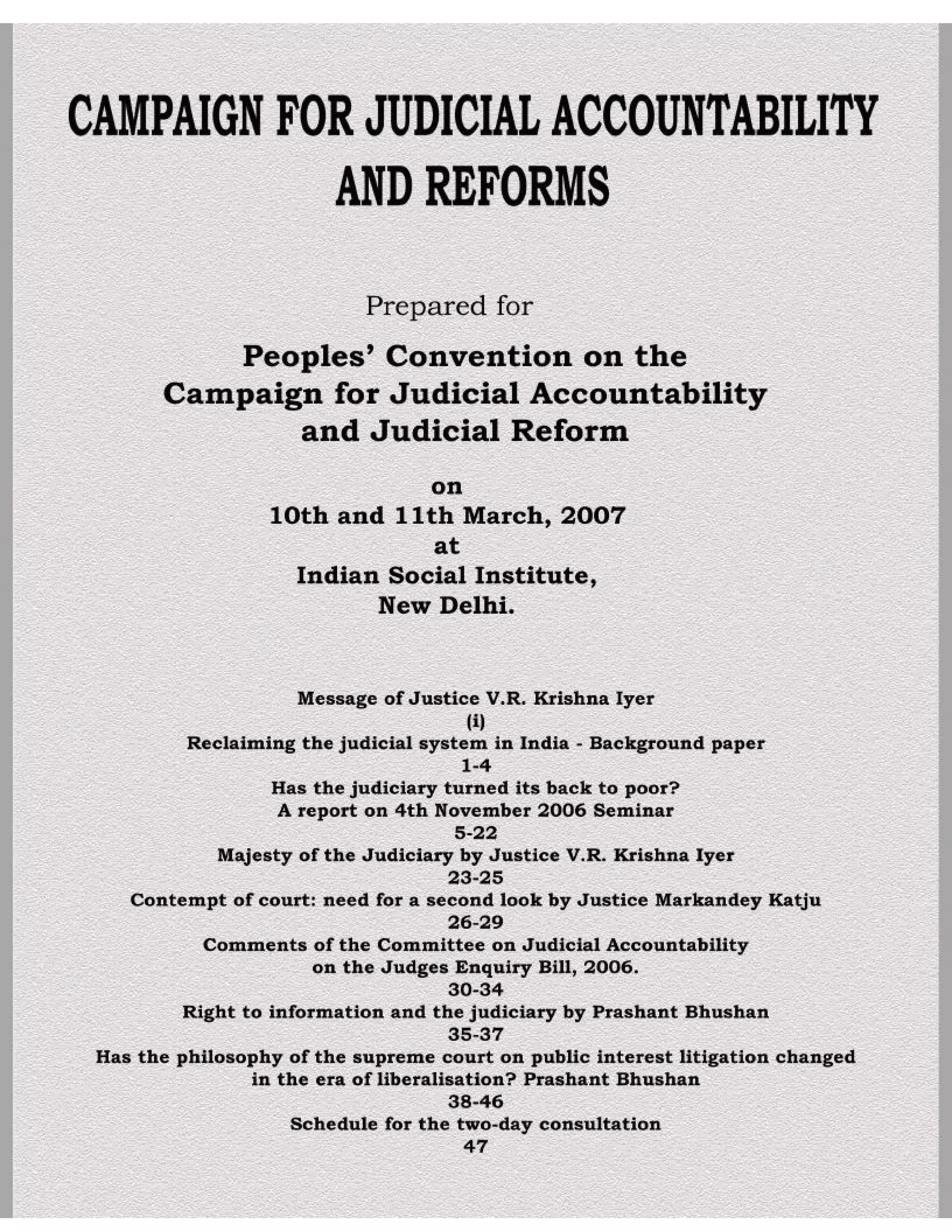
Credits:

Members of the organizing committee:         Rohit K. Singh (9868250545), Devvrat
                                             (9811818730), D.Leena (9811137421),
                                             Prashant Bhushan (9811164068), Indu
                                             Prakash Singh (9313327669),


Reclaiming the judicial system in India:     Background paper

Has the judiciary turned its back to poor?
A report of the seminar held on
4th November 2006 at
Indian Society for International Law :       Compiled by D.Leena

Majesty of Justice
Article by Justice V.R.Krishna Iyer:         ASIAN AGE

Contempt of court: need for a second look
Article by Justice Markandey Katju:          THE HINDU


Comments of the Committee on Judicial
Accountability on the Judges
Enquiry Bill, 2006:                          Committee for Judicial Accountability

Right to information and the judiciary       Prashant Bhushan

Has the philosophy of the supreme court
on public interest litigation changed in
the era of liberalisation?                   Prashant Bhushan

Campaign Support:                            see back cover

Printer:                                     Printcraft (9891094240)


Cover and Layout:                            D.Leena

Published:                                   Campaign for Judicial Accountability and
                                             Reforms

Year:                                        2007, New Delhi

Address:                                     14, Supreme Enclave, Tower No. 2, Mayur
                                             Vihar, Phase – 1, New Delhi 110 091
RECLAIMING THE JUDICIAL SYSTEM
                  IN INDIA
              (Background paper for the National Convention on
                      restructuring the judicial system)

While the corporate media often lionises the judicial system as the only working
wing of the State and projects it as the only in stitution which stands in the way
of a government controlled by criminals, the vast majority of the country do not
see the judicial system as capable of providing any modicum of justice to them.
The system is totally inaccessible to the poor of the country, being so formal and
procedurally complex that it can only be accessed with the help of lawyers,
whom the poor cannot afford. Even those who can access it cannot hope to get
their disputes adjudicated within a reasonable time. The majority of undertrials
spend more time during trials than the maximum sentence that can be imposed
upon them. Even if they are out of jail during this time, the agony of defending
themselves during this long trial is more painful and taxing than serving the
sentence that could b e imposed. In fact, the agony of a trial through the judicial
system has become the easiest way for the police and powerful persons who can
have the police at their beck and call, to harass, intimidate and silence
inconvenient persons, especially political activists who are trying to change the
oppressive and exploitative system of the country.

Even if one can get one’s case decided by the court, the course of justice is often
perverted by corruption within the judiciary and indeed within the entire system
of administration of justice. The corruption within the judicial system is no less
than that of any other institution of the State, and is well known to those who
have had to deal with it. It is less visible because of the lack of any system of
accountability of the judiciary, and because the media is unwilling to talk about
it, due to the fear of contempt. The corruption within the judiciary is exacerbated
by the total lack of accountability of the judiciary in the present system. Not only
is there no system for disciplining corrupt judges (other than an unworkable
system of impeachment), the Supreme Court has by a self serving judgment
removed judges even from the ambit of criminal investigation. Thus one cannot
even register an FIR against a judge taking bribes openly without the prior
permission of the Chief Justice of India, which has never been given. The
judiciary protects its own very zealously.

On top of all this immunity to the judiciary is the power of contempt of Court,
which can be and has been used by the judiciary to stifle public criticism, or
even an honest evaluation of the judiciary. This threat of contempt has
prevented a frank discussion of the judiciary by the media, which is partly the
reason why there hasn’t been any serious public debate about the state of the
judiciary. And now the judiciary is even seeking to remove itself from the
purview of the Right to Information Act. After having loudly pronounced that the
citizens have a right to know everything that goes on in every public institution,
the Supreme Court asks the government to effectively exempt it from the purview
of the Act by removing the jurisdiction of the independent appellate authority,
the Central Information Commission over the Registrar of the Court. It was also
recommended that the Chief Justice should be the final word in deciding

                                                                                  1
whether any information about the Court should be given out or not. Most High
Court have not even appointed a public information officer under the Act, and
the Delhi High Court has framed rules which prohibits the release of non judicial
information about the court, such as purchases and appointments. All this has
ensured that the judiciary becomes a law unto itself, totally non transparent,
and accountable to none.

It is this complete in sulation from all accountability, which has led to a situation
where it can easily transgress its jurisdiction by interfering in matters of the
formation and implementation of executive policy. Under the cover of its
expansive interpretation of Article 21 (which by itself is not objectionable),
particularly the right to environment, the judiciary has been ordering the
removal of slums from the Yamuna Pushta, hawkers and rickshaw pullers from
the streets of Delhi, and has even directed the government to take up the highly
controversial project of interlinking of rivers. Sometimes these arbitrary powers
are being exercised against the wishes of the executive, but often in connivance
with the executive, allowing the executive to do what a democratically
accountable government dare not do, such as demolish the Yamuna Pushta
slums of Delhi or take up the project of interlinking of rivers.

The recent orders regarding the sealing of commercial establishments running in
residential areas in Delhi is another example of judicial high handedness.
Though it was well within the powers of the judiciary to stop the violation of the
Master plan, it could have ordered the government to consider altering the
masterplan just as they were ordering the sealing of commercial users.
Moreover, it was totally beyond the jurisdiction of the Courts to order the sealing
of properties even after the Master Plan had been amended to allow commercial
user in some areas, merely because they had been made to give affidavits earlier
that they would stop the commercial user by a certain date.

It is this lack of accountability which has allowed the judiciary to take decisions
which are against their declared creed regarding the rights of the poor and
trample upon their rights with such impunity. Thus, after having declared that
the Constitution guarantees every citizen the right to shelter and livelihood, the
courts have nonetheless ordered the homes of hundreds of thousands of slum
dwellers of Delhi and Bombay to be ruthlessly bulldozed, without providing them
with any alternative dwelling. They have also ordered hundreds of thousands of
hawkers and rickshaw pullers to be driven off the streets of Delhi and Mumbai,
thus depriving them of their livelihood, without making any alternative
arrangement for them. While this is partly due to the elitist background of the
judges and the impact of the new economic policies on their thinking, where
human rights have also been left to market forces, such wanton disregard for
basic constitutional values is also facilitated by the impunity engendered by this
total lack of accountability of the judiciary. For the poor therefore, the judiciary
like the police has become an instrument of oppression rather than an
institution for the protection of their rights. T hey have come to fear and hate the
judiciary almost as much as they fear and hate the police.

The ruling establishment, particularly successive law commissions have devoted
considerable thought to some of the problems which afflict the judiciary,
particularly to that of the lethargy of the system. However, not much thought

                                                                                   2
has been devoted to some of the other problems such as access of the poor to the
system or the elitist sensitivities and bias of the judges, or even to the issue of
judicial accountability. And the law commissions, manned as they have been,
largely by retired judges, have displayed their own establishmentarian and elitist
biases in their reports. They have therefore suggested patchwork solutions
rather than the radical restructuring of the judiciary that is required.

Though a radical recommendation of a five-fold increase in the number of judges
had been made to deal with the problem of delays, adequate thought has not
been devoted to simplifying the judicial procedures. Hardly any thought has
been given to reforming the system of appointing judges so as to make it more
transparent, fair and sensitive to the poor. The solution suggested for judicial
accountability has been a feeble in house system where sitting judges are
supposed to hold their own brothers to account. And in the unlikely event that
they hold their brother guilty, they again send the matter to Parliament for
considering the impeachment of the judge. This is one of those recommendations
of the Law Commission which is acceptable to both the government and the
judiciary, keeping the feeble accountability introduced within the judicial family.
The Judicial Council bill cleared by the Cabinet recently, seeks to give statutory
status to the “In house procedure” for inquiring into complaints against judges
which was adopted by a Chief Justices conference almost 10 years ago, but
which has hardly ever been used.

However the Law Commission’s recommendations made 20 years ago about a 5
fold increase in the number of judges have been gathering dust as are most of its
even somewhat radical recommendations. Neither the government nor the
judiciary has made any effort to have those adopted. The record of both the
executive and the judiciary regarding judicial reforms does not inspire any
confidence that they are serious about making the judicial system work. It
appears that both are content with the present non-functional and
unaccountable judicial system. And for good reason too. The judges are happy
with the total lack of accountability and impunity that they have in the system
and the government is happy with the non-functioning of an institution which
could hold them to account. The media hyped skirmishes that we see between
the judiciary and the executive mask a much bigger partnership between the
institutions, where they have teamed up together to do what they want with
impunity but also appropriate land and other resources from the poor and give
them away to large vested commercial interests.

It appears clear that unless there is a people’s movement and a popular
campaign for judicial reforms in general and judicial accountability in particular,
which puts pressure on the ruling establishment, they are not going to take any
serious steps to change the state of affairs. Unfortunately, so far, such a
campaign hasn’t taken shape, partly because the people and the media have
shied away from a critical examination of the judicial system, partly also because
of the fear of contempt.

However, with the judiciary becoming more and more powe rful and increasingly
arbitrary and anti poor, allowing the administration of justice to remain in the
hands of the elitist ruling establishment would be suicidal for the common
people of the country. Time is running out for all of us. The people need to take

                                                                                 3
charge and drive this campaign to reclaim the judicial system. Every citizen of
the country has a vital stake in the proper functioning of the judicial system.
Ignoring it will not only intensify the judiciary’s assault on the poor, it is the
path to anarchy. The rule of law cannot survive in the absence of a properly
functioning system for the administration of justice. The people need to reclaim
the judiciary by having it restructured in accordance with the needs of the
common people.

These considerations and concerns have prompted us to take this first step of
calling this National Convention on Judicial reforms. All people’s movements,
consumer organisations, and indeed all organisations and individuals working
on any issue of public interest are in vited to attend this 2 day convention. We
hope to initiate the discussion on all the above issues relating to the functioning
of the judicial system. We hope that this convention will kickstart the process of
forming a national campaign organisation and begin a national campaign on this
issue.


                                      ****


                                                                                 4
HAS THE JUDICIARY TURNED ITS BACK ON
             THE POOR?
                            A Report on the Seminar
                               4 th November 2006
                                        At
                      Indian Society for International Law
                        9, Bhagwan Dass Raod, New Delhi


 A film by Ruzbeh N.Barucha – “yamuna gently weeps” was shown in the
  beginning of the seminar. The film was very emotive and reflected the
 trauma the oustees have undergone in Yamuna Pushta Demolition drive
            ordered by the Delhi High Court in January 2004.


Welcome by Shri Prashant Bhushan,
Advocate, Supreme Court

However, it was a very powerful film as we saw just now. There was a time, not
so long ago, when the Supreme Court of India waxed eloquent about the
Fundamental right to life and liberty guaranteed by Article 21 of the Constitution
to include all that it takes to lead a decent and dignified life. They thus held that
the right to life includes the right to food, the right to employment and the right
to shelter: in other words, the right to all the necessities of life.

All that seems a distant dream now, given the recent role of the courts in not
just failing to protect the rights of the poor that they had themselves declared
not long ago, but in fact spearheading the massive assault on the poor,
particularly since the era of economic liberalisation. This is happening in case
after case, whether they are of the tribal oustees of the Narmada Dam, or the
urban slum dwellers whose homes were being ruthlessly bulldozed without
notice and without rehabilitation. Similarly, the hawkers of Delhi and Mumbai
have been evicted from the streets pursuant to the orders of the court.

Public Interest Litigation has been turned on its head. Roadside hawkers are
being evicted on the orders of the Courts. Rickshaw pullers have been directed
by the Delhi High Court to be removed from certain parts of Delhi, depriving
thousands of people of their livelihood, and thousands of others of a non-
polluting and convenient means of transport.

In cities like Delhi and Bombay, the poor no longer regard the judiciary as a
protector of their rights. It is being increasingly seen as an instrumentality of the
wealthy and influential sections of society, which is now being used in tandem
with other instrumentalities of the ruling elite, like the police, to deprive the poor
of whatever natural resources that they still have access to. The judiciary has
come to play an increasingly important role in the governance of the country and
its role affects everyone, even those who may not be accessing the courts for
their individual disputes. It is therefore important that there is informed public

                                                                                    5
discussion and debate on the recent role of the judiciary, particularly between
thinking citizens who work with the poor and the judges themselves. It is
important that the judges understand what responsible citizens are thinking
about the role of the courts and they in turn understand the viewpoint of the
judges. We invited sensitive judges to this forum but it does not seem to happen.

There is an immediate need to form a campaign and demand the accountability
of the judges in giving anti-poor judgments; there is also a need to ask for
constructive judicial reforms.


Inaugural Address by Justice J.S.Verma

It is important to begin from the infamous role of Supreme Court in A.D.M.
Jabalpur case during emergency, which let down the people. The judges who
were responsible for passing the judgment had put many of us in shame. It is
also a misconception to think that it was in Maneka Gandhi’s case in 1978 that
for the first time ‘fairness’ and ‘reasonable’ was incorporated in Article 14. It was
actually the judge Vivan Bose who in 1952 said that ‘fair justice’ and ‘reasonable’
is the requirement of Article 14.

We all have to make judges to do serious introspection and examine the merits.
In the recent past three news items caught my attention, which is seemingly
unrelated, but to my mind they ought to be integrated. One item was the
reporting on the high degree of pollution in Vapi in Gujarat. Then few days later,
another news report a judgment by a single judge of Gujarat High Court, which
not only dismissed a writ, which had allegation of pollution by an industry in
Vapi, but also imposed a penalty of Rs 48 lakhs on the petitioner. Even if the PIL
was motivated but still Rs 48 Lakhs as penalty in India is a huge amount.

In Law of Evidence, there are three things; proved, not proved and disproved. If it
is not proved then there is not enough evidence. Only when it is positively
disproved then one goes to the extent of judging against the petitioner. If this is
the case, then how many people would take the risk of filing a PIL and end –up
paying Rs. 48 lakhs.

The third news was the headlines in Hindustan Times, which says Gujarat
Muslims give up right to buy peace. It was very sad read this item, when I am
still waiting for a culmination of the Gujarat communal violence case in which I
was initially involved. If they give up their rights to buy peace it is the worst
thing.

The Directive Principles of State Policy in Article 37 was merely brought s o that
people do not directly bring the writ to the court. But this is what the Supreme
Court did; it read Directive Principles of State Policy into the fundamental rights
so to enlarge the scope.

Well, one of the focuses of today’s meeting is displacement of slum dwellers. The
film also mentioned about Akshardham Temple. Every time I pass Nizamuddin
Bridge especially at night, I am so upset seeing such a well-lit temple. Where is
the distributive justice that we have promised in the Directive Principles of State

                                                                                   6
Policy? Article 37 says these are fundamental principles in governance, which
the legislative and the executive have to keep in mind while making laws. The
judiciary should also keep those in mind for the purpose of interpreting the laws.

Likewise, one would not consider right to food, health not merely as the right to
get some food, but the right to be free from hunger, if directive principles are not
read into it. The right to adequate means of livelihood in Article 39 is an
obligation of the state which compels state to ensure that everyone is able to
have adequate means of livelihood. So that one is empowered enough not to
depend on someone else’s charity to get food, that is our concept for a welfare
state and of distributive justice.

The area occupied by the displaced families is not more than the area occupied
by the Common Wealth Games or the Akshardham Temple. There is elite
population, having more than one houses and have been allotted more houses in
the same area. Governments make these discretionary allotments and courts
upheld it. Olga Tellis, twenty years back, had held the right to shelter as a
human right, right to development a basic human right and right to adequate
means of livelihood as envisaged in Article 39. The rights in all the international
covenants are included in Article 14 and 21. These are the things, which
judiciary has done earlier and if the judiciary is reversing this approach , then it
is a matter of serious concern more for those who are in the judiciary.

There should be greater public awareness and the people should have
participatory role in governance. That’s what democracy is all about. People’s
role is not merely to vote at sporadic elections but to monitor constantly the
performance of all institutions including the judiciary. Judicial Accountability
includes all these things. There is considerable rather almost total lack of any
effort at fair criticism of the judgments and role of judiciary.

There is a ‘law quarterly review’, which reviews the modern judgments, which
could help the judges to do self-introspection, but most of the articles written by
the advocates are to please the judges. We need to write articles which should
objectively analyze judgments and render a fair view.

According to me, the misuse of the contempt power is something, which erodes
the credibility of the judiciary most. Even before the Act was amended, truth
should be a permissible defense. People, who don’t want to say something, take
the pretext of the contempt of court but we s hould remove this misapprehension
by encouraging honest criticism.

The cause of the migration towards urban areas is related to lack of good
governance. The standard of education in Delhi is much higher and most
development happens in Delhi. So anyone who can afford comes here while
those who cannot afford comes and lives in slums.

If we strictly speak on legal terms then we have the law of Adverse Possession.
Wherein a person occupying a piece of land for more than 12 years (against
private citizen) and 60 years (against the govt.) which is now for 30 years, will
have to be made owner of the land. When these provisions have legally


                                                                                  7
empowered the occupier of a particular land that the state should not be evicting
inhabitants living on the land for more then 30 years.

In Pannalal’s case justice Vivan Bose delivered a good judgment on Adverse
Possession, which was reported in AIR 1937, Nagpur. The judgment raised that
under the Specific Relief Act, possession alone is sufficient to sue for restoration
of possession of a displaced, when the suit is brought within 6 months.

This shows that a person living for a long time cannot be uprooted. While
making orders, the courts must read Article 21 with Article 39. So thank you
very much for inviting me, I have spoken with as much reserve as I am capable
of.


       Session I: Impact of Recent Court Judgements on Labour
                               Chair: Baba Adhav

Presentation by Prem Krishan Sharma
Advocate, Supreme Court

After independence, the concept of social justice was introduced and the labour
law developed more as a judgment law. There were various laws but with the
intervention of judiciary, the labour law was moving in a progressive direction.
The issues concerning the labour matters such as wage, minimum wage, fair
wage, employment security, social security, etc. were initiated, right from the
Express Newspaper’s case.

Between 1970 and 1980, the definition of industry was widened; employment
security was given to workman as a right. The right to get the back wages if the
dismissal of the workman was found to be unjustified, and the worker’s right to
strike was declared as legitimate weapon for collective bargaining. Till 1980’s,
the labour laws were developed to suit the interest of working class. But now the
recent judgements show that the judiciary has taken a U-turn.

In the SAIL case, the courts denied the workman the right of permanent
employment while in the famous Tamil Nadu case, the right to strike was called
morally and legally incorrect. Earlier a lawyer could successfully argue in the
courts that by striking, a workman do not lose his right of employment. But with
UP State Corporation case, it has been laid down that if the workman continues
to be on strike then the employer can declare that he has voluntarily abandoned
his services.

Since 1968, the burden of proof was on the party filing case against the worker.
But in Municipal Corporation Faridabad’s case, the burden of proof has been
cast on the worker. If the worker was retrenched, still he has to prove that he
worked for 240 days, while the attendance records are with the employer. In
recent case of Uma Devi, the court remarked that the worker does not have any
right to service even if he worked for 10 - 20 years as millions are waiting for
employment.


                                                                                  8
When it is declared that by striking a workman can lose his job, the right to
protest is lost. It is futile for the working class to fight at individual level, it can
only assert through collective bargaining. The strike is the most peaceful way to
assert. The right to work includes the right to not to work but when that right is
denied, as a consequence of losing job, the workers can’t strike.

After centuries of struggle, the working class got some security of employment
and the right for fair opportunity and enquiry but it has been nullified. The
worker was given the opportunity of fair hearing before he is thrown out even if it
had its own limitations. In Guzari Steel’s case, it was held that in case of the
dispute between the management and the worker, the management could prove
the worker guilty, the order of dismissal will be from the date when labour court
has passed the order and will not date back to the earlier order of dismissal by
management. But now in the recent Punjab National case, it has been laid down
that if the charge is proved against the worker in the labour court then the order
will date back to the day of dismissal by the management.

What is the practical impact of this decision? An employer can hire and fire any
workman any time without any e nquiry and without any opportunity of hearing.
And if the workman raises an industrial dispute, it takes 2 -3 years for the case
to get referred to the labour court. For instance, in Rajasthan even if the
workman goes directly to the labour court, he has to prove whether he was an
employee in the industry, which takes years. After that the management will
come into picture and defend itself.

The Supreme Court in one of the recent judgements stated that the management
is the best judge to decide about the conduct of an employee and such decision
should not be made subject to judicial review. It is only in the condition when
the judge becomes suspicious of the role of management that the judicial review
comes into play but it is never practiced. It is clear that the Magna Carta created
is for the employer not for the workman. According to Justice S. B. Sinha in U.P
Brass case, the interpretation of labour laws, in this changed scenario of
privatisation and globalisation, cannot be the same as it was in 80’s.

During 70s and 80s, the success rate was 95 percent in the labour courts and
the Rajasthan High Court. It was not necessary that the worker always got the
relief but the judgements were upheld by High Courts and even Supreme Court
in favour of the worker. But gradually after 90’s the success rate has dropped to
5 percent.

Earlier when the judiciary was in support of the working class, it was not due to
its pro-working class stand or greater understanding of socialism, as was in the
case of E.M.S Namboodaripad. In fact, in those days the bourgeoisie and the
ruling class were in need of the working class. But today the trade unions
movements have became scattered and weak. The trade unions leaders are
dependent on judicial decisions than taking the movement forward.

As a trade unionist, I feel that instead of struggling with the workers on the
streets, most of our time was spent in the courts. It was nothing but betrayal of
working class movement. Today’s judgements have defied all employment
security, and the right to strike. The positive impact was that we must come out

                                                                                      9
of the illusion that the judicial system can help the struggle of working class.
Judiciary is nothing but a tool in the hands of ruling classes. E.M.S.
Namboodaripad had said this and was punished. In this age of privatisation and
globalisation, we cannot implement labour laws in its true sense. We need to
hasten the process of coming out of this illusion and struggle with the working
class.

Dr. Baba Adhav
Hammal Panchayat, Pune

7% of the total work force is organized labour while 93% is unorganized with no
law to protect them. Supreme Court in Madras case denied workers the right to
strike but the doctors’ strike was termed legal. This shows what is governing the
psychology of the judiciary. We are untouchables here. For these 93% of the
workforce we demanded social security laws, which are pending since 2002.
MP’s Salary bill and the 6th pay commission were passed within 24 hours.
Ravinder Verma Commission worked on the umbrella legislation for 37 crore
unorganized sector workers which includes social security, insurance,
compensation at the time of accident and pension. Both Sonia Gandhi and
Manmohan Singh have given passing comment on the bill inspite of the fact the
Common Minimum Programme has felt the need of this bill. Most of the
countries like US and China have Social security laws in place.

People of our country want some sort of security and self-respect. For instance,
when women waste pickers took out a rally on 15 th August, they demanded
Sharad Pawar (then Chief Minister) that they have not come for flag hoisting
ceremony but want to highlight the issue of sexual abuse by police when they go
for waste picking in the morning.

The government tries to find way to keep the Bill at bay; Chidamdram said that
the government has no funds for it. It is also necessary to learn from Mathadhi
Protection Act in Maharashtra, where a collie have got provident fund, bonus,
gratuity without taxing on anyone. So there is a lack of political will. Supreme
Court has repetitively ignored Constitutional right to livelihood, so where will the
working class go.

Discussion:

Com. Kelkar: 80% workers in Pune are contractual, they are modern –day
bonded labour. Supreme Court, while passing anti-worker orders has never
addressed contractual labour issue. Attempts have been made to reduce
permanent workers by voluntary retirement schemes, which is also a systematic
attack on the working class. It has turned the working class into slavery with no
right what so ever. Employer can do and undo whatever he wants.

Question: The sudden change as Sharmaji referred is due to over protection
given by judiciary for a long time or due to lack of interpretation of the
constitutional or legal provisions or is it d ue to the globalisation, liberalisations?

Prem Krishan Sharma’s Reply: The Bangalore Suraj case, which widened the
definition of industry, has done more harm than benefit. Earlier, High Courts

                                                                                    10
were giving certain relief to the workers, but now widening the definition, all
cases has to go to labour courts. The change is due to the political thinking,
earlier the ruling class was in need of the working class’s support. Now they are
in need of the support of private industries.

Baba Adhav’s reply: Earlier the courts used to talk about their socialist
viewpoint, but now they are dictated by Liberalisation, Privatisation and
Globalisation.

Lalit Batra: It seems there is no relation between the organized and the
unorganized sector. The representation of the Central Trade Unions has been
token while talking about a social security comprehensive legislation for 37 crore
workers. When NPMO was formed by central trade unions, there were 2 rallies in
Delhi with more than 2 lakh people participating. But they have never shown
their strength to support the unorganized sector. Is it possible to bring these two
sectors together? We should also look into the conspiracy of the government, as
2nd labour commission attacked the organized sector, it is proposing the social
security for the unorganized sector workers.

Prem Krishan Sharma’s reply: Very well, the attempts should be made to bring
together these two sectors.

Baba Adhav’s reply: Attempts have been already made. There has been two
meetings where the central tra de unions have come together and as far as NGOs
are considered, talks to involve them is on.

Dunu Roy: Question to Sharmaji is that when he said that instead of struggling
in the street with the workers, they were struggling in the court rooms, which
according to him was a betrayal to the working class movement. Isn’t it that the
unorganized sector bill will be second betrayal?

Prem Krishan Sharma’s reply: The presentation showed the interpretations of
judiciary. If the implementation policies of laws will be the same, then nothing
will change. But if new concepts are devised then things will be different.

Prashant Bhushan: As the government wanted to climb to the next level of
economic reforms, the concept of liberalisation, privatisation and globalisation
was debated in formulating labour reforms. But politically, the left parties have
obstructed to these reforms, so the State had to get all these things done
through judicial interventions, which would not damage their political credibility.
The concept of Special Economic Zone was introduced as only way to bring in
contractual labour and revive the industries. SEZs have labour flexibility, with
many provisions of the Industrial Dispute Act, Contract Labour Laws and many
other labour friendly laws not be en applicable. According to Section 49 of SEZ
Act, the Central Government by notification can exempt any or all SEZs from the
operations of any or all laws. This is totally unconstitutional for excessive
delegation. The court should take the issue suo-moto and should squash such
an Act. The SEZ has become a new weapon to finish the labour protection laws.


                                                                                11
Prem Krishan Sharma’s reply: In China in 1984, there were 18 SEZ, but they
have not removed labour protection laws from these zones. So if our country is
following China, it should do it entirely.


        Session II: The Impact of recent court the judgements
                           on the rural poor
                              Chair: Miloon Kothari

Presentation by Prof. Babu Mathew
Country Director Action Aid International-India

This debate is quite crucial, which is reminiscent of what happened with
judiciary during the period when India was trying to abolish Zamindari system
and introduce land reforms. While reflecting on the judiciary and its impact on
the rural poor, the most popular analysis is the class analysis but one should
not confine to it alone, one should also consider caste analysis. We must also
remember the indigenous people. (They do not like to be called ‘Adivasi’ or
‘Tribal’ in the North-East and perhaps the expression ‘indigenous people ’ is more
appropriate). Our general experience in civil society process is a tremendous
reluctance to identify Muslims as a group of people who are also among the rural
poor. The fisher folk, weavers, etc are the most backward communities in India.

The figures show that together this section constitutes more than half of India’s
population. So what we are witnessing today is displacement of unprecedented
nature, one is at the level of scale and the other is that it is encompassing every
single segment of the excluded. There is a tremendous relationship between the
growth model and the model which has been imported since June 1991.That
growth model is tremendously volatile and it seems the higher the growth rate is,
the more would be the destruction of live lihood.

According to one of the best economists Prof. Deepak Nair’s recent analysis,
there was virtually no growth during the 1 st phase of imperialism in India and it
begins during the 2 nd phase. Obviously that raises a number of questions but it
is important to note that a kind of a structural breakthrough vis-à-vis the
growth which is only after independence.

Prof. Nair’s analysis shows that it is not that the post-new economic policy
period which witnessed the highest growth but in fact it begins in 1980’s itself.
We are talking of a GDP of 5.9% and the government is talking of 8% and 10%.
What is important here is to see the relationship between this growth model and
displacement and the destruction of livelihood.

If we think about the displacement and destruction then the indigenous people
are worst affected. For instance, in the North East there are 168 new dams
planned, and in Andhra Pradesh 40 new dams. In terms of the mineral wealth
extraction as in Orissa, Jharkhand, and Chhatisgarh, the affected population in
the region is of 70 million. Dalits, which is about 170 million, have been
agricultural labourers, there is massive displacement due to privatisation and
modernisation of agriculture. With fisher folks, it’s disaster capitalism as what

                                                                                12
ne o-liberalism could not enter before Tsunami but was able to do it after
Tsunami. So capitalism now waits for a disaster to penetrate even that segment
of the economy. This has completely destroyed the livelihood of the fisher folk
through modernisation of the ports, fishing sector, and introduction of tourism
industry. It has destroyed their right to traditional habitat and efforts are going
on in a big way aided by the World Bank, Asian Development Bank, etc.

As regards the Muslims, tremendous destruction of their artisanal occupation
has occurred. A study conducted with the Indian Social Institute reveals that
there plight is as bad as that of Dalits and Adivasis. In the context of urban poor
the pauperisation process, is the accumulated result of what is happening in
other sectors. For those who are somehow living in slum areas have to undergo
the urban reform process which has been unleashed in sixty cities to destroy
their human rights to housing ad livelihood. Finally, the peasantry , which has
suffere d not only because of the agrarian crisis, but also due to the Special
Economic Zones.

The kind of protection, which was enjoyed in the past, could have come through
constitutional provision or through statutes or through budgetary allocations.
While the judiciary could only subvert the systematic remedy (such as 5 th & 6 th
Schedule) it will be more generous if it is a safety net package.

The excluded population may be broadly put into three models.

   1. Model A: This is a situation where the Indian State p rovided an alternate
      paradigm to co-exist with the dominant paradigm through a
      constitutional arrangement. It was semi permanent arrangement such as
      the fifth and the sixth schedule or legislation.
   2. Model B: It is situation where the dominant paradigm accommodated
      transitional paradigm, through reservations.
   3. Model C: It is the present situation where the dominant paradigm will
      exclude and destroy all other paradigms.

Professor Upendra Bakshi says that the judiciary is now structurally adjusted.

Through the protection of Civil Rights Act, Dalits had enjoyed some rights. But
judiciary discovered a new category called ‘Insult Simpliciter’ in Phool Singh Vs
State of Madhya Pradesh, wherein the Dalits will no longer have the protection of
Civil Rights Act. M ethods to water down not only social, economic and cultural
rights but also even civil and political right were sought. Simultaneously, in case
of tribal, the Samata judgement has been diluted further through the
Godavaram process.

It is also important to understand that the judiciary, legislature and executive
are hand in glove, which makes sure that the excluded suffer. The situation
today is, when the executive attempts to give protection then the legislature will
undo it and vice-a-versa, so it is necessary to understand the correlation.

During the earlier era, the ninth schedule, which is been debated now, was
necessary to protect land reform legislations due to the presence of the self-
reliance approach. In the present era, when the liberalisationprocess has seeped

                                                                                13
in, what are we going to really protect using the 9 th schedule? The Government
in power knows that they will pay a prize if they blatantly follow anti -poor stand.
Today, democracy is the only instrument to give some kind of protection, w hile
the neo-liberalism will get even more pro-n e o-liberal judges and of lesser quality
also. So that’s the kind of a crisis in which we are.

The expression used by jurists as the foundation of the society is ‘grundnorm’.
So if we have to see the Constitution of India, today, as the grundnorm, then the
elites in India would like to see this grundnorm over thrown. When Chief Justice
or the Prime Minister or the President is sworn to uphold the Constitution, it
means that the Constitution still offers hope for the poor. But still the poor has
to make sure that the Constitution of India remains alive and retained. It need
not be that it can be achieved by Public Interest Litigations but it will be retained
by building a new political bloc. A new political bloc should include the
marginalized working class, the organized and the unorganized with the
professionals and the organic intelligentsia. This is a big challenge that awaits
us.


       Session III - Impact of Recent Judgements on Urban Poor
                              Chair: Miloon Kothari

Presentation by Prashant Bhushan
Advocate, Supreme Court

One broad category of urban poor is the slum dwellers living in unorganized
housing sector, having occupation of street vendors, rickshaw pullers, etc. This
is the section, which has suffered the maximum onslaught of judicial decision in
the recent past.

The earlier paradigm laid down in a number of judgments of the Supreme Court
such as Chameli Singh case, PUDR judgment relating to the Asiad workers,
which stated that the right to live with dignity is the part of the right to life,
which includes right to shelter, right to food, water, health care, education. In
Chameli Singh case, it was categorically said that every citizen of this country
has a fundamental right to shelter and it is the o bligation of the state to provide
shelter to those who do not have. It also becomes the responsibility of the
judiciary, as an institution to enforce the rights of the people, to take note of the
situation of homelessness and suo-moto try to find out ways in which the
problem of homelessness be addressed. Instead, PILs filed to defend these rights
have been put in cold storage such as was the case filed by Aashray Adhikar
Abhiyan about four years ago.

To add to it, Delhi High Court has been ordering removal of slum dwellers from
the Yamuna Pushta on the ground of alleged pollution or on issue of
encroachment of public land. Instead of helping the people, what we saw in a
case filed on behalf of National Alliance of People’s Movement, which prayed to
get basic civic amenities to the slum dwellers, the court adjourned the matter for
many years. But in the petition filed by middle class colonies asking for the
eviction of slum-dwellers whether on Yamuna Pushta or near their middle class

                                                                                  14
colonies, the courts have ordered their removal without providing for any
alternative place, bypassing the relocation policy.

It is necessary to examine the ideology and sensitivity of the judges towards
these kinds of issues of the urban poor. Existing judiciary with a close system of
appointment will appoint more neo-liberal judges, which is seriously due to lack
of judicial accountability. First they appropriate the power of appointment to
themselves, and then pass self-serving judgment as in Vira Swami’s case, which
ruled that an FIR couldn’t be lodged against a judge without the consent of the
Chief Justice of India. So this is a catch 22 situation.

I am only emphasizing to say that judiciary has become embolden to pass these
kind of judgments with impunity. It is because they enjoy immunity from any
kind of scrutiny whatsoever wherein no disciplinary action is taken against
them.


Miloon Kothari’s address

It is quite clear from both presentations that there has been a massive failure on
part of the judiciary. It is true that the basic human rights principles as
enshrined in various UN conventions and covenants with regard to the displaced
population have not been respected. While the very basic Human Rights
principle is of protection of the rights of the most vulnerable has been violated,
but it has moved into a direction where there is an assault on the poor and
criminalisation of the poor.


Discussion

Ramit Basu from United Nation Development Programme.

While examining the performance of the parliament, the judiciary, the executive
and local self-governance, on the rights perspective, we believe it is important to
strengthen the governance structure. We should lessen the need to go to judicial
redressal. If we look into the Supreme Court observations with regard to hunger
deaths from1998 to 2001, where, there has been gross violation of the
implementation of scheme which did not reach the poorest of the poor. When the
budget distribution systems have failed, FCI have failed; why can not we make
the judiciary ensure that people get food? why can not the Supreme Court also
take suo-moto case and dispense a pro -poor judgement on the basis of the
newspaper reports?

Babu Mathew’s reply
That every judge has his own ideology, there is no neutral judge. So from where
the judge derives this ideology, it is from contemporary society, with neo-liberal
influences. So the judges are no longer upholding the Constitution beyond the
legislature and the executive and the overall mode is the neo-liberal mode.


                                                                                15
Sucharita from Lok Raj Sangathan:

Prof. Babu talked about the relationship between the executive, the legislative
and the judiciary, while Prashant said the judiciary seems to have lost its
conscience. It makes us ponder that what dictates their conscience, is it the big
monopolies or the SEZs? Moreover, working class have been giving vital
contribution to the economy, to the industry, to the transport and to every thing
that makes the city work. Calling them ‘pick pockets’ or giving them anti-social
labels and criminalisation of the poor needs to be highlighted. Can the city really
function without all of these services? The land use has been violated numerous
times when the State needs to build commercial structures or Akshardhams.
But it is called violation of Master Plan when the traders, small shopkeepers or
slum dwellers want it as their right and are named as illegal occupants. In Okhla
Industrial Area, when the industries were setting up, they allowed the slums to
develop, as they wanted cheap labour. And today, when Okhla is developed these
slums are called encroachers. We need a united platform of all affected sections,
to assert our right to life.


Biju Lal from Indian Social Institute

Are we following Constitution of India or Manusmriti? In several places in India
one can see that Manusmriti in practice, which says that the so called lower
caste people should not own any other things than dogs and donkeys. And if
they own a cow, then they will have livelihood. The Indian judicial system should
be fundamentally reviewed and the processes should involve people who are
actually excluded. The BJP government had tried to revise the whole
Constitution in a very bad way, negating the livelihood rights of the people.

Indu Prakash Singh from Action Aid India

The biggest challenge today in the country is judiciary. I would like to ask is
there any judicial norms, can a sitting judge in full court room call people pick
pockets, cheats, robbers, etc. Is there any basic ethics, which forms the part of
judiciary? Even the parliament is scared of taking judiciary by its own; they are
scared of the contempt against them. Why shouldn’t there be contempt of
constitution against the judiciary? Prashant has mentioned about the Vasant
Kunj Mall issue, which has been approved and cleared. At the same time we
have Bhatti Mines on the ridge where 25000 people are living for last 30 years.
But it has been issued notices of eviction. The elite are spared, the poor are
prosecuted. Then there is the issue of relocation of the slum dwellers who have
been given plots 45 – 50 kms away from the city and on the basis of licenses of 5
–10 years. The fear of eviction is always hanging. The preamble of the
Constitution says that we the people of India give ourselves to this Constitution.
But now it has become ‘we’ the judges of India have given this constitution to the
country and its people and ‘we’ are the vanguards of this country.

Swami Agnivesh

We should criticise the judiciary but at the same time we should not absolve the
executive and the bureaucracy, they are the real perpetrators. Who is taking

                                                                                16
decision to throw people out of the slums, it’s the government and judiciary is
only stamping it. Our Prime Minister sent his minister to Narmada but did not
give cognizance to the report. It was ju diciary which asked the Prime Minister to
intervene but in vain. We have no expectations from the parliamentarians. In the
bonded labour case, during the demonstration Madhu Dandvate asked us to
stop the protest and assured to resolve the issue. But the police lathicharged the
workers and killed 12 workers. Police illegally took thumb impressions of
workers and fabricated against us. No hearing was given in the Supreme Court.
Justice Bhagwati the then chief justice reserved the judgement. We planned a
prote st, which was published in newspapers and immediately Upendra Bakshi
called up a meeting with P.N.Haskar, Nikhil Chakravarti at Justice Desai’s house
and then Justice Bhagwati was made to give the judgement during vacation.


Prashant Bhushan’s reply

We can’t say that all judges have lost all their conscience, but it depends not
only on the external milieu, but also the external constraints and accountability
of that judge. If you remove all accountability from judges which is what has
happened today the n you will have a situation where even conscience will slowly
diminish. Sucharita had said that judiciary has assumed the role of the
legislature and the executive but while interpreting the constitution if the judges
start misusing their powers, then noth ing is above them. In fact the
interpretation of article 21 can be easily misused. They are governed by their
own predilections, if they find that interlinking of rivers is beneficial, they still
can’t order for implementation. Judiciary has no reason to dictate to make
amendments, while they should intervene and ask the authorities to follow due
process. The arrogance of power has inherently corrupted their thinking and
made them not just arrogant, but also insensitive.

Therefore, even though the judiciary is an important institution of the state and
has the potential of enforcing the rule of law and protecting the fundamental
rights of people, etc. But this does not mean that the judiciary should not be
criticised or should not be made accountable. The point Indu raised is also an
aspect of accountability. After insulating themselves from accountability, the
judges are resisting National Judicial Commission. They have recommended
amendment to the Right to Information Act suggesting that if the Chief Justice
orders that certain information cannot be given then nobody can question.

So the Campaign need to debate about the kind of accountability, question the
provision of contempt of court, implementation of the Right to Information Act.
And save the judiciary from getting lost.

Babu Mathew’s reply

We must destroy that very process which feels that the judiciary is infallible. The
Constitution of the country is supreme so it is important to have accountable
and healthy judiciary. Today when there is hegemony of neo-liberalism, our job
is to build counter hegemony, which can be done by attacking all institutions.
The doctrine of separation of powers was invented to make sure that we do not


                                                                                  17
have a tyrannical institution with all powers vested in it. One of the tasks of this
platform would be to restrain judiciary from becoming some such tyrant.

Miloon Kothari

It is a very good beginning and the strategies on holding the judges accountable
should be explored along with appeals to international forums. One of the
preconditions of these appeals is to exhaust local remedies, which we have
already exhausted. A collective submission from all the groups in this forum can
be addressed to the United Nations Human Rights Council and to the High
Commissioner for Human Rights. The international community has high
admiration for the Indian courts.


       Session IV - Changing Trends in Public Interest Litigation
                             Chair: Swami Agnivesh


Presentation by Sanjay Parikh
Advocate, Supreme Court

It is important to discuss about t reasons for developing a tool like Public
                                  he
Interest Litigation and how it has transformed recently. While criticizing
judiciary one must not forget about the executive inactions of last ten years and
the recent laws passed by the legislature. It is necessary to substantiate by two
examples, one is aquaculture case which permitted the multinational
corporations to have their aquaculture activities at the cost of the traditional
fishermen. The second was the case on Electoral Reform wherein it was
mandatory for the candidate to give declaration of assets, immediately an
ordinance was brought in.

When the PILs were getting developed, it was an understanding that the job of
the courts is not to work to interpret the laws but also make the States carry
their executive actions. Even the limited understanding of judiciary review
cannot provide justice to what constitutes the social wrong, they are wrong to
the general public; there may be perpetuation of illegalities and executive
accesses, either on an individual or on the society as a whole. The failure to
perform public duty should not go unchecked and should not promote
disrespect for the rule of law.

As the purpose of the concept of Public Interest Litigation was to make the
constitutional rights of the deprived sections meaningful. In the meantime,
courts have evolved their own guidelines and principles for entertaining Public
Interest Litigation. It is also true that individuals or institutions have done a
great service to the people by addressing the issues concerning the rights of
women, civil liberties, custodial deaths, environment, public health and the
courts have given bold and far reaching judgements on some of these issues.

At this juncture, it is pertinent to see globalisation which has the po tential to
wipe away the social, economic, and cultural rights of the people and nullify the

                                                                                 18
Constitution and democracy. What role the courts will have to play within the
constitutional parameters? Can the courts simply brush aside the decisions,
widely affecting the rights of the people? There cannot be any just or fair reason
to depart from the march of Public Interest Litigations towards achieving
equality. The debate can only be about the controlling mechanism and how to
prevent its abuse, but the abuse of it by busy-bodies or persons with self serving
interest cannot give any justification to depart from PIL jurisdiction.

On one hand the court has taken the right to food seriously, but on the other
took away the benefit of employment or the source of livelihood from contract
labours, daily wagers and even individual workers seeking reinstatement.
Similarly, on the one hand protection of environment, forest reserves has been
taken up vigorously, but in the name of development construction of hotels and
residential apartments has been permitted in sensitive areas, big hydel projects
have been allowed by saying that precautionary principle does not apply to
them.

While the industries were polluting the river Yamuna in the name of
environment protection, people living in the slums have been asked to shift
without realizing that there is a deep-rooted problem of migration. The state’s
obligation to protect the life and livelihood is not meant only for haves, but also
for have-nots.

Corruption impedes deve lopment and infringes on human rights in various
processes of empowerment. It is realized that electoral reforms alone can bring in
true democracy to free and fair elections. But the political parties, have
completely eroded the democratic values of the constitution, resulting in money
and muscle power of the ruling class.

For centuries the agriculture farmers had complete control over seeds,
agricultural operations, etc, but it is not there today. The Breeders’ Acts, Seed
Act have been amended and Protection of the Plant Varieties and Farmer’s
Rights Act 2001 has been introduced. These provisions have forced the farmers
to shift from their traditional breeders’ rights. International law has become
relevant while determining the legal and constitutional rights including of the
people of our country. For example, through the intervention of the courts the
patents of Basmati rice was retained by India.


Swamiji pointed out that there are very few advocates left to file the Public
Interest Litigation. There is no doubt that the executive negligence in action and
violation, corruption and political life and the legislatures has brought enormous
pressure on the court. It is indeed a testing time not to give up but to fight with
knowledge and conviction.


Shanti Bhushan ji
Senior Advocate, Supreme Court of India

Parikh has shown as to how this principle has evolved over the years and why
Public Interest Litigation was conceived. The judges conceived it in 70’s and 80’s

                                                                                19
with an objective that rule of law requires, the rights of the downtrodden, human
rights and legal rights, to be enforced as the poor were not able to come to the
courts to enforce their individual or collective rights. Thus, PIL was devised as
machinery.
Those were the days when we had judges like justice Krishna Iyer, justice
Chinnappa Reddy, justice Bhagwati, etc. Since the tone of Supreme Court has
changed this also determines the tone of the High Courts. The Supreme Court,
some years back, ruled that no commercial activity in the residential area be
permitted according to Master Plan of Delhi. There could have been two
approaches to deal with this case - one where courts have blatantly stopped the
commercial activity and rendered lakhs jobless and the other is to direct the
government to amend the Master Plan according to the needs of this population.
If the Supreme Court would have consisted of elected judges who were
dependent on the votes of the people, they would have preferred the later
approach. The concept of democracy depends on votes; the constitution gave
power to the votes only so that the interest of the poor could be protected.
Why has this change come out in the judiciary, it’s because sometimes people in
a high position including those in the judiciary think that they are the ru lers and
the people are their subjects. So, they have only replaced the Britishers.
Pre-1993 era, the judges were appointed by the government that was answerable
to the elected house committed to the social cause. But in 1993, a nine-judge
bench of the Su preme Court gave a judgment, which took away this power from
the executive and giving independent power to a collegium of five judges to do
the appointments of new judges. Today, the judiciary itself has appropriated this
power. Even in the U.S, Supreme Co urt judge cannot be appointed unless he
appears before the senate committee and the president. The situation of
appointments in India is such that the Supreme Court judges would themselves
decide to appoint some like-minded judges who are away from the soc ial
philosophy and reality of India. The judges belong to the most affluent class who
has never acquainted themselves with the pain and suffering of the working
people. This is also one of the reasons why the Public Interest Litigation concept
has taken ba ck stage.
Now the PILs filed by the affluent sections are allowed and immediate orders for
the removal of slum dwellers are passed. Now the need of the hour is reforms
within judicial appointments, the campaign should demand a separate body
where people have power of selecting judges. If the campaign will be able to
achieve that I think there would again be a reversal in the principles of public
interest litigation.


Anuradha from Hazard Center.
Whether public interest is defined in any Act or Statute. Or is it a total discretion
of judges to decide what constitutes public interest.


Shantibhushan ji
Public interest is not defined anywhere, it depends largely on the discretion of
the judiciary. That is why it is necessary that the social philosophy of the judge
concerned must be on the right track. He must feel that public interest means

                                                                                  20
the public interest which is the interest of the voiceless and the downtrodden
masses who are suffering from centuries of oppression.


Siddharth from Pune University
The idea of the Supreme Court to hire the judges would have only occurred
perhaps to remove the influence of the legislature. Hence, the mechanism was to
bring about the judiciary to be independent in itself. Now, decade later it seems
that judiciary itself have gone on an absolute power mode. So in a sense one
could say the judiciary may not be corrupt, but the judiciary has become
autocratic.


Shanti Bhushanji’s reply
Today, we are talking about the corruption among the politician but a few years
back the si tting Chief Justice of India, justice Barucha declared that atleast 20%
judges in higher judiciary were corrupt. When I joined practice in 1948, it was
impossible to think that a judge could be corrupt. Under the code of criminal
procedure, if a person has committed a crime and a FIR is lodged than the police
should make investigation. But in case of corruption in judiciary which is clear
from the Vera Swami case in 1990. Vera Swami was chief justice of Madras High
Court and cash worth lakhs was recovered; the explanation given was that the
chief justice’s wife was carrying on diary business. When the matter came to the
Supreme Court, it laid down a new principle to maintain the independence of the
judiciary, that an FIR for any offence cannot be recorded ag ainst the judge of the
High Court or the Supreme Court without the permission of the Chief Justice of
India. Chief Justice of India will never give permission for the lodging an FIR
against his brother judges.

Therefore, the judges feel that they are totally immune so they have a liberty to
be corrupt. Recently the Committee for Judicial Accountability had written to
the Chief Justice of India giving him evidence against a judge’s wife who had
purchased land worth lakhs for only 5 lakhs and asking for permission to lodge
an FIR. We are yet to receive an answer, but it is not enough to remove a corrupt
judge but it is necessary to send them to jail.

Vishnu Prakashji
The impact of the liberalisation and globalisation is also on the media. The rights
of the poor have been systematically dismissed. For instance, the demolitions are
happening everywhere but the press is not reporting it at all.


Swami Agnivesh
Once we were protesting outside the Supreme Court, a case of contempt was
filed against Arundhati Roy, although she was sitting peacefully and we were
making most of the noise. The tool of Public Interest Litigation was the need and
is a very important tool for advocating our rights. Though there are aberrations
but still we have to protect this tool. Major contribution was also on part of
judges. For instance the Master Plan of Delhi has become ball game for the two

                                                                                21
political parties, who violated the same plan many times. It is not only judiciary
but also the executive, which is corrupt.
When I was in the Janata Party and a minister there, my own government
applied Section 144 in industrial area of Faridabad for almost a year. When the
workers took processions, the police opened fire and 12 workers were killed.
When I raised the issue in the Parliament, I was questioned and asked not to
raise the issue as I was the cabinet minister. I was asked to resign and I
resigned. The very party, the Janata Party changed its stand for working for the
rights of the poor. There is something which changes everything just after they
come to power.
This calls for the need for judicial accountability, as the judiciary has absolved
themselves from any scrutiny, right to information, FIRs, etc.


                              Vote of Thanks
Prashant Bhushan
This is only the beginning of this whole issue and the debate has to be taken
forward. All of us should take the lead to organize into the strong movement on
this whole issue of judicial accountability and judicial reforms etc.


Indu Prakash Singh
95 people participated today, so it shows that pe ople are interested in this
campaign. Thank you for joining.


                                      *****


                                                                                22
Majesty of the Judiciary
                              By V.R. Krishna Iyer

Asian Age: New Delhi: 17 th February 2007

The judiciary is the most sublime instrumentality in the country and I have
served it for nearly a decade during the best part of my life. This article, written
out of reverence for the judicature, has a benign intent meant to arrest its
corruption and decline now creeping into its vitals.

David Pannick, in his delectable book Judges, wrote, "Judicial independence was
not designed as, and should not be allowed to become, a shield for judicial
misbehaviour or incompetence or a barrier to examination of complaints about
injudicious conduct on apolitical criteria.

"That a man who has an arguable case that a judge has acted corruptly or
maliciously to his detriment should have no cause of action against the judge is
quite indefensible."

Quoting Judge Jerome Frank — a great author (Courts on Trial) — Pannick
wrote, "Some politicians, and a few jurists, urge that it is unwise or even
dangerous to tell the truth about the judiciary. Judge Jerome Frank of the US
Court of Appeals sensibly explained that he had little patience with, or respect
for, that suggestion. I am unable to conceive … that, in a democracy, it can ever
be unwise to acquaint the public with the truth about the workings of any
branch of government. It is wholly undemocratic to treat the public as children
who are unable to accept the inescapable shortcomings of man-made
institutions… The best w ay to bring about the elimination of those shortcomings
of our judicial system which are capable of being eliminated is to have all our
citizens informed as to how that system now functions. It is a mistake, therefore,
to try to establish and maintain, through ignorance, public esteem for our
courts…"

Justice Jackson of the US Supreme Court once remarked, "We are not final
because we are infallible. We are infallible because we are final."

Judges are human, though they are ordinarily of high standards and rarely
commit serious solecisms, fundamental flaws and grave goofs. Justly, therefore,
even high bench pronouncements do desiderate decisional review and
correctional reversal. So we must abandon the populist superstition about
judicial supremacy or curial papacy. Judges are under the Constitution, not over
it. It becomes necessary to make a thorough scrutiny of the robed brethren’s
moral, materialist and value-based opinions if they stultify established principles
of justice and violate Constitutional vision.

Equally necessary is the need to scan the candidates for the selection of judges,
especially because our country is poor, our swaraj is anti -colonial, our Republic
is socialist, secular, democratic, humanist, pro-labour and pro-agrarian. Many
"Lordships" hardly deserve the high office, since in their rulings they do not
                                                                                 23
share the basic values of their oath, being under the illusion of irremovable office
and aristocratic class bias. Luckily, learned, humanist and morally exemplary
judges maintain the maje sty and high dignity of our courts, with the insolent,
ignorant, corrupt and dubiously lazy, still being in a minority.

A more careful investigation into their appointments is necessary, tuned to the
socialist, secular, democratic values of the Preamble. When beyond criticism,
blanketed by curious "contempt law", arbitrary judges are apt to behave
unbecomingly and delay writing judgments, and even fail to write rulings.
Constant vigilance of court performance is fundamental. The elitist, oligarchic
and deli nquent brethren must be subjected to disciplinary action. Many of their
Lordships have little concern for the spiritual-compassionate perspective of
swaraj jurisprudence and poverty-oriented justice for which India struggled and
gained freedom. To shape our basic structure according to Yankee yen, MNC
values and "Westoxication" is a betrayal of our heritage, history and commitment
to the developmental policy for the backward billions whose resources are being
greedily privatised by billionaires, foreign and indigenous. With privatisation and
globalisation, mega-corporations are competing for power, holding our wealth
and bribing our executive. So it is obligatory that our rulers, executive,
parliamentarian and judicative, are scanned sedulously so that theycan uphold
the interest of the masses and the suppressed. These criteria apply a fortiori to
the judiciary in which power vests finally over the validity of the two other
crucial instrumentalities. The judiciary, claiming counterfeit finality, with no one
to question its constitutionality, usurps even executive roles and challenges
legislative autonomy.

The judicature has a sublime status and commands the reverence of the people
which is a great tribute to this national institution. Necessarily, judges have the
highest duty to the people of administering justice, based on fearless truth,
moral rectitude and negation of addiction to power and lucre. Austerity, never
ostentation, is the essence of forensic parameters. Declaration of wealth and
high code of con duct are binding principles. High education, professional ability,
advanced technology and mega-factories and wealth belong to the rich and they
control the country’s resources, police power and incarceratory power. If this
superior class manages to gain judicial power too, Indian law is likely to be
interpreted and adjudicated in favour of the creamy layer and the robber sector.
The weaker sector finds law to be its enemy if the instrument of law is in the
hands of the higher class.

"There is no doubt that we are surrounded in our adult life with a wealth of
humbugs: fame humbugs, wealth humbugs, patriotic humbugs, political
humbugs, religious humbugs and humbug poets, humbug artists, humbug
dictators and humbug psychologists," said Lin Yutang.

Prof. Griffith has observed in his book, "Judges are the product of a class and
have the characteristics of that class. Typically coming from middle-class
professional families, independent schools, Oxford or Cambridge, they spend 20
to 25 years in successful practice at the bar, mostly in London, earning very
considerable incomes by the time they reach their 40s. This is not the stuff of
which reformers are made, still less radicals."


                                                                                 24
Once Winston Churchill said in the Commons, "The courts hold justly a high,
and I think, unequalled pre -eminence in the respect of the world in criminal
cases, and in civil cases between man and man, no doubt, they deserve and
command the respect and admiration of all classes of the community, but where
class issues are involved, it is impossible to pretend that the courts command
the same degree of general confidence. On the contrary, they do not, and a very
large number of our population have been led to the opinion that they are,
unconsciously, no doubt, biased."

As David Pannick wrote, "We need judges who are trained for the job, whose
conduct can be freely criticised and is subject to investigation by a Judicial
Performance Commission; judges who abandon wigs, gowns, and unnecessary
linguistic legalisms; judges who welcome rather than shun publicity for their
activities."

(Justice V.R. Krishna Iyer is a former judge of the Supreme Court)

                                       ****


                                                                            25
Contempt of court: need for a second look
In a democracy the people should have the right to criticise judges. The purpose of
the contempt power should not be to uphold the majesty and dignity of the court
but only to enable it to function.

Markandey Katju
THE HINDU, MONDAY, JANUARY 22, 2007


THE BASIC principle in a democracy is that the people are supreme. It follows
that all authorities — whe ther judges, legislators, Ministers, bureaucrats — are
servants of the people. Once this concept of popular sovereignty is kept firmly in
mind, it be -comes obvious that the people of India are the masters and all
authorities (including the courts) are their servants. Surely, the master has the
right to criticise the servant if the servant does not act or behave properly. It
would logically follow that in a democracy the people have the right to criticise
judges. Why then should there be a Contempt of Courts Act, which to some
extent prevents people from criticising judges or doing other things that are
regarded as contempt of court?

In a democracy, the purpose of the contempt power can only be to enable the
court to function. The power is not to prevent the master (the people) from
criticising the servant (the judge) if the latter does not function properly or
commits misconduct.

Article 19(1)(a) of the Constitution gives the right of freedom of speech and
expression to all citizens. But Articles 129 and 2 15 give the power of contempt of
court to the higher judiciary, and this power limits the freedom granted by
Article 19(1)(a). How are these two provisions to be reconciled?

Once it is accepted that India is a democracy and that the people are supreme,
the reconciliation can only be affected by treating the right of the citizens to free
speech and expression under Article 19(1)(a) to be primary, and the power of
contempt to be subordinate. In other words, the people are free and have the
right to criticise judges, but they should not go to the extent of making the
functioning of the judiciary impossible or extremely difficult.

The test to determine whether an act amounts to contempt of court or not is
this: does it make the functioning of the judges impossible or extremely difficult?
If it does not, then it does not amount to contempt of court even if it is harsh
criticism.

Much of our contempt law is a hangover from British rule. But under British
rule India was not free and democratic. Also, there was no Constitution
containing provisions such as Article 19(1)(a). How then can the law of those
days be applicable today? The only situation where I would have to take some
action was if my functioning as a judge was made impossible. For example, if
someone jumps up on to the dais of the court and runs away with the court file
or keeps shouting and screaming in court or threatens a party or a witness.

                                                                                  26
In a speech delivered on the topic “The Law of Contempt — is it being stretched
too far?” the doyen of the Indian Bar Fali Nariman said the offence of
scandalising the court is a mercurial jurisdiction in which there are no rules and
no constraints.

He and others are perfectly correct in saying there should be certainty in the
law, and not uncertainty. After all, the citizen should know where he or she
stands. There are two reasons for the uncertainty in the law of contempt of
court. In the Contempt of Courts Act, 1952, there was no definition of
‘contempt.’ Secondly, even when a definition was introduced by the Contempt of
Courts Act, 1971 (vide Section 2), there was no definition of what constitutes
scandalising the court, or what prejudices, or interferes with, the course of
justice. What could be regarded as scandalous earlier may not be regarded as
scandalous today and what could earlier be regarded as prejudicing or
interfering with the course of justice may not be so regarded today.

The view about the contempt power was first stated in England by Wilmot J. in
1765 in a judgment that was, in fact, never delivered (R. vs. Almon). In that
opinion, Wilmot J. observed that this power in the courts was for vindicating
their authority, and it was coeval with their foundation and institution and was
a necessary incident to a court of justice. Successive courts not only in England
but also in other countries thereafter followed the above dictum.

But from where did this authority and dignity of the court come from? In
England, it came from the king who, in earlier times, would decide cases himself.
It was only subsequently that the judicial function was delegated to judges. Thus
in a monarchy the judge really exercises the delegated functions of the king, and
for this he requires dignity and majesty as a king must have to get obedience
from his subjects. The situation becomes totally different in a democracy; here
the judges get their authority delegated to them by the people.

Hence in a democracy there is no need for judges to vindicate their authority or
display majesty or pomp. Their authority will come from the p ublic confidence,
and this, in turn, will be an outcome of their own conduct, their integrity,
impartiality, learning, and simplicity.

The view expressed above is, in fact, accepted now even in England. As observed
by Lord Salmon in AG vs. BBB: “The description ‘Contempt of Court’ no doubt
has a historical basis, but it is nonetheless misleading. Its object is not to
protect the dignity of the Courts but to protect the administration of justice.”

As observed by Lord Denning in R vs.Commissioner of Police(1968): “Let me say
at once that we will never use this jurisdiction as a means to uphold our own
dignity. That must rest on surer foundations. Nor will we use it to suppress
those who speak against us. We do not fear criticism, nor do we resent it. For
there is something far more important at stake. It is no less than freedom of
speech itself.”

The best shield and armour of a judge is his reputation of integrity, impartiality,
and learning. An upright judge will hardly ever need to use the contempt power

                                                                                27
in his judicial career. I submit that the law of contempt of court can be made
certain once it is accepted that the purpose of the contempt power is not to
vindicate or uphold the majesty and dignity of the court (for it is automatically
vindicated and uphe ld by the proper conduct of the judge, not by threats of
using the contempt power) but only to en-able the court to function. The
contempt power should only be used in a rare and exceptional situations where,
without using it, it becomes impossible or extremely difficult for the court to
function. In such situations, the contempt power should not be used if a mere
threat to use it suffices.

There may, of course, be differences of opinion about what acts prevent, or make
very difficult, the functioning of a judge. For instance, do comments by the
public (including lawyers, journalists, etc.), or publicity in the media about a
pending case cause this? I think not. A judge should have the equanimity and
inner strength to remain unperturbed and unruffled in any situation. The
expression ‘preventing or making it extremely difficult for the judge to function’
should ordinarily be understood with reference to a judge who has a true judge’s
temperament — one that is detached, calm, with equanimity, and with broad
en ough shoulders to shrug off baseless criticism or at-tempts to influence him
without being perturbed.

A fresh, modern, democratic approach, like that in England, the United States,
and Commonwealth countries, is now required in India to do away with the o ld
anachronistic view. Contempt jurisdiction is now very sparingly exercised in
these western countries. Thus in Defence Secretary v. Guardian Newspapers
(1985) 1 A.C. 339 (347), Lord Diplock observed that “the species of contempt
which consists of ‘scandalising the judges’ is virtually obsolescent in England
and may be ignored.”

Moreover, it must always be remembered that contempt jurisdiction is
discretionary jurisdiction. A judge is not bound to take action for contempt even
if contempt has, in fact, be en committed.

Before concluding, I may refer to the book Judges by David Pannick in which he
states: “Some politicians, and a few jurists, urge that it is unwise or even
dangerous to tell the truth about the judiciary. Judge Jerome Frank of the US
Court of Appeals sensibly explained that he had little patience with, or respect
for, that suggestion. I am unable to conceive ... that, in a democracy, it can
never be wise to acquaint the public with the truth about the workings of any
branch of government. It is wholly undemocratic to treat the public as children
who are unable to accept the inescapable shortcomings of man-made
institutions… The best way to bring about the elimination of those shortcomings
of our judicial system which are capable of being eliminated is to have all our
citizens in -formed as to how that system now functions. It is a mistake,
therefore, to try to establish and maintain, through ignorance, public esteem for
our courts.”

In this connection reference may be made to the recent amendme nt to the
Contempt of Courts Act (the Contempt of Courts Amendment Act, 2006), which
has introduced a new Section 13(b) that states: “The courts may permit, in any
proceedings for contempt of court, justification by truth as a valid defence if it is

                                                                                  28
satisfied that it is in public interest and the request for invoking the said defence
is bona fide.”

Thus, truth is now a defence in contempt of court proceedings if it is in the
public interest and is bona fide. This amendment is in the right direction, and
was long overdue.

(The writer is a judge of the Supreme Court. This article is adapted from a lecture
he delivered at the Indian Society of International Law, New Delhi, on January 17,
2007.)

                                        ****


                                                                                  29
COMMITTEE ON JUDICIAL ACCOUNTABILITY
                                     66 Lawyers Chambers
                               S upreme Court of India, New Delhi
Members: Ram Jethmalani, Shanti Bhushan, D.S. Tewatia, Anil B. Divan, Indira Jaisingh,
Kamini Jaiswal, Prashant Bhushan, Arvind K. Nigam, Convener: Hardev Singh

Comments of the Committee on Judicial Accountability on the Judges
                      Enquiry Bill, 2006.
       Before making detailed comments on the Bill, it is necessary to
understand the problem of Judicial Accountability, which this Bill seeks to
address. The problem of Judicial Accountability, or rather the lack of it, has
been gradually increasing due to the progressive whittling down of whatever little
accountability of the higher judiciary that existed earlier. This lack of
accountability has been further accentuated by the increasing exercise of powers
by the higher judiciary making inroads into by passing orders even on matters
which are within the domain of executive policy such as interlinking of rivers,
demolition of Jhuggis from the Yamuna Pushta, laying down the policy for
hawkers, cycle rickshaws, etc. It is this increasing assertiveness of the judiciary
coupled with an almost total lack of accountability has led to a situation where
large sections of the judiciary have effectively sought to declare themselves above
the Right to Information Act and claimed i mmunity from it. Thus, while many
High Courts have not even appointed Information Officers, others like the Delhi
High Court have framed rules which prohibit the release of information on
administrative matters such as expenditures on the Judges and appointments of
class III & IV staff of High Court by the Judges. The Supreme Court has even
recently asked the Government to amend the Right to Information Act to remove
the Supreme Court from the purview of an independent Central Information
Commission and also to provide that the Chief Justice of India can interdict the
release of information which shall not be questioned.

         The problem of Judicial Accountability is as follows:
   (i)     The actions of the Judiciary on the premise of independence of the
           Judiciary while understandable cannot be at the expense of
           accountability. Accountability and independence are not mutually
           exclusive.
   (ii)    The disciplinary control via the process of impeachment, which, as
           seen in Justice V. Ramaswami’s case, is an impractical and extremely
           difficult process to pursue in practice.
   (iii)   The additional immunity with which the judges have cloaked
           themselves in Justice R. Veeraswamy’s case, to the effect that even an
           FIR for any crime committed by a Judge, can not be registered against
           him without the prior permission of the Chief Justice of India.
   (iv)    The failure to even make known/disclose the complaints against
           judges and the action taken thereon by the so -called in -house
           mechanism coupled with the exemptions/exclusion being sought from
           the RTI.
   (v)     The persistent failure to recognize truth as a defense in an action for
           contempt of court proceedings and the exercise of the power of
           Contempt of Court which can be and has been occasionally used to
           punish even legitimate criticism of the judiciary. Even if the power of
                                                                                         30
contempt has been rarely used, it is a sword which hangs over the
          neck of people, particularly that of the media, and has undoubtedly
          intimidated them from exposing the rot within the judiciary. The
          recently introduced amendment that truth may be a good defence in a
          contempt action, while mitigating the problem, does not solve the
          problem because, apart from the fact that it may sometimes be
          difficult to prove the truth of an allegation which has been made in
          good faith, one often needs to prove the truth of that allegation before
          the same Judge against whom the allegation has been made. The
          threat of contempt, has insulated the judiciary even further from any
          semblance of accountability. Of course, the judiciary, unlike the
          Parliament, or the Government, is not democratically accountable in
          the sense that it does not have to seek re-election. Now the judiciary
          has even sought to remove itself from the purview of Right to
          Information Act.

It is in the above context of total lack of accountability, that this current
proposed Judges Enquiry Bill must be examined. The bill seeks to amend the
Judges Enquiry Act and provide for a National Judicial Council consisting of the
Chief Justice of India, two senior-most Judges of the Supreme Court and two
Chief Justices of the High Courts (two more Judges of the Supreme Court in the
case of an enquiry against a Supreme Court Judge) as members to enquire into
allegations of misbehavior against the Judges of the Supreme Court and the
High Courts. The Bill also provides in section 6 that the Council may also
investigate into the conduct of any person other than the Judge if it considers
necessary to do so. One change from the existing Judges Enquiry Act is the
change of composition of the Enquiry Committee from a sitting Judge of the
Supreme Court, a Chief Justice of the High Court and one other Jurist (to be
selected by the Speaker as provided in the existing Act), to this ex-officio
Committee of 5 sitting Judges provided in this Bill. The other change is that the
enquiry, apart from being initiated on an impeachment motion presented in
Parliament, can also be initiated on a complaint made to the Judicial Council.
The Bill further provides that the complainant must verify the complaint and
also disclose the source of his information and if the complaint is found to be
frivolous, or made in bad faith or with the intent to harass the Judge, he shall be
punished with imprisonment which may extend up to one year and also to a
fine.

If, after the enquiry, the Council holds the Judge to be guilty of misconduct, it
can, if it considers the charges do not warrant any removal of the Judge, issue
advisories, warnings, censure or admonition including requesting the Judge to
voluntarily retire or withdraw judicial work for a limited time. If it is, however,
satisfied that the charges are so serious so as to warrant his removal, it shall
advise the President accordingly and the matter will be laid in the Parliament in
accordance with the procedure for impeachment and removal provided in the
Constitution. It also provides that the Judge aggrieved by the order of removal of
the President or from the final order of the Council imposing any other minor
penalty of censure, etc., may file an appeal before the Supreme Court. The Bill
further provides in Section 33 that all papers, documents and records of
proceedings related to a complaint, shall not be disclosed to any person in any
proceeding except as directed by the Council. Section 36 of the Bill further

                                                                                31
provides that the restatement of judicial values adopted in the Chief Justices’
Conference of 1999 shall be record of conduct and can be further amended by
the Judicial Council. These are the salient features of the Bill.
The positive features of the Bill are that it creates another statutory procedure
for initiating an enquiry into the allegations of misconduct of a Judge. While
earlier it could only be done by an impeachment motion, it can now also be done
against complaints made by individuals to the Judicial Council. The other
positive feature is that the restatement of judicial values of 1999 adopted by the
Chief Justices’ Conference is given statutory status by this Bill.

However, the above relatively minor positive features of this Bill, are
overshadowed by far more serious problems with the Bill which, in our opinion,
is going to reduce whatever little accountability of Judges remained under the
present Judges Enquiry Act. This is for the following reasons:
    (a)    The Committee of 3 Judges/Jurists under the existing Judges
           Enquiry Act, 1968 are to be selected by the Speaker and at least one
           of these three could be outside the sitting judiciary. In the present
           Bill, the Judicial Council is an in-house Council of sitting Judges
           which is similar to the Judicial Council proposed when the
           restatement of judicial values was adopted by the Chief Justices’
           Conference in 1999. This in-house body of sitting judges, hardly ever
           enquired into allegations against judges, much less recommended any
           action against judges in the last many years it existed. Even in the
           recent case of serious allegations against Justice Jagdish Bhalla
           which was backed by documentary evidence and official reports, the
           in house procedure under the restatement of judicial values was not
           resorted to by the Chief Justice of India and instead the Collegium,
           without even causing an enquiry to be made into the charges,
           recommended his elevation as Chief Justice of Kerala. Even in the
           other case of a serious charge against Justice Vijendra Jain of the
           Delhi High Court, when he had decided the case of a litigant (Hari
           Ram) in his favour despite the fact that he knew the litigant well
           enough that his grand daughter’s marriage had taken place from his
           official residence, it was ignored by the Chief Justice by saying that
           the Supreme Court did not have disciplinary powers against judges.
           However, when it was pointed out that under the restatement of
           judicial values, charges against the Judge to be enquired by an in-
           house Committee of Judges, the Chief Justice said that he had looked
           into the charge and did not find any merit in it. He thus dismissed
           the charge without even any in -house enquiry and without assigning
           any reasons.
    (b)   The in-house Committee of Judges is not an appropriate mechanism
           to enquire into the conduct of their brother judges with whom they sit
           in the Court every day. It is common knowledge that Judges regard
           their brother judges as part of their judicial family and also find it
           very embarrassing to hold any of their brother judges guilty o f any
           misconduct. It is, therefore, highly unlikely that they would be able to
           dispassionately decide allegations against their own brother judges
           with whom they are sitting in and out of courts day after day. It is in
           fact more likely that the complainant would be strictured and even


                                                                                32
sent to jail under the powers given to the Judicial Council under
                 section 26 of the Bill.
   (c)           Even more objectionable is the provision in section 33 of the Bill for
                 not disclosing any information relating to the complain t to any person
                 in any proceedings except as directed by the Council. This will make it
                 impossible for the complainant to publicise the charges and the
                 incriminating material against the judge once he chooses to approach
                 the Council. It is likely that if the Judicial Council dismisses even a
                 good bona fide and substantial complaint against a brother judge, it
                 will not be possible for the people to know what the charges and
                 materials were and how they have been dealt with by the Judicial
                 Council. In fact, these two provisions (section 26 and section 33) are
                 likely to deter any complaints being made to this Judicial Council at
                 all, particularly with the knowledge that the brother judges almost
                 never break ranks among themselves.
   (d)           It is, therefore, absolutely essential that if any enquiry is to be
                 conducted into the conduct of a sitting judge, it must be done by an
                 Enquiry Committee or a Council which does not consist of any sitting
                 judges at all. It may consist of some retired judges but it must have
                 persons from outside the judicial family. What is really required is
                 constitutional amendment to put in place a 5 member National
                 Judicial Commission, consisting of persons who could be retired
                 judges or other eminent persons and chosen in the following manner:
         (i)           One member to be nominated by a collegium of all the judges of
                       the Supreme Court.
         (ii)          One member to be nominated by a collegium of all the Chief
                       Justices of the High Court.
         (iii)         One member to be nominated by the Cabinet.
         (iv)          One member to be nominated by a colleg ium of the Speaker,
                       Leader of the Opposition in the Lok Sabha and the Leader of the
                       Opposition in the Rajya Sabha.
         (v)           One member to be nominated by a Collegium of Chief Vigilance
                       Commissioner of the Central Vigilance Commission, Comptroller
                       and Auditor General and the Chairperson of the National Human
                       Rights Commission.

Thus, the National Judicial Commission will have 5 members nominated as
above who would not be sitting judges and would e full time members, having an
assured tenure. They must have an investigative machinery under their
administrative control through whom they can get charges investigated against
judges. If they find any prima facie case against the Judge, they could hold a
trial of the Judge and if found guilty, recommend his removal after which his
removal should be automatic.

The view which has been propagated particularly by the Judiciary, that it cannot
be held accountable by any body outside itself, since they would compromise its
independence, is completely without merit. Independenc e of judiciary means
independence from the Government and Parliament and not independence from
accountability to an outside independent body. It cannot be said that
accountability to a National Judicial Commission of the kind mentioned above,
would compromise the independence of the judiciary. Independence from

                                                                                     33
accountability from any outside body in practice means independence from
accountability altogether, which cannot be countenanced for any body or any
institution in this country. Everybody, including the President, is accountable to
outside bodies. There is no reason why the judiciary should not be so
accountable to an independent high powered and credible body of retired judges
and eminent persons selected in the above manner. The proposed Judges
Enquiry Bill 2006 falls far short of the above requirements and would, in fact, far
from improving the accountability of the judiciary, serve only to diminish it.

The Committee on Judicial Accountability, therefore, recommends a complete
overhaul of the proposed Bill and its replacement by a constitutional amendment
for constituting a Committee on the lines proposed above.

Note: Comments of Shri Anil B. Divan regarding the aforementioned bill
The aforementioned new bill is worse than the old Judges Inquiry Act and it
needs to be scrapped in toto. This new bill is nothing but a sham. The detailed
comments on the accountability of the higher judiciary will be sent later on by
the Committee on Judicial Accountability.


                                       ****


                                                                                34
RIGHT TO INFORMATION AND
                   THE JUDICIARY
                            By Prashant Bhushan

There was a time when the Courts in India, particularly the Supreme Court
waxed eloquent about the “Right to Information”, being a part of the
Constitutionally enshrined right to speech and expression. Thus, while rejecting
the government’s claim of privilege on the Blue book containing the security
instructions for the Prime Minister in Indira Gandhi’s case, the Court said, “In a
government of responsibility like ours, where all the agents of the public must be
responsible for their conduct, there can be but few secrets. The people of this
country have a right to know every public act, everything, that is done in a
public way by their public functionaries.”

Thereafter, while rejecting the government’s claim of privilege on the
correspondence between the Chief Justice and the Law Minister on the
appointment and transfer of judges, the Court said, “Where a society has chosen
to accept democracy as its creedal faith, it is elementary that the citizens ought
to know what their government is doing. The citizens have a right to decide by
whom and by what rules they shall be governed and they are entitiled to call on
those who govern on their behalf to account for their conduct. No democratic
government can survive without accountability and the basic postulate of
accountability is that the people should have information about the functioning
of the government. It is only if people know how government is functioning that
they can fulfil the role which democracy assigns to them and make democracy a
really effective participatory democracy.”

It was on the basis that the Right to Information is a fundamental right of
people, that the Court ordered that even candidates contesting elections would
be obligated to publicly disclose information about their criminal antecedents
and their income and assets etc. Yet, though the courts general pronouncements
on the right to information have been very liberal, it’s practices have often not
been in conformity with the declared right. Thus, for example, the courts often
follow the practice of asking the government and public authorities to file reports
in sealed covers in court. These reports are then perused only by judges and
often not given to the opposite parties or their lawyers. Often the orders and
judgements of courts are based on their perception formed on the basis of these
“confidential reports”, which is not only a violation of the right to information of
the opposite party, but also in violation of the principles of Natural Justice,
considered to be sacrosanct.

The double standards of the Courts on Right to Information have become even
more obvious after the Right to Information Act has come into force. Though the
Act clearly applies to Courts which are obviously included in the definition of
Public Authorities, most High Courts did not even appoint Public Information
Officers (PIOs) even months after the Act came into force. Some have still not
appointed them, thus effectively denying the right to information to the people
about the courts. Moreover, many of even those which appointed PIOs have
framed their own rules which effectively deny information about administrative
or financial matters. Thus, the Delhi High Court Rules provide that:

                                                                                 35
“5.     Exemption from disclosure of information - The information
      specified under Section 8 of the Act shall not be disclosed and made
      available and in particular the following information shall not be
      disclosed:-
      (a) Such information which is not in the public domain or does not relate
          to judicial functions and duties of the Court and matters incidental
          and ancillary thereto.”

Thus, information sought regarding the appointment of Class 3 and 4 employees
by the High Court, who are reported to have been appointed on extraneous
considerations, without any public advertisement or selection, was denied by the
High Court, citing this rule. This rule means that no information will be given
about the expenditures incurred by the High Court (from public funds) or about
any appointments or transfers. This is in total violation of the RTI Act which
allows exemption from disclosure only on certain grounds specified in Section 8
of the Act and on no other ground. No public authority can refuse to disclose
information which does not fall under the exemptions permissible under Section
8 of the Act. Rule 5 of the Delhi High Court rules clearly violates the Act and is
thus liable to be struck down.

Not only this, the High Court rules have increased the application fees from the
normal 10 Rupees to upto 500 Rupees. And the penalty for non disclosure has
been reduced from the Maximum of 25,000 Rs. as provided in the Act to Rs. 500,
which is hardly likely to deter any information officer from wantonly denying
information. Thus every attempt has been made to dilute the Act and make i t as
difficult as possible for citizens to access information about the courts. They
have been emboldened to do all this in the secure knowledge that to challenge
such illegal rules, the citizen would have to approach the same courts.

The Supreme Court has recommended to the government that so far as the
Supreme Court is concerned, the decision of the Registrar General of the Court
should be final and not subject to any independent appeal to the Central
Information Commission. They have further recommended that the Chief Justice
should have the unfettered right to interdict the disclosure of any information,
which in his opinion, might compromise the independence of the Judiciary. The
Chief Justice has already gone on record to say that even the disclosure of
income and assets by judges or the formation of any independent disciplinary
authority over judges, would compromise the independence of the judiciary.
Going by this, it is obvious that no information about complaints against judges
or about their incomes and assets would be available under the Right to
Information. Thus while the Supreme Court decrees that even candidates
aspiring to become public servants (MLAs or MPs), would be required to disclose
their assets, when it comes to sitting judges, such disclosure would violate the
independence of the judiciary! There cannot be a more glaring case of double
standards.

The track record of the courts on cases arising out of the RTI Act is also not very
inspiring. Even the occasional progressive orders of the Central Information
Commission ordering various public authorities to disclose information have
been stayed by the Delhi High Court and the matter remains pending for months
and years thereafter. Thus, even the order of the CIC to merely peruse the

                                                                                36
correspondence between the then President and the Prime Minister on the
Gujarat genocide of 2002 has been stayed by the High Court, though the Act
specifically provides that no information will be withheld from the CIC. Similarly,
the order of the CIC asking the UPSC to disclose the marks obtained by
candidates in the preliminary examination has also been stayed by the High
Court, as have various other orders of the CIC.

All this shows that while the courts have been liberal in making
pronouncements about the citizen’s right to information in a democracy, and
have also in cases implemented it with regards to others, they have been very
reluctant to practice what they preach. The dictum appears to be that
transparency and accountability is good for others, but the courts and judges
are sui generis, and in their case transparency would compromise their
independence. The wand of “Independence of the Judiciary” has always been
waved by the judiciary to shield themselves from accountability, going to the
extent of saying that not even an FIR can be registered against judges for any
offence without the prior written permission of the Chief Justice of India. On top
of all this, they enjoy the power of Contempt, where they can send any person
who accuses any judge to jail.

It is not surprising then that the voices to make the judiciary accountable are
growing louder and are now beginning to take the shape of a public campaign.
The common people are beginning to realize that they are the main stakeholders
in the judicial system and they must bring grassroots pressure on the
authorities for them to reform the system.

                                       ****


                                                                                37
HAS THE PHILOSOPHY OF THE SUPREME COURT ON
PUBLIC INTEREST LITIGATION CHANGED IN THE ERA OF
                LIBERALISATION?
                            By Prashant Bhushan


The foundations of public interest litigation were laid in the late 70s with cases
like the Ratlam Municipalities case. The scope and breadth of public interest
litigation were expanded in the Eighties from the initial environmental concerns,
to concerns like bonded labour, child labour, the rights of detenues, inmates of
various asylums, the rights of the poor to education, to shelter and other
essential amenities which would enable them to lead a life of dignity. Article 21
was expansively interpreted to include all these ri ghts and the rule of Locus
Standi was relaxed to enable any public spirited citizen to move the courts on
behalf of a person or persons who may not have the social or financial capacity
to move the courts themselves. Subsequently, in the early Nineties the courts
also took up as public interest litigation, cases involving corruption in high
places and the accountability of public servants.

This new activism on the part of the courts naturally created serious rumblings
of discontent in the political and bureaucratic establishments which charged
that the courts were going beyond their normal role and were assuming extra
constitutional powers. The political establishment also threatened from time to
time to curb the powers of the courts with regard to public interest litigation by
legislation. However, since this activist role of the courts gained increasing
public support, the political establishment desisted from such legislative
misadventures. However, the charges of usurpation of extra constitutional
powers by the activist courts, continued to be made by all sections of the ruling
establishment. Unfortunately however, these charges appear to have struck a
sympathetic chord among a significant section of the court, as appears from
some of their pronouncements recently. There is now a large body of cases
decided in the last decade where the court has not only betrayed a lack of
sensitivity towards the rights of the poor and disadvantaged sections of society,
but has also made gratuitous and unmerited remarks regarding abuse of public
interest litigation. This decade has also been the decade of “economic reforms”
as they are called. Several public interest cases were filed during this period
challenging alleged perversions, corruption and other illegalities involved in the
implementation of the new economic policies. Almost all these cases were
dismissed. In several of them, the court hinted at and made remarks suggesting
an abuse of public interest litigation. Since I had myself been involved in many
of these cases as a lawyer, I thought that it would be interesting to investigate
whether one could see a change in the philosophy of the Supreme Court with
regard to public interest litigation during the era of economic reforms. This is
what I have set out to do briefly, in this presentation. The results are quite
illuminating and indeed, distressing.

In BALCO Employees Union Vs Union of India (2002 Vol 2 SCC 343), where the
employees union of the government company had challenged its disinvestment
on various grounds including the arbitrary and non transparent fixation of its
reserve price, the Supreme Court while dismissing the petition went on to make
the following observations:
                                                                               38
“There is, in recent years, a feeling which is not without any foundation that
public interest litigation is now tending to become publicity interest litigation or
private interest litigation and has a tendency to be counter-productive.” "PIL is
not a pill or a panacea for all wrongs. It was essentially meant to protect basic
human rights of the weak and the disadvantaged and was a procedure which
was evolved where a public spirited person filed a petition in effect on behalf of
such persons who on account of poverty, helplessness or economic and social
disabilities could not approach the court for relief. There have been, in recent
times increasing instances of abuse of PIL. Therefore there is a need to re -
emphasise the parameters within which PIL can be resorted to by a petitioner
and entertained by the court."

The court in this case refused to consider the petition of Mr B. L. Wadhera, a
lawyer known for having taken up many serious public interest cases, on the
ground that he was not directly affected by the disinvestment of Balco. It went
on to observe, "it will be seen that whenever the court has interfered and given
directions while entertaining PIL, it has mainly been where there has been an
element of violation of article 21 or of human rights or where the litigation has
been initiated for the benefit of the poor and the underprivileged who are unable
to come to court due to some disadvantage. In those cases also it is the legal
rights which were secured by the courts. We may, however, add that public
interest litigation was not meant to be a weapon to challenge the financial or
economic decisions which had been taken by the government in exercise of their
administrative power. No doubt a person personally aggrieved by such decisions
which he regards as illegal, can impugn the same in the court of law, but, a
public inte rest litigation at the behest of a stranger could not to be entertained.
Such a litigation cannot per se be on behalf of the poor and the downtrodden,
unless the court is satisfied that there has been violation of article 21 and the
persons adversely affe cted are unable to approach the court. The decision to
disinvest and the implementation thereof is purely an administrative decision
relating to the economic policy of the State and challenge to the same at the
instance of a busybody cannot fall within the parameters of public interest
litigation. On this ground alone, we decline to entertain the writ petition filed by
Shri B. L. Wadhera”.

This effectively meant that a citizen could not challenge by way of PIL, the loot of
the public exchequer, unless he was personally affected. It is significant that
these observations were made in a case involving a challenge to an element of
the so-called “economic reforms" of the government. It will be seen that the
Supreme Court has almost without exception negated all challenges to any
element of the economic reforms package of the government, even when such
challenges were based on specific violation of law or evidence of corruption.

In Balco itself, the challenge to the selloff of the PSU, was based inter alia on a
completely non transparent and arbitrary valuation of the company conducted in
less than a week by a valuer of immovable property having no experience in the
valuation of companies. It had been pointed out that the valuation of the captive
power plan ts of the company alone were worth more than the price at which it
was being sold. The court however refused to examine this challenge by saying
that the valuation was done by one of the known methods of valuation.

                                                                                 39
In CITU Vs. State of Maharashtra, where the validity of the Enron power project
had been challenged on the ground that it was being set up in violation of
section 29 of the Electricity Supply Act, that the project would be ruinous to the
finances of the State Electricity Board, and that there was adequate
circumstantial evidence of corruption in the sanction of the project, the court
restricted the challenge only to examine the accountability of the public servants
involved in the sanction of the project. It refused to examine the challenge tothe
project itself on the ground that they did not think it to be in public interest to
go into the validity of a project which had been substantially set up and against
which several previous challenges had been rejected by the courts. This was
said despite the fact that the construction of phase 2 of the project (which was
more than twice the size of phase 1) had not even commenced at the time, and
that none of the previous challenges to the project were based on the grounds
and material on which the CIT U challenge was based. One of the grounds, on
which CITU had challenged the project was that under section 29 of the
Electricity Supply Act, it was only the Central Electricity Authority which had
the power to examine and grant technical and economic approval to the project.
In this case, when the CEA was finding the cost of power from this project too
high, the Finance Ministry told the CEA not to examine the financial aspects of
this project and proceed to grant only technical approval. This is how the
project came to be approved which went on to supply power to the State
Electricity Board at a cost of upto Rs 27 per unit, as a result of which the supply
from the project had to be stopped, leading to claims of thousands of crores by
Enron in an arbitral tribunal in London.

In State of Karnataka Vs. Arun Kumar Agrawal, (2000 1 SCC 210) the Karnataka
High Court had ordered a CBI investigation into the circumstances in which a
1000 MW power project had been approved in Karnataka. The series of highly
suspicious circumstances found by the High Court which warranted such
investigation were among others:
    A . That the financial capacity of the company, Cogentrix, which had been
        approved to set up this project was such that no reasonable person could
        think that it was capable of executing such a project. Its paid-up capital
        was only 130,000 US$, as against a project cost of over $1 billion. Its debt
        equity ratio was 19.2 is to 1 as against the norm of 2:1.
    B. That Cogentrix had falsely claimed in its techno economic feasibility
        report that General Electric Co would be its technical partner in order to
        ride piggyback on the technical experience of GE.
    C. That China Light and Power which was subsequently brought in as a
        partner by Cogentrix had shown an amount of 191 million Hong Kong
        dollars as development costs in India (through its Hong Kong subsidiary,
        CLP international) though they did not have any ongoing project in India
        and had not shown how and on what these costs had been incurred. This
        Hong Kong subsidiary was subsequently shut down and another
        subsidiary by the same name was opened in the British Virgin Islands, a
        known tax haven for money-laundering.
    D. That though the requirement for power in Karnataka would mainly be in
        the Bangalore area, and that is why originally the application of Cogentrix
        was for setting up a 500 MW plant in Bangalore and another 500 MW
        plant in Mangalore. Later however, they were allowed to set up the entire

                                                                                 40
1000 MW plant in Mangalore, necessitating expensive transmission of
      power by the State authorities from Mangalore to Bangalore.
   E. That though the original permission for setting up the plant was given on
      the basis that Cogentrix would sell this power privately to whoever was
      willing to purchase it from them at mutually negotiated rates, thereafter
      the State Electricity Board entered into the power purchase agreement
      with Cogentrix to purchase the entire power at very high rates.

The Supreme Court however made short shrift of the elaborate High Court
judgment, holding that, "Thus none of the 13 circumstances noticed by the High
Court can be characterised as giving rise to any suspicion, much less the basis
for investigation by a criminal investigating agency.”

In Centre for Public Interest Litigation versus Union of India (2000 8 SCC 606),
the Supreme Court dismissed the plea for an independent investigation into the
government's decision to sell off developed offshore gas and oilfields from ONGC
to a private joint venture. The challenge was based on a large number of facts
and circumstances suggesting corruption in the deal such as:
    A . The government's own estimates of the oil and gas deposits kept
        arbitrarily varying at different points of time and the deal was evaluated at
        the lowest of such estimates.
    B. An SP of the anticorruption unit of the CBI had filed a source information
        report to the effect that the deal involved a loss of thousands of crores to
        the public exchequer and recommending that an FIR be registered so that
        a regular investigation could be commenced and searches and seizures
        made. However, instead of registering an FIR, the SP was transferred out
        of the CBI soon after he made this report, and the file on which he made
        the report was made to disappear. The CBI went on to file a false affidavit
        in the High Court, denying the existence of the file on which the SP's note
        had been made.
    C. The CBI had in another case being investigated by it recorded the
        statement of the private secretary of the Minister of petroleum who had
        signed the deal, that the Minister had received Rs. four crores from
        Reliance Industries, one of the joint venture partners to whom the oilfields
        had been sold.
    D. Various high officials of the Ministry of petroleum and ONGC who were
        involved in the evaluation of this deal left their jobs and joined Reliance
        immediate ly thereafter.
    E. The CAG had submitted a report on this deal pointing out that:
            i)     the government had not studied the comparative economics of
                   running the gas fields and oilfields through the ONGC versus
                   giving them to a private joint venture.
            ii)    The estimates of gas and oil deposits kept arbitrarily varying at
                   different points of time.
            iii)   Though the deal was evaluated on certain claimed levels of
                   operating expenses by the joint venture, the operating expenses
                   were not capped in the contract, leading to a situation w hereby
                   the operating expenses actually claimed by the joint venture in
                   the first few years of operation were higher than those of the
                   ONGC.


                                                                                  41
iv)    The royalties and cess payable to the government of India by the
                 joint venture on the extraction of oil and gas were frozen for the
                 duration of the contract, though the JV was allowed to sell the
                 oil and gas at the international market prices prevailing at any
                 point of time.

However, despite the above host of highly suspicious circumstances surrounding
the deal, the re port of the CAG, and the report of the SP of the CBI, the Court
did not think it fit to even order an investigation in the matter, though it
castigated and passed strictures against the CBI for the loss of the file
containing the SPs report and their false affidavits filed in the High Court.

In Delhi Science Forum versus Union of India (AIR 1996 SC 1356), the
petitioners had challenged the award of telecom licences to private companies on
various grounds, including that one of the companies HFCL which had made by
far the highest bids in nine circles had a very small net worth which made it
ineligible. It however sought to make up its net worth by entering into a joint-
venture with a foreign company which had a minor equity in the joint-venture,
but 90% of its net worth. The petitioners also challenged the decision of the
government to place a cap of three circles for any single company, which
effectively allowed HFCL to vacate its other six circles, where it was by far the
highest bidder, without the penalty of 50 Crores per circle which it would have
otherwise had to pay since it could not have possibly paid the licence fees of all 9
circles. Again the court dismissed the challenge by saying that the matter had
been cleared by the tender Evaluation committe e and there were no allegations
of malafides against it. All other challenges were repelled on the ground that they
amounted to challenges to the economic policies of the government.

In Union of India Vs. Azaadi Bachao Andolan, (2003 8 SCALE 287) the High
Court had struck down a government circular which compelled the IT authorities
to exempt post box companies registered in Mauritius as “offshore companies”,
from taxation in India on the ground that such a direction violated the IT Act
and prevented the IT authorities from lifting the corporate veil of these post box
companies in order to examine their real place of residence. The Supreme Court
however reversed the High Court decision, holding that the government could in
terms of its economic policies grant a tax holiday to foreign companies in order
to attract foreign investment. It gave short shrift to the argument that this would
violate the Income Tax Act under which non resident companies are taxable on
their domestic income and that any change in the tax regime would have to be
done by means of a Finance Act passed by Parliament and could not be made by
the executive alone.

The Oil companies case (CPIL Vs. UOI 2003 Supp 1 JT 515) is the only case to
my knowledge in which the Supreme Court has allowed a challenge to any
purported implementation of the new economic policy. It held here that the
government oil companies nationalized by Acts of Parliament which specifically
mandated the companies to remain government companies could not be
privatized without amending the Acts and thus taking the approval of
Parliament.


                                                                                 42
So we see that barring the exception of the oil companies case, the court
dismissed all other petitions challenging any executive act taken under the cover
of economic reforms. While it may be possible to take the view that all these
decisions are technically correct, it is difficult not to get the feeling that the
Courts decisions were influenced by its own approval of the new policies of
liberalisation, privatisation and globalisation. Indeed, the court in Balco went on
to say that, "lastly, no ex parte relief by way of injunction especially with respect
to public projects and schemes or economic policies or schemes should be
granted. It is only when the court is satisfied for good and valid reasons, that
there will be irreplaceable and irretrievable damage that an injunction be issued
after hearing all the parties. Even then the petitioner should be put on
appropriate terms such as providing an indemnity or an adequate undertaking
to make good the loss or damage in the event the PIL filed is dismissed.” A
similar proposition, virtually restraining the court from granting any interim
orders in PILs challenging any “ development projects”, was also laid down by
the court in Raunaq Inte rnational (1999 1 SCC 492). Obviously, if a public
interest petitioner is asked to give a bank guarantee or even an undertaking that
he will make good the loss that may occur to the government or any other
person because of an interim order obtained in his petition, in the event of his
petition eventually being dismissed, no interim order can never be granted in a
PIL. No petitioner, especially one who moves the court in public interest, can be
held responsible for the vagaries of the court. Different judges have completely
different views on even matters of law. The Narmada matter for example came to
be heard and decided by a different bench from that which had originally stayed
the construction of the Dam. Even the bench which eventually dismissed the
pe tition and allowed the construction to proceed had continued the stay order in
various hearings. Could or should the NBA have been saddled with any loss
occasioned to the government or the project authorities or the contractors on
account of the stay order which stopped the construction for four years? It would
completely stultify PILs, if such a pernicious view is allowed to prevail.

The activism of the Supreme Court in the last decade is most evident is
environmental cases, particularly cases involving the urban environment or
deforestation. Thus, the court has taken sweeping and bold steps to move
polluting industries out of Delhi, to improve the air quality of Delhi by forcing
commercial vehicles to convert to CNG, and to stop deforestation across the
country. But it must be noted that in a number of cases where the cause of the
environment was pitted against “development projects”, such as large dams, or
even hotels and housing colonies, the cause of the environment gave way to the
interest of such development. It is important to note that in many of these
cases, the legal soundness of the case was also evident from the fact that some
of the judges gave dissenting judgements or that the court went against the
advice of its own expert committees.

In Narmada Bachao Andolan versus union of India (2000 10 SCC 664), despite
the strong dissenting judgement of Justice Bharucha, pointing out that the
Sardar Sarovar project was proceeding without a comprehensive environmental
appraisal and without even the n ecessary environmental impact studies having
been done, as was evident from the documents of the government itself, the
majority judges still went on to approve the project and allowed it to go on
without any comprehensive environmental impact assessment w         hich was

                                                                                  43
necessary even according to the governments own rules and notifications. The
underlying reasons and ideology behind the subordination of the cause of the
environment to the cause of "development", is also evident from the majority
judgement. There are several passages in the majority judgement, extolling the
virtues of the kind of development brought in by large dams. The judgement
even goes on to gratuitously emphasise the myth that the Bhakra dam was
responsible for the green revolution in the country. This, despite the fact that the
court had specifically restrained the Narmada Bachao Andolan from making any
submissions on the pros and cons of large dams. The court also goes on to
make disparaging remarks against the NBA as being an anti development
organisation.

The same subordination of environmental interests to the cause of
“development” is evident in the Supreme Court's judgement in the Tehri Dam
case (N.D. Jayal Vs. UOI, 2003 7 SCALE 54), where the governments own expert
committee known as the Hanumantha Rao committee had given an elaborate
report pointing out a series of violations of the conditions on which
environmental clearance to the project had been given by the Ministry of
environment. The committee had pointed out that a number of studies which
were necessary to evaluate the environmental impact of the project had not been
conducted and had recommended these be immediately conducted. However,
despite this, though Justice Dharmadhikari held that in order to ensure
compliance with the conditions of environmental clearance, it was necessary to
constitute an independent expert committee which would monitor the
compliance and further construction of the Dam could only proceed on the green
signal of this expert committee, the majority judgement did not even bother to
ensure compliance with the conditions of environmental clearance of the project.
Again, the judgement makes remarks extolling the virtues of development
projects like such large dams.

This attitude showing the Court favouring “development” over the rights of
oustees or the environment is most clearly evident in the manner in which the
court has sought to push the Mega project called “Interlinking of rivers”.
Consider the circumstances. On Independence Day last year, a paragraph was
added in the President's speech to the effect that the problems of floods and
drought can perhaps be solved by interlinking the rivers. This paragraph was
enough for a lawyer appointed by the Supreme Court as amicus curiae (to assist
the court) in the Yamuna pollution case to file a short application praying that
the court should direct the government to take up this project. As if on cue, the
bench headed by the then Chief Justice B.N.Kripal issued notices to all the
States and the Centre. On the next day of hearing, which was the day before the
retirement of the then Chief Justice, an order was passed which is now
effectively being treated by the government as a direction by the court to
undertake this project and complete it within the shortest possible time. The
order noted that only the Union of India and the State of Tamil Nadu had filed
responses to the notice issued by the court. It stated that the Union of India
pointed out that the project would cost Rs 5,60,000 crores, would take 43 years,
and would need the consent of the States. The State of Tamil Nadu had filed an
innocuous affidavit, virtually saying nothing. The court noted that no other
State had filed any affidavit and therefore it could be assumed that none had
any objection to the implementation of this project! After orally noting, that

                                                                                 44
funds cannot be any constraint for the government for a project in national
interest, the court observed in its order that the project should be completed
within 10 years! It also went on to advise the government that in case consent
was not forthcoming from the States, the government should consider passing a
legislation to obviate consent of the States for this project.

All this for a project which would require funds equal to the total irrigation
budget of the country for the next 44 years, if the Ninth Plan expenditure is any
guide. And all this without hearing any interested party, not even the States,
without any discussion or debate whatsoever, without completing even feasibility
studies, leave aside the question of social, environmental, economic or optimality
assessments! Such is the casual nonchalance with which this country is being
pushed to a course which would have unparalleled and unprecedented,
financial, social and environmental consequences.

In TATA Housing Development Company Vs. Goa Foundation (2003 7 SCALE
589), the court went against the report of its own expert committee in allowing
the construction of a housing colony on land which had been held by the
committee to be forest land. The court held that the committee had wrongly
classified this land as forest land, by holding that the committee had deviated
from its own norms. The court also relied on the reports of some other private
experts filed by the Tata Housing development Company. Without entering into
an elaborate discussion of the merits of this judgement, it may only be noted,
that such microscopic examination of a report of the courts own expert
committee has never been done at the instance of a poor or weak petitioner. For
example, the court did not critically examine or interfere with the report and
recommendations of the Centrally empowered committee appointed by the court,
regarding fishing by poor local fishermen in the Jambudvip islands. The courts
orders ba sed on the committee's report had effectively deprived hundreds of poor
fishermen of their livelihood who were using the Jambudvip islands.

The period of economic reforms also appears to have coincided with an
apparently decreased sensitivity of the courts to the rights of the poor. This is
evident from the attitude that the court has displayed towards slum dwellers,
oustees and workmen. In Almitra Patel Vs. Union of India, (2000 3 SCC 575) the
court while adversely commenting upon the governments policy to rehabilitate
slum dwellers, remarked that, “ the promise of free land, at the taxpayers cost,
in place of a jhuggi, is a proposal which attracts more land grabbers. Rewarding
an encroacher on public land with the free alternative sites is like giving a
reward to a pickpocket.” This, despite that the court was aware of the fact that
most of the dwellers live in sub human conditions and do not have access to
other houses, and the court had earlier repeatedly pronounced that the right to
shelter and housing is a fundamental right of every citizen of the country.

In Ekta Vs. Union of India, the Supreme Court refused to stop the eviction of
slum dwellers in Calcutta who had been living in those slums for the last more
than 30 years, despite the fact that they had no other access to housing nor
were they being offered any alternative place to go by the government. This was a
case where the High Court had ordered the eviction on the ground that the
slums were a public nuisance. In Azaadi Bachao Andolan versus union of India,
(2003) the Supreme Court even refused to examine the question whether the

                                                                               45
Land Acquisition Act in so far as it allowed compulsory acquisition of land from
persons who are dependent upon that land for their livelihood is violative of their
fundamental rights, since the Act does not obligate the government to provide
them with alternative land or an alternative means of livelihood. The challenge to
the validity of the Act was made in the circumstances that the monetary
compensation given under the Act does not enable the oustees to recover what
they lose by their displacement as a result of compulsory acquisition of the land,
and that they are in effect deprived of their livelihood by such compulsory
acquisition.

The recent decision of the Supreme Court (T.N. Rangarajan Vs. State of Tamil
Nadu), holding that there is neither any fundamental nor legal nor any moral
right to strike on the part of workmen, (which not only goes against the Statute
where this right has been recognized, but also against several earlier
judgements) has further strengthened the perception among a significant class
of poor and disadvantaged sections of society, that despite its expansive
pronouncements on the ambit of fundamental rights under Article 21 of the
Constitution, the ideology of the Supreme Court has during this phase of
“reforms”, shifted decisively in favour of the rich and powerful sections of society.

The above cases provide more than anecdotal evidence for the propositions that,
a) The Supreme Court as an institution has frowned upon challenges to any
action of the executive taken in the purported furtherance of “economic reforms”,
even when such challeges were based on violations of Statute and evidence of
corruption, and b) The court appears to have diluted its interpretation of Article
21, in the recent past. At the very least, it has often not acted to enforce the
rights that it had declared earlier in favour of the poor and the weak.

In these circumstances, it is indeed tempting to argue that the recent drawing
back of the court in PIL, and the fears expressed by it of the possible abuse of
PIL is because the court has in fact bought the ideology underlying the economic
reforms- an ideology which venerates the virtues of the free market and
undermines the role of the State in providing education, jobs, and the basic
amenities of life to its citizens. Such an ideology runs counter to the Court’s
earlier expansive interpretation of Article 21. This hypothesis does seem to offer
the simplest explanation for the above decisions of the Court.


                                        ****


                                                                                  46
Schedule
                                                               Day One – Saturday 10 th March 2007
                                              Tentative schedule*
9.30 am                           Registration of the delegates and Tea
10.00 am – 11.15 am               Inaugural Session
                                  Address by Shri Prashant Bhushan
                                  Inaugural Address by Shri V.P.Singh
                                  Key note address by Justice P.B.Sawant
                                        Session – I (11.15 am – 1.10 pm)
                                  Appointment and Accountability of Judiciary
                                          Chair: Ms. Kamini Jaiswal
11.15 am – 12.15 pm               Keynote Address by Shri Shanti Bhushan
                                  Speakers: Shri. N.Ram – Chief Editor, The Hindu
                                              Dr. Bhaskar Rao, Chairman, Centre For Media Studies
                                               Ms. Arundhati Roy, writer
12.15 pm – 1.10 pm                Discussion
1.10 pm – 2.00 pm - Lunch Break
                                       Session – II (2.00 pm – 5.00 pm)
                                    Access to Judiciary and Delay in Justice
                                         Chair: Shri. Miloon Kothari
2.00 pm – 3.15 pm                 Keynote speech by Shri. Mihir Desai
                                  Speakers: Shri Bhagwanji Raiyani, Janhit Manch
                                               Prof. B.B.Pandey
                                               Prof. Mulchand Sharma
3.15 pm – 3.30 pm – Tea break
3.30 pm – 5.00 pm             Discussion

                                                                  Day Two – Sunday 11 March 2007
                                        9.30 am – 10.00 am - Tea
                                  Session - III (10.00 am – 12.45 pm)
                           Values and Attitude of the Judiciary towards Poor
                                    Chair: Shri Ajit Bhattacharjee
10.00 am – 11.15 am           Keynote speech by Adv Prem Krishan Sharma
                              Speakers: Shri. Baba Adhav
                                           Dr. Venkatesh (Lok Raj Sangathan)
                                           Shri. Pradeep Prabhu
                                           Prof. Babu Mathew
11.15 am – 12.45 pm           Discussion
                                   Session – IV (12.45 pm – 1.15 pm)
12.45 pm – 1.15 pm            Preparation of Campaign Statement

1.15 pm – 2.00 pm – Lunch Break
2.00 pm – 3.00 pm               Press Conference
                                     Session – V (3.00 pm – 5.00 pm)
                             Open Discussion on strategies for the campaign
                                -Formation of a Campaign Organisation-
3.00 pm – 5.00 pm               Open Forum on Strategies

                                                                                                    47
Booklet for cf ja&r

Booklet for cf ja&r

  • 2.
    Credits: Members of theorganizing committee: Rohit K. Singh (9868250545), Devvrat (9811818730), D.Leena (9811137421), Prashant Bhushan (9811164068), Indu Prakash Singh (9313327669), Reclaiming the judicial system in India: Background paper Has the judiciary turned its back to poor? A report of the seminar held on 4th November 2006 at Indian Society for International Law : Compiled by D.Leena Majesty of Justice Article by Justice V.R.Krishna Iyer: ASIAN AGE Contempt of court: need for a second look Article by Justice Markandey Katju: THE HINDU Comments of the Committee on Judicial Accountability on the Judges Enquiry Bill, 2006: Committee for Judicial Accountability Right to information and the judiciary Prashant Bhushan Has the philosophy of the supreme court on public interest litigation changed in the era of liberalisation? Prashant Bhushan Campaign Support: see back cover Printer: Printcraft (9891094240) Cover and Layout: D.Leena Published: Campaign for Judicial Accountability and Reforms Year: 2007, New Delhi Address: 14, Supreme Enclave, Tower No. 2, Mayur Vihar, Phase – 1, New Delhi 110 091
  • 4.
    RECLAIMING THE JUDICIALSYSTEM IN INDIA (Background paper for the National Convention on restructuring the judicial system) While the corporate media often lionises the judicial system as the only working wing of the State and projects it as the only in stitution which stands in the way of a government controlled by criminals, the vast majority of the country do not see the judicial system as capable of providing any modicum of justice to them. The system is totally inaccessible to the poor of the country, being so formal and procedurally complex that it can only be accessed with the help of lawyers, whom the poor cannot afford. Even those who can access it cannot hope to get their disputes adjudicated within a reasonable time. The majority of undertrials spend more time during trials than the maximum sentence that can be imposed upon them. Even if they are out of jail during this time, the agony of defending themselves during this long trial is more painful and taxing than serving the sentence that could b e imposed. In fact, the agony of a trial through the judicial system has become the easiest way for the police and powerful persons who can have the police at their beck and call, to harass, intimidate and silence inconvenient persons, especially political activists who are trying to change the oppressive and exploitative system of the country. Even if one can get one’s case decided by the court, the course of justice is often perverted by corruption within the judiciary and indeed within the entire system of administration of justice. The corruption within the judicial system is no less than that of any other institution of the State, and is well known to those who have had to deal with it. It is less visible because of the lack of any system of accountability of the judiciary, and because the media is unwilling to talk about it, due to the fear of contempt. The corruption within the judiciary is exacerbated by the total lack of accountability of the judiciary in the present system. Not only is there no system for disciplining corrupt judges (other than an unworkable system of impeachment), the Supreme Court has by a self serving judgment removed judges even from the ambit of criminal investigation. Thus one cannot even register an FIR against a judge taking bribes openly without the prior permission of the Chief Justice of India, which has never been given. The judiciary protects its own very zealously. On top of all this immunity to the judiciary is the power of contempt of Court, which can be and has been used by the judiciary to stifle public criticism, or even an honest evaluation of the judiciary. This threat of contempt has prevented a frank discussion of the judiciary by the media, which is partly the reason why there hasn’t been any serious public debate about the state of the judiciary. And now the judiciary is even seeking to remove itself from the purview of the Right to Information Act. After having loudly pronounced that the citizens have a right to know everything that goes on in every public institution, the Supreme Court asks the government to effectively exempt it from the purview of the Act by removing the jurisdiction of the independent appellate authority, the Central Information Commission over the Registrar of the Court. It was also recommended that the Chief Justice should be the final word in deciding 1
  • 5.
    whether any informationabout the Court should be given out or not. Most High Court have not even appointed a public information officer under the Act, and the Delhi High Court has framed rules which prohibits the release of non judicial information about the court, such as purchases and appointments. All this has ensured that the judiciary becomes a law unto itself, totally non transparent, and accountable to none. It is this complete in sulation from all accountability, which has led to a situation where it can easily transgress its jurisdiction by interfering in matters of the formation and implementation of executive policy. Under the cover of its expansive interpretation of Article 21 (which by itself is not objectionable), particularly the right to environment, the judiciary has been ordering the removal of slums from the Yamuna Pushta, hawkers and rickshaw pullers from the streets of Delhi, and has even directed the government to take up the highly controversial project of interlinking of rivers. Sometimes these arbitrary powers are being exercised against the wishes of the executive, but often in connivance with the executive, allowing the executive to do what a democratically accountable government dare not do, such as demolish the Yamuna Pushta slums of Delhi or take up the project of interlinking of rivers. The recent orders regarding the sealing of commercial establishments running in residential areas in Delhi is another example of judicial high handedness. Though it was well within the powers of the judiciary to stop the violation of the Master plan, it could have ordered the government to consider altering the masterplan just as they were ordering the sealing of commercial users. Moreover, it was totally beyond the jurisdiction of the Courts to order the sealing of properties even after the Master Plan had been amended to allow commercial user in some areas, merely because they had been made to give affidavits earlier that they would stop the commercial user by a certain date. It is this lack of accountability which has allowed the judiciary to take decisions which are against their declared creed regarding the rights of the poor and trample upon their rights with such impunity. Thus, after having declared that the Constitution guarantees every citizen the right to shelter and livelihood, the courts have nonetheless ordered the homes of hundreds of thousands of slum dwellers of Delhi and Bombay to be ruthlessly bulldozed, without providing them with any alternative dwelling. They have also ordered hundreds of thousands of hawkers and rickshaw pullers to be driven off the streets of Delhi and Mumbai, thus depriving them of their livelihood, without making any alternative arrangement for them. While this is partly due to the elitist background of the judges and the impact of the new economic policies on their thinking, where human rights have also been left to market forces, such wanton disregard for basic constitutional values is also facilitated by the impunity engendered by this total lack of accountability of the judiciary. For the poor therefore, the judiciary like the police has become an instrument of oppression rather than an institution for the protection of their rights. T hey have come to fear and hate the judiciary almost as much as they fear and hate the police. The ruling establishment, particularly successive law commissions have devoted considerable thought to some of the problems which afflict the judiciary, particularly to that of the lethargy of the system. However, not much thought 2
  • 6.
    has been devotedto some of the other problems such as access of the poor to the system or the elitist sensitivities and bias of the judges, or even to the issue of judicial accountability. And the law commissions, manned as they have been, largely by retired judges, have displayed their own establishmentarian and elitist biases in their reports. They have therefore suggested patchwork solutions rather than the radical restructuring of the judiciary that is required. Though a radical recommendation of a five-fold increase in the number of judges had been made to deal with the problem of delays, adequate thought has not been devoted to simplifying the judicial procedures. Hardly any thought has been given to reforming the system of appointing judges so as to make it more transparent, fair and sensitive to the poor. The solution suggested for judicial accountability has been a feeble in house system where sitting judges are supposed to hold their own brothers to account. And in the unlikely event that they hold their brother guilty, they again send the matter to Parliament for considering the impeachment of the judge. This is one of those recommendations of the Law Commission which is acceptable to both the government and the judiciary, keeping the feeble accountability introduced within the judicial family. The Judicial Council bill cleared by the Cabinet recently, seeks to give statutory status to the “In house procedure” for inquiring into complaints against judges which was adopted by a Chief Justices conference almost 10 years ago, but which has hardly ever been used. However the Law Commission’s recommendations made 20 years ago about a 5 fold increase in the number of judges have been gathering dust as are most of its even somewhat radical recommendations. Neither the government nor the judiciary has made any effort to have those adopted. The record of both the executive and the judiciary regarding judicial reforms does not inspire any confidence that they are serious about making the judicial system work. It appears that both are content with the present non-functional and unaccountable judicial system. And for good reason too. The judges are happy with the total lack of accountability and impunity that they have in the system and the government is happy with the non-functioning of an institution which could hold them to account. The media hyped skirmishes that we see between the judiciary and the executive mask a much bigger partnership between the institutions, where they have teamed up together to do what they want with impunity but also appropriate land and other resources from the poor and give them away to large vested commercial interests. It appears clear that unless there is a people’s movement and a popular campaign for judicial reforms in general and judicial accountability in particular, which puts pressure on the ruling establishment, they are not going to take any serious steps to change the state of affairs. Unfortunately, so far, such a campaign hasn’t taken shape, partly because the people and the media have shied away from a critical examination of the judicial system, partly also because of the fear of contempt. However, with the judiciary becoming more and more powe rful and increasingly arbitrary and anti poor, allowing the administration of justice to remain in the hands of the elitist ruling establishment would be suicidal for the common people of the country. Time is running out for all of us. The people need to take 3
  • 7.
    charge and drivethis campaign to reclaim the judicial system. Every citizen of the country has a vital stake in the proper functioning of the judicial system. Ignoring it will not only intensify the judiciary’s assault on the poor, it is the path to anarchy. The rule of law cannot survive in the absence of a properly functioning system for the administration of justice. The people need to reclaim the judiciary by having it restructured in accordance with the needs of the common people. These considerations and concerns have prompted us to take this first step of calling this National Convention on Judicial reforms. All people’s movements, consumer organisations, and indeed all organisations and individuals working on any issue of public interest are in vited to attend this 2 day convention. We hope to initiate the discussion on all the above issues relating to the functioning of the judicial system. We hope that this convention will kickstart the process of forming a national campaign organisation and begin a national campaign on this issue. **** 4
  • 8.
    HAS THE JUDICIARYTURNED ITS BACK ON THE POOR? A Report on the Seminar 4 th November 2006 At Indian Society for International Law 9, Bhagwan Dass Raod, New Delhi A film by Ruzbeh N.Barucha – “yamuna gently weeps” was shown in the beginning of the seminar. The film was very emotive and reflected the trauma the oustees have undergone in Yamuna Pushta Demolition drive ordered by the Delhi High Court in January 2004. Welcome by Shri Prashant Bhushan, Advocate, Supreme Court However, it was a very powerful film as we saw just now. There was a time, not so long ago, when the Supreme Court of India waxed eloquent about the Fundamental right to life and liberty guaranteed by Article 21 of the Constitution to include all that it takes to lead a decent and dignified life. They thus held that the right to life includes the right to food, the right to employment and the right to shelter: in other words, the right to all the necessities of life. All that seems a distant dream now, given the recent role of the courts in not just failing to protect the rights of the poor that they had themselves declared not long ago, but in fact spearheading the massive assault on the poor, particularly since the era of economic liberalisation. This is happening in case after case, whether they are of the tribal oustees of the Narmada Dam, or the urban slum dwellers whose homes were being ruthlessly bulldozed without notice and without rehabilitation. Similarly, the hawkers of Delhi and Mumbai have been evicted from the streets pursuant to the orders of the court. Public Interest Litigation has been turned on its head. Roadside hawkers are being evicted on the orders of the Courts. Rickshaw pullers have been directed by the Delhi High Court to be removed from certain parts of Delhi, depriving thousands of people of their livelihood, and thousands of others of a non- polluting and convenient means of transport. In cities like Delhi and Bombay, the poor no longer regard the judiciary as a protector of their rights. It is being increasingly seen as an instrumentality of the wealthy and influential sections of society, which is now being used in tandem with other instrumentalities of the ruling elite, like the police, to deprive the poor of whatever natural resources that they still have access to. The judiciary has come to play an increasingly important role in the governance of the country and its role affects everyone, even those who may not be accessing the courts for their individual disputes. It is therefore important that there is informed public 5
  • 9.
    discussion and debateon the recent role of the judiciary, particularly between thinking citizens who work with the poor and the judges themselves. It is important that the judges understand what responsible citizens are thinking about the role of the courts and they in turn understand the viewpoint of the judges. We invited sensitive judges to this forum but it does not seem to happen. There is an immediate need to form a campaign and demand the accountability of the judges in giving anti-poor judgments; there is also a need to ask for constructive judicial reforms. Inaugural Address by Justice J.S.Verma It is important to begin from the infamous role of Supreme Court in A.D.M. Jabalpur case during emergency, which let down the people. The judges who were responsible for passing the judgment had put many of us in shame. It is also a misconception to think that it was in Maneka Gandhi’s case in 1978 that for the first time ‘fairness’ and ‘reasonable’ was incorporated in Article 14. It was actually the judge Vivan Bose who in 1952 said that ‘fair justice’ and ‘reasonable’ is the requirement of Article 14. We all have to make judges to do serious introspection and examine the merits. In the recent past three news items caught my attention, which is seemingly unrelated, but to my mind they ought to be integrated. One item was the reporting on the high degree of pollution in Vapi in Gujarat. Then few days later, another news report a judgment by a single judge of Gujarat High Court, which not only dismissed a writ, which had allegation of pollution by an industry in Vapi, but also imposed a penalty of Rs 48 lakhs on the petitioner. Even if the PIL was motivated but still Rs 48 Lakhs as penalty in India is a huge amount. In Law of Evidence, there are three things; proved, not proved and disproved. If it is not proved then there is not enough evidence. Only when it is positively disproved then one goes to the extent of judging against the petitioner. If this is the case, then how many people would take the risk of filing a PIL and end –up paying Rs. 48 lakhs. The third news was the headlines in Hindustan Times, which says Gujarat Muslims give up right to buy peace. It was very sad read this item, when I am still waiting for a culmination of the Gujarat communal violence case in which I was initially involved. If they give up their rights to buy peace it is the worst thing. The Directive Principles of State Policy in Article 37 was merely brought s o that people do not directly bring the writ to the court. But this is what the Supreme Court did; it read Directive Principles of State Policy into the fundamental rights so to enlarge the scope. Well, one of the focuses of today’s meeting is displacement of slum dwellers. The film also mentioned about Akshardham Temple. Every time I pass Nizamuddin Bridge especially at night, I am so upset seeing such a well-lit temple. Where is the distributive justice that we have promised in the Directive Principles of State 6
  • 10.
    Policy? Article 37says these are fundamental principles in governance, which the legislative and the executive have to keep in mind while making laws. The judiciary should also keep those in mind for the purpose of interpreting the laws. Likewise, one would not consider right to food, health not merely as the right to get some food, but the right to be free from hunger, if directive principles are not read into it. The right to adequate means of livelihood in Article 39 is an obligation of the state which compels state to ensure that everyone is able to have adequate means of livelihood. So that one is empowered enough not to depend on someone else’s charity to get food, that is our concept for a welfare state and of distributive justice. The area occupied by the displaced families is not more than the area occupied by the Common Wealth Games or the Akshardham Temple. There is elite population, having more than one houses and have been allotted more houses in the same area. Governments make these discretionary allotments and courts upheld it. Olga Tellis, twenty years back, had held the right to shelter as a human right, right to development a basic human right and right to adequate means of livelihood as envisaged in Article 39. The rights in all the international covenants are included in Article 14 and 21. These are the things, which judiciary has done earlier and if the judiciary is reversing this approach , then it is a matter of serious concern more for those who are in the judiciary. There should be greater public awareness and the people should have participatory role in governance. That’s what democracy is all about. People’s role is not merely to vote at sporadic elections but to monitor constantly the performance of all institutions including the judiciary. Judicial Accountability includes all these things. There is considerable rather almost total lack of any effort at fair criticism of the judgments and role of judiciary. There is a ‘law quarterly review’, which reviews the modern judgments, which could help the judges to do self-introspection, but most of the articles written by the advocates are to please the judges. We need to write articles which should objectively analyze judgments and render a fair view. According to me, the misuse of the contempt power is something, which erodes the credibility of the judiciary most. Even before the Act was amended, truth should be a permissible defense. People, who don’t want to say something, take the pretext of the contempt of court but we s hould remove this misapprehension by encouraging honest criticism. The cause of the migration towards urban areas is related to lack of good governance. The standard of education in Delhi is much higher and most development happens in Delhi. So anyone who can afford comes here while those who cannot afford comes and lives in slums. If we strictly speak on legal terms then we have the law of Adverse Possession. Wherein a person occupying a piece of land for more than 12 years (against private citizen) and 60 years (against the govt.) which is now for 30 years, will have to be made owner of the land. When these provisions have legally 7
  • 11.
    empowered the occupierof a particular land that the state should not be evicting inhabitants living on the land for more then 30 years. In Pannalal’s case justice Vivan Bose delivered a good judgment on Adverse Possession, which was reported in AIR 1937, Nagpur. The judgment raised that under the Specific Relief Act, possession alone is sufficient to sue for restoration of possession of a displaced, when the suit is brought within 6 months. This shows that a person living for a long time cannot be uprooted. While making orders, the courts must read Article 21 with Article 39. So thank you very much for inviting me, I have spoken with as much reserve as I am capable of. Session I: Impact of Recent Court Judgements on Labour Chair: Baba Adhav Presentation by Prem Krishan Sharma Advocate, Supreme Court After independence, the concept of social justice was introduced and the labour law developed more as a judgment law. There were various laws but with the intervention of judiciary, the labour law was moving in a progressive direction. The issues concerning the labour matters such as wage, minimum wage, fair wage, employment security, social security, etc. were initiated, right from the Express Newspaper’s case. Between 1970 and 1980, the definition of industry was widened; employment security was given to workman as a right. The right to get the back wages if the dismissal of the workman was found to be unjustified, and the worker’s right to strike was declared as legitimate weapon for collective bargaining. Till 1980’s, the labour laws were developed to suit the interest of working class. But now the recent judgements show that the judiciary has taken a U-turn. In the SAIL case, the courts denied the workman the right of permanent employment while in the famous Tamil Nadu case, the right to strike was called morally and legally incorrect. Earlier a lawyer could successfully argue in the courts that by striking, a workman do not lose his right of employment. But with UP State Corporation case, it has been laid down that if the workman continues to be on strike then the employer can declare that he has voluntarily abandoned his services. Since 1968, the burden of proof was on the party filing case against the worker. But in Municipal Corporation Faridabad’s case, the burden of proof has been cast on the worker. If the worker was retrenched, still he has to prove that he worked for 240 days, while the attendance records are with the employer. In recent case of Uma Devi, the court remarked that the worker does not have any right to service even if he worked for 10 - 20 years as millions are waiting for employment. 8
  • 12.
    When it isdeclared that by striking a workman can lose his job, the right to protest is lost. It is futile for the working class to fight at individual level, it can only assert through collective bargaining. The strike is the most peaceful way to assert. The right to work includes the right to not to work but when that right is denied, as a consequence of losing job, the workers can’t strike. After centuries of struggle, the working class got some security of employment and the right for fair opportunity and enquiry but it has been nullified. The worker was given the opportunity of fair hearing before he is thrown out even if it had its own limitations. In Guzari Steel’s case, it was held that in case of the dispute between the management and the worker, the management could prove the worker guilty, the order of dismissal will be from the date when labour court has passed the order and will not date back to the earlier order of dismissal by management. But now in the recent Punjab National case, it has been laid down that if the charge is proved against the worker in the labour court then the order will date back to the day of dismissal by the management. What is the practical impact of this decision? An employer can hire and fire any workman any time without any e nquiry and without any opportunity of hearing. And if the workman raises an industrial dispute, it takes 2 -3 years for the case to get referred to the labour court. For instance, in Rajasthan even if the workman goes directly to the labour court, he has to prove whether he was an employee in the industry, which takes years. After that the management will come into picture and defend itself. The Supreme Court in one of the recent judgements stated that the management is the best judge to decide about the conduct of an employee and such decision should not be made subject to judicial review. It is only in the condition when the judge becomes suspicious of the role of management that the judicial review comes into play but it is never practiced. It is clear that the Magna Carta created is for the employer not for the workman. According to Justice S. B. Sinha in U.P Brass case, the interpretation of labour laws, in this changed scenario of privatisation and globalisation, cannot be the same as it was in 80’s. During 70s and 80s, the success rate was 95 percent in the labour courts and the Rajasthan High Court. It was not necessary that the worker always got the relief but the judgements were upheld by High Courts and even Supreme Court in favour of the worker. But gradually after 90’s the success rate has dropped to 5 percent. Earlier when the judiciary was in support of the working class, it was not due to its pro-working class stand or greater understanding of socialism, as was in the case of E.M.S Namboodaripad. In fact, in those days the bourgeoisie and the ruling class were in need of the working class. But today the trade unions movements have became scattered and weak. The trade unions leaders are dependent on judicial decisions than taking the movement forward. As a trade unionist, I feel that instead of struggling with the workers on the streets, most of our time was spent in the courts. It was nothing but betrayal of working class movement. Today’s judgements have defied all employment security, and the right to strike. The positive impact was that we must come out 9
  • 13.
    of the illusionthat the judicial system can help the struggle of working class. Judiciary is nothing but a tool in the hands of ruling classes. E.M.S. Namboodaripad had said this and was punished. In this age of privatisation and globalisation, we cannot implement labour laws in its true sense. We need to hasten the process of coming out of this illusion and struggle with the working class. Dr. Baba Adhav Hammal Panchayat, Pune 7% of the total work force is organized labour while 93% is unorganized with no law to protect them. Supreme Court in Madras case denied workers the right to strike but the doctors’ strike was termed legal. This shows what is governing the psychology of the judiciary. We are untouchables here. For these 93% of the workforce we demanded social security laws, which are pending since 2002. MP’s Salary bill and the 6th pay commission were passed within 24 hours. Ravinder Verma Commission worked on the umbrella legislation for 37 crore unorganized sector workers which includes social security, insurance, compensation at the time of accident and pension. Both Sonia Gandhi and Manmohan Singh have given passing comment on the bill inspite of the fact the Common Minimum Programme has felt the need of this bill. Most of the countries like US and China have Social security laws in place. People of our country want some sort of security and self-respect. For instance, when women waste pickers took out a rally on 15 th August, they demanded Sharad Pawar (then Chief Minister) that they have not come for flag hoisting ceremony but want to highlight the issue of sexual abuse by police when they go for waste picking in the morning. The government tries to find way to keep the Bill at bay; Chidamdram said that the government has no funds for it. It is also necessary to learn from Mathadhi Protection Act in Maharashtra, where a collie have got provident fund, bonus, gratuity without taxing on anyone. So there is a lack of political will. Supreme Court has repetitively ignored Constitutional right to livelihood, so where will the working class go. Discussion: Com. Kelkar: 80% workers in Pune are contractual, they are modern –day bonded labour. Supreme Court, while passing anti-worker orders has never addressed contractual labour issue. Attempts have been made to reduce permanent workers by voluntary retirement schemes, which is also a systematic attack on the working class. It has turned the working class into slavery with no right what so ever. Employer can do and undo whatever he wants. Question: The sudden change as Sharmaji referred is due to over protection given by judiciary for a long time or due to lack of interpretation of the constitutional or legal provisions or is it d ue to the globalisation, liberalisations? Prem Krishan Sharma’s Reply: The Bangalore Suraj case, which widened the definition of industry, has done more harm than benefit. Earlier, High Courts 10
  • 14.
    were giving certainrelief to the workers, but now widening the definition, all cases has to go to labour courts. The change is due to the political thinking, earlier the ruling class was in need of the working class’s support. Now they are in need of the support of private industries. Baba Adhav’s reply: Earlier the courts used to talk about their socialist viewpoint, but now they are dictated by Liberalisation, Privatisation and Globalisation. Lalit Batra: It seems there is no relation between the organized and the unorganized sector. The representation of the Central Trade Unions has been token while talking about a social security comprehensive legislation for 37 crore workers. When NPMO was formed by central trade unions, there were 2 rallies in Delhi with more than 2 lakh people participating. But they have never shown their strength to support the unorganized sector. Is it possible to bring these two sectors together? We should also look into the conspiracy of the government, as 2nd labour commission attacked the organized sector, it is proposing the social security for the unorganized sector workers. Prem Krishan Sharma’s reply: Very well, the attempts should be made to bring together these two sectors. Baba Adhav’s reply: Attempts have been already made. There has been two meetings where the central tra de unions have come together and as far as NGOs are considered, talks to involve them is on. Dunu Roy: Question to Sharmaji is that when he said that instead of struggling in the street with the workers, they were struggling in the court rooms, which according to him was a betrayal to the working class movement. Isn’t it that the unorganized sector bill will be second betrayal? Prem Krishan Sharma’s reply: The presentation showed the interpretations of judiciary. If the implementation policies of laws will be the same, then nothing will change. But if new concepts are devised then things will be different. Prashant Bhushan: As the government wanted to climb to the next level of economic reforms, the concept of liberalisation, privatisation and globalisation was debated in formulating labour reforms. But politically, the left parties have obstructed to these reforms, so the State had to get all these things done through judicial interventions, which would not damage their political credibility. The concept of Special Economic Zone was introduced as only way to bring in contractual labour and revive the industries. SEZs have labour flexibility, with many provisions of the Industrial Dispute Act, Contract Labour Laws and many other labour friendly laws not be en applicable. According to Section 49 of SEZ Act, the Central Government by notification can exempt any or all SEZs from the operations of any or all laws. This is totally unconstitutional for excessive delegation. The court should take the issue suo-moto and should squash such an Act. The SEZ has become a new weapon to finish the labour protection laws. 11
  • 15.
    Prem Krishan Sharma’sreply: In China in 1984, there were 18 SEZ, but they have not removed labour protection laws from these zones. So if our country is following China, it should do it entirely. Session II: The Impact of recent court the judgements on the rural poor Chair: Miloon Kothari Presentation by Prof. Babu Mathew Country Director Action Aid International-India This debate is quite crucial, which is reminiscent of what happened with judiciary during the period when India was trying to abolish Zamindari system and introduce land reforms. While reflecting on the judiciary and its impact on the rural poor, the most popular analysis is the class analysis but one should not confine to it alone, one should also consider caste analysis. We must also remember the indigenous people. (They do not like to be called ‘Adivasi’ or ‘Tribal’ in the North-East and perhaps the expression ‘indigenous people ’ is more appropriate). Our general experience in civil society process is a tremendous reluctance to identify Muslims as a group of people who are also among the rural poor. The fisher folk, weavers, etc are the most backward communities in India. The figures show that together this section constitutes more than half of India’s population. So what we are witnessing today is displacement of unprecedented nature, one is at the level of scale and the other is that it is encompassing every single segment of the excluded. There is a tremendous relationship between the growth model and the model which has been imported since June 1991.That growth model is tremendously volatile and it seems the higher the growth rate is, the more would be the destruction of live lihood. According to one of the best economists Prof. Deepak Nair’s recent analysis, there was virtually no growth during the 1 st phase of imperialism in India and it begins during the 2 nd phase. Obviously that raises a number of questions but it is important to note that a kind of a structural breakthrough vis-à-vis the growth which is only after independence. Prof. Nair’s analysis shows that it is not that the post-new economic policy period which witnessed the highest growth but in fact it begins in 1980’s itself. We are talking of a GDP of 5.9% and the government is talking of 8% and 10%. What is important here is to see the relationship between this growth model and displacement and the destruction of livelihood. If we think about the displacement and destruction then the indigenous people are worst affected. For instance, in the North East there are 168 new dams planned, and in Andhra Pradesh 40 new dams. In terms of the mineral wealth extraction as in Orissa, Jharkhand, and Chhatisgarh, the affected population in the region is of 70 million. Dalits, which is about 170 million, have been agricultural labourers, there is massive displacement due to privatisation and modernisation of agriculture. With fisher folks, it’s disaster capitalism as what 12
  • 16.
    ne o-liberalism couldnot enter before Tsunami but was able to do it after Tsunami. So capitalism now waits for a disaster to penetrate even that segment of the economy. This has completely destroyed the livelihood of the fisher folk through modernisation of the ports, fishing sector, and introduction of tourism industry. It has destroyed their right to traditional habitat and efforts are going on in a big way aided by the World Bank, Asian Development Bank, etc. As regards the Muslims, tremendous destruction of their artisanal occupation has occurred. A study conducted with the Indian Social Institute reveals that there plight is as bad as that of Dalits and Adivasis. In the context of urban poor the pauperisation process, is the accumulated result of what is happening in other sectors. For those who are somehow living in slum areas have to undergo the urban reform process which has been unleashed in sixty cities to destroy their human rights to housing ad livelihood. Finally, the peasantry , which has suffere d not only because of the agrarian crisis, but also due to the Special Economic Zones. The kind of protection, which was enjoyed in the past, could have come through constitutional provision or through statutes or through budgetary allocations. While the judiciary could only subvert the systematic remedy (such as 5 th & 6 th Schedule) it will be more generous if it is a safety net package. The excluded population may be broadly put into three models. 1. Model A: This is a situation where the Indian State p rovided an alternate paradigm to co-exist with the dominant paradigm through a constitutional arrangement. It was semi permanent arrangement such as the fifth and the sixth schedule or legislation. 2. Model B: It is situation where the dominant paradigm accommodated transitional paradigm, through reservations. 3. Model C: It is the present situation where the dominant paradigm will exclude and destroy all other paradigms. Professor Upendra Bakshi says that the judiciary is now structurally adjusted. Through the protection of Civil Rights Act, Dalits had enjoyed some rights. But judiciary discovered a new category called ‘Insult Simpliciter’ in Phool Singh Vs State of Madhya Pradesh, wherein the Dalits will no longer have the protection of Civil Rights Act. M ethods to water down not only social, economic and cultural rights but also even civil and political right were sought. Simultaneously, in case of tribal, the Samata judgement has been diluted further through the Godavaram process. It is also important to understand that the judiciary, legislature and executive are hand in glove, which makes sure that the excluded suffer. The situation today is, when the executive attempts to give protection then the legislature will undo it and vice-a-versa, so it is necessary to understand the correlation. During the earlier era, the ninth schedule, which is been debated now, was necessary to protect land reform legislations due to the presence of the self- reliance approach. In the present era, when the liberalisationprocess has seeped 13
  • 17.
    in, what arewe going to really protect using the 9 th schedule? The Government in power knows that they will pay a prize if they blatantly follow anti -poor stand. Today, democracy is the only instrument to give some kind of protection, w hile the neo-liberalism will get even more pro-n e o-liberal judges and of lesser quality also. So that’s the kind of a crisis in which we are. The expression used by jurists as the foundation of the society is ‘grundnorm’. So if we have to see the Constitution of India, today, as the grundnorm, then the elites in India would like to see this grundnorm over thrown. When Chief Justice or the Prime Minister or the President is sworn to uphold the Constitution, it means that the Constitution still offers hope for the poor. But still the poor has to make sure that the Constitution of India remains alive and retained. It need not be that it can be achieved by Public Interest Litigations but it will be retained by building a new political bloc. A new political bloc should include the marginalized working class, the organized and the unorganized with the professionals and the organic intelligentsia. This is a big challenge that awaits us. Session III - Impact of Recent Judgements on Urban Poor Chair: Miloon Kothari Presentation by Prashant Bhushan Advocate, Supreme Court One broad category of urban poor is the slum dwellers living in unorganized housing sector, having occupation of street vendors, rickshaw pullers, etc. This is the section, which has suffered the maximum onslaught of judicial decision in the recent past. The earlier paradigm laid down in a number of judgments of the Supreme Court such as Chameli Singh case, PUDR judgment relating to the Asiad workers, which stated that the right to live with dignity is the part of the right to life, which includes right to shelter, right to food, water, health care, education. In Chameli Singh case, it was categorically said that every citizen of this country has a fundamental right to shelter and it is the o bligation of the state to provide shelter to those who do not have. It also becomes the responsibility of the judiciary, as an institution to enforce the rights of the people, to take note of the situation of homelessness and suo-moto try to find out ways in which the problem of homelessness be addressed. Instead, PILs filed to defend these rights have been put in cold storage such as was the case filed by Aashray Adhikar Abhiyan about four years ago. To add to it, Delhi High Court has been ordering removal of slum dwellers from the Yamuna Pushta on the ground of alleged pollution or on issue of encroachment of public land. Instead of helping the people, what we saw in a case filed on behalf of National Alliance of People’s Movement, which prayed to get basic civic amenities to the slum dwellers, the court adjourned the matter for many years. But in the petition filed by middle class colonies asking for the eviction of slum-dwellers whether on Yamuna Pushta or near their middle class 14
  • 18.
    colonies, the courtshave ordered their removal without providing for any alternative place, bypassing the relocation policy. It is necessary to examine the ideology and sensitivity of the judges towards these kinds of issues of the urban poor. Existing judiciary with a close system of appointment will appoint more neo-liberal judges, which is seriously due to lack of judicial accountability. First they appropriate the power of appointment to themselves, and then pass self-serving judgment as in Vira Swami’s case, which ruled that an FIR couldn’t be lodged against a judge without the consent of the Chief Justice of India. So this is a catch 22 situation. I am only emphasizing to say that judiciary has become embolden to pass these kind of judgments with impunity. It is because they enjoy immunity from any kind of scrutiny whatsoever wherein no disciplinary action is taken against them. Miloon Kothari’s address It is quite clear from both presentations that there has been a massive failure on part of the judiciary. It is true that the basic human rights principles as enshrined in various UN conventions and covenants with regard to the displaced population have not been respected. While the very basic Human Rights principle is of protection of the rights of the most vulnerable has been violated, but it has moved into a direction where there is an assault on the poor and criminalisation of the poor. Discussion Ramit Basu from United Nation Development Programme. While examining the performance of the parliament, the judiciary, the executive and local self-governance, on the rights perspective, we believe it is important to strengthen the governance structure. We should lessen the need to go to judicial redressal. If we look into the Supreme Court observations with regard to hunger deaths from1998 to 2001, where, there has been gross violation of the implementation of scheme which did not reach the poorest of the poor. When the budget distribution systems have failed, FCI have failed; why can not we make the judiciary ensure that people get food? why can not the Supreme Court also take suo-moto case and dispense a pro -poor judgement on the basis of the newspaper reports? Babu Mathew’s reply That every judge has his own ideology, there is no neutral judge. So from where the judge derives this ideology, it is from contemporary society, with neo-liberal influences. So the judges are no longer upholding the Constitution beyond the legislature and the executive and the overall mode is the neo-liberal mode. 15
  • 19.
    Sucharita from LokRaj Sangathan: Prof. Babu talked about the relationship between the executive, the legislative and the judiciary, while Prashant said the judiciary seems to have lost its conscience. It makes us ponder that what dictates their conscience, is it the big monopolies or the SEZs? Moreover, working class have been giving vital contribution to the economy, to the industry, to the transport and to every thing that makes the city work. Calling them ‘pick pockets’ or giving them anti-social labels and criminalisation of the poor needs to be highlighted. Can the city really function without all of these services? The land use has been violated numerous times when the State needs to build commercial structures or Akshardhams. But it is called violation of Master Plan when the traders, small shopkeepers or slum dwellers want it as their right and are named as illegal occupants. In Okhla Industrial Area, when the industries were setting up, they allowed the slums to develop, as they wanted cheap labour. And today, when Okhla is developed these slums are called encroachers. We need a united platform of all affected sections, to assert our right to life. Biju Lal from Indian Social Institute Are we following Constitution of India or Manusmriti? In several places in India one can see that Manusmriti in practice, which says that the so called lower caste people should not own any other things than dogs and donkeys. And if they own a cow, then they will have livelihood. The Indian judicial system should be fundamentally reviewed and the processes should involve people who are actually excluded. The BJP government had tried to revise the whole Constitution in a very bad way, negating the livelihood rights of the people. Indu Prakash Singh from Action Aid India The biggest challenge today in the country is judiciary. I would like to ask is there any judicial norms, can a sitting judge in full court room call people pick pockets, cheats, robbers, etc. Is there any basic ethics, which forms the part of judiciary? Even the parliament is scared of taking judiciary by its own; they are scared of the contempt against them. Why shouldn’t there be contempt of constitution against the judiciary? Prashant has mentioned about the Vasant Kunj Mall issue, which has been approved and cleared. At the same time we have Bhatti Mines on the ridge where 25000 people are living for last 30 years. But it has been issued notices of eviction. The elite are spared, the poor are prosecuted. Then there is the issue of relocation of the slum dwellers who have been given plots 45 – 50 kms away from the city and on the basis of licenses of 5 –10 years. The fear of eviction is always hanging. The preamble of the Constitution says that we the people of India give ourselves to this Constitution. But now it has become ‘we’ the judges of India have given this constitution to the country and its people and ‘we’ are the vanguards of this country. Swami Agnivesh We should criticise the judiciary but at the same time we should not absolve the executive and the bureaucracy, they are the real perpetrators. Who is taking 16
  • 20.
    decision to throwpeople out of the slums, it’s the government and judiciary is only stamping it. Our Prime Minister sent his minister to Narmada but did not give cognizance to the report. It was ju diciary which asked the Prime Minister to intervene but in vain. We have no expectations from the parliamentarians. In the bonded labour case, during the demonstration Madhu Dandvate asked us to stop the protest and assured to resolve the issue. But the police lathicharged the workers and killed 12 workers. Police illegally took thumb impressions of workers and fabricated against us. No hearing was given in the Supreme Court. Justice Bhagwati the then chief justice reserved the judgement. We planned a prote st, which was published in newspapers and immediately Upendra Bakshi called up a meeting with P.N.Haskar, Nikhil Chakravarti at Justice Desai’s house and then Justice Bhagwati was made to give the judgement during vacation. Prashant Bhushan’s reply We can’t say that all judges have lost all their conscience, but it depends not only on the external milieu, but also the external constraints and accountability of that judge. If you remove all accountability from judges which is what has happened today the n you will have a situation where even conscience will slowly diminish. Sucharita had said that judiciary has assumed the role of the legislature and the executive but while interpreting the constitution if the judges start misusing their powers, then noth ing is above them. In fact the interpretation of article 21 can be easily misused. They are governed by their own predilections, if they find that interlinking of rivers is beneficial, they still can’t order for implementation. Judiciary has no reason to dictate to make amendments, while they should intervene and ask the authorities to follow due process. The arrogance of power has inherently corrupted their thinking and made them not just arrogant, but also insensitive. Therefore, even though the judiciary is an important institution of the state and has the potential of enforcing the rule of law and protecting the fundamental rights of people, etc. But this does not mean that the judiciary should not be criticised or should not be made accountable. The point Indu raised is also an aspect of accountability. After insulating themselves from accountability, the judges are resisting National Judicial Commission. They have recommended amendment to the Right to Information Act suggesting that if the Chief Justice orders that certain information cannot be given then nobody can question. So the Campaign need to debate about the kind of accountability, question the provision of contempt of court, implementation of the Right to Information Act. And save the judiciary from getting lost. Babu Mathew’s reply We must destroy that very process which feels that the judiciary is infallible. The Constitution of the country is supreme so it is important to have accountable and healthy judiciary. Today when there is hegemony of neo-liberalism, our job is to build counter hegemony, which can be done by attacking all institutions. The doctrine of separation of powers was invented to make sure that we do not 17
  • 21.
    have a tyrannicalinstitution with all powers vested in it. One of the tasks of this platform would be to restrain judiciary from becoming some such tyrant. Miloon Kothari It is a very good beginning and the strategies on holding the judges accountable should be explored along with appeals to international forums. One of the preconditions of these appeals is to exhaust local remedies, which we have already exhausted. A collective submission from all the groups in this forum can be addressed to the United Nations Human Rights Council and to the High Commissioner for Human Rights. The international community has high admiration for the Indian courts. Session IV - Changing Trends in Public Interest Litigation Chair: Swami Agnivesh Presentation by Sanjay Parikh Advocate, Supreme Court It is important to discuss about t reasons for developing a tool like Public he Interest Litigation and how it has transformed recently. While criticizing judiciary one must not forget about the executive inactions of last ten years and the recent laws passed by the legislature. It is necessary to substantiate by two examples, one is aquaculture case which permitted the multinational corporations to have their aquaculture activities at the cost of the traditional fishermen. The second was the case on Electoral Reform wherein it was mandatory for the candidate to give declaration of assets, immediately an ordinance was brought in. When the PILs were getting developed, it was an understanding that the job of the courts is not to work to interpret the laws but also make the States carry their executive actions. Even the limited understanding of judiciary review cannot provide justice to what constitutes the social wrong, they are wrong to the general public; there may be perpetuation of illegalities and executive accesses, either on an individual or on the society as a whole. The failure to perform public duty should not go unchecked and should not promote disrespect for the rule of law. As the purpose of the concept of Public Interest Litigation was to make the constitutional rights of the deprived sections meaningful. In the meantime, courts have evolved their own guidelines and principles for entertaining Public Interest Litigation. It is also true that individuals or institutions have done a great service to the people by addressing the issues concerning the rights of women, civil liberties, custodial deaths, environment, public health and the courts have given bold and far reaching judgements on some of these issues. At this juncture, it is pertinent to see globalisation which has the po tential to wipe away the social, economic, and cultural rights of the people and nullify the 18
  • 22.
    Constitution and democracy.What role the courts will have to play within the constitutional parameters? Can the courts simply brush aside the decisions, widely affecting the rights of the people? There cannot be any just or fair reason to depart from the march of Public Interest Litigations towards achieving equality. The debate can only be about the controlling mechanism and how to prevent its abuse, but the abuse of it by busy-bodies or persons with self serving interest cannot give any justification to depart from PIL jurisdiction. On one hand the court has taken the right to food seriously, but on the other took away the benefit of employment or the source of livelihood from contract labours, daily wagers and even individual workers seeking reinstatement. Similarly, on the one hand protection of environment, forest reserves has been taken up vigorously, but in the name of development construction of hotels and residential apartments has been permitted in sensitive areas, big hydel projects have been allowed by saying that precautionary principle does not apply to them. While the industries were polluting the river Yamuna in the name of environment protection, people living in the slums have been asked to shift without realizing that there is a deep-rooted problem of migration. The state’s obligation to protect the life and livelihood is not meant only for haves, but also for have-nots. Corruption impedes deve lopment and infringes on human rights in various processes of empowerment. It is realized that electoral reforms alone can bring in true democracy to free and fair elections. But the political parties, have completely eroded the democratic values of the constitution, resulting in money and muscle power of the ruling class. For centuries the agriculture farmers had complete control over seeds, agricultural operations, etc, but it is not there today. The Breeders’ Acts, Seed Act have been amended and Protection of the Plant Varieties and Farmer’s Rights Act 2001 has been introduced. These provisions have forced the farmers to shift from their traditional breeders’ rights. International law has become relevant while determining the legal and constitutional rights including of the people of our country. For example, through the intervention of the courts the patents of Basmati rice was retained by India. Swamiji pointed out that there are very few advocates left to file the Public Interest Litigation. There is no doubt that the executive negligence in action and violation, corruption and political life and the legislatures has brought enormous pressure on the court. It is indeed a testing time not to give up but to fight with knowledge and conviction. Shanti Bhushan ji Senior Advocate, Supreme Court of India Parikh has shown as to how this principle has evolved over the years and why Public Interest Litigation was conceived. The judges conceived it in 70’s and 80’s 19
  • 23.
    with an objectivethat rule of law requires, the rights of the downtrodden, human rights and legal rights, to be enforced as the poor were not able to come to the courts to enforce their individual or collective rights. Thus, PIL was devised as machinery. Those were the days when we had judges like justice Krishna Iyer, justice Chinnappa Reddy, justice Bhagwati, etc. Since the tone of Supreme Court has changed this also determines the tone of the High Courts. The Supreme Court, some years back, ruled that no commercial activity in the residential area be permitted according to Master Plan of Delhi. There could have been two approaches to deal with this case - one where courts have blatantly stopped the commercial activity and rendered lakhs jobless and the other is to direct the government to amend the Master Plan according to the needs of this population. If the Supreme Court would have consisted of elected judges who were dependent on the votes of the people, they would have preferred the later approach. The concept of democracy depends on votes; the constitution gave power to the votes only so that the interest of the poor could be protected. Why has this change come out in the judiciary, it’s because sometimes people in a high position including those in the judiciary think that they are the ru lers and the people are their subjects. So, they have only replaced the Britishers. Pre-1993 era, the judges were appointed by the government that was answerable to the elected house committed to the social cause. But in 1993, a nine-judge bench of the Su preme Court gave a judgment, which took away this power from the executive and giving independent power to a collegium of five judges to do the appointments of new judges. Today, the judiciary itself has appropriated this power. Even in the U.S, Supreme Co urt judge cannot be appointed unless he appears before the senate committee and the president. The situation of appointments in India is such that the Supreme Court judges would themselves decide to appoint some like-minded judges who are away from the soc ial philosophy and reality of India. The judges belong to the most affluent class who has never acquainted themselves with the pain and suffering of the working people. This is also one of the reasons why the Public Interest Litigation concept has taken ba ck stage. Now the PILs filed by the affluent sections are allowed and immediate orders for the removal of slum dwellers are passed. Now the need of the hour is reforms within judicial appointments, the campaign should demand a separate body where people have power of selecting judges. If the campaign will be able to achieve that I think there would again be a reversal in the principles of public interest litigation. Anuradha from Hazard Center. Whether public interest is defined in any Act or Statute. Or is it a total discretion of judges to decide what constitutes public interest. Shantibhushan ji Public interest is not defined anywhere, it depends largely on the discretion of the judiciary. That is why it is necessary that the social philosophy of the judge concerned must be on the right track. He must feel that public interest means 20
  • 24.
    the public interestwhich is the interest of the voiceless and the downtrodden masses who are suffering from centuries of oppression. Siddharth from Pune University The idea of the Supreme Court to hire the judges would have only occurred perhaps to remove the influence of the legislature. Hence, the mechanism was to bring about the judiciary to be independent in itself. Now, decade later it seems that judiciary itself have gone on an absolute power mode. So in a sense one could say the judiciary may not be corrupt, but the judiciary has become autocratic. Shanti Bhushanji’s reply Today, we are talking about the corruption among the politician but a few years back the si tting Chief Justice of India, justice Barucha declared that atleast 20% judges in higher judiciary were corrupt. When I joined practice in 1948, it was impossible to think that a judge could be corrupt. Under the code of criminal procedure, if a person has committed a crime and a FIR is lodged than the police should make investigation. But in case of corruption in judiciary which is clear from the Vera Swami case in 1990. Vera Swami was chief justice of Madras High Court and cash worth lakhs was recovered; the explanation given was that the chief justice’s wife was carrying on diary business. When the matter came to the Supreme Court, it laid down a new principle to maintain the independence of the judiciary, that an FIR for any offence cannot be recorded ag ainst the judge of the High Court or the Supreme Court without the permission of the Chief Justice of India. Chief Justice of India will never give permission for the lodging an FIR against his brother judges. Therefore, the judges feel that they are totally immune so they have a liberty to be corrupt. Recently the Committee for Judicial Accountability had written to the Chief Justice of India giving him evidence against a judge’s wife who had purchased land worth lakhs for only 5 lakhs and asking for permission to lodge an FIR. We are yet to receive an answer, but it is not enough to remove a corrupt judge but it is necessary to send them to jail. Vishnu Prakashji The impact of the liberalisation and globalisation is also on the media. The rights of the poor have been systematically dismissed. For instance, the demolitions are happening everywhere but the press is not reporting it at all. Swami Agnivesh Once we were protesting outside the Supreme Court, a case of contempt was filed against Arundhati Roy, although she was sitting peacefully and we were making most of the noise. The tool of Public Interest Litigation was the need and is a very important tool for advocating our rights. Though there are aberrations but still we have to protect this tool. Major contribution was also on part of judges. For instance the Master Plan of Delhi has become ball game for the two 21
  • 25.
    political parties, whoviolated the same plan many times. It is not only judiciary but also the executive, which is corrupt. When I was in the Janata Party and a minister there, my own government applied Section 144 in industrial area of Faridabad for almost a year. When the workers took processions, the police opened fire and 12 workers were killed. When I raised the issue in the Parliament, I was questioned and asked not to raise the issue as I was the cabinet minister. I was asked to resign and I resigned. The very party, the Janata Party changed its stand for working for the rights of the poor. There is something which changes everything just after they come to power. This calls for the need for judicial accountability, as the judiciary has absolved themselves from any scrutiny, right to information, FIRs, etc. Vote of Thanks Prashant Bhushan This is only the beginning of this whole issue and the debate has to be taken forward. All of us should take the lead to organize into the strong movement on this whole issue of judicial accountability and judicial reforms etc. Indu Prakash Singh 95 people participated today, so it shows that pe ople are interested in this campaign. Thank you for joining. ***** 22
  • 26.
    Majesty of theJudiciary By V.R. Krishna Iyer Asian Age: New Delhi: 17 th February 2007 The judiciary is the most sublime instrumentality in the country and I have served it for nearly a decade during the best part of my life. This article, written out of reverence for the judicature, has a benign intent meant to arrest its corruption and decline now creeping into its vitals. David Pannick, in his delectable book Judges, wrote, "Judicial independence was not designed as, and should not be allowed to become, a shield for judicial misbehaviour or incompetence or a barrier to examination of complaints about injudicious conduct on apolitical criteria. "That a man who has an arguable case that a judge has acted corruptly or maliciously to his detriment should have no cause of action against the judge is quite indefensible." Quoting Judge Jerome Frank — a great author (Courts on Trial) — Pannick wrote, "Some politicians, and a few jurists, urge that it is unwise or even dangerous to tell the truth about the judiciary. Judge Jerome Frank of the US Court of Appeals sensibly explained that he had little patience with, or respect for, that suggestion. I am unable to conceive … that, in a democracy, it can ever be unwise to acquaint the public with the truth about the workings of any branch of government. It is wholly undemocratic to treat the public as children who are unable to accept the inescapable shortcomings of man-made institutions… The best w ay to bring about the elimination of those shortcomings of our judicial system which are capable of being eliminated is to have all our citizens informed as to how that system now functions. It is a mistake, therefore, to try to establish and maintain, through ignorance, public esteem for our courts…" Justice Jackson of the US Supreme Court once remarked, "We are not final because we are infallible. We are infallible because we are final." Judges are human, though they are ordinarily of high standards and rarely commit serious solecisms, fundamental flaws and grave goofs. Justly, therefore, even high bench pronouncements do desiderate decisional review and correctional reversal. So we must abandon the populist superstition about judicial supremacy or curial papacy. Judges are under the Constitution, not over it. It becomes necessary to make a thorough scrutiny of the robed brethren’s moral, materialist and value-based opinions if they stultify established principles of justice and violate Constitutional vision. Equally necessary is the need to scan the candidates for the selection of judges, especially because our country is poor, our swaraj is anti -colonial, our Republic is socialist, secular, democratic, humanist, pro-labour and pro-agrarian. Many "Lordships" hardly deserve the high office, since in their rulings they do not 23
  • 27.
    share the basicvalues of their oath, being under the illusion of irremovable office and aristocratic class bias. Luckily, learned, humanist and morally exemplary judges maintain the maje sty and high dignity of our courts, with the insolent, ignorant, corrupt and dubiously lazy, still being in a minority. A more careful investigation into their appointments is necessary, tuned to the socialist, secular, democratic values of the Preamble. When beyond criticism, blanketed by curious "contempt law", arbitrary judges are apt to behave unbecomingly and delay writing judgments, and even fail to write rulings. Constant vigilance of court performance is fundamental. The elitist, oligarchic and deli nquent brethren must be subjected to disciplinary action. Many of their Lordships have little concern for the spiritual-compassionate perspective of swaraj jurisprudence and poverty-oriented justice for which India struggled and gained freedom. To shape our basic structure according to Yankee yen, MNC values and "Westoxication" is a betrayal of our heritage, history and commitment to the developmental policy for the backward billions whose resources are being greedily privatised by billionaires, foreign and indigenous. With privatisation and globalisation, mega-corporations are competing for power, holding our wealth and bribing our executive. So it is obligatory that our rulers, executive, parliamentarian and judicative, are scanned sedulously so that theycan uphold the interest of the masses and the suppressed. These criteria apply a fortiori to the judiciary in which power vests finally over the validity of the two other crucial instrumentalities. The judiciary, claiming counterfeit finality, with no one to question its constitutionality, usurps even executive roles and challenges legislative autonomy. The judicature has a sublime status and commands the reverence of the people which is a great tribute to this national institution. Necessarily, judges have the highest duty to the people of administering justice, based on fearless truth, moral rectitude and negation of addiction to power and lucre. Austerity, never ostentation, is the essence of forensic parameters. Declaration of wealth and high code of con duct are binding principles. High education, professional ability, advanced technology and mega-factories and wealth belong to the rich and they control the country’s resources, police power and incarceratory power. If this superior class manages to gain judicial power too, Indian law is likely to be interpreted and adjudicated in favour of the creamy layer and the robber sector. The weaker sector finds law to be its enemy if the instrument of law is in the hands of the higher class. "There is no doubt that we are surrounded in our adult life with a wealth of humbugs: fame humbugs, wealth humbugs, patriotic humbugs, political humbugs, religious humbugs and humbug poets, humbug artists, humbug dictators and humbug psychologists," said Lin Yutang. Prof. Griffith has observed in his book, "Judges are the product of a class and have the characteristics of that class. Typically coming from middle-class professional families, independent schools, Oxford or Cambridge, they spend 20 to 25 years in successful practice at the bar, mostly in London, earning very considerable incomes by the time they reach their 40s. This is not the stuff of which reformers are made, still less radicals." 24
  • 28.
    Once Winston Churchillsaid in the Commons, "The courts hold justly a high, and I think, unequalled pre -eminence in the respect of the world in criminal cases, and in civil cases between man and man, no doubt, they deserve and command the respect and admiration of all classes of the community, but where class issues are involved, it is impossible to pretend that the courts command the same degree of general confidence. On the contrary, they do not, and a very large number of our population have been led to the opinion that they are, unconsciously, no doubt, biased." As David Pannick wrote, "We need judges who are trained for the job, whose conduct can be freely criticised and is subject to investigation by a Judicial Performance Commission; judges who abandon wigs, gowns, and unnecessary linguistic legalisms; judges who welcome rather than shun publicity for their activities." (Justice V.R. Krishna Iyer is a former judge of the Supreme Court) **** 25
  • 29.
    Contempt of court:need for a second look In a democracy the people should have the right to criticise judges. The purpose of the contempt power should not be to uphold the majesty and dignity of the court but only to enable it to function. Markandey Katju THE HINDU, MONDAY, JANUARY 22, 2007 THE BASIC principle in a democracy is that the people are supreme. It follows that all authorities — whe ther judges, legislators, Ministers, bureaucrats — are servants of the people. Once this concept of popular sovereignty is kept firmly in mind, it be -comes obvious that the people of India are the masters and all authorities (including the courts) are their servants. Surely, the master has the right to criticise the servant if the servant does not act or behave properly. It would logically follow that in a democracy the people have the right to criticise judges. Why then should there be a Contempt of Courts Act, which to some extent prevents people from criticising judges or doing other things that are regarded as contempt of court? In a democracy, the purpose of the contempt power can only be to enable the court to function. The power is not to prevent the master (the people) from criticising the servant (the judge) if the latter does not function properly or commits misconduct. Article 19(1)(a) of the Constitution gives the right of freedom of speech and expression to all citizens. But Articles 129 and 2 15 give the power of contempt of court to the higher judiciary, and this power limits the freedom granted by Article 19(1)(a). How are these two provisions to be reconciled? Once it is accepted that India is a democracy and that the people are supreme, the reconciliation can only be affected by treating the right of the citizens to free speech and expression under Article 19(1)(a) to be primary, and the power of contempt to be subordinate. In other words, the people are free and have the right to criticise judges, but they should not go to the extent of making the functioning of the judiciary impossible or extremely difficult. The test to determine whether an act amounts to contempt of court or not is this: does it make the functioning of the judges impossible or extremely difficult? If it does not, then it does not amount to contempt of court even if it is harsh criticism. Much of our contempt law is a hangover from British rule. But under British rule India was not free and democratic. Also, there was no Constitution containing provisions such as Article 19(1)(a). How then can the law of those days be applicable today? The only situation where I would have to take some action was if my functioning as a judge was made impossible. For example, if someone jumps up on to the dais of the court and runs away with the court file or keeps shouting and screaming in court or threatens a party or a witness. 26
  • 30.
    In a speechdelivered on the topic “The Law of Contempt — is it being stretched too far?” the doyen of the Indian Bar Fali Nariman said the offence of scandalising the court is a mercurial jurisdiction in which there are no rules and no constraints. He and others are perfectly correct in saying there should be certainty in the law, and not uncertainty. After all, the citizen should know where he or she stands. There are two reasons for the uncertainty in the law of contempt of court. In the Contempt of Courts Act, 1952, there was no definition of ‘contempt.’ Secondly, even when a definition was introduced by the Contempt of Courts Act, 1971 (vide Section 2), there was no definition of what constitutes scandalising the court, or what prejudices, or interferes with, the course of justice. What could be regarded as scandalous earlier may not be regarded as scandalous today and what could earlier be regarded as prejudicing or interfering with the course of justice may not be so regarded today. The view about the contempt power was first stated in England by Wilmot J. in 1765 in a judgment that was, in fact, never delivered (R. vs. Almon). In that opinion, Wilmot J. observed that this power in the courts was for vindicating their authority, and it was coeval with their foundation and institution and was a necessary incident to a court of justice. Successive courts not only in England but also in other countries thereafter followed the above dictum. But from where did this authority and dignity of the court come from? In England, it came from the king who, in earlier times, would decide cases himself. It was only subsequently that the judicial function was delegated to judges. Thus in a monarchy the judge really exercises the delegated functions of the king, and for this he requires dignity and majesty as a king must have to get obedience from his subjects. The situation becomes totally different in a democracy; here the judges get their authority delegated to them by the people. Hence in a democracy there is no need for judges to vindicate their authority or display majesty or pomp. Their authority will come from the p ublic confidence, and this, in turn, will be an outcome of their own conduct, their integrity, impartiality, learning, and simplicity. The view expressed above is, in fact, accepted now even in England. As observed by Lord Salmon in AG vs. BBB: “The description ‘Contempt of Court’ no doubt has a historical basis, but it is nonetheless misleading. Its object is not to protect the dignity of the Courts but to protect the administration of justice.” As observed by Lord Denning in R vs.Commissioner of Police(1968): “Let me say at once that we will never use this jurisdiction as a means to uphold our own dignity. That must rest on surer foundations. Nor will we use it to suppress those who speak against us. We do not fear criticism, nor do we resent it. For there is something far more important at stake. It is no less than freedom of speech itself.” The best shield and armour of a judge is his reputation of integrity, impartiality, and learning. An upright judge will hardly ever need to use the contempt power 27
  • 31.
    in his judicialcareer. I submit that the law of contempt of court can be made certain once it is accepted that the purpose of the contempt power is not to vindicate or uphold the majesty and dignity of the court (for it is automatically vindicated and uphe ld by the proper conduct of the judge, not by threats of using the contempt power) but only to en-able the court to function. The contempt power should only be used in a rare and exceptional situations where, without using it, it becomes impossible or extremely difficult for the court to function. In such situations, the contempt power should not be used if a mere threat to use it suffices. There may, of course, be differences of opinion about what acts prevent, or make very difficult, the functioning of a judge. For instance, do comments by the public (including lawyers, journalists, etc.), or publicity in the media about a pending case cause this? I think not. A judge should have the equanimity and inner strength to remain unperturbed and unruffled in any situation. The expression ‘preventing or making it extremely difficult for the judge to function’ should ordinarily be understood with reference to a judge who has a true judge’s temperament — one that is detached, calm, with equanimity, and with broad en ough shoulders to shrug off baseless criticism or at-tempts to influence him without being perturbed. A fresh, modern, democratic approach, like that in England, the United States, and Commonwealth countries, is now required in India to do away with the o ld anachronistic view. Contempt jurisdiction is now very sparingly exercised in these western countries. Thus in Defence Secretary v. Guardian Newspapers (1985) 1 A.C. 339 (347), Lord Diplock observed that “the species of contempt which consists of ‘scandalising the judges’ is virtually obsolescent in England and may be ignored.” Moreover, it must always be remembered that contempt jurisdiction is discretionary jurisdiction. A judge is not bound to take action for contempt even if contempt has, in fact, be en committed. Before concluding, I may refer to the book Judges by David Pannick in which he states: “Some politicians, and a few jurists, urge that it is unwise or even dangerous to tell the truth about the judiciary. Judge Jerome Frank of the US Court of Appeals sensibly explained that he had little patience with, or respect for, that suggestion. I am unable to conceive ... that, in a democracy, it can never be wise to acquaint the public with the truth about the workings of any branch of government. It is wholly undemocratic to treat the public as children who are unable to accept the inescapable shortcomings of man-made institutions… The best way to bring about the elimination of those shortcomings of our judicial system which are capable of being eliminated is to have all our citizens in -formed as to how that system now functions. It is a mistake, therefore, to try to establish and maintain, through ignorance, public esteem for our courts.” In this connection reference may be made to the recent amendme nt to the Contempt of Courts Act (the Contempt of Courts Amendment Act, 2006), which has introduced a new Section 13(b) that states: “The courts may permit, in any proceedings for contempt of court, justification by truth as a valid defence if it is 28
  • 32.
    satisfied that itis in public interest and the request for invoking the said defence is bona fide.” Thus, truth is now a defence in contempt of court proceedings if it is in the public interest and is bona fide. This amendment is in the right direction, and was long overdue. (The writer is a judge of the Supreme Court. This article is adapted from a lecture he delivered at the Indian Society of International Law, New Delhi, on January 17, 2007.) **** 29
  • 33.
    COMMITTEE ON JUDICIALACCOUNTABILITY 66 Lawyers Chambers S upreme Court of India, New Delhi Members: Ram Jethmalani, Shanti Bhushan, D.S. Tewatia, Anil B. Divan, Indira Jaisingh, Kamini Jaiswal, Prashant Bhushan, Arvind K. Nigam, Convener: Hardev Singh Comments of the Committee on Judicial Accountability on the Judges Enquiry Bill, 2006. Before making detailed comments on the Bill, it is necessary to understand the problem of Judicial Accountability, which this Bill seeks to address. The problem of Judicial Accountability, or rather the lack of it, has been gradually increasing due to the progressive whittling down of whatever little accountability of the higher judiciary that existed earlier. This lack of accountability has been further accentuated by the increasing exercise of powers by the higher judiciary making inroads into by passing orders even on matters which are within the domain of executive policy such as interlinking of rivers, demolition of Jhuggis from the Yamuna Pushta, laying down the policy for hawkers, cycle rickshaws, etc. It is this increasing assertiveness of the judiciary coupled with an almost total lack of accountability has led to a situation where large sections of the judiciary have effectively sought to declare themselves above the Right to Information Act and claimed i mmunity from it. Thus, while many High Courts have not even appointed Information Officers, others like the Delhi High Court have framed rules which prohibit the release of information on administrative matters such as expenditures on the Judges and appointments of class III & IV staff of High Court by the Judges. The Supreme Court has even recently asked the Government to amend the Right to Information Act to remove the Supreme Court from the purview of an independent Central Information Commission and also to provide that the Chief Justice of India can interdict the release of information which shall not be questioned. The problem of Judicial Accountability is as follows: (i) The actions of the Judiciary on the premise of independence of the Judiciary while understandable cannot be at the expense of accountability. Accountability and independence are not mutually exclusive. (ii) The disciplinary control via the process of impeachment, which, as seen in Justice V. Ramaswami’s case, is an impractical and extremely difficult process to pursue in practice. (iii) The additional immunity with which the judges have cloaked themselves in Justice R. Veeraswamy’s case, to the effect that even an FIR for any crime committed by a Judge, can not be registered against him without the prior permission of the Chief Justice of India. (iv) The failure to even make known/disclose the complaints against judges and the action taken thereon by the so -called in -house mechanism coupled with the exemptions/exclusion being sought from the RTI. (v) The persistent failure to recognize truth as a defense in an action for contempt of court proceedings and the exercise of the power of Contempt of Court which can be and has been occasionally used to punish even legitimate criticism of the judiciary. Even if the power of 30
  • 34.
    contempt has beenrarely used, it is a sword which hangs over the neck of people, particularly that of the media, and has undoubtedly intimidated them from exposing the rot within the judiciary. The recently introduced amendment that truth may be a good defence in a contempt action, while mitigating the problem, does not solve the problem because, apart from the fact that it may sometimes be difficult to prove the truth of an allegation which has been made in good faith, one often needs to prove the truth of that allegation before the same Judge against whom the allegation has been made. The threat of contempt, has insulated the judiciary even further from any semblance of accountability. Of course, the judiciary, unlike the Parliament, or the Government, is not democratically accountable in the sense that it does not have to seek re-election. Now the judiciary has even sought to remove itself from the purview of Right to Information Act. It is in the above context of total lack of accountability, that this current proposed Judges Enquiry Bill must be examined. The bill seeks to amend the Judges Enquiry Act and provide for a National Judicial Council consisting of the Chief Justice of India, two senior-most Judges of the Supreme Court and two Chief Justices of the High Courts (two more Judges of the Supreme Court in the case of an enquiry against a Supreme Court Judge) as members to enquire into allegations of misbehavior against the Judges of the Supreme Court and the High Courts. The Bill also provides in section 6 that the Council may also investigate into the conduct of any person other than the Judge if it considers necessary to do so. One change from the existing Judges Enquiry Act is the change of composition of the Enquiry Committee from a sitting Judge of the Supreme Court, a Chief Justice of the High Court and one other Jurist (to be selected by the Speaker as provided in the existing Act), to this ex-officio Committee of 5 sitting Judges provided in this Bill. The other change is that the enquiry, apart from being initiated on an impeachment motion presented in Parliament, can also be initiated on a complaint made to the Judicial Council. The Bill further provides that the complainant must verify the complaint and also disclose the source of his information and if the complaint is found to be frivolous, or made in bad faith or with the intent to harass the Judge, he shall be punished with imprisonment which may extend up to one year and also to a fine. If, after the enquiry, the Council holds the Judge to be guilty of misconduct, it can, if it considers the charges do not warrant any removal of the Judge, issue advisories, warnings, censure or admonition including requesting the Judge to voluntarily retire or withdraw judicial work for a limited time. If it is, however, satisfied that the charges are so serious so as to warrant his removal, it shall advise the President accordingly and the matter will be laid in the Parliament in accordance with the procedure for impeachment and removal provided in the Constitution. It also provides that the Judge aggrieved by the order of removal of the President or from the final order of the Council imposing any other minor penalty of censure, etc., may file an appeal before the Supreme Court. The Bill further provides in Section 33 that all papers, documents and records of proceedings related to a complaint, shall not be disclosed to any person in any proceeding except as directed by the Council. Section 36 of the Bill further 31
  • 35.
    provides that therestatement of judicial values adopted in the Chief Justices’ Conference of 1999 shall be record of conduct and can be further amended by the Judicial Council. These are the salient features of the Bill. The positive features of the Bill are that it creates another statutory procedure for initiating an enquiry into the allegations of misconduct of a Judge. While earlier it could only be done by an impeachment motion, it can now also be done against complaints made by individuals to the Judicial Council. The other positive feature is that the restatement of judicial values of 1999 adopted by the Chief Justices’ Conference is given statutory status by this Bill. However, the above relatively minor positive features of this Bill, are overshadowed by far more serious problems with the Bill which, in our opinion, is going to reduce whatever little accountability of Judges remained under the present Judges Enquiry Act. This is for the following reasons: (a) The Committee of 3 Judges/Jurists under the existing Judges Enquiry Act, 1968 are to be selected by the Speaker and at least one of these three could be outside the sitting judiciary. In the present Bill, the Judicial Council is an in-house Council of sitting Judges which is similar to the Judicial Council proposed when the restatement of judicial values was adopted by the Chief Justices’ Conference in 1999. This in-house body of sitting judges, hardly ever enquired into allegations against judges, much less recommended any action against judges in the last many years it existed. Even in the recent case of serious allegations against Justice Jagdish Bhalla which was backed by documentary evidence and official reports, the in house procedure under the restatement of judicial values was not resorted to by the Chief Justice of India and instead the Collegium, without even causing an enquiry to be made into the charges, recommended his elevation as Chief Justice of Kerala. Even in the other case of a serious charge against Justice Vijendra Jain of the Delhi High Court, when he had decided the case of a litigant (Hari Ram) in his favour despite the fact that he knew the litigant well enough that his grand daughter’s marriage had taken place from his official residence, it was ignored by the Chief Justice by saying that the Supreme Court did not have disciplinary powers against judges. However, when it was pointed out that under the restatement of judicial values, charges against the Judge to be enquired by an in- house Committee of Judges, the Chief Justice said that he had looked into the charge and did not find any merit in it. He thus dismissed the charge without even any in -house enquiry and without assigning any reasons. (b) The in-house Committee of Judges is not an appropriate mechanism to enquire into the conduct of their brother judges with whom they sit in the Court every day. It is common knowledge that Judges regard their brother judges as part of their judicial family and also find it very embarrassing to hold any of their brother judges guilty o f any misconduct. It is, therefore, highly unlikely that they would be able to dispassionately decide allegations against their own brother judges with whom they are sitting in and out of courts day after day. It is in fact more likely that the complainant would be strictured and even 32
  • 36.
    sent to jailunder the powers given to the Judicial Council under section 26 of the Bill. (c) Even more objectionable is the provision in section 33 of the Bill for not disclosing any information relating to the complain t to any person in any proceedings except as directed by the Council. This will make it impossible for the complainant to publicise the charges and the incriminating material against the judge once he chooses to approach the Council. It is likely that if the Judicial Council dismisses even a good bona fide and substantial complaint against a brother judge, it will not be possible for the people to know what the charges and materials were and how they have been dealt with by the Judicial Council. In fact, these two provisions (section 26 and section 33) are likely to deter any complaints being made to this Judicial Council at all, particularly with the knowledge that the brother judges almost never break ranks among themselves. (d) It is, therefore, absolutely essential that if any enquiry is to be conducted into the conduct of a sitting judge, it must be done by an Enquiry Committee or a Council which does not consist of any sitting judges at all. It may consist of some retired judges but it must have persons from outside the judicial family. What is really required is constitutional amendment to put in place a 5 member National Judicial Commission, consisting of persons who could be retired judges or other eminent persons and chosen in the following manner: (i) One member to be nominated by a collegium of all the judges of the Supreme Court. (ii) One member to be nominated by a collegium of all the Chief Justices of the High Court. (iii) One member to be nominated by the Cabinet. (iv) One member to be nominated by a colleg ium of the Speaker, Leader of the Opposition in the Lok Sabha and the Leader of the Opposition in the Rajya Sabha. (v) One member to be nominated by a Collegium of Chief Vigilance Commissioner of the Central Vigilance Commission, Comptroller and Auditor General and the Chairperson of the National Human Rights Commission. Thus, the National Judicial Commission will have 5 members nominated as above who would not be sitting judges and would e full time members, having an assured tenure. They must have an investigative machinery under their administrative control through whom they can get charges investigated against judges. If they find any prima facie case against the Judge, they could hold a trial of the Judge and if found guilty, recommend his removal after which his removal should be automatic. The view which has been propagated particularly by the Judiciary, that it cannot be held accountable by any body outside itself, since they would compromise its independence, is completely without merit. Independenc e of judiciary means independence from the Government and Parliament and not independence from accountability to an outside independent body. It cannot be said that accountability to a National Judicial Commission of the kind mentioned above, would compromise the independence of the judiciary. Independence from 33
  • 37.
    accountability from anyoutside body in practice means independence from accountability altogether, which cannot be countenanced for any body or any institution in this country. Everybody, including the President, is accountable to outside bodies. There is no reason why the judiciary should not be so accountable to an independent high powered and credible body of retired judges and eminent persons selected in the above manner. The proposed Judges Enquiry Bill 2006 falls far short of the above requirements and would, in fact, far from improving the accountability of the judiciary, serve only to diminish it. The Committee on Judicial Accountability, therefore, recommends a complete overhaul of the proposed Bill and its replacement by a constitutional amendment for constituting a Committee on the lines proposed above. Note: Comments of Shri Anil B. Divan regarding the aforementioned bill The aforementioned new bill is worse than the old Judges Inquiry Act and it needs to be scrapped in toto. This new bill is nothing but a sham. The detailed comments on the accountability of the higher judiciary will be sent later on by the Committee on Judicial Accountability. **** 34
  • 38.
    RIGHT TO INFORMATIONAND THE JUDICIARY By Prashant Bhushan There was a time when the Courts in India, particularly the Supreme Court waxed eloquent about the “Right to Information”, being a part of the Constitutionally enshrined right to speech and expression. Thus, while rejecting the government’s claim of privilege on the Blue book containing the security instructions for the Prime Minister in Indira Gandhi’s case, the Court said, “In a government of responsibility like ours, where all the agents of the public must be responsible for their conduct, there can be but few secrets. The people of this country have a right to know every public act, everything, that is done in a public way by their public functionaries.” Thereafter, while rejecting the government’s claim of privilege on the correspondence between the Chief Justice and the Law Minister on the appointment and transfer of judges, the Court said, “Where a society has chosen to accept democracy as its creedal faith, it is elementary that the citizens ought to know what their government is doing. The citizens have a right to decide by whom and by what rules they shall be governed and they are entitiled to call on those who govern on their behalf to account for their conduct. No democratic government can survive without accountability and the basic postulate of accountability is that the people should have information about the functioning of the government. It is only if people know how government is functioning that they can fulfil the role which democracy assigns to them and make democracy a really effective participatory democracy.” It was on the basis that the Right to Information is a fundamental right of people, that the Court ordered that even candidates contesting elections would be obligated to publicly disclose information about their criminal antecedents and their income and assets etc. Yet, though the courts general pronouncements on the right to information have been very liberal, it’s practices have often not been in conformity with the declared right. Thus, for example, the courts often follow the practice of asking the government and public authorities to file reports in sealed covers in court. These reports are then perused only by judges and often not given to the opposite parties or their lawyers. Often the orders and judgements of courts are based on their perception formed on the basis of these “confidential reports”, which is not only a violation of the right to information of the opposite party, but also in violation of the principles of Natural Justice, considered to be sacrosanct. The double standards of the Courts on Right to Information have become even more obvious after the Right to Information Act has come into force. Though the Act clearly applies to Courts which are obviously included in the definition of Public Authorities, most High Courts did not even appoint Public Information Officers (PIOs) even months after the Act came into force. Some have still not appointed them, thus effectively denying the right to information to the people about the courts. Moreover, many of even those which appointed PIOs have framed their own rules which effectively deny information about administrative or financial matters. Thus, the Delhi High Court Rules provide that: 35
  • 39.
    “5. Exemption from disclosure of information - The information specified under Section 8 of the Act shall not be disclosed and made available and in particular the following information shall not be disclosed:- (a) Such information which is not in the public domain or does not relate to judicial functions and duties of the Court and matters incidental and ancillary thereto.” Thus, information sought regarding the appointment of Class 3 and 4 employees by the High Court, who are reported to have been appointed on extraneous considerations, without any public advertisement or selection, was denied by the High Court, citing this rule. This rule means that no information will be given about the expenditures incurred by the High Court (from public funds) or about any appointments or transfers. This is in total violation of the RTI Act which allows exemption from disclosure only on certain grounds specified in Section 8 of the Act and on no other ground. No public authority can refuse to disclose information which does not fall under the exemptions permissible under Section 8 of the Act. Rule 5 of the Delhi High Court rules clearly violates the Act and is thus liable to be struck down. Not only this, the High Court rules have increased the application fees from the normal 10 Rupees to upto 500 Rupees. And the penalty for non disclosure has been reduced from the Maximum of 25,000 Rs. as provided in the Act to Rs. 500, which is hardly likely to deter any information officer from wantonly denying information. Thus every attempt has been made to dilute the Act and make i t as difficult as possible for citizens to access information about the courts. They have been emboldened to do all this in the secure knowledge that to challenge such illegal rules, the citizen would have to approach the same courts. The Supreme Court has recommended to the government that so far as the Supreme Court is concerned, the decision of the Registrar General of the Court should be final and not subject to any independent appeal to the Central Information Commission. They have further recommended that the Chief Justice should have the unfettered right to interdict the disclosure of any information, which in his opinion, might compromise the independence of the Judiciary. The Chief Justice has already gone on record to say that even the disclosure of income and assets by judges or the formation of any independent disciplinary authority over judges, would compromise the independence of the judiciary. Going by this, it is obvious that no information about complaints against judges or about their incomes and assets would be available under the Right to Information. Thus while the Supreme Court decrees that even candidates aspiring to become public servants (MLAs or MPs), would be required to disclose their assets, when it comes to sitting judges, such disclosure would violate the independence of the judiciary! There cannot be a more glaring case of double standards. The track record of the courts on cases arising out of the RTI Act is also not very inspiring. Even the occasional progressive orders of the Central Information Commission ordering various public authorities to disclose information have been stayed by the Delhi High Court and the matter remains pending for months and years thereafter. Thus, even the order of the CIC to merely peruse the 36
  • 40.
    correspondence between thethen President and the Prime Minister on the Gujarat genocide of 2002 has been stayed by the High Court, though the Act specifically provides that no information will be withheld from the CIC. Similarly, the order of the CIC asking the UPSC to disclose the marks obtained by candidates in the preliminary examination has also been stayed by the High Court, as have various other orders of the CIC. All this shows that while the courts have been liberal in making pronouncements about the citizen’s right to information in a democracy, and have also in cases implemented it with regards to others, they have been very reluctant to practice what they preach. The dictum appears to be that transparency and accountability is good for others, but the courts and judges are sui generis, and in their case transparency would compromise their independence. The wand of “Independence of the Judiciary” has always been waved by the judiciary to shield themselves from accountability, going to the extent of saying that not even an FIR can be registered against judges for any offence without the prior written permission of the Chief Justice of India. On top of all this, they enjoy the power of Contempt, where they can send any person who accuses any judge to jail. It is not surprising then that the voices to make the judiciary accountable are growing louder and are now beginning to take the shape of a public campaign. The common people are beginning to realize that they are the main stakeholders in the judicial system and they must bring grassroots pressure on the authorities for them to reform the system. **** 37
  • 41.
    HAS THE PHILOSOPHYOF THE SUPREME COURT ON PUBLIC INTEREST LITIGATION CHANGED IN THE ERA OF LIBERALISATION? By Prashant Bhushan The foundations of public interest litigation were laid in the late 70s with cases like the Ratlam Municipalities case. The scope and breadth of public interest litigation were expanded in the Eighties from the initial environmental concerns, to concerns like bonded labour, child labour, the rights of detenues, inmates of various asylums, the rights of the poor to education, to shelter and other essential amenities which would enable them to lead a life of dignity. Article 21 was expansively interpreted to include all these ri ghts and the rule of Locus Standi was relaxed to enable any public spirited citizen to move the courts on behalf of a person or persons who may not have the social or financial capacity to move the courts themselves. Subsequently, in the early Nineties the courts also took up as public interest litigation, cases involving corruption in high places and the accountability of public servants. This new activism on the part of the courts naturally created serious rumblings of discontent in the political and bureaucratic establishments which charged that the courts were going beyond their normal role and were assuming extra constitutional powers. The political establishment also threatened from time to time to curb the powers of the courts with regard to public interest litigation by legislation. However, since this activist role of the courts gained increasing public support, the political establishment desisted from such legislative misadventures. However, the charges of usurpation of extra constitutional powers by the activist courts, continued to be made by all sections of the ruling establishment. Unfortunately however, these charges appear to have struck a sympathetic chord among a significant section of the court, as appears from some of their pronouncements recently. There is now a large body of cases decided in the last decade where the court has not only betrayed a lack of sensitivity towards the rights of the poor and disadvantaged sections of society, but has also made gratuitous and unmerited remarks regarding abuse of public interest litigation. This decade has also been the decade of “economic reforms” as they are called. Several public interest cases were filed during this period challenging alleged perversions, corruption and other illegalities involved in the implementation of the new economic policies. Almost all these cases were dismissed. In several of them, the court hinted at and made remarks suggesting an abuse of public interest litigation. Since I had myself been involved in many of these cases as a lawyer, I thought that it would be interesting to investigate whether one could see a change in the philosophy of the Supreme Court with regard to public interest litigation during the era of economic reforms. This is what I have set out to do briefly, in this presentation. The results are quite illuminating and indeed, distressing. In BALCO Employees Union Vs Union of India (2002 Vol 2 SCC 343), where the employees union of the government company had challenged its disinvestment on various grounds including the arbitrary and non transparent fixation of its reserve price, the Supreme Court while dismissing the petition went on to make the following observations: 38
  • 42.
    “There is, inrecent years, a feeling which is not without any foundation that public interest litigation is now tending to become publicity interest litigation or private interest litigation and has a tendency to be counter-productive.” "PIL is not a pill or a panacea for all wrongs. It was essentially meant to protect basic human rights of the weak and the disadvantaged and was a procedure which was evolved where a public spirited person filed a petition in effect on behalf of such persons who on account of poverty, helplessness or economic and social disabilities could not approach the court for relief. There have been, in recent times increasing instances of abuse of PIL. Therefore there is a need to re - emphasise the parameters within which PIL can be resorted to by a petitioner and entertained by the court." The court in this case refused to consider the petition of Mr B. L. Wadhera, a lawyer known for having taken up many serious public interest cases, on the ground that he was not directly affected by the disinvestment of Balco. It went on to observe, "it will be seen that whenever the court has interfered and given directions while entertaining PIL, it has mainly been where there has been an element of violation of article 21 or of human rights or where the litigation has been initiated for the benefit of the poor and the underprivileged who are unable to come to court due to some disadvantage. In those cases also it is the legal rights which were secured by the courts. We may, however, add that public interest litigation was not meant to be a weapon to challenge the financial or economic decisions which had been taken by the government in exercise of their administrative power. No doubt a person personally aggrieved by such decisions which he regards as illegal, can impugn the same in the court of law, but, a public inte rest litigation at the behest of a stranger could not to be entertained. Such a litigation cannot per se be on behalf of the poor and the downtrodden, unless the court is satisfied that there has been violation of article 21 and the persons adversely affe cted are unable to approach the court. The decision to disinvest and the implementation thereof is purely an administrative decision relating to the economic policy of the State and challenge to the same at the instance of a busybody cannot fall within the parameters of public interest litigation. On this ground alone, we decline to entertain the writ petition filed by Shri B. L. Wadhera”. This effectively meant that a citizen could not challenge by way of PIL, the loot of the public exchequer, unless he was personally affected. It is significant that these observations were made in a case involving a challenge to an element of the so-called “economic reforms" of the government. It will be seen that the Supreme Court has almost without exception negated all challenges to any element of the economic reforms package of the government, even when such challenges were based on specific violation of law or evidence of corruption. In Balco itself, the challenge to the selloff of the PSU, was based inter alia on a completely non transparent and arbitrary valuation of the company conducted in less than a week by a valuer of immovable property having no experience in the valuation of companies. It had been pointed out that the valuation of the captive power plan ts of the company alone were worth more than the price at which it was being sold. The court however refused to examine this challenge by saying that the valuation was done by one of the known methods of valuation. 39
  • 43.
    In CITU Vs.State of Maharashtra, where the validity of the Enron power project had been challenged on the ground that it was being set up in violation of section 29 of the Electricity Supply Act, that the project would be ruinous to the finances of the State Electricity Board, and that there was adequate circumstantial evidence of corruption in the sanction of the project, the court restricted the challenge only to examine the accountability of the public servants involved in the sanction of the project. It refused to examine the challenge tothe project itself on the ground that they did not think it to be in public interest to go into the validity of a project which had been substantially set up and against which several previous challenges had been rejected by the courts. This was said despite the fact that the construction of phase 2 of the project (which was more than twice the size of phase 1) had not even commenced at the time, and that none of the previous challenges to the project were based on the grounds and material on which the CIT U challenge was based. One of the grounds, on which CITU had challenged the project was that under section 29 of the Electricity Supply Act, it was only the Central Electricity Authority which had the power to examine and grant technical and economic approval to the project. In this case, when the CEA was finding the cost of power from this project too high, the Finance Ministry told the CEA not to examine the financial aspects of this project and proceed to grant only technical approval. This is how the project came to be approved which went on to supply power to the State Electricity Board at a cost of upto Rs 27 per unit, as a result of which the supply from the project had to be stopped, leading to claims of thousands of crores by Enron in an arbitral tribunal in London. In State of Karnataka Vs. Arun Kumar Agrawal, (2000 1 SCC 210) the Karnataka High Court had ordered a CBI investigation into the circumstances in which a 1000 MW power project had been approved in Karnataka. The series of highly suspicious circumstances found by the High Court which warranted such investigation were among others: A . That the financial capacity of the company, Cogentrix, which had been approved to set up this project was such that no reasonable person could think that it was capable of executing such a project. Its paid-up capital was only 130,000 US$, as against a project cost of over $1 billion. Its debt equity ratio was 19.2 is to 1 as against the norm of 2:1. B. That Cogentrix had falsely claimed in its techno economic feasibility report that General Electric Co would be its technical partner in order to ride piggyback on the technical experience of GE. C. That China Light and Power which was subsequently brought in as a partner by Cogentrix had shown an amount of 191 million Hong Kong dollars as development costs in India (through its Hong Kong subsidiary, CLP international) though they did not have any ongoing project in India and had not shown how and on what these costs had been incurred. This Hong Kong subsidiary was subsequently shut down and another subsidiary by the same name was opened in the British Virgin Islands, a known tax haven for money-laundering. D. That though the requirement for power in Karnataka would mainly be in the Bangalore area, and that is why originally the application of Cogentrix was for setting up a 500 MW plant in Bangalore and another 500 MW plant in Mangalore. Later however, they were allowed to set up the entire 40
  • 44.
    1000 MW plantin Mangalore, necessitating expensive transmission of power by the State authorities from Mangalore to Bangalore. E. That though the original permission for setting up the plant was given on the basis that Cogentrix would sell this power privately to whoever was willing to purchase it from them at mutually negotiated rates, thereafter the State Electricity Board entered into the power purchase agreement with Cogentrix to purchase the entire power at very high rates. The Supreme Court however made short shrift of the elaborate High Court judgment, holding that, "Thus none of the 13 circumstances noticed by the High Court can be characterised as giving rise to any suspicion, much less the basis for investigation by a criminal investigating agency.” In Centre for Public Interest Litigation versus Union of India (2000 8 SCC 606), the Supreme Court dismissed the plea for an independent investigation into the government's decision to sell off developed offshore gas and oilfields from ONGC to a private joint venture. The challenge was based on a large number of facts and circumstances suggesting corruption in the deal such as: A . The government's own estimates of the oil and gas deposits kept arbitrarily varying at different points of time and the deal was evaluated at the lowest of such estimates. B. An SP of the anticorruption unit of the CBI had filed a source information report to the effect that the deal involved a loss of thousands of crores to the public exchequer and recommending that an FIR be registered so that a regular investigation could be commenced and searches and seizures made. However, instead of registering an FIR, the SP was transferred out of the CBI soon after he made this report, and the file on which he made the report was made to disappear. The CBI went on to file a false affidavit in the High Court, denying the existence of the file on which the SP's note had been made. C. The CBI had in another case being investigated by it recorded the statement of the private secretary of the Minister of petroleum who had signed the deal, that the Minister had received Rs. four crores from Reliance Industries, one of the joint venture partners to whom the oilfields had been sold. D. Various high officials of the Ministry of petroleum and ONGC who were involved in the evaluation of this deal left their jobs and joined Reliance immediate ly thereafter. E. The CAG had submitted a report on this deal pointing out that: i) the government had not studied the comparative economics of running the gas fields and oilfields through the ONGC versus giving them to a private joint venture. ii) The estimates of gas and oil deposits kept arbitrarily varying at different points of time. iii) Though the deal was evaluated on certain claimed levels of operating expenses by the joint venture, the operating expenses were not capped in the contract, leading to a situation w hereby the operating expenses actually claimed by the joint venture in the first few years of operation were higher than those of the ONGC. 41
  • 45.
    iv) The royalties and cess payable to the government of India by the joint venture on the extraction of oil and gas were frozen for the duration of the contract, though the JV was allowed to sell the oil and gas at the international market prices prevailing at any point of time. However, despite the above host of highly suspicious circumstances surrounding the deal, the re port of the CAG, and the report of the SP of the CBI, the Court did not think it fit to even order an investigation in the matter, though it castigated and passed strictures against the CBI for the loss of the file containing the SPs report and their false affidavits filed in the High Court. In Delhi Science Forum versus Union of India (AIR 1996 SC 1356), the petitioners had challenged the award of telecom licences to private companies on various grounds, including that one of the companies HFCL which had made by far the highest bids in nine circles had a very small net worth which made it ineligible. It however sought to make up its net worth by entering into a joint- venture with a foreign company which had a minor equity in the joint-venture, but 90% of its net worth. The petitioners also challenged the decision of the government to place a cap of three circles for any single company, which effectively allowed HFCL to vacate its other six circles, where it was by far the highest bidder, without the penalty of 50 Crores per circle which it would have otherwise had to pay since it could not have possibly paid the licence fees of all 9 circles. Again the court dismissed the challenge by saying that the matter had been cleared by the tender Evaluation committe e and there were no allegations of malafides against it. All other challenges were repelled on the ground that they amounted to challenges to the economic policies of the government. In Union of India Vs. Azaadi Bachao Andolan, (2003 8 SCALE 287) the High Court had struck down a government circular which compelled the IT authorities to exempt post box companies registered in Mauritius as “offshore companies”, from taxation in India on the ground that such a direction violated the IT Act and prevented the IT authorities from lifting the corporate veil of these post box companies in order to examine their real place of residence. The Supreme Court however reversed the High Court decision, holding that the government could in terms of its economic policies grant a tax holiday to foreign companies in order to attract foreign investment. It gave short shrift to the argument that this would violate the Income Tax Act under which non resident companies are taxable on their domestic income and that any change in the tax regime would have to be done by means of a Finance Act passed by Parliament and could not be made by the executive alone. The Oil companies case (CPIL Vs. UOI 2003 Supp 1 JT 515) is the only case to my knowledge in which the Supreme Court has allowed a challenge to any purported implementation of the new economic policy. It held here that the government oil companies nationalized by Acts of Parliament which specifically mandated the companies to remain government companies could not be privatized without amending the Acts and thus taking the approval of Parliament. 42
  • 46.
    So we seethat barring the exception of the oil companies case, the court dismissed all other petitions challenging any executive act taken under the cover of economic reforms. While it may be possible to take the view that all these decisions are technically correct, it is difficult not to get the feeling that the Courts decisions were influenced by its own approval of the new policies of liberalisation, privatisation and globalisation. Indeed, the court in Balco went on to say that, "lastly, no ex parte relief by way of injunction especially with respect to public projects and schemes or economic policies or schemes should be granted. It is only when the court is satisfied for good and valid reasons, that there will be irreplaceable and irretrievable damage that an injunction be issued after hearing all the parties. Even then the petitioner should be put on appropriate terms such as providing an indemnity or an adequate undertaking to make good the loss or damage in the event the PIL filed is dismissed.” A similar proposition, virtually restraining the court from granting any interim orders in PILs challenging any “ development projects”, was also laid down by the court in Raunaq Inte rnational (1999 1 SCC 492). Obviously, if a public interest petitioner is asked to give a bank guarantee or even an undertaking that he will make good the loss that may occur to the government or any other person because of an interim order obtained in his petition, in the event of his petition eventually being dismissed, no interim order can never be granted in a PIL. No petitioner, especially one who moves the court in public interest, can be held responsible for the vagaries of the court. Different judges have completely different views on even matters of law. The Narmada matter for example came to be heard and decided by a different bench from that which had originally stayed the construction of the Dam. Even the bench which eventually dismissed the pe tition and allowed the construction to proceed had continued the stay order in various hearings. Could or should the NBA have been saddled with any loss occasioned to the government or the project authorities or the contractors on account of the stay order which stopped the construction for four years? It would completely stultify PILs, if such a pernicious view is allowed to prevail. The activism of the Supreme Court in the last decade is most evident is environmental cases, particularly cases involving the urban environment or deforestation. Thus, the court has taken sweeping and bold steps to move polluting industries out of Delhi, to improve the air quality of Delhi by forcing commercial vehicles to convert to CNG, and to stop deforestation across the country. But it must be noted that in a number of cases where the cause of the environment was pitted against “development projects”, such as large dams, or even hotels and housing colonies, the cause of the environment gave way to the interest of such development. It is important to note that in many of these cases, the legal soundness of the case was also evident from the fact that some of the judges gave dissenting judgements or that the court went against the advice of its own expert committees. In Narmada Bachao Andolan versus union of India (2000 10 SCC 664), despite the strong dissenting judgement of Justice Bharucha, pointing out that the Sardar Sarovar project was proceeding without a comprehensive environmental appraisal and without even the n ecessary environmental impact studies having been done, as was evident from the documents of the government itself, the majority judges still went on to approve the project and allowed it to go on without any comprehensive environmental impact assessment w hich was 43
  • 47.
    necessary even accordingto the governments own rules and notifications. The underlying reasons and ideology behind the subordination of the cause of the environment to the cause of "development", is also evident from the majority judgement. There are several passages in the majority judgement, extolling the virtues of the kind of development brought in by large dams. The judgement even goes on to gratuitously emphasise the myth that the Bhakra dam was responsible for the green revolution in the country. This, despite the fact that the court had specifically restrained the Narmada Bachao Andolan from making any submissions on the pros and cons of large dams. The court also goes on to make disparaging remarks against the NBA as being an anti development organisation. The same subordination of environmental interests to the cause of “development” is evident in the Supreme Court's judgement in the Tehri Dam case (N.D. Jayal Vs. UOI, 2003 7 SCALE 54), where the governments own expert committee known as the Hanumantha Rao committee had given an elaborate report pointing out a series of violations of the conditions on which environmental clearance to the project had been given by the Ministry of environment. The committee had pointed out that a number of studies which were necessary to evaluate the environmental impact of the project had not been conducted and had recommended these be immediately conducted. However, despite this, though Justice Dharmadhikari held that in order to ensure compliance with the conditions of environmental clearance, it was necessary to constitute an independent expert committee which would monitor the compliance and further construction of the Dam could only proceed on the green signal of this expert committee, the majority judgement did not even bother to ensure compliance with the conditions of environmental clearance of the project. Again, the judgement makes remarks extolling the virtues of development projects like such large dams. This attitude showing the Court favouring “development” over the rights of oustees or the environment is most clearly evident in the manner in which the court has sought to push the Mega project called “Interlinking of rivers”. Consider the circumstances. On Independence Day last year, a paragraph was added in the President's speech to the effect that the problems of floods and drought can perhaps be solved by interlinking the rivers. This paragraph was enough for a lawyer appointed by the Supreme Court as amicus curiae (to assist the court) in the Yamuna pollution case to file a short application praying that the court should direct the government to take up this project. As if on cue, the bench headed by the then Chief Justice B.N.Kripal issued notices to all the States and the Centre. On the next day of hearing, which was the day before the retirement of the then Chief Justice, an order was passed which is now effectively being treated by the government as a direction by the court to undertake this project and complete it within the shortest possible time. The order noted that only the Union of India and the State of Tamil Nadu had filed responses to the notice issued by the court. It stated that the Union of India pointed out that the project would cost Rs 5,60,000 crores, would take 43 years, and would need the consent of the States. The State of Tamil Nadu had filed an innocuous affidavit, virtually saying nothing. The court noted that no other State had filed any affidavit and therefore it could be assumed that none had any objection to the implementation of this project! After orally noting, that 44
  • 48.
    funds cannot beany constraint for the government for a project in national interest, the court observed in its order that the project should be completed within 10 years! It also went on to advise the government that in case consent was not forthcoming from the States, the government should consider passing a legislation to obviate consent of the States for this project. All this for a project which would require funds equal to the total irrigation budget of the country for the next 44 years, if the Ninth Plan expenditure is any guide. And all this without hearing any interested party, not even the States, without any discussion or debate whatsoever, without completing even feasibility studies, leave aside the question of social, environmental, economic or optimality assessments! Such is the casual nonchalance with which this country is being pushed to a course which would have unparalleled and unprecedented, financial, social and environmental consequences. In TATA Housing Development Company Vs. Goa Foundation (2003 7 SCALE 589), the court went against the report of its own expert committee in allowing the construction of a housing colony on land which had been held by the committee to be forest land. The court held that the committee had wrongly classified this land as forest land, by holding that the committee had deviated from its own norms. The court also relied on the reports of some other private experts filed by the Tata Housing development Company. Without entering into an elaborate discussion of the merits of this judgement, it may only be noted, that such microscopic examination of a report of the courts own expert committee has never been done at the instance of a poor or weak petitioner. For example, the court did not critically examine or interfere with the report and recommendations of the Centrally empowered committee appointed by the court, regarding fishing by poor local fishermen in the Jambudvip islands. The courts orders ba sed on the committee's report had effectively deprived hundreds of poor fishermen of their livelihood who were using the Jambudvip islands. The period of economic reforms also appears to have coincided with an apparently decreased sensitivity of the courts to the rights of the poor. This is evident from the attitude that the court has displayed towards slum dwellers, oustees and workmen. In Almitra Patel Vs. Union of India, (2000 3 SCC 575) the court while adversely commenting upon the governments policy to rehabilitate slum dwellers, remarked that, “ the promise of free land, at the taxpayers cost, in place of a jhuggi, is a proposal which attracts more land grabbers. Rewarding an encroacher on public land with the free alternative sites is like giving a reward to a pickpocket.” This, despite that the court was aware of the fact that most of the dwellers live in sub human conditions and do not have access to other houses, and the court had earlier repeatedly pronounced that the right to shelter and housing is a fundamental right of every citizen of the country. In Ekta Vs. Union of India, the Supreme Court refused to stop the eviction of slum dwellers in Calcutta who had been living in those slums for the last more than 30 years, despite the fact that they had no other access to housing nor were they being offered any alternative place to go by the government. This was a case where the High Court had ordered the eviction on the ground that the slums were a public nuisance. In Azaadi Bachao Andolan versus union of India, (2003) the Supreme Court even refused to examine the question whether the 45
  • 49.
    Land Acquisition Actin so far as it allowed compulsory acquisition of land from persons who are dependent upon that land for their livelihood is violative of their fundamental rights, since the Act does not obligate the government to provide them with alternative land or an alternative means of livelihood. The challenge to the validity of the Act was made in the circumstances that the monetary compensation given under the Act does not enable the oustees to recover what they lose by their displacement as a result of compulsory acquisition of the land, and that they are in effect deprived of their livelihood by such compulsory acquisition. The recent decision of the Supreme Court (T.N. Rangarajan Vs. State of Tamil Nadu), holding that there is neither any fundamental nor legal nor any moral right to strike on the part of workmen, (which not only goes against the Statute where this right has been recognized, but also against several earlier judgements) has further strengthened the perception among a significant class of poor and disadvantaged sections of society, that despite its expansive pronouncements on the ambit of fundamental rights under Article 21 of the Constitution, the ideology of the Supreme Court has during this phase of “reforms”, shifted decisively in favour of the rich and powerful sections of society. The above cases provide more than anecdotal evidence for the propositions that, a) The Supreme Court as an institution has frowned upon challenges to any action of the executive taken in the purported furtherance of “economic reforms”, even when such challeges were based on violations of Statute and evidence of corruption, and b) The court appears to have diluted its interpretation of Article 21, in the recent past. At the very least, it has often not acted to enforce the rights that it had declared earlier in favour of the poor and the weak. In these circumstances, it is indeed tempting to argue that the recent drawing back of the court in PIL, and the fears expressed by it of the possible abuse of PIL is because the court has in fact bought the ideology underlying the economic reforms- an ideology which venerates the virtues of the free market and undermines the role of the State in providing education, jobs, and the basic amenities of life to its citizens. Such an ideology runs counter to the Court’s earlier expansive interpretation of Article 21. This hypothesis does seem to offer the simplest explanation for the above decisions of the Court. **** 46
  • 50.
    Schedule Day One – Saturday 10 th March 2007 Tentative schedule* 9.30 am Registration of the delegates and Tea 10.00 am – 11.15 am Inaugural Session Address by Shri Prashant Bhushan Inaugural Address by Shri V.P.Singh Key note address by Justice P.B.Sawant Session – I (11.15 am – 1.10 pm) Appointment and Accountability of Judiciary Chair: Ms. Kamini Jaiswal 11.15 am – 12.15 pm Keynote Address by Shri Shanti Bhushan Speakers: Shri. N.Ram – Chief Editor, The Hindu Dr. Bhaskar Rao, Chairman, Centre For Media Studies Ms. Arundhati Roy, writer 12.15 pm – 1.10 pm Discussion 1.10 pm – 2.00 pm - Lunch Break Session – II (2.00 pm – 5.00 pm) Access to Judiciary and Delay in Justice Chair: Shri. Miloon Kothari 2.00 pm – 3.15 pm Keynote speech by Shri. Mihir Desai Speakers: Shri Bhagwanji Raiyani, Janhit Manch Prof. B.B.Pandey Prof. Mulchand Sharma 3.15 pm – 3.30 pm – Tea break 3.30 pm – 5.00 pm Discussion Day Two – Sunday 11 March 2007 9.30 am – 10.00 am - Tea Session - III (10.00 am – 12.45 pm) Values and Attitude of the Judiciary towards Poor Chair: Shri Ajit Bhattacharjee 10.00 am – 11.15 am Keynote speech by Adv Prem Krishan Sharma Speakers: Shri. Baba Adhav Dr. Venkatesh (Lok Raj Sangathan) Shri. Pradeep Prabhu Prof. Babu Mathew 11.15 am – 12.45 pm Discussion Session – IV (12.45 pm – 1.15 pm) 12.45 pm – 1.15 pm Preparation of Campaign Statement 1.15 pm – 2.00 pm – Lunch Break 2.00 pm – 3.00 pm Press Conference Session – V (3.00 pm – 5.00 pm) Open Discussion on strategies for the campaign -Formation of a Campaign Organisation- 3.00 pm – 5.00 pm Open Forum on Strategies 47