Building Influence
Melinda Belcher
JPMorganChase
Executive Director
Practical, everyday strategies to grow and
maintain influence
Buildin
g
3
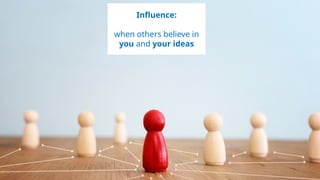
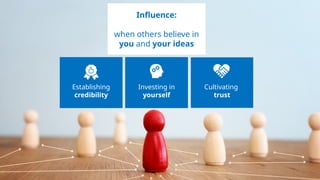
Influence:
when others believe in
you and your ideas
4
Influence:
when others believe in
you and your ideas
5
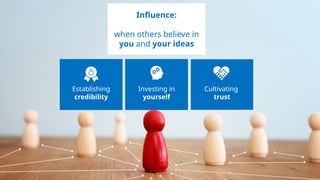
Establishing
credibility
Cultivating
trust
Investing in
yourself
Influence:
when others believe in
you and your ideas
6
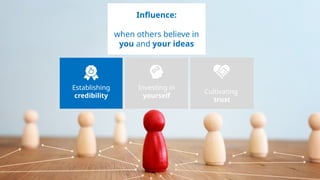
Establishing
credibility
Cultivating
trust
Investing in
yourself
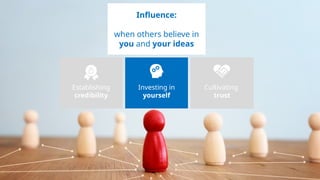
Influence:
when others believe in
you and your ideas
Showcase your skillz and smartz
AKA “jazz hands and spirit fingers”
• Take a hands-on approach
• Know your industry
• Identify and showcase quick wins
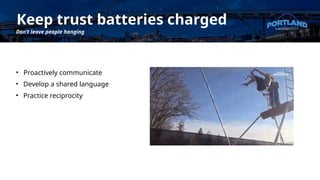
Keep trust batteries charged
Don’t leave people hanging
• Proactively communicate
• Develop a shared language
• Practice reciprocity
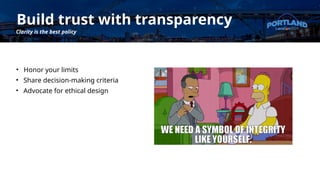
Build trust with transparency
Clarity is the best policy
• Honor your limits
• Share decision-making criteria
• Advocate for ethical design
10
Establishing
credibility
Cultivating
trust
Investing in
yourself
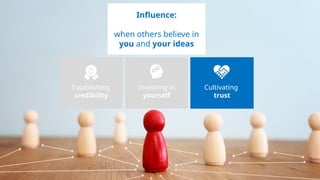
Influence:
when others believe in
you and your ideas
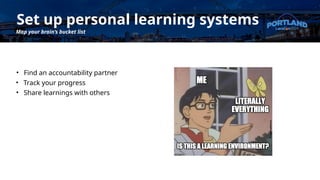
Set up personal learning systems
Map your brain’s bucket list
• Find an accountability partner
• Track your progress
• Share learnings with others
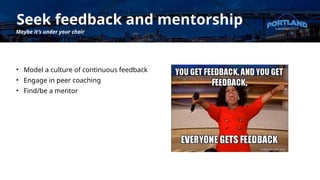
Seek feedback and mentorship
Maybe it’s under your chair
• Model a culture of continuous feedback
• Engage in peer coaching
• Find/be a mentor
Build your growth network
Swipe right for wisdom
• Curate your own personal board of directors
• Identify networking opportunities
• Put yourself out there
14
Establishing
credibility
Cultivating
trust
Investing in
yourself
Influence:
when others believe in
you and your ideas
Set the pace, protect your space
“No spaghetti arms”
• Connect the dots
• Check in purposefully
• Clarify and communicate
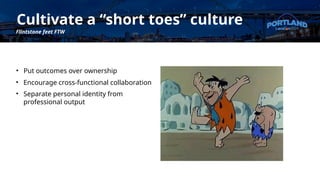
Cultivate a “short toes” culture
Flintstone feet FTW
• Put outcomes over ownership
• Encourage cross-functional collaboration
• Separate personal identity from
professional output
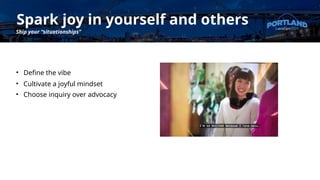
Spark joy in yourself and others
Ship your “situationships”
• Define the vibe
• Cultivate a joyful mindset
• Choose inquiry over advocacy
18
Establishing
credibility
Cultivating
trust
Investing in
yourself
Influence:
when others believe in
you and your ideas
Building your influence roadmap
• Build your network
• Tell your story
• Set clear goals
• Give and ask for feedback
• Seek mentorship
• Bring people together
Are there any key takeaways you plan
to implement after today?
Building Influence, Keynote LavaCon 2024

Building Influence, Keynote LavaCon 2024

Editor's Notes

  • #1 MELINDA Hello and welcome to Building Influence! Much of what you are about to hear would be good advice for anybody in the workplace, but is especially crucial for those in the UX space, which is still establishing itself as a respected discipline in some enterprise environments.
  • #2  Discussing practical, tactical strategies to build influence Workplace - especially more nascent fields Larger toolkit for actionable roadmap for you Today, we'll be discussing practical, tactical, everyday strategies to grow and build your influence as a design professional. I may say some things you have heard before, or use terms you are already familiar with. However, there will likely be some —or even several— strategies you may not have heard of. And, as there are quite a couple of opportunities to interact and discuss throughout the presentation, you'll get the chance to share your experiences and hear others' stories about how they have gone about building influence. Because it's different for everybody. This is about taking a look at the larger toolkit and creating an actionable roadmap for you personally.
  • #3 Selene De La Cruz, public speaker who tells this story about me New team / met her before / did not recognize me Pivotal moment / full self to work / intentional communication Impact can happen without us even realizing it. My influence story is about a woman I hired several years ago when I was building a team from scratch. Her name is Selene De La Cruz and she is now an accomplished public speaker who often shares this story about me when she’s talking about leadership. She was my first hire and she happened to start work on Halloween. We had met in person once before, but she barely recognized me because I greeted her wearing a blue onesie with a pacifier around my neck. (Unfortunately I could not find a picture of me in that outfit but this gives you an idea.) The way Selene tells it, that moment made her realize she could bring her full self to work on my team, and she now makes sure to intentionally communicate this to her own teams because it was such a pivotal moment for her. Interestingly, I barely remember this, which highlights another aspect of influence: after a while, you might not even realize the impact you're having.
  • #4 What is influence Influence is not authority / being the boss or having a decision-making role. Authority means people have to do what you say. Influence inspires people to act with you because they trust your ideas and insights. Influence will not be handed to you, you must create it To kick us off, let's define what we mean by influence. And what better way to define something than by indicating what it isn’t? Influence is not authority.  Authority means you're in a decision-making role and people have to do what you say because you're in charge. Influence, on the other hand, inspires people to act alongside you because they trust in you and the direction, ideas, or insights you offer. Influence is not something that will be handed to you. You have to create it for yourself.
  • #5 Key elements Credible expert Life strategy of continuous learning Build strong relationships built on shared trust Credibility is the bedrock on which influence is built People won’t trust you without it Consistently meet and exceed expectations. Investing in Yourself: Invest in yourself through continuous learning and sharing knowledge. Focus on continuous improvement for yourself and others in your network. Cultivating Trust: Build strong, trustworthy relationships by being receptive, collaborative, and positive. Trust helps boost influence by making others feel confident in you. In this session, we'll connect some important elements that help you build influence. It's best done by establishing yourself as a credible expert, developing a life strategy focused on continuous learning, and working to build strong/ trustworthy relationships.  These are the 3 topics we’ll be diving into today as we discuss practical, everyday strategies to build and sustain influence as a UX professional. First, we’ll dive into credibility. Remember, creating a trusted reputation is your responsibility—no one else can do it for you. We'll explore effective strategies to help you achieve and maintain that credibility. Next, we'll explore the importance of investing in yourself through learning and knowledge sharing. When you invest in yourself, you become more confident, and people are more likely to trust you. Focusing on continuous improvement, for yourself and others in your orbit, is a great way to boost your influence. Finally, we'll discuss cultivating trust. When people trust you, they feel more confident, and you're more likely to influence them. We'll explore how being receptive, collaborative, and positive can help you build stronger, more effective relationships
  • #6 Credibility is the bedrock on which influence is built People won’t trust you without it Consistently meet and exceed expectations. Credibility is the bedrock of influence. Without it, we can't expect others to trust or follow our recommendations. Building credibility involves: demonstrating your expertise, reliability, and integrity. It has a lot to do with consistently meeting and exceeding expectations. Building credibility is all about being consistent and open. It means delivering on your promises, being honest about what you can and can't do, and always working to improve your skills—as well as making sure your partners are aware of the area expertise you bring to the table.
  • #7 BYOCheerleader: don’t love /jazz hands / care deeply / knows a lot Take a hands-on approach: Fully understand E2E your product, service or company (XFN) Informed decisions Know your industry: Establish expertise / Design trends and best practices / discipline, deliverables, and workflows Nascent discipline Identify quick wins: Small, impactful changes key metrics like NPS, conversion rates, or attrition. data to demonstrate value to business / customers. It’s hard to be your own cheerleader. Not everyone loves talking themselves up, but sometimes you have to get out the jazz hands and the spirit fingers if you want to start building your personal brand as someone who cares deeply about the work and know what they’re talking about. Take the hands-on approach: Spend time with your product SMEs, finance and tech partners to really understand how your product works and how it’s profitable, so you can make more informed design decisions. For example, instead of waiting for feedback from the QA team, find a way to test a new feature yourself or at least get a demo in UAT. QA folks are not necessarily checking for fidelity with design and content, and I can tell you I have seen quite a few issues that would have gone live to customers if there had not been a set of design eyes to catch them. Know your industry: Stay on top of (and share) the latest design trends and best practices through newsletters, presentations, or lunch-and-learn sessions—whatever comes naturally to you. And don’t limit this to just your design team—you can help educate and inform your product, tech, and data partners too. For example, I know a lot of us have created decks for our XFN partners to explain our discipline, our deliverables and the way we work. Third, Identify and showcase quick wins. Quick wins are small victories that will show how a better user experience can boost NPS, reduce attrition, or increase conversion rates as these are keywords for many of our stakeholders. For example, last year my team made a few small tweaks to specific fields that we knew Freedom Rise applicants were struggling with. We could then track the value of changing those few variables (by looking at form completion and approval rates) to prove the value to both the customer and the business. I personally send a "Friday update" to the Card design team with interesting links I've come across during the week with regard to finance, tech and design, and I will forward relevant decks from across the org to my quad leadership partners with a quick summary if I think it will be of interest to them.
  • #8 Every interaction a battery + or -; lizard brain (assess risk / trust) Make it a habit to keep everyone in the loop with quick updates or meeting recaps Be the glue that connects disparate teams / Strong culture of collaboration Develop a shared language: shared terms fosters team cohesion shorthand / jargon / makes it easier to align on priorities / “parking lot” / cognitive shortcut / helps streamline conversations Practice reciprocity: Show trust goes both ways Accept help, look for opportunities to return the favor. Looking out for them / them you Some things that may help level up your trust battery could be: Proactive communication is key to building trust, Make it a habit to keep everyone in the loop with quick updates or meeting recaps, Being the glue that holds information together helps teams stay aligned, and showing that you can connect the dots between different roles, tasks, or insights builds confidence. By making sure everyone has the context they need, you foster a sense of collaboration and keep trust strong across the team. Develop the common language. Creating a shared language fosters team cohesion and trust over time. For example, in one project, our team started using the phrase "parking lot" for ideas we wanted to discuss later. It became a simple, effective way for everyone to quickly align on priorities without derailing current discussions. Practice reciprocity. When you're new, people will often offer their help, and you’ll likely need it. But once you’ve received help, look for opportunities to return the favor. When someone who has supported you needs assistance, be the first to step in and offer your support. This shows that trust goes both ways. When what people expect in a situation matches what you deliver  that helps you keep their trust batteries charged.
  • #9 Integrity: business context / transparent @ability, promises, responsibility Honor your limits: capabilities and limitations, can’t / can’t Mistakes / don’t know / need more information Risk / communicate early and propose solutions. Share decision-making criteria: Document and share the rationale Collaborate to create a shared rationale / brainstorm / validate hypothesis Advocate for ethical approach: Work / user-friendly, inclusive, and accessible Internal ethical guidelines, fair lending and avoiding deceptive design patterns In a professional context, integrity means being transparent, keeping your promises, and taking responsibility for your actions. Integrity is your moral compass –. Integrity enhances social health and relationship quality. Now, how do we best demonstrate integrity? Honor your limits. This means clearly communicating your capabilities and limitations. It also means acknowledging mistakes and admitting when you don’t know something or need more information to make a decision. If a project is at risk, communicate early and propose solutions. Example: In sprint planning communications, set realistic expectations for what can be achieved within that timeframe. Also, be ready to have a pivot conversation if needed when priorities shift. 2. Document and share rationale for design decisions with partners and stakeholders. Even better, work with them towards creating a shared rationale. For example: you might work together to align on a way to track decisions made throughout the project, or engage your partners in decision making by having them brainstorm and validate different hypotheses to be explored before you even start designing. 3. Advocate for user friendly, inclusive and accessible designs. This means understanding internal ethical guidance re: fair lending and deceptive design patterns, as well as working to educate yourself and others about accessibility.
  • #10 Continuous learning isn’t just a career strategy, it is a life strategy. Investing in youself shows you’re committed to gaining knowledge and applying it to move things forward. learning new skills, perfecting the skills you already have and connecting with mentors and peers along the way.
  • #11 Learning systems help you stay motivated and on track Decide what you want to learn Make a plan for how you are going to acquire this knowledge or skill You’ll need an accountability partner to make sure you follow through on your learning plan. Track your progress: in a journal, project management tool, or checklist to regularly review what you’ve accomplished and what still needs work stay focused and adjust as necessary Share your learnings: Reinforce your knowledge by sharing it / internalize It's important to find an accountability partner. This could be a friend, a colleague, or someone from your design community. Having someone to check in with can keep you motivated and on track. Have a way to track your progress. Keep a journal, use a project management tool, or set up a simple checklist. Regularly review what you've accomplished and what still needs work. This will help you stay focused and make adjustments as needed. Share your learnings with others. Whether it's through a blog, social media, or a design meetup, sharing what you've learned not only reinforces your own knowledge but also helps others in the community.
  • #12 Continuous feedback: regular, timely feedback sessions (give / get) Feedback as a conversation vs email / review Peer coaching: support each other’s growth / sharing knowledge / tackling challenges Improve skills collaboratively. Mentorship: guide and advise your professional growth / just ask Regular check-ins / progress and challenges. ADP List / refresh and upskill On your influence-building journey, it is crucial to seek feedback from peers, managers, and stakeholders to identify areas for improvement—as well as know where you’re already killing it. One way to tackle this: schedule (or request) regular feedback sessions with your team and stakeholders to gather constructive criticism and suggestions. My team tends to do this in fortnightly retrospective conversation, as it's easier to give and receive feedback with a certain amount of recency. I also feel it's important to structure feedback as a conversation vs sending an email or having "surprise" issues come up in a midyear or end-of-year review. A more low-risk method of introducing a steady feedback a loop is peer coaching, which means teaming up with a colleague to support each other's growth. You can share insights, give and receive feedback, and help each other tackle challenges together. You could also look for a peer mentoring relationship, which typically involves one person with more experience guiding and advising the other. Overall, finding a mentor within or outside the organization who can provide guidance and support for your professional growth is a good move. Set up regular check-ins to discuss your progress and challenges. Want to be a mentor? ADP List is a great place to start.
  • #13 Next you need to build your growth network is a strategic collection of people Personal board of directors: trusted advisors who provide guidance, opportunities, endorse your work Networking: Internally or externally Meetups can be great networking opportunities as they are often low-stakes / affordable. Conferences / webinars, workshops, and events Make a list of events you're interested in Putting yourself out there: Public speaking to keep presentation skills sharp. All-hands, immediate team a bit beyond your comfort level / push to grow A growth network is a strategic collection of people who support your personal and professional development. They may boost your influence by amplifying your ideas, endorsing your work, and connecting you with new opportunities. A good way to expand your growth network is to start assembling your personal board of directors—these are the people you meet along the way who can (and will) provide guidance, share knowledge, offer opportunities, and help you navigate challenges. This group of trusted advisors can include mentors, peers, industry experts, close friends or even family members. But how am I supposed to meet this personal board of directors, you might ask. One way is through networking. You can find networking opportunities both internally at JPMC and externally. IMO, meetups are nice because they are generally affordable, there's usually free food and it's pretty low-stakes, versus attending a conference where it can be harder to pick "your people" out of a big crowd. That said, conferences can be great places to connect with new people. In fact, I came to JPMC because of a connection I made almost a decade ago when I was speaking at a conference. Webinars and workshops also offer opportunities to network.  Make a list of events you’re interested in and ask your manager what your training budget will cover, or which internal partnerships/courses they would recommend. Finally, GET OUT THERE. to be honest, you’re watching me get out of my comfort zone right now. Public speaking is something that I force myself to do a couple of times a year, partially because I don’t particularly enjoy being in the spotlight — in fact, However, I do love knowledge sharing and connecting with people and I know it’s important to keep that muscle strong. Or perhaps "getting out there" for you is presenting to your immediate team, or at an All-Hands. Whatever your comfort level is, find a way to push yourself just a little further outside of that zone so you can keep making valuable connections and growing your influence.
  • #14 Trust is essential for gaining influence, as we mentioned before Less about trust battery which is 1;1 and more about fostering a strong working team that trusts and supports each other Lastly, building trust is key to gaining influence. It's the foundation for working well together and creating a strong team culture. When your team trusts and supports each other, you can achieve amazing things and build lasting respect. When we talk about TRUST here, it’s slightly different from the previously mentioned Trust battery concept – here we talk about trust from high-level and overarching point of view. Building trust in your network involves creating clarity around ways of working (steady rhythm), being open and collaborative (short toes), and maintaining a positive, supportive attitude (joyful situationships) in your work relationships.
  • #15 Dancing together / No toes stepped on Connect the Dots bridge the gap between “how I work" and "how they work / "how we work together.” Be the glue: connect the dots, teams across marketing, product, data, architecture, and engineering for info sharing / decision-making Check in: Schedule regular alignment meetings with clear agendas Reason for group meetings (1:1) – time back is a gift Clarify and Communicate: UX initiatives, ways of working, definition of success (workshop, alignment meetings, etc) Mindful thought process sharing XFN / reciprocity It’s important to  bridge the gap between "how I work", and "how they work", to get to "how we work together". And an important part of that effort is establishing boundaries. We may be dancing together, but we require our own space to dance in so no toes get stepped on. Check in purposefully For many design professionals, much of our work involves connecting the dots between teams. We're working with marketing, product, data, architecture and engineering to get everyone on the same page. This may mean scheduling regular alignment mtgs. Set agendas for these mtgs to make sure people know what to expect and why their attendance matters. Get your workshop on When it's time to get clear on UX initiatives, and even on process/ways of working, design a workshop to facilitate those discussions and clarify what needs to happen for the team to be successful. These sessions are great for building rapport and showing the value of experience design as a whole. Explain yourself Be thoughtful about your thought process when engaging with XFN partners. Take time to explain your rationale and find frameworks or templates to help facilitate these conversations. If you're working to explain your thought process to them, the odds are they will take the same care to explain their thought process to you.
  • #16 David Santos CPO of GitLab: “ short toes" / not possible to step collective goals rather than individual agendas Outcomes Over Ownership Shared objective, disparate ideas to get there (focus on shared understanding) Dig into the problem and align on what it is / definition of success / solid starting point. Encouraging XFN Collaboration: multiple teams / LOBs (Steerco) provide regular opp’ties for knowledge sharing and discourage silos. (agenda) Access to the information needed to contribute effectively. Separating PIFPO: opportunity to grow, reflection on your work not you more open and productive dialogue with colleagues. A few months ago I listened to a podcast featuring David DeSanto the CPO of GitLab talking about the importance of a "short toes” environment — meaning it's not possible to step on anyone's toes, because people are focused on the team's collective goals rather than individual agendas. Outcomes over ownership: When you open up a meeting with a bunch of folks who have a shared goal but disparate ideas of how to get there, focus on that shared goal. Dig into the problem you're trying to solve together . Because when you truly understand the problem, and everyone is aligned on what that problem is and what success should look like, you have a much more solid starting point. Workshops can be a great way to do this. Encourage cross-functional collaboration: If you have a cross-functional project that requires input from multiple teams or LOBs, invite representatives from each team to a regularly-scheduled steerco mtg to encourage knowledge sharing and discourage silos. This is a proactive approach to ensure everyone has skin in the game and they're getting the information they need to contribute effectively. Separating personal identity from professional output: By approaching feedback as an opportunity to grow, and as a reflection on your work rather than you as a person, you can help create a more open and productive dialogue with those around you.
  • #17 Define the vibe: “situationship”—shared need, not by choice. approach to work /opportunity to define your personal brand / positive as possible Cultivating a Joyful Mindset: find joy in everyday interactions Show up with openness and curiosity / mantra pw / reminder / goals / focus / grounded Inquiry over advocacy:—lead with investigation Seek to understand others’ POV rather than advocating for your own. Surface the right information for the team /new information / bring together to identify and rally for the best decisions. In a recent ways of working session with my quad partners, we struggled to name the relationship we have with each other. We decided ti's not a partnership, it’s not a marriage, it’s a “situationship”—you’re together because of a shared business need, not because you’ve necessarily chosen to be there. This is an opportunity to define your personal brand in the way you approach these working relationships. And why not make that vibe as positive as you possibly can? A key piece of this is cultivating a joyful mindset. If you can’t find joy in our everyday interactions, if your hearts isn’tt in it, how can you show up with the open mind and curiosity you need to do this work? One way I maintain my own joyful mindset is to set a mantra or intention for myself every time I need to change my network password. That way, I am reminding myself every time I enter my password what I’m here to achieve, and that I am surrounded by people who are going to help me get there—sometimes several times a day. Which brings me to my next point—we all want to make sure we’re supporting the company or client to the best of our ability. We are here to surface information that will help the working group make the best decisions possible. That means choosing inquiry over advocacy. If we can lead with investigation, seeking to understand others’ points of view vs trying to beat them over the head with ours, we can bring a group together and rally for the best solution possible. ---------- When you do choose to advocate, you should be pushing for data-driven decisions—and the inquiry piece can point you to a lot of key data points as an inherent part of the process.
  • #18  In summary, influence is built when you work to establish credibility which requires investing in and actively developing your own expertise (and others’) and that makes people trust you and your ideas.
  • #19 Build your network: Find people who give honest feedback and help you grow. Tell your story: Share your knowledge in whatever way works for you / comfort level Set clear goals: Create a personal development plan and make sure you’re accountable for it Give and ask for feedback: Make feedback a regular and intentional habit. Seek mentorship: Be both a mentee and a mentor to foster growth. Bring people together: Drive alignment around shared goals and values.
  • #21 Final Conclusion: Building influence maybe a slow process, but once you kick start it and stay on that track – it keeps working and developing itself. It almost works like a well-oiled machine, with less effort than what was needed in the beginning.