Memes in the Cloud –
Building a full-stack app with Golang and
Google Cloud Platform in one week
Dr. Felix Raab | Head of Engineering @ KI Labs Munich | ki-labs.com
f.raab@kigroup.de | medium.com/@fe9lix
SCOPE OF TALK
SCOPE OF TALK
Case Study
Project idea and journey for an MVP finished within one week
SCOPE OF TALK
Case Study
Project idea and journey for an MVP finished within one week
Software Engineering for Cloud Apps
The “full” stack: Frontend, Backend, Build, Deployment, Logging…
Towards the end of the talk: Software Engineering practices in Go
SCOPE OF TALK
Case Study
Project idea and journey for an MVP finished within one week
Software Engineering for Cloud Apps
The “full” stack: Frontend, Backend, Build, Deployment, Logging…
Towards the end of the talk: Software Engineering practices in Go
Memes
At the heart of the app itself – consequently, Memes to illustrate
some opinionated views
BACK AT MY PREVIOUS EMPLOYER…
Hours claiming – trying not get “shitlisted”…
because the boss would be notified!
Idea – Every Friday…
Schedule an hours claim reminder mail containing
a meme, to myself.
FIRST: HOW TO CHOOSE A CLOUD?
…when you can start from scratch – no corporate
constraints, no restrictions, no Frankfurt.
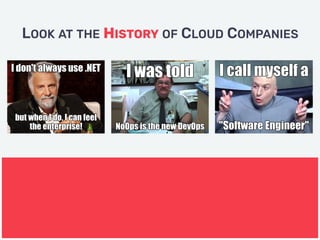
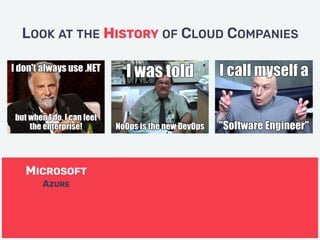
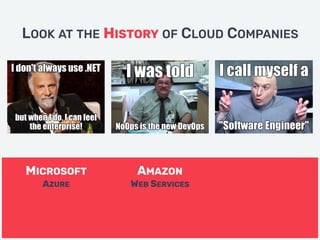
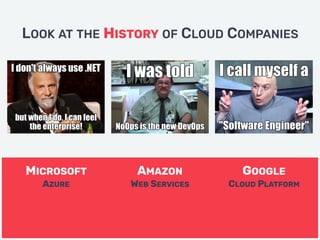
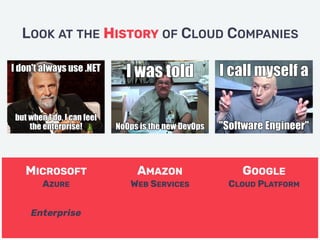
LOOK AT THE HISTORY OF CLOUD COMPANIES
MICROSOFT
AZURE
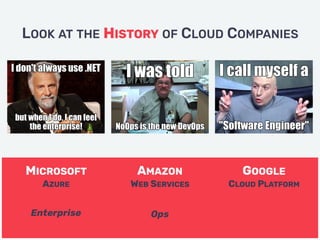
LOOK AT THE HISTORY OF CLOUD COMPANIES
MICROSOFT
AZURE
AMAZON
WEB SERVICES
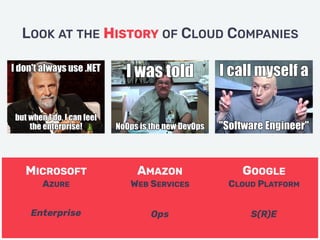
LOOK AT THE HISTORY OF CLOUD COMPANIES
MICROSOFT
AZURE
AMAZON
WEB SERVICES
GOOGLE
CLOUD PLATFORM
LOOK AT THE HISTORY OF CLOUD COMPANIES
MICROSOFT
AZURE
AMAZON
WEB SERVICES
GOOGLE
CLOUD PLATFORM
Enterprise
LOOK AT THE HISTORY OF CLOUD COMPANIES
MICROSOFT
AZURE
AMAZON
WEB SERVICES
GOOGLE
CLOUD PLATFORM
Enterprise Ops
LOOK AT THE HISTORY OF CLOUD COMPANIES
MICROSOFT
AZURE
AMAZON
WEB SERVICES
GOOGLE
CLOUD PLATFORM
Enterprise Ops S(R)E
–Brave New Geek
“Multi-Cloud Is a Trap”
https://bravenewgeek.com/multi-cloud-is-a-trap/
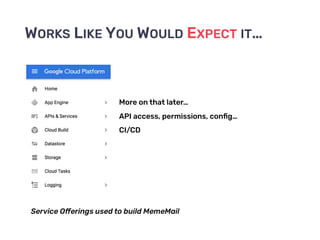
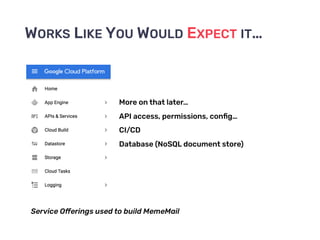
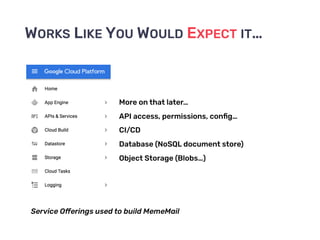
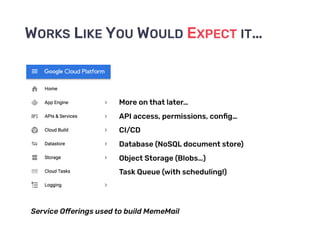
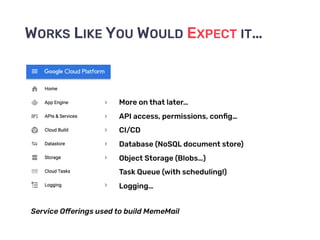
WORKS LIKE YOU WOULD EXPECT IT…
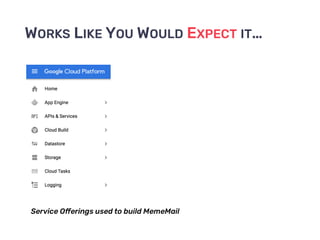
Service Offerings used to build MemeMail
WORKS LIKE YOU WOULD EXPECT IT…
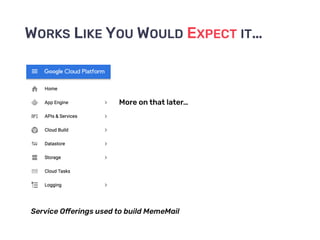
Service Offerings used to build MemeMail
More on that later…
WORKS LIKE YOU WOULD EXPECT IT…
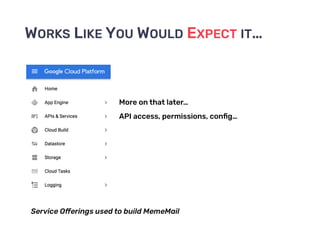
Service Offerings used to build MemeMail
More on that later…
API access, permissions, config…
WORKS LIKE YOU WOULD EXPECT IT…
Service Offerings used to build MemeMail
More on that later…
CI/CD
API access, permissions, config…
WORKS LIKE YOU WOULD EXPECT IT…
Service Offerings used to build MemeMail
More on that later…
CI/CD
Database (NoSQL document store)
API access, permissions, config…
WORKS LIKE YOU WOULD EXPECT IT…
Service Offerings used to build MemeMail
More on that later…
CI/CD
Database (NoSQL document store)
Object Storage (Blobs…)
API access, permissions, config…
WORKS LIKE YOU WOULD EXPECT IT…
Service Offerings used to build MemeMail
More on that later…
CI/CD
Database (NoSQL document store)
Object Storage (Blobs…)
Task Queue (with scheduling!)
API access, permissions, config…
WORKS LIKE YOU WOULD EXPECT IT…
Service Offerings used to build MemeMail
More on that later…
CI/CD
Database (NoSQL document store)
Object Storage (Blobs…)
Task Queue (with scheduling!)
Logging…
API access, permissions, config…
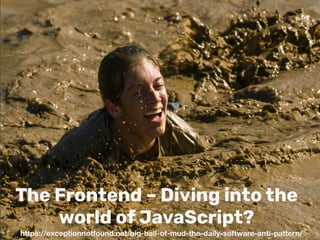
The Frontend – Diving into the
world of JavaScript?
https://exceptionnotfound.net/big-ball-of-mud-the-daily-software-anti-pattern/
THE FULLSTACK IN GO –
SO HOW ABOUT
WEBASSEMBLY (WASM)?
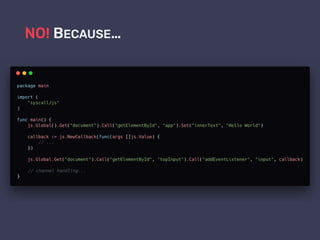
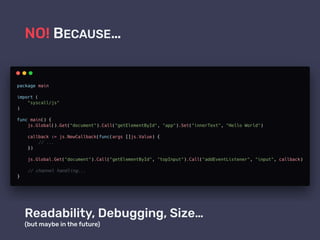
NO! BECAUSE…
NO! BECAUSE…
NO! BECAUSE…
Readability, Debugging, Size…

(but maybe in the future)
NO WEBASSEMBLY.
MAYBE ELM THEN?
NO! BECAUSE…
Learning curve, different paradigm,
transpiling to JS, libraries… – remember, we
have one week to finish!
VANILLA JS (ES 6)! 

BUT WHICH FRAMEWORK?
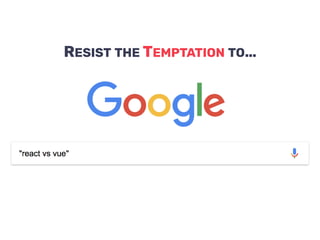
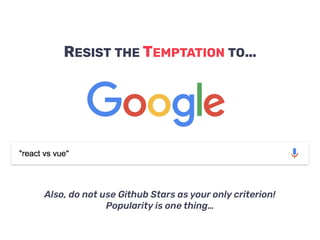
RESIST THE TEMPTATION TO…
Also, do not use Github Stars as your only criterion!
Popularity is one thing…
HOW TO CHOOSE
HOW TO CHOOSE
1) Does it solve your problem in a simple way?
Rendering the frontend and adding interaction without sprinkling
jQuery calls throughout your code base.
HOW TO CHOOSE
1) Does it solve your problem in a simple way?
Rendering the frontend and adding interaction without sprinkling
jQuery calls throughout your code base.
2) Look at the quality of the documentation!
Because you need to read it and be able to understand it – quickly!
VUE.JS SEEMS TO MATCH.
BUT WHICH
ARCHITECTURE?
SO MANY APPROACHES…
…MVVM, Flux, Redux, SAM, ELM Architecture…?
What is the essence?
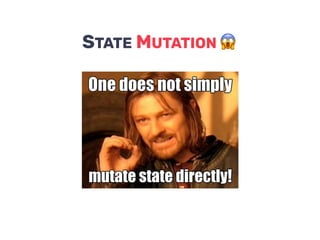
STATE MUTATION
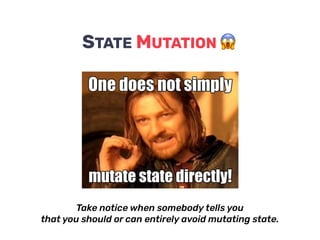
STATE MUTATION
Take notice when somebody tells you
that you should or can entirely avoid mutating state.
MUTATING STATE. HERE’S HOW…
1) Put your entire app state into a single model
Avoid primitive obsession – use proper objects! This is your single source of truth.
MUTATING STATE. HERE’S HOW…
1) Put your entire app state into a single model
Avoid primitive obsession – use proper objects! This is your single source of truth.
2) Dispatch Actions from the UI to trigger a state mutation
Do not yet mutate the state in the action itself! Actions are intents with payloads.
MUTATING STATE. HERE’S HOW…
1) Put your entire app state into a single model
Avoid primitive obsession – use proper objects! This is your single source of truth.
2) Dispatch Actions from the UI to trigger a state mutation
Do not yet mutate the state in the action itself! Actions are intents with payloads.
3) Accept or reject the state mutation in your model
At the end of your (async.) action, “commit” / “propose” a new value to the model.
MUTATING STATE. HERE’S HOW…
1) Put your entire app state into a single model
Avoid primitive obsession – use proper objects! This is your single source of truth.
2) Dispatch Actions from the UI to trigger a state mutation
Do not yet mutate the state in the action itself! Actions are intents with payloads.
3) Accept or reject the state mutation in your model
At the end of your (async.) action, “commit” / “propose” a new value to the model.
4) Update the UI when the state changes
Derive the state to render from your model, e.g. by UI bindings.
VUEX.JS KIND OF
SUPPORTS THAT PATTERN
–Ryan Dahl
“[...] if you’re building a
server, I can’t imagine using
anything other than ”
THE BACKEND.
HOW TO BUILD?
HOW TO BUILD?
Go 1.11
Because Go Modules!
HOW TO BUILD?
Go 1.11
Because Go Modules!
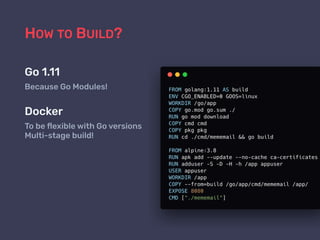
Docker
To be flexible with Go versions

Multi-stage build!
HOW TO BUILD?
Go 1.11
Because Go Modules!
Docker
To be flexible with Go versions

Multi-stage build!
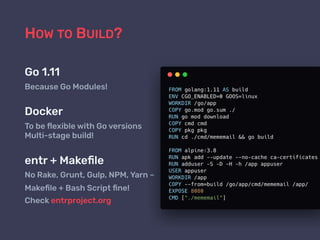
entr + Makefile
No Rake, Grunt, Gulp, NPM, Yarn –
Makefile + Bash Script fine!
Check entrproject.org
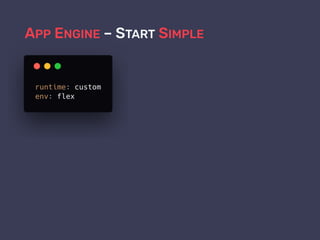
APP ENGINE – START SIMPLE
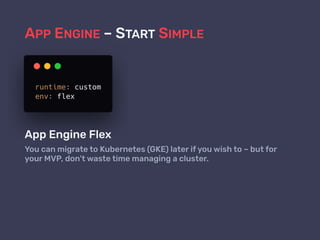
App Engine Flex
You can migrate to Kubernetes (GKE) later if you wish to – but for
your MVP, don’t waste time managing a cluster.
APP ENGINE – START SIMPLE
App Engine Flex
You can migrate to Kubernetes (GKE) later if you wish to – but for
your MVP, don’t waste time managing a cluster.
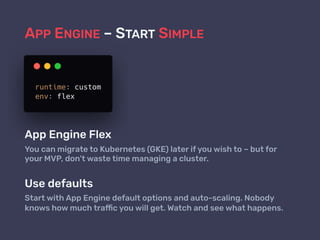
Use defaults
Start with App Engine default options and auto-scaling. Nobody
knows how much traffic you will get. Watch and see what happens.
SEPARATE THE FRONTEND
AND BACKEND?
YES AND NO!
YES AND NO!
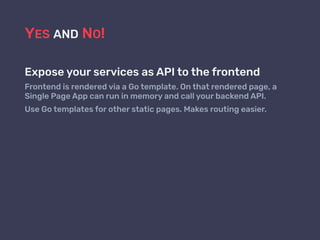
Expose your services as API to the frontend
Frontend is rendered via a Go template. On that rendered page, a
Single Page App can run in memory and call your backend API.
Use Go templates for other static pages. Makes routing easier.
YES AND NO!
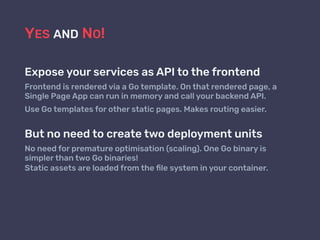
Expose your services as API to the frontend
Frontend is rendered via a Go template. On that rendered page, a
Single Page App can run in memory and call your backend API.
Use Go templates for other static pages. Makes routing easier.
But no need to create two deployment units
No need for premature optimisation (scaling). One Go binary is
simpler than two Go binaries! 

Static assets are loaded from the file system in your container.
CI/CD
CI/CD
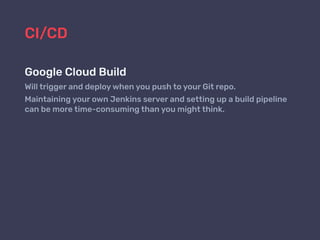
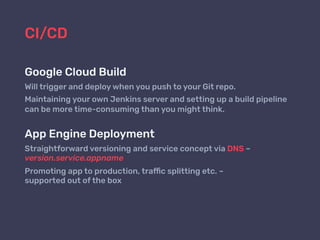
Google Cloud Build
Will trigger and deploy when you push to your Git repo.
Maintaining your own Jenkins server and setting up a build pipeline
can be more time-consuming than you might think.
CI/CD
Google Cloud Build
Will trigger and deploy when you push to your Git repo.
Maintaining your own Jenkins server and setting up a build pipeline
can be more time-consuming than you might think.
App Engine Deployment
Straightforward versioning and service concept via DNS –
version.service.appname
Promoting app to production, traffic splitting etc. – 

supported out of the box
The cloud can be mean and slow.
PLAYGROUNDS SAVE TIME
Create a GCP “Playground” project
Got stuck with Cloud Datastore (vs. Cloud Firestore) and 

Cloud Tasks (only certain EU region).
Led me to test service offerings first via playground.
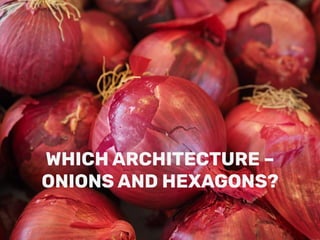
WHICH ARCHITECTURE –
ONIONS AND HEXAGONS?
SO MANY LAYERS AND CONCEPTS
Also, ask yourself : Is there a rich domain? Or are
you really building a CRUD app?
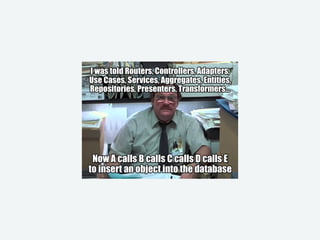
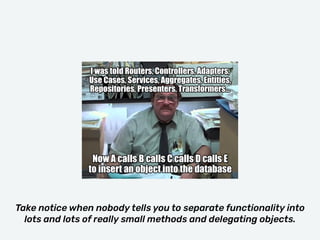
Take notice when nobody tells you to separate functionality into
lots and lots of really small methods and delegating objects.
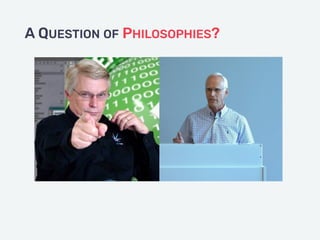
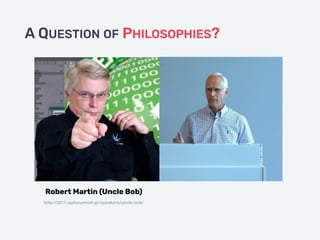
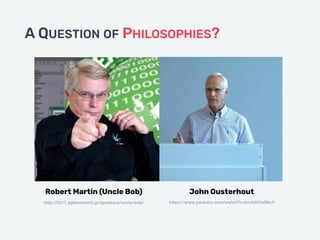
A QUESTION OF PHILOSOPHIES?
Robert Martin (Uncle Bob)
http://2017.agilesummit.gr/speakers/uncle-bob/
A QUESTION OF PHILOSOPHIES?
John Ousterhout
https://www.youtube.com/watch?v=bmSAYlu0NcY
Robert Martin (Uncle Bob)
http://2017.agilesummit.gr/speakers/uncle-bob/
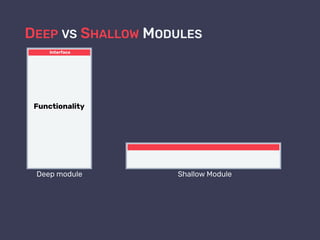
DEEP VS SHALLOW MODULES
Shallow ModuleDeep module
Interface
Functionality
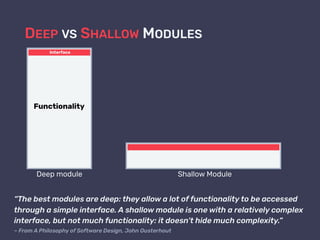
DEEP VS SHALLOW MODULES
Shallow Module
“The best modules are deep: they allow a lot of functionality to be accessed
through a simple interface. A shallow module is one with a relatively complex
interface, but not much functionality: it doesn’t hide much complexity.” 

– From A Philosophy of Software Design, John Ousterhout
Deep module
Interface
Functionality
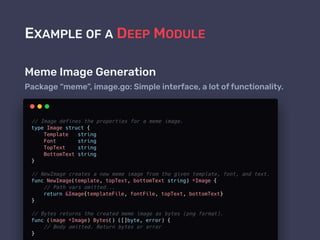
EXAMPLE OF A DEEP MODULE
Meme Image Generation
Package “meme”, image.go: Simple interface, a lot of functionality.
PASS-THROUGH CODE
TENDS TO BE SHALLOW – BUT
HOW MUCH SEPARATION?
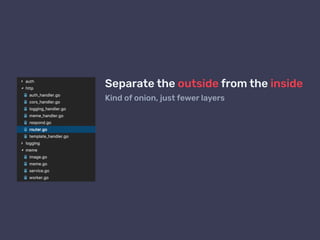
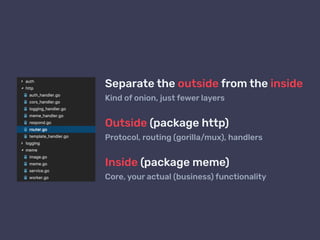
Separate the outside from the inside
Kind of onion, just fewer layers
Separate the outside from the inside
Kind of onion, just fewer layers
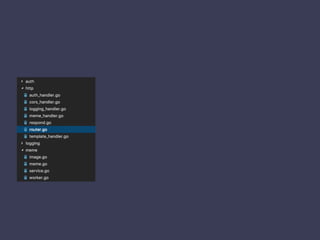
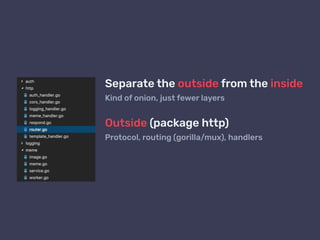
Outside (package http)
Protocol, routing (gorilla/mux), handlers
Separate the outside from the inside
Kind of onion, just fewer layers
Outside (package http)
Protocol, routing (gorilla/mux), handlers
Inside (package meme)
Core, your actual (business) functionality
WHAT ABOUT
INTERFACES?
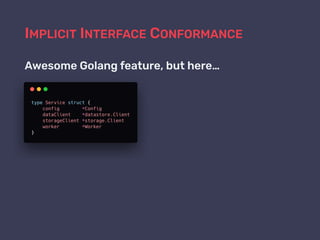
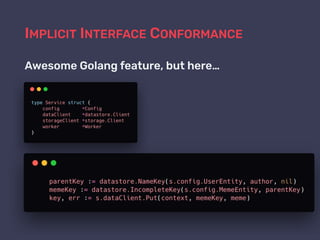
IMPLICIT INTERFACE CONFORMANCE
Awesome Golang feature, but here…
IMPLICIT INTERFACE CONFORMANCE
Awesome Golang feature, but here…
IMPLICIT INTERFACE CONFORMANCE
Awesome Golang feature, but here…
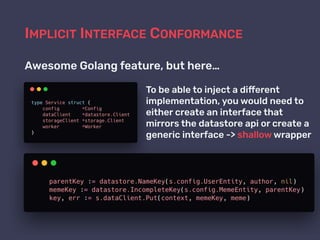
IMPLICIT INTERFACE CONFORMANCE
Awesome Golang feature, but here…
To be able to inject a different
implementation, you would need to
either create an interface that
mirrors the datastore api or create a
generic interface -> shallow wrapper
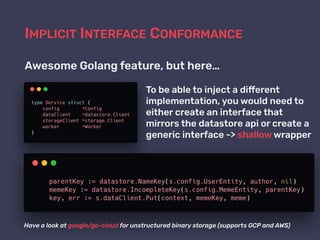
IMPLICIT INTERFACE CONFORMANCE
Awesome Golang feature, but here…
To be able to inject a different
implementation, you would need to
either create an interface that
mirrors the datastore api or create a
generic interface -> shallow wrapper
Have a look at google/go-cloud for unstructured binary storage (supports GCP and AWS)
STRONGER ARGUMENT FOR AN INTERFACE?
Logging
Needed almost everywhere! But Go’s default logging has limitations.
STRONGER ARGUMENT FOR AN INTERFACE?
Logging
Needed almost everywhere! But Go’s default logging has limitations.
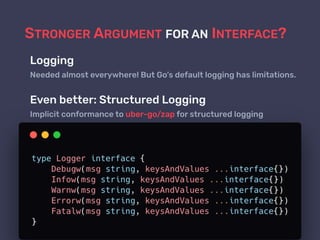
Even better: Structured Logging
Implicit conformance to uber-go/zap for structured logging
STRONGER ARGUMENT FOR AN INTERFACE?
Logging
Needed almost everywhere! But Go’s default logging has limitations.
Even better: Structured Logging
Implicit conformance to uber-go/zap for structured logging
HOW TO HANDLE CROSS-
CUTTING CONCERNS…?
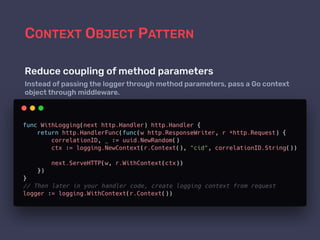
CONTEXT OBJECT PATTERN
Reduce coupling of method parameters
Instead of passing the logger through method parameters, pass a Go context
object through middleware.
CONTEXT OBJECT PATTERN
Reduce coupling of method parameters
Instead of passing the logger through method parameters, pass a Go context
object through middleware.
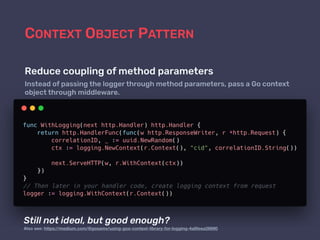
CONTEXT OBJECT PATTERN
Reduce coupling of method parameters
Instead of passing the logger through method parameters, pass a Go context
object through middleware.
Still not ideal, but good enough?
Also see: https://medium.com/@gosamv/using-gos-context-library-for-logging-4a8feea26690
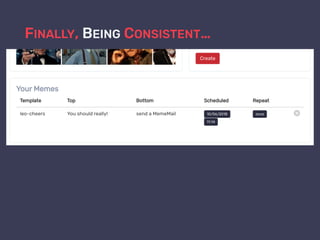
FINALLY, BEING CONSISTENT…
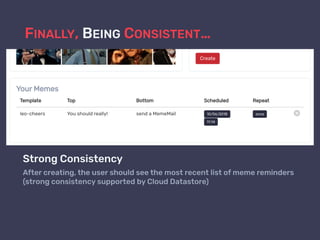
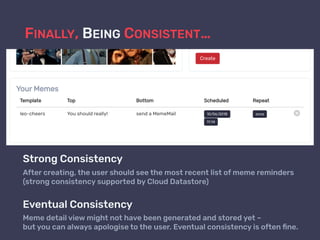
Strong Consistency
After creating, the user should see the most recent list of meme reminders 

(strong consistency supported by Cloud Datastore)
FINALLY, BEING CONSISTENT…
Strong Consistency
After creating, the user should see the most recent list of meme reminders 

(strong consistency supported by Cloud Datastore)
Eventual Consistency
Meme detail view might not have been generated and stored yet – 

but you can always apologise to the user. Eventual consistency is often fine.

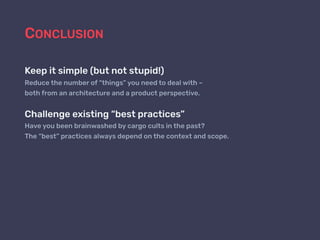
CONCLUSION
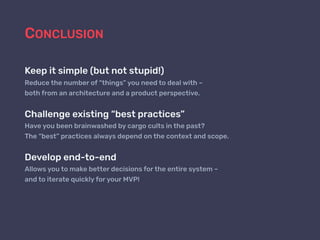
CONCLUSION
Keep it simple (but not stupid!)
Reduce the number of “things” you need to deal with –
both from an architecture and a product perspective.
CONCLUSION
Keep it simple (but not stupid!)
Reduce the number of “things” you need to deal with –
both from an architecture and a product perspective.
Challenge existing “best practices”
Have you been brainwashed by cargo cults in the past?
The “best” practices always depend on the context and scope.
CONCLUSION
Keep it simple (but not stupid!)
Reduce the number of “things” you need to deal with –
both from an architecture and a product perspective.
Challenge existing “best practices”
Have you been brainwashed by cargo cults in the past?
The “best” practices always depend on the context and scope.
Develop end-to-end
Allows you to make better decisions for the entire system –
and to iterate quickly for your MVP!
Building a full-stack app with Golang and Google Cloud Platform in one week

Building a full-stack app with Golang and Google Cloud Platform in one week

  • 1.
    Memes in theCloud – Building a full-stack app with Golang and Google Cloud Platform in one week Dr. Felix Raab | Head of Engineering @ KI Labs Munich | ki-labs.com f.raab@kigroup.de | medium.com/@fe9lix
  • 2.
  • 3.
    SCOPE OF TALK CaseStudy Project idea and journey for an MVP finished within one week
  • 4.
    SCOPE OF TALK CaseStudy Project idea and journey for an MVP finished within one week Software Engineering for Cloud Apps The “full” stack: Frontend, Backend, Build, Deployment, Logging… Towards the end of the talk: Software Engineering practices in Go
  • 5.
    SCOPE OF TALK CaseStudy Project idea and journey for an MVP finished within one week Software Engineering for Cloud Apps The “full” stack: Frontend, Backend, Build, Deployment, Logging… Towards the end of the talk: Software Engineering practices in Go Memes At the heart of the app itself – consequently, Memes to illustrate some opinionated views
  • 6.
    BACK AT MYPREVIOUS EMPLOYER… Hours claiming – trying not get “shitlisted”… because the boss would be notified!
  • 9.
    Idea – Every Friday… Schedulean hours claim reminder mail containing a meme, to myself.
  • 12.
    FIRST: HOW TOCHOOSE A CLOUD? …when you can start from scratch – no corporate constraints, no restrictions, no Frankfurt.
  • 13.
    LOOK AT THEHISTORY OF CLOUD COMPANIES
  • 14.
    LOOK AT THEHISTORY OF CLOUD COMPANIES
  • 15.
    LOOK AT THEHISTORY OF CLOUD COMPANIES
  • 16.
    LOOK AT THEHISTORY OF CLOUD COMPANIES
  • 17.
    LOOK AT THEHISTORY OF CLOUD COMPANIES MICROSOFT AZURE
  • 18.
    LOOK AT THEHISTORY OF CLOUD COMPANIES MICROSOFT AZURE AMAZON WEB SERVICES
  • 19.
    LOOK AT THEHISTORY OF CLOUD COMPANIES MICROSOFT AZURE AMAZON WEB SERVICES GOOGLE CLOUD PLATFORM
  • 20.
    LOOK AT THEHISTORY OF CLOUD COMPANIES MICROSOFT AZURE AMAZON WEB SERVICES GOOGLE CLOUD PLATFORM Enterprise
  • 21.
    LOOK AT THEHISTORY OF CLOUD COMPANIES MICROSOFT AZURE AMAZON WEB SERVICES GOOGLE CLOUD PLATFORM Enterprise Ops
  • 22.
    LOOK AT THEHISTORY OF CLOUD COMPANIES MICROSOFT AZURE AMAZON WEB SERVICES GOOGLE CLOUD PLATFORM Enterprise Ops S(R)E
  • 23.
    –Brave New Geek “Multi-CloudIs a Trap” https://bravenewgeek.com/multi-cloud-is-a-trap/
  • 24.
    WORKS LIKE YOUWOULD EXPECT IT…
  • 25.
    WORKS LIKE YOUWOULD EXPECT IT… Service Offerings used to build MemeMail
  • 26.
    WORKS LIKE YOUWOULD EXPECT IT… Service Offerings used to build MemeMail More on that later…
  • 27.
    WORKS LIKE YOUWOULD EXPECT IT… Service Offerings used to build MemeMail More on that later… API access, permissions, config…
  • 28.
    WORKS LIKE YOUWOULD EXPECT IT… Service Offerings used to build MemeMail More on that later… CI/CD API access, permissions, config…
  • 29.
    WORKS LIKE YOUWOULD EXPECT IT… Service Offerings used to build MemeMail More on that later… CI/CD Database (NoSQL document store) API access, permissions, config…
  • 30.
    WORKS LIKE YOUWOULD EXPECT IT… Service Offerings used to build MemeMail More on that later… CI/CD Database (NoSQL document store) Object Storage (Blobs…) API access, permissions, config…
  • 31.
    WORKS LIKE YOUWOULD EXPECT IT… Service Offerings used to build MemeMail More on that later… CI/CD Database (NoSQL document store) Object Storage (Blobs…) Task Queue (with scheduling!) API access, permissions, config…
  • 32.
    WORKS LIKE YOUWOULD EXPECT IT… Service Offerings used to build MemeMail More on that later… CI/CD Database (NoSQL document store) Object Storage (Blobs…) Task Queue (with scheduling!) Logging… API access, permissions, config…
  • 33.
    The Frontend –Diving into the world of JavaScript? https://exceptionnotfound.net/big-ball-of-mud-the-daily-software-anti-pattern/
  • 34.
    THE FULLSTACK INGO – SO HOW ABOUT WEBASSEMBLY (WASM)?
  • 35.
  • 36.
  • 37.
    NO! BECAUSE… Readability, Debugging,Size…
 (but maybe in the future)
  • 38.
  • 39.
    NO! BECAUSE… Learning curve,different paradigm, transpiling to JS, libraries… – remember, we have one week to finish!
  • 40.
    VANILLA JS (ES6)! 
 BUT WHICH FRAMEWORK?
  • 41.
  • 42.
  • 43.
    RESIST THE TEMPTATIONTO… Also, do not use Github Stars as your only criterion! Popularity is one thing…
  • 44.
  • 45.
    HOW TO CHOOSE 1)Does it solve your problem in a simple way? Rendering the frontend and adding interaction without sprinkling jQuery calls throughout your code base.
  • 46.
    HOW TO CHOOSE 1)Does it solve your problem in a simple way? Rendering the frontend and adding interaction without sprinkling jQuery calls throughout your code base. 2) Look at the quality of the documentation! Because you need to read it and be able to understand it – quickly!
  • 47.
    VUE.JS SEEMS TOMATCH. BUT WHICH ARCHITECTURE?
  • 48.
    SO MANY APPROACHES… …MVVM,Flux, Redux, SAM, ELM Architecture…? What is the essence?
  • 50.
  • 51.
    STATE MUTATION Take noticewhen somebody tells you that you should or can entirely avoid mutating state.
  • 52.
  • 53.
    MUTATING STATE. HERE’SHOW… 1) Put your entire app state into a single model Avoid primitive obsession – use proper objects! This is your single source of truth.
  • 54.
    MUTATING STATE. HERE’SHOW… 1) Put your entire app state into a single model Avoid primitive obsession – use proper objects! This is your single source of truth. 2) Dispatch Actions from the UI to trigger a state mutation Do not yet mutate the state in the action itself! Actions are intents with payloads.
  • 55.
    MUTATING STATE. HERE’SHOW… 1) Put your entire app state into a single model Avoid primitive obsession – use proper objects! This is your single source of truth. 2) Dispatch Actions from the UI to trigger a state mutation Do not yet mutate the state in the action itself! Actions are intents with payloads. 3) Accept or reject the state mutation in your model At the end of your (async.) action, “commit” / “propose” a new value to the model.
  • 56.
    MUTATING STATE. HERE’SHOW… 1) Put your entire app state into a single model Avoid primitive obsession – use proper objects! This is your single source of truth. 2) Dispatch Actions from the UI to trigger a state mutation Do not yet mutate the state in the action itself! Actions are intents with payloads. 3) Accept or reject the state mutation in your model At the end of your (async.) action, “commit” / “propose” a new value to the model. 4) Update the UI when the state changes Derive the state to render from your model, e.g. by UI bindings.
  • 57.
  • 58.
    –Ryan Dahl “[...] ifyou’re building a server, I can’t imagine using anything other than ” THE BACKEND.
  • 59.
  • 60.
    HOW TO BUILD? Go1.11 Because Go Modules!
  • 61.
    HOW TO BUILD? Go1.11 Because Go Modules! Docker To be flexible with Go versions
 Multi-stage build!
  • 62.
    HOW TO BUILD? Go1.11 Because Go Modules! Docker To be flexible with Go versions
 Multi-stage build! entr + Makefile No Rake, Grunt, Gulp, NPM, Yarn – Makefile + Bash Script fine! Check entrproject.org
  • 63.
    APP ENGINE –START SIMPLE
  • 64.
    APP ENGINE –START SIMPLE
  • 65.
    APP ENGINE –START SIMPLE App Engine Flex You can migrate to Kubernetes (GKE) later if you wish to – but for your MVP, don’t waste time managing a cluster.
  • 66.
    APP ENGINE –START SIMPLE App Engine Flex You can migrate to Kubernetes (GKE) later if you wish to – but for your MVP, don’t waste time managing a cluster. Use defaults Start with App Engine default options and auto-scaling. Nobody knows how much traffic you will get. Watch and see what happens.
  • 67.
  • 68.
  • 69.
    YES AND NO! Exposeyour services as API to the frontend Frontend is rendered via a Go template. On that rendered page, a Single Page App can run in memory and call your backend API. Use Go templates for other static pages. Makes routing easier.
  • 70.
    YES AND NO! Exposeyour services as API to the frontend Frontend is rendered via a Go template. On that rendered page, a Single Page App can run in memory and call your backend API. Use Go templates for other static pages. Makes routing easier. But no need to create two deployment units No need for premature optimisation (scaling). One Go binary is simpler than two Go binaries! 
 Static assets are loaded from the file system in your container.
  • 71.
  • 72.
    CI/CD Google Cloud Build Willtrigger and deploy when you push to your Git repo. Maintaining your own Jenkins server and setting up a build pipeline can be more time-consuming than you might think.
  • 73.
    CI/CD Google Cloud Build Willtrigger and deploy when you push to your Git repo. Maintaining your own Jenkins server and setting up a build pipeline can be more time-consuming than you might think. App Engine Deployment Straightforward versioning and service concept via DNS – version.service.appname Promoting app to production, traffic splitting etc. – 
 supported out of the box
  • 76.
    The cloud canbe mean and slow.
  • 77.
    PLAYGROUNDS SAVE TIME Createa GCP “Playground” project Got stuck with Cloud Datastore (vs. Cloud Firestore) and 
 Cloud Tasks (only certain EU region). Led me to test service offerings first via playground.
  • 78.
  • 79.
    SO MANY LAYERSAND CONCEPTS Also, ask yourself : Is there a rich domain? Or are you really building a CRUD app?
  • 82.
    Take notice whennobody tells you to separate functionality into lots and lots of really small methods and delegating objects.
  • 83.
    A QUESTION OFPHILOSOPHIES?
  • 84.
    A QUESTION OFPHILOSOPHIES?
  • 85.
    A QUESTION OFPHILOSOPHIES? Robert Martin (Uncle Bob) http://2017.agilesummit.gr/speakers/uncle-bob/
  • 86.
    A QUESTION OFPHILOSOPHIES? John Ousterhout https://www.youtube.com/watch?v=bmSAYlu0NcY Robert Martin (Uncle Bob) http://2017.agilesummit.gr/speakers/uncle-bob/
  • 87.
  • 88.
    DEEP VS SHALLOWMODULES Shallow ModuleDeep module Interface Functionality
  • 89.
    DEEP VS SHALLOWMODULES Shallow Module “The best modules are deep: they allow a lot of functionality to be accessed through a simple interface. A shallow module is one with a relatively complex interface, but not much functionality: it doesn’t hide much complexity.” 
 – From A Philosophy of Software Design, John Ousterhout Deep module Interface Functionality
  • 90.
    EXAMPLE OF ADEEP MODULE Meme Image Generation Package “meme”, image.go: Simple interface, a lot of functionality.
  • 91.
    PASS-THROUGH CODE TENDS TOBE SHALLOW – BUT HOW MUCH SEPARATION?
  • 93.
    Separate the outsidefrom the inside Kind of onion, just fewer layers
  • 94.
    Separate the outsidefrom the inside Kind of onion, just fewer layers Outside (package http) Protocol, routing (gorilla/mux), handlers
  • 95.
    Separate the outsidefrom the inside Kind of onion, just fewer layers Outside (package http) Protocol, routing (gorilla/mux), handlers Inside (package meme) Core, your actual (business) functionality
  • 96.
  • 97.
  • 98.
    IMPLICIT INTERFACE CONFORMANCE AwesomeGolang feature, but here…
  • 99.
    IMPLICIT INTERFACE CONFORMANCE AwesomeGolang feature, but here…
  • 100.
    IMPLICIT INTERFACE CONFORMANCE AwesomeGolang feature, but here…
  • 101.
    IMPLICIT INTERFACE CONFORMANCE AwesomeGolang feature, but here… To be able to inject a different implementation, you would need to either create an interface that mirrors the datastore api or create a generic interface -> shallow wrapper
  • 102.
    IMPLICIT INTERFACE CONFORMANCE AwesomeGolang feature, but here… To be able to inject a different implementation, you would need to either create an interface that mirrors the datastore api or create a generic interface -> shallow wrapper Have a look at google/go-cloud for unstructured binary storage (supports GCP and AWS)
  • 103.
    STRONGER ARGUMENT FORAN INTERFACE?
  • 104.
    STRONGER ARGUMENT FORAN INTERFACE? Logging Needed almost everywhere! But Go’s default logging has limitations.
  • 105.
    STRONGER ARGUMENT FORAN INTERFACE? Logging Needed almost everywhere! But Go’s default logging has limitations. Even better: Structured Logging Implicit conformance to uber-go/zap for structured logging
  • 106.
    STRONGER ARGUMENT FORAN INTERFACE? Logging Needed almost everywhere! But Go’s default logging has limitations. Even better: Structured Logging Implicit conformance to uber-go/zap for structured logging
  • 107.
    HOW TO HANDLECROSS- CUTTING CONCERNS…?
  • 108.
  • 109.
    CONTEXT OBJECT PATTERN Reducecoupling of method parameters Instead of passing the logger through method parameters, pass a Go context object through middleware.
  • 110.
    CONTEXT OBJECT PATTERN Reducecoupling of method parameters Instead of passing the logger through method parameters, pass a Go context object through middleware.
  • 111.
    CONTEXT OBJECT PATTERN Reducecoupling of method parameters Instead of passing the logger through method parameters, pass a Go context object through middleware. Still not ideal, but good enough? Also see: https://medium.com/@gosamv/using-gos-context-library-for-logging-4a8feea26690
  • 112.
  • 113.
  • 114.
    FINALLY, BEING CONSISTENT… StrongConsistency After creating, the user should see the most recent list of meme reminders 
 (strong consistency supported by Cloud Datastore)
  • 115.
    FINALLY, BEING CONSISTENT… StrongConsistency After creating, the user should see the most recent list of meme reminders 
 (strong consistency supported by Cloud Datastore) Eventual Consistency Meme detail view might not have been generated and stored yet – 
 but you can always apologise to the user. Eventual consistency is often fine.
  • 116.
  • 117.
    CONCLUSION Keep it simple(but not stupid!) Reduce the number of “things” you need to deal with – both from an architecture and a product perspective.
  • 118.
    CONCLUSION Keep it simple(but not stupid!) Reduce the number of “things” you need to deal with – both from an architecture and a product perspective. Challenge existing “best practices” Have you been brainwashed by cargo cults in the past? The “best” practices always depend on the context and scope.
  • 119.
    CONCLUSION Keep it simple(but not stupid!) Reduce the number of “things” you need to deal with – both from an architecture and a product perspective. Challenge existing “best practices” Have you been brainwashed by cargo cults in the past? The “best” practices always depend on the context and scope. Develop end-to-end Allows you to make better decisions for the entire system – and to iterate quickly for your MVP!